






THE PROSPECTS OF AFRICAN EQUITIES FOR 2018 AND BEYOND
KENYA EQUITIES MARKET: WHERE DO OPPORTUNITIES LIE?
SOUTH AFRICA EQUITIES MARKET: WHERE DO OPPORTUNITIES LIE?


EXITING AFRICAN PRIVATE EQUITY INVESTMENTS
ARTIFICAL INTELLIGENCE: YOUR BOT WILL SEE YOU NOW
EXCLUSIVE: MR. ABUBAKAR JIMOH GMD, CORONATION MERCHANT BANK



Editor Tunde Akodu
Associate Editor Michael Osu
Advertising & Sales
Tola Ketiku
FEATURED ARTICLES
The Prospects of African Equities for 2018 and Beyond
Ghanaian Equities Market: Where do Opportunities Lie?
Kenya Equities Market: Where do Opportunities Lie?
Mauritius Equities Market: Where do Opportunities Lie?
Nigeria: Improving macro fundamentals to bolster equities market
South Africa Equities Market: Where Do Opportunities Lie?
Zambia Equities Market: The Prospects in the year 2018
South Africa Fixed Income Prospects: Aluwani’s Views
EXCLUSIVE INTERVIEWS
African Investment Prospects in 2018: Fund Managers’ Perspectives
Exclusive Interview with Mr. Abubakar Jimoh, Group Managing Director, Coronation Merchant Bank
SPECIAL FEATURES
Tunisian macro picture since revolution
Exiting African Private Equity investments
PwC Report: African Capital Markets Show Recovery in 2017
SPONSERED FEATURE
Artifical Intelligence: Your Bot Will See You Now
Welcome to the March 2018 edition of INTO AFRICA -a publication with fresh insight into Africa’s emerging capital markets. The edition is titled: Sailing Africa 2018 Investment Prospects.
After a difficult period from 2014 to 2016, African equities posted excellent returns in 2017, with the Zimbabwean Stock Exchange (ZSE) the top performer with triple-digit growth. The market gains are in line with performances recorded across the globe where stock markets such as the Dow, S&P 500 and NASDAQ closed at record-breaking levels. The ZSE, though driven by weak currency fundamentals, was the continent’s top performer after adding 130.42% in 2017. Its biggest one-year gain since dollarization. The Nigerian Stock Exchange (NSE) put on 42.3% by the end of the year while the Nairobi Securities Exchange had gained 28.39% amidst of political unrest. Other notable gains were recorded in Zambia, where the Lusaka Stock Exchange put on 26.97%, while the Egyptian Exchange added 21.65%. The Malawi Stock Exchange was also firm after gaining 62.14% in 2017.
The rally in industrial metals and oil in combination with a decline of the US dollar against major currencies certainly helped African equities. But let’s not overlook the idiosyncratic drivers for listed companies in Africa, such as undemanding valuations and solid financial results. We also saw encouraging signs of further improvements in the political and institutional landscape across Africa during the last year. We expect 2018 to be another decent year for African equities in the base case, since all those drivers remain firmly in place. For more insight read the article “The Prospects of African Equities for 2018 and Beyond” by PHILIPPE KOCH (Head of Fund Management, IPRO, Mauritius).
On country basis, ALEX BOAHEN (Head of the Databank Research team, Ghana) explores the potential in the Ghanaian equity market. In parallel, HARRISON GITAU (Senior Research Analyst, ApexAfrica, Kenya) and BHAVIK DESAI (AXYS GROUP, Mauritius) offer insights on where do opportunities lie in Kenya equities and Mauritius equities markets, respectively.
Still on the same track, JERRY NNEBUE (Investment Research Analyst, CardinalStone Partners, Nigeria) thinks that sentiments are building favourably towards Nigerian macro-economic environment, hence a booster to Nigerian equities market in “Nigeria: Improving Macro Fundamentals to Bolster Equities Market”. While CHRIS HOLDSWORTH (Head of Equity Research, Investec, South Africa) states that the outlook for the resources sector is less uncertain in “South Africa Equities Market: Where Do Opportunities Lie?”. MUMA NG’AMBI (Investment Analyst, Pangaea Securities, Zambia) take a look at Zambia in “Zambia Equities Market: The Prospects in the Year 2018”.
In addition, we provide a Fund Manager’s opinions where OLIVER BELL (Portfolio Manager, T. Rowe Price Middle East and Africa Equity) and RANDOLPH OOSTHUIZEN (Co-Portfolio Manager, Old Mutual African Frontiers Fund) believe Africa’s long term-potential is starting to unlock and see three types or risk – currency, political and liquidity. In the same spirit, OLIVER DREWS (Chief Executive Officer, Clifftop Colony Capital Partners) offers his thoughts and his of the opinion that the most volatile factors of the African investment environment today are the perceptions of foreign investors about the continent.
And we’re not yet done yet. CONRAD WOOD (founding member of ALUWANI Capital Partners) looks at the prospects of South Africa’s fixed income in “South Africa Fixed Income Prospects: Aluwani’s Views”. And the EQUITY RESEARCH DEPARTMENT (Tunisie Valeurs, Tunisia) dissects the Tunisian economy in “Tunisian Macro Picture since Revolution”. KENNETH BARRY (Partner, White & Case LLP, London) and LINFORD COATES (Associate, White & Case LLP, London) take a look at private equity investments in Africa in “Exiting African Private Equity Investments”.
And there’s more … in this edition, we bring you an exclusive interview with MR. ABUBAKAR JIMOH, Group Managing Director, Coronation Merchant Bank. As well as a special feature on the use of intelligent computers to give advice and speed up the process of buying insurance and paying claims in “Artificial Intelligent: Your BOT Will See You Now”.

Cover Image : Sailing Ship Image Source: Pexels.com
Editor
Connect with The Editor on Linkedin. Follow us on twitter @capitaMKTafrica. Subscribe to INTO AFRICA at http://eepurl.com/buHhNv or please send an email to intoafrica@capitalmarketsinafrica.com.
Please visit our website at www.capitalmarketsinafrica.com for the latest news, bespoke analysis, investment events and outlooks. ENJOY!
By Philippe Koch, Head of Fund Management, iPRO, Mauritius
fter a difficult period from 2014 to 2016, African equities posted excellent returns in 2017. The rally in industrial metals and oil in combination with a decline of the US$ against major currencies certainly helped. But let’s not overlook the idiosyncratic drivers for listed companies in Africa, such as undemanding valuations and solid financial results. We also saw encouraging signs of further improvements in the political and institutional landscape across Africa during the last year. We expect 2018 to be another decent year for African equities in the base case, since all those drivers remain firmly in place.
In this article, I would like to focus more on the microeconomic picture when looking at the prospects of African equities in 2018 and beyond. There are parallels across Africa regarding opportunity set and long-term sector trends for listed equities, despite notable economic and social differences between individual African countries.
A consolidated view across the three available MSCI Africa indices demonstrates that the listed African equities universe is dominated by five sectors, namely Financials (30.31%), Consumer Discretionary (29.24%), Materials (10.25%), Telecommunications (9.93%) and Consumer Staples (8.72%). The sector weights indicated are however distorted by the high weight (91.31%) of South Africa in the MSCI Emerging Frontier Markets (EFM) Africa Index. Further distortions arise through the dominant weight (28.86%) of South African media firm Naspers in the MSCI EFM Africa Index. Naspers can be considered a discounted “tracker stock” of its main investee Tencent, rendering shares in Naspers an ill-suited investment for an investor who wants to get exposure to Africa. When excluding Naspers, the weight of the Consumer Discretionary sector in the MSCI EFM Africa Index is a mere 5.04%. It is nil for the other two indices which exclude South Africa.
Thus, the Consumer Discretionary sector does not play a large role across African (listed) equity markets, apart from a handful of listed hotel groups or the occasional listed media outlet. This intuitively makes sense: Most African economies do not

(yet) avail of a sizeable middle class who can afford substantial discretionary spending, in turn leading to difficulties for such businesses to achieve meaningful scale. Furthermore, discretionary income in Africa is mainly spent on mobile telecom services, while tourism remains the only meaningful export of a discretionary consumer product or service across Africa. But as the African middle class will expand in the years ahead, investors spotting success stories in the African Consumer Discretionary sector early in the game should be handsomely rewarded. As an example, Jumia, Africa’s largest e-commerce platform, has opened its capital to private equity investors. We would welcome IPOs of interesting African businesses in the Consumer Discretionary sector in the years ahead, which would enhance the opportunity set for listed equity investors.
Give and take, the typical pan-African sectoral opportunity set for listed equities looks as follows: Financials (~50%), Telecommunications (~20%), Consumer Staples (~15%) and Materials (~10%). Let’s have a quick look at the case for each of them.
The banking subset of the Financials sector has turned into the pariah of investing since the financial crisis of 2007/2008. Many global investors systematically exclude banks from their screens, as banking businesses are considered leveraged black boxes that rarely earn their costs of equity capital. Additionally, new market entrants who leverage technology for better and cheaper financial products and services, commonly known as “Fintech”, disrupt the traditional “brick-and-mortar” business model in the consumer financial services space.
“The banking subset of the Financials sector has turned into the pariah of investing”
Like most successful commercial banking businesses, leading African banks are built around cheap float acquired through retail client networks. But unlike their developed peers, banks in Africa
still enjoy very high yields on the asset side. As an example, net interest rate margins for Equity Group of Kenya were 8.6% in Q3 2017, providing literally a margin of safety for an increase in impairments of assets booked. Even better, those margins are achieved with a relatively conservative asset mix: 55% of Equity Group’s total assets are cash and government securities, with the remainder being largely a diversified portfolio of plain-vanilla corporate, SME and retail loans. In addition to decent net interest income, increasing sophistication of non-funded income results in very consistent profitability ratios for leading African banks, even during economic downturns.
The leading African banks do not only generate excellent streams of revenues. They are also quite efficient on the cost side. Reality on the ground forced many financial services businesses across Africa to leapfrog stale technologies and innovate. Taking again the example of Equity Group, management pioneered a distribution model known as agency banking, where thousands of independent agents interact with end customers. At the end of FY 2016, Equity Group had 278 branches and 7,669 employees serving over 11 million customers across six countries in East and Central Africa. With smartphones becoming increasingly affordable in East Africa, Equity Group is now starting to shut down branches and even replace agency networks with its mobile banking solution Equitel. As the primary interface with customers, mobile solutions are becoming increasingly important for the whole sector in Africa. We believe that the African Financials sector is still offering exciting opportunities, while valuations can be considered on the cheaper side, particularly when looking at earnings yields.
The Telecommunications sector in East Africa is another symbol for the convergence of financial services and technology, as witnessed by the success of Safaricom’s M-Pesa platform in Kenya. Some might even say that East Africa is the cradle of “Fintech”. As innovative as some African banks are, it is often impossible for them to reach out to low-income customers, particularly in rural areas. Telecom firms such as Safaricom have bridged the gap there and helped to increase financial inclusion. For many Kenyans, their mobile phone serves as an electronic wallet and a gateway to a countrywide payment network. Given the benefits of this business model on overall society, several regulators in low-income West African countries are pushing for its adoption in their jurisdictions as
well.
Mobile money aside, telecom firms operating in Africa have another growth angle – data services. Transmission of data through mobile networks is another example where African firms leapfrogged existing technologies – there were no copper fixed line networks to start with. Ericsson estimates in its “Sub-Saharan Africa Mobility Report 2016” that total mobile data traffic in Africa will see a 50% compounded annual growth rate between 2016 and 2022. South Africa meanwhile is already rolling out a 5G network.
Granted, mobile telecom firms are also facing headwinds in Africa, as their 50%+ EBITDA margins have attracted increasing regulatory scrutiny. As opposed to financial services, most mobile telecom markets in Africa are factually monopolies or duopolies. Once markets are saturated, firms operating in this sector will be perceived as public utilities whose prices require even stricter regulation, as is already the case in many developed markets. But the scenario sketched will still take considerable time to unfold in most African countries. Hence, we see decent growth opportunities for the sector on the back of the value-accretive growth avenues indicated.
No economic sector has been a better reflection of the “Africa rising” story than the Consumer Staples sector. It has an intuitive appeal for global investors since demand for basic consumer goods in Africa is expected to increase exponentially over time. Also, well-entrenched African subsidiaries of global FMCG companies usually avail of monopolistic market positions and moats that are almost impossible to bridge for new market entrants. Since a couple of years, such characteristics have turned into the main stock screening criteria for many global emerging market investors, in turn leading to elevated valuations for the companies in question.
That said, growth in volumes and margins for some of those businesses in Africa, particularly for brewers, have regularly failed to meet the high expectations investors have put into them. Pricing power of monopolistic firms and the undeniable adverse impact on public health have resulted in drastic increases in excise taxes on alcoholic beverages, cigarettes, and even soft drinks in some cases. Firms have responded by sacrificing margins through the offering of cheaper products (e.g. sorghum beer), while consumers have often turned towards the informal market, including
illegal imports. In general, we believe that businesses focusing on socially beneficial products, like food or basic hygiene, should fare better in the long term. Adverse actions from governments and regulators against such firms are less likely; governments might even indirectly support the firms as their products create a tangible benefit for overall society. Further, firms catering for basic consumer necessities are generally characterized by lower demand elasticity and earnings volatility.
The materials sector, with its two sub-sectors Construction Materials (i.e. cement) and Metals & Mining, is the 4th largest sector in the African listed equity universe. If Consumer Staples has been synonymous with the “Africa rising” story on a sector level, Dangote Cement has probably been its equivalent on a company level. Over the years, Aliko Dangote and his team have built the largest cement business in sub-Saharan Africa through an innovative production and distribution model tailored to the local environment. On the back of the large economies of scale built over the past years, Dangote Cement has in turn outmaneuvered multinational competitors in Africa, such as Lafarge and Holcim (which have merged subsequently), HeidelbergCement and PPC. Cement consumption per capita in sub-Saharan Africa was 82 kg in 2016 vs. a global average of 513 kg, according to a report by Afrisam. As investments into infrastruc-
Adventis launches both the Africa Enhanced Income Fund and the Africa Equity Fund, which position the firm as a new force in African asset management.
Adventis has agreed to purchase Africa Merchant Capital’s investment management business, which manages the Africa Merchant Sub-Sahara Fund. The public equity fund will be rebranded as the Adventis Africa Equity Fund. The fund has a strong track record with top quartile performance over a three year period to December 2017. The fund will continue to be managed by its founding portfolio manager Jonathan Kruger, who is supported by Michael Ashaolu as lead analyst on the fund. Jonathan Kruger will remain as a shareholder and director in the public equity business. The team has been particularly successful at finding unique investment opportunities that aren’t held in most other African equity mandates. Joseph Rohm will sit on the Investment Committee and bring his extensive experience to the fund management. The fund mandate will be enhanced by broadening the investment universe to include North Africa.
Rohm: “Adventis gains the skills of two highly talented investment professionals, Jonathan Kruger and Michael Ashaolu. The fund is currently trading at very attractive valuations, and over the coming decade I expect the Adventis Africa Equity Fund to
ture, residential and commercial real estate are expected to accelerate further in the decade ahead, exponentially rising demand for cement in sub-Saharan Africa seems to be a given. The bidding war for distressed South African firm PPC also demonstrates that financial and strategic investors see a bright future for the sector. We wouldn’t disagree there.
To conclude, there are many opportunities left in African equities in 2018. Increasing sophistication of economies and capital markets in Africa should ensure a decent pipeline of new opportunities in the years ahead as well.
Contributor’s Profile
Philippe Koch (Head of Fund Management, iPRO Fund Management, Mauritius) has over 17 years of experience in the financial services industry. He is responsible for the management of Pan African equity and fixed income portfolios at IPRO Fund Management. Philippe is also the lead Fund Manager of the African Market Leaders fund, a long only Pan African equity fund with a track record of almost ten years. Setup in Mauritius in 1992 and present in Botswana since 2007, IPRO manages a small range of investment funds dedicated to the African Continent and its home markets Mauritius and Botswana, both in equities and bonds.
take advantage of the increasing number of attractive equity investment opportunities on the continent.”
Kruger: “We are excited about the opportunity that bringing the fund under Adventis brings. We see Adventis’ broad corporate and investor networks, and Joseph Rohm’s extensive investment experience as value enhancing for the fund and public equity business. Adventis’ dedicated African asset management focus and entrepreneurial culture makes it a good strategic fit.”
Adventis has agreed a joint venture with Saffron Wealth to promote the Adventis Africa Enhanced Income Fund. The fund is a debt fund that invests predominantly in USD African instruments. The fund was launched in March 2014, and has a strong institutional track record. Brandon Quinn will continue as portfolio manager of the fund, and will be supported by Anina Swiegers, who continues as lead analyst. Adventis benefits from the robust investment process and African macro-economic analysis at Saffron Wealth.
Rohm: “We are excited about joining forces with a dynamic investment boutique, such as Saffron Wealth, in growing the Adventis Africa Enhanced Income Fund. They have a strong investment culture and a well tested investment process that is complementary to ours.”
Quinn: “We can benefit from Adventis’ African investment experience and broad network. We will have access to Adventis deal flow, which will allow us to differentiate the fund, by accessing new investment opportunities that other investors can’t easily access.”
The launch of these two funds provides attractive synergies and strong support for the Adventis Africa Financial Sector Deepening Fund, which is a local currency African debt fund. The fund is highly innovative in its approach to lend in long dated local currency to the top quality banks on the African continent. The Africa Financial Sector Deepening Fund, will be managed by Joseph Rohm, Managing Director of Adventis, and supported by co-portfolio manager, Michael Waller.
These two transactions give Adventis a clear competitive advantage in African asset management. The company believes it will be able to generate attractive sustainable performance through; having a highly experienced multi-talented team, proven investment process, established on the ground networks, strong research capabilities, and complementary asset management and capital markets experience. Additional information can be found on the Adventis website, www.adventis.ltd
By Alex Boahen, Head of the Databank Research team, Ghana
brief review of performance of Ghana’s equity market in 2017
The year 2017 gave most investors in Ghana’s equity market a lot to cheer about after two consecutive years of losses. The Ghana Stock Exchange emerged as one of the best performing stock markets in the sub-region. In USD terms, the benchmark Ghana Stock Exchange Composite Index (GSE-CI) recorded a return of 47.85% only bettered by Malawi (61.43%) in the sub-region.
Ghana’s improving macroeconomic fundamentals with its attendant positive investor sentiments and healthy corporate earnings have underpinned the equity market’s bullish run. For the most part of 2017, Ghana witnessed a rebound of real GDP growth with key economic indicators such as inflation and exchange rate for the domestic currency showing favourable trends while corporate earnings particularly for non-financial stocks picked up strongly. Additionally, the consistent decline in interest rates increased the appeal of stocks as a more viable investment option, giving further impetus to the equities market. Nevertheless, the question on the mind of investors now is: where is the market headed in 2018 after the strong outturn for 2017?
Performance of Ghana Stock Exchange (in Cedi terms)
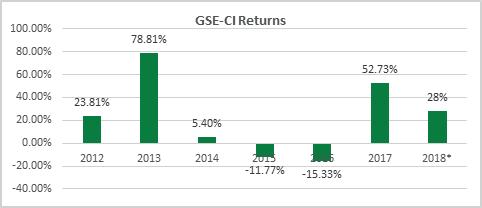
*YTD as at 14th February 2018
Source: Databank Research
Equities market momentum to continue on the back of stronger macroeconomic outlook and suppressed fixed income yields
While there are a number of factors for investors to stay mindful of, including relatively lofty valuations and possible sell-offs, Ghana’s strong economic outlook should provide investors with confidence about where the market is headed. In our view,

Ghana’s stock market will post another year of sizable returns. The GSE Composite Index has already recorded a stellar 28% return on a yearto-date basis (as at 14th February 2018) as the positive market sentiment continues to prevail and Ghana consolidates its macroeconomic gains achieved in 2017. Strictly speaking, Ghana’s real GDP growth will remain robust at 7.8% for 2018 according to Databank’s forecast (IMF: 8.9%). This growth compares favourably to the average of 3.4% projected for Sub-Saharan Africa for (IMF estimate) and is expected to be driven largely by increased oil and gas production and robust growth in the non-oil sector of the economy. We expect the prevailing low interest rates regime to provide further impetus for the stock market as fund managers rebalance their portfolios in favour of equities. Fixed income yields are likely to decline further this year, in view of the positive outlook for consumer price inflation, which is expected to reach a single digit by year-end
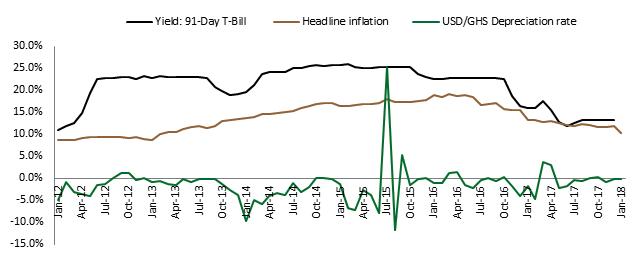
Source: Databank Research
Trend in leading macroeconomic indicators
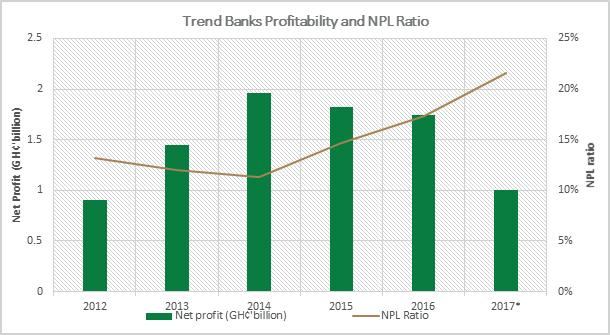
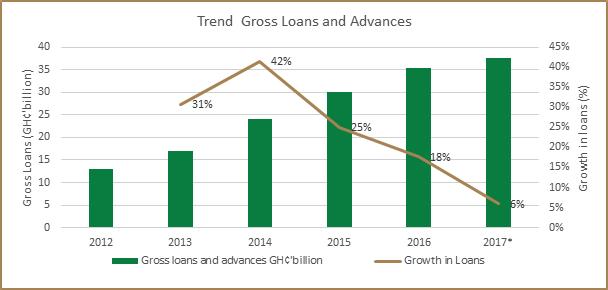
Bank stocks to be the leading lights on strong earnings expectations Looking ahead, we expect bank stocks to be the leading lights on Ghana’s equity market as banks’ profitability is set to record a rebound in 2018, in view of our expectations of improved NPLs levels and aggressive loan book expansion. The ongoing resolution of the energy sector’s indebtedness to the banking sector should translate into improved asset quality and stronger growth in profitability to boost the appeal of bank stocks on the equity market, going forward. As a matter of fact, in November 2017, the Government of Ghana issued a GH¢4.7 billion bond and an additional GH¢650 million in Jan-2018 through a Special Purpose Vehicle (ESLA Plc) in a move to bailout the highly
indebted energy related State Owned Enterprises (SOEs). It is significant to mention that the banking sector continues to grapple with the phenomenon of high non-performing loans as these SOEs are believed to be indebted to the banking sector at an estimated GH¢10 billion (US$2.2 billion). This has resulted in high impairment charges that, in conjunction with strong macroeconomic headwinds has suppressed the banking sector’s profitability for the past three years.
*As at June 2017
Source: Databank Research
We expect the banking sector to be awash with liquidity once banks complete their capital raising activity in a bid to meet the new minimum capital requirement of GH¢400 million (from GH¢120 million) by December 2018. We expect the increased liquidity along with the improved asset quality to encourage banks to expand loan books to enhance profitability in the coming years. With the minimum of GH¢400 million (US$90 million) in stated capital, banks in Ghana will be better capitalized to engage in larger ticket transactions on account of increased single obligor limits. This could boost Banks’ profitability and translate into stronger stock prices on the market. In addition, we expect the renewed national industrialization drive, aimed at establishing one factory in all 216 districts in Ghana to provide further avenues for banks to increase lending to the private sector to support profitability.
Author’s Profile
*As at June 2017
Source: Databank Research
A new regulatory regime could translate into stronger balance sheets for banks and present investment opportunities in bank stocks.
Alex Boahen is the Head of the Databank Research team. He currently supervises a team of Economists and Equity Analysts who cover Ghana and selected SSA markets. Alex joined Databank Group in 2011 as a Senior Equity Analyst, where he provided coverage of the Fast Moving Consumer Goods and the Oil Marketing Sectors in Ghana. Prior to joining Databank, he was lecturer at Regent University College of Science and Technology where he taught corporate finance, investments management and derivatives. He also had a stint with CDH Securities Limited as an Investment Banking analyst in 2010. Alex holds an MSc in Finance from the University of Gothenburg (Sweden) and MSc in Business Administration and Economics from Stockholm University (Sweden).
Ghana President Nana Akufo-Addo said the country’s banks should cut their lending rates for clients. Lenders are failing to pass on lower rates from the central bank and are standing in the way of economic progress, Akufo-Addo said Wednesday in an emailed copy of a speech he delivered at the Ghanaian unit of Ecobank Transnational Inc. in Accra, the capital. While the Bank of Ghana has reduced its key rate by 550 basis points to 20 percent since November 2016 as inflation slowed to the lowest in at least five years, lenders have continued to charge their clients an average of 29.3 percent to 31.7 percent since the start of the monetary easing cycle, he said. “The gap between what is happening to the decline in inflation and the lending rates being charged by the private sector is a gap we have to bridge,” Akufo-Addo said. “Lending rates must come down. And they need to come down as a matter of urgency.”
The year-old government of Akufo-Addo came to power on pledges to implement policies that will support the private sector. While growth in the West African nation is forecast to accelerate to 8.3 percent this year as oil producers continue to lift output from new fields, manufacturing and some services sectors remain under pressure as the high cost of debt weigh on their profits. “My challenge to you is to complement the efforts of my government,
which is creating a more stable macro-economic framework, by bringing down lending rates,” Akufo-Addo said.
In January, Bank of Ghana Governor Ernest Addison ruled out the possibility of setting a limit on lending rates. The central bank’s new capital requirements were designed partly to create bigger lenders that will operate more efficiently and enable them to bring down borrowing costs, he said.
In Kenya, President Uhuru Kenyatta introduced a cap on bank lending rates in August 2016 to spur access to credit in East Africa’s biggest economy. The move, which limited bank charges on loans to 400 basis points above the central bank’s rate, exacerbated dwindling demand for private-sector credit that was already slowing because of tighter industry regulations and the collapse of three lenders in eight months.
“Everybody, with the benefit of hindsight, can see the negative impact of putting into place interest-rate ceilings,” Addison said Jan. 22. “Capping of interest rates, I think, is completely out of the question.”
By Harrison Gitau, Senior Research Analyst, ApexAfrica, Kenya
he Nairobi Securities Exchange (NSE), with a market capitalization of USD 26.4B and 63 listed companies, remains the go-to place for investors looking to gain exposure to Kenya and the East African region. Despite various headwinds, the NSE closed an eventful 2017 firmly in the green, halting a multi-year bear run that started early 2015. The blue-chip NSE 20 index, comprising of 20 largest listed companies on the NSE, closed the year up 16.4%. Compared to an 8.0% y/y decline in 2016, the market’s performance in 2017 marks the start of a recovery in the Kenyan equity market.
Performance during the year was influenced by several macroeconomic and political factors. A severe drought during the start of 2017 pushed inflation to 11.5% in April 2017, the highest in over 5 years. Additionally, political uncertainty raised the country’s risk profile, resulting in increased risk aversion, which subdued investor appetite for Kenyan equities. Kenya made history this year, by being the first African country to have its presidential election annulled by the supreme court. The investor optimism and resilience witnessed in 2017 is projected to carry on in the medium term.
We expect the NSE to build on the gains recorded in 2017, supported by a better macroeconomic environment. The Kenyan Shilling, over the past two years, has seen a period of unprecedented stability, and the outlook for the local currency remains positive. Additionally, benchmark macroeconomic variables are all pointing in the right direction. Inflation is stable and will likely remain within the CBK’s targets over the medium term.
An important caveat to our economic expectations is the cap on lending rates implemented in Kenya in September 2016. Proponents of the cap claim that it levels the field for borrowers while enhancing sector transparency, while opponents say that the cap on lending rates has artificially slowed down economic activity. On the flip side, there have been extensive talks from treasury and parliament to review/repeal the rate cap given the adverse effects that it has had.
The political scene appears a bit calm despite hard-line stands taken by the Government. These have seen the international community express concerns over the deteriorating democratic space

in the country. Being the President's last term in office, the Government has stated intent to focus on 4 main areas, tagged the Big 4. These are food security, affordable healthcare, manufacturing and housing. The key concern is the failure of the Government to meet its revenue targets which impedes on budget implementation. The Government is however optimistic that a raft of tax reforms coupled with a rebounding economic activity will see KRA hit its revenue targets.
The impact of the various challenges in 2017 and opportunities will be reflected on paper when listed companies release their financial results. The earnings period is characterized by heightened volatility and a marked increase in trading volume; and therein lie opportunities. Savvy investors, who operate on the realization that a single year’s earnings do not reflect a company’s ability to create value for shareholders, will look for opportunities offered by market overreactions to corporate releases.
Despite challenges, the Kenyan equity market remains highly attractive for investors. Strong companies are currently trading well below historical multiples. For instance, the average price-book of listed banks stands at 1.2X, while dividend yield hovers at 4.7%. Kenya’s telco and fintech giant Safaricom is already up 9.4% this year after marking a new 52-week high in the first few trading days of the year.
This year, we expect investors to focus on the energy, telecommunications and financial services sectors with the companies under focus including Kenol Kobil, Kengen, Safaricom, KCB Bank, Equity Bank and Cooperative Bank. With the talks surrounding the review/repeal of the rate cap, interest on banks is anticipated to remain heightened.
Contributor’s Profile
Harrison Gitau joined ApexAfrica in May 2016. He is a Senior Research Analyst covering cement, energy and telco companies listed on the NSE. In addition, he covers the macro-economic developments in Kenya and Tanzania. He holds a BSc in Actuarial Science from Maseno University, is a CPA graduate and is currently working towards attaining the CFA Charter.
By Bhavik Desai, AXYS GROUP, Mauritius
he Mauritian economy has not fired on all cylinders since the Great Financial Crisis of 2008. GDP growth rates have hovered between 3.5% to 3.9% in recent years and have yet to break the 4%-mark. 2018, a decade on since the crisis, is expected to be the year when the psychological 4%-mark is either achieved or crossed.
In the immediate aftermath of the crisis, tourism was among the most affected industries. Sub-optimal tourist arrivals coupled with increased supple of rooms triggered an inward spiral for room rates. While tourism struggled, the construction sector was doped by major infrastructure projects which included a new airport terminal, and new roads/highways while the private sector was completing hotel and high-end residential developments which had kick-started before the crisis. However, upon completion of these projects, the dearth of fresh private or public investment triggered a 5Yr-Long recession for the construction industry. Adding to the woes was the renegotiation of the Indo-Mauritian Double Taxation Avoidance Agreement which restored India’s ability to charge capital gains tax a little over two years ago which would require a re-engineering of the sector.
Faced with these headwinds, policy adjustments ensured, key among them was the opening up of skies to seasonal operators from both Europe and Asia. Tourist arrivals growth accelerated since 2015 driving average occupancy rates up from the mid-60s into the 70s and consequently room rates have begun to rise. This positive trend is expected to continue for the foreseeable future.
Beyond tourism, Government reviewed and rationalised property development schemes in which non-residents were allowed to invest and addressing the areas of concern which hurt its “Doing Business” rank therein propelling Mauritius to 25th (up 24 spots) in 2018 ranking. This has given fresh impetus to Mauritian conglomerates to develop “Education” or “Logistics” themed

“Smart-Cities” under the revised development schemes. In addition to these new private sector projects, fresh public road decongestion projects kick-started in Q1-18 after lengthy delays, with the centre-piece being a light rail project linking Curepipe to Port-Louis. Prospects for the construction industry – forecasted to grow at 7.5% in 2018 – thus look promising. As for the Global Business sector, the shift in the industry came from an unexpected source: Large Multi-Nationals including Sanne, SGG and Ocorian groups buying out large Mauritian players IFS, Cim Global and Abax at relatively high multiples. A presence in Mauritius for multi-jurisdictional service providers appears to be an integral part of their strategy. This segment is thus poised to evolve from “Global Business” to providers of outsourced “Professional Services” such that demand for audit, legal, secretarial and other professional services is expected to increase in the medium term. m.
Prospects for the Mauritian economy, which celebrates half a century of independence this year, is thus looking promising with the 4% GDP growth rate achievable. In order to partake and/or benefit from the upside in construction, only two offerings are available: United Basalt Products Ltd (UBP) which manufactures and deals in building materials, and Gamma-Civic Ltd (GAMMA) which also deals in building materials but also does contracting work and holds other investments. Buoyant tourism, especially driven by room rate increases, are expected to benefit hotel groups, Sun Resorts Ltd (SUN), Lux Resorts & Hotels Ltd (LUX) and New Mauritius Hotels Ltd (NMHL) locally. However proceed with caution as exposure to Maldives for some could affect performance in light of the recent political unrest whose impact on tourism in the Maldives was not fully known at the time of writing. And finally, given the state of the general economy, Banks SBM Holdings Ltd (SBMH) and MCB Group Ltd (MCBG) are also expected to benefit from the upside albeit with differing lending loan book growth rates.
By Jerry Nnebue, Investment Research Analyst, CardinalStone Partners, Nigeria
entiments are building favourably towards the domestic macro-economic environment as a follow-up to last year’s recovery from economic recession. Broadly speaking, the World Bank has projected a GDP growth of 2.5 percent for Nigeria in 2018 and we expect this to filter positively into the equities market on the back of further improvements in macro-economic variables. We also note the heightened foreign investors’ interest in the equities market, notably since the Central Bank of Nigeria introduced the Investors’ and Exporters FX window in late April, 2017 to allow for easing of FX constraints. This is highlighted by the fact that foreign transactions in the equities market increased significantly by 133 percent in 2017 compared to 2016 and we expect this trend to persist. The decision to retain Nigeria in the MSCI Frontier Markets Index also juices up the burgeoning prospects of the market. This is in addition to rising oil prices, oil production recovery, declining inflation, foreign reserve accretion, currency stability, increasing corporate investment, rising consumer confidence as well as expectations of an accommodative monetary policy.
The financial services sector enjoyed a robust 2017 supported largely by high yields on most banks’ treasury assets. However, as yields have trended downwards recently, we expect banks to refocus efforts in building their loan assets to ease the pressure on net interest margins. Also, the recent uptrend in oil prices have positive implications for bottom-line as banks with huge exposure to the oil and gas sector are expected to record lower impairment charges than previously anticipated. We also expect to see gradual write-backs and possible reclassification of non-performing loans over time.
Most FMCG firms are going through a recovery phase from the impact of harsh macroeconomic variables- which began in 2015- on their bottom-line. As oil prices continue to recover, we expect lingering stability in the exchange rate to, in addition to the easing of fx constraints, soften the pressure on cost of imported inputs and also

alleviate the burden of foreign exchange losses which have hitherto hampered profitability. More so, we are of the opinion that, in the light of expected low interest rate environment, most consumer firms will embark on capital restructuring or balance sheet deleveraging in order to ease the pressure of high finance costs on their net margins. Consumer confidence crossed positive for the first time in twelve quarters to 1 percent in December 2017 and we expect this to rise further as perception about the domestic economy remains favourable. This, in addition to gradually improving real wages for households (as a result of moderating inflation) should spur a consumption boost and be a key catalyst for volume growth in the consumer goods space in 2018.
There was an observable slowdown in the industrial sector in 2017, no thanks to the slow pace of the passing and implementation of the 2017 appropriation bill. Nevertheless, we are optimistic of a more vibrant industrial space in 2018 following the Federal Government’s plans to rollover sixty (60) percent of the previous year’s CAPEX into 2018. 2018 also, is a pre-election year, as such we highlight the expected positive implication this portends for increased infrastructural spending in order to retain- or gain as the case may be- the confidence of the voting populace. Thus, industrial firms such as DANGCEM and WAPCO look set to feed off increased fiscal bounty.
Key risk to our expectations Nigeria’s economy remains principally dependent on international crude oil price volatility and this, in addition to possibility of resumption of disruptions in production activities by Niger Delta militants pose great risk to economic stability. Essentially, a repeat of events that led to the slowdown of growth in 2015 with the attendant economic woes, could lead to waning of consumer confidence, with a negative spillover effect on foreign perception of the domestic market. More so, any heightened political tensions in the 2018 pre-election year portend hostile implications for the capital market.
By Chris Holdsworth, Head of Equity Research, Investec, South Africa

he past two years have seen a remarkable rally in SA equities. The MSCI SA is up 100% in USD off its lows two years ago. This leads to the natural question – is there much more to go? To answer this question one must look to the dispersion within the SA equity market. The constituents of the South African equity market can be broadly grouped into three categories – SA inc (retailers, banks, SA industrials), Resources and Global Consumer Plays (Naspers, Richemont etc).
The key call for SA inc shares is whether any tax increases announced in the February budget will wipe out gains that consumers are experiencing from low inflation (inflation in SA has been below 6% since April 2017, the total wage bill in SA was up 7.8% yoy in Q3 2017, the last data point). The maize price in SA is down 50% yoy and SA is still experiencing import price deflation - given the strength of the ZAR, this is likely to continue for the next few months at least. Increasing oil production out of the US should put a cap on oil prices. The net result is as things stand the inflation outlook is looking fairly benign at the moment.
This may even allow the MPC to cut rates by 25bps in H1 2018, further aiding consumers. However, there is a question mark over how the government aims to funds its shortfall in February. Presumably there will be tax increases of a sort – a VAT increase (not our base case) would put the SA inc. call in jeopardy. We can expect bracket creep, possibly another fuel levy increase and a shifting of the brackets but without cutting government expenditure elsewhere, this may well not be enough. The buoyant backdrop suggests a strong performance for SA inc even after the post Cyril rally but the budget poses significant risk.
“In our view, the outlook for the resources sector is less uncertain.”
Global growth is currently synchronized and strong (the IMF expects global growth of 3.9% in 2018). This is the very environment under which commodity prices, and industrial metals in particular, do well. In addition, by our estimate, mining companies in SA are not pricing in the currently observed commodity prices, never mind the prospect of rising ones over the next 12 months.
“Add in the possibility of a more business friendly mining charter and the outlook for returns for the year ahead, in our view, for the resources sector looks strong.”
The Global Consumer Plays largely track DM indices when measured in USD. There the prospect of rising core bond yields and a normalisation of risk measure pose significant risk.
In addition DM equity indices are trading at the highest premium relative to EM indices (based on 12m forward P/Es) since 2004. In addition, a strong global environment traditionally sees DM earnings growth significantly underperform EM earning growth.
The net result is that our expected return for the aggregate market is fairly modest but given the global backdrop and the possibility of more business friendly regulations, we do see opportunities in the SA resources sector. While SA inc looks interesting even after the post Cyril rally, the budget poses some risk and we think that as a sector the global consumer plays are unlikely to provide strong performance over the year ahead.
By Muma Ng’ambi, Investment Analyst, Pangaea Securities, Zambia
he fluidity and dynamism of Zambia’s capital market has been largely dictated by macroeconomic fundamentals and investors perceptions and expectations of the economy. It is no secret that a country’s ability to attract and maintain foreign capital flows is vital for its economic and capital market growth trajectory. Fortunately, 2017 ushered improved economic conditions for Zambia as compared to headwinds experienced in 2016.
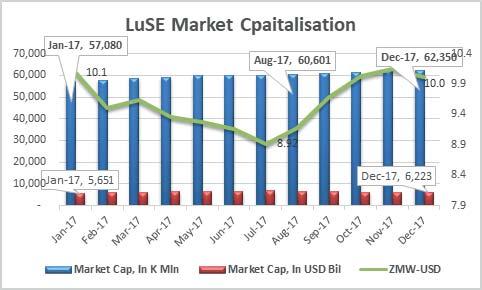
Healthier macro-economic conditions, filtered positively into investors’ perceptions and prompted them to participate in the capital markets. We saw all 24 listed companies increasing in trade volumes throughout the year. The Lusaka Securities Exchange (LuSE) recorded turnover of US$ 120 million and 852 million trading volume in 2017. LuSE All-Share Index (LASI) closed 5,327.58 points in December of 2017, pushing the index up by 26%, year to date. Foreign portfolio investment inflows increased to US$ 19.8 million in 2017 compared to a measly US$ 7.38 million in 2016. Moreover, market capitalisation gained by 9% in kwacha terms to ZMW 62.35 billion compared to the 12% drop in 2016. However, in US dollar terms the market capitalisation increased marginally to US$ 6.22 billion from US$ 5.81 billion because of the appreciation of the kwacha against the US dollar. According to Bank of Zambia (BoZ)1 , there was higher participation by non-resident investors in government bonds and t-bills. With yields on government securities declining through 2017, reflecting heightened investor sentiment and demand. Market participation on the equity market was dominated by domestic activity accounting for 67% whilst foreign participation was 33%.
SOURCE: Lusaka Securities Exchange; Pangaea Securities

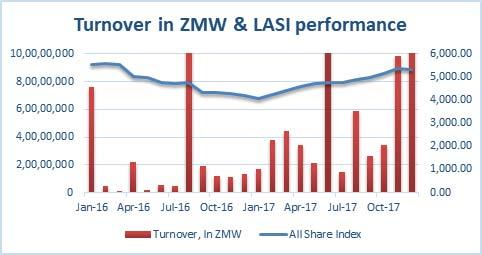
SOURCE: Lusaka Securities Exchange; Pangaea Securities
The consistently top performing sectors were Banking and Energy in terms of trades, volume and turnover through 2017. They accounted for 60% of the turnover, 50 % and 85% of trades and volumes, respectively. The Banking sector performance was augmented by the trickling of liquidity following the loosening of the monetary policy and statutory reserve ratio. Additionally, positive business outlook and reduced inflation coupled with improved cost management pushed performance in the sector and encouraged investors. The thrust witnessed in the Energy sector came from improved energy generation that permeated to the efficiency of mining production and output of other industries. Furthermore, to spur private investment in the sector, the Energy Regulation Board(ERB) hiked tariffs so that electricity prices become more cost reflective.
Illiquidity on the LuSE remains a challenge, with turnover as a percentage of market capitalization only at 4.24%. A report published by Barclays Africa Group financial markets index2 found Zambia to have high level of product diversity but low liquidity. Illiquidity is closely linked to the financial innovation, market and trading structures and institutional infrastructures. Commendably, Securities Exchange Commission (SEC) of Zambia has implemented various policies and regulatory framework for supervision and development of the LuSE as well as to increase its competitiveness and enhance credibility.
Yet, 25 years post the establishment of LuSE, there are still only 24 listed companies and the last initial

public offering was in 2014. This goes to show most firms still rely on traditional bank finance for growth capital. To further promote market participation and liquidity, LuSE introduced alternative market for small to medium companies with lower trading turnover looking for growth capital, which has no listing thus far.
Zambia’s capital market has made big strides and has continued to provide a new source of long term funding. It continues to be a conduit to match savings from institutional investors and pension houses within the country and corporates seeking investment funding. Moreover, there is room for development with a meager market capitalization to GDP of 13%.
In 2018 we expect LuSE performance to continue with the upbeat tempo from 2017 due to maintained sound marco-economic conditions and fiscal policies. With top sector picks remaining as Banking and Energy sectors with anticipation of major capital market transactions in the near future.
Contributor’s Profile Muma Ng’ambi is experienced in Investment consultancy in both Zambia and South Africa with a solid economics and finance background . She currently as Investment analyst at Pangaea Securities, Zambia.
Muma has a masters Degree in Finance and Investment from Wits Business School along with Honors Degree in Investment Management.

CAPMARKETSAFRICA: Is now a good time to take a risk on African markets?
OLIVER BELL: We believe Africa’s long term-potential is starting to unlock. While some country-specific issues linger, we are optimistic that recent developments should gradually lead to healthier economic backdrops, which will in turn be more conducive to corporate earnings growth.
South Africa is a chief example where we believe Jacob Zuma’s resignation as national president marks a major political and economic inflection point. Under the stewardship of Cyril Ramaphosa, we believe the country is due a major reversal of fortune as his African National Congress (ANC) Party deepens their anti-corruption drive and prepares a reform-minded agenda.
Elsewhere on the continent we grow more positive about the outlooks for Egypt, Kenya and Nigeria, which are important economies in considering wider regional growth. We’ve just returned from Nigeria where things on the ground felt a lot better with support from a better functioning exchange rate and a higher oil price.
RANDOLPH OOSTHUIZEN: 2017 was a good year for African markets, although performance did lag world markets (MSCI Africa ex SA: +23% vs MSCI Frontier and Emerging Markets around 31% each). On valuation ratios African markets are not generally cheap but relative to frontier markets and emerging markets it does offer some value (e.g.

dividend yield of 3.5% vs 2.9% and 2.1% for frontier and emerging respectively). Egypt and Nigeria have been offering great carry trade opportunities over the last year and have seen an influx of fixed income portfolio flows. As monetary policy moderates in these countries this carry trade will unwind and may pose a risk to currency stability. Whereas investment returns over the last three years (to around mid 2017) were driven mainly by country/currency selection we think the current environment favours stock/sector selection once again. In Egypt for example, consumer stocks suffered in the aftermath of the 100% EGP devaluation, struggling to pass on costs to embattled consumers. In contrast, Egyptian banks benefited from surging t-bill yields. The Central Bank of Egypt’s recent decision to cut rates signals the start of an easing cycle that will hopefully stimulate fixed investment and consumer spending. In Nigeria, the non-oil economy is still struggling but the steadily rising oil price and increased oil production, combined with improved FX liquidity from the so-called Investors and Exporters (IEFX) foreign currency window are reasons for some optimism.
CAPMARKETSAFRICA: What are some of the fundamentals that you consider when looking at African markets?
RANDOLPH OOSTHUIZEN: We have a comprehensive analytical framework that considers a variety of factors. These include the usual macro-economic variables such as GDP outlook,
inflation, interest rates, balance of payments and government finances. The most important factor driving returns is how a country’s currency performs so we spend a lot of time understanding a country’s approach to its currency. Currency regimes differ quite a lot, from the fully floating ZAR to the West African monetary unions (XOF, XAF) and a wide variety in between. When looking at the managed floats of larger markets like Nigeria and Egypt it is very important to understand policy dynamics. Spending time in these countries and meeting with policy makers, gives one an understanding of the trade offs they are willing to make. In Nigeria, for example, it is very doubtful whether policy makers will allow a currency devaluation ahead of the 2018 elections. Apart from economic fundamentals, we also consider overall market variables such as earnings growth, profitability (e.g. ROE), earnings yields vs bond yields compared with valuation metrics such as P/E and P/B. All else equal, as earnings growth picks up one would expect a market trading up to higher P/E multiples. Since African markets are at different stages of development, fixed income markets vary substantially so it is not always easy to establish the opportunity cost (typically long-bond yields) for investors. In these cases it is important to understand the local fund management industry, including its’ size, structure and mechanics but importantly also what instruments they can invest in.
OLIVER BELL: One of the biggest attractions of investing in Africa is the ability to tap into high, sustainable GDP growth. While many developed and emerging markets are experiencing a slowdown, economies across Africa are urbanising at a faster pace than anywhere else in the world, with support from a young and growing workforce, a strong asset base and rising levels of infrastructure spending.
CAPMARKETSAFRICA:What are some of the challenges you see in African markets at the moment, and how does that influence your investment decisions?
OLIVER BELL:We keep watch on a number of economic developments this year such as in Kenya where a lifting of caps on interest rates charged by the banks would prompt us getting more excited. The cap has prevented banks from being able to price risk sufficiently and has withdrawn vital credit extension from the economy. In Nigeria, we want
to see full unification of all the various exchange rates, and for the resulting rate to be free-floating. This should help attract significant foreign re-investment and accelerate the economic improvement which is underway.
RANDOLPH OOSTHUIZEN: In Africa (and frontier markets in general) we see three types or risk –currency, political and liquidity. We think that currency risk has abated for now, especially in larger markets like Nigeria and Egypt, whilst liquidity has also been improving. Political risks vary from country to country and needs continuous monitoring, especially around election periods. Political risk is not only the risk of violence or unrest, but also changes to rules and regulations. In Tanzania for example, President John Magafuli has been ringing the changes since taking office in 2015. This includes slapping gold miner Acacia with a humongous fine in 2017 and forcing Vodacom to list its local business to comply with its license conditions. In addition, the banking sector suffered from a number of changes, including a switch to a central treasury account for government. The so-called TSA (treasury single account) is something that has been implemented by a number of governments in recent times and affects the banking sector by removing a significant source of cheap funding. Changes to the rules can be good and bad – as investors we welcome new investment opportunities such as Vodacom Tanzania, but we also need to be wary of stocks and sectors that might be subject to compliance clamp downs (recall MTN’s USD 5.2b fine in Nigeria, later reduced to around USD 1.7bn), price controls and tax increases.
CAPMARKETSAFRICA: And, how do you see the sea-change in global politics affecting African equity investment? What are the downsides and upsides?
OLIVER BELL: Many of the companies we invest in are domestically-driven, especially the banks and consumer companies - so global politics are, with some exceptions, less of a factor. Meanwhile the local political climate looks more stable, not only in South Africa but also considering the end of Robert Mugabe’s 37 year rule in Zimbabwe and these changes should have a knock-on effect to neighbouring countries and the wider economy.
RANDOLPH OOSTHUIZEN: Global politics is too noisy to make a call on so we rather focus on
understanding local politics well.
CAPMARKETSAFRICA: What types of investments country will be significantly hindered by the US dollar strengthening and which ones may rise from this?
OLIVER BELL: In 2017 we saw a nearly 10% decline in the USD, which has been supportive to those African companies and countries with significant dollar-based debts, such as Egypt, Nigeria and South Africa. If the US Dollar was to strengthen this year debt payments become more burdensome, but the impact could be offset by a higher level of investment, and as African exports look more competitive.
CAPMARKETSAFRICA: How are macroeconomic decisions elsewhere – particularly monetary policy at the US Fed and the ECB – affecting the environment for African investment and growth? What are the consequences for FDI coming to the market?
OLIVER BELL: Global monetary policies remain

largely accommodative, but the Federal Reserve and ECB have been signalling the end of policy easing for some time now. Most African countries should be positioned to weather this - external balances and foreign exchange reserves have improved across some of its key economies.
We believe FDI is ultimately driven by domestic improvements such as better politics, a stable currency and attractive relative growth. In South Africa, we already see a recovery in investment levels this year as confidence rebounds.
RANDOLPH OOSTHUIZEN: A stronger dollar is generally bad for African economies as they run current account deficits. A stronger dollar also means lower commodity prices. And tighter monetary policy in US and ECB means less money sloshing around so less portfolio flows. To the extent that tighter policy signals growth in the real economy one would expect FDI to pick up though.
CAPMARKETSAFRICA: Thank you very much for granting this interview!
CAPMARKETSAFRICA: There has been a lot of talk about how African story had been over-sold and why investor needs to have a long time view rather than expect a short-term return. What is your take on this? And how would you sell the investment potential story of Africa?
OLIVER DREWS: Like in Asia in the past, the most volatile factors of the African investment environment today are the perceptions of foreign investors about the continent. The upward trajectory of most African countries and sectors is a reality, so at times when perceptions are negative, or not that great, those are the best times to engage for the long-term.
CAPMARKETSAFRICA: What makes the continent attractive to investors and which sectors are generating high levels of inbound investment?
OLIVER DREWS: The data shows that inbound investment is increasingly diversifying, which should lead to more stability and also allow for more employment opportunities at better conditions, which in turn drives sustainable growth and a fuller bouquet
of investment opportunities. For us at Clifftop we like agric, food & consumer, media & technology, especially around the digital inclusion theme, light industrial and healthcare.
CAPMARKETSAFRICA: What considerations should investors make when structuring and financing deals in Africa, to maximize ROI?
OLIVER DREWS: Once you get your head around currency, regulatory environment, exchange controls etc., I think the single most important considerationin whichever sector - is transparency and control on an ongoing basis. Make sure you are setting up the right financial management structures that allow you to monitor operations correctly, spot red flags early and build the asset. I see too many investors focus only on the actual transaction, looking for protection through contractual clauses but not doing enough to actually implement operational best practices in the investee companies, which means having adequate and functioning systems, clearly defined processes and people properly trained to provide the back bone for the operation.

CAPMARKETSAFRICA: Firstly, let’s talk about you. Please tell our readers more about your background and what motivated your choice of career path?
ABUBAKAR JIMOH: Thank you. My name is Abubakar Jimoh, the current Group Managing Director of Coronation Merchant Bank Limited (formerly Associated Discount House). I started my career in 1990 with Prime Merchant Bank Limited as an Analyst in the Corporate Banking Team. I later joined Express Discount Limited as a Securities Trader I worked with Royal Bank of Canada for about 7 years between 1999 and 2005. I have worked for over 28 years in various investment management, credit, risk and project management capacities covering Credit and Portfolio Management; Project and Operations Risk Management; Market Risk management; Risk Policies and Reviews; COSO; Enterprise Risk Management (ERP); SOX and Basel II and ICAAP implementations, and Client relationship management. Between 2005 and October 2008, I was a Divisional Chief in charge of Private Sector Portfolio Management with the African Development Bank (ADB).
Prior to joining Coronation Merchant Bank/ Associated Discount House Limited, I was a General Manager and Divisional Head at the UBA Group with responsibilities for Group Balance Sheet Management, Market Risk and Investor Relations. My roles covered Group Asset and Liability Committee effectiveness and ensuring that the group had an effective and sustainable balance sheet structure. I worked at various times within the UBA Group as the Chief Risk Officer (CRO) for various business segments, including UBA Africa (the 18 African subsidiaries of UBA PLC), Group Institutional Banking and Subsidiaries, Group Treasury and Investment Banking, Corporate and International Bank, and UBA Capital.
In terms of academic qualifications, I hold a Masters of Science in Finance and Bachelor of Science in Finance from the University of Lagos. I am also a Certified Financial Risk Manager, Chartered Financial Analyst, Certified General Accountant of Ontario in Canada, Chartered Internal Auditor, Associate, Chartered Institute of Accountants of Nigeria and an Associate, Chartered Institute of Bankers of Nigeria.
CAPMARKETSAFRICA: Now, to Coronation Merchant Bank (Coronation MB). What led to the creation of Coronation MB? What does Coronation MB do? Which areas of financial services is it engaged in ? What category of clientele and any major recent or upcoming trans-actions?
ABUBAKAR JIMOH: This Company has been in existence since 1993, but it operated as a Discount House. Associated Discount House Limited (ADHL) became a leading financial services institution, thriving through a tough period for the Nigerian economy. The company transitioned from a pure play discount house to a well-diversified financial services power house in 2015, offering investment and corporate banking, private banking/wealth management and global markets/treasury services to our select clients. Coronation MB was established to fill the gap in a long-underserved market segment, seeking to address the need for
long term capital across key sectors of the economy. Knowing fully well that the provision of affordable, longer term financing is critical for sustainable economic growth and its absence is one of the key challenges facing African entrepreneurs and corporations. The transitioning has provided various business opportunities, especially in the Capital market.
We cannot serve everybody, so we have decided to focus on corporate clients, high net-worth individuals, and financial services businesses. We have a well-defined market segment and our approach to serving our clients is totally different from a conventional Commercial Bank. We have a clear market demand for more sophisti-cated banking services from Nigeria’s top-tier corporates and we will focus on bringing world-class advisory services, accompanied by innovative products and services to Nigeria.
Recently, we creatively introduced a credit enhancement mechanism, known as Liquidity Back-Stop Facility, to the commercial paper offering of a leading Real Estate Company in Nigeria. Our collaboration with the client in providing the backstop facility is the first of its kind in Nigeria and its ingenuity boosted the investment grade of the commercial paper to “A-“, despite the issuer’s “Bb-“ Agusto rating – representing a 6 notch improvement. The significant improvement in the rating made the pricing of the offer attractive to both the Issuer and the investors as the Issuer was able to lower its cost of borrowing by almost 600 bps, invariably reducing its cost of capital thereby creating immense value to its shareholders.
CAPMARKETSAFRICA: Recently, Coronation
Merchant Bank won the “Merchant Bank of the Year award” in Nigeria. Please tell us what are CMB’s competitive advantages and challenges?
ABUBAKAR JIMOH: We have a clear strategy based on our competitive advantage: exceptional local knowledge combined with world-class financial solutions. Our robust distribution network and strategic alliances – both regional and international– enable us to provide high quality services across West Africa and beyond, identifying markets and sectors for development.
Our resilient business model has enabled our business to record considerable success in the few years of our operations despite the challenging economic environment. We have a clear strategic objective to operate a lean and highly efficient organization while we leverage our technology infrastructure to drive the efficiency of our business operations.
With the increasing NPL ratios among financial institutions in Nigeria, we have implemented a robust risk management framework backed by a well-defined risk management strategy, philosophy and culture for continuous improvement of our loan portfolio. We have defined our risk appetite to be moderate and we are determined to focus on corporate clients, high net-worth individuals, and financial services businesses that meet our risk acceptance criteria.
“We cannot serve everybody, so we have decided to focus on corporate clients, high net-worth individuals, and financial services businesses”
Coronation Merchant Bank specifically focuses on bringing its world class advisory and financing capabilities, accompanied by innovative products and services to deepen and broaden the wholesale banking and capital market space, whilst remaining committed to our values of strong governance and transparency.
CAPMARKETSAFRICA: In your view, what are the key areas requiring improvement in order for the Nigerian financial markets to attain their full potential?
ABUBAKAR JIMOH: A sound and efficient financial market system is critical to the growth and development of the Nigerian economy. In any economy, problems of inefficient allocation of financial resources and information asymmetry may arise as one financial institution possesses superior information than other parties. Hence without an efficient capital market, the economy may be starved of the required long-term funding required for a sustainable growth.
The efficiency and effectiveness of the Nigeria financial market have greatly been limited by various factors, notable among which is the structure of the economy, which is dominated by oil production. Appropriate policy mix and institutional frameworks for the financial market to effectively carry out its core purpose of its establishment must be in place to ensure that the expectations of both the lenders and users of funds are adequately met.
It is interesting to note that our regulators i.e. the Securities and Exchange Commission (SEC) and the Central Bank of Nigeria (CBN) understand that the Nigerian capital market has amazing potential to serve as a catalyst for getting more people into the financial services industry. Recently, the regulators have commenced the implementation of key policy initiatives to deepen the Nigeria financial market, boost investors’ confidence and drive investment with new technologies. For example, the e-dividend management system, which was launched last year by the SEC in collaboration with the CBN and the Nigeria Interbank Settlement System (NIBSS), has enabled investors to have direct access to their dividends, and has enjoyed some level of compliance from the investing public.
Also, for the Nigerian Financial Market to attain its full potential, achievement of financial inclusion for a significant fraction of the population is critical. Currently, about 41.6% of the Nigerian population is financially excluded.
CAPMARKETSAFRICA: Have Nigerian banks overcome their aversion to lending and what areas of the economy would you increase lending to?
ABUBAKAR JIMOH: I don’t think any of the Nigerian banks at any point in time stopped its lending activities. Merchant Banks and Commercial Banks are in the business of financial intermediation, i.e. the process through which banks channel surplus funds from the lenders to borrowers. The critical issue here is the quality of the clients and the economic sector(s) that banks want to focus on. All banks pursue the lending business based on their risk acceptance criteria as stipulated in the risk management framework.
At Coronation Merchant Bank, we have implemented a robust risk management framework backed by a well-defined risk management strategy, philosophy and culture for continuous improvement across all our businesses. We have also defined our risk appetite to be moderate and determined to focus on corporate clients, high net-worth individuals, and financial services businesses that meet our risk acceptance criteria. Specifically, for a proactive and forward-thinking organization like ours, risk profiling is critical and essential. We have carefully defined our market segments as well as our approach to serving our clients which will be totally different from that of commercial banks. Our lending activities will be tailored towards the Coronation 200 - target clients that cut across the businesses in various economic sectors, therefore our lending activities will not discriminate against any sector of the economy, but will continue to be guided by opportunities and risks we see in each financing transaction.
CAPMARKETSAFRICA: What, in your view, should the Federal Government and policymakers be doing to attract foreign direct investment (FDI) and promote private sector-led infrastructure development in Nigeria?
ABUBAKAR JIMOH: Policy implementation has a tangible effect on the ability of foreign strategic investors to invest and participate in the Nigerian economy, and the Federal Government is active across several different areas. There is a range of measures which have been successful in the past, one example being project management of road building.
Foreign strategic investors look to business
indicators, such as the World Bank’s Ease of Doing Business rankings, and it is inevitable that such international agencies will strongly influence foreign direct investment over the coming years. In the World Bank’s Ease of Doing Business 2018 report, Nigeria was cited as one of world’s top-ten most improved nations for ease of doing business comparing 2017 with 2016. This well-earned result in improving both business conditions and the country’s external reputation.
It is important, and it is entirely possible, that this regulatory momentum is maintained, because Nigeria’s overall score in the Ease of Doing Business ranking is not particularly good. We are competing with many other countries for investment, and we cannot rely on investors overlooking these issues while positively assessing our abundant natural resources and favourable demographics.
If we look at specific issues, such as getting credit and protection of minority interests, Nigeria is considered among the best countries in the world. So, it is not unrealistic that policymakers can improve areas where we do not score well, such as resolving insolvency and enforcing contracts. Improving electricity supply is also possible to achieve. Infrastructure development is likely to improve when a broad range of business indicators have improved, and impediments have been resolved. The private sector, including foreign strategic investors, are very likely to react to an improvement in the business environment, and I believe we will see increases in investment and deepening of our capital markets as a result.
CAPMARKETSAFRICA: Given the prominence of counterparty credit risk in financial markets deals, to what extent can this risk be mitigated aswell as managed in Nigeria?
ABUBAKAR JIMOH: The management of risk in financial market deals requires various levels of rigorous risk analysis, risk assessment, evaluation, control, monitoring and reporting. Generally, for financiers of long term projects in Nigeria, the challenge of risk management is immense. This is so because they are exposed to a wide spectrum of risks like credit, market, liquidity, operational, counter party, reputational, investment, strategic and legal over a longer term. Counterparty risk is the risk to each party of a contract that the counterparty will not live up to its contractual
obligations. It’s also called the default risk. The key to managing the counterparty risk is to have an enterprise approach to risk management. This can be achieved by identifying all the inherent and potential risks per project and consequently evaluating and mitigating them. Since these risks are long term, effective control, monitoring and reporting must be in place. In addition to effective risk acceptance criteria, the risk can further be mitigated via adequate and proper documentation of transaction terms.
To a large extent the counterparty credit risk can be effectively mitigated and effectively managed in most financial market deals.
CAPMARKETSAFRICA:
What strategic plans do you have in place to maximise profitability as well as enhance shareholders’ value? And where do you see Coronation Merchant Bank in 10 years from now?
ABUBAKAR JIMOH: In the next 10 years, I see Coronation Merchant Bank as the premier Investment Bank in Africa. We are setting standards of excellence in the Nigerian banking sector and beyond.
Our journey towards unparalleled market leadership is driven by a combination of service excellence, product innovation and market intelligence. This is the platform for success that creates sustainable value for our investors. We have a clear strategy based on our competitive advantage: exceptional local knowledge combined with world-class financial solutions.
Our unique value proposition is to deliver world class solutions to our esteemed clients in a cost-effective manner whilst leveraging our local extensive knowledge and technology. We also leverage our best-in-class human capital to deliver value-enriching solutions to our clients. Our quest for industry distinction is evident in our corporate identity which has been designed to communicate the Group’s vision, ambition and inner strength.

CAPMARKETSAFRICA: On a personal note, what do you do in your spare time, when not busy managing Coronation Merchant Bank?
ABUBAKAR JIMOH: I’m a family person and pride myself on spending my spare time and vacation with my wife and children. In my spare time, I also enjoy playing golf. Playing golf has always been part of my life.
CAPMARKETSAFRICA: To bring the interview to an end, how would you like to be remembered?
Coronation Merchant Bank will focus on bringing its world class advisory and financing capabilities accompanied by innovative products and services to deepen and broaden the wholesale banking and capital market space, whilst remaining committed to our values of strong governance and transparency.
ABUBAKAR JIMOH: Of course, I want people in my life to remember me with love! But I am thinking of that maxim, “the success of a man cannot be measured by their own achievements but rather the achievements of their successors” – or something like that. I want to be remembered as the pioneer MD that led the transformation of failing ADH to a viable one and led the conversion of the company to a Merchant Bank. I want to be remembered as the Managing Director that laid the foundation (i.e. People, Processes, Systems and Structures) for a sustainable future growth of the Bank. I will also like to be remembered for the lives and generations that I would have impacted positively in the course of my career.
CAPMARKETSAFRICA: Thank you very much for granting this interview!
By Conrad Wood, founding member of ALUWANI Capital Partners
nvestors in South African fixed income markets have been taken on a roller coaster ride since that fateful day on 9th December 2015 when then Finance Minister, Nhlanhla Nene, was unceremoniously removed from office and replaced by the unknown Des van Rooyen. This brazen act by President Jacob Zuma was widely considered as the intensifying of the unadulterated “capturing” of the State for personal gain by a cabal of cronies. This would prove to be both devastating and tragic for the country over the next two years.
For experienced, offshore investors, this was simply elevated political risk, common in many of the emerging markets in which they invest. But for local investors, spoilt by two decades of stable and credible policy decisions, this was a shock and something very difficult to incorporate into the investment decision making process. How do you price for the vagaries of political risk, what would happen if South Africa lost it’s hard earned investment grade credit rating and should we be trying to use the bargaining power we have as funders’ of the state to try and bring about change? This was the beginning of a two year period, where despite a relatively constructive environment for emerging bond markets, South Africa endured a volatile period of several sell-offs in yield, where investors’ collectively held their proverbial breath in case this time “we” were going over the cliff. Indeed, investors in local bonds (ALBI total return index) have underperformed money market (STeFI composite index) on a buy-and-hold basis for the 3 year period, ended 31 December 2017. Hardly a compelling risk-adjusted proposition.
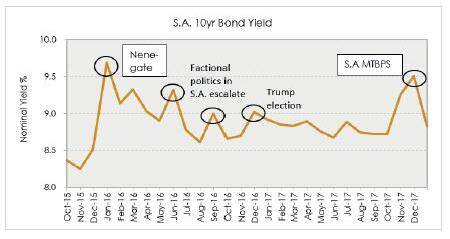

But, South Africa is an incredibly resilient place. A blend of developed and emerging world characteristics in one. It is a land of contrasts, among world leaders in certain spheres, while struggling to deal with many acute challenges in others. A microcosm, hewn by its unique past, with the potential to be a leading emerging market investment destination if the correct policy decisions are undertaken and vital structural reforms are implemented. If this society can rise, not only would it lift a populous plagued by incredible inequality and imbalances, but it would provide investors with an attractive return on their capital.
At ALUWANI Capital Partners, we believe that some potentially significant steps were taken at the end of December 2017 that improve the prospects for local fixed income in 2018. The scourge of “State Capture” has been formally accepted (previously denial and deflection were the order of the day) and a willingness to address it with retribution has developed – Our Brazilian moment.
At the ruling party’s year-end elective conference, a leadership emerged (the Reformists) that seems intent on setting South Africa on the straight and narrow, tackling the cancer of corruption and returning to the globally lauded macro policy framework that earned a comfortably investment grade sovereign rating, attracted record foreign flows to the bond market and gave local investors comfort to run exposure to bonds at more than double the current average. These are very early days, but it appears to us that political risk premium will likely be materially reduced in 2018. In addition, the macro environment looks very benign for fixed income investors as not only is inflation trending toward the mid-point of the target, but it is exhibiting incredibly low volatility in the process. In addition, global portfolio flows to emerging markets look stable at worst, but more likely accelerating somewhat as global growth continues to improve and the weakness in the U.S. dollar provides an underpin for commodity prices. The stage looks set for local bonds to deliver double digit returns in 2018.
While we highlight a fairly constructive outlook
above, there are many risks that lurk and which could be disruptive for emerging markets and South Africa in particular over the course of the year. Globally, the developed world authorities seem more intent on normalising the current accommodative policy backdrop. Principally, this would occur through rate hikes and tapering of central bank balance sheets. Traditionally, removal of policy accommodation has proved challenging for emerging markets, however given the measured nature of it this time around, we believe it be less impactful on emerging markets.
Of course, any surprise in the pace and magnitude of the policy tightening will be dangerous, particularly for South African markets which tend to have a high beta to policy changes in the developed world. Other global risks for 2018 that could provide some angst for the local fixed income market include a China growth downturn and an escalation of geopolitical tension of which there are numerous flashpoints experiencing volatility as we start the year. Moving closer to home, one can’t help but feel a little intimidated by the substantial risks that South Africa still faces domestically. Front and centre is the deterioration in debt and fiscal metrics. It is clear (fig.2 below) that S.A. has run increasingly accommodative and counter-cyclical fiscal policy since the global financial crisis in order to combat the underperforming economy, while providing a social safety net for a huge portion of the population that are heavily reliant on state support.
This has pushed up the overall indebtedness and debt servicing costs are an ever more dominant expenditure item in the annual budget, along with the funding of a bloated salary bill for the government sector. So as far as risk for 2018 goes, the annual budget speech in February is prominent. Nothing less than a bold approach to fiscal consolidation and an innovative strategy for funding some large ticket spending items will appease the bond market, while Moody’s will complete their rating review in March and it is vital that we manage to retain our investment grade sovereign rating from them. A crucial part of this process will include dealing decisively with the State Owned Enterprises. In their current miss-managed form they are a drain on the economy and a cess pit of looting and corruption.
The contingent liability that they place on the government via the sovereign guarantees has dramatically impacted debt metrics and increased
the risk premium used when placing a valuation on local fixed income investments.
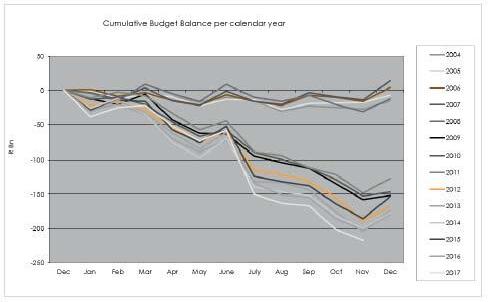
We are likely to begin the year with a relief rally in the currency and local bonds. The low hanging fruit has been snapped up and the easy wins made. Sentiment is buoyant and risk appetite less suppressed. But the easy part is done. Now comes the call to action. Does the newly elected leadership have the willingness and the ability to implement the necessary reforms? If they do and as a result retain the investment grade sovereign rating from Moody’s, we are likely to have a fairly constructive environment for S.A. bonds in H1 2017.
The second half of the year looks likely to see local inflation trending up, perhaps at the same time as global inflation gains a bit more traction, resulting in policy makers tightening policy and emerging markets face a sterner test at the same time as the hurdle rate needed to attract global capital increases. This is when South Africa is at its most vulnerable given it’s over dependence on offshore portfolio flows and thus we look for a tougher environment for local nominal bond yields later in the year. Perhaps this is the time when inflationlinked bonds will finally be in the sweet spot and these may offer a defensive investment at this stage if the entry level of real yield is attractive.
Contributor’s Profile
Conrad Wood is a founding member of ALUWANI Capital Partners, with more than 23 years in investment management. His work experience has been within the fixed-income market. At ALUWANI, he and his team seek to continue the successful fixed-income philosophy and process that they have developed over time, while leveraging the benefits of being in a smaller, more flexible institution.
By Equity Research Department, Tunisie Valeurs, Tunisia
After 2011, economic growth was rather fragile and could not regain the momentum it had in the years 2000. Real GDP growth amounted to an average of 1.6% annually between 2011 and 2017 compared to 4.5% in the period between 2005 and 2010.
In the aftermath of the revolution, Tunisia has shown resilience thanks to a sound management of its public finances that could be traced back to the period preceding the revolution. However, the country today suffers from a serious drift of its public accounts that has translated into a worsening of its budget deficit and an increased recourse to external debt.
In 2010, the budget deficit represented only 1% of GDP. More specifically, there was a budget surplus if we consider the proceeds from the privatization of 35% of the capital of Tunisia Telecom carried out in 2006 for about 3 billion dinars which were not recognized in the State budget.
As of 2011, we have witnessed a rapid rise in the State budget, from 17884MD in 2010 to 34455 MD in 2017. The budget scheduled for 2018 is 35951 MD, an overall increase of 110% or an average annual growth of more than 9% throughout the period.
The State total expenditure evolved very rapidly, which explains the swelling of the budget over the last seven years. The operational and investment expenditure rose by 9.6% on an annual average throughout the period 2010-2017.
The wage bill rose dramatically since 2011, thus moving from 6785 MD in 2010 to 14300 MD in 2017 and 14751 MD are planned in the 2018 Finance Act, an annual rise of 11% on average over the period 2010-2017. This dramatic increase has its roots in wage increases and the massive recruitments in the civil service.
Expenditures for subsidies have also risen considerably as a result of the increase of energy subsidies. Thus, they increased from 1500.75 MD in 2010 to 3500 MD in 2017, an average annual evolution of about 13%. The fall in oil prices and the removal of subsidies for energy-intensive sectors in 2014 helped to considerably decrease pressure on consumption expenditure.
Finally, State expenditures increased as a result of an important rise in debt-servicing costs during recent years. These costs rose from 3616 MD in 2010 to 7090 MD in 2017.
The increase in own resources (tax and non-tax) was slower than expenses: 7.2% on an annual average between 2010 and 2017 against 9.6% for operational and investment expenditures. The direct consequence was a more important budget deficit and an important debt.
The government debt outstanding evolved steadily since the revolution at an average annual rate of about 15% between 2010 and 2017. Today, it represents 69% of GDP compared to 40% in 2010.
The increase in foreign national debt compared to the overall government debt exposes the State to the double risk of foreign-exchange and refinancing. In fact, since the beginning of 2017, the Dinar lost about 15% of its value against the Euro and 5% against the dollar. The debt refinancing risk in the medium term is a serious component that should be taken into account because of the stress that it may introduce with respect to the State’s financing needs.
The revolution and the subsequent economic transition witnessed a deepening of the current deficit which went from 4.8% of GDP in 2010 to 8.8% in 2016. Clearly, this posed the problem of having recourse to external financing sources, and hence of the rising debt.
The economic policy put in place in the aftermath of the revolution did not help to improve the situation. In fact, after 2011, public authorities effected a major change of their Policy mix through a fiscal stimulus policy by means of public expenditures and an accommodative monetary policy. However, this policy did not achieve the expected results in terms of an upturn in growth, investment and employment. On the contrary, consumption prevailed and will be at the origin of the rise in inflationary tensions and the accumulation of important external deficits. These balances gave rise to corrective attempts by the Central Bank of Tunisia by means of a gradual tightening of its monetary policy. This attempt posed a problem of overall coherence between a fiscal stimulus policy, the aim of which is to increase investments and an increasingly less accommodative policy which, by seeking to
address inflation and encouraging the return to an external balance, dissuades investment.
The political and security context played an important role in the disruption of the major macroeconomic balances and the country’s stability. Even if it is possible to consider that the political transition in Tunisia is clearly moving ahead, it nonetheless has run up against two types of difficulties that explain the structural political instability:
(1) A political difficulty to form a ruling majority, which has given rise to the game of modular political alliances in a search for stability, which is typical of periods of transition. These difficulties could be explained by the nature of the post-revolution political regime, predominantly parliamentarian in nature;
(2) Terrorism and political assassinations, which, to some extent, marked the post-revolution period.
Social instability and the inability to build a new social contract after the revolution also explain the difficulties of the transition process and represent one of the challenges that will weigh on the economic transition and the political stability in the years to come.
The success of the economic transition should target overcoming structural deficiencies and the implementation of reforms, in particular in relation to economic governance.
After the revolution, a new system started to be put in place based on transparency and the fight against corruption as well as on attempts to weaken the stranglehold of the administration, the initiation of reforms to improve the business climate and foster the development of the private sector, strengthen the banking system and undertake the restructuring of public undertakings. These reforms were launched since 2011 in order to overcome the structural deficiencies of the economic model so as to achieve a qualitative and quantitative economic leap towards a sustainable and inclusive job-creating growth with higher value added. However, despite the consensus on the nature of reforms and the necessary measures, implementation rates remain very slow, which explain why imbalances have persisted.
The Tunisian economy mid-term prospects seem to be shifting towards the resumption of growth, albeit weak, and a consolidation of the major macroeconomic balances. Nonetheless,
Tunisia remains continues to face three major political risks:
(1) An endemic political instability which has given rise to unholy alliances and an instable executive branch because of the large number of governments;
(2) The rise of terrorism;
(3) Regional conflicts likely to have a negative impact on the social and economic situation of Tunisia.
The country remains also vulnerable to socio-economic risks that may jeopardize this growth trajectory, or even reverse it. These risks are mainly twin deficits and the slow reform implementation pace.
In the short term, public policies must address the constraints weighing on the major macroeconomic balances and on a rapid recovery of investments. Among these constraints, we can cite the drifting public finances. On the level of expenditures, it is imperative to quickly achieve a greater mastery of the wage bill and of expenses for subsidies. Governments should speed up the reform of the subsidies system: in parallel to the automatic fuel price adjustment mechanism for energy subsidies, direct transfers for food subsidies should be accelerated.
Public authorities should speed up the current reforms of the social security funds to reduce the impact of their deficit on the State budget and to bring in new blood to the Tunisian social contract. It is also important to undertake appropriate action on State revenues through a proactive fight against tax evasion. The State may also divest its shares in the public undertakings operating in competitive sectors. Finally, the stranglehold of the administration with respect to some procedures and authorizations should be loosened. Taken together, these proposals could promote, in the short term, a microeconomic stabilization and unleash energies.
In the medium term, the prospects of growth and of macroeconomic stabilization, as well as the acceleration of reforms and the initiation of competitiveness in the new promising sectors, will make of Tunisia a new pole of growth.
Despite these risks, it is obvious that Tunisia has achieved an essential milestone in its political transition toward a democratic and transparent regime. From this perspective, Tunisia has become the only success story of the Arab Spring and a true emerging democracy.
By Kenneth Barry, Partner, White & Case LLP, London Linford Coates, Associate, White & Case LLP, London
istorically, one of the key concerns of LPs regarding African private equity has been the number and quality of available exit routes. Illiquid domestic exchanges as well as political and foreign exchange risk have all weighed on the exit multiples that investors have hoped to achieve. However, as the African private equity market matures, the chances of achieving a successful exit have notably improved. The African Private Equity and Venture Capital Association (AVCA) and African Securities Exchanges Association (ASEA)1 have reported a record number of PE firms in Africa exiting in 2015 and 2016 (44 and 48, respectively), which is double the numbers that were achieved a decade ago. Nor was this record exit activity confined to a small group of private equity funds. It involved 48 deals spread across 31 firms.
Furthermore, the majority of respondents in a 2016 Deloitte report2 expected the volume of exits in the 12 months that followed to increase or remain the same, despite increasing challenges in the debt funding environment.
Performance among African private equity exits is not uniform across the continent. Political and macro-economic drivers differ significantly from region to region. It is no secret that South Africa has historically been home to by far the most private equity investment, due to its more advanced and diversified economy as well as its relatively stable political platform. By both market capitalization and number of listed companies, the Johannesburg Stock Exchange (JSE) is considerably larger than all the other African bourses combined (Figures 1 and 2). This investment matured into 42 percent of the continent’s exits over the past ten years, which is 13 percent more than the next four countries combined.3 While South Africa’s reign as the most advanced African economy looks set to continue for at least the next few years, the general consensus is that the country’s economy will continue to deteriorate in the short term, which is likely to increase exit activity and reduce multiples in the coming years.


The next region that has experienced the most private exits is West Africa. Between 2011 and 2016, West African transactions accounted for 27 percent of Africa’s total deal volume compared to only 18 percent in East Africa.4 These transactions were not only focused in the resources sectors but also retail sectors, as profits flowed down to employees and generated a more affluent consumer base. As a result of the depressed oil prices, coupled with last year’s dramatic devaluation of the Nigerian naira and its subsequent volatility, investor attention has turned elsewhere. These factors have led private equity investors to focus more on exits in West Africa than in previous years, with 11 percent of respondents to the Deloitte report stating that they are more likely to exit than invest in the short term, up from zero percent in 2015. However, the sudden and pronounced impact of the naira devaluation coupled with the oil price decline has reportedly caused a wide bid/ask spread on West Africa divestments, as sellers struggle to come to terms with the significant reduction in the dollar value being offered for their businesses. This behavioral economic factor could weigh on exit deal volumes in the short term, although this should lessen as oil prices start to stabilize.
East Africa has historically not experienced the same level of private equity investment as its neighbors to the west and south, but its more diversified (and generally oil importing) economies are proving attractive to private equity investors who are keen to rebalance away from the West. Ninety percent of private equity investors intend to invest more in the region than they exit, which is widely expected to improve buyer competition for prize assets and add upward pressure to transaction multiples in the region given the imbalance in demand and supply. Kenya has been the biggest beneficiary of this shift in attention, mostly due to its economy’s limited reliance on oil—its GDP is predicted to grow in excess of 5 percent this year and to continue that pace throughout 2018.5
Historically, exits have been fairly evenly distributed across business sectors, with the most
common sector for exits being financials with only 20 percent of the total, followed by industrials with 15 percent. More recently the industrials sector has become the sector with the most exits, comprising 21 percent of the 2016 exits, more than double the next most common sector (Figure 3).
Trade sales to strategic investors continue to be the most preeminent exit route, constituting more than 50 percent of private equity exits in 2015 and 2016. These have also historically generated the highest average returns. This is expected to continue to be the case in the next 12 months, particularly in West Africa, where the expectation is that trade sales will comprise 72 percent of any contemplated exits, possibly due to subdued secondary buyout interest (sales to other private equity firms).
If one were to break down the types of strategic buyers into local, national and multinational, the mix of strategic buyers has remained fairly consistent over the past ten years. Local firms remain the most likely strategic buyer, with involvement in 42 percent of acquisitions in 2016, closely followed by multinational buyers, who were involved in 38 percent of acquisitions.
A notable feature of the evolving private equity market is the increased prevalence of auction sales, such as the sale of Brandcorp in June 2016 by Ethos Private Equity to The Bidvest Group following a competitive process. Given the strong fundraising by Africa-focused funds in recent years and the competition for quality higher-value African assets, it is likely that auction processes will become increasingly common.
After trade sales, secondary buyouts, such as the sale of Algeria-based manufacturer Cellulose Processing by Mediterranean Capital Partners to Abraaj in 2016, account for the next largest proportion of exits, at 55 percent of deals surveyed in 2016. This is a dramatic increase from 2015, when only 20 percent of deals were secondary buyouts.6 Another notable trend is that the private equity buyers in these secondary transactions are increasingly international brand names. In 2016, 47 percent of secondary buyers were classed as multinational private equity firms, an increase from less than 30 percent a decade ago. With strong fundraising by international Africa-focused and
global funds such as Carlyle and KKR, who made their maiden African investments in 2014, we expect that secondary buyouts will continue to be an increasingly important feature in the African private equity market.
As the quality of assets and deal sizes increase over time, we would also expect to see more sophisticated secondary transaction structures, such as “portfolio” deals, which package up several assets together to be sold to another fund, or deals that involve the breaking up of larger investments into smaller divisions for sale. Given that 75 percent of deals in the first half of 2016 were below US$250 million, it may be some time before the market develops to such a point.
While enterprise value to EBITDA multiples for listed companies in Africa have steadily decreased from nearly 10x in the first quarter of 2014 to less than 8x in the second quarter of 2017, multiples on private equity transactions have followed the opposite path. In 2013, the average private deal multiple was sitting just above 6x, but now these multiples have almost converged on listed company multiples at around 8x. Nevertheless, there still seems to be a fairly heavy risk discount applied to African transactions when these deal multiples are compared with global transactions—since 2012, only 40 percent of private equity transactions achieved a multiple in excess of 7.5x, compared to almost 55 percent globally. This risk discount appears to decrease as transaction values increase, with the average multiple for transactions in the past five years with a deal value exceeding US$250 million being close to 9x.7 The rationale for this correlation of value and multiples is thought to be caused by the added stability and cash generation that come with larger companies on the continent.
In terms of regional performance, as indicated above, transaction multiples in Southern and West Africa are expected to decrease over the next 12 months8 as a result of decreased macro-economic forecasts. In East Africa, multiples are anticipated to increase, but only slightly due to the uptick in interest from private equity being largely cancelled out by the increased cost of debt.
Certain sectors tend to consistently achieve greater transaction multiples in Africa, despite this not being the case elsewhere. The consumer 6
staples and discretionary sectors have recently seen the highest multiples due to evidence of a growing middle class with increasing disposable income. These sectors have also proved themselves to be more resilient across the economic life cycle and a helpful hedge in a depressed oil price environment. Factors such as these have led to more competitive bidding processes between private equity sponsors for assets in those sectors. This was apparent from the Abraaj Group’s US$100 million acquisition from Emerging Capital Group in July of the Java Group, a growing coffee shop chain. It is reported that the sellers received 12 non-binding bids for this middle class demographic-focused business, a degree of interest that would previously have been unheard of. Another sector that has fared well for similar macro reasons is healthcare. As the wealth of the people increases, high-quality healthcare is close to the top of the list of priorities.
Although IPOs and stock sales on public markets remain some of the most attractive exit mechanisms in the global PE industry, the converse has historically been true in African PE. Fragmented regulation, political uncertainty, underdeveloped capital markets and low levels of market capitalization compared to the developed world result in low usage of IPOs as a PE exit route: Only 1 percent of all 83 PE exits in Africa during 2014–2015 took place by way of IPOs (Figure 4).
Despite a large increase in IPO proceeds raised in 2016, African exchanges saw the lowest volume in IPO activity since 2013, with only 20 IPOs, compared to 30 in 2015.9 The suspension of Nigerian fintech company Interswitch’s IPO plans to raise as much as US$1 billion, due to fears over the further weakening of the naira and a general shortage of foreign currency, is a good example of the challenges faced by African PE investors attempting to use IPOs as an exit route. While opportunities outside South Africa’s Johannesburg Stock Exchange, Egypt’s Cairo and Alexandria Stock Exchanges and Nigeria’s Lagos Stock Exchange remain limited, the Abraaj Group’s exit of Unimed via an IPO on the Tunis Stock Exchange in May 2016 and Actis’s exit of Ugandan electricity company Umeme Ltd. via the Ugandan and Kenyan capital markets in December 2016 show that viable options do exist.
When investors decide to IPO African companies, they often opt for dual listings with international exchanges. The London Stock Exchange (and in particular AIM) is the international exchange of
choice, due to its liquidity and the credibility of its governance and disclosure criteria. This is evidenced by the fact that the combined market value of African-operated companies listed in London is US$149 billion, which is more than any other African exchange except the Johannesburg Stock Exchange.
A number of initiatives have been introduced to improve the listing of shares in African companies such as: (i) the East Africa Community (EAC) stock markets integration project; (ii) the introduction of the Growth Enterprise Market Segment by the Nairobi Securities Exchange (NSE); and (iii) new mechanisms to trade and settle ordinary shares of London-listed or dual-listed Nigerian companies. As such initiatives come to fruition, we would expect that exit options on a limited number of exchanges will become more viable.
Despite some recent headwinds in certain African regions and sectors, the outlook for private equity investment in the continent is undeniably positive. Almost 90 percent of limited partners interviewed as part of a recent AVCA report confirmed their intention to either increase or maintain their private equity allocation in Africa over the next three years, and only 2 percent believed that over the next decade Africa will be less attractive than other private equity markets. These statistics are a clear indication that investors’ concerns with the region, in particular that pivotal concern of how to successfully exit, have substantially improved.
Ken Barry is a Partner in the EMEA private equity team of White & Case LLP, within the Global Mergers & Acquisitions Practice. Ken’s practice focuses primarily on private equity, with extensive experience advising private equity houses and financial sponsor clients on a range of complex cross-border acquisitions, divestitures, joint ventures, leveraged buyouts and public offerings in Africa, Europe and the Middle East.
Linford Coates is an associate in the corporate department of the Firm's London office and focuses on private equity. In addition to his private equity expertise, Linford has experience in a range of corporate and capital markets transactions, including international M&A, joint ventures, block trades, high yield bond offerings and corporate reorganizations.
By The Allianz Africa Group, South Africa
ext time you contact your insurer there is a good chance that you will be dealing with Artificial Intelligence (AI). Insurers are starting to use intelligent computers to give advice and speed up the process of buying insurance and paying claims. Virtual underwriters and risk advisors are no longer confined to insurers’ research and development departments. But with the benefits also come new risks.

AI is expected to enable a better understanding of risk and transform the insurer-customer experience
The age of machine learning Artificial Intelligence (AI), also referred to as machine learning, is essentially software that is able to think and learn like a human. Today, basic forms of the technology are able to perform specific tasks – like checking an insurance claim for fraud – but future generations of AI will be capable of solving complex problems and making decisions, in much the way humans do today.
AI promises to improve productivity through automation of simple tasks and by giving new insights from analyzing data. As such, AI is expected to boost national economies worldwide by more than 30% by 2035, according to Accenture1 .
Already, AI is beginning to find uses in almost every industry, from chat bots that offer roundthe-clock financial advice to helping doctors
diagnose cancer. The technology is being used to power driverless cars, eradicate certain diseases, and better predict the weather and effects of climate change.
Insurance is an industry particularly suited to AI, as it involves lots of data and repetitive processes. In fact, the insurance industry has been an early adopter of machine learning, partnering with technology firms and investing in start-ups on a range of applications. Tata Consultancy Services' Global Trend Study found that of 13 industries surveyed, insurers invested $124m in AI, almost double the $70m cross-sector average2
According to Michael Bruch, Head of Emerging Trends at AGCS, AI is likely to transform the insurance industry, to the benefit of customers and insurers alike. There is lots of potential for AI to improve the insurance value chain by making it more effective in addressing customer needs, delivering value on time and at lower cost.
AI is likely to make a big difference in three key areas. Initially it will help automate insurance processes, such as claims and underwriting. But over time it will give insurers and their clients a better understanding of risks, and it will change the way insurers interact with customers.
To date, insurers have mainly focused on developing AI applications for personal lines, but increasingly they are turning their attention to commercial insurance, including the large corporate market.
AI has the potential to bring about significant cost savings for commercial insurance, as well as speeding up the insurance transaction process and enhancing service in areas such as analysing submissions, checking or verifying policy documents, developing new insurance solutions and services or flagging up potentially fraudulent claims.
According to Michele Lagioia, an affiliate of the Italian Association for Artificial Intelligence, the claims process, in particular, would benefit further from increased automation.
“AI and automation would make for a much faster and more efficient settlement for lower value claims. Even with more complex commercial claims, AI could support claims decisions, speed up some processes and make for a more customized claims service,” says Lagioia.
Insurers in the life and health market are already using AI to review and analyze policy wordings and validate claims. Last year, start-up insurer
Lemonade3 set a new world record when it used an AI claims system to accept and pay a claim for a lost item of clothing within three seconds, and without any paperwork. And many commercial lines of business, such as motor and workers’ compensation lend themselves to automation. By automating repetitive tasks, people would be free to focus on value-added work, like client relationships, risk assessment or providing technical support.
The 24/7 insurer
AI also creates opportunities for commercial insurers to interact with their clients more frequently and more conveniently, as well as offer a more personalized or tailored offering. For example, in the personal lines arena, Allianz has developed Allie, an online assistant available 24/7 to answer customers’ questions.
“AI could be used to increase the points of contact with customers, ensuring an insurer is available at any time, and able to reach out and offer tailored products and services,” says Lagioia.
“For large commercial and corporate clients, insurance needs to be bespoke,” says Bruch. And while machine learning will support automated services it will also change the way insurers interact with clients and will allow for a platform approach to service. AI can help create an environment for insurers and third parties, offering a more targeted spread of risk management and insurance services.”
In addition to improving the insurance process and service delivery, AI could also boost data and analytics, the backbone of the insurance proposition, Bruch predicts.
“AI will be the key to unlocking data, especially as more data is made available by the Internet of Things (IoT). It could enable insurers to better understand customers’ risks and help clients reduce their risk, as well as find potential solutions for risks that may not be currently insurable.”
Allianz is already using machine learning to carry out risk assessments and to support automated underwriting in the small- to medium-enterprise (SME) space, a trend that will extend to the large commercial market. AGCS has developed a tool that uses machine learning to identify accumulations of business interruption risk in supply chains. The tool analyzes big data to identify and map networks of critical suppliers across industries.
“AI will support underwriters with the analysis of data and assessment of risk, helping to identify accumulations and price risk more reliably, while the insights gained should enable insurers to enter a more meaningful risk dialogue with clients,” says Bruch.In cyber, for example, AI could play an important role in risk mitigation and risk assessment, benefiting both insured and insurer.
AI-powered analytics could help companies better understand their cyber risks, improve cyber security and even defend against cyber-attacks. At the same time, the technology could assist insurers in assessing cyber risk and spotting accumulations of cyber exposure. “AI can improve commercial clients’ risk visibility. There are many areas – like reputation, cyber, supply chain and economic and climate risk scenarios – where machine learning could help companies better understand their risks,” says Bruch.


As the technology becomes more sophisticated, AI applications for analyzing risk will evolve, predicts Bruch.
“AI could act as an ‘intelligent agent’ able to create different scenarios and outcomes, and potentially take decisions. The next generation of machine learning will move from increasing risk awareness to decision-making.”AI will also work alongside other technologies, most notably the IoT and blockchain, to increase our understanding of risk and enable insurers to offer new, faster and more customized services. For example, sensors on shipping containers are already providing data on the location and condition of cargo, which, once analyzed, can trigger insurance cover or mitigation measures if the goods are damaged.
“Insights gained from data and AI-powered analytics could expand the boundaries of insurability, extending existing products, as well as giving rise to new risk transfer solutions in areas like non-damage business interruption and reputational damage,” says Bruch.
AI brings new risks as well as benefits
In addition to improving the products and services insurers offer clients, AI will also impact insurers in another way – by introducing new risks to society. AI technology is in its early stages, but it is expected to find a multitude of applications over coming years. AI is already making driverless cars a reality, but it is also leading to improvements in speech and image recognition.
However, like any disruptive technology, AI comes with risks and will have far-reaching implications for the economy, politics, mobility, healthcare, security and the environment.
AI could, for example, disrupt the labor market, changing the nature of some roles while eliminating others. Technology advances are also likely to increase the frequency and relevance of regulatory updates as governments and society struggle to keep pace.
AI will also need to be adequately tested to ensure it is safe before being introduced to the real world. For example, an AI agent for portfolio management could work according to specifications when tested in a development environment but then behave unexpectedly in the real world, making illegal investments. While AI could boost cyber security, conversely, misuse may also increase the risk of cyber-attacks if malicious hackers can train AI to attack. For business, AI will bring reputational risks. Unintentional errors or unexpected consequences of AI applications could negatively impact consumer trust and cause reputational harm.
Liability and regulation is an area of particular relevance to AI risk. While AI agents are taking over decisions from humans, they are not yet legally responsible for damages caused by their actions. Ethical concerns are also likely to arise as AI pervades society, as will concerns for the accountability of AI and its ability to make transparent and auditable decisions. Appropriate risk management strategies are needed to prevent, mitigate and transfer these risks and maximize the net benefits of AI in society. By addressing areas such as accessibility, safety, accountability, liability and ethics, responsible development and introduction of AI becomes less hazardous and the role of insurers will be key in ensuring risks are properly mitigated. New types of insurance coverage will help transfer and manage emerging risks.
verall, African equity capital market transaction volume and value improved in 2017 over 2016. In terms of value, 2017 saw the largest initial public offerings (IPOs) over the trailing five-year period, and an increase in the total value of equity capital market (ECM) transactions of 49% between 2016 and 2017 in US dollar terms.
PwC released its 2017 African Capital Markets Watch publication, which analyses equity, and debt capital market transactions that took place between 2013 and 2017 on exchanges throughout Africa, as well as transactions by African companies on international exchanges.
This report lists all new primary market equity initial public offerings (IPOs) and further offers (FOs) by listed companies, in which capital was raised on Africa’s principal stock markets and market segments. The report also includes IPO and FO activity of African companies on international exchanges or non-African companies on African exchanges, on an annual basis.
Andrew Del Boccio, PwC Capital Markets Partner notes: “Capital markets in Africa saw a recovery in 2017 with the positive impact of commodity stabilisation on economies such as Cote d’Ivoire and Nigeria, which emerged from five successive quarters of GDP declines, and resilience in the face of economic and political uncertainty in South Africa.”
Since 2013, there have been 519 African ECM transactions raising a total of $52.7 billion, up 17% in terms of capital raised over the previous five-year period. Overall, ECM activity in 2017 was the second highest since 2013 in terms of volume with 121 issuances, up 25% over the prior year, and the highest since 2013 in terms of value, driven mainly by a few significant IPOs and FOs during the year.
“We are optimistic about the pipeline of companies seeking to access the capital markets in 2018, including cross-border IPOs of African companies, given encouraging indicators in large markets such as South Africa, Egypt, and Nigeria, and the continued economic growth in East Africa and the Francophone West African countries,” Del Boccio
comments.
African ECM activity in 2017 was largely driven by the financial services sector for FOs, and the consumer services sector for IPOs, though both of these statistics were impacted by a few very sizable transactions during the year. Businesses in sectors such as telecommunications, consumer goods and services, financials, and healthcare continued to form a significant component of African ECM activity.
Although levels of market capitalisation for many of Africa’s exchanges remain low in a global context, a number of initiatives have taken place to deepen liquidity and provide investment opportunities for foreign and domestic investors alike. Regulators in some African countries have made efforts in recent years to encourage companies in specific sectors to list shares on their domestic stock exchanges. Additionally, enhanced regulatory capital requirements have driven financial services companies to access both the debt and equity capital markets over the past year.
2017 also saw a greater focus by exchanges on small and medium sized enterprises (SMEs) with the introduction of junior or alternative boards. In South Africa, the entry of four new exchanges altered the South African listing environment. Although there have been a number of listings on these new boards, with more activity in 2018, the listings to date have been technical in nature, with no new equity proceeds raised.
African IPO market
2017 saw the second-largest volume in IPO activity (28) over the past five years and is the largest in value, with $2.9bn raised in IPO proceeds, exceeding 2015 (the year with the next-largest value raised over the past five years) by 42%. Over the past five years, there have been 134 IPOs by African companies on both African and international exchanges, raising $9.1bn, a 37% increase in capital raised over the preceding five year period, 2012-2016.
Despite the policy gridlock and economic and political uncertainty South Africa has experienced over the past five years, the JSE has maintained its
dominant role in the African capital markets. In 2017, capital raised from IPOs by companies on the JSE in US dollar terms increased by 178% as compared to 2016. Since 2013, capital raised from IPOs by companies on the JSE alone of $4.8bn represents 52% of the total African IPO capital raised.
Over the five-year period, the Bourse de Tunis with 23 issuances, and the EGX with 13 issuances followed the JSE in terms of volume of IPO transactions. In terms of value over the past five years, the next largest value of IPO proceeds raised was on the EGX at $1.3bn.
While a stronger year for some exchanges in sub-Saharan Africa, IPO activity on the North African stock exchanges – Egypt, Morocco, Tunisia and Algeria – decreased by 61% in terms of the value of IPO proceeds. There was also no IPO activity in Ghana compared to 2016, which saw $102.0 million raised on the Ghana Stock Exchange.
In contrast, elsewhere on the continent, 2017 saw some significant increases in IPO value on exchanges in Namibia, Rwanda and Tanzania compared to the prior year.
The top 10 African IPOs by value took place in South Africa, Egypt, Tanzania and the Francophone West African region, represented by the BRVM. On a sector basis, for the first time in five years the consumer services sector dominated the African IPO market with 44% of total value, followed by the financial services sector with 26%. In terms of volume, financial services accounted for the greatest volume of IPOs with 50%, followed by consumer goods with 14%.
African FO market
In 2017 FO activity was on a par with 2015 levels in terms of transaction volume, at 93 FOs – this represented an increase of 27% on the prior year. In terms of proceeds raised, 2017 saw an increase of 42% on the prior year, though it fell short of the highs noted in 2015. Over the past five years, there have been 385 FOs by African companies, raising $43.6bn on both African and international exchanges.
Over the five-year period, the vast majority of FO activity took place in South Africa representing 65% and 86% of total FO volume and value, respectively. This is broadly consistent with the 2017 year, when South Africa accounted for 51%
and 86% in total FO volume and value, respectively. Egypt accounted for the next largest amount of FO volume for the 2017 year at 14% and for the five-year period 2013-2017 at 6%, respectively. In terms of FO value, Mauritius accounted for the next-largest FO proceeds raised in 2017 at 5%, and Nigeria the next-largest proceeds for the five-year period at 4%.
During 2017, the sector composition of African FO activity was largely consistent with the five-year average in terms of value and volume, with the financial services sector contributing 56% of the total FO value, followed by the basic materials sector at 14%.
Inbound, outbound, domestic and cross-border activity, 2013-2017
In 2017, domestic activity represented 76% of total ECM activity in terms of volume, and 87% in terms of value. For African ECM data, this statistic is driven by significant activity on the larger exchanges such as the JSE and EGX. There was an overall drop of 17% and 44% in cross-border activity in 2017 compared to 2016 in terms of both volume and value respectively.
Outbound ECM volume in 2017 remained on a par with prior periods, ranging between a five-year low in 2016 of ten, and a high of 17 in 2014. However, there was a significant drop of 89% in the value of outbound ECM activity in 2017 compared to 2016.
African debt markets
In respect of DCM activity, non-local currency corporate issuances totalled $7.5bn, an increase of 68% in terms of value and 110% in terms of volume over the prior year, with several large first-time issuers tapping into a market with sustained appetite for emerging market yields. Most of this funding was targeted at refinancing existing debt, but there were also instances of these proceeds being put to use for acquisitions or strategic capital expenditure.
The year ahead
Del Boccio comments: “In terms of capital markets activity, we expect that the recovery seen in 2017 will gain momentum in 2018 against a more stable political and economic backdrop. This will likely include an increase in cross-border ECM activity for regional players looking to compete in global markets, the continued impact of partial privatisation efforts through the capital markets, and the effect of other regulatory drivers that will lead African companies’ capital markets.”
CountryNameIndexNameIndexat28-February1-month%ΔYTD%Δ1-Year%Δ1-YearLow1-YearHigh30Days
BotswanaBSEDCI8,691-0.67-1.91-4.008,6859,3790.888
BRVMICComp2343.06-3.66-18.842142866.371
EgyptEGX308,081-34.54-46.19-32.3112,34516,41116.412
GhanaGSEALSI3,3378.4629.3679.951,8633,3549.670
KenyaFTSENSE151820.656.1745.541201829.821
MalawiMSEALSI23,1834.327.3470.0114,00524,40813.069
MauritiusSEMDEX2,2921.624.0919.221,9162,3095.209
MoroccoMORALSI13,1430.516.0910.2011,21013,3887.736
NamibiaLocal1,4345.5810.3332.53121,46123.867
NigeriaNIGALSI43,331-2.2813.3071.0724,54745,32216.404
RwandaRSEASI133-0.25-0.424.061241331.245
SouthAfricaJSEALSI58,325-1.98-1.9814.0450,73761,77721.146
SwazilandSSXALSI4070.200.206.233834102.311
TanzaniaDARALSI2,3680.76-1.192.7640414,154854.200
TunisiaTUNIS6,6994.156.6319.475,5176,7916.460
UgandaUSEALSI2,044-0.592.1744.761,3962,09111.236
ZambiaLuSEALSI5,5874.884.8632.104,2505,5908.932
RwandaFranc854.00-1.010.00-3.92425.00863.658.870
SouthAfricaRand11.800.474.7410.1511.5114.5715.111
TanzaniaShilling2,244.520.22-0.44-0.482,137.002,254.003.792
TunisiaDinar2.43-1.481.31-5.832.252.589.015
UgandaShilling3,645.03-0.71-0.05-1.633,549.733,666.691.886
ZambiaKwacha9,7560.15252.20-1.528,76610,3884.514
Angola12-Nov-25112.3967.3580.7686.886100.511118.576USD
Cameroon19-Nov-25115.3216.9020.50511.430112.007122.002USD
Congo30-Jun-2982.4078.4400.32712.24965.75889.100USD
Cameroon19-Nov-25115.3216.9020.50511.430112.007122.002USD
Egypt30-Apr-4099.8366.8880.2591.87891.804103.215USD
Ethiopia11-Dec-24100.4816.5340.96714.05193.702107.070USD
Gabon16-Jun-25100.5786.8450.5489.59095.680106.780USD
Ghana14-Oct-30134.5416.6590.1384.603115.926141.231USD
Kenya24-Jun-22103.5006.1940.40510.17497.340108.350USD
IvoryCoast31-Dec-3297.1106.2210.4078.83592.009101.626USD
Morocco11-Dec-42108.7524.8860.3156.985103.736116.038USD
Namibia29-Oct-25100.5435.1620.3325.32598.728105.604USD
Nigeria12-Jul-23105.5195.1810.2142.900100.110107.418USD
Rwanda02-May-23104.0715.7020.2703.185100.654106.237USD
Senegal30-Jul-24104.9295.3310.35412.30399.932109.777USD
SouthAfrica24-Jul-4496.5725.6250.2585.35790.553103.430USD
Tanzania09-Mar-20104.3525.9300.65511.845104.140106.272USD
Tunisia19-Sep-27109.6696.8530.2021.571107.081111.481USD
Zambia30-Jul-27107.0927.8860.70610.681103.160114.654USD