
AFRICA’S INSURANCE MARKETS UNCOVERED AFRICA’S INSURANCE MARKETS UNCOVERED
THE FUTURE OF INSURANCE BROKING IN SUBSAHARAN AFRICA
THE FUTURE OF INSURANCE BROKING IN SUBSAHARAN AFRICA
NEW CAPITAL REGIME A STEPCHANGE FOR KENYAN INSURERS
NEW CAPITAL REGIME A STEPCHANGE FOR KENYAN INSURERS
NIGERIAN INSURANCE: CHALLENGES AND OPPORTUNITIES
NIGERIAN INSURANCE: CHALLENGES AND OPPORTUNITIES
GROWING UGANDA’S INSURANCE INDUSTRY DESPITE THE ODDS
GROWING UGANDA’S INSURANCE INDUSTRY DESPITE THE ODDS
TUNISIAN INSURANCE: REGULATION AND SUPERVISION
TUNISIAN INSURANCE: REGULATION AND SUPERVISION
INCLUSIVE INSURANCE MARKETS: EMERGING TRENDS AND SUPERVISION
INCLUSIVE INSURANCE MARKETS: EMERGING TRENDS AND SUPERVISION
THE PROMISE OF BLOCK CHAIN IN INSURANCE
THE PROMISE OF BLOCK CHAIN IN INSURANCE
TECHNOLOGY AND INNOVATION: POSITIVELY DISRUPTING THE INSURANCE MARKET
TECHNOLOGY AND INNOVATION: POSITIVELY DISRUPTING THE INSURANCE MARKET

EDITORIAL TEAM
Editor Tunde Akodu
Associate Editor Michael Osu
Advertising & Sales
Tola Ketiku
CONTENTS
FEATURED ARTICLES
The Future of Insurance Broking in SubSaharan Africa
New Capital Regime a Step-Change for Kenyan Insurers
Nigerian Insurance Industry: Challenges and Opportunities
Growing Uganda’s Insurance Industry Despite The Odds
Kenyan insurance industry: Is RBC the insurance “Rate Cap”?
Tunisia’s Insurance sector: Regulation and Supervision
Technology and Innovation: Positively disrupting the insurance market
Inclusive Insurance Markets: Emerging trends and supervision
The promise of block chain in insurance Africa: weaker premium growth as key economies struggle
Outcome-based Investing: Putting the investor first
Assessing Monetary and Fiscal Policies in 2017
The Four Africa’s: Nigeria the Unstoppable Super Eagle
EXCLUSIVE INTERVIEW
Alhaji Kaddunabbi Lubega, Chief Executive, Insurance Regulatory Authority Of Uganda
Mr. Sheriff Samy, Chairman of the Egyptian Financial Supervisory Authority (EFSA)
Mr. Alaa El Zoheiry, Managing Director, MISR insurance Group
Mr. Mohammed Ali Londe, Assistant Vice President, Moody’s Insurance Group
Mr. Ali Harraj, Chairman and Chief Executive Officer, Wafa Insurance, Morocco
Mr. Thabo Dloti , Chief Executive of Liberty Holdings Limited, South Africa
Mr. Corneille Karekezi, Group Managing Director of African Reinsurance Corporation
ECONOMIC WATCH
Africa’s Central Bank Monetary policy rate and foreign exchange reserves
March’s Inflation Treads Across The African Continent

Cover Image : Man under umbrella Image Source: pexels.com License: CC0
DISCLAIMER: The contents of this publication are general discussions reflecting the authors’ opinions of the typical issues involved in the respective subject areas and should not be relied upon as detailed or specific advice, or as professional advice of any kind. Whilst every care has been taken in preparing this document, no representation, warranty or undertaking (expressed or implied) is given and no responsibility or liability is accepted by CAPITAL MARKETS IN AFRICA or the authors or authors’ organisations as to the accuracy of the information contained and opinions expressed therein.
Welcome to the May 2017 edition of INTO AFRICA, the publication with fresh insight into Africa’s Emerging capital markets. This edition focuses on the Insurance sector and is titled: Africa’s Insurance Markets Uncovered marks an exciting time in the sector.
The insurance sector remains under-developed in Africa (it generates barely 1.7% of global insurance premiums) despite being home to 15% of the World’s population, recent economic growth and an emerging middle class with higher income and desire for a better quality of life. Other sectors have benefited immensely and capitalised on these favourable economic factors. The low insurance penetration in Africa is due to a wide variety of factors, including regulatory factors, market structure, lack of development of other segments of the financial sector, social/human development factors, and cultural/religious factors.
Indisputably, there is a considerable market prospect for insurance business in Africa. As with other emerging economies across the world, expansion in output will ultimately lead to an increasing pool of insurable assets. Growth in wealth and improved income distribution will also expand the population of insurable individuals. In addition, Africa’s growing use of technology, the expanding and increasingly urbanized population should drive demand for insurance in the continent. To be specific, governments’ enforcement of compulsory insurance and adoption of defined contribution pension schemes as well as favourable regulatory framework aimed at building local insurance sector capacity will continue to attract foreign insurance players into the markets. In general, we anticipate strong, sustained, long term growth in insurance penetration across insurance businesses on the continent.
To kick off, MICHAEL DUNCAN (Managing Director: Multinational Client Services, Marsh Africa) hints that insurance brokers need to adapt amid tough economic climate and competition in “The Future of Insurance Broking in Sub-Saharan Africa”.
HARISH GOHIL (Managing Director, EMEA Insurance, Fitch Ratings) and KASEE MBAO (Research Analyst, Dyer & Blair Investment Bank) review and diagnose the Kenyan new Risk Base Capital regulation in “New Capital Regime a Step-Change for Kenyan Insurers” and “Kenyan Insurance Industry: Is RBC the Insurance Rate Cap?”, respectively. While in “Nigerian Insurance Industry: Challenges and Opportunities” ADA UFOMADU (Analyst, Financial Institutions unit, Agusto & Co. Nigeria) gives an overview of the challenges and opportunities in Nigerian insurance sector.
FAITH EKUDU (Public Relations and Advocacy, Uganda Insurers Association) in “Growing Uganda’s Insurance Industry despite the Odds” discusses Ugandan insurance growth prospects and ALHAJI KADDUNABBI IBRAHIM LUBEGA (Chief Executive Office, Insurance Regulatory Authority, Uganda) talk to us about Uganda’s insurance regulation and micro insurance potentials. In addition, HAFEDH GHARBI (President, General Insurance Committee, Tunisia) provides an evolution of insurance regulation and supervision in “Tunisia’s Insurance Sector: Regulation and Supervision”
In a round-table discourse, SHERIFF SAMY (Executive Chairman of the Egyptian Financial Supervisory Authority), ALAA EL-ZOHEIRY (Managing Director Arab MISR Insurance Group, Egypt) and MOHAMMED ALI LONDE (Assistant Vice President, Moody’s Insurance Group, Dubai) agree that the Egyptian insurance market is resilient despite the turbulent times and full of untapped potential.
In our Exclusive Interview segment, we speak to ALI HARRAJ (Chairman and Chief Executive Officer, Wafa Insurance, Morocco), THABO DLOTI (Chief Executive of Liberty Holdings Limited, South Africa) and CORNEILLE KAREKEZI (Group Managing Director/Chief Executive of African Reinsurance Corporation).
PRECIOUS NDULI (Head of Technical Marketing, Discovery Insure, South Africa) opines that technology and innovation are positively disrupting the insurance market and experts from MCKINSEY & COMPANY write on “The Promise of Blockchain in Insurance” while JANICE ANGOVE (A2ii Sub-Saharan African regional coordinator, Access to Insurance Initiative) reviews growing inclusive insurance markets in “Inclusive Insurance Markets: Emerging Trends and Supervision” And there’s more … in this edition, we have a special treat for you, JOSEPH PEARSON (Senior Portfolio Manager, Momentum Investments) explains portfolio construction philosophy in “Outcome-Base Investing: Putting the Investor First”. CHRISTINE ASIIMWE NAMANYA (Macroeconomic Policy Analysis Division, Bank of Uganda) examines Uganda economy in “Assessing Uganda’s Fiscal and Monetary Policies in 2017”. While MARK BYRON (Co-Founder, Barton-Heyman, Limited) and ROBERT JOSEPH AHOLA (CEO of Galahad Films) identify why Nigeria is key in Africa in “The Four Africas: Nigeria the Unstopped Super Eagle”.
Editor
Connect with The Editor on Linkedin. Follow us on twitter @capitaMKTafrica. Subscribe to INTO AFRICA at http://eepurl.com/buHhNv or please send an email to intoafrica@capitalmarketsinafrica.com.
Please visit our website at www.capitalmarketsinafrica.com for the latest news, bespoke analysis, investment events and outlooks. ENJOY!
THE FUTURE OF INSURANCE BROKING IN SUBSAHARAN AFRICA
By Michael Duncan, Managing Director: Multinational Client Services, Marsh Africa.

he current tough economic conditions are compelling Clients to focus on cost savings, whilst the under-cutting of commission, reduced fee incomes and incessant regulatory changes are combining to create the perfect storm for insurance brokers in sub-Saharan Africa.
Regulatory changes
Executives, globally, regard ongoing regulatory change as a key risk to their business and this is equally true of the Insurance industry. Regionally, regulations are continually evolving and there is little consistency of approach amongst the regulators. The result is that the cost of compliance is steadily increasing.
My concern is that intermediaries throughout the region are often subjected to regulatory changes which are not in their best interests. In some countries, brokers have to contend with the additional cost of compliance, whilst in others brokers face relaxed enforcement of the regulations, resulting in low barriers to entry and which is leading to congestion and lack of differentiation between brokers and agents.
Due to their perceived greater contribution to the economy, insurers have traditionally been better positioned than brokers to lobby the regulators. Indeed, in many instances, regulators do not fully appreciate the role brokers play, often thinking that it is merely one of sales and marketing rather than the much broader advisory role we play.
“Even within the African Insurance Organization, brokers have virtually no standing, with no permanent positions
for broker representatives on its Executive.”
So, is it not, therefore, surprising that a number of recent regulations are favoring a disintermediated environment. These include restrictions placed on insurers on the outsourcing of policy administration and other functions to brokers and restrictive premium payment obligations.
Brokers need to increase their influence with the regulators, to better educate them as to the vital role we play and the fact that no other stakeholder has a better grasp of what is happening in the insurance market. Regulators also need to understand the key link brokers
provide in connecting policyholders with insurers, that they act independently of insurers and represent the interests of policyholders.
The changing competitive landscape
The traditional boundaries between brokers, insurers and reinsurers have become very blurred. Today, virtually all of the larger Insurers are offering ‘direct’ products, not only targeting individuals but also the less complex risks. In fact, in some countries insurers are even handling large, complex public and private sector risks on a direct basis, which I find difficult to understand. Is the Client truly going to receive objective advice in terms of both the breadth and cost of cover and can the insurer be totally unbiased in the event of a large, complex or contentious claim?
There is also the concern that direct insurers are not generally geared to render bespoke advice and solutions, which represents a challenge to the new and unsophisticated buyers of insurance.
However, direct insurance is alive and well in sub-Saharan Africa, with insurers targeting both personal lines and the smaller, less complex commercial risks –and often competing head-on against brokers, with price invariably the differentiator.
Of course, current economic headwinds and lack of new investments in many countries are causing insurers to look for new sources of business; if this means bypassing the broker, then so be it.
Tied agents of insurance companies are also competing directly with brokers for business, often without possessing the expertise to adequately respond to their Clients’ needs. Is there sufficient regulatory supervision of tied agents, I hasten to ask?
There are the many new entrants to our industry; within our region, most of the larger banks are contracting bancassurance on a direct basis, where permitted to do so, and this has become quite an emotive issue in countries such as Kenya and Nigeria. Then there are the mobile phone operators, the retail chains, the car hire companies, the transport contractors and many others who view insurance as an attractive additional line of revenue. Of course, these represent affinity channels for the more enterprising brokers. However, if there is no perceived added value in using the broker, they will
almost certainly deal direct with an Insurer in order to reduce leakage and maximize their revenue.
This brings us to the stealthy disrupters, some of which we have not considered. Google have been playing in the insurance space with their Insurance Aggregator, Google Compare, which enables customers to obtain quotes from multiple insurers in the US and UK; surprisingly, they are closing this facility down due to lack of traction, but I am sure they will re-enter our space in the future, perhaps from a different angle. The point is that the likes of Google are innovative and enjoy considerable customer loyalty, so we in the insurance industry must ignore these potential disrupters at our peril.
A further point; there are various other disrupters literally turning industries upside down, including Apple, Paypal, Uber, WhatsApp and Tesla. Insurance practitioners need to stay informed about disruptive technologies in order to stay relevant to our Clients’ changing businesses.
Bottom line, these various developments in our industry have resulted in the broker slice of the insurance pie reducing.
Commoditization
I perceive that the broking function is fast becoming commoditized. Clients often do not appreciate the value-adding advice provided by brokers and, therefore, see little difference between the different brokerages. Too often, price is the main criterion when it comes to broker selection. Pricing of services is not a strength of brokers, with undercutting of commission and fee income an all too common practice. I suggest that sales people within brokerages are preoccupied in making the sale and often do not understand or want to understand the true cost of servicing the business; the problem is that the new fee then becomes the base figure for next year’s fee negotiation and it is very difficult for the new broker to argue for an increased fee simply because he did not fully understand the workload!
For the larger and more complex enterprises, considerable skill and resources are required to ensure that the various risks are appropriately identified and treated. Just as risks are becoming more complex, Clients are becoming more demanding, the result being that brokers end up providing more for less – a veritable vicious circle. We should avoid negotiations which focus purely on cost, because this serves to further commoditize the services we are providing – ultimately it destroys our brand. We should rather motivate our fees based on the added value services we provide to our Clients, such as the successful settlement of a large or difficult claim, the negotiation of beneficial renewal terms or valuable risk management advice.
A controversial opinion it may be, but I feel that the FSB, in line with some other regulators in our region, should be reviewing current rating levels and consider imposing
minimum rates and even restricting the rebating of commission other than in exceptional circumstances, in order to safeguard the future of our industry.
Creating a sustainable future
How then do we remain relevant in terms of the advice and services we provide our Clients?
Firstly, and here I am focusing on the larger corporate Clients, I do not believe that brokers are engaging sufficiently with the decision-makers or C-Suite. However, to do so will require us to transform ourselves so as to become an indispensable part of the Client’s management team, with the objective that the Client automatically reaches out to us for advice when contemplating any major developments such as an acquisition or international expansion.
This will require a radical change of mindset and skills. The description “insurance brokers” is too limiting in my opinion and we should rather describe ourselves as risk advisors or risk consultants, with the actual broking of risks merely one of the various services we offer. As risk advisors, we should also be addressing not only downside risk (our traditional focus) but also focusing on upside risk or opportunities. This will require a different set of skills, ranging from financial and analytical to management consulting, which should make our segment of the industry much more appealing to those bright young millennials we seek to attract.
The larger global brokers have the investment capital, the big data and the people skills to offer their Clients access to risk-based analytics, the objective of which is to improve the Client’s business performance. This could be through benchmarking the Client’s risk profile and loss experience against those of many similar businesses globally, or it could be to assist the Client to determine their optimum risk bearing capacity. Clients make better decisions when appropriately informed and are increasingly seeking more scientific backing to both the structure and placement of their programs.
Engagement with the C-Suite
As mentioned, it is vitally important for brokers to regularly engage with the key decision-makers of their major Clients to ensure that they remain relevant to their business. This involves building up a good knowledge of not only their business but the industry in which they operate, so as to be able to identify the current and emerging risks.
The strategic conversation could include a review of the significant issues affecting the Client’s industry, their key performance indicators, their strategic risks, opportunities and threats including emerging threats, their business strategies and the financial performance and competitive position of the business. It is always good to ask the question, “What keeps you awake at night?” In most instances, the answer will not be a
traditional insurance risk. These discussions may well highlight new risks which need to be addressed.
The overall objective is to transform the relationship with the Client to that of a partnership; we need to appreciate, however, that this has been the preserve of the management consultancies in the past and we, therefore, need to earn the right to play in this space.
Fortunately, there is no shortage of strategic engagement topics, including risk management surveys (such as those undertaken by the likes of the Institute of Risk Management South Africa, Allianz and Commercial Risk Africa). These surveys identify both present and emerging risks. Then, for Clients looking to invest beyond our borders, The World Bank “Ease of Doing Business” report is an excellent reference guide, measuring annual changes in ten dimensions from starting a business to enforcing contracts – information which is invaluable to a potential investor.
My point is that brokers (or risk consultants!) need to keep abreast of what is happening in the risk environment at both the macro and micro levels.
“The traditional boundaries between brokers, insurers and reinsurers have become very blurred. Today, virtually all of the larger Insurers are offering ‘direct’ products, not only targeting individuals but also the less complex risks.”
Additional income streams
In response to the challenges to brokers’ conventional revenue, it is important we continually identify new income streams.
With existing Clients, this includes organic growth, such as increases in sums insured, limits of liability or the business interruption indemnity period. Normally, this would form part of the pre-renewal or renewal meeting with the Client. It is essential that the broker comes to the meeting adequately prepared to motivate these increases through, for example, benchmarking the Client’s covers with those of peer groups. Then there is the opportunity to market additional products and services to Clients; this can be done by means of a gap analysis, to identify gaps in existing cover and uninsured risks. Cyber risks is a case in point. Costing the global economy an estimated US$445m last year, surely every business, no matter how small, should have a minimum level of cyber cover in place?
My sense is that brokerages will struggle to grow by marketing the same products and services to existing and new corporate and commercial Clients. Our survival will be determined by our ability to continually innovate and launch new products and services. This could be through
affinity marketing, such as offering handset insurance to the customers of a mobile phone network. Microinsurance represents another opportunity to offer inexpensive insurance products to the previously uninsured section of the community – bearing in mind that global microinsurance premiums are estimated to be in the region of US$50bn.
There is no monopoly of ideas and I cannot overly emphasize the benefits of networking – whether between brokers and insurers or with other organizations, as this often results in the identification of new mutual opportunities.
Conclusion
I have shared my concerns about the regulatory, competitive, commoditization and pricing threats facing brokers today. I have endeavored to convey the need for brokers to become more relevant to our Clients by forging a new value proposition, through regular strategic conversations.
This will require brave and innovative action and a new set of skills so that we can transform ourselves to become trusted risk advisors to our Clients and not merely their insurance brokers. It will also require us to identify new sources of revenue, in order to reduce our reliance on traditional lines of business.
I have no doubt that the more enterprising brokerages will not only weather the perfect storm we currently face, but will emerge the stronger for it.
Contributor’s Profile
Michael Duncan is a Director of Marsh Africa and Managing Director of the Multinational Client Services Division. For many years, he was responsible for managing Marsh's network of owned and correspondent offices outside of South Africa.
Michael has some 37 years of broking experience and has spent most of the last 20 years focusing on the developing countries in the Africa Region.
Whilst each country is different and has its own set of challenges and opportunities, there are many industry-related factors which are common to most. Michael's presentation will focus on the challenges facing intermediaries throughout our Region and will suggest ways in which this vital segment of the insurance industry can remain relevant and, indeed, sustainable.
Michael is an Associate of the Insurance Institute of South Africa and a Fellow of the Institute of Risk Managers (South Africa). In May 2006, he was presented with an Award of Excellence by the University of South Africa for promoting the field of Risk Management in the College of Economic and Management Sciences.
NEW CAPITAL REGIME A STEPCHANGE FOR KENYAN INSURERS
By Harish Gohil, Managing Director, EMEA Insurance, Fitch Ratings

t Fitch Ratings, we believe that new capital regulations will push consolidation in the fragmented Kenyan insurance market. The risk-based capital regime, being phased in between 2016 and 2018, seeks to improve both the level and quality of capitalisation across the industry. However, higher minimum capital requirements are likely to drive the consolidation of smaller insurers.
In recent years Kenya’s Insurance Regulatory Authority has been making strides to align the industry with global best practices. The regulator aims to raise insurance awareness in the population and build trust in the industry. This improving regulatory environment underscores Kenya’s status as a leading regional insurance market. Compared to other frontier markets, Kenya has a sophisticated insurance industry. This has supported Kenyan insurers’ attractiveness to foreign investors such as Old Mutual Plc, Liberty Holdings Limited and Sanlam Limited.
Kenya’s access to the greater East African region makes it an attractive destination for foreign capital, with several Kenyan insurers already established across the region, notably in Uganda and Tanzania. Through the Kenya Vision 2030, the government aims to connect the East Africa region, establishing Kenya as the economic hub. This will be achieved through large scale infrastructure projects, some of which are currently under way. Through regulation, Kenya can cultivate growth opportunities and lead the way for the development of the insurance industry in Africa.
Regulatory Change
As well as the new risk-based capital regime, other new regulatory initiatives that are under way include the consolidation of regulatory bodies and reform of claims settlement requirements. Alongside risk-based capital requirements, absolute minimum capital requirements for insurers have doubled under the new capital regime. General insurers must now hold KES600 million (USD5.8 million) capital and life insurers KES400 million (USD3.9 million). Fitch expects small insurers to experience difficulties in raising the additional capital to meet new requirements. This could lead to market consolidation as insurers seek capital injection or mergers to achieve necessary scale.
New capital charges have been imposed upon insurers. In particular, insurers are required to hold capital equivalent to 40% of the value of their property investments and 30% of the value of their equity investments. This will likely encourage a shift in investments to less risky, more liquid government securities.
The concept of Tier 1 and Tier 2 capital is similar to that seen in developed markets. Insurers’ capital will be tiered dependent on loss absorbency and permanency. The regulator will establish risk-based supervision by assessing capital using capital adequacy ratios (CARs), and has the ability to issue directives to insurers to increase their minimum CAR.
We view the successful implementation of clearly defined regulatory initiatives, such as the risk-based capital regime, as important milestones towards building a thriving insurance sector. However, Tom Gichohi, executive director at the Association of Kenya Insurers (AKI) stated that many insurers missed the June 2016 deadline to begin building their capital to new prescribed levels. We view the new capital requirements as credit positive, although their enforceability is a concern. If insurers are unwilling or unable to comply, then that could
Kenya remains the dominant economy in the East Africa region. However, poverty continues to be an impediment to the growth of insurance market. We expect insurance penetration to improve to the extent that economic growth is able to translate into growth in the size of the middle-income market.
lead to a lack of investor confidence in the industry and the regulator.
Market Ripe for Consolidation
The relatively low valuations of leading Kenyan insurance companies indicate an industry that is ripe for consolidation. We believe that the Kenyan insurance market will benefit from further consolidation as insurers seek to improve scale and capitalisation.
Significant M&A activity in 2015 increased valuations considerably, limiting the scope for further large acquisitions. After a relatively quiet 2016, this year may provide the right environment for M&A in the Kenyan insurance market. Insurance valuations have fallen significantly amid recent domestic equity market weakness. However, M&A activity may be tempered by possible political uncertainty due to the general election later in the year.
The Nairobi Stock Exchange hit a peak in early 2014, but then suffered a bear run in 2015 that has continued into 2017. The benchmark NSE 20 Index declined 35% from January 2014 to December 2016. As a result, the valuations for Kenya’s leading insurance companies have fallen dramatically.
The most recent large transaction in the Kenyan insurance market was the International Finance Corporation’s (IFC, a member of the World Bank Group) acquisition of a 10.4% stake in Britam in December 2016. The IFC paid KES3.6 billion, nearly a 60% premium on the previous closing price. According to Cytonn Investments, a local investments and advisory firm, insurance transactions over the past six years have averaged a price-to-book valuation of 2.4x. The IFC Britam transaction multiple was 1.5x price-to-book, a 37.5% discount on the six-year market average, highlighting the reduced valuations of Kenyan insurance companies. However, the insurance sector itself is currently trading at around 1.1x price-to-book value. The IFC transaction shows the Kenyan insurance market is still a popular target for foreign capital and Fitch expects this trend to continue.
Market Remains Fragmented
The Kenyan insurance market has a large number of operators, with 54 companies licensed to write insurance and reinsurance. The market is led by diversified groups, with most overall market share changes coming from M&A activity, as opposed to significant individual out/underperformance.
The top five life insurers have a combined 63% market share, and the top five non-life 41%. This fragmented structure and overall market size has made it difficult for most insurance companies to achieve significant scale benefits. This, combined with the willingness of foreign capital to invest, supports our view of the potential for further consolidation.
The non-life insurance
than that of life. A significant number of insurance groups (either as composite insurers or through separate licences) have large footprints in both life and general insurance, and focus on multiple product lines.
In recent years most foreign interest has come from insurers based in South Africa, looking to diversify their businesses away from the well-penetrated home market. These companies are generally looking to Anglophone sub-Saharan Africa as the main region for expansion. However, many international insurers now have a market presence, such as American International Group, Inc. (AIG), Allianz SE and Prudential Plc. Barclays plans to pull out of the Kenyan market. However, this is part of a broader Africa divestment strategy and is not indicative of a slowdown in Kenya.
Competition Constrains Non-Life Profitability
Competition has kept premium rates down in recent years while claim rates and expenses continue to rise. We believe there is significant scope for efficiency gains as the fragmented market structure has made it difficult for most insurance companies to achieve significant scale benefits. The market could benefit as insurers seek to improve scale and capitalisation. M&A activity seems to be a likely avenue to achieve this, as the relatively low current valuations of leading Kenyan insurance companies indicate an industry that is ripe for consolidation.
Poverty Remains a Challenge
We believe that the insurance industry will benefit from Kenya’s steady economic growth and favourable demographic factors, although widespread poverty remains the biggest obstacle to future growth.
Despite strong economic growth (2015 GDP growth: 5.5%; 2016 Fitch forecast 5.8%), per capita wealth is low by global standards with 44% of the population living below the poverty line. This remains one of the major reasons for low insurance penetration rates in Kenya. Overall insurance penetration is higher than most of its East African peers’, but significantly below that of developed markets. Insurance penetration has stagnated in recent years mainly due to the slow take-up of insurance products among the growing middle-income market.
It may well take time for insurance penetration to increase meaningfully in Kenya and elsewhere in sub-Saharan Africa. However, we believe the long-term prospects for the insurance markets are on the whole good, as the economies continue to develop and as awareness of the benefits of insurance grow over time.
Contributor’s Profile
Harish Gohil is a managing director within the global insurance team of Fitch Ratings, based in London. Harish has been with the agency since 2002 and is responsible for overseeing a team of analysts covering a broad geographical range of life and non-life insurers and reinsurers across the EMEA region.
NIGERIAN INSURANCE INDUSTRY: CHALLENGES AND OPPORTUNITIES
By Ada Ufomadu, Analyst, Financial Institutions unit, Agusto & Co Nigeria

espite the lingering apathy for Insurance by the Nigerian populace, driven largely by cultural & religious beliefs, the Industry remains resilient, recording a compounded annual growth rate (CAGR) of 10.2% in gross premium Income (GPI) since 2012. In 2016, the Industry’s GPI grew by an estimated 10% to ₦356 billion1. Growth was upheld by the enforcement of compulsory insurance policies, particularly in the group life and motor insurance business lines. However, the Industry’s performance was dampened by the downturn in Nigeria’s fortunes which had its roots at declining global crude oil prices since 2014.
Life insurance business recorded significant feats in the last 2 years on the back of growth in annuities following the passage of the Pension Reform Act 2014 which allows pension funds administration (PFAs) transfer funds for annuity purpose to insurance companies. The impact of this Act was particularly evident in the 84% growth in life premiums in 2015. Nonetheless, the performance of the life business segment going forward will be shaped by ongoing discussions between the National Pension Commission (PenCom) and the National Insurance Commission (NAICOM) on the custody of annuity funds.
The National Pension Commission in November 2016 released a circular requesting all life insurers providing retiree life annuity under the Contributory Pension Scheme (CPS) to transfer all corresponding assets in their custody to the Pension Fund Custodian (PFC) of their choice within a stipulated timeframe. All new annuities purchased following the release of the circular are domiciled in dedicated accounts with the PFCs. Subsequently, the treatment of existing retiree life annuity
funds is to be decided following the issuance of a joint regulation in June 2017.
The Nigerian Insurance Industry continues to record increased claims payments as is typical in periods of recession. In 2016, net claims paid by operators amounted to an estimated ₦100 billion ($327.9 million @ ₦305/$), a 19% growth over the preceding year. This translated to an average loss ratio of 43.7% (FY2015: 43%). We expect this upward trajectory to be sustained in 2017 as the weak macroeconomic climate persists.
The Industry’s performance continues to be upheld by investment income which reached an estimated ₦54.5 billion ($178.7 million @ ₦305/$) in 2016 on the back of favourable yields on government securities. In view of the tight monetary regime adopted by the CBN which is characterized by high interest rates, we expect a marked growth in investment income as operators take advantage of higher yielding government securities. The Nigerian financial market is relatively small and nascent with a limited number of financial instruments to invest in. We believe that investment options of the Industry need to be broadened to take advantage of higher yielding securities while protecting shareholder value.
Overall, the Insurance Industry’s return on equity (ROE) which hovered at around 8.4% in 2016 (FY2015: 8.6%) is expected to weaken slightly in 2017 as the economy recovers from the recession. The Industry’s low ROE reflects its weak profitability compared to the average yield on 364-day treasury bills of 13.7% in 2016. In our opinion, profitability is hampered by weak investment returns, rising maintenance & acquisition expenses as well as increasing claims.
Nonetheless, we project a stable outlook for the Nigerian Insurance Industry in 2017 as the negative impact of the
recession will be moderated by the positive factors. The 53% naira devaluation in 2016 increased the value (and subsequently reduced the risk cover) of assets such as motor vehicles. These assets will need to be revalued to accommodate the impact of the devaluation and avoid “underinsurance”. Underwriters are advising clients to increase premiums especially on motor vehicles policies and we believe this will support growth in 2017. We note however that weak consumer purchasing power may moderate expected growth.
Overall, we foresee an 8% growth in GPI in 2017 on the back of a probable further devaluation and a continued growth in the life business.
Emerging threats amidst macroeconomic uncertainty
The Nigerian Insurance Industry, like most other industries, is affected by the macroeconomic environment. The downturn in Nigeria’s fortunes which had its roots at declining global crude oil prices since 2014 has triggered changes in the consumption pattern of insurance products in recent times. While contributions from the non-life business segment have been on a decline (particularly in the oil & gas line), the Industry has seen increased surrenders in the life business segment.
The Consumer Price Index (CPI) which measures inflation rose to 18.6% in December 2016 (the highest in over a decade) and impacted the value of long term savings. In a high inflation environment, long term savings loose value over time. As such, at an average inflation of 18.6%, 100 saved now is worth only ₦43 in 5 years and 8 in 15 years. This discourages savings and consequently, there is a preference to invest in high yielding securities. Rising inflation also has a direct impact on the Industry’s operating costs which in turn reduces profits. In 2016, about 28% of the Industry’s GPI was paid out as underwriting expenses (including acquisition and maintenance costs).
Nonetheless, enormous Untapped Opportunities
With an estimated insurance penetration rate2 0.4% and only 1% of the population holding any form of insurance policy, the opportunities in the Nigerian market are enormous. The Nigerian economy is expanding and new risks are evolving, hence a growing need for companies and individuals to insure businesses and protect themselves in the event of unexpected losses. By this, the economy is able to rebuild and recover from losses quickly. When we compare the country’s insurance penetration to economies like Kenya and South Africa which boast of insurance penetrations of 2.9% and 14% respectively, we see a clear lag.
In an attempt to ascertain the reasons behind the Industry’s low penetration, Agusto & Co concluded a retail consumer survey on insurance in January 2017. One of our major findings was an untapped female retail insurance market waiting to be served.
- Women are increasingly becoming empowered in
Nigeria, enabling them to make spending decisions. About 22% of female respondents from the survey earned above ₦10 million ($33,000 @ ₦305/$). In addition, female entrepreneurs are becoming a growing part of the real sector as 24% of the female respondents were self-employed and managers of various small and medium sized enterprises (SMEs). This highlights the need for insurance products specified to underwrite risks involved in small and medium sized enterprises (SMEs) as well as life policies for female entrepreneurs.
- From our survey, we discovered that 57% of female respondents preferred direct sales agents as an avenue in purchasing insurance policies. This somewhat reflects a knowledge gap as women would prefer to relate one on one with sales agents in order to build trust and be given opportunities to ask questions in order to deepen their understanding of insurance. This point is buttressed by a significant 72% of female respondents who indicated mistrust of insurance companies and policies offered as the reason for not subscribing to insurance policies.
- Operators need to equip their agents to market products with an adequate understanding of the products offered and the needs of clients. Our survey revealed that 42% of respondents had not had any insurance products marketed to them in the last 12 months.
Agusto & Co believes that it is imperative for both operators and regulators to work together to increase awareness and educate the populace on the benefits of insurance. We need to take a cue from countries like Kenya and South Africa who have adopted various strategies including the support of other sectors such as telecommunications to drive penetration of insurance. Industry operators must be more aggressive in their marketing approaches, offering products and services that are bespoke to the Nigerian environment and populace.
Contributor’s Profile
Ada Ufomadu is an Analyst within the Financial Institutions unit at Agusto & Co. She holds a Bachelor of Science degree in Biochemistry from the University of Lagos (Unilag), Nigeria. Prior to joining Agusto & Co, Ada worked in Treasury Operations, Product Development, Corporate Banking and Core Treasury departments in Fidelity Bank Plc. At Agusto & Co, Ada’s core functions include industry research and financial institution ratings. Ada is the primary analyst covering key industries such as Quick Service Restaurants (QSR), Confectioneries, Renewable Energy and Telecommunications. In addition, she is the lead analyst for the Insurance Industry in Nigeria and the coverage analyst for the Nigerian Banking Industry. Ada is a Level 2 candidate of the CFA Programme.
GROWING UGANDA’S INSURANCE INDUSTRY DESPITE THE ODDS
By Faith Ekudu, Public Relations and Advocacy, Uganda Insurers Association
n his 1907 book entitled “My African Journey”, Winston Churchill referred to Uganda as truly “the Pearl of Africa” as he enthused over the magnificence of the country, the variety of form and colour and a profusion of brilliant life. Churchill’s words are a true reflection of a Uganda in 1907 and a Uganda today.
We are a democratic country blessed with a stable economy with a vast number of attractive investment opportunities. This is evidenced by the fact that, when it comes to insurance, in particular, we have grown from less than 7 insurance companies (at our independence in 1962) to 29 insurance companies and 1 reinsurance company in 2017. These companies are licensed by the Insurance Regulatory Authority of Uganda (IRA) to write both Life and General (non-life) insurance. We also have four trade associations which represent the views of their members to government and related stakeholders to ensure that the consumers’ needs are safeguarded at all times and have a dedicated organisation, the Insurance Institute of Uganda (IIU), whose mandate is to promote professionalism through industry training and capacity building.
In terms of premium written, according to provisional figures from the IRA, we wrote estimated ugx 465 Bn ($ 129M) in Gross premiums of which Ugx 360bn ($ 100M) was written in Non-Life Insurance and Ugx 97Bn ($ 27M) in Life representing a growth of only 4% from 2015. (These results only consider insurance company performance figures and exclude Health Membership Organization (HMO) performance figures).Over the same period, we also paid Ugx 110bn ($ 31M) in net claims, which we believe can be, in part, attributed to a more informed clientele who understand the claims process, as well as the firm, claims payment requirements which are, on a whole, being adhered to.
Prior to 2012, the industry grew on average 18-20% and since has grown on average 11.75%. The decline in performance has largely been attributed to the current tax policy which is slightly less positive towards the sector. We are currently the 3rd most taxed industry in Uganda following Beverage (alcohol) and Telecommunication having to bear, among others, a stamp duty of Ugx 35,000 ($ 9.7) which is 7 times what other industries pay in the same duty, Value Added Tax on Insurance services, With Holding Tax on Reinsurance Services and a training levy.
The industry through the Uganda Insurers Association (UIA) is currently lobbying for a reduction in the tax component on insurance services and so far, the

government has reduced the stamp duty on micro insurance products from Ugx 35,000 ($9.7) to Ugx 15,000, ($4.2) which while an improvement, still means that micro products are still a little too expensive for the ordinary Ugandan. We will continue lobbying for the previously applied Ugx 5,000 ($1.4) stamp duty to be reinstated on these and other individual products with the aim of ensuring that insurance is accessible to all our populations.
Given the fact that we are lobbying for a more positive policy environment and that penetration stands at less than 1%, the industry put aside time to ask questions about just how much the market understands our products, if we have suitable products and if we do, how we are getting our products to market and how we can improve our services overall.
The result of that exercise was a 10 year Market Growth and Development plan whose main goal is to see penetration grow to 3% by 2025. In addition to answering the above questions, we carefully looked at our demographics and consumption patterns and determined four key intervention areas which when implemented should see us hit our goal. We identified the need to increase the understanding and appreciation on insurance, the need to leverage technology, to continue lobbying and advocating for the good of the industry and to build our institutional capacity.
We then broke these down into bite size implementable blocks in view of other changes in the environment in Uganda to ensure further success. We, for example, took into consideration the fact that the majority of our population falls into the lower income household bracket and that the majority of these are either informally employed or employed in the Small Medium Enterprise (SME) category. In order to reach this segment, it became clear that we needed to simplify our explanations and messaging about our services (from the education standpoint), simplify our products and make them more relatable to this category and make them more accessible (from a product development and technology standpoint) and ensure that these products are affordable (from a pricing and lobbying standpoint). With all these aspects aligned, we see the micro insurance category space growing exponentially over the next 3-5 years.
So far, a few insurance companies are providing micro insurance products with the majority covering personal accident with a medical and Life benefit, Medical Insurance and Life Insurance. Although most of these
products are relatively new (most introduced within the last 4 years), we anticipate that many more products will be introduced in the near future.
We also anticipate that following the introduction of the Uganda Agriculture Insurance Subsidy Program in 2016 which provides a 30-80% premium subsidy to farmers (both small scale (less than 5 acres) and large scale farmers(5 acres or more)), we will see a shift in how both the insurers and the market at large view insurance. We also face similar challenges with this category as with the micro insurance category stemming from the limited understanding of insurance as a subject and then the benefit to the farmers who are situated across the country. We are similarly working to educate and raise awareness particular to this category and make use of our partnerships with government agencies, agriculture extension officers, and SACCOS to infiltrate these groups and make sure this service is relevant to them. In terms of lobbying, we are advocating for a reduction in the stamp duty to Ugx 5,000 ($1.4) and a removal of Value Added Tax on agriculture insurance.
In terms of more recent changes in regulation, the Financial Institutions Act was amended in early 2016 and now allows for insurance companies to sell their products through banks distribution channels. The financial advantages of banks and insurance companies partnering through bancassurance agreements notwithstanding, insurers will now be able to use the bank branch networks which will increase access to our services. We are similarly now speaking with the banking and related sectors to raise awareness about this change to ensure that when the regulations are passed. We expect that they will be passed by mid-2017.
We are also looking at how the insurance industry can support the nascent Oil and Gas sector extending to building our internal capacity through the establishment of the Oil and Gas Co-Insurance syndicate which was approved by the IRA in October 2016. We are now lobbying with Government and related entities to ensure local content is upheld and that we, as the local industry, are able to write most of the risk related to this sector.
We are confident that if the Market Growth and Development plan is executed as envisaged, we will see a more informed customer who understands insurance, understands risk and the applicable risk mitigation measures, can access both information on and insurance services through different technological avenues and makes insurance a priority.
Contributor’s Profile
Faith Ekudu is a marketing communication specialist who believes that most of the world’s challenges would be solved with the right message/communication. She currently works for Uganda Insurers Association (UIA) where she develops and implements communication strategies to increase insurance penetration in Uganda.
Prior to joining the Association, Faith worked for M-Cash, a mobile platform solution provider, Kelley Chunn & Associates and Colette Phillips Communicationcommunication firms that specialize in multicultural and cause-related public relations and marketing and Afroeducare-a student match and placement firm. Her exposure to different sectors and cultures, gives her a better understanding of what positioning and messaging brands should take in order to stand out.
UGANDA’S INSURANCE INDUSTRY: FINANCIAL PERFORMANCE IN 2015
The Gross premium underwritten by the insurance industry increased from UShs 503 billion in 2014 to UShs 611 billion in 2015 representing a composite growth of 21.58%. In terms of composition, Non-life business continued to dominate the insurance industry in terms of premiums underwritten. It accounted for 75.99% of the total industry premiums compared to life which accounted for 16.34% while HMOs contributed 7.67% of the total premiums in 2015.
The life Insurance premiums continued to grow relatively much faster at a rate of 35.67% in 2015 while Non-life and HMOs grew by 21.47% and 0.26% respectively. The proportion of life insurance premiums in total premiums grew from 13.7% in 2014 to 16.34% in 2015. This is attributed to the effective separation of the hitherto composite companies, increase in private sector credit (credit life), product innovation, aggressive marketing by individual companies, among others.
The Insurance Industry has experienced rapid growth overtime as shown in the table below:
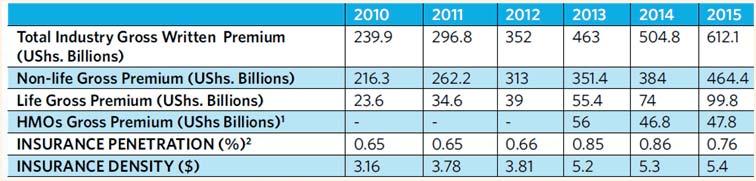
Source: Insurance Regulatory Authority Uganda Annual Insurance Market Report 2015.
The Insurers’ (including HMOs) Net Asset base (i.e. Assets less Liabilities) rose from UShs 316 billion in 2014to UShs 373 billion in
2015 representing a growth of 18%. This highlights the growing strength of companies to handle insurable risks locally and provide adequate protection to the insuring public.
The Gross claims paid for both Life and Non-life insurance (including HMOs) rose from UShs 184 billion in 2014 to UShs 214 billion in 2015 representing a growth of 16.08%. This excludes the outstanding claims and those that will emerge from the long-term policies.
The 21.58% growth registered in 2015 is impressive compared to the 9% growth registered in 2014. This is mainly due to the uptake of local insurance by large infrastructural projects. Significant premiums have been realized from infrastructural projects such as Karuma, Isimba, Entebbe airport, Entebbe express highway, Jinja Bridge, various small dams and road projects.
On the financial side, the total networth increased by 12% (from UShs 311 billion in 2014 to 347.3 billion in 2015) for non-life companies while total networth for life companies grew by 21% (from Ushs 43.8 billion to 53 billion in 2015). HMO’s networth on the other hand grew from UShs -6.8 billion in 2014 to 1.3 billion in 2015 representing a growth of 119%.
The future of the insurance sector in Uganda lies in re-engineering strategies and processes to protect the companies so that they are strong and able to continue being available for all those who count on them.
INSIGHT INTO UGANDA’S INSURANCE REGULATION AND MICRO INSURANCE MARKETS
An Interview with Alhaji Kaddunabbi Ibrahim Lubega, Chief Executive Office, Insurance Regulatory Authority Of Uganda
Alhaj Kaddunabbi Ibrahim Lubega is a Senior Associate and Certified Insurance Professional (CIP) a Fellow of the Australian and NewZealand Institute of Insurance and Finance (ANZIIF) with over 20 years hands-on experience in insurance operations, regulation and supervision. Currently, he is the Chief Executive Officer of the Insurance Regulatory Authority of Uganda and Chairman of the East African Insurance Supervisors Association (EAISA). He is the Vice President of the African Insurance Organisation (AIO).
Alhaj Kaddunabbi also served as President of Insurance Institute of Uganda, Executive Member of the Parliamentary Union of the Organization of the Islamic Conference, Vice Chair and Member of three (3) distinguished University Councils in Uganda, and also as a Member of Parliament of Uganda for 10 years where he chaired the Parliamentary Committee on the National Economy and Board of Trustees of the Parliamentary Pension Scheme.
He holds a Masters degree in Economic Policy and Planning and a Bachelor of Science in Economics from Makerere University, Uganda.
CAPMARKETSAFRICA: How has Uganda insurance regulation and supervision evolved in recent years?
Kaddunabbi Lubega: Prior to 1962 when Uganda secured its independence, there were about 100 agencies/branches/brokers of foreign insurers including Jubilee (from Kenya), Prudential, Crusader and Uganda American Insurance Company (formerly American Life). The only local insurance company then was the East Africa General Insurance Company Limited (EAGEN) which had been established in 1949. In 1964, the National Insurance Company (NIC) was formed through an Act of parliament and commenced operation in 1965. In 1972, many companies pulled out of insurance business after the declaration of the economic war, which saw the expulsion of many non-Ugandan Asians and non- African foreigners most of whom were businessmen.
In addition, the hyperinflation and consequently the currency devaluation in the 1980’s created public confidence deficit in the insurance industry. Ggovernments’ adoption of the privatization and liberalization policies let to a number of other companies joining the insurance market. This further led to the enactment of the Insurance law and establishment of the Uganda Insurance Commission which was rebranded to currently, the Insurance Regulatory Authority of Uganda (IRA).
Established under Section 14 of the Insurance Statute, 1996 (Statute) [now, The Insurance Act, (Cap 213) Laws

of Uganda, 2000], the IRA is mandated to regulate, supervise and develop the insurance market, maintain its safety and sound operation, protect the interests of insured’s and other beneficiaries, and ensure the supply of high quality and transparent insurance services and products.
The IRA has over the years come out with several regulations and guidelines covering the insurance industry. Most recent is the passing of the Insurance Bill (2017) which paves way for major reforms in the industry. The Bill which now awaits the President to assent to it to become law repeals and replaces the Insurance Act CAP 213 which came into force in 1996 and amended in 2011.
“The new law follows the need to adhere to the International Association of Insurance Supervisor’s Insurance Core Principles (ICPs), which are currently adhered to by about 240 countries, which is a benchmark for all insurance supervision in the world.”
With the industry poised for growth and with the new law, IRA is also in the process of transiting into a Risk Based Supervision regulatory framework from compliance
based supervision. The industry has also moved into a framework where composite insurance companies split their existing general and life businesses into separate legal entities with the expectation geared towards energizing the life portfolio.
Meanwhile, solvency margin rules are expected to be revamped, broadening the classification of assets recognized as admissible. Through these moves, the IRA intends to bring the local insurance sector more in line with international norms and to support the domestic equity market.
CAPMARKETSAFRICA: How do you see the current and future importance of micro-insurance in Uganda? Should there be different regulatory and supervisory standards for companies offering micro insurance?
Kaddunabbi Lubega: Insurance penetration in Uganda, currently, stands at 0.85% of the gross domestic product (GDP), which is considerably still low in the region. This has largely been attributed to Uganda’s poor saving culture, the low levels of disposable income and lack of awareness on the benefits of insurance.
The IRA considers Micro insurance as one of the avenues which will address the insurance dilemma for the low income earners and households and rural communities whose risk coping mechanisms keep them in poverty. Today, the banking sector has rapidly spread in various rural communities through the Micro Finance Institutions which the insurance sector also believes can be benchmark to penetrate the market segment.
An enabling regulatory environment for the development of micro insurance since such initiatives are aimed at encouraging insurers develop innovative products which meet the needs of the low-income segments and also allow micro- insurers to evolve and integrate with the formal insurance sector.
In Uganda, the current Insurance Act mandates IRA to supervise micro insurance business through regulations. The objective of the regulations is to promote market development of the micro insurance market by encouraging the participation of other persons in the market to generate sustainable and innovative products that meet the needs of the consumers at a lower level. The regulations also provide a basis upon which the IRA will regulates the business of micro-insurance and initiates and facilitates the transition to formalized micro insurance provision.
CAPMARKETSINAFRICA: Please tell us more about insurance penetration rates and emerging trends as well as opportunities in Ugandan insurance industry?
Kaddunabbi Lubega: It suffices to note that with insurance penetration levels still below 1%, the sector is yet to realise the performance levels worth celebrating. Nevertheless, we are on the right course to realising that potential. In the past few years, the advent of mobile money has brought a new dimension to Uganda’s
insurance industry. As most Ugandans have a mobile phone, buying insurance on a mobile phone is an exciting growth area as it will offer a more affordable way for Ugandans, especially in remote areas, to gain access to insurance products. Beyond the mobile phone, Digitalization as a key driver of business success and encourage players to integrate it into all dimensions of their business and processes.
Additional opportunities are expected to come from Bancassurance and Takaful insurance which will introduce very useful platforms of reaching an expanded market at relatively lower costs.
The insurance industry has started gaining good traction and creating value propositions with greater local relevance to market participants beyond the formal sector; although this is yet to deliver profitable growth. Insurers will continue to relentlessly drive operational excellence and invest in innovation and sales development to deliver the desired growth.
In addition, the future of the insurance sector in Uganda lies in re-engineering strategies and processes to protect the companies so that they are strong and able to continue being available for all those who count on them. Actions that should give the shareholders, clients and regulators comfort and demonstrate that the company is rock solid will have to be taken. To create and sustain this, a critical minimum effort is required to assemble a force of creative firepower and professional competence.
CAPMARKETSAFRICA: Do you see a trend towards harmonizing certain insurance related regulations across various East Africa countries?
Kaddunabbi Lubega: Following the increasing cross-border operations as well as significant regulatory challenges that are faced by partner states in the region, regional cooperation is necessary not only in developing effective frameworks to supervise the cross-border activities of insurance companies, but also to realize the convergence and harmonization of frameworks within the East African Community (EAC) Partner States.
As we move towards East African Community integration, it is also becoming critical that the standards of professionalism and ethics of the insurance industry are harmonized especially the aspects of regulation, certification, the free movement of labour and other related issues.
Currently, the EAC regional insurance Associations like East Africa Insurance Supervisors Association (EAISA), East Africa Insurance Institutes Association (EAIIA), the East Africa Insurers Association (EAIA), are all committed to working together to have the respective regulatory frameworks harmonized.
CAPMARKETSAFRICA: Thank you very much for granting this interview!
KENYAN INSURANCE INDUSTRY: IS RBC THE INSURANCE “RATE CAP”?
By Kasee Mbao, Research Analyst, Dyer & Blair Investment Bank
he Kenyan market is full of different push factors (regulatory, legal or innovative) that jolt industries into action and challenge the status quo. M-Pesa redefined mo-bile money worldwide while the Banking Amendment Act has shaken the very foundations of the Kenyan banking system. Following recent developments in the insurance sector there has been push towards establishing capital adequacy procedures for insurers with the Insurance Regulatory Authority (IRA) implementing the Risk Based Capital (RBC) regulations. This leads to the question, ‘Could RBC be the much needed jolt for the insurance industry?’
Insurance Market Overview
Kenya’s insurance penetration rate has hovered around the 3.00% level with a slight dip in 2015 as a result of the rebasing of Kenya’s GDP. The Insurance Regulatory Authority (IRA) in their Strategic Plan for 2013-2018 listed the key impediments to industry growth as: a general lack of a savings culture among Kenyans, low disposable incomes for majority of the population, limited understanding of insurance and a negative perception of insurance companies. Following interactions with management of insurance companies and the regulator, the issues that bedevil the insurance industry can be summed up in the following: slow innovation of products and services, price competition and inadequate risk management strategies. So, how does the RBC help in addressing the above issues?
What is
RBC?
First of all, the RBC changes the capital calculation methodology from compliance based, that is, maintaining capital above a stated minimum, to risk based, that is, maintaining capital depending on the risks that you have insured. This aims at creating resilience in the books of insurance companies to enable them withstand shocks. It also aligns Kenya’s regulations with industry best practice, thus allowing for jurisdictional comparison and reducing avenues for regulatory arbitrage. As per the current guidelines, the minimum capital required is 100% of RBC with a prescribed capital requirement of 200% of RBC.
For insurers operating between 100% and 200%, the IRA has established different levels that determine the supervisory interventions to be taken by the regulator. Without diving into the technical aspects, the gist of RBC is that if you aim to write risky business then you should invest in assets that are highly liquid and have low volatility or hold a significant capital buffer.
Risk Management

Insurers will need to develop robust risk management systems that adequately price and monitor risk in order to match insurance risk to capital adequacy. In 2016, insurance premiums written in the non-life business rose 8.51% year on year compared to a 10.70% rise in 2015. This can be attributed mainly to insurers slowing down volume growth in high risk, low return segments such as motor insurance which attract a higher capital charge. The industry is strategically shifting focus to the quality of under-written business rather than the quantity.
Asset Rebalancing
We are likely to see a re-thinking of how insurance companies invest premiums with a focus on the liquidity and volatility of assets. Insurance companies have started rebalancing their portfolios towards more liquid assets such as government securities that attract a lower capital charge. As per the IRA statistics for 2016, insurance companies raised investments in government securities by 700 bps while reducing investment property, equities and term deposits by 80 bps, 240 bps and 450 bps respectively.
Innovation & Competition
With implementation of new risk based systems, we anticipate more innovation in the sector in terms of products and service delivery. We are likely to see a revamping of pricing of certain sectors of insurance such as medical and motor in order to properly incorporate the complexities of risk away from current pricing methodology which is primarily age based. Untapped areas such as Takaful and micro-insurance will provide further avenues for insurance companies to venture into and increase their product offering. This in turn will help in raising the insurance penetration rates.
The past two years have seen increased competition in the insurance sector with players aiming to grow market share. The medical sector, comprised mainly of corporate clients, has faced the most price undercutting due to the limited pool of available clients. However, business acquisition costs have remained relatively stagnant over the period leading to reduced profitability of underpriced asset classes. Undercutting therefore leads to an asset liability mismatch as insurance companies are receiving premiums that don’t match the underlying risks. Under the RBC regime, one would be forced to dig deeper into their pockets in order to cover capital charges and boost as-set investments. Hence, a price undercutting strategy would be tantamount to shooting one’s uninsured self in the foot. We are likely to see improved profitability of the
core insurance business as combined ratios (factor of claims and expenses against earned premiums) have floated above 95% for a significant period of time.
Opportunity
So where does the opportunity lie for investors that want to jump into the Kenyan insurance sector? For an investor with significant financial muscle, insurance companies that have the innovation flexibility and risk management capabilities but, by faults not of their own making, have failed to shore up capital ratios or are operating at low capital adequacy ratios are attractive acquisition targets. In the listed space, holding companies that have deep pocketed shareholders are more likely to weather the storm of capital adequacy in the short to medium term. Management is also key as the adaptability of the
company depends mostly on the individuals setting the strategy. Investors need to pick out entities whose management has displayed the relevant skills and fore-sight in the sector can be great investments. Consequently, investing in stocks that combine the best of these criteria would be a good bet.
Contributor Profile
Kasee Mbao is a Research Analyst at Dyer and Blair Investment Bank covering the Insurance and Tier II banks and FMCG (BAT Kenya) sectors. Prior to this, he was a commodity futures trader at Futures First Kenya for one and a half years. He holds a Bachelor of Science degree in Financial Engineering from the Jomo Kenyatta University of Agriculture and Technology and is working towards a Chartered Financial Analyst (CFA) designation.
KENYAN INSURANCE INDUSTRY: OVERVIEW OF FINANCIAL PERFORMANCE IN 2016
The insurance business in Kenya is profitable, but it is not necessarily easy. Kenya represents one of Africa’s most well-developed and best-regulated insurance markets, with formidable historic growth and even better near-term prospects, but it is fragmented and competition is tough. There are increasing regulatory capital requirements on the horizon, and there is growing scope for consolidation. Kenya is the largest insurance market in East Africa and its insurance companies have established subsidiary and associate companies within the region. The performance of Kenya’s insurance industry is highly likely to impact on the performance of the regional insurance industries despite existence of individual regulatory regimes in each member state. This has led the region to work towards harmonizing regulatory laws. In this regard, the East African Insurance Supervisors Association (EAISA’s) Executive Committee, in their 14th meeting held in Dar es Salaam on 22nd January, 2016, passed the Draft Market Conduct Supervision Manual to be exposed to the staff of the respective EAISA Authorities for their input.
Industry Gross Premium Income: Kenya’s insurance industry has continued to grow though marginally in real terms. In 2016, insurance premiums registered a growth of 12.3% largely driven by growth in the life sector. This was an accelerated growth compared to 9.9% growth witnessed in the previous year. The life sector grew by 19.3% compared to an 8.5% growth in the non-life segment. The non-life segment contributed 62.5% (KES 121.67 billion) while long-term insurance business contributed 37.5% (KES 73.06 billion) of the total premium written by insurers during the period under review.
Reinsurance premiums have been shrinking on the backdrop of declining reinsurance activity in the market. The premiums reported by reinsurers by the end of 2016 amounted to KES 17.66 billion compared to KES 18.44 billion reported by the end of 2015. This represents a decline of 4.3% during this period. The gross premium income reported under life reinsurance business amounted to KES 2.39 billion while that
under general reinsurance business was KES 15.27 billion
Claims experience and underwriting expenses: The loss ratio under general insurance for the period under review was 62.3% (2015: 61.5%). The general insurance business underwriters incurred claims amounting to KES 53.70 billion in 2016, an increase of 9.3% compared to KES 49.13 billion incurred during the previous year. Underwriting expenses comprise of expenses of management and commissions (business acquisition costs). The net spending on commissions for the acquisition of business in 2016 amounted to KES 12.32 billion, representing a growth of 11.3% from KES 11.06 billion reported in the previous year. Management expenses grew marginally by 6.8% from KES 35.71 billion by the end 2015 to KES 38.13 billion a year later. Commissions and management expense ratios under general insurance business were 7.8% and 30.3% respectively resulting to a combined ratio of 100.5% in 2016.
Shareholders’ Funds and Investments: Investors’ equity funds amounted to KES 140.29 billion as at the end of 2016. These had grown by 9.5% between 2015 and 2016 up from KES 128.17 billion. The key component of equity was retained earnings. Some of the key components of shareholders funds were retained earnings at 38.9%, paid up capital at 29.9% and statutory reserves at 15.8%. The insurance industry asset base was KES 525.25 billion as at the end of December 2016. This was a growth of 10.1% from KES 477.22 billion held as at the end of the previous year. Income generating assets formed 80.6% (KES 423.31 billion) of the total assets. The total insurance industry’s liabilities grew by 10.3% to KES 384.96 billion from KES 349.05 billion registered in 2015.
Insurance business requires companies to invest in assets that match their liabilities in both nature and term. Consequently, most insurers held their investments in government securities (49.9%), investment property (16.8%), term deposits (10.9%) and ordinary shares (8.5%).
EGYPTIAN INSURANCE MARKET: UNTAPPED POTENTIAL AND RESILENCE DESPITE MARKET TURBULENCE



Mr. Sheriff Samy is the executive chairman of the Egyptian Financial Supervisory Authority (EFSA), Egypt’s regulator of all non banking financial services: capital market, insurance, private pension funds, leasing, mortgage, factoring and microfinance. In this capacity he is the chairman of its Financial Services Institute, the Auditors Oversight Unit and the Egyptian Institute of Directors. He is a member of the board of the Central Bank of Egypt and its Monetary Policy Committee in addition to the country’s National Anti Money Laundry Unit.
Mr. Alaa El Zoheiry had been in the Insurance market for more than 25 years. He also gained experience of professional indemnity insurance in the US market Starting with ACE Egypt as a Technical manager in 2001 and heading Arab MISR insurance Group ( AMIG ) as a Managing Director as of 2005.
Alaa is a board Member of the Egyptian Lebanese Businessmen Association and the Arab Orient Insurance Company (Jordan) as well as the Vice Chairman of the General Arab Insurance Federation and a member of the American Chamber of the Commerce in Egypt (he chairs the chamber’s insurance committee).
Mr. Mohammed Ali Londe is an Assistant Vice President – Analyst within Moody’s Insurance Group, based in Dubai. He is responsible for Moody’s insurance ratings in the Middle East. Prior to joining Moody’s in 2013, Mohammed worked in the Planning and Performance Management department of Zurich International Middle East. Mohammed’s past experience also includes working with Chartis Middle East (AIG).
CAPMARKETSINAFRICA: How has Egyptian insurance regulation and supervision evolved in recent years?
SHERIF SAMY: Over the past decade the two major legal changes addressed the mandatory split of life and non life in separate companies in addition to allowing for the first time the establishment of Insurance Brokerage firms, as opposed to brokerage being only practiced by individuals. Additionally more recently EFSA has issued directives with regards to concentration risks with re insurers, revised brokers operations and compliance issues in addition to making a major leap with regards to allowing for the first time electronic insurance policy issuance and distribution by entities other than insurance companies and brokers. EFSA is pursuing a major initiative to enhance financial inclusion; micro-insurance has been defined and introduced for the first time in Q4 2016.
With the amendments of the Egyptian Accounting Standards making them more aligned with international reporting standards, EFSA has also issued its revised Insurance Accounting & Reporting Guidelines Manual, which all insurance companies must abide by. It reflects the amended accounting standards and addresses in more details Takaful.
CAPMARKETSAFRICA: The general view is that the Egyptian insurance industry needs to recapitalise, what is your take on this and to what extent is consolidation needed in the country’s insurance sector?
ALAA ELZOHEIRY: The Egyptian Insurance market is a very attractive market for investors and multinational insurance players. Yet, the penetration is still too low and this could be one of the reasons why this market is attractive for a lot of insurance players especially in the area of Life market. The Life premiums have witnessed an increase of more than 20% yearly during the last two years , this confirm that there is a big chance for growth in this
segment particularly following the resume of the Bank assurance .
The main problem is that the minimum required paid up capital is EGP 60 million (about US$3.5 million). This has created very small insurer that can't really compete with the big ones specially the public sector companies. The regulator is working now on changing the insurance law including increase the required paid up capital to be more than double. This could be a solution but yet it will not create huge and big local players that can invest in developing this market and increase the penetration.
Our view is that the market should see some sort of merge and acquisitions; this could be an effective solution that can lead to a bigger and stronger entities. This could be a wish rather than a view since our deep understanding of the market tells us that even if this a wish of the shareholders of these small entities, the management of these companies will be the main obstacle of achieving so! We believe that merger is a solution, but the main obstacle is the companies’ management.
CAPMARKETSAFRICA: Given that the guiding principle of micro insurance is the provision of insurance cover for people with low incomes. Please can you tell our readers, how can insurance criteria be adapted to integrate lower-income households and how active is your company in the micro-insurance sector?
ALAA ELZOHEIRY: The Egyptian Financial Supervisory Authority (EFSA) is trying to promote the micro insurance in all aspects. Recently, they have agreed to allow a lot of entities to promote micro finance, this will increase the penetration of the micro insurance in the Egyptian market. There are some banks that already working in the microfinance space and provide a lot of products that assist the poor people in the country. In addition to that there some active NGOs in this area as well and they have been
very active in providing microfinance in a different format. EFSA also has issued a decree recently to allow selling micro insurance products electronically, this will help the insurance companies to solve a lot of connected problems to the selling of micro insurance products and collection of the premium as well as claims handling in future.
We have been able to position ourselves in this market and have already started selling micro insurance and have partnered with some of the microfinance institutions. We are working hard to finalizing the requirements of EFSA which will allow us to sell micro insurance electronically.
CAPMARKETSINAFRICA: The Egyptian insurance industry has shown a welcome degree of resilience despite the turbulent times of recent years. What new trends are visible in insurance and what impact has the depreciation of the Egyptian pound had on the industry?
MOHAMMED ALI RIYAZUDDIN: Economic growth has picked up after years of political instability and our growth outlook is that real GDP growth will average 4% to 4.5% per year until 2019. We expect the insurance market will benefit from a number of large scale infrastructure projects, both from providing direct insurance cover and indirectly as a result of job creation which will support the expansion of the commercial and personal lines of business. Additionally proposed bills, including the one mandating comprehensive health insurance which just got approval from Egypt’s Cabinet and the draft insurance supervision law and regulations proposed by the Egyptian Financial Supervisory Authority, will provide a boost for the sector’s medical, micro-insurance, takaful (Islamic Shariahcompliant insurance) and mutual guarantee premiums when enacted.
As a result the product mix is expected to diversify further towards personal lines with the advent of compulsory medical insurance and as takaful and micro insurance gather momentum, whilst commercial lines will maintain pace from continued large scale infrastructure projects. Thus, absent any political or economic upheaval, we expect the market to record a double digit growth in the next 12-18 months, helping to cement post revolution improving profitability with net profits growing at a compound annual growth rate of 33% between 2010 and 2015.
Furthermore, while brokers continue to be the key distribution channel in Egypt, we note that the reintroduction of bancassurance in 2013 has been a positive driver for premium growth and we expect the draft regulations covering internet sales and micro-insurance to open up new distribution channels. Having said that, the industry still faces challenges with i) high concentration among the top players while fragmented at the bottom; ii) high exposure to investment risk given the low rated sovereign and local banks; iii) moderate levels of capitalisation and limited access to capital markets with only a handful listed in the stock market; and iv) the impact of currency exchange rate liberalisation. The currency exchange rate liberalisation and followed depreciation of the Egyptian pound poses challenges in the short term to
profitability of insurers given our expectation of increasing claims and operational expenses inflation. In response, insurers may increase premium rates however higher premium rates as well as the rise in cost of living will affect insurance affordability, challenging further penetration of personal lines products in the Egyptian market in the short term.
In the long term we view the exchange rate liberalisation to have a credit positive impact as a result of an expected improvement in business activity, and by extension, a positive impact for the Egyptian insurance sector. Furthermore, investment income for insurers will improve as a result of the decision of the Central Bank of Egypt to increase deposit rates.
CAPMARKETSINAFRICA: Do you see a trend towards harmonising certain insurance related regulations across various North Africa countries?
SHERIF SAMY: I am not sure there is an intentional trend to harmonize, however various Arab insurance regulators meet periodically and exchange experiences and ideas. Most important is the membership in the IAIS to address the principles and sets standards for the industry.
CAPMARKETSAFRICA: What is your estimate of the annual growth in premiums for your business for 2017 and over the next three years as well as how are you planning to achieve the target?
ALAA ELZOHEIRY: Arab MISR Insurance Group/gig is the only Insurance company in the Egyptian market that has rating from two different rating agencies (AM Best as well as Moody's). We have a market share of 6% from the total Non-Life market including the public sector companies but 12% excluding the public sector companies.
We have achieved a Gross Written Premium (GWP) of EGP 536 Million as at June 2016, and we do expect this year (by the end of June 2017) to achieve 12% increase. We do expect to achieve between 10 -12% increase of the GWP during the coming three years. We do have a very balanced portfolio and we are working hard to keep this pattern. Unlike the Egyptian insurance market which has a 45% motor comprehensive, we have only 25-30% of our portfolio in motor comprehensive insurance. This has helped us to build a balanced portfolio among all lines of business and is likely to continue during the coming years.
We are working hard in the area of clients risk management and our engineers are providing excellent services to our clients that allow them to define the problems that they have to solve to prevent losses and this is an added value that we give to our clients free of charge. We do also carry a very strong reinsurance treaties supported by very strong reinsurance markets which allow us to get more business with huge support from these reinsurance markets.
Finally we have a strong team that we have invested in and continue to invest and their training either locally or in the international markets. All of the above have contributed in the Gross Written Premium and will assist us in growing this
An Exclusive Interview with Mr. Ali Harraj Chairman and Chief Executive Officer, Wafa Insurance, Morocco

Mr. Ali Harraj graduated from Ecole Centrale in Paris (ECP) (1981), Ecole Nationale Supérieure du Pétrole et des Moteurs (ESPN) and of the European Institut of Business Administration (INSEAD) (1987).
Mr Harraj started his career in the petroleum sector as an oil and gas engineer. Then he shifted to the automotive industry as general manager of a major car distributor in Morocco. Subsequently, he was appointed as head of various banking and financing institutions belonging to the Moroccan “Caisse de Dépôt et de Gestion” Group for which he officiated as Secretary General and member of the executive committee.
Mr. Ali Harraj is currently Chairman and Chief Executive Officer of Wafa Insurance (since February 2015).
CAPMARKETSAFRICA: A new insurance regulatory body (Supervisory Authority of Insurance and Social Security) was set up in Morocco, affecting the licensing requirements for insurers seeking to enter the market. Please can you tell us what prompted this move and how has the new regulatory body affected the insurance sector?
ALI HARRAJ: The Moroccan insurance market has almost doubled in size over the past decade and is increasingly important for the Moroccan economy and capital markets. It is hence natural that the regulatory setup evolves as well. Indeed, a new independent regulatory body (ACAPS) has been setup to accompany and ensure the development of the sector, further reinforce policy holders’ protection and guarantee the solvency of insurance companies. ACAPS has been working, in coordination with local insurers, on some structural topics such as premium collection from intermediaries, an updated insurance regulatory framework (Code des assurances), or is preparing the transition to risk-based solvency, all of which will force insurance companies to evolve in the way they do business.
On the other hand, we do not have knowledge of impacts on the licensing requirements for insurers seeking to enter the market. For instance, Allianz has just entered the market in replacement of Zurich and I am not aware that there has been any increased regulatory hurdle.
CAPMARKETSAFRICA:Disruptive social, technological, economic, environmental, political and regulatory changes are megatrends reshaping the competitive environment for insurers and the markets they operate. How are you leveraging the positive impacts and mitigating against the negative influences of these megatrends?
ALI HARRAJ: The mentioned megatrends are going to profoundly impact insurance markets. This can be either an opportunity or a threat depending of each insurer’s strategy. At Wafa Assurance, we try to be on the offense trying to be “simple and efficient” for our customers while
keeping high standards of service level and customer experience. On the other hand, we believe our commitment to stringent code of conducts and sound financial structure are strong assets against increased regulatory pressure or move towards risk-based solvency.
CAPMARKETSAFRICA: What is your estimate of the annual growth in premiums for your business for 2017 and over the next three years as well as how are you planning to achieve the target?
ALI HARRAJ: Wafa Assurance has adopted in 2016 a new strategic plan “Oufouq 2018” aiming at reinforcing our leadership in Morocco and accelerate our development in Africa. We have multiple strategic initiatives that should allow us to reach our ambition, such as the extension of our agents network to be even closer to our customers, the optimization of our commercial and distribution model, or an increased leverage of the synergies with our parent banking group. Our performance in 2016 has been positive and in line with our expectations. We have increased our revenue by 14% crossing the 7Bn MAD mark, and our net profits by 5% to ~840M MAD. For the future, we unfortunately do not give guidance on expected financials.
The largest and best developed in North Africa, the Moroccan insurance market is currently undergoing a range of reforms aimed at cementing its stability and further boosting premiums growth. Swiss Re Sigma’s “World Insurance in 2015” report put The value of insurance premiums in Morocco at 3.05% of GDP, the fourth-highest in Africa”
CAPMARKETSAFRICA: Thank you very much for granting this interview!
TUNISIA’S INSURANCE SECTOR: REGULATION AND SUPERVISION
By Mr Hafedh Gharbi, President, General Insurance Committee, Tunisia.
Introduction
The demand for insurance in Tunisia is set to increase in the long term. In spite of the recent t economic slowdown, the insurance sectors resisted well to the sluggish economic environment in 2011, registering a growth rate between 2% and 5% and consequently outperforming the 2% GDP decline in real terms. The insurance sector was less correlated to the overall dampening economy than tourism or manufacturing sector, owing to the low, albeit increasing, insurance penetration rate.
The insurances market in Tunisia consists of twenty two (22) local companies and six (6) offshore companies; twenty (20) of the local companies operate under the statute of limited company and two (2) are companies with mutual form. The insurance sector in Tunisia account more than one thousand and hundred twelve (1112) insurance intermediary in 2015.
In terms of total premiums written, the non-life sector is roughly twice as large as the life sector. In 2015, the total premium income stood at Tunisian dinar (TND) 1.67 billion. Like its neighbors, the Tunisian insurance market reported solid growth over the past three years, with premium volumes up 8% in 2013, 9.8% in 2014, and 7.6% in 2015. Likewise, the insurance penetration rate and average premiums per capita remain low at 2% and $83.4, respectively, in 2015.
Trend
in regulatory framework
Reminder of main undertaken reforms from 1992
Since 1992, the insurance sector has been governed by the Insurance Code. In 1994, the legal framework was enriched by the introduction of new legislation related to the decennial liability insurance. Similarly, 1997 saw the reform of export insurance. The new improvements introduced by the law of 28 April 1997 concern mainly the abolition of the monopoly conferred on a single undertaking so far and the opening up of this activity to competition from companies operating in the market, Intervention of export insurance to the risks that may arise before the dispatch phase and to non-resident operators.
The work on reform of the legal framework continued in 2002 by actions of reinforcement and modernization of the prudential control rules of the insurances companies and the profession conditions. These principal modifications concerned primarily:
- Consolidation of the financial bases of the insurance companies through a slight increase of minima
capital required.

- Improvement the performance of the insurance companies and their upgrading.
- The adaptation of the prudential rules with the international standards (Solv I) through a recasting of the calculation way of the solvency margin, and the institution of a solvency margin suitable to the life insurance.
- The introduction of new accounting standards specific to insurance sector in accordance with international norms and standards.
- Strengthening the role of the supervisory authority and creation of the Insurance General Committee.
In 2008, the reform continued and the main focus was strengthening the control and governance rules of insurance companies through:
• Attribution of new powers to the supervisory authority through the institution of a control on:
The shareholding: any change in the structure of the capital must be submitted in preliminary to the approval of the Minister of Finance.
The management: any change of administrator, director, or manager must be submitted in to the approval of the Minister of Finance.
• Authorization of the majority foreign participation in the capital of insurance companies since the independence was limited to 49 %; more than this percentage must be submitted to a specific authorization
Furthermore, the Insurance General Committee continued to work to strengthen the regulatory framework of the insurance activity as what they did for the solvency supervisory framework and constituting a major reform in line with the implementation of solvency norms and standards that will help to set the bases for more efficient management of the sector liquidity and solvency risk.
The main undertaken Reforms during the last 3 years
Since 2008, the insurance general committee started a reform program of insurance regulation in a strategic vision in accordance with international norms and standards in order to improve the competition conditions, governance and transparency of insurance industry and to confer on the regulatory authority the essential tools with the effective exercise of its mandate of prudential monitoring. The principal reforms touched the quantitative requirements management covering of the risks and the qualitative requirements governance fight anti money laundering and of financing of terrorism. The main measures have been taken within this
framework are the following ones:
• Institution of a department dedicated to control of the intermediaries and the other jobs including the experts and the mutual insurance companies;
• The promulgation in July, 2014 of the law dedicated to the takaful insurance sector,
• New agreements inter companies regulating the expertise and the compensation of damage to property resulting from traffic accidents;
• Clarification and reduction of the compensation procedures and deadlines
• Introduction of the circular in2009 concerning the strengthening of the rules of good governance in insurance companies. This text promulgated new obligations being inspired by principles of the Committee of solvency and to rehabilitate the role of the Board of directors by involving him more in the risk management process;
• The revision of many circulars. These revisions aim at making many rules in accordance with international norms and standards those relating to good governance.
• Publication of the circular in July 2013 requiring insurance and reinsurance companies the implementation of a complete device of control interns for the anti-money laundering widely inspired by the recommendations of the FATF in the objective to protect the insurance sector against any excessive financial use.
• Publication of the circular by the end of 2016 concerning the way to calculate the contribution of the technical and financial profits in life insurance.
The final goal is to preserve the reputation of the Tunisian insurance sector especially in a context favorable to the proliferation of some risks.
Reforms drafts Progress
a. Mid-term action plan for insurance supervision strengthening: As part of elaborating a program to strengthen the Insurance Supervision, a mission of World Bank technical assistance was conducted in March 2014. This mission drafted, with the support of a Tunisian supervision team, a mid-term action program to strengthen supervision aiming at achieving the following objectives:
• Transitioning into a fully risk-based approach that relies on a balanced mix of offsite and onsite resources,
• Developing an automated risk-based prudential reporting system that is sufficiently comprehensive and reliable to enable an early detection of the insurance’s problems and risks as well as at the level of the whole insurance sector,
• Increasing the staff number and supervisors’ capacities,
• Establishing a prompt corrective action framework that deals effectively and timely with insurance’ weaknesses and problems.
b. The reform of the insurance law that would introduce substantial changes to converge with international
norms and standards aims at improving a legal and regulatory framework of the insurance activity. In this sense, the main features of this project can be summarized as follows:
• To review the current insurance legislation for both life and non-life insurance;
• To review of the law’s application fields in particular the legal framework for Islamic insurance activity;
• To review conditions for insurance activity access and practice;
• To strengthen good governance rules;
• To strengthen the micro and macro prudential supervision of insurance and reinsurance companies;
• To review the system of sanctions;
• To establish a specific insurance resolution regime inspired from international best practices by providing the resolution authority with a set of specific instruments rather than common rights rules.
c. Process of supervision: As part of the reforming of the supervision process which aims at:
• Strengthening the operational capacities of insurances and reinsurances and of the supervisory authority,
• Permanent developing supervisory practices towards a more efficient supervision of the Tunisian insurance sector,
• Early detection of weaknesses and problems of insurances and reinsurances companies and rapid measures to correct them.
Trend in insurance supervision operational framework
Human resources
The insurance supervision staff number increased since 2015 with the recruitment of 30 Executives from different specialties mainly in the fields of: accountants, insurance and finance to reach 50 executives of which 91% are university graduates for the five last years. The recruitment of actuaries since 2015 is part of the continued strengthening program of human resources and logistics by providing the existing team with adequate and modern infrastructure.
Professional training
Supervisors’ training and capacity building occupies a prominent place in the professional development of supervisors with regard to developments affecting the legislative aspects, regulatory aspects and the insurance and financial techniques.
The main subjects were related to recent developments in the insurance and financial regulation around the world such as: the latest advances of the solvency Committee’s work (solvency II), Risk-based insurance supervision, Microfinance and financial inclusion, Combating money laundering and terrorism financing and Reinsurance as well as Asset and Liability Management (ALM)
REGULATIONS HARMONIZATION, MULTINATIONALS AND TECHONOLOGY ARE KEY TO
An
AFRICA’S INSURANCE GROWTH
Interview with Mr. Thabo Dloti , Chief Executive of Liberty Holdings Limited, South Africa

Mr. Thabo Dloti was appointed Chief Executive of Liberty Holdings Ltd in March of 2014. He first joined the Liberty Group in 2010 as the Chief Executive of STANLIB and Liberty’s institutional businesses, namely, Liberty Corporate and Liberty Properties. Part of his responsibilities included leading the group’s strategy function.
Prior to that, he spent 18 years at Old Mutual where he held several senior positions including Chief Executive of Old Mutual Investment Group (South Africa) and Managing director of Old Mutual Group Schemes. In 2013, Thabo received the CEO of the decade award from ABSIP. This award recognises his leadership and overall contribution to transformation within the Financial Services Sector.
Thabo holds a Bachelor of Business Science, Actuarial Science, from the University of Cape Town and completed the Advance Management Programme (AMP) at Harvard University in Boston.
Thabo is currently the chairman of the Association for Savings and Investment South Africa (ASISA) which represents the majority of the country's asset managers, collective investment scheme management companies, linked investment service providers, multi-managers and life insurance companies.
CAPMARKETSAFRICA: Given that Liberty operates in multiple jurisdictions, it therefore faces different regulators and supervisors. What is your view on regulatory provisions with regards to the cross-border activities of insurers in Africa and do you see a trend towards harmonising certain insurance related laws across various countries or regions in Africa?
THABO DLOTI: Multinational businesses are important in bringing capital and expertise to grow markets, so capital requirements and other regulations should not be prohibitive. They should enable these businesses to compete fairly in individual markets with local insurers.
The ‘home’ regulator must, however, be concerned that subsidiaries may be a capital drain on the holding company. All regulators should therefore be concerned that local entities can stand alone should the holding company fail e.g. can detach systems so that they can operate as stand alone entities.
There is therefore a need for regulators to communicate with each other and for there to be visibility on the specific risks that come with operating in multiple jurisdictions.
The harmonisation of laws across countries makes it easier and cheaper to operate in multiple countries, which lowers the barriers to entry and enhances the customer proposition.
However, it is important to note:
• Laws need to be pragmatic for the scale of the market, for example, requiring Solvency Assessment and Management (SAM) in the form it
is envisaged in South Africa would not be appropriate for say Swaziland given the scale of that market.
• We operate in mainly countries with a British legal system so there is a lot of commonality in insurance law applicable although there are obviously some differences. Things like capital regimes are all evolving towards risk based regimes but are being implemented differently.
• Insurance law is just part of the overall legal framework, and more specifically financial services law so these have to link and make sense when read together in a country. Also complications come from laws like taxation, governance, etc. therefore harmonising insurance laws would not remove all the complications. In addition some countries include pension funds under the insurance license, others require separate licenses so again simplicity will not just come from insurance laws being harmonized.
• Each country has its own culture and preferences and ways of doing things so even if you harmonised the law you would still need to deal with differences in product preferences, how people buy, what is important to them, payment and the banking systems, skills, etc.
“Operating in sub-Saharan Africa has inherent political and regulatory challenges that all companies need to be aware of, and navigate through with much care.”
CAPMARKETSAFRICA: Disruptive social, technological, economic, environmental, political and regulatory changes are megatrends reshaping the competitive environment for insurers and the markets they operate. How are you leveraging the positive impacts and mitigating against the negative influences of these megatrends?
THABO DLOTI: Looking at the emerging disruptive trends, traditional insurers have turned their eyes towards digital for insurance opportunities, but so have other disruptors. As technology changes customer interactions and preferences, a new integrated network economy is emerging: traditionally, customer needs have been served by dozens of parallel value chains, however, technology change is accelerating a shift in these chains and increasingly, value chains are collapsing into one chain around each need. Through our relationship with Standard Bank, and other key partnerships, we are well poised to delivering solutions in these integrated network economies.
Technologically, consumers are empowered by “infinite information” and digitisation, and are becoming more diverse and sophisticated. Consumers are more technologically connected and have more information than ever before available at the point of purchase. Consumers demand and expect “shopping experiences”; not just products. This customer trend compels us to promote a customer centric culture to drive innovation and execution of strategy to create value for our customers. To this end, we continue to invest in digital innovations that will not only improve customer experience, but create more frequent and meaningful customer touchpoints.
The poor growth expectations, a weakening currency and rising inflation and interest rates paint a challenging picture for the next 3 years. This has had a significant impact on the life insurance industry, and financial services as a whole. On average, South Africa is becoming a slow growth market for life insurance as total premium growth has been flat (in real terms) and profitability declining. However, the mass market is opening up as “financial exclusion” has halved over the last 4 years. The mass affluent market segment for life insurance is growing, driven by the Black Middle Class (in term of new business Life APE), presenting opportunities in one of key growth markets.
Furthermore, operating in sub-Saharan Africa has inherent political and regulatory challenges that all companies need to be aware of, and navigate through with much care. We continue to work with local professional bodies that collaborate with the government and regulators. We are seeing a tightening of regulation across our markets of operation, with impacts on our capital requirements, products, and distribution channels (inter alia). We work closely with regulators not only to ensure our compliance, but to ensure that there is full understanding of the potential ramifications of
proposed changes
CAPMARKETSAFRICA: In 2015, Liberty strategy 2020 was set with focus on Sub-Saharan Africa. Can you tell us the key element of the strategy and any achievement to-date as well as future targets (for example any acquisitions in the pipeline)?
THABO DLOTI: The key element of our strategy is that Liberty will be the trusted leader for insurance and investments in Africa and other markets. This means the following for sub-Saharan Africa in particular:
• Being in the Top 10 in Nigeria and Top 3 in Kenya, and gaining significant growth and insurance market share in the rest of sub-Saharan Africa.
• Become the preferred destination for asset flows destined for Africa.
• Become the preferred partner for Standard Bank in all its African geographies.
• Leverage and ensure seamless transfer of core capabilities of the group where the opportunities are.
In terms of achievements to date on the continent, we have a presence in 24 African countries with operations spanning: Life insurance; Asset management; Short-term insurance; Property; and Health.
Our key successes in 2016 include:
• Lesotho life business successfully launched;
• Three short-term insurance businesses acquired (Uganda, Malawi and Botswana);
• Regulatory approvals obtained for a Nigeria long-term insurance transaction. Certain conditions remain outstanding;
• Alternative investment, Health Cover, Business Owners Life Insurance and Living Annuity products were developed and launched in various key countries by the Liberty Africa Insurance team;
• Bancassurance transactional channel implemented and delivering sales in Botswana, Namibia and Swaziland;
• Worksite channel implemented across six of the seven life insurance businesses in Africa and delivering promising results; and
• Liberty Life Kenya was runner up for prestigious life insurer award and second runner up in the socially responsible corporate awards category (7th Annual Think Business Awards).
“The harmonisation of laws across countries makes it easier and cheaper to operate in multiple countries, which lowers the barriers to entry and enhances the customer proposition”.
CAPMARKETSAFRICA: Thank you very much for granting this interview!
TECHNOLOGY AND INNOVATION: POSITIVELY DISRUPTING THE INSURANCE MARKET
By Precious Nduli, Head of Technical Marketing, Discovery Insure, South Africa
he insurance market in Africa has experienced tremendous growth in the recent years, largely influenced by increasing economic growth, a rapidly expanding middle class and urbanisation – all of which are fuelling the demand for insurance. Along with a relatively low insurance penetration in most countries it represents an increased opportunity for growth in the insurance market.
Technology is another element driving growth with rates of access to mobile internet across Africa forecasted to rise to 56 percent by 20201. This represents a new generation of customers who are digitally savvy with higher disposable incomes. That being said, there are still significant challenges in the African insurance market. The first being diverging economic prospects in many countries, which means affordability can be an issue. Countries that are commodity driven have also seen lower economic growth in recent times. Low insurance penetration levels can further indicate a lack of relevance of insurance products and a lack of trust between customers and insurance companies.
Technology can play an important role in alleviating some of these challenges. It has the potential to improve the level of transparency, foster better communication, open new markets and reduce the insurance cost for customers and insurers. Technology can also improve financial literacy by making information more accessible to customers.
Fuelling innovative product design and better risk assessment
Technology can and is positively disrupting the insurance market. Current insurance solutions are moving away from the traditional insurance models that no longer serve customers’ needs. South Africa represents a fairly mature insurance market and some insurance providers have been around for over 100 years, maintaining a largely traditional approach to insurance. Traditional insurance works on a simple and static model, which ignores the behavioural nature of insurance risk. Newer insurers, such as Discovery Insure launched in June 2011, are moving away from this traditional insurance approach. The company offers comprehensive car and home insurance and through Vitalitydrive, a unique driver-behaviour programme, it incentivises and rewards clients for driving well. By improving driver behaviour, the aim is creating a nation of great drivers. Discovery Insure has applied the disruptive capabilities of technology to offer a range of

first-to-market safety features, such as ImpactAlert, weather warnings and a vehicle panic button (accessed by pressing one’s smartphone power button) ImpactAlert, through telematics technology, allows Discovery Insure to detect severe impact and immediately dispatch emergency assistance to their clients in the event of an accident. Called DQ-Track, this telematics technology applies cell phone capabilities to measure and report in real time on the following driver behaviours: acceleration, braking, cornering, speed, time of driving (night time driving has been shown to be 7 times more dangerous than any other time of day), distance, location of trips and cell phone use while driving. This data is integral in more accurate insurance risk assessment. It is also used to incentivise clients for positive behaviour change, and it enables further product innovation for the benefit of clients.
Data collected on driving behaviour over time confirms that women, on average, drive better than men. However, women tend to use their cell phones more while driving. This deeper understanding of the risks associated with a specific client allows Discovery Insure to provide targeted interventions and insurance solutions. For example, young drivers in high-performance vehicles normally have high insurance premiums. This is due to the fact that the accident rate is higher among these young drivers. With the driver-behaviour data available to Discovery Insure, they can see when a young driver is a good, safe driver. The collected data triggers rewards, such as reimbursements of large portions of their insurance premiums through fuel and other rewards, to encourage better driving behaviour. This means young drivers pay a premium that is directly related to their actual risk, as opposed to a higher premium based on the risk associated with the “average” young driver in a high-performance vehicle.
A better understanding of risk and behaviour, through the use of technology and innovative solutions, means the industry will be able to move beyond traditional risk rating factors such as age and gender.
The adoption of big data in insurance is also transforming how the industry works. Changing from a reactionary function of covering the costs of the consequences of risk, insurers can take a preventive approach and help customers to improve behaviour and prevent avoidable illnesses and injuries that are often the source of claims. This model has been applied across Discovery Group’s health, life and general insurance businesses with positive
results. Increased engagement in behaviour-change programmes results in reduced risk from an insurance perspective. Lowered insurance risk drives substantial returns to insurers and customers through better health, lower mortality rates and significant financial incentives. In addition, these solutions have a wider social impact such as improved health and road safety, and create greater trust between insurers and customers. Customers, especially the younger generation of millennials, support companies that also make a difference in society. This is particularly important in the African context where there are a vast amount of societal needs to address.
“A better understanding of risk and behaviour, through the use of technology and innovative solutions, means the industry will be able to move beyond traditional risk rating factors such as age and gender.”
Improving service and creating new channels In the distribution of insurance products to communities, agents and brokers are and will remain crucial to reach a rapidly-expanding middle class that is generally unfamiliar with insurance. Technology, however; also gives customers access to more direct channels. Nigeria, for example, is starting to see the first price-comparison sites, such as Topcheck. People can purchase insurance directly on these sites without a broker or agent. Similar start-ups have also appeared in Kenya. These types of services are already well-developed and fairly popular in developed countries and in larger insurance markets, such as South Africa. However, Discovery Insure believes in the value of advice and supports brokers through a differentiated product offering and a bespoke servicing platform.
Across these markets, technology can play an important role in2 :
• Online and mobile underwriting platforms for policy quotations and renewals.
• Distribution channels that enable online and mobile purchasing of policies and premium payments.
• Online and mobile claims processing and customer payments.
Insurers are already using various digital channels, such as websites and mobile messaging, to better communicate with their customers. Brokers are also being encouraged to make use of digital channels to better service customers. Digital channels combined with the use of big data makes it possible for insurers to communicate with customers in a manner that is relevant to them. This information allows agents and brokers to offer personalised advice to clients based on a better
understanding of their needs and risks.
Facilitating new markets and lowering costs in the long term
The active, working population (aged 25 to 64 years) is growing more rapidly than any other age group3 in Africa. In competing with direct insurance channels, brokers and agents will, to a large extent, have to integrate new technologies into their business to reach a broader customer base and reduce running costs. The new generation is also more driven by incentives. A study done in the United States shows that millennials are 44% more likely than the average consumer to use a device from their insurance company that tracks driving behaviour in exchange for discounts4 .
Telematics and connected motor insurance are expected to drive the development of a far more sustainable insurance model. One where insurers can reduce costs because they can accurately assess and price risk, customers pay more affordable insurance premiums and have lower risks, and one where there is more equity in the book from better loss ratios from improved driving behaviour.
Technology is only an enabler
It is important to remember that technology does not work in isolation. Rather, it is an enabler for innovation and business growth. This is also the case in the Discovery Insure model, which combines actuarial expertise and behavioural economics with technology to improve the lives of customers as it leads in helping the industry to evolve. In an era where it is important to remain relevant, insurance companies have to stay at the forefront of meeting clients’ needs through continuous innovation.
“The adoption of big data in insurance is also transforming how the industry works. Changing from a reactionary function of covering the costs of the consequences of risk”
Contributor’s Profile
Precious Nduli is currently the Head of Technical Marketing at Discovery Insure. She has previously held roles spanning product development and strategy at leading insurance companies in South Africa. Precious has recently completed her MBA at the University Of Cape Town Graduate School Of Business. She also holds a Bachelor of Science in Actuarial Science from Wits and a Bachelor of Commerce Honours in Financial Analysis and Portfolio Management from UCT. She is passionate about business having a social impact particularly in the area of improving access to financial services for low income communities.
AFRICAN REINSURANCE SECTOR: WEATHERING THE STORM
An Interview with Mr. Corneille Karekezi Group
Managing
Director/Chief Executive of African Reinsurance Corporation

Mr. Corneille Karekezi was appointed the Group Managing Director / Chief Executive Officer of the African Reinsurance Corporation (Africa Re), the leading reinsurance company in Africa and the Middle East in July 2011.
He rose to that position after a two-year transitional period as Deputy Managing Director / Chief Operating Officer of Africa Re, a company he also served as a Board Director for three years between 2002 and 2005.
Before joining the reinsurance industry, Mr. Karekezi spent 17 years in two leading insurance companies in Burundi (SOCABU s.m.) and Rwanda (SONARWA s.a.) where he occupied various senior accounting, reinsurance, financial, technical (Life & Non-Life) and strategic positions, the last being Chief Executive Officer of SONARWA s.a.
Mr. Karekezi has contributed significantly to the development of the insurance and reinsurance industries in Africa by participating in various national and regional initiatives (insurance organizations, reinsurance pools, insurance supervisory boards, etc.). Currently, he sits on several boards of continental companies and institutions: Executive Committee Member of the AIO (African Insurance Organization), Board Member of Shelter Afrique (leading Pan-African housing finance company), Vice Chairman of Africa Re South Africa Ltd. (No. 3 South African reinsurer) and Vice Chairman of Africa Retakaful Co. (No. 1 Islamic reinsurer in Africa based in Egypt).
CAPMARKETSAFRICA: How is the reinsurance sector coping in the current macroeconomic uncertainty, where currency volatility and the commodity slump coupled with terrorism and political instability have put pressure on economies in Africa?
CORNEILLE KAREKEZI: The recent slump in commodity prices coupled with the attending depreciation of most currencies in the continent has been a drag on the economies of promising African States. A number of infrastructural projects have been delayed, slowed/scaled down or abandoned. The loss in income would hamper commercial insurance. Furthermore, the depreciation of African currencies should make insurance claims more expensive due to the subsequent inflation in affected economies, hence pushing insurers to review upwards their prices. However, due to the intense competition in most African insurance markets, insurance rates are still falling while the growth in premium income in local currencies do not rise in tandem with the appreciation of the US dollar. The reducing premium rates have led to shifting reinsurance buying pattern of insurers in favour of greater retention with the hope of keeping internally some potential underwriting profit. Therefore bigger insurers are moving towards excess of loss covers as against proportional reinsurance programmes.
CAPMARKETSAFRICA: Given that Africa-Re operates in multiple jurisdiction, hence faces different regulators and supervisors, what is your view on regulatory provisions regarding cross-border activities of reinsurers
in Africa and do you see a trend towards harmonising certain insurance related laws across various countries or regions in Africa?
CORNEILLE KAREKEZI: Most African insurance markets commenced the process of deregulating their insurance industries and aligning their regulatory frameworks with international standards, at the start of the new millennium. In essence, apart from Eritrea, Ethiopia and Democratic Republic of Congo, where talks on deregulation are ongoing, other markets have liberalised their markets and allow local private insurers and foreign insurers to operate within their borders. In the case of reinsurers, there is the need for them to write business across many countries to diversify their portfolios and be profitable.
A number of Insurance regulators in the continent insert certain safeguards as to the category of reinsurers that may operate within their borders. In the absence of such provisions, many local insurers insert minimum security ratings that reinsurers must meet. This is usually in the form of a minimum rating by A.M Best or Standard and Poor’s. For local reinsurers the minimum capital base have been significantly increased in most markets to enable them to be more competitive at home and abroad. However, the African domiciled reinsurers’ capitalisation remains averagely low (solvency ratio in 2015: 85%) compared to other parts of the world. This is the primary reason of their meagre share (35%) of the total African reinsurance premium income.
There are some markets in sub-Saharan Africa, where certain classes of business such as Life & Accident are retained within the country. Kenya, Nigeria & Ghana, and very recently the CIMA Zone (Central and West Francophone Markets) come readily to mind. Furthermore, Nigeria & Ghana have local content laws ensuring that the local market retains as much Oil & Gas risks as possible in line with aggregate local capacity. A number of prospective Oil & Gas markets are also thinking in this direction.
“The recent slump in commodity prices coupled with the attending depreciation of most currencies in the continent has been a drag on the economies of promising African States. A number of infrastructural projects have been delayed, slowed/ scaled down or abandoned”
CAPMARKETSAFRICA: A school of thought believes emerging insurance markets in Africa should be protected by regulatory provisions from excessive foreign competition until a healthy and sustainable domestic insurance market has developed. What is you take on this and any impact on your company, please?
CORNEILLE KAREKEZI: In principle, reinsurance industry is by essence international as it fulfils the role of geographical risk diversification and spread. As discussed in the answer to the earlier question, where necessary risks are retained in the country as it is important that the domestic market is allowed to grow and be sustainable. This can only happen if the local market does not act as a post office but develops its technical underwriting skills and increase its underwriting capacity through higher capital. However, for large exposures such as insurances of dams, bridges, and other large infrastructure, where the local market lacks capacity, it is advisable to reinsure such portion as is found necessary with reputable foreign players. Finally, before retaining more risks in a markets, regulators and public authorities should make sure, through tests, that they can bear large or systemic claims when they arise.
“Most African insurance markets commenced the process of deregulating their insurance industries and aligning their regulatory frameworks with international standards, at the start of the new millennium”
“African
reinsurers, supported by their governments, play an
important role
in mobilizing financial resources to create regional reinsurance capacity, thereby reducing currency outflows and actively supporting African economic development.”
CAPMARKETSAFRICA: Disruptive social, technological, economic, environmental, political and regulatory changes are megatrends reshaping the competitive environment for insurers and the markets they operate. How are you leveraging the positive impacts and mitigating against negative influences of these megatrends, please
CORNEILLE KAREKEZI: Any industry is reshaped over years by the trends in its environment and insurance is no different. To navigate the course of those trends, every industry player has to be strategic in its decisions and nimble in its strategic execution. Africa Re scans regularly the environment and reviews frequently its strategy. For example, in recent years, a higher emphasis has been put on new technologies to prepare future required competences as digitalization will transform the industry and unleash new avenues for growth and operation. Also, focus has been put on the acquisition of new and emerging insurance products such as cyber risks and index-based insurance products. Finally, we can mention risk management culture, systems and tools which have been revamped to match the international standards.
CAPMARKETSAFRICA: What is your estimate of the annual growth in premiums for your business for 2017 and over the next three years as well as how are you planning to achieve the target?
CORNEILLE KAREKEZI: It has become more difficult to predict the annual premium income growth in US dollars since the exchange rates of African currencies against the US dollar are very volatile. If they were stable, a growth rate of 10% is achievable. That is the underlying weighted average growth rate of our portfolio. In case major economies currencies continue to stumble against the UD dollar, it could be another story. Africa Re is planning to achieve its strategic targets by leveraging on its unique competences. These are competences and capabilities which are valuable, rare, non-imitable and able to capture value in core markets, such as a strong financial rating (A by A.M. Best), a strong capitalisation (28% of the total African reinsurers’ equity), superior technical expertise, proximity to markets and deep market knowledge.
CAPMARKETSAFRICA: Thank you very much for granting this interview.
INCLUSIVE INSURANCE MARKETS: EMERGING TRENDS AND SUPERVISION
By Janice Angove, A2ii Sub-Saharan African regional coordinator, Access to Insurance Initiative
nsurance softens the blows of misfortune. However, many low-income earners lack access to insurance and are thus deprived of the cushioning insurance provides although they are the ones in most need of insurance protection as they have little to fall on. For smallholder farmers, for example, besides the lack of access to insurance leaving them exposed to the varieties of the weather, it can also disincentivise them from investing (extra) in high-yielding, disease-resistant seed variety out of fear of losing their investments if weather conditions become unfavourable. In contrast, a commercial farmer with access to insurance can invest in potentially profitable ventures, confident that if misfortune strikes, they can recoup their investments through insurance. The lack of insurance protection, therefore, deprives the most vulnerable people the essential safety nets to help them break the vicious cycle of poverty.
More and more, insurance supervisors around the world are recognising the critical role they can play to make insurance markets more accessible and inclusive. An inclusive insurance market goes beyond providing insurance products targeted at low-income earners; it embraces all insurance products aimed at the excluded or the underserved market. For example, many Latin American countries promote access to insurance or increase insurance penetration by using alternative distribution channels, dubbed "mass insurance". Unlike microinsurance which targets a specific segment of the market, mass insurance unlocks channels and significantly widens outreach without any target consumer in mind. Yet, since mass insurance products are standardized and straight forward, they serve the excluded and the underserved segment of the market.
The global landscape in inclusive insurance continues to evolve quickly as new players, technologies and products emerge, altering the traditional composition of the insurance value chain. These trends offer both opportunities and threats to inclusive insurance; while they make insurance more affordable and accessible, they can make risks more complicated for the policyholder. On the positive side, electronic money providers and mobile network operators (MNOs) are partnering with insurance companies to deliver insurance products to the mass market (mobile insurance), helping to achieve scale quickly. For example, a study by the Deutsche Gesellschaftfür Internationale Zusammenarbeit (GIZ) and the National Insurance Commission of Ghana (NIC) shows that in Ghana, mobile insurance is playing a critical role in the microinsurance sector with approximately 60% of lives insured under microinsurance products delivered via mobile
insurance.1

On the flip side, the regulatory factors become more complex as multiple stakeholders such as MNOs, Technical Service Providers (TSPs) and financial institutions actively get involved in developing, delivering and maintaining mobile insurance products. These new channels tend to have significant bargaining power over commission costs, which are often passed on to the low-income consumer. Insurance supervisors must, therefore, adapt to the changing power dynamics within the distribution chain and collaborate more closely with telecommunication and banking regulators to protect consumers, ensure client value and financial sustainability for the products. Equally important are sound, clear service agreements between insurers and distributors, as well as effective controls agreed to by the regulatory authorities involved. This will help protect policyholders and anticipate scenarios such as the dissolution of the business relationship and suspension of products and services.
Another trend in the inclusive insurance market is how the breadth of coverage has been expanding (beyond life, for example, to cover health and property) and products are becoming more sophisticated. Some insurance products are bundled with non-financial services. Innovative products like index-based insurance are also emerging, driven by developments in digital technology and the desire of policy makers to use insurance to address wider development issues such as climate change, poverty reduction and food security.
Supervisors must ensure that these innovative products offer value to their low-income clients. For example, there is the risk that policyholders under index-based policies might not receive compensation after suffering a loss because of a mismatch between the actual loss and the loss determined by the index. That is the basis risk problem, which supervisor must help to minimise to build confidence in insurance. As a further example, evidence shows that in some cases, bundled insurance schemes have rather low claims ratios, which suggests that policyholders are either unaware that they have insurance or do not know how to make a claim.
Insurance has also become integrated into national financial inclusion strategies. With governments recognising the critical role insurance can play in helping meet their development objectives, insurance supervisors are increasingly finding themselves pulled into wider policy debates and arenas. This requires supervisors to broaden their scope beyond policyholder
protection and interact more closely with governmental departments and other key stakeholders
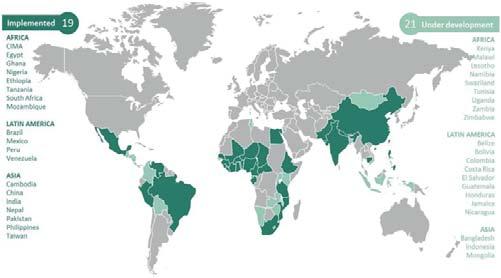
In the light of these trends and as insurance supervisors become more aware of their role in issues such as client value and protecting consumers, a growing number of supervisors are adopting proportionate supervisory approaches aimed at striking a balance between establishing an enabling business environment and ensuring vulnerable consumers are protected. In the past decade, insurance supervisors have made significant progress in this direction. In 2005, India introduced the first microinsurance regulation. Today, at least 21 countries in Africa have adopted regulatory frameworks for microinsurance, which are tailored to the nature, scale and complexity of risks individual insurers face.
The fourteen CIMA countries (that is, Benin, Burkina Faso, Cameroon, Central African Republic, Comoros, Chad, Cote d’Ivoire, Gabon, Guinea, Equatorial Guinea, Mali, Niger, Senegal, and Togo) together with Ethiopia, Egypt, Ghana, Mozambique, Nigeria and Tanzania have all implemented microinsurance regulations. Also, Kenya, Malawi, Lesotho, Namibia, South Africa, Swaziland, Tunisia, Uganda, Zambia and Zimbabwe are also developing microinsurance regulations. Figure 1 paints a global picture of countries that have or are in the process of implementing microinsurance regulation. Beyond these, insurance regulators are responding to the emerging trends in other ways, exemplified by the following:
In October 2015, the Philippines issued new microinsurance frameworks to both supplement and enhance their existing regulation.These new regulations include new rules on the roles and function of microinsurance agents, brokers and distribution channels as well as product bundling. Besides, a new micro-agri framework was introduced, establishing a definition for index based insurance and rules to govern its usage.
In April 2016, Bank Negara in Malaysia published a discussion paper on inclusive insurance. The paper provides guidance on the proportionate regulation of microinsurance/ microtakaful products and the operating environment that is envisioned for microinsurance/ microtakaful in Malaysia.
In May 2016, following an in-depth consultation with the industry, Peru issued a revised microinsurance regulation that included a more efficient product registration process, revisions to the microinsurance definition and new distribution and consumer protection requirements.
Some countries or regional insurance regulatory bodies are in the course of drafting new regulations to deal with the unique regulatory and supervisory challenges of mobile insurance or digital technologies more broadly (for example, Ghana and CIMA).
Kenya finalised its draft regulations for index insurance.
Uganda proposed a new microinsurance regulation entailing reduced minimal capital requirements for microinsurers.
In September 2015, the insurance supervisors of Ghana, Liberia, Nigeria, Sierra Leone and The Gambia signed a Multilateral Memorandum of Understanding on the establishment of “The West African Insurance Supervisors Association (WAISA).” Among others, they agreed to “collaborate in facilitating access to insurance.”
Jamaica and Fijiare in the process of developing their first ever inclusive insurance regulation.
As the inclusive insurance market continues to evolve, supervisors and regulators are likely to face new, unpredicted challenges. They must, therefore, continually develop and test new policy and regulatory measures. It is crucial that supervisors proactively monitor and understand the implications of new developments in the market and develop a proactive approach to protecting consumers and making their markets more inclusive. As the International Association of Insurance Supervisors’ (IAIS) implementation partner on inclusive insurance, the A2ii will continue to inspire and support supervisors to establish and enabling regulatory framework as well as help develop the capacities of regulators to implement them.
Contributor’s Profile
Janice Angove is responsible for coordinating A2ii’s regional implementation work in Sub-Saharan Africa, strengthening cooperation and supporting capacity building for supervisors in the region. She has worked in the areas of microinsurance and capacity building for insurance supervisors in Africa for more than 8 years. Her experience covers the development of microinsurance regulations for several Southern African countries, capacity building for insurance supervisors in Africa and research into the business case for microinsurance. Janice is a qualified actuary and lectures part-time Wits University.
Figure 1: The state of microinsurance regulations around the world
THE PROMISE OF BLOCKCHAIN IN INSURANCE
By Johannes-Tobias Lorenz, Senior Partner, McKinsey & Company, Düsseldorf
Björn
Münstermann, Partner, McKinsey & Company, Düsseldorf
Peter
Braad Olesen, Associate Partner, McKinsey & Company, Copenhagen
lockchain has huge potential to enhance insurers’ business model and to improve cooperation between insurance companies, but is also being used by digital start-ups to attack it. Hence, the imperative for incumbents to start exploring this nascent technology. Many have likened the revolutionary possibilities of blockchain technology to those of the internet, such is its perceived capacity to transform the ways in which people and businesses cooperate.
Sensing this, investors put more than $800 million into blockchain-related start- ups between 2014 and 2015. Perhaps even more indicative of its disruptive potential, in late 2016 four European insurance giants, Aegon, Allianz, Munich Re and Swiss Re set up a combined pilot project known as B3i to explore the nascent technology.1
The insurance industry in general, however, lags behind other industries, such as banking, in terms of the interest it has so far expressed. It will have to catch up, because as well as demonstrating potential to enhance insurers’ current business model, blockchain is being used by digital start-ups to attack it.
Blockchain is a shared, public ledger of records or transactions that is open to inspection by every participant but not subject to any form of central control. The Economist newspaper has described it as a machine for building trust.2 In the case of the virtual currency Bitcoin, arguably its most famous application; it tracks transactions and facilitates money transfer, while preventing double- spending, without the need for a bank.
But blockchain lends itself to many other applications and it is also a platform for “smart contracts”—computer programs that automatically initiate certain actions when predefined conditions are met.
How it works
While blockchain technology can be used in different ways, a blockchain solution generally builds on four features.
Decentralized validation: When a transaction such as a ticket sale occurs, new data blocks describing it are added to a chain only after consensus is reached among the relevant participants on the validity of the action—for example, when the seller is validated as the owner of a ticket that is sold.



Redundancy: The blockchain is continuously replicated on all or at least a group of nodes in a network. As a result, no single point of failure exists.
Immutable storage: Blockchain confounds hackers because to tamper with data they would have to alter not just one block in a chain but also all successive blocks and the majority of their replications. In addition, data is registered in the blockchain with a digital fingerprint that includes a date and time stamp making it difficult to tamper with data.
Encryption: Digital signatures based on pairs of cryptographic private and public keys enable network participants to authenticate which participant owns an asset, initiated a transaction, signed a smart contract, or registered data in the blockchain.
Opportunities for insurers
With these characteristics, blockchain can help address some of the key challenges that many incumbent insurers face in a digital age.
Meeting customer needs
In a digital world, winning companies meet exacting consumer needs—for tailored products, simplicity, and transparency, for example. Insurers traditionally have had little opportunity to understand such needs, with very few and often intermediated interactions with their customers. This explains both the threat and often the success of digital attackers that make customer satisfaction their priority.
Blockchain can help insurers in this both by sparing clients the frustration of repeatedly having to provide data for verification purposes — a copy of a passport, for example —and by reducing privacy concerns. No longer will it be possible to pass that data on to a third party without the client’s permission. For instance, UK start-up Tradle is working on a blockchain solution that will enable financial institutions to conduct the know-your-customer (KYC) checks required by regulators to prevent money laundering — a process that is otherwise expensive and time-consuming for institutions and annoying for clients.
In addition, blockchain provides greater transparency and hence perceived fairness in respect of tariffs and claims handling. Another UK start-up, InsurETH, is working on a peer-to-peer flight insurance policy built on blockchain with smart contracts. The contracts initiate payouts to the holders of insured tickets when cancellations or delays
1. See also http://www.mckinsey.com/industries/financial- services/our-insights/beyond-the-hype-blockchains-in- capital-markets. 2. http://www.economist.com/news/leaders/21677198- technology-behind-bitcoin-could-transform-how- economy-works-trust-machine.
are reported from verified flight data sources, making the claims and payments process quick and easy.
Similarly, smart contracts could trigger the claims and payments processes for damage caused in the home or to a car and detected and verified by sensors linked to the Internet of Things, doing away with quibbling about the causes of damage and phone calls to chase the progress of a claim.
Fraud prevention
An estimated 5 to 10 percent of all insurance claims are fraudulent, costing US non- health insurers more than $40 billion a year according to the FBI. By serving as a crossindustry, distributed registry of external and customer data, blockchain can be used to identify fraud.
It can, for example, expose falsified damage or theft reports by validating the authenticity, ownership, and provenance of goods, authenticating documents such as medical reports, checking police theft reports and claims histories, and verifying identities.
As an example, Blockverify, a UK start-up, is building a system that will enable users to check for fraudulent transactions, counterfeiting, or theft relating to goods such as personal electronics, pharmaceuticals, and luxury items. It works by labeling products and then storing their history and supply chain activity in a blockchain. Everledger, also based in the United Kingdom, has devised a similar application, used to verify diamonds and transactions relating to them.
Efficiency
Underlying many of these use cases is another clear opportunity for insurers—to reduce operational and administrative costs. Automated verification of policyholders’ identity and contract validity, the auditable registration of claims and data from third parties such as doctors, the underwriting of smart contracts, and the automation of claims procedures all reduce costs while speeding up processes.
The lower handling costs of a smart contract could feasibly help open up new growth markets. In emerging markets, blockchain and smart contracts could be used to offer micro-insurance to farmers, for example, triggering payments to them when drought conditions are verified by a reliable meteorological source.
In emerging markets, with limited pre-existing insurance industry infrastructure for transactions between insurers, e.g., for claims registration, subrogation, cancellation of polices etc., blockchain also holds significant potential. Instead of investing into central clearing exchanges the interactions could be based on blockchain technology which in combination with smart contracts could provide a very efficient insurance industry infrastructure.
The way ahead
Blockchain
and promises cost advantages to insurance companies and their customers. Various barriers impede its widespread adoption, however.
Scalability is the first challenge. The larger the blockchain grows, the greater become the requirements for storage, bandwidth, and computational power. That leads to a risk of centralization if the blockchain becomes so large that only a few nodes are able to process a block.
Second, recent incidents have shown that for all blockchain’s security attributes, it is not impregnable. For example, hackers stole $65 million from Bitfinex, a cryptocurrency exchange.
Standardization is a third challenge. To realize sustainable benefits from an open or partially shared and distributed system, some standardization and collaboration will be necessary. A distributed system that sometimes depends on collaboration between competitors, suppliers, and others will take time to evolve. So will the resolution of legal and regulatory issues. Thus, there is a high risk of initiating inefficient solutions, and investment decisions will need to be taken carefully.
But the obstacles should not deter insurers given that new companies are rapidly embracing the technology and its cost advantages.
The blockchain start-up examples pose no immediate great threat to incumbents’ business. But they should alert incumbents to blockchain’s disruptive potential, and to the need for them to help shape the blockchain insurance ecosystem. The starting point is to develop a thorough understanding of how the technology can address customers’ needs as well as their own, and to identify potential applications.
That will mean working with consortia, technology experts and start-ups, regulators, and other market participants to address the challenges. Incumbents can learn from the start-ups and might consider partnering with or acquiring companies that are entering the insurance market with blockchain-based products and processes.
For the time being, it is important to bear in mind what blockchain can and cannot facilitate. If a limited number of parties are involved in a transaction then insurers’ current transaction models are likely to suffice. Moreover, it is unlikely to be beneficial if no intermediary is needed, or a trusted one already exists. But in transactions involving multiple parties, perhaps with competing incentives, where an iron-clad record of data is needed, and no central trusted authority is available or needed or if the infrastructure to provide this does not exist — then blockchain technology holds out huge promise, which insurers would be wise to explore.
AFRICA: WEAKER PREMIUM GROWTH AS KEY ECONOMIES STRUGGLE
he life sector in Africa slowed in 2015, as growth cooled in many markets
Life insurance premium growth in Africa slowed to 2.8% in 2015 from 5.1% in 2014. In South Africa (86% regional market share), growth slowed to an estimated 2.3% from 4.6% in 2014 due to lower single and recurring premiums as household incomes were impacted by the weakening economy. In the rest of Africa, growth was mixed, based on estimates and preliminary data for eight countries. Premiums in Morocco, the second largest market, continued to grow, up by 11% after an 8.8%- increase in 2014. The improvement was driven by individual savings business, while group business stagnated. Premiums also increased in Egypt (+5.2%), though less so than in 2014 (+6.9%). Meanwhile, Algeria registered strong double-digit growth (+15%), though this is still a very small market.
In Sub-Saharan Africa, premium growth was mostly positive. Growth in Kenya cooled to a still solid 8.0%. The severe economic slowdown in oil-exporting Nigeria led to a contraction in life premiums. In Zimbabwe, life premiums are estimated to have expanded by more than 20% driven by funeral products, while the Namibian market also grew solidly (+5.1%). For other SSA markets, the latest data available are for 2014 only. The numbers suggest that premiums grew by a modest 8.2% in SSA (excluding South Africa) in 2014.
Non-life premium growth in Africa slowed on a broad basis in 2015
Non-life premium growth in Africa was subdued at 1.3% in 2015 (2014: 1.2%). Despite a further weakening economic environment, non-life premium growth in South Africa increased to 2.5% (2014: 0.3%). Insurers have been able to increase rates and push past adverse claims experience on to consumers, and underwriting results have improved. Solvency and Asset Management (SAM), the risk-based capital regulation in South Africa, has been further delayed to 2017. Elsewhere in Africa, non-life premium growth mostly slowed. In Morocco, premium growth weakened as commercial lines slowed, while motor and property benefitted from rising rates. In Kenya, commercial lines contributed to the slower growth of 5.2% (2014: 9.5%), but the motor and medical also grew more slowly, while domestic fire improved. In Egypt, premiums continued to contract (–1.8%). Preliminary data for Nigeria suggest that premium volumes contracted strongly (–11%) reflecting the weak economic environment because of low oil prices and the uncertainty before and after the presidential election in May 2015.
Insurance sector in 2016 and outlook, stable amid economic uncertainties
In Sub-Saharan Africa, available data and estimates for select markets indicate that premiums overall have barely grown in 2016 from 2015. In South Africa, the weak economic environment has lowered premium growth (+0.3%). In other resource-intensive countries, including Nigeria, economic recession and significantly weaker rates in oil and gas have adversely impacted overall non-life premium growth. In Kenya, engineering and marine premiums have declined markedly, while motor premiums have grown only slowly. On the other hand, life premium growth is estimated to have slowed to 1.1% in 2016, mainly due to a further slowdown in South Africa, which accounts for 90% of Sub-Saharan Africa life premiums. Outside South Africa, premium growth has been more resilient given a base of very low penetration levels. The life sector has continued to grow solidly even in those markets hit by economic crisis (e.g. Nigeria). In Kenya, growth strengthened slightly to 3.2%.
In South Africa, the near-term outlook for life industry is challenging given sluggish economic growth, but that should improve in the medium term as the economy picks up. South African life insurers are increasing their efforts to market towards the lower income segment of society, which will support growth and broaden the reach of life insurance. Premium growth is likely to be slow in the oil-exporting countries in 2017, as lower economic growth and weaker currencies reduce disposable income. However, as life insurance penetration is still very low, there is ample potential for growth. Leveraging mobile distribution technologies will be the key to selling life insurance to the large share of the population living on low incomes1 .
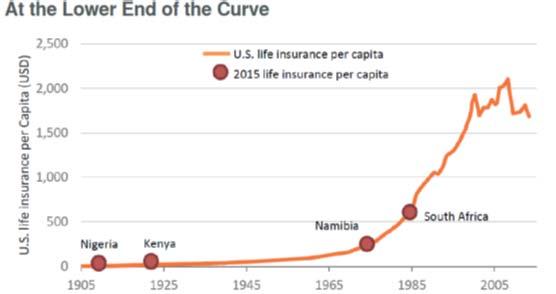
OUTCOMEBASED INVESTING: PUTTING THE INVESTOR FIRST
By Joseph Pearson, Senior Portfolio Manager, Momentum Investments
uilding purposefully driven investment solutions
Outcome-based investing has become a trending topic in recent times, but what does it mean and why does Momentum Investments believe this to be a sustainable long-term investment strategy and not simply the latest craze? The approach has client-centric investing at its core. This requires a paradigm shift in the investment thought process, where the driving force now becomes the delivery of the desired goals rather than perusal of the investment landscape for the ‘next-best’ opportunity. The investment philosophy, or rather the belief system, puts the investor first. This is achieved by building purposefully driven investment solutions that offer high probabilities of achieving the investors’ essential and aspirational goals, while limiting downside risk. This philosophy has successfully been implemented by Momentum Investments. The temptation to time the market is also avoided. These investment solutions ensure a consistent investment experience over time by remaining flexible, adaptable and diversified.
Past returns are not indicative of future returns
Investors are not concerned about the terminal value of their asset base, but their focus is rather on the terminal ratio of their assets to liabilities, as this will determine the standard of living they can afford at retirement. In contrast, traditional investment strategies concentrate on providing the highest risk-adjusted return without considering individual investor milestones along the way. The emphasis is placed on the investment manager’s ongoing peer-based-return reviews. A top survey ranking is not necessarily indicative of positive return potential (the solution could simply be the best performer among a low-performing group).
The fleeting nature of survey-related return information as well as its non-suitability to a longer-term, sustainable investment plan is illustrated in table 1. Investment returns are therefore better gauged against an investment goal than against peers or benchmarks and should define the goal, as well as the preferred path to achieving
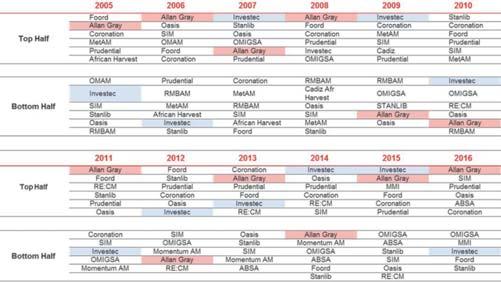

that goal, as clearly as possible. Investors often tend not to meet their objectives, as they often select investment managers based on favourable past returns. This creates a false sense of confidence that can prove costly for the investor over time, as can be clearly seen from table 1. Using a more diversified solution eliminates the guess work associated with the choice of past winners that underperform in subsequent periods.
Portfolio construction under an outcome-based philosophy
Ultimately, the desired goal of the investor drives the design of the solution. The solution combines a multiasset class, multi-strategy and multi-mandate approach. The mix of strategies is entirely dependent on the outcome. The old debate about whether to invest actively or passively has been a lively one, with the proponents of each having solid arguments about why their approach is best. However, the investors and their needs should be the guide in terms of determining which approach, or combination of approaches, is appropriate. Ultimately, the portfolio construction process, which takes investor requirements into account, should drive the solution, which could also include alternative asset classes such as hedge funds.
Conventional portfolio construction methodologies equate the measure of risk to volatility or variability in returns. For an outcome-based investor, this does not always hold true when trying to achieve a desired outcome. In the context of an outcome-based investor, the risk should be defined in terms of the probability of achieving the outcome, the future purchasing power as well as the experience of the investor (value at risk of shortfall probability relative to the goal) during the investment period. A ‘one-size-fits-all’ portfolio construction approach does not exist in an investment world where risk is not equal to volatility. In an outcome-based investment philosophy, the following principles are used:
• Understanding the investor goals
The most important consideration is the desired goal, as articulated by the investor. This includes the detailed formulation of the risk parameters that underpin the portfolio construction process. In an outcome-based world, capital loss, preservation of capital and purchasing power form the basis of the discussion.
• Diversification is your friend
Diversification has been described as the only free lunch in investing. Although diversification is unable to shield investors from extreme events
such as the Great Financial Crisis where correlations tend to spike, the benefit of a well-diversified solution reduces the overall risk of an investment. In an outcome-based investment world, a broad range of asset classes, investment strategies as well as mandates should be considered, including alternative investments such as commodities, private equity, hedge funds, infrastructure or physical property.
• Efficient use of conventional asset classes
At the centre of outcome-based investing, lays the extraction of consistent long-term risk-premia strategies. The implementation of these strategies should not be limited to the use of either active or passive strategies but smart beta investments as well. Smart beta investments extract style riskpremia such as value, momentum, quality or size.
Risk within an outcome-based philosophy
Understanding the investors’ risk profiles forms the basis of delivering on the investors’ goals. The goals need to be formulated in the context of the investor’s risk profile. Most investors struggle to articulate their risk profile and this could be gauged along three dimensions on a behavioural basis (see the illustration below). Constructing well-informed solutions increases the probability of successfully delivering on the investor goal with adequate monitoring along the way. In the context of outcome-based investing, these risk measures may include a combination of the probability to achieve the goal, the probability of not achieving the goal, purchasing power as well as the potential for capital losses.
in volatile market conditions. Radical changes to investment solutions in times of uncertainty are likely to destroy wealth in the long run. The below graph illustrates the benefit of using an outcome-based investment philosophy. It is investor-focussed and aims to reduce the price fluctuations along the journey to improve the investment experience, while increasing the probability of achieving the desired goal.
Conclusion
Outcome-based investing is about educating investors
The major challenge for outcome-based investing is educating investors. Discussions with investors should revolve around the goal they would like to achieve within the context of their respective risk appetite. It is not about outperforming the peers or choosing last year’s winners but constructing portfolios that will have the highest probability of delivering on the investment goal over the appropriate investment horizon. It is telling the investor to stay invested through difficult market cycles, although the temptation to time the market may increase
Outcome-based investing puts investors first by understanding their desired goals in context of their risk appetites. It is an investment belief that persuades investors to invest in solutions that have the highest probability of achieving their goals, given their respective risk profiles. It avoids the temptation to time the market or focus on short-term peer-relative returns but aims to deliver a consistent investment experience through well-diversified asset classes, investment strategies and mandates.
“Conventional portfolio construction methodologies equate the measure of risk to volatility or variability in returns. For an outcome-based investor, this does not always hold true when trying to achieve a desired outcome.”
Contributor’s Profile
Joseph Pearson is the Senior Portfolio Manager of the Classic, Flexible and Enhanced Factor range portfolios at Momentum Investments.
He began his career in 2003 as an economics lecturer and joined the private sector in 2007 as an operational risk specialist. His investment career started in 2008 as a quantitative multi-manager analyst with manager research responsibility.
Since 2009 Joseph held various positions at Momentum Investments ranging from Head Portfolio construction, Co-portfolio manager of the Balanced and Top 40 unit trust portfolios as well as Head Investment Performance and Risk Insight. Joseph has a BCom in Quantitative Risk Management (Cum Laude), an MSc In Business Mathematics and Informatics (Cum Laude), an Executive MSc in Risk and Investment Management as well as a PhD In Economics.
ASSESSING UGANDA’S FISCAL AND MONETARY POLICIES IN 2017
By Christine Asiimwe
ganda’s rate of growth, though positive, has slowed over the past few years to average 4.5 percent in the last five years compared to 7.4 percent in the preceding period. Core inflation has been in line with the target of 5 percent over the medium term, with the few deviations from the target arising largely from supply side shocks caused by developments on the global scene as well as weather related factors. The deterioration of the current account balance was partially reversed in 2016 because of a lower trade deficit. The Bank of Uganda (BOU) has continued to accumulate foreign exchange reserves which currently exceed 4 months of import cover.
To strengthen economic growth, public sector investment has been on the rise in line with the second phase of the National Development Plan (NDPII (2015/16 -2019/20) which was launched in March 2015. The theme of NDPII is ‘Strengthening Uganda’s Competitiveness for sustainable wealth creation, employment, and economic growth’. The effective implementation of the NDPII is expected to propel Uganda’s economy to an annual growth rate of 6.3 percent by 2020.
Underlying the economic strategy of the NDPII will be prudent macroeconomic policies, specifically, fiscal and monetary policies. The fiscal policy will aim at stimulating economic growth by strengthening the supply side of the economy, through the optimal use of public resources, while keeping public debt at sustainable levels. On the other hand, monetary policy will be focused on maintaining low and stable inflation.
The NDPII lays out priority activities to propel the economy to the next level -middle-income status - by 2020. Particularly, the government is focused on addressing infrastructural gaps which will have a high multiplier effect on economic growth once completed. Other priority areas include increasing production, productivity and value addition in key growth sectors; strengthening human capital development; and strengthening mechanisms for quality, effective and efficient service delivery. In a nutshell, the government will be carrying out structural reforms to improve the business environment and support private sector growth; raise per capita GDP, alleviate poverty, improve social service delivery and increase manufactured exports.
Fiscal policy in 2017 and beyond, therefore, will

concentrate on ensuring that the infrastructural projects are implemented as per the approved time frame and brought to completion. The projects include the Hydropower projects of Karuma and Isimba which are underway; the Kampala-Entebbe Express highway which is close to completion as well as the refurbishment of the Entebbe airport, among others. Other projects that are planned include the construction of a refinery and the pipeline to facilitate the oil sector.
On the social expenditure and poverty alleviating programs, Government will continue to prioritise health and education targeting primary health care particularly funding for malaria and HIV/AIDS control as well as the school fee grant in the education sector. To prevent a section of the population from falling back below the poverty line, Government is investing in social protection programs including: identification, verification, and payments of pensions and pension arrears; the Social Assistance Grant for Empowerment (SAGE), which provides direct cash transfers to the elderly; continued funding for the Youth Livelihood Programme; and funding for the Uganda Women Entrepreneurship Programme (UWEP). The government is also implementing a skills development program for employment and enhanced productivity and growth. The objective is to create employable skills and competencies relevant in the labour market and to enhance participation of the private sector in policy development planning, implementation, monitoring and evaluation including financing and training.
Infrastructural development – the key focus of fiscal policy – however, requires significant resources, in particular, a big component of the funding has to be in foreign exchange which is not easily available given Uganda’s current account deficit. Moreover, Uganda’s tax revenue effort stood at only 14.4 percent of Gross Domestic Product (GDP) in 2016 lower than the average for Sub-Saharan Africa of 16.3 percent. With low domestic revenue, grants remaining almost constant and expenditure rising by more than a percentage point of GDP annually, the widening of the fiscal deficit are inevitable. Indeed the fiscal deficit in expected to rise to 7.2 percent of GDP in 2017/18. The onus is thus upon the fiscal authorities to mobilise resources to either reduce the deficit or fund it in a sustainable manner.
Fiscal Policy over the medium term will be focused on improving tax revenue mobilisation. The government has
Namanya, Macroeconomic Policy Analysis Division, Bank of Uganda
programmed annual increases in domestic revenue of at least 0.5 percentage points of GDP of over the next five years, driven by improvements in tax policy and tax administration. Eventually, the government would like the domestically raised revenue to fund more than 70 percent of total expenditure.
Another source of financing is by borrowing from the domestic market that is, financial institutions as well as the general public. This form of financing, however, if not managed properly could lead to crowding out of the private sector from credit markets. The Government has, therefore, capped domestic financing at just a percentage point of GDP. The rest of the funding will be borrowed from external sources on both concessional and non-concessional terms. In fact, Government has so far signed agreements with the Exim Bank of China, to finance a number of infrastructural projects such as hydropower projects and road construction mentioned hitherto.
The government has put in place a debt strategy to ensure that the fiscal deficit is financed in a way that keeps public debt at levels which are sustainable over the long term and that does not crowd out the private sector. Thus far, debt sustainability analyses show that Uganda’s debt remains at low risk of distress. However, to sustain this position, GDP, tax revenue and export receipts need to be improved to minimize risks, in particular from weak exports. The government also need to bring to a conclusion some infrastructural projects that can generate income and reduce the debt servicing burden.
Having said that, there are several challenges affecting the implementation of fiscal policy including the weak current account and a related weakening of the local currency. All this complicates debt serving. Furthermore, delays in implementation of government projects, even in cases where resources have been allocated, remains a big challenge. Accordingly, Government is taking various initiatives to address these challenges including strengthening public investment management through putting in place guidelines to sectors on appraisal, sequencing, and implementation of projects. To improve export earnings, the government is undertaking several export and trade enhancing measures such as subscribing to two regional trade blocs. Uganda is a member of the East African Community (EAC) and the Common Market for Eastern and Southern Africa (COMESA) both of which have instituted common market areas as well as customs union to enable Partners States trade freely amongst one another. Indeed, 38 percent of Uganda’s exports and 17 percent of imports are to and from COMESA member states.
The high cost of debt can also be abetted by stable interest rates. Interest rates are affected by several factors including the level and predictability of public domestic debt. The objective of monetary policy in Uganda is to maintain low and stable inflation using the interest rate as the policy instrument. The BOU sets
benchmark interest rates – Central Bank Rate (CBR) on a bi-monthly basis. The CBR has expected the impact on the structure of interest rates and in that way affect private sector credit which has implications for consumption and investment and therefore inflation.
“To strengthen economic growth, public sector investment has been on the rise in line with the second phase
of the National Development Plan which was launched in March 2015.”
To be able to formulate appropriate monetary policy, the BOU is guided by a forecast of future –twelve months ahead- inflation and the factors/risks thereof. Currently, BOU has managed to maintain inflation around its medium-term target of 5 percent.
Going forward, inflation is projected to rise above 5 percent by end of 2017 due to high food prices and increasing international oil prices. Over the medium-term inflation is expected to return to its target of 5 percent. The inflation forecast, however, faces a number of downside and upside risks emanating from both the domestic and external environments. Food price dynamics, as well as uncertainty in the global financial markets and the evolution of commodity prices, especially oil, will impact on inflation. Another important factor is the exchange rate prospects. Given that Uganda is a small open economy any changes in the exchange rate are transmitted to domestic prices of importables and consequently inflation. The performance of the domestic economy reflected by the output gap as well as the fiscal stance may also affect inflation. The overall monetary policy will depend on future inflation developments and the balance of risks to the outlook.
Fiscal and monetary policies will each have their independent roles over the medium term. However, as discussed previously, monetary and fiscal policies have implications for each other, making it very important for proper coordination among the two authorities. The BOU and Ministry of Finance, Planning and Economic Development (MFPED) have several channels through which they coordinate including a number of committees. The two institutions jointly develop a macroeconomic framework that seeks to achieve growth of 5.5 percent in 2017/18 and 6.3 percent by 2020, while maintaining inflation close to 5 percent and ensuring a stable exchange rate.
Contributors Profile:
Christine is Assistant in charge of Macroeconomic Policy Analysis in the Economic Research Department at the Bank of Uganda. She holds a Master’s degree in Economic Policy and Planning from Makerere University Kampala and possesses 10 years’ experience in policy formulation at the central bank.
THE FOUR AFRICAS: NIGERIA THE UNSTOPPABLE SUPER EAGLE
By Mark Byron, Co-Founder of Barton-Heyman, Ltd.
Robert Joseph Ahola, CEO of Galahad Films
t is a results-driven world we live in, like it or not. And the rules are simple, occasionally ruthless, but invariably bottom-line. Whenever international financial institutions or global marketing giants look to invest their capital, manpower and technology in a new market, they invariably ask one question: Are the fundamentals sound? If the answer is “yes,” they continue. They set down roots. And they often use that nation as a base-point to expand their franchise to neighboring countries.
In the Africa of the Sub-Sahara, there are four countries that the EU, the US and the BRICS nations have been looking to for solid partnerships. And after a quick scan of their political, economic and demographic profiles one can arguably arrive at three out of the four choices: Nigeria, South Africa and Kenya—due to their industrial dynamism, business friendly profile and youthful demographic—are logical linchpins for lower half of the continent. Ethiopia may seem to be on the bubble (and other “comers” like Botswana and Ghana can certainly make a case). But somehow—when it comes to anchoring everything from the African Union to modernizing its infrastructure—the longstanding Lion of Abyssinia always seems to rise to the occasion.
Collectively these four “anchor states” account for $1.4 Trillion of Africa’s estimated total $2.8 Trillion GDP (or approximately 47% of its wealth). They represent roughly 376 million (or 35%) of Africa’s 1.1 billion inhabitants. And yet they take up less than 5% of the continent’s total land mass. And for the next four issues, we’re going to focus on each of them in a bit more depth.
For that we begin with Nigeria—the unstoppable, bipolar, mercurial, paradoxical, economic engine—that constantly confounds and perplexes us yet forever fills us with hope.
Nigeria: Despite the fluctuations, it’s “Too Big to Fail.”
With a population of 180 million people, a current annual GDP of $572 Billion, and one of Africa’s most economically varied revenue streams from a dozen different industries, Nigeria as a nation is now “simply too big to fail.”
Sometimes, it worries us all… a lot! And yet it progresses with a kind of deliberate madness in the right direction.


“Nigeria—the unstoppable, bipolar, mercurial, paradoxical, economic engine—that constantly confounds and perplexes us yet forever fills us with hope.”
Despite the tanking Naira (tied to falling oil prices which have already doubled since the November nadir of 2015), Nigeria has done more to diversify in the last decade than any other African nation.
Even when struggling with an antiquated infrastructure and pathetic travel routes to outlying areas, Nigeria still manages to leads the way in at least half a dozen burgeoning industries. Telecommunications technology, internet retailing, heavy industry, agricultural production, fashion, entertainment and lifestyle appeals to its under 30 Millennials who now represent 73% of the population—other African nations know this, and so do serious FDI players. In the last 10 years, Nigeria has seen the influx of more FDI capital and international partnerships than the next three closest nations combined.
Nigeria is often referred to as “the soul-train” that drives the Sub-Sahara. This is something of a hyperbole, and yet it’s closer to being accurate than not. In a way the numbers speak for themselves. 180 million people representing approximately one-fourth of the entire economic output of the world’s second largest continent make it a force to be reckoned with. And at this point it cannot be otherwise. The national debt to GDP ratio is 11%, one of the best in both Africa and Asia. And recently the IMF designated Nigeria as one of the Top Five Emerging Global Economic Powers.
All this comes as something of a contradiction, especially since the beginning of 2015 when President Muhammadu Buhari took office. Coming in with great promise and all the aspects of integrity Buhari has, in the last two years, had to cope with a dirty dozen major issues that keep rising up:
1) An infrastructure and electronic grid originally constructed for a nation with the population of Poland (about 40 million people) forced to serve a population of 180 million, rolling blackouts and not enough energy to run heavy industry:
2) $45 Billion in unaccounted for funds that have just disappeared either from the national treasury or
through massive corporate theft;
3) Finding that the nation’s previous Minister of Finance has been indicted for malfeasance and illegal extraction of government funds and his predecessor Goodluck Jonathan is being investigated for fraud;
4) Discovering that his administrative staff contains one or more “moles” from Boko Haram;
5) Continued outrages from Boko Haram and other Muslim fringe terrorist groups that continue unabated while Buhari’s military continues to be impotent to stop them;
6) The tanking of the national currency, the Naira, to its lowest level in 15 years and runaway inflation as a result;
7) A precipitous drop in oil production to 30% of previous years;
8) The first predicted recession since 1987 now come to be blaring reality;
9) A flight of FDI investment due to fears over terrorism and financial instability at all levels;
10) Such a spike for food basics at retail levels (as much as 8 times as much) that shoppers now have a new term for it—Buhariya!
Not a very good resume for the first 30 months, and yet were he to be graded on the curve, it would generally be conceded that Buhari would at least get a C – for effort.In fact, the man inherited a mess that will take some time to fix. And as another inescapable truth Nigeria—for its Pandora’s Box of problems—has grown into one of those rare economic Leviathans that just keeps.
“Nigeria is often referred to as “the soul-train” that drives the Sub-Sahara. This is something of a hyperbole, and yet it’s closer to being accurate than not.”
At the Reuters Africa Investors’ Forum in Johannesburg earlier in 2015, foreign investors who have their businesses in Nigeria and other African countries were quoted as saying; “If you want to ride Africa’s business boom, choose your country well and be ready for bumps on the road. But the momentum is upward and you will be rewarded if you stay the course.” African policymakers and chief executives of companies operating in Africa are spreading this upbeat message, as interest in what was once dubbed the “hopeless continent” blossoms along with growth rates.
During the year, Global X Funds listed the first Exchange Traded Fund (ETF) on the New York Stock Exchange to track Nigerian stocks. Recently Nigeria’s Stock Exchange (NSE) disclosed that it is reviewing applications from some leading global investment banks to join its trading floor to take part in improving liquidity. Despite the falling Naira the index rose to over 9% in 2015. And though the average was down from the spectacular rise of 29% in
2013 and 24% in 2014, the upward trend continues and U.S. investors are looking to continue “heavy up” their investments in Africa’s largest economy.
Three areas in which Nigeria has shined in the last five years provide more visible “showcase” cachet than actual contribution to the bottom line. Still, in terms of the entire African Continent, Nigeria has become the locus of power advertising, fashion and filmmaking.
Especially in terms of fashion leadership, Nigeria has led the way with one third the total revenues of Africa’s new $31 billion dollar fashion industry. One of signature statements depictive of Nigeria’s “passion for fashion” has always been its daring use of color—from tamarind oranges to effervescent blues. They were given an unimpeachable international advocate in 2013 through the First Lady of the United States when Michelle Obama, during her Africa tour, wore a top by Nigerian designer Maki Oh.
Maki Oh (full name Maki Osakawa) is a thirty-something designer who is more or less the unofficial spokeswoman for the Lagos school of design—a style she embraces readily. According to Maki, Nigerians are born with true grit and a competitive spirit. And she spoke about it in an interview recently: “It’s in our DNA to want to be the best at everything we do. I guess it’s our time for fashion now.”
Less profitable but equally visible may be Nigeria’s new global reputation as the new number 3 player in the world of film production. As a little known factoid, in terms of feature films going out under the aegis of a single national industry, Hollywood is no longer Number 1. Since 2010 (India’s) “Bollywood” now produces more actual releases yearly, including 1,989 feature films in 2016, and annual revenues of just over $8 billion (USD). Hollywood still holds the box office gross with $10.8 billion. But guess, who comes in at a solid Number 2 in 2016, in total fictional feature films produced? That’s right: Nollywood!
A sobriquet for the Nigerian Film Industry, “Nollywood” (The term for Nigerian-Hollywood) logged in at 979 feature films and just a notch over $1 billion in total box office gross for the first time in total sales. And to add to its recent cachet in the last 10 years, this Lagos-based film community has been a solid staple of the Nigerian economy, having truly come into its own since 2001. Besides having a broad active audience in Africa, South America and the Caribbean, Nollywood is also attracting some very quality acting and directing talent from neighboring countries like Ghana and Cote d’Ivoire who are flooding this reinvented new creative phenomenon with innovative concepts, good scripts, solid talent and funding.
Finally, the hidden leverage of Nigeria, as in other African nations, comes not from some newfound (and heretofore lacking) government virtue or the elusive Legatum Prosperity Index as much as it does some of the Nations billionaire “philanthrocapitalists.” Billionaire benefactors
and include Africa’s richest man Aliko Dangote, its second richest woman FolorunshoAlakija and the continents newest billionaire inductee Tony O. Elumelu.
Dangote whose net worth (in the neighborhood of $20 billion) exceeds the GDP of 31 of Africa’s 54 nations, is commonly known as Nigeria’s most patriotic investor. Building African businesses, he doesn’t wait around for the government to build infrastructure and takes it on himself, using his private funds to leverage $3.3. billion of a $14 billion pipeline for Nigeria’s natural gas industry and providing growth media and funding to help make his country’s rice crop independent and self-sustaining.
“Flo” Alakija has taken advantage of her hard earned $2.2 billion of oil and fashion industry fortunes and applied it in her new role as a benefactor for the National Heritage Council and Endowment for the Arts in Lagos and is “Chief Matron” of AYE (Africa’s Young Entrepreneurs), a program to fund and mentor startup African businesses primarily in Nigeria and West Africa.
“Three
areas in which Nigeria has shined in the last five years provide more visible “showcase” cachet than actual contribution to the bottom line.
Still, in terms of the entire African Continent, Nigeria has become the locus of power advertising, fashion and filmmaking.”
Ultimately, Tony O. Elumelu is one of those rare young (40 something) entrepreneurs who probably could be richer than he is had he not given so much of his time, energy and discretionary income to become the continent’s foremost promoter of Africapitalism (a term he is credited for that is used to describe all that is best about African wealth to develop homegrown talent). Recently, as part of his own Africapitalism institute, he recently set up The Tony Elumelu Entrepreneurship Programme—a $100 million pilot program to develop 10,000 new African businesses in the next 10 years, plus adding 1 million new jobs and $10 Billion in revenue spreading across several nations in the Sub-Sahara. Tony does so because he believes that Africa’s business future will come from empowering smart young entrepreneurs who have the vision, the energy and the dedication—but need only the tools and the situational opportunity—to “shape the destiny of a Continent.”
These are just a few examples of the heterodox of individual initiative that Nigeria has become. It’s growth and progress, previously blunted by military protectionism and a history of kleptocracy seems destined due mainly to the preponderance of private sector integrity.
Nevertheless a struggle still exists for the true soul Nigeria. But if one truly believes in happy endings, the smart money tells us that in the end the “good guys will win.’
“If you want to ride Africa’s business boom, choose your country well and be ready for bumps on the road. But the momentum is upward and you will be rewarded if you stay the course.”
Contributors’ Profiles
Mark Byron is a successful startup entrepreneur and investment director in the complicated world of finance who has mastered a unique ability to leverage current market trends and meld them into emerging markets.As Co-Founder of Barton-Heyman, Ltd. A company with business partnership in the U.K. and Sub-Sahara Africa of London and Lagos, Nigeria,, Mark heads a group of experienced professionals who have come together to form a financial vanguard in African markets. For that reason he has developed a unique strategy and laid it all out in this groundbreaking book, Africa Arrives! as an exceptional guide for both experienced entrepreneurs and savvy investors looking for leverage in new markets. In it, you’ll learn how to navigate the intricate currents of the 54 nations in what every financial expert has predicted will be the world’s hottest market for the next 50 years. If you are looking to Africa to invest, start up a new business, co-venture or make connections Africa Arrives! is a great place to start.
Robert Joseph Ahola is an author, playwright, producer and director who lives in Malibu, California. As CEO of Galahad Films, Robert has authored 14 published and/or produced plays, including Pavlov’s Cats, Judas Agonistes, The Ghost and Josh Gibson, and NARCISSUS: The Last Days of Lord Byron. An environmental activist and world traveler, Robert is the author of twenty-two published books including The Silent Healer, The Return of the Hummingbird Wizard, and I, Dragon. Africa Arrives, co-authored with Mark Byron, is his tenth work of non-fiction.
AFRICA’S CENTRAL BANK MONETARY POLICY RATES AND FOREIGN EXCHANGE RESERVES
Angola's central bank kept its benchmark lending rate unchanged at 16 percent following a policy meeting on Friday 28th April 2017, the bank said in a statement posted on its website. The National Bank of Angola (BNA) has kept its key rate steady since June last year when it raised it to the current level to curb accelerating inflation. In 2016 the BNA rate was raised 500 basis points.
Botswana's central bank left its benchmark lending rate unchanged at 5.5 percent on Friday 28th April 2017. The outlook for price stability remains positive as inflation, although increasing slightly in the short-term is forecast to remain within the 3 – 6 percent objective range in the medium term. Subdued domestic demand pressures and the modest increase in foreign prices contribute to the positive inflation outlook in the medium term.
Tunisia's central bank raised its key interest rate by 50 basis points to 4.75 percent at an extraordinary board meeting held Tuesday 25th April 2017, to help ease rising inflationary pressures following a sharp fall in the dinar's exchange rate and said it was closely following those pressures so it could undertake the appropriate actions on time. The central bank also raised the minimum savings rate that banks can offer by 50 points to 4.0 percent to boost the incentive to save and thus liquidity in the financial system. Tunisia's banks are in need of liquidity given a weak level of savings in the country, the central bank said.
Namibia's central bank left its benchmark lending rate unchanged at 7 percent on Wednesday 12th April 2017, saying the level was appropriate to support economic growth. "This rate remains appropriate to support growth, while maintaining the 1-to-1 link between the Namibian dollar and the rand," said the central bank. The domestic economy slowed in 2016 compared to 2015; overall inflation rose during the first two months of 2017. Growth in private sector credit slowed over the same period.; the stock of international reserves remained sufficient to meet the country’s foreign obligations.
Uganda's central bank cut its benchmark lending rate to 11 percent on Wednesday 12th April 2017 from 11.5 percent, saying core inflation would remain around the bank's mid-term target over the next 12 months. The cut was the seventh in succession since last April as policymakers rein in borrowing costs from a peak of 17 percent reached after a surge in inflation.
Mozambique's central bank cut its benchmark lending rate by 50 basis points to 22.75 percent, it central bank said on Monday 10th April 2017.The central bank said the rate cut reflected a favourable change in
inflation and the exchange rate of the metical despite the risks of further price changes, worsening liquidity in the banking system and the resumption of foreign aid to the government.
Angola's net foreign exchange reserves fell to $19.20 billion in March from $20.89 billion in February, according to data posted on the central bank's website.
Egypt's foreign reserves rose to $28.5 billion by the end of March, the highest level since March 2011, a cabinet statement and the central bank stated. The cabinet statement also said Egypt had attracted $17 billion of foreign currency inflows since the flotation of the pound in November. The Central Bank allocated $23 billion to finance foreign trade in the same period, the statement added.
Namibia's foreign currency reserves fell to a seventh-month low in March as a sharp slide in neighbouring South Africa's rand caused the central bank to purchase less of the currency to which it is pegged. Data from the Bank of Namibia showed reserves at N$22.6 billion ($1.68 billion) compared to N$22.7 billion in February. The Namibian dollar is pegged 1 to 1 against the rand.
Nigeria's foreign exchange reserves rose to $30.80 billion by April 26 2017, their highest level since Sept. 2015, and central bank data showed. The increase could be attributed to a recent rise in global crude oil price and proceeds of Nigeria's latest Eurobond issued in March. Nigeria's dollar reserves stood at $30.31 billion a month ago. They have risen 18.1 percent since the start of the year but are still far off their peak of $64 billion, hit in August 2008.
South Africa's net foreign reserves fell to $41.419 billion in March from $41.506 billion in February, the Reserve Bank said reported. Gross reserves edged down to $46.588 billion from $46.722 billion, the central bank data showed. The forward position, which represents the central bank's unsettled or swap transactions, fell to $2.867 billion in March from $2.97 billion in the previous month.
MARCH’S INFLATION TRENDS ACROSS THE AFRICAN CONTINENT
Angola's inflation eased to 36.52 percent year-on-year in March from 38.32 percent in February, data from the National Statistics Agency reported. Price increases on a month-on-month basis slowed 1.91 percent in March compared to a 2.3 percent previously.
Algeria's consumer price inflation stood at 7 percent year-on-year in March from 4.7 percent a year earlier. the National Statistics Office reported. Inflation reached 1.6 percent in March compared with the previous month after a 1.8 percent rise in food prices.
Botswana's consumer inflation inched up to 3.5 percent year-on-year in March from 3.4 percent in February, statistics office reported. Prices rose 0.5 percent month-on-month compared to 0.2 percent previously.
Burundi's inflation rate increased to 21.1 percent in March, from 20.7 percent year-on-year in February, the Institute of Economic Studies and Statistics (ISTEEBU) reported.
Democratic Republic of Congo's consumer price inflation rose to 17.93 percent year-on-year in March, up from 14.8 percent in February, the central bank reported.
Egypt's annual urban consumer price inflation rose to 30.9 percent year-on-year in March from 30.2 percent in February, the official CAPMAS statistics agency reported.
Ethiopia's inflation rose to at 8.5 percent year-on-year in March from 7 percent a month earlier, the statistics office reported. Food inflation rose to 9.6 percent in March from 7.8 percent a month earlier.
Ghana's annual consumer price inflation fell to 12.8 percent in March from 13.2 percent the previous month, the statistics office reported. Food inflation was 7.3 percent in March compared with 7.1 percent in February.
Ivory Coast consumer inflation fell to 0.4 percent year-on-year in March from 1.5 percent in February, the National Statistics Institute reported. Food and soft drink prices declined by 1 percent year-on-year and housing and utilities prices climbed 1.3 percent.
Kenya's inflation accelerated to 10.28 percent year-on-year in March from 9.04 percent a month earlier, pushed by higher food prices, the Kenya National Bureau of Statistics reported. Month-on-month inflation was 1.67 percent.
Malawi's consumer inflation slowed to 15.8 percent year-on-year in March from 16.1 percent in February, the National Statistical Office reported.
Mauritius' annual headline inflation remained unchanged at 1.3 percent in the year to March, from the previous period, the statistics office reported.
Morocco's year-on-year inflation slowed to 0.1 percent in March from 1.8 percent in the same month in 2016 and from 1.6 percent in February this year as food prices fell, the planning authority reported.
Mozambique's consumer inflation rose to 21.57 percent year-on-year in March from 20.88 percent in February, the statistics agency reported.
Nigeria’s inflation slowed to 17.26 percent year-on-year in March compared to 17.78 percent year-on-year in February, the National Bureau of Statistics, Nigeria reported. A separate food index showed inflation at 18.44 percent from 18.53 percent in February.
Rwanda's year-on-year inflation eased to 7.7 percent in March from 8.1 percent a month earlier, the National Bureau of Statistics reported.
Seychelles' inflation was at -1.15 percent year-on-year in March from -0.6 percent the previous month, the statistics office reported.
South Africa's consumer inflation eased to 6.1 percent year-on-year in March from 6.3 percent in February. On a month-on-month basis, inflation fell to 0.6 percent from 1.1 percent, Statistics South Africa reported.
Sudan's annual rate of inflation rose to 34.68 percent year-on-year in March from 33.53 percent the previous month, as food and energy prices kept rising after subsidies were cut in early November, the Central Statistics Office reported.
Tanzania's year-on-year inflation rose to 6.4 percent in March from 5.5 percent the previous month, the statistics office reported. The monthly headline inflation rate for March increased by 1.4 percent compared with 1.0 percent in February.
Tunisia’s inflation rate rose to 4.8 percent year-on-year in March from 4.6 percent in the first two months of the current year, the National Institute of Statistics (INS) reported.
Uganda's inflation fell to 6.4 percent year-on-year in March from 6.7 percent a month earlier, the statistics office said on Friday. The core inflation fell to 4.8 percent from 5.7 percent in February.
Zambia's inflation slowed to 6.7 percent year-on-year in March from 6.8 percent in February, the statistics office reported. The monthly inflation slowed to 0.3 percent from 1.0 percent in the previous month.
Zimbabwe's consumer prices rose by 0.21 percent year-on-year in March from a 0.06 percent increase in February, the national statistics agency reported. On a month-to-month basis, prices rose by 0.03 percent after increasing 0.61 percent previously.
AFRICAN CAPITAL MARKET UPDATES
BotswanaBSE
MauritiusSEMDEX 2,0174.3211.5313.191,7382,0263.700 MoroccoMORALSI 11,6382.27-0.0516.669,42712,95111.020 NamibiaLocal 1,0831.551.385.809251,14416.661
NigeriaNIG ALSI25,7670.98-4.122.8124,54731,07311.061
RwandaRSEASI128-0.270.24-2.251271310.774
South AfricaJSE ALSI53,8173.386.251.6248,93654,70410.530 SwazilandSSX
MauritiusRupee34.85-2.72-3.12-0.6334.2736.509.513
MoroccoDirham9.92-1.37-2.003.379.2310.324.687
MozambiqueMetical64.34-4.58-9.8721.2349.2579.3810.676
NigeriaNaira310.04-1.35-1.6855.81197.00350.2520.908
RwandaFranc826.000.120.496.75715.50839.5011.971
South AfricaRand13.37-0.32-2.69-6.0412.3115.9818.002
TanzaniaShilling2,235.000.182.482.012,170.052,272.502.760
TunisiaDinar2.467.246.1822.822.002.5820.721
UgandaShilling3,652.501.032.6710.063,315.004,071.583.657
ZambiaKwacha9,313-3.6492-6.2893-2.999,12511,2657.935
Angola12-Nov-25105.5598.566-0.4298.51486.206105.971USD
Cameroon19-Nov-25115.3157.077-0.3726.78596.756115.937USD
Congo30-Jun-2976.5459.208-0.26819.26163.76676.545USD
Cameroon19-Nov-25115.3157.077-0.3726.78596.756115.937USD
Egypt30-Apr-4095.4627.285-0.1349.00882.391100.290USD
Ethiopia11-Dec-24100.2146.587-0.7218.23887.394100.566USD
Gabon16-Jun-2599.9116.963-0.3696.00781.889100.354USD
Ghana14-Oct-30121.1758.129-0.3791.94997.500123.374USD
Kenya24-Jun-22101.7846.556-0.3957.18790.961101.934USD
Ivory Coast31-Dec-3296.2026.347-0.4423.51288.498101.499USD
Morocco11-Dec-42109.2674.863-0.1266.975100.880118.426USD
Namibia29-Oct-25101.8854.975-0.1553.52597.640108.052USD
Nigeria12-Jul-23103.2015.750-0.2726.27689.886103.574USD
Rwanda02-May-23101.9326.233-0.1482.28593.652102.978USD
Senegal30-Jul-24103.0655.724-0.3162.88592.173105.956USD
South Africa24-Jul-44100.3955.347-0.1731.79591.188116.008USD
Tanzania09-Mar-20106.2055.100-0.2310.881101.770106.212USD
Tunisia19-Sep-27110.1016.869-0.1383.622101.250110.396USD
Zambia30-Jul-27107.4547.891-0.4278.34779.324108.227USD