


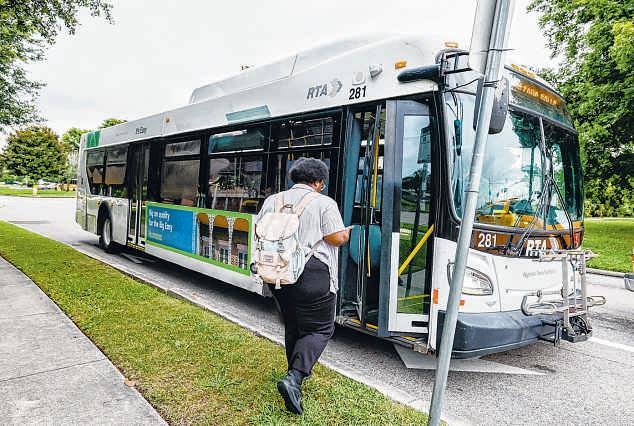
BY BLAKE PATERSON Staff writer
The New OrleansRegionalTransit Authority will begin accepting applications this week for anew CEO after Lona Edwards Hankins resigned from the post in May after falling out of favor with MayorHelena Moreno’snewly-installed board. Whoever is chosenhas plenty to tackle.
The next CEO will take over an agency struggling to pick up riders on time across its fleet of buses, streetcars and paratransit shuttles. It’sprojectedtofacea shortfallinfunding in thecoming yearsthatwithout new revenues couldrequire future cuts to service.
mutes and shorter wait times. And its workforce has been riven by internal disputes, resulting in several six-figure settlementswith former employeesand lawsuitsalleging workplace discrimination.

“The organizationneeds alot of healing,” said RTABoard Chair Ann Duplessis, Moreno’s pick to lead an agency that counted more than 13.5 millionpassengerboardings last year.She addedthatthe next CEO will need to “have adeep, genuine respect” for theexperience of riders and that hergoal is to picka new leader by the end of August.
Amajor revamp of its bus system, known as New Links, hasn’t lived up to its promise of faster com-
The selection of anew CEO for the RTAwill mark one of the first major leadership changes at an agency in New Orleans underthe newadministration. Moreno,who took officein January,has said she expects majorchanges at the RTAduring her
Lawmakers supportclinical trials forthe drugs
BY ALYSE PFEIL Staff writer
For retired Maj. Gen.Glenn Curtis, the former top official at the Louisiana National Guard,it was the headaches and cloudy thinking caused by aneckinjury,traumatic brain injuriesand PTSD. And for his son Nicholas Curtis, it was the vertigo, light sensitivity andmemory problems stemming from two head injuries. That suffering —and their

hope for an elusive cure— spurred the fatherand sonto travel to Mexico together in early 2025 to take the psychedelic drug ibogaine after the younger Curtis heard about it on apodcast with Joe Rogan Bothmen said their symptoms disappearedafter thetreatment andhaven’t returned since. Inspired by the transformation, the father-son duolaunched anonprofit to help military veteransaccess ibogaine, psilocybin and ayahuasca to treat mental health conditions. But the drugs are largelyillegal, and opportunities for clinical trials using them have been scarce.
ä See TREATMENTS, page 5A
tenure, vowinginaspeech in April “to getthat regional piece” back into an agency that’s now almost entirely focused on New Orleans. In February,she swept out former MayorLaToyaCantrell’s RTAboard appointees andreplaced them with herown Transit is akey quality-of-life issue in the city,and for manyNew Orleanians, the RTAistheir only affordable option to gettowork.Some 17% of householdsinthe city don’t have access to avehicle, andRTA bus serviceisoften relied on by hospitality-industry employees and others who work in servicejobs in downtown neighborhoods. Meanwhile, demand for public transit in New Orleans is on the rise. The numberofpeople riding theRTA’s buses reached a10-year high in 2025.
ä See RTA, page 5A
Billthatwas rejected would havefundedearly childhoodeducation
BY MEGHANFRIEDMANN Staff writer
As Louisianapours millionsinto making LSU afootball juggernaut,some state lawmakershave started to raise concerns that the stateistoo often putting football ahead of other priorities. Thedebate comes after alegislative session during which the Louisiana House killed abill that



Support, spending led to
BY TYLER BRIDGES Staff writer
U.S. Rep. Julia Letlow rode President Donald Trump’sforceful support and an avalanche of campaign spending in the finalweek to decisively win the Republican runoff SaturdaytobeLouisiana’s next senator, after late polls had suggested the race might be neck-and-neck.


Trump didn’tjust endorse Letlow, R-BatonRouge.He lavishedpraise on herintwo campaign videos and held a rally by phone with Letlow on Thursday that attracted 98,000 listeners, an official withher campaign saidon Sunday. Thatwas more than half the 179,000 votes she collected on Saturday Trump’ssuper PAC, Securing American Greatness, also contributed $1 million to an outside group, the Accountability Project, that battered state Treasurer JohnFleming, Letlow’s Republicanopponent, witha barrage of negative ads.
“I can’twait to work with him (Trump) over on the Senate side,” Letlow,45, told reporters at her Baton Rouge victory party after clinching the Republican victory “Great News!!!” Trump posted Saturday night on Truth Social. “Julia LetlowWON in Louisiana, beating conclusively avery strong and smart opponent.” Her triumph sets up aNov.3general election against Jamie Davis, afarmer from northeast Louisiana, who overwhelmingly won the Democratic nomination over business owner GaryCrockett.
“Weplanted good seeds in fertile soils, and we started to harvest last night,” Davis said in an interview on Sunday
ä See RUNOFFS, page 4A
would havegivenmoremoney to early childhood education programs; instead, college sports programs will get that money Asecondbill exacerbated tensionsbyshielding fromthe publicdetails of howstate universities spend funds generated by athletics programs, including how they divide themoney among different sports and top athletes.

“I don’tknow if I’dcall it asacred cow.But it pretty much is asacred cow,” state Sen. Beth Mizell, R-Franklinton, said of college football. “You can’t touch it. Youcan’tlessen what we put intoit.”
Mizell sponsoredSenateBill 135, which would have changed how sportsgambling tax revenue is allocated. Currently,25% of that revenue goes to an early childhood education fund, while 25% goes to an account thatsupports college athletics known as the SPORTfund. According to state law, the money in the SPORT fund is distributed evenly amongLouisiana’s public colleges that play Division Ifootball. Schools may spend it on scholarships, insurance and medical coverage for
See FOOTBALL, page 4A

Officials: Israelistrikes in Gaza kill at least 4
DEIR AL-BALAH, Gaza Strip Israeli strikes across the Gaza Strip on Sunday killed at least four Palestinians, including a13-year-old girl, local healthofficials said.
The first strike targeted a group of people in northern Gaza’sBeit Lahiya, killing two and wounding another,according to the Palestinian Red Crescent Society
Another Israeli strike in southern Gaza killeda man, accordingtohealth officials at Nasser hospital.
Andthe 13-year-oldgirl,Eileen al-Farra, was killedby shrapnel from Israelitankshelling in southern Gaza,according to Nasser hospital.
The Israeli military did not immediately respond to arequest for comment on the strikes but said one of them targeted a“Hamas terrorist,” without elaborating.
Palestinians on Sundayreported heavytank shelling across Gaza and quadcopters —atype of unmanned aerialvehicle— buzzing overhead.
Skydiving plane crashes in France, killing 11 TOMBLAINE, France Families watched in shock as askydiving plane carrying their loved ones on what was meant to be athrilling introductiontoparachuting crashed in northeastern France on Sunday,killing all 11 peopleon board, authorities said.
The dead included five parachuting instructors, five novice jumpers and the pilot, Interior Minister LaurentNunez said Transport Minister Philippe Tabarot said it was France’s biggest aviation accident involving skydiving in about 30 years.
“Some of the victims’ families witnessed the aircraft falling with their own eyes.Sothere is tremendous emotion and an even greater psychologicaltrauma,” Nunez said.
He refused to speculate on what caused the crash but said the plane dropped out of the sky suddenly.Hesaid it had just taken off from the Nancy-Essey airfield on theoutskirts of thecityof Nancy when it came downabout 300 yards from the runway Yves Séguy,prefect of the Meurthe-et-Moselle region,said theplane suffered amalfunction and “fell almost vertically,” narrowlymissing abuilt-up area.
“Haditoccurred just afew dozen meters away,the accident could have caused collateral casualties,” he said.
Pakistan hits militants along Afghan border
ISLAMABAD Pakistanisecurityforces Sunday carried out aground operation along the Pakistan-Afghanistan border, followed by “calibrated strikes” againstmilitant hideoutsand safehavens, killing 29 fighters, officials said.
In apost on X, Information Minister Attaullah Tararsaid the operation waslaunched in response to multiplemilitantattacks across the country.There wasnoimmediate response fromAfghanistan.
Pakistan has witnessed a surge in militant attacks targeting police and security forces in recent years. Authorities have blamedthe Pakistani Taliban known as Tehrik-e-Taliban Pakistan, or TTP,and allied militant groups for most of the violence. It comes aday after militants armed withguns and explosives targeted the regional headquarters of the paramilitary Rangers in thesouthern port cityof Karachi, killing three soldiers. Security forces killed three attackers and arrested another assailant, whom the military identified as an Afghan national in woundedcondition.
Jamaat-ul-Ahrar,abreakaway faction of the Pakistani Taliban, claimed responsibility for the Karachi attack in astatement Saturday night.
BY JONGAMBRELL and MELANIE LIDMAN Associated Press
DUBAI, United Arab Emirates
Iranagain launched drone and missile attacks targeting Bahrainand Kuwait on Sunday following newU.S. airstrikesagainst the Islamic Republic, andthreateneda “complete halt” in negotiations to end the war if Washington continues its attacks.
Iranian Foreign Minister Abbas Araghchi on Sunday reiterated the claim that Tehranmust govern the straittothe Persian Gulf that once carried afifth of theworld’s oiland natural gas.

Efforts to reopen the StraitofHormuzwithoutIran’s oversight has sparked days of crossfire.
Amultinationalmaritime body overseen by the U.S. Navy said Saturdayit wouldexpanda routenear Oman for inboundand outbound traffic.
“Any attempt to establish neworseparate arrangements from thosecurrently being carried out by theIslamic Republic of Iran will only lead to furthercomplications, delaythe reopening of the Strait of Hormuz and increase the leveloftension,” Araghchi said.
The straithas long been considered an internationalwaterway despite its locationinIran and Oman’sterritorial waters.Inrecentdays, Iran has twice attacked vessels going through aroute near theOmaniside.
Pakistan,akey mediator hassaidtalks wouldresumeTuesday between the U.S. and Iran on the terms
of their interim deal. The Trumpadministration on Sunday said nothing has been canceledand technical talks areontrack for thecoming days.
Talks include arrangements around thestrait, the removal of aU.S. blockade on Iranian ports and sanctions on Iran, and the future of Iran’sstockpile of highly enriched uranium. The two sides have 60 days from their signing of the memorandum of understanding earlier this month to workout details.
ContinuedconflictinLebanon threatens the agreement, which says fighting must end on all frontsbefore certain issuescan be discussed.
StrikestargetGulfstates
Iran’s paramilitary Revolutionary Guardclaimed responsibility forthe attacks in Bahrain and Kuwait.
Kuwait,which hosts a majorU.S. military base,
said air defenses intercepted Iranian drones and twomissilesjustafter the U.S. strikesinIran. There were no reports of injuries or damage. Bahrain said theIranian strikes damaged aresidentialbuildingnear the international airport and no onewas killed. Bahrain is home to theU.S.Navy’s 5thFleet.The damaged building was notnear its headquarters.
Bahrain’sForeign Ministry denounced what it called“adangerous escalation that reveals that what Tehran is doing is not apassing act, nor an isolated incident, butrather adeliberate approach and asystematic pattern of repeated aggression.”
LateronSunday, Qatar said acivilian had been killed, andanother person washurt, by shrapnelrelated to “military operations in the area” after avessel didn’treturn at its scheduled timeonSaturday.It
did not give details.
Trump’saccusations
The U.S. militarysaid it struck Iranian military
“surveillanceinfrastructure,communicationsystems, air defense sites, drone storage facilities and minelayer capabilities” following an attack on aship on Saturday.The Panamanian-flaggedtankerKiku carried crude oil forthe state-run energy company of Qatar, another keymediator President Donald Trump on social media accused Iran of violating the deal andwarned of apoint wherethe U.S. may“be forced to militarily complete the job.”
“If thathappens, the Islamic Republic of Iran will no longer exist!” Trump wrote. The exchangesoffire began when an Iranian drone struck amerchant vessel offOman on Thursdayand the U.S. military retaliated.
BY REGINA GARCIACANO, JUAN PABLO ARRAEZ and MEGAN JANETSKY Associated Press
LA GUAIRA, Venezuela— Local and international rescueteamsraced against the clock to pullsurvivors fromthe rubble in VenezuelaonSunday,fourdays after two powerful earthquakes shook thenorthern state of La Guaira.
Thegovernment reported 1,450 dead fromthe quakes Sunday afternoon as it faced growing criticism fromVenezuelans that its response was inadequate and overshadowed by civilian-led efforts to rescue people buried under collapsed buildings.
Thousands have been reported missing,according to multiple databases used by families searching for loved ones.
Even as the likelihood of finding people alivediminished with each passing hour,rescuers continued to free some survivors from mountainsofdebris, offering anguished families asliver ofhope.
The first 48 to 72 hours after anatural disaster are
crucial to rescue efforts, though survival can be extendedifpeople have access to food and water
More than2,600 rescue workers from aroundthe world had arrived by Sunday, the government said, noting that crews were being supported in their effortsbynearly 140 specially trained dogs.
“It’sbeen incredibly hard work, but we’re going strong,”said Jason Mercano, acivilian who was able
to communicate with family buried under therubble via social media.
“We’venever given up hope,” he added.
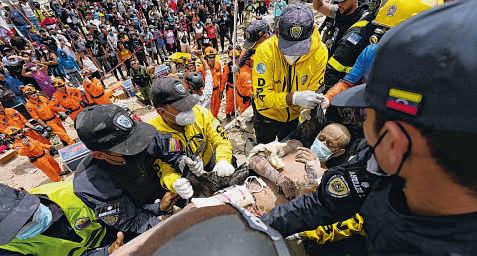
Masses of people gathered to watch as rescue crews from the U.S. and France pulleda manand his son from the ruins Sunday morning and carried them carefully on a black tarp into an ambulance.
Still, many Venezuelans arestruggling to hold
3firefighterskilled, 2hurtbattling wildfire on Colorado-Utahborder
BY TY ONEIL, MICHAEL R. SISAK and JULIE CARR SMYTH Associated Press
BEAVER, Utah Three firefighters were killed and two sustained burn injuries when they were overcome by flames from fast-moving wildfires in hot, windy conditions nearthe Colorado-Utah border
The firefightersdeployedemergency shelters for themselves during the socalled burnover —which occurs when afire spreads and closes off all escape routes —onSaturday in Mesa County, Colorado, the U.S. Interior Department said
They worked forthe U.S. Wildland Fire Service and U.S. Forest Service and were part of an interagencyresponsetothe Knowles andGorefires, which merged with other fires to form the Snyder Fire. So far,about 44 square mileshaveburned.
The Wildland FireService, created earlier this year to streamline firefighting and firereductionacross public lands, said in astatement thatit“stands united” withthe ForestService in grief and“in ourunwavering support forthe loved ones left behind.”
ASSOCIATED PRESS PHOTO
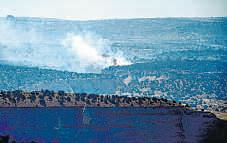
Sunday from the SnyderFire burning near Thompson Springs,Utah.
asking people to evacuate the potential pathofthe fireand to turn on irrigation water to saturate the land. The federal Bureau of Land Management closed public access to lands it manages nearby “Firefighter and public safety are the highest priority,” the agency said in a statement. “The temporary closing of the lands is to reduce exposuretohazardous situationsdue to therapid rates of spread and firebehavior that the fire has exhibited. The public is to remain clear of these closed lands.”
onto hope in an increasingly desperate situation. The one-two punch of 7.2 and 7.5 magnitude earthquakes that hit last Wednesday have left atrail of devastation.
Alayer of dust coated coastal communities, and as the stench of decomposing bodies spread, morepeople began to wearmasks.
Authorities said Sunday that more than 770 buildings had totally or partially collapsed from the earthquakes, twiceasmany as were reported destroyed or damaged on Friday.The risk of further damage remains as aftershockscontinued to shake Venezuela; quakes measuring 4.2 and 4.5 hit Sunday morning. Many livingindisaster zones said they had seen little sign of their government sincethe quakes. But rescue efforts in La Guaira —the hardest-hitarea— appeared significantly more organized on Sunday as international rescuemissions arrived en masse. In previous days, residents there had expressed frustration and anger about the level of response.
The government reported on state television that more than 14,000 members of the military and police are now patrolling La Guaira state, where access is blocked and special permitsare required to enter
Astory about Saturday’s BESE primary that appeared in the Sunday paper incorrectly stated that candidate Mike Hollis was former board member Paul Hollis’ son. They are brothers.
TheTimes-Picayune regrets the error CORRECTION
“Theirbravery,dedication,and sacrificewillnever be forgotten,” the statement said.
The names of the firefighters who perished werebeing withheld pending notifications to their loved ones, the Interior Department said.
Temperatures in Grand Junction —east of the fire—hit ahigh of 93 degrees, with windsgusting to 44 mph, according to the NationalWeatherService.
TheMesaCounty Sheriff’sOffice was
Wildfire activity has intensified across thewestern United States, as consecutivedays of hot,dry and windy weather have fueled flames in Utah, Arizona and elsewhere as new fires popped up across the region. The largest blaze, theCottonwood Fire, was burning in ruggedterrain in southwestUtah. It ballooned Saturday to more than 144 square miles aftermarching through canyons and mountainsides, destroying part of aski resort andother summer cabins along theway

BY KAITLYN HUAMANI and BARBARA ORTUTAY AP technology writers
Amy Neville describes Kristin Bride as her “soulmate.” But the day that forged their bond — June 23, 2020 was the worst of each of their lives.
Both Bride and Neville lost their teen sons that day Their kids lived a thousand miles apart and never met, but they both died from harms related to their social media use.
When the two mothers met, early in their advocacy work to protect other kids, Bride said she had felt “totally alone.” But they have since seen the online child safety movement blossom, with scores of other parents who lost kids pursuing stronger social media safeguards and legislation to protect children online.
With that momentum, advocates say the tide seems to be turning. A pair of landmark jury verdicts this year showed a way forward for holding tech companies accountable. And while the U.S. is nowhere near embracing social media bans for children like those seen from Australia to Indonesia, a push for regulation is simmering again in Congress
“Moving forward for me, it’s this groundswell. We now have the court of public opinion on our side, and that is powerful. That has brought things to the next level,” Neville said in an interview Her son Alexander Neville
was brilliant and intense,” Neville said, with an entrepreneurial spirit and “the best laugh in the world.”
When he was 14, a drug dealer connected with him on Snapchat and sold him the pill that killed him. Carson Bride was the “bright light” of his family, a funny and caring kid who loved connecting with people, his mother said. He died by suicide at age 16 after severe cyberbullying.
The teenagers were honored in Washington, D.C., on Tuesday alongside 270 other children and young people who died because of online harms. It was the sixth anniversary of the boys’ deaths, a date their families have worked to establish as Social Media Victims Remembrance Day
Growing awareness of the dangers social media poses for young, developing brains has shown up in a wave of new restrictions globally Australia, the U.K. Turkey Indonesia and others have passed bans on kids under 16 or 15 from using platforms like TikTok, YouTube and Instagram.
In the U.S., the movement turned a corner with two jury verdicts against Meta and one against Google that galvanized proponents for kids’ online safety Evidence in the court cases revealed some of the tech companies’ inner workings, including communications of employees who likened their products to drugs and casinos.
That the Los Angeles trial accusing social media platforms of causing deliberate harm to children was allowed to move forward was itself a watershed movement, said

Kristin Bride, right, mother of 16-year-old Carson Bride, who died by suicide after being cyberbullied on an anonymous app on Snapchat, is joined by Amy Neville, mother of 14-year-old Alexander Neville, who died from fentanyl poisoning after being deceived by a drug dealer operating on Snapchat, during a Social Media Victims Remembrance Day memorial on Tuesday on Capitol Hill in Washington.
Matthew Bergman, head of the Social Media Victims Law Center, which represents more than 1,000 plaintiffs in lawsuits against social media companies.
Section 230 of the 1996 Communications Decency Act shields tech companies from legal responsibility for posted content. It has been a barrier to accountability but lawsuits are side-stepping its protections by focusing on the companies’ deliberate design choices rather than content.
“It is still a hurdle, but it is no longer a barrier,” Bergman said.
In the U.S., federal legislation of social media has moved at a glacial pace The Children’s Online Privacy Protection Act, which took effect in 2000, requires kidoriented apps and websites
to get parents’ consent before collecting personal information of children under 13.
This week, lawmakers in the House unveiled a bipartisan deal called the Kids Internet and Digital Safety Act. It includes portions of the the Kids Online Safety Act, or KOSA, which passed the Senate in 2024, but critics say it’s been stripped of its most important part a provision called “duty of care,” a legal term that requires companies to take reasonable steps to prevent harm.
“Without a duty of care, Big Tech companies will maintain the status quo of putting profit before the safety of our children,” Sen. Marsha Blackburn, R-Tenn., said in a statement Bride said advocates have to employ a three-prong ap-
proach, utilizing legislation, litigation and education. That way, “when one stalls, like legislation,” Bride said, “then we have the trials and we have litigation. So we keep pressing forward. We’re not going to give up.”
Representatives from Meta, YouTube and TikTok did not immediately respond to messages for comment. Snap said in a written statement that it works continuously to strengthen safety protections across its platform.
Over the years, social media platforms have introduced some safety features including separating minors into teen accounts and providing even tighter restrictions for younger teenagers. Instagram, for instance, now restricts teen accounts to viewing content that aligns
with “PG-13” ratings and accounts are set to private and can’t be messaged by strangers. YouTube has a separate kids app and parental controls on its regular platform that allow for “supervised kid accounts” for preteens who have aged out of YouTube kids.
But child advocates say there’s still a long way to go. “Their fundamental incentive to design products that maximize engagement has not changed,” Bergman said. “Yes, there have been some improvements. A 13-year-old child is not by default provided with an open account for adult predators to prey upon So, you know, there are baby steps, but there are steps in the right direction. We just need more of them.”
Since 2024 the Senate has passed a resolution annually to recognize June 23 as Social Media Harms Victim Remembrance Day, which honors the lives of those who died because of online harms including suicide, drug poisoning, cyberbullying and dangerous social media challenges.
Alongside several parents and advocates who spoke at the event Tuesday evening including Bride and Neville — senators called for urgent action.
Sen. Amy Klobuchar, DMinn., advocated for the repeal of Section 230. Sen. Richard Blumenthal, DConn., said advocates and lawmakers need to “fight like hell for the living.” Sen. Josh Hawley, R-Mo., assailed his fellow Congress members for not doing more, saying “we all know why” they haven’t acted.
BY KIRSTEN GRIESHABER and JOHN LEICESTER Associated Press
BERLIN France saw around 1,000 additional deaths last week at the height of its record-smashing heat wave, the country’s public health agency said Sunday, as the head of the World Health Organization warned that Europe is now the fastest-warming continent and needs to do more to protect its citizens. Temperature records were toppled in several countries on the weekend, wildfires were sparked in Germany and Berlin police used water cannons to cool down the crowds.
Meanwhile, the heat wave slowly moved toward eastern parts of the continent. Germany marked a record for the third day in a row with 107 degrees in Neißemünde, near the border with Poland, which baked under its new all-time high of 104.9. The Czech Republic also experienced its hottest day ever with 107.4, up from the previous record of 105.6 on Saturday.
A new study from the World Weather Attribution, a Europe-based collaboration of scientists, reported Friday that the record-breaking heat and humidity in Europe this past week would not have been possible without
climate change.
The rapid study found that the heat would have been virtually impossible just five decades ago, and is 200 times more likely today than it would have been 20 years ago.
France reported a surge in deaths last week, including a sharp increase at private homes, especially in the Paris region, the national public health agency said Sunday
There were more than 1,200 deaths on Wednesday, when France was sweltering under its hottest temperatures, increasing to more than 1,400 deaths on each of the two following days, Public Health France said.
In April and May before the heat wave, France’s rate of deaths was about 900 to 1,000 per day
The agency concluded that France experienced a total of at least 1,000 additional deaths during those three days alone, an estimate it cautioned is likely to increase as more data is collected, including for deaths at home.
The increase was sharpest in areas under red warnings of extreme heat, it said. Those warnings blanketed about three-quarters of the country at the peak of the heat wave. The agency said that 85% of the deaths involved people aged 65 and above.

BY MARC LEVY Associated Press
A long and dangerous heat wave will blast a large swath of the central and eastern United States this week, the National Weather Service said, with temperatures rising ahead of the July Fourth holiday and feeling even hot-
ter because of the high humidity that’s arriving with it Already parts of the U.S especially Phoenix and central Texas, and much of the Southwest were experiencing temperatures around 100 on Sunday, while the weather service warned of severe wildfire conditions developing across much of the West as new fires popped up across the region. On Sunday well over 130 million Americans across southern and Great Plains states were under moderate to severe heat risk conditions, according to weather service maps, with that area forecast to expand and temperatures to intensify as the
week drags on. Forecasters say several days of high temperatures — some above 100 degrees — will settle in across the lower Great Lakes, the midAtlantic and the Mississippi and Ohio River valleys. Some record highs could be set in areas from the lower Great Lakes to the mid-Atlantic
and New England later in the week, said weather service meteorologist Bryan Putnam.
A number of big cities could see their highest temperatures of the year so far as they host World Cup matches and celebrations for America’s 250th anniversary Feeling the heat will be
the East Coast cities of New York, Philadelphia, Washington and Baltimore, and Midwestern and Great Lakes cities including Chicago, Indianapolis, St. Louis and Detroit. Southern cities including Dallas, Little Rock, Arkansas, and Memphis, Tennessee, will also see high temperatures.

student athletes, and to enhance facilities and settle lawsuits
The early childhood education fund is capped at $20 million, but the SPORT fund has no cap. SB135 would have moved the cap to the SPORT fund, allowing the early childhood education fund to continue collecting revenue over $20 million.
The change would have generated an extra $3.4 million annually for the latter fund, according to a fiscal note attached to the legislation.
That fund is used to create more seats in Louisiana’s Child Care Assistance Program, which helps families pay to put kids in early childhood education programs.
The initiative has received praise not only from education advocates but also from the business lobby; supporters say early childcare helps ensure parents can get to work and improves educational outcomes for kids.
But some lawmakers note that college football is an economic boon to the state.
State Rep. Dixon McMakin, RBaton Rouge, who is also the PA
Continued from page 1A
Davis, 55, faces an uphill battle in a state where no Democrat has been elected to the Senate since 2008, and Republicans hold all of the statewide offices and twothirds of the seats in the Legislature. In the runoff, 316,538 people voted in the Republican runoff, while 196,190 voted in the Democratic one.
Davis said he is undaunted by the naysayers and said he will broaden his focus to appeal to Republican voters who could not vote for him in the just-concluded closed primary elections.

“Dr. Fleming’s voters are out there,” he said. “So are Dr Cassidy’s voters and Mr Crockett’s voters.”
Sen. Bill Cassidy was eliminated in the May 16 primary when he finished third in the Republican primary Cassidy had angered Trump and MAGA voters when he voted to convict the president of inciting the Jan. 6, 2021, attack on the U.S. Capitol by his supporters.
The overall turnout of registered voters in the runoff was 17%, according to Ed Chervenak, a political-science professor at the University of New Orleans. That was down from 28% in the May primary
According to unofficial returns from the Secretary of State’s Office, Davis defeated Crockett, 79.9% to 20.1%. That result was not a surprise since Davis had much more money and important Democratic endorsements
“We’re talking grassroots, pure grassroots, different organizations coming together to say, ‘This man has it; this man has what we want to see in the person who represents us,’” said Bonnie Byland, an organizer with Indivisible Baton Rouge.
At Davis’ election night party in Baton Rouge, she added, “There was tremendous energy.”
James Carville, the famed Democratic political strategist, said of Davis, “He has some guts and
announcer at Tiger Stadium, said strong athletics programs help generate visitors to the state who, in turn, spend money at local businesses.
“There’s no denying the economic impact that athletics has on all universities across the state when teams are performing well,” McMakin said, calling college sports programs “economic engines.”
Supporters of athletics
Mizell’s proposal easily passed the Senate, but it died in the House Administration of Criminal Justice Committee when none of that panel’s members would make a motion on the bill. No one spoke publicly in opposition to SB135 during that meeting, nor did any lawmakers explain why they did not want to move it forward.
Like many other Louisianans, Mizell said she loves football — but she also wants single moms in the poorer parts of her district to have access to childcare so that they can go to work.
“(The colleges) would still be getting $20 million,” Mizell said. “I thought we were ready to acknowledge that OK, maybe we’ve given football enough money.”
Mizell noted that former head LSU football coach Brian Kelly


received a $54 million buyout after LSU ousted him The school then made Kelly’s replacement, Lane Kiffin, one of college football’s three highest-paid coaches, with an annual salary of $13 million.
Supporters of the athletics programs say most of the money for sports is generated by the programs themselves or comes from donors. A single donor reportedly paid for most of Kelly’s buyout.
Tensions rise
A week after SB135 died, another sports-related bill stirred debate in the Senate.
House Bill 608 by state Rep. Tehmi Chassion, D-Lafayette, which was billed as a way to protect student-athletes exempts records that detail how colleges allocate socalled “revenue sharing” funds to individual sports and athletes. That is money paid directly from the budgets of athletic departments.
HB608 easily passed the House with only four no votes, but it picked up opposition from a coalition of senators from across the political spectrum who said it was a blow to government transparency
In addition to Mizell, state Sen. Greg Miller, R-Norco, and state Sen. Thomas Pressly, R-Shreveport, spoke against the bill when it was debated in the Senate on May 26.
“We’ve got ‘student-athletes’ that are getting paid $1 million, $2 million, $3 million, $4 million a year
We have lost sight of our priorities. We have jumped the shark on this,” said Miller “Who are we really trying to protect? What we’re doing here has just gone too far.”
HB608 passed the Senate 22-13.
Revenue sharing is just one source of money for student athletes. They often obtain lucrative name, image and likeness, or NIL, deals, which generally involve advertising campaigns.
Chassion said HB608, now Act 818, was necessary to protect athletes from being targeted for their money He also said it would make Louisiana sports teams more competitive, preventing other schools from learning a specific student athlete’s salary and using it to poach that athlete.

moxie. He seems to be a successful farmer, which is a pretty good profile for a Democratic candidate. His challenge will be raising money. Democrats have no power in Louisiana. In politics, you can have the best bio in the world, but if you don’t have money you can’t tell your story.”
Behind Letlow’s win
Letlow defeated Fleming, 56.8% to 43.2%. That 13.6-point margin was bigger than most political analysts predicted. The Letlow campaign, for example, expected she would win by six or seven points, the campaign official said New Orleans pollster Greg Rigamer, who had conducted weekly surveys throughout the race, won public attention when he found in the final days of the election that Fleming had closed most or all of the 17-point margin that Letlow had coming out of the May 16 primary, 45% to 28% Rigamer released a poll showing that Fleming held a 1-point advantage among those who voted early in the Republican runoff but that Letlow held a 6-point advantage among those expected to vote on
Saturday Rigamer expected Letlow to win the runoff but in “a squeaker.”
Fleming’s pollster, John Couvillon, reported that his poll several days before the election showed Fleming up, 45% to 40%.

The Letlow campaign saved its heaviest advertising buys for the final three weeks of the campaign, when more voters would be tuning into the race. Outside groups also stepped up their advertising. Two of them — American Mission and Save American Freedom spent over $1 million total to promote Letlow Another group, the Accountability Project — run by allies of Gov Jeff Landry — spent over $4 million on attack ads against Fleming — TV ads, radio spots, mailers and texts.
At 12:52 p.m. on Wednesday, voters received a text message from the group: “President Trump has sealed our border and is keeping illegal aliens out. But RINO John
Fleming has found a workaround to bring more Mexicans into our country his taxpayer-funded immigrant bus system.”
At 10:43 a.m. on Thursday: “While you bust your butt paying taxes, John Fleming and his family were globe-trotting the world on your dime, and lobbyist money.”
At 1:12 p.m. on Thursday: “Fleming is a fraud who can’t be trusted.”
At 3:06 p.m on Friday: “John Fleming bragged about working side-by-side with Dr Fauci on the COVID Task Force, even sharing with the media that they ‘very frequently’ met together as they pushed forced vaccines and forced masks on our kids, and shut down businesses.” The text ended with photos of Fleming and Fauci. Landry raised money for the Accountability Project and Hope in Action which transferred big dollars to the Accountability Project.
“We ran a strong campaign,” said Jay Connaughton, a St Tammany Parish-based media strategist who headed the Accountability Project.
“It wasn’t just about the money It


“This is a protection for student athletes. Folks tend to think of these as rich college kids, when these are regular kids that happen to be able to play a sport so well,” Chassion said. “It’s not anyone’s business what an individual athlete is making.”
Scott Sternberg, a First Amendment expert and attorney who is representing a group of journalists suing LSU for revenue-sharing records, said the exemption marks the first time the state is allowing the expenditure of public dollars to remain confidential.
Chassion argued that the revenue-sharing money should not be considered “taxpayer” dollars because it comes from funds that are “self-generated” by athletic departments.
Sternberg disputed that notion, saying taxpayer dollars make it possible for institutions like LSU football to generate revenue.
“If a tollbooth collects a toll, that’s public money,” Sternberg said. “If LSU sells an advertisement or a ticket to the game, how is that not public money?”
Sternberg also represents The Advocate | The Times-Picayune in some legal matters. The newspaper is not a party to the lawsuit filed against LSU.
was about the effective message
John Fleming was a flawed candidate. It made our job a lot easier.” Fleming repeatedly said the ads were dishonest. He declined to be interviewed on Sunday Letlow did not respond to interview requests.
Letlow campaign volunteers made 100,000 calls to likely Letlow voters on the weekend before the election and 91,000 calls on election day, said the Letlow campaign official.
Where Letlow won
According to a postelection analysis by Rigamer, Letlow ended up carrying 49 parishes, while Fleming won 14 — Orleans Parish and 13 more in a corridor that stretched from northwest Louisiana to Allen and Beauregard parishes, the area he represented in the U.S. House from 2009 to 2017.
“She just dominated,” Rigamer said on Sunday Fleming and Letlow tied in Bossier Parish, each with 4,351 votes, according to the Secretary of State’s Office.
Couvillon, who acknowledged on Sunday that he misfired on his final poll, said Fleming’s campaign aimed in the runoff to receive two-thirds of the Cassidy voters from the primary but collected only 45%.
“The Cassidy vote concluded there wasn’t a dime’s difference between the two runoff contenders, so they split their vote,” he said.
Roy Fletcher, Fleming’s campaign strategist, knew that his candidate had to take an early lead when the first batch of returns were released on Saturday night just after the polls closed at 8 p.m. Those figures tallied the early voters who, Rigamer’s poll showed, had given a slight advantage to Fleming.
Instead, Letlow took an immediate lead.
Fletcher was sitting in Fleming’s suite at the Crowne Plaza Hotel in Baton Rouge
“I said to myself, ‘That ain’t what it’s supposed to be,’” Fletcher recalled on Sunday “I knew then that it wouldn’t go right. I walked to get two oatmeal cookies. I thought it was time for sugar.”















But the rider experience is often “incredibly frustrating,” according to Courtney Jackson, executive director of the rider advocacy group RIDE New Orleans.
One out of every four RTA buses failed to arrive on time last year,according to agency data. In April, the RTAcanceled around2% of its scheduled busservice, largely due to alack of working vehicles, but also because of road closures, police barricades and driver shortages,agencyofficials said.
“Riders are more likely to use public transportation if they know their bus is going to show up andshow up when it says it’sgoing to showup,” Jacksonsaid “Right now,people don’t trust that they’re goingto gettowherethey need to go.”
In astatement, Moreno said the next CEO needs to focuson“delivering reliable, accessible service while strengtheningregional connectivity and expanding access to effective public transportation.”
Expandingaccess?
Even though many New Orleaniansrely on theRTA to get to work, the agency has made little progress in recent years in expanding riders’ accesstoemployment opportunities.
The average New Orleans resident can reach less than athird of theregion’sjobs in 60 minutes on public transit, according to aRIDE analysis from 2025.The metric has barely budged since the advocacy group began tracking it adecade ago.
In 2022, the RTAlaunched amajor bus network redesign called New Links in an attempt to speed up riders’ commute and improve regional connectivity.The redesign, the first since Hurri-
Continued from page1A
Now, as amovement to increaseaccess to psychedelic-assisted therapyhas gained steam across the country,Louisiana is joining agrowing list of states working to expand the use of the drugs to treat addiction, PTSD and other conditions. Statelawmakers this spring unanimously approved ameasure to cultivate research into psychedelics and support clinical trials.
Agrowingbody of research shows that psychedelics can help address problems like trauma, addiction and depression, which can lead to suicide, and that’s especially relevant for struggling veterans, said Sen. Patrick McMath,RCovington, who sponsored Senate Bill 43, now Act 956.
cane Katrina, didaway with some routes and reconfigured others.Itpromisedto increase the numberofbus lines with vehicles arriving at leastevery20minutes andtoexpand serviceon nights and weekends
However,less than ayear after rolling out the redesign,the RTAbegan cutting back on thefrequency on certain routes. It hasyet to return to the service it promised when it launched New Links
Thereason, according to agency officials:The RTA doesn’thaveenough buses. In order for New Links to work as intended,the RTA needs anactivefleet of 140 buses. With an aging fleet and ashortage of mechanics, the RTAstruggled to keep enough buses on the roads after it launched the redesign. Hankins,who joinedthe RTAas infrastructurechief in 2019and was named permanent CEO in March 2023, inherited thebus shortage problem. Under her watch, the RTA developed afleet replacement plan and secured federal funding that officials said should have the agency back to an activefleet of 140 busesby2028.
Until then, the RTAand itsnextCEO willbeconstrained in their effortsto expand service and make it more reliable.
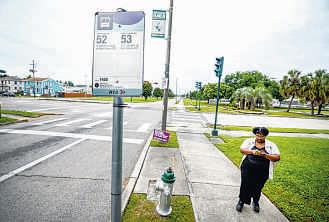
Lola Reynard knows those issues well. She budgets around two hours to get from her apartment in Gentilly to herjob at The National WWII Museum downtown. It’sa3-mile commute that would take less than25 minutes by car On agood day,ittakesher aroundanhouronpublic transit. Butthe 24-year-old New Orleans native has learned to plan for unexpecteddelaysonthe 52 Paris-Broadmoor line, which in April had an on-time performance of 77.4%. One time, she said, her bus broke down on herway to work and againonher way home.
stance use disorder or PTSD experienced remission for months or in some cases years after taking psychedelics with the right preparation and in amonitored clinicalsetting,he said.
At the same time, the field of psychedelic medicine is still inits early stages, he said,and most experts view thefindings thus faras “promising but not definitive” due to the limited scientific research and clinical trial data that’savailable.
“More research needs to happen,” he said,“but the potential is immense.”

“I believe it will save lives,” McMath said of the newlaw.“Shame on us as legislators in thisstateif we don’tdoeverything that we cantocreate theregulatory pathwaystosafely administer this type of therapy.”
Psychedelics in treatment
Psychedelics like ibogaine, psilocybin and MDMA are illegal under federal law,and are Schedule Idrugs, theDrug Enforcement Agency’smost restrictive classification.
While they can’tbeprescribed in standard medical treatment, scientists with a special Schedule Ilicense can study the drugs in research trials.
Some of those studies have produced“areally remarkable effect,” said Kevin Murnane, aprofessor of pharmacology,toxicology and neuroscience and a professor of psychiatry and behavioral medicine at LSU Health-Shreveport.
“Many times the outcomes are really, really profound,” he said.
For example, people with conditions like treatmentresistant depression, sub-
By 2028, the agency expectstoface a$9million shortfall in funding forits bus,streetcar and paratransit services,according to a RIDE analysis. The RTA hasn’traisedits passenger fares since1999, though RTACommissioner Barbara Majorsaidthe agency needs to improve its servicebefore raising prices or seeking morefrom taxpayers.
The next CEO will also be taskedwith securing federal dollars fora long-planned busrapid transitlineconnectingNew OrleansEast to the CentralBusiness Districtand Algiers.
“At the end of the day, they get people from Ato B,” Reynard said during a recent interview on an RTA bus. “But there’sbeen times where I’m like, ‘Oh,this really sucks.’”
TheRTA saiditismaking adjustments with the resources it has. In September theRTA plans to implement service changes on the West Bank to make it easier for residentstoget to grocery stores. RTAofficials will begin reaching outtoNew Orleans East residentsinJuly as part of asimilar serviceimprovement effort. In astatement, RTAinterim CEO RonaldBaptiste said “providing safe,reli-
able service remains acentral focus for the RTA.”
“During thistransition period, the agency remains focused on day-to-day operations, monitoring service performance, coordinating across operations teams, and continuing planned service improvement efforts,” he said.
Fundingchallenges
To maintain existing servicelevels in the coming years, thenextCEO will also need to secure new revenues. Sales taxes make up around 85% of the RTA’s operating revenues. Passenger fares,meanwhile, make up 10%.
The RTAhas several othercapital projects in the works thanks to nearly $200 millioninfederal grants secured by the RTA since2019. Construction is underway on the $11.4 million Algiers Ferry terminal renovation, and the RTAis in the process of procuring an architect for its$33 million DowntownTransit CenteronBasin Street near CanalStreet
“These were federal dollars that we aggressively went after in ordertobuild better infrastructure,” Hankins saidataRTA board meeting in December,noting that without the grants, the agency would have had to rely on bonds.
While Hankinsnotched several wins during her time as CEO,her threeyear tenure alsoincludeda string of controversies.
The biggest camein early 2024, when halfthe RTA’sboard resignedafter learning about aconstructioncontract thathad ballooned in value. Theepisode prompted Jefferson Parish to pull out of theRTA entirely
The RTAalso faced criticism for the slow paceof progress in improvingits paratransit servicefor disabled riders. RTAofficials saymanyofthe issues with
paratransit should be resolved with theroll-out of newscheduling software laterthis year In April, internalpersonnel issues at the RTAburst into view,when adozen current and former RTA employees fileda lawsuit in federal court alleging rampant workplace discrimination and wagetheftand accusing Hankins of violating free speech protections. The Moreno administration said the lawsuit underscored why “meaningful reform and structural change”atthe RTAwas needed
The RTAboardhas hired North Carolina-based KL2 Connects to conductthe search for the CEO. The firm hasalreadymet with City Council members, Moreno,union representatives and RIDE to hear what they wantinthe next CEO, Duplessis said.
Better communication
While the RTAfaces problems that can’t be fixedovernight, the next CEO could improve the rider experience by doing abetter job at communicating service disruptions, Jackson said. The RTAmakes note of disruptions on itswebsite and in its mobile LePass app. But they often lack essential details, like whichstops are closed, where to catch arerouted bus and how long the disruption will last. Waiting at abus shelter outside theMainLibrary downtown on arecentSaturday,Charles Thecook, 65, said the 57 Franklin-Freret bus he takes to his restaurant job Uptown is late almostdaily
“You never know if you’re going to get to workontime or not,” he said. “They miss routes. The bus breaks down. Thebus don’tcome according to the schedule. It’s really not dependable.”
Email Blake Paterson at bpaterson@theadvocate. com.
Murnane cautionedthat each psychedelic carries itsown risks and potential harms. For example, MDMA could affect thesupplyof blood to the heart, while ibogainecan make patients extremely physically illand impactthe heart’s rhythms, and some drugs carry psychiatricrisks like manic states or suicidality if used improperly,hesaid.
Psychedelics can also put people in avulnerable, compromised mental state, he said, and he does not recommendtakingthem independently outside of a clinical setting.
Murnane is the principal investigator for two ongoing clinical trials with psychedelics, one studying psilocybin to reduce relapsein methamphetamine addiction andanother studying apsilocybin-likecompound to treat adjustment disorder triggered by atraumatic or major lifechange like aterminal diagnosis.
He said he hopestoexpand theresearchtoinclude ibogaine and MDMA at the clinical trials office at LSU Health-Shreveport, which built out apsychedelic dosing room with input from experts.
Murnane, who gave advice on some aspects of Act 956, saidthe law will position Louisiana to beanational leader inpsychedelic research.
What does legislationdo?
Anew Psychedelic-Assisted Therapy Initiative
will be housed in the Office of Behavioral Health at the state Health Department andled by Dr.Vanessa de la Cruz,the office’s chief medical officer
Theprogram is tasked with identifyingacademic health centers conducting clinical trialsofpsychedelic-assisted therapy,helping identify potential study participants, and securing funding for the studies, including from Louisiana’s $600 millionpot of money from a2021 settlement with pharmaceutical companies over the opioid epidemic.
Academic healthcenters in Louisiana can now partnerwith drug manufacturers to develop clinical trials for psychedelic medications like ibogaine,psilocybin and MDMA totreat addiction and mental health conditions.
The measure became law this month without asignature or vetofrom Gov.Jeff Landry
Anationalmovement
Louisiana’seffortispart of abroader movement across thecountry to expand access to psychedelic drugs and tomedicalize ibogaine for mental health treatment.
Blue stateslikeOregon, Colorado and California have passedlaws expanding access to psychedelics forhealthcare, but several red states including Texas, Tennessee andothers are also followingsuit, according to data on state-level legislation compiled by the UC BerkeleyCenter for the Science of Psychedelics.
AndinApril, President Donald Trumpsigned an executive order aimed at speeding up research and development for psychedelics.
“Psychedelic drugs, including ibogaine compounds,show potentialin clinical studies to address serious mentalillnesses for patientswhose conditions persist after completingstandard therapy,” the order says.
Murnane said both the Louisiana legislation and the president’sexecutive order provide avaluable counterweight to the “cul-
tural baggage” psychedelics have.
“It’shelpful when you’re conducting research trials or trying to advance them as medicine to be able to say thatvery responsible, ethical and credible people believe this is worth researching andstudying,” he said.
At anews conference last week celebrating thenew law,McMath said he first heard about ibogaine afew years ago talking to military veterans about PTSD, and then he learned more about it fromaninterview on theJoe Rogan podcast withW.BryanHubbard, an ibogaine treatment advocate who has been gaining anational profile in recent months.
“Weshould probably start aJoe Rogancaucus,” McMathsaid jokingly “There’sbeen adecent amount of legislation that has comefromthatshow.”
Hubbard, alawyer and former executive directorofthe Kentucky Opioid Abatement Advisory Com-
mission, joined McMath at the news conference at a veterans wellness center in New Orleans.
“Weare in an existential struggle forthe survival of this country,” Hubbard said. He pointed to things like theopioidepidemic, ongoingmilitary conflicts since Sept. 11 and the high suicide rate amongveterans.
Hubbardworks with former TexasgovernorRick Perry running Americans forIbogaine,anational nonprofit group promoting medical and therapeutic use of the drug.
“Having recognizedthat the heart of traumaand addiction is profound spiritual affliction,mightyTexas has committed$100 millionto achieve the moonshot of our time, the medicalization of ibogaine within the United States in orderto serve and exalt the primacy of the human soul,” he said.
He said he is workingto change state and national policyonibogaine because “we have aprofoundly bro-
ken mental, behavioral and addiction health treatment system.”
Hubbard andRogan were at the White House and stood together behind Trumpthe dayhesigned the recent executive order on psychedelic research. Rogan said he sent Trump atextmessage aboutibogaine’spotential to treat opioid addiction, and the president responded that he would be supportive of FDA approval.
Trump said he got on board with the idea after asking U.S. Health Secretary Robert F. KennedyJr. and Dr.Mehmet Oz, who runs the Medicareand Medicaidprograms, about the psychedelic. The next week, the FDA forthe first time authorized aclinical studyofan ibogaine derivative to treat alcohol use disorder
The FDA also said it was fast-tracking studies by three companiesstudying psilocybin and another MDMA-like drug to treat depression and PTSD











BY MICHELLE HUNTER Staff writer
When Jefferson Parish Sheriff’s
Office deputies in April dug up the severed skull and hands of Eddie Tillman Jr at a Marrero home, questions quickly mounted about what previously had been a cold, missing person case. How did Tillman, who disap-
City will join state in new QR code program
BY LARA NICHOLSON Staff writer
The Kenner City Council repealed its vehicle inspection sticker program Friday, a move that followed the state’s decision earlier this month to discontinue brake tag requirements for most Louisiana drivers.
Under the council’s unanimous decision, Kenner drivers will no longer be required to undergo safety checks every one to two years in order to obtain a brake tag starting Jan. 1.
Instead, they will join the rest of the state in getting a Louisiana Vehicle Identification Program sticker when they renew their registration, which is a QR code costing $6 per year that lists the vehicle identification number when scanned.
“We all need to realize it’s our personal responsibility to maintain our vehicles and make sure it’s safe,” said Kenner City Council member Kristi McKinney, who co-submitted the legislation. “The threat of a ticket for a brake tag isn’t going to make someone do something they weren’t going to do anyway.”
One resident who spoke at Friday’s council meeting said that repealing vehicle inspections would create a safety issue for the city But several other residents and council members said Kenner’s vehicle inspections had grown obsolete, and that the police department could handle enforcement for issues like tinted windows or busted headlights on its own.
Kenner Police Chief Keith Conley said that keeping the inspection sticker program would create a “quagmire” in which cars from unincorporated Jefferson Parish would not be required to have a brake tag, making it difficult to enforce those rules.
Conley added that departments statewide will also have to buy separate equipment to scan QR codes instead of regular smartphones due to privacy concerns. According to Conley his department issues roughly 400 inspection sticker violations per year, compared with about 9,600 moving violation tickets.
Starting Tuesday, law enforcement officers will be prohibited from issuing tickets for not displaying an inspection sticker on personal vehicles under a bill signed into law by Gov. Jeff Landry Commercial vehicles and school buses will still be required to do regular safety inspections under state law
Mayor Michael Glaser did not oppose the repeal, but said he found the state’s QR code law to
peared without a trace almost three years ago, wind up in the backyard of a freshly renovated, single-story home listed for sale?
Homicide investigators are now beginning to hone in on the circumstances surrounding his final hours.
Six suspects have been taken into custody — including former residents of the house where Till-
man’s remains were recovered. Though they haven’t determined exactly how Tillman died, detectives are confident he met his demise at the hands of another “I don’t have an official autopsy result, but I do not believe he cut off his own head,” Detective Christopher Bodet testified Tuesday during a preliminary hearing in Jefferson Parish Magistrate Court
for three of the suspects. During his testimony Bodet laid out the chain of events, alleging that Tillman was abducted, beaten, killed and dismembered and buried at a house in the 1200 block of Gaudet Drive.
Tillman’s mother and sister watched the Tuesday hearing via Zoom, taking in the distressing details of his last night alive.
“They had my brother beaten, duct-taped, blindfolded and gagged,” his sister, Mary Tillman,
41, said. “My brother cried, and he begged for help, and nobody bothered to help him.” Eddie Tillman, 37, was a native of Florida who followed his mother, Mary Ann Tillman, 58, to Louisiana in 2017 when she began working for a tree-cutting service Eddie Tillman occasionally did work for the company but mostly sold scrap metal, according to his mother He wrestled with a drug addic-

ABOVE: Megan Malone participates in cat yoga during the Louisiana Cat Fest at the Fleur De Lis Event Center in Mandeville on Saturday RIGHT: Lauren Schulte pets a kitten up for adoption.
BY GRACE MAYER Staff writer
The Federal Aviation Administration announced Thursday that it has installed a new safety technology at Louis Armstrong New Orleans International Airport designed to help prevent collisions between aircraft and airport vehicles on runways and taxiways. The new system, called a Surface Movement Radar, is a specialized

and vehicle traffic.
The system also alerts controllers of any safety issues, like potential collisions. The New Orleans airport is the third airport in the nation to receive the upgrade from the FAA, after George Bush Intercontinental Airport in Houston and San Diego
and outdated air traffic control systems at airports around the country The nation’s airport safety systems have come under scrutiny after several high-profile accidents and well-publicized near-misses in recent months.
In March, an Air Canada plane collided with a fire truck on the tarmac at LaGuardia Airport in New York, killing the pilot and co-pilot and resulting in dozens of injured passengers.
Burns said in a statement.
The upgrade is part of the Trump administration’s $12.5 billion initiative, unveiled earlier this spring, to modernize aging
In January 2025, an army helicopter collided with a commercial airplane near Ronald Reagan Washington National Airport in Washington, D.C., killing 67 and becoming one of the deadliest commercial aviation accidents in U.S. history
The new surface radar system was installed earlier this week and will begin operating later this summer, the FAA said.

Energy companies to pay small fee for new span
BY MEGAN WYATT Staff writer
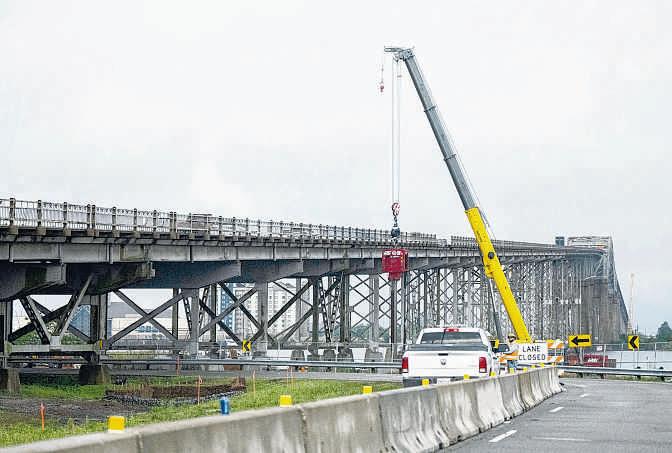
Two petrochemical giants will chip in a tiny percentage toward the overall cost of building the new Lake Charles Interstate 10 bridge after the state quietly settled a lawsuit earlier this year over a decades-old chemical spill at the foot of the current bridge. The confidential settlement agreement, which The Advocate | The TimesPicayune received through a public records request, called for Phillips 66 and Sasol to pay $2 million to the Louisiana Department of Transportation and Development — roughly 06% of the price tag for the new bridge. The payment ended a lawsuit the state filed against the two companies over an infamous 1994 spill of ethylene dichloride near the bridge. The companies spilled millions of pounds of ethylene dichloride, or EDC, during an underground transfer pipeline failure, they acknowledged in legal filings. Federal agencies intervened with cleanup orders, soil and water sampling and a restoration plan.
But hundreds of workers who cleaned up the EDC said they became sick and said they were not properly informed of the hazards of working with the chemical, nor provided the appropriate protection while working. The U.S. Environmental Protection Agency has classified EDC as a “probable human carcinogen,” and the chemical is used to make plastics, pipes and PVC. Dozens of claims against the companies quickly turned into a class-action lawsuit with hundreds of workers receiving confidential settlements.
State officials said the effects of the chemical spill were even more wide-ranging than health and safety concerns, and that the contaminated ground around the bridge would make it significantly harder and
more expensive to build a new one. When the state filed suit against the companies in 2008, they argued that the EDC spill upped the new bridge’s cost by $235 million.
The state wound up recouping a far smaller sum.
In a January joint motion, the state and petrochemical companies agreed to dismiss the lawsuit filed in Calcasieu Parish’s 14th Judicial District Court, with each party paying its own legal and court fees.
Chemical spill migration
In addition to the $2 million payment, the companies agreed to continue working with the DOTD on site access, right-of-way matters and utility relocation for the replacement bridge project, according to the settlement agreement. The settlement, which both sides signed last December, did not affect other aspects of cleanup orders for the two companies
Both have ongoing environmental remediation obligations under the Louisiana Department of Environmental Quality and other agreements related to the plugging and abandonment of wells.
The EDC spill happened so long ago that both companies involved have since changed names. At the time of the spill, the state argued that ConocoPhillips, now known as Phillips 66, and Vista Chemical, now Sasol, should have to pay for project costs. Hazardous waste from the chemical spill migrated into the subsurface soil at the planned project site, state officials argued. The migration meant the state’s old plan to use pilings to support the Sampson Street interchange portion of the new bridge could not move forward because of the risk of spreading the chemical deeper into the soil. State officials also worried about EDC spreading into the Chicot Aquifer, which provides drinking water to a large portion of the state, according to the lawsuit.
Taxpayers, meanwhile, helped foot the bill for figuring out how to build the new bridge. State officials argued that they spent 10 years designing the new bridge before they realized
the EDC had migrated to the site on which they hoped to build it.
In legal filings, Phillips 66 acknowledged that the company accidentally released EDC from its pipeline. When the spill was discovered, Phillips 66 said it started emergency response and cleanup efforts that were to continue until 2025, with DEQ overseeing them.
Phillips 66 and Sasol argued the state did not own or have a servitude interest in most of the property where they planned to build the new I-10 bridge. The companies said the state did not have the right to take action against them for contamination of the property or construction delays.
A toll on a new bridge
The $2 million settlement will go directly toward the replacement project, as outlined in a 2019 state law meant to expedite the bridge project. It’s a paltry sum for the $2.3 billion project, which is mostly being paid for through a public-private partnership and will include a toll for drivers upon its estimated completion in 2031.
A DOTD spokesperson did not comment directly on the settlement, but acknowledged the construction delays were largely due to environmental, location and funding concerns.
“This project has been a priority for DOTD for several years, and there are several steps involved,” said the agency’s John Guidroz. “The environmental process had to be completed, the necessary funding had to be obtained and then also navigating just the challenges or complexities of the location of the project — that all takes time.”
Attempts to reach attorneys who represented the state agency and both companies during the litigation were largely unsuccessful.
Attorneys who filed civil lawsuits against the companies on behalf of workers affected by the EDC said they could not share the terms of their settlements They noted, though, personal injury settlements differ from those impacting governmental plans, property and infrastructure.
Greg Marceaux, a Lake Charles lawyer who handled personal injury claims for
dozens of workers involved in the EDC cleanup efforts, said he was surprised to learn of the state’s settlement when contacted by a reporter “That seems low,” Marceaux said. “I don’t know the facts of the case well enough to be able to give a real opinion. It just seems low to me because it was such a substantial amount that was leaked, and surely they had to redesign the bridge and change the design of the bridge because of that.”
Marceaux said the toll for the new bridge is unpopular in Calcasieu Parish, especially among those familiar with how the EDC spill delayed construction and increased costs.
“If it increased the cost by $200 million, then why didn’t the responsible party have to pay that money?” Marceaux said.
Former Lake Charles Mayor Randy Roach, a former state representative, said he was recently reminded of the lawsuit with the groundbreaking this spring of the new I-10 Calcasieu River Bridge.
“I was saying just the other
BY STEPHEN MARCANTEL
Staff writer
St. Landry Parish residents have been playing a waiting game for the better part of a week. Recently, Tropical Storm Arthur dumped 20 to 30 inches of rain within 12 hours across southern parts of the parish, a likely 1,000-year rainfall event that caught most residents off guard. That water, which is not contained within rivers and canals, is now flooding parts of northern St. Landry Parish. For most of the past week, a flood warning has been in effect for the parishes of Avoyelles, St. Landry, Evangeline and Rapides, according to the National Weather Service. St. Landry Parish President Jessie Bellard issued voluntary evacuation recommendations for most areas of the parish north of La. 190 early in the week, and on Tuesday, water flowed across La. 10 in Palmetto On Wednesday, he warned residents of Lebeau along U.S. 71 from U.S. 190 north to La 10 that it was time to leave if they planned to evacuate. Though a Red Cross shelter opened for several days in Opelousas, Bellard said most residents who evacuated were able to find family and friends to stay with, and the shelter was closed On Friday, Bellard said about 100 homes in the Palmetto area had already flooded and more may flood as the water from Avoyelles continues to make its way south “It already flooded up in Morrow and Palmetto, up in those areas,” he said Friday morning. “Now it’s coming down Highway 71 and down to Bayou Courtableau.” Bellard said officials were hoping the flooding would peak by Sunday and then begin drying out within a week or 10 days.
Parish officials have been going house to house by boat, checking on residents and trying to get an assessment of damages to report to the Federal Emergency Man-

agement Agency Down Veazie Road in Palmetto, Sara and Benny Camp drove a four-wheeler down their flooded road before they hopped on a boat to make it to their front door
The couple left Saturday when floodwater began creeping into their yard, Benny Camp said.
On Friday night, the water level jumped about a foot, reaching at least 4 feet. Of the 15 or so houses on the street, about three homes flooded,
Sara Camp said. The Camps’ home was one of the lucky ones.
The same can’t be said for Sara Camp’s 72-year-old mother, who also lives along the street. Her home took on nearly 2 feet of wa-
ter
“I didn’t tell her yet I mean, she’s tough,” Sara Camp said.
The couple said they have never seen flooding like this in their lives.
“I was talking to the older folks, it was like early ’70s, they had a flood down this road,” Benny
Camp said. On Friday, KADN reported flood victims converged on a Louisiana Department of Insurance pop-up office in Lebeau seeking help.
Displaced residents spoke with representatives from the state Department of Insurance about federal, state and local resources available to them. Many were left with uninhabitable homes, with some forced to wade through knee-high water to reach higher ground. And many were facing the harsh reality of not having flood insurance. The Department of Insurance reported that only about 2,300 of around 19,000 homeowners in the area carry flood insurance.
“In this area, unfortunately, there’s not a high takeup, so that means they are not going to have flood coverage because flood is not covered under your homeowners policy,” Louisiana State Insurance Commissioner Tim Temple said. Temple urged flood victims without insurance to register their losses online, noting that the data collected could help Louisiana qualify for federal assistance
“Go to damage.la.gov, let the government know how many people don’t have coverage All of that amount gets totaled up, and then, that helps Louisiana figure out if it can qualify for federal assistance. So, if you don’t have flood insurance, unfortunately, we are going to have to wait for local, state or federal assistance,” Temple said.
Bellard said water levels were expected to peak by Monday in St. Landry, but the storm’s effects were not expected to be limited to Avoyelles and St. Landry parishes. Doug Kramer a meteorologist with the National Weather Service, said floodwaters from Avoyelles are expected to continue moving into St. Martin Parish and eventually into the Atchafalaya Basin.
day that I wish I had more information about that,” Roach said. “I wondered what happened, how that worked out, what the terms and conditions were.” Roach, who was mayor from 2000 to 2017, said he and the southwest Louisiana delegation encouraged both sides to resolve the lawsuit and move forward with the bridge project during his tenure.
“They had to wait until they really had a handle on the extent of the contamination underneath the bridge and how it would really affect the proposed route for the bridge,” Roach said. “That was still in progress when I left office because of the nature of it — It’s hard to clean up a spill underneath the ground.” Sarah Hughes, spokesperson for Sasol, said the lawsuit has been dismissed when contacted for this story “The parties have resolved the matter,” she wrote in an email to The Advocate. “And no further legal action will be pursued.”
Stef Adams, spokesperson for Phillips 66, said the company would not comment on litigation.
Continued from page 1B
be superfluous to scanning a license plate. He said the city and its partnered businesses did not profit from vehicle inspections, and that two city employees will be terminated or reassigned as a result of Friday’s repeal.
The city currently has four businesses acting as satellite brake tag stations, where drivers can get one-year tags for $10 or two-year tags for $20. Kenner was one of the few local governments to have its own local brake tag requirements, along with New Orleans and Westwego. Five parishes in the capital region, including Baton Rouge, also still must undergo federal Clean Air Act emissions testing requirements.
Unlike Kenner, Westwego decided earlier this month they would keep its inspection sticker program in place to maintain vehicle safety, according to Mayor Robert Billiot Sr New Orleans spokesperson Jonah Gilmore said the city was still deciding what to do with its local inspection sticker requirement.
Drivers in Westwego and New Orleans will still have to get a QR code sticker in addition to a brake tag to comply with state and local laws.
LOTTERY SATURDAY, JUNE 27, 2026
3: 7-1-7
NewOrleans Area Deaths
Davis, Ethel DeGrange,Antoinette
Mull, Philip NewOrleans Charbonnet
Davis, Ethel DeGrange,Antoinette
Lake Lawn Metairie
Davis; andson,OtisDavis Jr.She will be forever loved andforever remembered.A CelebrationofLifewillbe held at FirstShilohMis‐sionaryBaptist Church 2507 PerdidoSt.,New Or‐leans, LA on Tuesday, June 30, 2026 at 10:00a.m.Visi‐tation at 9:00 a.m. Inter‐ment -St. VincentDePaul Cemetery No 2, 1950 Soniat St NewOrleans,LA. Please sign theonline guestbookatwww.cha rbonnetfuneralhome.com. Charbonnet LabatGlapion Directors, (504) 581-4411.

Mull, Philip DeGrange,Antoinette Dinet
Davis, EthelMae
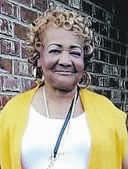
EthelMae Davis, ade‐votedmother, cherished grandmother, will be re‐membered forher unwa‐vering faith,lovingspirit, warm smile,and thekind‐ness shesharedwith everyone shemet,entered eternalrestonJune 22, 2026. Sheleavestocherish hermemoryher ONLY daughter,Jehan (Lavone) Davis, andthree grandchil‐dren,Jyra, Da'Vine, and Eric Davis; sister,Delores (Louis)Adams;along with ahostoffamilyand friends. Shewas preceded in deathbyher parents, Otis DavisSr. andLuevillia TerrellDavis;daughters, Jaquelineand BobbieJean
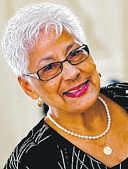
Antoinette DinetDe‐Grange passedaway peacefully on June 22, 2026, at herhomeinSlidell, LA surrounded by herloving family. Shewas born on March31, 1942, to the union of Homerand Marion Dinet. Shewas preceded in deathbyher parents; her brother, AndreDinet;and herbeloved spouses, StephenDonaldLlorens andDr. Elmore DeGrange Phd. Antoinette wasa proudalumnaofXavier PreparatoryHigh School Classof1959, andthe Uni‐versityofNew Orleans. She dedicatedmanyyears of serviceasa FederalCivil‐ianemployeefor theDe‐partment of theNavy, be‐fore retiring in 2002. Sheis
survived by hersiblings: Sister Rachel DinetOSF Rene DinetSr. (Gail),and Celina DinetNourse (Leslie). Shewas acaring anddevoted mother to An‐gela LlorensMcGee (Bryan), Regina Llorens Heisser (Asa), andKatrina LlorensJoseph(Albert Jr). Shewas also alovingstep‐mother to Paul DeGrange Antoinette wasaffection‐atelyknown as “Ma‐maNette”, aproud grand‐mother to StephanieHub‐bard,Stephen McGee, ChristineMcGee, Patrick Cuba,DanielleJoseph, and JasminePortuondo.She wasalsoa cherished great-grandmothertoHan‐nah, Shawn, Nicholas, Alexandra, Noah,Andre andZahra. Antoinette’s memory will foreverbe treasuredbyher nieces, nephews, cousins, ex‐tended family, andmany friendswhose livesshe touchedwithher love and kindness. Family and friendsare invitedtojoin in celebratingher life at a Mass of ChristianBurialat Corpus Christi-Epiphany Catholic Church,2022 St BernardAvenue,New Or‐leans, LA on Wednesday, July 1, 2026 at 10:00 AM Visitationwillbeheldat 8:00 AM.Interment will take placeatSt. Louis# 2 Cemetery,300 N. Claiborne Ave.,New Orleans, LA Please sign theonline guestbook at www.cha rbonnetfuneralhome.com. Charbonnet LabatGlapion Directors, (504) 581-4411.

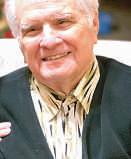




Philip (Phil) J. MullSr, on FridayJune 19, 2026 at age 100 was reunitedwith his soul mateand beloved wife of 73 years Lovenia (Lou) BMull to spend their eternal life togetherwith Jesus. Phil was born on February 25, 1926 to his parents who preceded him in deathalong withhis siblings, Jessie, Frankie, and Virginiaand his son in law Gary Palmisano Sr.Heis survivedbyhis children Philip (Phil) Mull Jr. (Dottie),DebbieMull, Cindy Catalano (Frank), and Karen Palmisano,his grandchildren, Philip (Phil) Mull III(Meredith), Chad Mull (Dana), Shaun Mull (Gaylin), Chantell Jennings (Peter), Brandon Laiche, Gary Palmisano Jr. (Megan) Frank Catalano Jr. (Stephanie), Brandi Shoemake (Cal), Nick Catalano, Suzie Siragusa (Sal), JacenCatalano, many greatgrandchildren and greatgreat grandchildren.Philisalso survived by his many treasured nieces, nephews and dear friends Phil was aproud veteran who served his country in theUnitedStates Army for WWIIand theUnited States Navy forthe Korean War. He beganhis career at DixieBrewery, later workedatFalstaff Brewery, and retired with over 40 years of service as adriver forFalstaff. He and hiswife Louenjoyed many memorable
trips outwest over the years. Phil especially loved spendingtimewith his grandchildren, whohold many countlessfondmemoriesoftheir MeheartyPawPaw through special outingsand time spent with eachone of them.His hobbiesincludedgolfing, softball, andheenjoyed theracetrack andbetting on theponies. As ayoung man Phil wasone of thefinest boxersfromthe NewOrleans area. Phil was aSAAU Champion,with him winning twochampionships. Knownasa clever boxer, he later shared histalent as aBoxing Coach for over 15 years at Delta Playground in Metairie. He dedicatedcountless hours to mentoring young boys, teachingthemnot only the art of boxing butalso valuesofcommitment, respect and life lessons.
The familywould like to extendtheir heartfelt gratitude to hiswonderful caregiverfamily: Dr. Michelle Davis, MJ,Jessi, Mrs. Lois, Mrs. Augustine Ms. Nyrobe, Ms. Darlene andThe Anvoi Hospice Family, Jody,Kaciand










As we celebratethe 250thbirthdayofour country, we askedreaders to weighinonwhatare some of thequintessential textsofAmericanhistory.Inaddition, we received severalletters aboutwhatthe commemorationmeans to you.
ghtfor
The Declarationof1776outlined the Founders’moral vision of afree society; its most important statement: “that all Men are created equal, and that they are endowed by their Creator with certain unalienable Rights.”
Although the word “slavery will not be found in the Declaration, it dominated much of the debate among our Founders, as slavery drove the economic engines of the Southern states and required several compromises in drafting the U.S. Constitution in 1788.
Article I, Section 2ofthe Constitution as originallydrafted stated that “Representatives and Direct Taxes shallbe apportioned among the states accordingtotheir respective numbers, which shall be determined by the number of free Persons.” The Southern states wanted toinclude slaves, whereas the Northern states wanted them excluded.The heated compromise was to count only 3/5ths of the slaves, butthey hadtobe called “other persons” as the North didn’twant to validate slavery nationally.
In 1807, President Thomas Jefferson called for alaw banning the importantion of slaves. Congress passed it, and it went into effect in 1808. However,slavery continued to grow in the South. In 1857, the Supreme Court ruled in Dred Scott v. Sandford that Black people were notcitizens, but were inferior In 1861,the Civil Warerupted. In 1863, President Abraham Lincoln issued the Emancipation Proclamation, which stated that slaves in states in rebellion would be free. By 1865, the war was over and all slaveswerefree (but notyet equal).
The battles to make the new freemen equal would take place over the following 100-plus years, highlighted by Martin Luther King Jr.’s1963 address calling for anation in which his children would not “be judged by thecolor of theirskin, but by the contentof their character.”
STEVE GARDES Lafayette
LETTERSTOTHE EDITOR
AREWELCOME.HEREARE

We are one nation —although sometimes that may be in doubt
We will soon celebrate 250 years of freedom and prosperity.Itisimperative that we honor our past by renewing our commitment to our founding principles: “Wehold these truthstobeself-evident, that all men are created equal, that they are endowed by their Creator with certain unalienable Rights, that among these are Life, Liberty, andthe pursuit of Happiness.”
My parentsimmigrated to this country to pursue thehope of abetter life for themselves andtheir children. This is adream that is shared by each of us today.Itisthe bond that holds us together
Division never makes us stronger.The chain is only as strong as the weakest link. Every opportunity that Ihave been blessed with has its roots in the kindness and support of others. It is adebt that Iowe and an obligation that Icarry to help thosearound me.
On thethreshold of this auspicious occasion, let us find common ground and a commitment to work together to moveeach and every one of us forward to reach new heightsand fulfill thepromise that lies within each of us. If not, our wish for abetter future foryour children and mine will never come true.
STEVENELSON, M.D Mandeville
Founders putour Constitution aboveanythingelse, so should we
In 1964, U.S. Supreme Court Justice Potter Stewart coinedthe phrase “I know it when Isee it” to describe his threshold testfor obscenity.That phrase has populated my thoughtsfar too often lately as we jointly experience the effects of our current political environment.
I’moccupied by thoughts of corruption, incompetence, criminalityand discrimination under the oversight of unprincipled,dishonorable“leaders.” The examples aretoo numerous to outline here, but in thewords of Stewart,Iknow it when Isee it.
that feel familiar?
In light of the president signing the bill thatgivesanadditional $70 billiontosupport his immigration anddeportationagenda, it bears remembering words from one of President Ronald Reagan’slast speeches in January 1989:
“... Aman wrote me and said:
‘You can go to live in France, but youcannotbecome aFrenchman. Youcan go to live in Germany or TurkeyorJapan,but you cannot become aGerman, aTurk or a Japanese. But anyone, from any cornerofthe Earth, can cometo live in Americaand becomean American’. This, Ibelieve, is one of the most important sources of America’sgreatness. We lead the world because,unique among nations, we drawour people —our strength —fromevery country andevery cornerofthe world. And by doing so,wecontinuously renewand enrichour nation.
“While othercountriescling to the stale past, here in America we breathe life into dreams. We create the future, andthe world follows us into tomorrow.Thanks to each wave of newarrivals to this land of opportunity,we’re anationforever young, foreverbursting with energy andnew ideas, and always on the cutting edge,always leading the world to the next frontier
“This quality is vital to our future as anation. If we ever closed the door to newAmericans, our leadership in the world would soon be lost ”
SUE SABRIO
U.S.

OUR GUIDELINES: Letters are published identifying name and the writer’scity of residence.The Advocate |The Times-Picayune require astreet address and phone number for verification purposes, but that information is not published. Letters are not to exceed 300 words. Letters to the Editor,The Advocate, P.O. Box 588 Baton Rouge, LA 70821-0588, or email letters@theadvocate.com. TO SEND US ALETTER, SCAN HERE
GeorgeWashington, in his farewell presidential address,offered his thoughtsonpolitical parties, stating that “. they arelikely, in the course of time and things, to become potentengines by which cunning, ambitious andunprincipled men will be enabled to subvert the power of the people and to usurp for themselves the reins of government .” Does
As we approach the250th anniversary of the founding of our nation, areading of George Washington’sfarewell address would help. In it, he expresses concerns that national divisions caused by political parties could lead todespotism.
He writes:
“The alternate domination of one faction [political party] over another,sharpened by the spirit of revenge natural to party dissension, which in different ages and countries has perpetrated the most horridenormities,isitselfafrightful despotism. But this leads at length to amore formal and

Washington recognized this 230 years ago! He understood the precious and fragile nature of our new republic. He fought forit. He bled for it.Hesacrificed for it in ways few can dare compare to. He,aswell as the other Founding Fathersand “the people,” put their lives on the line “to form amore perfect Union,” not for any political party I, and all citizens, owe anever-ending debt to those who enabled our Union to exist. Iam aregistered Republican. Thatmeans nothing compared to my allegiance to the Constitution,toall of “the people” and to those who paid thedebt before me. Iowe no debt to any party.
Speak up against those damaging our democracy.Who are they? Stewart was correct —you will know it when you see it.
STEVE PEARCE Mandeville
permanent despotism. The disorders and miseries which result gradually incline the minds of men to seek securityand repose in theabsolutepower of an individual; and sooner or later the chief of some prevailing faction, more able or more fortunate than his competitors, turns this disposition to the purposes of his own elevationonthe ruins of public liberty.…[T]he common and continual mischiefs of thespirit of party are sufficient to makeitthe interest and duty of awisepeople to discourage and restrain it.”
NORM STAFFORD Madisonville

is notreally 250years old yet, butwho’s counting?
On July 4, we will celebrate the 250th anniversary of the Declaration of Independence. But it will not be our nation’s250th birthday There was no American nation in 1776. The Declaration was an act of the Second Continental Congress, speaking on behalf of 13 independent British colonies in North America.
If we want to give adate forthe birth of the United States, 1788 would be abetter choice. That was when the Constitution wasratified, and the Constitution madethe United States.
It is important to commemorate milestones in our nation’shistory,but we need to get our facts straight.
SANFORD W. WOOD Eunice

By
anumber of conventional measures,the Republican Partyshouldbe headed for ahuge lossinthisNovember’sHouse midterm elections. But some experts think the resultswill be much closerthan originally thought. The problem for Republicans is that those experts still think the GOP will lose, just not in an old-fashioned blowout


Byron York
The traditional factors seem to point in slightly different directions. Pointing toward ablowout is PresidentDonald Trump’sjob approval rating —long a predictor of aparty’sperformance in midterms. At the moment, Trump’sapproval is 40.4% in the RealClearPolitics average of polls. In 2018, Trump’sfirst midterm, his approval rating wasinthe low 40s, and the Republican Partylost 40 House seats. Moregenerally,defeat is usually in the cards when apresident’sjob approval dips below 50%
But what kind of defeat? In the 2022 midterms, President Joe Biden’sjob approval was in the low 40s, and DemocratslostjustnineHouse seats. To Biden’sdismay,that was enough to lose the House. Now,with today’ssuper-thin GOP margin in the House, even if Republicans were to lose, say,five seats, that would be enough to lose controlof the chamber Then there is the directionofthe country.Inthe RealClearPolitics average, 59.3% of respondents saythe country is going in the wrongdirection, while 34.6% say it is goinginthe right direction. That soundsbad, but remember that most people, most ofthe time, say the country is going in the wrong direction. The current numbers are ugly, but they’re not the worst —inJuly 2022, during aparticularlyawfulstretchof the Biden presidency,75.5% said the country was going in the wrong direction. That was terrible. And yetBiden still lost just those nine seats. Then there is the most potent issue: the economy.Inarecent CBS News poll, just 31% rated the condition of the economy as very good or fairly good, while 63% said it was very bador fairlybad.Thatnumberisquite close to the RealClearPolitics average for Trump’sapprovalrating on handling the economy: 35% approve, 61.3% disapprove. There’snointerpretation

of those numbers that is good for Republicans Then there is history.The president’s partyalmost always loses House seats in midterm elections. Since the 1930s, that has been thecase in every midterm excepttwo —the first time in 1998, duringBill Clinton’simpeachment,and thesecond in 2002, in the aftermath of the 9/11 terrorist attacks. If thepredictive value of that bit of history is fading,ithasn’tfaded much. There is one moretraditional measure that seems to point towardaRepublican loss but not ahuge one. The genericballot is thegeneral question, “If the election for Congress were heldtoday,would you vote for the Republican candidate or the Democratic candidate?” Today,Democrats lead Republicans by 4.8 points, 47.9% to43.1%, according to theRealClearPolitics average. That’sa solid but not overwhelming lead. Back in 2018, heading into the defeat that cost Republicans 40 seats, Democrats led the generic ballot by 7.3 points. In 2010, ahistoric blowout in which Republicans won 63 seats, theGOP lead was 9.4 points. Today, things seemmuch closer Puteverythingtogether,and it seems to mean anon-massive Democratic victoryisonthe way.Why not ablowout? There are plenty of reasons that some of the moreserious Republican
problemslisted above might not be devastating to the partythis year The biggest of those is thevoting public’slow regard for Democrats. In theRealClearPolitics average, the Democratic Party’sfavorability rating is just 36.5%, while its unfavorability rating is 56.1%. For Republicans, the numbers are 38.6% favorable and 55.3% unfavorable —not much better than Democrats, but better.Soeven if Republicans are headed for aloss, the public’sgreater dislike of Democrats could limit the margin. Given all this, one can see 1) why thefinal result might be closer than somethink, and 2) why Republicans fought for every possible seat available through redistricting. It probably still won’tbeenough for theGOP to win, but it will make the election closer Right now,the indicators still seem to point towardaHouse controlled by Democrats, but by asmall margin say,10orfewer seats. Maybe the coming election will be aglimpse of the future, when thebig wipeout midterm is something that happens less and less often.
Butfor Republicans and for President Trump, in particular,life will still be miserable with aDemocratic House, even if the margin is small.
Byron York is on X, @Bryon York.
The journalistic adage “wedon’t report planes that land safely” means that what is deemed newsworthy often involves dysfunction and folly.Now, however,comes evidencethat“good news” is not always an oxymoron.A judicial ruling has prompted twosenators to prod the legislative branch to curtail certain executive branch mischief.
Texas Republican TedCruz is, figuratively speaking, to the right of the soup spoon. Oregon Democrat Ron Wyden is to theleft of the salad fork Their bipartisan anxiety concerns First Amendment speech rights. Their proposed legislation would inhibit government“jawboning,” defined (byMerriamWebster) as “the use of public appeals (as by apresident) to influence the actions especially of business and labor leaders.” Theadjective “public” is underinclusive. One of the senators’ objectives is transparency about hitherto secret pressure During the pandemic, executive branch officials in the Biden White House, FBI and elsewhere frequently hectoredsocial media platforms (YouTube, Facebook, Twitter) to adopt particular policiesof“content moderation.” In plain language, censorship was the officials’ goal and, often, their achievement. (During the2020 presidential election, the platformsalso, absent government pressure, censored speechabout Hunter Biden’slaptop.) The Bidenadministration thought that content on the platformswas promoting “vaccine hesitancy” and doubts about “social distancing” andshutdowns generally.The officials wanted to suppress theories about COVID-19’s origin (the lab-leak theory,now widely considered plausible). Twostates and five individual socialmedia users sued dozens of executive branch officials and agencies, seeking an injunction against them for pressuringthe plat-
Here’swhat Big Oil is not telling students about its CCS program.Itisn’tpretty
Like manyhere in Louisiana, Iwas not shocked to read that our state had invited the oil industry into our schools to “educate” young minds, teaching them that capturing carbon emissions at their refineries and storing them under our land is an example of their commitment to stop climate change.
forms to violatetheir speech rightsby removing, obscuring or otherwise discriminatingagainst their posts.
In 2024, the Supreme Court struck down (6-3) an appellate court’sruling that federal pressure caused the censorship andthereforetransformed it into governmentaction.


Will
Writingwith characteristic precision and caution,Justice Amy Coney Barrett held that the court need not rule on themerits of the plaintiffs’ argument because theplaintiffs lacked standing to sue. They failed to establish acausal relation between what the government demanded and what the platforms did. The platforms,being private entities, can enforce whatever editorial policies they choose, and plaintiffs did not establish that governmentclearly coerced the platforms’choices.
Justice Samuel A. Alito Jr., joined in dissent by Justices Clarence Thomas and Neil M. Gorsuch, said, correctly, that federal officials pursued a“covert scheme of censorship.” They “continuously harried,” “implicitly threatened” and “persistently hectored” the platforms with “virtual demands” backed by crediblethreats of punishment
Specifically,Alito wrote, internet platforms are “far morevulnerable to government pressure than other news sources.” Apresident cannot put a hostile newspaper out of business. But socialmedia companies “are critically dependentonthe protection” provided by Section 230 of a1996 statute that shields them from civil liability for contentthey disseminate. Government pressureincluded implicit but clear threats to repeal Section 230.
It is proper,indeed aduty, for the executivebranch to explain to the public its preferences.And explanation cannot bedisentangled from advocacy
But as Alito stressed, government officials who pressured Facebook were not speaking to thepublic. They were
advancing acovert scheme using surreptitious demands revealed only later by plaintiffs’ discovery and acongressional committee’ssubpoenas. Someexecutives of these platforms were ideologically disposed to obey the Biden administration. Others, when exposed to government pressure, had spines as limp as cooked linguine. Alito tartly writes that Facebook representatives “whimpered” their promise to be morecompliant.
The Cruz-Wyden bill is aresponse to executive misbehavior,and to judicial judiciousness, that requires Congress to legislate. Their bill affirms theprinciple that thegovernment may not do indirectly (e.g., censor speech) what it is forbidden to do directly.The bill: Would require government tomake public certain kinds of communicationswith social media companies, artificial intelligence companies and broadcasters. Andwould establish that plaintiffs must prove only that governmentattempted censorship, not that its pressurebyitself succeeded. And would provide for money damages, instead of mere injunctions, for plaintiffs when an offending official left office while acase wended its way through courts. So, crude and sneaky overreaching by theexecutive was followed by the SupremeCourt’saustere (andreasonable) refusal to overreach by ignoring principles of standing. This has prompted two lawmakers torespond. If Congress makes that response a law,there will have been aminuet of actions and reactions driven by each branch’sprerogatives, responsibilities and incentives. The separation of powers will have functioned as intended. The governmental plane will have landed safely.Given recent history, that is newsworthy Email George Will at georgewill@washpost.com.

But that had me wondering
Imagine we’re back in 1964 and the surgeon general just concluded that smoking cigarettes causes cancer.But the cigarette industry offers this solution: There’snoneed forthe governmenttoendorse reducing or banning smoking, we’ll just capture the secondhand smoke and bury it. Oh, and we’ll get the taxpayers to foot the bill —even those whodon’tsmoke.
That’swhat the fossil fuel industry is trying to pull off with its version of CCS. It’s one of the greatest shell games and grifts in polluting history Because what they don’ttell students, or us, is this: While capturing emissions at their smokestacks, they will continue to makeand promote the use of their products, resulting in manytimes the volumeofemissions that they can ever capture, continuing to fuel the rapid increase in climate change impacts —including the drowning of the coastal homes of these students.
They are not really addressing their responsibilities forour climate crisis, simply extending the lifeoftheir industry at our expense.
Here’swhat else they don’tmention. They are not doing this forfree. They are being paid billions of dollars in taxpayer grants and morebillions in tax credits to capture some of their own emissions. And they are making healthy profits. Imagine getting paid by those you harm to stop harming them —something the Mafia used to do.
They still spend hundreds of millions to electt friendly members of Congress —$219 million in 2024 cycle alone —who’ll stop regulations that could slow climate change and makethe air healthier forus. They do this to protect their profit margins.
They continue to support President Donald Trumpand his congressional acolytes in awar on clean energy,scaling back or killing grants and tax breaks that werehelping speed atransition from fossil fuels to clean energy
They support Trump’sattempt to repeal the 2007 SupremeCourt ruling that greenhouse gases are air pollutants, the legal unpinning for all climate regulations. If successful, it will end any hope of slowing climate change this century,and makeour air moredangerous forall of us and deadly forpeople with breathing issues and heart disease.
If fossil fuel makers were seriously concerned about the future of the planet instead of making those they injure protect their bottom lines, they would be using their billions to support the transition to clean energy.All they are doing now is looking forways to extend the future of fossil fuel consumption, which means the future of their high salaries, regardless of the crisis it will cause future generations.
It’s easy to equate today’sfossil fuel companies with the cigarette manufacturers of an earlier age. Our use of their products has caused this crisis, but their own research warned them of this decades ago, just as the tobacco industry knew about the deaths it was causing 40 years before admitting it.
But Big Oil is even worse.
In 1998, the tobacco industry settled with states forlegal immunity by pledging billions to address the damage it had done.
Big Oil is getting its immunity forfree.
Gov.Jeff Landry recently signed abill that prevents Louisiana residents from seeking compensation from the industry forthe damage it has done to their lives and futures. Meanwhile, the state laid out the welcome mat for Big Oil to enter our schools and spread its misleading story to our children.
But is that really asurprise in the sad state of Louisiana?
BobMarshall, aPulitzerPrize-winning Louisiana environmentaljournalist,can be reached at bmarshallenviro@gmail.com, and followedonX,@BMarshallEnviro.

tion that interfered with his relationships with his four daughters, according to family members.
“He would get his life in orderand then he wouldbe hanging outwith the wrong crowd, once again,” sister Mary Tillman said.
Eddie Tillman’sfamily wasn’tfond of his friend, Jessica Parks, 36. He sometimes stayed with her in a tent in awooded area off Westwood Drive in Marrero, MaryTillman said.
Parks is one of the six accused in Eddie Tillman’s murder.Witnesses told investigators they saw her andanaccomplice, Terrance “Popeye” Johnson, 35, beating him the night he died.
While Eddie Tillman had athing for Parks,his family said they believed she was stringing him along for favors, like rides in his 2001
Red Chevrolet Silverado truck. On the night of Aug. 16, 2023, Eddie Tillman had just finishedameal of cubed steak and mashed potatoes at his mother’sBridge City homewhenhe fieldeda frantic phone call froma friend who said they needed help. His mother and sister claim it was Parks on the line.
“I told him not to go but he said, ‘I’ve got to help her,’ ”recalledMaryAnn Tillman, whonever saw her son again.
The family reported EddieTillman missing about a week later.They told Sheriff’s Office investigators aboutrumors that he’d been beaten to death. But the case went cold,perhaps, Mary Tillman speculated, because of her brother’sdruguse.
“They maybethought that’sjustanotherdrug user, no reason to take it on,” she said.
Butdeputiesdid look extensively into Eddie Tillman’sdisappearance back
in 2023, Jefferson Parish SheriffJoseph Lopintosaid Thursday.Investigators didn’thave enough evidence, factsoreven abody to aid their search.
That changed in the months after the Sheriff’s Office received aCrimestoppers tip in August. Thetipster named someofthe suspects allegedly responsible forTillman’s deathand ultimately led to therecovery of his partial skeletal remains on April 21, 2026.
Through the renewed investigation, detectives identified several witnesses who helpedauthoritiesunmask an unlikely cabalofco-conspirators who, according to investigators, didn’tkeep mum about Eddie Tillman’s killing over the years.
Twowitnesses told investigators theysaw Parks and Johnson forcing a“demolished and bloody” Eddie Tillmanintohis own truck, with Parks behind thewheel Bodet testified. Parks then allegedly drove Eddie Tillman
to the home in the 1200 block of Gaudet Drive, aresidence neighbors said had aprior history of frequent domestic disturbances, heavy traffic, suspected drug use and lots of clutter
ChristinaBeasley,45, lived at the house with her brother, Dustin Billot, 33, and friend Kelly Barrios, 40, accordingtoauthorities.A witness reportedseeing Parksand Johnson drag the injured Eddie Tillman, whowas bound, blindfolded and gagged, into the house and to aback room, according to Bodet.
“Theycontinuedtoslap, kick and beat him while he is crying and begging for help,” Bodet told the court.
The witness left the house at Billot’sdirection, they told police. When they returned, they weren’tallowed into the back room.The witness said Billot divulged that Eddie Tillmanhad been killedand hisbody “chopped up and placed in an ice chest.”
The witness overheard Parks say,“He’s gone. He’s in
the backyard.”
In the weekssurrounding
EddieTillman’s disappearance, neighborsonGaudet Drive reported afoulsmell lingering in the air and swarms of thousands of flies coming from Beasley and Billot’shouse.
Anothersuspect,John Lopez, 46,was implicated by witnesses who saidhe’d bragged over theyears about taking part in the killing. Lopez told others he’d hitEddie Tillman in the head with a board and buried the body in Billot’sbackyard, Bodet said. When another witness scoffedatLopez’sclaim of murder,Lopez “doubled down” by directing the witness to Eddie Tillman’sentry on the Sheriff’s Officemissing person webpage, accordingtoauthorities. Yetanother witnessheard Lopeztell Billot, “You need to getrid of the head. You’re going to get us in trouble,” Bodet testified Billottoldinvestigators that Lopez tried to feed the rest of
EddieTillman’s body to alligators and had cellphone video of himbound andbeing tortured.
Johnson, Parks, Billot and Lopez were booked with second-degreemurder, obstruction of justice andunlawful disposal of humanremains Parks and Johnson arealso facingacharge of seconddegree kidnapping. Beasley was booked with beinganaccessory after the fact to second-degree murder andfailure to report the commission of afelony. She also faces obstruction of justice after authorities say shehad Eddie Tillman’sred truck removed from herproperty. It has never been found. TheJefferson Parish District Attorney’sOffice formally charged Barrios with failure to report thecommission of ahomicide and obstruction of justice. She pleaded not guilty.
Email Michelle






































The 2025-26 LSU athletic year is over Ithink everyone whois at LSUorfollows LSU can be very glad aboutthat. Now that thisyear has slipped thankfully into the history books, The Rabbys are hereto make sense of it all
Usually,this is atime and placetoreward and remember the great achievements of thepast 12 months.
This time, mostly what is needed and deserved are condolences and calls of “good riddance.” How bad was it? By at least acoupleofmeasuring sticks: historically bad.
This was the first time LSU ever fired its football coach, its athletic director and its men’sbasketball coach all in the same athletic year.That figures,becauseitwas also the first time in 50 years, since 1975-76, that LSU’s football, men’sbasketball and baseball teams all had losing Southeastern Conference records in the same year About the only thingthat saved the Tigers, other than some deep pockets that supplied thebuyouts forBrian Kelly,MattMcMahon


and Scott Woodward (totaling close to $70million), were LSU’swomen’ssportsteams. OK, someofthe men’steamslike golf, tennis, track and swimming and diving also had good to great seasons, but this was thewomen’syear to shine.

Not that it was much of ahorse race. There were no championships won, but teams likegymnastics, women’sbasketball, softball and tennis morethan held up their end as the most successful programs on campus in an otherwise dismal year.Collectively,those four programsdeserve The Golden Rabby —ifthere were such athing. We do have sometraditional awards tohand out,starting with: ä See RABALAIS, page 6C
As matchesheatup, some teamsmight feel like they’vedrawn shortstraw
BY TIM REYNOLDS AP sportswriter
FIRSTIN: Co-host Canada stuns SouthAfrica to advanceto Roundof16 for firsttime, Page 4C
MIAMI GARDENS,Fla. If theWorldCup was theNCAAbasketball tournament, then teamslike Morocco andthe Netherlands would have some serious angertowardthe selection and seeding committee right now England, Mexico, Portugal and Spain might not be all that happy,either Lionel Messi and Argentina, on the other hand, probably wouldn’tcomplain muchabout their potential path to the World Cup final four Thebracket is set for theknockout stage of the World Cup. There was no selectioncommittee; slots were predetermined —Group Awinner on this line, Group Drunner-up on this line, etc. —soitwasn’t exactly like how the NCAA tournaments go. And FIFA doesn’treseed like some sports, so acouple of lower seedsare certaintoget into at least the Round of 16. So, whentaking the 32 qualifiers forthe knockout stage and ranking them like it’sanNCAA tournament—essentially seeding the field 1to32 basedonthe FIFA live rankingsentering Sunday—it’seasy to see why some“regions” might be tougher to navigate than others.
Abreakdownofthe World Cup bracket: Foxborough Region
Quarterfinal: July9 •Foxborough,Massachusetts. Round of 32 matchups: No.12Germany vs. No 27 Paraguay,No. 2France vs. No.26Sweden, No.29South Africa vs. No. 25 Canada, No.7Netherlands vs. No.6Morocco. Outlook: Netherlands vs. Morocco in the Round of 32 means that at least one of the seven highest-ranked teamsleft in the tournament won’teven get to the Round of 16. France and Germany —perennial European powers —could meet in the Round of 16. And Canada, who beat South Africa 1-0 on Sunday,

go for aheader during aWorld Cup

BY KEN AP sports
MAGUIRE writer
Serena Williams had to talk o accepting Wimbledon’soffer gles. England club was holding one rdentry and the 23-time Grand eschampion —who had already edshe’d playdoubleswith her Venus —had adecision to ke. “I thought Ishould really take this opportunity.Who knows f I’ll ever make it here again. s could be it,”the 44-year-old mssaid Sunday at anews con-
ference. “I was like, ‘What’swrong with me, Serena? What are you thinking? Areyou nuts? Like youreally should do this,’” sheadded. “People live to be an athlete. Ihavethis great opportunity to showcase what Ido, what Idobest, Isuppose. Yeah, Ithink ultimately Iwas like that is pretty cool, so I should do it.”
Williams’ first match at the grass-court Grand Slam since 2022 will takeplace on Centre Court on Tuesday evening when shefaces 20-year-old Maya Joint of Australia as part of her evolving tennis comeback. Williamshad been away from the sport since her farewell at the 2022 U.S. Open. Her mostrecent appearance at Wimbledon was in 2022, when shelost in the opening round toHarmony Tan, who was then-ranked115th. The American great walked away from tennis —she described it as “evolving” away —after losing in the
third round to Ajla Tomljanovic at Flushing Meadows. After earlier accepting awild card in doubles, Williams describedthe process of making her decision forsingles. “So Ithink it was on, Ihad until Monday to decide. Ithink it was like Sunday.Ijust wasn’tsure up until then,” she said. “Honestly,I’m still not even sure, but we’ll see.” Williamsisaseven-time Wimbledon singles champion but said Sunday that “in general my expectations are definitely different forthe first timeinmycareer.” Reigning champion IgaSwiatek opens play on Centre Court on Tuesday,in keepingwithtradition,againstTaylor Townsend. That’stobefollowed by Taylor Fritz vs. home favoriteJack Draper —in what is oneofthe most intriguing men’s first-round matchups. And then Williams-Joint.
Jannik Sinner of Italy returns the ball during an exhibition match against Cameron Norrie of Great Britain on Wednesday at the Hurlingham Tennis Club in London.

BY KEN MAGUIRE Associated Press
LONDON Jannik Sinner said he changed his physical workload after his French Open meltdown, when he felt ill and dizzy in a second-round loss.
So, he’s taking it a bit easier?
Wrong.
“Much longer sessions — both in the gym and on the court,” he said. “We did everything together but without any breaks. Now we’ll see how I react on the court.”
Sinner spoke Saturday in English and Italian — at Wimbledon as he prepares to defend his singles title. He opens against Miomir Kecmanovic on Centre Court on Monday, when the temperature is expected to be 77 degrees.
With Carlos Alcaraz sidelined by
a wrist injury, Sinner is the leading favorite — just like he was in Paris — to win at the grass-court major
Following his early exit at Roland Garros, Sinner did take a week off and did some testing.
“General tests to see healthwise how I was, to be sure that all is OK with the body, which is. All tests were really good,” he said. And then it was back to work.
Sinner, who has struggled with heat and cramps in the past, said, “We need to practice in hotter conditions. I feel like everywhere where we play is going to be very hot. Every year is getting warmer and warmer It is a very important topic.”
At the French Open, Sinner came within one game of concluding his second-round match in straight sets when he led 5-1 in
the third. But amid a Paris heat wave, he struggled with dizziness and was beaten by Juan Manuel Cerundolo 3-6, 2-6, 7-5, 6-1, 6-1.
There’s no quick fix, he added.
“We are happy at the moment with what we are doing. The result we’re not going to see here. It’s a long process. There’s no magic behind it.
“I’m very happy with the work we did in the last two and a half weeks,” Sinner added. “Very long days. I feel well prepared.”
He spoke in Italian about the longer training sessions but added: “I don’t like to talk too much about exactly what we changed, but we changed the physical workload a bit.”
No warmups needed
This week, Sinner said it was always his plan to not do warmup
tournaments ahead of Wimbledon.
“If you play a tournament before here, maybe it’s not going the way you would like to, you come here with some doubts,” he said.
“If you don’t play any tournament, you don’t have these doubts You just go and play
“Last year I lost second round in Halle. I came here and I played very well,” said Sinner, who beat two-time champion Alcaraz in the Wimbledon final.
Benefits of being a champion
A perk of being a Wimbledon champion is getting an All England Club membership.
“It’s a great honor for me. As I’ve always said, it’s the best tournament we have, the most prestigious, and so having this thing for my whole life is very, very nice,” Sinner said.
BY ANDREW DAMPF Associated Press
LONDON When Serena Williams played her first professional tennis match in nearly four years recently, another elite female athlete in her 40s was on hand for the occasion.
Skier Lindsey Vonn has a special understanding of what Williams is going through as she prepares to play both singles and doubles at Wimbledon at age 44. After making her own comeback, Vonn was the top World Cup downhiller last season at age 41 until her horrific crash at the Milan Cortina Olympics in February left her with a severely fractured left leg.
“There is an increasing shift in what women can accomplish at later stages in their careers or life,” Vonn told The Associated Press. “I feel like we are in the same boat, where we don’t need to prove anything to anyone but we still have the ability to compete at an elite level. She (Williams) also told me that I played a role in inspiring her to come back, so that of course was meaningful to me.” Vonn talked with Williams after the tennis standout’s doubles victory with partner Victoria Mboko at Queen’s Club in London, having watched the match from one of the VIP balconies.
“She was in great spirits. She’s having fun which I loved seeing, even more than her tennis,” Vonn said in a written response. “If it’s bringing her joy to play, I say play as long as you want!”
Vonn has undergone eight surgeries following her Olympic crash which nearly led to a leg amputation — and needs at least one more to repair a torn ACL in that same knee. But she’s back in the gym and has resumed physical training, while still assessing whether she’ll compete again. After nearly six years away from skiing Vonn returned in December 2024 with a partial titanium replacement in her right knee. She had two victories and seven podium results last season. On Centre Court at Wimbledon on Tuesday, Williams will play
her first singles match since 2022 against 20-year-old Maya Joint of Australia. Then she’ll play doubles with older sister Venus Williams later in the week. So what does Vonn expect from Williams at Wimbledon?
“It’s her first major singles tournament since retiring so I would expect for her to play well but not show all her cards yet,” Vonn said. “I’m sure she can still win, but I wouldn’t put any expectations on her She’s the GOAT (greatest of all time) no matter what happens.”
Indeed, Williams is a 23-time Grand Slam champion in singles and has won 14 more Grand Slams in doubles all with Venus as her partner Vonn’s 45 World Cup downhill wins are the most by a male or female skier
“It was kind of like riding a bike,” Williams said Sunday of her first practice sessions back at the All England Club. “Obviously when I play I might have a lot of things come up.”
By MARCO
Ryu wins her first major title at Women’s PGA CHASKA, Minn. — Haeran Ryu recovered from a rough start to secure her first career major title winning the Women’s PGA Championship by two strokes over Ina Yoon on a windy Sunday at Hazeltine National Golf Club. Ryu shot a 2-under 70 to finish at 13-under 275 and become the sixth South Korean to win the event over the past 12 editions, smiling as she holed her last putt and friends ran out to douse her in celebration. The 2023 LPGA Tour Rookie of the Year was also the first major champion in at least the past 60 years to rally from a 10-plus-shot deficit after the first round. Ryu opened Thursday with a 73 in a tie for 70th place, as Yoon shot a tournament-record 63. Brooke Henderson and Dewi Weber tied for third at 10 under
Hornets continue shakeup, send Bridges to Suns CHARLOTTE, N.C. — The Charlotte Hornets are continuing their offseason overhaul.
The Hornets have agreed to trade forward Miles Bridges, a 2029 first-round draft pick and a 2027 second-round pick to the Phoenix Suns for guard Grayson Allen, forward Royce O’Neale and a 2033 first-round pick, a person familiar with the situation told The Associated Press.
The trade comes on the heels of the Hornets sending star point guard LaMelo Ball to Minnesota as part of a deal that brought them Naz Reid, draft picks and pick swaps.
The 6-foot-7 Bridges, 28, was the longest-tenured player on the Hornets roster, joining the team as a first-round draft pick in 2018 out of Michigan State.
Reeve ties coaching wins record as Lynx beat Wings ARLINGTON, Texas Cheryl Reeve tied the WNBA record for career coaching wins as the Minnesota Lynx beat the Dallas Wings 85-77 on Sunday Reeve, who already owns the WNBA’s record for playoff wins, tied Mike Thibault for the most regular-season wins in league history at 378. Reeve was inducted Saturday night into the Women’s Basketball Hall of Fame in Knoxville, Tennessee. Natasha Howard had 21 points and 14 rebounds, and Olivia Miles added 21 points and eight assists for the Lynx. Howard went 9 for 17 from the field and added three steals for Minnesota (15-4), which improved to 9-1 on the road and 3-0 against Dallas this season.
Rangers put Langford on IL with strained hamstring
TORONTO The Texas Rangers put outfielder Wyatt Langford on the 10-day injured list Sunday because of a strained left hamstring and activated outfielder Evan Carter off the IL.
Langford had homered seven times in 20 games since returning from the IL on June 5 after missing 39 games because of a strained right forearm.
Langford is batting .278 with eight homers and 20 RBIs.
Rangers manager Skip Schumaker said Langford will likely be out until after the All-Star break. Langford felt sore after beating out a double in Friday’s 5-4 win and was scratched from the lineup Saturday
S. Korea coach quits after criticism from president
South Korea coach Hong Myungbo resigned Sunday after the team’s quick elimination from the World Cup drew a harsh condemnation from the country’s president, who called the coach “incapable” and ordered a complete review of the national team program.
PRESS FILE
Lindsey Vonn concentrates ahead of an alpine ski downhill training on Feb 6 at the Winter Olympics in Cortina
No matter the outcome, Williams shares Vonn’s credo of setting the bar high to create new standards.
“You have to believe in yourself and go for any dream,” Williams said, “no matter how wild it may be.”
South Korea won its opening match against Czech Republic, then lost its next two Group A matches to South Africa and Mexico. The quick exit for a team that expected to advance left the national team program in turmoil and drew a sharp rebuke from President Lee Jae Myung. He leveled pointed criticism at the coach.
“As a former honorary professional football club chairman and, at heart, a member of the Red Devils, I feel not just surprise but deep bewilderment at this unexpected result,” the president said.
By The Associated Press
SPIELBERG, Austria George Rus-
sell showed he can stand the heat in more ways than one as he won the Austrian Grand Prix to revive his Formula 1 title chances.
Racing in a heatwave with a broken drinks system, Russell held off Max Verstappen and his own teammate Kimi Antonelli to turn his controversial pole position into a dominant win.
It’s the first win for Russell, excluding sprint races, since the season-opening Australian Grand Prix. Russell said it was “incredible” to win again after struggling to compete with Antonelli when his teammate racked up five straight victories earlier in the season
“It’s been a tough couple of months with some really tricky races, with races that felt like everything was going against me, then some races with some tough performances,” he said.
Verstappen took the fight to Mercedes with his upgraded Red Bull car at the team’s home race but couldn’t get close enough for a shot at Russell and finished on the defensive against Antonelli The top three were separated by just two seconds at the finish.
Lewis Hamilton and Ferrari failed to build on his breakthrough win at the Barcelona-Catalunya Grand Prix last time out, fading badly in the race despite qualifying well, with the seven-time champion fifth and teammate Charles Leclerc eighth.
Russell takes back second in the standings from Hamilton with his seventh career win and cuts Antonelli’s lead to 40 points.
“I have a lot of confidence in myself, knowing I can do it. I have less confidence in being able to get everything aligned with the car, the setup and the tires, because it’s just been so up and down for me,” Russell said.
Antonelli was left to rue mistakes he said cost him valuable seconds early in the race.
“It was a shame that I joined the party a bit too late,” the 19-year-old driver said.
Russell’s smart win
Russell took pole Saturday with
a lap time set as a yellow flag was displayed for a crash by Verstappen. Russell argued he’d lifted off enough to be safe, and the stewards agreed
Sunday’s win showed off Russell’s smart approach to racing in a different way as he managed his pace and stayed out of trouble, even as those behind him lost time battling each other for position.
Leclerc had started second, with Hamilton third, but they gradually dropped back through the field on a track where they lacked power compared to Mercedes and also had difficulties with tire wear Hamilton didn’t give up without a fight, bringing back memories of his fierce battles with Verstappen in 2021. Hamilton and the Dutch driver fought side by side in the early part of the race and Verstappen complained Hamilton had forced him wide into a gravel trap.
Fourth place for Oscar Piastri was a positive sign for McLaren, with defending champion Lando Norris seventh but it came with a warning from team principal Andrea Stella.
It was an example of “excellent strategy” but “we are not in a position to fight for victories and podiums on pure pace at the moment,” Stella said.
Cadillac feels the heat
The heatwave sweeping Europe made this the first race of the year to be run under F1’s “heat hazard” rules, with drivers required to use cooling vests or carry an equivalent weight in ballast. They lined up for the pre-race Austrian anthem in cooling gear and carrying umbrellas.
Overheating brakes were a hot topic, with Antonelli among those struggling to stop the car Both Cadillac drivers retired early, with the team’s crew rushing to put out a small fire on Valtteri Bottas’ car before Sergio Perez reported smoke.
F1’s newest team is launching an investigation into the issues.
“We have made progress in terms of pace and the gap from the rear of the field is growing, but we need to ensure we have the reliability to demonstrate it,” team principal Graeme Lowdon said.

Continued from page 1C
“Yeah, actually, I know her. I’ve watched some of her videos,” said Williams, who paused for a moment before adding, “I’m sure she knows my game.” Michigan-born Joint slipped from No. 53 to No. 87 in the WTA rankings updated on Sunday Serena gets nervous?
Even GOATs get butterflies, apparently
“I expect to be nervous. I was also nervous every single match I ever played in my life,” Williams said. “I think that showed the passion and the love and the care, that I cared about my job, whether it was the first round or the second round or the finals. I’ve always had some nerves. But then I just dust ’em off, then I move on.”
Williams has a Wimbledon singles first-round record of 19-2 — the losses coming in her past two appearances: 2021 and 2022. The most recent of her seven singles titles at the All England Club was 2016. She reached the 2018 final — 10 months after giving birth and lost to Angelique Kerber A year later, she lost in the final to Simona Halep. Williams officially returned to tennis earlier this month in a doubles match with 19-year-old Canadian Victoria Mboko at the Queen’s
Travelers Championship delayed by storms
BY DOUG FERGUSON Associated Press
CROMWELL, Conn. Scottie Scheffler made an 8-foot par putt on the 18th hole Sunday and pumped his fist with more emo-
tion than he showed all day, just for the right to return Monday at the rain-delayed Travelers Championship to face a suddendeath playoff against Viktor Hovland. The final round was stopped for 90 minutes as storms moved over the TPC River Highland, and officials deemed there was not enough daylight for them to play another hole. Scheffler and Hovland each
had birdie chances at the end. Scheffler rammed his 30-foot putt 8 feet by the hole. Hovland’s 25-foot attempt missed by inches and he tapped in for a 69. Scheffler made his third big par putt for a 68 to match Hovland at 21-under 259. That was one shot ahead of Collin Morikawa, who closed with a 61 and was briefly tied for the lead, though it never looked as though it would be enough.
He becomes NASCAR’s leading active winner on road, street courses
By The Associated Press
SONOMA, Calif. Shane van Gisbergen continued his remarkable run on the twistiest tracks in NASCAR, but this was no easy Sunday drive.
The Trackhouse Racing driver became the winningest active Cup Series driver on road and street courses with his second consecutive victory at Sonoma Raceway Though he led 74 of the final 83 laps after starting sixth on the 1.99-mile road course north of San Francisco, van Gisbergen had to fend off a charge by runner-up Chase Briscoe with a No. 97 Chevrolet that hadn’t been entirely to his liking since practice a day earlier


Williams reacts during a practice session on Wednesday ahead of the Wimbledon Championships in London.
Club grass-court tournament. She then played doubles in Berlin with Karolina Muchova losing in the first round
What to expect
Newly crowned French Open champion Mirra Andreeva probably spoke for lots of top players when she mentioned on Saturday that she was relieved to see the draw didn’t match her up with Williams in the first round.
“Respectfully,” Williams said,
“it’s not surprising simply because I think anyone that’s done — it’s like the big four coming back, I mean, Novak (Djokovic) is still here, but no one would want to play them in their first round. I can’t think of anyone that would want to do that.”
“We were really bad yesterday, and these guys did an amazing job turning this car into a winner,” said van Gisbergen, who celebrated with a massive burnout for the grandstands. “(Briscoe) was coming. He was really, really good, and I ran out at the end. Yeah, a couple more laps, we would have had some problems.”
Finishing second to van Gisbergen at Sonoma for the second consecutive year Briscoe came up 0.357 seconds short and was left lamenting a mistake in getting his No. 19 Toyota into Turn 1 with four laps remaining.
“Not very many people get that close to him at the end of one of these road course races,” Briscoe said. “Just frustrated with myself. I felt like I definitely had the better car I didn’t do as good of a job as he did driving. I was having to push so hard, and that was where I would make up my ground. It was just such a razor’s edge, and I about crashed. If I don’t make that mistake, I’m probably ahead of him at the end.
“Just bummed that it was my fault we didn’t win with the best car. Against that guy, you’ve got to be absolutely perfect.”
Van Gisbergen notched the eighth victory of his career on the tracks that require left and right turns, breaking a tie with 2020 Cup champion Chase Elliott. With his second win this season, van Gisbergen improved three spots to 14th in the points standings, moving back into a provisional spot in the Chase.
But there are no road or street
courses remaining over the final 18 races of the season, so the New Zealand native will need to diversify his skillset after entering NASCAR three years ago with no experience on ovals.
“I need to really step it up on the ovals,” he said. “This is an oval championship, and I need to keep getting better at them.”
Pole-sitter Ty Gibbs finished third, and Kyle Larson and Christopher Bell rounded out the top five.
In-Season Challenge upset
For the second year in a row, the top seed was knocked off in the opening race of the In-Season Challenge, the bracket-style tournament that pits 32 drivers head to head with the top finisher advancing. Tyler Reddick finished four laps down in 36th because of a power steering problem. That turned his first-round matchup into a walkover for 10th-place finisher Alex Bowman, who nabbed the 32nd and final seed in the In-Season Challenge despite missing four races with vertigo.
“It’s just a very odd issue,” Reddick said. “Everything seemed fine when we left the pit stall, and then the steering just really got notchy with the power steering going in and out. It was just really really hard to make any kind of lap time with it.”
The 23XI Racing driver salvaged a point by setting the race’s fastest lap after the team made repairs. After leading the Chase standings since winning the Daytona 500 season opener, Reddick fell one point behind Denny Hamlin with eight races remaining in the regular season.
“I’d say we got pretty fortu-
nate,” Reddick said. “All things considered, for the issues that we had, we were very fortunate to only lose nine points to Denny while finishing last.”
Hamlin vs. Dillon
Second-seeded Hamlin advanced despite a 26th-place finish, avenging a first-round upset by Ty Dillon last year In a rematch, Dillon was ahead of Hamlin for most of Sunday’s race until he lost power steering with 15 laps remaining and fell to 35th. Hamlin rebounded from being spun from seventh by Carson Hocevar on a restart with 46 laps remaining.
“I had a really fast car, a top-five car on speed,” Hamlin said. “Once we got spun, it just lost all the downforce, and we struggled.” Hocevar, who was also involved in a separate incident with Bell, apologized for the contact with Hamlin.
“I was watching my mirror the whole time, and I wasn’t even seeing that I was hitting Denny,” said Hocevar who has tangled with several veterans this year “I was happy to hear that I wasn’t the difference maker of Ty beating Denny because I would be looked at for sports fixing probably with the way I was singing Ty’s praises.”
Up next
NASCAR will return to Chicagoland Speedway for the first time in seven years with a 400mile race on July 5. In the most recent Cup race on the 1.5-mile





With win, co-host advances to its first WC Roundof16
BY GREG BEACHAM AP sportswriter
INGLEWOOD,Calif. StephenEustáquio scored in the second minute of second-half stoppage time, andCanadabeat SouthAfrica1-0 on Sunday for its firstknockout match victory in aWorldCup.
Atense match at SoFi Stadium appeared to be headed for extra time until Eustáquio —who plays professionally for Los Angeles FC several milesaway—put astunning volley from outside the penalty area into the bottom corner of Ronwen Williams’ net.
Co-host Canada hung on with strong defensive play in the final minutes of the tournament’sfirst round of 32 match. Coach Jesse Marsch’steam advanced to face the Netherlands or Morocco in Houston on Saturday,July 4.
Marsch gathered hisplayers in a huddle after the whistle and gave aspirited speech, declaring, “You guysare Canadian heroes! Canadian heroes for the future children of this country who play this sport. This sport has abig futurebecause of you guys. Youshould be so proud of who you are. Youshould be so proud of this game.” Canada played its firstthree matches at home in Toronto and Vancouver while appearing in only its third World Cup, but was forced to become the first World Cup host to play on the road when it lost 2-1 to Switzerland last Wednesday

our team when Icompare that with our opponent,” South Africa coach Hugo Broos said. “Wehad a difficult game, certainly.But when we look back, we can be fairly satisfiedwith what we did. We are disappointed, and we wanted to win, but we don’thavetobetoo muchdisappointed. What we did was good, and I’m very happy and proud of my team.”
Canada finally broke through when Alistair Johnston’slong pass into thebox was cleared directly intothe pathofEustáquio, who chested it down, struck it purely andstarted to celebrate almost immediately
The Canadians werestill the clear crowd favorite in the Los Angeles area betweentheir traveling fans and thousands of supportive locals, including several in Eustáquio’sLAFC shirt whocouldn’t have imaginedthe daytheywere abouttoenjoy
“Wenever stopped believing,” Eustáquio said. “And Ithink the goal is really somethingthat we deserved.”
Williams made five saves for SouthAfrica, which played with remarkable heart while hanginginuntil the final momentsin search of another historicwin for the team known as BafanaBafana. Canada had the best chances all day,but underdog South Africa stayed firm defensively and created ahandful of excellent chances itself.
“Welost thegame because there was alack of power and speed in
After finishing second in their respective groups, both South Africa and Canada were playing for their nations’ first knockout victories at aWorld Cupwhen they opened knockout play withthe only match of the day
Canada gota boostinthe 75th minutewhen star defender Alphonso Davies came on for his first World Cup action.The playmaking Bayern Munich defender missed group playafter injuring his hamstring last month for the thirdtimethisyear, but finally returned in the same stadium where he tore akneeligament in March2025 in CONCACAF Nations League play.
Davies immediately madethe best pass of the day to setupPromise David foragoldenchance, but the forward hit it wide.
SouthAfrica reached the knockout rounds for thefirst time with a 1-0 victory over South Korea last Wednesday,arguably the highest moment in Bafana Bafana’scheckered international history
BY JIM VERTUNO AP sportswriter
Iran has been eliminated from the World Cup, narrowly failingtoadvance past the group stage in apolitically charged tournament where the team played itsmatches amid tight restrictionsimposed by theUnited States. Iran missed the round of 32 by one spot in heartbreakingfashion
It finished third in GroupGwith threepointsearnedwithdrawsagainst Belgium,NewZealandandEgypt.Iran appeared to have advanced via tiebreakers when Algeria scored astunning stoppage-time goaltogo ahead of Austria 3-2 Saturday night, but Austria tied it back up seconds later on the game’sfinal play.Their draw ensured Iran’selimination.
It was one last painful moment for Iran in aWorld Cup that’s been tumultuous, on and off thepitch.
The Iranians have been playing while Tehran negotiates with Washington on terms of adeal meant to permanently end the war
that began earlier this year.Tensions continued Saturday when Iran launched adrone assaulttargeting Bahrain, hometothe U.S. Navy’s5th Fleet, in alikely response to overnightairstrikesby the U.S. Hours later,the U.S. said it struck multiple Iranian military targets after it said Iranattacked a ship near the Straight of Hormuz.
Duringthe WorldCup,Iran coach AmirGhalenoei andplayers complained about numerous complications, including travel restrictions, visa denials for support staff and quick departures from theU.S. after matches
U.S. officials have saidall restrictions were known beforethe tournament.
The U.S.and Israel began the waronFeb. 28 by attackingIran, which retaliatedwith attacks in the region and by asserting control over theStrait of Hormuz.
In March, Iran sought to move its group-stage matches to Mexico, with whichithasdiplomaticties.Itsrequest to move itsbasecampfrom Tucson,
Arizona, to Tijuana was granted two weeks before the team’sarrival.
AfterIranwas eliminatedSaturday night,the team sent astatementexpressing “heartfelt appreciation to thewonderful people of Mexico, especiallythe beautiful city of Tijuana.”
“LeavingTijuana is truly difficult forall of us,”the statement said.
At its first match, several hundred Iranian Americans protested outsidethe stadium, calling for change in Tehran and waving the pre-revolutionary lion-and-sun flag. Thousands morepoured into the stadium to watch themplay,and the pre-game national anthem was met withamix of cheers and boos.
For thefirst twomatches,near Los Angeles, the team was not permitted to travel until the day before and had to return to Mexico immediately after each game. The U.S. theneased itsrestrictions, allowingthe squadto travel to Seattle two days before Friday’smatch againstEgypt.IfIran had advanced,itwouldhaveplayeditsnext matchinVancouver,BritishColumbia.
LATE SATURDAY
BY STEPHENHAWKINS AP sportswriter
ARLINGTON, Texas Giovani Lo Celso becamethe first Argentina player other than Lionel Messi to score in this World Cup as the defending champions finished the group stage with athree-game sweep after a3-1 victory over Jordan on Saturday night.
Lo Celso, in his first World Cup start, putArgentina ahead to stay when he scored on adirect free kick in the 19th minute.Messi added oneofhis own after entering thegame in the second half, and the topscorer in World Cup history extended his mark to 19 goals.
“I am very happy for him, for themoment he is having,” Lo Celso saidintranslated remarks about their captain.
Messi,the leader in this tournament with six goals, was among nine Argentina starterschanged fromthe previous game since Group Jwas already clinched before thematch. He entered in the 60th minute, threedays after his 39th birthday andinthe same stadium where he broke the scoring markMonday,and scored in the 80th minute. He scored all five of Argentina’sgoals in wins over Algeria andAustria, including his first World Cuphat trick and then two goalsinhis record-setting game Monday.Hehas scored in seven consecutive World Cup games, breaking atie with France’s Just Fontaine and Brazil great Jairzinho for the longest all-time streak.
Lautaro Martinez put Argentina up 2-0 whenhescored on a penalty kickinthe 31st minute, in thesamesequence when his close-range shot ricocheted off thecrossbar Martinez, who wassubbedout for Messi, and goalkeeper Emiliano Martinez were theonly playerstostart all threeofArgentina’sgroupmatches.
“I was able to include all the footballers forthem to play.This wasa goal that we have always set for ourselves,” coach Lionel Scalonisaidthrough an interpreter.“Ithink they played quite well in adifficult match. They showed today that we can count on them.”
Argentina, whichhas seven wins and two draws in its last nine WorldCup games, plays in theround of 32 on Friday against CapeVerde,the smallest countrytoearn aspot in the knockout round. That game is in Miami, the home of Messi’sMajor League Soccer team This is the fifth time Argen-
tina haswon allofits matches in group stage, and first since backto-back tournaments in 2010 and 2014. Argentina has14wins, two lossesand threedraws in its last 19 group games.
Franceand Mexicowerethe only other squads in this expanded 48-team World Cup to get the maximum nine pointsinthe group stage.
Jordan, the world’s72nd-ranked team,was outscored 8-3 in losing allgames in its first appearance in the international tournament.
“As afirst participant in the World Cup, Ibelieve that the most importantthing that we can come out of in terms of lessons is for the players to have experienced firsthand what they weretrained on,” coach Jamal Sellami said through an interpreter.“Now they are moreaware of the requirements of such competition.” Mousa Altamari, who entered the game at the start of the second half, scored in the 55th minute forJordan.
Lo Celso and Martinez both scored their first World Cup goals forArgentina.
“I didn’thave any doubts about them,” Scalonisaidthrough an interpreter.“Lautaro is doing amazing work. We are just so happy with him since he’s been on our squad. If you score agoal, all the better forthem and all the better for the squad. We’re very happy with them.” Only acouple of minutes after Lo Celso was offside when he kicked theballinthe netbut notcountingfor agoal, he gota free kick after being tripped up just outside the penalty box by Mohannad Abutaha, whodrew a yellow card.
That was the first direct free kick for an Argentina goal in a WorldCup sinceMessi against Nigeria in 2014.
“I waited alot forthis moment, Idreamed it alot and Ithink that what Isaw today was much more thanwhatIhad imaginedor dreamed,” Lo Celso said.
After Martinez shot off the crossbar,JulianAlvarez followed withaheader that was deflected by keeper Yazeed Abulaila over the net. But aVAR replay showed that Alvarez took akick to the face on the play,setting up the penalty Nicolás Paz, who madehis WorldCup debut subbing in for Messi late in the 3-0 winover Algeria in the opener,made his first start in his spot this time. Paz and Lo Celsowerejoinedbyforwards Marcos Senesi and Giuliano Simeonemaking first WorldCup starts.















Continued from page1C
Team of theyear LSU likes to call itself DBU, NILSU or the capital of strange things at tailgate parties that taste like chicken. In recent years, it really has become Gymnastics U.
In April, the gymnastics Tigers came within one of Mike VII’s whiskers of winning their second NCAA championship in the past three seasons,falling just shy of Oklahoma. Still, aNo. 2finish, matching LSU’s preseason ranking, is nothing to be despondent about. Not considering some of the performances we saw from Jay Clark’steam (more on that later) throughout the 2026 season. One of the best things for LSU is that the Tigers can be expected to be right up there again as anationalcontender in 2027.
Coachofthe year

Clark would be an easy choice but histrophy case is already full of Rabbys. This year,we’re going with adeserving new recipient: LSU women’stennis coach Taylor Fogleman In four years coaching the Tigers, Fogleman has led them to four NCAA tournament appearances, including consecutive appearances in the NCAA team championships. That’s the equivalent of making it tothe College World Series or gymnastics nationals or the Elite Eight Cadence Brace earned AllAmerican honors, becoming the first Tiger to do so in consecutive seasons since 2008.
Athleteofthe year
Is there any choice but Kailin Chio? The Tigers’ super sophomore gymnast got shaftedby not winning the Honda Award as the nation’sbest gymnast, but she most definitely deserves The Rabby here.
We start with her 13 perfect 10s, including three in one meet against Arkansas in the only three events she did that night, aperfect 30.0 score.
“If you’d put her in on bars,”
assistant coach Garrett Griffeth told Clark,“she’d have gotten a 40.” Her 13 10.0 marks were one off the all-time single-season NCAA record, and by far led the nation. She won 44 individual titlesinall, includingthe SEC all-around crown. AndChio was named SECgymnast of the year, beating out OU’sFaith Torrez, whobeat her out for the NCAA all-around title and, unjustly,the Honda Award.
LSU’sKaliyaLincoln also had aperfect 10 on floor in the NCAA Baton Rouge regional. There were 45 perfect scores across NCAA gymnastics this year, meaning 31% of them were by Tigers. That’sawow,for sure. Headliner moment of theyear
It could beChio’sthree 10s against Arkansas, but we’ll go off thefield for LSU’shiring of Lane
Kiffin in late November
It caused ahuge kerfufflenationally,and folks at Ole Miss have spent theentire offseason sticking pins in littleLane voodoodolls. Butwhatacoup by newLSU athleticdirector Verge Ausberry.Rarely doschools land their first choice for abig job like this —remember,Nick Saban










LSU president Wade Rousse, left, and athletic director VergeAusberry flank newcoach Lane Kiffin after an introductorynewsconference on Monday, Dec.1,2025, at TigerStadium
wasn’tAlabama’sfirst choice 20 years ago. ButLSU got itsman, shrugging off the slings and arrows of itscritics and clearly doing all it can to return to national contention.
Kiffin recently declared LSU would win anational championship on his watch. For certain, everyone is watching. Surprise of theyear
I’ll admit, I— like alot of folks —figuredevenwhen things gotrockyfor Kelly midseason, there was no way LSU was goingtohavethe means or the willtoponyup$54 million to buy himout. He would be back as coach in 2026. We were all provenwrong on Oct. 26, when Kelly was ousteda day after LSU’s49-25 blowoutloss to TexasA&M in Week 8. LSU ridiculouslytried to wiggle out of paying Kelly for a time, claiming it hadfired him for cause, but the Tigers are back on thehook for thefull amount. That was followed by Kiffin’s$91 million, seven-year deal andthe reported$40 million (reported by Kelly,ofall people) LSUspent to build this year’sroster Thereal biggest surprise of

all: WhenLSU wants to find the money,itfinds the money Surprise of theyear: silver medal That would be bringing back Will Wade as men’sbasketball coach. The same Will Wade LSU fired (for cause) four years earlier That is the most LSU thing ever invented. Newcomer of theyear Bronze medalist for surprise of the year was MiLaysia Fulwiley transferring from hometown SouthCarolina to LSU in women’sbasketball. She immediately paid dividends, starting only one game but coming off the bench to lead theTigers with 14.6 pointsper contest. Her gamereminds one of the Tasmanian Devil in the Bugs Bunny cartoons, awhirling dervishofpoints, stealsand turnovers. Butyou can’t look away Fulwiley put the capper on her first year as aTiger by teaming with LSU’sMikaylahWilliams and two other players to win the 2026 FIBA 3x3World Cup gold medal.

BY JOSH BOAK Associated Press
WASHINGTON President Donald TrumponSundaysurveyedseveral of hisconstruction projects around thenation’scapital,suggesting afterward that his redevelopment of theEastPotomac Golf Links would enable it to host apremier tournament.
“When completed, this Course will have the ability to host Major Golf Tournaments, including The U.S. Open, The Ryder Cup, The PGAChampionship, and other top PGA Tour events,” Trump posted on social media.
Trumptoured the course with InteriorSecretaryDougBurgum, various aidesand the golf course architect TomFazio and his son, Gavin Fazio. The president’sredevelopment of the course is subject to alawsuit in U.S. District Court. It’s unclear when thecourse could host any major tournaments, as locations are chosen several years ahead of the events. Locations for the U.S. Open are scheduled through 2051, while the PGA Championship is set through 2035, according to the tournaments’ websites.
Trump complainedinhis post aboutthe conditionofthe grass and the sprinkler system forthe public golf course, but debris from the demolition of the White House East Wing has also been dumped on the grounds. The National Park Servicesaidlastmonth thatthe debris tested positive for lead, chromium and other toxic metals.
Trump said in his post that work on the golf course would begin on Sept. 1. The president also toured updates toLafayetteParkonthe
TO OUR READERS:
We have made a change to our comics pages after Big Nate’ cartoonist Lincoln Pierce decided to end his daily comic strip on short notice.We have replaced it with ‘Rosebuds.

A look at the design of World Cup uniforms where national pride meets breathable mesh
BY CLAIRE RUSH
Associated Press
BEAVERTON, Ore. — Heat Moisture. National pride.
These were top of mind as Nike designed its uniform kits for this year’s World Cup including for football powerhouses France and Brazil as well as the U.S and Canada in their role as host nations.
In a tournament that has seen storm delays and temperatures hovering around 90 degrees Fahrenheit in some locations, the first step was to ensure players’ performance and comfort.
Phil McCartney, chief innovation, design and product officer for Nike, said the company worked with athletes, coaches and football federations to understand how uniforms affect the game.
“We also talk to fans — so what does it mean to wear a Uruguay jersey, what does it mean to represent France, what does it mean to play for Canada?” McCartney told The
BY TRACY BROWN Los Angeles Times (TNS)
LOS ANGELES The Owens family curse strikes again and this time it’s here for the next generation. In the new trailer for “Practical Magic 2,” released June 24, Sally’s (Sandra Bullock) daughter Kylie (Joey King) learns about her family’s legacy and curse after her paramour is involved in
na, host nation Mexico and Colombia, also unveiled cooling gear for the tournament. Puma designed the kits for Portugal as well as Morocco and Senegal, the two finalists at the most recent African Cup of Nations.
While the three companies are behind most of this year’s kits, some teams are sporting uniforms designed by other apparel makers. Thermal chambers and robots
On a recent morning, McCartney spoke from the sports research lab at Nike’s headquarters just outside Portland, Oregon, where experimentation helped the kits come to life.
Associated Press “We take that and we merge that with all the science and the innovation to make sure that we have beautiful designs.” Adidas, which designed jerseys for defending champion Argenti-
The indoor facility includes a 219-yard track, a small football pitch and a basketball court, with hundreds of motion-capture cameras placed throughout Thermal chambers replicate the effects of heat and humidity on apparel
See UNIFORMS, page 2D
A month-old pony moves to a 4th-floor apartment in Croatia. Neighbors don’t mind
By
A month-old pony named Mile is the newest resident of an apartment building in the northern Croatian coastal town of Rovinj. Mile has moved in temporarily to his owners’ fourth-floor flat because his mother rejected him at birth. He also needs round-the-clock care after undergoing an operation for a lifethreatening infection in neighboring Slovenia, where people donated to cover the costs of his treatment.
“Every two hours, we warm up his milk and feed him,” owner Andjelka Josipovic said. “If we forget to feed him, he wakes up, comes to us and rouses us up.”
Josipovic lives in a one-bedroom flat with her partner Kristijan Jelenic, her two sons, a dog and now Mile.
The unusual newcomer has drawn attention in the neighborhood, but no one has complained.
Josipovic is hopeful Mile will recover fully as he now eats well and has gained 2.2 pounds. He seems cheerful with a “strong desire to suckle, eat, and fight,” she said.
“The first night, the vet thought there was no hope and wanted to put him down,” she recalled. “I said, let’s try until the morning.”

The family runs a small ranch and a playroom for children in Bale, some 9 miles from Rovinj, with llamas, pigs, horses, and sheep.
Mile spends his days with the other animals at the ranch, but he returns to Rovinj — one of Croatia’s most popular tourist resorts in the evening. The pony rides in the back seat of the family car At the apartment, he sleeps on either a mattress or a sofa. The family lives in a residential part of Rovinj, away from the main tourist zone in the old town, which is famous for its
See PONY, page 2D
“It’s
believe they were actually cursed.
“I will never trust you again,” Kylie responds. Directed by Susanne Bier, the sequel of 1998’s “Practical Magic” will follow Sally and Gillian (Nicole Kidman) as they chase after Kylie who has set off to “fix the curse,” which will put her on a dark path Along the way, the sisters encounter a mysterious “scholar of the craft” played by Lee Pace. The trailer also offers a glimpse into Sally

See ‘MAGIC’, page 2D
‘Practical Magic 2’ speak during the film’s Warner Bros. presentation at CinemaCon on April 14 at Caesars Palace in Las Vegas.
Dear Doctors: When Ihear about seasonal depression, it has to do with winter.Supposedly it’s because of the shorter days and thelack of daylight. But Ifeel the start of depression whenever summer comes, which can’t be about thelight. Why would that happen? What can Ido?


Dr.Elizabeth Ko Dr.Eve Glazier ASK THE DOCTORS
Dear reader: It’strue that when people talk about adownward emotional shift tied to achange of seasons, winter is most often the culprit. As you point out, the shorter days and longer nights play abig role. The steady decrease of daylight hours is believed to affect levels of melatonin and serotonin. These are brain chemicals that affect mood and sleep. With colder weather, moretimeis spent indoors. This canlead to fewernatural social interactions and contribute to feelingsofisolation. Repetitive wintertasks, like shoveling snow or dressingand undressing just to step outside, can each add a measure of stress. So can simply being cold. While notascommon as winterbased seasonal depression, the summertimeblues you are experiencing are indeed areal thing. It is part of acondition known as
seasonal affective disorder,or SAD. As with its wintry cousin, summertime SADismarked by symptomsthat can include anxiety,irritability, low energy disrupted sleep and feelings of sadness or hopelessness. And because summer is supposed to represent acarefree and joyful stretch of time, people with summer SADare sometimes also weighed down by guilt. As with winter SAD, summertime depression is believed to involve bothphysiological and lifestyle triggers. Longer days mean later twilights. For somepeople, this can affect sleep cycles and contribute to the onset of depression. Longer days often also disrupt theroutines that got us through thewinter.These changes can be stressful. So can heat
Dear Miss Manners: What is the correct way to deal with being stood up for social plans?
Over the years, people have said things to me such as, “I’m going to breakoff our lunch plans for today,OK?
I’m going to lunch with someone else.”
and humidity.For somepeople, being included in —orleft out of —summertime group activities can trigger social anxiety.Genetics may also play arole. Studies of identical twins have found that siblings often shared similar patterns of seasonal changes in mood and behavior.Newer research, still in theearliest stages, has identified gene variants that may alter how serotonin affects the brain.
Auseful first step in steadying your summertimemood is to safeguard your daily routine. Trytosticktothe samesleep, meal andexercise schedule you follow therest of the year.With later sunsets and early sunrises, thesleep part of the equation can becomeachallenge. That makes blackout curtains forthe bedroom
aworthwhile investment. And try to steer clear of heat stress. Useair conditioning and fans as needed in the house. When you can, save exertion and outdoor activities forthe cooler parts of the day.There is also evidence that cognitive behavioral therapy can be effective in managing seasonal mood swings. It’s aform of talk therapy that helps people flag and change harmfulmental habits. The good newsisthat even small lifestyle adjustments can help ease the summertimeblues. Sendyour questions to askthedoctors@mednet.ucla edu, or write: Ask theDoctors, c/oUCLA HealthSciences Media Relations, 10880 Wilshire Blvd.,Suite1450, Los Angeles, CA, 90024.
By The Associated Press
Today is Monday,June 29, the180th day of 2026. There are 185 days left in theyear Today’shighlight in history:
fortea.)
In 1776, the Virginia state constitution was adopted, and Patrick Henry was made the state’sgovernor
who leaned heavily on manners, socialskills and all matters of social responsibility

Or,“Ican’tmeet you for breakfast on Saturday like we’d planned; I’m going to go and play golf with Dolores.” Or,atthe last minute, “I can’tgotosee the play with you this evening. My boyfriend says we’re going someplace else.”

After beingtreated likethis, my tendency is to viewthe situation as the ball nowbeing intheir court. Theonly person whose behavior Ican control is my own.Isay and do nothingfurtherand remain polite, but at arm’slength.Inolonger reach out to them with friendly gestures andefforts until they can prove that it is agenuine, mutual, courteousfriendship
ing up —ornot showing up, if one has declined. There is something you can say to those lastminuteoffenders: “I wish you had bailed out earlier; Iwould have madeplans of my own.”
Dear Miss Manners: Please explain how to administer aCut,aDead Cut, and a Cut Absolute.
Sometimes people simply fail to show up for plans made in advance, without aword of apology or explanation, ever.Upon next seeing them, they behave as though nothing had ever happened. If I gently inquire about what happened, they engage in defensive, manipulative behavior,gaslighting and offering non sequiturs At such moments, Ihave always said kind and polite things to these people, but Ihave difficulty in understanding them. Iwas brought up with parents
Perhaps this is agood way to screen for friendships. What are your thoughts on thesubject? Anysuggestions concerningwhatI could or should be doing?
Gentle reader: Socializing with people who respect you?
They are increasingly hard to find, MissManners realizes. The idea has gotten around that it is charmingtobespontaneous in one’ssocial life, unbound by the rigid codethatrequiredmaking or declining commitments, and then following through by show-
Gentle reader: ACut is pretending not to seesomeone who is obviously within sight. ADead Cut is staring right at the person without any acknowledgment. And aCut Absoluteiswhipping around upon seeing thepersonand walking away Miss Manners hopes that she is not fueling feuds by providing these definitions. She attaches to each of them alabel that says, “Caution! Highly dangerous socially,with difficult side effects. To be used only in extreme cases.”
Send questions to Miss Manners at her website, www.missmanners. com; to her email, dearmissmanners@gmail com; or through postal mailtoMiss Manners, Universal Uclick,1130 Walnut St., Kansas City, MO 64106.
Dear Heloise: Ikeep aclean house, but Istill have an ant and roach problem. What will help me stop attracting these filthy pests? I’ve used commercial companies that come in and sort of bomb the house with a mist of chemicals. I hated the smell that lingered for weeks, and the expense was nightmarish. Can you offer some advice to keep these bugs out of my house? Youalways know what to do, and Iappreciate all your hints.
—Leilani M., in Oahu,Hawaii
On June 29, 2007, the first version of the iPhone went on sale to thepublic; over 2.3 billion iPhones have been sold to date.
Also on this date:
In 1613, London’soriginal Globe Theatre, where many of William Shakespeare’splays wereperformed, was destroyed by afire sparked by acannon shot during aperformance of “Henry VIII.”
In 1767, Britain approved theTownshend Revenue Act, which imposed import duties on glass, paint,oil, lead, paper and tea shipped to theAmerican colonies (Colonists bitterly protested, prompting Parliament to repeal the duties on each of the products —except
In 1967, Jerusalem was reunified as Israel removed barricades separating the Old City from the Israeli sector
In 2006, the Supreme Court ruled, 5-3, that President George W. Bush’splan to try Guantanamo Bay detainees in military tribunals violated U.S. and international law
In 2009, disgraced financier Bernard Madoffreceived a150-year sentence forhis multibillion-dollar fraud. (Madoff died in prison in April 2021.)
In 2022, R. Kelly was sentenced to 30 years in prison forusing his R&B superstardom to subject young fans to sexual abuse. The singer and songwriter wasconvicted of racketeer-


Leilani, having lived in Hawaii, Iknow how difficult it is to completelyseal off ahome from ants and roaches. Here are some things that you can try to keep these pests away:
n Scrub the shelves with hot sudsy water.Pay close attention to anycracks, crevices, andthe undersides of shelves.
n Before you return items to your shelves, spray them with insecticideand letthemdry (Usually,it only takes a fewminutes.) Be sure to spray anycracks or crevices that might be present.
n Before you return items to the shelves, make sure that you place open food packages in sealed, airtightcontainers.
n Take everything out of your cupboards and pantry,and destroy every box or bag that has avisible infestation of insects. You can’t eat food once insects are livinginitand spreading their eggs, so toss it out.
n Keep all food off kitchen counters when not cooking. Wash the floors frequently to be sure that spills don’t
attract insects. Store food in the refrigerator,and if you don’thave timetowash thembefore you leave, store all dishes and cups in your freezer until you get back home. Never leave dirty dishes in the sink.
—Heloise Storingreusedbags
Dear Heloise: Afterover 50 years of struggling to keep rewashed zip-close bags stored, Iwent to asecondhand store/thrift shop. I spotted alarge file keeper and got an idea; it could workfor the bags!Now I’ve got one place to put theminstead of them being scatteredhereand there. I tossedout unusable ones aftercutting them up. Ihope this helps others. Thanks for all the hintsover the years! —Mrs.T.,via email Send ahinttoheloise@ heloise.com.
Continuedfrom page1D
seen in the shoulder seams on jerseys forteams including France and Uruguay, the Guardian reported.
winding, Mediterraneanstyle stone streets dominated by achurch.
Jelenic said having Mile at home at the moment is no different from having adog or any other pet because he is still relatively small, weighing just 35 pounds.
“In about 20 days, this probably will no longer be possible,” Jelenic said. “I hope he will be strong enough by then to be able to stay at the ranch.”

donnedbypeopleorrobot mannequins. “Wetakemotion-capture to see howthey’re moving in thekit,how the kits are responding,”McCartney said.“We also usethe thermalchambers thatwehave to testthe kit’sbreathability, to testwicking and moisture management.” For theWorld Cup kits, Nike engineered anew fabric thatitsays is more breathable and made from fully recycled materials. Theway thejerseys are knit,withmeshstitching in certain areas allowing more air flow,helps “get that thermalregulation thatall the players have been asking for,” McCartney said. Despite all thetesting, the rollout of thekit was still a bit bumpy During matches earlier this year,bulgescould be
‘MAGIC’
Continuedfrom page1D
Continued from page1D apparent lack of love life. It seems Sally is uninterested in tempting the fates since forgenerationsthose who have fallen in love with membersofthe Owensfamily have been cursed to die. Evenafter things take aturn with the tragic accident, it’s clear thattheir sisterly bond
WhenaskedbyAP, Nike said it wasable to identify theissue before thestart of the World Cup, andworked with federations “to ensure kits show up as intended.”
Symbolsofnationalpride
While akit’sphysical attributes are important forathletes, its appearance is just as significantfor fans who sport the jerseys and want to feel connected to their team “Wetakeinspiration from lots of different places,from the past, from art, from music, from culture, so anything that gets us connected to the country we really want to harness,” McCartney said.
France’saway kit, for example,isa light green akin to the Statue of Liberty, which France gifted to the U.S. in the late 19th century
The interior tag features the word “Liberté”inside asil-
remains strong.While Sally seemsworried abouther daughters inheriting her powers, theclip also hints that there might be some happier times ahead.
Also returning forthe sequel are Dianne
houette of the monument’s crown. On thefront of thejersey there’sarooster— an emblemofthe nationalteam and thecountry itself andtwo stars representing France’stwo previous World Cup victories.
France’shome kit features acollar —asdoes Uruguay’s. The decision to use collars comes fromthe federations, Nike said,with France leaning into itshistory as afashion capital and Uruguay looking to evokea more classic football look.In previous decades, manyuniformsincluded collars. Key nationalsymbols were also consideredwhendesigning kits for the U.S. and Canada.The home kit for the U.S. features horizontal red andwhite stripesreminiscent of awaving American flag, while Canada’sdisplays aprominent maple leaf “Especially in an event like the World Cup, we really play into national pride,” McCartney said.
2” castalso includesXolo Maridueña,who plays Kylie’sseemingly ill-fated love interest, and Solly McLeod. Written by Akiva Goldsman, Georgia Pritchett and Kelly Marcel,“Practical Magic 2” is based on the 2021 novel “The Book of Magic,” the fourth andfinalinstallment of author AliceHoffman’s “Practical Magic” series. “PracticalMagic 2” will hit theaters Sept. 11.







cAncER (June 21-July 22) Take your time, get the lowdown and hedge your bets before you make amove. It's up to you to ask questions and to barter on your behalf. An opportunity looks good if you are open-minded.
LEo(July 23-Aug. 22) Pay attentiontohow you present yourself and your ideas. Having confidence will encourage others to listenand contribute suggestions thatare easytoimplement. Showyour leadership ability in order to highlight your profile.
VIRGo (Aug. 23-Sept. 22) Refuse to let anyone push you to change something that isn'tinyour best interest. Collect your thoughts, talk to experts andoffer a heartfelt reason why you prefer to take the road that offers you something in return.
LIBRA (Sept.23-oct. 23) If you are agood listener, you'llavoid interference. Knowing what's expected of you and deliveringwhat's necessary will help ward offcriticism.
ScoRPIo (oct. 24-nov. 22) You're in abetter position than you realize. Speak up. Refuse to let what othersdodeter you from followingyour heartand doing what works foryou.
SAGIttARIuS (nov. 23-Dec. 21) Achange will do you good. Invest time and money in yourself. Refuse to spend what you don't have or be tempted by afast-talking salesperson trying to scam you or separate you fromyour cash.
cAPRIcoRn (Dec. 22-Jan.19) Keep what you cherish and get rid of what no lon-
germatters. Lettinggoisyour ticket to anew adventure. Shake offthe old, revitalizewhatyou plan to keep and head forward with arenewed faith in yourself. AQuARIuS (Jan.20-Feb. 19) Keep your eyes wide open and your fingeronthe pulse of whatever you pursue. It's up to you to be the driver of your prospects. Stop waiting for someonetodothings foryou.
PIScES(Feb. 20-March20) Motivate yourself to get involved in acause that concerns you, and someoneyou connect with will help youmakeadifference. Having discipline will encourage you to change your lifestyle.
ARIES (March 21-April 19) Be careful not to upstagesomeone who can influence your reputation or status. Getting along will be anecessityifyou want to get ahead. Listen carefully.
tAuRuS (April 20-May 20) Devise aplan and budget that add to your convenience and comfort. Stretch your imagination, but don't let anyone tempt you to spend more than you can afford
GEMInI (May 21-June 20) Put pressure where necessary,and positive change will evolve. Don'thesitate to do the work yourself. You will makeadifference to the outcome of whatever you are trying to achieve.
Thehoroscope, an entertainment feature, is not based on scientific fact ©2026 by nEa, inc.,dist. By andrews mcmeel syndication




InstructIons: sudoku is anumber-placing puzzle based on a9x9 grid with several given numbers. The object is to place the numbers 1to9 in the empty squares so that each row, each column and each 3x3 box contains the same number only once. The difficulty level of the sudoku increases from monday to sunday.
Saturday’s Puzzle Answer



Bridge
By PHILLIP ALDER
Francis Bacon,anEnglishmanwho a few believe wrote Shakespeare’s plays, said, “Truth comes outoferrormore readilythan out of confusion.”
After abridge dealinwhichyourpartner made amistake, youhopethathe sees the reason for his error; youdonot want him confused.
In today’s deal, South is in three notrump after West has overcalled in spades. West leads his fourth-highest spade.How shouldSouth plan the play after taking this trick with dummy’s queen, the honor from the shorter side first?
North’s double was negative, promisingfourhearts(andmaybe five or six if tooweaktorespond two hearts). His three-spade cue-bid asked South to bid three no-trumpwith aspade stopper.
Southhas eight top tricks: one spade, onediamondandsixclubs.Hecangethis ninthwinner from hearts or diamonds, butthere is arisk thatthe defenderswill runthe spade suit first.Sincetrickone indicates that West has the spade ace, South must work to keep Eastoff the lead. At first glance, this might suggest taking two diamond finesses. However, that is confused thinking. If East has the heartace, the defenders can always triumph. After adiamond finesse loses, West can shifttoaheart, andEast can push through aspade,resulting in down two. If West has the heart ace, though, the contract is safe regardless of the diamond position.The simplest approach is to crosstohandwith aclub, thentolead the heartfourtowarddummy.
©2026 by nEa, inc., dist. By andrewsmcmeel syndication
Each Wuzzle is aword riddle which creates adisguised word, phrase, name, place, saying, etc. For example: nOOn gOOD =gOOD aFTErnOOn
Previous answers:
word game
InStRuctIonS: 1. Words must be of four or more letters. 2. Wordsthat acquire four letters by theaddition of “s,” such as “bats” or “dies,” are not allowed. 3. additional words made by adding a“d” or an “s” maynot be used. 4. proper nouns, slang words, or vulgar or sexually explicit words arenot allowed.
toDAy’S WoRD cAnoED: kuh-NOOD: Traveled in alight narrow boat propelled by paddling.
Average mark 12 words Time limit 20 minutes Can you find 17 or more words in CANOED?
SAtuRDAy’S WoRD —FRAGILIty










dIrectIons: make a2-to 7-letter word from the letters in each row. add points of each word, using scoring directions at right. Finally, 7-letter words get 50-point bonus. “Blanks” used as any letter have no point value. all the words are in the Official sCraBBlE® players Dictionary, 5th Edition. Formoreinformation on tournaments and clubs,email naspa–
Saturday’s Puzzle Answer
info@scrabbleplayers.org.Visit
ken ken
InstructIons: 1 -Each row and each column must contain the numbers 1thorugh 4(easy) or 1through 6 (challenging) without repeating. 2 -The numbers within the heavily outlined boxes, called cages, must combine using the given operation (in any order) to produce the target numbers in the top-left corners. 3 -Freebies: Fill in the single-box cages with the number in the top-left corner. HErE is