The Southeast Advocate 12-03-2025

Page 1


PROVIDED PHOTO

Cajun fiddler Courtney Granger

Beloved Cajun fiddler has

final recording released in collection

In 2021, beloved Cajun fid-

dler Courtney Granger had a weary look that matched the old soul in his voice. Granger, 39, was in the final round of a lifelong fight with diabetes, which forced musical retirement and faint hope of a kidney transplant APO Records founder Chad Kassem never forgot the jaw-dropping moment of seeing Granger play as a teen. The fiddler remained on Kassem’s to-do list of recordings.

But Yvette Landry a friend of both, knew that opportunity was fading. With Kassem’s blessings, she brought Granger to Dockside Studio in Maurice with another old soul in a young body, Creole musician Cedric Watson. Still, Landry wondered if it was too late.

“When Courtney got there, you can tell he wasn’t feeling good,” said Landry “I told him, ‘If you’re not feeling good, we can reschedule.’

“He said he wanted to do it right now We could tell in his voice, and overall, he was feeling really bad. So we recorded it.”

Granger died seven weeks later That last recording has become “Courtney Granger & Cedric Watson: Cajun & Creole Music of Louisiana,” a two-vinyl, 16-song collection on APO Records of Salina, Kansas. Landry served as producer and played triangle, guitar and accordion throughout these acoustic performances In the liner notes, historian Barry Ancelet writes that the recordings, “...aren’t hiding under a bunch of production. …The two performers often sound like one.”

Landry describes the experience in mystical terms

“I think Courtney and Cedric both lived before in other lifetimes,” said Landry, a resident of Breaux Bridge. “They came back as these old souls that have experienced so much

“They have so much feeling and passion at such young ages. Cedric has probably lived 100 lives before. Those two guys are just amazing to me.” Soulful experiences are also highlights for Landry, a

ä See GRANGER, page 2G

‘Bitsy’

holds her four season tickets to the LSU/Arkansas

season tickets for 70 years and only missed six games until this season when her health prevented her from attending

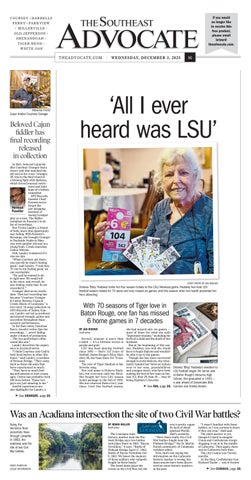
With 70

seasons of Tiger love in Baton Rouge, one fan has missed 6 home games in 7 decades

Seventy seasons is more than a habit it’s a lifetime woven in purple and gold.

LSU has been playing football since 1893 that’s 132 years of football. Baton Rouge’s Bitsy Hadskey, 88, has been there for 70 seasons. The roar of Tiger Stadium is her favorite song. Her real name is Dolores Hadskey, but everyone calls her Bitsy She bought her first LSU season ticket package in the fall of 1955. She has renewed them every year since. Until this football season,

she had missed only six games — most of those for what she calls “legitimate reasons,” including the birth of a child and the death of her husband.

But at the beginning of this season, Hadskey was told she would have to begin dialysis and wouldn’t be able to go to the games. Though she has since recovered enough to avoid dialysis, she reluctantly handed her beloved tickets over to her sons, grandchildren and younger sister, who have been making the best of her seats in Section 212, Row 25, Seat 35 — Seat 35 being Hadskey’s favorite.

ä See FAN, page 2G

Dolores ‘Bitsy’ Hadskey’s devotion to LSU football began her senior year at Baton Rouge’s Istrouma High School. She graduated in 1955 — a year ahead of classmates Billy Cannon and Smiley Anders.

Was an Acadiana intersection the site of two Civil War battles?

hard to imagine Union and Confederate troops slugging it out at in the middle of Lafayette. Then again, there was no Lafayette back then. The city’s name was Vermilionville. At the time, Confederate Gen. Richard Taylor — son of former

Herman Fuselier
STAFF PHOTO BY JAN RISHER
Dolores
Hadskey
game. Hadskey has held LSU football

An unexpected airport friendship, lessons included

Human Condition

The shoeshine stand was strategically placed by the men’s room outside of the security checkpoint near the Southwest Airlines Concourse B. Catching flights, I would usually move swiftly to get through security at the old New Orleans International Airport. There were a few times when my shoes needed attention, and I would stop for a quick, convenient shine.

While my shoes were being tended to, I would read the newspaper, check email, and maybe chat about what was happening with the Saints. There was small talk, nothing overly engaging

One day, I had a little extra time. As I walked past the stand, I noticed a U.S. congressman sitting in the chair grabbing a shine. I began to see, and take notice of, the interaction of passersby with those at the stand. The exchanges,

Continued from page 1G

Ole Miss hatred perseveres

Hadskey’s devotion to LSU football began her senior year at Baton Rouge’s Istrouma High School She graduated in 1955 — a year ahead of classmates Billy Cannon and Smiley Anders — and that fall, as a new LSU freshman, she bought her first season ticket package.

She was in Tiger Stadium on Oct. 31, 1959, when Cannon returned the punt 89 yards against Ole Miss, securing the SEC championship, solidifying his Heisman Trophy season, and helping LSU to a 7-3 victory She still considers watching her high school friend clinch the win as her favorite moment in Tiger Stadium — and she’s been chasing that feeling ever since.

For the record, Hadskey still hates Ole Miss.

“Used to it didn’t matter who we were playing, the chant was always ‘Go to hell, Ole Miss,’” she said with a smile.

Old rivalries age, but sometimes they don’t soften.

Her second-favorite moment came 60 years later: the 2019 national championship season

‘A walking encyclopedia of LSU’ Hadskey was 16 when her baby sister, Debbie Henson-Hamilton,

GRANGER

Continued from page 1G

Grammy-nominated musician and singer, teacher, sign language interpreter, tour guide and author She and musician Jourdan Thibodeaux operate SOKO Music Group Tours, which educates visitors with shows about local music, food, language and culture at Cypress Cove Landing near Henderson.

Landry is celebrating the release of her fourth book, “The Wild Girl of Catahoula,” on Pelican Press The children’s book recalls the folktale of a feral, gypsy girl living in the swamps of St. Martin Parish.

While her account is fictional, Landry found 1930s newspaper articles that reported sightings. The book contains a reader’s guide and glossary to spark discussions with young readers. Landry believes the story has wide appeal

“The book is for ages 9 to 99. It’s like Bigfoot. Is it real or is it not real? Is she real or is she not real?” she said “It’s not really scary It’s more suspenseful than scary.” Landry has already finished another book. She will reveal more projects in 2026.

“None of this is work,” Landry said. “It’s just something else to do that makes me happy.”

Herman Fuselier is executive director of the St. Landry Parish Tourist Commission. A longtime journalist covering Louisiana music and culture, he lives in Opelousas. His “Zydeco Stomp” show airs at noon Saturdays on KRVS 88.7 FM.

makes a lot of friends at the Louis Armstrong New Orleans International Airport.

the chatter was directed not to the congressman, but with the aproned attendant, Darral Kendrick. There was little doubt there was much respect for the man

was born. The love for LSU has been a part of their relationship all of Henson-Hamilton’s life.

“I didn’t know you could go anywhere else — all I ever heard was LSU,” Henson-Hamilton said of her alma mater

Henson-Hamilton now lives three doors down from her big sister

The pair still spends a lot of time together

“Bitsy is a walking encyclopedia of LSU sports information,” said Henson-Hamilton. “She knows who the quarterback was. She knows who the coach was.”

Hadskey pipes in with a memory of her time at LSU when Paul Dietzel was coaching For the record, Dietzel coached LSU from 1955 to 1961.

After seven decades, she’s seen more ups and downs than most — and she’s made friends with the people around her section in Tiger Stadium — but not being there this season has been the hardest. That said, LSU football’s off-the-field drama in recent days has frustrated Hadskey

“It makes me sad,” she said. “The first year Brian Kelly started and he ended with a 10-4 record, fans were crying for him to get fired. The next year he was 10-3 — and he faced the same thing.”

She thinks the criticism has been unfair

She’s seen enough seasons to know storms pass — and good coaches deserve a fair shake.

CURIOUS

Continued from page 1G

President Zachary Taylor instructed his troops to burn the bridge in an attempt to stop Union Gen. Nathaniel Banks’ troops’ northward advance. Today the waterway is called the Vermilion River In 1863, Banks and his troops marched through Bayou Teche in the spring to push back Confederate forces in southwest Louisiana to seize Alexandria, thereby clearing a route to Port Hudson near Zachary Port Hudson would be the last Confederate stronghold on the Mississippi River after the fall of Vicksburg later in the summer, on July 4, 1863.

Banks’ eventual arrival in Alexandria would morph into the Red River Campaign of 1864, but that’s another story.

This one focuses on Banks’ troops’ advancement to Bayou Teche by way of New Orleans and Taylor’s constantly throwing wrenches into the route to make things more difficult for the Union general.

“Banks was coming up from Morgan City,” said Michael Martin, professor of history at the University of Louisiana at Lafayette.

“He would eventually meet up with Admiral David Porter and Union Navy in Alexandria. Once Port Hudson fell on July 9, 1863, Banks could divert his attention to Alexandria.” Martin explains that Banks was going through what is now Lafayette.

On the Confederate side, Alfred Mouton was taking the lead at Gen. Richard Taylor’s instructions. Mouton’s job was to slowing Banks down.

that I had walked past so many times before. After that, I felt that I couldn’t walk by without either getting a shine or stopping for a brief visit. Over time, I learned a few things from Darral and about him, and we developed a friendship that I value. I learned a lot more about the shoeshine business too. The stand had been his father’s business. Darral handled the stand on the Southwest Airlines side, and his brother tended the stand at the other concourse. I also learned that the shoeshine business in an airport is heavily dependent on business travelers.

To support them, Darral arrived early and worked until 3 p.m.

The old terminal shut down on Nov 5, 2019, and the new Louis Armstrong New Orleans International Airport opened immediately thereafter Things would be better for business with the stands on the gate side of TSA. This had to bode well for Darral’s business. Then, in early 2020,

most travel was abruptly interrupted by the pandemic. Business travel came to a halt for me and most others. I wondered how Darral was doing. As travel restrictions began to ease and I flew out of New Orleans the first couple of times, the stand was empty — no Darral. It was after one of my returns that I first jotted a quick note on the back of one of my business cards “Hello, thinking about you, hoping you are well.” — and left it for Darral. I made a practice of leaving cards with messages, hoping they would get to him.

One day I got a call from Darral, letting me know that he was getting my messages. Not long after that, I was in the airport and so was Darral, a friend that I was never sure I’d see again. We hugged each other, and caught up. Weeks later at the airport, Darral told me that he had kept all the notes I had left for him. He said if I had gone to the trouble of leaving notes, he should hang on to them. He said they meant some-

“I never understood why they were so against (Kelly). Some teams never win 10 games in a single season,” she said “You just got to support the team and don’t be so ready to write ’em off.”

You can’t win ’em all

Seventy years of watching the Tigers has given her perspective: nobody wins them all. But for Hadskey, supporting the team regardless is part of being a real fan. Her favorite coaches over the decades include Les Miles (2005-16) and Charles McClendon (1962-79).

After football, her Tiger loyalty extends to other sports. She still makes it to all LSU women’s bas-

ketball home games.

“Because my parking pass is closer,” Hadskey said “I just can’t walk that far for the football games anymore.”

She says it with a shrug, but it’s clear the walk not the will is what has kept her from being there in person these days.

She gave up her men’s basketball tickets last year, even though she really likes head coach Matt McMahon.

A devotion like no other Hadskey’s ties to LSU go beyond athletics. When she arrived on campus as a freshman, she wanted to major in computer science

troops at the 1863 battles at Bayou Vermilion.

RIGHT: Major General Nathaniel Banks, Union occupation commander, commanded the Union troops advancing up Bayou Teche to Bayou Vermilion.

“I don’t think Taylor and Mouton had any illusions that they were gonna beat Banks, but they were trying to cause as much trouble as possible,” Martin said.

On that April day, the two armies struggled for about four hours, with few casualties.

Some accounts of that battle include that the next day as Union troops built a pontoon bridge, about half of the soldiers decided to take a dip in the water

They stripped off clothes and jumped into Vermilion — just as the Confederate cavalry doubled back and opened fire on the bathers. Madness ensued, as naked and half-dressed Union soldiers scrambled amidst

shots firing.

Circumstances surrounding the second battle seemed to perplex several state university historians.

Jerry Sanson, retired LSU at Alexandria professor of history, suggested a book called “Yankee Autumn in Acadiana” to find the answer

“If any source has the answer that would be it,” he said He was right. The 1979 book by David C Edmonds examines how Union troops again advanced from New Orleans to Acadiana in October 1863, this time to gain a foothold in Texas.

Once again, Confederate troops burned the pontoon bridge in October

thing to him.

I have learned a lot from Darral. If you go through life with blinders on, and never take the time to speak to people, you miss the opportunity to get to know them. I know that I have been guilty of that, and I am trying to be better at this. I learned that some of the people that we interact with, even if only for a short time, do genuinely care about us, and do care if our shoes look good. I have learned that a quickly jotted note letting someone know that they matter to you can lift a person’s spirit. Years on from the first note, I still leave notes and I know that he still keeps them. Thank you, Darral.

— Magee lives in Baton Rouge.

Human Condition submissions of 600 words or fewer may be emailed to features@ theadvocate.com. Stories will be kept on file and publication is not guaranteed. There is no payment for Human Condition.

— but it didn’t exist yet. Electrical engineering was the closest option, so she chose that and graduated in three and a half years. When companies came to campus to recruit, Hadskey said she showed up, only to be told, “We don’t hire women engineers.”

She remembers those interviews vividly — not with bitterness, but with the quiet pride of someone who kept showing up anyway

She couldn’t get an engineering job, so she spent two years teaching high school math before landing a job at the phone company

“Well, they told me that I would be doing the work of an electrical engineer, but they would have to pay and hire me under the title of clerk/typist,” she said. “I did that for eight months and then they changed my title and my pay.”

Today company records still cover her dining room table. She continues to handle the accounting for the business her husband started.

Seventy years later Hadskey’s love for LSU hasn’t dimmed — even if she has finally, grudgingly, handed over her seats.

She’s still watching and rooting for her Tigers, just now from her living room instead of Section 212, Row 25, Seat 35.

Even so her devotion hasn’t aged a day

Email Jan Risher at jan.risher@ theadvocate.com.

“Great clouds of billowing smoke, rising high above the treeline of Vermilion Bayou, indicated that once more Pinhook Bridge was ablaze,” Edmonds writes. “The Pinhook, so called because it opened and closed like a pin to permit river traffic, had also been burned in the spring.”

Tensions began rising as Union troops began anticipating a brutal battle.

“But the Federals, who believed the enemy strength to be on the order of from two to three thousand, had come prepared,” Edmonds writes. “The road to Texas lay beyond the Vermilion, and they were not going to be stopped here.

In short order General Williams Franklin, the brilliant West Point engineer, began ordering his men into position for assault.”

The battle began at 11 a.m.

“For a moment, with all the horses, men, polished guns and caissons flying in all directions, it seemed as though all were hopelessly confused,” Edmonds writes. “But as quickly as it started, the eight-hundred pound cannons, resting on their spoked carriages, were unlimbered in line, the cannoneers at their posts ram-rods at the ready — and the piece limbers caissons and horses stood at the prescribed dis-

tance to the rear.” In the end, the battle proved to be more noise than destruction as the Confederates evacuated, leaving the Union soldiers in chaos.

“The battle of Vermilion Bayou, such as it was, ended in a bloodless victory for the Union,” Edmonds writes. “In spite of all the shooting, the massive artillery bombardment and the impressive display of strength, only five Yankees were wounded.” In the end, the Union troops wouldn’t make it from Acadiana to Texas due to limited supplies and inner logistical problems. Meanwhile, Banks’ troops began pushing through Alexandria to Shreveport gathering cotton in the Red River Campaign.

Banks once again would come face-to-face with Taylor’s forces, which would beat his troops back at the Battle of Mansfield.

Louisiana culture editor Jan Risher contributed to this report. Do you have a question about something in Louisiana that’s got you curious? Email your question to curiouslouisiana@ theadvocate.com. Include your name, phone number and the city where you live.

Mugs, shirts, hats, posters, books. Something for everyone at the

PROVIDED PHOTOS
LEFT: Gen. Richard Taylor, son of Zachary Taylor, the 12th president of the United States, commanded the Confederate
PROVIDED PHOTO
Dolores ‘Bitsy’ Hadskey with LSU’s Mike the Tiger at the Pete Maravich Assembly Center in Baton Rouge

COMMUNITY

PROVIDED PHOTO

Romany

The 2026 Royal Court of Romany is, from left, Maid Shaunnessy Rose, Maid Audrey Greely, King Romany LXXVI Matthew Vaughn, 2026 Ball Captain Ashley Day Fabre, Queen Romany LXXVI Amelia Lambert and Maid Faye Buco.

Krewe of Romany celebrates ball captain

The Krewe of Romany honored 2026 Ball Captain Ashley Day Fabre Oct. 4 at a poolside celebration hosted by her parents, William and Leslie Day Guests dined on a menu catered by Bergeron’s, Bites and Boards, and complemented by desserts including a cheesecake bar from New York’s Magnolia Bakery

At twilight, T-Ray theViolinist gave a performance blending modern favorites with timeless classics Fabre, a third-generation Krewe of Romany ball captain, toasted the family legacy that inspired her path

GFWC Lagniappe Woman’s Club

The GFWC Lagniappe Woman’s Club heard Michael Mamp, curator, discuss the LSU Textile & Costume Museum’s current display on Oct. 20 Gathered are, from left, Lana Merliss, hostess; Monica Watson, guest; Hollen Brown, Lagniappe and Museum member; Mamp; and Cathie Ryan, Lagniappe president.

PROVIDED PHOTO

Garden Club

The Plaquemine Garden Club celebrated its Art Club winners for their 2025-26 yearbook on Oct. 21. Shown are, from left, Katherine Desselles, Caroline Doyle, Riley Martinez, Emma Ourso, Jane Boudreaux and Donna Carville.

PROVIDED PHOTO

WBR Garden & Civic Club

Twenty-two members of the West Baton Rouge Garden & Civic Club met for a guided tour by Keith ‘Kicka’ Guedry at the Cora Texas Manufacturing sugar factory on La. 1 in White Castle on Oct 14. After the tour club members enjoyed lunch at the Grapevine in Donaldsonville. Garden club member Debra Salvadras hosted the event.

COMMUNITY GUIDELINES

The

Romany

Adrienne

Adviser Leslie Day,

Captain Ashley Day Fabre, President Collette Lambert, Treasurer Carla Brown and Publicity Officer Kristi Hammatt.

Members of the Baton Rouge Amateur Radio Club met on Sept. 30 for a presentation given by John Krupsky and Jon Reise on the use of the Weak Signal Propagation Report (WSPR) system. The WSPR system is used worldwide to probe the best parameters such as time of day, radio frequencies, and transmission power for radio communication. Shown are, from

Todd Huovinen, Krupsky, Reise, Matthew Mapes, Laura Mapes, Jennifer Curry Daniel Csaszar and Joe Roppolo.

PROVIDED PHOTO
The Krewe of Romany board includes, from left, Secretary
Vaughn, Vice-President Chelsea LeMieux, Special
2026 Ball
PROVIDED PHOTO
Romany
The Day-Fabre family includes, from left, William Day, Leslie Dease Day, Adelaide Fabre, Ashley Day Fabre, Evangeline Fabre and Travis Fabre.
PROVIDED PHOTO
Plaquemine
PROVIDED PHOTO
Baton Rouge Amateur Radio Club
left,

Turn static files into dynamic content formats.

Create a flipbook
Issuu converts static files into: digital portfolios, online yearbooks, online catalogs, digital photo albums and more. Sign up and create your flipbook.