

THE CANDY ISSUE

The Sweet Life: Mary Jean "Watermelon" Dunsdon














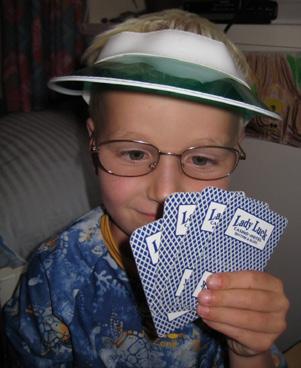
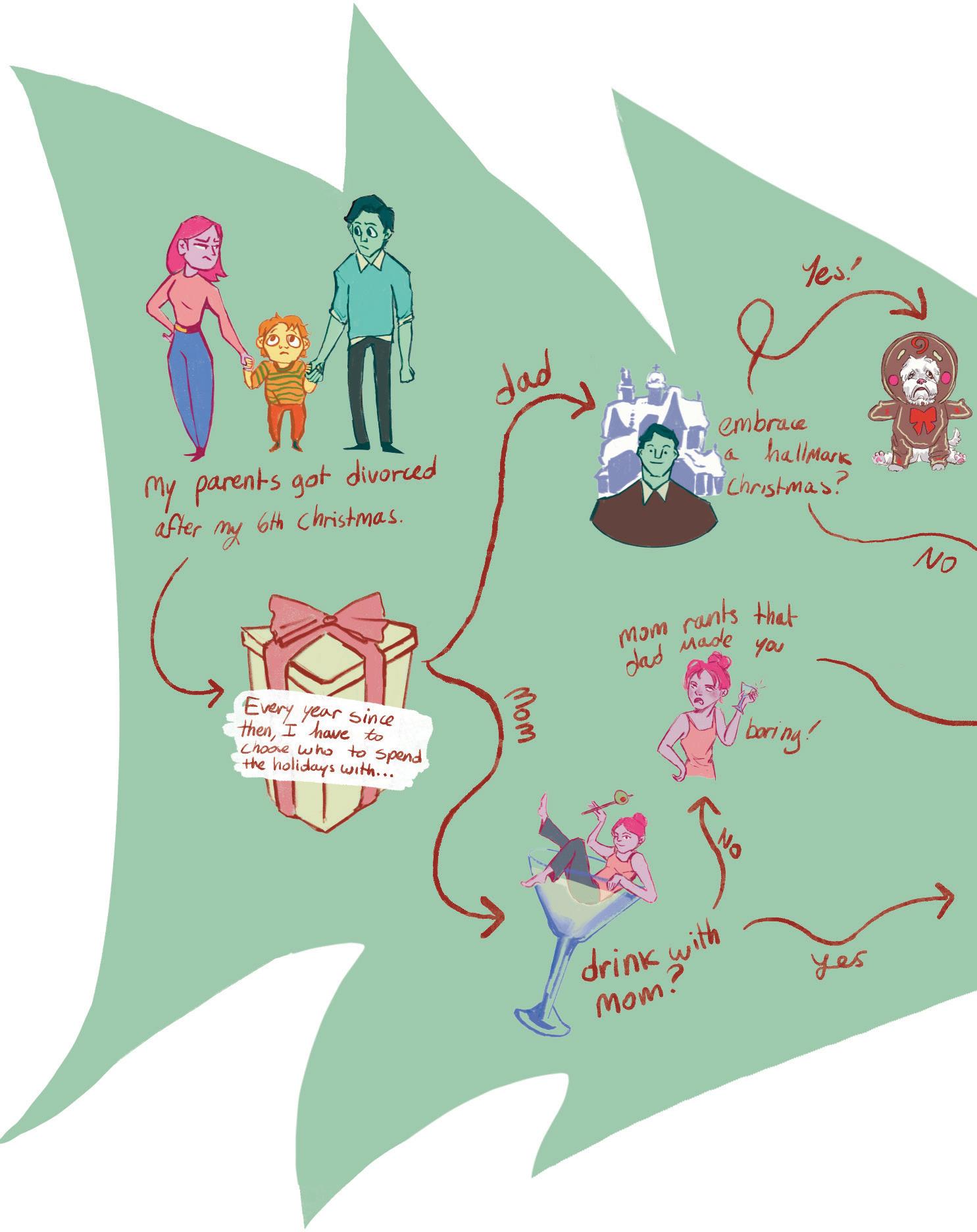
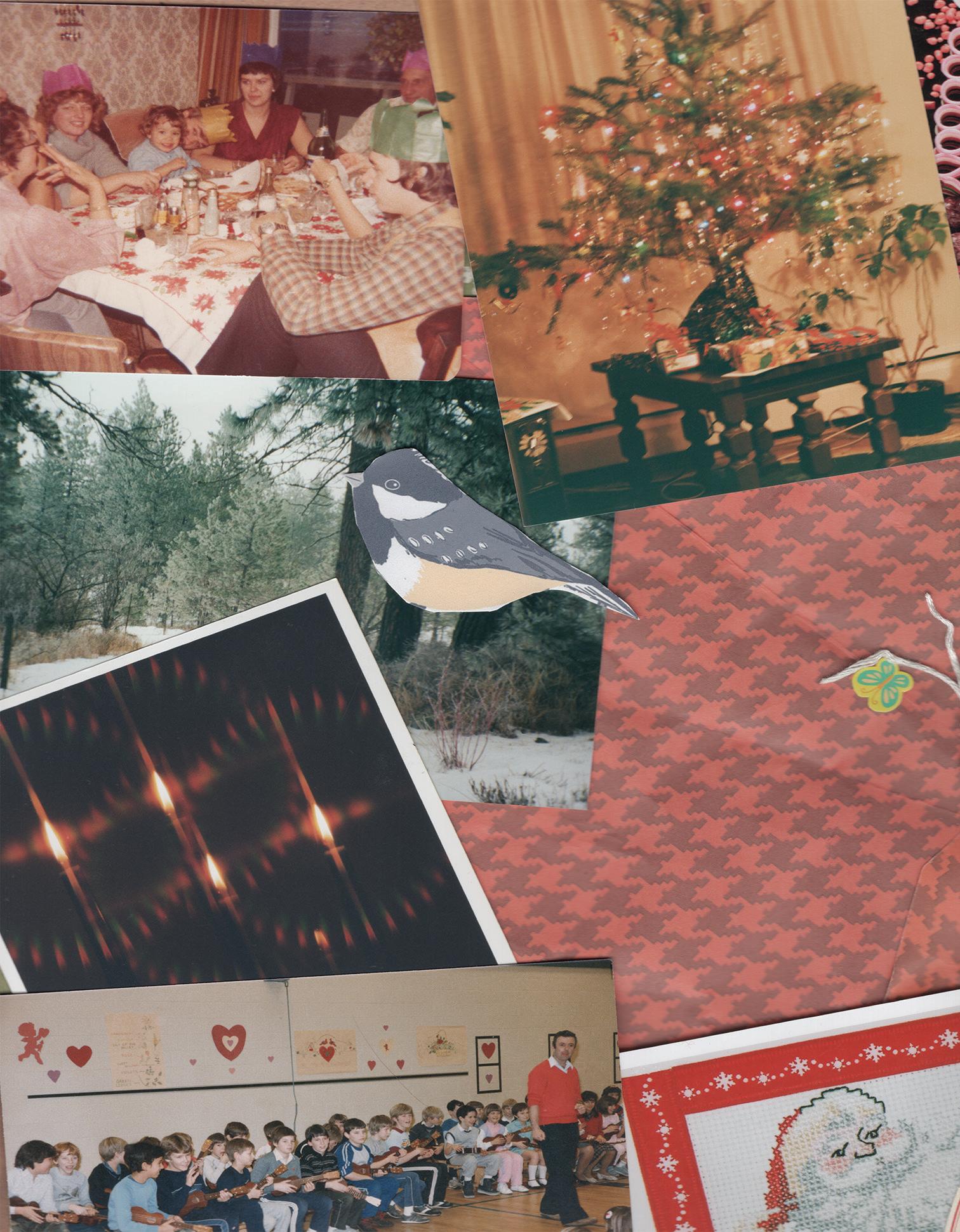
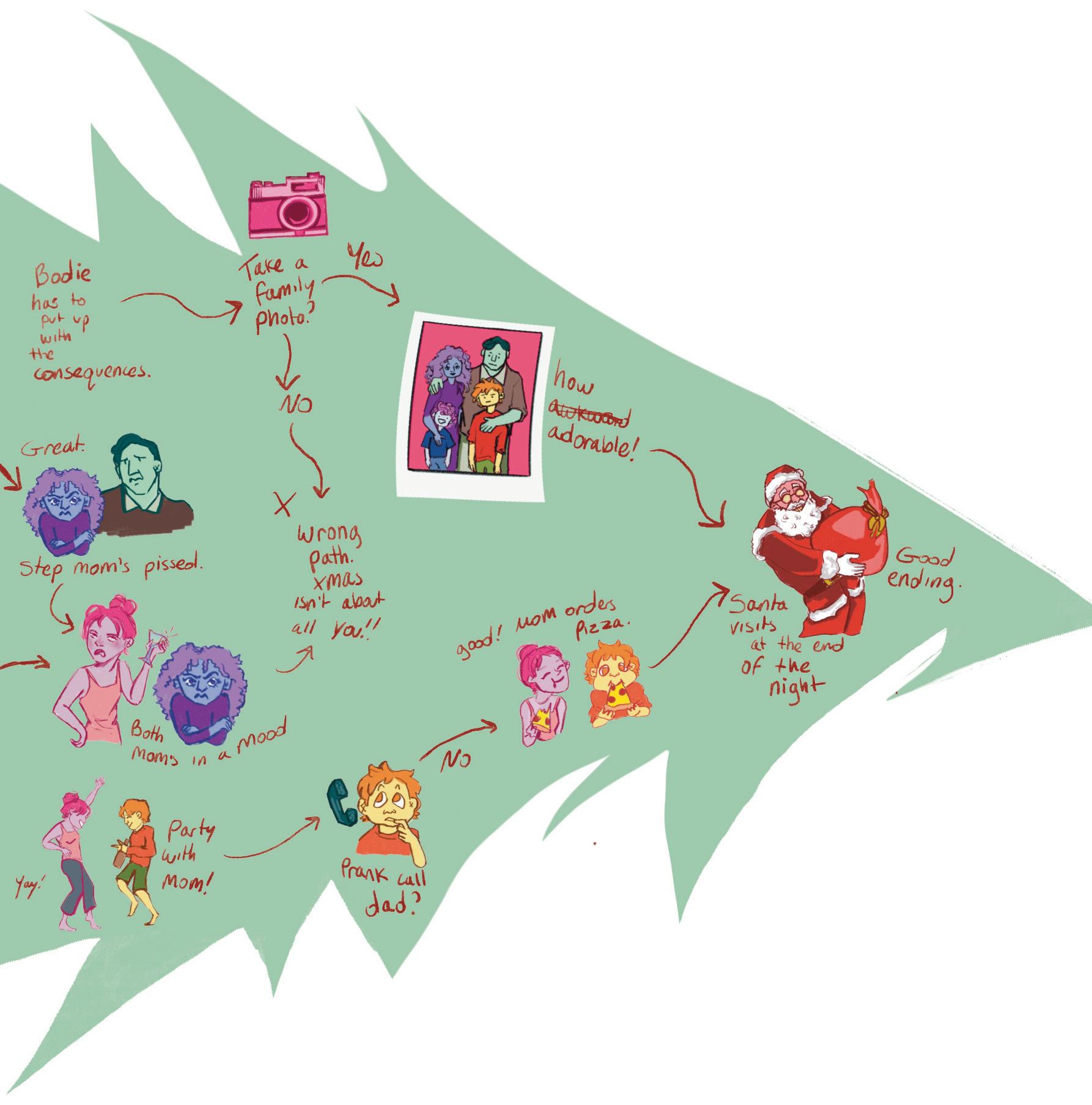
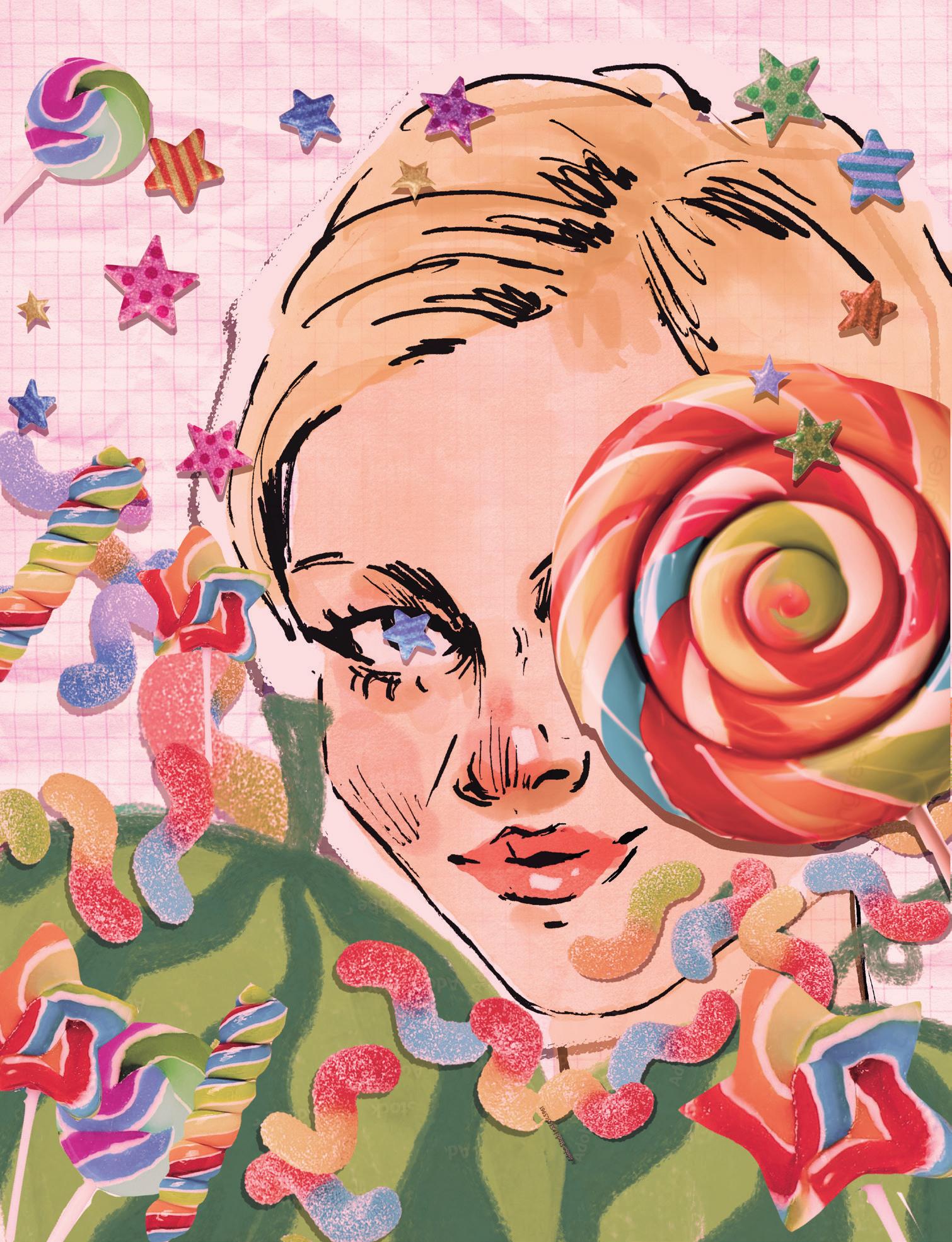
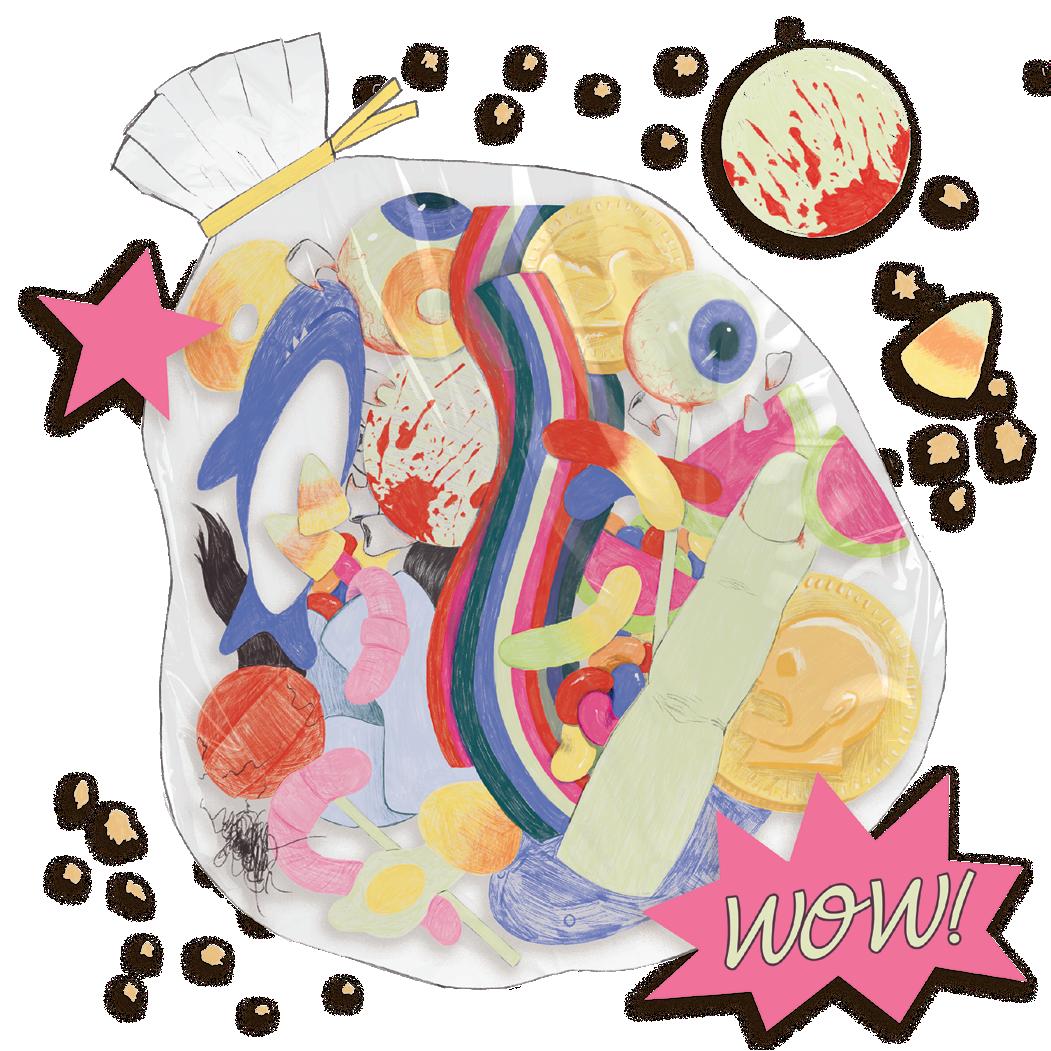
Do you remember eating candy as a kid? Once I ate so many twizzlers peel-and-pull that I threw up and made my mom throw the rest of them away. Candy isn’t as good now as it was back then. But that’s okay. Hopefully I’ll never eat so much candy that I throw up ever again, but it was fun while it lasted. That’s what I think is tricky to recognize with nostalgia; you can’t spend your time trying to relive it, but it’s a beautiful thing to have cherished memories. And as much as we’re all doomed to live in the present moment, there’s still lots of memories left to make. I know that might be too saccharine an expression to swallow for some, but would you rather be embarrassingly, earnestly sweet? Or an ironic, detached cynic?
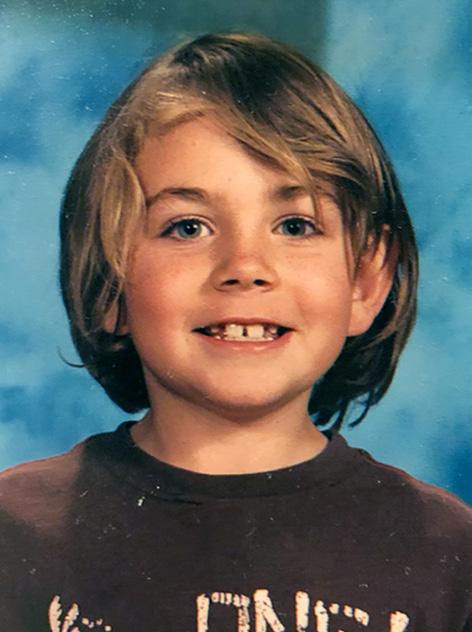
- Adam Stothard
Adam Stothard CO - EDITOR-IN-CHIEF EDITOR@CAPILANOCOURIER.COM
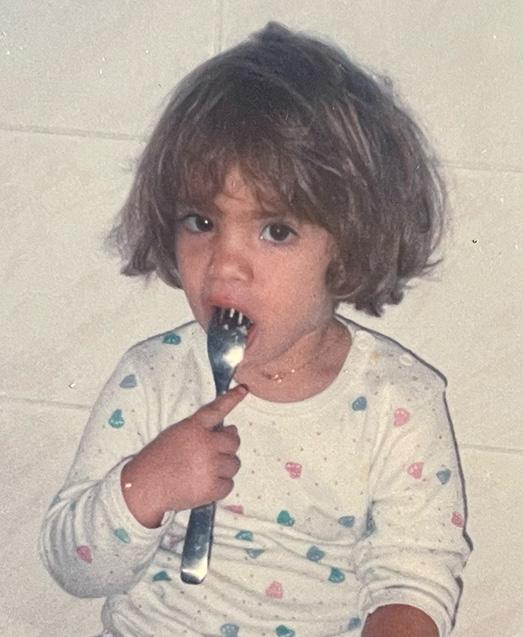
Laura Morales
CO - EDITOR-IN-CHIEF EDITOR@CAPILANOCOURIER.COM
What started as an umbrella topic to write about childhood and the holidays ended up taking a few unexpected turns. From a historical account of how sugar became a colonial weapon, to a candy store owner's reflections on nudism—and how stigma almost made her a criminal—our approach was not exactly lighthearted. To compensate, dear reader, I'll give you one quote that contains all the sweetness you need and let you explore our pages to discover where it came from: "and all the love we’ve contributed to the world will grow long after we’re around to see it.
- Laura Morales











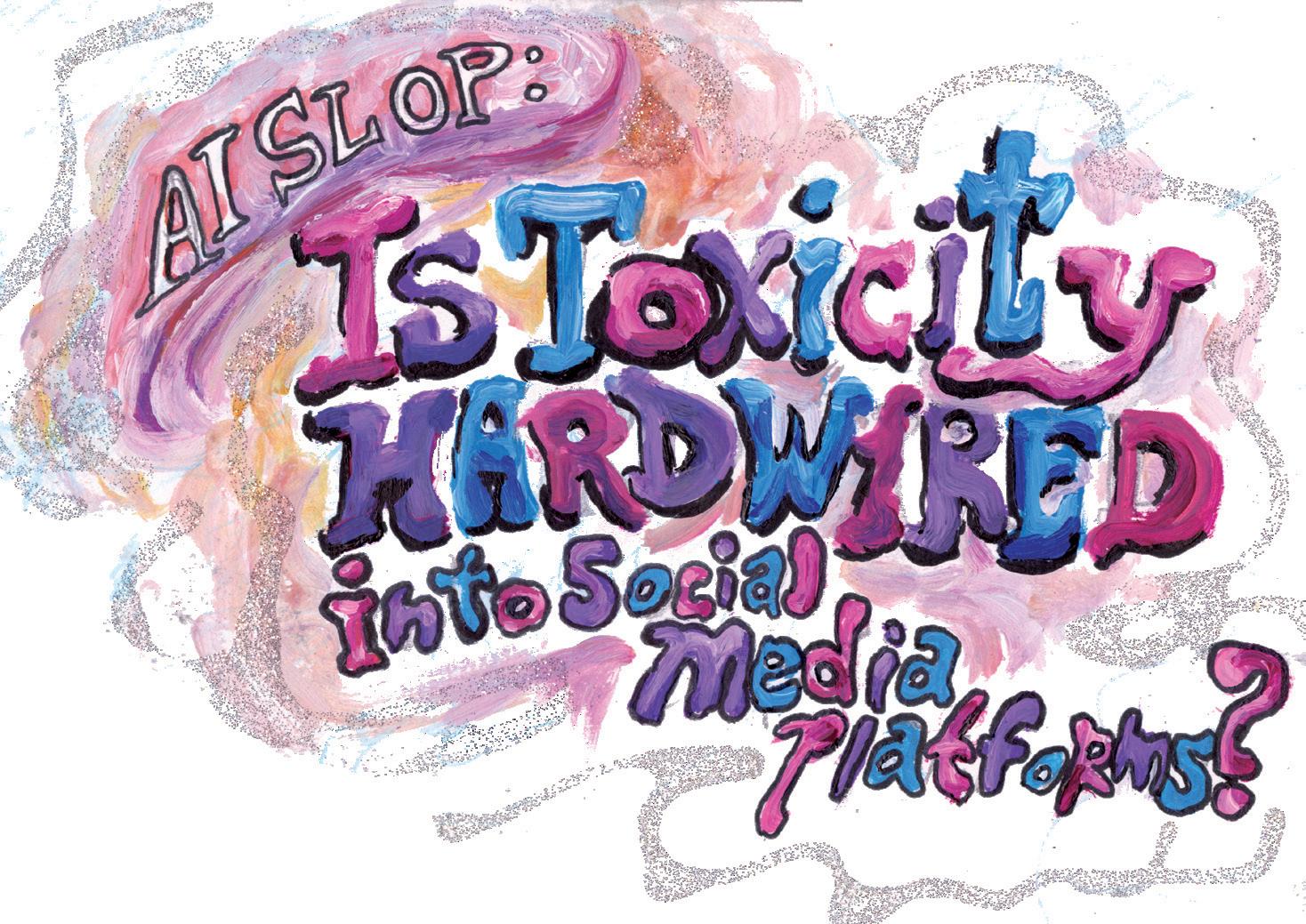
Toxicity Hardwired into Social Media Platforms?
Delays for On-campus Student Housing
Left Behind
Faculty Merger Divides Senate
Sugar is a Weapon
Vancouver Vendor Markets
CapU Donor, Wendy Yau Sum Cheung
28 A Mild and Acceptable Protest To Protest Guidelines
Looking Back at You is You Isn't it?
Comic by Alex Baidanuta
The Sweet Life: Mary Jean "Watermelon" Dunsdon
December Events: Blueshore @ CapU Holiday Markets
Seasonal Sweets
Anti-Ghazal Poems
A Pony Tale





















WRITING CONTRIBUTORS
Lily Dykstra, Joshua Settee, Benjamin Kimberley, Andrea Chiang, Sylvie Harpur & Walden.
VISUAL CONTRIBUTORS
Ryan Coomber, Jasmin Linton, Tin Raganit, Alisa Nguyen, Andrei Gueco, Anya Ali Mulzet, Eugene Lee, Mia Antinori, Lily Jones, Kayla Kim, Alex Baidanuta & Caroline Zhang.
COVER ART
Cameron Skorulski
INTERESTED IN CONTRIBUTING?
Email editor@capilanocourier.com for potential writers, and production@capilanocourier.com for interested visual artists and/or photographers.
*Illustrators and Photographers are required to send a portfolio or sample(s) of their work.


Research into AI tells us it is
Written by Lily Dykstra (she/her)// Contributor
It’s no secret that over the years, social media has garnered a reputation for being problematic. On platforms such as Instagram and TikTok, we sometimes blame this negative atmosphere on users, but as it turns out, social media’s toxicity may be more a product of its fundamental structure. While human interaction is a crucial component of social media, a recent study shows that most of these platforms operate in a way that incentivizes bad behavior, and that users—or certain algorithms—are not necessarily to blame.
In 2025, at the University of Amsterdam, two researchers used LLMs (large language models) to create bots in order to simulate social media users. The study had the bots interact with one another, post, repost and follow each other. On the main news feed, 10 posts were shown, with only five of them being from users the bot already followed to simulate the way users find new accounts and how what is popular tends to be shown more frequently. The platform was created without any “complex recommendation algorithms,” the goal of this being to “construct a minimal environment capable of

Visuals by Rachel Lu (she/her) // Crew Illustrator & Andy Poystila (he/him) // Art Director
reproducing well-documented macro-level patterns.” In the end, they found the same problems that many real-life users have already been experiencing on social media, including political echo chambers, negative influences and followings concentrated to a small percent of users. Each round of simulation, which involved allowing the bots to operate within the artificial social media just as humans would in reallife, consisted of a random user reposting, sharing or doing nothing with the posts shown to them on the feed. Who each bot follows was determined by what they repost, and often they only interacted with users who share the same “beliefs” or views as their own.
On social media platforms, it’s common for extreme political opinions to garner more attention than less inflammatory content, which in turn, creates a kind of feedback loop where users are primarily subjected to certain kinds of views. Users are more likely to interact with content that is seeing high numbers of likes and comments—whether they are aware
of it or not—furthering its reach and ensuring that only what is popular is what is seen. Finally, over time followers are concentrated to a small number of users, minimizing the visibility of certain users and perpetuating popular ideals.
Within the study, after the bots showed signs of exhibiting the kinds of negative behaviours that are stereotypical of current social media platforms, the researchers implemented a number of different changes to the algorithms, primarily ones that have been brought up in popular discourse regarding how to make social media a more positive place. The changes included structuring the feed chronologically, obscuring likes and hiding bios to help limit the echo-chamber-effect. Overall, these changes to the algorithm had little effect, and
in some circumstances exacerbated the issues. In short, the researchers found that algorithms do little to influence the way social media operates, specifically in relation to remedying its harmful outcomes.
This suggests that the study’s “findings challenge the common view that social media’s dysfunctions are primarily the result of algorithmic curation,” and that “the problems may be rooted in the very architecture of social media platforms.” The findings of this study bring into question how social media can be fixed, but also, the ethics of using platforms that are, evidently, so inherently flawed.

Delays for StudentOn-campus Housing
University announces Summer 2026 move-in date
Written by Cami Davila(she/her)
//
Crew writer
Visuals by Rachel Lu (she/her)
// Crew Illustrator
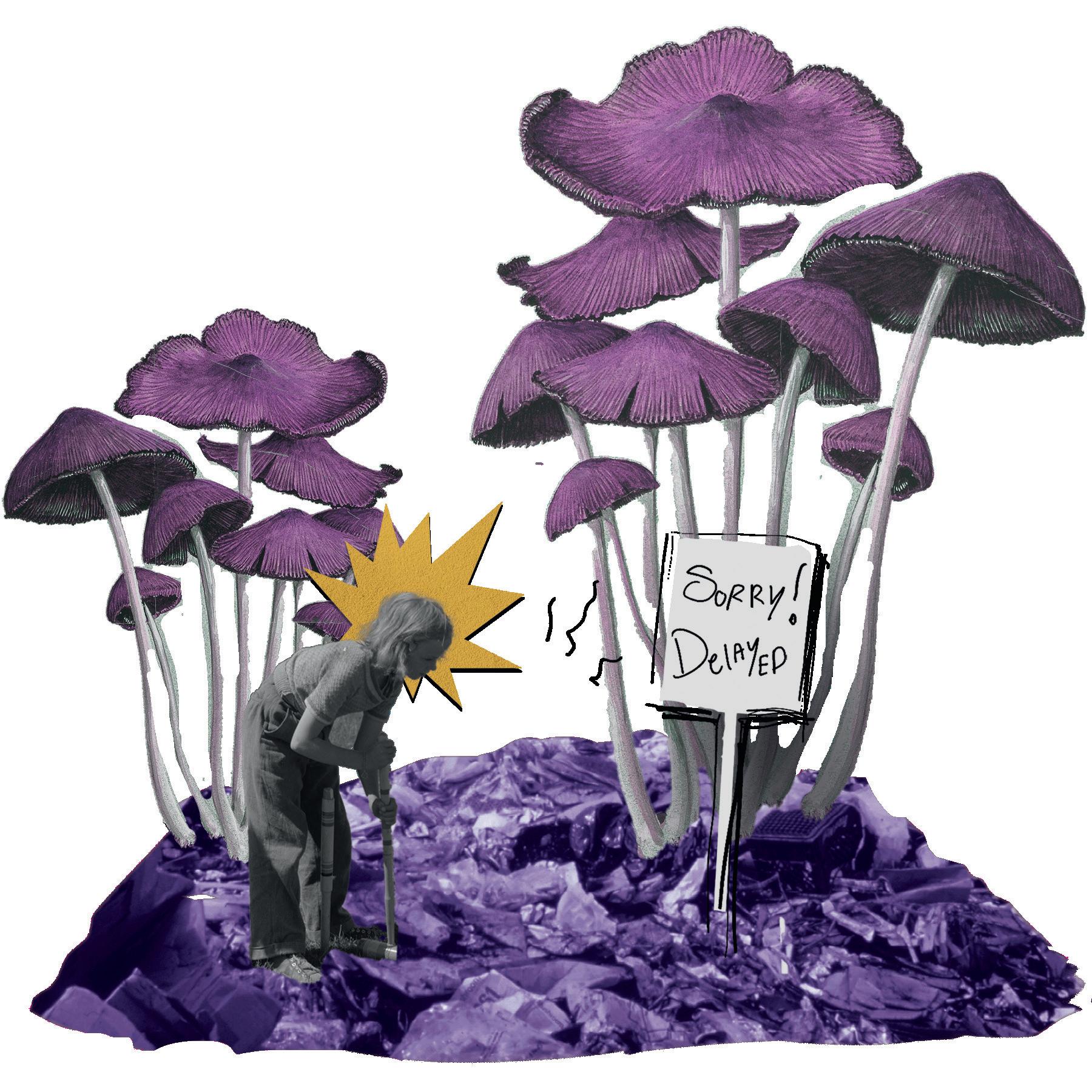
Capilano University’s new on-campus residence building will not open in Spring 2026, as was previously planned. At the beginning of October, the housing team sent an email to the students who currently live in the buildings at Dollarton Highway indicating that the new residence will now open in Summer 2026, without providing a specific move-in date. According to the Director of Student Housing & Food services, John Umunna, the delay was first announced by the developer of the project, Scott Construction. Labour shortages and a lack of necessary materials are two reasons cited for the delay. Umunna emphasized that, given this is a project external to the university, CapU has “no control” over this delay.
The on-campus housing development was first announced by the Ministry of Post-Secondary Education and Future Skills in 2022. According to the news section on CapU's website, the project was initially slated for completion in late 2024. As reported by the minutes of the Senate Meeting in February of this year, Capilano University's operating budget has a deficit for the fiscal year 2025/26 of $6.4 million, as a result of, among other things, "committed priorities," such as the new on-campus residence project. In the minutes of the Senate meeting in June, however, the Budget Advisory Committee announced that the deficit is now anticipated to be $11 million since “enrolment numbers are coming in lower than previously budgeted.”
Nevertheless, the opening keeps getting postponed and this has created some uncertainty, especially among the students who live in the existing residence on Dollarton Hwy and were looking forward to moving to the on-campus building at the beginning of next year.
“We were supposed to move into the new residence this January, and for a while, it felt like something to look forward to. But once again, the university said ‘just not yet.’ I feel disappointed and honestly a bit disrespected. It’s not just about moving to other buildings; it’s about being able to trust what we’re told. Each delay makes it harder to take their promises seriously,”
commented one student who has been living in the CapU Residence since Fall 2023.
“I wish the university would be more transparent. It’s exhausting. Not just the waiting but the constant letdown. I am still holding onto the idea that someday we’ll finally move, but I don’t want to keep waiting for something that may never happen.”
Given that the Dollarton Hwy buildings are going to be open for at least another full semester, many students are concerned about the rapidly deteriorating state of these accommodations.
Pointing out that most of the work that needs to be done is the responsibility of the landlord, not the university, Umunna also notes that a targeted improvement plan started in early October. After reviewing the current situation, the student housing & food services team has started to implement changes in the showers, the ventilation system and the cleaning of the building, including more regular inspections of common areas by staff.
The opening date of the on-campus building is unclear. “I can’t say that we are certain,” said Umunna, “We recognize that the delay is disappointing to students who were looking forward to moving to the building earlier.” However, he emphasized that they remain committed to supporting the residents and that’s why the housing team announced Summer 2026 as the opening, because it gives them a big leeway.
General information about student housing is available on the CapU Website, under Campus Master Plan & Capital Projects.

Left Behind

A breakdown of the current political scene in BC shows why progressive voters are feeling unaccommodated by their options
Written
by Theodore Abbott (he/him)
// News Editor
Visuals by Jasmin Linton (she/her)
// Contributor
In the days following the October 2024 provincial election, when ballots were still being counted, David Eby addressed voters, and announced that the “message,” as he put it, had been received, loud and clear. With an almost meek countenance, the NDP leader ate humble pie as he reflected on his party’s narrow victory over the Conservatives. But, one year out, it seems as though the NDP has done little to coursecorrect, leaving some progressive voters feeling left behind in B.C.’s political arena.
For those not up to speed with the current state of affairs, the political landscape in B.C. can be simplified as follows: The NDP, who in last year's election won a slim majority, are centre/centre-left. The Conservatives, as their name suggests, are a right-wing party who rose to prominence after absorbing the now defunct BC Liberals (which had briefly rebranded as BC United). Further to the right is the newly formed OneBC, which was established by former Conservative MLA Dallas Brodie after she was ejected from Caucus for publicly mocking residential school survivors. Back in the middle is the aptly named CentreBC, which purports to offer a via media between the NDP and the Conservatives. Lastly, the left wing Green party maintains a small base of supporters, mostly concentrated around southern Vancouver Island and the Gulf Islands. With 93 seats in the B.C. legislature, the NDP hold 47, the Conservatives 39, OneBC with two, the Greens also with two and three independents.


Justine Davidson is a defence lawyer with the BC First Nations Justice Council, and a former NDP voter. When questioned by the Courier about the 2024 provincial election, Davidson admitted that she almost didn’t vote, emphasizing that progressive voters like herself were presented with a tricky dilemma: vote for a centrist NDP government, or throw away their ballot on a Green candidate with dim prospects.
Expressing a similar sentiment is Steve McClure, a freelance writer and editor, who says, “I don’t see myself represented by either party [the NDP or the Conservatives]. The NDP, along with many other social-democratic parties, has lost its sense of mission and purpose, and has succumbed to the lure of identity politics and neo-liberalism.” McClure also notes that “erstwhile NDP supporters” like himself may tend towards the BC Greens, but that he finds their “lack of ideological grounding and consistency troubling”.
With regard to the BC Greens, the election of 24-yearold Emily Lowan as party leader is a bright spot for a political brand that is otherwise declining at every level of government. While Lowan ran her leadership bid on a bold social-democratic platform, it’s yet to be seen if she will be successful in making the Greens a serious contender in the next election.
Offering a different perspective is D’arcy Pocklington, a CapU alumnus and front-line health care worker. Pocklington contends that electoral politics will never deliver the social change that is desired on the left. “Political parties cannot solve our problems. What we need is more extra-parliamentary political activity. More tenant unions. More land defenders. More feminist solidarity. More public transit enthusiasts. More public health advocates. More people building infrastructure that is controlled by ordinary people, not billionaires, not the state,” Pocklington stated in an interview with the Courier.
Pocklington also underscores that progressive policy changes always begin with strong social movements, and that political parties merely reflect the shifting attitudes in society. In the absence of such a social movement, Pocklington insists that the emergence of a new leftist party in B.C. is highly unlikely.
If this is true, then the imminent crumbling of the BC Conservatives exemplifies what can happen when a party takes shape strictly on the merits of voter dissatisfaction, and not a cohesive social movement.

With Rustad on his heels, it’s possible that the NDP will call a snap election—just as former premier John Horgan did in 2020—in order to consolidate power and capitalize on the Conservatives’ internal strife. If this comes to pass, then progressive voters will once again be left to choose between an increasingly centrist NDP government, or a Green party that is unlikely to be competitive in most ridings.
Although B.C. may seem primed for a new leftist party, without a strong grassroots movement the NDP is likely to remain in power for the foreseeable future. Much to the chagrin of progressive voters, B.C. is set to drift in the doldrums of moderate liberalism until the scale is tipped to the left or to the right.

FACULTY DIVIDES
Written by Laura Morales (she/her)
Visuals by Ryan Coomber (he/him)
MERGER SENATE
The Board of Governors seeks advice from Senate on the merging of two faculties, but is it really a merger?
“We are in unprecedented times,” stated Tracy Penny Light—interim VP Academic and Provost—during her report to Senate on October 7, referring to the challenging context for the proposed faculty merger at Capilano University. During the discussion of this announcement— which proposes to merge the Faculty of Global and Community Studies (FGCS) and the Faculty of Business and Professional Studies (FBPS)—multiple concerns surfaced, not so much directed to the merger itself, but rather, the way it was presented. As worded in the minutes, “Although there may be good reasons for the merger, there is a perception that the decision was made ‘behind closed doors.’”
The Board of Governors approved the motion to seek advice from Senate regarding this merger during their latest meeting on October 1, 2025, as required by the University Act and CapU’s policy B.105. Noticing that the Board’s proposal included a suggested timeline, January 26, concerns were raised by faculty and student senators that, while there are “a lot of unknowns” around this proposal—as stated in the October 7 minutes—there is also “a perception that the determination to move the proposal forward has already been made.”
When it comes to the unknowns, there is a distinction between information that is not yet available—because it depends on future decisions—and information that is simply not made available. An example of the first instance came when a faculty senator asked about the lack of financial evidence to support the merger proposal, such as estimated long-term savings versus short-term costs. Penny Light explained that this information is not available yet, as it depends on decisions that will be based on the advice from Senate and the transition working group. In terms of the information that led the Board of Governors to seek advice specifically on a merger rather than a broader restructure of faculties, however, it was not made available according to one of the senators. As stated in the minutes, “Concern was raised that the context of the proposal may be understood only by one section of the University.”
Framing the proposal as a merger significantly limits Senate's role, given that the University Act only requires the board of governors to consult with Senate. If the proposal was to establish a new faculty— to align with schools and programs from the FGCS and the FBPS— then the board would need Senate approval. This observation came from a faculty member during the October 7 meeting, who was concerned about the new faculty potentially having to “demonstrate that the merger is not breaking policy.” According to the minutes, the administration maintained that the proposal is for a merger since minimal changes would be made “to schools/student programming.”
When it comes to faculty mergers, the University of British Columbia (UBC) set a precedent in 2018. The UBC Faculty of Education Vancouver and UBC Faculty of Education Okanagan merged “to create a new Okanagan School of Education.” This merger, as indicated in UBC’s Faculty of Education website, “will not change the number, size, requirements or tuition fees of the programs offered either in Vancouver or in the Okanagan,” and, “Each program will continue to operate in its current state.”
In contrast, the briefing note for the November 4 Senate meeting provided the enrolment background of the FGCS—the smallest of CapU’s five faculties—currently experiencing two program pauses due to low international enrolment. The briefing note indicates that “program rethinking and redesign will be essential” to make some of these programs sustainable again. Additionally, when a faculty senator from the School of Communication asked if schools from merging faculties would have a say on which faculty they would prefer to join, the administration indicated that “there will be an opportunity to consider the repositioning of units/schools once the merger takes place,” as indicated in the October 7 minutes.
UBC’s 2018 amalgamation of two faculties of almost the same name took place over a four-year period, while CapU’s merger of less similar faculties was given a suggested timeline of less than four months. To understand the sense of urgency behind this proposal, the university recently forecasted a deficit budget of approximately $25 million for the 2026-27 fiscal year. Still, during the November 4 Senate meeting, the administration opened the floor to questions regarding the next steps for the merger, but the discussion continued to circle back to how the process started. Considering the limited information available, a Faculty of Arts & Sciences senator argued that there needs to be an assessment of how policy in the University Act is being interpreted, especially since—as Penny Light stated—in “unprecedented times,” the way in which the restructuring of faculties is handled will set a precedent. The bicameral governance system is organized to distribute the decision-making power between the Board of Governors and Senate, depending on whether decisions involve the business or academic sides respectively. The merging of two faculties involves both aspects, but as long as it’s framed as a merger, and not as the creation of a new faculty, the Board is required to seek advice but not necessarily to take it. The University Act prescribes consultation rather than approval,
which makes senators more attentive to signs of whether the board is providing enough information to allow for thorough, informed advice for this decision. At the same time, the administration is

Why DiD The Capilano FaCulTy assoCiaTion
Take Capilano universiTy To CourT in 2014?
According to the 2013-14 budget background provided on CapU’s website, “Our operating costs continue to face inflationary pressures, and the transition to a university has resulted in some increased costs, however, our operating grants have remained flat.” To balance the budget as required by the University Act, the administration suspended programs and courses without seeking advice from the Senate.
The BC Supreme Court found that CapU’s decision “to discontinue various courses and programs was made without complying with section 35.2(6) of the University Act,” and that the decision should have been made “after seeking advice on the matter from the Capilano Senate and the Capilano Senate has so advised the Capilano Board.” Furthermore, the court ordered the Capilano Board to seek advice from the Senate “on the development of an educational policy for the discontinuance of courses and programs before the university can discontinue any courses or programs.”
remaining guarded in portraying a proper consultation process, as failing to do so has previously resulted in the university being taken to court. So far, senators have refrained from giving advice or to have anything in the minutes that could be argued as such, since the administration is obligated to wait until that advice is given to make the final decision. During the November 4 Senate meeting, faculty made it clear that the discussion during that session was not to be considered as official advice, but rather as a consultation.
To investigate whether this susceptibility came about as a result of the merger, or if it has been a trend within CapU’s governance, the Courier reached out to senators from the last 5 years and collected information about their experience and perceptions anonymously through a survey. From the 44 people who received the survey, the Courier received 13 anonymous responses representing the views of six faculty members, five students, one staff member and one administrator.
Additionally, an open question was included at the end, requesting senators to interpret the following statistics put together by the Courier based on the minutes posted on CapU’s
website: In the last 5 years, Senate has approved 165 motions (an average of 94 per cent were approved unanimously), and 4 have been defeated (an average of 2.3 per cent).
A faculty member offered the explanation that, “It is at the committee level where issues are asked to be re-worked and re-considered before being approved to send to Senate.” Another faculty member shared, “I believe that the subcommittees of Senate do most, if not all, of the leg-work,” corroborating the previous statement. “It's not a surprise that we would in the vast majority accept their recommendations,” stated a third faculty member, noting that most of these recommendations come from their peers at the committees. A fourth member, however, disagreed and stated, “My sense is that major decisions at this university are made elsewhere”; from their view, “motions are approved unanimously simply because they are relatively insignificant.” A student shared this opinion: “Essentially a rubber stamp, decisions primarily made in committees or by admin.”
Capilano University’s policies are meant to “set out standards and expected behaviours, manage risk, promote efficiency and assist with compliance with applicable regulations,” according to the university’s website. However, the lack of substance and deficient interpretation of the University Act in policy B.105—Establishment and Discontinuance of Faculties—issued in 2015 and overdue for review since 2018, is the main cause for the ad hoc approach to the “merger” of the FBPS and FGCS.
Firstly, the word “merger” is not used once throughout the University Act, nor is it defined in policy B.105. Instead, the ambiguous addition of this instance is the flaw that makes it vulnerable to administrative overreach. The policy indicates that the merger of one or more faculties “may involve the discontinuance of some Faculties and the establishment of others” and leaves both instances open to interpretation, even though one scenario requires Senate to give advice only and the other requires its approval.
In contrast, Kwantlen Polytechnic University (KPU)’s policy GV9 clarifies, “Proposals for the amalgamation of two or more Faculties, or the division of an existing Faculty into two or more Faculties, will be considered as the establishment of a new Faculty.”
Secondly, policy B.105 only includes a list of factors that the board “may base its decision on,” with no obligation to share what those considerations are or the evidence to support them. In contrast, KPU’s policy procedure sets out required information to present a preliminary proposal for either the establishment or discontinuance of a faculty so that Senate can assess if it “merits further consideration.”
On: The Senate's Overdue Homework*
*The Courier supports critical analysis but does not necessarily endorse the views expressed in this segment

This preliminary proposal requires an academic and operational rationale, a preliminary plan to realign departments or programs in other faculties, an initial assessment of the impact on operating and capital budgets, “Recommendations, feedback and responses collected by the Proponent from key interested parties,” among other information. Some faculty members received “I don’t know” for an answer from the administration to multiple questions that would have been answered if CapU had a similar standard for preliminary proposals.
Moreover, considering the precedent set by the 2014 BC Supreme Court ruling, although CapU argued that “educational policy can be developed informally through practice and custom,” the court ordered that the Board “must seek the advice of the Capilano Senate [...] on the development of an educational policy for the discontinuance of courses and programs before the university can discontinue any courses or programs.” Piggybacking on what the court said, instead of wasting more time trying to interpret a faulty policy and setting a precedent of uniformed improvisation, Senate should start with the long overdue review of policy B.105.
Lastly, to guide current and future decision making around the restructuring of faculties, it is imperative to create a procedure for this policy—as the one supporting KPU’s policy GV9—with input from the “transition working group” already put together by the administration. After all, the University Act doesn’t simply state that the Board is required to seek advice when it comes to establishing or discontinuing faculties, but rather on “the development of educational policy” for such matters. This policy is meant to be the foundation on which informed, structured and collaborative decision making can take place.


Survey on University Senate Governance:


Faculty Students Admin Staff

The Senate’s decisions have a meaningful impact on the academic direction of the university.
When I speak in the Senate, I feel that my perspective is heard and considered by other members and the administration.
Questions and concerns put forward by senators are addressed satisfactorily, either with reasonable justifications or evidence-based responses.
Decisions made at senate feel as though they have been predetermined before the meeting.
Senators receive all relevant materials with enough time in advance for all items on the agenda.
Senators put in the time to be sufficiently prepared for meetings (thoroughly read the background materials in advance).
The Senate’s committees do thorough work in reviewing items before they come to the Senate.
When the Senate amends or sends a committee recommendation back, it is seen as a constructive part of the process, not a failure.
Senators who frequently ask critical questions or vote against the majority are respected for their contributions.
There is subtle social or professional pressure to align your vote with the majority.
The Senate provides effective and independent oversight of academic quality, even when it might be inconvenient for administrative priorities.
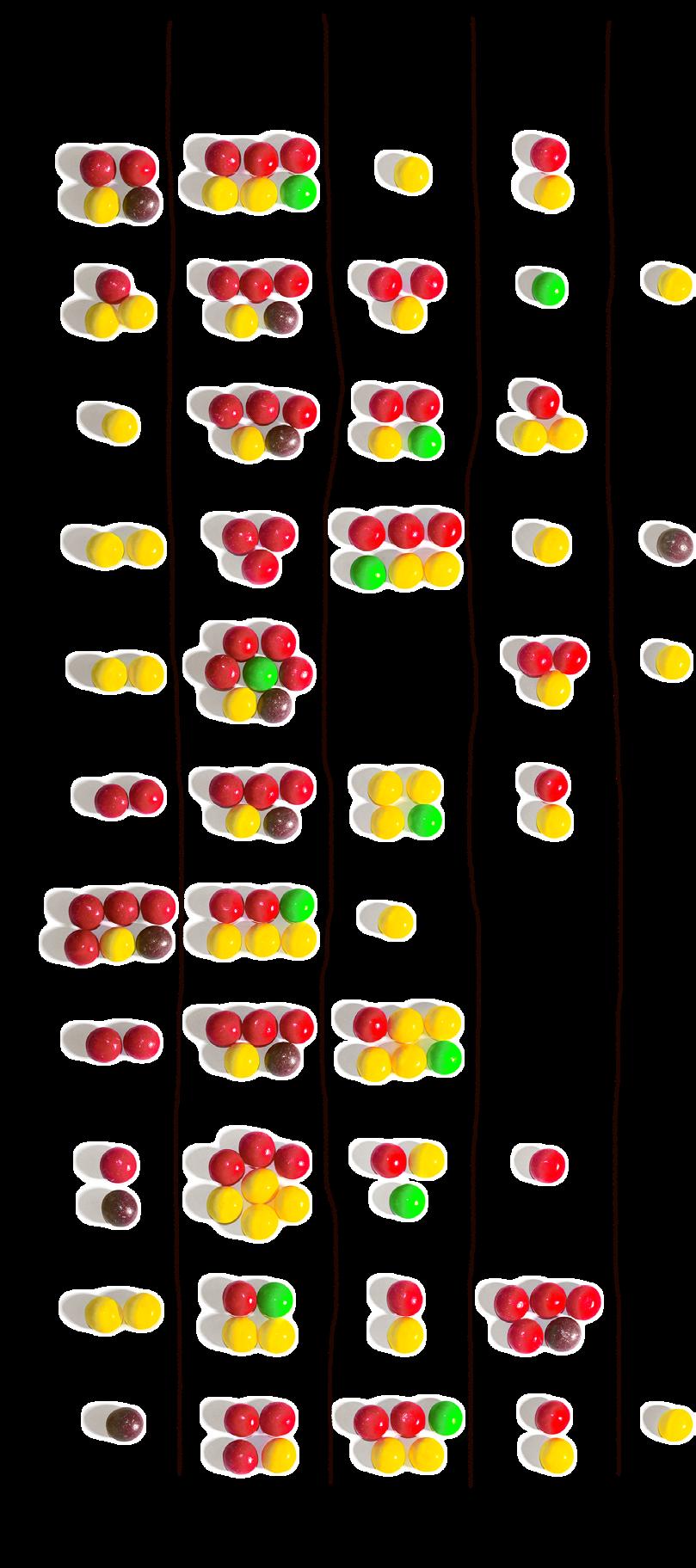

SUGAR IS A WEAPON
Sugar in a way, functioned as a weapon: culturally, economically, ecologically, and biologically
Written by Joshua Settee (he/him)
// Contributor
The industry of sugar in North America is not simply one of over-consumption, it is an industry of conquest, control and cultural disruption. At its heart lies the transformation of a seemingly benign convivial sweetener into a global health catastrophe that helped uproot entire Indigenous communities and brought waves of chronic disease among Indigenous peoples.
Many Indigenous nations of the Northeastern Woodlands, particularly the Anishinaabe (Great Lakes), Haudenosaunee Confederacy (upstate New York and Ontario), Abenaki (Vermont and Quebec) and Mi’kmaq (Maritime provinces), harvested maple sap and processed it into sugars in communal festivals rooted in care of the land. Colonization disrupted these traditions, destroying them in many ways.
The establishment of the American Sugar Refining Company in 1891 marked a turning point. By 1907, this company would control 98 per cent of refined sugar processing in the U.S. Viewing sugar as a basic food and household item, the industrial complex repositioned it as a cheap, mass-market sweetener, a massive change from its ecological and cultural roots. Massive plantations and processing plants flourished and grew while Indigenous food systems and ecosystems were disrupted or outright stopped; their lands and foods stolen and diet forever changed. The consolidation of the sugar industry matters, as it reconfigured not only global trade, but consumption patterns of colonised peoples, including Indigenous nations. In Canada and the U.S., Indigenous peoples now suffer disproportionately from type 2 diabetes. Among First Nations living on reserves in Canada, about 17.2 per cent

Visuals by Tin Raganit (they/them)
// Contributor
are affected. Indigenous Services Canada notes that Canada’s Indigenous populations are among the highest risk groups for diabetes and its complications. One study reports that for some First Nations adults in Alberta, diabetes prevalence is 13.5 per cent compared to six per cent in the general population. The principal determinants include colonisationera policies, displacement from traditional territories, erosion of traditional diets, food insecurity and limited access to nutritious food.
The Pima of the Gila River Indian Community in Arizona demonstrate one of the most extreme examples of how colonization and dietary change can drive disease. After the U.S. government diverted their river water in the late 1800s to support non-Native farms, the Pima’s traditional irrigation systems and agriculture collapsed. Their diet once based on tepary beans, corn, mesquite and squash was replaced by government-issued rations heavy in refined flour, sugar and lard.
By the mid 20th century, studies found type 2 diabetes rates among the Pima to be among the highest ever recorded. Later research compared Pima families in Arizona with genetically related Pima living in rural Mexico, where traditional farming persisted. The Pima in Mexico are still eating traditional foods and leading physically active lives, and have dramatically lower diabetes rates. The contrast makes it obvious that the epidemic wasn’t genetic; it was environmental and forced. The loss of food sovereignty and the forced adoption of sugary commodities lay at the heart of this crisis.

In Northern Ontario, the Sioux Lookout First Nations Health Authority serves about 30 remote communities, most of them predominantly First Nations. In a 2015/16 health analysis they found a diabetes prevalence of 12.9 per cent and an annual incidence of one per cent, rates higher than those in the general Canadian population.
Research has linked these numbers to the erosion of traditional food systems. One long term dietary study in a First Nations community in Ontario found that people following a “Beef and Processed Foods” diet high in refined sugars and marketsupplied processed foods, and low in traditional foods such as fish, game and berries, had a 38 per cent higher risk of developing type 2 diabetes over ten years than those who maintained traditional diets.
The loss of food sovereignty, combined with the high cost and limited availability of nutritious foods in northern and rural regions, has created dependence on packaged and refined foods which leads to chronic diseases beyond even diabetes.
Recent interviews with urban Indigenous adults across Canada reveal how sugar sweetened beverages like Pepsi have become daily staples, even earning its own nickname “Bepsi” in communities across Canada.
In a way, sugar functions as a weapon: culturally, economically, ecologically and biologically. Culturally, because Indigenous nations lost control of their foodways. Economically, because monopolies exploited both labour and land. Biologically, because the flood of refined sugar into vulnerable communities helped fuel epidemics of diabetes and related illnesses while also ecologically disrupting land for plantations.
For Indigenous communities in North America, the path forward is not simply about reducing sugar intake, it is about restoring food sovereignty, reclaiming land and rebuilding cultural systems of nourishment and health. The monopoly once held by the sugar industry may have shifted, but the legacy it had remains and acknowledging that is just the first step toward healing.





Vancouver Vendor Markets
Taking a look at some of this year’s Christmas vendor markets; are they worth going to?
Written by Ben Taylor (he/him) // Crew Writer
Visuals by Andrei Gueco (he/him) // Contributor
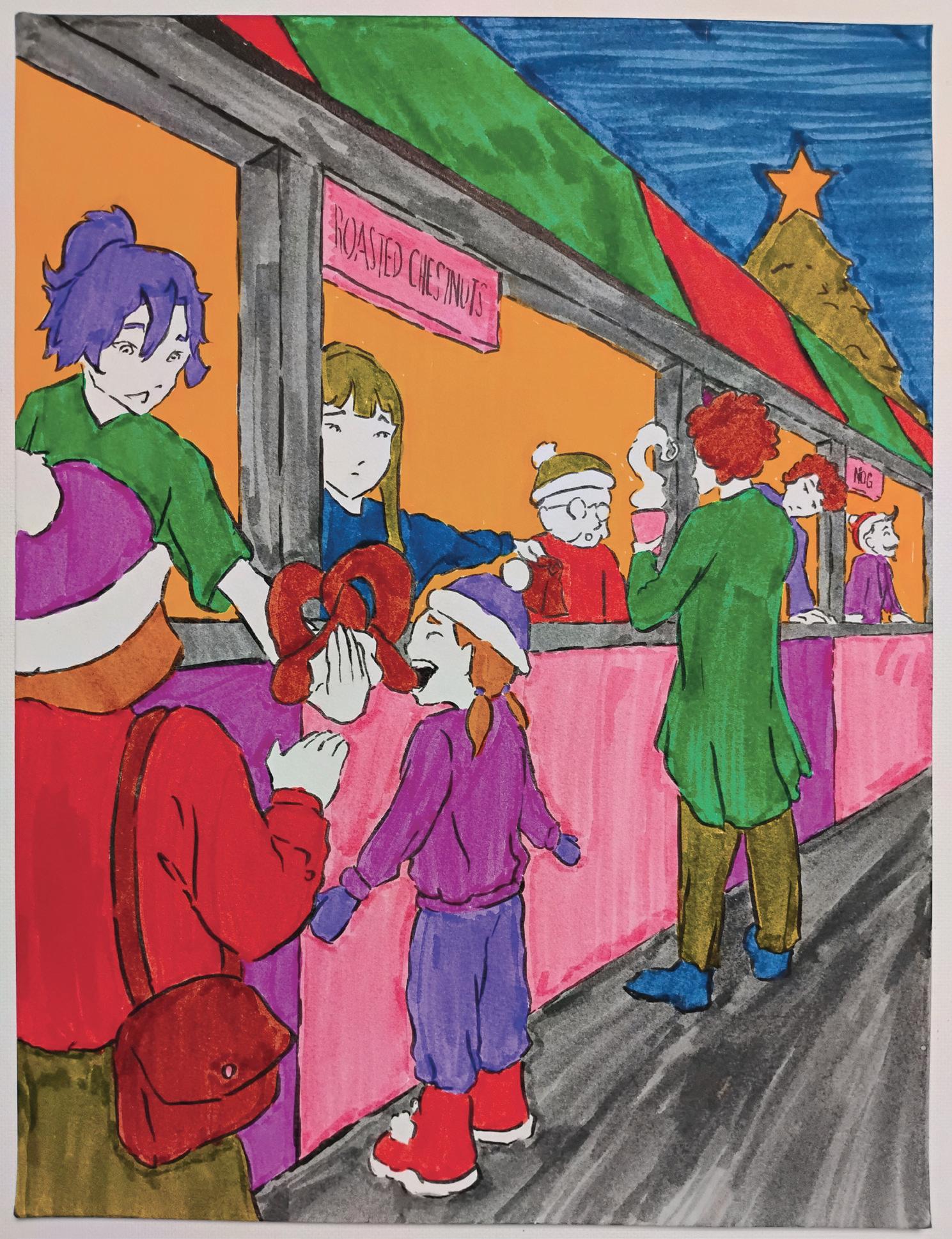
As winter break approaches and students return home for the holidays, many will turn to the various Christmas markets around town for artisanal gifts and other holiday treats. Rather than buy presents online on Amazon, or from malls with established shops and corporations, attending local markets is a good way to support our local community of artists and artisans. By checking out some of the markets in this article, not only will you support sustainable and independent businesses, you can also find one of a kind, handmade gifts, that you can’t find anywhere else.
The official ‘Vancouver Christmas Market,’ takes place every year in Jack Poole Plaza in Coal Harbour. This Europeanthemed market is immensely popular with over 75 vendors in German-style alpine huts. Admission starts at $7, but goes as high as $25 in the week leading up to Christmas. For those looking for a large-scale market with traditional German food and a wide variety of vendors, this could be a good match, despite admission prices increasing closer to Christmas. The market takes place November 13 to December 24.
Another larger scale market taking place again this year on the North Shore is the Polygon galleries Christmas shop, along with the Shipyards Christmas market. The Polygon holiday shop has no admission fee, and has a variety of
curated gifts “created by independent artists and artisans.” Right outside the gallery is the annual Shipyards market, which similar to the Vancouver market, is also European themed, and hosts over 140 vendors in alpine huts laid out along the piers. This market is free admission, making it an accessible local holiday market for shoppers who want to avoid fees. The holiday shop runs from November 12 to January 4, and the Shipyards market runs from November 28 to December 24.
Aside from these bigger markets, there are also numerous options for those looking to support smaller scale independent vendors and artisans. On the North Shore, the 22nd annual Tsleil-Waututh Nation Christmas craft fair is happening on December 7 and 8 in the Tsleil-Waututh Nation Community Centre. It features over 80 Indigenous vendors selling a wide variety of items from nations all across the province. Admission is by donation. The University of British Columbia is also hosting an Indigenous holiday craft fair on December 4 in the Longhouse. Admission to this event is free.
The folks at Eastside Flea also have their foot in the door with their Christmas market running over from November 22 to December 14. Admission is $5, and artisans seeking opportunities can even apply to set up a stand as a vendor. The Russian Hall is also hosting the 8th annual Weirdo’s Holiday Market. Although the exact dates have not been released yet, they will soon be announced on the Russian Hall’s website. The Weirdo’s features perhaps the biggest and strangest variety in crafts and vendors in addition to thrilling activities, as it’s known to have featured sword swallowers as well as Tarot readings in the past.
One final vendor market taking place in both Vancouver proper and the North Shore are Made in 604’s series of winter/holiday markets. These are more free-of-charge events, located at Pipe Shop in North Van, and the Heritage Hall on Main St. They will take place over the weekend of December 6 and 7, with a Christmas market also occurring in North Van on the 22 and 23 of November.
There are many more options of Christmas markets taking place around the city, some of which can be found at vancouverchristmasguide.com. This holiday season, why not show some love to our bustling market community here in Vancouver. Plenty feature free admission, making it a low risk high reward method of shopping. As the scene continues to grow, more are sure to pop up in the coming weeks, so keep your eyes peeled for local markets near you, and give back to your community this Christmas break!

CapU Donor, Wendy Yau Sum Cheung
Wendy Yau Sum Cheung will be debuting her show ‘Senses’ on November, 29th
Written by Benjamin Kimberley (he/him) // Contributor
Visuals by Alisa Nguyen (she/they) // Contributor
Wendy Yau Sum Cheung is an award-winning composer, musical director, and real estate investor. She donated $20,000 to CapU in 2017 to support students studying music. On November 29th of this year she will debut an orchestral charity concert called 'Senses,' which weaves all five senses into one cathartic emotional journey.
A Brief History of Wendy
When she was a toddling youngster, Cheung’s compositional aspirations were spurred by the tunes of legendary songwriter Joseph Koo. She would go on to study composition at CapU and University of British Columbia (UBC). After graduating she founded Live A B Life, a feel-good entertainment company, before moving to Hong Kong to write hits for pop stars. In 2018 she created 'Seasons', a Broadway-like musical featuring a magician. Cheung eventually caught the attention of Joseph Koo at a songwriting competition, and came to consider him a mentor. "He passed away a few years ago," she says, "and I have his piano right here in the living room: a white Yamaha grand. He signed it."
Cheung also went into business, seeking the financial freedom to make whatever art she wanted. This tall order turned out to be a breeze; in the year and a half ‘Senses’ has taken to put together, Cheung swears she "could've done 10 businesses already.” While at UBC, Wendy founded the Mozart School of Music. In 2005, she dove into real estate, buying and selling at a profit. She went on to co-found Peak Performance Investments, Alture Properties and later Empiro Capital. According to the Empiro Capital website, her portfolio is currently worth over $100 million.
Senses
‘Senses’ takes the audience on an immersive emotional journey, and allows them to tap into an untouched part of themselves. Perhaps, it would help to think of it as your favourite movie, but with the story removed and the emotions directly injected into your brain. It aspires to bring forth the emotions you have within, and let you experience them surrounded by sound, colour, smell, touch and taste.
Sound is supplied by the Vancouver Metropolitan Orchestra;
Cheung wistfully recounts that her compositions "come to life, and it's almost a heaven." Touch is found in a notebook given to each attendee, in which they may write or doodle. To entertain the eyes, evocative images dance upon an LED screen. Cheung wants to leave smell and taste "as surprises for the show" so no spoilers here. The concert also includes guided breath work; music therapist and former CapU instructor Dr. Alpha Woodward was brought on board to offer therapeutic expertise.
With her mother working and her father sleeping, Cheung found solace in the piano. "Through the instrument, I was able to tap into parts of my emotion," she says. This therapeutic introspection is the emotional core of her work, and what she aims to evoke in ‘Senses.’ All proceeds from ‘Senses’ are donated to HeadsUpGuys, a nonprofit in support of men's mental health. The impetus for this charity, and the emotional core of the concert, is Cheung’s experience with her father. "I grew up with a father who was sort of an absentee dad to me, emotionally and mentally," she admits. “He was trying very hard to cope with what he was going through.” She tried to help, but didn’t know where to start; she was left hopeless and out of her depth. Her mother was left to pick up the slack and raise three kids.
Through all her work, Cheung aspires to leave something meaningful behind in the world. We are surrounded by the work of classical composers from years ago: a good piece, Cheung says, "never goes out of style." Whether we are musicians or accountants, we all struggle against time to make our one true beautiful thing. Cheung asks, "What have you done that makes your one hour last forever?" "How can you make it impact somebody, so that person can impact another person?" Cheung is working towards her beautiful thing, spending her hours writing music and crafting experiences, giving her audience permission to feel, to be transported and to find their own release.

Love Bombing
As Chappell Roan says:“Good Luck, Babe!”
Written by Cami Davila (she/her) // Crew Writer
Visuals
by Mia Antinori (they/them) // Contributor
When I was younger and had just started dating, there was no term to describe love bombing, or at least I wasn't aware of one. There were intense feelings and a lack of emotional responsibility, but not a term for every single thing that we were experiencing relationship-wise.
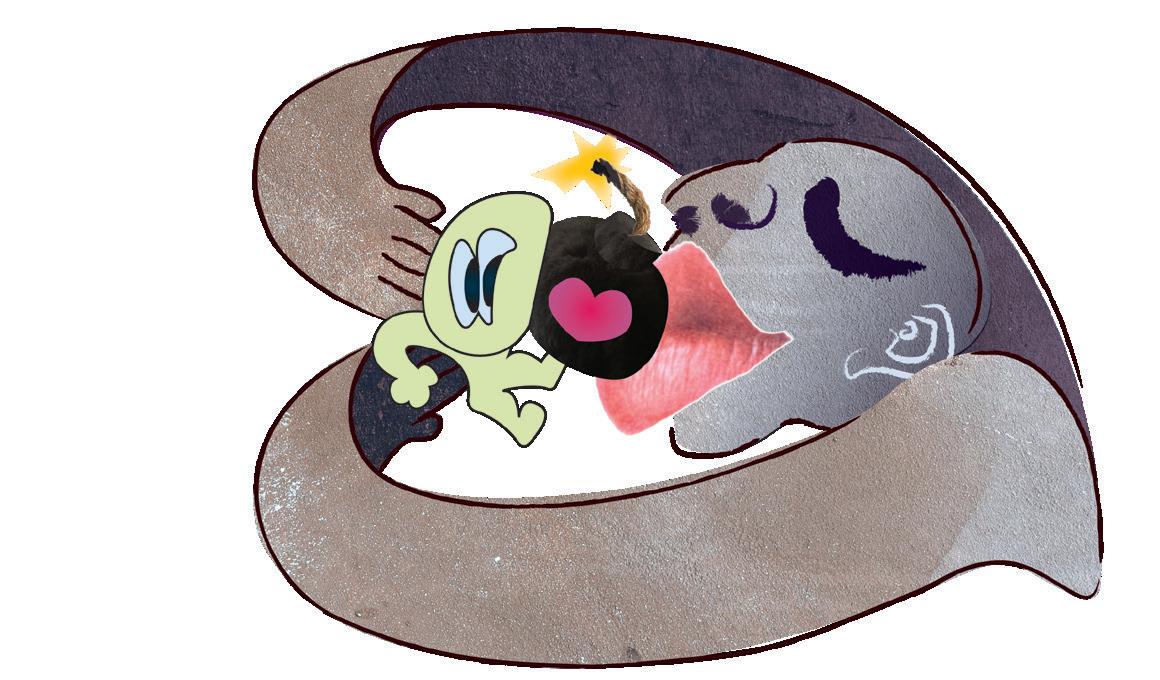
For those who aren’t familiar with this term, let me break it down. According to Wikipedia, love bombing is “an attempt to influence a person by demonstrations of attention and affection.” Usually, that’s followed by ghosting or a drastic change of behavior after that person gets what they want. Validation, control, affection, distractions; love bombing is a type of emotional manipulation.
Sound familiar? I was afraid of that.
With the misfortune of being involved with girls that weren’t sure of their sexual orientation and felt they needed to ‘try it to know if they really like it,’ I have had multiple experiences with love bombing. Now, I understand that those words were an instant red flag and I should have ran away, but I was naive and attached to the idea that maybe everything would turn out to be a love story.
One day, after we went to the movies, I invited her to my house for the first time. She walked around my bedroom, paying attention to every single detail and, after a while, she sat down on my bed. My heart beat was increasing with every second that passed by, my hands were sweaty. We laid down and we kissed.
For those who have never been in these situations, spoiler alert: It's extremely rare for it to end well.
Indeed, it started out like a fairy tale with a lot of messages, video calls, dates and presents. And, after that. . . nothing. Like a cliché love song, I ended up with no closure, no explanations and a broken heart. Because, truly, nothing hurts more than the end of a relationship between two women.
My worst experience with love bombing was when I was 22. My best friend introduced me to a friend of hers. She caught my attention from the start and I made my interest very clear. In one of our first conversations, she told me she had never dated a girl before, but she was open to it, and, of course, I was open to making it work.
We went on several dates. I remember that she used to take a lot of pictures of me and made collages and videos with them. She used to send me huge messages about how much she liked me, saying things like, “Even if it’s too soon, I really appreciate you.” She would give me presents on days that couples celebrated, like Valentine’s Day. Every time I wanted to walk away from the relationship, she made a huge gesture for me to stay.
Dating a woman if you are a woman is not easy, especially if you come from a conservative culture. I grew up in Colombia, a very Catholic country, which made it harder to accept myself under those beliefs. Even though I dressed up as the blue Power Ranger when I was six, I came out almost 10 years after that, and it was a long process for my mom and I to accept that I was going to be different.
It is inevitable that bad things happen in a relationship; the unacceptable thing is being emotionally irresponsible and at least giving a heads-up before ghosting.

It was the smallest kiss I have ever had, because she quickly interrupted it to tell me, “Agh, I wish you were a man.” I didn’t know what to say. We sat in that awkward silence for a long time. I just wanted her to leave.
I wish I could say that after that night I stopped seeing her, but I didn't, and that's on me. I truly liked her and, again, I used to believe in Nicholas Sparks’ stories (the guy that wrote The Notebook). So, we regressed to that typical and unhealthy dynamic; me, knowing that I needed to leave, and her, performing grand gestures.
I started to feel insufficient. I felt that I wasn’t enough, and that this was the reason why she couldn’t decide what she wanted. I mean, she told me loud and clear that I wasn’t what she expected in a partner. I was younger—that was more than four years ago, and yes, those years made a difference in terms of growth—and the only way that I knew how to get over someone and feel cared for again was by dating someone else. It wasn’t an emotionally responsible move on my part, especially because I should be able to care for myself without the approval of others, but it worked. Dating again—outside of that toxic bubble—worked as a mirror, showing me all the bad behavior that I was putting up with.
Now, we share the same group of friends and even though we are polite with each other, we both know how much we hurt one another, and that’s something that you can’t overcome easily.
With time (and other failed relationships, I’ve learned to respect and take care of myself. I also understand the importance of listening to your community when they tell you to get away from there!
In the end, what’s left is acknowledging your emotional responsibility and singing your heart out to Chappell Roan.
“You can kiss a hundred boys in bars. Shoot another shot, try to stop the feeling. You can say it’s just the way you are. Make a new excuse, another stupid reason. Well, good luck, babe!”
Seasonal Sweets A Chinese-Canadian Experience
Written by Andrea Chiang
(they/them)
Visuals by Mia Antinori (they/them), Andrei Gueco (he/him), Andy Poystila (he/him) & Eugene Lee (she/her) .
Tangyuan 汤圆 is a traditional Chinese dessert that dates back to the Song Dynasty (960-1279 C.E.). It’s made of glutinous rice balls about the size of ping-pong balls and served in a hot broth or syrup, sometimes with filling. They have a soft, chewy texture similar to Japanese Mochi. They often have a black sesame or crushed peanut filling. However, Tangyuan is a versatile dessert and can come in other fillings, made sweet or savoury, be coloured, fried or boiled. They can also be served with a Cantonese sweet dessert soup called Tongsui 糖水.
I can’t recall the first time I had tangyuan, but I remember my mom would make them every week during the COVID-19 lockdowns. It was always a nice dessert to share with my parents; I didn’t enjoy drinking the tongsui, but they did. I just really loved the peanut filling, which was balanced well with the plain glutinous rice ball. My mom would always forget to watch the stove, and—on several occasions—the tangyuan would inflate until they exploded. The peanut sesame innards would mix with the tongsui, leaving behind the skin of the glutinous rice ball. My parents didn’t mind since they enjoyed drinking the tongsui. As for me, after eating one too many disembowelled remains
of tangyuan, I ended up keeping an eye on the stove. Eventually, I learned how to make it myself. It was one of my first experiences cooking for myself and for my family. I grew to be obsessed with them, especially the peanut-filling tangyuan. I recently made it for my partner when he got sick. It’s always nice to introduce new foods that I grew up with to him. I’ve grown accustomed to growing up in a predominantly Chinese neighbourhood, so to see someone’s reaction when they eat food from my culture—food that I made—it hits different. It’s a feeling of connection I never experienced before.
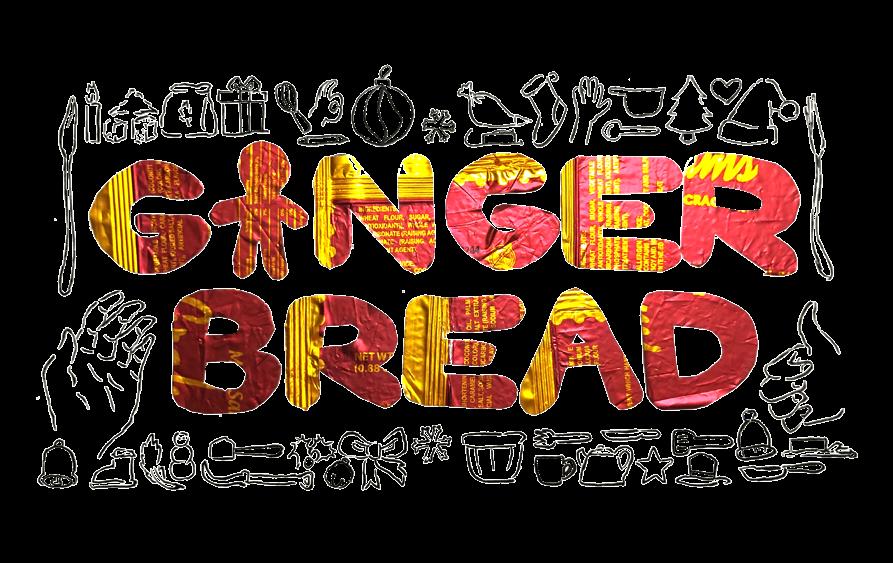
Gingerbread Houses (Lebkuchenhaus) are small buildings made from cookies, composed of cut and baked gingerbread walls and roofing. The gingerbread walls and roofing are glued together with icing and are often decorated with various candies. Although the history of gingerbread dates back to the 13th century in Germany, the recipe has evolved over the centuries. Nowadays, most gingerbread is made from a dough that consists of flour, butter, brown sugar, molasses, eggs, and spices like ginger, cinnamon, and cloves.

It’s fitting that tangyuan 汤圆 is a homophone for the Chinese word reunion 团圆 (tuányuán). The dessert symbolizes togetherness and completeness, symbolized in the roundness of the dessert itself. It’s why they aren’t only traditionally eaten during the Lantern Festival 元宵节 (yuánxiāo jié), but they’re also eaten during holidays like Chinese New Year and the Winter Solstice Festival 冬至 (Dōngzhì) and other celebrations such as weddings and family reunions.
When I was a kid, I used to build and decorate gingerbread houses with my sister. I have always loved the look of the gingerbread house because of how iconic a Christmas symbol it is. When I see gingerbread house kits on the store shelves, I feel the holiday spirit in me start to bloom. Even though I wasn’t allowed to eat the hard candies or the stale gingerbread in these kits, I’d always eat the leftover icing with my sister. It was our thing. Last year, I hosted a Christmas party for my class, and we made gingerbread people from raw dough. For once, I got a taste of gingerbread properly cooked and fresh from the oven—it was amazing. I had no idea it would taste like a sweet cookie with a bit of a spicy kick. I had fun eating and making my own gingerbread shapes with the cookie cutters. It was also nice seeing what everyone else made with their cookie dough. One person made “Chill Guy” from the chill guy meme, and another made “Gojo” from the “Jujutsu Kaisen” anime. It was a great bonding experience with my classmates and an icebreaker for all of us at the start of our 2-year diploma program together. Strangely enough, it felt nostalgic and yet much more cozy and warm compared to what I experienced as a kid. Tasting the treats and spending time with more people who are also having fun can make a memory sweeter.


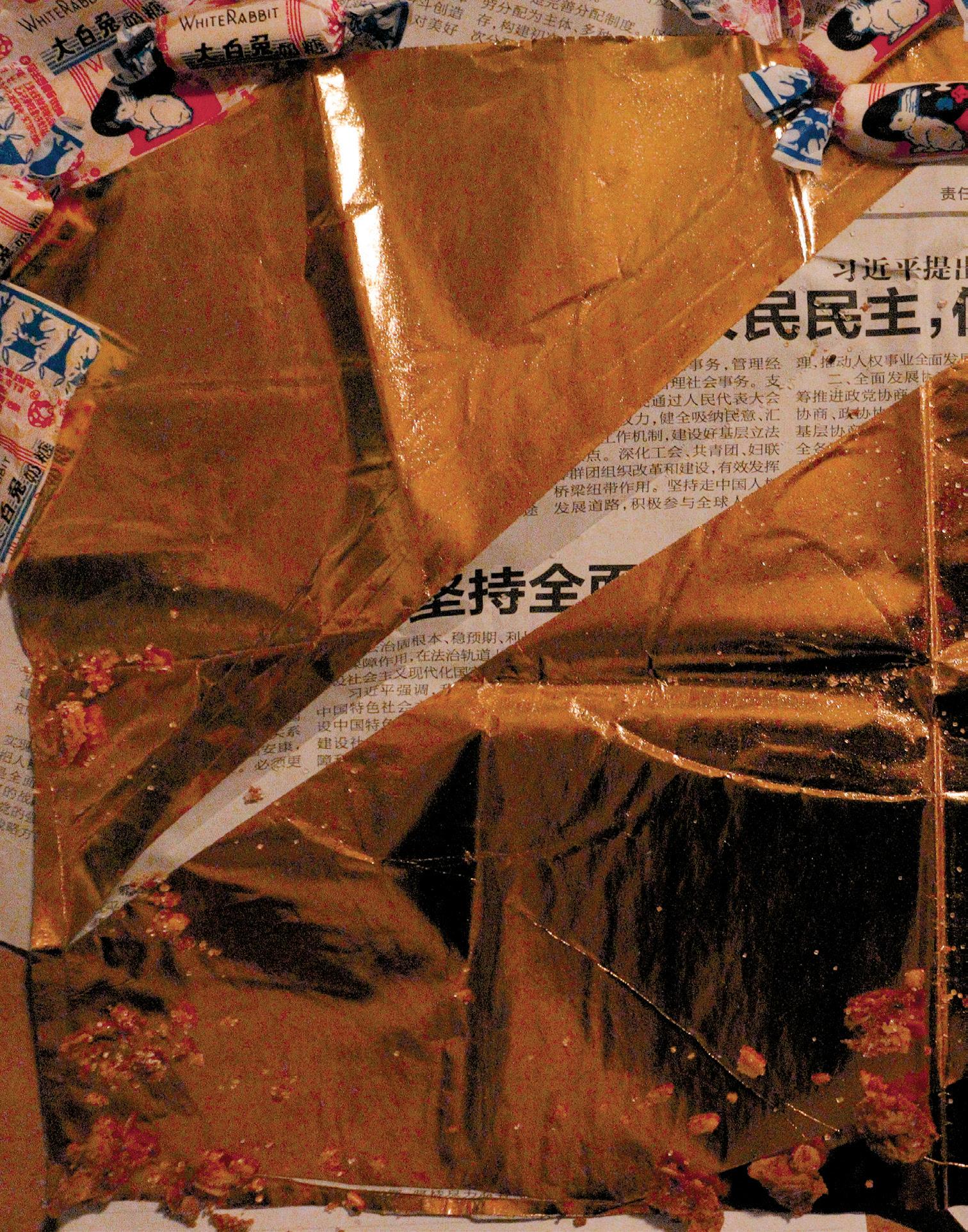
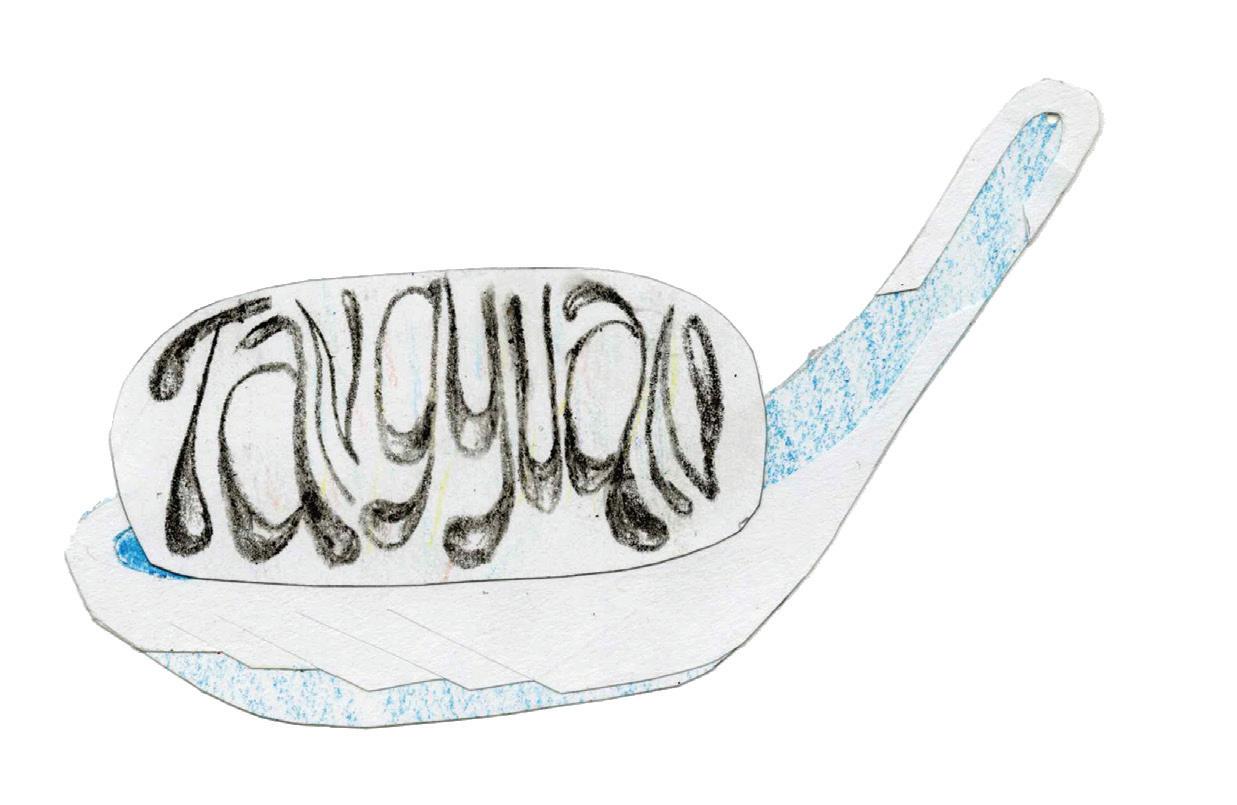


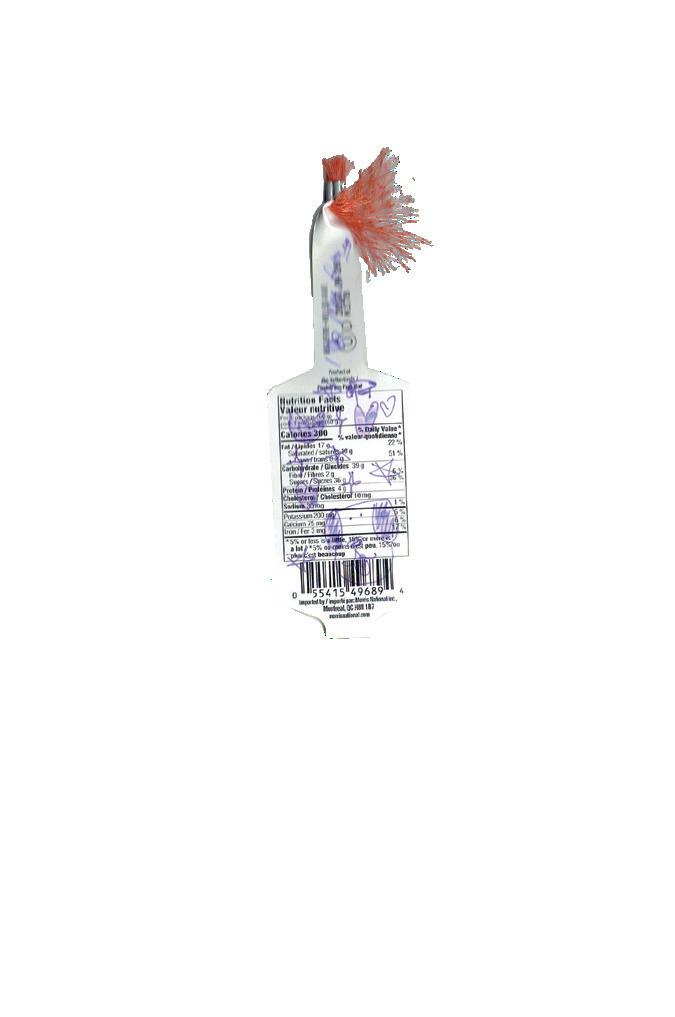
The White Rabbit Creamy Candy 大白兔奶糖 (Dàbáitù Nǎitáng) is a Chinese brand of milk candy. It’s a cream-white, cylindrical soft candy with a chewy texture similar to taffy. They’re wrapped in a transparent, edible sticky rice wrapper and a waxed paper wrapper with an image of a white rabbit printed across.
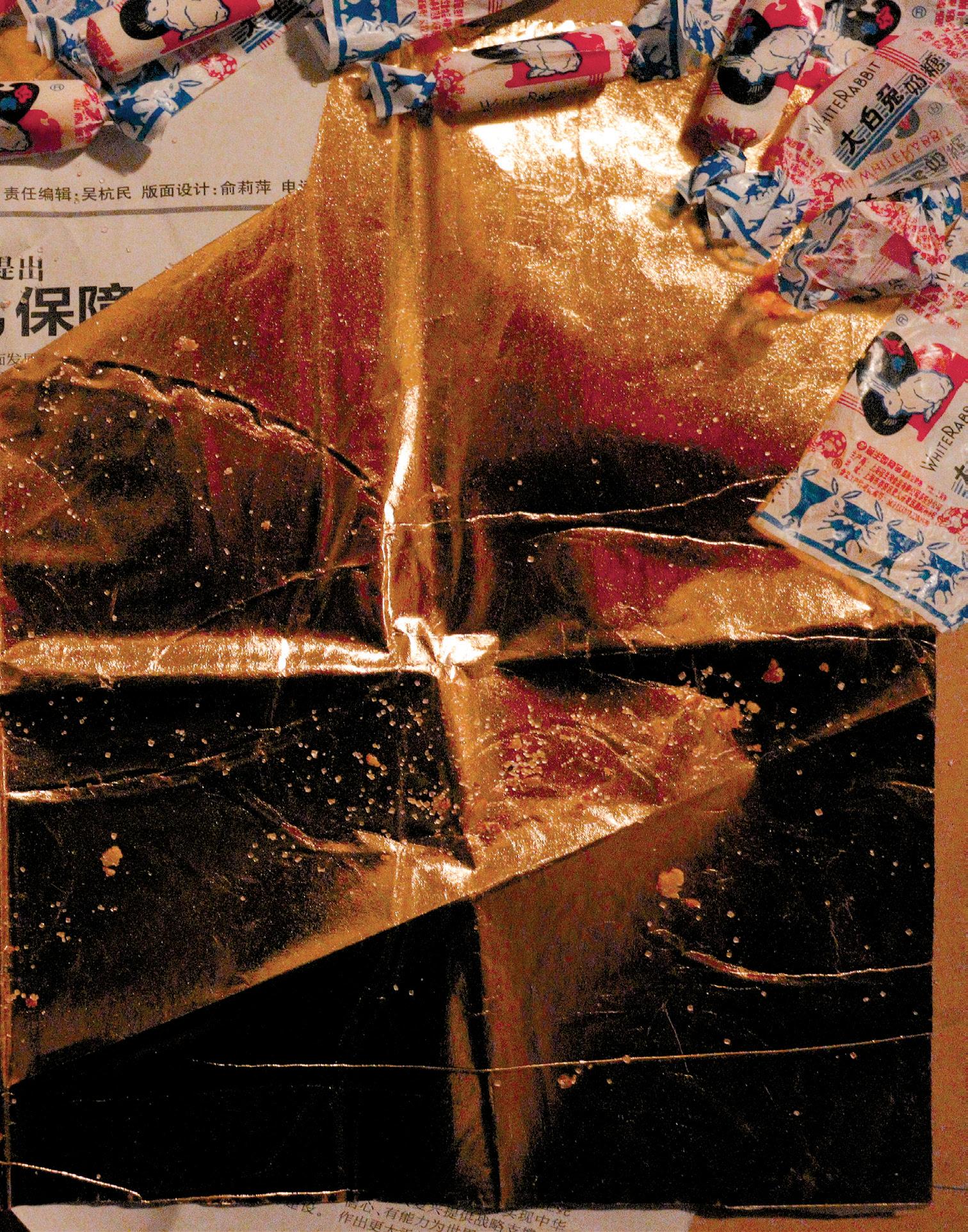

I grew up eating these candies during Chinese New Year whenever my relatives would meet for our big family gatherings. I remember my first time trying it, I peeled the sticky rice wrapper, only to be told that I’m supposed to eat it without peeling. It was so strange, as it was the first time I heard of such a thing. Even stranger was how delicious it tasted. The paper melted in my mouth almost instantly, and the candy had such a unique texture. Every Chinese New Year, I’d hoard all the White Rabbit candies I could find, like it was my secret stash of Halloween sweets. I always thought it was a very niche and unique candy that only I and a select few knew.
It always felt like a secret token of my childhood. Something special and given to me only. But, as I grew up, I learned that a lot of people, even non-Chinese people, knew of the candy. I would find myself being surprised to see it appear as an ice cream flavour in my neighbourhood ice cream shop, or as keychains and stickers from local art markets. What was once just a childhood candy turned into an icon for a shared cultural identity. Funny enough, this might have been the initial intent of the White Rabbit candy maker. It was initially designed in response to the growing rise of Disney’s Mickey Mouse symbol, and has now become a symbol of Chinese culture. Generations of children since 1943 have grown up eating this candy during the Chinese New Year, so it is no surprise that the candy has become another traditional sweet in Chinese celebrations.
Anti - Ghazal Poems


The next morning I met Liadan Ben Taylor (he/him) // Crew Writer
we were all significantly fruck out and needless to say, we haven’t been back in that house since.
I haven’t thrown up in eight years and I don’t plan on doing so again anytime soon.
the night my sister was born a coffee plantation was burning down.
onions, zucchini, pumpkins, corn, sunflowers, raspberries, Delicious blueberry pancakes!!
and all the love we’ve contributed to the world will grow long after we’re around to see it.
Visuals by Cameron Skorulski (he/him) // Production Manager


my mum taught me this idea at a very young age
Mia Lancaster (she/her) // Letters Editor
Skin in the brambles, black stone slabs at the base.
Guarding the treasure in a remote posting. And be soooooo happy.
From Venezuela, pass through the phone and into my dreams for another hug.
Here and Away...
At sea again where the wind hits heavy.
A frame for maybe two or three pansies. I think being buried has some value in it.
Christmas shielding perfect childhood
Cami Davila (she/her) // Crew Writer
There were gatherings on my grandma’s living room
Where we, the little ones, didn’t know sorrows
Around the Christmas tree, a pile of gifts
Under my mom’s eyes, shadows of her bitter, crying hours
Tables full of food and drinks
And the sweet innocent thought of nothing being wrong
While we sing, craving Christmas gifts
The women hold their breath and cross their legs
This is their gift to us
Christmas shield of the perfect childhood
A Pony Tale Growing up a Horse Girl.
Written by Sylvie Harpur (she/her) // Contributor
Visuals by
Lily Jones (she/her) // Contributor
He was always there, peering over the gate, asking for more hay, that’s all he was; a hay burner. Nobody rode him. He just sat there, bored with his life, waiting for someone to give him a new purpose. That someone was me.
After my Great Grandfather grew too old to carry on his wrangler legacy, his sturdy ranch horse, Drifter, was left behind to roam endlessly on the rolling hillsides of Harpur Ranch. Forever loyal, Drifter was ready for the old man to saddle him up again, prepared to doctor calves, ready to work. What he didn’t expect was a little blonde girl, trembling beneath her bright blue helmet, climbing onto his back with tears brimming her eyes. This is where my addiction began.
Drifter stood still that day, knowing his new rider was unsure and scared, as if he knew his waiting was over, as if he knew he was assigned a new role in his life. Drifter became my first teacher as a Horse Girl.
Drifter was no pony, he was a sorrel quarter horse standing 17 hands high— a retired ranch horse that had seen it all. He’d spent long days wading through deep streams, clambering through thick brush and pushing cows through rocky terrain underneath my famed Great Grandfather. Beneath Drifter’s rigid exterior with nicks and scars across his long white blaze, proof of his hard work, laid a gentle giant. Drifter was a legendary first horse.
My Grandmother, a retired Horse Girl herself, was determined to put him to use; she knew of his magical power, and that I would absolutely fall in love. This love did not happen instantly, it took several rides of me shaking like a leaf while upon his



back, scared of how far the earth had strayed from my feet. My Grandmother would lead him in a straight line down one of our hay fields while I clung onto his mane, ripping strands of red hair out with my tight grasp. Over time my hands loosened, my body learned to relax, and his back finally became a place of comfort: a place where nothing else mattered except Drifter.
Drifter became my passion. Riding him increased my confidence and helped me grow, but simply being near him nurtured my youth. Although this horse of mine spoke no words, he provided eternal guidance. That was his magic, contributing to the development of a girl’s childhood. As Drifter began to accept his old age, just as my great grandfather had done, two new teachers entered my life: kind Cody and silly Roach. These horses could not have been more different. Cody taught me the essence of true connection, whereas Roach continuously tested my patience. When their coats eventually turned grey, and old Drifter had passed—reuniting with my great grandfather—I knew it was my time to return their teachings.



Two year old Stella trotted into my life, trembling with nerves and wonder, just as I had. Together, we faced numerous ups and downs, each uncovering new lessons for the both of us. Throughout it all, our bond became invincible. From unbroken to broken, we matured together; winning competitions, wading through streams, riding in thick brush and chasing cattle over rocky, rough terrain. Stella has settled into her role as a gentle, ranch horse.
Now, being separated from Stella due to my studies at Capilano University, I spend my days anticipating my next visit home and, of course, my next ride. Stella shifts into the hands of my family members and friends who thoroughly enjoy her magic. She has traveled to cattle penning, ranch horse, and trail events, becoming a reliable mount for unknown passengers and growing her confidence even while I am away. Although Stella and I continue to play a part in each other’s lives, I know in the near future as the distance between us stretches, some little girl on the Harpur Ranch will be champing at the bit to climb upon her back, starting her own journey as a Horse Girl.
A Mild and Acceptable Protest

So, you want to start a protest? You're angry and you want everyone to know it? Good for you! Student activism has historically been one of the best ways to make a change. From Vietnam to Tiananmen; from gay rights to gun rights, students were there pushing progress. At Capilano University, it's a little more complex; that's where I come in. I am a professional protest planner, similar to a wedding planner or an immigration consultant. I help students plan their protest to by ensuring they understand the guidelines published on the CapU website that the university has put in place to regulate protest. (You might ask, ‘Regulate protest, isn't that a bit oxymoronic?’ Don’t.)
Let's start with location. As the website states, the campus is “private property and permits peaceful protest under specific conditions [...] Locations can be designated to ensure the safety of the University community and the protestors.” It also states, “The University can designate a 'protest zone' for lawful, peaceful protest.” What does that mean for you?
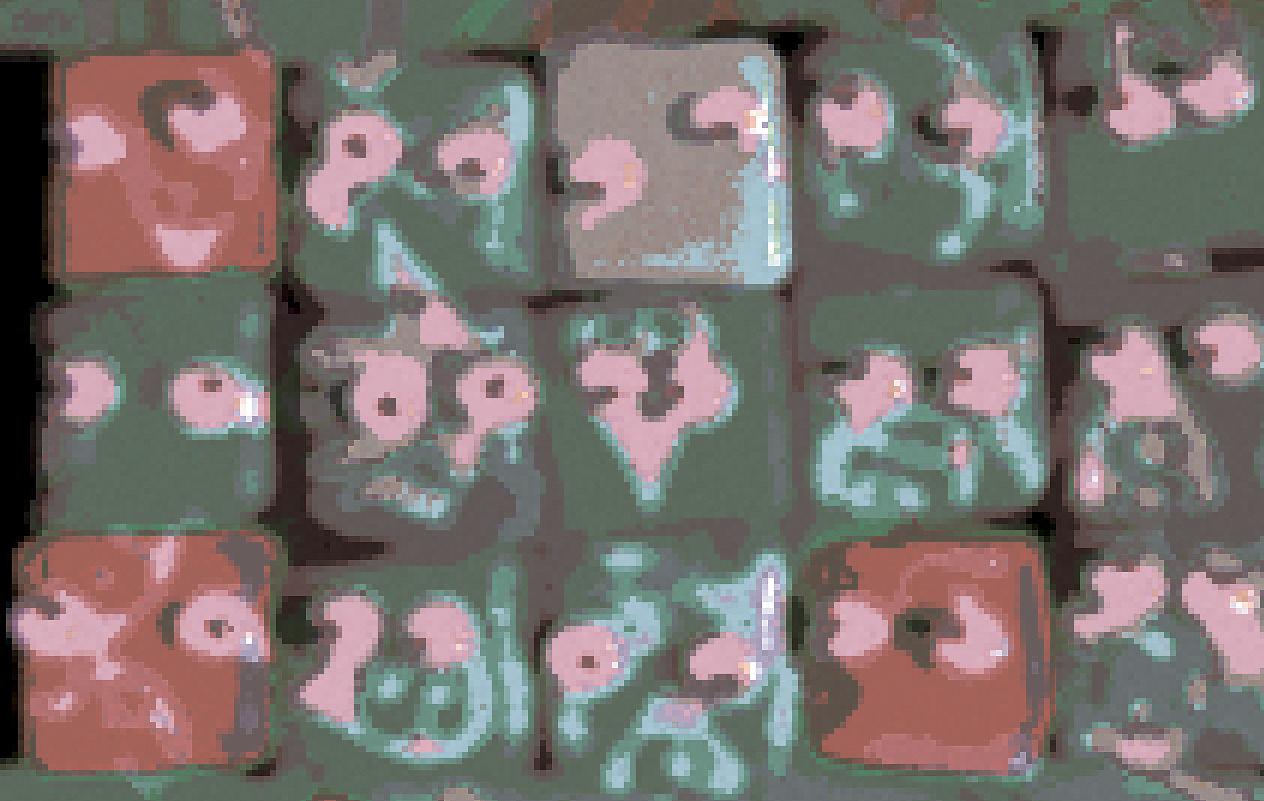
The university—with its infinite wisdom—occasionally stoops to allow protest, and—if it so desires and is feeling so generous—it may go so far as to allocate a plot of its extensive grounds that the troublesome agitators are permissed to use.
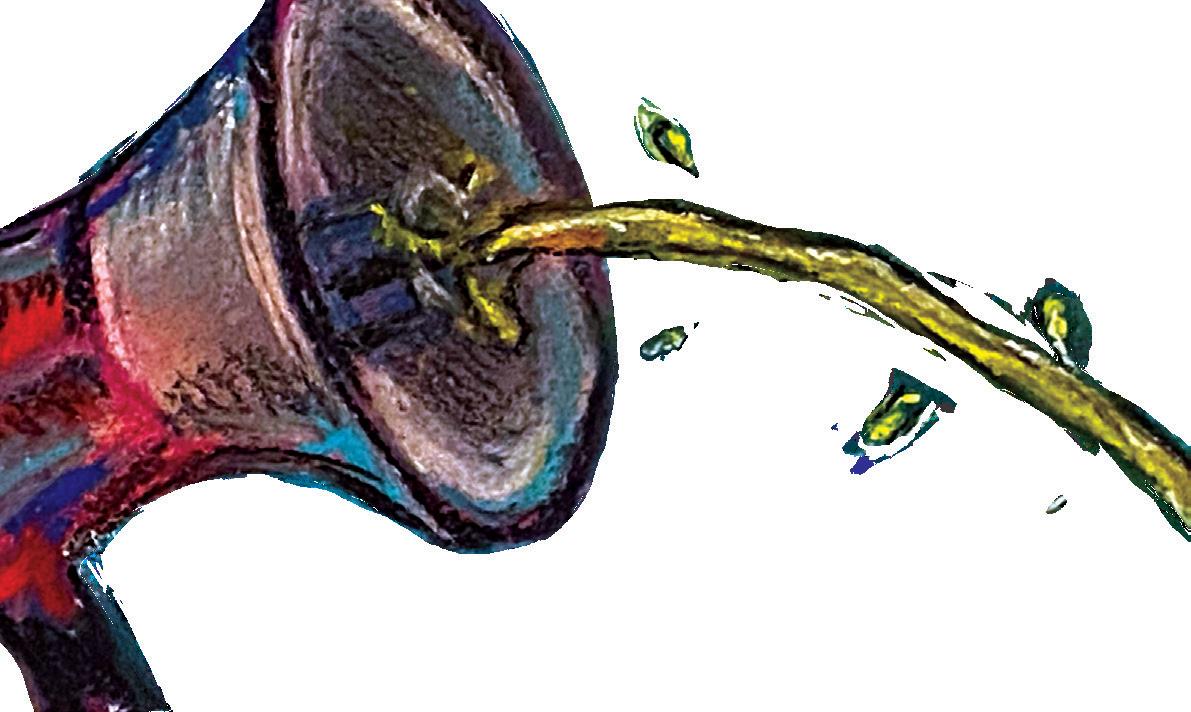
Now that you've got the location figured out (for you), it's time to decide how you will go about your protest. You may have seen famous images of your ideological predecessors with their bullhorns, chants and conviction, but I must dispel you of these aspirational ideas. There will be no bullhorn, and “no use of sound amplification devices” at all, in fact. You are, of course, allowed to hold up signs, “provided they do not contain offensive, profane or discriminatory content.” What constitutes offensive profane or discriminatory content, you might ask? That is up to the all knowing university administration to decide.
Before we continue, I feel it is important to lay out some more do’s and don't’s that must be followed in order to help you stay in compliance with the rules.
Protest to Protest Guidelines

A guide to the newly released protest guidelines at CapU straight from a professional Protest Planner!
Written by Walden (l /l) // l l
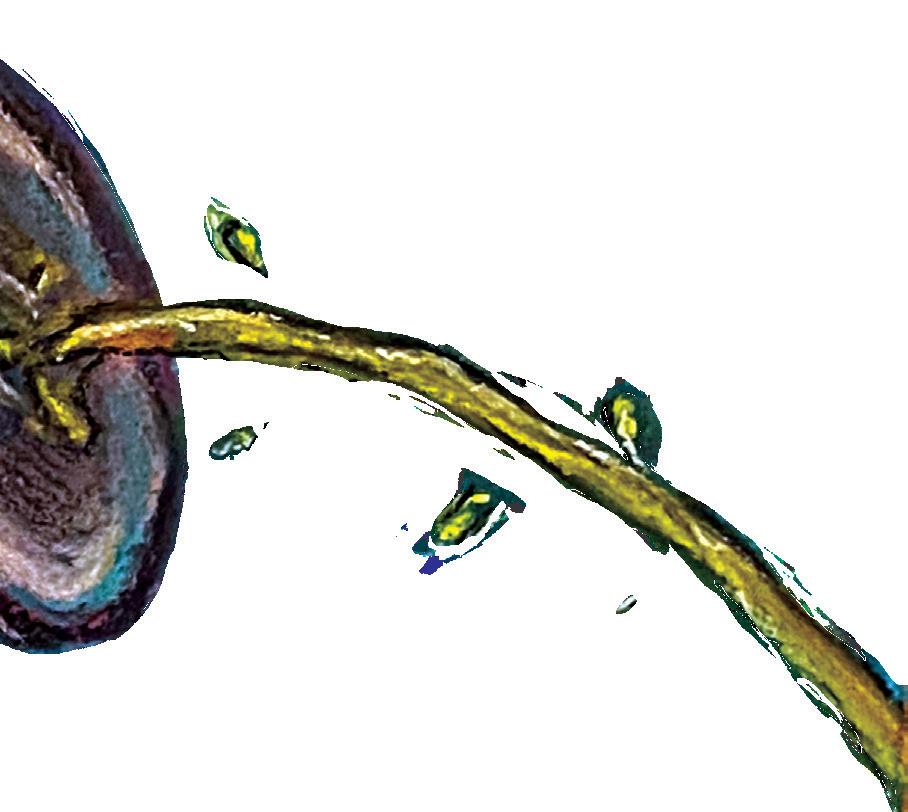
In case you were wondering about the washroom situation at your protest CapU has you covered, “[...] unsanitary behaviour such as public urination or defecation” are prohibited activities during a protest, incidentally these actions are also prohibited under Canadian law, but it is always nice to have a reminder. Another guideline I would like to make you aware of is the prohibition of “[...] gatherings that disturb the peace.” ‘WHAT?’ You might cry, ‘The point of protest is to challenge the status quo!’ Sadly, that is not the case at this institute of higher education.
A sit-in is another famous form of protest you may be considering now that a more traditional rally/march has been ruled out. Sit-ins have been a tool utilized by disability rights activists, feminists and even the great Martin Luther King participated in a sit-in (in his support of a student organized protest against segregation in Atlanta). But, before you get too excited, I must tell you what I'm sure you're already expecting: The “peaceful protest guidelines” do not allow sit-ins. There is to be no “disruption of others’ [...] access to campus facilities,” nor any “blocking entrances, roadways, or disrupting campus services (e.g., transit, deliveries, waste collection)." It's important to explicitly include waste collection, as who else would come clean up the immense quantities of urine and
by Kayla Kim (they/them) // Contributor
feces that the protesters will inevitably leave behind. Now, I’m sure the powers that be will protest (no pun intended): ‘That’s not what the guidelines mean!’ But, when reading through the guidelines, it seems that CapU is more concerned with keeping campus safe and quiet than fostering a culture that encourages students and faculty to use their voices and voice their opinions. Any response from administration defending these guidelines is difficult to take seriously when there was absolutely no opportunity for students or faculty to contribute to the shaping of this policy. These guidelines were not even voted on by the Board of Governors. The question that should be asked to the administration is: Who wrote these guidelines and by what virtue were they given the unilateral authority to put these guidelines in place with no input from students or faculty? The follow up question that should be asked is what protests was this person attending or watching that led them to feel the need to include the ‘poop clause.’ This redundant restatement of federal law and existing university policies are an insult to student rights, a terrible look for the university (Are people defecating publicly at CapU so much that it has to be explicitly prohibited?) and a draconian level of administrative overreach.
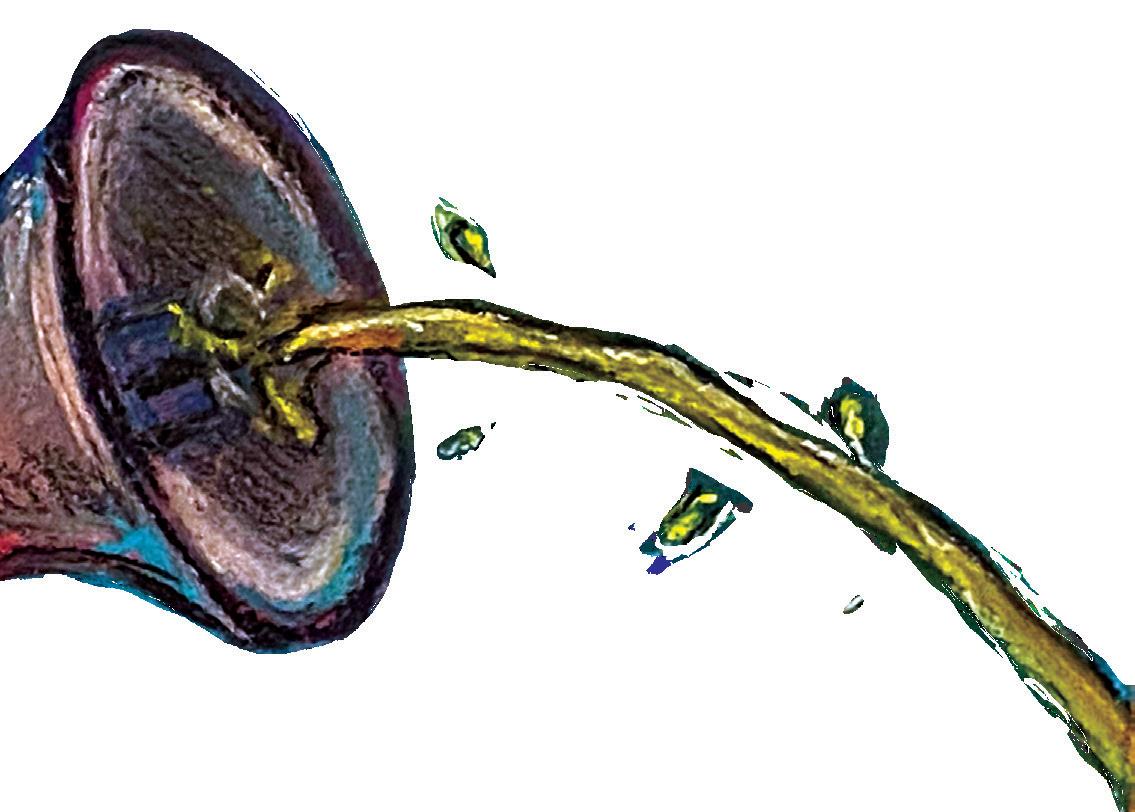
So, what can you do to raise awareness? If you were an obedient little student organizer you would stand in your protest zone (moving to allow anyone to pass by of course, wouldn't want to interfere with anyone's access to campus facilities), stay silent (don't wanna be disturbing the peace) and hold up a non controversial placard.
Visuals
Looking back at you is you, isn’t it?
Updating my past self on achieved dreams and new-found skills.
Written by Ben Taylor (he/him) // Crew Writer
Visuals by Alisa Nguyen (she/they) // Contributor
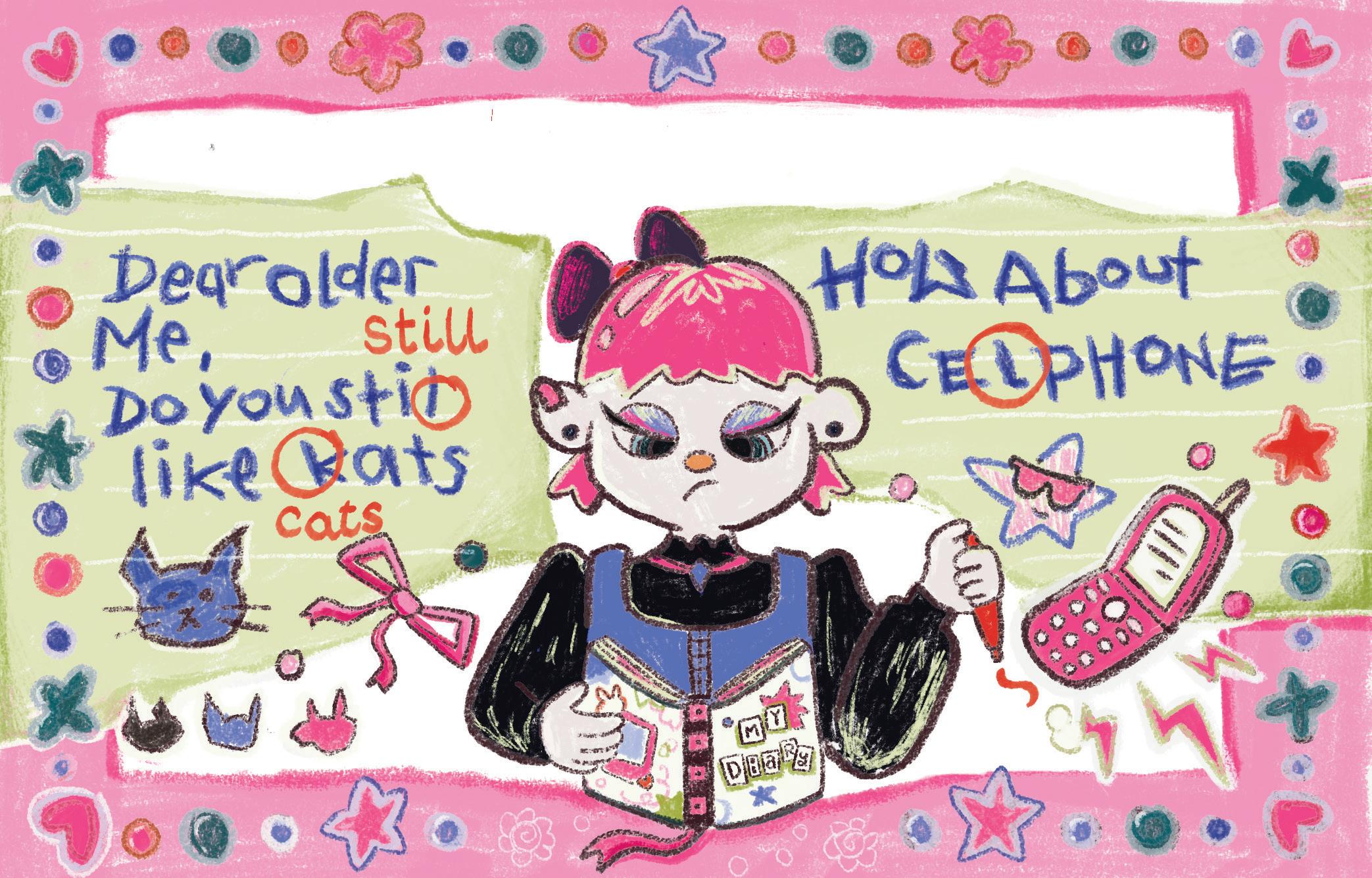
“Do not read until you graduate high school in 2023.”
I actually graduated in 2022. Math was never my best subject as I preferred silent reading time and creative writing. Speaking of which, let's not even get started on my bummy hand writing, from which you can tell I’m left-handed. How I expected to express anything meaningful with writing that looks like it was produced by someone left handed I have no idea. I even try to reference this in the first line of the letter.
“Hey Ben! Remember when your printing was this bad?”
Don’t deflect. Self-deprecating comedy can’t save either of us from the grim reality of such tragic printing skills.
“Are you still friends with Max or Liam? Is our dog still alive? Are you being nice to your younger sister?”
No, turns out they suck. Also, my dog is dead and my sister moved away to Montreal. “What are you doing with youre life? Hopefully good things.”
Bro, don’t be asking me about the state of my life when you can’t even use the correct ‘your.’ And, “hopefully good things” is a sentence fragment, shit doesn’t even have a main verb or a subject to form a complete thought. Clearly, I overcame your lack of ability to formulate questions in a cohesive way. That’s what I’ve been doing over the past eight years. That, and some other sick shit. Grown-up stuff; you wouldn’t get it.
“Do I do anything stupid over the next few years? Yes? Well, no suprise.”
It’s surprise, not suprise, idiot. Your grammatical shortcomings aren’t funny, only a shame for those poor elementary school teachers who had to tediously grade them.
“Did you become an author like we wanted to after all?”
You will soon figure that out after everyone makes fun of you for your terrible grammar when you read your short story to the class. Or, maybe when you fail grade five English for not knowing

how to spell. The closest you’ll get is writing for the school newspaper at Vancouver’s third best university. But, it’s cool. You’re cool. Whatever.
“Anyway I hope your doing good in life now ben, I hope this letter didnt annoy you. Give mom and dad a hug and keep following youre dreams!”
I remember my younger self full of ambition and passion for creative expression. All the years spent playing on the schoolyard with my best friends, some of whom I still know to this day. All the time spent in seventh grade writing short stories for class with my favourite teacher of all time. It floods my mind with happy thoughts.
But then, I reread the sentence. And, Jesus Christ, it’s the worst one yet. No comma after ‘anyway,’ wrong ‘your,’ uncapitalized name, comma splice, missing apostrophe, missed capitalization of proper nouns, repetition of ‘I hope’ and the last straw on the camel’s back: the wrong ‘your’ again.
Your writing is simply too tragic to be taken seriously. If I could respond, then I would. But, unfortunately, you’ve now become a part of me, one which I must exorcize if possible. My main takeaway from this letter is how important digital spellcheckers are. Not only do they fix my piss poor writing ability, they also hide my lousy left-handed chicken scratch.
//AlexComicbyBaidanuta(she/her) Contributor

M

THE SWEET LIFE:
Mary Jean“Watermelon” Dunsdon
A glimpse into the life of a noted political activist, comedian and candy store owner
Written by Adam Stothard (he/him) // Co-Editor-In-Chief
ary Jean Dunsdon, known by many as “Watermelon,” has had quite the life so far. Her nickname comes from her days as a vendor on Wreck Beach—a nude beach—where she sold watermelon slices and cannabis cookies to many satisfied naked customers. Her story took a turn when she was thrust into the political spotlight for being arrested on various marijuana-related charges in 2001, setting off a domino effect which eventually led her to run for Vancouver city council in 2017. Her campaign was highly publicized, leading to profiles in publications such as Vice and The Georgia Straight. While she wasn’t elected to council, she’s nonetheless a fixture in Vancouver as someone who appears at events, does stand-up comedy and owns the Licorice Parlour, a vibrant candy store with locations on Commercial Drive and Granville Island.
“This was all a happy accident, owning this Licorice Parlour,” says Dunsdon, explaining that the store used to be called Dutch Girl Chocolates. “[The previous owner] mostly sold licorice, and I didn't really get that because it was a chocolate shop. But, chocolate's really seasonal, so I just called it the Licorice Parlour,” she clarifies.
The Licorice Parlour entered its 13th year in business on October 13, and over time it’s become a mainstay within the community. It retains a homely, inviting quality that larger candy stores fail to provide.
Visuals by Ryan Coomber (he/him) & Rachel Lu (she/her) // Crew Illustrator
She explains,
“The neighborhood loves their candy store. So, it felt like it kind of went out of my possession and became something else. Do you know what I mean? It's a little hub.”
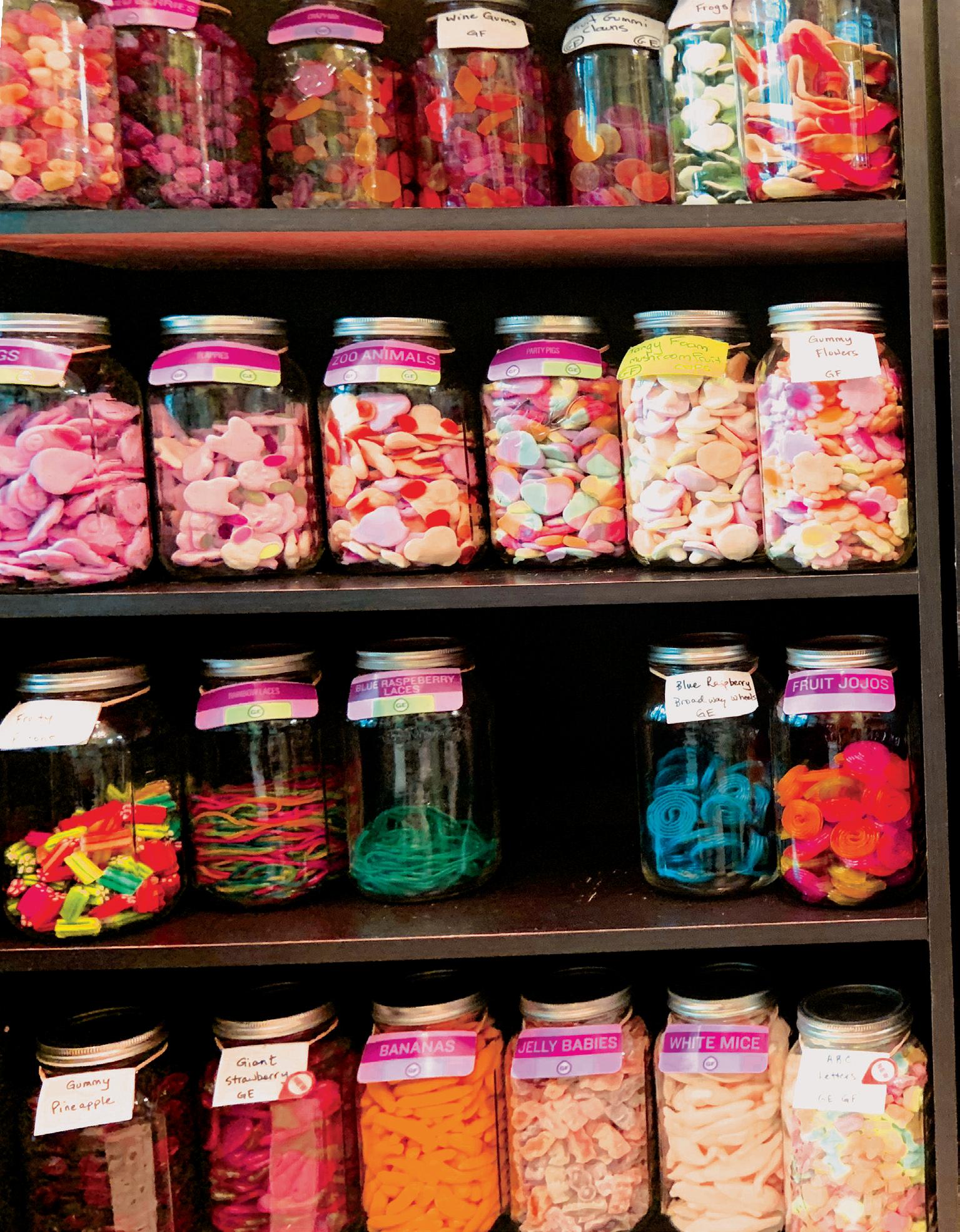
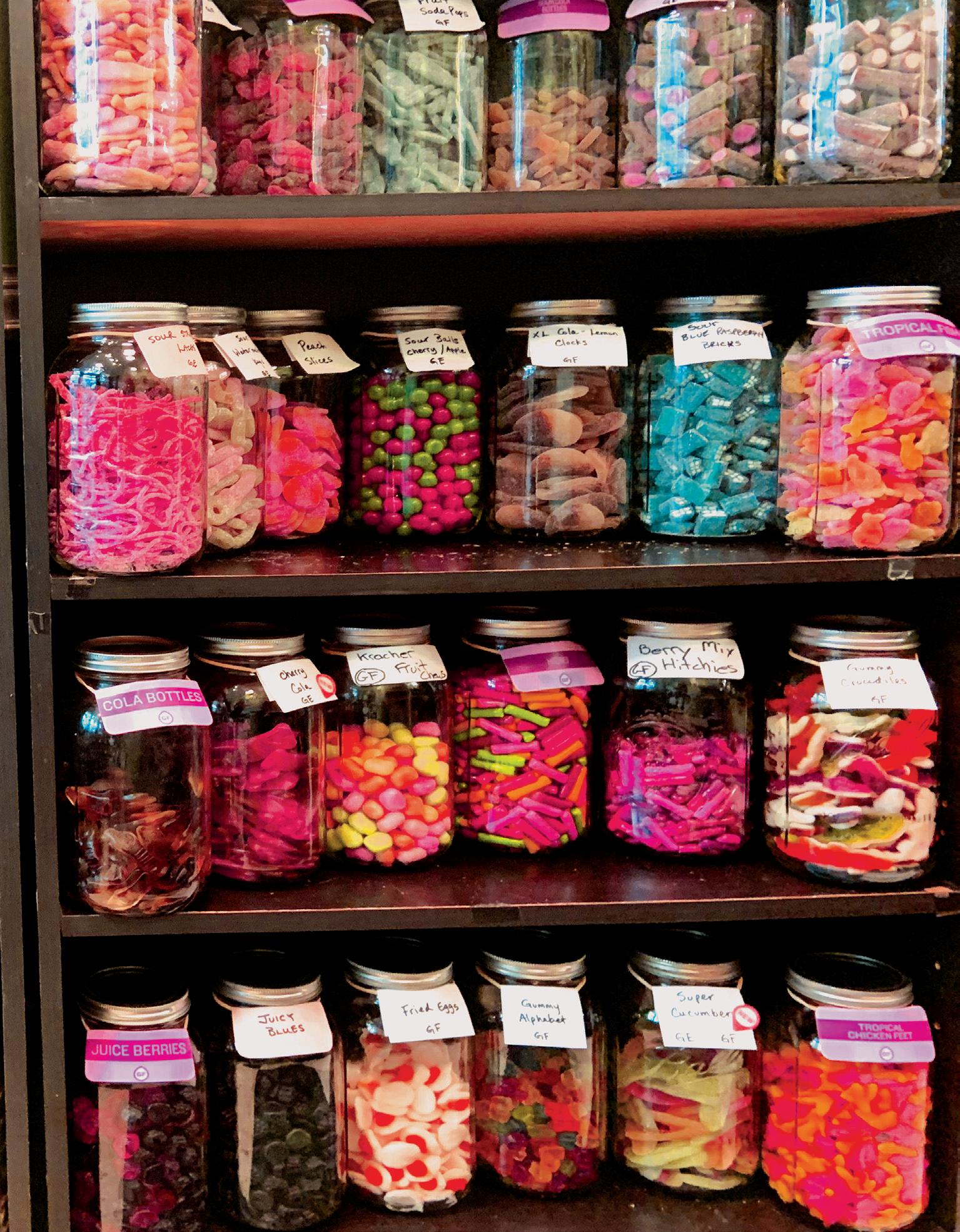
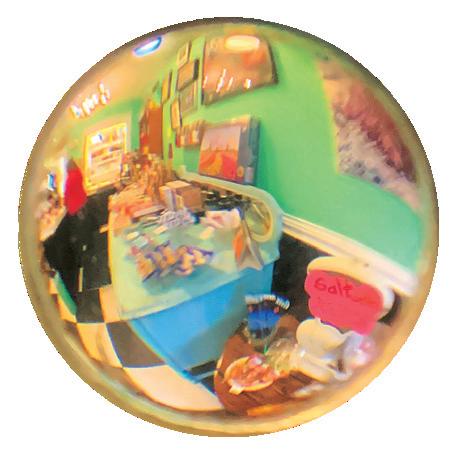
When first entering the Licorice Parlour on Commercial Drive, patrons are greeted with pastel colours, nostalgia and an all-encompassing warmth. The walls are enticingly lined with mason jars full of different licorice, chocolates and gummies. A bluetooth speaker plays calming, intimate alt-folk music, for example, Iron & Wine’s cover of the Postal Service’s “Such Great Heights.” Decorating the entrance are viewfinders, pogo sticks, doubledutch skipropes and other memorabilia from the analog era of Dunsdon’s upbringing. This is by design, not just as a way to showcase her own beloved collectibles, but as a way to spread joy among the parents of children that come in.
“Children don't have memories; children are making memories. So, the parent gets the joy,” she remarks.
Before she ran the Licorice Parlour, Dunsdon fought for marijuana legalization like her life depended on it; possibly because it did. “I had three provincial trials and three provincial acquittals. Like, it took a hat trick. But, that could have ruined my whole life. That would have made me a criminal.

Look at me. I'm, like, the biggest criminal,” she says sarcastically, not five minutes after brightening the days of excited schoolchildren looking to buy candy.
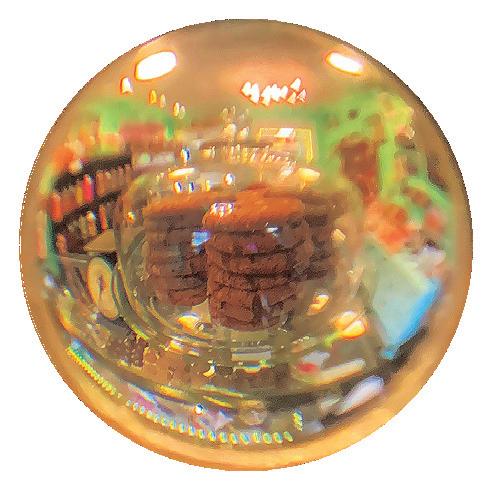
One of the unique markers of the Licorice Parlour is Dunsdon’s rejection of anything highly processed or synthetic. The Licorice Parlour may serve many different candies, but the selection is carefully crafted. Patrons won’t find any factory-manufactured, corn syrup-based or artificially-dyed candies at the Licorice Parlour. The flavours of the candy taste natural and vibrant, not at all the blandly sweet, chemical-like flavour of candy made by massive companies. Even the licorice–—a treat many people assume they don’t like—is delicious.
“European licorice is a superior product. So, a lot of people think they don't like licorice because they've only ever had North American licorice,” Dunsdon explains, “Once you have good licorice, I find that usually maybe one in five people who say they don't like licorice actually don't like licorice.”
While she may have been a candidate for change in the past, Dunsdon says her days of running for office are over. She further explains her change of heart by saying, “I'm really somebody who wants to maximize my happiness. Like, I’m a stand-up comic. I worked on a nude beach. I own a candy store. Being a city councillor would have brought my joy factor down. And, that would have been okay,” she reflects, “I would happily lose a little joy to try to fix some things for my fellow citizens. But, I don't think I could.”
Dunsdon’s love for her community is palpable, and extends from running the Licorice Parlour into inevitable criticisms of local government. As a small business owner in Vancouver with a storied history of politically involved activism and advocacy, her perspective is one of note. One of her qualms nowadays is the falsehoods presented to the public about recycling. “They have this whole insulting recycling system. But then, they don't actually recycle half of it. It goes to the incinerator,” she says, alluding to the many anti-plastic advocates who have pointed out that the notion of plastic recycling is simple greenwashing designed to pacify the environmentally concerned public.
As a comedian, Dunsdon has opened for heavy hitters in the comedy world, such as Sarah Silverman, Zach Galifianakis, Tig Notaro, Scott Thompson and Janeane Garofalo. On top of this, she has emceed many events, including the Cannabis Cup, a mass gathering of marijuana enthusiasts from around the world in Amsterdam who rank and judge different cannabis strains.
As a nudist, Dunsdon spent many of her formative years at Wreck Beach in Vancouver. For those who have never been to Wreck, Dunsdon offers a completed, nuanced view on the nudist lifestyle. She explains that in truth, the mantra of nudism has nothing to do with sex or with how you look; it’s all about the acceptance of yourself and your own body. “Wreck Beach is really about radical body acceptance,” Dunsdon offers her perspective, going on to say, “You're there to accept your own body. You're not there to accept other bodies.” As per Dunsdon’s explanation, nudism is a way to get outside of your own head and learn to embody yourself.
“Anybody can be [a nudist],” she says, “Any race, any religion. The only thing you can't be is with your clothes on.”
The popularity of nude beaches has gone down significantly since its heyday, and Dunsdon offers a reasonably simple explanation. “Camera phones really ruined it,” she says, “Back in the day, you were not allowed a phone or a picture. And, if you did take a picture, it was under express consent and you had to give them that photo.” Dunsdon shows a photograph of a Wreck Beach nudist gathering from back in the day, saying, “This is 1993. This is when I showed up.” She points out that there was “lots of bush, which doesn't happen anymore.” She asks, “Bush is out, right?”
The image portrayed a crowd of people, entirely naked, all smiling, happy and accepting. There was a profound wholesomeness to the image, entirely divorced from sexuality and rooted in joy. “I love that there, because it's a whole bunch of naked people not acting sexy,” she offers, “When you remove all those clothes, you remove all the stigmas, you remove all the social hierarchies, you remove all those things, right? So, that's something really wonderful at the beach. You don't know how rich or poor somebody is, right? Everyone's just themselves.”
As a person, Dunsdon is similar in personality to the candies she sells in her store; although some aspects may be an acquired taste, there’s an undeniable vibrancy to her. It’s possible that nudism, marijuana and licorice aren’t for everyone,
but—for those that give it a chance—one may find themselves uplifted in a way they hadn’t previously considered possible. If you have the opportunity, or if you find yourself in the neighbourhood, visit the Licorice Parlour on Commercial Drive or Granville Island to try some candy that certainly won’t disappoint.










METRO VANCOUVER UNITED FOR PALESTINE - MVUP WEEKLY RALLY
@mvupalestine
Rally Every Saturday: Vancouver Art Gallery (Georgia St Side) @ 12-4PM
- DEC 6th
- DEC 13th
- DEC 20th
- DEC 27th
FALL 2025 WRITING CONTEST:
@thecapilanoreview.com
The Capilano Review is pleased to invite submissions to our Fall 2025 Writing Contest, “Connective | Uncontainable,” guest-judged by Hari Alluri. Submissions are open NOV 11th – DEC 12th
KILLING TWINS W/ HEATHANZ
SINZ, ASHENPALL, & CAERRIAN
@takeurtimeback
Death Thrash from Metro Vancouver
All ages welcome! 20$, 648 Kingsway DEC 13th @ 6PM
ATHOS & VALLEY DOLLS
@takeurtimeback
VANKOUVER NEODADAIST DIGITAL HARDCORE
15 ADV, 20$/PWYC, 648 Kingsway DEC 14th @ 7PM






BLUESHORE @CAPU: @blueshoreatcapu
All Shows @ 7:30 - 9:30pm
$22 Student/ $37 Adult
- Chris Smither and the Motivators
DEC 3rd, - Chris Pierce
DEC 7th
- Winter Morning Walks: musica intima & Triology
DEC 12th
- Winter Harp
DEC 18th-19th
HOLIDAY MARKETS:
- Vancouver Christmas Market
@ Jack Poole Plaza
NOV 13th - DEC 24th
-stɑləw Christmas Craft Market
@ Museum of Surrey
DEC 7th, 10-4pm
-Make it! Craft Show
@ The PNE Forum DEC 7th -11th
-Toque Craft Fair
@ Western Front, 303 E 8th Ave
DEC 5th -7th
- Shipyards Christmas Market
@ Lonsdale Shipyards, NOV 28th - DEC 24th
- 22nd Tsleil-Waututh Nation Christmas Craft Fair
@ The Tsleil-Waututh Nation Community Centre
DEC 7th - DEC 8th












CAPILANO UNIVERSITY is located on the traditional unceded territories of the LíỈwat, xʷməθkʷəỷəm (Musqueam), shíshálh (Sechelt), Sḵwxwú7mesh (Squamish) and SəỈílwətaʔ/Selilwitulh (Tsleil-Waututh) Nations.
We recognize our presence here as guests on this sacred land and deeply appreciate the privilege to work, study, and reside in this remarkable place. The Capilano Courier acknowledges that this gesture is just a starting point on the path to reconciliation, and we are committed to amplifying Indigenous voices and sharing their stories.
THE CAPILANO COURIER is an autonomous, democratically-run student newspaper that encourages literary and visual submissions. However, all submissions undergo editing for brevity, taste, and legality. We are committed to not publishing material that the collective deems as promoting sexism, racism, or homophobia. The views expressed by the contributing writers are not necessarily those of the Capilano Courier publishing society.
Additionally, we prioritize a human-centered approach to content creation and do not support the use of AI in our editorial processes. We believe in the value of human perspectives and storytelling in our publication.