FIRST CANADIAN BATTLE

N Exclusive savings for Legion members on phone plans, smartphones, and tablets.
N Canada’s largest and most reliable 5G+ network.*
N Wide selection of devices and plans that include free features like unlimited international messaging and Spam Call Detect.
Unlimited Canada-wide Talk and Text with 10GB1
Unlimited Canada-wide Talk and Text with 50GB1 for only for only $29/mo. 2 $35/mo.
with Auto-Pay3 when you bring your own device. Plan includes data and unlimited talk and text in Canada.4
with Auto-Pay3 when you bring your own device. Plan includes data and unlimited talk and text in Canada.4


LEVY’S GAMBLE
A British-Canadian soldier risks it all in the Battle of Kapyong By Alex Bowers
LOVELY WAR
Canada invaded Iceland
Alex Bowers
In the aftermath of one world war with a second in the offing, Canadians were confronted with a range of opinions
J.L. Granatstein
INVASION PLANS
Post First World War, both Canada and the U.S. devised plans to attack each other By David
Pugliese
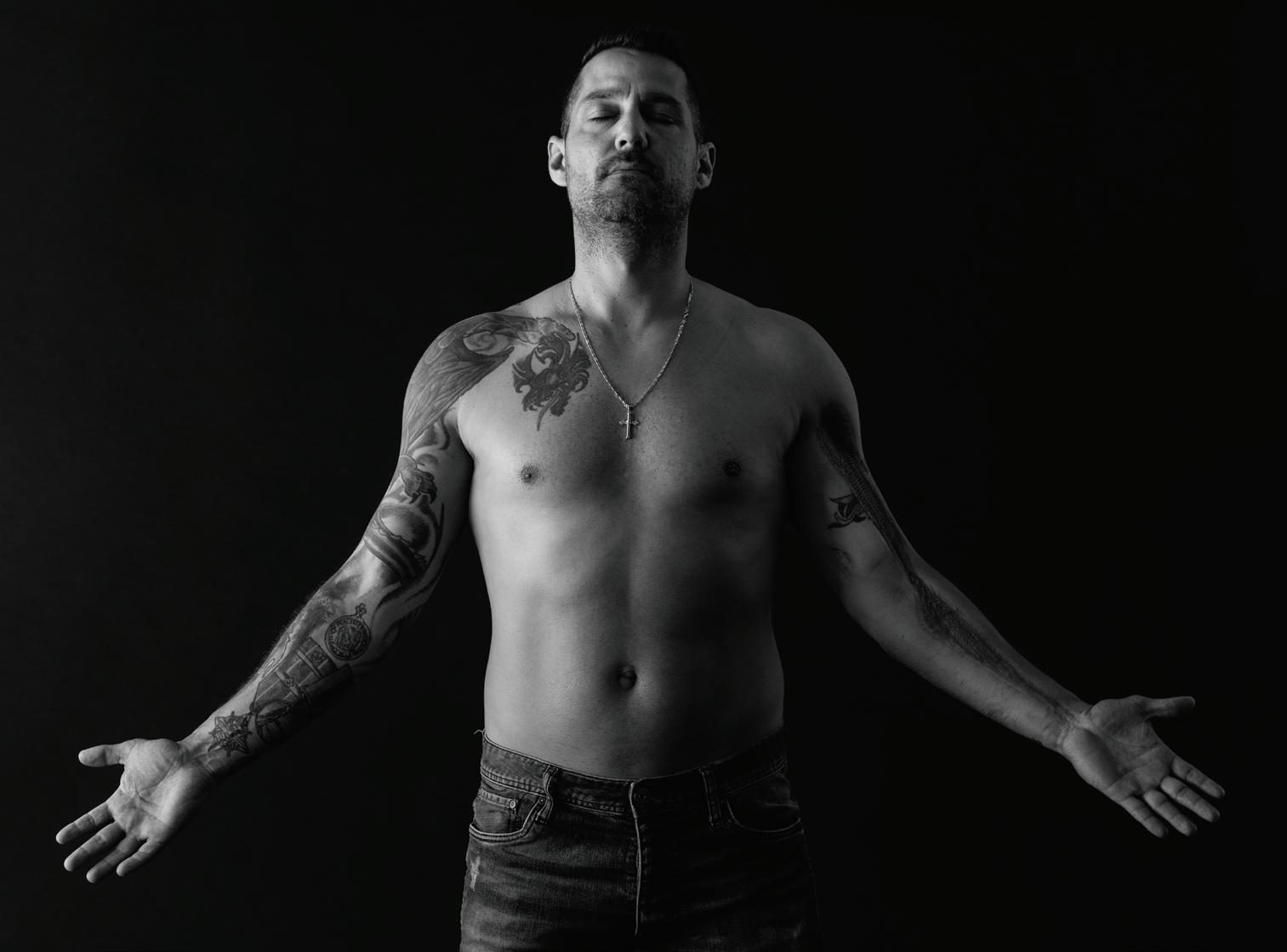
Corporal Gorden Boivin of Royal 22e Régiment nearly lost his left arm in a rocket-propelled grenade explosion during a Taliban attack on a forward operating base in Afghanistan in 2008.
Stephen J. Thorne
STUDENT OF THE CRAFT
A tribute to the photography of Stephen J. Thorne
After British tunnellers blasted mines in the St. Eloi area, the Canadian Corps fought hopelessly to hold the devastated landscape By Mark Zuehlke
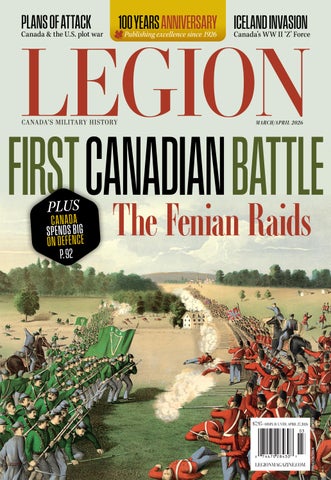
THE LAST INVASION Cover story
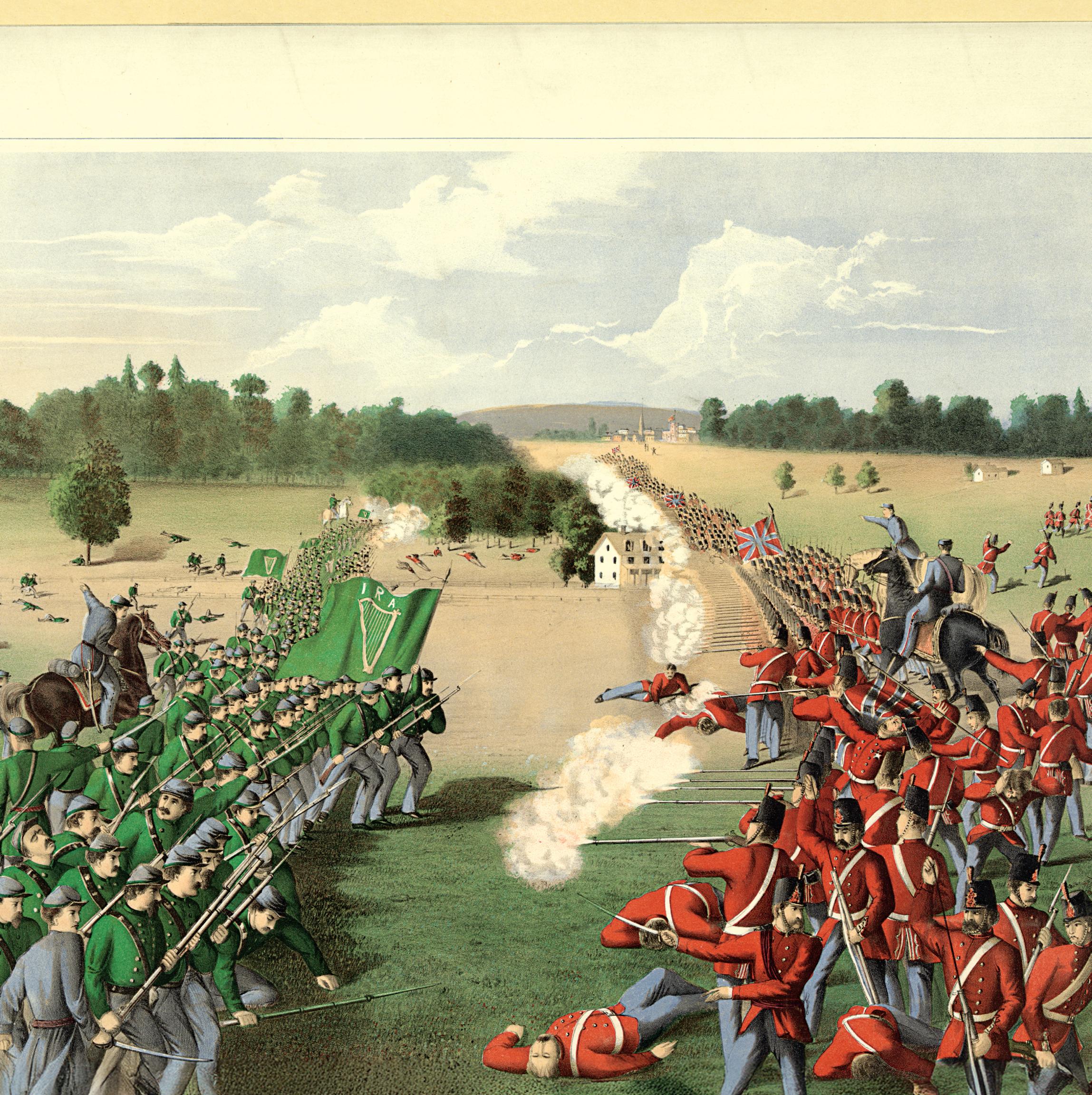
Between 1866 and 1871, Irish-American insurgents known as Fenians raided Canada from the U.S. in support of Ireland’s independence from Britain By Serge Durflinger
101, No. 2 | MARCH / APRIL 2026
BOARD CHAIR Sharon McKeown BOARD VICE-CHAIR Berkley Lawrence BOARD SECRETARY Bill Chafe
DIRECTORS Steven Clark, Dermod Coombs, Randy Hayley, Trevor Jenvenne, Bruce Julian, Valerie MacGregor, Jack MacIsaac Legion Magazine is published by Canvet Publications Ltd.
ADMINISTRATION MANAGER
Stephanie Gorin (on leave)
SALES/ADMINISTRATIVE
ASSISTANT
Lisa McCoy
ADMINISTRATIVE ASSISTANTS
Chantal Horan
Veronika Hughes
ADMINISTRATIVE AND EDITORIAL
CONTENT CO-ORDINATOR
Matthew Ryan
GENERAL MANAGER Jason Duprau
EDITOR
Aaron Kylie
SENIOR EDITOR
Michela Rosano
STAFF WRITER
Alex Bowers
ART DIRECTOR, CIRCULATION AND PRODUCTION MANAGER
Jennifer McGill
SENIOR DESIGNER AND PRODUCTION CO-ORDINATOR
Derryn Allebone
SENIOR DESIGNER
Sophie Jalbert DESIGNER
Serena Masonde
CANIK MARKETING SERVICES
Nik Reitz advertising@legionmagazine.com
Marlene Mignardi marlenemignardi@gmail.com Or call 613-591-0116 for more information
SENIOR DESIGNER AND MARKETING CO-ORDINATOR
Diana Coote
WEB DESIGNER AND SOCIAL MEDIA CO-ORDINATOR
Ankush Katoch
Published six times per year, January/February, March/April, May/June, July/August, September/October and November/December. Copyright Canvet Publications Ltd. 2026. ISSN 1209-4331
Legion Magazine is $13.11 per year ($26.23 for two years and $39.34 for three years); prices include GST. For addresses in NS, NB, NL, PE a subscription is $14.36 for one year ($28.73 for two years and $43.09 for three years). For addresses in ON a subscription is $14.11 for one year ($28.23 for two years and $42.34 for three years).
To purchase a magazine subscription visit www.legionmagazine.com or contact Legion Magazine Subscription Dept., 86 Aird Place, Kanata, ON K2L 0A1 Call 613-591-0116 or toll-free 1-844-602-5737.
The single copy price is $7.95 plus applicable taxes, shipping and handling.
Send new address and current address label, or, send new address and old address. Send to: Legion Magazine Subscription Department, 86 Aird Place, Kanata, ON K2L 0A1. Or visit www.legionmagazine.com/change-of-address. Allow eight weeks.
Opinions expressed are those of the writers. Unless otherwise explicitly stated, articles do not imply endorsement of any product or service. The advertisement of any product or service does not indicate approval by the publisher unless so stated. Reproduction or recreation, in whole or in part, in any form or media, is strictly forbidden and is a violation of copyright. Reprint only with written permission.
PUBLICATIONS MAIL AGREEMENT NO. 40063864
Return undeliverable Canadian addresses to Legion Magazine Subscription Department 86 Aird Place, Kanata, ON K2L 0A1 | magazine@legion.ca
United States: Legion Magazine, USPS 000-117, ISSN 1209-4331, published six times per year (January/February, March/April, May/June, July/August, September/October, November/December). Published by Canvet Publications, 866 Humboldt Pkwy., Buffalo, NY 14211-1218. Periodicals postage paid at Buffalo, NY. The annual subscription rate is $12.49 Cdn. The single copy price is $7.95 Cdn. plus shipping and handling. Circulation records are maintained at Adrienne and Associates, 866 Humboldt Pkwy., Buffalo, NY 14211-1218. U.S. Postmasters send covers only and address changes to Legion Magazine, PO Box 55, Niagara Falls, NY 14304.
Member of Alliance for Audited Media and BPA Worldwide. Printed in Canada.
We acknowledge the financial support of the Government of Canada. Version française disponible. From time to time, we share our direct subscriber list with select, reputable companies whose products or services we believe may interest our subscribers. To opt out of receiving these offers, please send your request, including your full name and address, to magazine@legion.ca. Alternatively, you can write to Legion Magazine, 86 Aird Place, Kanata ON K2L 0A1, call 613-591-0116, or call toll-free 1-844-602-5737.
We begin by acknowledging that the land on which we gather is the traditional, unceded territory of the Anishinaabe Algonquin Peoples, who have been guardians of, and in relationship with, these lands since time immemorial. We further acknowledge and recognize that our work reaches across all First Nations territories, Métis Homelands and Inuit Nunangat.
hen the military makes mistakes, it can be catastrophic. So you want to have more overseers, not less,” Stephen M. Saideman, an international relations professor at Carleton University in Ottawa, told The Canadian Press late last year.
Saideman, along with fellow academics David P. Auerswald and Philippe Lagassé, co-authored the new book Overseen or Overlooked? Legislators, Armed Forces, and Democratic Accountability, which argues that Canada has a relatively low level of civilian oversight of its military.
Indeed, during the 10-year study conducted by the three defence experts that underpins the work, one member of the standing committee on national defence told the authors he didn’t know the rules of engagement for Canada’s 2007 mission in Afghanistan because he didn’t hold the necessary security clearance.
That’s a problem. More so given the current government’s plan to increase defence spending to $150 billion by 2035 and considering the recent sexual misconduct scandal that resulted in more than a dozen senior military officials being sidelined, investigated or forced to retire. There’s clear evidence Canada hasn’t been doing a good enough job monitoring its military.
The book compares the military oversight in several other western countries, from Belgium, Finland and Germany to Japan, Sweden and the U.S. Notably, it measured Canada’s commitment against democracies with similar parliamentary systems.
“We found out that the British and the Australians actually take this stuff much more seriously than we do,” Saideman told CP. Instead, Canada’s on par with Japan, Chile and Brazil as “democracies with the most irrelevant legislatures for their civil-military relations.”
That must change.
The U.S. and Germany have the highest levels of civilian oversight of their militaries, the book says. Germany’s
defence committee can review classified documents, approve deployments and initiate inquiries. Parliament has the same powers but rarely uses them. And even when it does, politics often interfere.
Case in point: during the war in Afghanistan, the minority Parliament received classified material about the treatment of detainees. “Ultimately, the fight became about the (disclosure of documents), rather than actually, are we fighting the war right, or is the military behaving well in Afghanistan,” said Saideman.
The British and the Australians take this stuff much more seriously.
He and his colleagues note, too, that many MPs avoid obtaining security clearances as doing so is counter to their immediate political interests. Notably, Conservative leader Pierre Poilievre has refused the parliamentary privilege, indicating, a spokesperson said, that it would rend him “unable to effectively use any relevant information he received.”
That position seemingly defies common sense. Take a Belgian example. In 2016, Russia accused the Belgian air force of killing civilians in Syria. Belgium’s military operations committee examined evidence provided by the military and determined the allegation was baseless. No political infighting and no inquiry necessary as committee members can review classified info.
Politics aside, it’s frightening to think that Canadian legislators are, as the book’s authors put it: “distracted, disinterested or underpowered” when it comes to military oversight.
“War is too important to be left to the generals,” goes the loosely translated quote from First World War-era French statesman Georges Clemenceau, a principal architect of the Treaty of Versailles. More than a century later, Canadians would do well to heed those words.
Victoria-based Mark Zuehlke is an awardwinning author, and military historian, and a regular contributor to Legion Magazine. In 2024, he was appointed a member of the Order of Canada in recognition of his contributions to Canadian history, particularly as it relates to the country’s military heritage.
A former national security analyst and policy advisor for the federal government, Dennis Molinaro is an author, frequent media commentator and academic specializing in the history of security, counter-intelligence and foreign interference.
Serge Durflinger is a professor of history at the University of Ottawa and author of several books, including Fighting from Home: The Second World War in Verdun, Quebec and Veterans with a Vision. His work focuses on the Canadian forces, the history of veterans, and the impact of war on ordinary Canadians.
Award-winning journalist David Pugliese has been covering the Canadian Armed Forces and military issues in Canada for the past 40 years. He has contributed to numerous Canadian and American publications and is currently on staff at the Ottawa Citizen He is the author of two books on special forces.


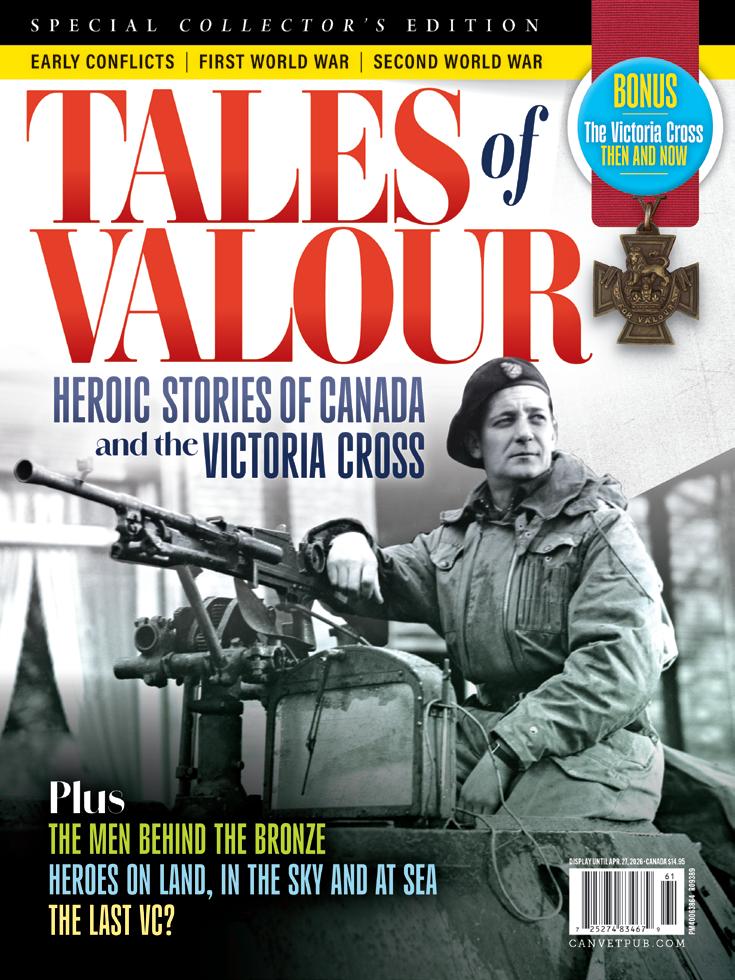
Heroic stories of Canada and
Separating myth from man is difficult to do. Never is that truer than among those who have earned the Victoria Cross, the Commonwealth’s highest military medal, in the face of immense odds. Of some 1,358 Victoria Crosses awarded, nearly 100 Canadians have received the distinguished honour. This special issue highlights the incredible tales of select Canadians who displayed valour in the presence of the enemy, revealing their stories, their legacies, and their humanity. Now available on newsstands across Canada!



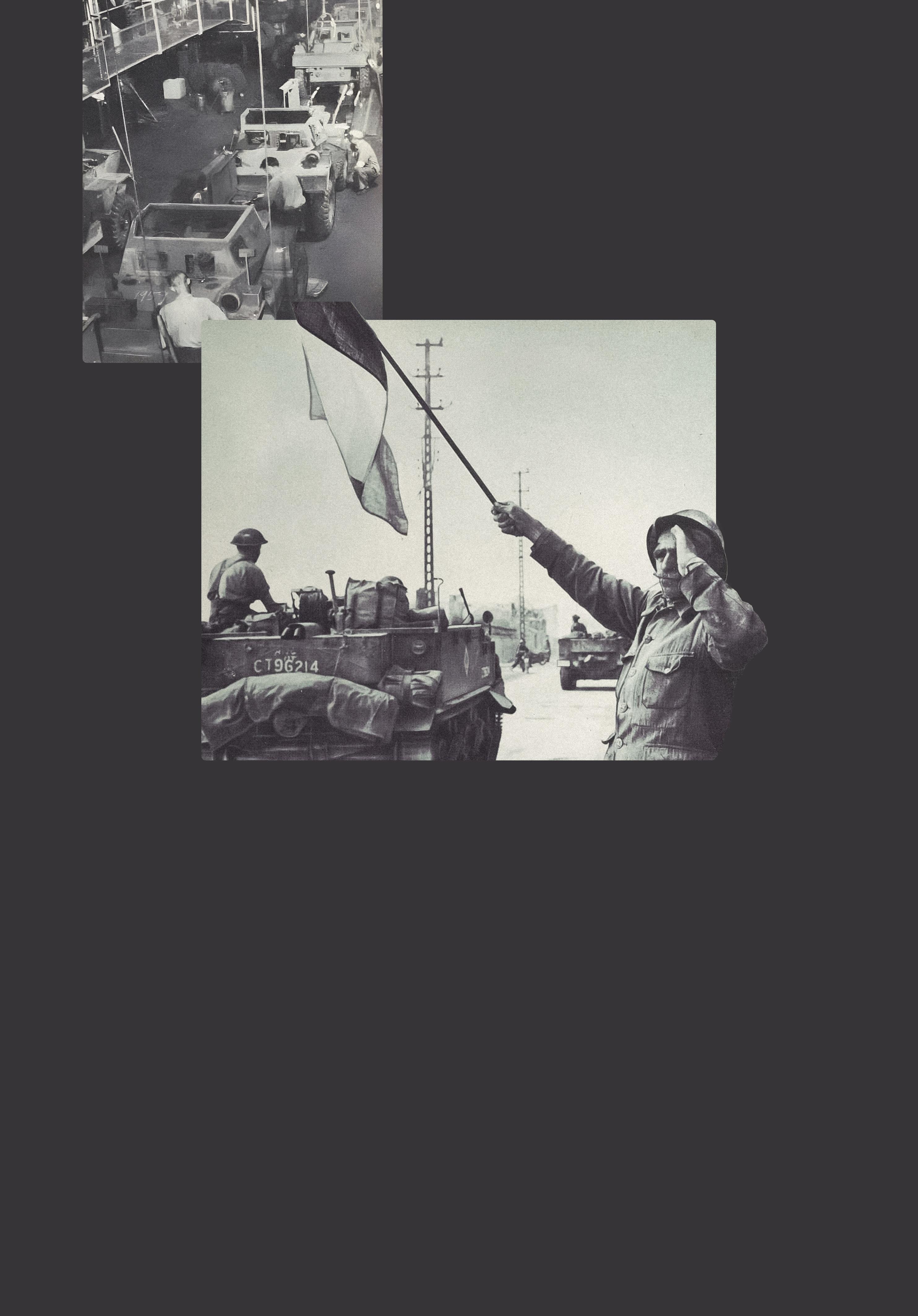
During the Second World War, over 335,000 military vehicles were built by the Ford workforce for our Canadian troops fighting on the front lines. We proudly honour all those who served both at home and abroad, as we mark our 100th Anniversary.
Recent articles concerning the Canadian Armed Forces’ potential equipment procurements (including “New world order,” November/ December 2025) have caused much concern for me. During the last election campaign and numerous times since, Prime Minister Mark Carney and other members of the government repeatedly stated that their aim, intention and mandate is to broaden and diversify future procurements by increasing Canadian military industrial manufacturing capabilities and/or working with other allied countries. But, based on recent media reports, it appears the Defence Department, the CAF, Public Services and Procurement Canada and the new Defence Investment Agency, have ignored and/or defied the government. Contracts for the new artillery systems, fighter jets, destroyers and night-vision equipment are all being steered to U.S. technology and manufacturers even though there are equivalents available from Canadian or other allied sources. This is especially galling to proud Canadians when the U.S. insists on total control of the technology, manufacturing and future
upgrades of its equipment, while other countries are perfectly happy to share technology and transfer it to Canada so the country can retain control over its equipment.
J.A. Summerfield Winchester, Ont.
David Bercuson’s article “Breaking Bad” (Eye on Defence, November/December 2025) raises legitimate concerns about misconduct in the Canadian Armed Forces, and no professional organization should ignore cases of racism, misogyny or extremism when they appear. These behaviours are unacceptable and must continue to be addressed through strong leadership, transparent investigations and appropriate consequences.
However, the article presents these incidents as reflective of the broader culture of the CAF, and that characterization is both inaccurate and deeply unfair to the tens of thousands of service members who uphold the highest standards of professionalism every day.
The CAF is one of the most diverse, disciplined and scrutinized institutions in Canada.
The overwhelming majority of its members serve their country with integrity, work in multicultural teams, respect its code of conduct and perform their duties in demanding environments where trust and co-operation are essential.
Highlighting the worst behaviour of a very small minority without acknowledging the dedication and conduct of the vast majority paints a misleading picture. Isolated incidents shouldn’t be used to define an entire institution or tarnish the reputations of thousands of men and women who serve honourably.
Constructive criticism is important, but so is balance. Addressing problems requires accuracy, context and fairness, not generalizations that risk damaging morale, recruitment and public trust. The CAF has real challenges, like any large organization, but reducing it to a narrative of pervasive racism and misogyny does a disservice to those who sacrifice for this country. Accountability matters. So does recognizing the professionalism and character of the many who uphold the values Canadians expect of their armed forces.
Michael Hill Kitchener, Ont.




Re “God rest ye weary gentlemen” (November/December 2025): There is mention of an unnamed non-commissioned officer of 17 Platoon. That was my uncle, Sergeant Lance Ross of The Royal Regiment of Canada. He was mentioned in dispatches twice. My uncle covered ‘D’ Company’s withdrawal with a Bren gun as he was the “better shot.”
Fortunately, Uncle Lance returned home to Gaspé, Que., though his wartime service helping to defend Hong Kong against great odds forever changed him. He was wounded in Hong Kong and survived nearly four years of slave labour and torture as a prisoner of war. Uncle Lance kept a diary during his time as a PoW to document the brutal realities of what transpired in the Japanese camps, and it was used at the war crimes trial. Stewart Ross Kingston, Ont.
Thank you for writing the obituary of historian Tim Cook (November/ December 2025). Tim was a good man and decent friend.
Mark Bourrie
Ottawa

Your September/October 2025 edition was fantastic. I read the article “Undying love” and was very moved at how well written and sombre it was. I was then
saddened to learn that its author Stephen J. Thorne had passed away just before Christmas (see “Front lines,” page 90 and “Student of the craft,” page 64). What a treasure we have lost. Thank you for the wonderful articles in each edition. Sarah Ross
Toronto
Submissions for this department can be sent to magazine@legion.ca. They should be constructive and of general interest. They may be edited for brevity and clarity. The views expressed are those of the correspondents and publication of them does not necessarily constitute an endorsement by Legion Magazine.
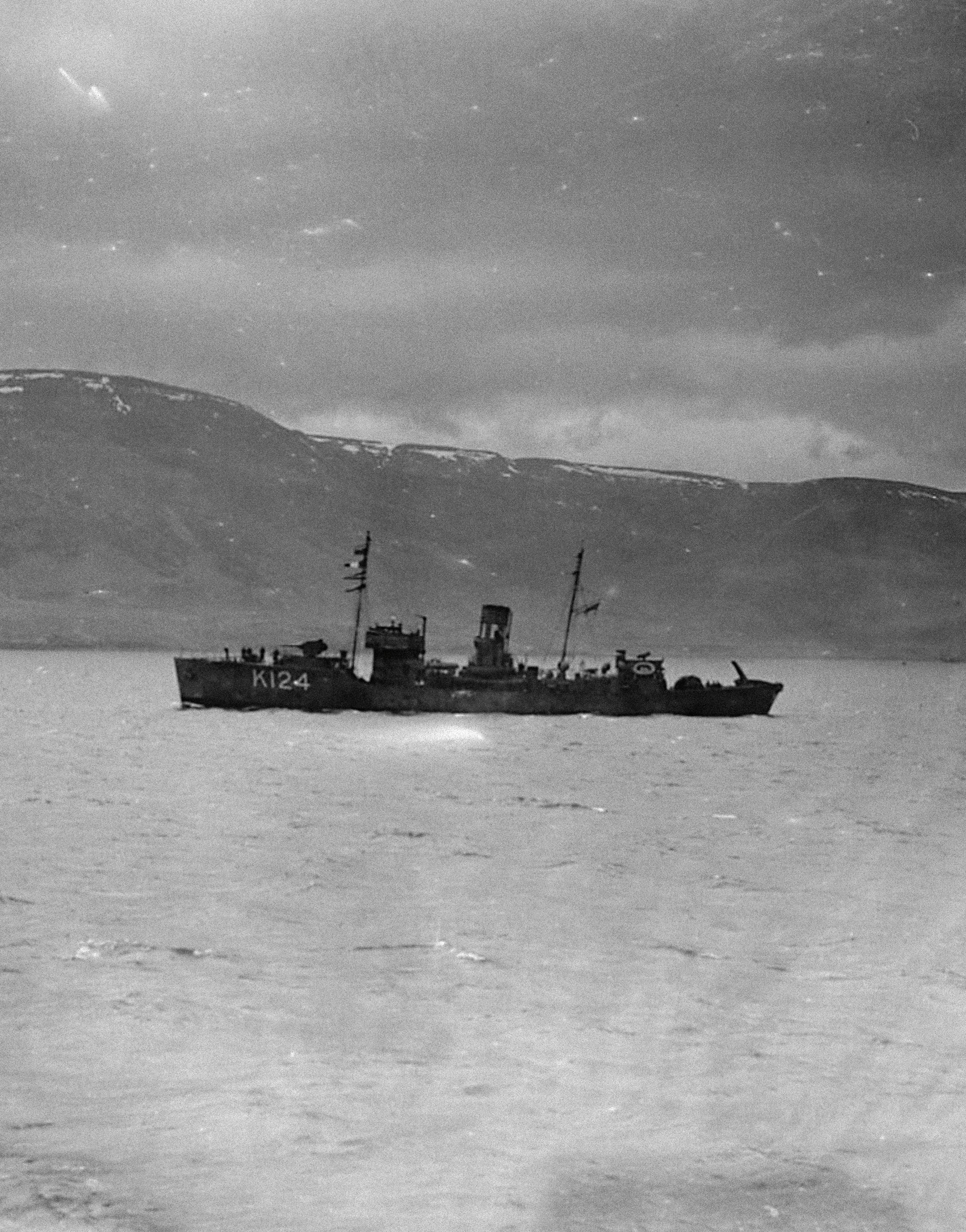
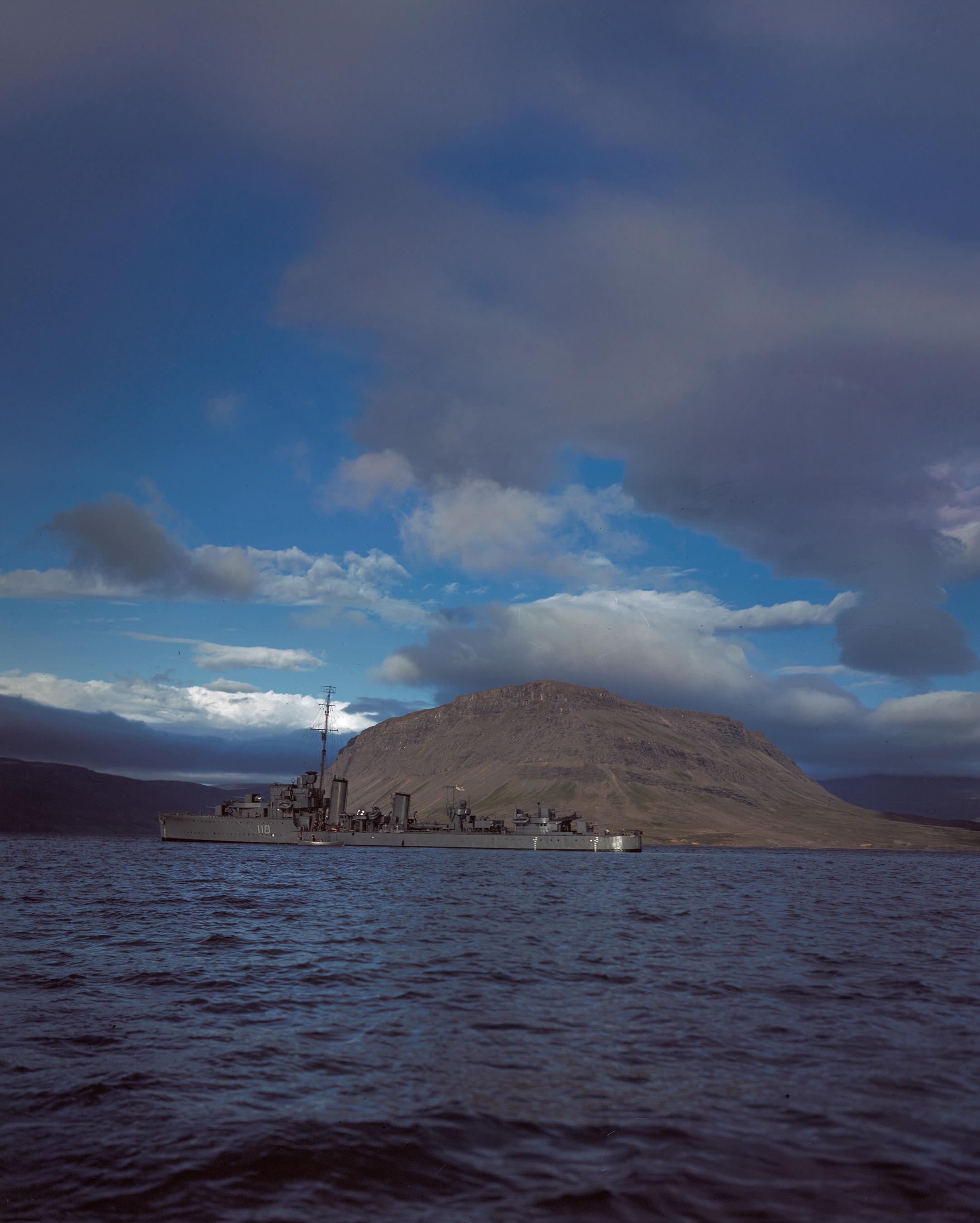
HMCS Cobalt departs the Icelandic port of Hvalfjörður on Nov. 16-17, 1941. The Royal Canadian Navy Flower-class corvette was part of Canada’s contribution of ships, aircraft and troops to the wartime Allied occupation of the island (see page 32).
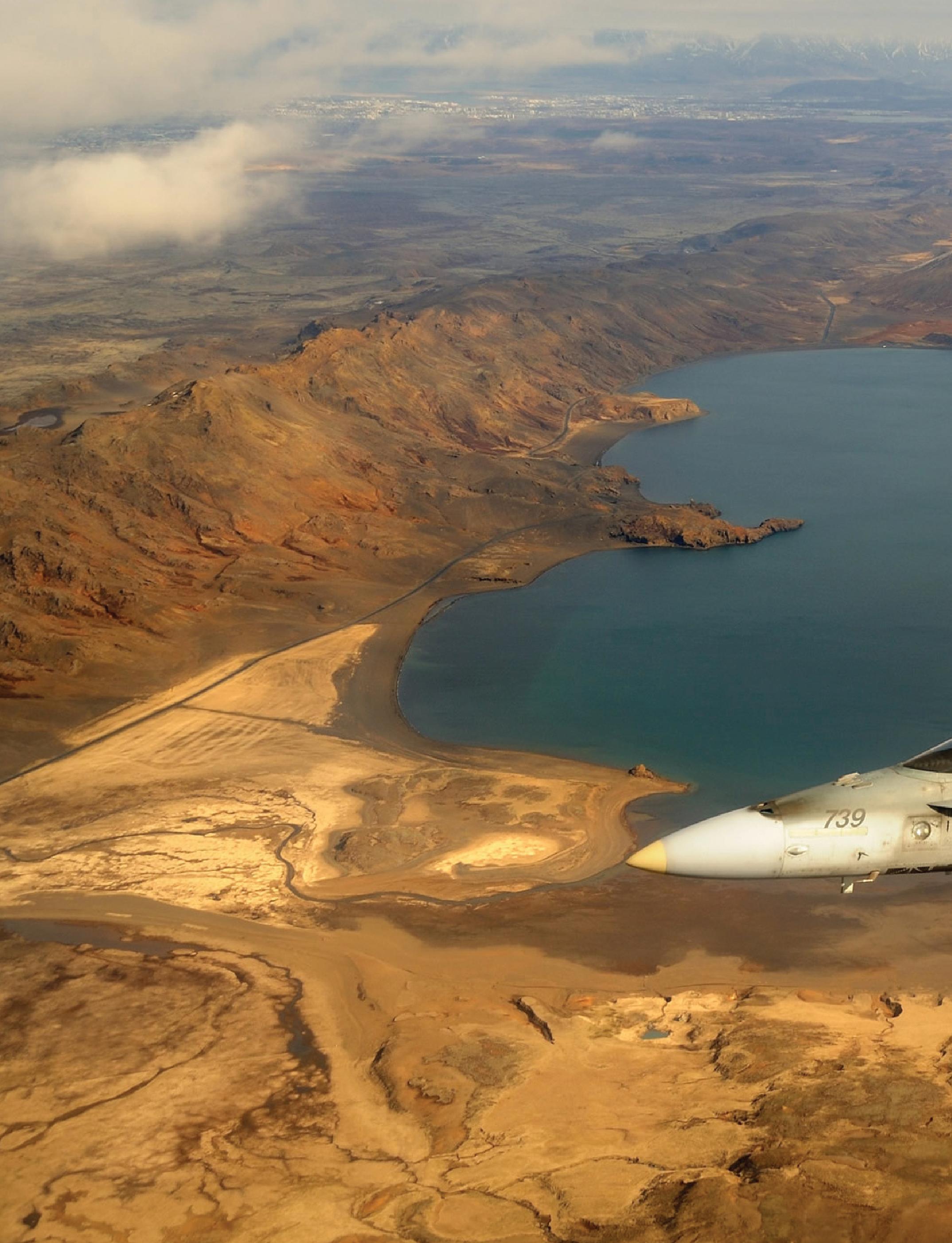
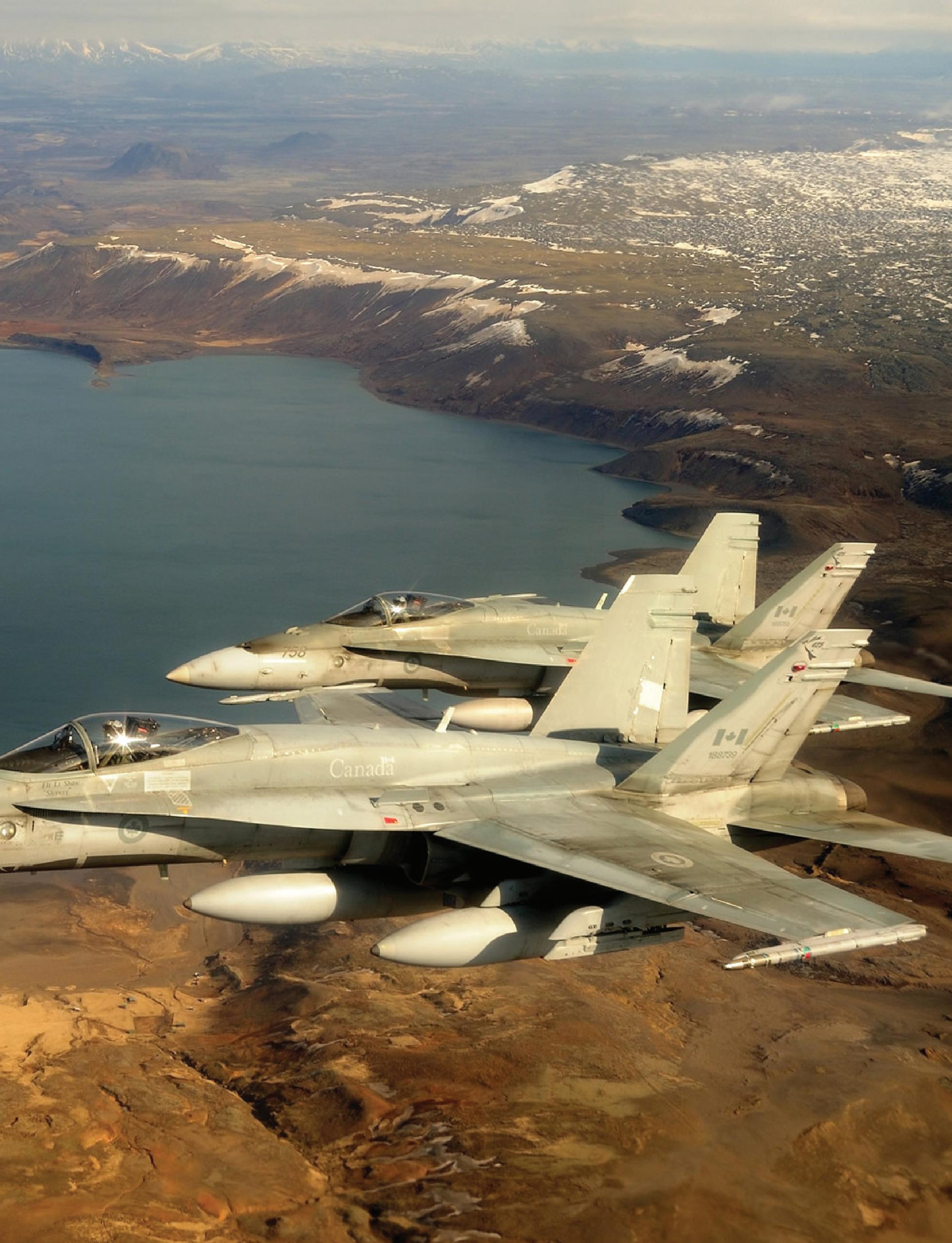
CF-18 jets fly over Iceland on April 5, 2013, during Operation Ignition, a NATO mission to monitor the country’s air space. Though Iceland is a founding member of NATO, it’s the only one without its own standing military.
By Alex Bowers
“We
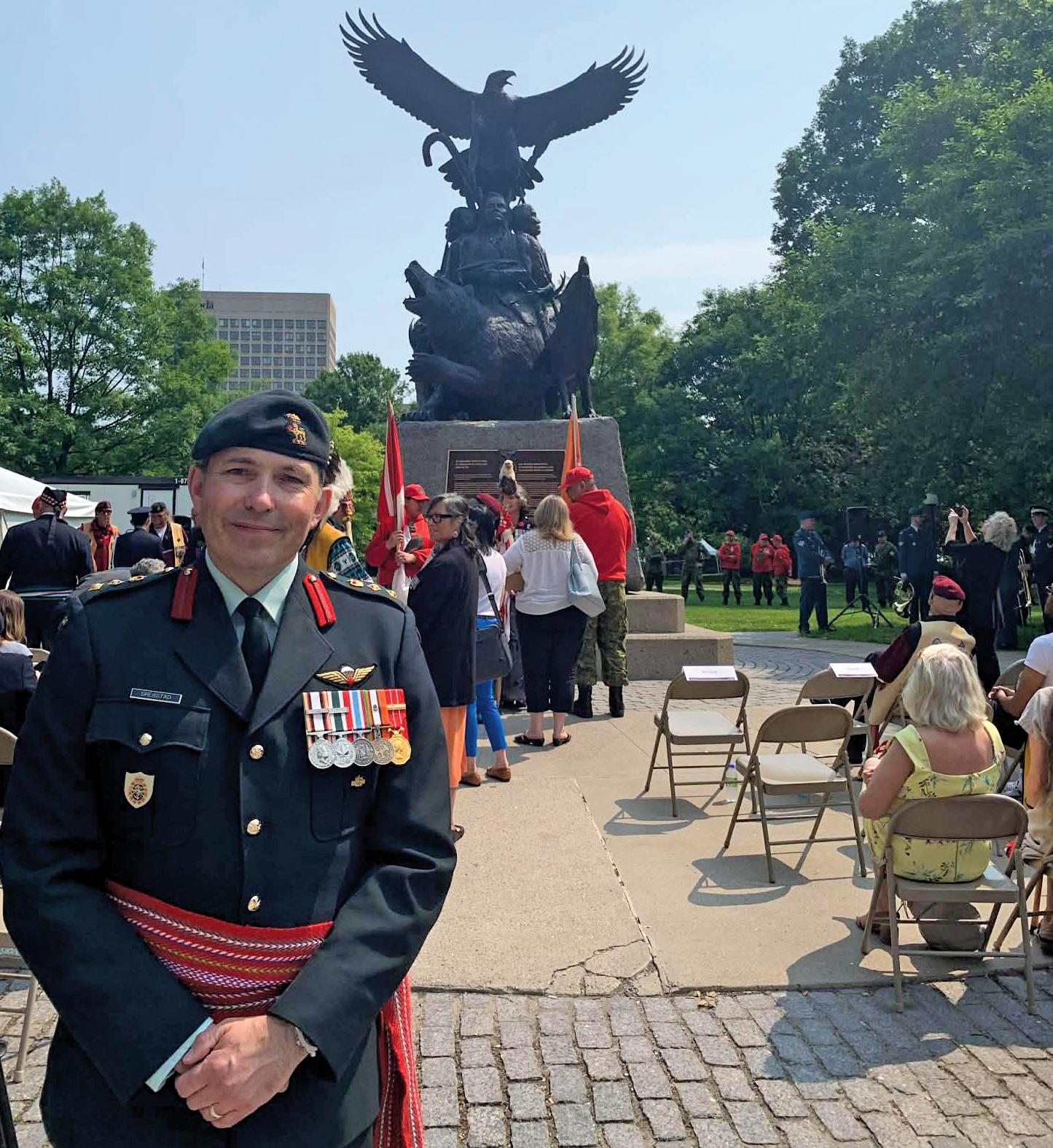
had to do better,” remarked Colonel David Grebstad regarding the services available to military personnel transitioning out of the Canadian Armed Forces, particularly ill and wounded members, after the war in Afghanistan. “We had to.”
The process took several years and several efforts to hone strategies that could help uniformed men and women preparing for Civvy Street, he said in a Legion Magazine exclusive. It was a process that culminated in establishing the Canadian Armed Forces Transition Group (CAF TG) in 2018, an organization that’s part of a broader effort to enhance care for veterans. The group became fully operational
two years ago in April 2024 and now hosts nine units and 26 centres across Canada.
Recognizing that transitioning back to civilian life is a major life change and can be a stressful experience, the group commits itself to professional, standardized and personalized support. Further, in recognizing that “transition does not automatically mean leaving the CAF,” its expert teams also facilitate career path changes within the military when applicable.
Grebstad, the group’s deputy commander, spoke about what’s on offer.
On the transition group’s general approach
The seven domains of wellbeing are something we’ve adopted in conjunction with
our colleagues at Veterans Affairs Canada. These seven domains are the following: purpose, finances, health, life skills, social interaction, housing and physical environment, and cultural and social environment. We focus on these because they’re key parts of any individual’s life. Whether in terms of comfort or success, it’s these aspects that enable an individual to thrive.
In the context of the CAF, whether it’s an older person who has done their time and wants to put their feet up, or someone who has served for 10 years and is looking for a new career, or sadly, a person who is ill or injured, we use the seven domains to gauge whether someone is well and truly set for success post transition. Of course, that’s a very individual experience depending on the person.
That’s where our teams at the transition units and transition centres have to get personal with the individual to ensure they have everything they require. We can offer a range of different services, including coaching, mentoring, guidance and more, and we do all that work in partnership with Veterans Affairs Canada.
On other services the group offers Obviously, we’re not trying to encourage people to leave the Canadian Forces, not least because that’s a personal decision made by these members and their families, but we do encourage them to consider life after service throughout their career in the military by attending what we call “my transition” seminars. They can speak
with people and seek advice while also doing a bit of horizon scanning early on.
In some cases, releasing members are eligible for vocational rehabilitation training. This is particularly important for a lot of people who may have learned skills over the course of their [military] career that aren’t necessarily translatable back in the civilian sector. So, for those who’ve decided they’re young enough and intend to do something else with their lives, our program is a chance at a career 2.0.
We have partnered with numerous organizations
that support transitioning women veterans. Meanwhile, for other equity-seeking groups, we’re always looking at ways to improve.
On what can be done for those feeling left behind What we’re trying to do is increase our co-ordination with Veterans Affairs to ensure transitions for former service members are as seamless as possible. The other element is that we’re a learning organization. Certainly, when someone has criticism or complaints, or really had a bad experience transitioning for some reason or another,
we’re here to support them and, where necessary, seek better ways to provide that support if mistakes were made, even if not by the CAF TG.
On the group’s future We’ve got a great team spread out across Canada. We’re doing excellent work. However, we’re always striving to improve. I think what we need to do better is getting the word out there. Even though we’ve been around for over 10 years in various forms, there are still people who don’t know what we do as a transition group, and I’m not just talking about young soldiers, but senior leaders as well. Beyond any religious connotations, we must spread the good news.
This interview has been edited for brevity and clarity.

2 March 2011
HMCS Charlottetown heads for Libya to evacuate Canadian citizens and provide humanitarian assistance.
6 March 1945
Operation Spring Awakening, the last major German offensive of the Second World War, begins.
7 March 1866
In anticipation of a St. Patrick’s Day attack by the Fenian Brotherhood, Canada West’s Minister of Militia and Defence John A. Macdonald puts 10,000 volunteer militia on alert.
11 March 1918
One of the first cases of Spanish influenza is diagnosed in Kansas. A deadly pandemic ensues, spreading across North America, to the front lines in Europe and around the world.
March 2014
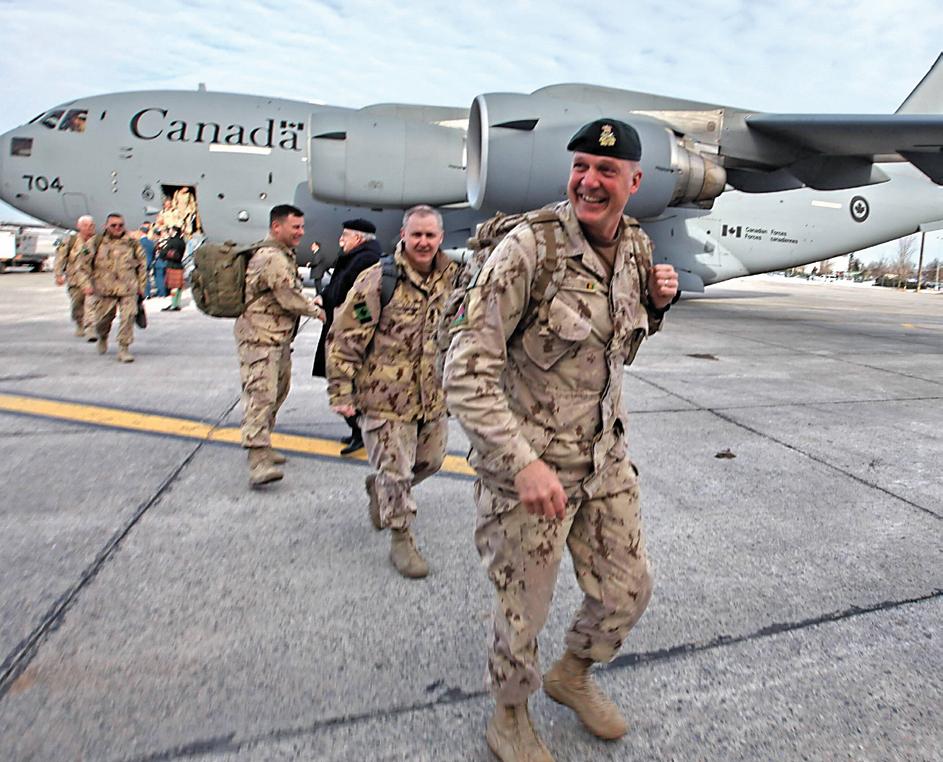
Canada’s military mission in Afghanistan ends.
March 1928
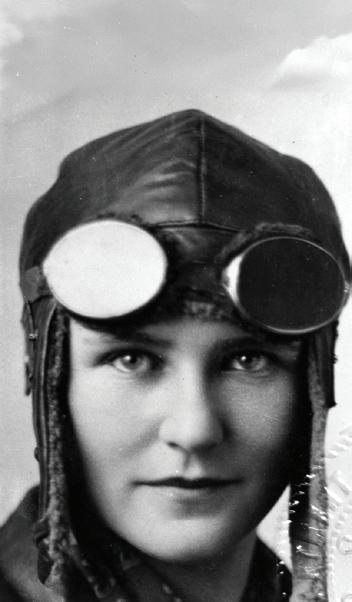
Eileen Vollick becomes Canada’s first licensed female pilot.
17 March 1900
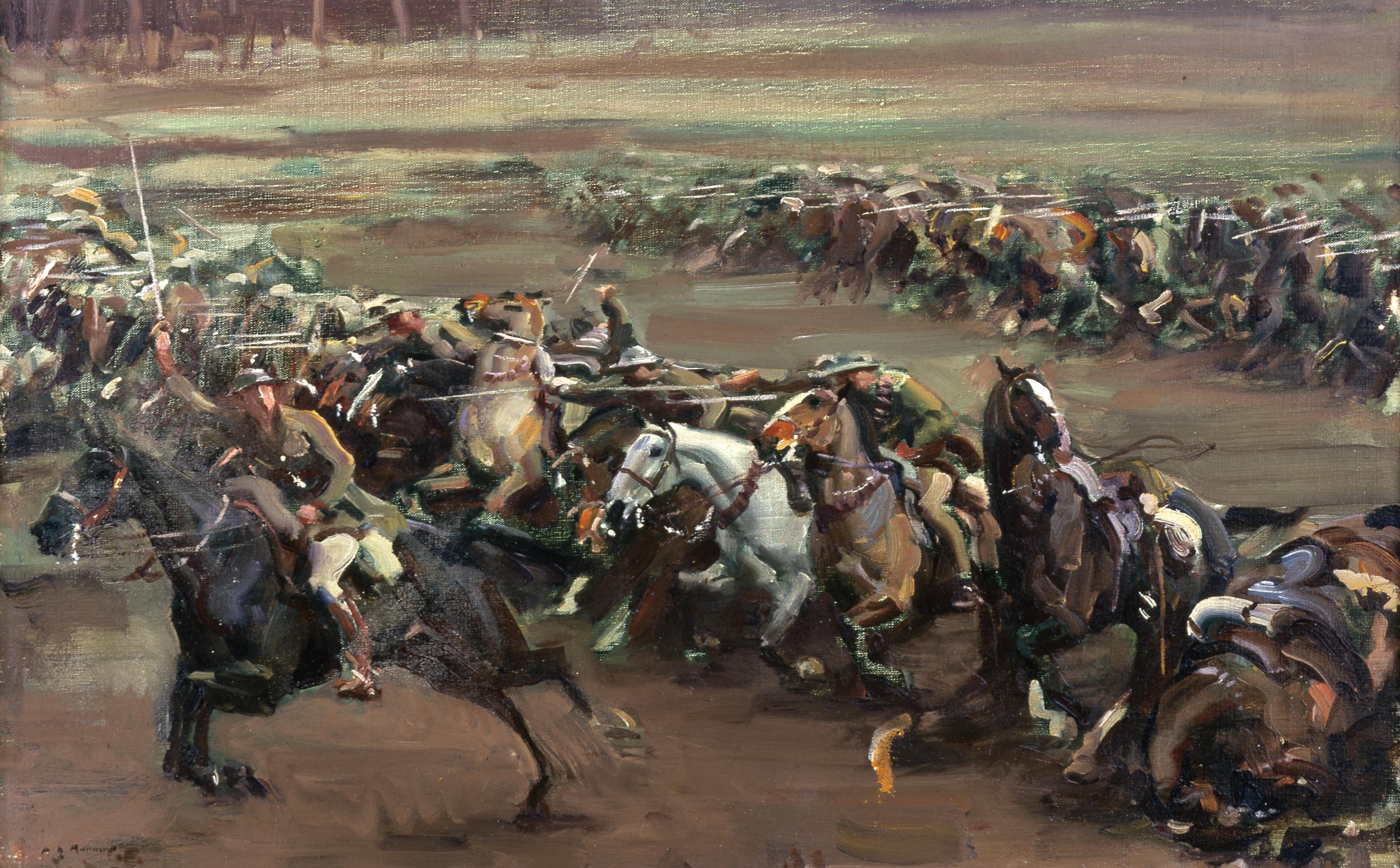
Lord Strathcona’s Horse leaves Halifax for the Boer War in South Africa with 28 officers, 512 troops, 599 horses and munitions.
18 March 1944
Mount Vesuvius begins to erupt in Italy as the Allies’ Italian Campaign wages on.
19 March 1885
The North-West Resistance begins, with Louis Riel named president of the Métis provisional government and Gabriel Dumont its military commander.
30 March 1918
The Canadian Cavalry Brigade forces the withdrawal of German troops from Moreuil Wood, France. Lieutenant Gordon Flowerdew earns a posthumous Victoria Cross for leading the charge of Lord Strathcona’s Horse.
20 March 1944
Harry Crerar is named commander-inchief of First Canadian Army, replacing General Andrew McNaughton.
March 1955
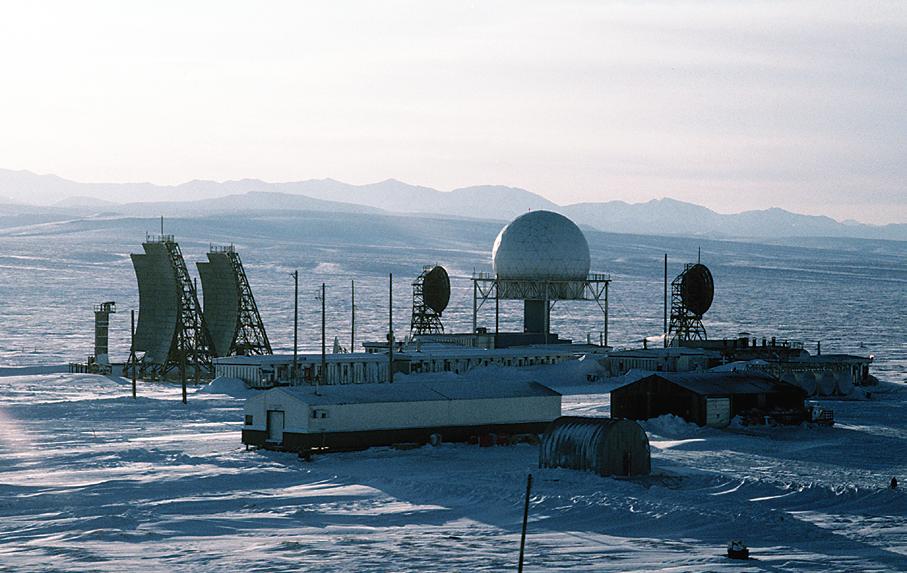
The Canadian government announces construction of the Distant Early Warning Line radar system across the North and Alaska to detect a potential Soviet attack.
23 March 2002
HMCS Algonquin joins the Canadian Naval Task Group, part of a multinational anti-terrorism campaign in the Persian Gulf.
27 March 1756
In the Battle of Fort Bull during the Seven Years’ War, French forces, Canadian militia and Indigenous allies take British-held Fort Bull, N.Y.
March 1949
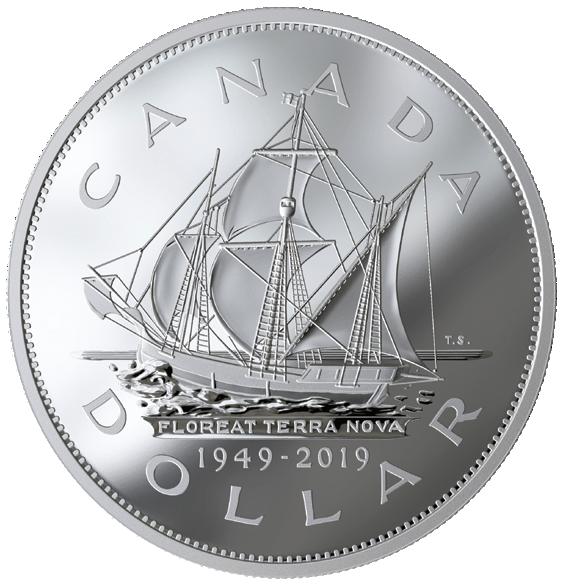
Newfoundland joins Confederation, becoming Canada’s 10th province.
9 April 1917
April 1924
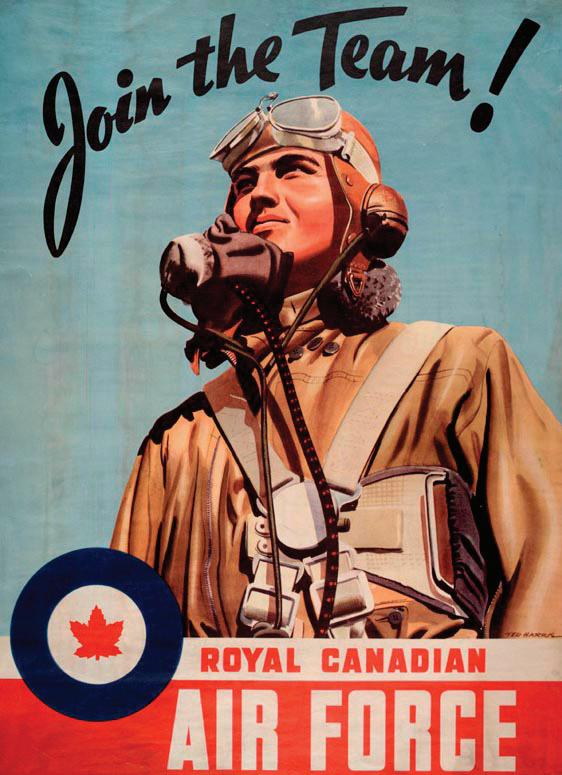
The Canadian Air Force officially becomes the Royal Canadian Air Force.
4 April 1949
Canada, the U.S. and 10 other nations sign the North Atlantic Treaty to create NATO.
The Battle of Vimy Ridge begins. It marks the first time all four divisions of the Canadian Corps fight together, a seminal moment in the country’s history.
11 April 2007
After his vehicle was destroyed by an improvised explosive device in Afghanistan, an injured Private Jay Renaud provides life-saving first aid to a crewmate. He is awarded the Medal of Military Valour.
April 1945
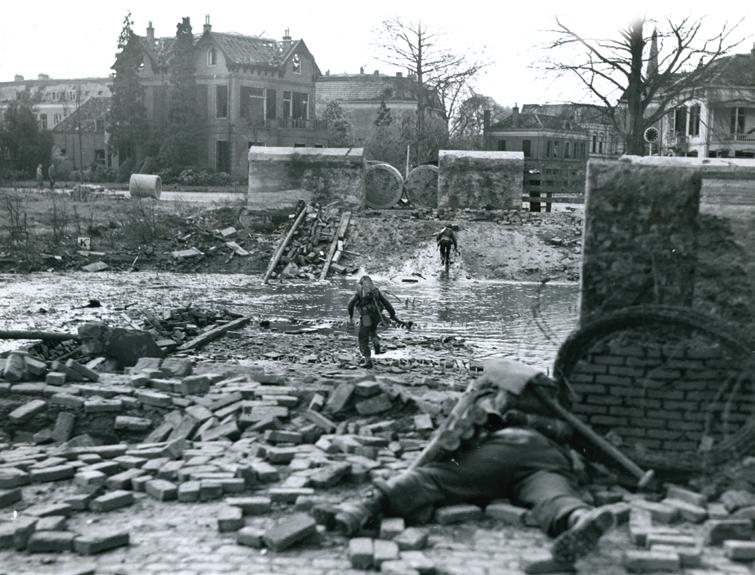
After nearly a week of fighting, Canadians capture the city of Zutphen, part of the final offensive to liberate the Netherlands.
14 April 1912
A remote Marconi wireless station at Cape Race, Nfld., receives a distress call from RMS Titanic with the simple statement: “Have struck iceberg.” The ship sinks at 2:20 a.m.
19 April 1978
Canadian peacekeepers start their UN mission in Lebanon.
April 1900
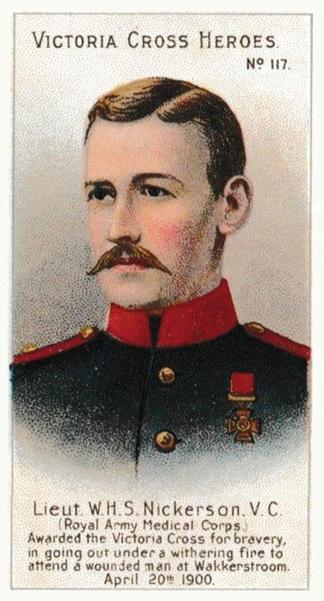
Under heavy fire at Wakkerstroom, South Africa, Canadianborn William Nickerson attends to a soldier’s wounds and remains with him until he can be moved to safety; he is awarded the Victoria Cross.
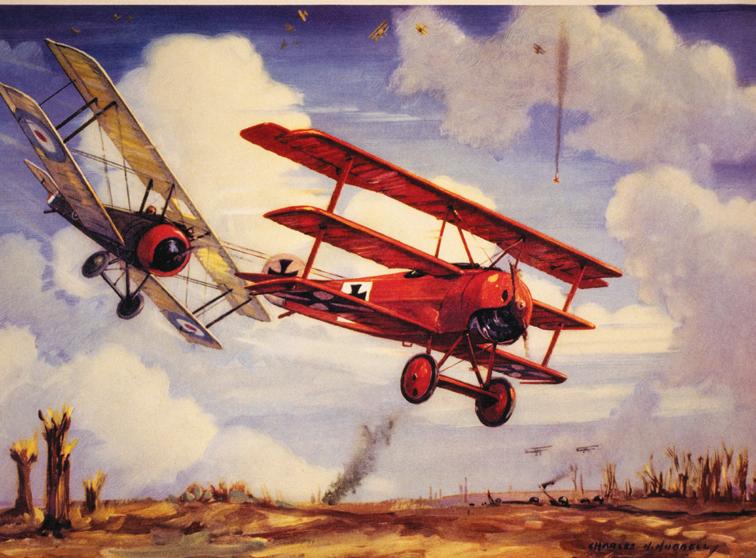
April 1918
Manfred von Richthofen, the Red Baron, is killed after being pursued by Canadian pilot Roy Brown. While debate exists over who fired the fatal shot, many Canadians credit Brown with the kill.
24 April 1992
The United Nations establishes UNISOM 1, a peacekeeping mission to Somalia.
26-28 April 1944
A fierce gun battle erupts when HMCS Athabaskan, Haida and Huron intercept three German destroyers off the coast of France; they sink one and damage the other two.
29 April 2014
The first CF-18 Hornets are deployed in Operation Reassurance, the ongoing NATO response to Russian actions in Ukraine’s Crimean peninsula.
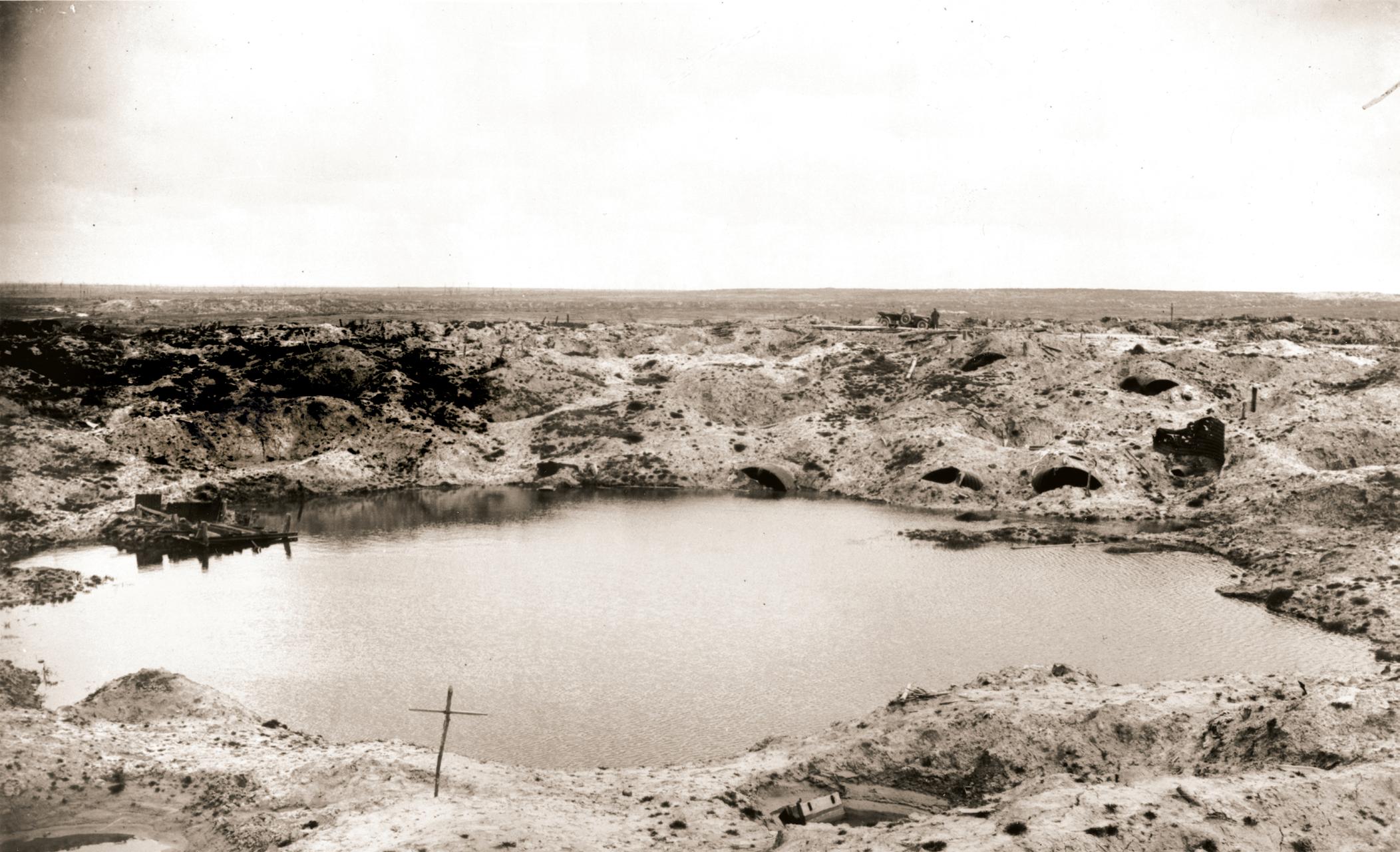
April 1952
The Diary of a Young Girl by Anne Frank is published in English.
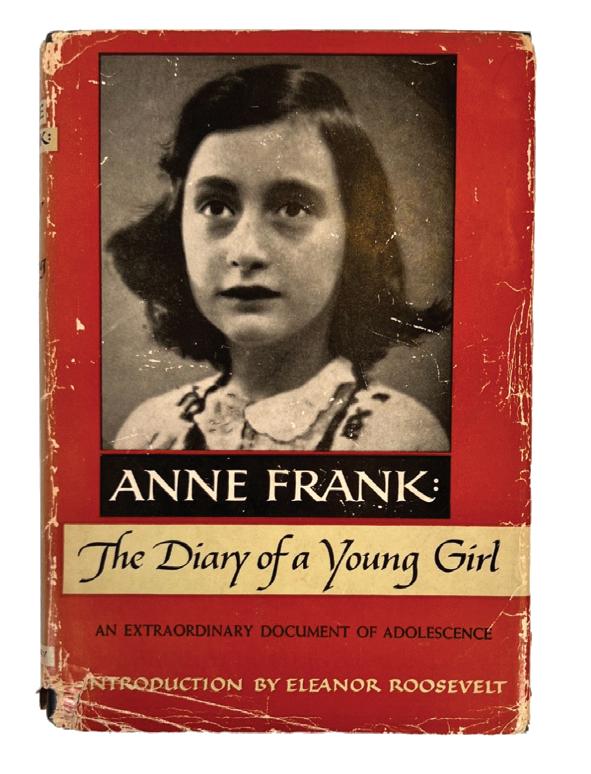

7 April 1916
No man’s land becomes a quagmire during the fighting for the St. Eloi Craters in France. Canada loses nearly 1,400 soldiers from late March to mid-April (also see “Cratered,” page 51).
GPS chassis machining
• Centra Industries; Cambridge, Ont.
• Dishon; Vaughan, Ont.
Centre fuselage composite structures
• Stelia Aerospace North America; Lunenburg, N.S. are full steam ahead…focused on making sure we’ve got the infrastructure, the pilots, the training in place for the arrival of those F-35s,” Deputy Defence Minister Stefanie Beck told a House of Commons committee in early October 2025.
Despite a pending review of Canada’s $27.7 billion purchase of 88 of the fighter jets from U.S. defence company Lockheed Martin, details suggest the initial tranche of F-35s are set to arrive as scheduled in 2028. Training slots for Canadian pilots have been booked in 2026 at Luke Air Force Base in Arizona and F-35-related upgrades are being made at 4 Wing Cold Lake in Alberta and 3 Wing Bagotville in Quebec.
Prime Minister Mark Carney ordered the purchase review in March 2025 in response to trade tensions with the U.S. and a sense the country’s military procurement was too reliant on American defence industry.
Still, while F-35s are primarily assembled in Fort Worth, Texas, more than 30 Canadian companies are currently producing parts for the aircraft, most notably Magellan Aerospace, which is manufacturing the tail assembly for the F-35A (the variant Canada is buying) at its Winnipeg factory. This graphic details a selection* of key madein-Canada components of what’s considered the world’s most advanced fighter jet—whether the country decides to fly it or not.
—Aaron Kylie

Inlet lip castings
• Howmet Aerospace; Laval, Que.

*Due to operational security, a full list of Canadian companies contributing parts to the F-35 is not readily available. Other manufacturers may also produce parts indicated here or more not shown.


• CMC Electronics; Montreal ELS circuit cards
• Curtiss-Wright; Kanata, Ont.
Radar subsystems and machining
TNS connectors and printed wiring boards
• Mindready Solutions; Saint-Laurent, Que.
Forward fuselage and wing machining
• Magellan Aerospace; Kitchener, Ont.
• Héroux-Devtek; Longueuil, Que.
Landing gear components
• Acroturn Industries; Brampton, Ont.
• Collins Aerospace Canada; Oakville, Ont.
Centre fuselage machining
• Héroux-Devtek; Longueuil, Que.
• Centra Industries; Cambridge, Ont.
Electrical power monitoring systems power panels
• DRS Technologies Canada; Kanata, Ont.
Engine health monitoring sensors
• Gastops; Ottawa
Electro-hydraulic actuation system components
• Ben Machine Products; Vaughan, Ont.
Conventional take-off and landing horizontal tail
• Magellan Aerospace; Winnipeg
Power and thermal management system controller package
• Honeywell ASCa; Mississauga, Ont.
Heat exchangers machining, casting and tube bending
• Alphacasting; Saint-Laurent, Que.
CANADA’S AEROSPACE INDUSTRY HAS BUILT COMPONENTS FOR THE ENTIRE FLEET OF NEARLY 1,250 COMPLETED F-35s.
IN TOTAL, 110 CANADIAN COMPANIES HAVE CONTRIBUTED PARTS TO THE U.S. F-35 PROGRAM.
CANADIAN MANUFACTURERS HAVE WON $4.63 BILLION IN SUPPLY CONTRACTS FOR THE F-35.


By Mark Zuehlke
E.A.H. ALDERSON
the aftermath of the Canadian failure during the Battle of St. Eloi Craters, a scapegoat was sought. Although 2nd Canadian Division had fought tenaciously to hold the ground the British 3rd Division had won in the last week of March 1916, the battle mostly ended on April 16 with the Allies roughly aligned with where they had started. In its first major engagement, 2nd Division lost 1,373 casualties for no gain.

Plumer, wanting the matter resolved, agreed that Turner should go.
“Canadian politics have been too strong for all of us.”
—Lieutenant-General
Edwin Alderson
The Canadians had been placed in an unwinnable situation.
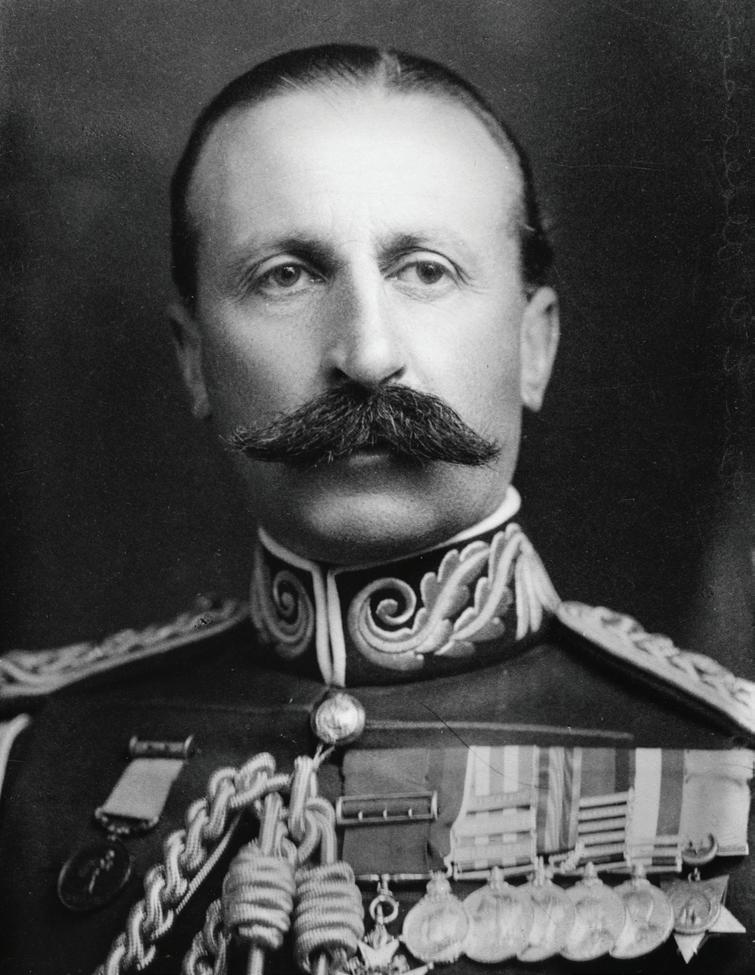
British Expeditionary Force commander-in-chief Field Marshal Douglas Haig initially reprimanded Second Army commander Lieutenant-General Herbert Plumer. Piqued, Plumer demanded that British Lieutenant-General Edwin Alderson, who commanded the Canadian Corps, take “severe disciplinary measures” by sacking 2nd Division’s Major-General Richard Turner and his 6th Canadian Brigade commander Brigadier-General Huntley Ketchen for incompetence. Alderson, however, understood that the Canadians had been placed in an unwinnable situation. Hoping to save Turner, Alderson asked him to condemn Ketchen. Turner refused and accused Alderson of failing to support the division by not authorizing a requested limited withdrawal out of the cauldron of fire to safer ground. Alderson lashed back, claiming Turner was unqualified for divisional command.
That might have been the end of matters had Canada’s military representative at the front, Max Aitken (later Lord Beaverbrook)—who had been appointed by Minister of Militia and Defence Sam Hughes—not waded into the matter. The 36-year-old entrepreneur warned Haig on April 23 that his government wouldn’t stand to see a Canadian general, already considered a war hero for past actions, scapegoated. Haig, fully aware of how defensive Canada’s politicians and soldiers were about their corps being commanded by a Brit, strove to avert a “serious feud between the Canadians and the British.”
Avoiding that feud, he said, was more important than permitting “the retention of a couple of incompetent commanders.” So, Turner and Ketchen kept their postings and Alderson was sacrificed.
On April 26, the Canadian cabinet agreed to Alderson’s replacement by British Lieutenant-General Julian Hedworth George Byng. Haig assured Alderson that he would receive a significant appointment in exchange for going quietly. However, he was appointed inspector-general of Canadian forces in England and France, which proved a purely nominal assignment. “Canadian politics,” Alderson told a friend, “have been too strong for all of us.” In 1920, he retired from the military.

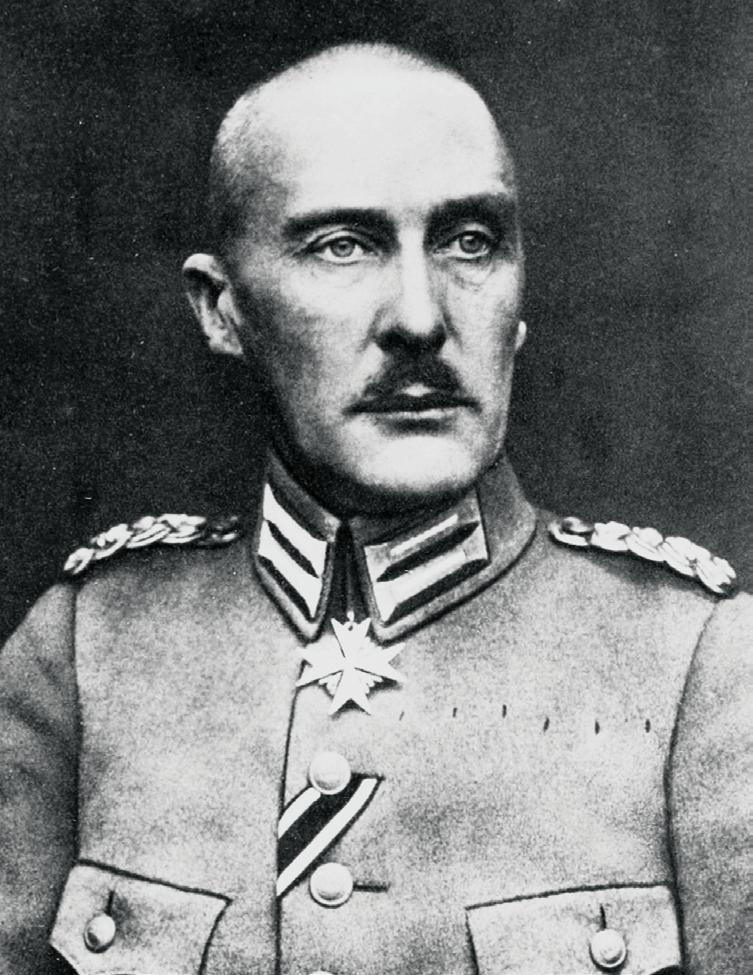
When the British Expeditionary Force detonated massive explosive charges on March 27 at St. Eloi, creating huge craters and reducing the battlefield to a nightmarish morass, two German companies were largely destroyed. These units were part of the German 4th Army commanded by Generaloberst Albrecht, Duke of Württemberg. Born in 1865, the longtime military careerist quickly rose to 4th Army command, and led it to victory in the August 1914 Battle of the Ardennes. Since then, Albrecht’s troops had competently fought the French, Belgians and British on the Western Front. During the Second Battle of Ypres, Albrecht had overseen the first large-scale poison gas attack in which Canadian troops were among the exposed. His reputation as a reliable and solid battlefield commander was recognized with a Pour le Mérite Germany’s highest order for bravery.
No sooner had the massive British mines detonated than Albrecht rushed troops into the devastated landscape. After a savage week of fighting, British 3rd Division was exhausted. On April 4, they were relieved by 2nd Canadian Division, who soon found themselves trapped in a meat grinder as the Germans launched repeated counterattacks and blasted their exposed positions with heavy artillery bombardments.
Albrecht knew the Canadians facing his troops were inexperienced and
likely not well trained. Having developed their infiltration tactics earlier in fighting the French at Verdun, four specialized German attack companies penetrated Canadian lines early on April 6 on the heels of a massive artillery bombardment. Slashing through the devastated defensive positions and catching the Canadians in the middle of a relief of one battalion by another, the Germans captured all key craters—except for Crater 6. They then called in a surrounding curtain of artillery fire that prevented any effective counterattacks.
Albrecht knew the Canadians were inexperienced and likely not well trained.
Although the battle had obviously tipped decisively in the Germans’ favour, the Canadians were ordered to not only hold their ground but regain what had been lost. The battle’s outcome, however, was inevitable. On April 16, aerial photographs showed the Germans heavily entrenched within the deepest craters of St. Eloi. A Canadian withdrawal was finally ordered.
The 4th Army’s win was decisive. Soon after, Albrecht was promoted to generalfeldmarschall and in 1917, his new army group assumed responsibility for the Western Front’s southern flank. Presumptive heir to the Kingdom of Württemberg, the 1918-19 German revolution prevented his ascension to the throne.
By Alex Bowers
John F. Stevenson never needed to serve.
The 1861-65 American Civil War was not his fight—or perhaps it may have appeared that way to the St. Andrews, N.B., native and freshly Harvard-educated surgeon. But serve he did as a volunteer for the Union cause, joining approximately 40,000 other Canadians who fought on both sides— more than 7,000 of whom died. Stevenson was to be one of them.
He enlisted in the United States Medical Corps with the 29th Connecticut Infantry, a mostly Black regiment raised after the 1863 Emancipation Proclamation. “At the end of the war, he was on occupation or garrison duty in Texas when he took sick,” said Vice President Troy Middleton of the New Brunswick Historical Society. “Stevenson got leave to return home to recuperate but died en route.”
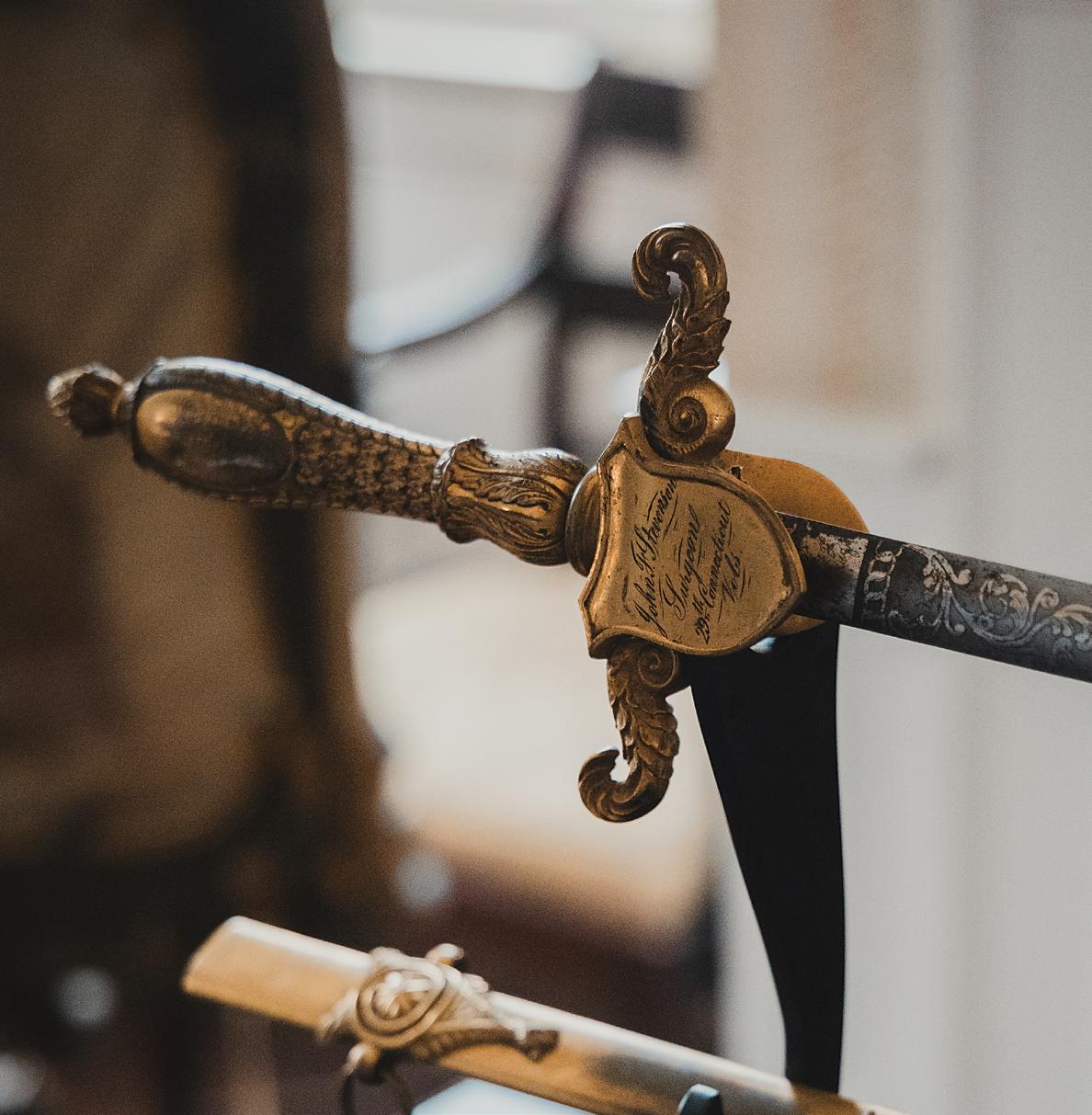
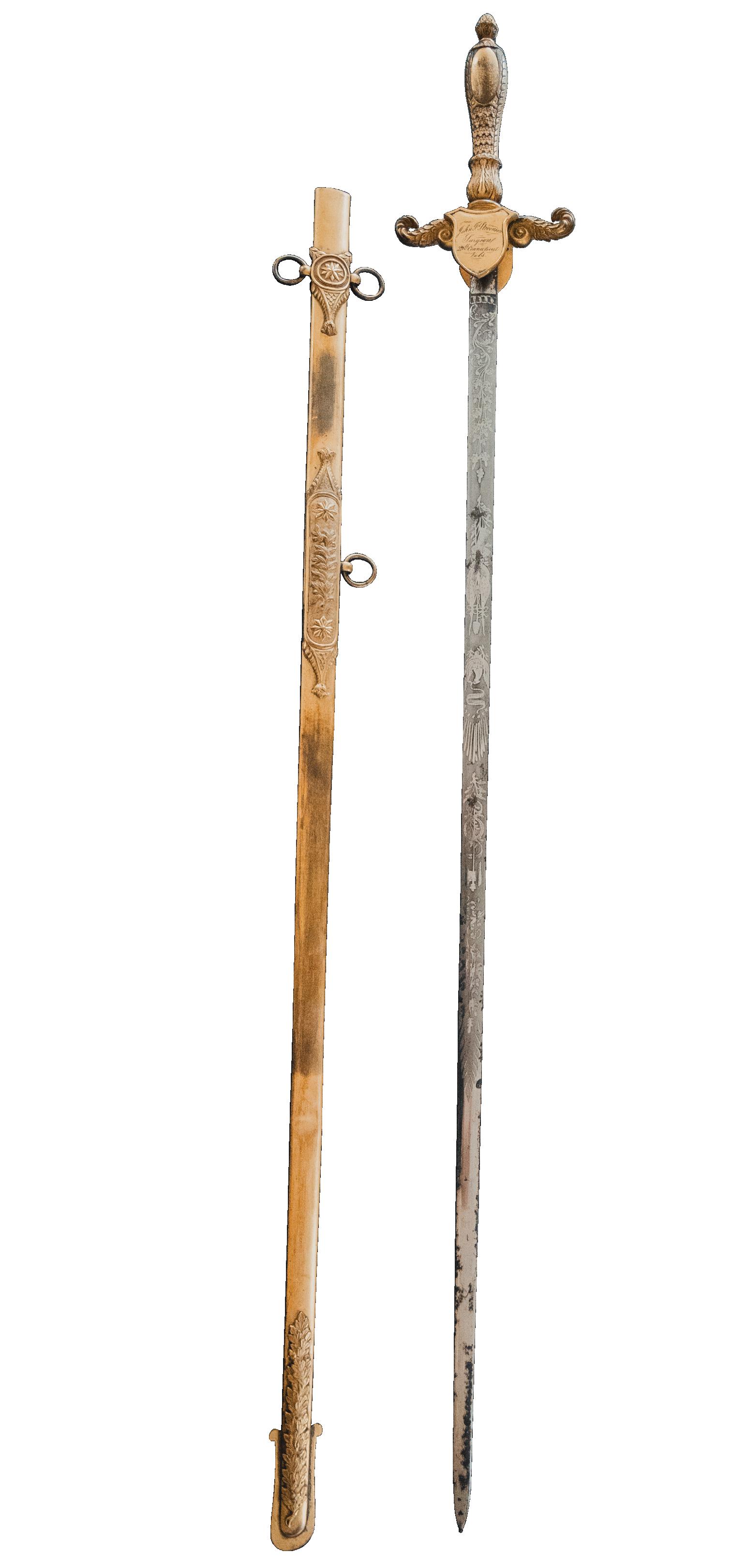
Among the late Canadian veteran’s possessions was his surgeon’s dress sword. Nickel-plated with engrav ings adorning the blade, its purpose was less practical and more decora tive, but nevertheless symbolic of the outsized role played by Stevenson and his compatriots, includ ing 29 Canadian
recipients of the Medal of Honor— the highest and most revered military accolade in the U.S.
When Middleton found the sabre for sale by a private collector in Ontario, he and fellow local historian Harold Wright sought to purchase it.
The original asking price of $8,000$8,500 was subsequently lowered to $6,200 as a goodwill gesture, the hope being that it might find its rightful New Brunswick home. “We started a fundraising campaign to purchase the sword and bring it back to New Brunswick, and we were successful,” explained Middleton. Stevenson’s sword is now proudly part of the Loyalist House Museum collection in Saint John, N.B.
The sword is symbolic of the outsized role played by Stevenson and his , including 29 Canadian recipients of the Medal of Honor.


For many of our Veterans and their families, navigating the intricate world of Veterans Affairs Canada (VAC) benefits, compensation, and assistance programs can be a challenging experience.
To reduce related stress, Legion Command Service Officers (CSOs) at the National and Provincial levels are available to help, as highly trained professionals with government security clearance. These experts are committed to guiding and assisting still serving and retired military Veterans, members of the RCMP, and their families, through the complete process to access the benefits and services to which they are entitled. The CSOs’ service is friendly and free, whether a Veteran is a Legion member or not. Veterans have made immense sacrifices in service to their country, and deserve trustworthy assistance to ensure their physical, emotional, and financial well-
being, and to help them thrive – without expecting anything in return.
We offer a cautionary note that we are aware of unscrupulous organizations that attempt to take advantage of Veterans and any vulnerabilities by charging service fees, by taking a percentage of benefits awarded, or even by claiming to offer free help, but still profiting in hidden ways. We advise Veterans to avoid such services. For example, they may charge to simply fill out forms – something that the Legion, VAC, or other reliable organizations can do at no charge.
March 30th, 1918
Dear Dad,
Just a few lines to let you know that I am getting along O.K….
No doubt you will be some what alarmed to hear of the German’s determined effort to break through our front on such a large scale. He has lost thousands of men and we now have by all efforts the situation well in hand and we are in for a wet time of it. Raining quite hard just at present. Will give our army a chance to bring up reinforcements….
Some of the chaps from our squadron was introduced to the king the other day. Happened to be up flying when he arrived so did not see him. He congratulated our squadron on its fine work. Bye bye Dad. Write soon. Your affectionate son.
Jim

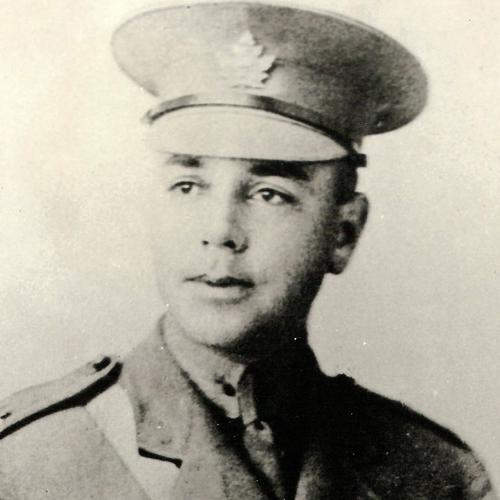
Lieutenant James (Jim) David Moses was from Six Nations of the Grand River in Ontario. He first served in a pioneer battalion before transferring to the Royal Flying Corps in September 1917. As an observer, he photographed enemy positions, bombed and attacked ground troops and defended his plane with a machine gun. He and his pilot were shot down two days after he penned the above letter. Their bodies were never recovered.
the mid-1960s, I was stationed at Air Transport Command Headquarters in Trenton, Ont. Every so often the warning sirens were activated, and exercises were initiated by Norad command. All personnel were to take shelter and remain there until all clear.
During one such drill, I passed a senior officer still working at his desk.
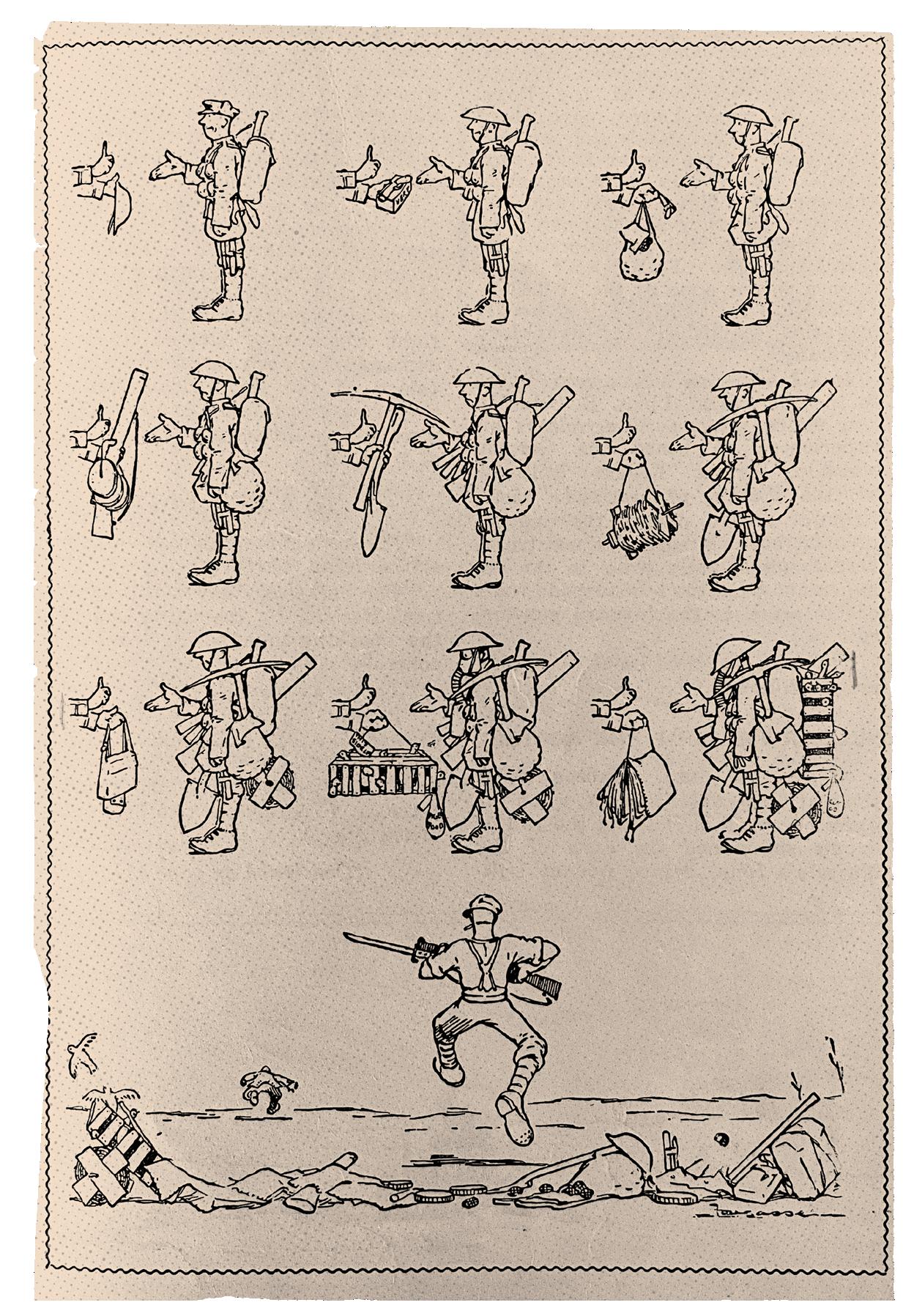
The Legionary magazine, December 1933
“I’m going to sit this one out,” he said, even though the service police would charge anyone who hadn’t left.
Two hours later, he was still at his desk. I asked what happened with the police. They had come and questioned him about what he would have done if the alert had been real.
“I would stand up, drop my trousers and get down on my knees,” he told the cop.
“To pray?” queried the policeman.
“Yes, but also to put my head between my legs,” replied the senior officer, “so I could kiss my [rear] goodbye.”
—John Fefchak, Virden, Man.

First boot: “I hear that the drill sergeant called you a blockhead.”
Second boot: “No. He didn’t make it that strong.”
First boot: “What did he actually say?”
Second boot: “Put on your hat, here comes a woodpecker.”

By Alex Bowers
The enemy tide was relentless. Wave after wave of Chinese troops, hastened by the shrill call of a bugle, streamed across a ridgeline toward Korean Hill 677, the moonlight silhouetting their figures until flares, then muzzle flashes and explosions, illuminated the advance. Yet still the torrent came, a seemingly unstoppable force that the entrenched defenders of ‘D’ Company, Princess Patricia’s Canadian Light Infantry (PPCLI), tried to plug.
Just three days earlier, the Communists’ Fifth Phase Offensive had routed the Republic of Korea 6th Division to the north of the Kapyong valley, giving rise to a flood of humanity that threatened to dismantle the United Nations’ front lines and open the way to Seoul in the south.
Mere hours earlier, the tenacious guarding action on Hill 504, adjacent to PPCLI on the valley’s opposite side, had been ceded—with great reluctance—when 3rd Battalion, The Royal Australian Regiment (3 RAR) couldn’t hold on any longer. From around 9:30 p.m. the previous eve, the Canadians of their own 2nd Battalion unit had come close, indeed closer than many realized in their isolated positions, to sharing a similar fate, first in clashes against ‘B’ Company, and battalion headquarters thereafter.
Now, at 1:30 a.m. on April 25, 1951, it was ‘D’ Company’s turn.
“Kill the imperialist pigs,” yelled a Chinese officer as he ushered his men through Vickers machine-gun fire, believing their assailants to be American. Spoken in an unfamiliar language, the war cry meant little to those atop Hill 677—save for one.
“We are Canadian soldiers,” bellowed No. 10 Platoon commander, Lieutenant Mike George Levy, in the appropriate dialect. “We have lots of Canadian soldiers here.”

Subsequent demands for a Chinese surrender echoed down the ridge line, only to be met with enemy fury and the accusation of one bewilderingly fluent defender being a “son of a turtle,” a culturally vulgar slight. Through the darkness and over the din of battle, Levy and the attacker exchanged further insults until a subordinate of the former, tiring of it all, interjected: “Tell the bloody platoon commander to shut up.”
It was no use, anyway, for the enemy waves continued.
By 3 a.m., a Canadian machine gun had been silenced and its operators, privates Maurice Carr and Bruce MacDonald, killed. Without the weapon’s enfilade decimating their ranks, the Chinese, far from dropping their arms, barrelled ahead with increasing aggressiveness, threatening to overrun multiple positions.

Levy’s platoon was all but surrounded on what seemed like a godforsaken Korean peninsula so far from home. The desperate moment called for desperate measures, of that the British-Canadian lieutenant was sure.
It wasn’t the first time he had made a bold gamble.
When Levy last encountered Chinese forces, they were not foe, but friend.
Born in Bombay (now Mumbai) in Britishoccupied India on Nov. 7, 1925, and raised in Shanghai over the Sino-Indian border, Levy spent his formative years active in sports and Boy Scouts. Following the Dec. 7-8, 1941, outbreak of war between Japan and the British Empire, however, he found himself in enemycontrolled territory, leading to his incarcaration.
At 16, Levy was delivered to Pootung Internment Camp in Shanghai before being transferred to the nearby Longhua Civil Assembly Center in 1943, sharing its rudimentary facilities with approximately
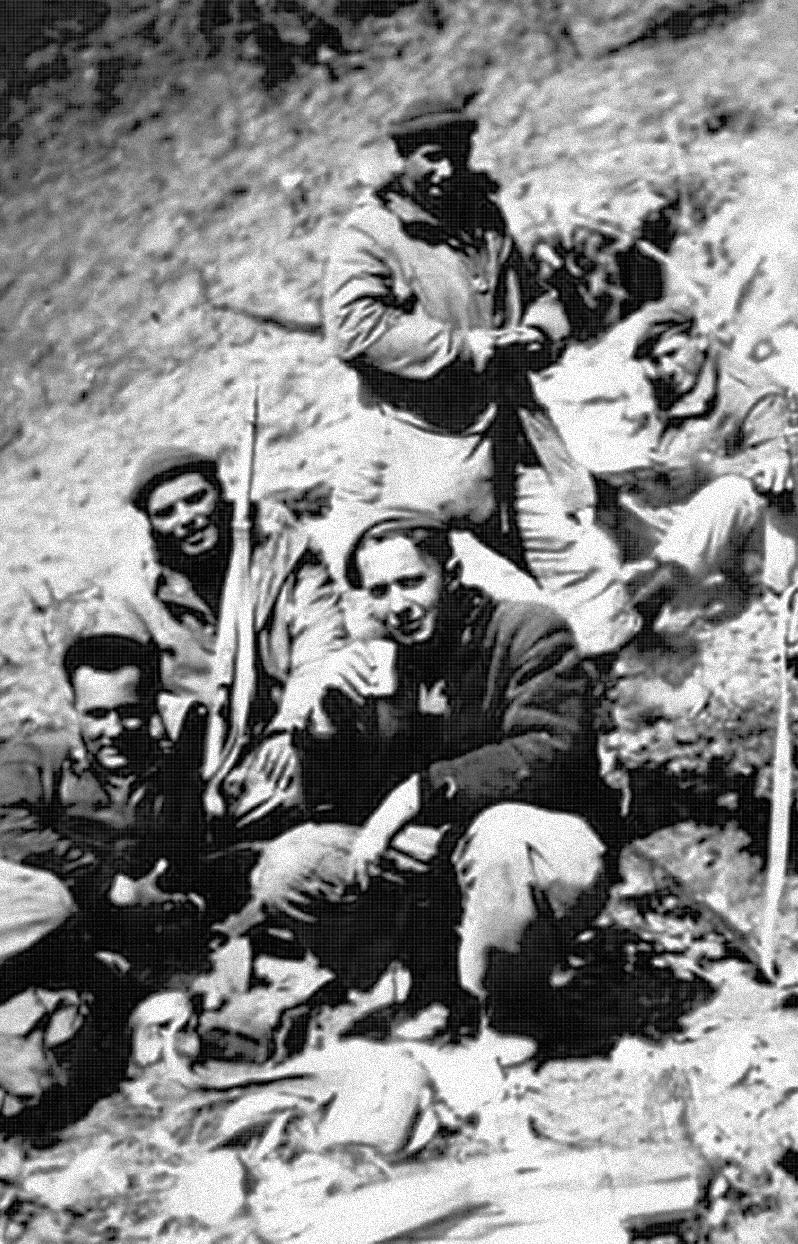
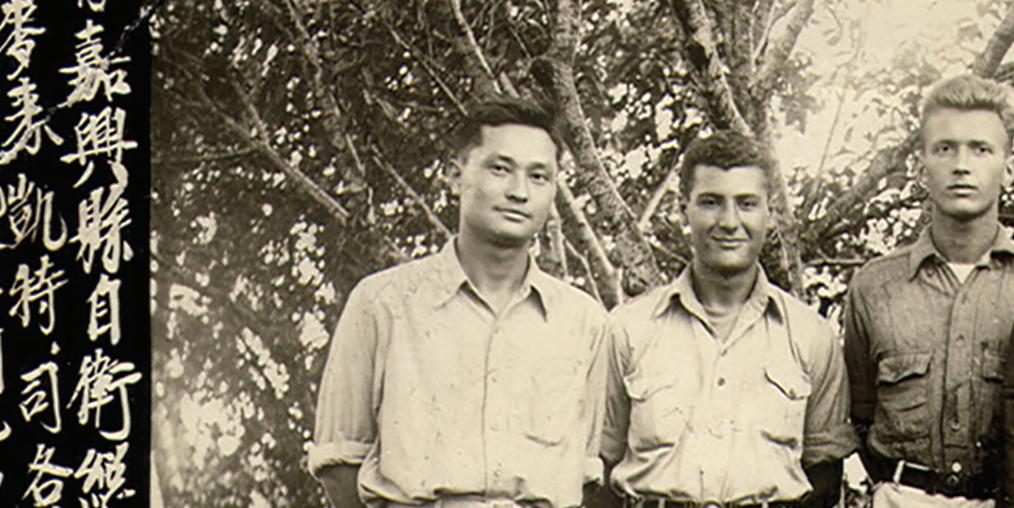
escapees pose with a Chinese guerrilla commander (below).
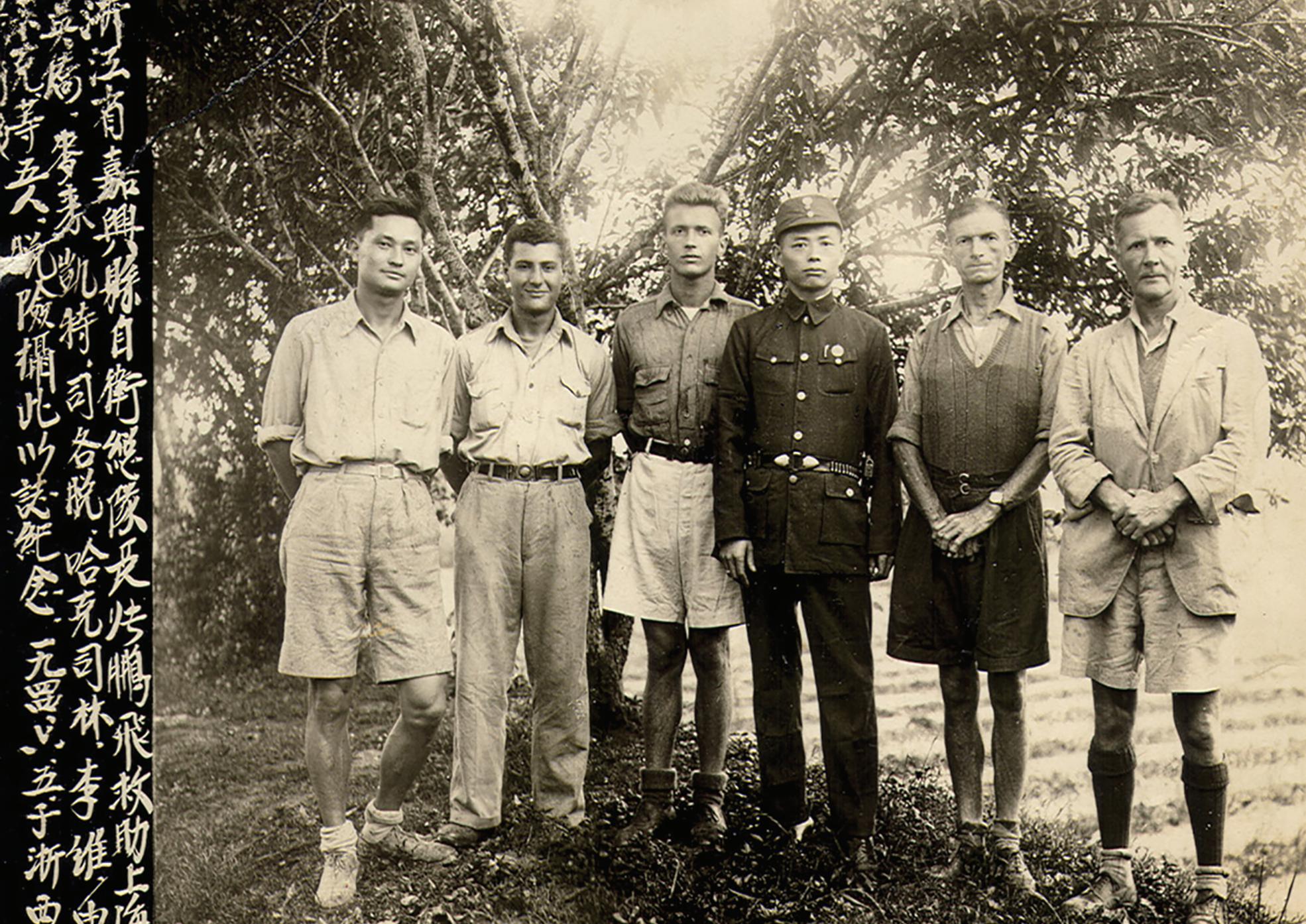
Levy was transferred to Longhua Civil Assembly Center in 1943. The teen had no intention of staying. During the night of May 22, 1944, he escaped.
2,000 Ally-aligned foreign nationals. The teen had no intention of staying, and so, during the night of May 22, 1944, with conditions “deteriorating rapidly,” he and four other captives escaped.
Evading the guards and navigating past the double-thickness barbed wire was just the beginning of their ordeal, however. Ahead of them lay a formidable 3,200-kilometre journey through vast swaths of Japanese-conquered China.
Within the first 24 hours, the group was confronted by a Japanese sentry post. An attempt to walk in the opposite direction while ignoring pleas to halt proved fruitless after a young guard caught up with them. Questioned on their identities, one of Levy’s companions said they were German and Russian hikers (that both of those countries were belligerents apparently didn’t arouse suspicion). The soldier permitted them to proceed.

Travelling on foot and by junk for much of the trip, Levy and his comrades trekked through jungles and across paddy fields, over lakes and between countless villages, usually escorted by Chinese guerrilla bands and aided by rural locals despite the immense risks in providing hospitality and money to the fugitives.
Meanwhile, the Japanese search for Levy’s group continued. The men also had to contend with the likes of disease, challenging—if stunning—terrain and the fast-changing nature of the front lines en route, occasionally justifying detours and the redrawing of plans.
On or about June 21, 1944, the British consulate in Chongqing (the Nationalist Chinese provisional capital) sent a telegram to the men congratulating them for their “courage and resourcefulness” in escaping. Eventually, after two months of eluding Japanese military authorities, guided by their Chinese allies, they arrived at friendly enough territory to fly over the Himalayas to India.
But Levy’s adventures were far from over.
In Calcutta (now Kolkata), the barely adult lad found a new purpose after joining the British Special Operations Executive (SOE), where his knowledge of Chinese culture and language, not to mention his recently evinced evasive skills, were deemed assets. Levy attained the rank of
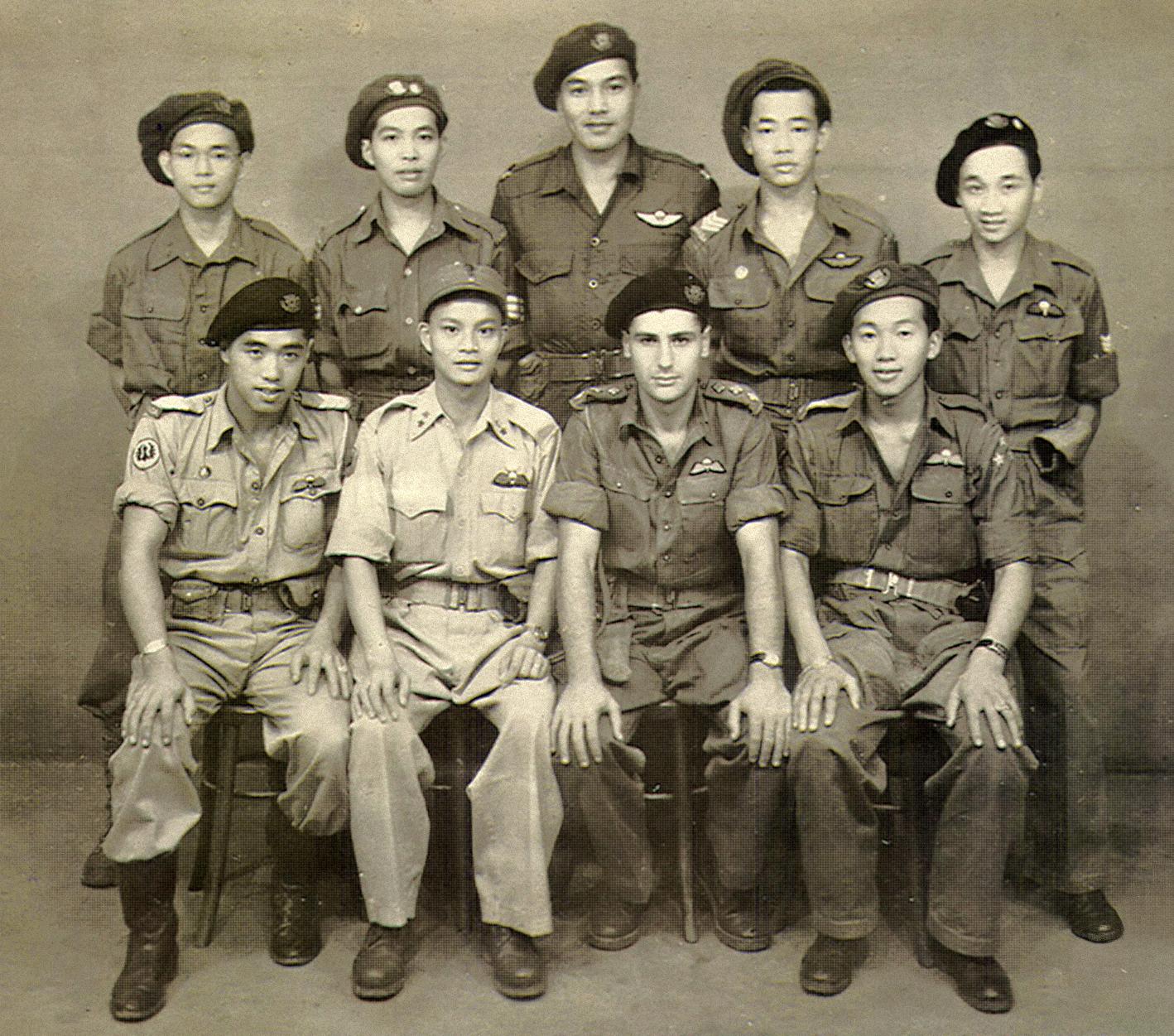
captain as part of the SOE’s Force 136, training and then working alongside some 150 ChineseCanadians who had signed up, largely with aspirations of receiving equal rights back home.
“The mission of Force 136 members was simple,” reads an article on the Chinese Canadian Military Museum website. “Get dropped behind Japanese lines; survive in the jungle in small teams with no outside support; seek out and train local resistance fighters; and work with those guerrilla
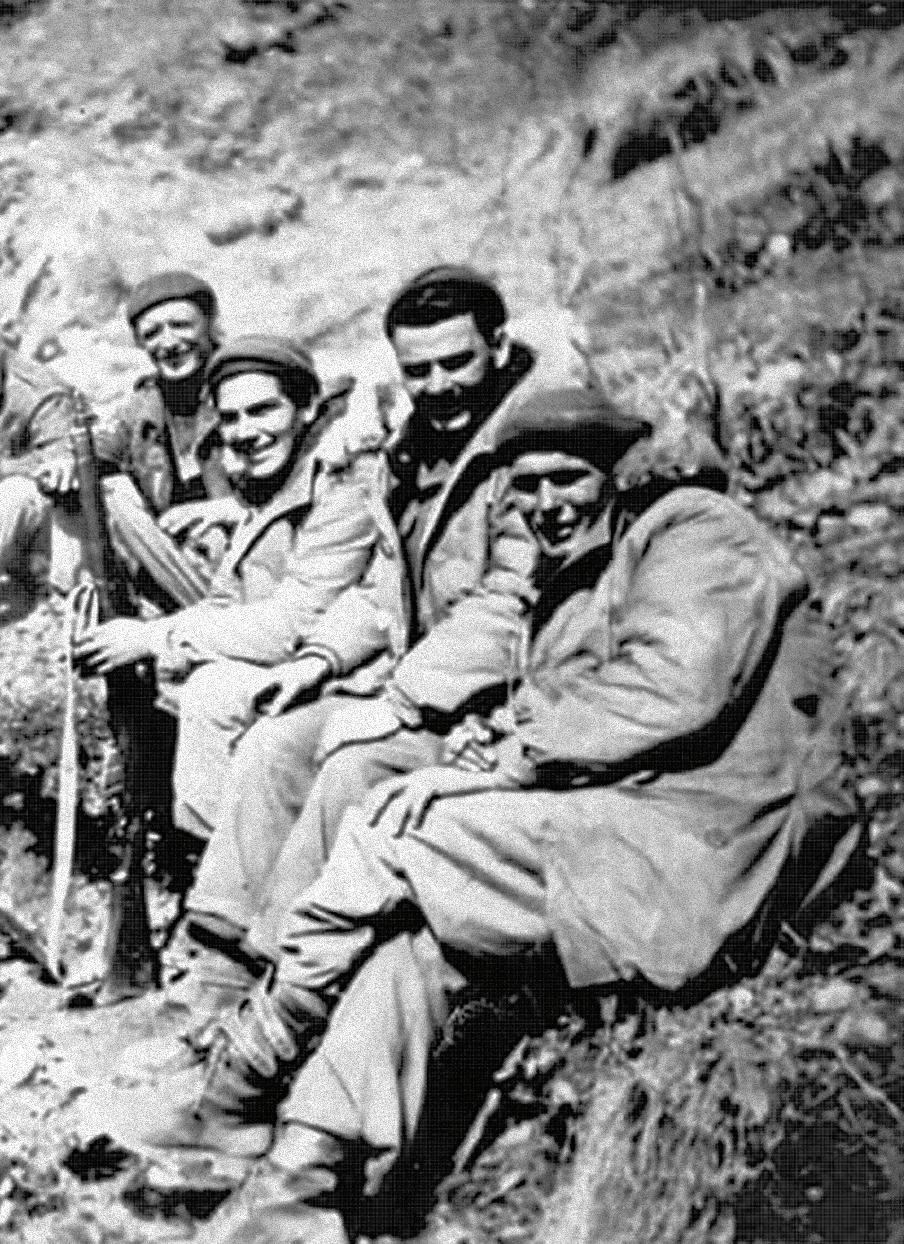
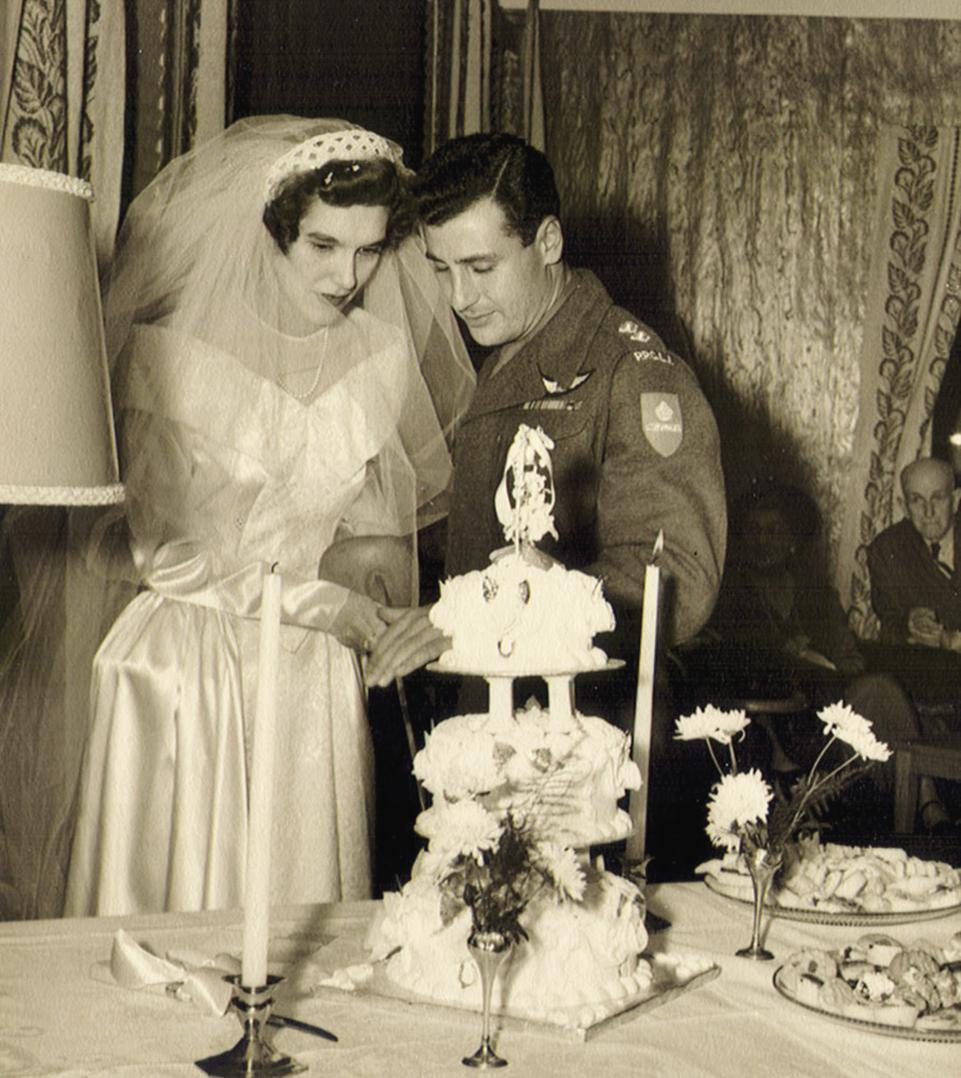
Post-WW II, Levy moved to Canada where he met his wife Marjorie (left ). He first connected with Canadians while serving with Force 136 (opposite bottom). Levy returned to Asia to fight for Canada in Korea (below).
groups to sabotage Japanese equipment and supply lines and conduct espionage.”
Levy was, unsurprisingly, the perfect candidate for such dauntingly ambitious objectives.
In July 1945, the captain—then acting as second-in-command of the code-named Galvanic Brown Patrol Liaison Team— dropped into the Malayan jungle north of Kuala Lumpur, tasked with sowing discord among the Japanese occupiers. Operating in relative seclusion alongside local guerrilla bands through to VJ-Day and beyond, Levy excelled in his numerous duties, earning a Mention in Dispatches for being “full of guts” during a clash outside the town of Salak South.
During his time with British intelligence, the now-combat-hardened officer learned much about Canada through SOE colleague and Vancouverite, Lieutenant-Colonel Arthur Stewart. Inspired by him and his ChineseCanadian comrades, Levy opted to resettle in Canada after the war, first living with Stewart himself—who would introduce the newcomer to his future wife, Marjorie Edith Arthur—before trying his entrepreneurial hand at running a Vancouver fish-and-chip restaurant.
While his business wasn’t as successful as he hoped, Levy remained resolute in his efforts to start fresh in his adopted country by building on his military ties and enlisting in the Irish Fusiliers of Canada militia regiment. The veteran was thus well-suited to volunteer for the UN mission to Korea in response to the Soviet-backed North’s invasion of the South on June 25, 1950.
Levy, now a PPCLI lieutenant of the Canadian Army Special Force, arrived on the Korean peninsula at a time when the conflict was, in historian William Johnston’s words, a “wildly shifting battlefield.” The original North Korean assault drove the South’s army and its U.S. allies out of Seoul and into a defensive perimeter around the southern city of Pusan (present-day Busan), a situation only alleviated following a UN amphibious landing near the port city of Inchon in September. This, as well as the concurrent breakout from the Pusan perimeter, quickly routed the Communist forces, who yielded the South Korean capital and retreated across the 38th parallel that divided the two countries. UN troops maintained the pressure, advancing farther north until the Chinese, who joined the war in October, launched a 300,000-manstrong offensive to drive them back.
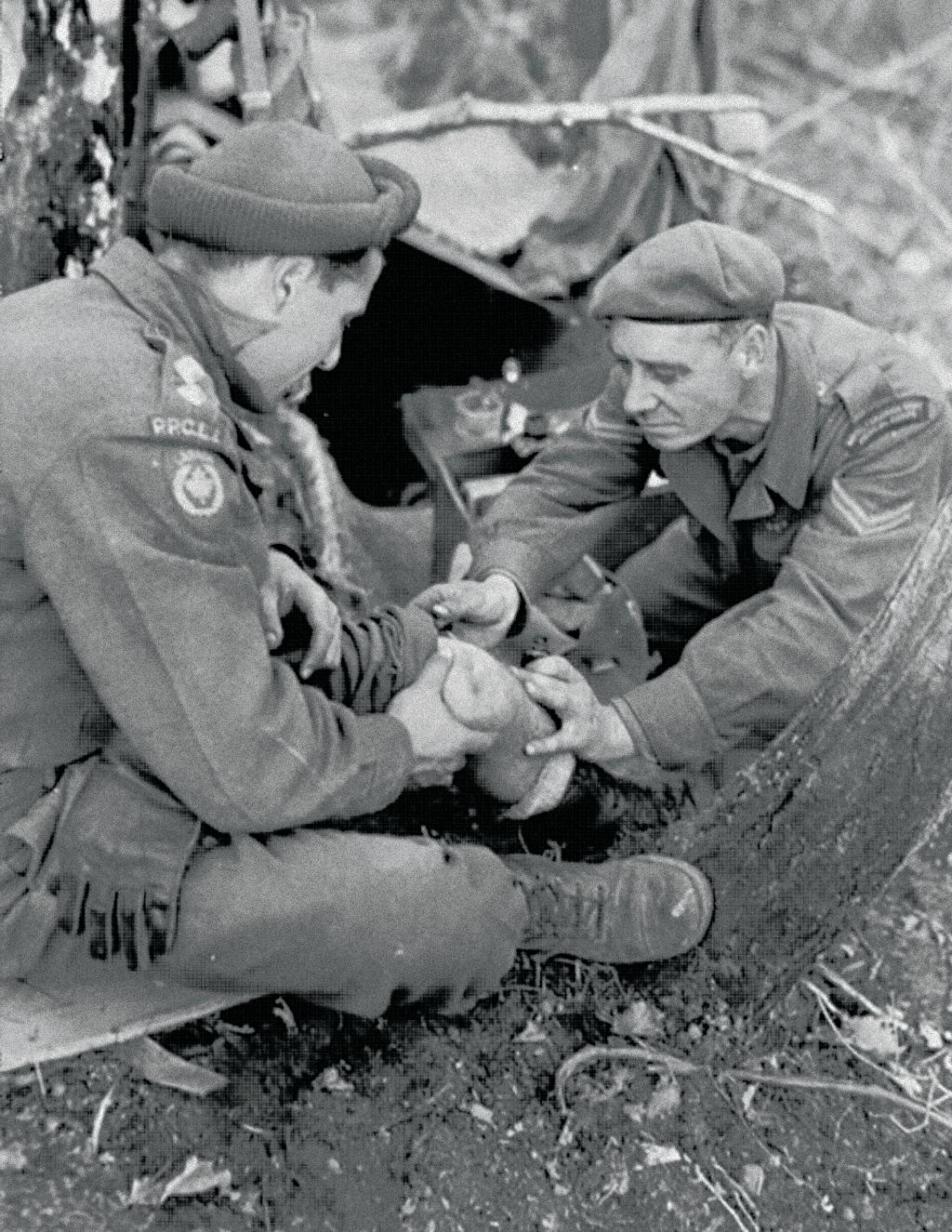
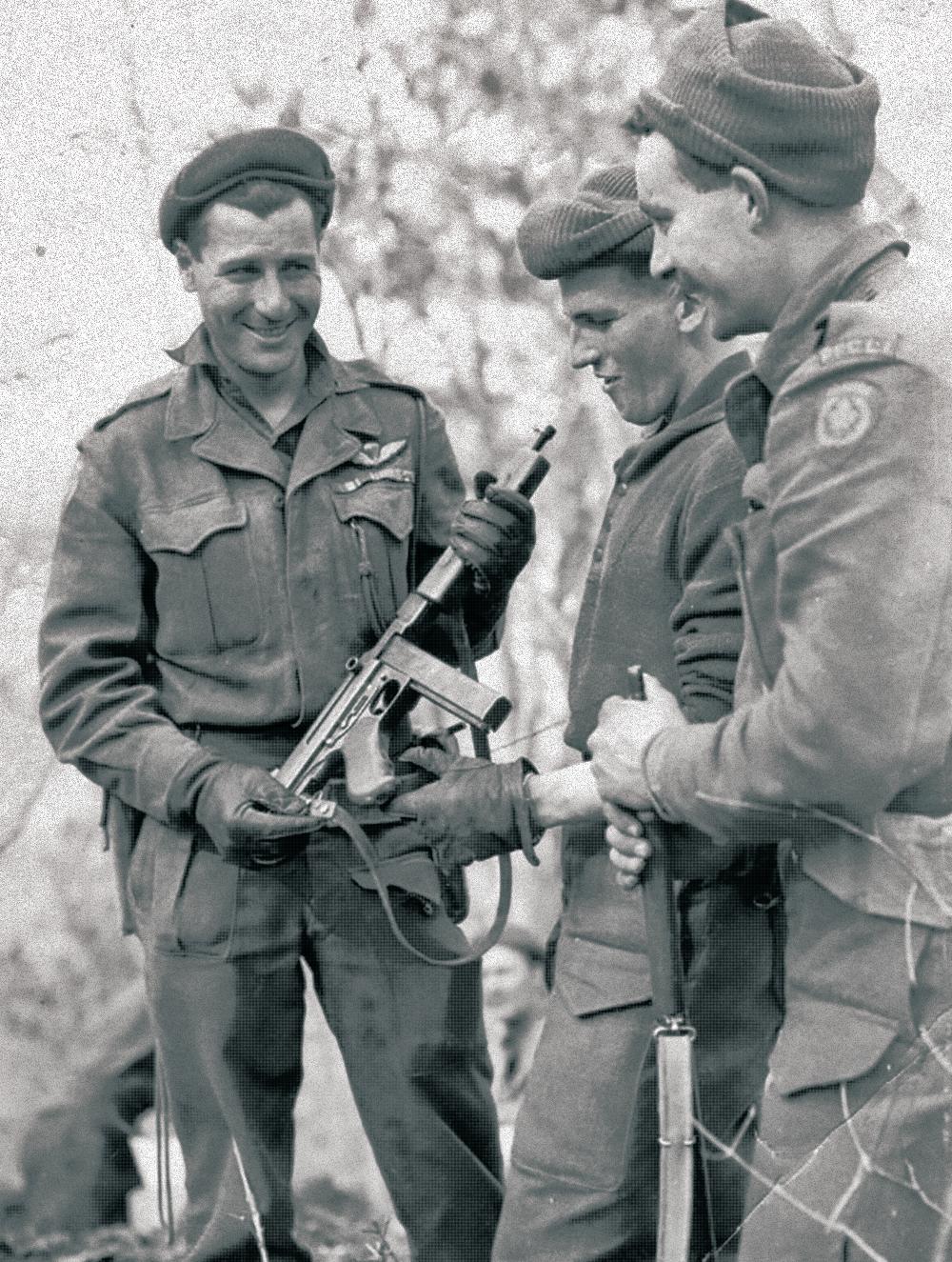
When Levy’s 2nd Battalion, PPCLI, landed in Pusan that December, the multinational coalition to which they were attached had been pushed out of North Korea to a front some 80 kilometres south of Seoul. Sent ahead of 25th Canadian Infantry Brigade’s other fighting elements, the formation was temporarily absorbed into 27th Commonwealth Brigade, which comprised 3 RAR and two British battalions, as well as a New Zealand artillery regiment and an Indian ambulance unit. These combined forces, under the command of Brigadier Brian Burke, participated in the broader counteroffensive to push the Communist Chinese and North Korean invaders back—once again—across the 38th parallel.
For the next few weeks, 2 PPCLI endured a series of bitter battles for nondescript Korean hilltops, facing a stubborn enemy capable of hampering UN inroads long enough to construct the next defensive position farther north. In the March 7, 1951, struggle for Hill 532 alone, the Canadians incurred seven killed and 37 wounded.
Yet slowly, surely, the Chinese and North Koreans withdrew, and finally, on April 8, 27th Commonwealth Brigade crossed the 38th parallel as it marched through a rugged and steep-sided valley, surrounded by hills that rose as high as 1,000 metres above a river and nearby village. Its name was Kapyong.
Further, if smaller, fights awaited the Canadians in the prelude to their greatest test. Starting April 14, in a battle to wrest control of Hill 795 from the enemy, PPCLI’s ‘D’ Company confronted some of its toughest opposition to date.
“At 1655 hours,” the battalion war diarist wrote, “the company attack went in [and]… was successful in reaching [the primary objective] but the position was untenable… Lieutenant M.G. Levy led the attack with great spirit and succeeded in reaching the well-held Chinese bunker...with his platoon.”
Despite their gallant efforts, however, Hill 795 didn’t fall for another two days, costing five wounded. Much of the brigade, less the Kiwi gunners, fell back and into reserve.
The break would be temporary—a fact Levy would come to realize all too well.
Friends-turned-foes swept in like a tide on April 25, 1951.
Levy, contacting Captain Wally Mills, ‘D’ Company’s acting commander who had established his tactical headquarters on Hill 677’s reverse slope, intended to change that.
The British-Canadian lieutenant requested that friendly artillery fire be directed “to impact within 10-15 metres of our position.” It was clearly a last-ditch ploy, one with immeasurable risks, but his superior officer endorsed it before relaying it on to
Lieutenant-Colonel Jim Stone, PPCLI commander, who obliged.
Twenty-four 25-pounder guns of the New Zealand 16th Field Regiment—bolstered by three U.S. artillery units—launched shell after shell into a concentrated mass of Chinese attackers as Levy, exposing himself to their ire, directed the bombardment.
Even so, recalled a PPCLI sergeant of the broader battle, the enemy “just keep coming.”
The situation desperate, Levy shifted the fire onto his own position.
“Our slit trenches were within hollering distance,” said one 10 Platoon soldier, “when we got the word, we all crouched down....” As he, Levy, and other survivors hugged the soil for dear life, the initial 10-minute barrage had the desired effect of scattering the enemy forces, if only for the briefest of moments. “They were about to over run us,” the soldier added, “when another ten-minute barrage came in. Later, we were hard pressed and called in a third ten-minute barrage. We were convinced the artillery would kill us all....” Levy’s two beleaguered sections were fortunate on that count as, from the skies above, around 4,000 rounds rained hell dangerously close to their positions, skirting them by less than five to six metres.
Elsewhere, agonized screams cut through the darkness as shrapnel bursts scattered just beneath tree-top height to shred the Chinese ranks, which were stopped cold. Levy, jumping between slit trenches as he honed Kiwi fire, had saved his platoon.
One Toronto Sun newspaper columnist would even claim he “may have saved Seoul.”
What remained indisputable was that Levy’s gamble had paid off.
The Battle of Kapyong officially ended for the Canadians on April 26, when the 27th Commonwealth Brigade was finally, and most deservedly, relieved. By then, enemy forces, suffering a reputed 300 fatalities against PPCLI and potentially some 2,000 casualties against all UN troops, had conceded the fight.
The struggle had ceased far less with a bang and more with a fizzle at dawn on the 25th. Regardless, the defenders, too, had been bloodied and bruised over three days of ferocious, largely hand-to-hand combat. The stalwart defence of Hill 504 cost 3 RAR 32 killed and 59 wounded while even the New Zealand gunners lost two dead. That such a sacrifice took place in the leadup to Anzac Day, marking exactly 36 years since the disastrous 1915 Gallipoli landings in Turkey, perhaps added to the sense of service. There was no question that the Aussies and Kiwis, the latter having fired approximately 14,500 shells
“In their isolated defence areas,” remarked Lieutenant-Colonel Stone, “they kept their heads down, the morale of their troops up, and their weapons firing.”
during the battle, had played a monumental role in averting a very different catastrophe in Korea.
The Canadians themselves, having performed their own stalwart defence atop Hill 677 against a numerically superior force, sustained 10 killed and 23 wounded. “In their isolated defence areas,” remarked Lieutenant-Colonel Stone, “they kept their heads down, the morale of their troops up, and their weapons firing.” Of course, many men had earned that characterization—yet arguably, one had epitomized it.
PPCLI, alongside other formations, received the U.S. Presidential Unit Citation—the first of only two occasions that a Canadian battalion has been awarded such a rare decoration. Five of the unit’s soldiers were also issued accolades, including Military Cross holder Wally Mills, who had relayed co-ordinates for the artillery strike provided by his 10 Platoon commander.
Levy wasn’t among the recipients.
True, modern history is replete with instances where infantry, recognizing that their position might fall to the enemy, have radioed in “danger close,” a tried-and-tested part of military doctrine in which an artillery barrage lands within range of its own troops, thereby risking friendly fire for a perceived—and hoped for—greater good. Nevertheless, its existence in the manuals made such a gambit no less courageous.
Regardless, Levy was said not to bear a grudge for having received no medal. His efforts were eventually acknowledged just prior to his death on June 4, 2007, at age 81. In April 2004, Gov. Gen. Adrienne Clarkson bestowed upon him a personal coat of arms, honouring not only his heroics at Kapyong but also his dedicated 25-year career in Canada’s military that followed.
The blazon features the red, blue and gold regimental colours of PPCLI, a lightning flash representing the wireless radio unit that Levy used to call in the artillery strike, and four Korean pine cones, symbolizing the county tree of Kapyong and the hopes of a fresh beginning.
The motto, meanwhile, says it all: “I have prevailed.”




By Alex Bowers
TThe trees—or lack thereof—were among the first things that private Claude Arthur Hill observed of the mountainous, fog-shrouded realm that lay ahead of him on July 7, 1940, as HMT Empress of Australia cruised closer to port.
The Smiths Falls, Ont., native jostled for space beside the crowded ship railings, where his comrades in The Cameron Highlanders of Ottawa (Machine Gun) shared in the curious scenery, their heads tilted as if gazing on another world.
They had all laughed in disbelief when the news broke during the voyage that they were bound for Iceland. Soldierly gossip, they had thought; likely a mere joke.
But here they now were, staring at the isle of the midnight sun.
“Reykjavík presented a city unlike any Canadian city,” wrote the regimental war diarist. “The view from the boat reminded one of many coloured shoe boxes set around and on a hill.” That may have been so for some, but for 27-year-old Hill, it was the perceived absence of conifers and evergreens, that oh-so familiar sight back home, that left him pining for the forests he had taken for granted.
He and every Allied occupier on board were in for a cold reception.
A 103,000-square-kilometre island forged in molten rock and cast-iron resolve, Iceland was a sovereign state under the Danish monarchy, a sparsely populated yet fiercely proud country of some 120,000. It was a semi-autonomous nation of anglers and farmers, where sheep outnumbered people by approximately six to one. It wasn’t a land of soldiers, nor a kingdom of conflict.
War found it eventually, however, following the German invasion of Denmark on April 9, 1940, prompting its swift surrender against overwhelming odds. Iceland was alone, with a borderline non-existent military, in an increasingly strategic arena—itself surrounded by increasingly contested waters. That the secluded Nordic nation had maintained neutrality, despite having assumed legislative control over its foreign affairs, was seemingly
of little consequence as London and Berlin eyed the prize. “Whoever has Iceland,” suggested one unidentified German sailor, “controls the entrances into and exits from the Atlantic.”
Winston Churchill, then British First Lord of the Admiralty, not only agreed but intended to go further. Two days after Denmark fell to the Nazis, the prime minister-in-waiting announced that steps were being taken to occupy the Faroe Islands, a Danish-administered archipelago located southeast of Iceland. Royal Marines landed there on April 13. It was a stepping stone toward a far greater precautionary measure, based on the assumption that enemy forces could use Iceland as a forward naval and air base to attack the British Isles.
Thus, on May 10, 1940, the U.K. struck first.
Several occupations began that day, not least Hitler’s blitzkrieg into France and the Low Countries. Meanwhile, Churchill walked through the door of 10 Downing Street as Britain’s new wartime leader. Elsewhere, indeed far away from the upper echelons of power, two British Royal Navy cruisers and two destroyers arrived in Reykjavík harbour transporting 42 officers and 775 other ranks from the Royal Marines, their task to implement Operation Fork.

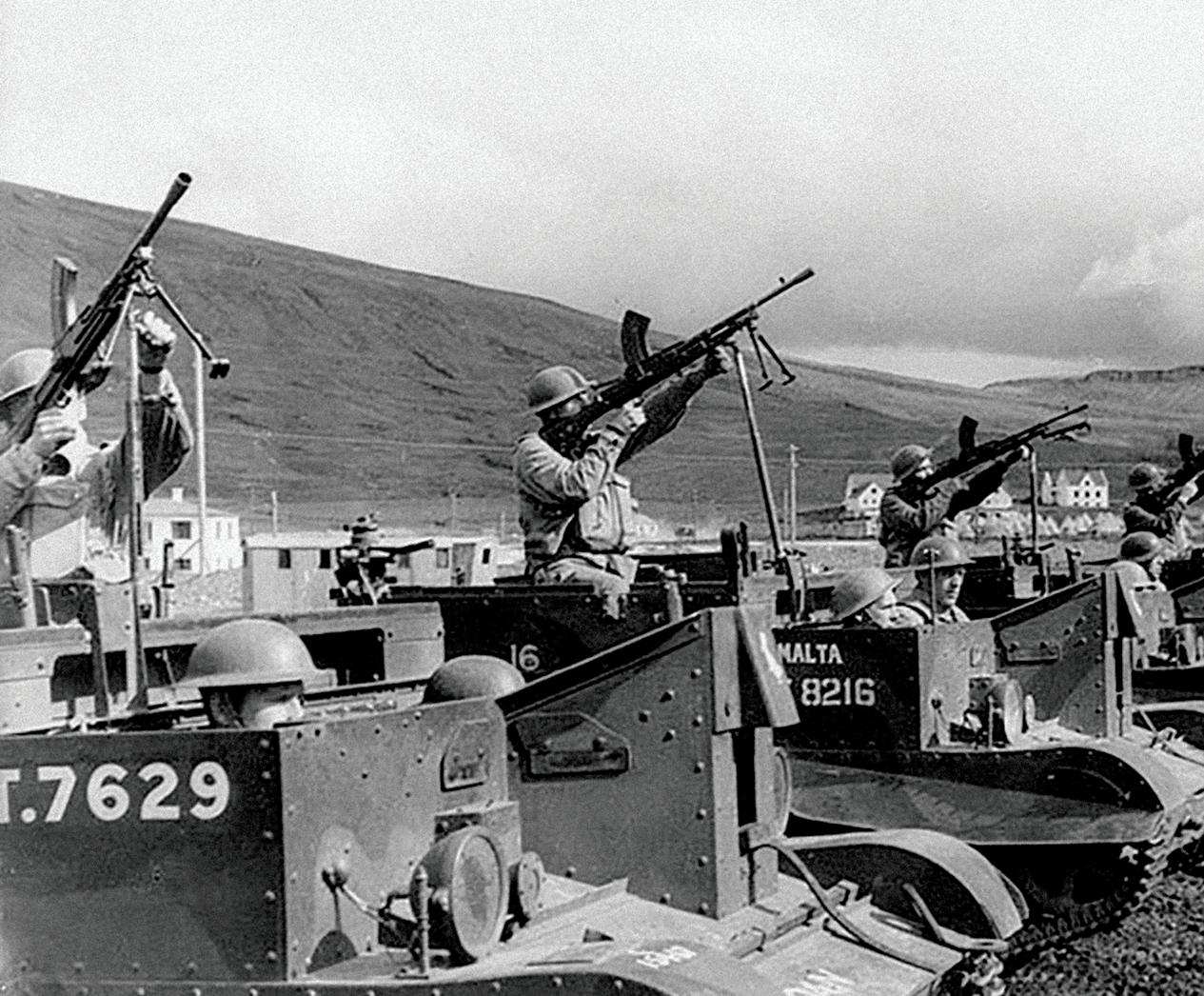

It was obviously a stepping stone based on the assumption that enemy forces could utilize Iceland as a forward naval and air base to attack the British Isles.
The invasion of Iceland was bloodless, if peculiar. Disembarking from the dockside at 6:20 a.m., the first troops were met by a crowd of onlookers, most of whom had been alerted to events after spying a Walrus aircraft patrolling overhead. Rather than openly resist the unwelcome guests, Reykjavík residents instead thronged the quay, passively surveying the scene, until their presence impeded progress.
“Would you mind...getting the crowd to stand back a bit so that the soldiers can get off the destroyer?” the British consul politely asked a local police officer.
“Certainly,” the uniformed man replied.
As the German consul in Reykjavík burned records in a bathtub, British authorities dealt with the immediate fallout of having violated Iceland’s sovereignty, insisting that the occupying force wouldn’t intervene in domestic affairs, that citizens would be compensated for any damages, and that every soldier would leave at war’s end. Beyond lodging a formal protest, the Icelandic government agreed to the terms with much reluctance, instructing its people to display civility to the invaders.
Nordic courteousness had its limits under the circumstances, of course, but the British had more pressing concerns after dispersing troops across Iceland to guard against enemy assaults: they needed more men.

A new, 4,000-strong contingent from 147th Infantry Brigade arrived a week later to relieve the Royal Marines, but even that wasn’t enough to satisfy the demand.
Churchill was in no position to send additional forces for some faraway garrison duty as the infamous Dunkirk evacuations loomed. And so, he turned to Canada for reinforcements, requesting a large formation to help fill the void.
Prime Minister Mackenzie King’s own war cabinet approved the plans on May 22. In doing so, argued Steven J. Bright in a 2022 article for the Journal of Canadian Military History, the Dominion had committed to its “first substantial and sustained deployment beyond the British Commonwealth up to that time in the expanding war,” even if King himself considered it as an afterthought.
Three battalions from 2nd Canadian Infantry Division formed the bulk of what became designated ‘Z’ Force, commanded by Vimy Ridge veteran, Brigadier Lionel F. Page. On June 10, 1940, Page departed with his staff and a vanguard outfit comprising the Toronto-based Royal Regiment of Canada (RRC), arriving just six days later “without incident”— barring bouts of “seasickness in rough seas.”
Joining them from July 7 was Les Fusiliers Mont-Royal (FMR), consisting of mostly francophone recruits, and Hill’s Cameron Highlanders of Ottawa.
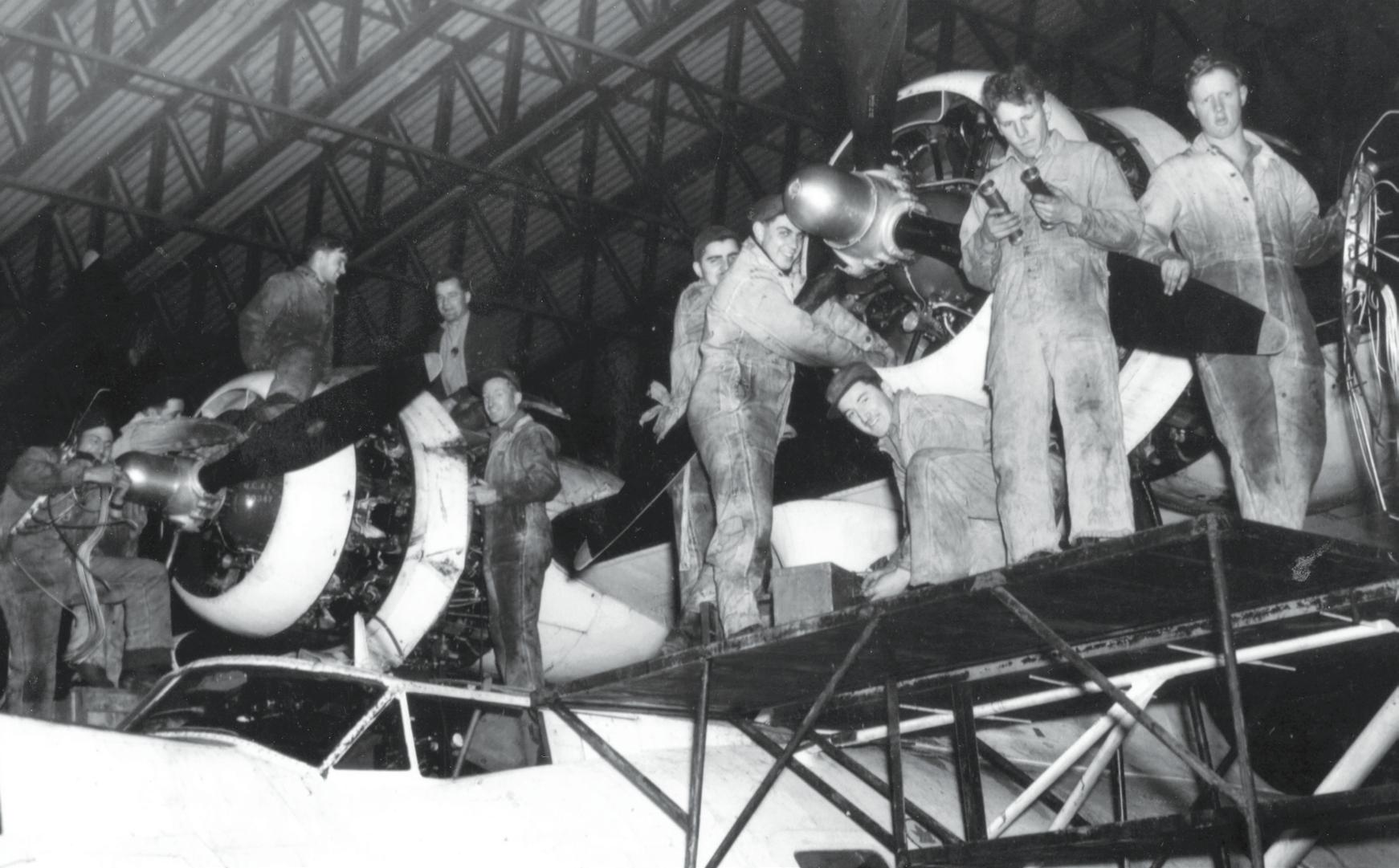
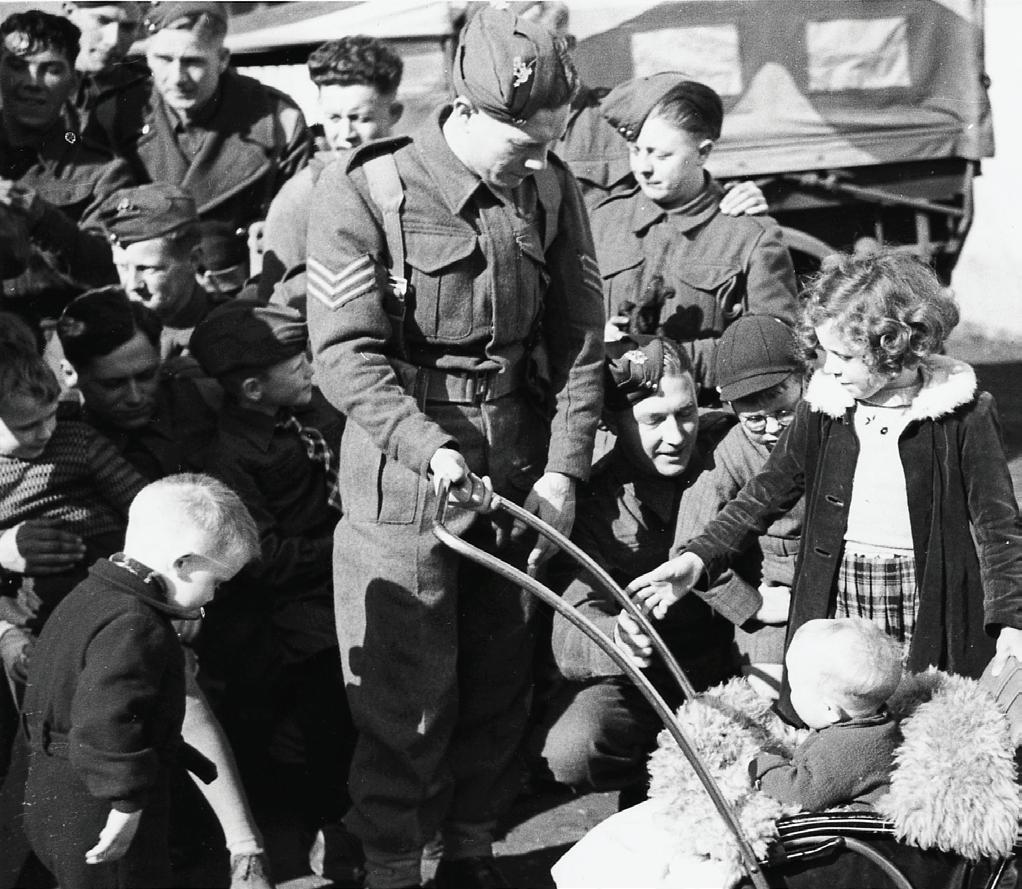
Royal Canadian Air Force ground crew service aircraft in Reykjavík in September 1944. British soldiers pose for a photo on a street in Reykjavík.
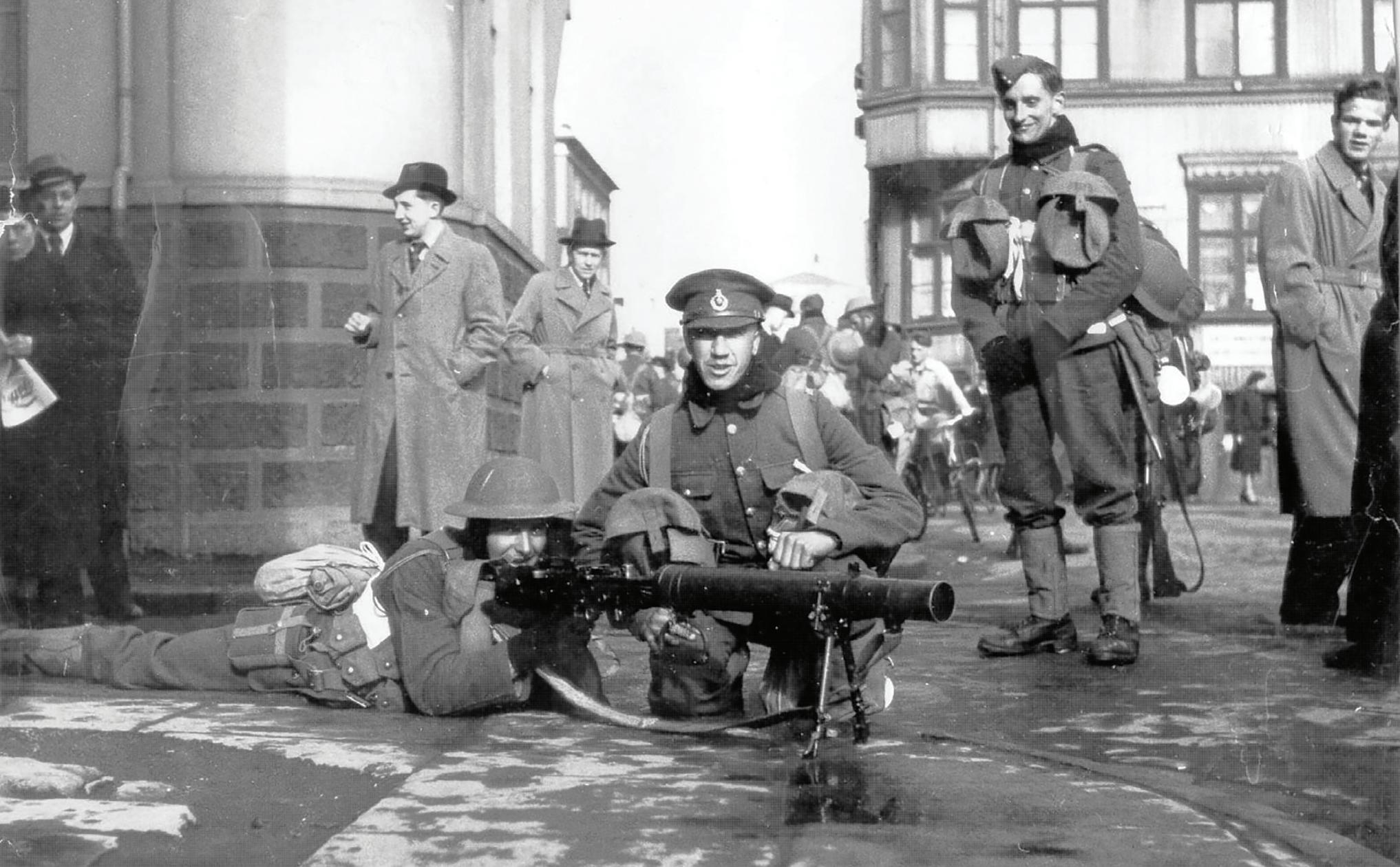
The machine-gunner marched through cheerless Reykjavík streets to the sound of bagpipes, their shrill notes a novelty to the Icelanders gathered on either side.
He and his fellow highlanders, as recounted in Hill’s posthumously published memoir Wind, Gravel and Ice, were destined to endure an arduous 10 months.
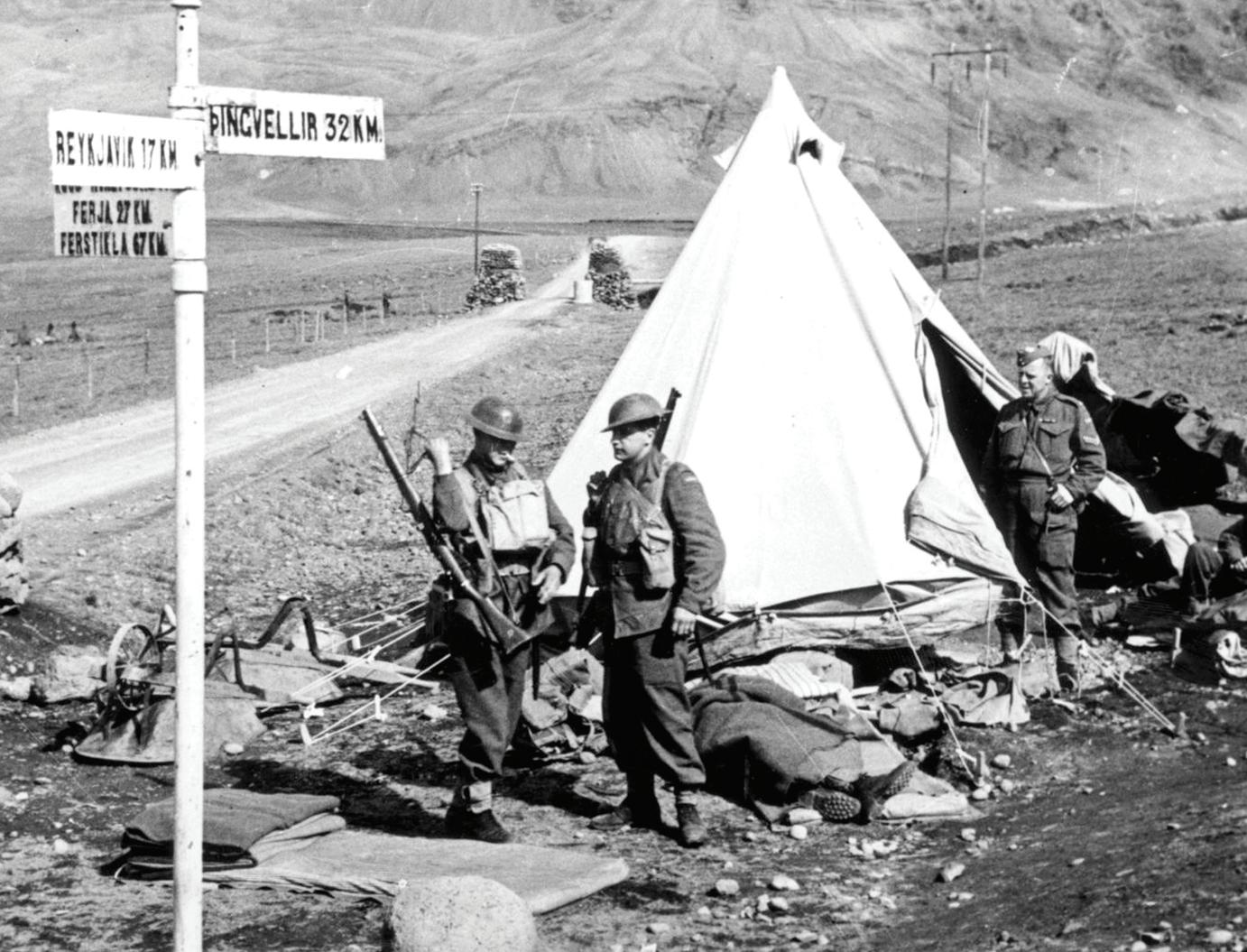
‘Z’ Force’s problems had begun almost immediately when it took about 16 days to fully unload one ship, due mostly to Reykjavík harbour proving ill-equipped to handle the tremendous influx of materiel. Worse, having departed from Canada hastily, a large proportion of those supplies had been left behind. The men had little choice but to suffice with an acute lack of rain jackets and boots that wore out easily on Iceland’s unforgiving hard-rock surface, compounded by the reality that the Canadians, like their British counterparts, were eventually spread out across huge swaths of the country for its defence.
Another monumental challenge was that Iceland’s infrastructure was considered rudimentary at best. Without an airport and boasting only a few rugged roads, it inevitably fell to the occupiers, including ‘Z’ Force, to transform the entire island into a self-sufficient military asset. Hill and a Cameron Highlanders detachment were sent to help the FMR and British personnel build a Royal Air Force aerodrome and defensive networks at Kaldadarnes, roughly 60 kilometres southeast of Reykjavík. There, toiling away in the “sea of gravel” and sodden soil amid rain showers, the troops erected hangars and machine-gun emplacements on a flood plain. The base was washed out in spring 1943.
The RRC likewise encountered hurdles, both literally and figuratively, in their efforts to fashion water pipes into tank obstacles, having evidently resorted to improvisation to execute their
garrison duties. The experiment failed to meet expectations, but slowly, surely and with great perseverance, the Canadians and willing locals safeguarded Iceland against an enemy invasion.
All the while, the men contended with spartan sleeping arrangements, as Hill and his work crew realized from day one.
“The lava gravel bends our tent stakes into strange formations,” penned author Christina Chowaniec, granddaughter of the Canadian private who fleshed out his tome by recreating his voice, “and the wind tears at the canvas with such force that…it is torn from our hands.”
Gusts capable of hauling vehicles off roads— let alone campsites from rain-saturated grass— were an all-too-common cause of soldiers’ insomnia as canopies were shaken from the inside out. Adding to the misery, Chowaniec, or possibly Hill himself, wrote that “two weeks after the summer solstice…just below the Arctic Circle, the sun will not set tonight.”
Damp nights devoid of darkness would ultimately be replaced by plummeting temperatures through fall and winter.
By September 1940, only half of ‘Z’ Force had a roof over its head. The rest had to cope with the canvas lifestyle until the availability of Nissen huts increased. According to Cameron Highlander Fred Hicks, a combination of dismal weather conditions and sheer boredom drove myriad soldiers to go “stark raving mad.”
Dealing with the monotony of their bleak existence, many Canadians turned to the bottle, numbing their senses with a potent local spirit nicknamed “Black Death.” In Chowaniec or Hill’s view, the “horrific”

beverage resembled “something between paint thinner and diesel fuel.”
Regardless, its high prevalence among all ranks led military officials to warn against its consumption and severely punish non-compliance. Shipments of cigarettes, chocolate, coffee and trusted brands of alcohol—not to mention mail from back home—helped alleviate the tedium.

At the same time, Canadians rarely sought comfort in Icelandic food—almost always mutton or fish—resulting in one anonymous poet putting pen to paper:
Oh Lord, we would thank thee, for what we are about to eat, If you could change this mutton, into some other kind of meat. We would thank thee for the potatoes, the peas and carrots, too, If the mud was only washed off, before they went into the stew.
Don’t think that we’re not grateful, we surely are, but now, We just entreat a little meat, that came off a cow.
Please listen to our pleading, we hope ’tis not in vain, For ev’ry time we look at sheep, we get an awful pain.
The occupiers weren’t alone in having choice words for being immersed in an unfamiliar culture. Icelanders, too, remained wary, especially those who feared that foreign soldiers may court local women. The scenario, and reality, became known as Ástandið, or “the situation.”
One subsequent investigation suggested that more than 500 such liaisons occurred. The 255 babies—perhaps more—born of these undesirable relations, mainly of British and, later, U.S. soldiers after they joined the occupation starting in the summer of 1941 (despite maintaining neutrality at that time) were dubbed ástandsbörn—meaning “children of the situation.”
Accusations of fraternizing forces, drunken confrontations, and even sheep theft persisted throughout the Anglo-Canadian inhabitancy of Iceland. But there were also, arguably, upsides to the invasion. Locals quietly benefited from new roads, amenities and, indeed, luxuries afforded to them by Allied occupiers as prosperity surged across the country. In gratitude, a proportion of Icelanders called it the “lovely war.” The majority, however, resented their guests for the duration.
As for the soldiers themselves, some managed to make the most of what would be, unbeknownst to most of the ranks, a short interlude before experiencing the harshest realities of war. Hiking or horseback riding through the unceasingly vast wilderness, staring in awe of “open grass plains, smoothed low volcanic hills, [and] rock gardens of green moss,” humbled in ways that the likes of Toronto and Montreal city boys
had seldom fathomed. Bathing in hot springs was one novelty that never wore off. Leaves spent in Reykjavík were a chance to grab a drink or catch a movie. And while soccer games against the British rarely resulted in victory, the Canadians enjoyed schooling their friendly yet “foul-mouthed” allies in the basics of baseball. Hill learned to love Iceland on the roads his comrades helped build. Borrowing a motorcycle, he toured across the country, savouring its landscape in solitude.
Brigadier Page and the majority of ‘Z’ Force departed Iceland in October 1940, although the last elements, namely Hill’s Cameron Highlanders, remained until April 28, 1941. It had been an unmistakably bizarre start to their war, and not a wholly welcome one for either occupier or the occupied, but it was a beginning, nonetheless. Both the RRC and FMR had a date with destiny on the beaches of Dieppe, where 916 Canadians perished amid nine hours of hell. Less than two years later—on June 6, 1944—the Cameron Highlanders found themselves attached to 3rd Canadian Infantry Division for Operation Overlord. Beyond D-Day, Hill served in France and Holland, surviving the conflict. He never saw the midnight sun again—but it would stay with him.
“Whoever possesses Iceland,” penned Churchill after the war, “holds a pistol firmly at England, America and Canada.” But there would be no smoking gun.
On balance, there was only the slightest threat of the trigger ever being pulled.
German Kriegsmarine commander Erich Raeder had learned on June 12, 1940, that Operation Ikarus—the allocated code name for a planned Axis invasion of Iceland—was under genuine consideration. It appears highly likely that Hitler himself advocated for the scheme—for the very reasons that the Allies feared.
Raeder was unconvinced. “The risks involved in conveying troops across a sea area dominated by the enemy,” read the Kriegsmarine diary, “are incompatible with any results to be expected from the occupation.”
Meeting Hitler one week later, Raeder argued that beyond the more apparent logistical complications, it would require the entire navy over a sustained period to ensure success.
The Führer continued to entertain the illogical plan for months; however, faced with ever-mounting impossibilities, he belatedly relented. Ikarus was scrapped.
Low stakes though it was, the Canadian garrison duty wasn’t entirely bereft of drama. On Feb. 9, 1941, for a “few lively moments,” the Cameron Highlanders did battle with a lone enemy Heinkel HE 111 that had, according to Chowaniec, “traded its bombs for extra fuel” in order to reach the secluded island. Hill was there, manning a machine gun with a comrade when the aircraft assaulted the aerodrome, strafing the site once before disappearing.
“The whole incident lasted less than thirty seconds,” he or his ghostwriter granddaughter remarked.
There would be no great struggle for Iceland, no clash of powers for the isle in the middle
“Whoever possesses Iceland holds a pistol firmly at England, America and Canada .”
of the North Atlantic, but in its positioning lay the most significant victory of all. In the direst years of the U-boat menace, the Allied presence in the country helped turn the proverbial tide, emerging as an essential base for long-range patrol aircraft that provided aerial coverage for friendly warships and merchant vessels braving the gauntlet. The Iceland port of Hvalfjördhur, meanwhile, desolate though it was, became a sanctuary, as well as a critical relay point for anti-submarine escorts and war materiel destined for Russia.
From early 1944, the Royal Canadian Air Force’s 162 Squadron—attached to RAF Coastal Command—bolstered the Allied air support available between Iceland and Scotland. The formation sank numerous U-boats from these bases. Equally, the Canadian-built military facilities themselves proved invaluable to the transatlantic flights that Ferry Command pilots carried out until war’s end.
Fundamentally, the gruelling efforts of 2,653 Dominion troops—76 officers and 2,577 men—from June 1940 to April 1941 weren’t in vain. Of those serving in ‘Z’ Force, six paid the ultimate sacrifice, victims of accidents, disease and, in the case of one, a potential suicide. Others perished in the cruel Atlantic waters surrounding Iceland, among them 15 Canadian souls aboard HMCS Skeena after it foundered and sank off the Reykjavík coast during a freak Oct. 25, 1944, storm.
Come VE-Day, the fallen of ‘Z’ Force shared the windswept isle with a further 42 Dominion soldiers, sailors and airmen who lost their lives in or around Iceland.
They remain there today, far from the forests of home.

By J.L. Granatstein

IN THE AFTERMATH OF ONE WORLD WAR WITH A SECOND IN THE OFFING, CANADIANS WERE CONFRONTED WITH A RANGE OF OPINIONS
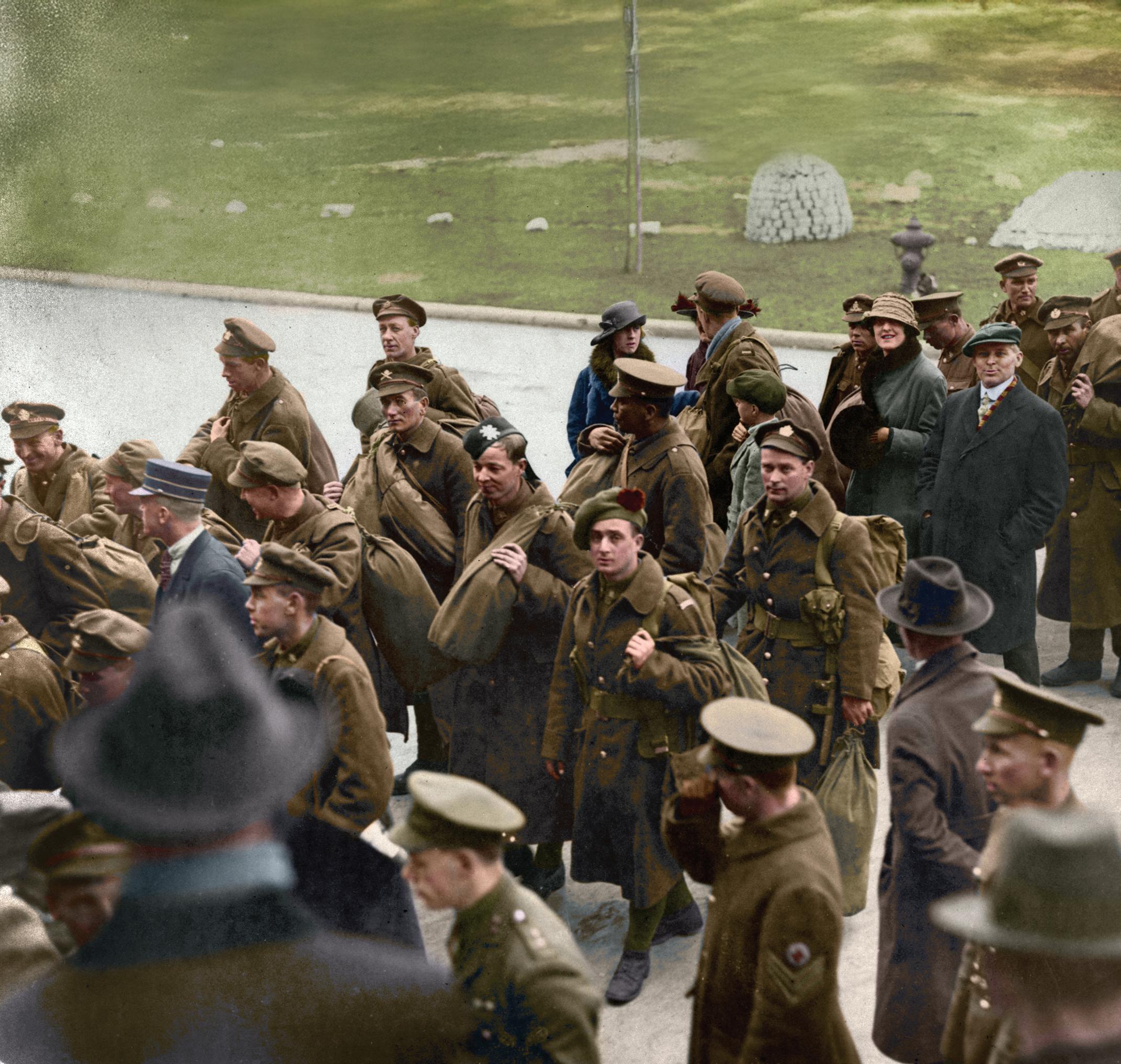




The Great War traumatized Canada. The early cheering that had greeted the outbreak of the conflict in August 1914 had disappeared with the reports of thousands of casualties from Ypres in April 1915. By the end of the fighting, the toll was enormous for a small country of some eight million to contemplate—approximately 68,000 dead, 176,000 wounded, and more than 3,800 prisoners of war. Many of the veterans who returned suffered from traumatic stress for the rest of their lives; many were opposed to Canada ever going to war again.
In 1914, the Methodist reverend Edwin A. Pearson had urged men to enlist and women to serve in ways that supported their efforts. Nine years later, on Nov. 11, soon to be a member of the United Church, Pearson’s sermon was very different: “We can end war in this generation if we as Christians are in real earnest about it,” he said. “Think how recent is the development of the sentiment of horror regarding war.”
The human costs of the conflict had changed him, as it had altered millions of Canadians, including Pearson’s son, and future prime minister, Lester.
Still, Canadian public opinion during the years after 1919 was in flux: there


were pacifists who believed every war was evil; there were neutralists who wanted Canada to stay out of all conflicts, favouring none of the combatants; and there were nationalists who wanted the country to be independent of the British Empire, free to make its own decisions on all matters of state, including going to war.
Speaking to the League of Nations in 1924, Senator Raoul Dandurand famously described Canada as “a fireproof house, far from inflammable materials.” That was a widespread view, akin to American isolationism. But roughly half of Canada’s population at the time was of British descent and most of them believed that the country’s duty was to stand by Britain no matter what.
There were many organizations in place to argue these perspectives. Canada’s League of Nations Society, formed in 1921, was the first national group to promote international affairs. Balanced in its approach, the society attracted individuals of varying opinions. It had branches across the country, and its leaders included Robert Borden and Ernest Lapointe, Mackenzie King’s Quebec chief. The society also distributed material published by the League of Nations and presented speakers across the country. Its success fluctuated with that of the league itself, which proved limited as the Genevabased organization faltered through the 1930s. The U.S. never joined, Japan
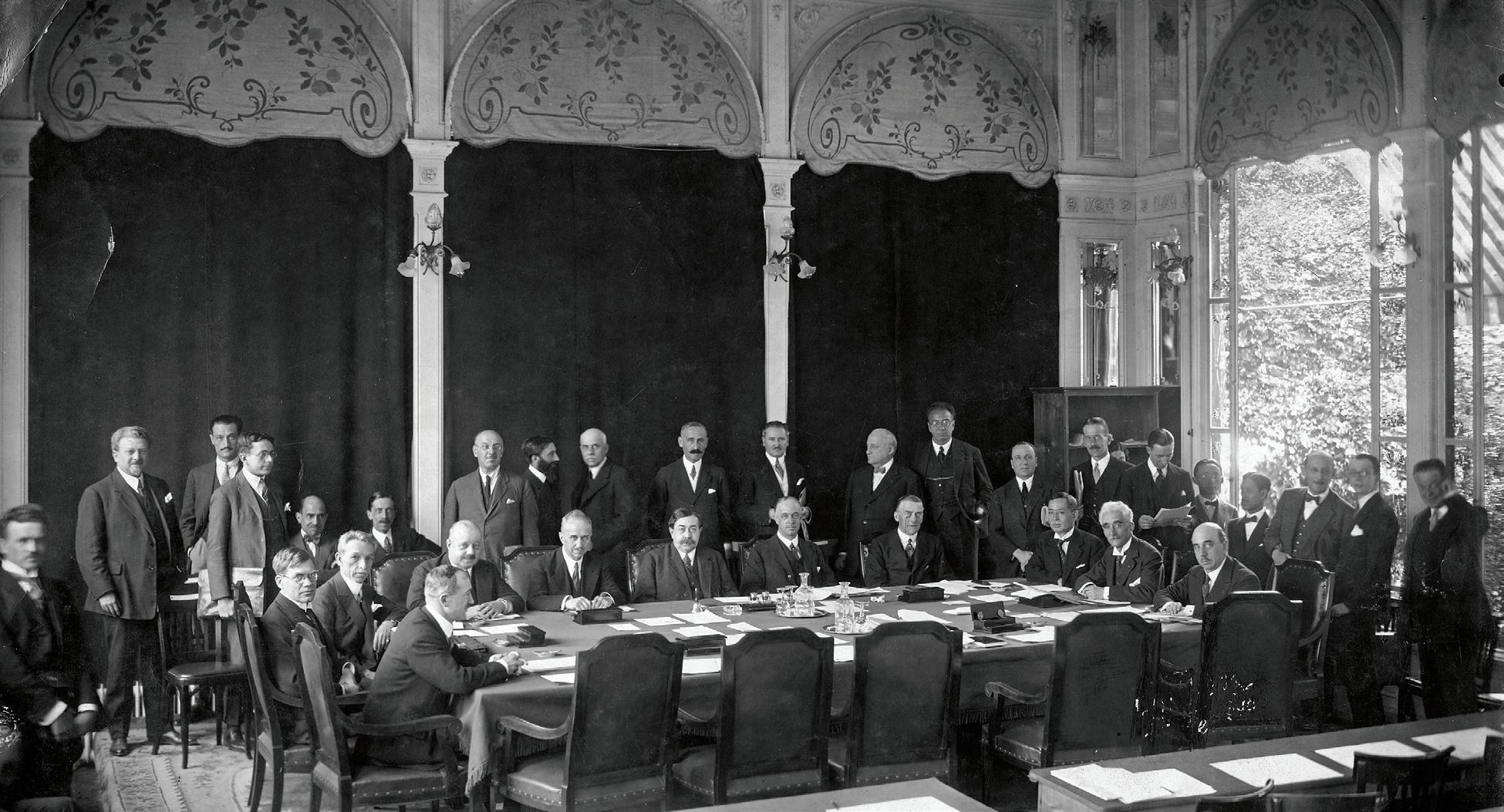

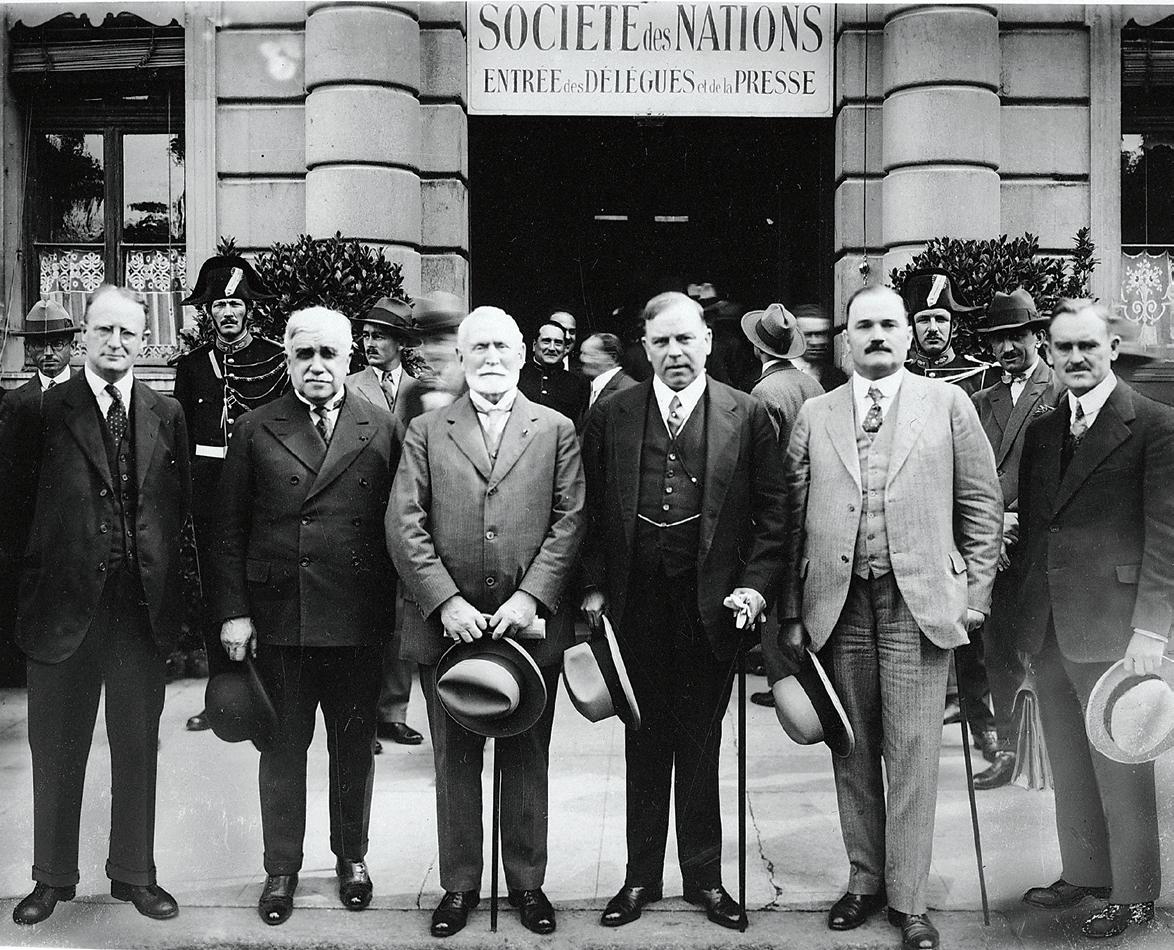
The Canadian delegation at a League of Nations meeting in Geneva, Switzerland, in September 1928 (above). The League meets in 1921 ( top). and Germany left in 1933, and Italy left in 1937, two years after it attacked Ethiopia. With the beginning of a second global war, the League essentially ceased operations—so, too, did the society in 1942.
Meanwhile, the Canadian Institute of International Affairs, a small membership-based organization, was established in 1928. Its founders included Borden, Manitoba Free Press editor John W. Dafoe, General Arthur Currie, and business titan Joseph Flavelle. The institute’s aim was, “To promote a broader and deeper understanding of international affairs and of Canada’s role in a changing world by providing interested Canadians with a nonpartisan, nation-wide forum for informed discussion, debate, and analysis.”
Like its founders, members came from politics, government, the military and academia. Especially prominent
in Winnipeg, Ottawa and Toronto, the institute began with five branches and 144 members. It grew slowly, but small as it was, it had some influence in and on the King government in the late 1930s. While its membership had earlier leaned to independence or neutrality, most were in favour of declaring war against Nazi Germany in September 1939.
Then there was the Women’s International League for Peace and Freedom (WILPF), founded in 1915 in the neutral Netherlands. After the Armistice, it worked to see that no further wars occurred. The WILPF established itself in Canada in 1922, forming branches in Vancouver, Toronto, Winnipeg and Edmonton to promote peace education and disarmament. In 1931, its petition calling for universal disarmament gathered 491,000 signatures in Canada.
This was a simple issue for Canada as the country was, for all practical purposes, disarmed between the wars. The regular force numbered 10,000 at best and had no modern equipment. The reserves were untrained and likewise ill-equipped with government funding during the Depression derisory.
The WILPF also protested the cadet movement. High schools and militia regiments operated cadet corps where young men wore uniforms, learned drill, discipline and how to fire a rifle. The federal government provided $500,000 a year to support the initiative in the 1920s, but the Depression reduced this to less than $145,000. WILPF member Agnes MacPhail—also the first woman elected to Parliament, in 1921—argued that the training was not beneficial, indeed

MACPHAIL REMAINED A PACIFIST UNTIL THE OUTBREAK OF WAR IN SEPTEMBER 1939: “ NO OPPOSITION TO HITLER SEEMED MORE TERRIBLE THAN EVEN WAR.”
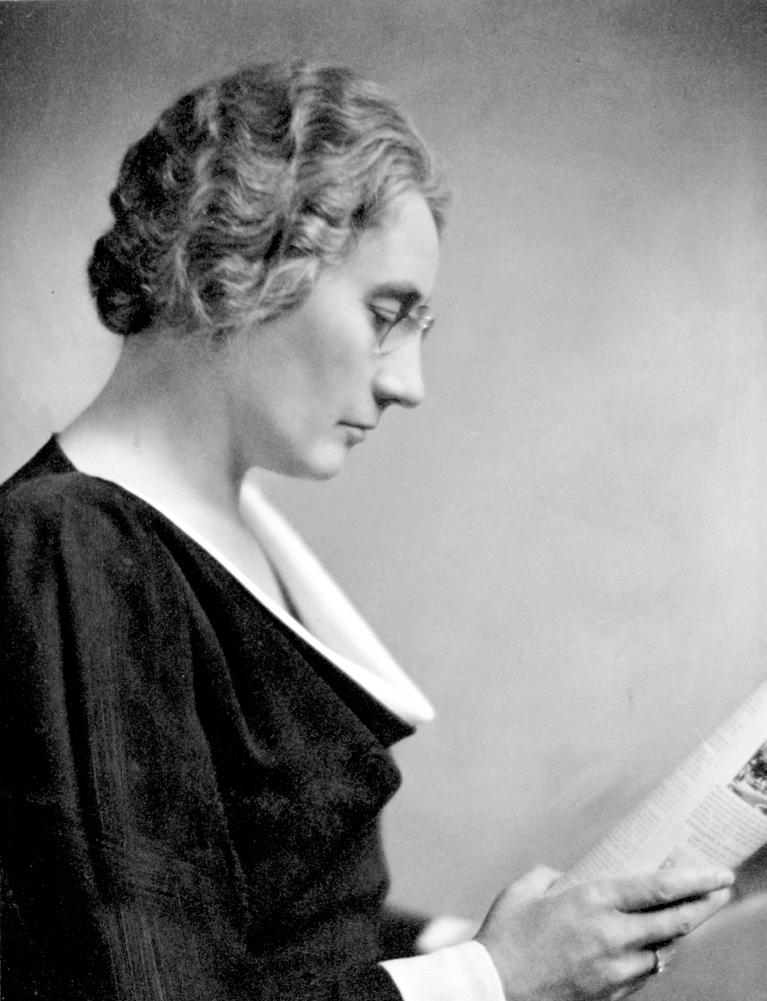
Agnes MacPhail in May 1934. A Canadian boys cadet corps with its instructors in October 1921.
harmful, and a waste of resources. It was better, she maintained, to improve the lives of Canadians through reform and education, not militarism.
Many school boards, including Toronto’s, eliminated high school cadets in the late 1920s, but reintroduced them a decade later. Not every teenager enjoyed marching and saluting, but some cadets found the training very useful to their development.
Bert Hoffmeister was 12 when he joined the Seaforth Highlanders cadet corps in Vancouver in 1919. He recalled that, “I found that the Seaforth Cadets provided me with a very good opportunity…to build up some self-confidence.”
By March 1944, he was a major-general commanding 5th Canadian Armoured Division. Not every cadet was as successful as Hoffmeister, but during the Second World War the cadet movement was a major source of recruits with at least 230,000 former cadets serving.
MacPhail wouldn’t have been pleased. She had carried her disarmament crusade to the League of Nations meetings in Geneva in 1929 as a member of the Canadian delegation and served on its disarmament committee. She remained a pacifist until the outbreak of war in September 1939. Said MacPhail: “No opposition to Hitler seemed more terrible than even war.”
Protestant churches, meanwhile, were divided on war. Anglicans backed England, while many Presbyterian clergy supported pacifism, though others felt the use of force in a just war was reasonable as a last resort. Most of the pacifists joined the new United Church of Canada (UCC), which formed in 1925 and brought together Methodists and 70 per cent of Presbyterians. The UCC developed a tradition of support for peace advocacy, but when Canada went to war in 1939 with the support of the church’s leadership, 68 ministers publicly declared their objection to the decision.
Pacifism was also fostered by books and films. Erich Maria Remarque’s 1929 novel All Quiet on the Western Front detailed his horrific and cautionary experiences in the German trenches; the 1930 film adaptation made them vivid. There were countless other influential works, including one by a Canadian soldier. Charles Yale Harrison’s novella Generals Die in Bed, published in 1930, detailed the squalor of the trenches and incidents of Canadians killing surrendering Germans. The latter claim was vehemently denounced by Canadian generals. Still, the book was a bestseller and remains in print today.
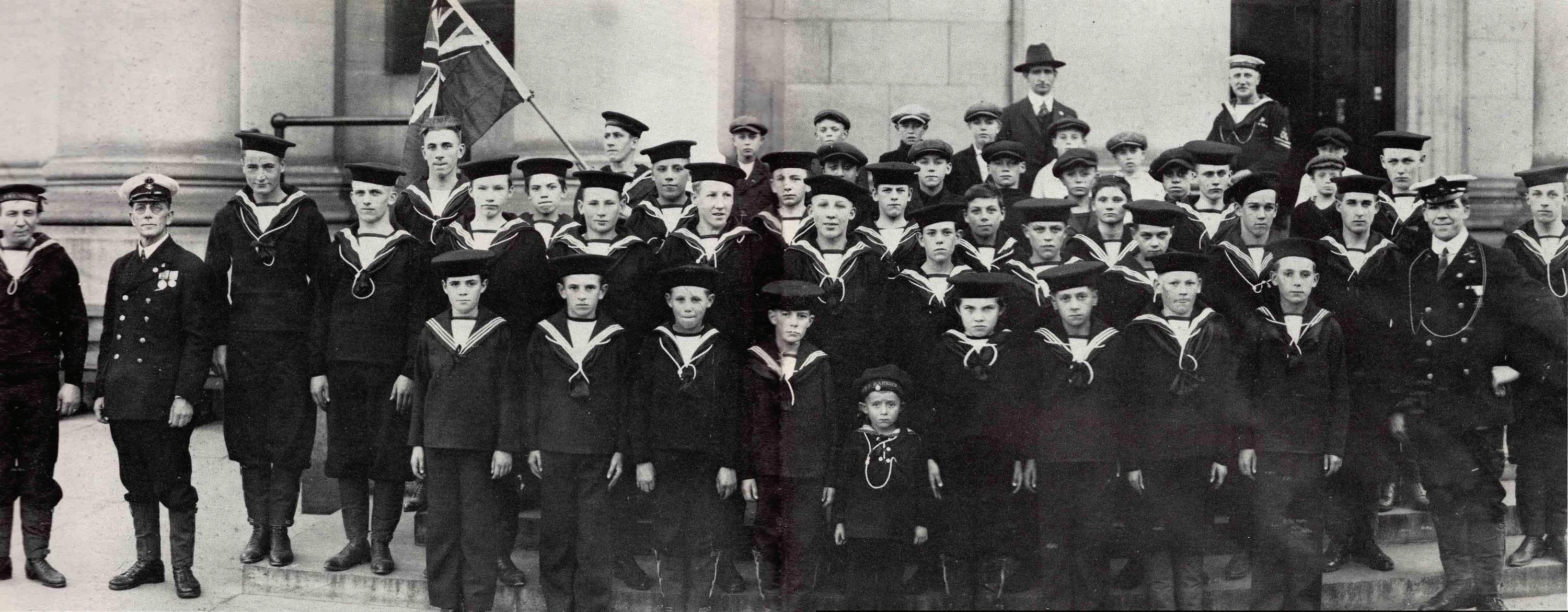
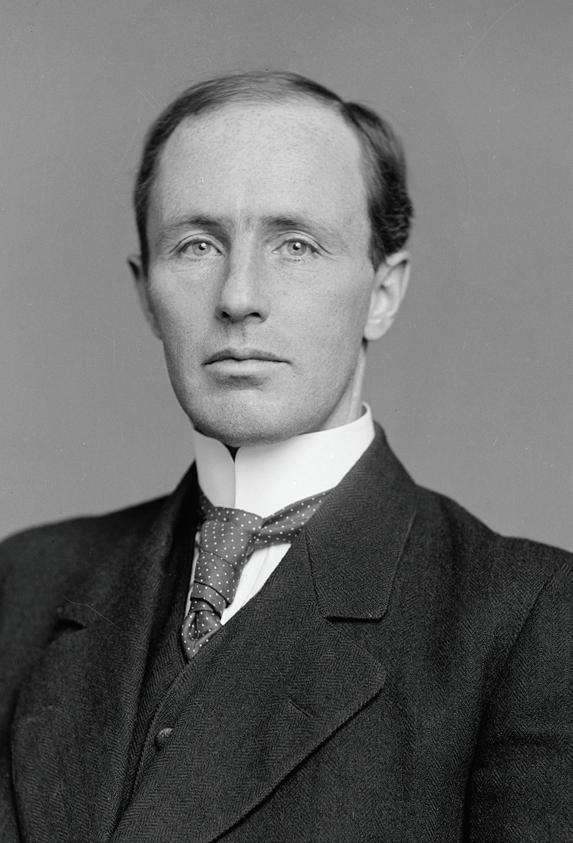
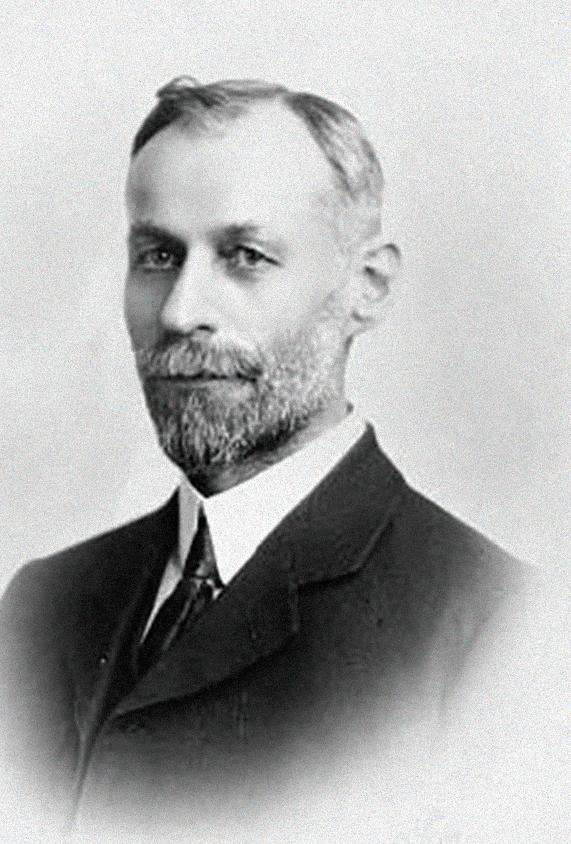
“DID THE LAST WAR SETTLE ANYTHING? I VENTURE TO SAY IT SETTLED NOTHING; AND THE NEXT WAR…IS NOT GOING TO SETTLE ANYTHING EITHER.”

Arthur Meighen and J.S. Woodsworth (above).
Political parties, of course, were the only organizations sanctioned to shape Canadian policy. The Liberals under Mackenzie King were initially nationalist, isolationist and quasi-neutral, seeking to foster Canada’s independence. King demonstrated this in 1922 when Britain announced that it wanted the dominions to send troops to assist in a quarrel with Turkey. King, who first learned of this from the press, was outraged, and said Parliament would decide. That was not a “no,” but it meant the same. Britain wasn’t happy—it controlled the Empire’s foreign policy, spoke for Canada in its embassies around the world and signed treaties on Canada’s behalf. The king of the British Empire remained indivisible. Soon after, King had Canada sign a treaty on halibut with the U.S., setting a precedent and, in 1927, he opened a legation in Washington. He then began pressing for formal recognition of Canada’s right to have its own foreign policy. The Statute of Westminster 1931 granted it. King also strengthened the Department of External Affairs, naming isolationist Oscar Skelton as its undersecretary. Skelton began hiring able officers for his department, including Lester B. Pearson.

Despite Skelton’s influence, King began a cautious rearmament program in 1937, steering, as he put it in his diary, “between the devil & the deep blue sea…between Imperialism & Nationalism.” Home defence was the priority and most of the funding went to the air force and navy.
The PM hated war and feared it might tear Canada apart. He supported appeasement and applauded the September 1938 Munich Agreement that annexed part of Czechoslovakia to Germany. Still, he suspected a serious conflict was coming. But, as he told the country in March 1939, there would be no conscription.
The opposition Conservative Party was far more pro-Empire and far less nationalist. In 1921, Conservative Prime Minister Arthur Meighen had persuaded Britain not to renew a treaty with Japan for fear of what might happen to Canada if Japan and the U.S. went to war. Persuasion could work to protect Canadian interests, Meighen believed, and independence wasn’t necessary.
Conservative R.B. Bennett, prime minister from 1930 to 1935, however, was pro-Empire but sometimes sought Canada’s independence in foreign policy. In 1935, he ordered Canada’s representatives at the League of Nations to press for sanctions against Italy after its invasion of Ethiopia. This was the proper response, even though it might have sparked war between the Empire and Italy. (Back as PM in late-1935, King abandoned that approach.) In the crunch, however, the Tories would typically back Britain.
The Co-operative Commonwealth Federation (CCF), founded in 1932, was a democratic socialist party. Its leader J.S. Woodsworth was an avowed pacifist. His party was sympathetic to his position, but its parliamentary caucus was more realistic. Some wars—for example, a fight against Nazi Germany— might require Canada to join. When the time of decision arrived, the CCF supported Canada’s participation, but Woodsworth spoke out against it.
“I would ask,” he said in the House of Commons, “did the last war settle anything? I venture to say it settled nothing; and the next war…is not going to settle anything either.” Woodsworth was soon replaced as CCF leader.
Almost all the francophone Liberal MPs supported going to war, just a few managing a feeble “nay.” French Canadians were

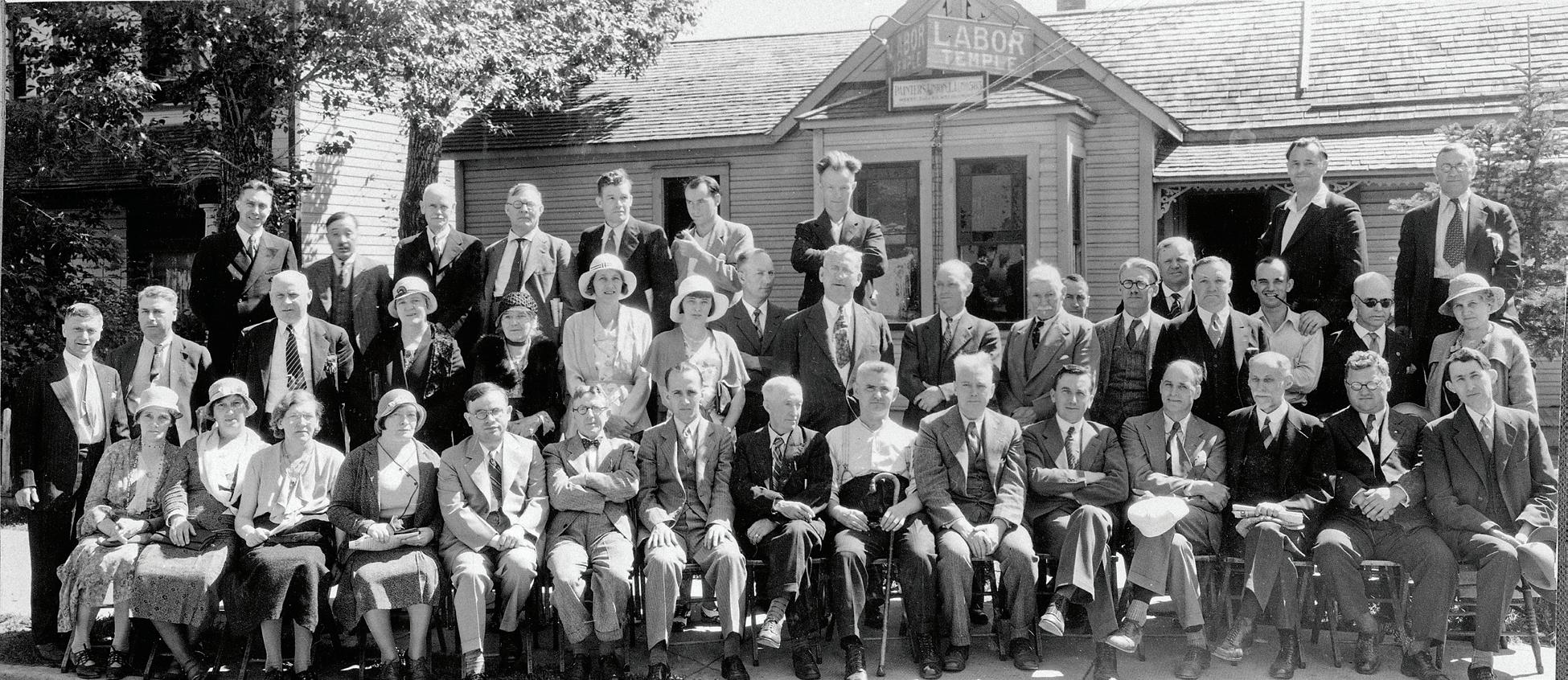
Attendees of the founding meeting of the Co-operative Commonwealth Federation (above), who, like the public at large, were torn between pacifism and sensible war. Anti-conscription demonstrators march in Montreal in March 1939.
about a third of the country’s population at the time. They had resented conscription in the Great War and feared it would happen again. Quebecers generally believed that even Mackenzie King, dependent on Quebec’s support to hold power, would support Britain and carry his party with him. They were right.
Even so, King somehow brought an almost united country into war in September 1939, something many observers thought impossible. The key was the prime minister’s pledge of no conscription for overseas service and his insistence that Parliament would decide if the nation would join the fight. And it did. Canada’s declaration of war came a week after Britain’s. That mattered, demonstrating that the country was making its own decision.
In a June 1939 article in The Atlantic, Stephen Leacock captured the Canadian position with his characteristically insightful humour: “If you were to ask any Canadian, ‘Do you have to go to war if England does,’ he’d answer at once, ‘Oh, no.’ If you then said, ‘Would you go to war if England does?’ he’d answer, ‘Oh, yes.’ And if you asked, ‘Why?,’ he would say, reflectively, ‘Well, you see, we’d have to.’” Leacock had captured the Canadian public and government position precisely. Canada wasn’t pacifist, nor neutral and, while legally independent after 1931, not yet autonomous in thought. The Anglo-Canadian mindset still demanded fealty to the Empire. King’s Canada would go to war at Britain’s side again. Why? Because it had to.
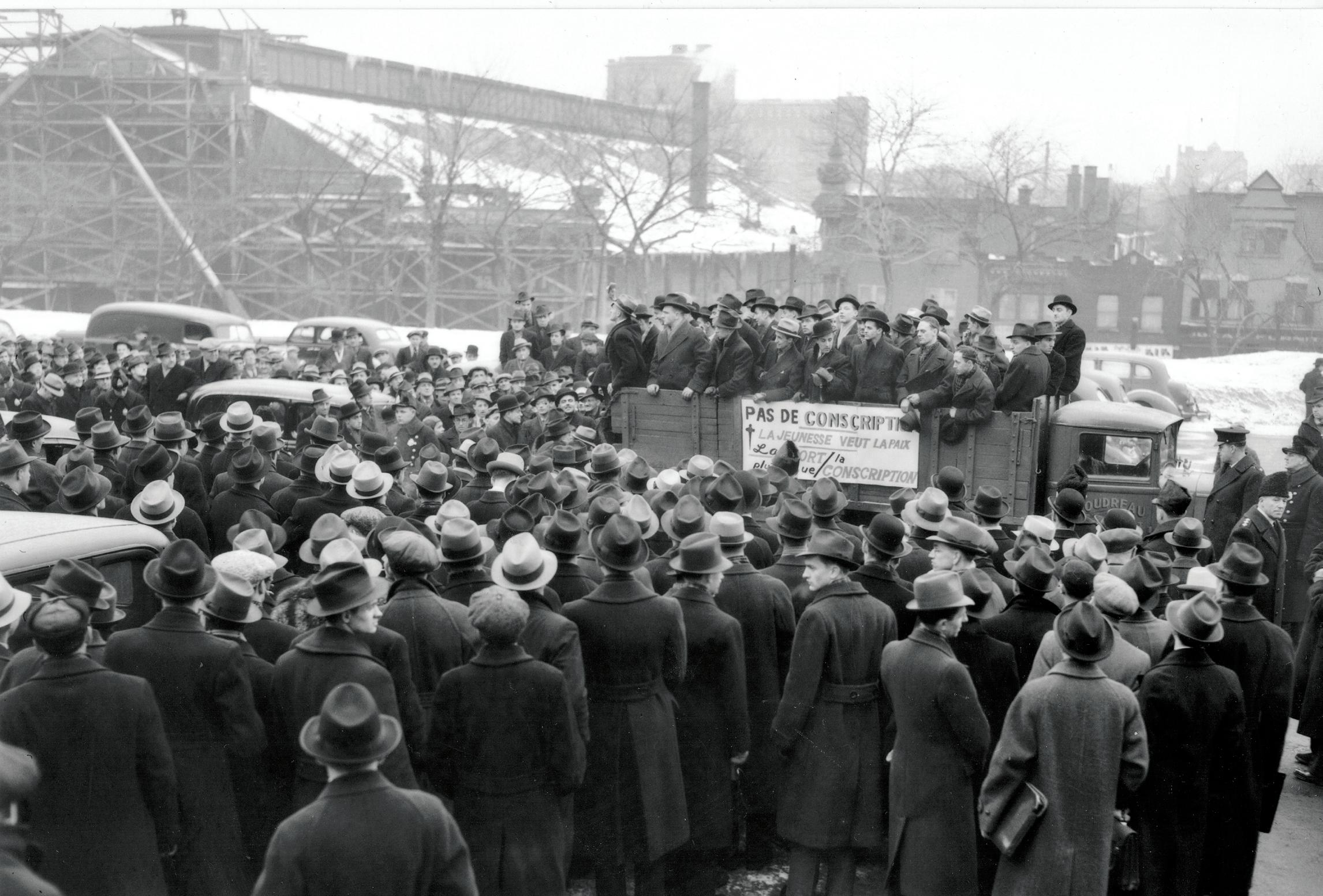
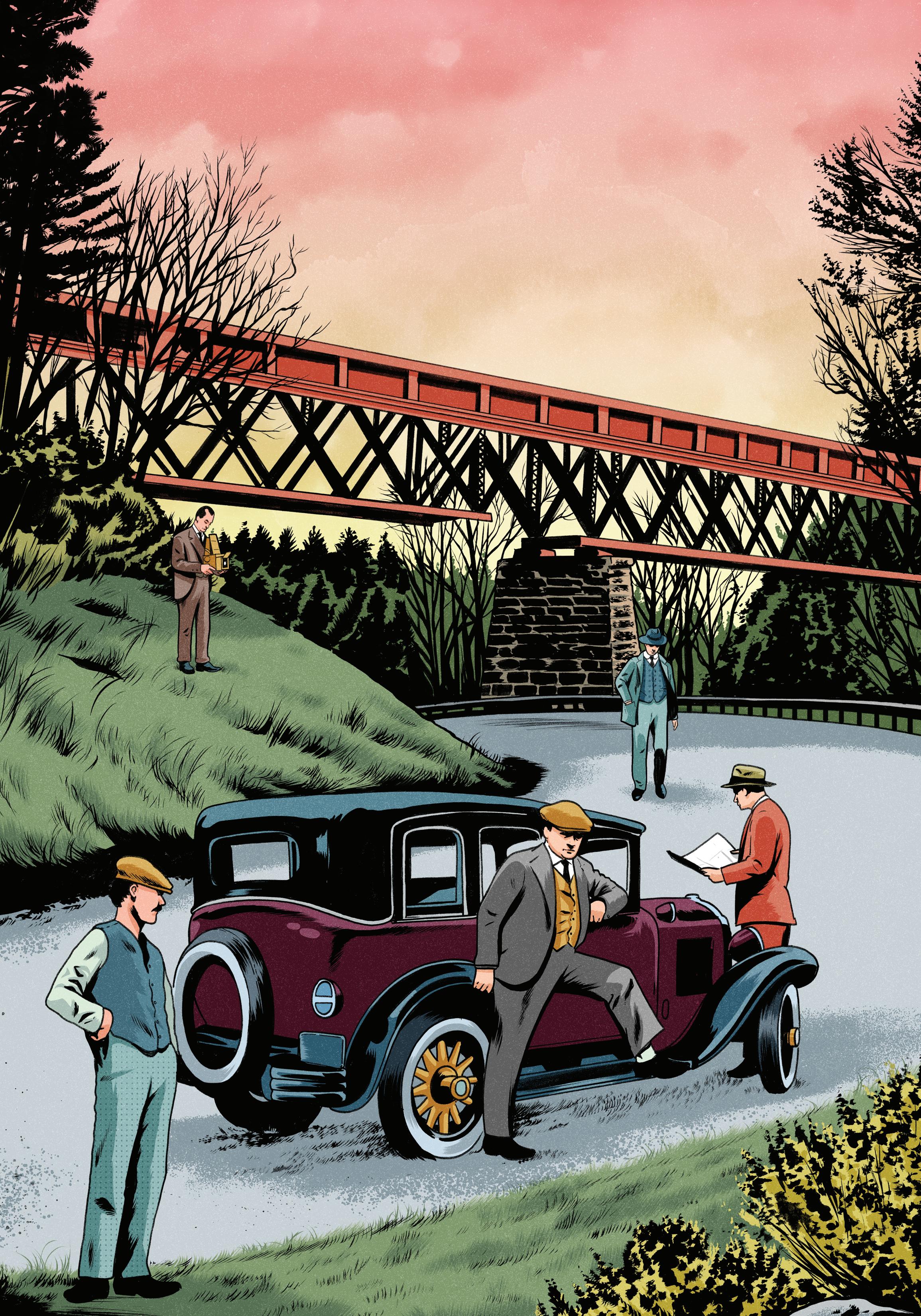
By David Pugliese, with illustrations by Joel Kimmel
the Americans of Upstate New York, the five men dressed in business attire likely looked like any other well-to-do visitors.
They were touring the state in a McLaughlin Special, a luxury vehicle with a powerful engine that would later become a favourite of alcohol smugglers during Prohibition because it could easily outrun police cars. The men snapped photos of bridges, roadways, canals and highway overpasses. They purchased local maps from gas stations and talked to residents about interesting geographic features in the area.
But these men weren’t tourists. They were all senior officers in the Canadian
Army, and they were on a reconnaissance mission led by Lieutenant-Colonel James Sutherland (Buster) Brown.
Brown was a decorated veteran of the First World War who had fought in most of the significant Canadian battles during that conflict. As the army’s director of military operations and intelligence, Brown’s foray into New York in spring 1921 was for a very specific purpose—he was going to draw up plans for a Canadian invasion of the U.S.
Brown, later promoted to brigadiergeneral, had the task of devising a variety of strategies under a series of numbered Defence Schemes. One outlined a plan for neutrality in case the U.S. went to war with Japan. Another involved an enlarged Canadian expeditionary force in the event of a deployment in an overseas or domestic emergency.
“Brown’s plan was to take the initiative and throw the Americans into disarray by launching this strike with the intention of buying time for the Brits to come in.”
But it’s Defence Scheme No. 1—a bold blueprint for a pre-emptive Canadian military strike against U.S. border states— that Brown is best known for. MajorGeneral George Pearkes, one of Canada’s most famous soldiers, would describe the initiative as “a fantastic desperate plan (which) just might have worked.”
Pierre Berton, writing in his 2001 book Marching As to War, dismissed Scheme 1 as “madcap” and Brown as “a bit of a nut.” Berton claimed that the idea of a major threat to Canada coming from the U.S. was “fanciful” as both countries enjoyed the best of relations.
But Andrew Burtch, a historian at the Canadian War Museum, told Legion Magazine that Defence Scheme No. 1 should be viewed in the context and political atmosphere of the times.
The U.S. had grown in economic power and influence. Canada was still closely tied to Great Britain, whose diplomats viewed the Americans with suspicion and distrust. In addition, there was growing tension between the U.S. and Britain over the American insistence that England pay back billions of dollars in loans from the First World War, Burtch explained.
Brown’s plan also took into consideration the potential U.S. desire for Canada’s natural resources, particularly the grain-growing provinces of Manitoba, Saskatchewan and Alberta.
“There are a lot of these pressures that factored into the thinking about security in that time,” Burtch explained.
In spring 1921, Brown received permission for the first of several clandestine trips into the U.S. His initial foray was the reconnaissance of the northern portions of New York state. Brown’s report from that journey was 60 pages long and contained 56 photos of key infrastructure.
In 1922, he set out on another surveillance, this one covering 1,750 kilometres through Vermont. Again, his summary was 60 pages and accompanied by photographs.
Brown’s missions were a combination of identifying strategic locations and taking measure of the potential American enemy. For instance, he noted that Wells River in Vermont was geographically important since it was a convergence point of both rail lines and roadways.
While in Burlington, Vt., Brown described that “the tradespeople and others we came in contact with seemed to be very affable.” Meanwhile, he observed that one man he met in North Duxbury, Vt., “was characteristic of a large number of men of the state— fat and lazy but pleasant and congenial.”
Brown took particular note of the individuals in the various rural areas he toured. He concluded the men appeared to be divided into two types: either lean and lanky or chubby, roundfaced and congenial. “If they are not actually lazy they have a very deliberate way of working and apparently believe in frequent rests and gossip,” Brown wrote in his report. “The women throughout the rural districts appear to be a heavy and not very comely lot.”
Still, he thought the men of Vermont would make good troops if they had a cause they could fight for.
In 1926, Brown sent another Canadian Army lieutenant-colonel on reconnaissance of the upper Michigan peninsula, covering more than 4,000 kilometres in 13 days. All of the material they gathered went into the plans for Defence Scheme No. 1.
It called for a pre-emptive attack by Canadian troops if it became apparent the U.S. was planning its own invasion of Canada. The Canadian initiative would involve quick-moving columns to temporarily seize U.S. centres near the border. Canadian troops in the West would capture Seattle and


Western troops occupy Seattle, Spokane, Butte and Portland
Troops from Prairie Command take Fargo and Great Falls, then march on to Minneapolis/St.Paul


Great Lakes-based column takes Detroit and Niagara
Troops from Quebec occupy Albany

Maritime army reclaims Maine
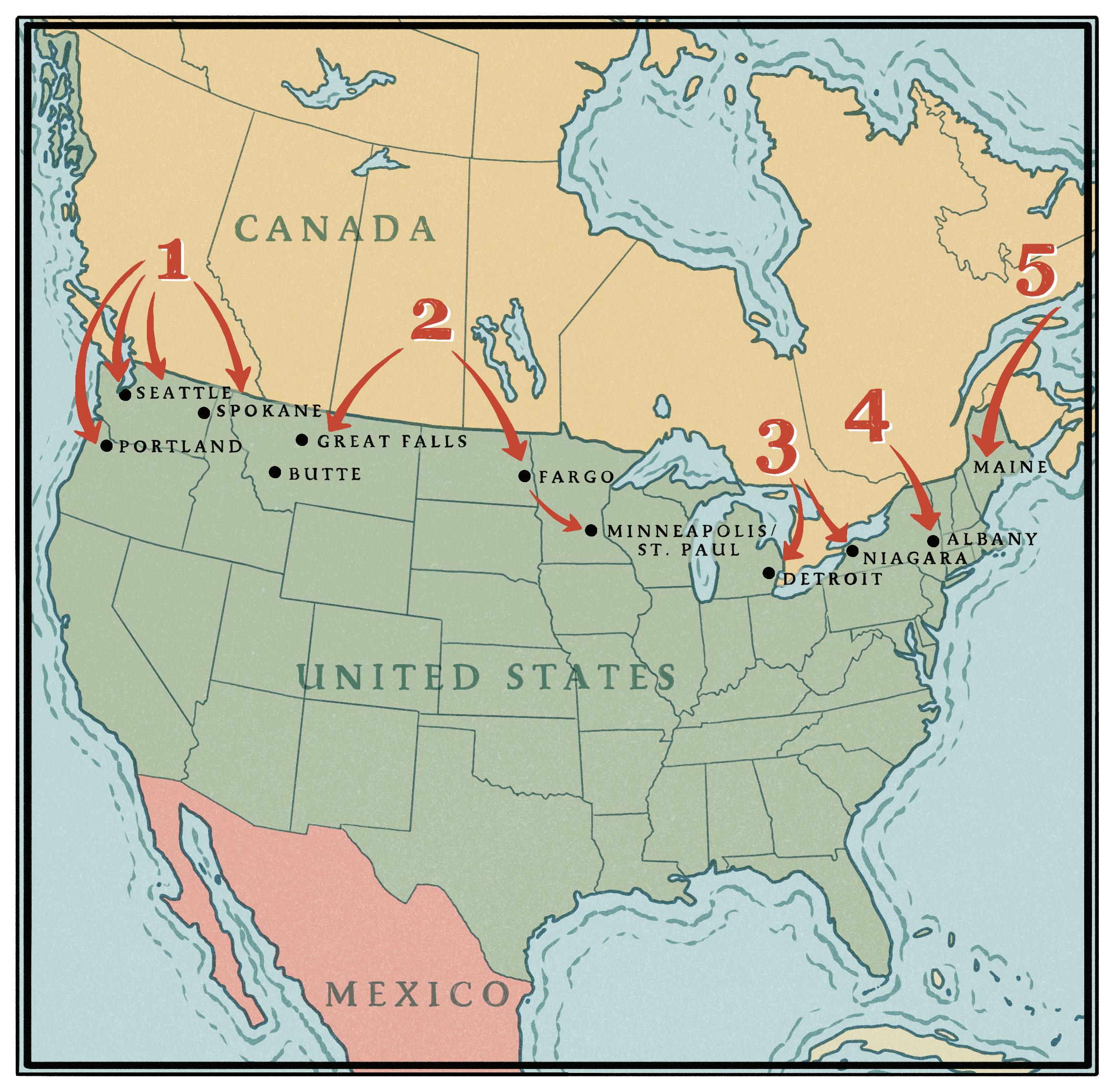
Spokane, Wash., and Portland, Ore. Great Falls, Mont., would be overrun and Canadian forces would continue their march through North Dakota before eventually seizing Minneapolis.
In the east, Albany, N.Y., would be captured. Canadian forces would also launch attacks along the Niagara River in New York state while other troops crossed into Maine to strike key points.
Like Brown and his entourage, American military officers conducted their own reconnaissance of the potential battlefields and strategic targets in Canada.
Brown’s strategy—based on the principle that the best defence is offence—wasn’t geared to hold territory for long. Bridges, rail lines and crucial transport hubs would be destroyed by the Canadians before they retreated. The idea was to hinder a U.S. invasion until Canada could receive reinforcements from Great Britian.
“Brown’s plan was to take the initiative and throw the Americans into disarray by launching this strike with the intention of buying time for the Brits to come in,” explained Burtch.
Defence Scheme No. 1 was circulated among senior Canadian Army staff for discussion and was updated throughout the 1920s.
“You’re really talking about one branch of the Canadian Army whose goal is to
study and think about security threats,” said Burtch. But, he added, “it was more than just a thought experiment.”
While Brown was working on Defence Scheme No. 1, the Americans were developing their own plans to seize Canada. The 94-page document, titled “Joint Army and Navy Basic War Plan – Red,” was more aggressive in nature and called for the U.S. to ultimately take full control of Canada.
The strategy was among a series of colour-coded plans the Americans had prepared to deal with conflict with several countries. Those included Orange for Japan, Black for Germany and Green for Mexico.
Red wasn’t specifically aimed at a direct conflict with Canada but rather focused on a war between the U.S. and Britain. Discussions about such a conflict were underway in American military circles throughout the 1920s, but War Plan Red wasn’t written until 1930. It was issued in February 1931 and revised several times.
Red had its origins in the economic rivalry between the U.S. and England. The strategy called for the “definite elimination of Red (England) as a strong competitor in foreign trade” and called for military action against “Crimson” (Canada) because of its close ties to the British.
Burtch says there was an obvious distinction between War Plan Red and Defence Scheme No. 1. “The main difference between the two is that the Americans had the presence and industrial base to actually effect the plan,” he said. “The Canadians never did.”
Like Brown and his entourage, American military officers conducted their own reconnaissance of the potential battlefields and strategic targets in Canada.
War Plan Red called on the U.S. army to launch an invasion at several points along the border. Troops would move from Vermont to capture Montreal and Quebec City. U.S. army units, marshalled in Grand Forks, N.D., would cross the border to seize Winnipeg, targeted as a central point for Canada’s rail system. American forces would also drive into northern Ontario to capture nickel mines in Sudbury. Toronto would be seized along with key hydro plants in Ontario.
Troops from Bellingham occupy Vancouver
Troops from Grand Forks take Winnipeg
Troops from Detroit seize Toronto
Troops from Buffalo disable Niagara Falls power grid

Armoured columns from Albany and Vermont capture Quebec City and Montreal
Naval fleet from Boston blockades Halifax
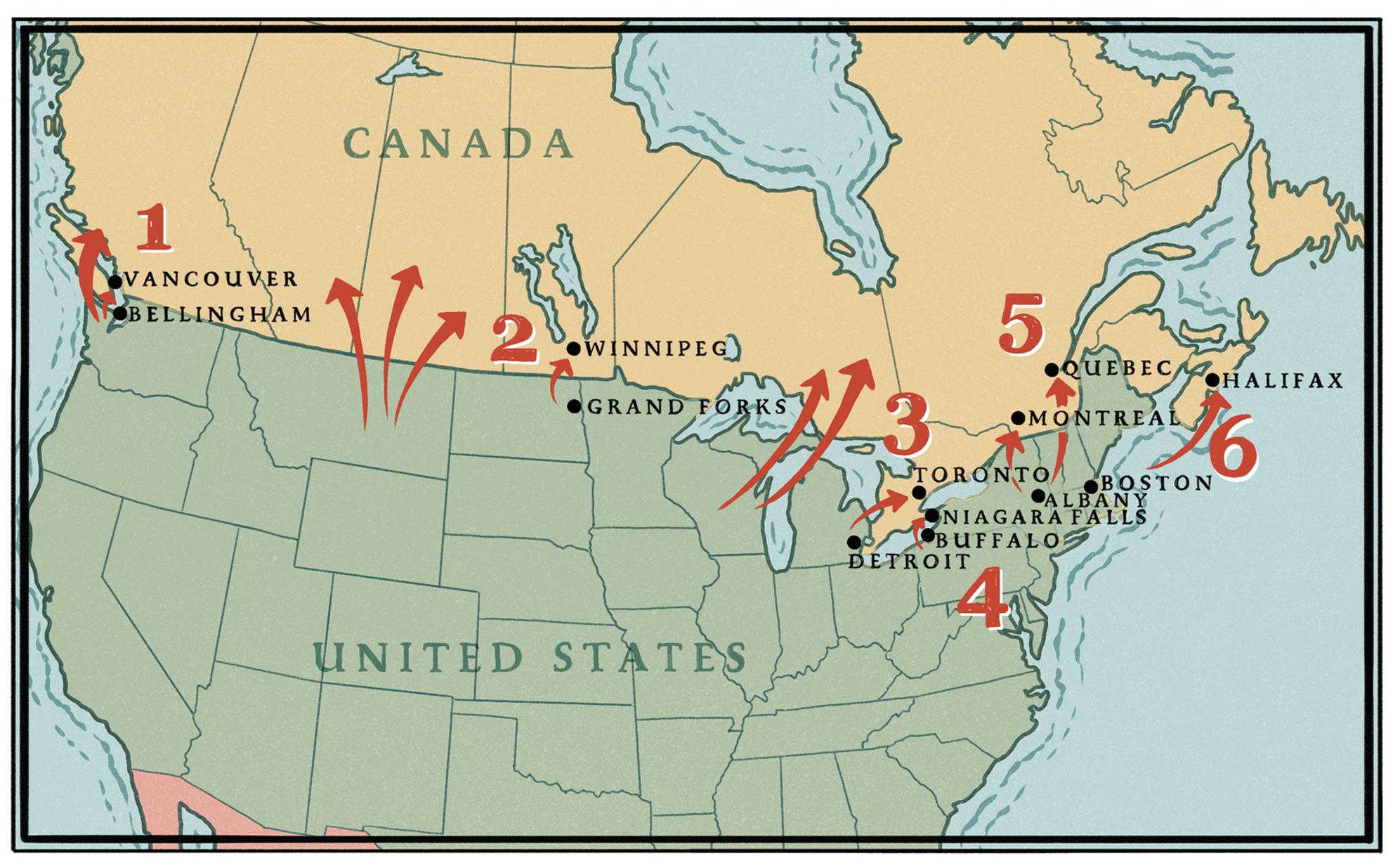
The U.S. navy would conduct operations on the Great Lakes and establish a blockade of Canada’s Pacific and Atlantic ports. Particular focus centred on Halifax, as the U.S. aimed to prevent Britain from using the port for reinforcements. The city would be subjected to both a strategic bombing campaign and chemical warfare. And troops would eventually seize the city. The Americans had no plans, however,
to return any captured territory. Canada’s provinces were to become U.S. states. If the invasion of Canada was successful, U.S. planners envisioned further strikes to seize other North American British colonies, including Jamaica, The Bahamas, Bermuda, and Trinidad and Tobago. But, if military operations didn’t go as planned and Britain emerged victorious, the American strategists concluded that Alaska would have to be ceded to Canada.
Both plans reflect the global uncertainty of the period in which they were developed.
Work on War Plan Red continued into 1935. That same year, though, U.S. lawmakers were dealing with a scandal involving American plans against Canada becoming public. The U.S. War Department had secretly built three military airfields, disguised as civilian airports, near the border. The project had been discussed at the House military affairs committee by two generals in a closed-door session, but their testimony was mistakenly published. That, in turn, prompted the Canadian government to lodge a protest.
The news made the front page of the May 1, 1935, New York Times as U.S. President Franklin D. Roosevelt sought to reassure Canada he wasn’t planning a war and that “the United States expected to live up to the letter and spirit of [its] treaties relating to the permanent disarmament of [the nations’] three thousand miles of common boundary.”
By 1939, the invasion plans of both countries had fallen by the wayside.
Defence Scheme No. 1 was the first to go. By 1929, it was shelved and in 1933, Canada’s defence chief, General Andrew McNaughton, ordered most of the documents related to it burned. McNaughton concluded that: “Politically Canada’s position vis-à-vis the United States has been immensely stabilized.”
Historian John Major of the University of Hull in the U.K. has noted that by May 1936, War Plan Red was considered a low priority by U.S. military leadership. By then, the American focus had shifted to the threat posed by the Japanese and War Plan Orange took precedence. Plus, U.S. and British interests in the Far East were coming together as both countries faced an increasingly aggressive Japan.
War Plan Red was declassified in 1974 and resides in the U.S. National
Archives at College Park, Md. Records related to Defence Scheme No. 1 are scarcer, but historians have found enough documents to put together the details of the invasion plans.
The notion of a war between Canada and the U.S. has surfaced several times in recent memory. In the early 1990s, War Plan Red was highlighted by Queen’s University professor Floyd W. Rudmin when he raised questions about why the Pentagon had launched a significant expansion of Fort Drum near the Canadian border in the vicinity of Kingston, Ont. Rudmin maintained that the 10,000-strong U.S. army unit located at the base was more suited for fighting its way into Ottawa than for the overseas battles it was supposed to take part in.
In his 1993 book Bordering on Aggression: Evidence of US Military Preparations Against Canada, Rudmin argued that several factors could prompt an American invasion. Those included the possibility of Quebec separation, or the U.S. need to maintain access to Canadian raw materials, energy and water resources.
In September 2012, a U.S. State Department official had to deny that a closed-door meeting between American and Mexican government officials had anything to do with a secret plan to invade Canada. Although the remarks were taken as a joke, the statement sparked another round of interest in War Plan Red and Defence Scheme No. 1. So, too, has current U.S. President Donald Trump’s talk about annexing Canada.
These days, the initiatives tend to be dismissed as the designs of paranoid or overzealous military leaders. Brown’s strategy has, in particular, faced open ridicule. But historian Burtch says that isn’t fair. Both plans reflect the global uncertainty of the period in which they were developed. It’s the job of professional military staff to protect their respective countries and draft strategies to deal with various scenarios, however unlikely they may seem in hindsight, he added.
Does Burtch think the current tensions between the U.S. and Canada have prompted defence planners to go back to their drawing boards and develop new sets of invasion blueprints?
“It’s doubtful,” he said. “But you never know.”
An artist depicts April 1916 fighting in the St. Eloi area.
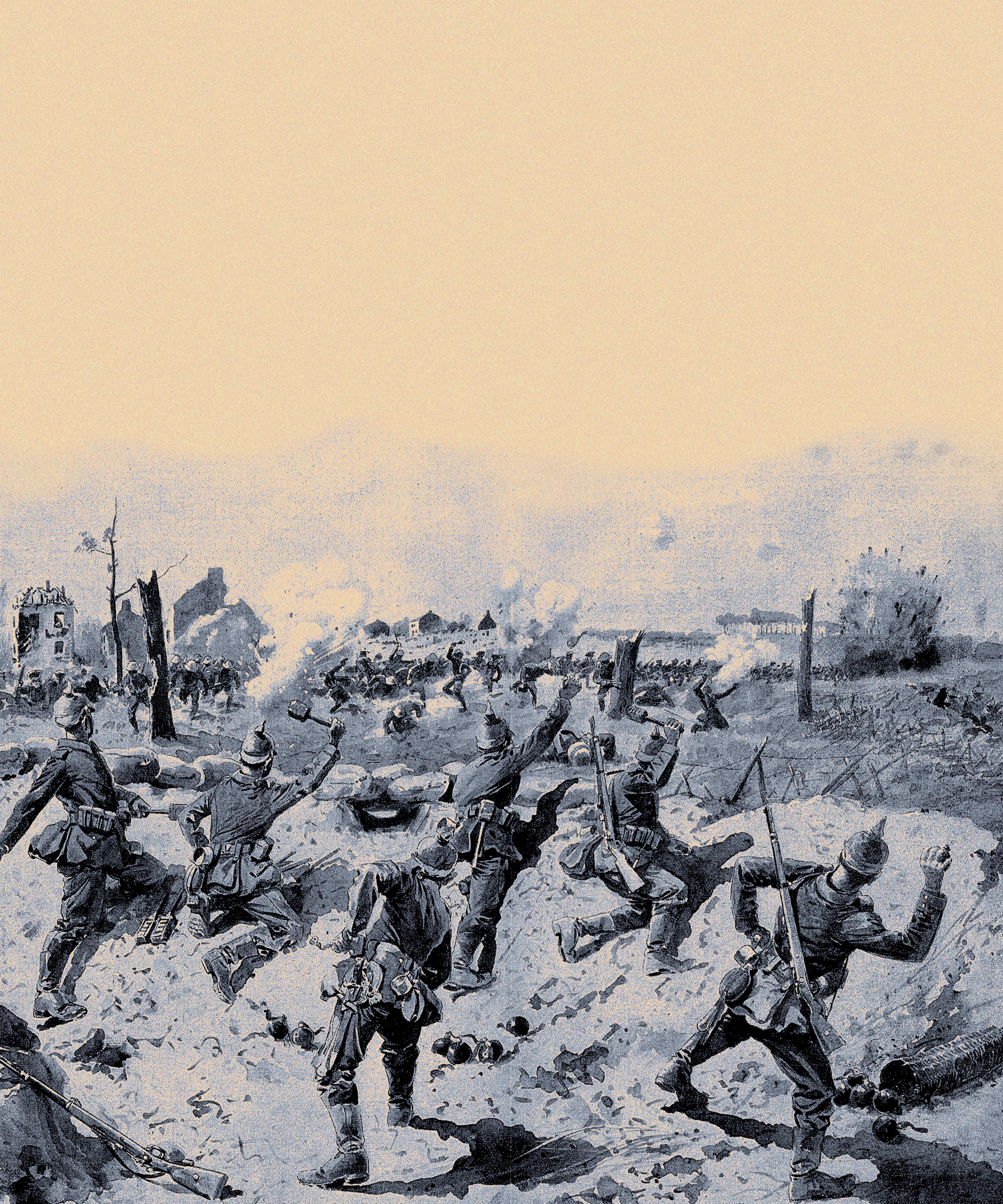
AFTER BRITISH TUNNELLERS BLASTED MINES IN THE ST. ELOI AREA,THE CANADIAN CORPS FOUGHT HOPELESSLY TO HOLD THE DEVASTATED LANDSCAPE Mark Zuehlke


Brigadier-General Huntly Ketchen (below). An artist depicts Canadian tunnellers at work near St. Eloi (opposite).

April 4, 1916, 2nd Canadian Division’s 6th Brigade commanded by Brigadier-General Huntly Ketchen took over the front lines of the St. Eloi battleground from 3rd British Division’s 76th Brigade. As the Canadians moved into shallow trenches clinging to the sides of massive craters, one called to the soldiers he was relieving a customary Western Front greeting: “Cheer up! Don’t be downhearted.”
“You’ll be downhearted,” a mud-spattered Tommy whispered morosely, “when you see what’s up there. I have lost my best chums.”
The Canadians quickly appreciated the warning. The St. Eloi area about five kilometres south of the largely devastated town of Ypres was to serve as the Canadian Corps’ introduction to what would prove to be, in the words of the late pre-eminent First World War historian Tim Cook, “a year of mayhem and battle.”
The landscape the Canadians entered bore little resemblance to anything natural. It had been utterly transformed by the outcome of a remarkable mining project conducted by British sappers—many of them miners in civilian life. After months, these engineers had tunnelled about 300 metres beyond a narrow British-held salient south of the village of St. Eloi to cross no man’s land to get underneath a slight rise of German-held ground nicknamed the Mound. The aim? To win from below what had proven impossible to take on the surface.
In the early part of 1915, the Western Front had stagnated into fixed lines from which
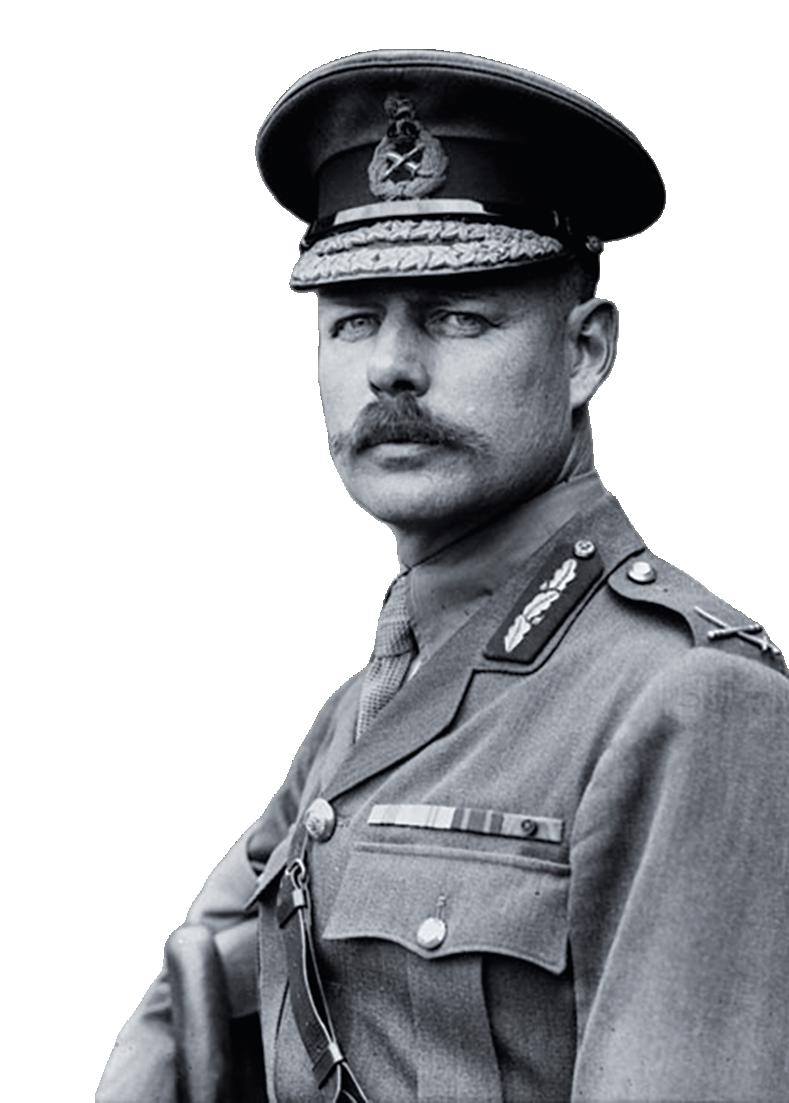
neither British nor German forces could gain any decisive advances. Desperate to seize the initiative, both sides began advancing underground, digging below the opposing lines and creating large caverns into which explosives were emplaced then detonated. The resulting demolitions collapsed trench systems above and created vast craters. Immediately following an explosion, infantry supported by massed artillery barrages would dash forward to overwhelm whatever dazed survivors remained. Initially, both German and British sappers worked at depths of only one to three metres to create tunnels that, when detonated with light charges, disrupted the opponents’ own similar efforts. By late 1915, however, the British ratcheted up the warfare mining tactic by digging even deeper. The ground of much of the Ypres salient was sandy to
15- to 45-metres deep. Below that lay hardpacked strata and it was into this that the British tunnellers dug. So enthusiastic was British command about the strategy that by December 1915, more than 20 tunnelling companies existed—including three Canadian units, though only the 3rd Canadian Tunnelling Company was then on the ground in France.
The Mound provided the Germans an ideal position overlooking British lines, and from which artillery could be fired. As such, it was identified by British Second Army’s General Hubert Plumer as a prime target for one of the most extensive mining schemes his sappers had yet undertaken.
By early March, ammonal charges from 270 to 14,000 kilograms had been placed in six mines. As the work was completed, a relief plan was developed whereby the Canadian Corps was to relieve the British V Corps. Lieutenant-General Edwin Alderson, a Brit in command of the Canadians, proposed the coming attack be launched by his 2nd Division. Plumer, however, pointed out that V Corps’ 3rd Division was already well
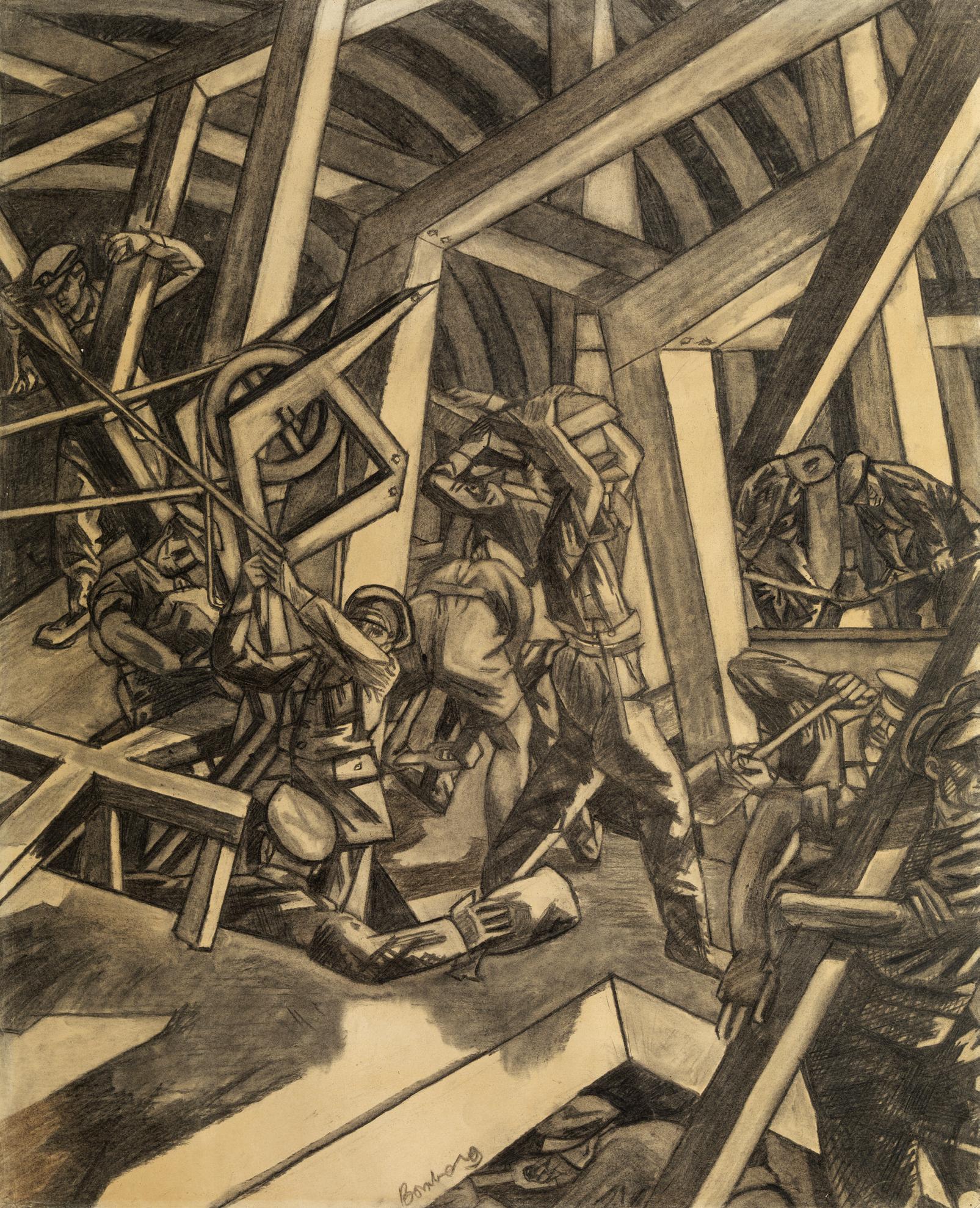
The explosion “leapt to heaven in a colossal shower of yellow smoke and debris; it shook the earth like the sudden outburst of a volcano.”
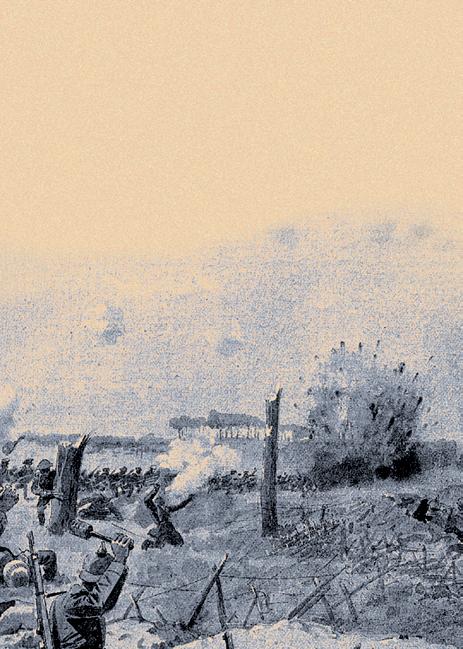
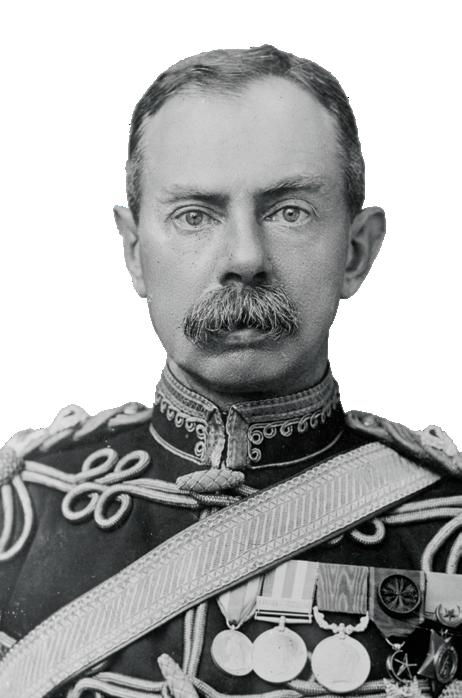
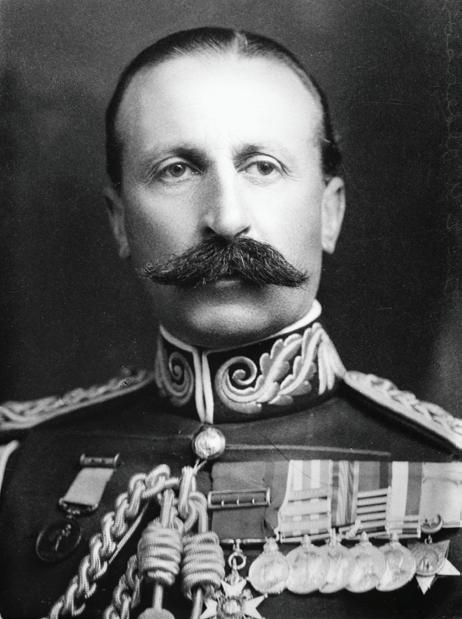
operation. His compatriot LieutenantGeneral Edwin Alderson

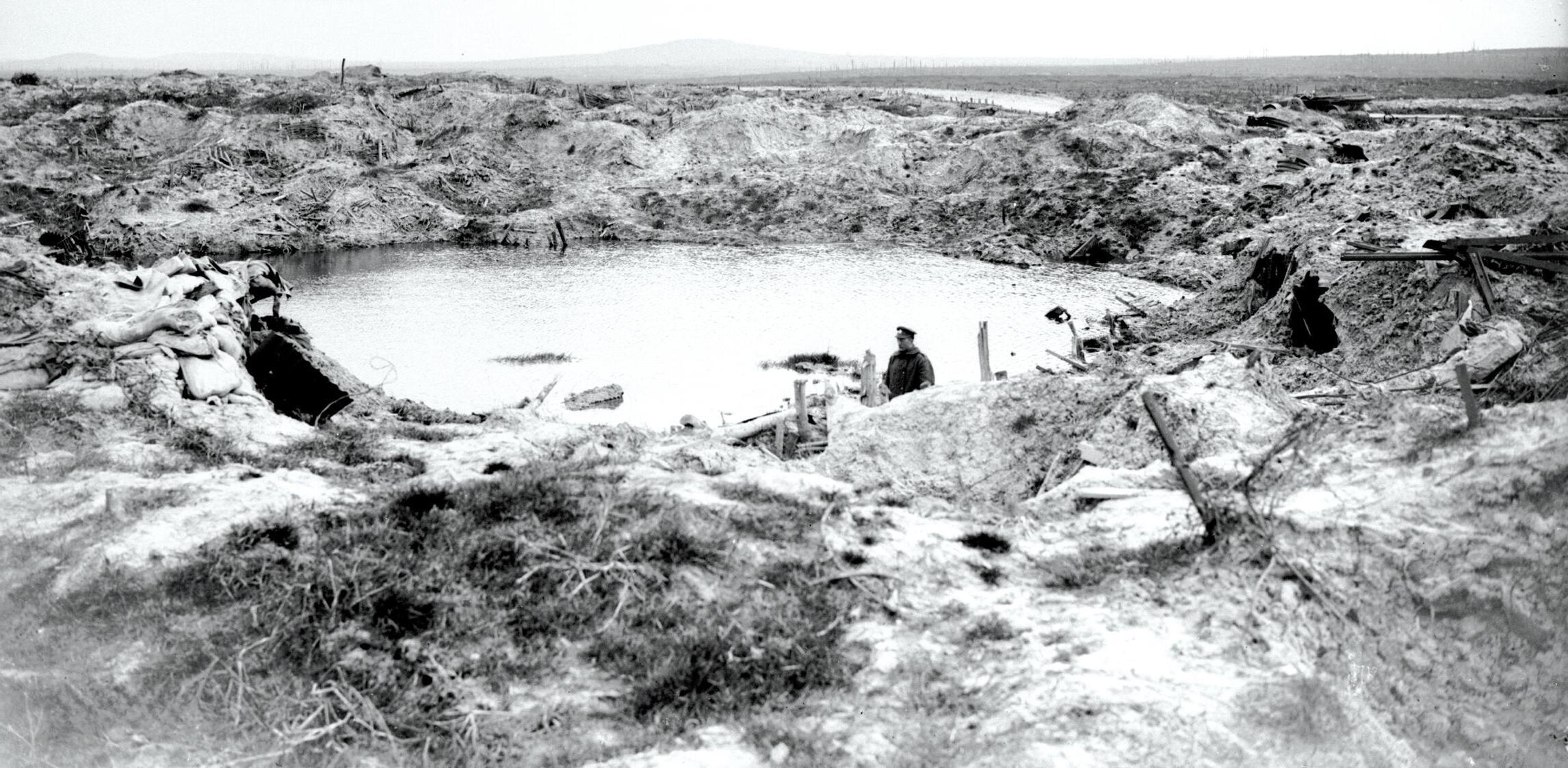


Major-General
Richard Turner (right ).
An aerial photo taken in late-March 1916 after the St. Eloi mines were blown (opposite). Three years later, the St. Eloi landscape remains devastated (above).











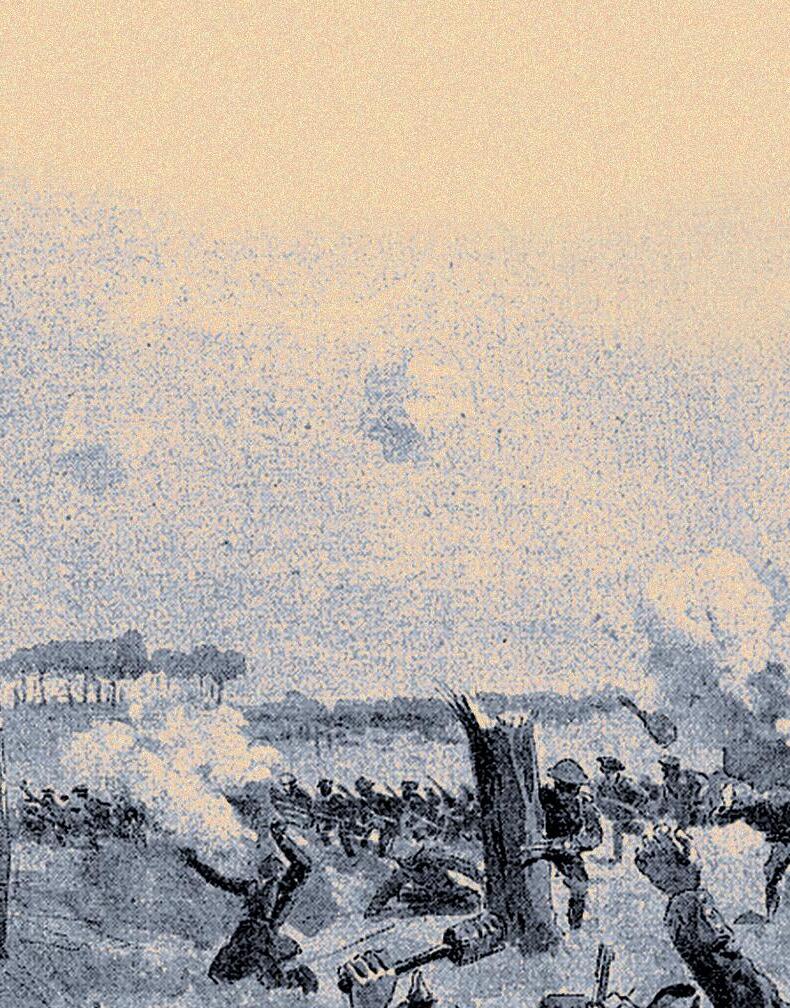
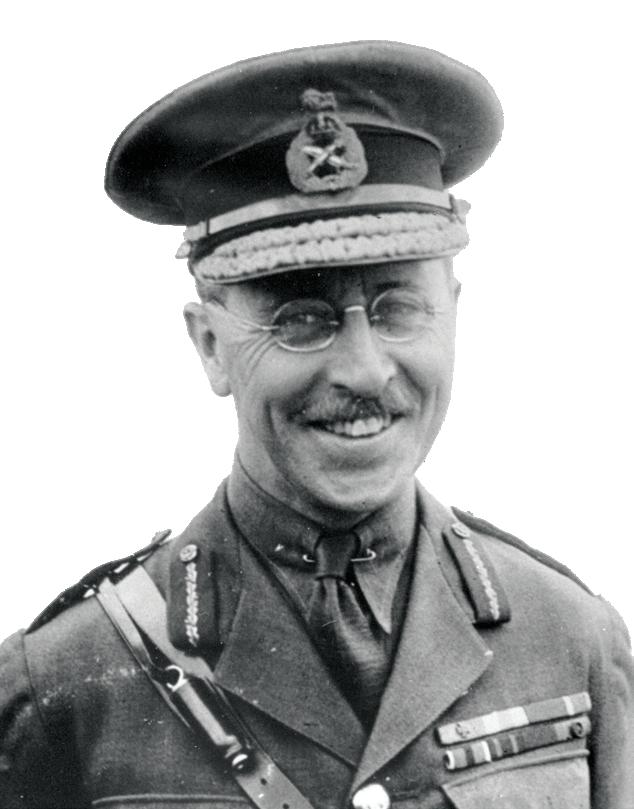
advanced in preparing for the attack, having practiced against mock German lines. So, the Brits would attack and once they had consolidated a new line beyond the soon-to-be-created craters, the Canadians would take over.
At 4:15 a.m. on March 27, 41 artillery pieces opened fire and the six mines detonated in a matter of seconds. The ensuing explosion “leapt to heaven in a colossal shower of yellow smoke and debris; it could be seen from miles away and shook the earth like the sudden outburst of a volcano,” wrote Max Aitken, Canada’s military representative at the front. “Trenches on both sides collapsed…. Old landmarks were blotted out.”
With the last clods of earth still falling, British troops rushed forward and secured five of the seven craters created by the blasts. Two of the craters, however, were taken by neither side—the British, finding the landscape so devastated and changed from what their maps showed, hunkered down in large

holes they mistook for craters. This left a large gap in the line for three days, at which point the regrouped Germans seized one of the two while the British then occupied the other. After a week of intense, close-quarters combat, the Brits ousted the Germans from the one crater, but the effort left 3rd Division spent. On the night of April 3-4, the Canadian Corps switched places with V Corps. This was the first time a corps-level relief was conducted by the British Expeditionary Force and conformed with Canadian government insistence that their corps must always enter and leave the front line together.
Exhausted British scouts tried to guide the Canadians to assigned positions, though they often got lost in the devastated battlefield. Two 6th Brigade battalions, the 27th and 31st, waded into what they discovered was just a 600-metrewide salient where the only defensive works were shallow ditches rather than an interlinked trench system. Sergeant A.H. Bell described the Canadian position as stuck “on a forward slope, in full view of the enemy.” This was particularly true for the German artillery spotters on nearby Wytschaete ridge, for whom the entire area was “spread out like a map.”
Canadian commanders and artillery observers, conversely, could only see beyond the edges of the craters that formed their skyline when the sun was low and not in their eyes. There
were no reserve lines. These had been obliterated to a depth of 1,000 metres since the initial British attack. Blown so closely together, the four central craters formed an impassable obstacle that made it impossible to create any coherent communication system from the front to the rear. Alderson, 2nd Division’s Major-General Richard Turner and Ketchen consequently had virtually no idea what was happening ahead of them. This created much misunderstanding as to what ground the Canadians did or didn’t hold. Turner remained optimistic. Given time, he believed, “we could make a pretty good line of the position selected, but that a great amount of work would be required.”
Third Division’s commander—having had some crater-fighting experience—offered Turner much advice on how to strengthen his defences and misdirect the German artillery away from his troops. Ketchen grimly noted that the British hadn’t implemented any of these suggestions and felt his brigade’s situation was tenuous. German artillery fire was unrelenting, described by one British artillery officer—who had been in the Ypres salient for almost a year—as the heaviest he had endured.
During one bombardment, a 200-metre trench section held by 27th Battalion was demolished. A section of 31st Battalion’s trench was exposed to German machine-gun fire from a nearby
Hand-to-hand fighting by desperate soldiers continued for hours with little mercy shown by either side. This only worsened the Canadian position.
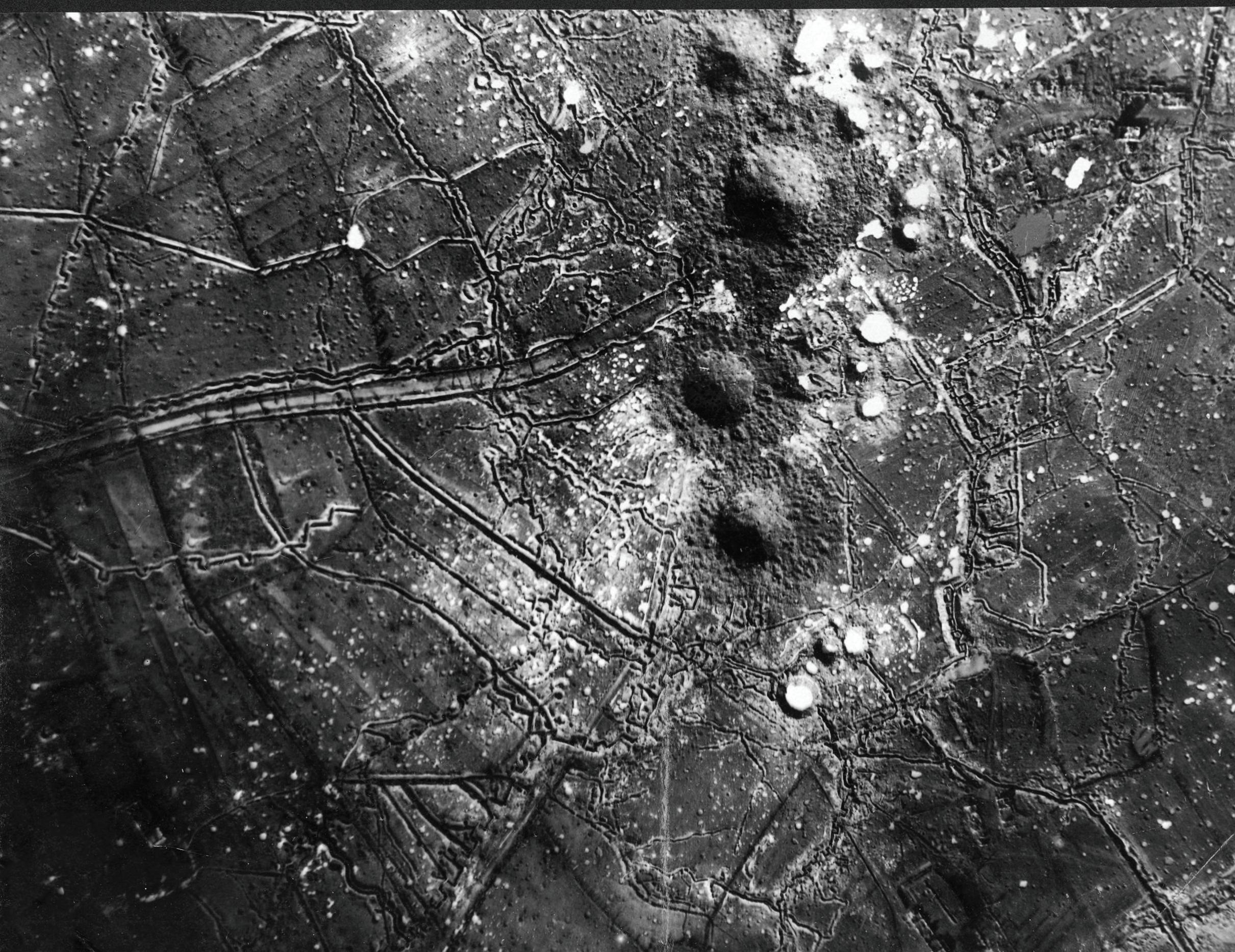

flanking position. Snipers were active from positions just 150 metres from the Canadians. By the evening of April 5, the two battalions had lost contact with each other. Later that night, Ketchen directed his 29th Battalion to relieve the badly depleted 27th, which had lost 40 killed and 189 wounded in three days.
Confusion and congestion in the muddrenched trenches delayed the relief, and it was still underway at 3:30 a.m. when, following a heavy artillery bombardment, a two-battalion strong counterattack struck. Craters 2, 3, 4 and 5 were all lost. In less than three hours, all the ground won by the British between March 27 and April 3 was again in German hands.
The Canadians immediately counterattacked, ordered by Turner, to recover what they had lost. Hand-to-hand fighting by desperate soldiers continued for hours with little mercy shown by either side. This only worsened the Canadian position. The craters remained in German hands and those soldiers who managed to reach them were annihilated.
Confusion ruled. Repeatedly, Canadian companies reported having won a specific crater only to discover they were somewhere else entirely. On the night of April 6-7, 28th Battalion sent 75 specialized bombers armed with grenades and protected by two infantry companies to recapture Crater 5. Moving through heavy rain and showering enemy shellfire, the force lost its way and ended up taking a cluster of craters north of Crater 4. Ketchen’s brigade was done and
relieved later that night by Brigadier-General Ronald Rennie’s 4th Brigade. In four days of fighting, 6th Brigade suffered 617 casualties.
Determined to regain the initiative, Turner presented two options to Alderson. He could either “evacuate the craters, and…shell the Germans out of the line they held, in the same way that they had dealt with us,” or “attack on a wider frontage…and to consolidate the ground gained; thus giving the German artillery a wider objective for their retaliation.”
Alderson ruled out the wider attack because there was no chance of achieving surprise with such an exposed front line. Also, the Canadians were already engaged in building up manpower and materiel for a forthcoming projected offensive on the Somme. When Alderson took the idea to Plumer, the army commander demurred. Mistakenly believing only two craters had been lost, he ordered the Canadians to hold their current positions while also retaking them.
On the night of April 8-9, 21st Battalion attacked Craters 2 and 3 from the west only to be repulsed by rifle and machine-gun fire. A three-battalion assault 24 hours later also failed. A German counterattack the following night was driven off by grenades thrown by Canadian bombers. On April 12-13, 5th Brigade relieved 4th and was organizing an attack on the German-held craters when Alderson and Turner agreed instead to just hold the line.
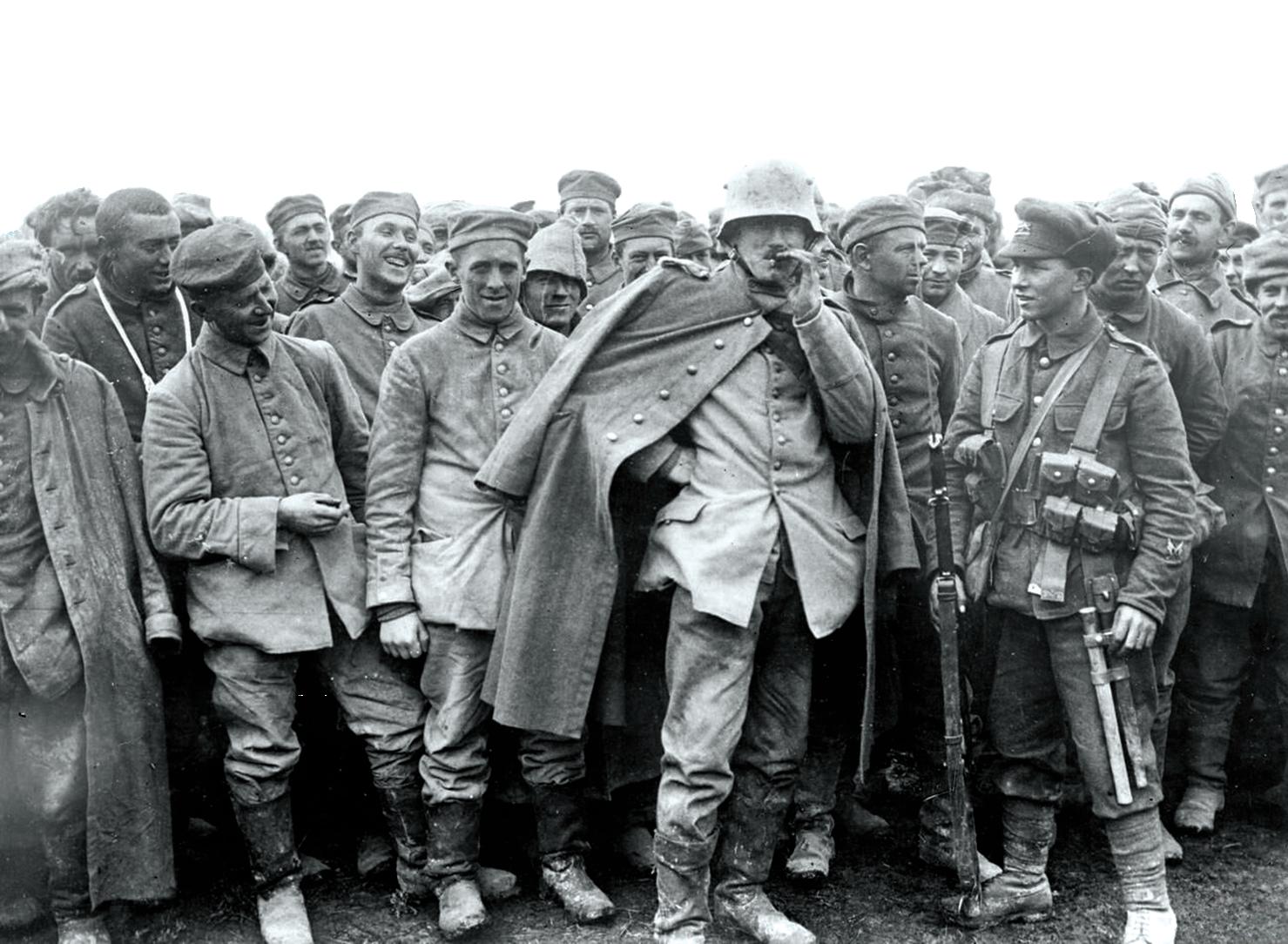



Despite all contrary evidence, 2nd Division’s daily intelligence summary for April 15 persisted in perpetuating the belief that only Craters 2 and 3 had been lost.
“At 2:30 a.m.,” the summary reported, “assisted by artillery fire, the enemy made a bombing attack on Craters 4 and 5…. The craters were both in our possession and there are no casualties.”
But, the 24th Battalion’s Major J.A. Ross had discovered during a personal reconnaissance that Craters 2, 3, 4 and 5 were all in German hands. Aerial reconnaissance— previously impossible due to the inclement weather—confirmed his report on April 16. Divisional staff, having finally accepted reality, cancelled any further attacks.
“It seems extraordinary yet if one thinks of it quietly and calmly,” Alderson wrote in a memo to Turner, “it is not only a very likely, but almost a natural outcome of the conditions under which your Division took over the line…. Our Army
The landscape the Canadians entered bore little resemblance to anything natural.
Commander, gallant gentleman as he is, has taken it well though he is probably the most hit, because the Army originated the situation.”
For two more weeks, the situation only worsened. Preparations for the Somme Offensive led to artillery supply restrictions that enabled the Germans to ready themselves. On the 19th, they cleared Craters 6 and 7 but left them unoccupied. The Canadians lacked the strength to take them back. Both sides let the battle fizzle and the lines stagnated. German losses recapturing the craters and during the subsequent fighting totalled 483, while between April 4 and 16 the Canadians suffered 1,373 casualties.
The St. Eloi battlefield remained a hellhole well after the guns had largely fallen silent and 2nd Division stayed in the line there until the beginning of June. On April 27, a 2nd Canadian Pioneer Battalion patrol had rescued 29th Battalion’s Private Stanley Harcourt Warn from where he had lain for nine days amid rotting bodies in no man’s land. Having suffered shrapnel wounds to his legs, arms and head, Warn had also developed trench foot. The 31-year-old soldier’s legs and arms were permanently disabled.
A scapegoat was sought for the overall disaster and eventually Alderson took the blame. On May 28, 1916, he was relieved by Lieutenant-General Julian Byng. St. Eloi was a Canadian loss, but it would be the last.
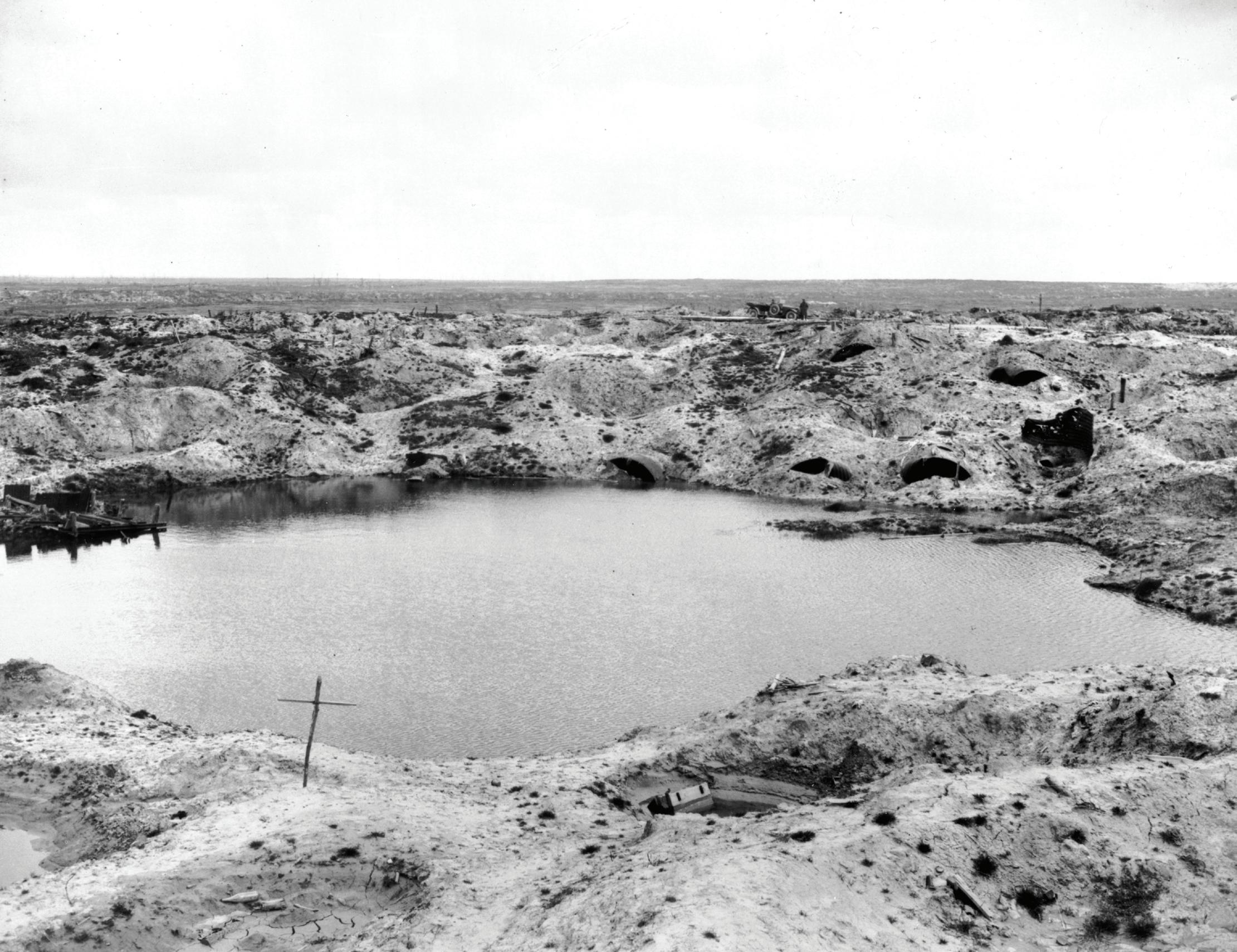
Between 1866 and 1871, Irish-American insurgents known as Fenians raided Canada from the U.S. in support of Ireland’s independence from Britain

By Serge Durflinger


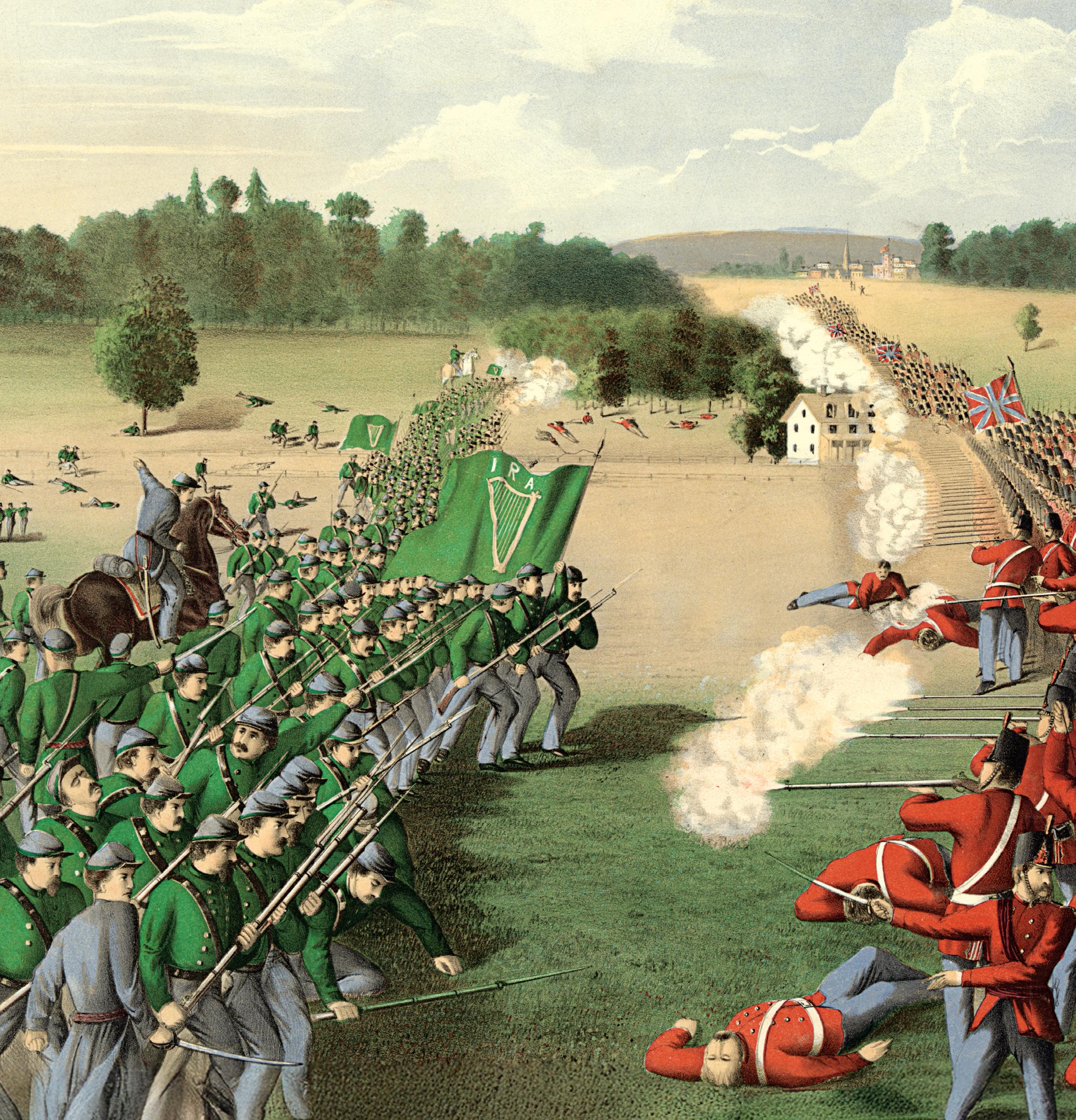
had landed on Canada’s doorstep.
The bitter ethnic and sectarian struggles between the British and the Irish crossed the Atlantic to North America along with waves of Irish immigrants escaping the Great Famine of the 1840s. Many longed for an independent Irish republic, and the end of the U.S. Civil War (1861-1865) seemed to provide an opportunity to help achieve that goal.
Relations between the U.S. and Britain and its North American colonies were strained. The latter had supported the breakaway Confederate States during the war and a series of crises, including

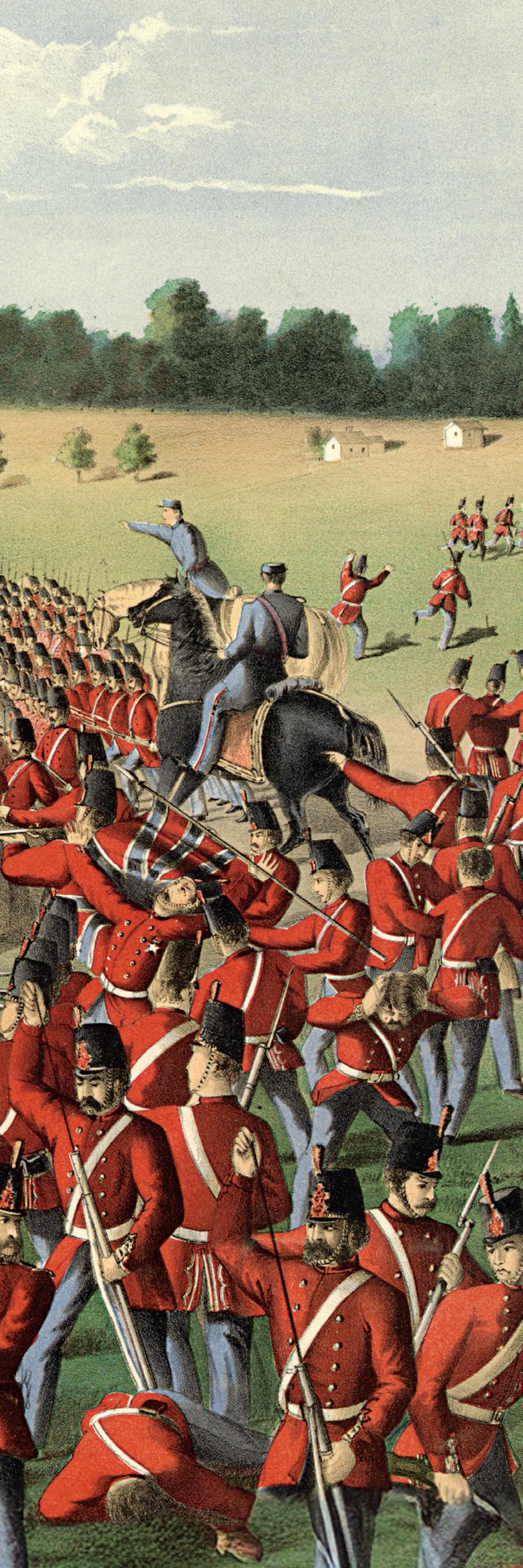
the British outfitting of the highly successful Confederate raider CSS Alabama and an armed Confederate raid on St. Albans, Vt., from Canadian territory, infuriated the Americans.
There was great relief in British North America (BNA) when the massive U.S. army demobilized. Among these men, however, were tens of thousands of Irish-born, combathardened veterans, some of whom were attracted to Fenianism, the philosophy that Ireland’s independence must be achieved by revolution. The name Fenian is derived from the Gaelic Fianna, the tribal Irish militia of folklore.
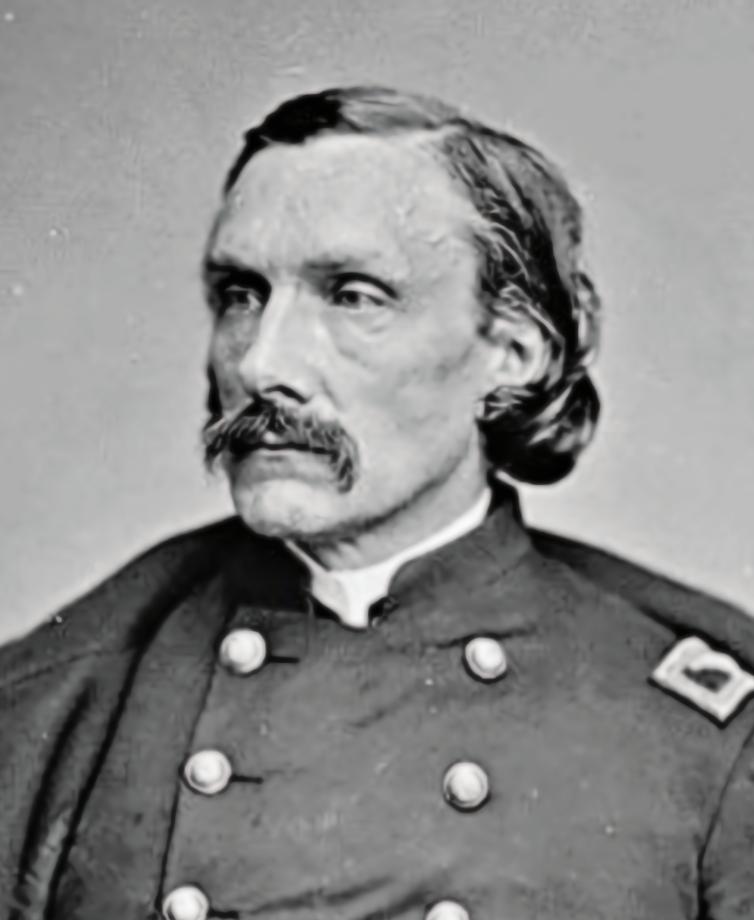
“We are a Fenian Brotherhood, skilled in the arts of war. And we’re going to fight for Ireland, the land that we adore.
Many battles we have won, along with the boys in blue.
And we’ll go to Canada, for we’ve nothing else to do.”

and Canada East (Quebec)— each maintained their own volunteer militia supported by British forces on garrison duty.

Irish revolutionaries founded the Fenian Brotherhood in the U.S. in 1858, and its leaders, John O’Mahony and William R. Roberts, believed that attacking BNA would create a new front in the struggle for Irish independence. They raised funds, recruited U.S. Civil War veterans, and planned to seize parts of Canada to blackmail Britain into granting Ireland independence.
Much of their military potential, however, would depend on whether the U.S. government would tolerate Fenian aggression from American soil. Resentment for Britain had to be tempered by war-weary Washington’s more pressing desire for national reconstruction. The Americans didn’t want war.
The self-governing colonies of Nova Scotia, New Brunswick and Canada—then divided into Canada West (present-day Ontario)
In April 1866, the Fenians planned to seize Campobello Island, N.B., in the Bay of Fundy. Campobello, conveniently located near Eastport, Maine, seemed like an easy conquest that might earn the Fenians U.S. recognition as a legitimate belligerent.
About 700 Fenians, led by Bernard Doran Killian, congregated in and around Eastport, while about 500 ex-U.S. army .58-calibre Springfield muzzleloading rifled muskets were surreptitiously shipped to them.
Opposing the Fenians were up to 5,000 troops, a mix of British regulars, New Brunswick militia and volunteer Home Guards, while Royal Navy ships stood by. It was more than enough to deter the would-be invaders who did nothing more than raid nearby Indian Island on April 14 and 22.
An artist depicts action at the Battle of Ridgeway. John O’Mahony (above), leader of the Fenian Brotherhood, which invaded British North America from the U.S.
Canadian militia officers of the Fenian Raids (below). An artist depicts the Battle of Trout River (bottom).
Canadian soldiers travel the Welland railway to meet the Fenians (opposite top).
Some Canadians had Spencer rifles (opposite bottom).

U.S. authorities subsequently impounded the ship used to transport the Fenian arms and issued a stern statement that American neutrality would be enforced.
Still, Canadian militiamen were anxious to prove their worth against the Fenians and had revised the lyrics to a U.S. army marching song accordingly:
Cheer up, let the Fenians come!
For beneath the Union Jack
We will drive the rabble back
And we’ll fight for our beloved Canadian home.
They didn’t have long to wait.
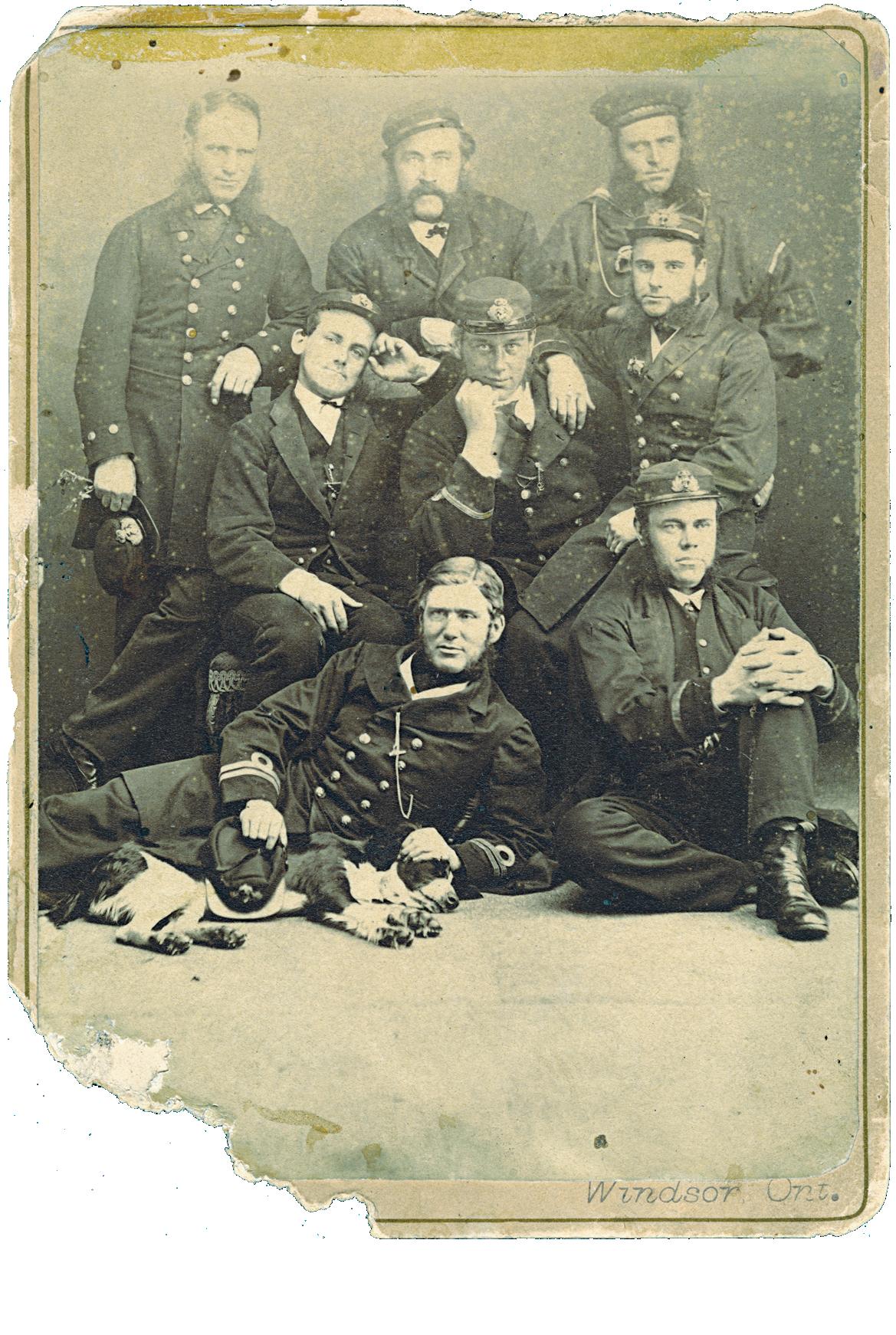
In the early hours of June 1, as many as 1,200 armed invaders crossed the Niagara River into Canada West. They came in three waves in barges towed by hired tugboats and landed near Fort Erie. They styled themselves the Irish Republican Army and wore a motley mix of Union and Confederate uniforms with civilian clothes. They were armed with accurate and reliable Springfield rifles and knew how to use them. The Fenians were under the command of John O’Neill, a former cavalry officer of the U.S. army who had been born in County Cork, Ireland.
Fort Erie, a small centre of 600, was undefended and O’Neill’s forces cut telegraph wires, pulled up some railway tracks and marched to Frenchman’s Creek, about five kilometres to the northwest. They bivouacked there for the night while awaiting reinforcements from Buffalo, N.Y. (that never came). In the meantime, the Fenians stole horses, tools and food from locals.
The Fenians issued a lengthy proclamation insisting that they had “taken up the sword to strike down the oppressor’s rod, to deliver Ireland from the tyrant, the despoiler, the robber.” The statement encouraged the Irish of Canada to join the struggle “in the name of seven centuries of British inequity and Irish misery and suffering, in the names of our murdered sires, our desolate homes, our desecrated altars, our million of famine graves, our insulted name and race.”
There were some small secret Fenian cells in Canada, particularly in its biggest cities, but the substantial Irish population didn’t join the invaders.
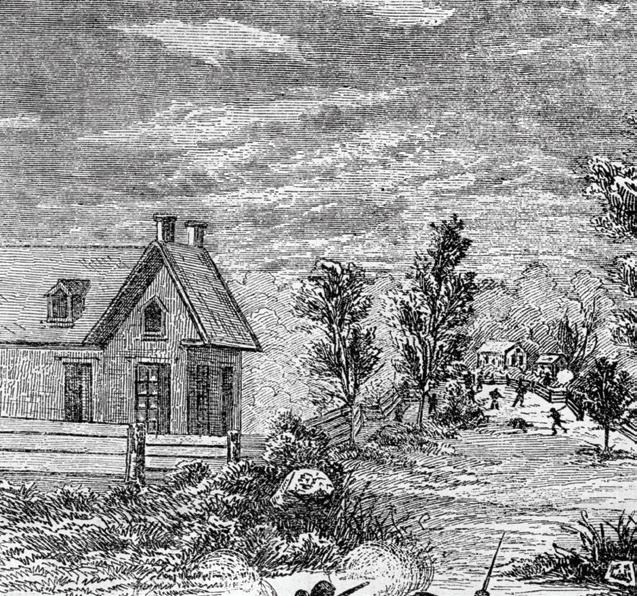
The statement encouraged the Irish of Canada to join the struggle “in the name of seven centuries of British inequity and Irish misery and suffering.”

“The fire of the now pursuing Fenians became hotter than ever, causing our poor fellows to fall on all sides.”

defensive positions. At about the same time, Peacocke ordered Booker to Stevensville, about 20 kilometres to the northeast of Port Colborne. There, the Canadian columns would join and engage the U.S. invaders.
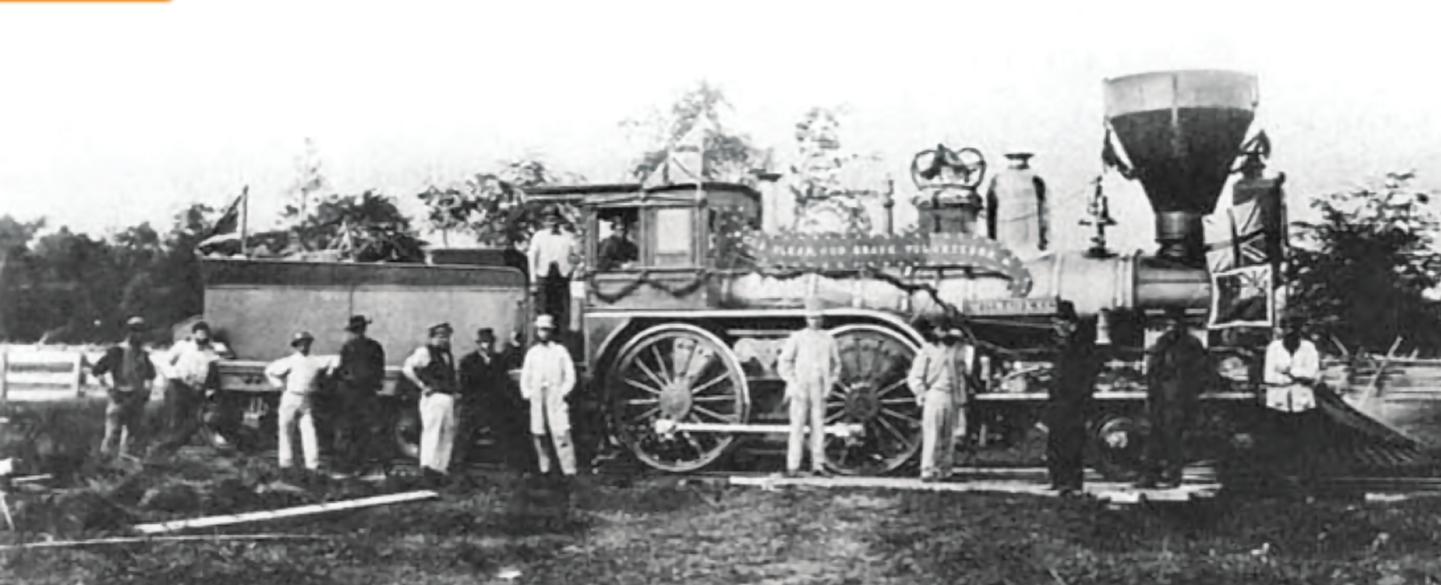
News of the Fenian landing led to the mass mobilization of 22,000 militiamen from Canada West and thousands of Canadian and British troops flooded into the Niagara region. Many were deployed to protect the Welland Canal linking lakes Ontario and Erie.
On the day O’Neill landed, British Lieutenant-Colonel George Peacocke’s force of British regulars and Canadian militia totalling 1,700 concentrated at St. Catharines. Peacocke ordered most of his men south to Chippawa, en route toward Fort Erie.
Also that day, a second Canadian force made its way to Port Colborne on Lake Erie. It was under the command of British-born militia
Lieutenant-Colonel Alfred Booker, commanding officer of the 13th Battalion from Hamilton, and comprised some 400 men of the Queen’s Own Rifles of Toronto (QOR), and about 400 men from the 13th, the York Rifles and Caledonia Rifles. Booker had never commanded in action before and his troops were short of basic equipment, ammunition, food, maps and provisions for medical care.
At 3 a.m. on June 2, O’Neill moved at least 750 of his men (others were left behind at various locations while some had deserted) southwest to Limestone Ridge, three kilometres north of the village of Ridgeway, where they prepared
But Peacocke was late in departing Chippawa, so the two Canadian columns didn’t meet in time, allowing the experienced Fenians to engage Booker’s force on its own.
Booker’s troops arrived at Ridgeway by train, believing the Fenians were in the vicinity of Frenchman’s Creek, and not just a few kilometres away at Limestone Ridge. No cavalry unit was mobilized with the infantry at first and neither Booker nor Peacocke had mounted men to act as scouts to provide accurate information about the Fenians’ locations.
Some of the Canadian militia units wore red tunics while the rifle battalions and companies wore green. Almost all were armed with .577-calibre Enfield single-shot rifled muskets similar in performance to the Springfield. The one exception was the 5th Company, QOR, whose 49 men were armed with modern, seven-shot, .52-calibre Spencer repeating rifles—although they had never fired them.
Booker’s men hadn’t slept the previous night and had eaten nothing. Many were under 20 years old. At about

7:30 a.m., their column stumbled upon the enemy. Peacocke had ordered Booker to avoid engaging the Fenians but, controversially, Booker later claimed he hadn’t received the message in time.
O’Neill sent about 150 skirmishers toward the Canadian column. The experienced Fenians, hastily entrenched and concealed in an orchard and behind fences, opened fire on them from about 200 metres.
The QOR were in the front, followed by the Yorks,
Fenian rearguards and stragglers were chased across the border at sabre point by the Royal Guides.
the 13th Battalion and the Caledonians. Booker deployed his troops in extended lines, and the two sides skirmished for about two hours. The inexperienced Canadian militiamen continued advancing toward the main Fenian force, giving as good as they received. But confusion and the fog of war soon intervened.
After spotting several mounted Fenian scouts, the Canadians anticipated a cavalry charge even though no such force was in sight. Booker presumptuously ordered the QOR to “prepare for cavalry” and form a square, the standard means by which infantry defended against a mounted attack. But this manoeuvre left the men bunched together and vulnerable.
The Fenians quickly took advan tage of the Canadians’ mistake and poured withering fire into the packed ranks of exposed men, inflicting numerous casualties. Realizing his error, Booker ordered the battalion to withdraw to reform its ranks. But when the other units witnessed this, they assumed a gen eral retreat had been ordered and they wavered. Soon, panic spread, abetted by a bold Fenian bayonet
charge. The entire Canadian line broke, and the militiamen fled the battlefield toward Ridgeway with the Fenians giving chase.
“The fire of the now pursuing Fenians became hotter than ever,” wrote the QOR’s adjutant, Captain William Dillon Otter, “and the volunteers being crowded up in a narrow road, presented a fine target to their rifles, causing our poor fellows to fall on all sides.”

He reported that the Canadian troops were “completely crestfallen.”
At Ridgeway, the QOR had suffered nine killed and 21 wounded, the 13th Battalion six wounded, and the York Company two wounded. Fenian losses are more difficult to ascertain but were at least eight killed and maybe twice that number wounded.
The Irishmen had won the Battle of Ridgeway. But because superior Canadian and British forces were closing in and no Fenian reinforcements would be forthcoming thanks to U.S. preventative action, O’Neill elected to retreat to Fort Erie and evacuate back to Buffalo. But he still had time for one more small victory.

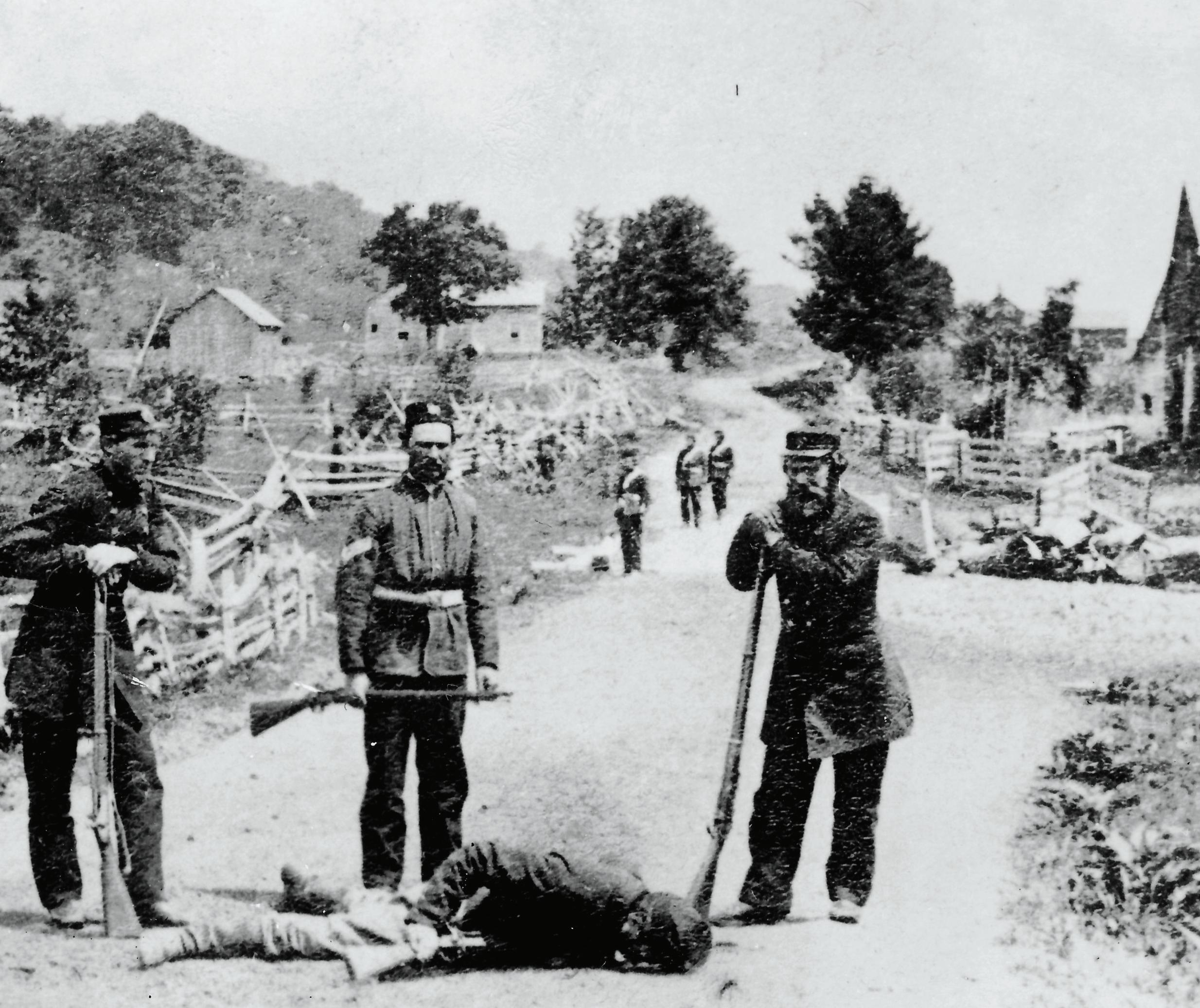
(opposite) near Eccles Hill.
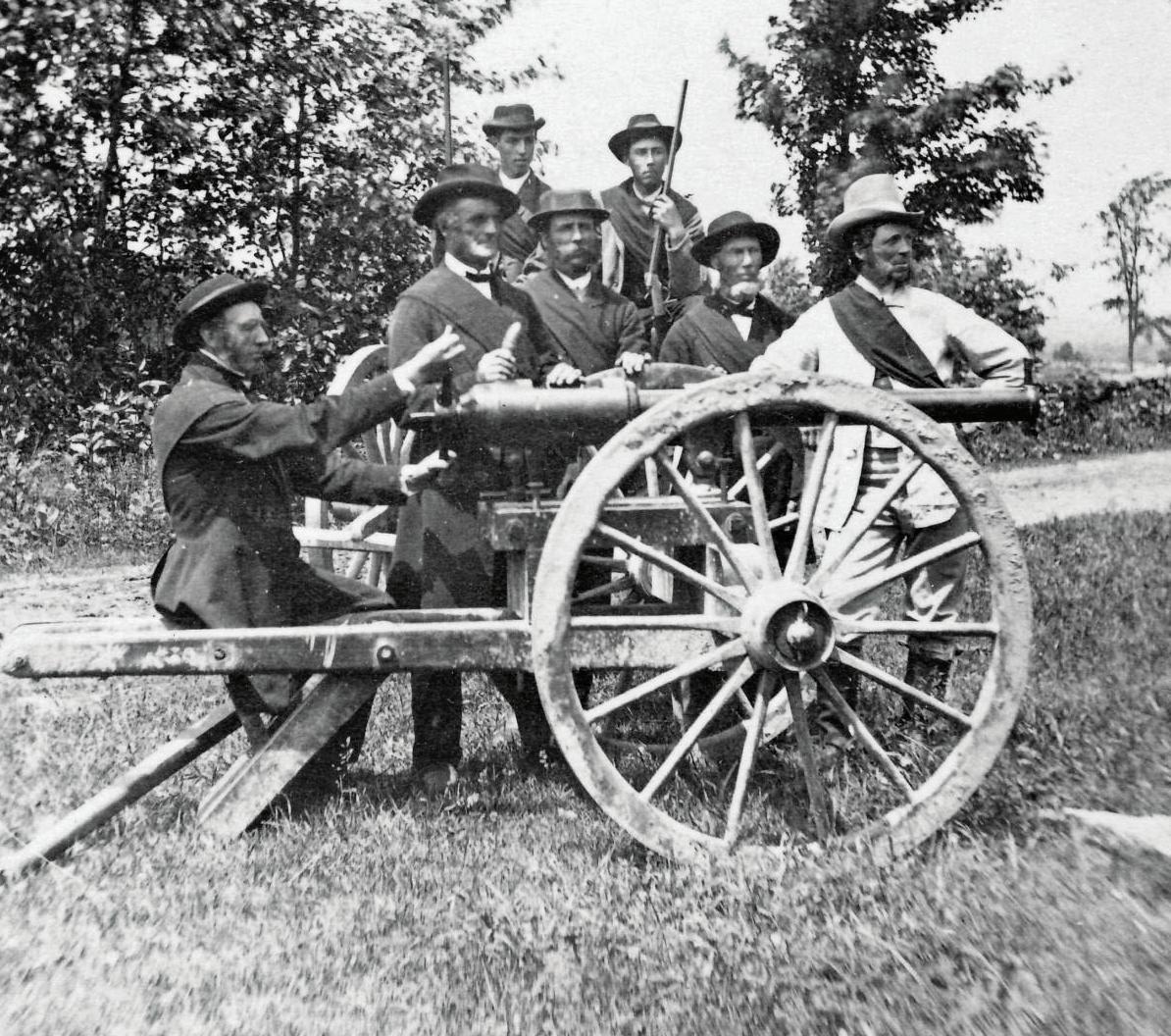
Colonel John Stoughton Dennis, who had under his command 79 men from the Dunnville Naval Brigade and the Welland Canal Field Battery, used the tugboat W.T. Robb to convey his force to Fort Erie. The Canadians landed and captured a group of surprised Fenians, but the militiamen were soon faced with the bulk of O’Neill’s men who were returning from Ridgeway.
A fight ensued with the badly outnumbered Canadians. Dennis ordered his men to scatter. Although he himself evaded capture, 54 Canadians were taken prisoner and six had been wounded. The W.T. Robb managed to escape with a few Canadians and 59 Fenian prisoners.
A few days later, the Fenians struck again, this time in Canada East. At 10 a.m. on June 7, some 1,000 Fenians commanded by ex-U.S. army officer Samuel B. Spears crossed the Vermont border into Missisquoi County near Lake Champlain. Spears contented himself with occupying a tactical position on Pigeon Hill, about three kilometres inside Canada. Fenian patrols also descended on Frelighsburg and other nearby villages.
Spears waited for reinforcements that never came. U.S. military authorities had seized Fenian arms at St. Alban’s, Vt., and had begun
American neutrality be upheld. After two days of looting farms and homes, the poorly disciplined, ill-equipped and demoralized Fenians withdrew back to the U.S. It was a wise decision as thousands of Montreal and area militiamen and British troops were converging on them. Fenian rearguards and stragglers were chased across the border at sabre point by the Royal Guides (mainly members of the Montreal Hunt Club). They also captured 16 prisoners. U.S. forces promptly disarmed the fleeing Fenians and arrested their officers. The raids of 1866 were over.
In 1867, Canada, New Brunswick and Nova Scotia federated into the Dominion of Canada; the Province of Canada was split into the provinces of Ontario and Quebec. The Fenian attacks and ongoing threats from south of the border had played an important role in spurring Confederation.
Meanwhile, Fenian “General” John O’Neill, the ballyhooed victor at Ridgeway, hadn’t abandoned his hopes of invading Canada. By May 1870, he had found financing, gathered men and arms in secrecy, established a headquarters in Franklin, Vt., and hatched another ambitious (albeit unrealistic) plan to invade southern Quebec and capture Sherbrooke.
Once it became known that the Fenians had mustered in Franklin,
13,000 Canadian militiamen were mobilized. Seizing the initiative and without waiting for reinforcements, about 40 members of the volunteer civilian Home Guard, consisting mainly of farmers wearing red sashes and armed with hunting rifles, rushed to the border on May 24. They established strategic positions at the base of Eccles Hill, one kilometre inside Canada. They were joined by an equal number of Dunham and Missisquoi volunteers.
On the morning of May 25, about 200 Fenians invaded, followed by an equal number of reinforcements. The small band of Canadians opened fire, the Home Guards leading the way. The Fenians returned fire but were pinned down. Soon, the Canadian civilians were joined by a company of the redcoated 60th Missisquoi Battalion, a unit of the Victoria Rifles from Montreal and a detachment of the 1st Volunteer Militia Troop of Cavalry of Montreal. Skirmishing continued until late afternoon.
Perhaps shocked at the Canadians’ determination, the poorly disciplined Fenians panicked and scuttled back to the U.S. Many discarded their arms, equipment and uniforms on the way. They had suffered three killed and about 10 wounded. There were no Canadian losses. American authorities arrested O’Neill.
A small raid two days later at Trout River, near Huntingdon, 130 kilometers west of Eccles Hill, ended similarly, with one Fenian killed and another wounded.
The final Fenian raid occurred in October 1871, when the indefatigable O’Neill and some 35 followers attempted to seize a customs building and Hudson’s Bay Company post on the ManitobaU.S. border. Farcically, surveyors had determined that the buildings were actually in the U.S., so the hapless Fenians never actually set foot in Canada.
Canada’s citizen soldiers had done well, even in defeat at Ridgeway, to safeguard the country. The Fenians would come no more.
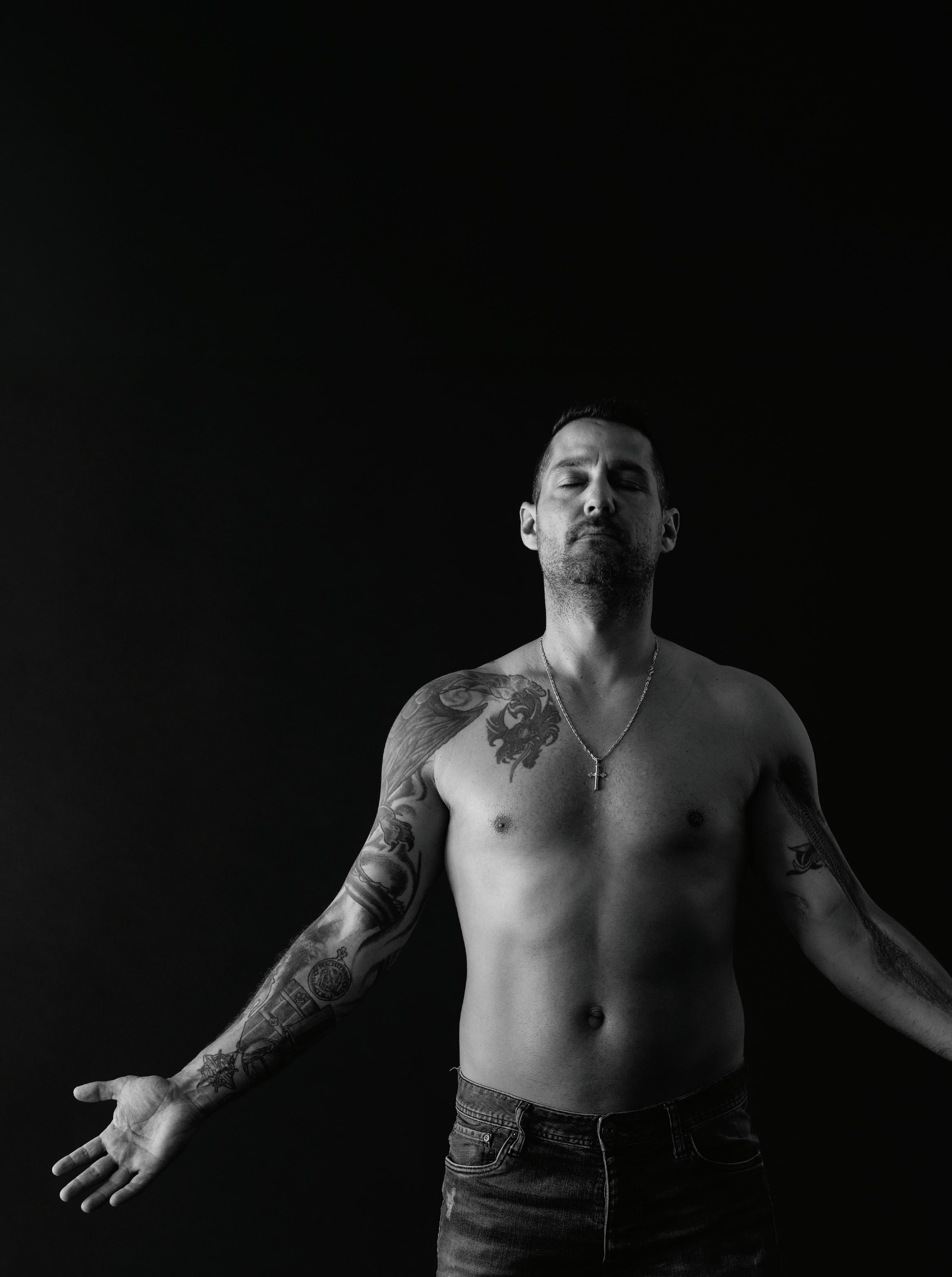



the photographer is interested in the people in front of his lens, and if he is compassionate, it’s already a lot. The instrument is not the camera but the photographer.”
So said American photojournalist Eve Arnold. The quote held a place of prominence on the gallery section of the personal website of Stephen J. Thorne, Legion Magazine’s late senior staff writer (see page 90).
As regular readers of the magazine well know, Thorne was as gifted a photographer as he was a writer. Photo essays of his own work regularly graced these pages, including a series of portraits of Afghanistan veterans from his earliest days with the
publication. Those images evolved into an exhibit, The Wounded, that premiered at the Canadian War Museum in Ottawa in 2019 and continues to tour to this day. And he also wrote the words, and often selected the images, that accompanied numerous other Legion Magazine pictorials.
His passion for the subject was deep. He was a student of the craft, intimately familiar with the history of war photography and photographers, his personal library sagging under the weight of tomes on the topic, his office decorated with iconic wartime images.
In celebration and tribute of his photographic work, here is a collection of images Thorne had curated, and which hold a place of prominence at Legion Magazine’s office in Kanata, Ont. It’s no coincidence they’re the faces of the people he covered.
—Aaron Kylie
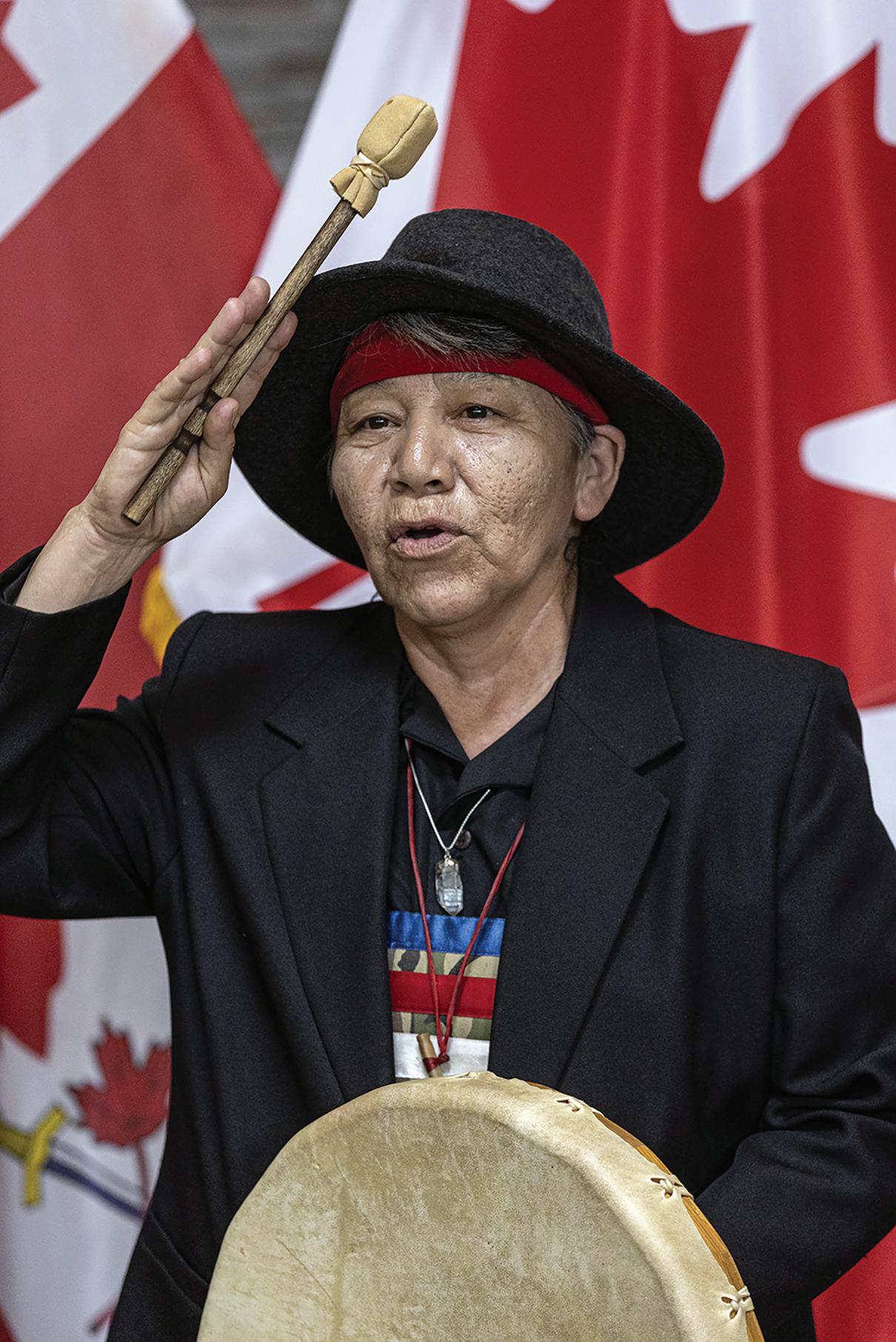
Thorne
was intimately familiar with the history of war photography and photographers, his personal library sagging under the weight of tomes on the topic.
Alma Mann Scott of Sagkeeng First Nation (left ) salutes after performing a blessing during a ceremony at the National Military Cemetery in June 2022. Royal Canadian Legion member Jack Anawak (below) of Naujaat, Nunavut, during Remembrance Day 2022. Mark Ormond, a Royal Marines veteran, at the 2017 Invictus Games in Toronto (opposite).
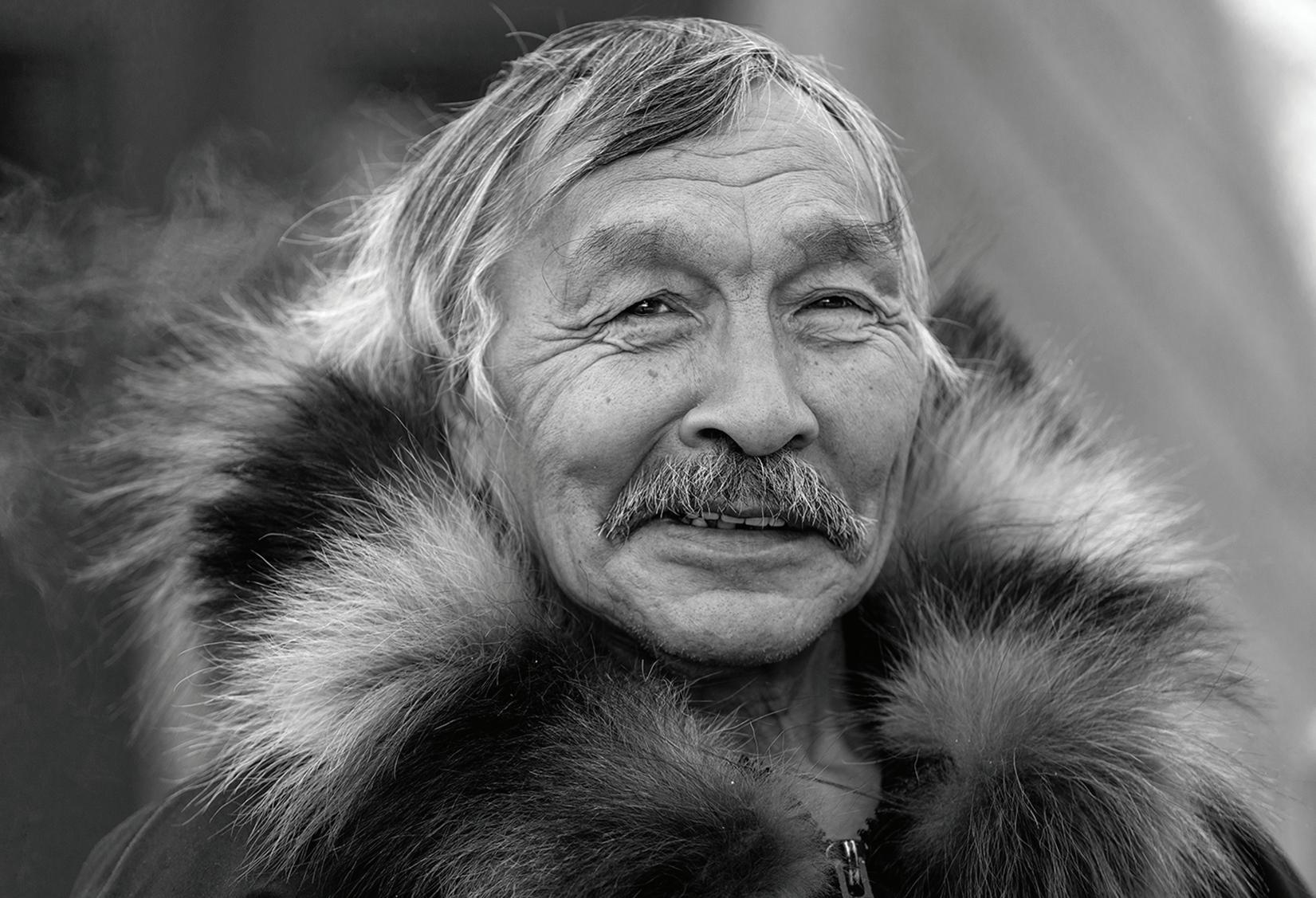


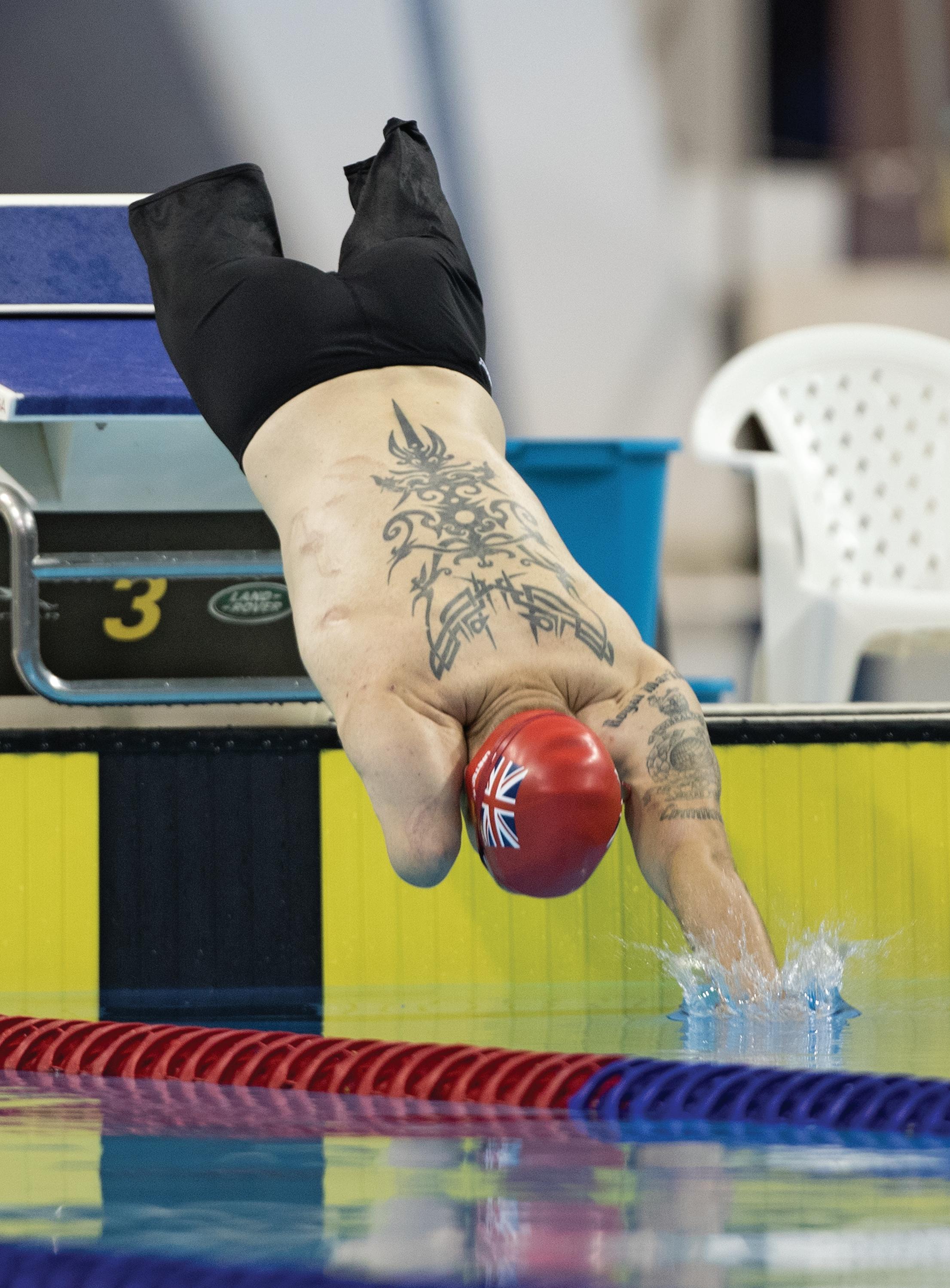
Lieutenant Tim Partello (below) of The Royal Canadian Regiment in the mountains southwest of Kabul, Afghanistan, in 2003. Corporal Ricardo Taylor (opposite top), a Canadian paratrooper, stands guard by the caskets of comrades killed in action in Afghanistan in 2003. Betty Metcalfe (opposite bottom), 98 at the time this picture was taken in 2019, was a member of the Canadian Women’s Army Corps during WW II.


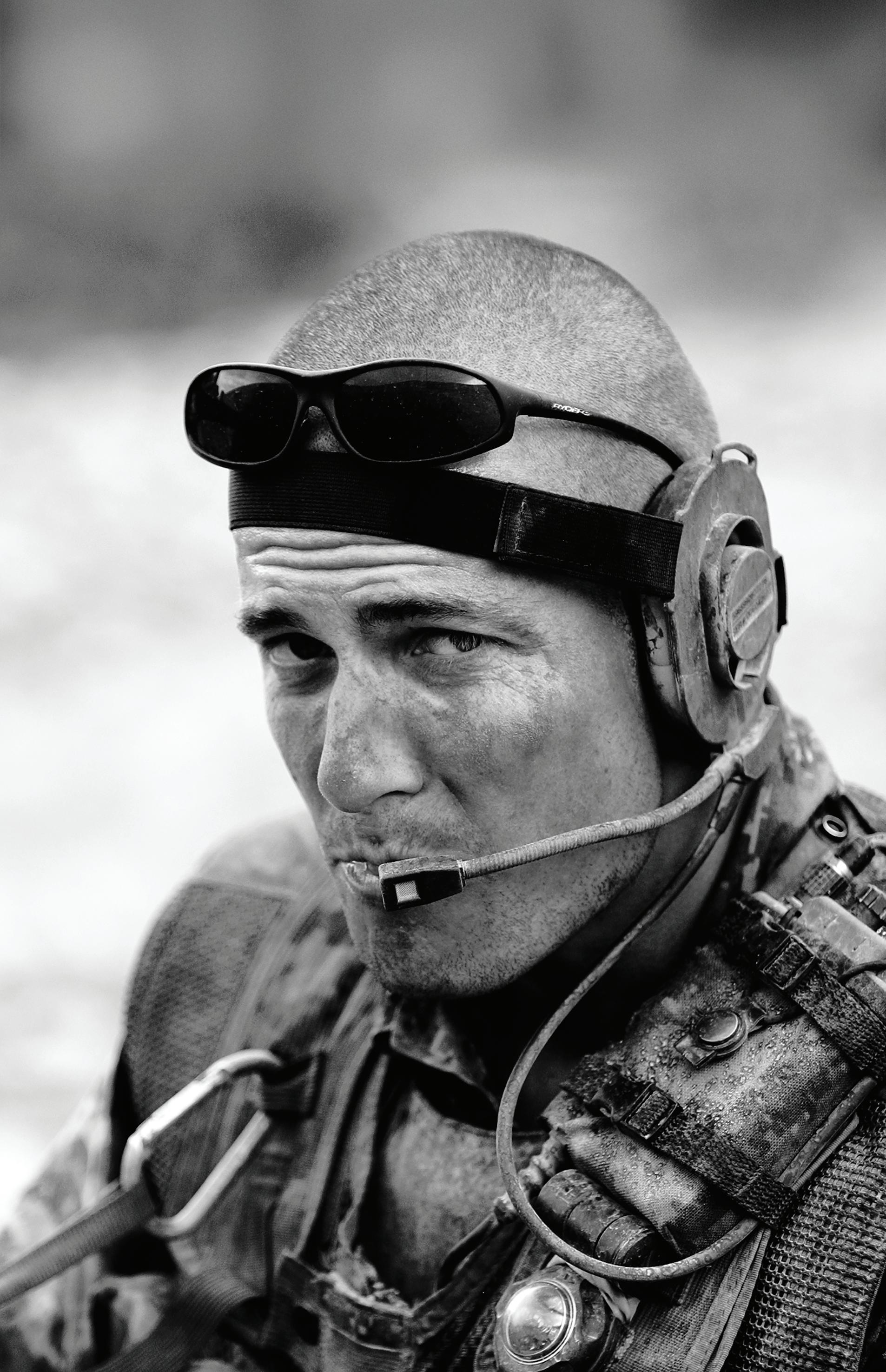


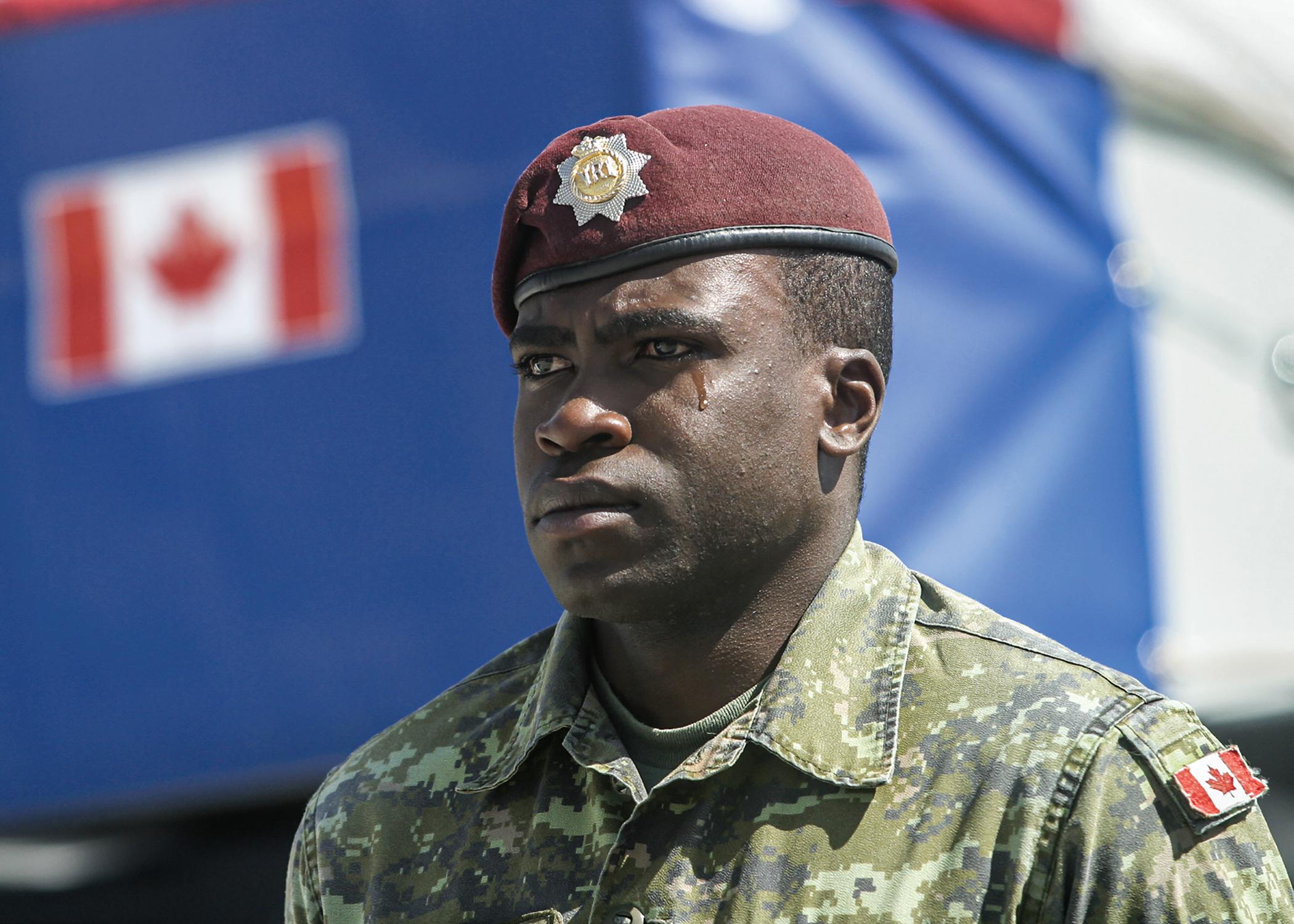
Retired lieutenantcommander (N) Bill Black (right ), founder of the Korean War Veterans Association of Canada, poses for a photo at his home in February 2023. A portrait of D-Day veteran James Strachan (below) taken in 2019 at age 93. Earl Francis (opposite), 84 when this photo was captured in 2022, a Saint Lucian volunteer of the Royal Commonwealth Ex-Services League.

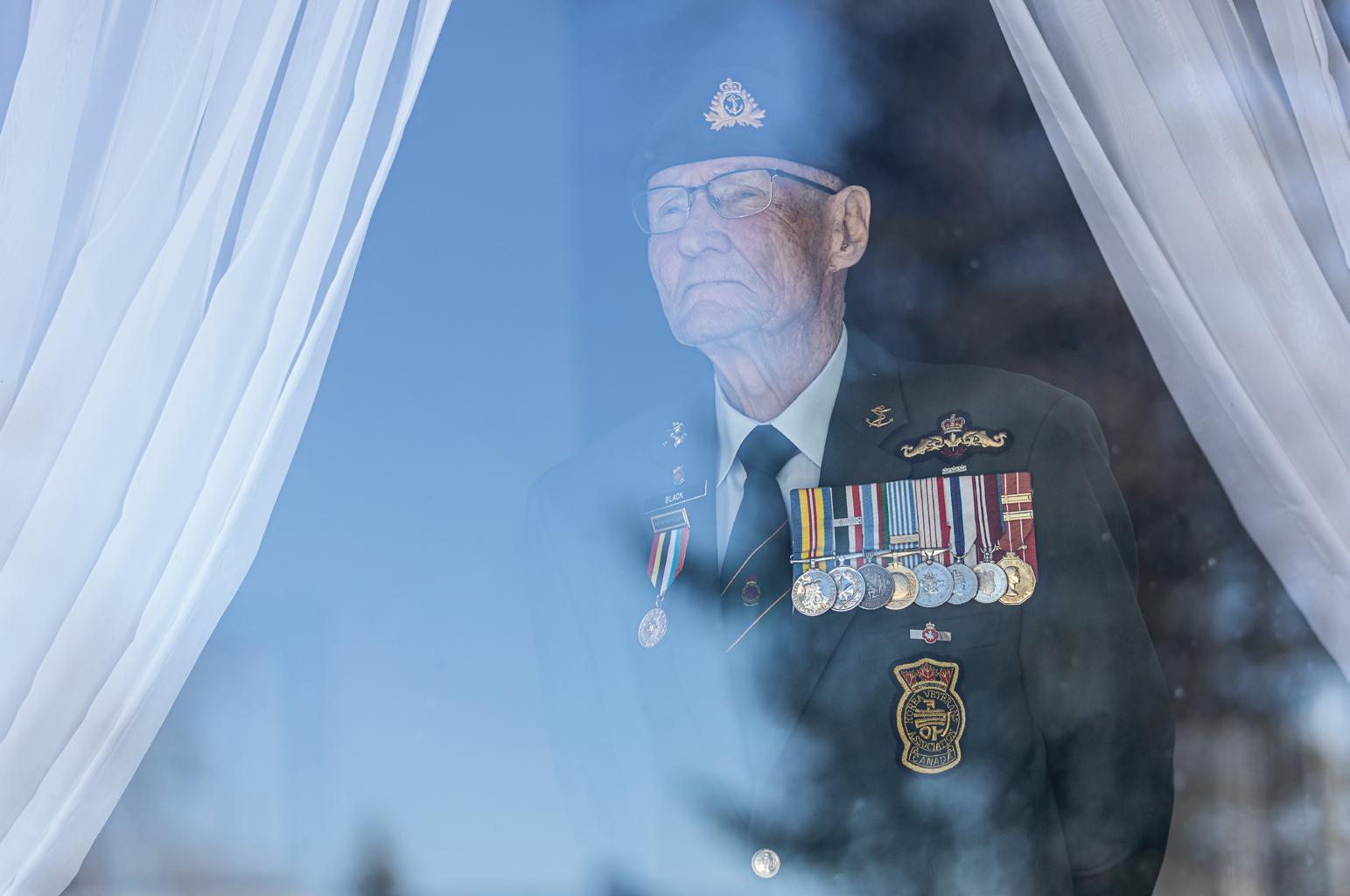


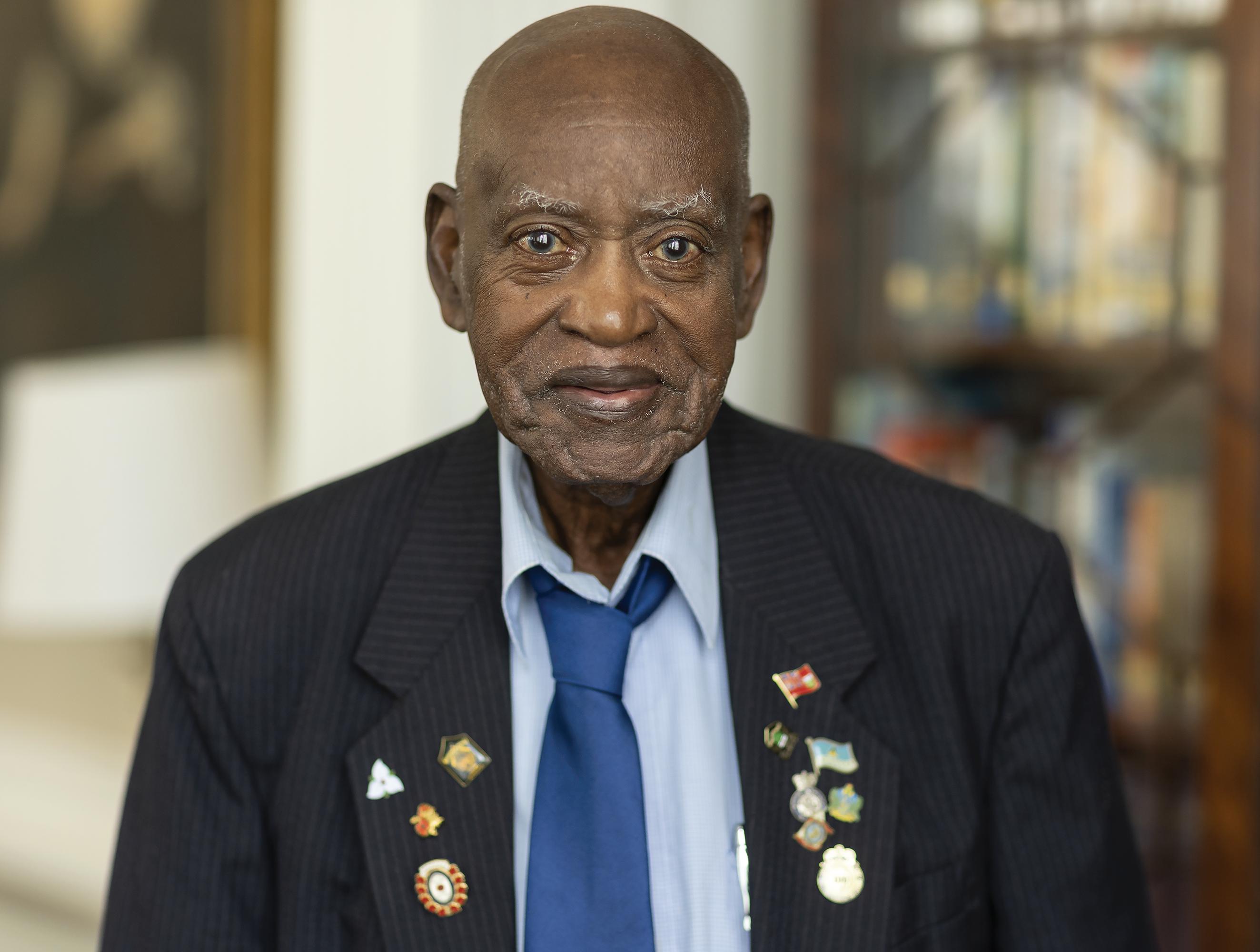

A series of portraits of Afghanistan veterans from his earliest days with the publication evolved into an exhibit, The Wounded, that premiered at the Canadian War Museum in Ottawa in 2019.
By Aaron Kylie

By Aaron Kylie
ne of the first big commemorations in recognition of The Royal Canadian Legion’s centenary this year is right on the money. In mid-January, The Royal Canadian Mint unveiled limitededition gold and silver collector coins featuring designs celebrating the RCL’s 100th anniversary.
The artwork of the $100 pure gold coin, which features two Legion members facing a collage of Great War symbols, was created by Canadian artist Laurie McGaw.
“It was an honour to be chosen to create a coin design

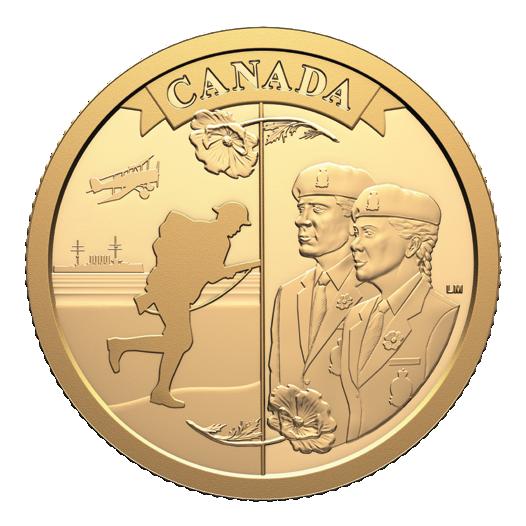
commemorating this important anniversary,” said McGaw. “The Second World War had a profound impact on my parents’ lives: my mom was an army nursing sister who cared for my dad, a Canadian soldier, in an army hospital in Toronto. My goal was to reflect the deep respect Legion members have for all who served Canada.”



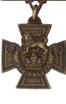
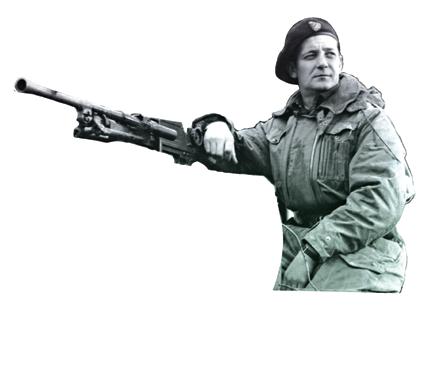
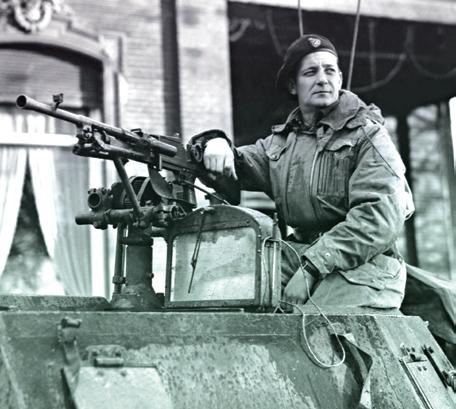
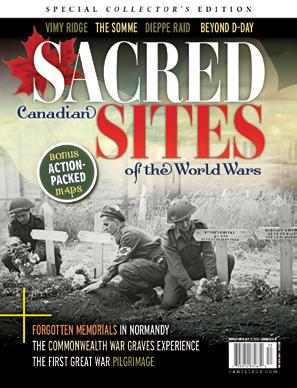
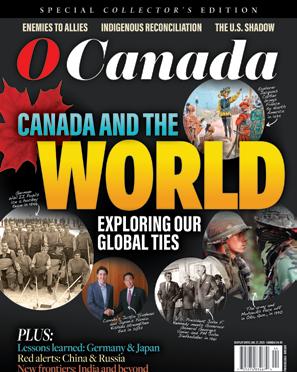

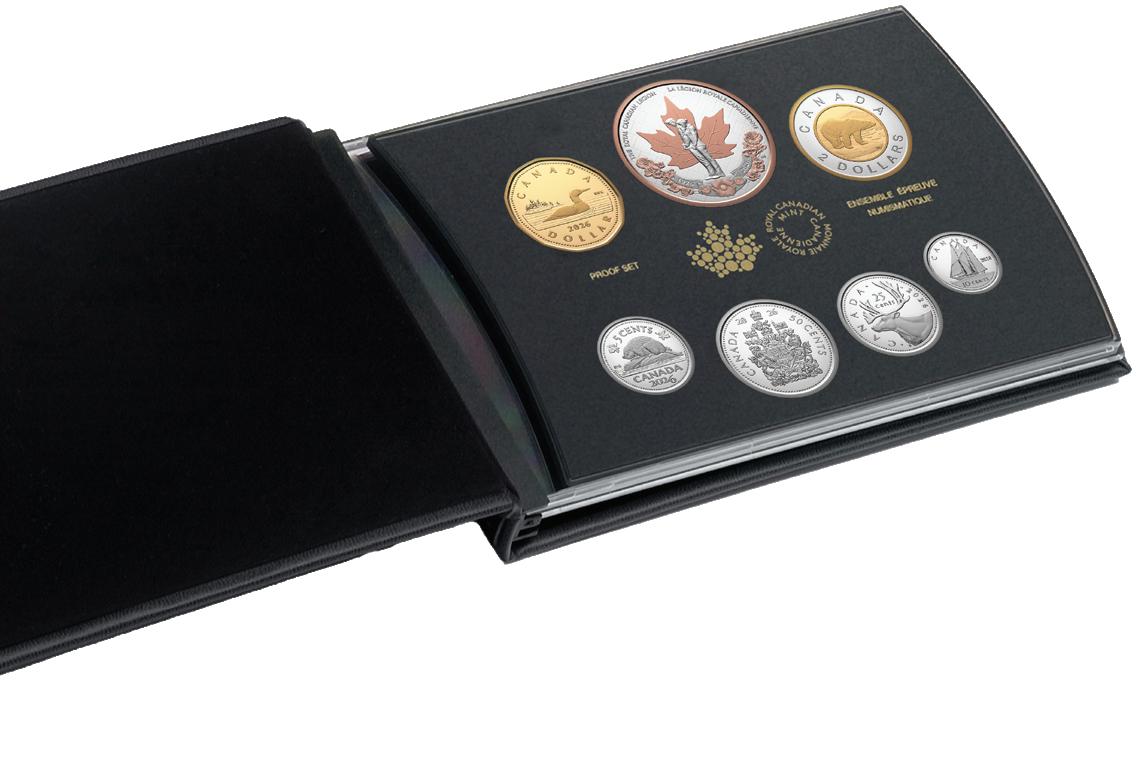
Canadian artist Steve Hepburn. It shows two Legion members in reflection above an arrangement of 14 poppies, one for each province and territory and one to represent the Legion’s international branches.

There is also a forget-menot, a floral symbol of remembrance for Newfoundland and Labrador, among the poppies.
A fine silver proof set, which includes a selectively rose goldplated version of the silver coin, was also released. Check mint.ca for current pricing of each of the new products.
The Veterans Independence Program (VIP) from Veterans Affairs Canada is annual, tax-free funding to help cover the cost of home care services so veterans can continue living independently. This benefit is only available to veterans residing in Canada and is meant to work in combination with other federal, provincial or municipal programs to help meet their overall care needs.
Veterans may be eligible for this program if they: qualify for a disability benefit and/ or the War Veterans Allowance, receive Prisoner of War Compensation, or are eligible for, but can’t access, a priorityaccess bed in a long-term care facility.
This program may cover services such as grounds maintenance, housekeeping, meal preparation, personal care, and professional health and support services, and clients can choose their own providers.
VAC will first try to connect the need for VIP service to an entitled condition, meaning one that developed or was worsened by service for which a veteran already receives a VAC benefit. If the need for funding isn’t related to an entitled condition, they may be considered under the “frail” criteria, defined as a physiological condition that

creates a risk of falls, injuries, illnesses or requires supervision or hospitalization. This condition must cause prolonged impairment that has lasted, or is expected to, for at least 12 months and requires a nursing assessment by a VAC occupational therapist.
A survivor of a veteran who was receiving VIP services prior to death, will continue to receive them as long as they apply as a primary caregiver and don’t discontinue the program. Once the program is cancelled, it can’t be received again.
Survivors who were primary caregivers may also be eligible for funding to help cover the cost of services such as housekeeping and grounds maintenance if they meet the following criteria:
• are low income (receive the Guaranteed Income Supplement), or
• are disabled (receive the Disability Tax Credit), and
• have a health-related need for these services, and
• currently live in Canada.
Grant rates are determined through a national review of service costs, including labour market factors. A national rate table sets the approved rates payable by geographic area.
If you, a veteran friend or family member would like assistance in connecting with VAC for VIP services, contact veteransservices@ legion.ca or call 1-877-534-4666 toll free.
Veterans Affairs Canada raised pensions, awards and allowances paid under the Pension Act by two per cent in 2026. VAC adjusts the rates for disability pensions and allowances on Jan. 1 each year. This year’s increase is based on the Consumer Price Index in accordance with the Pension Act
Disability pensions under the Pension Act
The extent of disability is expressed as a percentage, with a total disability assessed at 100 per cent. When a pensionable disability is assessed at less than 100 per cent, the pension is proportionally less. The following are examples of the 2026 pensions paid monthly.
Payment to a pensioner whose disability is assessed at less than five per cent is made on a one-time-only basis.
and suffering compensation
Disability awards under the Veterans Well-being Regulations may be paid as a lump sum, annual payments or in a combination of these options.
War veterans allowance
War veterans allowance paid to low-income clients is adjusted quarterly on Jan. 1, April 1, July 1 and Oct. 1. The following are the current rates.
Canadian Forces income support (maximum per month) Monthly


Bill Cavanagh of Drayton Valley, Alta., Branch presents $50,000 to the Heroes in Mind, Advocacy and Research Consortium, represented by director Suzette BrémaultPhillips, University of Alberta president Bill Flanagan and vice-provost Ravina Sanghera.

President Terry Kuzyk of Vegreville, Alta., Branch presents $2,000 to the Heroes in Mind, Advocacy and Research Consortium, represented by director Suzette BrémaultPhillips, University of Alberta president Bill Flanagan and vice-provost Ravina Sanghera.
In this issue, Legion branches donated more than $1,323,100 to their communities
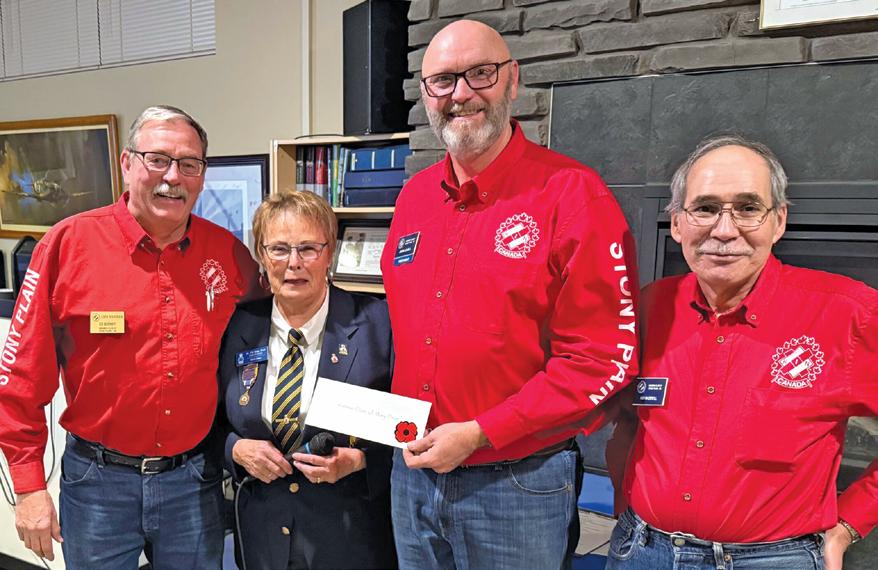
Dixie Jones of Stony Plain, Alta., Branch presents $7,000 to the Stony Plain Kinsmen Christmas hamper campaign. PAT HALE
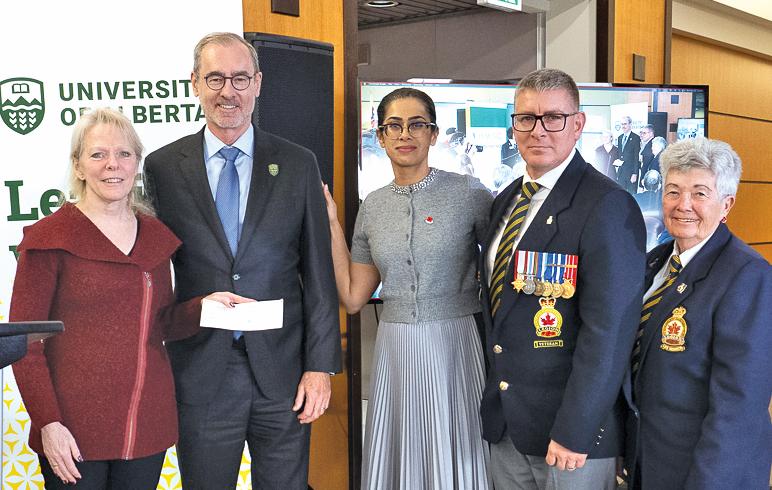
President Brad Ross of Men of Vision Branch in Cochrane, Alta., and District 5 Commander Karen Bruens present $20,000 to the Heroes in Mind, Advocacy and Research Consortium, represented by director Suzette Brémault-Phillips, University of Alberta president Bill Flanagan and vice-provost Ravina Sanghera.
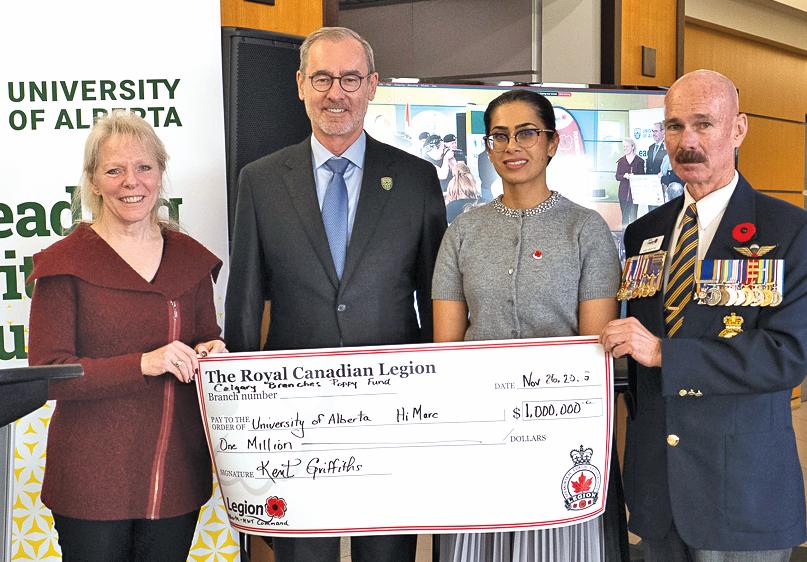
On behalf of Alberta-Northwest Territories Command, Kent Griffiths presents $1 million to the Heroes in Mind, Advocacy and Research Consortium, represented by director Suzette Brémault-Phillips, University of Alberta president Bill Flanagan and vice-provost Ravina Sanghera.
Dixie Jones of Stony Plain, Alta., Branch presents $6,500 to the Parkland Food Bank, represented by Sheri Ratsoy.
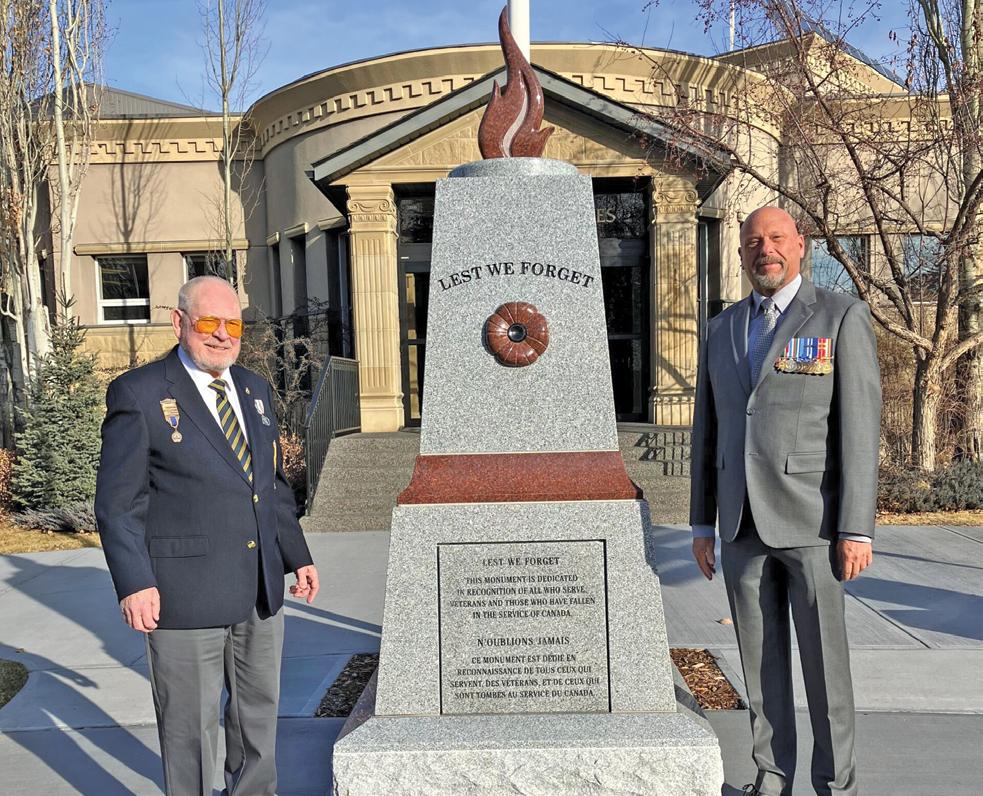
Whitford of High River, Alta., Branch and retired lt.-col. Michael Prendergast dedicate the city’s new cenotaph at the Highwood Centre.
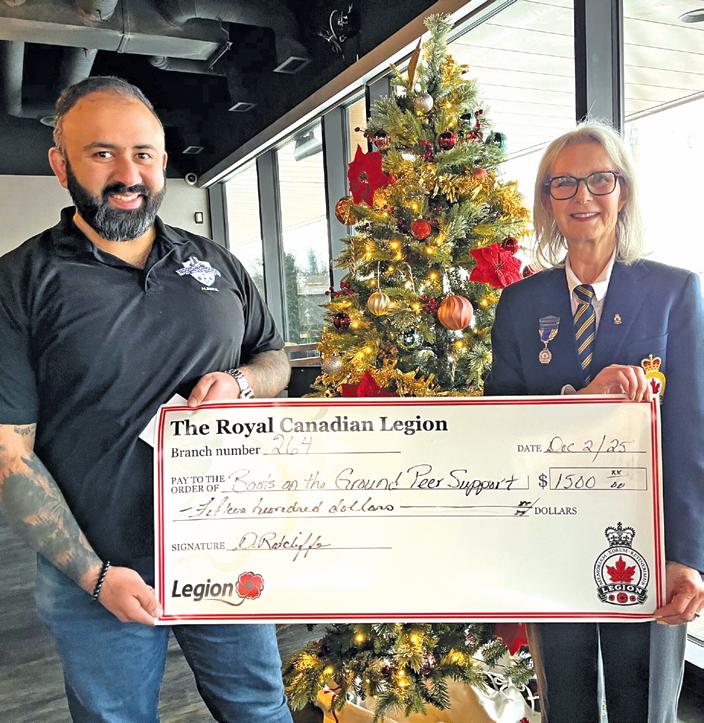
to Boots on the Ground Alberta, represented by Mo Shaukat.
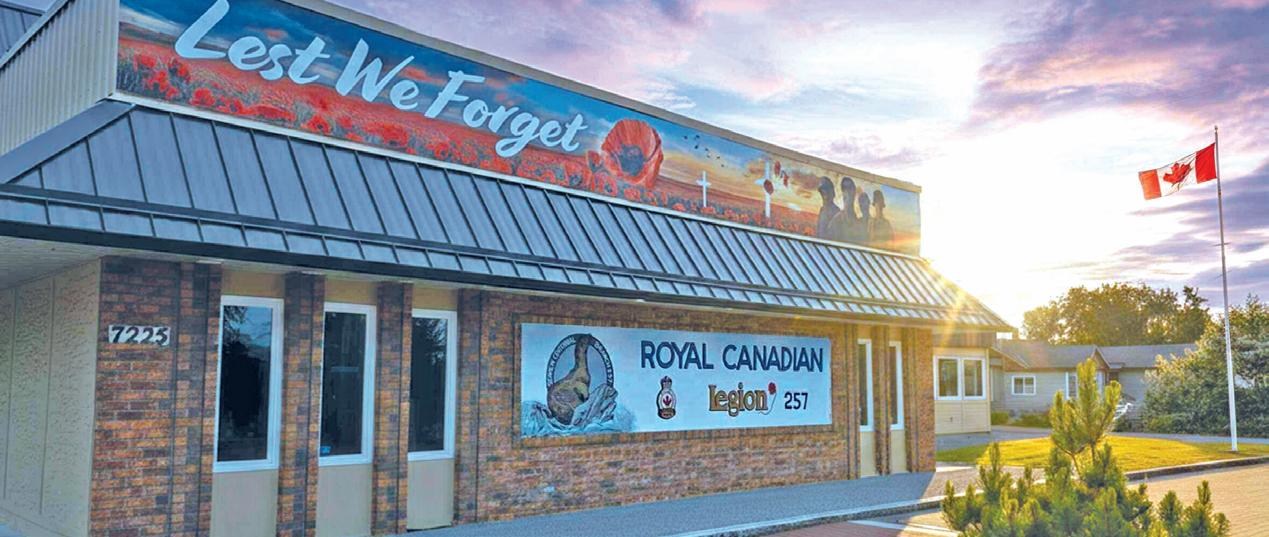
Windermere Branch in Invermere, B.C., launches its new Legion courtesy van initiative to help transport veterans and mobilityimpaired locals to medical appointments and recreational outings free of charge.
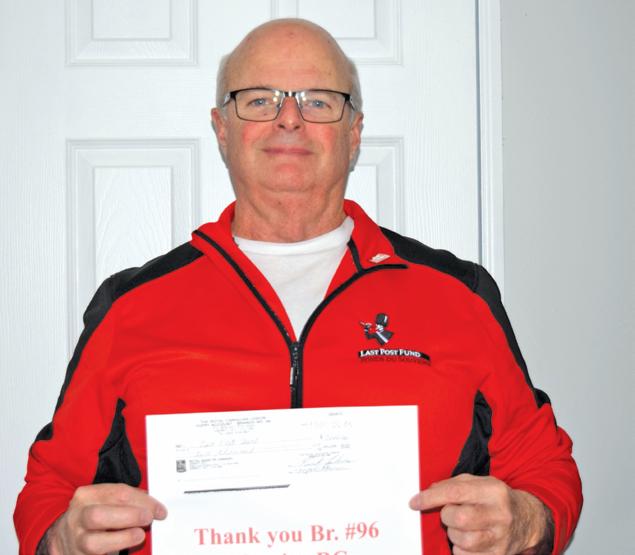
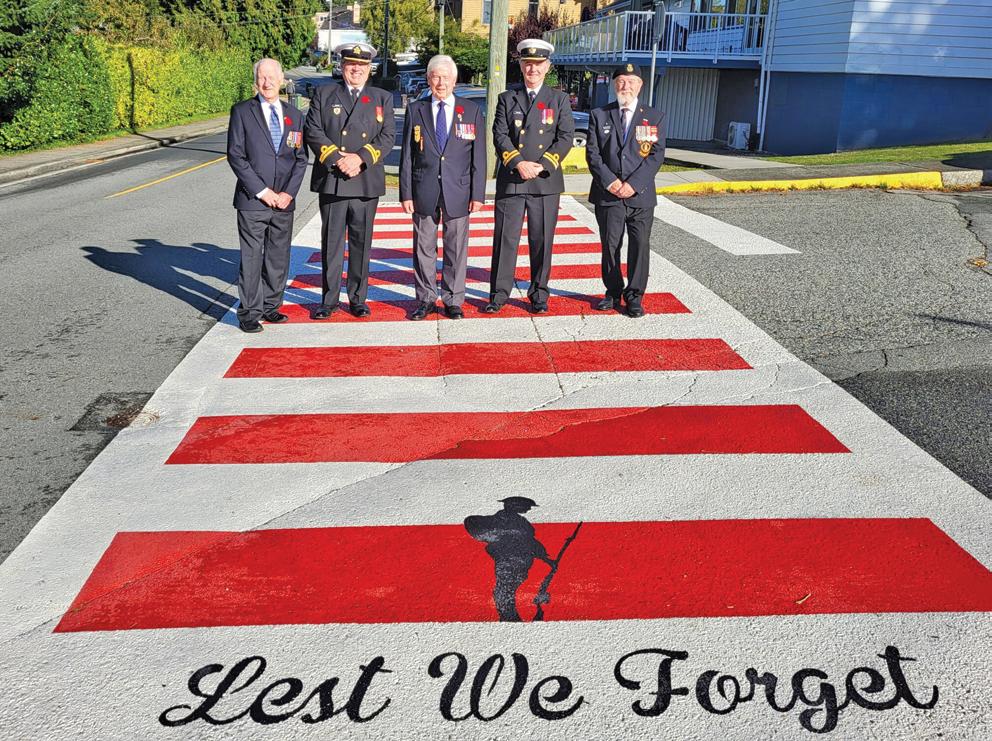
Retired maj. Ian Burke, Lieutenant (N) Alan Walker, retired capt. (N) Stewart Alsgard, Lieutenant (N) Ken Stewart and retired CPO2 Chris Carnall of Powell River, B.C., Branch unveil the city’s new veterans’ crosswalk.
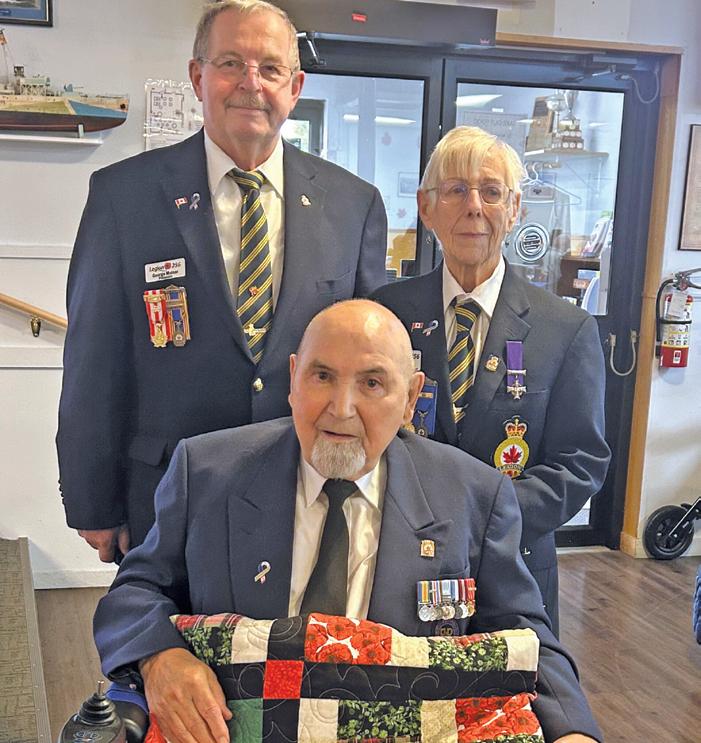
President George Molnar and service officer Joanne Walton of Mount Benson Branch in Nanaimo, B.C., present a Quilt of Valour to Stan Jones.
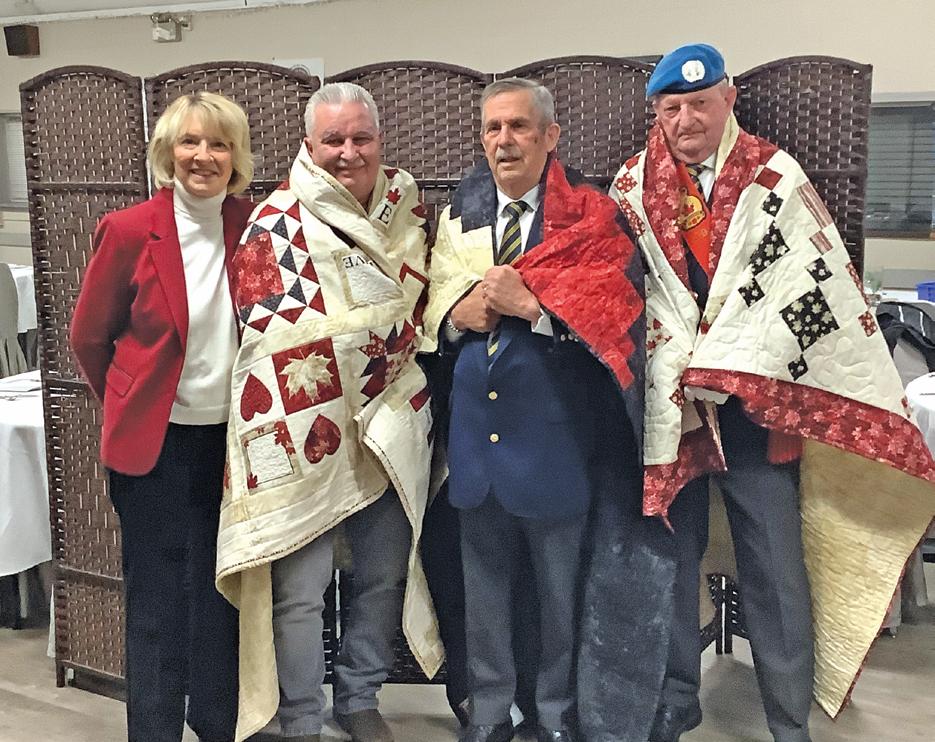
Steve Stewart, President Rod Wilkins and Sgt.-at-Arms Nils Adamsson of Mount Arrowsmith Branch in Parksville, B.C., receive Quilts of Valour from the organization’s Joan Irving.
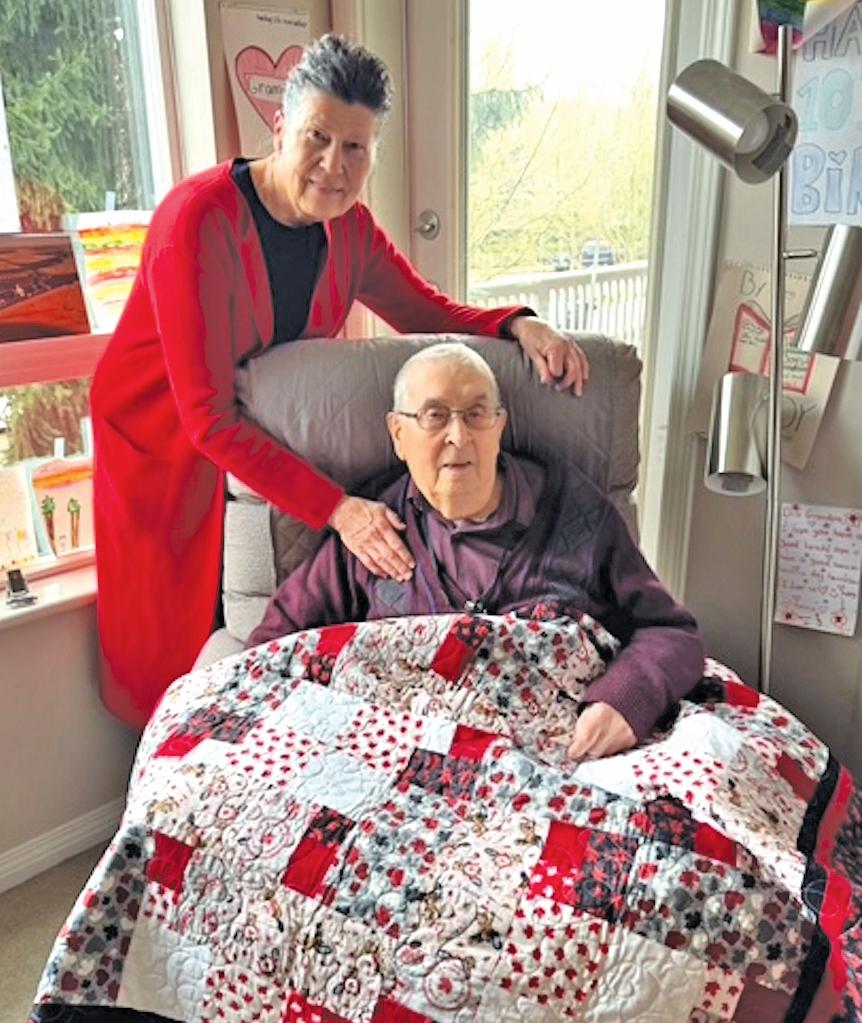
Mel Radom of Cloverdale Branch in Surrey, B.C., presents her father, 104-year-old veteran Gordon Phillips (since deceased), with a Quilt of Valour.
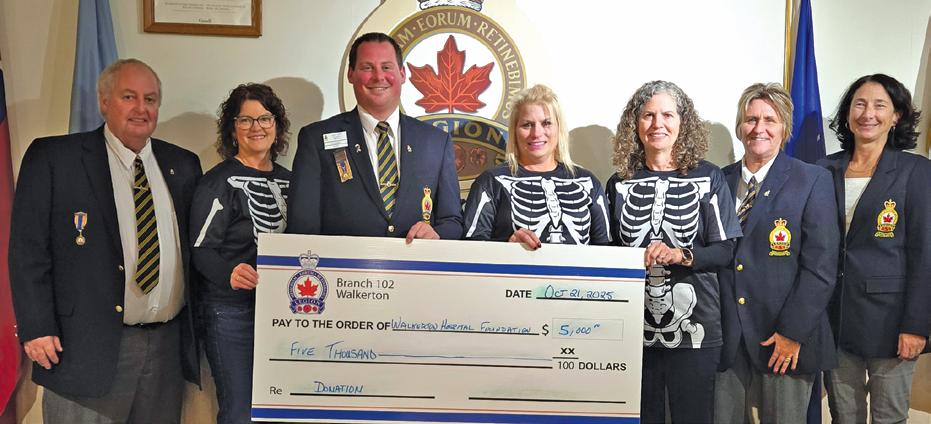
Ron Lamont, President Jake Lantz, Marianne Lamont and Dawn MacKay of Walkerton, Ont., Branch present $5,000 to the “Buy-A-Bone” campaign of the Walkerton & District Hospital Foundation.
Members of East Hamilton Branch hold a breakfast with Santa event for locals.
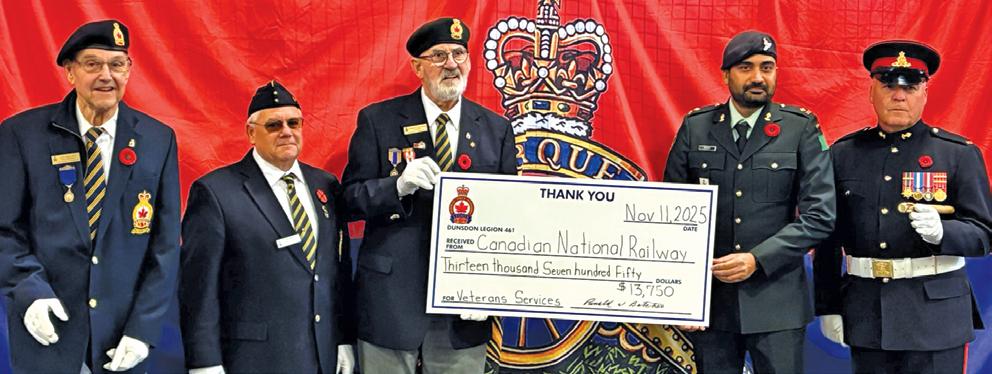
Lieut. Parwinder Singh and MWO Grant Philpott of the Canadian National Railway Veterans Affairs program present $13,750 to Dunsdon Branch in Brantford, Ont., represented by Past President Jack Wallace, Vice-President Don Wolan and President Ronald Butcher.
Larry Bryan, Jeff Martin, John Greenfield, Jackie Barnard, Corbin Stultiens, Robert Pritchard, Robert Pender and Bob Tate of Bowmanville, Ont., Branch unveil a memorial banner honouring Cyril B. Greenfield.
President Darren McConnell and bursary chair Nathan Pellerin of H.T. Church Branch in St. Catharines, Ont., present a $1,000 bursary to Lauren Percival.
President Jake Lantz and members of Walkerton, Ont., Branch present $10,000 to Saugeen Hospice.
President Peter Schaffer and Second Vice Ian Grant of Carleton Place, Ont., Branch present Paul Hargreaves with a Quilt of Valour.
Members of Coldwater, Ont., Branch and local council members unveil the town’s new veterans’ crosswalk.
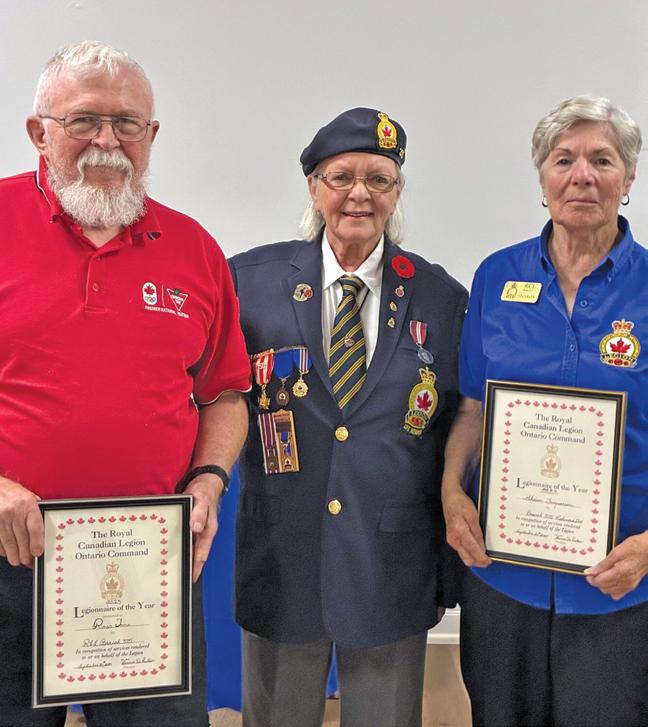
Former president Sheelagh MacDonald of Richmond Hill, Ont., Branch presents Legionnaire of the Year awards to Ross Toms and Sharon Farquarson.
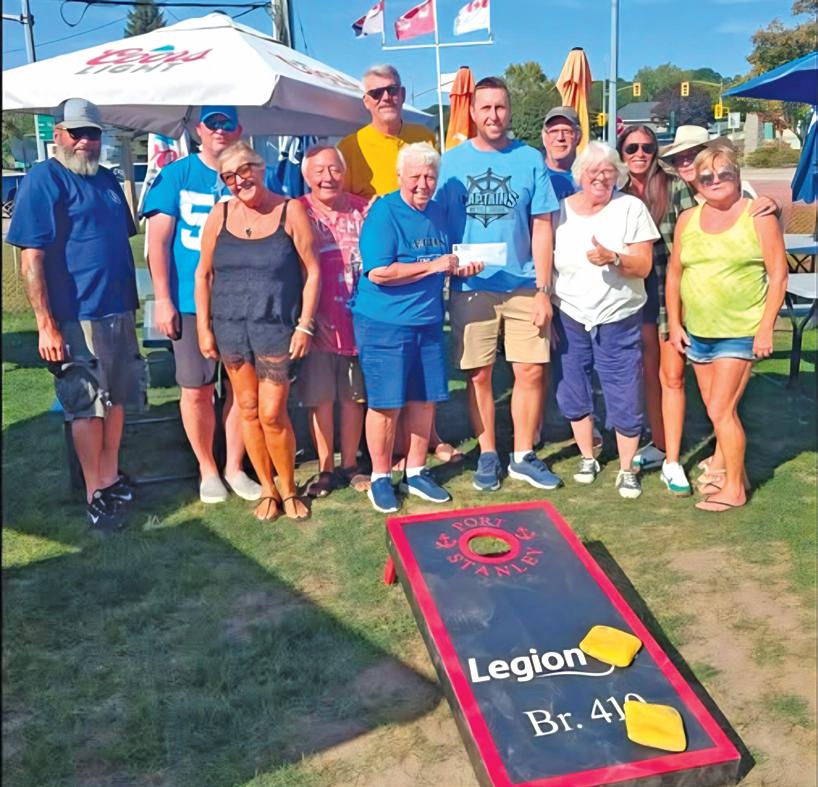
Members of Last Post Branch in Port Stanley, Ont., present $1,500 to the snack program at Kettle Creek Public School, represented by teacher Jeff Keayes (centre).
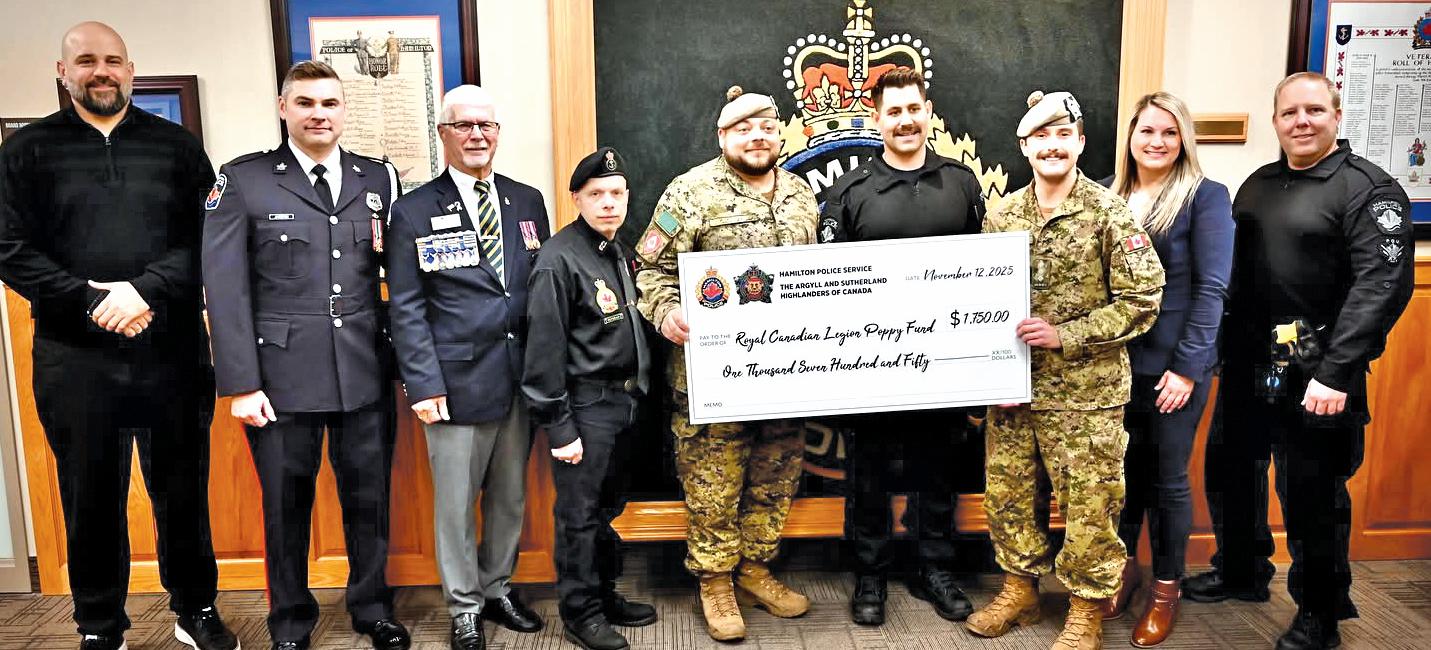
The Argyll and Sutherland Highlanders of Canada and Hamilton Police Service present $1,750 to the Legion poppy fund for the Military Veterans Wellness Program at Battlefield Branch in Stoney Creek, Ont. Attending are local MP Ned Kuruc, program director DC Dan Jaworski, Ontario Command President Lynn McLellan, branch service officer Greg Wilkinson, WO Justin Chaston, PC Chris Campovari, Capt. Dan Giordano, PC Lindsay Veljkovic and PC Jeff Nauman.

Bursary chair Nathan Pellerin of H.T. Church Branch in St. Catharines, Ont., presents a $1,000 bursary to Samantha McConnell.
Dave Hansen of Hollowood Branch in Sharbot Lake, Ont., presents $1,000 to the Salvation Army Christmas basket fund and $1,000 to the Rural Frontenac Community Services snowsuit fund, both represented by Joyce Burke.
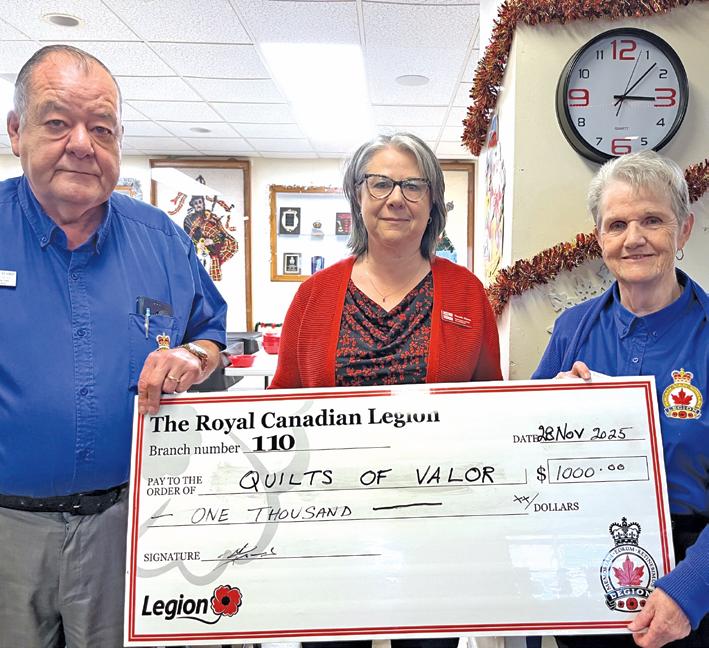
First Vice Yves Bouchard and Peggy Nancarrow of Trenton, Ont., Branch present $1,000 to Quilts of Valour, represented by Danielle Barnes.

President John MacDonell of Kirkland Lake, Ont., Branch presents a PlayStation 5 to the Teck Centennial Public Library, represented by communications and program co-ordinator Jordan Ayres.
Ontario Command hosts the biannual meeting of the Provincial Executive Council.
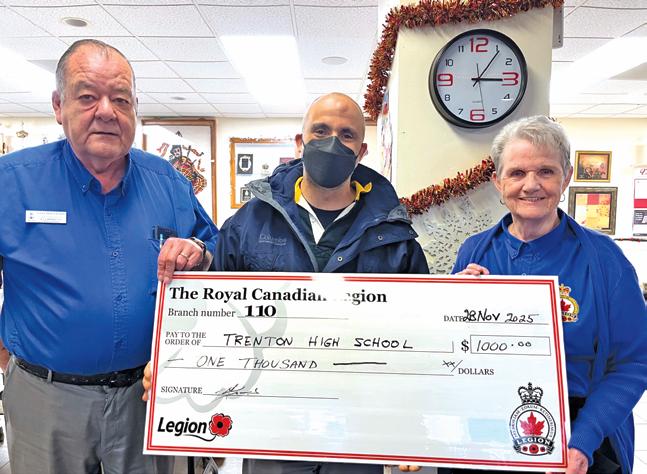
First Vice Yves Bouchard and Peggy Nancarrow of Trenton, Ont., Branch present Trenton High School with $1,000, represented by Dave Lanovaz.
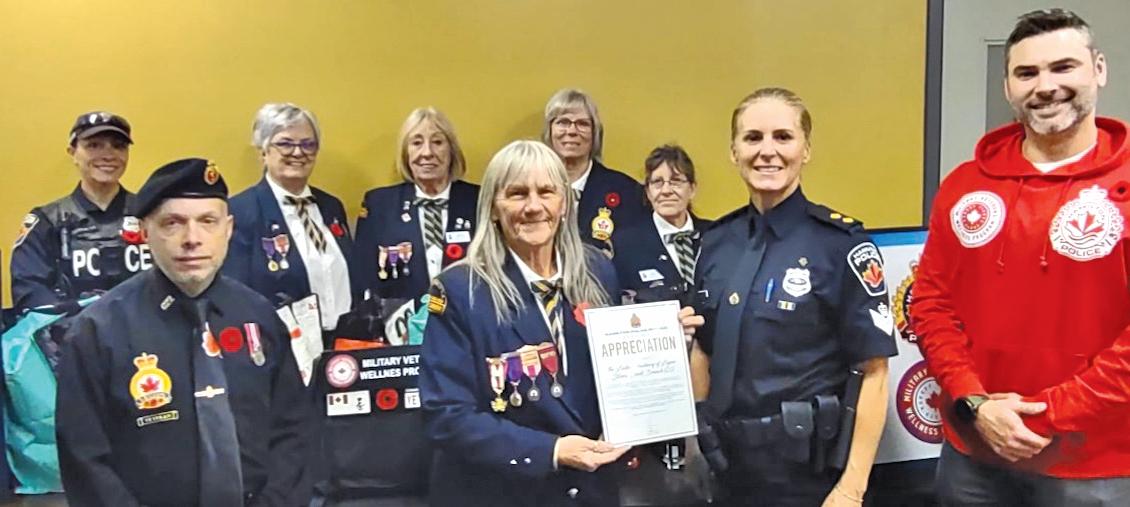
L.A. President Penny Monk and members of Battlefield Branch in Stoney Creek, Ont., present the Hamilton Police Service with wellness bags for its Military Veterans Wellness Program.
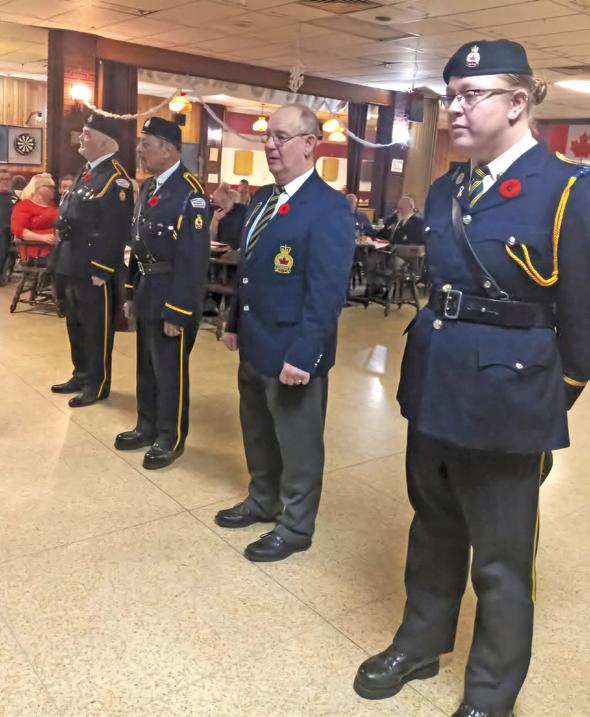
President Bob Lively and the colour guard of East Hamilton Branch attend the branch’s annual honours and awards evening.
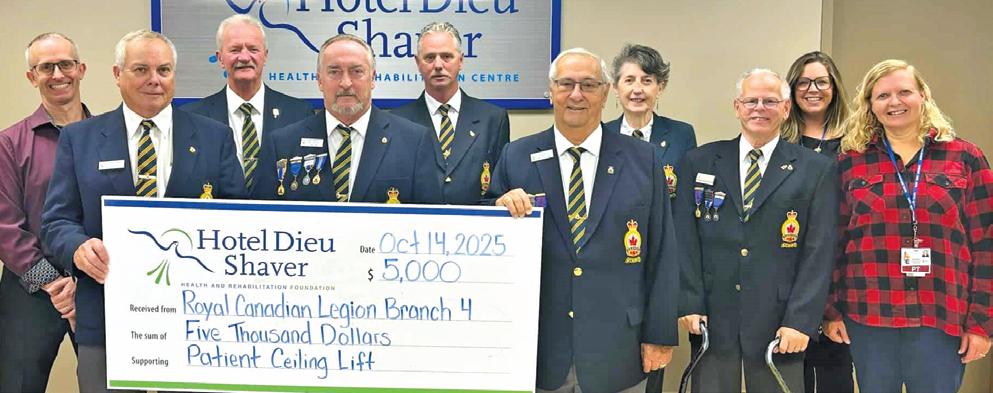
President Gerry Noel (centre) and members of Rose City Branch in Welland, Ont., present $5,000 to Hotel Dieu Shaver Health and Rehabilitation Centre, represented by senior development officer Courtney McLoughlin (back, right) and other foundation staff.
Brian Morris of Robert Combe VC Branch in Melville, Sask., presents a certificate to Legion poster and literary contest winner Malcolm Rondeau of Miller Elementary School.
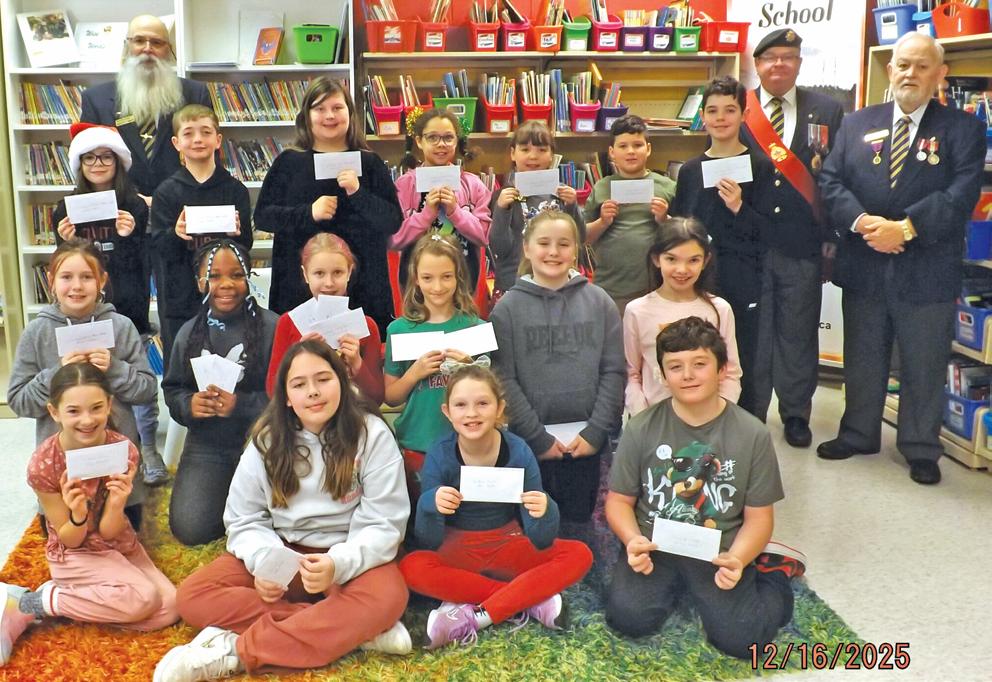
First Vice Danny Glendenning, Sgt.-at-Arms Tommy Jagoe and Michael White of Herman Good VC Branch in Bathurst, N.B., present certificates to Legion poster and literary contest winners from Janeville Elementary School. GRAHAM WISEMAN
Morris of Robert Combe VC Branch in Melville, Sask., presents a certificate to Legion poster and literary contest winner Vayda Gervais of Miller Elementary School.
President Brian Eisan and executive member Cheryl Robertson of Kennebecasis Branch in Rothesay, N.B., present $300 to the 1st Gondola Point Venturer Scouts to help fund a trip to Sweden. BRIAN EISAN
Former president Kathy Campbell and treasurer Ann Healey of Peninsula Branch in Clifton Royal, N.B., present $1,000 for the school nutrition program at Macdonald Consolidated School, represented by Shelley Girouard, Laura Stoddard and Wendy Clark.
President Brian Eisan and executive member Cheryl Robertson of Kennebecasis Branch in Rothesay, N.B., present $500 to the Kennebecasis Valley High School Blue Knights to host a hockey tournament. BRIAN EISAN
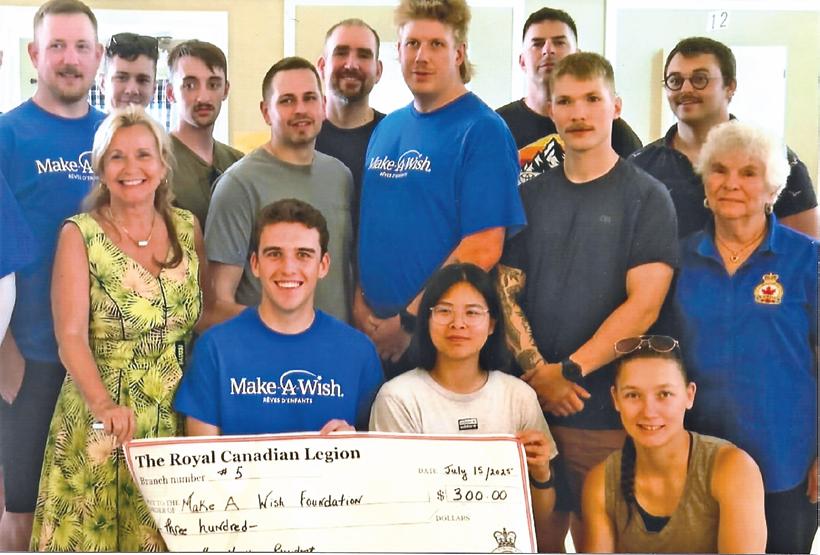
President Gayle Mueller of George Pearkes VC Branch in Summerside, P.E.I., presents $300 to Make-A-Wish. Attending is local MLA Barb Ramsay (front, left).
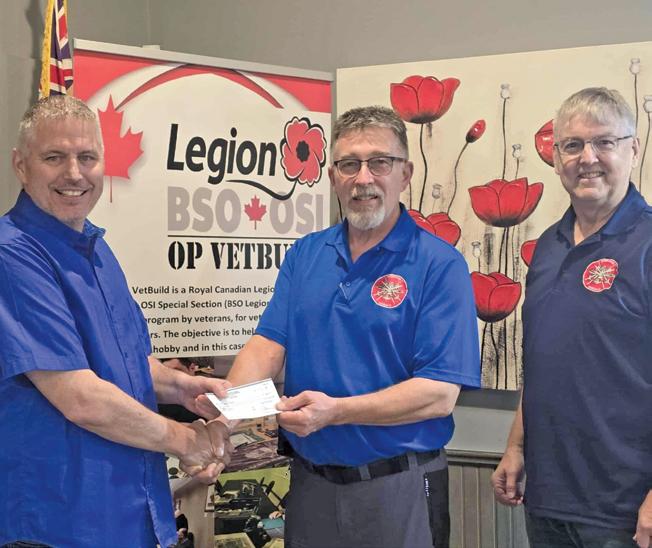
President Ryan Seguin of Shediac, N.B., Branch presents $1,000 to Operation VetBuild, represented by team leads Roger Smith of the same branch and Dan Meyers of Salisbury, N.B., Branch. TOSH LEBLANC
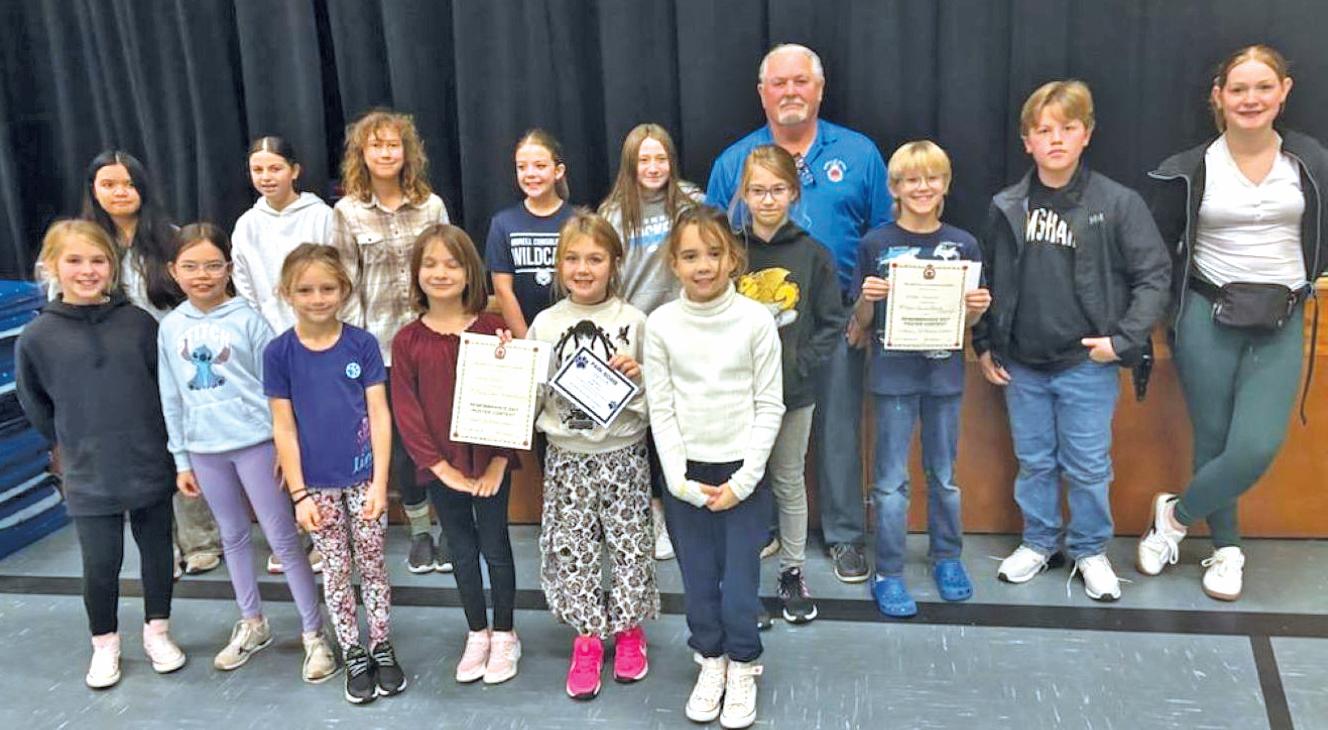
President Garry Doyle of Morell, P.E.I., Branch presents certificates to Legion poster and literary contest winners from Morell Consolidated School.
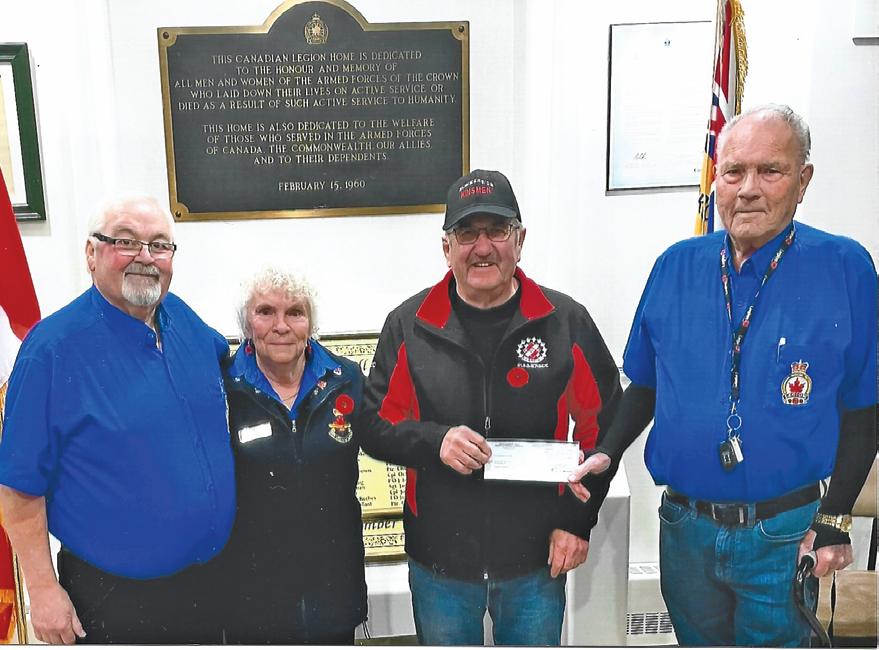
Dan Praught, President Gayle Mueller and LeRoy Gamble of George Pearkes VC Branch in Summerside, P.E.I., present $500 to the Summerside Kinsmen Christmas hamper campaign, represented by Eric Ferrish.
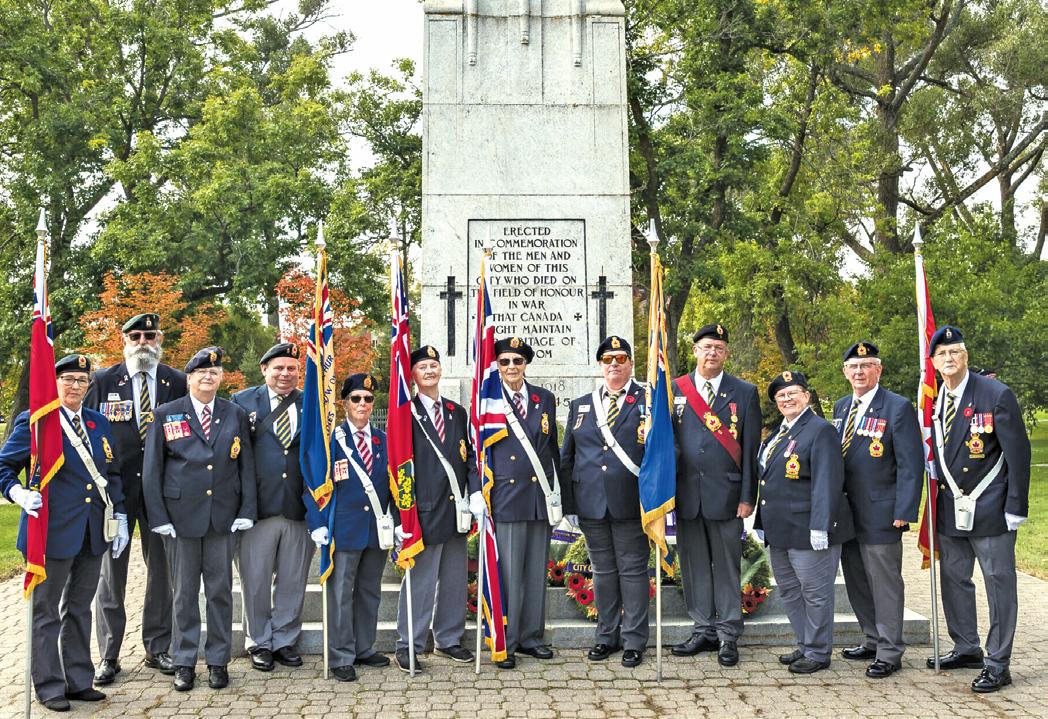
anniversary
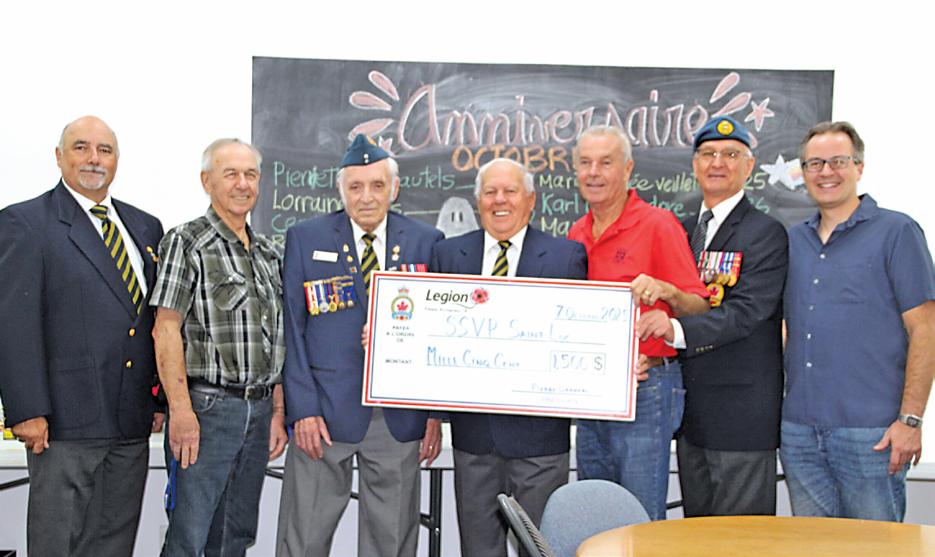
Dany Chicoine, First Vice Lucien Marmen, André Marion, René Morissette, President Yvon Godin, Albert Thivierge and Second Vice Karl De Gran Pré of Richelieu Branch in St-Jean-sur-Richelieu, Que., present $1,500 to the Society of Saint-Vincent de Paul.
Andrew Benkovich of Stony Plain, Alta., Branch presented $4,000 in bursaries to students Alyssa Burant, Kiera Hoflin, Login Hoflin, Brandon Noyes and Angus Ulmer.
Dixie Jones of Stony Plain, Alta., Branch presented $6,500 to the Edmonton Veterans Association Food Bank, represented by Paul Owen.
Dixie Jones of Stony Plain, Alta., Branch presented $3,000 to Meals on Wheels, represented by Robert Da Roza.
Several Alberta branches presented a cumulative $199,000 to the Heroes in Mind, Advocacy and Research Consortium, including $100,000 from the Greater Edmonton poppy fund, $75,000 from Fort Saskatchewan, $20,000 from Okotoks, $2,000 from Holden and $1,000 each from Athabasca and Smith.
L.A. President Margie Robinson presented $15,000 to Shubenacadie, N.S., Branch, represented by President Mike Chapman and treasurer Sheila Preiss.
Youth education chair John McCoubrey of Last Post Branch in Port Stanley, Ont., presented certificates to the winners of the Legion poster and literary contests from Southwold Public School and Éva Circé-Côté French Immersion Public School in St. Thomas, Ont., and Kettle Creek Public School in Port Stanley.
Send your photos and news of The Royal Canadian Legion in action in your community to your Command Correspondent. Each branch and ladies auxiliary is entitled to two photos in an issue. Any additional items will be published as news only. Material should be sent as soon as possible after an event. We do not accept material that will be more than a year old when published, or photos that are out of focus or lack contrast. The Command Correspondents are:
BRITISH COLUMBIA/YUKON: Lindsay Petrie, 503 - 17665 66A Ave., Surrey, BC V3S 2A7, snapshots@legionbcyukon.ca
ALBERTA–NORTHWEST TERRITORIES: Andrea Legaspi, 2020 – 15 Street NW Calgary, AB T2M 3N8, abnwtsubmissions@abnwtlegion.com
SASKATCHEWAN: Tara Brown, 2267 Albert St., Regina, SK S4P 2V5, admin@sasklegion.ca
MANITOBA: George Romick, 320 Admiral Court, Thunder Bay, ON P7A 8B5, romickg@tbaytel.net
NORTHWESTERN ONTARIO: George Romick, 320 Admiral Court, Thunder Bay, ON P7A 8B5, romickg@tbaytel.net
ONTARIO: Julie Stephens, 2 Malibu Lane, Fenelon Falls, ON K0M 1N0, juliestephenslegion25@gmail.com
QUEBEC: Ron Kappert, 105-2727 rue St. Patrick, Montreal, QC H3K 0A8, PR_RP@qc.legion.ca
NEW BRUNSWICK: Alissa Eisan, Box 183, Moncton STN Main, NB E1C 8K9, nblegionphotos@gmail.com
NOVA SCOTIA/NUNAVUT: Mary Phillips, 319 East Broadway, South Bar, NS B1N 3J9, maryp7910@gmail.com
PRINCE EDWARD ISLAND: John Yeo, 657 Rte. 19, Meadow Bank, PE C0E 1H1, islander657@yahoo.ca
NEWFOUNDLAND AND LABRADOR: Brenda Slaney, Box 5745, St. John’s, NL A1C 5X3, bslaney@nfld.net
DOMINION COMMAND ZONES: EASTERN U.S. ZONE, Gord Bennett, 803-190 Cedar St., Cambridge, ON N1S 1W5, Captglbcd@aol.com; WESTERN U.S. ZONE, Douglas Lock, 1531 11th St., Manhattan Beach, CA 90266, douglock@fastmail.com
Submissions for the Honours and Awards page (Palm Leaf, MSM, MSA and Life Membership) should be sent directly to Legion Magazine, 86 Aird Place, Kanata, ON K2L 0A1 or branchnews@legion.ca.
DIGITAL PHOTOS—Photos submitted to Command Correspondents electronically must have a minimum width of 1,350 pixels, or 4.5 inches. Final resolution must be 300 dots per inch or greater. As a rough guideline, colour JPEGs would be between 0.5 megabytes (MB) and 1 MB.
PHOTO PRINTS—Glossy prints from a photofinishing lab are best because they do not contain the dot pattern that some printers produce. If possible, please submit digital photos electronically.
FRENCH INSERT—To receive a French insert of Legion Magazine content, please contact MagazineSubscriptions@legion.ca or call 613-591-3335.
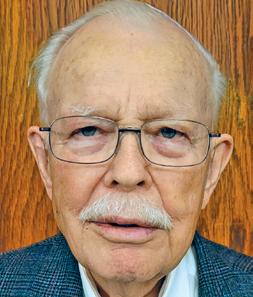
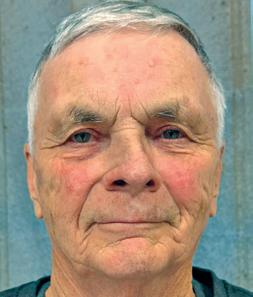
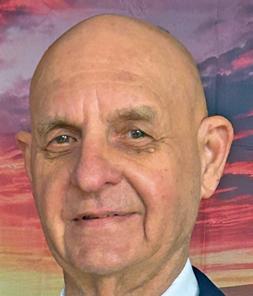
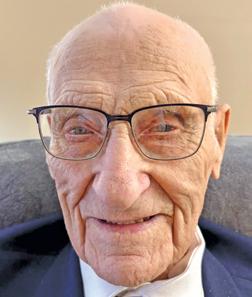
BRITISH COLUMBIA/YUKON
BEN VILLENEUVE
Qualicum Beach Br.
ALBERTA/NORTHWESTTERRITORIES
TIM WHITFORD
High River Br.
SERGIO BOTTOS
Smoky Lake Br.
IRENE MOLDOWAN
Smoky Lake Br.
GERRY VERCAMMEN
St. Albert Br.
MARJORIE PEABODY
Stony Plain Br.
SUSAN BENKOVICH
Stony Plain Br.
ONTARIO
ROBERT W. ELLIOTT
Pte. Joe Waters Br., Milton
PAT PERRIN
Carleton Place Br.
LAUREL CARPENTER
Carleton Place Br.
DONALD TAYLOR
Ridgetown Br.
RICH McCLENAGHAN
Last Post Br., Port Stanley
SASKATCHEWAN
HALLEY HILTS
Foam Lake Br.
ANNE ARNASON
Foam Lake Br.
DAVID MYALL
Foam Lake Br.

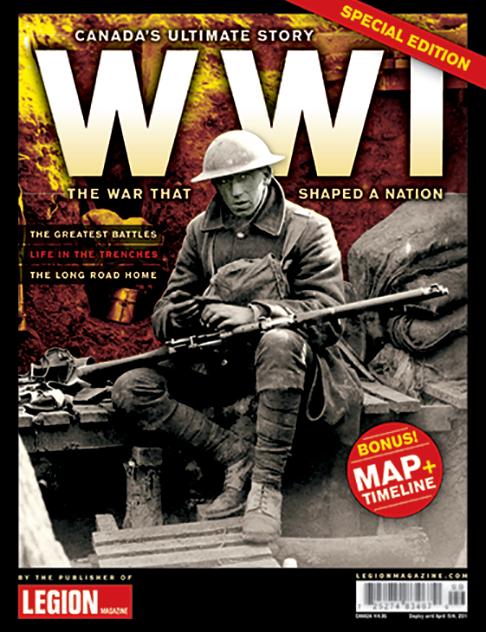






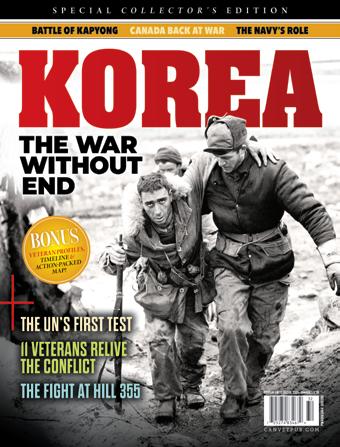

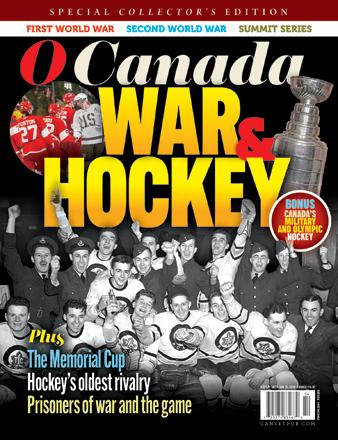
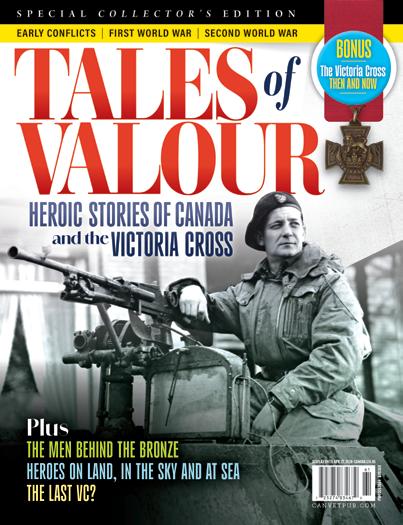
By Alex Bowers
How a Nova Scotian veterans’ pantry has highlighted food insecurity among service members, past and present
For veteran Jim Lowther, service didn’t end when he took off his uniform for the last time.
“It was the best job I ever had,” Lowther explained of his 15-year military career as a cook—or “culinary commando,” as it’s often called in the Canadian Armed Forces. But after an injury forced him out, “I was kind of lost,” he said. Nevertheless, the soldier raised in Cumberland County, N.S., ultimately walked a new path with the help of a “great psychiatrist” and his wife, Debbie, who convinced him to “get into the community and volunteer,” he said.
Lending a hand at a homeless shelter, however, he soon encountered someone he had served with. “I went over and spoke to the guy,” Lowther noted, “and I quickly realized that he was a homeless veteran, and he pointed out three other homeless veterans. I was gobsmacked—I didn’t know what to do.”
That may have been the case initially, but no longer. In 2010, the Lowthers co-founded the Veterans Emergency Transition Services—or VETS Canada—in Halifax. What started out as a small grassroots group has since evolved into a nationwide, volunteerled registered charity, delivering face-to-face, online and telephone assistance to veterans at risk, in crisis or experiencing homelessness.
From providing temporary shelters and household items to covering rent and utility bills, VETS Canada supported nearly 3,200 former service personnel—including eight residing outside of Canada— between Jan. 1, 2018, and Aug. 31, 2025. “Our intention was never to create a charity,” said Debbie of the venture. “We thought we would just help some veterans in our own community. But things just sprouted legs and took off.”
Food is another essential aspect of the services provided by VETS Canada, more so after the COVID-19 pandemic forced the closure of their Ottawa centre (a second facility in Edmonton ceased operations after changes in government funding). Such challenges became increasingly evident from 2022 onward, when, said Debbie, “we spent over $170,000 across the country just on grocery cards [for veterans]. And then the following year, we spent more than double that amount.”
At their Nova Scotia-based headquarters, the Lowthers recognized that they could go further still in offering support. Thus, in March 2025, the couple and their team opened the charity’s first pantry at its Halifax-Darthmouth site, “realizing that food insecurity was becoming a really big issue,” noted Debbie.
The recent initiative operates on a grocery store model and credit system in which visiting veterans are given a select number of monthly credits based on the size of their household. “They grab a shopping cart and walk through and take anything they like. Everything is labelled with the number of credits [it costs],” said Debbie.
Acknowledging the broadly unaddressed stigmatization of food banks, as well as the justifiably widespread nature of veterans’ privacy concerns, the scheme currently maintains an appointment-only practice “to give them a little more dignity” without any worry of bumping into familiar faces. In doing so, the pantry had aided about 112 former personnel at the time of writing. “If we get busier,” conceded Debbie, “we may not be able to do it like that anymore.”
Amid an ever-worsening cost-of-living crisis—one felt acutely by veterans at risk and experiencing homelessness—the organization is already planning how to accommodate the anticipated influx. Additional programs, including a provincial delivery service, are in the pipeline, with drop-off points “so we can actually hit the whole province,” Jim highlighted. “It’s like a military exercise.”
Beyond providing the food, VETS Canada also intends to show its beneficiaries how to make the most of it. “We have a
“I
brand new kitchen downstairs [at headquarters], so we’re going to offer classes,” said Jim. The culinary commando himself will lead the cooking workshop, sharing space with other initiatives, from their Guitars for Vets program to financial literacy seminars.
The VETS Canada team does what it can to feed hungry mouths, although the organization has encountered a 47.7 per cent decline in financial contributions since 2024, said Debbie. The pantry scheme itself has benefited from local businesses—another food bank among them—for some stock donations, together with its own purchased goods. Curious people driving by or walking past the building also stop in to see what they’re about.
“Between 70 to 80 per cent of the people that come here and go down to see the pantry come back with a food donation. They’re blown away by it.”
Despite this, what the Lowthers hope for above all else is greater government involvement—both in terms of the funding the organization receives and the fundamental willingness of politicians to serve those who have served. “You know, we get a pat on the back on Remembrance Day,” said Jim, but the political will to help “is really lacking in Canada.”
Debbie, meanwhile, granted that the federal government’s 2025 announcement of CAF pay raises was a “good first step,” lamenting that “we have members still serving that are accessing the food pantry, and that just shouldn’t be.”
“The general public thinks that veterans are well taken

care of. And why shouldn’t they think that?” she continued. “You put your life on the line to serve your country, you think that when you’re finished, your country is going to look after you.”
“I thought that when I was in uniform in Bosnia,” agreed Jim. “Thinking that if anything happens to us, we’re good to go. We’ll be looked after. We didn’t know until after. Until you work with veterans who are injured, who have to fight for their pensions. [Veterans who] get released from the military for an injury, and then have to fight Veterans Affairs to get compensated for that injury.
“I suppose it is what it is, though. We just try to do what we can. We quietly do the work.”

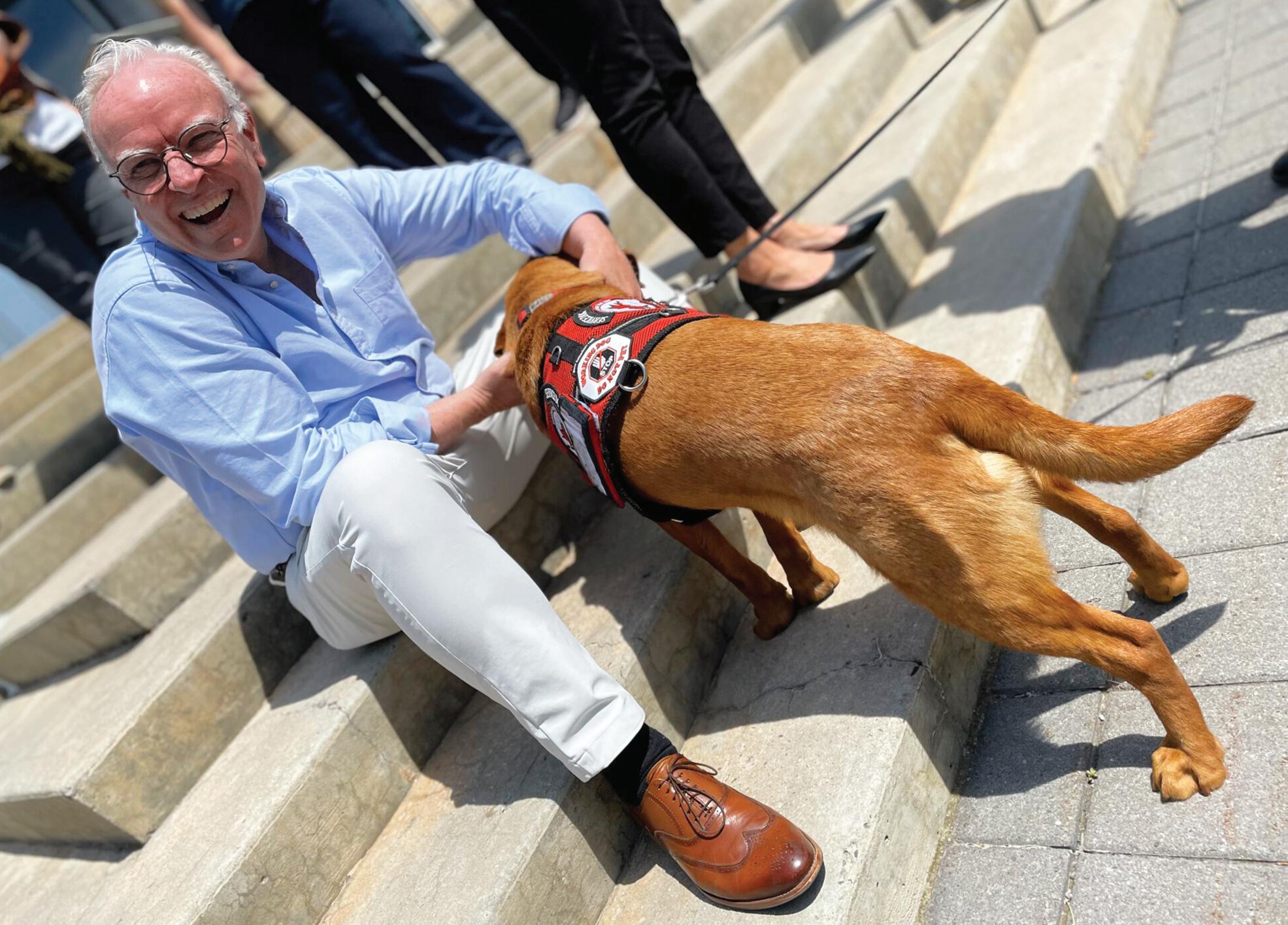
By Aaron Kylie
1959-2025
tephen?”
“No, I’m Aaron,” I responded to the question from a Legionnaire at a hotel in Saskatoon in September 2025. But I understood the confusion. After all, Legion Magazine’s senior staff writer Stephen J. Thorne was a regular, covering Royal Canadian Legion events across the country since he joined the publication in 2016. If there was a man with a camera roaming around, there was a good chance it was him.
“Oh, sorry,” said the Legionnaire. The apology, however, felt as though it had double meaning—sorry for the mistake; but also, a tinge of regret that I wasn’t actually Stephen. I get that, too.
After a sudden illness, Stephen died on Dec. 5, 2025, at age 66.
He was gregarious and seemed born for his role at Legion. Legionnaires and readers alike greatly appreciated his work, written and visual.
He had a passion for the military from his earliest days, and he wrote about it in the prologue to his 2024 book On War: Exploring How and Why We Fight. The conflict-themed comics, movies, TV shows and books of his 1960s youth led him to journalism and eventually, 29 years with The Canadian Press as a reporter, editor, photographer and foreign and war correspondent. In that role, Stephen won three National Newspaper Awards, four Radio Television
Digital News Association national broadcast awards, two Canadian Press Story of the Year awards, and the inaugural Ross Munro Award for Defence Reporting in 2002. He also covered the dying days of South African Apartheid and the wars in Kosovo and Afghanistan.
A few years later, Stephen started writing freelance articles for this publication, where that youthful interest in war and his career experience were the perfect blend for Canada’s military history magazine. And he seemed to relish it, almost as though the job was as made for him as he for the job. After just two years, he joined the staff full-time.
Stephen wrote prolifically: a weekly column, at times biting, for Legion’s website, as well as regular feature and news stories—producing more than 500 articles on a wide range of topics related to the country at conflict and beyond. He also authored seven special editions of Legion’s sibling publication Canada’s Ultimate Story and the aforementioned book. All in just nine years.
Legion Magazine also benefited greatly from Stephen’s skill as a photojournalist. A series of portraits of wounded Canadian Afghanistan veterans—along with the related stories—that he produced early in his days with the publication evolved into an exhibit, The Wounded, that premiered at the Canadian War Museum in Ottawa in 2019 and continues to tour to this day. In 2008, Stephen’s work and that of fellow photojournalist Garth Pritchard formed another of the museum’s exhibits, Afghanistan: A Glimpse of War.
Stephen’s portraits of veterans from that conflict, as well as of those who served in the Second World and Korean wars, were among his best photographic work.
And he loved producing them almost as much as he enjoyed speaking with the veterans and relaying their stories.
“What’s the hap?” Stephen would query me as he jovially bounded into my office every morning for a pre-getdown-to-it chat. Most days, we undoubtedly gabbed for far too long, but it was in those conversations that I feel like I learned so much more about Stephen. And where we made a genuine connection. If you knew him, or if he interviewed you, I can’t imagine you didn’t feel the same.
If you’ve ever had to summarize a person’s life in a few hundred words, you know the task is impossible, both because the space is far too insufficient, but also that each of us only knows a specific facet of a person. What’s above is Stephen’s resume. And as impressive as it is, the man himself, to me at least, was far more than that. But it’s just my perspective as a colleague and friend, not of him as a son, a father or a partner—though I believed him to be loving and dedicated in those roles, too, if the passionate stories he told about his family were any indication.
As many days as Stephen would patiently listen to my tales in our gabfests, or that he simply walked out in disgust if I dared to rail against the CBC, he too would share stories from his life. Of growing up in Halifax and playing basketball; of days as a young man working with resource companies flying in Canada’s Far North; of his early days with CP in St. John’s or later times in Toronto; of his kids, Kate and John; of long days behind the lens shooting basketball, cowboys or eagles; of last night’s baseball or hockey game; of his biker days and the crash that ended them; of his fiancé Dorothy and new cat Max.
Stephen wrote prolifically, producing more than 500 articles on a wide range of topics related to the country at conflict and beyond.
Admittedly not a cat person, that was probably my max, at which point Stephen would bound down the hall to chat with Legion’s art team, presumably a far more feline-friendly group.
In reflection, while I never had one, Stephen felt like a big brother. He would share unequivocally. He listened the same way. While I had been a journalist for more than two decades when I joined Legion Magazine, I was certainly no military or history expert. Stephen was always patient and diplomatic in pointing out potential editorial missteps. Rightly or wrongly, soldiers will always be “wounded,” never “injured,” and it will never be “the minesweeper HMCS whatever” (the inherent repetition of calling a minesweeper a ship)—for Stephen. And with all those years at CP, he was intimately familiar with its style; No. 1 not # one— for Stephen, and CP, I suppose.
Likewise, despite his decades of experience, Stephen was always open to new ways, to being pushed, to being challenged—and rose to it all.
Stephen’s book On War was an ambitious project and I’m grateful that I got to work with him on it. He was immensely proud of it. We had planned others, but regardless, it will stand as a crowning achievement of his incredible career: the culmination of childhood dreams and his life’s work.
There could be much worse than being mistaken for Stephen J. Thorne.
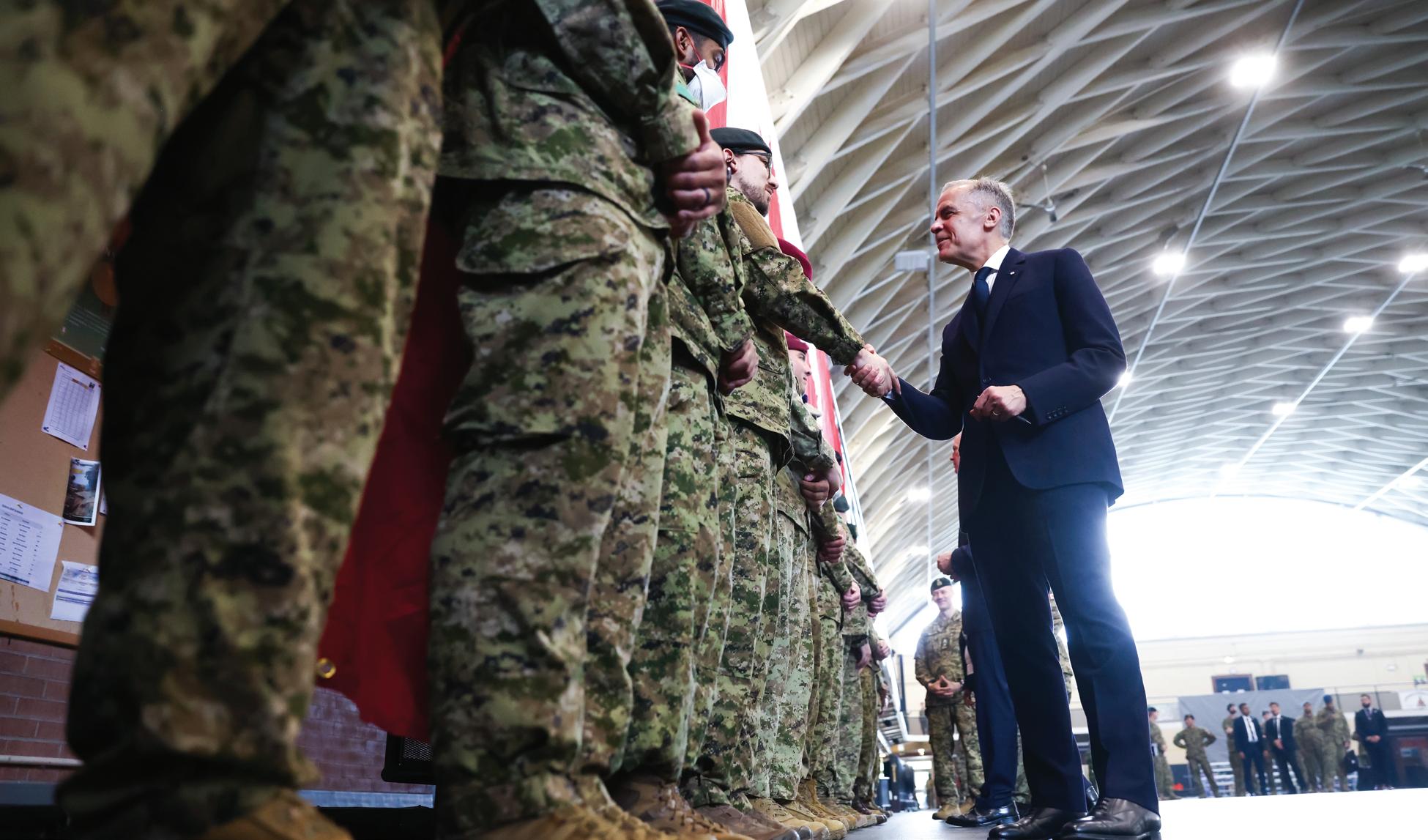
By J.L. Granatstein
In a dramatic turn, Canada initiates massive increase in defence spending
very country has national interests, priorities that govern its policies. Canada’s interests are simple: national unity, the welfare of the population, the defence of freedom and democracy with its allies, and the protection of its territory, sovereignty and the Canadian people.
The last item is the most important. Canadians want their government to ensure that they are safe from attack from enemy states. Canadians want their leaders to protect the country’s territory from nations that might try to impinge on them.
For more than six decades now, the federal government has failed to do that. Starting with John Diefenbaker’s government in 1957, defence budgets have been cut, weapon purchases delayed, the strength of the armed forces reduced and commitments to NATO and Norad often unfulfilled. A low point was Prime Minister Justin Trudeau’s statement in November 2024 that Canada would meet NATO’s goal of two percent of gross domestic product (GDP) spending on defence nearly a decade later, by 2032.
Canada’s allies noticed. With Russia continuing its unprovoked invasion of Ukraine and nuclear sabrerattling with western democracies, China increasingly pushing the boundaries of Taiwan’s sovereignty and exploring the Arctic for resources, including rare elements, and North Korea reportedly developing missiles that can strike North America, Canada was seemingly minimizing and delaying its support of the 75-year-old western military alliance.
U.S. politicians were outraged (“The Trudeau policies are the freeloading policies of a NATO decay,” said Congressman Mike Turner) and President Donald Trump was belittling the prime minister and dismissing Canada’s sovereignty (repeatedly referring to “Governor Trudeau” and calling the country the “51st state.”)
For their part, diplomats from several NATO countries made “clear that when it comes
to defence spending, allies are fed up” with Canada, said a 2024 Politico story. Yes, Canada had some 2,000 soldiers in Latvia leading a brigade in a forward defence role to deter Russian aggression in the region, but the troops lacked much modern equipment and Ottawa proved slow in remedying the situation.
The situation has changed dramatically, however.
Trudeau resigned on Jan. 6, 2025, and the governing Liberals chose Mark Carney as their leader, and thereby prime minister, 10 weeks later. Carney’s Liberals won a subsequent election, although as a minority government, and quickly set about remedying Canada’s defence shortfalls.
The defence of the country’s people, territory and sovereignty is now a priority. Carney announced on June 25 that the NATO spending commitment would be met before the end of 2025. Then at an August NATO meeting, he pledged to meet the organization’s insistence that its members spend 3.5 per cent of GDP on their militaries and an additional 1.5 percent on defence infrastructure. (In Canada’s case, the latter on roads and ports in the Arctic, for instance.)
This is a sea change. In the 1950s, Canada spent seven per cent of GDP on defence; under Justin Trudeau, military expenditures were about 1.3 percent. Under Carney, Canada’s armed forces are back in business, with a plan to also build more military equipment at home and recreate a robust defence industrial base. At the same time, if the country doesn’t have a certain capability—to build submarines, for example —it will solicit it from NATO or other allies. The intent is to diversify by building more in Canada and to buy and sell military equipment to allies.
The U.S. hasn’t been ruled out as a supplier—Canada may still purchase its state-ofthe-art aircraft or its HIMARS (High Mobility Artillery Rocket System)—but the aim is also to reduce the Canadian Armed Fores’ dependence on American industry.
This doesn’t mean that Canada is going to stop cooperating with Washington in the defence of North America. Norad is still vital, and Canada is committed to improving the binational organization’s radar and early warning systems. And Carney was quick to agree to participate in Trump’s proposed Golden Dome missile defence shield to protect North America from attack.
Twenty years earlier, President George W. Bush offered Canada a role in continental missile defence, essentially without cost, but Liberal Prime Minister Paul Martin refused. The result? The U.S. oversees North American missile defence with no Canadian representation or role. Carney’s government recognized that a seat at the table and a voice in the decisions was necessary to help protect Canadians and the country. The prime national interest demanded this action.
This took some political courage. Trump’s bluster toward Canada has angered many Canadians. In response, there have been widespread boycotts of U.S. goods, almost all provincial liquor boards refused to sell American products and there has been a precipitous drop in travel by Canadians south of the border.
The F-35, the U.S. fifthgeneration fighter, was the Royal Canadian Air Force’s choice to replace its 40-yearold fighters, and Canada had already invested in 16 of the stealth jets, with a contract for 72 more. But with antiAmerican/Trump sentiment
Under Carney, Canada’s armed forces were back in business, with a plan to build more military equipment at home and recreate a robust defence industrial base.
running high, Carney ordered a review of the purchase in March 2025. Warned by U.S. ambassador Pete Hoekstra that there would be “consequences” if the acquisition wasn’t completed, the government appears to be continuing apace.
Innovation minister Melanie Joly said that Lockheed Martin, the main U.S. contractor on the F-35s, would be pushed to involve more Canadian companies in building parts for the aircraft (also see “The Visual,” page 18). She noted, too, that would be an expectation for all foreign defence purchases. In an Oct. 9 speech to the Canadian Club in Toronto, Joly presented the government’s defence industrial strategy, which will involve fostering home industry but also partner with allied countries (she cited, as an example, working with Sweden to build a state-ofthe-art surveillance plane).
Joly had never been known as hawkish, but here she was delivering the outline of a defence industry policy. The government also created the Defence Investment Agency in early October 2025 to energize Canada’s moribund defence procurement and pegged 2025-2026 defence spending at $62.7 billion in its November budget—more than double the total for the previous fiscal year.
For the first time in decades, Ottawa is taking defence seriously. And none too soon.
By Dennis Molinaro
A former national security analyst and author of the new book Under Assault highlights the history and impacts of Chinese interference in Canada
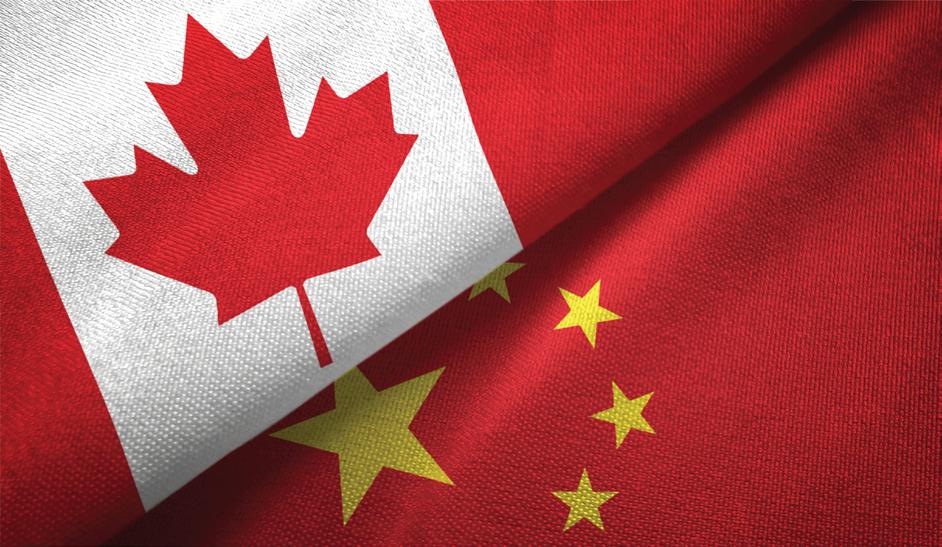
The western world has been focused on the threat of terrorism for the past two decades and for good reasons. The post-9/11 ‘war’ on terrorism sought to combat and end a substantial peril to the West and prevent more large-scale attacks. It succeeded on several fronts, although the threat will never be completely eliminated. But when it came to the West’s interactions with nation-states such as the People’s Republic of China (PRC), they were governed by a specific delusion for half a century. Canada, like the U.S., believed that if it did business with China, extended a hand of friendship, China would transform itself into a liberaldemocratic country; trade would lead to freedom. Canada was wrong. Beijing never considered joining a liberal
order and instead used Canada as a backdoor to the U.S. and as a means of exploiting resources and technology.
But more Canadians and Americans are coming to terms with the harsh realities they have ignored for too long. The stories of secret PRC police stations in the news about a year ago weren’t a new phenomenon. The PRC had been interfering and seeking to influence the political and civic life in Canada for decades. Canadian leaders have done little to deter adversaries from operating here.
But how did such a situation arise? To date, Canadians have had diplomatic histories of the Canada-China relationship but an intelligence history wasn’t incorporated into them. That’s necessary if Canada hopes to have a realistic appraisal and understanding of the relationship.
In October 1970, Prime Minister Pierre Trudeau recognized the People’s Republic of China. Canadians incorporated the event into the narrative of Canada as peacemakers who brought an isolated country
into the global fold. The truth is colder. Canada was useful. China was searching for a means to influence the U.S. into recognizing it and Canada served as an in. Chinese leader Mao Zedong didn’t view Canada as a friend in the western sense. He viewed it as a means of breaking the American containment policy. When Canada recognized Beijing, it abandoned Taiwan and accepted terms that its allies rejected. Canada thought it was leading the world. In truth, it was being led.
The problem with the Canada-China relationship from this point forward was that self-deception became ingrained and the standard operating procedure for Canadian governments. The China that Canada’s leaders saw and engaged with was one they invented in their own minds. They saw a potential market for wheat and potash. They saw a counterweight to the U.S. They convinced themselves that economic liberalization would inevitably lead to political freedom. They weren’t alone in this thinking as even the U.S. adopted it, though its defences against Beijing were more developed than Canada’s.
But the truth was that the Chinese Communist Party (CCP) used western openness to build its economy and modernize its military. They used western universities to train their scientists. The West dreamed of partnership while China planned for dominance.
The consequences of this naïveté are more visible in the ruins of Nortel Networks. In 2000, Nortel was a Canadian success story, a titan that dominated the global fibreoptic transmission market. Just one decade later, it was bankrupt. Many factors contributed to its fall, but corporate espionage was a fatal
wound. Hackers compromised the company’s networks for years. They stole trade secrets and technical papers that served as road maps for future technology. They stole the passwords of executives and had free reign in their networks. The hacking was traced back to China. While Nortel collapsed, Chinese tech giants rose to global prominence.
Similar thefts continue today. The thievery moved from corporate boardrooms to Canada’s most sensitive laboratories. The case of the National Microbiology Laboratory in Winnipeg stands as a notable example of carelessness. The facility is designed to handle the world’s deadliest pathogens. Yet Canada allowed scientists with ties to individuals connected to the PRC military to work there. Ignorant of the security threats, Canada allowed the transfer of deadly virus samples to China’s Wuhan Institute of Virology.
The regime in Beijing operates on a concept of transnational sovereignty. It believes anyone of Chinese descent, regardless of their citizenship, owes their loyalty to China. By this logic, it doesn’t respect Canada’s borders as it hunts its critics in Canada. It harasses the Uyghur community, Tibetans, the Falun Gong, and Hong Kong pro-democracy activists and Taiwan independence supporters. It uses threats against family members back home to silence dissidents in places such as Vancouver and Toronto. This is transnational repression. It’s a foreign state enforcing its political will on Canadian soil. When activists such as Chemi Lhamo run for student office in Canada, they face thousands of death threats. When Uyghur rights advocates such as Mehmet Tohti speak out, they are followed by strangers and
The China that Canada’s leaders saw and engaged with was one they invented in their own minds.
receive ominous phone calls and threats to their families in China. This isn’t community infighting. It’s a foreign government outsourcing terror to silence its enemies in Canada.
The United Front Work Department is an arm of the Chinese Communist Party tasked with influencing foreign elites and controlling the PRC diaspora abroad. Its goal is to make foreign decision makers sympathetic to Beijing’s interests, and it cultivates relationships with influential figures at all levels from school boards to Parliament. In return, it expects support for China’s interests and silence on its indiscretions. During the April 2024 Hogue inquiry into foreign interference, the Canadian Security Intelligence Service reported that it believed China interfered in the 2019 and 2021 federal elections. The government’s response to these revelations has been sluggish with a promised foreign agent registry yet to materialize. Canada can’t afford this approach any longer. The world has changed. The era of optimistic engagement is over. China isn’t a partner. It’s an adversary that seeks to reshape the international order. It supports Russia’s war in Ukraine. It threatens Taiwan. It spies on Canada’s allies. It steals technology. It interferes with democracy. Canada needs a profound shift in how it views national security. It needs to enforce the laws it has and fund its military and its intelligence services so they can do their jobs properly. It needs to better protect its research and its critical infrastructure.
Most importantly, Canada needs to stop seeing the China it wants to see and start seeing the China that is. It must recognize that it’s in a conflict that the other side has been fighting in secret for 50 years.
Canada is currently seeking a re-engagement with China due to U.S. tariffs, but that shouldn’t come at further expense to Canada’s economic security and threats to its democratic institutions, its sovereignty and its people. Any new relationship must first recognize that Canada has been under assault.
Costs must be imposed on people secretly working for foreign states in Canada. Canada needs to protect its democratic institutions and processes. Canada can engage with China, but it must demonstrate it won’t accept being bullied and that foreign influence and interference won’t be tolerated.
All of this is possible and achievable when Canada stops looking for friends and starts defending its interests.
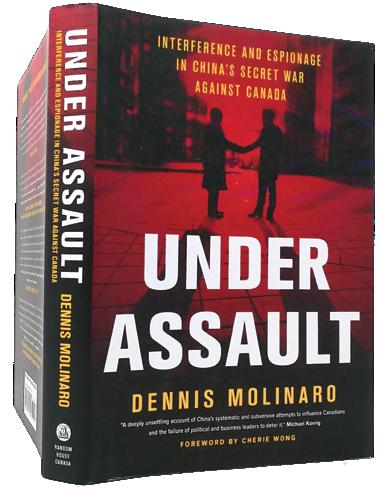
Dennis Molinaro’s latest book Under Assault: Interference and Espionage in China’s Secret War Against Canada was published in November 2025.
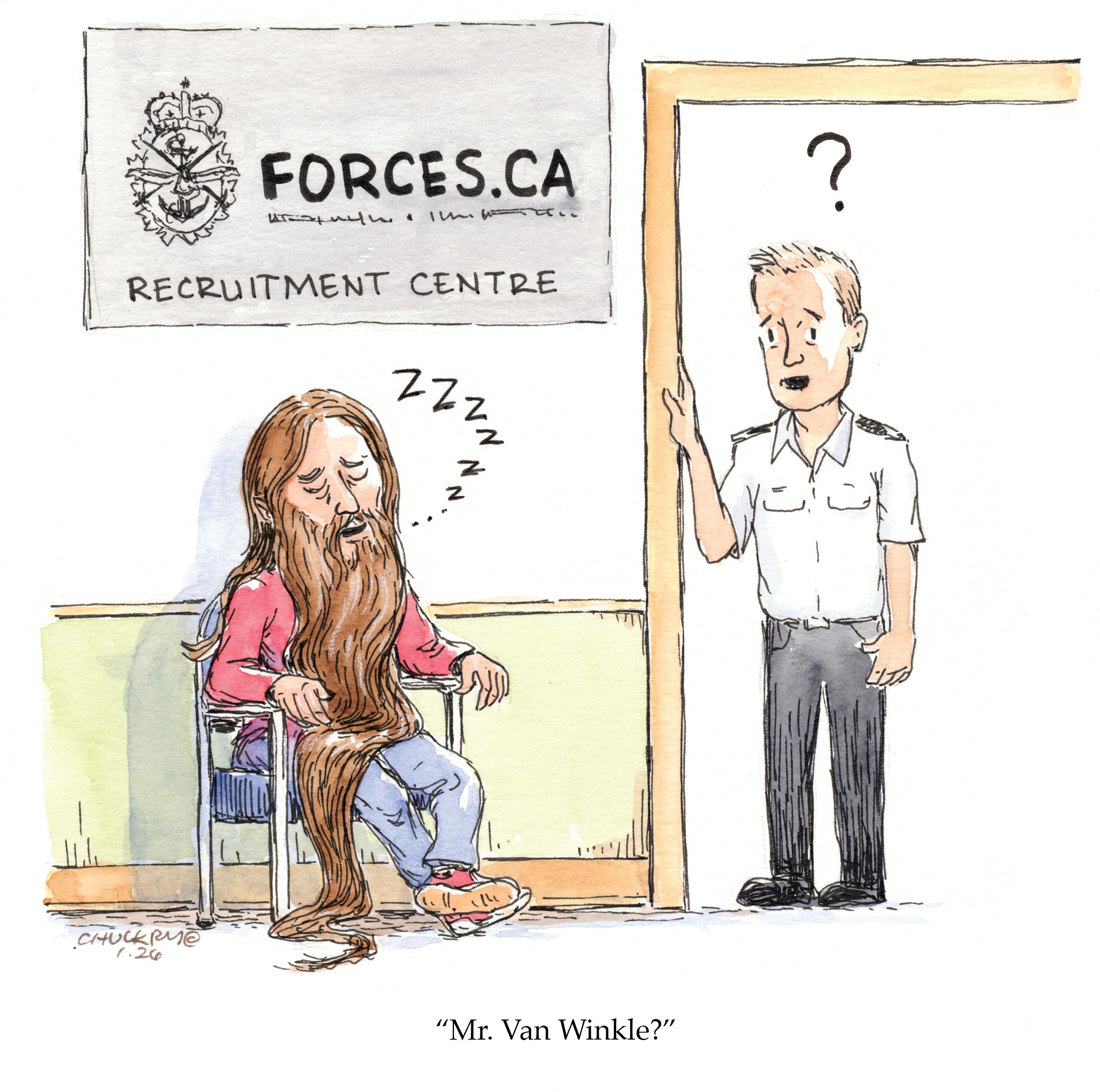
Legion Magazine needs your feedback and as a thank you, respondents will be entered into a draw for an amazing prize!
Every few years, Legion Magazine asks you to tell us what you think about your magazine. Your answers help guide our decisions as we work to improve the magazine and ensure that we serve your needs. The survey responses will also help us learn more about our typical reader’s household so we can strengthen our advertising, a vital part of the economic success of Legion Magazine. Please take a few minutes to complete the survey and return it with your ballot. When you do, your name will be entered into a random draw for a $1,500 travel credit on a vacation package booked through BST Vacations/Blowes & Stewart Travel Group. To be eligible for the draw, you must be a Canadian resident, 19 years of age or older and your completed survey must be received at Legion Magazine by 4:30 p.m. EST, May 15, 2026. Return your survey by mail or fill it in online at www.legionmagazine.com/survey.
No purchase is necessary and your responses are confidential. One entry per reader. The number of entries received will determine the odds of winning. Salaried employees and officers of Canvet Publications Ltd. are not eligible, nor are members of their immediate families. There is no cash substitute for the prize. The draw winner will be required to correctly answer a time-limited mathematical skill-testing question. All decisions of the judges are final.
Be sure to fill in your name and address in the appropriate box on page 91 to be entered into the draw. For full contest rules, write to: Readership Survey Contest Rules, Legion Magazine, 86 Aird Place, Kanata ON K2L 0A1.
And lastly, but very importantly, please consider allowing Legion Magazine the opportunity to include your comments in an upcoming article on the survey results. The prize winner’s name will also appear in that issue.
Good luck and thank you!
Jason Duprau, General Manager

1. What is your level of interest in these subjects?
None Low Moderate High Veterans’ health issues Remembrance
Pre-First World War First World War
Second World War Modern conflict
2. What is your level of interest in these feature topics?
None Low Moderate High The Home Front Canadian military history
Army history Navy history Air Force history Memoirs
Pictorials Anniversaries
Posters/maps/inserts
3. What is your level of interest in these columns?
None Low Moderate High Feedback On This Date
Military Health Matters Front Lines
Humour Hunt
Heroes and Villains
Artifact The Briefing The Visual The Dispatch The Historian Exit Strategy On Watch
4. What is your level of interest in these sections?
None Low Moderate High Honours and Awards
Lost Trails/Unit Reunions/ Requests Snapshots In the News Serving You
5. Are you? Legion member Non-member
6. Have you served in the military? No Yes (Serving Retired )
7. Which age group are you in? Under 35 55–64 35–54 65 plus
8. Are you? Male Female Prefer not to respond
9. On average, how much time do you spend reading a copy of Legion Magazine?
Less than 1 hour 3 to 4 hours 1 to 2 hours 4 hours or more
10. How many people besides yourself read your copy of Legion Magazine? 1 2 3 4-6 7-9 10 plus
11. Indicate which action(s) you have taken after reading Legion Magazine Keep for future reference Pass on to someone else Investigate a product or service advertised Visit a website for more information Purchase a product or service advertised Purchase a gift subscription
12. Do you visit Legion Magazine online? No Yes
13. Would you make purchases on the Legion Magazine website? No Yes
14. Indicate which other Legion Magazine products you have experienced. Military Moments video series Canada’s Ultimate Story magazine
15. Are you planning to purchase or lease a new vehicle in the next 12 months?
Purchase No Yes Lease No Yes
16. How often do you read these other publications?
Never Seldom Often Always
Good Times
Zoomer/CARP News
Canadian Geographic
Canada’s History
17. What is the approximate total population of the community or urban area where you live?
Less than 50,000 people
50,000 to 99,999
250,000 to 499,999
500,000 to 999,999
100,000 to 249,999 More than 1 million
18. Which of the following investments/savings do you have:
RRSP Company pensions
RESP TFSA
Mutual funds
Savings bonds
Stocks
T-bills
GICs
Term deposits
Investment real estate
Other (please specify)
None of the above
19. Would you like to see more information on living in a retirement community?
No Yes
20. What is your total annual household income before taxes?
Less than $50,000 $75,000 to $99,999
$50,000 to $74,999 $100,000 or more
21. Do you use the following on a regular basis?
Dietary supplements Advil Vitamins Tylenol
Homeopathic remedies Aspirin
Prescription drugs Orthopedics
22. Which of the following leisure activities do you enjoy?
Live performances Exercising
Winery/brewery tours Sporting events
Golf Galleries/museums
Watching movies Hunting/fishing
23. Are you interested in more information on Alzheimer’s disease Diabetes Arthritis Heart and stroke Cancer Home care
24. Do you intend to travel in the next 12 months?
No Yes
25. Which of the following places do you plan to travel to in the next two years?
Caribbean/Mexico Florida/Carolinas
Continental Europe California/Arizona
United Kingdom
Atlantic Canada
Australia/New Zealand Quebec Asia Ontario
South America
Western Canada
26. What kind of travel are you interested in?
RV/camping Cruises
Cultural and historical tours
All-inclusive sun vacations
Escorted tours in Europe or Asia
Escorted tours in North America
Winter-long getaways to a vacation home
Motor coach and escorted tours
Independent travel by car or train
27. Do you own any pets? No Yes
28. After reading Legion Magazine, have you ever Bought a product or service you saw advertised? No Yes
Requested information about a product or service you saw advertised? No Yes
29. Do you find advertising in Legion Magazine relevant? Very relevant Somewhat relevant Not relevant
30. How would you rate Legion Magazine overall in terms of serving your needs?
Poor Average Good Excellent
31. Reader comments:
Almost done. Just to make sure we can contact you if you win, please fill in the Draw Entry Form below and return to: Surveys, Legion Magazine 86 Aird Place, Kanata ON K2L 0A1 Canada
Please print / Limit one entry per reader
Name:
Address:
Telephone: ( )
Please consider my comments (with name) for publication. Yes No
Yes, I would like to keep informed on Canadian military history, veterans’ issues and exclusive deals as a Legion Magazine INSIDER. You can unsubscribe at any time. E-mail: