When you work with us, you are partnering with a true consultant, not just a salesperson. Our goal is to provide expert advice and guidance to help you make the best decisions for you and your family. We are dedicated to supporting you through every step of the process. We will thoroughly review the current market conditions, whether it’s a buyer’s market or a seller’s market, to ensure you are making informed decisions in securing your home. Whether you are interested in a preexistinghome,anewhome,orafor-sale-by-ownerproperty,we are here to assist you with all your real estate needs. We look forward to helping you find the perfect home for you and your family!
THE BEST ADVICE... GET PRE-APPROVED
Most real estate agents and lenders highly recommend that you, as a home buyer, get pre-approved with a lender before selecting a home to purchase. This way, you will have the best information about the right prie range for your pocketbook.
9 GREAT REASONS TO GET PRE-APPROVED
Pre-approval determines which loan program best fits your needs. You won’t waste time considering homes you cannot afford.
You are ready to write and present an offer on the home you really want when you find it. We can give the seller a pre-approval letter for you.
If there are multiple offers on the properties, preapproval puts you in a much better negotiating position.
You will know the amount needed for down payment and closing costs.
If you are a first-time buyer, you may be able to qualify for a special first-time buyer program that may allow you to afford more home for your money.
If you feel you would like and can afford a higher mortgage payment, other options may be available. Peace of mind.
Commonly Asked Credit Questions
your score Here are the five main parts of your credit score
TIPS TO IMPROVE: When you shop for a mortgage, multiple credit checks can count as a single credit inquire, protecting your credit score.
PAYMENT HISTORY: 35% OF CREDIT SCORE
TIPS TO IMPROVE: Make payments on time, all the time, even items in dispute. Pay the bill and worry about refunds later.
AMOUNTS OWED: 30% OF CREDIT SCORE
TIPS TO IMPROVE: Don’t close out “old” credit cards, and don’t lower your available credit limits. Having access to credit is good.
CREDIT HISTORY LENGTH: 15% OF CREDIT SCORE
TIPS TO IMPROVE: Don’t close out cards with “history”. You need them to show your experience with credit.
Don’t close out “old”, no-fee cards when you are done with them Instead, use them periodically and pay balances in full. This builds credit history and credit length.
NEW CREDIT: 10% OF CREDIT SCORE
TYPES OF CREDIT:
10% OF CREDIT SCORE
TIPS TO IMPROVE: Don’t carry an abundance of store charge cards. Interest rates are high and FICO model looks unfavorable upon them.
QUICK TIPS
KEEP CLEAR OF CREDIT LIMITS
Carrying a $500 balance on a credit card with a $500 limit is bad for your FICO because your “maxed out”. Conversely, carrying $500 on a card with a $5000 limit is good. Keep your balance rations under 30% for best results
RESIST “CASH REGISTER” OFFERS
Many retail stores offers discounts for opening up a store account The discounts are tempting, ranging up to 25% off your purchase price. If you’re buying a house sometime soon, you may save more money by passing on the store offer.
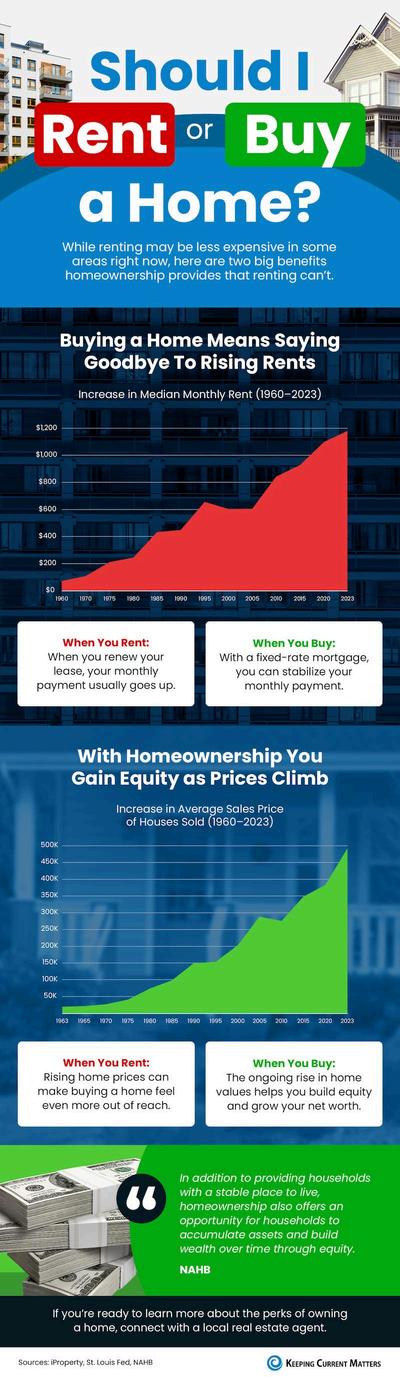
THE BENEFITS OF BUYING
Not sure if you should buy a home? The rent you pay could build equity in your own real estate
Do you realize how much you pay in rent over a period of years?
RENT
No interest payment deductions
Rental amount may increase at any time
Landlord approval needed for any changes
No capitalization; your money disappears forever
Rental is temporary and is often subject to 30 day’s notice
BUY
Excellent deductions for your mortgage interest paid
Mortgage payments could be fixed
Decorate and make changes, without approval needed
The value of your property will probably increase in time
Your house will become a home, not a temporary living situation; you are not at the mercy of the landlord
WHAT’S IMPORTANT TO KNOW ABOUT
HOME INSPECTIONS
A home inspection gives you more detailed information to help you make a wise decision. In a home inspection, a qualified inspector takes an in-depth, unbiased look at your potential new home to:
Evaluate the physical condition: structure, construction, and mechanical systems
Identify items that impact the habitability of the home that will need to be repaired or replaced
Estimate the remaining useful life of major systems, equipment, structure, and finishes
WHAT GOES INTO A HOME INSPECTION
A home inspection gives you an impartial, physical evaluation of the overall condition of the home and items that need to be repaired or replaced. The inspection gives you a detailed report on the condition of the structural components, exterior, roofing, plumbing, electrical, heating, insulation and ventilation, air conditioning, and interiors. If you have asked for an inspection to be done on your new home, you’ll need to pay the inspector at the time of inspection, usually in the range of $400-$500 (the cost is based on the size of the home)
BE AN INFORMED BUYER
It is your responsibility to be an informed buyer. Be sure that what you buy is satisfactory in every aspect. You have the right to carefully examine your potential new home with a qualified home inspector. You may arrange to do so before signing your contract, or may do so after signing the contract as long as your contract states that the sale of the home depends on the inspection.
Started Started
The average list price to sales price ratio is % in our overall market.
Listing inventory is % from this same time last year
When inventory is demand goes . % of my clients choose Buyer Agency.
The Facts
All commissions are negotiable!
All brokers have access to the same
We work with Builders and have excellent relationships to help get you get the very best pricing.
Open House Guest Pass!
The average Buyer looks at homes before finding the right one
The most important key to finding the right home quickly is your .
Go through the entire contract so that you find the right home you can and ensure that we get the home you want
This is a standard form that is approved by the Real Estate Commission
Earnest money amount will be about of the total offer price.
This is a deposit made with the offer and taken to Title.
Inspection is for items only
We have a list of inspectors that past clients have been very happy with.
Inspections are paid at the time of the inspection.
Commonly Asked Buyer Questions
Q: The listing agent said they could represent me fairly, so I don’t need a buyer’s agent. Is that true?
A: The listing agent is legally required to represent the seller’s best interests, not yours. While they may be professional and courteous, they cannot advise you on pricing, negotiation strategy, or whether a home is overpriced If the seller has representation, you should as well. As your buyer’s agent, we negotiate solely in your best interest.
Q: Is there a contract involved when working with a buyer’s agent?
A: Yes A buyer agency agreement formally establishes our responsibility to represent you It outlines the services we provide and ensures you have dedicated advocacy throughout the home buying process.
Q: Will using a buyer’s agent limit the homes I can see?
A: No We can show you homes listed with any brokerage, as well as For Sale By Owner properties and new construction homes that may not be listed in the MLS. Our role is to expand your options, not restrict them.
Q: What if I do not find the right home right away?
A: There is no pressure. Our buyer agreement allows flexibility, and you may pause or cancel at any time. When you are ready, we can continue the search, whether that includes resale homes, builder options, or custom opportunities. Our goal is to help you find the right home at the right time
Q: Why should I use an agent when buying a new construction or builder home?
A: The benefits are the same as purchasing a resale home, and in many cases, even more important Your agent serves as your personal real estate consultant, guiding you through the process with professional representation. We provide market insight, ensure you are not overpaying, and help you identify the best builder and home for your specific needs. We also handle contract review, negotiation, and closing coordination. This representation costs you nothing and does not affect the price of the home Builders have their own representatives whose role is to protect the builder’s interests, not yours. New construction and semi custom contracts are complex, and having professional representation ensures the details are structured correctly to protect you and support a smooth closing.
Commonly Asked Buyer Questions
y p y y g p y g , just as a seller does in a resale transaction Having representation ensures someone is solely focused on protecting your interests throughout the process. When visiting a builder’s sales center for the first time, your buyer’s agent must accompany you. Always contact our office so your buyer specialist can show you any builder homes you are interested in. If you visit a builder without us, be sure to provide our business card and let the builder know you are working with The Cannon Team, then notify us so we can assist you moving forward.
Q: Isn’t the agent who shows me the home representing me?
A: Not necessarily. Agents hosting open houses or representing new construction are typically working for the seller. Unless you have signed a buyer agency agreement, the agent showing the home is not obligated to act in your best interest. True representation only begins when an agent has formally agreed, in writing, to advocate for you
Q: If you negotiate the price down, does that reduce your commission and create a conflict of interest?
A: No. Any difference in commission is minimal and never outweighs our responsibility to you Our priority is protecting your interests, negotiating the best possible terms, and earning your trust and referrals long term.
Q: I am moving to another city. Can you help me find a buyer’s agent there?
A: Absolutely. We can connect you with a vetted, accredited buyer’s agent in your destination city at no cost to you. We carefully screen agents to ensure you receive the same level of service and representation.
Q: Does signing an Agency Agreement with The Cannon Team really make a difference?
A: Yes. A signed agency agreement legally establishes accountability and loyalty to you. Seller agents are required to act in the seller’s best interest. Buyer agents are required to protect your confidentiality, negotiate on your behalf, and disclose information that affects a property’s value This agreement ensures you have dedicated representation working solely for you.
Common Financing Terms/Glossary
Loan Origination Fee: This one time fee covers the lender’s cost to process your loan. It is often about 1 percent of the loan amount. Some loans offer no origination fee in exchange for a slightly higher interest rate.
Loan Discount: Often called points, this is a one time fee used to adjust the loan’s interest rate One point equals 1 percent of the loan amount This fee is less common when interest rates are low.
Appraisal Fee: This one time fee pays for an independent appraisal that determines the home’s value for the lender. Costs typically range from $300 to $450 but may be higher depending on the property.
Credit Reporting Fee: This one time fee covers the cost of running your credit report through an independent credit agency It usually ranges from $60 to $75
Title Insurance Fee: There are two title policies. One protects the lender and one protects you as the buyer. Both are one time charges. Buyers typically pay around $200 for their portion.
Miscellaneous Title Charges: These fees may include title search, document preparation, notary services, recording fees, and closing services. These are one time charges and typically total around $200
Document Prep Fee: This one time fee covers preparation of final legal documents such as the note and deed of trust. This fee is usually around $150.
Lender Fees: Additional lender fees may include underwriting, flood certification, amortization, and other administrative charges. These fees vary and are typically disclosed at loan application, often totaling $450 to $900.
Prepaid Interest: This is interest paid from your closing date to the end of that month The amount depends on when your loan closes Earlier closings require more prepaid interest, while later closings require less.
PMI (Private Mortgage Insurance) Premium: If your down payment is below a certain amount, mortgage insurance may be required. This protects the lender in case of default. You may pay an upfront fee and contribute to a reserve account held by the lender.
Beginning of Escrow Account: Your lender typically collects funds for property taxes and insurance into an escrow account At closing, taxes are usually collected to cover the remainder of the year plus approximately two additional months. Home insurance is typically collected one year in advance plus two additional months.
Earnest Money Deposit: Earnest money shows your intent to purchase the home. It is submitted with your offer and held in escrow until closing. This amount is credited toward your purchase at closing If your offer is not accepted, the funds are returned If financing is denied and proper notice is given, the earnest money is refunded Most buyers should expect a minimum deposit of $1,000, depending on the price of the home.
Title Insurance: A title commitment outlines ownership, liens, easements, and any restrictions on the property. Title insurance is required in most states and protects both you and the lender. While the seller often pays for the buyer’s policy, the buyer provides the lender’s policy as part of closing costs Once closing is complete and documents are recorded, the title company issues confirmation of clear title