THE CANNON
THE CANNON
EDITOR-IN-CHIEF
MANAGING EDITOR
SENIOR EDITORS
JUNIOR EDITORS
Christina Pizzonia
Rauha Ahmed
Annika Lam
Charlie Therence
Juneeta Vangala
Leila Agil
Justine Gaw
Omar Khan
STAFF WRITERS
Meilly Chen
Twisha Choudhary
Michael Yang
Joy Zhou
CREATIVE DIRECTORS
GRAPHIC DESIGNER
SOCIAL MEDIA MANAGER
WEBMASTER
DEVELOPERS
CONTRIBUTORS
Jennifer Xu
Aidy Zhang
Regina Jin
Andy Derevyanko
Nusaiba Rakhshan
Breyanka Elankeswaran
Linden Zheng
Avi Gell
Kelly Hong
Ishita Jain
Priyanka Madu
Prerana Manoj
SPECIAL THANKS
Ethan Mao
Rhonda Meek
All Solutions Printing
The Cannon is the official magazine of the University of Toronto Engineering Society
The views expressed herein are those of their authors, and do not necessarily reflect those of the Engineering Society.
A Letter from the Editor
Hello again, and welcome to the second issue of The Cannon! I’m glad you decided (or perhaps it was some mysterious force that irresistibly pulled you towards our newsstands?) to take a peek at this rather curious issue.
I want to begin by taking a moment to extend the warmest and happiest of welcomes to everyone who joined The Cannon at the start of the semester. I’ve already been overwhelmingly impressed by the enthusiasm and dedication that each and every one of our newest members has brought to our humble magazine. I am so excited for what’s to come, and I hope you, as a reader of The Cannon, are too!
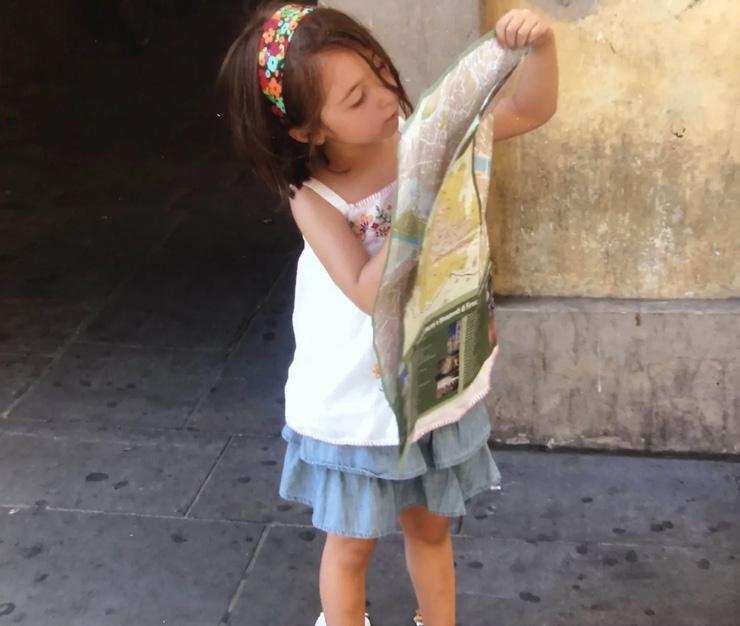
My first foray into the magical world of “mysteries” happened in Firenze, during the summer of 2009. As a very gullible and naive six-year-old, I became easily convinced by my older cousin, Daniela, that someone from the Medici family had hidden a secret treasure somewhere in the city. And that I was the only person who could uncover it once and for all.
I spent the entire afternoon wandering the city, following Daniela’s hints (she was making them up as we went along) with our parents in tow. I never did find any treasure, but I had a lot of fun trying.
It wasn’t until much later, when I finally picked up my first real mystery novel (The Murder of Roger Ackroyd), that I rediscovered the thrill of mysteries. I flew through its pages, doing my best to piece together the evidence and deduce who the killer really was. Although my efforts didn’t culminate in a radical “aha!” moment (to be fair, they rarely ever did—the best mysteries have endings you never expect), I still very much enjoyed watching the truth be unravelled before my eyes by a Miss Jane Marple.
Of course, not all mysteries, especially in the real world, have such satisfying conclusions. From science and technology to history and religion, there are countless questions whose answers continue to remain a mystery.
And then there are the private mysteries. The ones that aren’t found in books or academic papers, but in ourselves. Questions about who we are, how we got here, and what kind of person we hope to become. I know for certain I’ve spent a lot of time trying to make sense of my own place in our increasingly chaotic world, and yet I still feel like I’ve barely scratched the surface.
As you read through this issue, try to take a moment to reflect on the mysteries that still enthrall you—whether they’re big or small, individual or universal, ancient or contemporary. There’s so much out there left to explore: the world is “yours to discover.”
Sending you all the best of luck with the rest of the semester (it will remain forever a mystery how I got through first year
P.S. I would like to make it known that my cousin could be absolutely diabolical in taking advantage of how gullible I was as a child. For example, when I started reading the Rainbow Magic series, she told me she had some special fairy dust (just plain, old, regular glitter) that would turn me into a fairy if I placed it on my fingertips before falling asleep. The catch? She promised she would give me the fairy dust, but only after I had helped her with all of her chores. It wasn’t until I woke up the next day, still a human, that I realized I had been duped.
Nowadays, I can look back on all of the fantastical stories I was tricked into believing as some of my fondest memories. I wouldn’t change any of it for the world.

A much younger me holding a giant map, trying my best to figure out where the treasure was hidden
Me and my cousin! (no, I was not forced to include this)
Media & Culture
The Pale Beyond the Screen
(warning: spoilers ahead!)
Priyanka Madu
Video games are a unique form of entertainment due to them offering us a singular promise: the opportunity not just to witness a story, but to inhabit it. We don’t merely watch characters make decisions—we make them ourselves. And often, to accommodate that agency, games present protagonists who are more canvas than character: blank slates designed to make immersion seamless. Their inner lives are quiet so that ours can speak louder.
But Disco Elysium doesn’t want you to project. It wants you to follow. And it wants you to follow someone who is, at first glance, nearly impossible to identify with: Harry Du Bois—a self-annihilated, amnesiac, divorced, hopeless 44-yearold alcoholic detective who wakes up in a stranger’s hotel room with no memory of who he is, what he’s done, or why he wanted to disappear.
And what if I told you that living through him, and failing through him, could offer you, not just a haunting narrative experience, but a profound invitation to reflect on yourself?
At its surface, Disco Elysium is a classic hardboiled detective story. A body hanging behind a hostel. A neighborhood full of secrets. A case no one wants to solve. From that familiar setup, the game starts pulling at deeper, stranger threads. As you explore Martinaise, the ruined district where the murder took place, the boundaries between what’s “real” and what’s symbolic begin
to blur. The deeper you dig into the mystery—its political implications, its personal toll—the more the investigation becomes a mirror. You’re not just solving a crime. You’re uncovering a collapsed self, and a collapsing world.
And it doesn’t let you stay outside of it.
The game’s brilliance lies in how its central detective mechanics feed introspection. Every skill you use—such as Empathy, Inland Empire, and notably Volition—is a voice inside Harry’s head, and your head too. Your internal monologue becomes a chorus of conflicting perspectives, all arguing over what’s real, what matters, and what’s safe to feel. As you interrogate suspects, you’re also interrogating Harry. As you explore the shattered memories of the war-torn city, you’re asked to reflect on your own broken pasts and unresolved contradictions.
And just when you begin to feel oriented in the game’s gritty realism, it opens into something weirder.
You begin to hear about the Pale.
At first it’s just a whisper, a piece of offhand dialogue. But the more you tug at the thread, the more the story reveals a looming metaphysical conspiracy: not of politics or power, but of existence itself. The Pale is a kind of anti-reality— an expanding force that erases memory, time, matter. It is not evil, but it is frightening. It is described in hushed tones, like a cult secret. No one quite agrees what it is, only that it is spreading, and that it is somehow tied to the way things fall apart.
This is where the case grows colder, and closer. Because you realize the Pale is not just a setting detail. It’s a metaphor—for
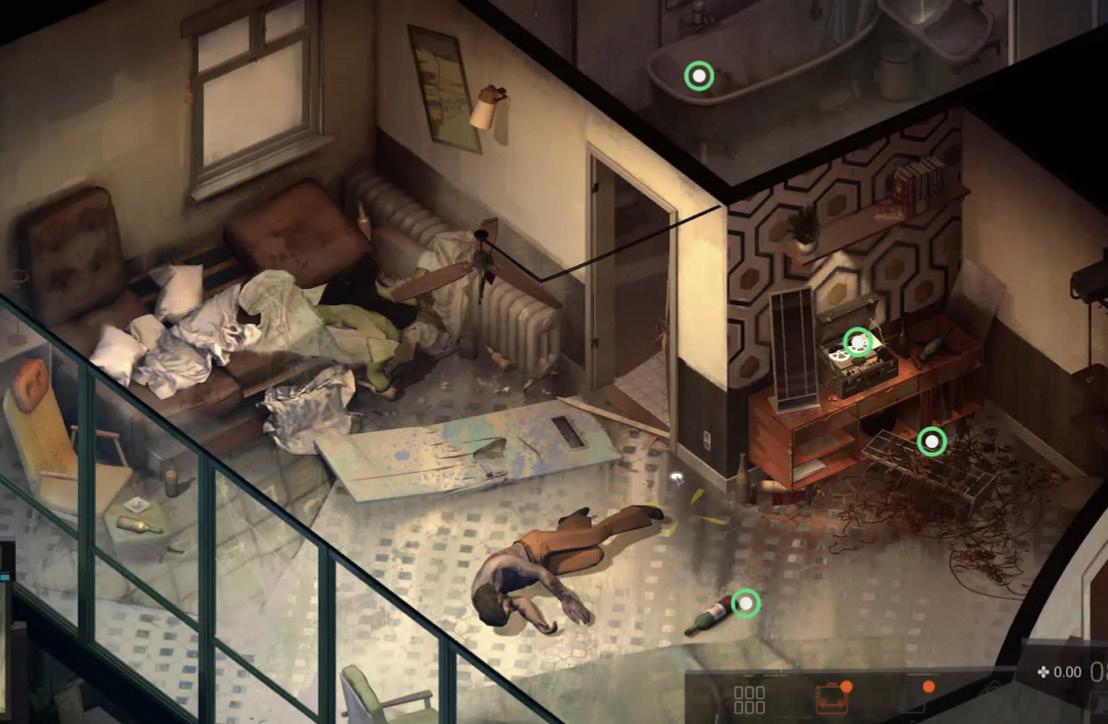
Disco Elysium's opening scene, with the protagonist's identity being just as disoriented as the hotel room he lies within
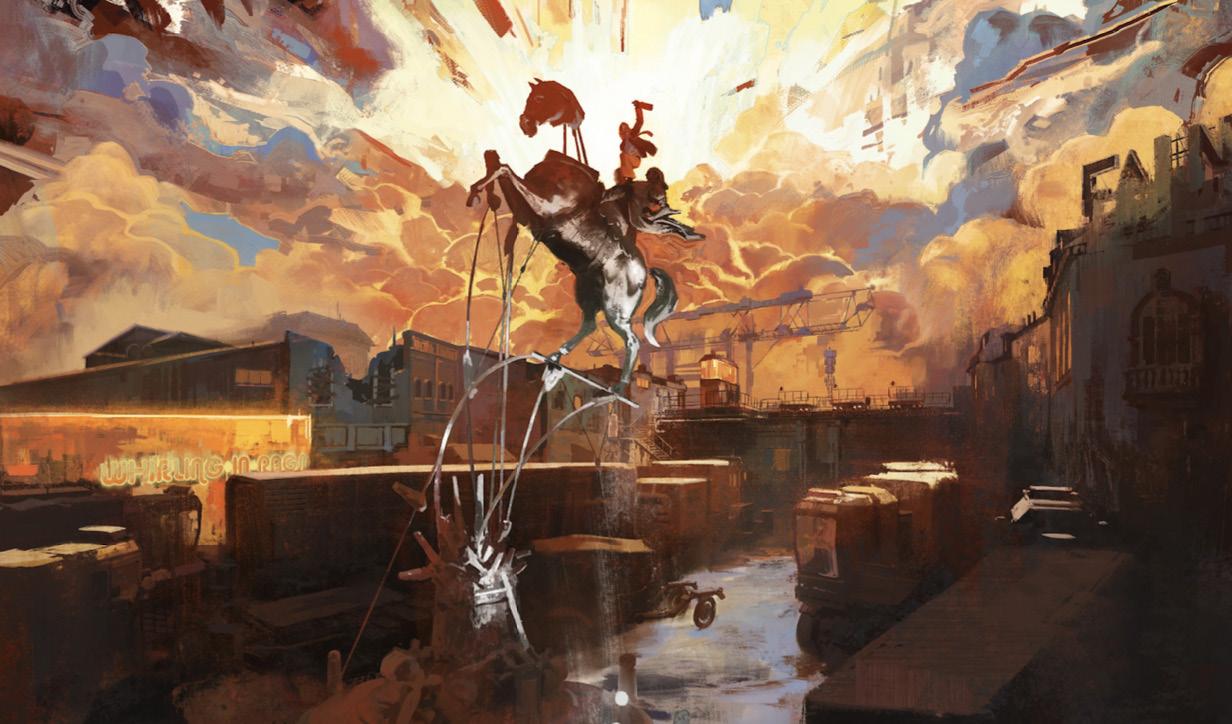
Martinaise, a very small district in the city of Revachol, and a hotspot for revolutionary activity, as exemplified by its poignant horseback statue
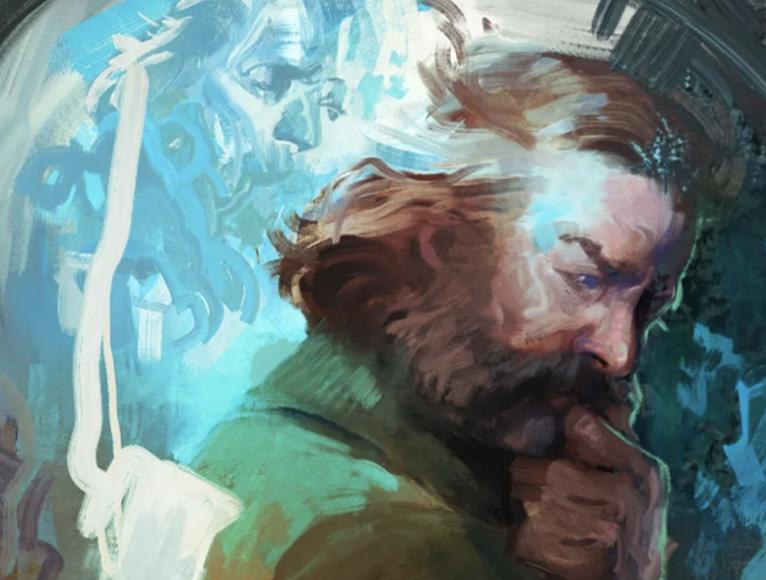
A visualization of the shifts in Harry’s archetype due to the Pale
memory loss, for depression, for the quiet pull toward oblivion. Harry didn’t just encounter the Pale. He brought it with him. He is porous to it. The Pale is the slow conspiracy of forgetting, of selferasure.
And Harry was its willing agent—until now. The player’s role is not to solve the mystery, but rather it’s to move Harry forward. To keep him in motion, even when every piece of evidence—internal and external—tells him to give up. You are not there to fix him. You are there to witness him, to hear him, to steady him, to choose, over and over, to help him try. In the end, when all threads seem to unravel and the murder is finally resolved, it is not with glory, but with something quieter, and sadder. The pale leads you to meet a creature beyond metaphor: the Insulindian Phasmid. A being of total otherness, not supernatural, just natural in a way you’ve never imagined. And in that moment, the last mystery becomes the most intimate. The moment you “win” the game is not in having fulfilled Harry’s job as a detective by arresting the one responsible for the hostel murder case, but in seeing Harry become a voice of reason through the lens of the unreasonable.
[Harry]: “I’m glad to be me—an incredibly sensitive instrument.”
[Insulindian Phasmid]: “Few of us can begin to imagine the horror of you—with all of creation reflected in
your forebrain. It must be the highest of hells, a kaleidoscope of fire and whirling glass. Eternal damnation. Even when you’re sleeping… and when you wake, you carry it around on your neck… I feel great, mute empathy for you.”
[Harry]: “It was very disorienting at first, but I’m keeping my sh*t together.”
[Insulindian Phasmid]: “That must be incredibly hard. The arthropods are in silent and meaningless awe of you. Know that we are watching—when you’re tired, when the vision spins out of control. The insects will be looking on.
Rooting for you.
And when you fall we will come to raise you up, bud from you, banner-like, blossom from you and carry you apart in a sky funeral. In honour of your passing.”
And Volition—the inner voice of Harry’s will to live—gently speaks:
[Volition]: “In honour of your will, lieutenant… That you keep from falling apart, in the face of sheer terror. Day after day. Second by second.”
Despite the bleak, unpromising manner in which the Insulindian describes Harry, he continually chooses not to flinch in the face of that emptiness. Harry firmly uplifts himself through one-liners, boldly contrasting the run-on nature of

the Insulindian’s pessimistic comments multiple times. His self-worth is founded on the understanding that there is no inherent reason to live, no universal truth that governs our existence. What there is, instead, is an endless stream of choices. Most of which arise with the chance of resulting in bad decisions.
Yet, despite this, the player chooses to confront those choices anyway. To face the weight of uncertainty of the pale, to invest in the inner voices of Harry, and to stick with the most unlikely of protagonists.
We are not bound by the potential for wrongness or failure. Every step Harry takes is a choice to embrace the mystery of the world and continue. This journey, with its trials and uncertainties, exemplifies that the power to choose and assign meaning is ours.
The real discovery that Disco Elysium passes on to its players through its fractured protagonist is that mistakes necessarily break one part of us in order to reveal another part deeper within us worth living for. For even the toughest cases are considered “cracked” when solved.
Images: Stills from Disco Elysium, used for explanatory purposes.
Harry’s encounter with the Insulindian Phasmid
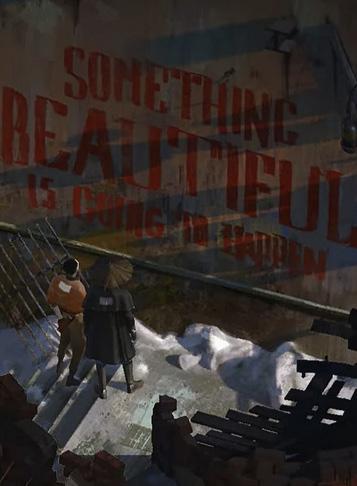
A hopeful phrase you can choose to make Harry write on the wall, alongside his partner on the left, Kim Kitsuragi
The Road So Far
Juneeta Vangala
We open in Lawrence, Kansas. 1983.
A mom puts her kids to bed before heading to sleep herself. We are in the nursery. The clock stops ticking, and the night-light starts flickering. In the parents’ bedroom, the mom is awoken by the crackle from the baby monitor. She heads into the nursery and finds a silhouette standing next to the crib. “John?” she whispers, “Is he hungry?” He shushes her. She softly smiles, glad that her husband heard the baby first and eager to head back to bed herself. Stepping softly, she heads towards their bedroom.
On the wall, she notices the dancing glimmer of the TV. She walks down the stairs and turns the corner. John is asleep on the couch. Oh.
She rushes to the nursery. The man turns around. His eyes gleaming a sickly yellow. The room lights up in flames.
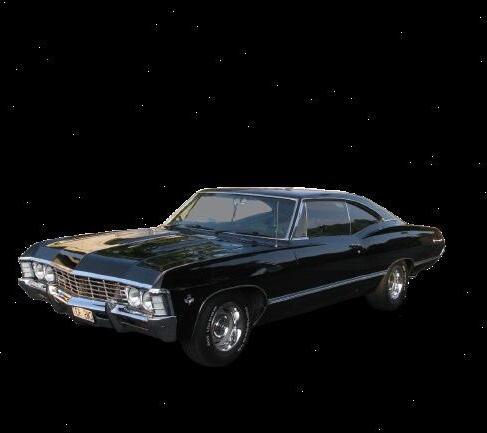
Six million people tuned in for this—the pilot episode of Supernatural in 2005, making it one of the most-watched on CW. It promised fear, horror, mystique, with a backdrop of classic Americana. It reached back to the country’s haunted folklore, its roadside ghosts, and the peculiar poetry of its motels and cornfields. The show followed two brothers, Sam and Dean Winchester (Jared Padalecki and Jensen Ackles, respectively), driving across America in a 1967 Chevy Impala, carrying out their father’s unfinished battle for revenge while fighting real and inner demons alike. Under the creator Eric Kripke’s wing, the first five seasons deliver on this promise. But after that, we are left with an echo of what was and are forced to chase something that will never be.
The early seasons, especially the first two, have an aesthetic that never gets replicated again in the series—that grungy, dark atmosphere that many early 2000s horror movies and shows such as X-Men and Buffy embody. It was peeling motel wallpapers, creaking floors, homemade EMF readers, the smell of rain-soaked asphalt. And within every small detail, heart was present; it was in Dean wearing his dad’s leather jacket and his brother’s childhood gift; in
the analog hum of research in a library, in flip phones and digital cameras, in bootcut jeans and silver rings. We see the brothers navigate ghosts, vampires, demons and everything in between while dealing with phantoms of their past. But at its core, it was just two brothers on a road trip, eating greasy fast food and fighting over who played the music.
Every episode, the Winchesters come across a different type of entity, stay at a dingy motel, find and defeat the creature, and then drive off to their next mystery town with a million unsaid words between them and emotional constipation that can only exist in early 2000s action protagonists. The Impala is a mobile confession booth, carrying the shadow of their mother’s death and the ghosts of every town they leave behind. They attempt to outrun their grief while simultaneously trying to avenge it as hunters and the hunted. It was futile from the start.
This dilemma is what made Supernatural special. We were given characters that are doomed by the narrative but are unable to see their misfortune. They are cursed by their past and haunted by the ghosts of what their lives could have been: Sam as an aspiring Stanford law student and Dean owning a mechanic shop with a family of his own. Instead, they are trapped in the “family business”, carrying responsibility and emotional scars far too heavy for anyone.
This show lingers like the scent of gunpowder, and the depth of these characters—their broken pasts, their stubborn loyalty, their pipe dreams—is what kept audiences coming back for fifteen years.
But as the seasons go on, the show loses this charm and intrigue. Unfinished plot lines, halfbaked characters and character arcs that seem like afterthoughts. It was as if the show saw how well it was doing and chased the need to be bigger instead of developing what made it special. The motel rooms
still looked the same, but the air had changed. By the time Leviathans ran a food processing company in Season 7 and angels fell from heaven in Season 8, the series had become the ghost of itself. The show traded its dirt-under-the-nails Americana for lore-heavy spectacle, and in doing so, it sacrificed what brought audiences in–the characters.
Supernatural promised horror; it promised vampires and demons and ghosts. It delivered something more than that. It gave us men barely holding themselves together. And the desire to be bigger and richer was its downfall.
It started as horror, but in the end, the only thing it’s haunted by is everything it could have been. But that haunting— of broken men in a broken story—is why we kept watching. That we can see them grow and hope that they put themselves back together, because they deserve a shred of the life they could have lived.
We watch because, at its best, it captures the slow ache of loss, the emotional repression of masculinity, and the quiet tragedy of two men carrying a burden they were never allowed to put down. At its worst, it reads like a game of “what if” that has dragged on for far too long.
The shadows of the early show linger longer after it ends. From the haunted
A STUDY IN SCARLET
Rauha Ahmed
When I first decided to write this article, I had a grand, delusional vision: I’d watch 31 horror movies, for 31 nights of October, and report on my findings. It was going to be my very own cinematic advent calendar, until I realized that October is spooky season for an entirely different reason—midterms. So, instead of a fresh month-long binge (what is free time?), you’re getting my insight on two of my absolute favourite horror franchises, which are the must-sees for your next fear-inducing binge.
Now, what exactly counts as “horror” for this list? I’ll tell you what doesn’t: slashers that use excessive violence against women for shock value (I’m looking at you, Terrifier movies). I have many thoughts on that particular subgenre, but that’s a rant for another issue. However, I am a sucker for the mysterious and the supernatural. Give me ghosts, cursed objects, religious imagery, and the occasional exorcism, and I’m set. Bonus points if it involves flickering candles and Latin chanting.
I’ll try to keep things spoiler-free, because if you’re a horror fan, you deserve to experience the dread firsthand, but no promises.
as opposed to many other horror movie couples who probably need a divorce lawyer more than they need an exorcist.
The spin-off films focus on the origins of some of the entities and cursed objects the Warrens encounter. From the spinoffs, special mention goes to Annabelle: Creation, because, of course, dolls are creepy and possessed dolls are twice so. The visual effects are also done so incredibly well in that one.
For all their demons, hauntings, and flying furniture, these movies have a surprising amount of heart. The Warrens’ greatest weapon isn’t their stash of holy water or their dubious collection of
fate, the survivors are later killed one by one in a series of Rube Goldberg-style accidents, proving that gravity, glass, and everyday household objects are far deadlier than anything supernatural.
This is the only franchise that has actually terrified me (but I am an adrenaline junkie, so of course I watched all six movies), because it makes the mundane lethal. I can’t drive behind a logging truck anymore without preparing my will, and I side-eye kitchen knives, bathtubs, and even dental equipment like they’re plotting my demise. It gives you a feeling of dread that lingers long after the end credits stop rolling, and every creak of the toaster feels like foreshadowing.
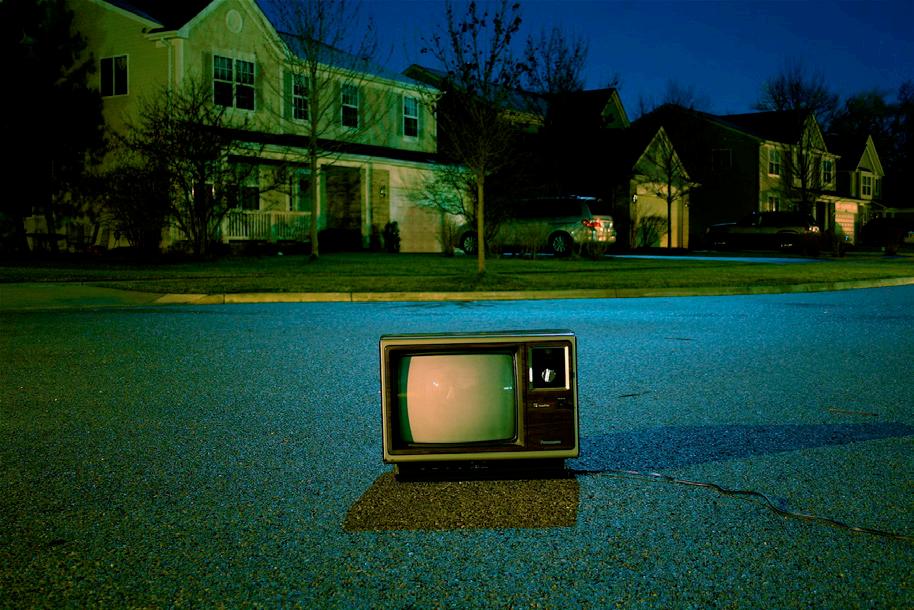
(and for the non-horror fans, this is where you’ll want to throw your TV after watching these films)
The Conjuring movies have to be my all-time favourite. I put down the whole franchise because picking a single favourite is impossible. Something about the atmosphere they manage to create is so mesmerizing, and they’re one of the most popular mainstream horror franchises for a reason.
The main series follows paranormal investigators (and spouses) Ed and Lorraine Warren, and their attempts to assist families who find themselves tormented by spirits. While the real-life Warrens were very interesting characters (that’s a story for another day), their movie versions are very charming and genuinely helpful people. I honestly adore the Warrens as depicted in the films, and could watch a hundred more movies about their ghost-busting adventures. I enjoy them being wholesome characters,
haunted antiques—it’s their undying faith in each other, and that’s what saves them and the families they’re trying to help every time. Honestly, dare I say, The Conjuring franchise has some of my favourite horror and romance films.
Watching this franchise was perfection. The real tragedy is that there’s not going to be any more new films.
There’s something quite horrifying about watching these poor souls try to cheat fate, only for fate to get increasingly creative about killing them anyway. At its heart, Final Destination is really a series about control, or more accurately, our lack thereof. It’s the ultimate proof that no matter how many seatbelts we buckle or green juices we drink, the universe can still take us out with a rogue coffee mug and a bad coincidence.
Overall 11/10 experience, but goddamn did it make me paranoid of literally everything, including my own shampoo bottle. Do not recommend you watch it if you value your mental sanity.
And there you have it, folks. My thoughts on the films that have haunted, delighted, and occasionally traumatized me over the years. Although nothing on this list—and nothing I’ve ever watched, ever—has terrified me quite like looking at a midterm and realizing that the one topic the professor casually mentioned as “probably irrelevant” is actually the main focus of the exam. You can probably tell that the ratings are very arbitrary. They don’t follow any critical framework, they’re not based on scientific methodology, and they probably mean nothing to anyone except me. I’m not a movie critic; I just watch a lot of media and think a lot of thoughts, but the real purpose was to simply share the strange, wonderful, terrifying joy of horror, and remind you that life is fragile. Final Destination Franchise
Unlike most horror movies, where the villain can be banished with a crucifix, Final Destination offers no such mercy. There’s no ghost, no demon, no slasher in a mask. Just Death itself, with a clipboard and an impeccable sense of timing. The films involve a group of people who escape death after one of them has a premonition of an impending disaster. After avoiding their foretold
SkuleTM Life Hidden Study Spots on Campus
Justine Gaw
The one good thing (debatable) about being an engineering student is that because there are so many ‘interesting’ things to learn, you have a LOT of hours of class. All your classes end at ungodly hours, and you have all these weird onehour study breaks where you feel like you should be productive but you never are because all the common rooms smell like unwashed dog, and the likelihood of getting beaned in the head with a pingpong ball or a foosball ball is higher than you would think.
As a proud member of the I-Have-ToStay-At-School-To-Study-BecauseMy-Bed-Is-Comfy community, I spend longer than I should holed up in libraries and odd nooks. Here are my favourite hidden-but-not-so-hidden study spots, organized by when I enjoy visiting them.
In the morning
1. The Terrence Donnelly Centre (& Medsci!)
If you go into this building through the entrance on College Street, you’ll see some benches among the questionably real plants.
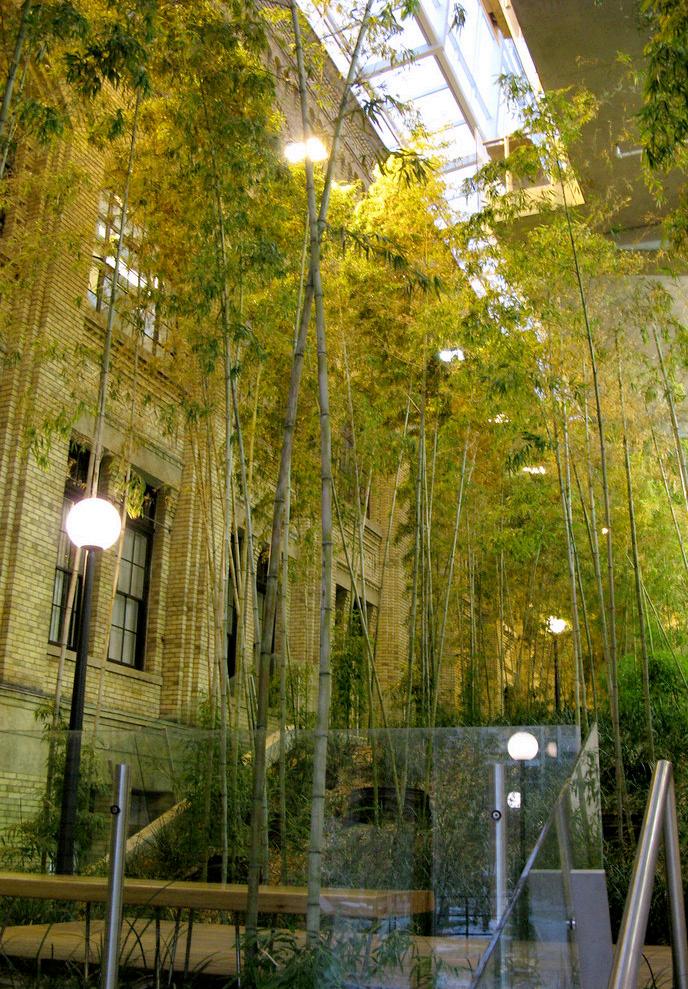
I don’t know if I necessarily recommend that you study there for fear of zoning out and pitching backward into the soil, but you can get five minutes of green, so go there first.
The Terrence Donnelly Centre is connected to MedSci, which is pretty much empty in the morning. If you cross through to MedSci before 9am, you can get your overpriced Starbucks and hunker down on one of their garishly bright plastic chairs for just three mental breakdowns a cup!
2. Myhal
Finding a comfortable spot in Myhal is possible, but only in the morning: we all how know many people are too lazy (or too tired from studying all night) to wake up early for their 9am class.
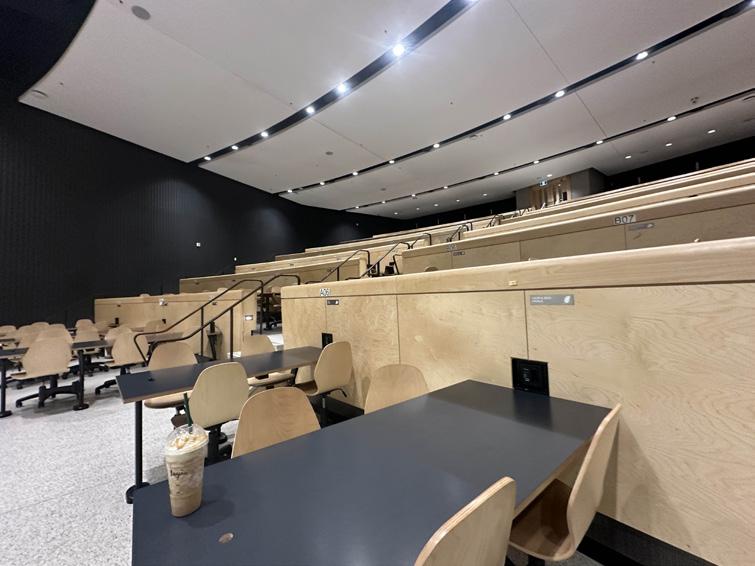
Myhal always makes me feel a little cheated because it looks so much better in the website pictures than in person, but there’s nothing like a little bit of disappointment and a painfully modern space with a sloping ceiling that feels like it’s about to collapse any second.
If I’m honest, I spend most mornings collapsed on a bench to append to the sleep cut short by the TTC commute, but I know… some people… who are… productive…? Thankfully, the tables on the fifth floor are usually vacant if you’re feeling particularly studious, and the high ceilings complement the emptiness I feel when I look at my to-do list.
The first floor tables and benches are also underrated for naps (I always pin my shoulder beneath me: if I don’t have
joint problems when I’m thirty, did I really do this ‘engineering thing’ right?)
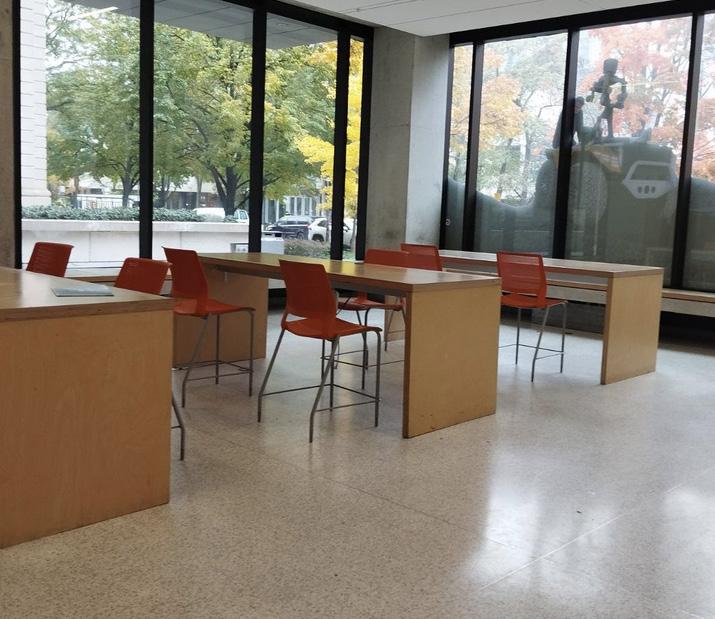
In the afternoon
3. Literally anywhere in Gerstein if you go down the stairs
I love Gerstein, and I’m not saying that just because it’s less brutalist than Robarts. The quiet study areas and the first floor study spaces are always crowded, but if you just turn left, head down the stairs and wander around for a bit, you will always find a spot.
If you’re lucky, you’ll get the tables that are partitioned off, so you can’t feel the judgment of other people as you fail at debugging your code. Also, if you need naps, just find one of the one-seater couches (chairs?), curl around your backpack, and it’s lights out.

The greenery (is this the only way engineers will ever touch grass?) surrounding the benches
Photo: FHKE, licensed under CC BY-SA 2.0
POV: You show up to a 9am class after the first week of classes and it’s empty
Some of the secluded tables on the first floor of Myhal, with Myhal’s signature colourful chairs
Two ridiculously comfortable and cozy oneseater chairs, with some sadly non-partitioned tables (best when working with non-judgmental friends)
That is, unless you’re tall. Then you don’t deserve naps.
4.
Knox Study Hall (NEEDS RESIDENCE ACCESS!)
There are around 100 students living in Knox Residence, and you’d better hope you’re really good friends with one of them–or that you have the guts to pretend you know where you’re going in search of this spot.
There’s virtually no one in Knox Study Hall during the afternoon–presumably because people have lives and you don’t–and if you can just get someone to let you in, the natural light will hit your linear algebra notes in such a striking way. Plus, the long tables let you push your homework straight across them when you can’t stand to look at it anymore.

Just hope that you don’t have cat instincts, because the pools of sunshine are so very intoxicating, and it’s even better to sleep in than lecture halls.
In the evening
I don’t care if it’s overrated, but Bahen hallways always make me feel some type of way–and if it’s a terrible sinking feeling, well I guess it’s working.
By the time evening rolls around, most people that are still trapped inside Bahen choose to stay in the EngSci common room (if they’re in EngSci or lucky enough to have EngSci friends because it’s objectively the superior common room). So if you don’t mind the occasional bustle around the common room entrance, the tables lining the hallways of the 2nd floor of Bahen can get really empty. The best part? Since it’s so empty, you can take up two workspaces,
guilt-free (if your setup is complicated enough, which, to be honest, if you’re in engineering, probably is).

I’ve never been lucky enough to get one of the chalkboard tables on the third floor hallway, but I look longingly at them every time I walk by. It’s also (I think?) good for all-nighters, because the bathrooms are right there and the normal chairs in Bahen are not conducive to napping.
I have recently had good luck with some of the lecture halls on the first floor (bonus if there’s leftover lecture material from the previous class that serves as a reminder of the terrifying material faced by upper years).
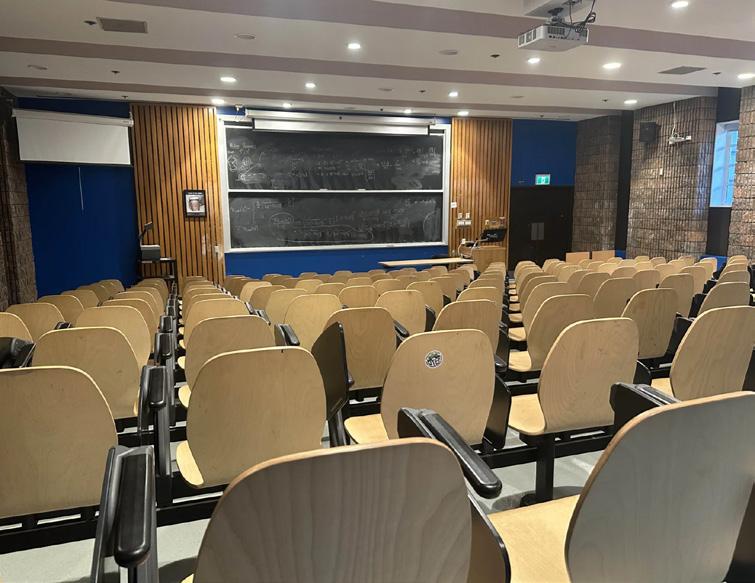
Upper years, please tell me it gets better (lie to me if necessary).
You didn’t hear it from me, but if you did, I heard it from some guy who was talking very loudly in front of me in Galbraith.
There’s nothing like standing in the middle of an empty classroom pretending that you know more than you do because your midterm is tomorrow and you have to teach yourself ten more chapters of content. And you better hope there isn’t a surprise 7pm class, because that’s awkward.
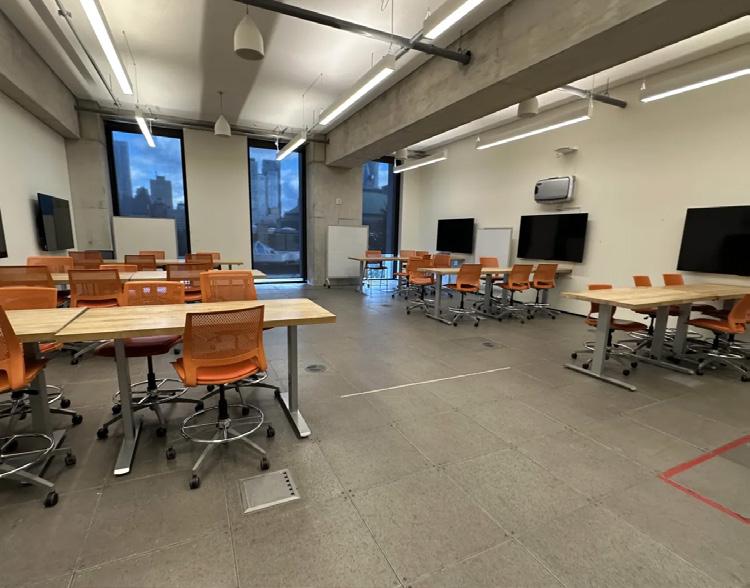
Out of all the buildings on campus though, if you are looking for an empty room in particular, head to Sandford Fleming. SF is one of those places that has so very many randomly open rooms, so do your best and take to trial and error.
P.S. (from an upper year): I honestly think does get better. The content might be objectively harder, but by then you’re used to everything UofT engineering can throw at you. And you’ll have learned how to study more effectively.
I also personally have a selection of preexam rituals that have never failed to get me through an exam (s/o to the 4-7-8 breathing technique our TA taught us in APS100 that I still use every time).
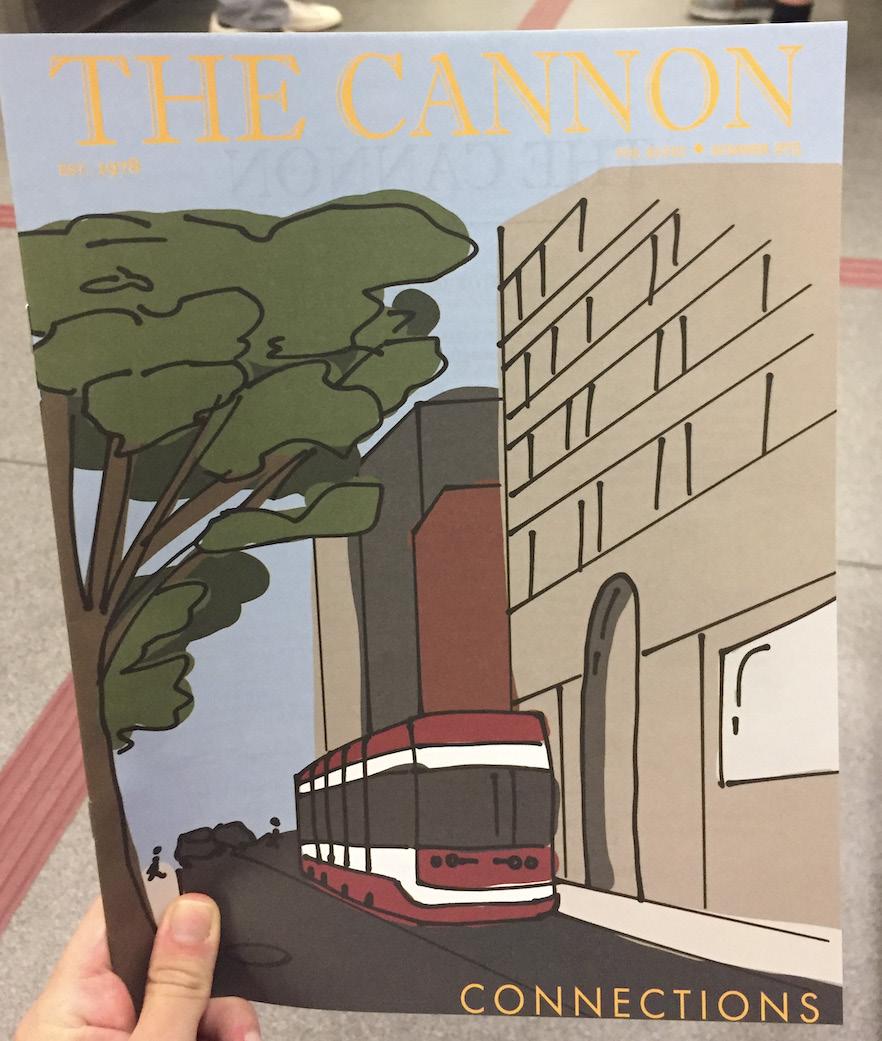
So with all that said: everything improves, except commuting. Commuting still sucks. Although it is made better by having quality reading material...
5. The Second & third floor hallways in Bahen
6. Empty classrooms and/or tutorial rooms
The very hidden Knox Study Hall (why are all the non-engineering buildings so beautiful?)
The tables near the EngSci common room entrance
An empty classroom in Myhal (a rare occurrence)
A lecture hall on the main floor of SF
The highest quality reading material one could have on the TTC

The Legend of Reznikoff & Diabolos
Charlie Therence
My first year was mostly spent in classes and on-campus cafeterias. Chestnut and New College cafeterias, MedSci Starbucks, and Cafe Reznikoff. For the purposes of this article, I’m most interested in Cafe Reznikoff. I didn’t frequent the place much—it deviated too far from where my classes usually were, though I would occasionally visit friends at Morrison Hall and end up there.
Thinking of the cafe, I imagine the exterior facade—the window bearing the cafe’s logo and name. Have you ever taken a close look at the logo? It’s quite strange, isn’t it?
The objects in the logo are known as grotesques— and it’s not because the objects resemble deformed creatures. Grotesque, in this case, refers to ornamental figures carved from stone into walls and ceilings. These specific ones can be found embedded into the walls of University College, right in front of a scarred wooden door.
strongly disliked Reznikoff, and carved the latter’s “baboon-like” face into several grotesques. The two carvings depicted on the Cafe Reznikoff window are said to be Diabolos laughing at the Russian.
This is where the legend of Reznikoff and Diabolos begins to unravel and diverge. Many versions of the story exist, each claiming its own chronology of events. However, all these stories do have one thing in common: Reznikoff and Diabolos were in love with the same woman—Reznikoff’s fiancée, Susie.
If you are interested in finding these grotesques, head over to Convocation Hall and walk towards Back Campus. As you walk, you’ll see a circular structure to your right, attached to University College. This structure is the Croft Chapter House, and just past it is the wooden door scarred by an axe mark.
It is said that the grotesques were carved by a certain stonemason in the 1850s— during the initial construction of the building. You may already be familiar with his name...
Our legend begins with Paul Diabolos (Diabolos Coffee Bar, anyone?), a young Greek stonemason from Corinth. He was refined in his craft and is said to have carved many grotesques in the east wing of UC. They were perfectly carved, though some were incredibly “grotesque”.
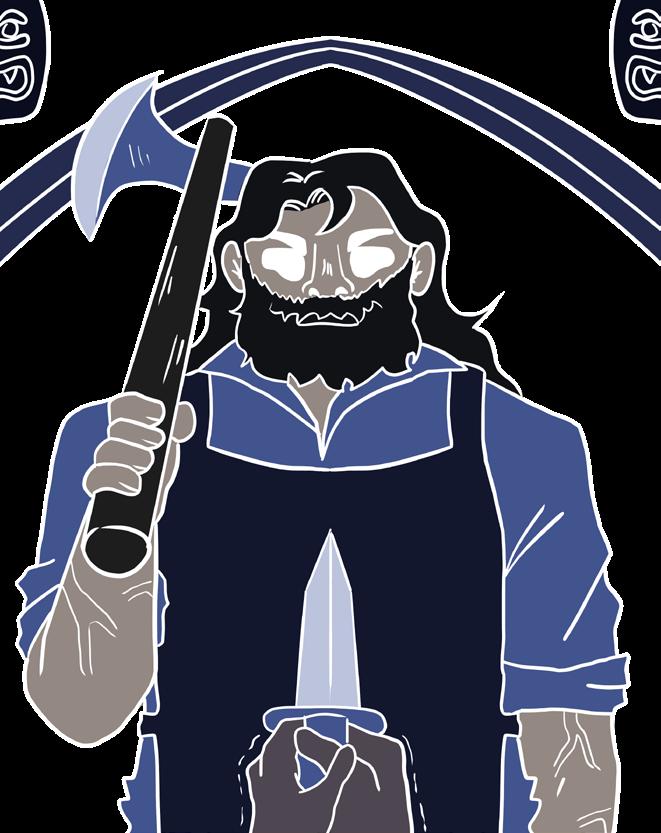
A fellow stonemason, Ivan Reznikoff, was said to have inspired these “grotesque” ones. Reznikoff, a Russian immigrant, was brawny and tough—a perfect contrast to the nimble Diabolos. For reasons unclear to us, Diabolos
Diabolos had seduced Susie and convinced her to leave Reznikoff. Some say Reznikoff had been working to save for a wedding, and Diabolos and Susie were planning to elope with his savings. Either way, in all stories, Reznikoff learned of Susie’s affair and confronted Diabolos. Some say this confrontation happened at the aforementioned grotesques. These stories claim that Diabolos had revealed the inspiration behind his work and taunted Reznikoff—the 1850s version of sending someone a crying wojak vs. chad meme.
An altercation broke out between the two and quickly spiraled out of control. Reznikoff was armed with an axe and Diabolos, a dagger. Upon hearing Diabolos’ insults, Reznikoff cornered him, swung his axe, and missed—leaving a mark in the wooden door behind Diabolos. The blow forced the door open and the two tumbled down the stairs, where Reznikoff continued to hunt Diabolos.
As fantastic and important to UofT lore as this story may be, it is likely not true. There is no known employee record for stonemasons that worked on the construction of UC, although it is true that the building was primarily worked on by European workers. The names Ivan Reznikoff and Paul Diabolos are also not present in the censuses from the years around when the murder supposedly took place. Most damningly, there is no record of a body being discovered in or around UC after the fire (though it is rumoured that the lack of a proper burial could have been what prompted Reznikoff’s spirit to haunt our campus in the first place).
The proximity of the grotesques to the door prompts me to imagine someone noticing the strange axe mark and the two faces carved into the building, then spinning the tale that started this legend. Is it true that this story is well over a century old? I wonder if it started out as an inside joke between friends or simply something a bored mind came up with. How interesting is it that a small, mundane action could send such large ripples throughout history?
To the 19th century UofT student that lied for fun and accidentally started this myth: you may not exist either, but I appreciate your work and creativity. I will dedicate a coffee from both Cafe Reznikoff and Diabolos Coffee Bar for you.
Some stories say Diabolos had hidden and snuck up on Reznikoff, killing him. Another account claims the fight continued up to the 3rd floor of the building’s unfinished tower, where Reznikoff swung his axe yet again, missed yet again, but this time plummeted to his death. Others say that Diabolos had fought back and stabbed Reznikoff to death. In instances where Diabolos had murdered Reznikoff, he is said to have either dumped the body down a well, out the window, or down the circular staircase of the tower. It is not known what became of the other two, Diabolos and Susie, following the alleged murder.
Science & Research
Whispers of the World We Still Live In
Annika Lam
If there’s one thing to know about me, it’s that I like to learn about history (does anyone else watch Trey the Explainer, Tasting History with Max Miller, The Histories, or Premodernist?).
Personally, I believe that our world is so diverse in more ways than we know, and it’s so amazing to find out just how rich our history is the more we look. I’ve been into ancient history especially, and there are so many mysteries within it that I think you should know about—and maybe even whip out as a conversation starter. Learning about our past reveals that there’s so much we already know, so much left to know, and so much that we don’t even know we don’t know (gosh that was a word jumble).
The Library of Alexandria
Everyone knows it burned down and a lot of information was lost, but how much were we set back from what we lost? Actually not that much.
The library was built early on in the Ptolemaic dynasty1 in Egypt, and was around 500 years old by the time of its destruction. It was only under the rule of Ptolemy VIII (145 BCE) that the library drifted towards obsolescence as Alexandria became increasingly less attractive to scholars for study and research. Not only did Ptolemy VIII murder his older brother to get the throne, but he also expelled scholars from Alexandria because they supported him. Because of this, Alexandria lost
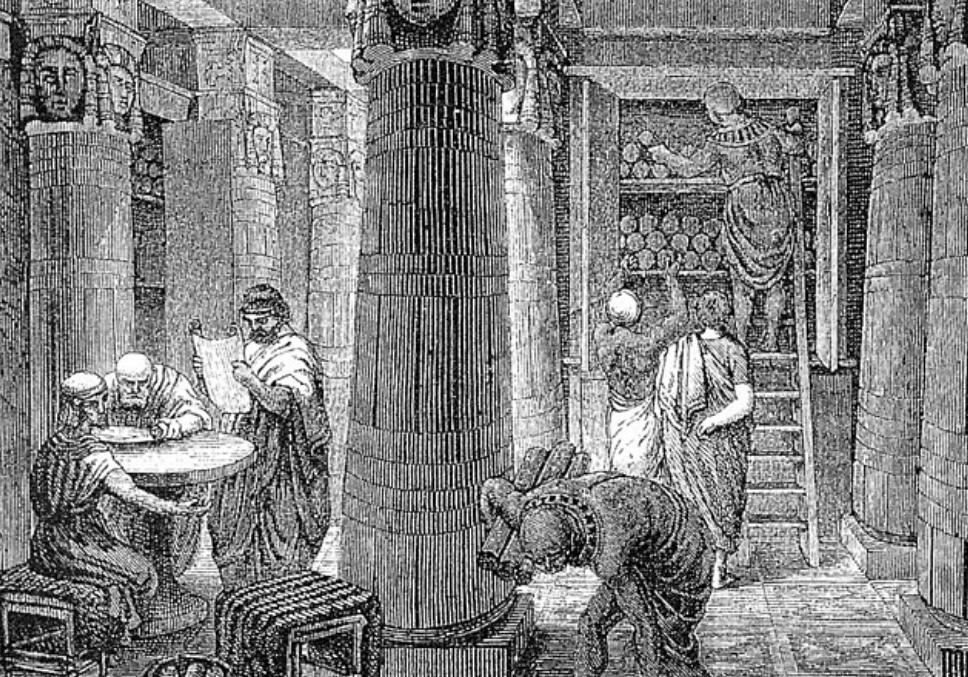
its prestige and respect as a place for research as scholars went elsewhere. Plus, during this time, Ptolemaic rule was becoming more unstable with escalating social unrest and economic problems. As a result, the library became a pretty outdated place for information as successive rulers neglected it. So, in
the end, we weren’t set back that much as a species.
The Hanging Gardens of Babylon
One of the Seven Wonders of the World, it’s described as a beautiful tiered garden filled with a variety of trees, shrubs, flowers, and vines. Though I
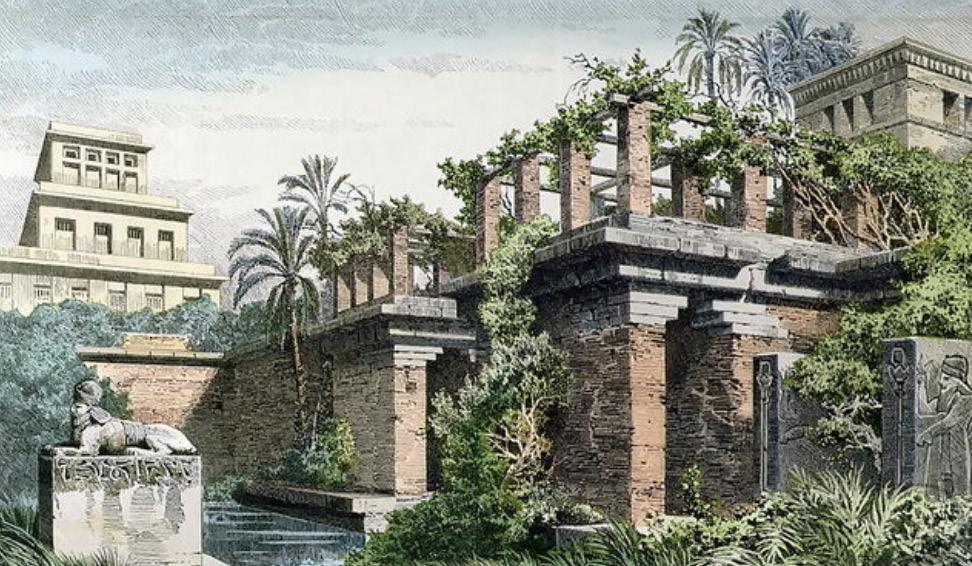
wish it were possible to visit it in the modern day, its existence altogether hasn’t been confirmed. It’s the only Wonder whose location hasn’t been definitely established, and there’s a lack of evidence of its construction or other documentation. It’s pretty funny how it became a Wonder of the World despite so little evidence towards it existing. Though for now, we’ll just have to reference the many legends surrounding it and authors that describe it to envision the mythological paradise.
Undeciphered Languages
There are so many undeciphered languages that have popped up in history, some notable ones being Linear A from the Minoans, Rongorongo from

Easter Island, and the made-up language in the Voynich Manuscript (well I guess all languages are made up, but this one is extra fictional).
Linear A, which was used by the Minoans of Crete, later evolved into Linear B (which is essentially proto-Greek) and used by the Mycenaeans. Though Linear B is deciphered, Linear A remains relatively unknown. This is mostly due to a lack of artifacts, with around 1,400 inscriptions compared to the 6,000 for Linear B. This is also why the Rosetta Stone discovery was so significant, as it’s the main reason we can decipher Egyptian hieroglyphics which existed around the same time as Linear A.
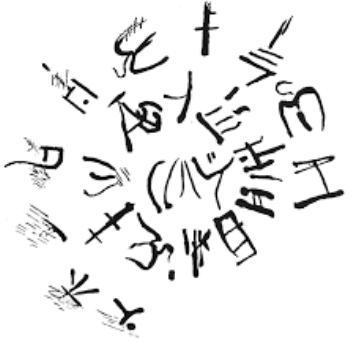
Sample of Linear A (or what I write on my midterm when I have no idea what I’m doing)
Rongorongo was the script used by those from Easter Island and vaguely looks like hieroglyphics with detailed and complex symbols instead of letters.
1 A brief background if you’re curious: Ancient Egyptians built the pyramids g Alexander the Great conquered an empire reaching from Greece to India g Ptolemy I (trusted general of Alexander, and pronounced like tol-eh-mee) ruled over Egypt and started the Ptolemaic dynasty, where the most famous family member was Cleopatra VII.
Inside the Library of Alexandria
The Hanging Gardens of Babylon
The Library of Alexandria
The Hanging Gardens of Babylon
Undeciphered Languages
A Complaint Tablet to Ea-nasir Greek Fire
The Roman Dodecahedron
The Tomb of Genghis Khan KV55
The Nazca Lines Bronze Age Collapse Mesopotamia
“Aliens Built Everything?” ¯
However, like Linear A, there’s a severe lack of artifacts (only 26!), making it difficult to find patterns in the language. There’s also no connection to other languages, with Easter Island being isolated from other cultures. So for now, it remains a mystery.

Lastly, the Voynich manuscript, written around the early 15th century, details 200 pages of… uhhh… something. We don’t know quite yet. Filled with drawings of strange plants and written in an unknown language, scientists can identify word patterns, but the meanings to them are still total speculation. It’s possible that it could be a medicinal manual, where it instructs how to make certain cures from plants. It’s all public domain so you could take a crack at deciphering it if you’re curious.

Greek Fire
In a nutshell, this is basically ancient napalm that was used by the Romans of the Byzantine Empire. Though Roman in identity, they culturally were more Greek, and primarily spoke Greek as well. Sidenote: it is a bit complicated, but the Byzantine Empire, also called the Eastern Roman Empire, is one half of the continuation of the Roman Republic, after it split into the Western and Eastern Roman Empires in 395 CE. The Western Roman Empire, on the other hand, was a mix of Roman and Celtic-Germanic cultures, with the main language spoken being Latin.
Take a look at the picture below and tell me what you think it was used for.
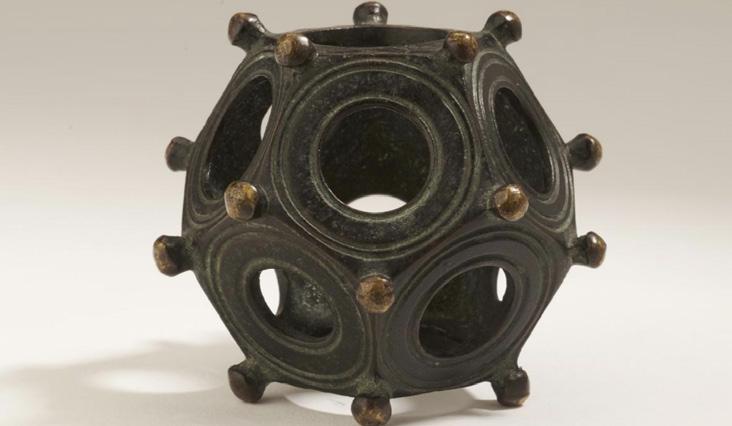
That’s what archaeologists and historians have been trying to figure out ever since they unearthed it in 1739. It’s not even a particularly rare item, with over 130 of these dodecahedrons found. Did they fill it with peanut butter and give it to their dogs? (they actually didn’t have peanut butter at the time) Is it a cup holder? Flower vase? Really strange D12? A toy? I’m curious what your theory might be. Personally, I’m of the mind that it was a multi-use object, like a Thneed from The Lorax (which is a cop-out answer I know).
The Tomb of Genghis Khan
There’s honestly countless famous military figures of which we don’t know where their tombs lie. This great general and emperor is no exception, although he specifically requested to be buried in secret. One legend claims that a river was
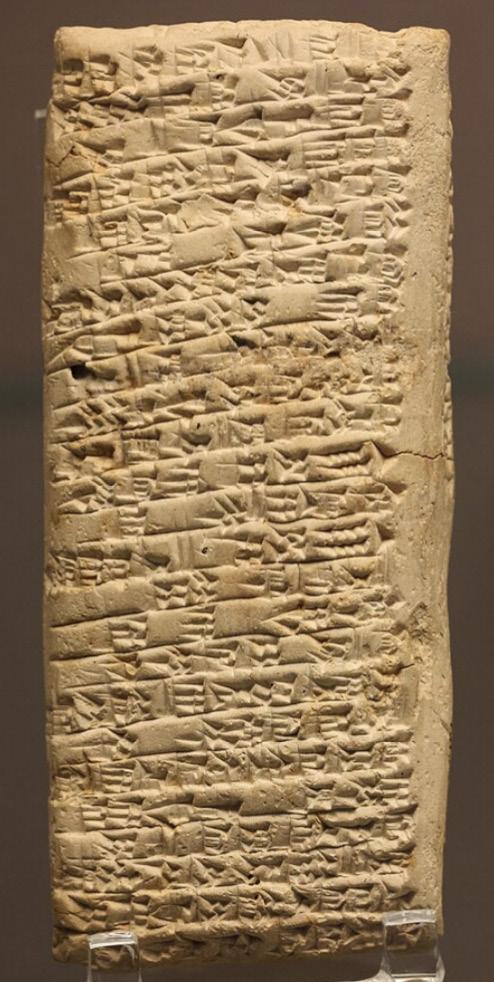
This artifact is a cuneiform clay tablet sent to Ea-nāṣir from a customer named Nanni, who was seriously unhappy with the quality of copper he received. Was Ea-nāṣir actually a bad merchant? The answer is yes. What I find funny is that this guy actually had several complaints sent to him, and that he kept them all. Because he consistently had such bad copper, he currently holds the Guinness World Record for receiving the world’s oldest customer complaint. Now he’s cemented in history (and memes) as the world’s most famous (but subpar) copper merchant.
Sidetrack aside, the real mystery to Greek Fire is how it was made. It was a highly combustible compound that was launched to ignite enemy ships and even ignited on water–making it impossible to put out. Its recipe is a coveted military secret and, even to this day, we don’t know the exact composition. It’s speculated that it was resin mixed with petroleum, though it could’ve been made with saltpeter, sulfur or quicklime.


diverted over his grave, while another says that 1,000 horses stampeded over it, so that a forest could be planted atop, hiding it forever. There are plenty more speculations as to where he’s now buried, but this is a mystery that will probably remain unsolved.
It’s also speculated that his tomb lies somewhere near the sacred mountain of Burkhan Khaldun in the Khentii
Sample of Rongorongo
A page of the Voynich Manuscript
The complaint tablet to Ea-nāṣir written in cuneiform
Byzantine depiction of Greek Fire
The Roman dodecahedron
Equestrian statue of Genghis Khan in Ulaanbaatar, Mongolia
Mountains. However, there’s a line between the search for knowledge versus respecting areas that exist today. By conducting a search and excavation in these sacred areas, it not only violates these protected spaces, but also violates the general’s wish to remain hidden.
There have been many unfortunate instances of this lack of consideration and respect with archaeological excavations and their findings. Is disturbing the present worth it in order to unearth the past? Should we excavate even though existing native populations object? The answer should be obvious.
KV55 is an ancient Egyptian tomb excavated in 1907, and the mystery behind this one is discovering who exactly was buried there.
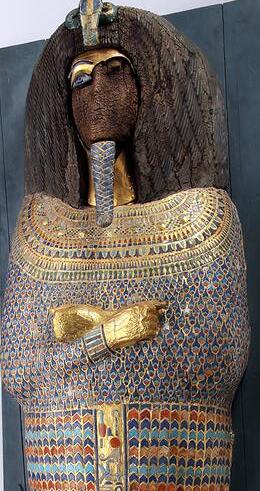
There’s multiple candidates with evidence supporting each of them, but a conclusive decision hasn’t been reached. It’s been speculated that the tomb belongs to the famous heretic king Akhenaten, as genetic tests confirm that the mummy there is both the son of Amenhotep III and father of
Tutankhamun, and the time of death is consistent. Seems like an open and shut case right? Well, there are a lot of problems with this. Firstly, this tomb was unearthed before in ancient times, where they altered inscriptions and possibly mummies, and in general, the contents of the tomb contained artifacts belonging to different people. It also seemed like a hasty burial, with the coffin originally made for a woman but then altered for a man. It’s speculated that it was originally made for Queen Tiye, the mother of Akhenaten, but then altered for Smenkhkare, a short-lived and mysterious successor of Akhenaten, who may be an older brother or even the father of Tutankhamun. It’s pretty messy, and it doesn’t help that the coffin was stolen from the Egyptian Museum in Cairo and moved to the Museum of Egyptian Art in Munich (crazy how one museum bought a stolen artifact from another). I didn’t do this story justice, but it’s really quite mysterious.
One archaeological site in Peru contains over 700 geoglyphs created between 500 BCE and 500 CE, known as the Nazca lines. These lines depict different animals and people, from birds to insects. With such large drawings, only able to be seen fully using drones and satellites, the question becomes why did the Nazca people make these lines? This site is also speculated to be the work of extraterrestrials, which is definitely a unique take on it and a bit absurd to boot. Some theories of their purpose could be that they represent constellations or that they act as some kind of observatory to point to celestial
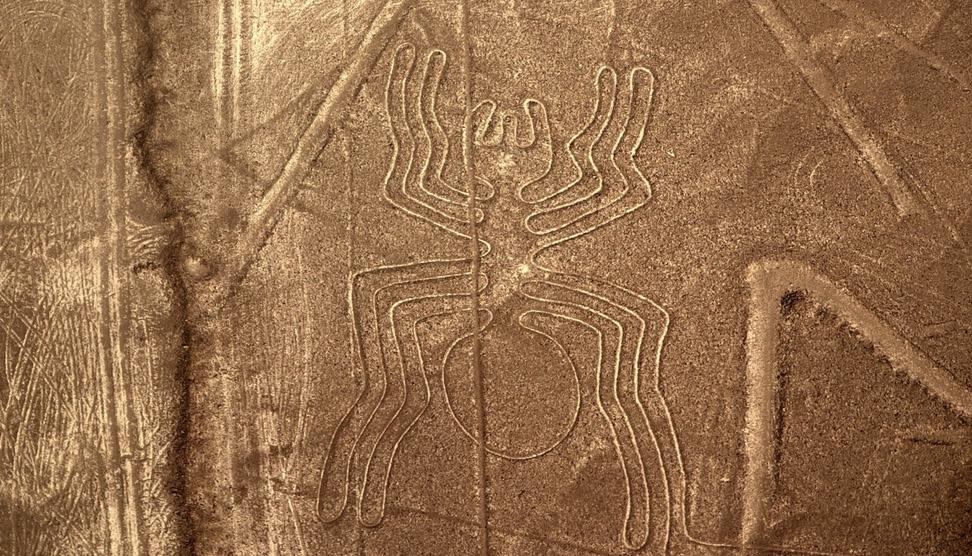
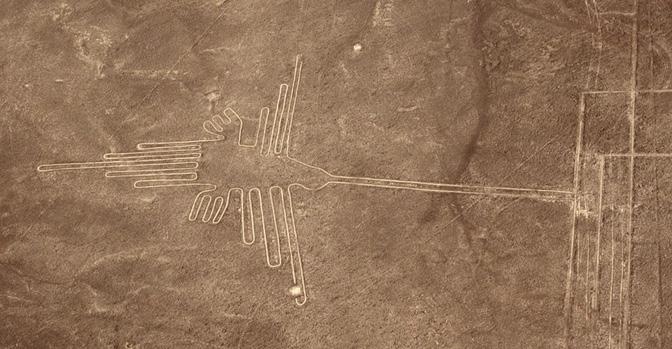
objects or events, like Stonehenge is thought of to do. They could also have been made as a ritual to the gods to bring fertility, growth or water to their city.
Bronze Age Collapse
Ok. This one actually baffles me. During the Bronze Age (3300 - 1200 BCE) there were many strong civilizations like the Egyptians, Hittites, Mesopotamians and Mycenaeans (they used Linear B remember?). Then all of a sudden, they collapsed or were heavily weakened. The real question is how did this happen? There are many theories
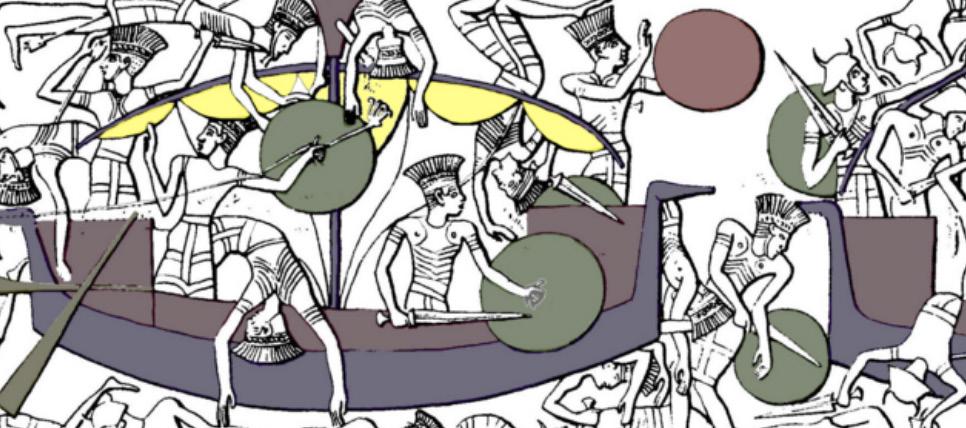
about it, but whatever the causes were, within 40 to 50 years, it caused almost every significant city in the eastern Mediterranean world to be destroyed. Can you imagine that today? That, within half a century, the three largest global powers just disintegrated with the rest heavily weakened. Causes include political and economical disruptions, natural disasters like volcanic eruptions, droughts, diseases, and most mysteriously, invasions by the Sea Peoples. We don’t even know who the Sea Peoples really were, but their invasions are well documented, describing them as an aggressive, seaborne group of raiders that pillaged Egypt and the surrounding areas. We don’t know where they originate from, but their actions brought upon a new era. As a result of these factors, everything was affected, and the world became smaller and more isolated. It took centuries, and I’m talking centuries, for new cultures to arise from the ashes of a once great collection of civilizations.
Mesopotamia
Also called the Cradle of Civilization, Mesopotamia was located between the rivers Tigris and the Euphrates (lower Iraq today). The mystery is why it was that location where the first ancient civilizations flourished, like the Sumerians, Akkadians, Babylonians and Assyrians. There’s actually a book I read called Germs, Guns, and Steel
KV55
The coffin of KV55
The Nazca Lines
Aerial views of some of the Nazca lines, showing an ant (top) and hummingbird (bottom)
Egyptian depictions of the Sea Peoples
by Jared Diamond that talks about a theory of why events in history played out the way they did. It tackles questions like “Why was it the Europeans who ‘discovered’ the New World rather than the other way around?” or “Why did some societies advance technologically

whereas others stayed stagnant?”. It’s a fascinating read and I highly recommend it if you’re into those types of books. The criticisms are equally interesting to read as well. It’s a bit of a long book though, so I’m not sure if there’s enough time with an engineering schedule.
“Aliens
Built Everything?”
No, they didn’t actually. If there’s one thing to know about humans in general, it’s that we’re pretty crafty (I mean, there’s a reason engineering exists in the first place). There’s a drive in everyone to create something, whether that be temples, pyramids, coliseums,
Unraveling the Theories of Time Travel
What would happen if you, a very spiteful engineer, decided upon the completion of your degree, to save other young engineers from the same misery?
To accomplish this, you created a time machine and went back in time to cut down the apple tree that Newton sat under.
You got what you wanted, but wait! If Newton didn’t achieve his scientific discoveries, and in turn you never became an engineer, then how did you go back in time in the first place? You have just stumbled upon the engineering version of the grandfather paradox.
The concept of time travel has always been shrouded in mystery, leaving many unanswered questions in its wake. Einstein’s theory of special relativity related time, mass and space using the formula everyone knows: E=mc2.
Essentially, as a body approaches the speed of light, its mass becomes infinite, creating a sort of speed limit for everything in the universe (which might be bad for the hitchhikers who need to get to places quickly). Though it’s helped our understanding of special relativity immensely, being the foundation to later inventions like the atom bomb, it has also raised many thoughtprovoking theories–that perhaps, if we did somehow cross this speed limit, we could escape the present and travel time.
to a concept known as time dilation. In simple terms, it is just the difference in perceived time between someone who is stationary and someone who is in motion. The logic behind this is that time is relative and depends on the reference frame (you can understand this by thinking about how time moves faster when you’re writing your mechanics exam compared to when you’re attending the lecture). A popular paradox stemming from this time dilation is the twin paradox–if one twin were to travel to space and come back, he would noticeably have aged less compared to his twin.
This did prove to be true in some sense. The theory of special relativity gave rise
Now that we have understood some of the background behind relativity and time, it has become evident that it is almost impossible to completely understand all the nuances of time. This, however, does not stop the curious human mind from imagining. A popular representation of time, as you would see in history books, is a line stretching infinitely on both sides. Every moment we live is a point on that timeline. This notation considers time to be set in stone, with everything that you’ve ever experienced or are yet to experience has been predetermined. According to this theory, nothing that you ever do is going to impact what is destined to happen. The Butterfly Effect theory is the polar opposite of this. This theory argues that even the most
art, music, delicious food, new cures for diseases, rocket-ships, or even artificial meat. I’m constantly amazed about the feats we can achieve. It’s a real testament to human creativity that we can point to all of this and say “This is what we are capable of, this is who we are.” One thing I’m reminded of, when I learn about people of the past, is that they weren’t too different from us. The jokes they told, the petty things they did to each other, the complaints about everything (and anything), the care and kindness they gave to one another... It goes to show that we really haven’t changed one bit; that our human nature is eternal.
insignificant event in the past can lead to a drastically different outcome in the future.
Another very interesting theory is that of Parallel Universes. You must have seen this theory in action if you’ve watched The Umbrella Academy. This suggests that every alteration you make in the past does not change the timeline of the original universe, but instead creates an alternate universe with different final outcomes. This theory efficiently handles the grandfather paradox with all changes affecting a different universe.
Finally, there is the Closed-Time Loop theory, which suggests that travelling back in time would become an event of the past, which can no longer be changed. To explain this, think about Hermione’s Time Turner in Harry Potter and the Prisoner of Azkaban. The mere act of a person travelling back in time would make it a part of history. Now you in the future must travel back in time to make that history true.
Since no one from the future has yet travelled back in time, it may be safe to assume that we will never achieve the wonders of time travel (unless we go by the parallel universe theory of course). In that case, I will humbly advise you to complete your engineering degree with diligence, as it is unlikely that you are going to be rescued by your future self.
Cherwell, Mesopotamia painted by Lydia Larden
Humour & Comics
Where’s the Golden Man?
Michael Yang
Opening Credits
Every spring, Los Angeles polishes its halo. Spotlights cut through the night, limousines crawl down Hollywood Boulevard, and an army of stylists and publicists gets to work. The ceremony isn’t just an award show; it’s the annual reminder that no one takes themselves more seriously than Hollywood does.
Winning means eight pounds of metal, a name engraved into film history, and a lifetime supply of humble acceptance speeches. Audrey Hepburn held hers like a sacred object, Monroe dreamed of one, and Streep seems to have enough to start a recycling program. Each trophy is designed to last forever, the physical embodiment of “making it.”

And then, the lights go out. The stage is cleared, the champagne flutes abandoned, and by morning the red carpet has already been rolled back into storage. Somewhere in the sprawl of Los Angeles, a golden man has gone missing. Maybe he was left in a limousine, maybe he’s buried under a pile of PR gift bags. Things vanish in this city all the time, but you’d think this one would be harder to misplace. So how, exactly, does someone lose an Oscar after winning one?
Films in real life?
It seems only fair that Hollywood, a place that spends millions creating stories about smooth-talking thieves and impossible heists, would eventually fall victim to its own plotlines. It has perfected the choreography of crime on screen. Audiences have watched on-scene antagonists pick locks, dodge laser grids, and distract security guards with nothing more than charm and a perfect jawline. The thieves in these films are graceful, clever, and always dressed like they have a sponsorship deal. Maybe it was only a matter of time before someone outside the soundstage started taking notes.
In movies, theft is an art form. From Topkapi to Charade, it’s less about money than about showmanship, the precision, the timing, the thrill of pulling off the impossible while looking unreasonably good doing it. By the time Audrey Hepburn floated through How to Steal a Million in her black Givenchy mask, the genre had reached perfection. She made theft look elegant, even ethical, as long as it was carried out with style.
Then came the irony. At some point, the perfect crime escaped the script and made its way into real life. The next great Hollywood mystery didn’t star a jewel thief or an international spy. The prize wasn’t diamonds or paintings. It was something far shinier: the little gold man himself.
The GREAT Heist of 2000
polishing replacements, the factory floor buzzing like a midterm week machine shop. In less than a week, fifty-five new trophies were shipped out under tight guard. It was the first time the race for Best Picture had competition from the race to rebuild inventory.

It began, fittingly, with a logistics failure. In early March 2000, a shipment of fifty-five freshly cast golden statuettes made its way from the R. S. Owens factory in Chicago to a warehouse in Bell, California. The plan was simple: unpack, polish, and prepare them for the 72nd Academy Awards. What could possibly go wrong with a process that had worked for decades? Quite a lot, apparently. When workers opened the delivery bay, the crates were gone. Not misplaced, not delayed, just gone. In a city that makes movies about elaborate robberies, someone had quietly pulled off one for real.
The story hit the media faster than a Marvel reboot. Fifty-five missing Oscars in broad daylight was too poetic to resist. Late-night hosts treated it like a crossover between Ocean’s Eleven and a supply-chain seminar. The Academy called Chicago in a panic. Within hours, R. S. Owens had launched what might be the most glamorous production sprint in manufacturing history. Dozens of workers spent days recasting and
Then came the twist. A man named Willie Fulgear spotted several boxes behind a grocery store that seemed suspiciously well-packed. Inside were fifty-two of the missing Oscars, shining like a limited-edition buyone-get-fifty-four-free deal. Fulgear called the police, posed for the cameras, and famously declared that he now had “more Oscars than any movie star.” The delivery company awarded him fifty thousand dollars, the Academy gave him a seat at the ceremony, and the thieves, who had apparently panicked and dumped the shipment, were later caught. Three statues were still missing. But one turned up in a Florida drug bust, proving that even at the bottom of a duffel bag, Hollywood glamour travels well. The last two remain unaccounted for, somewhere between legend and a pawn-shop shelf marked “slightly used.”
Shipping and Handling Not Included
If the great heist of 2000 played like a studio thriller, Whoopi Goldberg’s missing Oscar two years later was a straight-up sitcom. In 2002, she sent her Best Supporting Actress trophy for Ghost to the Academy for a professional cleaning. You know, the kind of errand no one expects to go wrong. Somewhere between New York and Beverly Hills, the package vanished. One golden statue, tracked, scanned, and then quietly lost in transit. The story spread faster than a rumor at an after-party. Reporters dubbed it a sequel to the earlier theft, proof that not even Hollywood’s most sacred object was safe from bureaucracy.
A week later, the missing statue emerged in a garbage bin at Ontario International
Airport, battered but unharmed. A worker found it, called the police, and briefly became the most responsible person in Hollywood. Goldberg took the incident with her usual grace, placed the statue back on her shelf, and moved on. The Academy apologized and promised stricter handling, though by then the story had already entered legend.
The Disappearance of Hattie McDaniel’s
Ocsar
Before Oscars started vanishing from delivery trucks and airport garbage bins, the first one ever awarded to a Black performer quietly disappeared from history. In 1940, Hattie McDaniel won Best Supporting Actress for Gone with the Wind. She accepted her award in a white gown and gardenias at a segregated hotel where she wasn’t allowed to sit with her co-stars.
Her trophy was different from the gold figures we know today: a small bronzeand-gold plaque. When McDaniel died in 1952, she left it to Howard University’s drama department, where it was proudly displayed as proof that the impossible could happen. For a while, students treated it like a relic. Part history, part hope.
And then, it vanished. No one is quite sure how. Some say it was stolen, others say it was boxed up and lost during renovations. The archives list it only as “missing,” which feels like an understatement for a piece of history that symbolized both progress and its limits.


Howard declined the Academy’s offer to replace it. The loss itself had become the lesson. Today, the award’s fate remains unknown, not stolen for profit or fame, but simply swallowed by time. Maybe it’s in an attic somewhere, or maybe it’s gone forever.
So Many Questions...
Christina Pizzonia
As an engineering student myself, I can admit that I chose to study engineering in part because I wanted to be able to tell people I’m an engineer (and feel morally superior about that fact), but also because I “enjoy problem solving” (cliché, I know). The thing is, after being here for 4 years, there are still some things about this university that I haven’t quite cracked:
1. Where even is the ECC?
Genuinely. Every semester I receive what feels like hundreds of emails from a mythical “ECC” office, gracing my inbox with networking tips, recruiter events and knowledge on how to craft a resume that will render me gainfully employed and student no more. But where is this building actually? The office seems to exist in that same metaphysical space as missing socks, and all I know for sure (from the high quality images inserted into their emails) is that they have the fanciest office décor around. They put SF’s bright red tiling (reminiscent of 70s TTC station design) to shame.
2. What’s up with the GB-Bahen crosswalk?
To be clear, I am not someone that habitually breaks the law. But my god does this intersection test me. It doesn’t matter how early I leave my house for a 9am class in Bahen: if it’s not the TTC doing me wrong, it’s the darn crosswalk. Sprinting from Queen’s Park to gain a few precious minutes means nothing when you’re forced to come to a halt right in front of GB, mere metres from your final destination, unable to move. If only the traffic lights were more receptive to the repeated hammering of the “walk” button right around when classes commence...
3. Why do ECEs have such poor hygiene?
Coming from an ECE–why, just why!? The argument could potentially be made that perhaps it’s because of the workload; that under the immense stress of debugging labs (it was missing a single semi-colon), we simply ‘forget’
Maybe the mystery isn’t who steals the Oscar, but why it keeps happening. Every few years, one goes missing. Sometimes it resurfaces in a dumpster or a pawn shop, sometimes it never does. Each disappearance says something about Hollywood’s uneasy relationship with permanence. The statue is meant to prove that a moment can last forever, yet somehow it keeps slipping away.
Hollywood has always admired its thieves. On screen, they move with purpose and confidence, stealing only what they can turn into legend. There’s a kind of symmetry in that. The same industry that romanticized the perfect heist has been quietly living one of its own. Somewhere between the studio and the street, the script comes to life, and the ending writes itself.
4. Who is Mario Baker?
to shower. But that should be no excuse, and it’s about time we finally figure out how to have an actual ‘work-life balance.’ I have nothing but the utmost respect and admiration for the prank culture that the BFC has so beautifully cultivated. Yet I have never understood the lore behind the mysterious Mario Baker. Who is he? When did he graduate, and was he even a student? Why is his Instagram account taking over my feed? And why was his ass a Cymbalic Majur for the Bnad in 2023 (does it make a desirable sound when slapped?!)
Alas, it is unlikely that we will ever discover the true answers to any of these questions. But it won’t be for lack of trying. And that’s ok, because if engineering has taught me anything, it’s that the process is more important than the final result.
What Comes After: A Letter from the Corpse Bride
Poetry & Fiction Waning Light
Ishita Jain Prerana Manoj
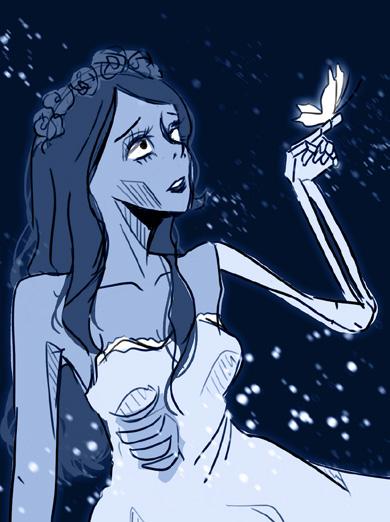
To my dearest Victor,
I write to you from the other side. Here, time passes like leaves drifting from the autumn trees. Slow, quiet, inevitable. The sun doesn’t quite exist here, but sometimes I think I see the moon peeking out from the endless grey, shining in between the empty bodies who shy away from its light.
I see lovers, some separated, some together. Somehow they both suffer from the ache. I think I understand that I will never understand love. And I think that’s okay. The children here find it rather disconcerting in nature. Some cry, others simply wallow, completely unknowing of their parents who could never be. It hurts me to see them, but that pain eventually transforms into some form of acceptance. I find that to be rather comforting. The silence too.
If you asked me to describe it here, I’d say it is a place where thoughts are kept safe from the wrath of the outer world, an in-between space where juxtaposing scenery finds its harmony. The thought of you here seems rather unusual. I will stop thinking about it. Well, at least before it stops thinking about me.
No matter the thoughts that surround me, I found the peace I never had back there. Searching for something that wasn’t mine. Reaching for a love that didn’t belong.
I found a place to cherish the thoughts that I never had. A place to remember, and to grow. I’ve found a home. I’ve found myself.
Love, Emily
The deep orange that settles about the horizon is a refuge from the dark skies that guide my journey home. I am reminded of a world that exists beyond the glaring white streetlights and the industrial glow of the train. I wish that all of those impostering lights would blink away, I wish that I could become one with the sky. I wish I could crawl out of my skin and leave my shriveling corpse behind as I ascend into a moment of nothingness.
I love the quiet. It is deep and sorrowful, unlike the hubbub of the city. I have learned to hate the noise. It is not weighted enough. It is too carefree and I do not deserve the giggles, the joy, the small things that compose the symphony. I am destined for something bigger. Something emptier. Something with no meaning.
I miss my Jaime. They disappeared behind the horizon three months ago. No note, no form of message, no indication to ease our aching hearts and stubborn will. I am still searching for the “why” behind their departure, but I slowly doubt that it would grant me any solace. I am deserted, I am broken. I am heartless, and I am guilty. Every car headlight shines in my face, as if to cast the blame upon me.
Therapy means nothing. I was told to go, but whenever I am there, the silence engulfs me, suffocating my voice and subduing my urge to wail. I cannot. I cannot reveal the sinner that I am, for I would be imprisoned by their attempts to soothe, wary of the judgement behind their words.
and my soul has fled, as if it was always theirs and never mine to begin with. I was shocked, even when I knew it was coming. There are tears in my eyes that never seem to go away but never seem to stream down either. I am tired, though I have no right to be.
If I could just see them once more, I would have all of the energy in the world. Their glistening eyes. Their wide, pearly smile when they laugh. Their messy hair and their slightly green glasses. The scandalous ideas we would conjure together, and our suspect explorations of campus buildings. Together we survived through midterms and labs, and together we were when they held me as I cried. I want that back, but having all of that back would break me.

I am burdened with shame for I have not dared to touch their photograph since I lost them. If I could just see them once more, I fear that I would want to live again in this life of frivolous pleasures and irrelevant consequences. But how could I frolic in the leaves without their protection from the bugs? How could I dance in the rain without their little smirk? That is not who I am anymore, not someone I could now ever be.
Alas, I also cannot depart, lest I forget them. It is my duty to remember them for the rest of eternity, and to garner enough woe for the both of us combined. I shall stand still in space, but I must somehow move forward in time. There is no vivid colour or alluring mystery without them. There is nothing for me to do but deal with these absolutes, even when the world tells tales in shades of grey. All I know is that the glimpse of orange has dissipated.
The sky is black now. My station is here and I must drudge on with my days. But in my heart, this All Hallows Eve lasts forever.
There was so much I could have done. I should have been able to get through to them but I was not enough. I never will be enough. There is no better place they have gone to. They are just gone,
I miss your light.
The Rime of the Ancient Brigantine
Leila Agil
There is an ancient brigantine
Sunk deep beneath blue sea. And though none lived to tell her tale, She whispered it to me:
It was by light of baleful moon
The restless waves did cease. As though ‘twas time itself that stopped, And Neptune was at peace.
The twinkling stars never so clear
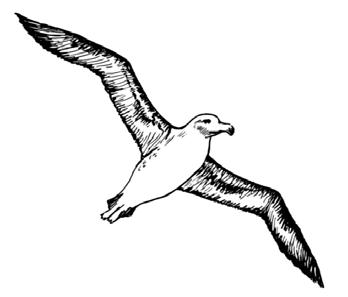
As on this tranquil night. Her crew gazed up in wonderment— And so did miss the steep ascent Of the Albatross’s flight.
But one among the crew did see
The bird, and bade it wait; As all were lulled to dreamless sleep, The helmsman begged in vain.
But all his pleading cries did naught: The lucky bird still flew. And in the night as still as death, A fiendish heat now grew.
By morn the sailors’ throats were parched, Their mouths like desert wastes. By noon the blood-red Sun had dried Their tongues no more to taste. By dusk the helmsman understood The Albatross’s haste.
In dire moods they suffered through
A fortnight’s beastly heat. When finally a cooling wind Their arid eyes did meet.
The mists swept in and left them drunk
On dewy, soothing breeze. Clouds grew and grew till all at once, The rain came down in sheets.
Then blistering through the downpour broke
A flame of purest green! It was as though the briny sea Had gained an oily sheen.
Fires dueled the endless rain And flickered in the haze
Fires danced across barren sea, The entire Earth to raze.
The smoke was thick and choked the sky, The fog a murky thing. No wretched soul could stand to bear This bleakest twilight’s sting.
And at long last the waves crashed down— Struck like a titan’s rage! With crests aflame and towering, Their goal the ship to cage
In gloom the helmsman begged mercy: “Oh Albatross, return! Why did you flee, oh Albatross? You left us here to burn!”
The lashing waves and driving rain, Flicker of emerald flame. It was in such a vile state The captain did proclaim:
“Although our fate I see is sealed, We will not go in wrath.”
When all at once a dreadful sound: —CRACK SPLINTER CRACK— Her hull was wrenched in half. But no more could the sailors hear The captain’s epitaph.
And in the hellish, loathsome storm, White wings rend darkest night. All souls but one sank silently, Freed from their worldly plight.
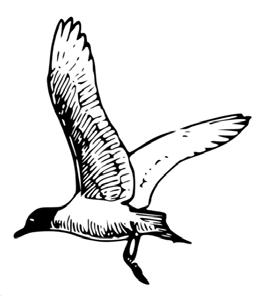
Two Albatross flew from the wreck Of the ancient brigantine.

The Mystery of the Lime Jello
Meilly Chen
I wake up in the middle of the night to a chill rushing through my room. I pull my blanket tightly over my face to stop the shivers spiking through the air. A growl creeps from my stomach, swerving like the whistle of the outside wind. Tracing my tongue is a plea–a desperate yearning for a decadent dessert. Its sweet, citrusy flavour is the only thing I want to taste; its springy texture is the only thing I want to feel. I roll to the other end of my bed and peek out of my blanket, wondering if my roommate has woken up too.
“Are you awake?” I whisper. I can’t imagine being asleep when it feels like the temperature of our room is rapidly declining. It’s only October, so why does it feel like I’m stranded in the middle of a forest on a snowy December night? The windows here at Chestnut Residence are sealed shut, and there should be no space for any wind to leak indoors. “It’s freezing…” I mutter.
again. Exasperated, I check the time on my phone once more. 3:00 AM. Still? I chuck my phone onto the carpet next to me, producing a muffled thud. The stupid thing has to be broken. I sink back into my mattress, taking a deep breath to relax myself. Third time’s the charm. This time, I’ll be able to get some good, peaceful sleep…
*VRRRT* – Ignore it.
*VRRRRRT* – IGNORE IT.

*VRRRRRRRRT* – IGNORE IT!
*VRRRRRRRRRRRRRRRRRRT* –
All around me I feel shivers, as if ice is encasing my body. The doorknob cranks open and the force continues to drag me forward. For better or for worse, my room is right next to the elevators. Whatever force took control of me releases its grip right before an elevator. Its gleaming steel gates are extended, beckoning me to step inside its empty space. I can turn back. I know that I should turn back, and I know that I should go to sleep.
Met with silence as a response from my roommate, I worm my way back under my blanket and try to fall asleep in its warmth. As I feel my consciousness surrendering itself to that sweet cotton embrace, I shove out thoughts of wanting dessert–of wanting a ramekin of light, smooth jello, brought to life by an enticing bright green. I have no need for it; I already have three portions stuffed in my stomach from lunch, and an extra from dinner. I smile, content, and let my own exhaustion overcome me like a wave.
*DING*
My eyes burst open to the sound of an elevator opening. What time is it? Did I oversleep? My curtains are shut, so I’m not able to gauge whether the sun has risen or not. I reach for my phone on my nightstand and tap it to check the time. 3:00 AM. Seriously? Who could be using the elevator at THIS hour, and why? I toss my face into my pillow and squeeze my eyes shut.
*DING*
I snap upright, sending my blanket flying off my body, with my sleeping roommate being the only thing stopping me from screaming in frustration. Using the irritating vibrations to guide me in the dark as I drop onto the floor, I locate the phone I had carelessly abandoned hours earlier. At least, what I thought was hours earlier. With a gentle tap of the screen, I am greeted with three digits, two letters, and a colon glaring at me. 3:00 AM. How? On my notification list is a new voicemail from that same time, 3:00 AM. I must’ve missed a call. I try to check who the voicemail is from, but make a misclick and accidentally let it play instead.
I enter the elevator. Its doors close just as I step in, nearly clamping a strand of my hair in between. Without needing my prompt, the transport–or my “escort”, as the voice message had called it–drops down to the lobby level. I step forward, waiting for the doors to slide open.
They don’t budge.
I check my phone for the time, and it still says 3:00 AM. How could that be? I close my eyes and count the seconds up to 60. When my phone still says that it’s 3:00 AM and the elevator doors are still closed, I think of pressing the emergency button to call for help. Just as my finger connects to the button, my phone rumbles. I stop and see a new text message.

“WE ARE WATCHING YOU”
“Hello,” an automated voice says through grating static. “This is a message from -bzzzt-. We are awaiting your arrival in the Dining Commons. Please use the elevator we have sent to escort you.”
“Huh?” I blurt from shock. Is this a prank? When the message concludes with a tone, the dreadful sound of the elevator rings from the hallway. It’s for… me? To go to the Dining Commons at 3:00 AM? It isn’t even open! My phone vibrates and I see a text message from an unknown number.
“THIS IS YOUR FINAL CHANCE.”
And blessing my screen is a glimmering photo of the dessert I had been suppressing my craving for.
The doors squeal open. I warily take a step out onto the pitch-dark floor. That’s weird. It shouldn’t be dark, should it? I’ve never been down here at 3 am before, so I’m not fully certain. I flip on my phone flashlight to navigate across the pearly floor, past the empty security desk, towards the Dining Commons. As expected, no one is in front of the cafeteria to swipe my T-Card for entry… but the doors inside are wide open. Shouldn’t they be locked shut? My phone vibrates again with a new text.
“GO INSIDE.”
The elevator chime wakes me up yet
Scratchy words escape from my parched throat in a gasp. “Lime jello…” Suddenly, I feel a force grabbing at me, yanking me across the rough carpeted floor.
Shaking, I obey and slink into the dining hall. High-pitched creaking snakes behind me and the doors close with a thud. I whip around and push my hands against them, but they don’t move. I’m locked in–and not in a good sense. I turn back around and a sole light flickers on from a familiar spot, to the right and far in front of the entrance. The place where they keep their desserts–the place where they keep their lime jello. Any hesitation I felt is swallowed by the euphoria of
knowing that I’m so close to what’s been keeping me up at night. With nobody around to see me, I sprint forward, holding my flashlight in front of me. I turn off my light when I reach the spot which cradles a group of lime jello portions, neatly arranged in an array.
“No way,” I blurt, panting from being out of breath. “There’s this much lime jello sitting here after hours?”
A vibration buzzes from my phone yet again, but I don’t care. I wrap my fingers around a ramekin and lift up the 100-gram portion of cubed jello. The energetic treat sparkles, reflecting the light in my eyes as I take in its heavenly scent. Not bothering to grab a spoon, I directly slurp up a cube and let it slide down my throat.


to gather them like fluffy white dandelion seeds. But they slipped between my fingers, like wishes carried away by the wind, until not a single remained. By then the sky had already drifted into slumber, a sable blanket gently drawn over her boundless body, creating a beautiful illusion of infinite ebony darkness; a peaceful union of sky and ocean so still, so fathomless that it might well have been the first night young Earth had ever known.
Then amidst the seemingly endless darkness, distant spots of bright light carved a fragile boundary between ocean and sky. Perhaps they came from lighthouses or from street lamps burning along nearby shores.
The Spectator
‘Nobody’
Above the fog
A figure quietly hums
An unfamiliar tune
I stop and listen to The absence of voice And hear its meaning
Conscious yet swaying
Shadowless and fraying Form forever betraying
As I embrace the melody And follow the performance It begins to enliven
So I continue to spectate And act behind the scenes
Puppeteering this play And shaping new dreams
My knees buckle and the ramekin crashes to the floor, shattering. I clamp my hand to my mouth, coughing uncontrollably. Blurry spots enter my vision as a crackling voice blares from somewhere above.
“I told you that this would be your final chance.”
My memories stop there.
Morning Promises Me a Sunrise
Kelly Hong
Leaning over the balcony rail, I feel the ship drifting away from the island in a wistful farewell. The snow-white birds, however, were not quite ready to bid their goodbyes.
They chased the brilliant white circles of light spilled carelessly by the ship upon the ocean surface, enchanted by the fleeting glow amid these dusky waters.
I reached over the ledge, hand stretched out
But, I found it ever more romantic and haunting to imagine that I was adrift at the very heart of nowhere; that when the moon met the ocean, it generously sprinkled, from its luster pallid hands, moondust that floated down softly like snowflakes, igniting into sparkling gold and rose and amber as soon as it touched the water, kindling a path for the wandering ghosts of lonely sailors.
The fog never clears But I welcome its uncertainties
As one with imagination And student of mysteries
I gazed past myself And witnessed the tapestry Of ourselves
So I continue to spectate And blend into the crowd
Above the fog once more
A tune I once knew Plays now through every voice Aloud

When ocean and sky were one again, I felt myself one of them— a lost soul wandering the waters, uncertain of what awaited beyond. Yet, though the grand ocean wrapped my heart in its solemn darkness, my vessel, and I, continued onward, comforted by the solace of knowing that eventually, the sun will rise.

Puzzles & Games
Welcome back to the Puzzles & Games section of The Cannon! To help you on your puzzling journey, hints for the following mystery-themed puzzles can be found on the bottom of each page.
And if you still can’t quite figure out a puzzle (or just want to check your work once you’re done), full solutions to all puzzles can be found on the last page of the magazine!
Good luck & happy puzzling!
Charlie Therence
Group words that share a common thread. The goal is to create 4 sets with 4 words each. Write your groups in the coloured boxes below, along with the thread linking all 4 words.
connections TRAIN
SHIP GRUFF SHELL
Sudoku
Avi Gell
Normal sudoku rules apply: Place the digits 1-6 into the grid such that no digit repeats in any row, column, or 2x3 box.
Black magnifying glass: The digits along a black magnifying glass must be in a 1:2 ratio. For example:

3 and 6 are valid entries, since 3:6 is a 1:2 ratio (3 * 2 = 6).
White magnifying glass: The digits along a white magnifying glass must be consecutive. For example:
4 and 5 are valid entries, as they are consecutive digits.
Best of luck! 4 5 3 6
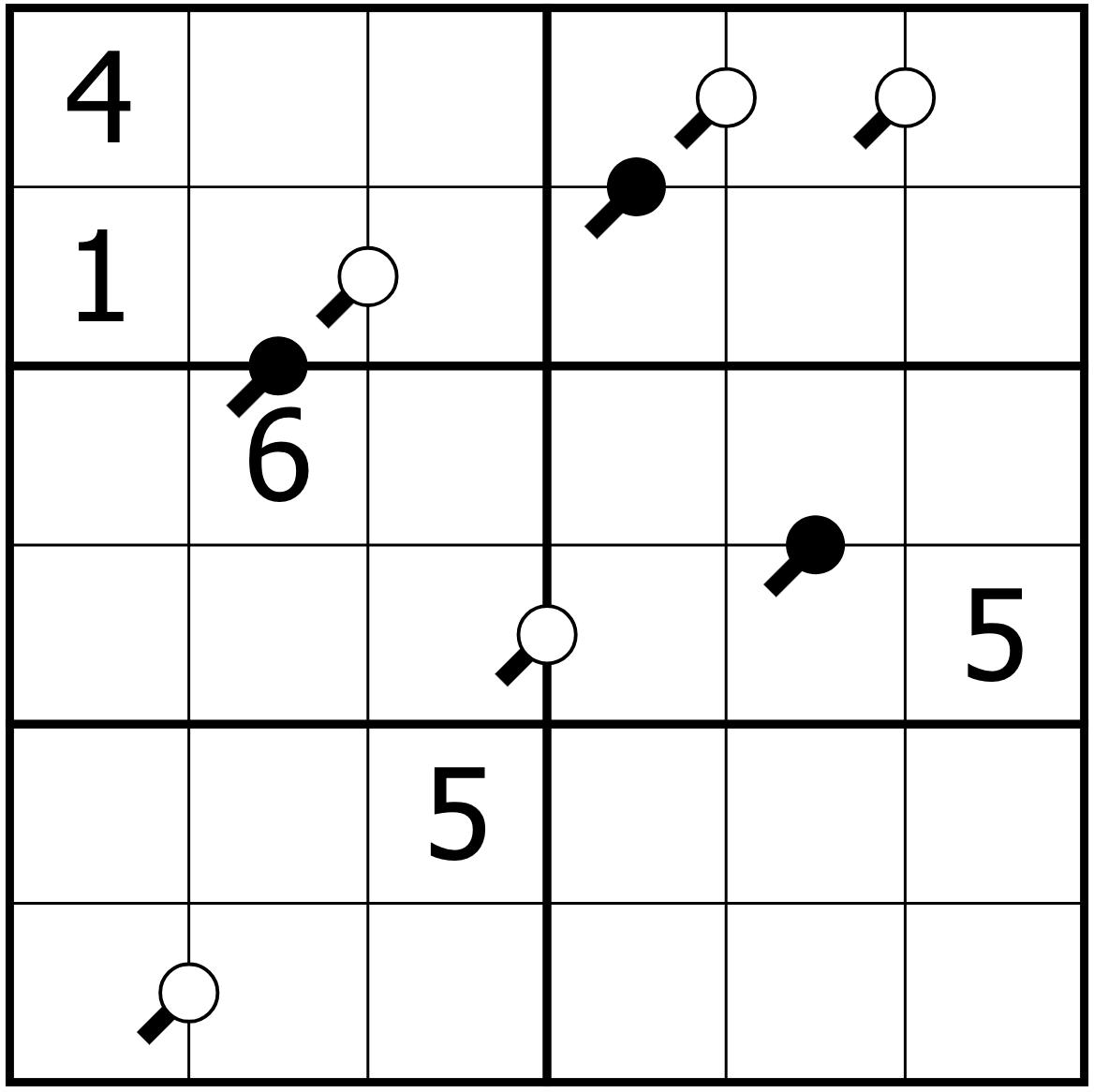
Connections Hint: Straightforward: GRUFF // Medium: TRAIN // Hard: DEAN // Insanely difficult: STEVE
The Mini Crossword
ACROSS
1. Slang term for young men, often used by Murdoch Mysteries’ Constable Crabtree (4)
5. Rolie Polie ___, nostalgic children’s adventure show featuring a yellow robot (4)
6. Dodgers of the truth, especially during an interrogation (5)
8. A detective’s discoverable hint (4)
9. __ Squalor, Count Olaf’s second-incommand in A Series of Unfortunate Events (4)
Cryptic Clues
DOWN
1. Common group chat reply from Brooklyn 99’s Gina Peretti (3)
2. Heroine who falls into a rabbit hole (5)
3. What Miss Marple might do with a rotary (5)
4. Life-saving antidote, typically injected (5)
7. To spot, notice or uncover (3)
Avi Gell DETECTIVE
How it works: The end of the clue is the definition or synonym of the answer you are trying to find, similar to a crossword clue. The start of the clue instructs you to use wordplay to construct the answer through techniques such as anagramming letters or combining new words together. For example:
Example: ICE vetted disorganized one who solves mysteries (9)
If the letters of the words ICE vetted are “disorganized”, they may be rearranged. This forms DETECTIVE, which matches the definition of “one who solves mysteries.”
Give these next 4 clues a try!
Clue 1: Progressive getting into artificial intelligence gives plausible excuse (5)
Clue 2: Initially staring longingly, Elise understands the honourable investigator (6)
Clue 3: Victoria & Timothy familiarly make casualty (6)
Clue 4: Culture oddly shows hint (4)
Cryptic Clues Hints: (Clue 1) Progressive = “Lib” // (Clue 2) Initially = initial letters // (Clue 3) Familiarly = nicknames // (Clue 4) Oddly = odd indices or positions
Mystery Media Word Search
Joy Zhou
Find the media listed to complete the word search! Apostrophes and spaces in media names are omitted. Once you’re done, consider exploring the mystery media recommendations in the word list!
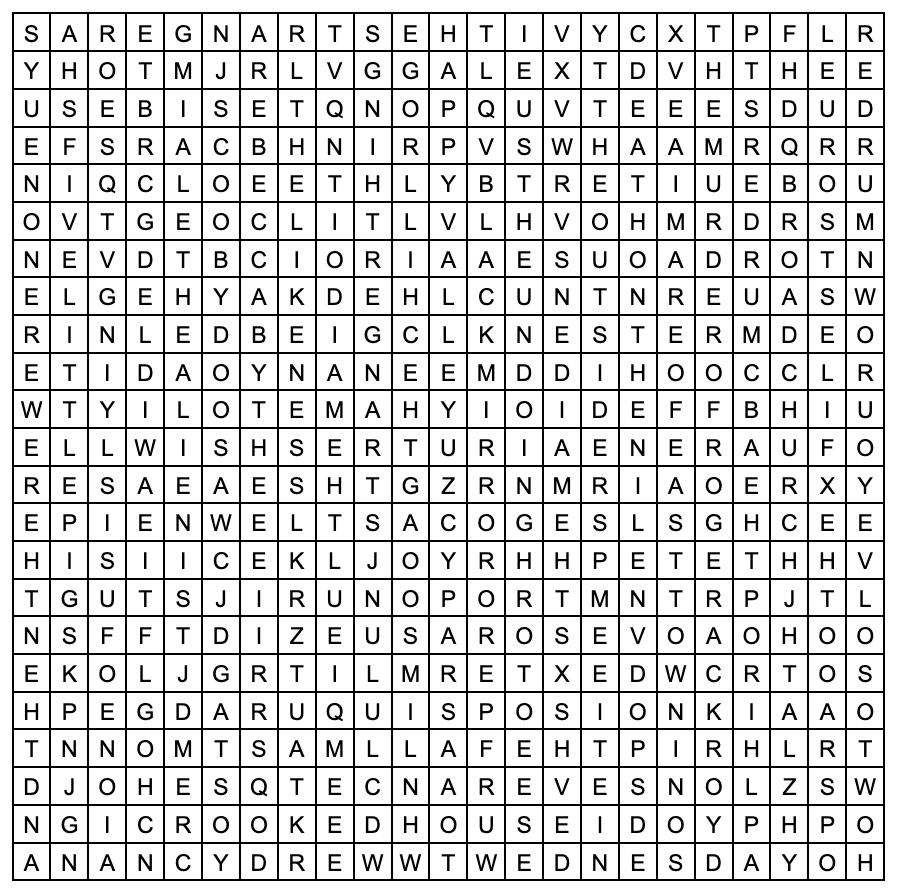
Scooby Doo
Sherlock
A Good Girls Guide to Murder
Wednesday And Then There Were None
One of Us is Lying
Stranger Things
We Were Liars
The Outsiders
Severance
How To Solve Your Own Murder
Castle
The X Files
Dexter
Black Mirror
The Stranger
The Undoing
Broadchurch
The Fall
The Murder of Roger Ackroyd
Happy Valley
Nancy Drew
Mare of Easttown
The ABC Murders
Death on the Nile
Five Little Pigs
The Maid
The Maiden
The Alienist
Rebecca
The Likeness
Crooked House
The Chill
The Mystery of the Missing Notebook
Nusaiba Rakhshan
Oh no! Our editor-in-chief has lost her notebook–which contains top-secret information about the upcoming issue of The Cannon! Fortunately, students across campus have reported seeing a professor carrying her favourite notebook. It seems as if a professor has found it, and is keeping it safe until she can pick it up (thank you, professor!). The professor in question decided to leave her a note explaining the situation to her, in a location she usually frequents.
Use the following clues to uncover which professor found which object (one of which is her notebook!), and in which location they left her a note. Remember that all pairings are all mutually exclusive. That is, if a professor was seen at the library carrying a flower, you can assume no other professor was seen holding a flower or at the library.
Clues
1. The official podcast of the FASE, “Coffee with Chris”, was held today.
2. Prof. Rose is rumoured to be allergic to pollen.
3. Our Lab Manager, Aslan, noticed the smell of flowers at the oscilliscopes in BA3135.
4. SF1106 is primarily used by ECE professors.
Which professor found Christina’s notebook? _______________
Where did they leave a note for her to find? _______________
Jumble
Christina Pizzonia
Unscramble these four jumbles, one letter to each square, to form four ordinary words.
IVTOEM
VEGASR
OPNIOS
TLUYGI
Now, arrange the circled letters to form the surprise answer, as suggested by the cartoon on the right:
Answer: -
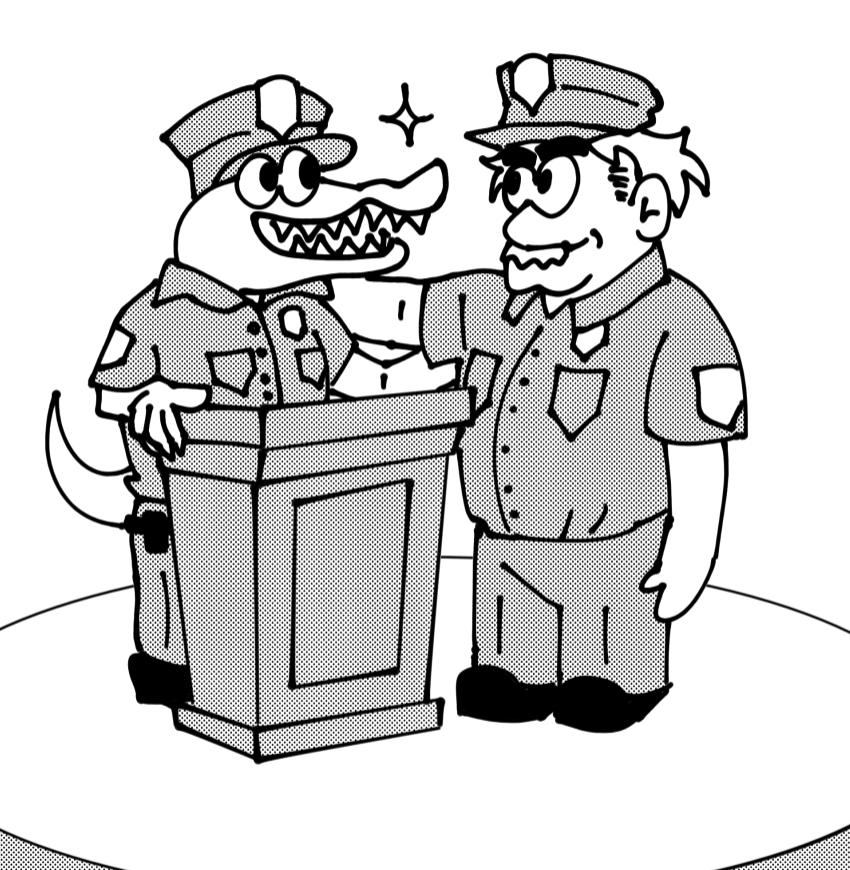
THE TORONTO POLICE SERVICE PROUDLY ANNOUNCED THE HIRING OF THEIR FIRST---
Jumble Hint: Alligators on the police force?!

Solutions
DESCRIPTIONS OF MYSTERIOUS VOICES GRUFF, HUSKY, DEEP, HARSH
CRIME SCENES FROM AGATHA CHRISTIE NOVELS TRAIN, SHIP, ISLAND, LIBRARY
MEMBERS OF THE WINCHESTER FAMILY (SUPERNATURAL) JOHN, DEAN, SAM, MARY
FIRST 5 LETTERS OF 19TH CENTURY HORROR AUTHOR SURNAMES SHELL, STOKE, WILDE, STEVE
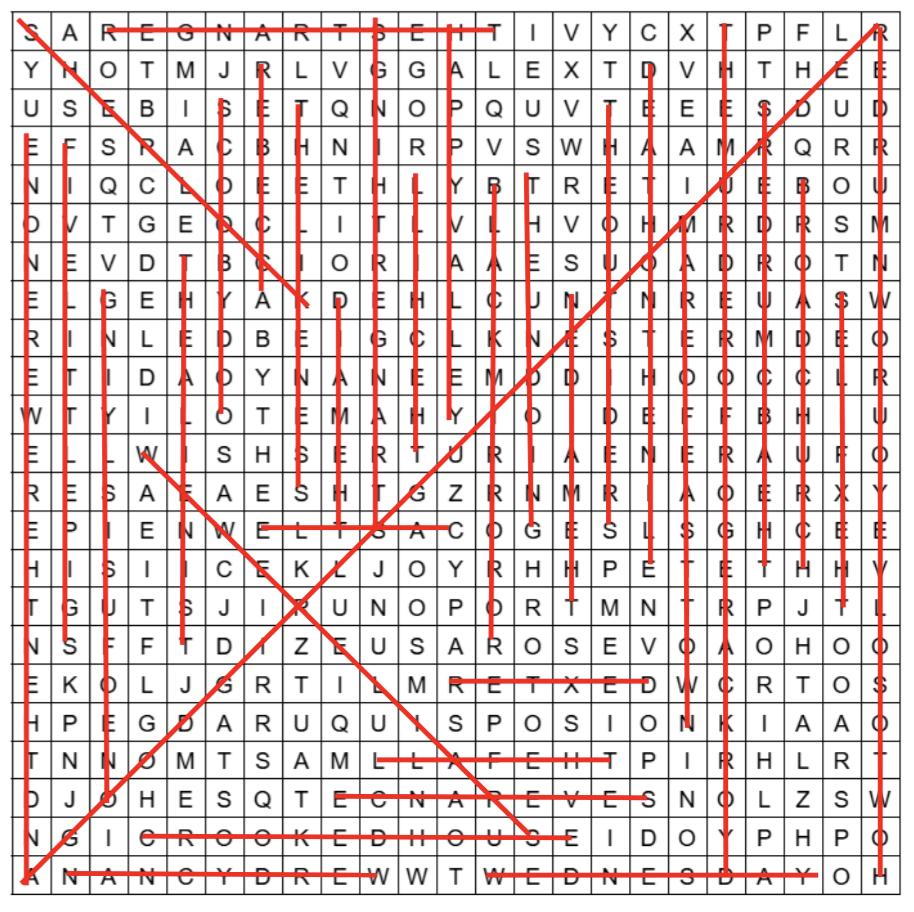
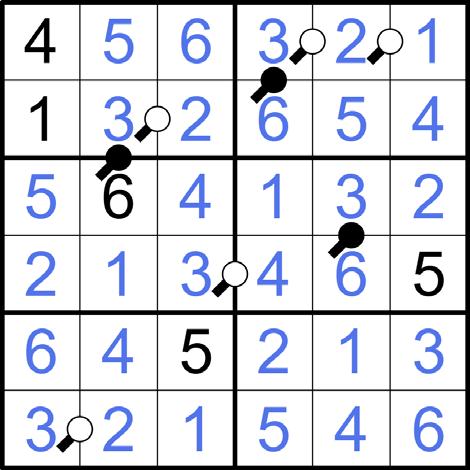

CRYPTIC CLUES: ALIBI, SLEUTH, VICTIM, CLUE
JUMBLE: MOTIVE, GRAVES, POISON, GUILTY
SECRET WORD: “INVESTI-GATOR”
THE MYSTERY OF THE MISSING NOTEBOOK: PROF. ROSE FOUND THE NOTEBOOK, AND LEFT CHRISTINA A NOTE IN SANDFORD FLEMING!