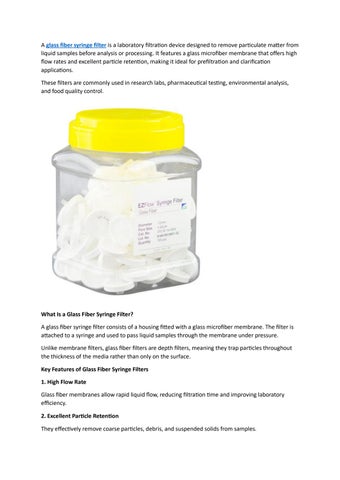
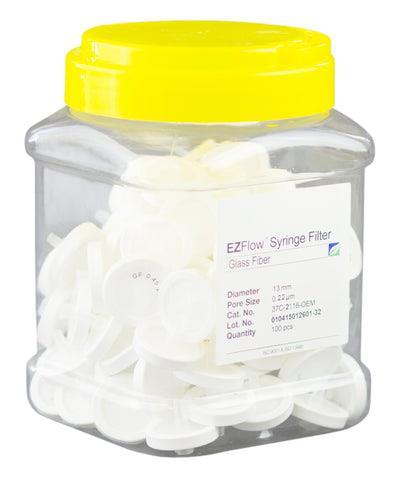
A glass fiber syringe filter is a laboratory filtration device designed to remove particulate matter from liquid samples before analysis or processing. It features a glass microfiber membrane that offers high flow rates and excellent particle retention, making it ideal for prefiltration and clarification applications.
These filters are commonly used in research labs, pharmaceutical testing, environmental analysis, and food quality control.
What Is a Glass Fiber Syringe Filter?
A glass fiber syringe filter consists of a housing fitted with a glass microfiber membrane. The filter is attached to a syringe and used to pass liquid samples through the membrane under pressure.
Unlike membrane filters, glass fiber filters are depth filters, meaning they trap particles throughout the thickness of the media rather than only on the surface.
Key Features of Glass Fiber Syringe Filters
1. High Flow Rate
Glass fiber membranes allow rapid liquid flow, reducing filtration time and improving laboratory efficiency.
2. Excellent Particle Retention
They effectively remove coarse particles, debris, and suspended solids from samples.
3. Depth Filtration Technology
Particles are captured within multiple layers of fibers, preventing early clogging.
4. Broad Chemical Compatibility
Glass fiber filters are compatible with many aqueous and organic solvents.
5. Low Extractables
They release minimal impurities, ensuring accurate analytical results.
Applications of Glass Fiber Syringe Filters
1. Sample Clarification
Used to remove visible particles from samples before chromatography, spectroscopy, or microscopy.
2. Prefiltration
Acts as a pre-filter before fine membrane filtration to extend the life of final filters.
3. Environmental Testing
Helps prepare water, soil extracts, and wastewater samples for analysis.
4. Pharmaceutical and Biotech Research
Used in drug development, formulation studies, and quality control.
5. Food and Beverage Testing
Filters beverages, extracts, and food samples for laboratory examination.
Benefits of Using Glass Fiber Syringe Filters
Improves accuracy of analytical results
Prevents instrument blockage
Reduces sample preparation time
Enhances filter lifespan in multi-step filtration
Ensures consistent sample quality
Common Specifications
Feature Description
Membrane Material Glass microfiber
Typical Pore Size 0.7 µm – 1.2 µm (nominal)
Diameter 13 mm, 25 mm, 33 mm
Housing Material Polypropylene
Sterility
Sterile or non-sterile
Feature Description
Connection Luer lock / Luer slip
How to Use a Glass Fiber Syringe Filter
1. Draw the liquid sample into a clean syringe.
2. Attach the glass fiber syringe filter securely.
3. Hold the syringe vertically.
4. Apply steady pressure to push the sample through.
5. Collect the filtered liquid in a sterile container. Avoid excessive pressure to prevent filter rupture.
Glass Fiber vs Membrane Syringe Filters
Feature Glass Fiber Filter Membrane Filter
Filtration Type Depth filtration Surface filtration
Flow Rate High Moderate
Clogging Low Higher
Particle Removal Coarse particles Fine particles
Best Use Prefiltration Final filtration
Glass fiber filters are mainly used for prefiltration, while membrane filters are preferred for final sterilization.
Storage and Handling Tips
Store in a clean, dry environment
Avoid touching the membrane surface
Keep sealed until use
Dispose after single use
Protect from dust and moisture
Proper handling ensures consistent filtration performance.
Why Choose Glass Fiber Syringe Filters?
Glass fiber syringe filters are ideal when you need:
Fast filtration
Reliable particle removal
Reduced clogging
Cost-effective sample preparation
High-volume processing capability
They are especially suitable for laboratories handling samples with high particulate content.
Conclusion
A glass fiber syringe filter is an essential laboratory tool for efficient and reliable liquid sample filtration. With high flow rates, strong particle retention, and excellent chemical compatibility, it serves as a perfect solution for prefiltration and clarification across scientific, pharmaceutical, and industrial applications.