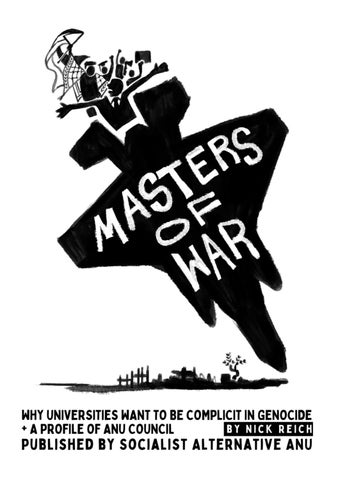
MASTERS OF WAR
A STUDENT MOVEMENT
has exploded across the world against university complicity in the current Israeli genocide. Since October 7 2023, thousands of students have been involved in large city street demonstrations, smaller direct actions, online activism and many more forms of politicalorganisinginsolidaritywith Gaza. But student involvement in themovementtookaleapforward following the establishment of a protest encampment at Columbia university and the attempted repressionofit.
Following Columbia, ANU's Gaza Solidarity Encampment was established on April 29 on the lawns of Kambri, the freshly developed corporate centre of the university. During the first month of the camp being stubbornly planted there, over a dozen rallies have been held, thousands of leaflets and hundreds of posters have been distributed, regular teach-inshavebeenheld,ageneral meetingofover600studentsvoted to support the camp and daily
political meetings have democratically debated the camp's approachtowinningitsdemands.
In response to this mass and vibrant expression of students politically organising for justice, ANUofferedonlyrepression.Two weeks after the commencement of the encampment, on the 76th anniversary of al-Nakba, the universitysummoned7studentsto a meeting with the Deputy ViceChancellor. At this meeting they were told that whilst the university respects and values their right to protest, they must leave the encampment by Friday otherwise they would be in breach of the university code of conduct. When they asked why they had been singled out, the Deputy ViceChancellor assured them that they didn’tintendforthesenoticestobe given only to them, the rest of the students involved in the camp wouldalsobedirectedtoleave.She thenpushedacrossthetableastack of blank pages with pens on them andencouragedthestudents tolist thenamesofanyoneelseinvolved.
3
A week and a half after that, at 8am on Reconciliation Day, the encampment was awoken by two dozen security guards surrounding them. They were given letters ordering the camp to pack up immediately, and referring to the fact that police were ready to intervene. Sure enough,three vans full of officers loomed in the background.
In an incredible show of force, hundreds of students and community members rallied to defend the camp. When the hundreds of students involved in the camp congregated, they discussed, debated and voted on their response to the forceful escalation, ultimately deciding to stand their ground and fight. 100 students sat in the centre of the camp, the phone number of a lawyer written on their forearm in preparationforbeingarrested,and around 200 more protestors formedahumanchain around the grass to block any police advance, chanting and singing for hours on end. Ultimately, the police were forced to withdraw, promising to return the next day with more officersreadytocarryoutarrests.
In every statement they made, the ANU has reaffirmed their commitmenttoprotectingfreedom of assembly and the right to free speech. As they said this, they dragged students through McCarthy-esque tribunals to issue arbitraryordersrestrictinghowthey should protest and brought in legions of police to impose order throughforce.
Theaimofthisarticleistolook at how the university operates and fitsintobroadersocietyinorderto answer the question of why the ANU administration is so resistant to the demands of this protest encampment. To answer that question will help students and activists resolve all the strategic politicalquestionsofwhatitwould taketowin.
THE INTELLECTUAL ARMS TRADE
One of the major demands of the student movement is for universitiestodivestfromweapons companies that supply Israel and theirgenocideinGaza.
Without the globalised supply chain enabling the manufacture of
4
advancedweaponssuchasF-35jets, Israel’s capacity to rain fire and destruction on the impoverished population of Gaza would be diminished.Byextension,allthose who fund and facilitate the productionanddeliveryofarmsare themselves complicit, no matter how much they may express their own “concerns” about civilian deaths.
ANUhasover1milliondollars (that we know of) invested in just such companies: BAE Systems, Lockheed Martin, Northrop Grumman etc. In fact, basically every university in Australia has similar investments. This certainly makesthemamodestbloodmoney profitandoughttobeimmediately divested,butitisn'tthecoreofthe relationship between Australian universitiesandthewarmachine.
More important than their investmentportfoliosistheirsupply of research partnerships and educated graduates to these arms companies.
Around the country a pattern emerges:MelbourneUniversityhas a joint lab and many research partnershipswithLockheedMartin,
University of Sydney promotes theirclosepartnershipwithThales, University of Queensland has a joint research centre with Boeing, tolistjustafewexamples.Fortheir part, ANU boasts a close relationship with Northrop GrummanAustralia(NGA),whoas recentlyas 2022took89%oftheir massive revenue from the sale of arms.ANUmaintainsanumberof scholarship programs and an externship program with NGA, who also sponsor ANU's rocketry club. An indication of their privilegedrelationship: in 2019 the university invited NGA to help fix their IT issues after a major cyber attack. The full extent of joint research partnerships between them are unknown, but clearly there are close connections. The friendship demonstrates ANU’s open commitment to funnelling graduatesintocompanieslikeNGA, aswellascarryingoutjointresearch, sothatthosecompaniescanremain at thecuttingedge ofdevelopment inwaranddeath.
Thisrepresentsmorethanjusta strategy by the university to vie for profitable funding lines. Staying at thecuttingedgeoftheinternational
5
arms race is crucial for any government who wants to “project power”anddemolishtheirenemies. To serve this aim, they cultivate advanced arms industries by promoting joint research at public universities. This hawkish contribution to the nation's war machine has been core to ANU's purpose since its foundation, for whichtheyhavebeencompensated handsomely.
A few current examples of this are that ANU is a member of the Government'sDefenceScienceand Universities network, they house the Australian Signals Directorate, theADF'sspyagency,andtheyare expanding their nuclear physics department in order to train technicians to staff the nuclear submarines acquired through the AUKUS deal. Not to mention ANU’s defence strategy departments, like the International Relations department or the College of Asia and the Pacific, being heavily integrated with the defence establishment, providing strategicadvicetothedefenceforce.
Theuniversityisandalwayshas beentiedbyathousandthreadsto Australia's military aims. Currently,
those aims align with the interests of all of the major arms manufacturers and Israel's own military aims. Blood soaks every portion of this network of complicity,evenifit'stheIDFthat pulls the trigger. Israel has long been the closest ally of the Australian government in the MiddleEastandsohasescapedall sanctionfromthemaftermonthsof genocidal violence, on top of decades of apartheid, ethnic cleansing and mass murder before that. If ANU acted to contradict that stance–be it under pressure fromstudentprotestorsorontheir own moral terms– they would risk severing their close relationship with the Australian defence establishment.
To update their Socially Responsible Investment policy is one thing, but to fully accept what the protestors are arguing - that arms companies like Lockheed MartinorNorthropGrummanare drippingfromheadtotoewiththe blood of innocents - would be unacceptable to the ANU. That wouldrequiretheuniversitynotjust to divest, but to cut all research partnerships and discourage rather
6
than encourage graduates from joining those companies. Furthermore, it would challenge ANU’s place in the Australian military establishment, who prize their alliance with Israel even as theycommitgenocide.
The argument is about more thanjustmoney.Itcutstothecore oftheroleofuniversitiesinsociety: should they act as a wing of the militaryornot?
THE COUNCIL WILL DECIDE YOUR FATE
So who is making these decisionsandhowcouldtheyjustify themselves? Day to day decisions are made by the Vice-Chancellor and her management team, but ultimatepowerresidesintheANU Council. The Council is made up of 5 current or former corporate directorsandexecutives,4disciples ofSiliconValley,1politicallobbyist for big business and 1 former LiberalPartyleader.Theuniversity is structured along corporate lines by these vultures, always profit seeking and managing friction or discontent through authoritarian HRpractices.Themodernbanality
of evil is nowhere more odious thaninacorporateHRdepartment.
Universityworkersfeltthebrunt ofthiswhenhundredsofstaffwere sacked or pushed into redundancy through overwork in 2022. Students have suffered the corporate cold shoulder when hundreds of courses were cut, and somedegreesentirelydiscontinued. All the while new buildings go up, costs for on-campus living explode andtheuniversityannouncesaline of exciting new projects in partnership with banks, consulting firms, tech companies and government departments. The Council is always concerned with helpingtheirfriendsinpoliticsand businessfirstandforemost.
The university bosses view of the students is shaped by their position as managers within the Australian economy. The university’sparamountroleistofill skills shortages and acquire strategically important research advantages over rival economies. Student concerns are subordinated to these aims, opposition is just another problem that needs to be managed as it arises. Whilst this petty dictatorship over students’
7
livesprevails,itmustbejustifiedby theuniversityinmuchkinderterms.
Wherestudentsareseenbythe university as future graduates for businesses to use and exploit, we are encouraged to see ourselves as bolsteringourskillsetstobemore marketable to employers. Where research is directed along lines amenable to business and military needs,researchersaretoldthatthey are helping solve practical social problems. Where the curriculum teaches a very narrow school of thought, students are told we are thinkingcriticallyandopenly.
And so, whilst students are inpractice funnelled, directed and controlledbytheuniversity,weare encouragedtofeelinchargeofour own destiny and on a pathway to helping change the world for the better.
But there are limits to such a marketingstrategy-limitswhichare starkly revealed when a student protest movement takes hold. Thousandsofstudentsoverthelast few months have witnessed an uninterrupted genocide livestreamed to us. For many, the prospectofself-advancementbegan
to pale in comparison to the historic and moral importance of fightinghoweverwecantoendthe horror. Especially when the university,whichissupposedtobe thevehicleforself-advancement,is part of a network of complicity in thatgenocide.
As protests challenge the university to publicly answer this chargeofcomplicity,thecorporateauthoritarian crackdown replaces their standard appeal to open critical thinking and selfadvancement to change the world. Freedomofspeechandtherightto protest are jettisoned in favour of police on campus, arbitrary moveondirectives,statementsofconcern and closed door promises of superficialchange.
This situation presents ANU studentswithaclearchoice:doyou return to a status quo of finding yournicheinauniversitythatfeeds grist to the mill of genocidal warindustries,ordoyouresist?
8
APPENDIX
Here is a who's who of the non-academic, government appointedmembersoftheANUCouncil:
JULIE
BISHOP istheChancellorofANU.Sheismost wellknownasaLiberalPartypolitician,servingasaminister in the Liberal Government from 2013 to 2018. The Liberal Party has always been a party serving the interests of big businessinAustralia,aperfectfitforBishop.Hercareerasa corporatelawyerincludednotoriouscasessuchasrepresenting CSR against their former mine workers suing for compensationforsilicosistheygot.Theirstrategywastodrag out the case until the victims died. In government, herparty enforced vicious anti-refugee policies, attacked unions and carriedthroughmajorneoliberalbudgetcuts,tonameonlya fewoftheircrimes.
GENEVIEVE
BELL istheVice-ChancellorofANU.She spent 18 years at Intel in Silicon Valley as a resident anthropologist, and upon her return to Australia to lead ANU’s 3A facility was also a non-executive director on the board of Commonwealth Bank. She writes and lectures primarily on questions of techno-optimistic futurism, but has also been thoroughly inducted into management schools of corporateAmericaandAustralia.
9
ALISON KITCHEN isthePro-ChancellorofANU.She isadirectorofNationalAustraliaBank(NAB)andadirector oftheBusinessCouncilofAustralia(BCA).TheBCAisthe peak business lobbyist in the country, notorious for campaigning against pro-union industrial relations laws, environmentalrestrictionsandtaxesontherichtofundsocial services. Kitchen is also the former National Chairman of KPMG, one of the big four consultancy firms that has been under scrutiny for corruption recently due to the massive outsourcing of public service work. KPMG themselves were chargedwithwidespreadcheatingonintegritytestsandcorrupt dealingswiththeNSWGovernmentTransportauthority,both ofthesehappeningduringKitchen’stenure.
TANYA HOSCH is the Executive General Manager InclusionandSocialPolicyattheAustralianFootballLeague (AFL), and occupies many other advisory bodies on IndigenousissuesforcorporationssuchasNAB.
ROB WHITFIELD is a non-Executive Director of CommonwealthBank,formerCEOof Westpac Institutional BankandformerSecretaryofNSWTreasuryandIndustrial Relations under the Liberal state Government. During his timeatWestpactherewasamajormoneylaunderingscandal connectedtochildexploitationinthePhilippines.Duringhis time as secretary of treasury he carried through a substantial
10
privatisation project of the NSW electricity grid, initially proposedbyMikeBaird.
LARRY MARSHALL
isacontroversialformerheadof theCSIRO.BringinghisSiliconValleymindsetwhenhewas appointedin2014,Marshallspenthistimetryingtoalignthe CSIRO more closely with business interests and away from purescience.Oneconsequenceofsuchastrategywasthathe dealt with fossil fuel companies like Santos to embark on a project investigating Carbon Capture and Storage (CCS), whichiswidelyrecognisedasanunrealistictechnologyusedby the fossil fuel industry to defer actual lowering of emissions. LastyearhewaspushedoutoftheCSIROandpromptlytook up a position as non-executive director on the board of Fortescue Metals. This company, run by Australia's richest man, has recently been in a controversy over mining indigenous land. Fortescue has still not provided any compensation or received permission from the Yindjibarndi people to carry out mining on their land, despite them receiving permission from a larger local Aboriginal corporation,composedofmostofthecommunityleadersand elders.Fortescue'soperationsintheareahavedestroyedabout 250culturalandsacredsites.
SARAH PEARSON
worked closely with Julie Bishop foryearsasheadofinnovationinDFAT.Shehasworkedfor corporations like Cadbury and the Queensland state government, always on the subject of science and innovation forbusinessdevelopment.
11
PADMA RAMAN is CEO of the Federal Office for Women. She is a lawyer who has previously worked for the humanrightscommission.
ANNE-MARIE SCHWIRTLICH is an archivist and formerDirector-GeneraloftheNationalLibraryofAustralia.
SCANTOREADTHISPAMPHLET WITHTHERELEVANTLINKS:

12




14