Boxes
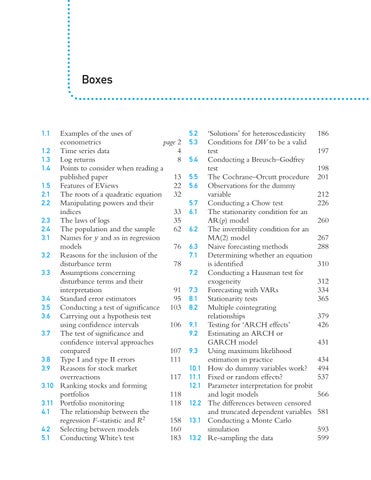
Examples of the uses of econometrics page 2 1.2 Time series data 4 1.3 Log returns 8 1.4 Points to consider when reading a published paper 13 1.5 Features of EViews 22 2.1 The roots of a quadratic equation 32 2.2 Manipulating powers and their indices 33 2.3 The laws of logs 35 2.4 The population and the sample 62 3.1 Names for y and xs in regression models 76 3.2 Reasons for the inclusion of the disturbance term 78 3.3 Assumptions concerning disturbance terms and their interpretation 91 3.4 Standard error estimators 95 3.5 Conducting a test of significance 103 3.6 Carrying out a hypothesis test using confidence intervals 106 3.7 The test of significance and confidence interval approaches compared 107 3.8 Type I and type II errors 111 3.9 Reasons for stock market overreactions 117 3.10 Ranking stocks and forming portfolios 118 3.11 Portfolio monitoring 118 4.1 The relationship between the regression F-statistic and R2 158 4.2 Selecting between models 160 5.1 Conducting White’s test 183 1.1
5.2 5.3 5.4 5.5 5.6 5.7 6.1 6.2 6.3 7.1 7.2 7.3 8.1 8.2 9.1 9.2 9.3 10.1 11.1 12.1 12.2 13.1 13.2
‘Solutions’ for heteroscedasticity Conditions for DW to be a valid test Conducting a Breusch–Godfrey test The Cochrane–Orcutt procedure Observations for the dummy variable Conducting a Chow test The stationarity condition for an AR(p) model The invertibility condition for an MA(2) model Naive forecasting methods Determining whether an equation is identified Conducting a Hausman test for exogeneity Forecasting with VARs Stationarity tests Multiple cointegrating relationships Testing for ‘ARCH effects’ Estimating an ARCH or GARCH model Using maximum likelihood estimation in practice How do dummy variables work? Fixed or random effects? Parameter interpretation for probit and logit models The differences between censored and truncated dependent variables Conducting a Monte Carlo simulation Re-sampling the data
186 197 198 201 212 226 260 267 288 310 312 334 365 379 426 431 434 494 537 566 581 593 599