Notes on the Exhibition
by Gary-Ross Pastrana
For the better part of the last few months, Corinne De San Jose has been coming and going at Calle Wright, using one of the newly renovated bedrooms in the adjacent house as an ad hoc workspace. Her presence has served as an early rehearsal of sorts, allowing us to fine-tune the mechanics of our upcoming residency program before its formal launch.
Afternoons spent here have revealed more noise than anticipated: the nearly daily practice sessions of students rehearsing for school presentations, often on the street and sometimes right in front of our gate; the round-the-clock bustle of delivery trucks; our next-door neighbor’s pack of dogs; and, every so often, the faint cries of, let’s just say, more exotic animals from somewhere further down the block. I’m actually unsure whether it’s accurate to label any of these as noise per se. For someone like Corinne, whose ear is trained to the evocative power of ambient sound, these layers may not register as mere noise. They settle into the place as part of its character, inseparable from its unfolding story.
These things are seen and heard, firmly in the physical realm. Still, anecdotes of other presences moving through the house, from the rooms to the backyard, persist. Some guests profess to feel a certain way immediately upon entering the premises, sensing strange traces that feed into the myth. And here is where the artist’s intervention begins to take shape: as countermeasures—in the same way certain Eastern healing traditions approach illness as an imbalance and, to regain health, one must devise ways to offset it and restore equilibrium.
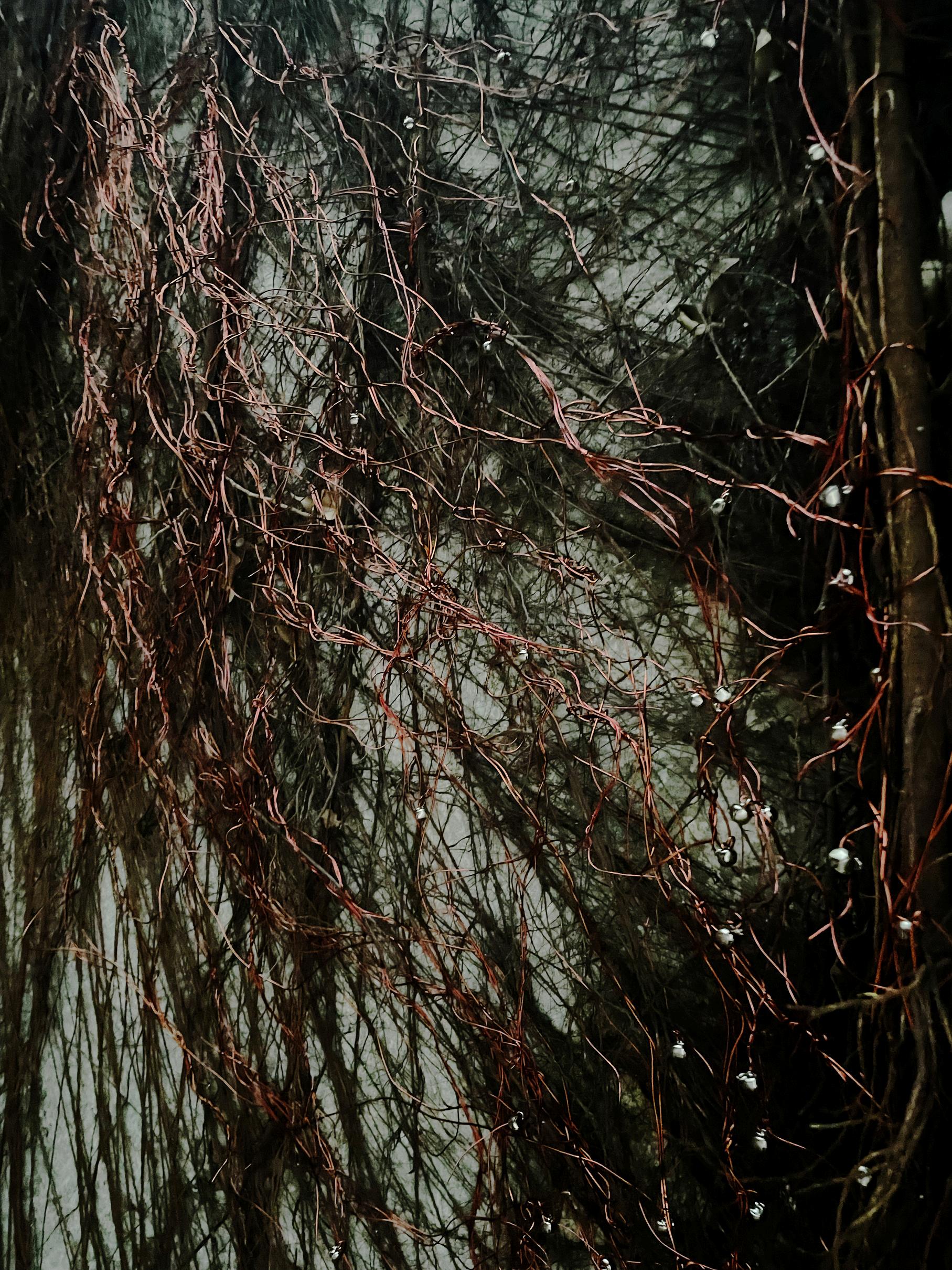
Out back we have, by all indications, a Balete tree. It grew atop an old, dilapidated patio, a ruin from an even older structure that has long been torn down. Otherwise known as the Banyan tree, this persistent creeper from the fig family is also called, somewhat ominously, the Ficus Strangler. I learned that I need to stop referring to those thin, soft, somewhat otherworldly threads that hang loosely from the tree as ‘tendrils’, for they are, in fact, aerial roots. They find their way down from the branches, seeking ground, then lignify (turning from soft to woody) and, if left unchecked, could eventually harden into trunks.
One of the patio’s remaining walls is almost entirely covered and subdued by these roots. Corinne jams this network with copper wires, interrupted by tiny bells, like some ancient warning device that registers the passing wind, tremors, or the presence of a bird or a predatory cat. As the copper strands disappear into this entangled web, they retain their conductive qualities—much like sentient antennas activated by heat or moisture and sensitive to signals that can be harnessed to trigger sound. Elsewhere in the garden, birdcalls tuned to specific frequencies could be heard, subtly modulated to amplify their healing potential.
There must be a reason why some older structures, abandoned and seemingly empty, evoke asense of longing or absence, a kind of unease that urges one to keep the radio on as company, filling the silence. It takes grace to inhabit such a space not as an intruder or disruptor, but as a considerate guest: carving out room for slowness, for the practice of listening to grow and offer respite not just for the audience, but for the house itself this once-inhabited space that perhaps still holds some of its memories. Imprints not erased or overpowered, but received as a given signal.
Corinne’s gestures are complemented by additional works by visiting Singaporean artist Daniel Chong, and an in-development collaborative project by Calle Wright alumni Lesley-Anne Cao and myself. Calle Wright’s first 'Open House' opens on November 22, 2025, and our Residency Program begins in February 2026. Visit our page for further announcements.