SPRING 2017
CENTRAL VALLEY FARMLAND TRUST
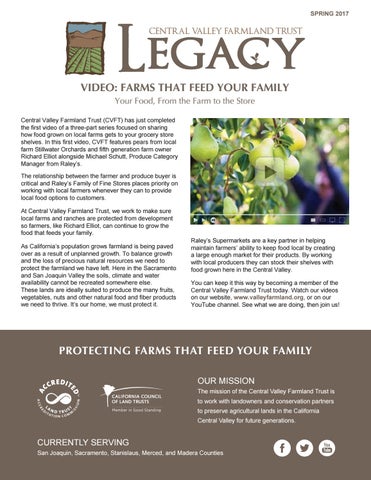
VIDEO: FARMS THAT FEED YOUR FAMILY Your Food, From the Farm to the Store Central Valley Farmland Trust (CVFT) has just completed the first video of a three-part series focused on sharing how food grown on local farms gets to your grocery store shelves. In this first video, CVFT features pears from local farm Stillwater Orchards and fifth generation farm owner Richard Elliot alongside Michael Schutt, Produce Category Manager from Raley’s. The relationship between the farmer and produce buyer is critical and Raley’s Family of Fine Stores places priority on working with local farmers whenever they can to provide local food options to customers. At Central Valley Farmland Trust, we work to make sure local farms and ranches are protected from development so farmers, like Richard Elliot, can continue to grow the food that feeds your family. As California’s population grows farmland is being paved over as a result of unplanned growth. To balance growth and the loss of precious natural resources we need to protect the farmland we have left. Here in the Sacramento and San Joaquin Valley the soils, climate and water availability cannot be recreated somewhere else. These lands are ideally suited to produce the many fruits, vegetables, nuts and other natural food and fiber products we need to thrive. It’s our home, we must protect it.
Raley’s Supermarkets are a key partner in helping maintain farmers’ ability to keep food local by creating a large enough market for their products. By working with local producers they can stock their shelves with food grown here in the Central Valley. You can keep it this way by becoming a member of the Central Valley Farmland Trust today. Watch our videos on our website, www.valleyfarmland.org, or on our YouTube channel. See what we are doing, then join us!
PROTECTING FARMS THAT FEED YOUR FAMILY OUR MISSION The mission of the Central Valley Farmland Trust is to work with landowners and conservation partners to preserve agricultural lands in the California Central Valley for future generations.
CURRENTLY SERVING San Joaquin, Sacramento, Stanislaus, Merced, and Madera Counties
EXECUTIVE DIRECTOR’S MESSAGE: Q & A with Charlotte Mitchell
What can CVFT members expect from you as the new Executive Director? Our members and supporters can expect a level of sincerity and honesty from me as the new Executive Director. As I made a difficult, yet meaningful decision to leave Farm Bureau and accept the position at CVFT, I reflected on my career and soon realized, I have spent my entire life in agriculture! Not just a career, but a lifetime. I have a passion and sincere drive to contribute to the vitality, longevity and protection of California agriculture. Being part of a family farming operation today, I have skin in the game and this continues my drive to do what is right for the industry. I am honored to serve as the Executive Director of CVFT.
How do you think you are uniquely suited for this role? With my background in production agriculture, I am uniquely suited for this role as I have a fundamental understanding of the nature of agriculture from the past, the present and looking into the future. Being able to discuss land preservation with farmers and understand the complexities of the agricultural business will allow me to engage with our our food producers in the most meaningful way.
What are CVFT’s biggest challenges? One of the biggest challenges we face is to secure reliable and consistent state and federal funding to engage farmers who want to protect their farms and ranches for the next generation. Making farmland protection a number one priority for both the State of California and local jurisdictions up and down the valley will consistently be a challenge. While good progress has been made with robust farmland preservation ordinances, our work must continue. Our local elected officials and consumers have the ability to ensure their local food supply remains plentiful, fresh and of the highest quality by supporting the efforts of CVFT.
Let’s pretend you are already retiring, what impact(s) would you like your legacy at CVFT to look like? The impact I want to have at CVFT is to be a respected, honest and reliable partner for our farmers. Ultimately, they make the decision to protect their farmland for future generations. This decision comes with a lot of hard work and dedication on the part of family farmers and I want to be the trustworthy partner that will help them navigate a complex and lengthy road. Exceeding our established goal of 20,000 acres by 2020 can only come with the hard work of building sound relationships with our farmers who have a vision for farmland conservation.
Board Officers: Barbara Smith, Courtland | President Ron Freitas, Modesto | Vice President Maxwell Norton, Merced | Secretary Ken Oneto, Elk Grove | Treasurer Directors: Tim Byrd, Modesto Mike Darnell, Sacramento Ron Dolinsek, Rocklin Larry Ruhstaller, Stockton Staff: Charlotte Mitchell | Executive Director Susan Hooper | Associate Director Darcel Trapani | Administrative Assistant
2
Founding Members: Markus & Elizabeth Bokisch Timothy & Suzanne Byrd Richard & Sharon Clauss John & Jeani Ferrari E & J Gallo Winery Hilmar Cheese Company, Inc. Vance Kennedy, Ph.D Brad Lange/Lange Twins Partnership Martin & Stacey Machado Charles & Sally Magneson Scott & Pamela Magneson Maxwell & Diane Norton Donald & Lynn Skinner Duncan & Barbara Smith Michael & Cathy Tanner
Charter Board Members: Don Bo Markus Bokisch Tim Byrd Jeani Ferrari Denny Jackman Brad Lange Linda Macedo Maxwell Norton Ken Oneto Mike Tanner Trustee Council: George Gomes Ed Nishio Paul Wenger
Editor/Design: Erin Davis, Davis Communications Group Editing Team: Monica Bianchi Mike Darnell Ron Freitas Meredith Rehrman Ritchie Susan Hooper Content: Erin Davis Daniel Best Susan Hooper Charlotte Mitchell John Oneto Becca Whitman
LEGACY
RALEY’S WINE AWARD SPOTLIGHT & FARMLAND CONSERVATION MESSAGE Raley’s was honored to be named Wine Enthusiast’s 2016 Wine Star Award Winner for the “Retailer of the Year” in the United States. Wine Enthusiast cited Raley’s courage to reimagine its wine and spirits category and turn it into a thriving business. The honor is particularly highly regarded because the nominees are determined by an impartial panel of experts from the industry. The team at Raley’s has been working over the last three years to develop a premiere department to broaden customers’ options for eclectic and affordable wines. Central Valley Farmland Trust is proud to announce this award to our readers as Raley’s is a tremendous supporter of the local wines from producers in the CVFT coverage area. A healthy vineyard industry helps keep development and conversion at bay. Thank you Raley’s for supporting local wines and the farms that produce them!
Kevin Curry, Raley’s Senior Vice President Sales, Merchandising, & Distribution at Raley's, Jameson Fink, Wine Enthusiast Editor, and Curtis Mann, Director of Wine, Beer & Spirits at Raley’s. Photo credit: Mark Tomaras Photography
WHY PROTECT FARMLAND IN THE CENTRAL VALLEY OF CALIFORNIA? Recently, we gathered some great minds and talent together to hone in on why protecting farmland is urgent, critical and worthy. We wanted to share some of the work that came out of this gathering so you can share it with your friends, neighbors and colleagues. Help us bring more CVFT members into our community.
But we can stop it, if we act now. We benefit from and rely on the land everyday, its our responsibility to give back, to protect her. The land sustains us; we must sustain her. Become a member of CVFT today and protect farmland with us. A GIFT OF $50 IS LIKE GIVING $200 BECAUSE THE GIFT IS LEVERAGED WITH OTHER FUNDING ALREADY COMMITTED. $.92 OF EVERY DOLLAR GOES TO FARMLAND PROTECTION.
PROTECTING FARMS THAT FEED YOUR FAMILY
3
INDUSTRY INSIGHT Three food industry experts share their insights on providing food to consumers and why farmland conservation is important Daniel Best, C.E.O. Certified Farmers’ Markets of Sacramento:
Q3: From your perspective, what are the biggest challenges facing California farmers?
Q1: What is your farm/company/ organization's mission and why is it important or what impact does it intend to make?
Maintaining the low production cost demands of the consuming public and food distribution industry, while generating enough income both to sustain their farm and their family.
Our mission is to ensure California food supply security and California small-acreage family farm sustainability. Small-acreage California farms are generally not sustainable when they must price-compete in a food distribution system controlled by the low margin economics of large scale farming. This low margin of return is not sufficient for small-acreage farms to meet both the costs of production and the personal costs of raising a farm family. Elimination of regulation and post-production distribution costs can widen the profit margins. Therefore, the primary focus of our mission is the elimination of multiple middle distribution costs by bringing the small-acreage farmer and consumer face to face so they can both benefit financially. However, there are additional valuable benefits gained when the insulating layers between the farmer and the consumer are removed, including a better realization of their mutual dependency and hopefully the creation of an appreciation for each other. We see certified farmers’ markets as a limited means of creating a closer connection between the farm and the person buying food for the preparation of meals. We generally encourage other endeavors that are in tune with our mission of sustaining smallacreage family farms, even though they might be viewed as competitors. Q2: How can grocers, farmer’s markets and other direct-toconsumer farmers work together to make a better food production system? There are those that would perhaps label us as romantics because our vision of a better food production system is not a future of technologically controlled industrial food manufacturing factories. It is also not our vision that we become further food dependent on foreign sources unbridled by the same regulatory cost impositions to which our domestic farmers are subjected. A “better food production system” would be California farms not having to absorb a multitude of rising costs imposed on their farming business without a commensurate increase in the monetary return on their cost of production investment. It would also be one where competing varieties of foreign fresh seasonal produce may only be imported into California if first they have shown comparable compliance with the same environmental protection, pesticide use, food safety and worker compensation requirements imposed on our California farmers. If consumers demand cosmetically perfect, nutritionally beneficial, socially responsible and risk-free food, they also need a household budget responsible for the costs that such a system requires. Therefore, like the farmer and major retailers, the consumer would be an essential stakeholder member included in the “work together” team that is responsible for the design of any “better” food production and distribution system.
4
Gaining the education and knowledge base to comply with the many technical and administrative record keeping requirements demanded by the Food Safety Modernization Act. Finding a means to absorb the multitude of administration and record keeping costs demanded by the seeming endless number of public regulatory and permit agencies. Whether or not to continue to grow labor intensive fresh seasonal crops, like asparagus, that cannot price compete with those simultaneously grown in other countries that do not have same regulatory cost impositions to which our domestic farmers are subjected. Maintaining their personal health which is increasingly strained by the excessively stressful nature of sustaining a viable farming operation in California. Q4: How critical is farmland conservation to the maintenance of your business or the CA food production industry? Highly critical. The preservation of a local California smallacreage farming culture maintains a ready source of food supply not dependent on foreign imports or on large consolidated food distribution grids. This preservation of an economically viable local California food source is an essential part of a successful local food source security foundation. Becca Whitman, Community Relations Manager, Raley’s Family of Fine Stores: Q1: What is your farm/company/ organization's mission and why is it important or what impact does it intend to make? Raley's mission is to make shopping easier, better and more personal. We strive to provide the highest quality products at a good value. Our founder, Tom Raley, believed in treating customers like family and that value still stands true for our 11,000 team members. Raley’s vision is to infuse life with health and wellness. As a grocery store, Raley's has the opportunity to make a profound impact on the decisions customers make when they shop. As each individual’s food journey is a unique experience, Raley’s works to educate customers on how to make more informed decisions when purchasing food. Q2: How can grocers, farmer’s markets and other direct-toconsumer farmers work together to make a better food production system? At Raley’s, we want to increase access to fresh, local produce. We support small local farms through our Living Local program, where we source produce on a store by store level. The challenge
LEGACY
INDUSTRY INSIGHT CONT’D for farmers is meeting the requirements for retail, including quality assurance, risk management and food safety. Raley's has worked to simplify the market channel process for our partners and we offer workshops providing the technical assistance to smaller farmers. We continue to reach out to farmers in our neighborhoods to create new opportunities to get fresh produce to our customers. Q3: From your perspective, what are the biggest challenges facing California farmers? The biggest challenge facing farmers is the aging workforce and decline of small family farms. We need to invest in career pathways programs to guide students into these in-demand jobs. In addition, the impact of technology and automation has increased the need for greater skills acquisition by current and new workers. Q4: How critical is farmland conservation to the maintenance of your business or the CA food production industry? Farmland and rangeland conservation is important for our region and our world. We are grateful to operate our business in the Farm to Fork Capitol, where we have access to a variety of crops, local eats and specialty products. We need to continue investing in our agricultural land for production and long-term sustainability.
“Farmland and rangeland conservation is important for our region and our world.” John Oneto, farmer and owner of Naturally Nuts in Visalia, CA: Q1: What is your farm/company/ organization’s mission and why is it important or what impact does it intend to have? I grew up in the middle of a cherry and walnut orchard. I have lived on a ranch all of my life. In the beginning of my career, I worked in our packing house packing cherries, apples and bell peppers. We also shipped asparagus, apricots and table grapes. Later, I processed over 1.5 billion lbs. of nuts including walnuts, pistachios, pecans and almonds. These experiences give me a fairly broad knowledge of California agriculture. At Naturally Nuts, our local nut shop, I try to use my knowledge and experience to provide the freshest, nicest-quality products available. For 22 years we have been providing people with quality products for a fair value. I also try to tell the story of California agriculture. Few people have had the opportunity to be a farmer, food processor and a retailer dealing directly with the consumer.
Q2: How can grocers, farmer’s market and other direct-toconsumer farmers work together to make a better food production system? Farmer’s markets certainly raise the standards for the grocery industry. They bring fresh items from local and surrounding areas to market regularly. They also bring an abundance and variety of products. We are very fortunate to have such abundance and variety in California, not every area has our good fortune. Thankfully, grocery stores have taken on the task of providing that same variety and abundance across our nation. Many of our products are picked, packed and shipped in the same day, often arriving on the East Coast in just 3 days. As consumer tastes change the markets respond. Never have we seen such selection in the organic section. An important thing about food is that it is a very personal thing. Thus, the market is ever-changing and reacting to consumers’ wants and farmer’s markets are the on the frontline of grower-consumer interaction. Q3: From your perspective, what are the biggest challenges facing California farmers? One of the big issues is water. Some people think that using water for the production of food is a waste of a resource. Our country has 325 million people who expect to eat three meals a day, every day of the year. Just trying to imagine how much food that takes is incomprehensible to me. California raises a large portion of that food. Last summer while driving through the San Joaquin Valley, in one hour I saw 200 truckloads of tomatoes going to the cannery, 9 million lbs. in 1 hour! Not surprising when I learned we produce 26 billion lbs. each summer. Not only do we contribute a large portion of our nation’s food, but we are the major world supplier. We raise over half of all the pistachios and almonds grown in the world, right here in California. Getting all of that food distributed across the nation and around the world in a marketable condition, while still using energy resources wisely is a huge challenge. Sometimes I think that people do not make the connection between food and agriculture. Agriculture is the food we eat, and no one does it better than California! Q4: How critical is farmland conservation to the maintenance of your business or the California food production industry? I have always thought of myself as a steward of the land, a conservationist of nature. Some people may not see commercial agriculture that way, but I sure do. I have often been asked if I believe in sustainable agriculture. My response is, of course. My family has been farming at the same location for nearly 100 years. How do you get more sustainable than that? Often people want to get back to nature, go back to the “good old times,” but today is different. There are more people than ever before. We live in areas with population densities never seen before. We have managed our environment to our advantage. This year is a good example. We have near-record amounts of rain. Without the multitude of dams we have surrounding this valley to control the flood waters, cities would be submerged. We see flood control as a good thing, but using the stored water that results from flood control for agriculture is criticized as a poor use of resources. Storing water and flood control results in benefits to all of California and to agriculture as well.
PROTECTING FARMS THAT FEED YOUR FAMILY
5
24 HOURS TO GIVE! MIDNIGHT MAY 4
Starting at midnight (12AM) on May 4, the Sacramento region will come together for one BIG Day of Giving – a 24-hour giving challenge that funnels as much generosity as we can muster in the place we call home.
LAST YEAR WE BLEW OUR GOAL OUT OF THE WATER, THIS YEAR WE HAVE RAISED THE BAR AND ARE AIMING TO RAISE $20,000! With your support, Central Valley Farmland Trust can continue to work to stop the loss of family farms throughout the Central Valley – these are the farms that feed your family. To make being generous on this day as simple as possible – Like Us on Facebook or Follow Us on Twitter. You can also bookmark our website, www.valleyfarmland.org and we will share links to donate quickly, safely and securely the day of the event. As you consider your gift to farmland, remember that $.92 of every dollar donated to CVFT goes directly to land conservation and we are excited to announce: we can turn your $50 gift into $200 by leveraging it with other dedicated funds.
JOIN US IN PROTECTING THE FARMS THAT FEED OUR FAMILIES.
BIG DAY OF GIVING APPRECIATION EVENT HOSTED BY LANGETWINS WINERY, SUNDAY, JUNE 11
For all of our members and friends who give $300 or more on May 4 during our BIG Day of Giving, you will be invited to a special event just for you at LangeTwins Winery. This luncheon event is our way of showing our appreciation for supporting the protection of local, California family farms. Come enjoy award-winning wine and a delicious meal with us – lets celebrate!
6
For five generations, LangeTwins has proudly practiced the art of sustainable winegrowing. Unlike other farming practices, sustainable winegrowing is all encompassing in its approach, concerning not only the health of the vineyard, but also its surrounding natural environment. To learn more about LangeTwins, visit valleyfarmland.org & click on the BIG Day of Giving.
LEGACY
DIRECTOR’S MESSAGE: Ken Oneto
I would like to take this opportunity to welcome Charlotte Mitchell as our new Executive Director. I have had the pleasure of working with Charlotte over the last 11 years in her previous position as the Executive Director of the Sacramento County Farm Bureau. I have seen her tirelessly campaign to help strengthen agriculture here in Sacramento and at the state and national level. Charlotte carries a driving passion to preserve our agricultural heritage and viability. I have had many opportunities to join Charlotte on visits to numerous government agency meetings. She always held her own, speaking the Farm Bureau’s message to every corner of the county. When you have the chance to meet and work with Charlotte, you will feel her drive, passion and vision. We met a few times before her job change, boy was she excited, many questions, new ideas and anticipation. So where will Charlotte take us from here? Bill was an exceptional founding father. Setting up our internal procedures, agreements with many municipalities in our service area, telling the story of ag land mitigation and getting our foot in many doors. I expect that Charlotte will knock on all of those doors, introduce herself and reintroduce the Central Valley Farmland Trust. I believe that we will become a household name throughout the central valley as the premier land trust in California. Her experience of working with a board of directors and a nonprofit will help our board keep their focus and passion. We still have three original members; Maxwell Norton, Tim Byrd and myself. I think I can confidently say, we are all happy with our new direction. As we move in new directions, you may wonder, what can I do? Do your part in supporting local agriculture. When you are in the store, buy fruits and vegetables that are local and in season. I am always looking at the label on that pear, California for me please. Supporting your local farmer’s market helps and remember each farmer feeds 155 others. The majority of our state’s agricultural product is shipped to other states or exported. Another way to help local agriculture, join your local Farm Bureau. They work hard on local political and regulatory issues facing the ag industry. Show up at public meetings when an agricultural issue is being discussed. State your opinion on the importance of local agriculture in your life. One item that is never really talked about is food security. In our country we have always had the benefit of an extremely safe and abundant food supply. Do you know that you pay less for your food than healthcare? What a wonderful thing that is. So, when you have to pay a few pennies more for that gallon of milk, just hope that it is going to the dairyman, not to pay for more regulations.
PROTECTING FARMS THAT FEED YOUR FAMILY
7
CENTRAL VALLEY FARMLAND TRUST 8788 Elk Grove Blvd, Bldg 1, Ste 1 Elk Grove, CA 95624
NON-PROFIT ORG U . S. POSTAGE PAID PERMIT #182 ELK GROVE, CA
916-687-3178 phone 916-685-1041 fax www.valleyfarmland.org
PROTECTING FARMS THAT FEED YOUR FAMILY