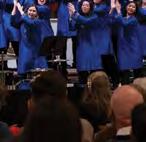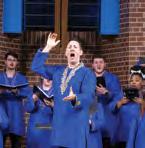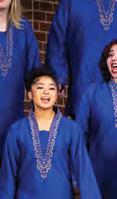
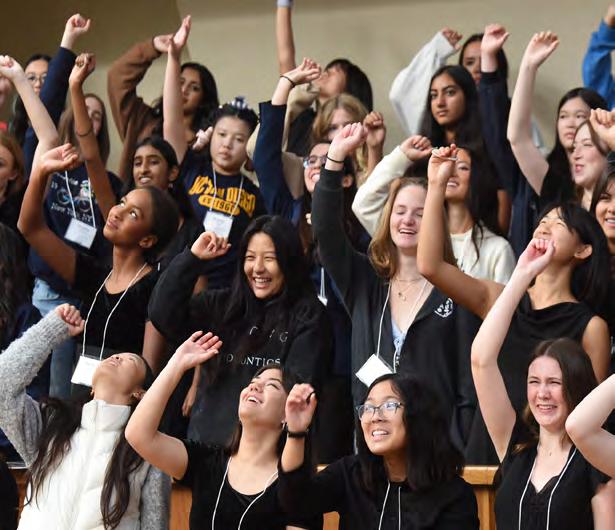
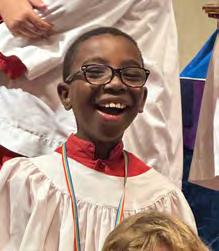
Gus Otey of the All Saints Church Pasadena Unidad Choir is bringing the joy into 2026! Photo courtesy of Jenny Tisi. more photos begin on page 16.
Official publication of the California Choral Directors Association, an Affiliate of the American Choral Directors Association
Eliza Rubenstein, editor cantate editor@gmail com
Ryan Yoder, content coordinator r yoder@bonita k12.ca us
We welcome and encourage CCDA members to contribute articles, announcements, music and book reviews, job vacancy listings, photos, and other items of interest to Cantate!
Please send queries and article ideas to the addresses above. You are also welcome to submit completed articles, but please note that not all articles received will be published.
Deadlines for publication are as follows: August 15 (Fall issue); November 1 (Winter issue); March 1 (Spring issue). The editor reserves the right to edit all submissions.
Please visit our website (www.calcda.org) or e-mail us at cantate.ads@gmail.com for complete information on advertising in Cantate, including rates, deadlines, and graphics specifications. Advertisements are subject to editorial approval.
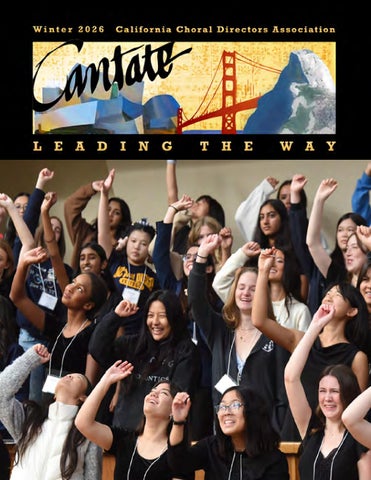
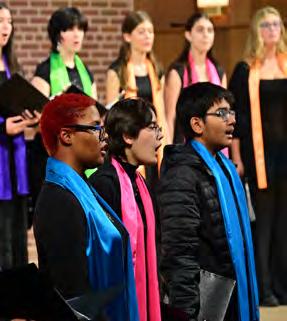
On the cover: Coastal Honor Choir members practice their moves! Photo by Robyn Peters.
WHEREAS, the human spirit is elevated to a broader understanding of itself through study and performance in the aesthetic arts, and WHEREAS, serious cutbacks in funding and support have steadily eroded state institutions and their programs throughout our country,
BE IT RESOLVED that all citizens of the United States actively voice their affirmative and collective support for necessary funding at the local, state, and national levels of education and government, to ensure the survival of arts programs for this and future generations.
California Choral Directors Association empowers choral musicians to create transformative experiences for California’s diverse communities.
CCDAisa501(c)3 non-profit,tax-exempt corporation and an affiliate of the American Choral Directors Association.
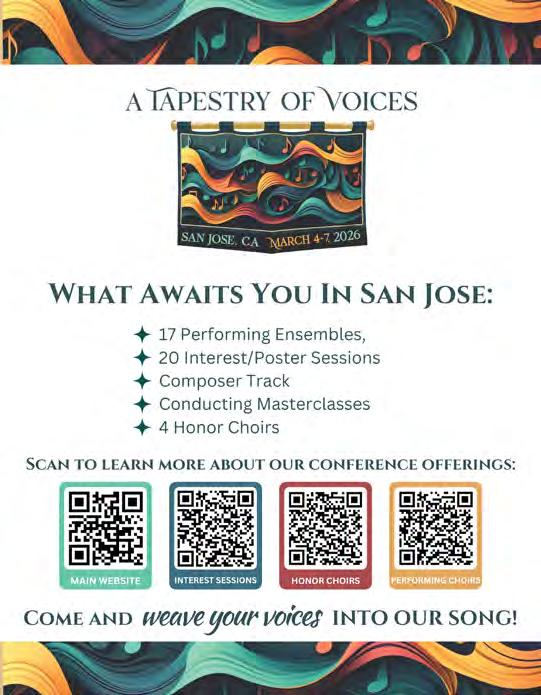
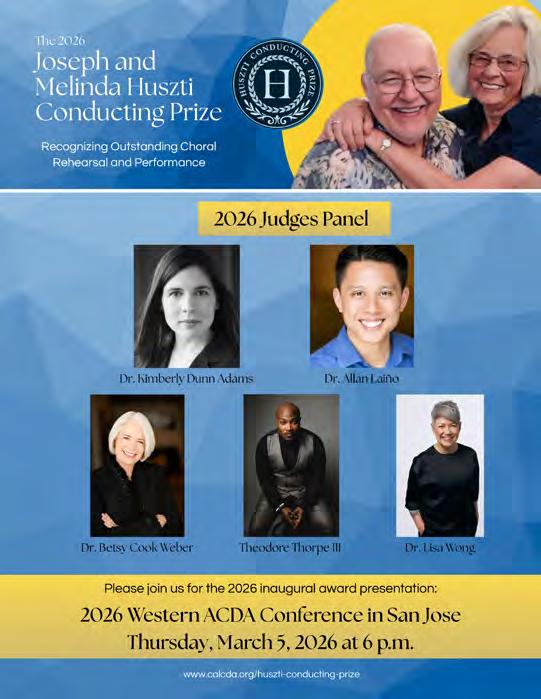
ACDA Western region ConferenCe MArCh 4-7, 2026, sAn Jose



Kristina naKagawa is the executive artistic Director of vivace Youth chorus anD the artistic Director of resounDing achorD ProDuctions, both in san José. PreviouslY, Kristina DirecteD choirs at saratoga high school, st. francis ePiscoPal church, san José state universit Y, anD PinewooD school. as a soloist, Kristina has PerformeD in musicals anD cabaret shows throughout the baY area she receiveD a bm in vocal Performance from uc irvine anD a ma in choral conDucting from san José state universit Y. Kristina anD her husbanD, rYan, are the ProuD Parents of a vivace Youth chorus singer.
“The world is violent and mercurial... it will have its way with you. We are saved only by love...love for each other and the love that we pour into the art we feel compelled to share: being a parent; being a writer; being a painter; being a friend. We live in a perpetually burning building, and what we must save from it, all the time, is love.” Tennessee Williams
Choral
music is the art that I feel compelled to share, and I know that in this column I’m preaching to the choir. Tennessee Williams’ quote reminds me of the text of one of my favorite Unitarian hymns, written by Holly Near:
We are a gentle, angry people, and we are singing, singing for our lives. We are a justice seeking people, and we are singing… We are young and old together, and we are singing… We are a land of many colors, and we are singing…
Throughout the years, verses have been added with references to LGBTQ+ individuals and additional lines that focus on being loving and peaceful people as well. In the past year, watching as our education systems and standards, appreciation and support for the arts, and freedom of speech are dismantled before our eyes has made me a pretty angry person. I tend to program music based on whatever in the world is currently making me angry, so this past fall, my choirs sang music from Rosephanye Powell, performed in both Arabic and Ukrainian, and asked the question “Where Does My Heart Find Home?” Our answer: together, in community, singing for our lives. I’m not sure how gentle I have been of late, but because of choral music, at least I still have hope.
In November I had the immense privilege of sitting in on rehearsals
at the CCDA Coastal Region Honor Choir. The music, chosen by conductors Bruce Rogers, Wei Cheng, and Lynn Atkins, was everything we needed and more. Singers got to experience works from Handel and Brahms, Powell and Hagen, Choi and Cordero, among others. It proved to me, once again, that diverse repertoire fosters connections, and singing that music does so much more than just create beautiful sounds. It creates beautiful people. I know my friends in the Central Region and Southern California Vocal Association choirs had similar experiences. Thank you to all of the incredible California conductors and coordinators for each of these events. I hope you know how grateful we are for your time and care. The start of the new year brings us into conference season! The California All-State Music Education Conference (CASMEC) and Western Region ACDA Conference (WACDA) events bring a wealth of opportunities for learning and networking, and the fantastic performances will inspire you and fill your souls. Thank you to Jennifer Heder, Susanna Peeples, Jenni Gaderlund, and Hillary Ngo for your tireless work putting CASMEC, the All-State Honor Choirs, and the Choral Leadership Academy together, and bravo to Julie Dana, WACDA President, and Cari Earnhart, Conference Chair for all of your incredible work.
At each of these events I know I will learn, and I know I will hear music that will inspire me. Choral conductors and choir enthusiasts are where my heart finds home. You are my gentle, loving people. If we keep working together and keep making music, we might be able to save love from the perpetually burning building.

eliza rubenstein is the Director of choral
anD vocal activities at orange coast college,
anD the artistic Director of the orange count Y women’s chorus she holDs Degrees from oberlin college anD uc irvine, anD she is a former animal shelter suPervisor anD the co-author of a booK about Dog aDoPtion
eliza’s familY incluDes her Partner, Julie fischer, anD five Dogs. she’s Passionate about vegan thai fooD, PhotograPhY, anD the st louis carDinals anD st louis blues
Write about music, Eliza. It’s a magazine for choral directors. It’s a choral magazine.
december 27, 2025 We’ve finished decking the halls and dressing the dogs, and we’ve watched enough old videos of “Christmas from King’s College” to know which anthems our moody Australian shepherd approves of and which he doesn’t.
Last spring in these pages I wrote about the dangers of serenading fascists. Some people agreed; others told me to quit overreacting. Today, in Washington, the government is threatening to sue a jazz musician for canceling a planned gig at the John F. Kennedy Center for the Performing Arts. Serenade the fascists or else.
january 3, 2026. These are the slow days that ease the new year into being, when concerts and carols are finished and e-mails go unanswered without penance. Scrolling back through the messages I’ve allowed to lie fallow during the holiday crush, I revisit a tour-planning thread from six weeks earlier, one filled with early-stage brainstorming and fantasizing rather than late-stage irritation over rooming lists and overdue payments. Where do you want to go? Dream big!
Whoops, nope, not there; the United States just invaded its neighbor to the east. Planning international travel two summers in the future is risky enough as it is. Better cross off those parts of the world that our country might be planning to upend.
january 6, 2026. Brahms Requiem rehearsals begin tonight, and as usual, despite (or because of?) the last three weeks of leisure, I haven’t quite finished marking the score in my lap. Add a tenuto here, circle that
chromatic passage in the alto line, remember that crescendo.
Footage of an insurrection, marking its five-year anniversary, pops up over and over on a browser tab I don’t have the fortitude to click shut. Crowds marching, screaming, pounding on doors. Louder, angrier. Remember that crescendo.
Breathe at these commas in the text. Breathe on those tied-over eighth notes. Breathe.
january 7, 2026. The Brahms read-through last night was a success, thanks to count-singing and sight-reading skills and a smattering of folks who’d sung it sometime in the past. Every time I begin teaching the Requiem, I’m reminded of how deeply I love it, but also of how bloody many notes it has; we got through most of them, though for efficiency’s sake we skipped over movement five—the one with the soprano solo, the one Brahms added two years after the rest of the work had premiered, as a late offering to his departed mother. I awake later than usual with Brahms in my head, because I stayed up later than usual with Brahms in my head.
At 7:37 a.m. Pacific Standard Time, an Immigrations and Customs Enforcement officer in a Minneapolis neighborhood shoots a local woman in the face through the window of her SUV. Her name, impossibly, is Renee Nicole Good. She writes poetry. She wrote poetry. She’s dead now. She was returning home with her wife and dog after dropping her son off at elementary school.
Ich will euch trösten, wie Einen seine Mutter tröstet.
As one whom his mother comforteth, so will I comfort you.
Just write about choral music. It’s a choral magazine, you know.

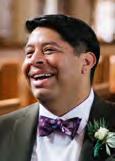
CCDA is deeply saddened by the loss of Eric Graham and Marcelo MartÍnez, two shining stars of the Southern california choral world, in the fall of 2025.
We will pay tribute to Eric and Marcelo in our Spring/Summer issue of Cantate




Are we really talking about recruitment and retention before February? Yes! Because class registration somehow keeps inching earlier and earlier every year, and suddenly those familiar internal conversations start up again:
Who’s coming back next year?
Who might switch electives?
Do my singers feel happy and supported? Is choir still one of the best places to be on campus?
I’ve led a large high school choral program for years, and one of the most common questions I get from colleagues is “What’s the secret to getting kids in the room?” Is it flyers? Free pizza? Bring-a-friend day? Strong social media presence? A solid feeder system? Those things help, but they’re not the secret.
Recruitment isn’t a campaign.
Retention isn’t a trick.
Growth isn’t a gimmick.
It’s a lifestyle of building community, intentionally, consistently, and one singer at a time.
This mindset has shaped both my school choirs and my church choirs. And it’s worked in places with strong feeders and in places
with none at all. The philosophy stays the same: build relationships first, and everything else follows.
Before we go further, hello! I’m Ryan Yoder, Director of Choral Music at Bonita High School in La Verne, where I am lucky enough to work with more than 250 singers across five choirs, and Director of Music at St. Presbyterian Church in Newport Beach. But my most cherished title is: “Ramona Middle, Roynon, Oak Mesa, La Verne Heights, and Grace Miller Elementary School Choir’s Biggest Fan.”
When I asked long-term students why they joined choir and stayed, the answers surprised me. Not one mentioned a flyer, campus visit, or scheduling conversation. Instead, they said things like “When the Chamber Singers came to our elementary school, I knew I wanted to do that someday,” or “I’ve been singing since elementary school, so why would I stop now?” Those responses reframed everything for me. Recruiting students on the high school campus is helpful but often too late. If a senior walks into choir for the first time and loves it, I always find myself saying, “Where have you been? I wish you had joined sooner.” So I began prioritizing presence, not promotion. For our program, the three most important performances of the year are now:
BY RYAN YODER
• Chamber Singers featured on our middle school winter concert
• An elementary school holiday tour in December
• La Verne Sings!, a combined elementary, middle, and high school choir concert in February
I also attend as many feeder concerts as possible—not to recruit, but to cheer. I greet students backstage, congratulate them, and tell them I can’t wait to hear them at the high school someday. I talk with families in the audience because, realistically, parents influence enrollment just as much as students.
But this investment only works when it’s rooted in respect. Elementary and middle school programs are not stepping-stones or audition pools. They are thriving musical communities shaping lifelong singers, and I am endlessly grateful for my colleagues who lead them. My role is that of a partner, not an an extractor. Feeder relationships take time— years, not weeks—but the stability they create is something no flyer or recruitment campaign can match.
Not all students arrive through feeder pathways, so presence on your own campus matters, too. Go to football games, school plays, robotics competitions, ASB events, lunchtime activities, dances. Celebrate your singers outside of choir. Let students see that you care about their lives, not just their voices. Wave at them like you’re running for office. Not because it helps recruitment, but because it tells students, “I see you as a whole human, not just as a singer.”
And yes, I absolutely walk up to kids and say “When are you joining my class?” or “You look like a singer.” (It works. Don’t ask me why.)
Most importantly, I get their names, and it’s not usually the first interaction we have. But I know I’ve hit gold when I remember their name the second time. The sweetest sound a person can hear is the sound of their own name. That lesson came from growing up watching Mister Rogers’ Neighborhood. Fred Rogers had a way of making every person he spoke to feel genuinely seen and valued. He wasn’t just hosting a TV show; he was modeling empathy and human connection. He understood that
acknowledging someone’s presence, especially by remembering their name and their story, is a profound way of communicating respect and care. People feel valued when they feel seen, and Rogers’ quiet, intentional approach taught me that lesson well.
The moment a student realizes that “Mr. Yoder remembered my name” or “Mr. Yoder wants me to join his class,” the relationship changes. Recruiting should never feel transactional; it should feel relational. The same philosophy has strengthened my church choir. We launched a summer pick-up choir so congregants who can’t commit during the school year still have an entry point. Not everyone becomes a year-round member immediately. But a relationship begins, and relationships eventually build choirs.
Recruitment gets them in the door. Culture keeps them there. Students want to belong to something others are proud of, so we intentionally develop student ownership. Our student council leads social events, helps with attire, runs social media, organizes tours, and builds community across ensembles. Some of our most successful bonding traditions include Halloween movie night, karaoke/game night, and all-choir pizza lunch the first month of school.
Music brings students in, and the community keeps them coming back. In our rehearsals, we make intentional space to affirm one another—especially during moments when singers need a brief vocal rest. I’ll say, “I need at least five affirmations for someone else in the group,” and sometimes I’ll narrow it further to “only musical affirmations” or “only non-musical affirmations.” Before students sit down after singing a passage, I might say, “Turn to the person next to you and thank them for singing in this group,” or after a sight-reading exercise, “Tell your neighbor, ‘You read music really well.’” These small practices remind our singers that what we are building is much bigger than just singing. It is a community rooted in gratitude, encouragement, and shared purpose. Eventually, the students take responsibility for the culture, and that may be the most powerful recruitment tool of all.
Students want to feel like they’re part of something excellent, but excellence looks different in every ensemble. A beginning mixed choir of freshmen achieving a clean unison? Huge win. A choir sight-reading confidently for the first time? Celebrate it. A bass section that finally locks in those F-sharps? Throw a parade. Every ensemble is a top ensemble. Just as we don’t view our feeder programs as a means to an end, our entry-level ensembles are not a means to an end either. Our responsibility is to take the singers in front of us and help that ensemble “win,” whatever winning looks like for that particular group. I want five superior ensembles, and that will look different in each room. I can’t, and shouldn’t, compare a mixed choir of all freshmen with an advanced treble ensemble, or any other combination of voices.
our true measure of success lies. Success is not reserved for the most advanced group. Entry-level ensembles are not stepping-stones, they are destinations worthy of excellence, joy, and recognition. Awards, festivals, and honors are wonderful, but the greater accomplishment is creating lifelong musicians who continue singing long after they leave us.
What I can do is work to produce the strongest, most confident, most musical version of each ensemble right where they are. This requires a broader mindset than “preparing these singers so they can someday beef up the top group.” Our goal is to build lifelong singers, and that is where
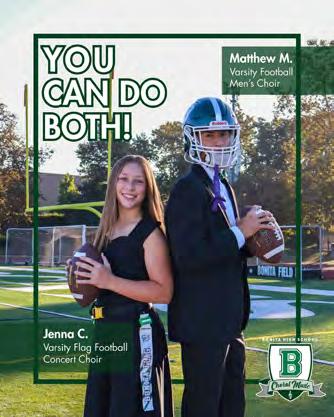
One of the most common obstacles to enrollment is the belief that students must choose between choir and everything else; sports, ASB, AP classes, dance, clubs. So we launched a social media campaign called “You Can Do Both.” Instead of promoting how lucky we are to have kids in choir from other activities, we flipped the script:
Choir kids play football. Choir kids are cheer captains. Choir kids take AP physics. Choir kids run student government. This
reframes choir not as competition, but as collaboration. It also strengthens relationships with coaches, counselors, and other program leaders, relationships that make scheduling, advocacy, and conflict resolution far easier. Suddenly, choir isn’t the thing preventing involvement; choir is the thread connecting
involved, confident, balanced humans. And the message is true: students are better humans when they do both.
One of my favorite mantras is: “All the best ideas I’ve ever had were stolen from someone else.” If you’re reading this magazine, attending conferences, following programs online, or reaching out to colleagues, you’re already doing the right work. Recruitment and retention are not seasonal, they are daily, relational, human practices. Programs blossom when we shift from “How do I grow my choir?” to “How do I invest in people?”
conversation, or idea, please reach out. I would love to connect at r.yoder@bonita.k12. ca.us. Or see what our program is up to on social media: @bonitachoralmusic are better when we build together!
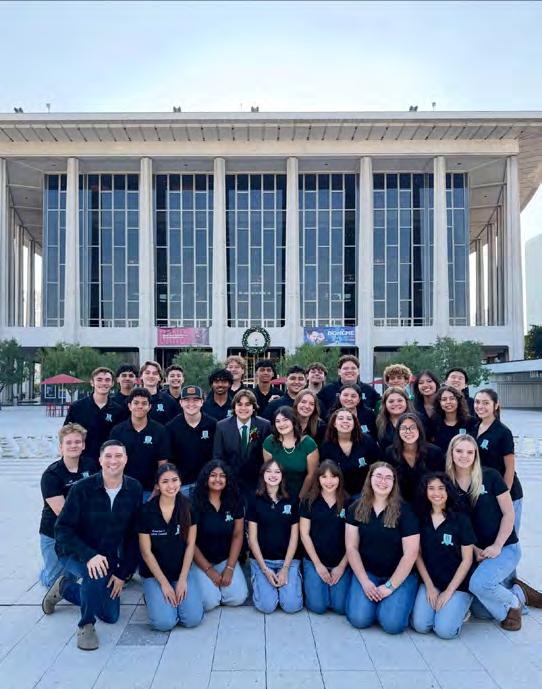
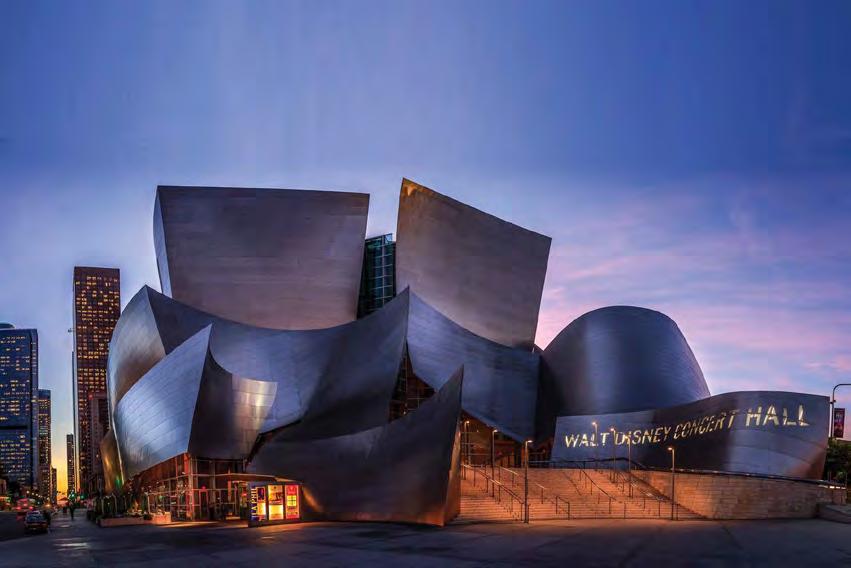
On page 10: gather at Los Angeles’s Dorothy Chandler Pavilion before a performance.
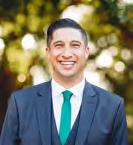
Ryan Yoder is the Director of Choral Music at Bonita High School in La Verne, California, where he leads more than 200 students across five ensembles. Under his leadership, Bonita’s
performed at venues and events including

CONFERENC
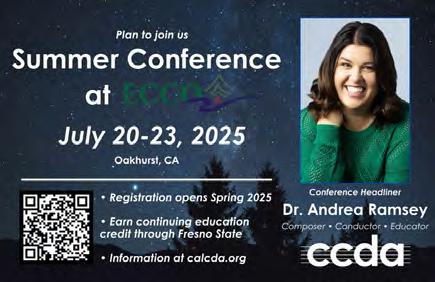
CONFERENCE HEADLINERS





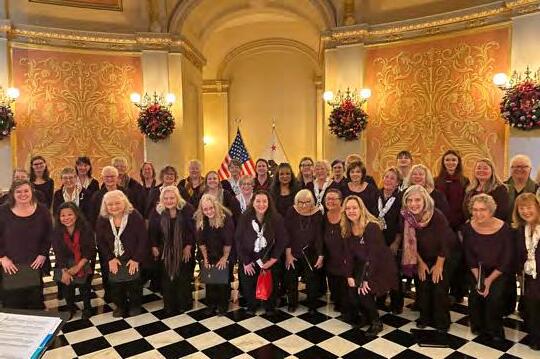
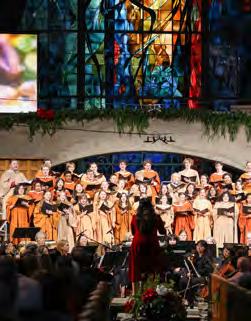
Clockwise from right: Susanna Peeples gets a gift of peppermint Peeps from her Granite Bay High School students; Carlmont High School (Genevieve Tep, director) presents their holiday concert; Sandy Rosales leads the Trinity United Presbyterian Church High School/College Chapel Choir in their Christmas celebration; Vivace Youth Chorus members “Sing in the Season” (Kristina Nakagawa, director); and Sacramento Women’s Chorus (Rachel Jackson, director) performs at the state capitol.
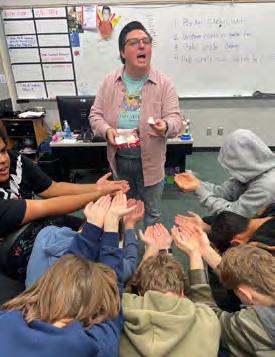
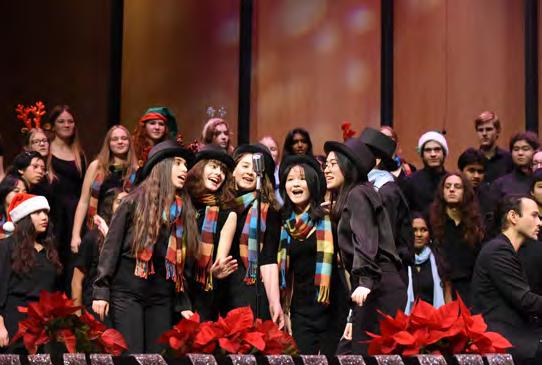
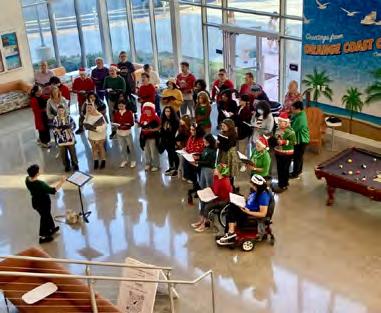
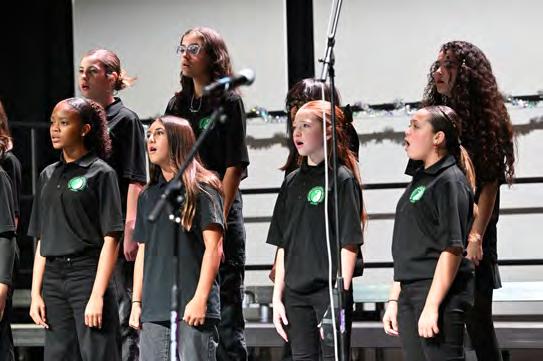
Right: The Orange Coast College Chorale (Kelly Self, director) spread some midday holiday cheer at OCC’s new student center during finals week; below: thanks to Prop 28, choral music has returned to Matthew Gage Middle School in Riverside, and their chorus (Kristen Walton, director) performs in a winter concert alongside Riverside Poly High.
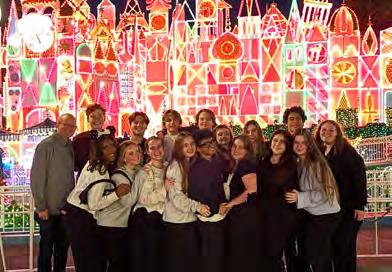
Left: Singers from Tesoro High School (Keith Hancock, director) visit the happiest place on earth during the holiday season. Send your best photos to Ryan Yoder at r.yoder@bonita.k12. ca.us if you’d like them considered for inclusion in a future issue of Cantate!
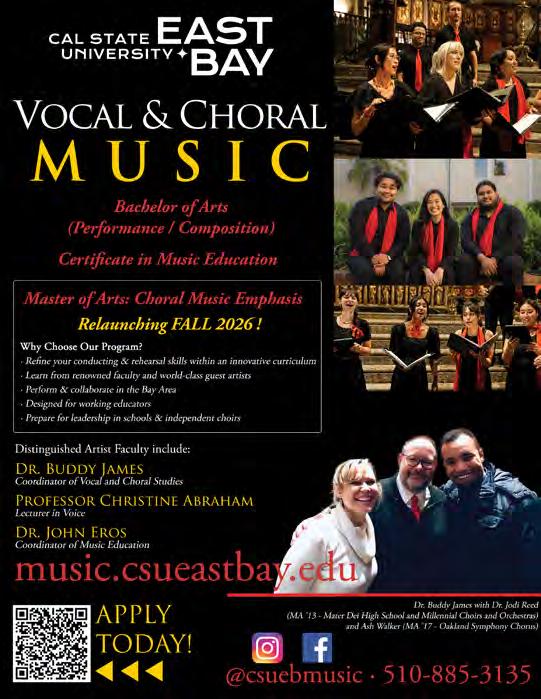
In October, Dr. Buddy James held the 15th Annual Tenor-Bass Festival at Cal State East Bay with clinician Frank Bianchi. Frank was Buddy’s high school teacher and the person who inspired him to pursue his career in choral music.
In November 2025, the Albany Choirs, under the direction of Kate Huizinga, were privileged to welcome Chanticleer into their space for a concert and workshop.
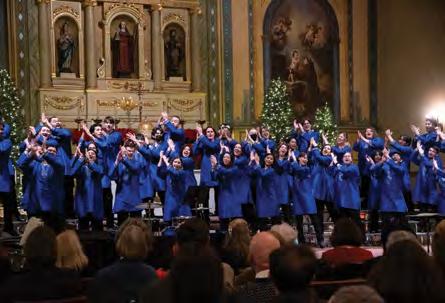
San Jose State University invited high school teachers from all over the Bay Area to recommend students to participate in the SJSU Honor Choir. Singers spent a whole day at SJSU learning and singing together, and joined the SJSU choirs for their concert in mid-October.
Send us news to share about hirings, retirements, collaborations, commissions, premieres, awards, or projects!
Adjudicator, and Ken Rawdon, Adjudicator.
On November 2, Schola Cantorum (Buddy James, director) performed Amor! 2: Music from Brazil, created in partnership with Dr. Daniel Afonso. Through this performance, voices, rhythms, and stories from across Brazil came to life.
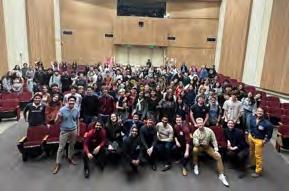
The CMEA Bay Section Honor Choir was held in late November at SJSU. Students in grades 7-9 came together to perform in two honor choirs conducted by Angelina Fitzhugh and Eric Tuan.
A huge thank you to Daniel Afonso (CSU Stanislaus), Cari Earnhart (Fresno State), Alissa Gibbs (Enterprise High School), Amanda Isaac (Bakersfield High School), Daniel Paulson (Sacramento City College), and John Sorber (College of the Sequoias) for hosting Central Region Honor Choir auditions and for their dedication to our young musicians.
The Fresno State Choirs under the direction of Dr. Cari Earnhart hosted their annual invitational choral festival in October 2025, where 59 choirs participated and were adjudicated by select panelists. Those panelists included Dr. Earnhart, Director of Choral Activities, Dr. Alyssa Cossey, Clinician, Kristina Nakagawa,
The La Jolla Symphony and Chorus, conducted by Dr. Arian Khaefi, presented Joy! A Messiah Celebration, a festive celebration of choral joy, community spirit, and holiday cheer, on November 29. The power of choral music took center stage in this moving and festive experience.
Dr. Jeffrey Benson is excited to add “Happy New Year, My Friends,” arr. by Will Schneider, and “Dawn, Unhindered” by Eric Tuan to his choral series with Santa Barbara Music Publishing.
In October, CSU Bakersfield held their 1st Annual Invitational Festival, and it was a huge success with adjudicators Christopher Borges and Matt Hanne. CSUB is grateful to all the amazing schools and directors who joined them for this exciting event: Mt. Whitney High School (Tim Howard), Hanford High School (Jennifer McGill), Stockdale High School (Rebecca Spickler), Centennial High School (Patrick Burzlaff), Foothill High School (David Ortiz), and Redwood High School (Mel Carrillo).
Congratulations to Dr. Cari Earnhart for being elected as the Western Region American Choral Directors Association President-Elect. She begins her term on July 1 and will serve as WACDA President from 2028-2030.
Send your news items and photos to MARC McGHEE at mmcghee@luhsd.k12.ca.us!
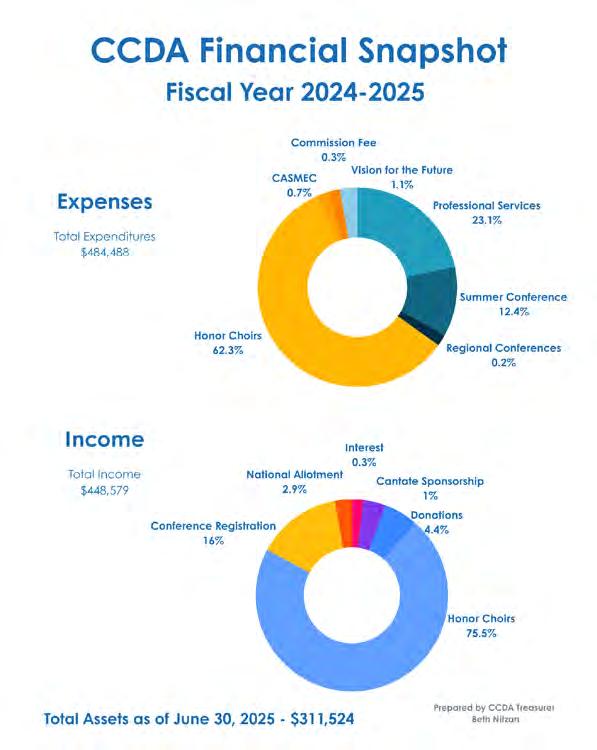
Each year CCDA is proud to offer several grants and scholarships to support our members This year we have increased the amounts awarded for some of our grants and have added a new summer conference scholarship Please consider applying for any of these grants or donating to CCDA to help us keep doing this important work

Applications will be available online in January and are due Friday, March 13, 2026. Please visit www.calcda.org for additional details and applications.
This scholarship award of up to $1,500 will be given to support a professional member's attendance at one of America’s nationally recognized conducting workshops Eligibility: Any current professional Active CCDA member in good standing What activity is supported by the funds? Any workshop or program of study in advanced conducting, the workshop should be nationally recognized for musical and artistic excellence, and the attendee must participate as an active conducting participant in the program
CCDA CHORAL EQUITY
This scholarship award of up to $2,000 will be given to support special projects that are specif ically available for BIPOC (Black, Indigenous, and people of color) and/or underrepresented choral directors in California Eligibility: Any choral, educational or equity-based program that aids in the musical or communal benef it of a BIPOC and/or underrepresented choral director in California can be submitted to the committee for consideration The funds may be used for musical and social programs that will benef it the choral director, their musicians, and the communities in which they serve

In honor of two of our most longstanding summer conference attendees, this scholarship will be given to support professional members (non-students) to attend CCDA’s summer conference at ECCO These scholarships include lodging, registration and meals Eligibility: Any Active professional (non-student) member in good standing
THE CCDA CREATIVITY GRANT
This scholarship award of up to $2,000 will be given to special projects such as presentations, research, travel, performances, and other activities that leads to promoting excellence in choral music Criteria for Application: Any idea that focuses on “Creating Opportunities Promoting Excellence” can be submitted to the committee for consideration.
Established in conjunction with CCDA by Bill's husband David Masone, this award provides funds to support a professional member’s (non-student) attendance at CCDA’s Summer Conference at ECCO The award includes lodging, registration and meals, up to $575 00 Eligibility: Any choral music educator who is over 21 years of age, in their f irst f ive years of teaching at the elementary, high school, and/or college or university levels of choir in California, and attending the ECCO experience for the f irst time as a "new attendee "


KNOW A

OR
This list includes donations made in the past year. kindly bring ERRORS OR OMISSIONS to our attention BY E-mAILING info@calcda.org so that we may make A correction as soon as possible. Thank you for your support!
President’s Circle
Diamond ($1000 and higher)
Resounding Achord
Dr. Arlie Langager*
Susie Martone
David Masone and William Hall
Legacy Giving, in honor of Dr. Gene Peterson, Dr. Jonathan Talberg, and Dr. Joseph Modica
Ken Rawdon
Lori Marie Rios and Bryan D. Walker*, in honor of Shirley Nute, Don Brinegar, and Bruce Mayhall-Rastrelli
Trevor Strohman
President’s Circle Platinum ($500-$999)
ACFEA Tour Consultants
Dr. Daniel Afonso Jr*, in honor of Bill Hatcher
Mike and Julie Dana*, in celebration of ECCO conference
Lou and Mary De La Rosa*, in memory of Jim Heiner
Angelina Fitzhugh
Keith Hancock
Duand and Linda Lovaas*
Susie Martone
National Concerts
Bob Rogers Travel, Inc. Burt and Polly Vasché*
President’s Circle Gold ($300-$499)
Florence Agcawili
Marc McGhee
Kristina and Ryan Nakagawa*, in memory of Lois Carah and Joe Huszti
Beth Nitzan and Rob Blenk
June Ou
Cliff and Cindy Samson, in celebration of Joe and Melinda Huszti
Magen Solomon, in memory of Joe Huszti
Dr. Jonathan Talberg*, in honor of Dr. William Hall
President’s Circle Silver ($100-$299)
Lorna and Haroutune Bedelian, in memory of Joseph and Melinda Huszti
Felicia Bessent
Patrick Burzlaff
Katie Carbajal
Lauren Diez
Karen Fulmer
Jennifer Gaderlund
Brian Gorelick
Scot Hanna-Weir
Marty Haynes
Dr. Ron Kean*, in memory of Dr. Lynn Bielefelt
Chiara Njoo Ko, in memory of Joseph and Melinda Huszti
Ludus
Richard S. March, in honor of Dr. Don Kendrick
Richard Martone
Hugh McDevitt
Emily Moore
Christina O’Guinn
Lynn and Steve Overcashier
Jeff Peckham
Susanna Peeples, in memory of Germán Aguilar
Molly Peters, in honor of Lori Marie Rios
Matthew Potterton
Zanaida Robles
Genevieve Tep*
Randeep Toor
Sponsor ($50-$99)
Dr. Cari Earnhart
Brett Epperson
James Jirak
Suzanne Martone
Lisa McCormick
Willi Mickelson
Sheela Raju
Sandy Rosales
Karyn Silva and Dan Kildahl
Susan Swerdlow
Supporter (up to $50)
Loreen Dunbar
Shelley Durbin, in memory of Charles Irvin
Joy Gage
Jason Gallardo
Kate Huizinga
Linda Manuilow
Hillary Ngo
Michael Ortiz
Andreas Preponis
Noah Sutherland
Ryan Yoder
William A. Zinn*
* Founder’s Circle
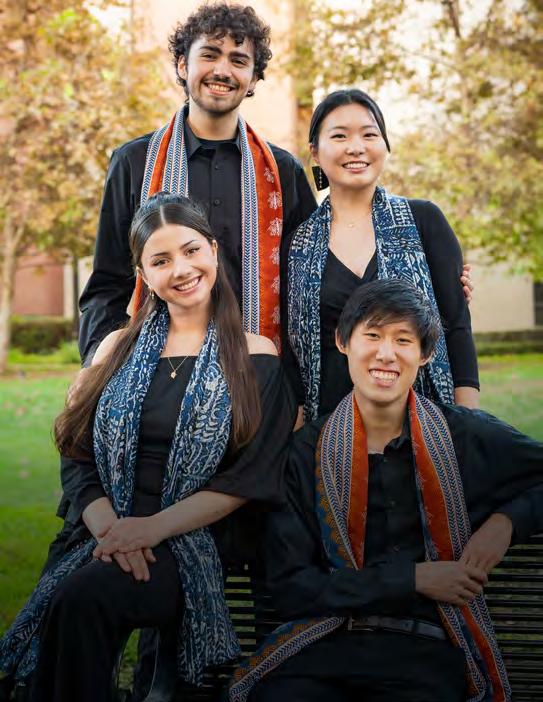





matthew brown is active in los angeles as a comPoser, orchestrator, arranger, KeYboarDist, session singer, anD tenor with the los angeles master chorale. his choral worKs, haileD bY the new YorK times as “ quietlY mesmerizing,” are featureD on the antioch chamber ensemble’s album though love be a DaY he comPleteD his Doctoral stuDies in comPosition at usc. his worKs have been PerformeD throughout the us anD internationallY bY chanticleer, the crossing, the la master chorale, the Young new YorKers’ chorus, la choral lab, usc chamber singers, anD more
Iam
honored to begin serving as CCDA’s new Composition Chair and to continue the work so beautifully led by Dr. Zanaida Stewart Robles. Her warmth, insight, and advocacy for living composers have set a high standard, and I am grateful for her example. My goal in this role is to build on that foundation and to create new pathways for connection between California’s composers and conductors.
When a choir brings a new piece of music to life, there is a particular kind of electricity in the air. The singers’ curiosity, the composer’s anticipation, and the director’s trust all combine to form something both fragile and powerful. I have seen this spark in professional ensembles, in community choirs, and in classrooms. It reminds me that choral music is not only about what we sing but also about how we shape sound together.
As a composer, I have spent much of my life on both sides of the podium. I have taught, conducted, and sung in choirs across Southern California, while also writing new works for professional ensembles such as the Los Angeles Master Chorale. These experiences have shown me that when composers and conductors collaborate early and often, the result is deeper artistry for everyone involved.
Here are a few simple ways we can continue to strengthen those connections in the year ahead:
1. Celebrate local voices.
California has one of the richest ecosystems of choral composers in the world. By programming even one new work each season, directors can help grow that community and give their singers the thrill of singing music by someone they might meet in person.
2. Start small and grow.
Commissioning does not have to be intimidating. A short a cappella piece or a consortium-style project can make a lasting impression. Many composers, myself included, are eager to write with the specific character and sound of a choir in mind.
3. Encourage experimentation.
Invite a composer to visit rehearsal, even for fifteen minutes, to share their process. Offer reading sessions, combine poetry and song, or explore new textures and techniques. These moments of curiosity often spark lifelong curiosity and collaboration. Working directly with a living composer also challenges singers to engage more deeply with the creative process, developing flexibility, imagination, improvisation, and a greater sense of artistic ownership.
4. Share your successes.
When your choir performs a new work, post a clip, tag the composer, or write a short reflection for Cantate. Visibility and enthusiasm help new music reach other ensembles, and they remind us all that choral composition is thriving and evolving.
I also encourage conductors and composers to explore the new WACDA Composer Directory, developed by 2026 Western ACDA Composer Track Co-chair David Saldaña. This resource makes it easier than ever to discover active composers across our region and to build bridges between creative voices and performing ensembles. Visit the directory at www.acdawestern.org/ composer-directory.
In the coming year, I hope to highlight California composers, promote opportunities for collaboration, and develop resources that make it easier for choirs to discover and perform new music. If you have ideas, suggestions, or stories to share, please reach out to me at matt@ mattbrowncomposer.com. I would love to hear from you.
Together, we can continue to expand the conversation that Dr. Robles began and keep our state at the forefront of new choral creation. The arts remind us of our shared humanity, and in times of uncertainty, creative expression is more essential than ever. The future of choral music in California is bright, and it is ours to shape.
The winning composer will receive $500 and be invited to attend the 2026 CCDA ECCO Summer Choral Conference for FREE! Could you be this year’s winner? Get ready to submit your composition with the chance to have it distributed to and read by choral directors from all around the state. Please visit www.GeorGeHeussenstamm com to learn more about our late, great, talented, and generous benefactor.
Eligibility: Adult composers are invited to submit a single, original composition, not from a larger set. We are looking for single, stand-alone compositions, not sets and not arrangements. Shorter works (3-5 minutes) are preferred. (Previous winners are not eligible to apply.) Winners agree to become members of ACDA.
Scores: Please submit your anonymous, unpublished* score, a cappella or with piano accompaniment (no obbligato instruments), any voicing, along with an anonymous demo recording (MIDI is acceptable but voices are preferred) to znrobles@Gmail com. Please visit the CCDA website to enter all composition and composer information via Google Form.
NOTE: Please be sure to remove composer’s name ANYWHERE that it might appear: file name, title page, copyright notice, headers/footers, etc., and even on audio file information.
Format: All scores must be submitted in PDF format AND all audio files must be in MP3 format.
Dates: Submissions will be accepted from Feb. 15, 2026 through Mar. 15, 2026, 11:59 p.m. PDT.
Submissions that do not meet the above requirements WILL NOT BE CONSIDERED. Compositions will be judged on the following criteria: Overall Effect, Overall Craft, Harmonic Interest, Rhythmic Interest, Melodic Interest, Text Usage, Originality, and Cosmetics of Score. As we are interested in finding works that might be considered for inclusion in the CCDA Choral Series with Pavane Publishing, we will also consider the composition’s marketability.
Winner: The winning composition will be chosen by the CCDA Choral Composition Committee and will be announced on the CCDA website at the end of April 2026. The winning composer will receive a scholarship for tuition, room, and board at ECCO 2026, and will have their composition copied, distributed, and read at the summer conference. The winning composer will also receive a $500 cash prize. The winning score may be given consideration for inclusion in the CCDA Choral Series on Pavane Publishing. [NOTE: CCDA reserves the right to declare “no winner” if it is deemed appropriate.]
* “Unpublished” is defined as “not released for public distribution or sale.” Self-published works and works published in audio and/or video formats are also ineligible; if the public can access any version of it, then it is ineligible.
Contact Matt Brown at matt@mattbrowncomposer.com for more information.

PatricK burzlaff has taught in the Kern high school District for 18 Years anD has serveD as the choir Director at centennial high school for 14. he holDs a ba in music from luther college anD an ma in choral conDucting from csula mr burzlaff was awarDeD the Kcmea choral music eDucator of the Year (2016), featureD as one of baKersfielD’s 20 unDer 40 PeoPle to watch (2020), anD nameD the Kcmea eDucator of the Year (2022). he has serveD as chair for the ccDa regional honor choir anD guest conDuctor for the Kern count Y honors music festival,.
To truly experience the thrill of Bass Choir, you must step into the choir room and embrace the unique blend of ambition, camaraderie, and chaos before you. Walk into a Bass Choir rehearsal on a good day, and you’ll notice the energy is alive; whether it’s focused energy or not might be in question, but where there is energy, there’s an eagerness for new concepts, more music, and vocal development.
I have found no better way to focus great energy than with a spirited adaptation of Handel’s duet from Judas Maccabaeus, “Sing for Joy,” arranged by Linda Spevacek. It’s a nice starter piece to teach technique and diction while still engaging their interest.
Observe a rehearsal on a rough day in Bass Choir, and you may find lost souls searching for motivation or even an interest in singing at all. One of the challenges that I typically face in this setting is the underdeveloped head voice. Matching pitch takes time and careful scaffolding.
Here are some strategies for matching pitch that have worked for me:
Eliminate the overtones: Resonant sounds tend to confuse the untrained ear, so put away the piano and your big vibrato and have them sing lightly and even breathy to better access the head voice.
Use speech inflection: Singing is not far off from sustained speech. Implement exercises that ascend using speech inflection, i.e., “Mom,” in a low, embarrassed voice, or “Dad, can I have $20,” in a lighter, sweeter voice. Be creative in coming up with something to help match them in their head voice.
Breath Energy: Crank up the sound physically: use the dominant hand to turn an imaginary crank, gathering speed and energy, to help ascend them out of the basement.
Register choices: Differentiating and identifying chest voice, mixed voice, and head voice goes a long way to assist with intonation issues in the music.
Proximity considerations: Don’t be afraid to change up formations, put them in circles, or have them cup their ear. Switching up the usual standing
formation disrupts the aural perception of the singer, allowing them to hear themselves and their peers differently.
“Yellow Bird,” based on a Caribbean folksong arranged by Dan Davison, is a great piece during tough years with Bass Choirs. It’s entertaining with just the right amount of challenge to build musicianship.
Naturally, there is an element of competitive-mindedness in Bass Choir. With that, there is a willingness to make mistakes that would otherwise be less prevalent in other choirs. Whether they are earning an opportunity to take a shot at the basketball hoop, selling enough cookie dough to win a pizza party, or auditioning for the one who gets to play the djembe at the concert, tenors and basses love the thrill of competition. Working this to your advantage is a powerful tool.
“Betelehemu,” a Nigerian Carol arranged by Andy Beck, incorporates percussive elements. Bass Choirs will jump at the chance to audition to play a percussion instrument.
Channeling the chaos in Bass Choir can be a challenge, but it doesn’t mean you can’t have fun while managing it. Here are some additional things to consider:
Keep it enjoyable: This class dictates whether you have tenors and basses in your program in the future, so make sure they are having fun while learning musicianship.
Schedule it first thing in the morning: That way, they are slightly sedated, yet still active enough to produce supported sounds early in the morning.
Respect goes both ways: You’ll easily win them over if you demonstrate what you preach, show empathy, and use language that builds up, not puts down.
Be genuine: It’s hard balancing this while keeping things light and enjoyable, but being transparent and real with them goes a long way to helping them respect you.
“Take, O Take Those Lips Away,” by J. Edmund Hughes & Mary Ellen Loose is a lovely setting of the notable Shakespearean text, available at Santa Barbara Music Publishing, and is great for eliciting the emotive aspect of Bass Choir.

Jesse Diaz serves as Director of choirs at reDlanDs high school, where he is in his eleventh Year
leaDing a vibrant anD nationallY recognizeD choral Program. before moving to california, he sPent ten Years
teaching vocal music in the miDwest, builDing Programs grounDeD in artistrY, communit Y, anD stuDent growth. he holDs a bachelor of music in music
eDucation from milliKin universit Y, a master of music in music eDucation from ball state universit Y, anD a master of science in curriculum
anD instruction from governors state universit Y
For this list (a Top Five and a bonus!), we focused on repertoire for secondary, collegiate, and community SSAA choirs. These selections have become favorites not only for us as conductors, but also for the singers who learn and perform them.
Advanced Middle School, NonAuditioned High School, or Community Treble Ensemble
uno naissoo
Metsa Telegramm
(The Woodpecker’s Warning)
SSA and piano, with woodblock or rhythm sticks
Hal Leonard
This lively piece, available in both Estonian and English, begins in unison with the voices echoing the woodpecker’s call—“Tok, tok, tok”— reinforced by the woodblock. In the middle section, sopranos and altos toss the melody back and forth before returning to the opening theme, fading into a final whisper. A charming call to preserve the beauty of the forest!
arr. ruth elaine schram
The Turtle Dove
SSA and piano
BriLee Music Publishing
Schram’s setting of this traditional English folk song is tender and expressive, featuring flowing vocal lines, gentle dissonances, and a poignant sense of longing. The simple harmonic structure allows for growth in part independence, supported by a rich and expressive piano accompaniment. A beautiful opportunity to develop blend, phrasing, and sensitivity.
Auditioned/Advanced High School, University, or Community Treble Ensemble
marie-claire saindon
Terre-Neuve
SSAA a cappella and body percussion
Cypress Choral Music
This vivid and percussive piece evokes the rugged landscape of Newfoundland, with a dramatic chordal opening
giving way to rhythmic interplay and body percussion. A quieter section follows before building to a joyful and energetic conclusion. According to the composer, “Terre-Neuve is a love letter to the powerful geology that is the island of Newfoundland and its ancient mysteries.”
dan Forrest
Come to Me
SSAA and piano (optional cello)
Beckenhorst Press
Forrest’s SSAA arrangement offers singers a chance to explore expressive nuance, dynamic contrast, and unified vocal blend. A featured soprano solo provides a valuable opportunity to work on balance between soloist and ensemble. The piece is accessible yet artistically rich.
ron JeFFers
This We Know SSA(A) a cappella earthsongs
Set in a simple homophonic style, this moving piece supports Chief Seattle’s statement on the interdependence of all life. With some tricky harmonic shifts, the piece builds to a powerful climax on the words “all things are connected,” then recedes before building again to a final, quiet A major chord that leaves a lasting impact.
daniel brinsmead
Sea Fever (from Five Sea Songs)
SSA and piano
Walton Music
With driving rhythms, colorful harmonies, and vivid text painting, this piece challenges singers to convey both energy and control. It develops rhythmic precision, vocal agility, and storytelling through music. The natural momentum mirrors the pull of the sea, making it a thrilling opener or closer.
These treble choir recommendations represent a collaboration between Cricket Handler, Co-Artistic Director of Canzona Women’s Ensemble in San Luis Obispo, and Jesse Diaz




Chris Maunu, Editor
Since 2003, Pacific Youth Choir has been a benchmark for choral excellence in the Pacific region of the United States. This Portland-based organization serves hundreds of young singers, aged 5 to 19. Chris Maunu is the Artistic Director of the Pacific Youth Choir in Portland, Oregon. He conducts Choro in Schola and is on the faculty at Portland State University.

To see our complete choral catalog, visit PavanePublishing.com.
The California Choral Directors Association (CCDA) exists to uplift and empower the choral conductors and singers of California. In a time of heightened social and political instability, we remain steadfast in ensuring that the core tenets of our mission—diversity, equity, inclusion, access, and belonging (DEIAB)—are not just ideals but guiding principles in every aspect of our work. We are committed to fostering choral music experiences that reflect and honor the diversity of our communities.
Guidance and Support: We will actively support all California choral musicians by providing resources and mentorship by our DEIAB team for repertoire selection and programming that promote diverse voices and inclusive storytelling. This includes a complimentary review of programming or repertoire lists, if requested.
Access and Representation: We will make resources available to schools, churches, and community organizations to diversify their choral programs, ensuring that every singer—regardless of background—feels seen, valued, and empowered to sing.
Safe and Brave Spaces: We pledge to create and uphold spaces where conductors and singers can engage in meaningful, courageous conversations that challenge barriers and drive equity forward.
Ongoing Accountability: We will continuously evaluate and refine our programs, processes, and publications through the lens of DEIAB, ensuring that our impact is both intentional and lasting.
We will not waver in our commitment to making choral spaces more equitable, more inclusive, and more transformative for all singers. This work is ongoing, and CCDA stands resolute in ensuring that every voice—on stage and behind the podium—has a place, a purpose, and a future that honors and respects all voices.
This statement was collaboratively crafted by the members of the CCDA Diversity, Equity, Inclusion, Access and Belonging (DEIAB) Team and approved by the Board of Directors of the California Choral Directors Association
February 8, 2025
President
Kristina Nakagawa kristina.m.nakagawa@ gmail.com
Past President
Arlie Langager alangager@miracosta edu
President-Elect
Molly Peters mepeters79@gmail.com
Children’s & Community
Youth
Karyn Silva ksilva@peninsulagirlschorus.org
Choral Composition
Matt Brown matt@ mattbrowncomposer.com
Community Choirs
Yewon Lee yewonlee98@gmail.com
Community College
Lou De La Rosa l delarosa wvc@gmail com
Music in Worship
Jason Gallardo jgallardo@scu edu
SSAA Choirs
Jesse Diaz jesse diaz@redlands k12.ca us
Vocal Jazz
Andreas Preponis apreponis@ laspositascollege.edu
Cantate magazine editor
Eliza Rubenstein cantate.editor@gmail.com
Social media
Ryan Yoder r.yoder@bonita.k12.ca.us
Webmaster
Kelly Walker kellyeshoff@gmail com
Web editor
John Nguyen nguyenjoe964@gmail.com
E-mail coordinator
Emily Moore emoore@musd org
Liaison to past leadership
Lori Marie Rios lmrdiva1@gmail.com
Secretary/Executive Administrator
Kathleen Preston 921 N. Harbor Blvd., #412, La Habra, CA 90631-3103 exec admin@calcda.org
Treasurer
Beth Nitzan beth.nitzan@gmail.com
Development
Genevieve Tep gtep@seq.org
Membership
Marc McGhee mmcghee@luhsd.k12.ca.us
Director at Large
William Zinn wzinn6023@gmail.com
DEIAB
Kellori Dower drkellori@gmail.com
K-12 Student Programs
Patrick Burzlaff
patrick burzlaff @kernhigh org
Community and Worship
Kieun Steve Kim kieunstevekim@gmail com
Education and Student Outreach
Cari Earnhart cearnhart@csufresno edu
Communications
Ryan Yoder r.yoder@bonita.k12.ca.us
CCDA at CASMEC
Jennifer Heder jenniferheder@gmail com
CLA/CASMEC
Hillary Ngo choralleadershipacademy @gmail com
All-State Honor Choirs
Jenni Gaderlund Susanna Peeples honorchoir.allstate.ca @gmail.com
Central Region honor choir
Katie Carbajal (2025) Marc McGhee (2024) honorchoir.central.ca @gmail.com
Coastal Region honor choir
Kate Huizinga coastalhonorchoirchair @gmail com
ECCO Summer Conference
Jeffe Huls jeffe.huls@gmail.com

corie.brown@sjsu.edu
jeffrey.benson@sjsu.edu