Tahlequah Community Playhouse stands the test of time THE BUTTERFLY EFFECT
Ministry takes woman’s faith to every continent
THAT TULSA SOUND, PART 2
From musician to farmer, rich memories persist for Gilmore
MOVING LEGACY
When the canoe touches water, memory comes alive
PROM ON A PENNY
University class project makes formal wear affordable for teens
Spring has sprung
– and earlier than usual!
Just a week or so ago, Cherokee County residents were surprised by temperatures of 92 degrees. That wasn’t a typo. Spring came a little earlier than usual this year.
It’s a good thing most of us at the Tahlequah Daily Press don’t have time to mess with gardens, because – well, we wouldn’t have time to mess with gardens. Some of our green-thumb friends are a little worried about plants blooming too early, and crops being spoiled. We’ll rely on their expertise to keep things going.
We’ve also seen some folks prepping their pools for opening. That doesn’t usually happen until late April. But if they’re long-time Okies, they’ll know what Will Rogers said: “If you don’t like the weather in Oklahoma, wait a minute. ...”
The weather is unpredictable, but one thing we can count on is the next edition of the Grapevine. And it’s full of content readers are guaranteed to love – either poolside or in front of the fireplace.
Our cover story, by Nancy Garber, is about Tahlequah Community Playhouse, which has been around for more than half a century. Nancy interviewed several long-time members, who explained what they do and why they do it.
Next up is a story by Renee Fite, about a woman whose mission involves sending butterflies all over the world. Not the living kind, mind you, but to the recipients, they’re just as real.
Then, Greg Combs wraps up his two-part series on the “Tulsa Sound,” with a local musician who rubbed elbows with the likes of J.J. Cale, Leon Russell and Eric Clapton. You will almost certainly learn something you didn’t know about this venerable tale.
We follow that up with a great story about making Native canoes, by J.D. Langford. If that name doesn’t sound familiar, here’s a clue: He’s a student of Eddie Glenn’s at the University of Arkansas-Fort Smith. Now there’s a name everyone knows! (Yes, we know J.D. has never written for us before, but we trust Eddie’s judgment.)
Finally, we wrap up this edition with Dr. Dana Eversole’s story about Prom on a Penny. If you’re not familiar with this philanthropic project her students undertake at NSU, you will be once you read the story.
We’re confident you’ll enjoy the read in this quarterly installment of Grapevine, and as always, email me if you have ideas for future content. You can reach me at kpoindexter@tahlequahdailypress.com.
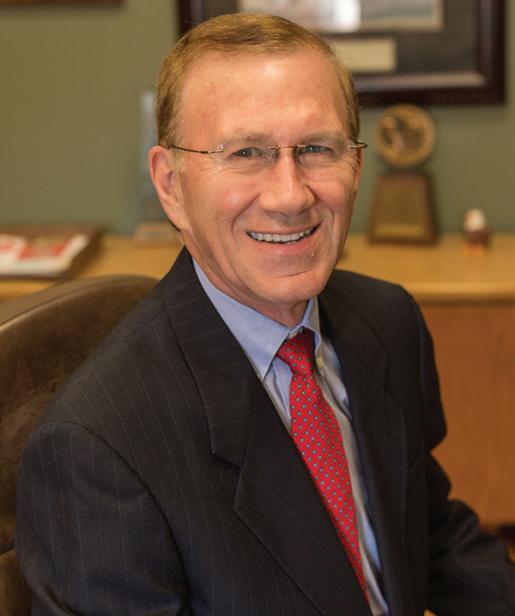
MEET THE EDITOR
Kim Poindexter has been a member of the TDP news team since 1985. She is in the Oklahoma Journalism Hall of Fame and received the 2022 Oklahoma Press Association Beachy Musselman Award. She has won more than 300 journalism awards on the national and state levels, both individually and as part of the team for TDP, which has been named CNHI’s Best Newspaper for five consecutive years. A noted editorial and column writer in Oklahoma, she was named OPA Editorial Writer of the Year in 2023, and by CNHI, Columnist of the Year. She and her husband, Chris, a facilities engineer, have an adult son, Cole, and a daughter-in-law, Dani.
Tahlequah Grapevine is a quarterly magazine published by the Tahlequah Daily Press. The contents of this magazine are fully protected by copyright and cannot be reproduced without express permission from CNHI, LLC.
On The Cover
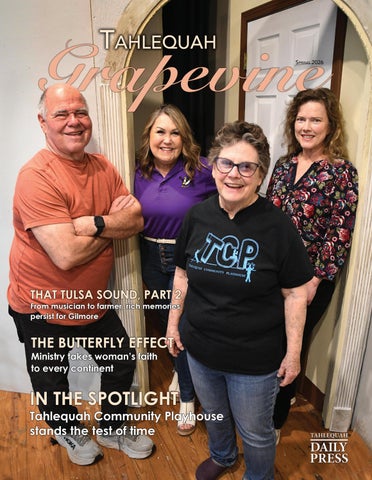
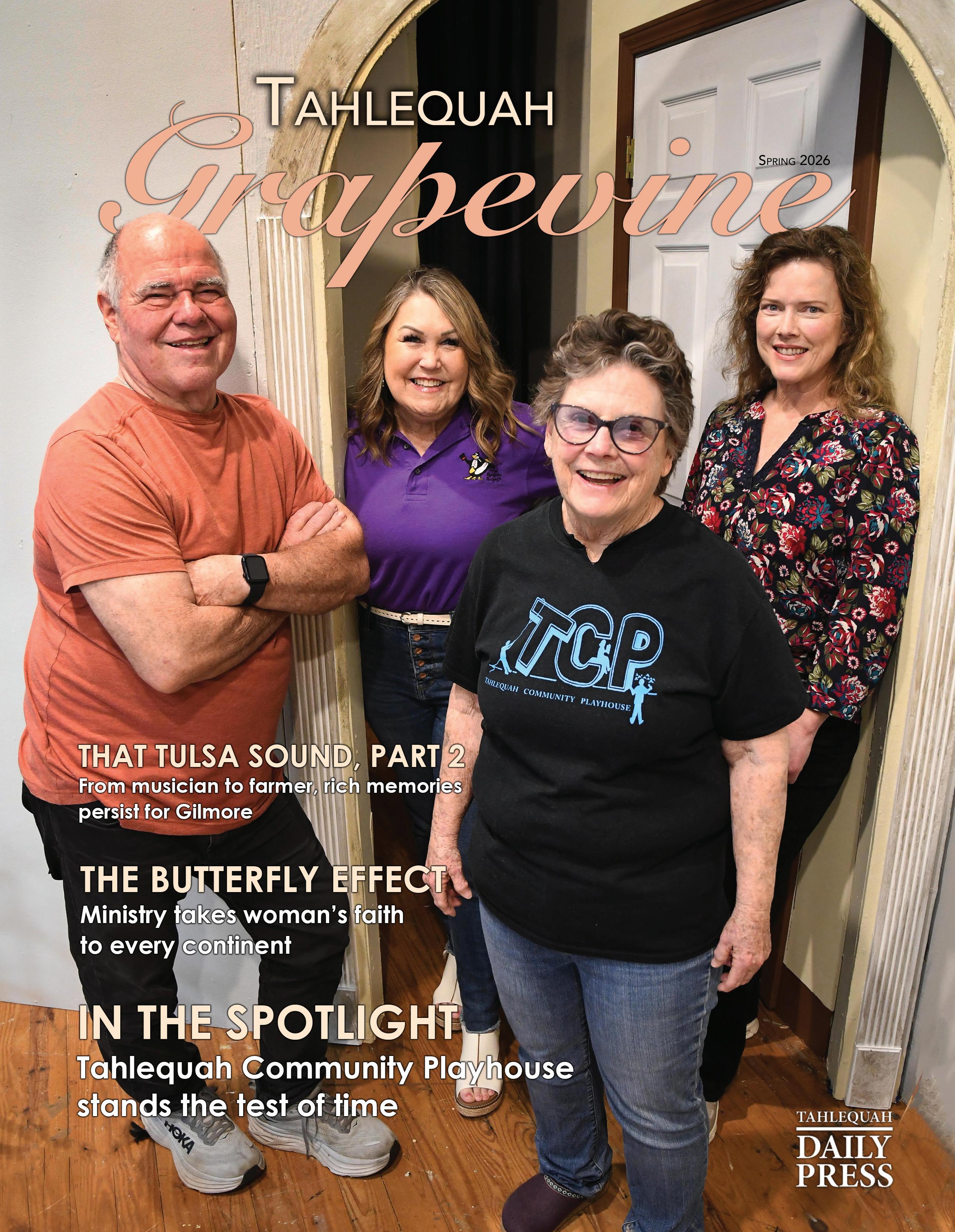
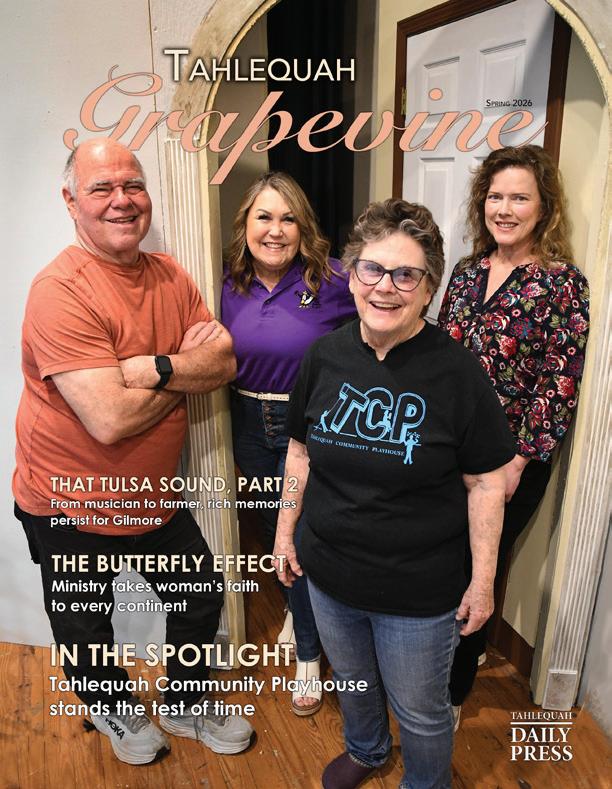
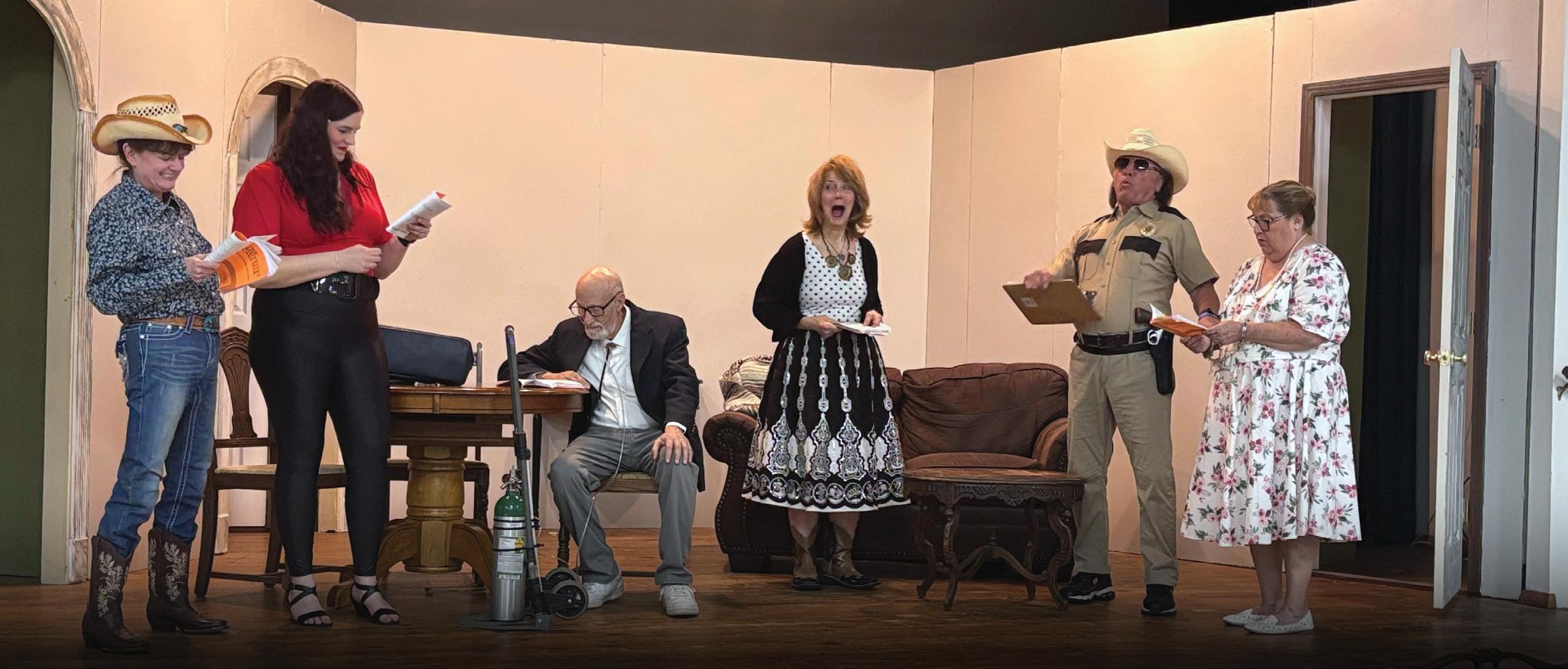
Cast members backstage on the set of the 2026 Tahlequah Community Playhouse production of “Red Velvet Cake War.” From left are: Craig Clifford, Bryn Smith, Mason Walters, and Christine Pearson.
Cover photo by Nancy M. Garber
IN THE SPOTLIGHT
Tahlequah Community Playhouse stands the test of time
TThere’s a lot to be said for a volunteer group that is 52 years in the making and still going strong.
Take passion for the purpose, mix with strong commitment from individuals willing to put in the work, and add a dose of institutional memory to strengthen the roots. Tahlequah Community Playhouse certainly fits the bill.
A summary of the group’s online history goes like this: In summer 1974, a cadre of area art lovers joined forces to put on a play at the Tsa-La-Gi Amphiteater south of Tahlequah. They came from various organizations — the Tahlequah Area Arts and Humanities Council, National Endowment for the Arts, Oklahoma Arts and Humanities Council, and Cherokee National Historical Society — to produce Shakespeare’s Elizabethan tragedy “King Lear.” The lead role was played by Paul Grover, who became a regular cast member in the coming years.
No one from those early days is around to tell whether the group held high expectations for the future success of live theater in Tahlequah, but its evolution as a local institution proves they should have.
Flash forward to 1986, and the arrival of Craig Clifford to Tahlequah; see the Summer 2025 edition of Grapevine Magazine for his inspiring story. Clifford became involved with TCP when his wife, Patsy, enlisted his help with set takedown at the now-long-gone TsaLa-Gi Lodge near the Cherokee Nation headquarters. Clifford soon found himself onstage alongside well-known local actors Dudley Brown, John Dameron, Marie Anderson, and Grover. His talent for technical directing, stage design and construction earned him recognition early on as the “go-to” person; he held those roles this writer signed on for a small part as a chambermaid in the TCP production of “Plaza Suite” in 1987.
TCP’s reach and resources have expanded through the decades.
By Nancy M. Garber
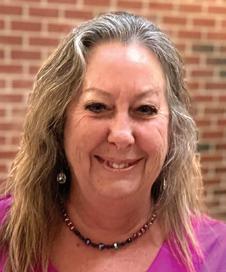
Nancy M. Garber, a University of Florida graduate, is a lifelong journalist and photographer. A former member of the TDP editorial and advertising teams, she retired from NSU as director of Communications and Marketing and still likes to pick up the pen and camera now and then.
“In those days, we could store all the set pieces we owned in a small office space,” Clifford said. “We now have storage spaces all over town” – some generously provided by supporters, others rented.
Since 1974, TCP has staged more than 100 productions, “from silly slapstick to serious drama, from children’s plays to local originals” – even Grand Ole Opry-style shows and Christmas concerts, according to their website. The 2025-’26 season included the play “Red Velvet Cake Wars,” directed by TCP newcomer Mason Walters.
Walters got involved shortly after moving to Tahlequah from Utah in 2022. When a cast member had to bow out of a production, she took that person’s place.
“Everyone was so supportive, I knew I had found a home for my creative expression,” she said.
She enjoys helping with set design and backstage, and currently serves as TCP board president. Directing allows her to utilize so many different skills, Walters said.
“I strive to provide an environment that allows both my vision and the performers instincts to thrive,” she said. “I see live theater as a place where people of all ages can gather and feel safe enough to be silly together, to feel laughter move like a wave through the audience, to openly cry while sitting next to a stranger, and to create a human connection that is, unfortunately, rare in today’s technological society.”
TCP currently stages one musical and
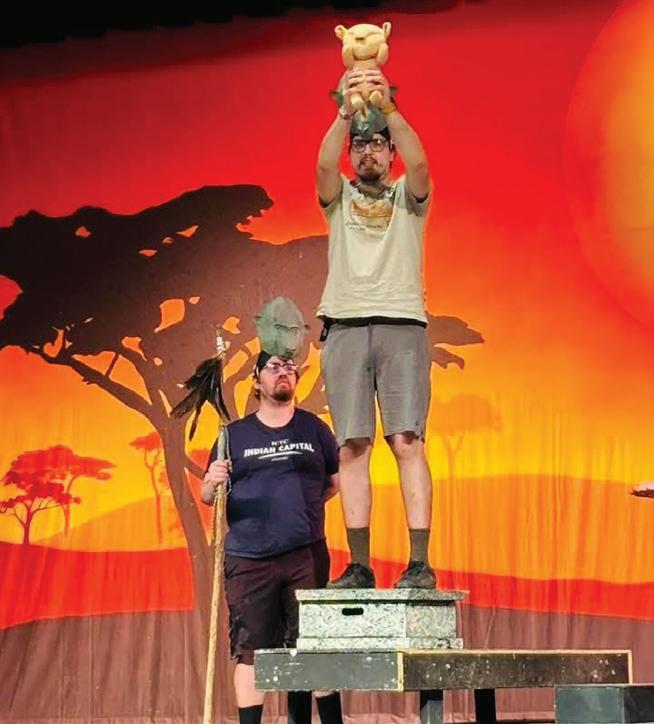
Adam Kaney and John Paul Kolb rehearse for the 2025 Penguin Project production of “The Lion King.” Photo courtesy of Peggy Kaney
Rehearsing for opening night of “The Red Velvet Cake War” in February are, from left: Bridget Cowlishaw, Heather-Rose Thompson, Steve Ball, Toni Bailey, Blackhawk Walters, and Misty Zimbelman.
three non-musicals annually, including four dinner theater performances and two matinees per production. TCP After Dark launched about seven years ago to offer smaller, less-traditionally staged offerings.
Most noteworthy among these is the Penguin Project, spearheaded by Bryn Smith and Peggy Kaney.
“This unique program has widened our reach to a very significant part of our community not traditionally served by stage performances,” Clifford said.
Shortly after Smith and her family moved to Tahlequah from California in 2009, they began attending TCP shows and decided to get involved.
“We loved live theater,” she said. “My son enjoyed knowing all the details about what went on backstage. He soon knew most of the actors and delighted in greeting them as they came off the stage at the end of the show.”
Her son enjoyed participating in church productions, but being confined to a wheelchair kept this “bright, loving, hilarious” young man from enjoying the spotlight on stage, Smith said. She lost her son in 2014.
The following year, she attended a conference of the American Association of Community Theaters in Tulsa, where she learned about Dr. Andy Morgan, a developmental pediatrician who started his own theater company in Peoria, Illinois.
“He yearned for his special-needs patients to have similar opportunities to others, to perform on stage without
fear of being too challenged to do so,” she said.
Smith approached TCP with Morgan’s method of pairing his patients and others like them with similar-aged mentors. The result: the TCP Penguin Project.
“Mentors help artists to learn choreography, music, lines, and expressions, along with any difficulty from navigating a stage in a wheelchair to being intellectually challenged,” she said. “It is amazing what opportunities can be presented with a bit of extra effort and accommodation.”
Kaney’s involvement with TCP began in 1998 when her 8-year-old son, Matthew, revealed his New Year’s resolution was to be in a “real play.” Together they attended the next TCP meeting and signed up to audition for “Charlotte’s Web.” Matthew was cast as Wilbur the Pig, his mother as the narrator. Later, his brother Adam joined the cast.
Kaney took a brief hiatus from TCP while attending graduate school, and later returned to join Smith in establishing the Penguin Project. The two are deeply involved, alternating as directors, and Kaney often serves as costumer. Her husband, Brian, has designed and built the sets for every production.
“A unique aspect of the Penguin Project is putting children and youth with disabilities in the spotlight as the stars of the show,” Kaney said.
Participants build confidence and develop friendships. The community has shown support both financially and through attendance.
TCP has performed in various venues in Tahlequah, changing locations as circumstances warranted. Several churches, along with the Carnegie Room at the Tahlequah Public Library and the old Armory on Water Street, have served as “home.” Productions are currently held at the First Presbyterian Church. Each location presents challenges. As Christine Pearson told the Tahlequah Daily Press recently, “Our greatest hurdle is performance space that is flexible enough for us to move sets around and provide space to store costumes and props during performances.”
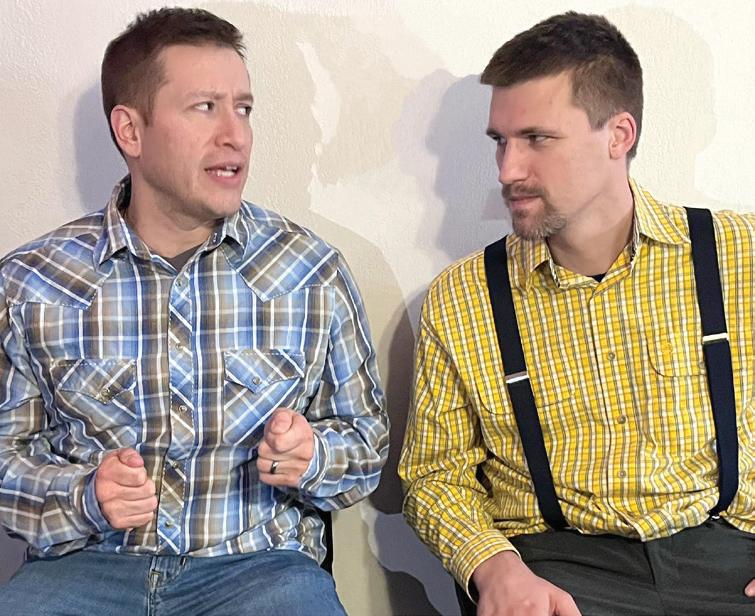
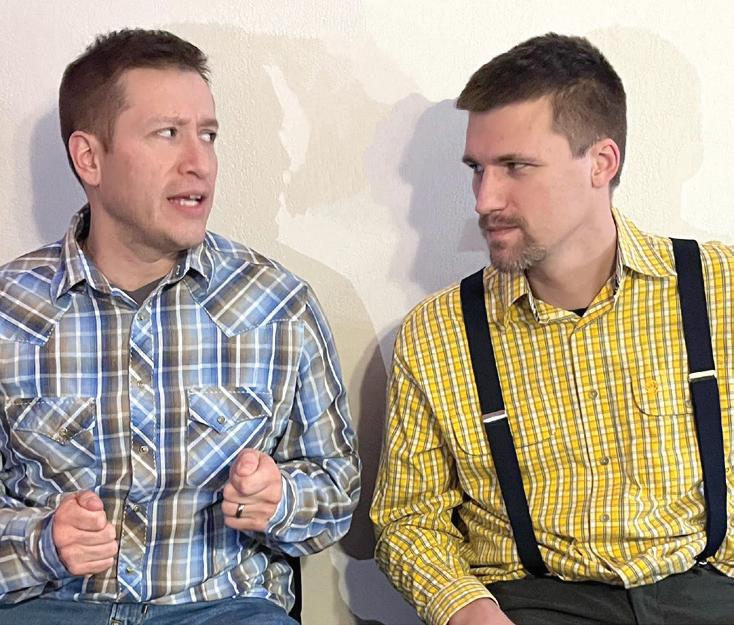
Right: Coty Thompson, left, and Kyle Vareberg star in the two-man show “Greater Tuna,” presented in March.
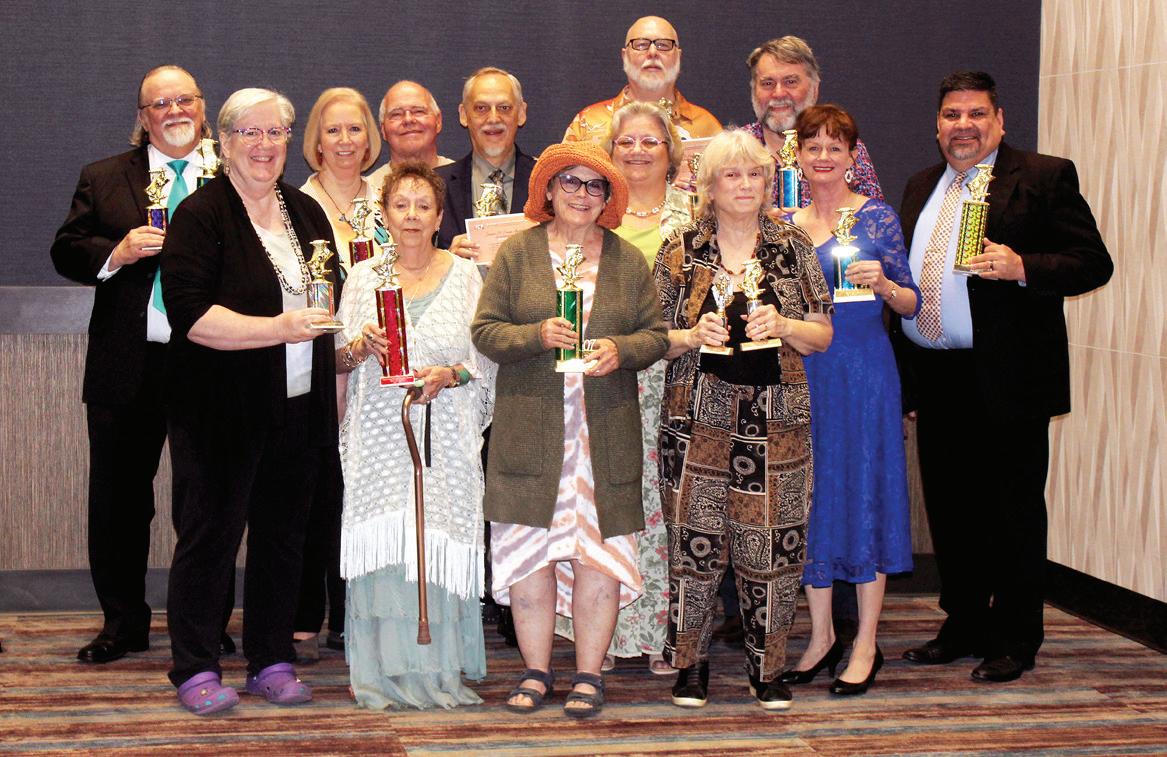
2025 TCP Erwin Award Winners include, from left, front row: Peggy Kaney, Sandra Becker, Christine Pearson, Connie Herrin, Erika Lloyd, Bridget Cowlishaw and Darren Tobey. Back row: Dennis Tibbits, Lena Worley, Craig Clifford, David VanDonkelaar, Brian Cowlishaw and Brian Kaney.
Photo courtesy of Craig Clifford
Cast members also need space to change and appreciate restroom facilities separate from the audience.
With the support of Tahlequah voters, a new performance facility could alleviate these issues. The city is planning to hold a vote in late 2026 to continue the 0.75% city sales tax to fund a new round of capital improvement projects.
“The current proposal for a city bond package contains a performance facility that would be a great fit for community theater,” Clifford said. “While not ‘our home,’ we hope to be able to move there and call it ‘our home.’ This all depends on the citizens of Tahlequah voting to continue the current sales tax. The proposed name of the new space would be City Center, which has a nice ring to it.”
For updates on TCP productions, go to the Facebook page or tcpok.org. To see a complete list of TCP productions since 1974, visit https://tcpok.org/programs/. G
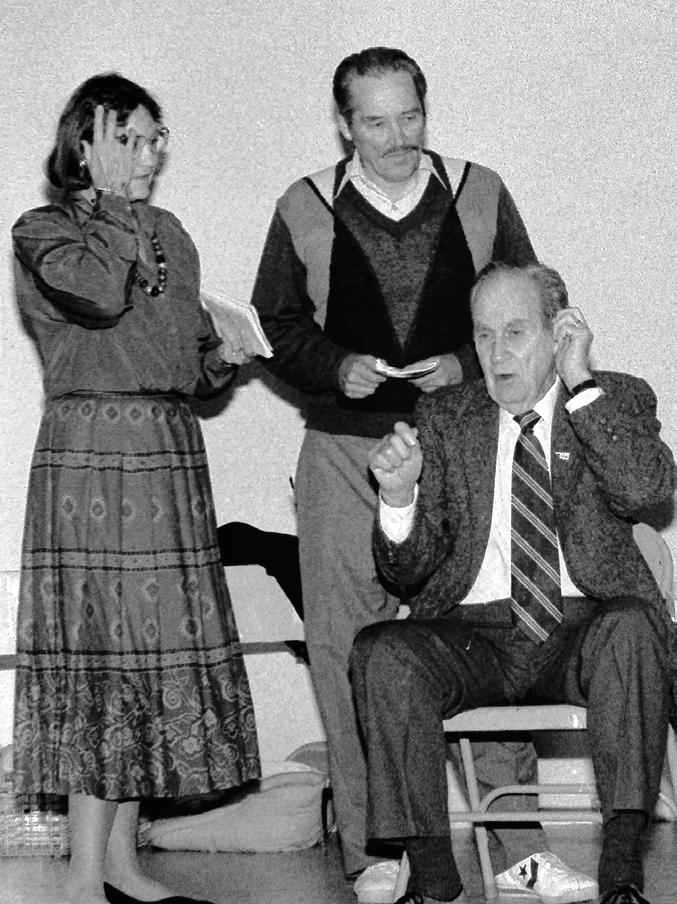
Above: Actors Edie Greubel and Paul Grover rehearse for the 1987 production of “Plaza Suite,” while Director John Dameron looks on.
By Renee Fite
FFor senior citizens, it can sometimes feel like time is drifting away, but one savvy golden ager founded a ministry that has a global outreach and gives meaning to her days.
Louise Wells, aka the Butterfly Lady, is 88. She said God used some unusual ways — a wall, a sculpture, a tattoo, and a quilt — to help her realize she could be free, like a butterfly.
She shares how God revealed what was to be her ministry for this season of life. Since it began Oct. 29, 2021, and with the help of an untold number of people who shared the butterflies, she has sent 173,000 of the creatures out into the world.
This year so far, 5,000 butterflies have left Wells’ home. Free Like a Butterfly cards have been translated into 13 languages, including English, and have been taken or sent across the continents of Europe, Asia, Africa, Australia, North and South America, and even Antarctica.
The story began as Wells and her late husband, Johnny, were retired and enjoying life in Tahlequah when his health took a downturn. She found joy in caring for her high school sweetheart until he passed on in 2019.
Wells said God revealed his plan for her over the next few months. In July 2021 she took her first bus trip to Mackinac Island and the Missouri Botanical Garden, where God showed her the ministry would be one on one, to encourage and offer prayer, and just be a friend to whoever came into her life.
“My roommate on the trip recognized God’s work in me before I did. Then, at the Botanical Gardens, when I saw an origami sculpture of a butterfly emerging from its chrysalis, just as a ray of sunlight caused it to sparkle, I knew my ministry outreach would be accomplished through butterflies somehow,” she said.
Wells realized that “free like a butterfly” was not just for her.
Ministry takes woman’s faith to every continent
Remembering butterflies she had seen on a wall in a beauty salon started her thinking, and looking for butterflies. She found some on Amazon, even though she wasn’t sure yet how they would be used. She started handing them out and letting people know they could also have this freedom in Christ.
“The next confirmation was the tattoo on a friend’s forearm, which had the word ‘free’ and three tiny butterflies, with the scripture Galatians 5:1,” she said.
She recalls how God wrapped all these experiences up in a beautiful butterfly quilt she won in a raffle. A friend helped her put the words God had written on her heart onto a card to go with the butterflies, and another friend suggested placing the butterfly and a card into a white organza bag.
“And the idea was complete for letting people know they, too, can be free from whatever separates them from God, and that this freedom to choose God as the cornerstone of their life is their choice to make every day,” Wells said.
Butterflies have given her an opportunity to speak to various groups.
Renee Fite, a longtime feature writer for the Tahlequah Daily Press, is former editor of the Stilwell Democrat Journal. Currently she is communications director for the City of Stilwell and president of the Arts Council of Tahlequah.
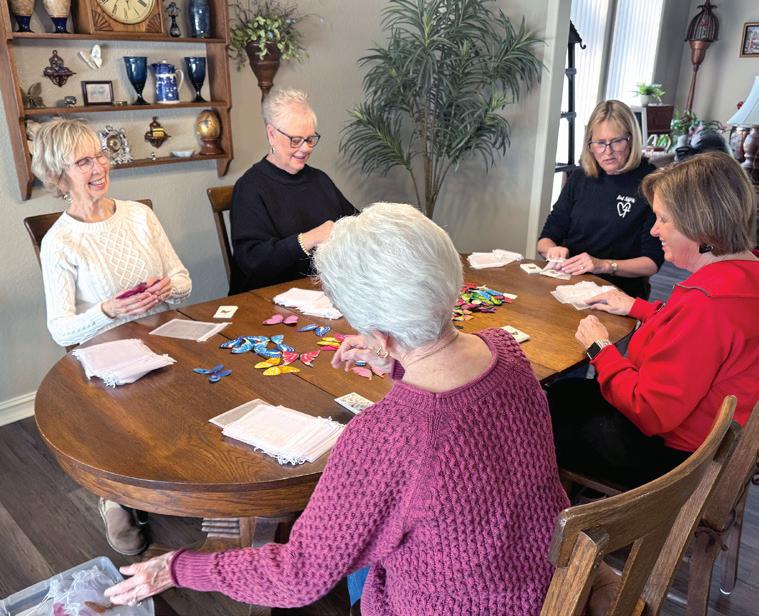
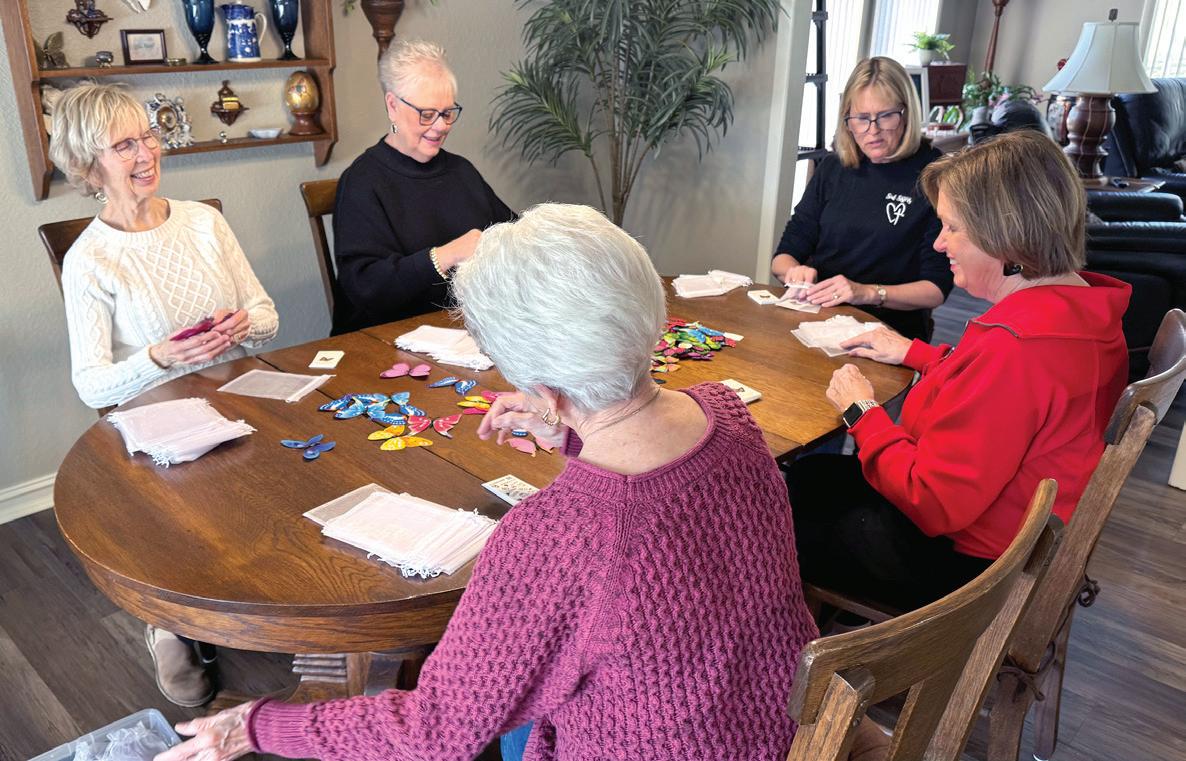
A butterfly bagging party brings friends together to put butterflies and cards into white organza bags. On a recent Sunday afternoon, these friends bagged 1,500 butterflies in a hour. Clockwise from left are: Margaret Looney, Karen Stowe, Janet Thompson, Olivia Baggett and Louise Wells, who drops a bag into a box. Not pictured is Polly Latta. Photo by Renee Fite.
Butterfly cards have been sent all over the world.
“It’s been incredible to see how the butterflies touch people. They may be plastic, but they are or dained by God. One lady told me she was given two butterflies six months after her husband died. She put them on her refrigerator, and when she sees them, she feels hope, love and encouragement instead of grief,” Wells said.
The requests for butterflies continue as one contact leads to another.
“Almost every day, I am blessed to hear a new but terfly story of hope and joy that has come into some one’s life,” Wells said. “Isn’t God amazing?”
She is still in awe of the ministry God has given her.
“To think my hands have touched something God is going to use to bless someone,” she said. “He has a ministry for everyone; just ask him.” G
BUTTERFLY BAGGING A MINISTRY IN ITSELF
By Renee Fite
A butterfly ministry founded by Louise Wells brings friends together to place butterflies and faith cards into an organza bag.
The butterflies have traveled around the world and are still flying into the hearts of people everywhere. On a recent Sunday, Wells and friends bagged 1,500 butterflies in an hour while chatting with friends Margaret Looney, known at Butterfly Lady 2, along with Karen Stowe, Janet Thompson, and Olivia Baggett. Polly Latta was missing due to the flu.
The women were gathered around a table with a mound of butterflies piled between them and each with a stack of organza bags and cards.
“I like to pass then out around church; the children and adults love them,” said Baggett. “They just beam and are so excited when they take the butterfly and card out of the bag, and each card tells all the things Jesus can help them with.”
For Wells, it’s amazing that her hands have touched each one of these and they end up all over the world to share the message of Christ.
Each friend is busy bagging the butterflies and cards.
“They’re ordained by God to touch and bless people,” Stowe said. “She has prayed over each of these.”
The butterfly bagging is a ministry in itself, said Wells.
“We love being with each other,” Thompson said. “Louise is a good mentor for all of us and everyone she comes in contact with.” Wells appreciates the sentiment.
“I’m thrilled and so blessed I can still do so much at 88,” she said.
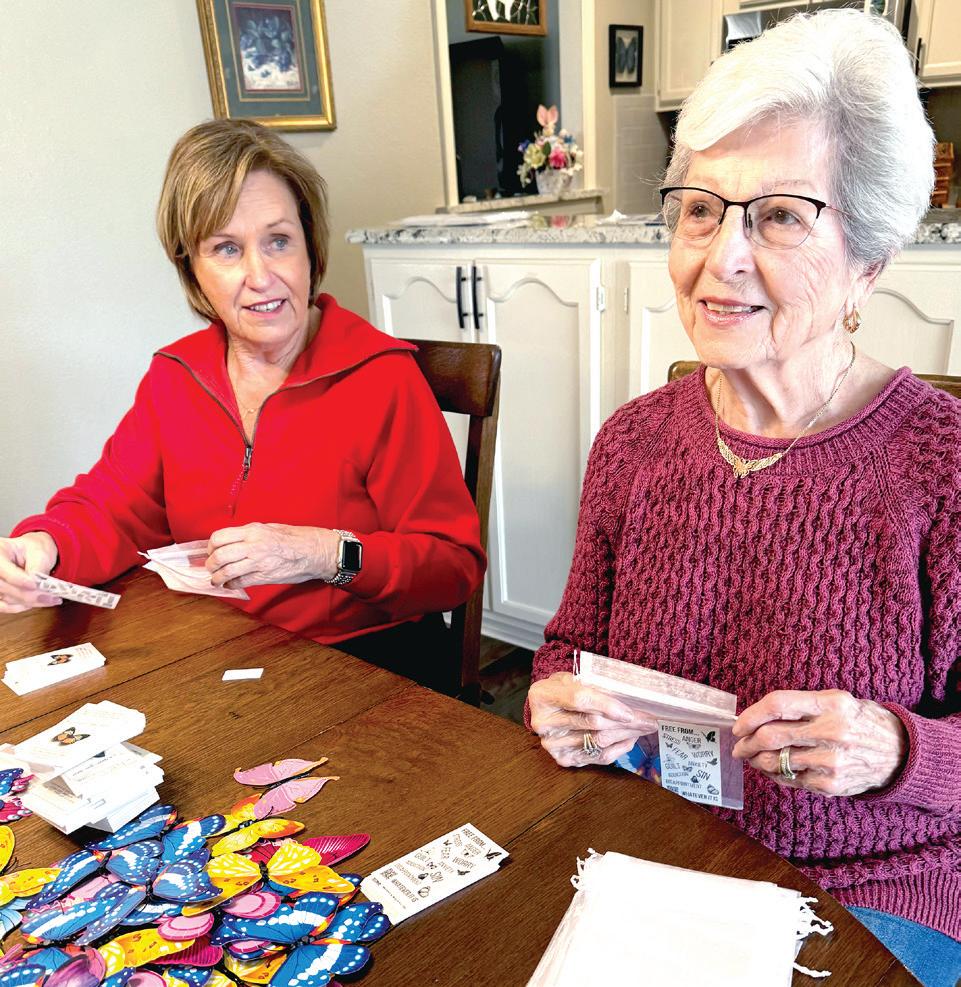
Olivia Baggett, left, and Louise Wells bag butterflies. Photo by Renee Fite.
That Tulsa Sound
Part 2: From musician to farmer, rich memories persist for Gilmore
By Greg Combs
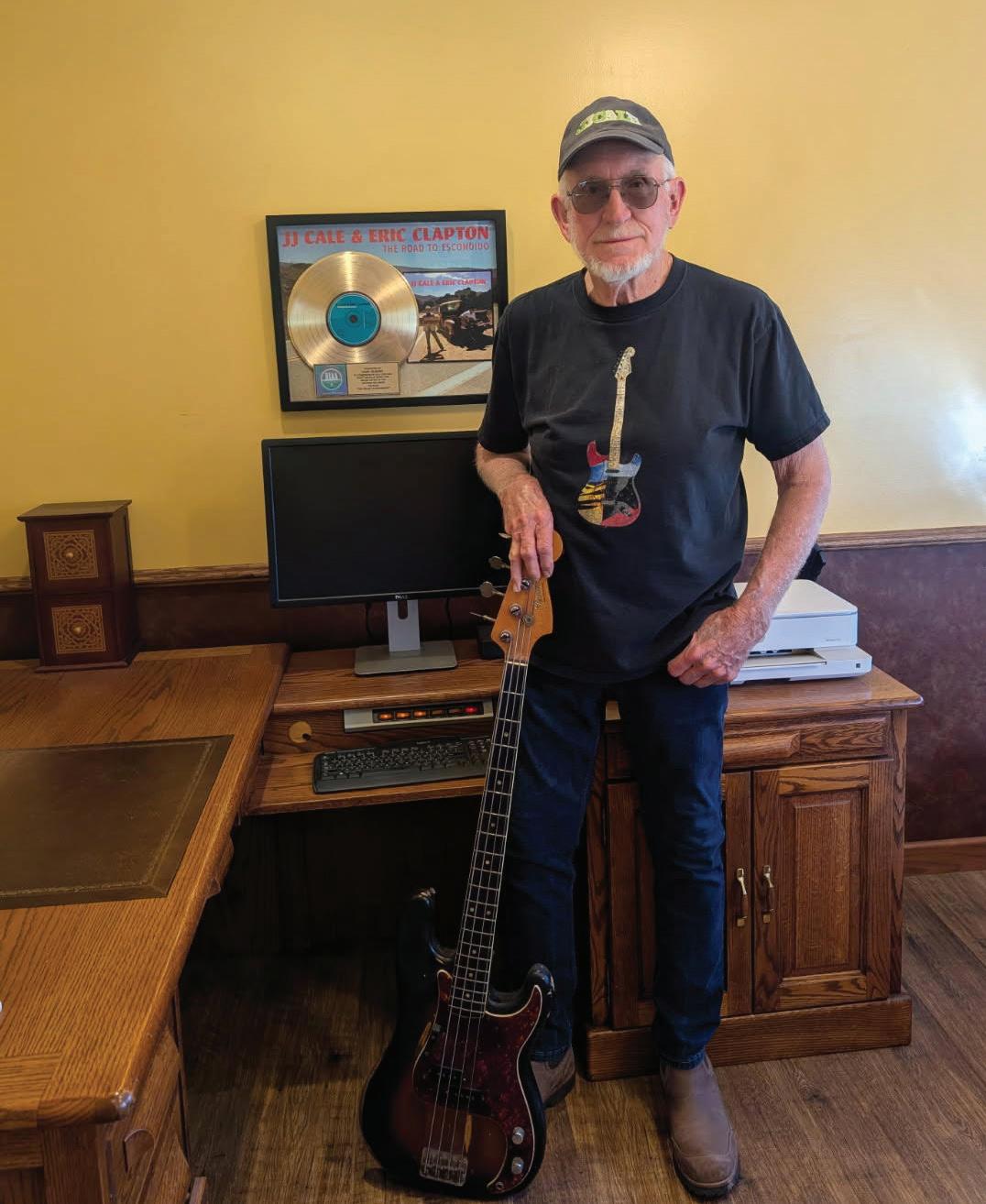
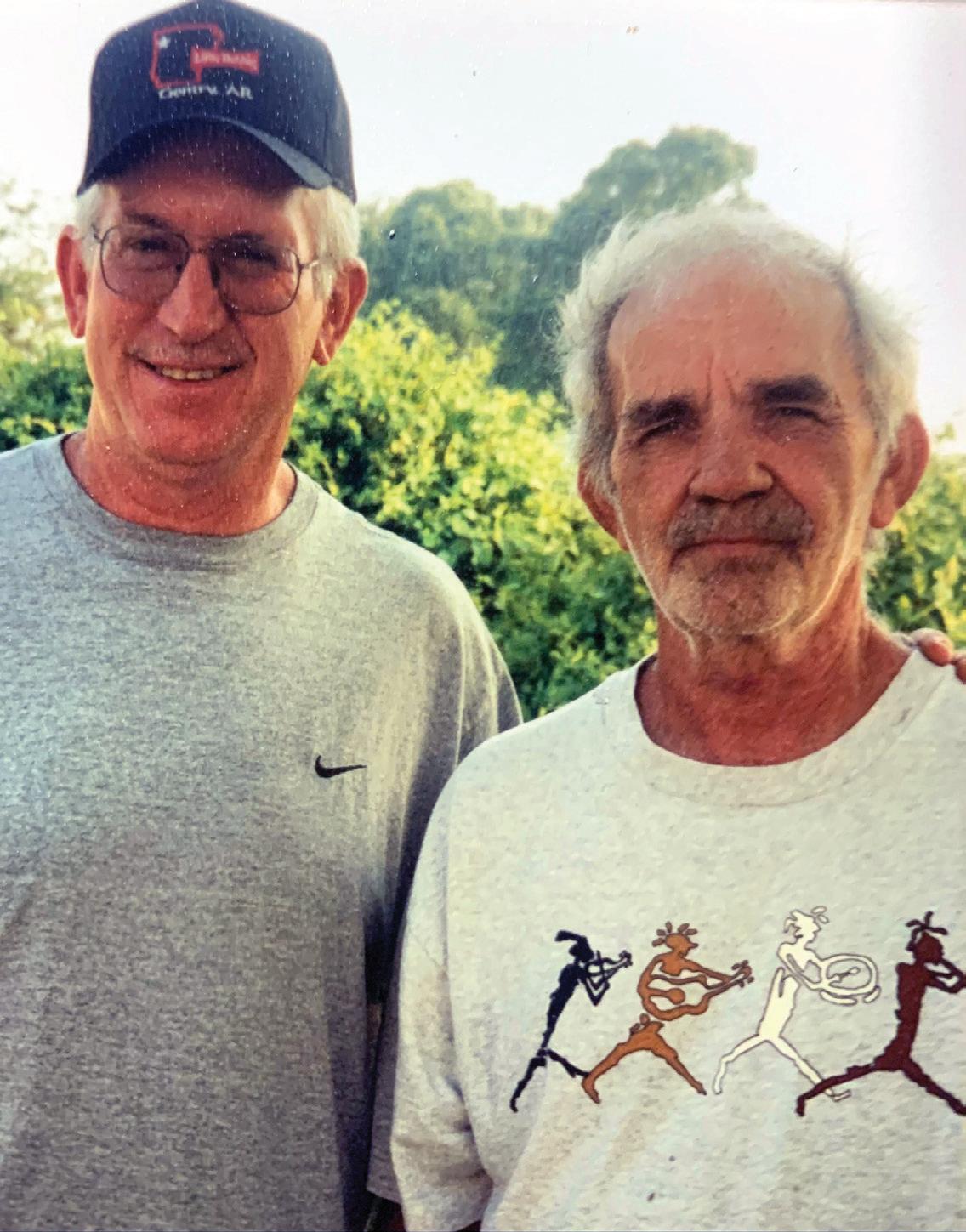
Gary Gilmore, 2026, is retired but ready to answer the call. He has carried this Fender bass guitar since 1965, when his bandmate ,Jesse Ed Davis, spotted it in a Hollywood pawn shop.
Editor’s note: The following is the second of a two-part look at the “Tulsa Sound,” a music phenomenon as seen and experienced by Cherokee County resident Gary Gilmore. The first installment appeared in the Winter 2025 edition of the Tahlequah Grapevine.
The first part of our “Tulsa Sound” chronicle followed a group of young Oklahoma musicians who migrated almost en masse to California in the early 1960s.
TThe reason for this relocation was Tulsa piano prodigy Leon Russell, who at 17 had moved to Hollywood, found success as a studio musician, bought a home in the Hollywood Hills in which he installed a recording studio, then hosted an influx of his hometown musical peers.
“Our band went when our guitarist was invited to operate Leon’s studio,” Gary Gilmore said.
Gilmore was 18, just out of Central High School and played the electric bass. J.J Cale played guitar and was an electronics whiz. Drummer Gary Sanders rounded out the trio. Soon more than a dozen Tulsans appeared at Russell’s Skyhill Studio, finding work and solidifying what became known as the Tulsa Sound.
In his 2025 biography of guitarist Jesse Ed Davis, author Douglas K. Miller presents a detailed account of the Skyhill gathering and the refinement of the group’s special sound, both at Russell’s studio and at a nearby farmhouse dubbed “The Plantation.” The book is highly recommended. It was Oklahoma native Davis who introduced Gilmore to young blues artist Taj Mahal and the three — along with Tulsa drummer Chuck Blackwell — thereafter comprised Mahal’s band.
The account of the group’s rocket-like assent in the late ‘60s rock ‘n’ roll world is described in Part 1 of this story, including their 1968 appearance in London, sharing the stage with the Rolling Stones, The Who, John Lennon, Jethro Tull, Maryanne Faithful and others. Following the filming of the
“Rock and Roll Circus,” members of the young blues band went their separate ways – Mahal to a legendary career and Davis as a session artist, developing into what author Miller described as “one of the most sought-after guitarists in the world of rock ‘n’
Greg Combs is a retired educator and served as District Attorney during his career at Tahlequah. He formerly wrote for the Pictorial Press, a predecessor to the Tahlequah Daily Press, after serving four years in the U.S Air Force during the war in Vietnam.
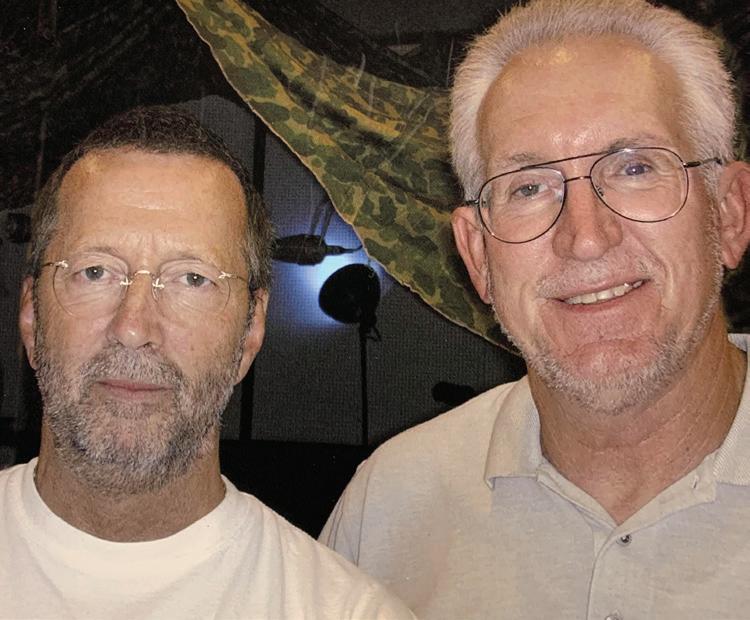
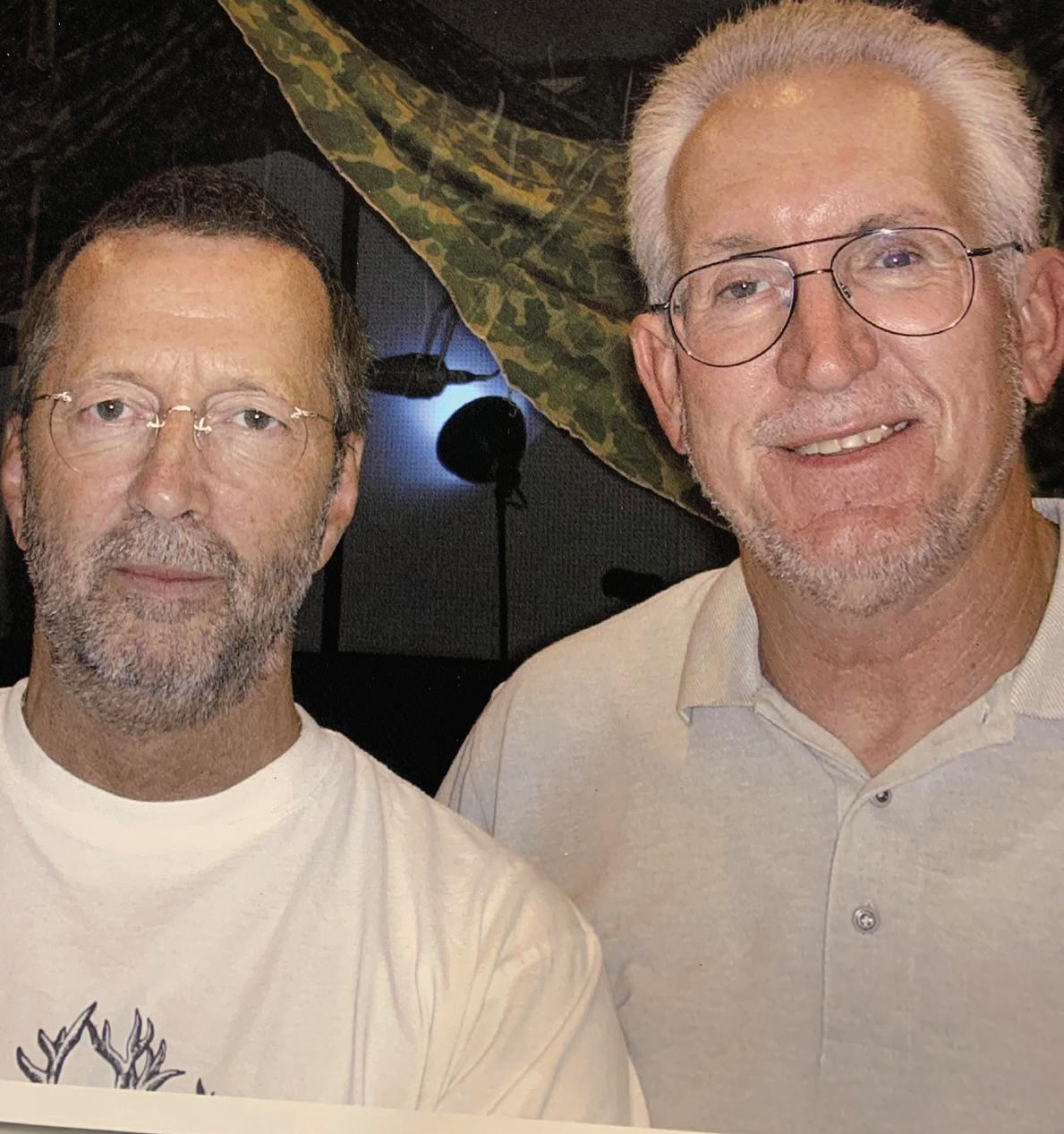
British superstar Eric Clapton, left, and Gary Gilmore earned a Gold Record in 2006 for the “Escondito” album, a reunion of early Tulsa Sound musicians.
roll, jazz and blues music.
In addition to Taj Mahal’s first three albums Blackwell played drums on Davis’ first solo album, then for the likes of the Everly Brothers, Little Richard, Jerry Lee Lewis, ZZ Top and six albums with his boyhood friend and collaborator, Leon Russell. In 1970, he was a “Mad Dog” on Joe Cocker’s “Mad Dogs and Englishmen” album.
Gilmore went home.
The movement of so many Oklahoma musicians in the mid-1960s didn’t leave a vacuum in Tulsa live entertainment. Piloting an assortment of vehicles, these modern Okies became familiar with Route 66, which was not fully replaced by Interstate 40 until 1984. When in Tulsa, they took to local club stages, more accomplished and well-known than ever.
Cale was back in Tulsa when he first heard Eric Clapton’s recording of “After Midnight” on a local AM station in 1970. Although the Tulsa Sound had gone global with Clapton’s hit, it was right at home in Tulsa, and has remained so to this day.
So what of Gilmore, then a 24-year-old veteran of the Hollywood music scene, a regular at the iconic Whisky A-Go Go on the Sunset Strip, a friend and colleague of Leon Russell and Cale, bandmate of Mahal, Davis and Blackwell, as well as an electric bass player alongside the Rolling Stones and John Lennon in London? He had seen his friends reach similar success, including his boyhood neighbor and closest pal, Tommy Tripplehorn — father of actress Jeanne Tripplehorn, a guitarist on several hits with Gary Lewis and the Playboys in the 1960s, renowned studio musician with the “wrecking crew” in Hollywood, and member of the Oklahoma Blues Hall of Fame.
logged over a million accident-free miles as a long-distance trucker, then bought the nicest resort on the Illinois River. And that would all be true. Also true is that he and his bass guitar — bought by Davis in a Hollywood pawn shop — have not been idle.
“My happiest times growing up were on my aunt and uncle’s farm in Kansas,” Gilmore said recently. “I really wanted to have a place in the country, with animals and that pace of life.”
Upon returning to Tulsa, he rented a farm in Owasso. It fit him just fine, and friends and musicians found it to be the perfect place to light when in town. Talent from around the world began to see Tulsa as a music center, and many found Gilmore’s farm in Owasso. The floodgates opened in 1972 when Russell came home, opening his Church Studio and launching Shelter Records. That year, Gilmore bought a farm in Cherokee County on Spring Creek, just upstream from Rocky Ford.
It would be enough to say that Gilmore has lived on that property for 54 years, that he worked construction, drove a school bus, got married, raised a family, operated a dairy, served on the local school board,
He first dived into the live music scene in Tulsa, joining his old bandmate, Larry Bell, playing clubs. World musicians such as George Harrison, Tom Petty, Bob Marley and others too numerous to name found their way to Tulsa, taking in the local offerings. Gilmore joined with Jimmy Byfield’s band, “Brothers of the Night,” a true Tulsa Sound ensemble. Their 1979 album “By The Light of The Moon” was a hit in Europe. The band was invited to tour overseas.
“Jimmy liked to stay close to home. He said he wouldn’t go, so I made a decision to start a dairy,” Gilmore said. “After I bought the herd, Jimmy changed his mind and the band went, after all.”
Dairymen don’t take weeks off. The “Brothers” took on a new bass player. Gilmore did not make his second trip across the pond, but to his good fortune, in July 1980, he married Paula Coursey of Tulsa. For the next 13 years, the Gilmores milked 30 cows, raised three sons and worked – she as a public school teacher and he as a dairyman and occasional Tulsa musician. In 1996, the Rolling Stones
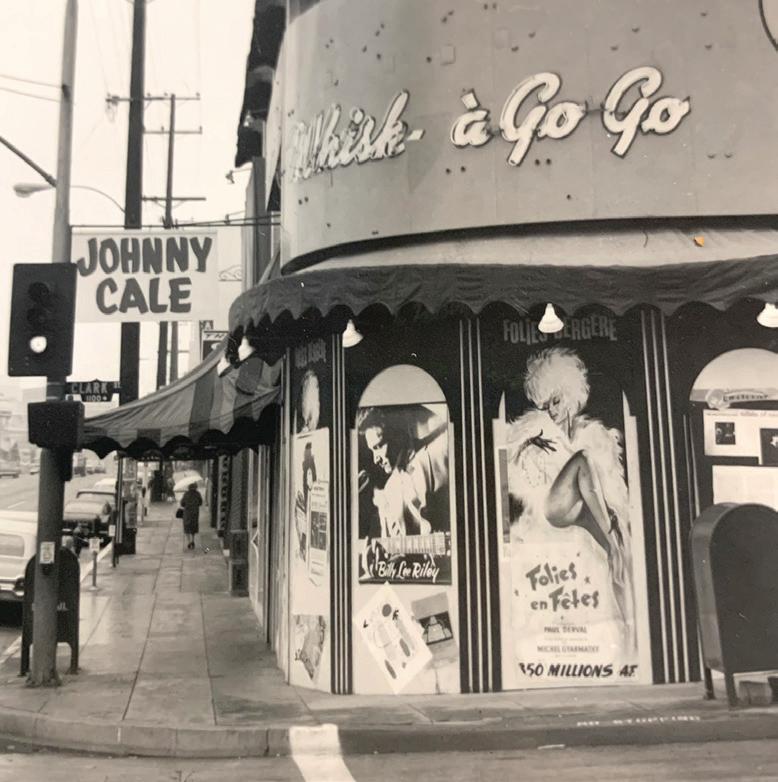
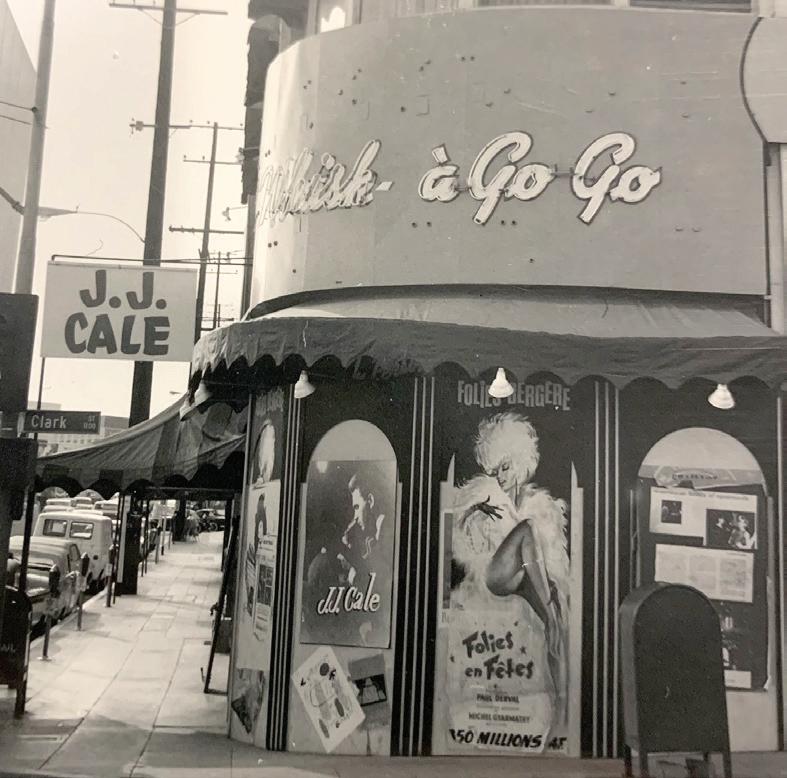
The Cale trio became a fixture on Hollywood’s Sunset Strip at the legendary Whisky A Go Go. Johnny Rivers was also featured and to avoid confusion the club owner suggested Cale adopt the stage name J.J. Cale, the name by which he was thereafter known. The club itself was inducted into the Rock and Roll Hall of Fame in 2006.
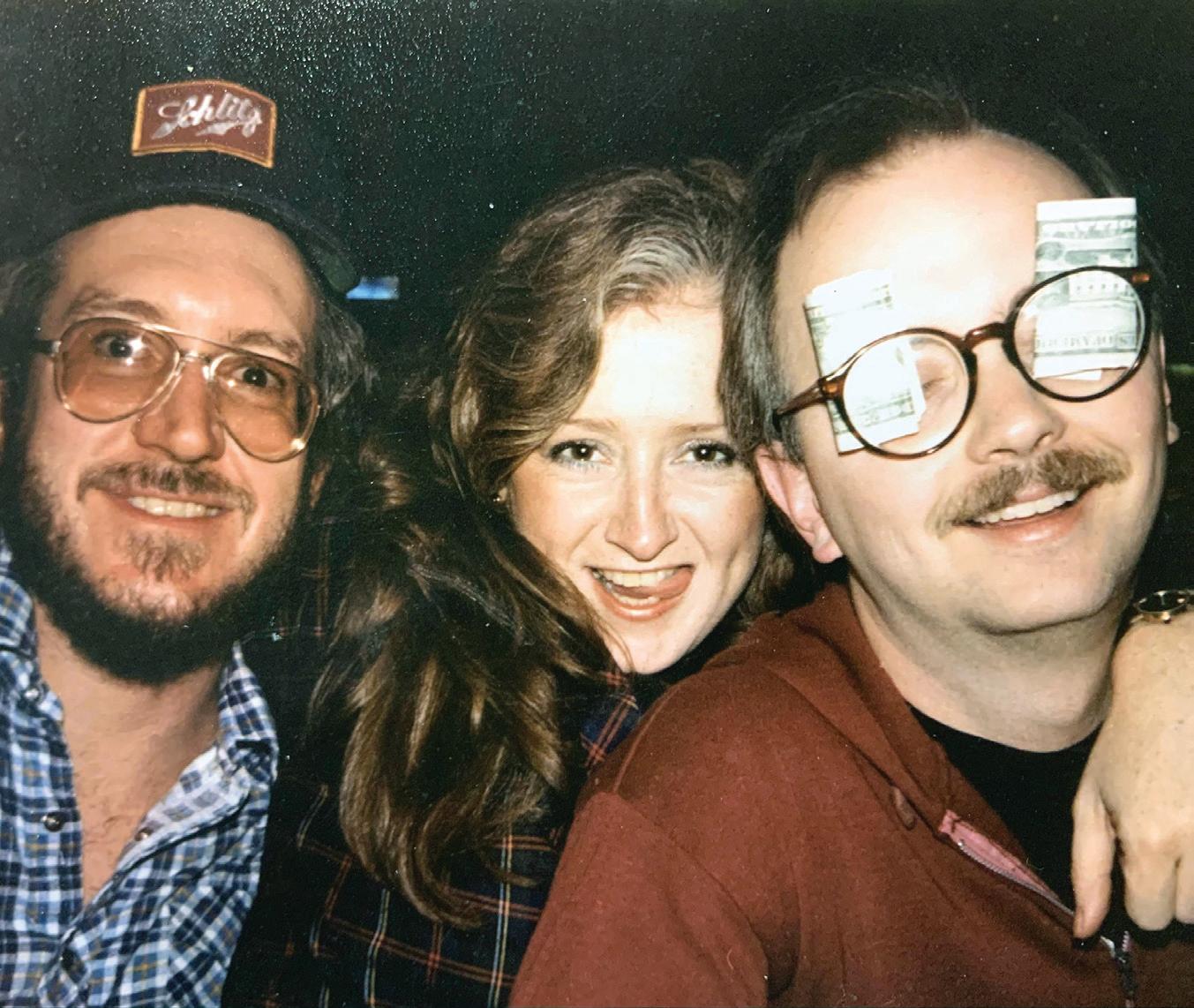
A lively music scene and Shelter Records drew top stars to Tulsa in the 1970s. From left are: Gary Gilmore, a young Bonnie Raitt, and Rockin’ Jimmy Byfield.
released their one-hour music video “Rock and Roll Circus,” 28 years following the filming. According to published sources, the delay was due to the Stones’ dissatisfaction with their performance, being upstaged by The Who and Mahal. But the release was good news for Gilmore. He and Blackwell got a trip to the New York premier with all the trappings, were reunited with Mahal, and enjoyed a very welcome payday.
Then Gilmore “made my best money ever” – not with his bass guitar, but 15 years at the wheel of a sleek Mack tractor-trailer, driving long-distance in the employ of Mc-Kee Foods, makers of Little Debbie products. Playing bass guitar at the highest level and rubbing elbows with blues and rock ‘n’ roll royalty was in his rearview mirror. Or so it seemed.
Jamie Oldaker, an acclaimed Tulsa drummer on eight Clapton albums, became a Nashville music fixture and producer. His “Mad Dogs and Okies” compilation album featured Vince Gill, Peter Frampton, Willie Nelson, Clapton, Mahal, Ray Benson and Cale, among others. Gilmore, having played with Mahal and Cale, was invited to Nashville for a reunion. Reviews hailed the work as a “splendid reminder” of the Sooner state’s influence shaping rock, country, blues, folk and soul music.
In 2005, Gilmore was nearing 60. His friend and old bandmate, Cale, called one day, relaying an invitation from Clapton to join them in a “let’s get the old band back together” album to be cut in San Diego. Who could resist such an invitation? Gilmore’s supervisor, for starters. He had not heard of this Clapton fellow.
“I knew the man over him was a music fan, so I appealed to him,” Gilmore recalled.
He didn’t hesitate, quickly telling him to “Go!”
And go he did, joining several former comrades in recording “The Road to Escondito,” a blues album of mostly Cale original songs. Gilmore had an unexpected music payday, a heartfelt reunion of Tulsa Sound pioneers, and a Gold record. Critically acclaimed, “Escondito” won the Grammy Award for Best Contemporary Blues Album in 2006.
In 2015, the Gilmores bought the beautiful Riverside Resort, the northernmost Illinois River camp in Cherokee County. It has been a family operation along a peaceful stretch of river, just right for a family used to hard work.
Last year, the Miller book “Washita Love Child” was published. Gilmore and Mahal attended the signing and other festivities in Tulsa, including taking the stage together. Davis died in 1988 at age 43, succumbing to the excesses of the rock ‘n’ roll lifestyle. Gilmore and Mahal were among the few veterans of Skyhill Studio and The Plantation. Cale had passed in 2013, Bell in 2015, Russell in 2016, Blackwell in 2017, Tripplehorn in 2019, and Oldaker in 2020.
Gilmore turns 80 on April 27. He is retired, or so he says. He still has that Fender bass guitar, his family, a beautiful spot on the Illinois River and amazing memories. Accordingly, this account will end as it began.
Gilmore smiled as he recounted his days in the Hollywood Hills. G
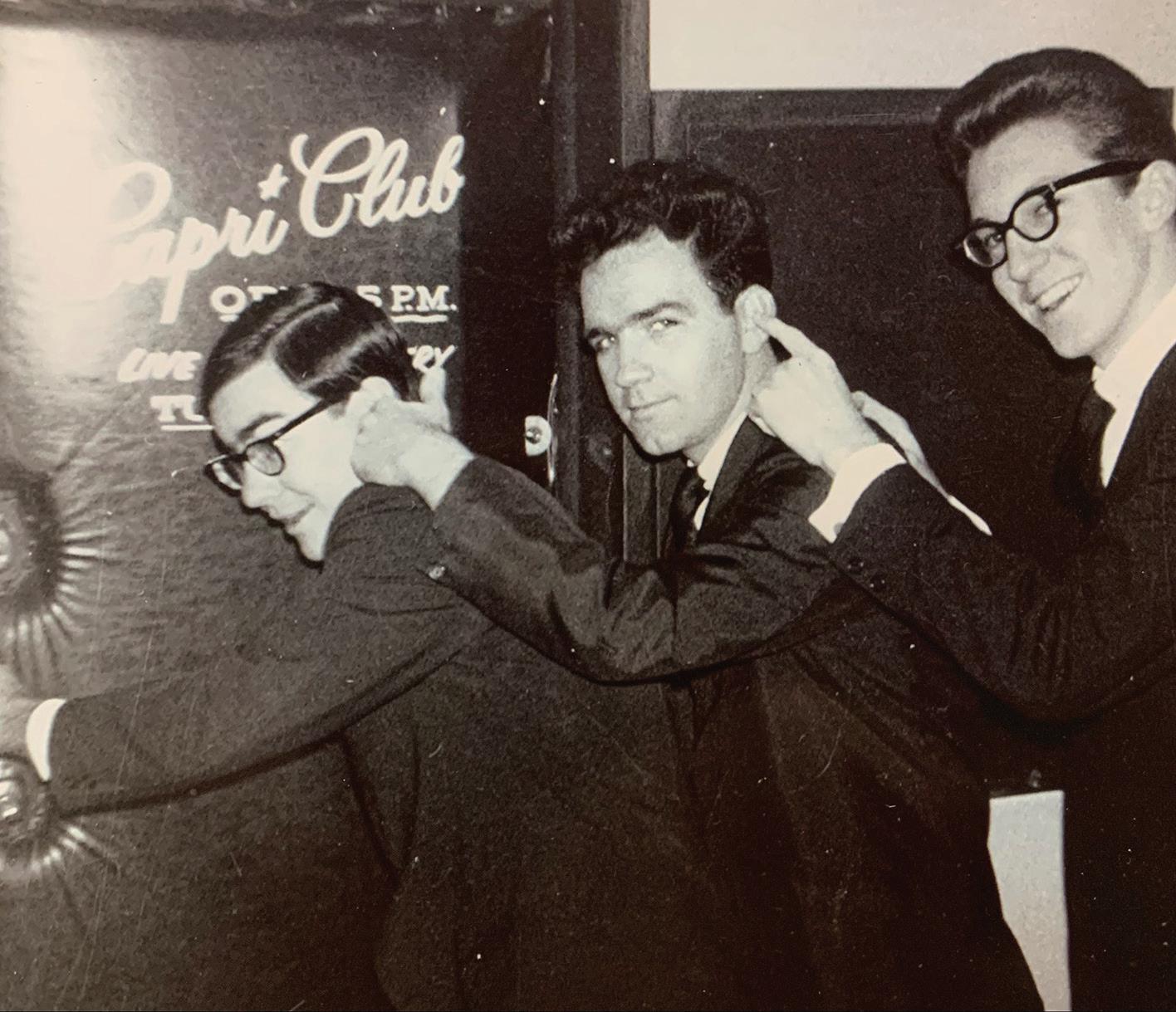
In his senior year of high school, Gary Gilmore (right) joined J.J Cale (center) and drummer Gary Sanders. The trio were regulars at Tulsa’s Capri Club. When invited to Holywood to manage Leon Russell’s Skyhill Studio, Cale accepted and the trio moved west in 1964. There they would record Cale’s After Midnight, made famous by Eric Clapton.
Gary Gilmore, left, began playing bass for J.J. Cale’s band in high school. Here he joined Cale in 2005 in San Diego for their Grammy-winning album, “The Road to Escondito.”
When the canoe touches water, memory comes alive
TThe smell of wood shavings and fresh-cut timber is a scent many people desire in their candles. But Sacongah Gray gets the privilege of this aroma daily.
Gray has taken up the project of building a functional traditional Cherokee canoe, but he is carving more than a canoe. He is drawing memory back into the grain, shaping history with every careful pass of his tools.
Gray, a Tahlequah artist, has deep roots in Cherokee material culture.
“I grew up in a family of people that worked with their hands,” he said. “Carpentry, gardening, woodcarving. My dad carved fishing lures when I was young.”
Craft was not a hobby; it was inheritance.
Gray was introduced to Cherokee National Treasure artisans as a teenager by his mother, Catherine Foreman Gray. This sparked an interest in young Sacongah’s mind. He began to study traditional archery and bow-making, then moved steadily into other forms of Cherokee material culture, such as woven items, copper work, wood sculpture, and leatherwork. By age 19, he was helping carve a dugout canoe while working at the Cherokee Heritage Center’s Ancient Village. What stood out to him from all the experiences was that few people were pursuing these crafts.
Gray noticed that compared to some other Native nations – like the Pacific Northwest tribes, the Seminole, the Eastern Band of Cherokee, and the Wampa-
By J.D. Langford
J.D. Langford is a student in the Myles Friedman Honors Program at University of Arkansas in Fort Smith. This story was written as an Honors Program project in Dr. Eddie Glenn’s Writing Across the Media class at UAFS. Glenn, a former Daily Press writer and photographer, assisted in acquiring the photos accompanying the story.
noag – canoe culture in Oklahoma was relatively weak. Before the Removal, the dugout canoe was central to the everyday life and commerce of the Cherokee people. Rivers functioned as highways. Canoes carried goods, connected communities, and shaped the rhythms of trade and travel. To carve one today is more than just nostalgia. It is reclamation and restoration of culture, and that’s why Gray took on this project.
Many Americans today visualize canoes with pointed ends, sharply upturned tips, and bowed sides, a design that traces back largely to northeastern woodland traditions. Tribes in that region commonly built canoes from birch or elm bark, peeling large sheets and constructing a frame inside the bark for structure. Modern aluminum and fiberglass canoes are modeled closely after those designs. Southeastern tribes, including the Cherokee, worked differently. Their canoe traditions developed around river systems
rather than large, windswept lakes or coastal waters.
Gray explained there are two main styles of dugout canoe: one for rivers and one for larger lakes or oceans. In the Great Lakes region and among the Seminole around Lake Okeechobee, dugout
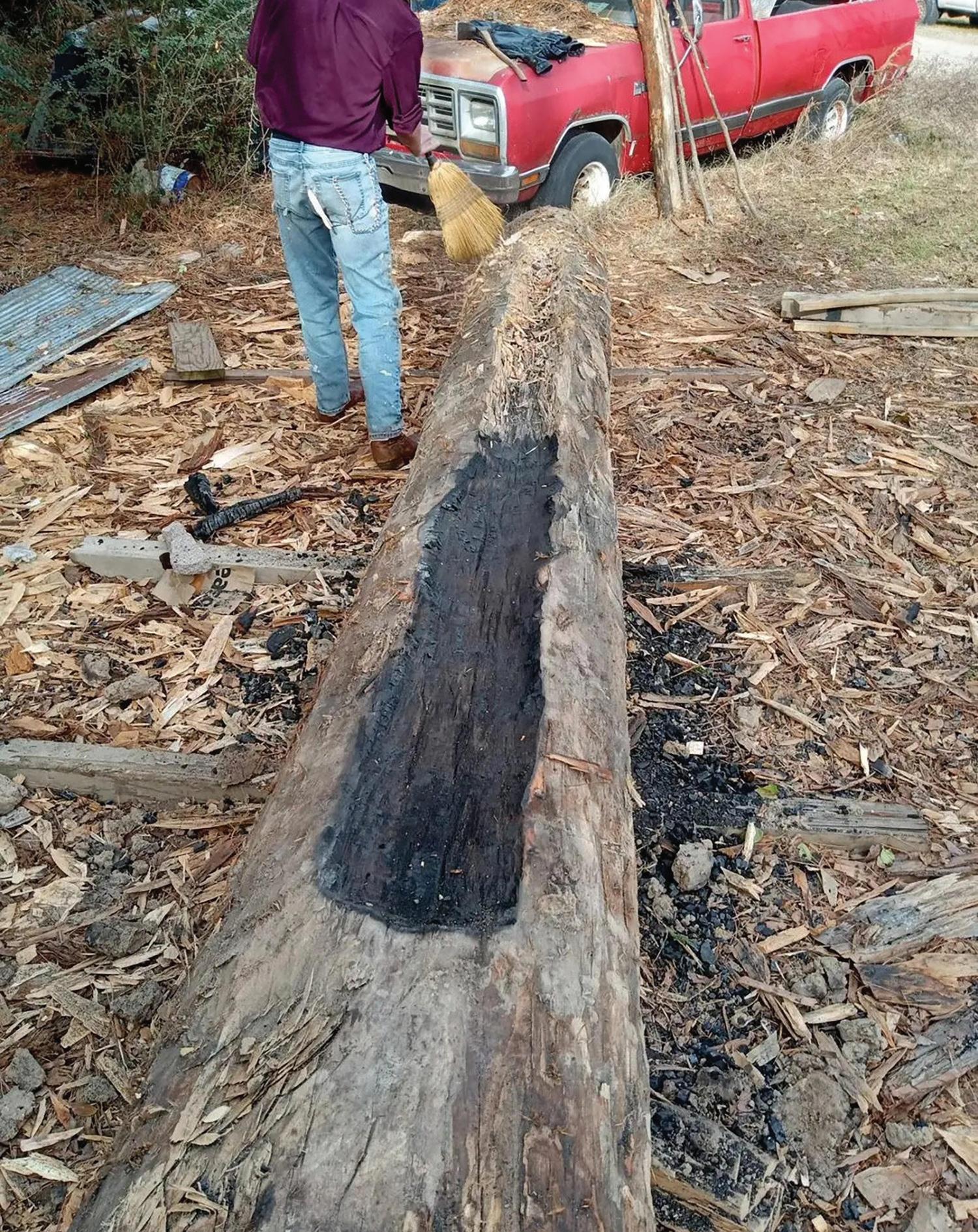
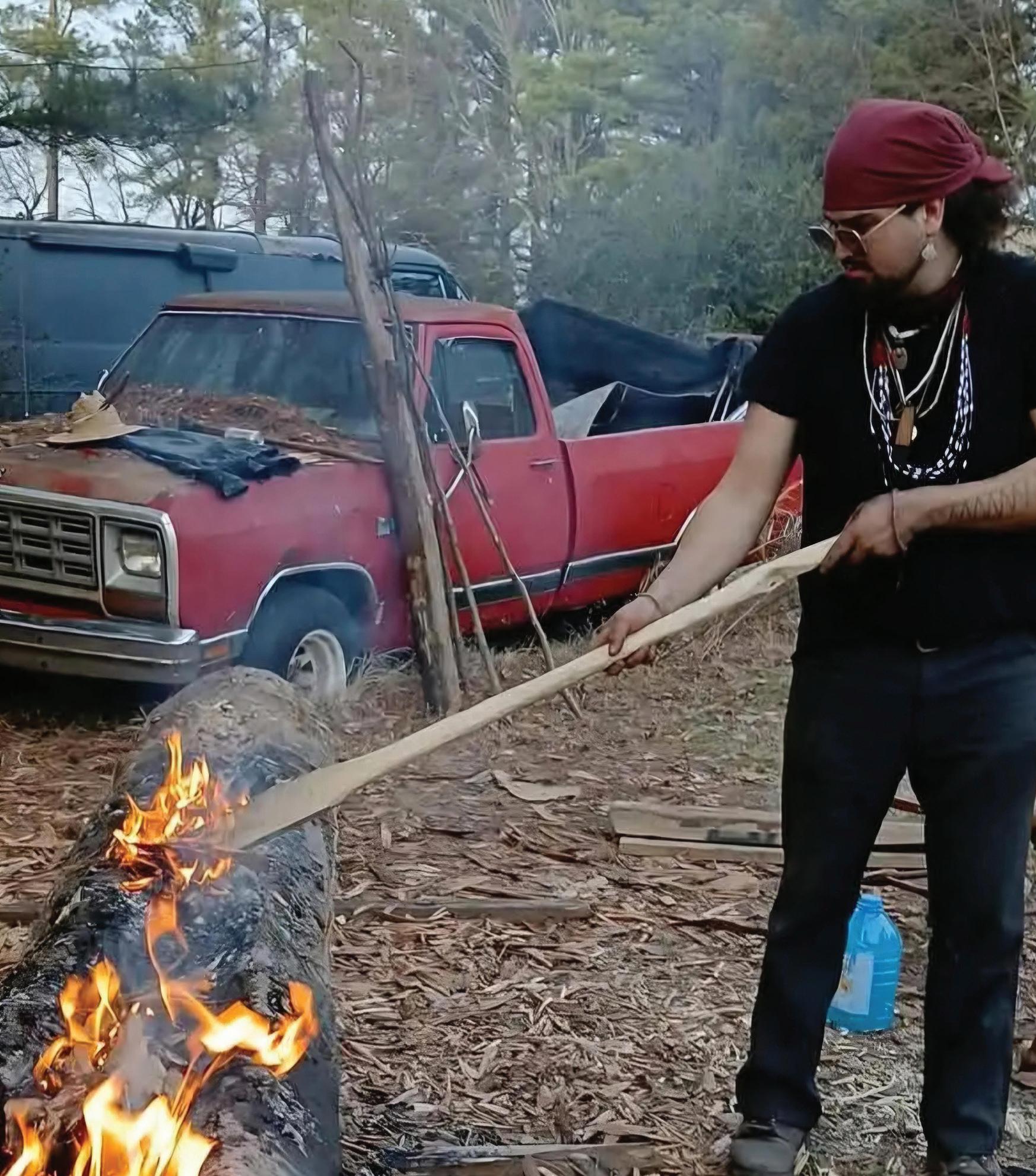
Sacongah Gray’s canoe project, after a round of burning out the log he’s using to make the traditional Cherokee craft.
Photo courtesy of Sacongah Gray.
canoes often had a rectangular cross section designed to slide across low-water areas. The ends featured a rudder-like “tail” that helped keep the canoe straight in strong winds over open water. Stability and directional control were essential for crossing large bodies of water.
Cherokee and other southeastern peoples – such as the Choctaw, Chickasaw, and Muscogee-Creek – tended to make river-style dugouts. These canoes also had a rectangular cross section but were built for shallow rivers and streams. They were maneuvered with push poles and paddles rather than sails or heavy rudders. Instead of a narrow, pointed end or rudder tail, Cherokee canoes featured a wide “lip” on each end. That lip functioned as a standing platform. The sides ran straight along the length, and there was no discernible tail.
The distinction is not just decorative, but practical and cultural.
“The ends are the key difference, since the need for ease of turning in moving on rivers was more important than maintaining direction as would be needed on a large lake,” Gray said.
In other words, Cherokee canoes were shaped for and by the current, not by the open horizon. They were made to pivot quickly in flowing and rushing water, to navigate bends and shoals, and to move through the geography of southeastern rivers.
Gray’s current project is being built for this purpose. It is not a display piece, but one that will be used. Unlike his other canoe that now sits in an exhibit, this one will be used on the water. That decision is intentional. A canoe sitting still tells a story; a canoe moving on a river tells it louder. It challenges assumptions that Native culture is frozen in museums and invites younger generations to see heritage not as artifact but as skill. It reframes all the history, not simply as tragedy, but as resilience.
and bridges, before state lines and allotment maps, rivers carried Cherokee people forward. The river was not just geography; it was movement, provision, and direction.
Gray is not simply replicating the past. He is strengthening a lineage that was interrupted but never erased. Heritage does not survive on sentiment alone. It survives because someone is willing to do the hard, patient work of carrying it forward.
Gray’s path reflects that resilience. From a childhood surrounded by handmade work to early mentorship under master artisans, his journey into canoe carving grew organically from lived tradition. The amount of research, experimentation, and adaptation it takes to take on these projects is astonishing. From carefully selecting the logs to the required attention to detail needed while hollowing them out, the entire process is rigorous. Yet Gray perseveres in his work to restore the culture of his people.
In Tahlequah, where the Cherokee Nation headquarters now stand far from the ancestral rivers of the Southeast, carving a dugout canoe is more than craftsmanship. It is an act of remembrance. It reminds the community that before highways
As wood curls away and the shape emerges — rectangular cross section, straight sides, broad lips at either end — a river canoe takes form. A Cherokee canoe. And in that shaping, something larger is being said. Every person has been entrusted with memory. With story. With skills passed down through hands that are no longer here. Those things are not accidents of history. They are gifts. And gifts are meant to be stewarded.
When this canoe finally touches water, it will do more than float. It will move. And in moving, it will testify that a culture lives when its people remember who they are, practice what they have received, and refuse to let their inheritance drift away. To keep heritage alive is not to live in the past. It is to honor what has been given and to carry it faithfully into what comes next. G
Fire can be a valuable friend when working on a dug-out canoe. Sacongah Gray tends the flames of his traditional Cherokee canoe construction project. Photo courtesy of Sacongah Gray.
PO Box 1354, Tahlequah, OK 74465 humanecherokeecounty@gmail.com |www.humanecherokeecounty.org www.facebook.com/HumaneSocietyOfCherokeeCounty
University class project makes formal wear affordable for teens
By Dana Eversole
Dr. Dana Eversole is a professor of Media Studies and chair of the Department of Communication and Media Studies at Northeastern State University. Eversole worked as news editor for the Daily Press for two years before taking the job at NSU. She has been a stringer throughout the years for the Press. During her tenure at the Press, she won many awards, including a Sweepstakes award for investigative reporting from the Oklahoma Associated Press. She was recently named Oklahoma Outstanding Journalism Educator by the Oklahoma Society of Professional Journalists. Eversole is serving her second term on the Tahlequah School Board.
FFor 10 years, young people in Northeastern Oklahoma have relied on university students to help them purchase formal attire for prom or other events at an affordable cost.
Prom on a Penny was created in the spring of 2016 when Breah Boon Daily, of Tulsa, and four of her classmates in the media studies program at Northeastern State University were tasked with coming up with an event to plan and carry out.
“The event did not have to earn money,” said Dr. Dana Eversole, professor of media studies and instructor of the media campaigns and events class. “Other members of the class produced an awareness event concerning the animal population in Tahlequah, and another group created an antique/flea market vendor fair in Norris Park.”
Daily quickly came up with a plan, and her group was excited.
“I pitched the project of collecting new and slightly worn formal wear and reselling it at a low cost,” she said. “When I was in high school, I saw several of my friends struggle to buy a dress, and I decided every person should have the dress she wants.”
Daily and her committee quickly went to work advertising to collect dresses in the area. Daily’s mom set her sights on the Tulsa area and selected locations where people could drop off clothing.
It worked, and before the date of the event, the students had gathered more than 300 dresses.
“We also visited with the cosmetics salespeople at Dillard’s in Muskogee, and several came to Tahlequah to help with makeup. We also had several beauticians from the area provide suggestions on how to fix your hair for prom,” said Daily.
The first event was held in the basement of the University Center at NSU, and the line to get in was down the steps and out the door.
“It was a great first event, and we learned a lot,” said Dai-
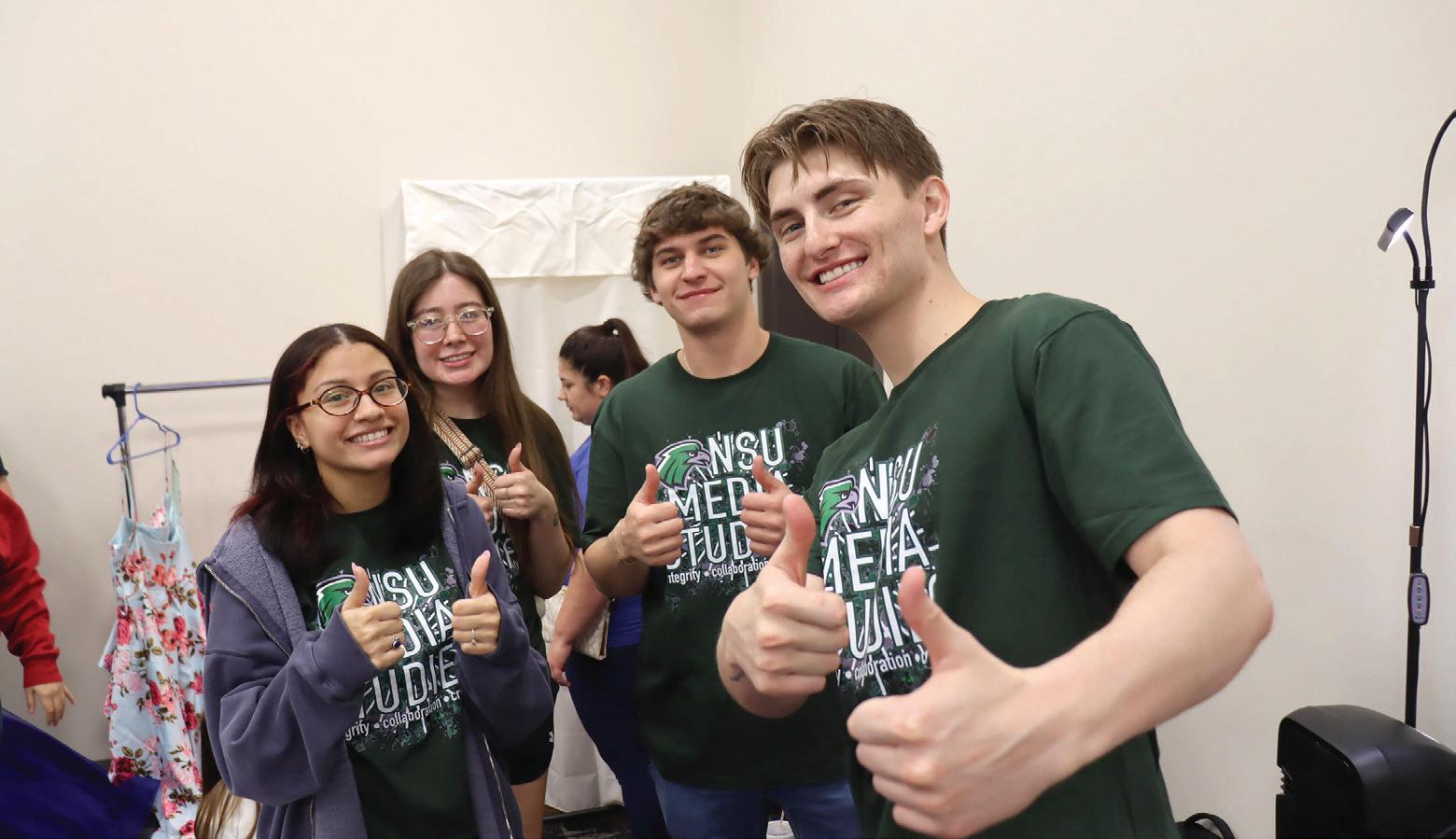
Giving a thumbs up on how Prom on a Penny is going are, from left: Victoria LeFlore, Kaleena Burtrum, Seth Brown and Colby Cook, More than 100 people showed up to shop this year.
Photo by Halli Resinger.
ly. “Better dressing rooms or more bathrooms were definitely needed.”
Prom on a Penny began as a project for the capstone course and remains a mainstay event, providing students with the opportunity to buy apparel at an affordable price.
Dresses are donated to the event by the community and are sold at a fraction of their original price.
Proceeds have always gone to Tigers ROAR — Removing Obstacles Achieving Results, a Tahlequah Public Schools initiative. The goal of the program is to address the socioeconomic challenges of students in the TPS district by ensuring access to mental health support, basic supplies and other necessities. Such efforts aim to eradicate barriers that inhibit a student’s ability to succeed socially and academically.
A former Prom on a Penny co-leader, Brooklyn Larrison, of Choctaw, believes the Tigers ROAR program provides the community with much-needed support and is a fitting beneficiary of the event’s proceeds.
“Tigers ROAR is doing big things in the community, and they do not get enough recognition,” said Larrison. “While Tahlequah is a thriving community in many aspects, there are still so many people here who struggle, and TPS is addressing these issues head-on. I am so honored that Prom on a Penny not only gets to provide opportunities to help people with prom, but that all our proceeds are going to another organization to help people meet their needs.”
Former Prom on a Penny co-leader Honor Sagebiel, of Tulsa, believes the event’s philanthropic nature has encouraged students to continue the tradition.
“This event has meant so much to media studies students,” said Sagebiel. “We feel a need to keep this tradition going, not only to give students the prom experience I think every student should experience, but the money we do make goes to students who truly need the support.”
Another former Prom on a Penny organizer, Jessica Treat, of Tulsa, recalls how enriching the experience of organizing the event was. It brings up memories of her own humble beginnings.
“The most rewarding part was seeing the impact that affordable formal wear had on our local community,” said Treat. “My family didn’t have much growing up, and we even struggled to buy my own prom dress in high school. It meant everything to me to see young students at Prom on a Penny stress-free and with smiles on their faces when they found the attire they needed.”
Larrison said organizing an event like this requires a lot of time, effort, and community support. To ensure its success, it is reliant upon donations and community involvement.
A high school student shedding tears after finding the “perfect” dress is not an uncommon sight at Prom on a Penny. NSU graduate Breanna Hampton, Hulbert, said she even had a young girl hug her after finding a dress that fit.
“I think it was definitely a worthwhile experience, just seeing the girls find that perfect dress they normally wouldn’t be able to afford,” said Hampton.
Katie Culberson, of Tulsa, donated her senior prom dress that she did not get to wear because of the COVID-19 pandemic. But the gown did find a new life at Prom on a Penny.
“I watched this one girl buy it, and I was like, ‘Oh, my gosh! I love that dress.’ I never got to wear it. I’m so glad [she’s] going to get to enjoy it, “ Culberson said.
Culberson said she learned several real-life skills that parallel what she is learning during her internship with the Tahlequah Main Street Association with the Red Fern Festival.
“It was the same thing we were doing here in class, so I think it gives you the same experience you would get out of the workforce,” Culberson said.
The students spend a lot of time sorting the formal wear into sizes and trying to iron out all the details before the big day.
Even though Prom on a Penny has been around for many years, the event is always changing to better suit the community.
Dresses weren’t the only types of formal wear available. There were also suits, an aspect that has only been around for the past three years. Hampton said the group’s special media had a lot of engagement, wondering about Prom on a Penny’s suits and plus-size dresses.
“I think that’s one thing we could [improve on]. For years to come, maybe something we should push for more is suits,” Hampton said.
Nikki Molloy, special services director of TPS, said Prom on a Penny is a perfect example of their mission, as it transforms what could be a stressful or difficult experience for some students into a joyful occasion.
“The process of removing obstacles starts with a care team system that meets weekly to review student referrals,” Molloy said. “These referrals may concern academic needs, food insecurity, hygiene or other challenges. Our team, including members from the Outreach Center, works quickly to get in contact with families and provide resources. Families can also reach out to the OC directly to inquire about available resources and community partnerships.”
Molloy said funds from Prom on a Penny will go to the ROAR account and be used to support families with essential items, including clothing, supplies and food. Every Thursday, students in the class travel to TPS and put together snack packs to be distributed to students.
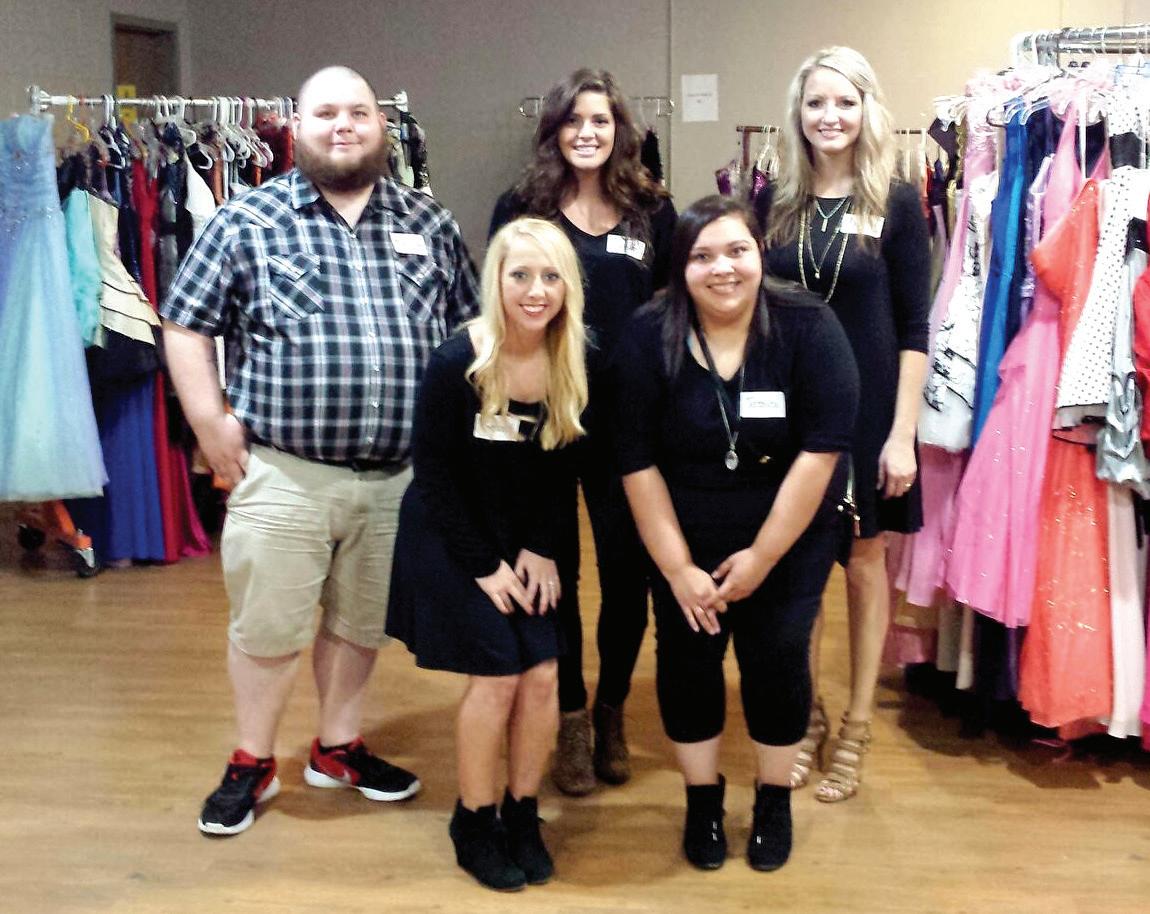
Five NSU students in the media studies program at NSU created the Prom on a Penny event 11 years ago. From left are: Matt Dorr, Kasidee Webb, Breah Boone Daily, Charity Murhlenweg and Hessica Henry.
“When Dr. [Dana] Eversole suggested involving her class in packing snack packs, we were thrilled,” said Molloy. “The Backpack Program currently serves over 300 students weekly and having her class assist with packing is a tremendous help. These snack packs are vital for students facing food insecurity and receiving these packs provides them with the resources they need to get through the weekend. It makes a meaningful difference in their lives.”
Dae’lyn Smith, of Mannford, a former Prom on a Penny co-leader, said Eversole really values service-learning in the college classroom.
“This campaigns and events class is our way of implementing service-learning into our media studies curriculum,” Smith said.
Several years ago, the students decided to expand the event to include men’s formal wear. In addition to women’s dresses, shoes and jewelry, they are accepting tuxedos, suits, ties, bow ties and shoes. The committee’s goal is to provide affordable prom attire for both young women and men in the surrounding communities.
“I was intrigued by this event my freshman year because I remembered what it was like to watch my peers drop hundreds and hundreds of dollars on prom night, when I was digging through my mom’s old bridesmaids’ dresses or searching for something semi-cute that I could also afford. The stories I witnessed at this event were incredible, and girls were in tears that we made prom a reality for them,” said Smith. “Please, consider donating, because it really means the world to high school girls who cannot afford it otherwise.”
This year’s Prom on a Penny was held the first weekend in March at the old Armory, now the Education Service Center for Tahlequah Public Schools.
Jennifer Bennett, of Locust Grove, came to shop because her niece and friend were looking for prom dresses.
“My sister works for the Cherokee Nation and heard it from her co-workers. There are a lot of good dresses for cheap,” she said.
Chole Blackman, 16, of Tahlequah, said she had three proms to attend and heard about the event.
“I got three dresses,” said Blackman. G
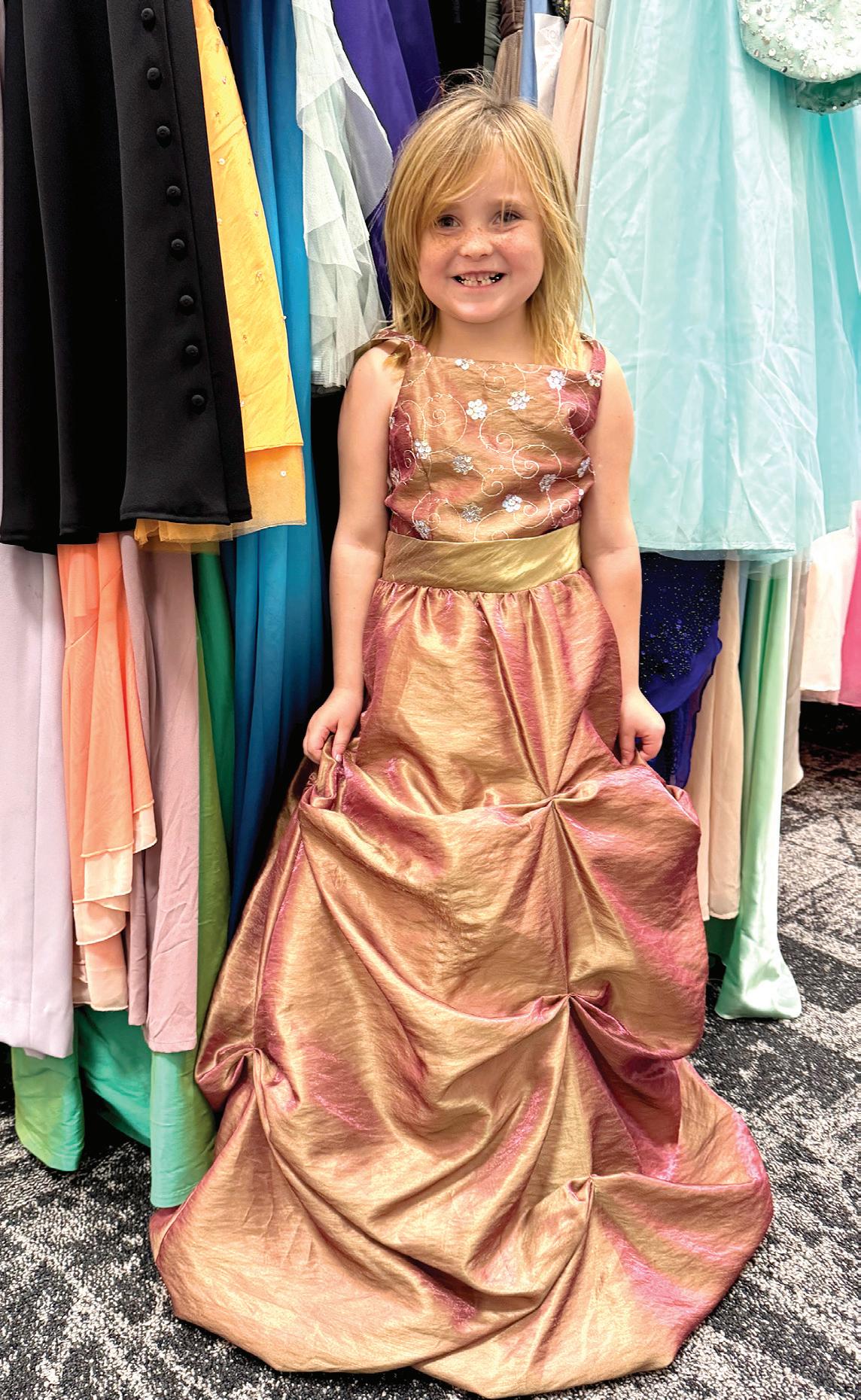
Emilia Johnson tries on a formal dress at Nsu Media Studies’ Prom on a Penny. Photo by Halli Resinger
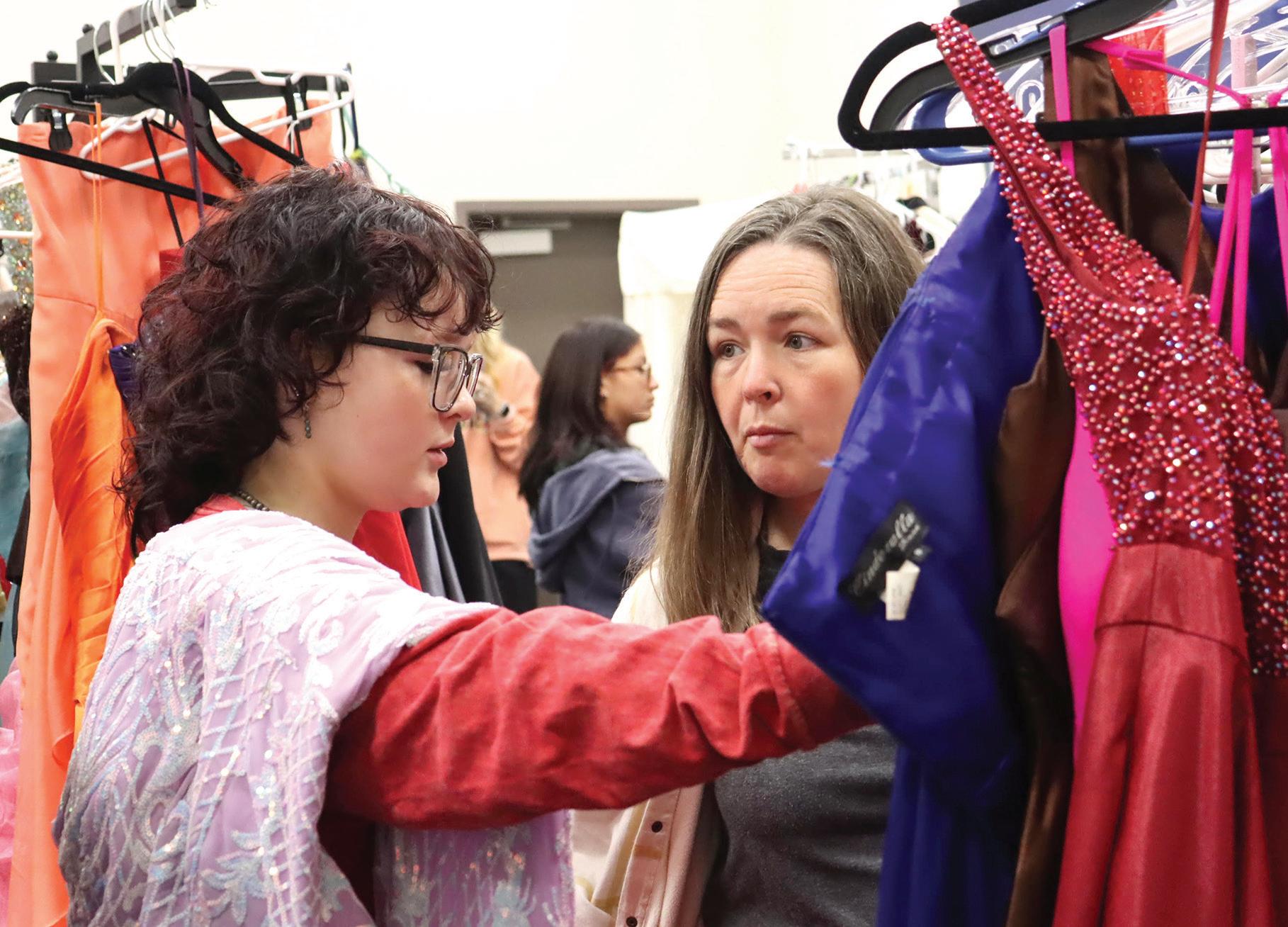
Shoppers at Prom on a Penny took their time looking for inexpensive formal wear. Photo by Halli Resinger
Tahlequah Backpacking Program evolving to better serve families
By Dana Eversole
The Tahlequah Backpacking Program continues to evolve its communication strategy to better serve families and the broader community, with social media emerging as its primary and most effective communication tool.
The program is just one of many covered by the Tigers ROAR program at Tahlequah Public Schools.
“I’m the outreach center coordinator. I help with the backpack program, anything like, if families need resources, I kind of help them get them set up for that. We do have social sources specialists at each site,” Amy Spears said.
The Tahlequah School District’s motto is ROAR: Remove Obstacles, Achieve Results. One of the big issues was food insecurity.
“This is something that I know when I started at Tahlequah 16 years ago, they had the program back then, and it’s continually grown and grown and grown every year. We’ve been able to improve the food that’s given out,” Spears said.
The district now buys everything through Sam’s Club, where it’s more name brand, just so school officials know kids are eating it. The feedback is positive, and the program continues to grow, she said.
As digital access has become more widespread, the organization has prioritized platforms that allow for timely updates, direct engagement and consistent outreach.
Social media, particularly Facebook, serves as the program’s main form of controlled media, alongside its website, email communications, flyers and community bulletin postings. According to Spears, outreach center coordinator for the Tahlequah Backpacking Program, these platforms allow the organization to reach families efficiently.
“A large majority have some type of cellphone, and they probably have some type of medium. We’ve always asked
people to join our Facebook page. That’s the best way that we reach everyone,” Spears said.
While Facebook remains the primary communication channel, the organization continues to supplement digital messaging with printed materials. Flyers and handouts provide families with a visual reference and ensure information remains accessible.
“We try to use Facebook as a main one to push out for the majority but also try to supplement with flyers so they can have a visual as well,” Spears said.
In addition to controlled media efforts, the Tahlequah Backpacking Program benefits from uncontrolled media exposure through local news coverage, community wordof-mouth and social media mentions. Coverage from the Tahlequah Daily Press also plays a role in extending the organization’s reach and reinforcing its presence within the community.
Before the COVID-19 pandemic, the organization relied heavily on in-person communication, including school partnerships, community events and face-to-face outreach. Social media was used, but primarily as a supplementary tool. During the pandemic, communication shifted significantly toward digital platforms as the program worked to share safety updates, program changes and virtual engagement opportunities.
Post-pandemic, the program continues to rely on social media and digital communication as central components of its outreach strategy. These platforms allow for quick updates, event promotion and storytelling that highlights the impact of their programs. By combining digital communication with traditional media and local press coverage, the organization remains connected to the families and community it serves.