B C
www.cabe.org
Vol. 23, No. 2
February, 2019
View from the Capitol
Superintendent/ Board Communication in a Crisis
Patrice McCarthy
Deputy Director and General Counsel, CABE
The 2019 Session of the Connecticut General Assembly began on January 9. It was a day filled with history and ceremony, including the inauguration of Ned Lamont as the 89th Governor of Connecticut, and the swearing in of the Constitutional officers and members of the House and Senate. Organizational meetings of each committee have been held, and the legislative deadlines have been established. Public hearings will begin in February. The Education Committee deadline to report out bills is April 1st and the Appropriations Committee deadline is May 3rd. Governor Lamont will present his budget to the General Assembly on February 20th. At CABE Area Legislative breakfasts being held around the state, legislators, school board members, and superintendents have the opportunity to discuss key issues. CABE’s Day on the Hill on March 20th will be the perfect time to discuss legislation under consideration by the various committees. With a new Governor and many new legislators, the connection between local and state officials is more important than ever.
Nicholas D. Caruso, Jr. Sr. Staff Associate for Field Service, CABE
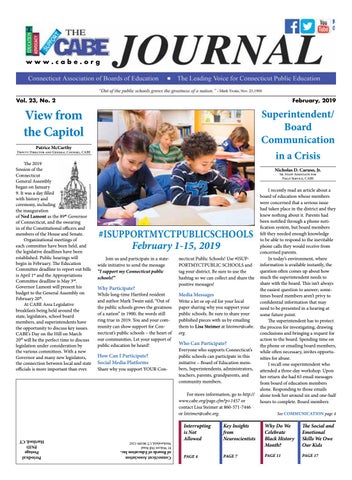
#ISUPPORTMYCTPUBLICSCHOOLS February 1-15, 2019 Join us and participate in a statewide initiative to send the message “I support my Connecticut public schools!”
Why Participate?
While long-time Hartford resident and author Mark Twain said, “Out of the public schools grows the greatness of a nation” in 1900, the words still ring true in 2019. You and your community can show support for Connecticut’s public schools – the heart of our communities. Let your support of public education be heard!
How Can I Participate? Social Media Platforms
Share why you support YOUR Con-
necticut Public Schools! Use #ISUPPORTMYCTPUBLIC SCHOOLS and tag your district. Be sure to use the hashtag so we can collect and share the positive messages!
Media Messages
Write a let or op-ed for your local paper sharing why you support your public schools. Be sure to share your published pieces with us by emailing them to Lisa Steimer at lsteimer@cabe. org.
Who Can Participate?
Everyone who supports Connecticut’s public schools can participate in this initiative – Board of Education members, Superintendents, administrators, teachers, parents, grandparents, and community members. For more information, go to http:// www.cabe.org/page.cfm?p=1457 or contact Lisa Steimer at 860-571-7446 or lsteimer@cabe.org.
I recently read an article about a board of education whose members were concerned that a serious issue had taken place in the district and they knew nothing about it. Parents had been notified through a phone notification system, but board members felt they needed enough knowledge to be able to respond to the inevitable phone calls they would receive from concerned parents. In today’s environment, where information is available instantly, the question often comes up about how much the superintendent needs to share with the board. This isn’t always the easiest question to answer; sometimes board members aren’t privy to confidential information that may need to be presented in a hearing at some future point. The superintendent has to protect the process for investigating, drawing conclusions and bringing a request for action to the board. Spending time on the phone or emailing board members, while often necessary, invites opportunities for abuse. I recall one superintendent who attended a three-day workshop. Upon her return she had 65 email messages from board of education members alone. Responding to those emails alone took her around six and one-half hours to complete. Board members See COMMUNICATION page 4
Interrupting is Not Allowed
Key Insights from Neuroscientists
Why Do We Celebrate Black History Month?
The Social and Emotional Skills We Owe Our Kids
PAGE 4
PAGE 7
PAGE 11
PAGE 17
81 Wolcott Hill Road Wethersfield, CT 06109-1242
Connecticut Association of Boards of Education Inc.
Periodical Postage PAID Hartford, CT
2
The Journal – Connecticut Association of Boards of Education | February 2019 PRESIDENT COMMENTARY
Lobbying on Behalf of Public Schools Robert Mitchell President, CABE
The 2019 Legislative Session has begun and all eyes are on Hartford. With a new Governor, new co-chairs of the Education Committee, as well as other key committees, school districts across the state are anxious. Will there be a solution to the serious funding issues we all face? Will we continue to see one-size fits-all solutions to complex problems? School reform and regionalism continue to be words mentioned regularly. These and other topics will be on the table this current legislative session. As board members, you know that many decisions made by the Connecticut General Assembly will affect the schools under your purview. These decisions often make you feel like there is nothing you can do to influence what comes out of the Legislature, but, frankly, that is just not true. Boards of education have a lot to add to the conversation as state laws are crafted or reviewed. In fact, you can really make a difference in helping to inform our legislators on what will happen in your district if their proposals become law. Legislators rarely hear from their locally elected municipal officials. CABE and similar organizations work hard to impact these decisions. CABE staff, working with volunteer board of education members and members of the CABE Board of Directors, is at the Capitol every day during the session providing support
The NSBA Annual Conference and Exposition will be held March 30-April 1 in Philadelphia, PA. Conference registration and housing are now open. Register online at www.nsba. org/conference.
for the Association. Board members testifying at legislative committee meetings is invaluable. It isn’t easy, it takes time and patience. The hearing process is not very user-friendly, but the experience is incredible and it does get your district’s testimony on the record. If you are interested in participating in this type of activity, contact the Government Relations staff at CABE and they can help you prepare. If you can’t take the time to visit Hartford, a letter, phone call or e-mail to your local legislators can be very helpful. These communications really do influence the members of the Connecticut General Assembly. Another activity you can participate in to influence the Legislature is to attend CABE’s Legislative Breakfasts. Many of these breakfasts will have taken place by the time you read this, but put it on your watch list for next year. These breakfasts bring local legislators together with board members and superintendents from each CABE area to talk about legislation and the impact on local schools. You also should attend the annual CABE Day on the Hill on March 20, to learn about current legislative activities and to meet with your legislative delegations and, again, help them understand what will happen to their community if they vote on bills regarding their schools. Finally, this process shouldn’t be
Mission: To assist local and regional boards of education in providing high quality education for all Connecticut children through effective leadership. Vision: CABE is passionate about strengthening public education through high-performing, transformative local school board/ superintendent leadership teams that inspire success for each child.
Board of Directors something we only think about when the General Assembly is in session. Advocacy should be a year-round activity. Invite your local legislators into your schools and to visit during board meetings. Get to know them and establish a rapport with them, so when you call, your comments will be credible. Participate in the CABE Delegate Assembly process, drafting resolutions, attending the Delegate Assembly in November and participating in the CABE Government Relations Committee – made up of board members who want to make a difference. While your service on your local board is incredibly important, the fact is that many decisions that affect your schools happen outside the borders of your local community and to fully advocate for your district you need to look to other decision-makers, and help them make good decisions. Not only that, but you’ll meet great people along the way. If you are interested in participating in CABE legislative activities, contact Patrice McCarthy, CABE’s Deputy Director and General Counsel, or Sheila McKay, Senior Staff Associate for Government Relations.
The CABE Area 6 breakfast was held on January 8. Pictured left to right: CABE Area 6 Director Karen Kleine (Westport), CABE Associate Director Elaine Whitney (Westport), and Representatives Steinberg, Lavielle, McCarthy-Vahey, Meskers and Gresko.
EXECUTIVE COMMITTEE Robert Mitchell | President, Montville Donald Harris | First Vice President, Bloomfield Elizabeth Brown | V ice President for Government Relations, Waterbury Christopher Wilson | V ice President for Professional Development, Bristol Michael Purcaro | Secretary/Treasurer, Ellington Ann Gruenberg | I mmediate Past President, Hampton Bryan Hall | Member at Large, East Hartford Lydia Tedone | NSBA Director, Simsbury AREA DIRECTORS Doug Pfenninger | Area 1 Director, Winchester Bryan Hall | Area 2 Co-Director, East Hartford Leonard Lockhart | Area 2 Co-Director, Windsor Michael Purcaro | Area 3 Co-Director, Ellington Michele Arn | Area 3 Co-Director, Vernon Joan Trivella | Area 4 Director, Brooklyn Mic helle Embree Ku | A rea 5 Co-Director, Newtown Frances Walton | Area 5 Co-Director, Ridgefield Karen Kleine | Area 6 Director, Westport George Kurtyka | Area 7 Director, Derby Lon Seidman | Area 8 Director, Essex Sean Nugent | Area 9 Director, Preston ASSOCIATES Eileen Baker | Associate, Old Saybrook Robert Guthrie | Associate, West Haven John Prins | Associate, Branford Robert Trefry | A ssociate, CT Technical High School System COMMITTEE CHAIRS Becky Tyrrell | Chair, Federal Relations, Plainville Bryan Hall | Chair, Resolutions, East Hartford Jennifer Dayton | Chair, State Relations, Greenwich CITY REPRESENTATIVES Betsy Allyn| C ity Representative, Stamford Charles Stango | City Representative, Waterbury STAFF
Robert Rader | Executive Director Patrice McCarthy | Deputy Director and General Counsel Rebecca Adams | Senior Staff Attorney Nicholas Caruso | Senior Staff Associate for Field Service and Coordinator of Technology Sheila McKay | Senior Staff Associate for Government Relations Vincent Mustaro | Senior Staff Associate for Policy Service Lisa Steimer | Senior Staff Associate for Professional Development and Communications Teresa Costa | Coordinator of Finance and Administration Pamela Brooks | S enior Administrative Associate for Policy Service and Search Services Terry DeMars | Administrative Associate for Policy Service Gail Heath | Administrative Associate for Government Relations Wilmarie Newton | Administrative Associate for Labor Relations Nancy Propfe | Administrative Assistant for Membership Services Corliss Ucci | Receptionist and Assistant to Executive Director
The CABE Journal (ISSN 1092-1818) is published monthly except a combined issue for July/ August as a member service of the Connecticut Association of Boards of Education, 81 Wolcott Hill Road, Wethersfield, CT 06109, (860) 5717446. CABE membership dues include $30 per person for each individual who receives The CABE Journal. The subscription rate for nonmembers is $75. Association membership dues include a subscription for each board member, superintendent, assistant superintendent and business manager. The companies and advertisements found in The CABE Journal are not necessarily endorsed by CABE. “Periodicals Postage Paid at Hartford, CT.” POSTMASTER: Send address changes to The CABE Journal, CABE, 81 Wolcott Hill Road, Wethersfield, CT 06109-1242. Email: bcarney@cabe.org. Members can find the CABE Journal online at: www.cabe.org/ page.cfm?p=1024
The Journal – Connecticut Association of Boards of Education | February 2019
CABE Affiliate Members BUSINESS AFFILIATES DIAMOND MEMBER Finalsite PLATINUM MEMBER
Berchem Moses PC GOLD MEMBERS
Pullman & Comley Shipman & Goodwin Support for the Budgetary Process SILVER MEMBERS Anthem Blue Cross and Blue Shield Arthur J. Gallagher & Company Corporate Cost Control Digital Back Office ESS Milliman Milone & MacBroom, Inc. BRONZE PLUS MEMBERS Coordinated Transportation Solutions COUNTABILITY, Inc. JCJ Architecture OneDigital Health and Benefits The S/L/A/M Collaborative BRONZE MEMBERS Albert Risk Management Consultants Brown & Brown Chinni & Meuser LLC Dattco, Inc. Goldstein & Peck, P.C. Kainen, Escalera & McHale, P.C. The Lexington Group Perkins Eastman Zangari Cohn Cuthbertson Duhl & Grello
EDUCATIONAL AFFILIATES
American School for the Deaf Area Cooperative Educational Services Capitol Region Education Council The College Board Connecticut Association for the Gifted Connecticut Association of School Business Officials Connecticut Center for School Change Connecticut School Buildings and Grounds Association Connecticut Technical High Schools Cooperative Educational Services EASTCONN EdAdvance Explorations Charter School Girls Scouts of Connecticut Interdistrict School for the Arts and Communications (ISAAC) LEARN Unified School District #1
3
EXECUTIVE DIRECTOR COMMENTARY
Looking for Lessons in Different Places Robert Rader
Executive Director, CABE
It is often said that the victors in war write its history. Their spin on why they fought, how they fought and their (usually) heroic stories become part of the accepted story of that time. While the story of the defeated may be glorified by some (like the “Lost Cause” legends of the American Civil War), often the history is forgotten or just ignored. Over the holidays, I had the chance to see two memorable presentations on history. One was the terrific show, Hamilton, written by Lin-Manuel Miranda, which is a phenomenal telling of the life of Alexander Hamilton and his role in the Revolutionary War and in the beginnings of our nation. I enjoyed the stage version every bit as much as I love the music, which includes rap, hip-hop, pop, soul and traditional show tunes. The Founding Fathers are played by people of color, which certainly turns history on its head! While not always completely factual or loyal to history (certainly the book by Ron Chernow is a lot less exciting!), it tells the story in such a compelling and attractive way. The show, through its last song, Who Lives, Who Dies, Who Tells Your Story, illustrates the point made above: that what is said about an historical figure, a period of time, or anyone else, will depend on whether the person telling the story is sympathetic or not. Hamilton’s wife, Eliza, certainly was! The other presentation I saw was very different and dealt with very different material. John Leguizamo is a well-known, award-winning author, actor, screenwriter and comedian. He won a 2018 Tony Award nomination for his production, Latin History for Morons. I did not know what to expect from this program, but, I had heard it was good. Don’t let its name fool you (and, no, my family did not suggest I watch it because, after all, it is for morons). While it is hysterically funny at some times and contained vulgar language, it dealt with a very serious subject: the history of Hispanics in Latin America, South America and in the United States.
Latino History
Why is that worth thinking about? Because, not only are Hispanics becoming the majority of students in our schools, so we should honor their past, but also because the fact that so few know about the rich, yet horribly sad history of Latino tribes and what happened to them. As described in the New York Times, “Leguizamo takes on the role of a professor attempting to find a Latin hero for his son to research for a middle school project. ‘That’s how it happened in real life… My son needed a historical hero for a school project, and there weren’t any in his textbook. So I started reading, doing research.” He speaks about tribes, like the Mayans, Incas and Taino, which suffered extermination at the hands of the Spanish in particular. He makes the point that over centuries, these tribes have melded together so that in a DNA test, it is very difficult to tell who comes from which tribe. I think that the reason so many of us know so little about this history is that the history continues to be written by the victors. Against these tribes, the victors were Europeans. As Leguizamo states, all that his son’s teacher seems to know is that Hispanics have only contributed “drugs and violence” to America.
“People become ‘invisible’”
Leguizamo wonders how his people became so “nonexistent” and “invisible.” I believe that boards and superintendents have a key role in reshaping that narrative. He put together a syllabus, discussing “our powers and our contributions,… how much was destroyed and how much has been exploited and how with the incredible amount of resources and power we have, why are we powerless?” There are lessons in these two completely different presentations: •B oard members and superintendents should look beyond the usual stories that we may have learned growing up. There is much to be learned, and much to be gained, by hearing opinions that you may not share---or may not yet know about.
•T o understand our students and their needs, we have to have a deep understanding of them and their stories. Where did their families come from? When did they get to our schools? • S ometimes it takes “out of the box thinking” to get a point across. Illustrating it in a totally new way can be very influential. If Miranda presented Hamilton as a story of “old white men” with more traditional music, would it have been noticed? I am not suggesting that board members or superintendents should take on face value what they see in the media, on Broadway or on television. CABE always encourages its members to “ask the right questions”, but know enough about the subject to ask those “right” questions. A healthy skepticism is a key part of being a good board member and leader.
Equity Lens
At a time when the State, nonprofit organizations and CABE and CAPSS are encouraging us to look at our work through an “equity lens”, maybe we need to look wider and deeper about what is happening—and what happened--in our State and the country. We may have to learn more about what happened in other countries, too, since their histories directly affect ours. This might require us to, at times, challenge what we learned in school. But, if the result is providing changes in programs and activities so that everyone feels included, it will have been worth it. Hamilton continues to tour and is on Broadway. John Leguizamo’s “Latin History for Morons” is now streaming on Netflix. His “required reading list” on Latin history can be found at https:// latinhistorybroadway.com/wp-content/ uploads/2017/12/LatinHistory_RequiredReading.pdf.
4
The Journal – Connecticut Association of Boards of Education | February 2019
Interrupting is Not Allowed at Meetings
Interrupting = disrespect
There is an exception to this rule. If someone is saying something completely off the wall, negative, and breaking the rules of courtesy, the chair should stop them, or a member should interrupt to make a Point
of Order. In that case, it is okay and indeed a good thing to interrupt. But though it is allowed to interrupt a speaker to make a Point of Order, people should exercise this right with care. The fact that you CAN do something doesn’t necessarily mean that you SHOULD. For example, suppose a member is talking about the motion under consideration and mentions in passing that she believes it would be a good idea to amend the ordinance in a certain respect. I saw a chair interrupt this speaker to say, “Amending the ordinance is not germane [relevant] to the topic.” In my view, that was a mistake. The member should have been allowed to complete her thought, and the chair could have gently said, “Amending the ordinance is not directly related to our motion,
COMMUNICATION
and the vehicle best suited for it. Many boards have a communications plan which would include general guidelines for board-superintendent communications. These plans should be deliberate and strategic. In general, it starts by articulating examples of what the board believes should be shared that can be discussed with the superintendent for viability. In the case of the district I mentioned at the outset, putting board members on the general list for broadcast phone calls was easy to do and satisfied the board. In some cases other solutions make more sense. In many districts, the superintendent regularly (once a month or once a week) reports on things he or she believes the board should know about. It might be an issue that the district is
facing - budget updates, possible labor issues or programmatic problems are examples. Some issues require a personal call, but in most districts the superintendent will reach out to the board chair to determine who needs to be on the list to be informed, and just how much should be shared. May boards have a protocol where the chair then calls individual board members to share the issue with the rest of the board. It is important that whatever information is shared with the board, that all board members receive the same information. Consider this a work in progress. In doing his or her job, the superintendent might not get information in a timely manner, or the superintendent’s understanding of the problem
Ann Macfarlane
Professional Registered Parliamentarian, Jurassic Parliament
Interrupting is one of the most common conversational gambits in our American society. It is not allowed at meetings run according to Robert’s Rules of Order. We see and hear interruptions all the time. Parents interrupt children; employers interrupt their subordinates, men interrupt women (and occasionally, though less often, women interrupt men). Let’s put a stop to it!
Interrupting is a basic sign of disrespect. It puts the clamps on free expression. The person interrupting is perceived as dominant and the person being interrupted is the victim. It (continued from page 1)
need to be sensitive to the effect that has on superintendents’ time and energy. That being said, nobody wants to read about a serious issue in the schools either in the newspaper (frontpage/above the fold), in social media or on television. Getting a call from a reporter asking a question about a serious issue that the board member knows nothing about is not something anybody wants. As part of a discussion on board evaluation, or the board/superintendent relationship, discussion should take place about what should, or should not be shared with the board,
shouldn’t happen. In discussing this topic on page 383-384, Robert’s Rules of Order Newly Revised, 11th edition (RONR) says that when a member has been assigned the floor and has begun to speak, he cannot be interrupted by another member. Robert’s Rules says further that the chair may not interrupt a speaker, even if he knows more about the subject than the speaker does (p. 44). Would that all chairs took this to heart!
Interrupting – an exception
so let’s put that aside for consideration at another time.” Robert’s Rules allows interrupting a speaker in a few other instances (see RONR, pp. 383-384 and tinted pages 40-41). These are far different, however, from our ordinary conversational type of interrupting. The basic rule is, don’t interrupt another speaker. If you are interrupted, make a Point of Order. Eventually, your group will learn this fundamental guideline, and members will treat each other with the respect that they deserve. Reprinted with permission from Jurassic Parliament and the Alaska Association of School Boards who first published the article.
might not gel with what social media is saying. It may have been blown out of proportion. Sometimes a situation may be underestimated or exaggerated into something more serious than it actually was. It is okay to look at things in hindsight and learn. Finally, here is some advice I always give to boards. When a situation develops, the most important thing is that the situation gets assessed, resolved and then communicated to the community. With social media in play, we often try to accelerate the process. That being said everyone should work to establish protocols that will minimize the potential for misreading a situation and to ensure board members don’t get any unpleasant surprises.
Eleven new senators and 30 new house members were among those sworn in on January 9.
The Journal – Connecticut Association of Boards of Education | February 2019
5
See You in Court – The Nutmeg Board of Education
Transferring Funds – Who? When? How? Thomas B. Mooney, Esq. Shipman & Goodwin
The Nutmeg Board of Education makes many mistakes. The latest imbroglio created by the board will be reported here each issue, followed by an explanation of what the board should have done. Though not intended as legal advice, these situations may help board members avoid common problems. The Nutmeg Board of Education is in the thick of its budget deliberations, and the members are having trouble establishing priorities. Board members Red Cent and Penny Pincher are still smarting from the budget overrun in special education costs last year, and they have been arguing that the Board should allocate more money to the special education line item in 2019-2020 to avoid another problem. By contrast, Ms. Chairperson and Mal Content are presuming optimistically that special education costs will moderate, and they want the Board to allocate funds to hiring more teachers to reduce class size in the elementary schools. Given these conflicting views, the Board members are having a very difficult time coming together on a budget to present to the Nutmeg Board of Finance. When Mr. Chairperson adjourned the meeting last week, he admonished the Board members to reflect and reconsider their respective positions. Veteran Board member Bob Bombast saw this impasse as an opportunity to be the leader he fancied himself to be. He sat down with A Practical Guide to Connecticut School Law and read all he could about the budget process for boards of education in Connecticut. The reading wasn’t exactly scintillating, and it was a slog for Bob. However, by the end of the evening, he came up with the answer, at least in his own mind. “Fellow Board members,” Bob began grandly in an email to the entire Board, “I am pleased to share with you the results of my research on the Board budget process. We don’t really have to worry too much about where we put the dollars in the first instance. Under Connecticut statutes section 10-222, we can transfer funds throughout the year. In preparing the budget right now, we just have to make our best guess. If special education costs are higher than we budget or lower than we budget, we can just move money around. So we should do our best and chill out.” In less than an hour, both Penny Pincher and Mal Content responded to Bob’s email, copying the other Board members. Penny wrote that, with that understanding the Board can simply move money around, she will drop her insistence on allocating addi-
tional funds to special education. Ever the naysayer, however, Mal Content wanted to know more. “What is the process for making these transfers?” he asked. “I don’t want to make a big public deal out of it!” Bob was ready with the answer. “Have no fear!” he wrote back. “The Board can delegate the authority to make transfers to Mr. Superintendent (or whomever else we want). We can just tell Mr. Superintendent in executive session what we want him to do, and the necessary transfers will be made.” That explanation mollified even Mal Content, and the path was clear for an agreement at the next meeting. When the Board met again, the discussion was short and sweet, and the Board promptly adopted a budget to submit to the Town. Mr. Chairperson was greatly relieved to have this important task complete, and he thanked Bob Bombast for his leadership and guidance on the issue. Local reporter Nancy Newshound was already curious as to why the Board members were now playing so nice, and Mr. Chairperson’s comments confirmed her suspicions. Nancy stood up and asked, “Hey! Did you guys have a secret meeting?”. Mr. Chairperson tried to walk it back. “Of course not; Board members just chatted a bit between meetings. Nothing wrong with that!” • • • • • • • • • • • • • Is Mr. Chairperson correct? Was Bob Bombast right? Sadly, both were incorrect in their own ways. Mr. Chairperson and Bob failed to recognize that the discussion among the Board members on email was a “meeting” in violation of the Freedom of Information Act (as a convening of a quorum by electronic means to discuss matters within the Board’s jurisdiction without a proper posting). Bob’s misapprehensions about the budget process require more discussion. At the outset, we note that Bob correctly described the longstanding right of boards of education in Connecticut to expend the appropriation made to them for school purposes “by and in their discretion,” including the right to make transfers from one line item to another. Conn. Gen. Stat. § 10-222. However, Bob should have read more carefully, because he misinformed the Board by stating that Mr. Superintendent can make line-item transfers. Allocating resources for a school district is a fundamental board of education responsibility, both in adopting a budget in the first place and in making transfers over the course of the year. Section 10-222 provides that boards of education “may transfer any
unexpended or uncontracted-for portion of any appropriation for school purposes to any other item of such itemized [budget] estimate.” Moreover, the statute now elaborates on the nature of such transfers, stating that “‘itemized estimate’ means an estimate in which broad budgetary categories including, but not limited to, salaries, fringe benefits, utilities, supplies and grounds maintenance are divided into one or more line items.” Thus, a “transfer” for purposes of the statute does not occur with every adjustment, but rather only when the Board moves funds from one “broad category” to another. Perhaps Bob’s confusion stemmed from the provision in Section 10-222 that states that boards of education may “authorize designated personnel to make limited transfers under emergency circumstances if the urgent need for the transfer prevents the board from meeting in a timely fashion to consider such transfer.” Reading carefully, we see that this authority is quite limited. Furthermore, the requirements that follow destroy Bob’s hope for stealth transfers by Mr. Superintendent. If and when a “designated” person makes an “emergency” line item transfer, the statute requires (1)
that it be announced by the board of education at its meeting, and (to make matters worse) (2) that a written explanation of the transfer be sent to the legislative body of the town (and, if the legislative body is the town meeting, to the board of selectman). Given these requirements, clarity as to these procedures is especially important, e.g., defining what is a “line item,” identifying who can make emergency transfers” and setting the limits on any authority to make such transfers. It is thus advisable that boards of education have in place a policy to provide guidance on such matters. For this policy, as well as other required policies, CABE’s policy service is a great resource, as described here: https://www.cabe.org/page. cfm?p=1161. CABE can assist boards of education by providing different policy options for boards of education and by reviewing with boards of education their current policies and those that boards of education may be well-advised to adopt. Attorney Thomas B. Mooney is a partner in the Hartford law firm of Shipman & Goodwin who works frequently with boards of education. Mooney is a regular contributor to the CABE Journal.
The Ninth Edition – Now Available!
A Practical Guide to Connecticut School Law by Thomas B. Mooney, Esq. Shipman & Goodwin
CABE is delighted to announce that the Ninth Edition of Tom Mooney’s Practical Guide to Connecticut School Law is now available. PRICING: CABE Members: $54.99; CABE Non-Members: $79.99; Students: $44.99 There have been many changes in school law in the last few years, and the Ninth Edition has been extensively revised to provide updated guidance on the legal issues that govern our schools. Changes include descriptions and commentary on:
• Changes in teacher evaluation and teacher tenure. • New rules regarding employee background checks. • New requirements concerning student data privacy. • New rules for suspension, expulsion and alternative educational opportunities. • Revised requirements governing seclusion and restraint. • The new “Every Student Succeeds Act” and how it has changed “No Child Left Behind Act” requirements. • The CCJEF case and ongoing litigation over equal educational opportunities. • The Minimum Budget Requirement and new duties to collaborate with town officials. • A host of other changes in the rules that boards of education and school administrators must follow.
6
The Journal – Connecticut Association of Boards of Education | February 2019
The Journal – Connecticut Association of Boards of Education | February 2019
7
Key Insights from Neuroscientists In this interview with Rafael Heller in Kappan, Tracey TokuhamaEspinosa (Latin American Social Science Research Faculty, Ecuador) shares recent findings of the Delphi panel – a group of experts in neuroscience, psychology, and education that was formed more than a decade ago to build and support teachers’ pedagogical knowledge. Tokuhama-Espinosa begins by debunking some “mistaken beliefs” harbored by many educators and parents: • That students have differing learning styles; • That it’s possible to do more than one cognitively demanding task at the same time; • That specific abilities (for example, math, reading, spatial perception) are localized in specific parts of the brain; • That there are significant differences between male and female brains (there are small differences, but there’s far more brain variation among men and among women). Getting adults to let go of these and other misconceptions is hard – we cling to our erroneous beliefs – but it’s an important professional development mission, especially with novice teachers. Many commercial programs are selling products to schools based
on bogus claims, says TokuhamaEspinosa. “It’s always good to be skeptical about commercial products based on brain research,” she says. “Don’t be fooled by how many scientists a company has on its advisory board, or what they’ve been able to teach rats in the lab, or even what they’ve been able to teach some kids under controlled conditions. It’s just not that straightforward to turn research findings into effective programs and apps. If it sounds too good to be true, it probably is.” The Delphi panel has reached agreement on six core principles about how all brains work – across contexts or cultures: • Human brains are as unique as human faces; the basic structure is similar, but each person’s unique genetic makeup combines with life experiences (and free will) to shape neural pathways. • Each individual’s brain is differently prepared to learn different tasks; the variables are the person’s biology and genetic makeup, prenatal and perinatal events, environmental exposures, the learning context, prior learning experiences, and personal choices. • New learning is influenced by prior experiences; the brain is highly efficient in decoding
external experiences and comparing them with existing memories. • Th e brain is constantly changing based on individual experiences; these changes, part of a complex, dynamic, integrated system, occur at the molecular level, even before they are visible in behavior. • Th e brain is plastic; that’s true throughout the lifespan, though there are important developmental differences by age. •N o new learning takes place without some form of memory and some form of attention; most school learning requires that working memory, shortterm memory, and long-term memory are functioning, as well as conscious attention. “Free will has its limits,” says Tokuhama-Espinosa. “It’s just not true that we can rewire our brains to become whoever we want. The My Fair Lady story has to go out the window.” What are the implications of all this for schools? TokuhamaEspinosa says many teachers are already acting on the findings, but good PD helps them understand why the practices they’re using are important. For example, teachers may be making connections with students’ background knowledge when
introducing a new topic, or getting students to think metacognitively about how they go about solving math problems, but cognitive research can help them understand how and why these and other practices are so important. “I think this is the best way to empower teachers,” she says. “If they know the science, then that allows them to be better researchers in the classroom. And, you know, teachers do more experiments in a day than a neuroscientist does in a lifetime. They may not document it or present it at conferences, but they are always experimenting, constantly asking themselves, What do I plan to do? What did I actually do? Did it work? Why or why not? And the science gives them the background knowledge they need to make those judgments.” “What We Know (and Think We Know) About the Learning Brain: An Interview with Tracey TokuhamaEspinosa” by Rafael Heller in Phi Delta Kappan, December 2018/January 2019 (Vol. 100, #4, p. 24-30), https:// bit.ly/2rlkGGH; the author’s book is Neuromyths: Debunking False Ideas About the Brain (Norton, 2018). Reprinted with permission from The Marshall Memo, 12/21/2018.
Do You Want to Write for the CABE Journal? About the CABE Journal The CABE Journal has a reputation for fairness, professionalism, and accuracy. The CABE Journal is published by the Connecticut Association of Boards of Education. The purpose of the CABE Journal, and of all other CABE publications, is to publish information and points of view beneficial to public education and boards of education in Connecticut and to publish information promoting the beliefs, polices and activities of the Association and its membership. CABE attempts to present a variety of information which will help the general public, legislators and local boards
of education to understand and respond constructively to educational issues. CABE encourages the presentation of alternative points of view in our publications. However, editorial control is maintained by CABE’s Executive Director.
What we don’t want
What do we want?
Other Ways to Contribute:
We are looking for articles about emerging education trends and solutions available that are aimed at our audience of school board members, superintendents, and other administrators. We cover just about every public education topic, with special emphasis on district-level leadership.
Few teachers read the CABE Journal, so articles aimed specifically at classroom educators aren’t right for us. While we don’t publish articles that push a particular product or service, we look for “best practices”.
Letters to the Editor – Comments on an article or points of view can be submitted to Lisa Steimer at lsteimer@ cabe.org. People in the News – To alert us to a CABE member who is assuming a new title, retiring, receiving a significant honor or has passed away, contact
Lisa Steimer at lsteimer@cabe.org. Spotlight on Connecticut Practices – This resource allows school districts to learn about - and find inspiration from - successful programs. We invite you to briefly tell us about your most successful programs and help inspire all school boards, by completing a simple survey that can be found at https://www.cabe.org/page. cfm?p=1218. We welcome detailed query letters for first drafts of articles for our review. For more information about writing for the CABE Journal, please go to https://www.cabe.org/page.cfm?p=1352.
8
The Journal – Connecticut Association of Boards of Education | February 2019
CABE: Working for YOU
Individualized Workshops | Professional Development Opportunities Legal Services | Policy Services | Representing You Statewide and Nationally Below are the highlights of activities that the CABE staff has undertaken on your behalf over the last month. We did this:
B y providing opportunities for members to learn how to better govern their districts: z Provided Lighthouse training for the Greenwich Board of Education. z Provided policy information to 26 requests were provided to 21 districts on 23 topics. Further, districts continue to access CABE’s online Core Policy Reference Manual and/or online manuals posted by CABE for policy samples. The topics of greatest interest included student discipline and graduation requirements. z Spoke before the Derby Board of Education on its receiving a Level II CABE Distinguished Board of Education Award and the Bonnie B. Carney Social Media Award and an Honorable Mention for its website. z Responded to 10 requests for legal information or research regarding board rolls and responsibilities,
meeting process, FOIA, and board governance.
B y helping school boards to increase student achievement:
z Sent two issues of “Policy Highlights” via e-mail listserv covering topics that affect student achievement. This included special education, cell phone use in schools, Title IX regulations and fundraising (crowdfunding). z Responded to four requests for information regarding School Governance Council operations. By promoting public education: z Met with ACES and CES governing boards to discuss legislative issues. z Met with representatives of the Hartford Foundation for Public Giving.
B y attending Professional Development to strengthen staff knowledge and skills:
C.O.P.S
What will provide YOUR district? • A policy manual updated within days of a board meeting. • Access to your policy manual 24/7 anywhere with Internet capability. • Timesaving links to legal and cross references. • A search engine specifically designed for board policy manuals. • The ability to search other online districts for similar policies or language. • A happier staff that will have less paper to deal with.
If you would like additional information on CABE’s Connecticut Online Policy Service (C.O.P.S.), call
Vincent Mustaro at 860-571-7446 or email vmustaro@cabe.org for full details
z Attended New England Association of Schools and Colleges (NEASC) annual conference.
B y ensuring members receive the most up-to-date communications: z Trained CREC staff on the use of CABE-Meeting. z Prepared materials as part of the Custom Policy Service for Cromwell, Enfield, Killingly, Newtown and Norwalk.
B y providing services to meet member needs:
z Met with the Windsor Board of Education to discuss legislative issues.
z Attended the CABE Area 6 and East Hartford Board of Education legislative breakfasts. z Facilitated a Board self-evaluation for the Columbia Board of Education. z Prepared materials as part of the Custom Update Service for East Hampton, Ellington, New Fairfield and Sterling. z Completed the audit of the policy manual of the Suffield Public Schools. z Currently in the process of auditing the manuals of the Montville and Danbury Public Schools. z Responded to 27 requests for legal/labor relations research and information from 18 districts and providing written memos regarding topics including:
•m inority party representation law, board subcommittees as only either committees of the whole or subcommittees of fewer than a quorum, confidentiality of background check and fingerprinting information, background checks for charter school board members, teacher shortage areas, qualifications for long term substitutes, executive sessions covering multiple topics, due process: the district employee discipline process, non-discrimination notices for employees and students, best practices in discrimination complaint investigations, the current law and the potential impact of the 2.5% municipal budget increase cap.
B y helping districts operate efficiently and conserve resources:
z Reviewed and prepared contract negotiation proposals for three districts for four contracts. z Conducted collective bargaining contract “audits” (review, analysis, and recommendations/suggestions) for three districts (total of 13 contracts).
B y representing Connecticut school boards on the state or national level:
z Participated in meeting of CAPSS Technology Committee. z Attended the CAPSS Board of Directors meeting. z Participated in Governor-elect Lamont’s Shared Services Policy Transition work group. z Participated in Fingerprinting Task Force meetings. z Attended CT Coalition for Justice in Education Funding Steering Committee meeting. z Met with various legislators to discuss education issues. z Participated in meeting of the whatwillourchildrenlose coalition (CABE, CAPSS, CAS, CASBO) to discuss the upcoming legislative session. z Took part in teleconference on the SEL4CT (Social Emotional Learning for CT) Steering Committee. z Participated in Minority Teacher Recruitment Oversight Committee meeting. z Worked with Dr. Marc Brackett of the Child Study for Emotional Intelligence at Yale, CAPSS Executive Director Fran Rabinowitz, and Barbara Dalio and Andrew Ferguson of the Dalio Foundation on an Op-Ed that appeared in the CT Mirror. z Spoke with Jonathon Gyurko, CEO and Founder of the Association of College and University Educators. z Wrote and filed an Amicus Brief in the Connecticut Supreme Court in the case of Haughwout v. Tordenti in which the Connecticut Superior Court upheld the expulsion of a Connecticut State College student and held that his comments were threats and, therefore, not protected speech under the First Amendment to the United States Constitution. z Attended ConnPELRA annual winter meeting.
The Journal – Connecticut Association of Boards of Education | February 2019
9
People in the News seriously committed to the wellbeing of children, Bev brought a really playful spirit to everything she did. She represented CABE with a warm, welcoming, and engaging presence. She drew people in and made them want to be a part of CABE and its good work.”
Patrice McCarthy
Deputy Director and General Counsel, CABE
Beverly Bobroske, CABE President in 2000-2003, died recently. A retired educator, she was appointed to the Bristol Board of Education in 1983 and served as Board Chairman. In 1987, she became the first Bristol Board of Education member elected as a director for the Connecticut Association of Boards of Education and represented Area 7. Beverly received the Philip S. Fenster Distinguished Service Award in 2005. At the state level, Governor Jodi Rell appointed Beverly to the State Board of Education in 2005. She also received gubernatorial appointments to the Legislative Commission for School Transportation Safety and the Governor’s Commission for Education Administrator Professional Standards.
Mary Broderick Past President, CABE; Past President, NSBA Beverly Bobroske CABE extends sympathy to Beverly’s family.
“The first thing you would notice about Beverly Bobroske was the twinkle in her eye. Though fully and
“Beverly was unique! Strongwilled with a style all her own. I will never forget her waving her handkerchief over her head when she was recognized at various events. I know that her family was so important to her, but that public education and CABE were critical to her, too. Not only was she president of CABE, but she won the Phil Fenster Distinguished Service Award. Rest in Peace, Bev!” Robert Rader Executive Director, CABE
Bryan Hall, CABE Member at Large and Area 2 Co-Director (East Hartford) was awarded the W.E.B. DuBois Talented-Tenth Award for his many years of community service at the Scribe’s Institute, Inc. Dr. Martin Luther King, Jr. Gala for Learning and Literacy. Congratulations, Bryan!
CABE Area Legislative Breakfasts
CABE Area 5 Co-Directors Frances Walton (Ridgefield) and Michelle Embree Ku (Newtown) hosted the CABE Area 5 Legislative Breakfast on January 15. Legislators in attendance included Senator Haskell and Representatives Gucker and Frey.
CABE Area 3 Co-Directors Michael Purcaro (Ellington) and Michele Arn (Vernon) hosted the CABE Area 3 Legislative Breakfast on January 15. Legislators in attendance included Senator Champagne and Representatives Ackert, Wilson Pheanious, Dubitsky, Winkler and Darios.
CABE Area 7 Director George Kurtyka (Derby) hosted the CABE Area 7 Legislative Breakfast on January 16.
10
The Journal – Connecticut Association of Boards of Education | February 2019
Fitch High School in Groton provided a warm welcome to all attending the CABE Area 9 Legislative Breakfast. Thank you for hosting.
CABE President Bob Mitchell (Montville) facilitated the conversation with Board members, superintendents, Senators Osten and Somers, and Representatives Cheeseman, Dubitsky, France and McCarty at the CABE Area 9 Legislative Breakfast on January 18.
Program participants were very engaged in meaningful conversation.
The Journal – Connecticut Association of Boards of Education | February 2019
11
Why do we celebrate Black History Month? Terrell M. Hill
Assistant Superintendent for Human Resources, Windsor Public Schools; Founding President, Black Leaders and Administrators Consortium, Inc. (BLAC)
Every February in the United States, we celebrate Black History Month. For many it is a time to celebrate the contributions and accomplishments of Blacks or African-Americans. For others, it is a reminder of the gulf that still exists between Black and White. As an educator for the past 27 years, I have heard a myriad of comments from so many of my fellow educators, both Black and White, that disparage the celebration. I also realize that few truly know the how this celebration came into existence or why it is still relevant today. Black History Month was originally called Negro History Week, and it was the brainchild of Dr. Carter
G. Woodson, a Harvard graduate. Woodson was inspired by a national celebration of the fiftieth anniversary of the Emancipation Proclamation, held in Illinois in 1915. After seeing the interest and enthusiasm of the thousands of Blacks who attended the event, he decided to start an organization that would promote the scientific study of Black life and history. He first coined the celebration in February of 1926, when he sent out a press release announcing Negro History Week. Woodson chose February because Abraham Lincoln and Frederick Douglas were born in that month, on the 12th and 14th respectively. The popularity of the celebration grew in schools across the nation over the decades, and in 1976 it was expanded from a week to a month, was now called Black History Month. Since that time, every American President,
CABE’s Unemployment Cost Management Service CABE has partnered with
Corporate Cost
Control
to offer support through a number of services to reduce costs and save staff time. Services include training and education, claims processing, charge auditing, hearings representation and budgeting/reporting.
For more information you may visit our website at http://www.cabe.org/page.cfm?p=1198 If you have questions or would like to receive a quote, contact Teresa Costa at CABE at 860-571-7446 or email tcosta@cabe.org
Democrat and Republican, has issued proclamations endorsing Black History Month. As a nation, we continue to push through the challenges of our past. One persistent challenge is the inclusion of the notable achievements and contributions of Black Americans. While it is important that students learn about such great people as Dr. Martin Luther King, Jr., Rosa Parks, George Washington Carver, and Shirley Chisholm, they must also be made aware of the contributions to this country by so many others. These people need to be written about in our “mainstream” history books, and given the same level of appreciation as White American luminaries. Recently on January 11th, I had the honor of being invited to the Legislative Office Building in Hartford to take part in a commemoration of African
Americans being in Connecticut for 400 years. I consider myself pretty well educated when it comes to Black History, but quickly found out that there is so much I need to learn when comes to Black History in Connecticut. I am pretty confident I am not alone in my historical ignorance. A big part of the commemoration was to invoke the support of participants and guests for House Bill 5009, which was put forth by Representative Bobby Gibson, of the 15th district. This bill would require all schools to include African American Studies as a part of the Social Studies curriculum. If this country is ever to reach its professed potential, it will have to ensure the efforts of ALL of its citizens, past and present are given equal appreciation. Black History Month is but one attempt to continually remind of us the need to do just that.
CABE-Meeting CABE-Meeting is a user-friendly online service offered by CABE specifically for school boards. Users can eliminate unnecessary paperwork, increase efficiency and reduce costs while enabling board members to utilize the latest in cutting edge technology. Using CABE-Meeting, the Meeting Manager can create an electronic meeting from developing the agenda to creating the minutes and everything in between.
CABE-MEETING OFFERS:
• Secure login access for board and district staff • Access from any location with Internet access • Search archived agenda and meeting related items in a flash • Ability to download and print attachments • Option to provide a public link to board meeting information
YOUR SUBSCRIPTION PROVIDES: • • • •
Access to CABE-Meeting Initial and ongoing training Support and maintenance Upgrades to the service
CABE MEMBER SUBSCRIPTION FEES: Initial Subscription – $3,000 Annual Maintenance – $1,500
If you have an interest in this service, contact Lisa Steimer at 860-571-7446 or lsteimer@cabe.org
12
The Journal – Connecticut Association of Boards of Education | February 2019
Meet the CABE Area 3 Directors Michele Arn
We began profiling the CABE Area Directors in the January issue of the CABE Journal. CABE Area Directors and Co-Directors serve on the CABE Board of Directors and provide a vital communication link with the CABE Board of Directors and regional and local boards of education. This month, we profile our Area 3 Co-Directors, Michele Arn (Vernon) and Michael Purcaro (Ellington). What made you want to join your local Board of Education? ARN: My involvement as a new PTO mom many years ago made me realize how important, powerful and satisfying volunteering is, particularly when it involves kids and their education. Moving from PTO to Board of Education was a natural progression for me. Forty years later, serving on the Board is still one of my most favorite and satisfying ways to spend my time. PURCARO: Engaging in civic activities for the betterment of one’s community is a fundamental aspect of any grassroots democracy. I believe that serving on a local board of education provides me with a unique opportunity to address one of our most important civic responsibilities – ensuring that all students are prepared academically and socially to succeed and to approach life’s challenges with confidence. How long have you served on your local Board of Education? ARN: I served for 10 years beginning in 1990. Believing that there is such a thing as staying too long, I chose not to run in 2000. I stayed involved from the sidelines and then ran for a seat in 2011. PURCARO: I have been serving on the Ellington Board of Education since November of 2013 and I am in my second four-year elected term. I currently serve as
Michael Purcaro
Vice-Chairperson of the Board of Education and Chair of the Board’s Finance Committee.
courage other local board members across our state to consider serving on the CABE Board of Directors!
What are you most proud of in your work on your local Board of Education? ARN: I am most proud of the work the Board has done to address our identification as an Alliance District. With the support and leadership of our excellent Administrative team, Vernon developed a comprehensive and successful long-term plan to restore Vernon’s education excellence. PURCARO: I am most proud of being part of our Board’s work to champion and implement full-day kindergarten. Research shows that all children benefit from high-quality full-day kindergarten programs. These programs help ensure that our students build the strong base of learning they need to succeed throughout school and life.
What do you see as the most important work CABE does? ARN: It’s very difficult to choose “the most important work CABE does”. Advocating at the State and providing Board member training are only a couple of CABE’s invaluable offerings. Since setting policy for their district is one of a Board’s most significant responsibilities, I’ll suggest that the policy services provided by CABE are the most important. PURCARO: Advocacy. Martin Luther King, Jr. said, “Our lives begin to end the day we become silent about things that matter.” Education matters deeply to me and we must have a strong voice locally, state-wide, and nationally
Why did you join the CABE Board of Directors? ARN: Vernon has been a CABE member for many years, so I have witnessed and taken advantage of the benefits of that membership. Becoming a member of CABE’s Board of Directors was, for me, an opportunity to expand my learning in a different direction and to share that knowledge with my Board. PURCARO: Over the past 22 years I have dedicated my career to public service – specifically in the areas of public administration, public health, public safety, and public education. I believe that through my experience and training I offer a valuable perspective on public education that contributes to the Board’s ability to make well-rounded decisions. I also enjoy serving with a group of highly intellectual and passionate people who work collectively for the common good of all students. I strongly recommend and en-
to ensure that governmental policies and budgets are prepared and implemented in the best interests of all students. Looking back to when you first joined your local Board of Education, what one piece of advice would you give to the newly elected you? ARN: I’ll offer the advice I try to adhere to: Listening is often more important than speaking. Always do your homework - arrive at every meeting, Board and committee, prepared. PURCARO: I would advise any newly elected board member to develop the skill of listening and to be prepared to dedicate and sacrifice the personal time needed to have the greatest positive impact on your school district.
The Journal – Connecticut Association of Boards of Education | February 2019
13
14
The Journal – Connecticut Association of Boards of Education | February 2019
The Policy Corner Vincent A. Mustaro
Senior Staff Associate for Policy Service, CABE
A New Look at Cell Phone Policies Many families depend on cell phones, making it extremely difficult to ban them from schools. The current debate now is to regulate cell phone use in schools, as increasingly more students own them. The newest generation of cell phones, with cameras, Internet access and text messaging creates issues regarding how to permit legitimate uses of the devices while preventing possible privacy violations and cheating. The main concern is prohibiting use of cell phones during instructional time and to avoid the disruption of the school atmosphere. This has become more problematic for schools because the cell phone industry continues to improve the product. In the late 1980s and early 1990s, cell phones, pagers and beepers spread into the mainstream which resulted in most districts and even states banning them from school grounds. Technological and social changes and national events, coupled with advances in cell phone technology and the explosion of the industry resulted in phones being less of a luxury item and more of a convenience, especially for parents wanting to keep track of their children. The regulation of cellphone and other electronic devices in the school setting is evolving along with their growing ubiquity. This raises issues of conduct, not technology. Connecticut legislation, C.G.S. 10233j, regulates cell phone possession in schools. The law indicates that boards of education may restrict the use of cellular mobile telephones in district schools. The law further indicates that boards, in determining whether to restrict such possession or use, shall consider the special needs of parents and students. Any rules regarding technology, like other school rules, must be understandable, disseminated and have a rational relationship between the rule and its purpose. Therefore, a blanket prohibition against cell phones on the school campus is increasingly difficult to justify. Policies on the use of cell phones in school vary in content. As cell phone use in and around schools evolves and becomes more pervasive throughout our society, it is now also evident that the age of the typical child with a cell phone in the school setting
has gotten much younger. The debate over cell phone use has moved beyond simply banning them in the school setting. Parents, as previously stated, expect to be in greater contact with their children before and after school, as well as during lunch periods. It is not considered reasonable to expect students to turn in their cell phones at the door and pick them up
excessive communication with others, when they should be focused on school work. Policies, like technology, must evolve to address the current situation. Today’s students, of all ages, are more tech savvy than previously. The district’s policy pertaining to cellphones should be reviewed, and revised as necessary, according to the district’s
“ A blanket prohibition against cell phones on the school campus is increasingly difficult to justify.” when school is over. Leaving the devices in lockers may increase the risk of theft. However, allowing students to carry cell phones on their person makes it more likely they will be used to cheat. Restricting the use of a cell phone in the classroom may be considered a matter of common sense. The issue then becomes how to control their use during other times, out of the classroom setting. Proponents on both sides of the cell phone issue advance compelling arguments. The devices can be used to enhance instruction, as they are, in reality, hand held computers. Smart phones provide students with access to the Internet, which can assist research and note taking, but also opens up potential concerns about cell phone safety. Other arguments in favor include helping to promote school safety and communication in the case of an emergency and assisting parent’s ability to communicate directly with their children about the scheduling of events. Some educators utilize the cell phone as an opportunity to teach discernment and responsible behavior. Those opposing cellphones in the classroom cite the distractions they can cause including making cheating much easier. Also raised are the issues of disrespect which include cyber-bullying, sexting, and other forms of serious misconduct which are easier to conceal with cell phone technology. Further, it may be considered unhealthy for a student to depend on a cell phone for entertainment, or
position, incorporating community input. There are several different variations of a cell phone policy. One variation remains a total cell phone ban. Such a policy prohibits student possession of a cell phone for any reason on school grounds. Students are permitted to carry their cell phones, but they should not have them out at any time unless there is an emergency. Some schools do not allow cell phone on school property at all. This would be a most difficult, if not impossible policy to implement. Another option is to allow limited use of cell phones, necessitating the need to post specific guidelines, for appropriate non-classroom use. Some schools, embracing cell phone technology, encourage its use instructionally in the classroom setting, with guidelines. Cell phones in the classroom can pose significant discipline problems and a classroom management struggle if clear and explicit guidelines are not established. During the 2018 legislative session, The General Assembly passed Special Act 18-28, signed by Governor Malloy. This legislation established a “working group” to study and make recommendations related to the search and seizure of students’ personal electronic devices. As of the writing of this article, the “working group” has not submitted a report on its findings and recommendations to the General Assembly by the date specified in the legislation. It is considered like that this issue of search and seizure of student cell phones will be discussed in the cur-
rent legislative session. This may result in new legislation pertaining to this topic, necessitating some policy language revision. CABE’s Policy Service will continue to monitor this topic.
Policy Implications
There was a time when “not in school” was the adopted policy regarding cell phones. Things have changed and cell phones are now more welcomed in schools, but with guidelines. Over recent years there has been a huge culture shift regarding mobile phones, especially smart phones. Such devices at school are inevitable. Cell phone technology is here to stay. It is not easy to keep up with the changes, but schools have adapted to technological changes in the past and they will adjust again to the current technology. It is necessary to enact real, enforceable cell phone policies. Many districts sit somewhere between banning phones and incorporating them into teaching. Policy #5131.81 pertains to this topic. An entirely new version has been developed and is available upon request for your consideration. In addition, the previous samples have been updated and also available. The number and variety of these models provide a range of options for local district to consider in revising the existing policy. Schools must face the responsibility of preparing young people to use modern technology in a safe and responsible way.
Did You Know? For the price of CABE dues, your board and superintendent are eligible for: •U nlimited telephone legal consultation from out experienced in-house attorneys •U nlimited telephone labor relations and negotiations advice •C ABE Labor Relations survey information
The Journal – Connecticut Association of Boards of Education | February 2019
15
The Media Message by Ann Baldwin, President, Baldwin Media Marketing, LLC
Trending: Why Public Education is a Media Target and What That Means for You
We all know that the role of school board members is to ensure the best education possible is provided to all children. And yet, negative messages about school boards and public education still seem to run abound in the media. The media tends to cover stories of board dysfunction and controversy or frames public schools as “failing.” Sadly, it is rare that schools get calls from the media because they want to cover something positive. We have let others tell our stories and define the perception of public education. We hear many negative assessments from the public. We hear that our schools should run more like a business and those schools with struggling students should convert to charters or even close down completely. The “run it like a business” mantra also puts hard-won fights for creating
democratic and socially just schools at risk. How can you change that perception? By telling your stories — of how your board is making a difference, of how your district is improving student achievement or of how public education matters in your community. Talking about your board’s goals and priorities for improving the district is not, in and of itself, a topic that will interest the public, the media, or your critics. But showing how those goals and priorities have led to improvements in student achievement can make a difference. Rooting your school’s messaging in the importance of student success can help set the tone of your school’s narrative and can improve public perception. Simple demographic shifts underscore why we need more proactive
storytelling about why locally controlled public schools are so important. An aging population and other trends mean fewer U.S. adults have schoolage children. In terms of impact, this means public schools can do a great job of teaching students and communicating with parents, yet still miss 70 percent of the people on whose support and vote they depend. Lacking relevant, first-hand knowledge, voters in the community are going to rely on news coverage, neighborhood gossip, water cooler discussions, and other personal experiences to fill the gap. As a result, simply doing a good job is no longer good enough. We have to do a good job and tell parents and the public about it on a daily basis. Does your community understand how your board’s decisions set the
stage for gains in student achievement? Do your business leaders care about the impact that your decisions have on their bottom lines? Are you showing your local and state leaders how your local leadership is leading to improvements in your public schools? The reality is that public education today is an incredibly dependent on public perception. As school board members, we cannot allow the media to control our messaging and completely influence the public perception. In order to combat the negative media attention that news organizations seem to love to target, we must be proactive in setting our schools’ best foot forward on a daily basis to the entire community. See #ISUPPORTMYCTPUBLICSCHOOLS on page 1.
16
The Journal – Connecticut Association of Boards of Education | February 2019
Where Did the Policy Versus Administration Concept Come from Anyway? Robert Rader
Executive Director, CABE
In order to govern and operate a school district successfully, boards and superintendents have long used a model that was developed years ago. Unlike in other countries, our model uses a shorthand form that all board members and superintendents rely upon. That model defines the relationship between boards and superintendents. It is commonly referred to as “policy versus administration”. As a general rule, the board of education’s role and responsibility is to set overall guidance through policy adoption and the superintendents’ role and responsibility is to administer and implement that policy. But, where did this concept come from? Interestingly enough, I learned about its history from a book entitled, “Washington’s Crossing” by Brandeis University Professor David Hackett Fischer. The book, which I found fascinating, describes the military campaign carried out by George Washington and the ragtag American soldiers against British and Hessian troops in 1776-1777. I am still amazed when I read how close we came to losing the Revolutionary War not long after it started as the British closed in on an army that had been chased from New York and ended up with so few troops as they dodged the British noose in New Jersey. The crossing of the Delaware was just one part of this amazing tale. But to get back to the governance issue, Fischer writes that in December 1776, Congress granted Washington full authority to direct the war. This had been preceded by Washington’s paying of deference to the elected leaders of the fledgling nation. These leaders and Washington as well, were “accountable to a free people through their representatives… American leaders responded to a new force that their generation was the first to call
popular opinion.” Washington spent much time working with leaders of Congress and consulting them. He “worked hard to establish the principle of civil control over military affairs, and always respected it. But there was a prob-
leaders.” After the War, this model spread to business corporations, colleges, churches, voluntary associations and “public organizations of many kinds, all with their civil boards and professional managers… It became a model for separation of powers and
“ There you have it: the concept of a strong institution consisting of laypersons (not an elite) governing
on Fischer’s ideas. While he hadn’t yet read the book, he told me that Connecticut and other states were debating the issue of administration versus policy even as the Congress and Washington were working to get it right. It is true that there were school committees before the Revolution and they had to set certain parameters over their employees, such as any teacher they might employ. But, thanks to our founders, the system became more formalized and now seems natural to any of us in education. The debate, some 200 years later now seems to be over which issues are policy, which are administrative and which are shared responsibilities. While the answer to these questions may be different in each district, there seems little doubt that the basic idea of the concept in defining roles and responsibilities has been thoroughly institutionalized in Connecticut and throughout the nation. If you want to see an example of the concept working today, just take a look at the CABE/ CAPSS Governance Statement (https:// www.cabe.org/page.cfm?p=1223). And, as the late Paul Harvey would say, that is the rest of the story.
organization and a strong administrator carrying out the
day-to-day operations of the organization. The laypersons
are accountable to the people through elections and, often, popular opinion, and the administrator is accountable to the laypersons.”
lem: Congress intervened actively in military affairs, told the generals how to run the war and even attempted to make tactical decisions in the defense of New York… it was increasingly evident that the Congress could not operate efficiently in the executive role and was ill-qualified to manage the war…” General Nathanael Greene worked with Congress to figure out a new way for it to work with the army. When Washington was granted full authority, critics claimed that a new dictator had been crowned. “But it wasn’t so. The general’s powers were carefully limited in time and scope, and always subject to congressional oversight. Congress and Army hammered out a typically American compromise… Congress treated Washington with growing respect, and military leaders were very careful to acknowledge the principle of civil supremacy.” This “improvised solution to an urgent problem in the dark days of 1776 became a permanent part of the American system. It strongly affirmed the principle of civilian control over the military and also established the principle that military men should direct military affairs, subject to civilian
the rule of law.” The model also helped the nation deal with “another problem peculiar to a free society and vital to its strength: a growing pluralism of its elites… which made American society very different from Britain and Europe.” There you have it: the concept of a strong institution consisting of laypersons (not an elite) governing organization and a strong administrator carrying out the day-to-day operations of the organization. The laypersons are accountable to the people through elections and, often, popular opinion, and the administrator is accountable to the laypersons. So, well before school boards and superintendents developed their relationship so many years ago, a model had been developed by the Founding Fathers. It is one more thing to thank them for (depending on your view of our system). Years ago, I called Christopher “Kit” Collier, retired State Historian, University of Connecticut Professor of History Emeritus, author of Connecticut Public Schools: A History, 1650-2000 and former Region 5 school board member, to ask about his take
CABE Day on the Hill Wednesday, March 20, 2019 8:30 a.m. The Bushnell Hartford Watch your email and mail for registration information.
The Journal – Connecticut Association of Boards of Education | February 2019
17
The Social and Emotional Skills We Owe Our Kids Marc Brackett
Founding Director of the Yale Center for Emotional Intelligence and Professor in the Child Study Center, Yale University
Barbara Dalio
Co-Founder and Director, The Dalio Foundation
Fran Rabinowitz
Executive Director, CAPSS
Robert J. Rader
Executive Director, CABE
As we begin a new year, the State of Connecticut faces daunting challenges. Each feels more pressing than the last and it’s hard to know where to even start. But efforts in one policy arena hold promise for creating a ripple effect that would contribute greatly to our state’s economic development, fiscal sustainability, public health, and more. If we support a holistic approach to education, we can transform prospects for prosperity across the state so more young people can realize their untapped potential. And better still, we know what’s needed to produce the results we seek for all students. A growing body of evidence, culminating in a major report released yesterday, confirms that preparing students for success in school, career, and life requires educating the “whole student,” inclusive of crucial social and emotional skills in addition to education’s traditional focus on academic
instruction. The report, From a Nation at Risk to a Nation at Hope, issued by the Aspen Institute’s National Commission on Social, Emotional, and Academic Development (SEAD Commission), compiles decades of research and reports on two years’ worth of conversations, meetings, and site visits that the SEAD Commission conducted across the United States, connecting with students, parents, educators, community leaders, and other experts. Research and on-the-ground experience confirms that cognitive, social, and emotional development are inextricably linked. Children with more developed social and emotional skills are more adept at paying attention, setting goals, persevering, thinking critically, and problem solving. They act with responsibility, honesty, and integrity. They’re more empathic and compassionate. And their grades, graduation rates, and post-secondary outcomes improve. Longitudinal studies also show students with these skills thrive later in life at work and become successful members of society. We want Connecticut to lead the nation in this work. It seems only fitting. The movement to educate the whole child began 50 years ago here in our state, launched by Dr. James
Comer at the Yale Child Study Center. From the seeds Dr. Comer planted, myriad approaches to social and emotional learning (SEL) have sprouted across Connecticut. One promising approach is scaling rapidly. With the support of superintendents and school boards, the Yale Center for Emotional Intelligence has partnered with more than a hundred schools in dozens of districts across the state in implementing RULER, a systemic, evidence-based approach to SEL. The approach improves academic performance and emotional intelligence, reduces teacher stress and burnout, and enhances school climate and relationships among students, teachers, and administrators. Students in RULER schools also report less anxiety, depression, and bullying. In districts where RULER has been adopted, such as Bridgeport Public Schools, now in its 5th year of implementation, the approach is proving to be enduring and sustainable because SEL is infused into the curriculum, policies, and culture of the district. And once educators are trained, the cost of maintaining it is low. Empowered by the new flexibility created at the state and local level through the federal Every Student
Succeeds Act of 2015, Connecticut can act on the recommendations of the SEAD Commission. We can invest in integrated programming that explicitly teaches students social, emotional, and cognitive skills; supports educators’ wellbeing; and embeds the development of these skills in school-wide practices and academic instruction. SEL transforms learning environments, creates schoolwide cultures that foster strong, supportive relationships and student voice and agency, and affirms the cultural backgrounds of our state’s diverse learners. And when we build partnerships among schools, families, and community organizations a holistic approach to education benefits students’ lives both in and outside of the classroom. SEL is essential for success in school and life. Now, more than ever we know how to do it right. We must invest in school and community programs that already have a strong SEL component, and encourage those that haven’t yet embraced SEL to learn more. The future prosperity of our children and our state depends on it. This Op-Ed piece first appeared in the CT Mirror on January 16, 2019 and is used with the CT Mirror’s permission.
On January 17, CABE brought together members of the five biggest school boards to talk about issues facing urban boards. Former Interim Commissioner of Education, George A. Coleman, facilitated the meeting.
18
The Journal – Connecticut Association of Boards of Education | February 2019
Investigations of Alleged Misconduct by High-Level Employees – Who Should Investigate and Advise? Christine Chinni, Esq. Craig Meuser, Esq. Chinni and Meuser
Recently, and over the past several years, school districts have been confronted with allegations of employee misconduct involving high level employees, such as central office administrators. When conducting investigations of employee misconduct by high level employees, such as the superintendent, and members of his or her cabinet a school board must consider the likelihood of legal action arising. In certain circumstances, using outside counsel - who have not worked closely with and advised the Superintendent and/or the target of the investigation - to conduct the investigation and provide legal advice is the board’s best choice and provides the benefits of the attorney-client privilege and the maximum opportunity for both actual impartiality and the appearance of same. While it is appropriate to ask the district’s in-house human resources / talent management staff to investigate allegations of misconduct of lower level employees, it is not reasonable to expect a staff member to investigate a highly placed administrator, or worse still, the Superintendent. Further, regardless of the outcome, many in the community will question whether any such investigation could be conducted in a fair and thorough manner.
Boards may consider hiring a private investigator, such as a retired school administrator with a human resources and/or education background, to investigate allegations against a high level employee. Private investigators with no such background will be hampered by their lack of understanding of the school setting and the roles of the staff members who they need to interview as part of the investigation. And, if a lawsuit arises, the investigator’s work product - such as notes or reports - may be discoverable in subsequent litigation and, the investigator’s report may be subject to disclosure under Connecticut’s Freedom of Information Act. In most cases involving allegations against a high level employee it would be appropriate to employ an attorney to conduct the investigation - particularly if there is a possibility that litigation, such as a CHRO complaint or termination hearing, may arise from the matter(s) under investigation. An attorney should be particularly sensitive to areas of potential liability that may result from the investigation and should possess full knowledge of what the law requires to constitute a legally adequate investigation, in terms of scope, thoroughness, proper order of interviews, and due process requirements. There is an additional significant advantage to having an attorney
For an update or more information on vacancies go to our website:
cabe.org/page. cfm?p=1176
conduct the investigation: the ability to invoke the protection of the attorney-client privilege, both as a defense to request for information under the Freedom of Information Act and during the discovery process in any subsequent litigation involving the high level employee and any of his/her alleged victims. Documents protected by the attorney-client privilege generally are exempt from disclosure to the public under the FOIA. But, the attorney-client privilege generally only will apply if the attorney is both conducting the investigation and providing legal advice. So, the district should not have to disclose any document containing legal advice that the attorney-investigator prepares solely for the client district’s review and consideration. In some cases, the attorney may hire a private investigator, and that individual’s work product will belong to the attorney, and also should be protected from disclosure under the Freedom of Information Act. In addition, if the documentation prepared by the attorney-investigator includes advice concerning likely litigation it should be protected from disclosure to the other side in any resulting legal action. If a district decides to utilize an attorney to conduct the investigation, the second question is -which attorney? There are both legal and public relations implications to consider. A
large urban district might consider a staff attorney from the Corporation Counsel’s office. A smaller district might consider utilizing the firm that serves as general counsel to the board of education. Both are potential choices. In either situation, the attorney owes his/her professional duty to the board of education, as an entity. The board of education should be aware of concerns linked to either choice. First, if the target of the investigation has worked closely with the corporation counsel’s office or general counsel law firm, any final determination that partially or completely exonerates the target will lead to questions as to whether the investigation was impartial, thorough, and fair to the victim(s) or accuser(s). Second, if the office or firm conducting the investigation has a substantial relationship with the target of the investigation, such as the Superintendent, the attorney’s ability to serve as the investigator may be compromised and observers may questions if the investigator skewed his/her factual findings or legal advice in favor of a Superintendent with whom the firm or attorney has worked for many years. Therefore, depending on the circumstances, it may be preferable to hire an outside attorney to investigate. Chinni and Meuser is a CABE Business Affiliate.
2019 CABE Membership Survey The 2019 CABE Membership Survey was emailed to all board of education members on January 10, 2019. While the deadline to respond was February 1, we encourage anyone who has not yet responded to do so in the next several days.
MARY BRODERICK, ED.D SENIOR CONSULTANT
For more information contact
CABE Search Services
81 Wolcott Hill Road, Wethersfield, CT 06109
860-608-1763
Equal Opportunity Employer
“Every great dream begins with a dreamer. Always remember, you have within you the strength, the patience, and the passion to reach for the stars to change the world.” – Harriet Tubman
The Journal – Connecticut Association of Boards of Education | February 2019
19
Executive Coaching for Superintendents: One Way for a Board to Protect Its Investment Isobel Stevenson
Director of Organizational Learning, Connecticut Center for School Change
Is it an exaggeration to say that hiring a superintendent is the single largest investment that a Board makes? The hiring process takes several months and, just by itself, costs many thousands of dollars. The leader of the district is the lynchpin of the organization; the lynchpin is a very old piece of technology, but unless it’s robust, the wheels fall off. Oh, and the superintendent is the only employee who directly reports to the Board. So no, probably not an exaggeration. So what should a Board do to nurture its investment? Because being a superintendent is a very difficult job — and extraordinarily hard to do well. There is only so much that previous experience as an assistant superintendent can provide in preparation, or that a preparation program can anticipate that a new superintendent will need. CABE, along with CAPSS and my organization, the Connecticut Center for School Change, was part of a grant from 2013 to 2017 (“LEAD Connecticut”) that provided leadership development support to new principals and superintendents. The grant itself was evaluated as part of the program. So while all three organizations have a great deal of experience helping support new superintendents, now we also have additional insight into how superintendents think and feel about the support they receive. We trained experienced superintendents to: •B uild relationships with, and listen closely to, the leaders they support. •P rovide feedback (often in the form of questions) designed to support the leaders’ selfregulation (Where am I going? How am I going? Where to next?), ability to think through a problem, and tailored to the client’s experience and expertise. •A sk questions grounded in their client’s problem of practice to challenge their assumptions about what is possible, reinforce
their personal agency, help them design action plans, review data, and reflect. •C onnect their work to the mission, vision, and long term goals of the leader and the organization in order to build powerful systems, structures, and cultures. • S upport clients in deciding on strategy. •A ssist the leader in developing powerful theory of action for improving student learning. •H elp leaders assess their competence using a variety of data sources and support them in improving their skills. You’ll notice that this list doesn’t include “tell the superintendent what to do” and there are very good reasons for that. Coaches don’t tell superintendents what to do and frankly, they don’t want to be told what to do. They recognize that no one can tell them because much of the superintendency is an art, not a science. There is no “right” thing to do, because no one has ever been in that exact situation before, and so all they can ever do is tell them what they did in a similar situation, in a different district, with different players and politics. Superintendents are very clear that they don’t want war stories, because they don’t actually help. Instead, they want someone whom they can trust, who will listen closely to them, not so that they can give them advice, but so that they can ask them questions to clarify, challenge, and expand their thinking. They were very clear on this point: the evaluation of the coaching program included many quotations from early career superintendents praising their coaches for pushing their thinking even when it would have been a lot easier to just tell them what to do, and another set of quotations bemoaning their previous experience with a coach or mentor whose only technique was to tell stories from their tenure as a superintendent. The truth is that all superintendents (and probably all CEOs) could use a coach. New superintendents are reluctant to ask
“Coaching has provided me the opportunity to step outside my comfort zone and reflect on how my practices shape our district. I continued a coaching relationship beyond my induction period because I immediately recognized the value to my professional growth and district leadership. Coaching allows me to step outside the fray and reflect on district leadership issues from a variety of perspectives. That reflection and strategizing with someone who has similar experiences has led to better outcomes for our district.” – Jeff Solan, Superintendent, Cheshire Public Schools for one because they have just gone through a hiring process in which they convinced a Board that they could do the job, which makes it challenging to then ask for help. It is tough to start in a new position with a coach; not everyone understands the role of a coach, and may interpret having one as a sign of weakness rather than a path to strength. In a time of tight budgets, it is also hard for a superintendent, especially a new one, to propose spending money on his or her own professional development, even when it is unreasonable to expect that a new superintendent will be able to perform all the functions of the superintendency flawlessly from Day One. Given the size of the investment, Boards should encourage the new superintendent to hire a coach, one who has the knowledge and skill to listen and question intently, and
to promote strategic thinking and instructional leadership. When a Board hires a superintendent, it is making a calculated judgement that the person it chooses will be able to lead the district in achieving the district’s vision, mission, and goals. This is an incredibly complex, political, and essential position, and the Board should be doing whatever it can to make sure that its bets pays off over the long term. Luckily, in Connecticut, we have a cohort of experienced, skillful coaches ready to help! Isobel Stevenson works for the nonprofit Connecticut Center for School Change, a CABE Educational Affiliate, in Hartford. She has extensive experience in educational leadership and executive coaching. She can be reached at istevenson@ctschoolchange. org or 860-576-9410.
20
The Journal – Connecticut Association of Boards of Education | February 2019