Welcome Back to School!
B C
www.cabe.org
Vol. 22, No. 8
September, 2018
Hrabowski to Speak Saturday Morning at CABE/CAPSS Convention Lisa Steimer
Sr. Staff Associate for Professional Development and Communications, CABE
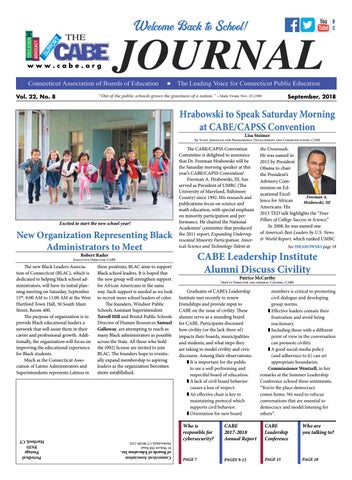
Excited to start the new school year!
New Organization Representing Black Administrators to Meet
The CABE/CAPSS Convention Committee is delighted to announce that Dr. Freeman Hrabowski will be the Saturday morning speaker at this year’s CABE/CAPSS Convention! Freeman A. Hrabowski, III, has served as President of UMBC (The University of Maryland, Baltimore County) since 1992. His research and publications focus on science and math education, with special emphasis on minority participation and performance. He chaired the National Academies’ committee that produced the 2011 report, Expanding Underrepresented Minority Participation: America’s Science and Technology Talent at
these positions, BLAC aims to support Black school leaders. It is hoped that the new group will strengthen support for African Americans in the same way. Such support is needed as we look to recruit more school leaders of color. The founders, Windsor Public Schools Assistant Superintendent Terrell Hill and Bristol Public Schools Director of Human Resources Samuel Galloway, are attempting to reach as many Black administrators as possible across the State. All those who hold the (092) license are invited to join BLAC. The founders hope to eventually expand membership to aspiring leaders as the organization becomes
more established.
See HRABOWSKI page 18
CABE Leadership Institute Alumni Discuss Civility
Robert Rader
Executive Director, CABE
81 Wolcott Hill Road Wethersfield, CT 06109-1242
Connecticut Association of Boards of Education Inc.
The new Black Leaders Association of Connecticut (BLAC), which is dedicated to helping black school administrators, will have its initial planning meeting on Saturday, September 15th, 9:00 AM to 11:00 AM at the West Hartford Town Hall, 50 South Main Street, Room 400. The purpose of organization is to provide Black educational leaders a network that will assist them in their career and professional growth. Additionally, the organization will focus on improving the educational experience for Black students. Much as the Connecticut Association of Latino Administrators and Superintendents represents Latinos in
the Crossroads. He was named in 2012 by President Obama to chair the President’s Advisory Commission on Educational ExcelFreeman A. lence for African Hrabowski, III Americans. His 2013 TED talk highlights the “Four Pillars of College Success in Science.” In 2008, he was named one of America’s Best Leaders by U.S. News & World Report, which ranked UMBC
Patrice McCarthy
Deputy Director and general Counsel, CABE
Graduates of CABE’s Leadership Institute met recently to renew friendships and provide input to CABE on the issue of civility. These alumni serve as a sounding board for CABE. Participants discussed how civility (or the lack there of) impacts their boards, municipalities and students, and what steps they are taking to model civility and civic discourse. Among their observations: z It is important for the public to see a well performing and respectful board of education. z A lack of civil board behavior causes a loss of respect. z An effective chair is key to maintaining protocol which supports civil behavior. z Orientation for new board
members is critical to promoting civil dialogue and developing group norms. z Effective leaders contain their frustration and avoid being reactionary. z Including those with a different point of view in the conversation can promote civility. z A good social media policy (and adherence to it) can set appropriate boundaries. Commissioner Wentzell, in her remarks at the Summer Leadership Conference echoed these sentiments. “You’re the place democracy comes home. We need to refocus conversations that are essential to democracy and model listening for others”.
Who is responible for cybersecurity?
CABE 2017-2018 Annual Report
CABE Leadership Conference
Who are you talking to?
PAGE 7
PAGES 9-12
PAGE 15
PAGE 18
Periodical Postage PAID Hartford, CT
2
The Journal – Connecticut Association of Boards of Education | September 2018 PRESIDENT COMMENTARY
Communication as a Role of the Board Robert Mitchell President, CABE
Board members have many responsibilities, from hiring and evaluating the superintendent to negotiating contracts or acting as a hearing panel in serious legal matters. One very important role of the board is that of communicating the board’s vision to the community. This is most often seen, usually as a problem, during budget season, but boards should seriously consider the role of communicator as year-round. Boards need to ensure that their community understands the vision of the district – what is expected of students and staff and how it aligns for the betterment of the community. This includes how the district spending plan aligns with that vision. In most communities where local schools are heavily supported there is a sense of shared ownership. The schools are not just the responsibility of the board of education, but are considered an asset by the entire town.
How can your board of education foster a sense of ownership like that? First and foremost, don’t use the passage of the budget as the bellwether of successful communication. Yes, that is one outcome of strong community support, but that shouldn’t be the goal. The goal is for your townspeople (or those in your region) to think of their schools as an asset to be treasured.
Start with a vision
Does your district have a strategic or long-range plan? If so, you should share it with the community. Get people to understand that the expectations of the district are well thought out and the vision is the focus of the work the schools in your district are doing. We know what we want and we have a plan to get there. If you do not have a long-
State Board of Education Monthly Meeting September 5 • 9:30 a.m. CT State Department of Education 450 Columbus Boulevard, Hartford Plaza North Conference Room C & D
term plan, strongly consider developing one. These plans often are created by a broad section of the community so buy-in starts with the creation of the vision. Strategic planning can be a major communications tool that helps gain support for your schools. Make sure your municipal government is actively involved in this process. Of course, a good strategic (or longrange) plan is only going to benefit the district if it is implemented, so continuing to communicate the plan and how board actions are supporting it should be a year-round activity of the board.
Have a communications plan
Good communication is not an accident. It must be deliberate and structured. Not only do you need to make sure you have a well-crafted message, but that you identify the target audiences, as well as the key communicators and that they are provided support in that role. Just because a person has a good communication style does not make them an expert in public relations. It is no different than providing any other professional development, you should support key staff with the tools they need to share your message.
Create allies
Some towns are fortunate – the local municipal government sees the schools as an asset that helps the entire community; in others they may be seen in a much less complimentary manner. Needless to say, in those town the board of education will struggle for credibility. Effort must be made to get other community leaders on board. Include them in long-range discussions. Reach out wherever you can. I have seen boards invite town council members (or selectpersons, alders, etc.) on a tour of the schools to see first-hand their condition.
Mission: To assist local and regional boards of education in providing high quality education for all Connecticut children through effective leadership. Vision: CABE is passionate about strengthening public education through high-performing, transformative local school board/ superintendent leadership teams that inspire success for each child.
Board of Directors The current dialogue of members of the CABE Executive Committee and that of the CCM should be seen as a model for good dialogue. Since budget is where boards and towns often clash, work hard on communicating financial issues regularly; not just a month before the budget comes out. Communicate needs with community leaders before budget process starts. Share your vision and plans regularly.
Reach out to parents and other community members
Some boards are highly effective in getting community discussion about varied topics by: • Conducting listening tours •C onnecting the district spending plan to district goals •U sing cable television or the web to promote a “Superintendent’s Report” or “Board Chair’s Report” •E stablishing community conversations on specific topics of interest to the community Finally, board members must think of themselves as advocates for the public schools. I’ve run into board members from time to time who feel they can’t advocate for their budget – or support the schools publicly. While there are rules about how public agencies can use resources to take positions on public issues, nothing precludes you from being a cheerleader for your schools, including the budget – in fact ask yourself, “If not me, who?” As another school year starts, use this as an opportunity to reach out to your community and share the vision of the schools and how the board, administration, teachers and students all work hard to make the community proud.
MEETINGS OF INTEREST
Advisory Council on CABE Government Intergovernmental Relations and Resolutions Relations Committee September 7 • 10:30 a.m. Legislative Office Building, Meetings Hartford, Room 1C
September 12 • 1 p.m. CABE 81 Wolcott Hill Road, Wethersfield Rovins Conference Room
Special Act 18-28 – Working group on the search and seizure of student’s personal electronic devices September 17 10 a.m. -12 noon Legislative Office Building, Hartford, Room 1A
EXECUTIVE COMMITTEE Robert Mitchell | President, Montville Donald Harris | First Vice President, Bloomfield Elizabeth Brown | Vice President for Government Relations, Waterbury Christopher Wilson | V ice President for Professional Development, Bristol Michael Purcaro | Secretary/Treasurer, Ellington Ann Gruenberg | I mmediate Past President, Hampton Bryan Hall | Member at Large, East Hartford Lydia Tedone | NSBA Director, Simsbury AREA DIRECTORS Jonathan Moore | Area 1 Co-Director, Region 1 Michelle Lucian | Area 1 Co-Director, Plymouth Bryan Hall | Area 2 Co-Director, East Hartford Leonard Lockhart | Area 2 Co-Director, Windsor Michael Purcaro | Area 3 Co-Director, Ellington Michele Arn | Area 3 Co-Director, Vernon Joan Trivella | Area 4 Director, Brooklyn Mic helle Embree Ku | A rea 5 Co-Director, Newtown Frances Walton | Area 5 Co-Director, Ridgefield Jennifer Dayton | Area 6 Co-Director, Greenwich Karen Kleine | Area 6 Co-Director, Westport George Kurtyka | Area 7 Director, Derby Sean Nugent | Area 9 Director, Preston ASSOCIATES Eileen Baker | Associate, Old Saybrook Robert Guthrie | Associate, West Haven John Prins | Associate, Branford Robert Trefry | Associate, CT Technical High School System COMMITTEE CHAIRS Becky Tyrrell | Chair, Federal Relations, Plainville Bryan Hall | Chair, Resolutions, East Hartford Jennifer Dayton | Chair, State Relations, Greenwich CITY REPRESENTATIVES Betsy Allyn | City Representative, Stamford Charles Stango | City Representative, Waterbury STAFF
Robert Rader | Executive Director Patrice McCarthy | Deputy Director and General Counsel Rebecca Adams | Senior Staff Attorney Nicholas Caruso | Senior Staff Associate for Field Service and Coordinator of Technology Sheila McKay | Senior Staff Associate for Government Relations Vincent Mustaro | Senior Staff Associate for Policy Service Lisa Steimer | Senior Staff Associate for Professional Development and Communications Teresa Costa | Coordinator of Finance and Administration Pamela Brooks | S enior Administrative Associate for Policy Service and Search Services Terry DeMars | Administrative Associate for Policy Service Gail Heath | Administrative Associate for Government Relations Wilmarie Newton | Administrative Associate for Labor Relations Nancy Propfe | Administrative Assistant for Membership Services Corliss Ucci | Receptionist and Assistant to Executive Director
The CABE Journal (ISSN 1092-1818) is published monthly except a combined issue for July/ August as a member service of the Connecticut Association of Boards of Education, 81 Wolcott Hill Road, Wethersfield, CT 06109, (860) 5717446. CABE membership dues include $30 per person for each individual who receives The CABE Journal. The subscription rate for nonmembers is $75. Association membership dues include a subscription for each board member, superintendent, assistant superintendent and business manager. The companies and advertisements found in The CABE Journal are not necessarily endorsed by CABE. “Periodicals Postage Paid at Hartford, CT.” POSTMASTER: Send address changes to The CABE Journal, CABE, 81 Wolcott Hill Road, Wethersfield, CT 06109-1242. Email: bcarney@cabe.org. Members can find the CABE Journal online at: www.cabe.org/ page.cfm?p=1024
The Journal – Connecticut Association of Boards of Education | September 2018
3
EXECUTIVE DIRECTOR COMMENTARY
CABE Affiliate Members BUSINESS AFFILIATES DIAMOND MEMBER Finalsite PLATINUM MEMBER
Berchem Moses PC GOLD MEMBERS
Pullman & Comley Shipman & Goodwin Support for the Budgetary Process SILVER MEMBERS Anthem Blue Cross and Blue Shield Arthur J. Gallagher & Company Corporate Cost Control Digital Back Office Duhl & Grello PC ESS Milliman Milone & MacBroom, Inc. BRONZE PLUS MEMBERS Cohen & Wolf, P.C. Coordinated Transportation Solutions Friar Associates JCJ Architecture O & G Industries OneDigital Health and Benefits The S/L/A/M Collaborative BRONZE MEMBERS Albert Risk Management Consultants Brown & Brown Insurance Chinni & Meuser LLC Dattco Inc. ECG Engineering, PC Fusfoo Media LLC Goldstein & Peck, P.C. Kainen, Escalera & McHale, P.C. The Lexington Group Perkins Eastman Solutions Employee Assistance Program Suisman Shapiro Attorneys at Law Zangari Cohn Cuthbertson
EDUCATIONAL AFFILIATES
American School for the Deaf Area Cooperative Educational Services Capitol Region Education Council The College Board Connecticut Association for the Gifted Connecticut Association of School Business Officials Connecticut Center for School Change Connecticut School Buildings and Grounds Association Connecticut Technical High Schools Cooperative Educational Services EASTCONN EdAdvance Interdistrict School for the Arts and Communications (ISAAC) LEARN Unified School District #1
Strengthen Your Board with a Retreat Robert Rader
Executive Director, CABE
Facilitating retreats for CABE member Boards of Education and Superintendents is a service that our members often access. There is no charge (!) to members to have our Staff facilitate a retreat, or to hold it in the Rovins Conference Room at the CABE Office. Some districts ask us back year after year for a “tuneup”, to help new members better understand their roles and responsibilities and to set goals. CABE’s Staff is experienced, not only in presenting information and best practices to our members, but helping Board members and Superintendents have thoughtful conversations on how to raise student achievement, strengthen their relationships with each other and the community and how to have more effective meetings. These are just a few of the subjects of the retreats. Perhaps the most helpful retreats are those in which we use the Board’s filled-outand-returned self-assessments to bring up issues—particularly those items in which Board members are divided.
Board of Directors’ Retreats
CABE holds a retreat for our Board of Directors annually and uses it to discuss issues concerning the Association and educational issues in general. In August this year, we held a second with the Executive Committee, due to a desire to clarify our goals and priorities.
How does a retreat differ from a regular board meeting?
While there is usually an agenda, the retreat is an opportunity to concentrate on specific issues, not the “usual” work of the Board. The idea is that the retreat’s logistics and the environment will allow attendees an opportunity to think more broadly and spark creative thought and a more frank discussion than before television cameras with members sitting at the formal table.
Comfort and Price
The comfort of the attendees is crucial. The CABE Board generally meets at the New Haven Lawn Club in January, where sitting on overstuffed chairs with a warm fire in the fireplace, is a good environment for thinking through complex issues. Food and beverages should be easily available. The idea is for everyone to feel they want to be a part of good conversation and get to know others on the Board and the Staff. Be careful about the costs. While the comfort of attendees is important,
taxpayers will probably not applaud the spending of large funds for the Board retreat. Sometimes, however, foundations or local companies may be glad to provide an appropriate setting. Preplanning is key to getting the most value out of your retreat. It’s critical to design it with clear goals in mind and the agenda should take into account both the time allotted and the energy levels of the participants. Thus, the early afternoon after a hearty lunch is NOT an optimal time to discuss big new plans and, CABE Staff will tell you, neither is a Friday afternoon! Don’t be overambitious. Better to do a great job on just a few items than just a fair job on lots.
The Facilitator
A crucial determinant of failure or success will be the selection of your facilitator. Usually it’s best to use an “outside neutral” who comes in without “local baggage” and can objectively weigh ideas without judging the person who suggested them. The outside facilitator can hold attendees accountable for their suggestions and comments. He or she will often have more experience than others in leading a group discussion and developing goals. If the Board asks it of the facilitator, he or she should discuss expectations with participants before the retreat. Sometimes, an “inside” facilitator is better, especially when a good part of the retreat is done more “classroom style” — one way teaching of information. The inside facilitator may have a better understanding of the issues in some situations. For example, if class sizes are a part of the discussion, it may be helpful to have someone facilitate who knows the schools and the community. Sometimes our boards use the superintendent to facilitate. I know of some who are very good at ensuring the board and the superintendent come away unified and energized and they know the community and the schools. However, remember that it might be better to have the superintendent as an active participant.
The Retreat Itself
Often the retreat begins with an “icebreaker”, especially if the attendees don’t know each other. Experts say, however, don’t use the word “icebreaker” — people hate it. Once the working part of the retreat starts, make sure you capture all thoughts, so even those with really out-of-the-box ideas feel free to contribute. Mix up activities, such as group discussion and breakouts, if the group is big enough.
The Outcome
The facilitator should keep things moving, concluding with goals for continued improvement. Expected results of the retreat should include a written action plan which establishes a prioritized list of who is expected to accomplish the results, when, and how. After the retreat is over, but not too long after, the facilitator should, if this is the expectation, provide a report to the Board of the outcome of the retreat. Often there’s a later checkin with the Board and Staff, such as a meeting a few months later, where the facilitator and the Board can discuss what has been accomplished on the action plan. Experts suggest that the results can be changes in the perceptions of attendees, rather than what’s on paper. People hear others’ ideas and comments and those can change opinions. It also should serve as a bonding experience for the Board members and superintendent. Good luck with your retreats and please don’t hesitate to call us if we can be of help with your retreat!
Legal Notes for Retreats • Retreats are meetings. • They are special meetings unless held on a regular meeting date on the list of regular meeting dates adopted by the board and forwarded to the Town or City Clerk. • Public notice must be posted at least 24 hours prior to the meeting • The notice must include the agenda and agenda topics must be stated with enough detail for the public to be reasonably informed of what the Board will cover. • Minutes must be kept. • If the retreat is a special meeting, items may not be added to the agenda during the meeting. • Retreats must be open to the public and business must be discussed and acted on in open session, including, but not limited to, discussion and action regarding Board and Superintendent goals, strategic planning, budget, staffing, and district realignment. • Executive session may be held but only for the purposes allowed under the FOIA. • Board self-evaluation may be held in executive session ONLY for discussion of the performance of the Board.
4
The Journal – Connecticut Association of Boards of Education | September 2018 CABE_backtoschool_2018.pdf
1
8/6/18
9:32 AM
A MESSAGE FROM THE CT LOTTERY
1 Balance gambling with other types of leisure activities 2 Set a time limit before you play 3 Know how the game works and what the odds are before playing
5 Set a budget and stick to it
FIND OUT MORE AT CTLOTTERY.ORG
©2018 Connecticut Lottery Corporation 08/2018
4 Play for entertainment, not to make money
The Journal – Connecticut Association of Boards of Education | September 2018
5
See You in Court – The Nutmeg Board of Education
Is It Time to Say Goodbye? Or Not? Thomas B. Mooney, Esq. Shipman & Goodwin
The Nutmeg Board of Education makes many mistakes. The latest imbroglio created by the board will be reported here each issue, followed by an explanation of what the board should have done. Though not intended as legal advice, these situations may help board members avoid common problems. The glory days for Nutmeg Knights Football were long gone, the last winning season having been in 2003. But Coach Rock, the beleaguered long-time Knights coach, soldiered on. Calls for change grew shriller, however, as the Knights dropped their first two games this fall by lopsided scores. Mr. Superintendent decided that he had to do something. The next day, Mr. Superintendent stopped by to chat with Coach Rock before practice, and he gently broached the subject of retirement. “None of us is getting any younger, Coach. Don’t you think that it is time for you to hang up your cleats?” In the moment, Coach Rock was quiet, even contemplative. “Despite my tough exterior,” he responded after a long pause, “I am a sensitive soul, and I am sick of the all the criticism. If these Football Boosters think that they can do a better job with the meager talent here in Nutmeg, let them try. I will resign.” True to his word, Coach Rock sent Mr. Superintendent an email later that day, stating, “I hereby resign my employment as coach, effective soon.” Mr. Superintendent promptly replied by email with a grateful acknowledgment, stating that he would bring Coach Rock’s resignation to the Board at its next meeting. There are no secrets in Nutmeg, and somehow word of Coach Rock’s resignation was soon the topic of controversy. A group of Nutmeg Knights alumni promptly started a Facebook page, “Winning Isn’t Everything,” which accused Mr. Superintendent of age discrimination against Coach Rock and demanded that Coach Rock withdraw what they now described as his “offer” to resign. Coach Rock was touched by this show of support, and he called Mr. Superintendent to say that he had reconsidered and would continue on as coach of the Nutmeg Knights. Mr. Superintendent was surprised and annoyed by this news, and he told Coach Rock that it was too late for equivocation. “I have your resignation,” he replied curtly, “and the Board will be accepting it at its next meeting.” But Coach Rock was not persuaded, and later that day, he sent Mr. Superintendent another email, stating “To avoid
any misunderstanding, please be advised that I have withdrawn my resignation, and I look forward to coaching the Knights for many years to come.” By the next Board meeting, battle lines were drawn, and a group of Knights football alumni were in attendance, many wearing their old jerseys. During Public Comment, a number of former players gave testimonial to Coach Rock’s influence on their lives. But others spoke in favor of Mr. Superintendent, and one speaker even used part of his three minutes to play a recording of “It’s Time to Say Goodbye.” Eventually, the Board went on with its meeting, and it addressed the question of Coach Rock’s resignation when it reached the standing agenda item, Personnel Actions. Mr. Chairperson started the discussion by noting that it was time for some new blood in the football program and that the Board should support its Superintendent. Surprisingly, there was little discussion. Mal Content moved to accept Coach Rock’s resignation, and the Board promptly and unanimously so voted. Is Coach Rock done in Nutmeg? • • • • • • • • • • • • Unless Coach Rock has a second change of heart, Mr. Superintendent and the Board are in for a fight. This situation illustrates the need to be clear as to the authority of the Superintendent with regard to personnel actions, especially resignations. The general rule is that the person or group with the power to appoint is authorized to accept resignations. Apparently, the Nutmeg Board appoints coaches because Mr. Superintendent did not simply accept Coach Rock’s resignation. Once Coach Rock withdrew his resignation before the Board accepted it, however, there was no outstanding offer for the Board to accept. Accordingly, Coach Rock remains employed and the Nutmeg Board of Education is in a pickle. The employment of coaches in Connecticut is regulated by statute, and given that Coach Rock withdrew his offer to resign, he has statutory rights. Specifically, Conn. Gen. Stat. § 10-222e provides that, when a coach has served in the same capacity for three or more years, school districts that don’t want a coach to continue must inform such coach of such decision no later than ninety days after the completion of the sport season covered by the contract. The statute further provides that the coach may appeal that decision to the board of education as the board may prescribe. Boards of education are therefore well-advised to adopt such procedures before they face an appeal in a specific case.
Mr. Superintendent could have notified Coach Rock at the end of the season that his coaching contract was terminated, and Coach Rock could have challenged that decision before the Board. Otherwise, the statute permits immediate termination of the contract of a coach who has served for three or more years only for “(1) for reasons of moral misconduct, insubordination or a violation of the rules of the board of education, or (2) because a sport has been cancelled by the board of education.” This whole situation raises two points for consideration. First, at the very least, boards of education should be sure to delegate to the superintendent of schools the right to accept any and all resignations. Sometimes a proffered resignation is a gift from on high that the school district should accept promptly. Once accepted, a resignation is binding. Until it is accepted, however, an offer to resign may be withdrawn. Second, boards of education and superintendents should review their understandings as to who can hire which staff members. Under statute, the superintendent is the chief executive officer of the board of education, and except for teachers and admin-
istrators, he or she has the legal right to hire and fire and to accept resignations. As to teachers and administrators, boards of education can delegate that authority to the superintendent. It is advisable, therefore, for boards of education to adopt clear practices and policies to clarify which staff members the superintendent may hire without board action. Finally, both Mr. Superintendent and Mr. Chairperson should be more careful about what they say. Discrimination claims are built on inferences, and Mr. Superintendent’s asking Coach Rock about his retirement plans and Mr. Chairperson’s call for “new blood” can both be cited as evidence that their actions were based on discriminatory animus. Under these facts, Nutmeg should be able to rebut any such inference by pointing to Coach Rock’s losing record. However, avoiding such statements in the first instance is by far the better course. Attorney Thomas B. Mooney is a partner in the Hartford law firm of Shipman & Goodwin who works frequently with boards of education. Mooney is a regular contributor to the CABE Journal.
The Ninth Edition – Now Available!
A Practical Guide to Connecticut School Law by Thomas B. Mooney, Esq. Shipman & Goodwin
CABE is delighted to announce that the Ninth Edition of Tom Mooney’s Practical Guide to Connecticut School Law is now available. PRICING: CABE Members: $54.99; CABE Non-Members: $79.99; Students: $44.99 There have been many changes in school law in the last few years, and the Ninth Edition has been extensively revised to provide updated guidance on the legal issues that govern our schools. Changes include descriptions and commentary on:
• Changes in teacher evaluation and teacher tenure. • New rules regarding employee background checks. • New requirements concerning student data privacy. • New rules for suspension, expulsion and alternative educational opportunities. • Revised requirements governing seclusion and restraint. • The new “Every Student Succeeds Act” and how it has changed “No Child Left Behind Act” requirements. • The CCJEF case and ongoing litigation over equal educational opportunities. • The Minimum Budget Requirement and new duties to collaborate with town officials. • A host of other changes in the rules that boards of education and school administrators must follow.
6
The Journal – Connecticut Association of Boards of Education | September 2018
Aim Higher
Creative legal solutions for Connecticut’s public schools – because sometimes it is rocket science.
WELCOME BACK TO SCHOOL!
Shipman & Goodwin’s school law attorneys have more than 40 years of experience, and represent over 125 public school districts, as well as public school member organizations and associations, on a full range of legal issues that they confront, from general education law to special education matters.
Our school law site, www.ctschoollaw.com is devoted entirely to emerging school law issues. Attorneys counsel clients, monitor legislation and provide periodic alerts and updates. We regularly present seminars, quarterly workshops, webinars and professional development workshops for schools on current topics of interest. Our Practice Group Co-Chair, Tom Mooney, has written A Practical Guide to Connecticut School Law, a comprehensive treatise on Connecticut school law, published by CABE and used by teachers, administrators and board of education members throughout the state.
Education is a core focus of our law firm.
Facebook “f ” Logo
CMYK / .eps
Facebook “f ” Logo
CMYK / .eps
www.ctschoollaw.com Contact: Thomas B. Mooney or Linda L. Yoder | 860.251.5000 | www.shipmangoodwin.com GREENWICH
|
HARTFORD
|
LAKEVILLE
|
NEW HAVEN
|
NEW YORK
|
STAMFORD
|
WASHINGTON DC
The Journal – Connecticut Association of Boards of Education | September 2018
7
Who Is Responsible for Cybersecurity? Dale Bruckhart
VP Marketing, Digital BackOffice
Who does a school board or town council hold responsible for cyber hacking or suspicious activity when the attackers are anonymous and the ransom, if paid, is untraceable? Do administrators hold employees accountable for detecting and preventing cyber-attacks? A data breach should be reported to law enforcement, financial institutions and the public, if personally identifiable information is exposed to hackers but many breaches go unreported or worse, undetected. A second call may go to the insurance carrier that underwrites the cyber risk insurance policy if available. What steps are taken or should be taken to strengthen cyber defenses after an attack occurs? Who follows up? A survey reported in the November 11, 2017 issue of Education Week says, “while the K-12 sector has spent heavily on digital devices, software, and bandwidth, investments in cybersecurity have not kept pace. That’s left many district IT departments understaffed and under-resourced—just as they’re being asked to
fend off the types of attacks that have overcome well financed corporations like Equifax, Target, and Yahoo. One contributing factor: With so much recent attention and legislation around student-data privacy, many schools have been focused on identifying what information is collected from students and how it is used, rather than on how to keep safe the full scope of sensitive information on their networks.” Note 1 One of the key challenges facing our K-12 schools and municipalities is a growing IT skills gap, especially, cyber skills. According to a recent Global Information Security Workforce Study, the cybersecurity workforce gap is expected to reach 1.5 million by 2020, with 66% of the respondents across all industry categories, report not having enough workers to address current and future cyber threats. The cost of data breaches is also growing. IBM and the Ponemon Institute estimate that the average cost of a data breach in 2018 is $3.86 million. Managed security service providers, like Digital BackOffice, offer a single point of contact help desk, 24x7 monitoring and expertise in securing the network perimeter and endpoints
FIRST TIME ON THE EAST COAST
on the Road at
Ulster BOCES! Moving Project-Based Learning Beyond the Project Learn how to take your instruction to whole new levels through High Tech High's Renowned Deeper Learning Institute, an intense and highly acclaimed professional development opportunity now available in New Paltz, New York through a new partnership between High Tech High (HTH) and Ulster BOCES.
from cyber-attacks, malware, hacking and ransomware. Prevention is the key to cyber-attacks and effective prevention requires next generation tools, experience, training, process controls and a team prepared to take responsibility for managing network security. Mandates like PCI, the European General Data Protection Regulation (GDPR), and others make it clear that organizations including the public sector can no longer ignore security
breaches or blame a breach on a third party and expect to avoid responsibility and liability. Partnering with next generation managed service providers is the fastest way to protect users and assets from hacking, data theft, ransomware, identity theft and inappropriate sites. Digital Back Office is a CABE Business Affiliate.
For an update or more information on vacancies go to our website:
MARY BRODERICK, ED.D
cabe.org/page. cfm?p=1176
SENIOR CONSULTANT
For more information contact
CABE Search Services P.O. Box 290252, Wethersfield, CT 06129-0252
860-539-7594 Equal Opportunity Employer
Seven Magnet Schools of Choice Thousands of Students and Families Dedicated Educators and Staff Countless Stories Critical Special Education Services Quality Programs & School District Collaborations
OPTION 1: Total Immersion
$2,000 per participant Oct. 24-25, 2018 & Apr. 23-24, 2019 at Ulster BOCES, New Paltz, NY plus Jan. 23-24, 2019 at HTH in San Diego, CA
OPTION 2: Testing the Waters $1,200 per participant Oct. 24-25, 2018 & Apr. 23-24, 2019 at Ulster BOCES, New Paltz, NY Registration includes embedded regional coaching and breakfast and lunch on conference days. Team Discount: Enroll 4 and get 5th free.
Deadline to Register: September 30, 2018
www.ulsterboces.org/hth
#LEARNinnovates
learn.k12.ct.us
860-434-4800
8
The Journal – Connecticut Association of Boards of Education | September 2018
The Policy Corner Vincent A. Mustaro
Senior Staff Associate for Policy Service, CABE
The Policy Role in a New School Year As we start a new school year, it is essential that board of education members familiarize themselves again with their role as policy makers. A school board’s major function is the fulfillment of its legislative role by adopting policies to guide the operation of the school system. Policy development and adoption remains the board’s most important function. The board’s adopted policies are statements that set forth the purposes and prescribe in general terms the organization and program of a school district. The board is guided in making decisions and in assigning authority and responsibility to the school administration and staff through its policies. Policies provide the needed framework within which the superintendent and staff can discharge their assigned duties with positive direction. Policies establish a definite course of action to guide present and future directions, while allowing flexibility for the day-to-day operations of the schools. The development of clear, sound and legal policies is critical to the successful operation of any school district. In this time of continuing fiscal constraints, increased accountability, community scrutiny, legislative mandates and recently passed legislation, effective policies help support the board’s primary purpose; that of advancing student achievement. Adopting policy is a fundamental responsibility of any board of education. Boards can prevent or resolve problems through good policy. Policy is the primary tool that provides the board power to allow or require action. It is through policy that lay citizens can effectively govern. The board, as a policy-making body and its adopted policies are the local law of the school district. Policies are broad guidelines, philosophical statements set by the school board to chart the district’s course of action.
Guidelines
At the beginning of this new school year, keep in mind some guidelines that will help boards govern effectively through policy. Board members are in a leadership position. Therefore, policies should reflect what the board wants to see happen. Therefore, boards need to have a comprehensive bylaw that establishes its’ policy development process. The board’s adopted policies should be designed to help achieve the district’s vision and mission. Avoid detailed policies that can move the board into administrative issues which could result in board involvement in issues, complaints and problems that should be handled by the administration.
However, some federal and state statutes require school boards to place in policy detailed language and/or procedures on certain issues, which normally would not be in policy. In these situations, boards have no alternative but to comply with such requirements. There is a continuing trend for legislation, both federal and state, to be increasingly more prescriptive regarding the language to be included in local policy. Policy should cause improvements in district schools which represents responsible governance. Policy should move the school system in the desired direction. Development and adoption of policy represents only the beginning to achieve the desired action. Policy must be monitored to ensure appropriate implementation and achievement of desired results. Don’t abandon your policies to the boardroom shelf, website or CD. Board members, as well as school administrators, and community members need to know what the board policy manual contains. Keep in mind board policies carry the weight of law and establish a legal record for the board of education and the school district. The board’s policies must be current, effective, monitored, and communicated and distributed to school employees, students, parents and the school community. They should be easily accessible and conveniently located. That is why policies having a significant impact on staff and/or students are frequently included in handbooks and posted on district and school websites.
Ensuring Your Policy Manual is Relevant and Up to Date
A vigorous program of policy oversight and evaluation is recommended. This means ensuring that your policies are accomplishing what they were designed to achieve, producing the desired results. When evaluating the effectiveness of policy, look to see if unintended consequences have occurred. It is essential that community members, in addition to district staff, have easy access to the board’s policies. This can be achieved through their placement on the district’s website, in town and school libraries, school offices and at town hall. CABE’s successful Connecticut Online Policy Service (C.O.P.S.) has assisted many local boards in placing the district’s policy manual online, keeping it up-to-date, and providing easy searchable access for the entire educational community and the public. Policy development is an unending responsibility and process to keep the manual up-to-date. The boundaries of policy making are shaped by many
factors including federal and state laws and regulations, judicial decisions and local beliefs. Policies must change in our ever-evolving world. Some policies are required due to federal or state laws or agency regulations. CABE policy updates facilitate the adoption and/or changing policies in a timely fashion. Districts must be sure that all paper copies of manuals in the district and the web-posted manual are updated when the board adopts or revises a policy. Technology can be of great assistance in this regard by posting the policy manual online especially through CABE’s C.O.P.S. which includes speedy revisions. Policies should also be reviewed on regular basis throughout the school year to determine conformity with current statutes and judicial decisions as well as be sure that what the policies say and what the district does match. The superintendent usually communicates necessary policy revision and reviews to the board. It is important for boards to have a policy committee in place. Consider rotating the board members who serve on this committee yearly. Rotating members through the committee can provide an opportunity for all board members to better understand the board policy manual. Time should also be spent at administrative team meetings on policy issues. Administrators involved in reviewing policies can identify areas where board policy and district practices are not aligned. This is especially critical in those policies pertaining to technology. It is important to adopt policies on controversial or sensitive issues before such issues actually arise in the district. Sound legal advice resulting in appropriate policy can help the board avoid litigation. Adopting policies on controversial or sensitive issues can be an uncomfortable and contentious process, but it is necessary. Sound policy, while not a guarantee, will help a district stay out of court. Not all policies require the superintendent’s development and issuance of administrative regulations. However, some policies should have written administrative procedures to ensure the board that policy is implemented fairly, consistently and in the board-desired manner. Administrative regulations provide guidance and direction to the district’s administrative, instructional and support staff in the uniform administration of board policy. The purpose of administrative guidelines, often called procedures, is to fill in broad policy statements with the details that ensure that what the board wants done, actually happens. The
board usually does not adopt administrative regulations, unless required by statute or by a district’s bylaw. The superintendent may share them with the board in order to provide assurance that he/she understands and is attempting to carry out the intent of the board’s policy. In conclusion, policy remains the school board’s most powerful tool for bringing its vision, mission and goals to reality. They are the basis for evaluating staff work, for governing student behavior and much more. They keep the district moving toward the vision the board and the community holds for the schools. Policy can and should be a force for leadership, school reform and improvement. Local boards should govern aggressively to create the educational vision of their community, ensure there is an infrastructure in place to achieve the community’s vision, establish academic standards designed to achieve the community’s vision and an assessment system to measure how the vision is being achieved. This is the board’s policy role which needs to be practiced in this new school year.
People in the News Patrice McCarthy was recently appointed by the Connecticut Bar Association to serve on the Executive Committee of the Labor and Employment Law Section as well as the Education Law Section. Patrice was also appointed to serve on the Civics Education Committee.
Upcoming Professional Development Opportunities
October 18: Legal Issues 8:30 a.m. Registration; 9 a.m.-12 p.m. Program Sheraton Hartford South Hotel
November 16-17 CABE/CAPSS Convention Mystic Marriott Hotel, Groton
The Journal – Connecticut Association of Boards of Education | September 2018
9
Our Purpose CABE is the only statewide organization that advocates for school board leadership in Connecticut. We are dedicated to strengthening public education through advocacy, professional development and service to our member boards of education. High-quality education for all Connecticut children begins with effective school board leadership. CABE is committed to ensuring that the future of public education remains bright.
CABE 2017-2018 Annual Report
It’s your Association – Get Involved! Over the last year, CABE continued to focus on helping member Boards increase student achievement and operate more efficiently and effectively. Through the hard work of the CABE Board of Directors and Staff, we provided leadership, advocacy, professional development and other support for the boards of education of Connecticut. This has been a difficult year for our boards of education and the State of Connecticut overall, especially fiscally. Your Association suffered not only from continued pressure on school district finances, but also the loss of funding from the State for some of our most important programs. Our Board decided that continuing these programs remains a priority for the Association so that they are continuing, though not always at the same level as before. In particular, our Lighthouse Project is not funded as before, but it continues and is available to districts which desire it.
While that creates some difficulties for us (for example, salaries have been frozen over the last two years), we continue to provide some of the best services, activities and programs for our members. One of the most unexpected events last Fall was the sudden passing of Senior Staff Associate for Publications Bonnie B. Carney, who had worked at CABE for 47 years! Bonnie was very well-loved and Staff thinks about her often. While much of her work is now being done by Lisa Steimer, who was promoted to Senior Staff Associate for Professional Development and Communications, as well as other members of Staff, we will always miss Bonnie. In more positive news, over the last year, we continued to build on our already-positive relations with the Connecticut Association of Public
Director Karissa Niehoff will be off to her new job in Indiana, as the head of the National Federation of State High School Associations (NFHS), by the time this Journal reaches you. We look forward to working with new Executive Director Glenn Lungarini. 2017-18 was a busy year for coalitions, task forces and other activities. We look forward to 2018-19 optimistic that Connecticut’s fiscal woes will ease (at least a little!) and promise that CABE will continue to serve your needs in the professional, high-quality manner which you have come to expect. As we look forward to the coming year, we will need your support in this election year, in which we will have a new Governor and Legislature. While maintaining our focus on our current services, our Board has set diversity, civility and student voice as priorities. Please feel free to reach out to members of our Board or Staff with any questions or comments. Here is
Finances remain very tight at the Association, but, luckily, we have reserves to protect us. Because of this and the pressure on individual districts, our Board of Directors froze dues last year and again this year.
School Superintendents (CAPSS) and its new Executive Director Fran Rabinowitz. She is thoughtful and has so much experience that benefits all of us in public education. Connecticut Association of Schools Executive
our report on 2017-18:
Advocacy: Supporting School Boards at the Legislature, State Board, and Congress
CABE’s positions on a broad range
of local, state and federal issues are adopted each year at the Delegate Assembly. The State Relations Committee then develops CABE’s Legislative Priorities, and Board Members and Staff implement the advocacy agenda. The Convention, Out of the Public Schools Grows the Greatness of a Nation, was held on November 17 and 18, 2017. Attendance at the Convention was 545 board members, superintendents, business managers, administrators, education officials and invited guests. General session speakers included Dan-el Padilla Peralta, David Pogue, Bridget Cooper and a Student Panel. Workshops included: Shared Service: Strategies and Considerations, The Rx for the Pain Killer Crisis: Prevention Strategy and Awareness of the Opioid Epidemic, Get On Board for Social Emotional Learning, Funding Innovation through a LEAN Mindset, Protecting Transgender Kids: Untangling the Web of State and Federal Guidance, and Innovation for All: How the Future of Learning Provides Equity for All Learners.
10
The Journal – Connecticut Association of Boards of Education | September 2018
Our Mission To assist local and regional boards of education in providing high quality education for all Connecticut children through effective leadership.
Members of the State Board of Education participated in a lively discussion with the attendees. Approximately 56 exhibitors of education-related goods and services participated in the exhibit hall.
Superintendents’ Secretaries and Administrative Assistants
Since October 2015, CABE has provided professional development twice a year for superintendents’ secretaries. Between the two programs in 2017-18, we had 97 participants who were superintendents’ secretaries or otherwise provided support in Central Office. Pursuant to their request, we established a listserv so they can share ideas and suggestions.
CABE Board of Distinction Award Level Two – In 2016-17, 18 boards of education received the Board of Distinction Award. This Award was granted to boards who have achieved Level One at least twice in the prior four years and meet the eligibility criteria.
panies, institutions and firms with an interest in public education, to become our partners and to show their support. The program grew to 32 partners in 2015-2016. Membership consisted of 1 Diamond, 4 Gold, 7 Silver, 9 Bronze Plus and 11 Bronze Members.
Bonnie B. Carney Awards of Excellence for Educational Communications
This year CABE presented 39 Awards of Excellence in Educational Communications and 37 Honorable Mentions.
This program helps provide education-related organizations with a closer relationship with CABE. In 20172018, we had 15 Education Affiliates. A current list of Business and Education Affiliate members can be found on page 3 of every CABE Journal.
Student Leadership Awards
Lighthouse Project
Education Affiliates
Individual Board Workshops
CABE staff continues to regularly meet with boards of education as they desire to provide professional development. Staff continues to facilitate customized workshops from basic roles and responsibilities, the superintendent search process, goal setting, FOI, legislative updates and full-day board retreats.
CABE Search Services
As part of CABE’s ongoing effort to provide local boards of education with the resources they need to carry out their most important responsibilities, we continue to strengthen our
Other Services: The Critical Work of Boards of Education
PUBLICATIONS The CABE Journal was published 11 times this year, in both paper and electronic forms. The Journal’s primary audience is school board members, superintendents and district administrators throughout the state. The Journal is also sent to state and federal legislators, other education organizations (local and national) and others who have an interest in keeping up-todate with education issues in our state. The Model Student Parent/Guardian Handbook was revised to reflect current issues and legislative changes. The Ninth Edition of A Practical Guide to Connecticut School Law by Thomas B. Mooney, Esq. of Shipman & Goodwin was released in early 2018.
CABE Board Recognition Awards
CABE Board Leadership Award Level One – In 2017-18, 10 boards of education received the Board Leadership Award for their work on their leadership skills. Boards need to fulfill 22 of 34 Level One criteria to earn this Award.
The CABE Student Leadership Awards program continues to be very popular, with 403 students from 104 CABE member school districts earning the award. This program enables each high school and middle school in member districts to nominate two students to be honored for their leadership qualities.
Affiliate Membership Program Business Affiliates
CABE invites private sector com-
CABE helped a number of districts improve student achievement through more effective board leadership by providing training through the Lighthouse Project. Lighthouse trainers have worked with a cohort involving eight other states and over 20 Connecticut school districts. Connecticut Lighthouse trainers are also providing professional development to other state associations as they begin to participate in the program.
Our Vision CABE is passionate about strengthening public education through high-performing, transformative local school board/superintendent leadership teams that inspire success for each child.
Search Services program. Mary Broderick, Senior Search Consultant and Associate Consultant Paul Gagliarducci are uniquely qualified to assist boards in recruiting and retaining key personnel such as superintendents, principals and other critical members of your district staff. Over the last year, CABE Search Services has performed four successful searches or is conducting searches for the following Boards of Education: East Haven (Superintendent of Schools); Newtown (Superintendent of Schools); Columbia (Superintendent of Schools); and Eastford (Superintendent of Schools).
The Journal – Connecticut Association of Boards of Education | September 2018
11
Our Members CABE represents nearly all boards of education across Connecticut. School boards are comprised of citizens, elected or appointed, who work with their superintendents to provide the best education possible in their communities. They devote countless volunteer hours to provide leadership and oversight, and connect the will of the community to the education of its children. Policy Policy Highlights
Twenty-six issues of the email newsletter, Policy Highlights, were distributed on an every-other-week basis to board members and superintendents, highlighting current educational topics with policy implications. Throughout, the major focus remained on issues pertaining to student achievement. This represented the seventeenth year of this newsletter.
tion, access to student records, board member use of social media, English Learners, and personnel issues. The CABE Policy Reference Core Manual, the Core Manual, containing approximately 625 sample policies and regulations, was continuously revised throughout the year. Moreover, new policy topics were added. It is easily “searchable” and remains accessible for CABE members on the CABE website in a multi-searchable user-friendly format.
Policy Requests and/or Samples
Policy Audit Service
Over 675 requests for policy information and/ or sample policies from member districts were addressed, usually on the same day the request was received. The website-based Core Policy Manual continues to receive a great number of “hits” for sample policies in addition to the district manuals that have been placed online through the CABE Connecticut Online Policy Service (C.O.P.S.). Forty new or revised policies were made a part of the policy resource files.
Eight districts had audits completed of their existing policy manuals.
policies, administrative regulations, and information. Topics included student discipline, student records, technology, student health issues, student data privacy and protection, student health issues, nondiscrimination, website accessibility for the disabled, English Learners, alternative education, sexual health instruction, use of automatic calling and text messaging, and various personnel issues.
Connecticut Online Policy Service (C.O.P.S.) Forty-five districts subscribed to the Connecticut Online Policy Service
issues of helping boards better reflect their communities and the hiring of more leaders and teachers of color.
Finance and Support
CABE has continued to ensure its resources are consistent with the needs of our members. We want to remind you, if you would like to use the Rovins Conference Room, please let us know. We don’t charge for use of the room and it’s a great place for a meeting or a retreat. We want our building to be seen by board members as your building!
Customized Policy Manuals
Thirty-five districts were under contract for Customized Policy Services during the year for the review and development of new district policy manuals or updates to selected portions of the manual. Three districts entered into contracts for customized policy manual development. Three districts completed the development of a new policy manual. Several districts have new manuals close to completion.
Policy Update Service
One hundred and two districts subscribed to the Policy Update Service publication. Subscribing districts received four mailings, hard copy and electronically, which reflected timely policy issues, including the need for new and/ or revised policy topics based upon legislative action, judicial rulings or contemporary policy issues, especially in the areas of technology, student discipline, student health and wellness student data privacy and protection, alternative education, Title I, service animals, sexual health educa-
This represents the second consecutive year in which the highest number done in a year was attained. This service provides the district with a report on the strengths and weaknesses of their existing manual with recommendations on how to update the manual. Five of the audits resulted in additional policy projects in which the local district contracted with the CABE Policy Services for assistance.
Custom Policy Update Service
Seventeen districts subscribed to the Custom Policy Update Service. In this service, CABE assumes the responsibility for updating the district’s existing policy manual. Major focus was placed on providing needed
(C.O.P.S.). Districts appreciate that their manuals are easily accessible and searchable online and are kept current through CABE.
Diversity Committee
With support provided by the Nellie Mae Foundation and Graustein Memorial Fund, CABE has developed a draft toolkit for boards of education to discuss diversity, equity and excellence in their districts. Our expectation is that it will be piloted in four districts, primarily in the Fall, with the help of our consultants, Mary Broderick and John Ramos. The Committee has met with a number of though leaders over the two years of its existence and continues to move forward on the critical
Unemployment Cost Control
Our Unemployment Cost Control Program membership totaled 21 districts in 2017-18. This program, which is administered by Corporate Cost Control, offers consultation, claims processing and full administration of all unemployment compensation claims for a district.
Business Travel Insurance
CABE contracts to provide Business Travel Insurance to all school board members whose boards are CABE members. This policy provides $25,000 of Accidental Death coverage and is free of charge to CABE members. Coverage is for any school board member traveling on school board business.
12
The Journal – Connecticut Association of Boards of Education | September 2018
2017- 2018 CABE Staff Administration
Robert Rader Executive Director rrader@cabe.org
Teresa Costa Coordinator of Finance and Administration tcosta@cabe.org
2017- 2018 CABE Board of Directors Executive Committee
Corliss Ucci
Receptionist/ Assistant to the Executive Director cucci@cabe.org
Government Relations
President
First Vice President
Montville H: 860-447-8882 B: 860-443-7441 E: rrmitch01gmail.com
Bloomfield H: 860-243-3611 B: 860-878-1403 E: dharris@blmfld.org
Robert R. Mitchell
Donald Harris
Vice President for Government Relations
Vice President for Professional Development
Waterbury H: 203-754-7136 C: 203-560-7028 E: ebrown@waterbury. k12.ct.us
Bristol H: 860-582-5002 C: 860-681-8274 E: cwilson@cvmco.com
Ellington C: 860-595-2141 B: 860-896-4661 E: mpurcaro@gmail. com
Ann Gruenberg
Elizabeth Brown
Christopher Wilson
Secretary/Treasurer
Michael Purcaro
Immediate Past President
Hampton H: 860-455-1211 C: 860-465-7486 E: agruenberg1211@ charter.net
Executive Committee Member at Large
Bryan Hall
East Hartford C: 860-982-7600 E: educationfirst27@ yahoo.com
Area Directors Patrice A. McCarthy Deputy Director and General Counsel pmccarthy@cabe.org
Sheila McKay Senior Staff Associate for Government Relations smckay@cabe.org
Gail Heath Administrative Associate for Government Relations gheath@cabe.org
Policy Service
Vincent A. Mustaro Senior Staff Associate for Policy Service vmustaro@cabe.org
Pamela Brooks Senior Administrative Associate for Policy Services/Search Services pbrooks@cabe.org
Area 1
Area 2
Area 2
Area 3
Area 3
Area 4
Area 5:
Plymouth H: 860-283-0295 E: lucianm@plymouth. k12.ct.us
East Hartford C: 860-982-7600 E: educationfirst27@ yahoo.com
Windsor C: 860-883-3344 E: llockhart@windsor. org
Ellington C: 860-595-2141 B: 860-896-4661 E: mpurcaro@gmail. com
Vernon H: 860-872-2551 E: michele.arn@att.net
Brooklyn H: 860-774-3589 B: 860-779-3770 C: 860-608-2673 E: trivella@brooklynschools.org
Newtown H: 203-364-9862 C: 401-439-0710 E: kum_boe@newtown.k12.ct.us
Michelle Lucian
Bryan Hall
Michael Purcaro
Michele Arn
Joan Trivella
Michelle Embree Ku
Terry DeMars Administrative Associate for Policy Services tdemars@cabe.org
Labor Relations
Area 5
Area 6
Area 6
Area 7
Area 9
Ridgefield H: 203-894-5550 E: fwalton@ridgefield. org
Greenwich H: 203-637-5823 E:daytonjennifer@ gmail.com
Westport C:203-858-4010 E: kkleine@westport. k12.ct.us
Derby H: 203-732-4673 E:kurtyka@sbcglobal. net
Preston H: 860-204-0824 C: 860-625-3162 E: s.t.nuge@gmail.com
Frances Walton
Jennifer Dayton
Associate Directors Rebecca Adams Senior Staff Attorney radams@cabe.org
Leonard Lockhart
Karen Kleine
George Kurtyka
Sean Nugent
Wilmarie Newton Administrative Associate for Labor Relations wnewton@cabe.org
Membership Services Eileen Baker
Old Saybrook H: 860-388-2761 E: ebaker@snet.net
Robert Guthrie
West Haven H: 203-934-7565 C: 203-996-2382 E: rjgwh911@yahoo. com
John Prins
Branford H: 203-481-6279 C: 203-623-6191 E: jrprins@gmail.com
Nicholas Caruso Senior Staff Associate for Field Services ncaruso@cabe.org
Nancy Propfe Administrative Assistant for Membership Services npropfe@cabe.org
“Don’t wait for someone else to take the lead — we need every board member to be involved. . .”
CT Technical High School System C: 203-521-8371 E: rjtrefry@gmail.com
Elaine Whitney
Westport H: 203-221-7335 E: ewhitney@westport. k12.ct.us
City Representatives
Committee Chairs Lisa Steimer Senior Staff Associate for Professional Development and Communications lsteimer@cabe.org
Robert Trefry
NSBA Director
Photo Unavailable
Resolutions Chair
Bryan Hall
East Hartford C: 860-982-7600 E: educationfirst27@ yahoo.com
Federal Relations Chair
State Relations Chair
Plainville H: 860-793-0615 E: becka59@comcast. net
Greenwich H: 203-637-5823 E: daytonjennifer@ gmail.com
Becky Tyrrell
Jennifer Dayton
Stamford
Waterbury
Stamford H: 203-96407429 E: ballyn@stamfordct. gov
Waterbury H: 203-575-041 E: charlesstango@ sbcglobal.net
Betsy Allyn
Charles Stango
Lydia Tedone
Simsbury H: 860-658-1173 C: 860-543-1523 E: lydiatedone@aol. com
The Journal – Connecticut Association of Boards of Education | September 2018
13
14
The Journal – Connecticut Association of Boards of Education | September 2018
The Media Message by Ann Baldwin, Baldwin Media Marketing, LLC
Why Public Relations for Your District is a Must Many people don’t really understand the true meaning or the benefits of public relations. In fact, a lot of people don’t even know what it is. I explain public relations as intentional, consistent communication and active listening to your audiences that establishes and nurtures positive, mutually beneficial relationships. Now ask yourself, “Is that something my school can afford to do without?” It seems that, especially today, everyone is looking for “transparency” in communication, as they should. Meanwhile, they don’t realize communicating transparently is a full-time job. Boards of Education and schools are doing a great job educating, but the problem is that in many cases, no one really knows about the details. With the distractions that sometimes occur in our schools and the reality that public education is a media target, it is becoming more difficult to communicate the good things that are being
done in districts on a daily basis. Many educators and school officials are of the mindset that their district only needs public relations assistance if there is a crisis. Think again. If you have taken the time, energy and effort to build support for your schools throughout the school year, then the better the chance that you have also built respect and credibility with your school community and other stakeholders. Trust and respect are the one foundation that you want when it comes to communicating, so that people are more likely to give you the benefit of the doubt when a crisis hits. Utilizing best practices of transparency and consistency can be your best advantage in a number of situations, but the key is that it has to be a priority. Taking the time to share with your community all of the good that is going on in our schools is well worth the time and the effort. Trust me, even when you think no one is paying attention, or that they even care, there
are still those who do. Public relations for schools is just as important, if not more important, when there is good
news to share.
On June 5 CABE staff and Board of Directors remembered Bonnie Carney by planting a hydrangea in the CABE front garden. Pictured is CABE President Bob Mitchell (Montville) with the plaque that reads “In memory of our valued colleague Bonnie B. Carney. Her CABE sun rose in January, 1971. Her CABE sun set in September, 2017. Her journey is complete.”
The Journal – Connecticut Association of Boards of Education | September 2018
15
8TH ANNUAL CABE LEADERSHIP CONFERENCE – AUGUST 13, 2018
Lessons from MA Panel: (left to right), Glenn Koocher, Executive Director, MA Association of School Committees (MASC); Dianna Wentzell, CT Commissioner of Education; Allan Taylor, CT State Board of Education Chair; and Robert Rader, Executive Director, CABE, talk about Lessons from Massachusetts. Jacki Rabe Thomas, Reporter for the CT Mirror, who wrote a series of articles in late 2017 on Commissioner Dianna Went- what CT’s education leaders zell, talked about the opportu- can learn from MA moderated nities and challenges in public the Lessons from Massachueducation in Connecticut. setts panel discussion.
Dr. John Ramos, Retired Superintendent and CABE Consultant, and Mary Broderick, Past President of NSBA and CABE, and CABE Consultant, talked about diversity, equity and excellence.
“ Education is a social process. Education is growth. Education is not preparation for life; education is life itself.” – John Dewey
CCM CABE Panel: (left to right), Matt Knickerbocker, First Selectman, Bethel; Candy Perez, Mayor, Winsted; Liz Brown, (Waterbury) VP for Government Relations, CABE; Leonard Lockhart, (Windsor) Area 2 Co-Director, CABE; and Patrice McCarthy, Deputy Director and General Counsel, CABE (panel moderator) talk about effective municipal/ board of education relationships..
Group Activity: Dr. John Ramos, Retired Superintendent and CABE Consultant, and Mary Broderick, Past President of NSBA and CABE, and CABE Consultant, led the conference participants More than 80 board of education members and superintendents participated in the 8th Annual CABE Summer Leadership Conference. in an exercise demonstrating the effects of white privilege.
Registration Is Open!
CABE/CAPSS Convention | November 16 - 17, 2018 | Mystic Marriott Hotel, Groton, CT Follow along with v Be Inspired by the General Session Speakers | Friday, November 16 | 8:30 – 10:45 am
Marc Brackett
Saturday, November 17 | 8:30 – 9:30 am
Freeman Hrabowski
v Student Panel Discussion | Saturday, November 17 | 12:05 - 1:35 pm What do students think about transforming K-12 education? This keynote panel features the leaders of tomorrow – students from diverse backgrounds, immersed in next generation learning models, who will share their perspectives on shifting toward student-centered approaches to learning. They will present research they have gathered and will take questions from the audience. v Discover what will help you be an effective board member with 35 workshops sessions, like • Revisiting School Safety • Real Case Studies in Crisis Communication • Implicit Bias: How It Impacts Your Work • Grading Practices v Explore the Exhibit Hall Floor… Visit more than 50 exhibitors who are excited to share ways they can help your district’s work.
#CABECAPSS2018
for the latest Convention updates.
2018 CABE Events Mobile App
Get instant access to all sorts of valuable, information, including the CABE/CAPSS Convention.
Be sure to download this app as the prevous one is no longer supported! @ConnecticutAssociation ofBoardsofEducation
@CTAssocBdsofEd
Register NOW and SAVE!
Register today at: http://www.cabe.org/page.cfm?p=1145
16
The Journal – Connecticut Association of Boards of Education | September 2018 UNDERSTANDING CONNECTICUT’S FOIA
Personnel Matters, the FOIA and Common Mistakes
Mark J. Sommaruga, Esq. Pullman & Comley, LLC
Connecticut’s Freedom of Information Act (“FOIA”) generally provides access to both public agency records and meetings. The FOIA does provide an exception to the open meetings requirements for certain “personnel matters”, namely, discussions “concerning the appointment, employment, performance, evaluation, health or dismissal of a public officer or employee, provided that such individual may require that the discussion be held at an open meeting.” In addition, with respect to public agency records, the FOIA provides that an agency need not disclose “personnel or medical files and similar files the disclosure of which would constitute an invasion of personal privacy.” Over the years, these two exceptions have acquired an almost mythical status, sometimes divorced from their limited scope. Here are some common mistakes: 1. Not specific enough agenda items. The FOIA requires that an agenda item reasonably apprise the public of what action is contemplated or might take place at a meeting. Simply stating that a “personnel matter” will be discussed is clearly not sufficient. The need for specificity in the agenda item does not include a requirement that the public agency (for example, a school board) identify by name any individual to be discussed in a private “executive session”. However, a school board will likely need to identify the type of employee being discussed (for exam-
ple, teacher, school principal). The Freedom of Information Commission (“FOIC”) has ruled that simply stating “public employee” without identifying what type of employee is going to be discussed violates the FOIA. 2. “Discussion”, “action” and votes. A school board that anticipates that it may appoint the successful candidate for a position after any interviews and/or deliberations needs to indicate on its agenda that there will be discussion and (possible) action regarding the position; the failure to include these words led to the FOIC finding that a board violated the FOIC when it then proceeded to appoint a human resources director. 3. Improper executive sessions for board level hearings on personnel matters. The evidentiary portion of a board level employee hearing is generally not an appropriate subject for executive session based upon the “personnel matters” exception absent some other applicable FOIA exception (such as the need to protect to records exempt from disclosure). While the board’s “deliberation” is viewed to be a “discussion” covered by this exception, the presentation of evidence is not. PLEASE NOTE: the employee could still request that the discussion (i.e., the deliberations) take place in public, and the board would then be unable to deliberate in executive session over the employee’s objection absent some other applicable exception (such as the “collective bargaining” exception). 4. Using executive session for general district personnel issues. The
“personnel matters” executive session exception only applies to a discussion regarding a specific employee, not general categories of employees. For example, a discussion of whether to eliminate a school program or to reduce the overall level of staffing in general (without any tie to a specific individual) would not be covered by this executive session provision. 5. Giving the employee too much latitude in objecting to the disclosure of his/her personnel records. Whenever a school district receives a request to inspect or copy records contained in any of its employees’ personnel or medical files and similar files and it reasonably believes that the disclosure of such records would legally constitute an “invasion of privacy”, the district is required to immediately notify in writing (a) the employee concerned, and (b) the employee’s union representative (if any). The district must then disclose the records requested unless it receives a written objection from the employee concerned or the employee’s union representative, within specified time frames. The district is not required (or even permitted) to withhold from disclosure (or even allow the employee or union a chance to object to disclosure) requested personnel files when it does not reasonably believe that such disclosure would legally constitute an invasion of personal privacy. Simply put, most routine employee records have been held by the courts and the FOIC to be subject to disclosure. Thus, the district (espe-
cially after calling its attorney) will not possess a “reasonable belief ” that the release of such records could constitute an invasion of privacy, and thus must disclose such records, regardless of the employee’s or union’s discomfort. Since the FOIC has the power to issue fines, a public agency should never simply give employees the blanket right to object to disclosure of all records. PLEASE NOTE: The General Assembly recently passed (and Governor Malloy signed) Public Act 18-93, which applies to a situation where the public agency does NOT have a “reasonable belief ” that disclosure of requested “personnel, medical or similar files” would constitute an “invasion of privacy”. This Act amends the FOIA so as to require a public agency disclosing such records to then make a “reasonable attempt” (within a “reasonable time” after disclosure of the records) to send a written or electronic copy of the request to inspect or copy such records, or a brief description of such request, to each employee concerned and the union representative, if any. Public Act 18-93 does not affect the underlying obligation to disclose these types of records to a person making a FOIA request; rather, it just creates a post-disclosure obligation to notify the employee of the request for and release of such records. Attorney Sommaruga is the author of “Understanding Connecticut’s Freedom of Information Act” (5th Edition). He writes a quarterly column for the CABE Journal.
LEADERSHIP INSTITUTE ALUMNI REUNION
Leadership Institute alumni gathered for an annual reunion to discuss the importance of civility.
Robert Mitchell, CABE President (Montville) makes a point during the conversation.
Patrice McCarthy, Deputy Director and General Counsel, CABE and Lisa Steimer, Sr. Staff Associate for Professional Development and Communications, CABE, facilitated the Leadership Alumni conversation on civility.
The Journal – Connecticut Association of Boards of Education | September 2018
17
CABE: Working for YOU
Individualized Workshops | Professional Development Opportunities Legal Services | Policy Services | Representing You Statewide and Nationally Below are the highlights of activities that the CABE staff has undertaken on your behalf over the last month. We did this:
B y providing opportunities for members to learn how to better govern their districts:
z Provided 64 requests for policy information to 31 districts, one RESC, two attorneys, three newspapers and two out-of-state school board associations on 57 topics. Further, districts continue to access CABE’s online Core Policy Reference Manual and/or online manuals posted by CABE for policy samples. The topics of greatest interest included use of Narcan, restraint and seclusion, SROs, civility, graduation requirements, computer acceptable use and green cleaning. z Provided Roles and Responsibilities workshops for the Darien and Sprague Boards of Education. z Provided Roles and Responsibilities, FOI and social media workshop for the Bethany Board of Education. z Provided retreat planning and Roles
and Responsibilities workshop for the Region #18 Board of Education. zM et with Colchester Superintendent Jeffrey Burt, Newtown Superintendent Lorrie Rodrigue and Willington Superintendent Philip Stevens about CABE programs, activities and services. zF acilitated retreats for Region 8 (Andover, Hebron, Marlborough) and Woodbridge. zM et with Cheshire Board Chair Cathy Hellreich and Superintendent Jeff Solan about facilitating a board retreat.
B y providing services to meet member needs:
z Prepared materials as part of the Custom Update Service for East Hampton, Ellington, Marlborough, New Fairfield, New Hartford, Newington, North Stonington, Putnam, The Gilbert School, Union, and West Haven. z C ompleted the audit of the policy manual of the Preston Public Schools.
z Currently in the process of auditing the manual of the Cheshire Public Schools. z Entered into an agreement to do an audit of the policy manual of the Region #18 Public Schools. z Provided Goal Setting session for the Cornwall, New Milford, North Stonington, Region #18, and West Haven Boards of Education.
B y helping school boards to increase student achievement:
z Sent via email listserv three issues of “Policy Highlights” covering topics that affect student achievement. This included required annual due process notifications for parents/ guardians and students, updates to the online Core Manual, technology use in the classroom.
B y ensuring members receive the most up-to-date communications:
z Prepared materials as part of the Custom Policy Service for Killingly, New Haven, and Region #14.
z Facilitated annual meeting of CABEMeeting Meeting Managers. z Met with ConnSPRA Executive Committee members about CABE and ConnSPRA working together.
B y representing Connecticut school boards on the state or national level:
z Participated in Special Education Funding Taskforce meeting. z Chaired meeting of the Connecticut Commission for Educational Technology’s Digital Learning Advisory Council. z Met with Connecticut Voices Steering Group on college and career readiness. z Met with new C.E.S. Executive Director Chip Dumais on working together z Represented CABE at a Graustein Memorial Fund 25th Anniversary Celebration z Participated in NSBA’s Executive Director Summer Institute. Led a session on board retreats.
What will C.O.P.S provide Your district? • A policy manual updated within days of a board meeting. • Access to your policy manual 24/7 anywhere with Internet capability. • Timesaving links to legal and cross references. • A search engine specifically designed for board policy manuals. • The ability to search other online districts for similar policies or language. • A happier staff that will have less paper to deal with. If you would like additional information on CABE’s Connecticut Online Policy Service (C.O.P.S.), call Vincent Mustaro at 860-571-7446 or email vmustaro@cabe.org for full details.
Experience. Expertise. Success. • Dedicated, diligent search consultants who have served as successful superintendents. • A 4-phase process (Research, Recruitment, Selection, Transition) that has led to dozens of successful placements in the state. • Nationwide recruitment reach with an unparalled database of more than 31,000 emails for current administrators. • Excellent, timely customer service.
www.ces.k12.ct.us/searches Contact Cooperative Educational Services and get the best match for your district 203-365-8803 / executivesearches@ces.k12.ct.us See ANNUAL REPORT page 19
18
The Journal – Connecticut Association of Boards of Education | September 2018
Who are you talking to?
Define your audience when you plan your communications What and how are you trying to communicate? It depends on who you are trying to reach. Before you develop your messages or plan your strategies, you need to determine your audience. Consider the following examples: Your district needs to finalize enrollment numbers, but transfer applications from within and outside of the district trickle in all year long. To improve the random process, you define an application window for parents to submit transfer requests – in July. You announce this window on your district website. In August, several parents complain about a lack of transfer information when they register for the new school year. You are planning a school bond campaign for projects that will fund school maintenance and build a new gymnasium. Your research shows that most of your regular voters are over age 60. You mail a flyer to all homes about the benefits of the new athletic facility. In the piece, you suggest that voters find more information about other projects on your social media sites. Your communications are effective if the right messages reach the right audiences. An essential part of any communications plan is defining who you are talking to. In the examples, the messages may not be effective, you may not reach your audience or, even worse, they may have a negative effect
HRABOWSKI
(continued from page 1)
the nation’s #1 “Up and Coming” university for six years (2009-14). For the past three years (2015-17), U.S. News ranked UMBC in the top ten on a list of the nation’s “most innovative” national universities. For the past nine years, U.S. News also consistently ranked UMBC among the nation’s leading institutions for “Best Undergraduate Teaching.” TIME magazine named him one of America’s 10 Best College Presidents in 2009, and one of the “100 Most Influential People in the World” in 2012. In 2011, he received both the TIAA-CREF Theodore M. Hesburgh Award for Leadership Excellence and the Carnegie Corporation of New York’s Academic Leadership Award, recognized by many as the nation’s highest awards among higher education leaders. Also in 2011, he was named one of seven Top American Leaders by The
on the audience. Who are you talking to? Defining your key audience is the first part of your communications plan. Who do you want to reach? Is the message for parents? Voters without kids in school? Business owners? This is essential in identifying every group or individual who needs to hear from you. Your plan can have multiple audiences. Thinking about who they are will help you will tailor your messages and tactics to each group. It may help to develop an audience profile, a list of audience characteristics that provide information about each group, such as: • Where do they get their information? (Newspapers, TV, school staff, family members?) • What is their age, gender, political affiliation? • Where in the district do they live? • What is their level of education? • Do they have children in school? • Are they married or single? • What is their voting history?
a valuable tool that will identify messages that resonate with each group. What tools are you using to communicate? After you have identified your audience and crafted messages to them, you can more easily decide how you want to reach them. If you do a survey, an important question to include is where respondents get their information. Do you want to reach elementary parents? Coverage in the local paper will probably not reach them. Instead, send a message home with students, use auto dialer or send a text or email. A parent survey at the start of the school year can help determine parent preferences. Without knowing specific communication preferences, use common sense. If you try to share important information with parents in July on your district website, you will likely fail and end up making parents angry.
What do you want to say? Developing your messages is step two. When you understand who you are writing to, it will be easier to know how to say it. A survey – of parents, voters or community members – is
The hierarchy of effective communication The most effective way to reach your audience is through direct, targeted contact. When you call someone, canvass homes or mail personalized letters, you must know your audience well, and they are more
Washington Post and the Harvard Kennedy School’s Center for Public Leadership. In 2012, he received the Heinz Award for his contributions to improving the “Human Condition” and was among the inaugural inductees into the U.S. News & World Report STEM Solutions Leadership Hall of Fame. He serves as a consultant to the National Science Foundation, the National Institutes of Health, the National Academies, and universities and school systems nationally. He also serves on the boards of the Alfred P. Sloan Foundation, France-Merrick Foundation, Marguerite Casey Foundation (Chair), T. Rowe Price Group, The Urban Institute, McCormick & Company, and the Baltimore Equitable Society. He served previously on the boards of the Carnegie Foundation for the Advancement of Teaching and the Maryland Humanities Council (member and Chair). He holds honorary degrees from
more than 30 institutions – from Harvard, Princeton, and Duke to the University of Michigan, University of North Carolina at Chapel Hill, Johns Hopkins University, Georgetown University, Haverford College, and Harvey Mudd College. With philanthropist Robert Meyerhoff, he co-founded the Meyerhoff Scholars Program in 1988. The program is open to all high-achieving students committed to pursuing advanced degrees and research careers in science and engineering, and advancing underrepresented minorities in these fields. The program is recognized as a national model, and based on program outcomes, Hrabowski has authored numerous articles and co-authored two books, Beating the Odds and Overcoming the Odds (Oxford University Press), focusing on parenting and highachieving African American males and females in science. His most recent book, Holding Fast to Dreams: Empow-
likely to be responsive with personal communication. The hierarchy of effective communication, published in Election Success: Proven Ways to Win by Jeanne Magmer and Gay Campbell, lists the following methods of communications in order of effectiveness.
1. One-to-one, face-to-face 2. Small group discussion 3. Speaking before a large group 4. Phone conversation 5. Handwritten, personal note 6. Computer generated, personal letter 7. Mass produced, not personal letter 8. Brochure or pamphlet in mail 9. Information on websites 10. News carried in popular press 11. Advertising in newspapers, radio, TV, posters, magazines 12. Other forms – billboards, skywriters, etc. The better you know your audience, the easier it will be to reach them with an effective message. Contributed by Marcia Latta, communications consultant. This article first appeared as part of the September 2016 CABE CONNection. For more information about the CABE CONNection service, contact Lisa Steimer at lsteimer@cabe. org.
ering Youth from the Civil Rights Crusade to STEM Achievement (Beacon Press, 2015), describes the events and experiences that played a central role in his development as an educator and leader. A child-leader in the Civil Rights Movement, Hrabowski was prominently featured in Spike Lee’s 1997 documentary, Four Little Girls, on the racially motivated bombing in 1963 of Birmingham’s Sixteenth Street Baptist Church. Born in 1950 in Birmingham, Alabama, Hrabowski graduated from Hampton Institute with highest honors in mathematics. He received his M.A. (mathematics) and Ph.D. (higher education administration/statistics) from the University of Illinois at Urbana-Champaign. Dr. Hrabowski will participate in a book signing immediately after his session Saturday morning. Several of Dr. Hrabowski’s books will be available in the Convention bookstore.
The Journal – Connecticut Association of Boards of Education | September 2018
Avoiding Illegal Board of Education Meetings Rebecca Adams Sr. Staff Attorney, CABE
A. Rules of Operation for Board of Education Committees/ Subcommittees Pursuant to the Connecticut Freedom of Information Act, all Board of Education committees are public agencies and all committee meetings are public meetings unless the committee is composed entirely of nonboard members and the Board successfully has petitioned the Freedom of Information Commission prior to the committee formation for such committee to be exempt from this requirement. As public agencies conducting public meetings, committees must: 1. Publish notice of the meeting and the agenda at least 24 hours prior to the committee meeting, and 2. Produce meeting minutes and make them available to the public within seven days. To be Committee meetings and NOT full board meetings, committees must not: 1. Have a quorum of the Board appointed to the committee; or 2. Allow non-committee Board members in attendance at committee meetings to participate in committee discussions. Non-committee member Board members are able to attend committee meetings. Like members of the public, they may address the Committee during public comment. •B eware, if a quorum of the Board of Education is present and the non-committee Board members participate in committee discussion, the meeting becomes an illegal meeting of the full Board of Education. Example: A seven-member Board sits as a “committee of the whole” for the Budget and Finance Committee, since all Board members wish to participate in all budget discussions. The Chair then appoints three members to the standing committees; Policy, Personnel,
November 16-17, 2018
Curriculum, and Communications. The Policy Committee convenes at a duly noticed meeting and begins to discuss the latest CABE Policy Update which provides information and suggestions for draft language for a policy mandated by the General Assembly that will go into effect in October. A Board Member with policy experience and on whom the Board often relies for her writing and editing skills, attends the meeting. During the discussion, the Committee Members see that she is in the audience and ask her to weigh in, or, she has information that will help them in deliberating and raises her hand. If the Board Member weighs in on this policy as part of a discussion, the meeting becomes an illegal Board meeting.
Please Note: A subcommittee may not convene a meeting of only one member because in the absence of another Board member to discuss business with, the gathering is no longer a meeting.
TOP TEN reasons to join us at the
2018 CABE/CAPSS Convention Connecticut’s Future: Transforming Schools, 10 Transforming Lives
Renew old friendships and develop new ones
Board members are never at a loss for conversation because they have the universal bond of children’s education to discuss.
9 Reenergize yourself
Each of us needs to be nudged out of the rut occasionally to help us regain the fervor we possessed as a newly elected board member ready to revolutionize education.
8
Become familiar with the uniqueness of other districts
The annual Convention provides you with the opportunity to learn more about each other by sharing concerns and successes with other districts.
7 Find common interests and concerns
If you thought your district was the only one dealing with a particular issue – think again!
6
B. Tips for committee chairs for getting helpful information without holding an illegal Board meeting • Ask Board Members to attend and provide input during public comment • Request input and information from individual Board Members (and others), when you believe their comments will be useful • Schedule public comment at the beginning and the end of the meeting C. A n exception to the FOIA for Committees Committees are NOT required to have a quorum (a simple majority unless Board bylaws define quorum differently) to hold a meeting. Since committees are without the authority to make decisions that are binding on the board, that is, they can only recommend (or not recommend) that the Board pursue a particular course of action, there is no quorum requirement.
19
Connect with other board members
The annual Convention is the perfect place to meet individuals who share your passion for education. Talk one-on-one with people who are as energetic, committed and caring as you are.
5
4
Develop your boardsmanship skills
Board members come from all walks of life and are required to set the vision and direction of the district, hire and evaluate the superintendent, and establish the budget, along with many other responsibilities. To do all this without training would be irresponsible.
To divide and conquer
Examine the agenda, select topics of interest and send each board member to a different workshop session.
3 Become a part of the solution
2
Exercise leadership
Every one of you is a “mover and shaker” in your home community. You come from every possible political agenda and yet you put that aside to pull together for children. Attend the annual Convention because you want to make things happen for Connecticut’s children.
When board members speak from the heart and everyone gives a little to go forward, we are a strong, unified voice for education. Attend the Convention to better understand the issues so we can move quickly towards developing solutions together.
1 Advocate for Connecticut’s children
Board member education and advocacy go hand-in-hand if the children are to benefit. You can be part of advocating for all of Connecticut’s children.
20
The Journal – Connecticut Association of Boards of Education | September 2018
Serving the Legal Needs of Connecticut’s Boards of Education Pullman & Comley’s School Law practice works with school districts, their boards of education and administrators to find practical, innovative and cost effective solutions to the legal issues they face. We provide legal counsel to school districts in connection with reviewing and revising policies and procedures, Freedom of Information Act issues, student discipline matters, and addressing other challenges school districts face on a daily basis. Additionally, our attorneys have significant experience in successfully representing school districts with respect to: O
Special education issues
O
All aspects of employment and labor relations matters, including collective bargaining and counseling concerning employee discipline issues
O
Cases in the federal and state courts and before administrative agencies
William R. Connon 860.424.4385 wconnon@pullcom.com
Stephen M. Sedor 203.330.2137 ssedor@pullcom.com
Donald F. Houston 203.330.2245 dhouston@pullcom.com
John P. Shea, Jr. 860.424.4387 jshea@pullcom.com
Melinda B. Kaufmann 860.424.4390 mkaufmann@pullcom.com
Mark J. Sommaruga 860.424.4388 msommaruga@pullcom.com
Michael P. McKeon 860.424.4386 mmckeon@pullcom.com
Zachary D. Schurin 860.424.4389 zschurin@pullcom.com
Please visit Education Law Notes, our school law blog that covers issues of great interest to school districts, including labor and employment, special education, gender and disability rights, FOIA, social media, bullying and policies and procedures at http://schoollaw.pullcomblog.com/.
Jonathan B. Orleans 203.330.2129 jorleans@pullcom.com
pullcom.com
@pullmancomley
BRIDGEPORT
HARTFORD
STAMFORD
WATERBURY
WESTPORT
WHITE PLAINS
203.330.2000
860.424.4300
203.324.5000
203.573.9700
203.330.2205
914.705.5355