B C
www.cabe.org
Vol. 25, No. 9
October, 2021
CABE Leadership Institute Reunion
State Board of Education Meets
Patrice McCarthy
Sheila McKay
Deputy Director and General Counsel, CABE
Sr. Staff Associate for Government Relations, CABE
Sr. Staff Associate for Professional Development and Communications, CABE
At the September State Board of Education meeting, Donald Harris (Bloomfield) and Allan Taylor were sworn in for the next term, along with new student members Natalie Bandura and Rishabh Bhandari. A presentation on college enrollment, credit attainment and remediation of high school graduates was delivered showing trends from 2010 to 2016. Questions on how many students chose Connecticut higher education institutions, enrolled in remedial courses and the timeline in which they attained credit were reviewed. The partnership of the State Department of Education, the Department of Labor, Board of Regents of Higher Education, and University of Connecticut make up the Preschool through 20 and Workforce Information Network (P20WIN). Use of this data provides insights for each agency and highlights their interdependence. There was a slight increase in the number of students enrolling in Connecticut public institutions within 16 months of graduation - up from 39.3 percent in 2010 to 42.0 percent in 2016. Again, there was a slight increase in the number who earn 24 credits
Lisa Steimer
The graduates of CABE’s Leadership Institute gathered for their annual meeting in conjunction with CABE’s Summer Leadership Conference. This year they shared ideas about the role of boards of education in addressing controversial issues. Among their recommendations were: •F ocus on the board’s mission, vision, values and principles. •R ead the board mission at the beginning of each meeting. •F ind common ground – with board members and the community. •D on’t be afraid to bring up controversial issues. Do so with respect and civility. •D o not take the opportunity to editorialize/soap box. •F ocus on “which policy should we look at?” • Th e community needs to hear and See LEADERSHIP INSTITUTE page 6
Conrad Vahlsing has joined CABE as a Staff Attorney. Conrad graduated from the University of Connecticut School of Law with honors, where he served as an Associate Editor of the Connecticut Law Review. Conrad will provide advice and information on legal matters to CABE member boards of education, as well as provide assistance in collective bargaining. Welcome to the CABE Family Conrad!
inside
CABE Welcomes Staff Attorney
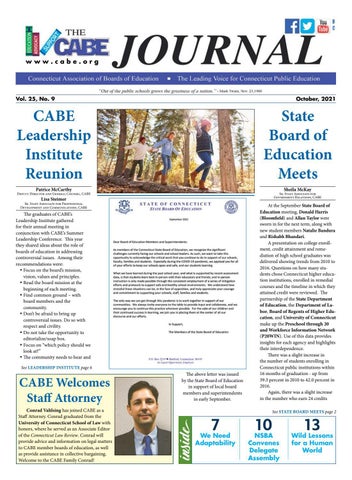
The above letter was issued by the State Board of Education in support of local board members and superintendents in early September.
7
We Need Adaptability
See STATE BOARD MEETS page 2
10
NSBA Convenes Delegate Assembly
13
Wild Lessons for a Human World
2
The Journal – Connecticut Association of Boards of Education | October, 2021 PRESIDENT COMMENTARY
Why Can’t We All Just Get Along? Donald Harris President, CABE
“Why can’t we all just get along” were words that Rodney King famously spoke on May 1, 1992. For the history buffs, King was caught after a car chase on March 3, 1991 and was pulled from his car, brutally beaten by four Los Angeles police officers. The officers were indicted and charged with assault with a deadly weapon and excessive use of force by a police officer. However, after a three-month trial, a predominately white jury acquitted the officers. This act so inflamed the Los Angeles community, that riots ensued that accounted for the deaths of 63 people, 2,300 injured, 12,000 arrested and $1 billion in property damage. Fast forward 30 years and we have the horror show that occurred on January 6 at the Capitol in Washington, D.C. We still have the Delta variant of COVID-19 and the ongoing verbal and sometimes physical confrontations about getting a vaccination and wearing a mask. So now, I’m asking, “Why can’t we all just come together?” for the benefit of humanity, for our children, and our families. CABE Leadership has a deep abiding concern about our children who are going to school each and every day. We have created an Anti-Hate Speech resolution that we hope will be adopted at the CABE Delegate Assembly in November and accepted by every one of our school boards. The draft language, to be presented to the Assembly for a vote reads:
Belief:
“CABE believes that all students deserve to learn in an environment that is safe, affirming, and free of bias and discrimination. CABE denounces the use of words or images that harass
and directly attack individuals or groups based on race, religion, national origin, sexual orientation, gender or gender expression, disability, or any other aspect of identity. CABE believes that when students or adults speak explicit hate language at school, it is the responsibility of the school district to actively respond to these incidents. CABE urges boards to foster school climates where differences are appreciated and not used to ridicule, single out, intimidate, disrespect, or exclude different groups. We recognize that these injustices can have a negative impact on the educational experience that we expect for each child.” Boards of education have an obligation to provide a safe environment for learning, and that includes physical, mental and emotional concerns. By tackling some of these difficult issues now, we may keep history from repeating itself in years to come. Now, boards not only have an obligation to provide curricula and instruction that supports these concepts, but have found themselves in the crosshairs of folks who are also threatening the safety and well-being of board members themselves. People are attacking boards for decisions they are not even making. Board meetings are being disrupted and forced to adjourn when a small but extremely vocal minority of audience members refuse to be civil and adhere to basic rules of decency. These disruptions are causing some members of the pubic to question whether or not boards are doing the appropriate work. Now, more than ever, the focus on us all getting along is even more critical. If boards (or board members) are lowering their standards of behavior to that of those disruptive audience members, they will lose the credibility that they have so long worked to acquire. Through all of this, boards need
Mission: To assist local and regional boards of education in providing high quality education for all Connecticut children through effective leadership. Vision: CABE is passionate about strengthening public education through high-performing, transformative local school board/ superintendent leadership teams that inspire success for each child.
Board of Directors to do the following to ensure that vast majority of the public that trust their elected leaders: • S tay focused! Boards are there primarily to provide a quality education in a safe environment. Do not get distracted by outside groups with other agendas • Take back the narrative! Too many people are sharing information that is not accurate, but since they are controlling the conversation, too many people are feeding into it. • Be transparent! Stick to the facts. Show your community what you are doing and help them understand why. •F ollow the science! Listen to the experts and don’t allow politics to enter into the decisionmaking process. DO WHAT IS RIGHT! •D emand (and model) civility! The best way to do this is to behave in a civil manner to each other. Some of the issues before us are difficult and emotional. I believe board members can work through these issues without taking things personally. To answer Rodney King’s question, “Why can’t we all just get along”, I would respond with a question of my own, “Why not?”
STATE BOARD MEETS
(continued from page 1)
within two years – up from 64.4 percent in 2010 to 65.7 percent in 2016. Fewer students took remedial courses within the first two years of enrollment – down from 50 percent in 2010 to 41 percent in 2016. The full report can be found at https://portal.ct.gov/-/media/SDE/ Board/BoardMaterials090121/SBEGoal1_College_Enrollment_Credit_Attainment_and_Remediation_of_ HS_Graduates_P20WIN_Report.pdf.
EXECUTIVE COMMITTEE Donald Harris | President, Bloomfield Elizabeth Brown | First Vice President, Waterbury Leonard Lockhart| Vice President for Government Relations, Windsor Bryan Hall | V ice President for Professional Development, East Hartford John Prins | Secretary/Treasurer, Branford Robert Mitchell | I mmediate Past President, Montville Christopher Wilson | Member at Large, Bristol Lydia Tedone | NSBA Director, Simsbury AREA DIRECTORS Bryan Hall | Area 2 Co-Director, East Hartford Leonard Lockhart | Area 2 Co-Director, Windsor Joan Trivella | Area 4 Director, Woodstock Academy Mic helle Embree Ku | A rea 5 Director, Newtown Karen Kleine | Area 6 Director, Westport George Kurtyka | Area 7 Co-Director, Derby Robert Guthrie | Area 7 Co-Director, West Haven Lon Seidman | Area 8 Director, Essex Sean Nugent | Area 9 Director, Preston ASSOCIATES Julie Auseré | Associate, Canton Eileen Baker | Associate, Old Saybrook Ethel Grant | Associate, Naugatuck Ann Gruenberg | Associate, Hampton Robert Trefry | A ssociate, CT Technical High School System Elaine Whitney | Associate, Westport COMMITTEE CHAIRS Becky Tyrrell | Chair, Federal Relations, Plainville Meg Scata | Chair, Resolutions, Portland Michelle Embree Ku | Chair, State Relations, Newtown CITY REPRESENTATIVES John Weldon | City Representative, Bridgeport Ayesha Clarke | City Representative, Hartford Yesenia Rivera | City Representative, New Haven Andy George | City Representative, Stamford Charles Stango | City Representative, Waterbury STAFF
Robert Rader | Executive Director Patrice McCarthy | Deputy Director and General Counsel Nicholas Caruso | Senior Staff Associate for Field Services and Coordinator of Technology Sheila McKay | Senior Staff Associate for Government Relations Vincent Mustaro | Senior Staff Associate for Policy Service Lisa Steimer | Senior Staff Associate for Professional Development and Communications Conrad Vahlsing | Staff Attorney Teresa Costa | Coordinator of Finance and Administration Pamela Brooks | S enior Administrative Associate for Policy Service and Search Services Terry DeMars | Administrative Associate for Policy Service Gail Heath | Administrative Associate for Government Relations Wilmarie Newton | Administrative Associate for Labor Relations Nancy Propfe | Administrative Assistant for Membership Services Corliss Ucci | Receptionist and Assistant to Executive Director
CABE Journal (ISSN 1092-1818) is published bi-monthly by Connecticut Association of Boards of Education, 81Wolcott Hill Road, Wethersfield, CT 06109. Periodicals postage Paid at Hartford, CT.” POSTMASTER: Send address changes to The CABE Journal, CABE, 81 Wolcott Hill Road, Wethersfield, CT 06109-1242. CABE membership dues include $30 per person for each individual who receives The CABE Journal. The subscription rate for nonmembers is $75. Association members dues include a subscription for each Board Member, Superintendent, Assistant Superintendent and Business Manager. The companies and advertisements found in The CABE Journal are not necessarily endorsed by CABE.
The Journal – Connecticut Association of Boards of Education | October, 2021
CABE Affiliate Members BUSINESS AFFILIATES VALEDICTORIAN Connecticut Business Systems – A Xerox Company Finalsite SALUTATORIAN
Berchem Moses PC Shipman & Goodwin HIGH HONORS
Pullman & Comley HONOR ROLL Anthem Blue Cross and Blue Shield ESS JCJ Architecture Newman/DLR Group SCHOLAR Brown & Brown Chinni & Associates, LLC Coordinated Transportation Solutions Dattco, Inc. Goldstein & Peck, P.C. Kainen, Escalera & McHale, P.C. The Lexington Group Network Support Co. OneDigital Health and Benefits Perkins Eastman T-Mobile The S/L/A/M Collaborative Zangari Cohn Cuthbertson Duhl & Grello, P.C.
EDUCATIONAL AFFILIATES American School for the Deaf Area Cooperative Educational Services (ACES) Capitol Region Education Council (CREC) The College Board Communities in Schools Connecticut Arts Administrators Association Connecticut Association of School Business Officials Connecticut School Buildings and Grounds Association Connecticut School Counselor Association Connecticut Technical High Schools Cooperative Educational Services (C.E.S.) EASTCONN EdAdvance Explorations Charter School Integrated Day Charter School ISAAC LEARN Live Girl
3
EXECUTIVE DIRECTOR COMMENTARY
Difficult Times Robert Rader
Executive Director, CABE
The opening of schools this year has been a particularly challenging time for School Boards and Superintendents. It has been one of the most difficult periods, I, who have worked for boards for over 40 years, have ever seen. We have seen Board Members face intense pressure on masking students; diversity, equity and inclusion (the alleged teaching of critical race theory); vaccinations; and other issues. This is not limited to boards in the more conservative areas of the country. It is happening in Connecticut, too. We have seen outrageous, uncivil, disruptive behavior in Connecticut at a Governor’s Education Roundtable meeting, school board meetings and even at a district’s policy committee meeting where police had to be called. Parents have brought their small children to these events and then shout profanities about mask wearing. What are those child learning from their parents? The protests have continued even though boards have to follow the Governor’s Executive Order requiring masks. Children seem to have adjusted to the masks with little distress. Despite these issues, to the best of my knowledge, Connecticut schools opened successfully with a minimum of issues, a testament to the preparation done by our boards, superintendents, principals, teachers and all the other staff. Terrific work, folks! Let’s not forget that most parents support masks and other safety precautions that districts are taking. This is evidenced by recent polls. Those protesting appear to be the loudest… of the minority.
The Impact of This Environment
However, the pressure that is being put on our boards and superintendents cannot easily be dismissed. I know of board members who have ably served on their boards for years and have decided not to run again. I am concerned that those who might be great board members might decide there are other ways to serve their communities, if they decide to remain in public service at all. Repercussions from this environment take their toll not only on school board members or candidates for our
boards. Superintendents have likewise been affected. Those who have been hired to help districts with diversity, equity and inclusion issues, whether teaching or administering programs must see some of these attacks as directly targeted on their work. We have seen experienced educators, with many years of working on behalf of all students under their care bullied and disparaged. In certain states, these attacks are seen as campaigns to undermine public education as the principal institution for teaching and helping socialize our children. What is also so difficult to reconcile is that these series of attacks are happening in school districts that are known for years of success in preparing their students for the future. The issues that we are facing are, surprisingly enough, not about the dysfunction or ineffectiveness of boards. The attacks even challenge the best of school boards. Districts which have built records of integrity, credibility and are seen as wonderful centers for their communities are questioned about what is being taught without any indication that there are problems with curriculum or other issues. Most of the issues and the anger of speakers happen during the public comment part of board meetings. How Boards conduct this part of the agenda will depend on the skill of the Board Chair, guided by bylaws and regulations dealing with public comment. I see these issues as more than just the to-be-expected results of the frustration and anger brought about by the divisive presidential campaign of last winter and the ongoing restrictions of COVID-19 and its progeny. I do not believe these issues or the underlying rancor will fade away easily, because there are definitely parts of our communities which have totally lost faith in our institutions. If anyone judged by the letters to the editors in my community’s local newspaper, this was not just a difficult back-to-school period, but, an existential issue about the way in which American education is provided. Our system of public education is based on the belief that education is locally governed by a board elected by the community to represent and make the best decisions on behalf of our students. Yes, democracy can be messy,
but, having met thousands of board of education members over my years of working for school boards, I know that the vast majority are working to make the best decisions for those children. These elected volunteers are central to ensuring that the public is represented, even as our board members also are agents of the State and must uphold and follow the laws of the State, as well as the Executive Orders that are signed by the Governor.
My Hope
My hope is that rather than the undermining of public education, the way in which boards and superintendents handle these issues, will, in the long-run, strengthen our system. While this may not seem likely now, I have seen boards that handle the protests appropriately, listened during the protests and continue to make the right decisions for their students, staff and communities. They engender trust and credibility. Over the years, we have seen other attacks on boards and superintendents. Whether during the McCarthy period, civil rights era or even over Common Core, the institution closest to the community has continued to hold the confidence of the public. Continuing to do the work of the people, in public, with integrity, thoughtfulness and empathy will, in the long run, despite the crises of today, strengthen public education. On September 9 CABE presented a webinar with Cheshire Chair Anthony Perugini, Cheshire Superintendent of Schools Jeffrey Solan, moderated by CABE Deputy Director and General Counsel Patrice McCarthy on Board Chair Leadership in Divisive Times. The speakers and attendees provided strategies for Boards and their Chairs to ensure that Board meetings remain civil and orderly. To see a recording of the webinar, go to https://www.cabe.org/page. cfm?p=1525.
4
The Journal – Connecticut Association of Boards of Education | October, 2021 See You in Court – The Nutmeg Board of Education
The Nutmeg Board Interviews Assistant Superintendent Candidates – What Could Possibly Go Wrong? Thomas B. Mooney, Esq. Shipman & Goodwin
The Nutmeg Board of Education makes many mistakes. The latest imbroglio created by the board will be reported here each issue, followed by an explanation of what the board should have done. Though not intended as legal advice, these situations may help board members avoid common problems. The members of the Nutmeg Board of Education were frustrated with the low-energy, long-serving assistant superintendent, and they were delighted to receive a confidential email from Mr. Superintendent that the assistant superintendent had finally decided to move on. Veteran Board member Bob Bombast was right on it, emailing back to Mr. Superintendent that the Board would like to be “very involved” in the search for a new assistant superintendent. “Thank you for your interest in helping me identify a new assistant superintendent,” Mr. Superintendent wrote “Reply all” in response to Bob’s email. “I value the perspective of Board members, and I will request your assistance in the selection process.” True to his word, some weeks later Mr. Superintendent sent the Board members the résumés of the top 20 applicants and asked for them to rank the candidates in order and send him their rankings. Surprisingly, there was unanimity in the Board members’ rankings, shared by “Reply All” emails, and three candidates stood out from the crowd as the best prospects. Mr. Superintendent then scheduled Board interviews with the three candidates. Mr. Superintendent posted the interviews as “Executive Session: Personnel Matter,” and Mr. Superintendent told the Board members to stick to scripted questions so that each candidate would have a fair opportunity to answer the same questions. Moreover, the Board members were to fill out prepared forms with their impressions of the candidates between the interviews. Mr. Superintendent described these procedures in an email to the Board members, along with the questions he had prepared for each of the Board members to ask. The first interview had just started when Bob Bombast went off script.
The candidate stated that she had earned her undergraduate degree at UConn, and Bob jumped right in. “I went to UConn too!” Bob told the candidate excitedly. “What class were you in?” When the candidate answered Bob, he was surprised, and he told he candidate that she didn’t look that old! The candidate thanked Bob for the compliment, and the candidate made a good impression on Bob and the other Board members. During a scheduled break, the Board members filled out their interview forms on the first candidate, and the next candidate came in. For the most part, the interview with the second candidate also went well. But in filling out the interview form, Board member Mal Content noted that the candidate had an “ethnic” hair style that could be a distraction for some of the Nutmeg parents. As it turned out, the Board members liked the third candidate the best, and they gave her their unanimous endorsement. Mr. Superintendent thanked the Board members for their assistance, and he collected the forms. In reading through the forms the next day, however, Mr. Superintendent was concerned about Mal’s comment about an “ethnic” hair style. Would it be okay for Mr. Superintendent to discard the comment forms now that the interviews were over? Do you have any other concerns about this hiring process? • • • • • • • • • • • • • It would not be appropriate for Mr. Superintendent to discard the comment forms, and there are other concerns with the Board members’ participation in the interview process. In conducting job interviews, board of education members and others participating in the hiring process must be aware of the extensive protections against discrimination that exist for employees and prospective employees under Connecticut law. It is unlawful for employers to discriminate against employees and prospective candidates on a number of protected characteristics, including age, sex, race, national origin, ancestry, religion, marital status, sexual orientation, gender identity or expression, veteran status, genetic information, and disability. Moreover, such claims are often decided without any direct proof of discrimination. Many years ago, the
Connecticut Supreme Court described the problem: “One who indulges in discrimination does not usually shout it from the housetops. All too frequently persons publicly announce abhorrence of racial prejudice while privately practicing it.” Reliance Insurance Company v. CHRO, 172 Conn. 485 (1977). Accordingly, the courts will draw inferences from words and actions to determine whether illegal discrimination has occurred. The hiring process often gives rise to discrimination complaints, and those complaints are typically decided by drawing such inferences. It is not illegal per se, for example, to ask a candidate how old he or she is (or to compliment a candidate for looking young for her age). But such information is (or should be) irrelevant to the hiring process, and the CHRO and/ or the EEOC would be ready to infer that such a question was asked for an improper, discriminatory purpose. It is therefore important that board members, administrators, teachers, parents or anyone else who participates in interviews be aware of discrimination
prohibitions and avoid questions that elicit information about a protected status. We note that the Nutmeg Public Schools adopted a procedure whereby the interviewers were supposed to ask all candidates the same questions. That makes sense, because asking different questions of different candidates could result in a claim of differential treatment on a prohibited basis. However, to interview effectively, there should be some flexibility, and follow-up questions are an appropriate way to get to know the candidates. In training persons involved in the hiring process, two new statutes are of particular interest. Effective October 1, 2021, Public Act 21-69 makes it a discriminatory employment practice for employers, including boards of education, to request or require a prospective employee’s age, date of birth, dates of attendance at or date of graduation from an educational institution on an initial employment application. While understandable, Bob’s asking the first See SEE YOU IN COURT page 7
The Ninth Edition – Now Available!
A Practical Guide to Connecticut School Law by Thomas B. Mooney, Esq. Shipman & Goodwin
CABE is delighted to announce that the Ninth Edition of Tom Mooney’s Practical Guide to Connecticut School Law is now available. PRICING: CABE Members: $54.99; CABE Non-Members: $79.99; Students: $44.99 There have been many changes in school law in the last few years, and the Ninth Edition has been extensively revised to provide updated guidance on the legal issues that govern our schools. Changes include descriptions and commentary on:
• Changes in teacher evaluation and teacher tenure. • New rules regarding employee background checks. • New requirements concerning student data privacy. • New rules for suspension, expulsion and alternative educational opportunities. • Revised requirements governing seclusion and restraint. • The new “Every Student Succeeds Act” and how it has changed “No Child Left Behind Act” requirements. • The CCJEF case and ongoing litigation over equal educational opportunities. • The Minimum Budget Requirement and new duties to collaborate with town officials. • A host of other changes in the rules that boards of education and school administrators must follow.
The Journal – Connecticut Association of Boards of Education | October, 2021
5
It’s Personal Relationships fuel success. We earn your trust by taking your success as personally as you do. However you define value, Shipman delivers.
Shipman’s school law lawyers have nearly 50 years of experience, and represent over 100 public school districts, as well as public school member organizations and associations, on the broad range of legal issues that school districts confront. We call on lawyers experienced in school law, special education, employment law, labor relations, intellectual property, data privacy, construction and environmental issues, and business contracts to provide effective and efficient legal assistance for our clients.
It all adds up to a relationship that delivers added value for each of our school district clients.
Our Practice Group Co-Chair, Tom Mooney, has written A Practical Guide to Connecticut School Law, a comprehensive treatise on Connecticut school law, published by CABE and used by teachers, administrators and board of education members throughout the state.
Education is a core focus of our law firm.
Facebook “f ” Logo
CMYK / .eps
Facebook “f ” Logo
CMYK / .eps
www.ctschoollaw.com Contact: Thomas B. Mooney or Linda L. Yoder | 860.251.5000 Shipman & Goodwin LLP
Connecticut | New York | Washington, DC | www.shipmangoodwin.com
6
The Journal – Connecticut Association of Boards of Education | October, 2021
More Support for Affinity Groups Dr. Martha Brackeen-Harris DEI Consultant, CABE
Robert Rader
Executive Director, CABE
As we reported in last month’s CABE Journal, CABE is in the process of launching affinity groups for our African-American, Hispanic or Latino and white Board Members. We are looking for Board Members who want to join one of these groups. At the end of August, after the September Journal was published, we received Of Note, a monthly newsletter from the Nellie Mae Foundation, which included the National Equity Project’s A Landscape Analysis of Education-Based Racial Affinity Groups in the U.S. The report focuses primarily on the affinity groups which have been established to help African-American “to increase, retain, and sustain educators of color which will impact classrooms for the better in reaching the goal of a more equitable system.” It is no surprise that these affinity groups were very positive for those who have attended. Research has shown that teachers of color face situations which require support from those who have faced similar issues, such as many “do not feel intrinsically supported in schools by their leaders or by the institution or system. Across
LEADERSHIP INSTITUTE
(continued from page 1)
understand the board’s role. •D evelop relationships with candidates/new board members. •B oard professional development and self-evaluation is critical. Use CABE staff for support. •D on’t feed into the “hysteria”. • Th e board chair sets expectations for meeting conduct. • Th e board, not just the chair, needs to be empowered to keep
SEE YOU IN COURT
(continued from page 4)
candidate when she graduated from UCONN could be a problem, and he did himself and Nutmeg no favors with his follow-up comment that the candidate did not look that old. Similarly, Public Act 21-2 (known as the “CROWN Act”) now defines “race” as “inclusive of ethnic traits historically associated with race, including but not limited to, hair texture and protective hairstyles.” Mal
the board, organizational leaders discussed the toxic and hostile nature of schools for educators of color.” While not exactly the same situation faced by school board members of color, here are some of the lessons learned by enabling teachers of color to join affinity groups (whether paid for by the teacher or by the district), the study found that “all of the racial affinity-based groups interviewed have a direct focus on practicing what we have termed racial wellness support, which includes inspiration and empowerment; fellowship and networking; and understanding”. The study also found that the: “authenticity and vulnerability fostered by racial affinity spaces enables educators of color to recognize that they are not alone in their professional challenges, and that they are often rooted in the same issue — institutional and systemic racism… A common thread for racial affinity groups is that they serve as places of healing from trauma and oppression and focus on racial wellness support through providing a communal space for • Inspiration and empowerment; • Fellowship and networking; and, • Developing a shared understanding and practices around navigating and negotiating racial and racist issues… The opportunity
to make connections and build community is a critical element of racial affinity spaces, as many educators of color express feelings of isolation at their school sites” especially for male teachers of color. Our hope and that of the CABE Diversity, Equity and Inclusion Committee, is for our new affinity groups to provide some similar space for support, healing, critical conversations about their board work, and building of networks as the teacher and administrator affinity groups in
the study. Our affinity groups can help with our goal of attracting new BIPOC members to our boards and retaining current members. The entire report, which also provides information on organizational needs for affinity groups, policy and activism implications and advocacy, can be found at https://static1.squarespace.com/static/5c01b0d6b98a78f723592deb/t/60fee815702130399ad065fa/1627318296163/BTP+Landscape_Analysis_Racial_Affinity_ US_2021.pdf.
CABE BOARD OF DIRECTORS MEETING
order. •H old board members’ hands when confronting issues and ugliness/ threats from outside. Develop protocols with your police department before a crisis arises. • S tudent board members can provide hope (and role models!) •B oard members are leaders of leaders. These experienced board leaders embraced the opportunity to share their strategies and connect with their colleagues in person.
The CABE Board of Directors met on September 9 and were joined by Commissioner Charlene Russell-Tucker. At this meeting the Board adopted an Anti-Hate Speech resolution that will move forward to the CABE Delegate Assembly on November 11.
Content’s inappropriate note about candidate two’s “ethnic” hairstyle could well support a finding of illegal race discrimination. That said, Mr. Superintendent should certainly not discard the comment forms. Per EEOC regulations, records related to the hiring process must be retained for two years. Moreover, when such records are destroyed in violation of that rule, the courts may draw an inference that such records would have supported the plaintiff ’s claim. Byrnie v. Town of
Cromwell, 243 F.3d 93 (2d Cir. 2001). Finally, there were at least two FOIA violations here. Decision-making through “Reply All” emails constituted communication among a quorum to do Board business, which was in effect illegal unposted “meetings.” Moreover, the FOIC has repeatedly ruled that the reason for an executive session must be stated more specifically than “Personnel Matter.” Given that the assistant superintendent is an executive-level position, the Nutmeg Board could have (and should have)
avoided the FOIA problems by naming its members a “personnel search committee.” By taking that action, the Nutmeg Board, as such a committee, would have been able to conduct the search without having to follow the FOIA meeting requirements. Attorney Thomas B. Mooney is a partner in the Hartford law firm of Shipman & Goodwin who works frequently with boards of education. Mooney is a regular contributor to the CABE Journal. Shipman & Goodwin is a CABE Business Affiliate.
The Journal – Connecticut Association of Boards of Education | October, 2021
7
We Need Adaptability Robert Rader
Executive Director, CABE
We can name many times in the last year-and-a-half that showed the importance of being able to adapt quickly to new circumstances. Whether it was districts turning on a dime from traditional in-school teaching to provide remote learning for students, or back, our Superintendents and Boards showed their ability to move quickly, effectively and efficiently. The need for adaptability continues as the new Coronavirus morphs into new variants. In the middle of August, the National School Boards Association (NSBA) was set to have its first in-person Leadership Conference and Delegate Assembly in Louisville, Kentucky, but, the week before the conference, the COVID-19 numbers in Kentucky doubled. NSBA cancelled the in-person meeting and held a virtual Delegate Assembly. McKinsey & Company, perhaps the best-known global management consulting firm in the world, recent-
ly published an article called Future Proof: Solving the ‘Adaptability Paradox’ for the Long Term. It contained new ways of dealing with a world that is “volatile” and “complex” and “serving up change at an accelerating pace.” The article argues that, “adaptability is the critical success factor during periods of transformation and systemic change. It allows us to be faster and better at learning and it orients us towards the opportunities ahead, not just the challenges.” The authors write that the same circumstances that make adaptability so important “can also trigger fear, making us default to familiar patterns or whatever solutions that worked last time.” They call this the “adaptability paradox: when we most need to lean and change, we stick with what we know, often in a way that stifles learning and innovation. Even positive events, such as receiving a promotion or beginning a new workstream, can turn negative unless we can maintain a learning mindset [when we’re] under
pressure.” So how do we do this? McKinsey recommends five steps leaders can take to become more adaptable:
are not.” Nonnegotiables are “vows you make to yourself that you will not break no matter what.”
Step 1: “Practice well-being as a foundational skill”
When we move towards the patterns that we have always used to deal with difficult and changing circumstances, we may “hinder our ability to adapt and respond in ways that a new situation requires.” The authors state that “critical components of adaptability” are self-awareness and reflection. The underlying idea is that an adaptability lens will help you see issues in new ways.
According to the article, leaders had anxiety and burnout during the COVID period, “at unprecedented rates as they focused on others without restoring their own energy levels.” They recommended that leaders “focus on allowing themselves to thrive, and then helping others to be at their physical, mental and emotional best.”
Step 2: “Make purpose your North Star and define your ‘nonnegotiables’” Purpose should be “what truly matters to you and what you want to spend your time on.” People who say they are “living their purpose at work report levels of well-being that are five times higher than those who say they
Step 3: “Experience the world through an adaptability lens”
Step 4: “Build deeper and more diverse connections” “Strong interpersonal relationships… bolster adaptability, since human beings need meaningful connections to survive and thrive.” To build those connections: See ADAPTABILITY page 14
8
The Journal – Connecticut Association of Boards of Education | October, 2021
THE POLICY CORNER Vincent A. Mustaro
Senior Staff Associate for Policy Service, CABE
Curriculum Development Curriculum development is a dynamic and continuous process by which a school system plans, implements, and evaluates its educational programs in a coherent and logical manner. Curriculum guides the teaching/learning process by defining what is to be learned, how it is to be learned and how it will be assessed. Through the use of written curriculum documents, teachers are able to ensure that every student will encounter a planned, on-going, sequential and systematic instructional program. To be highly effective, the written curriculum must be used by teachers on a daily basis to make instructional decisions that are focused on a core of mastery objectives. The curriculum must also be flexible enough to allow for a teacher’s creativity, enhancement and critical monitoring of effective learning strategies. The written curriculum must be a working document that is constantly reviewed and modified to meet the ever-changing learning needs of students, especially considering modifications and/or additions mandated by statute. The board’s selection of a superintendent is its most important decision. Board decisions pertaining to the school system’s curriculum follows closely in importance. Boards of education should expect on-going curriculum review and development in order to maintain programs consistent with current and future-oriented quality standards, new state curricular mandates and with comprehensive PK-12 continuity. Curriculum content, a very important concern for board members, may also be a source of frustration and confusion, at times fueled by inaccurate community views. Curriculum encompasses everything presented to and provided for students under the jurisdiction of the school board and the superintendent of schools. It is so important that it will inevitably cause controversy, a major reason some boards may shy away from this critical area of responsibility. Boards need to be prepared to respond appropriately to curricular controversy, when it arises. A number of factors cause boards to experience difficulties with their curriculum responsibilities. These include state and federal mandates that predetermine some curriculum content, financial restrictions, lack of curriculum policies, constraint in setting aside time to analyze curriculum issues, deferring to staff as curriculum experts, and lack of sufficient knowledge on curricular issues and strategies. Boards, however, have major responsibilities regarding curriculum. They must adopt curriculum for use in the schools, because state statutes
impose specific requirements and identify areas in which instruction must be offered. C.G.S. 10-16b contains a list of subjects that must be taught in the public schools. Other statutes detail other curriculum responsibilities for local districts. School districts have some discretion in establishing programs and courses to address these requirements. Boards may also provide instruction in a multitude of non-mandated subject areas, as well. In order to offer a first-class academic program to all school children, school districts need clear, specific academic standards and a high quality curriculum in all schools that foster high student achievement. An academic accountability reporting system that is available to the community, appropriate instructional materials, and academic improvement plans for schools are also required. In addition, there should be staff involvement, with the board and community, in determining what should be taught and the best instructional methods to use. Boards affect the curriculum in three ways. First, the board should make a commitment to the curriculum, proclaiming, through written policy, the importance of the curriculum and the board’s concern with its development, execution, and evaluation. Curriculum issues should be a regular part of board meeting agendas. Meeting time should be spent discussing what is being taught, how it is being taught, and the results attained. Second, the board must allocate adequate resources. Commitment to curriculum development must be accompanied by the adoption of a budget that provides adequate resources for staff development, supervision, curriculum development activities, program implementation and evaluation. Next, the board must maintain a curriculum focus. It should require frequent reports from the administration through a series of curriculum-related presentations to the board on the educational program over-all, continuity between grade levels, plans for evaluation, curriculum revision and student achievement.
District Curriculum Committee
Boards of education are required by statute, C.G.S. 10-16b, to establish the district’s program of studies. To accomplish this a “school district curriculum committee” must be appointed by the board (C.G.S. 10-220(e)). The District Curriculum Committee establishes an orderly and ongoing process for assuring that there is a written curriculum in each discipline which accurately reflects the philosophy and goals of the
local district and state requirements. To accomplish this purpose, the Curriculum Committee must actively engage in a process of determining the need for curriculum review and revision. The membership of the School District Curriculum Committee usually consists primarily of teachers representing various grade levels and schools in a district, teachers representing special student populations such as English Language Learners and Special Education, building-level administrators, district curriculum coordinators (depending on district size) district level administrators with primary responsibilities for curriculum and instruction, perhaps student representation, and some community members. One or two members of the board may be appointed as liaison members. The committee is usually chaired by the district’s administrator with major responsibilities in curriculum and instruction. The Committee is the body which reviews current research, understands the impact of state initiatives, and is aware of how the future affects today’s curricular offerings. The Committee recommends, develops, reviews, and approves all curriculums for the District which are then submitted to the Board of Education for its review and approval, “should it wish to exercise that authority.” This author recommends such action. The Committee sets the standards for learning in the district. The establishment of what is expected of a graduate of the local district has a major impact on the curriculum which, in turn, will affect what students will be expected to accomplish at each grade level. Within the framework of the limited resources of time and money, each program offering must be routinely evaluated to determine those programs which are of value for today’s learners and those which are not. It is through a process of ongoing evaluation that the Curriculum Committee determines how best to design a curriculum which will meet the present and future learning needs of the students and fulfill state requirements. The Curriculum Committee is charged with the responsibility to fully consider the implications of all concepts, mandated or otherwise, which relate to the total curriculum of the school system. In fulfilling this function, the Committee serves as the major source for curriculum-related input to the superintendent and the board of education and facilitates the implementation of the its recommendations, including the establishment of a master curriculum review/development calendar.
The board of education, however, must reserve the responsibility for establishing and approving curricula for the school district, subject to any limits specified by the State. Teachers are required to teach within the approved curricula.
Related Policy Issues to Consider
Some other issues, handled through policy decisions, exist for the board to consider. Curriculum development should be approached as a long-term commitment involving research, policy development, oversight, and evaluation. Policy should proclaim the board’s instructional beliefs, expectations and priorities. Instructional goals should be adopted. The board must also provide guidance defining the core curriculum, co-curricular program and electives. It must also approve any changing of textbooks in the system. Through policy the board must establish graduation requirements, fulfilling state mandates. Policy is also used to establish codes of conduct and clarify other issues relative to the learning environment. Key policy areas impacting curriculum include, but are not limited to, review and selection of textbooks, homework, after-school programs, field trips, teaching controversial subjects, reporting to parents, curriculum alignment with statewide assessments, instructional arrangements, testing, and grouping. The school board, actively involved in curricular issues, decides and approves what should be taught in the schools and why. The board must decide what knowledge, skills, attitudes and values the district wants its students to acquire and demonstrate competency. It is important for boards to adopt a policy detailing the district’s educational philosophy and goals. Next, the board must determine the school system needs to be addressed, what will be taught to meet those needs, what will be emphasized, and the instructional sequences to be followed. Well-defined, specific objectives provide direction to administrators and staff and facilitate the evaluation of the instructional program. In short, the purposes of the curriculum, the manner in which it is to be developed, reviewed, revised and evaluated are among the most important policy responsibilities of boards of education. Boards must be involved in determining and monitoring the instructional program in cooperation with the staff and community. Involvement in this area permits boards to exert leadership through its policy initiatives and monitoring activities.
The Journal – Connecticut Association of Boards of Education | October, 2021
9
We Are Well Suited to Respond to the Legal Needs of Boards of Education Attorneys and Counselors at Law
Berchem Moses PC is a leading player in the State of Connecticut in the field of Education Law. With 10 attorneys dedicated to this specialized practice, we offer a long history of experience and deep resources. We promise the highest level of service in a more cost effective manner. We work with boards of education to address a myriad of complex issues including labor and employment, student issues, special education, general counsel, and other challenges facing educators today. Be sure to visit www.connecticuteducationlawblog.com where our attorneys regularly cover legal matters that pertain to Connecticut schools.
www.berchemmoses.com Milford
75 Broad Street Milford, CT 06460 Phone: 203-783-1200
Westport
1221 Post Road East Westport, CT 06880 Phone: 203-227-9545
10
The Journal – Connecticut Association of Boards of Education | October, 2021
NSBA Convenes Delegate Assembly Patrice McCarthy
Deputy Director and General Counsel, CABE
The National School Boards Association 2021 Delegate Assembly was held virtually in mid-August. CABE President Donald Harris (Bloomfield), First Vice President Liz Brown (Waterbury) and Immediate Past President Bob Mitchell (Montville) represented CABE at the Delegate Assembly. Among the resolutions adopted were numerous proposals submitted by CABE addressing issues such as
IDEA, school safety, forced separation of children and families, and 21st Century skills. Liz Brown addressed the delegates about the importance of ensuring a diverse representation on NSBA’s Executive Committee. Donald Harris spoke in support of a proposal to add the importance of diversity, equity and inclusion in education to NSBA’s purpose as defined in the NSBA Constitution. Despite the challenges of a virtual format, the delegates accomplished the business of the meeting.
CABE participants in the Virtual NSBA Delegate Assembly included Immediate Past President Robert Mitchell (Montville), NSBA Director Lydia Tedone (Simsbury), First Vice President Elizabeth Brown (Waterbury), President Donald Harris (Bloomfield), Executive Director Robert Rader, and Deputy Director and General Counsel Patrice McCarthy (not pictured).
CABE RESOLUTIONS COMMITTEE AUGUST 31
The CABE Resolutions Committee met regarding the resolutions submitted by school districts for the CABE Delegate Assembly. Those meeting in person included State Relations Chair Michelle Embree Ku (Newtown), Deputy Director and General Counsel Patrice McCarthy, Sr. Staff Associate for Government Relations Sheila McKay, Executive Director Robert Rader, Administrative Associate for Government Relations Gail Heath, Resolutions Committee Chair Meg Scata (Portland), President Donald Harris (Bloomfield), and Vice President for Government Relations Leonard Lockhart (Windsor).
Those participating in the Resolutions Committee meeting virtually included Past President Ann Gruenberg (Hampton), Secretary/Treasurer John Prins (Branford), Nick Kapoor (Monroe), Associate Julie Ausere (Canton), and Associate Elaine Whitney (Westport).
The Journal – Connecticut Association of Boards of Education | October, 2021
11
CABE: Working for YOU
Individualized Workshops | Professional Development Opportunities Legal Services | Policy Services | Representing You Statewide and Nationally
Below are the highlights of activities that the CABE staff has undertaken on your behalf over the last month. We did this:
B y providing opportunities for members to learn how to better govern their districts:
zA ttended SDE/DPH webinars. z Responded to 47 requests for policy information from 22 districts, one RESC, one law firm and one out-ofstate school boards’ association, providing sample materials on 34 topics. Further, districts continue to access CABE’s online Core Policy Reference Manual and/or online manuals posted by CABE for policy samples. The topics of greatest interest were those pertaining to staff vaccination mandates, face masks, dress codes, bullying, and public comment at board meetings. z Discussed board roles and meeting protocols with the Trumbull Board of Education.
B y helping school boards to increase student achievement:
z Sent two issues of “Policy Highlights” via e-mail listserv covering topics that affect student achievement. Included topics pertained to staff COVID-19 vaccinations, face masks, and civility.
B y ensuring members receive the most up-to-date communications:
z Prepared materials, as part of the Custom Policy Service, for Danbury and Region #15. z Revised policies in the master resource file of policies and in the
online Core Manual based on recent legislative action. z Participated in a meeting with CTS to resolve some issues with the posting of online manuals. z Developed a new “Staff Vaccination policy” to address the impact of the Governor’s Emergency Order.
B y promoting public education:
z Hosted a Board Chair Check-In and Update. z Attended Pullman & Comley legal seminar.
B y providing services to meet member needs:
z Presented a webinar addressing Dealing with Divisive Issues. z Completed the audit of the policy manual of the Brookfield Public Schools. z Worked on policy manual audits for Union and North Stonington. z Revised policies, as part of the Custom Update Policy Service, for East Hampton, East Windsor, Gilbert School, New Fairfield, New Hartford, Marlborough, and North Stonington. z Facilitated a board retreat for the Hamden Board of Education.
B y helping districts operate efficiently and conserve resources:
z Posted policies online, as part of the C.O.P.S. Program for Barkhamsted, Bethel, Bolton, Canton, Chaplin, ISAAC, Region #12, Region #18, Ridgefield, Voluntown, Westport, Woodbridge, and the CABE Core Manual.
B y attending Professional Development to strengthen staff knowledge and skills:
z Attended CDC webinar on maintaining health and safety in schools.
B y representing Connecticut school boards on the state or national level:
z Attended CAS Board meeting z Participated in meetings to address school bus driver shortage. z Participated in Special Education State Performance Plan meeting. z Attended Commissioner’s Back-toSchool event. z Participated in virtual National School Boards Association’s (NSBA) Delegate Assembly. z Attended NSBA Town Hall meeting with U.S. Education Secretary Miguel Cardona. zP articipated in SDE Partners Meeting (SDE, CABE, CAPSS, CAS, CEA, AFT-CT) on FAQs document concerning vaccinations for school staff.
z Attended Connecticut Region Anti-Defamation League meetings. z Hosted CABE Government Relations and Resolutions Committees meetings. z Attended Department of Education Back-to-School Safety Resources webinar. z Attended virtual NSBA Northeast Region meeting. z Participated in NSBA State Association Counsel virtual meetings. z Participated in NSBA Juvenile Justice Diversion Workgroup meeting. z Staffed Resolutions and Government Relations Committee meetings. z Attended State Board of Education meeting. z Attended the Board of Directors meeting of Discovering Amistad. z Participated in meeting creating New England Chapter of the National School Public Relations Association (NSPRA). z Participated in meeting of NSBA Convention Managers.
What will CABE’s
Connecticut Online Policy Service (COPS) provide YOUR district?
• A policy manual updated within days of a board meeting • Access to your policy manual 24/7 anywhere with Internet capability • Time saving links to legal and cross references • A search engine specifically designed for board policy manuals • The ability to search other online districts for similar policies or language • A happier staff that will have less paper to deal with!
If you would like additional information on CABE’s Connecticut Online Policy Service (C.O.P.S.), call Vincent Mustaro at 860-571-7446 or email vmustaro@cabe.org for full details
12 ADAPTABILITY
(continued from page 8)
• Pay full attention to the person in front of you. • Allow yourself to be vulnerable. • Show empathy but don’t stop there... empathy is not enough,” you need take into account the other person’s perspective and react appropriately. • Meet others with compassion.
Step 5: “Make it safe to learn” “Healthy team dynamics
The Journal – Connecticut Association of Boards of Education | October, 2021 also foster adaptability.” Foster psychological safety, the “shared belief by team members that interpersonal risk taking is safe—that ideas, questions, concerns or mistakes will be welcomed or valued.”
How can we do this? • Reframe failures as ways to learn from missteps. • Encourage team voice. • Appreciate others. • Coach team members to support one another.
Board Members and Superintendents
There are many good lessons in this article, though some seem a bit simplistic. Looking at situations with an adaptability lens is certainly a skill that Board members and Superintendents need to adopt, but, despite the metaphor, is not as easy as looking through a new set of glasses. It takes thoughtfulness, self-understanding and most importantly, a willingness to do the work. Much like the journey to more understanding of racial issues, it has
to begin with the individual. We have learned much already about adaptability from dealing with COVID, which caused pivots in much of what we do. This article is well-worth the time if you want to continue to understand and prepare for more experiences on your adaptability “journey.” The McKinsey article can be found at: https://www.mckinsey.com/business-functions/organization.our-insights/future-proof-solving-the-adaptability-paradox-for-the-long-term.
For an update or more information on vacancies go to our website:
https://www.cabe.org/ page.cfm?p=1176 MARY BRODERICK, ED.D SENIOR CONSULTANT
For more information contact
CABE Search Services
81 Wolcott Hill Road, Wethersfield, CT 06109 On September 1, CABE President Donald Harris (Bloomfield) was sworn in for a second term on the State Board of Education.
860-608-1763
Equal Opportunity Employer
There when you need us for: •C risis Communications • Working with the Media •S chool Board Messaging and Professional Development •M edia Training and School Board/ Administrator • Presentation Skills • Full Video Storytelling Capabilities •S ocial Media Management and Strategies
Ann Baldwin, President
860-408-1580 | baldwinmedia.net ann@baldwinmedia.net
The Journal – Connecticut Association of Boards of Education | October, 2021
Jim Knox
13
Wild Lessons for a Human World
Curator of Education, Connecticut’s Beardsley Zoo
“In August of 2000, a group of South African youths wandered their home turf, randomly attacking those they encountered. Without adult role models, the juveniles were left to their own inclinations and irreparably harmed those in their path.” This description of violent activity does not refer to teens in Pretoria, Johannesburg, or Cape Town — but astonishingly — to a group of young male elephants. This series of events which unfolded have forced us to reexamine the definition and causes of “bullying” across species. Most significantly, this group behavior enables us to examine our own species through the lens and context of animal societies. “Mysterious,” “bizarre,” “tragic.” Those were just some of the words uttered by the rangers in the South African National Parks (SANParks) during the late summer of 2000. Their discovery of dozens of dead and injured rhinos and hippos began to paint a picture of an improbable suspect. The enormous animals had succumbed to both blunt force trauma and massive puncture wounds. As unlikely as it appeared, there was only one suspect in the animal kingdom capable of inflicting such injuries — the African Savannah Elephant. Once the forensic connection had been established, the more significant question emerged — why? To learn the why... we must go back to the when. From 1979 to the early 1980s, South Africa’s Kruger National Park was experiencing a population boom
of elephants. To mitigate the environmental damage of an overpopulation of the world’s largest land animals, and with limited translocation options at their disposal, The SANParks administration made the exceedingly difficult decision to cull elephants. The culling of the Kruger herds resulted in orphaned youngsters. With a void in other national parks throughout South Africa, the decision was made to translocate these orphaned animals to parks which had lost their elephants over time. Growing up in the absence of the mature bulls who set the behavioral norms for younger males in elephant societies, created a behavioral vacuum for juvenile males. With no behavioral standards in place and no mature bulls to enforce those standards, the juveniles were left to their own hormone-driven, and increasingly aggressive tendencies. These unruly bands of late teen-to early twenties juveniles roamed their new range of Pilanesberg National Park, “looking for a fight” with anything animate or inanimate. When rangers in Pilanesberg came across their first rhino carcasses, they were mystified. In time, when their forensic reconstruction yielded the culprit to the disturbing deaths of these exceedingly rare, protected creatures, they realized they must devise a plan to counter the wave of deaths. This bold plan — never before attempted — was to translocate massive, mature bull elephants in specially-designed trucks across hundreds of kilometers to Pilanesberg, to keep the bands of roving juveniles in check. The astonishing results were almost immediate. Within just 12 hours of introduction of the seven
mature bulls, the behavior and the deaths ceased. By restoring the behavioral balance of both modeling and reinforcement of mores, the elephant society in Pilanesberg had achieved stability. Furthermore, SANParks had proven that translocation of mature bull Savannah Elephants was possible and that a remedy for herd imbalance could be achieved and replicated across Africa. So, what lessons can we draw from the Pilanesberg elephants? In short, many wildlife societies have similar behavioral aspects, and dynamics to our own. Wildlife societies offer us a lens through which we can view analogous human behaviors such as bullying, displaced aggression, or departure from societal codes for examination, without the bias of judgment. Similarly, breakthroughs in wildlife behavioral observation often occur by embracing unprecedented, never-before-attempted methods to achieve success. In 2012, in collaboration with Fairfield University’s Department of Biology, Connecticut’s Beardsley Zoo embarked on the Research, Internships and Zoo Education
(R.I.Z.E.) partnership. This one-of-akind program brings undergraduates into a focused intensive behavioral observation sphere under the direct supervision of both institutions. Through R.I.Z.E. they can continue their studies beyond their semester coursework, to publish their findings and present to the international research community. This program has driven best practices and has informed innovation in husbandry, educational programming, research, and further collaboration. The animal/human behavioral sphere is vast, providing us with great opportunities for exploration, research, implementation, and application. Elephants may not solve our perennial societal issues of bullying, but they offer us a unique and promising lens through which to view our own behaviors, explore, and take giant steps — attempting solutions that were once deemed impossible. Editor’s note: We thought readers would find this article interesting. There are obvious lessons about the need for mentors and role models in many aspects of our lives. Just don’t expect results as quickly as the rangers!
Ideal for school districts, municipalities, state agencies and other public agencies!
Understanding Connecticut’s Freedom of Information Act Fifth Edition By Mark Sommaruga, Esq., Pullman & Comley, LLC
The Connecticut Freedom of Information Act (“FOIA”), often called the “Sunshine Law, is a series of laws that guarantee the public access to meetings and records of governmental entities in Connecticut. The FOIA also sets forth numerous exceptions to its open meetings and records requirements. Over the years, however, both the FOIA and its exceptions have often been misconstrued.
On September 9 CABE provided a workshop, Board Chair Leadership in Divisive Times. CABE Deputy Director and General Counsel Patrice McCarthy provided strategies that boards can use to keep the focus on the work of the board and Cheshire Board Chair Anthony Perugini and Superintendent Jeffrey Solan provided real-life examples. This program allowed for great sharing of experiences and best practices among the participants.
The Fifth Edition includes: The latest statutory changes and important decisions concerning the FOIA The latest developments concerning: ✓ law enforcement records ✓ school videos ✓ personnel records Additional details regarding FOIA compliance
To order please visit the CABE online publication store at CABE.org
14
The Journal – Connecticut Association of Boards of Education | October, 2021
Trusted Legal Counsel in Extraordinary Times Now more than ever, school districts, their boards of education and their administrators are turning to Pullman & Comley’s School Law practice for informed, accurate and timely information on the unprecedented legal issues they face in the age of COVID-19, including those surrounding the safe reopening of schools, remote learning, PPE protocols, and labor and employment matters. At the same time, our attorneys are counseling clients on new laws affecting school districts, including the Title IX regulations effective in August 2020, transgender athlete policies and the sexual harassment training obligations mandated by October 2020.
Please visit our Education Law Notes blog for up-to-the-minute alerts, commentary and insights on critical legal issues affecting educational institutions. Schoollaw.pullcomblog.com And, for critical information on the legal implications as a result of the COVID-19 pandemic, please visit our COVID-19 Focus page at pullcom.com to view recent publications, receive alerts, and to register for and view our webinar series related to the pandemic.
Our attorneys are accessible to their clients, responsive to concerns and always available to answer questions on these issues as well as on the challenges schools face on a routine basis in their daily operations.
pullcom.com
@pullmancomley
William R. Connon 860.424.4385 wconnon@pullcom.com
Zachary D. Schurin 860.424.4389 zschurin@pullcom.com
Melinda B. Kaufmann 860.424.4390 mkaufmann@pullcom.com
Stephen M. Sedor 203.330.2137 ssedor@pullcom.com
Michael P. McKeon 860.424.4386 mmckeon@pullcom.com
Mark J. Sommaruga 860.424.4388 msommaruga@pullcom.com
BRIDGEPORT
HARTFORD
SPRINGFIELD
STAMFORD
WATERBURY
WESTPORT
WHITE PLAINS
203.330.2000
860.424.4300
413.314.6160
203.324.5000
203.573.9700
203.254.5000
914.705.5355