Happy Summer!
B C
www.cabe.org
Vol. 26, No. 6
June, 2022
State Board of Education May Meeting
Rader to Retire After 26 Years as Executive Director
Patrice McCarthy
Deputy Director and General Counsel, CABE
At the May meeting the State Board of Education took action on several significant issues. They accepted the recommendation of the Litchfield-Regional School District 6 Temporary Regional Study Committee to create a K-12 regional school district for the towns of Goshen, Litchfield, Morris and Warren. The report recommends that the four existing elementary schools continue to accommodate the students in each town, and the current Litchfield middle school/high school house grades 6 to 8 and the current Region 6 high school become the regional high school for “Region 20”. The recommended configuration of the new regional board of education would be 12 members, with three members from each of the towns. The next step in this process is for a vote to take place in each of the participating towns. The State Board of Education also voted to accept the racial imbalance report for the 2021-22 school year, which indicates that three schools remain in continuing imbalance, and 19 schools have impending racial imbalance. See STATE BOE MEETING page 14
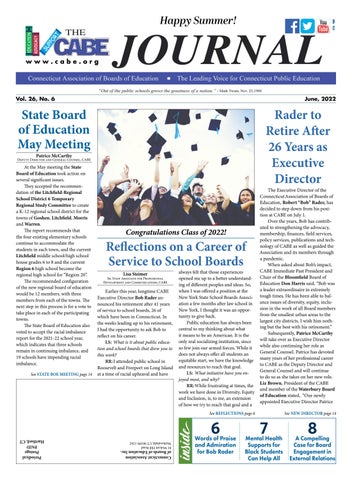
Congratulations Class of 2022!
Reflections on a Career of Service to School Boards Lisa Steimer
Sr. Staff Associate for Professional Development and Communications, CABE
Earlier this year, longtime CABE Executive Director Bob Rader announced his retirement after 41 years of service to school boards, 26 of which have been in Connecticut. In the weeks leading up to his retirement, I had the opportunity to ask Bob to reflect on his career. LS: What is it about public education and school boards that drew you to this work? RR: I attended public school in Roosevelt and Freeport on Long Island at a time of racial upheaval and have
always felt that those experiences opened me up to a better understanding of different peoples and ideas. So, when I was offered a position at the New York State School Boards Association a few months after law school in New York, I thought it was an opportunity to give back. Public education has always been central to my thinking about what it means to be an American. It is the only real socializing institution, since so few join our armed forces. While it does not always offer all students an equitable start, we have the knowledge and resources to reach that goal. LS: What initiative have you enjoyed most, and why? RR: While frustrating at times, the work we have done in Diversity, Equity and Inclusion, is, to me, an extension of how we try to reach that goal and a
The Executive Director of the Connecticut Association of Boards of Education, Robert “Bob” Rader, has decided to step down from his position at CABE on July 1. Over the years, Bob has contributed to strengthening the advocacy, membership, finances, field services, policy services, publications and technology of CABE as well as guided the Association and its members through a pandemic. When asked about Bob’s impact, CABE Immediate Past President and Chair of the Bloomfield Board of Education Don Harris said, “Bob was a leader extraordinaire in extremely tough times. He has been able to balance issues of diversity, equity, inclusion in the work of all Board members from the smallest urban areas to the largest city districts. I wish him nothing but the best with his retirement.” Subsequently, Patrice McCarthy will take over as Executive Director while also continuing her role as General Counsel. Patrice has devoted many years of her professional career to CABE as the Deputy Director and General Counsel and will continue to do so as she takes on her new role. Liz Brown, President of the CABE and member of the Waterbury Board of Education stated, “Our newly appointed Executive Director Patrice
inside
See REFLECTIONS page 6
6
Words of Praise and Admiration for Bob Rader
See NEW DIRECTOR page 14
7
Mental Health Supports for Black Students Can Help All
8
A Compelling Case for Board Engagement in External Relations
81 Wolcott Hill Road Wethersfield, CT 06109-1242
Connecticut Association of Boards of Education Inc.
Periodical Postage PAID Hartford, CT
2
The Journal – Connecticut Association of Boards of Education | June, 2022 PRESIDENT COMMENTARY
Reflections on a Year of School Board Work
Mission: To assist local and regional boards of education in providing high quality education for all Connecticut children through effective leadership. Vision: CABE is passionate about strengthening public education through high-performing, transformative local school board/ superintendent leadership teams that inspire success for each child.
Board of Directors Liz Brown
President, CABE
June: A riot of colors blankets the landscape, red yellow, purple, beauty stirs the soul. The school year follows natures’ cycle; Autumn: planting of seeds, pruning of trees Winter: fertilization and the deepening of Earth’s nourishment. Spring: awakening, summer, full birth. Summer: The school year comes full circle in June and our students bear the fruit of hard work. It’s an opportunity for school boards to reflect on what has transpired in the school district over the past year. Reflections infer an inner self. Do Boards have an inner self? I think the answer to this question
is yes, maybe a collective one. Did we set realistic goals and measure progress? Did we communicate effectively with all stakeholders, superintendent, staff, parents, students, and the community at large? Did we sow “seeds” of trust and collective vision for districts? Did the children that we serve receive the services we promised them? I have served on the Waterbury Board for 11 years and like many board members, I am deeply unnerved by the current controversies boiling in school districts throughout the country. Is trust and belief in Public Education at risk? As elected officials and advocates of public education, how can we bring reason and compromise to the national discourse? Reflection: During a time when “politics” seems to be the focus of so many, how do we continue to serve the
public in the governance role we swore an oath to provide to our communities? Reflection: a pause amidst the angry voices? CABE stands ready to provide a “table to reflect”, and discuss critical issues facing Boards. CABE plays a significant role in Connecticut’s education system and relies on member participation and input to keep public education true to its mission-educate all children! Reflection: the end of the school year needs reflection to prepare for the next “cycle of school”. CABE reflects with and for you! The CABE staff is always ready, willing and able to assist your board as you share this journey of governance. Please take advantage of their expertise in helping you and your board be all they can be.
Upcoming CABE Programs
AREA DIRECTORS Marion Manzo | Area 1 Director, Region 15 Douglas Foyle | Area 2 Co-Director, Glastonbury Tyron Harris | Area 2 Co-Director, East Hartford Jay Livernois | A rea 4 Director, Woodstock Academy Dan Cruson | Area 5 Director, Newtown Janice Cupee | Area 6 Co-Director, Stratford Lee Goldstein | Area 6 Co-Director, Westport George Kurtyka | Area 7 Co-Director, Derby Robert Guthrie | Area 7 Co-Director, West Haven Lon Seidman | Area 8 Director, Essex Carol Burgess | Area 9 Co-Director, Montville Bryan Doughty | A rea 9 Co-Director, New London ASSOCIATES Eileen Baker | Associate, Old Saybrook Ann Gruenberg | Associate, Hampton Anthony Perugini | Associate, Cheshire Robert Mitchell | Associate, Montville Robert Trefry | Associate, CT Technical High School System Joseph Wilkerson | Associate, Bloomfield COMMITTEE CHAIRS Becky Tyrrell | Chair, Federal Relations, Plainville Ethel Grant | Chair, Resolutions, Portland Christopher Wilson | Chair, State Relations, Bristol CITY REPRESENTATIVES John Weldon | City Representative, Bridgeport Pastor A. J. Johnson | City Representative, Hartford Yesenia Rivera | City Representative, New Haven Andy George | City Representative, Stamford
CABE Collective Bargaining Workshop June 7 8:30 Registration 9:00 a.m. – 12:00 p.m. Program Inn at Middletown, Middletown Register at https://www.cabe.org/ professional-development/upcoming-workshops. CABE 12th Annual Summer Leadership Conference August 18 1:30 p.m. Registration 2:00 – 7:15 p.m. Program Water’s Edge, Westbrook Watch your email for registration information.
EXECUTIVE COMMITTEE Elizabeth Brown | President, Waterbury Leonard Lockhart | First Vice President, Windsor Meg Scata | V ice President for Government Relations, Portland John Prins | V ice President for Professional Development, Branford Lon Seidman | Secretary/Treasurer, Essex Donald Harris | I mmediate Past President, Bloomfield Christopher Wilson | Member at Large, Bristol Lydia Tedone | NSBA Director, Simsbury
STAFF
Robert Rader | Executive Director Patrice McCarthy | Deputy Director and General Counsel Nicholas Caruso | Senior Staff Associate for Field Services and Coordinator of Technology Sheila McKay | Senior Staff Associate for Government Relations Vincent Mustaro | Senior Staff Associate for Policy Service Lisa Steimer | Senior Staff Associate for Professional Development and Communications Conrad Vahlsing | Staff Attorney Teresa Costa | Coordinator of Finance and Administration Pamela Brooks | S enior Administrative Associate for Policy Service and Search Services Terry DeMars | Administrative Associate for Policy Service Gail Heath | Administrative Associate for Government Relations Wilmarie Newton | Administrative Associate for Labor Relations Nancy Propfe | Administrative Assistant for Membership Services Corliss Ucci | Receptionist and Assistant to Executive Director
CABE Deputy Director and General Counsel Patrice McCarthy and CABE Area Director Lee Goldstein (Westport) met with Congressman Himes on April 20 to discuss education issues.
“ If you’re going to live, leave a legacy. Make a mark on the world that can’t be erased.” –Maya Angelou
CABE Journal (ISSN 1092-1818) is published bi-monthly by Connecticut Association of Boards of Education, 81Wolcott Hill Road, Wethersfield, CT 06109. Periodicals postage Paid at Hartford, CT.” POSTMASTER: Send address changes to The CABE Journal, CABE, 81 Wolcott Hill Road, Wethersfield, CT 06109-1242. CABE membership dues include $30 per person for each individual who receives The CABE Journal. The subscription rate for nonmembers is $75. Association members dues include a subscription for each Board Member, Superintendent, Assistant Superintendent and Business Manager. The companies and advertisements found in The CABE Journal are not necessarily endorsed by CABE.
The Journal – Connecticut Association of Boards of Education | June, 2022
CABE Affiliate Members
EXECUTIVE DIRECTOR COMMENTARY
Thank You and Fare All of You Well! Robert Rader
Executive Director, CABE
BUSINESS AFFILIATES VALEDICTORIAN Connecticut Business Systems – A Xerox Company Finalsite SALUTATORIAN
Berchem Moses PC Shipman & Goodwin HIGH HONORS
Pullman & Comley HONOR ROLL ESS JCJ Architecture Newman/DLR Group SCHOLAR Brown & Brown Chinni & Associates, LLC Coordinated Transportation Solutions Dattco, Inc. Kainen, Escalera & McHale, P.C. The Lexington Group Public Agency Retirement Services (PARS) The S/L/A/M Collaborative Zangari Cohn Cuthbertson Duhl & Grello, P.C.
EDUCATIONAL AFFILIATES
American School for the Deaf Area Cooperative Educational Services (ACES) Capitol Region Education Council (CREC) Connecticut Arts Administrators Association Connecticut Association of School Business Officials Connecticut School Buildings and Grounds Association Connecticut School Counselor Association Connecticut Technical High Schools Cooperative Educational Services (C.E.S.) EASTCONN EdAdvance Explorations Charter School Integrated Day Charter School ISAAC LEARN Live Girl Odyssey Community School, Inc. Relay CT
3
As you might have heard, I have decided to retire as of July 1. I am one of the lucky people who has health, wonderful support from my family and enough wealth to last, well, at least a while. I have an innate feeling that now is the right time for me to move to whatever the next stage of my life will be. I sometimes joke that I have inflicted myself on the good people of Connecticut for long enough. However, it is really about knowing that you’ve left your best on the field and that now is a time for others to take the reins. How’s that for a mixed metaphor? I have worked for school boards for 41 years… since 1981, when I joined the New York State School Boards Association as an Assistant Counsel. I also became a lobbyist, a risk management director and, finally, Director of and Counsel for Policy and Employee Relations Services. In 1995, I noticed in Education Week that CABE was searching for a new executive director. I was lucky enough to be entrusted with the job and my family and I left Albany and moved to Connecticut. The Board I signed up with in 1995 took a chance on me and since then, working with great Boards and Staff, I believe we made some real progress. I learned a lot in the first few years and I am still learning today. I learned that, different from New York, Connecticut school board members run on political lines, towns and cities control the “bottom line” of boards’ budgets and exactly half of the CABE office consisted of Yankee fans and the rest were Red Sox fans. I also learned that women’s college basketball is really the top sport here.
Boards, Superintendents and Partners
I learned that school board members and superintendents in both states and across the country are passionate, caring and have dedication and commitment to their schools and our students beyond words. I knew strong Leadership Teams made for effective governance of school boards,
but, I learned during the last two years of the COVID crisis that Team members have resiliency, strength and courage beyond what we ever thought that they would need. I learned that the members of our Board of Directors are effective, focused on critical educational issues and effectively handle being on their local boards, our Board and, often, their RESCs. When anyone discusses multitasking, well here are the experts! I really learned of our Board’s caring when the Sandy Hook tragedy occurred. Board members offered to attend the funerals of children and Staff and wanted to do anything they could in the dark days thereafter. I learned how lucky I have been to work with terrific CABE presidents, who put the Association above their own personal interests. They have given so much of themselves by the hours they have worked, much of it not seen by our members. Presiding over a statewide organization made up of members who often have very different political and educational agendas is not easy. I learned when the COVID crisis started that we could best serve our members and even nonmembers by providing weekly Board Chair CheckIns and Updates. We provided the best analysis we could of the health and educational issues that our members were facing and they shared what was working best for them. I also learned that we had partners, like CAPSS, CAS, CASBO and the teachers unions who understand that public education is a trust and that we all have roles in protecting and strengthening it. Other partners, such as other state school boards associations across the country and the National School Boards Association (NSBA) provided great advice and help to us. The Education Commissioners and the staff at SDE have also taught me about how to pull disparate groups together in an inclusive way focus on critical issues and using our united voices to speak out on educational issues. No, not every issue is solvable, nor are we always agreed, but discussing them in a civil way is a great first
step. I am proud of CABE and the positions taken at our Delegate Assembly and the impact we have made in the State and nationally. Resolutions on both civility and anti-hate language were passed unanimously at our Delegate Assembly and at NSBA’s. Connecticut leads! I have learned about DEI, SEL, SRBI, FAPE and about a million other initials of programs and activities that are necessary for the State’s children to succeed.
CABE Staff
One of my most important learning experiences has been coming into the office every day, watching and listening to your incredible Staff at CABE. They not only understand our mission of strengthening local and regional Boards, but they live it. Staff spends long nights and weekends delivering professional development to boards, monitoring the Legislature in those final, hectic midnight hours of each Session, providing sample policies on the newest educational concern, creating the CABE Journal every month, providing timely and comprehensive legal information. In addition, Staff offers up-to-date information at workshops and presents the largest educational convention every year. Both Senior and Support Staff work together as a Team. They make CABE and our members proud! We also lost members of the staff along the way. I especially want to mention one, Senior Staff Associate for Publications Bonnie Carney. She told me when I came to CABE that she “loved change” and proved it when we made changes to the Journal. She passed about five years ago — during her 47th year! A little CABE secret: if you examine the B and C on the Journal cover, Lisa and I put it on the top See THANK YOU page 8
4
The Journal – Connecticut Association of Boards of Education | June, 2022 See You in Court – The Nutmeg Board of Education
Nutmeg in the Metaverse
Thomas B. Mooney, Esq. Shipman & Goodwin
The Nutmeg Board of Education makes many mistakes. The latest imbroglio created by the board will be reported here each issue, followed by an explanation of what the board should have done. Though not intended as legal advice, these situations may help board members avoid common problems. As the end of the school year approaches, most of the members of the Nutmeg Board of Education are looking forward to putting the challenges of the COVID pandemic behind them. Veteran Board member Bob Bombast, however, is not one of them. For Bob, the pandemic was a formative experience that should result in permanent changes in how the Nutmeg Board of Education does its work. Bob came to the Board meeting last week loaded for bear. When the Board reached “New Business” on the agenda, Bob asked to be recognized and then proceeded to roll out his plan, “Nutmeg in the Metaverse.” Bob explained that he wants the Board to prepare Nutmeg students to be global citizens by teaching them to do almost all their business virtually. “No more in-person parent-teacher conferences! No more snow days! Options for all students to learn remotely! And, most important, no more need to get dressed up and drive over here for these dreadful Board meetings!!” The other Board members in Nutmeg are inured to Bob’s rhetorical exuberance, but fellow Board member Mal Content was intrigued by that last point. “Tell me more, Bob,” Mal asked. “How are we going to get out of coming to these Board meetings?” Bob was only too happy to explain. “With all we learned during the pandemic, we can simply hold all of our meeting virtually. There is even a new law to that effect.” “Hold on, Bob!” Ms. Chairperson interrupted. “This ‘new’ law simply extends the rules for remote meetings that have been in place since last June.” “Exactly. And under those rules all Board meetings can be conducted remotely. Why should we waste very expensive gas driving to meetings that we can attend from our homes?” Ms. Chairperson disagreed. “Some of us like to get out of the house from time to time. As Chair, it is my prerogative to call meetings when and how I see fit. And, please, no more of this ‘remote’ meeting nonsense. The Nutmeg Board of Education will henceforth be meeting in person no matter what, because I say so.”
Mal Content protested. “But remote meetings are so much more convenient! I don’t want to have to get dressed up every time there is a meeting.” “Exactly!” Bob interjected. “Besides, Ms. Chairperson, as you must know, boards of education and other public agencies must now at least conduct their meetings in a hybrid fashion so that members of the public may attend the meeting by electronic means. It would be ridiculous to require that the Board members attend in person when the public can participate in the meeting in the comfort of their own homes.” Ms. Chairperson was unmoved. “At the risk of repeating myself, I remind you that, as Chairperson, I call the meetings when and how I want. And I am sick of this remote participation nonsense. As we deliberate on the important actions we take, I want to look each of you in the eye. We will be meeting in person. End of discussion.” “Wait just a minute,” Bob responded. “What about the other elements of my plan? Can we at least agree that all parent-teacher conferences will be remote? And what about my plan to abolish snow days? Is the Nutmeg Board of Education unwilling to embrace the future? • • • • • • • • • • • • • • • In some ways, the future is here, and in other ways, we must wait for the law to catch up with the lessons learned in the pandemic. Bob should read the new law more carefully. Public Act 22-3 does codify the rules for remote meetings, but it does not require that boards of education (or any other public agency) hold meetings remotely or in hybrid fashion, as Bob claimed. Rather, Public Act 22-3 gives public agencies the opportunity, but not the obligation, to hold meetings either in hybrid or fully-remote mode. The Freedom of Information Commission has prepared a helpful description of the rules for holding hybrid or fully-remote meetings, found at https://portal. ct.gov/-/media/FOI/Notices_General/ New-Primer---Remote-Meetings.pdf. Ms. Chairperson presents an interesting issue here – is meeting modality a decision left strictly to her discretion as Board Chair? One can certainly consider that decision to be a procedural matter that is left to the board chair, but as is often the case, there is more to the story. Board chairs act on behalf of the boards they serve, and under Robert’s Rules of Order, any member of the body can raise a point of order in response to a procedural ruling of the chair. Moreover, if
that member does not agree with the ruling, the member can appeal, and if that appeal is seconded, the full board will make the final decision on the ruling in question. That review procedure would be appropriate if there is disagreement over meeting modality. For her part, Ms. Chairperson should also read Public Act 22-3 more carefully. She may be able to schedule meetings in-person in the first instance, and she may want to look Board members in the eye during deliberations. However, Public Act 22-3 carries over a provision from June Special Session, Public Act 21-2, that gives members of public agencies the unilateral right to attend meetings remotely, even when the meeting is in-person: Any public agency that conducts a meeting shall provide members of the public agency the opportunity to participate by means of electronic equipment, except that a public agency is not required to adjourn or postpone a meeting if a member loses the ability to participate because of an interruption, failure or degradation of that member’s connection by electronic equipment, unless the member’s participation is necessary to form a quorum. Thus, Bob, Mal or any other mem-
ber of the Nutmeg Board of Education can insist on attending board meetings by remote means, even when the meeting is otherwise in-person. As to Bob’s other ideas, we note that Conn. Gen. Stat. § 10-221 was amended last year to require that boards of education permit parents and guardians to attend parent-teacher conferences by remote means as they choose. Conversely, boards of education may provide that parent-teacher conferences will be conducted by remote means, though presumably such boards will accommodate parents who wish to attend such conferences in person. As to remote learning, the law has not caught up with Bob’s very reasonable hope that remote learning will obviate the need for emergency closure days. To be sure, Conn. Gen. Stat. § 10-4w authorizes school districts to offer remote instruction to grades 9-12, starting with the 2022-2023 school year, provided that (1) the board adopts a policy regarding student attendance during remote learning (which must now also prohibit dual instruction), and that (2) such remote instruction complies with the Standards for Remote Learning, Grades 9-12 See SEE YOU IN COURT page 12
The Ninth Edition – Now Available!
A Practical Guide to Connecticut School Law by Thomas B. Mooney, Esq. Shipman & Goodwin
CABE is delighted to announce that the Ninth Edition of Tom Mooney’s Practical Guide to Connecticut School Law is now available. PRICING: CABE Members: $54.99; CABE Non-Members: $79.99; Students: $44.99 There have been many changes in school law in the last few years, and the Ninth Edition has been extensively revised to provide updated guidance on the legal issues that govern our schools. Changes include descriptions and commentary on:
• Changes in teacher evaluation and teacher tenure. • New rules regarding employee background checks. • New requirements concerning student data privacy. • New rules for suspension, expulsion and alternative educational opportunities. • Revised requirements governing seclusion and restraint. • The new “Every Student Succeeds Act” and how it has changed “No Child Left Behind Act” requirements. • The CCJEF case and ongoing litigation over equal educational opportunities. • The Minimum Budget Requirement and new duties to collaborate with town officials. • A host of other changes in the rules that boards of education and school administrators must follow.
The Journal – Connecticut Association of Boards of Education | June, 2022
5
It’s Personal Relationships fuel success. We earn your trust by taking your success as personally as you do. However you define value, Shipman delivers.
Shipman’s school law lawyers have over 50 years of experience, and represent over 100 public school districts, as well as public school member organizations and associations, on the broad range of legal issues that school districts confront. We call on lawyers experienced in school law, special education, employment law, labor relations, intellectual property, data privacy, construction and environmental issues, and business contracts to provide effective and efficient legal assistance for our clients.
It all adds up to a relationship that delivers added value for each of our school district clients.
Our Practice Group Co-Chair, Tom Mooney, has written A Practical Guide to Connecticut School Law, a comprehensive treatise on Connecticut school law, published by CABE and used by teachers, administrators and board of education members throughout the state.
Education is a core focus of our law firm.
Facebook “f ” Logo
CMYK / .eps
Facebook “f ” Logo
CMYK / .eps
www.ctschoollaw.com Contact: Thomas B. Mooney or Linda L. Yoder | 860.251.5000
Shipman & Goodwin LLP
Connecticut | New York | www.shipmangoodwin.com
6
The Journal – Connecticut Association of Boards of Education | June, 2022
WE HAVE GOALS
(continued from page 1)
tie back to my elementary and secondary education. Social justice is key to making progress in this area. My son, Dusty, a transgender male, has broadened my understanding and support for all marginalized groups. When I did some research and saw what a small minority of school board members were of color, I raised the issue both at the National School Boards Association and at here at CABE. I also found research that showed that when there are people of color on a board of education, policies and other work of the board are more sensitive to and supportive of these students. With over 50 percent of our students of color, we have to be sure that boards can address their needs. LS: What has been the greatest challenge, and why? RR: The continued learning gap between African-Americans, Hispanics and whites in Connecticut has remained the greatest challenge for public education. That goal of equity is dependent on resources and willingness of citizens to work together
to eradicate the causes of that inequity. That certainly affects our work at CABE, since we are both nonpartisan and represent urban, suburban and rural districts. Balancing the needs of all of these districts and enabling them to speak with one voice is always a challenge. Change challenges us as well: we are constantly impacted by change. Demography, school board members, superintendents, the needs of students, our understanding of how to address educational concerns and the political climate all change. However, CABE has thoughtful, committed boards of directors and staff, who have united our members and led at times of the greatest change. LS: What has changed in public education since you began this work? RR: Over the 40 years, one would expect many changes and there certainly have been. Look at a high school catalogue these days and it is like what I got at Cornell in the ‘70s. However, the biggest change has been technology. How would we have provided instruction during a pandemic, even as recently as the 1990s?
I realize that the use of technology and the internet in particular, can be positive, negative or both. But, how wonderful it is to have such tools to augment the great work our teachers and administrators do! LS: What advice would you give to school board members? RR: I would encourage board members to look beyond their districts and work more with other districts, whether next-door or across the State. I’d love to see more get involved with CABE, network with other board members and advocate for providing the best education we can. Our mission of strengthening public education, in spite of its flaws, does not stop at district boundaries— we are all responsible for every one of our students. LS: What are your plans for retirement? RR: My wife, Megan, and I plan to do some traveling and spending time with our three grandchildren. However, my passion for social justice continues and if an opportunity comes up, I would love to help with one of those important causes.
is?
However, it will NOT be fulltime! LS: What do you think your legacy
RR: I hope my legacy is that I helped guide board members across the State to be as effective as possible, strengthened CABE and public education and mentored CABE’s terrific staff. If I helped prepare the Association for future challenges and carrying out its mission, that would be enough for me. LS: Final thoughts? RR: Once again, I want to thank the school board members of Connecticut who put in countless hours to do a critical voluntary job that is key to a great future for our children. In the face of difficult times, partisan and personal attacks, and a polarized electorate, they do the best they can for our students and public education in general. They are the ones who will have the most lasting legacy. Thank you, Bob, for all you have done for school boards and students. It has been an honor to work with you for 21 of your 26 years in Connecticut!
Words of Praise and Admiration for Bob Rader “ Bob has been a champion for the children of Connecticut for so many years. I have always admired Bob’s calm, collaborative approach. He will be missed as the CABE leader but I know Bob. He will continue to advocate for all of the students of Connecticut. Congratulations, Bob, take a well-deserved break, enjoy your family and friends and I look forward to your next mission.” – Fran Rabinowitz, Executive Director, CAPSS “ Bob has exhibited his commitment to public education in all of his work on behalf of school boards at the local, state, regional and national levels. He leaves a legacy of keeping the needs of students as the focus of all decisions.” – Patrice McCarthy, Deputy Director and General Counsel, CABE “ I’ve had the privilege of working with Bob for over 25 years. In all that time he has never wavered in his staunch supporter of Public Education and equity in all its forms, and been a strong leader for CABE. Good luck in your next adventure!” – Nick Caruso, Sr. Staff Associate for Field Services and Coordinator of Technology, CABE “ Wishing you good health, relaxation, and a start to the new chapter of your life. It has been my pleasure working with you.” – Teresa Costa, Coordinator of Finance, CABE “ During my first week as CASBO’s Executive Director, Bob called to invite me to lunch to help me get a lay of the “education” land. At that first meeting, and in the almost 25 years since, Bob has generously shared his knowledge and expertise. I am so grateful to have him as a mentor and wish him all the best in retirement.” – Sharon Bruce, Executive Director, CASBO “ CABE has been privileged to have Bob’s leadership for the past 26 years and I have been honored to work with him and know he leaves a remarkable legacy on behalf of public education.” – Liz Brown, President, CABE (Waterbury)
“ It has been a pleasure to work with and learn from Bob over the last 21 years. Wishing you all the best in retirement!” – Lisa Steimer, Sr. Staff Associate for Professional Development and Communications, CABE “ I worked with Bob on education coalitions for many years. He cared deeply about the education of Connecticut’s children. I congratulate him on his retirement and thank him for his years of hard work.” – Jan Hochadel, President, AFT-CT “ Bob we have worked together for 25 years, I truly will miss you. Making coffee in the morning just won’t be the same and I’m losing a die-hard Yankee fan off my team! Congratulations on your retirement! Wishing you the best of health, happiness and success on your new journey in life.” – Pam Brooks, Sr. Administrative Associate for Policy Services, CABE “ Thanks for lasting legacies of leadership.” –Ann Gruenberg, CABE Past President “ Bob Rader’s welcome call was the first I received in 2000 when I joined MASC. Over more than two decades, his commitment to public education making the most of his energy, intellect, and courage were never in question. He was a great model for others by his collegiality, civility, and willingness to speak and write with power. His social conscience in opposing bias and prejudice wherever he saw it and pursuing social justice was never in question. He has been a valued colleague and friend to many of us who hope to continue our collaboration for public education with Bob not far away from the action. – Glenn Koocher, Executive Director, Massachusetts Association of School Committees
The Journal – Connecticut Association of Boards of Education | June, 2022
7
Mental Health Supports for Black Students Can Help All Robert Rader
Executive Director, CABE
According to a recent article in the Hechinger Report, the “suicide rate among 13-30 year olds is growing fastest in the Black community, rising over 50 percent between 2010 and 2019.” The article describes a study which showed that the “rate of suicide among Black girls ages 13 to 19 rose 182 percent between 2001 and 2017” –and that was before the pandemic. The Hechinger article, written by Director of the JED High School Implementation program of The Jed Foundation Wenimo Okoya, it discusses the anxiety and depression of Black students, which may lead to more discipline in the schools, “sometimes through the justice system which is associated with an increased risk for suicide.”* As Board Members and Superintendents are aware, Connecticut continues to ramp up efforts on mental health and wellness for our students. Okoya makes recommendations primarily for Black students, but, can be tailored for other individuals or groups that are struggling.** He writes that “we need to provide our youth with a powerful mental health pro-
tective factor — a sense of belonging — and one of the greatest buffers to trauma — connection to a supportive adult. Schools provide an unmatched opportunity to build an inclusive, equitable network of support that can protect the mental health of Black and — by extension and intention — all students.” Among other recommendations, he suggests: • Creating positive school climates in which Black students’ identities are celebrated beyond Black History Month and Juneteenth. • Hiring school mental health staff who share the backgrounds of the students they are serving. • Training all staff in ways to communicate with their students that take into account different students’ experiences, identities and circumstances to increase students’ sense of belonging and engagement. • Using a community approach to conflict and behavior challenges. For instance, instead of suspending students for fighting, schools can bring them together for a mediated conversation after a conflict. This not only holds students accountable for their behavior, but also helps
students build connections, develop conflict-management skills and learn to address the roots of conflicts. •E ducating teachers, students and staff on how to identify and reach out to students who are struggling. •L aunching student-designed awareness campaigns that include the input of Black students to make mental health an everyday conversation and increase student understanding that school is a place where they can ask for — and find — support. •H elping students develop the skill to ask for help when they need it is a powerful way to prevent suicide and will benefit students’ physical and emotional well-being their entire lives. He points out, “Historically, Black communities have relied on collective methods of healing to overcome adversity; fostering a community approach to supporting students — such as getting support from their peers — is an effective, less stigmatizing and more accessible way to improve mental health. Building a community of support within schools respects the traditions and cultures of Black stu-
dents while benefiting all students.” The Connecticut Legislature has passed and the Governor has signed three bills focusing on student mental health concerns. We appreciate them for recognizing this need. *According to its website, the Jed Foundation “is a nonprofit that protects emotional health and prevents suicide for our nation’s teens and young adults, giving them the skills and support they need to thrive today… and tomorrow.” https://jedfoundation.org/ **It is no secret that mental health challenges among students from marginalized communities remains a huge concern for our school districts. According to the Trevor Project, for example, LGBTQ youth are “more than four times as likely to attempt suicide than their peers.” According to 2020 data from the CDC, “almost a quarter (23.4 percent) of high school students identifying as lesbian, gay, or bisexual reported attempting suicide in the prior 12 months. This rate is nearly four times higher than the rate reported among heterosexual students (6.4 percent).” https://www.cdc.gov/suicide/facts/disparities-in-suicide.html
8 THANK YOU
(continued from page 3)
right corner of every Journal to honor her! All that I have learned and all of the experiences I have had has led me to believe now is the right time for me to move on. I know that I am leaving CABE in great hands. You have an impressive Board with many members with much experience and skill. That goes for the Staff as well. Patrice McCarthy will be a terrific new executive director. She knows our State and its government, the issues and the people. I have learned much from her – everything from how to best address the original Sheff decision, to practicing civility and modeling professionalism. She is good at tamping down my New York instincts and remembering the more diplomatic culture of Connecticut. She wrote the civility and anti-hate resolutions. I also want to mention my wife, Megan, who is still teaching and encouraging districts to adopt a science research program years after she officially retired. I have learned so much from her, including one key lesson for Board members and superintendents to remember: you don’t have to solve every problem, sometimes people just want to vent.
The Journal – Connecticut Association of Boards of Education | June, 2022 And my Mom and Dad for all of their support. While Dad passed in December, I feel like he is with me every day.
To Your Future
Thank you to all who read this, for your many kindnesses through the years. Not many individuals work in any area for so long and leave still
believing in the mission every bit as strongly as when they started. I do! Good luck and know that I will never stop rooting for you and public education!
Some of the challenges that school boards and superintendents had to address over my 41 years include: In 1983, the Reagan Administration published “A Nation at Risk”, which set out the belief that the nation’s schools were not adequately preparing students for the future. It recommended more rigor in our classrooms, new standards and other reforms. In the 1980s, SAT scores decreased, graduation requirements increased, so were teachers’ salaries and there were attempts at developing new educator career ladders. In the 1990s, home schooling, the growth of charter schools (including in Connecticut), metal detectors in schools and other security concerns took center stage. In Connecticut, in Sheff v O’Neill, the Supreme Court held that the separation of suburban and Hartford students violated the segregation clause in the Connecticut Constitution and it ruled that the State was obligated to provide equal educational opportunity for all students. This was a bit of a shock to me as I had just arrived in Connecticut six months before — and the recently agreement to settle seems like completing the circle. Sheff led to the building of magnet schools, both intraand inter-district, especially in the Hartford area. As we entered the new century and America was attacked on 9/11, a bipartisan Congress (imagine that!), passed the No Child Left Behind Act (NCLB) and we learned much about accountability and the plight of many inner-city schools. Many schools, even in the “best” districts were considered “failing” and while changes occurred, the issue of inadequate funding continued to be a focus of school boards and superintendents. The Obama Administration brought in “Race to the Top”, which led the State Legislature, Education Commissioner and the Governor to scramble to get laws passed that would be favored by the Federal Government. Despite this, Connecticut never got any Race to the Top money as states competed to determine the funding they would get. In 2012, the Sandy Hook tragedy took place and our State focused on the mental health needs of our students and school security. Adoption of a Common Core curriculum was encouraged by the Federal Government and, some of the concern was alleviated in Connecticut by changing its name to Connecticut Core Standards. States fought over how involved the Federal Government should get in the education of children. Since 2019 and into this decade, public education remained under great pressure, as the COVID-19 virus has forced school closings, inoculation concerns, mask mandates, busing issues, shortages of bus drivers and substitute teachers. And, as political strife continues over the 2020 election, critical race theory, diversity, equity, inclusion and mascots(!) all became very hot (and difficult) political issues in some districts. RJR
There when you need us for: •C risis Communications • Working with the Media •S chool Board Messaging and Professional Development •M edia Training and School Board/ Administrator • Presentation Skills • Full Video Storytelling Capabilities •S ocial Media Management and Strategies
Ann Baldwin, President
860-408-1580 | baldwinmedia.net ann@baldwinmedia.net
The Journal – Connecticut Association of Boards of Education | June, 2022
9
A Compelling Case for Board Engagement in External Relations Doug Eadie
CEO, Doug Eadie & Company
A growing number of board members and administrators now recognize the importance of district image building and the powerful contribution board members can make in this arena if strongly supported by the superintendent and her senior administrators. School board members are in a unique position to make a significant contribution – both through their governing work and their non-governing, hands-on diplomatic and image building activities – to strengthening your district’s public image and building its relationships with critical constituents and stakeholders. Their position on the school board gives them unique visibility and clout. Not only are they perceived as important community leaders, but they are also seen as above the fray and less captive to the system they are responsible for governing than the superintendent and her administrative team. School board members also bring strong community contacts and affil-
iation networks and familiarity with the people who elected them. They are woven into the fabric of the community, rather than observing it from a distance, and this uniquely equips them to reach out, capturing minds and hearts on behalf of the public schools. There’s another important reason for school board members to be meaningfully engaged in the external relations and image building function: the work tends to be interesting, enjoyable, and frequently ego satisfying – and hence a form of nonmonetary compensation for all the time they spend in the boardroom grappling with difficult and often negative issues. Experience has taught me that satisfied board members not only make for more productive members of a district’s Strategic Governing Team, but also more reliable partners for the superintendent. I vividly recall chatting with a board member after she’d spoken about her district’s strategic goals and educational programs at a Chamber of Commerce luncheon meeting. I was aware that when she was initially
approached by the superintendent to speak at the upcoming luncheon, she was very reluctant, doubting – as she shared with the superintendent – that she was experienced enough at the podium to do an adequate job of representing the district and her board colleagues. Of course, she was almost certainly also afraid she might be embarrassed in playing an unfamiliar role, and we all know that embarrassment sounds worse than death to many people. To make what could be a long story short, the superintendent and his public information officer pitched in to prepare her for the speaking engagement, supplying her with talking points and a few PowerPoint slides, and even an opportunity to do a dry run in the superintendent’s conference room with several administrators and board members making up her audience. Well, the assistance paid off handsomely. She took the podium knowing her stuff inside and out, made a very inter-
esting presentation, and comfortably answered several questions. She also tossed a few questions to the district public information officer, who was sitting at her side. When I chatted with her afterward, she was glowing. And, by the way, the glow didn’t wear off anytime soon. It was obvious from her behavior in the ensuing months that she’d become a closer, more supportive colleague of the superintendent’s. Never doubt that this kind of non-monetary compensation can help to cement the board-superintendent partnership. This post is excerpted from Chapter 10 of Doug Eadie’s newest book, Building a High-Impact Board-Superintendent Partnership: 11 Critical Questions You Need to Answer (Rowman & Littlefield, 2019). Doug Eadie is CEO of Doug Eadie & Company (doug@dougeadie.com).
Yes, There’s Bad News; But There’s Good News Too! Robert Rader
Executive Director, CABE
As we wind up the school year, I thought it might be helpful to discuss some good news about public education and some bad news. If you feel like you’re getting whiplash from trying to understand these results… you are not alone! Here’s some good news: National Public Radio (NPR) Correspondent Anya Kamentz discussed an NPR/Ipsos survey of parents of school-aged children towards public education in two articles. In spite of the COVID crisis, partisan divides, CRT disputes, SEL concerns and other issues, here is how the parents answered: • 88 percent “my child’s teacher(s) have done the best they could, given the circumstances around the pandemic” • 82 percent say “My child’s school has handled the pandemic well” • 76 percent say “My child’s school does a good job keeping me informed about the curriculum, including potentially controver-
sial topics”. Parents also reported other good results since last year’s survey: “More parents now say their children are on track or ahead of where they should be on reading and writing, math and science, socialization and communication, and mental health and well-being. Fewer say they are behind. In fact, nearly half – 47 percent – now say “the pandemic has not disrupted my child’s education.” That’s up from 38 percent last year…” Kamentz also noted that “parents’ rosy views on this clash with what test scores and other indicators suggest.” However, parents of children who receive special education “are significantly more likely to indicate their child is behind where they should be in math and science, reading and writing, social skills, and mental health”, according to Ipsos. In the same newsletter, NPR Ed Correspondent Cory Turner reported on an annual review by the National Institute for Early Education Research (NIEER) at Rutgers University. He stated that “the pandemic erased a
decade of public preschool gains.” The review reported that State-based preschool programs suffered big drops in enrollment and state funding “in the teeth of the pandemic” Overall, “ nearly 300,000 fewer children were enrolled in preschool during the 2020-2021 school year compared to 2019-2020 – an 18 percent drop. Given the timeframe, researchers attribute the drop largely to pandemic-driven school closures and the challenges of providing preschool remotely... Perhaps the most worrying data in the report come from parent surveys that capture the pandemic’s impact on preschool enrollment based on family income.” Here’s some more news, that may help us as board members and superintendents focus on how to help students progress: According to The New York Times Senior Writer, David Leonhardt, the math skills of elementary and middle students improved greatly starting in the early 1990s and early
2000s. His findings were based on NAEP and other test scores. During that same period, the gap between white students and students of color also declined in math and reading. He quoted Harvard professor of education and economics Thomas Kane as saying, ““It may be the most important social policy success of the last half century that nobody seems to be aware of.” Basing his reporting off other studies, Leonhardt argues that there were two primary reasons for the progress. The first was greater accountability for the schools. We know that this came during a time of increased competition from charter schools and more publicity given to how students did in individual districts. The second reason was increased funding, especially for low-income schools. So, why did the gains level off in recent years? Leonhardt argues that districts “made some important changes in response to accountability policies but See GOOD NEWS/BAD NEWS page 14
10
The Journal – Connecticut Association of Boards of Education | June, 2022
The Journal – Connecticut Association of Boards of Education | June, 2022
11
CABE LEGISLATIVE WRAP-UP MAY 10, 2022
CABE Staff Attorney Conrad Vahlsing talks about the implications of recent legislation on meetings.
CABE Deputy Director and General Counsel Patrice McCarthy and Sr. Staff Associate for Government Relations Sheila McKay shared what happened in the 2022 General Assembly and its impact on school districts.
Current Vacancies: Superintendent of Schools HAMDEN PUBLIC SCHOOLS MARY BRODERICK, Ed. D SENIOR CONSULTANT
For more information contact
CABE Search Services
81 Wolcott Hill Road, Wethersfield, CT 06109
860-608-1763
Equal Opportunity Employer
New contract awards
Commercial kitchen equipment and small wares, installation options, and kitchen layout templates.
For more information, visit www.crec.org/marketplace
What will CABE’s
Connecticut Online Policy Service (COPS) provide YOUR district?
• A policy manual updated within days of a board meeting • Access to your policy manual 24/7 anywhere with Internet capability • Time saving links to legal and cross references • A search engine specifically designed for board policy manuals • The ability to search other online districts for similar policies or language • A happier staff that will have less paper to deal with!
If you would like additional information on CABE’s Connecticut Online Policy Service (C.O.P.S.), call Vincent Mustaro at 860-571-7446 or email vmustaro@cabe.org for full details
12
The Journal – Connecticut Association of Boards of Education | June, 2022
CABE: Working for YOU
Individualized Workshops | Professional Development Opportunities Legal Services | Policy Services | Representing You Statewide and Nationally Below are the highlights of activities that the CABE staff has undertaken on your behalf over the last month. We did this:
B y providing opportunities for members to learn how to better govern their districts: z Met with NSBA leaders to discuss revamping the “Guidebook for State School Boards Association Leadership”. z Responded to 34 requests for policy information from 20 districts. Further, districts continue to access CABE’s online Core Policy Reference Manual and/or online manuals posted by CABE for policy samples. The topics of greatest interest were those pertaining to gifted and talented students, advanced learning, and superintendent evaluation. z P rovided Roles and Responsibilities workshops for the Plainfield and Stafford Boards of Education.
B y helping school boards to increase student achievement:
z S ent two issues of “Policy Highlights” via e-mail list serve. Highlights topics included Remote Learning Standards for Grades 9-12 and Remote Learning Audit and the U.S. Supreme Court Upholds an Elected Board’s
Ability to Censure a Member.
B y promoting public education:
z P articipated in Anti-Defamation League Orientation for new Connecticut board members. z A ttended Glastonbury’s Martin Luther King Community Initiative on critical race theory.
B y attending Professional Development to strengthen staff knowledge and skills:
z A ttended online meeting of the NSBA Federation of Trainers. z A ttended COSA’s State Counsel meetings
B y ensuring members receive the most up-to-date communications:
z P repared materials, as part of the Custom Policy Service, for Brookfield, Region #15, and Sharon. z P rovided webinar on the Appropriations Committee budget.
B y providing services to meet member needs:
z A ttended Fundraising for Nonprofits webinar. z Attended Civic Engagement seminar. z R evised policies, as part of the Custom Update Policy Service, for New Fairfield, New Hartford, Sterling,
z
z
z z z
z
z z
and The Gilbert School. Assisting the districts of Bozrah and Hamden with superintendent search. Facilitated a retreat for the North Stonington Board of Education and their new Superintendent, Troy Hopkins. Hosted monthly Board Chair Check-In and Update. Staffed CABE/CAPSS Convention Committee meeting. Staffed CABE/CAPSS Convention Workshop Proposal Subcommittee meeting. Planned and implemented successful Spring Meeting of Superintendents’ Administrative Professionals. Responded to a variety of legal inquiries from members. Presented at CABE’s Legislative Wrap-up.
B y representing Connecticut school boards on the state or national level:
z M et with Congressmen Courtney and Himes, and staff for Congresswoman Hayes and Congressman Larson. z Participated in NSBA State Association Counsel calls. z Participated in Social Emotional Learning Collaborative. z Provided Legislative update for CREC Council. z Attended CAS Board of Directors
SEE YOU IN COURT
(continued from page 4)
published by the Connecticut State Department of Education last February. While this new option may be helpful in making specialized courses available to high school students, such remote learning is not currently authorized for students in the lower grades. Looking ahead, this year the General Assembly extended the remote learning option to grades K-12, but not until the 2024-2025 school year. As with Conn. Gen. Stat. § 10-4w, boards will have to adopt related
z z
z
z z
z
z
z
meeting. Attended State Board of Education meeting. Participated in meeting of the National Association of Superintendent Searchers (NASS). Attended State Education Resource Center’s (SERC) workshop on Dismantling Systemic Racism. Represented CABE at CASBO’s Vendor Day. Participated in meetings with several State Associations regarding communications support services for school districts. Participated in conference planning meetings for the New England School Public Relations Association (NESPRA). Participated in State Association Convention Managers Work Alike meeting. Chaired a meeting of the Digital Advisory Council of the Connecticut Commission for Educational Technology.
B y helping districts operate efficiently and conserve resources:
z Posted policies online, as part of the C.O.P.S. Program for Bethel, Branford, Derby, Killingly, Monroe, New Fairfield, Ridgefield, Voluntown, Wolcott, and Woodbridge.
policies, and such instruction will have to comply with standards for such instruction as developed by the State Department of Education. Given the effective date of this legislation, sadly snow days will still be with us for the next two years. Attorney Thomas B. Mooney is a partner in the Hartford law firm of Shipman & Goodwin who works frequently with boards of education. Mooney is a regular contributor to the CABE Journal. Shipman & Goodwin is a CABE Business Affiliate.
Did You Know?
Nicholas Caruso, CABE Sr. Staff Associate for Field Service and Coordinator of Technology, received a CEN Outstanding Leader Award (COLA) at the 2022 Annual CEN Member Conference on May 5.
For the price of CABE dues, your board and superintendent are eligible for: •U nlimited tailored workshops on issues such as FOIA, roles and responsibilities, board self-evaluation, and goal setting. •U nlimited advice on key educational issues from knowledgeable, expert professionals who have great experience in helping boards better serve their communities. • Unlimited telephone legal consultation from experienced in-house attorneys.
The Journal – Connecticut Association of Boards of Education | June, 2022
13
THE POLICY CORNER Vincent A. Mustaro
Senior Staff Associate for Policy Service, CABE
Responding to Hateful Speech in Schools
Schools across the country have seen hate-filled speech increase as students emulated the divisive language common in national rhetoric and policy. A national UCLA study found that “teachers are seeing increased incivility, intolerance and polarization in classrooms, heightened polarization on campus and an increase in students making derogatory remarks about other groups during class discussions. The study indicates what educators across the nation are facing. Explicitly racist, Islamophobia, xenophobic, homophobic, anti-Semitic, sexist, and cruel talk has become more commonplace in schools.” CABE adopted a resolution several years ago urging public officials at all levels of government to model civil discourse in their deliberations, allowing for the thoughtful, beneficial, and productive exchange of ideas and perspectives, it urged school boards to provide opportunities for students to develop their skills in conflict resolution and consensus building, and for school board members to model these skills in their own conduct. The resolution was subsequently adopted by the National School Boards Association. Hate speech originates from an expressed idea that people of a certain race, religion, gender, sexual orientation, ethnic origin, or disability are inferior and should be denied respect or even the rights of American citizenship. Educators need to respond to such hateful speech. However, many educators feel unsure of what to do. Educators, due to law and regulation, cannot passively ignore hateful speech that “creates an intimidating, threatening or abusive educational environment.” Educators should never let speech devaluing, disrespecting, or misrepresenting “types of people” occur in schools without response. They should always model what it looks like to challenge, engage and question such speech. Educators must question claims that hurt because they are inaccurate, and to press instead for the engagement of facts. Inaccurate claims about “types of people” distort other people’s families, cultures, histories, and neighborhoods or falsely deem some “groups” less valuable, skilled, or deserving of opportunity. It is important to question inaccurate or under-informed claims and to invite evidence-based reasoning and ongoing learning about complex social issues in order to achieve a deeper understanding
of history and contemporary lives. The National Coalition Against Censorship (NCAC) believes that the question of restricting “hate speech” in schools is a thorny issue. “Schools must provide access to education on a non-discriminatory basis, prevent harassment that interferes with their educational mission, and socialize students to live and work in a diverse community, and they must do all these things while recognizing that the right of free speech sometimes means the right to say things that are offensive to others.”
Titles VI and IX
Title VI of the Civil Rights Act of 1964 and Title IX of the Education Amendments of 1972 impose the responsibility on schools to ensure that educational opportunities are provided on a non-discriminatory basis. To rise to the level of discrimination, objectionable speech must create a “hostile environment.” Further, “Under U.S. Supreme Court decisions, discrimination occurs only when harassment is so severe, persistent, and pervasive that it creates a hostile or abusive educational environment and adversely affects a student’s ability to benefit from an education program. Age and maturity of students is also relevant.” To understand how hate, intolerance, and bias are affecting school climate and impacting students and their educators, Education Week partnered with the nonprofit news organization ProPublica in a project called Documenting Hate. The Project analyzed three years of media reports and self-reported incidents of hate and bias in K-12 school settings. Investigators found that most school incidents targeted black, Latino, Jewish or Muslim students. Most incidents involved hate speech, both spoken and written. Schools have long been a venue for bias and harassment, where targeted students can feel threatened and unwelcome and where parents worry about their children’s physical safety. Administrators often falter in dealing with the ugliness, in both the immediate aftermath and over the longer-term, to confront deeper-seated hate and bias in their school communities. K-12 leaders must first investigate and identify the motivation for the incidents, Deborah Temkin Director of Education research for the nonpartisan “Child Trends” said, and then establish
whether there are solutions such as anti-bias training and multicultural education that could address the problem. “We know how adults respond to incidents affects the entire climate of the school, as in saying that these incidents are not okay and not the norm,” Temkin said. “However, there is some assumption on the part of the parents of what a school should do that may not align to what a school should or can do.” Often, Temkin said, school leaders and teachers may feel pressure to discipline those who commit the hateful acts, but doing so can undermine aiming for a more sustainable outcome in trying to push back on the bias itself. The two main areas to focus on include making sure children who were targeted feel safe and delving into why the perpetrators of the bias incidents are acting that way. A school crime survey revealed that more than 25 percent of students aged 12 to 18 reported seeing hate words or symbols in their schools. These hostile acts impact the school climate for everyone in the school.
Social Media
The pervasive use of social media to spread messages of hate can leave communities feeling pummeled. Many of the bias reports Education Week reviewed included the use of Instagram and Snapchat. Parents interviewed in various cities said they usually find out about hate-related incidents from their children or social media. In addition to students, teachers and school support staff have also been the source of bigoted statements.
First Amendment
The U.S. Supreme Court has consistently ruled that such speech enjoys First Amendment protection unless it falls within an unprotected category such as incitement to violence, true threats, fighting words, and obscenity. The government may not regulate speech based on the viewpoint expressed. The government cannot choose sides in the marketplace of ideas, permitting speech that is positive about a racial or religious group, for example, but banning speech that is critical or derogatory. “It is firmly settled that under our Constitution the public expression of ideas may not be prohibited merely because the ideas are themselves offensive to some of their hearers.”
Public schools must respect students’ rights to freedom of expression, guaranteed under the First Amendment. However, those rights aren’t absolute. There are some general exceptions to the First Amendment protections as well as the restrictions on student speech unique to the school setting. Public schools have the responsibility to keep children safe, teach them proper behavior, and provide a school environment conducive to learning. Schools must both respect students’ rights to freedom of expression and protect children and the learning environment.
Supreme Court Decisions
Four major Supreme Court decisions shape how public schools need to approach First Amendment issues: Tinker v. Des Moines School District (1969), Bethel School District No. 403 v. Fraser (1986), Hazelwood School District v. Kuhlmeier (1988) and Mahanoy Area School District v. B.L., (2021). Tinker indicated schools could legally limit student speech if the speech causes either a (1) material and substantial disruption or (2) collides with the rights of others. School officials, however, may not squelch the expression of unpopular decisions just to avoid “discomfort and unpleasantness. The banned speech would need to create a “substantial disruption” at school or would violate other students’ rights. Social media and other online speech has made the issue of disruption more complicated. The Fraser case permits schools to limit student speech that is lewd, vulgar, or counters the school’s educational mission. The Court ruled that schools could discipline students for offensively lewd and indecent speech. In Hazelwood, the Court established that school officials could exert editorial control in school-sponsored expressive activities, such as the student newspaper. School personnel controls school-sponsored expression that could reasonably be seen as bearing the stamp of approval of the school. These three cases provide the foundation for legal interpretations of First Amendment cases in schools. In Mahanoy, the Court held that the First Amendment limits but does not entirely prohibit regulation of off-campus student speech. Another the U.S. Supreme Court See HATEFUL SPEECH page 14
14 NEW EXECUTIVE DIRECTOR
The Journal – Connecticut Association of Boards of Education | June, 2022 STATE BOE MEETING
all affiliate partners of advocacy and legislative command of educational issues that impact our member districts. We are confident that her leadership will take us to the next level with historical knowledge as a guide. I wish her great success and fulfillment.” Patrice said, “I am excited to have the opportunity to serve CABE as Executive Director. CABE has a distinguished history dating from 1906 in fulfilling its mission to assist boards
of education in providing high quality education for all Connecticut children through effective leadership. Our school boards and public education system are an essential component of our democracy. In these challenging times maintaining civility in public discourse is critical. I am energized to work with the CABE Board of Directors and staff to continue to move CABE forward.”
then struggled to maintain the pace of improvement.” He notes that we need to look at what occurred during the pandemic. He writes, “Of course, there are caveats to the recent trends in educational progress.
The racial gaps, while smaller, are still large. Reading scores did not rise as much as math scores (perhaps because reading is more heavily influenced by students’ lives outside of school, while math is mostly taught at school). High-school test scores did not rise as much as middle-school or elementary-school scores. And some forms of accountability backfired, leading
schools to focus more on test-taking than on actual learning.” It behooves all in public education to consider how these and other studies might impact how districts approach various issues. For example. is this how the parents in your districts see how the district handles curriculum issues? Will your district have to make accommodations for the time
that preschool children lost during the pandemic? Did progress of students slow down since the 90s in your district? While they may be contrary, studies such as these help you determine the best way to move your district forward. Just don’t get whiplash reading them!
HATEFUL SPEECH
celebrating illegal drug use.
Assembly adopted a similar resolution at the 2022 Delegate Assembly.
bullying, harassment, peer harassment, sexual harassment, in-school disturbances, nondiscrimination, freedom of expression, school climate and hate crimes and bias incidents in schools.
(continued from page 1)
McCarthy, is well positioned to lead CABE and continue this tradition of excellence.” Leonard Lockhart, CABE First Vice President and member of the b added, “Ms. McCarthy is primed to be our new Executive Director. She has developed relationships and a reputation with the Connecticut General Assembly, media and
GOOD NEWS/BAD NEWS
(continued from page 9)
(continued from page 13)
ruling, in Morse v. Frederick, provided schools a fair amount of leeway in deciding whether students’ speech poses a danger to classmate and teachers. This ruling indicated it was part of the school’s mission to protect students from messages that could be viewed as promoting or
Anti-Hate Resolution at the 2022 NSBA Delegate Assembly
In addition, the 2021 CABE Delegate Assembly adopted a resolution decrying hate speech and calling for Boards to create and foster positive school climates. The NSBA Delegate
Policy Implications
Many existing policies relate to this topic. They include, but are not limited to, the policies pertaining to student discipline/student conduct, bullying, hazing, terroristic acts/threats, cyber-
(continued from page 1)
Members of the State Board of Education also heard reports from the Hartford Public Schools and the Bridge Academy in Bridgeport about efforts that they have undertaken to promote student attendance and engagement. We will feature details on their strategies in a future CABE Journal.
CABE has also developed a policy #0525, “Hate Speech in Schools.” All are available upon request.
The Journal – Connecticut Association of Boards of Education | June, 2022
15
UNDERSTANDING CONNECTICUT’S FOIA
“Permanent” Changes to the FOIA Regarding “Remote” and “Hybrid” Meetings Mark J. Sommaruga, Esq. Pullman & Comley, LLC
On April 28, 2022, Governor Lamont signed Public Act 22-3, which makes permanent changes to Connecticut’s Freedom of Information Act (“FOIA”) so as to preserve the ability of public agencies such as school boards to conduct “remote” and “hybrid” meetings. The Act largely mirrors the temporary provisions which were set to expire on April 30, 2022. Here are the highlights of Public Act 22-3: The Continued Remote/Hybrid Meetings Option: A school board can continue to hold (if it so chooses) meetings that are accessible to the public through 1) electronic equipment only (i.e., “remote meetings”) or 2) remote participation in conjunction with an in-person meeting (i.e., “hybrid meetings”). For these meetings, boards must use technology that “facilitates realtime public access to meetings,” such as “telephonic, video or other conferencing platforms.” While most boards have provided “Zoom” style video access to their remote meetings, an audio-only option is permissible. Regular Meeting Notice/Posting Requirements. If a board intends to conduct a remote or hybrid regular meeting, it must provide at least 48 hours 1) advance written or electronic notification to each board member and 2) notice to the public that is posted in its office, the applicable town clerk’s office and on its website. Boards still must post agendas for these meetings at least 24 hours in advance; the notice/agenda must include instructions for the public on accessing the meeting. Special Meetings: A notice of a special meeting must be posted 24 hours in advance and indicate whether it will be conducted solely or in part via electronic equipment (with instructions for accessing the meeting). Public Access For Remote Regular Meetings: If a board conducts a meeting (other than an executive session or special meeting) solely by means of electronic equipment, it must 1) provide any member of the public (upon a written request at least 24 hours in advance of the meeting) with a physical location and electronic equipment necessary to attend the meeting in real-time, 2) record or transcribe the meeting
(excluding portions held in executive session), with any transcription/ recording to be posted on its website and made available to the public in the board’s office (along with the meeting minutes) no later than seven days after the meeting and for at least 45 days thereafter; and 3) if a quorum of board members attends a meeting via electronic equipment from the same physical location, permit the public to attend the meeting in that location. NOTE: Boards are not required to provide such access/equipment for in-person or hybrid meetings, since the public can access such meetings by merely showing up. Public Comments (If You Have Them): Members of the public attending remotely must be provided with the same opportunity to provide comment and participate in the meeting that they would be accorded if it was in-person. Conversely, boards are NOT required to offer persons attending a meeting remotely the opportunity for comment if they are not required by law for persons attending in-person. Nothing in the FOIA requires a board to have public comments. Board Member Remote Participation: Preserving an absolute right that emerged during the pandemic, board members must be provided the opportunity to participate in meetings remotely (even at an otherwise in-person meeting). However, boards are not required to adjourn or postpone a meeting if a member loses the ability to participate because of issues with that member’s electronic connection, unless the member’s participation is necessary for a quorum. Unless unanimous, votes taken at a meeting at which any board member participates remotely shall be taken by rollcall. Meeting minutes must identify which members attended in-person or remotely. Identify Yourself: Any board member or member of the public participating in a meeting conducted via electronic equipment “shall make a good faith effort” to state one’s name and title (if applicable) at the outset of each occasion that the person participates orally during an uninterrupted dialogue or series of questions and answers. Technological Issues: A board is not required to adjourn or postpone a meeting if a member of the public loses the ability to participate because
of issues with the person’s connection to the meeting. If a meeting conducted via electronic equipment is interrupted by disconnection or an unacceptable degradation of the electronic equipment, or if a board member necessary to form a quorum loses the ability to participate because of such issues with the member’s connection, the board may (at least 30 minutes -but not more than two hours- after the interruption) resume the meeting 1) in-person, if a quorum is present inperson, or 2) if a quorum is restored via electronic equipment, solely or in part by such equipment. The board shall (if practicable) post a notification on its website and inform attendees by electronic transmission of the expected time of resumption, or the adjournment or postponement of the meeting, and may announce at the beginning of meetings what preplanned procedures exist in the event of an interruption. Regional school district public
budget hearings: Eliminating an area of ambiguity, Public Act 22-3 specifically permits a regional school board to conduct remotely (or as a hybrid meeting) the public hearing at which it presents its proposed budget. Final Thoughts: The law preserves local discretion on whether to conduct meeting in-person or remotely. The law does not require a board to provide to the public remote access to its meetings, as a board could choose to conduct traditional/fully in-person meetings. However, the law provides board members with a right to attend meetings remotely (even for meetings held in-person). Previously, such participation may have been limited by internal bylaws. In light of the new law, boards may wish to review and update (and eliminate obsolete language from) bylaws governing meetings. Attorney Sommaruga is the author of “Understanding Connecticut’s Freedom of Information Act” (5th Edition 2018).
16
The Journal – Connecticut Association of Boards of Education | June, 2022
Trusted Legal Counsel in Extraordinary Times Now more than ever, school districts, their boards of education and their administrators are turning to Pullman’s School Law practice for informed, accurate and timely information on the unprecedented legal issues they face as a result of COVID-19. During this time as always, our attorneys prioritize accessibility to our clients, responsiveness to client concerns and our availability to answer questions. Please contact us if you have any matters you would like to discuss.
pullcom.com
@pullmancomley
Please visit our redesigned Education Law Notes blog for up-to-the-minute alerts, commentary and insights on critical legal issues affecting educational institutions. pullcom.com/education-law-notes And for critical information on the legal implications as a result of the COVID-19 pandemic, please visit pullcom.com to view recent publications, receive alerts, and to register for upcoming webinars.
Melinda B. Kaufmann
Mark J. Sommaruga
860.424.4390 mkaufmann@pullcom.com
860.424.4388 msommaruga@pullcom.com
Zachary D. Schurin
Zachary T. Zeid
860.424.4389 zschurin@pullcom.com
203.330.2077 zzeid@pullcom.com
Stephen M. Sedor, Chair 203.330.2137 ssedor@pullcom.com
BRIDGEPORT
HARTFORD
SPRINGFIELD
STAMFORD
WATERBURY
WESTPORT
WHITE PLAINS
203.330.2000
860.424.4300
413.314.6160
203.324.5000
203.573.9700
203.254.5000
914.705.5355