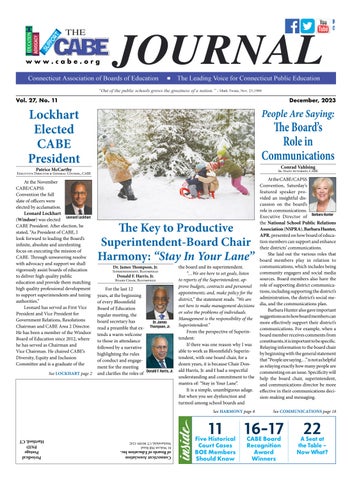
B C
www.cabe.org
Vol. 27, No. 11
December, 2023
Lockhart Elected CABE President
People Are Saying:
The Board’s Role in Communications Conrad Vahlsing
Patrice McCarthy
Sr. Staff Attorney, CABE
Executive Director & General Counsel, CABE
At the November CABE/CAPSS Convention the full slate of officers were elected by acclamation. Leonard Lockhart Leonard Lockhart (Windsor) was elected CABE President. After election, he stated, “As President of CABE, I look forward to leading the Board’s infinite, absolute and unrelenting focus on executing the mission of CABE. Through unwavering resolve with advocacy and support we shall vigorously assist boards of education to deliver high quality public education and provide them matching high quality professional development to support superintendents and taxing authorities.” Leonard has served as First Vice President and Vice President for Government Relations, Resolutions Chairman and CABE Area 2 Director. He has been a member of the Windsor Board of Education since 2012, where he has served as Chairman and Vice Chairman. He chaired CABE’s Diversity, Equity and Inclusion Committee and is a graduate of the See LOCKHART page 2
The Key to Productive Superintendent-Board Chair Harmony: “Stay In Your Lane” Dr. James Thompson, Jr.
Superindendent, Bloomfield
Donald F. Harris, Jr.
Board Chair, Bloomfield
For the last 12 years, at the beginning of every Bloomfield Board of Education regular meeting, the board secretary has Dr. James Thompson, Jr. read a preamble that extends a warm welcome to those in attendance followed by a narrative highlighting the rules of conduct and engagement for the meeting Donald F. Harris, Jr. and clarifies the roles of
the board and its superintendent. “…We are here to set goals, listen to reports of the Superintendent, approve budgets, contracts and personnel appointments; and, make policy for the district,’’ the statement reads. “We are not here to make management decisions or solve the problems of individuals. Management is the responsibility of the Superintendent.” From the perspective of Superintendent: If there was one reason why I was able to work as Bloomfield’s Superintendent, with one board chair, for a dozen years, it is because Chair Donald Harris, Jr. and I had a respectful understanding and commitment to the mantra of: “Stay in Your Lane”. It is a simple, unambiguous adage. But when you see dysfunction and turmoil among school boards and
inside
See HARMONY page 8
11
Five Historical Court Cases BOE Members Should Know
At the CABE/CAPSS Convention, Saturday’s featured speaker provided an insightful discussion on the board’s role in communications. Executive Director of Barbara Hunter the National School Public Relations Association (NSPRA), Barbara Hunter, APR, presented on how board of education members can support and enhance their districts’ communications. She laid out the various roles that board members play in relation to communications, which includes being community engagers and social media sources. Board members also have the role of supporting district communications, including supporting the district’s administration, the district’s social media, and the communications plan. Barbara Hunter also gave important suggestions as to how board members can more effectively support their district’s communications. For example, when a board member receives comments from constituents, it is important to be specific. Relaying information to the board chair by beginning with the general statement that “People are saying . . .” is not as helpful as relaying exactly how many people are commenting on an issue. Specificity will help the board chair, superintendent, and communications director be more effective in their communications decision-making and messaging. See COMMUNICATIONS page 18
16-17 CABE Board Recognition Award Winners
22
A Seat at the Table – Now What?
81 Wolcott Hill Road Wethersfield, CT 06109-1242
Connecticut Association of Boards of Education Inc.
Periodical Postage PAID Hartford, CT
2
The Journal – Connecticut Association of Boards of Education | December, 2023 PRESIDENT COMMENTARY
School Board Members as Servant Leaders Leonard Lockhart President, CABE
Thank you to our Immediate Past President, Elizabeth Brown, for her service to the City of Waterbury, the state of Connecticut, and CABE. We look forward to your continued advocacy for public education. Why? It’s a reflective question for all boards of education members. It’s good to ask that question often to help set the focus. School board members shall be servant leaders to the students and the community. Attitude, balance, and compassion are guides I recommend when discussing policy, curriculum, budget, and support of the superintendent. CABE’s role is to provide advocacy and support to you and your board. I continue to be concerned about the education environment on the state and national levels. I feel unfunded mandates bundled with fiscal hardships create a difficult environment to maintain and create positive results. With CABE, I have fought to invest in infrastructure, major maintenance, human capital, board professional development, universal pre-K, technology, a focus on civil engagement and collaboration, STEAM, and providing more support in math, literacy, and science. I will continue to fight for full funding of our public schools and supporting the Open Choice Program while eliminating the adversarial relationships created by law and appropriations. CABE is a strong partner with the Connecticut Department of Education and supports the work with the fiveyear comprehensive plan for education 2023-2028. According to the Department, the comprehensive plan for education over the next five years will position us to deliver on the promise of a high-quality public education to
every child in Connecticut by focusing on the four strategic areas of focus outlined in this document. Succeeding in the implementation of this strategic plan will improve the outcomes for many students who need our support the most. It will create the conditions to allow them to make productive choices about their preferred pathway to enjoy the full benefit of rigorous preparation for life after high school. While the responsibility for implementing this plan rests with the CSDE working in cooperation with local boards of education, districts and schools across the state, and key educational partners, this plan belongs to the residents of Connecticut. CABE shall lead the work and it begins with professional development of board members. We will host the New Board Member Orientation/Leadership Conference this month with new board member and leadership tracks that intersect throughout the day. Professional development will be offered throughout the upcoming year. CABE staff and Board of Directors have worked hard for the membership with advocacy and legislative relations, legal and labor relations, search services, policy, finance and support, professional development, and communications. With board governance addressing the needs of our members, we are focused on students and strong advocates for public education. The incoming Board of Directors will focus on pushing the needle, commanding executive branch and legislative committee engagement with CABE. In an environment where too often boards of education are left out of the public narrative, we will create our narrative to our communities. I wish to say thank you for electing me as President of CABE along with all the others elected and appointed.
Mission: To assist local and regional boards of education in providing high quality education for all Connecticut children through effective leadership. Vision: CABE is passionate about strengthening public education through high-performing, transformative local school board/ superintendent leadership teams that inspire success for each child.
Board of Directors I’m humbled and honored to lead the Board of Directors. The leadership team will be intentional with representing you. The executive committee, committee chairs, area directors, associate directors, and city representatives (all per CABE’s bylaws) will be focused on executing the mission of CABE: “To assist local and regional boards of education in providing high quality public education for all Connecticut children through effective leadership.” and vision “CABE is passionate about strengthening public education through high-performing, transformative local school board/superintendent leadership teams that inspire success for each child.” I encourage everyone to come with an attitude of gratitude, ready to learn and grow, ready to accept new ideas and to be respectful of others. Balance time, effort, and resources for the benefit of the students and the community to provide a quality education in a fiscally responsible manner. Be compassionate toward others. Everyone is fighting the good fight. It takes a community to raise our children, and everyone brings a perspective and experience. As I’ve learned on this journey, board members must come with an open mind, ready to learn and serve. Board members must be servant leaders to the students and the community. In truth, the ABCs may really need to stand for Attitude, Balance, and Compassion.
EXECUTIVE COMMITTEE Leonard Lockhart | President, Windsor Meg Scata | First Vice President, Portland Lon Seidman | Vice President for Government Relations, Essex Eileen Baker | Vice President for Professional Development, Old Saybrook Anthony Perugini | Secretary/Treasurer, Cheshire Elizabeth Brown | Immediate Past President, Waterbury Lydia Tedone | NSBA Director, Simsbury AREA DIRECTORS Marion Manzo | Area 1 Co-Director, Region 15 Thomas van Stone | Area 1 Co-Director, Waterbury Douglas Foyle | Area 2 Co-Director, Glastonbury Tyron Harris | Area 2 Co-Director, East Hartford Philip Rigueur | Area 2 Co-Director, Hartford Jay Livernois | Area 4 Director, Woodstock Academy Chris Gilson | Area 5 Co-Director, Newtown Tina Malhotra | Area 5 Co-Director, Ridgefield Lee Goldstein | Area 6 Co-Director, Westport Jill McCammon | Area 6 Co-Director, Darien John Hatfield | Area 7 Co-Director, Seymour Edward Strumello | Area 7 Co-Director, Seymour Seth Klaskin | Area 8 Co-Director, Madison Kim Walker | Area 8 Co-Director, Westbrook Carol Burgess | Area 9 Co-Director, Montville Lindsay Dahlheimer | Area 9 Co-Director, Region 13 ASSOCIATES Ethel Grant | Associate, Naugatuck Robert Mitchell | Associate, Montville COMMITTEE CHAIRS Becky Tyrrell | Chair, Federal Relations, Plainville Laurel Steinhauser | Chair, Resolutions, Portland Jaime Barr Shelburn | Chair, State Relations, East Lyme CITY REPRESENTATIVES Joseph Sokolovic | City Representative, Bridgeport A. J. Johnson | City Representative, Hartford Yesenia Rivera | City Representative, New Haven Versha Munshi-South | City Representative, Stamford LaToya Ireland | City Representative, Waterbury STAFF
Patrice McCarthy | Executive Director and General Counsel Nicholas Caruso | Senior Staff Associate for Field Services and Coordinator of Technology Jody Goeler | Senior Staff Associate for Policy Service Sheila McKay | Senior Staff Associate for Government Relations Lisa Steimer | Senior Staff Associate for Professional Development and Communications Conrad Vahlsing | Senior Staff Attorney Wendy DeBarge | Coordinator of Finance and Administration Pamela Brooks | S enior Administrative Associate for Policy Service and Search Services Terry DeMars | Administrative Associate for Policy Service Gail Heath | Administrative Associate for Government Relations Wilmarie Newton | A dministrative Associate for Digital Communications Nancy Propfe | Administrative Assistant for Membership Services Corliss Ucci | Receptionist and Assistant to Executive Director
CABE Journal (ISSN 1092-1818) is published bi-monthly by Connecticut Association of Boards of Education, 81Wolcott Hill Road, Wethersfield, CT 06109. Periodicals postage Paid at Hartford, CT.” POSTMASTER: Send address changes to The CABE Journal, CABE, 81 Wolcott Hill Road, Wethersfield, CT 06109-1242. CABE membership dues include $30 per person for each individual who receives The CABE Journal. The subscription rate for nonmembers is $75. Association members dues include a subscription for each Board Member, Superintendent, Assistant Superintendent and Business Manager. The companies and advertisements found in The CABE Journal are not necessarily endorsed by CABE.
The Journal – Connecticut Association of Boards of Education | December, 2023
CABE Affiliate Members
EXECUTIVE DIRECTOR COMMENTARY
Collaborate, Commit and Learn
BUSINESS AFFILIATES VALEDICTORIAN Connecticut Business Systems – A Xerox Company Finalsite SALUTATORIAN
Berchem Moses PC Pullman & Comley Shipman & Goodwin HONOR ROLL JCJ Architecture Kainen, Escalera & McHale, P.C. Newman/DLR Group Solect Energy SCHOLAR Brown & Brown Chinni & Associates, LLC Coordinated Transportation Solutions Dattco, Inc. ESS Franklin Covey GWWO Architects The Lexington Group Perkins Eastman Public Agency Retirement Services (PARS) The S/L/A/M Collaborative Zangari Cohn Cuthbertson Duhl & Grello, P.C.
EDUCATIONAL AFFILIATES
American School for the Deaf Area Cooperative Educational Services (ACES) Booker T. Washington Academy Cambridge International Capitol Region Education Council (CREC) Connecticut Alliance of YMCAs Connecticut Arts Administrators Association Connecticut Association for Adult and Continuing Education (CAACE) Connecticut Association of School Business Officials (CASBO) Connecticut School Buildings and Grounds Association (CSBGA) Connecticut School Counselor Association Connecticut Technical High Schools Cooperative Educational Services (C.E.S.) EASTCONN EdAdvance Explorations Charter School Great Oaks Charter School Integrated Day Charter School ISAAC LEARN Live Girl New England Science & Sailing Foundation Odyssey Community School, Inc. Relay CT The Bridge Academy
3
Patrice McCarthy
Executive Director & General Counsel, CABE
Congratulations to those board members elected last month. As you embark on your journey of school board service – those newly elected and those returning to the board table – I encourage you to be lifelong learners. Listening, asking questions and building relationships will enhance your effectiveness as a board member. • Actively listen to your colleagues, the public and the administration to help you make well-informed decisions. • Ask questions that invite multiple perspectives on an issue, and maintain civility even when those perspectives differ from your own. • Engage in effective communication and collaboration – with your board colleagues and your superintendent.
LOCKHART
(continued from page 1)
CABE Leadership Institute. Leonard also represents CABE on the Educator Evaluation and Support Council, and serves on the CREC Council. On the national level he represents the Eastern Region on the National School Boards Association Board of Directors. Other officers elected were: Meg Scata (Portland) as First Vice President: Meg currently serves as Vice President for Government Relations and she previously served as Resolutions Chair. She has been a member of the Portland Board of Education since 2017, where she has served as Board Secretary/Vice Chair, Policy Committee Chairman, and CREC Liaison. She is currently CREC Council Secretary/Treasurer. She also represents CABE on the Teacher of the Year Selection Committee and is a graduate of the CABE Leadership Institute.
When every board member is an effective, contributing member, school boards are productive in supporting student success. Our convention theme “Leading from Why” resonated with each of us. Students are why, as volunteers and professionals, we commit to this work. Student voices were heard – as presenters and performers – throughout the recent CABE/CAPSS Convention. I know the development of effective board of education and superintendent teams is critical to ensure success for all students, and CABE is committed to that work. Collaboration and commitment are the hallmarks of effective leadership at the local, state and national levels. The strong CABE/CAPSS partnership models that collaboration. Throughout the year members of CABE’s volunteer leadership and staff represent you on numerous statewide task forces and working groups. President Leonard Lockhart and Lon Seidman (Essex) as Vice President for Government Relations: Lon currently serves as Secretary/ Treasurer and CABE Area 8 Director. He is a member of the Region 4 Board of Education and the Essex Board of Education, where he has served as Chairman since 2007. He has served on the Advisory Commission on Intergovernmental Relations since 2016, and represented CABE on the Remote Learning Task Force. He also serves on the governing board of the Rell Center for Public Service at the University of Hartford. Eileen Baker (Old Saybrook) as Vice President for Professional Development: Eileen currently serves as a CABE Associate Director and has been a member of the CABE Board of Directors for many years. She has served as a Area Director and the Chair of the Federal Relations Committee. She has been a member of the Old Saybrook Board of Education since 1989, where she has served as
Immediate Past President Liz Brown serve on the Educator Evaluation and Support Council. Lon Seidman serves on the Advisory Commission on Intergovernmental Relations. Meg Scata serves on the Teacher of the Year Selection Committee I represent you on the Special Education Task Force, the Education Mandates Working Group and the CT Educator Certification Council. We look forward to continuing to be your voice at the state and federal levels. Your engagement with your legislators is a key way to amplify our efforts on your behalf. I wish you a holiday season filled with joy and time shared with family and friends. 2024 offers promise of new opportunities to learn and collaborate.
Policy Committee Chairman for over 15 years. She has presented workshops at the CABE/CAPSS Convention on Student Representatives on Boards of Education and is a graduate of the CABE Leadership Institute. Anthony Perugini (Cheshire) as Secretary/Treasurer: Tony currently serves as a Member at Large on the CABE Executive Committee and was previously an Associate Director. He has served as the Chair of the Cheshire Board of Education since 2019, and has been on the Board since 2009, serving on many committees. He has presented at several CABE statewide workshops. Liz Brown (Waterbury) will serve as Immediate Past President. We thank Liz for her leadership and insights as CABE President. NSBA Director Lydia Tedone (Simsbury) also serves on the Executive Committee.
4
The Journal – Connecticut Association of Boards of Education | December, 2023 See You in Court – The Nutmeg Board of Education
Is the Nutmeg Board Failing to Implement the Educational Interests of the State?
Thomas B. Mooney, Esq. Shipman & Goodwin
The Nutmeg Board of Education makes many mistakes. The latest imbroglio created by the board will be reported here each issue, followed by an explanation of what the board should have done. Though not intended as legal advice, these situations may help board members avoid common problems. Gary Gadfly moved with his family to Nutmeg two years ago, and ever since then he has made his presence known with emails and complaints. First, he started a Change.org petition to protest the Board’s “pay for play” policy, which requires parents to pay fees for their children to participate in certain sports. Then, he filed complaints with the Freedom of Information Commission alleging that the agendas the Board was posting for its meetings were not sufficiently specific. Gary was not successful with either challenge, but he remained vigilant in looking for some trouble to make for the Nutmeg Board of Education. Gary did not have to wait long. At the regular Board meeting last month, veteran Board member Bob Bombast moved to add a new item to the agenda, namely a review of employee reimbursements made by the Nutmeg Public Schools in the last year. Ms. Superintendent advised the Board members that they should not discuss reimbursement that evening, because new legislation requires the Board to post on its website any documents the Board members may discuss at a regular or special meeting. “I can pull up a spreadsheet and answer questions about reimbursements,” Ms. Superintendent explained, “but I don’t know how to post the spreadsheet on our website so that members of the public can follow along.” In response, Bob erupted with annoyance. “There they go again!” Bob seethed. “Year after year after year, the General Assembly thinks up new ways to torment us and passes laws that impose new obligations on us. Well, that ends now. I move that we add a different item to the agenda, namely that the Nutmeg Board of Education will decide for itself what to post on its website without regard to the actions of the General Assembly.” Bob’s frustration with the ever-increasing list of mandates imposed
on boards of education resonated with his fellow Board members, and the Board promptly added Bob’s motion to the agenda and then approved the motion by unanimous vote. A week later, Ms. Superintendent was surprised to receive a written notification from the State Board of Education that Gary Gadfly had filed a Section 10-4b complaint against Bob and the Board, alleging that the “Nutmeg Board of Education was failing to implement the educational interests of the state.” The notification stated further that a representative of the State Department of Education would be coming soon to investigate. Ms. Superintendent promptly notified the Board members of this complaint and reached out to Ms. Board Attorney to ask for her advice. Ms. Board Attorney responded with a lengthy email, advising the Board on its obligations under the new legislation. Mr. Chairman then had a special meeting posted, the agenda of which was “Discussion and possible action on a pending Section 10-4b complaint and Ms. Board Attorney’s advice.” Gary was delighted to see that the Board had received his complaint, and he attended the meeting, eager to hear what the Board members had to say. Gary was disappointed, therefore, when the Board convened in executive session when the meeting started, and he promptly filed a new complaint, this time with the Freedom of Information Commission. What’s the story with 10-4b complaints and can the Nutmeg Board of Education discuss its response to this complaint in executive session? • • • • • • • • • • • • The FOIA issues here are straightforward, but the Nutmeg Board needs to understand the Section 10-4b process and its new posting obligations under Conn. Gen. Stat. §10-220(g). The Board had every right to discuss its response to the Section 10-4b complaint (discussed further below) in executive session, because the complaint is a “pending claim,” discussion of which is authorized in executive session by Conn. Gen. Stat. § 1-200(6) (B). Moreover, members of a board of education may discuss written legal advice from its attorney on any issue in executive session as authorized by Conn. Gen. Stat. §§ 1-200(6)(E) and 1-210(b)(10), provided that the subject
of the legal advice is referenced on the agenda. The Nutmeg Board of Education does need to learn more about the Section 10-4b process. We start with Conn. Gen. Stat. § 10-4a. That statute defines the educational interests of the State as follows: For purposes of sections 10-4, 10-4b and 10-220, the educational interests of the state shall include, but not be limited to, the concern of the state that (1) each child shall have for the period prescribed in the general statutes equal opportunity to receive a suitable program of educational experiences; (2) each school district shall finance at a reasonable level at least equal to the minimum budget requirement pursuant to the provisions of section 10-262j an educational program designed to achieve this end; (3) in order to reduce racial, ethnic and economic isolation, each school district shall provide educational opportunities for its students to interact with students and teachers from other racial, ethnic, and economic backgrounds and may provide
such opportunities with students from other communities; and (4) the mandates in the general statutes pertaining to education within the jurisdiction of the State Board of Education be implemented. (Emphasis added). The highlighted words about implementing the mandates in the general statutes is the relevant provision here. Conn. Gen. Stat. § 10-4b authorizes any person to file a complaint with the State Board of Education alleging that a board of education is not implementing the educational interests of the State. If the State Board of Education finds that the complaint is “substantial,” it appoints an agent to investigate. If the agent finds that there is reasonable cause to find that the board of education has not implemented the educational interests of the State, the State Board of Education conducts an “inquiry” at which the board of education can respond. If after conducting the inquiry, the State See SEE YOU IN COURT page 8
The Journal – Connecticut Association of Boards of Education | December, 2023
5
6
The Journal – Connecticut Association of Boards of Education | December, 2023
CABE: Working for YOU
Individualized Workshops | Professional Development Opportunities Legal Services | Policy Services | Representing You Statewide and Nationally Below are the highlights of activities that the CABE staff has undertaken on your behalf over the last month. We did this:
y providing opportunities B for members to learn how to better govern their districts: z Facilitated Board Chair Check-In. z Facilitated workshop on the board/ superintendent relationship and superintendent evaluation for the Thomaston Board of Education. z Co-presented a webinar on improving the board chair/ superintendent relationship. z Presented a Roles and Responsibilities workshop for the Union Board of Education. z Responded to 53 requests for policy information from 28 districts, providing sample materials on policy topics. Further, districts continue to access CABE’s online Core Policy Reference Manual and/or online manuals posted by CABE for policy samples. The topics of greatest interest were those pertaining to artificial intelligence, ages of attendance and sexual harassment. z Provided support to board members and central office administrators regarding policy matters.
y ensuring members B receive the most up-to-date communications: z Participated in discussion with Connecticut urban boards on legislative
priorities. zP rovided one issue of Policy Highlights via e-mail which included a new model policy on Educator and Leader Evaluation and Support following the State Board of Education guidelines.
y providing services to B meet member needs: z S upported the work of the CABE Diversity, Equity and Inclusion Committee. zM et with the Berlin Board of Education to discuss CABE services. zA ttended tri-board meeting to discuss the role of a board of education for the Andover Board of Education. zR evised policies, as part of the Custom Update Policy Service, for East Hampton, East Windsor, Gilbert School, New Fairfield, Newington, and West Haven. z Prepared materials, as part of the Custom Policy Service, for Danbury, Region 14, Stamford, Stratford, and Woodbridge. zP reparing a Policy Audit for the Fairfield Public Schools. zP rovided a policy update presentation to the Montville Board of Education. zW orked in collaboration with the Commission on Women, Children, Seniors, Equity and Opportunity on the development and subsequent adoption of a new School Climate Policy compliant with 2023 legislation. The policy climate standards and a uniform “challenging behav-
ior” complaint form are expected to be released together in December. zP rovided Legal Issues workshop. zP rovided fall program for superintendents’ administrative professionals. zR esponded to a variety of legal inquiries from members. zP resented Roles and Responsibilities for School Governance Councils in Hartford.
y attending Professional B Development to strengthen staff knowledge and skills:
Woodbridge, and the CABE CORE Manual.
y representing ConnectiB cut school boards on the state or national level: z Participated in FOX61 interview to discuss the Dalio Foundation report on at-risk you people. z Conducted Education Mandates Working Group meetings. z Participated in Connecticut Certification Council meeting. z Participated in Braver Angel webinar on civility.
z Attended NSBA Council of School Attorneys fall virtual seminar.
z Participated in Social Emotional Learning Task Force meeting.
z Attended federal virtual summit on school safety.
z Provided legislative update for CREC Council and LEARN Board of Directors.
z Attended workshop on AI and nonprofit organizations. z Attended day-long training session on the Franklin Covey 7 Habits for Educators.
z Participated in Connecticut Education Partners meeting. z Participated in NSBA State Association Counsel meeting.
z Attended webinar on crisis communications.
z Attended REL-NEI virtual board meeting.
z Attended ethics webinar.
z Attended Discovering Amistad Board of Directors and Ship Committee meetings.
y helping districts B operate efficiently and conserve resources: z Posted policies online, as part of the C.O.P.S. Program for Avon, Bethel, Danbury, Derby, ISAAC, Monroe, New Fairfield, New Hartford, Portland, Region 18, Ridgefield, Somers, Voluntown, Windsor,
z Co-chaired a meeting of the combined Digital Learning Advisory Council and Infrastructure Advisory Council of the Connecticut Commission for Educational Technology. z Participated in New England School Public Relations Association (NESPRA) Board meeting.
SAVE THE DATE!
CABE New Board Member Orientation/ Leadership Conference
December 6, 2023 Sheraton Hartford South, Rocky Hill
Register at: cabe.org/professional-development/upcoming-workshops
The Journal – Connecticut Association of Boards of Education | December, 2023
7
8 HARMONY
(continued from page 1)
superintendents in Connecticut - and beyond – you can be assured that it is because there was a blurring of those boundaries. When he and I began our relationship in 2011, we both agreed that it was important to understand the scope of our duties. We built a viable partnership, rooted in ongoing, candid communications and the expectation there would be “no surprises.” This year marks my 55th year in education, the large majority of my work has been with Hartford Public Schools. The last 12 years have been in Bloomfield. Over the years, our work here has been recognized locally, regionally and nationally. From the perspective of the Board Chair: The board’s purpose is three-fold – establish policy, set an annual budget and conduct annual evaluations of the superintendent. That’s it. I consistently remind our Board members and community that: “We only have one employee – the Superintendent”. Each year the Board of Education evaluates the Superintendent based
The Journal – Connecticut Association of Boards of Education | December, 2023 upon district goals, set by the Superintendent and approved by the board. The Superintendent’s purpose is to oversee and manage the day-to-day operation of the school system, including preparation and presentation of the budget. The Superintendent is also there to keep the board informed about district issues, including student-performance data and communicate with staff and families. The board and superintendent should work together with a high degree of integrity and ensure that the district is in compliance with state and federal laws. The Bloomfield school board also conducted self-evaluations to review its performance and measure if members were staying in their lanes. Additionally, the board would conduct regular retreats and professional development workshops to further enhance member accountability. If I had to offer any advice for new board chair/superintendent tandems, it would be this: • Understand and embrace your respective roles. • Communicate clearly and candidly with each other. No surprises. • Resist the urge to stray beyond
your lane. Dr. James Thompson is Bloomfield Public Schools Superintendent. Donald
SEE YOU IN COURT
(continued from page 6)
Board of Education determines that the board of education has failed to implement the educational interests of the State, it may require the board of education to develop a plan of action to remedy the failure. Moreover, the State Board of Education may seek to enforce the order in court. In recent years, Section 10-4b has taken on greater prominence. Since 2021, Conn. Gen. Stat. § 10-222r has required that the Social and Emotional Learning and School Climate Collaborative “develop a plain language explanation of the rights and remedies available under sections 10-4a and 10-4b,” and Conn. Gen. Stat. § 10-222q has required that boards of education post that plain language statement on their websites, presumably to inform parents that they may file a 10-4b complaint if they think school officials have not followed the law. Newly enacted, Conn. Gen. Stat. § 10-220g provides that boards of
F. Harris, Jr. is Bloomfield’s Board of Education Chair. Both are retiring this year after 12 years working together.
education “conducting a regular or special meeting of such board shall make available for public inspection the agenda for the meeting or any associated documents that may be reviewed by members of the board at such meeting and post such agenda and documents on the Internet web site of such board.” One may reasonably interpret this requirement as relating to the public Board packet, and, as the Nutmeg Board did here, boards can still discuss other records at a meeting without violating this new law. However, more generally the duty of boards of education to implement the educational interests of the state includes compliance with applicable laws, and the blanket refusal by the Nutmeg Board of Education to follow the prescriptions of Section 10-220g is not permitted under Sections 10-4a and 10-220. Attorney Thomas B. Mooney is a partner in the Hartford law firm of Shipman & Goodwin who works frequently with boards of education.
The Journal – Connecticut Association of Boards of Education | December, 2023
9
THE POLICY CORNER
Jody Goeler
Connecticut School Climate Policy
Sr. Staff Associate for Policy Service, CABE
Among the factors most likely to ensure all children are provided the greatest opportunity to learn, such as high-quality instruction, a coherent curriculum, and a broad range of engaging programs, a school climate that welcomes and embraces all members of the school community may be at the top of the list. Responding to recent revisions to Connecticut’s school climate law, Public Act 23-167, An Act Concerning Transparency in Education, CABE developed its Connecticut School Climate Policy with technical and substantive guidance from the Commission on Women, Children, Seniors, Equity & Opportunity (CWCSEO) and other members of the statewide Social Emotional Learning and School Climate Collaborative. Pursuant to the legislation, the “Collaborative” has formally adopted the policy and has posted it on the children’s subcommittee page of the CWCSEO. For the school years commencing July 1, 2023, and July 1, 2024, each local and regional board of education may adopt and implement the new policy in lieu of policies drafted in compliance with the previous provisions of the general statutes. For the school year beginning on July 1, 2025, and each school year that follows, each local and regional board of education is required to adopt and implement the Connecticut School Climate Policy. Along with the new policy, all members of school communities have access to the uniform bullying complaint form, referenced in the legislation. Also required and Included in the new policy are the recently drafted Connecticut School Climate Standards informed by the national standards and research-based best practices. Perhaps most notable as it relates to the new Connecticut School Climate Policy is its orientation or emphasis on creating a positive school climate, which mitigates those “challenging” behaviors that disrupt the learning environment and foster unhealthy, harmful, and hurtful interactions. Rather than emphasizing regulatory language related to investigative procedures, the Connecticut School Policy provides a framework to support and promote teaching and learning environments where all students thrive academically and socially, have a meaningful voice, and are prepared for lifelong success. This framework includes a continuous cycle of planning and preparation, evaluation, action planning, and implementation.
It’s interesting to note that while CABE’s previous model policy and regulations added up to 27 pages, this new policy has ten, illustrating the importance of providing districts with a policy that is lean, clear, and operational – with greater attention to intersecting structures and systems emphasizing the capacity and professionalism of district staff. These structures, which are embedded in general statutes, have been widely discussed since the passing of the legislation and include the roles of the School Climate Coordinator, the School Climate Specialist, the School Climate Committee, the School Climate Survey, and the School Climate Improvement Plan, along with key concepts, such as “challenging behavior”, “restorative practices”, and “bullying”. The new bullying definition refers to “unwanted and aggressive behavior” and adds, “that involves a real or perceived power imbalance.” To help ensure the new Connecticut School Climate Policy received all the benefits of collaboration and input, prior to its release, various key organization stakeholders, including the Connecticut Association of Schools (CAS), the Connecticut Association of Public School Superintendents (CAPSS), the Connecticut Education Association (CEA), the Connecticut State Department of Education (CSDE), and Special Education Equity for Kids (SEEK) provided their feedback to determine it provided districts the appropriate level of guidance, and perhaps as importantly, the space for districts to leverage the talent of their staff, students, and community to improve school climates across the State. Moving forward, the Policy outlines the work ahead: Learning and applying “Restorative Practices”, addressing the challenges related to electronic communication, and defining and addressing “challenging behavior”. To ensure the success of School Climate Committees, enhancing skills related to collaborative decision-making, for example, will be important work for supporting and sustaining committee outcomes. Professional growth opportunities will also need to include effective data collection and analysis, and the implementation of strategies responsive to the data. Boards of Education can assist by embedding climate improvement goals into overall improvement efforts and goal-setting while applying a “climate improvement lens” on curriculum, instruction, student support/interventions, and programming decisions.
While the Connecticut School Climate Policy is designed to promote school and district efforts in creating and sustaining necessary cultural shifts, improving school climate will take time, sustained focus, and targeted resource allocation. On a State level, resources will need to be targeted to ensure the school climate structures have the opportunity to develop in our district through continuous improvement efforts. It’s also important to note that school programs have a great impact on promoting and ensuring a positive school climate – arts and music programs, physical education and wellness programs, and school-to-career programs. Each year, districts have the difficult task of budgeting for fixed costs while protecting and enhancing programs that engage all students. We need to keep in mind this broader context as well. Finally, we need to pursue this critical initiative of improving school climate with realism and intention. The Connecticut School Climate Policy attempts to provide a starting point
for both, as it reveals the complexity of the work ahead while providing a framework for improvement efforts. We need to start now and stay on it.
Links to Cyberbullying Information Anti-Defamation League (ADL)
https://www.adl.org/
CT Legislature Revises Bullying Laws
https://www.shipmangoodwin.com/ insights/ct-legislature-revises-bullying-laws.html
Cyberbullying Research Center
Provides resources for parents, students, educators and adult victims.
https://cyberbullying.org/
This federal government site, managed by the U.S. Department of Health and Human Services, provides research results, infographics and fact sheets.
https://www.stopbullying.gov/
UNICEF
provides a number of resources
https://tinyurl.com/2w496af9
10
The Journal – Connecticut Association of Boards of Education | December, 2023
The Journal – Connecticut Association of Boards of Education | December, 2023
11
Five Historical Court Cases Board of Education Members Should Know Conrad Vahlsing
Sr. Staff Attorney, CABE
Public education consists of a web of laws. From state and federal constitutions, to statutes, regulations, court decisions, and more, much of what public school districts can and must do is controlled by a variety of legal authorities. For new board of education members, it may appear overwhelming. This article is intended to offer a brief historical perspective on some legal responsibilities of boards of education. Familiarity with these five cases may help new board members establish part of a foundation upon which can be built a deeper understanding of public education in Connecticut. The cases are arranged in chronological order and most have been further developed, limited, or expanded by subsequent cases. Of course, these cases should not be construed to be more important than others, as there are countless cases that have shaped, and continue to shape, public education. But this collection is a good place to start.
Brown v. Board of Education (1954) U.S. Supreme Court
Arguably the most famous case in public education history, this decision declared “separate but equal” in public schools to be unconstitutional under the U.S. Constitution, specifically, the Fourteenth Amendment, which guarantees equal protection under the law. But Brown v. Board of Education of Topeka, Shawnee County, Kansas (full name) was not a decision that ended segregation in all corners of the country. For example, private school segregation was ruled impermissible by the U.S. Supreme Court in 1976, in Runyon v. McCrary, twenty-two years after Brown. And segregation in public accommodations was outlawed ten years after Brown, with the Civil Rights Act of 1964. As an extra historical point, that Act also established Title VII and its prohibitions against discrimination in employment.
Tinker (1969) U.S. Supreme Court An important case involving students who protested the Vietnam War that affirmed students’ rights to free speech in the school environment. The decision included a famous passage, often formulated as some version of:
students do not shed their constitutional rights at the schoolhouse gate. Interestingly, the actual passage references students and teachers: “It can hardly be argued that either students or teachers shed their constitutional rights to freedom of speech or expression at the schoolhouse gate.” Perhaps one reason for focusing on students in many paraphrases of the quote is that teachers’ free speech rights had been affirmed by the U.S. Supreme Court a year earlier, in 1968, in Pickering v. Board of Education. With a full name of Tinker v. De Moines Independent Community School District, this case was a foundation upon which many subsequent cases involving First Amendment rights of students would be built.
Lemon v. Kurtzman (1971) U.S. Supreme Court
Probably the most important aspect of this case is that, as of June 2022, it is likely not very relevant any more (more on that in a moment). But for approximately fifty years, this case helped guide school districts in determining whether they were violating the Establishment Clause, a part of the First Amendment that stands for the proposition that public entities should not be entangling their actions with (establishing) religion. The case would be synonymous with the “Lemon test,” a multi-part analysis for determining if a public school action may be “establishing” religion. In June 2022, the U.S. Supreme Court all but ended the Lemon test in Kennedy v. Bremerton School District, and stated that such an analysis should instead refocus on interpretation of the Establishment Clause by “reference to historical practices and understandings.” Attorneys may differ in their interpretations of the Kennedy decision and your district’s board attorney will have important guidance on the topic of religion in public schools.
Horton v. Meskill (1977) Connecticut Supreme Court
Now for an important state court case. This case is an important part of the history of current financial aspects of boards of education such as the Educational Cost Sharing (ECS) formula and the minimum budget requirement (MBR). For new board members, for whom those acronyms may be news, the former is a variable method for
distributing state education funding and the latter is a requirement that board of education budgets are at least the same amount as the previous year (with exceptions). In Horton v. Meskill, our state supreme court determined that funding education using property taxes and a flat, per-pupil state grant system amounted to a violation of students’ rights to an equal education under the state constitution, as less wealthy towns could only provide a lower quality public education than wealthier towns.
Sheff (1996) Connecticut Supreme Court
Another important state court case. In Sheff v. O’Neill (full name), the court determined that the state had an
affirmative obligation under the state constitution to remedy unequal access to, and segregation in, public education in Hartford even in the absence of intentional racial segregation. While the Connecticut Supreme Court’s initial decision occurred in the mid-90s, actually remedying the de facto segregation has involved further litigation as the case has been subject to more court decisions and settlement agreements since then, with another settlement having been reached in January 2022. That settlement hopes to be an end to the litigation and includes a variety of provisions, including added seats at magnet schools and financial incentives to encourage volunteer-based Open Choice schools to accept additional students from Hartford, among others.
Berlin Board of Education
Patrice McCarthy
Executive Director & General Counsel, CABE
The Berlin Board of Education keeps students front and center at their board of education meetings by beginning their meetings with a student presentation. At their October meeting, students from the Emma Hart Willard Elementary School provided a presentation on the lessons they have learned from RULER. The students demonstrated the principles of RULER and illustrated how the principles are put into practice in their classrooms, from kindergarten through 5 grade. RULER helps the school community build the skills of emotional intelligence and create a positive school climate. RULER is an acronym for the five skills of emotional intelligence: •R ecognizing emotions in oneself and others •U nderstanding the causes and consequences of emotions •L abeling emotions with a nuanced vocabulary
• Expressing emotions in accordance with cultural norms and social context • Regulating emotions with helpful strategies The students also provided examples of how they have utilized the RULER techniques as they manage their emotions in their home environment. Their presentation enabled board of education members to see the impact of social emotional learning on school climate and student success.
Prepare for the
2024 Legislative Session by attending a
FREE CABE WEBINAR:
The Board’s Role in Advocacy
Wednesday, January 24, 2024 11 a.m. to 12:15 p.m.
Scan to register:
12
The Journal – Connecticut Association of Boards of Education | December, 2023
Dalio Education Foundation Report
Patrice McCarthy
Executive Director & General Counsel, CABE
The Dalio Education Foundation recently released a report prepared by the Boston Consulting group “Getting Young People Back on Track”, which examines Connecticut’s at risk and disconnected young people. The research reveals 119,000, or 19 percent of Connecticut’s 14 to 26 year olds were either at risk or disconnected in 2021-22. This group comprises high school graduates who are not employed nor enrolled in postsecondary education. 63,000 were deemed “disconnected”, including: • 12,000 “severely disconnected”neither employed nor have attained a high school diploma or equivalent. • 51,000 “moderately disconnected” - high school graduates who are neither employed nor enrolled in postsecondary education, as well as high school non-graduates who are employed. The study reveals that there are significant numbers of at-risk
and disconnected young people in every community in Connecticut. The at-risk and disconnected young people were most concentrated in the largest cities (Bridgeport, Hartford, New Haven, Waterbury, Stamford, Danbury, Norwalk, and New Britain). Rural towns, especially those in eastern and western Connecticut (e.g., Sterling, Sprague, and Salisbury) also had higher concentrations of at-risk and disconnected young people. The report examines the impact of disconnection on unemployment and wages showing the economic opportunity for Connecticut if it can help these young people get back on track. According to the report, support would help fill a large portion of the state’s 90,000 unfilled jobs, boost gross domestic product by $5 - $5.5 billion, and improve fiscal performance by $650 - $750 million annually (in the form of added tax revenue and lower spending on government services). The report includes a number of recommendations to build upon the best practices utilized by Connecticut districts.
1. Improve school district data systems and practices to identify and support at-risk students. Help districts expand their capabilities with continued investment in data systems, sharing, and implementation/capacitybuilding processes that enable better and timely monitoring and support of at-risk students. 2. Publish annual reports about at-risk and disconnected young people. Publish reports using integrated data across state agencies to highlight the challenges and opportunities of at-risk and disconnected young people on an ongoing basis and promote collective accountability. 3. Establish cross-sector coalitions and partnerships focused on supporting at-risk and disconnected young people. Regional/statewide coalitions could work on behalf of this population, identifying and supporting them using integrated data and coordinating and advocating on their behalf; this includes evaluating programs and policies that could benefit this population.
4. Designate an entity in every municipality or region responsible for supporting disconnected young people. While the entity might differ by municipalities, each should designate and fund an organizational entity, beyond the school district, that takes ownership and responsibility for identifying and monitoring disconnected young people and connecting them to crucial services. 5. Significantly strengthen the capacity of organizations that serve at-risk and disconnected young people. Provide technical assistance around program design and implementation, talent, data collection and analysis, performance tracking, financial management, and IT support to boost the effectiveness of these organizations. 6. Invest in expanding supports and services for at-risk and disconnected young people. Provide additional funding to invest in evidence-based supports, along with rigorous measurement and evaluation, especially for high priority topics See DALIO FOUNDATION page 13
The Journal – Connecticut Association of Boards of Education | December, 2023
13
SCHOOL BOARDS:
Understanding Your Role is Critical in a Crisis Erin Good
Communications Consultant
School board members and school leaders need to work together to be effective. During a crisis, they need to be even more united, which can be challenging. This is a highly polarized time, and school board meetings have become emotional, contentious and sometimes disruptive as tensions are high surrounding pandemic-related school closures, vaccine mandates and mask requirements. This is a good time to remind
DALIO FOUNDATION
(continued from page 12)
such as chronic absenteeism, school mobility, mental health, and justice system involvement. 7. Invest in high-touch case management for at-risk and disconnected young people. Use case management practice to help identify, prevent, and support at-risk and disconnected young people (e.g., through mentorship, connection to
board members and stakeholders of the primary responsibilities of the school board and the school district leader. According to the National School Boards Association, the most important responsibility of elected school board members “… is to work with their communities to improve student achievement in their local public schools. School boards derive their power and authority from the state. In compliance with state and federal laws, school boards establish policies and regulations by which their
services, using cognitive behavioral principles). 8. Invest in tracking chronic absenteeism. Make significant investments in addressing chronic absenteeism, including working with students and families to understand and tackle its root causes and examining the systemic challenges underpinning this issue. 9. Invest in strengthening pathways from disconnection to employment. Employers should
local schools are governed.” — www. nsba.org/About/Public-Education-FAQ
Why is this important?
The school board and school leader have important and unique roles. A clear understanding of their respective roles is critical to weather the challenges of the pandemic and the many divisive issues that pop up in communities, schools and social circles. Knowing clear roles can help the board respond to questions from the community and know when to
partner with service providers to create pathways to employment, including job training and mentorship, connection to job opportunities, and wraparound services. The report concludes that by increasing visibility and awareness of the challenges faced by disconnected young people, improving coordination among stakeholders, expanding capacity of high-performing organizations that serve at-risk and disconnected young people, and
forward the question to the school leader or other staff members. A lack of role clarity for board members and school leaders will reduce effective collaboration and hamper progress. A clear understanding of roles is a primary characteristic of an effective board.
What are the board’s roles and responsibilities in relation to the school leader? • The board hires and evaluates the school leader — the district
See UNDERSTANDING page 22
funding effective programs to increase scale, there is immense opportunity to reengage young people and help them get back on track. It is clear from the recommendations in the report that this is not an issue that public schools can address in isolation, but can be a partner with other agencies, nonprofits and businesses to improve the likelihood of productive lives for all Connecticut’s young people.
14
The Journal – Connecticut Association of Boards of Education | December, 2023
FALL 2023 MEETING OF SUPERINTENDENTS’ ADMINISTRATIVE PROFESSIONALS
Participants had the opportunity to break into lively discussion groups on topics such as Best Practices for District Secretaries Meetings, Onboarding New Board Members and Superintendents, Ask the CABE Staff!, I Just Need to Talk with Someone Who Does What I Do!
Superintendents’ Administrative Professionals from across the state came together for professional learning.
CABE Sr. Staff Associate for Professional Development and Communications facilitated a session on How the Superin- CABE Sr. Staff Attorney Conrad Vahlsing presented on Board of Education tendent’s Administrative Professional’s Role Changed. Meetings: New Posting Law & FOIA Overview.
The Journal – Connecticut Association of Boards of Education | December, 2023
15
16
The Journal – Connecticut Association of Boards of Education | December, 2023
Congratulations to the CABE Board Recognition Award Winners: LEVEL 1! BETHANY
Our Board effectively uses multiple sources of data throughout the year, to make informed decisions. They focus their attention on developing policy and allocating resources to support high levels of achievement for ALL students in Bethany. The Bethany Board conducts ongoing evaluations, formally with a self-evaluation instrument, and informally at monthly scheduled Committee meetings to assess the effectiveness of their work which focuses on high quality teaching and learning.
students, staff and community. Each member is a member of the Board of Education before they are a member of a political party and this is reflected in their practice. Committees and the full board recognize the value of open communication between one another, the administration, and with the community in order to provide clear guidance. The common allegiance has fostered a unique unity to the point that a collegial bond has developed.
our district Portrait of the Graduate tenets in the highest regard, teaching and modeling these key characteristics district wide and at every grade level, as the guiding pillars of success. The Plainville Community Schools Portrait of the Graduate tenets include being: Communicative, Innovative, Mindful and Resilient.
PORTLAND
HARTFORD
MADISON
BLOOMFIELD
Bloomfield’s Board of Education adheres to three primary criteria for Board effectiveness: 1. U nderstanding our role as Board members to govern by setting policy and monitoring the management system of the district. 2. Decisions are based on relevant research and data gathered from our schools. 3. Guided by common purpose and aligning our governance with the District Plan of Excellence.
Board members’ commitment to working collaboratively and continually investing in professional development makes their leadership effective. The Board of Education actively participates in CABE Conferences and activities. The Board Chair participates in the statewide Board Chair discussions. The Board has held annual retreats focused on academic results and social emotional needs of students among other timely topics. The goal of the retreats is to make sure the work of the board is relevant and effective.
CHESHIRE
PLAINVILLE
Members of the Cheshire Board of Education demonstrate leadership by an unwavering commitment to collaboration in the name of our
At the heart of Plainville Community Schools lies our commitment to equipping EVERY student with the skills, resources and supports necessary for lifelong success. To that end, we hold
WESTBROOK
Our Board works collaboratively with district leadership to understand trends in student academic achievement and in social and emotional health of students, and to provide the necessary resources to support our students. As a Board we work to be responsive to the shifting needs of our district and to seek out support innovative solutions to challenges. We regularly evaluate curricula and policies, and make changes as necessary to uphold high standards and intended outcomes for our students.
The Westbrook Board of education is a very active Board with the school community. It is a standing agenda item at every board of education meeting to provide members with an opportunity to share recent school events and activities that they have participated in to promote our schools and to encourage membership ongoing participation in our schools. The presence of the Board at school events has created a culture of mutual respect, support, and collaboration. The Board is also highly visible in the community at major Town events, such as the Tree Lighting, providing access to families and a clear commitment to serving as community leaders.
WOODBRIDGE
SUFFIELD
Beyond the leadership of the Board within the district, the Suffield Board of Education has worked hard outside of our own Board to cultivate a relationship with our Board of Finance. We actively tend to our relationship with our Board of Finance scheduling budget season kick-off meetings and clearly communicating expectations. We have found that having a culture of teamwork helps when resource planning gets complicated. Our relationship with the Board of Finance helps limit surprises at budget time and creates trust that resources will be used wisely.
The Woodbridge Board of Education is a high-functioning team of individuals who demonstrate respect for process, respect for voice and respect for each other. This respect is generated from careful listening, open minds and vulnerability, all of which breed thrust and foster collaboration. The Board members are committed to a shared vision of high expectations for student achievement and quality instruction. The Woodbridge Board of Education carefully considers the Superintendent and administration’s recommendations for improvement and aligns and sustains resources, such as professional development, to meet district/board goals.
The Journal – Connecticut Association of Boards of Education | December, 2023
17
Congratulations to the CABE Board Recognition Award Winners: LEVEL 2! BERLIN
BETHEL
Aligned to the Strategic Plan, the Bethel Board of Education adopted a set of goals that enables the school district to focus on what’s most important – improving student outcomes. The Board’s goals keep student growth as the foremost priority and connect the work of the schools with the vision we hold for our students.
BRANFORD
The Branford Board of Education plays an important role in effective leadership for improving student achievement. The key strategies the Board has engaged recently include: 1. Setting a clear vision through the development and adoption of a Strategic Coherence Plan. 2. Hiring, supervising and evaluating a Superintendent who engages the community in realizing the district’s vision and mission. 3. Allocating resources that are designed to enhance student achievement. 4. Monitoring the district’s progress through updates and presentations to the Board’s Teaching and Learning Committee as well as the full Board. 5. Attend to the needs of teaching and learning through regular policy updates that mey potentially impact teaching and learning.
6. Supports the professional development of all staff by adopting a school calendar that allows for regular early release days for adult learning purposes. 7. Attends to their own professional learning needs allowing them to provide appropriate oversight of teaching and learning and leadership accountability.
COVENTRY
The Board’s commitment to doing what is best for students. This commitment, and their strong leadership, have resulted in the acquisition of resources which has allowed the district to prepare students for challenges of the 21st century. Most recently, our Portrait of the Graduate initiative has us building on the success we have experienced over the past several years. Recently, our intermediate school has obtained National Blue Ribbon School status. This work will position our students to achieve individual goals that ensure they are ready for future college and career opportunities. Board members demonstrate a willingness to work together with student achievement at the very forefront. Their combined efforts and growth as a team, on behalf of the students of Coventry, validate the confidence the community had in electing these individuals to office.
learning and improvement. Most recently has been their leadership supporting the development of a new strategic plan. This process will be inclusive of many stakeholders both within and outside of our district. Additional leadership moves by the board include negotiating and supporting wage increases in several areas to help with recruitment of qualified educators as well as support staff.
social and emotional support, extracurricular opportunities, and community involvement. We work to continue to meet each student’s academic and social, and emotional needs.
GRANBY
EAST HARTFORD The East Hartford Board of Education Team continues to make a concerted effort and commitment to build upon relationships between Board members and the Superintendent that prioritize student needs and are grounded in “role clarity.” Our school prioritization of relationships that are shared within classrooms, lunchrooms, faculty breakrooms, and across school buildings will unleash the strength of a unified culture where varying perspectives lead to a single purpose – to do special things for children!
EAST LYME
GLASTONBURY
The Boardsof Education is extremely supportive of public education both within the state and the local community. Granby’s school system and the community have benefitted from strong and consistent Board leadership and decision-making over a period of many years. The Board exhibits a unique ability to work collaboratively and supportively with the community and town officials in a non-partisan fashion as strong advocates for students and education. In 2022, the Board adopted the Moving Forward Together Strategic Plan: 2021-2025. This plan is based on the adopted core values of the Board of Education and six goal areas are identified that will move the Granby Public Schools forward together.
MONTVILLE
DERBY
Our board leadership takes the time to understand the state’s new initiatives and participates actively to ensure all board members are provided with professional development on these initiatives. In addition, we have scheduled meetings throughout the year that are dedicated to reporting on and learning more about student achievement,
We are proud of the administrative structure, public presentations, and careful budgeting that leads to the highest student achievement. The shared vision for career and college readiness guide all of our decisions in the context of our Strategic Plan. We are proud of our outstanding educators who embrace innovation and provide the best learning opportunities for our students while utilizing effective curriculum, interdisciplinary projects and focused professional development. Most importantly, we concentrate on educating the whole child, providing academic challenge,
NORWALK
Our Board believes in setting high expectations for ourselves as well as our constituents. The Board provided data in order to make informed data-determined decisions. ol at every board meeting to share the amazing
18
The Journal – Connecticut Association of Boards of Education | December, 2023
work of administrators, staff, students and families.
OLD SAYBROOK
The Old Saybrook Board of Education is especially effective in improving student achievement due to our continued commitment to the strategic plan and promoting student voice. Every student is considered a “Learner” and our vision is for “Learners in Old Saybrook to excel in and outside of the classroom, engage fully in the schools and the larger community, and achieve their highest aspirations.” The entire education team plays a critical role in this amazing process. It begins in the home with parents, moves to the schools, then finally reaches the community. It truly does take a village to educate students. The Old Saybrook Board of Education is passionate about recognizing what students need and utilizing all available resources for their success.
STRATFORD
Stratford in a variety of positions. The Board members have been visible in the school system, at events, and have taken part outside the community in other organizations such as CABE, CES. etc. They do not hesitate to reach out to other Boards to find out how other districts are facing and dealing with similar situations. They take the initiative to do research, and they engage in professional development on a regular basis.
THOMASTON
At the start of each school year, the Board develops and adopts student achievement goals and that guide district wide continuous improvement plans. Throughout very school year, the Board revisits its goals and uses them to ensure consistent planning, decision-making, and resource allocation. Board and committee agenda items are explicitly tied to goals and to vision and strategic improvement objectives the Board has adopted. As a result, families feel supported, teachers believe they are heard, and students grow as learners.
WINDSOR
WATERBURY
The leaders of the Thomaston Board of Education are especially effective in improving student achievement through their focused efforts. What makes the Boards leadership especially effective in this area is that it actively collaborates with and takes advice from the Superintendent, the Director of Curriculum, and other committee members like the Mathematics Instructional Coach. Without collaborating with the staff who are “in the trenches” the Board’s efforts to improve student achievement would be passive and in policy only. Our Board’s leadership is active, effective and focused on student achievement.
VERNON
Our Board’s Leadership is especially effective in the way it conducts its business on a regular basis, always being fair to the members, the administration, the staff and community. They allow the community vote to be heard, and are active throughout the Town of
the work of the Board. Committee meetings are held on nights separate from the regular Board meetings. Minutes of all committee meetings are disseminated to the rest of the Board and all committees make recommendations to the full Board for decisions on policy, personnel, budget, technology, curriculum and facilities. The Vernon Board of Education, along with the Superintendent, have created a District Leadership Theory of Action that drives strategies toward improved student learning. In addition, every Board meeting has a “Teaching and Learning” presentation to highlight the growth of the student achievement in the District.
The open, honest and respectful atmosphere practiced by our Board fosters a commitment to student centered leadership. Board members are open to truly deep discussions around student need and explore new innovative ways to support learning, while closely monitoring and assessing the success and value of current programming. The Board is focused on opportunities for all students to expand their horizons and reach beyond expectations. The Board has committed to support for all staff at all levels, recognizing our student’s success is dependent on the success of the staff who lead them. An honest and open yearly self-evaluation, with goal setting for the Board is critical to our Board success.
WILTON The Vernon Board of Education utilizes a system of committees to forward
The Wilton Board is singularly committed to improving student achievement in the Wilton Public Schools.
MEETINGS OF INTEREST n Connecticut State Board of Education
Wednesday, December 6 • 9:30 a.m. 450 Columbus Boulevard, Plaza North Conference Room C and D n CABE State Relations Committee Meeting
Tuesday, December 5 • 11:00 a.m. CABE Office, 81 Wolcott Hill Road, Wethersfield Please contact Gail Heath at the CABE Office 860-571-7446 if you plan to attend.
Through its mission statement, “To develop the genius in every child and create life-long learners,” the Windsor Board of Education prides itself in offering a robust and diverse curriculum, extensive technology, fine arts, and sports programs for all of its students. Through their budget, they support the technology needs of the district as well as other programming. Through staff presentations at Board of Education meetings, they receive data and are able to monitor student performance through such platforms. The Board also engages in spirited discussions on academic achievement, discipline, diversity, equity and inclusion throughout the district.
COMMUNICATIONS
(continued from page 1)
She also provided important insights on effective crisis management within a district, and the separate roles of board members, the superintendent, and the communications director/PIO. In a crisis, board members should be supporting the superintendent and staff on the crisis response and crisis communications, sharing important messages (retweeting and reposting on social media), monitoring stakeholder feedback and sharing with the superintendent, and directing media inquiries to the superintendent or communications director. Barbara Hunter’s expertise was clear and thorough, and board members in attendance were able to gain skills on an important topic.
The Journal – Connecticut Association of Boards of Education | December, 2023
19
2023 CABE / CAPSS CONVENTION
Friday General Session photos courtesy of Lifetouch National School Studios.
Convention participants ready to learn!
Donald Harris (Bloomfield) Immediate Past President, CABE.
Patrice McCarthy, Executive Director and General Counsel, CABE.
Joseph Macary (Vernon) was named 2024 CAPSS Superintendent of the Year.
Commissioner Charlene Russell-Tucker received the CABE Friend of Public Education Award.
Connecticut State Comptroller Sean Scanlon offered greetings.
CABE Outgoing President Liz Brown (Waterbury) offered remarks on Friday night. Thank you for your leadership, Liz!
Friday morning Student Performers, The Community Singers of the Greater Hartford Academy of the Arts, directed by Melanie Guerin, got us started on a high note!
CAPSS President Christine Carver (Bethel) served as the General Sessions host on Friday.
Student panelists Ben Aviad (Region 5) and Ariana Mohamed (New Britain) presented a valuable session at Friday’s lunch which was moderated by CABE First Vice President Leonard Lockhart (Windsor).
John Prins (Branford) Vice President for Professional Development, CABE.
2023 CAPSS Superintendent of the Year Jan Perruccio (Old Saybrook) introduced the 2024 CAPSS Superintendent of the Year.
Friday Keynote Speaker Justin Reich
Fran Rabinowitz, Executive Director, CAPSS.
CABE Incoming President Leonard Lockhart (Windsor) shares his vision on public education in Connecticut.
Saturday Keynote Speaker Barbara Hunter, APR.
The Windsor High School Teens of Praise Gospel Choir, directed by Dr. Tracee White, kicked off the first day of CABE President Leonard Lockhart’s (Windsor) tenure.
The Fitch Falcon Honors Chamber Choir, directed by Sandra Hall, kicked of our Leading from WHY luncheon.
20
The Journal – Connecticut Association of Boards of Education | December, 2023
2023 CABE DELEGATE ASSEMBLY
Meg Scata, CABE VP for Government Relations (Portland); Laurel Steinhauser, CABE Resolutions Chair (Portland); Patrice McCarthy, CABE Executive Director and General Counsel; Elizabeth Brown, CABE President (Waterbury).
Rep. Jeff Currey received the CABE Distinguished Legislator Award for his support of Public Education in Connecticut.
Delegates voting on the resolutions before the Delegate Assembly.
We were fortunate to have a number of CABE Past Presidents join us at the Convention! Pictured left to right, Donald Harris (Bloomfield), Richard Murray (Killingly), Cal Heminway (Granby), Bob Mitchell (Montville), Lydia Tedone (Simsbury), Elizabeth Brown (Waterbury), CABE President Leonard Lockhart (Windsor), and CABE Executive Director and General Counsel, Patrice McCarthy. Also in attendance was Mary Broderick (East Lyme).
Congratulations to the CABE 2023 Bonnie B. Carney Award of Excellence for Educational Communications Award Winners Social Media
Berlin Public Schools Brookfield Public Schools C.E.S. New Britain Public Schools Plainville Community Schools Region 18 Public Schools
Newsletter
Course Selection Guide EASTCONN
Parent Student Handbook
Danbury Public Schools EASTCONN Newington Public Schools Old Saybrook Public Schools
C.E.S. East Hartford Public Schools Calendar New Britain Public Schools C.E.S. Plainville Community Schools Glastonbury Public Schools Region 18 Public Schools New Fairfield Public Schools Ridgefield Public Schools
Special Project
Annual Report
Bristol Public Schools EASTCONN Norwalk Public Schools
District Budget
Glastonbury Public Schools Mansfield Public Schools Norwalk Public Schools Thompson Public Schools
East Hartford Public Schools Mansfield Public Schools Newington Public Schools Old Saybrook Public Schools Wilton Public Schools
Website
Glastonbury Public Schools Madison Public Schools Newington Public Schools Old Saybrook Public Schools Region 18 Public Schools Stratford Public Schools
District Budget
Middletown Public Schools
East Lyme Public Schools Glastonbury Public Schools Norwalk Public Schools Plainville Community Schools Vernon Public Schools Wilton Public Schools Windsor Public Schools
Glastonbury Public Schools Mansfield Public Schools Plainville Community Schools
Special Project AV
Honorable Mentions
Bethel Public Schools Coventry Public Schools
Computer Generated Project
Berlin Public Schools Bethel Public Schools
Bloomfield Public Schools Brookfield Public Schools C.E.S. Cheshire Public Schools Colebrook Public Schools Derby Public Schools Fairfield Public Schools East Hartford Public Schools Glastonbury Public Schools Greenwich Public Schools Mansfield Public Schools Old Saybrook Public Schools New Britain Public Schools Newington Public Schools Norwalk Public Schools Plainville Community Schools Region 7 Public Schools Region 18 Public Schools Ridgefield Public Schools Stratford Public Schools Suffield Public Schools Vernon Public Schools Wilton Public Schools Windham Public Schools Westbrook Public Schools Wolcott Public Schools
The Journal – Connecticut Association of Boards of Education | December, 2023
Why Do We Care About AI in Our Schools? Jody Goeler
Sr. Staff Associate for Policy Service, CABE
Keynote speaker Justin Reich kicked off the 2023 CABE/CAPSS Convention with an informative and fascinating presentation on “Why We Care About AI in Our School?” Associate Professor at MIT and Director of MIT’s Teaching JUSTIN REICH Systems Lab, Professor Reich is the author of Iterate: The Secret to Innovation in Schools. In his presentation, Justin elaborated on four key ways schools are being impacted by Generative AI technologies: • New technologies alter the working world and civic sphere, and our educational systems should figure out how to prepare young people for new realities; • New AI tools can empower educators in their mission to improve learning; • Our information landscape is about to be flooded by low-quality, machinegenerated text, images, and video. We will need to learn how to navigate this new reality. • School districts will need to address the
day-to-day issues related to upholding academic integrity and promoting critical thinking and cognitive engagement. Justin Reich’s presentation provided convention attendees with a broad understanding of how Generative AI works, including the various ways it can be accessed and the algorithms that mimic human language. Large language models, like Chat GPT are built in three steps, which include the collection of text, predicting the next word in any given sequence of words, and fine-tuning the language model to align with the prompt provided. Most interesting was Dr. Reich’s explication of the predictive aspects of the Generative AI process. Here, by analyzing its massive volume of available text, ChatGPT learns to predict the next word in a sequence of words. By repeating this process over and over again, it can generate long strings of coherent text. Justin Reich’s presentation set the table for an informative, highly engaging, and energizing convention, leaving audience members with an awareness of the challenges confronting their districts and importantly the information and tools to address them. Information on purchasing Iterate: The Secret to Innovation in Schools can be found at https://tsl.mit.edu/books/iterate/.
21
2023 CABE/CAPSS
SPONSORS
The CABE/CAPSS Convention Committee would like to thank the following for their generous sponsorship of the 2023 Convention:
DIAMOND SPONSORS
Imagine Learning Shipman & Goodwin GOLD SPONSORS
Berchem Moses PC Pullman & Comley SILVER SPONSOR Lifetouch BRONZE SPONSORS BBS Architects Discovery Education EASTCONN LEARN
CABE 2023 LEGAL ISSUES WORKSHOP – OCTOBER 24
Board members, superintendents, and other central office staff gathered for CABE’s 2023 Legal Issues workshop.
Attorneys Julia Wilde and Julie Reznik from Shipman & Goodwin presented on Risks, Response and Board Obligations: Mental Health Needs in Our Schools.
CABE Sr. Staff Attorney Conrad Vahlsing presented on Hot Legal Topics.
CABE Sr. Staff Associate for Professional Development and Communications Lisa Steimer welcomed participants.
Attorney Stephen Sedor from Pullman & Comley presented on Collective Bargaining.
22
The Journal – Connecticut Association of Boards of Education | December, 2023
A Seat at the Table – Now What? Tips for New Board Members Focused on DEI
Martha Brackeen-Harris DEI Consultant, CABE
Congratulations to all new and returning board members. For those of you who are new to working on a school board, the expectation is that you will be or become knowledgeable about all aspects of board topics which will require your input in discussions and your vote. There is a distinct possibility that you may need to participate in a dialog that centers around Diversity, Equity, and Inclusion topics. Since you now have a seat at the table, it is important to be knowledgeable and prepared to add your thoughts to those conversations through an informed equity lens. Our districts are becoming more diverse and as new DEI topics come to the forefront, returning board members and school leadership may find that they will have conversations that their board or district have yet to discuss. I am currently and have been for many years, a member of many educational and non-profit boards. No board is the same. Each has its own personality and racial, gender, or cultural makeup. I’ve found myself mostly in the racial/cultural minority but occasionally I’ve been in the majority. At times, I was more interested and passionate about some topics than others. However, I’ve taken every opportunity to push myself out of my comfort zone so I could continue to learn and stay open to new ideas. I counted on those who were returning to share the “unspoken and subtle norms” while I was getting acclimated to my new position. I’m sharing tips that worked for me and hope they may be useful should DEI become a topic in your district or for your personal interest.
Prepare Yourself
How much do you already know about DEI? CABE offers webinars, has DEI information on its website, and has an Equity Toolkit publication that gives basic information about equity, cultural competence, and steps that boards of education can take to reach their equity goals. The State Education Resource Center of Connecticut (SERC) has excellent information and webinars. I strongly suggest that learning about implicit bias is a great
starting point. It’s important to understand how who you are and what part your experiences, culture, where you lived growing up, important people and events had an impact on your perspective on various DEI issues.
Get To Know Your Other Board Members
Your perspective, skills, interest, and goals need to be respected if you want to be and feel included in the board work. One important aspect of inclusion is to know who is sitting at the table with you. Find an opportunity to share your story and learn the stories of the other members. Often, just having a short conversation will result in finding something you have in common. That is an opportunity for building a relationship. Listen to understand what they know and feel about DEI. Be open to where they stand and remember that research and my colleagues who are DEI practitioners believe that diverse groups are more successful at problem solving and creative thinking because they have a variety of ideas and skills that don’t often surface in homogeneous groups. Working on a diverse board helps everyone grow and represents different voices.
Know Your Data
Examine your current knowledge of what DEI concerns are in your educational district, your city or town, and society at large. It’s important to be able to think about these topics in the context of each of those places with an equity mindset. Additionally, compare local demographics to see how well your board mirrors your school district. Know your district. What are your student demographics and what are the policies and practices that support all students?
Speak Up
Learn how to participate in difficult conversations especially when you need to add information or thoughts that have not been brought up. Everyone may not agree with you, but your voice deserves to be heard.
Be Prepared for Change
DEI work is constantly changing, sometimes at lightning speed. Let’s remember how fast things changed after George Floyd’s death. Educational institutions, companies, non-profit
organizations, and parent groups were creating positions and committees where they could confront our country’s issues. We’ve learned that we must be prepared for the next change. Know your district and board’s history of handling change. What were the issues of adapting to the pandemic and how did your board and district handle the change? Knowing history prepares us for our future.
Ask for Help
There is a lot at stake. Some members want to discuss DEI topics personally rather than publicly. Ask a member of your board or CABE if you need help.
UNDERSTANDING
(continued from page 13)
superintendent — and the superintendent hires and manages staff. • Th e board sets district priorities, and the superintendent/leader turns priorities into action by directing and managing staff. • Th e board adopts policy, and the superintendent implements policy. • Th e board oversees the overall budget, and the school leader manages the budget and plans expenditures. • Th e board monitors district progress toward meeting district priorities, and the superintendent reports progress to the board.
How can school boards and leaders support each other during a crisis? During these challenging times, it is helpful to remember that we are all on the same team, and we all want essentially the same things: opportunities for students. First, school boards, district staff and parents should assume good intentions. We are all trying our best. In addition, the following tips are helpful reminders: School boards can: •L et the school leader lead and set aside conflict •A llow your superintendent or other designated spokesperson to continue to be the organization’s voice • S tay in regular contact with your superintendent or ask that your superintendent designate a liaison for regular contact and
Be Clear About Your Personal Goals
It’s important to have goals that are aligned with your district’s mission and vision. Sometimes you may get push back (especially on DEI issues), sometimes you may disagree with decisions. Sometimes you may have disappointments and get tired. Remember that students, their families, and educators are relying on you to make sure they have an educational experience that gives them what they need to reach their potential and have a successful future. If you focus on that, the rewards are bountiful.
information School leaders can: • Support the board by sharing regular updates and making them a part of your communications plan • Make sure their school/ organization maintains a unified public message • Promote messages that are factual and supported by their full leadership team
Build public understanding
Sharing the school board’s roles with stakeholders also has benefits. Consider posting information on your school board’s web page or adding a short FAQ to the school newsletter. Building public understanding helps demystify the school board’s role in a child’s education, guides questions from the community to the appropriate staff contacts, and promotes community engagement. School board example: The Beaverton School District, a suburb of Portland, Ore., has a detailed web page for their school board. Their school board web page contains four sections about their school board: • “We direct” lists roles and responsibilities of the board. • “We listen” clarifies how the board hears public comment. • “We can help” explains how they can provide assistance or answer questions. • “We work together” describes the relationship of the board with the superintendent. www.beaverton.k12.or.us/about-us/ school-board
The Journal – Connecticut Association of Boards of Education | December, 2023
23
UNDERSTANDING CONNECTICUT’S FOIA
Welcome to the Board:
What New Board Members Need to Know About the FOIA Mark J. Sommaruga, Esq. Pullman & Comley, LLC
Congratulations on your election to the board of education and thank you for volunteering your time to your community. As you begin to embark on your board journey you will unfortunately, find that way too much of your time will be consumed in trying to avoid legal landmines, including the legal mind field that is Connecticut’s Freedom of Information Act’s (“FOIA”). While there are many opportunities to receive training on the FOIA (including through CABE – and including my book on the FOIA), here are some very basics on the FOIA that will hopefully get you started. The FOIA in a nutshell: The FOIA essentially has two requirements: 1) meetings of public agencies must be held in the open, and 2) records of public agencies are subject to disclosure and inspection by the public at large. The FOIA also sets forth numerous exceptions to its open meetings and records requirements. What is a “meeting”? A meeting under the FOIA includes 1) “Any hearing or other proceeding of a public agency”, 2) any convening or assembly of a quorum of a multimember public agency, and 3) any communication by or to a quorum of a multimember public agency, whether in person or by means of electronic equipment, to discuss or act upon a matter over which the public agency has supervision, control, jurisdiction or advisory power.” While most meetings are self-evident (for example, regular and special meetings of your board), you must be aware of accidentally creating a “meeting” under the FOIA, which leads to … Be aware of the “inadvertent” meeting (i.e., do not “reply all”): Connecticut’s Freedom of Information Commission (“FOIC) had ruled that a series of telephone calls or “telephone polling” (or e-mails and “e-mail polling”) by and between a quorum of board members concerning board business may be deemed to be a “meeting.” As such, if a quorum of board members e-mail each other back and forth to discuss board business, they have created a meeting in violation of the FOIA’s posting and open meetings requirements. While there are
exceptions to this rule, be very mindful that there is a risk in sending an e-mail to the entire membership (or quorum) of the board discussing board business and if you receive such an e-mail, do not reply (and be very afraid of hitting the “reply all” button). What is a “public record”? The FOIA defines a public record as “any recorded data or information relating to the conduct of the public’s business prepared, owned, used, received or retained by a public agency, … , whether such data or information be handwritten, typed, tape-recorded, videotaped, printed, photostated, photographed or recorded by any other method.” As you can see, clearly this is a very broad definition. While the FOIA definition (which was created back in 1975) may contain archaic terms, it has been construed to cover modern forms of communications, such as …. Electronic messages: Any electronic messages (including e-mails and text messages) sent or received by a public agency (including board members) relating to the conduct of the agency’s business are subject to disclosure. While there are certain exceptions to disclosure (for example, communications from your board attorney that are protected by attorney-client privilege), board members should proceed cautiously understanding that any e-mail or text message that they create relating to board business could end up in your local newspaper. Please also remember that 1) using a personal e-mail account or phone number to send/receive e-mails or text messages concerning public business does not shield such e-mails or text messages from disclosure under the FOIA. What happens if you make a mistake? If it finds that a public agency violated FOIA, the FOIC has the authority to: • order the agency to produce or copy any public records that were improperly withheld. • impose a fine of not less than $20 and not more than $5,000 against the agency’s record custodian or official if the agency acted 1) “without reasonable grounds” or engaged in 2) “a practice or pattern of conduct that constitutes an obstruction” of any FOIA
right or “reckless, willful, or wanton misconduct” in delaying or denying responses to public records requests. • declare agency action to be “null and void.” • o rder the agency to provide relief that the FOIC “believes appropriate to remedy the denial of any right conferred by the FOIA” (for example, receive training on the FOIA). Generally, if you are acting in good faith, and make a mistake, the FOIC will not impose a punitive ruling (for example, a fine), but will require the public agency to cure the mistake. However, if you are found to have acted “without reasonable grounds” or have engaged in reckless or willful misconduct, you may
be subject to fines. Unlike most situations, where public officials (including board members) are indemnified from personal liability, fines may have to be paid by officials responsible for FOIA violations out of their own pockets; indeed, indemnification by a public agency of an offending agency members’ FOIA fines may be prohibited by law. As such, it is incumbent upon board members to act in good faith, and also to learn from (and not repeat) any mistakes that they make. Attorney Sommaruga is the author of “Understanding Connecticut’s Freedom of Information Act” (6th Edition 2023), which has just been released and is available through CABE.
ACTIVE/8.8/MSOMMARUGA/11416993v1
24
The Journal – Connecticut Association of Boards of Education | December, 2023