7 68 33 25
('8&$7,21
$'92&$&<
7+(
www.cabe.org
www.facebook.com/ConnecticutAssociationBoardsEducation
-2851$/
&RQQHFWLFXW $VVRFLDWLRQ RI %RDUGV RI (GXFDWLRQ 7KH /HDGLQJ 9RLFH IRU &RQQHFWLFXW 3XEOLF (GXFDWLRQ Vol. 18, No.9
Meet the candidates: Malloy, Foley and Visconti
Bill Daggett Convention Saturday morning speaker
Patrice A. McCarthy Deputy Director and General Counsel, CABE
Sheila McKay
Lisa Steimer
Senior Staff Associate for Government Relations, CABE
As part of CABE’s advocacy on behalf of public education, CABE arranged meetings with each of the candidates for Governor. Board members from around the state were able to participate in these discussions. A key issue on everyone’s mind in the room was the candidate’s Malloy views on education funding. Republican Tom Foley, former Ambassador to Ireland, said “my commitment to underperforming schools is non-negotiable, we will provide whatever is needed� to help the urban Foley districts, but he would not increase overall state spending. He went on to say fairness and opportunity must be available to all students. He expressed support for more subjecVisconti tive factors in the ECS formula, but did not See CANDIDATES page 10
October 2014
³2XW RI WKH SXEOLF VFKRROV JURZV WKH JUHDWQHVV RI D QDWLRQ ´ 0DUN 7ZDLQ 1RY
Senior Staff Associate for Professional Development, CABE
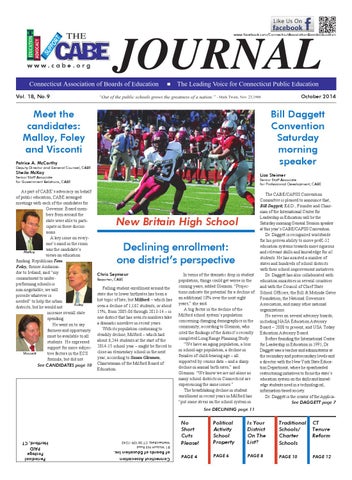
New Britain High School Declining enrollment: one district’s perspective Chris Seymour Reporter, CABE
Falling student enrollment around the state due to lower birthrates has been a hot topic of late, but Milford – which has seen a decline of 1,162 students, or about 15%, from 2005-06 through 2013-14 – is one district that has seen its numbers take a dramatic nosedive in recent years. With its population continuing to steadily decline, Milford – which had about 6,244 students at the start of the 2014-15 school year – might be forced to close an elementary school in the next year, according to Susan Glennon, Chairwoman of the Milford Board of Education.
In terms of the dramatic drop in student population, things could get worse in the coming years, added Glennon. “Projections indicate the potential for a decline of an additional 18% over the next eight years,� she said. A big factor in the decline of the Milford school system’s population concerning changing demographics in the community, according to Glennon, who cited the findings of the district’s recently completed Long Range Planning Study. “We have an aging population, a loss in school-age population, a decline in females of child-bearing age – all supported by census data – and a sharp decline in annual birth rates,� said Glennon. “We know we are not alone as many school districts in Connecticut are experiencing the same issues.� The breathtaking decline in student enrollment in recent years in Milford has “put some stress on the school system in
The CABE/CAPSS Convention Committee is pleased to announce that, Bill Daggett, Ed.D., Founder and Chairman of the International Center for Leadership in Education will be the Saturday morning General Session speaker at this year’s CABE/CAPSS Convention. Dr. Daggett is recognized worldwide for his proven ability to move preK-12 education systems towards more rigorous and relevant skills and knowledge for all students. He has assisted a number of states and hundreds of school districts with their school improvement initiatives. Dr. Daggett has also collaborated with education ministries in several countries and with the Council of Chief State School Officers, the Bill & Melinda Gates Foundation, the National Governors Association, and many other national organizations. He serves on several advisory boards, including NASA Education Advisory Board – 2008 to present, and USA Today Education Advisory Board. Before founding the International Center for Leadership in Education in 1991, Dr. Daggett was a teacher and administrator at the secondary and postsecondary levels and a director with the New York State Education Department, where he spearheaded restructuring initiatives to focus the state’s education system on the skills and knowledge students need in a technological, information-based society. Dr. Daggett is the creator of the ApplicaSee DAGGETT page 7
See DECLINING page 11
No Short Cuts Please!
Political Activity School Property
Is Your District On The List?
Traditional Schools/ Charter Schools
CT Tenure Reform
PAGE 4
PAGE 6
PAGE 8
PAGE 10
PAGE 12
81 Wolcott Hill Road Wethersfield, CT 06109-1242
of Boards of Education Inc. Connecticut Association
Periodical Postage PAID Hartford, CT
2
The Journal – Connecticut Association of Boards of Education/October 2014 PRESIDENT COMMENTARY
Food for thought addictive behavior This month I wanted to write about a problem several generations of my family have had to deal with and has affected many other families in Connecticut: addiction. It is a disease that can have devastating consequences for individuals and families. More often then not, addictive behaviors begin in school age children. According to the National Institute for Health, (NIH), “The patterns of alcohol and drug abuse that emerge during adolescence are increasingly recognized as important determinants of later substance abuse and associated behaviors. The National Survey on Drug Use and Health, (NSDUH), examined substance use disorders and is the only national survey to use diagnostic interviews regarding both current and lifetime substance abuse among U.S. adolescents. They found large increases in the cumulative incidence of substance use disorders between 13 and 18 years of age - and an overall lifetime prevalence that approaches adult samples. The National Comorbidity Survey - Adolescent Supplement, (NCS-A), found that by late adolescence 78% of U.S. teens had consumed alcohol and 15% met the criteria for lifetime abuse. According to the NCS-A the opportunity to use illicit drugs was reported by 81% of the oldest adolescents, drug use by 42% and drug abuse by 16%. The conclusion of the authors of these surveys and studies is that alcohol and drug use is COMMON for our country’s teenagers and the findings of this study “indicate that most cases of abuse have their initial onset in this important period of development”. Clearly we need to do more then “just say no”. The issues of drug and alcohol usage and abuse occurs in every school in the state. The findings from these surveys cut across all socio-economic backgrounds. Teenagers from all races and gender as well as living in rural or urban communities are at risk for a potential future of
CABE Search Services Call CABE for your recruiting needs For an update or more information on vacancies go to our website:
www.cabe.org
For more information contact, CABE Search Services, 860-539-7594 Jacqueline V. Jacoby, Senior Search Consultant Paul Gagliarducci • Associate Consultant Mary Broderick - Associate Consultant Bob King • Associate Consultant P.O. Box 290252, Wethersfield, CT 06129-0252 www.cabe.org/support Equal Opportunity Employers
addiction and other at-risk behaviors because of patterns developed at such a young age while their brains were still developing. So, what can we do as board Richard Murray members to possibly reduce these behaviors? Obviously there is no magic bullet, but we can start with our health classes. An updated curriculum should teach youngsters about behaviors and actions that will lead some of their peers down the path to abuse and addiction. Knowledge can be powerful for the friends of these kids. They can be there for their risk-taking friends to turn to so that these teenagers don’t have to feel all alone without help and or support. It is important for users to know where to get support. I think we need to increase the number of School Based Health Centers (SBHCs) in Connecticut. Currently there are 75 licensed outpatient clinics that are located in 18 communities, serving approximately 20,000 students per year. According to the Connecticut Association of SBHCs its members provided more than 40,000 mental health visits annually for a range of mental health and substance use disorders. We need to develop more public-private health care within our school districts. However, Scott Newgrass, Education Consultant with the State Department of Education, testified that the capacity of schools to provide needed services is compromised by “the need to provide uninterrupted and regularly scheduled appointments for students”, as well as “accommodating parents’ schedules within the school day and/or collaboration with community service providers”. We have all seen the increasing frequent stories of opioid related deaths in Connecticut and in New England. Apparently, 75% of accidental poisonings can be attributed to narcotic usage, as well, which just happens to be the leading cause of death for Connecticut residents. Many of these young people may have already passed through our schools, but unfortunately their destructive behaviors were often learned while in our schools. Think about it, please. I would like to thank Michaela Fissel, from the Windsor Board of Education, for her support and encouragement in writing this commentary.
Mission: To assist local and regional boards of education in providing high quality education for all Connecticut children through effective leadership. Vision: CABE is passionate about strengthening public education through high-performing, transformative local school board/superintendent leadership teams that inspire success for each child.
CABE Board of Directors EXECUTIVE COMMITTEE Richard Murray .................................................. President, Killingly Ann Gruenberg ................................. First Vice President, Hampton Robert Mitchell ................ VP for Government Relations, Montville Elaine Whitney ........... VP for Professional Development, Westport John Prins ......................................... Secretary/Treasurer, Branford Lydia Tedone ............................................ Immediate Past President Donald Harris ........................................................ Member at Large
AREA DIRECTORS Susan Hoffnagle ............................. Area 1 Co-Director, Winchester Mari-Ellen (Mimi) Valyo ............... Area 1 Co-Director, Winchester Daniel Gentile ................................... Area 1 Co-Director, Plymouth Jeffrey Currey ............................. Area 2 Co-Director, East Hartford Susan Karp ................................... Area 2 Co-Director, Glastonbury Donald Harris ................................. Area 2 Co-Director, Bloomfield Laura Bush ................................................. Area 3 Director, Vernon Douglas Smith .................................. Area 4 Co-Director, Plainfield Andrea Veilleux ................................ Area 6 Co-Director, Stratford Elaine Whitney .................................. Area 6 Co-Director, Westport Roxane McKay ............................. Area 7 Co-Director, Wallingford John Prins ......................................... Area 7 Co-Director, Branford Lon Seidman ................................................. Area 8 Director, Essex Aaron Daniels ........................................... Area 9 Director, Norwich
ASSOCIATES Eileen Baker .............................................. Associate, Old Saybrook Sharon Beloin-Saavedra .............................. Associate, New Britain Gary Brochu .......................................................... Associate, Berlin Robert Guthrie .............................................. Associate, West Haven Robert Trefry ........... Associate, CT Technical High School System COMMITTEE CHAIRS Elizabeth Brown ......................... Chair, State Relations, Waterbury Donald Harris ......................... Chair, Federal Relations, Bloomfield Becky Tyrrell ...................................... Chair, Resolutions, Plainville
CITY REPRESENTATIVES Jacqueline Kelleher ....................... City Representative, Bridgeport Matthew Poland ................................ City Representative, Hartford Carlos Torre .................................. City Representative, New Haven Polly Rauh ........................................ City Representative, Stamford Charles Stango ............................... City Representative, Waterbury
STAFF Robert Rader ....................................................................... Executive Director Patrice McCarthy .................................. Deputy Director and General Counsel Bonnie Carney ............................................ Sr. Staff Associate for Publications Nicholas Caruso ............................................ Sr. Staff Assoc. for Field Service and Coord. of Technology Sheila McKay ............................. Sr. Staff Associate for Government Relations Kelly Moyher ......................................................................... Sr. Staff Attorney Vincent Mustaro ..................................... Sr. Staff Associate for Policy Service Lisa Steimer .............................. Sr. Staff Assoc. for Professional Development Teresa Costa .................................. Coordinator of Finance and Administration Pamela Brooks ......................... Sr. Admin. Assoc. for Policy Ser. /Search Ser. Terry DeMars ............................................... Admin. Assoc. for Policy Service Gail Heath ........................................ Admin. Assoc. for Government Relations Wilmarie Newton ........................................ Admin. Assoc. for Labor Relations Denise Roberts .................................... Admin. Asst. for Membership Services Corliss Ucci .................................. Receptionist/Asst. to the Executive Director
The CABE Journal (ISSN 1092-1818) is published monthly except a combined issue for July/August as a member service of the Connecticut Association of Boards of Education, 81 Wolcott Hill Road, Wethersfield, CT 06109, (860) 571-7446. CABE membership dues include $30 per person for each individual who receives The CABE Journal. The subscription rate for nonmembers is $75. Association membership dues include a subscription for each board member, superintendent, assistant superintendent and business manager. The companies and advertisements found in The CABE Journal are not necessarily endorsed by CABE. “Periodicals Postage Paid at Hartford, CT.” POSTMASTER: Send address changes to The CABE Journal, CABE, 81 Wolcott Hill Road, Wethersfield, CT 06109-1242. Email: bcarney@cabe.org. Members can find the CABE Journal online at: www.cabe.org/ userlogin.cfm?pp=84&userrequest=true&keyrequest=false& userpage=84
The Journal – Connecticut Association of Boards of Education/October
3
2014
EXECUTIVE DIRECTOR COMMENTARY
CABE Affiliate Members BUSINESS AFFILIATES DIAMOND MEMBER Finalsite GOLD MEMBERS
Advanced Corporate Networking dba. Digital BackOffice Berchem, Moses & Devlin Centris Group Guidance Counselors for Senior Teachers Pullman & Comley Shipman & Goodwin Siegel, O'Connor, O’Donnell & Beck, P.C SILVER MEMBERS Anthem Blue Cross and Blue Shield Corporate Cost Control Milliman, Inc. Milone & MacBroom, Inc. The Segal Company BRONZE PLUS MEMBERS Brown & Brown Insurance Friar Associates Goldstein & Peck, P.C. Guidepost Solutions, LLC Lindburg & Ripple Morganti Group O & G Industries The S/L/A/M Collaborative Trane UltiPlay Parks & Playbrounds BRONZE MEMBERS Chinni & Meuser LLC Dattco Inc. Fuller & D’Angelo Architects and Planners JCJ Architecture Kainen, Escalera & McHale, P.C. The Lexington Group Muschell & Simoncelli Ovations Benefits Group Suisman Shapiro Attorneys at Law
EDUCATIONAL AFFILIATES American School for the Deaf Area Cooperative Educational Services Capitol Region Education Council The College Board Connecticut Association of School Business Officials Connecticut Center for School Change Connecticut School Buildings and Grounds Association Cooperative Educational Services EASTCONN EDUCATION CONNECTION LEARN Unified School District #1
Diversity and boards of education In the heat of August, Ferguson, Missouri, exploded after a policeman shot and killed a young African-American after the two had an argument. Days of rioting occurred thereafter. I grew up in the 1960s. I vividly remember watching our black and white television show machine guns mounted in Washington, D.C. to protect the White House and Capital in the aftermath of the shooting of Martin Luther King, Jr. I remember hearing about the National Guard being called out in many states to protect against rioters. I was even in the middle of a racial riot at my high school when black students threw chairs and tables across the cafeteria. Sixty-eight armed policemen with helmets patrolled the halls. Racial tensions were high throughout the country. So, what happened in Ferguson was not a huge surprise – racial issues continue to divide us. Yes, we’ve made progress in many different areas on racial issues. That an African-American was elected president is but one achievement that was unthinkable back 50 years ago. But, in many areas, such as in leadership of our civic bodies, we have not achieved success. This was brought to my attention while watching the news about Ferguson when a reporter mentioned that 60% of the population in the city were of color and only three of the 55 policemen in Ferguson were people of color. The reporter then stated that NO members of the Ferguson Board of Education were minority. I have no idea why there are no minorities on the Ferguson Board. There may be good reasons, like no one willing to stand for election. But, that no one on the Board is a member of a minority group in such a city was disquieting.
Minorities on Boards I have spent some time in researching the percentage of minorities on boards of education. Unfortunately, there is not much research. One study, conducted by the American Enterprise Institute’s Frederick M. Hess for NSBA, showed that across the nation, approximately 12% of board members are African-American and 3% are Hispanic or Latino, though the sample size was less than 900 board members. This compares to approximately 12% of Americans who are African-American and 16% who are Hispanic. Most minority board members are from our larger school systems. To the best of my knowledge there is no data on the percentage of minorities on Connecticut Boards. I have talked to one of my peers from the South and, possibly because of demographics and housing patterns, there appear to be a larger number of people of color on their boards and in leadership positions in state school boards associations. The CABE Board, under the leadership of President Richard Murray, has
Robert Rader
“. . . our leadership believes that boards and town committees who select candidates need to be sensitive to this issue and consider what actions they might take to encourage minorities to run for office.” been very supportive of looking into these issues. Area 2 Director Donald Harris has worked with me as we held discussions with various leaders about how to identify and encourage high-quality candidates of color to consider school board service. I want to make clear that this is not an affirmative action initiative. We are not talking about a quota system and never would. But, our leadership believes that boards and town committees who select candidates need to be sensitive to this issue and consider what actions they might take to encourage minorities to run for office.
Why is this important? As you may know, I have been working on a project entitled, The Future of Boards of Education, with a number of my colleagues across the country. Here is what we said on ensuring quality candidates in the whitepaper that executive directors from around the country voted
unanimously to send to the NSBA Board of Directors: “Finding high-quality candidates for school boards is imperative if we want to ensure the relevancy and effectiveness of school boards of the future. Gone are the days when we could count on businesses to provide individuals with time off to serve. It is important that we encourage highquality individuals to run. We also need to encourage candidates from diverse groups, such as minorities, to serve on boards. If we believe that boards should represent their communities, this is not only a practical, but also a moral imperative (especially as our country becomes minority-majority in the next 25 years or so).” [My emphasis]. This year, the majority of students entering our public schools are minorities. This is the first time this has happened in the history of our nation. While studies of specific effects of having minority members on a school board are few, one stated, according to Dr. Hess, in an analysis “of district data on resource allocation, staffing and other policy concerns in eighty-two large urban districts, [the authors found] that black membership on boards was correlated with policies that were more equitable for black students and staff”. This is no surprise and can be analogized to a different and yet similar issue school districts have been trying to address for years: encouraging the hiring and support of more teachers of color: In America’s Leaky Pipeline for Teachers of Color, the authors stated that “There is a large demographic mismatch between students and teachers of color. This matters because students of color need teachers who not only set rigorous standards for them but teachers who also can provide models of professional success. Teachers of color have demonstrated success in increasing the academic achievement of students of similar backgrounds.” Board members and Boards as a whole, also should be models of professional success. Living through those difficult periods in the sixties, I think I became much more sensitive to racial issues that I might have otherwise been. I am proud of CABE leadership for taking on this issue in a sensitive, thoughtful way. You will be hearing more about how we can help boards engage minorities and find ways to encourage them to be part of our cornerstone of American democracy. More engagement will be healthy for all of our communities. In the long run, this engagement will not only build trust in our communities, it will strengthen school boards by strengthening our roots in our communities. And, most importantly, it will strengthen our boards in their role to affect positive change on behalf of all of our students.
4
The Journal – Connecticut Association of Boards of Education/October
2014
No Short Cuts Please! The search for a superintendent of schools in Connecticut Jacqueline Jacoby Senior Search Consultant, CABE Search Services
Recent events highlighting difficulties with searches for school superintendents prompted me to write about this topic. Selecting a superintendent is one of the most important responsibilities of a board of education. When things go wrong, complications of this process can have a negative impact on those involved. We have seen this play out in a couple of Connecticut communities recently. But these cases represent a small percentage of the total number of superintendent searches completed each year. However, with these current situations in mind, it seems timely to outline some key elements of the search process that result in a more positive experience and outcome. The search process usually begins with the selection of a consultant. This consultant must work in a harmonious
13 CT high schools made Newsweek’s American Top High School List Newsweek’s 2014 Rankings highlights schools that do the absolute best job of preparing students for college. This year, their methodology is more stringent than ever with new measures of quality and a higher standard for data. An asterisk next to a school’s name means that low-income students are scoring at or above average on state assessments. This is a way of recognizing schools that narrow the achievement gap. Connecticut High Schools listed in the report were: Rank High School 112 Amity Regional High School – Region 5 140 Connecticut IB Academy – East Hartford 164 Litchfield High School* 168 Greenwich High School 179 Daniel Hand High School – Madison 226 South Windsor High School 227 Fairfield High School 228 East Lyme High School* 337 Wolcott High School* 352 Lyme-Old Lyme High School – Region 18 366 Haddam-Killingworth High School – Region 17 386 Pomperaug High School – Region 15 401 Cheshire High School To see the complete report go to: http:/ /www.newsweek.com/2014/09/19/ newsweeks-high-school-rankings-2014two-lists-are-better-one-268691.html
partnership with the board of education. The consultant must never lose sight of one reality: This is the board’s search. The consultant must maintain ongoing communication with board members, constituents and stakeholder groups. He or she needs to keep all relevant groups informed at each stage of the process. In addition, proactive recruitment efforts, protocols for reviewing applications, thoughtful questions developed in order to conduct thorough interviews and finally a comprehensive background check are integral to the process. I have facilitated multiple superintendent searches and found that the overall integrity of the selection process begins with attention given to the above areas by boards and consultants. Some boards and consultants become impatient with the length of time necessary to appropriately address these elements. It is important to keep in mind that quality searches will take 90 to 120 days and sometimes longer.
Consultants When a board learns about a pending vacancy, they will invite search providers to submit a proposal and after reviewing proposals, interviews are held with selected firms. Boards should do reference checks for the firm/s they wish to interview. While reviewing the resume of the consultant, it is important to look at the track record and experience. If there is a consultant team, made up of a board member and a superintendent, the varied involvements will bring different perspectives to the search as well as broad and deep networks. Remember that the board should have a comfort level and an innate trust that the consultant has the district’s best interest at heart. Board members need to take a little time to assess and analyze which consultant will guide the committee most effectively through such an important task. Board members should feel free to ask any and all essential questions of the consultant. Critical to a successful search is the selection of a skilled and credible consultant who understands and appreciates the differing perspectives of all board members. The consultant has the responsibility to review all materials submitted by each applicant, study background checks, and scrutinize all components of the candidate’s application looking for inconsistencies, subtleties in work experience, and or “red flags”. The consultant must inform board members whenever any anomalies are raised. Without question, all interactions between Board members and the consultant are confidential. There must be no surprises.
Communication One of the first steps in the process is to cooperatively establish a schedule for the search, often beginning by setting a desired appointment date. Of course the application and interview process must be kept confidential. However, the consultant will want to provide a combination of regular updates on the district website, eblasts to staff, community updates and periodic media releases throughout the search. The goal is not to breech confidentiality, but to provide all interested parties with appropriate information and also reduce speculation.
Community The board and consultant will want to involve the community through focus groups, interviews and a survey to learn about the leader qualities and characteristics desired by constituents. The consultant will collect and analyze this data and write a leadership profile. This profile is used as a reference point and guide throughout the search. Some boards involve an advisory committee, beyond the board, to meet with several finalists and provide written feedback to the board. The board should carefully consider the pros and cons of this step and be certain to inform the candidates early in the process, if this step will be included. Some quality candidates are sensitive to expanding the search membership, beyond the board, because of the potential of a breach of confidentiality, and they may withdraw.
Connecting and Consensus Recruitment efforts include publicizing the search through vacancy notices on websites, in newspapers, and through direct mailings and/or email to school districts and education related organizations. The importance of personal recruitment on the part of the consultant is key. This does not infer that the consultant has a stable of candidates but instead that they have contacts. They may have coached; or taught university classes connecting them to aspiring leaders who are worthwhile candidates. Consultants will receive, process, and review all application materials. They will conduct pre-interviews with selected candidates in order to provide a viable slate for board interviews. This reality is another reason why choosing a consultant you trust is important. Of course the board has access to all of the applications received. The pool of candidates has shrunk over the years, but there must be worthy options for each search. If a candidate does not “wow” the board, do not settle. The consultant can help to find an interim superintendent and the board can reopen the search at a later
date. The contract with the consultant should include a clause that indicates they will stay with the board until they have chosen a candidate. Consultants will facilitate an interview seminar with the board. They will guide the board in drafting interview questions to determine a match between the candidate and the district’s leadership needs. Initial interviews with slated candidates and second interviews are conducted by the board and the consultant facilitates the process. A series of questions for reference conversations should be provided as a guide to be certain there is consistency and parity across reference checks. Once the board has determined a finalist/s, a comprehensive background check is conducted. Some boards like to conduct a site visit to the candidate’s current place of employment for a firsthand observation. If a site visit is a part of the search, the consultant should provide written guidelines.
Credential Checks The consultant should have affiliations with firms that can conduct comprehensive credential and reference checks done prior to the district hiring a superintendent. There should be no surprises after the appointment. Beginning with a social security and residence trace, the reference review includes a search of criminal and civil records, department of motor vehicle history, financial records review, sex offender registry search and education/ degree verification. Additionally, the consultant should ensure a review of media publications, social media activity, certification requirements and determine authenticity of written application documents. In conclusion, a skilled and competent consultant working cooperatively with the board of education makes for a sound and thoughtful selection process. So much of what a consultant is charged with doing seems obvious. Yet, board members need to assess the consultant’s productivity and integrity at each stage of the selection process. We know that oversights and unfortunate difficulties with a search can have far reaching effects on the district’s reputation, trust of the community and morale of staff. Let’s do it together, taking no short cuts. The Chinese proverb says it all: A single tree cannot make a forest, a single beam cannot support a great house.” Jacqueline Jacoby, Ed.D, Senior Search Consultant and Former CT Superintendent of Schools in consultation with CABE Search Consultants, Mary Broderick, Ed.D and Paul Gagliarducci, Ed.D.
5
The Journal – Connecticut Association of Boards of Education/October 2014 See You in Court – The Nutmeg Board of Education
A Nutmeg principal holds a tag sale - was it legal? Thomas B. Mooney, Esq. Shipman & Goodwin
The Nutmeg Board of Education makes many mistakes. The latest imbroglio created by the board will be reported here each issue, followed by an explanation of what the board should have done. Though not intended as legal advice, these situations may help board members avoid common problems. Prissy Principal was pleased finally to get the promotion she had been seeking for several years. As an assistant principal, she was infamous for being a neat freak, and Mr. Superintendent had been concerned that her rigidity would be a problem in handling the demands of an elementary school. But after her lawyer sent him a doctor’s note to the effect that Ms. Principal’s OCD would not prevent her from doing the essential job functions of a principal, Mr. Superintendent decided to give her a chance, and he recommended her for the vacancy at Acorn Elementary School. As the new principal of Acorn Elementary School, Ms. Principal was appalled at how disorganized her school was, and she promptly assigned her head custodian Joe Broom to conduct a complete inventory of all school property, on his own time if need be. Joe grumbled a bit, but he immediately set about creating the inventory, and even he was surprised. He found forty serviceable but outdated computers, 100 unused desks and, in the boiler room, a WPA mural that was done in the 1930s. Given her abhorrence of clutter, Ms. Principal decided that this unused property must go. As she surveyed the surplus property, Ms. Principal wracked her brain as to what to do. Certainly the property was still worth something, and she was reluctant to throw it out. Quickly, Ms. Principal realized that a tag sale would be a win-win situation, providing some needed cash to the school while cutting down on the clutter. Ms. Principal then placed ads online as well as in the local newspaper, and she spent the next day tagging the items for sale. She puzzled over the WPA mural — the mural was large and colorful, but had a little damage in one corner. What the heck, she thought, and she tagged it for $500. The sale was a big success. A new charter school bought all of the desks, and it even bought the old computers. The WPA mural, however, had not yet been purchased when Joe Broom started to clean up at the end of the sale. But just as Ms. Principal was thinking that she would be stuck with the mural, a stranger came up to her, pointed out the damage, and offered her $400 cash. Ms. Principal could hardly believe her good
fortune. She took the cash, got his name and issued a receipt, and even helped the man carry the mural to his truck. Ms. Principal was quite proud of herself, and she was therefore surprised to be called down to Mr. Superintendent’s office for a “little chat” the following Tuesday with him, Mr. Board Attorney and Mayor Megillah. Ms. Principal promptly asked if she should have representation from the Nutmeg Administrators Group, but Mr. Superintendent told her no. He explained that he, the Mayor and the Board Attorney just wanted some answers. Discipline, if any, would come later. “So,” began Mayor Megillah. “Where are my desks, computers and mural? That is all Town property, you know.” Ms. Principal gulped. “But all that stuff was in my school and not being used, so I sold it. I have all the money in an envelope in my office. Do you want it?” Mr. Superintendent interrupted. “We have a problem here. You better get the property back pronto, and then we will sort all of this out. Understood?” Should Ms. Principal try to get the property back? Will she be able to? Yes and yes. School boards and their employees do not own property used for school purposes. The statutes provide that property dedicated to use for school purposes is under the control and jurisdiction of the board of education, control that is then delegated to the superintendent and other school employees. However, the town, acting as school district, owns such property, both real and personal (other than regional school districts, which by statute actually do independently own the property). Given that fact, Ms. Principal overstepped badly when she purported to sell school property. The question of surplus property is a legitimate concern, and boards of education should have procedures for disposing of such property. Those procedures, however, should involve a two-step process. First, the board of education should decide whether and when property is no longer being used for school purposes. The superintendent and the administrative staff should provide guidance, but by statute the board of education has control of such property and should make the decision. Once the board has decided that property is no longer to be used for school property, control automatically reverts to the municipality. The town should be notified of the board’s decision, and the town, not the board of education, should then decide what to do with the property – sell it, throw it out, keep it, or use it. Getting the property back may be a bit
tricky. The buyers purchased it in good faith, likely presuming that Ms. Principal had the authority to sell it. However, since the property was not Ms. Principal’s to sell, the buyers should turn the property back to the town and receive their money back. If they don’t cooperate (and the fellow who purchased a WPA mural for $400 may well be inclined to hold on to it), the courts would likely side with Nutmeg on this one and order the school property returned. When Ms. Principal asked for union representation, Mr. Superintendent should have granted her request. As with any other union employees, Ms. Principal has a right to union representation in any meeting in which she is questioned and she may reasonably fear disciplinary action. Mr. Superintendent was mistaken in telling Ms. Principal that she didn’t need union representation. That mistake may well complicate any future disciplinary action against Ms. Principal for the tag sale. Mr. Superintendent also should have been more proactive as to Ms. Principal’s claim of OCD (obsessive compulsive disorder). If an employee raises an issue
of potential disability, the employer must deal with it. Here unfortunately, the situation was left ambiguous. Mr. Superintendent should have sat down with Ms. Principal to discuss the doctor’s note. In the interactive dialog required by the Americans with Disabilities Act in such situations, they should have then discussed whether Ms. Principal has a disability. The district could even require an independent medical examination to find out. If it is determined that she does in fact have a disability, school officials must meet with Ms. Principal to discuss whether and how she can perform the essential duties of the position, with or without accommodation. Finally, Ms. Principal needs to learn about labor law as well. It was inappropriate to tell the head custodian to finish the inventory on his own time if necessary. As a non-exempt employee subject to the wage payment statutes, Joe was entitled to be paid for all time that he is directed to or permitted to work. Attorney Thomas B. Mooney is a partner in the Hartford law firm of Shipman & Goodwin who works frequently with boards of education. Mooney is a regular contributor to the CABE Journal.
Seventh Edition
A Practical Guide to Connecticut School Law by Thomas B. Mooney, Esq. Shipman & Goodwin The Guide comes with a CD which provides hyperlinks to many cases and statutes and will permit word searches as a supplement to the Index. New to the Seventh Edition: Bullying, Background Checks, Child Abuse Reporting, Discrimination Issues, Educational Reform, FERPA, Freedom of Information, State Aid for Education and much, much more The 7th edition is now available from CABE. Call and order your copy TODAY at 860.571.7446 or 800.317.0033
6
The Journal – Connecticut Association of Boards of Education/October
The Policy Corner Vincent A. Mustaro, Senior Staff Associate for Policy Service, CABE
Policy guidance for political activities on school board property We again are in the midst of a contentious election season. National, local and state elections remain hotly contested political events. Many states are viewed as battleground states and the public schools in all states will not be immune from the fury of political activity. Therefore, it is appropriate to review issues related to the political activities of staff and of political activities on school grounds and how policy can provide direction.
Court Rulings Political activity and the distribution of campaign materials and visits by candidates and/or their campaigning supporters at public schools is a controversial issue. Guidance has been provided by court rulings. In Tinker v. Des Moines School District, the United States Supreme Court declared that “Neither students nor teachers shed their constitutional rights to freedom of speech or expression at the school house gate.” However, this does not mean that teachers and students enjoy the freedom to speak on any topic at any time. In Bethel School District v. Fraser, the U.S. Supreme Court indicated that schools need not tolerate “lewd, indecent or offensive speech.” School districts also can take appropriate steps to distance itself from certain kinds of speech, such as in a school newspaper or school website, when such speech is viewed as inconsistent with the school’s basic educational mission. Therefore, within the principles established by Supreme Court rulings, boards of education may set reasonable time, place and manner restrictions on student speech, even if the speech is “protected.” This could result in the school’s interests in preserving the classroom for educational purposes to outweigh the student’s interests in engaging in political speech. The courts have taken a similar position with district employees, especially teachers. When the speech pertains to a matter of public concern, the courts balance the employee’s right to free speech against the interests of the school district. In addition, time, place and manner restrictions may apply. Boards must recognize that their employees enjoy private lives and may associate with others outside of school for political, economic, religious, cultural or personal reasons. The board’s supervisory staff, however, has the responsibility to evaluate employees in terms of their effectiveness in discharging assigned duties and responsibilities.
When non-school activities impact upon a district staff member’s effectiveness and job performance, the board reserves the right to evaluate the effect of such non-school activities upon the staff member’s performance of employment responsibilities. Generally, school board employees have the right to actively participate in political activities on behalf of any candidate, party or issue providing such activities are outside their assigned hours of employment.
Other Considerations Also to be considered are the issues of candidates’ rights to information, employee participation in political campaigns, distribution of campaign literature and visits of candidates or their campaigning supporters to schools and school classes and/or functions. Any candidate for any office has the same right to public and existing information as does any other citizen. This includes the right to meet with an administrator for a reasonable period and to be given a tour of the school facilities, if requested. District employees should not participate in nor may district facilities be used in political campaigns during school or work hours. Neither candidates nor their supporters, including school district employees, should be allowed to campaign on school grounds during school hours. Anyone wanting to use district facilities for political activities outside school hours should do so in conformity with the district’s “Community Use of School Facilities” policy. It is advised that if a class or schoolsponsored group plans a political debate during the school day, the principal/ teacher/sponsor should ensure that all candidates for the same public office or who have differing opinions on a political issue are given equal opportunity to participate. Political candidates or their supporters should not be allowed to appear at a school unless they are invited to visit or speak to a class or other school-related activity during school hours. The requirements for debates or forums should apply and other candidates for the public office should be invited to visit at the same time or be provided an equivalent opportunity.
Distribution of Literature Distribution of campaign literature and political statements by candidates or their supporters may occur in class and at a school event only as part of an instructional discussion of controversial issues. Teachers can use political materials as
part of the instructional program, provided the material is germane to the instructional objectives of the class/ course. Any presentation of political materials, or issues, or expression of view, however, must be balanced, fair and subject to policy parameters. Another issue to be considered is the distribution of political or campaign literature. The U.S. Supreme Court in Perry Educational Association v. Perry Local Educators’ Association ,established that teacher mail boxes in a school system’s interschool mail system are “nonpublic” forums. Therefore, they are not open to general debate or the free exchange of ideas. A district may impose reasonable viewpoint-neutral restrictions on teacher mailboxes in order to exclude speakers or literature that would disrupt the system or hinder its effectiveness. Restrictions on access to teacher mailboxes may be considered reasonable when it is clear that the mailboxes are used exclusively for school-related purposes. Courts have acknowledged the school district’s need to avoid any appearance of political favoritism. A regular newsletter of an employee organization that is normally distributed via the teacher mailboxes is not considered political material if it simply contains news of a political nature taken by the organization. However, a publication from, or newsletter primarily containing news or discussion about any political action committee is considered political material and may not be distributed through the staff mailbox system.
Board Policy A board of education’s policy prohibiting the distribution of political materials must not distinguish between political parties, candidates or viewpoints. If it does, the district potentially opens the mailboxes to all political expression and faces charges of discrimination. A number of policy areas are impacted by this topic. These include policy #1311.2, “Political Activities in the Schools,” #1140, “Distribution of Materials by Students,” #1311.1, “Political Activities of School Employees,” #1330/3515, “Community Use of School Facilities,” #3543.13, “ Mail and Delivery,” #4118.21, “Academic Freedom,” #6144, “Controversial Issues,” and #6153.2, “Student Participation in Election Process.” These are available upon request from the CABE Policy Service.
2014
Good apps vs. bad apps There are pros and cons to signing your child up as a mobile user. The apps may be one of the biggest advantages to owning a smartphone. We can text or phone our children to check in or plan for after-school and activity pick-up, maintain a household calendar, download books and organize study habits and tasks. It is not all good news, though. As with all technology use, parents need to be aware of some pitfalls to avoid. If your child has a smartphone, check the device periodically for these apps and be aware of how your child uses his or her phone. Here are a few dangerous apps identified in The Atlanta Public Schools Examiner: • Yik Yak: Allows anonymous posts and GPS location. Content can be sexually explicit, vulgar or a personal attack that has been connected to cyberbullying. • Poof: Allows kids to hide an app or apps with a single touch, making it difficult to monitor mobile app usage. • SnapChat: Allows content to be viewed for 10 seconds before disappearing. The viewer can save the post as an image and redistribute. Many kids don’t know that the temporary post may not be temporary. • Down: Allows the user to categorize Facebook friends from hang out with to hook up with. • Whisper: Allows users to post anonymously to people, who can search for location of user to within one mile. There is a danger of sexual predators tracking young users. • Omegle: This video app allows anonymous posts and matches users through Facebook likes. The concern is that strangers may use the app to communicate with children. • Kik Messenger: Allows anonymous, private messages that can be hidden from parents. The app has been the source of school fights and a way for predators to pose as teens. Some other sites to be aware of are: Secret, Cyber Dust and Streetchat. www.examiner.com/article/whatparents-should-know-aboutdangerous-apps-targeting-children. This first appeared in the CABE CONNection, September 2014.
The Journal – Connecticut Association of Boards of Education/October
7
2014
Another Professional Development Resource Available to YOU! We all have read the studies that tell us what we already know, because we are living it – it is increasingly difficult to make time for professional development. Family and work demands are such that there is very little extra time to go around. Whether you are a board member, superintendent or superintendent’s secretary CABE is making it easier for you to access important information through webinars.
Sheila McKay and Patrice A. McCarthy held a webinar addressing the impact Governor Malloy’s budget would have on boards of education.
Throughout the year, a variety of CABE staff provide webinars live to those who register. These webinars are archived on CABE’s website after the ‘live’ presentation. If you register to participate in a live webinar, you have the opportunity to ask questions of our presenters via your computer as the webinar takes place – much like a face-toface workshop. The current webinar offerings on CABE’s website include topics such as Professional Governance Boards = Student Success, Legislative Update, Unemployment Compensation Costs with an Emphasis on Reasonable Assurance, Alliance District Requirements, The Affordable Care Act and Collective Bargaining in Connecticut’s Schools, and A Unique Perspective on Crisis Communications and Planning, and Ten Best Practices to Avoid Liability. For districts with School Governance Councils, there are several webinars available including The Relationship
Bill Daggett Convention Saturday morning speaker (continued from page 1) tion Model and Rigor/Relevance Framework™, a practical planning and instructional tool for determining the relevance of curriculum and assessment to real-world situations. The Rigor/Relevance Framework has become a cornerstone of many school reform efforts throughout the United States. Dr. Daggett is the author of numerous books about learning and education, textbooks and research studies, reports, and journal articles who has spoken to hundreds of thousands of educators and education stakeholders in all 50 states. His enlightening, entertaining, and motivating messages have helped his listeners to look at education differently by challenging their assumptions about the purposes, benefits, and effectiveness of American schools. Dr. Daggett inspires his audiences both to embrace what is best about our education system and to make the changes necessary to meet the needs of all students in the 21st century. Dr. Daggett has been recognized as a distinguished alumnus by both Temple University and the State University of New York at Albany. Dr. Daggett has a special commitment to individuals with disabilities. He and his wife, Bonnie, volunteer their time and lend their support to Wildwood Programs in upstate New York. Wildwood serves the needs of people of all ages who, like their daughter Audrey, have neurological impairments/learning disabilities or autism, by enabling them to become the best that they can be.
Between School Boards and School Governance Councils. For CABE-Meeting subscribers webinars are available on a variety of topics for board members and those responsible for creating board meeting agendas.. There is also a webinar available for districts interested in learning more about CABE-Meeting entitled CABE-Meeting Overview. Previously recorded webinars may be accessed 24/7 on CABE’s website at http://www.cabe.org/page.cfm?p=354. System requirements for participating in a CABE webinar are: PC-based attendees Required: Windows® 7, Vista, XP or 2003 Server Mac®-based attendees Required: Mac OS® X 10.6 or newer Mobile attendees Required: iPhone®, iPad®, Android™
The Affordable Care Act and Collective Bargaining in Connecticut's Schools. Presenters were: Attorney Richard Mills, Shipman & Goodwin, and Joseph Spurgeon, MHA, Senior Health Benefits Consultant, Milliman.
phone or Android tablet While the staff at CABE continues to add topics that will provide our members with timely information, we recognize the value of convening a group of people for face-to-face training as well. Staff will continue to provide both forms of professional development. If you have a suggestion for a webinar or face-to-face training, please contact Lisa Steimer at lsteimer@cabe.org.
CABE-Meeting CABE-Meeting is a user-friendly online service offered by CABE specifically for school boards. Users can eliminate unnecessary paperwork, increase efficiency and reduce costs while enabling board members to utilize the latest in cutting edge technology. Using CABE-Meeting, the Meeting Manager can create and electronic meeting from developing the agenda to creating the minutes and everything in between. When the meeting is ready, the Meeting Manager emails your board members and designated administrators to let them know they can log in. Users can login from the comfort of their homes or work place. With a mouse click, agenda and related documents are open and ready for
viewing. Using the search features, Your CABE-Meeting administrators and board members Subscription Provides: can easily locate information from • Access to CABE-Meeting previous board meetings. No more • Initial and ongoing training time consuming, tedious searches • Support and maintenance through mounds of paper! • Upgrades to the service
What Else Does CABE-Meeting Offer? • Secure login access for board and district staff • Password protected access for certain features and audiences • Access from any location with Internet access • Search archived agenda and meeting related items in a flash. • Ability to download and print attachments • Option to provide a public link to board meeting information • Calendar for tracking events of district interest
CABE Member Subscription Information: Initial Subscription Fee – $3,000 Annual Maintenance Fee – $1,500
If you have an interest in this service, contact Lisa Steimer at 860-571-7446 or lsteimer@cabe.org.
8
The Journal – Connecticut Association of Boards of Education/October 2014
Is your district on this list? Districts with at least one Convention registrant as of September 15 AREA 1
AREA 3
AREA 6
AREA 8
Litchfield Naugatuck Norfolk Plymouth Region 1 Region 6 Region 10 Region 15 Waterbury Winchester Wolcott
Ashford Bolton Colchester Columbia Coventry Ellington Hampton Hebron Lebanon Mansfield Region 8 Region 19 Somers Stafford Vernon Willington Windham
Bridgeport Fairfield Greenwich Monroe New Canaan Norwalk Shelton Stamford Stratford Weston Westport Wilton
Chester Cromwell East Hampton Guilford Madison Old Saybrook Region 13 Region 18
AREA 2 Berlin Bloomfield Bristol East Hartford East Windsor Enfield Farmington Glastonbury Granby Manchester Meriden New Britain Newington Plainville Simsbury Southington Suffield Wethersfield Windsor Locks Windsor
AREA 4 Canterbury Eastford Griswold Killingly Plainfield Putnam Union Woodstock
AREA 5
Register before October 24th when the fees increase!
Bethel Easton New Fairfield Region 12 Ridgefield
AREA 9 Bozrah East Lyme Groton Ledyard Montville New London North Stonington Norwich Salem Stonington Voluntown Waterford
AREA 7 Ansonia Branford Cheshire Derby East Haven Hamden Milford Orange Region 5 Seymour Wallingford West Haven Woodbridge
Convention Sponsors Thank You PLATINUM SPONSOR Renaissance Learning GOLD SPONSORS Berchem, Moses & Devlin ConnCAN Shipman & Goodwin SILVER SPONSORS
NEW!
EASTCONN
Follow CABE on Twitter @CTAssocBdsofEd
Pullman & Comley
LEARN Vantis Life Insurance Company
9
The Journal – Connecticut Association of Boards of Education/October 2014
CABE Board Recognition Awards Board Leadership Award and Board of Distinction Award The CABE Board Recognition Awards are designed to recognize boards that provide effective leadership to their districts through the use of good practices. This program, which acknowledges the importance of school board members and superintendents working together as effective teams, continues an important trend among school board associations across the country. The Board Recognition Awards have been redesigned this year. • CABE Board Leadership Award - Level One includes 34 items and
boards need to fulfill 22 of these with at least three completed in each of the following areas: board leadership/student achievement, board member professional development, policy, community relations, and related organizational leadership. • CABE Board of Distinction Award - Level Two (new this year) recognizes Boards which are truly exemplary. To be eligible for this higher level of award, the Board must have achieved Level One distinction at least twice in the past four years. Boards must achieve at least two
CABE Board of Directors meets with State Board of Education
State Board Member Stephen Wright, Commissioner Stefan Pryor, Chair Allan Taylor, Robert Trefry, CABE President Richard Murray and CABE Executive Director Robert Rader.
Level Two items in each Level Two category to receive this award. An optional question in Level One and Level Two, asks about what makes your Board’s leadership especially effective. These responses will be printed in the CABE Journal. The Awards will be presented at the CABE Leadership Awards Reception at the CABE/CAPSS Convention on Friday, November 14 at the Mystic Marriott Hotel in Groton. Winning Board Chairs and Superintendents will be notified the week of October 13. All members of your board of education who are attending the
Convention are welcome to attend the ceremony. Districts receiving the award for the first time will receive a plaque; in years following, plates for the plaque will be provided. Winning districts will also be honored, for one year, on a plaque that hangs in the Leonard Rovins Conference Room at the CABE Office and will be recognized in the December CABE Journal. DEADLINE for Submission: OCTOBER 10, 2014
Available from the CABE Bookstore!
Understanding the Connecticut Freedom of Information Act and Access to Public Meetings and Records - Fourth Edition Written by: Mark J. Sommaruga, Esq. Pullman & Comley, LLC
At the September 9 CABE Board of Directors meeting State Board of Education members, Chair Allan Taylor, Stephen Wright, Robert Trefry and Commissioner Stefan Pryor, updated the CABE Board of Directors on issues of interest and were asked a wide array of questions.
to order the FOIA book go to the CABE Online Bookstore at www.cabe.org/page.cfm?p=749
10
The Journal – Connecticut Association of Boards of Education/October 2014
What traditional schools can learn from Charter Schools When the Legislature decided to permit public charter schools in 1996, one of the reasons given for permitting these new schools to operate was to provide traditional public schools with new ideas for becoming more effective and efficient. This cross-fertilization has not been as successful as enactors had hoped. The Hamilton Project, part of the Brookings Institution, “provides a platform for a broad range of leading economic thinkers to inject innovative and pragmatic policy options into the national debate.” In a 2012 paper, the authors listed the following areas in which public schools may learn from charter schools: • Focus on human capital Teachers need tools to succeed, including “increased feedback from administrators, particularly based on class observations. New teachers especially benefit from professional development” and could be provided with systemic professional development on subjects such as classroom management, literacy and other important subjects.
• Use student data to drive instruction The use of data can result in “more personalized and more efficient learning, allowing both teachers and students to track progress and to make sure that each student is on a path that is appropriate for her. Assessments can be used to adjust everything from tutoring to student goals.” Data allows us to know if a student is learning on pace and can help provide educators with insights as to why a student may be struggling. • High-dosage tutoring Consistent with personalized learning, “schools can further boost student learning by creating an intensive tutoring program that can target curriculum to the level of each student. All students should take an assessment at the beginning of the year so that they can be matched with the tutor and peers most conducive to learning.” • Extended time on task To make time for increased tutoring, among other changes, the amount of time devoted to instruction should be increased. It was suggested that “this
should be implemented both by increasing the length of the school day and by increasing the number of days in the school year”. • Development of a Culture of High Expectations Students “should understand that they are expected to succeed and that the teachers, administrators, and other staff are there to help them succeed. The first week of school should be a ‘culture camp,’ a time to focus on what behaviors and actions are conducive to achieving success.” Now, in a follow up to the original study, one of the authors of that study, Rowland G. Fryer, has written Injecting Charter School Best Practices Into Traditional Public Schools: Evidence from Field Experiments. The study considered the use of the “best practices” in “low performing, traditional public schools in Houston”, by using a field study and “quasi-experimental comparisons.” According to Fryer, the findings showed that injecting some best practices
from high-performing charter schools “significantly increases student math achievement in [traditional] elementary and secondary schools [but] has little effect on reading achievement.” The author suggests that based on this study, the use of the “best practices” may very well help traditional schools raise student achievement, but there remain questions regarding scalability and other concerns. I would also caution that some of the ways in which the “best practices” were used might go far beyond what traditional schools, such as in Connecticut, would be willing or even able to do in light of limits on resources, law and collective bargaining agreements. However, attempting to replicate the gains these charter school practices provided, at least in this study, may be something that Connecticut schools may want to consider. The 2012 study can be found at http:// www.brookings.edu/~/media/research/ files/papers/2012/927%20charter%20 schools/thp_fryer_charters_brief.pdf The more recent study appears in the Quarterly Journal of Economics. Robert Rader, Executive Director, CABE
Meet the candidates Malloy, Foley and Visconti (continued from page 1) identify specific elements. Saying that parents make the best decisions, Foley indicated his support for money following the child, and for creating an A-F grading system for schools. Democratic Governor Dan Malloy said ECS funding is the most important investment we make. He pointed out that only 6 states increased their education funding and Connecticut was number 2. He also pointed to the 2020 additional pre-K slots created since he has been governor. Unaffiliated third party candidate Joe Visconti said he will fully fund education and the ECS formula needs to be revisited. However, he said that many of the other programs that districts offer are extras and should be supported by charitable contributions.
Common Core Standards and Testing When questioned on Common Core state standards Foley said, “I support standards, but this has become a political football. I think we should change the name and tinker with the program. “We need something like common core assessments,” he said “but I don’t think it will be common core.” Malloy pointed out that the districts that embraced the standards are doing well, while those that didn’t aren’t doing as well. Malloy said we learned lessons
from the Task Force that he convened, and probably need to give a little more guidance for implementation. He noted that funds were made available for district technology upgrades to support the new testing. He also discussed the waiver the state received so as to not have two testing systems administered concurrently. Just recently, Malloy has directed the State Department of Education to look at the multitude of tests that 11th graders must or choose to take and has asked the federal government to examine whether a college entrance exam, such as the SAT, could satisfy the federally mandated high school exam. Foley supports a 3rd grade reading test and a high school graduation test, and Molloy remarked he is not a proponent of testing in 3rd grade. Malloy opposed a Regents type of graduation exam and Foley supported an exam. Visconti opposes the Common Core state standards. “Right now”, he said, “I would stop it in its tracks”, as it creates toxic stress. He supports local standards developed with parents.
School Security Foley indicated that he would continue the school security initiatives that are in place. Malloy discussed the approximately $45 million in funds that have gone to districts to help with security capital expenses, and efforts to continue to meet
local needs in this area. Saying we live in a dangerous world, Visconti said he would support funding for police or retired military personnel for school security and he is committed to raising taxes to support this level of security.
Next Commissioner Malloy and Foley both identified three qualities they would seek in the next Commissioner of Education: - education background - collaborator - communicator Visconti said a Commissioner should be someone with a heart, and that he would ask Jonathan Pelto to serve in that role.
Other Issues Malloy expressed his belief in the importance of public education, and his willingness to lead by example in supporting funding. He has seen real progress during some of his visits to schools. He would not require regionalization by districts, and believes school districts can determine ways to conserve resources. With respect to mental health issues, Malloy supports a more proactive effort to recognize and intervene with children suffering from mental illness. Foley sees the role of the State Board of Education as monitoring and analyzing the progress of the other states. As Governor, he would try to solve real problems with a focus on outcomes. Visconti does not want to see pre-k programs become a babysitting service.
School Board Governance Malloy, a former member of the Stamford Board of Education, indicated that the democratic process generally results in school boards that work well. He said that for the most part districts are doing the right thing, and it would be wrong to pretend that there are 166 bad or good boards. He said voters have a way of straightening that out. Foley expressed support for a diverse mix on school boards, not just teachers and parents. Visconti said boards of education are “everything”, but when bureaucracy prevents them from making a change it is frustrating.
The supreme quality of leadership is integrity. – Dwight Eisenhower
11
The Journal – Connecticut Association of Boards of Education/October 2014
CABE: working for YOU Individualized Workshops • Professional Development Opportunities Legal Services • Policy Services • Representing You Statewide and Nationally Below are the highlights of activities that the CABE staff has undertaken on your behalf over the last month. We did this:
➤ By representing Connecticut school boards on the state or national level:
•
• • • • •
Participated in a meeting of the Connecticut Society of Association Executives (CSAE) Board of Directors and Past Presidents to discuss the future of the organization. Participated in CSAE workshop on Membership. Attended two-day session of the Connecticut Academy for Professional Learning. Chaired NSBA Council of School Attorneys Outreach Committee call. Attended Connecticut Bar Association Committee training session. Attended and participated in LEAD
• • • • • • • •
Connecticut quarterly meeting which aims at providing support for future and current educational leaders. Attended Connecticut Coalition for Public Education meeting. Attended PreK-3 Advisory Group meeting. Attended MORE Special Education Committee meeting. Participated in Connecticut Coalition for Justice in Education conference call. Attended State Department of Education Personalized Learning meeting. Participated in State Department of Education discussion on Personalized Learning paper being developed. Participated in Commissioner’s Back to School meeting. Attended meeting of “Smart Start Critical Friends” on preschool programs.
•
• • •
(continued from page 1) ways you might not expect,” according to the Board chair. Four years ago, Glennon said her board was faced with a $2.2 million dollar reduction to its annual operating budget by the city’s Board of Aldermen. “This did lead to the swift closing of a school on the west side of town in reaction to this reduction in funding,” said Glennon of the Simon Lake Elementary School, which closed in 2010. “Those students were dispersed to the two bordering schools, which has created over-crowding conditions there, while the schools on the east side of town have more breathing room,” noted Glennon. The closing of Simon Lake School in 2010 also resulted in a reduction of approximately 45 staff members in total, according to Glennon. “There have been small reductions in teachers and paraprofessionals and a reduction of two secretaries in more recent years,” she continued. “Of course, changes like this lead to much stress across the school community—staff and parents alike.” So far, education has not suffered—but that could change, according to Glennon. “To this point we have mostly been able to withstand any impact to educational programs but, as enrollment continues to decline, the reality is we could see impact in the coming years, especially at the high school level,” she stated. Milford has two high schools but consolidating the two “is not an option that has broad support across the community,” according to Glennon. However, with fewer students at each high school, course offerings could be affected at some point. “There is a point at which a course will not be offered if enough students in a school do not sign up for it,” she explained. “When students are spread over two high schools, the pool of interest for a course might be less than if all the students were in one school.”
Glennon said she has also heard “anecdotal evidence” of programs like band (especially at the elementary level) and athletics suffering due to declining enrollment. “Again, fewer students spread out over many school buildings means less participation at the building level,” she said. In order to be proactive with respect to the continued declining enrollment and its implications, in 2012, the Milford Board commissioned the Long Range Planning Study. “It was the desire of the Board chair in 2012 to conduct a review of the school system, in light of this declining enrollment, so we could have a proactive plan in place,” explained Glennon. The study was “a community effort” that involved parents, school board members, city leaders and school staff, with the firm Milone and MacBroom consulting, said Glennon. The study closely examined Milford’s demographics as well as housing and enrollment data and included “an exhaustive review” of Milford’s facilities, which includes two high schools, three middle schools and eight elementary schools, according to Glennon. “The committee’s findings and recommendations were turned over to the Board of Education in April 2014 and the Board has been working since to thoroughly review and consider the information,” noted Glennon. As the Board continues to review those findings, it may consider closing another school in the near future. “Based on current enrollment and enrollment projections, we could certainly close an elementary school in the next year,” explained Glennon. “Whether that will happen or not will be determined in the next few months as we complete the Long Range Planning process. The one given the Board has agreed on is that we must conduct a system-wide redistricting to balance the enrollment at all the elementary schools across the district.”
• • • •
➤ By providing services
to meet members needs:
• •
• •
Declining enrollment: one district’s perspective
Met withGubernatorial Candidates Governor Malloy, Ambassador Tom Foley and Joe Visconti on their views on public education. Comments are included in this Journal. Met with the Whatwillourchildrenlose coalition on issues to focus on the upcoming year. Attended Connecticut Commission for Education Technology meeting. Guest lecturer on educational leadership at Southern Connecticut State University.
•
•
Staffed Government Relations and Resolutions Committee meetings. Met with Morgan Barth, State Department of Education Assistant Commissioner for Turnaround Schools. Worked on audit of the Windham and Bloomfield Policy Manuals. Entered into an agreement to do an audit of Hamden’s Policy manual. Completed the process of placing the policy manual of Bolton online utilizing CABE’s Connecticut Online Policy Service. As part of the Custom Update Service, revised policies were developed for the districts of East Windsor, Marlborough, New Hartford, Putnam, Sterling and Windham.
➤ By ensuring members
receive the most up-todate communications:
•
As part of the development of new policy manuals utilizing the Custom Policy Service, materials were prepared for Clinton, Cromwell, Ellington, Griswold, Newtown, North Haven, Stamford, Stratford, and Wethersfield Boards of Education.
➤ By providing opportunities for members to learn how to better govern their districts:
•
Demonstrated CABE-Meeting for several board members, the superintendent and staff in Derby.
NSBA President’s Leadership Institute Attending the Summer President’s Leadership Institute from Connecticut were: (left) CABE President Richard Murray (Killingly); (far right) CABE Immediate Past President Lydia Tedone (Simsbury); and (center) Anne Byrne, President of the National School Boards Association.
Trained new staff person in Windsor on CABE-Meeting. Attended CABE/CAPSS Governance Committee meeting. Facilitated board workshop on effective meetings for the Windsor Board of Education. Provided policy information to 40 districts, one out-of-state school board association and one newspaper, through 58 answered requests for information or sample policies, on 43 topics. Further, districts continue to access CABE’s online Core Policy Reference Manual and/or online manuals posted by CABE for policy samples. The topics of greatest interest pertain to student attendance, concussions, technology issues, handbooks, and graduation requirements.
➤ By helping school boards to increase student achievement
• •
Provided Lighthouse training for the Vernon Board of Education. Sent out two issues of Policy Highlights via email listserv covering topics that affect student achievement. This included student records, enrolment of immigrant children, concussions, summer programs, special education, internet safety and immunization.
➤ By promoting
public education:
• •
• • •
Participated in CABE staff retreat. Answered questions about the current legal issues facing boards of education. “HOT” topics this month were: school governance bylaws, executive session confidentiality, board vacancy, public participation at meetings, and email between board members/FOIA. Met with representatives of CAPSS to work on the issue of mastery-based diplomas. Arranged meetings with the three candidates for governor and the CABE Board of Directors. Developed professional development program for Chester School Board members.
12
The Journal – Connecticut Association of Boards of Education/October 2014 The
Media Message
from Ann Baldwin, Baldwin Media Marketing, LLC CABE and Baldwin Media: Partners in Managing Communications
The media has its agenda, what’s yours? Tips for Preparing for a Media Interview Too many people go into a media interview without being properly prepared. Whether you have five minutes or five days you need to take the time to do it right. Preparation not only helps ensure that your key message gets out to the public, but it will also help increase your comfort level when it comes to dealing with the press. Before participating in any interview with the media, there are some basic steps you should follow. Some of this may seem pretty basic, but as a former reporter who now helps businesses and individuals “deal” with the media, it amazes me how many people go into interview situations without the knowledge they need in order to be effective. For this month’s article, I have taken a page right out of my media training program with the hope that before you or someone you know is interviewed that they will take the time to ask the reporter, or the producer the following questions: What is the topic of the interview? How can you possibly deliver your key messages if you don’t know what the reporter wants to talk about?
Where is the interview going to be conducted? If it is a print or
radio interview is it going to be over the phone? If so, don’t do it on your cell phone! Or if it’s a television interview are they coming to you?
Who is the interviewer? Too many times people get all excited about doing an interview and fail to find out who the reporter is. Is this person an investigative reporter? Is their interview and reporting style fierce or friendly? If you don’t know….find out!
Who are the other guests? This especially applies to the political and issue oriented radio and talk shows. What you don’t want to happen is for you to show up to appear on a program and find your opposition sitting next to you and you didn’t know that because…You didn’t ask.
Is the interview going to be live or
taped? This is pretty selfexplanatory. Obviously the comfort level is usually higher with a taped program because if things go terribly bad, there is a chance it can be re-recorded. When it’s live, it’s live! Once you have those answers, here are the questions that you need to ask yourself:
Who is the best person to be speaking on the issue? Just because you are the one who received the call from the reporter, may not mean that you are the best spokesperson.
What are the two or three key points that need to be made? There isn’t room, or time for any more than that. Regardless of the question you are asked, stick to your key messages. Prepare talking points on the issue you will be discussing. Speaking from talking points will make you feel more comfortable and allows you to have
concise answers on difficult or complicated issues.
Who is your audience? Who is it that you are trying to reach with this information? What kind of behavior or influence do you want to motivate with the people who are reading your quotes, or viewing the program? Make sure that your message fits the audience.
Are you ready for the tough questions? Just because you don’t want to talk about it doesn’t mean that it isn’t going to be asked. As a matter of fact, it is the tough stuff that you had better be prepared for!
Finally, how did you do? Find out when the interview will be published or broadcast and get copy of the final piece. This way you can find out what the public saw or heard particularly if your interview was edited, and you can also evaluate your performance in the interview. Remember… The media has its agenda, what’s yours?
Connecticut’s tenure reform in the wake of Vergara v. State of California Michael P. McKeon, Esq. Pullman & Comley LLC
In a 1789 letter, Benjamin Franklin made the now oft-quoted observation that “in this world nothing can be said to be certain, except death and taxes.” For many years, however, that certitude has been equally applicable in Connecticut to tenure for public school teachers. Thus, when on June 10, 2014, a California Superior Court judge in the case of Vergara v. State of California struck down California’s teacher tenure laws as unconstitutional, there was much consternation among members and supporters of teacher unions. In a nutshell, the Vergara court held that California’s tenure laws violated the California Constitution’s equal protection clause because they resulted in “grossly
ineffective teachers obtaining and retaining permanent employment,” because “these teachers are disproportionately situated in schools serving predominately low-income and minority students,” and because these statutes consequentially violated students’ “fundamental rights to quality of education by adversely affecting the quality of the education they are afforded by the state.” Essentially, once these teachers were granted tenure, it became next to impossible to dislodge them, the court noting that “the current torturous process” for terminating teachers was “so complex, time consuming and expensive as to make an effective, efficient yet fair dismissal of a grossly ineffective teacher illusory.” There are similarities between California’s and Connecticut’s tenure laws, and Connecticut’s own “time consuming
and expensive” termination process has often resulted in the same hesitancy to move against incompetent teachers. In an effort to address this, the Connecticut General Assembly revised Connecticut’s tenure law — set forth in Section 10-151 of the Connecticut General Statutes — most notably with respect to cases predicated upon “[i]nefficiency, incompetence or ineffectiveness,” which have traditionally proven to be the most nettlesome in terms of complexity, time and expense. The purpose of these amendments was to facilitate the removal of incompetent teachers, but whether they serve that goal remains an open question. Under Section 10-151(d), a school board or a committee of at least three board members may preside over the termination hearing. Prior to the July 1,
2014 amendments to Section 10-151(d), either party was also entitled to request that the hearing instead be held before either a single hearing officer or a tripartite panel, which was the option most commonly utilized. The teachers union and the Superintendent of Schools each selected one member of the tripartite panel, who, in turn, selected the third member. The union and the district bore the cost of their respective panel members and split the cost of the third member, an expense which, when added to the district’s own legal fees, made termination hearings a costly proposition. The July 1 amendments seek to reduce the cost of the termination hearing by eliminating the tripartite panel, leaving the school board, board committee, or See TENURE page 15
13
The Journal – Connecticut Association of Boards of Education/October 2014
2014 CABE/CAPSS Convention 10 Reasons why you shouldn’t miss the Annual CABE/CAPSS Convention Lisa Steimer, Senior Staff Associate for Professional Development, CABE
1. Advocate for Connecticut’s children CABE’s mission is “to assist local and regional boards of education in providing high quality education for all Connecticut children through effective leadership.” Board member education and advocacy go hand-in-hand if the children are to benefit. You can be part of advocating for all of Connecticut’s children.
2. Exercise leadership CABE represents nearly all Connecticut school districts, and is a powerful organization. Every one of you is a “mover and shaker” in your home community. You come from every possible political agenda and yet you put that aside to pull together for children. How
many other gath-erings can you think of where over four hundred diverse people can gather together for a purpose as noble as the education of children? Attend the annual Convention because you want to make things happen for Connecticut’s children.
3. Develop your boardsmanship skills If you believe in education for children should you expect any less for yourself? Every industry and agency believes in training. Public officials need to also realize that their skills need to be constantly honed in order to remain effective. Attend the annual Convention to learn new skills that will help you become a better school board member.
4. Reenergize yourself Each of us needs to be nudged out of the rut occasionally to help us regain the fervor we possessed as a newly elected board member ready to revolutionize education. Attend the annual Convention to be inspired so that you can return home and dig in anew to make your district even better.
5. Find common interests and concerns If you thought your district was the only one dealing with a particular issue – think again! Attend the annual Convention to learn how other districts are dealing with specific issues, addressing concerns, and implementing curricula to meet the needs of children.
6. Connect with other board members The opportunity to talk with others who share a common interest is invaluable. The annual Convention is the perfect place to meet individuals who share your passion for education. Talk one-on-one with people who are as energetic, committed and caring as you are. No one is a stranger for long at the Convention. The annual Convention provides an unprecedented forum where sharing and networking occur constantly.
7. Become familiar with the uniqueness of other districts Connecticut is a diverse state and to effectively educate all See 10 REASONS page 15
14
The Journal – Connecticut Association of Boards of Education/October 2014
The Legal Issues Corner Kelly B. Moyher, Senior Staff Attorney, CABE
Ruling on rehiring retired teachers A board of education can rehire a retired teacher or administrator to work in a “priority school district,” pursuant to Connecticut General Statutes §10183v. Darlene Perez, the administrator of the Connecticut Teacher’s Retirement Board, asked Attorney General George Jepsen whether an individual who worked for a school district, and then retired and received retirement benefits from the Teachers’ Retirement System, could be rehired as an interim superintendent for the Bridgeport Board of Education, which qualifies as a “priority,” school district, pursuant to Connecticut General Statutes §10-183v. The statute provides, “A teacher receiving retirement benefits from the system may be reemployed for up to one full school year by a local board of education… in a position… at a school located in a school district identified as a priority school district.” The plain language of the statute does not exclude any category of employee from reemployment.
C.G.S. §10-183(26) clearly includes “superintendent” within the definition of “teacher.” Attorney General Jepsen concluded that the legislature intended to include superintendents in the group of individuals who can be rehired by the board of education and continue to receive benefits from the Teachers’ Retirement System. “Permitting the reemployment of retired teachers in the enumerated statutory situations,” wrote Jepsen, “serves the policy of making available to local boards of education a pool of qualified professionals to fill short-term – but urgent – education needs.” Connecticut Law Tribune, 8/18/14
2nd Court of Appeals rules on staff reduction A full-time, tenured teacher whose hours and salary are reduced to half-time may not possess the right to written notice that “termination” of the teacher’s contract is under consideration, pursuant to the Teacher Tenure Act, Connecticut General Statutes §10-151.
Regional School District 16 hired Catherine Mirabilio as a full-time teacher, and she obtained tenure. In May 2011, the superintendent of Regional School District 16 informed Mirabilio that starting in September, Mirabilio would only work half-time, because of budgetary constraints. Mirabilio sued and alleged that because Regional School District 16 did not provide notice and a hearing, before it reduced her job to half-time, it violated her due-process rights and the Teacher Tenure Act. Mirabilio requested reinstatement, reimbursement of lost wages and monetary damages. The District Court, Chatigny, J., granted the school districts motion to dismiss. “Because plaintiff’s position has not been terminated or discontinued within the meaning of the statute,” wrote the District Court, “she is not entitled to the [Teacher Tenure Act’s] pre-termination protections and fails to allege a cognizable due process claim.” The 2nd Court of Appeals Circuit reviewed the case. C.G.S. §10-151(d) provides, “Prior to terminating [a tenured teacher’s employment] contract, the
superintendent shall give the teacher concerned a written notice that termination of such teacher’s contract is under consideration,” and the teacher will receive the opportunity to file “a written request for a hearing.” The statute treats a teacher who remains employed at a salary rate of 50 percent of full-time salary as if the teacher continued to work full time. Mirabilio remained a “full-time” employee under the statute. “Because the reduction in hours and salary does not constitute a ‘termination’ under Connecticut law,” wrote the majority of the 2nd Circuit, “we conclude that Mirabilio was not entitled to notice or a hearing before the school board’s decision.” The majority affirmed the judgment of the District Court. Judge Guido Calabresi dissented, distinguished the precedents on which the majority relied, implied that the majority engaged in “judicial activism” and wrote that he would certify the case to the Connecticut Supreme Court. Connecticut Law Tribune, 8/11/14
15
The Journal – Connecticut Association of Boards of Education/October 2014 Connecticut’s tenure reform in the wake of Vergara v. State of California (continued from page 12) single hearing officer as the only hearing options. Doing so, however, also limits the school administration’s opportunity to obtain the factual findings required for termination. More specifically, although the school board is strictly bound by the factual findings issued by the hearing body, those findings do not have to be the ones issued by the panel majority; rather, even if the majority’s findings did not support a termination, the administration could still rely upon the dissenting member’s findings in recommending to the school board that it terminate the teacher’s contract of employment. As there will now only be a single hearing officer, that obviously will no longer be a possibility. Perhaps more significantly, the July 1 amendments truncated the amount of time that can be spent on cases pertaining to incompetence or ineffectiveness, restricting it “to twelve total hours of evidence and testimony, with each side allowed not more than six hours to present evidence and testimony.”
The district administration bears the burden of proof, and six hours is an extraordinarily limited amount of time in which to prove that a teacher – to whom the district previously awarded tenure – is actually so incompetent that his or her employment should be terminated and career derailed. Recognizing this, the union might adamantly oppose an administration request to extend the length of the hearing, which the statute permits “when good cause is shown.” At the same time, because teachers are on paid administrative leave during the pendency of the termination hearing, they have a financial interest in prolonging the hearing. Additionally, the union might also need more than six hours to defend the teacher’s livelihood. Thus, this proposed reform of the lengthy hearing process might prove chimerical. In conclusion, while the reforms to Connecticut’s teacher termination process create new issues while seeking to resolve old ones, these amendments are likely sufficient to bolster Connecticut’s tenure law against Vergara-like challenges. Attorney McKeon is a Member of the law firm of Pullman & Comley LLC, which represents a number of Connecticut school districts. Attorney McKeon has
common goals to advocate for Connecticut’s children. Attend the Convention to better understand the issues so we can move quickly towards developing solutions together.
written more extensively about the potential effect of the Vergara v. State of California decision on the firm’s blog: Education
10 Reasons why you shouldn’t miss the Annual CABE/CAPSS Convention (continued from page 13) children, school board members must set the example as adults respecting each other. The annual Convention provides you with the opportunity to learn more about each other by sharing concerns and successes with other districts. 8.
Become a part of the solution As an association we will always have potentially divisive issues before us. When board members speak from the heart and everyone gives a little to go forward, we are a strong, unified voice for education. We come from all over the state, we have many different personal beliefs, but during the Convention we work toward
9.
Renew old friendships and develop new ones It is a great feeling to know you have friends across the state that you will see periodically through the year. Board members are never at a loss for conversation because they have the universal bond of children’s education to discuss.
10. To divide and conquer To gain optimum learning and to make sure your school district gets full value for sending more than one board member, develop a plan to divide and conquer. Examine the agenda, select topics of interest and send each board member to a different seminar session. Follow up and share what each has learned over dinner at the Convention or during an informal work session back in your district.
16
The Journal – Connecticut Association of Boards of Education/October 2014