68 33 25 7
('8&$7,21
$'92&$&<
7+(
www.cabe.org
-2851$/
&RQQHFWLFXW $VVRFLDWLRQ RI %RDUGV RI (GXFDWLRQ 7KH /HDGLQJ 9RLFH IRU &RQQHFWLFXW 3XEOLF (GXFDWLRQ Vol. 17, No. 4
View from the Capitol
April 2013
³2XW RI WKH SXEOLF VFKRROV JURZV WKH JUHDWQHVV RI D QDWLRQ ´ 0DUN 7ZDLQ 1RY
CABE Day on the Hill
Patrice A. McCarthy, Deputy Director and General Counsel, CABE
As committees sprint to finish their public hearing process, legislation is being further refined before it leaves committee – and perhaps travels on to several others. One major stop for most legislation is the Appropriations Committee, which is grappling with the 2013-15 state budget. A number of the proposals related to school safety and security are contingent on the availability of some additional resources, as well as flexibility in the use of existing resources. By the deadlines for the Education (April 3) and Appropriations (April 23) committees to report out legislation, the “view” of legislation will be somewhat clearer.
Connecticut After School Network Report The Connecticut After School Network, of which CABE is a participating member, recently released the report “Supporting Student Success in Connecticut – A Blueprint for Expanded Opportunities.” The goal of the Network is to ensure that all students make best use of after school and summer hours to complement and strengthen what they are learning in school, to build social skills they need to succeed, and to explore new opportunities. The Network sees after school programs as an important component supporting student success in meeting See CONNECTICUT page 4
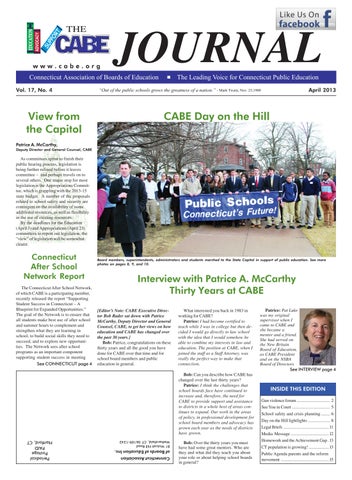
Board members, superintendents, administrators and students marched to the State Capitol in support of public education. See more photos on pages 8, 9, and 10.
Interview with Patrice A. McCarthy Thirty Years at CABE [Editor’s Note: CABE Executive Director Bob Rader sat down with Patrice McCarthy, Deputy Director and General Counsel, CABE, to get her views on how education and CABE has changed over the past 30 years.] Bob: Patrice, congratulations on these thirty years and all the good you have done for CABE over that time and for school board members and public education in general.
What interested you back in 1983 in working for CABE? Patrice: I had become certified to teach while I was in college but then decided I would go directly to law school with the idea that I would somehow be able to combine my interests in law and education. The position at CABE, when I joined the staff as a Staff Attorney, was really the perfect way to make that connection. Bob: Can you describe how CABE has changed over the last thirty years? Patrice: I think the challenges that school boards face have continued to increase and, therefore, the need for CABE to provide support and assistance to districts in a whole host of areas continues to expand. Our work in the areas of policy, in professional development for school board members and advocacy has grown each year as the needs of districts have grown. Bob: Over the thirty years you must have had some great mentors. Who are they and what did they teach you about your role or about helping school boards in general?
Patrice: Pat Luke was my original supervisor when I came to CABE and she became a mentor and a friend. She had served on the New Britain Board of Education, as CABE President and on the NSBA Board of Directors See INTERVIEW page 4
INSIDE THIS EDITION Gun violence forum .............................. 2 See You in Court .................................. 5 School safety and crisis planning ........ 6 Day on the Hill lightlights .................... 8 Legal Briefs ......................................... 11 Media Message .................................. 12 Homework and the Achievement Gap .13 CT population is growing! ..................13 Public Agenda parents and the reform movement ...........................................15
81 Wolcott Hill Road Wethersfield, CT 06109-1242
of Boards of Education Inc. Connecticut Association
Periodical Postage PAID Hartford, CT
2
The Journal – Connecticut Association of Boards of Education • April 2013 PRESIDENT COMMENTARY
Appreciation all year . . . School board members are a highly valued and important part of our communities’ social fabric. More and more, however, our work as advocates for our children involves time outside of our district, as much as the work we do in a myriad of meetings throughout the regular work week. Whether participating on panels, in symposiums, community conversations, or testifying before legislative committees – we are valued and respected as educational leaders on our own boards, in our communities, at the State Capitol and in Washington. Recently, Bob Rader and I had the opportunity to attend a town hall meeting “Moving from Tragedy to Action: The Power of Community.” Looking through the lens of Newtown, panel and audience members spoke on ideas on how communities can come together to transform concerns, emotions, ideas and resources, through combined civic involvement. More importantly, I came away with a renewed sense of appreciation from comments from three students. An eight grade student who lost her aunt in the massacre spoke of inspiring fellow students to follow random acts of kindness, not just when tragedy strikes. A high school student mentioned the importance of civic connections as acts of goodwill through her involvement with the Unity Project though Newtown High School. A local college student requested a seat at the table, where personal experiences of young adults regarding mental health can be voiced. [Editor’s Note: a link to the television program on the town hall meeting can be found at the CT-N website. CABE’S Day on the Hill offered us the opportunity to thank Governor Malloy for the leadership he has demonstrated in supporting public education. From the Year of Education Reform to providing additional funding in these difficult economic times, the Governor continues his commitment to public education. As we marched to the LOB, our mantra chant “Support our Future” was heard loud and clear.
Meetings with legislators addressed issues facing districts; students presented by their Representatives on the House Floor delivered key messages “celebrating success” their individual schools. The student forum revolved around conversations pertaining to HB 6505, An Act Concerning Lydia Tedone Parameters for Fees for Extracurricular Activities at Public Schools. Measures of success were demonstrated in their critical thinking as they debated relevance from real experiences at their high schools at the same time discussions centered on how to improve ways education dollars are spent. Several students summed up their observations of the day, “Hearing the Governor and Legislators speak broadened my understanding on issues education is facing. Interacting with other students allowed me to compare and contrast our school’s problems and solutions. By speaking with Legislators, I was able to voice my opinions. I feel fortunate I was able to go.” Another student commented,” Very informative day; the question and answer session by the Governor offered great insights to his thoughts on education. It was fantastic for me as a student to ask him a question regarding the new Evaluation Process. It was very encouraging as a student to see so many people who are investing in our future.” Finally, acknowledgement must be given to your advocacy efforts on behalf of your continued support in protecting and sustaining education priorities facing our districts, We are appreciated by our school systems. Our children are counting on us.
Gun violence forum Kelly Moyher, Senior Staff Attorney, CABE
On February 21st CABE President Lydia Tedone and I represented CABE at the Gun Violence Forum hosted by U.S. Senators Richard Blumenthal and Chris Murphy and U.S. Congresswoman Elizabeth Esty. The Forum was by invitation only to public officials, educators, stakeholder groups and individuals and others from around the state of Connecticut and families of the victims in Newtown were invited as panelists as well as spectators. The Forum featured many prominent and knowledgeable professionals in their fields who spoke about gun violence, mental health and school safety initiatives and concluded with an address from Vice President Joe Biden. Held at Western Connecticut State University, the four-hour Forum featured two panels: the first addressing gun violence and reform to the country’s federal laws; the second addressing mental health and school safety initiatives. The first panel consisted of Captain Dale Hourigan of the Connecticut State Police Department, City of Hartford Mayor Pedro Segarra, Chris and Lynn McDonnell of Newtown, New Haven Detective Stacy Spell, Senior Vice President for Public Affairs of ‘Third Way’ Matt Gennett, and Dom Basile, local sportsman and gun advocate. The first panel was in agreement that there is a responsibility as a state and as a country to our children who are currently growing up in a world where it is ‘scary’ to attend school. Regardless of positions on guns, panelists agreed that this atmosphere is unaccept-
able for children to grow up in, is damaging to the psyche and will damage their views of the world unless changes are made. The first panel also brought forward valuable information to the group. For instance, the group learned that 9 out of 10 gun violence crimes each year are not committed by the actual owner of the gun and the crime is usually not committed in the state where the gun is originally purchased. There are also currently no background checks for ammunition purchases in the state. The panel also discussed the need for much stronger penalties as much gun violence occurs at the (please see GUN page 15)
“Leadership” Each month we will print a quote on the meaning of LEADERSHIP. Send us your definition of leadership to be printed in the CABE Journal. “ Leadership of anything means mission first and your self-interest last, . . . That’s the very definition of what it means to lead.“ said Michael Useem, Director of the Center for Leadership and Change Management at the University of Pennsylvania’s Wharton School.
CABE Board of Directors EXECUTIVE COMMITTEE Lydia Tedone .................................................. President, Simsbury Richard Murray ............................. First Vice President, Killingly Ann Gruenberg ........... VP for Government Relations, Hampton Stephen Wright ............. VP for Professional Development, Trumbull Robert Mitchell ............................ Secretary/Treasurer, Montville Don Blevins ........................................... Immediate Past President John Prins ........................................................... Member at Large
AREA DIRECTORS Susan Hoffnagle ....................... Area 1 Co-Director, Winchester Mari-Ellen (Mimi) Valyo ........ Area 1 Co-Director, Winchester Daniel Santorso ........................... Area 1 Co-Director, Plymouth Becky Tyrrell ................................. Area 2 Co-Director, Plainville Susan Karp ..................................... Area 2 Co-Director, Glasbonbury Don Harris ........................................ Area 2 Co-Director, Bloomfield Laura Bush .................................................. Area 3 Director, Vernon Douglas Smith ...................................... Area 4 Co-Director, Plainfield Steve Rosendahl .............................. Area 4 Co-Director, Woodstock Gavin Forrester ................................... Area 6 Co-Director, Stratford Elaine Whitney ................................... Area 6 Co-Director, Westport Sheila McCreven ........................... Area 7 Co-Director, Woodbridge John Prins ............................................ Area 7 Co-Director, Branford Pamela Meier ............................................. Area 8 Director, Madison Gail MacDonald .................................... Area 9 Director, Stonington
ASSOCIATES Eileen Baker ........................................... Associate, Old Saybrook Sharon Beloin-Saavedra .......................... Associate, New Britain Gary Brochu ........................................................ Associate, Berlin Robert Guthrie .......................................... Associate, West Haven Cal Heminway ................................................... Associate, Granby COMMITTEE CHAIRS Elizabeth Brown ............................ Chair, State Relations, Montville Beverly Washington ....................... Chair, Federal Relations, Groton Becky Tyrrell ....................................... Chair, Resolutions, Plainville
CITY REPRESENTATIVES Jacqueline Kelleher ......................... City Representative, Bridgeport Matthew Poland ................................. City Representative, Hartford Carlos Torre ................................... City Representative, New Haven Polly Rauh ......................................... City Representative, Stamford Charles Stango ............................... City Representative, Waterbury
STAFF Robert Rader ...................................................................... Executive Director Patrice McCarthy ................................ Deputy Director and General Counsel Bonnie Carney ........................................... Sr. Staff Associate for Publications Nicholas Caruso ............................................ Sr. Staff Assoc. for Field Service and Coord. of Technology Sheila McKay ............................ Sr. Staff Associate for Government Relations Kelly Moyher ......................................................................... Sr. Staff Attorney Vincent Mustaro ..................................... Sr. Staff Associate for Policy Service Lisa Steimer .............................. Sr. Staff Assoc. for Professional Development Teresa Costa ............................... Coordinator of Finance and Administration Pamela Brooks ......................... Sr. Admin. Assoc. for Policy Ser. /Search Ser. Terry DeMars .............................................. Admin. Assoc. for Policy Service Melissa Dickinson ........................... Admin. Assist. for Membership Services Gail Heath ...................................... Admin. Assoc. for Government Relations Wilmarie Newton ...................................... Admin. Assoc. for Labor Relations Corliss Ucci .............................. Receptionist/Asst. to the Executive Director
The CABE Journal (ISSN 1092-1818) is published monthly except a combined issue for July/August as a member service of the Connecticut Association of Boards of Education, 81 Wolcott Hill Road, Wethersfield, CT 06109, (860) 571-7446. CABE membership dues include $30 per person for each individual who receives The CABE Journal. The subscription rate for nonmembers is $75. Association membership dues include a subscription for each board member, superintendent, assistant superintendent and business manager. The companies and advertisements found in The CABE Journal are not necessarily endorsed by CABE. “Periodicals Postage Paid at Hartford, CT.” POSTMASTER: Send address changes to The CABE Journal, CABE, 81 Wolcott Hill Road, Wethersfield, CT 06109-1242. Email: bcarney@cabe.org. Members can find the CABE Journal online at: www.cabe.org/ userlogin.cfm?pp=84&userrequest=true&keyrequest=false& userpage=84
3
The Journal – Connecticut Association of Boards of Education • April 2013 EXECUTIVE DIRECTOR COMMENTARY
CABE Affiliate Members BUSINESS AFFILIATES DIAMOND MEMBER ACT, Inc. - Northeast Region Finalsite GOLD
MEMBERS
Berchem, Moses & Devlin Centris Group Shipman & Goodwin Siegel, O'Connor, O’Donnell & Beck, P.C Sullivan, Schoen, Campane & Connon
SILVER MEMBERS Anthem Blue Cross and Blue Shield Corporate Cost Control Milone & MacBroom, Inc. Quisenberry Arcari Architects The Segal Company
BRONZE PLUS MEMBERS Brown & Brown Insurance Friar Associates Goldstein & Peck, P.C. Lindburg & Ripple O & G Industries The S/L/A/M Collaborative Trane Whitsons School Nutrition
BRONZE MEMBERS Chinni & Meuser LLC Dattco Inc. Fuller & D’Angelo Architects and Planners Kainen, Escalera & McHale, P.C. The Lexington Group Muschell & Simoncelli Ovations Benefits Group
EDUCATIONAL AFFILIATES American School for the Deaf Area Cooperative Educational Services Capitol Region Education Council The College Board Connecticut Association of School Business Officials Cooperative Educational Services Connecticut Center for School Change Connecticut School Buildings and Grounds Association EASTCONN EDUCATION CONNECTION LEARN Unified School District #1
Students say “Nobody Cares”! One of the saddest perspectives I heard following the Newtown shootings took place at a meeting, sponsored by the Clifford Beers Clinic, between mental health care experts from Bridgeport and New Haven and experts from the National Child Traumatic Stress Network in New Have including a woman with direct experience in the Oklahoma bombing incident and the NCTSN’s terrorism and disaster expert. The Clinic provides a “programs and services for families with children affected by trauma and stress that includes complete wraparound care.” Beers “uses a trauma-informed approach to care as it strives to ensure that the children and families it serves live healthy, successful lives supported by a strong community.” John Prins, a member of the Branford Board and the CABE Board of Directors, is the Clinic’s Director of Human Resources. He invited us to join the meeting which was arranged to help provide some perspective to the horrific events of that December day in Newtown, where several Beers clinicians had been assigned as a crisis response team A mental health professional from one of our big cities shared that students in her inner-city schools could not understand the degree of attention on the students in Newtown. Shootings occurred around their school all the time and no one seems to notice. It was just expected. They were not lavished with teddy bears or toys or media attention from anyone. I’ve thought about those comments a lot since December. To me, it’s not about comparing the magnitude of the Newtown tragedy to what we see in our cities. It’s not about the other social, racial and other differences between what happened in Newtown and the cities. Of course, all of these play a role. But, what is so striking to me is that too many of our kids feel undervalued – that no one cares about them and what they experience daily. We have to ensure that all of our students feel valued, no matter their race, creed, gender, sexual orientation, color, religion, economic status, disability or where they live. The students’ comments could be a cry for help or an indication of hopelessness. But, students need a feeling of worth, respect and recognition of their value. Those without a feeling of worth find it very hard to concentrate on school. They are much less motivated to do well in a system that they feel from the beginning is stacked against them – and that nobody even cares. This attitude may permeate their whole lives, resulting in not taking advantage of opportunities to move up in society. We all lose because those who might have made great progress in any aspect of society, were unable to move beyond where they were.
dual’s background or status – is normal. The 12-year-old girl shot in front of her urban school is no less tragic than any one of the 20 children taken at Sandy Hook. • Mental health must be a bigger factor in how we assess our students, and mental health services must be readily available… the Clinic reports that the children it treats show quantitative improvement within three to six months of receiving therapy, as evidenced by a reduction in anger; improved relationships with peers, and; a healthier and better connection to family members. Patrice McCarthy and I worked with a class of secondary school education majors at the University of Hartford and brought up the issue: how do we ensure all students feel valued? Their answers were instructive: • More interaction with peers with a focus of respect would help. • Students who feel marginalized often have selfesteem issues. They often have unique characteristics that they may be having trouble coming to terms with. They need to value the parts of them that are unique. Materials are available that can help them better understand themselves. • Often, the work of other students of an inspirational nature can help them. Posting them in a class or elsewhere in a public area of a school may be helpful. • Especially while thinking about issues like what the students might have been thinking after Newtown, the students may need more internal supports. They need to focus on the support of people they know, rather than those they don’t. Some other suggestions from the Beers Clinic:
“We have to ensure that all of our students feel valued.”
Talk with the Experts Thinking about these issues, I turned to the experts at Clifford Beers Clinic who report: • No shooting – regardless of an indivi-
Robert Rader
• Ask families in the district what they need. • Make sure someone is available to talk to if a child needs to and make sure all the conditions are right for that to happen when it needs to happen. • Make sure that adults in the building are modeling appropriately, i.e., actually doing themselves what they say is the right thing. • Create policy/policies that establish professional development as a priority to ensure that staff are educated on o types and symptoms of mental health problems o modeling behaviors that minimize or eliminate stigma associated with mental illness o leading staff in creating caring communities within their buildings. • Ensure that trauma-informed mental health professionals are integrated into the general school environment. • Develop procedures for addressing potential problems, including – o working first with parents and basic classroom interventions, o having regular meetings with teachers about children with difficulties, o informing parents when and why the school psychologist is being brought in, o inviting parents to participate in meetings and evaluations, and (please see STUDENTS page 15)
A Professor Weighs In Harvard Associate Professor of Psychology Dr. Gil Noam, who I met at a safety clinic sponsored by the New York State School Boards Association, made these points about how schools can best handle children who feel undervalued: • Treat any such situation with proper respect and dignity. Make sure all students feel respected and honored. • Invest in support teams from outside the schools when a tragedy has occurred. • Make sure there are links between afterschool programs, mentoring and middle schools, so that they work together more effectively. • Students need positive adult relationships in the schools. And, adults must LISTEN. This has the
highest benefit. • Ensure every student is known and relevant information is shared between teachers, administrators, etc. • There must be productive student/ teacher relationships, fostered by school leaders and superintendents. • Coaches are also helpful to ensure that teachers are sensitive to the mental health needs of their students. Dr. Noam developed the Program in Education, Afterschool, and Resiliency (PEAR), the mission of which is “to create and foster school and afterschool settings in which all young people can be successful.” Robert Rader, Executive Director, CABE
4
The Journal – Connecticut Association of Boards of Education • April 2013
Interview with Patrice A. McCarthy Thirty Years at CABE (continued from page 1) before joining the CABE staff. She led CABE’s Government Relations effort, and I learned a great deal about working effectively with legislators from her. I also learned a great deal about association management, working in coalitions and connecting with other organizations at the state and national level.
become a year round activity. The number of task forces and commissions that meet in the interim between legislative sessions is a full-time job in and of itself. It’s no longer a matter of being sure you are at the Legislature when the Legislature is in session, but equally important is being at the table, or at least in the room, when the discussions take place throughout the year.
Bob: What are some of your most memorable moments at CABE? Patrice: One is the role CABE was able to play in the development of school funding formulas over the years. While at times very frustrating, it’s also very exciting to help board members understand the funding system. Also, through my work at CABE, I’ve had the incredible opportunity to serve at the national level as the Chairman of NSBA’s Council of School Attorneys, working with colleagues throughout the country who have vast expertise in school law and are so generous in sharing that expertise. As an evaluator of international schools for the New England Association of Schools and Colleges, I have been able to look at school governance issues around the world, providing support and assistance to those schools and also learning a great deal that is applicable to our work in Connecticut.
Bob: What do you see as the future? Is it just going to get more and more harried and difficult? Patrice: I think in the immediate future, yes, it will, because the implementation of the multitude of education reforms, both in Connecticut and nationally, will require intense focus by board members, educators and CABE staff. The focus of legislators is going to remain on public education.
CABE Executive Director Robert Rader interviews Patrice McCarthy, Deputy Director and General Counsel.
Bob: So, with your experience and skill at working at the local level doing retreats, roles and responsibilities workshops and other events, what would you suggest CABE members and their superintendents do to strengthen public education? Patrice: It’s extremely important that boards and superintendents are focused on their respective roles and responsibilities at the local level, because that has a significant impact on public confidence in their schools. They should realize that they are not in this alone and that they don’t have to reinvent the wheel. They should use the resources, such as CABE, that are available to them to get guidance and input before they take an action.
Bob: What else should board members and other readers know about your work at CABE and about you?
Bob: How has your job as head of CABE’s advocacy efforts changed since you got that position? Patrice: As a greater focus has been put on education at both the state and federal levels, advocacy for public education has
Gun violence forum (continued from page 2) hands of repeat offenders. Of particular interest to the group was the question of why guns play such a large role in American society. The panel expressed a need to change our culture and address why people feel the need to protect themselves and/or settle differences with a firearm. The second panel addressing mental health and school security included Dr. George Sugai of the UCONN Neag School of Education, Dr. Kathryn Seifert, author of ‘Path to Violence’, Dr. Philip Wang, Deputy Director of the National Institute of Mental Health, Dr. Mark Benigni, Superintendent of Meriden Public Schools and Dr. Steven Girelli, President and CEO of Klingberg Family Centers. The panel first discussed that mental illness and violence are often two different constructs and the vast majority of mentally ill are no more at risk for violence than anyone that was in the room that day. One risk factor that does influence mental illness is lack of treatment. On average, a person usually waits 100 weeks from their first experience with mental illness to seek help. Mental illness is often not a trigger for violence, but rather a person becomes violent when a multitude of issues form a perfect storm. In looking at schools and school age children, the panel agreed that more family
and community resources are needed to help schools engage the entire family and look at the mental and physical health of the child and family members. Unfortunately, when a district faces budgets cuts, resources like social workers, school psychologists and behavior experts are often the first to go. The second panel also looked to American culture and focused on the idea of reaching out to families while also teaching or ‘reteaching’ social skills and alternatives to violent behavior just as academics are taught. Pop culture and exposure to violent media and games was also discussed. After hearing from Governor Malloy and U.S. Secretary of Education Arne Duncan, Vice President Biden spoke of his history working on issues concerning gun control and stated he has never seen an array of officials who are as committed and talented who have been called to the table to address these issues as he has seen not only in the country right now, but particularly in the state of Connecticut. He reiterated the sentiment that the issues and questions the state and the country are facing do not have a single answer, but rather there are a multitude of things that can and must be done to assure safety in our schools, resources for mental health issues and safe and lawful gun use.
Bob: And would you say one of their most important roles is advocacy? Patrice: Absolutely. At the local level, advocacy involves building and maintaining community support for education. As the largest group of elected officials in Connecticut, board members also have a responsibility to communicate with legislators at the state and federal levels about the need of the students and their schools.
Patrice: When I came to CABE thirty years ago I was excited and challenged by the position and that remains true today. I didn’t necessarily expect that this would become my career and my life, but it continues to be an honor and a privilege to work with volunteer school board members who are committed to making a difference in the lives of children. Bob: Wonderful, thank you and here’s to another thirty years!
5RRÀQJ DQG %XLOGLQJ 6ROXWLRQV Through a partnership with AEPA and CREC, Tremco, a leading innovator and provider of roofing and weatherproofing solutions, delivers unique facility asset management solutions designed to reduce your roofing and building envelope life-cycle costs while improving performance The benefits to buyers include: t A streamlined procurement process t Single-source responsibility: turnkey t Pre-competed line item pricing
t Buying power of a national contract t Shorter project time t Use of “best in class” contractors
For more information, contact Cara Hart at 860-524-4021 or chart@crec.org.
Connecticut After School Network Report (continued from page 1) the Common Core requirements. In 2010, 7 out of 10 Connecticut children ages 6-12 had all available parents in the labor force. Many of these children were home alone or unsupervised while their parents were at work. A study by the National Institute of Child Health and Human Development Study of Early Child Care and Youth Development (SECCYD) has made the following preliminary conclusions about after school activities: • Positive short-term effects of high quality programs on student academic and social outcomes • Positive long-term effects of high quality programs on school attendance and task persistence • Positive cumulative afterschool effects for student grades, math achievement, and work habits and • Evidence of after school activities eliminating the achievement gap in mathematics achievement.
The report outlines seven recommendations for investing in the future: • Increase access to expanded learning opportunities • Support expanded learning opportunities to address summer learning loss • Incorporate expanded learning opportunities in the state education reform strategies • Increase alignment between different systems and funding • Use expanded learning opportunities to rethink relationships between time and learning • Strengthen the statewide system for quality and accountability • Continue to improve existing programs. The complete report can be found at www.ctafterschoolnetwork.org/documents/CTAfterSchoolNetwork.pdf Patrice A. McCarthy, Deputy Director/General Counsel, CABE
5
The Journal – Connecticut Association of Boards of Education • April 2013 See You in Court – The Nutmeg Board of Education
The Nutmeg Board deals with bad weather and maybe canceling April vacation Thomas B. Mooney, Esq. Shipman & Goodwin
The Nutmeg Board of Education makes many mistakes. The latest imbroglio created by the board will be reported here each issue, followed by an explanation of what the board should have done. Though not intended as legal advice, these situations may help board members avoid common problems. It has been one problem after another this year, with storms and cancellations. It is only the beginning of April, and already the last day of school for the Nutmeg Public Schools this year is scheduled for June 25. Bob Bombast, veteran member of the Nutmeg Board of Education, is worried that one more big storm could push the last day of school into July, which is not allowed. Accordingly, Bob was considering suggesting that the Board cancel April vacation to create a buffer. However, before he did so, he wanted to get some informal parent feedback, and Bob sent out a survey on his personal email on his home computer to 200 of his closest parent friends, asking for input. Bob was shocked at the vehement response against his proposal. Of the 120
responses he received, over 100 were opposed to canceling any part of April vacation. Bob was disappointed, because he felt that there was no reasonable alternative to assure that the students would get their 180 days of school. Therefore, Bob decided after some reflection to keep quiet about the survey and go ahead and propose canceling April vacation. Given that the Board agenda for the meeting last night already included the item School Calendar, Bob was all set to make his pitch. As soon as the Board reached this agenda item, Bob’s hand shot up, and he announced, “Mr. Chairman, after hearing from our constituents, I think that we should bite the bullet and cancel April vacation to make sure we can end the school year on time.” Mal Content, Bob’s nemesis on the Board, was ready. “Is that a motion, Bob? If so, I am surprised. Some parents told me about your survey, and they must have told you what they told me – cancelling vacation at this late date is a terrible idea. Aren’t you going to share your survey results with us?” “Well . . . .” Bob responded uncertainly, “That survey was on my home
Seventh Edition Now Available
A Practical Guide to Connecticut School Law by Thomas B. Mooney, Esq. Shipman & Goodwin The Guide comes with a CD which provides hyperlinks to many cases and statutes and will permit word searches as a supplement to the Index. New to the Seventh Edition: Bullying, Background Checks, Child Abuse Reporting, Discrimination Issues, Educational Reform, FERPA, Freedom of Information, State Aid for Education and much, much more The 7th edition is now available from CABE. Call and order your copy TODAY at 860.571.7446 or 800.317.0033
email, and it had nothing to do with the Board. The issue is the school calendar, and we should cancel April vacation so that we can finish the year on time.” Mal was quick to respond. “I will vote against the motion. Bob is overreacting. It is still early. We will probably be fine with the weather for the rest of the year.
Saturday or Sunday.” School districts thus must schedule all 180 school sessions Monday through Friday prior to July 1 or obtain a waiver. The State Board of Education views the granting of a waiver as a last resort. In Circular Letter C-9, Series 2010-2011 (January 21, 2011), the Commissioner of
“. . . a public official, and any email he sends out or receives that relates to the business of the Nutmeg Public Schools is a public record. . . . whether Bob uses his home computer or his personal email address.” And if need be, we can either hold school on Saturdays or get a waiver. We might even do double sessions to make up the time.” The other Board members had no interest in disappointing students and parents alike by canceling April vacation, and they were relieved to hear Mal shoot down Bob’s proposal. Indeed, Bob’s motion did not get a second. However, there was one calendar issue that the Board members did address. Ms. Superintendent explained that the Board would soon have to put down its deposit for the venue for graduation, and she asked for a motion fixing a graduation date of June 25, come hell or high water. The motion passed unanimously. If extra school days are needed, will Mal’s ideas work? School districts throughout the state have been challenged to make up school days this year, and we should all hope for a quiet spring. The statutes provide that all school districts must hold at least 180 actual school sessions each year, and those sessions must be held prior to July 1, which by statute is the start of the new school year. Some years ago, the General Assembly eliminated the concept of a minimum school day of four hours. That change made sense. Before the change, superintendents would feel pressure to delay early dismissals to get in the four hour minimum day even as the weather would worsen. Now, there is no minimum number of hours for a school session, and school districts must simply offer 900 hours of actual instructional time (450 for kindergarten) to students. However, school districts cannot count more then seven hours in any day. Conn. Gen. Stat. § 1016. Thus, Mal’s suggestion of double sessions is questionable. Even though the minimum school day has been eliminated, 180 school sessions are still required. This requirement is virtually absolute, with only the possibility that the State Board of Education can waive this requirement, an unlikely prospect, as discussed below. Conn. Gen. Stat. § 10-15. The statutes impose further restrictions on rescheduling school days. Section 1016 expressly states that “[w]hen public school sessions are cancelled for reasons of inclement weather or otherwise, the rescheduled sessions shall not be held on
Education stated: “When closures due to inclement weather occur early enough in the school year (such as in the winter months), local boards will have sufficient time throughout the remainder of the school year, through June 30, to make up lost days. Therefore, the State Department of Education (SDE) ordinarily will not support waiver requests for snow days. As a result, boards of education should anticipate that the SBE will not ordinarily consider waiving the 180-day requirement this year due to school closures as a result of inclement weather. Therefore, school districts should certainly not count on the State Board of Education to grant a waiver so that they can avoid difficult choices. Before granting any such waiver, the State Board of Education will ask what efforts the district has already made to reschedule the days, including by using vacation days or holidays. In addition, the State Board would likely require a plan to make up the time in the following year. The action taken regarding graduation stands on a different footing. After April 1, boards of education may schedule a firm graduation date as long as the calendar then provides for a year of at least 180 days of school from that day forward. Conn. Gen. Stat. § 10-16l. However, if subsequent cancellations would result in fewer days by the date of graduation, the graduating seniors must be invited back to receive the full 180 school sessions for the year. See Circular Letter C-9, cited above. Finally, Bob created a potentially embarrassing problem for himself when he sent out his survey. Bob is a public official, and any email he sends out or receives that relates to the business of the Nutmeg Public Schools is a public record. Such is the case whether Bob uses his home computer or his personal email address. If Mal really wanted to cause Bob trouble, he could make a Freedom of Information Act request for copies of the survey results, and upon receiving that request Bob would be legally obligated to provide those records to Mal. Attorney Thomas B. Mooney is a partner in the Hartford law firm of Shipman & Goodwin who works frequently with boards of education. Mooney is a regular contributor to the CABE Journal.
6
The Journal – Connecticut Association of Boards of Education • April 2013
A policy perspective on school safety and crisis planning Vincent A. Mustaro Senior Staff Associate for Policy Service, CABE
Districts must be prepared to respond to a multitude of potential emergency situations in order to protect the safety and well-being of students and staff and to create a safe, secure, and positive learning environment. This responsibility must be the first priority of all boards of education. The Newtown tragedy has refocused Americans, especially those within the education community, on the question of how to best protect children in our schools. Board members’ interest and concern for information about school safety plans and policies have been raised. Attention needs to be given to what has been done or should be done in school districts to ensure that plans and procedures are in place to provide a safe school environment. Prevention efforts are a priority. Violence remains one of the most difficult issues facing all school districts. More individuals, including school children, have access to dangerous weapons and are using them at an alarming rate. Connecticut schools, we have sadly learned, are not exempt from violent episodes and the loss of lives. However, we need to keep in mind that schools remain the safest place for children, and today’s schools are considerably safer than they were twenty years ago. Over the last decade, the number of schools reporting an incident of violent crime fell by more than 20 percent. However, despite successful efforts by school districts to reduce gun violence in the schools, each year 3,000 children and teens are killed by guns and 15,000 are injured outside of schools. Therefore, the solution to preventing the killing of innocent youth cannot be solely the responsibility of the school community. More attention and resources to improving school safety must be thoughtfully considered and sustained over time. All children have the right to live and learn in a safe and nurturing environment. Research demonstrates that learning is enhanced when children feel safe and their physical and emotional needs are met in a safe and healthy school environment. The effects of violence include rising fear among students, a feeling of loss of control by teachers and administrators and calls for action from the community.
School leaders seek to reduce the risks to students and staff, but recognize that there is no fool-proof solution to this ever-growing problem. No single solution will keep children safe in schools. However improving school security measures, educating students, staff, and parents/guardians on school crisis plans, periodic drills, and an increase in responsive mental health services are essential to progress. School boards may not be able to solve the underlying cause of violence but are in a unique and influential position to deal with violence. Boards are responsible for ensuring students, teachers, staff and visitors that the schools are safe places in which teaching and learning can occur. Instructional programs designed to educate students about alternate, nonviolent means of dealing with their problems can be implemented. It is appropriate and necessary to audit the district’s safety and discipline policies and procedures to see if they are up-todate, modified as necessary, and understood by all. Additional community input must be a part of the review, modification and implementation. However, we must also face the reality that tragic violence may not be preventable by school actions. Such violence is often the result of a complex mosaic of possible factors. Our awareness level of such factors can be raised. While the value of many intervention strategies is still questionable, school staff and students will have to treat security issues and threats of violence more seriously than previously. School boards must address violence before it occurs. An effective safety and crisis response program, linked to an effective education program for both students and staff, can help prevent violent incidents and lessen their impact if they occur. A number of key policy areas should be reviewed in board efforts to combat violence. Connecticut boards of education have policies and procedures related to various aspects of school security. Emergency management plans should be developed within the four phases of emergency management: prevention-mitigation, preparedness, response and recovery. In addition, schools should collaborate closely with police, fire and emergency services personnel and community partners, including public and mental health professionals, who can assist with
Ellen Camhi, Life-Long Education Advocate, Passed Away Ellen Camhi, a member of the State Board of Education since 2011, died recently. She served on the Stamford Board of Education for 12 years, including several terms as president. During that time she also served on the CABE Board of Directors. A tribute issued by the State Board of Education indicated “she cared deeply about students and their success and about the teachers and administrators entrusted with their care…she cared about the people of the state of Connecticut and she worked tirelessly to insure that those in office provided the leadership required to protect the rights of all.” Pat Luke, who served with Ellen on
both the State Board of Education and the CABE Board of Directors, said “I met Ellen Camhi when she was a member of the Stamford Board of Education and was active in CABE. Ellen was determined to make much needed changes happen on her board and in her schools. She just wouldn’t give up and nothing and no one could make her back down. She looked like an angel, but she was tough! She had that rare combination of toughness and compassion. Ellen was a woman who knew power and used it for the greater good.” CABE extends its sympathy to Ellen’s family. Patrice A. McCarthy, Deputy Director/General Counsel, CABE
the development of plans that address a wide range of crises. Such collaboration must be maintained in the drills to practice the plans and any necessary modification. School emergency management plans must be developed embracing an allhazard approach, to include appropriate emergency responses to such potential emergency situations, including but not limited to: fire, bomb threats, gas or chemical leaks, hazardous material release, weather-related emergencies, medical problems or school accidents, suicide, bus accidents, and violent actions. It is essential to bring together emergency services personnel, community partners and school-based staff to form a district wide crisis response team as a key step in developing a strong plan. Schools and school districts need to coordinate their emergency management activities, plans and resources with federal, state, and local agencies to ensure alignment with and compliance to certain policies, initiatives and programs. Schools and school districts need to ensure that their emergency management plans are aligned with the U.S. Department of Homeland Security’s National Incident Management System (NIMS). NIMS is a unified response plan used by first responders to prepare, coordinate, and execute responses to all types of emergencies. In addition, as part of the emergency management plan development process, schools and school districts should establish an Incident Command System (ICS). The ICS is the response infrastructure designated under NIMS to facilitate effective and efficient incident management. A comprehensive, multi-hazard emergency management plan should include district policies for a variety of incidents and potential emergencies. The aim of such policies is the fostering of a safe and nurturing school climate conducive to learning. Also, more staff training, with a stronger component on crisis preparedness, is needed. Policy, by itself, will not prevent the tragedy of Newtown. It is the manner in which district policies are implemented which provide the best opportunity for an appropriate response. Policy Implications: School districts have to be aware of and take action to prevent foreseeable dangers and to have a plan for those that are unforeseen and mitigate their effects as much as possible. The entire education community must be involved in the efforts to protect staff, students and district facilities and resources. Through policy related to safety and security and the actions taken to implement them, boards can take the important steps to ensure that their districts are prepared for a variety of potential emergencies. Policies must be appropriately disseminated and the implementation actions practiced and modified as necessary. Crisis and emergency planning should be driven by policy directives in a number of areas. A single policy, pertaining to just school security, is not the advocated approach. Many policies, starting with a district’s mission statement, can speak to various issues pertaining to safety. The key ingredient is the manner in which the policies are thoughtfully implemented. Awareness and planning help to ensure the safest possible environment. Emergency and security plans must be
collaboratively developed, easily understood, sufficiently detailed to be quickly implemented, practiced and periodically reviewed. The board through policy states its desire for a safe, nurturing environment and appropriate response to a multitude of potential emergency situations. The administration must develop the necessary plans and protocols to implement these policies. As previously stated, a comprehensive, all-hazards approach to safety, security and crisis management is recommended, based initially upon board policy. This approach starts with a district’s mission statement which speaks to the board’s goal to provide a safe, secure, drug-free and welcoming environment for all students and those professionals who serve them. CABE’s most recent Policy Update Service publication contains policy and administrative regulations pertaining to school security. In addition, a listing of other policies which should be considered in light of an “all-hazards” approach to school safety and school climate issues is included. Contact CABE’s Policy Department to secure a copy of this publication.
NOW AVAILABLE
Special Edition of Policy Security Publication The third edition of the Policy Update Service publication has been mailed to the districts subscribing to this service. This edition is considered a “special issue” related to a single topic: school security, safety and crisis management. The Newtown tragedy has refocused our attention on the question of how to best protect the children and staff in our schools. This 103-page publication contains updated sample policies and administrative regulations pertaining to security, building access, video surveillance, crisis management, emergency disaster preparedness and other related topics. Normally the Update Service Publication is available only to subscribing districts. However, a one-time exception is being made due to the nature of the tragedy and the fact that the subscribing districts to the service have already received their copy. Copies of this publication are now available to all CABE member districts at a price of $100. This fee includes the publication, a CD to facilitate local use of the contents of the publication and all shipping and handling charges. The publication may be ordered by contacting the CABE Policy Department at pbrooks@cabe.org or tdemars@cabe.org. Please provide a purchase order number at the time of ordering.
The Journal – Connecticut Association of Boards of Education • April 2013
The art of making people smile. Delta Dental knows what it takes to keep you and your employees happy. At Delta Dental, we can help you create a dental plan that’s sure to paint a smile on your employees faces: • Expertise. We’re part of the most experienced dental benefits company in the country. • Flexibility. We can help you design a plan that meets your needs and budget—without compromising on value. • Network of Dentists. We offer access to the largest network of dentists in the U.S.— with 4 out of 5 dentists participating nationwide. • Simplicity. You can count on us for easy plan administration. • Customer Satisfaction. Add it all up: the largest network, unbeatable expertise, flexibility, value and cost savings, and it’s easy to see why Delta Dental is your best choice. Delta Dental. We’re committed to promoting oral health for all your employees. Call 1-860-633-9200 or visit www.deltadentalct.com. In CT, Delta Dental Insurance Company writes dental coverage on an insured basis and Delta Dental of New Jersey administers self-funded dental benefit programs.
7
8
The Journal – Connecticut Association of Boards of Education • April 2013
Day on the Hill – Speakers
CABE Vice President for Government Relations Ann Gruenberg (Hampton) welcomed everyone.
CABE President Lydia Tedone (Simsbury)
Governor Dannel P. Malloy spoke to participants and then answered questions from the audience.
CABE Executive Director Robert Rader
Senator Toni Boucher spoke about pending legislation and took questions from the audience.
CABE Senor Staff Associate for Government Relations Sheila McKay updated participants on legislation before the General Assembly.
Representative Andy Fleischmann spoke about mandates and trying not to adopt any that are unfunded.
CABE Deputy Director and General Counsel Patrice A. McCarthy talked about school safety legislation, evaluation, school transportation and funding.
CABE First Vice President Richard Murray (Killingly) thanked Governor Malloy for making public education a priority. Granby Superintendent Alan Addley asked a question of the Governor.
^Ɖ ^ƉĞĐŝĂůŝnjŝŶŐ /Ŷ͗ ŶƌŽůůŵĞŶƚ WƌŽũĞĐƟŽŶƐ ^ĐŚŽŽů ZĞĚŝƐƚƌŝĐƟŶŐ ͬ ZĞĐŽŶĮŐƵƌĂƟŽŶ >ŽŶŐ ZĂŶŐĞ &ĂĐŝůŝƚLJ WůĂŶƐ 'ƌŽǁƚŚ &ŽƌĞĐĂƐƟŶŐ ,ŽƵƐŝŶŐ ŶĂůLJƐŝƐ WƵďůŝĐ KƵƚƌĞĂĐŚ
dŽ ůĞĂƌŶ ŵŽƌĞ ĂďŽƵƚ ŽƵƌ ƐĞƌǀŝĐĞƐ͕ ĐŽŶƚĂĐƚ DŝŬĞ ƵďĂ Ăƚ ŵŝŬĞnjΛŵŝůŽŶĞĂŶĚŵĂĐďƌŽŽŵ͘ĐŽŵ
ǁǁǁ͘ŵŝůŽŶĞĂŶĚŵĂĐďƌŽŽŵ͘ĐŽŵ ŽŶŶĞĐƟĐƵƚ Ͳ DĂŝŶĞ Ͳ DĂƐƐĂĐŚƵƐĞƩƐ Ͳ ^ŽƵƚŚ ĂƌŽůŝŶĂ Ͳ sĞƌŵŽŶƚ
The Journal – Connecticut Association of Boards of Education • April 2013
Day on the Hill – Highlights
9 Approximately 200 board members, superintendents, administrators and students from around the State gathered at The Bushnell for the morning briefing session.
Union Superintendent of Schools Jospeh Reardon asking a question of Governor Malloy.
CABE Resolutions Chair Becky Tyrrell (Plainville) asking a question of Governor Malloy.
Students who participated in Day on the Hill attended the Student Conversation and discussed a number of issues, e.g., pay-toplay and school uniforms.
Cal Heminway, Chair, Granby Borad of Education and Associate Director, CABE, being interviewed by NBC Channel 30.
Members of the Alliance Districts met and discussed flat funding, Those in attendance were: Waterbury, Windsor, Hartford Killingly and Vernon. Also attending were: Robert Rader, Executive Director, CABE; Lol Feron, CREC; and Debra Kurshan, Connecticut State Department of Education.
Now More Than Ever... Your District Needs Medicaid Direct
A fully integrated module of IEP Direct that simplifies Medicaid tracking and claiming, enhances compliance, and optimizes reimbursement
With Medicaid Direct, recovering Medicaid funds is less complex and time-consuming. This innovative web-based solution will provide a positive return on investment and benefit your school district by: U Saving time and improving data accuracy U Optimizing and accelerating reimbursement U Enhancing compliance and best practices U Simplifying service tracking and the billing process U Reducing paperwork burden with online documentation by providers U Allowing service providers to enter service encounters online U Providing integration with IEP Direct For a demonstration and information on Medicaid Direct visit IEPDirect.com or call 516.766.4448.
Tel: 516.766.4448 U Fax: 516.766.4896 U www.IEPDirect.com
10
The Journal – Connecticut Association of Boards of Education •April 2013
Day on the Hill Highlights – Student Participation
Students from the Waterbury Public Schools
Branford Public Schools students along with John Prins, Area 7 Co-Director.
Students from the Killingly Public Schools
Students from the Windsor Public Schools accompanied by Superintendent Jeff Villar.
Students from Canton Public Schools along with Superintendent Kevin Case. Robert Mitchell and a student from the Montville Public Schools
Students from the CREC Metropolitian Learning Center in Bloomfield
Becky Tyrrell, CABE Resolutions Chair accompanied students from the Plainville Public Schools.
Killingly board members, superintendent and students met with Senator Donald E. Williams, Jr., Senate President Pro Tempore.
State Representative Betty Boukus, Becky Tyrrell, Resolutions Chair and Plainville students and board members with the sculpture of State Heroine Prudence Crandall, which Rep. Boukus was instrumental in bringing to the Capitol.
Members of the Connecticut PTA along with a student.
CABE President Lydia Tedone, Chair, accompanied students from the Simsbury Public Schools.
CREC students and Hartford Representative Matthew Ritter at the Legislative Office Building as part of CABE’s Day on the Hill.
Students from CREC’s Academy of Aerospace and Engineering and the Public Safety Academy.
Students from the Stratford Public Schools Cal Heminway, Chair, Granby, accompanied students from the Granby Public Schools.
Students from CREC along with Hartford Mayor Pedro Segarra and Representative Doug McCrory at the Legislative Office Building.
11
The Journal – Connecticut Association of Boards of Education • April 2013
Legal Briefs Kelly B. Moyher, Citizen Spent Own Funds to Oppose School Budget An individual who allegedly acts on his own when he advocates the defeat of a municipal referendum may not be required to register a political committee or to file an expenditure statement. Phillip Penn filed a complaint with the State Elections Enforcement Commission, alleging that Martin Liutermoza was responsible for lawn signs and a website, burlingtonbudget.com, that opposed the school budget, and that Liutermoza failed to register a political committee or to file a statement of his expenditures with the municipal clerk. On May 8, 2012, electors voted on the school budget at a referendum. Martin Liutermoza admitted that he was responsible for the signs and the website. The State Elections Enforcement Commission found that he did not register a political committee or file a statement of expenditures with the municipal clerk. Connecticut General Statutes §9-612(d) provides, “Any individual may make unlimited contributions or expenditures to aid or promote the success or defeat of
Senior Staff Attorney, CABE
any referendum question, provided any individual who makes an expenditure or expenditures in excess of one thousand dollars to promote the success or defeat of any referendum question shall file statements according to the same schedule and in the same manner as is required of a campaign treasurer of a political committee under section 9-608.” The State Elections Enforcement Commission found that Martin Liutermoza used his personal funds when he spent $469 on signs, $252 on a Google AdWords search and $42 on a website. Martin Liutermoza’s expenditures of $764 did not meet the $1,000 threshold. “Liutermoza, as an individual acting on his own in making expenditures advocating the defeat of the May 8, 2012 Burlington School Budget referendum,” wrote the State Elections Enforcement Commission, “was not required to register a political committee with the town clerk’s office.” Martin Liutermoza’s expenditures, added the commission, “did not exceed the $1,000 threshold for individual expenditure referendum reporting pursuant to General Statutes §9-612(d).” Connecticut Law Tribune, March 11, 2013
State Election Commission rules on school budget website An email message that is neutral and that directs voters to a website that relies on public funds and that advocates a particular position on a referendum can violate the prohibition in Connecticut General Statutes §9-369b against the use of municipal funds to influence citizens to vote in favor of referendum. George Ruhe filed a complaint against Superintendent of Schools Michael Emmett, alleging that Emmett’s school district used town funds to advocate the approval of a referendum. An email to voters stated, “All registered voters will be casting ballots… on the Wethersfield High School Renovation Bond Referendum. All polling places will be open from 6 a.m. to 8 p.m.” The email included links to the public school’s website. C.G.S. §9369(b) provides, “[N]o expenditure of state or municipal funds shall be made to influence any person to vote for approval or disapproval of any such proposal or question.”
Costs that are associated with a website or a server that is maintained by the public schools may qualify as an expenditure of public funds, pursuant to §9369(b). Public funds were used to maintain the website, which contained information that advocated in favor of the referendum. Although the message itself did not advocate a position, the website created by the public schools included advocacy materials. “[T]he electronic mail message of April 24, 2012, which notified certain Wethersfield residents of the referendum vote and, more importantly, referred them to the school system’s website that included material advocating for the high-schoolbuilding project that was the subject of the referendum,” wrote the State Elections Enforcement Commission, “violated General Statutes §9-369b’s ban on the use of public funds to influence the outcome of a referendum question.” The Commission ordered Superintendent Emmett to comply with C.G.S. §9369b in the future. Connecticut Law Tribune, March 11, 2013
The College Board helps with college and career readiness Alan Bernstein Senior Educaitonal Manager, K-12 Services, New England Regional Office, The College Board
What exactly does it mean to be college and career ready? It is hard to have a conversation about public education these days and not hear the term “college and career readiness” (or CCR for short). The term comes up especially when we talk about the new Common Core State Standards. CCR is on the minds of most educators, but have we done enough to define and understand it? As educators, we talk a lot about CCR, we set policy around it, but are we talking about the same thing? To really “unpack” CCR, we need a good working definition and a good measuring stick to know when students are truly college and career ready. The College Board may be able to help. We know that there are many components that make someone college and career ready, such as content knowledge, higher order cognitive strategies, communication skills and the like. What’s needed is a good working definition of CCR and something that we can easily measure. The College Board defines CCR as “the ability to succeed in a two or four year postsecondary program without the need for remedial, develop-
mental, or non credit bearing coursework.” So far so good, but how do we know if students are CCR without having to wait until they are in college to figure who needs remediation? It doesn’t do school leaders much good to discover it after students have graduated. CCR information is needed while students are still in high school, and this is where the College Board can help. School leaders need an easy-to-use measuring stick. One way to measure CCR is with our Pathway assessments, which include SAT, PSAT/NMSQT, and more recently Readistep. For example, did you know that a composite score of 1550 on the SAT means that a student would have a 65% chance (or better) of scoring a B- (or higher) in his or her first year of college. To be clear, there are 3 sections of the SAT with each scored on a 200-800 scale. Getting a 1550 composite score is roughly a 500 on each section of the test: Critical Reading, Math, Writing. Does it mean that a student who scores below a 1550 is not college ready and won’t be able to succeed in college? Absolutely not, but scoring below 1550 incrementally lowers the 65% probability of getting that B-, while scoring above 1550 incrementally increases the probability. This is useful information for school
leaders because it gives districts a measuring stick towards CCR. If, say, half the students are below the Benchmark, than schools know there’s work to be done and can begin looking at ways to improve CCR skills. The elegance in the College Board’s CCR Benchmarks is that all of the Pathway assessments (SAT, PSAT, Readistep) align, have linked scales, and measure the same skills. The PSAT and Readistep tests have their own CCR Benchmark scales and this provides school leaders with additional data to see if their students are on track for college success. More importantly, school leaders can gauge CCR at each step along the way, starting in middle school with the Readistep assessment all the way through high school with PSAT and then SAT. How did the College Board came up with a 1550 SAT Benchmark? Data was collected from dozens of four-year colleges across the country (randomized by size, selectivity, demographics, etc.) and students’ college GPA was tracked backwards and connected to high school test scores. This very sophisticated research design enabled the College Board to predict the likelihood of college success based on earlier test results from thousands of students in the sample. Because all of the
Pathway assessments align and “talk to each other,” the College Board Benchmarks can be used to measure CCR over multiple grade spans beginning in grade 8. Another way to measure CCR is by taking an actual college level course in high school. The gold standard for college course taking in high school is Advanced Placement (AP). The College Board offers AP in over 30 subjects. AP is a strong measure of CCR because research shows that students who take AP (compared to their peers who do not) have stronger college GPAs and have better college completion and retention rates. Because the Advanced Placement program is a strong measure of CCR, it is important that the doors to AP should be open to all high school students. Taking even one AP course is a great way to ensure CCR. Combining Pathway with AP is a doubly powerful measure of CCR. If school leaders use the CCR Benchmarks and couple that with the rigor of Advanced Placement, they will have a good measuring stick to know when students are college ready. As an Educational Affiliate of CABE, the College Board is here to help. If you would like more information about our CCR Benchmarks or AP program, feel free to reach out to the College Board.
12
The Journal – Connecticut Association of Boards of Education • April 2013 CABE and Baldwin Media: Partners in Managing Communications
The
Media Message
from Ann Baldwin, Baldwin Media Marketing, LLC
A perfect example of how students can be great spokespeople Last month, many of you have seen coverage of CABE’s annual Day on the Hill in the news. Day on The Hill is a day for school board members, superintendents, students and parents to come together to discuss the issues surrounding public education in our state, and for local school districts to go to the Capitol and meet with their legislators. This year’s event included remarks by legislative leadership, as well as from Governor Dannel P. Malloy. One of the television stations that covered Day on the Hill was NBC Connecticut. There were dozens of stu-
remarks, as Windsor, and Kristen Regenauer of dents in well as on Simsbury were all fantastic and did a attensome of the great job of representing not only their dance budget issues own districts, but all of the public throughthat they are education students in our state. out the As part of your ongoing media plan, facing in their day from local districts. please take into consideration that more than While there students have very strong and powerful 15 diswere so many views and a voice in public education. tricts and great students After all, it is the students who are the it was the at the event, it focus of all of our efforts to improve “student was up to us public education. angle” of Kristen Regenauer, Simsbury High School I hope that you will take the time to go the story to select just CABE’s Facebook page and view the NBC that NBC was most interested in. That’s three! Connecticut news story and while you are where public relations come in and the I want to take the opportunity to there, please don’t forget to “like” us! reason for my article. publicly thank those students for a job As the public relations well done. While I worked with each one agency of record for briefly about what they CABE, it is Baldwin may be asked by the Media’s job to do media reporter, we worked outreach for an event such together on what they as Day on the Hill and to wanted their message to ensure that the reporters be to the viewers. This is obtain what they need to called “impromptu media cover the story. Todd training” at its best and it Pyro, the reporter, wanted was a success. to talk to three students These students, Kevin and asked for their view Fitzgerald of Granby, Jonathan Rush, Windsor High School Kevin Fitzgerald, Granby High School on the Governor’s Jonathan Rush of
CABE-Meeting CABE-Meeting is a user-friendly, web-based service specifically designed to assist the board, superintendent and central office staff in preparing for and running board of education meetings.
CABE Search Services
An exciting feature designed for use by committees, in addtion to boards of education, was recently added to CABE-Meeting. Now all your board work and committee information is conveniently located in one place!
is recruiting for SUPERINTENDENT OF SCHOOLS Amity Region No. 5 Public Schools For an update or more information on vacancies go to our website: www.cabe.org For more information contact, CABE Search Services, Jacqueline V. Jacoby • 860-539-7594 Mary Broderick • 860-739-7866 Paul Gagliarducci • 413-218-5692 Bob King • 203-461-0388 P.O. Box 290252, Wethersfield, CT 06129-0252 www.cabe.org/support • Equal Opportunity Employers
“CABE-Meeting has been a great program for our district. We have saved time and money and increased our ability to disseminate information quickly. I encourage Board members to consider the advantages of CABE-Meeting.” Becky Tyrrell, Member, Plainville Board of Education
For more information, or to schedule a demonstration for your board, call Lisa Steimer at 800-317-0033 or 860-571-7446 or email lsteimer@cabe.org
13
The Journal – Connecticut Association of Boards of Education • April 2013
Does homework widen the Achievement Gap? [Editor’s Note: This article was taken from the Marshall Memo, 466. Originally entitled “Today’s Assignment” by Louis Menand in The New Yorker, Dec. 17, 2012 (p. 25-26), www.newyorker.com /talk/comment/2012/12/17/121217 taco_talk_menand.] In this New Yorker article, Louis Menand wades into the ongoing debate about homework. He reports that French president Francois Hollande announced recently that his government intends to abolish homework in all primary and middle schools. Why? Because students with moreaffluent and better-educated parents have an unfair advantage when their children engage in academic activities at home, and Hollande, being a good socialist, wants to level the playing field. (He also plans to divert more resources to schools attended by less-advantaged children.) “Homework is an institution roundly disliked by all who participate in it,” says Menand. “Children hate it for healthy and obvious reasons; parents hate it because it makes their children unhappy, but God forbid they should get a check-minus or other less-than-perfect grade on it; and teachers hate it because they have to grade it. Grading homework is teachers’ never-ending homework. Compared to that, Sisyphus lucked out.” How substantive are the arguments against homework? Menand shoots down two of them: that it has no effect on academic achievement (in fact, it does, especially in the secondary grades); and that American students are getting more and more homework (except for a spike after Sputnik, the amount of homework has remained the same since the 1940s – an average of no more than an hour each
Book Review Mindset In her book Mindset, Dr. Carol Dweck uses her decades of research on achievement and success to describe how having a growth mindset rather than a fixed mindset makes in the ability of individuals to grow and learn. According to Dweck, fixed mindset leaders believe they are superior, and need to prove and display superiority. They use their subordinates to feed this need rather than foster the development of their workers. In contrast, the great leaders are not interested in proving themselves. They just do what they love, with tremendous pride and enthusiasm. Dr. Dweck uses multiple examples from business, sports and education to illustrate the impact of having a growth mindset. People with a growth mindset believe that their basic
weekday night). It’s striking that the homework practices in two high-achieving countries are totally different: Finland assigns virtually no homework, and South Korean students have a backbreaking afterschool load, including “crammer” schools that are sometimes operating after 10:00 p.m. A country’s schools tend to do what people want them to do – in Finland it’s bringing everyone up to the same level, and in South Korea, it’s enabling hard workers to get ahead. So what do Americans want from schools? “Not to be like Finland is a safe guess,” says Menand. “Americans have an egalitarian approach to inequality: they want everyone to have an equal chance to become better-off than everyone else.” The problem, he says, is that economically advantaged students have a definite advantage: “The educational system is supposed to be an engine of opportunity and social readjustment, but in some ways it operates as a perpetuator of the status quo.” But here’s the irony: the fiercest opponents of homework, says Menand, are affluent parents “who want their children to spend their after-school time taking violin lessons and going to Tae Kwon Do classes – activities that are more enriching and (often) more fun than conjugating irregular verbs.” Less-affluent parents tend to see homework as a way of keeping their children out of trouble. “If we provided after-school music lessons, museum trips, and cool sports programs to poor children,” Menand concludes, “we could abolish homework in a French minute. No one would miss it.”
abilities can be further developed through dedication and hard work. They demonstrate a love of learning and resilience. In a study, students, through discussions, were taught study skills and shown how to apply the lessons of the growth mindset to their study and schoolwork. This one adjustment of students’ beliefs seems to unleash their brain power and inspire them to work and achieve. While many of her findings seem to be common sense, the book reminds board members, educators and parents of the role expectations - our own, and those of the people around us - have on our achievement. Patrice A. McCarthy Deputy Director/General Counsel, CABE
Connecticut population is growing! For years, we have been told by demographers that Connecticut is losing population. While we have been seeing that, as expected, in our schools, Connecticut Magazine recently published an article stating that Connecticut is, in fact, growing its population. This is good news in that for economic growth to occur, a rising population is helpful; demand for goods and services will grow; and new, creative ideas are more likely to occur. According to the article, Connecticut’s population “grew by almost 170,000 between the 2000 and 2010 censuses (3.41 million to 3.57 million). It’s also projected… to keep growing over the rest of this decade, hitting 3.74 million by 2020.” In addition, Connecticut has also gained in the 15-24 year old group. This is important because they have lengthy work lives ahead of them. The article goes on to say that “these rates are modest, but still positive – in short, we’re not losing anyone
here. In fact, we’re also drawing people from faraway places at a very good clip.” The population of immigrants grew 31 percent in the first decade of the 21st Century. They now make up “over 13 percent of the state population with those coming from Latin America being the largest group at 41 percent.” The population is graying and Baby Boomers will retire in the years to come. The median age has moved from 37 to 40 and our birthrate has “slowed substantially”, which, the article states will mean “we’ll eventually start losing people…” “We’re just not quite there yet.” [Editor’s Note: Connecticut Magazine’s story was from the following sources: the Connecticut Economic Digest; the Connecticut State Data Center at UConn, and the U.S. Census Bureau.] Robert Rader, Executive Director, CABE
Testimony at Legislative hearings
CABE Resolutions Chair Becky Tyrrell (Plainville) testifying at an Education Committee public hearing at the State Capitol.
CABE President Lydia Tedone (Simsbury) testifying before the Appropriations Committee at the State Capitol.
CABE Area 8 Director Pam Meier (Madison); Senator Richard Blumenthal; CABE President Lydia Tedone (Simsbury); and CABE Associate Director Eileen Baker (Old Saybrook) at Western State University forum on school safety. [see page 2.]
14
The Journal – Connecticut Association of Boards of Education • April 2013
CABE: Working for YOU! Individualized Workshops • Professional Development Opportunities • Legal Services • Policy Services • Representing You Statewide and Nationally Below are the highlights of activities that the CABE staff has undertaken on your behalf over the last month and a half. We did this:
•
➤ By representing Connecti-
•
cut school boards on the state and national level:
•
• •
• • •
• • •
Attended meeting of the Sheff Group. Participated in meeting of the What Will Our Children Lose coalition (CABE, CAPSS, CAS and CASBO) and teleconference on State budget issues. Met with staff and board members of the Connecticut Association for the Gifted (CAG). Participated in CT-N program, “From Tragedy to Triumph” about the aftermath of the Newtown tragedy. Participated in meetings of the Educator Preparation Advisory Council (EPAC) as it develops guiding principles Attended New York State School Boards Association’s workshop on Student Safety. Participated in meeting of the Connecticut Coalition for Public Education. Participated in teleconference of the Big 6 Partnership (CABE, CAS, CBIA, Connecticut Council on Education
Reform (CCER) and ConnCAN) on teacher and principal evaluation and support. Participated in meeting of the P20 Council. Provided testimony at numerous legislative committee public hearings. Attended CREC Council meeting.
•
•
➤ By helping school boards to increase student achievement • • •
Provided Lighthouse training for Killingly, New London, Norwich and Shelton Boards of Education. Attended the State Department of Education’s Schools of Distinction Breakfast. Sent two issues of Policy Highlights via email listserv covering topics that affect student achievement. This included security, advanced placement courses, Title I parent involvement, student records and FMLA leave.
• • •
•
for members to learn how to better govern their districts:
to meet members needs: •
Held CABE/CAPSS Convention Committee meeting. Held Convention Workshop Proposal Subcommittee meeting.
•
• • • •
Provided CABE-Meeting training for a staff member in Bloomfield. Facilitated a Roles and Responsibilities workshop for Sprague and Region #11 Boards of Education. Met with New Haven and Newtown Boards of Education on the superintendent search process. Provided policy information to 33 districts, three out-of-state school board associations through 45 answered requests for information or sample policies, on 36 topics. The
topics of greatest interest included school security, attendance and truancy, and issues pertaining to the use of technology. Provided 2013 CABE Leadership Institute.
➤ By promoting public education: • • • • • •
➤ By providing opportunities
➤ By providing services •
Met with Dr. Steve Adamowski, special master for Windham and New London Public Schools and Diana Roberge-Wentzell, SDE Chief Academic Officer on working together. Taught classes at University of Hartford and Central Connecticut State University for those in graduate and undergraduate classes who will be teachers and administrators. Taught them about School Law and the work of boards of education. Audited the policy manual of the Groton and Ellington Board of Education. Prepared Custom Update materials for New Hartford Board of Education. Placed policy manual of the East Windsor Board of Education online using the Connecticut Online Policy Service. Prepared contracts for Orange and Sterling Boards of Education to place their policy manuals online using the Connecticut Online Policy Service.
Participated in and staffed CABE’s Day on the Hill. Met with the Norwich Bulletin’s editorial board. Met with Ben Barnes, OPM Secretary, on State fiscal issues. Testified before Education Committee on principal and teacher evaluation and support. Presented CABE Communications Awards to the Wallingford Board of Education. Answered questions about the current legal issues facing boards of education. “HOT” topics this month were: Referendum pending, board agenda, executive sesison privileges, teacher evaluation process, and student religious expression.
➤ By ensuring members receive the most up-todate communications: •
•
Prepared Custom Policy Service, material were prepared for Avon, Columbia, Hartford, North Haven and Watertown Boards of Education. Mailed issue #3 of the Policy Update Service publication to issues of school safety and security was distributed to 97 subscribing school districts.
CAPSS Executive Director Joseph Cirasuolo and CABE President Lydia Tedone (Simsbury) discussed the Governor’s proposed budget and how it will impact school districts across the state on FOXCT “The Real Story”. You can view this segment on the CABE website www.cabe.org.
Past Presidents of the Connecticut Society of Association Executives (CSAE) – Mary Ellen Dombrowski, President, Glastonbury Chamber of Commerce; Marty Rotblatt, President & CEO, Association Resources; Sharon Bruce, Executive Director, Connecticut Association of School Business Officials (CASBO); Lisa Steimer, Senior Staff Associate for Professional Development, CABE; Robert Rader, Executive Director, CABE; Peter Berry, Founder/Sr. Advisor, Association Resources; Don Dickey, Executive Director, Estate and Business Planning Council.
15
The Journal – Connecticut Association of Boards of Education • April 2013
Public Agenda examines the views of parents and the reform movement Public Agenda, a nonpartisan public opinion research and engagement organization, has long published information about public education. Its latest publication, written together with the Kettering Foundation, is entitled, Will It Be on the Test? The report examined how leaders of the reform movement and parents think about accountability in our public schools. There was much interesting, easy-to-read information in the report’s 27 pages, which was broken down into the three sections outlined below. I. Areas of Agreement The research indicated that the reformers and parents had a number of goals in common: both believe that the public schools need to improve and most parents applaud the goals of the accountability movement. They say the movement responds to some of their genuine concerns and welcome some of the changes it has instituted, such as raising academic standards and promoting students only when they have mastered needed skills.’ Still, most parents see it as sorely lacking in fundamental ways. II. Areas of Tension 1. As most parents see it, current discussions on accountability in public schools overlook one of the most crucial elements – the parents’ role. Schools and teachers can’t be successful, most parents say, unless students are cooperative and motivated and unless their parents instill and reinforce values of persistence and hard work. On this score, the parents say, parents need to be held accountable too. [Editor’s comment: This has long been one of the concerns of school board members, superintendents and others. They believe that parents (as well as the community) must help students succeed in school. Expecting that those who have the students 7 hours a day cannot overcome what is happening in the other 17. Three quarters of parents say that parents are more important in helping children learn than the schools.] 2. Many parents also indict the larger culture, depicting it as a force that continually undermines parents and teachers in their attempts to motivate children to work hard in
CABE Award of Excellence presentation CABE Area 6 Co-Director Gavin Forrester (Stratford) presented the Award of Excellence in the Calendar category to C.E.S. President Arlene Liscinsky (Shelton); C.E.S. Executive Director Evan Pitkoff; and C.E.S. Public Relations/Marketing Specialist Jodie Orzechowski.
school. Holding schools accountable is useful, these parents say, but don’t expect them to be successful without broader social support. Because of their “critique of the broader society” many parents were “much more sympathetic to the fact that so many schools underperform”. 3. Most parents say that there are many factors to consider in judging whether schools are effective and fulfilling their mission. Standardized tests are useful, most say, but they are a limited measure of student learning – one that is now in danger of being overused. “Many parents believe there is too much emphasis on testing and that this may be distorting teaching and learning.” 4. Most parents see local public schools as important community institutions and viscerally reject the idea that closing schools – even those that are persistently lowperforming – is a good way to improve accountability in education. To most parents, closing school is “seen as a defeat and a loss to the community; and most parents… simply do not understand why leaders don’t do more to ‘fix the schools we have’” rather than closing them. 5. For some leaders, allowing parents to choose which schools their children attend is another form of accountability – in effect the parents will vote with their feet. Parents appeared divided about whether more choice is beneficial –most take their responsibility to send their children to the best schools possible very seriously. Even so, there are warning signs that parents’ views are evolving on this issue and that many would prefer a traditional neighborhood public school – just one that is very good. While just over 50% of the parents say that having more charter schools would be a very effective or somewhat effective way to get parents more involved, the report recommended that the country have a discussion of whether our goal is to “have strong neighborhood schools…or to give parents more
choices about their children’s schools.” 6. Most parents welcome the trend of making more information about schools available to the public. But good communications means more than transparency and disclosure for most parents. It means being confident that a principal or teacher will return your calls and treat your concerns and questions with genuine care. Having more information about schools is helpful, most parents say, but it doesn’t mean that the lines of communication are open. [Editor’s Comment: it was obvious from the report that just getting more data would not be helpful to parents – especially if they don’t trust the information they’re getting, and we would add, or the people supplying the information.]
III.Can the Competing Views Be Blended? [This section contained questions for further discussion.] 1. What should we do when some parents don’t take the responsibility for teaching their children to behave and work hard in school. 2. Do we have to close failing schools, and if we don’t, what can we really do to turn them around? 3. How can we help parents raise responsible children in today’s society, when there are so many mixed messages in the media and the broader culture? The full report can be found on the Kettering Foundation website, http:// kettering.org/. Robert Rader, Executive Director, CABE
Students say “Nobody Cares”! (continued from page 3) o recommending intervention strategies and additional resources. • Establish a crisis response team that includes mental health professionals and provides for mental health prevention, intervention, and post-intervention services.
Your Role We realize no one solution fits every
situation or child. However, we also have the responsibility of ensuring that our students have the self-confidence and motivation they need to succeed. Please think about these concerns. How we address them before, and then when they arise, will determine a lot about our future. [Editor’s Note: the statistics above were from the Strategic Advancement and Development Department at Clifford Beers Clinic. Thanks to the Clinic, including John Prins and Sheryl McNamee for their assistance on this editorial]
Does your policy manual LOOK LIKE THIS? Then you are the perfect candidate for the
CABE Customized Policy Service! CABE’s Customized Policy Service tailors a policy manual for a subscribing board of education that reflects the specific needs and priorities of that community. The service includes: • Review and analysis of existing policies for relevancy and compliance with federal and state statutes and regulations. • Review of current contracts and student and personnel handbooks for explicit and implied policies. • On-site consultation for school board members and school administrators by CABE staff. • Update of existing policies • Legal referencing of policies: Connecticut and U.S. statutes Federal/state court decisions • Development of needed policies and regulations. • Use of CABE Codification System • Printing of policies and arrangement in manual. • Manual on CD Fee is based on school district enrollment. For more information contact Vincent Mustaro at CABE 860-571-7446 or 800-317-0033. You can also email Policy Services at vmustaro@cabe.org.
16
The Journal – Connecticut Association of Boards of Education • April 2013
REPRESENTING CONNECTICUT SCHOOL BOARDS FOR MORE THAN 35 YEARS THE LAW FIRM OF
SULLIVAN, SCHOEN, CAMPANE & CONNON, LLC With over thirty five years experience providing legal representation to Connecticut’s public school districts, Sullivan, Schoen has set the standard for public sector collective bargaining, has created an unparalleled body of case law favorable to school boards, and has established a proactive partnership with its clients to develop policies and practices that anticipate the law’s ever-evolving demands. Call us and see how we can help you.
646 Prospect Avenue Hartford, CT 06105-4286 Phone: 860-233-2141 Fax: 860-233-0516 William R. Connon, Partner
Website: sscc-law.com