68 33 25 7
('8&$7,21
$'92&$&<
7+(
www.cabe.org
-2851$/
&RQQHFWLFXW $VVRFLDWLRQ RI %RDUGV RI (GXFDWLRQ 7KH /HDGLQJ 9RLFH IRU &RQQHFWLFXW 3XEOLF (GXFDWLRQ Vol. 16, No. 9
³2XW RI WKH SXEOLF VFKRROV JURZV WKH JUHDWQHVV RI D QDWLRQ ´ 0DUN 7ZDLQ 1RY
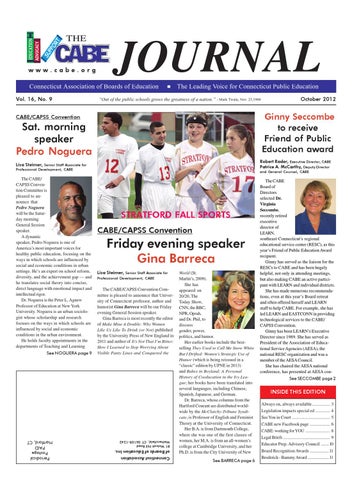
Ginny Seccombe to receive Friend of Public Education award
CABE/CAPSS Convention
Sat. morning speaker Pedro Noguera
Robert Rader, Executive Director, CABE Patrice A. McCarthy, Deputy Director
Lisa Steimer,
Senior Staff Associate for Professional Development, CABE
STRATFORD FALL SPORTS CABE/CAPSS Convention
Friday evening speaker Gina Barreca Lisa Steimer,
Senior Staff Associate for Professional Development, CABE
of Boards of Education Inc.
World (St. Martin’s, 2009). She has appeared on 20/20, The Today Show, CNN, the BBC, NPR, Oprah, and Dr. Phil, to discuss gender, power, politics, and humor. Her earlier books include the bestselling They Used to Call Me Snow White But I Drifted: Women’s Strategic Use of Humor (which is being reissued in a “classic� edition by UPNE in 2013) and Babes in Boyland: A Personal History of Coeducation in the Ivy League; her books have been translated into several languages, including Chinese, Spanish, Japanese, and German. Dr. Barreca, whose columns from the Hartford Courant are distributed worldwide by the McClatchy-Tribune Syndicate, is Professor of English and Feminist Theory at the University of Connecticut. Her B.A. is from Dartmouth College, where she was one of the first classes of women, her M.A. is from an all-women’s college at Cambridge University, and her Ph.D. is from the City University of New
Connecticut Association
See NOGUERA page 9
and General Counsel, CABE
See BARRECA page 6
The CABE/CAPSS Convention Committee is pleased to announce that University of Connecticut professor, author and humorist Gina Barreca will be our Friday evening General Session speaker. Gina Barreca is most recently the editor of Make Mine A Double: Why Women Like Us Like To Drink (or Not) published by the University Press of New England in 2011 and author of It’s Not That I’m Bitter: How I Learned to Stop Worrying About Visible Panty Lines and Conquered the
81 Wolcott Hill Road Wethersfield, CT 06109-1242
The CABE/ CAPSS Convention Committee is pleased to announce that Pedro Noguera will be the Saturday morning General Session speaker. A dynamic speaker, Pedro Noguera is one of America’s most important voices for healthy public education, focusing on the ways in which schools are influenced by social and economic conditions in urban settings. He’s an expert on school reform, diversity, and the achievement gap — and he translates social theory into concise, direct language with emotional impact and intellectual rigor. Dr. Noguera is the Peter L. Agnew Professor of Education at New York University. Noguera is an urban sociologist whose scholarship and research focuses on the ways in which schools are influenced by social and economic conditions in the urban environment. He holds faculty appointments in the departments of Teaching and Learning
October 2012
The CABE Board of Directors selected Dr. Virginia Seccombe, recently retired executive director of LEARN, southeast Connecticut’s regional educational service center (RESC), as this year’s Friend of Public Education Award recipient. Ginny has served as the liaison for the RESCs to CABE and has been hugely helpful, not only in attending meetings, but also making CABE an active participant with LEARN and individual districts. She has made numerous recommendations, even at this year’s Board retreat and often offered herself and LEARN staff to help CABE. For example, she has led LEARN and EASTCONN in providing technological services to the CABE/ CAPSS Convention. Ginny has been LEARN’s Executive Director since 1989. She has served as President of the Association of Educational Service Agencies (AESA), the national RESC organization and was a member of the AESA Council. She has chaired the AESA national conference, has presented at AESA conSee SECCOMBE page 2
INSIDE THIS EDITION Always on, always available ................ 3 Legislation impacts special ed ............. 4 See You in Court .................................. 5 CABE new Facebook page .................. 6 CABE: working for YOU ...................... 8 Legal Briefs .......................................... 9 Educator Prep. Advisory Council .......10 Board Recognition Awards ................. 11 Broderick - Bammy Award ...................11
Periodical Postage PAID Hartford, CT
2
The Journal
– Connecticut Association of Boards of Education • September 2012
PRESIDENT COMMENTARY
CABE: Working hard for you School districts across the state and nation are strapped to find the resources necessary to fulfill their mission and more expectations are placed on these same districts year after year. Between high school reform, NCLB waivers, common core curriculum, new, more rigorous student assessment and teacher evaluation models right around the corner it is harder than ever to make ends meet to get the job done. Boards of education are working overtime finding ways to deliver the services necessary to be successful. Regardless of the size or demographic of the particular district; we are all hurting. With that in mind, it came as a bit of a surprise to find out that CABE membership is at an all-time high (at least in the last 20+ years). But, as I thought about it, it made sense to me. At a time when fewer people are unified around support for public schools, CABE has taken a leadership role in fighting hard for public schools; and school boards in particular. Last week, Commissioner Stefan Prior, while attending a meeting of the CABE Board of Directors, told us that “CABE will always be at the table”. Indeed, CABE has been at the table, with board members and CABE staff participating on numerous committees such as PEAC (Performance Evaluation Advisory Council), The Governor’s Prevention Council and the newly resurrected Commission for Educational Technology. The Connecticut State Department of Education has supported more CABE projects, such as the CABE Leader-
ship Institute and the CABE Summer Leadership Institute. CABE is a full partner with the SDE on the Lighthouse Project, which helps board’s focus on the things that have the greatest impact on improving student achievement. I am so glad that CABE members see the value in the Lydia Tedone services the Association provides, from a quality professional development program, board training, policy, negotiations and legal services. I am proud that you see us as an active partner in your local work and because the strength we have in numbers will be tested as we go further along in the movement for improving student achievement. It is critical that boards don’t just belong to CABE, but actively participate. Join a committee, become an Area Director. Sponsor a Legislative Breakfast. There are plenty of ways that you can be part of this statewide organization. My involvement in CABE has made me a better board member. I believe it will do the same for you!
Board of Directors holds its September meeting On September 13, the CABE Board of Directors held its “Back to School” meeting. The biggest “news” was that Dr. Virginia Seccombe will receive this year’s Friend of Public Education Award (see article, page 1 ). State Board of Education Members Patricia B. Luke and Stephen Wright (who is also Trumbull Board Chair and a member of the CABE Board of Directors) together with Commissioner of Education Stefan Pryor and SDE Chief Talent Officer Diane Ullman met with the CABE Board to discuss issues of educational policy.
There was much good discussion on issues including: • the timing of the new principal and teacher evaluation and support program adopted by the State Board; • the costs of both financial resources and time in implementing the new Common Core Standards and secondary school reform; and, • ensuring that board members, superintendents, members of municipal governments and the public understand the work that needs to be done. (continued on page 11)
Ginny Seccombe to receive Friend of Public Education award (continued from page 1) ferences and served as the Chair of the RESC Directors’ Organization in Connecticut. She has also served as President of two regional Superintendent Associations and served on the Board of Directors of the Connecticut Association of School Superintendents. She is a long-term member of the CABE/CAPSS Convention Committee and has provided many suggestions on how the Committee can best carry out its responsibilities. Among the recommendations that Ginny has been made to help CABE better serve its members is that we should host a breakfast at the NSBA Convention, which has been instrumental in enabling Connecticut school board members and superintendents together to plan their time at the Convention (and the RESCs have been sponsors of these breakfasts and other events). Ginny brought Past CABE and NSBA President Mary Broderick to her first NSBA Convention. She served many years on the CABE/CAPSS Convention Committee and recommended that the Committee establish a subcommittee to screen workshops submissions. That has worked extraordinarily well to ensure that the full Committee has thoughtful recommendations on which workshops to provide at the Convention. CABE President Lydia Tedone stated, “Ginny has been
a huge friend to public education and to CABE. We believe that in honoring her, as we honored John Allison years ago, we pay homage not only to her, but also to the great work of the RESCs across the State.” CABE’s Board of Directors has awarded the Friend of public Education Award nine times since 1997. The Award is given to those men and women who have worked to support public education in Connecticut and are not eligible for other CABE awards. Past recipients of the award are: Theodore Sergi, Pat Luke, John Allison, Tom Mooney, Lori Aronson, Bob Frahm, James Comer, Betty Stern-berg, George Coleman and David Nee. David Nee, last year’s recipient, will present the award at the CABE/CAPSS Convention on November 16.
People in the News The American Society of Association Executives (ASAE) recently announded that Patrice A. McCarthy, Deputy Director and General Counsel, was renewed as a Certified Association Executive (CAE). The CAE is the highest professional credential in the association industry. Less than five percent of all association professionals have earned the CAE. Congratulations Patrice!
CABE Board of Directors EXECUTIVE COMMITTEE Lydia Tedone .................................................. President, Simsbury Richard Murray ............................. First Vice President, Killingly Ann Gruenberg ........... VP for Government Relations, Hampton Stephen Wright .... VP for Professional Development, Trumbull James Marpe ................................ Secretary/Treasurer, Westport Don Blevins ........................................... Immediate Past President John Prins ........................................................... Member at Large
AREA DIRECTORS Susan Hoffnagle ....................... Area 1 Co-Director, Winchester Mari-Ellen (Mimi) Valyo ........ Area 1 Co-Director, Winchester Daniel Santorso ........................... Area 1 Co-Director, Plymouth Becky Tyrrell ....................................... Area 2 Director, Plainville Laura Bush ............................................. Area 3 Director, Vernon Gavin Forrester .............................. Area 6 Co-Director, Stratford Elaine Whitney ............................. Area 6 Co-Director, Westport Michael D’Agostino ....................... Area 7 Co-Director, Hamden Sheila McCreven ..................... Area 7 Co-Director, Woodbridge John Prins ...................................... Area 7 Co-Director, Branford Robert Ruggiero ............................ Area 8 Co-Director, Madison Pamela Meier ................................ Area 8 Co-Director, Madison Gail MacDonald ............................. Area 9 Director, Stonington
ASSOCIATES Eileen Baker ........................................... Associate, Old Saybrook Sharon Beloin-Saavedra .......................... Associate, New Britain Gary Brochu ........................................................ Associate, Berlin Robert Guthrie .......................................... Associate, West Haven Cal Heminway ................................................... Associate, Granby COMMITTEE CHAIRS Robert Mitchell ........................ Chair, State Relations, Montville Beverly Washington ................. Chair, Federal Relations, Groton Becky Tyrrell ................................... Chair, Resolutions, Plainville
CITY REPRESENTATIVES Jacqueline Kelleher .................. City Representative, Bridgeport Matthew Poland ........................... City Representative, Hartford Michael R. Nast ....................... City Representative, New Haven Polly Rauh .................................... City Representative, Stamford Charles Stango ........................... City Representative, Waterbury
STAFF Robert Rader ...................................................................... Executive Director Patrice McCarthy ................................ Deputy Director and General Counsel Bonnie Carney ........................................... Sr. Staff Associate for Publications Nicholas Caruso ............................................ Sr. Staff Assoc. for Field Service and Coord. of Technology Sheila McKay ............................ Sr. Staff Associate for Government Relations Kelly Moyher ......................................................................... Sr. Staff Attorney Vincent Mustaro ..................................... Sr. Staff Associate for Policy Service Lisa Steimer .............................. Sr. Staff Assoc. for Professional Development Teresa Costa ............................... Coordinator of Finance and Administration Pamela Brooks ......................... Sr. Admin. Assoc. for Policy Ser. /Search Ser. Terry DeMars .............................................. Admin. Assoc. for Policy Service Melissa Dickinson ........................... Admin. Assist. for Membership Services Gail Heath ...................................... Admin. Assoc. for Government Relations Wilmarie Newton ...................................... Admin. Assoc. for Labor Relations Corliss Ucci .............................. Receptionist/Asst. to the Executive Director
The CABE Journal (ISSN 1092-1818) is published monthly except a combined issue for July/August as a member service of the Connecticut Association of Boards of Education, 81 Wolcott Hill Road, Wethersfield, CT 06109, (860) 571-7446. CABE membership dues include $30 per person for each individual who receives The CABE Journal. The subscription rate for nonmembers is $75. Association membership dues include a subscription for each board member, superintendent, assistant superintendent and business manager. The companies and advertisements found in The CABE Journal are not necessarily endorsed by CABE. “Periodicals Postage Paid at Hartford, CT.” POSTMASTER: Send address changes to The CABE Journal, CABE, 81 Wolcott Hill Road, Wethersfield, CT 06109-1242. Email: bcarney@cabe.org. Members can find the CABE Journal online at: www.cabe.org/ userlogin.cfm?pp=84&userrequest=true&keyrequest=false& userpage=84
The Journal
3
– Connecticut Association of Boards of Education • September 2012
EXECUTIVE DIRECTOR COMMENTARY
Always on, always available Over the last few years, businesses and nonprofits have begun to examine certain expectations they have of their staffs, including their CEOs. These expectations have to do with when it is appropriate for leaders to take time, such as vacation, to truly relax and recharge. Those who have studied this issue believe that “turning off” and “tuning out” are keys to allowing the brain to the time it needs to restore energy and reload. The brain can focus on only one thing at a time, even as we all try to multitask. Downtime is needed to allow the brain to store information effectively. This age of 365/24/7 connectivity has been made it tougher for many of us to break away from work. School board members, superintendents and, yes, CABE Staff, expect to work at least some nights and weekends. Slowing down in the summer has become more difficult, with the need to answer constituents, bosses or even those working for us. For many of us, the summer is when we use vacation time, but often we don’t take all to which we’re entitled. We seem to be in a place where it is never “okay” to put away the cellular phone, get off the Internet and even have
a vacation without feeling a need to be connected to our jobs. And social media is so instantaneous that we often must react before we have time to analyze the situation. This is especially true when something happens at a school and administrators in particular must react even as the incident goes viral in the community.
Board Members and Superintendents Affected
“always on and always available” age. Board members are now consumed by the ever-increasing pull of the internet— blogs, tweets, news and pour in in a never-ending flow. Constituents seem to think it’s okay to have a long discussion late at night with their board members, who must still get up the next day to do their day jobs. Is it any wonder that in many communities, it is becoming increasingly harder to find people to fill the position of school board member? Superintendents often got to their positions because of their attention to detail and “sweating the small stuff”.
Robert Rader
combination of guilt about not being in touch and the workaholic desire to always be working takes precedence. All of this is affecting the quality of We know that people are more creative, our lives. have less restless minds and can see For those of us with Type A personaliissues with more insight after a period ties, breaking away, when away from their even for a short primary responsibilities. time, is difficult. It is especially difWhat are we ficult for board members “If we are to maintain a high quality of life, missing? What do and superintendents to we need to do? Can tell others they won’t be have the energy to make the best possible I quickly find the in touch. They are all answer to the about being constantly decisions and to do the very best we can question posed in available and they pride an email? for our students, we must recognize that we’re themselves on this. I see board But, some people need not ‘human doings’, we are ‘human beings’.” members and permission to turn off. superintendents in They need to hear that it Connecticut as is okay to take a real victims of our vacation and to be out of touch, with, of They have to answer to members of the course, a way to contact them in an public, their staff, other municipalities emergency. and, of course, to their boards. It has I told my staff that the rules that apply become a huge psychological burden and to me about it being okay to turn off for those who blog, tweet or are even emails also applied to them… if they so more involved in social media, the time choose. Some felt they had to make sure and effort requirement in addition to the they were still in touch at least daily. But, difficulty in “turning it all off” is even I was okay if they didn’t. BRONZE PLUS MEMBERS more difficult. The S/L/A/M Collaborative I am not a school board member or Suisman, Shapiro, Wool, Brennan, superintendent but, I often find myself A Suggestion for Boards Gray & Greenberg answering emails at night and on weekWhitsons School Nutrition and Superintendents ends. It is hard for me to turn it off So, what do I think boards and because I feel an obligation to answer our BRONZE MEMBERS superintendents should do about this members and the Board of Directors issue? Nathaniel G. Brown, LLC whenever they have a need I might help I would suggest that as part of the them address. Chinni & Meuser LLC Having had to email staff on weekends discussion that accompanies a selfDattco Inc. assessment that boards discuss their on occasion, I know they feel the same Fuller & D’Angelo “digital expectations” of each other and duty because they seem to answer back Architects and Planners their superintendent. If we are to maintain as soon as the email is sent. JCJ Architecture a high quality of life, have the energy to Even if you’re a sports fan and get on Kainen, Escalera & McHale, P.C. make the best possible decisions and to your cellphone or a computer to look at The Lexington Group do the very best we can for our students, scores, it is so easy to then look at your Muschell & Simoncelli emails — and you’re back into it again! It we must recognize that we’re not “human doings”, we are “human beings”. is too tempting and too easy to remain in And, we should treat each other like constant touch. EDUCATIONAL that!
CABE Affiliate Members BUSINESS AFFILIATES DIAMOND MEMBER ACT, Inc. - Northeast Region Finalsite GOLD
MEMBERS
Berchem, Moses & Devlin Connecticut Business Systems Shipman & Goodwin Siegel, O'Connor, O’Donnell & Beck, P.C Sullivan, Schoen, Campane & Connon SILVER MEMBERS Anthem Blue Cross and Blue Shield Corporate Cost Control Lindburg & Ripple Milone & MacBroom, Inc. Ovations Benefits Group Quisenberry Arcari Architects The Segal Company Trane BRONZE PLUS MEMBERS Blue Ribbon LLC Brown and Brown Fletcher Thompson Architects Friar Associates Goldstein & Peck, P.C. Kaestle Boos Associates, Inc. O & G Industries
AFFILIATES American School for the Deaf Area Cooperative Educational Services Capitol Region Education Council The College Board Connecticut Association of School Business Officials Cooperative Educational Services Connecticut Center for School Change Connecticut Educators Computer Association Connecticut School Buildings and Grounds Association EASTCONN EDUCATION CONNECTION LEARN
Give Yourselves a Break The last two summers, during my vacation time, I turned off my email. I am happy to report it can be done… and I lived to tell about it! Of course, when I returned there was a huge pile of emails, but luckily, many were either unimportant or out-of-date so I could ignore them. During this time off, my automatic email response said that I was away and out-oftouch with day-to-day operations of CABE, but that if it is a true emergency, CABE staff knows how to reach me by telephone. It is difficult to create reasonable boundaries for when one is available. I know enough workaholics (like me) who may try to set boundaries, but maybe a
Kathryn Winter Kate Winter, who served the Connecticut Association Boards of Education as an area representative, and member of the Finance and Executive Committees in the 1980s, passed away recently. Kate was a member of the Woodbridge Board of Education for eight years. CABE extends its sympathy to her family. Patrice A. McCarthy, Deputy Director and General Counsel, CABE
4
The Journal
– Connecticut Association of Boards of Educatio • September 2012
Recent legislation impacts special education policy Vincent A. Mustaro Senior Staff Associate for Policy Service, CABE
The Connecticut General Assembly recently passed legislation affecting policies pertaining to special education. P.A.12-173, “An Act Concerning Individualized Education Programs and Other Issues Relating to Special Education,” makes several changes to Connecticut’s special education law, pertaining to a child’s individualized education program (IEP). Additional opportunities are now required for meetings and the exchange of information between school district officials and parents of students in, or under evaluation for, special education. In addition, teacher certification preparation, in-service training, and professional development must now include expanded instruction and training regarding implementing individualized education programs (IEPs). Any IEP for a child identified as deaf or hearing impaired must include a language and communication plan developed by the child’s planning and placement team (PPT). A number of items must be included in the plan.
Notification and Information Prior to PPT Meeting A school district, when providing special education, is required to offer to meet with the student’s parents, upon the parents’ request, after the student has been assessed for possible placement in special education and before the PPT meets. The sole purpose of the meeting is to discuss the PPT process and any concerns the parent has about the student. The parents must be given the opportunity to meet with a PPT member designated by the school district before the referral PPT meeting at which the student’s assessments and evaluations will be discussed for the first time. This applies to students under evaluation for possible placement in special education. The district, upon the request of parents, is also required to provide them with copies of the assessment and
evaluation results used to determine special education eligibility at least three school days before the referral PPT meeting at which the assessments will be first discussed. The school district is also required to provide parents with any State Department of Education (SDE) information and resources relating to IEPs as soon as a child is identified as requiring special education. These requirements also apply to guardians, emancipated minor pupils, and surrogate parents appointed according to statute.
Teacher Certification and Training Requirements for Special Education Teacher certification preparation, inservice training, and professional development programs are required to include expanded instruction and training regarding the implementation of IEPs. Certification preparation programs are now required to include instruction on implementing IEPs as they relate to special education and related services. Districts, as part of required in-service training options for certified personnel, must offer information on implementing student IEPs. Special education teachers, as part of their required professional development, must complete at least 10 hours of training every five years on implementing student IEPs and communicating IEP procedures to parents or guardians of special education students.
Plan (IEP) Requirements Regarding Deaf or Hearing Impaired Students Any IEP for a child identified as deaf or hearing impaired must include a language and communication plan developed by the child’s PPT. The IEP must address the following specifics which were not previously in statute: 1. the child’s primary language or mode of communication;
Government Relations and Resolutions Committees meet
September 7, 2012, CABE Government Relations and Resolutions Committees met at the CABE office to discuss Resolutions to be presented at the CABE Delegate Assembly on November 15, 2012 at the Mystic Marriott Hotel in Groton. Registration information for the Delegate Assembly will be mailed in mid-October.
2. opportunities for direct communication between the child and his or her peers and professional personnel in the primary child’s language or mode of communication; 3. educational options available to the child; 4. the qualifications of teachers and other professional personnel administering the plan for the child, including their proficiency in the child’s primary language or mode of communication; 5. the accessibility of academic instruction, school services and extracurricular activities to the child; 6. assistive devices and services for the child; and 7. communication and physical environment accommodations for the child. Legislation was also passed pertaining to the use of physical restraints and seclusion. P.A. 12-88, “An Act Concerning the Reporting of Children Placed in Seclusion,” requires local school boards and other entities providing special education to children, when recording instances when seclusion or restraints are used on a child, to indicate whether the use of seclusion was in accordance with the child’s individualized education program (IEP) or whether the use of either action
was an emergency. Districts providing special education to a child must record each instance when physical restraint or seclusion is used on a child and the nature of the emergency that necessitated the action and include the information in an annual compilation for the state. Districts must report to the SBE any instance in which the use of a restraint or seclusion results in the child’s physical injury. The SBE is required to review these compilations and provide annual summaries identifying the frequency with which restraints and seclusion were used, including whether such actions result in physical injuries to the child. By law, special education children generally may not be involuntarily placed in seclusion except as an emergency intervention to prevent immediate or imminent injury to the child or others or their IEP provides for such. The school district must notify the child’s parents or guardians of each incident in which a child is placed in seclusion or a physical restraint is used (CGS §46a-152(b)). Policy #6159 “Individualized Education Programs/Special Education,” and Policy #5144.1, “Physical Restraints/Seclusion,” have been revised to reflect the new legislation and are available upon request from CABE’s Policy Department.
The Journal
– Connecticut Association of Boards of Education • September 2012
5
See You in Court – The Nutmeg Board of Education
The Nutmeg Board deals with First Amendments rights at a board meeting Thomas B. Mooney, Esq. Shipman & Goodwin
The Nutmeg Board of Education makes many mistakes. The latest imbroglio created by the board will be reported here each issue, followed by an explanation of what the board should have done. Though not intended as legal advice, these situations may help board members avoid common problems. As September became October, the Nutmeg Public Schools settled into routine, and Mr. Superintendent started to focus on the challenges of operating for the fourth straight year under the cloud of financial stress. Unfortunately for the Nutmeg Board of Education, Mr. Superintendent was not the only one paying attention to the budget. Bruce Bellicose, founder of Residents Against New Taxes (RANT), has been attending every meeting of the Board. During public comment, Bruce rails against the greedy teachers, incompetent administrators and clueless Board members. The Board limits speakers during public comment to four minutes, but
Bruce makes sure that he uses every precious second to heap abuse upon the Board. At the beginning of every meeting, Bruce claims financial mismanagement by the Board and Administration, intimating more sinister motives, as he wonders aloud who is getting paid off. At the end of the meeting last week, the Board members convened into executive session to discuss what to do. Mr. Board Attorney had written a legal opinion, telling the Board that Bruce has free speech rights, but veteran Board member Bob Bombast wasn’t convinced. “Mr. Board Attorney is always so cautious. Where did he go to law school anyway?” Bob groused. “I know how to solve this problem. Just watch me at the next Board meeting.” “The larger question here,” interjected Mr. Chairperson, “is how we are going to do our budget deliberations. I am sick and tired of all the embarrassing questions that you all ask Mr. Superintendent in public session when we review his budget recommendations. How can we better show a unified front to the public?”
Seventh Edition Now Available
A Practical Guide to Connecticut School Law by Thomas B. Mooney, Esq. Shipman & Goodwin The Guide comes with a CD which provides hyperlinks to many cases and statutes and will permit word searches as a supplement to the Index. New to the Seventh Edition: Bullying, Background Checks, Child Abuse Reporting, Discrimination Issues, Educational Reform, FERPA, Freedom of Information, State Aid for Education and much, much more The 7th edition is now available from CABE. Call and order your copy TODAY at 860.571.7446 or 800.317.0033
“Amen,” responded Mr. Superintendent. “Do you guys set out to embarrass me or does it just happen? I would love to hear a sentence that does not begin with ‘Why don’t you . . .’ I am so sick of being second-guessed that I could scream.” “Look,” responded Bob Bombast. “We need to show the public that we are riding herd on the administration. It is as simple as that. Maybe we should give you a good evaluation and make it public this time. That way the public will know that we value you even if it seems that we know better than you do how to run the district.” “On that note, I declare this executive session over,” intoned Mr. Chairperson. “Let’s just remember that we can talk about some of the more controversial items over email. That might help tone down our public discussion.” At the Board meeting this week, sure enough Bruce Bellicose was there. But as he got up to speak, Bob Bombast was ready. “What is on your mind, Bruce?” he asked pointedly. When Bruce started to explain that he was concerned about the Board budget and the incompetents on the Board, Bob cut him off. “We have heard your concerns. Repeatedly. Until you have something new and positive to contribute, just sit down.” Bruce started to protest, but Mr. Chairperson banged his gavel. “I agree with Bob here, Bruce. You have kicked this budget thing to death. Sit down. Now.” Bruce sat down. But as he did, he shot a warning back to the Board. “This is not the last word. I have free speech rights. You will be sorry.” Did the Board act within its rights in the interest of efficient operation?
Bob and the Nutmeg Board of Education likely violated Bruce’s free speech rights, as discussed below. But the Board’s problems here involve other issues as well. As to Bruce and his rights, we start with the observation that boards of education are not obligated to provide an opportunity for public comment. Their meetings are meetings in public, not public meetings. However, when boards provide for public comment, they create a forum for speech, and they thereby become subject to First Amendment requirements. Reasonable regulations as to time, place and manner of speech are allowed. For example, boards typically limit speakers to three to five minutes. Boards can prohibit vulgar speech and/or personal attacks. Boards can even create forums for speech on a specific topic, e.g., a public hearing on the budget. However, boards may not restrict speech based on the viewpoint of the speaker. Here, Bruce was repetitive (indeed unrelenting) in his criticism of the Board.
But he was not vulgar or abusive, and he stayed within the four-minute time limitation established by the Board. If Bruce shouts, swears or is threatening, the Board can cut him off. But his merely being repetitive is not a legitimate basis for denying him the chance to speak in the forum that the Board created. The Board also violated the Freedom of Information Act. To be sure, the Board had the right to discuss the written legal opinion of Mr. Board Attorney in executive session. Boards can convene into executive session when discussion would otherwise reveal information in a confidential document. Here, the information was privileged by the attorney-client relationship. The FOIA contains a list of confidential documents that may be discussed in executive session, such as student or negotiations documents. Here, however, the Board violated the FOIA when it veered off that topic and discussed the budget process more generally. Indeed, Board members sharing their opinions over email to avoid contentious public discussion, as Mr. Chairperson suggested, would invite the further claim that the Board members were conducting an illegal meeting by email by holding a “discussion” outside of a posted meeting. We note that Mr. Superintendent took this opportunity to criticize the Board members for their embarrassing questions. Interestingly, if there were a proper posting, this discussion could have been held in executive session. Boards of education can discuss the performance of individual Board members as well as that of the Superintendent (and other board employees) in executive session as long as the individuals being discussed do not require that the discussion be held in public. The written evaluation of the Superintendent stands on a different footing. The Board was considering making Mr. Superintendent’s evaluation public. However, under current law all documents relating to the evaluation of the superintendent are already public documents. Board members should know that any written information about the performance of the superintendent is subject to public disclosure. That includes the evaluation itself and forms filled out by individual board members to provide input for a general rating. It even includes emails between individual board members commenting on the performance of the superintendent or any other school employee. Board members must be circumspect before creating any such public records. Attorney Thomas B. Mooney is a partner in the Hartford law firm of Shipman & Goodwin who works frequently with boards of education. Mooney is a regular contributor to the CABE Journal.
6
The Journal
– Connecticut Association of Boards of Education • September 2012
CABE and Baldwin Media: Partners in Managing Communications
The
Media Message
from Ann Baldwin, Baldwin Media Marketing, LLC
CABE launches new Facebook page – here’s why Facebook is a phenomenon that has grown exponentially in a very short time and continues to do so. Like it or not, recent statistics prove that it has become an incredibly powerful business networking and communications tool. Because the line between social and traditional communication has become blurred, whether or not and how you want to use Facebook can be a tough decision. The bottom line is that if you are careful and strategic about how your Facebook is set up and what information you share, this can be a great way to communicate information the way you want it communicated!
Two Facebook pages? With that said, CABE has recently launched a new Page on Facebook that will be the central profile for the organization on the social media site. If you find this a bit perplexing because you’re already connected to CABE on Facebook, you are likely a member of the organization’s Group which will remain intact as it is a more conducive format to interact with our members. So why have two different formats you ask?
What are Pages? The reason for establishing a Page in addition to the Group is due to the subtle but important differences between the two Facebook formats. For those of you who may not understand the difference between a Page and a Group, a Page enables public figures, businesses, organizations and other entities to create an authentic and public presence on Facebook. Pages are visible to everyone on the internet by default. You, and every
person on Facebook, can connect with these Pages by becoming a fan and then receive their updates in your News Feed and interact with them. In other words, a Page for a business or organization is the equivalent to a Profile for an individual person.
What are Groups? While Pages were designed to be the official profiles for entities, such as celebrities, brands or businesses, Facebook Groups are the place for small group communication and for people to share their common interests and express their opinion. Groups allow people to come together around a common cause, issue or activity to organize, express objectives, discuss issues, post photos and share related content. Like with Pages, new posts by a group are included in the News Feeds of its members and members can interact and share with one another from the group. Together, Pages and Groups bring even more ways for you to stay connected on Facebook. The CABE Page will serve as a place for staff to disseminate important information to members by posting events, updates and photos while the Group will continue to be a forum for members to discuss issues and share ideas. Maybe you’re not into social media, or simply feel daunted by it, but if you willingly choose to ignore it, you will be at a disadvantage and give others that do it a competitive edge. Facebook is what you make it. If you want to make it a tool to communicate with others and promote the good things that you do, by all means, go for it! Be sure to “like” us on Facebook! facebook.com/ConnecticutAssociation BoardsEducation.
CABE/CAPSS Convention Friday evening speaker Gina Barreca (continued from page 1) York. Gina blogs regularly for Psychology Today, The Chronicle of Higher Education, and The Huffington Post; she has also written for The New York Times, The Independent (of London), Cosmopolitan,
The Harvard Business Review, and other newspapers and magazines worldwide. Several of Gina’s books will be available for purchase in the Convention bookstore and she will be available for a book signing following her presentation.
CABE/CAPSS Convention
Student Panel Discussion – Saturday Lunch General Session
With the belief that our students play a critical role in determining their own education needs, the CABE/CAPSS Convention Committee has worked to further develop the Saturday programming that is focused on the needs of student leaders who attend the Convention. The Committee recognizes that student representatives on boards, district committee members, student council members and more informal student leaders help our boards make important educational policy decisions. This year we have created a more robust Saturday session for student
participants. As the culminating activity for these students, we have invited some of them to have a frank conversation with us about their thoughts on issues we grapple with each day. Topics to be covered may include the daily impact of education reform, social media, bullying and cyberbullying, and the capstone project have on the lives of students. We look forward to hearing what our students have to say, what we can learn from them, and how they think we can increase the achievement of their peers, all our students. Lisa Steimer, Senior Staff Associate for Professional Development, CABE
CABE Search Services is recruiting for
SUPERINTENDENT OF SCHOOLS DERBY PUBLIC SCHOOLS SCOTLAND PUBLIC SCHOOLS STRATFORD PUBLIC SCHOOLS For an update or more information on vacancies go to our website: www.cabe.org For more information contact, CABE Search Services, Jacqueline V. Jacoby • 860-539-7594 Randall H. Collins • 860-625-5495 Paul Gagliarducci • 413-218-5692 Bob King • 203-461-0388 P.O. Box 290252, Wethersfield, CT 06129-0252 www.cabe.org/support • Equal Opportunity Employers
The Journal
– Connecticut Association of Boards of Education • September 2012
2
We are delighted to announce that Frederick L. Dorsey has joined our firm as a principal. Fred brings 28 years of experience in defending management in labor law and employment law matters. Fred has extensive experience in a wide variety of general and special education, labor relations and employment issues including union representation elections, contract negotiations and administration, unfair labor practice charges and employment discrimination matters in both the public and private sectors. Fred focuses his practice in the area of education law, representing boards of education in special education, student expulsion, transportation and residency hearings in addition to conventional labor relations and employment litigation matters. Fred is Adjunct Faculty Member, University of Bridgeport, Professor of School Law; a member of the American Bar Association, Labor and Employment Law Section; a member of the Connecticut Bar Association, Labor and Employment Law Section, Committee on State and Local Government Bargaining Employment Law; and Past President of the Connecticut School Attorneys Council and the National School Boards Association Council of Attorneys. Fred can be reached at (860) 493-0870 and by email at fdorsey@kemlaw.com. For more information about Fred and our firm, please visit our website at www.kemlaw.com.
7
8
The Journal
– Connecticut Association of Boards of Education • September 2012
NEW PUBLICATIONS AVAILABLE
CABE: working for YOU Individualized Workshops • Professional Development Opportunities • Legal Services • Policy Services • Representing You Statewide and Nationally Below are the highlights of activities that the CABE staff has undertaken on your behalf over the last month and a half. We did this:
➤By helping school boards to increase student achievement:
The Collective Bargaining Handbook CABE is pleased to introduce the newly updated Collective Bargaining Handbook. This handbook contains practical information that we believe will enable you to better understand the collective bargaining process and be a more prepared member of your board of education. There is no substitute for careful preparation. New in this revision is an explanation of the Teacher Negotiation Act and the Municipal Employees Relations Act. There are sections on: ground rules, preparing for negotiations, bargaining strategies and techniques, provisions a public employer should try to obtain, common board mistakes in bargaining, and collective bargaining terms. This handbook is designed as a reference guide to the negotiations process for school boards. The handbook is not intended to provide specific or direct advice regarding the legal responsibilities of the school board or school officials. For specific legal advice or if assistance is required, please contact CABE at 860-571-7446 or your district’s negotiating attorney. The handbook was mailed to board chairs in August. If you would like additional copies they are available for $7.95 each by calling CABE at 800-317-0033 or 860-571-7446; or order online at www.cabe.org/page.cfm?p=749.
Telling Your Story A Communications Guide for School Boards CABE recently mailed to member board chairs a copy of the National School Boards Association (NSBA) publication, Telling Your Story: A Communications Guide for School Boards. The Guide is a quick read full of valuable information that will assist you and your Board in understanding and improving your communications strategies throughout the course of the school year. While the guide gives you a lot of useful information and strategies for a more successful communications initiative, often additional resources and expertise are needed, especially in a crisis communications situation. Over the course of the past couple of years, several boards of education and superintendents have taken advantage of CABE’s contractual affiliation with Baldwin Media Marketing (see above), providing hands-on assistance, professional development and expertise to CABE member districts. The ultimate goal for all of us is to get the good word out on the positive things that are happening in public education. You can contact CABE at 860-5717446 or Baldwin Media directly at 860408-1580. If you would like to purchase additional copies of Telling Your Story, A Communications Guide for School Boards, they are available for $8.95 each by calling CABE at 860-317-0033 or 860571-7446; or order online at www.cabe.org/page.cfm?p=749.
• Sent three issues of Policy Highlights via email listserv covering topics that affect student achievement. This included information pertaining to student records and directory information, child nutrition, pregnant and/or parenting students, handling of parental complaints, policies impacted by reform legislation (P.A. 12-116), teacher absenteeism and impact on student learning, student attendance and learning, assisting children of militarily deployed parents/guardians, resources regarding food choices in school, and board member access to policy manuals. • Provided Lighthouse training for Danbury and Norwich. Met with Killingly to discuss training.
➤By representing Connecticut school boards on the national level: • Attended Achievement Gap Task Force meetings. • Participated in Small School District Task Force meetings. • Participated in Red Tape Reduction planning meeting. • Staffed and participated in CABE’s Vision and Communications Committee meetings. • Staffed CABE’s Government Relations and Resolutions Committee meetings. • Participated in After School Advisory Council meeting. • Attended Secondary School Reform Implementation Committee meeting. • Attended meeting of a subgroup of the CAPSS International Committee. • Attended NSBA President’s Institute • Attended and spoke at Commissioner’s Back-to-School Conference.
➤By providing opportunities for members to learn how to better govern their districts: • Met with University of Connecticut students about capstone project that will enable CABE to learn more about how we can better serve our members. • Demonstrated CABE-Meeting for the Clinton, Coventry and West Haven. • Met with the new superintendent in Killingly to provide information on the district’s use of CABE-Meeting.
• Participated in conference call with Kentucky School Boards Association about recent and upcoming upgrades to CABE-Meeting. • Entered into an agreement with Glastonbury for CABE-Meeting. • Provided policy information to 33 districts, NSBA, two out-of-state school board associations, four newspapers, and one out-of-state university through 60 answered requests for information or sample policies, on 47 topics. The topics of greatest interest included truancy issues, bring you own devices to school, online/virtual learning, and social media. • Facilitated workshop on Roles and Responsibilities for Hartland; Board Self-Evaluation for Stonington; and Board Retreats for Danbury, New Britain, Region 15 and Windsor.
➤By promoting public education: • Continued work on Convention planning. • Attended Commissioner’s “Back-toSchool Meeting,” and CAPSS Board of Directors meeting. • Attended opening of Glastonbury-East Hartford Magnet School.
➤ By ensuring members receive the most up-to-date communications: • Prepared Custom Policy Service material for Park City Prep Charter School, EASTCONN, East Windsor, Wallingford, Windsor Locks and Woodbridge. • Completed revisions to CABE’s Model Student Handbook. • Prepared revised and/or new policies based on recent legislation for Ansonia, Columbia, East Hampton, East Windsor, Franklin, Gilbert School, Hebron, Marlborough, New Fairfield, New Hartford, Newington, North Stonington, Old Saybrook, Oxford, Regional School District No. 6, Stafford, Sterling, West Haven, Westbrook and Windham.
➤By providing services to meet members needs: • Completed the audit of the policy manual of the Scotland. • In the process of completing the audit of the policy manual of the Avon.
The Journal
– Connecticut Association of Boards of Education • September 2012
Legal Briefs Kelly B. Moyher, Court rules in First Amendment case A three-judge panel of the U.S. Court of Appeals for the Second Circuit (NY, VT, CT) has ruled that a former school district employee failed to state a valid First Amendment retaliation claim based on exercising her free speech rights because was she speaking pursuant to her official duties. The panel concluded that the employee’s reporting of financial irregularities to the district superintendent and school board was pursuant to her official duties as a payroll clerk. The panel pointed out that the record was clear that reporting pay irregularities to a supervisor was one of her job duties. It also noted that she acquired all of the information she reported to the superintendent in the normal course of her work duties. In the case Ross v. Lichtenfeld, No. 105275 (2d Cir. Sept. 10, 2012), Risa Ross was employed by Katonah-Lewisboro Union Free School District (KLUFSD) as a payroll clerk typist since 1998. Over a three-year period, she met with Superintendent Robert Lichtenfeld on numerous occasions to report payments to employ-
Senior Staff Attorney, CABE
ees she believed were improper. An outside consultant (from a neighboring district) was hired to resolve interpersonal matters between the staff. During that period, Ross complained to Lichtenfeld that she was being retaliated against by employees for her reporting of these incidents. During such time, KLUSFD learned that Ross had worked for that neighbor district, but no reference check was done, along with two other districts. After it was discovered that Ross had falsified her employment application, she was suspended with pay. Ross then wrote a personal letter to the individual school board members outlining the same pay irregularities she told Lichtenfeld. After the Board received her letter, it convened an executive session during which Lichtenfeld reco-mended Ross’ termination. The Board voted to discharge her. However, because Ross was entitled to a pre-termination hearing, the Board rescinded its vote and held the hearing. The hearing officer found that Ross had knowingly made false statements on her application and recommended that she be
terminated. The Board voted unanimously to terminate Ross. Ross filed suit in federal district court in New York against KLUFSD and Lichtenfeld, alleging that she was terminated in retaliation for exercising her First Amendment free speech rights. The district court denied Lichtenfeld’s motion for summary judgment. The Second Circuit panel reversed the lower court decision, holding Lichtenfeld was entitled to summary judgment. The panel concluded that Lichtenfeld was entitled to qualified immunity as Ross failed to show a violation of an actual First Amendment constitutional right because she was speaking as an employee, not as a private individual. The panel focused on the question of whether Ross was speaking pursuant to her official duties when she reported the pay irregularities to Lichtenfeld and the Board, since “[c]ourts must examine the nature of the plaintiff’s job responsibilities, the nature of the speech, and the relationship between the two.” It pointed out that if she was speaking according to her job duties, then Lichtenfeld was entitled, as a matter of law, to
CABE-Meeting CABE-Meeting is a user-friendly, web-based service specifically designed to assist the board, superintendent and central office staff in preparing for and running board of education meetings. An exciting feature designed for use by committees, in addtion to boards of education, was recently added to CABE-Meeting. Now all your board work and committee information is conveniently located in one place!
Is CABE-Meeting for you?
Learn more:
• Do you want to save your district money? • Do you want to utilize technology to enable staff to be more efficient? • Do you want to focus more of your human and financial resources on increasing student achievement in your district? • Do you want to enhance communication with your community? • Do you want to model the methods that should be used to infuse technology in your schools? If you answered “yes” to at least one of the above questions, read on. CABE-Meeting can help you!
Take a few minutes and go to http://www.cabe.org/ page.cfm?p=158 to complete our CABE-Meeting cost analysis worksheet (located at the bottom of the page) and see how much your district can save in one year. Districts can save thousands of dollars each year by using CABEMeeting.
CABE-Meeting Lisa Steimer Connecticut Association of Boards of Education 81 Wolcott Hill Road Wethersfield, CT 06109 www.cabe.org
9
For more information, a list of districts currently using CABE-Meeting or to schedule a demonstra-tion for your board, call Lisa Steimer at 800-3170033 or 860-571-7446 or email lsteimer@cabe.org.
summary judgment, because “although Ross’s speech was on a matter of public concern, it was made pursuant to her duties as a payroll clerk typist and is therefore not protected by the First Amendment.” It pointed out that among Ross’ duties, she was responsible for bringing mistakes with pay requisitions to the “appropriate person’s attention.” The panel also discounted Ross’ attempt to minimize her job responsibilities by referring to it as a “clerical” position. It noted that “[f]ormal job descriptions often bear little resemblance to the duties an employee actually is expected to perform.” In addition, it pointed out that Ross’ own testimony made it clear that one of her job duties was reporting pay irregularities to a supervisor. The panel rejected Ross’ argument that she was speaking as a private citizen just because she went outside the chain of command by first reporting the irregularities to Lichtenfeld, and then sending the letter to the Board. It pointed out that taking a complaint “up the chain of command to find someone who will take it seriously does not, without more, transform [her] speech into protected speech made as a private citizen.” The panel stressed that Ross had never attempted to take her complaints to the public and, therefore, could not “avail herself of the argument that her duties in no way included public revelation of misconduct of district officials that is generally available to the employee who takes the issue public.” It also pointed out that even if the workplace conduct complaint might be unprotected by the First Amendment, an employee might still avail herself of “whistleblower laws or other similar employment codes.” The panel stated that “[a]s a payroll clerk, she was tasked with reporting pay irregularities to her supervisors, and that’s what was done”. NSBA Legal Clips, September 11, 2012
Sat. morning speaker Pedro Noguera (continued from page 1) and Humanities and Social Sciences at the Steinhardt School of Culture, Education and Development, as well as in the Department of Sociology at New York University. Dr. Noguera is also the Executive Director of the Metropolitan Center for Urban Education and the coDirector of the Institute for the Study of Globalization and Education in Metropolitan Settings (IGEMS). In 2008, he was appointed by the Governor of New York to serve on the State University of New York Board of Trustees. Several of Dr. Noguera’s books will be available for purchase in the Convention bookstore and he will be available for a book signing following his presentation.
10
The Journal
– Connecticut Association of Boards of Education • September 2012
The Educator Preparation Advisory Council The Educator Preparation Advisory Council (EPAC) is meeting on a monthly basis, in order to meet their deadline of issuing a report with recommendations by April 1, 2013 to the State Department of Education, the Board of Regions for Higher Education, the University of Connecticut and the Legislature’s Higher Education Committee. The Council has received an overview of national trends and initiatives in teacher preparation, including entry and exit standards, clinical preparation and induction, disciplinary content, and evaluation and research to improve teacher preparation. The Council members are examining best practices in the clinical
experience provided to students in teacher preparation programs. A partnership between the higher education institutions and the school districts where students receive their clinical experience underlie all of the successful practices. Effective national teacher preparation models make teacher preparation an all-campus responsibility, begin before students actually engage in formal studies, extend beyond completion of the program, and embrace practicing educators and schools as essential partners in the teacher preparation process. Patrice A. McCarthy Deputy Director and General Counsel, CABE
Does your policy manual LOOK LIKE THIS? Then you are the perfect candidate for the
CABE Customized Policy Service! CABE’s Customized Policy Service tailors a policy manual for a subscribing board of education that reflects the specific needs and priorities of that community. The service includes: • Review and analysis of existing policies for relevancy and compliance with federal and state statutes and regulations. •
Review of current contracts and student and personnel handbooks for explicit and implied policies.
•
On-site consultation for school board members and school administrators by CABE staff.
•
Update of existing policies
•
Legal referencing of policies: Connecticut and U.S. statutes Federal/state court decisions
•
Development of needed policies and regulations.
•
Use of CABE Codification System
•
Printing of policies and arrangement in manual.
•
Manual on CD
Fee is based on school district enrollment. For more information contact Vincent Mustaro at CABE 860-571-7446 or 800-317-0033. You can also email Policy Services at vmustaro@cabe.org.
CABE Workshop
Board Chair Roundtable
Board Chairs from around the state gathered at the CABE Office, on September 19, to discuss the important initiatives that are aimed at increasing student growth. They include: State intervention in school districts; establishment of Alliance Districts and the Commissioner’s Network; and the “three-headed” reform of new professional evaluation standards, Common Core standards and secondary school reform. One of the questions posed to the group was “with these initiatives going forward, do you think the role of the board and its chair will change?” Leading the discussion was Lol Fearon, Chief, Bureau of Accountability and Improvement, State Department of Education.
Mark your CALENDAR ✔
Don’t miss these professional development opportunities! November 15 CABE Delegate Assembly Mystic Marriott Hotel, Groton
November 16-17 CABE/CAPSS Convention Boards and Superintendents: The Challenges and Opportunities Involved in Reforming and Transforming Education Mystic Marriott Hotel, Groton
March 6 CABE Day-on-the-Hill 8:30 am - 5:00 pm The Bushnell Hartford Workshop information as well as registration information is also published on the CABE website at: www.cabe. org. If you have any questions, please contact Lisa Steimer at the CABE Office 800-317-0033 or 860-571-7446 or email Lisa at lsteimer@cabe.org
Reminder We need your help in keeping our database up-to-date. Please call us (860571-7446) or go directly to the database website (https://em.eboardsolutions.com/ cabe/eMembership/Admin/Login.asp) with any changes on your school board or district administrators. With the most current information it will allow us to keep everyone informed.
The Journal
11
– Connecticut Association of Boards of Education • September 2012
Board of Directors holds its September meeting
CABE Board Recognition Awards Board Leadership Award and Board of Distinction Award CABE Board of Directors members meet with Commissioner Stefan Pryor, State Board Members Pat Luke and Steve Wright, and Chief Talent Officer Diane Ullman. Topics of discussion included the new evaluation and support system and other reform efforts.
(continued from page 2) The Board also unanimously nominated President Lydia Tedone as the Northeast Regional Director of the National School Boards Association (NSBA). There are at least two other candidates and a decision by the Nominating Committee will occur at the beginning of October. The election will be held at the NSBA Convention in April. The Board members in attendance signed the CABE Code of Ethics, a tradition that takes place annually at NSBA, that the Board felt would be an apt reminder of CABE’s high standards. We, too, expect to do this every year. The Board accepted the report of the Government Relations Committee and also named a Nominating Committee for officers. Immediate Past President Don Blevins will chair the committee and also on the committee are: • Don Harris (Chair, Bloomfield) • Janet Clancy (Preston) • Laura Bush (Vernon and Area 3 Director) • Robert Mitchell (Montville and State Relations Chair)
• Becky Tyrrel (Plainville and Area 2 Director) and, one more board member to be named by the Chair. Both the Vision and Communications Committees, which were established by the Board of Directors, gave reports. Both committees are planning to survey our members concerning how CABE can best help its members going forward and how they would best like to receive information from CABE (i.e., more electronic communication, use of blogs, changes in the CABE Journal, etc.). We will be contacting Board Chairs and CABE Liaisons in the hope that we can receive responses from the combined survey as soon as possible. The Board also heard from Bob Rader and Patrice McCarthy on survey work that is beginning by UConn graduate students, in conjunction with CABE, to learn more about our members and their interests and desires as CABE develops positions on educational policy. The next meeting of the Board is scheduled for October 25th. Robert Rader, Executive Director, CABE
CABE’s Communications Committee
The CABE Board Recognition Awards are designed to recognize boards that provide effective leadership to their districts through the use of good practices. This program, which acknowledges the importance of school board members and superintendents working together as effective teams, continues an important trend among school board associations across the country. • CABE Board Leadership Award - Level One includes 34 items and boards need to fulfill 22 of these with at least three completed in each of the following areas: board leadership/student achievement, board member professional development, policy, community relations, and related organizational leadership. • CABE Board of Distinction Award - Level Two recognizes Boards which are truly exemplary. To be eligible for this higher level of award, the Board must have achieved Level One distinction at least twice in the past four years. Boards must
achieve at least two Level Two items in each Level Two category to receive this award. An optional question in Level One and Level Two, asks about what makes your Board’s leadership especially effective. These responses will be printed in the CABE Journal. The Awards will be presented at the CABE Leadership Awards Reception at the CABE/CAPSS Convention on Friday, November 16, at the Mystic Marriott Hotel in Groton. Winning Board Chairs and Superintendents will be notified by email the wek of October 15. All members of your board of education who are attending the Convention are encourage to attend the awards ceremony. Districts receiving the award for the first time will receive a plaque; and in the years following, plates for the plaque will be provided. Winning districts will also be honored, for one year, on a plaque that hangs in the Leonard Rovins Conference Room at the CABE Office and will be recognized in the December CABE Journal.
DEADLINE for Submission: OCTOBER 12, 2012
Mary Broderick wins Bammy Award
September 10, 2012 — CABE’s Communications Committee met in the CABE office to discuss finalizing the Communications survey and distribution. CABE will be sending board members two surveys, one on CABE’s Communications (how best to communicate with our members) and the other from the Vision Committee (purpose of CABE, where do you see your board in the next five years and how can CABE help you reach your goals?) We will be asking boards to take a few minutes at a board meeting in October to answer these questions as a group and then communicate the answers back to CABE. This is very important for the future of CABE. Committee members in attendance were: Chair Sheila McCreven (Woodbridge); Ginny Seccombe (LEARN); Ann Baldwin and Jessica Pace (Baldwin Media); Elaine Whitney (Westport); and Pam Meier (Madison). Bonnie Carney, Patrice McCarthy and Bob Rader from the CABE staff.
Mary Broderick, former CABE and NSBA President, recently received a “Bammy Award”. The Bammies are given by WBAM in Washington, D.C. The Bammys are presented by the Academy of Education Arts and Sciences International, which “includes an eclectic cadre of leading educators, education leaders, education professors, journalists, editors, researchers, commentators, advocates, activists, visionaries and pioneers.” Great educational leaders from across America were honored at the Award Ceremony. Mary was honored in the School Board Member category. CABE Executive Director Robert Rader, who is a member of the Council of Peers for the Awards, had nominated Mary, stating that “she has been an exemplary board member, a role model and a wonderful friend to other board members, superintendents and students not only in Connecticut, but across the country.” Robert Rader, Executive Director, CABE
12
The Journal
– Connecticut Association of Boards of Education • September 2012
REPRESENTING CONNECTICUT SCHOOL BOARDS FOR MORE THAN 35 YEARS THE LAW FIRM OF
SULLIVAN, SCHOEN, CAMPANE & CONNON, LLC With over thirty five years experience providing legal representation to Connecticut’s public school districts, Sullivan, Schoen has set the standard for public sector collective bargaining, has created an unparalleled body of case law favorable to school boards, and has established a proactive partnership with its clients to develop policies and practices that anticipate the law’s ever-evolving demands. Call us and see how we can help you.
646 Prospect Avenue Hartford, CT 06105-4286 Phone: 860-233-2141 Fax: 860-233-0516 William R. Connon, Partner
Website: sscc-law.com