our future is bright!” I recently declared to the Law School’s 50th graduating class. Hedging a bit, I admitted, “Well, there is one possible cloud.” I wasn’t referring to the bar exam; I was talking about lawyer jokes. “You will be subject to lawyer jokes for the rest of your life,” I warned, and I jumped right into one:
A lawyer arrives at the pearly gates a little miffed. Peter asks, “What’s the matter?”
The lawyers responds, “I’m too young to die.”
“ You’re not too young,” Peter says. “You’re 165.”
“165!” says the lawyer. “I’m only 56. How did you get 165?”
Peter responds, “We counted all the hours you billed.”1
Lawyers also get a bad rap in the scriptures. At a time of pride and persecution, the Book of Mormon notes that “there were many merchants in the land, and also many lawyers, and many officers.”2 At least JDs are not alone in this account; we’ve got company from the mbas and mpas in the byu Marriott School of Business.
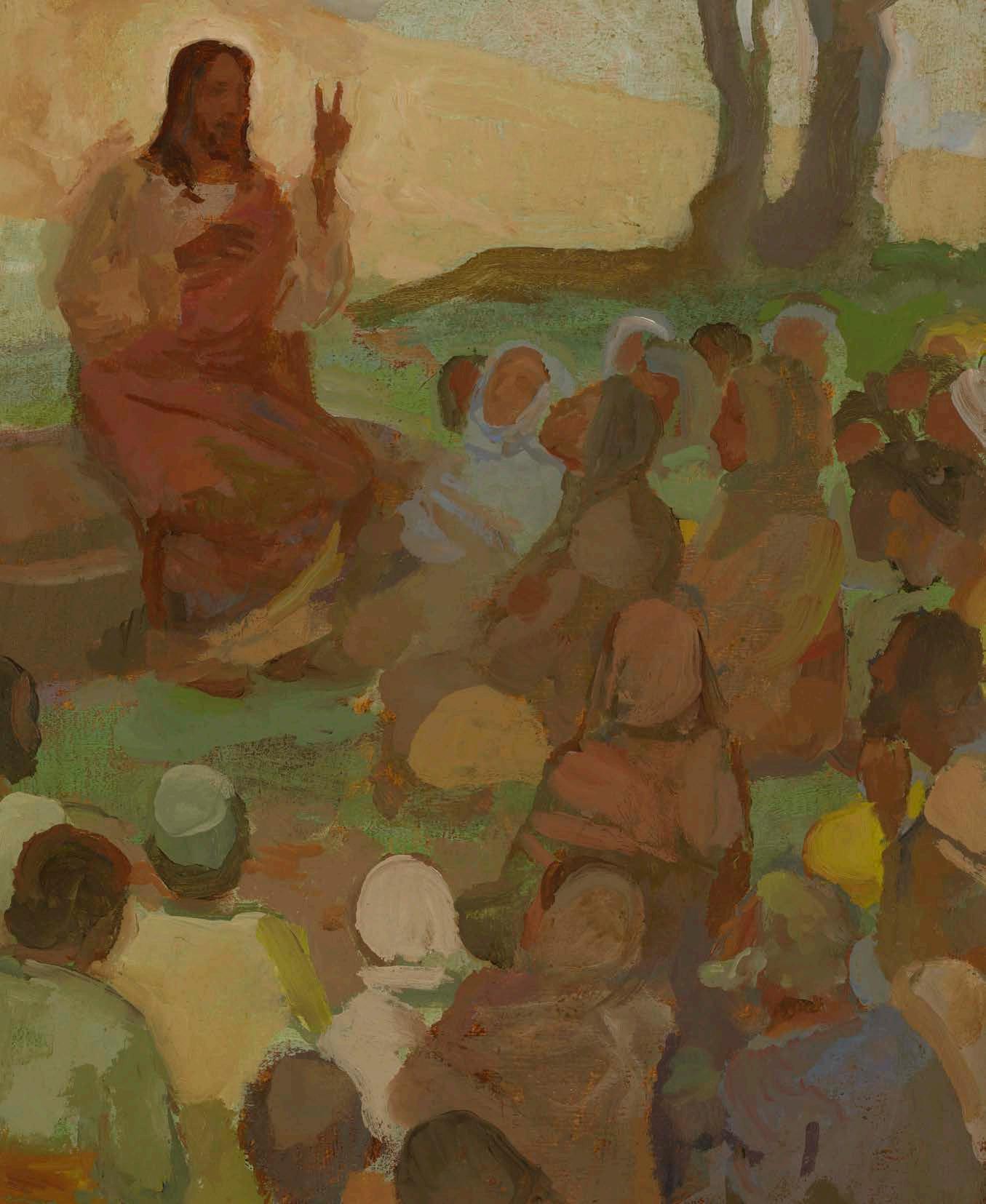
In the Gospel of Matthew, the Savior faced a well-known encounter with a lawyer: “Then one of them, which was a lawyer, asked him a question, tempting him, and saying, Master, which is the great commandment in the law?”3 The lawyer’s intent may have been malignant, but the question seems like a good one. 4 At the Savior’s time, there was a lot of law in the Law of Moses. There is a lot of law now. Law students spend years learning this law—torts, tax, constitutional law. With as much law as there is, this question is significant. What is the most important law? “Jesus said unto [the lawyer], Thou shalt love the Lord thy God with all thy heart, and with all thy soul, and with all thy mind. This is the first and great commandment.”5
What can we learn from Jesus’s answer? In identifying two great commandments, the Savior prioritized one as the first. Maintaining this priority is critical; we must let God prevail over all else.6 Living the first commandment by putting God first also helps us live the second great commandment to love our neighbor.7 We can’t love God without loving His children.
Living the first great commandment will help us with other priorities as well. Legal careers are often demanding and present prioritization challenges. But as President Ezra Taft Benson taught, “When we put God first, all other things fall into their proper place or drop out of our lives. Our love of the Lord will govern the claims for our affection, the demands on our time, the interests we pursue, and the order of our priorities.”8
Prioritizing love of God leads to obedience. We love Him by keeping His commandments.9 That decision has far-reaching consequences. As President Russell M. Nelson taught, “God’s greatest blessings are reserved for those who obey His laws.”10
Finally, we must share our love for God. At April commencement, Elder Clark G. Gilbert counseled that if you “isolate yourself from the world, you may preserve your faith, but you will miss the opportunity ‘to be a light to the world.’”11 As one who loves God, you have a light to share. In short, notwithstanding the jokes and negative portrayals, there is a way to live as a Christlike lawyer. It starts with living the first great commandment in the law.
notes
1 See Copeland v. Marshall, 641 F.2d 880, 929 n.53 (D.C. Cir. 1980) (Wilkey, J., dissenting).
2 3 Nephi 6:11.
3 Matthew 22:35–36.
4 See D. Todd Christofferson, “The First Commandment First,” byu devotional address, Mar. 22, 2022. (“In Matthew, the questioner is a lawyer of impure motive, tempting the Master. . . But I will at least give him credit for asking, despite his motive, because the Savior’s answer is so wonderful and profound.”)
5 Matthew 22:37–38.
6 See Russell M. Nelson, “Let God Prevail,” Liahona, Nov. 2020, 92–95.
7 See Christofferson, “The First Commandment First.” (“Putting the first commandment first does not diminish or limit our ability to keep the second commandment. To the contrary, it amplifies and strengthens it.”)
8 Ezra Taft Benson, “The Great Commandment—Love the Lord,” Ensign, May 1988, 4.
9 See John 14:15.
10 Russell M. Nelson, “The Love and Laws of God,” byu devotional address, Sept. 17, 2019.
11 Clark G. Gilbert, “A Light to the World: The Paradox of the byu Graduate Student,” byu commencement address, Apr. 24, 2025.
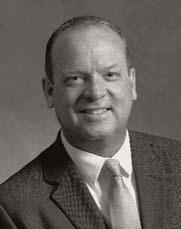
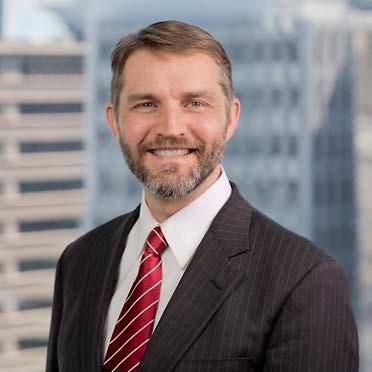
david h. moore Dean, byu Law School
former us congressman and senator from arizona and former us ambassador to turkey
One thing you learn as you progress through education and career is that people will discover who you are and who you represent—they will know that you are a member of The Church of Jesus Christ of Latter-day Saints. When I was in the US Senate, I often spoke with Chuck Schumer, who is still the Democratic minority leader in the Senate. His Harvard Law School roommate was a member of the Church who convinced him to read the Book of Mormon, and to this day, Senator Schumer has an affection for members of the Church because his roommate was a good example. h I hope that people will say the same after getting to know you. You’ll find throughout your career that people will know who you are. That’s a good thing. They should know who you are and who you represent, that you’re a disciple of Christ, and that you want to affect their lives in a positive way.
ILLUSTRATION BY MARK SMITH
HIGH EXPECTATIONS
When I was elected to the House of Representatives, there were (if I remember correctly) 13 members of the Church in the House. When I got to the Senate, there were six or seven of us out of 100. That’s a good percentage. I was fortunate that members of the Church who served before me set good examples so that people knew what to expect of a member of the Church.
One o f the first initiatives I worked on in the House of Representatives was to lift the travel ban to allow Americans to travel to Cuba. My thinking was, if you really want to get rid of the Castro brothers, just make them deal with spring break once in a while, right?
I sponsored legislation to lift the travel ban, but I couldn’t get Republican leaders to put it on the floor. So I sponsored amendments to appropriation bills to withhold the funds to enforce the travel ban, which would effectively repeal it. This became a heated debate, as many Republicans didn’t agree with my position. In fact, most of my support came from the other side of the aisle. One day early on, after I had argued on behalf of my bill, a Cuban-American Republican from Florida who didn’t like my amendment took the floor and said, “The gentleman from Arizona just wants to lift the travel ban so he can drink mojitos on the beach in Cuba!”
Usually if Democrats see Republicans going after each other, they will sit back and eat popcorn. But the chairman of the House Committee on Appropriations, Democrat
This article is adapted from remarks delivered at the Wheatley Institute’s Divinely Inspired Constitutional Principles Seminar on August 8, 2025.
David Obey, stood up and demanded that the congressman’s comment about me be “taken down,” or stricken from the record. When this happens, the clerk of the House has to read back what was said, to determine whether the words rose to the level of being defamatory or questioning someone’s motives.
Eventually, the Republican who made the mojito comment agreed to have the words stricken. Afterward, I went over to David Obey, who had served 30 years in Congress. I was just a freshman. I said, “You don’t know me. I’m a Republican, you’re a Democrat. Why did you come to my rescue?” He said, “Ah, Flake, I know you’re a Mormon. I know you don’t drink. Somebody had to protect your honor.”
Throughout my time in the House and the Senate, I knew people expected something of me because I was a member of the Church. People before me had set a good example. I would encourage you all to set a good example for those who follow you.
When I look at this group that may include future judges, lawmakers, or perhaps a few reluctant politicians, it brings to mind President Dallin H. Oaks’s assertion in general conference: “Our belief in divine inspiration gives Latter-day Saints a unique opportunity to uphold and defend the United States Constitution.”1
I’m told that earlier sessions of this seminar have examined the Constitution primarily through a judicial lens, and I’d like to approach it from two different angles. First, I want to focus on the Constitution as an export—something studied, emulated, and revered around the world. Second, I want to consider the Constitution as a muscle—a muscle that atrophies when Congress neglects to use it.
exporting the constitution
I served a mission in South Africa and Zimbabwe in the early 1980s, and six years later my wife, Cheryl, and I found ourselves in the country of Namibia, which lies between South Africa and Angola. This was a time of astonishing global change, as much of the world was emerging from the long night of communism and looking into the light of freedom.
In November of 1989 the Berlin Wall came down, and Namibia, just shaking off the weight of apartheid, was holding its first elections and drafting its constitution. For me, having recently graduated from Brigham Young University with degrees in international relations and political science, it was political nirvana. The foundation I directed brought American constitutional scholars to Namibia to help them draft their new constitution. One of the scholars we brought over was one of my former professors, Dennis Thomson. Now 35 years later, the language Dr. Thomson recommended regarding academic freedom remains a central part of the Namibian constitution.
They looked to our Constitution, not necessarily because it was American, but because it worked.
But what was most interesting to me was that the Namibian leaders, many of whom had been exiled in Soviet bloc countries, weren’t looking to consolidate power. They weren’t interested in a strong-man model; they had seen the end of that movie just months before. They wanted separation of powers . They wanted an independent judiciary . They wanted meaningful protections for individual rights. They were drawn not to a particular ideology but to a particular structure. They were drawn to the United States Constitution.
One thing I remember most about that time was Václav Havel’s speech to the United States Congress, which was delivered in February 1990. Havel had been a political prisoner in communist Czechoslovakia for years, and he had just been elected president after the country threw off Soviet rule. In his speech to a joint session of Congress, he expressed deep gratitude to the United States for the example that it had set. He added that without the support of Western democracies, Czechoslovakia would never have been able to secure freedom from Soviet control. “Our freedom, independence, and our newborn democracy have been purchased at great cost, and we will not surrender them,” he said. “[T]he salvation of this human world lies nowhere else than in the human heart . . . and in human responsibility.”2
In a speech a few years later, Havel said, “The idea of human rights and freedoms must be an integral part of any meaningful world order” and that any path “to peaceful coexistence and creative cooperation” must be rooted deeply “in human hearts and minds.”3
These words landed heavily on me. I was watching in real time in the drafting rooms and the voting lines in Windhoek, Namibia, as people long denied basic liberties sought not revenge, not revolution, but restraint—and they looked to our Constitution, not necessarily because it was American, but because it worked . On election day, the lines stretched for miles. Voters waited for 10 or more hours in the African heat to cast a vote for the first time in their lives. No violence, no chaos; just quiet dignity and the belief that freedom is real and that it is guarded not by personalities but by laws. President Oaks called the US Constitution “a common heritage of constitutions around the world.”4 I was fortunate to see firsthand what that heritage means to people who are struggling to write their own story. Later in my role as ambassador to Turkey, I witnessed again a deep and often unspoken respect for our Constitution and what it represents: a system of government strong enough to endure self-correction and open enough to let people hold it accountable.
exercising constitutional power
Let’s shift to the second half of President Oaks’s message: his warning that Constitutional principles can be undermined not only by enemies abroad but also by disuse, distortion, and disregard at home. This brings me to Congress. Now I’m a recovering legislator, so you may need to take this next part with the requisite dose of skepticism, but I believe that no institution has done more damage to the balance of power in our country than Congress itself. Article One of the Constitution lays out the powers of the legislative branch. The founders were clear: Congress declares war, regulates trade, controls the purse, and serves as a check on the executive.5
But over the last several decades, Congress has voluntarily and unwisely surrendered much of its authority to the Article Two branch, the executive branch. I’ll highlight a few examples: war powers : The Constitution is unambiguous that it is Congress, not the President, that declares war. And yet for decades, US military operations have been carried out under Authorizations for Use of Military Force (aumfs) that were passed in the immediate aftermath of the September 11 attacks and have never been meaningfully revisited. During my six years in the Senate, I spent a lot of time, often in partnership with Senator Tim Kaine of Virginia, a Democrat, trying to modernize the war powers process in a way that would
respect Congress’s proper constitutional role. We introduced legislation to sunset outdated aumfs to require constitutional debate and approval before committing US troops to new conflicts. I believe deeply that reclaiming Congressional war power authority isn’t just a matter of process; it is a matter of Constitutional integrity.
We did not succeed. Congress, like many institutions, has developed a deep aversion to risk, and debating war is politically uncomfortable. Voting is hard. Voting on war is even harder. It’s far easier to defer to the President and far too tempting to hold a press conference after the bombs have been dropped.
tariff authority : Levying tariffs is also a congressional power under the Constitution, but we’ve allowed the executive branch to impose tariffs unilaterally through statutes like Section 2 32 of the Trade Expansion Act, often for reasons that have more to do with politics than national security.
emergency powers : There are dozens of emergency statutes in effect, some dating back to the Cold War, that grant expansive and often unchecked authority to the executive. Congress has the tools for oversight, including subpoena power, hearings, and control of the purse, but these tools are often hamstrung by partisanship and selective outrage.
hThis is not a partisan critique; it’s a constitutional critique. The legislative branch has become too comfortable as a reactive body. We’re lobbing rhetorical grenades from the sidelines while the hard work of governing shifts further and further away from where the Constitution placed it.
Now, let me say this clearly: The Constitution only works if we use it. It’s not self-executing. If we don’t defend the separation among the three branches of government, if we don’t demand that each branch perform its duty, we’re not living under a constitutional system—we’re merely invoking one. To appropriate a phrase popularized by Elder Dieter F. Uchtdorf, 6 we are not living up to our constitutional privileges.
A word or two on moral agency and responsibility. President Oaks emphasized the connection between constitutional liberty and moral agency, stating, “God has given His children moral agency—the power to decide and to act. The most desirable condition for the exercise of that agency is maximum freedom for men and women to act according to their individual choices.”7
But real freedom requires accountability. Constitutional government doesn’t just empower, it restrains. It limits both what government can do to you and what government can do for you. The rule of law is not an ideology subject to the pendulum swings of politics. America without the rule of law is no longer America.
Fortunately, our Constitution forces compromise. It requires public servants and private citizens to do hard things: to negotiate, to amend, to vote, to lose graciously, and to start again the next morning. That’s why the Constitution is so easy to admire and difficult to live up to. It does not reward shortcuts. It demands the best of us.
I’ll borrow a line from Thomas Jefferson when he called the Constitution “the sheet anchor of our peace at home and safety abroad.”8 The sheet anchor is the failsafe anchor on a ship. The Constitution likewise anchors our system in turbulent waters, but anchors don’t work if we don’t lower them, and they don’t work if we keep cutting the rope.
integrity in the wilderness
Standing up for the Constitution may sometimes put you in the wilderness, but sometimes the wilderness suits just fine. I once spent a week alone, voluntarily marooned on a tiny, deserted island in the Marshall Islands called Jabonwod, a remote spin of sand and coconut trees in the Central Pacific, 7,000 miles from Washington.
This was during a congressional break in 2009. I just wanted to see if I could survive. I’ve always loved adventure stories, especially sailing adventures gone bad, and I always wondered, “If I were marooned on an island alone, could I survive?” After 20 years of marriage, Cheryl finally said, “If this is your midlife crisis, can you get it over with? Maroon yourself already!” So I did.
I was determined to test my survival skills, so I brought no food or water. I relied solely on what I could catch or collect. That turned out to be the easier part of the adventure. I got used to swimming with sharks and competing with them for food. More difficult was dealing with the intense loneliness that set in on the first night and never left me. By day three, for companionship I began to mark the hermit crabs that endlessly wandered through my camp. I put a number on them just to see if these were the same crabs doing laps or a whole new group. By the end of the week, I had 126 numbered friends.
Now, I wouldn’t recommend such drastic measures to escape a crisis of conscience, but I hope that should you be tempted to compromise your principles, you will eschew comfort and persevere in your own wilderness for a time.
Jeff Flake watches the waves on a remote beach in the Marshall Islands.
When I got elected to the Senate, I realized just how partisan things had become. Congress has always been partisan, of course, but it had reached a new level. I decided, along with Senator Martin Heinrich, a Democrat who had also just been elected to the Senate, that we would prove that Republicans and Democrats could get along.
S o Martin and I went back to the Marshall Islands for nearly a week with a crew from Discovery Channel, and we filmed a one-off special called Rival Survival. We were there with just a machete between us, determined to prove that we could survive together. When we returned to Washington, none of our colleagues in the Senate knew about our experience. We did the television talk show circuit to discuss how Republicans and Democrats could work together. The Colbert Report ran a clip of Martin and me trying to survive on the island, with Stephen Colbert commenting, “I want to give a tip of the hat to these senators for proving Republicans and Democrats can work together; all it takes is the threat of death.”9
looking to the future
Jeff Flake and Senator Martin Heinrich film the show Rival Survival.
You students from byu, Harvard, Yale, Georgetown, Notre Dame, and other fine institutions—whether you spend your lives in courtrooms or classrooms, boardrooms or briefing rooms, I hope you’ll not only admire the Constitution but also insist on its full and proper use by every branch of government in every season.
hnotes
1 Dallin H. Oaks, “Defending Our Divinely Inspired Constitution,” Liahona, May 2021, 107.
2 Václav Havel, speech delivered at a joint session of the US Congress, Feb. 21, 1990, Czech Republic Presidential Website, old.hrad.cz/president/Havel /speeches/1990/2102_uk.html.
3 Václav Havel, “The Need for Transcendence in the Postmodern World,” speech delivered at Independence Hall, Philadelphia, July 4, 1994.
8 Thomas Jefferson, “First Inaugural Address,” Mar. 4, 1801.
9 Stephen Colbert, The Colbert Report, episode 1404, aired Sept. 22, 2014, on Comedy Central.
Q&A with Jeff Flake
Q What made you decide to run for public office?
a I’m often asked this question. If you’re wondering if I knew in high school or college that I would run for Congress—no, I didn’t. But we are encouraged frequently by our Church leaders to serve in government. So when there was an open congressional seat, I thought it might be an opportunity to try to leave this a better country than I found it. I reflected on the examples of people who had contributed to our democracy as public servants, and I felt compelled to follow their lead.
I loved my time in the House and in the Senate. And 18 years later, when I decided to not run for reelection, it wasn’t because I had soured on public service. Frankly, I would have liked to have run for another Senate term. But under the political conditions that existed, to have a real chance of winning, I would have had to adopt positions I did not hold and condone behavior I could not condone. It simply wasn’t worth the price I would have to pay.
But I didn’t leave the Senate thinking, “Oh, what a terrible institution!” The truth is, we have a wonderful system of government. I’m more convinced of that than ever. There
are good people in Washington on both sides of the aisle trying to do the right thing, and it will remain so.
We need good people to run for office. We need people to work on campaigns and in think tanks and to be involved in public policy decisions. We need people who don’t see those on the other side of the aisle or those who don’t share their perspective as evil. They simply have different opinions.
Q What can we do as private citizens to improve politics?
a These days everyone can be, and needs to be, involved. I hope you’re on social media. We need more positivity. You can have strong opinions on social media, and you can express those opinions. You can change your mind later when you gain additional perspective. That’s all fine.
What’s not fine is demeaning those who don’t share your views, calling them names, using crass or crude language, and being snide or sarcastic. We don’t need any more of that. What we do need is for people to use whatever influence they have—whether it’s writing an op-ed in a local paper, contributing to a podcast, or posting on X or on
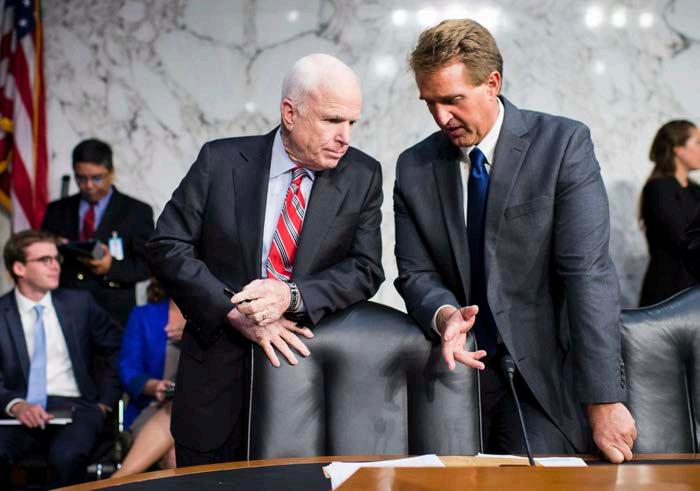
Jeff Flake speaks with former Senator John McCain.
Instagram—in a way that recognizes that this is a good system and there are good people in it.
And b e careful about what you post, because it always comes back. I spent 12 years in the House, six in the Senate. Twitter wasn’t around that whole time, gratefully, but it was around for a lot of it. When I was nominated to be ambassador to Turkey, I knew I would have to appear before my former colleagues, Republicans and Democrats, and they would have to approve my nomination.
I wondered, “Did I ever call them out on social media using language I shouldn’t have? Did I demean them? Question their motives?” I was pleased that when the State Department scrubbed through everything I had ever written, said, or posted on social media, there wasn’t anything that I felt I ought to delete. (Deleting old posts doesn’t work anyway—it’s still recorded.) If the worst reason to be civil is out of self-interest, that’s better than nothing. Of course, the best reason to be civil is because a disciple of Christ would not use crass or crude language, would not demean people, and would not question their motives. I hope Christ’s example is what really motivates us.
Afew years ago, the Maxwell Institute asked if I would contribute a book about law to a series of books on themes in the Doctrine and Covenants. I wasn’t sure if I was being asked to write about what the Doctrine and Covenants has to say about secular law, what it has to say about divine law, or some of both. I ended up writing about some of both, but with a focus on divine law.1
Very early on, the phrase that pressed on my heart and that I knew was going to be the foundation for this book was a passage in Joseph Smith’s King Follett discourse. In the April 1844 general conference, Joseph Smith spoke about King Follett’s death in an accident several weeks earlier. The Prophet Joseph explored the topic of the dead, expanding into a panoramic talk about the entire plan of salvation going back to the Council in Heaven, the Creation, and the Fall. The Prophet said, “God Himself found Himself in the midst of spirits and glory,” and seeing that He was more intelligent, “saw proper to institute laws whereby the rest . . . could have a privilege to advance like Himself.”2 God’s eagerness to lift His children became my focus.
DIVINE LAW
BY JUSTIN COLLINGS Academic Vice President and Professor of Law at BYU
Vice President Collings is the author of Divine Law, part of the Maxwell Institute series on themes in the Doctrine and Covenants.
This article is adapted from remarks delivered at byu Law School on February
24, 2025.
L AWS EMANATE GRACE
For most people, law is a scary word. Legal iconography is meant to be majestic and imposing to elicit fear that fosters obedience. Think of Lady Justice with her blindfold, a sword in one hand and a scale in the other, implacable and impartial. We tend to think about law in terms of punishment and justice, and in the theological context perhaps we have oversubscribed to the notion that God’s laws create elusive standards we can never meet. At some point in your life, you have probably been taught something like, “God gives us commandments to test our obedience, but we’re unable to keep them. We are subject to the demands of justice, so we need mercy and grace to save us from our inability to live the law.” There are scriptures that teach these things, but my concern is that we have an incomplete account, because this line of thinking portrays law in a light where it is the antithesis of grace. On this account, law is the standard against which we are weighed and forever found wanting. Law is the thing that necessitates the intervention of mercy, and we need the Savior to save us from law.
But we can flip that paradigm and view law not as the antithesis of grace but rather as a medium of grace. After all, Joseph Smith taught in that climactic discourse that before the Council in Heaven, God surveyed His spirit children and decided to lift us. God wanted us to have the privilege of advancing like Himself, to enjoy what He enjoys. He instituted laws as a kind of ladder of grace that, if we’re willing to climb, will lift us toward the throne of God.
I ’ll highlight several passages in the Doctrine and Covenants that I think support this view. One of the things that’s interesting in the Doctrine and Covenants is that at each significant point of gathering, the Lord reveals a law. In section 38 the Lord tells the Saints to gather in Kirtland, Ohio, and He says, “[T]here I will give unto you my law.”3 And in section 42 is the law—a great legislative revelation, I might call it. Section 59 is a similar legislative revelation in connection with the gathering of Saints in Jackson County, Missouri. We see this pattern repeated in section 124 when the Saints had gathered in Nauvoo, Illinois, and
in section 136 when they had gathered at Winter Quarters, Nebraska, in preparation to cross the plains to the Salt Lake Valley.
L AWS ARE SIGNS
One of the great aspects of the ancient law— the law of Moses—was that for Israel, laws weren’t just a set of guidelines, they were signs Yes, laws were the things Israelites were supposed to do, but the laws were also signs of God’s presence and interaction with His people. Basically, the Lord was saying, “Because I’ve given you my law, this is a sign that you are my people and I am your God.” This is the great blessing of the covenant: I’ll be with you; I’ll go with you. I collected two pages of quotations from the Doctrine and Covenants where the Lord is saying, “I will be with you”4; “I am in your midst.”5 We see this theme throughout the Doctrine and Covenants.
In section 59, the Saints have arrived in Jackson County, and the Lord reveals, “Yea, blessed are they whose feet stand upon the land of Zion, who have obeyed my gospel; for they shall receive for their reward the good things of the earth, and it shall bring forth in its strength”; and then this part: “And they shall also be crowned with blessings from above, yea, and with commandments not a few.”6 We might sometimes think about divine law as an imposition or constraint on our liberty. But in this revelation, the Lord depicts His commandments not as a constraint but as a crown. The righteous will be “crowned with . . . commandments not a few.” We want laws. We want as much guidance as we can get.
S ection 82:8–9 you are likely familiar with. These might have been scripture mastery verses back in my day:
And again, I say unto you, I give unto you a new commandment, that you may understand my will concerning you;
O r, in other words, I give unto you directions how you may act before me, that it may turn to you for your salvation.7
So a commandment is a salvific directive. These are God’s directions to work toward our salvation.
L AWS ARE PERFECTING
Finally, section 88 is one of the greatest of the revelations, and it is important to us here at byu. President Dallin H. Oaks, when he was president of byu, called this revelation “the basic constitution of Church education.”8 The Lord describes the function of law, speaking of the degrees of glory in the next life:
[N]evertheless, they shall return again to their own place, to enjoy that which they are willing to receive, because they were not willing to enjoy that which they might have received.
For what doth it profit a man if a gift is bestowed upon him, and he receive not the gift?
. . . [T]hat which is governed by law is also preserved by law and perfected and sanctified by the same.9
I w ant to highlight the words about being governed, preserved, perfected, and sanctified by law. We sometimes think, “Oh, we don’t manage to keep the law, so we have to be sanctified by something else.” But here the Lord explains that we can be preserved and perfected and sanctified by law. It’s law that allows us to become like
God. That’s why He gave us these redemptive directives.
Another aspect of my research was reading dedicatory prayers for temples. In my book I have a chapter about secular law and the Constitution and about references to the Constitution in the Doctrine and Covenants. One of the revelations that refers to the Constitution is section 109, which is the dedicatory prayer for the Kirtland Temple.10 And there are a lot of dedicatory prayers that refer to the Constitution or to constitutional principles. The dedication of the London England Temple mentions the Magna Carta,11 and the dedication of the Bern Switzerland Temple mentions principles of liberty.12 The dedicatory prayer for the Logan Utah Temple by President John Taylor refers to the temple as a place to learn higher laws and the different orders of law.13 His prayer was that we would come to the temple and be taught the Lord’s law, echoing Isaiah’s prophecy that Saints will gather to “the mountain of the Lord’s house” and be taught His law and His ways.14
When I talk about law in this context, I’m often asked about section 130, where we are told,
There is a law, irrevocably decreed in heaven before the foundations of this world, upon which all blessings are predicated—
And when we obtain any blessing from God, it is by obedience to that law upon which it is predicated.15
As Elder D. Todd Christofferson pointed out in general conference a few years ago, we may erroneously think of this scripture in a mechanical sense where God’s plan is like “a cosmic vending machine”16 in which we plunk in the coin of obedience and out comes the blessing. Offering our obedience in a transactional way is dangerous because sometimes the blessings don’t come as we expect or think we deserve. This can also lead to toxic perfectionism where we ascribe a failure to receive expected blessings to insufficient obedience.
This is only one o f several possible misreadings of this scripture. Elder Neal A. Maxwell noted another one, which is the misconception that blessings are commensurate to our obedience. He clarified that there is a correspondence, but it’s “a very, very generous ratio indeed,” 17 and
blessings often far outstrip our modicum of obedience.
Another misreading has to do with timing. We might expect blessings to come immediately or in a certain way. We look at our watch, waiting for blessings to come. But the Doctrine and Covenants presents a narrative arc of blessings deferred: gathering and being driven out, building a temple and abandoning it. In Nauvoo, Joseph Smith insisted that a temple must be raised and a university must be built.18 In the end, the Nauvoo Saints didn’t enjoy these blessings— we do. The stakes are high here. There are real consequences to misunderstanding the nature of God. God doesn’t tantalize His children; He reaches out to us in loving compassion.
A REL ATIONSHIP WITH GOD
We also tend to focus more on earthly blessings. So when we consider the Word of Wisdom, we think about health; or when we think about section 88, we value going
to bed early and getting up early to enjoy more vigor as we pursue our studies.19 But I’m convinced that the greatest of the blessings comes in terms of what happens to our character and what happens to our souls every time we are obedient to God’s commandments and become marginally more like God. I love section 88, which instructs, “[T]hat which is governed by law is also preserved by law and perfected and sanctified by the same.”20 God does not want to control us; He wants us to become like Him. And the heart of that is a relationship. God wants to invite us into a relationship with Him. It’s not that He wants to create a celestial kingdom just for a few people in some far corner. He wants us to come home having become more like Him because we’ve had a relationship with Him.
W hen we think about the commandments in terms of a relationship, this can soften our heart and sweeten our attitude toward these commandments. Instead of reacting to commandments with “What’s so bad about X? Why can’t I do that? Why
do I have to be different?” we can react with “Wow, this is breathtakingly beautiful that God cares about what I eat and what I drink and what I wear. He’s in the details of my life. He wants to be in a relationship with me.” If you think about your relationships, whether it’s in a marriage or with siblings, there are certain things that bother the people that we’re close to and certain things that delight them. Sometimes we refrain from the things that bother and we engage in the things that delight simply because the relationship is important to us. We can treat our relationship with God with the same care.
This way of thinking can transform all our relationships. Indeed, we can think of mortality as a construct for forming relationships. What a beautiful part of our theology—that we are created to love and support each other. We are created with the capacity for empathy. Take a step back from what you think you need to get done; even if you don’t want to play games with the in-laws, take that opportunity to strengthen friendships and build love.
OBEDIENCE A S A SIGN
I love the thought of God’s commandments as being not only an invitation to enter into a relationship with Him but also a sign of our obedience. President Russell M. Nelson’s 2015 general conference remarks on the Sabbath come to mind. It was revolutionary for President Nelson when he realized that the way he treated the Sabbath was a sign to God, a sign of his covenant.21 This thinking transforms Sabbath day questions like “Am I allowed to watch the game?” or “How far of a walk can I take?” It replaces the lists of things you can and can’t do with this simple question: “What sign am I showing to God?” Every commandment becomes an opportunity to show God that He is more important to us than whatever thing we are abstaining from. The Lord said, “If ye love me, keep my commandments.”22 You can read that as saying, “Well, if you really love me, you’re going to keep my commandments.” But another way to read it is, “If you love me, the way you show that is by keeping my commandments.” This kind of obedience is an expression of our love for God, just as the commandments themselves are an expression of God’s love, interest, and concern for us. Garments, the Word of Wisdom, chastity, church attendance—these are all choices that give us an opportunity to show God that He is more important to us than the thing that we’re giving up.
REPENT ANCE AS AN INVITATION
Repentance is something that we have a tendency not to see as a law. Rather, we acknowledge that there are commandments
we don’t keep and so we have to do this thing called repentance. I suggest that repentance is a law that has us turning toward the Savior. I used to think of repentance like a game of Whac-A-Mole—I could remember one infraction and try to take care of it but then have some other memory come up and be troublesome. That’s a pretty miserable way to live. For example, we can return home after executing a perfect youth activity only to realize we’ve neglected our own children. But God does not intend His laws, including repentance, to be a source of fear, anxiety, and failure; God’s laws, including repentance, are about becoming.
Elder Weatherford T. Clayton, in a 2017 byu devotional, cast repentance in this very different light. He explained, “When we sincerely pray to the Father, in a very real sense we are repenting. When we read the scriptures and ponder them, we are repenting.”23 And when we go to the temple, we’re repenting. All these things that we do to turn toward the Savior are repenting. And it’s not that we don’t have to go through the steps of the repentance process when that’s necessary, but Whac-A-Mole is not the way the Lord works with us. If it were, we would be stuck in a paradox: “Well, I know that I need to repent because I don’t live the law correctly, but I also don’t repent correctly. I don’t even get that right.” Thinking of repentance as this tantalizing thing we must get right has us saying to ourselves, “I didn’t live the law perfectly, but by golly I’m going to repent perfectly, because I really don’t want to need anybody’s help.” Elder Clayton’s perspective says that repentance is not a situation where you need to comb over every moment of your life for every single shortcoming, because that’s negating the necessity for the Savior. Repentance, like God’s other laws, is an invitation to come unto Christ, not an impossible paradox.
THE S AVIOR: OUR ADVOCATE
Studying the Doctrine and Covenants is an immersive study in the Savior’s roles as lawgiver, advocate, and judge. Lawyers like to see the Savior this way, just as doctors relate to the Savior as a healer, or as academics connect with the 12-year-old Christ teaching at the temple. The Savior’s legal roles are beautifully portrayed in the Jorge Cocco Santángelo polyptych at byu Law School, and they anchor the Law School’s mission statement.
As a lawgiver, the Savior is lifting us. He’s inviting us upward. He’s giving us opportunities. The Doctrine and Covenants is a latter-day Torah in the sense that its guidelines are day-to-day, quotidian commandments that help us to live the daily life of a disciple and develop a covenant relationship with the God of Israel.
We also learn a lot about God as a judge. Perhaps this is something that scares us. We might recoil from the warning that He will come in judgment. It can make us a little bit uncomfortable and even instill a sense of fear and dread. But consider what the angel tells King Benjamin in Mosiah 3: “[A]nd behold, he standeth to judge the world; and behold, all these things are done that a righteous judgment might come upon the children of men.”24 I love the notion that the Savior did what He did and experienced what He experienced so that our judgment could be a righteous judgment. I think this means that not only will it be fair and that He will be empathetic—we won’t be able to stand before our Judge and say, “You just don’t understand what it was like for me,” because He knows exactly what it was like— but it will also be a righteous judgment in the sense that the purpose of His judgment is to help us become more righteous and become more like our Father in Heaven, rather than to impose penalties. Penalty is
a mortal term. Turning away from the grace and joy of the Atonement, allowing the consequences of our imperfections to become permanent—that is the punishment, and it is a product of our own agency.
I want to focus now on the Savior’s role as our Advocate with the Father. Lawyers know that words matter and that prepositions matter, and I want to highlight that the Savior is always referred to as our Advocate with the Father, not our Advocate against the Father. We can misunderstand this imagery, painting a courtroom drama where the Father is eager to condemn us and to uphold justice, but where the Savior intervenes to assert mercy as a backup plan; we might envision Them being at odds—but because the Father loves the Son so much, He is grudgingly willing to squint at our sins and shortcomings and save us for the Son’s sake. This scenario has the cast of characters all wrong. God is not our accuser; Satan is our accuser. The Hebrew name Ha Satan means “the accuser,” and I suspect that part of Satan’s premortal attack on our agency was an accusation that we were not to be trusted with agency, that it was too dangerous a gift. The book of Revelation calls Satan “the accuser of our brethren” and says that he accused us before the throne of God “day and night.”25 He continues to accuse us now, insisting that we are sinners who have made a mess of our lives.
This imagined courtroom scenario also contradicts everything that we know about the Savior’s relationship with the Father. Consider the very first recorded words we have from the Savior in our scriptures: “Father, thy will be done, and the glory be thine forever.”26 Likewise, the first recorded words we have from His mortal life are at age 12 asking, “[Know] ye not that I must be about my Father’s business?”27 His last
words on the cross were, “Father, into thy hands I commend my spirit.” 28 When the resurrected Christ appeared to the Nephites, among the first things He said was, “I have drunk out of that bitter cup which the Father hath given me, and . . . I have suffered the will of the Father in all things from the beginning.”29 Finally, when He described His atoning sacrifice in section 19 of the Doctrine and Covenants, He began by saying, “I, having accomplished and finished the will of him whose I am, even the Father, concerning me.”30 So it’s just ludicrous, if not blasphemous, to think that somehow, at the moment of judgment, the Savior and the Father would be at cross-purposes. On the contrary, in advocating with the Father on our behalf, the Savior is fully realizing the Father’s will. Every law we are given is an opportunity to come into the Savior’s influence and orbit. This is His eternal saving role. Perhaps the Savior is there as our advocate not to persuade the Father that we deserve to come in but rather to persuade us: “You belong here.”
FULFILLING THE L AW
In closing, I’ll turn to the Book of Mormon, where Mormon embeds a great truth as a dependent clause within a question. I’ll rephrase it as a declaration: “Christ . . sat down [at] the right hand of God, to claim of the Father his rights of mercy.”31 As lawyers, you know that rights are not outside the law. They’re not negations of the law. They’re not exceptions to the law. They are the law at its most fundamental. So when Jesus says, “I am not come to destroy [the law], but to fulfil,”32 He means that He has come “to answer the ends of the law,”33 the purpose of which is the salvation and the exaltation of the children of God. He asserts
His rights of mercy to fulfill the most fundamental law, which is not in opposition to the Father’s will but is rather a glorious consummation of the Father’s will. And He can do this regardless of the price tag on the collective sins of humankind because Jesus Christ’s Atonement is infinite. This is the beautiful interaction between our agency and the Savior’s Atonement, made possible through the gracious medium of God’s law. That interaction was God’s purpose from the beginning, and we are living its fulfillment.
notes
1 S ee Justin Collings, Divine Law: Themes in the Doctrine and Covenants (Maxwell Institute, 2024).
2 Joseph Smith, quoted in Stan Larson, “The King Follett Discourse: A Newly Amalgamated Text,” byu Studies 18, no. 2 (1978): 204.
3 Doctrine and Covenants 38:32.
4 S ee Doctrine and Covenants 31:13, 49:27, 68:6, 84:88, 112:19, 132:49.
5 Doctrine and Covenants 29:5, 38:7, 50:44, 61:36.
6 Doctrine and Covenants 59:3–4.
7 Doctrine and Covenants 82:8–9.
8 Dallin H. Oaks, “A House of Faith,” address given at byu annual university conference, Aug. 31, 1977, speeches.byu.edu/talks/dallin-h-oaks/a-house-of -faith.
9 Doctrine and Covenants 88:32–34.
10 See Doctrine and Covenants 109:54.
11 See David O. McKay, “Dedicatory Prayer,” address given at the dedication of the London England
Temple, Sept. 7, 1958, churchofjesuschrist.org /temples/dedicatory-prayer/london-england -temple/1958-09-07; see also Gordon B. Hinckley, “Dedicatory Prayer,” address given at the rededication of the London England Temple, Oct. 18, 1992, churchofjesuschrist.org/temples/dedicatory -prayer/london-england-temple/1992-10-18.
12 See David O. McKay, “Dedicatory Prayer,” address given at the dedication of the Bern Switzerland Temple, Sept. 11, 1955, churchofjesuschrist.org /temples/dedicatory-prayer/bern-switzerland -temple/1955-09-11.
13 See John Taylor, “Dedicatory Prayer,” address given at the dedication of the Logan Utah Temple, May 17, 1884, churchofjesuschrist.org/temples/dedicatory -prayer/logan-utah-temple/1884-05-17.
14 Isaiah 2:2–3.
15 Doctrine and Covenants 130:20–21.
16 D. Todd Christofferson, “Our Relationship with God,” Liahona, May 2022.
17 Neal A. Maxwell, “Sharing Insights from My Life,” byu devotional address, Jan. 12, 1999, speeches .byu.edu/talks/neal-a-maxwell/sharing-insights-life.
18 S ee G. Homer Durham, Joseph Smith: ProphetStatesman (Bookcraft, 1944), 90; see also Teachings of the Prophet Joseph Smith, comp. Joseph Fielding Smith (Deseret Book, 1938), 186.
19 See Doctrine and Covenants 88:124.
20 Doctrine and Covenants 88:34.
21 See Russell M. Nelson, “The Sabbath Is a Delight,” Ensign or Liahona, May 2015, 130; see also Exodus 31:13 and Ezekiel 20:12, 20.
22 John 14:15.
23 Weatherford T. Clayton, “Rock of Our Redeemer,” byu devotional address, Mar. 14, 2017, speeches .byu.edu/talks/weatherford-t-clayton/the-rock-of -our-redeemer.
24 Mosiah 3:10.
25 Revelation 12:10.
26 Moses 4:2.
27 Luke 2:49.
28 Luke 23:46.
29 3 Nephi 11:11.
30 Doctrine and Covenants 19:2.
31 Moroni 7:27.
32 Matthew 5:17.
33 2 Nephi 2:7.
photo illustrations
Pages 12–13: Original photograph: Pavliha / iStock / Getty Images Plus
Page 15: Original photograph: Arthur Edelmans / unsplash.com
Page 16: Original photograph: Nick Tiemeyer / unsplash.com
T. S. Eliot’s play Murder in the Cathedral opens with a chorus of women from Canterbury chanting forebodingly that Thomas à Becket’s return to the cathedral will lead to his death. Eliot pens Becket’s assertion later in the book: “A Christian martyrdom is no accident. Saints are not made by accident.”2 For context, Thomas à Becket, the Archbishop of Canterbury was martyred for his stance against King Henry II of England, which included Becket’s efforts to preserve the religious integrity of the Church. Becket’s courage has inspired generations willing to stand by their religious convictions even in the face of tremendous secular pressures.
Today Thomas à Becket’s legacy motivates us in the face of modern authoritarian forces that would deny religious expression. In my role as the commissioner of education in The Church of Jesus Christ of Latter-day Saints, I see that these threats come from secular agendas in the media, from regulators, and even from peers and other academic contemporaries.
It is significant that the namesake of Becket Law, the nation’s leading religious liberty law firm, is this same Thomas à Becket. The highest honor Becket Law gives is the Canterbury Medal, recognizing individuals who have demonstrated courage in defending religious liberty. Past recipients include Rabbi Dr. Meir Soloveichik, President Dallin H. Oaks, Rabbi Lord Jonathan Sacks, and Dr. Robert George.
Last year Becket Law celebrated 30 years of religious liberty victories, including milestones that impact religious higher education.3 For example, Hosanna-Tabor (2012), 4 which The Wall Street Journal described as “among the most important religious liberty cases in a half century,”5 was a unanimous decision by the Supreme Court affirming ministerial exceptions for religions to choose their own teachers without government interference.
In Trinity Lutheran v. Comer (2017)6 the Supreme Court determined that the government cannot discriminate for funding solely because an organization is a religious institution.
In Our Lady of Guadalupe v. Morrissey-Berru (2020) 7 the Supreme Court extended Hosanna-Tabor to affirm that the government cannot dictate who religious schools hire to instruct students about their religious faith.
Then in Carson v. Makin (2022)8 the Supreme Court extended the Trinity Lutheran decision to rule that the government cannot exclude religious schools from tuition assistance programs simply because they are religious. This has implications for Pell Grant funding and perhaps even more immediately for proposed discriminatory legislation in California tied to Cal Grants.
The fact that these cases were strong majority victories shows that the legal protections for religious freedom, including in education, are strong and well reinforced. We are grateful that these judicial supports for religious liberty are also supported by the able legal and educational work of members of the J. Reuben Clark Law Society.
cleaRgoveRnance
At BYU we are sustaining efforts to preserve religious freedom worldwide, including through material contributions from the International Center for Law and Religion Studies and from the Wheatley Institute initiative on the US Constitution. But all these efforts will count for naught if we simply celebrate legal victories but don’t preserve our identity.
James Burtchaell’s The Dying of the Light: The Disengagement of Colleges and Universities from Their Christian Churches is instructive on this point.9 Looking across academia, Burtchaell concludes that universities’ loss of religious identity is not due to legal restrictions but rather a failure of organizational and administrative governance. This loss of religious identity did not happen all at once but through the recursive drift of everyday decisions deep inside these organizations. In Burtchaell’s analysis, this happened when religious schools allowed outside, secular entities to supersede key religious governance through three primary mechanisms:
FIRST, as the operating expenditures of running a modern university increased, religious schools began outsourcing their funding sources to nonreligious entities including donors, state and federal governments, and students (through increases in tuition).
SECOND , this reliance on outsourced funding often led to the selection of university leadership by stakeholders not affiliated with the sponsoring religious institutions. Presidents and other university leaders increasingly felt less accountable to the sponsoring religious institutions.
THIRD , increasing specialization of academic disciplines often meant that internal university leadership did not always have the academic training to review the scholarly work of the faculty. Over time, peer review increasingly came from outside scholars who did not support and were even antagonistic to religious perspectives.
The Church Educational System of The Church of Jesus Christ of Latter-day Saints has mechanisms in place to resist these forces. For example, the primary funding of byu comes from the Church, not from grants, government funding, donors, or student tuition. Similarly, the selection of the university president is made by the First Presidency of The Church of Jesus Christ of Latter-day Saints. On these first two points, the unique governance of the Church Educational System was described by Elder Ronald A. Rasband at the inauguration of President C. Shane Reese:
In the case of Brigham Young University, it is important to recognize that the governance of this institution operates under the guidance of a unique and distinctive board of trustees.
. . . The byu Board of Trustees is led by the First Presidency, with President Russell M. Nelson serving as chairman.10
This article is adapted from remarks delivered at the annual J. Reuben Clark Law Society fireside on January 17, 2025.
As far as Burtchaell’s third challenge—outsourced faculty hiring and review—all byu faculty candidates are interviewed by either the university president or academic vice president, as well as by a general authority, and new faculty must be approved by the byu Board of Trustees.
For religious expression to flourish, religious freedom and aligned governance must ultimately be supported by a deeply embedded personal and institutional stewardship. Speaking at the University of Oxford’s Pembroke College, Elder Quentin L. Cook charged believers to view their hard-won religious freedoms as a spiritual stewardship. Ultimately, for religious identity to find its full expression, it must live in the hearts and minds of individuals who view their faith as a sacred stewardship. Elder Cook stated, “There is no better demonstration of the great benefits associated with religious liberty than for devoted members of various faiths who feel accountable to God to model principles of integrity, morality, service, and love.”11
Becket Law’s most recent Canterbury Medal recipient is the Honorable Michael McConnell, past circuit judge on the United States Court of Appeals and professor at Stanford Law School. Reminding us that the use of our freedom supersedes our legal protections, McConnell cites Friedrich Nietzsche’s philosophical narrative, Thus Spake Zarathustra, in which the protagonist finds a saint isolated in the forest who mumbles praises to God. Observing the scene, Zarathustra says in his heart: “Could it be possible! This old saint in the forest hath not yet heard of it, that God is dead!”12 Zarathustra decides not to chastise him, having pity on his naive but heartfelt prayers. McConnell remarks, “And in like manner, the post-modern world is willing to leave the believer in peace, at least while he remains in the forest.” 13
Building on McConnell’s observation, I would like to suggest three characteristics that should define our religious stewardship. First, unlike Nietzsche’s saint, our religious expression must not remain hidden in the forest. In this sense, we might thoughtfully adjust the call toward isolation in commentator Rod Dreher’s book The Benedict Option 14 I believe the stewardship of religious freedom requires that we not retreat to protective enclaves, like that of St. Benedict of Nursia’s. Second, as we come out of the forest, our religious stewardship requires not only conviction but clarity. Peter did not ask us to mumble but to “be ready always to give an answer to every man that asketh you a reason of the hope that is in you.”15 Third, the stewardship of our religious freedom must go beyond our declarations of faith and ultimately bless others. As the apostle Paul taught, “Though I speak with the tongues of men and of angels, and have not charity, I am become as sounding brass, or a tinkling cymbal.”16
Religious freedoms that are essential to the operation of the Church Educational System are well protected by the US Constitution, by judicial precedent, and by capable legal teams for the Church and at byu. We likewise benefit from the clear and aligned governance provided by the Church Board of Education. But for byu (and the other universities in the Church Educational System) to become the “Christcentered, prophetically directed university of prophecy,”17 our people must feel both a personal and an institutional stewardship to God. This stewardship includes civic, intellectual, and ministerial accountability.
civicstewaRdship
Coming out of the forest requires religious universities to engage with broader society without compromising their identity or core beliefs. President Oaks described this in a speech he gave at the University of Virginia:
We have always had to work through serious political conflicts, but today too many approach that task as if their preferred outcome must entirely prevail over all others, even in our pluralistic society. We need to work for a better way—a way to resolve differences without compromising core values.18
One o f the ways we have tried to engage civically is to demonstrate how diverse religious institutions can work together and serve others. This is happening through the American Council on Education (ace). At a recent convening at the National Press Club, ace president and former US undersecretary of education Ted Mitchell stated that faith-based universities have lessons to teach the rest of
e must have the courage to come out of the forest and speak with clarity and conviction, while finding ways to bless those in need.
higher education in the areas of belonging, mission, purpose, and student retention.19 For the last two years, I have served alongside Shirley Hoogstra, president of the Council for Christian Colleges and Universities, as we have chaired this ace commission. This effort has brought together faith-based university presidents from Catholic, Jewish, Latter-day Saint, Baptist, and other religious schools. Shirley and I have also been able to coauthor several articles on the benefits that religious schools bring to the academy and to society more generally.
These efforts did not come easily. As Elder D. Todd Christofferson explained, “There are concerted efforts to shame and intimidate believers who have traditional moral values and to suppress religious viewpoints and practices.”20 Several years ago, I spoke on a panel with an editor of a prominent higher education publication. He seemed to repeatedly berate faith-based universities as outdated and naive. I suggested he needed a broader context and offered a follow-up discussion. Eventually we scheduled a meeting with his entire editorial board in Washington, DC, where I shared the three-track calendar of byu–Idaho and the certificate-first curriculum of byu–Pathway Worldwide. After an hour of discussion, this editor finally relented and acknowledged the impact of these innovations. But his final observation was that these developments did not grow out of our religious mission but rather from aligned governance and talented people. I responded that the reason our faculty supports church governance and why talented individuals come to our schools is because of our religious mission. No coverage came out of that initial meeting, but eventually his publication and others like it began to report on our work with ace.
Declaring our faith outside of the forest is not always accompanied by warm receptions. We must be prepared to counter skeptical audiences with persistence, confidence, and rigor, as well as with grace and humility, for our voices to eventually be heard.
In our public convening at ace in 2023, Reverend John Jenkins, past president at the University of Notre Dame, encouraged religious universities to consider their intellectual and scholarly stewardship: “I think it’s very important for institutions that have a mission from the spectrum of religious traditions to gather and to talk about what that dimension of faith-based vision adds to the educational enterprise.” 21 He pointed to Notre Dame research on poverty alleviation and data from Catholic Charities that few other institutions could access, let alone adequately interpret. Rabbi Dr. Ari Berman, president of Yeshiva University, articulated how understanding Jewish communities elevates social work in ways that has been hard to replicate in purely secular studies. At the 2024 meeting Linda Livingstone, president of Baylor University, stated, “We want [our faculty] to speak to us about how their faith does or might animate their research and their teaching.”22
In a remarkable essay about how her faith has connected to scholarly research,
criminal law scholar Shima Baradaran Baughman, ’04, shared why she chose to come teach at byu Law School:
[T]welve years into my career I realized I was missing some of the best techniques for fighting mass incarceration. My academic playbook, like many of my colleagues’, included policy and empirical data, theoretical frameworks, constitutional interpretation, structural solutions, and legislative change. But I realized I was missing something vital.
. . . I started to realize that changing the minds of judges and the hearts of defendants was possible through . . . values informed by my religious beliefs. I started to grasp that these values were applicable in my academic career too.
[And I] left an associate deanship at the University of Utah law school to teach at byu because I could participate in faith-centered scholarship.23
ministeRialstewaRdship
Beyond our civic and intellectual stewardship, religious freedom also comes with a responsibility to minister to others. The motto of Brigham Young University reflects this very ministerial charge: “Enter to learn; go forth to serve.” byu’s greatest impact will always come through the lives of its graduates. At over 400,000 strong, byu alumni are making a difference. byu alumni are nearly four times more likely to volunteer than the average American, and they are nearly twice as likely to have donated to charity.24 byu alumni work at the highest levels in education, healthcare, the judiciary, and public service.
Our ministerial stewardship in the Church Educational System also includes those who never thought that an education was possible. Today, byu–Pathway Worldwide serves more than 75,000 students in nearly 200 countries. Tomorrow, my wife and I leave for visits with byu–Pathway students in Africa, where there will soon be more enrolled students than on byu’s campus. When I described byu–Pathway to the editorial board mentioned earlier, they viewed the program as novel and innovative. What was harder for them to understand was that our religious mission, specifically our pastoral call of duty, was the source of these innovations. The Church of Jesus Christ of Latter-day Saints created byu–Pathway because we believe we have a heaven-directed responsibility to care for others.
conclusion
Growing protections for religious freedom and aligned governance provide critical safeguards for the modern religious university. And yet we also carry a stewardship to God for the opportunities we have been given. For authentic religious expression to flourish, we must have the courage to come out of the forest and speak with clarity and conviction, while finding ways to bless those in need. As the apostle Paul declared, “For God hath not given us the spirit of fear; but of power, and of love, and of a sound mind.”25
notes
1 See Clark G. Gilbert, “The Stewardship of Our First Freedom,” byu Studies Quarterly 62, no. 3 (2023): 5–17.
2 T S. Eliot, Murder in the Cathedral (Harcourt, Brace, 1935), 49.
3 The following cases are discussed in Gilbert, “The Stewardship of Our First Freedom.”
4 See Hosanna-Tabor Evangelical Lutheran Church and School v. eeoc, 565 U.S. 171 (2012).
5 “Hosannas for the Court,” Wall Street Journal, Jan. 13, 2012, wsj.com/articles /SB10001424052970204124204577154932994154936.
6 See Trinity Lutheran Church of Columbia Inc. v. Comer, 582 U.S. 449 (2017).
7 See Our Lady of Guadalupe School v. Morrissey-Berru, 591 U.S. 732 (2020).
8 See Carson v. Makin, 596 U.S. 767 (2022).
9 See James Tunstead Burtchaell, The Dying of the Light: The Disengagement of Colleges and Universities from Their Christian Churches (W. B. Eerdmans, 1998), 819–851. I first explored this concept in Clark G. Gilbert, “Dare to Be Different: Preserving the Distinctive Light of Religious Universities,” Deseret Magazine, Sept. 14, 2022, deseret .com/2022/9/14/23319209/elder-clark-gilbert-religious-universities-should-dare-to-be-different.
10 Ronal d A. Rasband, “For Such a Time as This,” speech delivered at the inauguration of byu President C. Shane Reese, Sept. 19, 2023, speeches.byu .edu/talks/ronald-a-rasband/for-such-a-time-as-this.
11 Q uentin L. Cook, “The Impact of Religious Freedom on Public Morality,” University of Oxford Pembroke College Quill Project, Oct. 23, 2019, religiousfreedomlibrary.org/documents/the -impact-of-religious-freedom-on-public-morality.
12 Friedrich Nietzsche, Thus Spake Zarathustra, trans. Thomas Common (Random House, 1970), 6.
13 Michael W. McConnell, “On Singing, Laughing, Weeping, and Mumbling,” Canterbury Medal Address, Becket Fund for Religious Liberty, New York, May 25, 2023.
14 See Rod Dreher, The Benedict Option: A Strategy for Christians in a Post-Christian Nation (Sentinel, 2017).
15 1 Peter 3:15.
16 1 Corinthians 13:1.
17 C . Shane Reese, “Developing Eyes to See,” byu devotional address, Jan. 9, 2024, speeches.byu.edu /talks/c-shane-reese/developing-eyes-to-see.
18 Dallin H. Oaks, “Going Forward with Religious Freedom and Nondiscrimination,” Joseph Smith Lecture, University of Virginia, Nov. 12, 2021, in byu Studies Quarterly 61, no. 1 (2022): 117.
19 See Sara Weissman, “New Commission on FaithBased Institutions Launched,” Inside Higher Ed , June 5, 2024, insidehighered.com/news/institutions /religious-colleges/2024/06/05/new-commission -faith-based-institutions-launched.
20 D. Todd Christofferson, “Religious Freedom—A Cherished Heritage to Defend,” speech delivered at the Freedom Festival Patriotic Service in Provo, Utah, June 26, 2016, speeches.byu.edu/talks/d-todd -christofferson/religious-freedom-cherished -heritage-defend.
21 John Jenkins, quoted in Tad Walch, “The Case for Faith-Based College Education and What Other Universities Can Learn,” Deseret News, Jan. 12, 2023, deseret.com/2023/1/12/23548705/the-case-for -faith-based-college-education-from-notre-dame -byu-yeshiva.
22 Linda Livingstone, quoted in Tad Walch, “Calling Faith Critical to Higher Education, Educators Launch New Commission on Faith-Based Universities,” Deseret News , June 4, 2024, deseret.com /faith/2024/06/04/are-young-people-religious -faith-based-universities.
23 Shima Baradaran Baughman, “Perspective: Why I Returned to byu,” Deseret News, Jan. 11, 2025, deseret .com/opinion/2025/01/11/new-byu-professor.
24 See “This Is Us,” Y Magazine, Fall 2017, magazine .byu.edu/article/this-is-us.
25 2 Timothy 1:7.
our CALL to ACTION
by cynthia nance Dean of the University of Arkansas School of Law
illustrations by robert hunt
Everyone is called to action in some way. In the words of Dr. Martin Luther King Jr., “Everybody can be great. Because everybody can serve.”1 The story of Queen Esther carries a profound and timeless message for those of us seeking to serve the Lord for the greater good in our society and to provide hope for those in need. Her story holds particular significance for those of us engaged in justice, leadership, and advocacy today.
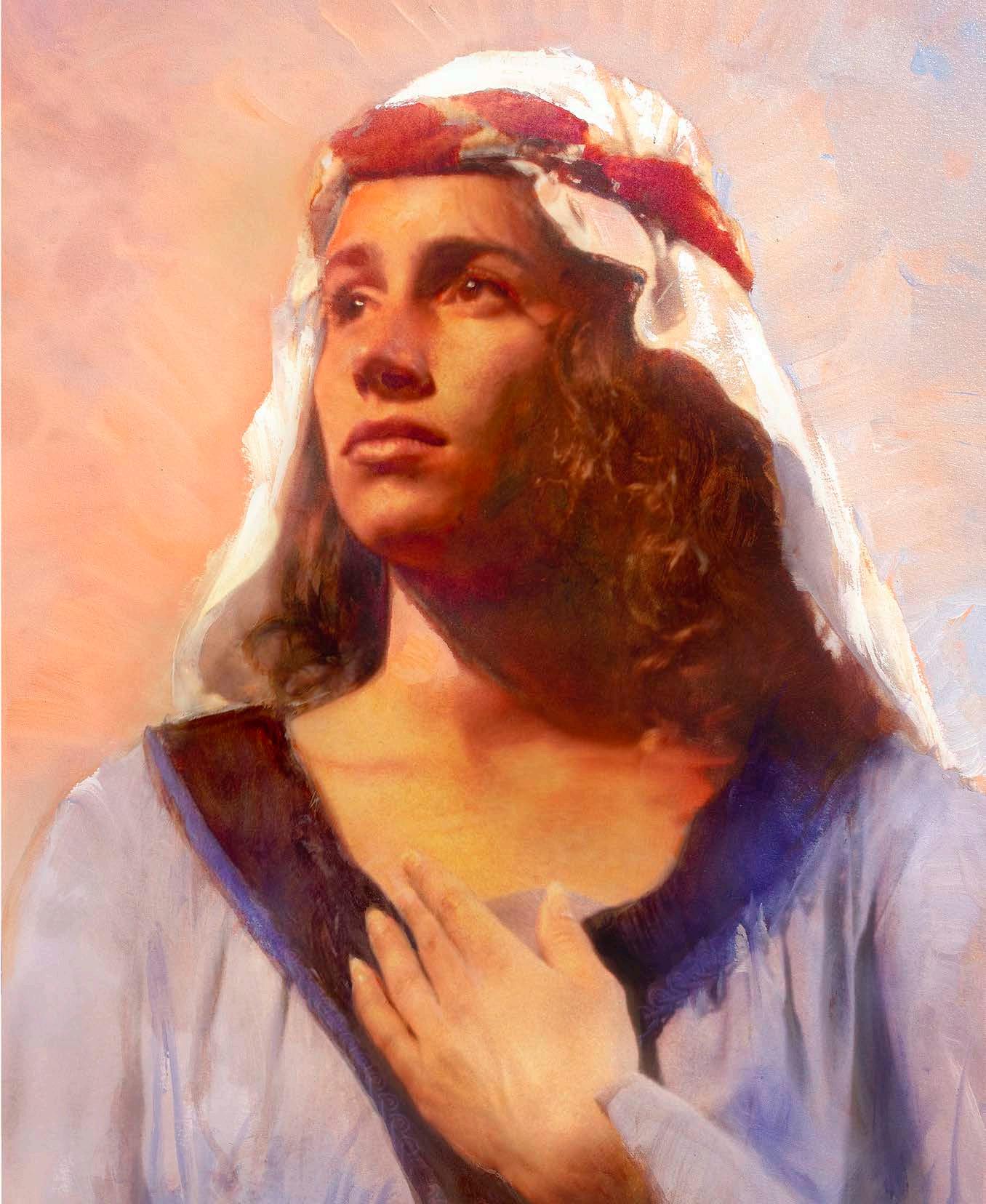
Let me share a quick refresher on the background of Esther, wife of King Xerxes, ruler of the Persian Empire. When Esther’s adoptive father, a Jew named Mordecai, held to his religious convictions and refused to bow to Haman, a high-ranking official in the king’s court, Haman resolved not only to put Mordecai to death but also to slaughter all Jewish people living in Persia. He secured the king’s permission for the killings, and a date was set. Urging Esther to take action, Mordecai issued a profound and timeless challenge: “[W]ho knows but that you have come to your royal position for such a time as this?”2 At first Esther hesitated because the king did not know she was a Jew. But ultimately Esther summoned the courage to importune the king, and she saved her people.
Those few words—“for such a time as this”—are rich with meaning and purpose. They remind us that no matter where we stand in life, the Lord can use our position, profession, and platform—as well as our unique abilities and courage—to accomplish His purposes. This message should resonate deeply with you here today—legal professionals, educators, and students who are preparing for careers where your influence will extend into people’s lives, your communities, and the broader legal and policy landscape of our state, nation, and world.
Drawing on the story of Esther, I want to talk about our “calling” as lawyers and to provide examples of the profound legacy of courageous leaders who embraced the solemn responsibility to stand unwaveringly for what is right and good. They understood the assignment—that they were called for such a time. My hope and prayer is that the Lord will guide our hearts and minds to fully recognize the “Esther moments” in our own lives and to respond with faith, wisdom, courage, and love.
Today, as we consider Esther’s example and Mordecai’s message, I’d like to issue three challenges to you:
Y OUR LIFE IS TOO IMPORTANT
“to be distracted with . . . things that keep you busy, that have nothing to do with your purpose or destiny.”
THE POWER OF YOUR POSITION
Despite Esther’s humble upbringing, her position in the king’s court afforded her tremendous influence. When the safety of her people was threatened, her identity as a Jew gave her a responsibility and a mandate that no one else could fulfill. As members of the legal profession, you carry a profound responsibility. Whether in the courtroom, the boardroom, public service, or academia, your work shapes laws, policies, and lives. With your training and education comes the expectation of leadership, and you will be a sought-after voice in critical moments. Former US Attorney General Janet Reno said, “Being a lawyer is not merely a vocation. It is a public trust. And each of us has an obligation to give back to our communities.”3
This
article is adapted from remarks delivered at byu Law School on February 5, 2025.
At times, we may feel unremarkable and think “I’m just a student” or “I’m not in a place of real power.” Let me suggest to you that you are indeed in most powerful positions. “What can I do?” you ask? You can do a lot.
law professors and lawyers . The lawyers and law professors here can shape the next generation of lawyers by mentoring students, offering career advice, and fostering professional ethics. You can provide legal scholarship and thoughtful leadership through your research and writing on pressing legal issues, which can influence public policy and shape legal discourse. You can lend your expertise on amicus briefs, providing courts with critical perspectives. You can lead and contribute your time in pro bono clinics in underserved communities. You can engage with media and the public by explaining complex legal issues and contributing to informed discussions. You can influence policy reform and legislative drafting, assisting lawmakers in crafting fair and just laws based on research and expertise. You can educate judges, attorneys, and government officials on evolving legal standards. You can partner with advocacy organizations to address social justice issues and legal inequities. You can uphold high standards of ethics and professionalism, ensuring that law students and young lawyers internalize the responsibilities of legal practice. You can contribute to global human rights efforts, international law research, and advocacy for justice worldwide.
law students . Those of you who are law students can volunteer with legal-aid organizations to help those who cannot afford representation. You can use externships and clerkships to gain hands-on experience working with judges, public defenders, and advocacy groups. You can research and propose legal reforms to policymakers on issues like criminal justice or civil rights. You can advocate for human rights and social justice by working with ngos and student groups on issues including immigration, racial justice, and gender equality. You can contribute to law journals, blogs, and op-eds to raise awareness of pressing
legal matters. You can participate in competitions including mock trials and moot court to develop advocacy skills while learning to think through real-world legal problems. You can teach community members about their rights through outreach programs. You can mentor and encourage young people. You can explore legal-tech solutions to improve access to justice and to streamline legal processes.
Know the power of your position! You have been called for such a time as this. The Lord uses those of us who feel ordinary to do extraordinary things. And not every act of kindness or courage need be extraordinary. Sister Cheryl Esplin of the Primary General Presidency once said, “[S]ervice doesn’t have to be big and grandiose to be meaningful and make a difference.”4 As the apostle Paul teaches in Ephesians 2, “For we are God’s handiwork, created in Christ Jesus to do good works, which God prepared in advance for us to do.”5 Even now, as you develop and refine your legal skills, the Lord is preparing these good works for you. No matter how routine your daily tasks may seem, never underestimate the influence you have and the power of your position— both now and in the future.
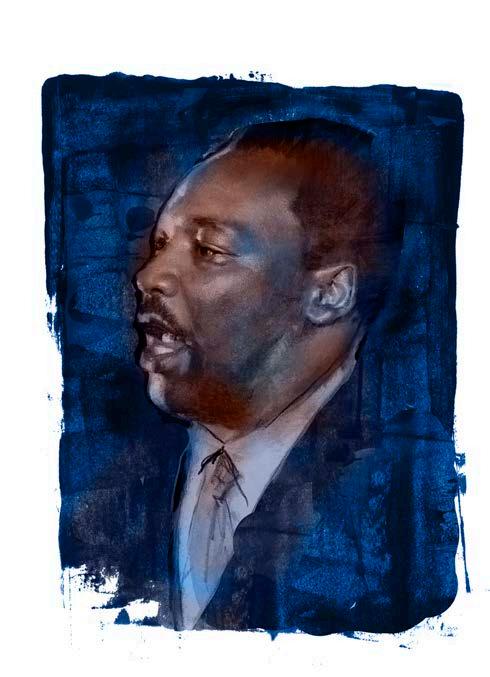
Dr. King saw the power in every person’s position—whether as a preacher, a student, or a workman, whether of high social status
dr. king believed that when we choose to do right, we align ourselves with the lord’s purposes.
or not. Dr. King believed that when we choose to do right, we align ourselves with the Lord’s purposes.6 We also unlock the potential of our influence. Let each of us follow this example by using the platform and the position that the Lord grants to us, whether great or small, to promote the values that advance truth, justice, compassion, and equity. The faith-filled lawyer’s work is essentially faith and love made active through the power of your position.
RECOGNIZING THE MOMENT
I appreciate the wisdom of the statement that your life is too important “to be distracted with . . things that keep you busy, that have nothing to do with your purpose or destiny.”7 Sometimes we can become distracted or focused only on what’s directly in front of us or what most loudly seeks our attention. How often do you check the alerts on your phone? Is it the first thing you do in the morning? The last thing at night? There are so many distractions! Sometimes the world shouts so loudly that we often fail to hear the still, small voice of God. 8 In the legal field especially, it can be very easy to lose sight of the forest for the trees given the constant deadlines, billable hours, stressful workloads, and high-stakes environments. For academics, the tenure and promotion process that looms is large. Law school deans face financial, managerial, and external constituent pressures. But the challenge is to remember that “[t]he direction of your focus is the direction your life will move. Let yourself move toward what is good, valuable, strong, and true.”9
When we lose focus, it is easy to become oblivious to injustice and need around us, just as Esther was initially unaware of the grave danger facing her people. Mordecai had to alert her—he had to get her attention! Only then did Esther grasp the urgency of the moment. We must open our eyes to the challenges unfolding in our communities, our nation, and the world. We live in an age of upheaval—one marked by rapid change, uncertainty, and deep moral complexity. We may avoid political division, but we cannot ignore the suffering surrounding us. Sometimes the sign you’re waiting for is the discomfort of knowing that “if you do nothing, nothing changes for the better.” 10 People go without food and shelter and healthcare. Families struggle under the weight of financial hardship. Individuals are vilified because of who they are. War and conflict devastate lives. These realities persist, and yet spiritual engagement is waning across our nation and the world. Do we hear the call for such a time as this? Let me suggest that you will recognize your moment when the cause outweighs your hesitation and the need outweighs your doubt. When the need is clear and the burden rests on your heart, that is your calling to move
S cripture commands us to “keep awake!” 11 The moment will come when you are called to stand up, to speak out, to make a difference. Will you recognize it? You are uniquely equipped to recognize systemic issues, but you must be willing to look around you, to really listen to others, and to learn ways that you can be the change that is so desperately needed!
L et me pause for a moment to emphasize the need to listen to others. Even as we recognize the moment we are “called,” we must also remember that advocating for others requires collaboration, shared decisionmaking, and genuine partnership with marginalized groups. For effective advocacy, it is imperative for you to actively listen, to learn from the experiences of those for whom you wish to advocate, and to empower them to lead their own advocacy efforts, rather than take over or dictate solutions from a position of privilege. It may be your moment—that is, you may feel called to act—but that may mean playing a supporting role to those you seek to serve. We can accept the call while
helping others not because they are weak but because they deserve support as they find their own strength.
MOMENTS SEIZED
As the founder of the Equal Justice Initiative, Bryan Stevenson has dedicated his career to challenging wrongful convictions and advocating for criminal-justice reform. His work, highlighted in the book and film Just Mercy, has led to the release of wrongly convicted prisoners and to significant reforms in death-penalty cases and juvenile justice.
At just 15, Greta Thunberg started skipping school to protest outside the Swedish Parliament, demanding climate action. Her small protest grew into a global youth movement, inspiring millions to take action against climate change. Despite criticism, she continues to challenge world leaders to prioritize environmental sustainability.
Tarana Burke started using the phrase “Me Too” long before it became a viral movement. As an activist working with survivors of sexual violence, she realized she needed to amplify voices and create a space for healing. When the #MeToo movement exploded in 2017, she continued leading, ensuring that survivors—especially those from marginalized communities—remained at the center of the conversation.
As lawyers of faith, you will have times throughout your life and your career when you must take a stand that sets you apart. You will have moments when you will be called to draw your line in the sand. You might be called to defend an unpopular client or to advocate for policy changes that challenge long-established norms. You might be called to simply correct a colleague who strays ethically. Each moment—big or small—may be the moment you recognize as your Esther moment. And in those moments, you will need to draw from courage that comes only from faith. The right time to act is often disguised as uncertainty. Trust your convictions and move forward, recognizing it is your moment.
TRUSTING IN THE LORD’S PLAN
To me, one of the most beautiful aspects of the story of Queen Esther is the clear
sovereignty of the Lord behind the scenes and in every detail. His hand is evident in Esther’s rise to power, in her platform, and ultimately in His perfect timing throughout each and every event in her story. In our lives, when we face moments of uncertainty and moments that would cause us to be fearful, remembering the Lord’s providence is key.
Harriet Tubman, often referred to as the Moses of her people, was acutely aware of the horrors of slavery. She risked her life to free others, guided by her faith and by a courageous and bold moral clarity. She once recounted, “I said to the Lord, ‘I’m going to hold steady on to you, and I know you’ll see me through.’” 12 Tubman’s ability to perceive injustice and to recognize her unique power to help gave her an abiding trust in the Lord’s guidance, and He emboldened her to rescue many people. May we also hold tightly to the Lord and to His great calling. And may we trust that He will see us through as we remain vigilant and ready so that—leaning on His word and our faith—we are ready to step up and get to work when we see real and pressing needs around us.
Your being here is no accident. Your unique personal background and story and the talents and abilities that you possess are all gifts divinely orchestrated by a loving Father who
“i said to the lord, ‘i’m going to hold steady on to you, and i know you’ll see me through.’”
HARRIET TUBMAN
prepares you for meaningful service to the world around you. King David proclaimed in the book of Psalms, “Thy word is a lamp unto my feet, and a light unto my path.” 13 When the future seems bleak, or the cost of doing right appears to be too high, lean on this assurance: If the Lord has called you, He will guide you, because He has equipped and prepared you for such a time as this. Let your faith be bigger than your fear!
S ometimes the Lord’s plan unfolds gradually, and we often grow anxious in the waiting. But the lesson we can hold on to from the story of Esther is that the Lord’s timing is perfect. She was in exactly the right position when her people needed an advocate the most. In your own lives, you may at times wonder why you are dealing with or facing certain challenges. Trust that the Lord is at work, and He is with you in every stage of your journey. Joshua chapter 1 tells us, “Be strong and courageous. Do not be afraid; do not be discouraged, for the Lord your God will be with you wherever you go.”14
While we don’t always understand every detail of our calling, we do know that we are called to make a difference in our families, in our professions, and in the world around us. Let your legal training become an instrument in the Lord’s hands to build, to bless, and to heal.
YOUR ESTHER MOMENT
We do not operate in a vacuum. Your moral and ethical choices as lawyers will ripple outward. Strive to be a principled voice in a world that is in great need of moral leaders. Be honorable in negotiations, be confident in courtrooms, and be courageous in legislative chambers and in your advocacy. Look for ways to serve, leveraging the power of your position to lift those around you.
The Lord knows your fears, He hears the questions in your heart, and He blesses you with gifts and strengths. He has placed you right here in this very moment to challenge injustice, to speak the truth, and to stand for what is right. Lean on His guidance and trust that your gifts, combined with His divine providence, are more than you will ever need to meet the challenges ahead. As a lawyer of faith, your duty is not just to the law but to justice—justice that reflects God’s love, mercy, and truth.
May we all go out into the world empowered by the assurance that the Lord is with us. And may we, like Esther, answer the call with faith and with boldness. If we do, we will fulfill the Lord’s purpose for our lives, and we will bless countless others in the process. God places us in positions of influence not for our own sakes but so that we may stand boldly for righteousness and serve those in need. You have been called for such a time as this! The world needs you!
God bless you.
notes
1 Martin Luther King Jr., in Coretta Scott King, The Words of Martin Luther King, Jr. (Newmarket Press, 1983), 17.
2 Esther 4:14 niv
3 Janet Reno, address delivered at the Access to Justice Forum: Ensuring an American Ideal, Baltimore, MD, Mar. 19, 1996, justice.gov/archive/ag /speeches/1996/03-19-1996c.pdf.
4 Cheryl A. Esplin, “He Asks Us to Be His Hands,” Ensign or Liahona, May 2016, 7.
5 Ephesians 2:10 niv.
6 See Martin Luther King Jr., “The Answer to a Perplexing Question,” chapter 15 (draft) in Strength to Love (Harper & Row, 1963), in Martin Luther King Jr. Papers, 1954–1968, Howard Gotlieb Archival Research Center at Boston University, kinginstitute .stanford.edu/king-papers/documents/draft-chapter -xv-answer-perplexing-question.
7 C. J. Small, You Were Created for Greatness (Xulon Press, 2008), 105.
8 See 1 Kings 19:12.
9 R alph Marston, “Look Up,” The Daily Motivator, Oct. 14, 2005, greatday.com/motivate/051014.html.
10 Judy Richardson, interview by Emilye Crosby, Silver Spring, MD, Dec. 9, 2015, for the Civil Rights History Project and completed by the Southern Oral History Program (under contract to the Smithsonian Institution and the Library of Congress), 114, crmvet.org/nars/richardson_j.pdf.
11 Mark 13:33 esv; Thessalonians 5:6 esv
12 Harriet Tubman, in Jean M. Humez, Harriet Tubman: The Life and the Life Stories (University of Wisconsin Press, 2003), 183; in Sarah H. Bradford, Scenes in the Life of Harriet Tubman (W. J. Moses, 1869), 20.
13 Psalm 119:105 kjv
14 Joshua 1:9 niv
Magnifying Pro Bono Service
Modeling the Master Advocate
by david m. cook
There is a curious paradox about pro bono service— the busier we are, the more impossible it seems to find time for it, yet the more we truly need it. When our calendars are full and the demands on our time are unrelenting, it can feel reckless to add yet another project. However, making time for service can give us far greater resources and satisfaction than we can find serving only ourselves. The secret to this contradiction lies in the One for whom we truly work. As we serve others, we take up employment with the Master Advocate—and He is an expert at making our burdens light.1 When we undertake work for those in need, it is His work we are carrying, His clients we are serving, and His help we are entitled to receive. This knowledge should reassure us that we can accomplish the work even when it seems daunting or terribly inconvenient, because the Master Advocate can magnify even small bits of time, clumsy efforts, and imperfect arguments. Through His Spirit, He can soften the hearts of those who hear our advocacy. In making up for what we lack, He transforms us— and those we serve— into more than we would be if we focused only on ourselves.
Honor Through Service
There is, of course, a practical obligation to pro bono service.
The American Bar Association suggests at least 50 hours of pro bono work each year, 2 and there is wisdom in following that guidance and fulfilling our professional duty. However, obligation alone rarely awakens our best or most satisfying effort. The desire to use the law for the benefit of others is ennobling in its own right, and it shares a rich historical tradition. Cicero saw pro bono service through the lens of Roman virtue, declaring that those who possess learning in the law must also possess a duty to those who lack learning. 3 The early Christian church went even further by marrying the cause of justice with Christ’s commandment to love others.
This article is adapted from remarks delivered at the jrcls Annual Conference in Mexico City, Mexico, on March 8, 2025.
Thus, when we make time in our busy professional lives to plead the cause of a prisoner, aid a widow, or give voice to an immigrant seeking refuge, we join hands with a long, luminous line of advocates whose service sanctified their legal gifts, and we reap timeless rewards. This service is the heritage on which the J. Reuben Clark Law Society is built. Some years back when I joined a new firm, I prepared extensive talking points to persuade our department head to fund my
attendance at a conference of the Society. But my write-up proved unnecessary. This legal leader—though not affiliated with the Church—stopped me as soon as I had mentioned the name of the Society. “Oh,” she exclaimed, “that group is fantastic! You go and make sure you are part of whatever they’re doing.” Let us be inspired by the Society’s excellent reputation for service and use our pro bono efforts to magnify that legacy.
Sanctifying Our Skills
Reverend Dr. Martin Luther King Jr. asked what he termed life’s most persistent and urgent question: “What are you doing for others?”4 While the exact answer for each of us will differ, the call is universal. The world is not merely broken; it is splintered into fragments crying out for mending. In the Jewish tradition, this is called tiqqun ‘olam—the repairing of
the world.5 As lawyers, we have peculiar tools for that repair. Our words can bind or liberate; our signatures can bless or burden. The question is not whether the law can heal, but whether we will turn that healing power outward to bless the people whom God puts in our path.
Some of us might hesitate because we lack training in the particular legal specialties for which pro bono service often calls. But consider the miracle of the loaves and fishes. A young lad listening to Jesus had only a few loaves and fishes against a crowd of thousands.6 It would have been perfectly understandable for him to say, “What difference can I make?” Instead, he gave what he had to the Master. The Lord accepted it, blessed it, and magnified it to the point that it became a feast—with leftovers! Where pro bono efforts are concerned, the time we have may be meager. The skill we have may be
on the day of the wrongly accused’s release, his family’s gratitude meant more to me than any monetary payment.
limited. But the real question is not one of competence but one of consecration: Will we offer what we do have? Indeed, our best credential is a willing heart.
This concept crystallized for me when I had the blessing of helping a man who had spent several months in jail for a crime he did not commit. His was not a headline case, just a quiet miscarriage of justice. The evidence that could free him rested with an employer who distrusted lawyers and initially refused to cooperate with an overburdened public defender. When I was asked if I could help, I considered that
this lay far beyond my regular legal specialty. Yet inspiration prompted me to say, “I’ll do what I can.” As it turns out, my role did not require specialized legal training. My most important contributions turned out to be patient listening and persistent follow-up.
The Lord softened the employer’s heart, and he ultimately provided evidence that freed a humble father just in time to spend Christmas with his family.
On the day of the wrongly accused’s release, his family’s gratitude meant more to me than any monetary payment.
My small contribution had been
rendered decisive by the Savior. The experience cemented a powerful lesson: When we offer whatever little we have, the Master makes up the difference. In that experience, pro bono work freed someone physically imprisoned. Pro bono service also enables the Master Advocate to free each of us spiritually—from indifference, ingratitude, and the narrow cell of self. Work that might ordinarily burden us becomes light when we offer it on behalf of another. It is rendered easy by Jesus Christ, who promises us that we need never labor alone.
notes
1 See Matthew 11:30; see also Mosiah 24:14.
2 See Rule 6.1, Model Rules of Professional Conduct (American Bar Association, 2019).
3 See Marcus Tullius Cicero, “Book II,” De Officiis, trans. Walter Miller (William Heinemann, 1913).
4 Martin Luther King Jr., Strength to Love (Harper & Row, 1963), 72.
5 See “Tiqqun ‘Olam,” The Oxford Dictionary of the Jewish Religion, eds. R. J. Zwi Werblowsky and Geoffrey Wigoder (Oxford University Press, 1997), 693.
6 See John 6:8–9.
Law School Friendships and Your Success
by paul warner, ’76
On March 9, 1971, I was in the Wilkinson Center at byu eating doughnuts and listening to the devotional. The speaker was Harold B. Lee of the First Presidency, and he announced the founding of J. Reuben Clark Law School. I had never in my life thought about a law career. I didn’t even know any lawyers. Yet I had a very distinct spiritual impression that I was to attend byu Law School.
This article is adapted from a byu Law panel discussion featuring Paul Warner, ’76 (byu Law charter class member, former US Attorney for the District of Utah and former Chief Magistrate Judge for the US District Court for the District of Utah), and his daughters Brooke Larsen, ’01 (judge for the Pleasant Grove Justice Court), and Ashley Carter, ’04 (attorney at the Utah State Board of Education).
The Paul and Linda Warner Public Service Endowed Scholarship Fund, established by Brett and Laurie Parkinson and Eric and Rebecca Benson, supports annual scholarships for byu Law students in perpetuity.
Many other members of my class had similar experiences. Rex Lee handpicked most of the class; he didn’t handpick me, but he was willing to have me come, and I’m so grateful that he was. People talk about what a risk it was to go to a brand new, unaccredited law school. I never felt that way. This is the Lord’s university. His hand was in the creation of this law school, so it was going to be done right and it was going to be successful. Things would work out.
Now, getting a job at the end of law school—that was challenging. I used to tell my students when I taught here for 15 years, “You don’t know what a tough job market is. When you’re applying and people haven’t heard of the law school you attended and it’s not even fully accredited? That’s tough!” We had no alumni base whatsoever. Nobody wanted to come here and interview. There was no placement office. We were beating the bushes for jobs.
In my case, I wanted to be a trial lawyer. I had heard that
I could get a lot of experience quickly in the military, so I applied for the US Navy, and I was told, “You’ll get all the rape, robbery, murder, and drug cases you want.” I said, “Sounds good to me!” and I signed up. That’s how it was to get a job coming out of this law school at that time. But I will tell you—and I don’t say this to be self-serving, I say it for the benefit of my classmates—we had some remarkable people in my class, and they went out and they succeeded. They got jobs, they worked hard, and they laid the foundation, which made finding a job a lot easier for future classes.
I was one of the most average kids to ever come out of byu Law School, yet I managed to succeed in my own way. I’d like to think that that should give hope to every one of you. Why do I tell you that? Because every one of you in this room is every bit as smart as you were the day you walked in, and you’re even more knowledgeable. Your grades, whatever they are,
have nothing to do with your ability and your intelligence. You don’t have to be at the top of your class to get a great job or to have a great career or, most importantly, to have a great family.
Look to your left. Look to your right. If you’re making friends in law school, that’s a good thing. Friends that you make in law school are important. If someone had told me when I was a student that my friend Dee Benson, ’76, was going to be an esteemed federal judge, or that my friend Jim Parkinson, ’76, was going to be a great personal injury attorney and make a sizable amount of money, I would have laughed. I can only imagine the laughter at the notion that I would amount to anything either. But you know what? We surprised each other. We also maintained those friendships, and they have been very important in our lives. Make good friends in law school and keep them. They will help your career and improve your life.
Michael Neider, ’76, wanted to become a seminary teacher until byu Law School was founded and he decided to join the charter class. Neider was confident he could meet the challenges of law school even though he had little exposure to law. “I was raised moving irrigation pipe and thinning beets on a farm in Idaho,” he says. “I wasn’t sophisticated, but I knew how to work hard.”
Neider remembers his byu Law years fondly, especially the camaraderie: “We were one big family, including the professors.” He recalls a memorable classroom lesson on answering questions from Dean Rex Lee, who shared that byu President Dallin H. Oaks had called him and asked, “Rex, do you have a Coke machine in the student center?” Dean Lee replied, while sipping a Pepsi, “I don’t know anything about a Coke machine in the student center.” Neider explains, “We had a Pepsi machine. He taught us that, as attorneys, we should only respond to the question asked!” Years of practicing law and gathering experience as a business owner have made Neider a valuable volunteer for The Church of Jesus Christ of Latterday Saints. But he insists that his wife, Cindy, offers greater skills from her years working as a third-grade teacher. “She’s in
Worldwide Voices
by maren hendricks
all details—nothing gets past her,” he says. The couple have put their many talents to good use volunteering for the Church.
The Neiders were on assignment in Ghana as human rights education missionaries within the Office of General Counsel, helping to promote curriculum for teaching the Universal Declaration of Human Rights, when they were asked to support a new effort to incorporate international singers into the Tabernacle Choir at Temple Square. Neider links this initiative to Álvaro Jorge Martins, llm ’21, of Natal, Brazil, a graduate of byu Law’s llm program, who had come to Salt Lake City on a visa, tried out for the Choir, and was accepted into the ensemble. When his visa expired and he had to return home, he discovered that he was famous all over Brazil and that his fans were tuning into Music and the Spoken Word and general conference to see him sing. The increased international interest in the Tabernacle Choir and general conference
helped inspire a new program that brings between 10 and 14 international Church members to sing with the Choir every conference (in April and October).
But where to find these singers? Choir members need to be more than just good singers; they must be highly trained musicians, speak fluent English, and hold a temple recommend. Working with area presidencies and local leaders, the Neiders helped recruit singers during the pilot initiative and early stages of the program. Now, interested Church members around the world can audition online. “The international singers are really on par with the permanent Choir members,” he explains. “Many of them are professional singers in their countries.” During their time in Utah the singers also work with the Church Music Department, giving leaders insights on ways to enhance new hymns and music programs for international members.
To accommodate these international singers, local Choir members must be willing to
give up their spots for visiting members. “Everyone just adores them and their enthusiasm and their testimonies,” Neider says. “Choir members think it’s an honor to give up their seat.” Still, the Neiders’ job was no logistical cakewalk. “Helping these international singers fit in, have a good experience, arrive at rehearsals on time, maintain their health, get up to speed, and perform—it’s complicated!” The Neiders were released in May 2025 and are still basking in the glow of this experience. The program has recruited 72 participants from 35 countries over the last six general conferences. These global members promote all four of the Choir’s objectives to (1) expand the Choir’s digital audience, (2) magnify the Choir’s missionary role, (3) ensure that the Choir reflects the Church’s worldwide membership, and (4) increase the Choir’s worldwide visibility. Neider has observed that the program has helped the Church’s missionary efforts in singers’ home countries. “It’s reactivating people who would not otherwise watch general conference, but they tune in to cheer on their fellow citizens. Then they’re listening to the prophet and the leaders of the Church, and they feel the Spirit,” he says. “This program represents our global Church and unifies the world.”