Benjamin Yerich Kansas State University / Class of 2023 / Architecture Portfolio
Table of Contents Resume / Curriculum Vitae Page
1
Experience / Skills
2
Project One - Sunset Hills Event Center
4
Project Two - Spatial Extension
8
Project Three - Amangiri Thermal Bath
12
Project Four - Artist’s Refuge
14
Resume Personal Legal Name Date of Birth Hometown Address Permanent Address Contact Information Email Phone Education Summer 2019 - Present Expected Graduation Date Intended Degree
Curriculum Vitae Page
Benjamin Jacob Yerich May 27th, 1999 Denver, Colorado 410 N. 4th St. Apt. 26, Manhattan, KS, 66502 10086 Amston St, Parker, Colorado, 80134
BYerich7@gmail.com or BYerich7@k-state.edu (303) 656-3525
Second Year Architecture; College of Architecture, Planning, and Design; Kansas State University. Spring 2023 Masters of Architecture (5-Year Masters Program, NAAB accredited), Minor in Business.
Please refer to separately attached resume for more details, references, and information. Thank you.
1
Experience / Skills Work Experience June 2017 - August 2017 June 2018 - August 2018 August 2019
Waner Construction Company Inc. - Part-time summer learning experience - learned about different structural techniques - Hands on experience with reading architectural drawings, understanding construction process, etc. - Keeping the jobsite up to the general contractor’s standard and specifications.
Skills Sketching Drafting Model making Software Experience
Adobe InDesign Adobe Illustrator Adobe Photoshop Rhinoceros 3D SketchUp Office 365 (Word, Excel, Powerpoint)
2
Rhino 3D, Adobe Illustrator, Illustrator and Adobe Photoshop recent work. I do not have much experience in these programs but I use them consistently every day and have improved significantly since I began a few weeks ago. All of these drawings, renderings, and axonometrics were created in Rhino, edited in Adobe Illustrator, and touched up in Photoshop or Adobe InDesign InDesign. This Portfolio contains work from drafted drawings by hand that have been edited in Adobe Photoshop and formatted into Adobe InDesign.
3
Sunset Hills Event Center Fall 2019 / Architectural Design Studio 1 / Prof. Judy Gordon
The Sunset Hills Event Center/Manhattan Event Center was the first project with an exact location. Along with a specific program, this project has been the most complex in our architectural curriculum. We were given it’s topography and neighboring buildings. When assigned this project, there was a strong emphasis on the effects of the pre-existing site and circulation of users. My design’s intent was to shape the required spaces and give each a specific hierarchy based on the importance and frequency of usage for each space. Using an orthogonal geometric system, all secondary and tertiary spaces are focused around the large exterior space which was done using a centralized organizational strategy or parti. When entering the building, direction is organized by an array of axes that invite users to each space. The exterior of the site is addressed with an idea of circulation, which reflects the experience when the user enters the interior of the event center.
4
Elevations
Floor Plan and Site Plan
Sections and Diagrams
5
Model Images - Site model with a scale of 1/16” = 1’ - 0”.
The site used was a study model, professor told us to use our study site models for the final due to a week of work lost during thanksgiving break.
6
Concept drawings and work from this unit. This unit filled 44 pages with ideas, concepts, measurements, site pictures, reference images, and drafted plans, sections, and elevations to use as concepts for materiality and other ideas. My mind works with visualization and drawing, so concept work in a sketchbook is very important to my design process.
This project introduced the ideas of parking and codes dealing with roads. Visiting the site and seeing the pre-existing conditions of the site helped us grasp a better understanding of how cars and people would circulate throughout the site.
7
Spatial Extension Summer 2019 / Environmental Design Studio 1 / Prof. Adriana Molina
The Spatial Extension project introduced the concepts and ideas of how using elements in design can be used to manipulate a spatial field. The goal of this project was to use our previous project’s primary spaces and place them within a spatial field and use elements and design strategies to create new spaces within that field. This unit explored the basics of understanding space and how it can be created, allowing us to think more deeply about how spaces can interact within a field. My design’s intent was to use linear elements and changing of levels to manipulate the spatial field in a way that highlights the importance of the primary space and puts a strong emphasis on the secondary and tertiary spaces within the field to establish a specific spatial organization. The repetition of linear elements, the spatial hierarchy, and the massing and voiding of specific elements are significant to the overall understanding of this project.
Title Page and Sectional Perspective
Final Model
8
Floor Plan
Section B-B
Change in Elevation
Repetition
Intentionally leads to primary space, creating spatial hierarchy
Repetitive use of L-shaped linear elements.
Datum
Spatial Hierarchy
Degree of Enclosure
Axis
All elements lead to primary space.
Enclosure is used to define primary space.
Axis created by the use of linear elements.
Diagrams - the main diagrams I used during my review to explain the design purpose and thought put into my project.
9
Concept work through physical models using leftover material and tape to begin understanding the manipulation of space using elements. This was because it was easier to understand when physically creating it, explaining the importance of concept work and model making. These were not the only models made, just the final three after our class’s critique.
First Revisions made after first internal critique and building a full scaled model with accurate geometric dimensions. As we began to finalize our ideas, this model was developed using the most important design features from my previous models. The design elements of repetition, changes in elevation, and enclosure became more of an emphasis on the project.
Second revisions made during a mid critique. Working closer to a final model and smoothing out the smaller issues within the spatial field. These models were created quickly using chipboard, tape, and glue to begin to explain our ideas to our classmates and our professor. Due to the shortness of summer studios, we were unable to make higher quality models.
10
Study models made of insulation foam and taped together to connect all projects together before revising and making the final model.
Spatial Extension Workshop Group Project - Summer 2019 / ENVD 202 / Prof. Adriana Molina The purpose of this project was to learn to work with others while maintaining your own ideas but in a collective way. The 2019 ENVD summer studio (four students) were assigned to take our previous project (Spatial Extension) and combine them into a singular spatial plane. Each person would create a small section of their model that was decided in a group to create a singular project in a puzzle-like way. This was done in our fabrication lab to experience new materials and ways of building models. Final models made of plywood, sanded, and glued together to combine with the other students to create the collective spatial field.
11
Amangiri Thermal Bath Fall 2019 / Architectural Design Studio 1 / Prof. Judy Gordon A-A
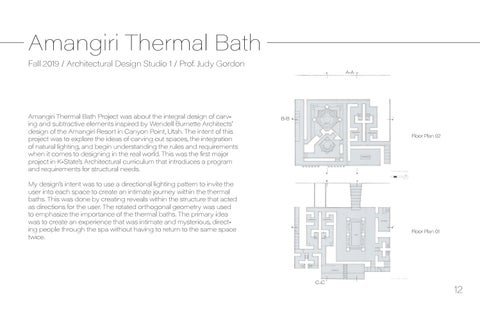
Amangiri Thermal Bath Project was about the integral design of carving and subtractive elements inspired by Wendell Burnette Architects’ design of the Amangiri Resort in Canyon Point, Utah. The intent of this project was to explore the ideas of carving out spaces, the integration of natural lighting, and begin understanding the rules and requirements when it comes to designing in the real world. This was the first major project in K-State’s Architectural curriculum that introduces a program and requirements for structural needs.
B-B
Floor Plan 02
My design’s intent was to use a directional lighting pattern to invite the user into each space to create an intimate journey within the thermal baths. This was done by creating reveals within the structure that acted as directions for the user. The rotated orthogonal geometry was used to emphasize the importance of the thermal baths. The primary idea was to create an experience that was intimate and mysterious, directing people through the spa without having to return to the same space twice.
Floor Plan 01
C-C
12
Concept Work in Sketchbook. Unit was 49 pages filled with concepts, case study notes relevent to the project, and ideas.
Section C-C: Sectional cut through both pools. This was done to show the spatial difference between the main spaces and the others within the thermal bath.. The farther the use goes into the thermal bath, the space is much larger and less congested, which allows the user a stronger experience with that space.
Section A-A: Sectional cut through the entry to the thermal spa and lounge space required by the program. An inviting lounge was important to the design because it is the only space where major interaction occurs. Creating an individual experience was key to appreciating the space created within the mesa.
Section B-B: Sectional cut revealing the lounge, changing rooms, and large pool. The design purpose of the large pool was to create less conpressed feeling within the thermal bath; making the user feel vulnerable yet appreciative of the space. The carved out gabled roof allowed for the space to feel large when in the center as well as more open to natural light from the circular skylight. Perpective of Lounge / Lobby.
13
Artist’s Refuge Summer 2019 / Environmental Design Studio 2 / Prof. Adriana Molina
The Artist’s Refuge was the final project of the Environmental Design Studio. This project was the conclusion of all that we learned over the course of 10 weeks in the summer, applying all of our knowledge into one collective proposal for a small artist’s refuge, or small structure that would allow the artist to focus on their area of study in complete solitude. The program given required a maximum of approximately 500 square feet (excluding parking space), specific spaces, and to consider a pre-existing site. My design’s intent was to create a refuge that was focused around a small pond, which acted as the initial drop within the landscape to create a ripple effect. This was emphasized when one would enter the site with the use of a ha-ha. This was a strategy used by farmers to keep their herds in tact without the use of unnatural fencing or walls. The organization of the building was centralized around this pond while prioritizing an inward focus to generate a better environment for the artist to work.
14
Building and Site Section - showing down the middle of the pond, facing the east side of the refuge.
Diagrams - organization, flow, and hierarchy were mostly important to the building’s design but were also elements used within the site.
Top or Roof Plan - seeing the refuge from a two dimensional view.
Site Plan - entrance from the southeast. Hedgerows along the retaining wall next to the entry to create exterior spaces for gardens and spaces for activities.
Floor Plan Level 01 - seeing the layout and foundation of the building, as well as pathways and circulation into the structure.
Floor Plan Level 02 - circulation can be seen more clearly, with the pathway from the primary structure to the studio.
15
Concept work for the Artist’s Refuge, including site plans, quick sketches, and organizational keys to explain what each structure’s purpose is.
16
Benjamin Yerich BYerich7@gmail.com / BYerich7@k-state.edu / (303) 656-3525