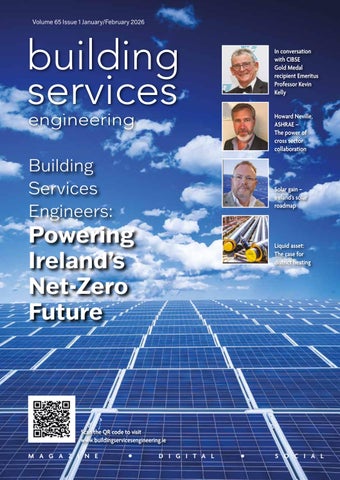
Building Services Engineering Jan Feb 2026

Page 1


In conversation with CIBSE Gold Medal recipient Emeritus Professor Kevin Kelly

Solar gain –Ireland’s solar roadmap

Liquid asset: The case for district heating Howard Neville, ASHRAE –The power of cross sector collaboration

Watch the full case study here

Bank of Ireland's Solid Investment in Decarbonisation

At Bank of Ireland’s Cabinteely data centre, Mitsubishi Electric’s CAHV heat pumps have replaced fossil fuels without disruption. Twelve units deliver 24/7 hot water, meet F-Gas regulations and cut approximately 120 tonnes of carbon; powering a resilient step toward Net Zero by 2030.

editorial

As we move into 2026, the Irish building services engineering sector finds itself “at a pivotal juncture”. Insights recently shared by CIBSE Technical Director Anastasia Mylona underscore a fundamental shift: We are moving beyond the era of “design intent” into a future defined by verified performance and holistic accountability.

For Ireland to meet its decarbonisation targets, the acceleration of low-carbon heating —specifically heat pump integration and low-temperature system design — must become the industry baseline. However, the challenge is expanding. The sector must master the complexities of whole-life carbon, quantifying the embodied energy of mechanical, electrical, and plumbing (MEP) systems.

In this issue, former CIBSE President and recent CIBSE Gold Medal recipient Emeritus Professor Kevin Kelly, a true building services engineering pioneer, discusses how diversifying university pathways is no longer just a social goal but a technical necessity for solving the most complex engineering hurdles.

ASHRAE Ireland President Howard Neville emphasises the progress achieved through cross-industry collaboration. David Connelly, IDEA, outlines the blueprint for delivering district heating networks, while Eamonn Sheils, SEAI, provides direction on completing SEAI Business Energy Upgrade Scheme applications. Ronan Power, Solar Ireland, explores the key drivers behind solar energy’s rapid growth, and Enda Ruxton offers expert technical guidance on heat meters.

BRIDGING THE GAP: THE CASE FOR DISTRICT HEATING IN IRELAND

Dr David Connolly, Irish District Energy Association, says district heating is the non-negotiable backbone of Ireland’s decarbonisation and must move from the drawing board to delivery.

A CONVERSTION WITH PROFESSOR KEVIN KELLY

A profile of CIBSE Gold Medal recipient Emeritus Professor Kevin Kelly, charting his early career from leaving school at 15 to transforming the engineering profession through academic innovation.

ASHRAE IRELAND: MORE THAN A NETWORK Howard Neville, 2026 ASHRAE Ireland President, discusses breaking down industry silos and why ASHRAE is a lifelong professional home for engineers.

CIBSE Ireland Podcasts
Ireland’s Solar Roadmap

NEWS AND PRODUCTS

Ireland’s retrofit momentum: SEAI reports record €645m grant investment in 2025

The Sustainable Energy Authority of Ireland (SEAI) has announced that 2025 was a landmark year for the nation’s energy transition. Figures released in January reveal a record €645m was deployed in government grants, marking the highest level of investment since the authority’s inception.

For building engineering professionals and contractors, the data signals a significant scaling up of the retrofit and renewables market. From domestic solar PV to large-scale business energy reductions, the appetite for decarbonisation is reaching a fever pitch.

Commercial and domestic highlights

The SEAI’s 2025 performance report highlights a robust year for the built environment across all sectors:

• Commercial decarbonisation: Over 4,500 businesses across every county in Ireland received support to reduce energy costs and fossil fuel reliance.

• Residential retrofitting: More than 58,000 home energy upgrades were completed, representing an 8% yearon-year increase.

• Solar PV Surge: 2025 was a historic year for microgeneration. Of the 102,000 homes grant-aided for solar

panels since 2018, one-third of those installations occurred in 2025 alone.

• Fuel poverty initiatives: The Warmer Homes Scheme reached a new peak, delivering free energy upgrades to over 8,000 households at risk of fuel poverty.

Driving the energy transition

William Walsh, CEO,SEAI, emphasised that the momentum is driven by a desire for long-term security against volatile international markets.

He commented, “The long-term solution to high energy costs is to reduce our reliance on fossil fuels,” Walsh stated. “We must put our energy system on a more sustainable, secure footing. Last year was a record year for investment—there is real momentum now behind our programmes.”

William Walsh also noted that the “neighbour effect” is taking hold, with the visible benefits of upgrades— improved comfort levels and reduced bills—encouraging more homeowners and businesses to enter the pipeline.

The engineering challenge ahead

Despite the record-breaking figures, the SEAI’s 2025 Energy in Ireland report,

published in December, suggests that there is still a significant mountain to climb. While emissions are falling, the link between economic growth and fossil fuel consumption has not yet been fully severed.

For the building services sector, the SEAI has identified the “solutions that work”, calling for a continued focus on:

• Grid reinforcement and renewable energy infrastructure.

• The expansion of district heating networks.

• Continued deep retrofitting of the existing building stock.

To support this technical evolution, the SEAI awarded €22m in research and innovation funding over the course of the year, ensuring that Ireland remains at the forefront of energy research.

2025 at a Glance

The SEAI now aims to expand its reach further. For engineering firms and energy consultants, the message is clear: The transition is accelerating, and the pipeline for sustainable building services has never been stronger.

William Walsh, CEO, SEAI.

NEWS AND PRODUCTS

CIBSE Ireland unveils “Bringing Buildings Alive” podcast series – A New Tactical

Briefing for the Modern Building Services Engineer

In an era where the built environment is being redefined by carbon targets, rapid technological shifts, and evolving wellness standards, staying ahead of the curve is no longer optional—it’s a professional necessity. Enter “Bringing Buildings Alive,” the flagship new podcast series from CIBSE Ireland, designed to be the monthly pulse of the building services industry.

The Future, Delivered Monthly Launching on the first Monday of every month, “Bringing Buildings Alive” serves as a “tactical briefing” for professionals navigating the complexities of modern engineering. Rather than just discussing the problems of today, the series focuses on the solutions for tomorrow.

From the integration of Artificial Intelligence (AI) in design workflows to the granular masterclasses on next-gen heat pump technology, the podcast promises a deep dive into the technical edge of the profession. Listeners can expect expert-led discussions on:

• The Net-Zero Transition: Navigating the sustainability challenges that will define the next decade.

• Smart Infrastructure: How AI and digital integration are changing the way buildings

“think” and operate.

• Human-Centric Design: Unpacking the nuances of WELL Building certification and the push for healthier indoor environments.

Beyond the “Weeds”

For many engineers, the daily grind involves being “buried in the weeds” of complex project delivery. CIBSE Ireland’s new series offers a rare opportunity to step back and view the bigger picture. The podcast poses the big questions that are often sidelined by immediate deadlines:

“What is the next standard we’ll need to meet before it lands on our desks?”

“Where is the Irish market heading in the next five years?”

“How do we design for buildings that will still be performing at peak efficiency in 2075?”

Why Tune In

The series is framed as more than just an educational tool; it is a piece of market intelligence. By bringing together the experts shaping the future of building services, CIBSE Ireland aims to provide its members and the wider construction community with a competitive advantage. It’s about understanding the “why” behind the “how,” ensuring that Irish engineers remain global leaders in sustainable and highperforming design.

The first two podcasts, released in February, are ‘Tallaght District Heating Success,’ featuring John O’Shea (Heat and Electricity Lead, Codema) in conversation with James Porter; and ‘Digital Buildings: Process Not Product,’ with David Hegarty (Smart Buildings Lead, Arup) speaking to Stephen Weir.

How to Listen

Whether you are on your morning commute or taking a break from the drawing board, Bringing Buildings Alive is your chance to get ahead of the line.

When: The first Monday of every month (Set your monthly reminder).

Where: Available now on all major platforms, including Spotify, Apple Podcasts, and Podfollow.

Listen and subscribe https://podfollow.com/ cibse/view or scan the QR code

Ireland’s €4bn leap toward sustainable urban heating

COWI, a global engineering and advisory firm, has been appointed by the European Investment Bank (EIB) to lead the development of a nationwide District Heating (DH) investment strategy in Ireland.

This programme aims to mobilise approximately €4bn in infrastructure investment by 2035. Working alongside the Irish government and the SEAI, COWI will focus on decarbonising urban heat in major hubs like Dublin and Cork. These cities are central to the EU’s Climate Neutral and Smart Cities Mission, serving as blueprints for a future-ready, low-carbon heating landscape.

The mandate involves more than just technical design; it encompasses:

• Policy & Frameworks: Establishing robust institutional and implementation models.

• Capacity Building: Strengthening local expertise to move projects from planning to delivery.

• Financial Viability: Identifying sustainable procurement and financing models to ensure long-term success. Slated for completion in September 2026, Ireland expects to reduce household energy costs, enhance energy resilience, and take a decisive step toward its 2050 climate-neutral goals.

NEWS AND PRODUCTS

2026: A Year of Upskilling for Net Zero

As several factors drive Ireland’s sustainability push, upskilling workforces has never been more critical. Richard Swinburne, Managing Director, Wilo Ireland, argues that meeting the ambitions of 2026 and beyond hinges on how effectively the sector strengthens its skills base and commits to knowledge and best practice sharing.

The previous issue of Building Services Engineering described 2026 as the “year of net zero action”. While this referred to the mustattend trade shows lined up for the coming year, it got me thinking about how 2026 should be perceived from a skills perspective. Who wouldn’t take that thought path?

Ireland is traditionally recognised as having a skilled workforce. The definition of “skilled” will naturally differ across industries, and it seems to evolve in response to two factors: technological advancements and global megatrends, which often influence one another. The ongoing conversation around the need to “be more sustainable” is a fitting example.

This is a megatrend that has brought

– and continues to bring – several ambitious targets and subsequent regulations, driving the corporate objective of delivering value to customers in a “sustainable” manner. Strategies like the EU Green Deal, for instance, explicitly show that the road to net zero is intrinsically linked to an organisation’s value chain and workforce capabilities. In short, the definition of “skilled” looks set to change once again…

A greener value chain

The Green Deal introduces more than 175 directives that reshape energy, supply chains and sustainability reporting. These mandates mean organisations must disclose emissions, climate risks and transition plans, to name just three, prompting the introduction of initiatives

and processes built to support the ‘green’ drive and upskill workers in the process. Similarly, in Ireland, the latest national skills strategy outlines the importance of bridging the “know-do” gap – which is the disconnect between knowing what to do theoretically and actually implementing it in practice - on carbon and environmental transparency.

Wilo’s Global Water AI Academy is a perfect example – one close to home, too. Launched in February, it intends to share both water and AI expertise across borders through a series of online modules developed alongside Edinburgh-based Heriot-Watt University. AI-enabled water technology can boost access to clean water and strengthen food security through digital irrigation solutions. Related tools can also help teams analyse operational costs versus upfront capital, enabling better long-term decision-making and supporting more transparent conversations about carbon impact and equipment longevity.

Collaborating to catalyse net zero

Why have I digressed into the ‘wonderful’ world of AI, you ask? Because short courses focused on topics like sustainability and AI, or both, are becoming increasingly important to modern training. They enable engineers to develop relevant skills without having to commit to a long-term apprenticeship. The scale of the green transition and the speed at which it’s unfolding mean no single organisation or academic institution can keep pace alone. This is where inter-industry collaboration is crucial.

The capabilities required of those working in the building services sector seem to change daily. Whether it’s heat pump installations, digital commissioning or embodied-carbon assessments, the best way for the industry to collectively thrive and progress towards net zero is through sharing best practices.

A great example of this collaborative approach is the CIBSE Ireland workshop programme, which I read about late last year. It delivers short sessions ideal for those who need to stay up to date

NEWS AND PRODUCTS

without stepping away from work for long periods. Most importantly, they create a space for open discussion, where lessons learnt on the job can be shared and fed back into best practice across organisations – even competitors.

In addition to improving the entire value chain, this can help reduce costly rework caused by misaligned project designs, which seem to occur far too often as building standards change. These partnerships play a major role in embedding awareness of sustainable practices and carbon transparency across all skill levels, from apprentices to senior engineers.

Closing the “know-do” gap CPD programmes are another route to industry-wide upskilling. They educate installers, consultants and building service engineers on a range of applications and equipment, such as high-efficiency pumps, pressure boosting, degassing and rainwater harvesting.

Pumps, for instance, are becoming increasingly intelligent, and the training requirement now centres around interpolating functions and menus on human-machine interfaces (HMIs). To bridge the “know-do” gap, businesses like Wilo offer CPD programmes to educate engineers on how to operate and maintain such equipment to the best of their ability. They can be

delivered both online and in-person, though I always think it is important to highlight the social element of learning in a classroom surrounded by those in a similar role.

Owning a collective responsibility 2026 is going to be another year defined by sustainability, and upskilling is a central pillar of Europe’s – let alone Ireland’s – net zero journey. The

continued evolution of technologies and directives curated from global megatrends demands a workforce that can adapt just as quickly. It’s also clear that isolated efforts from organisations won’t suffice either. Instead, this process will require collaboration between manufacturers, educators, professional bodies and even engineers themselves, each sharing knowledge and best practice that strengthens the sector as a whole.

Whether through CPDs, short courses, cross-industry workshops or ambitious initiatives like AI academies, there are a host of accessible opportunities available to those looking to be prepared for the coming year and beyond.

If 2026 is to become the year of net zero action, it must also be the year that we collectively invest in the skills needed to carry us there.

Discover more about Wilo Ireland, www.wilo.com/ie or scan the QR code to learn more about CPD programmes.

Richard Swinburne, Managing Director, Wilo Ireland.
Keeping up to date with pump technology with hands-on product training.

NEWS AND PRODUCTS

CIBSE Ireland launches the inaugural Seamus Homan Award for Innovation in Engineering

CIBSE Ireland is delighted to officially launch the CIBSE Ireland Student & Young Engineers Network Competition 2025, the inaugural Seamus Homan Award, themed Innovation in Engineering.

Announcing the award, CIBSE Ireland Chairperson Laura McMahon explained, “Created in memory of Seamus Homan, this competition celebrates creativity, technical excellence, and forwardthinking ideas that will shape the future of the built environment. It is open to undergraduate and postgraduate students, as well as early-career engineers within their first

10 years in industry, across mechanical, electrical, and sustainability disciplines.”

Participants are invited to submit innovative concepts, designs, or prototypes focused on energy efficiency and decarbonisation; sustainable design principles; digitalisation and smart building systems; and user comfort, health, and wellbeing.

Prizes include a €500 voucher for the winner, €250 for the runner-up, and publication on CIBSE Ireland platforms for highly commended entries.

The submission deadline is 06 March 2026.

NEG8 Carbon scales Direct Air Capture technology

A landmark agreement for an engineering study to define the detailed project specifications of Ireland’s first full-scale carbon capture system has been signed between direct air capture specialists, NEG8 Carbon, and engineering consultancy firm, Prochem Engineering.

The full-scale system will be the first module of NEG8 Carbon’s Direct Air Capture (DAC) technology to be developed. The module to attract and capture 50 tonnes of carbon dioxide (CO2) per annum will be built at the NEG8 Carbon Waterford headquarters.

NEG8 Carbon specialises in developing novel electrostatic DAC

Student membership of CIBSE is free and provides access to technical guides, training opportunities, and a strong professional network.

This is a great opportunity for students and young engineers to showcase their ideas, build confidence, and honour Seamus’s legacy through innovation. CIBSE Ireland strongly encourages eligible participants to get involved.

Entries should be emailed to cibseirelandchair@gmail.com. Scan the QR code to learn more.

technology for capturing CO2 from the atmosphere to combat climate change and help industries achieve net-zero emissions targets.

The engineering study agreement with Prochem marks a significant step forward in NEG8’s journey to develop the company’s unique electrostatic technology that will make DAC more affordable, efficient and scalable as NEG8 journeys to large-scale commercial deployment across the globe.

NEG8 Carbon’s Electrostatic DAC technology works by drawing in air and passing it over a specifically designed sorbent system that attracts and captures CO2 molecules. The captured CO2 can then be permanently and safely stored underground or converted into climate-neutral carbon products, such as Sustainable Aviation Fuel.

Dr John Breen, Chief Technology Officer at NEG8 Carbon, said: “The 50 tonne/annum unit will serve to validate NEG8’s system as a leading engineered carbon capture technology that will support industries and governments in their drive to net-zero and beyond to negative carbon emissions.”

Michael Kent, Director at Kilkenny-headquartered Prochem Engineering, said: “Prochem Engineering is proud to contribute its specialist engineering expertise to NEG8 Carbon’s carbon capture initiative, a landmark project designed to address the urgent challenges of global warming and environmental sustainability.”

The late Seamus Homan.
(L to r): Erik Malan, Senior Mechanical Engineer, NEG8 Carbon; Marie Ahern, Process Design Lead, Prochem Engineering; John Breen, Chief Technology Officer, NEG8 Carbon; Michael Kent, Director, Prochem Engineering; Paul Kearns, Project Manager, Prochem Engineering; and Ray Naughton, Founder and Managing Director, NEG8 Carbon.

NEWS AND PRODUCTS

Essential CIBSE publications released in 2025

As the built environment continues to evolve rapidly, staying abreast of the latest technical standards and methodologies is vital for maintaining professional excellence. CIBSE published several key documents and guides in 2025, and these are now available to members via the CIBSE Knowledge Portal.

The 2025 releases cover a broad spectrum of building services engineering, from carbon auditing to vertical transportation. Here is an overview of the new resources now available to support your projects.

Guide D: Transportation Systems in Buildings

The latest edition of ‘Guide D: Transportation Systems in Buildings’ has been fully updated to reflect the rapid technological advancements in lifts, escalators, and moving walks. It remains the definitive reference for the design, installation, and maintenance of transportation systems, with enhanced focus on energy efficiency and passenger safety.

TM70: Tall Building Drainage Design

With the increasing prevalence of high-rise developments, ‘TM70: Tall Building Drainage Design’ provides much-needed clarity on the unique hydraulic challenges posed by tall structures. This technical memorandum offers robust guidance on pressure fluctuations and system resilience to ensure efficient drainage in complex buildings.

TM65.4:

Embodied Carbon in HVAC Systems: Offices

As the industry moves towards net zero, understanding the life-cycle impact of our systems is paramount. TM65.4 extends the TM65 methodology to office HVAC systems, providing a standardised approach to calculating embodied carbon and enabling engineers to make more sustainable procurement decisions.

CCW Commissioning Code W: Water Distribution Systems

Correct commissioning is the bridge between design intent and operational performance. The new Commissioning

Code W sets out the latest best-practice procedures for water distribution systems, ensuring they operate safely, efficiently, and in accordance with modern health standards.

CIBSE Weather Data (2025 Update)

Accurate modelling requires accurate data. The 2025 update to the‘CIBSE Weather Data’ sets provides the most current hourly weather files for building performance simulation, accounting for recent climatic shifts and helping engineers “future-proof” their designs against a warming climate.

TM65: Spanish Translation

In recognition of CIBSE’s growing international community and the global nature of the climate challenge, it has released the Spanish translation of ‘TM65 Embodied carbon in building services: A calculation methodology’. This ensures that CIBSE’s industry-leading carbon calculation framework is accessible to a broader range of practitioners globally.

How to access

All these publications are available for digital download at https://www.cibse. org/knowledge-research.

As a benefit of membership, many of these titles are available at a significant discount or are free to download for CIBSE members.

Ensure your technical library is up to date by visiting the website today or scanning the QR code

NEXT GENERATION

The Grant Aerona R290 GET AHEAD WITH THE

- Designed for the UK & Irish Climate

- Innovative Technology

- Exceptional Performance

- Ultra-Low Noise Levels

- Outputs from 4kW – 16kW

Grant Aerona R290 Wins ‘Heat Pump of the Year’ 2025

The Grant Aerona R290 air source heat pump has once again been recognised for excellence in sustainable heating innovation as it was awarded ‘Heat Pump of the Year’ at Ireland’s Plumbing & Heating Awards 2025.

The judging panel for awards praised the bespoke design of the Aerona R290 and its ability to address the high moisture levels of the Irish climate. They also recognised the significant investment made by Grant into the development of the Aerona R290 heat pump.

Additionally, the judges were impressed by the aesthetically pleasing appearance of the heat pump, its ease of connection with only two cables, and the wide range of models with outputs from 4kW to 16kW available, which enables the Aerona R290 to suit most properties.

Commenting on the award, Barry Gorman, National Renewables Sales Manager, who accepted the

award on behalf of the company said; “We are absolutely delighted that the Aerona R290 has been awarded Heat Pump of the Year at the Plumbing and Heating Awards. The positive response that this next generation heat pump has received since its launch has been amazing and it is great to see it getting this recognition. Designed specifically for the Irish and UK climate, the Aerona R290 really is proving itself to be in another league of innovation and efficiency.”

The Grant Aerona R290 was recognised for its Outstanding Innovation at the Plumbing and Heating Awards 2024. The judging panel was so impressed by the heat pump range, that a new award was created in recognition of its outstanding innovation and described it as ‘redefining heating innovation and sustainability’ and setting ‘a new benchmark for low carbon heating solutions.

This latest recognition marks another milestone for Grant, underscoring the company’s dedication to developing forwardthinking, low carbon heating technologies for homes throughout Ireland.

Learn more about the Grant Aerona R290 heat pump and Grant’s innovative product range on grant.ie.

Follow Grant on LinkedIn @ GrantEngineeringULC, Facebook @ GrantIRL, and Instagram @grant_irl. You can also subscribe to Grant on YouTube @GrantEngineeringIE.

Key features of the Grant Aerona R290

Heat Pump Range: Innovative Design

• Designed for the Irish & UK Climate

• Environmentally friendly R290 refrigerant

• Ultra-low noise levels recognised by Quiet Mark

• Modern styling and colourway

Exceptional Performance

• Rated at -5°C air temperature and 55°C water flow temperature

• Five models with outputs from 4kW - 16kW

• Remote monitoring and management with the Aerona Smart Controller

Peace of Mind

• Designed by Grant to suit many types of property

• Design and onsite technical support

Pictured (l-r); William Comerford, Grant Technical Sales Representative; Glenn Clabby, Thermoparts (Award Sponsor); and Barry Gorman, National Renewables Sales Manager, Grant.
Grant Aerona R290 4kW heat pump
Grant Aerona R290 Heat Pump Range

NEWS AND PRODUCTS

Daikin Ireland appoints Kyrian Opstaele as new General Manager

Daikin has announced the appointment of Kyrian Opstaele as the new General Manager of Daikin Ireland. Kyrian, who has more than 20 years of experience with Daikin, has been promoted from Deputy General Manager to take over the running of the company’s Irish office.

Kyrian takes over from Michael Sheehan, who has been with Daikin for more than a decade, including the past seven years as General Manager. Michael Sheehan has announced his retirement, having led Daikin Ireland through its current period of strong growth.

Kyrian Opstaele commented, “I am proud to have been appointed General Manager of Daikin Ireland at this strategically important time for the company and the wider energy sector here in Ireland.

“We are at a crucial moment in the further deployment of heat pumps and other products that allow Irish homeowners, businesses and sectors of industry to reduce their carbon footprint by becoming more energy efficient,” Kyrian added. He continued, “I would like to acknowledge Michael Sheehan’s outstanding contribution to Daikin Ireland over the past 10 years.

Aldes Group Appoints John Kelly as Managing Director for Aereco Ireland & UK

Aldes Group has announced a key strategic leadership appointment with John Kelly named Managing Director of Aereco Ltd, with responsibility for driving growth across Ireland and the United Kingdom.

This appointment represents a deliberate step in strengthening Aldes Group’s position in both markets, as the business accelerates its expansion in response to increasing demand for highperformance ventilation and indoor air quality (IAQ) solutions.

John brings over 20 years of senior leadership experience within the HVAC and heating sectors. Throughout his career, he has led high-performing commercial teams, shaped market strategies, and delivered sustained growth in complex, highly regulated environments.

His deep understanding of the UK and Irish construction sectors, regulatory frameworks, and route-to-market dynamics positions him strongly to lead Aereco through its next phase of development.

In his role as Managing Director, John will have full responsibility for the performance and growth of Aereco across both regions, including:

• Commercial strategy and market expansion

• Business development and key account partnerships

• Operational leadership

• Brand positioning and market presence

He leaves the company in great shape, and we are immensely grateful to him.”

Originally from Ghent, Belgium, Kyrian Opstaele holds an MBA from Ghent University and joined Daikin Ireland as Deputy General Manager in summer 2025, having spent the previous five years with Daikin Europe, where he served as Manager of Distributor Markets.

The appointment comes at a pivotal time for the HVAC sector, as regulatory change, decarbonisation targets, and growing awareness of indoor air quality continue to reshape building design and performance standards.

Commenting in his appointment, John Kelly said, “I’m looking forward to accelerating Aereco’s growth across both markets by strengthening our partnerships, expanding our market presence, and delivering real value through intelligent ventilation solutions.”

His focus will now be on scaling the business, strengthening partnerships with consultants, developers, and contractors, and positioning Aereco as a leading authority in intelligent ventilation and IAQ solutions across Ireland and the UK.

Kyrian Opstaele, General Manager, Daikin Ireland.
John Kelly, Managing Director, Aereco Ireland & UK.

Engineering a greener future: Mitsubishi

Electric and

partners

transform Bank of Ireland’s energy footprint

In a landmark move toward full electrification, Bank of Ireland has transformed its mission-critical Cabinteely data centre into a model of energy efficiency. By replacing ageing gas boilers with Mitsubishi Electric’s advanced CAHV heat pump technology, it has reduced its annual carbon footprint by 120 tonnes.

As one of Ireland’s most established banks, Bank of Ireland faced a modern dilemma with its infrastructure. At the heart of the bank’s operations lies the Cabinteely data centre – a facility originally built in the 1970s and renovated in the 1980s. This centre operates 24/7 to support the bank’s core services.

As part of the bank’s 2030 carbon reduction strategy, the property engineering team, led by Robbie Norman, Bank of Ireland’s Property Engineering Manager, identified a number of critical needs: Decarbonise the site, eliminate reliance on fossil fuels and future-proof the building, all without disrupting its daily operations.

The facility had to move away from fossil fuels. However, the

project presented a triple-threat of challenges.

First, the retrofit had to integrate into a 50-year-old building.

Second, the solution needed to deliver high-temperature water (similar to a boiler) to match existing infrastructure.

Finally, as a live data centre, the site could afford zero downtime. Installation had to be executed in a way that ensured zero impact on staff or services.

In a nutshell, Robbie Norman explains the project’s central objectives: “The ultimate goal of this project was to remove our reliance on gas and then reduce our impact on the environment.”

Engineering a Seamless Transition

To solve this complex puzzle, Bank of

Ireland collaborated with JV Tierney & Co Consulting Engineers and Crossflow Refrigeration, a Mitsubishi Electric Diamond Quality Partner (DQP).

The project was driven by ambitious targets, removing as much carbon as possible annually, achieving full electrification and adopting low-GWP refrigerants to comply with upcoming F-Gas regulations.

After a rigorous evaluation process that weighted energy performance, reliability, and carbon impact, Mitsubishi Electric’s Ecodan CAHV system emerged as the clear winner.

Aaron O’Mahony, Project Engineer,

JV Tierney, takes up the story: “We needed something that would achieve similar performance to a boiler but obviously use new technology. And the Mitsubishi Electric CAHVs can do this.”

The solution involved the installation of 12 Ecodan CAHV-R450 high-temperature heat pumps. These units are specifically engineered for retrofits, capable of delivering hot water up to 70°C notes, without the need for auxiliary boost heaters.

The Power of the Cascade

A key technical highlight of the installation is the modular, cascadecontrolled design. By linking 12 units together, the system can handle variable loads with extreme precision, modulating in increments as small as 0.5kW.

This configuration also provides the “mission-critical” reliability required for a data centre. Furthermore, the

Bank of Ireland Cabinteely

Data Centre Project at a glance

• Location: Cabinteely Data Centre, Dublin

• The Equipment: 12 x Mitsubishi Electric Ecodan CAHV-R450 Heat Pumps

• The Goal: Full electrification and gas boiler replacement

• Environmental Impact: 120 tonnes of CO2 removed annually

• Partners: JV Tierney & Co (Consultants), Crossflow Refrigeration (Installers)

use of low-GWP (Global Warming Potential) refrigerants ensures the bank is already compliant with upcoming F-Gas regulations, futureproofing the investment for decades.

Johnny Ryan, Technical Sales for Crossflow Refrigeration, notes, “Mitsubishi Electric were the perfect option for this project with their reliability and their tech support.”

Results that bank on the future

The implementation was a masterclass in logistics. Despite the scale of the retrofit, the final installation took place over a single weekend, ensuring the bank’s services remained entirely uninterrupted.

The results speak for themselves. The move to full electrification is projected to remove approximately 120 tonnes of carbon annually. For Bank of Ireland, the Cabinteely project isn’t just a one-off upgrade; it’s a blueprint for the future.

Bank of Ireland’s Robbie Norman comments, “It’s a significant step toward our 2030 strategy. We’re now hoping to replicate this installation across our other admin buildings.”

For Mitsubishi Electric, the project represents the pinnacle of collaborative engineering.

Andrew McEvitt, Applied Solutions Manager at Mitsubishi Electric Ireland, explains why the system was ideal to meet the client’s needs. “This advanced technology was chosen for its ability to deliver high-temperature hot water up to 70°C without boost heaters, making it ideal for replacing traditional boilers.

“Its modular monobloc design allowed the installation of 12 units in a cascade configuration, providing exceptional flexibility. Built-in cascade and rotation control optimise efficiency and balance run hours. The refrigerant used is T454c, which has a GWP of 148, falling within the F-Gas phase-down guidelines.

“This removes the site’s reliance on fossil fuels. When you have the right technology and the right partners, the transition to net zero becomes a reality.”

In conclusion

This project exemplifies how strong partnerships drive success.

JV Tierney’s Aaron O’Mahony explains, “When you have Mitsubishi Electric and an installer like Crossflow, it just goes seamlessly.

“The collaboration between Bank of Ireland, Crossflow, JV Tierney and Mitsubishi Electric delivered a highprofile retrofit that meets carbon reduction targets, ensured operational continuity and future-proofs the building against regulatory changes,” Aaron concludes.

For more details on Mitsubishi Electric Ireland’s advanced heat pump technologies, visit https://les.mitsubishielectric.ie/ products/heating/commercial

Scan the QR code to watch the project video

L to r: Aaron O’Mahony, Project Engineer, JV Tierney; Andrew McEvitt, Applied Solutions Manager, Mitsubishi Electric Ireland; Johnny Ryan, Technical Sales, Crossflow Refrigeration; and Robbie Norman, Property Engineering Manager, Bank of Ireland.

A conversation with Kevin Kelly

From a school leaver at 15 to a global leader in building services engineering, Emeritus Professor Kevin Kelly’s career represents a landmark narrative of persistence and academic innovation. He speaks to ROBBIE COUSINS about receiving the CIBSE Gold Medal, Ireland’s untapped renewable energy potential, and his career-long mission to create a more inclusive, multidisciplinary profession.

The career of Professor Kevin Kelly, the recent recipient of the CIBSE Gold Medal, represents a remarkable narrative of persistence, academic innovation, and a deep-seated commitment to the evolution of building services engineering. As only the third Irish president in the Chartered Institution of Building Services Engineers’ long

history, following WR Maguire in 1901 and Eoin O Cionna in 1986, Kevin’s tenure and subsequent recognition mark a significant milestone for the Irish engineering community. His journey from an electrical apprentice in the 1970s to a Professor Emeritus and Research Fellow at TU Dublin is not merely a personal triumph but a testament to the transformative

power of lifelong learning and the strategic importance of creating flexible pathways and ladders of opportunity within the profession.

A collective success

The award of the CIBSE Gold Medal in 2025 is a pinnacle in a career that has spanned over three decades of service to the Institution. Reflecting on this achievement, Kevin maintains a characteristic humility, likening his role to that of a footballer scoring a goal that was only possible because of the team’s build-up and assists.

He explains that he feels like an imposter receiving the medal until he recognises the work of all those who contributed to CIBSE Ireland and the academic team in DIT, stating that it was the team who earned it.

He adds, “The medal reflects the collective efforts of the academic team at TU Dublin and the CIBSE Ireland region over the last 60 years. In CIBSE Ireland, the build-up began a long time ago with WR Maguire and continued through the work of influential figures like Seamus Homan and Pat Lehane. Pat, in particular, was indispensable to the region’s current

Ruth Carter, Chief Executive, CIBSE; Laura McMahon, Chairperson, CIBSE Ireland; Professor Kevin Kelly; and Vince Arnold. President, CIBSE; at Kevin’s CIBSE Gold Medal presentation at Claridge’s in London.

success.

“The academic team in the Department of Electrical Services Engineering also broke through academic barriers and the glass ceiling in creating opportunities for electricians to advance entry onto flexible programmes at honours and master’s degree level.”

Incidentally, Kevin was previously awarded the CIBSE Silver Medal in 2016. Recently, the CIBSE Silver Medal was also bestowed on Pat Lehane (2023), Seamus Homan (2018) and John Purcell (2011). Recent Irish recipients of the CIBSE Bronze Medal include Michael Curran (2024), Edward Heavey, Bill Kavanagh and Bill Noone (2016); and Brian Sterling (2015), all evidence of the high performance of CIBSE Ireland.

From apprentice to academic Kevin Kelly’s own educational journey began under challenging circumstances. Having left school at just 15 years of age in the 1960s, he recalls not responding well to the brutal corporal punishment regime of the time, which did little to entice him toward learning. However, his entry into Kevin Street College in 1971 for his first-year block release course as an electrical apprentice proved to be a turning point. The inspiring staff helped him find a love of learning. After qualifying as an electrician, he initially spent four years studying at night gaining electrical engineering qualifications to allow him teach, while also gaining practical experience as an electrical design engineer at firms like Varmings and McGrattan & Kenny. By 1983, he joined Kevin Street as a college teacher, joining a team of innovative academic staff.

Pioneering pathways

This background as an apprentice deeply influenced his later work in designing engineering academic programmes. In the early 1990s, when it was nearly impossible to gain an accredited honours degree part-time, Kevin and his colleagues forged a path at Bolton Street, on the honours

degree building services engineering programme, graduating in 1992. From this, and articles by CIBSE, a gap was identified with a lack of electrical services engineering graduates. This led to the development of the first Electrical Services Engineering programmes in Ireland, which he led. These programmes were international pioneers, specifically designed with “ladders of opportunity” that allowed qualified electricians to use their prior learning for advanced entry into degree programmes.

He explains, “The Irish contribution on the international stage has been and continues to be significant. We presented at international conferences, published our work in peer-reviewed journals, and established international collaborations with universities worldwide.

“But the work of Seamus Homan and others in the 60s and 70s, particularly in the setting up of the accredited Building Services Engineering honours degree programme, must also be recognised. This work led to the huge contribution of graduates of that programme. For example, Dr Ruth Kelly Waskett [Past President of the Society of Light & Lighting] and Dr Ciara Aherne (TU Dublin) were young

engineers of the year, and both are still contributing with their research and with many other contributions to the industry.”

Kevin continues, “The team that I was part of understood the frustrations of the lack of accredited programmes and opportunities for advancement for qualified electricians. In the 90s, we set up accelerated programmes recognising prior learning (RPL) that became hugely popular. Vincent Kenny was particularly innovative in helping us seamlessly align the part-time and full-time programmes. Our part-time degree programme grew exponentially to meet demand.

At its peak, the programme was graduating over 100 electrical services engineers annually, many of whom brought invaluable practical experience to highly challenging engineering problems. There were also a number of graduates and staff who were electricians who achieved PhDs, including Dr Kevin O’Connell, a significant figure in DIT, Dr Keith Sunderland (now Registrar in Engineers Ireland), and others.”

A global voice for Irish engineering Kevin’s influence in the building services engineering industry eventually reached the global stage

Emeritus Professor Kevin Kelly.

when he became the first Irish President of SLL in 2013 and only the third CIBSE President in 2021, following in the footsteps of WR Maguire in 1901 and Eoin O Cionna in 1986.

He takes this opportunity to share an anecdote about Eoin O Cionna to offer insight into the man.

“When I became Chair of CIBSE Ireland in 2005, Eoin approached me at the AGM with a ‘to-do list’ for the committee. It was quite long. As a new incoming chair with the usual trepidation one feels in a new position, I said to Eoin, who was quite elderly by then, that I would try to get it completed by the end of my year. ‘Oh no,’ he said, ‘You cannot wait until then, as I may be no longer around.’ Well, I just broke down in laughter, and so did he. I completed his list by half year, and he was still around for many years after that. With many more lists annually, I am sure.”

Kevin observes that while CIBSE was historically UK-centric, or even London-centric, the Institution has shifted toward a more broadly based international organisation with over 23,000 members in over 100 countries. He credits this transition to dynamic leadership and greater recognition of contributions from Ireland, Australia, New Zealand, Hong Kong, and the Middle East, citing research output that provided cutting-edge solutions during the pandemic.

“23,000 members in over 100 countries speaks for itself. I think that over the last few years, particularly under the hugely dynamic CIBSE CEO, Ruth Carter, there has been greater recognition of the Irish contribution and of international contributions generally.

“The current Chair of CIBSE Ireland, Laura McMahon, and the executive committee continue to keep Irish engineering at the heart of the global Institution.”

A sleeping frog

Central to Kevin Kelly’s vision for the future of the industry is his response

to the challenge of climate change, which he famously illustrates through the “sleeping frog” analogy.

He explains, “While a frog might jump out of boiling water if placed in it, it will fall asleep and perish if placed in water that is slowly heated. This is what is happening with the response to climate change.”

He is critical of the Irish government’s pace, suggesting it has been “asleep at the wheel” regarding Ireland’s vast wind energy potential.

“The engineering community needs to take a leadership role, acting as both advocates for renewable energy and experts in the design and retrofitting of buildings. Legislation must be brought forward for the greater good of the community, even when it challenges local interests, to capitalise on Ireland’s position as a potential energy-rich nation.”

His commitment to modernising the industry extends to how engineers are trained to work together. As the former Head of the School of Multidisciplinary Technologies at TU Dublin, Kevin championed modern methods of construction that emphasise collaborative team-based learning.

Dr Avril Behan led a hugely popular Master’s programme in BIM and modern construction methods from 2014, after the economic crash. It was Springboard-funded, allowing anyone out of work in the sector to achieve a Master’s degree and upskill in modern construction. It was hugely popular and combined architects, structural engineers, building services engineers, surveyors and contractors in project-based learning teams. A multidisciplinary approach not only improves industry efficiency but also leads to better building designs that reduce energy consumption and carbon emissions. For passive design to work, there must be buy-in from the entire design team, including architects and structural engineers.

However, it was not only at the upper level that the new school innovated, but it also combined all of the seven accredited honours degree

engineering programmes at first-year level.

“We combined all first-year students into a common entry system, and students could explore various engineering disciplines in first year before specialising later. This proved hugely popular with students, and the programme has gone from strength to strength, led by Kevin Gaughan, who has been course leader throughout that time.”

Breaking the “Sea of Dudes”

Perhaps one of Kevin Kelly’s most vocal stances is his defence of inclusivity and diversity, particularly when he hears the term ‘woke’ used pejoratively. “Being woke is simply being aware of the difficulties others face, particularly minorities. To be woke, one needs emotional intelligence. It is not something negative, but something that is very positive. We must not lose this battle for equity.”

“Today, Trump and seemingly a huge number of people in the United States have declared themselves antiwoke. Even the Calibri text font is banned in US government documents because it is ‘too woke’. Spare me!

“Women, too, unfortunately, are still a minority in “a sea of dudes”. This is despite women outnumbering men in the population. This is particularly the case in engineering, where the proportion of women is

only 10% to 15%.

“Diversity is not just a moral imperative but a practical necessity for business survival. The best and most effective teams are diverse because business problems are multifaceted and require varied perspectives to solve them. If a team is composed only of middleaged, white, heterosexual males, the solutions will inevitably be limited and lack imagination.

“Take the car industry as one example. It designs its cars for men. The research around car accidents centres on the use of the average man in the driving seat, when half of drivers are probably women. What a great selling point for manufacturers selling women cars to be able to say that the research focused on women as drivers. Of course, that could only happen if women were part of the research and project teams in the car company.”

During his CIBSE presidential year, Kevin Kelly oversaw the flourishing of Equity, Diversity, and Inclusion (EDI) panels within CIBSE, which he believes are essential for the Institution to remain agile and connected to the external environment.

Data centres and our ‘Goldilocks’ climate

Kevin Kelly also applies this nuanced thinking to contemporary infrastructure challenges, such as the rise of data centres in Ireland. While acknowledging the concerns surrounding their high electrical consumption, which is approaching 25% of the national total and increasing, he offers a perspective rooted in global efficiency rather than just Irish emissions. “Ireland’s ‘Goldilocks’ climate—not too hot and not too cold—is ideal for the “free cooling” required by data centres, making it one of the most energyefficient locations globally for such facilities. If data centres are a global necessity, they should be located where they require the least energy, and perhaps the associated emissions should be viewed as a shared global

SDAR Journal

Throughout his career, Kevin Kelly has remained a champion of mentorship and professional development, qualities highlighted in the citation for his gold medal. His legacy is defined by his ability to bridge the gap between academia and industry, as evidenced by his founding and editing of the ‘Sustainable Design and Applied Research Journal’ (SDAR Journal).

“With SDAR, we wanted to publish applied research and cutting-edge ideas that were directly relevant to the building services industry. The journal was published for ten years and has had over 72,000 paper downloads, so we certainly had some impact.”

In conclusion

Even as Professor Emeritus and Research Fellow, Kevin continues to supervise and examine Doctoral students and publish research, ensuring that his influence on the next generation of engineers remains as potent as his impact on the Institution’s history.

Kevin Kelly’s story is a powerful reminder that the engineering profession is at its best when it is

inclusive, innovative, and unafraid to “lean into the discomfort” of change to build a better-functioning professional community.

Kevin Kelly is optimistic about the future.

“We have a thriving, versatile economy with a very well-educated workforce. Global change has never been more challenging, though, and we must be prepared to meet the challenges ahead. The government must ensure that we can defend ourselves and our resources and interconnections (both power and data), as a neutral country, and not be dependent on others as much.

“We have to plan for a more integrated energy system, increasing our renewable energy resources and creating storage and export markets for excess energy produced at night.

“Increasing use of electric cars and other transport can provide increased storage opportunities at night, and international connectors provide opportunity for import of electricity during low generation times and export opportunities at times of excess generation.

“And, Ireland’s shoreline as an energy resource could perhaps be compared with Texas and its oil reserves a century ago, except renewable energy will never run out,” Kevin Kelly concludes.

responsibility rather than solely an Irish burden.”
Professor Kevin Kelly and Michael Curran at the CIBSE Ireland AGM.

Panasonic drives innovation in winter heating technologies

This winter across Europe, Panasonic takes centre stage by providing innovative solutions to keep homes and businesses warm efficiently, sustainably, and healthily, combining state-of-the-art heat pumps, advanced smart controls, and pioneering air purification technologies.

Backed by substantial European investment and a steadfast commitment to improving indoor air quality and sustainability, Panasonic is driving the market toward a greener, more comfortable future for both residential and commercial spaces.

Heat pumps: The heart of efficient winter heating Heat pumps are increasingly recognised as the cornerstone of Europe’s transition to low-carbon heating. Unlike traditional boilers, Panasonic’s air source heat pumps extract ambient heat from the air and transfer it indoors, offering

a highly efficient alternative that can deliver up to five times more energy than they consume, with COP values reaching up to 5.3. This makes them particularly attractive for both residential and commercial applications as energy prices fluctuate and climate targets tighten.

The European Union’s REPowerEU initiative has accelerated the shift toward electrified heating, aiming to reduce dependency on fossil fuels and bolster energy security. As part of this strategy, governments across the continent are offering incentives and subsidies to encourage heat pump adoption, with installation rates rising sharply in countries like Germany, France, and the Nordics.

Panasonic meets demand

To meet this growing demand, manufacturers are ramping up production and investing in local infrastructure. A standout example is Panasonic’s investment in its heat

pump capabilities in the Czech Republic, Italy and France, which will significantly increase supply capacity, training, and support across the EU. The grand opening of Panasonic’s new factory in Pilsen, Czech Republic, took place on 29 August this year, marking a major milestone in the company’s European expansion with its €320m investment. This state-ofthe-art facility is designed not only to boost production output but also to serve as a hub for technological innovation and operational excellence.

In addition to the factory, Panasonic has inaugurated the Centre of Excellence in Pilsen - a dedicated training centre, with approximately 300 sq metres of advanced learning space, aimed at upskilling installers, engineers, and partners to ensure the highest standards of product knowledge and customer service. Complementing this initiative, the Panasonic Lab in Italy, also with 300 sq metres dedicated to both technical and theoretical learning, provides further opportunities for research, development, and hands-on training tailored to the specific needs of the European market.

Technological advancements are also making heat pumps more versatile and accessible. Modern systems are quieter, more compact,

modular, and capable of operating efficiently even in colder climates, a key consideration for northern Europe. Notably, Panasonic’s unique T-CAP (Total Capacity) technology ensures that the heat pump maintains its full heating capacity, delivering consistent warmth and reliable performance throughout the harshest winter conditions at even -28C (-18.4F). This innovation addresses one of the main challenges faced by traditional heat pumps, which often see a reduction in output as temperatures fall. Combined with smart controls and integration into home energy management systems, heat pumps are becoming central to the vision of a connected, sustainable home.

Panasonic’s commitment to a greener

Europe

Sustainability is central to Panasonic’s heating technology, with solutions designed to reduce environmental impact through energy efficiency and smart innovation. Panasonic uses low-GWP refrigerants, including natural options such as R290, which has a near-zero GWP, supporting compliance with Europe’s F-gas regulations and helping to cut the climate impact of heating and cooling systems by addressing the significant greenhouse gas emissions associated with conventional high-GWP refrigerants.

By operating with high seasonal efficiency and integrating natural refrigerants, Panasonic’s systems are also compatible with renewable

energy sources such as solar PV, enabling homes and buildings to significantly reduce their carbon emissions while maintaining comfort and performance even in colder climates.

Smart controls & energy efficiency

Smart controls are transforming heating systems by offering precision, convenience, and energy savings. Through integration with IoT platforms, smart grids, and home automation, Panasonic enables users to monitor and adjust heating remotely, optimise energy consumption, reduce peak demand, and align usage with renewable energy availability.

Panasonic offers a suite of dedicated tools and technologies to support this, including the Comfort Cloud App and Aquarea Service Cloud platforms. With the Aquarea Service Cloud app, maintenance is easier than ever, as it allows remote maintenance, ensuring the heat pump is working at its highest performance. Additionally, Panasonic offers smart thermostats for its Aquarea range, developed in collaboration with tado°. This partnership delivers an exclusive, unique algorithm and functionality.

Panasonic’s nanoe™ X Technology Enhancing Winter Wellness

As winter sets in and people spend more time indoors, indoor air quality (IAQ) becomes a critical factor in maintaining health, comfort, and wellbeing. With reduced

ventilation and increased exposure to indoor pollutants, the need for air purification is more urgent than ever, especially in homes, schools, hospitals and workplaces across Europe.

Panasonic is addressing this challenge head-on with its advanced nanoe™ X technology, which is integrated into almost 80% of its indoor RAC units. nanoe™ X uses hydroxyl radicals - naturally occurring molecules known for their ability to inhibit pollutants - to actively purify indoor air. This includes reducing allergens, bacteria, viruses (including SARS-CoV-2), mould, and odours, creating a cleaner, safer environment for occupants.

A New Era for European Heating

As winter approaches, the convergence of indoor air quality, sustainability, and European investment, demonstrated by Panasonic, is reshaping the heating landscape.

From smart heat pumps to airpurifying innovations, Panasonic is responding to both environmental imperatives and consumer demand for healthier, more efficient homes. Europe is not just adapting to winter; it’s leading the way in how we heat our spaces.

For more information, visit https://www. aircon.panasonic. eu/IE_en/ or scan the QR code

More than a network: The ASHRAE Ireland ecosystem

Howard Neville, 2026 President, ASHRAE Ireland Chapter, speaks with ROBBIE COUSINS about the vital role of networking, the power of cross-industry collaboration, and why ASHRAE is a “family for life” for Irish engineers.

Howard Neville, the 2026 President of the ASHRAE Ireland Chapter, is a much respected figure within the Irish engineering sector, whether that be in his day job with Arcadis, as an active committee member of the ASHRAE Ireland Chapter or indeed as a mentor to young engineers on ASHRAE’s Mentoring Programme.

His commitment to his craft and contribution to the HVAC sector over the years comes as a result of a perspective forged through decades of high-level mechanical design and work to improve professional standards in the industry.

At the heart of technical infrastructure

His day job sees him managing the mechanical department for the Advanced Technology Group within Arcadis, a global powerhouse

that he describes as the biggest company that you have never heard of. This duality of roles—leading a department in a multinational firm while steering the course of a local chapter of an international professional body —places him at the heart of Ireland’s technical infrastructure.

Howard explains that Arcadis in Ireland has deep roots, originally operating as DPS Engineering in Cork before being acquired by the Dutch global firm in 2022. Today, the organisation is a multinational giant headquartered in the Netherlands, employing 40,000 people globally with a strong contingent of 1,000 or so professionals based in Ireland. The scope of its work is staggering, covering everything from airports and transport systems, such as the new Dart extension in Dublin, to heavy engineering in the oil, gas, and

renewable sectors.

For Howard, however, the focus remains on the technically complex, specifically within the Advanced Technology Group. This division handles semiconductors, data centres, dry-clean rooms, and other highly technical buildings where precision is not just a requirement but a necessity for operation. He notes that Arcadis also maintains a separate Life Sciences Division, which often crosses over with his team’s expertise, creating a collaborative environment that mirrors the multidisciplinary approach he champions at the ASHRAE Ireland Chapter.

From attendee to president

His journey with ASHRAE began long before he took the presidential chain of office. Howard recalls attending his first ASHRAE show in New York back in 1998, which sparked a peripheral involvement that lasted for many years from the early noughties up to starting a more engaged committee involvement in the mid 2010s.

“In 2015, I moved from having a peripheral involvement becoming an active ASHRAE committee member and I was invited to join the board in 2022.”

He was more recently appointed ASHRAE Ireland President for this year. His trajectory from a curious attendee at an ASHRAE event in 1998 to the President of the Ireland

Mentors and mentees who are participating in this year’s ASHRAE Mentoring Programme.

Chapter informs his leadership style, which is rooted in the belief that the industry thrives when individuals are willing to contribute beyond their immediate job descriptions. He comments, “ASHRAE is not merely a technical society. It is a vital network that allows diverse professionals operating in the same sector to become more involved in the industry and to give something back to the community that has supported their careers.” He adds, “I am very proud to follow in the footsteps some amazing previous ASHRAE Ireland presidents and, in particular, the immediate past presidents, Edith Blennerhassett and Gary O’Sullivan.

ASHRAE: A ‘family for life’

One of the most compelling aspects of Howard’s philosophy is his view of the industry as a family.

He cites the words of another past president, Conor Murray, who remarked that ‘ASHRAE is a family for life’.

Howard explains, “This sentiment is particularly relevant in the Irish context, where the engineering sector is predominantly composed of small- and medium-sized enterprises. While working for an SME allows an individual to gain broad experience, it can also lead to professional isolation.

“ASHRAE serves as a critical bridge, pulling people out of their organisational silos and placing them within a wider global HVACR family. This exposure does not just benefit the individual; it allows them to bring their entire organisation along with them, introducing fresh ideas and international standards to smaller firms that might otherwise remain insular.”

Bridging the skills gap through technology transfer

Howard Neville’s commitment to education and training is a recurring theme in his career. Beyond his work at Arcadis, he previously managed the skills network for Refrigeration Skillnet, where he was instrumental in upskilling the refrigeration and

air conditioning industry to meet City and Guilds 2079 standards for handling F-gases.

This passion for mentoring and teaching has always been a side part of his professional life, and it is a focus he has brought to the forefront of his ASHRAE involvement in ASHRAE’s Chapter Technology Transfer Committee (CTTC). He describes technology transfer as a fancy way of talking about education and training, “The CTCT works to identify skills gaps within the industry and address them through lectures and access to distinguished international speakers.”

ASHRAE Mentoring Programme

Another committee within the ASHRAE Ireland Chapter that Howard says is making its mark is the Young Engineers of ASHRAE (YEA) programme. This is a source of

particular pride for Howard.

“While many companies have internal mentoring systems, they are often limited by internal politics or hierarchies. The ASHRAE Mentoring Programme, run through YEA, however, matches young engineers with seasoned professionals generally from different organisations, who provide a neutral and expansive learning support.

“The results speak for themselves,” Howard notes. “This year we have 15 mentees. Historically, the success rate in recent years has been phenomenal, with nearly all participants receiving promotions within a year of completing the programme.”

This initiative was so successful that the Ireland Chapter was invited to the ASHRAE World Summit in Phoenix, Arizona, to present their model to a global audience.

A seat at the table

For Howard Neville, the value of ASHRAE membership extends far beyond local networking. It is about having a seat at the table where international standards are written. He is currently involved in Technical Committee 9.11, which focuses on Clean Spaces. In this capacity, he is in the room with the very people writing the handbooks and guidance for the entire planet. He highlights the significance of the upcoming revision of Handbook 62.1, the ‘Clean Air Quality Handbook’, which is set to be published next year.

“For an engineer, being part of these conversations is invaluable, as it

Howard Neville, President, ASHRAE Ireland Chapter.
ASHRAE Ireland committee members, panellists and organisers at the Annual ASHRAE YEA ‘Advice to your Younger Self ‘event in Pearse Street, Dublin.

provides a level of insight that cannot be found in a textbook.”

He adds that even after 30 years in the industry, he still learns something new from the monthly ASHRAE Journal, proving that the collective experience of the membership far outweighs any individual’s personal history.

Strength in the ecosystem:

Strategic collaboration “Collaboration with other industry bodies is another pillar for 2026.”

Howard Neville cites the benefits of many ASHRAE members being members of bodies such as the Chartered Institution of Building Services Engineers (CIBSE), the Institute of Refrigeration Ireland (IRI) and Engineers Ireland (EI).

“Because many of our members are also members of other organisations, there are great opportunities for collaboration and knowledge sharing.”

He mentions ASHRAE Ireland Chapter board members Seamus Kerr and Michael Quinn, who hold prominent roles in IRI and EI, respectively, as evidence of this crosspollination.

“By working together on events and sharing resources, we can make the entire industry more efficient. I believe that being part of this ecosystem is essential for anyone who wants to have a real impact, as it allows them to be active stakeholders

in the growth and development of the sector.”

Irish Engineers Punching Above Their Weight on a Global Scale

The global nature of the industry is something Howard experiences daily. He reflects on his travels with Arcadis, noting that no matter where he is in the world with work, he is rarely the only Irish person in the room.

“Irish engineers punch well above their weight on a global scale. By being part of ASHRAE Ireland, local engineers are not just members of a domestic club; they are part of the world’s largest organisation for HVACR and allied trades. This global connection provides access to a wealth of standards, handbooks, and research that is essential for modern engineering practice.”

Investing in the future: The

role of sponsorship

He adds, “Companies also have a vital role to play in this ecosystem. While membership is on an individual basis, corporate sponsorship is what allows ASHRAE Ireland to invest in its ambitious programmes. Corporate support is a reinvestment in the industry’s future, particularly in initiatives like our student networks.”

In a move that is unique to the Ireland Chapter, ASHRAE student membership is fully funded, ensuring that the next generation of engineers is brought into the fold as early as

possible. This is a clear example of how ASHRAE Ireland looks beyond immediate gains to ensure the longterm health of the profession.

A global family for the modern engineer

In Howard Neville’s’s view, with the current global climate marked by unsteady waters, the stability and collective knowledge of a body like ASHRAE is more important than ever. He encourages anyone involved in the HVACR sector to ask themselves why they are not already involved in ASHRAE.

“The benefits are clear. There is an opportunity to influence change, have access to world-class technical data, and the chance to be part of a professional family that spans the globe.”

As he leads the Ireland Chapter through 2026, Howard Neville remains dedicated to the idea that by coming together, sharing knowledge, and mentoring youth, the Irish engineering community can continue to lead the way on the international stage.

ASHRAE Ireland Chapter Leadership & Committees Innovative Design

Howard Neville: President, and Chair, Chapter Technology Transfer Committee

Dr John McKeon: Vice President and CTTC Chair

Conor Murray: CTTC Vice Chair and Chapter XIV RVC (Regional Vice Chair)

Edith Blennerhassett: Chair, Government Affairs

Brendan Reddington: Vice Chair, Government Affairs

Donal Finn: Nominations Chair

Alexandru Frant: Chair, Young Engineers in ASHRAE (YEA)

Michael Geraghty: Chair, Treasurer and Membership Promotion

Gary O’Sullivan: Chair, Sponsorship

Karen McNevin: Chair and Secretary, Executive Committee

John Tynan: Chair, Research Promotion

Seamus Kerr: Chair, Refrigeration

Alireza Etemad: Chair, Student Affairs

ASHRAE YEA annual pub quiz night 2025 at Rody Bolands bar in Rathmines, Dublin.

solutions engineered

advantages of Aalberts hfc engineered solutions:

optimum system design

seamless system integration

speed of build

cost saving

compliance and support

IRAC 2026: Ireland’s Premier RACHP Exhibition Returns to Dublin

The refrigeration, air conditioning, and heat pump (RACHP) industry is set to gather in Dublin as the IRAC Exhibition makes its highly anticipated return. Scheduled for Thursday, 16 April 2026, this biennial event, organised by the Institute of Refrigeration Ireland (IRI), serves as the primary hub for professionals across Ireland to explore the latest advancements in cooling and heating technology.

Event Overview

The exhibition, with thanks to sponsors RSL Group, RDL, and Mitsubishi Electric Ireland, will be held at the Green Isle Hotel, Newlands Cross, Dublin. Running for one day only from 8:00 AM to 5:30 PM, the event is designed to be a concentrated forum for industry news, technological innovation, and regulatory updates.

Held in conjunction with the IRI, IRAC 2026 aims to unite wholesalers and suppliers, providing a platform to showcase cutting-edge products and services to a targeted audience of buyers.

Who should attend?

In an era of rapid industry shifts, IRAC 2026 offers a vital opportunity to stay informed on changing regulations

and emerging market trends. Attendees can expect to see the latest technology and new products in action.

The event is specifically tailored for a wide range of professionals, including:

• Contractors, installers and specialist refrigeration, airconditioning, and heat pump

technicians

• Designers and consultants involved in refrigeration and heating system design.

• Facilities professionals, industrial and commercial facility owners and managers.

• Architects and engineers

• Sustainability specialists, energy managers and environmental personnel. How to attend

To attend, visit https://iri.ie/events/ and register your interest or scan the QR code

Scan the QR code to register to attend

Thank you to the IRI Corporate Partners, without their continued support these events would not be possible.

Versatile: Your Decarbonisation Partner

Versatile operates as a familyrun business with a clear mission: “To blend high-level engineering expertise with specialised building products.”

For over four decades, the company has built a reputation for designing and supplying the most sustainable brands in indoor climate control (HVAC), bathroomware and tiles. However, as the global imperative to address climate change intensifies, Versatile has undergone a significant evolution, recently announcing its role as a dedicated “decarbonisation partner” for its clients.

Solving the net-zero puzzle

The transition to sustainable building performance is often viewed as a complex challenge that architects and developers struggle to solve without sacrificing aesthetic integrity. Versatile’s core philosophy challenges this notion: “The path to Net Zero doesn’t have to be a challenge.”

By focusing on the seamless integration of high-performance technology into the very fabric of a

building, the company ensures that carbon reduction does not come at the expense of architectural design.

Versatile’s approach is rooted in “design-led engineering.” Whether working on a sleek, modern office development or a sensitive retrofit of a protected historic structure, it provides the essential infrastructure required to meet modern environmental standards while respecting the designer’s vision.

A Comprehensive Decarbonisation Toolkit

Versatile’s transition into a decarbonisation partner is supported by a robust portfolio of low-carbon technologies. These solutions are designed to address both operational emissions and the efficiency of the building envelope:

• Heat Pumps & Radiant Systems: By utilising low-temperature heat pumps and Net Zeroready radiators, Versatile helps buildings transition away from fossil fuels. Its radiant panels and climate ceilings offer energy-

efficient heating and cooling that distribute temperature evenly without the need for high-energy consumption.

• Advanced Ventilation: With a focus on Indoor Air Quality (IAQ) and energy recovery, it offers Centralised and Decentralised MVHR (Mechanical Ventilation with Heat Recovery). These systems are critical for achieving NZEB (Nearly Zero Energy Building) standards, particularly in high-occupancy environments like schools and offices.

• Precision Climate Control: Solutions such as Fan Coils, Chilled Beams, and Trench Heating/Cooling provide discreet yet powerful temperature control. These are often used to solve spatial challenges in buildings where traditional ductwork isn’t feasible.

• Perimeter & Entrance Efficiency: Versatile’s Over Door Air Curtains and Multi-Column radiators ensure that energy loss is minimised at the building’s most vulnerable points.

Heritage in Action: The Power of Retrofit

One of Versatile’s standout strengths lies in “sensitive retrofits.” In an era where the most sustainable building is often the one that already exists, Versatile specialises in transforming aged assets into high-performing, energy-efficient spaces.

A prime example is its work on the

Google Annex & Treasury Building in Dublin—a 1940s structure. By integrating ultra-low acoustic fan coils and trench heating, Versatile helped the project achieve WELL Platinum, LEED Platinum, and Carbon Zero status, proving that heritage and high-tech sustainability can co-exist. Additional decarbonisation projects completed include buildings in Trinity

“Versatile’s transition into a decarbonisation partner is supported by a robust portfolio of low-carbon technologies.’

College Dublin and ESB offices, as well as many others.

A Legacy of Partnership

Beyond the hardware, Versatile remains a service-oriented business. Its engineering roots allow it to offer deep technical support, including CIBSE-accredited CPD webinars for architects and engineers. This educational aspect ensures that the industry at large has the knowledge to implement sustainable strategies effectively.

As a family-run business, Versatile prides itself on long-term relationships. By positioning the company as a decarbonisation partner, it is moving beyond being a mere supplier; It is becoming a collaborator in the fight against climate change. From the initial carbon footprint analysis of an existing building to the final commissioning of advanced HVAC systems, Versatile provides the roadmap and the tools to ensure that the built environment of tomorrow is healthy, efficient, and—above all— sustainable.

To learn more, visit www.versatile.ie, phone +353 (0) 46 902 9444, email sales@ versatile.ie or scan the QR code

Versatile Director Andrew Treacy marking the start of a new green legacy in Co Meath, where Versatile have planted 1,200 native trees as part of the company’s sustainability mission, creating a legacy for the next generation.
Versatile decarbonisation project at Trinity College Dublin.

Energy wastage giving your business nightmares?

Conquer the Energy Unknown with state-of-the-art usage monitoring.

The SEAI Energy Show

2026 – Step into the Future of Energy

With 2030 the deadline to achieve Ireland’s climate targets fast approaching, building services professionals are at the forefront in providing the necessary solutions to decarbonise Ireland’s energy system. Architects, builders, consulting engineers, mechanical and electrical contractors and other key specifiers already know they have to be armed with the very latest knowledge to make this happen. The SEAI Energy Show is a perfect environment to gather knowledge and share experience.

This year’s event is the thirtieth SEAI Energy Show and it continues to grow in scale and importance, showcasing the very best in innovative energy

technologies, services and solutions. Taking place at the RDS, Dublin on Wednesday 22 April and Thursday 23 April, the SEAI Energy Show is an inperson event for the whole sustainable energy supply chain, and those who engage directly with it. Exhibitors and visitors come together in an environment designed to promote connection, networking, awareness, education, and business development. The Show focusses on energy products, technologies, and services for the business, industry, and residential sectors. It really is a must-see event for all energy professionals.

Key features for 2026

The central exhibition, with more than one hundred exhibitors in Dublin’s RDS demonstrates the vibrance of the sustainable energy sector. It will be complemented by features and talks designed to heighten awareness of best practice services and state of the art products.

Taking on board what exhibitors and

visitors have told us, we are delighted to continue with some of the features from last year, including:

• Energy best practice stage

• SEAI expert briefing stage

• SEAI Ask the Expert one-to-one consultations

This year will also see a new specially designed seminar area created in Hall 3 of the RDS, ensuring that key CPD accredited seminars are taking place right in the heart of the exhibition meaning ease of access to all those exhibiting.

We will be expanding the always popular Retrofit Demonstration Area, bringing deep retrofit, sustainability, regulation compliance, and installation skills to life. The demonstrations will cover the key elements of construction excellence with live presentations – using physical examples of fabric, insulation, heat pumps, hot water, ventilation, airtightness and solar.

Product of the Show Awards

New product development and cuttingedge technology are the very lifeblood of any industry, but particularly so in the energy sector where decarbonisation has become an imperative. The SEAI Energy Show is often chosen by manufacturers to introduce their latest innovations, particularly those incorporating smart energy solutions. The Product of the Show Awards champion these developments. All the shortlisted finalists are featured on a dedicated stand that is often the first port of call for arriving visitors.

Register Now to Exhibit or Attend

The SEAI Energy Show is the perfect arena for exhibitors and visitors from across the energy sector to discuss specific projects; share ideas and opinions with colleagues; make new introductions; see the latest innovations; and learn about relevant policies and regulations.

If your business is in energy efficiency, renewables, decarbonisation, zero emissions buildings, product circularity and/or sustainability, this is a MUST ATTEND event.

Further event details and how to register are available on www.seaienergyshow.ie

At last year’s SEAI Energy Show (L to r):William Walsh, CEO, SEAI; Minister of State Timmy Dooley TD; Minister for Transport and Minister for Climate, Energy and the Environment Darragh O’Brien TD; Margie McCarthy, Director of Research and Policy Insights, SEAI; and Dermot Byrne, Chair, SEAI Board.

For hotels, Daikin VRV 5 now offers full safety compliance

‘Game changer’ for hotel sector as factory-fitted Shirudo Technology on VRV 5 ensures no third-party leak detection required, even in small rooms

Of the myriad commercial applications for climate control, perhaps none are quite as diverse and complex as the hotel industry.

Every hotel features multiple rooms and spaces, all with individual requirements for ventilation and air conditioning – from corridors to conference rooms, kitchens to cold rooms, restaurants to recreational spaces, as well as guest accommodation that runs the full spectrum of shapes and sizes.

For hotel consultants, architects and developers who must address the building’s air conditioning requirements in their planning, safety comes first.

The emphasis on safety in hotel HVAC planning is the driving force behind the international standards IEC 60335-2-40 and EN 378. By imposing strict safety regulations, these standards define when gas detection and alarm systems are mandatory, thus minimising the risks associated with refrigerant leaks.

This has been a significant challenge for hotel developers and planning consultants; not only the installation

of third-party detectors where necessary, but the need to assess every individual space served by the air conditioning system.

VRV 5 now 100% compliant straight out of the box

Now, however, the picture may be a little clearer. A revised EU interpretation of IEC 60335-2-40 and EN 378 means that Daikin’s revolutionary VRV 5 air-conditioning system is now 100% compliant with refrigerant safety standards, straight out of the box.

Thanks to factory-fitted Shirudo Technology, no third-party leak detection is required on the awardwinning VRV 5 system – even in small hotel bedrooms.

This is a game-changer for hotel consultants, builders, architects, developers and planners, removing complexity from the design process and delivering complete peace of mind.

Daikin’s VRV 5, the gold standard of air conditioning, is now the only system in Ireland engineered to meet strict compliance and safety standards straight out of the box –no additional on-site work needed

– with built-in safety features providing peace of mind, not only for hotels but also for offices and other commercial spaces.

Purpose-built to support the decarbonisation of commercial buildings, the VRV 5 also offers renowned flexibility to fit any building as well as unmatched outdoor unit capacity, ease of installation and industry-leading CO2lowering impact.

“The in-built safety features that give the VRV 5 automatic compliance are a really important distinction in the context of Ireland’s hotel sector,” says Liam Kirwan, DX Manager with Daikin Ireland.

“The system also offers straightforward installation, maximum flexibility, and it is specifically built for lower GWP refrigerant R32, which reduces CO2 levels and enhances the energy of the building while providing a comfortable environment for hotel guests and staff across multiple rooms and spaces,” he adds.

“VRV technology was invented by Daikin, so the technology is synonymous with the company,” Mr Kirwan says. “And thanks to factoryfitted Shirudo Technology, the VRV 5 now offers 100% safety compliance, making it the most high-performing air conditioning system on the market.”

Contact Daikin Ireland today to discover how Shirudo Technology helps the Daikin VRV 5 comply with all industry safety standards –straight out of the box.

Contact us on (01) 642 3430 or cooling@daikin.ie Visit www.daikin.ie

VRV 5: Fully Compliant with Industry Standards

No third party leak detection required, even in small rooms

• Engineered to meet stringent compliance & safety standards*

• Built-in safety factors ensures peace of mind and compliance straight out of the box thanks to Shîrudo Technology

• Ideal for hotels, offices and commercial spaces

Bridging the Gap: The case for district heating in Ireland

Dr David Connolly, CEO, HeatGrid Ireland and IDEA Chair, tells Robbie Cousins why district heating is the non-negotiable backbone of Ireland’s decarbonisation and must move from the drawing board and into delivery without delay.

The landscape of Irish energy is at a critical juncture, particularly as the nation seeks to climb out of an unenviable position regarding its climate commitments. According to SEAI, district heating can supply up to 54% of Ireland’s building heating needs, thereby reducing carbon emissions (District Heating and Cooling Report 2022). Transitioning to district heating will play a crucial role in slashing CO2 emissions within the heating sector, propelling Ireland toward its net-zero goals by 2050.

Dr David Connolly, CEO of HeatGri Ireland and Chairperson of the Irish District Energy Association (IDEA), is candid about the scale of the challenge of delivering a district heating network in Ireland. He points out that Ireland is very much behind Europe in the share of renewable heat in any league table.

According to Dr Connolly, one of the big reasons the country remains at the bottom of the pile is the lack of district heating. He notes, “There is almost a direct correlation between the countries that have more renewable heat and the countries that have more district heating. The reason for this is that it is much easier to deliver renewable heat at scale if there is a network of hot water pipes to deliver that heat through, rather than trying to do it through individual solutions or gas grids, which are very challenging to get large volumes of renewable heat into.”

The Danish model

The disparity between Ireland and its European neighbours is perhaps best illustrated by Dr Connolly’s personal experience. Having lived in Copenhagen for six years, he observed an urban population of about 1.4 million—similar to Dublin—served by a staggering 3,000 kilometres of district heating pipework. In stark contrast, Ireland’s current level of district heating, in the sense of pipes in public roads, consists of one pilot project in Tallaght with approximately 2km of pipework. This comparison provides insight into the gap between a city just starting and one that has been refining its infrastructure for 40 years.

History suggests that necessity is the mother of invention.

He comments, “While Copenhagen’s first small scheme began a century ago, the real acceleration happened during the oil crisis of the 1970s. At that time, most Danish buildings relied on oil boilers, and when supply became insecure and expensive, Denmark implemented a long-term energy plan to foster independence.

“The biggest shift was recovering heat that was being lost from power production. Much like Ireland today, Danish power stations were losing 60% of their energy to the air or nearby rivers. The massive uptake of district heating from the 1980s onwards was driven primarily by this urgent need for security of supply.”

Building a spine

Moving from ambition to reality requires a pragmatic, project-led approach. Dr Connolly draws a parallel with his previous work in the wind energy sector, noting that large national targets were only met project by project.

“District heating will be no different. At a project level, there are natural limitations regarding affordability and risk. Typically, in areas with no existing infrastructure, projects start with a spine route of 5km-20km of pipework. This allows the first customers to be connected, usually starting with large heat users before moving to smaller ones, much like the development of the electricity grid.”

He envisions greenfield (areas without a district heating network) urban areas in Ireland, beginning with these initial networks connecting large users to a centralised heat production facility that ideally incorporates waste heat.

He adds, “Over time, these networks can be densified as smaller users join. join. Although the flagship Poolbeg project in Dublin has been discussed for two decades and is still not completed, future projects should not take that length of time.”

He highlights that, elsewhere, some projects have moved from concept to operation in just four years. So he emphasises that it is vital that Irish

Dr David Connolly, CEO, HeatGrid Ireland and Chair, IDEA.

projects move into the construction phase quickly so that the public can see the benefits.

The capital cost barrier

One of the most significant hurdles remains the high upfront cost of building the first spine routes. Dr Connolly argues that because these networks are designed to last 50 to 100 years but must be paid for on day one, the initial customers cannot be expected to carry the full cost if the heat price is to remain competitive.

He describes this as a neverending chicken-and-egg scenario. “To overcome this, we need only look at the success of the 50% capital support grant in England, which offsets initial costs to a level that encourages customers to join.”

Under Ireland’s National Development Plan (NDP) for 2026–2030, up to €100m has been allocated to support the development of district heating networks, reinforcing the country’s decarbonisation strategy. This funding aims to scale up sustainable heating, utilising waste heat and renewable sources.

Dr Connolly welcomes the recent transformation in government policy, with a dedicated District Heating Division now established within the Department of Climate, Energy and the Environment. “We are now waiting for the SEAI to finalise the terms and conditions to release funding to develop the first spines. I believe that once this is in place, we will see the first 5km-20km projects for which we have been advocating. Between now and 2030, the priority must be getting enabling funding into the market to kickstart these initial networks.”

Data centre district

A unique opportunity for Ireland lies in its data centre clusters. Dr Connolly dismisses the notion that heat can only be moved short distances, noting that networks in other European cities move heat over 50km.

“Data centres present a huge opportunity to use waste heat, and since they are often located near

urban centres, they are well-placed to act as sources. Commercial buildings would play a huge role as anchor customers, getting the first pipes in the ground, allowing the network to eventually expand into smaller residential areas.

“For facility managers, district heating would be a way to outsource the heat utility. Instead of managing an on-site plant room with a gas boiler or heat pumps, a pipe delivers hot water at 80°C to the door. This allows the building manager to focus on the commodity delivered rather than the production equipment. More importantly, it offers a cost-effective way to decarbonise. Rather than upgrading individual buildings one by one, district heating decarbonises the heat source for a large network of buildings simultaneously.”

What it all means for engineers

From an engineering perspective, district heating simplifies buildings. Having a single point of connection to supply an entire building is a major advantage compared to multiple plant rooms.

Dr Connolly explains, “District heating thrives on low supply temperatures and a wide Delta T, similar to heat pumps, though district

heating typically supplies water at around 80°C, which is higher than what many heat pumps provide.”

He adds, “Crucially, district heating provides a path for the retrofit of older buildings. If a building connects to a network on day one, it is immediately decarbonised because it is purchasing low-carbon heat. This removes the immediate pressure to perform costly and challenging building fabric upgrades. Fabric improvements can be overseen over the subsequent decade, but the primary goal of decarbonisation is achieved from the start. This flexibility is a primary reason why so many European cities have chosen district heating as their primary tool for the energy transition,” he concludes.

As the first spine networks move from concept to construction, Ireland has a unique opportunity to turn its data centre clusters and industrial waste heat into a cornerstone of national energy security. By focusing on these pragmatic, project-led successes, the goal of supplying over half of the country’s heating needs through district networks by 2050 becomes less of a distant ambition and more of an engineering certainty.

A district heating network being installed in the UK.

In focus: Increasing efficiency in district heating with CALPEX PUR-KING

The efficiency of district heating supply is significantly influenced by the choice of the right pipe system. With CALPEX PUR-KING, BRUGG Pipes offers the solution that has been setting the standard for years: As the serial winner with the world’s lowest lambda value according to the DTI test for pre-insulated PEX pipe systems, CALPEX PUR-KING impresses with minimal heat loss and maximum energy savings.

Serial winner for maximum energy efficiency

A serial winner in DTI tests for years, CALPEX PUR-KING delivers the best insulation values of all flexible PEX pipe systems. This lead in insulation means less energy loss, lower operating costs and a noticeable increase in efficiency in district heating and local heating networks.

Sustainable efficiency gains in district heating networks

The excellent insulation performance ensures that network operators, planners and installers benefit in the long term:

• Reduction of heat losses to a minimum

• Increase in the overall efficiency of district heating networks

• Reduction in operating costs while conserving resources

CALPEX PUR-KING thus makes a direct contribution to greater sustainability and cost-effectiveness in district heating supply.

Typical areas of application

• Local and district heating supply with a focus on increasing efficiency

• Neighbourhood solutions for energyoptimised networks

• House-to-house connections

With CALPEX PUR-KING, you can be sure you have the right pipe for maximum efficiency in district heating – reliable, future-proof and multiple award-winning.

For more information, visit https://www.bruggpipes.com/en/preinsulated-pipe-calpex-pur-king/

For enquiries, design information and quotations, please contact

Muirfield Drive, Naas Road, Dublin 12Tel: +353 (0)1 419 1919

Unit L, Furry Park Industrial Estate, Santry, Dublin 9 - Tel: +353 (0)1 842 7037

South Ring West Business Park, Tramore Road, Cork - Tel: +353 (0)21 432 1066

Anthony Harte, Specification Manager anthony.harte@hevac.ie www.hevac.ie

Quotation Enquiries: tender.enquiries@hevac.ie

In 1989, the word“Eco-Friendly” was used for the first time. We were already there.

For 35 years, Clivet has been synonymous with heat pumps. An efficient and sustainable technology in which we continue to invest for a maximum performance in all sectors, from residential to commercial and industrial.

THUNDER

Reversible heat pump with a power range from 40 to 85 kW

•Scroll compressors and full inverter fans

•Hot water production up to 75°C

•Modularity up to 16 units

•Operational range for heating from -20°C to +42°C

For enquiries, design information and quotations please contact: Muirfield Drive, Naas Road, Dublin 12 - Tel: +353 (0)1 419 1919 Unit L, Furry Park Industrial Estate, Santry, Dublin 9 - Tel: +353 (0)1 842 7037 South Ring West Business Park, Tramore Road, Cork - Tel: +353 (0)21 432 1066

Anthony Harte, Specification Manager, Hevac anthony.harte@hevac.ie | www.hevac.ie

Quotation Enquiries: tender.enquiry@hevac.ie

SEAI Business Energy Upgrades Scheme: The retrofit application process simplified

Getting a grant offer shouldn’t be a hurdle.

EAMONN SHEILS, SEAI Programme Manager for Commercial Retrofit, continues his series of articles on the SEAI Business Energy Upgrades Scheme (BEUS), explaining how a simplified application process is making it easier for SMEs to access grants to support their premises’ retrofit.

In our first article on the new SEAI Business Energy Grant, we provided an overview of the scheme and outlined its goal: to remove some of the processes of larger tailored grants that may not be suitable for SMEs with smaller buildings or retrofit projects who want to access grant funding.

Central to achieving this goal was providing a quick, easy application process for businesses, where time is a precious commodity.

In this article, we will provide a brief overview of this process to further demonstrate how fast and user-friendly

the application really is across all nine measures on the scheme.

Application Process Reviewing Options

The portal is designed, as far as possible, to minimise the level of detail required for an applicant to obtain their grant offer.

For the Heat Pumps, Air Handling Unit and Pump measures, the portal goes so far as to estimate the system capacity simply from the following inputs:

• Select from Drop-down: Building Type

• Input: Total Floor Area

• Select from Drop-down: System Served by new plant (eg Heating, Hot Water, etc)

• Select from Drop-down: Technology (eg, VRF, Air-to-Water, etc)

This allows a building owner to complete an application with basic details they will possess, aside from perhaps the System Served and Technology.

For example, in the case of the Heat Pump measures, the portal estimates a kilowatt capacity for the heat pump based on the building, total floor area and system served.

Using this result, in combination with the selected technology, a grant value is presented in the draft application along with the assumed estimated kilowatt capacity. You can also apply for FCU/ radiator and pipework replacements as part of this measure.

There is no requirement under the scheme to notify SEAI of the actual system details at this point. In addition, once the application is submitted, there is no need to contact SEAI until the project is completed and the Applicant is submitting their request for payment.

To ensure the Applicant has all these details and can complete their application in one short visit to the application portal, there is a Pre-Application Form on the dedicated webpage for each measure that mirrors exactly what will be requested on the portal.

The remaining measures (Solar Thermal, BMS Controls, Fabric Roof and Fabric Wall and Design Assistance), which cannot necessarily be estimated on building type and floor area, use a mixture of drop list selections and free text inputs. In all

Eamonn Sheils, Programme Manager for Commercial Retrofit, SEAI.

cases, the number of inputs is kept as simple and limited as possible.

The BMS Optimisation is a flat rate of €2,000 and only requires a minimum of three systems from a list that is controlled by the existing BMS.

The automatic generation of grant values allows the Applicant to try several options across all measures to obtain a grant value for same without fully submitting an application.

Contractor Selection

Another unique aspect of the BEUS application portal is the Applicant’s ability to select their own contractor (ie, not on the SEAI register).

Under each measure, while the Applicant is asked to select the contractor completing the works from a drop-down list, they may enter the name and contact details of the contractor they plan to use.

In order to maintain a level of monitoring on supply chain quality, for the Applicant to be paid on completion of their works, the contractor and their associated Installer(s) will need to be registered under the scheme. However, as noted, this does not need to be completed until the Applicant is ready to submit their request for payment.

If the Applicant decides to change their contractor, registered or unregistered, after they have submitted their application, this is not an issue, once, at the time of request for payment, the final contractor appointed is registered for the associated measure(s).

Funding Options

Once the Applicant is ready to submit their application, they simply fill in their bank details, review and agree to the

Terms and Conditions of the Scheme. The Applicant will also be asked to confirm which form of State Aid they wish to apply for the grant under. The Applicant can select either ‘De-Minimis’ or ‘General Block Exemption Regulation’ (GBER).

Applicants should understand their funding options to maximise aid while staying compliant. Full details are in the Application Guide. De-Minimis: Capped at €300,000 over three years. No energy efficiency uplift proof required; ideal for small works like pump installations.

GBER: No funding limit, but requires a 10% (single measure) or 25% (multiple measures) energy improvement. Proof is usually waived for heat pumps.

Strategy: Use GBER whenever eligible to preserve the De-Minimis budget for smaller projects such as a pump installation.

Application preparation

To ensure the Applicant has all these details and can complete their application in one short visit to the application portal, there is a Pre-Application Form on the dedicated webpage for each measure that mirrors exactly what will be requested on the portal.

The Applicant’s contractor, using this form, can advise which measure options to choose. The form also includes details of the completion documentation as well as the required professional qualifications of the Contractor and Installer. Using this form in conjunction with the Company Information Form of the related measure(s) ensures all parties are aware of their responsibilities to comply with the scheme requirements.

Payment Stage

Uploading Documentation

Once the project has been completed and all required documentation is prepared by the contractor, the Applicant simply returns to the related application within the portal.

The applied details on each measure page will now be frozen, and an upload section of the required documents (as outlined in the Pre Application Form) is listed at the bottom of the page.

The Applicant can simply drag and drop the relevant documentation and photographs into the relevant sections and click submit.

Once all data has been reviewed and deemed compliant, the project may be selected for an on-site inspection. After successful completion of the inspection phase, the project is moved to Accounts for payment.

Final Grant Value

At the payment stage, if the actual installed capacity is lower than the estimated size or provided details, the grant value can be adjusted by SEAI. If the installed capacity is higher, the grant value will not increase.

The second aspect that can impact the final payment from the initial grant value is the fact that the scheme cannot fund greater than 30% of the associated costs of the project.

As a result, at the payment stage, the final grant will be the lowest of the three values below:

• Initial offer in the portal

• Adjusted value due to a lower than estimated or input metrics on the application

• 30% of the direct project costs for the measure.

Note: SEAI advises applicants that it is often easier to make separate applications for each measure, so that when an individual measure is completed, they can submit that particular measure for payment. If all measures are within one application, all the documentation must be input before submitting for payment for a group application.

Need for Collaboration

If not, why not?

This Scheme will not succeed without the supply chain. The simple nature of the process means there is very limited input requirements for support or input from a design team or contractor, but they are a vital element to its success. We hope you can take some time to review the scheme and that you will consider promoting and encouraging your clients to engage with it for suitable projects.

For more details

Email: businessupgrades@seai.ie

Rapid Approval Grants website: https:// www.seai.ie/grants/businessgrants/ rapid-approval

Easy Wins Campaign: https://www.seai. ie/easywins

SEAI Application Portal: https://mgen. seai.ie/

Unitherm twins with Swegon Sustainable R290 solutions for commercial applications

The BlueBox R290 range of commercial heat pumps from Swegon was developed to deliver heating solutions for commercial applications that offered a reduced carbon footprint, were energy efficient, and ensured compliance with all regulatory requirements.

Distributed in Ireland by Unitherm Heating Systems, the range comprises three models – Titan Sky, Omicron Zero S4 and Geyser Sky.

Common to all is that they use R290 refrigerant which is a perfect sustainable option offering the following features:

• Contractors

• Nearly zero global warming potential (GWP = 3);

• Natural fluid;

• Natural non-toxic refrigerant;

• No ozone layer impact;

• 40% gas charge compared to R410A;

• No carbon tax;

• Supported by incentive schemes;

• Future-proofed natural solution given the ongoing HFC phase-out.

The three model choices are designed for different applications, brief details of which are as follow:

Titan SKY – This is a large range of high-efficiency chillers and reversible heat pumps featuring full inverter reciprocating compressors and an air source, suitable for both comfort and process applications. Chiller versions can produce chilled water from -15°C up to 20°C, with external temperatures from -15ºC up to + 52°C.

Heat pump versions are designed for the production of hot water up to 63°C, with outside temperature down to -20°C. Units feature variable speed inverter compressors in order to maximise the seasonal efficiency and achieve stable thermodynamic regulation in any load condition. Locating units is flexible as the range is characterised by its compactness and low refrigerant charge.

Geyser Sky – This range of reversible heat pumps is ideal for boiler replacement and features variable speed scroll compressors with extended operating mode. Configurations available include the Hi HP: Reversible heat pump version,

with inverter compressor; and /SLN: the super low-noise unit. Benefits include reduced refrigerant charge; extended operating limits; domestic hot water managed via a 3-way valve, either built-in or external; production of hot water up to 78°C; operation down to ambient -20°C with outlet water at +60°C; 4.3” touch screen interface.

OMICRON Zero – The OMICRON

Zero is a range of high-efficiency, multifunction units designed for large 4-pipe systems. It offers unique, high-tech solutions and is the first of its kind to deliver a GWP = 0. It incorporates independent defrosting cycles for each circuit with evolved operating logic, extended operating limits and is Eurovent certified.

The body is modular with a loadbearing frame, made from galvanized sheet-iron coated with polyester powder RAL 5017/7035 which makes it highly resistant to weather conditions.

The compressors are hermetic orbiting spiral scroll compressors, and each one is fitted with an oil level sight glass. Depending on the particular model, there are the following compressor configurations:

• Models with two compressors;

• Models with four compressors;

• Models with six compressors.

Units with two or three compressors come with an oil equalisation line. All the compressors are fitted with a crankcase heating device. The fans are axial fans, directly coupled to a 3-phase, 6-pole electric motor, with integrated thermal overload protection and IP 54 protection rating. The fan also includes the shroud, which is designed to optimise its efficiency and reduce noise emission to a minimum. The safety guard is also included.

For full details on the BlueBox range of commercial heat pumps, contact the Commercial Team at Unitherm Heating Systems. T: 01 610 9153; E: commercial@unithermhs.ie

Swegon’s new Bluebox R290 range of commercial heat pumps.

R290 Commercial Heat Pumps

BlueBox TITAN SKY

BlueBox TITAN SKY

Reversible heat pump with natural refrigerant (R290-Pr rooppane)

Reversible heat pump with natural refrigerant (R290-Propane)

30-200 kW

30-200 kW

Max temp 65 oC

Max temp 65 oC

BlueBox GEYSER SKY

BlueBox GEYSER SKY

Full inverter reversible heat pump with natural refrigerant (R290-Pr rooppane

Full inverter reversible heat pump with natural refrigerant (R290-Pr ropane)

20-30 kW

20-30 kW

Max temp 78oC

Max temp 78oC

BlueBox R290 Family

BlueBox R290 Family

BlueBox Omicron Zero

BlueBox Omicron Zero

High efficiency Multi-Funtional air source heat pumps (R290-Propane)

High efficiency Multi-Funtional air source heat pumps (R290-Propane)

50-230 kW

50-230 kW

Max temp 70oC

Max temp 70oC

9 City East Business Park, Ballybrit, Co Galway. T: 091-380 038

9 City East Business Park, Ballybrit, Co Galway. T: 091-380 038

Unit 30, Glenrock Business Park Bóthar Na Mine, Galway. T: 091-380 038

Peamount Business Centre, Newcastle, Co Dublin. T: 01-610 9153

Unit 8, Cherrywood Business Park, Little Island, Co Cork. T: 021-441 4010

Peamount Business Centre, Newcastle, Co Dublin. T: 01-610 9153 Unit 8, Cherrywood Business Park, Little Island, Co Cork. T: 021-441 4010

Peamount Business Centre, Newcastle, Co Dublin. T: 01-610 9153 Unit 8, Cherrywood Business Park, Little Island, Co Cork. T: 021-441 4010

www.unithermhs.ie

commercial@unithermhs.ie

www.unithermhs.ie commercial@unithermhs.ie

Solar in Ireland: Scaling fast, with significant room to grow

Last year, solar became a core component of Ireland’s electricity system. With over 2.1 GW now online, Solar Ireland CEO RONAN POWER examines the “three realities” driving this rapid expansion and explains why smarter integration—not just more installation—is the key to future-proofing Ireland’s built environment.

Ireland’s solar sector had a defining year in 2025. Not because the challenges disappeared, but because solar moved decisively from an emerging option to proven infrastructure across homes, farms, businesses and utility-scale projects.

National solar capacity passed 2 GW

National solar capacity passed 2 GW in 2025, reaching over 2.1 GW by November, while rooftop solar exceeded 1 GW in December, distributed across more than 170,000 rooftops nationwide.

These milestones confirm that solar is now a core component of Ireland’s electricity system, with growing relevance for how buildings are designed, operated and future-proofed.

For the building services sector, particularly, this shift matters. Solar is no longer confined to early adopters or demonstration projects. It is increasingly being incorporated into energy strategies, cost management approaches, and carbon-reduction plans for buildings of all sizes, while still at a relatively early stage of national deployment.

Scale of Solar 2025 report

Solar in Ireland is no longer a niche technology. It is infrastructure, and it is delivering at scale.

Solar Ireland’s ‘Scale of Solar 2025’ report, published mid-year, highlighted strong growth across microgeneration, commercial rooftops, auto-production and solar farms nationwide. The report estimated 2025 solar generation at approximately 1,558,570 MWh, enough to meet the annual electricity needs of more than 370,000 homes, alongside associated emissions savings of around 395,877 tonnes of CO2.

At the same time, this pace of deployment has brought the next set of challenges into sharper focus, particularly around grid capacity, skills availability, planning timelines and the policy frameworks needed to support sustained, high-quality delivery as volumes continue to rise.

Three important realities

Behind the headline figures, 2025 reinforced three crucial realities.

First, rooftop solar is moving beyond early adoption. Uptake accelerated across homes, farms, schools and businesses,

driven by rising energy awareness, improving economics and greater familiarity with the technology. The scale now being delivered reflects not just demand, but the gradual build-out of design, installation, engineering and certification capability across the built environment.

Second, large energy users are increasingly treating solar as a core operational consideration. Commercial rooftops, auto-production systems and corporate power purchase agreements are being deployed to address cost volatility, decarbonisation targets and resilience. These approaches reduce peak demand, lower operational emissions, and bring generation closer to where electricity is used, an increasingly important consideration for system efficiency.

Third, integration is now as important as installation. As solar penetration increases, its value depends more on how well it is connected, managed and complemented by storage and flexible demand. This is where building services professionals play a central role, through energy management systems, smart controls, EV charging optimisation, thermal storage and battery integration.

A

fast-growing sector, still building depth

Ireland’s solar market is expanding quickly, but it remains at a relatively early stage compared with where it needs to be by 2030 and beyond. Grid processes, connection timelines, skills availability and planning capacity remain defining constraints. These are not unique to solar,

Ronan Power, CEO, Solar Ireland.

but solar’s speed of deployment makes them particularly visible.

This context matters as Ireland aligns with new EU frameworks, including the Net-Zero Industry Act, revised renewable permitting requirements, and the evolving Energy Performance of Buildings Directive (EPBD). These initiatives rightly raise expectations around sustainability, resilience and system outcomes. At the same time, they underline why targeted supports for households and smaller businesses continue to play an essential role in enabling participation, building supply-chain capacity and supporting quality delivery.

NZIA, auctions and the next phase of delivery

One of the most important policy conversations now underway concerns how renewable support auctions evolve under the Net-Zero Industry Act (NZIA) and related EU requirements.

Future auctions will increasingly move beyond price alone to include non-price criteria such as sustainability, supply-chain resilience and innovation. This direction

is broadly supported across the sector, but implementation will be critical.

Criteria must be clear, measurable and proportionate, strengthening outcomes without introducing unnecessary complexity, cost or delivery risk at a time when scale-up remains essential.

For industry, the objective is not to slow progress, but to ensure Ireland continues to deliver renewable capacity efficiently while building the depth and resilience needed for long-term delivery.

Looking ahead

If 2025 was about demonstrating scale, 2026 must be about enabling the next phase of growth.

Key priorities for the year ahead include faster, more predictable planning and permitting, grid frameworks that can keep pace with deployment, clarity on hybrid projects, storage, and private wires, and continued support for rooftop solar as part of Ireland’s evolving building stock.

These themes will also shape Solar Ireland’s 2026 Annual Conference, titled ‘Energising Life – Decarbonising How We Live’, which will focus on integration,

Solar Ireland 2026 Annual Conference, RDS, Dublin, 18 June 2026

Solar Ireland 2026 Annual Conference Energising Life –

Decarbonising How We Live will be a national forum focused on integrating solar across buildings, infrastructure and Ireland’s evolving energy system. The question before us now is not whether solar can deliver, but how we ensure it continues to do so at the pace and scale required.

The theme reflects that shift. It recognises that solar is no longer

system readiness, and the practical role solar now plays across buildings, infrastructure, and everyday energy use.

Solar Ireland will also place increased emphasis on public information and engagement. As deployment expands, clear, evidence-based communication will be essential to address misconceptions and build confidence among communities, energy users and decision-makers.

A role for the building services sector

Building services professionals are central to the next stage of Ireland’s solar journey. The challenge ahead is not simply to install more capacity, but to integrate solar effectively, ensuring buildings contribute to a resilient, flexible and efficient electricity system.

Solar in Ireland is scaling rapidly, but there remains substantial room to grow. With the right policy frameworks, skills development and system investment, solar can continue to expand in a way that delivers long-term value for Ireland’s built environment and energy system.

just part of the energy system. It is shaping how we live, work, farm and plan for the future.

Topics to be covered include Market & Policy Landscape; Technology & Innovation; Solar Deployment & Operations; and Workforce & Industry Development.

To register or learn more, visit www.solarirelandconference.ie or scan the QR code

Ronan Power speaking at the Solar Ireland 2025 Annual Conference.

Insulated Pipe Supports: More Complex Than You Think

Pipe supports rarely grab headlines, yet they play a critical role in the performance, safety, and sustainability of modern mechanical systems. At ISOPARTNER we are acutely aware that for contractors and consultants working on complex pipe networks in Data centres, factories, schools, hospitals, and large commercial buildings, the selection of pipe support materials has become a far more significant issue than it once was.

Today we see a large increase in construction of data centres, and this has put a huge focus on process piping technology. The millions of litres of cooling fluid flowing through data centres providing cooling solutions enable quadrillions of operations per second and allow facilities to handle millions of user requests. As power densities rise and thermal tolerances tighten, the reliability and efficiency of these piping systems become critical to maintaining uptime and performance. Any failure or inefficiency in cooling infrastructure can have immediate and costly impacts on both operational stability and energy consumption.

Sustainability is also a critical consideration in modern data centre design, particularly as cooling systems account for a significant

portion of overall energy and water consumption. Efficient piping layouts, low-loss materials, and the integration of water-saving and heat-recovery technologies can substantially reduce environmental impact while lowering operating costs. By embedding sustainability into the design phase of process piping systems, data centres can meet performance demands while aligning with regulatory requirements and long-term environmental responsibility.

A Decision Made Early – With LongTerm Consequences

In most projects, the choice of pipework and associated supports is determined by design engineers during the early stages of system design. These decisions are typically informed by high-level thermodynamic and fluid dynamic calculations, focusing on flow rates, pressures, and operating temperatures.

However, the sustainability implications of getting this choice wrong can be significant. Pipe supports form a direct thermal bridge between the pipe and the

building structure. Poorly specified supports can increase heat loss or gain, introduce condensation risk, and contribute to corrosion under insulation (CUI), all of which drive higher energy consumption and maintenance costs over the life of the building.

Fire safety is an increasingly important consideration, particularly in healthcare, education, and high-occupancy buildings. Noncombustible pipe support materials such as Phenolic foam, calcium silicate, Foamglas, and microporous insulation offer clear advantages in meeting regulatory and insurer requirements.

The complexity increases further when pipe support system design is added to the equation. Supports must be capable of carrying the dead load of the pipe, the fluid, and the insulation, while also accommodating thermal expansion and absorbing vibration from pumps and fluid movement.

Crucially, changes in mechanical support performance can influence fluid and thermal performance. Excessive vibration can disrupt flow characteristics, while insulation compression at support points can significantly reduce thermal efficiency. In chilled water systems, this can lead to condensation; in steam systems, it can result in increased heat loss and reduced system efficiency.

Material Choice: More Than Just Strength

To address these challenges, designers can choose from a wide range of pipe support materials, each

available in different density grades. The main objective of the support material is twofold: to safely carry the mechanical load and to minimise heat transfer between the pipe and the support structure.

Density plays a crucial role. Higherdensity materials generally offer greater load-bearing capacity, but this often comes at the expense of increased thermal conductivity. In some materials, higher density can also increase the risk of cracking or damage under thermal cycling or vibration. As a result, selecting the “strongest” material is not always the optimal solution.

Phenolic foam is widely used in chilled water and refrigeration systems due to its exceptionally low thermal conductivity and good compressive strength. It is easy to machine into custom shapes and sizes, making it well suited to complex installations. The addition of a passivation layer on the inside removes the risk of corrosion under the insulation. Operating temperature range is ~ -50°C to +110°C.

Foamglas, or cellular glass, offers a unique combination of high compressive strength, noncombustibility, and complete resistance to moisture. It performs well in cryogenic and wet environments and is often specified where CUI risk is high. Operating

temperature range is ~ –260°C to +430°C

PIR (polyisocyanurate) remains popular in general HVAC applications, offering good thermal performance and moderate strength. Fire performance and temperature limits must be carefully considered, particularly in occupied buildings. Operating temperature range is ~ –180°C to +120°C

Calcium silicate is widely regarded as the industry standard for steam and hightemperature process piping. It offers excellent compressive strength and fire performance, making it ideal for demanding industrial environments. Moisture protection, however, is essential to maintain long-term performance Suitable for temperatures up to 850°C.

Monolux and other microporous insulation materials sit at the premium end of the market. They combine very low thermal conductivity with extreme temperature resistance, often up to 1,000°C. Their use is typically reserved for space-constrained or specialist applications where performance justifies the cost.

Mineral wool has a long history in high-temperature applications. Highdensity grades are non-combustible and capable of withstanding temperatures up to 650°C. However, mineral wool is not inherently load-bearing and typically requires inserts or saddles to support heavy pipework. Operating temperature range is +10°C to 250°C.

Rethinking the “Hidden” Component

As mechanical systems become more complex and performance expectations rise, pipe supports can no longer be treated as a secondary

consideration. Material selection must be informed by a balanced understanding of load, temperature, thermal performance, fire risk, and long-term durability.

For designers and contractors alike, rethinking pipe supports is an opportunity—not only to improve system performance but also to deliver more resilient, efficient, and sustainable buildings.

Sometimes, it is the components you never see that make the biggest difference.

About ISOPARTNER Ireland

ISOPARTNER Ireland specializes in the distribution and conversion of a very wide range of insulation solutions. With a focus on professional advice, standard and customized insulation solutions and excellent logistics, ISOPARTNER is the perfect partner for every project. We provide customers from the building sector, industry and specialized trade with products in the areas of thermal insulation, high temperature insulation, acoustic insulation, fire prevention & fire rated insulation. In addition, we are specialists in customization for a range of insulation applications.

We remain under the umbrella of the successful IPCOM Group because ISOPARTNER is the name of the business unit within IPCOM specialising in Technical Insulation.

ISOPARTNER is already active in several European countries. Being part of this group of progressive companies, all sharing the same values, has many advantages.

This international network allows us to further distinguish ourselves in expertise, service and know-how. This allows us to anticipate faster in times of change and continue to offer and guarantee quality-oriented, distinctive solutions. This is how we create noticeable economic synergies.

Contact us, we are ready to help! sales@isopartner.ie fire@isopartner.ie +353 1 8829990 www.isopartner.ie

Managing Heat Meter Complexity: A Fundamental Guide

Greentherm Managing Director ENDA RUXTON

demystifies heat meter selection, exploring essential components—from ultrasonic flow meters to LoRaWAN communications. This guide outlines critical sizing parameters, MID certifications, and installation best practices to ensure accuracy and longevity in energy efficiency applications.

Heat meters provide a valuable tool in the energy efficiency armoury, but they’re also widely misunderstood in terms of selection and application. To get an understanding of the fundamentals, we need to view a meter under the following four elements;

1. Flow meter

2. Heat Calculator

3. Temperature sensors

4. Optional communications interface

Ultrasonic Flow meter, calculator and temperature sensors (Image courtesy Engelmann Sensor GmbH)

Certifications

Thermal meters sold within the European Union must have CE certification and should comply with EN 1434 parts 1-6 2022. When utilising a thermal energy meter for energy billing purposes, it should comply with the Measuring Instruments Directive (MID), a European Union directive that aims to ensure that measuring instruments used for legal purposes meet certain accuracy and

reliability standards. Typically, MID class 2 meters are deemed sufficient for energy billing purposes. There are two fundamental types of flowmeters: “clamp-on”, which are non-invasive in nature and are typically used for temporary installations; and “in-line”, which are mechanically installed in the piping circuit for permanent use. For the purposes of this article, I will focus on the in-line variety.

Flow meters

There are four common varieties of in-line flow meters.

• Single Jet – Suitable for low flow applications. Fluid enters through one inlet, causing a single rotor to rotate, indicating flow.

• Multijet – Utilised for moderate flow applications. Multiple jets distribute the flow, causing a turbine to rotate; it is more sensitive to low flow rates.

• Woltmann – Used for large flow applications. The fluid flow rotates a turbine housed in a chamber, using gears to translate speed into flow rate.

• Ultrasonic – Applicable for small to large flow applications. Uses ultrasound travel-time measurement to derive flow rate with no moving parts.

Flow meters can be manufactured from brass, steel, or, in some cases, polymer materials and are generally suitable for temperature ranges of around 5C-150C ( 41F- 302F) and

Enda Ruxton, Managing Director, Greentherm.

operating pressures of up to 16 bar.

Thermal calculator

This is an electronic device that comes in two varieties. The first are calculators factory-fitted to the flow meter. These calculators are often detachable from the flow meter and can be wall-mounted or similar in relative proximity to the flow meter. They are factory calibrated as a finished product with the flow meter and come with one temperature sensor embedded in the meter and a pre-wired sensor intended to be ‘wetinstalled’ in the opposing circuit pipe.

The second variety are flow meters with a separate calculator and temperature sensors. These need to be wired on site during installation, but have the same operating principle as the pre-wired version.

Calculators can be configured for either heating or cooling mode

There are three specific values of relevance that are important when selecting a heat meter:

• Qp. This is the nominal or standard flow rate where the meter performs reliably and accurately over time, often used for general designation and testing.

• Qi. This is the lowest flow at which the meter can measure within its specified accuracy.

• Qs. This is the highest flow rate the meter can handle continuously and accurately.

When sizing a meter, it is important to be mindful of the above parameters as these define the operating limits for accurate measurement.

Temperature sensors

Temperature sensors are available in a range of diameters, typically 5, 5.2 and 6mm. They are mostly the PT1000 variety with a normal length of 1.5 metres, but available up to around 3 or 6 metres, generally as a special order. This is an important detail when dealing with a detachable calculator, which is prewired from the factory as a calibrated item, as this limits the distance between the flow meter and the calculator.

Communication

There are generally various communication options available for

heat meters. These can be divided into “wired” and “wireless” options.

The most basic wired communication method is a pulse output. This uses a volt-free dry relay contact that closes every time a set amount of energy is measured by the heat meter. This value is factoryset in the heat meter calculator, so one pulse may correspond to one kilowatt-hour (kWh) or a multiple thereof.

Meter-bus, also known as M-Bus, is a basic two-wire digital communication protocol with a low data transmission rate (baud rate). It falls under the EN 13757 standard, which should but doesn’t always guarantee interoperability between hardware devices.

M-Bus can, in theory, have up to 250 node devices and be up to 1km in length, although the distance can limit the number of nodes and the transmission speed.

Modbus is a wired openprotocol communication method normally using an RS-485 interface. The protocol can have up to 247 communication nodes, such as heat meters and can have a maximum network length of about 1.2 km.

Both M-Bus and Modbus can provide a digital telegram containing readings for Kilowatts (kW), KilowattHours (kWh), flow rate, and flow and return temperatures. This data is quite valuable to provide diagnostics to control systems that can help to identify system inefficiencies and fault analysis around Low Pressure Hot Water (LPHW) circuits or heat sources, such as heat pump alarms. It is also possible to get BACnet communication modules for some meters.

The most common nonsubscription, unlicensed wireless communication options are Wireless M-bus and LoRaWAN.

Wireless M-bus operates on the 868 MHz frequency, and, as the name suggests, is the wireless version of wired M-bus. It is a low data, low power, shorter range technology capable of transmission up to 100 metres in urban areas, but this is greatly reduced inside buildings. It is common to use repeater devices to ‘bounce’ the signal onward until it reaches a gateway device that brings it to the cloud. Alternatively, these devices can be read using a handheld device in ‘walk by’ mode, such as the

Embedded ‘wet’ sensor inside an Ultrasonic Flow meter, fitted with a prewired detachable heat calculator (Image courtesy Engelmann Sensor GmbH)

hallway outside apartments.

LoRaWAN is a newer, reliable technology that operates on the 868 MHz frequency and has a range of around 2-5 km in urban areas, reducing to hundreds of metres indoors. It is also low-data, lowpower technology, with less reliance on repeaters to get data to the cloud. This results in much less cost risk around the rollout of metering inside buildings, making it a more attractive option.

Installation considerations

Pipe sizing: Pipe diameter is often misunderstood in terms of heat meter selection. Sizing a meter solely by pipe diameter can often lead to poor accuracy and frequent oversizing, adding cost. It is important to examine the maximum flow rate and meter pressure drop, and to ensure that these are the two key parameters steering selection.

Pipe positioning: Meters configured for heating are typically factoryconfigured for installation on the return line of an LPHW circuit, because this element of the circuit is cooler, which maximises the operating life of the meter. It is possible to configure a meter for flow pipe installation, but this is usually only allowable as a one-time event, ie, once selected, it cannot be reversed.

Different types of flow meters have different pipe length requirements, sometimes on one side and other times on both sides of the meter. These requirements are outlined by manufacturers, and, generally, ultrasonic meters require less linear length as opposed to certain mechanical varieties

As a general rule, one temperature sensor is factory-installed in the flow meter as a wet sensor, ie, in direct contact with the liquid, and the second sensor is inserted into the opposing pipe work. One frequent installation mistake is when the second temperature sensor is

inserted into a dry pocket that is welded or threaded into pipework. This results in one wet and a ‘dry’ reading, respectively, leading to an inaccurate reading.

In order to solve this problem, it is possible to specify and install wet pocket valves or weldable threaded adapters, allowing temperature sensors to be directly tapped, measuring the liquid within the opposing pipe.

Cooling circuits

Using meters for cooling circuits can require careful selection, depending on the application, as not every meter is suitable for cooling. Where glycol is used for anti-freeze protection creates an additional challenge. Some meters can only be configured in 5% concentration increments, which can result in measurement inaccuracy; others offer glycol concentration measurement with automatic volumetric flow compensation. The latter also caters for variations resulting from automatic system pressurisation and glycol top-up during maintenance.

It is essential to note the Ingress Protection (IP Rating) of a heat meter device as well as the ambient operating temperature of the electronics. It would be expected that a heat meter would at least meet a minimum IP 65 rating that would withstand ingress to the level of protection shown below.

Battery life

Battery life is generally defined by the communication options and frequency of interrogation of stored measurements. The following is a guide to battery life expectancy across various scenarios.

• 20 years (without a communication module);

• 16 years (M-bus, readout interval one hour);

• 15 years (M-Bus, readout interval 10 minutes);

• 10 years (with others, eg, wM-bus, Modbus, LoraWAN)

In conclusion

While heat meters are indispensable for modern energy management, their effectiveness hinges on more than just pipe size. By understanding the interplay between flow measurement technology, calculator calibration, and accurate temperature sensing, engineers can avoid common pitfalls like dry sensor readings or oversizing.

Furthermore, selecting the right communication protocol—whether it’s the long-range reliability of LoRaWAN or the established standard of M-Bus—ensures that the data collected becomes a powerful diagnostic tool for system efficiency. Prioritising these technical fundamentals and adhering to MID standards will ultimately guarantee a reliable, long-term return on investment for any thermal energy project.

About the Author

Enda Ruxton, Founder and Managing Director, Greentherm, is a sustainable heating expert. specialising in renewable technologies like heat pumps and solar. He leads the design and commissioning of mechanical systems for diverse projects, utilising intelligent controls and energy monitoring. He combines mechanical engineering and controls expertise to deliver efficient, ecofriendly energy solutions across Ireland. Greentherm provide CPD training on this and many other technical topics.

For more details, phone 01 531 4781, email info@ greentherm. ie , visit www. greentherm.ie or scan the QR code

Definition of Ingress Protection 65 rating (IP 65).

PALLADIUM HEAT BEYOND SILENCE

The range of PALLADIUM heat pumps has been designed to allow units to be used with R290 natural refrigerant even in applications where noise must be minimised. The perfect balance between sizing of the aeraulic section, soundproofing of the unit and the combination of top performance and operating limits stretched to the furthest possible point has resulted in a range of

reversible heat pumps designed to meet the requirements of even the most challenging heating applications.

Features

• High Temperature Hot Water

• Low acoustic values

• Natural Refrigerants

• Environmentally Friendly for decarbonisation project

• Targets high demand hot water users

• Ideal for all commercial and industrial applications

C&F Quadrant

Dublin: +353 (1) 630 5757

Belfast: +44 (28) 90 36 55 55

For further details, contact Chris Satell, Chris@cfquadrant.ie, or visit www.cfquadrant.ie or www.enerblue.it

Proud To Present Our Latest Innovation! Introducing the new Pipelife Integrity 600 IC Manhole & Chamber

Pipelife develops, manufactures and distributes advanced PP, PVC and PE plastic pipe systems, something we have been doing under various names since 1947. Today, as Pipelife, part of the global Wienerberger building materials group, we are one of Europe’s largest manufacturers of lightweight yet strong solutions for the complete water cycle, for energy and power distribution, for telecommunication networks and for industrial applications.

Now, in 2023, we are delighted to present the latest and most innovative iteration of our continuous development processes: the Pipelife Integrity 600 IC Manhole & Chamber. This long-life system is the result of our dedication to learning from experience, monitoring climate and talking with customers to continually advance the design of our chamber systems. We are also looking for ways to speed up installation and improve overall integration across the entire pipeline system and the Integrity certainly delivers on this front.

Flexible & Water-Tight Installations

The New Pipelife Integrity manholes and chambers offer strength, durability and resistance to abrasion and high temperatures, ensuring a reliable long service life. Thanks to their lightweight material they are

very easy to install without the use of heavy machines, and provide an ideal solution for sewage and stormwater applications in various ground and water conditions.

Our Pipelife Integrity manholes offer a wide range of connections to the base and riser rings. In practice, engineers can design their ideal manhole without being constrained by standard inlet-angle configurations. Water tightness is also guaranteed with rubber sealing rings, even if groundwater levels are higher.

21st Century Design

Every element of the new Integrity system has been designed with the very best 21st-century technology that promotes long-lasting and easy use. By prioritising this functional and high-quality technology, our manholes and chambers are built to resist, adapt, flow and last and we expect each system to provide at least 50 years of reliable service as a result. The technology used fulfils all of the requirements set out in the applicable European standards.

No-Compromise Production Processess

All Pipelife Integrity chambers and manholes are produced in an integrated, in-house production process. Because we develop and manufacture all the main elements ourselves, we can guarantee their compatibility with other Pipelife products as well as third-party ones. This unified, no-compromise approach to meeting requirements allows us to create functional, highquality components with clear and reliable features. This is backed by excellent service, knowledgeable staff and readily available stock.

Ideal Uses For The New Pipelife Integrity Manhole & Chamber

Our new and innovative product is typically ideal for the following list of uses:

• Sewage revision and inspection

• Connecting sewers on different levels

• Changing the direction of the sewer path (horizontally and vertically)

• Changing the slope and vertical section of a sewer pipe

• Draw tanks for sewage pumping station

• Energy reduction

• Water meter manholes

• Revision and inspection of telecommunication and power networks

• Industrial-specific needs

Please note that all of our inspection chambers can be tailored to specific needs. Don’t hesitate to get in touch with our expert team if you have any questions about your desired use.

QUALITY YOU TRUST, FLEXIBILITY YOU WANT, VALUE YOU DESERVE

Just like our products, when it comes to support and service, we think system-wide as well. Our R&D team have focused on customer needs as much as blue-sky thinking to ensure that our Integrity system can reach your stockyard in no time. We make life easier by always delivering our PRO manholes as a set and, as they are so lightweight, they are fast and simple to install when they do reach you.

If you’re keen to find out more about our latest technology and embrace the benefits of the Integrity system, simply call us on 021 488 4700 or email us at ireland@pipelife.com

Pipelife ‘Integrity 600’

IC Manhole & Chamber

Our new Pipelife Integrity manholes and chambers offer strength, durability and resistance to abrasion and high temperatures, ensuring a reliable long service life. Thanks to their lightweight material they are very easy to install without the use of heavy machines, and provide an ideal solution for sewage and stormwater applications in various ground and water conditions.

Our Pipelife Integrity manholes offer a wide range of connections to the base and riser rings. In practice, engineers can design their ideal manhole. Water tightness is also guaranteed with rubber sealing rings, even if groundwater levels are higher.

FLEXIBLE & WATER TIGHT INSTALLATIONS

SYSTEM-BASED

EASY HANDLING

FAST INSTALLATION

LIFETIME 50+ YEARS

EXTREMELY ROBUST

NO SCALING OR EROSION

100% RECYCLABLE

SWEPT DIRECTIONAL FLOW

Sirus

EVENTS

CIBSE Ireland Annual Lunch celebrated industry excellence and historic milestones at the Mansion House

The CIBSE Ireland Annual Lunch, the premier networking event in the building services engineering calendar, was hosted in the vibrant and historic setting of The Round Room in the Mansion House, Dublin, on Friday 12 December last.

Special guests included Ruth Carter, Chief Executive, CIBSE, and 2025 Rose of Tralee Katelyn Cummins, an apprentice electrician with plans to pursue an engineering degree, with entertainment provided by comedian Kevin McGahern.

A full house heard CIBSE Ireland Chairperson Laura McMahon acknowledge the achievements of the sector in the past year and look forward to another great year ahead.

In her speech, Laura thanked everyone for their support over the past year and acknowledged, in particular, the special achievement of former CIBSE Ireland Chair, Prof Kevin Kelly.

Laura said, “Thank you all for your support. It is an honour to serve as the 38th chairperson of CIBSE Ireland. As

only the third woman to hold the chair, I am privileged to serve as a role model for so many women in the industry across Ireland.

“As Chairperson of CIBSE Ireland, my vision is to build on the outstanding work of my predecessors and continue to champion excellence, innovation and inclusivity in our industry.

“CIBSE continues to deliver up-to-date guidance and literature to support our work. Among this year’s publications are ‘Guide D: Transportation Systems in Buildings’, ‘TM65.4, Embody Carbon in HVAC Systems in Offices’ and the new ‘CIBSE Weather Data’, to name just a few.

“Today, I want to acknowledge an extraordinary achievement by someone who has shaped our industry for decades: Prof Kevin Kelly, who was recently awarded the CIBSE Gold Medal, the highest honour in our institution and a first for Ireland. Kevin’s contributions span more than 50 years, from his early days as an electrical apprentice to his leadership at TU Dublin, to his service as CIBSE Ireland Chair and CIBSE President in 2021. His influence on education, inclusivity, mentorship and engineering standards is immeasurable. And, we are incredibly proud of him.”

Panasonic was the Main Sponsor for this year’s lunch, and Cancer Trials Ireland was the nominated charity. At the end of the lunch, Laura McMahon presented representatives from Cancer Trials Ireland with a cheque for €5,500.

(Go to page 20 to read an interview with Prof Kevin Kelly).

Scan the QR code to view all images from the event.

Laura McMahon giving her CIBSE Ireland Chairperson’s address.
CIBSE Ireland and CIBSE Ireland YEN Committee members.
(L to r): Emma Hinch, Laura McMahon, Katelyn Cummins, (Rose of Tralee 2025); Sarah Boylan and Mona Duff.

Engineered solutions from Aalberts hydronic flow control

Prefabrication isn’t new, but Aalberts hydronic flow control stands apart. Our range of products and technologies are unmatched in the sector, spearheaded by the Flamco brand. By including other Aalberts companies, such as Aalberts integrated piping systems and their Pegler, XPress, and Shurjoint products, within our manufacturing, our product offer becomes truly complete.

The majority of components used in our engineered solutions are manufactured in-house, from within the Aalberts group. This single-source approach makes the procurement, warranty and communications process smoother and simpler.

We place as much importance on our people as we do on our products. With decades of design expertise and experience, our engineers collaborate with your project teams in order to achieve optimal system design. This will help to achieve the seamless integration at point of install, which will offer you savings.

Our project support offer is total; from conception to completion, offering

full lifecycle assistance. This goes from the design and build stage, through commissioning and into the ongoing maintenance cycle, through our Service team.

The Aalberts offer

Our prefabricated offerings cover projects of all sizes and complexities, with bespoke solutions available as:

• Containerised plant rooms

• Skid-mounted packages

• Smaller “engineered to order” units Historically, our specialism has been in the pressurisation and expansion sector, combined with air and dirt separation and degassing technology through the Flamco brand. Plant performance is vital to keeping a site running, and our experts work with you to ensure resilience and dependability. Stable system pressure and optimal water quality are key, and successful management of these will enhance system reliability and, therefore, your reputation.

Added savings

Off-site engineered solutions deliver more than simple convenience; measurable savings can be found, too, by: accelerating speed of build (versus traditional build), helping your programme stay ahead of schedule reducing on-site activity, reducing labour costs and time-consuming

Combined, these benefits translate into commercial cost savings across your project.

Health and safety benefits

Using off-site manufacture allows acceptance and compliance testing before delivery, ensuring quality, while also reducing site risks. A safer environment means fewer delays, less chance of downtime, and fewer opportunities for accidents. This will ultimately help to keep projects running smoothly, from start to finish.

On-site advantages

Whatever the size of your solution, reliability comes as standard. Our systems are designed to be ‘seamless’, even the largest and complex containers arrive with the ‘plug and play’ methodology, helping your teams to get set up quickly and efficiently. The ability to pre-commission off site further streamlines seamless integration on site, saving more time during installation.

Solutions made seamless by Aalberts hydronic flow control

For more details, contact Austin Kennedy, Sales Director, Austin.kennedy@aalberts-hfc.com +353 87 4700015 / +44 7586121095

IRIDIUM - IRIDIUM WW

High temperature air to water and water to water heat pumps which use natural refrigerants.

• Heating capacity 14,5 kW to 137,9 kW in both air to water and water to water.

• Installation sectors commercial/ industrial.

• Utilising more than a decade of experience of low global warming potential refrigerants.

R744 (CO2) as refrigerant gas allows systems to heat water to temperatures up to 90° with an external temperature of -20°, efficiently

Features

• Heating

• Semi-hermetic reciprocating compressors

• Axial fans

• Total cool recovery

C&F Quadrant

Dublin: +353 (1) 630 5757 Belfast: +44 (28) 90 36 55 55

For further details, contact Chris Satell, Chris@cfquadrant.ie, or visit www.cfquadrant.ie or www.enerblue.it

EVENTS

Breaking Barriers: Mitsubishi

Electric to host 2026 Women in

HVAC&R event

Since launching the first “Women in HVAC&R” event in 2022 with its Diamond Quality Partner, Tech Refrigeration, Mitsubishi Electric has been committed to creating a meaningful platform for women in a traditionally male-dominated industry. What began as an industry-first initiative has grown into a space where women from every corner of HVAC&R, from consulting engineering and design to operations, sales and order processing, can connect, learn and support one another.

The purpose has always been clear: To foster a genuine sense of belonging, encourage women to remain and thrive within the sector, and inspire the next generation to pursue career paths they may not have previously felt confident exploring.

That mission continues on 06 March 2026, when Mitsubishi Electric Ireland, in partnership with CIBSE Ireland and WIBSE, hosts this year’s event, ‘Breaking Barriers: Engineering the Next Generation of Leaders’, at its Dublin 22 offices.

The programme promises a potent mix of goal-setting and

Strengthening Fire Safety: The 2026 ASFP/BESA Ireland Seminar

The Association for Specialist Fire Protection (ASFP) and the Building Engineering Services Association (BESA) are joining forces to host a landmark seminar at the Carlton Hotel Dublin Airport on 24 February next. This collaboration represents a shared vision where industry experts from across Ireland and Britain gather to explore how collective effort can drive competence and ensure higher standards of safety within the built environment.

A vision for competence and safety

The partnership between these two associations highlights the critical need for active and passive fire protection sectors to work in tandem. As Mike Ward, ASFP Managing Director, notes, “collaboration drives competence, and competence drives safety”. The event is designed to provide technical leadership and practical guidance to support the professional development of everyone working in building services and fire safety.

Technical insights and itinerary

The seminar features a comprehensive programme led by prominent voices in the industry, focusing on technical insight and compliance. To encourage engagement, the event will utilise Slido,

visualisation workshops, insights into upcoming Mitsubishi Electric innovations, and first-hand stories from women who have challenged norms and shattered ceilings across the industry.

For more information, or to register to attend, visit https://les.mitsubishielectric. ie/events/international-womens-dayevent-2026 or scan the QR Code

allowing attendees to submit questions for live on-stage answers during panel discussions.

Key sessions throughout the day include:

• Passive Fire Design Guide: Presented by Paul McSoley (ASFP).

• Installation, Design & Maintenance (DW145): Led by Kevin Morrissey, BESA’s Director of Technical.

• Kitchen Ventilation Systems: A look at grease accumulation (TR19 Grease) with Keegan Farrelly and Chris Major.

• Existing Buildings: Insights into passive fire protection within current structures by Alan Curran.

• Technical Best Practices: A session titled “Tek-Screw’s - Don’t Do It!” hosted by Dr. Andrew Taylor, ASFP Head of Technical.

• Supports & Fixings: Discussion on design, loading, and firerated applications.

Networking and Exhibition

Beyond the technical presentations, the seminar offers significant networking opportunities during scheduled breaks and a provided lunch. The event will also feature an exhibition area, placing specialised companies at the centre of the conversation. These exhibitors will showcase expertise and solutions that are instrumental in shaping the future of building engineering and fire safety compliance.

To book your place or learn more, visit https://asfp.org.uk/page/ ASFPBESARegionalEventIreland or scan the QR code

Some of the speakers at the International Women’s Day Women in HVACR conference 2025 at Mitsubishi Electric Ireland’s headquarters (L to r): Aine Murray, Siobhan Gilroy, Margaret Rafter, Caroline Campbell, Susan Cormican, and Rachel O Brien.

RACGS Golf Society Outings 2026

Date Course

9th April 2026

Carton House, Montgomery

Captain’s Drive in Panasonic, GEA & Carton Demesne, Maynooth, Diamond Air Co. Kildare W23 TD98

14th May 2026 Heritage, Killenard, Co Laois

Captain’s Day Viridus, Bluu Unit R32DA50 GMBH & Zeihl-Abegg (TBC)

26th June 2026 Killarney, Kileen, Lackabane, Overnight RDL, Hi-life & Hevac Co Kerry V93PR62

20th August 2026

Luttrellstown, Kellystown

President’s Day Burlington, RSL & Daikin Castleknock, Co Dublin D15 RH92

01st October 2026 Baltray

Charity Outing Mitsubishi Electric, FSW & Anglo Baltray, Drogheda, Co Louth A92HK03

Time sheets open to members for priority booking. Contact RACGSgolfsociety@gmail.com or scan the QR code to book your spot!

Refrigeration and Air Conditioning Golf Society, 28e Ashbourne Business Centre, Ashbourne, Co Meath. http://racgs.ie

EVENTS

Guaranteed Irish announces shortlist for 2026 National Business Awards

Guaranteed Irish has announced the finalists for the 2026 Guaranteed Irish Business Awards, proudly sponsored by PTSB.

The prestigious national celebration starts the Irish business award season in style with a gala event on Thursday, 05 March 2026, at the Dublin Royal Convention Centre. Hosted by radio and TV personality Marty Whelan.

Judges had a tough task of shortlisting the entries to 84 companies. All categories were judged by an independent panel of distinguished industry leaders, including representatives from Matheson, An Post, Musgrave, PTSB, Viatel Technology Group, FBD Insurance and the Editor of

Building Services Engineering magazine, amongst others.

Bríd O’ Connell, CEO, Guaranteed Irish, said: “Now in its fifth year, the Guaranteed Irish Business Awards continues to celebrate the innovation, resilience, and trust in our eco-system.”

A select list of categories includes the following shortlisted companies:

Construction- Manufacturing and Engineering, sponsored by Pipelife

Ballymore

Astatine

Smart Storage

Evara

Abbey Seals International

Castit

Guaranteed Irish House Supply Chain, sponsored by Pipelife

Homevalue

Trident Controls

Evara

Global Home Improvements

Cash & Carry Kitchens

Hygeia

Sustainability, sponsored by Cuisine de France

Etex Ireland

Cow & Gate (Danone Ireland)

Woodland Group

Glenisk

Pipelife Ireland

Oxigen Environmental

BTU Golf Society is also looking

Engineering Europe’s sustainable future through circularity

Circularity and advanced materials are no longer just abstract goals—they are the new engineering imperatives for a competitive Europe. With the Circular Economy Act and Advanced Materials Act on the horizon for 2026, MIHAI

,

Manager, Federation of Engineering Consultancy Associations, outlines why consulting engineers must lead this shift, integrating lifecycle data and modular design to bridge the gap between ambitious EU policy and sustainable reality.

The European Commission’s 2026 Work Programme sets an ambitious course for sustainability, with circularity and advanced materials as part of its pillars. For consulting engineers, these initiatives are more than policy; they

represent a fundamental shift in how we design, build, and maintain the built environment. As the Federation of Engineering Consultancy Associations (EFCA), we welcome the Commission’s ambition in this

direction and see it as an opportunity to lead the transformation towards a resource-efficient, resilient Europe.

Circular Economy Act – A turning point for construction

Expected in Q3 2026, the Commission’s proposal for a Circular Economy Act aims to harmonise rules across the EU, strengthen the single market for circular products, and accelerate the transition to a valuebased approach to resource use.

EFCA’s view is that the future legislation on circularity must emphasise clarity and uniformity, sector-sensitive frameworks, and prioritise waste prevention and reuse over recycling.

More specifically, EFCA’s key recommendations are that the Act must directly implement or quickly lead to: common metrics and standards for circularity, to ensure comparability and transparency; adaptive design principles enabling refurbishment, remanufacturing and urban mining; circular procurement strategies that reward lifecycle thinking and industrial symbiosis. Furthermore, it is essential to establish clear rules on liability

and risk allocation to encourage innovation without disproportionate burden.

For engineers, all these aspects mean integrating circularity from the earliest design stages – selecting materials for durability and reuse, planning for modularity and embedding lifecycle data into project workflows.

Advanced Materials Act –

Innovation meets sustainability

Scheduled for Q4 2026, the Advanced

Materials Act aims to complement the EU circularity framework by fostering innovation in materials science while ensuring safety and sustainability. EFCA advocates for a strategic EU framework that balances competitiveness with environmental responsibility.

Our federation believes that this Act should first ensure harmonised standards and streamlined regulation to reduce fragmentation and accelerate adoption. An additional requirement is to promote open innovation ecosystems and digital infrastructure for lifecycle data, enabling traceability and recyclability.

Finally, it is necessary to promote investment in skills development, to equip engineers for both emerging technologies and sustainable practices.

In a nutshell, advanced materials must be designed for reuse and recyclability, reducing dependency on critical raw materials and supporting Europe’s climate goals.

Implications for consulting engineers

These legislative initiatives present both opportunities and challenges. European engineers can lead by championing circular design, integrating advanced materials into projects, and leveraging digital tools for lifecycle management, thereby

“Circularity and advanced materials are not abstract ambitions—they are engineering imperatives for a resilient, competitive, and sustainable future.”

ensuring compliance and efficiency. They also bring added value via their engagement in standard-setting processes and advocating for fair procurement models, based on their extensive knowledge and experience.

Challenges also remain – regulatory complexity, investment barriers and skills gaps. Yet proactive engagement can position our profession at the forefront of Europe’s sustainable transition.

Circularity and advanced materials are not abstract ambitions—they are engineering imperatives for a resilient, competitive, and sustainable future.

In conclusion

Circularity and advanced materials are not abstract ambitions but political, economic and engineering imperatives. By embracing these principles and enshrining them in legislation, European consulting engineers can deliver projects that are not only technically sound but also aligned with the EU vision for a resilient, competitive and sustainable future.

Mihai Barcanescu, Policy Manager, Federation of Engineering Consultancy Associations.

APPOINTMENTS

ZeroOne appoints Stephen Byrne as COO

ZeroOne, a specialist MEP consultancy dedicated exclusively to the data centre industry, has announced the appointment of Stephen Byrne as Chief Operating Officer (COO).

Stephen Byrne is widely recognised as one of Europe’s leading electrical engineers in the data centre sector. With 20 years of industry experience and over 1,500 MW of data centre projects designed, he has worked extensively with hyperscalers, colocation providers, and general contractors. He has a proven track record of developing industry-leading teams in the sector.

His appointment as COO marks a significant milestone in ZeroOne’s growth trajectory. He joins co-founders CEO Conor McGinn and CCO Donal Dunlop, who bring a unique blend of engineering expertise and business strategy to the company.

Speaking on his appointment, Stephen said: “I’m delighted to

Passive Dynamics strengthens its senior leadership team

Passive Dynamics has announced a series of senior leadership promotions as the engineering-led sustainability consultancy enters its next phase of growth across Ireland and the UK.

be joining ZeroOne at such a pivotal stage in its growth. The company has a clear vision and a strong technical foundation, and I look forward to working with Conor, Donal and the wider team to scale our MEP design and delivery capability.”

Sirus appoints Martin Keogh as Sales Director

John Treanor has been appointed Director, with David Devlin and Liam Guinan promoted to Associate Directors. The appointments reflect the firm’s continued expansion within the construction sector and its focus on delivering measurable, performance- driven sustainability outcomes across the built environment.

Founded on both Architectural and Engineering expertise, Passive Dynamics works with developers, investors, and design teams to improve the energy and carbon performance of buildings. Its services span the whole building lifecycle from sustainability strategy development at concept design stage, through regulatory compliance and green building certification, to the optimisation of in-use building performance across commercial, residential, and logistics developments.

Commenting on the appointments, Passive Dynamics Managing Director Ciarán McCabe said, “These promotions mark an important milestone for the business. They strengthen our leadership capacity while ensuring we continue to deliver high-quality, performance- focused outcomes for our clients as we grow.”

Sirus has announced the promotion of Martin Keogh to the position of Sales Director, overseeing both Sirus Aircon and Sirus Engineering, effective immediately. Martin has dedicated almost 30 years of loyal service to Sirus. During that time, he has consistently demonstrated exceptional integrity, commitment, and a deep understanding of the business and the wider building services industry.

This appointment recognises not only Martin’s long-standing service but also his proven strategic judgement, sound decision-making, and unwavering commitment to the company’s values and long-term vision. Throughout his career, he has played a key role in developing trusted client relationships and supporting projects across commercial, healthcare, pharmaceutical, education, retail, and data centre sectors.

In his new role, Martin will lead sales strategy across both businesses, supporting continued growth and helping guide the company as it progresses towards a sustainable and long-term future.

Sirus is part of the SAUTER Group, a global leader in building automation and energy efficiency solutions.

ZeroOne’s Stephen Byrne, COO; Donal Dunlop, CCO; and Conor McGinn, CEO.
From l to r: Ciarán McCabe, David Devlin, Eoin Gahan, Liam Guinan and John Treanor.
Martin Keogh, Sales Director, Sirus.

We specialize in the distribution, conversion and production of innovative solutions for technical insulation.

With a focus on professional advice, standard and customized insulation solutions and excellent logistics, ISOPARTNER is your ideal partner for a wide variety of insulation applications.

JET AIR STREAM

THE SOLUTION FOR YEAR ROUND HEATING AND COOLING IN LARGE AND HIGH SPACES.

Large spaces are often heated with boilers and unit heaters, which are inefficient, noisy, complex, and expensive fossil fuel systems that rarely offer summer cooling integration.

The Jet Air Stream provides an efficient and sustainable solution for year-round heating and cooling in large spaces. It ensures optimal user comfort, a quiet environment, and is much easier to install than other systems.

The Jet Air Stream is the perfect solutions for the large spaces that require high air distribution, such as gymnasiums, production areas and warehouses.

Quiet operation
Long air distribution. Efficient heating and cooling.

Turn static files into dynamic content formats.

Create a flipbook