media partner of the year
United nations
2015 environmental Media Award leadership award 2008
BusinessMirror A broader look at today’s business
www.businessmirror.com.ph
n
Thursday, September 15, 2016 Vol. 11 No. 341
OSG SAYS PCC SHOULD BE ALLOWED TO REVIEW PLDT-GLOBE DEAL
Govt lawyers appeal order favoring telcos
O
INSIDE
By Catherine N. Pillas
@c_pillas29
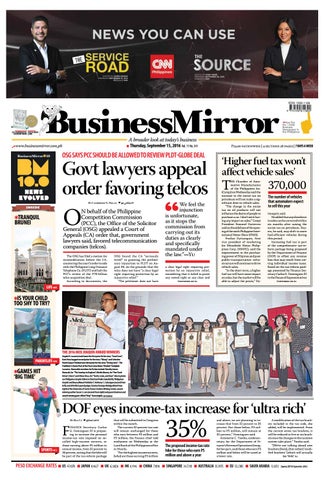
N behalf of the Philippine Competition Commission (PCC), the Office of the Solicitor General (OSG) appealed a Court of Appeals (CA) order that, government lawyers said, favored telecommunication companies (telcos).
tranquil brunei
The OSG has filed a motion for reconsideration before the CA, countering the court’s order to side with the Philippine Long Distance Telephone Co. (PLDT) and halt the PCC’s review of the P70-billion telco-acquisition deal. According to documents, the
life
OSG found the CA “seriously erred” in granting the preliminary injunction to PLDT on August 30, on the grounds that the telco does not have “a clear legal right requiring protection by an injunctive relief.” “The petitioner does not have
We feel the injunction is unfortunate, as it stops the commission from carrying out its duties as clearly and specifically mandated under the law.”—Yu
a clear legal right requiring protection by an injunctive relief, considering that it failed to prove any vested right or any clear and Continued on A2
P25.00 nationwide | 4 sections 28 pages | 7 days a week
‘Higher fuel tax won’t affect vehicle sales’
T
he Chamber of Automotive Manufacturers of the Philippines Inc. (Campi) on Wednesday said the increase in the excise tax on petroleum will not make a significant dent in vehicle sales. “The change in the excise tax on oil products will not influence the desire of people to purchase a car. I don’t see it having any impact on sales,” Campi President Rommel Gutierrez said on the sidelines of the opening of the sixth Philippine International Motor Show (PIMS). Froilan Dytianquin, first vice president of marketing for Mitsubishi Motor Philippines Corp. (MMPC), said the improvement in the purchasing power of Filipinos and poor public-transportation infrastructure will continue to drive vehicle sales. “In the short term, a higher fuel tax will have some impact on sales, but the market will be able to adjust the prices,” Dy-
370,000 The number of vehicles that automakers expect to sell this year
tianquin said. He added that any slowdown in sales can be corrected within six months after raising the excise tax on petroleum. Buyers, he said, may shift to more fuel-efficient vehicles during this period. Increasing fuel tax is part of the comprehensive tax-reform package being proposed by the Department of Finance (DOF) to offset any revenue loss that may result from cutting individual income taxes. Based on the tax-reform package presented by Finance Secretary Carlos G. Dominguez III to the House of Representatives Continued on A2
d1
is your child too shy to try?
The 2016 Nick Joaquin Award winners
parentlife
d4
games hit ‘big time’
Angelo R. Lacuesta took home the first prize for his story “Coral Cove”; Kate Osias bagged second prize for the story “Silang”; and Celestine Marie Gaspar Trinidad won third prize for the story “Giving Lives”. The Publisher’s Choice Poet of the Year is Ana Maria “Mookie” Katigbak Lacuesta. Honorable mentions for fiction include Timothy James Dimacali, for “The Sundays in Dapitan”; Merlie Alunan, for “One Truck Driver’s Story”; and Ethan Chua, for “Tooth, Scale, and Claw”. Also in photo are Philippines Graphic Editor in Chief Joel Pablo Salud (left); Philippines Graphic and BusinessMirror Publisher T. Anthony C. Cabangon (second from left); and 2016 NJLA panel judges Cristina Pantoja-Hidalgo (third from right) of the University of Santo Tomas Creative Writing Center, awardwinning author Susan S. Lara (second from right) and panel chairman and award-winning poet Alfred “Krip” Yuson (right). Roy Domingo
DOF eyes income-tax increase for ‘ultra rich’ F sports
c1
By Rea Cu
@ReaCuBM
inance Secretary Carlos G. Dominguez III is proposing to increase the personal income-tax rate imposed on socalled high-income earners, or those earning above P5 million in annual income, from 32 percent to 35 percent, noting that the hike will be part of the tax-reform package
PESO exchange rates n US 47.4370
that will be submitted to Congress within the month. The current 32-percent tax rate will remain unchanged for those who earn between P3 million and P5 million, the finance chief told mediamen on Wednesday at the Land Bank of the Philippines office in Manila. “For the highest income earners, [who] are those earning P5 million
35%
The proposed income-tax rate hike for those who earn P5 million and above a year
and above, we are planning to increase that from 32 percent to 35 percent. But those below, P3 million to P5 million, will remain at 32 percent,” Dominguez said. Antonette C. Tionko, undersecretary for the Department of Finance’s Revenue Operations Group, for her part, said those who earn P3 million and below will be taxed at a lower rate.
A modification of the tax brackets included in the tax code, she added, will be implemented. From the current seven tax brackets, it will be reduced to five or six brackets once the changes in the taxation system take place,” Tionko said. “[We’re not talking about] new brackets [here], [but rather] ‘modified brackets’ [which will actually
n japan 0.4627 n UK 62.6026 n HK 6.1146 n CHINA 7.1016 n singapore 34.7218 n australia 35.3975 n EU 53.2385 n SAUDI arabia 12.6512
See “DOF,” A2
Source: BSP (14 September 2016 )
A2 Thursday, September 15, 2016
BMReports BusinessMirror
news@businessmirror.com.ph
Govt lawyers appeal order favoring telcos Continued from A1
unmistakable legal right to a ‘deemed approved’ status of the acquisition,” according to the documents. The OSG underscored the PCC’s mandate to review all competition-related cases, contrary to the CA’s finding in August that its review is “in violation of petitioner’s supposed right to be accorded ‘safe harbor’ or protection from challenger.” Moreover, according to documents, the CA was found to have,
“likewise, erred in not balancing the paramount public interest represented by the respondent as against the mere private interest of petitioner.” The OSG is appealing for the CA to reverse and set aside its earlier resolution backing PLDT’s plea to halt the review and lift the writ of preliminary injunction. The CA, on August 30, granted the petition of PLDT for a preliminary injunction against the PCC’s review of the joint acquisition by PLDT and Globe Telecom Inc. of
telco assets held by conglomerate San Miguel Corp. The CA previously thumbed down Globe Telecom’s petition. According to the Philippine Internet Society (PIS), the injunction issued by the appellate court is “against public interest.” PIS Chairman Winthrop Yu said it was “unfortunate” that the Court of Appeals has ordered the competition council to temporarily stop “conducting further proceedings for the preacquisition review and/or investigation of
‘Higher fuel tax won’t affect vehicle sales’ … Continued from a1
on Wednesday, the revenue gain from this proposal could reach P178.2 billion by 2019. The DOF’s previous proposal was to raise the levy on regular gasoline by P10 in the first year and by P6 per liter for diesel. This could raise the transportation costs incurred by businesses and consumers. “There’ll be minimal slowdown in sales, unless the increase is really drastic, if let’s say the P10 is doubled to P20, then that will have a huge impact,” he noted. The auto industry has set a “conservative” sales target of 370,000 units this year. Campi hopes to sell as much as 500,000 units by 2020, or earlier.
Earlier, the government has rolled out the Comprehensive Automotive Resurgence Strategy (CARS) Program in its bid to boost the automanufacturing sector. Gutierrez, who is also vice president of Toyota Motors Philippines Corporation (TMPC), lauded the pronouncement of the Department of Trade and Industry (DTI) that it does not intend to tweak the rules of the program. “ The [DTI] really shouldn’t change it. I think Executive Order [EO] 182 and its implementing rules and regulations are clear enough, as far as the targets and conditions are concerned,” he said. Earlier, Trade Secretary Ramon
M. Lopez said the government does not intend to ease the requirements for participation in the CARS Program just to accommodate a third player. “It’s up to the government to invite a third player, but I think have two participants is already substantial compliance,” Gutierrez said, adding that nothing bars Toyota and Mitsubishi from enrolling a second model. TMPC and MMPC, the auto industry’s two biggest players, have already qualified for incentives under CARS. The program allows the enrolment of up to three models of a four-wheeled vehicle. Catherine N. Pillas
the subject acquisition.” “We feel the injunction is unfortunate, as it stops the commission from carrying out its duties as clearly and specifically mandated under the law. Thus, this delay is not in the public interest,” Yu told the BusinessMirror. Foundation for Media Alternatives, a nonprofit group seeking to democratize information and communication systems for citizens and communities, shared this view. “ The foundation and many civil-society organizations and
DOF. . .
Continued from A1
lessen] tax brackets compared to the tax code because there are seven brackets now…,” she noted. Quoting data from the Bureau of Internal Revenue, Tionko pointed out that high-income earners in the country are few in numbers at less than a thousand all over the country. And so are those who earn P3 million annually. “Based on BIR data, it’s less
HUDCC. . . Continued from A12
Nearly 75,000 housing units intended for displaced Supertyphoon Yolanda victims have yet to be completed, according to experts from the University of the Philippines-Center for Integrative and Development Studies (UP-CIDS). In a recent presentation, UP-CIDS Executive
independent observers believe that the PCC assessment of the transaction serves the public interest, and is against any move to prevent this assessment from happening,” the group said in a news statement. A day before the appellate court issued the order, the competition regulator issued a preliminary statement of concerns on the transaction, claiming the P70-billion deal might have a negative impact on the telco industry as a whole. For one, the Mergers and Acquisitions Office (MAO) of the competi-
tion commission said the transaction “will weaken any potential competitors to PLDT and Globe, such that they will impose less competitive constraints than they would have done in the counterfactual.” “ T he M AO has considered whether the transaction will result in either or both PLDT and Globe having substantial advantages, such that it will not be possible for other operators to match and effectively compete with the incumbent firms,” the document dated August 25 read.
than 1,000 [which is] very low, [and]…if you are earning P5 million…[and if you earn such an amount] based on World Bank data, you are considered ultrarich already,” Tionko said. The undersecretary noted that the increase in tax rates is not that much, noting that a P60,000 tax rate is relatively small, compared to the P5 million in income earned. “Actually, it is not that much, if you look at the difference between P3 million and the P5 million, how much is that about 3 percent, that
is only P60,000, which isn’t much if you earn P5 million,” she added. Dominguez, likewise, said the proposed tax-reform packages will be submitted to Congress before the end of the month, noting that the proposal on lowering personal income-tax is the first to be submitted. “The problem with putting it in one package, if somebody doesn’t like one item there, the whole thing gets stuck. So we are trying to limit the potential for it getting stuck,” Dominguez said.
Director Edna Estifania A. Co said over 80 percent of the housing projects in Yolanda areas have yet to be completed. Co said that, from 2013 to September 2015, the Department of Budget and Management (DBM) released P27 billion for the construction of 92,554 housing units. In Tacloban City alone, civil-society and international organizations said some 14,433 families still do not have housing units. Only
13 percent of the internally displaced persons have relocated. Apart from the lack of relocation facilities, families who were relocated struggle with poor access to basic facilities, such as potable water and wastewater treatment facilities. The local and foreign organizations also said the families also suffer from inadequate livelihood opportunities and unclear information on tenurial security.
BMReports BusinessMirror
news@businessmirror.com.ph
Thursday, September 15, 2016 A3
Stakeholders to DOT: Let’s keep ‘It’s More Fun…’ tourism slogan By Ma. Stella F. Arnaldo
@Pulitika2010 Special to the BusinessMirror
T
HE Department of Tourism’s (DOT) plan to change the Philippines’s tourism brand and campaign slogan was met with a barrage of negative reactions from tourism industry stakeholders, with netizens even giving their own “fun” spins and possible new slogans. Cesar Cruz, president of the Philippine Tour Operators Association (Philtoa), told the BusinessMirror that the “It’s More Fun in the Philippines” brand and campaign slogan launched in 2012 “should not be changed yet. It has not really reached its maximum potential.” Being a tourism industry veteran, he said, “I think the country slogan shouldn’t be changed every administration; it takes time for the brand or the campaign slogan to achieve its maximum potential. It’s only now that ‘It’s More Fun in the Philippines’ has gained acceptability here and abroad. Maganda ang dating nya sa tourists.” Cruz’s view was echoed by Aileen Clemente, executive vice president of the Tourism Congress of the Philippines, saying, “Large brands in the private sector do not change slogans in short periods of time because, more than an expense, it is an investment. I would rather see that we continue the momentum and enhance what needs to make it better.” For his part, Arthur M. Lopez, president of the Philippine Hotel Owners Association, also opined that the DOT should keep the “Fun” brand and campaign for the Philippines. “On a commercial point of view, for advertising recall and for continuity, it pays to stay with the current slogan.” He believes that “it takes time for a new slogan to take effect.” The “It’s More Fun in the Philippines” marketing campaign was conceived by advertising agency BBDO Guerrero, and launched in Januar y 2012 under thenTourism Secretary Ramon R. Jimenez Jr., who is an advertising veteran, as well.
₧3B
The estimated amount that the TPB had spent for developing the campaign and media placements for the Philippines’s “It’s More Fun…” campaign spread for over four-and-a-half years Initial conception for the slogan itself amounted to P5.6 million, but the subsequent media placements and advertising campaign have run into billions of pesos since its launch in 2012. These include advertising placements on buses and taxicabs in London, ad placements in major newspapers in key markets and window ads in New York. DOT insiders say the agency and its marketing arm, the Tourism Promotions Board, spent approximately $61 million (about P3 billion) spread over four-anda-half years for developing the campaign and media placements. Current Tourism Secretar y Wanda Corazon T. Teo announced in Cebu recently that the DOT is now soliciting new proposals from advertising agencies for a new brand and campaign slogan for the country. She said it was “normal” for every administration to change tourism marketing slogans, and that the new one, to be launched in mid-2017, would reflect the change and reforms being instituted by the Duterte administration.
An advertising material of the “It’s More Fun in the Philippines” tourism drive spearheaded by the Department of Tourism.
Let’s be honest, it’s only now that the ‘Fun’ campaign is really reaching its potential, and after the country branding, now the campaign has been tweaked to promote the provincial destinations. It takes time to develop, but we have yet to explore [other dimensions] of the campaign.”—Cruz Taking inspiration from the DOT’s direction, netizens actively took to their keyboards to create memes of possible new slogans for the DOT. Meanwhi le, Phi ltoa’s Cr u z pointed out that even the “Wow! Philippines,” marketing campaign conceived under the administration of former Tourism Secretary
Richard J. Gordon in 2002, “became very effective not even during the time of Gordon, but because we continued the campaign. So the impact of the slogan was sustained when other Cabinet secretaries, like Durano, etc., came in.” Cruz also stressed that in other countries, they have kept their slogans and country branding for
a long time. “For Thailand, for example, they made some tweaks but their slogan continues to be ‘Amazing Thailand.’ For India, it’s still ‘Incredible India’, and so on. If we change our slogan again, how long will it take until it reaches its acceptability?” Cruz added: “Let’s be honest, it’s only now that the ‘Fun’ campaign is really reaching its potential, and after the country branding, now the campaign has been tweaked to promote the provincial destinations. It takes time to develop, but we have yet to explore [other dimensions] of the campaign.” Aside from the length of time that a brand attains a certain level of acceptability, Cruz said there are other priorities that have to be attended that could boost visitor arrivals, such as infrastructure, air-traffic congestion, etc. “It’s expensive [to develop and launch a tourism campaign]. With
‘Defective ILS trigger Naia flight diversions’ By Butch Fernandez @butchfBM
S
keptical senators were informed on Wednesday that the recurring inconvenience to inbound and outbound airline passengers forced to bear with frequent flight diversions at the Ninoy Aquino International Airport (Naia) was caused by “defective” instrument landing system (ILS) at the Naia’s main runway. Grilling Department of Transportation (DOTr) officials at a Senate budget hearing, senators learned that the $70-million ILS installed at the countr y’s main airport to provide precision guidance for safe approach and landing “has been nonoperat ion a l for t he pa st one-year -and-a-half.” Sen. Joseph Victor Ejercito said he also found out that a high-rise condominium recently built close
to the airport perimeter “further complicated the problem.” “Lately, I’ve been noticing the frequency of flight diversions. Even if there is no typhoon, and it is just raining or there is a monsoon rain, many flights have been diverted to Clark International Airport,” Ejercito said during the Senate Finance Committee hearing on the proposed 2017 budget of the DOTr The senator added: “I found out recently that the ILS of Runway 24 is broken and has not been in use for more than a year. Another problem that aggravated this is a condominium situated at C-5, and is obstructing the flight path.” Tra nspor t of f ic ia ls, u nder questioning by senators, admitted that the ILS used to guide inbound flights landing at Runway 24 has not been repaired since it conked out in 2015, even as spare parts have been ordered from a
Ejercito said he also found out that a high-rise condominium recently built close to the airport perimeter “further complicated the problem.”
foreign supplier, but not expected to be delivered until October. At the same time, Ejercito said he further learned the twin problems “forced pilots to adjust the minimum decision altitude, an aviation term used when deciding when to push through or abort a plane’s landing.” “Before, when our ILS was operating, the minimum decision altitude was 300 meters. Now, because of the condominium,
the altitude was raised to 900 meters. There is no danger in this, because 900 meters is the pilots’ safet y adjustment for landing. But the repercussion is that we lose millions, if not billions, whenever our pilots have a hard time estimating their landing, resulting to flight diversions to Clark. We are wasting fuel, time and other resources expended for the flight, plus the passengers’ inconvenience,” he noted. Ejercito asserted at the hearing that all these inconvenience could have been avoided, “if the government would invest for an ILS for the country’s main airport, and also if the Civil Aviation Authority of the Philippines would no longer permit the construction of high infrastructure, such as the condominium named as Cypress Towers, that would block the planned course of aircraft.”
The Ninoy Aquino International Airport air-traffic control center.
the very limited budget that we have for our investment, we will have to spend so much, which is money we can use for other things that need to be prioritized, like marketing, promotion, infrastructure, etc.” Clemente, who is also president of Rajah Travel Corp., said, “When you change a slogan, it is effectively changing the branding. The consequences of doing so have a larger impact than one may originally think of. Since branding not only distinguishes us from that of another, it is critical that the adoption of the brand by all stakeholders is considered.” She added that there needs to be an independent assessment using quantitative and qualitative metrics to show whether a brand or campaign slogan has been effective, which will determine the need to change the brand or slogan, or to keep it.
A rare collection of BusinessMirror
exclusives
When I Was 25, Generations, Executive Views, Model Executive, Envoys & Expats, The Broader Look, BM Reports Extra, etc. The BM Extra Magazine is a must-have publication that you’d surely want to see in your office, library, coffee shop, restaurant, living room, anteroom, etc. Order your copies now.
BusinessMirror www.businessmirror.com.ph
Asean
BusinessMirror
www.businessmirror.com.ph
5th Asean-EU Business Summit Asean-EU Perspective
HENRY J. SCHUMACHER
W
ith the Philippines having taken over the chairmanship of Asean for 2017, all eyes are on the first big event that will happen from March 8 to 11, 2017, involving a series of summits/meetings, such as the Meeting of Asean Trade Ministers, the Asean-European Union (EU) Senior Officials Meeting and the Fifth Asean-EU Business Summit. This note sets some ideas for the summit for the consideration by potential partners. Alongside the AEM meeting, where EU Commissioner Cecilia Malmström will be present, the European Chamber of Commerce of the Philippines and partners from the Philippines, Asean and the EU will organize the one-day event. Among the partners will be EU-Asean Business Council and the Asean Business Advisory Council. Similar to earlier editions of the Asean-EU Business Council, there will be a mix of keynote addresses and panel discussions involving Asean and Philippine government officials, representatives of the EU Commission and the EU Delegation, Asean and EU business leaders, B2B meetings between European and Philippine/Asean companies. In the next few months, we will agree on the sectors to be presented/focused on in the Asean-EU Business Summit. Some industries we have identified already: n Automotive n Agriculture n Food and beverages n Health care n Infrastructure/logistics n Manufacturing n Financial services n Energy n Water Who should participate in the summit? n Business leaders from European and Asean businesses n Regulatory/government affairs leaders n Asean Business Advisory Council members n ECCP members n EU-ABC members n Government officials (Asean and EU member-states) n Ambassadors n Asean economic ministers n DG trade officials n Media As we move closer to this big event, let us just look at the size of the AseanEU relationship again: The Asean-EU investment relationship—The EU is the largest source of FDI funds to Asean; given the Duterte administration’s interest to attract more foreign direct investment , the EU investors will have to be targeted, given the fact that the EU’s FDI inflows to Asean reached $29.3 billion in 2014, representing 26 percent of total inflows. The Asean-EU trade relationship—Europe is Asean’s second-largest trading partner with €1.6 trillion in goods from 2004 to 2014, representing a share of 14 percent of Asean’s external trade. It will also be important to realize the areas in which regulatory/administrative changes can be made to improve the environment for investments and trade: n Customs and transit issues—The implementation of the National Single Window is high on the agenda; n Nontariff barriers—Work to promote Asean Trade Repository among members; n Health care and life sciences—Harmonized regulatory and testing regimes; market entry restrictions; n Financial services liberalization, insurance and tax issues— Removal of restrictions on the insurance market, payment and settlement systems, long-term investment constraints, taxation cooperation and excise duties; n IPR and illicit trade—Enforcement mechanisms; protecting IPR, highlighting counterfeit and illicit trade issues; n Digital innovation—ICT regulation, e-commerce; n Automotive—Harmonized regulations and testing regimes, national automotive policies, skills shortages. ECCP is looking for local partners—business organizations that are interested to be part of this event that will also focus on SME cooperation, involving Europe, Asean countries and the Philippines.
Thailand CB holds key rate as economic recovery continues
T
hailand’s central bank kept its benchmark interest rate unchanged for an 11th consecutive meeting, the longest streak on record, as an economic recovery continues to gain momentum. The Bank of Thailand held its oneday bond repurchase rate at 1.5 percent, with monetary-policy committee members voting unanimously in favor, it said in Bangkok on Wednesday. All but one of the 23 economists surveyed by Bloomberg News predicted the decision, with Moody’s Analytics Inc. forecasting a 25-basis-point cut. Consumer confidence rose to a five-month high in August, buoyed by public approval of the nation’s new constitution and better-than-expected economic growth in the second quarter. Finance Minister Apisak Tantivorawong said last month the economy grew“very
close”to its potential in the second quarter, supported by government stimulus measures and tourism. “The country’s economic recovery has steadily gained momentum and is likely to continue in the second half of this year, backed further by public spending and tourism,” Usara Wilaipich, an economist at Standard Chartered Plc. in Bangkok, said before the decision. “The central bank will likely prefer to preserve policy space to cope with unexpected shocks, if any, in the future.” Consumer prices rose 0.29 percent in August from a year ago, gaining for the fifth straight month after more than a year of deflation. Governor Veerathai Santiprabhob said last month the inflation rate is expected to return to the 1 percent-to-4 percent target range by early 2017. Bloomberg News
Editor: Max V. de Leon • Thursday, September 15, 2016 A5
Indonesia captures top militant in new blow to Santoso group
J
AKARTA, Indonesia—A senior figure from the East Indonesia Mujahideen militant group has been captured and one of the group’s members killed in a joint operation with the military, Indonesian police said. The capture of Muhammad Basri on Wednesday is another blow to the militant group, based in the jungles of Central Sulawesi province. The group’s leader, Santoso, who was Indonesia’s most wanted Islamic radical, was killed by security forces in
a shootout in July. Basri was Santoso’s deputy and may have assumed leadership of the group’s dwindling ranks following Santoso’s death. It claims allegiance to the Islamic State (IS) group. The capacity of Indonesia’s mili-
tant groups to carry out deadly attacks has been significantly weakened by a sustained crackdown following the Bali bombings in 2002 that killed 202 people, mostly foreigners. But Indonesians who traveled to Syria to fight with IS have directed and funded attacks from abroad, including a suicide bombing and gun attack in Jakarta in January that killed eight people, including four militants. National Police Spokesman Boy Rafli Amar said the man shot dead Wednesday near Poso Pesisir village in Poso district of Sulawesi was Andika Eka Putra. He said police and military forces are still searching for the remain-
ing 13 members of the East Indonesia Mujahideen group, including Ali Kalora, who is believed to have a key role. “We are grateful that Basri, our important target after Santoso, was captured alive,” said National Police Chief Tito Karnavian. “This arrest will improve security in Poso.” Karnavian said that Basri will be flown to Jakarta for further questioning. About 2,500 security personnel, including elite army troops, intensified operations this year in Poso, a mountainous district of Central Sulawesi province considered an extremist hotbed, to try and capture Santoso and his followers. AP
Singapore Air won’t extend lease on A380 jet in 2017
S
ingapore Airlines Ltd. said it won’t extend the lease on its first A380 superjumbo jet, a move that is set to test secondhand demand for the world’s biggest commercial aircraft. The carrier, the first operator of the Airbus Group SE plane, will see the contract expire in October 2017 and doesn’t plan to exercise an option to extend it, Singapore Air said in an e-mail on Wednesday. The airline’s first five A380s are on 10-year leases, and a decision on the other
four planes will be made later, it said. Airbus has said demand for A380s has fallen far short of its original projections, forcing the company to drastically cut output earlier this year. The jet-maker has said it sees a secondhand market for the plane as major carriers including Emirates and Singapore Air come to the end of their initial lease terms, potentially offering low-cost Asian airlines an option of flying more people on sixto eight-hour routes. In May aircraft-leasing firm Doric
said the company and fellow owner Dr. Peters Fund KG of Germany are preparing for a possible return and needed refurbishment of the five A380s from Singapore Air starting next year, reserving time in paint shops and exploring the availability of hundreds of replacement seats. Demand for the A380 has dwindled in recent years with the introduction of more nimble twin-engine jets. While Emirates has ordered more than 140 of the planes and has about 80 in services, only two other
operators, Singapore Air and Australia’s Qantas Airways Ltd., have bought 20 aircraft or more. The aircraft faced a further setback when Qantas said in August it is deferring deliveries of eight A380s it has on order. Malaysia Airlines Bhd. said last week it is in talks with carriers in China and other countries in the Association of Southeast Asian Nations about off-loading its six A380s because the giant doubledeckers are no longer needed in the fleet. Bloomberg News
Commerce Ministry pushes for farm innovation
T
he Commerce Ministry is committed to helping Thailand become one of the leading exporters for innovative farm products and services under a 20year strategic plan. Somkiat Triratpan, director of the ministry’s Office of Trade Policy and Strategy, said the strategic plan will concentrate on upgrading Thai entrepreneurs, streamlining laws and regulations and strengthening consumer and farm networks. “By 2036, we’re eager to upgrade the competitiveness and capability of Thai farmers, entrepreneurs and consumers alike,” he said. “By then, Thailand should be capable of producing more innovative farm products and food.” Approved by the cabinet last
week, the ministry’s long-term strategy will be divided into four phases, with the first phase (2017 to 2021) focusing on legal reforms to facilitate trade and the second phase (2022 to 2026) on improving local entrepreneurs so that smalland medium-sized enterprises (SMEs) become Asean’s leading traders. The third phase (2027 to 2031) calls for raising the potential of local entrepreneurs to promote global trade, while the fourth phase will focus on allowing local SMEs to become world leaders in innovative farm products and services. In the short term, a development center for innovative farm products will be set up. Patent and trademark registration processes need to be accelerated and facilitated, while attempts
to tackle intellectual-property (IP) piracy should be stepped up to have Thailand removed next year from the US’s Priority Watch List for IP, Somkiat said. The government should support Thai entrepreneurs in developing their own IP and innovative products, then marketing them, he said. The ministry’s role needs to be changed from a regulator to a trade facilitator, while the implementation of the National Single Window, an electronic system facilitating the import and export procedures of 36 state agencies, should be fasttracked, Somkiat said. The ministry will be more engaged in developing young, smart farmers who can handle not only production, but also distribution and marketing in the future, he said.
Expanding community markets and developing trading villages and farm outlets that will function as new distribution channels for farmers are also responsibilities for the ministry, Somkiat added. “By 2031, the ministry hopes the role of consumer networks will be strengthened to give them higher bargaining power with traders,” he said. “With the anticipated proliferation of online shopping and ecommerce, we expect consumers to be well-informed.” The long-term goal is for the ministry to work closer with its counterparts in Cambodia, Lao PDR, Myanmar and Vietnam to tackle trade and investment obstacles and upgrade the competitiveness of regional producers, Somkiat added. TNS
TheBroa Bulk of Duterte’s 1st budget
Business
A6 Thursday, September 15, 2016
By David Cagahastian, Jovee Marie dela Cruz & Butch Fernandez
L
IKE in previous administrations, President Duterte’s P3.35trillion “budget for real change” for 2017 focuses on social and economic services. In his budget message, Mr. Duterte said his first budget was designed “to realize change” in the government.
Top 10 Recipients Of The 2017 Budget Department of Education Department of Public Works and Highways Department of the Interior and Local Government Department of National Defense Department of Social Welfare and Development Department of Health State Universities and Colleges Department of Transportation Department of Agriculture Autonomous Region in Muslim Mindanao
“We have designed fiscal rules that will benefit the people. We will reduce our people’s tax burdens through an equitable tax regime,” Mr. Duterte has said. “We will spend more on infrastructure and social services. We will streamline government operations and make delivery more efficient.” “We owe it to our people to give them the best value for every peso we collect and spend,” the Commander in Chief added. President Duterte added: “The government’s finances are in a much better shape: In fact, it is now among the world’s most credible debtors after earning investmentgrade credit ratings.” But while not crediting that attractiveness to the previous administration, Mr. Duterte took a swipe at the fiscal stance of the Aquino administration. “However, because of underspending, we have deprived our citizens with much-needed services,” Mr. Duterte said. “Their taxes have, likewise, bloated through time due to outdated tax rates.”
Breakdown
OF the total P3.35 trillion in proposed spending next year, 40.14 percent, or P1.34 trillion, will be for empowering human resources through education, health care, social welfare and other social services. The 27.6 percent (P923 billion) for economic services is for fixing broken infrastructure network,
P567.7 billion P458.6 billion P150 billion P134 billion P129.9 billion P94 billion P58.8 billion P55.4 billion P45.2 billion P41.7 billion
boosting the agriculture and rural sector, and generate more jobs and livelihood. For general public services and defense, the government will allocate 22 percent (P729 billion) of its total budget. The 2017 budget is higher by 11.6 percent than the current year’s budget of P3.002 trillion. As a percentage of GDP, the 2017 budget represents 20.4 percent compared to this year’s 20.1 percent of GDP, according to the Department of Budget and Management. The total revenue next year is expected to reach P2.48 trillion, or around 10 percent more than the government’s target to collect this year. It is equivalent to 15.6 percent of the GDP. The national government budget deficit next year is expected at 3 percent of GDP, or P478.1 billion. This funding shortfall is funded through borrowings. The total borrowings in 2017 will reach P631.3 billion.
Education
THE President said the government’s budget will invest more on its greatest resources—its people. For education, the budget for next year will reach P699.95 billion, or 20.9 percent of the total budget. In particular, the budget of the Department of Education (DepEd) will increase by 31 percent to P570.4 billion to sustain the K to 12 education program. The money is also seen to go
President Duterte poses with a fist bump with Defense Secretary Delfin N. Lorenzana (third from right) and Armed Forces Chief of Staff Gen. Ricardo R. Visaya (third from left) during his “Talk with the Airmen” on the anniversary of the 250th Presidential Airlift Wing on September 13 at the Philippine Air Force headquarters in Pasay City. Budget Secretary Benjamin E. Diokno said the Armed Forces of the Philippines (AFP) will receive P130.6 billion, which is 15 percent higher than what it was allocated last year, to intensify its counterterrorism efforts and to protect our borders. The revised AFP modernization program will have P25 billion to give soldiers more weapons and equipment, he said. AP/Bullit Marquez
President Duterte accepts the gavel to symbolize the handing over of Asean chairmanship to the Philippines from Laotian Prime Minister Thongloun Sisoulith at the conclusion of the 28th and 29th Asean Summits on September 8 in Vientiane, Laos. A total of P15.46 billion will be spent for the Philippines’s hosting of the summit, which the government hopes to translate into more tourist arrivals next year to be able to recoup expenses. AP/Bullit Marquez
to construction of nearly 37,500 classrooms of kindergarten up to Grade 12 students. Construction of classrooms for senior highschool students is also included in the budget. Likewise, the funds are expected to go to the hiring of 53,831 additional teachers and provide assistance to 2.7 billion students in private schools. About P2.8 billion of the total DepEd budget is expected to go to the estimated allocation for new teachers from the Miscellaneous Personnel Benefits Fund. The Technical Education and Skills Development Authority will have P6.9 billion next year to support 293,333 enrollees to its Training-for-Work Scholarship Program, among others. The Commission on Higher Education will also have P13.5 billion to expand the reach of its student financial-assistance programs, as well as to heighten its K to 12 transition program. State universities and colleges will have a total of P58.8 billion next year in state subsidies, from P47.9 billion in 2016.
Health
PUBLIC health is proposed to have a war chest of P151.5 billion. The Department of Health will get P94 billion for the continuation of its universal healthcare program. This allocation will, among others, be used to deploy more doctors and health workers to rural areas, and enhance health facilities, such as local hospitals and drugabuse rehabilitation centers. The 2017 budget also supports the implementation of the Responsible Parenthood and Reproductive Health Law through an allocation of P4.3 billion next year. The Philippine Health Insurance Corp. (PhilHealth) will be given P50.2 billion to sustain the health-insurance coverage of about 15.4 million indigent families and 5.4 million senior citizens.
Social support
THE Department of Social Welfare and Development (DSWD) will receive P129.9 billion. This amount includes P78.7 billion for the Conditional Cash Transfer
aderLook
sMirror
www.businessmirror.com.ph | Thursday, September 15, 2016
a7
t in education, war on drugs B
UDGET Secretary Benjamin E. Diokno said the 2017 budget also focuses on programs and projects to achieve the country’s 10-point socioeconomic development agenda. Diokno added that the Philippine economy is “deficient in all types of infrastructure.” than in 2016, to hire more policemen, acquire more guns and patrol vehicles, and finance other activities for more effective crime suppression,” he said. Diokno added that the AFP will receive P130.6 billion, which is 15 percent higher than what it was allocated last year, to intensify its counterterrorism efforts and to protect our borders. The revised AFP modernization program will have P25 billion to give soldiers more weapons and equipment, he said. According to Diokno, the administration will increase the salaries of the military and police officers by pursuing a law that increases the base pay of uniformed personnel, but reforms the pension system of retirees, as well. To declog the courts by creating more Halls of Justice and implementing the Enterprise Information System, P32.5 billion will be set aside for the Judiciary, which is higher by 21.5 percent than in 2016, he said. The allocation of the DOJ will also increase by 16.1 percent to nearly P16 billion. This budget will boost the DOJ’s ability to prosecute cases, sustain the Public Attorney’s Office’s free legal assistance to poor defendants, and improve the National Bureau of Investigation’s (NBI) efforts to investigate crimes. This allocation should the streamlining of the processing of the NBI clearances.
Agriculture, tourism
(CCT) for 4.62 million beneficiaryfamilies. It also includes the P23.4billion rice allowance for 3 million beneficiary-families. To support livelihood and employment programs, the Department of Labor and Employment will have an allocation of P13.5 billion. One of the pressing social problems of the country is affordable housing for the poor. For 2017, the National Housing Authority will receive P12.6 billion for socialized housing, particularly the resettlement of informal settlers from danger zones and housing assistance for calamity victims. The Department of Transportation will be given P7.3 billion for the resettlement of informal-settler families to be affected by the North-South Railway project.
Utilities
TO help bring progress to the countryside, the 2017 budget provides P5.6 billion for electrification. The National Electrification Administration is provided P1.8 billion for the electrification of
2,410 sitios and 72,300 households. The National Power Corp., meanwhile, will receive P2.8 billion for the construction of transmission lines and substations and the repair and maintenance of generating assets in the offgrind areas. The DOE, on the other hand, will use P1 billion for the electrification of 190,600 households in off-grid and on-grid areas.
Infrastructure
BUDGET Secretary Benjamin E. Diokno said the 2017 budget also focuses on programs and projects to achieve the country’s 10-point socioeconomic development agenda. Diokno added that the Philippine economy is “deficient in all types of infrastructure.” He said the Duterte administration is committed to hike infrastructure spending from a low 5 percent to a high 6 percent to 7 percent of GDP next year. He added that the total proposed budget for infrastructure is P860.7 billion, or 13.8 percent higher than this year’s budget.
“We have proposed that P355.7 billion for infrastructure be spent for fixing and building road networks, railways, seaport and airport systems,” Diokno said. “The infrastructure outlays in 2017 is equivalent to 5.4 percent of the GDP. This would eventually make the Philippines on a par with its Asean neighbors by the end of this administration.” He also said the government has given the Mindanao Logistics Infrastructure Network P31.5 billion, which is higher than this year’s allocation of P19 billion, as part of the Duterte administration’s promise to pay equal attention to connecting lagging regions with growth centers.
Anticrime
TO support the administration’s drive against crime, illegal drugs and terrorism, Diokno said the budgets for the Philippine National Police (PNP) and the Armed Forces of the Philippines (AFP) were increased substantially. “The PNP will receive P110.4 billion, higher by 24.6 percent
THE proposed budget for the agriculture and agrarian-reform sector is P120.5 billion. The amount would include the Department of Agriculture’s (DA) allocation of P45.3 billion to boost the production and marketing of crops, fisheries and livestock. Part of the DA’s budget is for speeding up the construction of farm-to-market roads, postharvest facilities and other infrastructure projects. The government also hiked the funding for the National Irrigation Authority to P36.4 billion to build and rehabilitate irrigation systems nationwide, and to subsidize the user’s fees that used to be charged to poor farmers. Mr. Duterte has said that through the years, billions have been poured into agriculture, and yet the farmers and fishermen remain dirt-poor. “I ordered the DA and the Department of Agrarian Reform to do their work differently,” the President said. The DA, he added, will build an updated National Soil Sample Data after four decades. “The least we can do for our farmers is to guide them where, when and how to plant their crops so they can get the most income out of their toil and sweat.”
Meanwhile, tourism will have a total of P4 billion next year to create more jobs and livelihood opportunities from the country’s pristine destinations and cultural feature. “The amount is apart from the P20.1 billion earmarked for tourism infrastructure development— airports, seaports and access roads—that will make it easier for tourists to travel around the country,” the President said.
Palace defense
MALACAÑANG has defended the bigger budget of the Office of the President for 2017, which was proposed by the DBM to be 500 percent more than its budget for this year. At the budget hearing at the House of Representatives on Tuesday, Executive Secretary Salvador C. Medialdea said a bulk of the P19.99-billion budget for the Office of the President will be allocated for the Philippines’s hosting of the Leaders’ Summit and related meetings of the Association of Southeast Asian Nations (Asean) as its chairman in 2017. A total of P15.46 billion will be spent for the Philippines’s hosting of the Asean Summit, which the government hopes to translate into more tourist arrivals next year, to be able to recoup expenses. However, the DBM had also proposed an increase in the intelligence funds and contingency funds lumped into the budget of the Office of the President for 2017.
War against drugs
Diokno said the increase in the intelligence funds will be used by President Duterte in the war against drugs. Mr. Duterte himself, in his speeches this past week, had been complaining about the small budget given for his office with which he has to do despite high costs of waging his war against illegal drugs. “They know, and I know, and you know, that I came into office midstream. The budget is already done, and the budget on which we are working on now is a budget which was prepared the previous year by the Aquino administration,” Mr. Duterte said in a speech in Malacañang earlier this week. “At that time, they did not see the danger about drugs, because nobody, until I became President, made the naked truth come out— that we are really a drug country.”
DBM defended
DIOKNO also defended the budget-preparation process of the DBM, wherein it was admitted that members of Congress were able to recommend for funding their pet projects in their districts.
According to governmentspending watchdog Social Watch Philippines, which continues with its advocacy for fiscal prudence despite its former chief convenor having already appointed to a position in the Duterte administration, there are still vestiges of a “pork barrel” system in the 2017 national budget proposed by DBM. “We hope this government will abide by its promised change and veer away from the irregular practice of inserting projects that will render the agency hostage to the whims of the legislators,” Marivic Raquiza, coconvenor of Social Watch Philippines, said in a statement. Raquiza cited an observation from Sen. Panfilo M. Lacson, who is known to have shunned receiving any pork-barrel funds, that allowing members of Congress to identify projects for funding smacks of conflict of interest. “How can the legislators examine the budget submitted by the Executive when their ‘pet’ projects are embedded in these proposals?” Raquiza said. “While House representatives will understandably be concerned about the impact of the national budget on their local constituents, Congress’s power of the purse is focused on the big picture, and the need for legislators to scrutinize and amend the national budget as a whole to ensure that it will serve as a genuine equalizer to address poverty, hunger and joblessness, and promote regional, as well as national, development.”
Postenactment intervention
HOWEVER, Diokno said that, what is prohibited by the Supreme Court in its landmark decision which declared the “pork barrel” scheme as unconstitutional is the postenactment intervention by lawmakers, wherein they are given the power to influence where the money will be spent despite that particular project not being identified in advance in the budget-making process. He said the practice of allowing members of Congress to participate in pointing out which projects are needed during the budget-deliberation process is not prohibited, and that members of Congress are more knowledgeable of the needs of their constituents and the projects required to attend to those needs.
Approval
NATIONAL Unity Party Rep. Karlo Alexi Nograles of Davao City said his committee would be ready to submit the budget for plenary debates by September 19. Nograles said they expect the budget to hurdle third reading by September 30. Senators, on the other hand, remain confident the Senate is on track to pass the P3.35-trillion 2016 budget bill, the first big spending measure Congress would approve for the Duterte administration, before lawmakers adjourn for Christmas recess in December. “I’m sure [it would be] passed on time,” Senate Majority Leader Vicente C. Sotto III told the BusinessMirror, as he noted that the Senate Finance Committee has already started marathon hearings to review the budget proposals submitted by the different Executive departments. Sen. Loren B. Legarda, Finance Committee chairman, began convening last week consecutive budget hearings, attended by Cabinet officials and department heads, called to justify the funding proposals for their departments. Legarda is expected to submit a committee report endorsing the 2017 budget bill for plenary deliberations and amendments by next month before a plenary vote can be taken to approve the budget bill on third reading before the yearend recess.
A8
The World
Thursday, September 15, 2016 • Editor: Lyn Resurreccion
BusinessMirror
Pope honoring French priest: Killing in God’s name ‘satanic’
V
ATICAN CITY—Pope Francis honored the French priest who was killed by Islamic extremists while celebrating Mass as a martyr on Wednesday and urged all people of faith to have the courage to denounce such killings as “satanic.”
Francis celebrated a morning Mass on Wednesday, in memor y of the Rev. Jacques Hamel. Two
extremists slit Hamel ’s throat in his church in Saint-Etiennedu - R ou v r ay, out s id e R oue n ,
on Ju ly 26. Police later k il led them; the Islamic State group claimed responsibilit y. Hamel ’s relatives, 80 members of his parish and the Rouen bishop attended the intimate Mass in Francis’s hotel chapel. In his homily, Francis lamented the persecution of Christians today and denounced Hamel ’s slaying as the “satanic thread of persecution.” Francis recalled that before being killed, Hamel cried out to his killers: “Satan, get out!” “This example of courage, and the martrydom of one’s own life,
to give everything of oneself to help others, to make brotherhood among others, helps all of us to go forward without fear,” Francis said. He added that Hamel was a martyr to whom all people of faith should pray for peace “and also the courage to tell the truth: killing in the name of God is satanic.” Rouen Bishop Dominique Lebrun was asked by reporters afterward about the implications of the pope terming Islamic extremist attacks as “satanic.” He replied: “The assassins accepted the influence of the devil.” AP
Syria cease-fire deal rife with legal, liability questions W A S H I N G T O N —T h e dea l craf ted by t he United Staets and Russia to halt the Syrian civil war and focus efforts on rooting out extremists is rife with legal and liability questions that are fueling Pentagon skepticism about military cooperation between the two powers, senior US officials said.
7
The number of days a cease-fire and continuous humanitarian deliveries in Syria should hold so that the US could begin talks with Russia The first hurdle is that Congress has enacted a law prohibiting any military cooperation with Moscow in the wake of Russia’s annexation of the Crimea region of Ukraine. That means the deal that Secretary of State John Kerry and Russian Foreign Minister Sergey Lavrov agreed to last week in Geneva first needs a waiver from a skeptical Defense Secretary Ash Carter to be legal. Another nagging question revolves around whether America could be held responsible if a Russian airstrike—approved by the US as part of the military cooperation at the heart of the deal—kills civilians. Military and defense leaders question whether Russia will be able to force the Syrian government to uphold the cease-fire. And they worry that Moscow’s lack of precision targeting could result in civilian casualties, even if Russia is attempting to strike Islamic State militants. “We conduct military operations with our allies and partners, and Russia is neither,” said Evelyn Farkas, former US deputy assistant defense secretary who is now a senior fellow at the Atlantic Council in Washington. “So, it makes this very fraught with all kinds of risk for us—military and political.”
In this November 29, 2015, file photo, Kristin Cook of Potomac, Maryland, joins a rally outside the White House in Washington, D.C., in support of the climate talks in Paris. Most Americans are willing to pay a little more each month to fight global warming, but only a tiny bit, according to a new poll conducted by The Associated Press-NORC Center for Public Affairs Research and the Energy Policy Institute at the University of Chicago. AP
Poll: Americans favor slightly higher bills to fight warming
W
A SHINGTON—Most Americans are willing to pay a little more each month to fight global warming—but only a tiny bit, according to a new poll. Still, environmental policy experts hail that as a hopeful sign. Seventy-one percent want the federal government to do something about global warming, including 6 percent who think the government should act, even though they are not sure that climate change is happening, according to a poll conducted by The Associated Press-NORC Center for Public Affairs Research and the Energy Policy Institute at the University of Chicago. And those polled said they’d be willing to foot a little of that cost in higher electric bills. If the cost of fighting climate change is only an additional $1 a month, 57 percent of Americans said they would support that. But as that fee goes up, support for it plummets. At $10 a month, 39 percent were in favor and 61 percent opposed. At $20 a month, the public is more than two-toone against it. And only one-infive would support $50 a month. “I feel we need to make small sacrifices—and money is a small sacrifice—to make life better for
future generations,” said Sarah Griffin, a 63-year-old retired teacher in central Pennsylvania. “Surely I have enough money to spend on something that’s worthwhile.”
Opposition
GREG Davis, a 27-year-old postgraduate student in Columbus, Ohio, agreed: “It’s far more important to protect the environment than to save money. I think that’s true for businesses, as well as individuals.” That a majority is willing to pay more is a new phenomenon, said Tom Dietz, professor of sociology and environmental science and policy at Michigan State University. “While the amounts may seem small, the willingness to take action, even if there are some out-ofpocket costs, is encouraging,” Dietz said in an e-mail. Dana Fisher, director of the Program for Society and the Environment at the University of Maryland, said it’s noteworthy that a majority was “willing to pay at all,” and added that the levels of support for $10 a month and $20 a month are significant. But so was the opposition to higher costs.
Cyclical
JAMES Osadzinski, 52, of Rockford, Illinois, said simply: “I have a
set budget. I don’t have the money,” while for 26-year-old nurse Marina Shertzer of Pensacola, Florida, it doesn’t make sense, because she doesn’t see climate change as a threat, but something cyclical and normal. Of those polled, 77 percent said climate change is happening, 13 percent weren’t sure, and only 10 percent said it wasn’t happening. There remains a partisan divide in how Americans view climate change. While 84 percent of Democrats and 55 percent of independents view global warming as a fact and a problem that the government needs to address, only 43 percent for Republicans agree. And 18 percent of Republicans said they think climate change is happening, but don’t think the government should address the issue. Slightly more than half of Americans—54 percent—said they approved of Obama administration rules to cut pollution from coal-power plants, the biggest emitter of heat-trapping carbon dioxide. When the question also mentions that thousands of jobs may be eliminated while reducing coal use by one-third, only 45 percent favor the policy; 29 percent are opposed.
Late
LAST December, 190 nations in the world signed an agreement to reduce green-house gas emissions. Two-thirds of those polled were at least moderately confident that the United States could meet its obligations. But about the same number of Americans weren’t that sure that China— the No. 1 polluter—and India could meet their goals. Davis, the Ohio student, wasn’t very optimistic about the future “I think, as the younger generation starts displacing the older people, I think we’ll get somewhere,” he said. “But I’m afraid that may be too late.” The AP-NORC poll of 1,096 adults was conducted from August 11 to 14 using a sample drawn from NORC’s probabilitybased AmeriSpeak panel, which is designed to be representative of the US population. The margin of sampling error for all respondents is plus or minus 3.6 percentage points. The survey was paid for by the Energy Policy Institute at the University of Chicago. Respondents were first selected randomly using address-based sampling methods, and later interviewed online or by phone. AP
www.businessmirror.com.ph
Details sketchy
NEITHER U.S. nor Russian officials have released the plan, so details are sketchy. But senior US officials said militar y and intelligence officials and other segments of the ad m i n i st rat ion h ave ser iou s doubts that Russia will be able to live up to its commitments in the deal, despite Moscow’s long-held desire for militar y cooperation with the US. If it does happen, however, US officials said the cooperation would be a sharply limited and carefully controlled exchange of very basic targeting information that would protect US intelligence gathering and tactics, and involve detailed vetting to ensure that any proposed Russian strikes would hit Islamic State or al-Qaeda-linked combatants, not the rebels fighting Syrian President Bashar al-Assad. Several US officials spoke about the deal on condition of anonymity because they were not authorized to publicly discuss it.
Aid flow
THE cease-fire took effect at sunset on Monday, with sporadic small violations. It calls for a halt in hostilities between Assad’s government forces and rebel groups, and it paves the way for the delivery of humanitarian relief. It allows Syrian government
strikes against al-Qaeda-linked militants who fight alongside the rebels. And the US-led coalition can continue attacks on Islamic State militants. The Syrian army has said it would abide by the cease-fire, but will defend against any violations. If the cease-fire holds for seven days and humanitarian deliveries continue, the US would begin discussions with Russia on the establishment of a joint-implementation cell. If the cease-fire is violated, the seven-day time period resets, State Department Spokesman Mark Toner said. US officials said the cooperation won’t begin immediately after the seven days. They said it could be shut down quickly if humanitarian aid stops getting through or if the Syrian government violates the cease-fire.
Waiting period
THE Pentagon’s top leaders insisted on the seven-day waiting period, largely due to deep skepticism about Russia. Toner said he had no estimate on how long it would take to set up the coordination center, but said discussions have been going on for several months, so he didn’t believe it would “ be a matter of weeks.” Officials declined to talk about where the center would be and how it would actually work. And many suggested it was too early to discuss the details of something that may never happen. But a senior US official said American intelligence officials have been studying the issue for some time to determine what information could be given to the Russians and how it could be done carefully. Russia is not part of the US-led coalition targeting Islamic State militants in Iraq and Syria, and the US doesn’t have a history of sharing information with Moscow.
Miss and kill
U.S. officials expressed concerns that Moscow might continue to target US-allied opposition forces, claiming they are working with the al-Qaeda-linked group Jabhat Fatah al-Sham, previously known as the Nusra Front. Rebel forces have intermingled with the Nusra militants, at times making targeting difficult. They also worry that many of the Russian airstrikes do not involve precision-guided weapons. Moscow has predominantly used so-called dumb bombs in Syria, largely targeting opposition forces and backing Assad’s government forces. Two senior administration officials, however, said the US will bear no responsibility for any strikes made by Russia or deaths that result. And neither country will be able to veto strikes the other wants to conduct. The strikes have triggered frequent complaints of mass civilian casualties. And the US faces the possibility of agreeing on a particular target, then having the Russian strike miss and kill civilians.
Classified tactics
THE U.S. Officer in Charge of Air Force Operations in the Middle East, Lt. Gen. Jeffrey Harrigian told reporters on Tuesday that the intent is to develop a plan that “executes the mission precisely, minimizing risk to the coalition team and civilians on the ground.” He added that it would be important to do it in a way that does not undermine “coalition cohesion” and momentum. The US, he said, will not share any classified tactics with Russia. AP
The World BusinessMirror
www.businessmirror.com.ph
Colombian general recalls journey to peace with rebels
B
OGOTA, Colombia—For 40 years, army Gen. Javier Florez battled the guerrillas of the Fuerzas Armadas Revolucionarias de Colombia (Revotionary Armed Forces of Colombia, FARC). Now his mission is to make sure thousands of the rebels are safe, as they disarm and return to civilian life under a historic peace deal. It’s an improbable journey that Florez says has forced him to alter his soldier’s perspective, as the country undergoes profound changes after more than five decades of conf lict. “There are situations as a soldier that you don’t understand,” Florez told The Associated Press in an interview on Monday, describing his shift from one of the FARC’s most feared military adversaries to one of its most trusted government confidants. The transformation began when President Juan Manuel Santos two years ago asked Florez to give up his position as chairman of the joint chiefs of staff, the armed forces’ No. 2 position. He wanted the general to negotiate face-to-face with the FARC on how 6,000 guerrilla fighters would turn over their weapons and reintegrate into civilian life. The 59-year-old Florez said he sweated making his decision. At that point, peace negotiations were dragging into their third year and many in the US-backed military questioned whether years of hard work driving the rebels to the edges of the jungles would be undone by a piece of paper.
Political vortex
BETWEEN three coffees and a cigarette, or maybe three cigarettes and a coffee, Florez jokes, he thought about the political vortex into which he was plunging his family. “I thought they would call me a traitor, as in fact happened,” he said, recalling the attacks on social media he suffered from retired officers and conservative opponents of Santos’s peace effort. “I had to disarm my spirit, my soul and my heart and understand that Colombian society is very complex.” The sacrifice appears to have paid off. Last month Santos and the FARC announced they had reached a deal to stop fighting. In the coming weeks, the accord will be signed at a ceremony and then voters are expected to ratify it in a nationwide referendum. The cease-fire component negotiated by Florez sets out a detailed protocol by which the FARC will mobilize its troops to 28 rural areas across Colombia and over six
months gradually turn over their weapons to a United Nations-led mission of international observers.
Enough trust
KEY to the accord, Florez said, was guaranteeing the FARC will be treated with dignity and not as a surrendering force, despite the widespread contempt many Colombians hold for the group over its past involvement in drug trafficking, kidnapping and bombing of civilian targets. That was something he struggled with the night before his first meeting in Cuba with a rebel known as Carlos Antonio Lozada, a warlord Florez had personally hunted years before as head of the military’s elite Omega forces. He said two fellow generals who were on the government’s negotiating team from the outset, former police chief Oscar Naranjo and former military chief Jorge Enrique Mora, gave him a last-minute pep talk that prepared him for what would become the toughest mission of his life. “They calmed me down, making me understand that I wasn’t just representing the armed forces, but something bigger: the Colombian people,” Florez recalled. Over coffee breaks and leisurely walks at the convention center in Havana, where talks took place, he began to understand that Lozada faced many of the same pressures from inside the FARC not to cede too much to the government. By the end, enough trust had been built up that Florez recently toured with Lozada a guerrilla camp where he would have been a trophy prisoner not long ago.
Extrajudicial killings
UNDER the deal, both rebels and soldiers who committed abuses in the line of duty will have to confess their crimes to special peace tribunals or face up to 20 years in prison. That grates on some conservative critics, who say putting professional soldiers before the same courts that will judge rebels who systematically subverted the rule of law is a humiliation. But for Flores, military crimes such as the extrajudicial killings of potentially thousands of civilians represent only a small fraction of the conflict’s horrors. He said it is only fitting that hundreds of soldiers already serving time or facing charges for such crimes receive the same benefits as FARC fighters. “We’re not going to abandon these people,” he said of those soldiers, attributing their crimes to the psychological damage from years of bloody conflict. AP
Navy secretary defends his unusual picks for ship names
N
AVY Secretary Ray Mabus has raised a few eyebrows with some of the names he has picked for naval ships. Why, critics questioned, would he name a ship in honor of the late gay-rights leader Harvey Milk or after former US Rep. Gabrielle Giffords when there are plenty of military heroes to choose from? Mabus has said he is honoring people who have shown heroism, just as past Navy secretaries have done. He said he believes that by looking outside the military, at times, for heroes, he can help connect people with the US Navy and Marine Corps. Mabus is officially announcing five new ship names on visits to Mississippi and Massachusetts beginning on Saturday. Among the group, a replenishment oiler will bear the name of abolitionist Sojourner Truth. “I have named ships after presidents. I have named ships after members of Congress who have been forceful advocates for the Navy and Marine Corps,” Mabus said in a recent interview. “But I think you have to represent all the values that we hold as Americans, that we hold as a country. And so that’s why I’ve named ships the Medgar Evers, Cesar Chavez, John Lewis, the Harvey Milk. Because these are American heroes, too, just in a different arena.”
Republican US Rep. Duncan Hunter, of California, objects to Mabus naming ships after Milk, farm-labor leader Chavez and others. He wants ships to be named after service members honored for valor to inspire their crews.
Running risks
EVERS and Lewis were civil-rights activists. Lewis is now a Georgia congressman. A measure stalled recently in the House that would have prevented the Navy from naming ships after lawmakers who haven’t served in the military or as president. Retired Vice Adm. Doug Crowder questions naming a ship after Giffords, who survived after being shot during a constituent meeting. It’s the secretary’s right to name ships, and previous secretaries have made political decisions, but there’s an inherent risk in making a string of political statements, said Crowder, who served as a deputy chief of naval operations before retiring in 2010. “It just doesn’t help at all for what the basic sailor or officer thinks of his chain of command, up to the secretary of the Navy,” he said. “Is it catastrophic? No. But that’s the risk you run.” AP
Thursday, September 15, 2016
A9
US concerned over Chinese money in Australian politics
C
ANBERRA, Australia— The American ambassador to Australia has voiced US concerns over China’s impact on Australian politics, saying the United States wants the system reformed to remove the influence of Chinese political donations.
A$5.5M
The donations businesses with Chinese connections gave Australia’s major political parties from 2013 to 2015, the Australian Broadcasting Corp. reported last month
Ambassador John Berry said in an interview with The Australian newspaper that the United States is “surprised” by the amount of Chinese money and influence in Australian politics and wants Australia to resolve the foreign donation issue. The
embassy confirmed in a statement that Berry had been accurately quoted in the interview, published on Wednesday. Last week the opposition Labor Party called for foreign political donations to be banned after Labor Sen. Sam Dastyari stepped down from a senior role for asking a Chinese company to pay a A$1,670 ($1,250) travel bill. While Dastyari broke no law, he acknowledged that having the Sydney-based company Top Education Institute pay a personal bill was wrong. Prime Minister Malcolm Turnbull pointed to a Chinese language news report that quoted Dastyari as saying, “The South China Sea is China’s own affair.”
Turnbull said that statement contradicted both the government and the opposition’s foreign policy position that China should respect international law in territorial disputes. The prime minister accused Dastyari, who has been dubbed Shanghai Sam, of saying what Chinese donors paid him to say. Dastyari said he might have misspoken during the Chinese interview, but said he supported his party’s policy. T he issue is broader t han Dastyari, with Top Education Institute donating more than A$230,000 to both Labor and the ruling conservative Liberal Party. Unlike the US, which bans foreign donations, Australian l aw ha s never d ist ing u ished between donors from Australia and overseas.
Foreign-linked donations
BERRY said the United States hopes that Australia will protect its “core responsibilities against undue inf luence from governments that don’t share our values.” He said the US objects to Beijing being able to fund political candidates in an Australian election campaign to advance Chinese interests. “That, to us, is of concern,”
Berry said in the newspaper interview. “We cannot conceive of a case where a foreign donation from any government, friend or foe, would be considered legitimate in terms of that democracy.” “We have been surprised, quite frankly, at the extent of the involvement of the Chinese government in Australian politics,” he added. A Labor government introduced a bill to ban foreign donations to Parliament in 2010, but it never became law. The minor Greens party has proposed a similar bill in the current Parliament, but conservative government ministers have said there is no need for reform. Australian Broadcasting Corp. reported last month that businesses with Chinese connections gave Australia’s major political parties more than A$5.5 million from 2013 to 2015, making them easily the largest source of foreign-linked donations. Australia struggles to balance its relationships with the US, its most important strategic partner, and China, its most important trade partner. Neither the Chinese Embassy in Australia nor Top Education Institute immediately responded to a request for comment. AP
China vows to slash aluminum output as producers eye growth
B
EIJING—China’s leaders are promising to rein in aluminum production that is flooding global markets and threatening jobs in the United States and Europe, but its producers have ambitious plans to expand. The glut has cut costs for Western buyers of aluminum used to make lighter cars and aircraft. Prices have fallen so low, though, that the US and European smelters are closing, prompting demands for trade penalties. An array of Chinese industries from aluminum, steel and coal to makers of solar panels and glass mushroomed over the past decade until supply vastly exceeded demand. The surplus has widened as China’s economy cooled. The Communist leadership has been promising since 2009 to cut overcapacity and reduce reliance on energy-guzzling heavy industry. But they face resistance from local officials who are reluctant to lose jobs and tax revenue.
Shrinking
PLANS issued in February call for shrinking the steel and coal industries at a loss of 1.8 million jobs. The Cabinet says it plans to close 45 million tons of steel production this year and has done about one-third of that so far. Beijing agreed at the Group-of-20 (G-20) meeting of major economies this month to cooperate more closely on steel by forming a global forum to exchange information on the status of efforts to shrink its industry. But it avoided any binding commitments. Beijing has yet to issue plans for other industries but affirmed its pledge to reduce excess capacity at an earlier G-20 meeting in July. Despite that, Chinese smelters that make more than half the world ’s aluminum are adding millions of tons of capacity, supported by what Western competitors complain are improper subsidies including lowcost power. Output in June hit a monthly record of 2.7 million tons, according to the Aluminum Institute in London. “The industry overcapacity situation is more severe,” the newspaper National Business Daily said this month.
In this August 22 photo, a woman walks with an umbrella past scavenged air ducts made from aluminum sheet metal in Beijing, China. China’s leaders are promising to rein in aluminum production that is flooding global markets and threatening jobs in the United States and Europe, but its producers have ambitious plans to expand. AP
Disputed
CHINESE producers dispute that. “We believe that if there is an overcapacity in the aluminum industry, then it must be temporary,” said Mo Xinda, a researcher for the aluminum branch of the China Nonferrous Metals Industry Association. Aluminum gets less public attention than Chinese steel exports, on which Washington imposed antidumping tariffs in July. But pressure for official action is rising: The Aluminum Association, a US industry group, appealed to regulators in April to investigate Chinese producers. The United States has five aluminum smelters left, down from 14 a decade ago, according to the association. It says the number of American jobs in alumina refining and primary aluminum production has fallen to 5,000 from 12,000 in 2013. Aluminum producers in Europe say its industry is being driven out of business by subsidized Chinese exports.
Growth
THE global price of aluminum has fallen by 40 percent since 2011 and sits at about $1,600 per ton
after dipping below $1,500 last year. That is far below the $2,200 level most Western smelters need to be financially viable, according to analyst Lloyd O’Carroll of CRU Group, a research firm. Chinese output grew by 1,000 percent, from 2.8 million metric tons in 2000 to 31.7 million metric tons last year, according to the International Aluminum Institute. At the same time, annual production outside China rose 19 percent to about 25 million metric tons. Tianshan A luminum Co. in Xinjiang in the northwest announced in June it is adding 1 million tons of production capacity. East Hope Group in Shanghai is adding 680,000 tons. China Resources Co., a national-level state company owned by the Cabinet, plans to build a 500,000-ton smelter in the northern city of Luliang in Shanxi province. “This kind of growth is not warranted by conditions in the marketplace globally and certainly not in China,” Aluminum Association, President Heidi Brock told a US government hearing in April. Treasury Secretary Jacob Lew pressed Chinese officials for action
on aluminum at an economic dialogue in June and again at the G-20 meeting in July.
Costly
CHINESE officials told Lew they have no plans to force the closure of aluminum capacity because they used up their “political capital” on coal and steel, according to a person who was briefed on the meeting and asked not to be identified further. Shutdowns of coal and steel producers are costly: The government is promising to spend 100 billion yuan ($15 billion) to help miners and steelworkers find new jobs. And while smelters in central and southern China are closing due to higher costs there, producers are opening in the north, where abundant coal supplies allow them to generate their own power. That reliance on China’s cheap but high-sulfur coal has prompted environmental warnings. “China cannot meet its carbonreduction commitments without both eliminating energy subsidies and curtailing outdated, carbonintensive production in the aluminum industry,” Brock said. AP
A10 Thursday, September 15, 2016 • Editor: Angel R. Calso
Opinion BusinessMirror
editorial
Your support is needed
P
eople with no moral authority to comment on President Duterte’s drive against corruption, criminality and illegal drugs are joining foreign efforts to discredit him. These include former government officials who had their chance to solve the problem but did nothing. As a Duterte supporter puts it, “the sum total of their enforcement efforts against drug abuse over the past six years has been an embarrassing zero. Nothing.” Indeed, the country’s shabu industry has been roaring like hell these last six years that it managed to spawn “shabu tiangges” in Metro Manila under the very noses of the police and local government officials. Since President Duterte assumed office, 90 million Filipinos are saying law and order in the country has improved. The minority, who complain that government’s antidrugs campaign violates human rights, failed to recognize the gravity and scope of the country’s drug problem. President Duterte came at a time when the drug lords are about to succeed making this country a narco republic. They have managed to buy protection and political favors from the powers that be. Just recently, President Duterte has named several government officials, including judges, members of Congress and military officers, accused of having links to the illegal-drug trade. Mr. Duterte’s bashers may attempt to label this a political stunt, but if they look closely, they would soon find out that more than 90 percent of the country’s more than 40,000 barangays have been penetrated by the billion-peso shabu industry. That’s how bad the situation has become. Fortunately, in less than four months in office, the President was able to deliver on his campaign promise. The change being touted about is now being felt by every Filipino wherever they are. For one, the Duterte administration’s campaign against illegal drugs and criminality has reduced the country’s crime rate in just three months. This early, the bold solution that the President adopted is getting positive results. According to the Philippine National Police, the crime rate in the country dipped 31 percent in July, compared to the same period last year. The improvement includes a significant decrease in rape incidents, murder, homicide, robbery, carnaping and physical injuries. Contrast this to a foreign observer’s prediction: “President Duterte’s campaign pledge to end crime within three to six months is bound to fail, especially when it comes to drugs. Illegal drugs are a renewable resource. The drug trade is a global trade controlled by criminal organizations that will always find a way to enter the market. Tough law enforcement and zero tolerance will do nothing to reduce supply or demand of illegal drugs in the grand scheme of things. It’s been a bitter lesson for dozens of countries, from the US to Latin America. Fighting fire with fire won’t work. The Philippines must reverse course immediately and choose evidence-based policies that put people first, reduce harm and put an end to these atrocities.” Foreign observers have been criticizing the President’s approach to drugs crime based on foreign media’s reports. But the Chief Executive remains unfazed. For example, the President took issue with the United Nations when the latter urged him to stop the extrajudicial executions and killings. He called the UN irresponsible for relying on unnamed sources without conducting adequate investigations. Just recently, the President also made a dig at US President Barack Obama, reminding him that American colonizers, who killed hundreds of innocent Filipinos, are now raising human-rights concerns with him. The President enjoys a high level of support among Filipinos who are already tired of the scourge of drugs. Nobody, but the people who suffered from the effects of drug-related crimes, know that drug lords and drug protectors have no respect to humanity. The President also knows this too well. Let’s give him a chance to do his job. Better yet, let’s help him succeed in this war against illegal drugs.
Since 2005
BusinessMirror A broader look at today’s business
It’s only the stock market John Mangun
OUTSIDE THE BOX
W
ith all the constant talk and analysis about the stock market, you might be under the impression that it is important. No, the Philippine stock market is not important.
But isn’t the stock market a way to measure economic performance? No. The Venezuela stock exchange index was up 400 percent in 2015. Since 2009, the New York stock exchange has increased by 150 percent. This is also the worst eight-year economic growth period in the history of the US. You want to measure the Philippine economic performance, go to any major department store on a normal Saturday and count the cashier booths that are open. Less than 50 percent is not good. Long lines are good. Isn’t the stock market an indicator of political stability? “Political stability” is a “yes or no” proposition.
If the government is closing down the media and press, and arresting journalists, the situation is not stable. But what about government approval ratings? Don’t people buy shares if they like the government’s performance? No. As of September 8, 70 percent of US voters think the nation is going in the wrong direction. The last time it was below 50 percent was in 2009. The one thing that we know that is important about the local stock market is whether foreign money is coming in. Actually, no. “Foreign money” is just like “local money”. It is greedy, paranoid, erratic, impulsive, unpredictable and—did I
Reality check
✝ Ambassador Antonio L. Cabangon Chua Founder
Publisher Editor in Chief Managing Editor Associate Editor News Editor City & Assignments Editor Senior Editors
Max V. de Leon Jennifer A. Ng Dionisio L. Pelayo Vittorio V. Vitug Lorenzo M. Lomibao Jr., Gerard S. Ramos Lyn B. Resurreccion, Efleda P. Campos Ruben M. Cruz Jr. Angel R. Calso
Creative Director Chief Photographer
Eduardo A. Davad Nonilon G. Reyes Judge Pedro T. Santiago (Ret.) Benjamin V. Ramos Adebelo D. Gasmin Marvin Nisperos Estigoy Aldwin Maralit Tolosa Dante S. Castro
BusinessMirror is published daily by the Philippine Business Daily Mirror
HOM
Publishing, Inc., with offices on the 3rd floor of Dominga Building III 2113 Chino Roces Avenue corner De La Rosa Street, Makati City, Philippines. Tel. Nos. (Editorial) 817-9467; 813-0725. Fax line: 813-7025. (Advertising Sales) 893-2019; 817-1351, 817-2807. (Circulation) 893-1662; 814-0134 to 36. E-mail: news@businessmirror.com.ph.
www.businessmirror.com.ph
Printed by brown madonna Press, Inc.–San Valley Drive KM-15, South Superhighway, Parañaque, Metro Manila MEMBER OF
DECISION TIME
Jun B. Vallecera
Online Editor Social Media Editor
Chairman of the Board & Ombudsman President VP-Finance VP Advertising Sales Advertising Sales Manager Group Circulation Manager
Ariel F. Nepomuceno
T. Anthony C. Cabangon
T
he ultimate dilemma of our present government is the fact that we are confronted with many problems that cannot be resolved in six years. Strong political will nor sincerity would not be enough to alter the consequences of gross mismanagement committed by some of our leaders and the fundamental weaknesses in the structure of our politics. We should, therefore, be prepared to sacrifice in order to correct the mistakes that we, as a nation, have, inflicted on ourselves. Meanwhile, we have to build on what we have and overcome the challenges of what we have been deprived of for so many years.
Inadequate infrastructure and poor urban planning
Our road network is not enough to accommodate the vehicles that traverse our roads. Edsa alone has to squeeze in the 70,000 to 100,000 vehicles that exceeded its daily maximum capacity of 280,000. We constantly hope that mere road discipline and strict enforcement of traffic rules would untangle the monstrous mess in almost all our
streets. What we need are longterm engineering solutions that would provide us with world-class elevated roads, dependable masstransit system, such as conventional or subway trains. We have to decongest Metro Manila by utilizing Subic airport and Batangas international seaport. We must build a national railway system that would encourage the transfer of goods and passengers away from the traditional trucks and oversized jeepneys. We must also wisely use our rivers as a major route for transport. The traffic situation has been worsened by the sudden construction of huge shopping malls along our main city arteries. Unlike in other countries, centers like these are
When foreign funds flow into the stock market, the experts caution that this is called “hot money” for a reason. It can come out at any time for any reason. Yet, when the hot money does leave the stock market as it has been doing for a couple of months, everyone suddenly goes crazy that the world is coming to an end.
of the year. Further, does “foreign money” speak Chinese, Japanese, English, German, Swedish, or Thai and does it move all at the same time in or out? Sometimes “foreign money” buys the local stock market at the high (1997) and sometimes, it sells at the low (2009). Other times it buys at the low (2013) and sells at the high (2015)—just like you and I do. Listening to talk about the stock market is like listening to the six blind men describing an elephant. Most everyone has no idea what he is talking about because he analyzes from a particular perspective. A banker, politician, economist, stockbroker, journalist, or stock trader sees something different. The elephant is not remotely like a tree, a wall, a rope, or a fan, even if it may seem that way. Likewise, the stock market is just a vehicle where people buy and sell shares trying to make money. Nothing more, and nothing less.
mention—greedy. When foreign funds flow into the stock market, the experts caution that this is called “hot money” for a reason. It can come out at any time for any reason. Yet, when the hot money does leave the stock market as it has been doing for a couple of months, everyone suddenly goes crazy that the world is coming to an end. You cannot have it both ways. Either foreign portfolio investment is the economic foundation of the Philippines and without it we might, as well, apply to be a Spanish colony again. Or, it comes in and out based on a variety of factors like currency exchange rates, geo-economics and local interest rates, and the time
E-mail me at mangun@gmail.com. Visit my web site at www.mangunonmarkets.com. Follow me on Twitter @mangunonmarkets. PSE stockmarket information and technical analysis tools provided by the COL Financial Group Inc.
We have to decongest Metro Manila by utilizing Subic airport and Batangas international seaport. We must build a national railway system that would encourage the transfer of goods and passengers away from the traditional trucks and oversized jeepneys. We must also wisely use our rivers as a major route for transport.
not predict even their immediate future in the midst of their sub human existence in urban slums or streets. Our agricultural workers or farmers, about 10 million to 12 million according to the latest data, are themselves victims of extreme poverty. Their livelihood is trapped in the perpetual cycle of poor harvest, high cost of fertilizers, bondage to loan sharks and virtually manipulated low market prices.
mindfully located away from the national roads. A significant distance for easements are provided between malls and roads. Or, in countries, such as our neighboring Singapore, Malaysia, Thailand and even Hong Kong, the mass-transport system is proudly in place, which mitigate the existence of commercial areas along the roads.
Glimmer of hope
Poverty across the nation
The economy has shown an encouraging annual growth of 5 percent to 7 percent in terms of GDP. However, we still have to contend with the plight of at least 25 million to 27 million Filipinos who are struggling daily for survival. The improvements in our quantitative economic indicators must be felt inside the homes and on the tables of our people. At least 12 million are still homeless and could
The present administration of President Duterte focuses on the aggressive campaign against the menace of illegal drugs and criminality. At this early stage, we are confident that the government is winning on this battlefront, notwithstanding some issues on legal procedures. The war on drugs can be won in six years or less. If an equal intensity and dedication would be given to address our other problems in the economy, infrastructure, politics and other social ills, then the pillars for a strong and vibrant nation will be slowly built for the long term. We cannot expect that the full results will be realistically achieved before 2022. However, we can hope that by then, we are on the right path away from the mistakes of the past.
opinion@businessmirror.com.ph
Opinion
Trouble in ICTSI land
Practical wisdom for salvation
BusinessMirror
Msgr. Sabino A. Vengco Jr.
Val A. Villanueva
Businesswise
T
ransnational and publicly listed firm International Container Terminal Services Inc. (ICTSI), whose owner and poster boy Enrique K. Razon Jr. is among Forbes top billionaires, now finds itself in a legal bind.
The case stems from an estafa complaint, with Case Number XV-07INV-16G-03550, filed by its minority shareholder Makiling Farms Inc. (Makiling) before the City Prosecutor’s Office of Manila. Makiling claims that it has been short-changed, alleging that its 5-percent stake in ICTSI was illegally transferred in favor of Razon’s late father Enrique Razon Sr. in 2004. Makiling shares, valued at P78.60 each at today’s ICTSI’s price, amount to more than P200 million. Makiling is a stockholder of E. Razon Inc. (ERI), which won the management contract to operate the Port of Manila. Proof of its status as a shareholder is the original ERI stock certificates that Makiling claims have never been “assigned, encumbered or canceled.” While ERI has long been dissolved, Makiling claims, its corporate assets were never liquidated by the respondent. In December 1987 a company known as ICTSI was formed. ERI subscribed to 28,049,600 shares (47 percent) out of the original 60 million shares, which comprised the total stockholdings of ICTSI. The new company eventually took over the operations of the Port of Manila. In the said complaint, Makiling says it is only after the 7.7 million ICTSI shares in the name of ERI, “which were admittedly acquired using ERI’s corporate funds.” Makiling alleged that in 2004 its shares were illegally assigned in favor of Razon Sr. by the younger Razon, making it appear that his late father entered into an agreement with the Presidential Commission on Good Government (PCGG) in behalf of ERI for the lifting of ERI’s sequestration; and the dismissal by Sandiganbayan of the case against ERI. Razon Sr. also had agreed to pay P9 million, “in consideration of the dismissal of the case by the Sandiganbayan.” It will be recalled that Imelda Marcos’s brother, Alfredo “Bejo” Romualdez, was reported to have forcibly taken over some of ERI’s shares, which had become the basis for the company’s sequestration when Corazon C. Aquino took over the presidency from Ferdinand Marcos Sr. Marcos Sr. was booted out of power through the peaceful People Power revolt in 1986. Soon after, the 7.7 million ICSTI shares in the name of ERI were assigned to Razon Sr., ostensibly to reimburse him for the P9 million he paid to the PCGG.
Upon discovery of the shares’ transfer in October 2004, Makiling demanded from Razon Jr. substantiation that the shares’ transfer was for a valuable consideration. When the ICTSI chairman asked Makiling for proof of ownership, since most of the company’s records “were lost or destroyed,” Makiling complied. In the course of its own investigation, the company learned that the ERI sequestration has not been lifted, providing it with a “smoking gun” against ICTSI. Makiling was able to obtain a certification from Sandiganbayan that ERI has not complied with the condition for the lifting of the sequestration, to wit: “This certifies that (1) the Sandiganbayan, Fourth Division, where the above-entitled case was previously pending, have not issued any order/ resolution lifting the sequestration issued against E. Razon Inc. (Metro Port Services Inc.); and (2) there is no motion filed or agreement on record between E. Razon Inc. (Metro Port Services Inc.) and the Presidential Commission on Good Government (PCGG) which led to the lifting of the sequestration issued against the corporation.” Makiling provided Razon Jr. with a copy of this certification, and challenged him that “if he could produce documents that the Deed of Assignment was supported by a valid consideration, i.e., present a certified true copy of the alleged agreement entered into by ERI with the PCGG, as well as proof of payment by his father, Enrique Razon, of P9,000,000 to the PCGG, Makiling would withdraw its claim covering its proportionate ownership of the 7.7 million ICTSI shares.” Razon Jr., however, has not been able to produce a copy of the said agreement with the PCGG “… wherein the PCGG acknowledged full payment of the amount of P9 million supposedly made by his father.…” In summary, the Sandiganbayan certification rebutted the claim of Razon Jr. in the Deed of Assignment that ERI allegedly had to reimburse his father, through the assignment of 7.7 million ICTSI shares, “because he allegedly caused the lifting of the sequestration and dismissal by the Sandiganbayan of the case against ERI.” To be continued
For comments and suggestions, e-mail me at mvala.v@gmail.com
Alálaong Bagá
G
od is to be praised and His name blessed because He lifts up the poor (Psalm 113:1-2, 4-6, 7-8). The disciples of Jesus in their total commitment to God must learn to be ingenuous and trustworthy in handling the riches in the world so as to be worthy of true wealth (Luke 16:1-16).
He raises up the lowly from the dust This first of the Hallel Psalms is a classic hymn of praise of the Lord (Hallelujah), beginning with the imperative summons to praise God, then following up with the reasons for praising. The servants of the Lord called to praise Him need not be only the religious cultic leaders like the priests and Levites but could, as well, be all who owed any allegiance to God. To praise the name of the Lord is to praise the very essence of God. He is Lord of heaven and earth, pictured as enthroned high above all nations and His glory is above the heavens. “Who is like the Lord, our God?” This rhetorical question waits
Lifting of audit suspension
BloombergView
P
undits and policy-makers everywhere are bemoaning the rise of a new, inward-looking populism. Led by the likes of Donald Trump and Nigel Farage, those who’ve felt only globalization’s ill effects, not its benefits, have mounted a fierce counterattack. Border-hopping elites fret that the whole process of opening up and knitting together the world through trade, capital flows and immigration may soon go into reverse. They’re missing the point. Support for freer trade and greater openness had, in fact, begun to falter well before economic nationalists, like Trump and Farage, took center stage. The same governments that count themselves among globalization’s greatest champions have been rolling it back steadily since the global financial crisis. Their excuses are innocent-sounding and several: to protect national industries and iconic businesses; to secure export markets and competitive advantage; and above all, to prop
up employment and incomes. Despite oft-repeated warnings about avoiding the beggar-thy-neighbor policies of the 1930s, these governments allowed global trade talks—the so-called Doha Round—to stall as early as 2008. Nations, including the US, have, instead, pursued narrower bilateral and regional deals where they don’t have to satisfy so many different negotiating partners and can continue to protect key sectors. If these pacts are better than nothing, they more or less foreclose the possibility of a more ambitious multilateralism. Meanwhile, between 2009 and 2015, three times as many discriminatory trade measures were introduced as liberalizing ones. In the first 10 months of 2015 alone, the latest Global Trade Alert database recorded 539 such initiatives adopted by governments worldwide that harmed foreign traders, investors, workers or owners of intellectual property—a record. Efforts to control trade flows have grown increasingly sophisticated. Most governments no longer impose tariffs or other crude roadblocks that
The gospel story of the steward who altered the accounts of his master’s debtors in order to ensure for himself a financial future after his announced dismissal shows he is ingenious when his own future is at stake. He was not careful enough earlier in managing his master’s resources; he squandered the property. He is being dismissed for mismanagement. Now in the time left he takes advantage of his authority to make legitimate decisions reducing and giving up his own commissions in transactions so that he can have friends to turn to when the need comes. The master commends the shrewdness of the steward who knows how to use the resources available to make friends for later. Jesus draws His own conclusion from the story saying that, indeed, the children of the world have more ingenuity or practical wisdom than
Alálaong bagá, we are in the world, and it is in the world we serve God. The world is precious to God; He wants to raise up particularly the poor and the lowly. The right use of the things of this world should be a fundamental concern of Christians as children of light and trustworthy stewards. With practical wisdom we make sure we “make friends for ourselves” with what we have, not in egoistic squandering and self-destructive exploitation but responsibly for the good of all, especially the poor. Join me in meditating on the Word of God
every Sunday, 5 to 6 a.m. on dwIZ 882, or by audio-streaming on www.dwiz882.com.
audit processes will come into full swing. These forms of enforcement activities are, indeed, needed for the effective administration of tax laws and the collection of the rightful taxes due to the government. However, the new administration may also consider other avenues for increasing tax collections and focus its resources on those other avenues, other than the usual conduct of tax examinations. The traditional targets of examinations are the same taxpayers who are already in the BIR’s database and who are regularly complying with their tax obligations. And percentage-wise, the contribution from these enforcement activities is not substantive. Mostly, the errors committed by these types of taxpayers are not deliberate but, by reason of unclear substantive and difficulty in procedural compliance, rules. Give these taxpayers clear rules and ease the difficulty in compliance requirements, and they will follow. The author is a senior associate of Du-Baladad and Associates Law Offices (BDB Law), a memberfirm of World Tax Services (WTS) Alliance. The article is for general information only and is not intended, nor should be construed as a substitute for tax, legal or financial advice on any specific matter. Applicability of this article to any actual or particular tax or legal issue should be supported therefore by a professional study or advice. If you have any comments or questions concerning the article, you may e-mail the author at julie.aranda@ bdblaw.com.ph or call 403-2001, local 312.
a competitive advantage. Devaluation has reduced the purchasing power of foreign investors holding the devaluing nation’s debt. Volatile and potentially destabilizing inf lows have prompted countries as varied as Switzerland, China, Brazil, South Korea and India to restrict capital in one form or another—something the International Monetary Fund has implicitly endorsed, reversing years of economic orthodoxy. Several places, including Canada, Hong Kong, Singapore and Australia, have introduced special taxes or other restrictions on overseas property buyers. Nations, such as Spain and Portugal, with high levels of debt have sought to channel funds domestically to support financial institutions and economic activity. The US, the UK, the euro-zone countries and others have used regulations and political pressure to encourage banks and investors to adopt “patriotic” balance sheets, purchasing national government bonds or prioritizing lending to domestic borrowers. According to
Standard and Poor’s, banks have doubled their holdings of their own states’ debt since 2008. The underlying drivers behind these trends are clear. In an environment of tepid economic growth, governments have good reason to try and maximize their share of a shrinking pie. At the same time, countries that face painful structural adjustments have been reluctant to bear the pain. Nations, such as China, Germany and Japan, have resisted abandoning an economic model reliant on exportdriven growth, placing pressure on their trading partners. Governments have grown frustrated with the way globalization undercuts the effectiveness of national policies: Fiscal expansion designed to support domestic demand, for instance, may be dissipated through financial leakage, boosting imports rather than promoting domestic activity. Rivals are able to undermine domestic-tax policies, as Ireland’s attempts to lure companies, such as Apple, have shown. All this was true before the US presidential campaign gained steam and
Britons voted to leave the European Union. Now that major party leaders in the US and the UK have positioned themselves as champions of the dispossessed, railing against trade and threats to national economic sovereignty, what were once surreptitious antiglobalization efforts have simply gained new legitimacy. The process threatens to gain an unstoppable momentum. Already the suspicion of global trade talks has spread to all trade deals: The US-led Trans-Pacific Partnership is on life support, while its transatlantic counterpart appears stillborn. Policies, such as negative interest rates, will require progressively tighter controls to prevent capital flight. Governments have done enough damage already. Unless they can quickly recover the cooperative spirit they demonstrated in response to the financial crisis and convince voters of their ability to ensure an equitable sharing of the benefits and costs of globalization—a difficult ask at the best of times—tomorrow’s economies are certain to be even less open than today’s.
I
mmediately upon assuming office, the new commissioner of internal revenue issued a circular suspending all field audit and other field operations of the revenue agency relative to the examinations and verifications of taxpayers’ books of accounts, records and other transactions.
would violate World Trade Organization rules. Instead, countries from the US—with the auto bailouts—to the UK, China, Brazil, Canada and several European Union members have funneled aid to domestic industries. State procurement rules—which in China, say, forbid buying strategic and defense technology from abroad—favor domestic suppliers, as do “buy local” campaigns, like the ones launched since 2009 in the US, the UK and Australia. New safety and environmental standards have served, as well, to block foreign products. The US’s long-running resistance to Mexican trucks, based in part on safety and environmental concerns, was one egregious example. The restrictions many countries place on various food imports are another. Financial policy has become a trade weapon. In the US, Europe, the UK and Japan, a combination of artificially low interest rates, quantitative easing and direct intervention in money and foreign-exchange markets have implicitly targeted currency levels to gain
You cannot serve God and mammon
the children of light. His disciples should learn to act with the same kind of practical wisdom in ensuring their place in the eternal dwelling. They must show by their handling of small matters (wealth in the world) that they are trustworthy of weightier responsibilities (eternal salvation). The riches of the world, of course, are to be used especially in caring for the poor and the lowly, as God Himself would want it. This is the way God is served and not mammon. We do not serve mammon and “put our trust in it,” because it is God’s merciful love we trust.
corporation, including subsidiaries and affiliates; and other matters or concerns where deadlines have been imposed or under the orders of the commissioner himself. A few days after the issuance of the suspension, the commissioner issued another circular providing clarifications relative to the suspension of audit. Among the clarifications pertained to the exception for the prescribing cases. The circular explained that considering the different periods for the filing of various tax returns, the reckoning for the counting of the prescription period shall also be different for each type of tax. The withholding taxes, with the three-year prescriptive period, shall be counted from the date required for the filing of the monthly return, while the value-added tax shall prescribe based on the filing
Tax Law for Business
As a result of the suspension of field audit, field operations and other forms of business visitations, the implementation of previously issued Letters of Authority (LOA)/ Audit Notices, Letter Notices, or Mission Orders was temporarily stalled. Issuance of new orders for audit of taxpayers was, likewise, halted, with the exception of the investigation of cases prescribing on or before October 31, 2016; processing and verification of estate-tax returns, donor’s tax returns, capital-gains tax returns and withholding-tax returns on the sale of real properties or shares of stocks, together with the documentary stamp-tax returns; examination and/or verification of internal-revenue tax liabilities of retiring businesses; audit of national government agencies, local government units and government-owned and -controlled
heaven, God stoops to lift up those who are far below, the reputedly discarded ones, and to seat them with the royal rulers and mighty ones of His own people. Such is the solicitude of the Lord for the lowly ones (Luke1:52-53).
date of the quarterly return. As for the income tax, the prescriptive period shall be counted from the required filing date of the annual income-tax return. Thus, the investigation and audit of cases under LOAs covering all internal-revenue taxes for taxable year of 2013 and prior years were suspended. The suspension provided a hiatus in the inconveniences and additional burden experienced by taxpayers during tax examinations. That break, however, did not last that long. Revenue Memorandum Circular (RMC) 89-2016 lifted the suspension of the implementation of LOAs pertaining to the Run After Tax Evader (RATE) Program. The field audits, field operations, and all forms of business visitations and activities connected directly in the implementation of examination orders pertaining to RATE cases resumed. This was followed by the issuance of RMC 91-2016, wherein the suspension of the field audit and other field operations of the Bureau of Internal Revenue (BIR) for the examination of taxpayer’s books of accounts and other transactions was lifted. This means that the field audits, field operations and any form of business visitation pursuant to issued written authority, in any of its forms, will again be conducted. With the lifting of the suspension of audit of taxpayers for possible tax liabilities, it is expected that the
Atty. Julie Ann L. Aranda
The closing of the world economy By Satyajit Das
for no answer: No one is equal to our God; He has no match, no rival. He is the victorious creator who vanquished the forces of chaos and put order in the universe; He rules high above every power in the heavens or on earth. It is from so high up in heaven that God looks down on the lowly and the poor. From the dust as symbolic of human finitude and insignificance God raises up those from the lowest rang of the economic ladder. From the dunghill or ash heap as the dump site of human derelicts and refuse God lifts up the lowly ones of society long abandoned as worthless. Reigning from His exalted throne in the highest
Thursday, September 15, 2016 A11
2nd Front Page BusinessMirror
A12
Thursday, September 15, 2016
www.businessmirror.com.ph
BRENT OIL TRADES NEAR LOWEST IN WEEK AS I.E.A. SEES GLUT PERSISTING
B
rent crude traded near the lowest close in more than a week as the International Energy Agency (IEA) changed its view on global oversupply, seeing a glut persisting into 2017. Futures were little changed in London after dropping 2.5 percent on Tuesday. The surplus will last longer than previously thought, as demand growth slumps, the IEA said. US crude stockpiles increased by 1.44 million barrels last week, the industry-funded American Petroleum Institute was said to report. Energy Information Administration data on Wednesday is forecast to show supplies rose by 4 million barrels as the peak summer demand period ends. Oil has fluctuated since rallying in August, amid speculation the Organization of the Petroleum Exporting Countries (Opec) and Russia would agree on measures to stabilize the market at a meeting later this month. Record output from Opec’s Gulf members is compounding the global glut, the IEA said on Tuesday. The agency last month predicted the market would return to equilibrium this year. “The focus of the market is squarely on supply,” said Evan Lucas, a market strategist at IG Ltd. in Melbourne. “While the Opec meeting will be important, nobody really expects them to do anything. They’re talking down the idea of raising supply, but if you look at the numbers, all they have done is increase.” Brent for November settlement was at $47.27 a barrel on the London-based ICE Futures Europe exchange, up 17 cents, at 11:21 a.m. in Hong Kong. The contract fell $1.22 to $47.10 on Tuesday, the lowest close since September 2. The global benchmark was at a $1.63 premium to West Texas Intermediate (WTI) for November.
Global glut
WTI for October delivery was 21 cents higher at $45.11 a barrel on the New York Mercantile Exchange. The contract slid $1.39 to close at $44.90 on Tuesday. Total volume traded was 27 percent below the 100-day average. Consumption growth sagged to a two-year low in the third quarter, as demand faltered in China and India, while record output from Opec’s Gulf members is compounding the glut, the IEA said in its monthly report on Tuesday. The agency trimmed projections for global oil demand next year by 200,000 barrels a day to 97.3 million a day.
Oil-market news
U.S. gasoline stockpiles fell by 2.39 million barrels last week, the API said on Tuesday, according to people familiar with the data. China’s crude-oil imports may rise further in the coming months as tumbling domestic output leaves refiners looking overseas for supplies, according to analysts from Natixis SA and Energy Aspects Ltd. Bloomberg News
While the Opec meeting will be important, nobody really expects them to do anything. They’re talking down the idea of raising supply, but if you look at the numbers, all they have done is increase.”—Lucas
PREMIER MOTOR SHOW Seventeen of the top car manufacturers and distributors gather for the sixth Philippine International Motor Show (PIMS) to showcase their latest vehicles and automotive technologies. PIMS is an annual prime industry-led motor show organized by the Chamber of Automotive Manufacturers of the Philippines Inc. (Campi). This year’s theme is “Steer The Future,” with the tagline “Campi: Driving Progress, Empowering Society.” The motor show will run until September 20. ALYSA SALEN
HUDCC to roll out housing road map by end of the year
D
By Cai U. Ordinario
@cuo_bm
espite the lack of funds and the administrative challenges it faces to wipe out the housing backlog, the Housing and Urban Development Coordinating Council (HUDCC) expressed confidence that it could release a comprehensive housing road map by December. Vice President Maria Leonor G. Robredo, who is also chairman of HUDCC, said the road map will be based on data on the available properties and list of informal settler families (ISFs) nationwide. Robredo earlier said the country’s housing woes stemmed from the lack of a comprehensive road map based on reliable information. “For me, it is very difficult to craft a complete housing road map without data. This is why we aim to complete the road map before the end of the year,” Robredo said. “We are asking help from the DBM [Department of Budget and Management] so they can help us get the funds to obtain the data released,” she added. While awaiting the appointees
in the top positions of the shelter agencies, Robredo said the HUDCC is auditing these agencies. It can be recalled that the President issued Memorandum Circular 4, directing all top government officials, except newly appointed heads and those with fixed terms, to vacate their posts by tendering a courtesy resignation. Robredo said the housing backlog remains a “huge problem” because HUDCC does not have the authority to implement a housing program. The HUDCC estimates that there are 1.4 million ISFs who do not have homes. Around 40 percent of them live in Metro Manila. “Even if we want to speed up the process of making changes in the housing sector, we cannot do anything. This is why
it is so frustrating since we do not have the mandate,” Robredo said. She added that this is the reason HUDCC and the Office of the Vice President are pushing for the creation of a Department of Housing and Urban Development (DHUD). Tu r n i ng H U D CC i nto t he DHUD will give the agency the mandate to create and implement housing projects and programs without going through the Office of the President. Robredo said that, under the current setup, the HUDCC needs to issue an executive order for every housing project and program it wants to implement. “HUDCC’s mandate is to coordinate all the six shelter agencies. It cannot do anything because the six shelter agencies under us have their own mandates,” she said. “Maybe this is the reason HUDCC has not been successful in the past few years, because it has a very limited authority,” Robredo added. Budget Secretary Benjamin E. Diokno earlier said the Duterte government supports the creation of the DHUD and is planning to include it in the Legislative-Executive Development Advisory Council meeting this month.
Homes for Yolanda victims
Robredo also said the National Housing Authority (NHA) intends
to meet with the Commission on Audit (COA) to relax housing requirements in Typhoon Yolandaaffected areas. She said relaxing land-title requirements may speed up efforts to provide housing units in the Visayas. “The requirement of the COA that requires titles of land before housing units can be built is difficult to meet since we know that in the provinces, only tax declarations are available,” Robredo said. “This is why I told NHA representatives that we should meet with the COA at the soonest possible time to determine how this requirement can be relaxed,” she added. Robredo said acquiring land titles takes two to three years. This long process has caused the delay in the government’s emergency shelter response in areas devastated by Yolanda three years ago. She said that in Eastern Samar alone, only 200 out of the targeted 900 housing units are being constructed. Further, even after three years, Robredo said none of the 200 houses has been completed. Robredo also added that she has tasked the NHA to provide a matrix of all unfinished housing projects and other problems that need to be addressed in areas affected by Yolanda. See “HUDCC,” A2
Duterte: PHL has exclusive rights over West Philippine Sea
P
resident Duterte has asserted the Philippines’s exclusive economic rights over areas in the West Philippine Sea which are within the country’s 200-nautical-mile exclusive economic zone. Mr. Duterte said China knows that the Philippines is entitled to exclusive rights over the West Philippine Sea, by virtue of international law and the arbitration case decided in the Philippines’s favor by the United Nations’ Permanent Court of Arbitration (PCA). “At this time, I said we are not cutting umbilical cords, but I would not also want to place my country in jeopardy. I don’t like hostile moves,” the told President the members of the Philippine Air Force (PAF) at the Villamor Air Base on Tuesday afternoon. “For example, China knows that we are really entitled. Let’s not fool around. We already won at the arbitral tribunal. So China knows that we have a claim that is legitimate. But the problem is, they are also claiming it as a territory,” he added. Mr. Duterte said earlier he is open to holding bilateral negotiations with
China regarding joint exploration and exploitation in the disputed areas in the West Philippine Sea, but he said his negotiating position will be limited “to the four corners” of the PCA’s decision in favor of the Philippines. Among others, the PCA’s decision invalidated China’s claim of historical right over the West Philippine Sea, as reflected by its overarching “nine-dash” line. The President cited the territorial limits of the Philippine territory, and its exclusive economic interest even beyond the territorial waters, which extends up to 200 nautical miles from the coast. “I would like to make it clear again. Our territorial limits are 12 miles from the seashores. That is the territorial integrity of the Republic of the Philippines. Beyond that is our own exclusive economic interest,” Mr. Duterte said. “In other words, all countries are given that. It’s like we’re all given a fishpond, and the fish there are ours, and whatever is under that—if it’s really oil or gas— that’s included. That’s our fishpond. All nations are given that 200 [nautical mile] delineation,” he added. David Cagahastian