media partner of the year
BusinessMirror
United nations
2015 environmental Media Award leadership award 2008
www.businessmirror.com.ph
A broader look at today’s business
n
Thursday, September 8, 2016 Vol. 11 No. 334
P25.00 nationwide | 4 sections 28 pages | 7 days a week
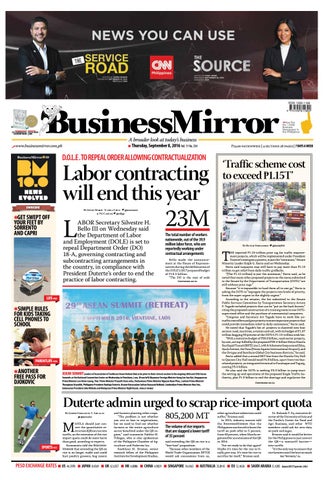
D.O.L.E .TO REPEAL ORDER ALLOWING CONTRACTUALIZATION
‘Traffic scheme cost to exceed ₧1.15T’
INSIDE
L
get swept off your feet by sorrento and capri
life
By Jovee Marie N. dela Cruz @joveemarie & VG Cabuag @villygc
abor Secretary Silvestre H. Bello III on Wednesday said the Department of Labor and Employment (Dole) is set to repeal Department Order (DO) 18-A, governing contracting and subcontracting arrangements in the country, in compliance with President Duterte’s order to end the practice of labor contracting.
23M The total number of workers nationwide, out of the 39.9 million labor force, who are reportedly working under contractual arrangements
Bel lo made the announcement at the House of Representatives during the deliberation of the Dole’s 2017 proposed budget of P13.5 billion. “The DO is the root of endo Continued on A2
d1
simple rules for kids taking cell phones to school
parentlife
d4
ANOTHER FREE PASS for djokovic
asean Summit Leaders of Association of Southeast Asian Nations link arms prior to their retreat session in the ongoing 28th and 29th Asean Summits at the National Convention Center on Wednesday in Vientiane, Laos. (From left) Myanmar Foreign Minister Aung San Suu Kyi, Singaporean Prime Minister Lee Hsien Loong, Thai Prime Minister Prayuth Chan-ocha, Vietnamese Prime Minister Nguyen Xuan Phuc, Laotian Prime Minister Thongloun Sisoulith, Philippine President Rodrigo Duterte, Brunei Darussalam Sultan Hassanal Bolkiah, Cambodian Prime Minister Hun Sen, Indonesian President Joko Widodo and Malaysian Prime Minister Najib Razak. AP/Bullit Marquez
NONIE REYES
Labor contracting will end this year
By Butch Fernandez
@butchfBM
T
he reported P1.15-trillion price tag for traffic improvement projects, which will be implemented under President Duterte’s emergency powers, is just the “minimum,” Senate Minority Leader Ralph G. Recto said on Wednesday. Recto said taxpayers may still have to pay more than P1.15 trillion to get relief from daily traffic gridlocks. “[The P1.15 trillion] is just the minimum,” Recto said, as he noted that many other proposed projects on the menu submitted to the Senate by the Department of Transportation (DOTr) “are still without price tags.” Because “it is impossible to fund them all in one go,” Recto is asking the DOTr to “segregate the projects into levels of priority, from the super urgent to the slightly urgent.” According to the senator, the list submitted to the Senate Public Services Committee by Transportation Secretary Arturo P. Tugade included projects that can be “put on the back burner,” citing the proposed construction of a training room in one DOTrsupervised office and the purchase of nonessential computers. “Congress and Secretary Art Tugade have to work like airtraffic controllers and give priority to more important projects that could provide immediate relief to daily commuters,” Recto said. He noted that Tugade’s list of projects is clustered into four sectors: road, maritime, aviation and rail, with its budget of P1.07 trillion hogging 93 percent of the DOTr’s P1.15-trillion wish list. “With a tentative budget of P58.6 billion, road-sector projects, by cost, are top-billed by the proposed P39.4-billion Metro Manila Bus Rapid Transit [BRT] Line 2, a 48.6-kilometer loop around Edsa, Ayala Avenue, the Naia [Ninoy Aquino International Airport], and the Ortigas and Bonifacio Global City business districts,” he said. Recto added that a second BRT line from the Manila City Hall to Quezon City Hall would need P4.8 billion, apart from two busrelated projects, an integrated terminal in Parañaque and Taguig, costing P5.4 billion. He also said the DOTr is seeking P3.3 billion to jump-start the setting up and operations of the proposed Single Traffic Authority, plus P1.9 billion to end the shortage and regularize the Continued on A2
Duterte admin urged to scrap rice-import quota By Jasper Emmanuel Y. Arcalas @jearcalas
M sports
c1
anila should just convert the quantitative restriction (QR) on rice into tariffs, as the extension of the rice import quota could do more harm than good, according to experts. Economists told the BusinessMirror that extending the QR on rice is no longer viable and could hurt poultry growers, hog raisers
PESO exchange rates n US 46.5970
and farmers planting other crops. “The problem is not whether you win or lose in negotiations, but we need to find out whether farmers or the entire agriculture sector benefited under the QR regime,” said economist Pablito M. Villegas, who is also spokesman of the Philippine Chamber of Agriculture and Fisheries Inc. Roehlano M. Briones, senior research fellow of the Philippine Institute for Development Studies,
805,200 MT The volume of rice imports that are slapped a lower tariff of 35 percent
said extending the QR on rice is a “lose-lose” proposition. “Because other members of the World Trade Organization [WTO] would ask concessions from us,
other agriculture subsectors could suffer,” Briones said. In 2015, industry sources told the BusinessMirror that the Philippines was forced to lower the tariff on pork offal to 5 percent, from 40 percent, when Manila negotiated for an extension of the QR in 2014. “Are we ready to do that again? Maybe it’s time for the rice to finally give way. It’s time for rice to sacrifice for itself,” Briones said.
Dr. Rolando T. Dy, executive director of the University of Asia and the Pacific’s Center for Food and Agri Business, said other WTO members could ask for zero duty on pork and sugar. Briones said it would be better for the Philippines to just convert the QR—a nontariff barrier— into tariffs. “It’s the only way to ensure that rice farmers won’t be hurt so much
n japan 0.4569 n UK 62.6357 n HK 6.0086 n CHINA 6.9829 n singapore 34.6163 n australia 35.8145 n EU 52.4636 n SAUDI arabia 12.4285
See “Duterte,” A2
Source: BSP (7 September 2016 )
A2 Thursday, September 8, 2016
BMReports BusinessMirror
news@businessmirror.com.ph
Labor contracting will end this year Continued from A1
and contractualization. We will repeal it within the year,” he said. Bello said the Dole is now drafting a new policy that will replace DO 18-A, which was issued in 2011 during the Aquino administration. “Actually, from the very start, our focus in the Dole is not only to reduce, but completely eliminate the practice of endo and contractualization in our country. This is a strict mandate coming from President Duterte,” he said. Bello told lawmakers that by the end of 2017, all kinds of contractualizations will be eliminated, except those that will be given exemptions. “By the end of 2016, we will try to reduce this practice of contractualization by 50 percent so that by the end of 2017 endo and contractualization will be a thing of the past,” he said. “By the end of 2017, there will be no contractualization, all kinds
of contractualization will be eliminated, except those who will be given exemptions, like the projectbased businesses,” Bello added. Earlier, the BusinessMirror reported the National Economic and Development Authority will draft a list of industry sectors that will be allowed to continue hiring contractual workers, saying these may include industries that deal with seasonal work, such as construction. Under t he DO 18 -A , contracting and subcontracting arrangements are expressly allowed by law, subject to regulations for the promotion of employment and the observance of the rights of workers to just and humane conditions of work, security of tenure, self-organization and collective bargaining. It also said these rules shall apply to all parties of contracting and subcontracting arrangements where employer-employee relationships exist.
Contracting and subcontracting refers to an arrangement whereby a principal agrees to put out or farm out with a contractor the performance or completion of a specific job, work or service within a definite or predetermined period, regardless of whether such job, work or service is to be performed or completed within or outside the premises of the principal. The DO also allows trilateral relationship in contracting arrangement. Trilateral relationship refers to the relationship in a contracting or subcontracting arrangement where there is a contract for a specific job, work or service between the principal and the contractor, and a contract of employment between the contractor and its workers. There are three parties involved in these arrangement: the principal who decides to farm out a job, work or service to a contractor; the contractor who has the capacity to independently undertake
the performance of the job, work or service; and the contractual workers engaged by the contractor to accomplish the job, work or service. “Agencies are still allowed to operate, but they should regularize their employees,” Bello said. However, Labor Undersecretary Ciriaco Lagunzad III admitted the Dole is still gathering data to determine the number of contractual workers in the country. “After 30 days we will give you [the House] the number of contractual workers. Currently, we are assessing 500 establishments nationwide and, after, determining the number of contractual workers, then enforcement letters will be issued to these establishments,” he said. “However, we have experienced that some companies who regularize workers also resulted to lay offs of some workers and the Dole is now designing a program to protect them [affected workers] through livelihood and training,”
Lagunzad added. As this developed, Rep. Joey S. Salceda of Albay, citing reports, said 23 million of 39.9 million workers nationwide are contractual. “If we address this endo our GDP could reach 12 percent. The people can’t buy a house because they are not sure if they still have a job the next day,” he said. “Our current GDP of 7 percent to 8 percent is nothing if we will empower our workers,” Salceda added. In the 17th Congress, there are already several bills filed seeking to end the practice of endo and contractualization. Meanwhile, the SM Group, known for its chain of malls in the country, said all of its store operations are manned by regular employees. The company on Wednesday disputed a report that it only had a few hundred regular employees out of its thousands of workers, scattered in many industries from banks to hotels and resorts. “It is unfortunate there was a
press release on the issue of contractualization against SM and it falsely stated that SM has only 355 regular employees out of 90,000 plus employees,” the company said in a statement. “The fact is the 373 is merely the number of employees of SM Investments Corp., the holding company. Group-wide, the employee head count as of 2015 was 94,516, employed in various companies under the SM Group which include companies engaged in banking, financing, property, retail, malls, hotel, resorts and entertainment,” it added. “All of our employees are compensated at or paid above government mandated salaries and benefits.” The company said it also has vendors inside its stores that provide their own employees. These vendors are required to comply with all labor laws and regulations, particularly on the rights, salaries, benefits and security of tenure of their employees, it said.
‘Traffic scheme cost to exceed ₧1.15T’ Continued from A1
supply of vehicle license plates and driver’s license cards. In addition, he said maritimerelated activities would cost P3.9 billion, with P2.9 billion for the revival of the Pasig River ferry system, saying this would fund the purchase of 20 100-passenger boats, the repair of eight terminals and the dredging of the 15-kilometer ferry route. “As for the trillion-peso proposed outlay for the rail sector, this will be dispersed among three major categories: improvement
and construction of light rail lines in Metro Manila, Cavite and Bulacan; the Philippine National Railways (PNR) south and north lines; and construction of regional networks in Mindanao and Cebu,” Recto said. He noted that LRT Line 1 will cost P24 billion plus P3 billion for the MRT-LRT Quezon City common station; Line 2, P21 billion; Line 3, which is the MRT, P8.4 billion; Line 4, P84 billion; and Line 5A, P15 billion. Recto said the Line 5 project alone will incur the biggest cost: P219 billion for a 14-kilometer
subway that will snake through the Makati City and Taguig City business districts to Manila and the Pasay reclamation complex, while Line 6 from Cavite to Dasmariñas will cost P68 billion, while Line 7, from Quezon City to Bulacan, will cost P95 billion. At the same time, he said separate funding amounting to P107 billion is being eyed for PNR’s north line to Malolos, Bulacan, and P150 billion for its south line to Biñan, Laguna, apart from a 55-kilometer track extending the north line to Clark will cost an additional P99 billion.
Recto said a proposed Mindanao Rail will consist of a 20-kilometer line costing P79 billion in a yet to be named city, while a 25-kilometer line in Cebu will cost P98 billion. “Of the aviation sector’s P18.2billion share, P10.9 billion will be for the Naia, P2.4 billion of which is for a third runway and P7 billion for the relocation of informal settlers on its 96 hectares of property,” the senator said. He added that this is on top of the Civil Aviation Authority of the Philippines’s (CAAP) P4.4-billion allocation for the repair and nightflying capability upgrade of the
Roxas, Dipolog, Ozamis, Tuguegaro, Cauayan, Pagadian, Catarman, Masbate, Calbayog, Dumaguete and Naga airports. Recto said the list also earmarked P814.5 million worth of projects for Clark International Airport and P635.5 million to modernize the airport at Subic Bay. While all these costings are tentative and preliminary, he said the program of work will reveal the true cost. “If you read the proposal of the DOTr, there are many activities there whose costs have yet to be computed. Some initially do not have estimated budgets but for
sure they will use taxpayer’s money later,” the senator said. He said the DOTr wish list could “be clustered under one item in the 2017 national budget, so that the budget cover needed to implement these will have the okay of Congress.” Recto reminded Duterte administration officials that “the emergency powers being sought to address the transportation crisis can never include the power to appropriate funds,” adding that, “What it only allows is the fast procurement of projects for which funds have been appropriated.”
Duterte. . .
Continued from A1
LOW PRESSURE AREA 175 KM EAST SOUTHEAST OF HINATUAN, SURIGAO DEL SUR SOUTHWEST MONSOON AFFECTING EXTREME NORTHERN LUZON (September 7, 5:00 PM)
by the lifting of the QR,” he said, adding that the 35-percent tariff on rice is based on the country’s commitment to Asean. According to the WTO General Council Ruling in July 2014, the Philippines should subject rice imports to ordinary customs duties right after the QR waiver extension expires on June 30, 2017. “That would be really the country’s option. As I see it, the Philippines will request for conversion into tariff right after the 2017 expiration of QR. The government could impose a very high tariff,” Briones said. Earlier, Agriculture Secretary Emmanuel F. Piñol told the BusinessMirror the administration is inclined to ask the WTO for a two-year extension of the QR on rice. Upon its accession to the WTO in 1995, the Philippines was allowed to enjoy the rice QR for 10 years. Manila was able to secure an extension when it lapsed in 2004. After it lapsed in 2012, Manila again negotiated for an extension. In 2014 the WTO gave its go signal to the Philippines to implement the QR for two years. The DA chief said the government was not able to prepare rice farmers to go head to head with its counterparts in Asean, like Thailand and Vietnam. “The quantitative restriction on rice must be extended for at least two more years [as] rice farmers need more time to prepare,” Piñol said in a phone interview. Under the QR, rice imports within the minimum access volume (MAV) of 805,200 metric tons per year are slapped with a lower tariff of 35 percent, while imports in excess of the MAV are slapped a higher tariff of 50 percent.
BMReports BusinessMirror
news@businessmirror.com.ph
Thursday, September 8, 2016 A3
ERC wraps up probe vs erring gencos–Salazar
T
By Lenie Lectura
@llectura
HE Energy Regulatory Commission (ERC) is set to wrap up its probe into the alleged anticompetitive practices of generation companies (gencos) whose power plants in Luzon went offline last month.
“We are already close to completing our inquiry on this,” ERC Chairman Jose Vicente Salazar said in a text message. The probe of the gencos was prompted by the recent forced outages that resulted in rotational brownouts in Metro Manila and nearby provinces between July 26 and August 5. There were a total of 20 plants that failed to deliver optimum power on those days, because these were either on scheduled maintenance shutdown or forced outage. Of the 20 plants, 12 were placed on maintenance shutdown, while eight went on forced outage. These 20 plants were unable to deliver more than 4,000 megawatts of electricity. This prompted the ERC to require power-generation firms to submit a report on the causes behind these outages. The firms are also being investigated by the commission if they were engaged in anticompetitive behavior. “In our analysis, we have considered parameters, such as the reasons for the outages, the resulting spot-market rates, and bidding behavior of the generation companies. A determination will also be made on whether there are compelling reasons for the commission to conduct further investigation,” Salazar said in an interview. He also clarified that the present inquiry is focused only on whether anticompetitive behavior was committed. But the commission vowed to take action so as to prevent similar incidents in the future. Salazar said the commission will also closely monitor changes in the schedule of power plant-maintenance shutdown. “On the issue of reliability, steps will be taken by the ERC, which will hopefully reduce the occurrence of red/yellow alerts through the enhancement of our monitoring mechanism for outage events, as well as the establishment of means to sanction unwarranted or unreasonable deviations from the schedule of planned outages by gencos periodically submitted to the system operator. This will most likely be done through a resolution by the commission en banc,” he said. Meantime, the ERC will collaborate with the Philippine Competition Commission (PCC) on the investigation.
Airport chief Monreal bares existence of colorum planes taking flight at Naia By Recto Mercene
J
40 @rectomercene
eeps, buses and taxis are not the only modes of transportation in the country that are engage in colorum operations. There are also colorum airplanes that regularly fly the Philippine skies, according Ninoy Aquino International Airport (Naia) General Manager The current movements Ed Monreal. per hour of airplanes These colorum planes, he at the Naia from the said, are actually commercial previous 47 to 50 airplanes that take f light or land in the daytime, although their assigned slots are at night. “May nakita tayo, parang colorum sa eroplano, may flight schedule sa gabi pero ang destinasyon is not night-rated [We bore witness to the flight of a suspected colorum plane which took flight to an airport that is not night-rated],” Monreal said. He revealed that these carriers somehow manage to fly at daytime, thus disrupting the flow of traffic that had been scheduled earlier by Slot Australia, the foreign company that arranges the schedules of all domestic airlines. “If we can’t control the distribution of aircraft, there would be disruptions in the schedule—bumubuntis,” he said. “The Manila International Airport Authority was able to talk to the Civil Aviation Authority of the Philippines, the Civil Aeronautics Board to look for solutions, otherwise the congestion will persist,” Monreal added. He said that since Slot Australia was given the prerogative to provide the schedules, all domestic-flight operations were rationalized, “and thus we were able to avoid the spikes that accompany unscheduled flights.” Today Monreal said the Naia operates at an optimum level of 40 movements per hour (MPH), whereas previous to that, it was sometimes 50 and sometimes 47 MPH. To further decongest the airport, Monreal said the Department of Transportation is requesting emergency powers, so that even general aviation (GenAv) air planes would be compelled to leave the Naia for Sangley Point. “Mga bigatin ang may-ari ng GenAv airplanes, “ he said, without further elaborating.
“The ERC will work hand in hand with the Philippine Competition Commission to determine whether there was, indeed, market power abuse or anticompetitive or discriminatory acts committed by some gencos during the recent forced outages. “ERC and PCC will formalize our partnership soon, so we could define our specific roles to competently ex-
ecute and fulfill our respective mandates,” Salazar said. The Electric Power Industry Reform Act (Epira) of 2001 mandates the ERC to monitor and penalize motu proprio any act that constitutes market power abuse and/or anticompetitive or discriminatory behavior by any electric power-industry participant.
The Philippine Competition Act (PC A) of 2015, or Republic Act 10667, on the other hand, mandates the PCC to implement and enforce the said national competition policy in order to ensure the promotion and protection of the competitive market by prohibiting anticompetitive agreements, abuse of dominant position, and anticom-
petitive mergers and acquisitions. “Having the PCC as an ally of the ERC will facilitate the investigation and adjudication of alleged collusion among gencos. We will champion and work for the benefit of Filipino consumers, whose best interests we are mandated to promote and safeguard,” the ERC chair said.
A4 Thursday, September 8, 2016
BMReports BusinessMirror
news@businessmirror.com.ph
Obama spat signals risks to betting on unpredictable Philippine President
W
hile President Duterte proved this week that he can apologize almost as fast as he can offend, his unpredictability risks unsettling global leaders and investors alike.
Duterte’s latest diplomatic dustup, this time offensive comments aimed at US President Barack Obama, led to Washington calling off talks between the two leaders at a regional summit in Laos. On its face a rift between the longtime allies would appear to provide an opening for China, but in reality it just made the Philippine leader look unsteady: And that’s not good for anyone. “It could hardly be perceived as an opportunity, because Duterte often talks incoherently and is temperamentally unstable,” said Li Jinming, professor of international relations at the Research School of Southeast Asian Studies at Xiamen University in China’s Fujian province. “He could say one thing today and utter the entire opposite tomorrow.” That tough-talking style has boosted Mr. Duterte’s popularity at home, as he aggressively takes on drug dealers, criminals and insurgents in a nation where security is often perilous. Yet, for governments and companies that prize stability, the rhetoric may prompt them to pull aid or investment at a time when the Philippines is shedding its reputation as the “Sick Man of Asia.” For now, the risk is mainly over the long term, according to Joey Cuyegkeng, a senior economist at ING Groep NV in Manila. Growth prospects are favorable, inflation is low, and manufacturing activity is increasing. Yet, that could all change: “Extrajudicial killings and statements that may antagonize longtime allies” have “elicited growing concerns also from investors,” Cuyegkeng said. “We believe that such political developments and concerns, if unchecked, would have a more profound impact on markets and the economy.”
‘I will curse you’
Philippine Central Bank Governor Amando M. Tetangco Jr. on Tuesday urged the Duterte administration to stay on message. “What we would need is to explain better what the objectives of the policies of government are”
to avoid misunderstandings “that can lead to a different picture of what the government is trying to do,” he said. The latest kerfuffle began on Monday, as President Duterte spoke to reporters before heading to a regional summit in Laos. He used an obscenity to describe Obama and said if the US president questioned him over his drugs war, “I will curse you in that forum.” Obama then decided to cancel a one-on-one meeting with Mr. Duterte. Hours later, the Philippine leader sought to do damage control, saying in a statement that he regretted that his comments “came across as a personal attack.” The White House on Tuesday night left the door open for the possibility of a less formal meeting between Obama and President Duterte at the gathering, which runs through Thursday.
Rare split
The episode sparked a rare split between the treaty allies ahead of a regional meeting where in the recent past they have joined together to express concern over China’s territorial ambitions. While Philippine commentators often deride the US for its colonial past—sentiment that prompted the country to expel American forces from a base at Subic Bay in the 1990s— security ties had increased under President Duterte’s predecessor, Benigno S. Aquino III. A new militar y agreement, which was signed in 2014 to the dismay of China, allows the US to increase the number of troops deployed to the Philippines for war games, as well as bring equipment into military sites, including Subic Bay. The Philippines is also the biggest recipient of US maritime-security assistance in Southeast Asia. Such funds may be at risk if US lawmakers grow more concerned at extrajudicial killings in Mr. Duterte’s drugs war, according to Ian Storey, a senior fellow at the ISEAS-Yusof Ishak Institute in Singapore. “Whether there will be any further fallout remains to be
President Duterte attends a welcome dinner at the Asean Summit in Vientiane on September 6. The gathering will see the 10 Asean members meet by themselves, then with leaders from the United States, Japan, South Korea and China. AFP/YE AUNG THU
Extrajudicial killings and statements that may antagonize longtime allies have elicited growing concerns also from investors.” —Cuyegkeng seen,” Storey said. “But the incident is indicative of where USPhilippine relations are heading under Duterte.”
‘Bloody’ war
For China, Mr. Duterte has similarly been hard to read. Last month he said he expected to have bilateral talks within the year, only to warn China the next day of a “bloody”
war if Beijing attacked. Hua Chunying, a spokesman at China’s Foreign Ministry, told reporters on Tuesday that China is “willing to make a joint effort with the Philippine side to rebuild mutual trust and push forward the bilateral ties.” Any easing of tensions between China and the Philippines could start with areas like maritime research, environmental protection
and trade, according to Kang Lin, a deputy director of the National Institute for South China Sea Studies’s Research Centre for Oceans Law and Policy in Hainan province. His boss, Wu Shicun, was part of a Chinese team that met Filipino counterparts last month for talks in Hong Kong. Yet, even so, Kang isn’t optimistic. Obama’s term is soon coming to an end, and President Duterte is hard to read.
‘Eccentric character’
“Duterte is an eccentric character who tends to say anything that pops up in his mind, sometimes without too much political consideration,” Kang said. China overtook the US in 2006 as the Philippines’s biggest trading
partner and hasn’t looked back, despite increasing tensions over territorial disputes. The US remains the biggest foreign direct investor in the Philippines by equity. Even though Mr. Duterte hasn’t said anything of major concern in terms of economic policy, his penchant for surprises poses a risk in itself, said Mark Williams, Londonbased chief Asia economist at Capital Economics Ltd. “The rest of the world is looking with great concern at some of the things thatDuterte is saying,” Williams said. “Investors like predictability—they like to have a sense that they know where things are going—and so if someone comes in and seems to be willing to tear up the normal ways of doing things, it’s generally not welcomed.” Bloomberg News
As oil giants dally over glut, Asia gets to work on production cuts
A
S the world’s biggest crude producers stop short of taking action to address the global oversupply, output cuts by their largest customers are helping to mop up the glut. While Asia buys more oil than any other region, it also accounts for about 8 percent of supply and has been cutting back as crude’s collapse prompts a wave of spending reductions from China to Malaysia. Shrinking domestic production will mean a greater need for imports that may help support global oil prices. With the market typically looking to Asian demand as a catalyst for crude’s recovery, the traders, producers and refiners meeting in Singapore this week for the industry’s annual Asia gathering are paying greater attention to how much the region’s pumping out of the ground. China, the world’s second-largest consumer
of oil, as well as the fifth-biggest producer, is expected to reduce supply more than 6 percent this year. “Structurally, this is a really interesting time to be doing business in the Far East,” Chin Hwee Tan, the Singapore-based head of Asia-Pacific oil trading at Trafigura Group Pte., said in an interview. “We are handling increased volumes at a time when Asian crude production has fallen.” Asia’s output peaked last year at 7.5 million barrels a day, according to data from the International Energy Agency (IEA) that excludes Organization of the Petroleum Exporting Countries (Opec) member Indonesia. It has dropped since then as companies, particularly state-owned Chinese giants, reduced spending. Asia’s top 5 producers—China, India, Malaysia, Indonesia and Vietnam—will cut output by 255,000
7.5M barrels The daily crude output of Asia in 2015
barrels a day this year and a further 309,000 barrels a day in 2017, according to Energy Aspects, a Londonbased researcher.
‘Massive overhang’
While production is declining, the market still remains oversupplied. There is a “massive overhang” of crude and fuel inventories, according to the IEA. Citigroup Inc. last month cut its price forecasts for Brent crude over the rest of the year because of weak refining margins and strongerthan-expected supply. As record stockpiles cap oil’s recovery much beyond $50 a barrel,
speculation has mounted that the world’s biggest producers will take some sort of coordinated action, such as an output freeze, to rebalance the market. While Saudi Arabia and Russia, the world’s biggest suppliers, pledged this week to cooperate, they failed to announce any specific measures to bolster prices. Brent fell 0.8 percent in London on Tuesday to $47.26 a barrel. Saudi Arabia led the 2014 decision by the Opec to maintain output in the face of a rising glut in the hope that the collapse in prices would force higher-cost producers to shut down. That’s what’s happening now in Asia.
High-cost fields
“The decline in oil prices has had a severe impact on China’s oil industry,” Neil Beveridge, a Hong Kongbased analyst at Sanford C. Bernstein, wrote in a report this month.
“No other large oil-producing country is experiencing this level of production decline.” PetroChina Co. cut its 2016 domestic crude output target to 103 million metric tons, a drop of about 6 percent from the previous year, as some high-cost fields were shut. Production from China Chemical & Petroleum Corp., known as Sinopec, is on track to shrink by a similar amount, company forecasts show. The decline is increasing the nation’s appetite for cheaper, foreign oil. China’s crude imports surged to a record this year and the share of overseas supply in the country’s mix has risen as high as 66 percent. “Chinese oil majors are no longer under orders to increase domestic production, as they were doing so at a loss,” said Adam Ritchie, executive general manager for supply at Caltex Australia Ltd. “China’s change to
let economics decide between imports and domestic production is a big change.”
Malaysia, Indonesia
Producers in other parts of Asia are also shutting their oldest fields. Indonesia has reduced drilling, hurting supply of Minas and Duri crude. The slide in Malaysia’s Tapis output, which was arrested earlier this decade by investments in so-called enhanced oil recovery, has resumed, according to Energy Aspects. “Output in Asia will not bounce back up that quickly because in conventional fields it takes two to three years for the prices to feed into output,” said Michal Meidan, a London-based analyst at Energy Aspects. “A market rebalancing is coming earlier than expected because of the underestimated supply cuts from Asia.” Bloomberg News
Asean
BusinessMirror
www.businessmirror.com.ph
Editor: Max V. de Leon • Thursday, September 8, 2016 A5
Pledging US help, Obama says Laos living in ‘shadow of war’
Competition policy Asean-EU Perspective
HENRY J. SCHUMACHER
L
aunching the Asean Regional Guidelines on Competition Policy in 2010, Dr. Surin Pitsuvan, then-secretary-general of Asean, said, “It is a pioneering attempt to achieve the stated goal of ensuring Asean as a highly competitive region envisaged in the Asean Economic Community [AEC] Blueprint, in particular, the introduction of nationwide Competition Policy and Law by 2015.” The guidelines are based on country experiences and international best practices with the view to creating a fair competition environment in Asean. It seeks to enhance and expedite the development of national competition policy within each Asean member-state. In the Philippines the Philippine Competition Act (PCA) was signed into law last year and a Philippine Competition Commission (PCC) was formed under the leadership of Arsenio M. Balisacan.
Purpose and benefits of regional guidelines
The regional guidelines serve as a general framework guide for the Asean member-states as they endeavor to introduce, implement and develop competition policy in accordance with the specific legal and economic context in each country. The guidelines endeavor to help in the process of building stronger economic integration in the region, by acting as a common reference guide for future cooperation to enhance the competitive process in the Asean member-states. It is important to note that the guidelines serve only as a reference and are not binding on the member-states. The guidelines take into account the varying development stages of the competition policy in the member-states.
Main objectives and benefits of competition policy
The most commonly stated objective is the promotion and the protection of the competitive process. Competition policy introduces a “level-playing field” for all market players that will help markets to be competitive. It will set “rules of the game” that—in the end— protects the consumer of products and services. The scope of the policy includes: n Prohibition of anticompetitive agreements n Prohibition of abuse of a dominant position n Prohibition of anticompetitive mergers. These “fair competition” objectives are certainly challenged when observing the telco issue, which involves a duopoly vs. the PCC, and where we see the duopoly supported by the court system. As the trend is toward data, it is important for the PCC to keep the doors open for a third, fourth and fifth player, at least in this area. Competition in this niche should be made possible and the way to do it is to provide the basic components for a potential player, i.e., sufficient spectrum of the appropriate frequency, and adequate infrastructure to start with. The third player would, thus, not be competing on the same level as Philippine Long Distance Telephone Co. (PLDT) and Globe, but would carve out a market that requires higher capacity and data rates. Such a “start-up package” should be a good guide for the PCC in evaluating the San Miguel Corp. (SMC)-PLDT-Globe deal and in crafting a win-win solution where PLDT and Globe can fairly keep the assets acquired from SMC that they really need to finally improve their services, and divest those which are redundant to them but could very well be useful for new entrants in the high-data niche business model.
Billionaire Salim’s company offers to buy out China Minzhong Food
A
company controlled by billionaire Anthoni Salim offered to acquire the rest of China Minzhong Food Corp. in a deal valuing the Chinese company at S$786 million ($584 million), helping the Indonesian tycoon expand a food empire spanning potato chips, instant noodles and cooking oil. Marvellous Glory Holdings Ltd. offered S$1.20 in cash for each share in Singapore-listed China Minzhong Food, or 25 percent more the stock’s last closing price. The shares traded at S$1.125 as of 11:24 a.m. in Singapore. Investors can choose an alternative offer in a mixture of cash and exchangeable bonds, according to an exchange filing. A takeout of the Chinese vegetable-growing and -processing company would add to more than a dozen delistings in Singapore—with a combined market value of S$4.5 billion—in the first half of 2016
alone, according to data compiled by Bloomberg. Salim has a net worth of $3.3 billion, according to the Bloomberg Billionaires Index. His First Pacific Co., through Jakarta-listed PT Indofood Sukses Makmur, owns 82.88 percent of China Minsheng Food. Salim has a combined direct and indirect interest of about 45.11 percent in First Pacific, the filing showed. “Valuations have been beaten down, so there is a lot of incentive to take them private,” said Jeremy Teong, an analyst at Phillip Securities Pte. in Singapore. China Minzhong said the proposal would allow “greater control and management flexibility” in implementing “strategic initiatives,” according to the filing. The offer is contingent on the acquirer gaining acceptances for shares carrying more than 50 percent of voting rights, according to the document. Bloomberg News
U.S. President Barack Obama (right) pauses at a tour station highlighting tools used to clear areas with unexploded ordnance at Cooperative Orthotic and Prosthetic Enterprise Visitor Centre in Vientiane, Lao PDR, on Wednesday. AP
V
IENTIANE, Laos—Acknowledging the dark aftershocks of the Vietnam War, President Barack Obama paid tribute on Wednesday to survivors maimed by some 80 million unexploded bombs America dropped on Lao PDR decades ago and pledged United States help to finally clean them up. Touring a rehabilitation center in Vientiane, Obama said the US had a “profound moral and humanitarian obligation” to work to prevent more bloodshed from the remnants of the US bombardment. He touted his administration’s move to double spending on ordinance cleanup to roughly $90 million over three years. “For the last four decades, Laotians have continued to live under the shadow of war,” Obama said. “The war did not end when the bombs stopped falling.” Some 20,000 people have been killed or wounded since the war ended, Obama said after viewing displays of small rusted grenades and photos of a child missing his foot. He insisted those were “not just
statistics,” but reminders of the heavy toll inflicted by war—“some of them unintended.” “I’m inspired by you,” he told one survivor Thoummy Silamphan, who uses a prosthetic after losing a hand to one of the bombs. Half a century ago, the US turned Laos into history’s most heavily bombed country, dropping some 2 million tons of ordnance in a covert, nine-year chapter of the Vietnam War. The first US president to set foot in Laos while in office, Obama lamented that many Americans remain unaware of the “painful legacy” left behind. The $90 million is a relatively small sum for the US, but a significant investment for a small country in one of the poorer corners of the
80M
The number of unexploded bombs that America dropped on Lao PDR during the Vietnam War world. Obama sought to put a human face on the issue by meeting on Wednesday with survivors of bombs that America dropped. The president did not come to apologize. Instead, he said he hoped the strengthened partnership on clearing the bombs could mark a “decisive step forward” between the US and this landlocked communist nation. Thanks to global cleanup efforts, casualties from tennis ball-sized “bombies” that still litter the Laotian countryside have plummeted from hundreds to dozens per year. But aid groups say far more help is needed. Of all the provinces in landlocked Laos, only one has a comprehensive system to care for bomb survivors. “We’re incredibly proud of the progress the sector has made over the last five years in terms of the decline in casualties and new victims,” said Channapha Khamvongsa of the nonprofit Legacies of War. “But we are concerned about the upward of 15,000 survivors around
the country that are still in need of support.” After touring the rehab center, Obama was taking a short flight to Luang Prabang, a city in mountainous northern Laos that is on United Nations Educational, Scientific and Cultural Organization’s World Heritage List. He was to tour a Buddhist temple before taking questions from young Southeast Asians at a town hall-style event. The $90 million Obama announced follows $100 million the US has committed in the past 20 years. The Lao government, meanwhile, said it will boost efforts to recover remains and account for Americans missing since the war. The punishing air campaign on Laos was an effort to cut off communist forces in neighboring Vietnam. American warplanes dropped more explosives on this Southeast Asian nation than on Germany and Japan combined in World War II, a stunning statistic that Obama noted during his first day in Vientiane. Obama was one of several world leaders visiting Laos to attend a meeting of the Association of Southeast Asian Nations. Taking its turn as chair of the regional forum, Laos’s communist government is seizing a rare moment in the spotlight. For Obama, the visit serves as a capstone to his years-long effort to bolster relations with Southeast Asian countries long overlooked by the US. The outreach is a core element of his attempt to shift US diplomatic and military resources away from the Middle East and into Asia in order to counter China in the region and ensure a US foothold in growing markets. The project has yielded uneven results. Yet, Obama’s outreach took an uncomfortable turn just as he headed to Laos from another summit in China. The White House called off a scheduled meeting on Tuesday with President Rodrigo R. Duterte of the Philippine—a US treaty ally—after the brash new leader referred to Obama as a “son of a bitch.” Duterte, who had been expecting Obama to criticize his deadly, extrajudicial crackdown on drug dealers, later said he regretted the personal attack on the president. Obama filled the hole in his schedule by meeting with South Korean President Park Geun-hye in a display of unity a day after North Korea fired three ballistic missiles. Obama vowed to work with the United Nations to tighten sanctions against Pyongyang, but said the door wasn’t closed to a more functional relationship. AP
Malaysia palm-oil reserves seen at five-year low
P
alm oil inventories in Malaysia probably fell to the lowest since 2011 as demand for the vegetable oil used in everything from instant noodles to detergents surged in countries, including India and China. Inventories fell 7.9 percent to 1.63 million metric tons in August from a month earlier, the lowest since March 2011, according to the median of eight estimates in a Bloomberg survey of planters, traders and analysts. Production of crude palm oil rose 6.9 percent to 1.7 million tons, while exports jumped 21 percent to 1.67 million tons, the highest since October 2015. The Malaysian Palm Oil Board will release official data by September 13. Palm oil entered a bull market last month, as demand for the world’s most-used cooking oil surged ahead
of the Mid-Autumn Festival in China and Diwali celebrations in India. Inventories are shrinking in Indonesia and Malaysia, the world’s top producers, as shipments increase amid a slow recovery in production from the impact of a El Niño-induced drought. “People didn’t know how tight supply was until demand came in very strongly,” said Ivy Ng, regional head of plantations at CIMB Investment Bank Bhd. “Buyers found that they had to scramble to find supply. It’s quite a big deal for the market, especially when the recovery in production is much slower than what people thought.” Demand ahead of the Diwali festival at end of October will keep exports healthy in September, Ng said. Exports from Malaysia rose 26 percent to 1.62 million tons in August, according to data from cargo surveyor Societe Generale de
Surveillance, with shipments climbing 126 percent and 28 percent, respectively, to India and China. While production will recover from now on, yields will trail last year’s levels, according to Franki Anthony Dass, managing director of plantations at Sime Darby Bhd., the world’s biggest grower of the trees by acreage. Crude palm-oil production in August probably was 17 percent below a year earlier and the lowest for the month since 2012. Dwindling palm-oil reserves have also pulled global oil and fat stockpiles to four-year lows, Hamburgbased Oil World said in a report last month. Malaysian palm oil inventories have slumped from 2.91 million tons at end-November to 1.77 million tons by end-July, board data show. The contract for November delivery on Bursa Malaysia Derivatives
closed 0.6 percent lower at 2,629 ringgit on Tuesday. Futures may rally to 3,000 ringgit by end of the year with declining production in the fourth quarter, Barnabas Gan, an analyst at Oversea-Chinese Banking Corp, wrote in a August 24 report. “Prices will stay supported until the current tightness is over,” said Phang Loy Fatt, a trader at Malaysian planter Kuala Lumpur Kepong Bhd.’s marketing division. “On the other hand, prices will be capped by a record high US soybean crop, a bumper Indian kharif crop and prospect of a large sunseed harvest in Ukraine and Russia.” Malaysian imports probably totaled 20,000 tons in August, from 12,823 tons in July, while estimates for domestic consumption ranged between 200,000 tons and 260,000 tons in the survey. Bloomberg News
TheBroa
Business
A6 Thursday, September 8, 2016
Asian club replete with strongm
V
By Jim Gomez | The Associated Press
IENTIANE, Laos—As bodies continue to pile up in his war on illegal drugs, the Philippine President is making waves at his first summit of the Association of Southeast Asian Nations (Asean), where he joins a diverse cast of leaders, including some who have found themselves in the crosshairs of human-rights watchdogs.
President Duterte would fit right in, critics say, and even steal the show. As president, Mr. Duterte brings a long-blemished rights record into the 10-nation Asean bloc, which has struggled with internal strife due to its unwieldy collective of dictatorships, authoritarian states, a monarchy and fledgling democracies since its founding nearly half a century ago as an Asian bulwark against communism. “For most Asean leaders, Duterte represents a throwback to an uglier and more brutal form of Asian state, which taints Asean efforts to market itself as an increasingly progressive, modernizing trade block with a focus on trade data, rather than daily police-killing body counts,” Phelim Kine of New York-based Human Rights Watch said. Once a government prosecutor who fought outlaws and insurgents, President Duterte was a longtime mayor of southern Davao city, where he started to build a name for his deadly anticrime campaign—he was nicknamed “Duterte Harry” after Clint Eastwood’s Dirty Harry movie character.
Faux pas
SINCE taking office as president on June 30, Mr. Duterte’s crackdown on suspected drug dealers and users has left more than 2,000 people dead. More than 600,000 others, mostly drug addicts, have surren-
dered apparently for fear of being gunned down. “That dynamic means that Duterte can expect his most meaningful face-time in Laos with other Asean embarrassments, such as Cambodia’s dictator Hun Sen, representatives of Thailand’s military junta and his authoritarian Laotian hosts,” Kine said. He can rely on these leaders to lend him a sympathetic ear for “his grotesque justifications of abuse of rule of law and state-sanctioned extrajudicial violence as the price of a ‘secure’ society,” he said. In a rare moment of diplomatic tumult ahead of an Asean summit, the 71-year-old Duterte cursed on Monday at President Barack Obama, warning the world’s most powerful man not to question him about the rising body count in his crackdown or “son of a bitch I will swear at you.” This was hours before they were supposed to meet in the Laotian capital. The next day President Duterte expressed regret in a semiapology aimed at mending fences. But it was too late.
Obama cancellation
AN evidently offended Obama had by then canceled Tuesday’s meeting, which was shaping up as the most-awaited, again because of Mr. Duterte—he had recently unleashed abuses at the US ambassador to Manila, calling him gay in derogatory terms and railed against America’s security policies. Also, Obama was expected to raise the matter of
Southeast Asian leaders applaud at the opening of the 28th and 29th Aseans Summits and other related summits in the National Convention Center on Tuesday in Vientiane, Laos. (From left) Malaysian Prime Minister Najib Razak, Myanmar Foreign Minister Aung San Suu Kyi, Singaporean Prime Minister Lee Hsien Loong, Thai Prime Minister Prayuth Chan-ocha, Vietnamese President Tran Dai Quang, Laotian President Bounnhang Vorachith, Laotian Prime Minister Thongloun Sisoulith, President Duterte, Brunei Darussalam Sultan Hassanal Bolkiah, Cambodian Prime Minister Hun Sen and Indonesian President Joko Widodo. AP/Bullit Marquez
extrajudicial killings, all contributing to growing antagonism between the two longtime allies. Given what President Duterte said, “we felt that it wasn’t the right time to have a bilateral meeting with the US president,” said Ben Rhodes, Obama’s deputy national security adviser. “Certainly the nature of those comments was not constructive.” Obama is only the latest victim of Mr. Duterte’s foul tongue. In the few months since the election campaign and more than two months into the presidency, President Duterte has cursed the pope, the UN secretary-general and gotten into verbal tussles with the revered Roman Catholic Church in the Philippines.
Steeped in tradition
Chinese Premier Li Keqiang (left) shakes hands with President Duterte, as Laotian Prime Minister Thongloun Sisoulith and Cambodian Prime Minister Hun Sen watch during the 19th Asean-China summit in Vientiane, Laos, on Wednesday. AP/Gemunu Amarasinghe
ASIDE from his deadly record, Mr. Duterte’s disdain for statecraft and his irreverence and bluntly frank and profane language would likely weigh on Asean, a conservative group steeped in tradition, protocol and nuanced rhetoric. Asean’s still in a flux. In an incredible reversal of roles, for example, the Philippines was the democracy champions just years ago and was pushing then militaryruled Myanmar to move toward democratic reforms. Myanmar is now led by Nobel Peace laureate
Aung San Suu Kyi, who fought her country’s military junta while languishing in home detention for decades. Asean came into being during the Cold War era, and has long been hamstrung by the stark diversity of its member-governments along with a bedrock rule of noninterference in each other’s affairs and a policy of making decision by consensus. That has allowed leaders like Hun Sen, Thailand’s coup leader-turnedpremier Prayuth Chan-ocha, the faceless one-party communist rulers of Laos and Vietnam, and the general who once ruled Myanmar to occupy regional legitimacy and defy the West’s call for democratic governance. Asean says it’s best to keep dictators in its midst engaged, because dialogue helps to keep them in check. It takes credit for helping Myanmar’s generals give up power. It also says it is necessary to keep the diverse nations together so that they have a stable platform to resolve conflicts and integrate their economies as a counterweight to Asian powerhouses China and India.
No radical shifts
President Duterte rejects any suggestion that he is a dictator. He sees himself as a leader with
an extra tough approach on crime, especially on illegal drugs, because the problem has worsened into a pandemic, corrupting law enforcers and sparking heinous crimes. In Asean, he said he would assure the bloc and other countries that there would be no radical shifts in Philippine policies under him. While critics cringe, Mr. Duterte has been adored by a substantial electorate of followers who gave him a convincing election victory on a promise to eradicate crime, drug trafficking and corruption in six months. The tall promise was embraced by crimeweary Filipinos but abhorred by opponents and rights groups as a dangerous expansion of his rights record in Davao, where he was linked to killings with his tacit endorsements of vigilante extermination of alleged drug dealers by motorcycle-riding death squads. Anna Olarte, an English teacher at an international school in Vientiane, trooped to a convention center with more than 700 other Laos-based Filipinos to see and cheer the president she voted for. When Mr. Duterte walked up the stage and bowed deeply before her and others, Olarte said her heart melted. “It was like, my God, this is my president,” she said.
Pres sessi Natio
aderLook
sMirror
www.businessmirror.com.ph | Thursday, September 8, 2016
a7
men welcomes ‘Duterte Harry’
sident Duterte adjusts his headset at the start of the retreat ion in the ongoing 28th and 29th Asean Summits at the onal Convention Center in Vientiane, Laos. AP/Bullit Marquez
PHL to stimulate small business sector for Asean economic devt
President Duterte (third from right) poses with a fist bump with business leaders following his address to Asean Business and Investment Summit, a parallel summit in the ongoing 28th and 29th Asean Summits on Tuesday in Vientiane, Laos. AP/Bullit Marquez
BIMP-Eaga
MR. Duterte also said the BruneiIndonesia-Malaysia-Philippines East Asean Growth Area (BimpEaga) should be revitalized. “Hailing from Mindanao, I commit to promote BIMP-Eaga,” the President said. “We intend to open up our other major islands, like Mindanao and the Visayas, with high-quality backbone infrastructure.” Launched in 1994 as a cooperation initiative by Brunei Darussalam, Indonesia, Malaysia and the Philippines, the BIMP-Eaga initiative sought “to accelerate economic development in areas that are geographically distant from their national capitals, yet in strategic proximity to each other.” Accord-
168,373
US$ million
140,000 120,000
166,044
I-EAGA 6,844, 66%
97,007
80,000
Brunei 189, 2%
M-EAGA 2,976, 28%
126,608
100,000
Trend of intra-and extra-EAGA trade, 2009–2013
Share of intra-EAGA trade, 2013 (value in US$ million, share in %) P-EAGA 415, 4%
166,346
60,000 40,000
Between 2009 an
fivefold fro MR. Duterte said the other two pri-nearly tapering to US$4.6 orities of the Philippines as chairDo man of Asean next year are the support for MSMEs and the greater trade cooperation with Asean neighbors, such as China, Japan, India, Australia, New Zealand and South Korea. Brunei Darussalam Natural gas, crude oil, garments, transportation equipment, food and other manufactured goods Support for MSMEs was the Indonesia-EAGA Palm oil, oil seeds, copra, coconut oil, yellow fin tuna, shrimps and prawns, coal focus of the Malaysia-EAGA Liquefied naturalAsia-Pacific gas, crude petroleum, palm oil,Economic manufactured goods, machinery and equipment Cooperation meetings the Phil-TOURISM Philippines-EAGA Coconut, copra oil and meal, fresh and driedin bananas, prepared or processed fish, fruit juices, mineral fuels ippines last year. Domestic tourists c “We will work and collaborateindustry accounting INVESTMENT and 2013, fo with Asean in helping the MSMEs2009 annual average rate Foreign direct investments (FDI) in EAGA increased by 23% in 2013, declining at an aver lookbillion for all ways from US$8.2 to US$10.2 billion. to connect them T in the countries of Asean and the world,” Mr. Duterte said. “We will work in advancing our policy and regulatory environment, providing an affordable and innovative digital platforms, and accessing best practices and financial resources.” This publication has bee In 2013, investment inflows to Indonesia represented 69% of total in collaboration with t FDI in EAGA. 180 160 140 120 100 80 60 40 20 0
7,000
6,000
7% 2009
8% 2010
6% 2011
6% 2012
6% 2013
US$ million
160,000
Two priorities
In 2013, intra-EAGA trade represented 6% of EAGA’s total merchandise trade. I-EAGA is the most active trader in EAGA that together with Malaysia accounted for 94% of total intra-EAGA trade.
US$ billion
Trend of Trade in EAGA, 2009-2013 180,000
Extra-EAGA
Intra-EAGA
5,000
4,000
3,000
2,000 1,000
20,000
-
Principal Traded Commodities of EAGA, 2013
-
2009 EAGA
2010 Brunei
2011 I-EAGA
2012 M-EAGA
2013
2
Brunei
P-EAGA
NOTE: P-EAG
International trade is increasing but with varying degrees of importance among the EAGA areas. M-EAGA had the highest and fastest rising foreign trade to GDP (PPP$) ratio. International Trade to GDP (PPP$) Ratio, 2009–2013 70 60 50 40 30
30.0
FDI in EAGA, 2009–2013
12,000
20
25.0
10 -
2009 Brunei
2010 I-EAGA
2011
2012
M-EAGA
2013
P-EAGA
EAGA
millions
10,000
US$ million
Percent
T
HE Philippines will focus on stimulating economic growth in subregions within the Association of Southeast Asian Nations (Asean) when it takes over the chairmanship of the regional bloc next year. In his speech before the Asean Leaders’ Summit in Lao PDR on Wednesday, Mr. Duterte outlined the priorities that the Philippines will push for in the 49-year-old regional bloc’s meetings next year. “First, Asean must ensure the effective implementation of various agreements concluded through the years,” he said. “I note that since the establishment of Asean in 1967, several key economic agreements have facilitated regional economic integration of natural persons and mutual recognition, arrangement of certain professions. It certainly took to an immense amount of effort and compromise, as member-states shared their commitment and political resolve to accommodate and reconcile national interest with the regional the aspiration of one nation Asean community.” “On the part of the Philippines, our economic focus will be toward the promotion of inclusive growth through innovation in four areas: micro, small and medium enterprises (MSMEs), e-commerce, youth and women entrepreneurship,” Mr. Duterte added. He said Asean should focus on the growth of certain subregional cooperation frameworks, which are based on geographical locations, such as the Greater Mekong Subregion and the Indonesia-Malaysia-Thailand Growth Triangle.
EAGA’s total merchandise trade grew at an annual average rate of 14% between 2009 and 2013. Total trade in 2013 increased by 0.18% and was valued at US$166.34 billion with total surplus of US$72 billion.
8,000 6,000
Share of exports and imports in EAGA, 2009-2013 90 80 70 60 50 40 30 20 10 -
-
Brunei
2010
I-EAGA
2011
M-EAGA
2012
P-EAGA
Share of FDI in EAGA, 2013 (value in US$ million, share in %)
2011
2012
2013
2009
2010
Brunei
I-EAGA
2011
2012
2013
TOTAL IMPORTS
TOTAL EXPORTS
M-EAGA
P-EAGA
ing to an Asian Development Bank (ADB) document, the initiative eyes to hasten development “in one of the world’s most resource-rich regions that include the Heart of Borneo and Sulu-Sulawesi Marine Ecoregion.” BIMP-Eaga covers the entire sultanate of Brunei Darussalam; the provinces of Kalimantan, Sulawesi, Maluku and West Papua of Indonesia; the states of Sabah and Sarawak and the federal territory of Labuan in Malaysia; and Mindanao and the province of Palawan in the Philippines. The subregion covers a land area of 1.6 million square kilometers, with an estimated population of 70 million, according to the ADB document. “We will accelerate infrastructure spending by improving national roads and bridges, such as the Mindanao Logistics Infrastructure Network (MLIN) and other network master plans, including the interisland linkages,” Mr. Duterte said. “We have to further expand our roll-on, roll-off facility to Davao-General Santos and Bitung in Indonesia.” The MLIN is a long-term development plan of the road network in Mindanao. According to Public Works Secretary Rogelio L. Singson, the Department of Public Works and Highways spent an initial P16.2 billion for the 410 kilometers of the 16 local and national road in the island-province.
2013
EAGA
Notes: (1) FDI statistics for Brunei Darussalam represents realized investments in all sectors, Indonesia is realised investment in all sectors except upstream oil and gas, finance and banking; Philippines is approved investments in all sectors, and Malaysia is approved investments in the manufacturing sector only; (2) P-EAGA FDI in 2012 used in 2013 computation
-
2
NOTE: P-EAGA
by BIMP-FC and sou statistics agencies of Malaysia Investment D Development Authority websites of national, re support of the Asian Dev
MR. Duterte also said Asean needs “stronger resolve and action to combat transnational crime” and notedFor more information an that illicit and illegal-drugs tradeBIMP-EAGA Facilitation www.bimpeaga.org undermines “social cohesion, the rule of law and the socioeconomic programs of a country.” Speaking before members of the Asean Business Advisory Council, which gathers leading CEOs, heads of chambers and commerce and industry and business organizations from Asean memberstates, the President emphasized that sensibly crafted and wellimplemented laws are imperative toward bringing good governance and order, as well as providing an enabling environment for the country’s progress and prosperity. “We should act together in concert to ensure that the economic gains we made so far will advance at full speed, so that Asean can confidently play its rightful role as a global player contributing to economic growth and prosperity,” he concluded. The Abis is the Asean’s premier annual business and investment event, which coincides with the 28th Asean Summit. Per organizers, Abis is where the Asean private sector identifies, discusses and develops answers to pressing issues that impact the region’s investment attractiveness and business potential. The Abis 2016, carrying the theme “Operationalizing Asean Economic Community—Turning Vision into Reality,” aimed at charting new ideas, opportunities and insights to propel the business sector toward regional development. P-EAGA 12, 0.12%
2010
15.0
5.0
2009
Rule of law
2009
20.0
10.0
4,000
2,000
All the areas of EAGA are net exporters, with exports representing more than 60% of total merchandise trade. The value of total merchandise exports in 2013 was US$119 billion while imports stood at US$47 billion.
Percent
By David Cagahastian & Catherine N. Pillas
Brunei 775, 8%
M-EAGA 2,386, 23%
I-EAGA 7,006, 69%
A8
The World BusinessMirror
Thursday, September 8, 2016 • Editor: Lyn Resurreccion
Global conflict has uprooted millions of children–Unicef
U
NITED NATIONS—Some 28 million children around the globe have been driven from their homes by violent conflict, with nearly as many abandoning their homes in search of a better life, the United Nations Children’s Fund (Unicef) said in a report. The report released on Tuesday found that, while children make up about a third of the world’s population as of 2015, they accounted for nearly half of all refugees, with the number of child refugees having doubled in the last decade. “What’s important is that these children on the move are children. And they should be treated as children,” said Ted Chaiban, Unicef director of programs in Geneva. “They deserve to be protected.
They need access to services, such as education.” According to the report, there were 10 million child refugees and 1 million child asylum-seekers, whose status had not yet been determined. The remaining 17 million children displaced by conflict remained within their home countries’ borders. The report said 45 percent of the children refugees came from just two countries: Syria and Afghanistan.
I n c r e a s i n g l y, t h e s e c h i l dren are traveling alone, with 10 0,0 0 0 u n accompa n ied m inors applying for asylum in 78 countries in 2015, three times the number in 2014, the report found. Because these children often lack documents, they are especially vulnerable.
28M
The total number of children around the globe driven from their homes by violent conflict, the Unicef said in a report
The report estimates another 20 million children are migrants, driven from their homes by poverty and gang violence, among other things.
Refugee and migrant children face a host of risks, including drowning during sea crossings, malnourishment, dehydration, kidnapping, rape and murder. W hen they arrive in other countries they often face discriminations and xenophobia, the report stated. “ T he world hears the stor ies of c h i ld ref ugees one c h i ld at a t ime a nd t he world is able to br ing suppor t to t hat c h i ld, but when we t a l k about m i ll ions, it provokes incred ible out rage a nd u nderscores t he need to add ress t he g row ing problem,” sa id Em i ly Ga r i n, t he repor t ’s aut hor. Entitled “Uprooted: The growing crisis for refugee and migrant children,” the report calls on the international community to provide protection, education and health services to these children and asks governments to address the root causes contributing to the large-scale movements of refugees and migrants. AP
Execution drop in US makes some think death penalty is fading away
W
ASHINGTON—Is the death penalty in A mer ica g radua l ly dying? There have been just two executions since May 1 and the total for 2016 probably will hit a 25-year low. Execution drug shortages, sometimes grotesque errors in death chambers and legal challenges to sentences imposed by judges have contributed to a dramatic decline in the number of states that are carr ying out executions. Just three states, Texas, Georgia and Missouri, are using the death penalty with any regularity, though Texas has not executed anyone since April. Four executions are scheduled in the state before the end of the year. The reduction in executions and in the number of states that are enforcing death sentences led Supreme Court Justice Ruth Bader Ginsburg to conclude recently, “I think the death penalty is fading away.” There is not enough support on the court to abolish capital punishment, Ginsburg said, but added that may not be necessary. “Most states don’t have any executions. The executions that we have are very heavily concentrated in a few states and even a few counties within those states,” she said in an interview with The Associated Press in July. Ginsburg joined a lengthy dissenting opinion by Justice Stephen Breyer last year that highlighted problems with the death penalty that led the two justices to conclude that it probably is unconstitutional.
Procedures
In this November 15, 2014, file photo, Nicolo Marchetti, a professor of archaeology and art history of the Ancient Near East at the University of Bologna, gestures near the ruins of the expedition house of Lawrence of Arabia, who worked at Karkemish between 1911 and 1914, at an archaeologic site outside Karkemish, Turkey, meters away from the Turkey-Syria border and the Syrian city of Jarablous. Despite Syria’s civil war, archaeologists on the Turkish side of border-straddling Karkemish unearthed sculptures, mosaics and other artifacts in relative safety, although sporadic gunfire and shelling were occasionally audible from the Syrian side. AP
Ancient Karkemish sees modern war on border of Turkey, Syria
T
HE tourist gate and ticket house are ready at the ancient city of Karkemish, where Turkish troops crossed last month into Syria and ousted Islamic State (IS) militants from the border. Despite Syria’s civil war, archaeologists on the Turkish side of border-straddling Karkemish unearthed sculptures, mosaics and other artifacts in relative safety although sporadic gunfire and shelling was occasionally audible from the Syrian side. Now they plan to open the remains of the strategic city from the Hittite era to the public next year, despite the proximity of conflict in neighboring Syria. Such are the modern fortunes of Karkemish, which dates back thousands of years and was excavated before World War I by British archaeologists, including T.E. Lawrence, later known as Lawrence of Arabia. A century later, the area was demined and a Turkish-Italian team started work at the site controlled by the Turkish military. Then came Turkey’s August 24 military incursion into Syria from the Karkemish area, which could ease security worries about the archaeological park on the Euphrates. Its opening, delayed several
times, is scheduled for May 2017. “ The situation is definitely more favorable to tourism,” said Nicolo Marchetti, a professor of archaeology and art history of the Ancient Near East at the University of Bologna and project director at Karkemish on the Turkish side.
Temporary
THE February construction of a protective, 1.7-kilometer wall on the border, stretching from the train station of the modern town of Karkamis to a railway bridge built by Germans a century ago, was required for the tourist project, Marchetti said. The prefabricated wall “can be removed swiftly if peace breaks out,” he said. The remains of the citadel and inner town are on the Turkish side, where the most valuable archaeological items of Karkemish lie. But part of the ancient outer town is in the Syrian town of Jarablus, held by IS militants until Turkish ground forces occupied the area. Marchetti expressed concern about what he called “a void of responsibility” for protection of archaeological heritage on the Syrian side of K arkemish.
Turkey is a party to a 1954 Hague agreement calling for the protection of cultural heritage during armed conf lict. Syria’s lawlessness has already fueled widespread looting of artifacts, some of it by IS militants who have also destroyed ancient statues and structures, notably in the ancient town of Palmyra. Russia built what it called a “temporary” military encampment inside a zone that holds the United Nations Educational, Scientific and Cultural Organization (Unesco) World Heritage Site in Palmyra after militants were driven out earlier this year.
Vulnerable
IN western Syria Syrian government forces have used archaeological sites, cutting holes in mounds dating from ancient communities and using them to protect tanks and personnel from any attack from the other side, according to Dan Lawrence, a lecturer in the archaeology department at Durham University in Britain. A lot of archaeological material on the Syrian side of Karkemish is especially vulnerable because it is just below the ground surface,
said Lawrence, adding that he saw video of Turkish tanks moving through Syrian areas where he worked before the civil war. “Anything you do in that area will have a massive impact on the archaeology,” he said. IS fighters tried to dig a large ditch through the Syrian side of Karkemish earlier this year, but a US-led coalition aircraft destroyed their bulldozer, Marchetti of the University of Bologna said. Echoing complex conflicts in the region many centuries ago, Turkey supports US air strikes against the IS while seeking to thwart US-backed Kurdish forces, which are also fighting the Islamic extremists. The Bible’s Jeremiah refers to Karkemish for a battle there in which the Babylonians, led by Nebuchadnezzar II, defeated the Assyrians and their Egyptian allies. In 1516 long after Karkemish’s demise, Ottoman imperial forces defeated Mamluk troops at the battle of Marj Dabiq near Aleppo, opening the way to Ottoman conquests in the Middle East. The battle’s date was August 24, 500 years to the day before Turkey sent troops into Syria. AP
www.businessmirror.com.ph
STATES that have had to halt executions, though, are trying to figure out how to resume. Ohio and Oklahoma are among states that intend to restart executions once they have corrected wellpublicized problems in their death chambers. Ohio, which last executed an inmate in January 2014, has set a January 12 execution date for a man convicted of raping and killing a 3-year-old girl in Akron. But it’s unclear whether his execution, or more than two dozen others that are scheduled into 2020, will take place, because the state lacks lethal execution drugs and has struggled to find a supplier, as have other states. In Ohio’s last execution in January 2014, Dennis McGuire gasped and snorted repeatedly during a 26-minute execution that used a never before tried combination of two drugs. That protocol has since been eliminated and those drugs aren’t available for executions. Oklahoma last execution was in January 2015, amid the use of the wrong drug and other problems. The state’s prison system is expected to adopt new execution
procedures soon. Even then, Attorney General Scott Pruitt says he will wait at least another five months before asking a court to schedule an execution.
Moratorium
OKLAHOMA imposed a moratorium on the death penalty after two problem-filled executions and a third that was called off when prison officials noticed they received the wrong drug. The top lawyer for Gov. Mary Fallin urged officials to go forward any way, telling another lawyer to “Google it” to confirm the drug could be used, according to a grand jury investigation. Alabama and Florida haven’t put anyone to death since January because of questions about the way death sentences are imposed in those states. Even Texas has seen a reduction in executions. The state’s highest criminal appeals court has stopped four executions in the past month, though each case raised different issues. Separately, the Supreme Court will take up two Texas death row cases in the coming months, also involving discrete issues. California has the largest deathrow population, 746 inmates as of early August, but hasn’t executed anyone in 10 years. Voters in the nation’s most populous state will consider separate ballot questions in November that would abolish the death penalty on the one hand and speed up the appeals process on the other.
Parallels
THE longer states go without executions, the harder it may be for them to resume, said Robert Dunham, executive director of the Death Penalty Information Center. “The law of inertia is that a body in motion tends to stay in motion. A body at rest tends to stay at rest. There are policy parallels for that with the death penalty. Right now, most states are comfortable not executing anybody. And for the most part, the public is comfortable, even in death penalty states, with their states not executing anybody,” Dunham said. So far, there have been 15 executions this year. At the current pace, there would be 19 executions by the end of 2016, the fewest since 1991, when 14 people were put to death. The high-water mark was in 1999, when there were 98 executions. The number of new death sentences also is approaching historic lows as most jurisdictions are forgoing costly capital trials in favor of seeking life sentences with no chance of parole. Texas, which has executed more people since the modern resumption of the death penalty in 1976 than the next six states combined, had only two new death sentences last year. AP
US payment of $1.7 billion to Iran made entirely in cash
W
A S H I N G T O N —T h e Oba ma ad minist ration is acknowledging its transfer of $1.7 billion to Iran earlier this year was made entirely in cash, using non-US currency, as Republican critics of the transaction continued to denounce the payments. Treasury Department Spokesman Dawn Selak said in a statement late Tuesday that the cash payments were necessary because of the “effectiveness of US and international sanctions,” which isolated Iran from the international finance system. The $1.7 billion was the settlement of a decades-old arbitration claim between the US and Iran. An initial $400 million of euros, Swiss francs and other foreign currency was delivered on pallets January 17, the same day Tehran agreed to release four American prisoners. The Obama administration
had claimed the events were separate, but recently acknowledged the cash was used as leverage until the Americans were allowed to leave Iran. The remaining $1.3 billion represented estimated interest on the Iranian cash the US had held since the 1970s. The administration had previously declined to say if the interest was delivered to Iran in physical cash, as with the principal, or via a more regular banking mechanism. Earlier on Tuesday, officials from the State, Justice and Treasury departments held a closeddoor briefing for congressional staff on the payments, according to a Capitol Hill aide familiar with the session. The officials said the $1.3 billion was paid in cash on January 22 and February 5. The aide was not authorized to speak publicly and requested anonymity. AP
The World BusinessMirror
www.businessmirror.com.ph
Thursday, September 8, 2016
A9
Law lets female WWII pilot to be inurned at Arlington
A
RLINGTON, Virginia—It took an act of Congress, but World War II pilot Elaine Harmon is finally being laid to rest at Arlington National Cemetery. Harmon died last year at age 95. She was one of the Women Airforce Service Pilots (WASP), a group of women who flew military aircraft on noncombat missions during World War II so that men were freed up for combat. The women were not granted military status at the time they served, but received retroactive status as veterans in 1977. And for many years, WASPs were eligible to have their ashes inurned at Arlington. Last year, though, Army officials concerned about limited space at the cemetery ruled WASPs ineligible for inclusion at Arlington. A memo from thenArmy Secretary John McHugh concluded that Arlington never should have granted eligibility to WASPs in the first place. Harmon’s family fought the rule. In December an Associated Press article about the family’s campaign prompted widespread criticism of the Army for excluding WASPs. A petition on change.org received more than 175,000 signatures. In May President Barack Obama signed legislation allowing WASPs in Arlington. The legislation was sponsored by Rep. Martha McSally, Republican-Arizona, herself a retired Air Force pilot who was the first female fighter pilot in US history to fly in combat.
About closure
ON Wednesday Harmon’s ashes
will be inurned at a funeral service with military honors. The family had kept her ashes in a bedroom closet while they worked to get Arlington’s exclusionary policy overturned. Harmon’s granddaughter Erin Miller said dozens of family members are in town for Wednesday’s service, which comes more than a year after her grandmother’s April 2015 death. “It sounds funny, but we’re all kind of excited,” she said. “In a way, we’ve already grieved, and this now is about closure.” Eligibility for in-ground burial at Arlington, which has severe space limitations, is extremely tight, and not even all World War II veterans are eligible for burial there. But eligibility for placement of ashes, or above-ground inurnment, is not quite as strict. Kate Landdeck, a Texas Woman’s University history professor who has researched the WASPs, said roughly 1,000 women served as WASPs while the program was in effect from 1942 to 1944. Thirtyeight were killed. Fewer than 100 are still alive, Landdeck said. The youngest is 93. The women, who test-f lew repaired military aircraft, trained combat pilots and towed airborne targets that other pilots fired at with live ammunition, received the Congressional Gold Medal in 2009, but the campaign to get them into Arlington exposed even more people to WASPs’ role in history. “No one knew who these women were in the 1990s,” Landdeck said. AP
Mexico Supreme Court gets case on reeducation for abortions
M
E X ICO C I T Y—W hen Patricia Mendez miscarried in March 2015, she says police and detectives were called into the hospital ward to watch as she writhed in pain and expelled the dead, 20-week fetus. “I was naked, with just the robe they give you, and I had all of them around as I miscarried,” the 21-yearold recalled. “I was in a lot of pain, but nobody did anything. They just said, ‘Confess, you have committed the worst sin in the world.’“ Eighteen of Mexico’s 32 states have passed so-called right-to-life measures that have drawn criticism from women’s rights activists, all in response to a 2008 law legalizing abortion in Mexico City. The legislation ranges from constitutional changes that outline general principles on protecting life from inception to a law in Veracruz state, where Mendez miscarried, that calls for unspecified “educational measures” for women who abort. Mendez’s lawyers are using her case to try to get the Veracruz law overturned, with the Supreme Court set to consider it on Wednesday. If successful, they hope it could open a debate about whether abortion should be decriminalized across Mexico. That would face opposition from pro-life sectors that support the state constitutional amendments on the g rounds they protect the unborn. “It is about the defense of something so valuable that we have, which is life.... I ask for your prayers,” R om a n C at hol ic A rc hbi shop Hipolito Reyes of the Veracruz city of Xalapa said in July. The Veracruz state’s governmental Institute for Women, which apparently is in charge of administering the reeducation program, did not respond to repeated requests for comment.
Forced
MENDEZ, a 21-year-old university student, talked with The Associated Press in a recent interview in the
central state of Guanajuato, where she fled to escape what she called persecution in Veracruz. “ They treated me worse than an animal. I felt like I could have died there and nobody would have done anything,” she said of her treatment as she miscarried. She was made to sign some papers and then, she said, a nurse held the fetus to her face and said: “Kiss him. You have killed him.” Then her ex-boyfriend’s family held a funeral for the fetus, and she was forced to attend. “I have never seen anything like that,” said Veronica Cruz, a human-rights lawyer who is representing Mendez. “They performed a whole funeral and they opened the casket to make her look at the fetus.” Mendez’s experience is an extreme example of what activists say is harassment by some Mexican health workers, police and others who take matters into their own hands and try to impose their own punishment in such cases. There is no way to be sure how often such treatment occurs. But activists say medical workers sometimes call police on patients who miscarry, regardless of the circumstances.
Labeling
STATE-appointed defense lawyers appear and accuse the clients they are supposed to be representing of having an abortion or even of murder. The stigma can last after the fact as women become pariahs in their communities, and some choose to move away. Mendez was charged with having an abortion and could potentially be subjected to the “educational measures” provided for by the Veracruz law. Nobody really knows what the term means, since it is not defined and has yet to be enforced. So far Mendez’s legal team has stalled the charges through appeals. Backers of the Veracruz law present it as a gain for women because they would no longer go to prison if convicted of having an abortion. AP
In this August 18 file photo, a teenager sits next to a closed shop in Qazideh village, Wakhan district of Badakhshan province, far northeastern Afghanistan. The Wakhan corridor, which has been named Afghanistan’s second national park, is the country’s most—perhaps only— peaceful region. But it is so poor, even for Afghanistan, that people borrow food and children go barefoot during the long, harsh winters. AP
Peace but extreme poverty in isolated Afghanistan region
W
AKHAN, Afghanistan— Saeed Beg and his family live in a two-room mud house with no electricity or running water, no bathroom, no kitchen and no furniture apart from a few threadbare rugs and a couple of thin mattresses.
With his mother, wife and five children, aged from 8 months to 14 years, sitting alongside, he describes life in the Sarkand valley of Afghanistan’s far northeastern Wakhan corridor as “very difficult”. As he talks, the face of a child laying kindling on the roof to dry appears in the pentagonal hole in the ceiling—typical of the homes of Ismaili Muslims, supported by five pillars. The hole lets in the fading evening light, and when Beg’s wife Azalma sets a fire, the smoke curls up toward the velvety-blue, starlit sky. Beg describes how he exchanges his sheep and goats for food—rice, cooking oil, salt—in the barter system that is the main form of financial transaction here in the shadow of the Hindu Kush. “We do it because there is no money,” he says. “We don’t have any income, and if we don’t do it, my kids will go hungry. We’ll all be hungry all the time.” He looks at his boys, snottynosed but healthy, their clothes dirty but enough to keep them warm as they tend the livestock after school. Beg wants them to grow up to work for the government “so then they can feed me.”
Only peaceful region
THE Wakhan corridor, which has been named Afghanistan’s second national park, is the country’s most—perhaps only—peaceful region. But it is so poor, even for Afghanistan, that people get food on credit or barter for it, and children go barefoot during the long, harsh winters. T he Ismaili Shiite Muslim community here also fears being targeted by the nearby Sunni Taliban—so much that many women in Iskashim, the town at the mouth of the valley, have started to wear the all-covering burqa. Wakhan, in Badakhshan province, is an aberration of 19thcentury geopolitics, split east to
west in 1873 to create a buffer between the Russian and British empires. Afghanistan confirmed the new border 20 years later, and Wakhan has been mostly forgotten ever since. Ask any Afghan where it is, and they make a fist with their thumb protruding like a hitchhiker; the thumb represents a landlocked peninsula that ends at a 76-kilometers (47-mile) closed border with China, sandwiched between Tajikistan to the north and Pakistan to the south. An unmade road cuts along the southern bank of the Amu Darya river that divides Afghanistan from Tajikistan. The valley is overlooked by perpetually snow-capped peaks that ensure punishing winds and nighttime temperatures close to zero even during the short summer.
Arduous drive
ON the Tajik side, the road is sealed, and electricity lines feed villages with bright yellow satellite dishes on the rooftops. On the Afghan side, the region is home to around 17,000 Ismailis, followers of the Aga Khan, one of the world’s wealthiest men and their hereditary spiritual leader for 49 generations. For the past century, the Aga Khans have been better known in the West for their glamorous lifestyles, including a penchant for marrying models and movie stars, a love of horse racing, and a custom of receiving their body weight in gold as annual tribute from their impoverished followers. Here in Wakhan—where the largely Tajik people are known as Wakhis and speak a Pamiri dialect called Wakhi—paper money is almost useless. Villagers measure their wealth in livestock, and grow wheat for bread and oats for their animals. This year a blight has turned the wheat ears red and the bread black, forcing people to use more livestock to barter for food. It’s a long and arduous drive for
truckers bringing in rice, so the price is triple that in the capital, Kabul, almost 400 km southwest.
High indebtedness
THE main street of Wakhan’s administrative center of Khandood is lined with shops—wooden shacks on stilts, most padlocked shut. A few young men, most wearing salwar khameez and plastic shoes, hang around, as there’s not much else to do. Some ride by on donkeys. Mohammad Ayub took over his shop from his father; it’s been in the family for 50 years, he says. He sells biscuits, cigarettes, brake fluid, 50-kilogram sacks of rice from Kazakhstan, and locally grown red onions—or he would if he had any customers. Even people who have jobs are not paid regularly, he says. So he gives them what they need on credit—which means he has to shop on credit, too. “No one has any money,” he says. “Everyone here owes everyone else. Sometimes I’ll accept produce, like sheep, rice, flour, tea, sugar, whatever people have.” Fatima Roshan is conducting a basic necessities survey in 18 of the 42 villages in the Wakhan corridor for the World Conservation Society. She’s been into the homes of people who never eat meat, don’t know what clean water is and go months without washing. Many men in the corr idor marry, she says, “three, four, five times, one woman after another because their wives die in childbirth.” For their part, the women fear pregnancy, thinking they will die during or after giving birth.
Human rights
While the level of poverty here is breathtaking, things have improved in recent years. Foreign governments and organizations have funded bridges, irrigation channels, reforestation projects, schools and a clinic. The list of donors only emphasizes the Wakhan’s almost complete reliance on the largesse of the outside world. For lack of any other opportunities, many young Wakhi men join the armed forces, according to Shah Ismail, whose ancestors have represented the Aga Khan for hundreds of years. “The people here feel ignored, isolated and hopeless,” he says. “There are no human rights, equality or justice for the people of the Wakhan.” The local authorities are trying to change things. Two years
ago, the Kabul government named the Wakhan a national park. According to district governor Nasratullah Nayel, many locals were concerned the declaration meant their land would be taken away. So this month officials are travelling through the valley to convince people that the national park will attract tourists and create jobs.
Protection money
NAYEL concedes that with only 100 tourists a year, it will be a long time before any economic benefits start to flow. In the meantime, he says, his administration is dealing with other consequences of poverty, including rising opium addiction. Opium production, worth up to $3 billion a year, helps fund the Taliban insurgency. As opium gradually makes its way into the Wakhan, the number of addicts is growing, Nayel said. He is hoping the Taliban-led insurgency that has reached Badakhshan does not come to the valley, too. Just 30 km from Ishkashim, the town at the entrance to the valley, the Taliban and other criminal groups control the world’s oldest lapis lazuli mines, in Warduj district. According to mining officials, the Taliban make millions of dollars each year in protection money paid by the gangs who smuggle the rare blue stone to Pakistan.
Security concerns
THE presence of the Taliban so nearby has further isolated the valley by making the road between Ishkashim and the rest of the country impassable. It has also instilled a fear that insurgents may target villagers simply because they are followers of the Ismaili branch of Shiite Islam, widely considered a cult by other Muslims. Shah Langar, uncle of Shah Ismail, says an influx of foreign tourists may attract the Taliban’s attention. Sipping salted tea in his wooden house in Qazideh village, he says the Tajik government closed the border bazaars, where traders from both countries could meet for business, more than 10 months ago amid security concerns. “It generally hasn’t had a huge effect on us because the people here don’t have anything anyway, we often go without tea, rice, sugar,” he said. “The government never does anything for us. We are in a forgotten corner of Afghanistan.” AP
A10 Thursday, September 8, 2016 • Editor: Angel R. Calso
Opinion BusinessMirror
editorial
‘Son of a whore’
N
INETY million Filipinos would be furious if US President Barack Obama calls President Duterte a “son of a whore”. That’s why Americans have all the reasons in the world to express their rage upon reading the news that Mr. Duterte has called their President a “son of a whore”. The “intemperate comment” was unfortunate, but if you are not a Filipino and you get your information from your own media representative in the Philippines, it is easy to believe something that was taken out of context.
President Duterte curses in public. It is no big deal for us, not that we want to be seen as a country without breeding, but because we would rather have a foul-mouthed President who can deliver meaningful change than a polite leader who can’t be as good as his campaign promises. The President’s latest “putang ina” (“mother whore” not “son of a whore”), illustrates how his expressions could easily be taken out of context. Here’s what happened: After the President gave a short speech about his Asean trip on Monday, he asked: “Any questions? I will give you a few...for clarification for the statement only. Do not come more on to politics. It’s too far away.” Despite his warning of not going too far, one reporter asked him: “Sir, there have been concerns on extrajudicial killings. And you will meet leaders, any line of communication that we have prepared to address this issue in front of other foreign leaders?” The President replied: “To whom shall I address myself to? Who will be asking the question? May I know?” Somebody in the audience said: “Like Obama, sir.” And that started it all. His comment: “You know, the Philippines is not a vassal state. We have long ceased to be a colony of the United States. Alam mo marami dyan mga kolumnista [You know there are a lot of columnists] who look up on Obama and the United States as if we are the lapdogs of this country.” Note that the President was clearly addressing his audience. Obama’s name was only mentioned as an example, because somebody in the audience mentioned Obama. He added: “I do not respond to anybody but the people of the Republic of the Philippines. Wala akong pakialam sa kanya [I don’t care about him]. Who is he? I am not beholden to anybody.” This is the part that gets ugly. In trying to lift the country, Mr. Duterte said something that can be used against him. The President’s next line was addressed to the reporter, not to Obama, as the foreign media claimed: “You must be respectful. Do not just throw away questions and statements. Putang ina, I will curse you in that forum.” We repeat: That statement was not directed at President Obama. NonFilipinos who want to review the transcript are advised to hire a competent Tagalog speaker to put Mr. Duterte’s statement in its proper context.
Since 2005
BusinessMirror A broader look at today’s business ✝ Ambassador Antonio L. Cabangon Chua Founder
Publisher Editor in Chief Managing Editor Associate Editor News Editor City & Assignments Editor Senior Editors
T. Anthony C. Cabangon Jun B. Vallecera Max V. de Leon Jennifer A. Ng Dionisio L. Pelayo Vittorio V. Vitug Lorenzo M. Lomibao Jr., Gerard S. Ramos Lyn B. Resurreccion, Efleda P. Campos
Online Editor Social Media Editor
Ruben M. Cruz Jr. Angel R. Calso
Creative Director Chief Photographer
Eduardo A. Davad Nonilon G. Reyes
Chairman of the Board & Ombudsman President VP-Finance VP-Corporate Affairs VP Advertising Sales Advertising Sales Manager Group Circulation Manager
Judge Pedro T. Santiago (Ret.) Benjamin V. Ramos Adebelo D. Gasmin Frederick M. Alegre Marvin Nisperos Estigoy Aldwin Maralit Tolosa Dante S. Castro
BusinessMirror is published daily by the Philippine Business Daily Mirror
HOM
Publishing, Inc., with offices on the 3rd floor of Dominga Building III 2113 Chino Roces Avenue corner De La Rosa Street, Makati City, Philippines. Tel. Nos. (Editorial) 817-9467; 813-0725. Fax line: 813-7025. (Advertising Sales) 893-2019; 817-1351, 817-2807. (Circulation) 893-1662; 814-0134 to 36. E-mail: news@businessmirror.com.ph.
www.businessmirror.com.ph
regional offices n DXQR -93dot5 HOME RADIO CAGAYAN DE ORO E-MAIL ADDRESS: homecdo@yahoo.com ADDRESS: Archbishop Hayes corner Velez Street, Cagayan de Oro City CONTACT NOs.: (088) 227-2104/ 857-9350/ 0922-811-3997 n DYQC -106dot7 HOME RADIO CEBU E-MAIL ADDRESS: homecebu@yahoo.com ADDRESS: Ground Floor, Fortune Life Building, Jones Avenue, Cebu City CONTACT NOs.: (032) 253-2973/ 234-4252/ 416-1067/ 0922-811-3994 n DWQT -89dot3 HOME RADIO DAGUPAN E-MAIL ADDRESS: homeradiodagupan@ yahoo.com ADDRESS: 4th Floor, Orchids Hotel Building,
Rizal Street, Dagupan City CONTACT NOs.: (075) 522-8209/ 515-4663/ 0922-811-4001 n DXQM – 98dot7 HOME RADIO DAVAO E-MAIL ADDRESS: home98dot7@gmail.com ADDRESS: 4D 3rd Floor, ATU Plaza, Duterte Street, Davao City CONTACT NOs.: (082) 222-2337/ 221-7537/ 0922-811-3996 n DXQS -98dot3 HOME RADIO GENERAL SANTOS E-MAIL ADDRESS: homegensan@yahoo.com ADDRESS: 2nd Floor, Penamante Clinic Tiongson Street, General Santos City CONTACT NO.: 0922-811-3998 n DYQN -89dot5 HOME RADIO ILOILO E-MAIL ADDRESS: homeiloilo@yahoo.com
ADDRESS: 3rd Floor, Eternal Plans Building, Ortiz Street, Iloilo City CONTACT NOs.: (033) 337-2698/ 508-8102/ 0922-811-3995 n DWQA -92dot3 HOME RADIO LEGAZPI E-MAIL ADDRESS: homeradiolegazpi@ yahoo.com ADDRESS: 4th Floor, Fortune Building, Rizal Street, Brgy. Pigcale, Legazpi City CONTACT NOs.: (052) 480-4858/ 820-6880/ 0922-811-3992 n DWQJ -95dot1 HOME RADIO NAGA E-MAIL ADDRESS: homenaga@yahoo.com ADDRESS: Eternal Garden Compound, Balatas Road, Naga City CONTACT NOs.: (054) 473-3818/ 811-2951/ 0922-811-3993
Printed by brown madonna Press, Inc.–San Valley Drive KM-15, South Superhighway, Parañaque, Metro Manila MeMBer of
The king is dead; long live the kings John Mangun
OUTSIDE THE BOX
I
f you have lived more than 30 years, you have lived longer than every dog on earth. That is not just a trivia thing, but to put time and events in perspective. Our historical perception—in spite of having thousands of years of human history at our Internet fingertips—is distorted and limited. Our memories are incredibly short even as we think we are so smart.
One hundred years is a brief span of time as a human, about two, maybe three, generations—grandfather to father to son. We should be able to remember, at least through direct oral history, what happened in such a short period of time. Yet, 100 years might as well be a millennium ago in most people’s understanding. The Philippines is trying to come to terms with its martial-law period to fully understand and comprehend it, particularly for those who were not a part of that time. Yet, by the same token, there is the same kind of confusion—for want of a better term—about President Duterte’s
statement, “You know, the Philippines is not a vassal state.” When President Duterte was born, the Philippines was a “vassal state”, meaning one country—not a sovereign nation—that is subordinate to another. To several generations of Filipinos, the US is that place from which Lola or Tito sends expensive chocolate candies at Christmastime. But to other generations of Filipinos who have been passing away in the last few decades, the US government was their ruler—their king. We hear a lot of talk about human rights, freedom and self-de-
When President Duterte was born, the Philippines was a “vassal state”, meaning one country—not a sovereign nation—that is subordinate to another. To several generations of Filipinos, the US is that place from which Lola or Tito sends expensive chocolates at Christmastime. But to other generations of Filipinos who have been passing away in the last few decades, the US government was their ruler—their king. termination. But the truth is that a mere 100 years ago, the vast majority of the human race—like the Philippines—were vassals under the authority of kings. France was one of the earliest nations to abolish its monarchy. But the following European nations—and all of their colonies—were governed by kings and queens in one form or another until 1920: Austria, Finland, Germany, Hungary, Portugal, Russia and the United Kingdom. In 1914, 22 European countries were monarchies, six were not. The European political elites/
establishments were in fierce competition with each other for power and wealth. Transportation costs were falling so fast as to make mass global trade possible. Europe was increasingly unable to compete with a rising economic and technological power—the United States. Yet, the standard of living disparity between the rich and the not rich was nearly as great as during the feudal period. Within three decades, the political establishment of the 19th century was gone. While the monarchy is now a relic from the past, the political elite/establishment is alive but may be facing the same fate as the monarchies of a hundred years ago. The competition is startling. Look no farther than the UK and the European Union. Both China and Russia are fighting back. The US is increasingly desperate to appear relevant. The political revolution of 100 years ago may be repeating itself. One king is always replaced by another. E-mail me at mangun@gmail.com. Visit my web site at www.mangunonmarkets.com. Follow me on Twitter @mangunonmarkets. PSE stockmarket information and technical analysis tools provided by the COL Financial Group Inc.
Protecting our privacy: Why is it important? Ariel F. Nepomuceno
DECISION TIME
L
ast end of August 2016, the National Privacy Commission released the implementing rules for the Data Privacy Act of 2012, more than two years after the law was signed by former President Benigno S. Aquino III. This piece of legislation sounds daunting and very high tech, but do you know that with information now massively digitized, the overwhelming use of computer systems and the intense cyber culture of millions of people globally pose a real and present threat to one’s right against unauthorized use of personal information?
suppliers and customers, not to mention proprietary and commercially sensitive matters. Very important documents are held by those operating in the health, insurance, banks, retail or marketing, business-process outsourcing and education sectors. Even government agencies are overly deluged with information in their systems, as well.
Easy access to personal information
Privacy protected by the Constitution and laws
WE access, share and exchange data like there is no tomorrow— from name, residential or business addresses, phone numbers, credit card, past and current employment, places we frequent, and we constantly download and use voluminous documents via the Internet. Companies store and process data about all kinds of records, including that of their employees, contractors,
The right to privacy is so important. It is firmly rooted in our Constitution and other important laws, such as the Revised Penal Code, Civil Code and other special laws. In our Constitution, this is enshrined in the Bill of Rights, particularly in those sections pertaining to the right of people to be secure in their persons, houses and effects, the inviolability of privacy of
communication and correspondence together with the noncompulsion for one to be a witness against himself. The Revised Penal Code, on the other hand, provides for nonviolation of secrets. The Civil Code respects the dignity, privacy and peace of each individual, while laws that tackle bank secrecy and antiwiretapping, likewise, ensure aforementioned safeguards.
Global respect for privacy rights
Other countries have their own data-privacy legislation, and we see this phenomenon growing across different jurisdictions given the superhighway traffic of information dissemination. In order for our country to comply with international standards on data protection, the Philippine Data Privacy Act was passed in 2012 to protect the state’s policy to protect the human right to privacy and of communication while ensuring the free flow of information to promote innovation and growth. Its implementing rules concretize the basic principles of data privacy into three: transparency, legitimate purpose and proportionality.
Consequences when privacy is violated
Penalties for violating the law include fines and/or imprisonment for the following offenses: 1) un-
authorized processing of personal information and sensitive information; 2) unauthorized processing per se and those due to negligence; 3) improper disposal of personal and sensitive information; 4) unauthorized access or intentional breach; 5) concealment of security breaches; and 6) unauthorized and malicious disclosures, among others.
Exemptions
Central to this law is the role of the data processor, who should avoid the unauthorized use of personal information. Consent is required prior to the collection and processing of personal data. This is subject to exceptions, such as national emergency, public order and security, or when a public authority fulfills its functions. However, the overriding principle is the fundamental rights and freedoms of the data subject under the Constitution. There will surely be hurdles in implementing the same. Compliance will be ultimately connected to how the principles of transparency, legitimacy and proportionality are practiced and interpreted. Different facts would entail a different take. The Data Privacy Commission, the courts and the legislators’ interphase and actions shall be most critical in terms of making the goals of this law reachable and realizable. The challenge starts now.
Opinion BusinessMirror
opinion@businessmirror.com.ph
Decongesting Metro Manila’s air traffic
Rejoicing at a sinner’s repentance
For God will not despise a crushed and contrite heart.
Msgr. Sabino A. Vengco Jr.
Alálaong Bagá
Val A. Villanueva
Businesswise
T
he announcement of flag carrier Philippine Airlines (PAL) to move some of its domestic operations to Clark International Airport in Pampanga is a step in the right direction in decongesting the air-traffic nightmare in the metropolis. We have been witness to the inopportuneness faced by local and international travelers caused by congestion at the air gateways in Terminals 1, 2 and 3, which seems to have no immediate reprieve in sight. That our domestic and international airports have been wanting in providing convenience to air travelers is an understatement. Horror stories about Manila’s airport may be ranked among urban legends that underscore the deplorable state of our country’s aviation system. Case in point is what blogger Beingkirei experienced last month. In her August 27 post “11 hours at Gate 116,” she narrated how Cebu Pacific wasted almost half the day out of the lives of the passengers of its delayed flight from Manila to Kalibo, Aklan. A delay of one or two hours has almost become customary—what many people would even call “the new normal” in Philippine aviation—but 11 hours waiting at Gate 116 of Terminal 3 to board a 5 p.m. flight? Beingkirei narrated how one apparently exasperated passenger Googled the passenger bill of rights, and discovered that a passenger whose flight is delayed for at least six hours is automatically entitled to a voucher, redeemable within 90 days, for a free roundtrip flight to any local destination. Although she and her Cebu Pacific copassengers were given free dinner (Yoshinoya pork rice topping and a small bottle of purified water), the blogger felt that the Cebu Pacific staff kept them “in Gate 116 like prisoners.” Research by Beingkirei the following day revealed that the passenger bill of rights grants passengers who suffer a three-hour delay with the option to rebook or refund in the form of cash or voucher. For a delay of at least six hours, the flight can be deemed canceled, and the passengers have the option to get the said voucher. Was the Cebu Pacific ground crew ignorant of the law and left to face irate passengers by themselves, or did management deliberately keep the information both from its staff and stranded passengers? What the blogger was sure of was that, upon checking other terminal gates, passengers waiting to board different Cebu Pacific flights were also being held “hostage” there. Ever mindful that his company is accountable to its customers, PAL President Jaime Bautista says the carrier is keen on moving flights to Clark to aid in the government’s call to decongest Metro Manila, including the Ninoy Aquino International Airport (Naia), which was operating beyond its intended capacity. Bautista explains that, based on recent discussions with the Duterte administration, PAL has decided to heed the Manila International Airport Authority’s suggestion to move some of its flights to Clark. He adds that PAL needs to study which domestic flights would be assigned to Clark to minimize potential passenger inconvenience. In earlier columns, we reviewed the proposal of Dennis Wright, president of Peregrine Development International, for the country to have a world-class airport outside of Metro Manila, saying that the only viable location for a large airport would be the Clark Freeport. According to Wright, “It is indisputable that decongesting Metro Manila has to be done urgently to solve the socalled carmageddon gripping the whole nation. While you cannot fund and fix infrastructure and lethargic decisionmaking overnight, there are some things that can be done immediately to help alleviate the problem and better plan for the future—promote and
expand the use of the Clark airport and Port of Subic [Port of Batangas, as well].” He said the use of Clark and Subic would cost the government next to nothing, but would have a tremendous impact on the national economy and help alleviate some of the congestion. The Philippines needs both airports, he added, with the Naia’s continued operation, “even in the face of using Clark and/ or another new airport in the south.” PAL’s Bautista told BusinesWise that the flag carrier is also busy looking for other ways to help in clearing up Manila’s air traffic. He narrates that PAL recently unveiled a new vision: “to be the five-star full service national carrier of the Philippines.” He says that the company’s new noble mission is to deliver safe, reliable, efficient and pleasant travel experience, exceeding passenger expectations and to represent the best of the Philippines and of the Filipino to the world. Since its founding in 1941, PAL has strived to be a partner in nationbuilding. Through the years, PAL has etched numerous firsts in local commercial aviation: the first trans-Pacific flight by an Asian airline in 1946; first flight to Europe by a Southeast Asian airline in 1947; first in Asia to operate a jet aircraft in 1962; first airline to be honored by international gastronomic society Les Chaines de Rotisseurs for its inflight cuisine in 1979; first in the world to introduce Skybeds in 1980; first to use automated teller machines for domestic ticket payments in 1994; first to adopt electronic ticketing by phone or through the Internet in 2004; first to use browser-based Internet for booking flights, ancillary shopping and flight status monitoring in 2009; and many more. Bautista also reveals that under the flag carrier’s fleet modernization, PAL will take delivery of new jets, including Airbus A321s, Boeing 777-300ERs and Airbus A350-900s. The Airbus 350900 is an ultramodern, spacious aircraft with luxurious cabin features that will redefine passenger comfort. He says the airline has added Tablas in Romblon to its domestic points, as well as seven new international destinations and two new routes. PAL’s international route network extends in the east as far as New York, and London in the west. Today PAL flies to 43 international and 30 domestic destinations using 77 aircraft—Boeing 777-300ER, Airbus A340, A330, A321, A320, Bombardier Q400 and Q300. The need for our country to develop a new world-class airport is of utmost urgency. Everywhere in the world where a new airport was built the area boomed, and in a big way. Airports drive economic growth. Dr. John Kasarda and Greg Lindsay, who collaborated in their recent book Aerotropolis—The Way We Live Next are two of the most preeminent scholars, authors and experts on airports, urbanization and the economic impact of airports. They have documented that Class A office space in and around new airports often exceeds that of comparable space in the metropolitan cities they support, and that retail shopping space returns revenues per square meter of floor space up to six times that of comparable malls in the nearby cities. Airports generate jobs, expand the tax base and stimulate the economy. If the Philippines wants to enjoy economic benefits from tourism and trade, which would be of immense help in eradicating poverty, creating jobs and mobilizing resources, decongesting our air traffic and developing our aviation system is the way to go.
For comments and suggestions, e-mail me at mvala.v@gmail.com
Thursday, September 8, 2016 A11
I
t is in God’s goodness and compassion that man’s sinfulness and transgressions are wiped out and washed off; it is with a heart so recreated that one proclaims God’s glory (Psalm 51:1-2, 10-11, 15, 17). Divine compassion and forgiving love to a repentant sinner is the basis for joy-filled reconciliation (Luke 15:1-32).
A contrite heart you will not spurn IN the penitential psalm 51, the psalmist pleads for forgiveness. He is confident of God’s goodness and kindness (hesed), and on that account he hopes that God will be gracious (hanan) to him. He appeals to God’s mercy and compassion (rahamin). Only in the light of divine goodness and compassion can anyone look at his own sins and feel secure that God will blot out his transgressions (pesha, betrayal of the covenant with God) and wash away his guilt (awon, filth and rottenness) and cleanse him of his sin (hattah, being lost and missing the goal). We have here the three most frequently used Hebrew words for sin checked by three
attributes of God echoing throughout the Old Testament: “The Lord is tenderly compassionate and gracious, and abounding in kindness and faithfulness” (Exodus 34:6). For true transformation, the psalmist asks God to create a purified heart for him and to put a new and steadfast spirit within him. He begs that God will not cast him out of the divine presence and will not deprive him of the divine Spirit who alone effects reconciliation. Renewed and recreated, and empowered by the experience of salvation, he promises to proclaim to others God’s glory. In his praise of God the merciful, he knows that the offering pleasing to God is a broken and humbled spirit.
Right to remain silent? Atty. Rodel C. Unciano
Tax Law for Business
A
ny form of business visitation in execution of letters of authority/electronic letters of authority/audit notices, letter notices, or mission orders, including activities connected directly in the implementation of letters of authority pertaining to Run After Tax Evader (RATE) Program is now resumed, following the issuance of Revenue Memorandum Circulars (RMCs) 91-2016 and 89-2016, which both lifted the suspension of field audit and other field operations of the Bureau of Internal Revenue (BIR) under RMC 70-2016. More aggressive collection effort of the BIR is expected to be in place in the days ahead in an attempt to raise the much-needed fund to defray the anticipated increase in government spending for infrastructure projects and to fund the pay hike of some government workers as promised by the President, in an effort to clean up the country of corruption and drug mess.
In line with this, taxpayers are reminded of their due process rights to be informed of the factual and legal bases of the assessments issued against them with their corresponding right to answer such assessments or the right to remain silent on such assessment, if I may say so. Basic is the right of the taxpayer to receive assessment notices by himself or herself or his or her duly authorized
We must celebrate and rejoice
Jesus is faulted by the Pharisees and scribes because He “welcomes sinners and eats with them.” Keeping company and eating with sinners is to share life with them. Such association with social outcasts is deemed contaminating. But for Jesus, this association with sinners is an opportunity to introduce the reign of God to all. He illustrates the extent God will go to recover one lost individual. The divine solicitude is pictured in the parallel stories of the shepherd looking for a lost sheep and of the woman searching for a lost coin. The joy calling for celebration that the shepherd and the woman experience in finding what they lost depicts divine goodness at the rescue of sinners. The parable of the prodigal son is also the story of the extravagantly merciful father and of the merciless older brother. The depravity and defilement of the younger son is complete as his eventual repentance and decision to return to his father’s house. The pains of the father are real as his unrestrained joy and welcome at the return of his son. The resentment of the older son at his
representative, with the corresponding right to answer thereto. In CTA EB 1260, the Court of Tax Appeals (CTA) en banc voided an assessment issued by the BIR to a taxpayer due to the apparent violation of the taxpayer’s right to due process well guaranteed under the Constitution. In this case, the taxpayer failed to reply to a preliminary assessment notice (PAN) issued by the BIR to the taxpayer via personal service. The PAN was served to a person who turned out to be not connected at all to the taxpayer. Although the PAN was served in the office of the taxpayer, the receipt of the same does not bind the taxpayer as the person who received it was not duly authorized. The BIR failed to prove that the person who received the PAN is an employee or an authorized representative of the taxpayer. Hence, the subject PAN was considered not properly served to the taxpayer. Consequently, the assessment must fail. Interestingly, in another case, the Court of Tax Appeals in CTA Case 8654 sustained the validity of an assessment despite the fact that the final assessment notice (FAN) issued
The G-20 gets it, but is unlikely to act Mohamed A. El-Erian
BLOOMBERG VIEW
T
he Group-of-20 (G-20) meeting last weekend received only light coverage from the press and market analysts. Imagine my surprise when I read the content-heavy 48-paragraph statement issued at the conclusion of the gathering by country leaders. Either few took the trouble to read the communiqué or, more likely, its contents were dismissed as wishful thinking that wouldn’t be implemented any time soon. Although it contains the obligatory reassuring words from global economic leaders, the communiqué makes clear that they are not satisfied with the recent pace of growth and the prospects for the future. They neatly identify the principles that would underpin better global economic performance, such as inclusiveness, integration, openness and a proper vision for growth. And they acknowledge the need to make globalization work better, and for a lot more people. Cross-border partnerships and improved global policy coordination are rightly emphasized as critical to enhancing the world’s growth
potential. They also correctly devote attention to institutional and governance issues. Indeed, unlike many such messages in the past, this communiqué goes into unusual detail about the measures that would be required for a more prosperous and inclusive global economy. The communiqué gives the impression that world leaders recognize that they could be losing the battle against forces that would undermine long-standing drivers of growth and prosperity, including trade and investment openness. You also sense that the leaders representing countries that account for more than three-quarters of global GDP are in broad agreement
about how to restore growth, along with a willingness to cooperate better, especially on economic and financial issues. Yet, none of this has attracted broad attention; and probably for a good reason. Very few believe that the G-20—or any other global meeting—can influence national agendas in a deterministic way. Most advanced economies are dealing with antiestablishment movements that disrupt traditional political arrangements and make it harder to reach agreement on economic governance issues. In the US Congress is returning from its summer recess, but is too polarized to take the necessary economic decisions; and the unusual presidential election campaign is not helping. In Germany the ruling party of Chancellor Angela Merkel was dealt a humiliating loss in an election over the weekend. Spain has yet to form a durable new government, and a third national election appears increasingly likely. Italy is preparing for a tricky referendum that could determine the survival of Prime Minister Matteo Renzi’s government. The consequences of the Brexit vote in the UK have yet to take shape. And the list goes on. Although national issues are important, there is a common element. Frustrated by years of
father’s celebration of his brother’s homecoming is mean-spirited as his disdain for his younger brother who brought shame to them. The father here depicted in contrast to the selfrighteous older son portrays divine compassion and kindness for sinners who repent. Alálaong bagá, God’s unconditional love for us cannot be overcome by our sinfulness or depravity. It is as if God cannot abandon us to ourselves, we who, because of our human frailty and moral deficiencies, rush to self-destruction. The awareness that we are all sinners heightens all the more the amazing goodness of God who searches for, strengthens, leads to repentance and forgives sinners. With the psalmist, knowing God in His tender compassion is what gives us hope and confidence even amid our weaknesses. It is through Jesus that this story of divine mercy is accomplished; through Him, we are sought and saved, forgiven and reconciled, received into union with our Father. Are we in celebration because we have returned to our Father’s house? Join me in meditating on the Word of God
every Sunday, 5 to 6 a.m. on dwIZ 882, or by audio-streaming on www.dwiz882.com.
against the taxpayer was not received by a person who was neither an employee of the taxpayer nor designated as authorized representative. In this case, although the FAN was not duly served to the taxpayer’s authorized representative, the CTA ruled in favor of the BIR. The CTA ruled that the subsequent act of the taxpayer in filing an administrative protest on the FAN has the effect of ratifying the authority of the person who received the FAN. Had the case been disposed of differently if the taxpayer failed to file a protest to the FAN, or, shall I say, the taxpayer opted to remain silent on such FAN? I believe so. The author is a senior associate of Du-Baladad and Associates Law Offices (BDB Law), a memberfirm of World Tax Services (WTS) Alliance. The article is for general information only and is not intended, nor should be construed as a substitute for tax, legal or financial advice on any specific matter. Applicability of this article to any actual or particular tax or legal issue should be supported, therefore, by a professional study or advice. If you have any comments or questions concerning the article, you may e-mail the author at rodel.unciano@ bdblaw.com.ph or call 403-2001 local 140.
low growth whose meager benefits have accrued primarily to the best-off segments of society, antiestablishment movements are capitalizing on the vocal anger and dissatisfaction of the electorate. How better to fuel this anger then to also blame other countries and immigrants? The resulting dynamics add to the polarization of domestic politics, making any policy decision that much harder to reach and implement. Watching this paralysis, very few emerging economies have the willingness and ability to move forward on their own—and for good reasons. Many of the mentioned policy steps require coordinated action; and some of the measures that can be carried out without such coordination, individual action could end up being counterproductive. Muted e x pectat ions about progress are amplified by concerns about the functioning of the G-20 itself. With the exception of a highly successful April 2009 London meeting that played an important role in helping to avert a costly global depression, most of the previous meetings were heavier on photo opportunities than on policy follow-through. The rotating presidency and the lack of a secretariat could also be hurdles to operational next steps by individual countries.
2nd Front Page BusinessMirror
A12 Thursday, September 8, 2016
PDP-Laban think tank asks: What martial law?
T
By David Cagahastian
@davecaga
HE ruling party PDP-Laban on Wednesday maintained the declaration of a state of national emergency throughout the country is not equivalent to martial law, amid speculations that Memorandum Circular (MC) 3, issued by President Duterte, could result in unlawful warrantless arrests.
PDP-Laban Policy Study Group Head Jose Antonio Goitia said in a statement that Mr. Duterte, as a lawyer and former prosecutor, knows the bounds of his power and his duty to ensure that all laws shall be faithfully executed. “The proclamation merely asserts President Duterte’s full command of the security forces, both the military and the police, to
suppress violent threats in Mindanao and prevent its escalation and spread in other parts of the country,” Goitia said. “However, the proclamation clearly stated that the proclamation be exercised with due regard to civil and political liberties,” he added. Malacañang has already released the guidelines to be followed
by the police and the military in enforcing the state of national emergency throughout the country, but the guidelines include a provision in which a suspect can waive his right against being arrested without a warrant. Under the laws and as reflected in MC 3, there are instances wherein a person can be arrested without a warrant. These are when the person to be arrested has committed, is actually committing or is attempting to commit an offense in the presence of the arresting officer; when an offense has just been committed and the arresting officer has probable cause to believe based on personal knowledge of the facts and circumstances that the person to be arrested has committed the offense; or when the person to be arrested is a fugitive. But MC 3 adds another exception against the general rule that no person shall be arrested without a warrant. Under Section 5 of the circular, a warrantless arrest shall be valid if the person arrested or to be arrested “has voluntarily waived his
right against warrantless arrests.” Goitia said fears that the new provision could be abused by the police and the military are unfounded, citing safeguards in the enforcement of warrantless arrests even during a state of national emergency wherein the President calls out the military to help suppress lawless violence. He said both the Arroyo and Estrada administrations had used the calling out power of the President, which had already been upheld by the Supreme Court. “Those who are raising the martial-law bogey are either ignorant of these safeguards or falling for the fear-mongering trap of the terrorist themselves. Martial-law alarmists are sowing more confusion and are more concerned with lambasting the President. Instead of supporting actions to prevent further attacks and bringing the perpetrators to justice, they are distracting the administration in its performance of its duty to secure the public and hunt down the terrorists,” Goitia said.
The proclamation merely asserts President Duterte’s full command of the security forces, both the military and the police, to suppress violent threats in Mindanao and prevent its escalation and spread in other parts of the country.”—Goitia
www.businessmirror.com.ph
EMERGING ASSETS RISE AS U.S. DATA FEED RALLY OF DEVELOPING NATIONS
E
merging-market assets rose to fresh highs as US services data weakened the case for a Federal Reserve (the Fed) rate hike this month, adding momentum to a nine-month rally that had been sputtering in recent weeks. South Korea’s won closed at a 15-month high and the Taiwan dollar had its biggest three-day gain in seven years, after an Institute for Supply Management gauge of US services activity slumped to its lowest since 2010. The MSCI Emerging Markets Index of shares was set for the highest close since July 2015. Philippine equities fell for a third day after foreigners kept pulling money from Asia’s most expensive market, amid speculation the outbursts of President Duterte are hurting investor sentiment. Repeated delays in the US raising borrowing costs, as well as loose monetary policy and stimulus from developed nations, has buoyed developing-nation stocks and currencies this year as investors seek high-yielding assets. The Bloomberg Dollar Spot Index, which tracks the greenback against 10 peers, had its worst day in almost six weeks on Monday and US Treasury yields fell. “Weak US ISM nonmanufacturing with soft details is debilitating the odds of a September hike,” said Vishnu Varathan, a senior economist in Singapore at Mizuho Bank Ltd. “The attendant pull-down in Treasury yields is accentuating the allure of Asian currencies.” The ISM nonmanufacturing gauge fell to 51.4, less than 55.5 in July and the 54.9 median estimate in a Bloomberg survey of economists. The odds for a September Fed interest-rate increase declined to 24 percent, from 32 percent the day before, according to futures contracts. The chances of an increase by December dropped to 52 percent from 59 percent.
Currencies, bonds
The MSCI Emerging Markets Currency Index rose 0.5 percent as of 4 p.m. in Hong Kong, taking its four-day gain to 1.6 percent. The won closed up 1.4 percent and the Taiwan dollar advanced 0.6 percent as funds bought into Apple Inc. suppliers before an expected unveiling of the iPhone 7 later on Wednesday.
The ringgit appreciated 0.4 percent as Bank Negara Malaysia kept its overnight policy rate at 3 percent, a result forecast by 16 of 19 economists in a Bloomberg survey. Three had projected a 25-basis-point cut. Indonesia’s rupiah strengthened 0.3 percent, while Turkey’s lira and Mexico’s peso weakened 0.3 percent. South Korea’s 10-year sovereign bonds rose for a third day, pushing the yield down five basis points to 1.46 percent. The similar-maturity Thai yield fell six basis points to 2.22 percent. That on India’s 10-year paper declined five basis points to 7.05 percent and Turkey’s 10-year yield dropped seven basis points to 9.38 percent.
Stocks
The MSCI Emerging Markets Index rose 0.4 percent, extending its advance this month to 3.7 percent. Hong Kong-listed insurers were among companies providing the biggest boosts to the gauge as their first-half earnings topped forecasts. China Life Insurance Co. increased 3.8 percent and China Pacific Insurance Group Co. climbed 3.3 percent. “The combination of weak data recently and the expectation that the dollar is not going to strengthen further is underpinning more flows into emerging-market assets,” said David Ng, who oversees $7.5 billion as chief investment officer at Affin Hwang Asset Management Bhd. in Kuala Lumpur. “The next leg up for emerging markets really depends on earnings revisions that we will see for the rest of the year and 2017.” The Philippines benchmark stocks gauge dropped 1.3 percent, taking its loss this week to 2.4 percent, after President Duterte’s threat to swear at Barack Obama saw the US president cancel a meeting with him. Taiwan’s Taiex measure rose 0.8 percent and the Hang Seng China Enterprises Index of mainland Chinese companies listed in Hong Kong advanced 0.4 percent. The gauge will climb a further 11 percent by year-end, according to Adrian Mowat, the chief Asian and emerging-market equity strategist at JPMorgan Chase & Co. Thailand’s SET Index was up 0.8 percent and Russia’s MICEX measure climbed 0.5 percent. Bloomberg News