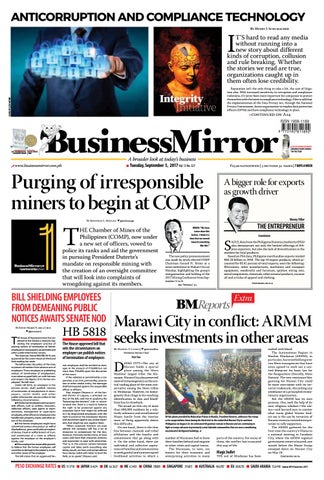
AntiCorruption and Compliance Technology
I
By Henry J. Schumacher
t’s hard to read any media without running into a new story about different kinds of corruption, collusion and rule breaking. Whether the stories we read are true, organizations caught up in them often lose credibility.
Leowolfert | Dreamstime
Reputation isn’t the only thing to take a hit, the cost of litigation also. With increased sensitivity to corruption and compliance violations, it’s never been more important for companies to protect themselves with the latest in compliance technology. I like to add that the implementation of the Data Privacy Act, through the National Privacy Commission, forces organization to employ data protection officers (DPOs) and have compliance technology in place.
»continued on A14
media partner of the year
United nations
2015 environmental Media Award leadership award 2008
BusinessMirror A broader look at today’s business
www.businessmirror.com.ph
n
Tuesday, September 5, 2017 Vol. 12 No. 327
Purging of irresponsible miners to begin at COMP
T
By Jonathan L. Mayuga
BILL SHIELDING EMPLOYEES FROM DEMEANING PUBLIC NOTICES AWAITS SENATE NOD By Jovee Marie N. dela Cruz @joveemarie
T
he House of Representatives has endorsed to the Senate a measure regulating the employers’ practice of posting notices of termination of former employees in newspapers, social media and other public-information venues. The measure, House Bill (HB) 5818, was approved by the Lower House on third and final reading last week. The bill invokes the policy of the state to protect all workers from abusive acts of employers. “Every employer, in publishing notices of termination of employment, must observe good faith, act with fairness and respect the dignity of its former employees,” the bill read. Under HB 5818, no employer in the private sector shall publish notices of termination of employment in newspapers, social media and other public-information venues unless in the following circumstances: ■ If the former employees were accountable officers, such as cashiers, treasurers, collection officers, sales agents or representatives, management or supervisory employees, other officers or employees who handle cash, property, stocks, and other assets of the employer; ■ If the former employees might have committed serious misconduct or willful disobedience, gross and habitual neglect of duties, fraud or willful breach of trust, and commission of a crime or offense against the employer or the employer’s family; and ■ If the employer has reasonable grounds to believe that the former employees will cause loss or damage to the property, stocks and other assets of the employer. The bill states that an aggrieved for-
HB 5818
The House-approved bill that sets the circumstances an employer can publish notices of termination of employees
mer employee shall be entitled to damages in the amount of P10,000 but not more than P50,000 upon the discretion of the court. If the violation is committed by a corporation, trust, firm, partnership, association or other similar entity, the damages shall be imposed against the responsible officer or officers. Rep. Joaquin Chipeco Jr. of the Second District of Laguna, a principal author of the bill, said that in applying the “balancing-the-interest” rule in constitutional law, there is a need to balance the right to be protected against any corporate harm that might be inflicted to it by disgruntled employees with the right to preserve the employees’ dignity and reputation against any undue aspersion that might be cast against them. “When corporate interests are prejudiced, the company still has a lot of resources to compensate for the loss. However, the lowly workers have, in most cases, only have their character, industry and reputation to cope with adversities. That is, in the uneven contest between capital and labor (with everything else being equal), our laws and jurisprudence have always sided with labor to level the field, so to speak,” Chipeco said.
PESO exchange rates n US 51.1710
BRIMO: “We have never done this before. I think it is time that we moved toward something like this.”
The new policy pronouncement was made by newly elected COMP Chairman Gerard H. Brimo at a news conference in Makati City on Monday, highlighting the group’s reorganization and holding of the 2017 Mining Conference from September 5 to 8.
business news source of the year
P25.00 nationwide | 5 sections 32 pages | 7 days a week
A bigger role for exports as growth driver Manny Villar
@jonlmayuga
he Chamber of Mines of the Philippines (COMP), now under a new set of officers, vowed to police its ranks and aid the government in pursuing President Duterte’s mandate on responsible mining with the creation of an oversight committee that will look into complaints of wrongdoing against its members.
2016 ejap journalism awards
THE ENTREPRENEUR
S
Conclusion
adly, data from the Philippine Statistics Authority (PSA) also demonstrate not only the limited offerings of Filipino exporters, but also the lack of diversification in the markets for local products. Based on PSA data, Philippine merchandise exports totaled $56.23 billion in 2016. The top 10 export products, which accounted for 83.41 percent of total exports, were the following: Electronics, other manufactures, machinery and transport equipment, woodcrafts and furniture, ignition wiring sets, metal components, chemicals, other mineral products, coconut oil and articles of apparel and clothing. Continued on A10
See “Miners,” A2
BMReports
Marawi City in conflict: ARMM seeks investments in other areas By Manuel T. Cayon |
@awimailbox Mindanao Bureau Chief
D
Part Two
AVAO CITY—The city of Marawi holds a special place among the Moro Muslims’ largest tribe: the Maranaos. Marawi City also preserved most of its homogeneity as the central trading place of the most conservative among the Moro tribes in Mindanao. However, its homogeneity that clings to far-reaching identification to clan and bloodlines has its drawback. The attack on this city of more than 400,000 residents by a relatively unknown and uninfluential Maute family from the interior town of Butig apparently shows this difficulty. On one hand, there is the thin line between clannish and tribal affiliation and the loyalty and commitment that go along with it. On the other hand, there are individual and collective aspirations of families and communities to seek gainful and uninterrupted livelihood activities to which a
In this photo provided by Malacañan Palace in Manila, President Duterte, addresses the troops as he congratulates them during his third visit to the embattled Marawi City in southern Philippines on August 24. An estimated 40 gunmen remain in Marawi and are continuing to fight as troops advance in previously scenic lakeside communities that are now a smoldering wasteland of disfigured buildings. AP
number of Maranaos had to leave their families behind and migrate to other cities and capital towns. The Maranaos, to note, are known for their economic and enterprising activities in many
parts of the country. For many of them, the conflict has truncated this way of life.
Magic bullet
THE soil of Mindanao has been
soaked with blood. The Autonomous Region in Muslim Mindanao (Armm), in particular, has wrestled long over two Moro insurgencies that have since agreed to work out a unified blueprint for basic law for the Bangsamoro (literally, Moro Nation). The new resistance bloc gunning for Marawi City could be more worrisome with its terrorist trademark, discarding any semblance of a principled revolutionary organization. But the Armm has its own panacea. One, seek the help of its own religious scholars—the ulama—and learned men to counter what many global Islamic leaders say is the use by terrorists of Koranic verses in twisted interpretation to rally supporters. The ARMM gathered for the first time the country’s Ulama to a national meeting in Cotabato City, where the ARMM regional government center is located, one month before the Maute Group swooped down on Marawi City on May 23.
n japan 0.4674 n UK 66.3637 n HK 6.5403 n CHINA 7.8009 n singapore 37.6811 n australia 40.6707 n EU 60.8270 n SAUDI arabia 13.6448
Continued on A2
Source: BSP (4 September 2017 )
A2 Tuesday, September 5, 2017
BMReports BusinessMirror
Marawi City in conflict: ARMM seeks investments in other areas Continued from A1
It would not be smooth-sailing though.
Under siege
MANY of the 300 Muslim scholars who attended received letters from a group called Dawla Islamiya threatening them with physical harm, including their family members and relatives, if they continued with the national meeting. Nothing happened to the ulama, or any their family members, however. Except that on that fateful day in May the terrorist group known as Maute attacked government and military facilities and occupied residential and business establishments. The siege was countered by government forces. The armed conflict in Marawi is now running past a hundred days. The Associated Press reported the violence in Marawi has led to the death of nearly 800 people, including more than 600 militants. The
North Korea. . . Continued from A14
troops would occupy the country and move directly to the Chinese border. Beyond that, the economic disruption of ending all trade with China would be so huge inside the US that Trump’s aides declined last Sunday to discuss the implications. After meeting with Trump, Defense Secretary Jim Mattis emerged to warn North Korea that “any threat to the United States or its territory, including Guam or our allies, will be met with a massive military response.” But Mattis, in a terse statement delivered on the White House driveway with the chairman of the joint chiefs of staff, Gen. Joseph F. Dunford Jr., also offered a word of reassurance to the North’s reclusive leader, Kim Jong Un. “We are not looking to the total annihilation of a country, namely, North Korea,” he said. “But as I said, we have many options to do so.” The statement echoed past comments by the defense secretary, as well as a warning issued by President George W. Bush after North Korea’s first atomic test, in 2006. In that statement, Bush also said North Korea would be held responsible if it ever exported any of its nuclear-weapons technology to other nations or to terrorists. Still, Mattis’s statement lef t open many questions. His formulation seemed to rule out the kind of “preventive war” that the national security adviser, Lt. Gen. H.R. McMaster, warned last month might be necessary after the North tested two intercontinental ballistic missiles
violence between the government forces and the Islamic extremists has displaced a total of 353,358 persons, Office of Civil Defense data revealed. T hese people re presented 74,981 households from the 96 barangays of Marawi City and 20 municipalities of Lanao del Sur. Of the total affected population, 4,086 households or 18,294 persons are staying in 78 evacuation centers, while 70,895 households or 335,064 persons are staying with their relatives tracked in seven regions, government data in July revealed. Malacañang has continuously assured that government forces may fully retake the city in a matter of a “few days”. Rehabilitation has also been placed on initial gear with policewomen and women soldiers wearing the Muslim headwear hijab sent to the evacuation centers to secure the evacuees and prepare them for the construction phase.
Call for investments
in an effort to demonstrate that it could reach Los Angeles and beyond. Instead, Mattis seemed to be talking about “preemptive strikes,” which the US might order if it determined that an attack seemed imminent. There was no public discussion of pursuing a diplomatic opening to the North. Trump and Secretary of State Rex Tillerson raised such a possibility two weeks ago, after a brief lull in North Korea’s testing. That statement turned out to be optimistic at best. The North has shown no interest in engaging with the US unless the Americans end their military presence in the South. To the contrary, the North Korean leader has tried to portray his nuclear program as unstoppable and nonnegotiable, posing by a picture of what the North’s official news agency last Sunday called a hydrogen bomb that could be fitted into the nose cone of the ICBMs tested last month. Experts warned that the weapon, while shaped like a hydrogen bomb, could well have been a mock-up or decoy, one of the many steps the North takes to make it appear more powerful than it truly is. On Monday South Korea’s army fired short-range ballistic missiles off its east coast in a simulated attack on North Korea’s nuclear-test site, its military said in a statement. F-15K fighter jets also joined in the show of force, firing air-to-land missiles, it said. Only hours earlier, Trump reacted to the North Korean test by lashing out at South Korea. “North Korea is a rogue nation which has become a great threat and embarrassment to China, which is trying to help but with little
success,” he said. “South Korea is finding, as I have told them, that their talk of appeasement with North Korea will not work, they only understand one thing!” Trump appeared to be referring to the offers by South Korea’s new president, Moon Jae-in, to enter into some kind of negotiations with the North that might lead to a renewal of the “Sunshine Policy’, an effort by some of his predecessors to lure the North into disarmament with economic engagement. Those efforts failed. Moon said recently that he had obtained a promise from Washington that the US would never take military action without Seoul’s approval—a commitment the Trump administration has never confirmed. Trump’s undisguised swipe at the South for “appeasement” was certain to exacerbate fears that the US might put it in danger. And it came only a day after Trump threatened a new rift in relations with suggestions that the US might withdraw from a trade deal with South Korea—one that was intended to bolster the alliance. In response to Trump’s criticism, Moon’s office said it was working closely with Washington to exert “maximum sanctions and pressure”. But it also reiterated that the allies shared the understanding that the goal of these sanctions and pressure was to bring North Korea back to the negotiating table. “We have experienced an internecine war and can never tolerate another catastrophic war on this land,” Moon’s office said in a statement. “We will not give up our goal of working together with allies to seek
THE AR MM’s second remedy against underdevelopment is to pursue the development path and call for more investments to uplift the country’s poorest provinces under its wings and ignite development. Rima Hassan, chairman of the ARMM Business Council and a Basilan-based businesswoman, has urged the ARMM government to find investors that can match the resources and skills of the local folks. “We hope that there will be power plants, milling plants, manufacturing plants and factories that can generate a large number of jobs,” Hassan said. “We want to maximize the sustainable use of our natural resources and take advantage of our serene nature and promote eco-halal tourism.” Hataman also made a similar appeal for more investments in Basilan and Sulu. “We want more investments in the region to prevent the formation of lawless elements in these areas,
because what brings them to this situation is the lack of job opportunities, which can be addressed if there are more businesses that will create productive activities and provide them with livelihoods to support their families.” Hassan’s call was also agreed by business representatives during the recent 2017 Investment Priorities Plan Roadshow for Basilan and Sulu held in Zamboanga City last month. The roadshow was organized by the region’s Regional Board of Investments (RBOI). Lawyer Ishak Mastura, chairman and managing head of RBOIARMM, said a number of people are ready to invest in region. “As of July, we have registered P3.65 billion worth of investments despite the ongoing Marawi crisis, and we are expecting additional P1.5 billion in investments from companies engaged in cacao plantations and other agri-based projects before the year ends,” Mastura added. To be concluded a peaceful denuclearization of the Korean Peninsula.” While Washington and Seoul argue over the threat of military force, Kim seems determined to forge ahead. He has conducted more than 80 missile tests since taking over the country. And four of the six nuclear tests have been on his watch. This was the biggest, by far. The US Geological Survey estimated that the tremor set off by the blast, detected at 12:36 p.m. at the Punggye-ri underground test site in northwestern North Korea, had a magnitude of 6.3. The South Korean Defense Ministry’s estimate was much lower, at 5.7, but even that would mean a blast “five to six times” as powerful as the North’s last nuclear test, a year ago, said Lee Mi-sun, a senior analyst at the South Korean Meteorological Administration. The South’s National Fire Agency, which operates an emergency hotline, said it had received 31 calls about buildings and the ground shaking, the first time that South Koreans had reported tremors after a North Korean nuclear detonation. The blast was so powerful that the first tremor was followed by a second, weaker one minutes later, which the US Geological Survey called a “collapse”, probably a cave-in at the North’s underground test site. Condemnation of the test came from around the world. China, the North’s main ally and biggest trading partner, expressed “strong condemnation” of the test, according to Xinhua, the state news agency, but suggested no new action. Its leaders feel as stymied as their US counterparts, according to many China experts.
The New York Times News Service
Steelmakers. . . Continued from A14
of finished and semi-finished steel were imported last year, versus the country’s shipments of 1.1 MMT of scrap steel and steel pipes. In 2016 the Pisi noted that the apparent steel consumption of the Philippines reached an “all-time high” of 9.68 MMT. It said the demand was met by importing 5.5 MMT of finished steel products and 3.15 MMT of semi-finished steel. BPS operates a product certification scheme under which a manufacturer obtains a license to use the PS Quality and Safety Marks for its capability to consistently manufacture products in accordance with a specific Philippine National Standard (PNS) or an internationally accepted foreign standard. As the proposed DAO covers a wide range of products, the Pisi recommended the crafting of a separate DAO for steel products.
www.businessmirror.com.ph
PHL SMEs not capitalizing on social commerce–ADB By Cai U. Ordinario
@cuo_bm
S
mall and medium enterprises (SMEs) in the Philippines can increase their revenues by capitalizing on e-commerce through online retailing via social media, according to experts from the Asian Development Bank (ADB). This was according to an Asian Development Blog authored by ADB Economic Research and Regional Cooperation Department Director for Regional Cooperation and Integration Cyn-Young Park, Economist Fahad Khan and Consultant Cindy Justo. The authors said that, while the country has a high social-media penetration rate of over 50 percent, the Philippines only earns around 0.016 percent of GDP from e-commerce. “SMEs and local startups could be the prime beneficiary of social commerce through reduced costs and improved market access [both domestically and across borders],” the authors said. To this end, the authors urged governments to remove barriers to digital trade, introduce institutional reforms to accommodate electronic businesses and facilitate connectivity and access that can enable e-payments.
Miners. . .
Continued from A1
The oversight committee, Brimo said, would look into allegations of wrongdoing hurled against its members. Large-scale mining operations are often the subject of complaints for massive environmental destruction, degradation and pollution. He clarified that the investigation will not necessarily be conducted to sanction its members, but merely to ferret out the truth. “In the process of investigation, there should be recommendations, and that will be discussed with the MGB [Mines and Geosciences Bureau]. [It] can lead to the delisting of the company from the chamber,” he said. He added a third-party expert will be tapped by the COMP in the probe. But he insisted that the move is not meant to appease or please antimining groups. “If a company is accused of environmental crimes, it is a must to know the truth...no matter what we do, we can never convince them [antimining groups].” At the start of the Duterte administration, the Department of Environment and Natural Resources (DENR), under the leadership then of environmental advocate Regina Paz L. Lopez, launched a 10-month crackdown on irresponsible mining operations. More than two dozens operating mines were issued closure or suspension orders, which are now under review by the Mining Industry Coordinating Council (MICC) and Malacañang through the DENR under Secretary Roy A. Cimatu. Brimo said this is the first time the COMP, whose membership extends to mostly largescale copper and gold miners as regular members, and other companies, such as equipment manufacturer and suppliers, as associate members will investigate complaints against its members. “The oversight committee will carry out investigations as directed by the board of trustees. If there is an incident from any of us that is serious enough for the board of trustees to step in, a third-party expert will conduct the investigation,”he said, Brimo said the oversight committee will also be responsible in holding dialogue with the DENR for the results of the investigation, which he described as COMP’s way of “self-policing”. “The oversight committee will carry out investigations for incidents as they occur. We have never done this before. I think it is time that we moved toward something like this. It has the power to conduct investigations through third party. Reports will contain recommendations, as well,” he said. Meanwhile, Brimo said the COMP is taking a new approach to mining operations, heeding President Duterte’s directive to promote responsible mining, which puts premium on the environment and the host-communities. The COMP, he said, will follow the Canadian mining approach called Toward Sustainable Mining. A mining country, Canada’s mining association, the Mining Association of Canada, has developed a protocol toward sustainable mining. Canada requires mining companies to annually assess their performance in six areas. Part of the protocol is the involvement of a third party, Brimo said. “In the coming Mining Conference, we have invited Canada to make
Governments, they said, must also create an enabling environment for digital businesses through investments and improving the availability and quality of connectivity infrastructure. “For social commerce to be successful in the future, it is imperative to develop the necessary market infrastructure and legal frameworks to facilitate transactions,” the authors said. The authors added seven Southeast Asian countries have social-media penetration rates higher than the global average of 37 percent: Brunei Darussalam, Singapore, Malaysia, Thailand, the Philippines, Vietnam and Indonesia. The growth in the number of active social-media users in these countries between January 2016 and January 2017 was above 20 percent. The growth in the number of socialmedia users in Indonesia (39 percent), the Philippines (32 percent) and Vietnam (41 percent) landed on the top 10 list. Asia and the Pacific is the world’s largest retail e-commerce market, with the bulk of sales, or 47 percent, coming from the China. Total sales are expected to almost triple from $1 trillion in 2016 to $2.7 trillion in 2020, driven by an expanding middle class.
a presentation,” he added. Under the new leadership, COMP vows to be more transparent, as it encourages members to allow mine visits to show to the public that its operation is above board. Mining companies are also encouraged to communicate better their corporate social responsibility (CSR) projects and activities to various publics, including regulators and local government units, aside from their host communities. M o r e o v e r, C O M P m e m b e r s a r e encouraged to be more transparent by submitting financial report, as required under the Extractive Industry Transparency Initiative Philippines, and show them how mining companies contribute to the growth and development through their various social development management programs and other CSR projects. Last month Duterte met with mining industry leaders to express his dismay, directing them to conduct rehabilitation and be mindful of the communities affected by their operations. Brimo said the election of the new set of officers and the creation of the oversight committee has nothing to do with the resignation of Apex Mining Corp., whose official complained of the COMP’s failure to police its ranks. According to Ronald Recidoro, who was elected COMP executive director, it was former President Benjamin Philipp Romualdez who requested for the election. The position of the president will remain vacant. Aside from the oversight committee, the new leadership has revived the Executive Committee, the Legal Committee, Information and Publicity Committee and Finance Committee. Brimo said the new COMP leadership wants to get someone not necessarily connected with a member-company to lead COMP as president. “We want someone who has a technical background...haven’t identified someone yet. That person was not beholden by that company,” he said. The new set of officers of COMP include the 15-member board of trustees, namely, Isidro C. Alcantara Jr., president, Marcventures Holdings Inc.; Eulalio B. Austin Jr., president and CEO, Philex Mining Corp.; Gerard H. Brimo, president and CEO, Nickel Asia Corp.; Gloria L. TanClimaco, director, Filminera Resources Corp.; Isidro A. Consunji, chairman and CEO, Berong Nickel Corp.; Joaquin C. Lagonera, president, Sagittarius Mines Inc.; Jose P. Leviste Jr., Chairman, Oceanagold (Philippines) Inc.; Eugene T. Mateo, president, TVI Resource Development Philippines Inc.; Clarence T. Pimentel Jr., president and CEO, CTP Cons. and Mining Corp.; Adrian S. Ramos, president, Atlas Consolidated Mining and Development Corp; Horacio C. Ramos, president, Pacific Nickel Philippines Inc.; Gilberto C. Teodoro Jr., chairman, Sagittarius Mines Inc.; Toru Higo, president, Sumitomo Metal Mining Phils. Holdings Corp.; Bryan U. Yap, president and COO, Lepanto Consolidated Mining Co.; and Martin Antonio G. Zamora, executive vice president, Rio Tuba Nickel Mining Corp. The officers are Gerard H. Brimo, chairman; Jose P. Leviste Jr., vice chairman; Gilberto C. Teodoro Jr., vice chairman; Ronald S. Recidoro; executive director; Nelia C. Halcon, executive vice president; lawyer Gaspar R. Andre, corporate secretary; and Ramon T. Diokno, treasurer.
The Nation BusinessMirror
news@businessmirror.com.ph
OCD says measures in place after North Korea nuke test By Elijah Felice E. Rosales
T
@alyasjah
he Office of Civil Defense (OCD) on Monday said it is readying contingency measures should the North Korean missile test causes fallout on the eastern coast of the Philippines. According to Civil Defense Assistant Secretary Kristoffer James E. Purisima, the government is rolling out risk-reduction measures following the nuclear test of the Democratic People’s Republic of Korea (DPRK). “The Office of Civil Defense is in continuous coordination with relevant national government agencies to ensure the safety of our people in light of the recent actions by North Korea that may put at risk the lives of our fellow Filipinos,” Purisima said on Monday. “Rest assured that contingencies are being set in motion for the protection of our civilian populace. Their safety is our primordial concern,” he added. North Korea last Sunday detonated its sixth nuclear bomb, a hydrogen bomb, as the DPRK claimed, which caused tremors that were felt in East Asia, especially in China and South Korea. The nuclear test prompted the United States to warn North Korea of a “massive military response” should it once more threaten to strike the US. In light of the DRPK’s recent strike, the Philippine government is growing more concerned about the possibility of fallout that might hit the eastern coast of the archipelago. Purisima said the OCD is closely monitoring regions in the east, particularly Cagayan Valley, Bicol region and Eastern Visayas, as most of the nuclear tests of North Korea are targeted
toward that direction. “Mahirap din kasi magsabi [kasi] minsan hindi rin kasi natin alam kung saan talaga gusto nila [The problem is we cannot say where their next strike will be],” the defense official added. However, Purisima said there is no need yet for residents in the eastern regions to panic, as North Korean nuclear tests are not directly targeted toward the Philippines. He added the worst that can hit the archipelago are debris of the missile. “Regarding this, we will try to assess the missile’s trajectory. Although we do not anticipate that…we’ll be part of the direct trajectory of any launch, we will [still] prepare for the debris,” Purisima said. “So we will inform our citizens, perhaps in our eastern coast, what they should do, where the available evacuation centers are and what municipalities should remain alert,” Purisima added. North Korea’s nuclear test last Sunday is its sixth detonation of a nuclear bomb as part of efforts to show its might against the US and its allies. It has threatened to strike Guam and has flew a missile over Japan, prompting the US to take a more aggressive response against the DPRK. According to Presidential Communications Secretary Martin M. Andanar, Washington has the backing of Manila in its virtual standoff with Pyongyang. “Our government supports our allies—United States, South Korea, Japan,” Andanar said in a previous radio interview. “North Korea knows who its enemies are and who the allies of the US are. On our part, we will always be here for the United States and our allies,” Andanar added.
Editor: Vittorio V. Vitug • Tuesday, September 5, 2017 A3
Dela Rosa to antidrugs critics: Hold protests in slum areas, too
N
By Rene Acosta
@reneacostaBM
ational Police chief Director General Ronald M. dela Rosa said on Monday that controversial Chief Inspector Jovie Espenido will remain as chief of police of Ozamiz City, even as he called on critics of the administration’s anti-illegal drugs campaign to hold their protests in slum areas.
Dela Rosa said it was no less than President Duterte who decided that Espenido should stay put in his post as chief of police of Ozamiz City, following calls from the residents of the city for the police official to remain in his position. “Residents of the city are being demoralized,” the PNP chief said, referring to the supposed to be reassignment of Espenido to Iloilo City to rid the city from illegal drugs, which Duterte said enjoys the protection of its mayor, Patrick Jed Mabilog. Duterte has tagged Iloilo City as the “bedrock” of illegal drugs and the most “shabulized” city in the Visayas, which prompted him to order the transfer of Espenido there. Espenido has been dubbed as the
“scourge” of drug lords, following the killings of Albuera, Leyte Mayor Rolando Espinosa and Ozamiz City Mayor Reynaldo Parojinog in police operations he has joined or had headed. Dela Rosa said the residents of Ozamiz might even stage a “people power” if the PNP will transfer Espenido to Iloilo City. Earlier, Duterte ordered Espenido’s reassignment to the city, but Camp Crame dillydallied on his transfer, apparently because the position of chief of police of Iloilo City was supposed to be occupied by an official with the rank of senior superintendent. Also, the reported top drug lord of Western Visayas, Richard Prevendido, who was supposed to be among the targets of Espe-
nido once he would be assigned in Iloilo City, has been killed by members of the Police Regional Office – 6. Dela Rosa belied speculations that the recall of Espenido’s new assignment has anything to do with the death of Prevendido. Meanwhile, the PNP chief also advised critics of the anti-illegal drugs drive to stage their protests in depressed areas and not at Camp Crame. “They are free to voice their sentiments. I will also appeal to them. Instead of going to the police, they should go to the slum areas and conduct their people power there,” he said.
They are free to voice their sentiments. I will also appeal to them. Instead of going to the police, they should go to the slum areas and conduct their people power there.”—dela Rosa
Economy
A4 Tuesday, September 5, 2017 • Editors: Vittorio V. Vitug and Max V. de Leon
BusinessMirror
Groups reject DENR plan to lift open-pit mining ban
A
By Jonathan L. Mayuga
@jonlmayuga
ntimining groups under the Alyansa Tigil Mina (ATM) on Monday rejected the plan of the Department of Environment and Natural Resources (DENR) to reverse an order issued by its former secretary, Regina Paz L. Lopez, that prohibits the open-pit mining method.
In a news statement, Jaybee Garganega, national coordinator of ATM, said they support Department Administrative Order (DAO) 201710, adding that open-pit mining is the most destructive form of mining as experienced by mining provinces across the country. Sought for reaction, Chamber of Mines of the Philippines (COMP) Chairman Gerard Brimo said there is no other way to mine but through the open-pit method. “There is no other way to mine. That’s the only way to do it,” he told reporters during news conference, announcing the group’s reorganization and policy to police its ranks
under the new COMP leadership. In opposing the open-pit mining method, Garganera said open-pit mines have left many mining areas devastated after miners explored and exploited the country’s mineral resources. The ATM said open-pit mining is a method that introduces permanent changes in the land and permanent changes in land use, cuts down trees and forests, disturbs waterways, rivers and the water tables. The group added that the mining method brings in massive infrastructures that destroy farms and livelihoods, displaces homes and disrupts existing livelihoods.
The mineral, meanwhile, processing brings toxic chemicals. The group cited Marcopper Mines in Marinduque Island, which has been closed down for over two decades already, but still remains a threat to communities. By-products of mines, mostly open-pit mines, remain even after mine closure. This leaves the task of long-term and perpetual maintenance of mined areas to the government. “We believe that the reversal of DAO 2017-10 is going to be a big failure on the part of DENR—the agency tasked to balance the protection of the environment and natural resources and exploitation of our national wealth. While the Mining Act of 1995 implemented now allows for all methods of mining, we believe the DENR has the power to impose such policy for the right reasons,” Garganera said. DAO 2017-10 was signed into an order by Lopez, who led the audit of more than 40 large-scale mining projects. During Lopez’s stint, the DENR undertook a study on open-pit mines in the country which showed a strong evidence of perpetual damage and liabilities caused by such a mining method. Garganera added: “To reverse this orders means to allow mining as destructive as this to continue.
President Duterte was aghast upon seeing the destructions caused by mining projects all over the country and promised to address the mining issues. We call on him to retain and implement this order through his appointed DENR Secretary [Roy A.] Cimatu. We also call on him to affirm the suspension and closure orders issued by Lopez in February 2017, and declare a moratorium on all mining operations in the country.” The alliance also reiterated that these continuing issues against irresponsible mining can only be resolved if a new mining law is passed by Congress. Currently, the Alternative Minerals Management bill is still pending in the House of Representatives and the Senate. Duterte has stated in his recent State of the Nation Address that he will support the enactment of a new mining law to redraw the minerals-management policy and ensure that Filipinos benefit from mining, as well as protecting the environment. “The ban on open-pit mining should stay until the government is able to prove that the benefits of mining outweigh the costs that we shoulder. These include environmental, social, cultural and health costs,” Garganera said.
NGCP awaits ERC okay for Aspa procurement
T
he National Grid Corp. of the Philippines (NGCP) is procuring ancillary services from two power firms in Luzon and Mindanao to ensure reliability of the power grid. NGCP has already signed ancillary services procurement agreements (Aspas) with First Gen Hydro Power Corp. (FGHP) and Therma Marine Inc. (TMI). The Energy Regulatory Commission’s (ERC) approval of these contracts is needed before these could be implemented. FGHP is the owner and operator of the Pantabangan Hydroelecric Power Plant, while TMI owns and operates a 100-megawatt (MW) power barge in Compostella Valley. NGCP and FGHP asked the commission to immediately issue a provisional authority to implement their Aspa and allow the grid operator the full recovery of ancillary services cost for the provision of ancillary services effective upon execution of the Aspa. Ancillary services as defined in Section 4b of the Electric Power Industry Act “refer to those services that are necessary to support the transmission capacity and energy from resources to loads, while maintaining reliable operation of the transmission system.” These services are essential in ensuring reliability in the operation of the transmission system and consequently, in the reliability of the electricity supply in the Luzon, the Visayas and Mindanao grids. NGCP and FGHP said that as demand for power in Luzon increases, the requirements of the system increases. “Ensuring the integrity of the system is essential to protect the interest of the public. The absence of system reliability and stability will certainly discourage investments and growth,” NGCP and FGHP said in their 12-page application. As such, they added, “The immediate approval of the Aspa is necessary to maintain the reliability, adequacy, security, stability and integrity of the Luzon grid.” Lenie Lectura
news@businessmirror.com.ph
PHL halal export seen reaching $1.4B in 2018 By Catherine N. Pillas @c_pillas29
T
he Philippines’s halal food export is seen to double this year on the back of the recent approval of the implementing rules and regulations (IRR) of the Philippine Halal Export Development and Promotion Act of 2016, the Department of Trade and Industry (DTI) said. DTI Assistant Secretary Abdulgani Macatoman said the expected $800 million in halal exports by year-end this year’s end can double to $1.4 billion in 2018 as a result of the institutionalization of the law on halal export development and promotion, or Republic Act 10817. The IRR, adopted in July, mandated the formulation and implementation of a comprehensive Philippine Halal Export Industry Development and Promotion Program. Particularly, the program includes the following objectives: The development and application of halal agricultural and manufacturing standards and practices; The organization and development of accredited certification bodies through capacity building and the formulation and application of internationally accepted accreditation standards; identification and expansion of markets for halal products, processes and service Forging of international and bilateral agreements, especially on harmonization of standards; The DTI’s Export Marketing Bureau (EMB) is the head of the Halal Export Board Secretariat,
RA 10817
The law that mandated the institutionalization of local halal development and promotion office
and will spearhead the crafting of the program. “The potential [to attract investments in] Mindanao is huge right now. Aside from captured market of 11 million Muslim population in the Philippines, globally, the halal industry is worth $3.2 trillion. That’s still going to go up to $10 trillion by 2030,” Macatoman said. “The Philippine halal board may encourage more certifiers of halal products, and manufacturers and producers, as well,” he added. According to Philippine Exports Confederation Inc., there are about 500 processed-food micro- small and -medium enterprises (MSME) that are currently registered as their members. These enterprises are expected to benefit in different trade assistance that the hub will provide to further their export products in penetrating the global market. In 2014 the Philippine Statistics Agency reported that there are a total of 127,518 established MSMEs in the food and accommodation sector. The halal industry spans sectors such as food processing, food service, cosmetics, personal care, pharmaceuticals and logistics industries. Other related industries include travel and hospitality services.
House panels form TWG to merge measures for creation of disaster-preparedness office
T
Back to the battlefield Battle-scarred soldiers wounded in the raging Marawi City siege wait for their return flight tickets to
Mindanao after getting their treatment in Manila from bullet and shrapnel wounds sustained in battle. Budget carrier Cebu Pacific has provided free airlift support to the soldiers and relief goods as the military prepares for the final push to rid Marawi City of Maute Group terrorists. NONIE REYES
DFA raises passport-application quota in consular offices By Recto Mercene @rectomercene
T
he Department of Foreign Affairs [DFA] on Monday said it has opened thousands of appointment slots for passport applications after the agency raised its consular appointment quotas and deleted so-called bogus appointments created by unscrupulous individuals. This follows the removal of 1,200 slots reserved daily for travel agencies, which were converted into additional slots for regular applicants. The DFA also successfully brought down to zero the backlog of 33,000 applications pending investigation under the Automated Fingerprint Identification System, the agency said in a news statement. “In a bid to make more appointment slots for passport applications
available to the public, travel agencies are no longer entitled to fixed appointment slots at the DFA for their clients’ passport application and renewal,” according to Ricarte B. Abejuela III, acting director of the Passport Division of the Office of Consular Affairs. The policy took effect on August 1, 2017. According to DFA Spokesman Robespierre Bolivar, a daily average of 10,000 applicants are submitted to the DFA and its branches daily, which balloons to 12,000 during peak days. “If the Foreign Service Posts are included, the daily average would be up to 12,500 to 14,500 in peak season,” Bolivar added. Last year the DFA issued a total of 3,110,114 passports, he said. To speed up the passport-application processing, the DFA has added 15 data-capture machines in its con-
sular office at Aseana since Secretary Alan Peter S. Cayetano assumed his post this year. Abejuela said under the DFA’s new policy, clients of travel agencies should undergo the same process all other applicants undergo when applying for or renewing a passport. “We want to give back the appointment slots to the Filipino public,” Abejuela said, adding, travel agencies are not the only ones who need to make adjustments “for the greater good”. DFA employees themselves would also have to make adjustments after their privilege to use the courtesy lane was restricted beginning August 1. “There were 94,350 additional slots that were opened from July to August, while 86,889 have been added so far for September,” he added.
wo committees of the House of Representatives have agreed to form a technical working group (TWG) that will consolidate at least eight bills seeking to create an independent agency focused on the country’s disaster preparedness and emergency management. The House Committees on Government Reorganization and National Defense and Security jointly approved a motion creating a TWG headed by Rep. Joey S. Salceda of Albay to harmonize House Bills (HB) 108, 344, 596, 2638, 3093, 4203, 4648 and 6075. Apart from the creation of an independent disaster authority, the bills also propose other provisions, such as the recovery and reconstruction plan; fishermen as auxiliary response team during disasters; administration of disaster aid; climate- change adoption linkages; and the establishment of disaster and emergency centers, among others. Party-list Rep. Bernadette Herrera-Dy of of Bagong Henerasyon, the author of HB 4203, said the Philippines ranked third-most exposed and most vulnerable to natural disasters out of 171 countries in the 2015 World Risk Report Index. The country also ranked 13th in the Climate Change Vulnerability Index. “Current government procedures require a revamp.… We need a more systematized approach in a disaster management and have in place key mechanisms to ensure quick and efficient means of disaster preparedness and assistance to those affected,” Herrera-Dy said. Rep. Yedda Romualdez of Leyte, the author of HB 344, cited the need for a
new department of disaster preparedness and emergency management to effectively improve the institutional capacity of the government for disaster-risk reduction and management. Romualdez further noted that the new department could help reduce the vulnerabilities surrounding the affected local population, as well as build the resilience of local communities to both natural and man-made disasters and calamities. “Nearly 74 percent of the population and 80 percent of the land area are identified as vulnerable to disasters with Manila, the capital, considered an extreme risk,” Romualdez said. For his part, Party-list Rep. Gary Alejano of Magdalo said there should be a permanent national agency that will handle the country’s planning and preparation for disasters and emergencies. Alejano proposed in his HB 108 the creation of an emergency-management agency that will undertake disaster mitigation and preparedness measures, as well as quick response mechanism “to reduce the risks of disasters and mitigate possible damage to life and property, initiate a rapid and effective response to disasters and effectively manage postdisaster recovery.” Several agencies have expressed support for the bills, including the National Economic Development Authority; Office of Civil Defense; Philippine Atmospheric, Geophysical and Astronomical Services Administration; Civil Service Commission; Center for Disaster Preparedness; Armed Forces of the Philippines; and World Vision Philippines. PNA
Agriculture/Commodities BusinessMirror
news@businessmirror.com.ph
Editor: Jennifer A. Ng • Tuesday, September 5, 2017
A5
Govt subsidies to agri firms hit ₧3.1B–PSA By Jasper Emmanuel Y. Arcalas
G
@jearcalas
overnment subsidies extended to agriculture firms declined by nearly 3.2 percent to P3.1 billion in 2015, from P3.2 billion in 2014, according to the latest report of the Philippine Statistics Authority (PSA). The PSA said the subsidies given to agriculture companies came in the form of tax exemptions and financial assistance. These perks are given by the government to aid and develop an industry. “Out of the eight major industry groupings for the sector, only two were recipients of subsidies in 2015. These were support activities to agriculture and postharvest-crop activities and fishing activities, both found in the National Capital Region,” the PSA said in its report, titled “2015 Annual Survey of Philippine Business and Industry”. The survey covered agriculture, forestry and fishing for establishments with total employment (TE) of 20 and over. Data from the PSA also showed that the growing of perennial
crops generated the highest employment in 2015. “ Tot a l employ ment gener ated by agriculture, forestry and fishing establishments with TE of 20 and over reached 145,237 in 2015. Of the total work force, 143,732 workers, or 99 percent, were paid employees, while the remaining 1 percent were working owners and unpaid workers,” the report read. “Among industry groups, growing of perennial crops employed the most number of workers with 67,354, or 46.4 percent of the total. This was followed by growing of nonperennial crops and animal production with 34,698 workers [23.9 percent] and 18,669 workers [12.9 percent], respectively,” it added. The total value of output gener-
ated by agriculture, forestry and fishing establishments with TE of 20 and over reached P126.2 billion in 2015. However, this was 8.48 percent lower than the P137.9 billion recorded in 2014. Davao region generated the highest value of output, with P32.7 billion, or 25.9 percent of the total. This was followed by Soccsksargen and Northern Mindanao, with respective shares of 17.5 percent (P22.1 billion) and 17.1 percent (P21.6 billion). “The top 3 regions in terms of value of output in 2015 were are all in Mindanao, with a combined value of output of 60.5 percent of the total,” the PSA added. By industry group, the PSA said the highest value of output was generated by growing of perennial crops worth P56.3 billion, or 44.6 percent of the total, followed by animal production with P35.4 billion (28 percent). Growing of nonperennial crops ranked third with P13.3 billion (10.6 percent). In 2015 there were a total of 1,147 agriculture, forestry and fishing establishments with TE of 20 and over, fewer compared to the 1,160 establishments recorded in 2014. The survey was conducted nationwide in 2016 with the year 2015 as the reference period of data.
Sugarcane output expanded to 8.73 MMT in April-June
T
he country’s sugarcane production more than doubled to 8.73 million metric tons (MMT) in the second quarter, from 3.39 MMT a year ago, according to the latest report of the Philippine Statistics Authority (PSA). In its report, titled “Major NonFood and Industrial Crops Quarterly Bulletin”, the PSA attributed the increase to the farmers’s use of good-quality planting materials and favorable weather conditions. “[The hike was also due to] the movement of harvest from the previous quarter in Negros Oriental due to heavy rains during the past months,” the PSA said in the report published recently. The report noted that the delay in the harvest of sugarcane in Northern Mindanao had played a factor in increasing production during the period. Production of sugarcane for centrifugal sugar, which accounted for 98.5 percent of the total sugarcane output, or about 8.6 MMT, expanded by 163.6 percent year-on-year. During the period, Negros Island Region produced 51.1 percent of the national sugarcane production, while Northern Mindanao
FILE P HOTO
contributed 21.5 percent. The PSA said coconut production during the April-to-June period grew slightly to 3.21 MMT, from 3.18 MMT recorded last year. “The increase in production was influenced by increase in harvesting activities in Zamboanga Peninsula [Zamboanga del Norte and Zamboanga del Sur], which were motivated by higher prices.” The PSA added the recovery of coconut-producing provinces, such as Palawan and Antique, from the dry spell last year, and the continuous salt-fertilization program of the Philippine Coconut Authority
also boosted coconut output. Data from the PSA, however, showed that the production of dried coffee berries in the second quarter fell by 12.1 percent to 6,770 metric ton (MT) from 7,700 MT last year. “This decrease was caused by the cutting of old and less productive arabica-coffee trees and bearing of less robusta-coffee trees in Soccsksargen [Sultan Kudarat] due to fruit-borer infestation and harvesting of less berries in Caraga [Surigao del Sur] due to continuous rains, which curtailed harvesting activities,” the report read. Jasper Emmanuel Y. Arcalas
A6
Banking&Finance BusinessMirror
Tuesday, September 5, 2017 • Editor: Jun B. Vallecera
news@businessmirror.com.ph
BSP vows to frustrate currency manipulators
T
By Bianca Cuaresma
Project-minded LGUs urged to tap revolving infrastructure fund
@BcuaresmaBM
he Bangko Sentral ng Pilipinas (BSP) won’t allow unnecessary volatility in the foreign-exchange (forex) market, and said on Monday they have the resources and regulatory powers to correct price distortions.
In a statement sent to financial reporters, BSP Governor Nestor A. Espenilla Jr. told reporters they stand ready to intervene and “neutralize the activity of speculators in the market” to frustrate currency speculators. “They can’t be allowed to distort price discovery in search of quick profits by promoting exaggerated price movements and instability. We have resources and regulatory powers to back the talk. The BSP has both capacity and resolve to act,” Espenilla warned. The peso has weakened in recent months, with the exchange rate increasingly averaging lower sine May, based on BSP data. On Monday data from the PDS Group showed the peso closing just half a centavo stronger to P51.165 per dollar, from P51.17 on Friday. The total traded volume hit $428.65 million, down from $494.5 million. Espenilla said the “modest and gradual depreciation” of the peso recently was a
reflection of a “dynamic price discovery process” on the back of strong and sustained imports growth as the economy continues to expand. “ There are also financial position adjustments in anticipation of normalization of interest rates in the US and other advanced economies. These have consequences for dollar supply and demand. The exchange rate needs to adjust in search of equilibrium,” Espenilla said. “At its current zone, the peso has achieved healthy correction based on prevailing economic fundamentals,” |he added. The BSP chief said the public should not expect the peso to stand still, as there is natural volatility in the movement of the local currency. “Don’t expect the peso to stand still. We are on a floating exchange-rate regime. This makes sense for a relatively small open economy…. For its part, the BSP has to practice self-restraint to allow the mar-
ket to process all the information, allow it to operate efficiently, and determine market-clearing price,” the Central Bank governor said. The local currency has weakened by 2.8 percent from year to date, in part because the economy has been importing the capital goods it needs to pursue an ambitious multitrillion-peso infrastructure buildup program, Espenilla said. He further said, however, that having a market-determined exchange rate does not mean a passive BSP at the forex market. “Nothing can be farther from the truth,” he said. The BSP has several critical roles to play in a world of decision-making under uncertainty,” Espenilla said, adding the BSP also produces trusted information and analyses, as well as craft rules to promote order in the forex market. The Central Bank’s regulatory powers on the forex market, according to Espenilla, distills the decisions of market players trying to figure out the right price of the dollar in peso terms.
T
he Department of Finance (DOF) has made available P2.58 billion worth of funds for local government units (LGUs) pursuing big-ticket projects under the publicprivate partnerships (PPPs) to help finance feasibility studies and prepare bid documents on their chosen ventures. According to the DOF, LGUs may now tap the revolving fund to check the viability of projects, prepare bid documents and monitor the progress of their chosen ventures. The Project Development and Monitoring Facility (PDMF) is not only for LGUs but for other national government agencies conducting prefeasibility and feasibility studies, project structuring, preparation of bid documents and project monitoring of their proposed PPP initiatives. The facility is managed by the PPP Center, which also provides probity advisory services to ensure fairness, accountability and transparency in the procurement process for PPP projects. The PDMF started as a P300
Case clippings
JTI to remit bulk of Mighty Corp. sale proceeds in weeks
T
he Department of Finance (DOF) expects the bulk of revenues from the civil settlement of the tax liabilities of Mighty Corp. of some P21 billion later this month. According to the DOF, the settlement sum of P21 billion will be remitted to the Bureau of Internal Revenue (BIR) within the month, following approval of the sale to Japan Tobacco International Inc. (JTI) by the Philippine Competition Commission (PCC). “By September we will start to get the bulk of it,” Finance Secretary Carlos G. Dominguez III told financial reporters.
Earlier, the DOF said Mighty Corp.’s offer to settle its tax liabilities for P25 billion will rise to P30 billion once the value-added tax and other fees were tacked to the computation of the final settlement sum. The BIR already received the first tranche of Mighty Corp.’s settlement offer of P3.44 billion on July 20. Dominguez had said acceptance of the settlement does not preclude the filing of criminal charges against the homegrown tobacco firm as criminal cases cannot be compromised. “We are very happy that the PCC acted expeditiously on this so that the pro-
jected cash flow will be actually met,” Dominguez said. As for the value added tax payment of P500 million, the DOF said that portion will come in next year since the transaction pertains to the 2017 taxable year. “Bulk of it is in September but there will be a portion pertaining to this particular taxable year,” Finance Undersecretary Antonette C. Tionko said. Dominguez said the windfall will significantly boost the national coffers at a time when the government has to find the resources to meet unexpected costs arising from calamities and natural disasters. Rea Cu
Conor Mcgregor’s lessons
F
loyd May weather claimed his 50th victory in a usual boxing match by beating mixed martial arts (MMA) champion Conor McGregor and kept his record unblemished by defeat. McGregor was written off before the fight but, surprisingly, the Irishman took the fight to the 10th round. McGregor got off to a rousing start, cou nter pu nc h i ng a nd out poi nt i ng Mayweather in the first four rounds. In round three, he got a warning as he illegally hit Mayweather on the top of the head. Despite this, the fight was a controlled professional display from the MMA fighter. Mayweather seemed a different fighter when he fought Pacquiao, as he struggled to make an impact on his younger opponent up to the fourth round. Starting in the fifth, the American turned the table with successful punches and was in command. He was composed and his confidence was building, as McGregor seemed to tire already. He finished off the Irishman in 10 rounds. The UFC champ may have lost but he sure gave us lessons to remember. Haste makes waste. McGregor was in a hurry to dispose of the American. He did not realize that Mayweather’s plan was to drain his energy. Mayweather knows UFC fights last less than 10 rounds. He has stamina on his side. This is similar to investing recklessly with the intention of quick profits. The investor does not know he is already being tricked by the solicitor opposite him. Before throwing away money, be a thinking fighter like Mayweather, who throws jabs knowing
Edmund Lao
personal finance he will hit his target. Choose your battles. McGregor may be a feared MMA fighter but that does not give him a guarantee that he will win in boxing. The reason is that there are restrictions in boxing that prevents McGregor from doing his usual in the ring. In short, he fought someone else’s battle. Investing is no different. When we invest, we must have knowledge of the instrument so that we can choose the investment that fits us. An example will be a conservative investor who invests in equities. He has a high risk of losing money as McGregor lost to Mayweather. Invest only in instruments you know and align it to your risk profile. That will give you peace of mind and minimal chance of loss. Be experienced. Nothing beats experience. Mayweather may be old but he leveraged on experience. McGregor has less experience in boxing. Remember that boxing is not all about brawling. Boxing is a science. It takes a lot of experience to become a scientific boxer like Ali and Mayweather. It must be noted that in their early years, both suffered losses from which they learned. Same with investing. Ex perience makes us financially
and emotionally stronger. Those who invested during the global financial crisis are certain to have learned lessons in investing. When another crisis comes up, they will welcome it and plan strategically to invest more during the bargain season. The inexperienced ones will surely stay away and make the mistake of not taking risk. Instead of winning by gaining when the market recovers, they permanently lose the opportunity to gain. Mayweather used his vast experience to lure his opponent into a false sense of security in the early rounds. Experienced scammers use this technique to unsuspecting victims. By learning from personal and other people’s mistakes, we can avoid losing our hard-earned money. Have a coach. Do not be a knowit-all. No man is an island. We need other people to mentor us in whatever field we are. To succeed financially, we need to be mentored by people who are good in personal finance. It is better to look for someone who has done it already than to have a coach who is good in theory only. Bruce Lee, considered the father of MMA, was once quoted: “Knowledge is not enough, we must apply. Willing is not enough, we must do.” Learn how money works and just do it. Happy investing. Edmund Lao is a registered financial planner of RFP Philippines. To learn more about personal-financial planning, attend the 65th RFP program this October 2017. To inquire, e-mail info@rfp.ph or text <name><e-mail> <RFP> at 0917-9689774.
million revolving fund and $6-million (approximately P300-million) grant from the Australian government but administered by the Asian Development Bank. As of end-July, the fund has grown to P2.58 billion and has, thus, far supported 35 projects of which 10 have been awarded. A pool of experts known as the Project Preparation and Transaction Advisors Panel provides the services granted by the PDMF for potential PPP projects consisting of a total 22 firms. The PPP governing board, the overall policy-making body for all PPP-related matters, is chaired by the head of the National Economic and Development Authority, with the secretary of the DOF as the vice chairman. Apart from the PDMF, LGUs may also tap local funds, grants or request for allocations under the General Appropriations Act to help fund the preinvestment aspect of their proposed PPP projects. Rea Cu
By Justice S J Ranada Jr. EVIDENCE–substantial evidence defined Substantial evidence is that amount of relevant evidence that a reasonable mind might accept as adequate to justify a conclusion. Substantial evidence does not necessarily mean preponderant proof as required in civil cases, but such kind of relevant evidence as a reasonable mind might accept as adequate to support a conclusion, or evidence commonly accepted by reasonably prudent men in the conduct of their affairs. Reci v. Marquez 07 Feb 2017
AM 17-01-04-SC Perlas-Bernabe, J
Association urges stricter imported cement testing
T
he Philippine Cement Importers Association (PCIA) is pushing for stricter quality tests to prevent the entry of substandard or defective cement into the domestic market. In a statement, the PCIA expressed strong support for the Bureau of Philippine Standards’ (BPS) new Department Administrative Order (DAO) concerning mandatory certification of cement products. “The draft DAO is consistent with the ISO [International Organization for Standardization], where the Philippines is a member and with the Key Principles and Obligations of the International Agreement on Technical Barriers to Trade (TBT) administered by the World Trade Organization,” PCIA Executive Director Dani Enriquez said. “Nonetheless, we still recommend that aside from the Product Quality/ Standard License requirement for cement importers, a preshipment testing at the port of origin should be done as it prevents poor-quality products from reaching the country,” he added. “If the imported cement products are brought in and tested in the Philippines as proposed by some sectors, what happens if they fail the standards test?” Enriquez asked. “What guarantees do we have that they will be shipped back to their country of origin? Unscrupulous importers who are bound to lose hundreds of millions will definitely
find a way to smuggle into the market these substandard cement, which will be easy since the products are already here in the Philippines,” Enriquez pointed out. “The claim of some local cement manufacturers that the new DAO proposes diminution of the minimum quality standards is false and baseless. All Department of Trade and Industry [DTI]-BPS DAO’s concerning product quality standards and testing methodologies are based on Philippine National Standards [PNS] and ISO,” Enriquez said. “No industry group has a monopoly when it comes to concerns about consumer welfare and protection. That is why we are recommending additional safeguards, such as the preshipment test and a 10-percent surety bond for every shipment on top of the mandatory requirements,” the PCIA head emphasized. “In actual practice, when cement is tested at the country of origin and if ever cement fails the quality test, they are simply rejected by the trader and replaced by good ones. This is also assured since the trader will not allow withdrawal from the Letter of Credit issued. In addition, the BPS, in its new DAO, intends to conduct a redundant product verification test to countercheck the pre-shipment test report. Inarguably, preshipment testing prevents poorquality cement from landing in the Philippines,” Enriquez said.
The World BusinessMirror
news@businessmirror.com.ph
S. Korea: North preparing for possible ICBM launch S
Tuesday, September 5, 2017
outh Korea detected that North Korea is continuing to prepare for a possible intercontinental ballistic missile (ICBM) launch, an official said, a move that would further raise tensions a day after it conducted its sixth and most powerful nuclear detonation. Chang Kyung-soo, acting chief of the defense ministry’s policy planning office, told lawmakers on Monday that North Korea was making preparations for a missile launch, but didn’t give a time frame for a potential launch. Chang also said the yield from the latest nuclear detonation appeared to be about 50 kilotons, which would mark a “significant increase” from North Korea’s past nuclear tests. The yen extended gains against the dollar after the news. South Korea earlier in the day paved the way for the full deployment of a US missile defense system while its military conducted a livefire drill with North Korea’s test site as the virtual target. The Environment Ministry on Monday decided to conditionally approve an environmental impact report on the Terminal High-Altitude Area Defense (THAAD) system, Yonhap News reported. That would remove the final administrative hurdle for complete installment of the missile shield, which China sees as a threat to the region’s “strategic equilibrium.” The Yonhap news agency said that South Korea and the US were discussing deployment of a US carrier group and strategic bombers.
South’s strong warning
South Korea’s military said its live-fire exercise was meant to “strongly warn” Pyongyang. The drill involved F-15 fighter jets and the country’s land-based “Hyunmoo” ballistic missiles firing into the Sea of Japan. The target was set considering the distance to the North’s test site and the exercise was aimed at practicing precision strikes and cutting off reinforcements, Seoul’s Joint Chiefs of Staff said. Each new North Korean missile and nuclear test gives Pyongyang’s scientists invaluable information that allows big jumps in capability. North Korea is thought to have a growing arsenal of nuclear bombs and has spent decades trying to perfect a multistage, long-range missile to eventually carry smaller versions of those bombs. Both diplomacy and severe sanctions have failed to check the North’s decades-long march to nuclear mastery.
Trump: Sanctions to those doing business with the North
Following the nuclear test, US President Donald J. Trump threatened to increase economic sanctions and halt trade with any nation doing business with North Korea—a threat he has used before without following through. That list would include China, the US’s biggest trading partner, which accounted for about a sixth of its overseas commerce. Asian stocks fell on Monday as investors turned to haven assets, sending the yen, gold and Treasury futures higher. The biggest declines were in Tokyo and Seoul, with more moderate reactions elsewhere in the region. Trump, who threatened over the weekend to pull out of the US-South Korea trade agreement, took a shot at President Moon Jae-in’s administration after the nuclear test. On Twitter he said South Korea is finding that its “talk of appeasement with North Korea will not work.” In Washington Trump, asked by a reporter if he would attack the North, said: “We’ll see.” No US military action appeared imminent, and the immediate focus appeared to be on ratcheting up economic penalties, which have had little effect thus far.
Mattis: Many options; massive military response
In brief remarks after a White House meeting with Trump and other national security officials, Defense Secretary Jim Mattis told reporters that America does not seek the “total annihilation” of the North, but then added somberly, “We have many options to do so.” Mattis said the US will answer any threat from the North with a “massive military response—a response both effective and overwhelming.” Mattis also said the international community is unified in demanding the denuclearization of the Korean Peninsula and that Kim should know Washington’s commitment to Japan and South Korea is unshakeable.
Moon: War shouldn’t be repeated
In response, Moon’s office said that war shouldn’t be repeated and that South Korea and its allies “will
50
South Korean army soldiers prepare barbed wires during a military exercise in Paju, South Korea, near the border with North Korea on September 4. Following US warnings to North Korea of a “massive military response,” South Korea’s military on Monday fired missiles into the sea to simulate an attack on the North’s main nuclear test site a day after Pyongyang detonated its largest-ever nuclear test explosion. AP/Ahn Young-joon
pursue the denuclearization of the Korean Peninsula through peace.” The two leaders haven’t spoken since North Korea detonated what it called a hydrogen bomb. Moon took power in May pledging to seek peace talks with Kim’s regime. He initially opposed the early deploy ment of Thaad, though has shifted in recent months as North Korea advanced its push for an ICBM that could strike the US. The disagreement between allies comes as Trump’s administration looks to convince China and Russia to support stronger sanctions against North Korea at the United Nations Security Council. The US and other nations called for an emergency meeting at 10 a.m. on Monday in New York. While Trump didn’t rule out an attack on North Korea when asked by a reporter, the focus of his Tweets and remarks by Treasury Secretary Steven Mnuchin were on tighter sanctions, not military action. China and Russia oppose military force to deal with North Korea’s nuclear program.
Japan: Threat ‘grave and imminent’
In a call with Japanese Prime Minister Shinzo Abe, Trump “reaffirmed the commitment of the United States to defending our homeland, territories and allies using the full range of diplomatic, conventional and nuclear capabilities at our disposal,” the White House said in a statement. Separately, Abe spoke with Russian President Vladimir Putin late Sunday, telling him that another strong UN resolution was needed. Abe also told South Korean President Moon that the North Korea threat was grave and imminent,
The yield in kilotons from the latest nuclear detonation by North Korea Japan’s Kyodo News reported. Moon hasn’t spoken with Trump since the nuclear detonation. Sunday’s test, North Korea’s first since Trump took office, was a “perfect success” and confirmed the precision and technology of the bomb, according to the Korean Central News Agency. Energy from the underground explosion, near the Punggye-ri nuclear test site in northeast North Korea, was about six times stronger than the nuclear test of a year ago, South Korea’s weather agency said.
Missile test
On Monday South Korea’s military accurately fired a surface-to-surface ballistic missile and air-to-ground rocket onto a target in the East Sea (also known as the Sea of Japan), according to a text message from the Joint Chiefs of Staff. The realdistance shooting exercise simulated the Punggye-ri site as the origin of the provocation, the joint chiefs said. Hans Kristensen, director of the Nuclear Information Project at the Federation of American Scientists, said the international community needs to “come up with a very different game plan than just sanctions and bomber exercises.”
“Right now, everything North Korea does appears to have to be bigger and scarier,” he said by e-mail. “The signal they’re sending is the same as always: We don’t care what you say, we can do this and will continue to do so until you stop threatening us. And they seem to have the resources needed to do so despite sanctions.”
North’s stunning progress in nuclear, missile program
The precise strength of the North’s underground nuclear explosion has yet to be determined. South Korea’s weather agency said the artificial earthquake caused by the explosion was five times to six times stronger than tremors generated by the North’s previous five tests. Sunday’s detonation builds on recent North Korean advances that include test launches in July of two ICBMs. The North says its missile development is part of a defensive effort to build a viable nuclear deterrent that can target US cities. North Korea has made a stunning jump in progress for its nuclear and missile program since Kim rose to power following his father’s death in late-2011. The North followed its two tests of Hwasong-14 ICBMs, which, when perfected, could target large parts of the United States, by threatening to launch a salvo of its Hwasong-12 intermediate range missiles toward the US Pacific island territory of Guam in August. It flew a Hwasong-12 over northern Japan last week, the first such overflight by a missile capable of carrying nukes, in a launch Kim described as a “meaningful prelude” to containing Guam, the home of major US military facilities, and vowed to launch more ballistic missile tests targeting the Pacific. Bloomberg News and AP
What’s the difference between hydrogen and atomic bombs?
N
orth Korea claimed that a nuclear blast last Sunday was a big advance from its previous five tests because it had successfully detonated a hydrogen bomb. But some experts suspect the North may have tested a “boosted” atomic bomb. How are a hydrogen bomb and a regular atomic bomb different? And why would that matter to the United States and its allies? Here’s what the experts say.
n How do nuclear weapons work? Nuclear weapons trigger an explosive reaction that shears off destructive energy locked inside the bomb’s atomic materials. The first atomic weapons, like those dropped by the United States on the Japanese cities of Hiroshima and Nagasaki in World War II, did that with fission—splitting unstable uranium or plutonium atoms so that their subatomic neutrons fly free, smash up more atoms and create a devastating blast. n How is a hydrogen bomb different? A hydrogen bomb, also called a thermonuclear bomb or an H-bomb, uses a second stage of reactions to magnify the force of an atomic explosion. That stage is fusion—mashing hydrogen atoms together in the same process that fuels the sun. When these relatively light atoms join together, they unleash neutrons in a wave of destructive energy. A hydrogen weapon uses an initial nuclear fission explosion to create a tremendous pulse that compresses and fuses small amounts of deuterium and tritium, kinds of hydrogen, near the heart of the bomb. The swarms of neutrons set free can ramp up the explosive chain reaction of a uranium layer wrapped around it, creating a blast far more devastating than uranium fission alone. The United States tested a hydrogen bomb at Bikini Atoll in 1954 that was more than 1,000 times more powerful than the atomic bomb dropped on Hiroshima in 1945. Britain, China, France and Russia have also created hydrogen bombs. n What would a successful hydrogen test mean? North Korea claimed that it successfully staged a hydrogen bomb test in January 2016, but experts were skeptical. A successful test this time would show that the North’s nuclear program has become more sophisticated and that the country is closer to making an atomic warhead that could be fitted on a long-range missile able to strike the mainland United States. The underground blast, which caused tremors felt in South Korea and China, was the first by the North to surpass the destructive power of the bombs dropped on Hiroshima and Nagasaki. If the North has the capability to build a hydrogen bomb, it could open the way to making warheads that pack much more destructive power in a smaller space. It could also enable North Korea to enhance the threat from its limited stocks of enriched uranium. n What will experts look for? Analysts who advise governments on nuclear weapons will study the shock waves from the blast measured by monitoring stations. They will also look for clues from traces of nuclear gases that could float into the atmosphere. Those traces may tell if this test was really a hydrogen bomb, or perhaps something less than a full-scale thermonuclear device. But it can take weeks for the gases to leak out and be detected. New York Times News Service
Trump strongly considering ending Daca, with 6-mo delay P
resident Donald J. Trump is strongly considering a plan that would end the Obamaera program that shields young unauthorized immigrants from deportation, but only after giving Congress six months to come up with a potential replacement for the popular initiative, according to three administration officials briefed on the discussions. Officials working on the plan said Trump could still change his mind, and some key details had not yet been resolved. Among them: whether beneficiaries of the program, known as Deferred Action for Childhood Arrivals (Daca), would
be allowed to renew their protected status during the six-month period. The compromise, which could lead to legislation superseding President Barack Obama’s executive order, is intended to address a growing chorus of Republican lawmakers, led by the House speaker, Paul D. Ryan, who have implored the White House to keep some form of the program. The temporary solution has been the subject of quiet negotiations between Trump’s legislative staff and members of Ryan’s staff, according to an administration official familiar with the talks. But administration aides concede that Congress may be unable to
agree on a legislative fix, given the headwinds that previous legislation has run into for years. It is unclear exactly what would happen after six months if Congress does not act. The president is scheduled to receive more counsel on the matter on Monday, before an announcement the White House has said will be made on Tuesday. The plan was first reported last Sunday night by Politico. The White House press secretary, Sarah Huckabee Sanders, had no response to questions about the negotiations, other than to say Trump still intended to make some kind of announcement after Labor Day.
One official, who spoke on the condition of anonymity to discuss internal deliberations, said Trump was sympathetic to the young immigrants, known as Dreamers—many have known life only in the United States and have few connections to the countries of their birth—but had been told by Justice Department lawyers that his predecessor’s program would not survive a court challenge. Last week John F. Kelly, the president’s chief of staff, told associates that he did not see how Texas, which has led the charge against the Daca policy, could proceed with a lawsuit while parts of the state are still un-
derwater from Hurricane Harvey. Democrats and corporate leaders, as well as Republicans, have urged Trump to preserve the program, and public opinion polls have found overwhelming support for allowing the young immigrants to stay and work in the United States. But Attorney General Jeff Sessions and his former aide, Stephen Miller, who is now the president’s top national policy adviser, have been pushing Trump to end the program. Both are immigration hard-liners who see ending Daca as a core campaign promise the president must adhere to.
A7
Eleven state attorneys general wrote to Sessions in June threatening to mount a legal challenge to the Daca program unless the administration phased out the program by September 5, which is Tuesday. In a meeting at the White House, Sessions informed Trump that he would not defend what he considered an unconstitutional order in court, according to people familiar with the conversation, and officials at the White House and the Department of Homeland Security have made the case to the president that his administration would look foolish if it argued in favor of preserving it. New York Times News Service
A4 Tuesday, September 5, 2017 A8
The World BusinessMirror
news@businessmirror.com.ph
Xi calls for BRICS to play bigger role in governance
$197B The volume of outbound investment made by BRICS in 2016
Leaders of Brazil, Russia, India, China and South Africa (BRICS) Brazil’s President Michel Temer (from left), Russian President Vladimir Putin, Chinese President Xi Jinping, South Africa’s President Jacob Zuma and Indian Prime Minister Narendra Modi pose for a group photo during the BRICS Summit at the Xiamen International Conference and Exhibition Center in Xiamen, southeastern China’s Fujian Province on September 4. Wu Hong/Pool Photo via AP
X
IAMEN, China—Five major emerging economies opened a summit on Monday to map out their future course, with host Chinese President Xi Jinping calling on them to play a bigger role in world governance, reject protectionism and inject new energy into tackling the gap between the world’s wealthy and developing nations.
We need to make the international order more just and equitable,” he told the leaders of Brazil, Russia, India and South Africa in his opening address. “Our ever-closer ties with the rest of the world require that our five countries play a more active role in world governance. Without us...many challenges cannot be effectively resolved.” Xi said they should “speak with one voice” to jointly present their solutions to global problems and safeguard their common interests. He also called on his Brazil, Russia, India, China and South Africa (BRICS) partners, Brazilian Presi-
dent Michel Temer, Russian President Vladimir Putin, Indian Prime Minister Narendra Modi and South African President Jacob Zuma to oppose a growing tide of protectionism across the world. The leaders are holding their annual summit in the southeastern Chinese city of Xiamen through Tuesday. BRICS was formed as an association of fast-growing large economies about a decade ago to advocate for better representation for developing countries and challenge the Westerndominated world order that has prevailed since the end of World War II. It soon achieved agreement to increase the share of voting rights for emerging markets in world financial bodies the International Monetary Fund and World Bank. It has also started operating its own development bank. Xi wants BRICS to play a more important role in international affairs, even as some observers suggest its power is waning given rivalry between China and India and the economic woes of Brazil, Russia and South Africa. “BRICS country cooperation is not a talking shop but a task force that gets things done,” Xi said in a speech to BRICS business leaders last Sunday. “Our goal is to build a big market of trade and investment, promote smooth flow of currency and finance, improve connectivity of infrastructure and build close
bonds between the peoples.” The five nations all broadly support free trade and oppose protectionism, although China, in particular, has been accused of erecting barriers to foreign competition as its own companies buy up others overseas. But Xi has positioned himself as a champion of globalization at a time when his US counterpart Donald J. Trump is renegotiating the North American Free Trade Agreement and pulled the US out of a planned trade deal with Pacific nations. Yet, clear political and economic differences exist among the BRICS countries. They range from democratic to autocratic, with some maintaining heavy government control over the economy and civil society. And the economies of Brazil, Russia and South Africa are driven largely by raw-material exports and have been hit by slumping commodity prices, while China and India are oriented more toward manufacturing and services. Trade within BRICS is also heavily in favor of China, the world’s secondlargest economy and a key driver of sustained world economic growth. Suggesting disagreements lie ahead in Xiamen, South African President Jacob Zuma said that despite a doubling of his nation’s trade with BRICS countries from $15 billion in 2010 to $31.2 billion in 2016, it had been “inequitable.” “The character of trade has been highly inequitable,” he said in remarks to the BRICS Business Council on Sunday. “Exports from South Africa have been driven particularly by raw-materials. This dominance of raw material exports has adversely impacted South Africa.” He called on the other BRICS nations to invest in supply and development programs in Africa and
skills development and technology transfer, and engage in projects “that would support inclusive development and equal partnerships.” He also called on the New Development Bank, which was created by BRICS in 2014 and started operating last year, to lend more to Africa. Xi told the other leaders on Monday that they had “yet to fully tap the potential of BRICS cooperation.” Of the $197-billion outbound investment made by BRICS in 2016, only 5.7 percent was within the five countries, he said, calling for more cooperation in finance, connectivity, sustainable development, innovation and industrial cooperation. A meeting between Xi and Indian Prime Minister Narendra Modi is due to take place on Tuesday. Last week the two hurriedly concluded a 10-week border standoff over disputed land in the Himalayas, which was their most serious confrontation in decades, to smooth the way for Modi’s participation in the summit. The two greeted each other smiling and with a firm handshake at Monday’s welcoming ceremony. Some observers say admitting other countries to BRICS would answer some of its problems. While no formal progress is expected on that at this summit, China has invited the leaders of Egypt, Guinea, Mexico, Tajikistan and Thailand to attend a dialogue with the BRICS’s presidents and prime ministers on Tuesday. Last Sunday Xi met on the sidelines with Russian President Vladimir Putin and discussed North Korea’s latest nuclear test—its sixth and most powerful yet, which has cast a shadow over the summit hosted by Pyongyang’s only major ally, China. AP
UNSC sets emergency Schulz fails to break through as Merkel holds firm in debate meet on N. Korea blast A N EW YORK—The UN Security Council is holding its second emergency meeting in a week about North Korea on Monday after a powerful nuclear-test explosion added another layer of urgency for diplomats wrestling with what to do about the North’s persistent weapons programs. Scheduled after North Korea said it detonated a hydrogen bomb underground last Sunday, the emergency session comes six days after the council strongly condemned Pyongyang’s “outrageous” launch of a ballistic missile over Japan. Less than a month ago the council imposed its stiffest sanctions so far on the reclusive nation. North Korea is “deliberately undermining regional peace and stability,” the council said last Tuesday when it rebuked the missile test, reiterating demands for the country to halt its ballistic missile and nuclear weapons programs. The North trumpeted “perfect success” last Sunday in its sixth nuclear test blast since 2006. Requested by the United States, Japan, France, Britain and South Korea, the Security Council meeting on Monday could bring additional condemnation and discussion of other potential steps. British Prime Minister Theresa May called in a statement last Sunday for speeding the implementation of existing sanctions and “looking urgently” at new measures in the council. The group aimed to take a big bite out of the North Korean economy earlier this month by banning the North from
exporting coal, iron, lead and seafood products. Together, those are worth about a third of the country’s $3 billion in exports last year. The council could look to sanction other profitable North Korean exports, such as textiles. Another possibility could be tighter limits on North Korean laborers abroad; the recent sanctions barred giving any new permits for such workers. The US also suggested some other ideas earlier this summer, including air and maritime restrictions and restricting oil to North Korea’s military and weapons programs. However, Russian Ambassador Vassily Nebenzia told the council Tuesday that “addressing the issues plaguing the [Korean] Peninsula through sanction pressure alone is impossible “because “that path does not propose any options for engaging [North Korea] in constructive negotiations.” Russia and China have both proposed a two-pronged approach: North Korea would suspend its nuclear and missile development, and the US and South Korea would suspend their joint military exercises, which they say are defensive but Pyongyang views as a rehearsal for invasion. The North recently requested a Security Council meeting about the war games. Washington says there is no comparison between its openly conducted, internationally monitored military drills and North Korea’s weapons programs, which the international community has banned. Neither North Korea nor South Korea is a Security Council member. AP
ngela Merkel’s election opponent, Martin Schulz, failed to score a decisive breakthrough in their only televised debate as the chancellor stood firm on her record, insisting that controversial decisions on keeping the country’s borders open for refugees and striking a deal with Turkey were right. Trailing badly in the race to determine Germany’s next leader, Schulz repeatedly failed to pin down Merkel on issues from pensions and a more socially just economy to Europe’s dealings with the US under Donald J. Trump. He also struggled to differentiate his policy positions from those of the Christian Democratic chancellor. One flash poll released after the debate found that Merkel won, while a second called it a draw. Schulz said it was a “good night” in a Twitter post. But with the onus on the challenger to land blows and mark himself out, even a marginally better-than-expected performance suggests that his last best chance to claw back lost ground before the September 24 vote may have passed him by. “The expectations on Schulz were low; he exceeded them a bit, but he didn’t finish the debate as a victor,” Holger Schmieding, the chief economist at Berenberg, said in an interview. The differences between the candidates “were not very great,” he said, adding: “This won’t be enough for Schulz to gain a large number of undecided voters.” The Social Democratic Party (SPD) leader attacked Merkel early in last Sunday’s nationally televised clash for failing to press other European Union countries to accept more refugees. As the 90-minute live encounter settled down, there were none of the kind of fireworks seen in US debates and few fundamental gulfs in opinion emerged between the two candidates on topics, such as dealing with Trump and responding to North Korea’s hydrogenbomb test.
Schulz Bloomberg
Relations with Turkey produced some of the sharpest rhetoric, with Merkel and Schulz competing to take a hard line against President Recep Tayyip Erdogan after the arrests of German citizens. Both called for economic pressure and a halt to EU membership talks with Turkey, while upholding Europe’s refugee accord with the country. “The only language Erdogan understands is an unyielding stance,” Schulz said. Merkel said Turkey “is moving away from democratic practices at breathtaking speed” and said she would lobby fellow EU leaders to formally end stalled accession talks, though she emphasized she has no intention of breaking off diplomatic relations.
More aggressive
Merkel won the debate according to a viewer poll for ARD television, with 55 percent of respondents saying her performance was more convincing, compared with 35 percent for Schulz.
While viewers rated Schulz as more aggressive and “closer to the people,” Merkel had the edge on competence and credibility. The “polite and cordial” debate wasn’t a game changer, but “could at least be the start to a more vivid campaign in the next three weeks,” Carsten Brzeski, chief economist at ING-Diba in Frankfurt, said in a note to clients. Schulz was more sure-footed in the second half of the debate, when he hammered auto industry executives over Germany’s diesel scandal and demanded the government take a harder line. He struck a personal note, citing workers whom he met in his hometown who were worried that a ban on driving diesel vans in city centers would hurt their ability to do their job. Merkel, who is due to hold a meeting with municipal leaders on Monday to discuss ways to avoid such bans, said she was “livid” about the scandal. Schulz scored points against
Merkel on issues, such as pensions and road tolls she had once opposed and “was strong on Trump,” Michael Spreng, a political strategist, said in an interview after the debate. Franz Muentefering, a former SPD party chairman and vice chancellor in Merkel’s first term, said the focus on international issues meant voters could still shift to the SPD on domestic policy and the election is still open. “Schulz was a bit better,” Spreng said. “But it won’t fundamentally change the outcome of the election.”
Last chance
Three weeks out from the ballot, Merkel and her party lead in all polls, including personal popularity surveys. For Schulz, the debate was a chance to build momentum in the face of a strong German economy that limits appetite for change and for the populism that fueled antiestablishment candidates in elections from the US to France. Bloomberg News
The World BusinessMirror
www.businessmirror.com.ph
Tuesday, September 5, 2017
A9
Besides Syria, IS broader plan: Southeast Asia
P
URWOREJO KLAMPOK, Indonesia—The quiet young Indonesian aircraft mechanic dashed out of his relatives’ home in a hurry in February and disappeared. The next time his anxious family would get word of him would be three months later, on the television news.
The authorities announced that the man, Yoki Pratama Windyarto, 21, was one of seven Indonesians who had joined the Islamic State (IS) and gone to the Philippines to fight on the island of Mindanao. His family had not even known that he had a passport. And then another shock: Weeks later, his mother, Sri Eny Windarti, received an anonymous call saying that her son had been martyred, and got a text message with a picture of him lying dead on the battlefield, a pool of blood under his head. “What caused him to go there is a big question for us,” she said. “We have no idea what happened to him.” Windyarto was one of about 30 foreign fighters recruited by IS operatives to join the battle against the Philippine government in the city of Marawi, officials say. That fight, which has raged for months, has become the most intense military campaign the IS has supported outside Syria and Iraq. The militants fighting in Marawi opposed the government long before they announced loyalty to the IS, also known as Islamic State in Iraq and Syria (ISIS), or Islamic State in Iraq and the Levant. But in addition to the propaganda value of linking themselves to the militant group, recent evidence suggests that they have received financing and other assistance from the IS command. Among those helping to recruit foreign fighters have been Indone-
500 The estimated number of Indonesians, who have joined the IS in Syria, including families with children
sians who went to Syria, joined the IS and rose to leadership positions, said Sidney Jones, director of the Institute for Policy Analysis of Conflict, a research organization in Jakarta. Another who has taken a leading role in recruitment for the group is a former law lecturer from Malaysia who is part of the inner circle of militant leaders in Marawi, the authorities say. Once Windyarto arrived in the Philippines, he was told to recruit his jihadi friends to come to Mindanao for a “big party” in May. “The Marawi operations received direct funding from ISIS central and reveal a chain of command that runs from Syria through the Philippines to Indonesia and beyond,” a recent report by the institute said. The siege of Marawi began in May, when Philippine troops tried to arrest Isnilon Hapilon, the IS leader
in Southeast Asia, and stumbled upon hundreds of militants massing for an assault. In Manila, Brig. Gen. Restituto F. Padilla Jr., a spokesman for the Armed Forces of the Philippines, said most of the foreign fighters had come from neighboring Indonesia and Malaysia. Fighters from Arab countries and Bangladesh are believed to be among them, he said, but their sightings are unconfirmed. “There have been a number of foreign fighters who made their way here under the guise of humanitarian workers,” he added. “Some come through the back door. It’s a very porous border.” Indonesian Islamists, in particular, have long had ties to Mindanao. In the 1990s they received military training at a camp near Marawi City. In the 2000s Mindanao became a transit point for Indonesians returning from fighting in Afghanistan and a sanctuary for others wanted in a string of terrorist bombings in Indonesia. “Marawi is not strange for Indonesian jihadis,” said Ansyaad Mbai, former head of Indonesia’s National Counterterrorism Agency. “All Indonesian jihadis are familiar with this place.” A leader of today’s Marawi militants, Omarkhayam Maute, is married to an Indonesian, Minhati Madrais, whose father is a conservative cleric. The couple met while studying in Egypt. For a time, Maute taught his radical views at his fatherin-law’s Islamic school in Bekasi, east of Jakarta. Today, the most prominent foreigner among the militants in the Philippines is Mahmud Ahmad, a Malaysian and onetime Islamic law lecturer who fled to Mindanao in 2014. A seized video of a strategy meeting before the battle shows him in the militants’ inner circle with Hapilon, Maute and Maute’s brother Abdullah, a fellow leader of the Maute Group. The former lecturer
Yoki Pratama Windyarto celebrated his graduation from the Indonesia Aviation School in September 2016. Windyarto, 21, joined the Islamic State and months later traveled to the Philippines to fight on the island of Mindanao, where he was killed. Family of Yoki Pratama Windyarto via The New York Times
is known among the militants there as Mahmud. “Dr. Mahmud appears to be senior to anyone operating in Indonesia, meaning whatever the intergroup frictions, all recognize a chain of command within the ISIS hierarchy that they are obliged to obey by virtue of their oath,” the report said. Among those Mahmud helped bring to Marawi was Windyarto. Windyarto grew up in a mostly Muslim neighborhood in the central Java town of Purworejo Klampok, a tolerant community about 250 miles east of Jakarta. The family is doing well by local standards: His mother is an English teacher, his father a town official. A few years ago, Windyarto was accepted into a university. But his parents said the cost was too high and sent him to the Indonesia Aviation School, a strict boarding school in Tangerang, west of Jakarta. He began studying aviation maintenance there in 2013. At first he was despondent. His head was
shaved and he was not allowed to leave or talk to anyone by phone for three months. He graduated in September of last year, shortly before his 21st birthday, and moved in with his uncle while waiting to start a job as a trainee at Garuda Indonesia, the state airline. Windyarto had always been devout. And during his stay in Bekasi, he expressed conservative religious views to some family members, including the idea that women should not work outside the home. But in interviews, more than a dozen relatives said they had not realized he had embraced a radical ideology. He never spoke about the IS or Syria, they said, speculating that he had been recruited online. But Jones, a leading expert on terrorism in Southeast Asia, said evidence indicated that he had been recruited by Islamists in person after he was allowed to leave campus. By 2015 he had joined a littleknown Islamist network called Al Hawariyun, or “The Helpers,” and took part in military training outside Jakarta, according to her institute’s report. The network’s first leader, the cleric Ustadz Nanang Ainur Rafiq, went to Syria in 2015 and was killed last year fighting Kurdish forces. The next leader, Abu Nusaibah, was arrested in November, with eight followers on charges that they were plotting to set off a riot at a huge election protest against the governor of Jakarta. Soon after, Windyarto began making plans to go to Syria along with another member, Anggara Suprayogi, whose wife worked as a maid in Hong Kong and was part of a radical cell of domestic workers there, Jones said. More than 500 Indonesians have joined the IS in Syria, including families with children, Jones said. About 100 fighters have been killed in combat or by air strikes; others have risen within the IS’s ranks. But when the two militants con-
tacted Indonesian operatives with the IS in Syria, they were urged to go to Mindanao instead and told to contact Mahmud, the report said. He agreed to help and directed a member of a rival Islamist group in Central Java to organize their travel. In mid-December, even before starting his job with Garuda, Windyarto quietly got a passport. Windyarto was briefly ill in midFebruary, and his mother went to Bekasi to care for him. Even then, she said, he gave no hint of his plan to leave. But after she left, he emptied his bank account, dropped out of the family WhatsApp messaging group and sold his motorbike and laptop, she said. Then, on February 27, he made a quick visit to the house in Bekasi when only his aunt was home, retrieving a flash data drive before rushing off. He never spoke with a family member again. On March 20 his parents, suspecting that he might have run off to join militants, filed a missing person’s report and asked the police to block him from leaving the country. Even so, they said they were shocked on May 31, when the Indonesian police announced on national television that their son and six other Indonesians were wanted for involvement in IS terrorism in Marawi. The phone call that Windarti dreaded came on June 20. A man speaking English told her that her son had become a “shahid”—a martyr. He texted her the picture of her son’s body lying on the ground. Family members cling to the hope that he may somehow be alive, perhaps having faked his death to escape. But there have been few answers. “If we use our normal logic, it doesn’t make sense,” said his uncle, Anto Kuswanto, in Bekasi. “We educated him to be a good guy. He had never even been in an airplane.” New York Times News Service
Indonesian Muslims Harvey’s floodwaters: Foul brew of sewage, chemicals protest persecution of H Myanmar’s Rohingya
J
AK ARTA, Indonesia—Several hundred Muslim women demonstrated outside Myanmar’s embassy in the Indonesian capital on Monday in the third day of protests, calling for the government to take a tougher stance against persecution of Myanmar’s Rohingya Muslim minority. Dozens of armed police are guarding the embassy, which is cordoned behind barbed wire, after a Molotov cocktail was thrown at it on the weekend. Protesters, organized by an Islamic group called Friends of Muslim Rohingya, shouted “Save Rohingya,” and held big banners that read, “Unite the people to free Rohingya Muslims” and “Stop Muslim genocide in Myanmar!” The violence in Myanmar and an exodus of tens of thousands of Rohingya from Rakhine state into Bangladesh began after insurgents attacked Myanmar police and paramilitary posts in what they said was an effort to protect their ethnic minority from persecution by security forces in the majority Buddhist country. In response, Myanmar’s military unleashed what it called “clearance operations.” Human Rights Watch says satellite imagery shows 700 buildings were burned in the Rohingya Muslim village of Chein Khar Li, just one of 17 locations in Rakhine state where the rights group has documented burning of property.
Malala Yousafzai, the youngest person to win the Nobel Peace Prize, said on Twitter she is waiting for fellow Nobel laureate, Myanmar’s leader Aung San Suu Kyi, to condemn the “tragic and shameful treatment” of the Rohingya minority. In Australia around 300 people from its Rohingya community rallied outside the Parliament House and called on the government to intervene to prevent violence. Indonesian Muslims protested against Myanmar’s government in Jakarta on the weekend, setting fire to a picture of Suu Kyi and further protests are set for this week. Local media reported that one group plans to stage a protest at Borobudur, a famous ancient Buddhist temple in central Java. “The world remains silent in the face of the massacre of Rohingya Muslims,” said Farida, an organizer of Monday’s protest who uses a single name. “They have been tortured and killed like animals by Buddhists in Myanmar,” she told the crowd outside the embassy. “We demand the government puts pressure on the Buddhist government of Myanmar. We demand mobilization of our military to rescue the Rohingya.” Indonesia’s president has called for an end to violence in Rakhine state and sent his foreign minister to discuss the plight of Rohingya Muslims with Suu Kyi. AP
arvey’s filthy floodwaters pose significant dangers to human safety and the environment even after water levels drop far enough that Southeast Texas residents no longer fear for their lives, according to experts. Houston already was notorious for sewer overflows following rainstorms. Now the system, with 40 wastewater, treatment plants across the far-flung metropolis, faces an unprecedented challenge. State officials said several dozen sewer overflows had been reported in areas affected by the hurricane, including Corpus Christi. Private septic systems in rural areas could fail, as well. Also stirred into the noxious brew are spilled fuel, runoff from waste sites, lawn pesticides and pollutants from the region’s many petroleum refineries and chemical plants. The United State Environmental Protection Agency (EPA) reported last Sunday that, of the 2,300 water systems contacted by federal and state regulators, 1,514 were fully operational. More than 160 systems issued notices advising people to boil water before drinking it, and 50 were shut down. The public works department in Houston, the nation’s fourth-largest city, said its water was safe. The system has not experienced the kind of pressure drop that makes it easier for contaminants to slip into the system and is usually the reason for a boil-water order, spokesman Gary Norman said. In a statement last Thursday, federal and state environmental officials said their primary concerns were the availability of healthy drinking water and “ensuring waste-
In this August 29 photo, homes are surrounded by floodwaters from Tropical Storm Harvey in Spring, Texas. AP/David J. Phillip
water systems are being monitored, tested for safety and managed appropriately.” About 85 percent of Houston’s
drinking water is drawn from surface sources—rivers and reservoirs, said Robin Autenrieth, head of Texas A&M University’s civil engineering
department. The rest comes from the city’s 107 groundwater wells. “I would be concerned about what’s in the water that people will be drinking,” she said. The city met federal and state drinking water standards, as well as requirements for monitoring and reporting, said Andrew Keese, spokesman for the Texas Commission on Environmental Quality. Keeping it that way will require stepped-up chemical treatments because of the flooding, Norman said. It’s prudent to pump more chlorine and other disinfectants into drinking water-systems emergencies like this, to prevent outbreaks of diseases, such as cholera and dysentery, said David Andrews, senior scientist with the Environmental Working Group, an advocacy organization. But doing so poses its own risks, he added. There’s often more organic matter—sewage, plants, farm runoff— in reservoirs or other freshwater sources during heavy rains. When chlorine reacts with those substances, it forms chemicals called trihalomethanes, which can boost the risk of cancer and miscarriages, Andrews said. “Right now it’s a tough time to deal with that, when you’re just trying to clean the water up and make sure it’s not passing illnesses through the system,” he added. “But we should do better at keeping contamination out of source water in the first place.” Federal and state officials said about two-thirds of approximately 2,400 wastewater treatment plants in counties affected by Harvey were fully operational. They said they were monitoring facilities with reported spills and would send teams to help operators restart systems. AP
A10 Tuesday, September 5, 2017 • Editor: Angel R. Calso
Opinion BusinessMirror
editorial
Remember the good old days of 2013?
T
he Philippine Stock Exchange index broke above 7,000 for the first time. The annual GDP growth rate reached 7.9 percent. In politics, then-Interior Secretary Manuel A. Roxas II was the presumptive candidate who would succeed former President Benigno S. Aquino III. The thought that the United Kingdom would leave the European Union was just a wild idea held by a few “extremists”. Hillary Clinton was already thinking about what she would do as the next president of the United States. Donald J. Trump was into his sixth season of The Celebrity Apprentice television show. The Philippine peso/US dollar exchange rate hit its most recent high at 40.65 in February 2013. The peso is now trading at approximately 51 and has, therefore, depreciated 25 percent. While the pundits have been wailing in the past few months at the peso/ dollar rate, everyone seems to be ignoring the move from that 40.65 level in 2013 to November 2016 when it touched 50. Further, the peso ended 2013 at 44.39, a 9-percent decrease. The year 2013 ended badly with the “pork-barrel” scandal protests in August, the Moro Islamic Liberation Front takeover of Zamboanga in September, and the Bicol earthquake in October. Then to top things off was Supertyphoon Haiyan (known in the Philippines as Supertyphoon Yolanda), the deadliest Philippine typhoon on record. Under the headline “In a Good Year for Asia Currencies, Philippine Peso Is Unloved”, Bloomberg’s analysts discussed the peso’s predicament. “The market appears to have turned to the view the Philippine authorities do not care about the peso,” said Callum Henderson, managing director of global markets-Asia Pacific at Eurasia Group UL Ltd. in Singapore. Callum may be correct based on the latest statements from Bangko Sentral ng Pilipinas Gov. Nestor A. Espenilla Jr. The press quoted Espenilla: “At its current 51 range now, that seems to be already a healthy correction. And there we are actively stabilizing to counteract speculators until a new economic fundamental emerges that warrants a shift in battleground.” We are not sure what is meant by “a shift in battleground” but we do know this. When a Central Bank governor starts talking about a currency being moved by speculators, something is not right. Initially, of the daily global trading in currencies, the Philippine peso accounts for 0.018 percent of the total. The peso is not the go-to currency for speculators trying to make a fast profit. Currency speculators trade with borrowed money from the forex broker to increase leverage and you will have to diligently search for any broker who even offers peso/dollar trading. Currency trading is different from the stock market in that all transactions are “counter trade”. That means if you want to speculate on the fall of the peso, you have to sell pesos and buy dollars from someone who wants to sell dollars and buy pesos. The second part of the counter trade is, therefore, “betting” that the peso will appreciate. In the stockmarket, the seller has no financial interest in the further movement of the price unless it is a “short sale”. Further, if Espenilla is correct that the peso is depreciating due to speculation, then maybe it is time to panic. Central banks—including the Bank of England in 1992 and the Bank of Thailand in 1997—always lose to speculators unless it is the US Federal Reserve controlling the world’s reserve currency. Either something is not right with the BSP policy or something has not been right with the Philippine economy since 2013. Since 2005
BusinessMirror A broader look at today’s business ✝ Ambassador Antonio L. Cabangon Chua Founder Publisher
T. Anthony C. Cabangon
Editor in Chief
Jun B. Vallecera
Managing Editor Associate Editor City & Assignments Editor
Max V. de Leon Jennifer A. Ng Vittorio V. Vitug
Senior Editors
Lorenzo M. Lomibao Jr., Gerard S. Ramos Lyn B. Resurreccion, Efleda P. Campos Dennis D. Estopace
Online Editor Social Media Editor
Ruben M. Cruz Jr. Angel R. Calso
Creative Director Chief Photographer
Eduardo A. Davad Nonilon G. Reyes
Chairman of the Board & Ombudsman President VP-Finance VP Advertising Sales Advertising Sales Manager Group Circulation Manager
Judge Pedro T. Santiago (Ret.) Benjamin V. Ramos Adebelo D. Gasmin Marvin Nisperos Estigoy Aldwin Maralit Tolosa Rolando M. Manangan
BusinessMirror is published daily by the Philippine Business Daily Mirror Publishing, Inc., with offices on the 3rd floor of Dominga Building III 2113 Chino Roces Avenue corner De La Rosa Street, Makati City, Philippines. Tel. Nos. (Editorial) 817-9467; 813-0725. Fax line: 813-7025. (Advertising Sales) 893-2019; 817-1351, 817-2807. (Circulation) 893-1662; 814-0134 to 36. E-mail: news@businessmirror.com.ph.
www.businessmirror.com.ph
Printed by brown madonna Press, Inc.–San Valley Drive KM-15, South Superhighway, Parañaque, Metro Manila MEMBER OF
A bigger role for exports as growth driver Manny B. Villar
THE Entrepreneur Continued from A1
C
ompared with 2007, the list of major exports did not change much. The top 10 products, which accounted for 79.3 percent of total exports ($50.28 billion) during that year, were: electronic products, articles of apparel and clothing accessories, cathodes and sections of cathodes of refined copper, petroleum products, woodcrafts and furniture, ignition wiring set, coconut oil, other products manufactured from materials imported on consignment basis, metal components and fresh bananas. Even the major destinations for Philippine products did not change significantly between 2007 and 2016. The top 10 destinations for exports in 2007, which accounted for 84.5 percent of total export receipts, were: the United States, Japan, Hong Kong, People’s Republic of China (PRC), the Netherlands, Singapore, Germany, Malaysia, Republic of Korea and Thailand. Except for changes in ranking (the US topped the list in 2007 and Japan in 2016, while Taiwan replaced Malaysia in 2016), the list of top 10 destinations in 2016, which accounted for 82.3 percent of total exports, was similar to nine years ago: Japan,
the US, Hong Kong, PRC, Singapore, Taiwan, Korea, Germany, Thailand and the Netherlands. The performance of the export sector during the first half of 2017 illustrates the benefits from diversifying markets. During the six-month period, exports to other members of the Asean increased by 4.8 percent, and to the European Union (EU) by 3.9 percent, which helped cushion the decline in exports to traditional markets—the US (down by 8.7 percent), Japan (down by 9 percent) and PRC (down by 2.4 percent). Now is the time to aggressively grow exports to take advantage of the recovery in the global markets.
The ‘Impossible Trinity’ John Mangun
OUTSIDE THE BOX
L
ike many things about the Philippine culture, the numbers game called “jueteng” came from China. The name comes from the Chinese as “jue” meaning flower and “teng” meaning bet. At least that is what I have been told. Of course, the Spanish colonizers had a hand in popularizing the game adding to the “diversity” of the Filipino culture.
Everyone knows that the outcome of the draw is fixed, which is appropriate also. The game was fixed against the Filipino during all colonization. Anything to do with numbers and the Chinese government are just as manipulated as jueteng. At least with the basketball “ending” gamble, something is left to almost random chance where a person can actually beat the odds with some luck. Actually we should combine some sort of hybrid jueteng/ending game before the Chinese government releases economic data. It is not that the data is factual. Everyone knows that it is not. But it might
be sort of interesting and fun to bet on the economic numbers that they are going to give out. You could use a formula to “bet” on the Chinese economic numbers not unlike people using family birthdays to bet on the Lotto. If the expert forecast is favorable to the Chinese government, then almost miraculously the data matches the prediction. If the experts show any signs of being negative, then also just as miraculously the data beats the forecasts. See how the system works? For at least a decade, the experts have been calling for the collapse of the Chinese economy, what with their ghost cities, government
After a 9-percent growth in 2014, Philippine exports declined in the next two years: $58.827 billion for 2015, down 5.3 percent from $62.10 billion in 2014; and $56.232 billion for 2016, down 4.4 percent from the previous year. The export sector rebounded in the first semester of 2017, recording a 13.6-percent increase to $31.04 billion compared with $27.33 billion in the same period last year. The government is optimistic that merchandise exports will grow by as much as 7 percent this year as the global economic recovery firms up. Exporters can also take advantage of the preferential status granted by the EU to the Philippines under its Generalized System of Preferences Plus program to tap new markets in Europe. Even the “weaker” peso will benefit exporters because it makes locally made products cheaper in peso terms, thus, increasing the country’s competitiveness in the foreign markets. I think the World Bank’s advice is worth considering. It says that while increasing domestic content is good, achieving it by imposing import substitution or adopting “more-restrictive-than-necessary” rules on local content is a mistake because such measures tend to discourage foreign investments and reduce competitiveness. Instead, the country should
position the domestic industry in the right segments of the value chain. The World Bank cited Vietnam, which reduced the domestic value added in its exports from 45 percent to 30 percent between 1995 and 2011, but increased the volume of exports from $200 million to $3.8 billion during the same period. Compared with some of its neighbors, the Philippines has not been considered an export-oriented country, and this became a positive factor during the global export slump following the US-led financial meltdown in 2008. The country, whose economy was mainly driven by domestic consumption, managed to sustain positive growth while exporting countries went through contractions. On the other hand, export-oriented countries are now rebounding and are benefiting more from the global recovery than the Philippines. What I want to point out is that we cannot rely indefinitely on consumer spending alone to fuel economic growth. We should continue to increase our economic drivers, and exports— as shown by many emerging economies—offers a lot of opportunities considering our abundant natural resources and a large pool of skilled manpower.
intervention in their stock markets and corporate debt collateralized by fantasy assets. But as each year passes and the Chinese people have not been reduced to eating tree bark and dirt to survive, the economic gurus lick their wounds and mutter something about “kicking the can down the road” and that it cannot continue forever. Canadian economist Robert Alexander Mundell developed a concept in the 1960s that has become known as the “Impossible Trinity”. The Trinity is the government equivalent of every little girl’s perfect dreams on the night of her debut. The Trinity consists of three (obviously) parts, including a stable or fixed currency exchange rate, free capital movement and an independent monetary policy—particularly interest rates—that do not depend on what is happening in the outside world. The problem that Mundell pointed out is that you can only have two of the three. If your currency is fixed and you let money freely come in and out, then you have to adjust interest rates to be competitive, or money will flow to another country. If you stop money flows, then you gain a fixed currency and interest rates but you lose foreign investment. If you allow
interest rates to be competitive and free money flow, then your currency exchange rate has to fluctuate or you have to use up foreign reserves to stabilize the currency. Because of its strong export-dependent economy, China has been able to keep the Impossible Trinity going for years. But this time it may be different. Under the ruthless logic of the Trinity, China will have to either devalue the yuan or see its reserves disappear. Or China could impose capital controls—which it has been trying to do with its citizens—and kill foreign investment. China cannot raise interest rates much higher without state-owned enterprises going bankrupt. The road is not as long as it used to be and the can is becoming much heavier. And to make matters worse, the Chinese Communist Party National Congress meeting—every five years—happens this October. The Chinese regime is deeply concerned that a faltering economy could threaten its hold on power.
For comments, e-mail mbv.secretariat@gmail. com or visit www.mannyvillar.com.ph.
E-mail me at mangun@gmail.com. Visit my web site at www.mangunonmarkets.com. Follow me on Twitter @mangunonmarkets. PSE stockmarket information and technical analysis tools provided by the COL Financial Group Inc.
Opinion BusinessMirror
opinion@businessmirror.com.ph
The Reform the Armed Forces Movement
War in Mindanao not likely to go away Ernesto M. Hilario
Cecilio T. Arillo
database Part Five
The beginning of the people power
THE crowd around the camp increased by the hour but, at dusk, their number had dwindled to less than 3,000. Reform the Armed Forces Movement (RAM) spotters were worried. They warned that unless something was done about the thinning crowd, the camp would become vulnerable to attack. “It was the beginning of people power,” observed Emil Ong, a businessman and Aquino supporter. Ong was in his house when he heard Cardinal Sin’s appeal to the people over the radio to support Juan Ponce Enrile and Fidel V. Ramos and to bring food to the camp. Ong was among the first to respond. He and a friend, Jose Balite, brought six boxes of canned goods for the rebels. The seven officers devised a new plan to recall people power to Edsa. This writer, who was present during the strategy meetings, suggested the use of media, particularly radio and television. A quick look at the media structure in Metro Manila and the rest of the country convinced the officers that the plan would work. There were 244 newspapers in the country, 33 of which were based in Metro Manila, including seven big national dailies. There were 185 weekly publications, including 46 comics magazines, circulated mostly in Metro Manila. Electronic media accounted for 286 radio stations, of which 46 were broadcasting from Metro Manila. There were 26 television stations throughout the country, five of them in the metropolis. The Manila networks had 10 relay stations nationwide. The government-owned Voice of the Philippines and the Maharlika Broadcasting System operated 22 radio stations and five TV stations nationwide, respectively. The newsman reminded the planners that Enrile and Ramos had the capability to preempt the use of these vast media outlets as a psychological propaganda weapon. Preemptive action would necessarily deny Malacañang maximum access to media, and Ferdinand E. Marcos would lose the propaganda war. Enrile lost no time when he was informed of the plan. He ordered his public information assistants, Brig. Gen. Eduardo Ermita, lawyer Jose Flores Jr., Silvestre Afable and Col. Luis San Andres, General Ramos’s spokesman, to get in touch quietly with their friends in media. At 6 a.m. (Day Two), Enrile was told the bad news: Radio Veritas had been destroyed. He was worried. His face, however, broke into a wide grin when he was informed that large segments of the print and broadcast media had been disseminating to the nation and to the world their gallant stand at Camp Crame. Thus, through the power of mass media, Enrile and Ramos were able to galvanize People Power and rally it back to Edsa. But, more important, from the tactical military point of view, they were able, through the mass media, to reach out to the ordinary soldiers, they who had their fingers on the trigger, to confirm to them in that precise moment of crisis what they had been saying all along that their president and commander in chief had lost the legal and moral right to lead them and the nation. Also because of the media, RAM members in the regional and provincial commands were able to react instantly to the crisis. The time gained from the rapid flow of information made possible the timely activation of previously prepared scenarios designed to prevent loyalist reinforcements from moving to Manila. At the RUC 10 Headquarters in Cagayan de Oro, nine RAM officers led by Lt. Col. Tibursio Fusilero and Lt. Col. Art Lumibao staged their own
Through the power of mass media, Enrile and Ramos were able to galvanize People Power. But, more important, they were able, through the mass media, to reach out to the ordinary soldiers, to confirm to them in that precise moment of crisis what they had been saying all along that their president and commander in chief had lost the legal and moral right to lead them and the nation. silent and bloodless mutiny on Day Two, which paralyzed the whole command and prevented it from sending troops to Manila. At Regional Unified Commands (RUC) 7, the Heavy Airlift Command in Cebu City, which had the planes to transport loyalist forces to Manila, was immobilized as early as before midnight of Saturday, through the clandestine work of two RAM officers, Lt. Col. Joseph Ramos and Lt. Col. Neon Ebuen. Ground Forces identified with Marcos and Fabian C. Ver in Bohol, and adjacent provinces in the RUC area were similarly frozen through the underground work of RAM officers Lt. Col. Jose G. Ayap, 2nd Lt. Augusto M. Marquez and 2nd Lt. Eduardo S. Ebon. At RUC 1, Brig. Gen. Tomas Dumpit, a rabid Ver loyalist, was helpless. His deputy, Col. Manuel Lopez, announced on Day Two that he had defected to the Enrile-Ramos camp. Others followed: Maj. Jun Jimenez, Dumpit’s Air Force component commander; Lt. Col. Flor Fianza, Ramos’s former aide who was on Dumpit’s staff; Capt. Bong Ibrado, Ramos’s intelligence officer in the region; Lt. Col. Marciano Ilagan, Camp John Hay base commander; and Lt. Benjie Magalang, commander of the 191st Ranger Company. On that day, too, the entire Philippine Military Academy cadet corps of 770 men switched loyalty to Enrile and Ramos through the efforts of Honasan’s classmate, Lt. Col. Nelson Eslao, deputy commandant of the Academy. However, the defection was not announced until Day Three at 1:45 a.m. when all the cadets were armed and ready to move to Camp Crame. Thirty minutes later, the entire cadet corps of the National Police Academy had armed themselves and announced their defection to Enrile and Ramos. Because of the confusion on Day One, many RAM officers were unable to report to their respective units. On Day Two, 46 RAM officers reported to Camp Crame, where they helped run the Enrile-Ramos War Room. Among them: Army Col. Ismael Villareal, PC Capt. Charlemagne Alejandrino, PC Capt. Rosendo Ferrer, PC Maj. Waler Besas, PC Maj. Servando Hizon, PC Maj. Doroteo Reyes, PC Maj. Samuel Bagasin, Army Maj. Alex Dimabuyo, Army Maj. Delfin Lorenzana, Army Maj. Fernando Patawaran, Cmdr. Matthew Mayuga, Cmdr. Ephraim Rio, Marine Maj. Emmanuel Teodosio, Air Force Capt. Raul Gonzales, Air Force Capt. Merito Quijano, Air Force Capt. Rene Baddilla, Air Force Capt. Rodolfo Petican and Air Force Capt. Meynardo Santiago. To be continued To reach the writer, e-mail cecilio.arillo@ gmail.com.
Tuesday, September 5, 2017 A11
ABOUT TOWN
M
ore than 100 days after the Maute terrorist group laid siege on Marawi City on May 23, the military appears well on the way to liberating the entire city.
Recently, government troops recaptured the Grand Mosque where the terrorists held an undetermined number of civilian hostages. The retaking of the Grand Mosque is considered a significant development in the ongoing conflict, as this is located in the central area of Marawi. The Mautes apparently used this and other mosques as their logistics hub and snipers’ nest. Earlier, the military made big progress toward liberating the entire city from terrorists when they were able to retake the city’s police headquarters, which had also been used by the Mautes as staging point for attacks against government forces. The military has also regained control of several strategic bridges from the Mautes. This is another accomplishment for the military, as the bridges led to the city’s main business district where tall structures afforded the terrorists vantage points to pick off approaching soldiers. Latest news reports indicate that the fighting is now confined to an
area of about 500 square meters, or the size of a residential lot in, say, a middle-class enclave in Metro Manila. But why can’t the military dislodge the Mautes in that small area? The surrounding areas left by the Mautes are said to have been laced with various improvised explosive devices that have inflicted injuries on advancing government troops. So, when will the fighting really stop so the displaced residents can go back to their beloved city and rebuild their lives? The military does not want to give a deadline. Early on, defense and military officials thought the siege would be over in a week’s time. When the terrorists battled government troops toe-to-toe amid air strikes and artillery fire by the latter, hopes were high that the Mautes would be gone by June 12, or Independence Day. That didn’t happen, nor by Duterte’s State of the Nation Address on July 24. It’s already September, and with the Maute Group’s military capabilities already severely degraded, it won’t
be long for Marawi to be freed from their clutches. The Mautes began the Marawi siege with an estimated 400 to 700 fighters, among them child warriors as young as 10 to 12 years old. The military now claims that more than 600 Mautes have been killed in the fighting, with the military suffering less than 200 casualties. The Marawi siege would be a big military setback for the Mautes. But even as Marawi is retaken by government troops, that will not necessarily mean the end for the terrorists. The terrorist threat is likely to remain—and even worsen—as the remnants of the Mautes, backed up by the two factions of the Abu Sayyaf in Basilan and Sulu, the 3,000-strong Bangsamoro Islamic Freedom Fighters and smaller other groups that have pledged allegiance to the Islamic State, could stage coordinated attacks in other cities in Muslim Mindanao with their newfound political clout. What complicates the situation is the presence of foreign jihadists, especially from Indonesia and Malaysia. It will be recalled that when the Marawi siege started, among the casualties on the Maute side were Indonesian and Malaysian nationals, with one even from faraway Chechnya in Europe. In other words, even if the government hoists the Philippine flag in Marawi soon and begins honestto-goodness reconstruction work funded by the World Bank and the Asian Development Bank, it could be
a pyrrhic victory, as the coalition of Islamic State of Iraq and Syria (ISIS)influenced terror groups could stage Marawi-style attacks elsewhere in Mindanao, perhaps even in Davao City, in the months or years to come. Sidney Jones of the Jakartabased Institute for Policy Analysis of Conflict and a keen observer of the terrorist threat in this part of the world, has written an excellent article, “Has Marawi killed the Philippines peace process?” that takes a close look at the dynamics of the situation in Muslim Mindanao. Jones says that with the Bangsamoro Basic law apparently not a priority of the Duterte administration with its singleminded focus on the war on drugs that has led to thousands of deaths and allegations of humanrights violations, the Mautes, even with their debacle in Marawi, could inspire other groups in Muslim Mindanao to take up arms in support of their goal of establishing a caliphate in southern Philippines. That’s not all. With the peace process with the communist-led National Democratic Front now in tatters and the New People’s Army actively recruiting new blood even as their geriatric leaders are engaged in back-channel talks to get the peace process back on track, the Duterte administration could face a twoheaded hydra—the ISIS-influenced terrorists in Mulsim Mindanao and the communist rebels in the three major islands, until 2022.
E-mail: ernhil@yahoo.com.
Weak wages only worsen US political volatility Albert R. Hunt
BLOOMBERG
L
abor Day 2017 might be a cause for celebration. This is the third-longest economic expansion in history—almost 100 months. Unemployment is approaching a 16-year low, and employers are looking to hire. Yet, for many working- and middle-class families across America, these good tidings are overshadowed by a sobering reality: Wages and their purchasing power remain flat. This is a long-term trend, decades in the making. More recent, affluent Americans have recovered beautifully from the Great Recession; most workers have not. While economists debate the causes and cures, the political implications are profound. These economic struggles and the demise of the centerpiece of the American dream—that kids will enjoy a more prosperous life than their parents— played a role in Donald J. Trump’s victory last year. Most of his support came from reliably Republican voters, and some of it from his appeal to bigotry and the anybody-but-Hillary chorus.
What made the difference, on the margins, in the important electoral states of Pennsylvania, Michigan and Wisconsin, was an alienation, even despair, among some working-class voters. They used to be Democrats, but last year they became part of the Trump base. Trump shrewdly pandered to their fears, blaming all the problems on bad trade deals, immigration and Washington elitists. It’s instructive to recall that some of the same voters were attracted to Bernie Sanders for different reasons. “Nothing is working” was the reasoning, so why not radical change? These voters will sour on Trump if he fails to deliver on his promise to increase the number of betterpaying jobs. “Nothing Trump is doing will help raise wages more for this base,” predicts Alan Krueger,
who was chairman of the Council of Economic Advisers under former President Barack Obama and is an expert on wage patterns. Trump seems to have forgotten pledges he made as a candidate, like raising the minimum wage to $10 from $7.25 an hour. He commanded headlines by pressuring Carrier not to transfer better-paying jobs from Indiana to Mexico; less attention was paid to the company’s recent announcement laying off hundreds of workers at that American plant. The president continues to claim that deporting millions of undocumented workers and limiting new immigrants will raise wages for American workers. Many economic studies dispute this; the effect would be that low-paying, unskilled jobs go unfilled. Likewise, while global trade deals have helped some sectors and hurt others, the protectionist measures the administration is espousing won’t reverse this and would cause damage. Last week Trump claimed his sweeping corporate tax cuts will bring a big boost in wages. “Corporate tax reform will boost wages for CEOs,” says Lawrence Katz, a Harvard labor economist. “It would have a pretty modest effect on most workers.” One Trump notion, Katz says, would be a big boost: a huge infrastructure program that would create
How music can help students By Emelinda C. Pascua
A
wise man once said that music is the greatest communication in the world. Even if people don’t understand the language that you’re singing in, they still know good music when they hear it. In these modern times, there’s no escaping music. We hear it on the radio, television and in the shopping malls. For tech-savvy individuals, there are music-sharing apps that recognize music’s roles in a person’s life. Tinder has a feature where you can share your favorite song, Spotify has sharable playlists, Facebook has an “I’m listening to” option in their status updates, and even Twitter has ways to directly share links of your favorite music to your feed. It’s clear that music has taken up a much more important role than it had in
the past. And, for many people, the music they relate to is an extension of themselves. In academe, experts believe that music can help students concentrate on their studies or while reviewing. Since music plays a very significant role in all of us, seeing students isolating themselves in their respective “personal study zone” with their earphones has now become a common sight in every school campus. The most famous theory linking music and cognitive performance is the “Mozart effect”, the popular idea that listening to Mozart makes one smarter. The research itself was interested in the relation between Mozart and “spatial-temporal reasoning”, or knowing how to fit things into other things. The idea that music—particularly classical music—can improve exam results has endured, with web sites such as mo-
zarteffect.com selling music supposedly designed to “charge the brain”. While many will challenge the idea that listening to music while studying has really no effect (or it could even be harmful to the student), this failed to deter students to listen to music while studying. Based on studies, music can help people perform better in high-pressure situations, such as the biannual high-pressure event that is finals week. Studies have also shown that music can help students perform well even under pressure. Perhaps one of the most compelling reasons to listen to music during a study session is the fact that music has been proven to help improve cognitive performance. Basically, music helps our brain function. Background music may enhance performance on cognitive tasks. An older study found that listening to
high-paying jobs and longer-term productivity gains. But the White House has put infrastructure on the back burner behind health care and tax cuts. The wage problem has bedeviled all recent presidents. There are many explanations: globalization and technology; reduced clout of labor unions; lower productivity; the replacement of some older employees by lowerpaid younger workers; and insufficient investments in education and development of job skills. Democrats believe one small help would be to raise the minimum wage, which at $7.25 hasn’t gone up in nine years. Conservatives point to studies showing a negative impact on jobs in places like Seattle, which is increasing the level to $15 an hour. Alan Krueger, who has extensively researched the issue, says other studies arrive at different conclusions, and he believes increasing the rate to $12 over four or five years would have net benefits. Overall, little is likely to happen, and the lethal politics won’t go away. The voters’ anger last year “reflects the downward pressure on incomes for so many Americans”, said Roger Altman, a Wall Street executive and economic adviser to Democrats. He predicts that “unless the weak wage trends of recent years are corrected, which is unlikely, there may be much more election volatility ahead”.
music allowed test takers to complete answering more questions during the allotted time, and they got more correct answers. More recent research suggests that whether music improves cognitive function depends on whether the music first improves a person’s emotional state. That’s because music also stimulates different regions of the brain responsible for memory, motor control, timing and language. In conclusion, there are many benefits to listening to music, and it is not a bad thing to do in order to stay focused. So, if you ever need a solution to stay focused or concentrate on the task at hand, use a pair of headphones and play some music. Who knows, music could be the key to help you finish on top of your class. The author is Master Teacher 1 at Lal-lo National High School in Cagayan.
Global Eye
A12 Tuesday, September 5, 2017 • Editor: Angel Calso
BusinessMirror
Today’s miracle is tomorrow’s also-ran in hottest cancer field
Pharma Inc., the California company being acquired by Gilead for $11.9 billion, is watching the space. Gilead CEO John Milligan said Kite has what he called a “pathway” to allogeneic, but pointed to the risks inherent to grafts, including infections carried by donors and rejection.
‘Crying out’ for efficiency
simplify the process: from readyto-use vials of donated cells that could be stored in hospitals to equipment the size of a large espresso machine that could create CAR-T therapies on-site. Companies developing technologies that could disrupt the CAR-T model range from biotech start-ups to giants like Johnson & Johnson (J&J) and General Electric Co.’s health-care unit. Among the most promising products on the horizon are offthe-shelf versions of CAR-T, which stands for chimeric antigen receptors T-cell. The off-the-shelf versions use infection-fighting T-cells from healthy donors, rather than the patient’s own, meaning they could be made in large batches and be readily available. The current leader, Paris-based Cellectis SA, hopes to have a product in the next two to three years, and companies, including J&J, are looking into such therapies, known as allogeneic transplants.
Also emerging are manufacturing advances that would allow hospitals and researchers to produce CAR-T therapies themselves, bypassing drugmakers. Existing technology requires specialized clinicians and scientists to reengineer infectionfighting cells, a costly, complex process. That won’t be sustainable as the drugs get approved for more types of cancer, and they’re needed in far greater quantities, said Ger Brophy, general manager of GE Healthcare’s cell-therapy business. “We have to make sure hospitals globally have access so the potential of the therapy can be realized,” Brophy said. “This is a space that’s crying out for operational efficiency.” Then there are innovators like Miltenyi Biotec Inc., a German maker of an all-in-one system about the size of an espresso machine that can handle every step of the CAR-T manufacturing process. Researchers hang a bag of cells above the machine—like a hanging IV bags in the hospital—which takes takes about two weeks to genetically alter them. Cancer patients in the US and Europe have received experimental therapies made with the product, which costs about $185,000. “Our vision is to decentralize the manufacturing, so that the cells don’t have to be shipped all around the world and can be made close to where the patients are,” said Andrew Kaiser, R&D manager of immunotherapy and gene engineering at Miltenyi. “The idea for us is to enable people to focus much more on the treatment and medical care and worry less about the hassle of the manufacturing.”
‘The way to go’
Just the beginning
Revolutionary CAR-T therapy is in open water. BLOOMBERG
L
By Michelle Fay Cortez | Bloomberg News
ast week was historic in the fight against cancer. Novartis AG got approval for the first treatment in a revolutionary new class of drugs, shortly after Gilead Sciences Inc. spent $11.9 billion on a biotech company working in the field. Neither can rest on their laurels. Research in the field is moving so fast that today’s breakthroughs can easily become tomorrow’s has-beens. “I can’t think of any other therapies in oncology that have seen such rapid development,” said Rachel Webster, senior director of oncology at Decision Resources Group, a health-care research and consulting firm in London. “In the coming months and years, with the new therapies that are brought to the market, the best will be the ones that win, not necessarily the first.” The novel cell therapies that reprogram the body’s own immune system to attack tumors are just now coming of age, but their developers are already bracing for challengers. Unlike many traditional drugs, being first isn’t enough. Rival products could eliminate the laborious, expensive process needed to make each treatment from scratch. And equipment manufacturers are developing technology to let hospitals and researchers produce the therapies called CAR-T
themselves, sidestepping the drug companies’ laboratories. “CAR-T therapy is in open water, vastly uncharted,” said Jay Bradner, president of Novartis Institutes for BioMedical Research, which is leading cell-therapy development at the Swiss drugmaker. “We have to make bold bets on where we can make the biggest impact.”
Many competitors
Part of the reason why the first CAR-T products will be so vulnerable to newcomers comes from the complex, boutique process behind the treatments. Unlike mass-produced pills, the one-time treatments are tailored for each patient through an intricate, weeks-long process that involves extracting infection-fighting cells from blood; sending them to a centralized manufacturing plant to get reprogrammed; and shipping them back to be reinfused into the patient at medical centers. Competition will come from a wide array of innovations that could
Cellectis’s product is licensed to New York-based Pfizer Inc. and privately held Servier Laboratories from France. The companies have presented data on their first seven patients, including two patients, dubbed the “London babies”, who responded to treatment under a compassionateuse program. “You can give these immediately to the patients, without having to wait for manufacturing,” said Andre Choulika, CEO and cofounder of Cellectis. “This is the way to go.” Novartis is also experimenting with allogeneic therapies, and Kite
Fifteen years after researchers began to make strides in the field, the future of the treatments is still being decided, said Bruce Levine, who helped develop CAR-Ts and is a professor of cancer-gene therapy at the University of Pennsylvania’s Perelman School of Medicine. “W hat I see is convergence among different fields, in the robotics and automation industries, that is filtering into biotechnology and cell processing and gene therapy,” said Levine, who pioneered the manufacturing of CAR-T cells. “The trajectory is clearly up.”
news@businessmirror.com.ph
How Japan needs to change to welcome immigrants By Noah Smith Bloomberg View
T
he United States has been roiled by debates over immigration. Japan has the opposite problem—not enough debate. Immigration is happening, and no one is talking about it or preparing to deal with it. Americans tend to use Japan as an example of a country that doesn’t take in immigrants. For example, my Bloomberg View colleague Justin Fox recently wrote that “politicians have so far been unwilling to allow immigration to take up the slack” of an aging population. It’s true that Japan has a small foreign-born population compared to other countries: But this image of Japan as a closed country gets two things wrong. First of all, Japan doesn’t actually do much to keep out immigrants. The country has no legal limits on either the number of people who can get work visas there, the number of people who can get permanent residency, or the number who can become naturalized citizens. This stands in contrast to the US, which still imposes legal limits on immigration. And Japan, unlike most countries, doesn’t require permanent residency as a prerequisite for becoming a naturalized citizen. It’s true that Japan, like most countries, doesn’t have birthright citizenship. Japan also takes very few refugees. But, in general, Japan has unusually lax immigration controls. The reason for Japan’s low immigration levels is that relatively few foreigners have chosen to move there. Second of all, Japan’s immigration numbers have risen substantially in recent years: The country’s foreign-born population grew by about 150,000 in 2016, to a total of 2.3 million, with most of the increase coming from other countries in Asia. That’s about three-quarters as many as Canada. Japan’s population is much larger, so it’s not about to enter the ranks of high-immigration countries, but it’s definitely not the walled garden many in the US make it out to be. Walking around Tokyo these days, the change is palpable. Chinese exchange students work the cash registers at convenience stores and the reception desks at hotels. Indian salespeople offer English-language help at electronics stores. Brazilian chefs serve up grilled chicken at restaurants, Africans sell clothing on the street in youth districts, and Canadian and American finance workers shuffle around ritzy neighborhoods in flip-flops and shorts. Many believe that immigration will be a positive for Japan. It will certainly help slow the decline of the country’s aging population, giving companies more of a reason to invest there, and helping to keep the pension and healthcare systems funded. Skilled immigrants will also help Japanese technology companies compete in global markets and improve its financial system. But all is not well in the world of Japanese immigration. Unlike Canada or other high-immigration countries,
neither Japan’s leaders nor its people seem prepared to deal with the flow of newcomers in a proactive way. When I talk to Japanese government workers, and to people involved in immigration policy, I get the distinct sense that the influx of foreigners is seen as a temporary phenomenon. The government simply expects most foreign workers to stay in the country for only a short time, and then leave—a rotating work force that gets constantly switched out. Some believe that the new arrivals will return to their home countries after the Tokyo Olympics in 2020. Others insist that Japan isn’t the type of place that foreigners want to move to. On the policy front, Prime Minister Shinzo Abe’s administration has made one very good step, which is to introduce a Canada-style points-based system for skilled immigrants. That’s good, because skilled workers tend to have an easier time integrating into local cultures and are less likely to be blamed if wages fall for the working class. But most of the government’s efforts involve guest-worker programs. Guest workers generally take low-earning, low-productivity jobs. Worse, guest workers are temporary residents, with less of a connection to Japanese culture, fewer local ties and poorer language skills. They will therefore be slower to integrate. And if Japan suffers a disaster, war or economic downturn, these workers could be vulnerable to scapegoating. That, in turn, lead to an exodus of workers, depriving Japanese companies of labor they had counted on and exacerbating the economic pain. It would also damage the lives of many of these vulnerable workers, many of whom will, by that time, have spouses and children in Japan. An anti-immigrant backlash in Japan could even lead to xenophobic leaders taking power—think Donald J. Trump with Japanese characteristics. Instead of assuming that foreign workers are temporary residents who will eventually depart, Japan’s leaders should plan for the reality that many will stay. This means more active programs of assimilation, including making sure that the children of immigrants attend Japanese schools. It also means more permanent residents and fewer guest workers, and more of a shift toward skills-based immigration. Making room for permanent residents will require government policies like language education, assistance with naturalization and urban planning to ensure adequate housing.
Role reversal: Now Europe appears stable and the United States looks volatile By Ferdinando Giugliano Bloomberg View
F
or a decade, Americans have looked across the Atlantic with anxiety, fearing that the rolling crises of the euro zone would wreck the world economy. The roles have suddenly reversed. Europe has bounced back and is looking more confidently at its future—with a wary eye to the west, as many assume the biggest threat to the European recovery could well come from America. The short-term peril facing Europe is already visible in the financial markets. Investors are losing confidence in the ability of US President Donald J. Trump to deliver on his promise of tax cuts. In the absence of looser fiscal policy and with inflation still subdued, the Federal Reserve could well turn cautious about the prospect of a new rate increase this year. The dollar, which had appreciated steeply after
Trump’s election, is now in free fall, and on Tuesday pushed the euro above $1.20 for the first time since early 2015, before paring back some of its losses. The risk that a strong single currency will make European companies less competitive abroad is already weighing on stocks and may soon hamper growth. A stronger euro could also make it harder for the European Central Bank (ECB) to end its program of buying government and corporate bonds to sustain the recovery. Frederik Ducrozet, an economist at Pictet Wealth Management, has calculated that the 5-percent appreciation of the euro against a basket of currencies between June and August will force the central bank to cut its inflation forecasts for 2018 from 1.3 percent to 1.1 percent. Of course, stronger domestic growth would have an offsetting effect, which may leave the ECB’s plans unchanged, but even this may not be enough were the euro to rise further.
Europe may be regretting its globalized (and vulnerable) economy. Jasper Juinen/Bloomberg
In theory, none of this ought to be a problem for a central bank: It could just extend quantitative easing, continuing to buy the same quantity of bonds and providing further stimulus as it seeks to hit its inflation target. However, the ECB will soon hit its own self-im-
posed limits on how many bonds it can buy from some sovereigns, such as Germany. While policymakers can, in theory, decide to circumvent these constraints, for example purchasing more Italian and French debt, such a move would be hard to sustain politically.
There is a risk that the ECB will decide to taper the quantitativeeasing program prematurely, tightening financial conditions while inflation is still short of the target. A weaker dollar is not the only immediate threat that the US poses for Europe. Another is widespread financial instability linked, for example, to the tensions in the Korean peninsula or to the risk of a prolonged fight over the debt ceiling. While none of these problems are solely Trump’s fault, the president’s ineffectiveness will weigh on investors’ minds. Europe could end up in the middle of a market storm just as its own economic outlook has rarely looked sunnier. Nor should one underestimate the long-run risks. The main one is probably the threat that the US administration may turn away from its long-standing commitment to international trade. It was no coincidence that, in his address at the Jackson Hole symposium last month, Mario
Draghi of the ECB chose to defend the multilateral institutions governing global commerce. In a remarkable show of confidence, he used the EU as an example of how well-functioning multilateral bodies can address the perception that openness is a cause of inequality. Only a few years ago it would have been hard to imagine a policy-maker using Europe as a positive economic model when giving a major speech in the US. Of course, the euro zone also has itself to blame for its vulnerability. The monetary union’s mammoth current-account surplus makes it more vulnerable to the vagaries of its exchange rate and to shocks originating abroad. Today, though, the euro zone is increasingly looking like a beacon of stability in the rich world. Unfortunately, it does not control its own destiny. Actions by the Trump administration will decide whether the US contributes to the global recovery, or undermines it.
Global Eye
A12 Tuesday, September 5, 2017 • Editor: Angel Calso
BusinessMirror
Today’s miracle is tomorrow’s also-ran in hottest cancer field
Pharma Inc., the California company being acquired by Gilead for $11.9 billion, is watching the space. Gilead CEO John Milligan said Kite has what he called a “pathway” to allogeneic, but pointed to the risks inherent to grafts, including infections carried by donors and rejection.
‘Crying out’ for efficiency
simplify the process: from readyto-use vials of donated cells that could be stored in hospitals to equipment the size of a large espresso machine that could create CAR-T therapies on-site. Companies developing technologies that could disrupt the CAR-T model range from biotech start-ups to giants like Johnson & Johnson (J&J) and General Electric Co.’s health-care unit. Among the most promising products on the horizon are offthe-shelf versions of CAR-T, which stands for chimeric antigen receptors T-cell. The off-the-shelf versions use infection-fighting T-cells from healthy donors, rather than the patient’s own, meaning they could be made in large batches and be readily available. The current leader, Paris-based Cellectis SA, hopes to have a product in the next two to three years, and companies, including J&J, are looking into such therapies, known as allogeneic transplants.
Also emerging are manufacturing advances that would allow hospitals and researchers to produce CAR-T therapies themselves, bypassing drugmakers. Existing technology requires specialized clinicians and scientists to reengineer infectionfighting cells, a costly, complex process. That won’t be sustainable as the drugs get approved for more types of cancer, and they’re needed in far greater quantities, said Ger Brophy, general manager of GE Healthcare’s cell-therapy business. “We have to make sure hospitals globally have access so the potential of the therapy can be realized,” Brophy said. “This is a space that’s crying out for operational efficiency.” Then there are innovators like Miltenyi Biotec Inc., a German maker of an all-in-one system about the size of an espresso machine that can handle every step of the CAR-T manufacturing process. Researchers hang a bag of cells above the machine—like a hanging IV bags in the hospital—which takes takes about two weeks to genetically alter them. Cancer patients in the US and Europe have received experimental therapies made with the product, which costs about $185,000. “Our vision is to decentralize the manufacturing, so that the cells don’t have to be shipped all around the world and can be made close to where the patients are,” said Andrew Kaiser, R&D manager of immunotherapy and gene engineering at Miltenyi. “The idea for us is to enable people to focus much more on the treatment and medical care and worry less about the hassle of the manufacturing.”
‘The way to go’
Just the beginning
Revolutionary CAR-T therapy is in open water. BLOOMBERG
L
By Michelle Fay Cortez | Bloomberg News
ast week was historic in the fight against cancer. Novartis AG got approval for the first treatment in a revolutionary new class of drugs, shortly after Gilead Sciences Inc. spent $11.9 billion on a biotech company working in the field. Neither can rest on their laurels. Research in the field is moving so fast that today’s breakthroughs can easily become tomorrow’s has-beens. “I can’t think of any other therapies in oncology that have seen such rapid development,” said Rachel Webster, senior director of oncology at Decision Resources Group, a health-care research and consulting firm in London. “In the coming months and years, with the new therapies that are brought to the market, the best will be the ones that win, not necessarily the first.” The novel cell therapies that reprogram the body’s own immune system to attack tumors are just now coming of age, but their developers are already bracing for challengers. Unlike many traditional drugs, being first isn’t enough. Rival products could eliminate the laborious, expensive process needed to make each treatment from scratch. And equipment manufacturers are developing technology to let hospitals and researchers produce the therapies called CAR-T
themselves, sidestepping the drug companies’ laboratories. “CAR-T therapy is in open water, vastly uncharted,” said Jay Bradner, president of Novartis Institutes for BioMedical Research, which is leading cell-therapy development at the Swiss drugmaker. “We have to make bold bets on where we can make the biggest impact.”
Many competitors
Part of the reason why the first CAR-T products will be so vulnerable to newcomers comes from the complex, boutique process behind the treatments. Unlike mass-produced pills, the one-time treatments are tailored for each patient through an intricate, weeks-long process that involves extracting infection-fighting cells from blood; sending them to a centralized manufacturing plant to get reprogrammed; and shipping them back to be reinfused into the patient at medical centers. Competition will come from a wide array of innovations that could
Cellectis’s product is licensed to New York-based Pfizer Inc. and privately held Servier Laboratories from France. The companies have presented data on their first seven patients, including two patients, dubbed the “London babies”, who responded to treatment under a compassionateuse program. “You can give these immediately to the patients, without having to wait for manufacturing,” said Andre Choulika, CEO and cofounder of Cellectis. “This is the way to go.” Novartis is also experimenting with allogeneic therapies, and Kite
Fifteen years after researchers began to make strides in the field, the future of the treatments is still being decided, said Bruce Levine, who helped develop CAR-Ts and is a professor of cancer-gene therapy at the University of Pennsylvania’s Perelman School of Medicine. “W hat I see is convergence among different fields, in the robotics and automation industries, that is filtering into biotechnology and cell processing and gene therapy,” said Levine, who pioneered the manufacturing of CAR-T cells. “The trajectory is clearly up.”
news@businessmirror.com.ph
How Japan needs to change to welcome immigrants By Noah Smith Bloomberg View
T
he United States has been roiled by debates over immigration. Japan has the opposite problem—not enough debate. Immigration is happening, and no one is talking about it or preparing to deal with it. Americans tend to use Japan as an example of a country that doesn’t take in immigrants. For example, my Bloomberg View colleague Justin Fox recently wrote that “politicians have so far been unwilling to allow immigration to take up the slack” of an aging population. It’s true that Japan has a small foreign-born population compared to other countries: But this image of Japan as a closed country gets two things wrong. First of all, Japan doesn’t actually do much to keep out immigrants. The country has no legal limits on either the number of people who can get work visas there, the number of people who can get permanent residency, or the number who can become naturalized citizens. This stands in contrast to the US, which still imposes legal limits on immigration. And Japan, unlike most countries, doesn’t require permanent residency as a prerequisite for becoming a naturalized citizen. It’s true that Japan, like most countries, doesn’t have birthright citizenship. Japan also takes very few refugees. But, in general, Japan has unusually lax immigration controls. The reason for Japan’s low immigration levels is that relatively few foreigners have chosen to move there. Second of all, Japan’s immigration numbers have risen substantially in recent years: The country’s foreign-born population grew by about 150,000 in 2016, to a total of 2.3 million, with most of the increase coming from other countries in Asia. That’s about three-quarters as many as Canada. Japan’s population is much larger, so it’s not about to enter the ranks of high-immigration countries, but it’s definitely not the walled garden many in the US make it out to be. Walking around Tokyo these days, the change is palpable. Chinese exchange students work the cash registers at convenience stores and the reception desks at hotels. Indian salespeople offer English-language help at electronics stores. Brazilian chefs serve up grilled chicken at restaurants, Africans sell clothing on the street in youth districts, and Canadian and American finance workers shuffle around ritzy neighborhoods in flip-flops and shorts. Many believe that immigration will be a positive for Japan. It will certainly help slow the decline of the country’s aging population, giving companies more of a reason to invest there, and helping to keep the pension and healthcare systems funded. Skilled immigrants will also help Japanese technology companies compete in global markets and improve its financial system. But all is not well in the world of Japanese immigration. Unlike Canada or other high-immigration countries,
neither Japan’s leaders nor its people seem prepared to deal with the flow of newcomers in a proactive way. When I talk to Japanese government workers, and to people involved in immigration policy, I get the distinct sense that the influx of foreigners is seen as a temporary phenomenon. The government simply expects most foreign workers to stay in the country for only a short time, and then leave—a rotating work force that gets constantly switched out. Some believe that the new arrivals will return to their home countries after the Tokyo Olympics in 2020. Others insist that Japan isn’t the type of place that foreigners want to move to. On the policy front, Prime Minister Shinzo Abe’s administration has made one very good step, which is to introduce a Canada-style points-based system for skilled immigrants. That’s good, because skilled workers tend to have an easier time integrating into local cultures and are less likely to be blamed if wages fall for the working class. But most of the government’s efforts involve guest-worker programs. Guest workers generally take low-earning, low-productivity jobs. Worse, guest workers are temporary residents, with less of a connection to Japanese culture, fewer local ties and poorer language skills. They will therefore be slower to integrate. And if Japan suffers a disaster, war or economic downturn, these workers could be vulnerable to scapegoating. That, in turn, lead to an exodus of workers, depriving Japanese companies of labor they had counted on and exacerbating the economic pain. It would also damage the lives of many of these vulnerable workers, many of whom will, by that time, have spouses and children in Japan. An anti-immigrant backlash in Japan could even lead to xenophobic leaders taking power—think Donald J. Trump with Japanese characteristics. Instead of assuming that foreign workers are temporary residents who will eventually depart, Japan’s leaders should plan for the reality that many will stay. This means more active programs of assimilation, including making sure that the children of immigrants attend Japanese schools. It also means more permanent residents and fewer guest workers, and more of a shift toward skills-based immigration. Making room for permanent residents will require government policies like language education, assistance with naturalization and urban planning to ensure adequate housing.
Role reversal: Now Europe appears stable and the United States looks volatile By Ferdinando Giugliano Bloomberg View
F
or a decade, Americans have looked across the Atlantic with anxiety, fearing that the rolling crises of the euro zone would wreck the world economy. The roles have suddenly reversed. Europe has bounced back and is looking more confidently at its future—with a wary eye to the west, as many assume the biggest threat to the European recovery could well come from America. The short-term peril facing Europe is already visible in the financial markets. Investors are losing confidence in the ability of US President Donald J. Trump to deliver on his promise of tax cuts. In the absence of looser fiscal policy and with inflation still subdued, the Federal Reserve could well turn cautious about the prospect of a new rate increase this year. The dollar, which had appreciated steeply after
Trump’s election, is now in free fall, and on Tuesday pushed the euro above $1.20 for the first time since early 2015, before paring back some of its losses. The risk that a strong single currency will make European companies less competitive abroad is already weighing on stocks and may soon hamper growth. A stronger euro could also make it harder for the European Central Bank (ECB) to end its program of buying government and corporate bonds to sustain the recovery. Frederik Ducrozet, an economist at Pictet Wealth Management, has calculated that the 5-percent appreciation of the euro against a basket of currencies between June and August will force the central bank to cut its inflation forecasts for 2018 from 1.3 percent to 1.1 percent. Of course, stronger domestic growth would have an offsetting effect, which may leave the ECB’s plans unchanged, but even this may not be enough were the euro to rise further.
Europe may be regretting its globalized (and vulnerable) economy. Jasper Juinen/Bloomberg
In theory, none of this ought to be a problem for a central bank: It could just extend quantitative easing, continuing to buy the same quantity of bonds and providing further stimulus as it seeks to hit its inflation target. However, the ECB will soon hit its own self-im-
posed limits on how many bonds it can buy from some sovereigns, such as Germany. While policymakers can, in theory, decide to circumvent these constraints, for example purchasing more Italian and French debt, such a move would be hard to sustain politically.
There is a risk that the ECB will decide to taper the quantitativeeasing program prematurely, tightening financial conditions while inflation is still short of the target. A weaker dollar is not the only immediate threat that the US poses for Europe. Another is widespread financial instability linked, for example, to the tensions in the Korean peninsula or to the risk of a prolonged fight over the debt ceiling. While none of these problems are solely Trump’s fault, the president’s ineffectiveness will weigh on investors’ minds. Europe could end up in the middle of a market storm just as its own economic outlook has rarely looked sunnier. Nor should one underestimate the long-run risks. The main one is probably the threat that the US administration may turn away from its long-standing commitment to international trade. It was no coincidence that, in his address at the Jackson Hole symposium last month, Mario
Draghi of the ECB chose to defend the multilateral institutions governing global commerce. In a remarkable show of confidence, he used the EU as an example of how well-functioning multilateral bodies can address the perception that openness is a cause of inequality. Only a few years ago it would have been hard to imagine a policy-maker using Europe as a positive economic model when giving a major speech in the US. Of course, the euro zone also has itself to blame for its vulnerability. The monetary union’s mammoth current-account surplus makes it more vulnerable to the vagaries of its exchange rate and to shocks originating abroad. Today, though, the euro zone is increasingly looking like a beacon of stability in the rich world. Unfortunately, it does not control its own destiny. Actions by the Trump administration will decide whether the US contributes to the global recovery, or undermines it.
2nd Front Page BusinessMirror
A14 Tuesday, September 5, 2017
www.businessmirror.com.ph
Sluggish global demand slows growth of PHL manufacturing
T
By Bianca Cuaresma
@BcuaresmaBM
he growth of the Philippine manufacturing sector lost steam in August, a month after it led other Southeast Asian countries, according to the latest Purchasing Managers’ Index (PMI). Regional business media organization Nikkei and international think tank IHS Marking announced on Monday that the Philippines’s PMI for August reached 50.6, down from 52.8 in July. The Philippines came in fourth
in the seven countries in the region, with Vietnam leading at 51.8, followed by Singapore at 51 and Indonesia at 50.7. Malaysia’s PMI came in at 50.4, Thailand at 49.5, and Myanmar at 49.3. The PMI is a composite index,
calculated as a weighted average of five individual subcomponents. Readings above 50 signal an improvement in business cond it ion s on t he pre v iou s month, while readings below 50 show deterioration. While business optimism in the country remained elevated during the month, the report showed further loss in the manufacturing sector in August, as growth rates in both output and new orders slowed noticeably from July and weighed on the PMI. The development led to a fall in employment levels. The report added that on the price front, peso depreciation stoked further inflationary pressures in the sector. “Signs of a softening in demand
through the third quarter continued to emerge. There was a considerable slowdown in order book growth to a level well below the historical survey average,” the report read. “The weakening was not limited to domestic markets: a fall in export sales was also responsible for the slower sales trend. The decline in new export orders was only the second in the 20-month sur vey histor y and ended an 18-month expansion run. Firms noted that shortages of raw materials led them to turn away some overseas orders,” it added. IHS Markit Principal economist Bernard Aw said the weakness in the Philippines’s manufacturing sector is likely to be temporary and
Steelmakers buck foreign firms’ use of Phl safety mark
T
By Catherine N. Pillas
8.65 million metric tons
See “Steelmakers,” A2
The explosion in digital data, a hardly available talent pool of compliance professionals to draw from, including DPOs, and a more-complex risk ecosystem are presenting serious cost, resource and efficiency challenges for compliance. As businesses go global, many are confronted with complexities of international regulations and distinct cultures. As a result new technologies are emerging to help consolidate compliance functionality. In order to help realize a more transparent and fair business c limate, companies and tech innovators will need to work closely together to change their industries. They can do so by in-
Signs of a softening in demand through the third quarter continued to emerge. The weakening was not limited to domestic markets: a fall in export sales was also responsible for the slower sales trend.”—Aw
A deliverer pushes a cart past an electronic stock board of a securities firm in Tokyo, on Monday. Asian shares were mostly lower on Monday, on investor jitters shaken up by a North Korean nuclear test over the weekend that raised fears about risks to regional stability. AP/Koji Sasahara
N
SELFIE MAGNET The walls of various establishments in Bonifacio Global City have been painted with eyecatching images that give off the impression that visitors are in another country. Some visitors take selfies using these colorful walls as backdrop. NONIE REYES
AntiCorruption and Compliance Technology Continued from A1
“However, there is a need to monitor the situation of rawmaterial shortages, which had affected production schedules, resulting in slower output growth. As for jobs prospects, an ongoing lack of capacity pressure, as signaled by a persistent fall in backlogs, meant that Filipino manufacturers may not be in a hurry to boost hiring,” he added.
NORTH KOREA TEST OF NUCLEAR BOMB AMPLIFIES A CRISIS
@c_pillas29
he Philippine Iron and Steel Institute (Pisi) on Monday opposed to the plan of the government to grant foreign steel plants a license The volume of steel to use the Philippine Stanproducts imported by dard (PS) safety mark. In a letter to the Depart- the Philippines last year ment of Trade and Industry’s Bureau of Product Standards (BPS), the Pisi aired their concerns over a draft department administrative order (DAO) on the new rules and regulations concerning the product-certification schemes of the BPS. In particular, the Pisi is concerned about the plan of the government to grant the PS-mark license to steelmanufacturing plants outside of the country. “[This] will jeopardize the business viability of local PS-mark license holders because these foreign companies enjoy various forms of state subsidies in their countries,” Pisi President Roberto M. Cola said in his letter addressed to BPS Officer in Charge Ernesto V. Perez. In case of consumer death of injury due to structural failure, Cola said the aggrieved party cannot go after the erring manufacturer because it has neither the personnel nor assets in the country that the consumer or government can go after. “Granting of PS-mark license to steel-manufacturing plants outside the Philippines will [also] discourage investments in the local steel industry and will derail the local steel industry road map’s vision of producing locally 70 percent of apparent steel consumption,” he added. There already exists what the Pisi considers a “lopsided trade” between steel exports and imports. According to data supplied by the group, 8.65 million metric tons (MMT)
prospects down the line are brighter for the industry. “While short-term prospects appeared increasingly weak, longer-term expectations remained optimistic. The majority of surveyed companies continued to anticipate output growth over the next year, suggesting that the recent slowdown could be temporary,” Aw said.
vesting in new technologies that make corruption more visible and easier to address. One of the best ways to avoid these sorts of controversial mistakes is by evaluating where other companies, brands and organizations have gone wrong, in order to develop measures to prevent your company from doing the same. In the past reviewing, compliance and corruption blunders was more difficult, but, as we all know, with the advance of digital media and research tools, understanding the complexities of existing cases has never been easier. Many impor tant lega l and regulator y documents are still on paper or hosted locally on one person’s hard drive. In or-
der to upgrade the accessibility of crucial documents processes and best practices, companies will need to adopt platforms that can streamline their compliance processes. In order for companies to modernize their compliance strategy, they’ll need to make their approach more agile. Streamlining corporate compliance efforts could eventually prevent organizations from becoming entangled in costly lawsuits and public scandals. As these technologies make solutions more accessible to all kinds of organization, the desire for better solutions grows. Accenture recently asked executives to list the top 3 compliance challenges they think will
have the highest impact on their business, to which “respondents most often cited fraud and financial crime risk [cited by 48 percent of respondents], business risk [47 percent] and cyber risk [45 percent].” It seems clear that there is much work to do not only in taking corporate ethics and compliance to the next level, but also in raising the moral consciousness of societies. The goal of compliance is to enable organizations to streamline their critical compliance data. If they do so, we can expect to see an increase in transparency, which will hopefully lead to less cases of corruption and save companies the costs that are associated with regulatory errors.
orth Korea’s detonation of a sixth nuclear bomb last Sunday prompted the Trump administration to warn that even the threat to use such a weapon against the United States and its allies “will be met with a massive military response”. The test—and President Donald J. Trump’s response—immediately raised new questions about the president’s North Korea strategy and opened a new rift with a major US ally, South Korea, which Trump criticized for its “talk of appeasement” with the North. The underground blast was by far North Korea’s most powerful ever. Though it was far from clear that the North had set off a hydrogen bomb, as it claimed, the explosion caused tremors that were felt in South Korea and China. Experts estimated that the blast was four to 16 times more powerful than any the North had set off before, with far more destructive power than the bombs dropped on the Japanese cities of Hiroshima and Nagasaki during World War II. Yet, after a day of meetings in the Situation Room involving Trump and his advisers, two phone calls between the president and Prime Minister Shinzo Abe of Japan, and even demands from some liberal Democrats to cut off North Korea’s energy supplies, Trump’s aides conceded that they faced a familiar conundrum. While the Pentagon has worked up a series of military options for targeted strikes at North Korea’s nuclear and missile sites, Trump was told that there is no assurance that the US could destroy them all in a lightning strike, according to officials with knowledge of the exchange. Cyber strikes, which former President Barack Obama ordered against the North’s missile program, have also been judged ineffective. Trump hinted at one extreme option: In a Twitter post just before he met his generals, he said that “the United States is considering, in addition to other options, stopping all trade with any country doing business with North Korea.” Taken literally, such a policy would be tantamount to demanding a stoppage of any Chinese oil to North Korea, essentially an attempt to freeze out the country this winter and bring whatever industry it has to a halt. The Chinese would almost certainly balk; they have never been willing to take steps that might lead to the collapse of the North Korean regime, no matter how dangerous its behavior, for fear that South Korean and US See “North Korea,” A2