media partner of the year
United nations
2015 environmental Media Award leadership award 2008
BusinessMirror A broader look at today’s business
Cheers for athletes, www.businessmirror.com.ph
n
Sunday, September 3, 2017 Vol. 12 No. 325
2016 ejap journalism awards
business news source of the year
P25.00 nationwide | 2 sections 16 pages | 7 days a week
jeers
for sports leaders
W
By Jun Lomibao | Sports Editor
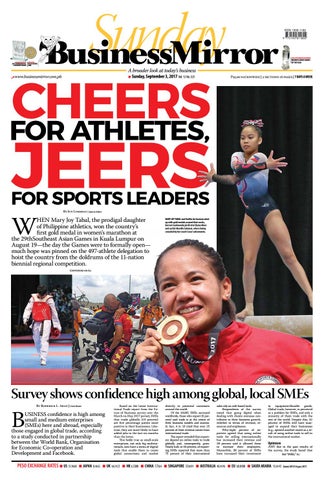
HEN Mary Joy Tabal, the prodigal daughter of Philippine athletics, won the country’s first gold medal in women’s marathon at the 29thSoutheast Asian Games in Kuala Lumpur on August 19—the day the Games were to formally open— much hope was pinned on the 497-athlete delegation to hoist the country from the doldrums of the 11-nation biennial regional competition.
MARY JOY TABAL and Kaitlin de Guzman wind up with gold medals around their necks, but not taekwondo jin Kirstie Elaine Alora and cyclist Marella Salamat, who is being consoled by her coach Cesar Lobramonte.
Continued on A2
Survey shows confidence high among global, local SMEs
B
By Roderick L. Abad | Contributor
USINESS confidence is high among small and medium enterprises (SMEs) here and abroad, especially those engaged in global trade, according to a study conducted in partnership between the World Bank, Organisation for Economic Co-operation and Development and Facebook. PESO exchange rates n US 51.1660
Based on the latest International Trade report from the Future of Business survey over the March-to-May 2017 period, SMEs that trade globally (19 percent) are five percentage points more positive in their businesses. Likewise, they are more likely to have added jobs in the last six months than the latter. This holds true as small-scale enterprises, not only big multinationals, now have a menu of digital tools that enable them to create global connections and market
directly to potential customers around the world. Of the 49,081 SMEs surveyed worldwide, those who export (5 percent) said trade is at the center of their business models and success. In fact, 4 in 10 cited that over 25 percent of their revenue comes from international trade. The report revealed that exporters depend on online tools to trade globally and, consequently, grow. Nearly half, or 45 percent, of exporting SMEs reported that more than 75 percent of their international
sales rely on web-based tools. Respondents of the survey noted that going digital when dealing with clients overseas contributes to their business growth, whether in terms of revenue, resources and employees. Fifty-eight percent of exporters agreed that using online tools for selling internationally has increased their revenue and 28 percent said it allowed them to increase their employees. Meanwhile, 38 percent of SMEs have increased their investment
in equipment/durable goods. Global trade, however, is perceived as a problem for SMEs, and only a minority of them trade with the rest of the world. Despite this, 42 percent of SMEs still have managed to expand their businesses (e.g., opened another store) as a result of using online tools to sell in the international market.
Optimism
JUST like in the past results of the survey, the study bared that
n japan 0.4642 n UK 66.1423 n HK 6.5388 n CHINA 7.7564 n singapore 37.6691 n australia 40.4416 n EU 60.8108 n SAUDI arabia 13.6443
See “SMEs,” A2
Source: BSP (31 August 2017 )
NewsSunday BusinessMirror
A2 Sunday, September 3, 2017
www.businessmirror.com.ph
Cheers for athletes, jeers for sports leaders Continued from A1
Two days later, Nikko Huelgas and Kim Mangrobang swept the triathlon gold medals and the Philippines was on its feet. But the hope turned out merely a hope. The most the Philippines could muster in each of the 12-day Games was five gold medals on Day Five on August 25—nothing more and everything less for the rest of the competitions. And forgettable Kuala Lumpur was, Filipino sports leaders simply looked the other way from the dismal finish that kept the country at sixth on the medal tally—but with despicable numbers of 24 gold, 33 silver and 64 bronze medals, much less than the 145 gold medals host Malaysia scooped from the 38 sports on the program to emerge overall champion for the second time since their last hosting of the Games in 2001. “Let’s move on and look forward to 2019 [when the Games come to Manila for the fourth time],” was Philippine Olympic Committee (POC) President Jose Cojuangco’s statement that shoveled more flak to his leadership that dates back to 2004. Chief of Mission to the Games Cynthia Carreon sounded more awful. She predicted 50 gold medals, almost double that of the 29 won in Singapore 2015, and terribly fell short. Her response was a pain in the ears. “The 50-gold medal prediction was to motivate the athletes,” she said. With their statements, the writing on the wall has become bolder and clearer: sports leaders who have clung to their positions for decades with meager—or none at all—achievements should step down and give what Philippine
sports has long needed, shots in both arms. To say that the government has inadequately supported or funded sports is a most convenient excuse. Our neighboring country’s athletes get more financial support from their governments, particularly the top finishers in the Games—Malaysia, Thailand (72 golds), Vietnam (58) and Singapore (57). But in a country whose economy is not as sound and healthy as its sports program, an athlete could only scrape so much from public funds. More so, an athlete is considered extremely lucky if a private or corporate sponsor comes his or her way. Non-government support for sports has never been friendly to athletes whose events come in as hard sell. Advertising is the priority and the goal of selling the product comes over and above a social responsibility of genuinely supporting an athlete. The Philippine Sports Commission (PSC), led by Chairman William Ramirez, hardly winked in providing P300 million to the Games participation. And that’s not counting the hundreds of millions more that went to training and preparing the athletes both on local soil and abroad for the Games. Ramirez, serving a second term at the PSC, viewed it from the athletes’ perspective. “Give it to the athletes, they did their best and gave their all,” he said. Notables among the Filipino athletes include prized find Filipino-American Trenten Anthony Beram, who won the men’s 200 and 400 meters of athletics; Kaitlin de Guzman and Reyland Capellan in gymnastics; pure homegrown Aries Toledo in decathlon; and Samuel Morrison in taekwondo.
Trenten Beram wins the country’s first athletics golden double in the Games with a heroic win in the men’s 200 and 400 meters.
Rio Olympian Kirstie Elaine Alora had her head bowed when she yielded to a familiar opponent in women’s taekwondo, thus settling for silver. Cycling’s Marella Salamat didn’t have the chance to defend her women’s time-trial gold medal after Malaysia scratched the event to its advantage and rode by her lonesome in the criterium and massed start after the task force
that selects athletes to the Games denied her a domestique. No Filipino athlete who saw action in Kuala Lumpur was illprepared for the Games. Each and every one of them trained so hard and sacrificed the joys of a normal life to heed the call of flag and country. Some actually overtrained and hobbled away from the podium. Gold-medal prospects who bowed in defeat shed a bucketful. Coming up empty despite all the physical and mental preparations shattered the athletes’ heart and soul. And for that, they deserve our cheers. For the sports leaders? Jeers.
SMEs...
And forgettable Kuala Lumpur was, Filipino sports leaders simply looked the other way from the dismal finish that kept the country at sixth on the medal tally—but with despicable numbers of 24 gold, 33 silver and 64 bronze medals.
continued from A1
enterprises that do international trading are more bullish about the current and future state of their businesses and are also considering to hire more employees. Almost half, or 49 percent, of global traders are positive about the present status of their business, in comparison to 43 percent of nontraders. Forward looking, the ratio is 64 percent versus 60 percent. Twenty-seven percent of traders reported having hired employees in the last six months against 17 percent of nontraders. Forty-nine percent of traders against 40 percent of nontraders anticipate hiring employees in the next six months. The same trend is also similar to those enterprises involved in exporting. The level of confidence of exporters on the present situation of their business was higher at 51 percent than nonexporters’ 43 percent; while the range of their bright future prospects are at 65 percent and 60 percent, respectively. Thirty-percent of exporters and 17 percent of nonexporters have recruited people over the last six months. In the coming six months, 50 percent (exporters) and 40 percent (nonexporters) plan to provide employment.
Challenges of global trading
SELLING to foreign countries is no easy task for exporters, as 48 percent of them still viewed it as a challenge. The level of difficulty, though, might be even higher among SMEs that want to export but have not been able to do so, per the study.
The main export barrier was finding business partners at 63 percent—an area where there has been less direct policy intervention. This was followed by market access limitations at 41 percent; different regulations, 38 percent; Customs regulations, 35 percent; language and/or cultural gap, 33 percent; securing export finance, 31 percent; poor onlinepayment alternatives to sell online, 29 percent; large geographical distance from home country, 26 percent; and poor Internet connection to sell online, 18 percent. Overcoming these challenges for export is a key factor to business success. In doing so, policymakers should collaborate with the business sector to build online payment tools that facilitate crossborder financial transactions in a seamless and risk-free way. In addition, the former must work to encourage regulatory frameworks that further facilitate SME trade, including standardizing trade regulations across countries to let SMEs manuever multiple markets sans being hindered by costly certification processes; lessening burdensome Customs regulation and encouraging ecommerce participation, which has contributed a lot to businesses to partially overcome trade barriers. When enterprises have the tools they need to reach new markets, and get over regulatory barriers, business revenue and economies grow. It’s a “win-win” for all.
Upbeat local SMEs
COMPRISING more than 96 percent of all the registered businesses in the country, SMEs are con-
sidered to be the lifeblood of the Philippine economy. Most of the 17 percent of local SMEs that trade internationally and participated in the survey expressed confidence about their business and are more likely to increase job generation for Filipinos. To wit, 59 percent of traders in comparison to 56 percent of nontraders are optimistic about their current business status, as 83 percent and 82 percent, respectively, are positive of the future. More traders than nontraders (47 percent versus 29 percent) stated to have created jobs in the past six months and plan to create jobs in the coming six months (76 percent versus 64 percent). For exporting SMEs (9 percent) that participated in the study, trade is at the core of their business models and success. Among them, 4 in 10 (44 percent) reported that more than 25 percent of their revenue comes from international trade. The Future of Business survey was launched in February 2016, with 22 countries. Today, it includes 42, representing economies accounting for 40 percent of the world’s population and 73 percent of global gross domestic product. Since January 2017, the study added the Czech Republic, Ecuador, Hungary, Nigeria, Pakistan, Portugal, Romania, Russia and Taiwan, China. To date, more than 218,000 Facebook business page owners, from both younger and longer-standing companies across a wide range of sectors, have taken the monthly survey— nearly a 60-percent hike since January of this year.
Editor: Lyn Resurreccion • www.businessmirror.com.ph
The World BusinessMirror
Sunday, September 3, 2017
A3
Trump pushes tax overhaul to ‘bring back Main Street’
French President Emmanuel Macron (center)waits for leaders at the élysée Palace in Paris on August 28. The leaders of France, Germany, Italy and Spain are meeting on Monday with counterparts from Libya, Niger and Chad to discuss ways to curb illegal migration across the Mediterranean Sea to European shores. AP/Thibault Camus
French President Macron faces biggest test over labor reform
P
A R IS —French President Emmanuel Macron faces his biggest test yet with Thursday’s release of a divisive pro-business labor reform that he hopes will foster stronger growth and reduce the country’s stubbornly high unemployment rate by revolutionizing the way the French work. But t he h igh- st a kes move comes just as his popu lar it y is sink ing , and unions and po litica l opponents have a lready ca l led for street protests and st r i kes i n wh at cou ld be a n unusua l ly hot autumn for t he recent ly elected president. His plans to reform the labor market to make it more flexible were at the heart of Macron’s election campa ig n. However, opponents fear it will weaken hard-won worker protections that have become globally synonymous with the much-envied French lifestyle. Foreign investors and France’s European neighbors are watching Macron’s plan closely—almost as closely as the French workers it will directly affect. France is the No. 2 economy in the euro zone, but its chronic 10-percent unemployment has long weighed on the region’s growth. The labor overhaul is the central pillar in Macron’s promises to create jobs and make his country more globally competitive after repeated failed efforts at reform. Macron said changing labor rules was but one “instrument” to attain something larger, “the freeing up of energies.” “A nd t hrough t his f reeing up, we do away w it h our sham of recent years: t hat of a countr y tough on t he wea k but t hat vaunts equality and fraternity, of a countr y corseted by rules... which considers itself a countr y of liber t y,” t he president said in a lengthy inter view with t he ne w sm a g a z i ne L e Point, published on T hursd ay. “We must see things as they are: We are the only major economy of the European Union which hasn’t vanquished mass unemployment in more than three decades,” Macron said. The details of the plan, to be disclosed on Thursday in a list of decrees, will determine how far the reform will change the country’s stringent labor rules. One measure is expected to cap the financial penalty for companies sued for firing employees. Other changes aim at simplifying negotiations process between employers and employees. A big question is how much the reform will reduce the power of national collective bargaining, which has long dominated Fre nc h l a b or re l at ion s — t he reason French unions are so inf luential despite relatively low union membership. T he plan is expected to give businesses more f lexibility to define internal working rules instead of being bound by sector-wide rules. Left-wing opponents fear it will
hand too much power to profit-focused bosses, while some conservatives fear it won’t go far enough. Gover nment spokesman Chr istophe Castaner said on We d n e s d a y m o r e t h a n 10 0 meetings w ith unions and employers organizations were held to prepare the reform. He acknowledged the government expects some measures to be contested but said the reform aims at being “ambitious”—not reaching a consensus. Pierre Gattaz, president of France’s main employers’ organization Medef, said on BFM television this week: “We have been awaiting this plan for decades.” The reform’s success depends heav ily on how many unions oppose it. Philippe Martinez, leader of the hard-left CGT, one of France’s major unions, has called for protests and strikes on September 12, but some others are waiting to see the detail in the decrees. “They want to make us believe that...it’s the only solution to reduce unemployment, but that’s a lie of the government,” Martinez told RTL radio this week. Far-left leader Jean-Luc Melenchon, who finished fourth in the presidentia l race, has called for another street protest on September 23 against “antidemocratic” measures. The government decided to use a special procedure at Parliament to avoid a lengthy debate and get the labor plan passed more quickly. The draft decrees released on Thursday aren’t final, but nearly so. They are to be formally approved in a Cabinet meeting on September 20 after being endorsed by the Council of State, the country’s highest administrative authority. Parliament, dominated by Macron’s party, must ratify them by the end of the year. France’s main European partners have repeatedly called on France to reform its job market to boost Europe economically. G er m a n Fore ig n M i n i ster Sigmar Gabriel said in Paris on Wednesday that he was “ impressed” by what he heard about the reform. “I’m sure this will help [France] to become stronger,” Gabriel said. The French public, however, has quickly shed its excitement about Macron, whose poll ratings have plunged in recent weeks after the government launched labor-reform negotiations and announced budget cuts. Last week, during a trip to Romania, Macron said “the French hate reforms” but “we must explain where we are going and propose deep change.” The élysée Palace is trying to improve his image, and announced this week the creation of a presidential spokesman position. Former TV journalist Bruno Roger-Petit will be in charge of “broadcasting the élysée’s public message” in an effort to better promote its policy. AP
S
PRINGFIELD, Missouri— President Donald J. Trump launched his fall push to overhaul the nation’s tax system by pledging on Wednesday that the details-to-come plan would “bring back Main Street” by reducing the crushing tax burden on middle-class Americans, making a populist appeal for a proposal expected to heavily benefit corporate America.
Trump said his vision for rewriting the tax system, a key campaign pledge, would unlock stronger economic growth and benefit companies and workers alike. He promised it would be “pro-growth, pro-jobs, pro-worker and pro-American.” True to form for the president, Trump dangled the prospect of the “biggest ever” tax cut and warned that without it, “ jobs in our country cannot take off the way they should. And it could be much worse than that.” Tr ump, who rarely travels to promote his policy agenda, chose to debut his tax-overhaul pitch before employees at a manufacturing plant in Springfield, Missouri, a community known as the birthplace of Route 66, one of t he n at ion’s or ig i n a l highways a nd one k now n as America’s Main Street. “This is where America’s Main Street will begin its big, beautiful comeback,” he declared. After eight months without any major legislative victories and after a significant defeat on health care, Trump and Republican congressional leaders face mounting pressure to notch some significant achievements before next year’s midterm elections. But the tax-overhaul effort already is facing political headw inds. The W hite House and Republican lawmakers have
not finalized details of the plan, and the push comes as Congress returns to face an intense September workload filled with must-do items, such as raising the debt limit, funding the government and providing assistance for the Harvey recovery effort. W hile the W hite House has been designing a tax plan aimed at appea ling to Republicans, Trump sought to cast the effort in bipartisan terms. He called on members of both parties to work with him on a “once-in-ageneration opportunity to deliver real ta x reform for ever yday hardworking Americans.” “ I a m f u l ly com m it ted to working with Congress to get this job done—and I don’t want to be disappointed by Congress, do you understand?” Trump said. “Do you understand, Congress? I
think Congress is going to make a comeback.” The president used the official White House event to inject an overtly political message aimed at Missouri Democratic Sen. Claire McCaskill, a top Republican target in next year’s midterm elections. “We must lower our taxes, and your senator, Claire McCaskill, she must do this for you. And if she doesn’t do it for you, you have got to vote her out of office,” Trump said, drawing out each of the last five words for emphasis. Even before Trump took the stage, Democrats eagerly laid down their own markers for what the tax plan should look like. Senate Minority Leader Chuck Schumer outlined a series of conditions, telling reporters the tax cuts should not go to the wealthiest 1 percent of Americans. He added that the plan should not increase the budget deficit and should be written by both parties—not just Republicans like the GOP’s failed health-care effort. “If the president wants to use populism to sell his tax plan, he ought to consider actually putting his money where his mouth is” and cut taxes for the middle class, not the richest Americans, Schumer said. The Trump administration released a one-page set of goals in April for its tax overhaul, followed by a joint statement in July with congressional leaders. In an interview with the Financial Times last week, Gary Cohn, a top Trump economic adviser, said
I am fully committed to working with Congress to get this job done—and I don’t want to be disappointed by Congress, do you understand? Do you understand, Congress? I think Congress is going to make a comeback.”—Trump
the White House and Republican leaders had agreed on a “good skeleton” for the plan, and said the tax-writing committee in the House would be drafting legislation while the White House tries to sell it. Cohn, who recent ly publicly denounced the president’s response to the racia l v iolence i n C h a rlot tes v i l le, V i rg i n i a , traveled to Missour i w ith the president and was standing to the side of the stage. But he was not among a number of administration officials whom Tr ump publicly thanked in his opening remarks. The White House played down the omission, saying White House staff members typically aren’t recognized in prepared remarks, only Cabinet members. Trump said he would like to see the top corporate tax-rate drop from 35 percent to 15 percent. But it’s not clear that the top rate will go that low in the plan or what kind of tax break a typical taxpayer would see. With his promises to the middle class, Trump is essentially betting that the benefits of tax cuts for businesses will flow directly to workers, rather than ending up in the pockets of top executives and wealthy investors. His administration has asserted that high corporate tax rates primarily hurt workers, since companies can stash their money overseas in countries with lower tax rates. Tr u mp’s Trea su r y Depa r tment cited a 2006 Congressional Budget Office study to back the claim that workers mostly bear the brunt from corporate taxes, as well as research by Kevin Hassett, the economist picked to lead the W hite House Council of Economic Advisers. But Treasury officials concluded in a separate 2012 analysis that only 18 percent of corporate taxes’ costs fell on labor. This would suggest that Trump’s plan is more likely to bolster stock prices and CEO pay than trickle down to worker’s salaries. AP
Employees work on Volkswagen e-Golf electric automobiles on the assembly line inside the Volkswagen AG factory in Wolfsburg, Germany, on May 20, 2016. Volkswagen AG agreed to raise German workers’ pay after labor leaders vowed that employees wont foot the multibillion-euro bill to resolve its diesel-emissions scandal. Krisztian Bocsi/Bloomberg
German August unemployment falls as nation braces for polls
G
erman unemployment extended its decline in August, underpinning a robust upswing in Europe’s largest economy less then four weeks before general elections. The number of people out of work fell by a seasonally adjusted 5,000 to 2.532 million, data from the Federal Labor Agency in Nuremberg showed on Thursday.
The median estimate in a Bloomberg survey was for a drop of 6,000. The jobless rate remained at 5.7 percent, the lowest level since the country’s reunification. “ T he labor market continues to develop favorably,” labor agency head Detlef Scheele said in a statement. “Strong employment growth continues and demand from companies for new
employees continues to be high.” Chancellor Angela Merkel’s record of falling unemployment, stable growth and a balanced budget has helped her maintain a doubledigit lead over Social Democratic challenger Martin Schulz, as she bids for a fourth term in September 24 election. The German economy continued its expansion in the second quarter and the Bundesbank
has said that momentum remains strong as rising employment encourages private consumption. Joblessness fell by about 3,000 in west Germany and 2,000 in the eastern part of the country. In the euro area, unemployment probably remained at 9.1 percent. Eurostat will publish those data, along with consumer prices, at 11 a.m. Frankfurt time. Bloomberg News
A4
Sunday, September 3, 2017
The World BusinessMirror
Editor: Lyn Resurreccion • www.businessmirror.com.ph
Trump’s NoKor stand sow policy confusion in Cabinet
W
ASHINGTON—True to form, President Donald J. Trump sowed policy confusion with a tweet. Declaring on Wednesday that “talking is not the answer” on North Korea, Trump’s message appeared to clash with efforts by his Cabinet members to safeguard the possibility of a diplomatic solution as Kim Jong Un’s military races toward mastering a nuclear-tipped missile that can reach America. The president’s morning tweet came a day after a highly provocative North Korean missile test that flew over Japan, a close American ally, potentially endangering civilians on the ground. On Wednesday, Kim called for more weapons launches in the Pacific. “The US has been talking to North Korea, and paying them extortion money, for 25 years. Talking is not the answer!” Trump tweeted. The statement raised fresh uncertainty about the Trump administration’s strateg y for North Korea. How the United States plans address the North’s growing nuclear capabilities is of increasing urgency not just in Northeast Asia, but also in the US. Last month, the isolated, communist country tested for the first time a missile that could potentially strike the US mainland. Trump didn’t spell out what he meant by “extortion,” but he appeared to be referring to the $1.3 billion the US has provided in aid to North Korea since 1995. Most of that has been food and fuel.
Criticism of past administrations’ failures to halt North Korea’s march toward nuclear weapons has been a recurrent theme from Trump. However, his comment overlooked the fact that there’s been virtually no US aid to North Korea since early 2009. Talks also have been in limbo for years. The last formal negotiation between Washington and Pyongyang on the nuclear issue occurred in 2012. Eliminating the possibility of new negotiations could limit US options. It also risks increasing the chance of military confrontation between nuclear-armed powers. Within hours of Trump’s tweet, Defense Secretary Jim Mattis appeared to contradict him. “We’re never out of diplomatic solutions,” Mattis said as he met with his counterpart from South Korea for talks on military readiness. The US-allied government supports, in theory, greater diplomatic outreach to Pyongyang. If war were to ever break out,
millions of South Koreans would immediately find themselves within range of the North’s large conventional-weapons arsenal. In Geneva, Robert Wood, the US ambassador to the Conference on Disarmament, sought to explain the president’s tweet. Trump was expressing his frustration at North Korea’s “dangerous and provocative threats,” Wood said. But like Mattis, he said the US remained willing to discuss the North’s denuclearization. “The United States is open to trying to deal with this question diplomatically, but the other side is not,” Wood told reporters. It’s not the first time Trump has complicated his administration’s national security message via social media. Last month as aides worked to defuse tensions between Qatar and its Arab neighbors, Trump blindsided them by t weeting that Qatar funded terrorism. The gas-rich monarchy hosts 11,000 US troops. Trump also surprised officials with tweets on Russia and banning transgender people in the military. Supporters of US engagement with North Korea argue that periods when the US is talking and providing aid to the country have proved the most successful in curbing its weapons development.
The US has been talking to North Korea, and paying them extortion money, for 25 years. Talking is not the answer.”—Trump
In the past five years, without formal talks, the North’s technological strides have been most rapid. Secretary of State Rex Tillerson last week hinted at possible direct talks if North Korea demonstrated its sincerity by stopping weapons tests. The US also has been maintaining a diplomatic back channel with North Korea. The immediate outlook for diplomacy, however, appears bleak. On Wednesday North Korea’s Kim called for more weapons launches into the Pacific Ocean. The Korean Central News Agency said the launch that overflew Japan was of an intermediate-range missile that the North first successfully tested in May and threatened to fire into waters near Guam earlier this month. It described the launch as a “muscle-flexing” countermeasure to US-South Korean military drills that conclude on Thursday. Trump offered a surprisingly subdued, initial response to the Japan overflight on Tuesday, without any of the bombast of earlier this month when he warned the North of “fire and fury” if its threats persist. He said “all options are on the table,” a standard formulation signaling Washington hasn’t ruled out military action. While the United Nations Security Council on Tuesday condemned the launch as “outrageous,” there was no move to impose more sanctions. At the disarmament body in Geneva, North Korean diplomat Ju Yong Chol said the council’s statement revealed Washington’s “evil intention to obliterate the [Democratic People's Republic of Korea]’s sovereignty and rights to existence and development.” AP
Lynching in Jakarta marks increase in vigilante violence
B
EKASI, Indonesia — His last words were: “I’m not a thief.” But the mob, believing he had stolen an amplifier from a mosque, refused to accept the denial. They beat him to death and burned his body as onlookers filmed the proceeding. A triumphant cry went up as he burst into flames. The lynching this month of Muhammad al-Zahra, 30, in Bekasi, a gritty, industrial suburb of Jakarta, has shocked Indonesia and opened a broader discussion about why vigilante mobs continue to torture and execute petty criminals in the country. Last month, in Surabaya, a large city in East Java, two young men accused of stealing were beaten by a huge crowd and struck with stones before being rescued by the police. That same month, a video surfaced of residents tying up, interrogating, beating and burning a man on suspicion of stealing in Madura, an island off East Java; the man survived. In June a theft suspect in Madura was tied to a tree and fatally beaten by villagers. “Vigilante justice, like the case that just happened in Bekasi, happens so frequently,” said Alghiffari Aqsa, a staff lawyer at the Legal Aid Institute, a nonprofit organization based in Jakarta. “It reflects a lack of trust toward legal institutions. The police are seen as insufficiently responsive,” so villagers take matters into their own hands. Nearly two decades after Indonesia began its transition to democracy, its judicial system remains weak, plagued by corruption and inefficiency. Despite a significant expansion of police ranks during the last decade, the police are widely considered ineffective at solving everyday illegality.
Siti Zubaidah, Muhammad al-Zahra’s widow, with her 4-year-old son, in Bekasi, West Java, Indonesia, on August 14. The lynching this month of Muhammad al-Zahra, in Bekasi, an industrial suburb of Jakarta, has shocked Indonesia and opened a broader discussion about why vigilante mobs continue to torture and execute petty criminals in the country. “Let’s not have there be any future victims of vigilante justice,” Zubaidah said. New York Times News Service
Frustration with high crime and a lack of punishment for ly nch mobs have encouraged more vigilantism. Mob attacks increased 25 percent between 2007 and 2014, according to the National Violence Monitoring System, a World Bank program that records vigilante killings in Indonesia. From 2005 to 2014, there were 33,627 victims of vigilante violence in Indonesia, 1,659 of whom died, the program found. Even that figure most likely underestimates the scale of the issue, as the program only monitors violence
in half of Indonesia’s provinces. “The legal system is seen by many people as too lenient for petty theft,” said Sana Jaffrey, a doctoral researcher at the University of Chicago who ran the World Bank program for five years. For many poorer residents, she said, the loss of a motorbike, or even something as minor as chickens, could greatly damage their livelihood. When convicted thieves are released from jail after just a few months, as is common, it creates a perception that the legal code is too lenient, she added.
Nonetheless, the killing in Bekasi struck a particular chord, in part because Zahra made his living selling electronic equipment, so the amplifier he was accused of stealing may have been acquired legally. Celebrity preachers swarmed Zahra’s rented home to meet with his widow, Siti Zubaidah, 25, and denounced lynching as un-Islamic. Indonesia’s Vice President Jusuf Kalla, a multimillionaire, dispatched a representative to visit Siti, who is six months pregnant, to pledge financial support. New York Times News Service
In this November 2, 1987, file photo, Britain's Diana, the Princess of Wales, is pictured during an evening reception given by the West German President Richard von Weizsacker in honor of the British Royal guests in the Godesberg Redoute in Bonn, Germany. It has been 20 years since the death of Princess Diana in a car crash in Paris and the outpouring of grief that followed the death of the “people’s princess.” AP/Herman Knippertz
Death of Diana transformed monarchy, and Britain itself
A
fter the death of Diana, Princess of Wales, 20 years ago, London felt like a city on the verge of a revolution. Suddenly everything was up for grabs, even the monarchy itself. For a few crazy weeks, this most enduring of institutions looked as if it might actually implode under the weight of so much emotion. For anyone there at the time, it was as electrifying as it was bewildering. The mood was febrile, angry, reckless. Flowers were piled knee-deep at the gates of the royal palaces; grown men wept openly in the streets; mild-mannered citizens inveighed against the usually blameless queen for what they believed was an inadequate response to a national crisis. Centuries of stiff, upper-lipped repression boiled over in a great howl of collective anguish. Eventually the public regained its grip, and the monarchy— chastened and battered, but a mo n a rc hy no ne t he l e s s — e n dured. But as Britain on Thursday marks the 20th anniversary of Diana’s death with commemorations, documentaries and books, a central, if unlikely, piece of her legacy is how she reshaped the monarchy that rejected her, and how she reshaped Britain, too. Diana in life was a loose cannon, an unpredictable wild card; in death, she had a galvanizing effect. Britain is already very different from what it was in Diana’s era, partly because of a younger generation less enamored with old conventions. But her death also opened a door, for better or worse, for the country to become more emotional and expressive, and more inclined to value gut feeling over expert opinion even in such matters as Brexit, its vote last year to leave the European Union. Faced with a clear choice—modernize or die—the monarchy decided to modernize, led by Queen Elizabeth II but bolstered by a new generation of better-adjusted, better-prepared royals. “The Windsors, whose most perilous moment came at Diana’s death, in fact owe their endurance to her example,” said Jonathan Freedland, a columnist for The Guardian, a left-leaning newspaper. “The queen is particularly alert to learning lessons from experience, and in this case the lesson was, ‘Don’t get on the wrong side of public opinion.’” Diana was glamorous, magnetic, photogenic, mercurial, manipulative and intuitive; media victim and media perpetrator; the Real Princess of Kensington, a reality star before such a thing existed. If she is a less-defining figure to the generation that has grown up since her death, she still is an object of fascination for the generations who were stunned when she died two decades ago, at 36. “We gossip about her as if she had just left the room,” novelist Hilary Mantel wrote recently in The Guardian. And so, the papers are full of snippets of “news” that have somehow managed to escape public disclosure until now. A tourist from Ohio claims he was in the tunnel in Paris at the
time of the car accident that killed Diana; her boyfriend, Dodi alFayed; and their driver, Henri Paul. A Diana-watcher reports that the princess, her identity muted by a voluminous head scarf, regularly visited the grave of the police protection officer whom she loved and who died in what she believed was an “establishment plot” but was really just a motorcycle accident. Diana’s “energy healer” reveals that she has heard from Diana recently (from beyond the grave) and that, in case you were wondering, the deceased princess is pro-Brexit. Beyond these sorts of details, which help to keep the princess in the public consciousness and to sell tabloid papers, Diana’s influence is perhaps most evident in the evolution of the royal family. During the days after her death, known now as Diana Week, a nation that had always appreciated the monarchy’s adherence to tradition was suddenly demanding that it tear up the old rules and learn new ones. “Show Us You Care,” the Daily Express said in its emblematic headline, imploring a staid queen, who had never once let down her guard in public, to address the nation and lower all her flags to half-staff, even as every fiber of her deeply conservative being militated against it. Seriously shocked by what t he y encou ntered , t he roy a l family had no choice but to respond. “ The times were changing, and they were not keeping up with the times,” Freedland said. “But the truth is, they did manage to modernize.” A s a n e x a mple, Freed l a nd pointed to the queen’s brief, witty appearance in a film for the opening ceremony of the 2012 London Olympics, in which she greeted actor Daniel Craig in his guise as James Bond and then appeared to parachute into Olympic Stadium (the first part was real; the parachuting was done by a stuntwoman). The new generation—namely Diana’s two sons, William and Harry, and William’s wife, Kate— has put a youthful, modern (at least by their standards) spin on what it means to be a royal person in 2017. They exude asexual wholesomeness (in the case of William and Kate) and bad-boy cheekiness (in the case of Harry), and give the appearance of working alongside, not in opposition of, public opinion. They present as both curiously formal—Harry and William in their tailored suits; Kate in her dress-and-hat combos that make her look 20 years older; the royal children’s nanny in an amusingly old-fashioned uniform—and relatively normal, considering how not-normal their lives are. Diana was considered disloyal and unhinged, an unguided missile, when she went on the BBC in 1995 to talk of her emotional distress (“There were three of us in this marriage, so it was a bit crowded.”). In a sign of how much things have changed, William and Harry are marking the anniversary by speaking publicly about her, with royal approval. New York Times News Service
Sports BusinessMirror
Editor: Jun Lomibao | mirror_sports@yahoo.com.ph
V
ATICAN CITY—The Brazilian soccer club that was devastated by an airplane crash in the mountains of Colombia last year met with Pope Francis at the Vatican on Wednesday. Francis gave Chapecoense a special welcome in his remarks and posed for pictures with the team at the end of his weekly general audience. When the team’s flight went down in Colombia last November, all but six of the 77 players, officials and journalists onboard were killed. Three players survived the crash and two of them, Jackson Follmann and Alan Ruschel, were among those at the Vatican. “I feel it was a miracle for what happened in my life,” Ruschel said. “I am very happy to be able to be back and play at a high level, and now I am taking advantage of every minute that I am playing.” Follmann had part of his right leg amputated from injuries in the crash. “I asked him to bless my rosary as I will get married soon,” said Follmann, who was the team’s goalkeeper. “He gave the blessing and so this will stay with me for the rest of my life.” Chapecoense faces Roma in a charity match at the Stadio Olimpico on Friday to raise funds for the team. The redesigned team is in 17th place in the 20-team Brazilian league standings. AP
Sunday, September 3, 2017
A5
Chapecoense crash survivors received by Pope Francis
NCAA head offers advice in Tokyo
T
OKYO—NCAA President Mark Emmert offered Japanese sports industry leaders advice on forming their own collegiate athletics association on Wednesday. Japan is seeking to become one of the few countries outside the United States to establish an NCAA-type governing body for college sports. Emmert spoke to sports officials and representatives from more than 20 Japanese universities at a seminar in Tokyo. “When I was asked to come over here and talk about this, I jumped at the chance because I think it is a terrific opportunity and we want to help,” Emmert said. “We’d like to be a part of this because we value sports as a part of education.” Despite its success, few countries have followed the NCAA’s model. Most countries do not view the integration of student-athletes the way American colleges do. After describing the history of the NCAA and how it benefits students and colleges, Emmert talked about the revenue generated from the association’s 90 tournaments. “The way the NCAA works is we generate revenue off of only those 90 tournaments,” Emmert said. “We don’t have anything else other than those 90 tournaments that we put on television and sell tickets for. Fortunately they are very, very popular, so they allow us to pass hundreds of millions of dollars back to the universities.” Compared to the US, college sports in Japan have a long way to go, but Emmert said the time is right for a governing body similar to the NCAA. “You have an extraordinary opportunity,” Emmert said. “You have some wonderful universities in Japan, you have a very strong higher-education infrastructure here with some great schools and you have the enthusiasm of the Olympics in 2020, when you’re whole nation is going to be focused on sport for the next three years as you roll into this incredible event.” The NCAA is interested in expanding its brand overseas. Stanford played Rice in a regular-season football game in Sydney, Australia, last Sunday, while universities in Canada and Mexico have either been admitted as NCAA members or are seeking to join the organization. AP
POPE Francis poses with members of the Chapecoense team at the end of his weekly general audience at the Vatican. AP
EMOTIONAL MOMENT By Doug Feinberg
N Stephon Marbury (left) talks to New York University freshmen at a question-and-answer session in New York. AP
BABY NO. 2 FOR PHELPS UP
M
ICHAEL PHELPS is set to become a father of two. The 23-time Olympic swimming champion and his wife Nicole announced the news on Instagram with the help of their 15-month-old son Boomer. Phelps shared a picture of Nicole holding a smiling Boomer and wrote in the caption: “Number 2 on the way!!!! So excited!! Wonder if it’s a boy or a girl??” Boomer has a big following on his own Instagram account, where another picture showed the smiling boy alongside a positive pregnancy test. Boomer was born in May 2016, a month before Phelps and the former Miss California USA got married. AP
Michael Phelps celebrates his gold medal in the men’s 200-meter butterfly with his wife Nicole and baby Boomer during the 2016 Rio Olympics last year. AP
Wada prioritizing research into full extent of doping
P
ARIS—The World Anti-Doping Agency (Wada) said it is prioritizing research on the extent of doping in sports. Wada says its group of experts on doping prevalence will meet next month to review a long-delayed study published this week that pointed to widespread doping at the 2011 track world championships in Daegu, South Korea. It added that studying prevalence “has been established as one of Wada’s key priorities for 2017-2018.” Wada called the newly published study, which it funded, “an important step for the future and in refining a tool to
assess the prevalence of doping.” It added that “Wada intends to build on this study in the future” and that better understanding doping prevalence “will allow us to more accurately evaluate the success of detection, deterrence and prevention programs.” Italy’s anti-doping agency, meanwhile, is appealing to lengthen the two-month ban handed to former French Open finalist Sara Errani. Nado Italia—which operates independently from the Italian Olympic Committee—filed a “statement of appeal” with the Switzerland-based Court of Arbitration for Sport,
without specifying how long of a ban it is seeking. Errani blamed food contamination from her mother’s breast-cancer medication after testing positive for the banned substance letrozole in a test taken in February. An International Tennis Federation adjudication panel ruled that Errani’s fault was “at the lower end of the scale”. The 30-year-old Errani was informed of the test results on April 28. Errani’s ban expires on October 2, precluding her from playing at the US Open. A long-delayed study funded by the Wada,
The Associated Press
EW YORK—Stephon Marbury had to wipe tears from his eyes. He had just shared a surprising, emotional hug with New York University (NYU) freshman Zhou Sheng Kang. The 19-year-old student, who grew up in Beijing, was overcome with emotion while standing a few feet away from the player he watched lead his hometown team to three Chinese league championships. Marbury was speaking at a question-andanswer session for incoming NYU students at the school on Wednesday, touching on his career with the Beijing Ducks that included the franchise’s first championship in 2012. “I had no clue. I couldn’t stop crying,” Marbury said of meeting Zhou . “I know how he feels, and he’s sharing the feeling of how happy he is. It goes to show the level of respect and love that comes from winning championships. Being a New Yorker, it’s like if the Knicks won a championship for the first time.” Zhou, who was holding a scarf emblazoned with the city’s soccer team, Beijing Guoan, didn’t know Marbury would be speaking at an NYU dorm until Tuesday. “It was like a dream come true meeting him,” Zhou said. Marbury had a few stellar seasons in China after a National Basketball Association (NBA) career that included stints with five teams, and he’s become an iconic figure in the country. He has a statue and was featured on a postage stamp in Beijing, and then he got a museum and a musical in his honor. He even starred in an autobiographical movie, titled My Other Home, and won Best New Actor for his performance at the Shanghai Film Festival. “I never in a million years would have
meanwhile, said one-third of athletes may have knowingly doped shortly before they competed at the 2011 track world championships—although few of them were caught at the time. The peer-reviewed study, published in the journal Sports Medicine, estimated that doping was even more widespread at the Pan-Arab Games in 2011, with at least 45 percent of competitors thought to have doped in the 12 months before the regional multisports event. The researchers said a total of 2,168 athletes at the two events participated in anonymous questionnaires upon which the study was based. The volunteers were offered the choice of replying to the question: “Have you knowingly violated anti-doping regulations by using a prohibited substance or method in the last 12 months?”
thought any of this would have happened,” he said. Marbury’s playing days will end after this season, but the 40-year-old New York native will stay near the game. He wants to coach the Chinese national team, and Yao Ming has told him he’ll be considered if he learns Chinese. Marbury plans to take classes during the upcoming season. He may also try his hand in the Big3 three-on-three league. “Basketball is my life and I definitely will still be involved with it,” Marbury said. Marbury also has his Starbury athletic shoe and clothing company to keep him busy. He relaunched the Starbury brand in 2016 after it first hit the market in 2006. His shoes are sold for as low as $15. “We understand the dynamics of what we need for the shoes to be made and get them to our warehouse,” Marbury said. “The way social [media] is and how platforms are set up with Instagram and Facebook. It’s the perfect time for us to be able to sell the products we have. People can buy products so fast with just three or four clicks. It’s amazing for us with impulse buying. The timing couldn’t have been better for us.” He gave out sneakers to all the NYU students at the event and spoke of how he still wants to make affordable shoes. “I grew up one of seven kids and my mom couldn’t afford to get us any of the $150 shoes,” he said. “I want to make sure that people can always have affordable shoes to wear.” He respects what LaVar Ball and his sons are trying to do by building their own brand from scratch, but he thinks they’re off in pricing their sneakers at $500. “I think that’s where the message is a little mixed up at,” Marbury said. “Where they’re making people make a decision is where the price comes in.”
After discounting some answers, from athletes who responded so hastily that they may have misunderstood the survey instructions or not carefully considered their response, the team of nine researchers from Europe and the United States came up with estimates of doping prevalence among athletes at the two events: 30 percent to 31 percent at the world championships in Daegu, South Korea, and 45 percent to 49 percent at the Pan-Arab Games. They said those findings may still have underestimated the extent of cheating. “There are many reasons to suspect that we may have undershot the true values,” Harrison G. Pope Jr., one of the authors, told The Associated Press in a telephone interview. Pope is a professor of psychiatry at Harvard Medical School. AP
Science
A6 Sunday, September 3, 2017
BusinessMirror
Sunday
www.businessmirror.com.ph • Editor: Lyn Resurreccion
Saving the banana-export industry through S&T Story & photos By Jonathan L. Mayuga
@jonlmayuga
D
e a dly pl a nt d isea ses continue to pose serious threats to the country’s agriculture sector. Experts say a single virus can cause an epidemic that can literally wipe out plantations and kill an entire industry—like Mindanao’s multibillion banana-export industry when it was seriously threatened by the dreaded Fusarium wilt, also called the Panama disease, in 2011. Mindanao is known for the massive production of Cavendish banana that is mainly for export. Until recently, Cavendish banana was previously believed to be resistant to Fusarium wilt. The affected areas continue to grow, sending chills to banana growers, particularly those in the export of the Cavendish variety.
Lourdes C. Generalao, chairman of Southern Mindanao Agriculture, Aquatic and Natural Resources Research and Development Consortium and president of the University of Southeastern Philippines
A total of 330,000 Filipinos are employed by the industry, generating a total of P446.4 billion in annual wages. The vitamin-rich fruit has vitamins A, B, C, D and E, magnesium, phosphorus and calcium, among others. According to Office of the Provincial Agriculturist of Davao del Sur, banana beats apple in terms of nutritional content and health benefits.
Uncontrollable, but manageable
“Fusarium wilt cannot be totally controlled. [Plant] diseases cannot be eradicated; they can only be managed,” said Lourdes C. Generalao, chairman of Southern Mindanao Agriculture, Aquatic and Natural Resources Research and Development Consortium (Sm a arr dec) and president of the University of Southeaster n Ph i l ippi nes ( USeP). T he Davao City-based USeP is host to Sma arrdec, a consortium of 25 national government agencies, institutions and local government units engaged in science and technology (S&T) innovation, and research and development. The banana-export industry remains under constant threat because of the persistence of the Panama disease, Generalao said in an interview with the BusinessMirror on August 22 during the kick off of “Sipag ni Juan Fiesta sa Dabaw: Farms and Industry Encounters through Science and Technology Agenda” held at a mall in Davao City. Thanks to S&T, the bananaexport industry remains vibrant and strong. She credited the timely intervention by S&T experts working hand-in-hand with concerned government agencies and LGUs in preventing the spread of the disease in many areas.
Research and development
In 2012, funded by the Department of Science and TechnologyPhilippine Council for Agriculture, Aquatic and Natural Resources Research and Development, the
A persistent disease
Panama disease-resistant variety GCTCV 219
330,000 The number of Filipinos who are employed in banana industry, generating a total of P446.4 billion in annual wages Research Division of the Research, Development, the extension office of USeP engaged in a thorough research on how to manage the disease, considering its potential adverse impact on the economy. Scientists from other Sma arrdec member-agencies also worked, among others, to improve soil management and conducted biological control research to help control the disease. “By 2014 we already came up with a solution to the problem,” she said. Extensive research was conducted to come up with the best varieties of the Fusarium wiltresistant somaclones, through a selection process to pick the best
planting materials and the propagation of disease-free planting materials through tissue culture. Si mu lt a neou sly, USeP, to gether with the Department of Agriculture (DA)-Davao region, particularly the Bureau of Plant Industry (BPI), started to develop management strategies, stop the disease from spreading through policy, awareness campaig n, erad ication of infected plants, encouraged crop rotation and promoted the use of disease-free tissue-cultured planting materials. Planting materials for two Fusarium-wilt resistant varieties developed in Taiwan are now being promoted for adoption by big and small banana companies.
All-important fruit
Banana is traded globally. It grows abundantly in tropical countries like the Philippines, the second-largest banana exporter in the world, next to Ecuador. The total production area in the Philippines is estimated at 450,000 hectares. The Philippines generated $1.1 billion in 2014 from the export.
Lorna E. Herradura, Agriculture Center chief IV of the BPIDavao National Crop Research, Development and Production Support Center in Bago Oshiro, Davao City, said the Panama disease is caused by a fungus, the Fusarium oxysporum f. sp. cubense (Foc). T he d isea se or ig i n ated i n Southeast Asia and was first reported in Australia in 1876. The soil-borne fungus attacks the roots of the banana plants and turns leaves into wilted yellow, killing the plant completely. Named after Panama, the disease earned its notoriety for wiping out entire banana plantations in that country. It was first observed in the Philippines in 2002, before the widespread occurrence in several plantations in 2011. The disease started to spread by means of infested far m implements or machiner y, infec ted br ac t s be i ng u sed a s padding for transport of local a g r ic u lt u r a l- produc t s, wh i le the propagules were spread by irrigation water. From a total of 634.70 hectares affected in the Philippines in 2011, the areas hit grew larger, threatening the industr y, particularly the small players that grow bananas for export through farmers’ cooperatives. By 2013 the areas affected
have grown to 3, 901.50 hectares By 2015, a total of 15, 507.73 hectares have been af fected, sa id Prof. Bel ly T. Dionio, a plant pathologist at USeP, who presented protocols in the Use of Microbial Control Agents for Fusarium Wilt Management The disease is very difficult to control due to its nature. It produces a resistant structure called Chlamydospore, Dionio added. She said the fungal pathogen that causes the disease survives in soil for decades with or without the banana plant.
Management strategies
Accor di ng to D ion io, t he management of Fusarium w ilt involves a combination of disease-control strategies, since no single method is fully effective on its ow n. These strategies concentrate on lowering the amount of inoculum in the field while enhancing plant vigor and disease tolerance. T h i s i nc lu d e s q u a r a nt i ne to prevent introduction to the disease, early detection of the disease, application of crop rotation and the use of resistant disease-free, Panama-disease resistant varieties. Plants infected by the Panama disease must be burned completely. Dionio said the use of antagonistic microbes as biological control is also helpful. According to Generalao, since the Fusarium wilt is soil based and has many potential vectors, “When I visited Ecuador, I had to buy a new pair of shoes in the airport because they wanted to make sure that I am not bringing the disease with me.” To prevent the disease from spreading, the clearing of plants around the infected area of about 5 kilometers is a must.
Disease-resistant varieties
A group of scientists belonging to members of Sma arrdec believes t wo var ieties can help save t he d ay for Mind anao’s banana g rowers. T hese are the Giant Cavend i sh Ti ssue Cu lt u re Va r i a nt (GCTC V ) 218, which produces fingers and y ield that are almost similar to the Grand Nain at an average of 25 kilograms ( kg )/ bunch, and GCTC V 219, which has a relatively lower y ield at an average of 18 kg per bunch, but is sweeter and can be marketed as highland banana. Scientists who worked on the project include Herradura, Dionio and Dr. Virgie P. Ugay. The
t wo Fu sa r iu m w i lt-resi st a nt var ieties— GCTC V 218 and GCTCV 219—were brought from Ta iwan. T hrough a selection process, scientists were able to produce disease-free planting materials for banana growers. “We picked the best varieties and through tissue-culture came up with the disease-free variety that is resistant to the virus,” Generalao said. The process does not involve genet ic eng i neer i ng or gene splicing, making the GCTCV 218 and GCTCV 219 nongenetically modified organism, she added.
Government intervention
Cur r ent government intervention to manage the spread of the Panama disease is working well, so far, an official of the DA was quoted in a recent BusinessMirror report as saying. In the report, DA Davao Region science research specialist Virgilio Gutierrez said the government is now monitoring the outcome of the interventions it had undertaken to resolve the incidence of Fusarium wilt. The areas affected by the disease include Davao del Norte, which suffered extensive damage, fol lowed by Compostela Valley, Davao City, Davao del Sur and Davao Oriental. Gutierrez also said a total of P102.2 million worth of interventions in 2015 and 2016 were spent for the banana growers in the affected areas. Farmers whose plantations were affected are offered P500 for every wilted plant or stump of banana that would be burned, according to quarantine protocols. It was learned that the DA distributed a total of 200,000 plantlets of the two Panama disease-resistant varieties. This is expected to produce 2,132,800 boxes of bananas, with an income of P37.324 million at P175 per box at current price. Generalao said big-industry players are capable of producing their own Panama disease-resistant planting materials and could even help small players by producing enough and selling planting materials to banana-growing farmer-cooperatives. She added USeP and Sma arrdec will continue to engage in R&D to come up with d i sea se - f ree, v i r u s -resi st a nt planting materials and develop management protocols that will effectively prevent the spread of diseases that may threaten the banana-export industry.
Lab-made ‘mini organs’ helping doctors treat cystic fibrosis U
TRECHT, Netherlands—Els van der Heijden, who has cystic fibrosis, was finding it ever harder to breathe as her lungs are filled with thick, sticky mucus. Despite taking more than a dozen pills and inhalers a day, the 53-year-old had to stop working and scale back doing the thing she loved best, horseback riding. Doctors saw no sense in trying an expensive new drug because it hasn’t been proven to work in people with the rare type of cystic fibrosis that van der Heijden had. Instead, they scraped a few cells from van der Heijden and used them to grow a mini version of her large intestine in a petri dish. When van der Heijden’s “mini gut” responded to treatment, doctors knew it would help her, too. “I really felt, physically, like a different person,” van der Heijden said after taking a drug—and getting back in the saddle. This experiment to help people with rare forms of cystic fibrosis in the Netherlands aims to grow mini intestines for every Dutch patient with the disease to figure out, in part, what treatment might work for them. It’s an early application of a technique now being worked on in labs all over the
world, as researchers learn to grow organs outside of the body for treatment—and maybe someday for transplants. So far, doctors have grown mini guts— just the size of a pencil point—for 450 of the Netherlands’s roughly 1,500 cysticfibrosis patients. “The mini guts are small, but they are complete,” said Dr. Hans Clevers of the Hubrecht Institute, who pioneered the technique. Except for muscles and blood vessels, the tiny organs “have everything you would expect to see in a real gut, only on a really small scale.” These so - called organoids mimic features of full-size organs, but don’t function the same way. Although many of the tiny replicas are closer to undeveloped organs found in an embryo than adult ones, they are helping scientists unravel how organs mature and providing clues on how certain diseases might be treated. In Australia mini kidneys are being grown that could be used to test drugs. Researchers in the US are experimenting with tiny bits of livers that might be used to boost failing organs. At Cambridge University in England, scientists have created hundreds of mini
brains to study how neurons form and better understand disorders like autism. During the height of the Zika epidemic last year, mini brains were used to show the virus causes malformed brains in babies. In the Netherlands the mini guts are used as a stand-in for cystic-fibrosis patients to see if those with rare mutations might benefit from a number of pricey drugs, including Orkambi. Made by Ver tex Pharmaceuticals, Orkambi costs about €100,000 per patient every year in some parts of Europe, and it’s more than double that in the US, which approved the drug in 2015. Despite being initially rejected by the Dutch government for being too expensive, negotiations with Vertex were reopened in July. Making a single mini gut and testing whether the patient would benefit from certain drugs costs a couple of thousand euros. The program is paid for by groups, including health-insurance companies, patient foundations and the government. The idea is to find a possible treatment for patients, and avoid putting them on expensive drugs that wouldn’t work for them. About 50 to 60 patients across the Netherlands have been treated after drugs
were tested on organoids using their cells, said Dr. Kors van der Ent, a cystic fibrosis specialist at the Wilhelmina Children’s Hospital, who leads the research. Clevers made a discovery about a decade ago that got researchers on their way. They found pockets of stem cells, which can turn into many types of other cells, in the gut. They then homed in a growing environment in the lab that spurred these cells to reproduce rapidly and develop. “ To our surprise, the stem cells started building a mini version of the gut,” Clevers recalled. Cystic fibrosis is caused by mutations in a single gene that produces a protein called CFTR, responsible for balancing the salt content of cells lining the lungs and other organs. To see if certain drugs might help cystic-fibrosis patients, the medicines are given to their custom-made organoids in the lab. If the mini organs puff up, it’s a sign the cells are now correctly balancing salt and water. That means the drugs are working, and could help the patient from whom the mini gut was made. Researchers are also using the mini guts to try another approach they hope
will someday work in people—using a gene-editing technique to repair the faulty cystic-fibrosis gene in the organoid cells. Other experiments are under way in the Netherlands and the US to test whether organoids might help pinpoint treatments for cancers involving lungs, ovaries and pancreas. While the idea sounds promising, some scientists said there are obstacles to using mini organs to study cancer. Growing a mini-cancer tumor, for example, would be far more challenging because scientists have found it difficult to make tumors in the lab that behave like in real life, said Mathew Garnett of the Wellcome Trust Sanger Institute, who has studied cancer in mini organs but is not connected to Clevers’s research. Also, growing the cells and testing them must happen faster for cancer patients who might not have much time to live, he added. Meanwhile, Clevers wants to one day make organs that are not so mini. “My dream would be to be able to custom-make organs,” he said, imagining a future where doctors might have a “freezer full of livers” to choose from when sick patients arrive. Others said while such
a vision is theoretically possible, huge hurdles remain. “There are still enormous challenges in tissue engineering with regards to the size of the structure we’re able to grow,” said Jim Wells, a pediatrics professor at the Cincinnati Children’s Hospital Medical Center. He added the mini organs are far smaller than what would be needed to transplant into people and it’s unclear if scientists can make a working, life-sized organ in the lab. There are other limitations to growing miniature organs in a dish, Madeline Lancaster at Cambridge University said. “We can study physical changes and try to generate drugs that could prevent detrimental effects of disease, but we can’t look at the complex interplay between organs and the body,” she added. For patients like van der Heijden, who was diagnosed with cystic fibrosis as a toddler, the research has helped her regain her strength. Vertex agreed to supply her with the drug. “It was like somebody opened the curtains and said, ‘Sunshine, here I am, please come out and play.’” she said. “It’s strange to think this is all linked to some of my cells in a lab.” AP
Tourism&Entertainment BusinessMirror
Editor: Carla Mortel-Baricaua
Sunday, September 3, 2017
A7
Ibalong: Bicol’s epic
Flying in style with Air Juan legend lives on Story & photos by Marcus Patrick Encinareal
F
Air Juan seaplane at Kandaya Resort in Bantayan Island By Bernard L. Supetran
A
n archipelago of 7,641 islands, the Philippines is an infinite string of land masses strewn across the seas, all with exciting natural features—cavernous caves, mesmerizing waterfalls, meandering rivers, towering peaks and powder y white -sa nd beac hes with gin-clear water. While the scattered islands pose challenges to accessibility, the same geography endowsthe country a host of off-the-beaten path destinations that are exciting as they are unique. Such is the reason Air Juan has been redefining the way people f ly since taking to skies in 2012, and has given the term “direct f light”a new meaning to travelers and jetsetters. The young airline has f leet of 12 single-engine seaplanes, landplanes and helicopters to extend their reach beyond the usual air ports in the archipelago’s urban centers. “When Air Juan says we fly direct, we can mean it in the literal sense. Imagine landing directly in front of your beachfront resort. With our seaplanes and our team of specially trained pilots, it’s possible for all destinations where this service may apply” says John Gutierrez, president of Air Juan. He added that, as the only commercial seaplane operator in the country, the company can f ly to places with short runways, airstrips, or in some cases, no airports at all. Unlike the usual carriers, Air Juan specializes in inter-island travel and flies directly between destinations without having to pass through the crowded hubs, eliminating downtime, thus allowing more time for recreation. “ We m a ke e ver y f l ight a s pleasantly memorable as possible, but we still remain focused on our goal, which is to take passengers to their destination
Air Juan lands at the Manila Bay CCP seaplane terminal
Air Juan Seaplane in Puerto Galera Dock
as safely and conveniently as possible,” Gutierrez enthuses. Scheduled f lights cover 22 routes, which include hot-spot getaways, such as Boracay, Coron, Puerto Galera, Subic, Bohol, Iloilo, Balesin Island, Puerto Princesa and Cebu, their hubs in the central part of the Philippines. It also flies to underserved and up-and-coming tourism gem, such as Marinduque, Biliran, Maasin City in Southern Leyte, Mamburao, Siquijor, Bantayan Island,
Sipalay City, and San Vicente and Cuyo in Palawan. The airline’s entry into the industr y has helped activate dormant airports in these areas, as the nine-seater Cessna Grand Caravan E X , can easi ly l and in short runways. It also has a couple of Cessna Grand Caravan EX (Amphibian), which can land both on the water and on concrete, providing great flexibility to the pilot and passengers alike. A novelt y in the domestic
aviation industry, Air Juan offers the convenience and thrill of landing right at the beachfront of their partner resorts in Boracay, Puerto Galera, Daanbantayan, Subic and Coron. Gutierrez noted that with its trusty fleet of seaplanes and helicopters, the airline can fly practically anywhere in the country, which were otherwise hard-toreach due to the different modes of transportation involved. He said that, down the road, they are looking at servicing farflung islands, such as Malapascua, Bantayan and Camotes in Cebu; Lakawon in Negros Occidental; Gigantes, Concepcion and Sicogon in Iloilo; Panglao and Anda in Bohol; and Kalanggaman in Leyte. These hideaways, which are noted for white-sand beaches and scuba-diving sites, are tourism frontiers, which have landed in the bucket lists of the most jaded travel bugs. Air Juan’s entry into the scenario will make these airport-less islands help boost visitor arrivals and spur economic development. With Air Juan’s resort-themed Manila Bay terminal at the CCP Complex, travelers can forgo the cumbersome check-in procedures and be there 20 minutes before the flight. The firm also offers charter services with its two state-of-theart choppers—a Bell 407GX and a 429 model. Accredited by the Department of Tourism (DOT) as a tourist air transport provider, Air Juan is the biggest commercial seaplane operator in Southeast Asia. Another plus in riding a small propeller plane is its low cruising altitude of just over 9,000 feet, which offers a view of the spectacular seascape below. Gutierrez concluded that in the next five years, the carrier hopes to acquire additional aircraft to double its passenger capacity and grow the business by enabling more people to fly in style, even in the archipelago’s virtually uncharted waters.
rom the dustbins of history to the streets of Legazpi City. This is the unfolding saga of Ibalong, Bicol’s epic legend that has been given a new lease on life through a festival extravaganza. Regarded as the region’s biggest nonreligious festival, Ibalong is based on indigenous folklore and is, perhaps, the only cultural event in the country which relives an epic. Now in its 26th edition, it is a recreation of a mid-19th centur y frag ments of 60 -stanza epic poem penned by Franciscan friar Bernardino de Melendreras about the ancient civilization of the Bicol region. He was inspired by the accounts of Kadunung, a wandering minstrel and bard for being a fountainhead of folklore. Cast in the mold of classic mythologies, Ibalong tells about its three legendary heroes—Baltog, Handyong and Bantong—who, with their supernatural strengths, rid the land of beasts and helped it attain its golden era. Arriving at various times in history, these warriors from a faraway land, vanquished the dreaded beasts, which sowed terror among the populace. Among these dreaded beasts were giant wild boar Tandayag and half-man, half beast Rabot. Another prominent character is the villain-turned-heroine Oryol, a beautiful half womanhalf serpent, who had a change of heart as she fell in love with Handiong, and joined his forces to defeat the monsters of the land. The legendary heroes cultivated the land, established a government and a justice system, followed by an age of discovery and invention which helped civilization flourish.
Global Architects Unite for Korea’s Biggest 2017 Congress
T
his autumn will be a high watermark for Korea’s meetings industry this year, when approximately 30,000 industry professionals come together for the UIA (International Union of Architects) 2017 Seoul World Architects Congress. The large-scale event will utilize two of Seoul’s top event venues, with the congress itself taking place at Coex from September 3 to 7, followed by the UIA General Assembly at the Dongdaemun Design Plaza (ddp) from September 7 to 10. Several merits of Seoul were lauded as factors for its selection as the host city, including how it is an “accessible, affordable and adaptive city for foreign delegates.” The UIA 2017 congress website also mentioned the city’s UNESCO Creative City of Design designation, cultural heritage, and creative architecture development policies as key reasons. Under t he t heme “Sou l of City”, the congress w ill cover topics on how to rev ive t he soul of a city through the five realms of architecture, namely, culture, nature, future, passion and human value. Specifically,
Dongdaemun Design Plaza
it w i l l d iscuss t he inf luence of cultural heritages of cities in architecture, identif y present ways of pursuing sustainabilit y through architectura l design and ex plore the latest architectural innovations and technologies through a range of scheduled programs. T hese include forums, seminars, exh ibit ion s, comp et it ion s a nd activ ities geared toward architecture students who w ill have the opportunity to meet w ith today’s ex perts.
Seoul Mayor Park Won-soon will be the among the invited speakers, addressing the topic of “Seoul, A Sharing City—Pursuing Democracy In Public Spaced Throughout The City”. Also scheduled is a look at the legacy of Architect Zaha Hadid, whose design portfolio includes the ddp, one of Seoul’s most famous examples of modern architecture. “Architecture is of great significance to us, as the only country still divided into two and bracing for reunification,” said congress
president Jong Ruhl Han. “Sharing related architectural stories unique to Korea’s situation, and by making suggestions for further advancement, we hope that this congress can contribute to achieving the central goal of the UIA: further advancement of the human environment,” he added. The Seoul event is being overseen by the UIA 2017 Seoul World Architects Congress Organizing Committee, with financial support being provided by a range of public and private sponsors. Among these is the Korea Tourism Organization, whose Korea MICE Bureau (KMB) division regularly provides a range of support programs and packages for international events hosted in Korea. The UIA is the world’s largest association of professional architects, with around 1.3 million members from 124 countries. The UI A World Congress has been held every three years since 1948, bringing together architecture professionals and students for networking and knowledgesharing about best practices in the field. The year2017 marks the congress’s third outing in Asia.
Baltog, Ibalong's first legendary hero
The mythical heroes and characters of Ibalong
A fter recounting their exploits, K adu nu ng sudden ly stopped and promised to resume telling the story some other time. Scholars noted that, while the epic is an unfinished story, it is a living legend where the readers can freely continue the saga with their own interpretations of modern-day heroism. The epic got into mass exposure in 1895 when editor Wenceslao Retana compiled and annotated its fragments in the book Archivo del Bibliofilo Filipino. While the original Spanish manuscripts were lost, what exists is the portion copied by Fray Jose Castaño and included in the Bibliofilo of Retana published in Spain. The title “Ibalong” was supplied by noted Bicolano essayist Jose Ma. Panganiban in reference to “Tierra de Ibalon”, the moniker given to the Bicolandia by the Spaniards. In 1992 the late Mayor Imelda Roces inaugurated the festival to rescue the epic from oblivion and make it a source of pride for the city and the Bicolandia. In 2013 it was adapted as a dance musical by the Tanghalang Pilipino at the Cultural Center of the Philippines by playwright Rody Vera. Legazpi City Mayor Noel Rosal said the festival puts to the fore Bicol ’s rich heritage and resilient character amid adversities as can be gleaned from the epic’s story. He said that, in transforming a forgotten legend into a colorful festival, the city has put a visual touch into the epic to make it more understood by the people. He noted that Ibalong showcases the city’s strides in economic development, governance and tourism despite being frequently hit by typhoons and eruption of Mayon Volcano.
RegionsSunday
www.businessmirror.com.ph • Editor: Efleda P. Campos
BusinessMirror
Sunday, September 3, 2017 A9
Niyogyugan Festival celebrates Quezon’s premier crop
The crowd at the Niyogyugan Festival
Story and photos by John A. Bello
D
Correspondent
URING the month of August since 2011, Quezonians from the 39 municipalities and the two cities of Quezon province celebrate what the province now describes as the mother of all festivals, the Niyogyugan Festival.
SOME of the competing booths at Niyogyugan Festival
ebrated every August 19 in the province named after him. The province was first called Tayabas, but on September 7, 1946, president Manuel A. Roxas, by virtue of Republic Act 14, renamed the province to Quezon in honor of the late President, the most illustrious son of Baler, formerly part of Quezon. The present seat of the provincial government is in Lucena City, the province’s capital. On Quezon Day, officials of the province led by the governor troop to the Quezon monument in Perez Park for a flower offering and a short program extolling the heroism and virtues of the late president who is also known as the “Father of the Filipino National Language”.
SOME of the candidates from different Quezon towns vying for the crown of Bb. Niyogyugan 2017.
This year the festival was celebrated from August 14 to 27. “We would like to promote our coconut industry, which our province is known for, being the top coconut-producing province in the country. I thought of having a festival to celebrate the coconut tree and its by-products, an event that would showcase the benefits of what is called our tree of life,” said former Rep. Aleta Suarez of the Third District of Quezon, the festival’s overall chairman. She said that, before, Quezon province only conducted a simple agri-tourism exposition where the province’s agricultural products were displayed. Her advisers and other political and social leaders of the province made suggestions about an event that would showcase the best products of the province. Niyogyugan combines the two words of niyog (coconut) and yugyog which means shaking, but the word really means shaking to boost the coconut industry in the province, said Alberto Bay, provincial tourism officer. “Before Niyogyugan, the province of Quezon had no festival, but the different towns had their own. Lucban has ‘Pahiyas’, Gumaca has ‘Aranya’t Baluarte’, Sariaya has ‘Agawan’. Niyogyugan Festival seeks to promote coconut
products, to exhibit our local produce and to promote tourism,” said the former lady solon, mother of the incumbent Quezon Gov. David “Jayjay” Suarez.
Cocolandia
QUEZON province has earned its moniker “Cocolandia”, or land of the coconut trees, a source of natural food, shelter and fuel in the province and in the whole country. Out of a total land area of 867,477 hectares, Quezon has a total agricultural area of 450,186 hectares, with a big portion planted with millions of coconut trees. Numerous products can be made out of the coconut: hat, handbag, tray, parquet flooring, slippers, laundry soap, hollow block, mosquito coil and food products, like nata de coco, buko juice, lambanog, root beer and vinegar. The Philippine Coconut Authority (PCA) said for the past 142 years, the coconut has played an important role in the nation’s economic growth. The first export of dehusked mature nuts took place in the late-19th century. Today, of the total national coconut production, around 80 percent goes to foreign markets in the US, Japan and Europe, and 20 percent is used domestically. The PCA said Quezon is No.
SEN. Cynthia A. Villar (in yellow), Gov. David Suarez (in green shirt) and Niyogyugan overall chairman, former Rep. Aleta Suare of the Third District of Quezon z (in white blouse and blue jeans) cut the ceremonial ribbon for the formal opening of the Araw ng Pamilyang Magsasaka sa Quezon at the entrance of the Quezon capitol compound.
1 in the Calabarzon region and in the whole country, producing 1,210,224.58 metric tons of coconut in 2015. In the region, Batangas ranked a very far second placer, with only 68,371.8 metric tons produced. Davao del Sur ranks second among coconut-producing provinces in the country with 872,895.86 metric tons. The country produced a total 14,735,188.98 metric tons of coconut, while of which 1,379,297,80 metric tons were produced in Calabarzon.
Booth competition
SINCE 2011, coconut-themed booths serve as the centrepiece of the Niyogyugan Festival. Each of the 39 towns and two cities have competed in constructing and designing their booth using 60-percent to 70-percent raw materials from the coconut tree. The provincial government has allotted P3 million, P2 million and P1 million worth of projects for the first, second and third prizes for
the municipal governments with booth displays, while nonwinners still get P100,000 worth of projects. Arch. Edwin Nolledo who supervised for the last two succeeding years the conceptual design and construction of the top-winning booth from Infanta said the booth competition appears to be more stiff for this year’s festival. Actor Richard Cepeda, a member of the 25-member board of judges, praised the overall design and quality of construction of the huts, in a chance interview with the BusinessMirror a day before the formal opening of the festival on August 17. The cost of each booth ranges from P200,000 to P500,000, most of them made up of 60 percent to 80 percent of coconut materials, like coco lumber, coco husks, coconut shells, coco coir and coconut inflorescence. The other indigenous materials used in booth construction include anahaw trunk, bamboo poles and sea shells.
For the first two days since the formal opening of Niyogyugan on August 17, Governor Suarez said 90,584 people already visited the booths at Perez Park, adding the festival is already included in the tourism map of the Departnent of Tourism. The governor, along with his mother and his wife, accompanied both Sens. Grace Poe and Cynthia Villar in visiting each booth. Poe came to grace the provincial launch on August 21 of the Quezon 1,000 Days of Life (Q1K), a mother and child health and nutrition program spearheaded by the governor’s wife, Party-list Rep. Anna Villaraza-Suarez of Alona, and Villar who was the guest of honor and speaker during the Araw ng Pamilyang Magsasaka two days later.
Quezon Day
THE birthday of the late President Manuel L. Quezon is cel-
Festival events and activities
NOW on its fifth year, Niyogyugan Festival continues to showcase significant events and activities involving various sectors and focused on agriculture. This year’s celebration started on August 14 with a blood-donation activity, followed on August 17. An agricultural investment forum and market matching led by Provincial Agriculturist Roberto Gajo and marketing specialist Arnulfo Manalac was held the following day at Bulwagang Kalilayan. After Quezon Day, the second Niyogyugan Triathlon was held at Alcala Sports Complex, followed by the Q1K provincial launching on August 21 and Farmers Family Day on August 23. Teachers Day were held on August 22 for the second and fourth districts, and on August 24, for first and third districts. Coronation for competing candidates of Bb. Niyogyugan 2017 was held on Aug. 25. The grand parade, float competition, street-dancing contest, and awarding ceremony were held simultaneously on the last Sunday.
Faith A8 Sunday, September 3, 2017
Sunday
Cardinal Tagle: Love of God trumps evil M
anila Archbishop Luis Antonio Cardinal Tagle reminded the faithful that the world, especially the Philippines, remains beautiful despite evil because of God’s love. “Human logic would say, ‘Once a sinner, always a sinner. There is no more hope for this person so the person must be eliminated to make the world beautiful.’ My God! The world is actually beautiful because God responds to it, ” he said in both English and Filipino, addressing participants of the Second National Conference on the Ministry of Spiritual Liberation and Exorcism gathered in the Beato Buenaventura Garcia Paredes, OP, Building of University of Santo Tomas. “God is stronger than evil. That’s the secret of the beauty of the world,” emphasized the prelate, who celebrated on August 21 the feast of Saint Piux X. “No evil, no evil is strong enough to defeat the love and mercy of God.”
Mystery of evil
Reflecting on Scripture passages that narrated the Israelites’ abandonment of God and Jesus’ encounter with the rich, young man, Tagle traced the mystery of evil in the world from the fall of Adam and Eve to the present. Quoting a verse from Saint Paul’s Letter to the Romans, he said, “‘The good that I know is good that should be done, I do not do.’ The Serpent [Satan] was able to read the human psyche from the very beginning of time such that man mysteriously participates in it even to the present.” The prelate cited instances “how
we are also captured by the mystery of evil” in the same way “Israel abandons the True God—the God that has saved” and “done marvelous deeds in order to give” them “new life.” It is best seen when spouses separate, brother and sister sue each other in court over a parcel of land, people abandon friendships in order to gain political positions, among others, Tagle said. Citing the story of the rich, young man, Tagle noted how free will makes evil possible. “Imagine the goodness of this person…. [But] when given a choice, he chose to abandon eternal life…. How could this be? Someone who have observed all the Commandments?”
Growing number of cases
“This is illogical. This is irrational. But sin—evil, is not rational,” he said. He pointed that people follow “gods who have not done anything for them.” The prelate highlighted that “human logic, human rationality would fail” in the face of sin. He said a person fails to understand his own choices. This, according to him, is actually the mystery of evil. Ne ver t he less, t he g re ater mystery of God’s love, he said, is present in the darkness of man’s sinful history. Tagle outlined the pattern of man’s relationship with God: “People will turn to Him in despair, God
www.businessmirror.com.ph • Editor: Lyn Resurreccion
The mystery of suffering By Corazon Damo-Santiago
First of two parts
S
uffering has many faces. Discern it in the countenance of failed board examiners, parents whose children were killed in drug encounters, patients undergoing life-threatening surgeries, people who were accused falsely of crimes, rape victims and those in trauma due to fires, typhoons and natural calamities. Pain and sufferings are eloquently reflected by women walking on their knees toward altars in the church, muf f led cr ies during burials or blank stares silenced by frustrations, doubts, fears and suicides. And there are myriad of sufferings that are masked that only God can decipher.
Suffering commenced
Manila Archbishop Luis Antonio Cardinal Tagle
will respond, the people will abandon Him again, God will be hurt” yet will remain with His people whom He cannot forsake. “This is the mystery also of the never-ending mercy and compassion of God. This is mystery of love that conquers evil. And there’s no other way to conquer evil but by the love of God.” Spearheaded by the Archdiocese of Manila Office of Exorcism, the Philippine Association of Catholic Exorcists, the University of Santo Tomas and the Instituto Sacerdos San Miguel Arcangel, the Second National Conference on the Ministry of Spiritual Liberation and Exorcism is an annual event. Nearly 200 exorcists and case officers from various dioceses, archdioceses and religious congregations in the country and from the US attended this year’s fiveday event that ended on August 25. The event was launched in 2016 due to the growing number of cases of demonic oppression, obsession and possession in the country.
‘Intense’ spiritual formation for cops
Meanwhile, a former military bishop has raised the importance of intense spiritual formation
for policemen amid controversies hounding the police force. Retired Lipa Archbishop Ramon Arguelles said the formation should put emphasis on inculcating and encouraging positive values with emphasis on respect for human life. “I am in favor of giving the police intense spiritual formation on the divine commandments and respect for human right to life,” said Arguelles, who is a former bishop of the Military Ordinariate of the Philippines. The prelate was reacting to proposals requiring police operatives to wear body cameras during operations amid growing public outrage against the drug-related killings under the government’s war on drugs. Arguelles pointed out that a body camera is not enough to deter a person with bad intentions. “If they have an evil heart they will do evil no matter what you place on their body,” he said. The archbishop also urged those in power “to work for the good of all even the misguided” amid the increasing cases of extrajudicial killings in the country. “Crime never solve crimes. Violence generate only more violence,” he said. Roy Lagarde/CBCPNews
Grand Mosque
God did not only give Adam and Eve, our first parents a paradise on earth. He conferred on them a “clear and flawless natural knowledge of Himself, a strong will, control of passions and senses resulting in perfect interior tranquility.” These qualities were preternatural gifts on the spiritual level, “outside of or beyond the usual course of nature,” Leo J. Trese said in The Faith Explained. And on the physical level, freedom from pain, suffering and death. This state of joy and holiness were lost when Adam and Eve disobeyed God’s commandment not to eat the fruit of the Tree of Knowledge, of Good and Evil. The consequences for humanity: sufferings, sins and death, according to Catechism of The Catholic Church. Man lost a world of perfect harmony.
Suffering as reparation
Indeed, we have a compassionate God. He freed the Israelites from their sufferings in the hands of the Philistines. He led them in the dessert and provided for their needs, but offended, God allowed them to wander in the dessert for 40 years before they reached the Promised Land. The all-loving God can also punish sinful people. So the early Christians bel ie ved t h at su f fer i ng i s t he consequence of sinfulness. One suffers in body, mind or spirit because of his wrongdoings or that of his parents or ancestors. “O Lord be mindful of me…. Punish me not for my sins nor for my inadvertent offenses, nor for those of my fathers,” said in Tobit 3:3. This is the prayer of supplication of early Christians. So, when the disciples saw a blind man since birth, they asked Jesus who among them sinned, the man or his parents. Jesus said, “Neither he nor his parents sinned, it is so that the works of God be made visible through him,” as said in John 9:3. And Jesus in His lifetime, fed the hungry, healed the sick, made the blind see and the lame walk. He also drove demons out of those who were possessed and brought to life the dead. He exemplified a loving, merciful, forgiving and powerful God.
It is a moral evil
T
he Sultan Hassanal Bolkiah Masjid, or the Grand Mosque of Cotabato, in Cotabato City is the largest in the Philippines. Established in 2011, the magnificent mosque, with goldplated domes and four minarets with 43-meter height each, was funded by the sultan of Brunei
Darussalam at a reported cost of $45 million. The mosque occupies 5,000 square meters of a 5-hectare land donated by former Rep. Didagen Dilangalen of Maguindanao, whose family now oversees the property. It has a capacity of 15,000 people. Muslims pray at the mosque, especially on feasts
like the Eid’l Adha, or Feast of Sacrifice on September 1. President Duterte has declared September 1 as regular holiday nationwide in observance of Eid’l Adha, an Islamic festival to commemorate the willingness of Ibrahim (Abraham) to follow Allah’s (God’s) command to sacrifice, his son Ishmael.
Before Ibrahim sacrificed his son, God intervened by sending his angel Jibra’il (Gabriel), who then put a ram in his son’s place. Muslims around world celebrate Eid'l Adha, which falls approximately on the 11th day or the end of the hajj, the annual Muslim pilgrimage to Mecca in Saudi Arabia. Lyn Resurreccion
Consciousness is a response to a stimulus—awareness in its fine and dynamic form. It is a man fully alive that absorbs the suffering that upsets his equilibrium. To rationalize sufferings, he often asks God why, or why me? Health authorities attribute sufferings to man’s nature and way of life, heredity and environmental factors. Others would cite man’s “perverse use of his liberty” and man’s inhumanity to man. Many doctors, sociologists, psychologists and environmentalists ascribe the sufferings of mankind and the world to man’s indecisions, wrong choices or lack of awareness on how to live a better life.
Adam and Eve in The Fall of Man by Peter Paul Rubens Wikimedia Commons
However, concer ned world leaders would also cite inadequate services provided for by government leaders. Others attribute sufferings to harm inflicted on them by their enemies. “Lord, I leave to you the person who did me wrong,” some would pray. To this mind-set, theologians remind Christians that Jesus’ concern is healing to make man whole. Seldom does man admit he is the primary cause of his own sufferings. He would implicate other factors, and even rationalize God too has a role—because He allowed it. Theologians attribute sufferings to wrong judgements of men and moral evil. When we suffer because of wrong decisions, selfcenteredness and disregard for the welfare of others, sufferings are multiplied.
Bitter or better
It is man alone who should be blamed for his distresses, the repercussions of his discretions and dispositions in life. The critical mind can say why suffer while the creative mind can look at hardships in different perspectives. To justify misfortunes to feel better is a choice. If life is an adventure, man can dare, confront tragedies, overcome challenges and struggle in lifethreatening situations. If life is a candle, choice and determination should keep the flames burning, never yielding to adversities and endeavor to extinguish the flames of despair. Sacrifice is derived from the Latin words sacrum facere, which mean “to do something for God.” The Old Testament cites animal sacrifice as an offering to God, to avoid punishments. In the fullness of time, at age 33 Christ offered His life on the cross to redeem man and reconcile Him with God the Father. His inexhaustible love for man is beyond comprehension. Reflecting on the logic of giftgiving, one offers the best one can afford. And suffering is laced with what ruins awareness, disfigures the body, destabilizes sanity, thus, dehumanizes man. Moral theologians said it is “man’s attempts to overcome sufferings and discomforts” that should be offered to God. In Evil and Suffering, Fr. Adolf Faroni, SDB, emphasized this idea when he said, “Christ did not offer his sufferings to the Father, he offered what he would become in those sufferings: a being that would burn.” Saint John said it very well: “To the perfection of love up to those summits of love that have saved us.” In a final exhortation for a Christian to be firm in his faith, especially in adverse circumstances, he is reminded, “God did not give men a spirit of cowardice but rather of power, love and self control,” according to 2 Timothy 17. To be concluded Santiago is a former regional director of the Department of Education National Capital Region. She is currently a faculty member of Mater Redemptoris Collegium in Calauan, Laguna, and Mater Redemptoris College in San Jose City, Nueva Ecija.
RegionsSunday BusinessMirror
A10 Sunday, September 3, 2017
Editor: Efleda P. Campos • www.businessmirror.com.ph
Understanding Love
from the Heart of Islam
A
By Marilou Guieb Correspondent
Muslim cannot be a terrorist. And a terrorist cannot be a Muslim.
In a forum called Global Terrorism and Radical Groups organized by the Hotel and Restaurant Association of Baguio (HRAB), Dr. Cihangir Arslan, or Dr. Hans, quoted these words of Fethullah Gulen, a prominent Muslim scholar dedicated to education and interfaith harmony. Arslan, an educator himself who has set up schools in Zamboanga and Manila as president of the Pacific Dialogue Foundation, is an ardent lecturer on interfaith harmony and the essence of the Islam religion. In the light of threats of the Islamic State of Iraq and Syria (ISIS) establishing a caliphate in Marawi and the monstrous atrocities committed by the Maute Group and foreign fighters in Marawi, his advocacy is now more urgently pushed. “Some people have no mercy beheading people. These are real terrorists. Please do not generalize. There are terrorists in Marawi, but, please, do not put Moslems under the same category because that makes another problem, “ he said. Arslan put his religion’s perspective from the teachings of the Koran that Islam is a religion of peace. The Arabic root word of Islam refers to peace, purity, submission and obedience, he began his lecture. Islam is strictly against extremism and recommends moderation and balance in everything: belief, worship, conduct and legislation, he added. He quotes from the Koran: “Oh mankind! We created you from a single [pair] of a male and a female, and made you into nations and tribes, that you may know each other [Not that you may despise each other].” (Koran 49:13) “As you can see in the quoted verse Koran, Allah [or God, is just the Arabic translation. In fact, you can see God is mentioned as Allah in the Arabic version of the Holy Bible] is telling that male and female are equal and he is ordering us to do interfaith dialogue to get to know each other. Clearly, he is not telling us to discriminate or harm or destroy each other!” he said. Three temples that still stand side by side in Istanbul, Turkey, his home country, tell the story that Islam embraced people of other religions. The three temples are a mosque, a church and a synagogue established 400 years ago during the Ottoman Empire period, an empire that lived Islam thoroughly. Arslan told the story of early interfaith harmony centuries ago. “When Ottoman conquered Istanbul, Sultan Mehmet the Conqueror met with religious leaders of Christian communities in Istanbul and informed them that they can live freely and peacefully in his country, no harm will come to them because of their religion. In fact, in case of some people who didn’t get Islam well, Sultan Mehmet assigned a troop of soldiers to ensure the security of non-Muslims living in Istanbul,” he said. In fact, Islam does not allow war, except in five circumstances: “And the state must start the war. And war must always be just defensive, allowed under the following situations: An attack to
your family, your property [and] your sanity, then you can defend them and yourself. “If there is an attack to your country, then the state [it must be the state/government of the country. It can’t be an individual or group of people’s decision] has the right to protect its people, “If there is an attack to your religion, then the state has the right to defend it. The ISIS is known to take verses from the Koran to defend their cruel acts. Arslan said the Koran is made of 6,666 verses and revealed to humanity in a span of 23 years. Most of the verses were revealed after an occasion to enlighten humanity on how to act in such cases. “So, to be able to understand the message of Koran, a simple translation of the verse from Arabic may not be enough. We have to have a holistic approach to the messages to be able to interpret them correctly,” he added. And contrary to what is now transpiring in Marawi and wherever the ISIS and extremists are, Arslan said Islam has rules and prohibitions in times of war: Harming children, women, the elderly, clergy (imam or priest or anyone in service of God); harming nature, cutting fruitful trees; slaughtering animals except for food, harming villages, fields and gardens; and fighting against anyone who doesn’t wield a weapon are all prohibited. Arslan also said the Koran says if the combatant stops fighting and asks for peace, then, as a Muslim, you have to stop fighting and look for peace as well. “And if they incline to peace, then incline to it [also] and rely upon Allah. Indeed, it is He who is the Hearing, the Knowing.” Koran, 8:61 Arslan added the most reliable sources of Islam are the teachings of Koran and teachings/statements of Prophet Mohammad (PBUH). In the Prophet’s statements, you can see many promoting dialogue and good relations between Muslims and non-Muslims. In one of his statements he said, “Those who are being unjustly to Jews and Christians will be answering me first on the Judgment Day.” In another one he is saying, “Those who are being unjustly to Jews and Christians will not be able to enter the paradise.” This is why he says that to be a suicide bomber is to commit a mortal sin in Islam. Arslan also told the story of the first interfaith dialogue actions between Muslims and non-Muslims that took place during Prophet Muhammad’s (PBUH) time. One occasion took place when the Christians in Najran City wanted to visit Medina and talk with the prophet of this new religion (Islam) they were hearing about. A total of 61 people led by one bishop came to Medina and were welcomed by Prophet Muhammad (PBUH) in the very first mosque of Islam. They sat, ate and exchanged information, and even slept there, and when the Christians wanted to pray, Prophet Muhammad asked his fellow Muslims (PBUH) to leave the mosque to their Christian brothers so they could pray in the mosque in their own way. “Since there is no way for any-
DR. Cihangir Arslan speaks in a forum called Global Terrorism and Radical Groups, organized by the Hotel and Restaurant Association of Baguio City.
CHIEF Rabbi of Israel Eliyahu Bakshi Apron (left) offers Islam spiritual leader Fethullah Gulen a hanshake during the rabbi’s visit in Istanbul.
Gulen meets with Pope John Paul.
THESE three temples are symbols of peace and unity in Turkey. The church and the synagogue were constructed earlier than the mosque. Many non-Muslims helped construct the mosque.
one to know Islam better than Prophet Mohammad (PBUH), then there can’t be any problem for a Christian to come to a mosque to pray. And Muslims have to learn about our religion and about our Prophet better,” Arslan said. Arslan also said people generally think of “jihad” as Holy War. In fact, when you translate Holy War to Arabic, it makes another term made of two words (Harb al-Muqadis). Jihad by word means “struggle”, he added. Jihad, he said, is mentioned in Koran 34 times. There are two kinds of jihad, the greater and the lesser one. The greater jihad mentioned in Koran 30 times refers to one’s self-struggle against a person’s sinful, carnal desires (i.e., lying, stealing, committing adultery). The lesser jihad is mentioned four times only, and refers to the defensive-purpose battles that were mentioned before.
Meanwhile, Dr. Stephen Cutler also spoke in the forum on Daesh and terrorism in the Philippines. He traced the beginnings of ISIS, what makes them strong and the new threats posed by the terrorist group. Cutler was a career special agent and the chief of the Federal Bureau of Investigation with the US Embassy in the Philippines for five years. He is now the director of Guide Meridian, a Philippine company that specializes in data collection, analysis and management. He reminded how the ISIS became flush with cash from revenues of selling oil from the fields it controls in Syria’s northern province, Dier-al-Zour. The ISIS has taken over six Syrian oil and gas fields, as well as al-Omar, Syria’s largest oil facility that can produce 75,000 barrels of oil a day. So the ISIS is not all about religion, he said. It is not a group
that is easy to dismantle because it does not use a traditional military hierarchy. “The structures being established indicate that, even if the actual leaders are killed, the system has created a succession procedure that will allow it to survive, just like Al-Qaeda survived the killing of Osama Bin Laden,” he said. Like Arslan, Cutler believes extremists spoil what Islam truly is. Cutler said that in the future, extremists inspired by the IS may seek to carry out attacks at home not necessarily ordered by the IS. Think of it like franchises, he added. He identified the three threats from the ISIS as destabilization of the Middle East, fear of new attacks and 12,000 foreign fighters. Moreover, because terrorists believe suicide bombers and bombings are well recognized by now and easier to spot, they
have turned to new devices, such as vehicles (London Bridge tragedy), blades (stabbing incidents), hands, fire and any other available tool at hand. He recommends that, in the midst of all these uncertainties, one must stay strong and focused on truth and justice, learn about threats, practice, enforce solid physical security skills and encourage good governance in local areas. He lauded the HRAB for organizing the forum, as he said awareness and understanding the trends in threats is the stepping stone to protecting people, especially in vulnerable spaces like hotels frequented by tourists. Arslan said the focus must be on the real problems the world faces that cause extremism as cited by Bediuzzaman Said Nursi (1876-1960), a Turkish Muslim scholar: ignorance, poverty and disunity. More than half of Muslim countries have less than a 50-percent literacy rate. Of the 146 countries surveyed by Transparency International (TI) on Corruption Index, 35 Muslim countries appear among the top 70, Arslan said. He added most Afro-Asian Muslim countries, about half of the population lives below the poverty line. The collective GDP of the Muslim world is just about 5 percent of the world GDP. Most Muslim countries are under autocratic or dictatorial rule. For Arslan, the best antidote to extremism is a religious education that teaches the tradition in a holistic and contextualized way. To resist the deceit of radical ideologues, young Muslims must understand the spirit of their Scripture and overarching principles of their Prophet’s life. Arslan continues to educate, establishing schools and taking it as a personal mission to carry the love professed by Islam in lectures around the country.
RegionsSunday BusinessMirror
www.businessmirror.com.ph • Editor: Efleda P. Campos
Sunday, September 3 , 2017 A11
The Café that was leaves the ruins
ONE of the founders of Café by the Ruins, renowned artist Benedicto “Bencab” Cabrera takes a snapshot of the memory wall containing various people and activities held at the iconic coffee shop in Baguio through its 29 years of existence.
A
Story and photos by Marilou Guieb Correspondent
MUMBAKI. A sacrificial pig. A cañao. On July 20 a cañao, or native feast, was held at 28 Chugum Street, where Café by the Ruins stood, but this time, it was not to celebrate the restaurant’s anniversary as was the custom for 29 years since it started.
A mumbaki, or a village priest, read the bile of a sacrificial pig to divine the message of spirits and to invoke blessings for a new beginning. It was a farewell feast in gratitude for the years brought to their once playful venture. Café by the Ruins took its name from the two war-ravaged walls that remained standing after the building was bombed during World War II (WWII). The name keeps intact part of the rich history of Baguio City and its early cinema. The walls that remained of the house was built by Hubert Phelps Whitmarsh, the owner of the first cinema in the city he called Garden Theater. Whitmarsh, who was born in Canada, once worked as a pearl diver and also became a miner in Australia, where he also opened a barber shop in his 20s. Around this age, he moved to New York and then to Boston, where he met his wife before traveling to Benguet in 1899. He was in Benguet
where he worked as a correspondent for the American publication Outlook Magazine. He became friends with President William Howard Taft and, despite being a Canadian, was appointed governor after only two years of residence in the country. His political career was brief as the rich gold mines of Benguet attracted him more. He had become eminent in social circles and in business in the city that was in the beginning called Kafagway. He acquired land from the foot of city hall to one end of Burnham Park that people called the Whitmarsh Valley. There, he built Baguio’s first store, the Benguet Commercial Co., aside from lodging homes, the Hotel Hills in 1906 and perhaps sometime in 1907, the Garden Theater, an open-air cinema that was short lived, that he later converted as his residence and a museum of Ifugao carvings, where prominent Americans
FAMILY and friends conduct the traditional cañao at the closing of the Café by the Ruins on July 20. Owners are now looking for a space to rebuilt the iconic coffee shop in Baguio. The original café was burned down in April.
came for tea as his visitors. When WWII happened, Japanese bombs left only part of a wall and some posts. From the ashes, Dr. Teodoro Arvisu from Cavite, who became a respected civic leader in the city, came and acquired the compound. His daughter, Christine, was in the circle of the artists and here it can be said the story of Café by the Ruins 29 years ago begins, the love for arts and culture a century ago that lived in Whitmarsh brought back to life in the spirit of which The Café is defined. The Café, as referred to by the owners, was started by a group of artists. It began with a whimsical plan by Christine Arvisu, David Baradas, Laida Lim and Baboo Mondenedo—as a summer activity. But many summers had passed and The Café stayed, a surprise to the owners who were joined by National Artist Benedicto Cabrera, known as Bencab, Louie and Su Llamado, Robert Villanueva and Boy Yuchengco. The Café had become quite a profitable venture. The café was a kind of openair eatery surrounded by bougainvilleas of ruby blossoms, which closed a few weeks at a time every rainy season to replace the cogon roof that gave the place its rustic feel and easy ambiance. In a book of memories and recipes published by The Café some years back, The Cafe spirit was captured in a few words: From the kitchen of this gathering place for Baguio-based artists and kindred souls, native brewed coffee, bread fresh from the oven and warm food was offered to the soul and spirit. For, indeed, it was the passion for art that formed The Café.
It was almost like their famous cuisine had become incidental, a great success that became a must to experience among lowland tourists. For the intent was to provide local artists a place where their fresh ideas could be nurtured into tangible works. Regular art exhibits had been held during the decades-long life of The Café. “We planned the art festivals here amid the serving of meals to clients,” Bencab said. It was in the casual get-togethers of these friends that became the springboard for the organization of art fests that put the city in the world art scene and made the city a haven for artists. Sometime in the 1990s, artist expats coincidentally started returning home to stay. Bencab built a home and studio in the city, the late Sunty Bose returned to his old home after reading a grafitti on a New York mirror saying, “I looked and looked for my heart around the world only to find it in my home;” and Baguio born and raised independent filmmaker Kidlat Tahimik also returned after decades of life in Europe. They got together and, over many bottles of beer and shared dinners, and with the Reggae music of the band Blank, Baguio Arts Guild was formed one Easter full moon. The international festivals they organized remain imprinted in the history of the growth of art in the city, with many of its concepts springing from conversations around the tables of The Café. Several art organizations sprung from this group, but The Café remained a stable venue for
BAGUIO artists and longtime friends and owners of Café by the Ruins Laida Lim and Benedicto “Bencab” Cabrera attend the closing of the coffee shop on July 20. The coffee shop served as one of the top gastronomic destinations in Baguio through its 29 years of existence.
budding and accomplished artists to keep the art energy flowing. The Café may have reached its end, but wherever they move in terms of its cuisine, it intends to let live the words of one of its late owners, Baboo, who said that, from the start, it was agreed The Café would be a venue for community events and would provide food, friendship and information—to give the best and operate beyond profit. The guiding principle was eating well, meaning serving food, locally grown and seasonal, fresh from the Baguio market. Their menu change every four months and what was special for the day was what came fresh from the market. The Café has been turned over to the children of the owners who have already put up Café Dua along upper Session Road. They say that, while they intend to keep the new café a place for artists and put touches of indigenous country feel, it will have modern transformations infused with their young energies. Even more important, the young-generation owners will keep the social responsibility The Café has made part of their identity. During the 1990 killer earthquake and in the aftermath of Typhoon Pepeng in 2010, The Café was a soup kitchen that served long lines of those affected by the calamities. Despite the excitement of building a new café with a new architectural design and business plan, having grown up in the environment of The Café, the young owners have imbibed the values they grew up with. Fifi Perez, daughter of Adelaida Lim, said, “I do not recall life
without this space. Many major events in my life have revolved around The Café and the people connected to it.” Benguetanya Villanueva, daughter of the late Robert Villanueva who was known for his unconventional artworks and dynamic performances, expressed her excitement in being part of setting up a new café. Returning from Canada where she grew up, she said she only intended to visit and know more about her father from stories of those who knew him, but the new venture is making her stay. It will certainly keep its fire in the new place wherever that may be. It might be symbolic that what they are taking along in a new setting is a dapa-ay (a circular stone-paved area where a fire is built in the center) built by Villanueva, where many bonfires were spent among artists and musicians beating into the night, percussion instruments and going into deep conversations about their dreams and artworks. It may seem that the spot in Chugum Street was destined to go into ruins and be a metaphor for a city rising again from rubble and ashes—the war and the earthquake and many typhoons past. In April The Café was gutted down by fire and the city can only wait for what new life will rise from it. It won’t be The Café, as it is out for a new adventure elsewhere. The young ones say, 29 years is a long time. They say it’s time to move forward, and they are buzzing with exciting new ideas on creating a new version of old sentiments for the arts and community involvement perked up by millennial energies and technology.
ONE of the owners of Café by the Ruins, Laida Lim stands in front of the memorial wall of the coffee shop that showed the events and people that graced the place through its 29 years of existence.
RegionsSunday BusinessMirror
A12 Sunday, September 3, 2017
Editor: Efleda P. Campos • www.businessmirror.com.ph
The 5th edition of the Amazing Subic Jeepney Race Story and photos by Henry Empeno
S
Correspondent
UBIC BAY FREEPORT—Ten units of the iconic Philippine jeepney rumbled out of the popular Camayan Beach Resort/Ocean Adventure theme park here last Sunday, August 20, heading out for hitherto parts unknown. It was a perfect day for a tour: The sun was out after weeks of intermittent rain, and Subic was crawling with visitors again. But the jeepney passengers here—some in military fatigue, some in corporate colors and others in sporty beach attire—were no ordinary tourists out for a weekend ride. They were on a mission to outrace, outthink and outlast one another to earn the bragging rights for being race champions. Welcome to the fifth edition of the Amazing Jeepney Race, an inspired spinoff of the hit reality TV game show, which put the uniquely Filipino means of mass transport into the center of the competition. Launched in March 2013 by the Philippines-New Zealand Business Council (PNZBC) in part to support its chosen charity Operation Restore Hope, the jeepney race has taken competitors to historical landmarks in Manila and Makati in 2013 and 2014, to a Batangas fiesta in 2015, and to a wet and wild adventure in Bulacan last year. In Subic on August 20, it was a little bit of everything for the racers. They had a taste of eco-adventure among forest trails, went hunting among historical sites, and enjoyed a fiesta of traditional Pinoy fun among theme parks and resorts where the challenges lay waiting. The race pitted 10 teams of 10 persons each, with groups coming from as far as Makati and Laguna. There was a team of teachers from the International School in Manila, a family team with grade-school kids, and, of
course, a team composed of office staff from the Embassy of New Zealand. The competing teams were assigned one jeepney each, which they dressed up in team colors and decors. Two jeepneys wore camouflage twigs, some donned balloons and paper masks and flowers, and at least one sported toy guns on its visor. Sammuel Benedick V. Nieto of Voice in 7 Events, which had coordinated the race in its past three outings, said adult competitors had to shell out P2,800 to join the race, while children 4 to 10 years old paid P1,300. The fee included the jeepney ride during the race, race kits and materials, raffle ticket, loot bags, souvenir team photo, as well as buffet lunch and drinks during the awarding ceremonies. The contestants were allowed free access to the Camayan Beach after the race.
Getting fired up
THE Amazing Jeepney Race kicked off early in the morning at the Camayan Beach Resort, where, after a last-minute briefing by organizers, some members of the indigenous Ayta tribe taught competitors the serious survival skill of fire-making and the raucous steps of the native courtship dance. A deep hush fell among the racers as they watched a native jungle-survival expert coach fire from nothing but bamboo sticks and shavings. But they soon erupted into wild cheering as they followed the monkey-dance steps from Ayta instructors. With the dancing done, the teams were on for the first challenge: Fire-making. Each team was given a set of bamboo splints, one with a notch where the other bamboo stick fitted. Rubbing these together, as the jungle expert demonstrated, was supposed to create a spark that would, in turn, set the bamboo shavings below on fire. But no one among the teams successfully created fire within the time limit, so off they went to the next challenge.
with the presence of mind to check the map first, however, simply walked the short distance to the next challenge. The Hell Ship Memorial paid tribute to 270 prisoners of war aboard the Japanese cargo ship Oryoku Maru, which was bombed and sunk in Subic Bay on December 15, 1944. Here, two members from each team must look for the plates honoring the allied countries in World War II, take pictures of the ones for the Philippines and New Zealand, and show the photos to the race staff for the next clue.
RACE briefing: An organizer sets ground rules just before the race starts at Camayan Beach.
From Camayan, the racers rushed on foot to the Ocean Adventure marine park next door, where they had to look for the park mascot and get a key that would take them to the next pit stop. Here, each member of the team paid P150 as donation in exchange for the stamp necessary for the next task.
Race fast
NOW aboard their dressed-up jeepneys, the racers had to go to the Pamulaklakin Forest Reserve, a good 30-minute drive from Camayan Beach. Once on their vehicles, the racers, most of whom were first-time navigators in the forested areas of Subic, had to rely on the drivers’ good sense of direction. As it would turn out, precious minutes were lost in wrong turns and missed side streets—or even from a misreading of the map provided at the start of the race. At Pamulaklakin, the racers used their stamps to enter the forest reserve guarded by the Ayta tribe. It turned out that the stamps, which represented the cash donations, were to be given to the natives. Then with the key from Ocean Adventure, the teams tried to unlock suitcases containing the next clue. The third clue directed the racers to the
Volunteers Shrine, which contained the names of some 8,000 volunteers who secured Subic Bay from looting and damage after the US Navy left in 1991. Here the participants had to find eight names of volunteers under time pressure, stencil the names on paper and submit the same to the Amazing Jeepney Race staff for their next clue.
Subic landmarks
THE next challenge took the teams to the f lagstaf f in front of Building 229, the head of fice of the Subic Bay Metropolitan Authority. Here, they were asked to look for f lag stations, given a set of ar t materials and asked to create a miniature Philippine f lag. They then submitted the completed f lag to the race staf f, who checked if the design was accurate, and posed with it for a photo before receiving the next clue. From there, the racers moved on to the next challenge that asked them to go to Hell Ship Memorial. But because it was a one-way street, most of the teams who boarded their jeepneys after the flag challenge had to go around the block only to realize they had come back right next to where they left off. Those
Forest attractions
FROM the hunt among memorials at Subic’s central business district, the Amazing Jeepney Race went to Tree Top Adventure at the Subic’s Cubi area. Known for its cable rides, Tree Top Adventure provided the next challenge, where two members of the team were asked to either “fly” or “surf”—a choice that only spells the difference between being in a prone or upright position while riding the zipline. This done, the racer s found themselves at another Subic theme park, the Funtas tic Park , where they were challenge d to f ind their way out of a maze by ans wering ques tions pos te d along the way. Wrong ans wer s le d racer s to dead ends, while cor re c t ones brought them out to the e xit where one team member mus t complete another challenge: Ride the grass slide down to where an event s taf f would issue the ne x t clue in the race.
Beach fun
FROM the maze, the racing teams went back to Camayan Beach, where more challenges awaited: “Barya sa Palanggana” and a minitriathlon with a twist. In the first task, team members must uncover 10 coins from a basin full of flour by just
blowing (or licking or sucking) off the white powder. The coins, too, must be transferred from the basin to the table without the players using their hands. Next, the competing teams must finish a mini-race in three stages. The “swim” leg of the mini-triathlon required them to form a line to reach the clue tied to a rope hanging over the water. Then, instead of the “bike” leg, the teams had to complete a sack-relay race, with four members of a team hopping inside one huge sack. The “run” part of the contest called for all team members to crawl on the beach under a net set just a foot above the ground.
Amazing winners
JUST before 2 p.m., the last team straggled back into Camayan Beach, where the awarding was held. Most of the teams arrived just af ter noontime, but this one group repor ted having engine trouble, thus causing their delay. All told, the fastest team award went to Converga, an outsourcing-solutions firm based in Makati. However, in terms of overall points gained in the race, the first place went to Team New Zealand, composed of embassy staff. Second place went to Team Yellow Submarine, the group of International School teachers from the United States and the United Kingdom; while third place was won by Team Junglist Massive. Meanwhile, the best in jeepney design went to Team Raco, a group of international trade consultants in Makati; while the best in costume award went to Team Yellow Submarine. Special prizes comprising of round-trip tickets from Hong Kong to Auckland, New Zealand were also given away to Matthew Dewitt of Team New Zealand Helen de la Cruz of Team Converga and Maria Nenita Jarlego of Team Raco.