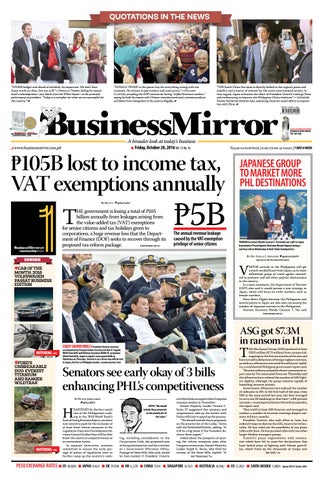
“Under budget and ahead of schedule. So important. We don’t hear those words so often, but you will.”—Donald Trump, linking his newest hotel’s redevelopment—just blocks from the White House—to his promised performance as president. “Today is a metaphor for what we can accomplish for this country.” AP
media partner of the year
United nations
2015 environmental Media Award leadership award 2008
“Donald Trump is the poster boy for everything wrong with our economy. He refuses to pay workers and contractors.”—Hillary Clinton, attacking the GOP nominee for having “stiffed American workers,” saying he built his empire with Chinese-manufactured steel, overseas products and labor from immigrants in the country illegally. AP
“The South China Sea issue is directly linked to the region’s peace and stability and a matter of interest for the entire international society. In that regard, Japan welcomes the effort of President Duterte visiting China and endeavoring to improve the Philippine-China relations.”—Japanese Prime Minister Shinzo Abe, welcoming Duterte’s recent efforts to improve ties with China. AP
BusinessMirror A broader look at today’s business
www.businessmirror.com.ph
n
Friday, October 28, 2016 Vol. 12 No. 16
₧105B lost to income tax, VAT exemptions annually T ₧5B By Rea Cu
2016 ejap journalism awards
business news source of the year
P25.00 nationwide | 6 sections 32 pages | 7 days a week
JAPANESE GROUP TO MARKET MORE PHL DESTINATIONS
@ReaCuBM
he government is losing a total of P105 billion annually from leakages arising from the value-added tax (VAT) exemptions for senior citizens and tax holidays given to corporations, a huge revenue loss that the Department of Finance (DOF) seeks to recover through its proposed tax-reform package. Continued on A2
The annual revenue leakage caused by the VAT-exemption privilege of senior citizens
Tourism Secretary Wanda Corazon T. Teo hands out a gift to Japan Association of Travel Agents Chairman Hiromi Tagawa during a courtesy call on Wednesday at their Tokyo headquarters. By Ma. Stella F. Arnaldo
inside
V
@akosistellaBM Special to the BusinessMirror
ISITOR arrivals in the Philippines will get a much-needed boost from Japan, as its most influential group of travel agents committed to promote and sell other popular destinations in the country. In a news statement, the Department of Tourism (DOT) also said it would pursue a new strategy in Japan, which will focus on niche markets, such as female travelers. More direct flights between the Philippines and several points in Japan are also seen increasing the number of Japanese tourists in the Philippines. Tourism Secretary Wanda Corazon T. Teo said
car of the month: 2016 Volkswagen Passat Business Edition
Continued on A2
motoring
e1
Ford’s unbreakable duo: Everest Titanium and Ranger Wildtrak
ASG got $7.3M in ransom in H1
coast guard drills President Duterte (center), accompanied by Transportation Secretary Arthur P. Tugade (fifth from left) and Defense Secretary Delfin N. Lorenzana (third from left), inspects Japan’s coast guard drills in Yokohama on Thursday. Duterte is on a three-day official visit to Japan, his first as Philippine leader. Kazuhiro Nogi/Pool Photo
Senators see early okay of 3 bills enhancing PHL’s competitiveness By Butch Fernandez
H
motoring
e3
@butchfBM
eartened by the four-notch rise of the Philippines’s ranking in the 2016 World Bank’s Ease of Doing Business Report, senators now intend to push for the inclusion of at least three reform measures in the Legislative-Executive Development Advisory Council (Ledac) that will further boost the country’s competitiveness as an investment haven. In separate interviews, senators committed to ensure the early passage of pieces of legislation seen to further ramp up the country’s rank-
PESO exchange rates n US 48.3020
SOTTO: “We should include those proposals on the priority list of the Ledac.”
ing, including amendments to the Corporation Code, the proposed ease of doing business law and the creation of a Government Efficiency Office. Passage of these bills, they said, would be fast-tracked if President Duterte
certifies them as urgent when Congress resumes session in November. Senate Majority Leader Vicente C. Sotto III suggested that senators and congressmen take up the matter with Palace officials to speed up the process. “We should include those proposals on the priority list of the Ledac,” Sotto told the BusinessMirror, adding: “It will be a big boost if the President declares them urgent.” Asked about the prospects of passing the reform measures soon after Congress reconvenes, Senate Minority Leader Ralph G. Recto, who filed his version of the three bills, replied: “It
T
he Abu Sayyaf Group (ASG) pocketed at least P353 million ($7.3 million) from ransom kidnappings in the first six months of the year and have turned to abductions of foreign tugboat crewmen, as military offensives restricted the militants’ mobility, a confidential Philippine government report said. The joint military and police threat-assessment report seen by The Associated Press on Thursday said the offensives have reduced the number of ASG fighters slightly, although the group remains capable of launching terrorist attacks. Government offensives have reduced the number of militants to 481 in the first half of the year, from 506 in the same period last year, but they managed to carry out 32 bombings in that time—a 68-percent increase—in attempts to distract the military assaults, the report said. They wield at least 438 firearms and managed to conduct a number of terrorist trainings despite constant military assaults. President Duterte, who took office in June, has ordered troops to destroy the ASG, known for its brutality. He has ruled out the possibility of any peace talks with them. He has pursued talks with two other larger Muslim insurgent groups. Duterte’s peace negotiations with communist rebels have led to cease-fire declarations that have halted years of fighting with Maoist guerrillas, which freed up the thousands of troops now See “ASG,” A2
See “Senators,” A2
n japan 0.4624 n UK 59.1748 n HK 6.2270 n CHINA 7.1341 n singapore 34.7321 n australia 36.9462 n EU 52.7023 n SAUDI arabia 12.8829
Source: BSP (27 October 2016 )
News BusinessMirror
A2 Friday, October 28, 2016
www.businessmirror.com.ph
₧105B lost to income tax, VAT exemptions annually Continued from A1
At the International Tax Forum on Thursday held at the Manila Peninsula Hotel in Makati Cit y, Finance Undersecretar y Antonette C. Tionko said among the primary goals of the department’s proposed comprehensive tax-reform program is to plug the said leakages and correct inequitable fiscal incentives by making the current tax system simpler, fairer and more efficient. An estimated P5 billion is lost annually from senior citizens’ VAT-exemption privilege, while an average of P100 billion is lost from from the tax holidays given to corporations annually. The DOF-proposed tax-reform package aims to correct the anomaly of the Philippines imposing one of the highest tax rates in Asia, yet having among the lowest revenue collections. She said the government plans to increase revenues by correcting these inefficiencies and inequities in the system and by expanding the narrow tax base, in which collec-
tions from the Bureau of Internal Revenue’s (BIR) 2,300 largest taxpayers comprise already half of the country’s entire revenue base. “We submit that tax-policy reform is needed to achieve a simpler, fairer and more efficient tax system characterized by low rates and a broad base. This diverges from the inequitable, complex and inefficient system that we are currently faced with. And, you know, this results into having some of the highest tax rates in Asia, here in the Philippines, and lower collections,” said Tionko, who heads the DOF’s Revenue Operations Group. The annual tax forum aims to gain insights from economists and finance experts on relevant issues on tax policy and administration, focusing on policy tools to enhance economic development. The forum serves as an opportunity to discuss and share best practices on prevailing tax policies and administrative issues in the context of reducing inequality and ensuring inclusive growth. Tionko explained that, besides
raising enough revenues to bankroll programs to ensure inclusive growth, the Duterte administration also plans to utilize the additional funds collected to expand subsidies and targeted programs for the poor, explaining that the subsidies will help cushion the marginal sector from the impacts of the tax-rate adjustments that the DOF is proposing as part of its comprehensive tax-reform plan. “No less than the World Bank’s chief economist for poverty reduction, Rogier Van Den Brink, said at the last business forum here in Manila that the country’s cash-transfer program, currently considered the biggest in the world, has been able to support income growth in the lowest income brackets at a pace much faster than higher income groups. And if this trend is sustained, the GDP growth of 6 percent per year would be enough to double per-capita income within a decade, five times in two decades, and by 11 times in three decades,” she added. However, she pointed out that Van Den Brink’s assumptions did
not take into account the Duterte administration’s plan to increase the amount for conditional cash transfers (CCTs) and incorporate training and livelihood programs for beneficiaries as part of the first package of tax reforms it has submitted in September to Congress for approval. According to the DOF, among the offsetting measures proposed by the first tax-reform package is the expansion of the VAT base by trimming the numerous exemptions in the system that have been subject to abuse. “For instance, we estimate that we lose about P5 billion on leakages from the exemptions granted to senior citizens,” Tionko said. The leakage-prone VAT system should be reconfigured and, instead, social-protection coverages should be put in place in the form of CCTs. “We’re thinking that it would be more prudent to increase the coverage of social protection, perhaps, through targeted cash transfers or higher pensions,” Tionko said. Tionko also pointed out that
the DOF is studying how it can improve the current system of corporate taxation, “where foregone revenues are estimated at almost P50 billion per year on income-tax holidays, and another P50 billion in the special rate regime among large firms.” She explained that the tax leakages stem from a fiscal-incentive system that is not time-bound, which leads to “severe inequity.” “For example, manufacturing companies in the special zones pay just one-third of what companies outside the zones pay. Special manufacturing firms pay P8 per P1,000 of revenues, while regular manufacturing firms pay P23 per P1,000 of revenues. The same trend is also seen in the services sector. At a standard cost of P25 million per kilometer for a twolane road, that P100 billion translates to about 4,000 kilometers of new roads every year,” she said. Tionko noted that attaining the Duterte administration’s goal of raising the average incomes for many Filipinos, with the end-goal of transforming the Philippines
JAPANESE GROUP TO MARKET MORE PHL DESTINATIONS Continued from A1
Hiromi Tagawa, c ha ir man of t he 532-member Japan Association of Travel Agents (Jata), personally conveyed his group’s expression of support in marketing more Philippine destinations. The Jata was responsible for boosting visitor arrivals in Cebu, a favorite destination among Japanese travelers. “I came here today hoping to invite your esteemed members to help us get a bigger share of the Japanese market,” she told Tagawa in their meeting on Wednesday. “With your reputation as the oldest and biggest travel association in Japan, you could easily encourage more Japanese tourists to come see the Philippines again.” She pointed to other “new and emerging destinations”, like Laoag in Ilocos Norte, Siargao in Surigao del Norte, Iloilo, Palawan, Clark in Pampanga and Davao, that Jata members could consider selling to its members’ clients.
She added that the DOT is pursuing a more aggressive Philippine tourism campaign in the Japanese travel market, as it eyes new targets and niche segments, such as the Joshi tabi or Japanese female travelers, among others. “We hope Japan would rise to become our top source market of tourists from its current spot as the fourth-largest outbound travel. The Philippines has so much more to offer than just our beautiful beaches, as we are also a destination for MICE [meetings, incentives, coventions and exhibitions], diving and ecotourism, shopping, gastronomy, sports and adventure tourism,” Teo said. Japanese female travelers are usually aged between 20 and 50 years old, and spend their hard-earned income by immersing in a destination’s culture and history, and are attracted to luxurious pampering activities. Research by the Japan Tourism Marketing Co. indicated that 60 percent of
Japanese women often go on holidays after discussions with friends and relatives, as well as travel agencies. But they usually make their own travel decisions, and may travel with their spouses, children, or office colleagues. Tagawa said he would meet with the group’s members “right away” to discuss plans to promote other Philippine destinations. Citing the availability of direct flights from Fukuoka, Osaka, Nagoya, and Tokyo, the DOT chief expressed confidence that the Philippines’s ranking as a choice destination among Japanese tourists would rise. As of 2010, the Philippines ranks 17th and 10th among favored destinations by Japanese tourists. Data from the JTB Tourism and Consulting Co. showed the most popular destinations for travel by the Japanese are South Korea, Taiwan, Hawaii, Hong Kong, Guam and Vietnam. From January to August 2016, there were some 11.2 mil-
lion Japanese outbound travelers. Teo arrived in Tokyo on Tuesday as part of the official Philippine delegations led by President Duterte on his threeday working visit in Japan. Last year visitor arrivals from Japan rose by 6.9 percent to 495,662, and accounted for 9.25-percent share of the 5.36 million total arrivals that year. This was slightly lower than its 9.6-percent market share in the 4.83-million total arrivals in 2014. The DOT said 38 percent of Japanese tourists in the Philippines come to try the country’s food and beverage, while 24 percent of them go shopping, and 19 percent go for recreation. The same data also show that 56 percent of Japanese visitors are in the Philippines for vacations and holidays, while 14 percent are for business purposes. The DOT pointed out that 83.80 percent of Japanese visitors travel alone, staying a maximum of four hotel nights.
into a high middle-income country by 2022, is premised on achieving sustainable economic growth that requires consistent job creation. “Gearing fiscal policy toward inclusive growth is doable, and the administration is doing its part to achieve its goal. Of course, we are aware that there will be obstacles and roadblocks ahead, but rest assured we will continue to champion improvements in our tax-reform and tax-administration agenda in order to better serve our countrymen,” she added. Based on the DOF’s tax-policy presentation, the government’s tax-reform goal for 2019 is to raise P600 billion in revenues, or 3 percent of GDP, to help fund the programs of the Duterte administration. It is expected that P400 billion in revenues will be coming from the implemented tax-policy reforms, while P200 billion will be from the proper implementation of tax-administration reforms. The BIR and the Bureau of Customs are the primary agencies that will implement revenuegenerating programs.
Senators. . .
Continued from A1
will have better chances of passing if the President prioritizes them.” According to Senate President Aquilino L. Pimentel III, he expects the proposed Corporation Code bill “will soon move” when lawmakers return to work after the All Saints’ Day recess. Pimentel told the BusinessMirror he will “research” to check the status of the two other reform bills on ease of doing business and government efficiency. Sen. Juan Edgardo M. Angara, Ways and Means Committee chairman, also suggested enlisting Palace action to fast-track approval of the pending bills likely to jack up the Philippines’s current World Bank ranking of countries on ease of doing business. “A presidential certification always speeds up the passage of bills, because it dispenses with the three-day rule between approval on second and third readings,” Angara added. It was earlier reported that the Philippines jumped four rungs, to 99th from 103rd, in the 2016 ranking of 190 countries in the World Bank business report released on Wednesday by the World Bank and the International Finance Corp.
ASG. . .
Continued from A1
redeployed to wage one of the largest offensives ever fought against the Abu Sayyaf in southern Sulu and Basilan provinces. “The ASG shifted in targeting vulnerable foreign-flagged tugboats and their crew due to the focused military operations against the group,” the report said, adding the group was expected to intensify its kidnap-for-ransom (KFR) assaults in the busy waterways around the southern Philippines, Malaysia and Indonesia. Abu Sayyaf’s attacks on tugboats this year and the kidnappings of their Malaysian and Indonesian crewmen have raised security alarms from those countries, whose officials have tried to map out a strategy to protect commercial and passenger ships. “Lucrative payoffs from KFR, the report said, “enabled the ASG to procure firearms, as well as ammunitions.” Of the estimated P353 million in ransom received by the Abu Sayyaf from January to June, the bulk was paid in exchange for the releases of 14 Indonesian and four Malaysian crewmen who had been held at Abu Sayyaf jungle bases in Sulu province, the report said. The militants got P20 million ($413,000) in ransom for freeing Marites Flor, a Filipino woman who was kidnapped last year with two Canadians and a Norwegian from a yachtberthing resort on southern Samal island. Philippine officials have said they were unaware of any ransom paid for Flor or other hostages and added they continue to adopt a no-ransom policy. The militants beheaded the two Canadians after ransom deadlines lapsed. Canadian Prime Minister Justin Trudeau urged governments not to pay ransom to encourage similar abductions. The Norwegian hostage, Kjartan Sekkingstad, was freed last month after a year of horrific jungle captivity when he was constantly threatened with beheading. AP
news@businessmirror.com.ph
BMReports BusinessMirror
Friday, October 28, 2016 A3
PHL misses UN’s poverty-reduction goal By Cai U. Ordinario @cuo_bm
D
espite the huge resources poured by the government into social programs, the Philippines failed to halve poverty by 2015, which it has committed to achieve under the United Nations’ (UN) Millennium Development Goals (MDGs).
21.6%
The poverty incidence of the Philippines in 2015 Data released by the Philippine Statistics Authority (PSA) on Thursday showed that the country’s poverty incidence in 2015 in terms of population declined to only 21.6 percent, translating to 21.93 million poor Filipinos. However, the country met the MDG target on reducing extreme poverty by half in 2015, as the rate fell to 8.1 percent, which translates to 8.23 million extremely poor Filipinos. “The subsistence incidence, which measures extreme poverty, was reduced by more than half as of 2015, attaining the target of halving extreme poverty under the first MDG,” National Economic and Development Authority (Neda) Deputy Director General Rosemarie G. Edillon said in a speech. In order to meet the MDG 1 on halving poverty, the country needed to reduce the country’s poverty rate by half from the 1991 baseline of 33.1 percent to 16.55 percent in 2015. In terms of extreme poverty or subsistence poverty, the country must reduce its 1991 extreme poverty rate of 17.6 percent to 8.8 percent by 2015. However, the Neda noted that the country’s poverty incidence per population declined by 3.6 percentage points between 2012 and 2015, higher than the 1.1-percentagepoints decline between 2009 and 2012. “One of the major factors in this improvement of poverty reduction is the increased budget in the government’s social-development programs, which significantly augmented the income of the poorest households,” the Neda said. “The regularity of the cash transfer sustained for three years for many CCT [Conditional Cash Transfer] beneficiaries has accorded them some resiliency to weather certain shocks,” it added. While all these efforts are well and good, the key is sustainability. Eagle Watch Senior Fellow Alvin Ang said that, while the CCT helped, recent improvements in the employment situation may have helped improve the country’s poverty data. Ang said if the government will continue these efforts, particularly those that address the country’s pervasive underemployment rate, which stood at 17.3 percent in July 2016, poverty incidence could be reduced further. T he Ned a a g reed a nd s a id it w i l l cont i nue to “leverage” on employment as a tool to sustain efforts to reduce poverty nationwide. These efforts entail improving the business climate and investments in human capital that will allow more Filipinos to have the skills needed in the workplace. “Maintaining rapid economic growth that increases incomes of the poorest sector is a crucial factor in sustaining this momentum of reducing poverty. Strategies to improve the business climate, boost competitiveness of the productive sectors and improve access to financing are definitely important,” the Neda said. University of Asia and the Pacific School of Economics Dean Cid Terosa said the government must also focus on economic growth and income-redistribution policies. Terosa added that government support for education and health must also be prioritized alongside sustaining investments in labor-intensive industries, such as tourism, construction, trade and related services. In terms of the CCT, Terosa said these cash grants must still be continued within a definite time period. Giving indefinite cash grants will also not be good for the economy and efforts to reduce poverty. “[T he gover n ment mu st a l so] reduce t he i nd irect tax burden of the poor [and] protect the value of the income of the poor by mitigating inflationary pressures,” he added.
Zero extreme poverty
Edillon also told reporters on the sidelines of a news briefing on Thursday that the country is now in a better position to eradicate poverty by 2040 or earlier. Because the country is working on a lower baseline, she said there is a “greater chance” of reducing overall poverty incidence by 1.25 percentage points annually. This means that, from the 21.6-percent poverty rate per population, the Philippines could reduce this
rate to around 13 percent to 15 percent by 2022 or by the time President Duterte steps down from office. “This will be driven by rural and regional development, while addressing the capacity constraints in the other sectors,” Edillon said. “There is still so much work to be done but we have already begun to lay a strong foundation for the kind of development we want for Filipino families.” Eradicating extreme poverty is one of the targets set under Goal 1 of the Sustainable Develop-
ment Goals (SDGs) by 2030. Based on the target, countries must eradicate extreme poverty for all people everywhere, currently measured as people living on less than $1.25 a day. The SDGs, or Global Goals, is a set of 17 socioeconomic goals that 193 UN member-countries, like the Philippines, committed to meet by 2030. The goals are composed of around 169 targets and over 300 global indicators. The SDGs were adopted in September 2015.
BMReports BusinessMirror
A4 Friday, October 28, 2016
news.businessmirror@gmail.com
IT-BPM sector to employ 1.8 million Filipinos, earn $38.9 billion by 2022
T
By Catherine N. Pillas
@c_pillas29
he country’s Information technology-business process management (IT-BPM) sector is expected to rake in $38.9 billion in revenues and employ 1.8 million Filipinos by 2022, according to the latest IT-BPM road map. The IT and Business Process Association of the Philippines (Ibpap) disclosed the revenue potential and employment contribution of the booming IT-BPM industry in the next six years during the launch of the industry blueprint on Thursday. The targets were based on the projected $22 billion in revenues and 1.15 million workers that will be hired by the industry this year. These figures are lower than the $25-billion revenue and 1.3 million jobs expected for 2016 under the previous road map. “The $39-billion revenue assumption would also mean the country would increase its share of the global IT-BPM sourceable work from the prevailing 12.6 percent to 15.5 percent by 2022,” Ibpap Chairman Dan Sebastian Reyes said. With an employment target of 1.8 million by 2022, this means that one in every seven new jobs will be in the IT-BPM sector. The road map, likewise, envi-
sions the industry to move up the value chain, targeting 73 percent of 1.15 million workers in the ITBPM sector to be in the middleto high-skilled jobs in the next six years. The industry’s compounded annual growth rate from 2016 to 2022 is expected to decline to 9.2 percent from 17 percent, but this is only due to the so-called base effect. “Growth may have slowed, but this is because our base is getting bigger,” said Nitin Bhat, senior vice president for Frost and Sullivan— the knowledge partner of Ibpap in crafting the road map. Reyes noted that the contact center and business-processing outsourcing subsector will continue to drive revenue growth by 2022 and will contribute $20.4 billion of the total $38.9 billion. This will be followed by global in-house centers with a $7.6-billion revenue haul by 2022; information technology and outsourcing, $ 5.7 billion; and health-infor-
mation management, $5 billion. The remainder will come from the nascent animation and game development sector. Bhat said global growth will also be tempered, with the growth rate seen at 6 percent in the next six years. The global IT-BPM is expected to grow to $249 billion by 2022. IBPAP identified six crosscutting areas, where specific programs can be made to reach the revenue and employment goal: technology, human capital development, inclusive growth, country competitiveness, government support, and small and medium enterprises and start-ups.
$22B The projected revenue of the Philippine IT-BPM this year
‘Ignore political noise’
Department of Information and Communication Technology (DICT) Secretary Rodolfo A. Salalima assured the Philippine business-process outsourcing (BPO) sector which heavily relies on the US market, that the government
remains supportive and committed to its growth. Salalima enjoined Ibpap, the representative business group of the $22-billion IT-BPM sector to “cut through the political noise.” “The Philippine government thru the DICT will continue with what has been started with regards to the BPO industry. Forget the political noise,” he told various BPO leaders and executives. “Please do not chastise our country. Please do not chastise our President, who is the representative of our country, in public. If you have concerns with the government, go through the diplomatic means. Do not prejudge
our President,” Salalima added. He told businessmen that President Duterte’s comments to “separate” from the United States economically and militarily, as well as his pronouncement that foreign businesses not happy with him can “pack up their bags” was just an assertion of Philippine sovereignty. “Freedom from external control, a component of being a state, means external sovereignty. Thus, our President is correct when he stated that we are separating from the US, when in truth, in fact and in law, the Philippines is different and distinct from the US,” Salalima said. “Consistent with the commitment of President Duterte to the BPO sector, the DICT shall continue to fulfill its duties and maintain our strong collaboration with our BPOs,” he added. The DICT issued this reaffirmation amid Duterte’s continuing anti-US rhetoric. Duterte’s distaste for Washington’s perceived meddling in Philippine affairs reached its apex during his state visit to China last week, when he announced his “separation” from the US. In light of the comments, the IBPAP released a statement last week seeking clarification from Malacañang on the pronouncements. Reyes said they are set to hold a dialogue with Duterte. The IT-BPM sector, this year is set to contribute $22 billion in export receipts to the economy. US-based clients account for 70 percent of export earnings.
PHL asks Japan to scrap tariffs on banana imports
T
he Philippines has requested Japan to cut or eliminate together the tariffs on banana imports, the Department of Trade and Industry (DTI) said on Thursday. Trade Secretary Ramon M. Lopez said the government has formally asked Tokyo to scrap the tariffs on bananas Japan imports from the Philippines. “We supply about 86 percent of Japan’s imports of bananas,” Lopez said in his text message to reporters. The DTI chief noted that Japan slaps a seasonal tariff of 2 percent on bananas imported from the Philippines from April to September and 18 percent starting in October. Further tariff elimination on agricultural products forms part of the two countries’ discussion on the Philippines-Japan Economic Partnership Agreement (Pjepa). Trade Undersecretary Ceferino Rodolfo said in a previous interview the Philippine government is seeking more
2 percent The tariff rate imposed by Japan on Philippine bananas from April to September
concessions for local marine produts and fruits. The Philippines also wants to expand the export-volume quotas prescribed for agricultural products under Pjepa. Data from Philippine Statistics Authority (PSA) showed that Philippine banana exports to Japan in January to June reached 174,525 metric tons, valued at $99.3 million. PSA data also showed that banana exports in 2015 reached 1.795 million metric tons, valued at $658 million. Japan is the top buyer of Philippine Cavendish bananas. Catherine N. Pillas
Twitter cuts 9 percent of its global work force
N
E W Y O R K— Twitter, seemingly unable to find a buyer and losing money, is cutting about 9 percent of its employees worldwide. Twitter Inc., which has struggled amid competition from the likes of Facebook, Snapchat and Instagram, said Thursday that it expects to book about $10 million to $20 million in workforce restructuring charges.
Since the end of 2014, Twitter has picked up just 15 million monthly users to expand its audience to 313 million people through June. During the same stretch, Facebook gained 319 million users to reach 1.7 billion people. Twitter is placing a big bet on live video, and wants to be the goto place to share opinions in real time. According to the company, it has about 3,860 workers. AP
AseanFriday BusinessMirror
news@businessmirror.com.ph
Stresses for Singaporean energy firms deepening
S
tresses among Singapore’s oil-and-gas companies are deepening, the head of Southeast Asia’s second-largest lender said, signaling that more firms grappling with the slump in energy prices may face difficulties repaying their debts. “I don’t think the oil-and-gas sector is in a situation where it is in a recovery mode yet, and continues to be under stress,” Oversea-Chinese Banking Corp. (OCBC) CEO Samuel Tsien told reporters at a briefing on Thursday. “I think the fourth quarter of this year will continue to be a difficult quarter for this sector.” OCBC had earlier reported a 10- percent jump in provisions for soured assets for the third quarter, taking some of the gloss off the better-than-estimated profit the lender announced for the period. Its nonperforming assets surged 34 percent to S$2.59 billion ($1.9 billion) by September from a year earlier, driven by loans to oil-and-gas services firms that had soured, the bank said in a statement. More Singaporean companies tied to that industry are facing difficulties repaying debt as demand for their services falls amid lower exploration activity. Swissco Holdings Ltd., which supplies rigs and support vessels to oil-and-gas explorers, signaled last week that it may face default, due to its failure to pay interest due earlier this month. Companies, including KS Energy Ltd. and AusGroup Ltd., have sought more lenient repayment conditions from their debt holders. OCBC’s allowances for impaired assets rose 10 percent to S$166 million in the third quarter. Oil and gas represented a third of the bank’s socalled specific allowances of S$99 million, Chief Financial Officer Darren Tan told reporters. Charges for soured oil-and-gas loans also dragged on OCBC’s earnings in the second quarter, when it reported a 15-percent profit decline. Tsien did provide one positive signal for the industry: since the third quarter of last year, the bank hadn’t seen any new companies emerging as “distressed names,” he said. “The problem in the oil-andgas sector for our portfolio has not broadened but has deepened, with those companies that are under stress continuing to be under stress,” Tsien said. The travails in the energy industry and a weak regional economy made it “difficult” to call a peak for nonperforming assets, Tsien said, adding that the bank will need to monitor the situation for another quarter. OCBC was the first of Singapore’s three large banks to report quarterly profit. United Overseas Bank Ltd. is due to post its results on Friday, while earnings from DBS Group Holdings Ltd., Southeast Asia’s largest lender, are scheduled for October 31. Bloomberg News
Editor: Max V. de Leon • Friday, October 28, 2016 A5
Indonesia government bonds eclipse Malaysia’s on central-bank tailwind
as global risk sentiment waned amid signs the Federal Reserve is moving closer to raising interest rates. Foreign ownership of Indonesian sovereign debt has dropped to 673 trillion rupiah from the peak of 686 trillion rupiah earlier this month.
‘More cautious’
“Investors are not so much turning bearish on Indonesian debt, but are, instead, turning more cautious on risk assets, given the upcoming global backdrop,” said Leong LinJing, a Singapore-based investment manager at Aberdeen Asset Management Plc., which oversees about $400 billion globally. “We are still relatively positive on Indonesian bonds versus other lower yielding, more US Treasury-like markets, such as Hong Kong and Singapore.” Indonesian exports have fallen in all except one of the past 24 months, amid weakness in the nation’s key commodity shipments. Inflation slowed to 3.07 percent in September, from as much as 8.4 percent at the end of 2014, allowing for stimulus to bolster an economy slowing in each of the past five years.
1MDB scandal
I
INDONESIA bonds on the uptrend. BLOOMBER PHOTO
ndonesia’s bonds have returned three times as much as Malaysia’s this year, as policy-makers in Southeast Asia’s biggest economy embark on the longest easing cycle since the global financial crisis.
Government securities in Indonesia returned 18.2 percent in 2016, while Malaysia’s rose 5.8 percent, less than the regional average. Rupiah sovereign debt has drawn more than $8 billion of inflows, versus $4.8 billion for ringgit bonds. Aberdeen Asset Management Plc. says it is still positive on Indonesian debt, while Pioneer Investment Management Ltd. says Malaysia sentiment has been hurt by probes
into a state investment arm. The two Southeast Asian nations are commodity exporters with economies highly correlated to raw material prices. Yet, Indonesia’s central bank has been able to cut interest rates six times, as its Malaysian counterpart has acted just once. “Indonesian government bonds have just a bit more tailwinds going for them,” said Eugene Leow, a
Vietnam authorities seize 1 ton of ivory smuggled from Kenya
H
ANOI, Vietnam—Vietnamese authorities have seized 1 ton of ivory smuggled from Kenya, the fifth such seizure in the past month. The ivory was hidden in timber in two containers on the way to Cambodia via Vietnam. Customs official Le Dinh Loi says the shipment was seized on Wednesday at Cat Lai port in the southern commercial hub of Ho Chi Minh City.
Earlier this month, authorities seized 3.5 tons of ivory in three shipments illegally imported from Africa at the same port. State media say 1 ton of ivory costs $1.8 million on the black market. In Hanoi 682 pounds (309 kilograms) of ivory was seized on October 1. Elephant ivory is used as jewelry and home decorations in Vietnam, which bans hunting of its own dwindling population of elephants. AP
fixed-income strategist at DBS Group Holdings Ltd. in Singapore. “With growth still lackluster by Indonesia’s standards, there is considerable support for bonds. Malaysia’s absolute yields are not as high and Bank Negara Malaysia has not shown the same kind of enthusiasm for lower policy rates.” The yield on Indonesia’s 10-year bonds has fallen 168 basis points this year to 7.07 percent, as the central bank has lowered its benchmark interest rate six times and said more easing was possible. That’s the longest run of reductions since the central bank delivered nine straight rate cuts from December 2008 to August 2009.
Piling in
Global funds have also piled into Indonesian debt amid a positive perception of President Joko Widodo’s
reforms. Widodo, elected in 2014, has introduced measures making it easier to do business and a tax amnesty, which the government estimates will bring in as much as 165 trillion rupiah ($12.7 billion) in revenue. The rupiah has appreciated 6 percent this year even with the 150 basis points of rate cuts. “With the rupiah remaining stable and volatility falling, fund inflows to Indonesia bonds are likely to continue,” said Takahide Irimura, an economist at Mitsubishi UFJ Kokusai Asset Management Co., which oversees about $120 billion. “Better-than-expected revenue from the tax-amnesty program can also prevent the nation from increasing bond issuance.” Indonesia’s 10-year bond yield dropped to 6.77 percent in August, the lowest level since 2013, before climbing back to their current level
While Malaysia’s central bank is also easing amid a crude-oil slump, it said the case for another rate cut depends on economic data. Global funds trimmed holdings of the nation’s bonds for the first time in a year in September and the 10-year yield climbed this month to the highest since August. Demand for ringgit bonds has also been hurt by the scandal over 1Malaysia Development Bhd. (1MDB), a state fund at the center of investigations in at least 10 countries. Both 1MDB and Prime Minister Najib Razak have denied any wrongdoing. “Investor perception for Indonesia is far better than Malaysia,” said Hakan Aksoy, London-based portfolio manager of emerging markets at Pioneer Investment Management, which oversees about $250 billion. “In this yield hunt, Indonesia was one of the best performers. We still have our positive standing.” Bloomberg News
Yangon group hopes to preserve heritage of Myanmar’s biggest city
IN this October 1 photo, cars are driven past an old colonial building in Yangon, Myanmar. The Yangon Heritage Trust says Myanmar’s largest city and commercial capital is facing its “last best chance” to salvage and restore many crumbling colonial treasures. They recently proposed a “heritage strategy” for the city that outlines a vision of how to make the city more livable, modern and still affordable as property developers crowd in, while preserving its unique landmarks and neglected green spaces. AP
Y
SINGAPORE oil-and-gas firms are on a slump. BLOOMBERG PHOTO
ANGON, Myanmar—A Yangon historic-preservation group says Myanmar’s largest city and commercial capital is facing its “last best chance” to save many crumbling architectural treasures dating back to the days when Myanmar was the British colony of Burma. The Yangon Heritage Trust recently proposed a heritage strategy for Yangon, outlining a vision for making the Southeast Asian city
more livable, modern and affordable while preserving its unique landmarks and neglected green spaces. Yangon, the former capital, has been razing old buildings, as it widens roads and builds flyovers to help ease massive traffic congestion. Property developers are rushing in. A few of the many colonial structures in the downtown area have been restored to their past glory, but most are crumbling, paint blackened or peeling, turrets topped with
emerald tufts of grass and bushes. Others are moldering away behind walls, engulfed by jungle. “The city is at a tipping point and, without action, Yangon may become another of the region’s urban disaster zones,” the Yangon Heritage Trust said in its report, alluding to cities, like Singapore, that have lost most of their beautiful older buildings. It argues that making the city more livable is crucial to its future competitiveness. AP
A6
Business
Friday, October 28, 2016 | www.businessmirror.com.ph
First inthe Philippines
U.S. Green Building Council awards LEED Gold certification to Arya Residences
A
rya Residences is now Gold certified under the United States Green Building Council’s Leadership in Energy and Environmental Design (LEED) program. This is the first and only topend residential development in the Philippines to receive a certification from the globally recognized greenbuilding rating system. A LEED certification is a guarantee that the building achieves high performance in key areas of human and environmental health. LEED recognizes best-in-class strategies and practices in green building. To be certified, projects need to satisfy prerequisites and earn points based on intelligent selection of the property location, water and energy usage efficiency, responsible use of materials and resources, and indoor environmental quality.
World-class green
Designed by Australian firm, Crone Architects, together with the local architectural group Aidea Philippines, Arya Residences has unique features that allow it to reduce exposure to too much solar heat, encourage use
of natural ventilation, and minimize potable water wastage. The project has received rave reviews from both national and international award giving bodies. In 2013, it was recognized by the Philippines Property Awards as the Best Residential Development in the country. It has also received citations from the South East Asia Property Awards for its architectural design excellence. Another prestigious regional body, the Asia Pacific Property Awards identified Arya Residences as the Best Residential High Rise in the Philippines. Arya Residences is also the benchmark vertical residential development in the Philippine Green Building Council’s rating program, Building for Ecologically Responsive
Design Excellence (BERDE) Launched in 2010, Arya Residences is now a vibrant residential community, distinctively standing along McKinley Parkway in Bonifacio Global City. The first tower was turned over to owners in early 2014 while turnover of the second tower started in the first quarter of this year.
Green DNA
“Arya Residences is a template of ArthaLand’s developments,” Angie de Villa-Lacson, the developer’s president and chief executive shared. “It embodies the DNA of ArthaLand’s projects: world class, boutique, and sustainable. These three will always be at the core of all projects, in whatever business segment that we serve,” she adds.
ArthaLand Century PacificTower is the best green building in PHL ArthaLand acquires prime property in Laguna F rom the green developer of Arya Residences, ArthaLand Corporation, a landmark of true and calibrated sustainable development is now rising in full swing in Bonifacio Global City. This is the ArthaLand Century Pacific Tower, a triple A - grade office building at the corner of 5th Avenue and 30th Street. ArthaLand Century Pacific Tower is located at a prime block, just across Shangri-la at The Fort, the Central Square Mall, and near the future Philippine Stock Exchange building. It is designed to accommodate headquarters of multinational companies in the financial, FMCG, pharmaceutical, and technology sectors. The premium grade building is designed by SOM New York, the same group that penned the One World Trade Center and Burj Khalifa in Dubai. ArthaLand Century Pacific Building’s architectural design is inspired by the precious stone, jade. In this year’s Philippines’ Property Awards, ArthaLand Century Pacific Tower was recognized as the Best Green Building in the country.
Calibrated green
In all aspects, this project, that is designed to hold the headquarters of multinational companies, is fully green. It is on target to achieve dual green building certification from both the United States Green Building Council’s Leadership in Energy and Environmental Design (LEED) and the Philippine Green Building Council’s
Building for Ecologically Responsive Design Excellence (BERDE) programs. In fact, it already is pre-certified in Gold category of the USGBC LEED program.
ArthaLand Century Pacific Tower is located at a prime block, just across Shangri-la at The Fort, the Central Square Mall, and near the future Philippine Stock Exchange building.”
L
isted real estate developer ArthaLand Corporation recently disclosed that it acquired an 8.1 hectare prime property in Laguna for P307 million as part of its mediumterm expansion plan. The green developer is marching onward as it sees further potential coming from markets outside of Metro Manila. Its portfolio currently includes top-end developments in Bonifacio Global City, the Arya Residences and the Triple A office building, ArthaLand Century Pacific Tower, and the soon to be launched office development in VisMin, the Cebu Exchange. “We continue to move forward on a strategically managed pace,” Angie de Villa - Lacson shared. “This is to ensure that we remain faithful with our standards on quality and sustainability. We also carefully study the market to make sure that we bring in products that are aligned to the specific segment’s unique needs and preferences.” The property in Laguna is seen to complement the green developer’s
roster of projects that adhere to the green building principles set by the USGBC LEED and the PhilGBC BERDE certification programs. In an earlier interview, the ArthaLand president said that the company is in the planning phase for the Laguna project and plans to launch the development by the second half of 2017. ArthaLand Corporation rests on a solid backing under CPG Holdings, Inc. (CPGHI), its biggest shareholder. CPHGI is led by the Po Family of the Century Pacific Food Inc., the Philippines’ largest canned food company which owns market leader brands such as Century Tuna, 555, and Argentina, among others. ArthaLand’s other major shareholder is international investment firm, AO Capital Group.
8.1 hectare the property that ArthaLand has acquired for its medium-term expansion plan.
sMirror
www.businessmirror.com.ph | Friday, October 28, 2016
A7
Po family-led ArthaLand launchES Cebu Exchange
T
he Po family-led green developer, ArthaLand Corporation is set to launch its first project in the Visayas and Mindanao region, signaling the company’s continuous expansion. The 8-billion Grade-A office development is designed to address the IT and business process outsourcing industry’s growing demand for quality space.
The project will rise at the property that ArthaLand recently acquired along Salinas Drive, at the Cebu IT Park area. To be built on more than 8,000 square meter prime property, Cebu Exchange will be the largest and the tallest IT-BPM business ecosystem at the Cebu IT Park area. The 38-storey office building will house four floors
of complementary retail outlets and 30 large-cut flexible office floors. Appurtenant parking will be ample at 945 units. “With the continuing market optimism on Visayas and Mindanao, ArthaLand sees robust opportunities, especially in the information technology and business process management
sector. This is why we are aiming to launch Cebu Exchange very soon,” said Angie de Villa-Lacson, the company’s president and CEO.
Certified Green
Cebu Exchange will be VisMin’s first and only office development to be on target to achieve dual green building certification under the U.S. Green
Building Council’s LEED program and the Philippine Green Building Council’s BERDE certification programs. To ensure resource efficiency for the building’s locators, Cebu Exchange will feature green elements such as efficient building envelope, water efficient plumbing system, low-energy consuming air-conditioning system, efficient lighting system, use of lowemitting materials, and allocation
for Low-Emitting & Fuel Efficient Vehicle (LEFEV) parking. With its strategic location, the project is well connected to the rest of the community, thus requiring less use of motorized vehicles.
Business Boost
According to industry experts and property analysts, certified green buildings are preferred by multinational players as required by their home offices. “ArthaLand is
the only Philippine developer that puts sustainability at the core of all its projects. This is why we know that the expertise that we bring to Cebu and the rest of Visayas and Mindanao will further boost the region’s business viability,” de VillaLacson underscored. “Cebu Exchange will change VisMin’s real estate landscape. Cebu Exchange will be the Future of Business in the region,” she emphasized.
With the continuing market optimism on Visayas and Mindanao, ArthaLand sees robust opportunities, especially in the information technology and business process management sector.”
—De Villa-Lacson, arthaland president & ceo
A8 Friday, October 28, 2016 • Editor: Lyn Resurreccion
The World BusinessMirror
news@businessmirror.com.ph
Mass protest in Venezuela urges end of ‘dictatorship’
C
ARACAS, Venezuela—Antigovernment protesters jammed the streets of Venezuela’s capital on Wednesday on the heels of a decision by Congress to open a political trial against President Nicolas Maduro, whose allies have blocked moves for a recall election. Tens of thousands of demonstrators shut down Caracas’s main highway, and schools and shops were closed as protesters occupied other key points around the city to demand the ouster of Maduro, who many Venezuelans blame for tripledigit inflation and shortages of food, medicines and other basic goods. In other major cities protesters clashed with police in what opposition leaders were calling “the takeover of Venezuela.” “Maduro has shown how scared he is that the people will express themselves,” opposition leader Henrique Capriles said. The protests come after electoral authorities blocked a recall campaign against the deeply unpopular president last week. The face-off escalated on Tuesday, when the oppositionled legislature voted to put Maduro on trial, accusing him of effectively staging a coup. Opposition legislators argued that Venezuela’s leader has effectively abandoned the presidency by neglecting his job. Several also questioned whether he was a dual Colombian national and therefore ineligible to hold Venezuela’s highest office — an old, unproven claim.
Government supporters staged a much smaller rally attended by Maduro downtown. Late Wednesday, officials said that a police officer was shot and killed, and two others injured, on the Pan-American Highway southwest of Caracas. The circumstances of the shootings were unclear. Miguel Mederico, the chief of press for police in Miranda state, said the officer was “shot in the abdomen” and died in a nearby clinic. He said two other police officers were injured in the “attack” carried out by unidentified gunmen who opened fire from nearby businesses. He said that two suspects have been detained. But Venezuela Interior minister Nestor Reverol said the police officer died “trying to disperse” an opposition protest. Nationwide at least 140 people were detained by police, according to the Foro Penal human-rights group. O pposit ion leaders ended Wednesday’s national day of protest with call for a general strike on Friday. They also threatened to march on the presidential palace in the heart of the city on November 3 if the government doesn’t reverse its decision to block the recall effort.
People protest against Venezuela’s President Nicolas Maduro in Caracas, Venezuela, on October 26. The opposition protested on the heels of a move by Congress to open a political trial against Maduro, whose allies have blocked moves for a recall election. AP Photo/Ariana Cubillos
The opposition has not been allowed to protest in front of the presidential palace since a massive march there helped precipitate a short-lived coup against former President Hugo Chavez in 2002. Police fired tear gas and clashes with police in provincial capitals that left several wounded. In the border state of Tachira, the windows of the heavily-guarded regional electoral office were broken and antigovernment slogans spray-painted
on the entrance. In a video widely circulating on social media, a young man shouted in the face of soldier in riot gear maintaining a line against a crowd of masked protester. “I’m going hungry! If you’re going to shoot me because I’m hungry, shoot me,” the protester said. In Caracas students casually sat on the country’s main highway. One protester dressed as Lady Justice, with a scale and white blindfold. Victoria Rodriguez, 18, said
US abstains for the first time in UN vote on Cuba embargo
U
NITED NATIONS—The United States abstained for the first time in 25 years on Wednesday on a UN resolution condemning America’s economic embargo against Cuba, a measure it had always vehemently opposed. The US was joined in abstaining by Israel, the only other country to vote against the embargo resolution in the General Assembly last year. When the vote—191-0 with two abstentions— was shown on the electronic board, diplomats from the 193 UN member-states burst into applause. US Ambassador Samantha Power announced the abstention just before the vote saying that the US policy of isolation toward Cuba had “isolated the United States, including here at the United Nations.” “After 55-plus years of pursuing the path of isolation, we are choosing to take the path of engagement,” she said. The US decision to change its vote follows President Barack Obama’s restoration of full diplomatic relations with Cuba and his support for lifting the embargo, which the Republican-led Congress is against. Obama and Cuban President Raul Castro announced on December 17, 2014, that they were restoring diplomatic ties, which were broken in 1961 after Fidel Castro took power and installed a communist government. On July 20 last year, diplomatic relations were restored and embassies of the two countries were reopened, but serious issues remain, especially the US call for human rights on the Caribbean island and claims for expropriated property. The US abstention in the General Assembly vote was certain to anger both Republican and Democratic opponents of lifting the 55-year-old embargo, but it reflects Obama’s belief shortly before he leaves office that it’s time to move ahead in normalizing US-Cuban ties. Indeed, there were immediate protests in the US Congress. Democratic Sen. Robert Menendez from New Jersey, the son of Cuban immigrants, tweeted that the US decision not to defend the “long-standing, bipartisan,
human rights-based US law...is shameful.” Texas Republican Sen. Ted Cruz tweeted that the act that imposed sanctions on Cuba “isn’t a ‘failed policy’...[and] is the law of the United States, which should always be defended and upheld.” Cuba’s Foreign Minister Bruno Rodriguez, the last speaker before the vote, said Cuba is “grateful” for Power’s efforts and words and thanked her for the US abstention. “A change in vote by the United States is a promising signal,” he said. “We hope it will be reflected in reality.” Rodriguez said the embargo is still in force and being implemented by US agencies, and while the executive measures taken by Obama were positive, they have “very limited scope and effect.” "Lifting the blockade is the key to be able to advance towards the normalization of relations with the United States," he said. “The blockade is unjust, inhuman, immoral and illegal and should unilaterally and unconditionally cease.” General Assembly resolutions are nonbinding and unenforceable. But the 25-year-old exercise in which the world body has overwhelmingly voted to condemn the embargo does reflect world opinion and has given Cuba a global stage to demonstrate America’s isolation on its Cuba policy. Before the vote, more than 20 speakers from all over the world denounced the embargo and urged the US Congress to quickly lift the ban on trade and financial dealings. The US administration had considered abstaining in the vote last October, but concluded it could not do so because the resolution did not reflect what it considered to be the spirit of engagement between Obama and Cuban President Raul Castro. Power made clear that the United States “categorically” rejects statements in Wednesday’s resolution suggesting the embargo violated international law. She also said that abstaining “does not mean that the United States agrees with all of the policies and practices of the Cuban government.” AP
she hopes to cast her first vote for the campaign to recall Maduro. A recent high-school graduate, she said she feels like she’s living in an emptying country; 15 of her 25 classmates have already left since graduating in July. She said she is frustrated that opposition leaders haven’t called for more dramatic action, like sleeping on the highway overnight or attempting to paralyze the capital for days at a time.
“People are tired of going to the streets and then going home,” she said. “The opposition is letting the streets go cold. They are giving the government too much time to maneuver.” Congress was expected to take up the issue of Maduro’s responsibility for the country’s worsening political and economic crisis on Thursday. The result of that debate is unlikely to have much impact, however. AP
2 quakes rattle Italy, crumbling buildings and causing panic
R
OME—A pair of strong aftershocks shook central Italy late Wednesday, crumbling churches and buildings, knocking out power and sending panicked residents into the rain-drenched streets just two months after a powerful earthquake killed nearly 300 people. But hours after the temblors hit, there were no reports of serious injuries or signs of people trapped in rubble, said the head of Italy’s civil protection agency, Fabrizio Curcio. A handful of people were treated for slight injuries or anxiety at area hospitals in the most affected regions of Umbria and Le Marche, he said. A 73-year-old man died of a heart attack, possibly brought on by the quakes, local authorities told the ANSA news agency. “All told, the information so far is that it’s not as catastrophic” as it could have been, Curcio said. The temblors were actually aftershocks to the Aug. 24 quake that struck a broad swath of central Italy, demolishing buildings in three towns and their hamlets, seismologists said. Several towns this time around also suffered serious damage, with homes in the epicenter of Visso spilling out into the street. The first struck at 7:10 p.m. and carried a magnitude of 5.4. But the second one was eight times stronger at 6.1, according to the US Geological Survey. Because many residents had already left their homes with plans to spend the night in their cars or elsewhere, they weren’t home when the second aftershock hit two hours later, possibly saving lives, officials said. “It was an unheard-of violence. Many houses collapsed,” the mayor of hard-hit Ussita, Marco Rinaldi, told Sky TG24. “The facade of the church collapsed. By now I have felt many earthquakes. This is the strongest of my life. It was something terrible.” Rinaldi said two elderly people were rescued from their home, where they were trapped, and appeared to be in good condition. Some 200 people in Ussita were planning to sleep
in the streets, given the impossibility of putting up tents so late at night. Calling it “apocalyptic,” he said the town and its hamlets were “finished.” In addition to the town’s church, the parish and other buildings also had suffered heavy damage, he added. “The final count of damages will be done with the first lights of dawn,” Rinaldi told The Associated Press. “It was something. The valley is small, and the fault passes here.” A church crumbled in the ancient Perugian town of Norcia, famed for its Benedictine monastery and its cured meats. A bell-tower damaged on August 24 fell and crushed a building in Camerino, the ANSA news agency said. Elsewhere, buildings were damaged, though many were in zones that were declared off-limits after the August 24 quake that flattened parts of three towns. In nearby Visso, residents wrapped in blankets filled a Red Cross center, and that town’s mayor said getting people water and something warm to eat or drink was the priority. Authorities were setting up makeshift dorms at the center and at a nearby gym. “Tomorrow morning we’ll need to get them bathrooms and something to eat. That’s the next thing. Then, of course, we’ll have to start putting up tents,” Mayor Giuliano Pazzaglini said. Many of Visso’s residents were spending the night in their cars, as smaller aftershocks continued to rock the town through the night. “We’re without power, waiting for emergency crews,” said Mauro Falcucci, the mayor of Castelsantangelo sul Nera, about 7 kilometers (4.5 miles) southeast of the epicenter. Speaking to Sky TG24, he said: “We can’t see anything. It’s tough. Really tough.” He said some buildings had collapsed, but that there were no immediate reports of injuries in his community. He added that darkness and a downpour were impeding a full accounting. AP
news@businessmirror.com.ph
The World BusinessMirror
Canadian trade group cancels trip as time runs out for EU trade deal
B
RUSSELS—A Canadian delegation would not be heading off to Europe late Wednesday to sign a landmark free-trade deal with the European Union (EU) after Belgium failed to make decisive headway to lift a crucial veto of one of its regions. The statement from a spokesman for Canada’s International trade minister late Wednesday likely means an embarrassing cancellation of a special summit on Thursday. The move comes after Belgium’s recalcitrant Francophone leaders insisted they would need more time to study and approve the latest compromise texts following talks with the Belgian national government, which desperately wants to sign the transAtlantic deal. Alex Lawrence, the spokesman for the minister, said in the release that Canada is ready to sign the Canada-EU trade deal whenever Europe is ready. Canadian Prime Minister Justin Trudeau earlier told Parliament he’s prepared to wait longer. “We are confident that in the coming days we will see a positive outcome for this historic deal,” Trudeau told Parliament. The 28-nation EU can only sign the agreement if it has unanimity among its 28 memberstates and Belgium can only approve it if all its regional executives back it. But Wallonia leader Paul Magnette said late Wednesday his region would not be able to approve the deal in the coming hours, making it ever more unlikely the full signing ceremony with Trudeau could be held on Thursday. “We regret it but it won’t be possible to have the summit tomorrow, but nothing is impossible," he said,
leaving little space for approval. Earlier, he had said an EU-Canada summit would come “one day, but not tomorrow!” It showed that despite the likelihood of missing the Thursday deadline, the talks with Wallonia were heading toward a compromise, which would allow the signature at a later stage. Magnette said some details still need to be clarified, notably in the agriculture sector, where he wants his farmers better protected. If the regional leaders agree, the adjustments to assuage Wallonia would have to be vetted by the 27 other nations and then likely still have to go back to the regional francophone legislatures for approval. It makes the deadline for signature next to impossible. If not on Thursday, the summit could be postponed for later in the year, but the failure would be an embarrassment for the EU, the world’s biggest trading bloc which wants to project itself as a dependable global partner. Politicians in Wallonia, which has a population of 3.6 million compared to over 500 million for the whole EU, argue that the proposed accord would undermine labor, environment and consumer standards. Proponents say it would yield billions in added trade through customs and tariff cuts and other measures to lower barriers to commerce. At the same time, the EU says it will keep in place the region’s strong safeguards on social, environmental and labor issues. He said Wallonia’s insistence on a better deal would bolster EU standards and set a strong precedent for other trade talks between Europe and trading partners, like the United States or Japan. AP
IMF, US Treasury chiefs visit Gulf amid oil-price slowdown
D
UBAI, United Arab Emirates—The heads of the International Monetary Fund (IMF) and the US Treasury have visited the Gulf in recent days. Both IMF Managing Director Christine Lagarde and Treasury Secretar y Jacob Lew traveled to Saud i A rabi a to spea k to the kingdom’s rulers, as well as other officials of a regional bloc called the Gulf Cooperation Council. On Thursday Lew said in
speech in Riyadh that he recognized “the challenge posed to Gulf economies by lower oil prices.” Oil prices, which traded above $100 a barrel in mid-2014, have been halved in the time since and now are trading under $50. Lagarde on Wednesday also noted the low oil prices and said more needs to be done in Gulf countries, including lifting expensive government subsidies on fuel and starting a region-wide valueadded tax. AP
Friday, October 28, 2016 A9
Opec cannot succeed alone as cuts would barely drain surplus
stockpiles next year, Société Générale’s price forecasts would probably have to be revised lower, Mike Wittner, head of oil market research, said in an e-mailed note. Over the first three quarters of 2017, the bank currently sees Brent averaging $55 a barrel and West Texas Intermediate at $53.50. Brent rose 0.1 percent to $50.04 a barrel at 12:09 p.m. Hong Kong time on the London-based ICE Futures Europe exchange on Thursday. WTI climbed as much to $49.23. “It will be a long road,” said Harry Tchilinguirian, head of commodity markets strategy at BNP Paribas in London, who predicts Opec action wouldn’t pare inventories until the third quarter of next year.
Persuading Russia
Organization of the Petroleum Exporting Countries’s cut won’t affect supply. Bloomberg
E
ven if Organization of Petroleum Exporting Countries (Opec) defies a skeptical market by implementing output cuts in full, it still won’t drain the ocean of surplus oil already pumped from the ground.
The Opec aims to shrink the world’s bloated oil inventories with its first production cut in eight years, according to Secretary-General Mohammed Barkindo. Yet, the bloc’s own data show that even the maximum reduction under consideration would barely dent record stockpiles next year. That makes securing help from competitors—chiefly Russia— critical to ending the glut. Global supplies have exceeded demand for three years straight, resulting in the accumulation of an oil-inventory surplus big enough to fill about 160 supertankers. While cutting output to the lower end of the range adopted last month would stop a further expansion, it would curb the existing excess by just 11 percent next year, the group’s data show. If the organization can’t make a deal with Russia, there’s a risk of another price collapse, according to Commerzbank AG. “Would the proposed production range actually reduce brimming glo-
bal inventories?” said Tamas Varga, an analyst at PVM Oil Associates Ltd. in London. “The signs are not encouraging. Based on current available data and past precedents, next year will unlikely see the supply-demand balance tighten.” Opec agreed on September 28 in Algiers to reduce output to a range of 32.5 million to 33 million barrels a day, and determine how much each member should cut by its next meeting on November 30. The accord helped push oil prices to a 15-month high above $50 a barrel earlier this month, although they have subsequently fallen amid doubts the group will follow through on its pledge.
Unsustainable inventories
The Algiers accord is “primarily geared” toward bringing down “the high, unsustainable level of inventories that have built up over the last two years or so,” Opec’s Barkindo said on October 18. Saudi Arabian Energy and Industry Minister Kha-
lid Al-Falih, who represents Opec’s most powerful member, said the following day he’s confident the organization will succeed. Many analysts agree, with International Energy Agency Executive Director Fatih Birol predicting the deal will hasten the rebalancing of supply and demand in 2017. World oil inventories will decline by 270,000 barrels a day next year if the cuts are implemented, or stay roughly unchanged if Opec keeps output steady, according to Harold York, vice president of integrated energy at consulting firm Wood Mackenzie Ltd. in Houston. Still, Opec’s own data indicate that cutting production to the bottom of the proposed range would only have a superficial impact on stockpiles.
Long road
IF Opec reduces output to 32.5 million barrels a day—a cut of 900,000 a day from September levels—it would be pumping slightly less than the amount needed to meet demand in 2017, the group’s monthly report from October 12 shows. Inventories would contract as a result, but only by 36.5 million barrels over the course of the year, a negligible impact on a stockpile surplus the group estimated at 322 million barrels above the five-year average in August. If Opec doesn’t act to reduce
Cutting output by enough to achieve Opec’s objective may then hinge on persuading rivals, such as Russia, to join in. The contribution of such countries is “every bit as critical” in stabilizing the market as any intervention by Opec, Saudi Arabia’s Al-Falih said. Yet, Russia has given mixed signals on its willingness to collaborate, with President Vladimir Putin suggesting in Istanbul on October 10 that the country was prepared to reduce supply, only to add two days later that it would, at most, refrain from further increases. “We are working on different options and mechanisms of coordination between Opec and non-Opec,” Russian Energy Minister Alexander Novak said on Monday in Vienna after talks with Opec officials. The discussions addressed “concrete” output levels, he said, declining to elaborate. Output cuts are not an option for Russia, the nation’s envoy to Opec said on Tuesday, according to Interfax. Russia has offered to help Opec in the past, only to renege on its promises. Raising expectations of a pact now—after attempts earlier this year and in 2014 failed— heightens the risk of a price collapse if no agreement is reached, according to Commerzbank. “For all the grand promises Russia and Opec are throwing around, the economic and political obstacles to their cooperation are just too high,” said Eugen Weinberg, head of commodities research at Commerzbank in Frankfurt. “The danger for them is what happens when the market realizes they’ve been bluffing.” Bloomberg News
Policy prescriptions: Trump and Clinton on global trade W
ASHINGTON—Donald Trump wants to blow up the way the United States does business with the rest of the world. Hillary Clinton repudiates an ambitious Asia-Pacific trade deal she once praised and vows to appoint a special prosecutor to keep US trading partners in line. American trade policy is taking a bipartisan beating this election year, ref lecting voters’ deep skepticism over the benefits of open trade with China and other countries at a time of sluggish economic growth and stagnant incomes. The hostility is jeopardizing a mainstay of US policy: Since World War II, the United States has championed free trade as a way to promote global peace and prosperity. It has coaxed countries like China to join the World Trade Organization and other institutions and to sign trade agreements that bind them to a code of conduct in the global marketplace. “Make no mistake, the proposed trade policies of both former Secretary [of State] Hillary Clinton
and Mr. Donald J Trump are huge deviations from...decades of consensus,” Adam Posen, president of the Peterson Institute for International Economics, said at a conference on the candidates’ trade policies in September. Expanded trade has taken a toll on US manufacturing jobs, especially in industries such as textiles and furniture-making that are vulnerable to low-wage competition overseas. The US last year ran a $500-billion trade deficit with the rest of the world, most of it with China. In a report earlier this year, economists David Autor of the Massachusetts Institute of Technology, Gordon Hanson of the University of California, San Diego, and David Dorn of the University of Zurich found that the damage from trade with China was worse than they expected. Americans who were thrown out of work by the “China shock ” bounced from job to job and suffered a drop in lifetime pay. Asked about threats to US workers, 80 percent of more than 5,000 Americans surveyed in Oc-
tober by the Pew Research Center cited the outsourcing of jobs to foreign countries and 77 percent pointed to competition from foreign imports. Still, many economists say it was technology—not foreign competition—that took away most of the 7 million manufacturing jobs lost since 1979. Trump and Clinton say trade policy can be overhauled to do a better job of creating or protecting American jobs—though Trump is willing to be far more aggressive in overturning US economic relations with the rest of the world. Here is a summary of their proposals:
Rethinking trade deals
Trump: The Republican candidate blames job losses on unfair trade agreements. The man who wrote The Art of the Deal says incompetent US negotiators are routinely outmaneuvered by sharper foreigners. He threatens to tear up existing trade treaties, including the North American Free Trade Agreement (Nafta) between the US, Canada and Mexico, calling it “the worst
single trade deal ever approved in this country.” Most economists say Nafta had little impact on the overall job market or the economy, confounding the optimistic predictions of its supporters and the dire warnings of opponents.
Clinton: Like Trump, Clinton has come out against the Trans-Pacific Partnership, an ambitious trade pact the Obama administration negotiated with 11 Pacific Rim countries. TPP awaits congressional approval. Critics say the deal exposes US workers to competition with low-wage workers in countries such as Vietnam. Clinton’s opposition is a flip-flop: As President Barack Obama’s secretary of state, Clinton called the TPP “the gold standard” for trade deals.
Cracking down on China and other competitors
Clinton: The Democratic candidate has promised to appoint a chief trade prosecutor and triple the number of trade enforcement officers to crack down on unfair practices by the United States’s trading partners.
Trump: He has vowed to name China a “currency manipulator” and punish it with trade sanctions. He says Beijing keeps China’s currency, the yuan, artificially low to give Chinese companies a price edge in international markets. Economists say Trump’s charges are outdated. Three or four years ago, China was pretty clearly holding the yuan down. But more recently, market forces, not government bureaucrats, have been pushing the currency lower as the Chinese economy decelerates. If anything, the Chinese government has been intervening in the currency markets to slow the yuan’s drop. On October 14 the US Treasury Department once again decided not to label China a currency manipulator.
Taxing imports
Trump: He threatens to impose tariffs—or taxes—of 45 percent on Chinese imports and 35 percent on goods shipped in from Mexico in an attempt discourage American companies from moving south of the border.
Congress normally approves tariffs and trade agreements. But Gary Hufbauer, senior fellow at the Peterson Institute, says that lawmakers over the years have given the White House the power to act unilaterally in foreign affairs. Nothing “prevents President Trump from imposing blunderbuss tariffs against one or more foreign countries,” Hufbauer wrote. The World Trade Organization could later rule that the US acted unfairly—but Trump has threatened to pull out of the WTO, too. W h at e v e r t he l e g a l it y o f Trump tariffs, other countries would almost certainly retaliate by slapping their own taxes on US goods. The Peterson Institute warns that Trump’s trade proposals “could unleash a trade war that would plunge the US economy into recession and cost more than 4 million private-sector American jobs.” Clinton: The Peterson Institute predicts Clinton’s program would be less damaging as it mainly calls for stepped-up enforcement of existing policies. AP
A10 Friday, October 28, 2016 • Editor: Angel R. Calso
Opinion BusinessMirror
editorial
Are the call centers leaving?
O
ver the last years, time and again, we have heard reports that business-process outsourcing (BPO) companies might close shop and pull out of the country. The reasons given were advances in automation, infrastructure expenses, low-quality and expensive Philippine Internet, and relocating BPO jobs back to American soil and to other countries as possible alternatives.
These concerns have been headlined recently over President Duterte’s statements of militarily and economically separating from the United States pursuant to an independent foreign policy. Based on these news reports, the President’s statements have made BPO executives jittery and weary about plans to expand their operations in the country. The Information Technology-Business Process Association of the Philippines, a BPO trade association, has sought an audience with the President to clarify his statements. Those skeptical of the President’s thrust for an independent foreign policy have criticized those working in the industry for supporting and voting for him. There are valid reasons to be worried about the BPO industry pulling out. In 2015 alone, the industry employed over 1.15 million people in various positions and generated $21.5 billion in revenues. The industry targets revenue of $25 billion for 2016 and wants to, eventually, double the number of people employed. The industry wants to double these numbers by the year 2022. These figures do not include the number of jobs and revenue generated by downstream industries and businesses that support or benefit from the BPO boom. About 77 percent of this sector’s revenues are derived from servicing clients based in the US. Companies outsource their business functions, from customer service and technical support to more complex tasks, such as graphic design, Web content and research, to local firms. These investments also include American companies that have existing inhouse BPO operations in the country. It is understandable that any shift in foreign and economic policy can create a cause for worry and can have detrimental effects in the long run. But does a change in foreign policy mean that BPO companies will pull out? Companies make their decisions based on the demands and needs of their businesses and less on political decisions or a President’s remarks on foreign policy. The average American customer-service employee earns from $14 to $16 (P600 to P800) an hour, while their counterparts in the Philippines earn from P80 to P100 an hour for the same amount and quality of work. Then there are the costs associated with setting up an operation. Industry insiders point out that it costs at least between P75,000 and P100,000 to recruit, train and bring an agent to the revenue-generating level. As the hiring rate is less than 20 percent of those who apply, it takes an enormous amount of time and money to build a business. Indian BPO Intelenet Global Services has announced that the company will expand its operations to 10,000 employees and plans to invest an additional $45 million for expansion. This will take three years at best. In spite of popular and ignorant opinion, the BPO business is not like hiring staff for a department store. This is the reason, despite all the jitters and political noise, BPOs continue to invest in the Philippines. Perhaps, more important, BPO companies simply are at home in the Philippines. Since 2005
BusinessMirror A broader look at today’s business ✝ Ambassador Antonio L. Cabangon Chua Founder
Publisher Editor in Chief Managing Editor Associate Editor News Editor City & Assignments Editor Senior Editors
T. Anthony C. Cabangon Jun B. Vallecera Max V. de Leon Jennifer A. Ng Dionisio L. Pelayo Vittorio V. Vitug Lorenzo M. Lomibao Jr., Gerard S. Ramos Lyn B. Resurreccion, Efleda P. Campos
Online Editor Social Media Editor
Ruben M. Cruz Jr. Angel R. Calso
Creative Director Chief Photographer
Eduardo A. Davad Nonilon G. Reyes
Chairman of the Board & Ombudsman President VP-Finance VP Advertising Sales Advertising Sales Manager Group Circulation Manager
Judge Pedro T. Santiago (Ret.) Benjamin V. Ramos Adebelo D. Gasmin Marvin Nisperos Estigoy Aldwin Maralit Tolosa Dante S. Castro
BusinessMirror is published daily by the Philippine Business Daily Mirror
HOM
Publishing, Inc., with offices on the 3rd floor of Dominga Building III 2113 Chino Roces Avenue corner De La Rosa Street, Makati City, Philippines. Tel. Nos. (Editorial) 817-9467; 813-0725. Fax line: 813-7025. (Advertising Sales) 893-2019; 817-1351, 817-2807. (Circulation) 893-1662; 814-0134 to 36. E-mail: news@businessmirror.com.ph.
www.businessmirror.com.ph
Printed by brown madonna Press, Inc.–San Valley Drive KM-15, South Superhighway, Parañaque, Metro Manila MEMBER OF
The single best example James Jimenez
spox
I
’ve spoken about the role of the youth in elections many times. It is a subject that I feel passionately about. And yet, despite having listed down innumerable examples of the roles the youth can— and should—play in democratic elections, I have apparently failed to point out what may be the single best example of the power of the youth to shape our democratic institutions. The omission was not intentional, I assure you. Infinitely more embarrassing, the omission was because of ignorance; I simply didn’t know about it.
Fortunately, I was recently privileged to join an international symposium on debates and debate organizing, sponsored by the American Commission on Presidential Debates (CPD) and the National Democratic Institute (NDI). For close to an entire week in Nevada, I and my fellow attendees from 28 nations around the world listened to each other’s experiences and to the insights of experts in United States presidential debates. Needless to say, with such an agenda, the whole symposium was a massive learning experience in both the theory behind holding presidential debates in the first place, as well as the practical considerations
involved in ensuring the success and credibility of these face-offs. I’ll be writing more about these lessons in the following days as I strive to craft a policy proposal intended to institutionalize debates in the Philippines. You can follow that thread on my blog at jamesjimenez. com. In this article, however, let me focus more on that “single best example” I spoke of earlier. One of the things I learned at the symposium was that the CPD was formed in 1987. Political debates, however, had been going on long before that, before even the first televised presidential debate in 1960. So, how were debates organized and
conducted before the CPD took over? Or to be more precise, how did the 1960 debate come about? I looked and looked, and there it was: my single best example. Four years before the 1960 debate, Fred A. Kahn—then a 23-year-old student at the University of Maryland (UM), Class of 1960—wrote a letter to UM President Wilson H. Elkins, suggesting that it would be a good idea to have the US presidential candidates from both political parties, stand on the same stage and answer questions from a student panel. Up until that point, there weren’t even any presidential debates to speak of. At most, there was the series of seven debates between senatorial candidates Abraham Lincoln and Stephen Douglas in 1858. Nearly a century later, in 1940, Republican Presidential candidate Wendell Wilkie challenged President Franklin D. Roosevelt (FDR) to a debate, but FDR declined. So, in 1956, at a time when the idea of presidential debates was considered hopelessly out of style, Kahn’s proposal was all kind of revolutionary. A tireless campaigner, Kahn also sent letters to the chairmen of the Democratic and Republican parties, then Maryland Gov. Theodore McKeldin, and Eleanor Roosevelt. In response, Mrs. Roosevelt
affirmed Kahn’s belief that the youth would be well served by the proposal. She wrote: “ ...This might be something that would arose [sic] the interest of young people all over the country...[and] it would be a gesture not only to all those at the University of Maryland but to young people in this group all over the country.” It’s hard to tell now how much Kahn’s letter influenced the course of subsequent events, but we do know that when faced with setbacks, Kahn refused to give up and took his case to the national media. Suddenly, his game-changing idea had started national conversation and four years later, John F. Kennedy and Richard Nixon faced each other in the firstever presidential debate in US history. The US presidential debates as we know them, and as they have influenced our own #PiliPinasDebates2016, can in part be attributed to a young person who boldly asked that the youth be allowed to demand answers directly from those who aspired to rule the nation. That is, without a doubt, the single best example of the power of the youth to shape public discourse. Let that sink in for a moment. James Arthur B. Jimenez is director of the Commission on Elections’s Education and Information Department.
Opinion BusinessMirror
opinion@businessmirror.com.ph
Friday, October 28, 2016 A11
May a deficiency tax Gifts from the dead assessment be increased Tito Genova Valiente on appeal?
annotations
Reynaldo M. Prudenciado Jr.
Tax Law for Business
T
he term “assessment” refers to the determination of amounts due from a person obligated to make payments. In the context of national internal-revenue collection, it refers to the determination of the taxes due from a taxpayer under the National Internal Revenue Code. (GR 175410, November 12, 2014)
The highest Court had declared that the Court of Tax Appeals (CTA) has no power to make an assessment at the first instance. On matters such as tax collection, tax refund and others related to the national internal-revenue taxes, the CTA’s jurisdiction is appellate in nature. In simple words, a tax assessment should be initiated and originate from the Bureau of Internal Revenue (BIR), but may be reviewed by the CTA following the prescribed procedures. There is no doubt that if the BIR makes an assessment against a taxpayer, the latter may dispute that assessment before the same agency. If the taxpayer is not satisfied with the decision of the BIR, he may invoke the review power of the CTA. The CTA then has to review the correctness of the BIR’s assessment and decision. There is also no doubt that in making its own determination of a taxpayer’s tax liabilities, the Tax Court may uphold, reduce, or cancel the deficiency tax assessment. May the Tax Court also increase a taxpayer’s deficiency tax assessment in case its own determination shows a higher tax or a higher (or additional) tax base than that included by the BIR in its assessment? This question is sometimes crucial for some taxpayers in considering whether to appeal an assessment case. To help answer this question, we refer to some of the decided cases, which, although the question may not have been initially raised as specific issue, would provide a glimpse on whether an assessment could possibly be increased. In CTA Case 8291, July 13, 2015, the Court found that the premium collections, which should be the basis for the value-added tax, is higher than the amount used by the BIR in its assessment. Accordingly, the Court used that higher amount in computing the deficiency tax. Naturally, the taxpayer questioned the increase, arguing that the jurisdiction of the Court does not include making assessments by increasing and making additional impositions. In justifying the validity of the increase, the Court held that its finding did not result in a “new” assessment, as it merely determined the true and correct amount of the tax to be collected. The Court also noted that the subject matter remains the same as that of the original. Thus, the increase of premium collections is valid. In CTA Case 7696 and 7728, July 15, 2015, the Court found that the BIR committed an error in the amount of expenses disallowed as deduction for failure to subject the same to
withholding tax. Instead of disallowing the related expense, which is the tax base of the withholding tax, the disallowance in the BIR assessment was the amount of the withholding tax. While there was an error in the disallowed amount, the Court noted that the error would result in the disallowable expenses being exponentially greater than what has been assessed. Considering that the power to assess is lodged in the BIR and is not within its province, the Court was constrained to limit its findings based on BIR’s assessment, albeit the erroneous computation. In a more recent case (CTA Case 8794, September 23, 2016), the Court sustained the BIR assessment disallowing a provision for bad debt as deductible expense. Apparently, the amount disallowed by the BIR in its assessment is the net of the provision made for the year and the reversal of an allowance. The Court found that it was an error on the part of the BIR to offset the reversal against the provision. Hence, in making its recomputation of the deficiency tax, the Court disallowed the full amount of the provision, not only the net amount as indicated in the BIR deficiency tax assessment. In this case, the Court effectively increased the amount of assessment by increasing the disallowed amount, which it found to be erroneous to what it considered as the correct amount. It is interesting to note, however, that the presiding justice made a concurring and dissenting opinion, holding that the disallowance cannot be increased because the Court has no assessment power. It seems clear that in making its review of an assessment case brought before it, the Court cannot make assessment. But an increase in the deficiency tax assessment can still be made if the resulting increase does not arise from a “new assessment”. And whether an increase is a result of a new assessment or not would depend on the facts of each case. We hope that subsequent cases will further clarify this issue.
The author is a senior associate of Du-Baladad and Associates Law Offices (BDB Law), a memberfirm of World Tax Services (WTS) Alliance. The article is for general information only and is not intended, nor should be construed as a substitute for tax, legal or financial advice on any specific matter. Applicability of this article to any actual or particular tax or legal issue should be supported, therefore, by a professional study or advice. If you have any comments or questions concerning the article, you may e-mail the author at reynaldo.prudenciado@bdblaw.com.ph or call 403-2001 local 380.
Feel good to be good Siegfred Bueno Mison, Esq.
THE PATRIOT
M
abuhay Evenings is a new TV show of Global News Network (GNN), which is aired every Wednesday night. The show seeks to inspire all viewers to believe that there is hope in the Filipino, that nothing is impossible with God, and that, with our collective efforts, our Philippines can be great again. The philosophy of the show is that every Filipino needs to be more aware that there are many positive and uplifting stories about the greatness of our culture and our people. However, close to 80 percent of the media coverage has
been more about the negative, e.g., corruption, criminality, killings, inefficiency, etc. Mabuhay Evenings producer Ricky Rivera envisioned a program to recognize a few good Filipinos with the objective of sharing their feel-good stories with its
T
here is a brass dragonfly magnet on my small refrigerator. One night, as I was cleaning my odd collection of horses— porcelain, wooden, clay figures—this insect was perched confidently near the handle. The magnet was a gift from the late Dr. Lydia Yu-Jose, one of the pioneering scholars of Japanese Studies and, for a long time, my director in the Japanese Studies Program of the School of Social Sciences of Ateneo de Manila University.
I looked around and saw a mixed, confused herd of tiger, rhinoceros and elephants, I dabbed baby oil on a medium-sized toothbrush and started to remove the grime off the tiny wild animals all made of dark wood. A menagerie was staring back at me and most of the beasts in the collection from Lydia. I wonder why Lydia gave me these gifts. Soon, I was not looking at the collection. I was recalling many things, wonderful things about this gift-giver. She was stern, but few people know that she has the gift of an open mind. In one of our
cultural festivals in the university, some years ago, I was frantic looking for the Japanese film that we would be showing for the celebration. I turned to Lydia and shared with her my anxiety. I could not locate the key to the cabinet where all the film were kept. “What do you have there?” she asked. “Oshima Nagisa’s In The Realm of Passion.” “Well, show it!” For those who do not know, the film by Oshima is noted for blurring the line between pornography and art. The screening was a success. There is one more treasure I keep in my apartment: a program with the
autograph of the great mime, Marcel Marceau. The picture shows the artist as a young Bip, the character he assumed to tell many stories about love of all kinds—great love, beautiful love many unrequited and always with bits of pain in them. With his signature, he drew a flower that was bent from wilting. My sister, Lilibeth, recalls that moment in the theater. We went to the backstage and met up with Marcel Marceau. I did not know what to do. Without the makeup, he looked like a doting grandfather, with a shock of white and gray, golden hair giving him an amused appearance. My sister hugged him, and he placed his hand on her forehead. He understood the sign of respect and he beamed and wrote his dedication on the program.
There are many more gifts in my apartment from people who have passed on. There is nothing morbid at all about these gifts. When someone gives you a gift. Another Marcel—Marcel Mauss—wrote the most primal reference on gifts in that small sociological book called The Gift. In it, Marcel Mauss talks about how the gift bears with it the obligation to give and to receive, and to give back. This brings me to the next question: What have I done to receive these gifts and what have I given back. This will be part of my remembrance, as well. As I look and inventory these gifts from the dead, I sense they are really gifts from those who would live, in my heart, forever. E-mail: titovaliente@yahoo.com.
Duterte’s pivot to China: A game theoretic analysis Joselito T. Sescon
EAGLE WATCH Part One
T
he article is an academic attempt to analyze the political and economic outcomes of the foreign policy shift of the Duterte administration toward China. Academic in the sense that the frames of analyses are based on game theory and is fully independent of the author’s personal political and economic views and opinion.
There are several versions of the definition of game theory. Citing from the Stanford Encyclopedia of Philosophy, “Game theory is the study of the ways in which interacting choices of economic agents produce outcomes with respect to the preferences of those agents, where the outcomes in question might have been intended by none of the agents.” In layman terms, it studies the interactions among people grouped together voluntarily or involuntarily to achieve differing or common results. The application of game theory spans the disciplines of economics, political science, sociology and anthropology, biology, computer science and sociobiology, among others. In this article, I will apply it in development economics and political science. Game theory in development economics shows how social norms and institutions can shape the “rules of the game” or the process of how society work together. To simplify,
consider the most common type of game, called coordination games. There are two significant games, “battle of the sexes” (BOS) and the “stag-hunt game” (SHG). BOS has this curious title because of its common representation depicting a couple deciding where to go on a date, wherein one activity is favored by the man and the other by the woman. The game assumes that the couple loves each other so much, so that they prefer to be together even if one of them had to endure engaging the favorite activity of his or her partner. We then adopt this game to United States—Philippines foreign policy stance on China. There are two possible extreme results, either both parties are antiChina or pro-China. We provided a
viewers. Ricky has nothing but love for our country since he and my law partner Alex Lacson became roommates in University of the Philippines Diliman. He has been in the communications industry for quite some time now—starting as field reporter to writer to PR manager to PR crisis consultant. So far, Mabuhay Evenings has guested overseas Filipino workers (OFW) champion Toots Ople, aviation industry game changer Aimee Carandang, antihuman-trafficking crusader Darlene Pajarito, maritime lawyer Iris Baguilat, author of the best-selling book series of 12 Little Things Alex Lacson, solar-power promoter Abdulgani Macatoman and Party-list Rep. John Bertiz III of ACTS-OFW. There are still quite a few people out there whose stories need to be shared, not for their personal ag-
grandizement but to inspire others to do what they can to help themselves and our country. One feelgood story closer to home is about my former student and colleague at University of the East (UE), who is now a Philippine Airlines junior executive. He spent most of his younger years behind the wheels of a jeepney (or next to it as his father was a jeepney driver). Since his parents only had meager resources, Renny Esteban Domingo was practically forced by circumstances to ply the jeepney route from Fairview, Quezon City, to Quiapo, Manila. Pursuing further studies without financial support from his parents, Renny worked as a student assistant in UE all throughout his college and law school days. He saw himself as a lawyer, became a lawyer, and is
possible result matrix (arbitrarily assigned numbers), which form the incentives for both players. The nature of the game is that if one player (the US or the Philippines) sticks to one strategy, it is better for the other party to do the same, or else, she gets a negative 2 while the other gets 0. For example, if both are pro-China the US gets 1 while the Philippines gets 3, and vice versa if both are antiChina. In short, differing choices of results lead to one losing more than the other. Applying this to the present, we ask the following questions, (1) Are the incentives as represented by the BOS game represent the real political and economic outcomes? And, (2) If it is true, can the Philippines strategically make a credible threat to stick to a pro-China strategy to bring the US to at least to let the Philippines independently chart its own pro-China foreign policy stance? In the case of both parties being anti-China, which, more or less, represents the past policy stance of previous administrations before President Duterte, the US gets 3 while the Philippines gets 1. To provide a base of analysis, we narrowing down the basis of the policy stance in regard to the West Philippines Sea (WPS) issue. We may agree that the US has greater benefits (3) having great economic and political interests that the WPS sea lanes remain free for international navigation. Having an ally like the Philippines to stand on the Permanent Court
Philippines Anti-China Pro-China Anti-China 3, 1 0, -2 United States Pro-China -2, 0 1, 3
now a highly respected lawyer, especially in the field of labor law. In the words of Johann Wolfgang von Goethe, “If you treat an individual as he is, he will remain how he is. But if you treat him as if he were what he ought to be and could be, he will become what he ought to be and could be.” I suppose lawyer Renny refused to see himself the way his father saw him. Producer Ricky wants Filipinos to see feel-good stories in our country for a better Philippines. President Duterte refuses to look at our country as mediocre or a lapdog of other countries. We have so many other Filipinos out there who can be better if only they look at themselves differently. It all starts with how we see ourselves. Media plays a major role in this vision formation. We become what we think. We become
of Arbitration decision on July 12, 2016, under the United Nations Convention on the Law of the Sea ruling that China’s claim of historic rights is invalid, is strategically beneficial to the US interests. In the case of the Philippines, does the gain of 1 as represented in the game above reflects the true nature of the bargain? Does the Philippines gain little to stand firm against China based on the international Permanent Court of Arbitration? So far, we have lost the rich fishing ground around Scarborough Shoal, where China’s coast guards are driving away Filipino fishermen. The US did little (as far as the author’s information and knowledge on the shoal’s issue) to stop China from occupying the shoal, probably also calculating the political risks of directly intervening in the dispute. Why did not the US put a stake or put itself at some risk by showing direct support to the Philippines in the disputed shoal? Does the US have more stake to maintain peaceful coexistence with China in the disputed WPS and, thus, it can afford to let the Philippines lost the shoal? We may opine that the US strategic position is to let China win a little in the short run, but it will put consistent international pressure for China until it withdraws its aggressive occupation of the shoal and the disputed islands in the long run. With the international court’s decision hovering at China’s aggressive behavior, the US should find an optimistic outcome in the future. Thus, it is strategic for the US that the Philippines stand on the international court’s decision. To be continued
what we say. I believe that all Filipinos are ambassadors of our country to the extent that whatever we say or do reflects on us all as a people. After all, the image of our country and our people does not solely depend on what Duterte says and does. And that’s how the Mabuhay Evenings show strives to be relevant. It highlights the positive vibes of good Filipinos to make its viewers believe that they themselves can be the best they can be. Perhaps, with some patience, a lot of perspiration, and by divine providence, we can all be “good” like an lawyer Renny, a Producer Ricky, or even a President Rody. It all starts by feeling “good” within ourselves and feeling “good” about our country. For questions and comments, e-mail me at sbmison@gmail.com