“I was awakened by the sounds of people screaming for help. I noticed a heavyset woman lying in the center aisle to my right yelling, ‘My legs! My legs!’”—Passenger Ana Car, 61, to the Los Angeles Times, after a tour bus crash on a California highway killed 13 people and injured 31 others. AP
media partner of the year
“We don’t know what’s in the e-mails, so we are nervous about this. Might get a big laugh tonight and regret it when content of e-mails is disclosed.” —Political consultant Mandy Grunwald, as Clinton campaign aides weighed whether to allow the Democratic presidential candidate to joke about her private e-mail server, according to hacked e-mails released by WikiLeaks. AP
“A political giant and dear friend has passed. Tom Hayden fought harder for what he believed than just about anyone I have known. RIP, Tom.”—Los Angeles Mayor Eric Garcetti, in a Twitter post about the famed 1960s antiwar activist, who died at 76. AP
BusinessMirror
United nations
2015 environmental Media Award leadership award 2008
www.businessmirror.com.ph
A broader look at today’s business n
Wednesday, October 26, 2016 Vol. 12 No. 14
2016 ejap journalism awards
business news source of the year
P25.00 nationwide | 6 sections 36 pages | 7 days a week
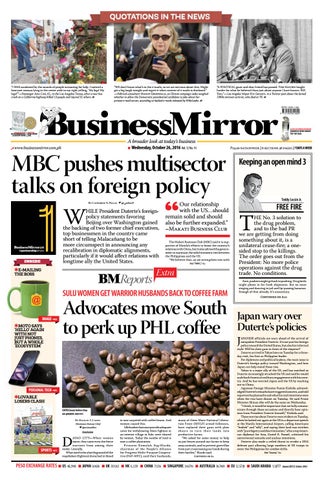
MBC pushes multisector talks on foreign policy W T
Keeping an open mind 3
By Catherine N. Pillas
@c_pillas29
hile President Duterte’s foreignpolicy statements favoring Beijing over Washington gained the backing of two former chief executives, top businessmen in the country came short of telling Malacañang to be more circumspect in announcing any recalibration in diplomatic alignments, particularly if it would affect relations with longtime ally the United States.
inside
e-mailing the boss
Our relationship with the US…should remain solid and should also be further expanded.” –Makati Business Club
The Makati Business Club (MBC) said it is supportive of Manila’s efforts to boost the country’s relations with China, but it also advised the government to maintain the solid economic ties between the Philippines and the US. “We believe that, as we strengthen ties with See “MBC,” A2
BMReports
Sulu women get warrior husbands back to coffee farm image
d4
Moto says ‘hello’ again with not just phones, but a whole ‘ecosystem’
personal tech
Advocates move South to perk up PHL coffee
d1
lovable losers clash Coffee beans before they are grinded. NONIE REYES By Manuel T. Cayon
Mindanao Bureau Chief @awimailbox
sports
c1
D
Conclusion
AVAO CIT Y—W hen women move, they tame even the fierce warriors from among their midst. Literally. What used to be a battleground of the mujahideen (fighters) drenched in blood
PESO exchange rates n US 48.2940
is now carpeted with coffee beans. And women caused this. Idle bushes that once provide adequate cover for withdrawing Moro fighters in an interior village in Sulu were cleared by women. Today the swathe of land is now a coffee plantation. P r i ncess Ku m a l a h Sug-El a rdo, chairman of the People’s A lliance for Progress Multi-Purpose Cooperative (PAP-MPC), said their husbands,
many of them Moro National Liberation Front (MNLF) armed followers, have replaced their guns with plow she a r s to t u r n t he i r l a nd s i nto productive farms. “We asked for some money to help us put fences around our farms to keep away animals, and to prevent guerrillas from just crisscrossing our lands during their battles,” Elardo said.
Teddy Locsin Jr.
free fire
HE No. 3 solution to the drug problem, and to the bad PR we are getting from doing something about it, is a unilateral cease-fire; a onesided stop to the killings. The order goes out from the President: No more police operations against the drug trade. No conditions.
Sure, pushers might go back to pushing. Drug lords might phone in for fresh shipments. But no more singing and dancing in jail and lip-passing bananas. Enough of that already. It’s unsanitary. Continued on A10
Japan wary over Duterte’s policies J
apanese officials are wary ahead of the arrival of outspoken President Duterte. It’s not just his foreign policy toward the United States, but also his informal style: Will he chew gum in front of the emperor? Duterte arrived in Tokyo later on Tuesday for a threeday visit, his first as Philippine leader. For diplomats and political leaders, the main issue is Duterte’s foreign policy toward Washington, and how Japan can help mend those ties. Tokyo is a major ally of the US, and has watched as Duterte increasingly attacked the US and said he would scale back America’s military engagement with his country. And he has worried Japan and the US by reaching out to China. Japanese Foreign Minister Fumio Kishida acknowledged Duterte’s remarks have triggered concern, and told reporters he planned to ask what his real intentions were when the two have dinner on Tuesday. He said Prime Minister Shinzo Abe will do the same on Wednesday. “I think, it would be important that we fully communicate through these occasions and directly hear opinions from President Duterte himself,” Kishida said. Those worries about Duterte were evident on Tuesday, when he lashed out again at the US in a departure speech at the Manila International Airport, calling Americans “foolish” and “silly”, and saying their land was stricken with “pure bigotry and discrimination,” after a top American diplomat for Asia, Daniel R. Russel, criticized his controversial remarks and unclear intentions. Duterte also made a veiled threat to revoke a 2014 defense pact allowing large numbers of US troops to enter the Philippines for combat drills. See “Japan,” A2
Continued on A2
n japan 0.4636 n UK 59.1263 n HK 6.2259 n CHINA 7.1256 n singapore 34.6716 n australia 36.7469 n EU 52.5728 n SAUDI arabia 12.8777
Source: BSP (25 October 2016 )
A2 Wednesday, October 26, 2016
BMReports BusinessMirror
www.businessmirror.com.ph
Advocates move South to perk up PHL coffee Continued from A1
Younger, fiercer
A big part of the peace prevailing now in Satan K and ayok, Panamao, Sulu, emerged from the agreement signed by MNLF leaders with the Government of the Republic of the Philippines in September 1996. Armed conflict, however, continued to threaten the island with the emergence of the younge—and, some say, fiercer—fighters of the Abu Sayyaf Group (ASG), whose terror tactics have kept off aid and development away from this rich southwestern island province. Elardo said the women left behind in the homes turned to productive activities when they formed the cooperative in March 2010, which now grew into 2,221 m e m b e r s , i n c lu d i n g f o r m e r Moro fighters. The conflict nothwithstanding, they were able to persuade government and international donors to come to their succor, in providing the good planting materials and postharvest facilities, such as roasting machines and grinders.
MBC. . .
Continued from A1
one of our neighbors, this should be in tandem with continuing efforts to nurture our partnership with existing strategic allies and friends,” the MBC said in a statement. “In particular, our relationship with the US, particularly
Without proof
THE cooperative was born out of the “need for economic and commercial development to provide business, livelihood and jobs to the local communities,” she said. Elarde added the “large segment of the population currently unemployed and underemployed or engaged in combat preparations.” Sulu has consistently figured in the lower rung of the country’s poorest provinces. The province would occasionally improve one rung higher in a government list of poverty graduates only to revert back to its infamous title of being the poorest. Elardo said, however, their cooperative would like to prove that “most of Sulu’s population can be induced to agricultural work if only the proper conditions are installed.” The cooperative and our partner-institutions persisted, she explained. We saw that when we stimulated and conditioned the area “there is hope to resolve insurgency and bring Sulu into the economic mainstream,” she added. Her argument was not without proof. on the economic front, should remain solid and should also be further expanded.” The influential business group, thus, called for a closer dialogue between various sectors and the government so that government could clarify the independent foreign policy it espouses. In the same way that the President’s economic cluster convened
Income
DOCUMENTS from PAP-MPC revealed that the cooperative that started with zero income for families in 2008. A record of its annual income generation revealed that agricultural activities soon paid off with P15,000 for each family beginning 2009 and tripling the following year. By 2011, income for each member-family hit P70,000, PAP-MPC records said. By 2012, a member-family of the cooperative soon earned P88,000, jumping to P120,000 the next year, going up higher to P142,000 two years ago and breaching the P150,000 mark last year. In her presentation during the Ninth National Coffee Summit here, Elardo said the improved peace-andorder situation in the area could be attributed to the increased farm activity owing to increased income also for the member-families. “Former MNLF members sold their guns and invested in coffee,” she said. As a consequence, “coffee farmers are now sending their children to college,” Elarde said. By various business groups in the “Sulong Pilipinas” Forum in Davao earlier, MBC urged the government to listen to the other sectors of Philippine society. “As we transition through this recalibration in our foreign policy, we call on the government to initiate another multisector dialogue similar to when it drafted the 10-point socioeconomic agenda,” MBC said.
2011, four already graduated from college, 47 from high school and 89 from the elementary, she added. Two years later, six more graduated from college, 52 from high school and 112 from elementary. The numbers just kept on churning on the following years, with eight more college graduates, 94 high-school graduates and 178 elementary graduates by 2014. Last year 10 graduated from college, 129 from high school and 250 from the elementary.
Pick red
ELARDO said it would take a lot to further grow the local coffee industry. She said farmers could be further helped by developing agri-enterprise and improving their productivity. Elardo added consolidating value chain, applying new technology, improving processing and putting up processing plants with complete equipment in the area could also help. So far, she reported the cooperative’s strict obedience to the “Pick Red” policy—harvesting of only choice red beans—“raised the bar “We hope that the government will also invite the views of eminent leaders, foreign-policy experts, policy-makers, business, academe and the youth,” it added. Relations between Manila and Beijing improved further after President Duterte’s state visit to China last week. In his speech before Chinese businessmen and officials, the President announced his intent to “separate” from the US, the country’s long-standing ally. Upon his arrival in the Philippines, Duterte clarified that he does not want Manila to cut diplomatic ties with Washington. His economic team also said the Philippines merely wanted to reduce its reliance on the US. The China trip yielded a total of $24 billion worth of deals, with $15 billion committed to various projects. The remaining $9 billion will be extended to the Philippines as loan. The President left for another state visit to Japan on Tuesday. Manila expects the visit to yield a minimum of $2 billion in private deals. The government also wants to reexamine the country’s bilateral free-trade agreement with Japan.
‘Presidential prerogative’
Unlike former President Fidel
Bid. . .
Continued from A12
These new train cars are needed to complement the construction of the new train stations in Cavite. Targeted for completion in about four years after the delivery of right-of-way, the 11.7-kilometer Cavite Extension will connect into the existing system immediately south of the Baclaran Station and run in a generally southerly direction to Niyog, Cavite.
Japan. . .
Continued from A1
“These Americans are really foolish,” said Duterte, adding Americans travel to the Philippines “like somebody, without visas, these sillies.” Referring to the pact that allows American forces, warships and planes to visit the Philippines, Duterte said, “Forget it,” adding that in the future “I do not want to see any military man of any ot her nat ion e xcept t he Philippine soldier.” But in a country where formality and politeness are highly valued, others in Japan are worried about the rough side of Duterte’s manners. They are particularly concerned about his meeting with
of quality of Sulu’s organic coffee.” As the cooperative also increased the yield per hectare, from 700 grams in 2011 to 1,700 grams of choiced red beans last year, it was also encouraged to plant more trees, from 35,500 to 250,000 on the same period. “We have also exported our coffee,” she beamed. She flashed snapshots of their processing area, showing a small, thatched-roof hut back then, to what looked like a two-classroom sized schoolbuilding, with rows and rows of coffee beans laid out neatly along the cement ground at the front yard. Inside, a photograph showed a wooden coffee processor with household members doing manual grinding of the beans. Another recent photograph juxtaposed the metal roasting machine.
THE local government has been persuaded also to turn the once muddy trail going to the interior coffee farms of Barangay Satan Kandayok into a concrete cemented road. “See what coffee can do to our
place, which was once an abandoned village that no one wanted to be there,” she said. The economic blessing for the members of the cooperative was “contaminating,” she said. PAP-MPC recently expanded its network to 11 other cooperatives in the same town of Panamao, mostly formed by farmers, fishermen and women. To date, these organizations were being assisted by the Philippine Coffee Board, the departments of Agriculture, Agrarian Reform and Trade and Industry, the Office of the Regional Governor of the Autonomous Region in Muslim Mindanao, the Philippine Marines, the Anak Partylist and the provincial government. It would not be difficult to cultivate coffee or any crops in Sulu as she argued that the province has good climatic conditions, fertile soils suitable for cassava and coffee, available large tracts of land for farming and available human resource at lower labor cost. “Coffee is our business,” she said, adding that is the only secret to the success of the community against the battle against poverty.
V. Ramos, two former presidents have thrown their support behind Duterte’s efforts to pursue an independent foreign policy. Former President and now Rep. Gloria Macapagal-Arroyo of the Second District of Pampanga and former President and now Manila Mayor Joseph E. Estrada said they see nothing wrong with Duterte’s “separation of foreign policy” from the US. Arroyo and Estrada also expressed support for the government’s efforts to forge closer ties with China. “That [forging of foreig n pol ic y] is t he President’s prerogative,” Arroyo said when sought for her reaction on Duterte’s pronouncements. Estrada also echoed Arroyo’s statements and admitted that during his term, the US was “intervening” when he declared an “all-out war” against the Moro Islamic Liberation Front (MILF) in 2010. “[The US] said I should stop, but I didn’t,” Estrada said. Alison Evans, senior analyst at IHS Markit, said in a statement that, in general, Japan does not highlight or push human rights on the international stage, so Duterte’s election is unlikely to change this for the Philippines. “Japanese Prime Minister Abe
and Philippines President Duterte just met in Laos in September, but this week’s extra one-on-one meeting following larger sessions arranged in Tokyo indicates that Abe is putting time and effort into maintaining and improving ties with the Philippines, bolstered under former President Aquino,” Evans said. “Duterte welcomed investment from Japan into Davao when he served as its mayor, so we’re likely to see a similar pattern now for Manila. According to sources, Abe may promise up to ¥5 billion for infrastructure projects, including a much-needed upgrade for the capital’s publictransit system.” Evans added: “Japan is also likely to maintain good ties with the Philippines, regardless of Duterte’s comments on trying to get closer to China, because of promised security cooperation: Japan has sold old coast-guard vessels and is scheduled to lend surveillance aircraft to the Philippines.” “It is not clear that military leaders in the Philippines support Duterte’s promise to move away from the US and toward China, especially for military procurement, which would cause compatibility issues.”
It will consist of elevated guideways throughout the majority of the alignment, except for the guideway section at Zapote, which will be located at grade. Eight new stations will be provided with three intermodal facilities across Pasay City, Parañaque City, Las Piñas City and Cavite. The new stations are Aseana, MIA, Asia World, Ninoy Aquino, Dr. Santos, Las Piñas, Zapote and Niyog. The intermodal facilities, shall be at Dr. Santos, Zapote and Niyog. The new stations will be accessible to and from nearby community facilities, such
as shops, schools, stadium, park, etc., and be located to suit passenger flow routes from residential areas. Pedestrian access to all new stations will be direct, safe and easy. Details, such as lighting to distinguish access points, pedestrian cross striping and curb cuts for handicapped access, will be provided. Light Rail Manila Corp. holds the concession for the operations, maintenance and the extension of the train line. It signed the agreement with the government in October 2014. The company will operate and maintain the oldest train system in the Philippines for 32 years.
Emperor Akihito on Friday. Japa ne s e T V show s h ave repeatedly shown Duterte apparently chewing gum—at meetings, shaking hands and at other public occasions. In footage of a meeting with Chinese President Xi Jinping, Duterte wore a business suit instead of a formal Philippine barong shirt. He walked in with his hands in his pockets and chewed gum during the hand shake and a signing ceremony. Duterte doesn’t usually button up the top of his shirt, often wears slacks or jeans and has been seen without socks. “When [Duterte] will make a courtesy visit to the Emperor, his behavior during the event could have a major impact. I trust he understands the consequences and he would not do such a thing
[as chewing gum], but I do hope the Philippine side to remind him of that particular point,” Itsunori Onodera, a senior lawmaker in the conservative ruling Liberal Democratic Party, told a Sunday talk show on Fuji TV. In Japan, where the Emperor was considered a living god until the end of World War II, people are expected to be extra polite in front of him and his family. “It’s unbelievable. I have never seen anything like that!” said Kunihiko Miyake, a former diplomat and political analyst. “How could he dare to behave in ways that could cause his host to lose face.” Miya ke, however, sa id Duterte might have done so intentionally, perhaps, because he was unhappy about compromising on the South China Sea issue. AP
Secret
BusinessMirror
www.businessmirror.com.ph
Wednesday, October 26, 2016 A3
Po family-led ArthaLand bullish on the VisMin market, launches Cebu Exchange
A
By Rizal Raoul Reyes
be finished in 2022.
fter developing an exclusive niche presence in the Metro Manila market, ArthaLand Corporation of the Po family carries its bullish mode by expanding in the Visayas region. “With the continuing market optimism on Visayas and Mindanao, ArthaLand sees robust opportunities, especially in the information technology and business process management sector. This is why we are aiming to launch Cebu Exchange,” said Angie de Villa-Lacson, the company’s president and CEO. Lacson said ArthaLand plans to be present in major cities in the country. “Cebu has displayed fantastic growth potential and the local government has built worldclass infrastructure for business and tourism,” she explained. A joint venture project, ArthaLand will have a 60 percent stake while Hong Kong-based Arch Capital will have a 40 percent equity. She said the P8 billion Grade-A
office development is designed to address the information technology and business process (IT-BPM) outsourcing industry’s growing demand for bigger and better quality space. The project will rise at the property that ArthaLand recently acquired along Salinas Drive, at the Cebu IT Park area. Recently, Leechiu Property Consultants (LCP) chief executive officer David Leechiu said the country’s IT-BPM industry will continue to grow in the next six years by doubling its current workforce from 1.3 million to 2.6 million. Furthermore, Department of Trade and Industry Secretary Ramon Lopez mentioned that IT-BPM industry is going be $250 billion by 2022. In its 2011-2016 roadmap, the IT-BPM aims to generate revenues
up to $25 billion and employment of 1.3 million by year's end. To be built on more than 8,000 square meter prime property, Cebu Exchange will be the largest and the tallest IT-BPM business ecosystem at the Cebu IT Park area. The 38-storey office building will house four floors of complementary retail outlets and 30 large-cut flexible office floors. Moreover, the office units are also suitable for knowledge process outsourcing (KPOs) and other allied services. Cebu Exchange will have 27 retail offices and 316 office spaces. Total retail space is 3,900 square meters and 83,100 square meters. Construction of the first tower will start on first half of 2017. Delivery of the first phase is scheduled on 2020 while the second phase is expected to
Truly green
Lacson said Cebu Exchange will be VisMin’s first and only office development to be on target to achieve dual green building certification under the U.S. Green Building Council’s Leadership in Energy and Environmental Design (LEED) program and the Philippine Green Building Council’s Building for Ecologically Responsive Design Excellence (BERDE) certification programs. To ensure resource efficiency for the building’s locators, Lacson stressed Cebu Exchange will feature green elements such as efficient building envelope, water efficient plumbing system, low-energy consuming air-conditioning system,
efficient lighting system, use of lowemitting materials, and allocation for Low-Emitting & Fuel Efficient Vehicle (LEFEV) parking. With its strategic location and strong connectivity to the community, the project is going to contribute a lot in lessening the carbon footprint because this will require lesser use of motorized vehicles. Lacson stressed Cebu Exchange is future-proofed to accommodate future technological advances.
Enhancing business
According to experts and property analysts, certified green buildings are preferred by multinational players as required by their home offices. “ArthaLand is the only Philippine developer that puts sustainability
at the core of all its projects. This is why we know that the expertise that we bring to Cebu and the rest of Visayas and Mindanao will further boost the region’s business viability,” de Villa - Lacson underscored. “Cebu Exchange will change VisMin’s real estate landscape. Cebu Exchange will be the Future of Business in the region,” she emphasized. Just like Arya Residences and the ArthaLand Century Pacific Tower, Cebu Exchange will carry the green DNA of the company that is essentially world-class, boutique and sustainable. These three will always be at the core of all projects, in whatever business segment that we serve,” she added.
ArthaLand is the only Philippine developer that puts sustainability at the core of all its projects. This is why we know that the expertise we bring to Cebu, and the rest of Visayas and Mindanao will further boost the region’s business viability.” —De Villa-Lacson, arthaland president & ceo
BMReports BusinessMirror
A4 Wednesday, October 26, 2016
news@businessmirror.com.ph
Senators scrutinize Palace plan to raise ₧1-trillion additional revenue ‘per year’
S
By Butch Fernandez
@butchfBM
enators, under mounting pressure from affected sectors, on Tuesday started scrutiny of the Duterte administration’s tax-reform scheme to raise an additional P1trillion revenue “per year” to bankroll its 10-point socioeconomic agenda.
Sen. Juan Edgardo M. Angara, chairman of the Senate Ways and Means Committee spearheading the review of the tax plan, confirmed that various “interest groups” are already conveying concerns to lawmakers over the government’s tax-hike plan, including cooperatives, senior citizens, persons with disabilities (PWDs), oil companies and transport groups. “This is a collective voice of already 10 million to 15 million Filipino people that we should not ignore,” the senator said. “We should hear their sentiments, because this tax-hike plan will have
varying effects on different sectors of society, even as we ensure that the poor and the middle class will not be disadvantaged,” he added. At the outset, Angara promptly asserted “strong reservations” over the Palace proposal to scrap the value-added tax exemptions on senior citizens and PWDs without providing alternative subsidies to the affected sectors, recalling that Republic Act 10754, exempting PWDs from VAT, which he sponsored, was signed into law only in March. “Ang mga batas na ’yan ay pinasa ng Kongreso dahil nakita namin na hindi pa kayang ipagkaloob ng gobyerno ang
lahat ng pangangailangan ng ating mga senior citizens at kababayang may kapansanan. Maliwanag na ang mga batas na ito at may saysay at puso. Huwag muna sana nating tanggalin ang mga benepisyong ito o ’yung exemption na ibinibigay sa kanila hanggat wala pang tiyak na subsidiya. [Congress did not pass these proposals knowing fully well that government may still lack the resources to provide the needs of the elderly and PWDs. Let’s not scrap these privileges for now],” Angara said. In their presentation before the Senate panel that included Minority Leader Ralph G. Recto, Department of Finance (DOF) officials cited President Duterte’s pledge to provide “positive change that the people can feel” through inclusive growth that includes improved public services. According to the DOF, the Duterte administration’s vision to reduce poverty rate and achieve high middle-income status, where per-capita gross national income increases from $3,000 to $4,100 by 2022, is expected to be achieved through sustained economic growth by investing in infrastructure, edu-
This is a collective voice of already 10 million to 15 million Filipino people that we should not ignore. We should hear their sentiments, because this tax-hike plan will have varying effects on different sectors of society, even as we ensure that the poor and the middle class will not be disadvantaged.”—Angara
cation, health, social protection, training and other investments. “All these investments require additional funds of around P1 trillion per year in 2016 prices on top of the current P1.3 trillion,” the DOF said, suggesting, “this can be achieved through tax reform, which is integral to the larger goals of the administration and crucial for achieving the vision of a prosperous country.” Moreover, the DOF said complementary economic reforms are crucial, including “secure property rights, enhance com-
petition, improve food security and simplify regulations.” DOF officials, led by Undersecretary Karl Kendric T. Chua informed senators in their presentation that the additional P1trillion revenue per year could be raised through ta x-polic y reforms by creating a “simpler, fairer and more efficient tax system characterized by low rates and a broad base that can promote investment, job creation and poverty alleviation.” In addition, the DOF is also eyeing tax-administration reforms at
the Bureau of Internal Revenue and the Bureau of Customs, apart from budget reforms to improve spending, transparency and efficiency to generate savings. T he DOF said the gover nment’s tax reform goal by 2019 is to raise P600 billion (3 percent of GDP in 2019 prices) to fund the priority investments of the Duterte administration, including P400 billion from tax-policy reform and P200 billion from taxadministration reform. Under the DOF ’s proposed tax-policy reform, upward adjustments are expected in petroleum excise tax, which the DOF said has not been increased since 1997; real-property tax that “richer” local government units have not adjusted for up to 20 years; corporate-income tax where significant forgone revenues from incentives are not time-bound leading to inequity; the value-added tax, which has 60 exemptions that lead to large leakages; personal-income tax with high rates, yet very narrow, base among self-employed and professionals; and, capitalincome tax with high rates for the poor and low rates for the rich.
news@businessmirror.com.ph
AseanWednesday BusinessMirror
Editor: Max V. de Leon • Wednesday, October 26, 2016 A5
Shell among new LNG sellers 421,037 for hub contender Singapore
Indonesia must signal tax amnesty won’t be repeated, OECD says
I
ndonesia’s government must make it clear to errant taxpayers that an amnesty program, which has revealed almost $300 billion in undeclared assets, is the last chance to fix their affairs before full penalties are applied, the Organisation for Economic Co-operation and Development (OECD) said. “Authorities must communicate clearly that this offer will not be repeated,” the OECD said in a report on Indonesia’s economy released on Monday in Jakarta. The amnesty was well-timed, the OECD said, as it comes within two years that global rules will be adopted to allow countries to exchange information to reduce the risk of tax evasion. The government must signal that the Automatic Exchange of Information regime “will be used to locate undeclared assets and that full penalties will apply,” the group said. With the deadline for the tax amnesty’s most generous phase having ended September 30, the number of people and institutions participating in the program stands at 421,037, with 3,863 trillion rupiah ($297 billion) of assets declared. The government has earned 97.7 trillion rupiah in revenue from penalties, according to a tally on
The number of people and institutions participating in Indonesia’s taxamnesty program
S
the Finance Ministry’s web site at 1 p.m. local time on Monday. Repeated tax amnesties in OECD countries had “been characterized by only temporarily increased tax revenues and encouragement of future evasion,” according to the report. Indonesia had previously implemented amnesties in 1984 and 2008, the OECD said. The government had projected as much as 165 trillion rupiah in revenue from the program to help fund President Joko Widodo’s ambitious infrastructure plan and offset a slowdown in Southeast Asia’s biggest economy. The OECD is forecasting expansion of 5.1 percent in 2016 and 5.3 percent in 2017. Bloomberg News
The companies will have exclusive rights to sell 1 million metric tons (MMT) of LNG annually for up to three years, with imports beginning in 2017, the city-state’s Energy Market Authority said in a statement. The country will also consider spot purchases of the supercooled fuel and piped natural gas on a case-bycase basis, S. Iswaran, the minister of industry, said at the Singapore International Energy Week conference on Monday. Singapore wants to use its geography and stature as Asia’s oil-trading
ingapore, which is vying to become a regional center for the trading of liquefied natural gas (LNG) in Asia, picked Royal Dutch Shell Plc. and Pavilion Gas Pte. Ltd. as its next suppliers of the fuel.
center to also be a leader in LNG in a region that accounted for more than 70 percent of global demand in 2015. The nation has built a receiving terminal, while the state-owned investment company set up Pavilion Energy Pte. in 2013 to trade the fuel. It’s drawn firms from Glencore Plc. and GAIL India Ltd. to open trading desks in the country, and Singapore Exchange Ltd. has started futures and swaps linked to an index of spot LNG prices. Shell and Pavilion were chosen, because they “offered flexible and
competitive pricing not just indexed to oil but to different options on the table,” Iswaran said. “One of the considerations in looking at the next tranche was the offering of flexibility in terms of price indexation. And indeed, they have put forward some flexible options, and end-users have responded to these offers.” The exclusive licenses will expire either after three years or if the companies import more than 1 million tons in a year, according to a statement from the Energy Market Authority. Beyond that the companies will still be able to import LNG into Singapore but will not be guaranteed exclusivity, Darius Lim, a Pavilion spokesman, said by e-mail. Natural gas can be cooled and liquefied to transport it on tankers between areas difficult to link by pipeline. LNG traded in Asia —where sellers, such as Qatar and Indonesia, ship fuel to buyers, including Japan or China—has traditionally been pegged to crude prices. That’s
because the region lacks a benchmark similar to Henry Hub in the US, which the country’s burgeoning LNG exporters use in sales contracts.
Demand surge
A previous contract to supply LNG to Singapore was won by BG Group Plc. The company was acquired by Shell in February. Under that deal, BG was to supply 3 million tons of LNG annually over 10 years starting in 2013. The island-nation, which generates 95.5 percent of its electricity using natural gas, imported 1.2 MMT of LNG last year, a drop of 14 percent from 2014 because of lower power demand, according to Bloomberg New Energy Finance. LNG consumption may rise to more than 3 million tons annually from 2022, and surge to 11 million tons a year by 2030, as its contracts to receive natural gas via pipeline from Malaysia and Indonesia expire, BNEF analysts, including Maggie Kuang, said in a June 9 report. Bloomberg News
A8
The World
Wednesday, October 26, 2016 • Editor: Lyn Resurreccion
BusinessMirror
www.businessmirror.com.ph
France moving more than 6,000 migrants from makeshift camp
C
ALAIS, France—France began the mass evacuation on Monday of the makeshift migrant camp known as “the jungle,” a mammoth project to erase the humanitarian blight on its northern border, where thousands fleeing war or poverty have lived in squalor, most hoping to sneak into Britain.
1,200 Youths ride bicycles next to a burning oil well in Qayyarah, about 50 kilometers south of Mosul, Iraq, on October 23. Islamic State fighters torched a sulfur plant south of Mosul, sending a cloud of toxic fumes into the air that mingled with oil wells the militants had lit on fire to create a smoke screen. AP
Threatened in Mosul, Islamic State uses alternative tactics
B
AGHDAD—Dozens of Islamic State (IS) fighters struck at dawn, storming government and security compounds in and around the northern Iraqi city of Kirkuk last week, in a coordinated assault more than 160 kilometers from the front lines of the Mosul offensive. Over the last two years, the extremists have adopted innovative tactics and launched diversionary attacks along the amoeba-like frontiers of their self-styled caliphate, and many now fear they have more surprises in store as Iraqi forces close in on Mosul, the militants’ last urban bastion in the country. The Kirkuk assault was carried out by more than 50 militants who may have been part of so-called sleeper cells. They struck targets in and around the city, pinning down Kurdish security forces for two days and killing at least 80 people. A similar attack was launched on the western town of Rutba, hundreds of miles from Mosul, over the weekend. Here is a look at some of the other tactics the group may employ.
Attacks on civilians
AS it has suffered a string of battlefield setbacks over the past year, IS has increasingly returned to its roots as a brutal insurgent group, carrying out suicide bombings against civilians, mainly in and around Baghdad. The group has sought to reassure its supporters that its long twilight struggle will continue, regardless of whether
it loses territory. Vastly outnumbered in Mosul, it may respond with attacks on so-called soft targets in Iraq or further afield, perhaps seeking to replicate the devastation of the 2015 Paris attacks. But Iraq is at the greatest risk. “W hat happened in Kirkuk might be an introduction to a series of operations, and we cannot rule out the targeting of Baghdad,” said Ahmed al-Sharifi, a Baghdad-based military analyst. “There are sleeper cells all over Iraq, particularly in Baghdad.”
Divide and conquer
THE choice of Kirkuk likely reflected a strategic calculation on the part of IS to sow tensions within the unlikely alliance arrayed against it. The city has long been at the center of a territorial dispute between the central government and the autonomous Kurdish region, where the Mosul operation has seen federal forces deployed for the first time in 25 years. The Baghdad government and the Kurds are united against IS, but the Kurds have little interest in Mosul, a potentially ungovernable city with a Sunni Arab majority. The Kurds have long
prized Kirkuk, however, and could divert their forces, known as the peshmerga, from Mosul to other fronts in order to defend territory they value more.
Chemicals and drones
CLOSER to the front lines, IS may deploy new and unconventional weapons. IS used a homemade drone carrying C-4 explosives to attack French and Kurdish forces in northern Iraq earlier this month, killing two Kurds. IS is believed to have used crude chemical weapons in both Syria and Iraq, and Iraqi forces have said they are going into battle with protective gear. Last month an IS rocket containing sulfur-mustard , a chemical agent that causes skin blistering, struck a military base used by hundreds of US troops near Mosul. No one was wounded in the attack, but Marine Gen. Joseph Dunford, chairman of the Joint Chiefs of Staff, called it a “concerning development.”
Suicide artillery
SUICIDE car bombs have featured in Middle East conflicts for decades, but IS might be the first insurgent group to deploy them against conventional forces on the battlefield as a kind of “smart” artillery. The group has already sent more than a dozen armored vehicles loaded with explosives careening toward front-line troops since the Mosul operation began. Iraqi forces, with the aid of USled coalition aircraft, have gotten better at blowing them up before they reach their targets, but the weapons still pose a huge risk.
Scorched earth tactics
IS deployed another k ind of
chemical weapon last week when it torched a sulfur plant south of Kirkuk, sending a cloud of toxic smoke across the Ninevah plain that caused breathing difficulties and nosebleeds up to 30 kilometers away. The fumes mixed with the smoke from oil wells in the region that IS has set alight in recent weeks to try to create a smoke screen. Many fear that as Iraqi forces converge on Mosul, the extremists could destroy factories, oil installations and other critical infrastructure in a scorched earth campaign. They may also seek to use civilians as human shields. Mosul is still home to more than one million people.
‘Unknown unknowns’
FOR MER US Defen se Sec re tary Donald Rumsfeld famously warned of “unknown unknowns,” things we don’t know that we don’t know, which somehow captures the challenge posed by evolving militant groups. The IS capture of Mosul in 2014—and the fleeing of thousands of Iraqi soldiers and police who were supposed to defend the city in the face of their advance—came as a shock to many people who had never imagined an extremist group could seize a major city. That they have persevered since then, holding onto large swaths of territory despite more than two years of US-led airstrikes and a vast array of forces battling them, also testifies to their dark ingenuity. “Every time we think we’ve countered terrorist tactics something new always happens,” said David M. Witty, a retired US Army Special Forces colonel and former adviser to Iraqi special operations forces. “There’s no end to it.” AP
Chinese firm issues US recall after massive cyber attack
B
EIJING—A Chinese electronics maker has issued a recall for millions of products sold in the United States following a devastating cyberattack that took down web sites, including Twitter and Netflix, but has lashed out at critics who say its devices were at fault. Hangzhou X iong ma i Technolog y said in a statement that c u stomers fa i l i ng to c h a nge their default passwords resulted in millions of Web-connected cameras and digital recorders becoming compromised. The hack has heightened longstanding fears among security
experts that the rising number of connected home gadgets, appliances or even automobiles represents a cyber-security nightmare. The added convenience of being able to control home electronics via the Web also leaves them more vulnerable to malicious intruders, experts say. Unidentified hackers seized control of gadgets, including Xiongmai’s, on Friday and directed them to launch an attack that temporarily paralyzed swaths of Internet addresses, according to US Web-security researchers. The “distributed denial-of-service” attack targeted servers run
by Dyn Inc., an Internet company in Manchester, New Hampshire. These typezs of attacks work by overwhelming targeted computers with junk traffic, so legitimate traffic can’t get through. In an acknowledgement of its products’ role in the hack, Xiongmai said on Monday it would recall products sold before April 2015 to demonstrate “social responsibility,” but added that its devices did not make up the majority of those used in the attack. Researchers at the New Yorkbased cyber-security firm Flashpoint said most of the junk traffic heaped on Dyn came from
Internet-connected cameras and video-recording devices that had components made by Xiongmai. Those components had little security protection, so devices they went into became easy to exploit. T he compa ny, wh ic h a l so makes dashboard cameras and computer chips, said it would recall more than 4 million Webconnected cameras and has offered customers a software security fix. But it downplayed its culpability, saying that as even the world ’s largest technology companies experience security lapses, “we are not afraid to also experience it once.” AP
The total number of policemen monitoring the mass evacuation on Monday of more than 6,000 migrants from makeshift camp in Calais, France
Before dawn broke, long lines of migrants waited in chilly temperatures to board buses in the port city of Calais, carrying meager belongings and timid hope that they were headed to a brighter future, despite giving up their dreams of life across the English Channel in Britain. Closely watched by more than 1,200 police, the first of dozens of buses began transferring them to reception centers around France where they can apply for asylum. More police patrolled inside the camp, among them officers from the London police force. Authorities were expected to begin tearing down thousands of muddy tents and fragile shelters on Tuesday as the migrants vacated them.
Not good
MIGRANTS have flocked to the Calais region for nearly two decades, living in minijungles. But the sprawling camp in the sand dunes of northern France became emblematic of Europe’s migrant crisis, expanding as migrant numbers grew and quickly evolving into Europe’s largest slum, supported by aid groups, and a black eye on France’s image. “It’s not good, the jungle,” 31-year-old Mahmoud Abdrahman of Sudan said. “Eating not good. Water not good, shelter not good, no good toilets.” He said he would leave on Tuesday, when lines were shorter, gesturing to a black knapsack that was all packed to go as proof he was ready. Ultimately, Abdrahman said, he wanted one thing more than anything else. “I need peace,” he said. “Anywhere.”
Left fearful
HOME to migrants from Afghanistan, Sudan, Eritrea, Syria and elsewhere, the closing of the camp fell like a stone on many as the reality of the evacuation sunk in and plans had to be made. Uncertainty and a lack of precise information left many fearful. “What should I do?” asked a 14-year-old newly arrived Afghan. “It is really hard, because we have found some good friends over here,” said Tariq Shinwari, a 26-year-old Afghan. The camp shutdown left some, like Imran Khan, an Afghan who was fingerprinted in another country before coming to France, with a tough choice—get on a bus and risk expulsion or go on the run as winter approaches. Under European rules, asylum-seekers must be returned to the country where they were fingerprinted on arrival. “I will decide tomorrow what to do,” the 35-year-old said.
So far
BY nightfall on Monday, French
Interior Minister Bernard Cazeneuve said 1,918 people had been processed and sent to 80 centers around France. Another 400 unaccompanied minors were being housed in heated shelters at the camp. The numbers were lower than the 3,000 expected to be evacuated on Monday. The operation, expected to last a week, would continue as long as necessary, Cazeneuve said. “This is an operation we want to be peaceful and under control. So far it is,” he said. Authorities say the camp holds nearly 6,500 migrants, while aid groups put the number at more than 8,300, with more than 1,200 unaccompanied minors among them. Unaccompanied minors, many with family members in Britain, were to be housed on-site in containers set up earlier this year as their files are studied in London to see if they qualify for a transfer across the English Channel. The humanitarian organization France Terre d’Asile says 1,291 unaccompanied minors live in the camp.
Try again
IN a breakthrough, Cazeneuve announced late Monday that Britain had agreed to take in unaccompanied minors with family ties in Britain, an important step after months of prodding by France. Officials have said that there will be a solution for each migrant, though expulsion may be among them for those who don’t qualify for asylum. Meanwhile, France will spend €25 a day on each migrant in the reception centers, according to officials. As the day dragged on, a group of Sudanese got tired of waiting and returned to their shelter in the camp, bags slung over their shoulders and laughing. They said they’d try again on Tuesday.
Restoring pride
THE camp, which sprang up 18 months ago, was previously tolerated but given almost no state help. Aid groups, and hundreds of British volunteers, have provided basic necessities. It devolved into a slum where tensions bubbled, friendships formed and smugglers thrived. The forced departure of thousands is an enormous task, planned for months, but authorities have had practice. They dismantled the southern half of the camp in March, a chaotic, often brutal, bulldozing operation that drew complaints from human-rights groups. This time, France hopes to restore some pride by closing the camp that has been seen as a national disgrace in a peaceful, humane operation. Some doubt the camp’s dismantling will end the migrant influx into northern France which predates the slum. A 2003 French-British accord effectively put the British border in Calais, stopping migrants there and putting the onus on France to deal with their plight. While a sense of camaraderie grew inside the camp, so did tensions. Two of the largest communities, Afghans and Sudanese, have clashed in the past and whole sectors of shelters burned down.
Fed up
LIFE at night is the toughest. In the dark, migrants invade the roadway, throwing tree branches and other objects into the path of oncoming trucks heading to port ferries to slow traffic enough to hop on the back. Fourteen migrants have died this year in the Calais area, mostly in hit-and-run accidents. “I’m three months in the jungle. I feel like I’ve stayed three years,” said Amin, a 32-year-old Sudanese with perfect English—and a brother in Britain. AP
news@businessmirror.com.ph
ExportUnlimited BusinessMirror
Editor: Efleda P. Campos • Wednesday, October 26, 2016 A9
PHL animation group showcases talent in global content market for entertainment in France
C
ANNES, France—Philippine animation studios, led by the Animation Council of the Philippines Inc. (Acpi), showcased the content capabilities of the Philippines at the International Market of Communications Program (Mipcom) at the Palais des Festivals et des Congrès in Cannes, France, from October 17 to 20. Mipcom is a major convergence of influential industry players in the global market for entertainment content across major entertainment platforms. This event featured areas of opportunities in drama, film, factual, nonscripted format, kids and teens, music, sports, games and publishing, among others. “Mipcom is the biggest event for sourcing and distribution in the world entertainment industry. The major players are here and the presence of the Philippines in this important event is essential. We expect to generate new business engagements for animation, as representatives from the entertainment industry source for content here.” ACPI President Juan Miguel del Rosario said. The Philippine delegation was composed of companies who are leaders in creative design and animation capabilities across major categories, such as Web and mobile games and applications, interactive and immersive visual technology, animation, production of audiovisual presentations, and commercials for television, cinemas and the Internet. “Given the capabilities of the participating companies, such as
ASI Animation Studios, RenderBee, Synergy88, TeamApp, Toon City, Toon City Academy, Top Peg Animation and 88storey Films, we are confident this participation will open doors of opportunities for the content industry in the country as we aggressively move to prioritize new markets and new services to expand our exports” said Senen M. Perlada, director of the Export Marketing Bureau (EMB) of the Department of Trade and Industry (DTI). “Additionally, Philippine participation comes at a time when Southeast Asia, including countries like Singapore, Malaysia, Thailand, Indonesia and Vietnam, all now have presence at the annual Mipcom,” he said. Philippine participation in Mipcom 2016 was made possible by the active collaboration between ACPI, the Department of Information and Communications Technology (DICT), the DTI through the EMB and the Philippine Trade and Investment Center-Paris (PTIC- Paris) and the Department of Foreign Affairs (DFA). Philippine Ambassador to France Ma. Theresa Lazaro, who visited the Philippine pavilion at Mipcom, said, “France has the largest animation
DTI conducts info session on e-commerce road map By Gliceria N. Cademia
Trade and Industry Development Specialist, DTI-EMB
T
HE Department of Trade and Industry’s Export Marketing Bureau (DTI-EMB) recently conducted an information session on the 2016-2020 E-commerce Road map and global practices of e-commerce at the DTI International Building in Makati City. The activity was one of the seminar series under the Philippine Export Competitiveness Program (PECP) of DTI-EMB. Cristina Reodica, division chief of the DTI’s Sector Planning Bureau (SPB), said the road map sets targets for information security, data privacy, electronic payment, consumer protection and logistics. By 2020, it is projected that e-commerce will contribute 25 percent to the country’s GDP and that 100,000 micro, small and medium enterprises (MSMEs) and 40 percent to 50 percent of Internet users will engage in e-commerce. At the same time, there will be fast and competitive Internet access; cybercrime enforcement and protection will be in place, as well as online and connected government infrastructure. The 52 road map action agenda are aligned with the six I’s of the Asia Pacific Economic Cooperation Digital Prosperity checklist and with the Philippine E-commerce Act. Michael John Menzon, account manager of TrancosmosPhilippines Inc., the biggest Japanese businessprocess outsourcing (BPO) compa-
ny in the Philippines, talked about global practices in e-commerce. He enumerated five types of e-commerce models: businessto-consumer (B2C), e.g., Lazada, Zalora, Metrodeal; business-tobusiness (B2B), e.g., Alibaba.com; government-to-Business (G2B), e.g., DTI (business registration), SEC; government-to-consumer (G2C), e.g., passport processing, request for birth, marriage, death, no marriage certificates; and consumer-to-consumer (C2C), e.g., OLX., Facebook, Instagram and Shopee. He also cited e-commerce global practices and trends in 2016. Participants were advised that investigation on complaints in C2C and social-media web sites are not under the DTI’s purview, but that of the National Bureau of Investigation. The info session was attended by business support organizations composed of the Publishers Association of the Philippines Inc., Philippine Printing Technical Foundation Inc., Chamber of Philippine Cosmetics Industry, Printing Industry Association of the Philippines, Virgin Coconut Producers and Traders Association of the Philippines, Construction Industry Authority of the Philippines and Philippine Franchising Association. Philippine exporters were also represented, namely, Century Pacific Food Inc., Goldware Essentials Co., Century Pacific and Philippine Native E-Tailers Co.; and personnel of DTI-EMB. The full text of the 2016-2020 E-commerce Road map is downloadable at http://e-commerce.gov. ph/index.php/roadmap.
Helping MSMEs join global markets via UN Global Marketplace By Magnolia Uy
Trade Service Officer Foreign Trade Service Corps, DTI
MARKET DEVELOPMENT UPDATES
G
ENEVA, Switzerland—The electronic procurement system of the United Nations, referred to as the United Nations Global Marketplace (UNGM), can become a significant additional market for Philippine exporters on improving access by Philippine micro, small and medium enterprises (MSMEs) to the international markets.
ATTENDING the just-concluded International Market of Communications Program (Mipcom) at the Palais des Festivals et des Congrès in Cannes, France, from October 17 to 20 are (from left) Anthony Rivera, assistant director of the DTI-EMB; Adam Ham of Entertainment and Media Specialist; Jerome Delhaye, director of entertainment at Reed Midem; Ma. Theresa Lazaro, Philippine ambassador to France; Paul Barbaro, senior manager of Reed Midem; Miguel del Rosario, Animation Council of the Philippines Inc. president; and Froilan Pamintuan, commercial attaché of the Philippine Trade and Investment Center-Paris.
industry in Europe and the third largest in the world, so there is a lot of potential for our animation industry to set up partnerships and increase awareness of the creative Filipino talent in France.” The animation industry in the Philippines started in the 1980s, making it one of the stronger Asian players in the global animation industry today. From only a handful of animation studios then, there are now over 100 animation studios all over the country with a total annual revenue of $153 million and over 11,000 full-time employees. Aside from participating in Mipcom, Del Rosario concluded meetings with the French Association of Animated Film (Afca) and the Network of French Animation Schools (Reca) in Paris, leveraging on the opportunities to work together in promotional activities
and establishing the initial talks for the cooperation in terms of skills training for Filipino animators. Del Rosario also invited the French organizations to join Animahenasyon, the country’s animated film festival, and to establish possible partnerships in higher education and training. Mipcom is an annual event held every October in Cannes, France, and is known in the television and entertainment industry as a premier marketplace to buy and sell new programs and formats for the global market. Major players in Mipcom include Disney, Warner Bros., 21st Century Fox and HBO. The 2015 performance included almost 14,000 participants, over 2,000 exhibiting companies and 4,700 buyers spread over 24,000 square meters of exhibition space at the Palais des Festivals et des Congrès in Cannes.
Education beyond borders for global competitiveness
‘E
DUCATION Beyond Borders for Global Competitiveness” was the theme of the sixth National Education Forum (NEF). It is very timely as the 21st century presents unparalleled risks, as well as opportunities for the whole world and the societies in it, including higher or university education. Thinking and working globally is now the norm for the survival, prosperity and competitiveness of every nation. As global citizens, we are required to develop a global mind-set, such as increasing our capacity to think and work on a global and intercultural scale. In the Philippines, this can be accomplished through a new higher education that meets these challenges. One for m of being globa l ly competitive is through education beyond borders. Thus, the PCCI Education Committee, in collaboration with the EDC Networking Committee on HRD conducted the NEF on September 1 with the participation of leaders and professionals in business and education, particularly the heads and deans of higher-education institutions. The NEF saw the need to strengthen the role of the government and our educational institutions in providing the highest degree of education beyond borders to achieve global competitiveness. It is also intended to enhance the quality of our higher-education system as a key determinant of the future growth of our economic competitiveness; assert that education is important for global competitiveness; advocate a reform agenda centered on the internationalization of our education system to
help the export sector; and advocate to the government to increase its investment in education to become globally competitive. “Internationalization of higher education is the expansion of higher learning within and beyond national borders and centers of scholarly studies. It involves the integration of international or intercultural dimensions to higher education institutions’ purpose, functions, and/ or delivery and as a process of interchange of higher education between nations, between national systems of higher education and between institutions of higher education”, Commissioner Maria Cynthia Rose Bautista from the Commission on Higher Education said. Science and Technology Secretary Fortunato de la Peña augmented this endeavor with the Department of Science and Technolog y’s Ser vice for Excellence and Equity through Science, Technology and Innovation. Director Jerry Clavesillas of the DTI’s Bureau of Micro, Small and Medium Enterprise Development talked about the Entrepreneurship Development Programs of the DTI, which include the Negosyo Center, SME Roving Academy and Negosyo Kapatid mentoring and coaching program. Other notable speakers in the NEF are Deputy Director General Rosanna Urdaneta for policies and planning of the Technical Education and Skills Development Authority, Director Levinson Alcantara of the Philippine Overseas Employment Agency and Lord Louis Valera of the Professional Regulation Commission. Grace T. Mirasol
The Philippine Trade and Investment Center (PTIC) Geneva participated in a briefing earlier this month on how to do business with the UN. The Philippines is currently the 51st supplier in 2015, amounting to $58 million or a share of 0.34 percent for both goods and services. The UNGM is a combined portal for the procurement activity for all 26 international UN agencies and represents an annual global market of over $17 billion for all types of products and services. The UN and its agencies present a huge market for Philippine MSMEs who can supply the procurement needs of the UN. To turn these opportunities into actual business transactions, it is essential to know how the UN organization works, how the procurement process is conducted, what items are most often procured and which agencies have the largest purchasing budgets. For example, the UN peacekeeping troops are the largest armies in the world. (See fact sheet.) Philippine enterprises can explore how to supply basic needs, such as apparel (helmets, uniforms), personalcare products, furniture and furnishings, emergency-relief items (tents, tarpaulin, beddings, food items, telecommunications equipment) and transportation (armored vehicles), among others. The key benefits for an enterprise considering to do business with the UN are the large number and variety of business opportunities; tenders are backed with funds; working language is English; and the payment is usually received in two months. To register as a potential supplier of the UN, go to the UNGM homepage (www. ungm.org) and click on the “Register” link in the top menu. Registration is free of charge. The Department of Trade and Industry, in coordination with PTIC-Geneva, will hold a business seminar on “How to Do Business with the UN” at the Usapang Exports. For details, please contact Export Marketing Bureau’s Export Assistance and Business Matching Division at (+632) 465-3300 Extension 104. Peacekeeping fact sheet as of August 31, 2016 Note: Statistical information on uniformed personnel is as of August 31, 2016. Statistical information on UN Volunteers is as of July 31, 2016. Statistical information on civilian staff is as of July 31, 2015, unless otherwise specified. Peacekeeping operations since 1948: 71 Current peacekeeping opera-
tions: 16 Personnel Uniformed personnel: 100,019 (as of August 31, 2016) Troops: 85,442 Police: 12,885 Military observers: 1,692 Civilian personnel: 16,471 (as of July 31, 2015) International: 5,256 Local: 11,215 UNvolunteers:1,575(asof31July2016) Total number of personnel serving in 16 peacekeeping operations: 118,792 Countries contributing uniformed personnel: 123 Total fatalities in current operations: 1,731 Total fatalities in all peace operations since 1948: 3,508 Financial Approved resources for the period from July 1, 2016, to June 30, 2017: About $7.87 billion List of major List of major goods procured services procured agricultural inputs aviation domestic/household catering and items food delivery educational supplies construction food consultancy fuel engineering services IT equipment freight laboratory equipment general management medical equipment insurance pharmaceutical investment supplies management shelter and housing leasing or rental telecommunications outsourced personnel equipment services vehicles printing water supply telecommu nications equipment security Top 10 countries supplying the UN 1. United States of America 2. India 3. United Arab Emirates 4. Switzerland 5. Belgium 6. Afghanistan 7. Denmark 8. France 9. United Kingdom 10. Kenya
upcoming events Compiled by Louise Kaye G. Mendoza DTI-EMB Knowledge Processing Division
OCT 27
Event: Preferential Trade Agreement Info Session for Exporters During the Bukidnon Foreign Trade Forum To be attended by: AD Agnes Legaspi Venue: Bukidnon
oct 27
Time: 1:30-4 p.m. Event: Philippine Export Competitiveness Program * Overview of EMB Services and Export Procedures * Doing Business in Free Trade Areas (DBFTA) * How Legal Technology Revolutionizes Legal Services for Businesses Venue: DTI International Building, 375 Sen. Gil Puyat Avenue, Makati City
oct 28
Time: 1:30-4 p.m. Event: Tradeline Briefing with Trade Industry Associations Venue: DTI International Building, 375 Sen. Gil Puyat Avenue, Makati City
A10 Wednesday, October 26, 2016 • Editor: Angel R. Calso
Opinion BusinessMirror
editorial
The hole we created
I
n recent days a fair amount of the discussion on economic issues centered on the current account, which is a component of the balance of payments that signals the direction of trade, and had been in a state of surplus since 2003. The current-account surplus had been a source of pride among the monetary authorities, mostly because it has counterbalanced the impact of the budgetary shortfalls in the fiscal sector the past 10 years, for example. The literature on national economies is filled with horror stories about the twin deficits in the current account and the government budget program. Now, three of the more astute analysts and thinkers at such influential financial services giants as HSBC, DBS and ING all forecast a shortfall this year in the country’s current-account balance. Should these guys’ considered view come to pass, then our $292-billion economy may be in troubled waters sooner than we like. Latest data from the Bangko Sentral ng Pilipinas (BSP) show the current account still in surplus, amounting to $389 million as of end-June this year. But even the BSP has to admit that, while the current account remains in a state of surplus, the same represents a moderation from higher surplus levels. At one point, the current-account surplus hit $1.810 billion in June 2014. To be sure, the continued moderation in the current-account surplus had been explained as the result of a wider trade in goods shortfall in the first six months this year. This, in turn, had been traced to rather frenetic importation of capital goods that tells on the country’s ability to sustain growth over a long horizon. It was for this reason that BSP Deputy Governor Diwa C. Guinigundo argued that the moderation in the current-account surplus may be viewed as investing for the future: “Over time, you improve your ability not only to export but also to produce for the domestic economy.” We have no quarrel with the monetary sector’s view on the state of the current account. The economy needs to import capital goods, raw materials and so-called intermediate products to put itself in a position to sustain growth over the next five or six years under our firebrand of a President Rodrigo Duterte. But, while we welcome the prompt activity of creating a buffer from which continued future expansion may be financed, we fear its twin in the fiscal sector. Sure, the budget deficit has similarly moderated from a high 3.7 percent of GDP in 2009 to only 0.9 percent of GDP last year. But the steady moderation in the budgetary shortfall President Duterte inherited from President Aquino was the result of willful official neglect on the state of public infrastructures groaning under the weight of an expanding economy. Roads, ports and bridges simply were not built and those that were built proved woefully inadequate. Sadly, President Aquino reported a steadily diminishing budget deficit but at the cost of public inconvenience so arrant it drives women commuters crazy on most mornings at all three lines of Manila’s light rail system. Now, President Duterte may be forced finally to build the infrastructure everyone wanted built. And when he does, the budgetary shortfall should be worth watching out for. We will watch it from the point of view of revenue generation because there might not be enough to convince local and overseas financiers to finance hundreds of billions of pesos worth of projects and programs to buy the bonds needed to underwrite such an ambitious undertaking. We will watch it especially because we have a local executive turned chief executive who comports himself in so many uninspiring ways that elicit uncertainty. Bondholders, particularly foreign, are particularly quick to panic and sell the sovereign IOUs like nothing. When that happens, we like to see what the budget deficit will be then and see whether we can extract ourselves from this hole we ourselves have created. Since 2005
BusinessMirror A broader look at today’s business ✝ Ambassador Antonio L. Cabangon Chua Founder Publisher Editor in Chief Managing Editor Associate Editor News Editor City & Assignments Editor Senior Editors
T. Anthony C. Cabangon Jun B. Vallecera Max V. de Leon Jennifer A. Ng Dionisio L. Pelayo Vittorio V. Vitug Lorenzo M. Lomibao Jr., Gerard S. Ramos Lyn B. Resurreccion, Efleda P. Campos
Online Editor Social Media Editor
Ruben M. Cruz Jr. Angel R. Calso
Creative Director Chief Photographer
Eduardo A. Davad Nonilon G. Reyes
Chairman of the Board & Ombudsman President VP-Finance VP Advertising Sales Advertising Sales Manager Group Circulation Manager
Publishing, Inc., with offices on the 3rd floor of Dominga Building III 2113 Chino Roces Avenue corner De La Rosa Street, Makati City, Philippines. Tel. Nos. (Editorial) 817-9467; 813-0725. Fax line: 813-7025. (Advertising Sales) 893-2019; 817-1351, 817-2807. (Circulation) 893-1662; 814-0134 to 36. E-mail: news@businessmirror.com.ph.
www.businessmirror.com.ph
Printed by brown madonna Press, Inc.–San Valley Drive KM-15, South Superhighway, Parañaque, Metro Manila MEMBER OF
Susie G. Bugante
All About Social Security
W
ith the spread of globalization and interconnectivity in various aspects of modern society driven by continuing advances in technology, the world is, indeed, getting smaller. Institutions can be rendered vulnerable to developments not only in their immediate environment but even in the global milieu. On the positive side, these linkages, spanning across nations, also facilitate faster and more meaningful collaborations and information sharing, affording institutions with critical knowledge and fresh perspectives that they can apply and modify in their respective policies and operations. Among the organizations that understand the significance of linkages for adapting to the changing world is the Social Security System (SSS). The state-run pension fund is one of the 322 member-organizations from more than 150 countries under the International Social Security Association (Issa). Founded in 1927 and headquartered in Switzerland, Issa focuses on promoting excellence in social-security administration by establishing international standards and enabling the exchange of up-to-date information, technical guidance and best practices among its members. Closer to home, SSS is also one of the 19 member-organizations under
the Asean Social Security Association (Assa), which aims to foster regional social-security cooperation and development in countries belonging to the Association of Southeast Asian Nations (Asean) such as Brunei Darussalam, Cambodia, Indonesia, Lao PDR, Malaysia, Myanmar, Philippines, Singapore, Thailand and Vietnam. SSS, represented by then-administrator Renato C. Valencia, also carries the distinction as one of the original seven member organizations that signed the memorandum of agreement in Bangkok, Thailand, which marked the birth of Assa in 1998. Issa and Assa assist their member organizations by disseminating information on current and emerging social-security trends, opportunities and threats. Issa, for example, has identified external challenges faced by SSS and similar organizations in the AsiaPacific region, which include the changing public attitudes to social security, demographic evolutions,
Keeping an open mind 3 Teddy Locsin Jr.
Judge Pedro T. Santiago (Ret.) Benjamin V. Ramos Adebelo D. Gasmin Marvin Nisperos Estigoy Aldwin Maralit Tolosa Dante S. Castro
BusinessMirror is published daily by the Philippine Business Daily Mirror
HOM
SSS linkages for adapting to the changing world
Free fire Continued from A1
B
ut what’s so new about stopping killing? We did not kill anything for six years except Hong Kong tourists. And look how big the drug problem got—3.8 million big.
And yet, when you think of it, there is no problem so big we cannot ignore or run away from it. [Again, don’t get angry. This is just an intellectual experiment. We are trying to think through
the two problems of drugs and the bad PR you get from addressing it seriously.] But with the No. 3 solution—we stop doing anything about the drug problem—everything returns to
fiscal environments, labor market situations and development of schemes outside formal structures, to name a few. Issa also drew the attention of its members in the region to existing internal challenges, such as improving service quality and accessibility, reducing fraud, planning and implementing social-security reforms, developing human resources, and identifying administrative solutions to reach out to populations, among other concerns. Meanwhile, Assa reminded its own members to remain wary of global demographic trends, such as aging populations and longer life spans, that can affect the implementation of their respective social-security programs. Assa also highlighted the importance of engaging the public in meaningful discussions about social security since it is a complex topic that may easily be misunderstood. Moreover, this misunderstanding may be further compounded by inaccurate information easily accessible in modern communication channels, such as the social media. Among the tools used by Issa and Assa in disseminating information include the publication of policy analyses, research findings and other types of reports. These associations also hold forums, conferences, seminars and similar activities attended by social-security professionals from all over the world. Issa, for example, shares that an average of over 1,500 participants attend its events every year. As part of its objective of
What happens to the 3.8 million drug pushers, addicts and occasional users? That is not your problem. It is the problem of their families, if they even have families, and it looks like most of them do not. So just stop the killings. Addicts die of their own accord. In a limited way of looking at it, drugs are a selfliquidating problem. Those who take drugs die or, for all intents and purposes, are dead because they are vegetal. abnormal…I mean, normal. But what about drug addicts? What about them? Are you a drug addict? Of course not, or you would
promoting excellence among its members, Issa has also released guidelines on core areas, such as good governance, service quality, information and communication technology, contribution collection and compliance, investment of social-security funds, return to work and reintegration, workplace health promotion, and prevention of occupational risks. From its end, SSS also shares its own experiences to provide fellow social-security institutions with ideas that they can adopt and implement for the benefit of their members and stakeholders in their respective countries. Both Issa and Assa have recognized the gains achieved by SSS in its campaign to promote inclusive growth through various programs that target vulnerable and hardto-reach workers who need social protection the most, such as the informally employed. Just last year, SSS received a Certificate of Merit with Special Mention during the Issa Good Practice Awards held in Oman, as well as the Assa Recognition Award under the Innovation Excellence category during the 32nd Assa Board Meeting held in Singapore.
For more details on SSS programs, members can drop by the nearest SSS branch, visit the SSS web site (www.sss.gov.ph), or contact the SSS call center at 920-6446 to 55, which accepts calls from 7 a.m. on Monday all the way to 7 a.m. on Saturday. Susie G. Bugante is the vice president for public affairs and special events of the SSS. Send comments about this column to susiebugante.bmirror@gmail.com.
be watching another program in another channel. What happens to the 3.8 million drug pushers, addicts and occasional users? That is not your problem. It is the problem of their families, if they even have families, and it looks like most of them do not. So just stop the killings. Addicts die of their own accord. In a limited way of looking at it, drugs are a self-liquidating problem. Those who take drugs die or, for all intents and purposes, are dead because they are vegetal. There, I spelled it out for you. In Latin, de rerum natura—Lucretius’s Of Natural Things—which I loosely translate as in the natural order of things. Stay tuned for other options. Tomorrow. Keep well.
Opinion BusinessMirror
opinion@businessmirror.com.ph
Seven score and 13 years later, Trump impersonates Lincoln By Timothy L. O’Brien BloombergView
W
hen Dona ld Tr u mp journeyed to Gettysburg, Pennsylvania, on Saturday to deliver a speech, his supporters said the Republican presidential candidate saw it as an opportunity to demonstrate purpose and gravitas. “Trump’s Gettysburg speech will be the most decisive break with the corrupt establishment in modern times,” former House Speaker Newt Gingrich advised on Twitter. “He is detailed and decisive.” Trump was also venturing onto some of the country’s most hallowed political soil (as legions of other politicians had before him) to associate himself with Abraham Lincoln. Lincoln spoke at Gettysburg on November 19, 1863, in the midst of a Civil War that would ultimately cost about 750,000 lives. The 16th president had a number of goals for the Gettysburg Address, but one of his key objectives was to reshape how Americans thought about the war. The North was fighting the civil war not only to preserve the union, Lincoln said in his speech. It also was waging war to defend and then enshrine the ideal of universal equality. “Four score and seven years ago our fathers brought forth on this continent a new nation, conceived in liberty and dedicated to the proposition that all men are created equal,” Lincoln said. “Now we are engaged in a great civil war, testing whether that nation, or any nation so conceived and so dedicated, can long endure.” Lincoln’s speech was also part of a broader ceremony meant to consecrate a national cemetery at Gettysburg, where one of the civil war’s most pivotal battles had recently concluded. In addition to embracing equality, the Gettysburg Address was a call to civic duty and shared sacrifice, written by a self-taught man whose writings were marked by the cadences and values of the Greek classics, Shakespeare and the Bible. “It is rather for us to be here dedicated to the great task remaining before us—that from these honored dead we take increased devotion to that cause for which they gave the last full measure of devotion,” Lincoln said. “That we here highly resolve that these dead shall not have died in vain—that this nation, under God, shall have a new birth of freedom—and that government of the people, by the people, for the people, shall not perish from the Earth.” Trump’s speech at Gettysburg neither looked backward to the principles Lincoln memorialized, nor forward to a new, complementary set of values that might challenge Americans to think above and beyond themselves in complex times. Lincoln’s Gettysburg Address
took about three minutes to deliver. Trump’s ran about 40 minutes. And Trump used a chunk of that time to introduce a laundry list of complaints that, in part, dwelled on corruption, retribution and conspiracy. Trump’s prepared speech was also a compendium of action points that he said would mark his first 100 days in office should he be elected president, including voiding some of President Barack Obama’s executive actions, rolling back trade and climate accords, establishing term limits for Congress, getting tougher on immigration and deregulating the energy industry. While Trump devoted the second half of his speech to those issues, he departed from the script in the beginning to revisit some familiar themes: The electoral system is “rigged”; Hillary Clinton should be “locked up”; the women who allege he sexually abused them are “liars.” “Every woman lied when they came forward to hurt my campaign,” Trump said at Gettysburg. “Total fabrication. The events never happened. Never. All of these liars will be sued after the election is over.” Trump also used his speech to excoriate the media for low-balling the size of the crowds he was drawing, and for not reporting polls that he said showed him surging ahead of Clinton with voters. (I’m a media member whom Trump once sued for libel. He lost.) “The rigging of the system is designed for one reason: to keep the corrupt establishment and special interests in power at your expense, and everybody’s expense,” Trump said. “I have no special interest but you, the American voter.” Trump went on to explain that he chose Gettysburg as a venue because he wanted to “drain the swamp in Washington, D.C.,” and “replace it with a new government of, by, and for the people.” His campaign had a slightly different take. “Abraham Lincoln is going to be an important figure in terms of Mr. Trump’s vision for the Republican Party,” a Trump aide told the Washington Post after Trump’s Gettysburg speech. That’s an interesting thought. Lincoln’s handiwork at Gettysburg was lyrical and long-lasting. He delivered an epic speech that linked the misery of a brutal war to the promises of the Declaration of Independence, and he would then go on to ask his country and the Republican Party to make equality a permanent, acknowledged feature of the Constitution. Though the political party Lincoln forged has undergone seismic changes since then, his words have endured for more than 150 years. Trump’s words are likely to be more ephemeral, and the Republican Party will have to decide in the wake of Trump’s candidacy what values it plans to hold dear for the next 150 years.
Taiwan clarifies news report MAIL
Please e-mail your letters to the editor to oped@businessmirror. com.ph. Letters chosen for publication in this section are edited for brevity and clarity. On behalf of the Taiwan government and Taipei Economic and Cultural Office (Teco) in the Philippines, I am writing to clarify that the BusinessMirror’s October 25 article, entitled “2-B deals, better Pjepa terms seen in Japan visit,” indicating that “Mr. Duterte and
Lopez will then proceed to Taiwan, where they will stay until October 28”, is inaccurate. I would like to point out that, so far, my government has not received any information that President Duterte from the Philippines is going to visit Taiwan at this stage. There is no such a plan for President Duterte to visit Taiwan after his Japan trip. For your information, President Duterte did visit Taiwan in January in his capacity as the city mayor of Davao. I sincerely hope that your prestigious newspaper can inform your readers the above-mentioned fact by publishing a clarification accordingly. Dr. Gary Song-huann Lin Representative of Taiwan/ROC in the Philippines
Wednesday, October 26, 2016 A11
Insurance statistics: The Special Data Dissemination Standard Atty. Dennis B. Funa
INSURANCE FORUM
M
acroeconomic and financial data are regularly released to the public by most governments. These data form part of important national statistics. These statistics, on the other hand, are needed to be divulged by nations, especially those seeking access to international capital markets.
To create a common standard for all nations, the International Monetary Fund (IMF) established in April 1996 a standard to guide member-countries in the dissemination of their national statistics. It is called the Special Data Dissemination Standard (SDDS). It enumerates various requirements. The objective is “to enhance the availability of timely and comprehensive statistics and, therefore, contribute to the pursuit of sound macroeconomic policies” and “improved functioning of financial markets.” The standard seeks transparency and openness. Nations that wish to observe the SDDS are called “subscribers”. There are now 74 nations subscribing to the SDDS. The Philippines subscribed to the SDDS in 1996, but became fully compliant only in 2001. Subscription to the SDDS is made by just writing to the secretary of the IMF. Subscription is purely voluntary. In 1997 the General Data Dissemination System (GDDS) was es-
tablished for countries with less developed statistical systems to guide them on data dissemination. In 2015 this was superseded by the Enhanced General Data Dissemination System (e-GDDS). The SDDS has identified four elements of data dissemination: a) the data: coverage, periodicity and timeliness; b) access by the public; c) integrity of the disseminated data; and d) quality of the disseminated data. In turn, these four elements are subject to good practices that can be monitored by the users of the data (monitorable elements). Subscribers are expected to submit information about its data and dissemination practices and these, in turn, are posted in the IMF’s Dissemination Standards Bulletin Board. The SDDS has undergone several revisions and reviews, the first of which was in 2007 and the latest of which was in 2013. In 2012 it has been upgraded to “SDDS Plus” with 11 nation-subscribers as of 2015. It is now the
The standard seeks transparency and openness. Nations that wish to observe the SDDS are called “subscribers”. There are now 74 nations subscribing to the SDDS. The Philippines subscribed to the SDDS in 1996, but became fully compliant only in 2001. Subscription to the SDDS is made by just writing the secretary of the IMF. Subscription is purely voluntary. third tier of IMF’s data standards. The SDDS Plus has added nine data categories, which a country commits to fully observe within five years after the date it adheres. The nine data categories are: a) sectoral balance sheets; b) quarterly general government operations; c) general government total gross debt; d) other financial corporations’ survey; e) financial soundness indicators; f) debt securities; g) participation in the coordinated Portfolio Investment Survey; h) the Coordinated Direct Investment Survey; and i) the Currency Composition of Official Foreign Exchange Reserve. Among the subjects in the Financial Soundness Indicators category is the Residential Real Estate Price Index, which would help detect risks stemming from the real-estate market and prevent a “housing bubble”. This was launched in 2015 and implemented by Bangko Sentral ng Pilipinas (BSP) Circular 892, which required the data from banks. Included in the “Other Financial Corporations Survey” (OFCS) are
the nonbank financial institutions, as well as the private and public insurance companies. The OFCS is “an analytical survey that, when consolidated with the present Depository Corporation Survey, will complete the monetary statistics framework thus, providing a comprehensive measure of the claims [by debtor sector] and liabilities [by creditor sector] of the entire financial sector.” It is “an analytical survey that provides a comprehensive measure of the claims [or assets] and liabilities of the other financial corporations in the Philippines.” On February 12, a memorandum of agreement (MOA) was signed between the BSP, the Governance Commission for Government-Owned or -Controlled Corporations, the Securities and Exchange Commission, and the Insurance Commission (IC) wherein the parties agreed to collect data from the OFCS under each parties’ respective supervision or regulation and to conduct data gap analyses. As for the IC, included in the OFCS sub-sector are life insurance, nonlife insurance and preneed companies. In 2016 the MOA was revised so as to include Mutual Benefit Associations, among others. Accordingly, a draft “Guidelines in Completing the Private Insurance and Pre-Need Companies’ Structured Reporting Forms” to regulate the quarterly compilation of the OFCS has been prepared and is awaiting official release by the IC. Dennis B. Funa is currently the deputy insurance commissioner for legal services of the Insurance Commission. E-mail: dennisfuna@yahoo.
Is Duterte learning ‘BRICS’-manship on a tightrope?
eing naturally mischievous, President Duterte has not only flirted with China and Russia, but has declared an engagement with China, while announcing a “separation” from our geopolitical marriage with Uncle Sam.
Some consider Duterte’s move as a risky and stupid gamble, considering we have 4 million to 5 million Filipino Americans in the US and over 1.1 million employed in the business-process outsourcing industry, which depends 80 percent on American companies. Also affected are billions of dollars in trade and investments.
Brinkmanship a big gamble? This unilateral political move has triggered shock waves and deep disdain from many, like former Foreign Affairs Secretary Albert del Rosario, declaring it a “national tragedy.” Even former President Fidel V. Ramos has distanced himself somewhat as he advised Duterte to refrain from uttering cuss words at world leaders, global blocs and institutions, like the European Union. It is unorthodox and risky “brinkmanship,” which is defined as the act of trying to achieve an advantage by either pushing one’s opponent to retreat or to plunge into dangerous situations that could potentially trigger uncontrollable conflicts more disadvantageous. Political analysts, pundits and experts are now carefully studying this Duterte phenomenon and speculating on the consequences of his statements, often colored or spiced-hot with flaming expletives. Social media has also joined the fray, expressing their concerns as manifested in the SWS survey saying 76 percent of Filipinos still trust the US more, compared to only 22 percent for China. Some ridicule the idea through parallel consumer symbolisms like a good-bye to American “Spam,” and a welcome to China’s “Maling”. Luckily, he clarified saying “separation” is not “severance” or cutting ties, but simply means exercising its sovereign independence and freedom to pursue separate directions without cutting off old ties. Learning ropes on a tight rope. As a mayor used to down-to-earth gutter politics, he may not know the decorum, protocols and the eloquence of diplomatic language and, therefore, needs to “learn the ropes” as an old idiom goes.
better, thus transforming the situation as a “blessing in disguise” on two fronts. On the geopolitical and military front, Duterte has unwittingly nipped in the bud the escalation in tensions in the West Philippine Seas as a result partly of US President Obama’s hegemonic “pivot to Asia,” which the Aquino administration subserviently embraced, leading to the Enhanced Defense Cooperation Agreement (Edca), that bypassed the Senate; and the US-instigated push for the Arbitration decision in The Hague, all of which fueled the building up of the dangerous near Greek “Thucydides Trap,” which refers to how Sparta and Athens were dragged into the stupid 27-year Peloponnesian wars all because of hubris or arrogance, fear and honor. He did a Sun Tzu by winning without firing a single shot by softening China’s expansionism in reaction to Obama’s pivot to China, which could have possibly led to similar wars in the Middle East and provocation of war with Russia through Ukraine and Syria. The Internet is full of literature on Obama’s warpath and his veto of US Congress’s Justice Against Sponsors of Terrorism Act and suppression of the controversial “28 pages,” implicating Saudi in complicity with some US officials responsible for causing the 9/11 tragedy. Building with BRICS. On the economic front, the China visit has resulted in $24 billion in investment and loan commitments, the biggest ever. It has also led us to discover lately the total contrast happening with the countries led by Brazil, Russia, India, China and South Africa (BRICS), not too publicized in mainstream media. China has launched its “New Silk Road,” “Maritime Silk Road” and “One Belt, One Road” initiatives
Michael Makabenta Alunan
on the contrary
B
But because you can’t teach an old dog new tricks, it’s difficult for Duterte to learn the ropes. His arrogant posturing is perceived by many as too risky and likened to burning bridges with America, while still building new bridges to China and Russia, the perceived enemies from the Cold War. Some consider Duterte’s move as a risky and stupid gamble, considering we have 4 million to 5 million Filipino Americans in the US and over 1.1 million employed in the business-process outsourcing (BPO) industry, which depend 80 percent on American companies. Also affected are billions of dollars in trade and investments. And because Duterte suffers from what critics say are “Foot in Mouth Disease [FMD]” and “Oral Diarrhea,” he is hated by his enemies, but is, ironically, an “idol” and “rock star” to die-hard fans and admired by other Asian leaders for standing up against America. If these negative consequences will happen, Duterte’s daring tightrope balancing move toward China can end up with the same rope becoming his hangman’s noose. Perhaps, the fears are more magnified perceptions as China and the US, albeit enemies on the geopolitical front, are sweethearts in trade and investments. America even owes China over $1.3 trillion in debts. Law of unintended consequences. Now that the die is cast, there is no choice but to maximize the gains from warming up ties with our Cold War enemies. The well-scented and well-heeled elite may not like Duterte’s rough abrasive ways and penchant for the hoi polloi, but his big mouth and tactlessness seem to lead us to the “law of unintended consequences,” which may turn out for the
aimed at linking Asia to Europe and Africa through massive infrastructures, like mag-lev railways, road networks and power systems. It has set up the Asian Infrastructure and Investment Bank, while Obama earlier discouraged many allies from joining AIIB as it excluded China from its Trans Pacific Partnership. BRICS itself set up its New Development Bank and other BRICS initiatives are building the World Land bridge across the Bering Strait from Russia to Alaska and the massive projects all the way to South America. As a new Suez Canal was built lately in Egypt, plans are also afoot to build a new canal across Nicaragua, similar to the Panama canal. BRICS has held its meeting recently in Goa, India, and everyone is upbeat. Similar to China, India plans to build 100 cities inland that will help wipe out poverty, develop the internal markets and be less dependent on the coastal port-based traditional maritime colonial trade. China’s Xi Jinping aptly calls the shift from Western neo-liberal free-market system to the BRICS new thrust as the “win-win development” agenda. In contrast, while Obama and North Atlantic Treaty Organization are flexing for more war, starting in the Middle East, their economies in America and Europe are facing ballooning financial bubbles that could blow up again, worse than 2008, as Wall Street and the too-big-to-fail banks, including Europe’s Deutsche bank and other ”zombie banks,” are facing bankruptcy despite the trillions of dollars in bailouts, quantitative easings, “bail-ins” of shaving interests from depositors, etc., as a result of freeing the financial markets with the scrapping in 1999 of the Glass Steagall Act of 1932. Ironically, while the big banks were rescued and fed with more lard that go into nonproductive derivatives now over 2 quadrillion dollars, scores of small banks in America that lend to small ventures that create physical wealth were unfairly closed shop from 2007 to 2012. Duterte may have blundered, but his “make or break” move may all be positive with a “make with BRICS” thrust. So let’s see, I hope it’s not the derogatory local “leche!”
E-mail: mikealunan@yahoo.com
2nd Front Page BusinessMirror
A12
Wednesday, October 26, 2016
www.businessmirror.com.ph
Duterte won’t sign VFA with Japan P By Butch Fernandez
@butchfBM
RESIDENT Duterte on Tuesday ruled out forging a Visiting Forces Agreement (VFA) with Japan, even as he is set to meet with top Japanese officials in Tokyo to firm up “maritime security” arrangements with Japan, likely to cover contested areas in the West Philippine Sea.
In his departure statement, Duterte said he was leaving for a three-day official visit to Japan, which he sees as “a valuable opportunity to further deepen and broaden the Philippines’s relationship w ith Japan, our valued strategic partner and one of our true friends.” Describing the three-day Tokyo visit as “most awaited”, Duterte said he was looking forward to meeting Prime Minister Shinzo Abe, recalling the Japanese leader’s warm invitation extended to him on the sidelines of the Association of Southeast Asian Nations summit in Lao PDR, which, he added, paved the way for “discussion of key issues of mutual importance to our countries and people.” “We will discuss, among others, greater political, social and defense cooperation particularly in maritime domain awareness and maritime security,” Duterte said. He added that with Japan as the Philippines’s top trading partner, “I shall seek the sustainment and further enhancement of our important economic ties.”
Duterte said he was also looking forward to meeting business leaders in Japan. “I will tell them clearly that the Philippines is open for business.” In pushing the Philippines’s sustained growth and development, Duterte said he also plans to open more avenues of cooperation in key infrastructure development. “In particular, we can tap the experience and expertise of Japan in developing high-quality and modern public transportation. The visit will be an opportunity for me to personally thank Japan for its preeminent and fearless role as the Philippines’s development partner.” At the same time, the President said he aims to strengthen this role “through more high-impact projects that will benefit our nation.” “Mindanao will be a central focus as, together with Japan, we shall seek to put on track these island regions toward a just and lasting peace and development. I shall also meet the leaders of the Japan-Philippines Parliamentarian Friendship League to seek greater interaction.”
President Duterte arrives at Haneda International Airport in Tokyo on Tuesday. He is on a three-day official visit to Japan. AP /Shuji Kajiyama
Duterte confirmed that he is also scheduled to pay a courtesy call on the Japanese Emperor, acknowledging that “this courtesy call is imbued with great and special significance [as] it reaffirms, at the highest level, the positive transformation of ties between our
nations and peoples.” He added: “It denotes our shared commitment to a forward-looking partnership that is founded on mutual respect, dignity and solidarity.” Asked in a brief interview before boarding his plane if he was going to sign a VFA with Japan similar
Govt finalizing bid terms for ₧30-B LRT train cars By Lorenz S. Marasigan
T
@lorenzmarasigan
he failed auction for the P30-billion train car-supply deal will be revived sometime this month, a ranking official of the transportation department said, pending the approval of the final terms by the Japanese creditor. Transpor tation Undersecretar y for Rails Noel Eli B. Kintanar said the government will pursue the purchase of 120 train cars for the Light Rail Transit (LRT) Line 1 from a Japanese supplier, pursuant to the previous administration’s agreement with Tokyo. “We are back on track and we are working with the Japanese government to accelerate the finalization of the terms,” he
said in an interview. The bidding should be launched “within the month,” pending the approval of the terms of procurement by the Japan International Cooperation Agency (Jica). “We still need Jica’s concurrence for the fina l ter ms,” K intanar said. “ We are planning to launch the bidding within the month.” To recall, the bidding for the supply of 120 light-rail vehicles (LRVs) for the oldest overhead railway line in Asia was declared as a failure earlier this year. Under the loan signed with the Jica, only Japanese companies are allowed to subm it bid s for t he mu lt ibi l l ionpeso contract. Marubeni Corp. and Sumitomo Corp. initially expressed interest to participate in the
auction for the procurement of the new LRT train cars. When procured, these 120 LRVs will be configured in 30 four-car train sets, to allow the rail line to accommodate up to about 750,000 passengers daily. The winning bidder will cover the technical design of the coaches, procurement of materials required for manufacturing the LRVs and ensure compliance with technical specifications through testing. The winning bidder will be required to submit a project management plan, design and development plan, as well as an inspection, testing and commissioning plan, in order for implementation to run smoothly. The supplier will have three years to complete the delivery of the new train cars. See “Bid,” A2
to the RP-US VFA, Duterte curtly replied: “No. I don’t think so.” The President said he has yet to see a document about a separate VFA with Japan. Duterte cited the 1987 Const it ut ion, whic h mand ates t h at t he Ph i l ip pi ne gover n -
ment shall pursue an independent foreign policy. “And to that extent, I would like to say this with all candor, I look for ward for the time when I no longer see any militar y troops or soldiers in my countr y except the Filipino soldier.”
IPOPHL bares legislative agenda for next 5years By Catherine N. Pillas
T
@c_pillas29
he Intellectual Property Office of the Philippines (IPOPHL) is pushing for amendments in key legislation concerning intellectual-property rights (IPR) protection and enforcement in the next five years. IPOPHL Deputy Director General Allan B. Gepty presented the agency’s “IPR Action Plan 2017-2022” on Monday. The plan centers on the agency’s legislative agenda to strengthen the “legal infrastructure” in intellectualproperty rights protection. “We want to sustain the gains the IPOPHL has achieved in the last six years on IP enforcement. We’ve adopted an action plan in 2011-2016, with the end view of establishing a strong IP regime. It’s the same objective for [the new plan],” Gepty told reporters on the sidelines of the sixth Philippine Anti-Counterfeiting and Piracy Summit. Among the gains noted by Gepty is the Philippines’s exclusion from the United States Trade Representative (USTR) 301 Watch List, an annual review of nations’ enforcement of intellectual-property rights, in 2014. The country was first delisted in 2014, after almost two decades of being included in the watch list of the USTR. The USTR’s Special 301 Report aims to push countries to better adhere to intellectual-propert y rights standards. Trade sanctions may be imposed by the US government on countries it has designated as a “priority foreign country” that has consistently committed IPR violations. IPOPHL said it is eyeing the amend-
ment of the Optical Media Act of 2003 and the Electronic Commerce Act of 2000. The agency also wants Congress to hold landlords liable for commercialscale counterfeiting. In particular, Gepty said the agency is eyeing to penalize other forms of media under the Optical Media Act, which now only covers optical disks and magnetic media. “Because of technology and evolution in information technology, there are a lot of media now that can be used in storing pirated material,” he said, but declined to name specific types of media that will be included. IPOPHL said landlords who engage in trademark infringement should also be penalized. “Right now, we have no law penalizing landlords enjoying the benefits of counterfeit activities except for copyright infringement, but there is none for trademark,” Gepty said. A s for the E- Commerce Act, IPOPHL sa id t he amend ments should allow government enforcers to detect IPR violations involving unauthorized copying via the use of the Internet and mobile phones. “We need to amend the E-Commerce Act to cover other IPR-related violations. The Act has penal provisions on piracy, but there are a lot of business models coming out now with different modalities so we have to address that,” Gepty said. The rollout of efforts to improve IPR protection in the Philippines would allow the country to boost its ranking in the World Intellectual Property Office’s (Wipo) Global Innovation Index. The country’s ranking rose by nine notches to 74th in the Wipo’s latest review.