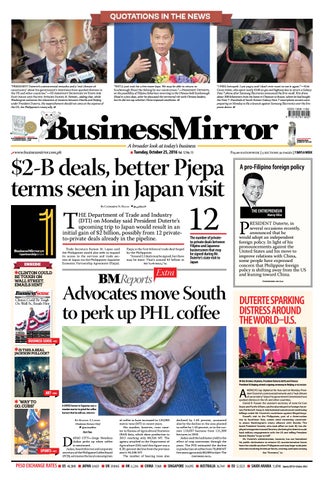
“President Duterte’s controversial remarks and a ‘real climate of uncertainty’ about his government’s intentions have sparked distress in the US and other countries.”—US Assistant Secretary of State for East Asian and Pacific Affairs Daniel R. Russel, adding that, while Washington welcomes the relaxation of tensions between Manila and Beijing under President Duterte, the rapprochement should not come at the expense of the US, the Philippines’s treaty ally. AP
media partner of the year
“We’ll just wait for a few more days. We may be able to return to Scarborough Shoal the fishing by our countrymen.”—President Duterte, on the possibility of Filipino fishermen returning to the Chinese-held Scarborough Shoal in a few days, after he discussed the territorial rift with Chinese leaders, but he did not say whether China imposed conditions. AP
“I feel betrayed. I am angry and I don’t ever want to use it again.”—Kim Chae-yong, who spent nearly $100 on gas and highway fees to return a Galaxy Note 7 phone after Samsung Electronics announced the first recall. Kim drove about 300 kilometers from his home in Cheonan to Busan, where he had bought the Note 7. Hundreds of South Korean Galaxy Note 7 smartphone owners were preparing on Monday to file a lawsuit against Samsung Electronics over the fireprone device. AP
BusinessMirror
United nations
2015 environmental Media Award leadership award 2008
A broader look at today’s business
www.businessmirror.com.ph
n
Tuesday, October 25, 2016 Vol. 12 No. 13
$2-B deals, better Pjepa terms seen in Japan visit T 12 By Catherine N. Pillas
Trade Secretary Ramon M. Lopez said the Philippines would also seek to expand its access to the services and trade sectors of Japan via the Philippines-Japanese Economic Partnership Agreement (Pjepa).
inside
clinton could be tough on wall street, emails hint
Advocates move South to perk up PHL coffee
BusinessMirror
analysis, ideas and commentary from
www.businessmirror.com.ph
Clinton Could Be Tough On Wall St., Emails Hint
Hillary Clinton arrives in Pueblo, Colorado, for a rally, october 12, 2016. Doug Mills/The New York TiMes
W
By Andrew Ross Sorkin
HEN Hillary Clinton was battling Bernie Sanders for the Democratic presidential nomination, she made spirited attacks on Wall Street and corporate America.
“Prosperity can’t just be for CEOs and hedge fund managers,” Clinton said in one speech. In another: “No bank is too big to fail, and no executive is too powerful to jail.” The plutocracy shrugged. That’s not the real Hillary Clinton, they’d say. If Clinton wins, they’d say, she’ll move back to the center when governing. And the recent dumps of emails and other material from WikiLeaks have tended to reinforce that impres sion. Behind the scenes, according to the transcripts of her paid speeches to the big banks, she often appeared con ciliatory toward the financial industry. In one speech, she characterized the blame laid on banks as “politicizing what happened,” and even implied that
bankers should play a role in setting ap propriate regulation: “You guys help us figure it out, and let’s make sure that we do it right this time.” Such ideas, of course, would be anathema to Sanders. But while some of Clinton’s detrac tors spread the view that she is bought and paid for by Wall Street, the Wiki Leaks documents point to a slightly different dynamic. While the full re cord suggests that Clinton may be a pragmatist, the emails sent by her staff hint that she may be inclined to impose heavier regulations on the financial in dustry than is fully understood. For people who don’t like her co ziness with Wall Street, this bit of nu ance may be welcomed. For those who
take comfort in her familiarity with the world of high finance, the leftward tug she seems to be feeling may disappoint. In one email, Mandy Grunwald, a consultant to the Clinton campaign, wrote that her understanding at one point last year “from HRC is that she left her call kind of leaning toward en dorsing GlassSteagall.” Clinton has long said she won’t reinstate the GlassSteagall Act, the Depressionera law that separated in vestment banking from commercial banking. The measure, a bulwark of the financial services industry for decades, was repealed during her husband’s presi dency, a move that has been blamed, in part, for the financial crisis. That Clin ton even toyed with endorsing Glass Steagall is a surprise, even though she never went through with it. “I under stand that we face phoniness charges if we ‘change’ our position now—but we face political risks this way, too,” Grun wald wrote. In another email message, one of Clinton’s campaign speechwriters, Dan Schwerin, told others on his team that he had met with Dan Geldon, an advis er to Warren. “He was intently focused on personnel issues, laid out a detailed
case against the Bob Rubin school of Democratic policymakers, was very critical of the Obama administration’s choices, and explained at length the opposition to Antonio Weiss,” a former banker at Lazard who had been nomi nated by President Barack Obama for a role at the Treasury, over the objections of Warren. (Weiss’s nomination was later withdrawn under pressure, and he instead became an adviser to the Treasury.) Schwerin continued to describe the meeting with Geldon and the guid ance from their respective bosses: “We then carefully went through a list of people they do like, which EW sent over to HRC earlier. We have already been in touch with a number of them, and I asked if he would be comfortable introducing me to the others, to which he seemed reasonably amenable.” Reading between the lines, it is hard to believe that Clinton plans to dismiss Warren’s concerns about the appointment of Wall Street insiders to critical government posts—which means that it is unlikely that many, if any, individuals with significant experi ence on Wall Street will end up in posi tions of power if she were to win. Another email by Schwerin that
has been widely circulated in recent days—most frequently to attack Clin ton as twofaced—may be read to sug gest something else. In it, Schwerin acknowledges that in a speech Clin ton gave to Deutsche Bank in 2014, he “wrote her a long riff about economic fairness and how the financial industry has lost its way, precisely for the purpose of having something we could show people if ever asked what she was saying behind closed doors for two years to all those fat cats.” He went on to explain that if the speech were released, the “upside would be that when people say she’s too close to Wall Street and has taken too much money from bankers, we can point to evidence that she wasn’t afraid to speak truth to power. Downside would be that we could then be pushed to release tran scripts from all her paid speeches, which would be less helpful though probably not disastrous.” The email clearly demonstrates how focused her team was on how she would be perceived. And it does raise ethical questions about whether the campaign was hoping to deceive the public about what she had said. But embedded in those is emails
was Schwerin’s casual reference to bank ers as “fat cats”—which most people on Wall Street consider a pejorative, even if most people on Main Street think of it as a harmless phrase—a tiny clue about how the Clinton machine may re ally perceive Wall Street. Yes, she may have to play along with them to get paid for speeches and for fundraising, but you get the vibe from her staff members that the relationship would be somewhat less chummy when it comes to governing and policy. Finally, there is this: While Clin ton hasn’t endorsed GlassSteagall, she has publicly endorsed the idea that Wall Street banks should pay a “risk fee” based on their size. In one email exchange that was unearthed, Gene Sperling, another Clinton adviser, es timated that the proposal could mean “Goldman and JP owe $8 billion or $18 billion.” Such a sizable charge would be a huge surprise to Wall Street. Perhaps all these email exchanges are just a lot of twofaced talk. And maybe that’s what Wall Street is count ing on. But being twofaced can go both ways.
business sense © 2016 The New York Times
See “$2-B deals,,” A2
BMReports
BusinessSense E1 Tuesday, October 25, 2016
Pjepa is the first bilateral trade deal forged by the Philippines. “Around 12 deals may be signed, but there may be more. That’s around $2 billion in
The number of privateto-private deals between Filipino and Japanese businessmen that may be signed during Mr. Duterte’s state visit to Japan
business news source of the year
P25.00 nationwide | 5 sections 32 pages | 7 days a week
A pro-Filipino foreign policy
@c_pillas29
he Department of Trade and Industry (DTI) on Monday said President Duterte’s upcoming trip to Japan would result in an initial gain of $2 billion, possibly from 12 privateto-private deals already in the pipeline.
2016 ejap JOURNALISM awards
the entrepreneur
P
Manny Villar
resident Duterte, in several occasions recently, announced that he would adopt an independent foreign policy. In light of his pronouncements against the United States and his move to improve relations with China, some people have expressed concern that Philippine foreign policy is shifting away from the US and leaning toward China. Continued on A10
DUTERTE SPARKING DISTRESS AROUND THE WORLD–U.S.
e1
is this a real jackson pollock?
In this October 20 photo, President Duterte (left) and Chinese President Xi Jinping attend a signing ceremony in Beijing. AP /Ng Han Guan
art
A
d4
‘way to go, cubs!’
A coffee farmer in Tagaytay uses a wooden mortar to grind the coffee harvest that he will use. NONIE REYES By Manuel T. Cayon
Mindanao Bureau Chief @awimailbox
sports
c1
D
Part Two
AVAO CITY—Jorge Mendoza Judan perks up when coffee is mentioned. Judan, board director and corporate secretary of the Philippine Coffee Board (PCB), estimates the local consumption
PESO exchange rates n US 48.2840
of coffee to have increased to 120,000 metric tons (MT) in recent years. His number, however, runs counter to Bureau of Agricultural Statistics (BAS) data, which show production in 2011 reaching only 88,526 MT. The agency attached to the Department of Agriculture (DA) said this figure was a 6.35-percent decline from the previous year’s 94,536 MT. The number of bearing trees also
declined by 1.65 percent, accounted also by the decline in the area planted to coffee by 1.43 percent, or to the current 119,657 hectares from 121,399 hectares in 2010. Judan said the lackluster yield is the effect of crop conversion through the years. The PCB estimated the decline in production of coffee from 70,000 MT five years ago to only 30,000 to date. The
merica’s top diplomat for Asia said on Monday President Duterte’s controversial remarks and a “real climate of uncertainty” about his government’s intentions have sparked distress in the US and other countries. Daniel R. Russel, the assistant secretary of state for East Asian and Pacific Affairs, said he also relayed to Foreign Secretary Perfecto R. Yasay Jr. international concern over continuing killings under Mr. Duterte’s crackdown against illegal drugs. Russel’s visit to the Philippines, part of a three-nation trip to Southeast Asia, comes amid increasing uncertainty about Washington’s treaty alliance with Manila. The brash President Duterte, who took office on June 30, has displayed antagonism toward America, declaring his desire to scale back military engagements with the US and telling President Barack Obama “to go to hell”. Mr. Duterte’s administration, however, has not formalized his public declarations to remove US counterterrorism forces from the volatile southern Philippines and stop large-scale joint exercises involving American forces, creating confusion among
Continued on A3 See “Duterte,” A2
Continued on A2
n japan 0.4651 n UK 59.0465 n HK 6.2246 n CHINA 7.1368 n singapore 34.6395 n australia 36.7441 n EU 52.5523 n SAUDI arabia 12.8740
Source: BSP (24 October 2016 )
BMReports BusinessMirror
A2 Tuesday, October 25, 2016
www.businessmirror.com.ph
Advocates move South to perk up PHL coffee Continued from A1
DA corroborated this with reports of crop shifting to Señorita banana in Compostela Valley and to rubber in Zamboanga City. The DA further said many processors of coffee in the country belong to local small and medium processors of roasted beans and ground coffee. The largest soluble-coffee processor is Nestlé Philippines Inc., which accounts for 80 percent of the instant-coffee markets in the Philippines, according to data from the DA. Universal Robina Corp. and Commonwealth Foods Corp. follow Nestlé, a Swiss transnational foodand drink-processing company.
Processing
THE DA said coffee is processed into various product forms: green beans, roasted beans, ground coffee and instant coffee. Green beans are used by industrial users, for further processing into roasted beans, ground coffee or instant coffee. Roasted beans are intended for grinding and are highly in demand among industrial
$2-B deals. . . Continued from A1
deals between private-sector players, excluding the official development assistance (ODA) or loans,” Lopez told reporters on Monday. Deals that may be signed would benefit the country’s manufacturing, agriculture and agri-processing sectors. The DTI said discussions on Pjepa centering on better terms for the country’s services sector will also take
buyers and, to a certain extent, institutional users. Ground coffee is derived from roasted beans that have been crushed. Ground coffee is mainly for brewing and has a better flavor than instant coffee. Instant soluble coffee includes pure soluble coffee, single-serve sachet mix, 3-in-1 mixtures and ready-to-drink. It is easy to prepare and has a lower price compared to ground coffee. There are also 5-in1 and 7-in-1 coffee variants with added ingredients, presented by sellers as having some health benefits, the DA further said. It added that there is also specialty coffee, “which is made from the high-quality green beans roasted and brewed according to wellestablished standards.” Specialty coffee products include Arabica blends, organic coffee, Civet coffee (Alamid coffee) and others, which cater to niche markets, the DA explained.
Net importer
THE DA said the country has been a net importer of coffee since 1997. The growing number of specialty
coffee shops and foreign brands contributes to the continuous increase in the country’s imports. Imports in 2011 were dominated by unroasted green Robusta and extracts, essences and concentrates of coffee, which accounted for 39 percent and 34 percent of the total value of coffee imports, respectively, data from the DA revealed. The DA said the bulk of value shipments, consisting of raw, g round and ung round, other than roasted and unroasted, extracts, preparations, came from Vietnam ($50 million, or 42 percent of total imports), followed by Indonesia ($25 million, or 21 percent); Malaysia ($22 million, or 18 percent); Thailand ($11 million, or 9 percent); and South Korea at (4 percent). Citing the United Nations Tr ade M ap st at i st ic s p or t a l (http://comtrade.un.org/data/), the DA said the Philippine imports of coffee amounted to about 23,766 MT in 2011, valued at roughly $54.94 million. The UN Trade Map revealed that Philippine imports of coffee (not roasted and not decaffein-
place. For one, the Philippines is keen on deploying more nurses to Japan. President Duterte will be going to Japan on a state visit from October 25 to 27. The President will be joined by Lopez and representatives from more than a hundred Filipino businesses seeking tieups with their Japanese counterparts. Mr. Duterte and Lopez will then proceed to Taiwan, where they will stay until October 28. Manila is making a concerted effort to reinforce relations with neighboring Asian countries following the President’s announcement that he wants to “separate” from its
ated) declined to 7,609.61 MT in 2014, valued at about $15.4 million (P742.41 million at current exchange rate of P48.23: $1). Imports, however, doubled last year at 14,962MT, which the UN Trade portal valued at roughly $27.55 million (P1.329 billion). The UN Trade portal pegged the exports of coffee from the Philippines to the world last year at 1.167MT, valued at $6,954 (P335,356.65).
Opportunities
DESPITE the daunting challenge to coffee growers, Judan remained optimistic for the agricultural sub-sector. He said recent conferences by the PCB summits have revealed new avenues to rejuvenate interest in domestic production to meet domestic demand. “The taste is very important, we have taste a lot of good coffee, very good cups, indeed, and they come from Mindanao,” he said during the end of the 2016 Coffee Summit here. “Always, we need government help; we need a lot of things from them—postharvest
long-standing ally, the United States. The President made the pronouncement in a speech before Chinese businessmen and government officials in Beijing. Mr. Duterte visited China from October 18 to 21. On Friday Cabinet members, including Lopez, clarified that the President merely wanted to “lessen the country’s dependence on one side of the world.” Other Cabinet members came to Duterte’s defense, explaining that the “separation” would not involve economic relations between the US and the Philippines.
Duterte. . .
equipment, fertilizers, whether organic or inorganic warehousing, finance. Many things.” The local coffee industry would only be required of its “interest and perseverance,” he added. “There’s not a lot of problem to face because we already have the coffee here that are so good.” Judan may be referring to the DA survey showing the top producers of coffee in 2011 in the Soccsksargen (collectively the Cotabato provinces), Davao region and the Autonomous Region in Muslim Mindanao (ARMM). T he share of Soccsksargen (South Cotabato, Cotabato, Sultan Kudarat, Sarangani and General Santos City) in the national production was at 30.94 percent, while the Davao region and the Armm was at 23.13 percent and 12.31 percent, respectively.
Teaching farmers
ALEJANDO C. Mojica, vice president for research and development of the National Coffee Research Development and Extension Center in Cavite State University, has high hopes for farmers.
Continued from A1
even his Cabinet officials. In a major walk-around, Duterte sparked diplomatic alarm when he announced during a state visit to Beijing last week his “separation” with the United States. Upon returning home the day after his stunning remarks, Duterte said he did not mean he was severing diplomatic ties with Washington, but only wanted to end a foreign policy that’s overly oriented toward the US. “I’ve pointed out to Secretary Yasay that the succession of controversial statements, comments and a real climate of uncertainty about the Philippines’s intentions has created consternation in a number of countries, not only in mine,” Russel told reporters on Monday in Manila
Mojica said the farmers may be mentored into going into the production of the fine Robusta, “and help them develop very good quality coffee, good processing and good genetic materials.” “These are the weapons of farmers to compete in the gourmet [market],” he added. “Of course, we already have the good impression of our coffee [in the world market].” Mojica said the local coffee growing and processing industry may tap the help of the Coffee Quality Institute (CQI). Mojica believes the Aliso Viejo, California-based nonprofit organization, can “help us turn our Robusta into good quality, from the Robusta we supply to Nestlé to the fine Robusta needed by the gourmet market.” “This is the most important of all, and the CQI can help us with improving our beans to better quality and make us known worldwide,” he added. The CQI maintains a quality grading system of coffee and bring them to the markets worldwide, with its partnership with institutions and governments in many countries. To be concluded
after a meeting with Yasay that went overtime. The unease, Russel said, was also palpable “not only among governments, but also...in other communities, in the expat Filipino community, in corporation board rooms, as well.” “This is not a positive trend,” he said, adding that the US remains committed to continuing a solid alliance with and providing assistance to the Philippines, including in fighting the drug menace. Russel said that, while Washington welcomes the relaxation of tensions between Manila and Beijing under Duterte, the rapprochement should not come at the expense of the US or other nations.“It’s a mistake to think that improved relations between Manila and Beijing somehow come at the expense of the United States,” he said. “This should be addition and not subtraction.” AP
BMReports BusinessMirror
A4 Tuesday, October 25, 2016
news.businessmirror@gmail.com
Econ managers set programs to shield poor from impact of fuel excise taxes
T
By Rea Cu
@ReaCuBM
he economic managers of the Duterte administration have guaranteed highly targeted, direct and indirect subsidies, plus other social-protection initiatives to shield the poor and low-income households from the impact of the proposed adjustments in excise taxes on fuel.
tax (VAT) base and restructuring of the excise tax on automobiles, except for trucks, cargo vans, jeepneys, jeep substitutes, single-chassis engines and vehicles for special purposes. “To mitigate the impact of higher oil prices on low-income and vulnerable households, we will use highly targeted transfer programs to ensure that the poorest 50 percent of the population is fully protected from the increase in oil excises, while the next 30 percent, which covers the commuting class, will be protected through indirect subsidies to public-utility vehicles,” the joint statement said. They pointed out that increasing excise tax on oil products is highly progressive, as the top 2 million households, comprising 10 percent of the total number of households in the country, consume almost 60 percent of oil products, while the top 200,000 households, or 1 percent of total households, consume some 20 percent of oil products. “Only when tax reform and targeted transfers are pursued together can we ensure that the resulting policy reform will be truly inclusive and equi-
Only when tax reform and targeted transfers are pursued together can we ensure that the resulting policy reform will be truly inclusive and equitable.” —Economic managers
table,” the economic managers added. According to Dominguez, the government’s proposed reforms in tax policy and administration aims to achieve more efficient, equitable and simpler tax system characterized by lower rates and broader base that will encourage investment, job creation and poverty reduction. Dominguez also explained that priority infrastructure, education and health investments that will be funded through tax reform will enable the country to lift 10 million Filipinos out of poverty by 2022 and eradicate extreme poverty by 2040. The near-term goal of the Duterte
administration’s tax-reform plan is to raise P600 billion, which is about 3 percent of the country’s GDP, by 2019 to help fund it 10-point socioeconomic agenda for sustained inclusive growth, which is anchored on accelerated spending on infrastructure, human capital and social protection for vulnerable sectors. Of the P600 billion, P400 billion, or 2 percent, of GDP will come from tax-policy reforms and another P200 billion, or 1 percent, of GDP from reforms in tax administration. The finance chief added that reforming the tax system and protecting the country’s vulnerable sectors
should go hand in hand in realizing President Duterte’s electoral mandate of making the benefits of economic growth felt by all Filipinos. The adjustments in oil excise taxes and later indexing these to inflation, the expansion of the VAT base and the restructuring of the excise tax on automobiles are measures that would offset the revenue losses arising from the reduction of PIT rates. He pointed out that adjusting oil excise taxes would remove the subsidy on fuel that is actually enjoyed mostly by the rich, and transfer this instead in the form of highly targeted assistance to low-income households and other vulnerable sectors. “The incremental revenues will be used to fund the massive infrastructure needs of the country and the programs to develop our human capital and provide social protection for the poor,” Dominguez said. The macroeconomic assumptions under the 2017 National Expenditure Program show that prices of crude oil in the world market will stay within the $40-to-$60 range in 2018 and 2019.
The proposal is under the initial comprehensive tax-reform program that was submitted to Congress. In a joint statement, Secretaries Carlos G. Dominguez III of the Department of Finance and Benjamin E. Diokno of the Department of Budget and Management, and Ernesto M. Pernia, the director general of the National Economic and Development Authority, said the highly targeted transfer pro-
grams will help cushion the impact of the proposed indexing to inflation of the excise taxes on oil products on “the poorest 50 percent of the population.” The proposed tax-reform package 1 includes adjustments in excise taxes on diesel, gasoline and other petroleum products. The first tax package also includes the lowering of personal income-tax (PIT) rates, broadening the value-added
Oil halts rally above $50 as Iraq signals break from Opec cuts
‘Land-use law to help solve housing problem, boost PHL food security’
O
il halted its advance near $50 a barrel, as Iraq threatened to derail the plan of the Organization of Petroleum Exporting Countries (Opec) to stabilize crude markets by saying it should be exempt from planned output cuts. Prices slid as much as 0.7 percent in New York after rising 0.4 percent on Friday. Iraq should be exempted from trimming production because it’s embroiled in a war with Islamic militants, Oil Minister Jabbar AlLuaibi said on Sunday at a news conference in Baghdad. Rigs targeting crude in the US rose for an eighth week to the highest level since February, according to Baker Hughes Inc. Oil has fluctuated near $50 a barrel amid uncertainty about whether the Opec can implement an accord to reduce oil output when they gather at an official meeting in November. A committee will meet later this month to try to resolve differences over how much individual members should pump. “The mind-set of the market at this stage is to wait for the actual outcome of the November meeting,” said Ric Spooner, a chief market analyst at CMC Markets in Sydney. “Oil will probably hold around $50 a barrel, but the short-term risk looks to the downside. Implementation of the output deal will probably be left to Saudi Arabia and a couple of others.” West Texas Intermediate (WTI) for December delivery lost as much as 34 cents to $50.51 a barrel on the New York Mercantile Exchange, and was at $50.64 at 9:30 a.m. in Hong Kong. Front-month futures gained 1 percent last week to close at $50.85 on Friday. Total volume traded was about 50 percent below the 100-day average. Brent for December settlement slid as much as 31 cents, or 0.6 percent, to $51.47 a barrel on the London-based ICE Futures Europe exchange. The global benchmark crude traded at a premium of 96 cents to WTI. Iraq is not going to reduce the achieved oil production level of 4.7 million barrels per day, the media reported on Sunday, citing Falah AlAmri, the head of the state-backed Iraqi company State Oil Marketing Organization. PNA
By Jovee Marie N. dela Cruz @joveemarie
T
o settle the perennial debate on what should be prioritized more—food security or housing—a member of the House minority bloc on Monday pushed for the immediate passage of the proposed National Land Use Act (NLUA). Liberal Party Rep. Teddy Brawner Baguilat Jr. of Ifugao made the statement amid conflicting views on the land-conversion moratorium being pushed by the Department of Agrarian Reform (DAR). “There is no debate actually. Both food and shelter are important for our people’s survival if only we carefully plan the use of our resources as a nation and as an ecosystem, and not just at the local government level,” Baguilat said. “But we do need to determine where and which of our 14 million alienable and disposable lands classified as agricultural would be more suitable for food production or as built-up areas for housing, urban expansion and infrastructure,” he added. Earlier, Vice President Maria
Leonor G. Robredo, Budget Secretary Benjamin E. Diokno, Finance Secretary Carlos G. Dominguez III, Trade Secretary Ramon M. Lopez and Socioeconomic Planning Secretary Ernesto M. Pernia submitted a position paper to Malacañang asking President Duterte not to endorse the moratorium on land conversion, saying this will only delay housing projects. Baguilat expressed apprehension that if the 2-percent growth rate of the country’s population continues, 142 million Filipinos may be fighting for food and water by 2045 if natural resources are not currently protected and conserved. With the increase in population, the lawmaker said the demand for housing will also multiply. “While it may be true more built-up areas will be needed to cater to the housing needs of Filipinos these areas may not necessarily come from the remaining 4 million prime agricultural lands planted to rice and corn across the country,” Baguilat said. “These 4 million hectares are merely part of the 14 million hectares of the total alienable and disposable lands generally classified as agricultural, meaning not public lands
or forest areas. Therefore, it is vital that appropriate land-use planning should be done in the whole country to determine the land allocation for settlements without compromising our remaining rice and corn lands,” he added. According to Baguilat, the moratorium for conversion is just a reiteration of the DAR’s mandate to protect prime agricultural lands under the comprehensive agrarian-reform law. “It is imperative to determine the amount of land local governments have actually reclassified to nonagricultural. Based on Section 20 of the Local Government Code, LGUs [local government units] are only allowed to reclassify 5 percent of their agricultural land for nonagricultural purposes,” Baguilat said. Citing a study of environmental planner Dr. Elmer Mercado on the rate of conversion in Rizal province from 2002 to 2012, Baguilat noted the “dramatic increase” of built-up areas, including settlements, in the towns of Antipolo, Baras, San Mateo, Rodriguez and Tanay. In Antipolo alone, Baguilat said built-up areas surged from 1,193.21 hectares in 2002 to 6,999.27 hectares
23
The number of years that the proposed National Land Use Act has been languishing in Congress
in 2012, or 487 percent. Meanwhile arable lands planted to cereals fell from 3,551.90 hectares to a mere 284.72 hectares and open canopy forests dropped from 2,527.22 hectares to 746.32 hectares, he added. “One only need to go to Antipolo to confirm such a conversion rate of forests and arable areas. Since it is near Mega Manila, this urban expansion may be expected. But we are losing even our critical watersheds and ricelands fast to this kind of urban demand,” Baguilat said. Moreover, he said, other provinces once branded as the rice bowls of the country, like Laguna, Bulacan,
and even Nueva Ecija, are losing their prime agricultural lands too fast to conversion. “I also have doubts on whether the housing units constructed from these conversions really did cater to the majority of the population who still have no permanent residency or nowhere to live at all,” Baguilat said. If the NLUA is passed, Baguilat said this will compel the whole country to determine what areas need to be protected for long-term use and which are more appropriate for other or multiple uses. “It has been languishing in Congress for the past 23 years already. It almost passed in the 15th Congress but was questioned in the Senate. This 17th Congress, I do hope there will be more support for the passage of this bill,” he said. The current version of the NLUA in the 17th Congress was recently passed at the committee level in the House of Representatives. Baguilat, one of the authors of the bill, said the measure recognizes the need and proposes for a rational, holistic and just allocation, utilization, management and development of the country’s land.
Senators ready to back funding Hostages held by Somali pirates released for Duterte’s emergency powers
S
enators are inclined to back funding for big-ticket national railway projects—estimated to cost between P300 billion to P700 billion—to be pursued while the country is under the proposed emergency powers, provided adequate safeguards are adopted to prevent fund misuse. Apart from the proposed Mindanao railway system, also up for funding are the Malolos-Manila line, the Manila-La Union line and the upgrade of the existing Manila-Bicol railway, as well as the Metro Rail Transit (MRT) or Light Rail Transit (LRT lines) in Cebu and Panay. “We are 100 percent in support of President Duterte in these railway projects,” said Sen. Joseph Victor Ejercito, adding that the additional railway systems are expected to “spread out development” in the countryside. While he admitted it would cost “so much” to build these national railway projects, “the returns would be big.” The senator told reporters that among the funding-source options for the proposed railways systems could
be a government-to-government loan arrangement with low interest public-private partnership scheme, “or a hybrid where the government would be allowed to run the system.” He said the funding is in the agenda of President Duterte’s upcoming trip to Tokyo, aiming to tap Japan for loans under the official development assistance fund. Ejercito reported that senators are looking at a two-year duration of the emergency powers for President Duterte. But he added: “We can extend it” if requested by the Executive. He said the Senate version of the extra powers for the President is likely to include additional provisions on “ease of doing business, peace and order, as well as address the weakness in infrastructures, including railways,” which, the senators added, are being blamed for “weakness in attracting investors.” As for the safeguards against fund misuse, Ejercito said the extra-powers measure would “have to be compliant with the freedom of information law.
F
ollowing more than four years in captivity, 26 Asian sailors held hostage by Somali pirates have been released from their captors, China’s Foreign Ministry confirmed on Monday. The sailors arrived in Nairobi, Kenya, on Sunday, and international mediators said the action marks a turning point in the long-fought battle against Somali piracy. The crew from Vietnam, Taiwan, Cambodia, Indonesia, China and the Philippines had been among the few hostages still in the hands of Somali pirates. The sailors were the crew of the FV Naham 3, a Taiwan-owned fishing vessel seized in March 2012, said pirate representative Bile Hussein. The ship later sank. Hussein said $1.5 million in ransom was paid for the sailors’ release. That claim could not be independently verified. Chinese Foreign Ministry Spokesman Hua Chunying said in a statement on Sunday night that 10 of the hostages were from the Chinese mainland and two were from self-governing Taiwan. She said the 26 crew members were rescued on Saturday “through various efforts.” The Chinese government was grateful to “all the organizations and people who participated in the rescue,” she said. The 26 sailors will be repatriated to their home countries, John Steed, coordinator of the Hostage Support Partners for the US-based organization
Sailors who had been held hostage by pirates for more than four years, wait to board an airplane after being released in Galkayo, Somalia, on Sunday. AP
Oceans Beyond Piracy, said in a statement. “They are reported to be in reasonable condition, considering their ordeal.... They have spent over four-and-a-half years in deplorable conditions away from their families,” Steed said. He said another member of the crew died in the hijacking and two died of illnesses in captivity. Piracy off Somalia’s coast was once a serious threat to the global shipping industry. Attacks have dropped off dramatically in recent years
amid patrols by the navies of North Atlantic Treaty Organization counties, China and India. No commercial vessel has been successfully attacked since 2012, but the threat of piracy remains, Steed said. Most hostages held by Somali pirates have been sailors on merchant ships, although European families also have been kidnapped from their yachts while traveling in the dangerous waters. AP
AseanTuesday BusinessMirror
news@businessmirror.com.ph
Editor: Max V. de Leon • Tuesday, October 25, 2016 A5
Najib chases win as supporters get ‘incentives’
M
alaysian Prime Minister Najib Razak has targeted budget spending at his coalition’s most loyal voters, seeking to limit any damage from more than a year of political turmoil, as talk turns to a potential early election.
The premier allocated more funds for his cash handout program to the poorest 40 percent of Malaysians, promised civil servants a bonus and introduced extra assistance for farmers. He pledged more roads, bridges and better electricity and water supply for rural regions, and sought to woo younger voters with discounts on outstanding student loans and access to cheap housing in urban areas. After weathering funding scandals and attempts to topple him for a good part of his second term as premier, Najib must balance a slowing economy with keeping voters happy ahead of an election that could come as soon as March. W hile the opposition is fractured, it has sought to lure ethnic Malays from Najib’s coalition amid discontent at rising living costs and disillusionment over allegations of graft surrounding the premier. Najib’s United Malays National Organization (Umno) leads the Barisan Nasional (BN) coalition, which has ruled since independence in 1957 with the support of ethnic Malays in the predominantly Islamic nation. “As we approach the next general election, it is really difficult to say whether it will be smooth sailing for Najib,” said Ahmad Martadha Mohamed, dean of the college of law, government and international studies at Universiti Utara Malaysia. “The budget aims at specific target groups that have been the main supporters of Umno for a long time. Giving a lot of incentives to these people is crucial to ensure stable and continued support for Umno and BN.”
Tax relief
While Najib’s term runs until mid-2018, some senior Umno officials told Bloomberg News last month a vote could come as soon as March. Najib has been quick to deny media reports that cited him as ruling out an early election. Speaking for more than two hours on Friday in a speech that took shots at his foes and praised allies for standing by him, Najib announced giveaways from tablets for 430,000 teachers to money for muezzins—those who call Muslims to prayer—and mosque caretakers. There was tax relief for working parents who enrolled preschoolers in early education classes and higher allowances for village heads. About 440,000 rubber tappers and smallholders will get so-called rainy-season assistance for three months to supplement wages affected by bad weather between November and January. Many farmers are ethnic Malays. “Najib is making sure every constituency gets their—albeit tiny—share of the pie, so that cumulative effect of all those albeit small amounts of vote switch will favor the incumbent government,” said Oh Ei Sun, an analyst at the S. Rajaratnam School of International Studies in Singapore and Najib’s political secretary from 2009 to 2011. At the last election in May 2013, BN lost the popular vote
The budget aims at specific target groups that have been the main supporters of Umno for a long time.”
—Universiti UtaraMalaysia
for the first time for its worst result yet. Najib on Friday made more overtures to ethnic Chinese and Indian voters who deserted the coalition then, providing funds for vernacular schools and loans to hawkers and small business owners from the minority groups. Still, he was unambiguous on who needed to be kept happy. Umno has, for decades, propagated policies that provide favorable access to education, jobs and housing for Malays and indigenous people, known collectively as Bumiputeras. “In a nutshell, the agenda of empowering Malays and Bumiputera will continuously be upheld,” Najib said. The premier needs a strong election win to dispel doubts on his ability to lead given scandals surrounding political donations and the finances of state fund 1Malaysia Development Bhd. Even as senior party figures publicly pledge support, some have privately expressed concern he will become a liability. Some of the biggest initiatives were reserved for the civil service, which employs 1.6 million people, or about 11 percent of the labor force. Around 79 percent of the civil service was made up of Malays as of the end of 2014, and over 11 percent from indigenous Bumiputera groups. To avoid “sleepless nights” for civil servants, Najib said they will get a special cash payment in early January, plus bigger loans for homes, motorcycles, computers and smartphones.
Opposition walkout
C abinet members denied it was an election budget, with Minister in the Prime Minister’s Department Abdul Rahman Dahlan saying it was an inclusive approach and “we do this every year.” Sports Minister Khairy Jamaluddin added “we don’t know when the election is going to be.” O p posit ion l aw m a k ers walked out during Najib’s budget speech after holding up placards referencing Malaysian Official 1, or MO1, a US Department of Justice description of a politician who it said controlled accounts that got hundreds of millions of dollars in diverted funds from a state company. Najib has acknowledged funds went into his accounts before the 2013 election but said the money was a donation from the Saudi royal family and most was later returned.
“Who is MO1, that was not answered,” said Lim Kit Siang, a leader of the opposition Democratic Action Party. “Corruption problems were not
mentioned. The prime minister paints a pretty picture” but questions remain, he told reporters. While Najib avoided mentioning
election timing in the budget speech, he urged his coalition to stay united and “close ranks.” Malaysians “will continue to be
safeguarded,” he said. The Barisan Nasional government will have the “ultimate victory in the 14th general election.” Bloomberg News
A6
Tuesday, October 25, 2016 • Editor: Lyn Resurreccion
The World BusinessMirror
www.businessmirror.com.ph
Merged AT&T-TimeWarner may not do consumers much good
N
A man takes a selfie near a picture of Chinese President Xi Jinping on display at an exhibition on the Long March at the military museum in Beijing on Monday. AP/Andy Wong
China’s Xi seeks to enforce will at Communist Party meeting
B
EIJING—Having punished more than a million Communist Party members for corruption, Chinese President Xi Jinping will use a key meeting that started on Monday to drive home the message that his signature antigraft campaign is far from over and that his authority remains undiminished.
The Central Committee plenary gathering also sets in motion preparations for next year’s 19th national party congress that will kickoff Xi’s second five-year term as head of the ruling party. At next year’s gathering, Xi is expected to place trusted lieutenants into the party’s top bodies, including the all-powerful Politburo Standing Committee, f ive of whose seven c u r rent members are, by custom, due to step down. Only Xi and Premier Li Keqiang, with whom he doesn’t always see eye-to-eye, are expected to remain. This week ’s meeting comes as X i is riding high as China’s mo s t p o w e r f u l l e a d e r s i nc e Deng X iaoping led the countr y in the 1980s and gaining kudos at home for his assertive foreig n polic y, inc lud ing the leveraging of China’s political and economic heft to open up a rift between the Philippines and its long-stand ing treat y ally, the United States. Yet, Xi’s domestic challenges are legion, ranging from slowing economic growth to massive layoffs resulting from the closure of steel and coal mines and other heavy industries in an effort to reduce industrial overcapacity. The state sector still plays an outsize role in the economy, debt is soaring and the potentially volatile wealth gap continues to broaden. Xi, the son of a former vice premier, has sought to exercise
350
The number of members of Central Committee and their alternates who are attending a plenary meeting at a military guesthouse in western Beijing
near total control by headingup a collection of party “leading groups,” including a newly created National Security Council that are seen as further eroding the legitimacy of established government institutions. Few political reforms have been mooted and Xi has drawn fire overseas for waging a sweeping campaign against activist lawyers and government critics resulting in a series of televised confessions reminiscent of Josef Stalin’s show trials. Official sources have offered little insight into this week ’s discussions, bringing together the more than 350 Central Committee members and their alternates at a military guesthouse in western Beijing. The official Xinhua News Agency reported their theme would be “strengthening and standardizing intraparty political life,” while
seeking to “primarily resolve problems of Party leadership fatigue and slackness in party governance and discipline observation.” That indicates Xi is experiencing difficulty keeping the rank and file on-program and establishing himself as the party’s “core,” said Zhang Lifan, an independent political commentator in Beijing. “The [meeting’s] agenda...indicates that resistance within the system is persistent and the leader needs to crack the whip,” Zhang said. “If he fails to get it done now, it will be even harder to achieve in future.” Xi’s main goal at the gathering is to get rid of “governance by personality and hidden rules,” Beijing Institute of Technology political scientist Hu Xingdou said. “For a long time now, problems have existed, such as party above state, individual above party or party above law,” Hu said. Other state media reports say new declarations on the anticorruption front will be issued and the most recent defaulters arrayed before the public. The past year has seen a number of retired and serving party big-wigs fall, including former top general Guo Boxiong. That followed the downfall earlier in Xi’s term of powerful officials, including former Politburo Standing Committee member Zhou Yongkang. More than 1 million of the party’s 88 million members have been handed punishments since 2013, according to party corruption watchdog, the Central Committee for Discipline Inspection. State media say a pair of documents toughening discipline will be put forward at this week ’s meeting, reflecting Xi’s preference for pursuing anticorruption through party channels rather than the legal system. W hat’s not clear is how Xi plans to tackle the unintended results of the antigraft drive. Those include the reluctance of low-level bureaucrats to do their jobs for fear of being accused of taking bribes and a malaise among the higher-ups unwilling
to act until they can once again earn kickbacks, according to recent editorials in the China Daily and other state newspapers. Shortly after the meeting, the process of selecting the roughly 2,300 delegates for next year’s fiveyearly national congress will begin. Past plenums have seen participants vote in a straw poll as a first step toward selection of candidates for the next Politburo. Despite informal rules on retirement, Xi may push to have ally Wang Qishan, who has been spearheading the anticorruption drive, remain on the Politburo Standing Committee, said Steve Tsang, a Chinese politics expert at the University of Nottingham. Xi might then use his personal authority to angle for a third fiveyear term, breaking the precedent limiting him to two terms and obviating the need to anoint a successor at next year’s congress, Tsang said. “I don’t think this is a foregone conclusion, as there is strong resistance within the establishment against Xi breaking rules to do so and asserting himself so powerfully. We will see from how the plenum goes the real extent of Xi’s power,” Tsang said. Xi has offered no public insights or opinions on the meeting’s nittygritty, but in a speech at a patriotic gathering on Friday, called for total adherence to party edicts, devotion to the people and full support for the armed forces that remain ultimately loyal to the party rather than the Chinese nation. He offered a hopeful message, as well, saying the struggles of the past showed that no challenge was too great and that China was closing in on its goal of becoming a modern nation with a comfortably well-off society. “We are closer now than at any period in history to realizing the great goal of the rejuvenation of the Chinese nation,” Xi said, shortly before the meeting closed with the singing of communist anthem “The International.” “We have more confidence and ability than at any period in history to realize this goal.” AP
S. Korea’s leader proposes revising presidential system
S
EOUL, South Korea—South Korea’s president on Monday proposed revising the country’s Constitution, which limits leaders to a single fiveyear term. Critics immediately called it an attempt to divert attention from corruption scandals involving her associates. It wasn’t immediately clear if President Park Geun-hye intended the change to allow her to run for office again, though analysts said that was unlikely. Park pledged during her presidential
campaign four years ago to try to change the system. South Korea adopted the current system in 1987, ending decades of military-backed dictatorships, including one by Park’s father, Park Chung-hee. Under the current system, a president is barred by law from seeking a second term. Park’s five-year term ends in early 2018. Park said in a speech before parliament that the current system makes it difficult for the government to maintain a continuity of its policies, including those dealing
with rival North Korea, which regularly threatens nuclear war against its southern rival. Park said her government would launch an organization to create a draft revision. Park’s proposal came as her approval ratings have dropped to new lows amid allegations that a purported longtime confidant used her connection to Park to push companies to make massive contributions to set up two nonprofit foundations. Park has also faced a separate corruption scandal involving a senior aide.
The main liberal opposition party issued a statement criticizing Park’s proposal, saying it won’t take part in any discussions on a constitutional change that appears meant to distract from the scandals. “What matters is the timing. Why does President Park propose a constitutional change at a time when she faces so many problems [involving her associates]?” said Kim Sung-Joo, an honorary professor at Seoul’s Sungkyunkwan University. AP
EW YOR K—AT&T and Time Warner are playing up how their $85.4-billion merger will lead to innovative new experiences for customers. But analysts, public-interest groups and some politicians are far from convinced. Republican presidential candidate Donald Trump said it should be killed. Tim Kaine, the Democratic vice-presidential nominee, said less concentration in the media “is generally helpful.” The Republican chairman and Democratic ranking member of the Senate’s antitrust subcommittee said that the deal would “potentia l ly raise sig nificant antitrust issues.” The potential harm to consumers from this deal could be subtle—far more so than if AT&T were simply acquiring a direct competitor, like a big wireless or home-broadband company. Time Warner makes TV shows and mov ies; AT&T gets t hat video to customers’ computers, phones and TVs. But the concern is that anything AT&T might do to make its broadband service stand out by tying it to Time Warner’s programs and films could hurt consumers overall.
Walling off time warner
The company certainly wants to do that. “With great content, we believe you can build a truly differentiated ser vice,” AT&T CEO Randall Stephenson said. “In particular, mobile.” Here’s how that would work. Because of Time Warner’s worldfamous shows and movies—Game of Thrones, the Harry Potter films and, professional basketball— and AT&T’s ability to gather information about its tens of millions of customers, AT&T thinks it could do a better job-tailoring ads and video to user preferences. It cou ld t hen create more attractive subscr iption packages suited for phones, where people are increasingly watching video. But many consumers already consider ads that know ever y t h ing about t hem creepy
or invasive, a nd d ig it a l-r ights groups complain that any preferent i a l dea l AT&T cou ld of fer w it h , s ay, H BO wou ld hu r t compet it ion. Say AT&T reser ved HBO for its customers only. That would cut HBO’s reach and hurt its value. “ This creates massive strategic tensions that are almost impossible to resolve,” Jackdaw Researchs Jan Dawson wrote in a note. AT&T can either disadvantage Time Warner by restricting who can watch its stuff or limit benefits for its own customers so much that they barely rate attention, he suggested.
Free data for time warner
T here ’s a not her way AT&T could favor its own media offerings. The company currently lets many of its wireless customers stream from the DirecTV app on their phones without counting it against their data caps, a practice known as “zero rating.” AT&T has suggested it may also zero-rate its upcoming live-streaming DirecTV Now service, which doesn’t require customers to install a dish on their homes. If AT&T did that with, say, HBO shows and TNT’s basketball games, it could upset other video providers, who could reasonably worry that customers might shun their streaming services to avoid exceeding their monthly data limit and possibly suffering slower data speeds as a result. The companies also say relying more on targeted ads could help lower the cost of making appealing shows and films. Even if that’s the case, the savings might not get passed on to consumers. R ich Greenfield, a BTIG analyst, noted there’s no evidence that Comcast’s 2011 acquisition of NBC led to lower prices. In fact, prices have been increasing broad ly, although Greenfield said there’s no way to know whether the deal contributed to that trend. “There may not be dramatic harm, but it’s certainly hard to find clear benefit,” Greenfield said. AP
Looking past Trump, Clinton aims to help other Democrats
D
URHAM, North Carolina—Newly confident and buoyant in the polls, Hillary Clinton is looking past Donald Trump while widening her mission to include helping Democrats seize the Senate and chip away at the Republican-controlled House. Though Trump’s campaign insisted on Sunday it was premature to count him out, it’s Clinton whose path to winning the White House has only grown wider in the race’s final weeks. Even longtime Republican strongholds, such as Utah and Arizona, suddenly appear within her reach on November 8, enticing Democrats to campaign hard in territory they haven’t won for decades. The shifting political map has freed Clinton and her well-funded campaign to spend time and money helping other Democrats in competitive races. Clinton said she didn’t “even think about responding” to Trump anymore and would, instead, spend the final weeks on the road “emphasizing the importance of electing Democrats down the ballot.” “We’re running a coordinated campaign, working hard with gubernatorial, Senate and House candidates,” said Robby Mook, Clinton’s campaign manager. And for good reason. After a merciless two-year campaign, the next president will face the daunting task of governing a bitterly divided nation. If Clinton wins, her prospects for achieving her goals will be greatly diminished unless her victor y is accompanied by major Democratic gains in Congress. “We’ve got to do the hard and maybe most important work of healing, healing our country,” Clinton said on Sunday at Union Baptist Church in Durham, North Carolina. For Democrats, there’s another reason to try to run up the score. With Trump
warning he may contest the race’s outcome if he loses, Clinton’s campaign is hoping for an overwhelming Democratic victory that would undermine any attempt by Trump to claim the election had been stolen from him. In a rare admission of fallibility by the typically boastful Trump, his campaign acknowledged he’s trailing Clinton as Election Day nears. “We are behind,” Trump Campaign Manager Kellyanne Conway said. Still, she added, “We’re not giving up. We know we can win this.” Conway laid out in granular detail Trump’s potential path to winning: victories in Florida, Iowa, North Carolina, Nevada and Ohio, to start. If Trump prevents Arizona and Georgia from falling to Democrats and adds in some combination of Colorado, Virginia, New Hampshire and Pennsylvania, he could reach the 270 electoral votes needed, Conway said. It won’t be easy. A current Associated Press analysis of polling, demographic trends and other campaign data rates Virginia as solidly Democratic, while Colorado, New Hampshire and Pennsylvania are all leaning Democratic. Arizona, remarkably, is a toss-up. Campaigning on Sunday in Florida, Trump called for voters to elect a Republican House and Senate that would “swiftly enact” his priorities, which include overhauling taxes, restoring higher spending on defense and repealing the Affordable Care Act. “We can enact our whole plan in the first 100 days—and we will,” Trump said. If Clinton wins, Democrats would need a net gain of four Senate seats to retake the majority. House control would be much harder. Democrats would need a 30-seat gain, a feat they haven’t accomplished in roughly four decades. AP
The World BusinessMirror
www.businessmirror.com.ph
Tuesday, October 25, 2016
A7
AT&T dealmaker is a Carlos Slim protégé Stephenson Bloomberg News
T
o understand what drove Randall Stephenson to do the deal of his life, combining AT&T Inc. with Time Warner Inc., you have to go back two decades to a threadbare office in Mexico City. That’s where Stephenson, a rising star at the Southwestern Bell Telephone Co., was installed to oversee the company’s holdings south of the border. He would work alongside Carlos Slim, a cigar-smoking King Midas who had taken investments in real estate, cigarettes and bottling factories and turned them into a fortune big enough to acquire the state-run phone monopoly. The two became fast friends, and Oklahoma-born Stephenson picked up a habit of Slim’s—obsessing over a detailed list of potential acquisition targets, routinely updated with the latest market valuations. Over the years, as Stephenson rose up the chain and his company morphed to become AT&T, he kept his mentor’s method in mind. These days, Stephenson’s list looks a little different than Slim’s old notebook. It resides on AT&T’s cloud, where only the chief executive officer can access the colorcoded sheet of 40 to 45 companies, constantly updated with stock and bond prices. He calls it his scan. “I live my scan,” Stephenson, 56, said in an interview. “The list grows; it’s a living breathing document. Some companies come on and some go off. Time Warner now comes off.”
Wild ride
Stephenson was just looking for opportunities outside his family’s cattle-feed business when he joined Southwestern Bell in 1982 on the recommendation of his brother Kevin, who is still an AT&T lineman in Oklahoma. It’s been a wild ride. From the time Randall became chief financial officer in 2001, on through his appointment as CEO in 2007, and up to last year, he had already done more than $200 billion in deals, plus a $39 billion one that got killed by regulators. “Within a couple of years of completing a deal they will be surveying the horizon for the next one and the bigger they get, the bigger the next deal has to be,” said Jonathan Chaplin, an analyst at New Street Research. “And this really kicked into high gear when Randall ascended to the role of CEO.” The $84.5-billion Time Warner acquisition, announced on Saturday, figures to be his biggest yet, both financially and in terms of the way it would transform Dallasbased AT&T. Stephenson, a longtime Republican party backer with a country twang, hardly fits the mold of an entertainment mogul. If the Time Warner deal gets government approval, he’ll be sending himself headlong into the world of Hollywood actors and New York media elite, from CNN to HBO to Warner Bros. It’s hard to imagine the stodgy phone company and the flashy TVand-movie business coming together without clashing. And that’s just one of the risks the CEO is putting on AT&T. Stephenson, whose ambitious attempt to acquire T-Mobile USA Inc. was stymied by regulators in 2011, is betting he can clear the Time Warner deal through Washington despite rising concerns about the concentration of media. Coming just 18 months after the $48.5-billion purchase of satellite
provider DirecTV, the Time Warner deal will put pressure on AT&T’s investment-grade credit ratings. Stephenson is also calculating that this marriage of content and distribution will be the right combination to keep pace with rapid technological change in the industry. Despite his long experience pulling off big mergers and acquisitions (M&A), Stephenson hasn’t attained a reputation like Slim’s as a visionary dealmaker. Before he became CEO, he was instrumental in making the after-merger work of integration go smoothly, bringing cultures together when his company acquired BellSouth Corp. and the old AT&T Corp. Time Warner gives him a chance to prove he’s not just a skillful manager but a strategic mastermind. “It is too early to judge Stephenson’s M&A acumen,” said Kevin Roe, an analyst at Roe Equity Research. “In fact, the jury is certainly still out on the DirecTV acquisition.” The failed T-Mobile deal was a low point for Stephenson as a dealmaker, forcing AT&T to pay its smaller rival a $7 billion breakup package that included cash, spectrum and network agreements. Worse, the windfall reinvigorated T-Mobile, whose growth has surged. In the aftermath, Stephenson’s pay was docked $2.08 million in 2011.
Comeback trail
After his misjudgment of the US regulatory climate, Stephenson took a hard look at expanding in Europe with a deal for Vodafone Group Plc. That effort was abandoned when AT&T m ad e a n of fe r for D i re cT V, though Stephenson’s company did begin a more modest international expansion in 2014 with the purchase of wireless carrier Grupo Iusacell SA in Mexico. The Mexico deal put Stephenson in direct competition with his old friend Slim, who had attended his daughter’s wedding just a few years before. Stephenson said they haven’t been in contact since. “I miss the guy,” Stephenson said. “Look, you have people in your life that are wicked smart and great entrepreneurs, and you want to be around them. You learn a lot from people like that. To have one you don’t get to be around, well, of course, you miss it.”
Quick deal
Normally after such a flurry of deal activity in a few years, a company would be expected to take more time to digest before stepping into another large transaction. But it was Stephenson who initiated deal talks with Time Warner CEO Jeff Bewkes, brokering the idea at lunch in mid-August at the Time Warner office in New York. The talks had a “gravity” to them, Stephenson said. “As we began to talk, the speed and urgency was apparent. After the second meeting it started to fall into place. We had a lot of late night, difficult negotiations, but we were able to make the deal,” Stephenson said. For Stephenson, the strategic rationale for the deal is pretty simple—it’s about getting scale in video programming production and maintaining AT&T’s dividend. Knowing the viewing habits of the 25 million DirecTV customers gives AT&T an advantage in terms of appealing to what people like. Stephenson said this opens up a shot at more ad revenue, especially as AT&T moves into video streaming with the introduction of an online service, DirecTV Now, in the coming months. “I’ll be honest, you can’t go through life making decisions and wondering how you will be judged,” Stephenson said. “You make decision on what’s right, right now. History will take care of itself. It’s not something I spend any mental cycles thinking about.” Bloomber News
People are reflected on the electronic board of a securities firm in Tokyo on Monday. Asian markets mostly rose on Monday as Japan reported its trade balance swung to a surplus in September and strong Japanese manufacturing data from a purchasing manager’s survey also suggested signs of improved activity in the world’s third-biggest economy. Attention is likely to focus this week on US growth data. AP/Koji Sasahara
Japan’s exports fall for 12th month
J
apanese exports fell for a 12th consecutive month in September, rounding out a rough year for manufacturers struggling with a stronger yen and soft global demand.
Yet, the numbers were better than expected, and export volumes rose last month by the most in nearly two years, prompting some upbeat assessments by economists. “Today’s report confirmed that exports are on the rebound,” said Masaki Kuwahara, senior economist at Nomura Securities Co. “Manufacturing activities are picking up globally, especially in Asian nations. That bodes well for Japanese exports.”
Key points
Overseas shipments dropped 6.9 percent in September from a year earlier, the Ministry of Finance
6.9%
The percentage drop of overseas shipments in September from a year earlier
said on Monday. The median estimate of economists surveyed by Bloomberg pointed to a 10.8-percent decline. Imports fell 16.3
percent during the same period, resulting in a trade surplus of ¥498.3 billion ($4.8 billion).
Big picture
Prime Minister Shinzo Abe has gotten little help from exports recently as he tries to revive Japan’s economy. Net shipments abroad shaved 0.3 percentage point off gross domestic product growth in the second quarter. T he yen has gained 16 percent since the start of the year, a nd sof t g loba l dem a nd h a s made matters worse. T his environment has made companies more reluctant to invest in domestic production, compounding the difficu lt y of creating economic grow th. T he September trade d ata offered hope that exports may soon be driving growth again. W hile down, they fell the least since March and shipment volume rose by 4.7 percent, the most since January 2015, according to Capital Economics.
Economist takeaways
“The strong rise in export volumes underlines that Japan’s manufacturing sector is showing resilience as external demand remains weak,” Marcel Thieliant, senior Japan economist at Capit a l Econom ics i n Si ngapore, wrote in a note. Nomura’s Kuwahara said real exports rose more than 1 percent in the July-to-September period from the previous quarter, according to Nomura’s calculations, a positive sign for third-quarter GDP. “Japan’s economy will probably recover gradually toward the end of the year, with a pickup in exports,” Kuwahara said. Exports to the US fell 8.7 percent from a year earlier. Those to the European Union rose 0.7 percent. Exports to China, Japan’s largest trading partner, dropped 10.6 percent. Adjusted for seasonal factors, exports showed a monthly increase of 0.3 percent by value, and imports showed a pickup of 0.6 percent. Bloomberg News
Rising debt from mom-and-pop businesses adds to Korea’s woes
S
welling debt at the rising number of mom-and-pop businesses in South Korea is adding to the challenges of an economy that is already burdened by record household borrowing and the restructuring of its once-mighty shipyards. Debt of the self-employed has surged 9 percent in the past 12 months, to an all-time high of 256 trillion won ($225 billion), according to the Bank of Korea (BOK). That makes it more than onethird the size of household loans, which themselves may also contain some hidden borrowing for small enterprises, according to the central bank. What most worries policy-makers in Korea is that only 30 percent of the small businesses survive more than five years, and many of the people starting these enterprises have done so after being laid off because of corporate restructuring. They often lack business skills and are trying to find a way to make ends meet and save enough for retirement. BOK board members noted the need to monitor small business debt at the September
policy meeting, minutes show. Lawmakers from both the major parties have recently warned of rising default risks of mom-andpop ventures due to high competition and the slowing economic growth rates. “Many of those who start small businesses in Korea are middle-aged workers who left companies, either voluntarily or unwillingly, and are unprepared,” said Jun Sung-in, an economics professor at Hongik University in Seoul. “A lot of them fail in a year or two. They suffer more than those employed at companies during economic slowdown.” Economists forecast South Korea’s economy to grow 2.6 percent this year and 2.7 percent in 2017, which is lower than projections by the central bank and the government. This rate of expansion, while better than most developed economies, compares with average annual growth of 3.6 percent in the previous 10 years. Loans to mom-and-pop businesses are similar to household debt in that the repayment burden falls on an individual, not a company. Yet, they have not been as strictly screened as they could be because,
so far, default rates have been declining. This downward trend may change as the self-employed see their income and profitability deteriorate, according to Jean Lim, a research fellow for Korea Institute of Finance. The number of self-employed rose by 86,000 in September, a second monthly gain after years of steady decline, data from statistics office show. The recent increase was led by small retailers and restaurants, and was concentrated in Gyeonggi province near Seoul and Gyeongsang province at the southern end of the peninsula, where many ailing shipbuilders are based. Daewoo Shipbuilding and Marine Engineering Co. and Hyundai Heavy Industries Co.—which have been going under restructuring and layoffs—both have operations in Gyeongsang. Korea Institute of Finance said in a report this month that the ratio of financial debt versus disposable income is higher for the self-employed, at about 146 percent. For regular employees it is 96 percent. The increase in small businesses’ debt is led by owners in
their 50s and 60s, according to the report. Opening a fried chicken joint is a common choice for many South Koreans who have been laid off or are trying to get by in retirement. The start-up costs are relatively low and these business doesn’t require sophisticated skills, though competition can be fierce. An analysis by the Seoul Metropolitan Government earlier this year showed the ratio of businesses shutting down within three years was highest for fried chicken shops, followed by bars and coffee shops. Small businesses in Seoul closed, or shifted categories, after an average of only 2.1 years, data show. According to data by the Small and Medium Business Administration, of those who started their own small businesses in 2008, only 60 percent managed to survive past the first year, and only 29 percent were still running businesses after five years. Loans to small businesses are offered at higher interest rates than those to households, and have been profitable for banks, which partly explains the fast increase, said Shin Hyun-yeol, head of the BOK’s financial stability analysis team. Bloomberg News
BusinessMirror
A8 Tuesday, October 25, 2016
www.businessmirror.com.ph
FORTUNE LIFE VALUES ADVOCACY PROGRAMS
A COMMEMORATION OF DISCIPLINE AND HARDWORK
THE winners of the fifth Ambassador Antonio L. Cabangon Chua Gintong Parangal Para sa Edukasyon with Fortune Life President Arnold Cabangon (fifth from left), and Fortune Life EVP and General Manager Evelyn Carada (fourth from right).
F
ORTUNE Life launched this year its sixth Values Advocacy Program and the fifth Antonio L. Cabangon Chua Gintong Parangal Para sa Edukasyon on October 18 at the Department of Education (DepEd) Central Office in Pasig City. Fortune Life celebrated another milestone in the promotion of the values of hard work and discipline among Filipino schoolchildren through the help of DepEd and MaryLindbert International. The advocacy program has distributed over 700,000 workbooks and 150,000 lesson plans to more than 1,000 schools nationwide. For six years now, it has remained true to its goal of inspiring students and teachers through the success story of Fortune Life’s founder, Ambassador Antonio L. Cabangon Chua. As a tribute to the ambassador, who passed away on March 11, a minimusical play, titled A Saga of Success: The Life and Times of Antonio Lim Cabangon Chua, was performed by a group of theater actors, led by multi-awarded writer and director Luna Inocian. The play highlighted the accomplishments and milestones in the life of the famous business tycoon who was also a generous philanthropist. A significant part of his charity works focused on education, which included
Guests from the Department of Education.
The Rizal High School Folkloric Group.
promoting the values of hard work and discipline to young Filipino students. Alongside the said launch and tribute was the fifth Ambassador Antonio L. Cabangon Chua Gintong Parangal Para sa Edukasyon. The awarding ceremony has been held annually to honor teachers who have shown unparalleled dedication to their profession while supporting Fortune Life’s advocacies. This year’s winners were Windel V. Alvarez of District Alternative Learning System Center in Caramoan, Camarines Sur; Mellany R. Arandia of Comembo Elementary School in Makati City; Cynthia F. Balaguer of Albay Central School in Legazpi City, Albay; Miguel V. Dumas Jr. from the Division Office of Tacloban City, Leyte; and Dr. Amelita P. De Mesa of Manuel G. Araullo High School in Metro Manila. Honorable mention awardees were Aileen R. Apostol of Santo Niño Special Education Center in Tacloban City, Leyte; Audepaz E. Benitez of Muntinlupa National High School;
and Vladimir B. Paraiso of Timoteo Paez High School in Metro Manila. Fortune Life President D. Arnold A. Cabangon thanked DepEd and its teachers for their unwavering support of the company’s advocacy program. Accordingly, he knows that his father’s principles are still as influential, and his advocacies are still as significant even to this day. He encouraged everyone, especially the awardees, to follow the footsteps of the late ambassador in order to become instruments of positive change. Education Secretary Dr. Leonor M. Briones, was the event’s guest of honor and keynote speaker. She praised Fortune Life’s initiative of promoting values needed by today’s children. “To give importance to discipline and hard work is to bring up the very values that had made us as a nation and as a people.” Briones said. She also reiterated that education in the country is a task not only of DepEd, but also everyone’s joint responsibility.
EDUCATION Secretary Leonor Briones (fifth from left) with Fortune Life President Arnold Cabangon (third from left) and his family, Fortune Life EVP and General Manager Evelyn Carada (left), and MaryLindbert International’s Erlinda Legaspi and Albert Rosal (second from right).
Eggo Velasco (center) as the young ambassador.
Mary Ann Villanueva, a teacher from Juan Luna Elementary School.
THE family of the late Ambassador Antonio L. Cabangon Chua: daughter Cecile (left), grandson Andrew, son Arnold, daughter-in-law Joanna and wife Bienvenida (sitting).
Miguel Dumas Jr., district supervisor of Tacloban City, Leyte.
The World BusinessMirror
www.businessmirror.com.ph
Tuesday, October 25, 2016
A9
Limited gains in first week of Iraq’s Mosul offensive
K
HAZER, Iraq—In the week since Iraq launched an operation to retake Mosul from the Islamic State (IS) group, its forces have pushed toward the city from the north, east and south, battling the militants in a belt of mostly uninhabited towns and villages. In the heavily mined approaches to the city, they met with fierce resistance as IS unleashed suicide truck bombs, rockets and mortars. In other areas, the militants retreated, and in at least one village civilians rose up and overthrew them before the troops arrived. IS, meanwhile, launched a massive assault on the city of Kirkuk, some 170 kilometers away, killing at least 80 people in two days of clashes in an apparent attempt to divert Iraqi forces. Here is a look at the main developments during the first week of the offensive:
Territorial gains A woman walks by an advertisement of the Samsung Electronics Galaxy Note 7 smartphone at the company’s showroom in Seoul, South Korea. AP/Ahn Young-joon
527 South Koreans to sue Samsung on Note 7 recall
S
EOUL, South Korea— Hundreds of South Korean Galaxy Note 7 smartphone owners were preparing on Monday to file a lawsuit against Samsung Electronics over the fire-prone device. Lawyer Peter Young-Yeel Ko, head of Harvest Law Firm, said on Monday 527 consumers want Samsung to compensate them for the costs to visit shops to exchange their phones, for the hours they had to wait while transferring data and for psychological harm from using a hazardous product.
His clients include a consumer who claims to have lost thousands of pictures from a family vacation and another who drove eight hours round-trip to return the phone. Samsung recalled the Galaxy Note 7 phone because it tends to overheat. It recalled replacement Note 7s after finding
they also were prone to catch fire, the company stopped making or selling them. The company did not immediately respond to called and emailed requests for comment. Ko, a longtime Samsung phone user, said he had to visit a mobile shop three times after buying the Note 7 in August, first to get the battery checked when reports of the devices catching fire first surfaced. He went back to get a replacement phone after Samsung’s first recall and again after the company’s second Note 7 recall. Apparent ly in response to criticism over its handling of the recalls, Samsung announced on Monday that Note 7 owners who switch to Samsung Galaxy S7 or S7 Edge smartphones can get 50-
percent discounts on upgrades to Galaxy S8 or Note 8 smartphones next year if they return the S7 or S7 Edges. Samsung earlier offered 30,000 won ($26) worth of coupons for the Samsung mobile shopping mall to all Note 7 users. Those switching to other Samsung phones were offered 70,000 won ($62) worth of coupons. Kim Chae Yong, who joined the lawsuit, said he spent nearly $100 on gas and highway fees to return a Note 7 phone after the first recall. Kim drove about 300 kilometers from his home in Cheonan to Busan, where he had bought the Note 7. “I feel betrayed,” the 26-year-old plant engineer said. “I am angry and I don’t ever want to use it again.” AP
France moving more than 6,000 migrants, destroying huge camp
C
ALAIS, France—Lines of migrants with their lives in small bags walked to a registration center in the French port city of Calais on Monday, the first day of the mass evacuation and destruction of the filthy camp they called home.
1,291
US role
The US-led coalition is providing air strikes and ground support, with more than 100 American soldiers embedded with Iraqi units and hundreds more in staging bases near the frontlines. An American soldier was killed by a roadside bomb near Bashiqa, marking the first US casualty of the operation. The peshmerga said on Sunday that 25 of its fighters have been killed since the operation began. The Iraqi military has not released any casualty figures. Iraqi and Kurdish forces have asked for more coalition air strikes, and the Kurds have requested more armored vehicles and roadside bomb detectors. They say most of the fallen peshmerga troops were
Humanitarian fallout
The UN and aid organizations say some 5,000 civilians have been displaced since the operation began, a tiny fraction of the 1 million people remaining inside Mosul. Aid groups fear that a mass exodus from the city could overwhelm camps set up around its outskirts, and the Iraqi government has called on Mosul residents to remain in their homes. Aid groups also fear that IS, which has been killing alleged informants in Mosul in recent weeks, may use civilians as human shields.
Tensions with Turkey
The launch of the Mosul operation has aggravated tensions with neighboring Turkey over the presence of some 500 Turkish troops at a base near Bashiqa, where they are training Kurdish and Sunni fighters who are taking part in the offensive. Baghdad says the troops are there without its permission and has ordered them to leave. Ankara has refused, insisting that it play a role in the Mosul operation. Turkey is closely allied with the Sunni former governor of Ninevah province, where Mosul is the capital, and Kurdish leader Masoud Barzani, both of whom have pressed for greater autonomy from Iraq’s Shiite-dominated central government. US Defense Secretary Ash Carter visited the region in part to try to ease tensions between the two US allies, but did not appear to make much progress, as both sides stood by their demands.
Where we go from here
Iraqi Prime Minister Haider alAbadi insists the operation is progressing ahead of schedule. But the fight to retake Mosul, Iraq’s second-largest city, is expected to take weeks, if not months. Iraq’s army and the police are still rebuilding from their humiliating defeat in the summer of 2014, when IS seized Mosul and much of northern and central Iraq in a matter of days. They have struggled in the past to make progress on more than one front simultaneously, and they have only advanced a few kilometers. As they get closer to the city and take the fight to more populated areas, they will have to rely less on coalition air strikes and heavy shelling. The militants will have a dense urban environment in which to hide, and they’ve had two years to prepare. AP
Ex-president: Peace deal could turn Colombia into a Venezuela
D
The number of unaccompanied minors who live in the Calais camp
French authorities are beginning a complex operation, unprecedented in Europe, to shut down the makeshift camp, uprooting thousands who made treacherous journeys to escape wars, dictators or grinding poverty and dreamed of making a life in Britain. Under the eye of more than 1,200 police, the first of hundreds of buses were ar r iv ing to begin transferring migrants to rece pt ion centers a rou nd France where they can apply for asylum, and level the camp in a week long operation. Hotels and even castles are among the hundreds of centers
Iraqi special forces captured Bartella, a historically Christian town some 15 kilometers east of Mosul, and celebrated victory by raising the Iraqi f lag over its church and ringing the church bell. The Iraqi army’s nineth Division pushed into the nearby town of Hamdaniyah and said it captured the main government compound. To the north, Kurdish forces known as the peshmerga have driven IS out of several villages and, along with Iraqi special forces, have encircled the town of Bashiqa. Progress has been slower to the south of Mosul, where troops have only advanced to around 50 kilometers from the city. They were hampered over the weekend after IS torched a nearby sulfur plant, sending a cloud of toxic fumes into the air that mingled with smoke from oil wells the militants had lit on fire.
traveling in unarmored vehicles. Two Iraqi television reporters have also been killed, one while covering the fighting south of Mosul and the other while covering clashes in Kirkuk.
Migrants line up to register at a processing center in the makeshift migrant camp, known as “the jungle,” near Calais, northern France, on Monday. French authorities say the closure of the slum-like camp in Calais started on Monday and will last approximately a week in what they describe as a “humanitarian” operation. AP/Emilio Morenatti
officials have been converting to migrant housing ahead of the big move. Unaccompanied minors, many with family members in Britain, were to be housed onsite in containers set up earlier this year as their files are studied in London to see if they qualify
for a transfer across the English Channel. The humanitarian organization France Terre d’Asile, says 1,291 unaccompanied minors live in the camp. Aut hor it ies say t he ca mp, known as the jungle, holds nearly 6,500 migrants who are seeking to get to Britain. Fourteen migrants
have died this year in the Calais area. Officials were expected to begin dismantling hundreds of tents and shelters as their occupants depart, gradually closing down the camp that sprung up behind an official shelter housing women and providing showers and daily meals. AP
ORAL, Florida— Former Colombian President Alvaro Uribe met with hundreds of Colombian immigrants on Sunday to explain why he led the opposition that led to voters’ rejection of a peace agreement between the current Colombian government and the Revolutionary Armed Forces of Colombia (FARC) guerrilla force. Uribe said if the deal prevailed without substantive changes, they could turn Colombia into another Venezuela, a reference to the government of leftist president Nicolas Maduro, perceived as a friend of Cuba and increasingly undemocratic. Maduro replaced President Hugo Chavez, who established an alliance with Havana, became friendly with FARC and set Venezuela on a path toward socialism. Chavez died in 2013. “This is an agreement that opens up the possibility of Colombia opening the doors to ‘Castro-Chavismo,’” Uribe told
the South Florida Colombians group. “The accords would resolve the Venezuelan problem, but it would create a similar one in Colombia.” Although Uribe travels often to the Miami area, Sunday’s visit was the first to South Florida since Colombian voters on October 2 rejected in a referendum the peace agreement signed by President Juan Manuel Santos and the FARC. They were negotiated in four years of talks in Havana. Uribe is considered as the big winner of the referendum because he was led the movement opposed to the deal. Uribe sat at a table flanked by Sen. Marco Rubio, Republican-Florida, and Republican US Reps. Ileana Ros-Lehtinen, Mario DiazBalart and Carlos Curbelo. Uribe asked them for their support to persuade Santos and FARC to renegotiate t h e a g re e m e nt to o b t a i n w h at h e described as “substantial changes” and not just “cosmetic tweaks.” TNS
A10 Tuesday, October 25, 2016 • Editor: Angel R. Calso
Opinion BusinessMirror
editorial
Beggars can be choosers
A
Cabinet official was once reported as saying, “beggars can’t be choosers,” apparently in imploring Filipinos to grab the jobs that are available. That official drew criticisms because of that statement. When President Duterte went on a four-day state visit to China last week, he created a buzz worldwide. It was because while we begged, we also chose. We begged, and we got $24 billion in investments and funding commitments. Of course, some would say that, with the country’s resources and quality talent pool, we don’t need to go to other countries to beg for capital. Reality, however, tells us that the Philippines is wanting of several other factors that make it conducive to investments. There is the perennial problem of lack of infrastructure. Our power rates are among the highest in Asia, and our policies keep changing every time a new administration comes in. These are just some of the reasons the country has been an investment laggard in the region. Trade Secretary Ramon M. Lopez said deals signed in private-topublic and private-to-private meetings of the Philippine delegation with their Chinese counterparts include $15 billion worth of investment projects and $9 billion in credit facilities—quite a haul for a “begging mission”. But we also chose. No matter the corrections and clarifications that came or will come later from his Cabinet secretaries, Mr. Duterte’s pivot toward Beijing and his “time to say good-bye” to the US quote reverberated the world over. It was quite a foreign-policy statement, especially for the leader of a country that has been dependent on US support—economic and security wise—for over a century now. Surely, ditching Washington in favor of Beijing will have repercussions for the Philippines. Washington’s allies wouldn’t like it, and that probably covers over 90 percent of world governments. As Mr. Duterte said: “Three of us against the world,” referring to the Philippines, China and Russia. But President Duterte, with his wisdom and vast experience culled from decades in public service, knows what he is doing. He is bringing back the dignity and pride of the Filipino race in the eyes of the international community. Let’s face it, people in other countries look down on Filipinos, seeing the Philippines merely as a producer of domestic helps, caregivers and even prostitutes. The statements dished out by Mr. Duterte in China pictured the Philippines in a positive light. He made it clear to every government in the world that the Philippines is an independent state that can choose who to ally with. In his next state visits, Mr. Duterte should continue showing the world that the Philippines is no patsy. We, especially our President, should be treated well, as what happened in Beijing. We may be begging for capital and loans, but we are not going to lose our dignity as a nation in the process. As the economy grows, the infrastructure development speeds up and more quality jobs become available domestically, the Philippines is going to stop begging for capital and work abroad soon. For now—as we tidy up on the domestic front—let’s support the President in showing to the world that our foreign-policy independence will not be compromised. Since 2005
BusinessMirror A broader look at today’s business ✝ Ambassador Antonio L. Cabangon Chua Founder
Publisher Editor in Chief Managing Editor Associate Editor News Editor City & Assignments Editor Senior Editors
T. Anthony C. Cabangon Jun B. Vallecera
Ruben M. Cruz Jr. Angel R. Calso
Creative Director Chief Photographer
Eduardo A. Davad Nonilon G. Reyes Judge Pedro T. Santiago (Ret.) Benjamin V. Ramos Adebelo D. Gasmin Marvin Nisperos Estigoy Aldwin Maralit Tolosa Dante S. Castro
Publishing, Inc., with offices on the 3rd floor of Dominga Building III 2113 Chino Roces Avenue corner De La Rosa Street, Makati City, Philippines. Tel. Nos. (Editorial) 817-9467; 813-0725. Fax line: 813-7025. (Advertising Sales) 893-2019; 817-1351, 817-2807. (Circulation) 893-1662; 814-0134 to 36. E-mail: news@businessmirror.com.ph.
www.businessmirror.com.ph
Printed by brown madonna Press, Inc.–San Valley Drive KM-15, South Superhighway, Parañaque, Metro Manila MEMBER OF
THE Entrepreneur Continued from A1
I
n a statement before he left for Brunei and China last week, the President vowed to adhere to his constitutional mandate to pursue an independent foreign policy for the Philippines.
That does not mean that the Philippines is veering away from the United States. Rather, the country, which was subjected to American rule after the Spanish regime, is veering away from a colonial foreign policy and asserting itself as a sovereign nation with a foreign policy that promotes its own interest when it establishes relations with other countries. Thus, the President said he would pursue relations with other countries on the “basis of sovereign equality, noninterference and mutual respect.” Some businessmen, including foreign investors, have cautioned that the President’s statements against Western countries, like the United States and the European Union, which have criticized the administration’s campaign against
illegal drugs, would deter investors from coming to the Philippines. Again, I disagree, and I cite Mahathir Mohamad and Lee Kuan Yew, who led two of the most prominent leaders of the Association of Southeast Asian Nations (Asean), as proof. Both Lee and Mahathir adopted very independent foreign policies for their governments, and have hit the US and other Western countries many times during their terms in office. Today, Singapore and Malaysia serve as models for developing countries. Mahathir, who was Malaysia’s prime minister from 1981 to 2003, criticized Western economic policies toward developing countries and supported the imposition of the death penalty on drug traffickers, which resulted in the execution of some convicts from
Emotions win; facts lose John Mangun
OUTSIDE THE BOX
Lorenzo M. Lomibao Jr., Gerard S. Ramos Lyn B. Resurreccion, Efleda P. Campos
BusinessMirror is published daily by the Philippine Business Daily Mirror
HOM
Manny B. Villar
Max V. de Leon Jennifer A. Ng Dionisio L. Pelayo Vittorio V. Vitug
Online Editor Social Media Editor
Chairman of the Board & Ombudsman President VP-Finance VP Advertising Sales Advertising Sales Manager Group Circulation Manager
A pro-Filipino foreign policy
T
heoretically, humans are the only animals that have emotions. Of course, anyone that has a pet dog knows that is not true. Instinctively by nature, animals use logic in making their decisions. Fire, for example, is to be avoided at all cost. Yet, that dog will ignore the logical danger and rescue its human master from a burning building maybe out of a sense of loyalty, honor and duty or just acting on instinct to protect a loved one. However, we humans should be smart enough to know when emotions should rule our thoughts and when logic should be on top. Unfortunately, that is not the case and 10 minutes on social media easily proves the point. Classic English author of the novel Jane Eyre, Charlotte Bronte, wrote: “Better to be without logic than without feeling.” That is fitting, since no one in her iconic book makes any decisions based on logic and common sense but virtually
always on “feelings”. The American motivational speaker and author of the book How to Win Friends and Influence People, Dale Carnegie, wrote, “When dealing with people, remember you are not dealing with creatures of logic, but creatures of emotion.” And that is the point. Carnegie’s real name was spelled “Carnagey” but changed the spelling after the world famous industrialist of that time, Andrew Carnegie, to increase his credibility. Dale Carnegie
The President vowed to adhere to his constitutional mandate to pursue an independent foreign policy for the Philippines. That does not mean that the Philippines is veering away from the United States. Rather, the country, which was subjected to American rule after the Spanish regime, is veering away from a colonial foreign policy and asserting itself as a sovereign nation with a foreign policy that promotes its own interest. Western countries. He adopted the “Look-East” policy, which replaced the western model of development with the eastern model. In line with this model, Malaysia established closer diplomatic and economic relations with other Asian countries, like Japan and Korea. During the 1997 Asian financial crisis, when Asian countries readily obtained loans from the International Monetary Fund and the World Bank, Mahathir refused to seek relief from the two US-led institutions and preferred domestic measures to survive the crisis. Lee Kuan Yew, the first prime minister of the city-state of Singapore, was a prime target of criticisms from Western countries because of
is now viewed as the icon of motivational speakers, but as are all of this type, they are selling something— books and training courses. And their selling techniques are based on what Carnegie taught—emotion, not logic. In politics, it is all emotional selling. Donald Trump, among many other US politicians, accuses “evil” China of manipulation of its currency. Of course, China manipulates, just like every other major nation. Japan’s Prime Minster Abe was elected in 2012 on the promise to move (manipulate) the Japanese yen from 78 to 120 to the US dollar. The only difference is that China does not announce its currency manipulation in advance. But that “evil China” idea, in spite of the facts, makes a strong emotional political argument. Social-media users question how President Duterte can go to Japan right after visiting China when “Japan is anti-China”. Japan cannot be too “anti-China” since China is Japan’s largest trading partner, exporting virtually the same amount to China as it does to the US. Further, Japan imports from China almost as much as it does from its other top 9
his policies, which were viewed by the West as repressive. Under his leadership, which spanned three decades, Singapore jumped from being a Third World country to a First World nation. The Global Competitiveness Report 2016 of the World Economic Forum ranks Singapore as the world’s second most competitive country, behind Switzerland and ahead of the US, Germany and Sweden in the top 5 slots. The success of Malaysia and Singapore, which continues to this day, shows that investments kept flowing into the two countries despite their adoption of independent foreign policies. An independent foreign policy does not mean making enemies of some countries and friends of others. Each country’s foreign policy promotes, first and foremost, its own interest. Thus, both the US and China have friendly relations, despite differences in many areas, because such relations serve both countries’ respective interests. What we need, and what I believe the President wants to establish, is not a pro-US foreign policy or a proChina foreign policy, but a pro-Filipino foreign policy. We can be friends with all countries because it serves our interest to do so. For comments, e-mail mbv.secretariat@gmail. com or visit www.mannyvillar.com.ph.
partners combined. But the facts of the territorial tensions in the region also make good emotional political arguments. The experts say trading on the local stock market is influenced by this or that economic data from the US or China. But the correlation of local stock-price movement and economic conditions abroad is never made. There is a built-in emotional response to this information that apparently does not need any logical explanation. If it’s foreign, it must be important. Do not be swayed that a list of numbers or charts on a page are facts rather than being there for an emotional appeal. Factual data can be massaged and manipulated just as easily as the stories in a Victorian novel to tug your heartstrings and not to increase your knowledge. The reality is that in the battle between emotion and logic, emotion always wins. E-mail me at mangun@gmail.com. Visit my web site at www.mangunonmarkets.com. Follow me on Twitter @mangunonmarkets. PSE stockmarket information and technical analysis tools provided by the COL Financial Group Inc.
Opinion BusinessMirror
opinion@businessmirror.com.ph
Why worry about President Duterte’s profanity? Cecilio T. Arillo
database
U
NITED STATES President Barack Obama and other American presidents were as prone to cuss as President Duterte, and all you need to do is browse the Internet before you start condemning him or imposing your own questionable level of morality. Newser, an American news site, founded in 2007 by journalist/ media pundit Michael Wolff and businessman Patrick Spain, the former CEO of HighBeam, known for its vivid cultural and political reporting, said: Barack Obama: Famously called Kanye West a “j__s.” George W. Bush: When discussing Syria in 2006, he said, “See the irony is what they need to do is get Syria to get Hezbollah to stop doing this s__t and it’s over.” George HW Bush: When discussing his 1984 vice-presidential debate performance, he said, “We tried to kick a little ass.” Jimmy Carter: The former prez did use “rough language,” but his funniest faux pas was unintentional: “I want to know the Polish people” was translated into Polish as, “I want to have carnal knowledge of the Polish people.” Richard Nixon: Complained about Harry Truman’s use of “hell” and “son of a b__h,” but was later—thanks to the Watergate tapes—found to have used quite a bit of bad language himself. Lyndon Johnson: Among the choice quotes attributed to him: “I never trust a man unless I’ve got his pecker in my pocket” and “I want someone who will kiss my ass in Macy’s window, and say it smells like roses.” In a copyrighted story in 1912, NBC reported: “Richard Nixon may hold the unofficial record for being the most openly profane US president — probably because he recorded much of what he said in the Oval Office. In a taped 1971 conversation between the president and two of his aides, Nixon called Mexicans “dishonest,” said blacks lived “like a bunch of dogs” and San Francisco was full of “fags” and “decorators.” And that was just one conversation.” “When President Obama called Mitt Romney a ‘b__r,’ in the pages of Rolling Stone this year, it set off a brief firestorm,” and “defenders of the Republican candidate were shocked—shocked!—that the man holding the highest office in the land would resort to such language.” In truth, the halls of the White House (like nearly every other house in the country, with the apparent exception of Romney’s) have heard no shortage of profanity over the
“When President Obama called Mitt Romney a ‘b__r,’ in the pages of Rolling Stone this year, it set off a brief firestorm,” and “defenders of the Republican candidate were shocked that the man holding the highest office in the land would resort to such language.” In truth, the halls of the White House have heard no shortage of profanity over the decades. It’s a dirty job, leading the free world. decades. It’s a dirty job, leading the free world. Sometimes, it takes a few dirty words, Rolling Stones reported. Aude Guerrucci-Pool reported (Getty Images): While campaigning for president in 2000, George W. Bush leaned over to his running mate, Dick Cheney, as they waited at the podium for a rally to begin and commented on the presence of New York Times reporter Adam Clymer. Believing he had an audience of one, Bush called Clymer a “major-league a__e.” Trouble was, the microphone in front of them was already live, and many in the audience heard the offhand comment loud and clear. After he’d taken office, Bush used his sense of humor to offer an apology of sorts when he taped a message for the press corps attending an annual dinner, calling Clymer a “major league ass...et.” On Abraham Lincoln, Alexander Gardner (Getty Images) said: “Honest Abe evidently loved a good off-color joke. In Steven Spielberg’s Lincoln, Daniel Day-Lewis bends the ears of an anxious telegraph crew with one of the president’s favorite shaggy-dog tales, recounting the tale of Ethan Allen encountering a portrait of George Washington in an outhouse in England after the Revolutionary War. His hosts were eager to see the reaction of their visitor, who stumped them by approving: There is nothing to make an Englishman s__t quicker than the sight of Gen. George Washington.” So, why worry about President Duterte’s profanity? What is important is that he accomplished more in just so short a time than any of the presidents before him. To reach the writer, e-mail cecilio.arillo@ gmail.com.
Senior citizens and old-age work Edgardo J. Angara
T
his is the third in a series of columns on aging, beginning with how our society handles retirement in old age, to the need to revisit and reform our overall pension system.
The traditional view is that as workers reach old age (60 years and above), they become less productive and, hence, more dependent on others for support. Such thinking feeds into the fear that an aging population will be a bane for an economy—from a contraction of the working force and, hence, decline of overall productivity over time. Aging does come with its share of risks—particularly with the onset of age-related diseases, like dementia or Alzheimer’s. As I discussed in the first of this series of columns, elderly health-care expenditures in
the Asia-Pacific region are expected to balloon within the next 15 years to five times as much as they were last year—from $500 billion in 2015 to $2.5 trillion in 2030. Indeed, elderly workers may not be as agile, as healthy or as strong as their younger counterparts. But to view the aging of a population with negativity assumes that seniors can no longer be productive citizens, and hence, shouldn’t be expected to engage in any work whatsoever. Throughout history, however, old-timers worked throughout their senescence. The expectation was, as a
2014 article in The Atlantic puts it, “if you were alive, you worked.” In fact, the world’s first formal pension system created by Prussian Chancellor Otto Von Bismarck in 1881 pegged the retirement age at 70, which was roughly the life expectancy of many Germans at the time. In short, people were expected then to work until they can, instead of idling away the hours in their sunset years. This more positive view of aging is gaining ground today. For instance, a recent Pew Research Center study of US federal employment data showed that, while only 12.8 percent of Americans older than 65 held a job in May 2000, by May 2016 that number had already grown to 18.8 percent. In Germany only 28 percent of people aged 60 to 64 were employed in 2005, but by 2014, that number had almost doubled to 52 percent. To be sure, the recent economic downturns have forced governments, particularly in the developed West, to tighten their belts and cut back on pensions of their elderly— making it imperative for the latter
Bold DOE, ERC moves vs system loss Ernesto M. Hilario
ABOUT TOWN
Q
uizzical eyebrows greeted neophyte Sen. Manny Pacquiao’s recent question widely publicized in media. It was a good question—one that has been asked before by the public and by legislators, past and present. The question was, “Why are consumers paying for system losses”? As a consumer, Pacquiao aptly lent his voice to a public long baffled by the practice of “penalizing” them for losses that could have otherwise been shouldered by the entities who are in a better position to prevent and address them— meaning, power firms. However, as a senator, Pacquiao should have, perhaps, been informed that the reason for the pass-on is an existing law that allows the practice: Republic Act 3832, or Anti-Electricity and Electric Transmission Lines/ Materials Pilferage Act of 1994. Since the basis for the burdensome passon is a piece of legislation, Pacquiao can choose to do something about it rather than simply rant against it. The controversial pass-on charge is actually now the subject of bold moves by two government agencies: the Department of Energy (DOE) and the Energy Regulatory Commission (ERC). DOE Spokesman Pete Ilagan said the department is already studying the possibility of “removing the burden on consumers to pay for system loss charges.” We presume that the move would require certain amendments to the law and which is why
Brits start to count the cost of Brexit By Mark Gilbert BloombergView
I
n the June referendum on whether Britain should leave the European Union (EU), 61 percent of the voters in the city of Sunderland voted to quit. As a result, 6,700 jobs at Nissan’s factory there are now in peril, as the Japanese carmaker weighs whether to build the next version of its Qashqai model in the northeast of soon-to-be-independent England. So you have to wonder whether Mackems, as the locals are called, might vote differently if they had a second chance. The economic implications of life outside of the EU are starting to sink in. And while the official economic data since the plebiscite has been decidedly mixed, Britons are starting to get nervous, particularly as government rhetoric about a so-called hard Brexit dominates the headlines. A poll conducted earlier this month by Ipsos MORI shows almost half of voters reckon they’ll be personally worse off after Brexit, up from less than a third before the vote.
Tuesday, October 25, 2016 A11
Moreover, almost half of the respondents in the survey regard the British pound’s 17-percent slump against the dollar after the referendum as bad for the nation, even if it does have the potential to boost exports.
Ilagan added that a legal team is looking into this possibility now. The ERC took an even bolder step by commissioning a third-party study on system losses. ERC Chairman Jose Vicente Salazar said they have already tapped a consultant to do two important tasks. First is to find out how the mystery of system losses can be unraveled by separating it into two components: the technical and the nontechnical losses. The second is to find out if the system losses cap can be further lowered. That cap, or the limit of the amount that can be passed on to consumers, stands today at 8.5 percent for private utilities and 13 percent for electric cooperatives. The results of that study commissioned by Salazar is worth waiting for. By separating the technical and the nontechnical components of system losses, Salazar should be able to help the public pinpoint which of the losses are due to gaps, failures and lapses in the operations of the power firm, and which ones are due to theft, cheating by customers and pilferages. This is a bold ERC move since we doubt if the players in the industry are willing to admit that customers
Even the prospect of lower mortgage rates for homeowners is receding. Prices in the futures market suggest there’s just a 12-percent chance that the Bank of England will cut interest rates in December, down from 50 percent a month after the referendum. As the pound has extended its slump, concern that currency weakness will stoke inflation has replaced speculation that the central bank will ease borrowing costs. It isn’t helpful for economic confidence when the independence of the central bank seems to be under attack. Both Prime Minister Theresa May and the former Foreign Secretary William Hague have criticized the Bank of England in recent weeks. In an article in Friday’s Times newspaper railing against “technocrats,” Michael Gove, a Conservative politician who helped lead the campaign to leave the EU, said Gov-
This is a bold ERC move since we doubt if the players in the industry are willing to admit that customers could actually be paying for operational incompetence. The ERC third-party study will bring that to light and just might show how unfair this particular component in our monthly bill may have been. could actually be paying for operational incompetence. The ERC thirdparty study will bring that to light and just might show how unfair this particular component in our monthly bill may have been. The Salazar-commissioned study should provide the answers to questions, like, could such losses have been prevented had power firms improved their technologies and operations? Could they have been averted if power firms were more efficient? On the nontechnical aspects, we hope to find answers to questions, like, have power firms put in place enough safeguards and measures to prevent theft, pilferage and cheating? Have they been lax in these aspects since part of the cost of the losses are being passed on to us, anyway? The move is also a bold one since ERC can immediately act on this issue. It has the power to set the cap. Salazar will not require legislation to lower the maximum pass-on should the commissioned study provide him a solid basis. This can happen sooner than a proposed change in the law. Both the ERC and the DOE moves are very much welcome. The ERC can set a lower cap while a DOEinitiated amendment to existing laws could take the burden away
ernor Mark Carney’s “attitudes and prejudices reflect a career in Goldman Sachs and the biases current among central bankers.” And it can’t help that the antagonism between the British government and its spurned EU partners is rising months before Article 50, the formal treaty procedure to open divorce negotiations, has even been triggered. Theresa May’s first European summit as prime minister at the end of last week was accompanied by comments from her fellow leaders all signaling that the negotiations will be anything but simple or smooth. And in a twist worthy of a comedy scriptwriter, the EU’s lead Brexit negotiator wants the discussions to be conducted in French rather than English, Reuters reported on Friday. So it shouldn’t be a surprise that there’s a significant portion of the commentariat still hankering for an outcome that somehow leaves Britain’s relationship with the rest of Europe unchanged. How might that happen? Well, the courts could rule that Westminster must vote on triggering the EU exit process, and politicians
to keep on working. But more important, better health care and education throughout the years have led to growing numbers of healthier, more educated seniors who are willing and motivated to keep on working. Consider a recent joint study by the Associated Press and the University of Chicago’s Norc Center for Public Affairs Research showing that six in 10 Americans aged 50 to 64 plan to work past the traditional retirement age of 65. Or the 2014 Manulife Investor Sentiment in Asia survey finding that up to 64 percent of Filipino respondents were in favor of raising the optional retirement age to 65 years old from 60 years old today, expressing that they want to keep on working in their old age to support themselves, as well as to provide for their loved ones. All these simply call for more jobs to be created across the Philippines, but equally important, new job descriptions for the seniors.
E-mail: angara.ed@gmail.com.
from consumers permanently. System losses in the power sector is not just a Philippine problem. It is a global concern. And, as far as the World Bank is concerned, technical system losses represent “an economic loss for the country.” That the World Bank itself has commissioned international studies on system losses in the power sector tells us the significance and the gravity of the problem. Based on these studies, the World Bank points out the technical system losses “in electricity transmission and distribution grids is an engineering issue, involving classic tools of power systems planning and modeling.” This means the more competent the engineering capabilities of a power firm, the less we pay for system losses. The World Bank study also pointed out that nontechnical losses “represent an avoidable financial loss for the utility.” These are the amounts of electricity consumed by users who do not pay for them. The report branded as “perverse” the effects of nontechnical losses, noting that “customers being billed for accurately measured consumption and regularly paying their bills are subsidizing those who do not pay for electricity consumption.” Would the Salazar-commissioned study show whether the power firms were in a position to prevent such a perverse situation? We certainly hope so. We should not be penalized for “poor management” on the part of the utilities that sell us electricity. Any decisive and permanent solution to the problem of system losses is definitely welcome.
E-mail: ernhil@yahoo.com.
could ignore the democratic niceties of the referendum and vote against departure. May could call an early election; candidates might then campaign on a platform of overturning the June decision, effectively hijacking a parliamentary election and transforming it into a second EU referendum. Both sets of negotiators might realize enlightened selfinterest dictates that free trade between the UK and the bloc remains unhindered, with some face-saving fudge reached on immigration and the free movement of people. None of those scenarios is very likely. What’s more probable is a continuation of the current limbo—Anthony Browne, the head of the British Bankers’ Association, says finance chiefs have their hands “poised quivering over the relocate button”—as companies either delay or cancel investment and spending plans. Britain might, as government minister claim, eventually emerge as a stronger player on the global economic stage. But for the foreseeable future, Brits may have good reason for pessimism about their standard of living.
2nd Front Page BusinessMirror
A12
Tuesday, October 25, 2016
www.businessmirror.com.ph
Duterte’s China trip a mix D.O.T. SEEKING NEW of both success and failure WAYS TO INCREASE
P
By Rene Acosta
@reneacostaBM
resident Duterte’s visit to China last week to pursue a Beijing-leaning diplomacy tack under the guise of an independent foreign policy was a combination of success and failure, or at the least, a frustrating exercise, depending on where one sits. For the country’s captains of the industry and those in the economic sector, Mr. Duterte’s cozying up with Chinese communist officials where he kowtowed the country before them was an enormous success. For those in the security sector, however, the visit was a total failure. While the President brought home more than $24 billion worth of trade and investments and loans, the Commander in Chief may have left or deliberately skipped the issue of the Philippines-China relations, which at its crux, is the standing claim for the West Philippine Sea (WPS). Before he embarked on his drooling visit to Beijing, the defense and military establishments were raising high hopes that President Duterte, a known socialist centrist, would raise China’s occupations of the WPS, and its actions, in the aftermath of the ruling of
the United Nations Permanent Court of Arbitration. A soldier earlier stressed that, “More than any other issue, we would like the President to raise matters involving our territory that China has occupied, and what would be the response of Chinese officials?” “The West Philippine Sea is an issue of national interest; it sits at the core of our country’s defense and security,” the soldier added. It was a hope that turned into wishful thinking, however. On the eve of his China sojourn, Mr. Duterte said he might ask China to at least allow Filipino fishermen to fish at the Scarborough Shoal, although most Filipinos and even the Armed Forces, wanted the President to tackle the territorial issue in its totality. Soon, however, a contradictory rhetoric was issued by For-
eign Affairs Secretary Perfecto R. Yasay Jr., saying the issue would not be raised. Yasay’s position was a push button for President Duterte, who said later while in the middle of his visit, that he would not discuss it, relegating the issue to a more propitious time in the future where both countries can discuss the matter. What makes it worse is when the President intoned before China’s highest officials that the decision of the Arbitral Tribunal, which declared both the defacto control of the Scarborough Shoal and the denial of Filipino fishermen’s access to the shoal that often goes with finishing touches of attack by China was “just a piece of paper.” Rather than raising the issue, which occupies the country’s core of national interest since it involves sovereignty and independence, Mr. Duterte pushed for a one-sided relations rather than an independent foreign policy by tolerating Beijing over the WPS issue.
China has maintained that the WPS forms part of its “historic and sovereign territory” and will do everything to defend it. With this stance, there could have been no proper time in clarifying this position than President Duterte’s elbowing with Chinese President Xi Jinping. While savoring his time with Xi, he should have asked his counterpart what China will do in response to the Arbitral ruling. And will it leave the WPS and the Scarborough Shoal and mind the Filipino fishermen to do their own business? In calling the UN body’s decision just a piece of paper, Mr. Duterte—as a learning, but indecisive diplomat—completely turned away from his wails of respect, not only from the United States, but from the international community while sulking the territorial dispute to its lowest and returning it to square one. As observers noted, in the end and with President Duterte, China got it wanted over the issue of the maritime dispute.
More than any other issue, we would like the President to raise matters involving our territory that China has occupied, and what would be the response of Chinese officials…. The West Philippine Sea is an issue of national interest; it sits at the core of our country’s defense and security.”—soldier
SOKOR ARRIVALS By Ma. Stella F. Arnaldo
@Pulitika2010 Special to the BusinessMirror
T
HE Department of Tourism (DOT) is pursuing a more aggressive marketing campaign in South Korea, shifting to new targets and niche segments, as well as high-end tourists and repeat visitors. This developed as the Philippines was this year’s featured destination in the Mode Tour Travel Mart, which was held from October 13 to 16 at the Seoul Trade Exhibition and Convention in Seoul, South Korea. In a news statement, the DOT said the 20 Filipino companies that joined the international travel show booked sales amounting KRW590 million (P25.12 million). Among the top Philippine destinations chosen by Korean travelers were Cebu, Boracay, Palawan and Bohol. “While it is reassuring to note that more than a million Koreans continue to flock the Philippines annually, new and complex outbound market segments and trends are also on the rise,” Tourism Secretary Wanda Corazon T. Teo said. “We are eager to stay ahead of the game by relentlessly pushing our country’s tourism industry to be responsive to the ever-changing demands of the Korean travel market,” she added. In 2015 visitor arrivals from South Korea reached 1.34 million, up almost 14 percent from the previous year. From January to August 2016, Korean tourists grew to 828,911, accounting for 24.16 percent of the total arrivals for that period. The market has consistently topped the 1-million arrivals mark since 2012. Tourism Promotions Board (TPB) Deputy Chief Operations Officer Maricon Ebron, who led a Philippine business delegation to Seoul, said Koreans are now becoming more sophisticated, and choose to pursue free and independent holidays instead of the usual package tours offered by most travel agencies. “To retain strong growth for Korean arrivals in the future, we should diversify the market and develop new destinations. We have to create attractive programs and activities to lure the market,” she said during a Philippine reception for Philippine sellers and Korean buyers and travel agents held on October 12 at the Lotte Hotel in Seoul.
She also expressed confidence that the Philippines would exceed its target of 1.4-million Korean visitors by year-end, as more hotel rooms become available for tourists nationwide, while infrastructure and connectivity between local destinations are further improved. She, likewise, assured tourism stakeholders of increased digital presence of the agencies—the TPB and the DOT—for its marketing campaigns, and will “expand trade and consumer activation in the country.” The TPB is the marketing arm of the DOT. The 63-man business mission was composed of representatives from the government and from 42 privatesector companies covering the airlines, tour operators, and hotels and resorts that brought in new tour packages, travel services and facilities in the Philippines. About 200 travel agents from Seoul and nine officials from the Korean government and other local companies exchanged ideas and proposed tour packages during the one-on-one meetings and business presentations. For her part, DOT Assistant Secretary for Administration and Special Concerns Gwen Cads-Javier, also saw the increasing share of Koreans in the Philippine arrivals market. Heading a separate Philippine delegation to the Mode Travel Mart, she said: “We will be persistent in asserting our presence in this high-spending tourist market by participating in as many travel shows as possible, and even in local festivals in Korea, such as the recently concluded Multicultural Festival, where the Philippines prominently figured, and the forthcoming Lantern Festival in November.” The Philippines has participated in the travel show in Seoul since its inception in 2014. This year, 20 Philippine companies joined the travel show and offered new tour packages, prime accommodations and destinations. A pioneer in the wholesale travel business in Korea, Mode Tour has been engaging with top-quality travel wholesale industry for more than two decades already. Mode Travel Mart draws some 65,000 visitors and books 9,000 guest reservations annually. According to the organizers, Southeast Asia, including the Philippines, shows the highest sales of tour packages, representing 12.5 percent of the total KRW8billion (P340.64 million) overall sales.
Fitch: PLDT, Globe to see 2017 margin falling by 38% By Lorenz S. Marasigan
T
@lorenzmarasigan
he two largest telecommunications carriers in the Philippines should brace themselves for stronger financial headwinds and expect earnings to erode in 2017 due to projected hike in capital spending. Credit watcher Fitch Ratings said in an outlook report that it would be challenging for Philippine telcos to generate positive cash flow in the next two years, in light of the decline in profitability and high capital expenditures. The industry is expect to invest P93 billion to P96 billion in 2017, as PLDT Inc. and Globe Telecom Inc. ramp up infrastructure spending to roll out cell sites for the new frequencies they acquired from their copurchase of San Miguel Corp.’s telco assets. “The industry outlook could turn stable from negative if competition in
the data segment eases, which may lead to improved margin and cash generation. However, we see a revision of the industry outlook as unlikely,” the debt creditor said. It forecasts the earnings margin of the telco industry will narrow to as much as 38 percent in 2017, underpinned by competitive pressure and the ongoing shift to lower-margin data services. PLDT, it said, is more vulnerable to margin dilution, as its push to regain lost market share entails higher marketing cost and increased handset subsidies. Globe, on the other hand, is expected to gain traction in 2017. “We think Globe’s higher average revenue per user postpaid subscribers should translate into stronger data monetization and market-share gains. Our forecasts assume that its revenue growth will decline to the mid-single-digits in 2017-2018, but outpacing that of PLDT’s low-single-digit level,” Fitch Ratings said.