MEDIA PARTNER OF THE YEAR
UNITED NATIONS
2015ENVIRONMENTAL MEDIA AWARD LEADERSHIP AWARD 2008
BusinessMirror
www.businessmirror.com.ph
A broader look at today’s business n
Saturday, October 6, 2018 Vol. 13 No. 357
2016 EJAP JOURNALISM AWARDS
BUSINESS NEWS SOURCE OF THE YEAR
P25.00 nationwide | 2 sections 20 pages | 7 DAYS A WEEK
WAR ON DRUGS IN THE PORTS
TAKING ON THE
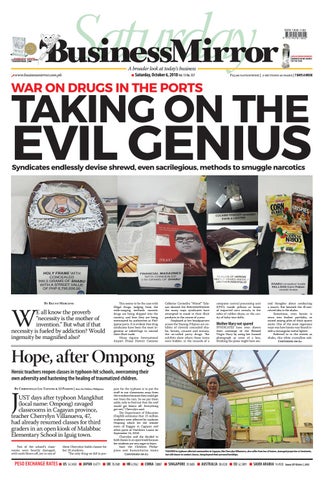
EVIL GENIUS Syndicates endlessly devise shrewd, even sacrilegious, methods to smuggle narcotics
W
By Recto Mercene
E all know the proverb “necessity is the mother of invention.” But what if that necessity is fueled by addiction? Would ingenuity be magnified also?
This seems to be the case with illegal drugs, judging from the wide-ranging methods narcotic drugs are being shipped into the country, and how they are being intercepted by authorities at Philippine ports. It is evident that drug syndicates have been the most ingenious at subterfuge to conceal their illicit trade. Ninoy Aquino International Airport (Naia) District Customs
Collector Carmelita “Mimel” Talusan showed the BusinessMirror the many ways syndicates have attempted to sneak in their illicit products in the course of a year. Displayed at her headquarters across the Nayong Pilipino are exhibits of cleverly concealed shabu, heroin, cocaine and ecstasy, the so-called party drugs. The exhibits show where these items were hidden: in the innards of a
computer central processing unit (CPU); inside pillows or boxes of imported corn cereals; in the soles of rubber shoes, or the cavity of baby-size dolls.
Mother Mary not spared
SYNDICATES have even shown their contempt of the Blessed Virgin Mary by using her framed photograph as cover of a box, thinking the pious might have sec-
ond thoughts about conducting a search. But beneath the ill-conceived idea is the shabu. Sometimes, even heroin is sewn into leather portfolio, or mixed among piles of thick sports socks. One of the most ingenious ways was how heroin was found inside a rectangular metal lighter. Referred to in the streets as shabu, this white crystalline subContinued on A2
Hope, after Ompong Heroic teachers reopen classes in typhoon-hit schools, overcoming their own adversity and hastening the healing of traumatized children.
J
By Christelle Lei Tapang & LJ Pasion | Save the Children Philippines
UST days after typhoon Mangkhut (local name: Ompong) ravaged classrooms in Cagayan province, teacher Cherrylyn Villanueva, 47, had already resumed classes for third graders in an open kiosk of Malabbac Elementary School in Iguig town. Two of the school’s classrooms were heavily damaged, with roofs blown off, yet in one of
them Cherrylyn holds classes for her 26 students. “The only thing we did to pre-
PESO EXCHANGE RATES n US 54.3450
pare for the typhoon is to put the stuff in our classrooms away from the windows because they could get wet from the rain. So we put them aside, only to find out that the roof would get blown off. Everything got wet,” Cherrylyn said. The Department of Education (DepEd) estimates that 15 million students were affected by typhoon Ompong which hit the remote town of Baggao in Cagayan and other parts of Northern Luzon on September 14, 2018. Cherrylyn said she decided to hold classes in an open kiosk because her students are very eager to learn. Save the Children Philippines sent humanitarian teams Continued on A2
TEACHERS in typhoon-affected communities in Cagayan, like Cherrylyn Villanueva, also suffer from loss of homes, damaged properties or farmlands, but still choose to conduct classes, rising beyond their personal hardships.
n JAPAN 0.4771 n UK 70.7681 n HK 6.9362 n CHINA 7.8887 n SINGAPORE 39.3605 n AUSTRALIA 38.4328 n EU 62.5891 n SAUDI ARABIA 14.4920
Source: BSP (October 5, 2018 )
News
BusinessMirror
A2 Saturday, October 6, 2018
www.businessmirror.com.ph
TAKING ON THE EVIL GENIUS Continued from a1
stance that goes by its medical tag, methamphetamine hydrochloride, is known by several names. It is also crystal, meth, ice, speed, crank, tweak, chalk, Tina and gak. Persons who use them are said to be tweaking, spun out or scattered. Nicknames for combining meth with other drugs include twisters, fire and shabu. Shabu, also known as the poor man’s cocaine, is a stimulant that used to be “cheap,” but because of its popularity has attained the status of a cult drug, whose price has skyrocketed,” Talusan said.
Sparks fly
‘Mule’
ANOTHER ranking Customs official, Emy Balatbat, who used to be an examiner at the airport arrival area, tells of a man who swallowed heroin encased in capsules. “That is one of the hardest to detect. Fortunately, our drug agents were tipped off by the Interpol [International Police],” she said. “The man was subjected to x-ray and they found the capsules’ image in his stomach.” The incident happened last year, when the rubber pellets were found inside a suspected Colombian drug courier, Alberto Pedraza Quijano. The 67-year-old passenger arrived in the Philippines via Emirates Airlines Flight EK332 from Dubai. Acting on a report from US Homeland Security InvestigationManila Attaché Office, combined elements from the Philippine Drug Enforcement Agency (PDEA), Bureaus of Immigration, Customs, the Philippine National Police, Airport Police, National Bureau of Investigation (NBI) and the Office of the Transport Security (OTS) arrested Quijano during an airport interdiction operation. Balatbat said the drug agents pumped out Quijano’s stomach and yielded 79 pieces of elongated rubber pellets containing suspected cocaine. The drugs, weighing approximately 1.185 kilograms, had an estimated market value of P8.9 million.
The look
SHE said many of the Customs employees are now trained in “profiling” passengers. “We can tell just by looking at them whether they look guilty or are carrying some illegal imports,” she said, but refused to reveal how they do it. “Some of us are able to tell [from experience] a guilty person
[or one possessing] some contraband. But others were learned through seminars,” she added. Talusan, who rose from the ranks as a Customs examiner at the Naia, said many of the seized shabu were intercepted at the Central Mail Exchange Center (Cemec), a huge building between the Naia and the Manila Domestic Airport, where thousands of parcels and boxes, flown in aboard commercial airliners, arrive daily from all corners of the globe. The boxes and parcels are in separate cargo containers. Upon unloading, the containers are towed by a tug directly from the planes to Cemec, under heavy guard.
X-ray power
“DRUGS in powder form, like heroin or cocaine, are casually inserted in Manila envelopes to make it appear that these contain nothing but letters,” Talusan said, adding that powdered drugs do not bulge and are therefore barely noticeable. She said the four Naia passenger terminals have their own upgraded x-ray machines and detectors. “Pieces of luggage from countries suspected of being sources of the drugs are x-rayed first before they are placed in moving conveyors. These countries are China, the United States and some parts of Africa,” Talusan said. “Any piece of luggage that shows a dark, mysterious shadow are suspects and marked with a letter ‘X,’” she said. “Once the luggage
comes up at the luggage carousel area for retrieval by its owner, Customs agents shadow these marked boxes, including the owner.” They want to make sure that the passenger is headed toward the Customs examiner and the marked luggage is not given to some “facilitator,” persons who carry temporary passes to enter the heavily guarded terminal, sometimes to simply welcome a relative or visitor, she said. Examiners, now alerted by the chalked, glaring symbol “X,” subject the cargo to closer scrutiny. “Many objects look innocuous enough, like the framed image of the Virgin Mary, or a piece of pillow carried by a passenger. The only way our agents could be certain about their contents is to call in the dogs of the drug agents,” Talusan said. She added that some bonded warehouses within the Naia compound have their own x-rays, and there have been many successful interceptions there in the past. Once detected, the bonded warehouse management calls in the Customs examiners and drug-enforcement agents. “The agents’ best assets are man’s best friend, the dog,” she said, noting that suspected contraband that are ingeniously concealed are subjected to inspection by especially trained dogs. The agents call them “drug sniffing K-9s.” This is how the heroin was found inside the lighter, she said.
IN an interview with the BusinessMirror, Talusan received 23 new recruits for the bureau. She briefed the newbies not to consider their job as the road to riches. “There was a time in the recent past when Customs officials were immediately branded as thieves. Those days are gone. People now look at us with a measure of respect,” she said. “I have been in this job for 35 years without my name being linked to any corrupt dealings, and I hope that you, too, will last that long and make a good name for yourselves.” Currently, the Customs bureau has a complement of about 5,000 men and women scattered across the country’s major seaports and airports like Laoag, Clark, Subic, Cebu, Davao, Zamboanga, Iloilo, Bohol and Laguindingan. There are about 15 active airports out of more than 80 aerodrome and airfields run by the Civil Aviation Authority of the Philippines. The deputy commander of the Inter Agency Drug Interdiction Group (IADITG), Gerald Javier, said it was PDEA’s people who discovered the more than P6 billion worth of shabu inside a “lifter” at the Manila International Container Port recently. The agents became suspicious after seeing sparks flying at midnight. When they came to investigate, a welder was found trying to open the lifter with a blowtorch to retrieve the drugs. Javier, who is now the task force head assigned at the Naia, said many of the drugs they were able to seize were sent via FedEx, an American multinational courier and delivery services that has a branch at the Naia. Other multinational delivery services there are DHL, UPS, LBC and PAL Cargo. “These cargo forwarders have their own x-ray scanners because of the volume of cargo they han-
LAST August, a package sent through the Cemec was found to have more than 14,000 tablets of ecstasy. The PDEA estimated the street value of the hot item was P25 million. The tablets were concealed in the CPU of a desktop computer that arrived at the Cemec from France on August 4. Agents arrested the person who claimed the package, identified as Joan Loteia Reynoso. She denied owning the party drugs. Javier said she reportedly carries a letter of authorization from consignee James Stanly, but the package was sent by a certain Roberto Stanly. Their latest achievement, Javier said, was the interception of a parcel sent through FedEx, which was found to conceal some 800 grams of shabu. “At P6,800 per gram, that shabu is worth P5.4 million,” Javier said. He said the cargo manifest declared the content of the parcel as “art table.” “We opened the box and there was the new table. However, by lifting the table out of the box, it turns out that the shabu was expertly concealed inside the box,” Javier said. The parcel arrived at the FedEx
warehouse on September 21, consigned to a certain Joy Bido Mariel of Cavite. The sender is a certain Asuman Lopeta of 5EM Rue Industrielle Kinshasa, Republic of Congo. Meanwhile, Talusan said the airport branch turned over to the PDEA some P37.3 million worth of illegal drugs it earlier impounded at the Naia. The agency’s haul consisted of 5,239 grams of shabu, camouflaged in a baby carrier. Others are inside a camera or inserted between the pages of business magazines. Some were found inside bar stools. The contraband were interdicted last May, June and July, respectively. Aside from shabu, some 1,000 pieces of ecstasy were found concealed in wooden toys. The hot items were seized on July 20. Talusan traced their success to consistent “reforms and the five-point program by Commissioner Lapeña.” Since Lapeña took over the helm at Customs, there has been a marked increase in the arrest of drug-related crimes, including the seizure of sizable volumes of shabu. Lapeña, during a news conference at Talusan’s office recently, said shabu nowadays mostly come from the United States, while ecstasy tablets are from Germany. The proper name of ecstasy is MDMA, meaning methylenedioxymethamphetamine. Like other amphetamines, it stimulates the central nervous system. It is also hallucinogenic. “On taking MDMA, abusers may have a feeling of boundless energy and, thus, commonly take the drugs to help them to dance for lengthy periods,” the web site said. “MDMA depletes the serotonin in the central nervous system, causing convulsions of muscles [usually muscles of the four limbs and the neck]. Therefore, all those ‘shaking and dancing’ are actually uncontrollable behavior of the abusers.” The street names include ecstasy, E, XTC, Adam. MDMA is usually sold as round tablets of various colors (pink, white, green, etc.). Lapeña said following the directive of the President, “the agency has been very proactive and relentless in its effort to combat the smuggling of illegal drugs.” “The Bureau of Customs is very much on board in the country’s war against drugs and we will exert our efforts to continue protecting our nation and prevent the use of our ports in the smuggling of illegal drugs into the country,” Lapeña vowed.
where they spend more than 6 hours a day, he said. Adolescent girls also learn from their teachers the importance of reproductive health, self-respect and positive attitude toward sexuality. “Even with the popularity of social media, teachers remain the biggest influencers to children because classroom lessons are taken
as gospel truth,” Muyot added. Muyot, who once served as undersecretary of the Department of Education, lauded the department’s initiative to integrate the principles of gender equality, equity, sensitivity and tolerance in the basic curricula. He also cited the country’s 700,000 public-school teachers as the most trusted public servants.
dle,” he said, adding that his task force has a complement of 27 personnel. “The Task Force is a joint undertaking among the PDEA, NBI and airport police.” He said the party drug ecstasy is usually sent via parcels from Bangkok and the x-ray was a big help in discovering them. “President Rodrigo Duterte’s anti-illegal drug campaign has been successful because they were provided the means to detect drugs coming in from different countries,” he said.
Drugs in computer, art table
Hope, after Ompong Continued from a1
to Cagayan towns of Baggao, Gattaran, Iguig and Lasam to distribute emergency kits and backto-school materials to affected schoolchildren. Albert Muyot, CEO of the organization, said teachers spend the most number of hours with young people from preschool to college -considered the most crucial years of a child’s life. Save the Children joined the celebration of World Teachers Day on October 5 to honor the most critical partners in shaping the minds of children to become responsible individuals. He said teachers in typhoonaffected communities in Cagayan, like Cherrylyn, also suffer from loss of homes, damaged properties or farmlands, but still choose to conduct classes, rising beyond their personal hardships. “Resuming classes for displaced children normalizes their routine, thus, helps them cope with the psychological stress. We are thankful to teachers, who, despite suffering from loss of homes and properties, helped our humanitarian teams in setting up alternative classes for children in evacuation
centers,” said Muyot. To help ease the problem of classroom shortage, Save the Children set up a Temporary Learning Space (TLS) for the students of Cherrylyn and other damaged classrooms in Cagayan towns. “We really need classrooms. My students are still interested in learning but the thing about holding classes outdoors is that the students get distracted easily by what’s happening around them. Like when other students hold physical education classes outside, they look at them even if I’m in the middle of teaching. A temporary classroom would be a great help,” Cherrylyn added. “Whenever I see some of my students losing interest in their studies, I tell them that I am doing this job so that none of them will turn out illiterate or ignorant. As long as I can, this is what I will do,” she said. Jerome Balinton, humanitarian officer of Save the Children Philippines who led the early assessment team to Tuguegarao and Cagayan towns, said hundreds of classrooms have been totally destroyed. The long-term impact of the typhoon includes children missing out on school.
“Sadly, we know that the longer children are out of school, the less likely it is that they’ll ever go back. This means that alongside the provision of life-saving food, shelter and medical support, it’s vital that there is a strong focus on getting children back to the classroom as quickly as possible,” he said. Cherrylyn has been teaching the last 25 years, 15 years of that spent in Malabbac Elementary School. By resuming classes under a makeshift classroom, Cherrylyn’s role is critical to healing the wounds of many children who suffer psychosocial problems during calamities. “School provides a sense of routine and comfort in times of disaster. It’s a safe space for students, and somewhere they can be with their friends and forget about the frightening ordeal they have been through,” said Balinton. Cherrylyn believes teaching is her calling. She recalled that lack of teachers was a lingering problem in Iguig when she was in grade school. She took up Education in college and promised to herself she would impart knowledge to her students for as long as she can.
Save the Children partners with teachers in promoting Early Childhood Development programs that ensure children are physically and emotionally healthy and intellectually curious to prepare them for school success. Muyot said teachers also influence young minds on the value of health and nutrition by eating the right kind of food in school—
News
BusinessMirror
www.businessmirror.com.ph
West accuses Russian spy agency of scores of attacks
DUTCH DEFENSE MINISTRY VIA AP
L
ONDON—T he West unleashed an onslaught of new evidence and indictments on Thursday, accusing Russian military spies of hacking so widespread that it seemed to target anyone, anywhere who investigates Moscow’s involvement in an array of criminal activities—including doping, poisoning and the downing of a plane. Russia defiantly denied the charges, neither humbled nor embarrassed by the exceptional revelations on one of the most high-tension days in East-West relations in years. Moscow lashed back with allegations that the Pentagon runs a clandestine US biological weapons program involving toxic mosquitoes, ticks and more. The nucleus of Thursday’s drama was Russia’s military intelligence agency known as the GRU, increasingly the embodiment of Russian meddling abroad. In the last 24 hours, US authorities charged seven officers from the GRU with hacking international agencies; British and Australian authorities accused the GRU of a devastating 2017 cyber attack on Ukraine, the e-mail leaks that rocked the US 2016 election and other damaging hacks; and Dutch officials alleged that GRU agents tried and failed to hack into the world’s chemical weapons watchdog, the Organization for the Prohibition of Chemical Weapons (OPCW). The ham-handed attempted brea k-i n— i nvolv i ng h ac k i ng equipment in the trunk of a car and a trail of physical and virtual clues—was the most stunning operation revealed on Thursday. It was so obvious, in fact, that it almost looked like the Russians didn’t care about getting caught. “Basically, the Russians got caught with their equipment, people who were doing it, and they have got to pay the piper. They are going to have to be held to account,” US Defense Secretary James Mattis said in Brussels, where he was meeting with Nato allies. Mattis said the West has “a wide variety of responses” available. Britain’s ambassador to the Netherlands, Peter Wilson, said the GRU would no longer be allowed to act with impunity. Calling Russia a “pariah state,” British Defense Secretary Gavin Williamson said: “Where Russia acts in an indiscriminate and reckless way, where they have done in terms of these cyber attacks, we will be exposing them.” Deputy Foreign Minister Sergei Ryabkov of Russia said in a statement that the US is taking a “dangerous path” by “deliberately inciting tensions in relations between the nuclear powers,” adding that Washington’s European allies should also think about it. While the accusations expose how much damage Russia can do in foreign lands, through remote hacking and on-site infiltration— they also expose how little West-
ern countries can do to stop it. Russia is already under European Union and US sanctions, and dozens of GRU agents and alleged Russian trolls have already been indicted by the US but will likely never be handed over to face American justice. Still, to the Western public, Thursday may have been a pivotal day, with accusations so extensive, and the chorus of condemnation so loud, that it left little doubt of massive Russian wrongdoing. A wealth of surveillance footage released by Western intelligence agencies was quickly and overwhelmingly confirmed by independent reporting. The litany of accusations of GRU malfeasance began overnight, when British and Australian authorities accused the Russian agency of being behind the catastrophic 2017 cyber attack in Ukraine. The malicious software outbreak knocked out ATMs, gas stations, pharmacies and hospitals and, according to a secret White House assessment recently cited by Wired, caused $10 billion in damage worldwide. The British and Australians also linked the GRU to other hacks, including the Democratic Party e-mail leaks and online cyber propaganda that sowed havoc before Americans voted in the 2016 presidential election. Later Thursday, Dutch defense officials released photos and a timeline of GRU agents’ botched attempt to break into the chemical weapons watchdog using Wi-Fi hacking equipment hidden in a car parked outside a nearby Marriott Hotel. The OPCW was investigating a nerve agent attack on a former GRU spy, Sergei Skripal, and his daughter in Salisbury, England, that Britain has blamed on the Russian government. Moscow vehemently denies involvement. Photographs released by the Dutch Ministry of Defense showed a trunk loaded with a computer, battery, a bulky white transformer and a hidden antenna; officials said the equipment was operational when Dutch counterintelligence interrupted the operation. What Dutch authorities found seemed to be the work of an amateur. A taxi receipt in the pocket of one of the agents showed he had hired a cab to take him from a street next to GRU headquarters to Moscow’s Sheremetyevo Airport. A laptop found with the team appeared to tie them to other alleged GRU hacks. The men were expelled instead of arrested, because they were traveling on diplomatic passports. The Dutch also accused the GRU of trying to hack investigators examining the 2014 downing of a Malaysian Airlines jetliner over eastern Ukraine that killed all 298 people onboard. A Dutch-led team says it has strong evidence the missile that brought the plane down came from a Russia-based military unit. Russia has denied the charge. AP
A3
Another rate hike looms as Sept inflation hits 6.7%
H IN this image released by the Dutch Defense Ministry on Thursday, the boot of a car filled with hacking equipment belonging to four Russian officers of the Main Directorate of the General Staff of the Armed Forces of the Russian Federation, or GRU, is seen on April 13, 2018. The officers were expelled from the Netherlands for allegedly trying to hack into the United Nations chemical watchdog OPCW's network. The Dutch defense minister on Thursday accused Russia's military intelligence unit of attempted cybercrimes targeting the UN chemical weapons watchdog and the investigation into the 2014 Malaysian Airlines crash over Ukraine.
Saturday, October 6, 2018
By Jasper Emmanuel Y. Arcalas
IGHER prices of food items, particularly rice and vegetables, drove the country’s inflation in September to hit a new nine-year high of 6.7 percent, according to the Philippine Statistics Authority (PSA). Supply disruptions in the country’s cereal and vegetable bowl in northern Luzon damaged by typhoon Ompong were factored into the faster inflation. The inflation rate’s approaching the 7-percent level signals more rate hikes before the year ends, analysts said. The latest figure on the rate of increase in the prices of goods and services in the country is the highest since February 2009’s 7.2 percent, according to the PSA. The September 2018’s inflation rate was 0.3 percentage point higher than the 6.4 percent recorded in August 2018. Likewise, it was 3.7-percentage point over the 3.0
UNIQLO OPENS BIGGEST SOUTHEAST ASIAN STORE IN MANILA’S MAKATI
C
ASUAL clothing retailer Uniqlo is opening its largest Southeast Asian store in Manila, widening its bet on the fast-growing Asian economy. The Fast Retailing Co., which owns the chain, debuted the 4,100-square-meter store in the city’s Makati business district on Friday. It dwarfs the 2,700-sq-m site opened on Orchard Road in Singapore two years ago, and takes the Philippines’s total store count to 52, the most in Southeast Asia and fourth-most outside Japan. The seller of basic clothes that emphasize advanced materials is betting on the country’s young, English-speaking population and booming tourism market to drive sales. Economic growth slowed to 6 percent in the second quarter, as household consumption— which accounts for more than a third of gross domestic product—rose 5.6 percent. “We have a lot of headroom to grow given the size of the Philippine economy and its growth potential,” Satoshi Hatase, Uniqlo’s Southeast Asia and Oceania chief executive officer, said in an interview on Thursday. “This is far from being saturated.” The flagship store opens as Philippine consumer prices have been soaring at the fastest pace in Asia. Inflation accelerated to 6.7 percent in September, the fastest in nine years, driven by rising prices for food and oil. With plans to enter Vietnam by 2019 and shift to bigger, freestanding stores in the region, Uniqlo is on track to hit its target of tripling sales in Southeast Asia to ¥300 billion ($2.6 billion) by 2022 from ¥100 billion in 2017, Hatase said. The expansion puts Fast Retailing in a strong position to capitalize on the region’s growing middle class, said Thomas Jastrzab, Bloomberg Intelligence industry analyst. “Uniqlo’s value-priced basics such as t-shirts and skirts should appeal to budget-minded consumers dealing with rising inflation,” Jastrzab said. Bloomberg News
percent inflation rate recorded in September 2017. “ T he uptrend was pr imarily brought about by the heavilyweighted food and non-alcoholic beverages index which further accelerated to 9.7 percent in September 2018,” the PSA said. In a joint statement, the government’s economic managers traced the increase in the food p r i c e s “s u p p l y d i s r u p t io n s ” caused by damage of Typhoon
Ompong to the farm sector. “Supply disruptions caused by the onslaught of Typhoon Ompong in the regions of Ilocos, Cagayan, and Cordillera Autonomous Region put upward pressures on food prices. Damage to agriculture, including facilities and infrastructure, amounted to P26.8 billion,” they said in a statement on Friday. “This has kept the price of the country’s staple grain elevated despite the arrival of some imported rice and the improvement in the rice stocks of the National Food Authority,” they added. National Statistician Lisa Grace S. Bersales said Ompong’s impact on the country’s food prices was already reflected in the September 2018 inflation. Laban Konsyumer Inc. (LKI) reiterated their call for the government to impose a nationwide price ceiling to arrest the continuous increase in the prices of food items. Dashing the usual warning of traders and sellers that imposing price ceilings will cause supply to be scarce, LKI argued that businessmen would still sell their goods despite the imposition of a price ceiling. “Business cashes on selling as much as they can even when price ceiling is imposed. The high demand
dictates that these goods find their way in the marketplace and had to leave the warehouses,” the group said. Consumer prices started spiking at the beginning of the year following tax increases on fuel, sugary drinks and cigarettes—the increases swiftly moved to rice, the nation’s staple food, due to supply shortages. On top of that, a more than 8-percent slump in the currency this year is adding to the inflationary pressure.
Another rate hike?
“PRESSURE is still rising and the Central Bank may raise rates by another 25 basis points this quarter,” said Eugenia Fabon Victorino, head of Asia strategy at Skandinaviska Enskilda Banken AB in Singapore. “We know that inflation will breach the 2018 target, but what’s important is whether or not the breach will extend to next year.” The Central Bank has delivered 150 basis points of interest-rate increases since May, and forecasts annual inflation will exceed a target of 2 percent to 4 percent until next year. The peso was little changed at 54.3 per dollar as of Friday morning in Manila. The benchmark stock index fell 0.1 percent. With Bloomberg News
CRUDE TUMBLES MOST IN SEVEN WEEKS AS U.S. STOCKPILES SWELL
O
IL dropped from the highest price in almost four years, amid signs of a growing crude surplus in the world’s biggest economy. Futures fell 2.7 percent in New York on Thursday for the deepest one-day dive in seven weeks. An additional 1.7 million barrels of oil were stowed in tanks at a key US pipeline hub
in Oklahoma in the five days to October 2, data provider Genscape Inc. was said to have reported. That followed Wednesday’s US government tally that showed nationwide inventories surged by the steepest margin since March 2017. Oil has been rallying as shrinking output from Venezuela to Iran stoked worldwide
concern about a supply crunch. US President Donald Trump has repeatedly chided the Organization of the Petroleum Exporting Countries to lift output. Although oilproducing nations benefit during market rallies, prices at too high a level can imperil energy demand. Bloomberg News
ExportUnlimited BusinessMirror
A4 Saturday, October 6, 2018 • Editor: Efleda P. Campos
Slingshot 2018 aims to scale up PHL start-ups
O
N the second day of the Inclusive Innovation Conference (ICC) 2018, “Slingshot: Startup and Innovation Summit” gathered start-ups, innovators, entrepreneurs, the government and academe on October 3, 2018, at the Sofitel Philippine Plaza, Manila. The fourth edition of Slingshot aimed to inspire the Philippine startup community to potentially become scale-ups. The event allowed the participants to promote their products and services and network with potential investors and buyers. The event was led by Department of Trade and Industry (DTI)Trade and Investments Promotion Group Undersecretary Nora K. Terrado, DTI Industry Development and Trade Policy Group (IDTPG) Assistant Secretary Rafaelita M. Aldaba, and Department of Science
and Technology (DOST)-Philippine Council for Industry, Energy and Emerging Technology Research and Development Deputy Executive Director Raul C. Sabularse, together with DTI-Export Marketing Bureau (EMB) Director Senen M. Perlada and DTI-EMB Assistant Director Agnes Perpetua R. Legaspi. This year’s Slingshot was composed of Pitching of Technologies, Business Matching, Networking and a Panel Discussion on “Start Local, Grow Global.” The theme for this year’s Sling-
shot is “Startups born Global.” During the morning session, 10 start-ups pitched their technologies. They were PhilMech’s Dr. Michael A. Gragasin for Impeller Rice Mill, University of Santo Tomas’s Dr. Mary Beth V. Maningas for Loop-Mediated Isothermal Amplification Kit for Shrimp Pathogens, Metals Industry Research and Development Center Pablo Acuin for Mass Transport (Hybrid Train Set and Hybrid Electric Train, University of the Philippines Manila’s Dr. Abundio Balgos for Ginhawa/ReliefVent, Antipara Exploration Inc.’s Aaron T. Hilomen for Antipara, UP-Diliman’s Dr. Prospero Naval Jr. for FISH-I, Mapua University’s Dr. Francis Aldrine Uy for USHER, UP Diliman’s Dr. Giovanni A. Tapang for VISSER, Biotech-UPLB’s Irene A. Papa for ACTIcon Biopesticide for Cavendish Banana and Orthopaedic International’s Jude Sasing for Axis Knee System. Various technologies were presented during the pitching session, from food, education, underwater technology, marine species, health to mass-transport innovations, which
aim to resolve some industry glitches. For the panel discussion, Terrado, USAID STRIDE chief of Party Dr. Richard Abedan, AIM-Dado Banatao Incubator Executive Director Prim Paypon and Airbus Head of Technology for Asia Pacific Dr. Cyrille Schwob discussed the updates on government efforts and studies in support of the Philippine startup ecosystem and in search for the next Filipino scale-up. Benny Schlick, Innovation Without Borders cofounder and director, presented the Startup Nation and discussed the Startup Ecosystem in Israel. Start-ups, such as OneWatt, Valea Health, AdMov, Senti, Container Living PHL and some DOST technologies from the morning session had a business matching with potential investors and buyers. The business matching was organized by DTI-EMB in partnership with DOST and QBO Philippines. The ICC 2018 was a two-day event, with the theme “Filipinnovation for Entrepreneurship and Inclusive Growth,” which was organized by the DTI-IDTPG.
Dubai Municipality visits government agencies, ports, private companies in PHL By Myrtle Faye L. Solina
Trade and Industry Development Specialist (TIDS) EMB-Food and Agri-Marine Division (FAMD)
L
AST month representatives from the Dubai Municipality of the United Arab Emirates (UAE) visited the Philippines. The visit was led by Mohammed Ahmed Abdulmajid, head of the Land Port Unit, and Mohammed Essa Belal, senior food trade hygiene officer, of the said agency. The visit, which took place from September 24 to 28, was part of the concerted efforts of the Department of Trade and Industry (DTI), led by the Philippine Trade and Investment Center (PTIC) Dubai and the Export Marketing Bureau (EMB) of the DTI to boost the acceptance of Philippine food consignments to Dubai. Both agencies implement campaigns and initiatives on the dissemination of relevant and updated UAE laws affecting the Philippine food-export sector. PTIC-Dubai, in particular, has also initiated coordination with the Dubai authorities on information regarding relevant Philippine food-regulatory agencies. This include sample formats of health certificates to facilitate the Dubai government’s verification submitted by UAE food importers as supporting documents for entry of Philippine products. The two heads of the Dubai delegation were welcomed by DTI Undersecretary for Special Concerns Abdulgani M. Macatoman, EMB Director Senen M. Perlada, EMB Assistant Director Anthony B. Rivera, Foreign Trade Service Corps Executive Director Emmanuel W. Ang, Commercial Attaché Eric C. Elnar, EMB Food and Agri-Marine Division Chief Rose Marie G. Castillo, and representative from the EMB Halal Section Al-Mahdi I. JulAhmad at the DTI International Building in Makati.
SUSTAINABLE AGRICULTURE FORUM
Director Senen M. Perlada of the Department of Trade and Industry’s Export Marketing Bureau serves as a resource speaker for the 2018 Sustainable Agriculture Forum on October 2 held at the Mariott Hotel, Pasay City. He spoke about “Food Philippines: Promoting Philippine food, beverage and agri-based products to the world.” The forum was organized by the European Chamber of Commerce of the Philippines, co-organized by the European Union-Philippines Business Network, and cofunded by the European Union.
In 2016 the Philippines exported 132,800 tons of food to Dubai. Of the 29,010 food items randomly checked by the Dubai Municipality, 5,874 food items or around 20 percent were rejected due to nonconformity to UAE’s food-quality and safety requirements. These included label contraventions, certificate contraventions and laboratory sample results contraventions. It was also noted that, among the food exporting countries, the Philippines ranked 19th in the number of contraventions encountered in 2016. To address this gap on contraventions with the Philippines and other countries, the Dubai Municipality launched a program, which is the Control of Food from the Source. Dubai Municipality defines the program as, “An activity carried out by government agencies or authorities to protect consumers and ensure the safety of all food during production, handling, storage, processing and distribution, ensuring their nutritional value and suitability for human consumption; and ensuring their conformity with quality and
safety requirements.” Commercial Attaché Charmaine Mignon S. Yalong for Middle East Asia and Africa stated that Dubai Municipality has identified the Philippines as one of the priority countries of the program. It shows how important the Philippines is as a food source and at the same time, the extent of the Philippine issues on contraventions. Mr. Abdulmajid conveyed that, from among their priority counties, the Philippines was the first country they visited. He stressed the Dubai Municipality’s assurance of support for the Philippines in terms of addressing these gaps with regard to food trade and thus, minimize, if not mitigate, the difficulties and obstacles facing the export of food. Dubai Municipality also visited other government agencies, ports, and private-sector companies, such as the National Meat Inspection Services, Department of Science and Technology-Region 4A Halal Verification Laboratory, Food and Drug Administration, Philippine Ports Authority-Batan-
gas International Port, Intertek Testing Services Philippines Inc., SGS Philippines Inc., San Miguel Corp. and Universal Robina Corp. On September 27, 2018, an information session on the standards and requirements of food exports to Dubai was conducted at DTI International Building in Makati where it was well attended by the food sector’s stakeholders, such private companies and inspection, verification, testing and certification companies. The Food Safety Department of the Dubai Municipality aims to establish a modern inspection system that meets the requirements of traders and international systems while ensuring the achievement of the government of Dubai’s objective to be a city of excellence in terms of enhancing confidence in food safety. To know more about the Dubai Municipality’s program on Control of Food from the Source and other related information, their presentation can be accessed through this link: https://drive.google.com/file/d/ 1AGFKRZlnpWPeAAOWxxEtStzh3X gOfRUT/view.
Japan’s organic packaged food market growing
O
RGANIC products have increased their presence in the Japanese packaged food market on the back of a general upmarket shift in demand, providing business opportunities for entrepreneurs. The Euromonitor Digest, released by the Department of Trade and Industry-Export Marketing Bureau, said this trend was most prominent in organic chocolate confectionery due to the growing interest in artisanal-style products and broader concerns about the origin of food,
thus encouraging small-to-midsized players to introduce organic chocolate. However, the report pointed out that organic remains a niche area in the market, accounting for only 2 percent of total health and wellness packaged food value last year. This was attributed partly to a lack of awareness of the difference between additive-free and organic products. “The Japanese ease and familiarity with technological innovation and functionality may also act as
an obstacle to some extent, though organic fits neatly with a more general increase in demand for natural products,” the report said. It expects the Tokyo Olympics in 2020 providing a boost to organic products with the release of basic guidelinesintheprocurementcoderelating to sustainability for the Games. Internet retailing is the largest distribution channel for organic packaged food, accounting for 40 percent of total category value last year. This is in contrast to other health
and wellness categories in Japan, including packaged food and beverages, in which Internet retailing was responsible for only 4 percent of value sales during the year. “There are store-based retailers that specialise in organic food and beverages, such as organic supermarkets, but many organic players focus on Internet retailing because of the impact of traditional store-based distribution on margins on top of the already considerable cost of organic production,” it said. Philexport News and Features
12 female founders represent PHL at SWITCH Singapore 2018
A
S part of its Gender and Development Program and in support of scaling up local tech-based start-ups, the Department of Trade and Industry-Export Marketing Bureau (DTI-EMB), in coordination with QBO Innovation Hub (QBO), sent a delegation of 12 female-founded and female-led start-ups to represent the Philippines at the recently concluded Singapore Week of Innovation and TeCHnology (SWITCH) Singapore. SWITCH is a yearly celebration of tech and innovation, which brings together various partners and relevant stakeholders from around the world in technology, innovation and enterprise ecosystem for a series of tech exhibitions, conferences, workshops and other activities related to innovation. This year SWITCH transpired from September 17 to 20 at the Sands Expo and Convention Centre and was bigger than ever with over 11,000 attendees from 70 countries, 260 speakers, 350 exhibitors and 70 partners. DTI-EMB and QBO, which both aim to develop local startups and grow the Philippine startup ecosystem and support female founders’ expansion into international markets, believed SWITCH was the perfect opportunity to empower local female entrepreneurs to forward their innovations. This is because Singapore is widely recognized as the Southeast Asian hub for technology start-ups and is often the launchpad for business expansion to the region. SWITCH, co-organized by the Enterprise SG and the Singapore National Research Foundation, brought together investors, incubators and corporates from around the world and was marked by headline partner events, including TechInnovation, Deep Tech Summit by SG Innovate, ICMG Corporate Innovation Summit and the launch of Women In Tech Asia among others. “Singapore is one of the region’s leading centers for tech and innovation, and home to many of Asean’s unicorn startups, with an unparalleled density of tech investors and companies,” said Katrina Rausa Chan, executive director of QBO. Speaking about the significance of having the Philippine start-up community represented at SWITCH this year, Chan added, “We are happy to be able to showcase 12 of the most promising, scalingandfemale-foundedFilipinostart-ups to get this opportunity for international marketaccess,exposureandsupporthere at SWITCH. We hope this experience will inspire our female founders and pave the path for our start-ups to scale up and create impact in the global stage.” The delegation’s startups represented female-led and female-founded companies, with a certain level of maturity and success in their technologies and business models, in disciplines ranging from artificial intelligence (AI) and data analytics, to financial technology, e-commerce and online marketplaces. The 12 start-ups were: 1. StyleGenie Represented by its Founder and CEO Abigail Mendoza, StyleGenie is a fashion-tech company focused on boosting customers’ confidence through expertly curated outfits, one box at a time, while also helping brand flush out their excess or old-season inventory. They offer styling subscriptions of outfits curated by fashion experts based on individual’s Style Profiles. 2. TripZeeker Represented by its Cofounder and CEO Kim Lim, TripZeeker is an online bazaar of travel experiences. It is an aggregatorwebsitethatcomparestheprices of tours from different tour operators. This platform offers a venue for travel providers around the world to compete in the same space, which allows travelers to save and gives travel small medium enterprises exposure to global clients. 3. Olivia Represented by its Founder and CEO Jocelyn Pantastico, Olivia is the Filipino woman’s virtual financial advisor. They help women create financial goals, match them investment products via AI and allow them to allocate investments to goals so they can track their progress. Olivia makes investing simple and affordable so that women are empowered to invest at least 10 percent of their income.
4. Valea Health Represented by its Cofounder and CMO Lorraine Faeldon, Valea Health is a comprehensive solution that addresses the health, fitness and wellness needs of companies and organizations that offer long term benefits for employees and companies. It is a personal SMS and chat-based health assistant that helps users manage their overall health and wellness with the ultimate goal of preventing diseases, especially chronic, lifestyle-related illnesses. 5. JazzyPay Represented by its Cofounder and COO Kathleen Acosta, JazzyPay is a payment platform that enables customers to make online payments to educational facilities, health-care facilities and other establishments instantly—at any time and from anywhere. It is also one of the start-ups in the coveted Rakuten Acceleration program powered by Techstars, Singapore, in 2018. 6. eCFulfill Represented by its Cofounder Bonnie Factor, eCFulfill is an e-commerce local and global fulfillment and cross-border logisticsservice.Itremovestheguesswork in global e-commerce by using data analytics to determine product competitiveness. They provide recommendations to improve product/brand packaging and identify the correct price. And they are developing Web-based tools that use data and AI to guide sellers to success. 7. Antipara Exploration Represented by its Cofounder and CFO Cherry Murillon, Antipara Exploration is an underwater 3D visual mapping and analytics company that uses its own underwater platform with a camera and sonar system to produce maps and provide relevant information for marine management. 8. PinoyTravel Represented by its Founder and CEO Aurora Mendoza Soriano, PinoyTravel is a company that aggregated provincial or long-distance bus and ferry companies into one site so customers get a single view of services available to a desired destination. They are currently the biggest service provider of this kind in the Philippines. 9. Edukasyon.ph Represented by its Chief of Staff Denisse Banez, Edukasyon.ph is an education platform that seeks to improve access to education and employment by empowering students to make informed decisions leading to full employability postgraduation. They equip them with: (1) thousands of education options through their comprehensive database of schools, courses and scholarships; (2) relevant and accurate advice content; and (3) a strong community of parents, peers and educators to guide them through their education to employment journey. 10. Husay Co. Represented by its Cofounder and Managing Director Leah del Rosario, Husay Co. is a performing-arts solution outfitthatenablesproductions,performers and advocates to connect for work and impact. They provide a platform for curated portfolio of performing artists to better market themselves as well as a collaboration of impact creators to better tell the stories behind their causes. 11. Container Living PH Represented by its Founder and CEO Mac Evagelista, Container Living PH provides a disaster-resilient expandable building system that has a modular design that is five times faster to build, three times stronger, 30-percent cheaper and twice as long-lasting as a regular home. TheyusedecommissionedorClassBshipping containers, which also help address the rise in greenhouse-gas emissions. 12. Senti Represented by its Cofounder Charibeth Cheng, Senti is a localized socialmedia platform that consolidates information from different social-media streams and uses it to provide analytics and data insights on responses to certain products, people, or events. Senti assists in analyzing market feedback that other tools cannot normally process because they only process English.
Editor: Jun Lomibao | mirror_sports@yahoo.com.ph
Sports
BusinessMirror
Saturday, October 6, 2018
A5
Protesters use Flyers’ new mascot vs Trump
P
HILADELPHIA—Philadelphians used the city’s latest sports mascot to protest a visit by President Donald J. Trump. About 100 protesters gathered on Tuesday outside of the Philadelphia Convention Center where Trump addressed the National Electrical Contractors Convention. Several carried homemade signs of the Flyers’ new mascot Gritty, a bearded orange monster. Gritty drew mixed reactions when he was introduced last week, drawing comparisons to ZZ Top, Muppets and horror movies. Many of the signs on Tuesday included expletives telling Trump to leave. One said Philadelphia only has room for one orange monster. Philadelphia hasn’t had a warm and fuzzy relationship with Trump. Trump’s administration has regularly clashed with city officials, including Mayor Jim Kenney. In June, Trump canceled a White House celebration of the Eagles’ Super Bowl win after it became apparent many players wouldn’t attend. AP
Hamilton closing in on F1 title at Japan GP
L
EWIS HAMILTON has won five of the last six Formula One races. This week the series is in Suzuka, where Hamilton has won three of the last four Japanese Grand Prix (GP). With five races to go, his fifth world championship is almost in the bag. “Lewis is hungry, focused and completely determined to succeed,” Mercedes team boss Toto Wolff said on Thursday. “It’s been great to see the power he has brought to this championship, and how he has taken it to the next level.” After winning the Russian GP last week, Hamilton leads Sebastian Vettel by 50 points. Even if Vettel wins all five remaining races, he’s not guaranteed to beat Hamilton. But Vettel, who has had his own success at Suzuka—winning four times over 2009 to 2013—was far from conceding the championship. “We need to keep pushing and try,” the Ferrari driver said. “Who knows what will happen in the next races?” The race in Sochi last Sunday was overshadowed by Mercedes ordering Valtteri Bottas to pull over and let teammate Hamilton pass to win. Bottas started from pole and was in position for his first win of the year. Wolff insisted the team order was justified. “The battle with Ferrari remains extremely close, as was underlined by Sebastian’s pace on Sunday and the pressure he put us under,” Wolff said. “In the end, we left Sochi with a bigger lead. But we know that doesn’t mean anything because our fight with Ferrari is far from being over.” Meanwhile, Red Bull’s Max Verstappen remains one to watch, too. On his 21st birthday, Verstappen started 19th in Sochi but charged through the field to finish fifth. It was another dramatic drive from Verstappen, who over four seasons has firmly established himself as F1’s most aggressive and exciting racer, but has never had a car capable of a true title challenge. Verstappen has fond memories of the Suzuka circuit, having made his F1 debut here by taking part in the first free practice at the 2014 Japanese GP. AP
DANICA PATRICK and Green Bay Packers’ Aaron Rodgers watch a National Basketball Association game between the Milwaukee Bucks and Boston Celtics in Milwaukee. AP
NO TO WOMAN CAVE THE United States’s Crystal Dunn (right) prepares to strike the ball during the second half of an international friendly in Carson, California. AP
WOMEN’S SPORTS DRAWS MALE FANS
L
By Pan Pylas
The Associated Press
ONDON—Male sports fans make up more than half of the group of people with an interest in women’s sports, according to a report published on Thursday by analysts Nielsen Sports. The report found that 84 percent of general sports fans in eight key markets around the world, including the United States and Britain, have an interest in women’s sports, and that 51 percent of those are male. “This research not only illustrates the vast amount of people actively interested in women’s sports today, but also shines a spotlight on the significant commercial opportunities on the horizon,” said Lynsey Douglas, who led the team behind the 32-page report “The Rise of Women’s Sports.” “From equal pay to record audiences and new media deals, women’s sport is one of the fastest-changing areas in the sports industry, and is more important now than ever before.” The landscape for women’s team sports has changed dramatically over the past few years, creating the potential to increase the cost of broadcasting rights and the pay of the athletes themselves. While tennis and golf have led the way for decades in the professionalization and commercialization of women’s sports, their counterparts in team sports have lagged far behind despite some exceptions, such as with soccer in the US. That’s all changing though, particularly in soccer, with leagues around the world being established. The Women’s European Championship in 2017, for example, attracted a television audience of 150 million, according to Nielsen. “Building on this momentum, next year’s Women’s World Cup is set to engage on a large scale and represents a great platform for brands to stand out,” Douglas said. Nielsen found that of those people aware of next year’s eighth Women’s World Cup in France, 34 percent have already shown an interest. That’s not far off the 45-percent equivalent for this year’s men’s version in Russia, which was eventually won by France.
CATALAN RULES CASINO FILIPINO B.E.T.S. VII
L
IKE a hungry wolf, Ruel Catalan of Catalan Fighting System quickly pounced on a hapless Dipolog Top Team’s George Mascardo to post an overwhelming victory and rule the Casino Filipino Battle Extreme Tournament of Superstars (BETS) VII recently at the CF Manila Bay in Ermita, Manila. Catalan, who successfully sprang from a disappointing defeat last February to score his seventh win in eight professional outings, delivered solid strikes from the get-go as he easily submitted Mascardo in the 1:18 mark of the opening round. The setback was the third for Mascardo, who dropped to a win-loss record of 7-3. In the co-main event, Mark Gregory Valerio of One Revolt MMA remained unblemished in seven matches when he beat Mario Sismundo of Team Boss MMA via refereestopped contest in the 3:56 mark of the second round. A heavy right cross from Valerio opened a deep cut in Sismundo’s left eyebrow, which bled profusely, forcing the referee to halt the fight. Metacore Elorde NAIA’s Norman Agcopra also put an abbreviated ending to his match against Farmon Gavarov of Korean Top Team/ Top Gym BF by scoring a technical knockout victory over in 1:29 of the first round. South Korean Hye Sun Kim of BK Wang Ho/Top Gym BF finally chalked his first professional win by prevailing over a favored Anne Kristelle Sabadlab
of Mindanao Ultimate Mixed Martial Arts via rear naked choke in the 59th second of the first round. Hye’s compatriot Won Il Kwon of Kwang Gym/Extreme Combat also scored a refereestopped victory against Team RLAN’s Herbert Faurillo in the first round. In other fights, Rick Lucena (Yawyan Fervilleon Matayog/Team Kampilan) grounded and pounded Reinier Gervacio in the second round to compel the referee to stop the match, while another referee-stopped contest was scored by Ariane Fantellanan (Catalan Fighting System) over JB Baldonasa (Team Hyper MMA)
in the third round of their tiff. Moises Ilogon (Subsport Ph), meanwhile, defeated Lorenzo Artillaga (Yawyan Kampilan) via rear naked choke in the second round. Jervie Tiongco (Team Olongapo) triumphed by unanimous decision against Mike Paiz (Elorde) in a fight that lasted the distance. “The fights were as good as advertised, and we hope to continue drawing the fancy of mixed-martial arts fans in the coming CF BETS series by lining up more exciting matches bannered by victory-hungry ring gladiators,” said Philippine Amusement and Gaming Corp. Assistant Vice President for Entertainment Bong Quintana of the nine-fight card organized by CF in partnership with the Universal Reality Combat Championship through Live Artists Production.
A BLOODIED Mario Sismundo puts up a brave stance against Mark Gregory Valerio.
With promotional campaigns still to come, Douglas said there is a “clear chance” to engage potential fans ahead of the tournament, which will be broadcast around the world. Major broadcasters, such as the BBC in Britain, TFI in France and Fox in the US, will show extensive coverage of the competition. Nielsen’s research in the eight countries—Australia, Britain, France, Germany, Italy, New Zealand, Spain and the US—involved 1,000 interviews per market, split between men and women between the ages of 16 and 69.
N
EWPORT BEACH, California—Danica Patrick encountered some resistance from Packers quarterback Aaron Rodgers when she wanted to set up a woman cave in the house they share in Green Bay, Wisconsin. The retired racecar driver proposed converting a bedroom into her own space. Patrick says she has her essential oils, salt rock lamp, yoga mat and meditation pillow in a windowless room in the house, and she wanted one with windows instead. “He’s got a man cave with his pop shot and ping-pong table and bar, and I need a woman cave,” Patrick told interviewer Hannah Storm on Monday at the annual espnW: Women + Sports Summit in California. “I got shut down,” Patrick said. When she first moved in, Patrick suggested building a greenhouse to counter the cold winters in Green Bay. She says Rodgers liked that idea, with a yoga studio built off the side of the greenhouse. AP
A6 Saturday, October 6, 2018 | Editor: Mike Besa
GOLF&SUSTAINABILITY SUMMIT Point Clubhouse
Story & photos by Mike Besa
W
ITH the global population growing to the earth’s breaking point, golf has gotten a lot of flak over the years for its seemingly disproportionate use of our dwindling resources. Tourism Concern (a British organization that works “with communities in destination countries to reduce social and environmental problems connected to tourism”) calculates that “an average golf course in a tropical country such as Thailand needs 1,500 kg of chemical fertilizers, pesticides and herbicides per year and uses as much water as 60,000 rural villagers.” Golf courses are often sizable properties, often enjoyed solely by the affluent so they make easy, conspicuous targets for the more aggressive proponents of the environment.
The Guardian’s Ben Adler makes a case against golf courses, saying, “Golf courses and the attendant resort and retirement communities demonstrate a preference for carefully crafted imitations of nature and small-town life to the real thing, and they impose landscape and architectural norms better suited to the American Northeast climate.” But are golf courses the evil, resource devouring, chemical dumping wastes of property that some environmental zealots make them out to be? It is true that golf courses require significant amounts of water and other inputs to keep the course in acceptable condition. It takes power and energy to cut the grass, clear the fairways of leaf litter and other debris, irrigate the course and do all the other things contribute to preparing it for the patrons to play. Looking at it from a distance, it is easy to think that keeping a golf course green does horrible things to the
environment, but a closer look shows that golf courses are much friendlier to Mother Nature than one would think. A well-managed golf course provides substantial ecological and community benefits. The facilities not only offer recreation, but also provide an environmental sanctuary to numerous plant and animal species. Some of the most prominent golf courses in the country are Audubon sanctuaries that have documented all the endemic species that call the golf courses their home. Most don’t realize the cleansing effect golf courses have on air and water, which filters through local communities. Healthy turfgrass is an excellent filter that traps pollutants, preventing them from reaching groundwater supplies. Golf courses can serve as catch basins for residential and industrial runoff. In fact, golf courses are effective disposal sites for effluent wastewater. A golf course is also an effective way to
reclaim an environmentally damaged site like a landfill. Golf courses can do more to lessen their impact on the environment. First and foremost is the choice of turfgrasses. Because Augusta National and the worldwide broadcast of the Masters Tournament have spoiled the image that all golfers have of the ideal golf course, golf courses everywhere have endeavored to make their golf courses look as much like Augusta National as they can. Of course, few have a budget that even remotely approaches that of the club that Bobby Jones built, so many fail in this regard. The sensible thing to do is to use as many indigenous grasses as possible. This lessens the inputs required while providing a healthy playing surface for the golfers. The Ayala Corp. managed to strike a good compromise with both Anvaya Cove and Southlinks Golf Club. Both golf courses use zoysia matrella or Philippine Bermuda grass for the tee boxes, fairways and primary
rough. For the greens, they went to a micro-Bermuda called mini-verde to provide the best possible putting surface on the greens. But as good a compromise as this is, some golf properties have gone to setups that utilize endemic turfgrass for the entire golf course. Wack Wack Golf and Country Club’s legendary East Course has long been carpeted with carabao grass on its fairways and zoysia matrella on its greens. Nothing wrong with this setup except for the fact that its carabao fairways don’t drain very well during the wet season. The zoysia greens are fabulous if a bit quirky. They roll the ball beautifully but reading them takes some local knowledge; they are grainy, and this affects the line of putt significantly. Otherwise, the greens on the East Course are beautiful and the course is as tough as they come. The East Course was recognized by the Royal & Ancient for their choices of turfgrass and it’s made a huge impact on the
Tomorrow’s stars today BY JOSH BURACK | Asian Tour CEO
Apart from becoming the Indian with the most titles on the Asian Tour, Bhullar secured a spot at the lucrative CIMB Classic sanctioned by the Asian Tour and the PGA Tour in October. He is also in the running to qualify for the WGC-HSBC Championship. Madappa consolidated his credentials as one of the best young golfers from India. He only turned professional in 2017 and earned his Asian Tour card at Qualifying School this year. At the TAKE Solutions Masters, the 20-year-old bested an elite field that consisted of many experienced champions to lift the trophy. Now that he has a winners’ exemption on Tour, the sky’s the limit for the young and ultra-talented Madappa.
B
Y now everyone associated with the Asian Tour is familiar with #whereitsAT. The hashtag was launched in 2016 and it has gained plenty of traction since its inception as the Tour’s slogan. In early August, we launched the third phase of our branding campaign “Tomorrow’s Stars Today.” We are now putting the spotlight on our young champions and many of our up-and-coming golfers. The campaign kicked off with a promotional video on Thailand’s Jazz Janewattananond. We’ve also rolled out videos of Ajeetesh Sandhu and Liu Yanwei during the initial month. The videos, produced in a fast-paced, hip and modern format, attracted plenty of eyeballs. In particular, Sandhu’s video had 40,000 views within just one week! We are excited about the promotion of the Tour through the campaign. The next series to be launched will feature Gavin Green, Shubhankar Sharma and Phachara Khongwatmai. Please remember to share the videos on your own social-media channels.
AMAZING AUGUST
SPEAKING of stars, two very talented Indian golfers lit up the month of August— established Asian Tour veteran Gaganjeet Bhullar and rookie Viraj Madappa. Bhullar won his ninth Asian Tour title at the Fiji International presented by Fiji Airways. His victory was hardly surprising, as he has been in excellent form. The 30-year-old posted four top-10s since May this year, including second-placed finishes in Korea and Thailand.
ASIAN TOUR’S PEAK SEASON UNDER WAY SHORTLY
www.pinoygolfer.com | Saturday, October 6, 2018 A7
club’s bottom line, too. Since endemics cover the entire East Course, their maintenance costs are almost insignificant. Really, all they need to do is cut the grass, roll the greens, rake the bunkers and make sure the course is neat and tidy for the members. Caliraya Springs was in rough shape when Atlanta Land took over management of the golf club. Since then, the Tifton 419 fairways have been overgrown by carabao grass and the club subsequently converted the greens to zoysia. The club has done very well for itself and recently started construction of the second 18. Summit Point Golf and Country Club has also gone down this road, allowing the fairways to convert to carabao while maintaining their tifdwarf greens. But zoysia and paspalum have begun to infiltrate Summit Point’s greens as well and, before too long, they might give in and just allow the zoysia to take over. Zoysia greens aren’t necessarily a bad thing. Yes, zoysia greens are grainy but zoysia is also endemic, which means that it is perfectly suited for our climate and should be inexpensive and easy to maintain. A healthy playing surface means that the club can focus on making the greens play the way they want them to and not on just keeping them alive. Tagaytay Highlands has successfully converted their tifdwarf greens over to zoysia and is so much better for it. The fairways were already zoysia so this move makes total sense. The greens roll beautifully and are so much more cost effective to maintain. No chemicals or fertilizer; just verticutting, rolling and a bit of nitrogen to keep things nice and green. We visited them two months ago and were very impressed with their playability. They act like good greens should. The real issue will be whether golfers will embrace the changes to endemic grasses on their golf courses. Many have become quite accustomed to putting on the micro-Bermudas like tifeagle, miniverde and a new strain called Sunday, which Mount Malarayat Golf and Country Club is planting on their newly refurbished greens. We have also become accustomed to playing off Tifton 419 or another Bermuda strain on the fairways. Short game shots react differently when played off one of the Bermuda strains. A different technique is required to play from carabao grass; one unfamiliar to golfers that have cut their teeth on foreign turfgrasses. Then there’s the tourist market that pays top dollar and demands the best-conditioned golf course possible. How will they take to a course that doesn’t fit their idea of what a perfectly manicured golf course should be? Will they enjoy themselves? Or will they leave, never to return? The tourist question is a tough one. The expectations are very high here and the Philippines has plenty of competition in Malaysia and Thailand that are willing to invest huge sums in their golf courses to lure tourists from faraway lands. We could lose out completely. But golf is golf. The varying conditions we face on different courses are part of the challenge. Learning to cope with them is intrinsic to the game of golf. We aren’t the only country facing these challenges, either. Saint Andrews’s Old Course sits on what amounts to public land. There are so many different kinds of grasses on its fairways and greens and yet people come from all over the world to play. The course remains supremely playable, no matter what type of grass dominates its fairways and greens. It sets the example for the industry worldwide. The game of golf, indeed the whole world, is in flux. The industry has tough choices to make. Each club will do what it deems best for its survival, however unpopular that might be. The clubs that have embraced the “naturalization” of their golf courses simply don’t have the funds to fight nature’s onslaught, but those that do, persist down that path. It will come down to striking the right balance between the expectations of the golfer and making the correct choices with regard to the playing surfaces. We all need to understand the pressures that the world faces today and adapt the game, so it retains its core values and therefore its attraction to all that play it. Golf is, as someone once said, the greatest game ever played and we, as the game’s heirs, need to ensure its success and survival in this rapidly evolving world.
THE 34th Shinhan Donghae Open marks the start of an extremely busy period for the Asian Tour. After the tournament in Korea, we will have events almost every week until the end of the year. Tournaments follow in Japan, Taiwan, Pakistan, Malaysia, China, India, Hong Kong and Mauritius. Then the final two tournaments are among our most anticipated. The $1-million Ho Tram Players Championship held at The Bluffs along the Ho Tram Strip in Vietnam makes its return after a three-year gap. Our 2018 season will conclude again at the star-studded Indonesian Masters slated from December 13 to 16 at the Royale Jakarta Golf Club. It is here that the Asian Tour Habitat for Humanity Standings will officially be decided. India’s Shubhankar Sharma is well ahead in pole position, but with so many high-profile events offering lots of prize money upcoming, anything can happen. Best regards, Josh #whereitsAT
THE clubhouse at Anvaya Cove Golf and Sports Club
CALLAWAY ROGUE SUB ZERO REVIEW
A better Epic? C THE clubhouse at Caliraya Springs GC
The PGA Tour’s Asian swing
T
By Chuah Choo Chiang
HREE world-class golf tournaments, three exciting and yet diverse destinations and a whopping $26.5 million in total prize money on offer—welcome to the PGA Tour’s annual October fest. It is becoming a wonderful tradition for the game in the Far East when fans welcome and celebrate the best golfers on the planet, thanks largely to the PGA Tour bandwagon, which rolls into town in successive weeks with the CIMB Classic in Malaysia, CJ CUP @ NINE BRIDGES in South Korea and World Golf Championships-HSBC Champions in China. Mega events attract the biggest stars of the game who deliver the glitz, glam and fireworks on the fairways and it promises to be a glorious stretch of tournaments in a region widely acknowledged as the game’s biggest growth opportunity. From Dustin Johnson to Justin Rose, Brooks Koepka to Justin Thomas, Francesco Molinari to Hideki Matsuyama and Patrick Reed to Rory McIlroy, many of these superstars have punched their tickets to Asia in chase of top dollar, early-season 2018-19 FedExCup points and ultimately be a part of a Tour which is driving the growth of the game around the world. “The PGA Tour is a global organization, we’ve got a global membership and we are an important part of a global sport,” said Jay Monahan, PGA Tour commissioner. The $7-million CIMB Classic kick-starts the festivities at TPC Kuala Lumpur from October 11 to 14, with veteran star Pat Perez defending his title against a stellar cast that includes 2017 FedExCup winner Justin Thomas, himself a double CIMB Classic champion in 2015 and 2016. The $9.5-million CJ CUP, the newest addition to the PGA Tour’s Schedule last season, will see Thomas returning to Jeju Island in search of a fourth win in the region before Asia’s lone World Golf Championships event, the WGCHSBC Champions, concludes the festivities with Justin Rose, the titleholder, headlining the starry field in Sheshan International Golf Club. When Monahan visited the inaugural CJ CUP last year, he told the Korean media that the Tour hopes to inspire many more golfers into the sport, which reportedly now has more than 80 million people playing the game globally. Asia’s growing middle-class segment is expected to raise the figures in the years to come. “It’s an honor to be in this golf-crazed market [South Korea] and it really is a remarkable marketplace for golf. I think, as you look to today and look to the future and, in fact, if you look to the past, 10 years from now and beyond, we hope we are inspiring a new generation of fans and new generation of players by having the best players of the
JUSTIN THOMAS
world here in South Korea for The CJ CUP,” said Monahan. The stars too have also embraced the Tour’s vision with both hands. Not only do they enjoy the opportunity to perform in front of new fans, the diverse cultures from one city to the next has been a strong pull in their decisions to venture abroad. “The game is so global now,” said Perez, who won the CIMB Classic by four shots last year. “I think it’s awesome that the Tour’s expanded outside the United States. I think it’s important for the game. When I was coming up, the game wasn’t that global. But I think there’re so many great new, young players worldwide that it’s important to get all these kids or players together because you can see there’s so much competition going on.” Xander Schauffele, the 2017 Rookie of the Year, epitomizes the game’s facet best. “I have a very international background...my dad’s half-French, halfGerman. My mom’s Taiwanese, grew up in Japan. So it’s cool that golf has allowed me to start here in Malaysia, then Korea, then China. If you want to be one of the best players in the world, you have to be a global player. You have to collect fans in different countries and play well in different countries.” Additionally, the PGA Tour’s collaboration with other golf bodies, including the Asian Tour, Korean PGA and China Golf Association, have provided positive influences as well, as explained by India’s Anirban Lahiri. “I think this is a great, great platform. A lot of players, of the 10 guys who qualified [from the Asian Tour for CIMB Classic], I think there’s a whole bunch who could contend. I learned so much from my first two or three times that I played this event. It also got me a chance to gauge what the level of
HIDEKI MATSUYAMA
golf is and where I needed to take my golf and elevate to that level so that I could be full time on the PGA Tour. For a lot of the young players, it will be the first step. But you never know where that path leads, so it’s great,” said Lahiri, now a regular on the PGA Tour. Monahan is convinced the PGA Tour’s footprint in Asia can further contribute toward the game’s growing popularity. “One of the six tenets to our mission statement is to grow the game, and any time we are actively growing, diversifying, developing the game, opening new markets, hopefully everybody that’s involved in the game is benefiting,” he said. n Note: Chuah Choo Chiang is senior director for communication of the PGA Tour and is based at TPC Kuala Lumpur.
ALLAWAY drivers have always been a source of fascination to me. Every one that I’ve owned was, at the time, the longest most forgiving driver that I had in the arsenal. Callaway drivers seem to have that home-run ball in them. When you hit it just so, the ball goes further than you believed you could ever hit a golf ball. I was sold on the story of the Epic drivers but was subsequently disappointed by my inability to hit my Epic Sub Zero consistently. It was long. It had that home-run ball I lusted after, but it wasn’t exactly friendly. Even after adding a degree of loft, success with it continued to elude me. Meanwhile, I was tearing up the links with my M2 so the Epic sat and eventually departed. I was similarly intrigued when Callaway announced the Rogue series of drivers and fairway metals. Hope continued to build as the product brief was announced—the Rogue was engineered to have higher MOI than its green older brother. But did it gain ease of use in exchange for distance? That would be unacceptable given the success of their counterparts from TaylorMade. Callaway was deplorably late to the party; at least in our market. The product hit global shelves in March, but it arrived on our shores almost five months later. Transview Philippines recognizes the problem and has taken it up with Callaway Japan. Hopefully, we’ll get Callaway’s best in a timelier fashion in the future. To make the Rogue, Callaway took the Epic geometry and tweaked it. Gone is the Epic’s sliding weight track and the weight it freed up went to finding more MOI and thus more forgiveness. It was a good trade-off. Similar gains in MOI were slightly more difficult with the Rogue Sub Zero. Some came from the crown, some from the new cup face and still more came from the Jailbreak 2.0 bars, which are now shaped like hourglasses to save weight. Callaway claims a weight savings of 25 percent for the new Jailbreak bars. All in all, Callaway claims an MOI number of 8600 for the Epic Sub Zero vs. just 8000 for the standard Epic. What this does is preserve ball speed over the clubface. The higher the number, the less ball speed is lost on off-center strikes. It’s the holy grail—to make a driver both long and forgiving. Testing both drivers on Transview Philippines’s Foresight GC Quad launch monitor was telling. I was 15 yards longer with the Sub Zero than I was with the standard Rogue driver. I tried all five of the shafts on offer and ultimately selected the Graphite Design Tour AD IZ. I already had a Tour AD TP in stock and was looking forward to deciding on the final configuration for the Rogue Sub Zero. After a lot of range time swapping back and forth between the two shafts, I settled on the TP with the 9-degree head set to 10 degrees of loft. The driver didn’t have long to wait for its baptism of fire; BRAFE Golf XIII was the very next day. The Rogue Sub Zero performed flawlessly. I found every fairway that I played it on and it seemed every bit as long as my M4. It was remarkably easy to hit. I wasn’t playing my best, but it seemed that I couldn’t miss. There was some drop-off in distance on patently off-center hits, but it was very manageable and at no point did I ever feel that I would have been better off with my
other driver in the bag. So, the Callaway Rogue Sub Zero and I are off to a great start. It’s long and forgiving and I quite like the soft, slightly muffled feel. The face doesn’t feel as hard as the Epic Sub Zero but that’s subjective and your mileage will most likely vary. There’s a third Rogue driver available: the Rogue draw. It wasn’t right for me but it might be exactly what you need. Callaway did what they set out to do; they took their Jailbreak technology to the next level by making the Rogue series noticeably easier to use than its predecessor without losing any of the Epic’s vaunted distance. It’s a great match for the Epic Sub Zero fairways that made it to the bag earlier in the year. The consistency of feel across the long clubs is exactly what many are looking for. Mike Besa
OurTime
A8 Saturday, October 6, 2018 • Editor: Efleda P. Campos
BusinessMirror
Private-sector campaign for Pinoys abroad launched to spur tourism-industry growth
C
By Roderick L. Abad | Contributor
REATIVE Travel and Tour International (CTTI) officially launched a private sectorled tourism campaign called “Balik Pinas, Balik Saya” (BPBS) with the end goal of enjoining Filipinos abroad to come home and experience a more dynamic Philippines. “We’re going to give them a brand of service, wherein they will have a ‘VIP’ treatment from the airport until the end of the program,” CTTI Managing Director Ruby Rose Rustia told reporters during the initiative’s kickoff held recently at the Resorts World Manila (RWM) in Pasay City. “We can tailor-make [the] program based on what they want, or we have a ready program.” Balik Pinas Balik Saya originated from a business concept of addressing the usual concerns of Filipinos as regards the lack in services that could provide tour activities for them and their families while on vacation here. “We want Balik Pinas Balik Saya to be embedded as a natural fiber and vein intertwined within each and every balikbayan’s cry, plea and aspiration, ‘Gusto kong umuwi,’” said Jose Francisco Juan Rivas, cofounder of BPBS. He said they created a platform to provide a dedicated linkage, a per-
sonal concierge and a private travel planner for clients to maximize their planned vacation within their term leave of absence from work. Rivas said 70 percent of Filipino repatriates cannot go home during special occasions due to conflict with scheduled leaves and contract of work. With this in mind, the campaign offers “The Give Love Package,” which addresses the need to commemorate these events by sponsoring the travel, the experience, the celebration of family events in behalf of their loved ones based abroad. “With this special gesture of affection coming from the balikbayan, the recipients will truly appreciate with full gratitude the acknowledgement of the family milestone or achievement. Such memorable selfless act of giving something is never forgotten and always remembered,” he said. Together with the formal inauguration is the launching of the hybrid web site, “Sundo” VIP wel-
come service, point-to-point bus service, activation program here and abroad, promotional video and campaign materials, mobile thematic content, and business infrastructure, with the help and support of sponsors, hotel partners, travel and tourism associates. “We have, therefore, assembled a complete travel and tour ecosystem and branded personalized service, all for the convenience of the balikbayan,” Rivas said. As a headstart, CTTI is now working on the six-day program for the first batch of 1,500 Filipino-American (FilAm) senior citizens. Specifically, their itinerary will include an overnight stay in RWM, a tour of various sites in Pampanga and Las Casas Filipinas de Acuzar in Bataan, and an outreach program. This does end there. After they get reunited with their family and friends, they can avail themselves of another program to visit a choice destination like Boracay, Bohol, Cebu and Palawan, among others, for three days and two nights. “We just plot the schedules,” Rustia said of the bundled program they created for the FilAm elderly in the fist quarter of 2019. “Then we will do a massive campaign. We’re doing activation on ground. We’re doing concerts all over the world for us to be able to reach out to our target market.” Apa r t f rom pr ivate pa r tners, BPBS already gained support from the government, led by House Speaker Gloria Macapagal-Arroyo. “Programs promoting Philippine tourism have been mostly govern-
ment-led. I am happy this program is purely private sector-initiated and sponsored and that the organizer has already lined up a number of events to convince Filipinos abroad to visit the old homeland and feel the joy of meeting friends and relatives once more,” she said in a statement. The representative of the Second District of Pampanga is hopeful other corporations can also help the government in promoting tourism to Filipinos abroad and other nationalities. Elated by the inclusion of her province in the tour program for the Fil-Am senior citizens next year, Pampanga Gov. Lilia G. Pineda lauded this campaign given its benefits to the local tourism industry. “In launching of the Balik Pinas Balik Saya campaign, Pampanga is poised to become not just the new hub and growth area after Manila, Cebu and Davao but the next top choice of destination by both the Filipino tourists and also the foreign tourists, apart from Koreans, who have made Clark their home away from home,” she said in a statement. As a show of readiness for the ex pected inf lu x of repatriating Filipinos in Pampanga, she noted that Clark International Airport now serves 170 and 296 weekly international and domestic flights, respectively. “Philippine tourism is growing. And with the Department of Tourism’s target of 5 million tourist arrivals this year, we Filipinos are certainly in for better and more robust business in this industry,” Pineda said.
How old Marlboro smokers are being wooed to try new devices
Why my grandmother moved from Ilocos Norte to Palawan Story and photo by Laila Austria Correspondent
T
E OD OR A MARCELINO, now 78, was barely out of her teens in Bacarra, Ilocos Norte, when she learned that a beloved cousin drowned in a boat mishap in 1949 in Palawan, then the great unknown. She went to Pa lawan to bury her cousin. While there, she met a 30-yearold businessman named Prospero Austria in a tow n c a l led MARCELINO Bacuit. They fell in love, and she decided to say good-bye to Ilocos Norte. After they got married, his town was renamed El Nido after the nests of the balinsasayaw, swiftlets turned into an expensive soup by Chinese food enthusiasts. El Nido is now compared to Ha Long Bay in Vietnam for its towering limestone islands. There are now more than 1,600 tourist facilities like beach resorts, inns, hotels and lodges in the area. In the 1950s the El Nido we know now was just one beautiful but unknown place. Teodora remembered there were only a few houses at that time. Most of the families originated from Antique and settled in the place in the 1900s. At the time of her move, Teodora said the main industries in the place were seafood salting and gathering of the el nido (bird’s nest) by the bociadores.
Back then, they sold the nests for P50 a kilo. Now, they are sold for P200,000 a kilo, if they can gather enough to make one kilo. Tourists, mostly lonely foreigners, discovered El Nido in 1985. Seeing the potential of the place, the Austrias decided to make their house into a small inn, with five rooms rented at P20 a night. They called it the Countryside. It was about 150 meters from the shoreline, but at that time, there were no other houses blocking the view to the splendid limestone islands by the sea. Now, it is the third street parallel to the beachfront. The Countryside is now known as Austria’s Place, a quaint place catering to visitors. It has since expanded, but it is mostly sought by foreign backpackers. Prospero died 10 years ago, and Teodora continues to live in their house by the beach.
96 Antique seniors to receive financial aid
S
P
HILIP Morris International Inc. is taking a rather old-world approach to tackle slowing sales of its high-tech smoking devices in Japan: hitting the streets. The tobacco company is shifting a large majority of its 1,000-employee sales force in Japan to target elderly smokers with direct appeals, discounts and money-back guarantees. The effort is an attempt by the Marlboro maker to sell to an older generation—Japan’s largest demographic that’s more price sensitive and less responsive to social media —its nextgeneration iQos smoking device. The change in tactics is the latest twist in the battle to find new customers for the high-tech products. Tobacco companies are becoming increasingly vulnerable to falling smoking rates and tighter regulations around the world. Seeking new revenue streams, Imperial Brands Plc. said Wednesday that it’s jumping into the Japanese market with its first heated-tobacco product, while rivals Philip Morris, Japan Tobacco Inc. and British American Tobacco Plc. (BAT) are investing billions of dollars in cigarette alternatives. United Kingdom-based Imperial, trying to catch up with its bigger rivals, said it will debut its Pulze device in Japan as smokers there are already familiar with products that heat tobacco without burning, according to CEO Alison Cooper. The company predicted that such smoking alternatives may add as much as £1.5 billion ($2 billion) in revenue in 2020. Philip Morris has said it aims to eventually stop selling traditional cigarettes altogether as it shifts to heat-notburn devices. BAT this week named a new chief executive to take over the company’s transformation amid the industry’s upheaval. Bloomberg News
www.businessmirror.com.ph
‘SEASONED’ CITIZENS OF BAGUIO CITY Older citizens of Baguio City lead the celebration of this year’s Elderly Month with a parade along the city’s Session Road on October 3. This year’s theme is “Kilalanin at Parangalan: Tagapagsulong ng Karapatan ng Nakakatanda Tungo sa Lipunang Makapagkalinga.” MAU VICTA
AN JOSE DE BUENAVISTA, Antique—The Provincial Social Welfare and Development Office (PSWDO) is set to release financial assistance to 96 elderly Antiqueños next week. In an interview on September 28, Noemi Tagle of PSWDO-Antique said Antiqueños 85 years old and above are given cash assistance under the provincial government’s “Kabalaka kang Gobernadora kay Lolo kag Lola” program, or the Governor’s Concern for Grandfather and Grandmother. “We will release the cash assistance to 54 seniors in San Remigio on Wednesday next week and in Bugasong to 40 seniors the following day,” Tagle said. She added two centenarians will be given financial assistance in Bugasong town. Under the program, older citi-
zens who are 85 to 89 years old will receive P2,000; those 90 to 94 years old will get P3,000; 95 to 99 years old will be given P5,000, and 100 years old and above will receive P30,000. The program is an initiative of Gov. Rhodora J. Cadiao after learning that many Antiqueño senior citizens do not even have money to buy milk and medicine. She said the cash assistance will go a long way in helping the province’s senior constituents. It is given annually to qualified beneficiaries. As of this month, the provincial government, through the PSWDO, has released P1.04 million to 85 to 99-year-old beneficiaries and P210,000 to seven centenarians. The assistance to centenarians is apart from what they receive from the Department of Social Welfare and Development. PNA
Senior citizens take over Baguio City administration for a day By Liza Agoot
B
AGUIO CITY—A total of 37 senior citizens took over the management of city hall on Monday, as part of the celebration of Filipino Elderly Month. At the executive-legislative meeting in the morning, lawyer Betty Lourdes Tabanda, who served as mayor for the day, said she would issue four administrative orders, one of which was on the conduct of risk assessment in different parts of the city. “We need to have a reassessment of the risk areas in the city,” she told officials at the city hall, both regular and senior citizen officials for a day (SCOFAD) like her. “During Typhoon
Ompong [international code name Mangkhut], we experienced landslides in areas where there used to be none, and flooding in areas that did not usually have it. There were also areas we monitored as landslide-prone and flooding-prone in the past, but did not have it during the typhoon.” She, however, clarified that the administrative orders she was issuing that day would still be subject to the approval of Mayor Mauricio Domogan. Victorio Afalla became the Lone District Rep. of Baguio for a day, replacing Rep. Mark O. Go. Andrew Sagandoy took over the post of Vice Mayor Edison Bilog. Sitting as city council commit-
tee chairmen were: Public Utilities and Transportation Patricio Evangelista; Women, Social Services and Urban Poor Felicidad Piquero; Urban Planning, Lands and Housing Alexander Wasian; Tourism and Special Events Ma. Fatima Pacis; Education, Culture and Historical Research Loreto Calderon; Public Protection Carol Domalsin; Laws Fe Avila; Market, Trade and Commerce Reynaldo Villacarlos; Employment Cooperatives and Livelihood Shirley Arukod; Health and Sanitation Elsie Godoy; Employment and Government Affairs and Personnel Wilfredo Mina; Public Works Alfredo Aberin; Barangay Affairs Ma. Concepcion Visperas; and Sangguniang Kabataan Clarita Soriano.
The senior-citizen councilors held sessions to get approval for their respective proposed resolutions and ordinances. A week ago, they were given an orientation on their functions to inform them of the processes. Other offices occupied by the elderly on the first day of October were: Accounting Office, City Administrator, Assessor, Auditor, Budget Officer, City Building and Architecture Office, Civil Registry Office, Department of Education; Department of the Interior and Local Government (DILG)-City Field Office, Engineers’ Office, City Environment and Parks Management Office, General Services Office, Health Services Office, Human Resource and Management Office, Planning and Development
Office, City Secretary, City Social Welfare and Development, City Treasurer and City Veterinary Office. The SCOFAD kicked off the city’s activities for Elderly Month. Other activities included an opening program and grand parade, recognition of Baguio centenarians, awarding of outstanding senior citizens, a walk for life and games, renewal of vows of senior-citizen couples, pista sa nayon, recognition of “Lakan at Lakambini,” and talent contests highlighting the indigenous styles of the lyrical poem and song “Daniw.” All activities were anchored on the theme, “Kilalanin at Parangalan: Tagapagsulong ng Karapatan ng Nakatatanda tungo sa Lipunang Mapagkalinga.” PNA
BusinessMirror
Editor: Gerard S. Ramos • lifestylebusinessmirror@gmail.com
Adhering to Data Privacy Act of 2012: Is it too late now? IN today’s age of data overload, organizations are now urged to take on valuable steps in taking good care of their client’s private data. This directive is integral, especially for businesses here in the Philippines, since the National Privacy Commission (NPC) recently launched its campaign to penalize all the violators of the Republic Act 10173, otherwise known as the Data Privacy Act of 2012. Since it took effect on September 9, 2016, the comprehensive and strict privacy legislation mandates the “protection of the fundamental human right of privacy and communication while ensuring the free-flow of information to promote innovation and growth.” While it applies to individuals and legal entities that process personal information in the country, it should also be implemented by global businesses with equipment based in the Philippines. The act further applies to the processing of personal information of any Filipino regardless of where they reside. For those who are not yet compliant, the question now is: Is it too late for them to adhere to it? As of this writing, preparations for the Data Privacy Act is past crunch time. In fact, the NPC’s campaign to inspect and check the compliance of companies across industries is now in full blast. Thus, a hasty action is necessary—or else, a noncomplaint may face a sanction of up to three years in jail (for officials) and fines amounting to P2 million. To ensure compliance and avoid compromising the personal data of their clients, the NPC noted five pillars that organizations should consider. Reviewing these points are crucial, especially for those who are not yet compliant, as a guide to monitor and know their status of amenableness. ■ COMMIT TO COMPLY. Companies that deal with client’s personal information are required to designate a data protection officer who will be accountable for compliance with the rules and regulations related to data protection and privacy. ■ KNOW YOUR RISKS. A privacy impact assessment is mandated so that businesses can institute proper organizational and technical security measures. This evaluation should identify the company’s processes, as well as the risks and threats associated with them. ■ BE ACCOUNTABLE. Organizations should create their privacy management program by writing a security manual that will align everyone in the same direction in facilitating compliance with the Data Privacy Act. This manual will also be useful in mitigating the impacts in case of a data breach. ■ DEMONSTRATE YOUR COMPLIANCE. Upon the creation of the data privacy program, it must be implemented. As it necessitates, it should be assessed, reviewed and even revised continuously. Of course, training for security officers must also be conducted. ■ BE PREPARED FOR A BREACH. All personal information controllers and processors should implement a security incident management policy. This policy is for managing security incidents, including data breaches. This rule also says that upon the discovery of the breach, organizations must conduct an initial assessment, mitigate its impact and notify the affected parties, as well as the NPC, within 72 hours of discovery. As a way of speeding up compliance, it will be beneficial to integrate security solutions and services to your organization. While there are many systems integrators present in the country, it pays to hire someone that uses a methodology that works based on the five basic principles of information security. It includes confidentiality, availability, accessibility, authentication/authorization and accountability/ nonrepudiation. Fujitsu Philippines (www.fujitsu.com) is dedicated to assist organizations to comply with the standards. With over four decades of experience, it is committed to working with all stakeholders in protecting personal data and privacy, which, in turn, can contribute to shaping a better and safer tomorrow.
Saturday, October 6, 2018 A9
Asian stars meet with Filipino fans PRIMETIME
DINNA CHAN VASQUEZ @dinnachanvasquez luckydinna@gmail.com
T
HESE days, it’s not impossible to see our favorite foreign stars visiting the Philippines. Sometimes, all it takes is to trend a hashtag on Twitter for it to happen. If a promoter/organizer is interested, then they could bring the celebrity here. Two popular Asian stars were recently in the country to meet with their fans. Both stars, incidentally, are products of reality/variety shows. Kare-kare was Korean singer and actor Jung Joon-young’s reply when asked about what Filipino food he missed the most. Kare-kare is a stew of ox tail and tripe in a peanut sauce and served with vegetables like eggplant and string beans. Jung Joon-young lived in the Philippines when he was 17 years old, teaching taekwondo and music to Filipino children. He returned to Philippines for the second time this year for his fan meeting, dubbed “Fiancee,” at the ABS-CBN Vertis tent. The fan meet gave Jung Joon-young and his Filipino fans the chance to interact with each other. He played games with
fans including “Know JJY Best,” wherein contestants had to answer questions about him. The Korean star revealed that he was born in South Korea and then moved to Malaysia. His favorite color is black and he can speak Korean, English and Chinese fluently. Oh, his English name is Andrew. In another game, Jung Joon-young sang lines from Filipino songs and the contestants had to guess the title of each song. The winners received autographed albums and had a selfie with the singer. During the event, Jung Joon-young also performed his songs “Spotless Mind,” “Becoming Dust,” “Sympathy” and “Fiancee.” Jung Joon-young’s fans made a video for him, which was shown on the screen. They also presented him with a cake. “It’s my first time in Manila to meet you guys here. I can’t promise you but I hope to come back next year. Just keep watching my shows every night.” It was Jung Joon-young’s second visit to Manila this year after he graced the launch of the Viu original Hello K-Idol in July. Jung Joon-young joined the Superstar K TV program in 2012 where he finished in the top 3. These days he is very popular as a mainstay of the Korean variety TV show 2 Days 1 Night. But singing is his first love. “My dream was to become a singer and my dream came true. I just focus on the music always,” said Jung Joon-young. Jung Joon-young’s “Fiancee” fan meeting in Manila was made possible by Viu, Globe and Ayala Malls Vertis North. Another recent Manila visitor was Thai actor and singer
Sattaphong “Tao” Phiangphor, who is very popular in the Philippines right now because of the Thai remake of the Korean drama Princess Hours, which aired on GMA Network. The 28-year-old star met with his Pinoy fans in “Prince Tao: The Royal Fan Convention” at Cinema 6 of SM City North Edsa. He also talked to members of the press at Novotel Manila Araneta Center the night before his fan meet. Present during the press conference were Royal Thai Embassy in Manila’s Chargé d’Affaires Urawadee Sriphiromya and First Secretary Thassarany Noivong. The Thai star revealed that he didn’t know about the airing of Princess Hours here. “At first I didn’t expect that it would catch on. I was tagged on Instagram by fans. I followed the tags and I started to see that the ratings in the Philippines started to rise. That was when it dawned on me and I said, ‘Oh my goodness.’ I felt proud.” He said Prince Ian in Princess Hours is the exact opposite of Tao. To study for the role, he watched the original Korean version but interpreted the role in his own way. The actor also said he was willing to do a project in the Philippines if there is an offer. He was asked what he wanted to do here and he replied that it was to see a jeepney. Tao started his career via a reality show. He also starred in the Thai remake of the popular Korean drama Coffee Prince in 2012. He is a popular singer and actor in Thailand. “Acting in lakorn [Thai soap opera] is also hard. I also had to study,” he said. “Prince Tao: The Royal Fan Convention” was presented by CDM Entertainment and Star Hunter Studios. ■
Chelsea Clinton fights cyberbullying by answering trolls NEW YORK—Chelsea Clinton says she’s naturally an optimist and despite enduring name-calling from the time she was a child, she chooses to answer insults—even on Twitter—with kindness and respect. “Cyberbullying is a huge challenge across our country. I think we need those of us with platforms to not ignore the trolls, not to become consumed by them, but to shine a light and say here’s how you can respond where you’re calmly defending yourself but you’re also showing it’s not OK and you’re not degrading your own humanity in doing that,” the 38-year-old mother of two said in an interview on Tuesday with The Associated Press. It’s one of several messages in her new book, Start Now! You Can Make a Difference, released this week. In it, Clinton encourages children to make a positive change in the world by educating themselves and taking action. The book focuses on preserving the environment, helping save animals, staying healthy and putting an end to bullying. Start Now! is Clinton’s fourth children’s book. Her role as an author is one of several that Clinton juggles, including motherhood, being vice chairman of the Clinton Foundation and teaching at Columbia University. Her latest book was inspired by the notion that age doesn’t matter when it comes to activism. “I’ve always believed that you’re never too young or too old to make a difference. And then when I became a mom, I think I felt that even more keenly because all of a sudden I had, you know, first Charlotte and then Aidan, these little
people in the world, I wanted the world to be a healthier, more equitable, more just safer place for them than previous generations,” she said. Making the world a safer place, in Clinton’s eyes, also means abolishing bullying. It’s a topic Clinton knows only too well, enduring brutal criticism of her looks when she was growing up in the White House (Saturday Night Live did a skit poking fun at her at the time). There were also those who targeted her because she was the daughter of Bill and Hillary Clinton. “So when I was confronted directly—even as a child—and people would say awful things to me, I would say, ‘I’m sorry you feel that way. I don’t feel that way. I don’t think I’m ugly or born in sin or the family dog or that my parents should have aborted me or you know that like we all should be dead,’” she recalled. “I mean these are all things that people said to me when I was a kid, and they were always said by much older people.” Decades later, the taunts still come—these days via social media. At first Clinton ignored them, but recently she started to speak up. “I started to worry that by ignoring it, it wasn’t depriving the trolls of oxygen, it was maybe taken as kind of implicit—not endorsement—but that I was somehow OK with that language and that behavior,” she said. “And I think particularly being a parent now, I never want my kids or any kid to think that that’s OK.” She added: “And I do think even if you don’t agree with me politically it’s never OK to attack me personally in the same way, like if I don’t agree with you politically it’s never OK for
me to attack you personally, and so I want my children to see their mom standing up for respect and kindness and to know that that is not a sign of weakness.” Clinton pointed to a recent mention of her family that came from Supreme Court nominee Brett Kavanaugh as he defended himself against-sexual assault allegations in a combative hearing on Capitol Hill. He said allegations against him came from Democrats seeking revenge over the Clintons; Kavanaugh was an investigator for Kenneth Starr, who led the probe of then-President Bill Clinton that led to his impeachment. While Clinton had already opposed Kavanaugh—in part over concerns about abortion rights—when he mentioned her family, her feelings were cemented. “I thought, ‘Oh goodness like judge Kavanaugh, I don’t even think I knew who you were until you were nominated.’ So clearly we were looming larger in your mind than at least you were looming in mine,” she said. “But even if he’d gone after a former Republican president or a current Republican senator or politician I would feel the same way: that that kind of blatant partisanship should be disqualifying.” While Clinton worked for her mother during the 2016 presidential campaign, she’s hoping the people who pick up Start Now! will be Democrats and Republicans. “And I hope that children whose families come from across the political spectrum would read this book and then think about how to channel whatever kind of their political values are...into issues that they care about.” AP
A10 Saturday, October 6, 2018
BusinessMirror
www.businessmirror.com.ph
Talking gloves, tactile windows: New tech helps the disabled
BY DANICA KIRKA | The Associated Press
L
ONDON—Hadeel Ayoub slips a black glove onto her hand before beginning the swish of sign language that is meaningless to the untrained observer. Then she pushes a button on her wrist, and a small speaker relays the message drawn in the air: “Let’s Dance!” “My dream is to give a voice to those who can’t speak,” says the 36-year-old inventor who is developing her BrightSign glove while working toward a PhD in assistive technology at Goldsmiths, University of London. Ayoub’s glove is just one example of a bigger trend as entrepreneurs, start-ups and companies like Microsoft and Google try to harness the power of artificial intelligence (AI) to make life easier for people with disabilities. The initiatives come as the World Health Organization (WHO) estimates that the number of people needing assistive devices ranging from wheelchairs to communication technologies will double to 2 billion by 2050. Improvements in AI, combined with the decreasing cost of hardware, are making it possible for inventors to develop new products without the need for the deep pockets of governments or corporations. With the help of 3D printers and the increased processing power of home computers, they are creating devices designed for people with motor, vision, hearing and cognitive impairments.
Microsoft and Google are trying to spur work in this area, offering a total of $45 million in grants to developers of assistive technologies. Microsoft says it hopes to identify promising projects that can eventually be incorporated into widely available services. “We’re certainly seeing an explosion of new technology that is looking to support people with disabilities,” said Zvika Krieger, head of technology policy and partnerships at the World Economic Forum. “There are a lot of innovators out there... who are looking to move beyond maybe a dating app or a social-networking app and are looking to do something that really helps the disadvantaged.” While Ayoub hopes her efforts pay off financially, she says she is driven by a desire to create a world where disabilities become meaningless. She is trying to raise £1 million to bring BrightSign to the market, estimating her gloves will cost “a few hundred dollars” each, compared with $2,000 or more for existing technology. “My dream for BrightSign is to be the extension of the senses for the people...who want to voice their feelings and opinions without having to always look for someone to help them out—to give them the independence that they need and control over their own communication,” she said. The need for such products is only going to increase as the world’s population ages, increasing the number of people with physical, cognitive, vision and hearing problems, according to a WHO report
published this year. The challenge is to develop new technologies while also increasing the availability of simple devices like spectacles and wheelchairs that many people can’t afford. Companies are starting to recognize the financial potential of the market, as these innovations can improve products sold more widely, said Hector Minto, who has the unusual title of “accessibility evangelist” at Microsoft. For example, Microsoft last year launched its free Seeing AI app, which turns a smart phone into a “talking camera” that helps visually impaired people do things like scan and read aloud text, recognize faces and identify products bar codes. Similar technology goes into the company’s text Translator service, which costs businesses $10 to $45,000 a month, depending on the number of transactions. “Absolutely I think there’s a unique business case on its own, but definitely there’s a much larger business case for Microsoft in that the tools of the future quite often will come through a disability lens,” he said. It’s important to remember that all of us have impairments at times, says Robin Christopherson, head of digital inclusion at the British charity AbilityNet, which helps older people and the disabled use computers. He explains it like this: a person with perfect sight might have a visual impairment when trying to read a smartphone in bright sunlight, or a person with perfect hearing can struggle to understand a phone call when on the street outside. As a result, technology that helps people with permanent vision or hearing problems also makes products better for everyone. In the past five years, AbilityNet’s team of experts who test products to ensure they work well for the disabled has grown from six people to 22. Innovation has not yet produced products good enough to offer complete freedom for the impaired, said Tom Kamber, executive director of Brooklynbased Older Adults Technology Services, a non-profit that helps the elderly use technology. But there is reason for optimism because investors are actively looking for the next big thing in technology, he said. “There’s no shortage of people in Silicon Valley that will take your call,” Kamber said. “The sector has advanced to the point that a lot of money is going to be made.” The Holy Grail is for such technology to be integrated into off-the-shelf products, so people with disabilities can get the help they need without extra cost, said Christopherson of AbilityNet. Christopherson, who is blind, cited the iPhone, which allowed him to swap a backpack full of equipment and cables for one device. And then there’s the opportunity for technology to help people with impairments experience the world in completely different ways. Ford Motor Co. worked with the Aedo Project, an Italian start-up, to create a device that helps blind people “feel the view” outside a car window by turning light into vibrations that, when combined with audio description, convey a sense of the scenery passing by. While the technology is only in the prototype stage, one blind man who worked on the project described his amazement when he tried out the device for the first time. “My first sensation when my finger went from the mountain to the sky felt like I had ended up in cream, something milky, something soft,” Antonio Bruni said. “They told me: These were clouds.” ■
FACEBOOK says it has named Adam Mosseri, a 10-year veteran of the company, as the head of Instagram.
Longtime Facebook exec Adam Mosseri new head of Instagram NEW YORK—Facebook has named Adam Mosseri, a 10-year veteran at the company, as the head of Instagram. The appointment comes after the photosharing app’s cofounders resigned last week without giving a clear reason. Kevin Systrom, Instagram’s CEO, and Mike Krieger, its other cofounder, announced Mosseri’s appointment on Monday on the company blog. Mosseri was named as Instagram’s head of product in May. He began as a designer at Facebook and most recently led its news feed. The founders, and Mosseri himself, sought to reassure users that Mosseri will “hold true” to Instagram’s values and community. Some users have worried since last week’s surprise departures that Instagram will become more like its parent company, becoming getting cluttered with features and sucking up personal data. In a statement, Mosseri reiterated his desire to keep Instagram’s unique culture that includes “simplicity, craft and community, as well as kindness.” Facebook said it completed an internal search for the best candidate, but Mosseri, 35, had been widely expected to get the post. The company did not make either Mosseri or Systrom available for interviews. Head of Instagram is Mosseri’s official title, as Facebook says it reserves CEO titles to company founders. In his blog post, Systrom praised Mosseri’s “strong design background and a focus on craft and simplicity—as well as a deep understanding of the importance of community.” Instagram was founded in 2010 and sold to Facebook for $1 billion two years later. It was Facebook’s first billion-dollar purchase (though dwarfed by WhatsApp at $19 billion two years later). At the time, Instagram was ad-free, with a loyal following of 31 million users who were all on mobile devices—still a somewhat elusive bunch for the Webborn Facebook back then. Since then, the service has grown to more than 1 billion users, expanded its features and, of course, added ads. Instagram has been a bright spot for Facebook, which has faced waves of controversy in the last two years ranging from fake news and misinformation, to privacy scandals. Instagram is generally seen as a more uplifting space and remains popular with teens and young people, which has been a challenge for Facebook. Some of those users don’t even know that Facebook owns their beloved app, and that’s not necessarily a bad thing, analysts say. And if Instagram starts to look too much like Facebook, it might start seeing similar problems. “When Facebook hit about a billion users that’s when it started to go downhill,” said Omar Akhtar, analyst at research firm Altimeter. “When everyone and their mom was on it.” AP
Online shopping trends: Are we seeing the end of shopping malls in the Philippines? THERE is no denying the increased presence and growth of online shopping. Convenience, ease of transaction, no traffic and a variety of platforms are among the reasons many Filipinos are now opting to make their purchases online. Whereas before, digital commerce was confined to those with credit cards, laptops or PCs, today buyers can simply use their mobile phones and pay cash on delivery. On September 9 Lazada and Shopee, two of the wellknown e-commerce sites in the Philippines, held a massive online sale. Consumers were all abuzz: the social-media data reflected that people were staying up late, making multiple purchases. The online sentiments were collected by RTL Research and Tech Lab, a digital research and consulting company that gathers, filters, examines and translates publicly available digital data into simple and actionable information. “Butas bulsa! Lazada and Shoppee 9.9 Sale! Grabe, ang daming sobrang baba ng presyo! [Burned a hole in my pocket! Lazada and Shopee 9.9 Sale! There are lots of items
at really low prices!],” posted one netizen on her social-media account. Another said, “99.9 percent ng reason bakit ako gising is 9.9 Shoppee sale [99.9 percent of the reason I am awake is 9.9 Shopee sale].” Other netizens admitted to hoarding stuff and buying things even if they have no need for it just because it was on sale. But, as expected, there are still those who expressed their dissatisfaction regarding the sale. Their complaints ranged from app glitches to canceled orders, expensive shipping fees to undelivered packages. Meanwhile, online sentiments for food-delivery apps such as Honestbee and Food Panda exhibited mixed results. Positive sentiments include appreciation for promotions and discounts, wide range of restaurant selections, and fast delivery. Complaints, on the other hand, vary from poor customer service, canceled orders and orders that were not received but were already paid for. In America formerly successful malls are now resembling abandoned warehouses. Looking more like ghost towns, the
once vibrant malls have become shadows of their former hustle and bustle. Big name brands in the United States are also reeling from the effects of their online competitors, with some even closing shop. Interestingly, despite the growing popularity of digital commerce, the majority of Filipinos still prefer traditional shopping. Online sentiments read by RTL Research and Tech Lab from July to September 2018 showed 68.81 percent are still in favor of traditional shopping. The data revealed that, although shoppers are drawn to the appeal of purchasing online for reasons such as no checkout queues, 24/7 access to stores and available reviews for products, many are still wary of site legitimacy. Others also prefer to physically inspect the product before making a purchase, while for some, the cost of shipping as well as the delivery time become deal-breakers. Being able to try on merchandise and personally examining a product before heading for checkout allows the customer to feel confident about their purchase. Taking the
item with them immediately after paying likewise gives them peace of mind. Profiles of engagers who shop online as well as in brickand-mortar stores showed that the majority are in the 18-31 age bracket. A study conducted by Dilip Lalwani in 2016 revealed that young customers worldwide readily switch channels while shopping as they search online to buy offline. The need to personally see, feel and try the product to ensure quality is of prime importance to them when making their choice. Price only came in second. Nowadays technology has changed the shopper’s journey by blurring lines and creating new stages where buyers can easily switch channels from online to offline—searching online to buy offline and vice versa. The use of more than one channel has given Filipino buyers more opportunities that go beyond the traditional. For now, it’s safe to say that malls still play an integral part in the life of a Filipino consumer as traditional shopping remains their mode of choice.
www.businessmirror.com.ph
BusinessMirror
Saturday, October 6, 2018 A11
Why you can’t always trust your handy map app
F
/
GREG PSITOS works on a computer in the Queens borough of New York. In February someone took over Psitos’s Google Maps listing and changed his hours to closed on Valentine’s Day, what should have been one of his busiest days of the year. Since then, he’s been on a crusade, putting up Web videos explaining how he’s fooled Google Maps into believing his flower shop is home to both news network CNN and Trump Palace, both of which are still listed on Google Maps. AP
BY RYAN NAKASHIMA The Associated Press
OR centuries, people have relied on maps to figure out where they are and where they’re going. But today’s digital maps—seemingly more precise than ever—aren’t always as dependable as they appear. At the end of August, for instance, Snapchat users woke up early to find the app’s internal map had renamed New York City with the anti-Semitic label “Jewtropolis.” In Washington, D.C., Google Maps incorrectly renamed a Senate office building after the late Sen. John McCain a few days after his death on August 25. Researchers have found numerous fake business listings in Google Maps for plumbers and hotels—apparent attempts to game search results and juice referral traffic. Digital maps are a modern uber-convenience, capable of pinpointing nearby landmarks, shops and restaurants, highlighting traffic jams and navigating you to destinations across the country. Google, Apple and a variety of lesser-known companies constantly update these real-world representations using a variety of sophisticated tools, from satellites in orbit to the phone in your hand. But there’s another important input: crowdsourced data submitted by ordinary people, which can make today’s maps more like Wikipedia than Rand McNally. When the navigation app Waze flags a highway accident, for instance, it’s because drivers further down the road have reported it. Other unpaid volunteers submit information on new business locations, landmarks and even new roads. All that is a bet that the wisdom of the crowd eventually ends up getting it right. But “eventually” can take a while, and in the meantime, pesky humans can still muck things up but good. Take, for instance, the morning of August 30, when users of Snapchat found New York City hatefully rebranded in the app’s map. In addition to the Jewtropolis label, prominent city landmarks bore ugly new names, such as “Pedophile Bridge,” “Zionist Cannibal Drive” and “Adolph Hitler Memorial Tunnel.” Snapchat and other apps such as The Weather Channel and Runkeeper rely on a company called Mapbox for their maps. Mapbox CEO Eric Gundersen said the company uses more than 130 sources of data. One of them is an open-source project similar to Wikipedia called OpenStreetMap. There, a user made more than 80 anti-Semitic label changes in a “tirade” across New York and other places in early-August; records of those changes show the anonymous user also abusively renamed London streets and dubbed Russia “Commieland.” The changes were reverted in OpenStreetMap less than two hours later by another contributor, other records show.
At Mapbox, however, the anti-Semitic changes remained in a pipeline of map edits where they languished for 20 days until human reviewers cleared a backlog. While Gunderson said that a Mapbox artificial-intelligence tool flagged the problem when it showed up and quarantined the abusive changes, a reviewer then mistakenly pushed through one of the edits anyway, overwriting correct data. The OpenStreetMap Foundation, a not-for-profit group based in Cambridge, England, said in a blog post that the changes were reversed so quickly that no one noticed them until Mapbox served up the vandalized OpenStreetMap data to thousands of apps and web sites. “The vast majority of editors want to come together to build something great, and these massively outnumber the few bad apples,” the foundation said. The king of digital cartography, Google Maps, doesn’t rely on far-flung contributors to the same extent as OpenStreetMaps. But it can still suffer fraudulent edits. Much of Google Maps’s data gathering, such as satellite images or traffic information, is automated. But at the local level, some listings rely on labels suggested by users themselves. Those are vulnerable to attack, and Google has been fighting the problem for many years.
On August 29 someone suggested the Russell Senate Office Building be renamed the “McCain Senate Office Building” on Google Maps, shortcircuiting a change real senators had been contemplating at the time. The change got past Google’s automated and human screens, although it was reverted after it drew press attention. (Renaming talk has since died down in the real world, as well.) Google said in a statement to The Associated Press that over the years, it has reduced fraud “to a very low incidence” and that “we’re always working on new and better ways to fight this type of behavior.” Sam Hind, a researcher at the University of Siegen in Germany who studies navigation technology, said mapping developers have come to realize that their users collectively have better up-to-date local knowledge than their own teams can collect. “Of course, this comes with a catch—that you can rely on the veracity of the knowledge, and that you can somehow verify this,” he said. That’s an issue for business listings on Google Maps. The company makes it easy to add new business listings to its map, in part to entice small business owners into advertising with Google to attract nearby customers. That opens the door to abuse. Just ask Greg Psitos, a 33-year-old florist in Queens, New York. In February someone hijacked his Google Maps listing
and changed his hours to “closed” on Valentine’s Day—what should have been one of his busiest days of the year. “Someone had controlled that listing for four years and I didn’t know any better,” Psitos said, adding that it took months to reclaim it. Since then, he’s been on a crusade to draw attention to the problem. In one stunt, he fooled Google Maps into believing his flower shop is home to both news network CNN and Trump Palace. Both of these listings were still present and searchable on Google Maps when this article was published. “I’m a florist,” Psitos said. “Now I’m a Google Maps savant.” In a Google study of the problem, Princeton postdoc researcher Danny Yuxing Huang used data on hundreds of thousands of business listings Google identified as fraudulent. A large number were for on-call contractors such as locksmiths and plumbers, who created listings in different neighborhoods to drum up business. In one technique, fraudsters would set up multiple listings from a single address, then move their map pins to new locations. Detecting such problems is a challenge, Huang said, since it makes sense to let legitimate owners correct data issues from faulty mapping. “I personally think it’s quite difficult to balance this,” he said. ■
Epson Philippines celebrates 20 years of leading the show
PRESIDENT of Bugatti Automobiles S.A.S. Stephan Winkelmann poses next to a €5 million ($5.8 million) Bugatti Divo during a media presentation on the eve of Paris Auto Show in Paris on October 1. AP
NEW ELECTRIC VEHICLES ARE STARS OF PARIS AUTO SHOW
PARIS—All electric vehicles with zero local emissions are among the stars of the Paris auto show, rubbing shoulders with the fossil-fuel burning SUVs that many car buyers love. Volkswagen’s Audi and Daimler AG’s Mercedes-Benz both on Tuesday showed off battery-powered SUVs for affluent customers. Mercedes also had a new, bigger version of its conventionally powered GLE sport-utility, while BMW offers a new version of its X-5 SUV that has been a pillar of sales and earnings. The model mix at the show underlined the contradictions pulling at the industry. The European Union and China are pushing for more electric and hybrid vehicles to reduce greenhouse gases and pollution that harms people’s health, while consumers like SUVs and remain reluctant to buy electrics due to cost and range limitations. AP
EPSON Philippines Corp. (EPC) recently celebrated its 20th year anniversary at the Grand Ballroom of the Grand Hyatt Hotel in Bonifacio Global City, Taguig. On its 20th anniversary celebration, Epson Philippines expressed its commitment to strengthen its presence in the business and office segments in the country. Eduardo Bonoan, marketing director for Epson Philippines, shared that customers can only expect greater things from the brand for 2018. “We boldly predict a strong 19-percent growth by the end of the fiscal year 2018, and we are confident in achieving this because of the continued support of our partners,” added Bonoan. “We aim to enable more partners from even bigger segments by bringing the right products and solutions to the right market.” Twenty years on, Epson continues to dominate in the highly competitive inkjet printer and projector industry. In the first half of 2018, Epson’s inkjet printers posted a market share of 55 percent, as reflected in the latest Hardcopy Peripherals Report of marketing intelligence firm International Data Corp. On the projector business, the latest FutureSource Projector Report showed that Epson continued to lead with a 55-percent market share in the second quarter of 2018. To sustain this growth, Epson Philippines continues to launch inspired innovations for customers, starting with the branding of its flagship L-series printers to Epson EcoTank printers. The EcoTank brand successfully aligns Epson Philippines with the rest of the Epson markets around the world, and carries the brand’s same inkjet legacy of offering
quality printouts with more value for money in a refillable tank printer. Along with the branding of its L-series inkjet printers, Epson Philippines also introduced its new high-speed T-series large-format printers available as desktop or floor-standing models, marking Epson’s entry into the low- to mid-range CAD plotter market. As the company marks another milestone, Epson Philippines dedicated its celebration, dubbed as 20 years Leading the Show, to express its gratitude to customers,
trade partners, employees and stakeholders for their continued support over the past two decades. Among the highlights of the celebration was the recognition of Epson’s extensive partner network which includes its sales and service partners, as well as business support service providers who have worked with Epson for 20 years. Epson employees, who have been in service for five, 10, 15 and 20 years, were also given awards and recognition during the event.
/
FROM left: Cris Sanchez, EPC sales director; Juliet Real, EPC business support director; Eduardo Bonoan, EPC marketing director; Toshimitsu Tanaka, ESP managing director and EPC president and country manager; Akifumi Takei, Epson Precision Philippines Inc. president; and Hideto Nakamura, Epson Vietnam general director and former EPC president lead the toast during Epson Philippines 20th anniversary celebration at the Grand Hyatt.
Editor: Gerard S. Ramos • lifestylebusinessmirror@gmail.com
BusinessMirror
Saturday, October 6, 2018 A12
JBL Everest 110ga JBL Everest 710ga
JBL Everest 310ga
JBL Link Series
Jet Yu: Angel in a suit THE TECHNIVORE ED UY
whereiseduy@gmail.com
CONTINUED FROM LAST WEEK
A
CCORDING to my college professor, to become a successful entrepreneur you need to start by working your way up the corporate ladder. He said working for a big company gives you the chance to learn without the high cost of failure and develop skills such as emotional intelligence that will help you deal with different kinds of people and egos in the professional workspace. Unfortunately—or as it turned out, fortunately— for Jet Yu, he never had a chance to work for a company. “I’ve never worked for another company, not because I didn’t want to, but because I simply didn’t get the chance,” Jet recalled. “Applying for a job wasn’t something ‘normal’ for students of our school, and while most of my classmates already had job offers months before graduation, I didn’t receive any offer.” What Jet had was a struggling food kiosk and a few other small businesses on the side, and the clerical experience he’d learned from working all those summers at their family business. “Managing a food kiosk was difficult and very time consuming, and the only way to run it more efficiently was to open five other branches, which I had no plans of doing. I figured I could sell the kiosk, and start another business—the only question was what?” He sold his kiosk at a small profit for around P200,000, and at age 23, Jet Yu put up Prime Philippines. “Prime Philippines began with a business plan, one employee, a lot of prayers and an accidental client. I met this Taiwanese developer who had a nine-story building here in Quezon City. The property had been operating for two years already but only had less than 10 percent occupancy, which was very bad performance. He entrusted me with the project, and thankfully we were able to deliver and sell the available spaces. After that, he recommended us to his friends and that was how we were able to grow the business.” In 2014 Prime Philippines brokered the biggest transaction in Quezon City with a project that was worth P500 million. Jet says he chose the name “Prime” to promote the country as a prime destination. The company provides innovative solutions that maximize realestate assets through high return on investments. Prime Philippines also performs real-estate documentation services, optimized real-estate solutions and sound decision-making through indepth market insights and extensive consultation services, brokerage/leasing solutions that complement space requirements to ensure maximum profitability and productivity, as well as cost-efficient
management strategies backed by top-notch research that will yield maximum profit for commercial properties. The company has since grown from one employee to nearly 50, with a satellite office in Davao City as it aims to make Davao the Central Business District of Mindanao. He attributes his company’s competitive edge to his young work force. “Prime is made up of 2 percent baby boomers and 98 percent millennials. If you look at it, a lot of strategists in the real-estate industry still practice traditional ways. Our mission is to challenge the tradition and invent better real-estate solutions tailor-fit for millennials which comprise the biggest market share.” His other venture, GreatWorks, is the first coworking space in Quezon City. It aims to give small and medium enterprises and entrepreneurs a more viable option than renting office spaces in the more expensive Makati area. Jet’s reputation and expertise led to a stint in the second season of the show Final Pitch where he became the youngest investor judge of the show. As an angel investor, Jet says he’s always on the lookout for businesses that foster and sustain Filipino ingenuity and innovation. For instance, he supported a team that pitched an application that simplifies the intimidating concepts behind stock investment so that common folk know when and how to invest in different companies, increasing support via quantity, thereby stimulating the economy. He is also keen on pursuing ideas pioneered by Filipinos that have a high impact on society and finance projects related to developing property technology. Looking back, Jet says giving up on video games helped him focus more on achieving his goals. “Anything that has nothing to do with my goal, I put it out. I listen to webinars instead of the latest pop hits. I have a vision wall and I don’t post much on socialmedia sites. I wake up at 5 in the morning and plan for the next day every night instead of going to a party. It’s never too late for people who graduated without honors. You just need to continuously change for the better. Focus on what you want to do and believe in learning by doing.”
GOOGLE MADE ME DO IT: JBL LINK SERIES WITH GOOGLE ASSISTANT THERE are two things that made the opening scene of Scream (the TV series remake) so memorable for me— Bella Thorne in the pool and then telling her phone to “Play Music.” Honestly, I lost interest in the series at seven minutes 28 seconds, or that moment when Bella had her throat slit, but I couldn’t forget how awesome it would be to just speak into your phone and make it do stuff. Well, thanks to Alexa, Siri and Google Assistant, we have taken one step closer to realizing our sci-fi dreams of controlling the tech in our lives via voice commands. Now that we have smarter phones, I guess it’s just logical to have smart speakers next—and it seems every audio manufacturer nowadays is releasing a product with at least one built-in voice assistant because, let’s face it, deny all you want, but it’s fun to shout instructions at something and always get answers. Last week Harman International finally brought in the JBL Link series to the Philippines, making them the first brand to officially launch Google Assistantpowered speakers in the Philippines. The JBL Link is a hands-free, voice-activated
/
JETTSON “JET” YU, founder and CEO of Prime Philippines
speaker series with built-in Google Assistant that allows users to stream music, ask questions, manage everyday tasks and easily control connected smart devices around the home—this, by simply using voice commands. By saying “Ok, Google” or “Hey, Google,” the device can help perform tasks like play a favorite song, find delicious recipes for dinner parties, or even check traffic before leaving the house. At the launch held at The Manila Hotel’s Presidential Suite, Larry Secreto, Harman Lifestyle Audio, Philippine country head, said the JBL Link series is comprised of outstanding wireless smart speakers that truly bring world-class innovation right into the home of the consumers. The JBL Link series is currently available in four models: the Link 10, Link 20, Link 300 and Link 500. For uninterrupted music anywhere you go, the Link 10 and Link 20 speakers are made highly portable with IPX7 waterproof rating and comes with five and 10 hours of playback time, respectively. The Link series’s larger members, the Link 300 and Link 500, meanwhile, are both made to be a reliable music source at home. These speakers can be connected to your smart appliances through the Google Home app. The 300 and 500, along with other JBL speakers, can all be connected through any home Wi-Fi network for a multiple speaker setup for a powerful, louder, multiroom listening experience. For a more personal experience, there’s also the new JBL Everest lineup comprised of the Everest Elite 110 GA, Everest 310 GA and Everest 710 GA. Also powered by the Google Assistant, all three of the in-ear Everest Elite 110GA, on-ear Everest 310GA, and over-ear 710GA allow users to have easy and convenient control over the connected device’s notifications, music, phone calls, SMS messages and other smartphone functions. The revamped Everest lineup also come with a touch-sensitive ear cup and earbud, allowing one tap access for Google Assistant. The Everest Elite 110GA, Everest 310GA, and Everest 710GA promote long hours of playtime with a stamina of eight hours, 10 hours and 25 hours, respectively. The JBL Link series and JBL Everest lineup will initially be available in JBL showrooms,
kiosks and leading appliance stores.
TEEN CELEBRITIES TAKE THEIR CONNECTION TO THE NEXT LEVEL WHEN it comes to local love teams, MayWard— Maymay Entrata and Edward Barbers—probably has the most active online supporters. Ask any entertainment blogger and they’d tell just how many likes and shares their posts get whenever they post something about the showbiz couple. A product of a reality TV show, MayWard knows too well the importance of social media and a reliable Internet connection. The love team’s accounts are filled with their travel adventures, behind-the-scene moments of their gigs and TV appearances, and daily discoveries that show off their fun-loving and carefree personalities. Instagram remains to be the duo’s main social-media platform, with Maymay boasting 1.8 million followers, and Barber amassing 1.2 million followers. Recently, they also got onboard the Tiktok craze, using the app to take short videos and edit them with special effects before uploading them for millions of followers. Maymay revealed that most of their socialmedia activities are done during their downtime; for example, backstage while waiting for their stage appearances, in transit for their many shows locally and abroad, or at home during their rest days—where they depend on their PLDT Home PrepaidWi-Fi. For them the prepaid WiFi service powered by Smart makes it more accessible for younger people like them because there’s no contract or lock-in period. They are also able to control how much they spend since you only have to load it up when you need to use it. Available at PLDT Stores and retailers nationwide, the PLDT Home Prepaid WiFi comes with free 10GB data valid for seven days for a one-time fee of P1,995. Because it is prepaid, there are no monthly bill payments, lock-in periods, or even uncontrolled data usage. Even better, PLDT Home Prepaid WiFi lets you surf for as low as P15 for 1GB via Home Boost 15, which comes with 1GB valid for one day for only P15. You can enjoy Home Boost 15 as an add-on to promos like Home Boost 50 or up for greater savings. To know more about PLDT Home Prepaid WiFi, visit www.pldthome.com. ■
OCTOBER 6, 2018
WHAT’S INSIDE:
Saturday Edition
COOK CONNECTING FOODIES
PUBLISHER T. ANTHONY C. CABANGON BUSINESSMIRROR EDITOR IN CHIEF LOURDES M. FERNANDEZ COOK MAGAZINE EDITOR IN CHIEF DINO H. DATU MANAGING EDITOR MAGNOLIA S. SILVESTRE GROUP CREATIVE DIRECTOR EDUARDO A. DAVAD GRAPHIC ARTIST SHAIRA MAE B. BARNUEVO ONLINE EDITOR RUBEN M. CRUZ JR. PRESIDENT BENJAMIN V. RAMOS VP FINANCE ADEBELO D. GASMIN VP ADVERTISING SALES MARVIN N. ESTIGOY ADVERTISING SALES MANAGER MARLON A. ALDENESE ACCOUNT MANAGERS MARIBEL C. AVELIS LEAH CALING-BONOTAN MICHAEL N. PITUC EVENTS & MARKETING OFFICER CARLO M. ABALOS CIRCULATION MANAGER ROLANDO MANANGAN PRODUCTION MANAGER JOMAR ESCALICAS PRE-PRESS SUPERVISOR RODANTE B. INGLES Contact us: Editorial: Tel. no. 814-0134 to 37 local 108; Website: www.cookmagazine.ph; e-mail us at editor@cookmagazine.ph. Advertising: Tel. No. 814-0134 local 152, 0915.769.0022 or e-mail advertising@cookmagazine.ph Circulation: for subscription; purchase back issues; and inquire about bulk orders; please call 893-1662 or e-mail circulation@cookmagazine.ph Copyright 2004 By Philippine Graphic Publications Inc. No reproduction without permission of Philippine Graphic Publications Inc. All Rights Reserved. Entered as second class mail at the Makati Central Post Office under permit no. 722-00 - NCR dated August 21, 2000. Subscription Rates: P1,800.00 for 2 years (Metro Manila); P3,000.00 (Provincial); P960.00 for 1 year (Metro Manila); P1,560.00 (Provincial). Cook Magazine - Connecting Foodies (ISSN:0119-9900) is a monthly publication of Philippine Graphic Publishing Inc. with editorial office at Dominga Bldg. III, 2113 Pasong Tamo cor. dela Rosa St., Makati City. Telefax No. 814-0134
2 BusinessMirror Cook October 6, 2018
BusinessMirror Cook October 6, 2018 3
SERVES 8-10
4 BusinessMirror Cook October 6, 2018
PREP TIME 1 HOUR
BAKING TIME 30 MINS.
BusinessMirror Cook October 6, 2018 5
6 BusinessMirror Cook October 6, 2018
THE FEED
BusinessMirror Cook October 6, 2018 7