media partner of the year
United nations
2015 environmental Media Award leadership award 2008
BusinessMirror
www.businessmirror.com.ph
A broader look at today’s business n
Friday, November 18, 2016 Vol. 12 No. 37
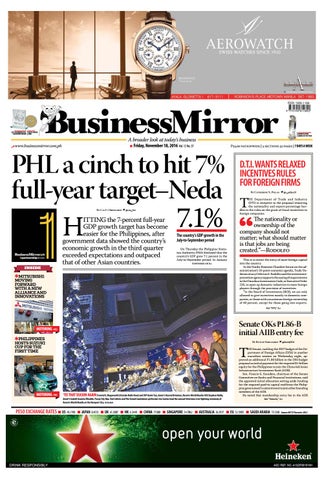
PHL a cinch to hit 7% full-year target–Neda 7.1% H By Cai U. Ordinario
@cuo_bm
itting the 7-percent full-year GDP growth target has become easier for the Philippines, after government data showed the country’s economic growth in the third quarter exceeded expectations and outpaced that of other Asian countries.
inside
The country’s GDP growth in the July-to-September period
On Thursday the Philippine Statistics Authority (PSA) disclosed that the country’s GDP grew 7.1 percent in the July-to-September period. In January Continued on A2
mitsubishi: Moving forward with a new alliance and innovations
2016 ejap JOURNALISM awards
business news source of the year
P25.00 nationwide | 5 sections 32 pages | 7 days a week
D.T.I. WANTS RELAXED INCENTIVES RULES FOR FOREIGN FIRMS
T
By Catherine N. Pillas
@c_pillas29
he Department of Trade and Industr y (DTI) is receptive to the proposal removing the nationality and export-percentage hurdles in the rules on the grant of fiscal incentives to foreign companies.
The nationality or ownership of the company should not matter; what should matter is that jobs are being created.”—Rodolfo
This is to entice the entry of more foreign capital into the country. In the Nordic Business Chamber forum on the administration’s 10-point economic agenda, Trade Undersecretary Ceferino S. Rodolfo said the investmentpromotion agency supports the easing of requirements in the Omnibus Investments Code, or Executive Order 226, to open up domestic industries to more foreign players through the provision of incentives. “In the Board of Investments [BOI], we are only allowed to give incentives mostly to domestic companies, or those with a maximum foreign ownership of 40 percent, except for those going into exports. See “DTI,” A2
motoring
Senate OKs ₧1.86-B initial AIIB entry fee
e2
philippines hosts suzuki cup for the first time
motoring
T e1
‘TIS THAT SEASON AGAIN From left, Megaworld Lifestyle Malls Head and SVP Kevin Tan, Annie’s Krystal Brimmer, Resorts World Manila COO Stephen Reilly, Annie’s Isabeli Araneta Elizalde, Pasay City Rep. Emi Calixto and The Grand Countdown performer Jon Santos lead the annual Christmas tree-lighting ceremony of Resorts World Manila at the Newport City. ALYSA SALEN
PESO exchange rates n US 49.2190
By Butch Fernandez
@butchfBM
he Senate, tackling the 2017 budget of the Department of Foreign Affairs (DFA) in another marathon session on Wednesday night, approved an additional P1.86 billion in the DFA budget proposal as initial payment for the required $1-billion equity for the Philippines to join the China-led Asian Infrastructure Investment Bank (AIIB). Sen. Francis G. Escudero, chairman of the Senate Committee on Banks and Financial Institutions, said the approved initial allocation setting aside funding for the required paid-in capital reaffirms the Philippine government’s commitment to join other founding members of the AIIB. He noted that membership entry fee in the AIIB See “Senate,” A2
n japan 0.4513 n UK 61.2087 n HK 6.3449 n CHINA 7.1580 n singapore 34.7862 n australia 36.7617 n EU 52.5905 n SAUDI arabia 13.1268
Source: BSP (17 November 2016 )
News BusinessMirror
A2 Friday, November 18, 2016
www.businessmirror.com.ph
PHL a cinch to hit 7% full-year target–Neda Continued from A1
to September, the PSA said GDP growth averaged 7 percent. The National Economic and Development Authority (Neda) said the country can easily meet its targets this year, given the strong performance of the economy in the last two quarters. “For the fourth quarter, the country only needs to attain at least 3.4-percent growth to attain the low-end target of 6 percent. To reach the high-end target of 7 percent, we need to grow by 6.9 percent in the fourth quarter,” Neda National Planning and Policy Staff Director Reynaldo Cancio said. At the rate the economy is growing, EagleWatch Senior Fellow Alvin Ang said full-year GDP could easily hit 7 percent, the high-end of the government’s target for 2016. Ang said he initially expected GDP in the third quarter to expand by only 6.7 percent, given that his “best-case scenario” for agriculture was to grow by 1 percent. He added that he became more optimistic about the country’s economic performance in the previous quarter, following the government’s announcement that farm growth reached 2.98 percent. “I was expecting that actual GDP growth could be higher after the release of higher agriculture production,
Senate. . .
Continued from A1
allows payment of $1-billion equity in installments, of which $200 million, representing 20 percent, could be “paid in tranches” over five years. The senator clarified that the Philippines is not required
but it was too late to revise my forecast,” Ang said. However, Cancio said downside risks to GDP growth remain, such as the vulnerability of the agriculture sector to La Niña, as well as the sluggish recovery of Europe, one of the country’s top export markets. Other risks include the uncertainties in the economic policies of the United Kingdom due to the Brexit and the United States, following the election of Donald J. Trump as president. The Neda official also said the resurgence of the “Saudization” policy, or the replacement of foreign workers with Saudi nationals, poses a threat to overseas Filipino workers (OFWs) in the Middle East. “While peace talks between the government and various rebel groups are ongoing, there is a need to consolidate efforts that will pave the way for lasting peace and development in the countryside,” Cancio added. For his part, Former Neda Director General Cielito Habito said, despite these risks, the country’s economic growth will continue to be strong, given the strong domestic economy. The government’s infrastructure program, “catch-up efforts” in disaster reconstruction and new investments by companies fleeing China and those lookto make a “onetime payment” of the total capital allocation, as the Senate proceeded to approve initial payment of the AIIB entry fee to allow the country to start availing itself of development funding for various projects from the China-led counterpart of the World Bank. According to Escudero, membership in AIIB allows the Philippines to tap additional sources of development funding to bankroll
ing to explore opportunities in the Asean Economic Community will also contribute to growth. Lower oil prices, Habito said, will help keep the economy afloat by maintaining strong consumption spending and improving the power outlook. “Down the line, downward pressures from post-Trump jitters would be offset by thawing relations with China, the promised removal of remaining foreign investment restrictions in the Constitution, and other positive policy reforms,” he said. University of Asia and the Pacific School of Economics Dean Cid Terosa added that, despite the threat of Saudization, OFW remittances will continue to spur consumption growth. Remittances account for 10 percent of the country’s GDP. This fuels the country’s household spending which, by itself, accounts for a huge chunk of economic growth. “I believe that we can sustain growth because major government spending plans will be implemented soon and the reconciliatory tone of the President’s rhetoric has caught the interest and attention of businessmen and investors,” Terosa said. The Philippine had the fastest-growing
economy among Asia’s emerging countries in the third quarter. The country grew faster than China, which posted a growth of 6.7 percent; Vietnam, 6.4 percent; Indonesia, 5 percent; and Malaysia, 4.3 percent. On the production side, the main driver of economic growth was still the Services Sector, which expanded by 6.9 percent in the third quarter. It accounted for 4.1 percentage points of the country’s GDP growth during the period. Under Services, the highest growth areas were real estate, renting and business services, which include the business-process outsourcing sector. It posted a growth of 8.8 percent in the third quarter. Data showed that on the demand side, the main growth driver was Fixed Capital Formation, particularly Durable Equipment, which grew 29.6 percent. Under Durable Equipment, the main contributors to growth were transport equipment, such as road vehicles, railway transport, air transport and water transport. “Robust domestic demand will continue to bolster growth in the near term. For the first three quarters, the domestic demand already posted an 11.2-percent growth, and for the third quarter alone, it stood at 9.8 percent. We see this momentum to continue in the fourth quarter of the year,” Cancio said.
various public-works projects, apart from the Japan International Cooperation Agency (Jica) and the Korean Export-Import (Exim) Bank. The Senate’s concurrence with the payment of initial paid-in capital tucked in the budget bill reaffirms the government commitment to join AIIB. “We can now borrow money from additional sources,” Escudero told the BusinessMirror. The senator suggested ear-
lier that Congress should encourage the government to always be open to all levels of engagement with neighboring countries in the region, including China, “any political differences with any such neighboring country notwithstanding.” Escudero added he does not see “any real disadvantage [in joining], compared to being part of an initiative that seeks to help develop the Asian and Asean region.”
Faster growth
DTI. . .
Continued from A1
We’d like to remove that export and nationality bias. For us, the strong growth of the Philippine economy is the biggest attraction to investors. The nationality or ownership of the company should not matter; what should matter is that jobs are being created,” Rodolfo stressed. “We are reviewing the Foreign Investment Negative List [FINL] in order to open up activities where foreign equity is limited. Our target is to open up industries,” he added, saying foreign firms opt to take advantage of the juicier perks offered by other countries due to the Philippine restrictions. Under the investments code, an export-oriented foreign firm must export at least 70 percent of its output if it wishes to qualify for BOI incentives. Under the Foreign Investments Act (FIA), foreign firms wishing to cater to the domestic market can invest 100 percent of equity, except in areas listed in the FINL. If the activity meant for the domestic market is not on the negative list and is more than 40-percent foreign-owned, the FIA prescribes a capital requirement of $200,000, although the amount can be lowered, depending on the type of technology introduced. The trade undersecretary added that this proposal to ease the requirements on the grant of perks to foreign firms has already been raised to the Department of Finance (DOF), which is currently moving to find revenue sources to counterbalance the planned cut on corporate- and personal-income tax. “We’re in sync with the DOF. They’re in agreement because we’ve already shown them the industries that are no longer competitive. What they don’t want is that we keep giving incentives to companies or industries that are going to invest anyway, that’s what they’re opposing, the redundancy,” he said.
BMReports BusinessMirror
news@businessmirror.com.ph
Friday, November 18, 2016 A3
Sta. Romana explains Duterte’s ‘hedging strategy’
F
By Jonathan L. Mayuga
@jonlmayuga
ILIPINO and Chinese officials are set to hold more meetings to discuss in details the agreements between the two countries during President Duterte’s visit to China recently. Ambassador to China-designate Chito Sta. Romana told members of the Rotary Club of Forbes Park at the Manila Polo Club on Thursday that the meeting will be held in the next few weeks. Sta. Romana was invited to speak about the Philippines-China relation by the Rotary International and Rotary Club of Forbes Park, led by its President Lito Bunag. In his speech, Sta. Romana explained Duterte’s independent foreign policy to business leaders and professionals attending the meeting the impacts of improved economic relations China. According to Sta. Romana, the meeting between the top officials of the two countries aims to improve bilateral relations and engage in direct talks, to peacefully resolve disputes. “We will not give up our sovereignty claims. We will resolve it peacefully,” he said. “PhilippinesChina relations will now be driven by economic cooperation.”
Sta. Romana admitted that the disputes between China and the Philippines will not disappear overnight. But he said changing perceptions between the two countries is a start. “From the Philippine viewpoint, China as a national-security threat to an economic partner in development. From China’s point of view, the Philippines as [a] geopolitical pawn and a ‘trojan horse’ of the US containment policy to friendly neighbor acting independently of the US,” he said. Without elaborating, Sta. Romana said talks are follow through of the framework agreement signed between the Philippines and China, which paves way for better political and economic relationship between the two countries. He explained Duterte’s “hedging strategy” aims not to move away from the US, but merely want to gain from an improved political and economic relations with China that
will benefit the people. Duterte brought home $24 billion worth of investment pledges during his visit to China. China will also provide $9 billion in soft loans and a $3-billion credit line with the Bank of China. “All these investments will generate 2 million jobs for the Filipinos in the next five years,” Sta. Romana said. The investments, he added, will benefit various sectors, including manufacturing, trade and finance, infrastructure, telecom, mining and energy. According to Sta. Romana, former President Fidel V. Ramos was instrumental in having a friendlier relations with China, which, he said, focuses on economic cooperation. “In the past, in a sense, we made a choice between China and the US, we decided to side with the US. Now we [are] shifting to one that balance the approach toward the two powers. Our goal is to maintain our alliance with the US but seeks political and economic ties, but not military alliance, with China,” he said. Diplomacy, Sta. Romana said, is
key to improving Philippines-China relationship from hereon. He reiterated that the Philippines is not giving up its claim to the West Philippine Sea, nor is setting aside its victory from the arbitration ruling by the United Nations Convention on the Law of the Seas (Unclos), but would use it as a baseline of building relationship with China. Sta. Romana insisted that forcing the issue of the Philippines winning the arbitration ruling would not lead to having improved relations with China, which rejects the ruling. “What we need to do is convince China about the ruling through bilateral talks through high-level policy meetings,” he said. According to Sta. Romana, Duterte’s “hedging strategy” in dealing with China has been fruitful. “Our fishermen can now fish in the Scarborough Shoal,” he said. Sta. Romana said China has a good record of resolving territorial dispute with other countries through bilateral talks, which something the Duterte administration is hoping to achieve.
We will not give up our sovereignty claims. We will resolve it peacefully…. Philippines-China relations will now be driven by economic cooperation.”—Sta. Romana
Sta. Romana. Photo courtesy of AIM
BMReports
A4 Friday, November 18, 2016
BusinessMirror
Duterte plans $1-B airport, railway in former US base
T
he Philippines plans to award at least $1 billion of contracts to build an airport and a railway to transform a former US military base into a commercial hub as part of President Duterte’s push to distribute wealth outside congested Manila. The Bases Conversion and Development Authority (BCDA) wants these and other major infrastructure projects for the area to be awarded by the second half of 2017 and for most to be completed as early as 2019, its CEO Vince Dizon said in an interview in Makati City. The authority will decide by the first quarter of next year whether to invite bids to build or operate the infrastructure, or do both, he said. “We want the investment community to know that this government isn’t just about addressing crime and drugs,” Dizon, 43, said on November 11. “We’re also here to build, build and build.” Duterte, who won the presidential election six months ago, is lifting infrastructure spending to a record and allocating resources away from the capital, Manila, where traffic and transport logjams cost the economy at least P2.4 billion ($49 million) a day. His government is attempting to fast-track development of the planned Clark Green City, which was carved out of the former Clark Air Base used by US forces during World War II. It received just one bid last year to develop part of the proposed alternative capital city. At 9,450 hectares (23,000 acres), Clark Green City would dwarf the main financial district of Makati in metropolitan Manila, home to the nation’s stock exchange and banks’ headquarters. Building infrastructure outside the capital is key to attracting investment and boosting the country’s growth potential to as much as 9 percent, Rosemarie Edillon, deputy director general at the National Economic and Development Authority, said on Thursday. Third-quarter economic
growth was 7.1 percent, the fastest in Asia.
Duterte’s spending plans for next year
The state body will invite bids for a new P15billion airport terminal in Clark, north of Manila, according to Dizon. It will include a new international terminal that will double Clark airport’s current capacity to 8 million passengers under the first phase of a 30-year plan developed by Aeroports de Paris, he said. It will also invite bidders for some projects identified during Duterte’s state visit to Beijing in October. These include a cargo rail line costing as much as $700 million, running from Clark to the Subic coastal area northwest of Manila, an industrial park and facilities for telecommunications and utilities. If the investments materialize, Clark Green City would bring a new lease of life to an area that now comprises, a main industrial zone with factories for companies, including semiconductormakerTexasInstrumentsInc.andplane-engine manufacturer Rolls-Royce Holdings Plc. and an airportwithlimitedinternationalflights.Under thegovernment’splan,theexistingClarkairport would be converted to a VIP terminal when the new aerodome is up. Dizon said the BCDA will continue to bid out rights to develop more plots of land in Clark, a process started under former President Benigno S. Aquino III. The Duterte administration may choose to fund infrastructure projects through loans obtained at cheaper rates and then offer contracts to companies to run them, Dizon said. Under Aquino, the preference was to let private companies handle the projects at the onset, and such an arrangement remains an option, the executive said. Bloomberg News
DOT renews partnership with students travel group By Ma. Stella F. Arnaldo @Pulitika2010
T
HE Department of Tourism (DOT) has renewed its partnership with the Students Travel Association (STA Travel), a worldwide tour operator, in a bid to further boost visitor arrivals from the United Kingdom. Tourism Secretary Wanda Corazon T. Teo made this disclosure after her arrival from London, where the Philippines participated in the World Travel Market (WTM) 2016. In 2015 STA Travel was able to send 2,200 visitors to the Philippines from the UK, and more than 7,000 from key European and Australian markets, according to a news statement from the DOT. This is the second year of the government agency’s partnership with STA Travel. Teo also reached out to UK and other foreign media present during the Media Address held at the sidelines of the WTM, to help intensify interest about the Philippines as a tourism and investment haven. She told them: “We are delighted to be here for the biggest-ever Philippine participation in the World Travel Market, considered the most influential and must-attend travel fairs in the world. We are serious in courting the British travel trade and business networks to bring more arrivals and related investments to the Philippines.” She added that the UK remains to be the biggest source of visitors of the Philippines from Europe, “and we intend to increase our share of this huge market, which contributed 35.7 million trips to the total global outbound figure last year.” In 2015 visitor arrivals from the UK reached some 155,000, up 16 percent from 2014. From January to August 2016, visitor arrivals from the UK jumped by 13.5 percent with 117,535. The DOT partnership with STA Travel is specifically aimed at UK students taking a “gap year,” or a one-year rest period before continuing their studies. On the STA Travel web site, there are three available package tours to the Philippines, priced from £759 to £1,479, for a Northern Philippines adventure (nine days), a Southern Philippines Palawan Adventure (nine days) and a North and South Philippines on a shoestring package (16 days). Most of these packages cover transport costs within the Philippines whether by plane, bus, or boat, hotel accommodations, breakfasts and tours of designated
sites—which, for most UK students, are not only reasonably priced, but packed with adventures and social interactions with the local communities. At any one time, on any given day, about 17,000 students move across Asia on trips organized by STA Travel. As the tours are certified by STA Travel, DOT officials explained, the students don’t fall prey to the usual mishaps that befall some travelers, like being fooled into taking certain side trips, or paying for more than the usual rate for local transportation, etc. Philippines Tourism Attaché Gerry Panga also informed Teo on the success of the agency’s other partnerships with companies that have helped spread the good news in the UK about the Philippines as a tourism destination. These include Philippine Airlines (PAL), which has been involved in the Station Domination campaigns, the Philippines Tourism Weekend at Potter’s Field and the Visit the Philippines Again 2016 Holidays. “It has also committed to support future selling missions and familiarization trips for media and tour operators,” Panga said. PAL is the only airline that offers direct flights between London and Manila. In an interview with PAL’s London office last year, the airline intimated that there are an increasing number of UK citizens now taking trips to the Philippines, compared to when the route was first offered in November 2013, when it was mostly Filipinos working in the UK who composed most of its passengers. (See “PAL sees clearer skies for UK routein2016,”intheBusinessMirror,November3,2015.) Similarly, he said Singapore Airlines, which ran the “First Stop Singapore, Next Stop Philippines” campaign, “successfully delivered over 1.2 million impressions with an expected 400 to 500 total passenger bookings for shortterm conversion as a result of visiting the platform.” For its part, Expedia, the largest online travel-agent portal worldwide, was able to generate around 18,000 bookings to the Philippines last year. “It hopes to improve on the conversion with fresh content and offerings from participating properties,” Panga said. Teo expressed appreciation to the DOT’s partners “for helping us position the Philippines as a top-of-mind destination. Again, we could only be as successful with the support of our media friends who continue to help us spread the good news and the compelling reasons to visit our beautiful country among the British travelers.”
AseanFriday BusinessMirror
news@businessmirror.com.ph
Editor: Max V. de Leon • Friday, November 18, 2016 A5
Singapore exports post biggest drop in 7 months in October
S
ingapore’s nonoil domestic exports posted the largest decline in seven months in October, driven by a slump in pharmaceutical exports. Key points
Big picture
Nonoil domestic exports fell 12 percent from a year earlier, compared with a revised 5-percent drop in September, International Enterprise Singapore said in a statement. That was worse than the median estimate of a 3-percent decline in a Bloomberg survey of 15 economists. Compared with the previous month, nonoil exports fell 3.7 percent. Pharmaceutical exports, one of the most volatile components in the index, fell 47 percent from a year earlier.
Exports in Asia’s most trade-dependent country have remained under pressure since last year—rising only once in the past seven months —amid weaker global demand and a slowdown in China. That’s been a drag on the economy, which contracted an annualized 4.1 percent in the third quarter from the previous three months, according to an advanced estimate from the government. Growth is set to be closer to the lower end of the official 1-percent to 2-percent forecast
12%
The percentage decline in Singapore’s nonoil exports
range this year. Trade prospects for Asia remain bleak given the risk of protectionism following Donald Trump’s victory in the US election last week. Petrochemical exports fell 7 percent in October from a year ago, while electronic shipments were down 6 percent. Exports to the majority of Singapore’s top 10 markets fell in October, except to Taiwan, Hong Kong and South Korea. The largest contributors to the decline were the European Union, Japan and Indonesia. Bloomberg News
Indonesia seen holding interest rates
A
MOST EXPENSIVE BETTA FISH In this November 7 photo, a Siamese fighting fish with colors resembling the Thai national flag, swims in
a fish tank in Kalasin, Thailand. Pictures of the fish’s blue, red and white horizontal stripes went viral upon being posted on a private Betta fish auction group on Facebook since its colors closely resembled the Thai flag and sold for a record breaking 53,500 baht ($1,528), making it the most expensive Betta fish to ever be sold. AP
Rohingya deaths exceed 100–group
A
dvocates for Myanmar’s Muslim ethnic Rohingya community said on Wednesday more than 100 members of the minority group have been killed in recent government counterinsurgency sweeps in the western state of Rakhine. Ko Ko Linn of the Arakan Rohingya National Organization said that, according to villagers, at least 150 people had been killed in Maungdaw district by security forces since Saturday. Independent verification of both army and activists’ claims is difficult because the government has restricted access to the area. “The reason the international news agencies and aid groups are not allowed to go there is because the military is trying to cover up what they are doing there, the killings and other things,” Ko Ko Linn said by phone. “They are lying.” Nay San Lwin, a blogger based in Europe who has closely monitored Rohingya developments since 2012, said reports from a network of activists in Rakhine said more than 100 bodies had been discovered by villagers, some covered by hay or burned. The government on Tuesday acknowledged the deaths of 69 “violent attackers” and 17 members of the security forces. The attackers weren’t specifically identified, but the army has aligned with Rakhine
Buddhists against the Rohingya. The government says the attackers burned down hundreds of homes, but rights groups blame the army for such actions and other abuses of Rohingya civilians. The two parties are also engaged in a propaganda battle. The government has said the international media are reporting “fabrications” about the situation, while Rohingya activists allege the army has taken pictures of captured Rohingya, including children, posed with various weapons, such as spears and clubs. The government held a news conference late Wednesday in the capital, Naypyitaw, seeking to rebut critical news reports. President’s office Spokesman Zaw Htay accused the US-based group Human Rights Watch of exaggeration in reporting on Saturday that satellite imagery showed a total of 430 destroyed buildings in three villages, and said international media had misreported the situation. He said journalists were not yet allowed to go to Maungdaw for security reasons, and that the affiliations of the “attackers” were unknown. Tensions have been high in Rakhine since fighting in 2012 between Buddhists and Rohingya Muslims. More than 100,000 Rohingya are still in squalid camps for the internally displaced after being driven from their homes at that time. Although
many have lived in Myanmar for generations, they are widely regarded as having illegally migrated from Bangladesh, and the government denies citizenship to most. Government military operations intensified last month after nine police officers were killed in attacks on posts along the border with Bangladesh. International concern has been building since then. On Tuesday the United States called for Myanmar to do more to stem the violence. State Department Spokesman Elizabeth Trudeau said a US delegation holding previously scheduled talks in Myanmar urged the government to “improve transparency.” The US also repeated its call for an independent investigation and humanitarian access. Concern was also expressed by former UN chief Kofi Annan, who heads a commission appointed by Myanmar leader Aung San Suu Kyi to investigate the cause of tensions in Rakhine. “As chair of the Rakhine Advisory Commission, I wish to express my deep concern over the recent violence in northern Rakhine state, which is plunging the state into renewed instability and creating new displacement,” Annan said in a statement Tuesday. “All communities must renounce violence and I urge the security services to act in full compliance with the rule of law.” AP
sia’s biggest interest-rate cutter may be about to hit the pause button, starting on Thursday. Bank Indonesia was happy to lower its benchmark rate six times this year to shore up economic growth amid subdued inflation and exchange-rate stability. Then came Donald J. Trump. His surprise US presidential election win has stoked investor bets on faster inflation and Federal Reserve (the Fed) interest-rate increases, boosting the dollar—especially against emergingmarket currencies, like Indonesia’s rupiah. It’s all reminiscent of the taper tantrum in 2013 when the Fed’s signal of stimulus withdrawal prompted an Indonesian sell-off. “The Fed complicates things and the turmoil that we’ve had since the Trump election I think makes it very difficult for the authorities to cut,” said Tim Condon, head of Asian research at ING Groep NV in Singapore. “When everybody’s selling your currency, for a central bank, the thing to do is to send those calming signals. Changing policy in that environment is really not the way to do that.” The central bank in Southeast Asia’s biggest economy is forecast to keep its benchmark seven-day reverse repurchase rate at 4.75 percent on Thursday, according to all but three of the 20 economists surveyed by Bloomberg.
Currency slide
IN a separate poll last week, when f inancia l markets were hit by
When everybody’s selling your currency, for a central bank, the thing to do is to send those calming signals. Changing policy in that environment is really not the way to do that.” —ING Groep
volatility, a majority of the 24 analysts predicted Indonesian policymakers will remain on hold until the end of 2017. Indonesia’s rupiah has been among the hardest hit in Asia in the past week as investors dumped emergingmarket assets, forcing policy-makers to intervene to stabilize the currency and signal more action if needed. The rupiah dropped as much as 3 percent against the dollar to a five-month low of 13,545 on November 11, its sharpest intraday decline since September 2013. Juda Agung, executive director of monetary policy at Bank Indonesia, said that, while the Indonesian economy remained in “pretty good” shape and growth in 2016 was still
expected to be in the range of 5 percent, “the challenge ahead is not easy”. The US election had delivered a president with a “more protectionist agenda,” he told reporters in Jakarta on Tuesday. “The impact in the short term is that financial markets were somewhat shocked by the election of Donald Trump because it was not what was expected,” he said. Until now, Bank Indonesia’s focus has been solidly on the economic growth outlook. It aggressively cut rates this year and in August adopted the seven-day reverse repurchase rate as its new benchmark in an effort to boost lending. The central bank’s growth forecast for this year is well below the 7-percent targeted by President Joko Widodo when he came to office two years ago. “Growth has been quite slow, inflation is still around the lower end of the forecast range,’’ said Charu Chanana, an economist with Forecast Pte. Ltd. in Singapore. “The global events right now are going to put them into a position to hold because Trump’s policies are very uncertain in terms of trade and foreign policy.” With inflation subdued at 3.3 percent in October, close to the lower end of the bank’s 3-percent to 5-percent target, economists, including Rahul Bajoria of Barclays Plc., had seen room for a rate cut on Thursday. “We changed our call just after the CPI numbers came out, before the election,” he said. “Now, since the election, has the risk of BI not moving in this meeting gone up? Absolutely.” Bloomberg News
Prince William praises Vietnam’s wildlife efforts
B
ritain’s Prince William praised Vietnam, China and other Asian countries for taking unprecedented steps to battle wildlife trafficking but said on Thursday the truth is that rhinos, elephants, pangolins and lions are still being killed in horrifying numbers. William, who is president of United for Wildlife, lauded progress in stemming trade in endangered wildlife since the London conference two years ago, particularly partnership between African governments to fight poaching. China has signaled a total ban on ivory trading, the US already has banned it and other nations, including Britain, are considering it, he said. Vietnam, one of major transit points and consumers of trafficked ivory and
rhino horns, for the first time, destroyed seized ivory and rhino horns last weekend, he said.“But here is the problem: We know that we aren’t moving fast enough to keep up with the crisis,” William told the Third International Conference on the Illegal Wildlife Trade in Hanoi. He said the Great Elephant Census published this summer confirmed our worst fears about the shocking 30-percent decline in the African elephant population in just seven years. “So while we’ve made progress, the truth is we are still falling behind. A betting man would still bet on extinction,” he said. Organized crime syndicates are much more agile, he said, adding that although authorities have stepped up
controls at ports and borders, most illegally poached products are still slipping through the net. “Attitudes on the use and purchase of illegal wildlife trade products are proving harder to shift than we might have liked,” William said, alluding to mistakenly held beliefs that rhino horns provide a cure for cancer. “In this part of the world we have to acknowledge the truth that newly aspirational consumers are still demanding more, not less, ivory and rhino horn.” He said the poachers are learning to be quiet and are much harder to track. “Their brutality continues to escalate with many more rangers killed since we gathered in London two years ago,” he said. AP
A6
Friday, November 18, 2016
The World BusinessMirror
Editor: Lyn Resurreccion • www.businessmirror.com.ph
Trump’s future role looms over Apec summit in Peru
A man dressed in traditional Andean clothes walks past the logo of the Apec 2016 summit in Lima, Peru, on Wednesday. Lima will host world leaders at this week’s Asia-Pacific Economic Cooperation summit. AP/Martin Mejia
L
Protesters chant before marching through the streets in Portland, Oregon, on Wednesday. Students at Portland State University joined a nationwide campus walkout to protest President-elect Donald J. Trump. AP/Don Ryan
College students protest Trump’s deportation plans
C
ollege students at campuses around the United States marched and rallied on Wednesday, urging administrators to protect students and employees against immigration action under a Donald J. Trump presidency. Rallying supporters on social media with the hashtag #SanctuaryCampus, organizers said actions were planned at more than 80 schools, including Vermont’s Middlebury College, where about 400 people gathered, and Yale University, where demonstrators numbered about 600. Students sought assurances that their schools would not share their personal information with immigration officials or allow Immigration and Customs Enforcement (ICE) agents on campus. “Can you imagine the fear that it would inflict on college campuses if having ICE agents walk into a campus becomes the status quo?” organizer Carlos Rojas of the group Movimiento Cosecha said by phone from New Jersey. “It would be terrifying.” The actions continued days of demonstrations that have broken out in cities and high-school c a mpu ses fol low i ng Tr u mp’s election victory last week. The Republican’s campaign promises included a vow to deport millions of people who are in the US illegally. “I’m very fearful,” Miriam
80M The number of schools where student actions were planned
Zamudio, whose parents brought her to the US from Mexico as a child, said by phone as she prepared to join a protest at Rutgers University in New Jersey. She worries that the family information she provided on her application for Deferred Action for Childhood Arrivals status will endanger her parents, who are living in the country without legal permission. “We don’t know what Trump is going to do,” Zamudio said. “We don’t know if he is going to demand this information, and we want our administration and our school to stand with us.” Several hundred people, mainly high-school and college students, rallied at the federal building in downtown San Diego to pro-
test Trump’s election. Some held signs or banners saying “we are not criminals” and “make racists afraid again.” An 18-year-old was arrested after he allegedly punched a police officer, the police said. In one non-campus protest on Wednesday night, hundreds of people rallied on the steps of Los Angeles City Hall to protest Trump’s appointment of Steve Bannon as a senior adviser. Faculty and staff at several universities have signed petitions in support of making their campuses sanctuaries for people threatened with deportation—or anyone who faces discrimination. “We are alarmed at the vitriol that students and community members are experiencing across the United States in the aftermath of the recent election,” the petition to administrators at the University of Illinois at Urbana-Champaign said. “Reports of gross imitations of disabled youth, threats to aid in the deportation of students and their families, renewed deployments of the ‘N’ word, sexual aggressions against young women, bullying of Muslim and LGBTQ+ [lesbian, gay, bisexual, transvestites and queer] youth, reappearances of swastikas, among other acts, point to hostilities that infiltrate our campus.” At the University of Memphis, students chanted “Say it loud, say it clear, refugees are welcome here” and “No racists, no KKK, no fascist USA,” The Commercial Appeal reported. Junior Lu ke Wi lson stood nearby, holding a sign that said
“You’re all cry babies.” Similar sentiments appeared on Twitter and other social-media platforms, along with messages of support. “We know that there are going to be people on both sides of the issue,” Rojas said. “But I think that what no one could argue with is that a university and a college campus have a moral responsibility to make the students that are paying tuition and just want to get an education feel safe.” Department of Homeland Security Press Secretary Gillian Christensen said existing ICE and Customs and Border Protection (CBP) policies guide enforcement at “sensitive locations,” which include colleges and universities. “ The ICE and CBP sensitive locat ions pol ic ies, whic h re main in effect, provide that enforcement actions at sensitive locations should generally be avoided, and require either prior approval from an appropriate supervisory official or exigent c i rc u m st a nces ne ces s it at i ng immediate action,” Christensen said by e-mail. “DHS is committed to ensuring that people seeking to participate in activities or utilize services provided at any sensitive location are free to do so without fear or hesitation.” Ya l e Ph D s t u d e nt R a mon Ga r iba ldo told t he crowd to remain hopef u l. “I fear for my existence every day,” said Garibaldo, whose parents brought him from Mexico. “My mom, my dad they crossed borders for me to be here. So we aren’t going to bow down to the orders of one man.” AP
IMA, Peru—Donald J. Trump will be on the minds of world leaders as they gather for an Asia-Pacific trade summit. The president-elect has made it clear that he is hostile to the kind of free-trade deals that tend to be the focus of the annual Asia Pacific Economic Cooperation (Apec) forum, taking place this year in Peru’s capital. He’s also singled out group members China and Mexico in a populist campaign standing up for displaced American workers. That has likely changed the tone and the agenda of a meeting that was expected to be part of a valedictory tour for US President Barack Obama. It will be his last international summit before he leaves office on January 20 and those in attendance are to include Chinese President Xi Jinping, Russian President Vladimir Putin and Japanese Prime Minister Shinzo Abe. Instead of promoting a now allbut-dead trade deal, known as the Trans-Pacific Partnership (TPP), economic experts expect Obama will field uncomfortable questions about Trump’s pledges to overhaul US trade policy, crack down on illegal immigration from Mexico and withdraw from a global agreement to fight climate change. “World leaders like everyone else are hoping he will be more moderate in office than he was on the campaign trail,” Fred Bergsten, a senior fellow at the Peterson Institute for International Economics in Washington. “But they are going to be worried.” Apec’s 21 member-nations comprise more than a third of the world’s population and half of global trade. It was established three decades ago to accelerate economic growth by removing trade barriers and helping integrate global supply chains. The group’s annual summits also deal with current international challenges, such as security following the terrorist attacks on September 11, 2001, or in Paris last year or the global economic crisis of 2008. This year the big issue is Trump. “As you can imagine, the issue of the day will consume a lot of the energy,” said Scott Miller, a senior adviser to the Center for Strategic and International Studies who previously advised the US on Apec matters. Manufacturing has been declining in the US since the 1950s and today represents less than 10 percent of employment.
Despite Trump’s promises to revive industry, those jobs are unlikely to return in large enough numbers, said Apec Executive Director Alan Bollard. At the same time, developing nations—the biggest beneficiaries of globalization—are more upbeat about free trade. “The pessimism about trade does seem to be more of a developed, affluent country phenomenon,” Bollard said in an interview. B ol l a rd , a for me r ce nt r a l banker in New Zealand, said world leaders haven’t done a good enough job selling the benefits of globalization and cited studies that credit trade for helping lift half-a-billion people out of poverty in the Apec region. He said there has also been an overriding focus on manufacturing, what Bollard called the “old wave” of globalization, instead of helping companies in the services industry navigate complex, crossborder regulations. “With the advantages of electronic commerce, it’s possible for small, remote businesses to be world traders in a way they never could before,” he said. While Trump has threatened a trade war with China, vowing higher tariffs and declaring it a currency manipulator, the Asian giant has emerged as an unlikely champion of borderless buying and selling. The leaders gathering in Peru will be presented with a joint US-China study ordered up in 2014 about the feasibility of a vast free-trade area including all Apec members. Beijing is also promoting a regional trade partnership grouping it with 10 Southeast Asian economies, as well as Japan, India, South Korea, Australia and New Zealand. That proposed pact has become more relevant with Trump’s victory all but killing the 12-nation Trans-Pacific Partnership, which excludes China and was widely seen as an attempt by the Obama administration to keep Asian trading partners in the US orbit. When it comes to US trade, said Miller, Trump’s actions as president seem unlikely to be as dramatic as he sounded on the campaign trail. He said 48 of the 50 states have either Canada or Mexico as their leading trade partner, which means disruptions to business from tearing up North American Free Trade Agreement could be politically, as well as economically, devastating. AP
Trump team names candidates for positions amid infighting P resident-elect Donald J. Trump’s transition team gave its first detailed update amid reports of infighting and disorganization. In a conference call with reporters on Wednesday night, aides named more than a dozen people who are either candidates for jobs in the Trump administration or were meeting with Trump to provide advice. The list includes South Carolina Gov. Nikki Haley, who once said Trump represented “everything a governor
doesn’t want in a president” but more recently has said she looks forward to working with a Republican president and Congress. Tr u m p s p o k e s m e n S e a n Spicer and Jason Miller didn’t specif y to reporters on the call which people were under consideration for administration posts as they named those who met with Trump in New York on Wednesday and are scheduled to visit on Thursday. They said they intend to start giving reporters daily briefings
about the transition’s progress and the president-elect’s schedule. T he transition team has been the subject of news reports about shakeups that have slowed the progress of building the new administration. Trump last week replaced the head of his transition team, New Jersey Gov. Chris Christie, with his Vice Presidentelect Mike Pence, and ousted several other transition members. Miller said Trump’s schedule on Wednesday included meetings with Georgia Rep. Tom Price, who
is in the mix for secretary of the US Department of Health and Human Services; Alabama Sen. Jeff Sessions, a possible defense secretary or attorney general pick; Retired Lt. Gen. Mike Flynn, who is in line for a possible national security post; Eva Moskowitz, chief executive officer of New York’s largest charter school network; Kansas Rep. Mike Pompeo; and hedge-fund manager Steve Feinberg. Spicer said those scheduled to meet with Trump on Thursday
include Haley; Texas Rep. Jeb Hensarling, whose name has been f loated for treasury secretary; FedEx Corp. CEO Fred Sm it h; Orac le Cor p. co - CEO Safra Catz; former Secretary of State Henry Kissinger; Florida Gov. R ick Scott; retired Gen. Jack Keane; Navy Admiral Mike Rogers; and former Ohio Secretary of State Ken Blackwell. Spicer said appointees would be required to sign paperwork banning them from lobby ing for five years after they leave
government. Trump is seeking to prevent people from using service in government to “enrich themselves,” Spicer said. Miller also said the first wave of transition landing team representatives will be announced on Thursday to meet with the State Depar tment, Justice Depar tment, Department of Defense and National Security Council. Teams for economic policy, domestic policy and independent agencies will be announced next week. Bloomberg News
www.businessmirror.com.ph
The World BusinessMirror
Friday, November 18, 2016
A7
Japan’s hidden, untapped potential to boost econ
J
apan’s population is declining, deflation has returned, and the nation’s economy is still stuck in cycle of weak, stop-start growth. And yet, there are a number of hidden and underutilized resources that Japan could tap to try and escape this economic malaise. The Organisation for Economic Co-operation and Development (OECD) notes that, while demographics are against it, Japan still has a huge wealth of human capital, thanks to its highly trained and educated people. There’s also dormant capital and even unused inventions that could be put to work to increase growth. Japan was the world-leader in numbers of patents issued in 2014, according to the World Intellectual Property Organization, with almost 300,000 patents. The US was second with almost 260,000 and China was third. However, for all that inventiveness, Japanese companies were much less aggressive with innovative new products and businesses. “If you look at the patent data, there is lots of innovation in Japan,” said Yumiko Murakami, head of the OECD’s Tokyo office. However, there are risks in commercializing that, and Japanese culture doesn’t allow people to come back from mistakes, she said.
hour of any Group of Seven nation, according to a report from the Japan Productivity Center. The amount of unused money socked away at Japanese companies and banks is not a new or hidden story, but it is a huge untapped resource for the nation. Households held ¥920 trillion ($8.4 trillion) of their assets in cash or deposits at the end of June, the second-highest level on record, and corporate cash and deposits stood at ¥242 trillion, an all-time high. In addition, there was ¥218.5 trillion more money deposited at
300,000 The number of patents issued by Japan
“We need to create an environment where risk-taking is attractive.” Meanwhile, Japan’s women are some of the most highly educated people in the world, and yet, many leave the work force to have children and then don’t return, or return to part-time, lower paying jobs. Although there has been some improvement in this trend in recent years, there is still a big gap with men and with women in other developed nations. Their absence from the work force during their 30s and 40s, which are the prime working years, hurts their chances of advancement, reduces life-time incomes, and wastes the time and money spent on their education. It’s similar for older Japanese,
People are reflected on the electronic board of a securities firm in Tokyo. AP/Koji Sasahara
whose labor-force participation declines markedly once they hit 60 years old, which is the mandatory retirement age in many companies. Japanese are some of the longest-lived people in the world and they have higher literacy and numeracy skills than the average for developed nations. For them to leave the work force early, or officially retire and then come back at lower pay, hurts their potential lifetime income and also overall growth.
“Japan has great people, assets and capital, in both quality and quantity. The issue is we don’t see that benefiting output,” Murakami said. “We have to reform the structure of the economy and improve the system.” Boosting the nation’s lagging productivity is another way the government and companies could generate more output despite the shrinking population. From 1970 through 2014, Japan had the lowest productivity-per-
the nation’s banks than was loaned out at the end of October, and with lending rates so low, this is a huge source of possible funding, if there were willing borrowers. If Japan was to utilize these resources, it could “dramatically transform” the nation, the OECD’s Murakami says. The biggest problem facing the nation is how to reform the economy’s structure to use these hidden and ignored treasures. Those reforms will hurt, Murakami says, but if it that pain is postponed, then the nation will die. Bloomberg News
A8
Friday, November 18, 2016 • Editor: Lyn Resurreccion
The World BusinessMirror
Mexico to embassy, consulates in US: Increase measures to protect citizens
M
EXICO CITY—One week after Donald Trump’s election as the next US president, Mexico has issued a message of support for Mexican immigrants living in the United States: “We are with you.”
On Wednesday the Mexican government instructed its embassy and consulates in the US to step up measures to protect Mexican immigrants. The measures include a 24-hour hot line that will allow people to report harassment and immigration raids, as well as the expansion of deportation-defense work at 50 consulates. “These are uncertain times,” said Foreign Secretary Claudia Ruiz Massieu in an online video introducing the new measures. “The government of President Enrique Peña Nieto and all Mexicans are with you. We are going to be closer than ever.” Ruiz urged those living in the US to contact Mexican consulates to find out whether they might be targeted for deportation after Trump takes office next year. Trump’s vows of mass deportations have caused deep anxiety among those living in the US illegally, about 5 million to 6 million of whom were born in Mexico. His repeated criticism of Mexico has
5m to 6M The number of people living illegally in the US who were born in Mexico also put millions of legal Mexican immigrants on edge. The new measures introduced on Wednesday illustrate the level of concern that is also felt south of the border over Trump’s immigration threats. While Mexican officials have been seeking ways to defend Mexico against Trump’s pledge to impose stiff tariffs on Mexican goods and tear up free-trade agreements, his threat to ramp up deportations could devastate the Mexican economy. Mexico, whose peso has been faltering since news of Trump’s victory, is highly reliant on the billions of dollars in remittances it receives each year from immigrants living in the US. And experts say it would be
Mexican President Enrique Peña Nieto addresses members of the California Legislature in August 2014. Mexico has issued a message of support for Mexican immigrants living in the United States: “We are with you.” Hector Amezcua/Sacramento Bee/TNS
difficult for Mexico to absorb large numbers of new deportees. Already, Mexican officials have been struggling to integrate the roughly 200,000 Mexicans who are repatriated annually by US immigration authorities. Many returnees lack the proper Mexican documents to find work, and many come with their children, some of whom are US citizens who don’t speak Spanish. Nearly half a million US citizen children are enrolled in Mexican schools, according to government statistics.
As part of its Trump-related action plan, Mexico says it will make it easier for Mexicans living in the US to obtain proper Mexican identity documents and will intensify a campaign to register as Mexican citizens children born in the US to parents who are Mexican nationals. A statement released by the Foreign Ministry on Wednesday, titled “We Are With You”, also pledged to “strengthen dialogue with state and local authorities.” While immigration laws are
enforced by federal officials, increasing numbers of local and state municipalities have taken steps to limit collaboration on deportations. It is “local policies that determine, to a large extent, the daily lives of Mexicans in the United States,” the statement said. The statement called on Mexicans living in the US to avoid “situations of conflict” that could lead to jail time and eventually a deportation order. Ruiz echoed that sentiment in her video. “Stay calm,” she said. Los Angeles Times/TNS
Bombs strike Aleppo, northern Syria, 54 dead B E I RU T— B o m b s r a i n e d down on rebel-held eastern Aleppo for a second st ra ight d ay on Wed nesd ay, pounding a district that houses several medical facilities, including the central blood bank, and forcing Syrian staff and patients in the only remaining pediatric hospital to cower in a basement as buildings collapsed around them. At least 54 people were killed in air strikes and artillery shelling across northern Syria, part of a long-anticipated offensive aga i nst rebel-held a rea s a nnounced by Russia, a key ally of Syrian President Bashar al-Assad. The bombardment hit in besieged neighborhoods of Aleppo, as well as the surrounding countryside and the nearby rebel-held province of Idlib. Russia said its air raids were only targeting Idlib and the central province of Homs to root out militants of the Islamic State (IS) group and Syria’s al-Qaeda affiliate. But Syrian warplanes were pounding rebel-held districts of Aleppo, home to nearly 275,000 people. Residents said the aerial campaign intensified on Wednesday. Syria’s Civil Defense, known as the White Helmets, recorded at least 150 raids, more than double the number of attacks on Aleppo on Tuesday. Resident Modar Shekho said warplanes hadn’t left the skies over his neighborhood since 9 a.m. “The helicopters would leave and the jets would arrive,” he said by telephone, adding that the helicopters were dropping seven or eight “barrel bombs” at a time “causing a lot of destruction.” The head of the only pediatric hospital still in service in eastern Aleppo described taking shelter in a basement with some 50 young patients and staff for more than two hours as the crude unguided explosive- and shrapnel-laden
bombs and other missiles fell around them. “It was frightening,” said Dr. Hatem, who gave only his first name out of fear for the security of family members living in government-controlled areas. He said he counted more than 20 missiles falling, and a number of nearby buildings were destroyed. W he n he a nd t he ot he r s emerged, he said they found missiles had landed in the hospital’s courtyard, hit the main door and stairs. The hospital ’s operating rooms, incubators and other equipment were moved underground four months earlier because of repeated aerial bombings of the city. “We have no other way to reinforce the hospital. We see barrel bombs bringing down whole buildings,” he told The Associated Press by telephone. “We don’t really have many options.” Adham Sahloul of the Syrian American Medical Society, which supports several hospitals in opposition areas in Syria, said it appeared the government was focusing its fire on Aleppo’s medical infrastructure, including the central blood bank, which was also hit. There are only five functioning trauma facilities left in eastern Aleppo, he said. The managing director of the blood bank, Ahmad Eid, said the damage was mainly to the facility’s exterior and reception area. The driver was slightly injured, but the stored blood was not affected, he said. “This was directly targeting the medical quarter. It is a very vital area,” Eid said. The Independent Doctors Association, a Syrian group which supports the children’s hospital and the blood bank, decried the lack of protection of civilians as the conflict rages. “Aleppo has been under siege since July and the escalating bombardment on the eastern part
Activists place false limbs outside the Russian Embassy in London. Two campaign groups, The Syria Campaign and Syria Solidarity UK, have scattered over 800 limbs around the gates of the building in a protest at the bombing of civilians in east Aleppo, Syria. Dominic Lipinski /PA via AP
of the city has rendered the medical mission nearly impossible,” the group said in a statement. Medical facilities have repeatedly come under attack in the conflict. The World Health Organization said it has documented with its partners 126 attacks on medical facilities across the country this year, including five hospitals that were struck in Aleppo and Idlib between Sunday and Tuesday alone.
Months of negotiations between Moscow and the Obama administration have failed to cement a long-term cease-fire in Aleppo, which has become the focus of the war between Assad and rebels fighting to topple him. Al-Qaeda’s Syrian affiliate is fighting alongside the rebels, but the IS group has no presence in Aleppo. The Russian declaration of
the offensive came hours after President Vladimir Putin and US President-elect Donald Trump discussed Syria in a phone call and agreed on the need to combine efforts in the fight against what the Kremlin called their No. 1 enemy—“international terrorism and extremism.” In an interview broadcast on Tuesday with Portugal’s staterun RTP television, Assad accused armed groups he called “terrorists” of occupying eastern Aleppo and refusing government offers to evacuate. He said his mission was to liberate civilians. Assad also identified President-elect Trump as a possible “natural ally,” if he turned out to be “genuine” about his commitment to fight terror in Syria. Trump has indicated he would prioritize defeating the IS group in Syria over regime change, saying the rebels could be “worse” than the sitting president. A strict blockade of rebel-held areas of Aleppo has been enforced since July, and talks to allow in food and medical supplies have failed. The UN warned last week that food rations inside Aleppo’s rebel-held districts could be depleted by the end of this week. In a sign of the rising desperation, a local Aleppo official said riots broke out outside a warehouse storing grain and other food on Tuesday and Wednesday, leading to clashes that left one person dead. The official, speaking on condition of anonymity for fear for his safety, said the r ioters stor med and emptied the warehouse. A resident of the area confirmed the warehouse was robbed. The Britain-based Syrian Observatory for Human Rights said air strikes in Aleppo killed at least 24 people, including six children. At least one paramedic was among the dead, according to the Syrian Civil Defense. AP
www.businessmirror.com.ph
Putin withdraws Russia from ICC
R
ussia on Wednesday withdrew support for the International Criminal Court (ICC), a largely symbolic but defiant gesture rendered more highly charged by uncertainty over President-elect Donald Trump’s stance toward Moscow. Russia’s move, in the form of a decree signed by Russian President Vladimir Putin and published on the official Kremlin web site, came a day after the court had released a preliminary report classifying Russia’s 2014 takeover of the Crimean peninsula as a consequence of armed conflict with Ukraine. Moscow says Crimea voluntarily joined Russia after a referendum whose validity was doubted by international observers. During his campaign, Trump made statements suggesting he was not aware that Russia had annexed Crimea, a move that triggered sanctions and a wave of international condemnation against Moscow. A week after Trump’s victory in the US presidential election, some Kremlin-watchers have pointed to early of signs of an emboldened attitude by Putin in the international arena. A na lysts pred ict t he Russian leader will act swiftly to test Trump, who often referred admiringly to Putin during his campaign, on many longstanding points of dispute with successive American administrations. On Monday Trump had what was described by the Kremlin as a cordial phone conversation with Putin, drawing expressions of concern from some in the defense and foreign-policy establishment. Veteran Republican Sen. John McCain, chairman of the Senate Armed Services Committee, issued a sharply worded statement on Tuesday urging Trump not to place excessive trust in Putin. The Russian repudiation of the ICC will have little practical effect, at least in the short term. Moscow signed the 1998 Statute of Rome creating the Hague-based tribunal, which was set up to prosecute grave international offenses, such as war crimes and genocide, and has cooperated with it on some issues. But it remained outside ICC jurisdiction because it did not ratify the treaty. The United States is not a signatory to the statute, citing concerns about potential prosecution of US military personnel and civilian political officials. Events in Syria’s multisided war might also have influenced Russia, which can wield a United Nations Security Council veto to prevent cases from being referred to the ICC. Putin’s government has brushed aside UN calls for a war crimes investigation of months of ferocious bombardment of the oppositionheld sector of the northern city of Aleppo by Russia and Syrian government forces. Hundreds of civilians have died in that onslaught. Fresh denunciations came this week as the UN General Assembly’s human-rights committee condemned attacks on civilians in Aleppo and called for a cease-fire. Trump has indicated he will cut off US financial and logistical support to some rebels seeking to oust Syrian President Bashar al-Assad, even as Russia deepens its involvement in the conflict. On Tuesday Russia, for the first time deployed, aircraft carrierborne fighter jets against Syrian rebel positions, and Assad told Portuguese TV that the incoming US leader might prove a “natural ally” in the fight against the militants of Islamic State. The Obama administration has excluded Syria from the coalition confronting the extremist Sunni Muslim group. While Russia might see a kindred ideology at work in Trump’s criticism of alliances and institutions, including the North Atlantic Treaty Organization, the ICC, was already struggling with widespread criticisms of ineffectiveness and unfair selectivity. TNS
www.businessmirror.com.ph • Editor: Lyn Resurreccion
The World BusinessMirror
Friday, November 18, 2016
A9
Trump’s election puts pressure on Merkel to take liberal lead
Choi Soon-sil appears at Seoul Central District. Bloomberg News
US President Barack Obama (right) presents German Chancellor Angela Merkel with the Medal of Freedom during the State Dinner in the Rose Garden of the White House in Washington on June 7, 2011. AP/Pablo Martinez Monsivais
B
ERLIN—Can Germany, the country that once unleashed Nazism, lead the free world? The idea that the former home of militarism and nationalism could become a beacon for human rights and peaceful international cooperation within one lifetime may seem far-fetched. But with outsider Donald J. Trump’s election as US president and the rising s t re n g t h o f f a r - r i g ht a n d p o p u l i s t m o ve m e n t s i n Eu ro p e, s o m e h ave suggested that German Chancellor Angela Merkel is left as the last powerful defender of liberal values in the West. Since taking office in 2005, Merkel has been a fixture of the international summit circuit, often providing the only dash of color in row upon row of grey suits. She has outlasted most of her contemporaries—save for Russian President Vladimir Putin—and won plaudits for successfully steering her country through the turmoil of the global financial crisis. Along the way, the trained physicist has deftly maintained relations with allies as they gained new leaders, including prime ministers and presidents whose positions were very different from her own. M e r ke l n av i g ate d e m b a r ra s s i n g moments, too, such as when US President George W. Bush caused her to recoil in shock by playfully rubbing her neck at a Group of Eight summit in 2006 and after former Italian Prime Minister Silvio Berlusconi was quoted making sexually explicit comments about her. Merkel’s relationship with US President Barack Obama hit a stumbling block when it was revealed that the National Security Agency had been monitoring her cell phone, but both leaders weathered the strain. Peter Tauber, the general secretary of Merkel’s Christian Democratic Union party, noted that the uncertainty surrounding another country’s new administration usually makes people think “cooperation won’t work anymore.” With the German chancellor having demonstrated other wise, “there is a certain opinion that maybe it would be good if Angela Merkel would remain as an anchor of stability among the statesmen of the Western world,” Tauber said. Merkel depar ted from the usual diplomatic script after Trump’s election last week by suggesting that respect for liberal values was a precondition for Berlin’s continued good relations with Washington. Many commentators saw her remarks a s a s i g n t h at t h e c h a n ce l l o r wa s thrusting Germany into the forefront of international politics. As if to drive home her point, Merkel repeated on Monday that Germany was prepared to “protect the dignity of every person, and that’s independent of religion, origin, sexual orientation, gender or other attributes.” Obama himself reinforced the image of passing the baton to Merkel by choosing to spend two days in Berlin during his final foreign trip as president, and declaring that the German chancellor had “probably been my closest international partner these past eight years.” Rather than bid farewell to Europe in Paris, the capital of America’s oldest ally, or in Britain—which prides itself on a having a “special relationship” with Washington—Obama’s choice signals recognition that the heart of the old continent now lies in Berlin.
The leaders of Europe’s other major powers—Britain, France, Italy and Spain— will meet Obama in the German capital on Friday, a day after he confers at length with Merkel. “The phrase ‘leader of the free world’ is usually applied to the president of the United States, and rarely without irony,” Timothy Garton Ash, a historian and professor of European studies at Oxford University, wrote on Friday in Britain’s left-leaning Guardian newspaper. “I’m tempted to say that the leader of the free world is now Angela Merkel.” Yet, skeptics point out that Merkel may not be suited to rally the West. Her decision last year to open Germany’s borders to hundreds of thousands of people fleeing war and poverty was seized upon by European nationalists and featured prominently in Britain’s debate over quitting the European Union—which the ‘leave’ camp narrowly won. European allies blame her for earlier stoking popular unrest by insisting on the need to cut public spending during the continent’s debt crisis. And in Ukraine, Merkel’s recent efforts to maintain a united European front in the face of Russian aggression are looking increasingly fragile. Domestically, Merkel is battling a new nationalist foe in the form of Alternative for Germany, a party that has surged in popularity by railing against refugees. Rather than confronting the party head-on, Merkel has, instead, stuck to her measured mantra of “We Will Manage.” “Germany can’t replace the United States as the leader of the free world,” said Josef Braml, an expert on international affairs at the German Council on Foreign Relations. “At best, it can protect Europe from nationalist tendencies and remind America that the liberal world order it established is also in the economic interests of the United States. That’s something the new businessman in the White House should be able to understand.” Close allies say Merkel—who is expected to declare her intention to run for a fourth term in the coming days—is conscious both of her responsibility and the limits of her power. “She is absolutely determined, willing and ready to contribute to strengthen the international liberal order,” said Norbert Roettgen, the head of the German Parliament’s foreign affairs committee. “But we can’t see the chancellor of Germany as last man standing. This will only work together, within Europe, and if we can have the backing of the trans-Atlantic alliance.” For now, German officials are hoping Trump, who called Merkel’s immigration policy “a catastrophe” while campaigning, will tone down his rhetoric once he’s inaugurated. They are conscious that Berlin is in no position to solve problems, such as climate change and crises in the Middle East without American help. In the meantime, Germany hopes that its postwar history will at least serve as an example to other nations. “Our country embodies, perhaps more than any other country in the world, the experience that war can become peace, division can become reconciliation, and that the mania of nationalism and ideology can eventually be replaced by political sanity,” Germany’s Foreign Minister FrankWalter Steinmeier said on Wednesday. AP
Revolt against Park shakes up South Korea’s political map
I
n President Park Geun-hye’s hometown of Daegu, a city at the heart of South Korea’s economic boom in the 1970s, even the sight of her face is enough to make residents cringe.
Shopkeeper Kim Yeon-hee said many customers want her to remove photos of Park taken after the president bought a pair of black shoes for about $35 on a visit to the southeastern city last year. Those were happier times, before Park became embroiled in an influence-peddling scandal that has sparked mass protests calling for her resignation. “I’ll keep them for the sake of memory, but I don’t feel admiration for Park anymore when I see her,” Kim, 59, said on a chilly afternoon in early November. “I only pity her.” The disenchantment with Park in her own backyard signals a wider shift in the nation’s political landscape, where regional loyalties often hold greater sway among the electorate than policy platforms. W it h a n e lec t ion loom i ng next year, her ruling party is at risk of losing more elderly voters in its southeastern base, who fondly recall how her father dictator Park Chung-hee helped transform the nation into Asia’s fourth-largest economy. The country’s youth has already abandoned her, with a recent poll showing that Park had zero support from Koreans in their 20s, many of whom are struggling to find jobs. They are leaning toward opposition parties who want to curb the economic influence of big conglomerates known as chaebol, including Samsung Electronics Co., Hyundai Motor Co. and Lotte Group. Daegu, part of South Korea’s most populous region, is filled
80% The percentage of Daegu voters who backed President Park Geun-hye in 2012
with factory parks churning out everything from automobile parts to electronics to socks. It sits next to a highway connecting the country’s two biggest cities, Seoul in the north and the port city of Busan in the southeast. T hat economic importance translates into political power: Six of South Korea’s 11 presidents have come from the region. In the last presidential election in 2012, some 80 percent of Daegu voters backed Park, whose ruling Saenuri Party advocates tough measures against North Korea and a pro-business approach to boost economic growth. Now her approval rating is in the single digits after she apologized last month for allowing her friend Choi Soon-sil to access presidential documents. Choi has been arrested on suspicion of attempted fraud over allegations that she used her relationship with Park to pressure some of the country’s biggest corporations into donating tens of millions of dollars to her foundations. Park may become the first
South Korean president to be investigated while in office if prosecutors question her this week as planned. Her own party has also agreed with the opposition to appoint a special prosecutor to determine whether she conducted any wrongdoing. “Lower approval rates in Daegu are symbolically troubling for Park, given that this was her home constituency in the National Assembly,” said Timothy Rich, assistant professor at Western Kentucky University who studies East Asia politics. “One of Park’s strengths in the past was an image of being above the fray in terms of corruption, and this scandal ends that image. If the Park scandal becomes a prolonged conflict in Korea, this could be damaging for the party’s electoral hopes next year.”
UN chief
Park’s travails are now hurting the prospects of United Nations Secretary-General Ban Ki-moon, who similarly appeals to an older generation of Koreans. While Ban still has six weeks to go at the UN and hasn’t formally declared his intention to seek the presidency, political commentators have speculated that the native of the central region would seek to join Park’s Saenuri Party and leverage its support base in next year’s election. Overtaking Ban in recent polls is Moon Jae-in, the runner-up to Park in 2012 and a former leader of the Democratic Party of Korea (DPK), the nation’s largest opposition party. While the DPK has its political roots in the southwest, Moon himself was born in the southeast and has a better chance of siphoning off votes in the region. His party showed signs of breaking through in April, when it won a parliamentary seat in Daegu for the first time in more than three decades. Weak economic
growth and troubles at companies, such as Hyundai Heavy Industries Co. and Daewoo Shipbuilding and Marine Engineering Co. hurt Park. “Discontent with Park in the southeast didn’t happen overnight,” said Yoon Jong-bin, a political science professor at Myongji University in Seoul. “It’s been accumulating and this scandal made it explode.”
‘National embarrassment’
The shipbuilding industry, located mostly in the southeast, eliminated about 20,000 jobs in the first half of this year as losses from excess capacity and sluggish global trade increased. That’s having a ripple effect through Daegu, once known as Park’s “kitchen garden of ballots” for propelling her to four election victories since 1998. “She should step down,” said Henr y Son, v ice president at Woosung Metal Co. on the outskirts of Daegu, which supplies to companies, like defense contractor Hanwha Techwin Co. “Something must be done about the economy. I wouldn’t even mind a war to get the factories going again.” So far, Park has shown no signs of stepping down. On November 4 she choked back tears and said she “let her guard down” with Choi, appealing to the sympathies of voters who had seen both of her parents killed by assassins. Yeo Joon-yeon, a 49-year-old man who makes a living by fixing motor parts in a suburb of Daegu, smiled as he recalled seeing Park attend an annual community sports event at a field across the street from his shop. “I feel sorry for her because I know how tragically her parents died,” he said, stooping over a grease-covered motor with a screw driver. “But I’m also ashamed of her. She’s made a national embarrassment of herself and that angers everyone who cared for her.” Bloomberg News
EU ready to resist Trump if he reneges on US climate-change promise
U
nswayed by Donald J. Trump’s election in the US, the European Union is prepared to move ahead on its climate-change promises even if the president-elect reneges on his country’s side of the bargain. “We have already cooperated with President George Bush Jr., which was difficult, but we didn’t stop,” said Peter Zapfel, head of the European Commission’s emissions trading unit in Brussels. “We have predictability in Europe. We have already agreed our 2030 targets.” In the wake of the US elections, Europe vowed to stick to its environmental policies and climate targets regardless of what the US does. Trump, who’s said climate change is a hoax perpetrated by the Chinese, has vowed to cancel the Paris Agreement brought into force this year by more than 190 other countries and pledged to increase production of coal, the dirtiest fossil fuel. US Secretar y of State John Kerr y
moved to assuage concern on Wednesday at a c l i m ate - c h a n g e co n fe re n ce i n Marrakech, Morocco. “Some issues look a little bit different when you’re in office than when you’re on the campaign trail,” Kerry told participants at the annual United Nations talks on climate in Marrakech. “No one has a right to make decisions for billions of people based solely on ideology.” EU Climate Commissioner Miguel Arias Canete said Trump’s administration would meet a wall of resistance from the majority of the population, from business and from almost every other country in the world if the US renounced efforts to protect the environment. “When you take office you have to see what the global trends are,” Canete said at a news conference in Marrakech on Wednesday. “If you go against the global trend, you make a mistake. The US is a country leading in innovation and green
energy is about innovation. It’s a country that’s leading in growth and jobs. And clean energy is about growth and jobs.” The 28-nation EU already has already established a better track record on leading climate action than the US. In 2005 it launched the world’s biggest carbon market even as its transatlantic ally failed to ratify the Kyoto Protocol reducing greenhouse -gas emissions. China and India similarly avoided making international commitments until last year.
Stricter targets
European leaders decided in 2014 that the bloc should move to a stricter target of reducing emissions by at least 40 percent in 2030 from 1990 levels. That’s tighter than the 20-percent cut envisioned for 2020. Policymakers are currently working to translate the political agreement into binding laws. The goal for the next decade was also submitted as Europe’s contribution to
the global emission-reduction Paris deal. Investors are concerned that once in office, Trump will weaken demand for renewable energy by turning away from President Barack Obama’s shift to a cleaner economy. Kerry issued a note of caution for Presidentelect Trump. “The global community is more united than ever,” Kerry said. “No one should doubt the overwhelming majority of the citizens of the United States who know that climate change is happening and who are determined to keep our commitments made in Paris.” The risk that the US breaks its climate pledges may be at least partially offset by China’s efforts to reduce pollution. Both China and India, the two biggest emitters among developing nations, will continue to lower greenhouse-gas emissions regardless of US actions, according to Yukari Takamura, professor at Nagoya University in Japan, who has been following international climate talks for 15 years. Bloomberg News
A10 Friday, November 18, 2016 • Editor: Angel R. Calso
Opinion BusinessMirror
editorial
The Duterte honeymoon is over
P
resident Duterte was inaugurated on June 30, so we are about five months into his administration. It is difficult to judge the overall performance of the past months. We do recognize that much has happened.
Philippine foreign policy has been upended. The war on drugs has some successes and some failures, and is still an emotional and controversial issue. The northern provinces endured a severe typhoon and accompanying damage. The burial of former President Ferdinand E. Marcos at the Libingan ng mga Bayani fills the daily discussion. Everyone has an opinion of whether the nation is on the right path that the President has set out, both at home and abroad. It seems that Duterte’s political opponents have lost little of their anger and less of their voices. Every move the President makes, and many of his statements are immediately surrounded in controversy. While the press and pundits theorized as to whether there would be a “honeymoon” period and how long it might last, it seems that the expected time of starry-eyed marital bliss after the wedding has been skipped entirely. Perhaps the reason, at least, in part, is that the nation was able to know Rodrigo Duterte during the campaign better than any presidential candidate before. It must be acknowledged that his rhetoric was different than what the voter has been used to. Duterte made clear then what his vision and plans were in no uncertain terms, for better or worse. That may have cost him some votes, and also likely added to his final tally. His personal attitude of urgency may also have been a reason for his victory. While on one hand he repeatedly expressed that being president was not one of his life goals, he also created a strong sense that the problems he described needed to be met with resolve and be addressed swiftly. Duterte raised the expectations of the public to high levels, and that may have been a mistake. It was refreshing to hear Cabinet secretaries and other agency heads quickly outline their own goals and objectives for their departments. The Department of Environment and Natural Resources certainly hit the ground running with its audit of the mining industry. However, since then, the harsh reality of regulating and enhancing the industry has become apparent. When will all the rules and fiscal schemes necessary for our mineral resources to benefit the nation come to realization? No one truly knows. The same is true in the Department of Transportation (DOTr). It seems now that here, also, nothing is moving as the DOTr is bogged down waiting for emergency powers that are not clearly defined in the public’s mind and also may never come. As of now, we have not seen anything substantial in terms of policy. While new trains on the Metro Rail Transit (MRT) 3 and a resolution of the North Avenue MRT station are welcomed, where do we go from here for the longer term? We hope that as the holiday season approaches and things may slow down, the President would take this time to assess his appointees and their results in the first months of his administration. Maybe some changes need to be made.
The candidate not chosen James Jimenez
spox
I
f the outcome of the 2016 US presidential election was surprising, the aftermath was undoubtedly even more so. Since election night, people have been protesting the election of the Republican nominee, Donald Trump. Even nonvoting high-school students have begun raising their voices in solidarity across the country.
Interestingly, these protests are not meant to question the integrity of the elections, as Trump once said he would if he lost. Instead, the people are marching to air their displeasure over who won. The distinction is important. The protesters accept that the electoral process worked as it should have, they simply don’t like the winner. I can’t help but point out that this is in stark contrast to the underpinnings of electoral protests here in the
Bato
Since 2005
BusinessMirror A broader look at today’s business ✝ Ambassador Antonio L. Cabangon Chua Founder Publisher Editor in Chief Managing Editor Associate Editor News Editor City & Assignments Editor Senior Editors
T. Anthony C. Cabangon Jun B. Vallecera Max V. de Leon Jennifer A. Ng Dionisio L. Pelayo Vittorio V. Vitug Lorenzo M. Lomibao Jr., Gerard S. Ramos Lyn B. Resurreccion, Efleda P. Campos
Online Editor Social Media Editor
Ruben M. Cruz Jr. Angel R. Calso
Creative Director Chief Photographer
Eduardo A. Davad Nonilon G. Reyes
Chairman of the Board & Ombudsman President VP-Finance VP Advertising Sales Advertising Sales Manager Group Circulation Manager
Judge Pedro T. Santiago (Ret.) Benjamin V. Ramos Adebelo D. Gasmin Marvin Nisperos Estigoy Aldwin Maralit Tolosa Dante S. Castro
BusinessMirror is published daily by the Philippine Business Daily Mirror
HOM
Publishing, Inc., with offices on the 3rd floor of Dominga Building III 2113 Chino Roces Avenue corner De La Rosa Street, Makati City, Philippines. Tel. Nos. (Editorial) 817-9467; 813-0725. Fax line: 813-7025. (Advertising Sales) 893-2019; 817-1351, 817-2807. (Circulation) 893-1662; 814-0134 to 36. E-mail: news@businessmirror.com.ph.
www.businessmirror.com.ph
Printed by brown madonna Press, Inc.–San Valley Drive KM-15, South Superhighway, Parañaque, Metro Manila MEMBER OF
Philippines. It’s not that Americans take their elections less seriously than we do, although the estimated 2016 voter turnout of 58.1 percent suggests that American voters are not quite as gung-ho in exercising their right of suffrage as Filipinos are. In our own 2016 elections, voter turnout was at 81 percent of the total number of eligible voters. It’s just that, in American politics, the graceful acceptance of electoral loss is considered as a fundamental
Siegfred Bueno Mison, Esq.
THE PATRIOT
B
ato is an actual name of municipalities in Leyte, Camarines Sur, and Catanduanes. Translated to English, bato as a common noun means stone, bato as a verb means throw, bato as an adjective means firm, strong, or solid, and bato in the Tagalog vernacular means stoic or emotionless. Nowadays, the term bato often refers to either the prohibited drug crystallized methamphetamine, more known as shabu, or our very own National Police Director General Ronald M. dela Rosa. Exercising the prerogative of what we know in the military as deep selection, President Duterte chose dela Rosa, despite not being the most senior in the police hierarchy, to lead the PNP in its anti-illegal drugs campaign. Fondly referred to as Bato, dela Rosa has set his sights on eradicating the source of illegal drugs. But is it General Bato’s purpose or goal in life? A purpose is much higher than any other goal combined. Goals are short term, tangible and almost always measurable. Whereas a purpose can be a series of goals put together. Long term as it is, a purpose generates much energy to last a lifetime. Intangible as it is, one never achieves a purpose through statistics. A person never reaches a purpose; he finds it. Thus, I think the most important activity a leader like dela Rosa must do is to find out his purpose in life, particularly in public service. Leadership is not about achieving goals or improving statistical performance; it is more about discovering one’s purpose. In his book The 21 Most Powerful Minutes in a Leader’s Day, author John Maxwell said that finding a purpose starts
with a burden. In his Law of Navigation, Maxwell said a burden purifies motives, cultivates persistence and cements conviction. Using Nehemiah as an example, Maxwell said the burden of rebuilding a wall allowed Nehemiah to find his purpose, to the point of giving up a stable and decent life as a cupbearer to a king. Calling Nehemiah as a Man with a Mission in her book The Path—Creating Your Own Missions Statement For Work and For Life, Laurie Beth Jones narrated that Nehemiah called on all responsible persons in Jerusalem—“You see the trouble we are in: Jerusalem is in ruins, its gates have been burned down. Come, let us rebuild the walls and suffer this indignity no longer!” It takes a team, led by a servant leader, to transform any organization, particularly those in government. In my 12 years in the Army and four years in the bureau, I discov-
part of democracy, such that any candidate who even hints at not accepting defeat is quickly excoriated as a danger to that democracy. Not so here. Our politicians and their partisans too often treat a loss at the polls as a kind of personal affront; an insult that must be avenged, even at the expense of electoral stability. This sort of thinking indicates that democracy has only taken very shallow root in our political landscape, despite all our chest-thumping about being the oldest republic in this part of the world. For many of us— both politicians and partisans alike —elections are not so much about putting one’s self at the service of the people as they are about winning personal glory and a higher station in life. In other words, rather than seeing elected position as a noble burden, we tend to think of it as a personal investment. Small wonder then that, with the average cost of getting elected to even local government positions running into the millions, electoral defeat is hardly ever accepted gracefully.
There have been improvements in recent elections, of course, especially with the advent of automated elections. But even then, the instinctive reaction to loss among many politicians remains largely unchanged: “We wuz robbed!” Don’t get me wrong. I am not advocating blind acceptance of election results. Needless to say, when there is strong evidence of fraud, redress must be sought and sought vigorously. However, until we, as a nation of voters and candidates, learn to fully accept electoral loss as an equally honorable part of democracy, even the slightest whisper of a suggestion of the possibility of irregularity will be considered enough justification to question the outcome and undermine the credibility of the electoral process. And that serves nothing and no one but the ambition of the candidate not chosen.
ered that some people volunteer to join government to have power and authority. The honorable ones use such power to relieve the country of our burdens, while the evil ones use or abuse such power, thereby adding to our country’s burdens. Servant leaders are usually called upon to help out. They rarely volunteer inasmuch as public service is truly a sacrifice, which is speaking from experience. But whenever they are called upon and they accept the challenge, these servant leaders do it because they see the burden of public service as their way of fulfilling their purpose in life—serving others. In the case of Bato, he never applied. And so did some Cabinet members—they never applied, as far as I know. They were, in fact, chosen. Some of them accepted the offer to serve the country quite reluctantly. Our country needs Nehemiah-like leaders who can see the burden of our country and sign up to help because they care. In the process of any transformation, leaders will have the burden of changing the organization from What Currently Is (WCI) to What Could Be (WCB), using the terms coined by Jones in her book. I am certain that for Bato, taking the PNP from WCI when he assumed its leadership to WCB will give him a lot of stressful and frustrating situations. To most observers, the PNP WCI is more known for the bad deeds of some bad cops rather than the good deeds of good cops. A number of policemen then and now are, unfortunately, associated with apathy, corruption and even incompetence. Internal processes, such as those in procurement and gun-license applications, are not as transparent and are awfully time-consuming. The 3Ps
(people, property and procedures) in the PNP must be transformed. Fortunately, we have a few police officers, like Chief Supt. Cesar Hawthorne Binag, currently the PNP-Firearms and Explosives Office chief, who initiated a zero-graft campaign, dubbed “Kusang Tatakbo Kahit Walang Piso Piso [Things Will Run Even Without Pesos].” With the shortened sixhour application process for a gun permit, there is hardly any room for any exchange of “grease money”. An advocate of the Christian faith, Cesar said the best way to fight corruption is for all those in the PNP to have a deeper understanding of the teachings of our Supreme Being. I am confident that there are more “Binags” out there in the PNP. WCB in the PNP is an organization that should stay true to its simple motto of “Serve and Protect”. Of course, there will be a few who will not tow the line, like those members of the Criminal Investigation and Detection Group unit who tried to serve a search warrant on a person inside a jail cell in the wee hours of the morning. What the PNP needs to improve its 3Ps is the 3Ds that Bato and the rest of the current leadership has been painstakingly providing—direction, dedication and determination. Bato was specifically chosen by our President to take the PNP from WCI to WCB. And this transformational process will entail the participation of servant leaders, who never applied but were chosen, like Cesar Binag. He is man with bato-like (firm) faith in God, with a bato-like (strong) stand against corruption and a bato-like (solid) graduate of the Philippine Military Academy Class 1987, a “Hinirang” as in “chosen”, so to speak.
James Arthur B. Jimenez is director of the Commission on Elections’s Education and Information Department.
opinion@businessmirror.com.ph
Opinion
A simple ‘ambisyon’
A dream of waves
BusinessMirror
Alvin P. Ang
Tito Genova Valiente
annotations
EAGLE WATCH
I
had the opportunity to serve as one of the discussant in the plenary session of the AmBisyon Natin 2040 Expo held on November 15. President Duterte recently signed Executive Order 5 adopting and approving “AmBisyon” as the country’s blueprint for long-term vision. AmBisyon 2040 is the result of a nationwide study by the National Economic and Development Authority (Neda) on the goals and aspirations of Filipinos on what they want their life to be in 2040. The results were initially shared to the public in March 2016. We have earlier used the findings of AmBisyon in our previous columns on the kind of issues the new government needs to immediately address. One of the main results of AmBisyon is that an overwhelming majority, or about 79.2 percent, of the respondents aspire for a simple and comfortable life. A question raised by the moderator, Tony Lambino, suggested that this seems to say the aspirations of the majority are too low and, therefore, easy to achieve. However, as the AmBisyon web site itself explains—a simple and comfortable life is actually a middle-class lifestyle. It consists of “having a car of their own, a house of their own, and enough money and savings to send their children to school and to afford leisure, like travel.” Considering the latest poverty statistics as of 2015, this simple and comfortable life aspiration is not easy to achieve immediately. Poverty rates have fallen from 26.6 percent of the population in 2006 to 21.6 percent in 2015. The perperson minimum income to get out of poverty required an income of P13,357 annually in 2006. This has increased to P21,753 in 2015. For a family of four, which is roughly the average family size in the country, it requires an annual income of roughly P90,000 or P7,000 monthly. For most people living in urban areas, this is a very low amount. But the reality today is that about 22 percent of the population are not even earning this much. Former National Statistical Coordination Board (NSCB) Director General Romulo Virola in his analysis of the 2009 Poverty Statistics showed that about 75 percent of families actually belong to the lower class. It will not be farfetched to assume that a significant number of those respondents belong to this class. In terms of deciles, the 2012 Poverty Statistics reveal that the richest decile has about 10.4 times the income of the poorest decile. The chart also shows that the differences in income from the first to the fifth deciles are actually not far off from each other. These are the same people who possibly are aspiring for the middle-class lifestyle. How much will it cost for this lifestyle to be achieved? According to the Neda estimates, this is about P120,000. We validated it and found
that today, the minimum required monthly income to qualify for a car loan is roughly P40,000 for a P600,000 car payable in five years. Meanwhile, for a modest house valued at P1,000,000, Home Development Mutual Fund (Pag-IBIG) requires at least a monthly income of about P30,000 to pay it in 30 years. Adding education expenses of two children and leisure could easily add up another P10,000 a month. Plus, we need to add savings and taxes to this. Thus, a family of four will need to roughly earn more than P100,000 a month in order to meet the basic qualifications or entry level of this lifestyle. It, therefore, means that we need to increase monthly income of those just above the poverty line 15 times to achieve this today. This would mean a lot of factors have to change for the country. Our planners and stakeholders have to work together for this. What may be critical is to understand that this cannot be done immediately. Prioritization may be done by phases focusing first on those who are in poverty. Phase 1 must be to ensure that people are getting out of poverty faster. Phase 2 is to ensure that those who have gotten out of poverty must be protected from falling back. Interventions per-income level may be necessary. Those that have gotten out of poverty are usually wanting to reach middle-class status immediately. Data from a World Bank financial behavior study reveal that only about 10 percent of the population have bank accounts. Our own research in rural hometowns reveals that families receiving remittances and those that do not have behave in the same way in regard to savings. Our data show that those who have savings actually keep them at home and most would put them into land and houses rather than in financial assets. A big challenge, but not necessarily unachievable. We need to work together with the government and other stakeholders to reach this dream. Behavior change and education can help facilitate the process and for the government to make the overall environment conducive for dreamers to achieve.
I
have been dreaming of waves for several nights now. When I wake up from these dreams, I try to make sense of the color and form of the waves. Are the waves coming from the dark deep part of the ocean? Are they breaking recklessly against the crags? Are they the silent froth emanating from a calm, green, peaceful water?
What is it in my family and birthplace that a dream of waves are not merely memories of a dreamy summer, of a day on the beach, or childhood. Waves, which by reckoning are always disturbance upon the sea or ocean, are seen as ominous of death in the family. My grandmothers are the keepers of this interpretation. Waves, however, are not the only elements of nature that should bother the dreamer. In some families, a dream of meat does not augur feasting, nor does it indicate something culinary. Meat, as dreamt, is supposed to be a harbinger of doomsday and death, again. Some years ago, a female friend of mine came to me distraught. Something was bothering her. She thought I could help her best. I told her I am not into dreams. The reason she approached me was that I was doing a postgraduate course in Anthropology. But, anthropologists do not do dream analysis, I countered. The closest we are to dreams, with my tone getting desperate, is when we ask
culture groups their equivalent of “dreaming”. My friend was persistent. I decided to bring her to a priest who was famous for his foray into parapsychology.
Friday, November 18, 2016 A11
In the priest’s office, my friend spilled out more details. Her dreams had something to do with her boss. The dreams predicted the health condition of her boss. When she dreamt of her boss and her smoking, she would find out the next day, the wife of her boss had asthma attacks. When she dreamt, however, of meat and blood, her boss would call in very sick. The old priest looked at my friend very intently as she spoke of her anxiety. She was blaming herself for the afflictions that fell upon her boss. Then the priest took out a deck of cards and asked my friend to shuffle it. He held the cards and encouraged my friend to feel the card at the bottom and guess its color. My friend could see darkness and so she guessed it was black. The card was, indeed, a black clover when it was
W
Orlando, Florida. Or remember 9/11. What are the chief challenges and how should a President Trump respond? n Russia, Europe and North Atlantic Treaty Organization (Nato): Questions about Trump’s take on the world start with his approach toward Russia—an authoritarian nuclear power that under Putin arguably has become the West’s most dangerous threat. The Kremlin has run roughshod over a neighbor’s sovereignty (Ukraine), indiscriminately bombed civilians (Aleppo) and allegedly overseen cyber piracy of the Democratic Party to meddle in the US election. Trump’s offhanded praise for Putin isn’t as troubling as his questioning of America’s commitment to its Eastern European allies. In recent weeks Russian fighter jets have buzzed Nato allies in the Baltics. Putin also has deployed more cruise missiles along Nato’s eastern flank. An aggressive Russia invites a forceful Nato response with the US at its core. A Kremlin stoking the separatist insurgency in Ukraine also requires the US to stand with Europe and ramp up sanctions against Russia.
E-mail: titovaliente@yahoo.com.
Manila Archdiocese to launch the Year of BEC Rev. Fr. Antonio Cecilio T. Pascual
SERVANT LEADER
H
is Eminence Manila Archbishop Luis Antonio Cardinal Tagle will lead the launch of the Year of Basic Ecclesial Communities (BEC) in a Eucharistic Celebration on November 26 at the Aquinas School Gymnasium, Blumentritt Street, San Juan City. With the theme “Building and Strengthening of Participatory Communities that make up the Parish as Communion of Communities”, the Year of the BEC is the fifth of the nine-year journey in New Evangelization as the Catholic Church in the Philippines looks forward to the 500th year of Christianity in the country on 2021. According to the Pastoral Exhortion of the Catholic Bishops’ Conference of the Philippines (CBCP),
“‘On Era of New Evangelization’, the focus for 2017 will be the building of a parish that is truly a faith community immersed in the lives of its people.” This vision of the Church finds expression in the BECs. During the launching of the Archdiocese of Manila, Fr. Amado Picardal, CSsR, who is the executive secretary of the CBCP Episcopal Committee on BECs, will deliver the keynote address, while Manila Auxiliary Bishop Broderick S. Pa-
billo, DD, will give an inspirational talk. The Archdiocese is lining up a series of activities for the Year of the BEC, and has tapped us at Radio Veritas, together with TV Maria, for a yearlong promotion and formation for our listeners and viewers for this event. The second Plenary Council of the Philippines, or PCP II, describes BEC as “small communities of Christian, usually of families, who gather around the Word of God and the Eucharist. These communities are united to their pastors but are ministered to regularly by lay leaders. The members know each other by name and share not only the Word of God and the Eucharist, but also their concerns, both material and spiritual. They have a strong sense of belongingness and responsibility for one another.” (PCP II 138) The members of BECs have threefold mission: the prophetic mission of proclaiming and giving witness to the Word of God, the Good News, as well as denouncing
The world according to Trump, and the peril of isolationism
e have yet to see the shape of Donald Trump’s foreign policy. But as we wait, so do nervous leaders across Europe, Latin America, Asia and Africa. With his arrival in the Oval Office, American alliances and policies forged over decades may well be in play. Meanwhile, in Moscow President Vladimir Putin smiles at the election outcome. Hmm. That would be worrisome enough if the US role in geopolitics would start from scratch on Inauguration Day. It won’t. President Barack Obama already has reduced America’s global involvement and influence. That backward lean is a key reason Trump will inherit so many foreign-policy predicaments. An America that on his watch slips further to the sidelines, an insular America that regards trouble on the other side of the world as someone else’s problem, would risk eroding diplomatic partnerships and defense pacts. That would imperil American interests overseas and at home: Conflicts elsewhere often make themselves felt here. Witness the Islamic State (IS) inspired attacks in San Bernardino, California, and
turned out. I could see my friend in tears. The priest held the cards again and asked my friend to sense the card at the top. My friend said she could feel a throbbing and a blood. It must be a heart. When the card was shown to her and it turned out to be a red, Heart, Ace, my friend burst into tears. The priest smiled and looked at my friend and, in a very slow voice, told her: “You are not causing the disease of your boss. You are able to predict it.” “What should I do?” my friend asked. The priest looked down and said: “Do not be afraid. It is a gift. Instead of fear, you should have joy in your heart. You ask me what you should do? Go to Quiapo and be a good soothsayer.”
Will Trump follow through with his suggestion that he might recognize the Ukrainian region of Crimea, currently illegally occupied by Russia, as Russian territory? Will he keep intact sanctions against Russia, or will he jettison them to curry favor with the ex-KGB agent he once hailed as “a leader, far more than our president has been a leader”? We hope the answers are no and no. n China and the Pacific. The US has strong ties with Asian countries at odds with Beijing and its mischief in the territorial waters of the South China Sea. But if countries, such as Malaysia and Vietnam, cannot count on the US to hold Beijing in check, their leaders might seek to bargain with China—a game the Philippines already is playing. Trump’s administration has to accept the value of having American warships ply the South China Sea near disputed lands—a deterrent to China’s aspiration to dominate the Pacific. Which brings us to… n Iran, North Korea, Japan and South Korea: Will Trump and the Republican Congress scuttle, through action or inaction, last year’s Iran nuclear deal? That’s a likely prospect. We weren’t
huge fans of the deal because it enriched the terror masters in Tehran. But it’s done. Some sanctions have been lifted. Iran, France and China just signed a preliminary $6-billion deal to develop an offshore Persian Gulf gas field, the first investment by a Western energy company since international sanctions were eased earlier this year. There will be more to come. The US can walk away, but its European allies would feel betrayed. Before Trump tears up the deal, he should have a plan in place to check Iran when it does the expected: launch a crash program to make a nuclear weapon. From what we’ve seen, the president-elect hasn’t given Thought One to thwarting Iran. And the other rogue nuclear power, North Korea? Presidents Bill Clinton, George W. Bush and Obama failed to stop North Korea from becoming a nuclear menace with a growing arsenal. Trump can employ the same weak economic and diplomatic weapons his predecessors used. He can hector China, Pyongyang’s main trading partner, to yank the rug from under Kim Jong Un. What Trump shouldn’t do: Encourage
Japan and South Korea to go nuclear. “It’s going to happen anyway. It’s only a question of time,” he has said. And: “Frankly, the case could be made that, let them protect themselves against North Korea. They’d probably wipe them out pretty quick.” Bad ideas all. The US maintains a “nuclear umbrella” over its allies—a promise to retaliate if they’re attacked—partly to prevent more countries from going nuclear. Our allies rely on that umbrella and America’s conventional military might. Those assurances aren’t bargaining chips to be casually cashed out. An open invitation for other countries to build nukes foolishly increases the chances that, someday, some impetuous ruler might use them. n Syria, IS and Iraq: The Iraqled military campaign is under way to drive IS fighters from Mosul. A separate assault by an Arab-Kurd coalition has begun on the outskirts of Raqqa, the IS’s self-proclaimed capital in Syria. The US plays support roles in both campaigns. If the battles go well, Trump takes office January 20 facing a significantly diminished threat from IS in the Middle East.
the manifestation of evil in society, the priestly mission through active participation in the liturgical celebration and the kingly/servant mission of working for the kingdom, for justice, peace and the integrity of creation. The BECs carry out their mission within the parish, starting in their own neighborhood, in the barangay or village, in nearby communities. They go to the peripheries in the parish and reach out to those who are baptized, but not evangelized, those who are nominal or seasonal Catholics and those who are alienated from the Church. They engage in dialogue with Christians from other denominations and those who belong to other religions. To know more about Caritas Manila, visit www. caritasmanila.org.ph. For your donations, please call our DonorCare lines 563-9311, 564-0205, 0999-7943455, 0905-4285001 and 0929-8343857. Make it a habit to listen to Radio Veritas 846 in the AM band, or through live streaming at www.veritas846.ph. For comments, e-mail veritas846pr@ gmail.com.
But many IS fighters may ride waves of immigration to Europe or the US. That’s where coordination among lawenforcement and immigration authorities can prevent attacks on the West. Trump’s not wrong to suggest that serious vetting of refugees will help. The defeat of IS won’t end the terror threat to Iraq and the Middle East. And Iraq won’t hold together if Shiite political leaders don’t offer their Sunni counterparts a significant voice in that nation’s future. Trump’s administration can stand back or, better, try to broker a deal to ensure that a second Syria doesn’t erupt. Trump—every president—faces an unpredictable world that often shreds carefully laid agendas. Ask Obama, many of whose approaches haven’t worked. But Trump would be mistaken to shred America’s alliances—or alienate allies with impossible demands—and expect that Russia and China won’t rush to pick up the pieces. Some fresh but also shrewd thinking—maybe “The Art of the Deal, Global Edition”—could reassure America’s allies and afflict its foes. TNS
2nd Front Page BusinessMirror
A12
Friday, November 18, 2016
www.businessmirror.com.ph
WB: 1 million people slid back into poverty because of Yolanda
T
By Jonathan L. Mayuga
@jonlmayuga
HE impact of natural disasters is costing $520 billion in annual consumption and forces some 26 million people into poverty every year, a new report released by the World Bank (WB) and the Global Facility for Disaster Reduction and Recovery (GFDRR) said. In the Philippines the impact of Supertyphoon Yolanda (international code name Haiyan) alone caused 1 million people to slide back into poverty, the report “Unbreakable: Building the Resilience of the Poor in the Face of Natural Disasters” said, underscoring the need for social and financial protection for the poor to cope with natural disasters. “Haiyan sapped $12.9 billion from the national economy and destroyed over a million homes,” the World Bank said. Yolanda, considered as the strongest typhoon ever to make landfall in history, struck the Phil-
$12.9B The estimated economic impact of Supertyphoon Yolanda
ippines on November 8, 2013, leaving a path of death and destruction. “Severe c l imate tshoc k s threaten to roll back decades of progress against poverty,” World Bank Group President Jim-yong Kim said in a atatement. “Storms, floods and droughts
have dire human and economic consequences, with poor people often paying the heaviest price. Building resilience to disasters not only makes economic sense, it is a moral imperative,” he added. According to the report, the combined human and economic impacts of extreme weather on poverty are far more devastating than previously understood. In the East Asia and Pacific region alone, disaster damages are 50 percent more than previous estimates, totaling $200 billion per year. In all of the 117 countries studied, the effect on well-being, measured in terms of lost consumption, is found to be larger than asset losses. Because disaster losses disproportionately affect poor people, who have a limited ability to cope with them, the report estimates that impact on well-being in these countries is equivalent to consumption losses of about $520 billion a year. This outstrips all other estimates by as much as 60 percent. With the climate summit, Conference of Parties 22, under way, the report’s findings underscore the urgency for climate-smart policies that better protect the most vulnerable. Poor people are typically more exposed to natural hazards, losing more as a share of their wealth and are often unable to draw on support
from family, friends, financial systems, or governments. “Unbreakable” uses a new method of measuring disaster damages, factoring in the unequal burden of natural disasters on the poor. Like the impact of Haiyan in the Philippines, Myanmar’s 2008 Cyclone Nargis severely hit the poor. It forced up to half of the country’s poor farmers to sell off assets including land, to relieve the debt burden following the cyclone, the report said. Economic and social repercussions of Nargis will be felt for generations. The report assesses, for the first time, the benefits of resilience-building interventions in the countries studied. These include early-warning systems, improved access to personal banking, insurance policies and social-protection systems, like cash transfers and public-works programs that could help people better respond to and recover from shocks. It finds that these measures combined would help countries and communities save $100 billion a year and reduce the overall impact of disasters on well-being by 20 percent. “Countries are enduring a growing number of unexpected shocks as a result of climate change,” said Stephane Hallegatte, a GFDRR lead economist, who led preparation of the report. “Poor people need social and fi-
MISS UNIVERSE Organizers and sponsors of the Miss Universe 2017 beauty pageant, to be held in Manila on January 30, 2017, prepare to make a toast during the media launch on Wednesday in Makati. Gracing the event are (from right) Shawn McLain, vice president for business development, Miss Universe Organization; Casino and Entertainment executive Kazuo Okada; Gov. Luis Singson of Ilocos Sur; Wilson Tieng; Ruby Anne Reyes, vice president for Corporate Marketing, SM Lifestyle Entertainment; and Frederick M. Alegre, assistant secretary of the Department of Tourism. It will be the third time that the Philippines will host the pageant. AP/Bullit Marquez nancial protection from disasters that cannot be avoided. With risk policies in place that we know to be effective, we have the opportunity to prevent millions of people from falling into poverty.” Efforts to build poor people’s resilience are already gaining ground, the report shows. For example, two weeks after Cyclone Pam struck Vanuatu in 2015, the small island
state received a $1.9 million cash injection by way of the Pacific Catastrophe Risk Insurance Program, the first program of its kind in the South Pacific. In the Philippines, following Yolanda, the government increased grants and temporarily lifted the conditions on a cash-transfer program to provide urgent humanitarian support to affected households.