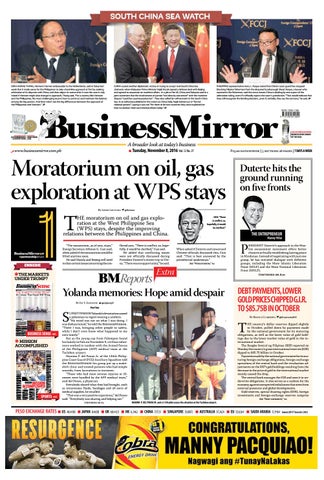
Dinh Hoang Thang, Vietnam’s former ambassador to the Netherlands, said in Tokyo last week that it made sense for the Philippines to take a hard-line approach at first by seeking arbitration of its disputes with China, and then adjust its stance after it won the case in July. Asked if Vietnam might also change its approach, Thang said, “For a country like Vietnam and the Philippines, the most challenging issue is how to construct and maintain the balance among the big powers. And here I don’t see the big differences between the approach of the Philippines and Vietnam.” AP
media partner of the year
China scored another diplomatic victory in trying to co-opt rival South China Sea claimants when Malaysian Prime Minister Najib Razak signed a defense deal with Beijing and agreed to cooperate on maritime affairs. In a jab at the US, China and Malaysia said in a joint statement that the involvement of parties “not directly concerned” with the maritime dispute “could be counterproductive”. They also called for self-restraint in the South China Sea. In an editorial published in the state-run China Daily, Najib lashed out at “former colonial powers”, saying it was not “for them to lecture countries they once exploited on how to conduct their own internal affairs today.” AP
Philippine representative Harry L. Roque noted that China’s coast guard has stopped blocking Filipino fishermen from the disputed Scarborough Shoal. Roque, a lawyer who represents the fishermen, said the move means China is abiding by one aspect of the arbitration ruling, even if it officially rejects the court’s jurisdiction. “That would indicate that they still recognize the binding decision...even if, verbally, they say the contrary,” he said. AP
BusinessMirror
United nations
2015 environmental Media Award leadership award 2008
A broader look at today’s business
www.businessmirror.com.ph
n
Tuesday, November 8, 2016 Vol. 12 No. 27
Moratorium on oil, gas exploration at WPS stays By Lenie Lectura
T
inside
BusinessSense BusinessMirror
www.businessmirror.com.ph
The MarkeTs Under TrUMp?
It’s Certain That Hands Will Wring
By Fil V. Elefante
S
An official merchandise table attracts a small crowd at Donald Trump’s campaign rally in San Diego, May 27, 2016. Stephen Crowley/the new york timeS
A
By Andrew Ross Sorkin
SSUME, for a moment, that Donald Trump wins the presidency. Some readers of this column will shudder at the thought and might even stop reading now. Others in the business world will beam, like Peter Thiel, the Silicon Valley entrepreneur.
But what exactly happens the day after? To markets? To the economy? The conventional wisdom is that, right off the bat, the stock market would fall precipitously. Simon Johnson, the Massachusetts Institute of Technology economist, posited that Trump’s presidency would “likely cause the stock market to crash and plunge the world into recession.” He predicted that Trump’s “anti-trade policies would cause a sharp slowdown, much like the British are experiencing” after their vote to exit the European Union. In explaining his prediction, Johnson wrote that Europe’s economy is so fragile that “Trump’s trade-led recession would tip Europe back into full-blown recession, which would likely precipitate a serious banking crisis.” After that, he continued: “If this risk were not contained—and the probability of a European banking debacle is already disconcertingly high—there would be a further nega-
tive spiral. Either way, the effects on emerging markets and all lower-income countries would be dramatic.” Johnson’s view may be a bit hyperbolic, but to one degree or another, his pessimism is shared by many economists across Wall Street, from Citigroup to Goldman Sachs. Each cites a different set of reasons the markets will fall if Trump wins. But is the conventional wisdom right? Naturally enough, investors and analysts hate uncertainty. Hillary Clinton largely represents the status quo. Trump is more like Forrest Gump’s “box of chocolates,” as Peter Boockvar, chief market analyst at The Lindsey Group, an economic advisory firm in Washington, put it. “You never know what you’re going to get.” In all likelihood, a Trump victory would lead to a swift, knee-jerk sell-off. Many investors will choose to sell stocks and ask questions later.
TruMp branded merchandise in the lobby of Trump Tower, on Fifth Avenue in Manhattan, July 9, 2016. Damon winter/the new york timeS
would make a change in what many view as a dovish-leaning Fed leadership much more likely.” A handful of economists have suggested that despite all of the promises made by the candidates, the outcome of the election might not actually decide what direction the markets will take. “Putting aside their personalities and policy proposals, it will likely not matter who the next president is when it comes to where markets go,” Boockvar wrote in a note to clients. “As we are in the second-longest bull market of all time, and as we approach the eighth year of this economic expansion,” he wrote, “odds are high that whoever the next president is, they will preside over a recession, a bear market and rising debts and deficits.” While Clinton is clearly the favorite choice of Fortune 500 chief executives and investors, Wall Street, perhaps surprisingly, is less enthusiastic about the idea of a Clinton presidency combined with potential Democratic majorities in the House and the Senate. “The S&P 500 has tended to react poorly to increases in the implied probability of a Democratic sweep, after removing the estimated effects of changes in growth, inflation and policy expectations,” Goldman Sachs wrote. “The upshot is that the equity market appears to favor Clinton to Trump, but also seems to prefer divided government over single-party control.”
business sense But in the days and weeks after a Trump victory, among investors who cull their portfolios carefully, the decision about buying and selling will be company by company, industry by industry, currency by currency and so forth. If Trump wins, two companies that seem poised for an immediate pummeling are AT&T and Time Warner, given
how much Candidate Trump has objected to their recently announced merger plan. AT&T, by the way, also happens to have a huge business in Mexico. The biggest test for the stock markets might be pegged to the future leadership of the Federal Reserve. “There is much more uncertainty regarding who Trump might nominate, though he has made it clear he
would not renominate Chair Yellen,” Goldman Sachs wrote in a note to clients. “His criticisms of Fed policy are somewhat ambiguous; he has suggested rates have been left too low for too long, but also warns of negative consequences of rate hikes. We would expect that financial markets would view a Trump victory as having slightly hawkish implications, since it
© 2016 The new York Times
e1
mission accomplished
Sports
C1
BusinessMirror
| Tuesday, November 8, 2016 mirror_sports@yahoo.com.ph Editor: Jun Lomibao Asst. Editor: Joel Orellana
M
portland trail blazers guard c.J. Mccollum (right) drives against Memphis Grizzlies guard andrew harrison. AP
Now No. 1, Murray vies for Nole’s title
P
ARIS—Having taken Novak Djokovic’s No. 1 ranking and his Paris Masters title, Andy Murray will try to grab another of his friend and rival’s crowns at the Association of Tennis Professionals (ATP) finals. Murray has never won the season-ending tournament, but heads to London full of confidence after winning the Paris Masters on Sunday. “The last few years I haven’t played so well [at the ATP finals],” Murray said. “I do think playing in front of a home crowd helps. It makes a difference, so hopefully I’ll be able to perform a bit better this year.” Murray did not need home supporters in Paris, beating big-serving American John Isner, 6-3, 6-7 (4), 6-4. He has won his past four tournaments and a career-high eight this year. This win was challenging—Isner missed six break-point chances—and it came the day after Murray ensured he’d became world No. 1. The official rankings are published on Monday. The 29-year-old Murray has three Grand Slam titles, two Olympic gold medals, a Davis Cup title and now—finally—the top ranking for the first time. “No one would have expected what I have done the last few months,” Murray said. “I don’t really know if it’s sunk in or not.” Three big titles he has yet to win are still held by Djokovic: the ATP finals, the Australian Open and the French Open. Djokovic and Roger Federer have won the finals 11 times between them since 2003, with Djokovic winning it for the past four years. This year Djokovic beat Murray in Grand Slam finals at the Australian Open in three sets and at Roland Garros in four. Murray has been a runner-up eight times in majors, with five of those in Australia. “I’d love to win the Australian Open.... It’s the next major goal, because I have been close a number of times,” Murray said. “I have never quite done it.” But he needs to finish off 2016, first. Murray will be the favorite when the finals begin next Sunday. He is the only British player to hold the top spot since the rankings began in 1973, and the oldest first-time No. 1 since John Newcombe at 30 in 1974. Murray secured top spot after Milos Raonic withdrew from their semifinal on Saturday. That sent Murray through to the final and, coupled with Djokovic’s quarterfinal loss, ensured enough points. Murray reached No. 2 for the first time more than seven years ago, and his career has been all about chasing the stars of tennis. Djokovic has 12 Grand Slam titles, Rafael Nadal has 14, and Federer is all-time leader with 17. “Put him in any other era, he probably has more Grand Slams,” Isner said of Murray. Murray has been playing those three his whole career—and also more recently world No. 3 Stan Wawrinka—and it shows in the statistics. Djokovic, who is one week younger than Murray, leads him 24-10; Nadal leads Murray by 17-7; and Federer’s up 14-11. That, along with some back surgery, helps explain why Murray has won fewer titles than his main rivals. Sunday’s win was his 43rd—of which 14 are Masters. Impressive enough, but way behind the other three. AP
MISSION ACCOMPLISHED Murray celebrates rise to the top with paris Masters title
P
By Jerome Pugmire The Associated Press
ARIS—Celebrating the best season of his career, Andy Murray cemented his rise to No. 1 by beating John Isner, 6-3, 6-7 (4), 6-4, on Sunday to win the Paris Masters for the first time. It was his eighth title this year, his 14th in Masters overall. It also ended Isner’s bid for a first Masters title. “I felt really nervous before the match,” Murray said, despite having beaten the big-serving American in all seven of their previous career meetings. Murray will officially replace Novak Djokovic at the top of the rankings when they are published on Monday. “It might only be for one week. So, I might as well try and enjoy it,” Murray said. “Because I could lose it at the [ATP] Tour Finals and never be there again.” The 29-year-old Murray is still getting accustomed to his newfound status. “I don’t really know if it’s sunk in or not,” said Murray, who is a three-time Grand Slam winner and a double Olympic champion. “It feels different [to] when I had won a Grand Slam or [the] Olympics.” Especially in the number of congratulatory messages. “More than I’ve had after any match I have played in my life,” Murray said. “It’s very nice, because you have won the respect of the players.” Murray recently beat Isner, 6-1, 6-3, in the quarterfinals of the Erste Bank Open in Vienna, but this was thoroughly contested. “We played last week and the difference was huge,” Murray said. Using 18 aces and hitting plenty of inside-out winners on his massive forehand, Isner generated considerable pressure. But he also wasted six break points overall. In the second set, he was 4-3 ahead and 40-0 up
McCollum tows Blazers to win versus Grizzlies
on Murray’s serve, but failed to punish the Briton— last year’s runner-up to Djokovic. But in a rare dip, Murray double-faulted during the tiebreaker and Isner profited to take the set. Isner saved break points on his first two service games of the third set, hanging on as Murray restored his superiority. Then, serving to stay in the match, the 2.08-meter (6-foot-10-inch) American double-faulted to trail 0-30. He won a tough first point and then hit yet another ace to make it 30-30. Isner sank a difficult volley into the net, giving Murray a first match point. With Isner on second serve, Murray dominated a brief rally, pinging a pass down the line that Isner patted into the net with the ball close to his body. It was a hard-fought victory and Isner stood with his head down at the net, waiting to congratulate Murray. Murray has won four consecutive tournaments, taking his career tally to 43. Next up is the season-ending ATP finals in London, beginning next Sunday. Murray will cross the English Channel to try and take the title there, having secured his top ranking here. “This has been an incredible journey to get to the top of the rankings,” said Murray, whose brother Jamie is among the world’s best doubles players. “There haven’t been many tennis players from Scotland over the years, and a lot of what we have done is big credit to our parents,” Murray said. “Our mum was a tennis coach. She helped us learn the game really and helped us enjoy the game at a young age.” The 31-year-old Isner, playing in the third Masters final of his career, ends the year without a title. He lost his other final this season to Australian Nick Kyrgios at Atlanta, Georgia, in August. Some small consolation is that he finishes the year with the most aces at 1,159—the fourth time he has
achieved this. Murray broke Isner twice, the first time to move 4-2 up in the first set. Isner fought back, a booming forehand winner giving him two break points in the seventh game. Murray saved the first one with a lob— impressive against such a tall player— and volley. He rescued the second by forcing an unforced error. Serving for the first set, Murray won the first point with an extraordinary backhand retrieve from a speedy Isner forehand that he somehow turned into a cross-court winner. “That was pretty spectacular from him,” Isner said. “He always clamps down on me when I have a bit of an opening.” In the second set, Isner got a deserved ovation in the eighth game when he won a 20-stroke rally. Showing nimble footwork that belied his size, he traded shots with Murray, winning the point with a superb drop shot and then a forehand winner from Murray’s retrieve. Isner was playing his best tennis of the match and had Murray 0-40 down. Murray recovered but gave Isner another chance at deuce. He missed that chance, too.
EMPHIS, Tennessee—Damian Lillard had his lowest-scoring game of the season. CJ McCollum made up the difference by matching the best game of his National Basketball Association (NBA) career. McCollum scored 37 points, 16 in the fourth quarter, to help the Portland Trail Blazers beat the Memphis Grizzlies, 100-94, on Sunday. He had 10 straight Portland points in the closing minutes to put the game away, and also matched his career best with six three-pointers. Lillard added 19 points and seven assists, and Maurice Harkless finished with 18 points. “He was big-time,” Lillard said of McCollum. “That’s who he is. We see him get hot like that all the time.... As a point guard, and as somebody that knows how capable he is of taking over a game, you go to it.” Marc Gasol led Memphis with 21 points, and Mike Conley added 16 points and seven assists. Zach Randolph had 15 points and seven rebounds. The game was close with 13 lead changes and 12 ties before Portland pulled away late behind McCollum hitting six-ofnine shots in the fourth. The Utah Jazz had a 114-109 win over the Knicks, with Gordon Hayward scoring 28 points in his season debut and George Hill contributing 23 points and nine assists. Hayward had been sidelined since breaking his right ring finger in training camp. He led the team in scoring last season, averaging nearly 20 points. Carmelo Anthony and Kristaps Porzingis each had 28 for the Knicks, and Derrick Rose added 18, as New York slipped to its third loss in four games. Rudy Gay scored 23 against his former team, helping the Sacramento Kings to a 96-91 win over the Toronto Raptors to end a four-game losing streak. The Dallas Mavericks won the first time this season, with Harrison Barnes scoring a career-high 34 points in the 86-75 overtime victory against Milwaukee. Barnes, who left Golden State to sign a $94-million, four-year contract with the Mavericks in the off-season, has scored at least 30 points twice this season after hitting the mark only once in his four years with the Warriors. His 20-foot jumper opened the scoring in overtime, and the depleted Mavericks (1-5) never trailed after that. The Bucks scored just one point in the extra period. The Mavericks played without starters Dirk Nowitzki (right Achilles soreness) and Deron Williams (left-calf strain). Elsewhere, the Nuggets had a 123-107 win over an injury-depleted Boston Celtics and the Lakers moved above .500 for only the second time in nearly three years with a 119-108 win over the Phoenix Suns. The Celtics, missing regular starters Jae Crowder (left-ankle sprain) and Al Horford (concussion), left the floor to a loud chorus of boos. Emmanuel Mudiay scored 24 of his season-high 30 points in the opening quarter for Denver. At Los Angeles, the Lakers (4-3) held off the Suns down the stretch despite Devin Booker’s career-high 39 points. It was Los Angeles’s third victory in its last 14 meetings with the Suns, who have lost five of seven. Other than its season-opening victory last month, Los Angeles hadn’t had a winning record since the franchise was 10-9 on December 6, 2013. AP
britain’s andy Murray (above) holds the trophy after winning the final of the paris Masters tennis tournament against John isner of the united states. (below) Murray gives a thumbs-up sign to the crowd. AP
sports
c1
flicted area. “There is conflict; so, hopefully, it would be clarified,” Cusi said. He added that conflicting issues were not officially discussed during President Duterte’s recent trip to China. “There was no opportunity,” he said.
Manny Villar
Part Two
upertYPHOON Yolanda’s devastation caused a policeman to regret wearing a uniform. “My mind was not on what I was doing. I was disheartened,” he told the BusinessMirror. “There I was, bringing other people to safety, while I don’t even know what happened to my own family.” But as the young cop from Palompon found his family in Palo on November 9, civilian volunteers worked in tandem with the Armed Forces of the Philippines (AFP) medical team at the Tacloban airport. Maximo P. del Ponso Jr. of the 134th Philippine Coast Guard (PCG) Auxiliary Squadron told the BusinessMirror his group put up a makeshift clinic and treated patients who had simple wounds, from lacerations to incisions. “Those who had more serious injuries or illnesses were handled by the AFP medical team,” said del Ponso, a physician. Everybody shared what they had brought, such as intravenous fluids, bandages and all sorts of medical supplies, he recalled. “That was a very positive experience,” del Ponso said. “Everybody was sharing and helping out.”
PESO exchange rates n US 48.4430
P
resident Duterte’s approach to the Muslim secessionist movement offers better chances at finally establishing lasting peace in Mindanao. Instead of negotiating with just one group, he has initiated dialogue with different groups, including the Moro Islamic Liberation Front (MILF) and the Moro National Liberation Front (MNLF). Continued on A10
When asked if Duterte and concerned Chinese officials discussed this, Cusi said: “That is best answered by the presidential spokesman.” See “Moratorium,” A2
@elefantefil
Continued on A2
Duterte hits the ground running on five fronts
the entrepreneur
Yolanda memories: Hope amid despair
analysis, ideas and commentary from
E1 Tuesday, November 8, 2016
P25.00 nationwide | 5 sections 28 pages | 7 days a week
CUSI: “There is conflict; so, hopefully, it would be clarified.”
BMReports
the markets under trump?
business news source of the year
@llectura
HE moratorium on oil and gas exploration at the West Philippine Sea (WPS) stays, despite the improving relations between the Philippines and China.
“The moratorium, as of now, stays,” Energy Secretary Alfonso G. Cusi said, when asked if the moratorium would be lifted anytime soon. He said Manila and Beijing still need to clear certain issues concerning the con-
2016 ejap journalism awards
Debt payments, lower gold prices chipped G.I.R. to $85.75B in October
T
By Bianca Cuaresma
@BcuaresmaBM
he country’s dollar reserves dipped slightly in October, pulled down by payments made by the national government for its maturing obligations, as well as the lower value of gold holdings due to the lower market value of gold in the international market. The Bangko Sentral ng Pilipinas (BSP) reported on Monday the country’s gross international reserves (GIR) dipped to $85.75 billion in October. Payments made by the national government for its maturing foreign-exchange obligations, foreign-exchange operations of the central bank and the revaluation adjustments on the BSP’s gold holdings resulting from the decrease in the price of gold in the international market mainly caused the drop. The central bank manages the GIR and uses it to underwrite obligations. It also serves as a cushion for the economy against unexpected imbalances that stem from external pressures and global developments. Gold reserves, special drawing rights (SDR), foreign investments and foreign-exchange reserves comprise See “Debt payments,” A2
MAXIMO P. DEL PONSO JR. and a C-130 pilot assess the situation at the Tacloban airport.
n japan 0.4658 n UK 60.4423 n HK 6.2462 n CHINA 7.1725 n singapore 35.0072 n australia 37.2624 n EU 53.6264 n SAUDI arabia 12.9164
Source: BSP (7 November 2016 )
A2 Tuesday, November 8, 2016
BMReports BusinessMirror
news@businessmirror.com.ph
Yolanda memories: Hope amid despair Continued from A1
While the Philippine Air Force’s C-130s flew almost incessantly, the three transport planes were just not enough to meet the demands on the ground. On the first few critical days after a storm surge hit Tacloban, only those who were able to reach the airport had any hope of receiving food, water and medical treatment. Annie, a 16-year-old resident of San Jose, Tacloban, recalled those first few days. “I was able to take a picture of the oncoming rush of water. My camera was the only thing that I have left. But we lost our home,” she said. “We were very lucky to survive.
We were getting some relief goods, but not enough.” By the evening of November 9, the airport was fast becoming a vital supply hub. However, civilian volunteers were still not allowed to deploy outside the airport. They were told that the police could not guarantee their safety. The additional units from the Philippine National Police (PNP) Special Action Force and the Army were still securing the city.
Samar deployment
AS additional support teams and supplies trickled in, the situation began to stabilize within the airport. The senior military officer at the Tacloban airport felt he now had enough spare personnel to send to isolated towns and villages. “On the second day, November 10, he sent us to Guiuan and Hernani,” Jesse Estrella, who was with del Ponso’s group, said. “We were tasked to assess the situation there and report back to him.” But the effort to assist the survivors was not without cost to del Ponso’s team. “We had to send back to Manila a couple of team members,” del Ponso added. “They were emotionally distraught by what they had witnessed. They could not stay.” Estrella took the remaining half of the team to Hernani, while del Ponso took the rest. They were sent to Guiuan and Hernani onboard helicopters. “A lot of people were waiting for us in Guiuan. The folks there thought that we had brought enough supplies with us on the helicopter,” del Ponso said. “What we had were medicines provided by the military, our own supplies from Manila and two sacks of food, just enough for one meal for about a hundred families.” But Estrella and his men had to do one task first: retrieve corpses lying strewn on street. They helped clear the roads so that
supply convoys can reach Hernani, a fifth-class municipality 199 kilometers from the Eastern Samar capital of Catbalogan City. With the road cleared of bodies and debris, Estrella’s team was able to complete their survey quickly and return to Tacloban immediately. However, the situation in Guiuan was different.
Guiuan
THIS is the town where Supertyphoon Yolanda (international code name Haiyan) made landfall on November 8, 2013. But this was also the town that del Ponso said was well-organized. He credits Mayor Christopher Gonzales for this. According to him, Gonzales had commissioned all the remaining medical facilities and pharmacies in the town and brought all surviving medical personnel and supplies to the municipal hall. He said, Gonzales, who was reportedly charged in May by the Ombudsman for fraud, had all the food and fresh water left gathered from all the damaged stores and stockpiled them at the municipal hall “so that these could be distributed to the people in an orderly fashion. There was no looting,” del Ponso said. “However, whatever was left was just not enough.” At Guiuan, del Ponso’s team cleared a wrecked public school to be used as a temporary clinic. Other desks were used as makeshift beds. “The problem at that time was that we ran out of tetanus toxoid,” he said. “The only thing we could do was to clean the wounds as best as we could and bandage them.” According to del Ponso, next to run out were the antibiotics. “These were quickly used up,” he said. “Even the municipal health office was running out of medicines, despite efforts to salvage supplies from pharmacies and the hospital.” The emergency medical effort was organized under the guidance of Yvonne Egargo, the provincial heath officer who lives in Guiuan.
Evacuation
BY the time Estrella and del Ponso’s teams returned to
Debt payments. . . Continued from A1
the country’s GIR. A high level of reserves means that the country has the capacity to repay its obligations and has enough buffers against risks to global imbalances. The October GIR level was $390 million lower than the revised $86.14 billion in September. It is, however, stronger, compared to the $81.097 billion seen in October 2015. The decline could have been larger, the central bank said, if not for the positive impact caused by the reclassification of renminbi-denominat-
ed accounts from nonreserve to reserve eligible assets. The national government’s net foreigncurrency deposits also helped stop the GIR from bleeding during the period. Toward the end of October, the central bank announced the formal inclusion of the Chinese reniminbi as an eligible currency in the country’s international reserves, following the International Monetary Fund’s move to include the Chinese currency in its special drawing rights valuation basket. The BSP said the rising economic and financial importance of China was also considered. Broken down, gold holdings of the central bank dropped from $8.3 billion in the previ-
Tacloban, the evacuation of survivors from the city began. Del Ponso said people with serious medical cases were flown out via C-130 to Cebu for treatment. “Our job at the receiving center of the airbase is to help refugees find places to stay,” said Erlinda T. Parme, a social worker from the Department of Social Welfare and Development (DSWD) Field Office 7. “Six evacuation centers in Lapu-Lapu City have communication facilities to help survivors contact their relatives.” However, each evacuation center can only accommodate 150 to 300 people at any given time, Parme recalled. Refugees from Ormoc, Guian and Tacloban arrived in droves. “Many arrived only with the clothes on their backs,” Parme said. “They are relieved to be alive.”
Foreign aid
WHAT del Ponso could not forget was American tourist Gregg Anderson. When Yolanda arrived, Anderson was in a resort an hour away from Guiuan and was trapped there for a while, del Ponso recalled. Anderson fainted upon finally reaching Guiuan’s town center. “When he finally made his way to Guiuan, he was severely ill because he took contaminated food and water. We inserted an IV [intravenous] line on him,” del Ponso added. “He later found out that he received the last IV fluid available in Guiuan. He was evacuated to Cebu.” After several weeks, Anderson returned with $10,000, which he used to buy construction materials for rebuilding the town. Anderson’s effort was one of the help that came from foreign sources. Four days after supertyphoon left a trail of death and destruction across a large part of the country, emergency assistance from foreign governments arrived in Tacloban. “When we got back to Tacloban from Guiuan, the first of the foreign aid had just arrived,” del Ponso recalled. “The first ones I saw were the Australians and Singaporeans. Then the Americans, British and other foreign military contingents arrived. That was about 3 in the afternoon.” What del Ponso saw was the beginning of a massive influx of foreign emergency assistance. To be concluded
ous month to $8.13 billion in October, while foreign-exchange operations yielded higher contributions to the overall GIR during the month, from $2.34 billion to $3.77 billion. The central bank’s foreign investments remained the major contributor to the overall GIR at $72.219 billion in October. This is, however, lower than the $73.85 billion seen in September. Despite the decline, the central bank said the end-October GIR level is still enough to cover 10 months’ worth of imports of goods and payments of services and income. It is also equivalent to 6.1 times the country’s short-term external debt based on original maturity and 4.4 times based on residual maturity.
Moratorium. . . Continued from A1
Cusi added that the conflict would be addressed “diplomatically” by the Department of Foreign Affairs, which, Cusi stressed, is in the best position to do so. Cusi reiterated that the Philippines abides by its commitment to pursue a peaceful resolution of disputes in the South China Sea and promote peace and stability in the region through diplomacy and consultations. Forum Energy Ltd. has a 70-percent stake in Service Contract 72, an oil-and-gas exploration permit covering the Sampaguita natural-gas prospect at the Reed Bank, to the west of Palawan. Early in 2015, the government declared “force majeure” on the license. As a result, the second subphase of the petroleum contract, which involves drilling two wells, was put on hold until further notice. In July the Philippines won an arbitration case against China over the South China Sea. In particular, the Philippines has exclusive sovereign rights over the West Philippine Sea and that China’s “nine-dash line” was invalid, according to the United Nations (UN) Arbitral Tribunal. Forum Energy could still not resume any exploration activities until the government or the Department of Energy (DOE) gives its green light. Recently, Philippine fishing boats have been allowed to enter the contested Scarborough Shoal on the South China Sea. The DOE earlier said it is evaluating the actions related to the ruling made by the UN body.
Economy
BusinessMirror Editors: Vittorio V. Vitug and Max V. de Leon • Tuesday, November 8, 2016 A3
news@businessmirror.com.ph
Lower November power rates–Meralco
T
By Lenie Lectura
@llectura
he Manila Electric Co. (Meralco) on Monday announced lower power rates would be reflected in the November electricity bills brought about by lower generation charge. The rate for a typical household will go down by P0.0781 per kilowatthour (kWh), thereby bringing power rates down to P8.26 per kWh, the lowest since January 2010. This month’s decrease translates to a reduction of around P16 in the electricity bill of a household with monthly consumption of 200 kWh. Also, this month’s overall rate is lower by P0.29 per kWh compared to November 2015’s P8.55 per kWh. This is also the fourth straight month of reduction in the overall residential rate. Meralco noted a decrease in the generation charge, which is P0.0502 per kWh lower than last month’s P3.8938 per kWh. At P3.8436 per kWh, the generation charge is around P0.24 per kWh lower, compared to November 2015’s P4.08 per kWh. The decrease resulted mainly from lower charges from the Wholesale Electricity Spot Market (WESM). This offsets increases in independent power producers (IPPs) and power-supply agreement (PSA) costs brought about by higher coal and natural-gas prices and low dispatch. Overall charges from the WESM decreased by P0.2756 per kWh. The share of WESM purchases to Meralco’s total requirements went up from 16.1 percent to 20.1 percent. Meanwhile, the cost of power sourced from plants under the PSAs increased by P0.0164 per kWh, primarily due to higher fuel costs. Coal prices in the region continued to rise, from $67.41/metric ton in August 2016 to $72.70 in September. The share of PSAs stood at 42.5 percent. Cost of power from the IPPs also increased by P0.0549 per kWh, primarily due to the scheduled outage and lower dispatch of San Lorenzo, and the higher cost of natural gas following its quarterly repricing. The share of the IPPs to Meralco’s total requirements for the October supply month was at 37.3 percent. There was also a decrease in the transmission charge by P0.0177 per kWh, mainly due to the reduction in the ancillary charge differential that the National Grid Corp. of the Philippines (NGCP) began to collect from
DOF secures loan from German bank for anti-red tape initiative By Rea Cu
T
@ReaCuBM
he Department of Finance (DOF) has secured a P21.5-million grant from the German development bank Kreditanstalt für Wiederaufbau (KfW) Group to implement an anti-red tape initiative that would simplify processes in securing documentary requirements for imports and exports as part of the Duterte administration’s efforts to ease doing business in the Philippines and facilitate its integration into the regional community of Southeast Asian economies. Finance Secretary Carlos G. Dominguez III said the grant from the Frankfurt-based KfW Group will help implement the Inter-Agency Business Process Interoperability (IABPI) Program, which aims to streamline the process of issuing permits for imports and exports from the current two weeks to a maximum of three days, in compliance with President Duterte’s directive to cut red tape in all government offices. In a report submitted to the finance chief by Undersecretary Gil S. Beltran, the project will not only improve the frontline government service, but would also contribute rev up revenues, facilitate regional trade links and the entry or expansion of businesses in the Philippines. According to Beltran, who was also named as the DOF’s anti-red tape czar, the IABPI will be implemented by the DOF’s Policy Development and Management Services Group, in coordination with the government’s trade regulatory agencies. Besides simplifying import-export documentation processes, the program will also include developing policies to oversee, manage and harmonize transactions of all regulatory agencies involved in these processes by establishing protocols to link their information with each other. This was explained to make the agencies a member of a collaborative group that will be able to exchange information with one another and become interoperable. “The major cause of red tape in government is that agencies act and operate in isolation of each other,” Beltran pointed out. The DOF, through the IABPI project, is leading the way for government interoperability, which is defined as the mix of policy, management and technology capabilities needed by a network of agencies to deliver coordinated government programs and services. It will also enforce transparent and accountable regulation processes and procedures in government agencies and ensure that these would be sustained. On top of the said project, the DOF is working together with the Department of Information and Communications Technology (DICT) to develop the government’s automated business and citizen data-bank portal that would serve as the primary tools in cutting red tape and reducing processing time for government frontline services providing a portal to verify business and citizen government records. Beltran said the DOF and the DICT are now identifying the data to be gathered from various government agencies for the automated business and citizen data-bank portal. The first stakeholders meeting for the Business Databank was held on October 26 and where the pilot platform was presented. In appointing Beltran as anti-red tape czar, Dominguez had said he is envisioning a system comparable to the one used by the online buying portal Amazon.com, which can process millions of purchases from clients by requiring just a one-time registration of data that can then be validated and used for all transactions.
its Luzon customers in June. Taxes and other charges also decreased by a combined amount of around P0.0102 per kWh. Meralco’s distribution, supply and metering charges, meanwhile, have remained unchanged for 16 months, after these registered reductions in July 2015. Meralco reiterated that it does not earn from the pass-through charges, such as the
generation and transmission charges. Payment for the generation charge goes to the power suppliers, while payment for the transmission charge goes to NGCP. Meralco, in partnership with the Department of Energy (DOE) and local government units, continues to give beneficiaries access to safer, legal electricity supply, as it makes power available to Filipinos pre-
viously without any electrical connection. From July 8, 2016 to November 4, 2016, the DOEMeralcopartnership has energized a total of 20,101 households in the areas of Gaya-Gaya, San Jose del Monte and other municipalities in Bulacan, Laguna and Cavite, and some parts of Rizal, Happy Land Aroma, Baseco, Isla Puting Bato and Parola area in Tondo, Manila.
The Nation BusinessMirror
A4 Tuesday, November 8, 2016 • Editor: Dionisio L. Pelayo
news@businessmirror.com.ph
Stop Duterte from ‘harassing’ JV ready to serve 90-day suspension S me, de Lima asks Supreme Court
S
By Joel R. San Juan
otherwise known as the Magna Carta of Women. Duterte had previously accused de Lima of having a relationship with her driver, who he also linked to the big time illegal-drugs trade at the New Bilibid Prisons (NBP) in Muntinlupa. Diokno said Duterte cannot invoke presidential immunity from suit considering that his verbal attacks on de Lima are not considered official acts of a president. “The crude remarks, slut-shaming and threats that President Duterte has made about petitioner, and his prying into her private life and alleged private affairs have endangered her life, liberty and security,” the petition read. “ They constitute unlawful, unof f icia l conduct that have nothing to do with the President’s duties and responsibilities,” the petition added. Duterte had publicly accused de Lima of “screwing her driver,” and that she has a “propensity for sex.”
@jrsanjuan1573
EN. Leila M. de Lima on Monday asked the Supreme Court for the writ of habeas data to stop President Duterte from collecting and disclosing information about her private life that tend to “malign her and degrade her dignity as a human being.”
In a 22-page petition, de Lima, through her lawyer Jose Manuel Diokno, also asked the Court to compel Duterte to disclose the sources of his information about her private affairs, as well as the destruction of such data. The petitioner also asked the Court to order Duterte to disclose to her the name of the foreign country,
who, according to the latter, “helped him” listen in on her. Diokno said Duterte’s personal attacks on de Lima, which involve the collection and publication of her alleged private affairs and activities, is tantamount to gender discrimination and constitute psychological violence, which is prohibited by Republic Act 9170,
Bandits snatch German; female companion found dead on yacht By Rene Acosta
A
@reneacostaBM
GERMAN was believed to have been kidnapped by Abu Sayyaf bandits after they killed his female companion while they were sailing aboard a yacht on the waters off Sabah. Maj. Filemon Tan Jr. Armed Forces Western Mindanao Command Spokesman, said that as of Monday afternoon, military authorities in the area were still piecing together details over the reported kidnapping as the supposed yacht with German flag and marking “Rock All” was seen on Sunday by residents of Laparan Island, Pangutaran, Sulu. He said it was possible that the kidnappers took the yacht to Sulu, which when found, yielded the body of a woman who is believed to be a foreigner. “The cadaver had gunshot wounds and was discovered inside the yacht bearing a German flag with markings Rock All. A shotgun was recovered beside the body,” Tan said. He said miltiary authorities were verifying reports that the body “belonged to the alleged companion of Kantner identified as Sabina Wetch.” “[What is] alarming is that the body found was naked and had several contusions in the face indicating that it may have been raped. The National Police Soco [Scene of the Crime Operations] group will conduct autopsy to validate this possibility,” Tan said. Tan added that reports reaching with Western Mindanao Command indicate that Rami claimed the bandits snatched Kantner while he and his companion were sailing off Sabah. “The said German had a female companion named Sabina Wetch who was left in their yacht,” he said. Tan said Rami did not say what happened to Wetch after the bandits took Kantner, including whether she was still alive when left at the yacht. The latest kidnapping incident happened ahead of the scheduled visit of President Duterte to Malaysia.
He has likened the former justice secretary also to an “x-rated artist” and threathened that he “will destroy her in public,” and that she “will rot in jail.” De Lima, however, repeatedly denied these allegations, saying the President was out to destroy her because of her insistence to to investigate his alleged involvement in the so-called Davao Death Squad and the series of extrajudicial killings in the country following an intensified anti-illegal-drugs campaign of the administration. “Since the respondent has been gathering private and personal information about petitioner, intruding into her private life, and publicizing her alleged private affairs outside the realm of legitimate public concern, in violation of her right to privacy in life, liberty and security; and continues to threaten to do so, a writ of habeas data should be issued to protect her,” the petition pointed out.
EN. Joseph Victor “JV” G. Ejercito expressed readiness on Monday to serve a 90-day suspension ordered by the Sandiganbayan for an alleged offense committed when he was still San Juan mayor involving purchase of firearms using the town’s calamity fund. In a privileged speech justifying the transaction, Ejercito said he was even willing to go to jail to “protect my constituents.” “If I will be imprisoned for fighting crime and protecting the lives of my constituents, so be it! Faced with a similar situation, I will not hesitate to do it again,” Ejercito said at the resumption of Senate session on Monday, adding that it was his “duty and responsibility as mayor and father of the city to protect the welfare and lives of my people.” The senator, however, begged off from going into details of the questioned transaction while insisting he did not benefit from it. “I will not discuss the details of this case today but allow me to say, in no uncertain terms, that I have never benefited from any illegal transaction in my years as a public servant,” he added. Based on findings by the Ombudsman, the Sandigbayan’s Fifth Division ordered the suspension of
EJERCITO: “I will not discuss the details of this case today but allow me to say, in no uncertain terms, that I have never benefited from any illegal transaction in my years as a public servant.”
Ejercito and three other San Juan City officials, including City Administrator Ranulfo B. Dacalos, City Legal Officer Romualdo C. de Los Santos and Special Assistant Lorenzana C. Ching of the Office of the Mayor’s compliance office. The Ombudsman filed the graft case following findings that the San Juan City Council passed a city ordinance to have the calamity funds used in the 2008 procurement of highpowered firearms worth P2.1-million during then-Mayor Ejercito’s term. The senator’s lawyer, however, filed before the Sandiganbayan a 57-page demurrer to evidence, asserting that the case against Ejercito be thrown out for failure of prosecutors to submit evidence proving his guilt beyond reasonable doubt. Butch Fernandez
Group urges Duterte to freeze projects that displace Typhoon Yolanda survivors By Marvyn N. Benaning Correspondent
A
N environmental group has asked President Duterte to freeze all projects and policies that threaten to displace the victims of Yolanda and other disasters. The Kalikasan People’s Network for the Environment (Kalikasan PNE) issued the plea on the eve of the third anniversary of Yolanda, which killed at least 8,000 people, ruined hundreds of thousands of houses and destroyed the livelihoods of more than a million people in Eastern Visayas, Central Visayas, Panay and even Region 4-B, or the Mindoro-Marinduque-RomblonPalawan region. “The no-dwelling zones and the Leyte Tide Embankment Project poses threats of displacement to Yolanda and other disaster survivors, and must, thus, be suspended until a program to ensure adequate and climate-resilient homes for the threatened communities is put in place. These measures that are supposed to mitigate disaster impacts of the scale of Yolanda should be subjected to scientific study and genuine public consultation or else they should be scrapped. With various climate in-
justices persisting three years after Yolanda, it is a welcome reprieve for survivors if threats of displacement were stopped by President Duterte,” said Leon Dulce, campaign coordinator of Kalikasan PNE. Dulce thanked both the Department of Social Work and Development (DSWD) and the Presidential Commission on the Urban Poor (Pcup) for taking the initiative to address the plight of disaster survivors. However, he criticized some agencies for working at cross-purposes with the initiatives undertaken by the DSWD and Pcup. Social Work Secretary Judy M. Taguiwalo earlier exposed the fact that 200,000 Yolanda survivors were unjustly denied emergency shelter assistance (ESA) by the Aquino administration. Moreover, Taguiwalo revealed initial findings of an ongoing investigation that showed DSWD Memorandum Circular 24 created serious problems on the distribution of ESA funds. Pcup, now under former Partylist Rep. Terry Ridon of Kabataan, said during a housing and resettlement forum held by environment and survivors’ groups that it will
Civil engineers’ group eyes ESO as BPM growth area
T
HE Philippine Institute of Civil Engineers (Pice) is working on a road map that will include engineering services as a new growth area for the country’s information technology and business-process management (IT-BPM) sector. PICE President Ernesto S. de Castro, during an interview in the Pice headquarters in Quezon City, said the Philippines is already No. 1 in voice services, but the challenge is to move from voice to nonvoice, in particular, to go into the high value-added activities and link these with services embedded to manufacturing, finance, design and engineering. Citing industry data, de Castro said the Philippine ITBPM industry accounted for 8 percent of the 2015 GDP, with revenue of $22 billion and direct employment of about 1.1 million. By 2022, the industry is looking at a revenue target of $44 billion and creating an additional 720,000 direct employees. To sustain its growth, the industry is looking at emerging sectors, like engineering services outsourcing (ESO), for higher valued services that can be offered by the Philippines. Per industry data, ESO accounts for only 1 percent of the Philippine IT-BPM Industry, with a revenue of $300 million and 13,000 employees in 2015.
DULCE: “With conflicting rehab programs from the different agencies, it is only proper for the Duterte administration to put a freeze order on supposed disastermitigating policies and projects that is expected to cause the dislocation of Yolanda survivors.”
fully utilize its mandate to deny the participation of the National Police in demolitions without adequate relocation and will embark on a massive education drive in urban-poor communities on climate justice. “There are initiatives from agencies, such as the DSWD and PCUP, to consult Yolanda survivors and investigate their lingering problems. But the Department of Public Works and Highways opposes these initiatives by pushing the Leyte Tide Embankment Project through, even if it threatens to displace thousands and possibly destroy mangrove expanses and other important natural buffers. Meanwhile, the government still has no technically sound
guidelines in ensuring no-dwelling zones do not displace communities to even more hazardous situations,” Dulce explained. The DPWH announced earlier this year that it will already begin construction of some parts of the 27.3-kilometer tide embankment project proposed by the Japan International Cooperation Agency. Apart from presenting socioeconomic and ecological risks, the project is also in conflict with the existing P38-million mangrove-rehabilitation project of the regional office of the Department of Environment and Natural Resources (DENR). “With conflicting rehab programs from the different agencies, it is only proper for the Duterte administration to put a freeze order on supposed disaster-mitigating policies and projects that is expected to cause the dislocation of Yolanda survivors. Allow the DSWD, Pcup and other relevant agencies to conclude their inquiries and justly resolve the complaints and petitions of survivors and environmental groups first. The Leyte Tide Embankment Project is, in fact, being petitioned to have its environmental compliance certificate revoked,” Dulce said.
PLCPD, PopCom eye environment approach to development projects
T
HE Philippine Legislators Committee for Population and Development (PLCPD), Foundation for the Philippine Environment (FPE) and the Commission on Population (PopCom) will hold three-day conference starting on Tuesday to drumbeat their Population-Health-Environment (PHE) approach to development. This approach, said the PopCom chief Jeepy Perez, recognizes the crucial link between people and their environment. On the other hand, PLCPD Executive Director Romeo Dongeto stressed that, “Integrated population, health and environment programs have shown better results than single-sector programs and are more programmatically efficient.” Perez and Dongeto argued that PHE programs have also demonstrated cost-effectiveness by reaching more beneficiaries than single-sector interventions, while achieving lower operating costs and fostering community goodwill and trust. Now on its sixth year, the PHE National Conference will look at the prospects for achieving the Sustainable Development Goals (SDGs) using the PHE approach and for intensifying, replicating and expanding the integrated PHE approach in various settings, such as urban and rural, community and ecosystem and across landscapes (such as aquatic and upland). PHE also has applications on the different strategic points of intervention,
like climate-change actions, disaster mitigation, poverty alleviation, food security, public-health programming, improved technology and sustainable energy and others. The conference will explore the successes and challenges in meeting the Millennium Development Goals (MDGs) to draw lessons for mainstreaming the PHE approach in the crafting and implementation of the next Philippine Development Plan and plans for achieving the country’s SDG targets. PLCPD is a member of the sixth PHE Steering Committee. The theme of the conference is “Engaging the Government in Mainstreaming the PHE Approach Towards the Achievement of Sustainable Development Goals.” The three-day conference includes plenary sessions with national and international experts followed by parallel sessions for solicited papers. At noon on Tuesday, November 8, a press conference will be facilitated by PLCPD and attended by key officials from PopCom, Department of Environment and Natural Resources, National Economic Development Authority and the Philippine Information Agency. Providing civil society perspective are representatives from PATH Foundation Philippines, Conservation International and FPE.
Agriculture/Commodities BusinessMirror
news@businessmirror.com.ph
Editor: Jennifer A. Ng • Tuesday, November 8, 2016 A5
Duterte likely to approve additional PRDP loan By Jasper Emmanuel Y. Arcalas @jearcalas
T
he Department of Agriculture (DA) on Monday has expressed confidence that President Duterte will approve its request to secure an additional $450-million loan from the World Bank for the Philippine Rural Development Project (PRDP).
“The [PRDP expansion] proposal was already seen by the President and it ’s ok ay w it h him. There are already indications that the president will approve it,” DA-PR DP Nationa l Deputy Project Director Arnel V. de Mesa told reporters in a news briefing. “So we are still waiting for the final and formal endorsement of the President,” de Mesa added. De Mesa said Duterte’s recent pronouncements against the West will not cause the President to hold back his approval for the expansion of the PRDP. “Last time there was one project from the Department of Agrarian Reform to be financed by the World Bank and it was approved by the President during the first Neda [National Economic and Development Authority] board meeting,” de Mesa added. He also said if the DA secures the endorsement of the President and then the approval of the World Bank for the additional P20.9-billion loan, the government could use it by July 2017. The DA earlier said it is hopeful of securing the Neda Board’s approval for the PRDP by early January next year. The expansion of the PRDP project would involve the construction of an additional 206 farm-to-market roads (FMR), 24 market roads and bridges, 17 level 2 potable-water supply and 65 other agricultural-support infrastructure, the Neda Investment Coordination Committee-Cabinet Committee (ICC-Cabcom) said. The ICC-Cabcom approved and endorsed the $450-million expansion plan for the PRDP in endSeptember. “Yes, this [PRDP] is the big-
gest World B a n k sup por te d community development project,” World Ban k Task Team L eader for t he PR DP Frau ke Jungbluth said. A World Bank team is currently in the country to assess the current development and status of the PRDP in the next three weeks. As of November 4, Agriculture Secretary Emmanuel F. Piñol approved funding for 354 infrastructure development subprojects worth P17.75 billion and 215 enterprise development subprojects amounting to P540.67 million. The subprojects covered 71 of the 81 targeted provinces under the countrywide program. “ T he rem a in ing prov inces that are not yet par t of the PRDP are: Batanes, Cavite, Rizal, Negros Or ienta l, Dinagat Islands, Camiguin, Davao Occidental, Siquijor, Basilan and Sulu,” de Mesa said. The PRDP is a P27.48-billion six-year national project under the DA that aims to establish a modern, value-chain oriented, and climate-resilient agriculture and fisheries sector. The PRDP’s financing comes from the World Bank loan worth P20.50 billion, Global Environment Facility grant of P287 million, national government of P3.579 bi l l ion a nd L GUs’ equ it y of P3.118 billion. In June the World Bank said the new administration under Duterte gives them “high hopes” for the improvement of the Philippine agriculture and the farmers. The World Bank has expressed sat isfact ion w it h t he P27. 5 billion PRDP in Mindanao following a review mission in the region in April.
FOOD FROM THE SEA
A fisherman in Puerto Princesa, Palawan, uses bamboo sticks to catch fish. The province of Palawan is one of the major sources of fish and other marine products for Filipino consumers. MAU VICTA
Program aims to double rice production in Leyte DAR, PCIC offer By Elmer V. Recuerdo Correspondent
T
ACLOBAN CITY—The Leyte provincial government is targeting to increase the unmilled rice output of farmers to more than double their pre-Yolanda yield under a program, which encourages the use of “climateresilient” seeds. Leyte Gov. Leopoldo Dominico Petilla said farmers in the province have increased their average output to as much as 90 cavans per hectare in 2015, from 50 cavans per hectare before Supertyphoon Yolanda (international code name Haiyan) hit the country in 2013. Farmers under the provincial government’s More Income in the Countryside (MIC) rice program also experienced “considerable increase” in yield as their output reached 120 cavans per hectare from 80 cavans. Introduced in 2014, the program aims to help rice farmers by providing them loans to cover labor, seeds, fertilizers, pesticides and insurance. They were also encouraged to plant “climate-resilient” rice seeds. Leyte has 60,000 hectares of rice land, making it one of the country’s top five rice-producing provinces. Petilla said the revenue of rice farmers in the province is between P3 billion and P4 billion per cropping season.
Full mechanization
Petilla said the province targets to increase further the production under its program to at least 170 cavans per hectare, which is more than double the average yield of farmers before Yolanda. “Mechanization is the way to go,” he said in an interview during the recent launching of a part-
nership with a private company that will pilot full mechanization of rice production in three Leyte municipalities. “We have seen an increase in production and now we want to do it massively.” Chenyi Agventures (CYA), a company owned by Renucci Partnership, is offering an end-to-end mechanized rice-farming process, the first in the Visayas region. The full mechanization will cover land preparation to planting, cultivation, to harvesting, drying, silo storage, milling, bagging and distribution. CYA founder Rachel Marjorie Renucci-Tan said the company will be involved in the whole rice value chain in the province. Tan said the company wants to uplift the condition of the farmers by helping them increase their earnings from planting rice. She said mechanization will reduce wastage and lower production cost. Full implementation will start next year with an introduction of a high-yielding and existing seed variety that was proven to grow well in Leyte initially to cover 2,000 hectares of rice land. It also plans to set up a state-of-the-art postharvest facility. Tan said the partnership targets to increase the current average income of farmers pegged at P19,000 per hectare, by sevenfold via the provision of high-yielding seed variety, fertilizers, pesticides and modern-farming equipment. The company will also train farmers enrolled in the MIC rice program on adopting optimal planting techniques. CYA is currently helping farmers in deploying and operating combined harvester-thresher in the towns of Alang-alang, Santa Fe and San Miguel—the municipalities that are considered Leyte’s rice granary. The harvester allows farmers to cover as much as four hectares of land daily, compared to one hectare via manual labor. Tan said the equipment will give a farmers a big boost especially during the rainy season.
Minnesota farmers tightening belts, with ripple effects on the rural economy have started to ripple onto the main streets of rural Minnesota. When farmers have less money to spend, it affects anyone who is selling farm equipment, marketing fertilizer, or building new barns, bins and sheds. Low commodity prices also put a squeeze on cash rents for land that many retired farmers or their families depend on for income. Successful farmers were adjusting their budgets even before corn prices dropped below $4 per bushel in mid-2014, considered to be near the break-even point for many producers.
Record yields should help
Corn tumbles from the hopper of a truck at the CHS grain terminal on the Minnesota River in Savage, Minnesota, about to begin a journey around the world. Aaron Lavinsky/Minneapolis Star Tribune/TNS
E
d McNamara sat in the driver’s seat of his John Deere combine recently, musing about crop prices, as he mowed through six rows of corn at a time. Thousands of Minnesota farmers have withstood stubbornly low crop prices during the past 27 months, and farmers’ average net income has been dropping steadily for the past three years. McNamara, who has been farming just
south of the Twin Cities near Goodhue since 1978, has seen the farm economy cycle up and down several times and knows the drill when profit margins are slim to none. “Tighten your belt, cut back on inputs, but don’t hurt your yield, run machinery a little bit longer, and try to get the best deal for supplies,” he said, including seed, fertilizer and other chemicals. As farmers cut back, the doldrums caused by lackluster prices for crops and livestock
Many hope to salvage marginal profits in 2016, thanks to generally good weather and record or near-record yields forecast for the second consecutive year. But David Preisler, executive director of the Minnesota Pork Producers Association, said the direct effects of weak crop and livestock prices show up quickly in many small towns. “The first ripple effect you see is going to be any sort of capital purchases that are more discretionary in nature,” he said. New data released by University of Minnesota Professor and Extension economist Bill Lazarus confirm some of that slowdown. He analyzed spending by more than 1,000 producers across the state on machinery and equipment, farm buildings, fertilizer and land rent. The average spending for machin-
ery and equipment in 2012 and 2013, when crop prices peaked, was about $117,000 per farm. That plummeted to about $67,500 in 2014 and $48,000 in 2015. Farm building purchases, such as grain bins and hog barns, had a similar drop-off, from about $36,000 per farm in 2013 to $21,000 in 2014 and $16,000 in 2015. The report also found that fertilizer purchases fell more than 14 percent from 2013 to 2014 before rebounding slightly in 2015. And land rent, which typically lags behind the ups and downs of crop prices, increased in the two years after crop prices peaked, but last year fell about 3 percent.
Effects felt widely
AGCO, a major farm machinery manufacturer in Jackson, Minnesota, is feeling the pinch. In a quarterly report issued two weeks ago, Agco’s North American net sales were down nearly 10 percent for the first nine months of 2016 compared with the same period last year. Large tractor sales were down 11 percent, and sales of combines were down 20 percent. The company said that sales of smaller equipment were up slightly. Big machinery makers John Deere and Caterpillar also reported declines in sales due to softness in ag and construction markets. “The biggest driver of our business is definitely farm income,” said Greg Peterson, Agco’s director of investor relations. TNS
crop insurance to Agusan del Norte farmers
T
he Department of Agrarian Reform (DAR), in partnership with the Philippine Crop Insurance Corp. (PCIC), is offering farmers in Agusan del Norte low-cost crop-insurance packages for protection against disastrous typhoons and drought. The DAR recently met with farmers belonging to nine different agrarian-reform beneficiaries (ARBs) organizations in the province as part of an orientation and training program on the Risk Mitigation and Management for Agricultural Investment and Crop Insurance Education. DAR-PCIC Point Person Luningning Buque-Ycoy said in a statement the activity aims to make farmers understand the crop insurance program of the government and encourage them to insure their crops to avoid losses brought by natural calamities, pest and diseases, and climate change. “The agricultural insurance is anchored on the DAR’s Agrarian Production Credit Program and this program empowers eligible ARBs to avail [themselves of] the package of credit assistance coupled with agricultural insurance,” Ycoy added. PCIC Resource Person Ernesto Chaves said providing agricultural insurance to the farmers will mitigate the possibility of farm losses associated with extreme weather events, such as drought or typhoons and other calamities. Lucita C. Onde of Duque ARB Cooperative said, “The crop insurance is a great opportunity for many farmers to secure our crops and give us peace of mind.” Crop protection is one of the DAR’s mandate in the implementation of the Comprehensive Agrarian Reform Program to mitigate the risk involved in agricultural production. Jonathan L. Mayuga
A6
Tuesday, November 8, 2016 • Editor: Lyn Resurreccion
The World BusinessMirror
China passes cyber-security law despite strong foreign opposition M
www.businessmirror.com.ph
Nicaraguan president wins 3rd consecutive term
C
hina has green-lit a sweeping and controversial law that may grant Beijing unprecedented access to foreign companies’ technology and hamstring their operations in the world’s second-largest economy.
The cyber-security law was passed by the Standing Committee of the National People’s Congress, China’s top legislature, and will take effect in June, government officials said on Monday. Among other things, it requires Internet operators to cooperate with investigations involving crime and national security, and imposes mandatory testing and certification of computer equipment. Companies must also give government investigators full access to their data if wrongdoing is suspected. China’s grown increasingly aggressive about safeguarding its information-technology systems in the wake of Edward Snowden’s revelations about US spy ing, and is intent on policing cyber space as public discourse shifts to online forums, such as Tencent Holdings Ltd.’s WeChat. The fear among foreign companies is that requirements to store data locally and employ only technology deemed “secure” means local firms gain yet another edge over foreign rivals from Microsoft Corp. to Cisco System Inc. “A number of IT companies have really serious concerns. We don’t want to see barriers put up,” US Deputy Secretary of Commerce Bruce Andrews told reporters during an October visit to Beijing. “Cross-border data flow has become increasingly important to trade and to companies in the way they operate every day.” The decision on cyber security
40
The number of business groups from the US, Europe and Japan that signed a letter to Premier Li Keqiang, arguing the cyber-security law would affect the country’s growth. was revealed on Monday, along with a raft of other announcements, including a ruling that barred a pair of elected Hong Kong localists from office and the surprise replacement of veteran official Lou Jiwei as finance minister. Companies operating on Chinese soil rarely raise public objections to domestic policy for fear of repercussions, but much is at stake in a Chinese IT market Gartner puts at $340 billion. The draft law prompted more than 40 business groups from the US, Europe and Japan to pen a letter to Premier Li Keqiang this summer, arguing it would impede foreign entry and the country’s own growth. Parallel legislation governing the use of data for the insurance industry has also provoked objections. The measures are part of a
sweeping push under President Xi Jinping to control China’s Internet, including the passage of a security law establishing “cybersovereignty” and making the spread of rumors and defamatory posts a crime. “The law fits international trade protocol and its purpose is to safeguard national security,” said Zhao Zeliang, director general of the bureau of cyber security for the Cyberspace Administration of China. “China’s cybersecurity requirements are not being used as a trade barrier.” China’s campaign to safeguard its infrastructure echoes postSnowden efforts in Europe and elsewhere. The difference lies in how the vague language affords regulators leeway to expand their scope if needed, critics say. And it’s not just technology providers who’re concerned, but also any company that relies on foreign systems to run its business there. Broad or vague language casts uncertainty over the steps required for compliance, for starters, said Xiaoyan Zhang, an attorney with Mayer Brown Llp. in Shanghai. The requirement on certification could mean technology companies will be asked to provide source code, encryption or other critical intellectual property for review by security authorities. This is something Microsoft already does with its software, under controlled conditions. The law also requires business info and data on Chinese citizens gathered within the country to be kept on domestic servers and not be transferred abroad without permission. That last condition hampers the operations of multinationals accustomed to a global Internet computing environment. Jake Parker, vice president of the US China Business Council, cites the example of an industrial-machinery manufacturer that operates equipment in China.
“Data from many locations was previously sent to a global datacenter to analyze macro-trends to evaluate risks,” hopefully in time to intervene before equipment malfunctions, he said. Setting up an alternate analysis center in China would be costl—and raise additional questions. The company is “not clear about the management and safety of that data if they bring it to China,” he said. Some foreign companies may have already begun to ring-fence their Chinese data. In November Airbnb sent an e-mail last week informing its Chinese users that their personal data will be transferred to servers within the country, “in accordance with Chinese laws and regulations.” It’s not clear if the move was in anticipation of the cyber-security law. Airbnb didn’t respond to requests for comment. The law may drive further business to local giants, such as Huawei Technologies Inc. or Lenovo Group Ltd., the world ’s largest PC maker. A libaba Group Holding Ltd.’s paying cloud customers had already doubled in the September quarter. Alibaba said in an e-mail it will ensure it’s compliant with relevant laws. Not all see it this way. Advocates say the government will issue future regulations to clarify its scope and intent. “The new law is to protect China’s cyber security and will not damage the interests and the normal operations of foreign companies,” said Ma Minhu, director of the Information Security Laws Research Center of Xi’an Jiaotong University. Whether the legislation will be strictly, or selectively, enforced remains to be seen. But in a sense, Parker says, “It doesn’t really matter. Large multinationals want to be compliant. The risks of noncompliance are too great to even consider.” Bloomberg News
ANAGUA, Nicaragua— President Daniel Ortega won reelection to a third consecutive term as Nicaragua’s leader, electoral officials said late Sunday as they released early results from an election that the opposition called a farce. With about a fifth of ballots counted in the six-candidate presidential race, Ortega had more than 71 percent of the votes, the president of the Supreme Electoral Council, Roberto Rivas, said. Ortega ran with his wife, Rosario Murillo, as his vice-presidential candidate in a race that pitted him against five lesser-known candidates after court rulings weakened the opposition. Critics of the government said the election was unfairly tilted against the opposition, but Murillo praised the process. Emerging with her husband after casting their ballots shortly before the polls closed, she called the vote “an exemplary, historic election.” There were no vote counts yet for 92 congressional seats that were also contested on Sunday. Rivas also said 65 percent of Nicaragua’s 3.8 million registered voters participated in the election. The opposition, which had urged people to boycott the vote, disputed that, contending turnout was low. The main opposition movement, the Broad Front for Democracy, estimated “more than 70 percent” of voters did not cast ballots. Ortega and his leftist Sandinista National Liberation Front have benefited from the Central American country’s steady economic growth and low levels of violence compared to neighboring Honduras and El Salvador. Many Nicaraguans also cite the first lady’s social programs as a major reason for the governing party’s popularity. But critics accused Ortega and his allies of manipulating the political system to guarantee he stayed in power for a new five-year term by dominating all branches of government, allowing indefinite presidential reelection and delegitimizing the only
opposition force seen as capable of challenging him. They said he wants to form a political dynasty together with his wife. “I don’t think it’s worth voting and wasting time, because it’s already fixed,” said Glenda Bendana, an appliance sales executive in a Managua shopping mall. “Here they have taken away not our right to vote, but to choose. Ortega wants to die in power and leave his wife to take his place.” Eva Duarte Castillo, with a degree in marketing, was among those who went to the polls, though she didn’t say how she voted. “I came to vote because it is not only my right as a citizen, it is also my duty. It is a responsibility and I exercised it. I’m happy,” she said at a polling station in the capital’s Altamira Managua neighborhood. In July Nicaragua’s Supreme Electoral Council effectively decimated the opposition by ousting almost all its members from congress—28 active and alternate legislators from the Liberal Independent Party and the allied Sandinista Renovation Movement—for refusing to recognize Pedro Reyes as their leader. Reyes was named head of the opposition by the Supreme Court, but is seen by many as a tool of Ortega. Many Nicaraguans viewed Ortega’s five challengers as weak opponents who were put on the ballot to make it seem the president had legitimate competition. After helping topple the dictatorship of Anastasio Somoza as a Sandinista guerrilla leader, Ortega ruled Nicaragua in 1979-1990, then lost power in an unexpected electoral defeat. He returned to the presidency through the ballot box in 2007. Ortega will be facing an increasingly difficult regional landscape in his new term. Leftist ally Venezuela is overwhelmed by an economic crisis and Cuba is normalizing relations with the US. The US Congress is working on legislation to require the US government to oppose loans to Nicaragua from international lending institutions. AP
Hillary Clinton focuses on healing, Trump on e-mails in final hours
M
A NCHESTER, New Hampshire—With the cloud of an Federal Bureau of Investigation (FBI) investigation lifted, Hillary Clinton and Donald Trump struck strikingly different tones as they moved into the final hours of a volatile, nearly two years’ long presidentia l campaig n. A f ter days of full-throated attacks on Trump’s qualifications and temperament, Clinton cast herself as the candidate of “healing and reconciliation”—perhaps, a surprising position for a woman who’s long been one of the most divisive figures in American politics. She started her day with a visit to an African-American church in Philadelphia, where she spoke of her candidacy in almost spiritual terms, as she tried to motivate black voters in the crucial swing state. And she ended with an evening rally in Manchester, New Hampshire. That event featured remarks from Khizr Khan, the Muslim-American lawyer whose Army captain son was killed in Iraq, and soft rock from folk singer James Taylor. “This election is a moment of reckoning,” she told voters on Sunday night. “It is a choice between division and unity, between strong, steady leadership and a loose cannon who could put everything at risk.” Clinton said she was “hopeful and optimistic” about the future. Trump, meanwhile, voiced new confidence as he brought his campaign—and his dark visions of a rigged American economic and political system—to a series of states
that have long been considered Democratic strongholds. “This is a whole different ballgame,” Trump said at a rally in an airport hangar in Minneapolis, predicting victory in a state that hasn’t cast its electoral votes for a Republican since 1972. Overshadowing the flurry of last-minute campaigning was the decision by FBI Director James Comey to release a new letter to Congress stating that he’d found no evidence in its hurried review of newly discovered e-mails to warrant criminal charges against her. Still, Trump continued to seize on the e-mail issue, despite the FBI’s finding. “Hillary Clinton is guilty. She knows it, the FBI knows it, the people know,” he said at a rally that drew thousands to an amphitheater in the Detroit suburbs. “And now it’s up to the American people to deliver justice at the ballot box on November 8.” Comey’s announcement on Sunday capped a stunning chapter in the bitter, deeply divisive contest. The FBI began investigating the handling of classified material on Clinton’s private e-mail server shortly after she announced her bid in April 2015. The issue has dogged Clinton’s campaign and contributed to the questions a majority of Americans have about her honesty and trustworthiness. Based on that review, Comey told lawmakers the FBI was not changing the conclusion it reached this summer. Then, Comey said, “no reasonable prosecutor” would recommend Clinton face criminal charges for using
Cleveland Cavaliers star LeBron James speaks as Democratic presidential candidate Hillary Clinton listens during a campaign stop at Cleveland Public Hall in Cleveland on November 6. AP/Phil Long
a private e-mail system while at the State Department. The d irector’s init ia l dec ision to make a renewed inquir y into Clinton’s e-mails public on October 28 upended the campaign at a crucial moment, sapping a su rg i ng C l i nton’s momen-
tum and giv ing Tr ump fresh ammunition to challenge her trustworthiness. Clinton’s campaign, furious at Comey’s handling of the review, welcomed his latest announcement. Communications Director Jennifer Palmieri told reporters, “We’re glad this matter is
resolved,” though Clinton herself did not mention the issue at her campaign events. The new review involves material found on a computer belonging to Anthony Weiner, the disgraced former congressman and estranged husband of Clinton aide
Huma Abedin. While Comey was vague in his initial description of the inquiry, he said on Sunday the FBI reviewed communications “to or from Hillary Clinton while she was secretary of state.” Clinton still appears to hold an edge over Trump in the campaign’s final stretch. The Republican has a narrow path to victory that requires him to win nearly all of the roughly dozen battleground states up for grabs. The candidates spent Sunday sprinting across swing states as they sought to lock up support ahead of Election Day. As the campaign’s final weekend drew to a close, more than 41 million Americans had already cast their ballots in early voting. Clinton’s high-wattage allies also fanned out across the country, including President Barack Obama, who was joined by musical icon Stevie Wonder at a rally in Florida. He’ll join Clinton and her husband, former President Bill Clinton, first lady Michelle Obama along with rock stars Bruce Springsteen and Jon Bon Jovi at an evening rally in Philadelphia on Monday. She’ll also campaign in Grand Rapids, Pittsburgh and Raleigh. Trump’s campaign manager Kellyanne Conway told reporters on Sunday that Trump planned to keep up the breakneck campaign pace through Election Day. On Monday he’ll go to Florida, North Carolina, Pennsylvania and New Hampshire. After voting in New York on Tuesday morning, Trump was expected to return to Pennsylvania, Michigan, Ohio, North Carolina and New Hampshire later in the day, Conway said. AP
www.businessmirror.com.ph
The World BusinessMirror
Forecasters see dollar rout should Trump win
T
he dollar will plunge toward the weakest since 2013 against the yen in the wake of an election victory for Donald Trump, the most-accurate currency forecasters say. Within 24 hours, the greenback will drop to ¥100 or lower if Trump is voted president, according to the majority of the top 10 foreignexchange analysts in Bloomberg’s third-quarter rankings. If Hillary Clinton wins, they see an advance. The dollar surged 1.1 percent to ¥104.25 as of 1:29 p.m. in Tokyo on Monday, after the Federal Bureau of Investigation (FBI) said it maintains the view Clinton’s handling of her e-mails wasn’t a crime. The survey of leading currency analysts shows that even the biggest and most liquid global markets face sharp swings and volatility in the aftermath of Tuesday’s vote, with repercussions set to spread around the world. Democrat Clinton’s lead over Republican challenger Trump has narrowed in the past week, according to polling, raising the stakes in foreign-exchange markets, because Trump has promised to tear up existing US trade agreements and is seen by investors as less predictable than his Democratic rival. “Currency markets are long the dollar and not positioned for a Trump victory, so there may be panic selling of dollar and buying of safe-haven currencies,” said Scott Petruska, a senior adviser in Newton, Massachusetts, at SVB Financial Group, the sixth mostaccurate currency forecaster in a Bloomberg analysis. He sees the dollar falling to ¥99.50 24 hours after a Trump win, while the greenback would rally to 105.25 on a Clinton victory. Investors got a fresh reminder of the market’s volatility when the FBI’s director said in a letter on Sunday in the US the bureau was sticking with its July conclusion that Clinton’s handling of her emails as secretary of state wasn’t a crime. The FBI’s James Comey had informed Congress in a letter on October 28 that the bureau was examining new e-mails potentially related to its investigation, roiling the presidential race. The Mexican peso promptly climbed, as did the Canadian dollar. The greenback advanced 0.5 percent to $1.1083 per euro. Bloomberg asked the 10 mostaccurate currency forecasters from its quarterly assessment to predict where the dollar would trade against the yen and the euro 24 hours and seven days after the election. Among the top 10, only Wells Fargo & Co. declined to provide election-based forecasts. T he one-day reaction to a Trump triumph would weaken the dollar to $1.1328 per euro from $1.1141 on November 4, while a Clinton victory would see the greenback gain to $1.1006, according to the average of nine estimates. The seven-day results showed a Trump win would weaken the dollar to ¥99.06 and $1.1389 per euro. A Clinton victory would boost the
greenback to ¥104.78 and leave it little changed at $1.1014 per euro during the same time period. In terms of the immediate market reaction, a win for the Democratic nominee would lead investors to pivot their focus back to the economy and monetary policy, said David Kohl, the Frank f ur t-based head of foreig n-exchange research at Julius Baer Group Ltd., the No. 1 forecaster in the survey. High on the list would be the December 13 and 14 Federal Reserve (the Fed) meeting, in which futures traders are currently pricing in about a 76-percent chance of an interest-rate increase. There will likely be “no reaction on a short-term horizon,” Kohl said. “Over the longer term, focus will shift much faster to the Fed. Under Clinton, politics will not be an issue for financial markets for a long time.” If Trump wins, dollar bulls may still come out on top if they can stomach short-term losses. While all analysts forecast the dollar will suffer in the immediate aftermath of a Trump win, Bank Julius Baer and Rand Merchant Bank, the No. 2 forecaster, said the US currency would rally in the long run because the Republican candidate’s policies, including pledges to cut taxes and spend as much as $500 billion on infrastructure programs, are inflationary, which would lead to higher US interest rates and bolster the dollar’s relative allure. To them, the crux of forecasting lies in pinpointing how long it’ll take for investor angst to dissipate, and figuring out when the $5.1-trillion-per-day global currency market starts pricing in Trump’s economic agenda. “Forecasts are a lways difficu lt—you’re basica l ly trapped b e t w e e n f u n d a m e nt a l s a n d moment u m,” Koh l sa id. “ We have a call out and I stand quite fir mly behind it—that the dollar wou ld actua l ly profit from a Tr ump v ictor y, but this w il l not play out in 24 hours and a lso not in a week.” Kohl predicts the dollar to gain 12 percent to ¥115, and as much as 7 percent to $1.04 against the euro, by June 2017 if Trump becomes president. If Clinton’s elected, he said the dollar will appreciate to ¥111 and $1.07 versus the common currency in the span. Trump’s plan to lure American multinationals, such as Apple Inc. and Microsoft Corp., to bring billions of offshore cash home would ultimately drive demand for the dollar, said Rand Merchant Bank ’s John Cairns. The candidate’s promise to expand fiscal policy through tax cuts will boost economic growth and potentially lead to higher interest rates, according to the Johannesburg-based strategist. “The dollar should logically strengthen on a Trump victory,” Cairns said. “He’s more likely to approve a tax holiday, which would see significant capital return to the US.” Bloomberg News
China replaces finance minister amid debt, stimulus efforts
B
EIJING—China’s government has replaced Finance Minister Lou Jiwei, one of its most prominent figures in global financial circles, as Beijing pursues plans to rein in surging debt and stimulate its slowing economy. The national legislature announced on Monday that Lou would be succeeded by Xiao Jie, one of his deputies. Lou is 65, an age at which Cabinet ministers traditionally have retired. There
was no word on whether he would take another post. It was unclear if the handover would lead to a change in policy, which is made by the ruling Communist Party. But it comes as regulators are tr ying to rein in surging cor porate debt while keeping economic growth on track. Lou became minister in 2013 after serving as chairman of China’s sovereign wealth fund, the China Investment Corp. AP
Tuesday, November 8, 2016
A7
Oil rebounds before US polls amid Opec deal uncertainty
O
il rebounded amid a broader market rally ahead of the US election as Algeria remains confident Organization of Petroleum Exporting Countries (Opec) will set output quotas at its next meeting to manage production.
Futures advanced as much as 1.4 percent in New York as equities climbed after the Federal Bureau of Investigation (FBI) said it maintains the view that Hillary Clinton’s handling of her e-mails wasn’t a crime. There is no going back on the agreement set in Algiers in September to curb output, Algeria’s energ y minister said, according to state-run news agency APS. A 5-magnitude earthquake struck Oklahoma on Sunday near the largest US oil storage hub, prompting some pipeline operators to shut down operations at the site as a precaution.
Oil has retreated below $45 a barrel following the failure of the Opec to agree on output quotas for member-countries on October 28, which must happen before a deal can be finalized. Opec pumped at a record rate in October, according to data compiled by Bloomberg. Asian equities and US stock index futures gained ahead of Tuesday’s election. “There’s going to be plenty of scope for volatility around the election, but I think markets are adjusting to the likelihood the FBI matter improves Clinton’s chances,” said Ric Spooner, a chief market analyst at CMC Markets in
Sydney. “The market will continue to have a watching brief on Opec.” West Texas Intermediate (WTI) for December delivery rose as much as 61 cents to $44.68 a barrel on the New York Mercantile Exchange, and was at $44.66 at 1:20 p.m. in Hong Kong. The contract slid 59 cents to $44.07 on Friday. Total volume traded was about 13 percent below the 100-day average. Prices slipped 9.5 percent last week, the most since the period ending January 15.
1.4%
The reported hike in oil futures in New York as equities climbed after the Federal Bureau of Investigation said it maintains the view that Hillary Clinton’s handling of her e-mails wasn’t a crime
US earthquake
Brent for Ja nu a r y s e t t le ment rose as much as 56 cents, or 1.2 percent, to $46.14 a barrel on the London-based ICE Futures Europe exchange. Prices declined 8.3 percent last week, the most since January. The global benchmark traded at an 84-cent premium to January WTI. The MSCI Asia Pacific Index advanced as much as 0.5 percent, climbing for the first time in four sessions. The FBI is sticking with its view after reviewing new communications potentially related to the Democratic candidate, Director James Comey said in a letter to Congress. T he earthquake occurred 2 kilometers west of Cushing at a depth of 5 km, the US Geological Sur vey said on its web site. Magellan Midstream Partners Lp., a pipeline operator, is working through a controlled shutdow n of its assets in the area, Spokesman Bruce Heine said in an e-mailed statement. T here was no damage to its assets and it ex pects to resume operations on Monday, he said. Bloomberg News
UK and India’s migration row deepens as Modi and May clash
U
NITED KINGDOM Prime Minister T heresa May clashed with her Indian counterpart Narendra Modi on Monday as a row over migration threatened to overshadow her attempt to set up a trade deal with India. Modi called on Britain to support more Indian students who want to enroll at universities in the UK, as he appeared alongside May at a technology summit in New Delhi. “Education is vital for our students and will define our engagement in a shared future,” Modi said. “We must, therefore, encourage greater mobility and participation of young people in education and research opportunities.” Modi’s comments—as May sat beside him on stage—are likely to escalate the long-running disagreement between India and the UK over restrictions on student visas. May’s policy of requiring students to return home after their courses end, which dates back to her time as UK home secretary, caused the number of Indian students enrolling in British universities to fall by 50 percent.
‘Brightest and best’
Modi’s remarks were a direct response to May, who told reporters traveling with her to India that her migration rules were working well. “We have a visa system for countries outside the European Union, which ensures that the brightest and the best are able to come to the UK,” the UK premier said. “The figures show that we issued more work visas to India than I think the US, Australia, Canada and China put together.” The row over migration could be a sign of the difficulties ahead for May as she seeks to pave the way for deals with countries outside the EU after leaving the bloc. She sees controlling Britain’s borders as key to satisfying the 17 million voters who backed Brexit in the June referendum, but risks antagonizing countries she will need as trade and investment partners. In her speech to the business summit on Monday, May said the UK and India did not need to wait for Brexit before stepping up trade between the two countries. Failure to embrace free trade will lead to stagnation, she said. “A s Br itain leaves the EU, we’re determined not to turn
Indian Prime Minister Narendra Modi and his British counterpart Theresa May walk for a meeting in New Delhi, India, on November 7. May and Modi have begun wide-ranging talks aimed at deepening ties between their two countries and boosting trade and investment as the United Kingdom plans to leave the European Union. May arrived in New Delhi late Sunday on her first bilateral visit overseas since she became prime minister in July. AP/Manish Swarup
our backs on the world but to forge a new, global, outwardlooking role for ourselves,” May told the conference. “We know from history what happens when countries do not embrace the opportunities of the world. They stagnate. They get poorer. They don’t protect their people; they make them worse off.” May’s trip offers a chance to recover momentum after a doublesetback at home last week, when she lost a court case over Parliament’s role in Britain’s divorce from the EU and one of her lawmakers quit in protest at her strategy. Brexit Secretary David Davis is likely to lead her counteroffensive in the House of Commons on Monday as officials prepare an appeal to the Supreme Court, due to be heard next month.
Newspaper anger
The ruling that May must consult Parliament before starting Brexit negotiations threatens to slow down and complicate the process of leaving the EU and could dilute her plans to deliver on the referendum result. The Daily Mail was
among newspapers that criticized the judges, branding them “enemies of the people,” and sparking anger from lawyers who were further incensed by the government’s reluctance to condemn the coverage. “I believe in and value the independence of our judiciary,” May told reporters on her plane, before risking further anger by defending the newspapers. “I also value the freedom of our press. I think these both underpin our democracy.” The government has a “strong” legal case for why British lawmakers should not get to vote on when to invoke Article 50 of the Lisbon Treaty, which would begin Britain’s formal exit from the EU, she said. “We have had two court cases in the UK—they have come out with different decisions. The Northern Irish court found in favor of the government, the High Court found against the government,” May said. “We think we have strong legal arguments and we will be taking those arguments to the Supreme Court.”
Bespoke visas
The prime minister outlined what
her officials called a “bespoke” visa service for “high net-worth” Indian business leaders, and promised faster border checks for all executives traveling from India to Britain. “We want to attract more Indian businesses to the UK, which is why it’s right to offer Indian business executives a world-class visa service tailored to their needs,” May said in a statement to journalists traveling with her. Migration is not the only point of tension between London and New Delhi. May also promised to raise the case of six former British troops who were convicted of gun running to terrorists and are in prison in India. She is under pressure from the veterans’ families and the press to secure their release. May said she has also been unable to arrange a meeting with senior figures at Tata Group, amid uncertainty for 4,000 workers at the company’s plant in Port Talbot, south Wales. The Indian multinational declared its plan to sell all or part of its British business in March, another source of strife for May’s administration. Bloomberg News
A8
Tuesday, November 8, 2016 • Editor: Lyn Resurreccion
The World BusinessMirror
www.businessmirror.com.ph
Scandal unites rival Koreas in fury at South Korea’s leader
S
EOUL, South Korea—In only a few days, South Korea’s biggest scandal in years has done what six decades of diplomacy and bloodshed couldn’t. It has united the rival Koreas, at least in one area: indignation against South Korea’s leader. Nor t h Korea’s propaga nd a mavens have never been shy in calling South Korean President Park Geun-hye an incompetent, power-hungry clone of her late dictator father Park Chung-hee— and that’s when they’re pulling their punches. Inconceivable a week ago, many South Koreans now seem to be reaching Pyongyang levels of fury over an investigation into whether Park allowed a longtime confidante with no official government role to manipulate her administration from the shadows. The North’s fondness for vicious threats is generally missing in the South, but the anger over the scandal—sometimes partisan, mostly spontaneous on the part of many South Koreans, but more violent and somewhat canned in the North, where carefully cultivated outrage is a state commodity—often seems to be in lockstep. For instance, in wording that North
Korea would be right at home with, Ahn Cheol-soo, a lawmaker from a small South Korean opposition party and a potential presidential candidate, recently said of Park: “You no longer have the authority to destroy the constitution. You no longer have the authority to stomp on the pride of our people.” Here’s how a similar sentiment looked when North Korea’s main newspaper recent ly att ac ked Park: “It’s deplorable that the South’s politics have become the joke of the world and its economy and people’s livelihoods are left in shreds.” To be clear, the expressions in South Korea, even at their sharpest, are still a long way from the odious linguistic swamp of violence and sexism that characterizes much of North Korea’s propaganda. The North, for instance, has called Park a “dirty prostitute who licks her master’s groin”, an
In this November 5 file photo, South Korean protesters shout slogans during a rally calling for South Korean President Park Geun-hye to step down in downtown Seoul, South Korea. AP/Ahn Young-joon
“aging witch”, a “female dog” and an “American parrot”. Pyongyang has also repeatedly called for her death. But there has been an uptick in both rage and sexism in the South, especially online, where Park and her confidante, Choi Soon-sil, have been called “crazy bitch”, “chicken head”—a slur meant to attack their intelligence—and “stupid Gangnam ajumma”—a term often used to insult middle-aged women living in affluent southern Seoul. People have also declared that South Korea will never again vote for a female president or trust a woman’s leadership. It is not just happening in obscure corners of South Korea’s social media or the Web, never the cream of public discourse. “ Pa rk G eu n-hye t h re w aw ay her authority as [the person]
ultimately responsible [for governing the state]to a common street woman of unknown roots,” Jae-myung Lee, the opposition mayor of Seongnam, told more than 10,000 people taking part in a recent anti-Park rally, referring to Choi. “Park has lost her authority as president and has shown that she doesn’t have the basic qualities to govern a country.” That Park, who has 15 months to go in her single five-year term, should go has long been a mainstay of North Korean rhetoric. But similar sentiments are also emerging in South Korean media. “If we had to pick one person who made the country into the shattered mess that it is now, it’s none other than President Park,” the South ’s Kyunghyang Shinmun newspaper said in an editorial on Saturday, calling
for Park’s resignation. “The citizens no longer want Park to govern state affairs.... She lost the political leadership to persuade and guide the ruling and opposition parties, the parliament and the people. Her moral authority as the head of state has fallen to the ground.... Continuing this state for another year and three months will make everyone miserable.” North Korea’s state media have at times seemed overwhelmed with the amount of negative stories, both international and South Korean, about Park, and have often just rounded up the coverage, with some insulting comment added. Six days after Park first acknowledged that she had sent Choi, the daughter of a shadowy religious figure who emerged as Park ’s mentor in the 1970s, drafts of her speeches for editing, North Korea’s main newspaper, Rodong Sinmun, released a lengthy, painstaking summary of the saga, replete with sexist, violent insults. The newspaper described Park and Choi as “two women who have lost their minds”. It also broke down reports that Choi influenced important government decisions, including Park ’s move to shut down the last major symbol of inter-Korean cooperation, a jointly run factory park in the North Korean city of Kaesong. “This shows to the world that Park Geun-hye is not merely a
first-class dog controlled by a large monster that is the United States, but also doubly and triply a puppet manipulated by strings pulled by one ‘Gangnam’ woman,” the North Korean newspaper said, referring to the Seoul neighborhood, where Choi reportedly built a fortune on real-estate investments. Observers of North Korean propaganda have wondered about the length of time it took the newspaper, the mouthpiece of the ruling Workers’ Party, to weigh in on the scandal—nearly a week. It’s almost as if the paper’s propaganda experts, after firing at much smaller targets for so long, couldn’t quite believe the huge gift they’d been given. Pyongyang has more recently stepped things up. For i n st a nce, t he Nor t h ’s official Korean Central News Agency published a statement by a Foreign Ministry unit said that Park ’s actions had caused a “ hideous power-backed scandal unprecedented in histor y.” It predicted that a “mass struggle” of enraged South Koreans will leave Park at a crossroads where she is forced to choose between quitting her presidency on her own or facing impeachment. With tens of thousands of South Korean protesters calling for Park’s ouster over the weekend and bigger crowds expected in coming days, Pyongyang’s breathless, over-the-top propaganda might not be so far off the mark. AP
AseanTuesday BusinessMirror
news@businessmirror.com.ph
Editor: Max V. de Leon • Tuesday, November 8, 2016 A9
Indonesia’s economy expands 5 percent Duterte to hold 439.7T I talks with Najib in Kuala Lumpur
P
resident Duterte’s upcoming official visit to Kuala Lumpur is expected to further deepen the ties between the Philippines and Malaysia, an official of the Department of Foreign Affairs (DFA) said on Monday. “The visit hopes to further deepen PhilippinesMalaysia ties for mutual benefit of the two countries and their people,” DFA Spokesman Charles C. Jose said in a predeparture press briefing in Malacañang. Jose, an upcoming ambassador to Malaysia, said Duterte will visit Malaysia on November 9 and 10 as part of his introductory visits to countries in the Southeast Asian region. He said the President is expected to hold bilateral talks with Malaysian Prime Minister Najib Razak in Kuala Lumpur. Among the bilateral issues expected to be discussed, Jose said, are economic and security cooperation and Malaysia’s role in the Philippine government and Moro Islamic Liberation Front (MILF) peace process. He said other issues to be tackled include security issue in Sulu-Sulawesi Sea, counterterrorism and the Philippines’s chairmanship of the Asean Summit in 2017. “Malaysia has played a constructive role in helping bring peace and stability to Southern Philippines and the two countries are cooperating to confront transnational concerns, among other issues,” Jose said. “The Philippines looks upon Malaysia, both as a brother nation and as a dependable partner, not only bilaterally, but also within the larger context of the BIMP-Eaga [Brunei-Indonesia-Malaysia-Philippines-East Asean Growth Area] and our beloved Asean community,” he added. Jose said the Philippines and Malaysia have had frequent exchanges of officials at all levels, being two of the founding members of Asean. “Malaysia is the Philippines’s 10th-largest trading partner in 2015 and is the second-largest investor among all Asean countries in the Philippines,” he said. Before his official visit to Malaysia, Jose said Duterte will pass by Bangkok to pay his respects to the late Thai King Bhumibol Adulyadej. “He has no other business there but to pay respects to the late Thai king. He will be there [in Thailand] for maybe three hours only,” Jose said. King Bhumibol Adulyadej, the world’s longest-reigning monarch, died on October 13 at the age of 88. PNA
ndonesia’s economy grew in line with economists’ forecasts in the third quarter, as President Joko Widodo seeks to spur the nation onto a higher growth path.
GDP increased 5.02 percent in the third quarter from a year earlier, compared with a revised 5.19 percent in the second quarter, the statistics bureau said in Jakarta on Monday. The median estimate of 22 economists surveyed by Bloomberg was for growth of 5.08 percent. GDP rose 3.2 percent in the third quarter from the previous three months, compared with a median estimate
outlook are six interest-rate cuts by Bank Indonesia this year to spur spending, as inflation remains inside the 3-percent to 5-percent target band.
The amount of the Indonesian government’s spending in Q3 in rupiah
of 3.25 percent in a Bloomberg survey.
Big picture
Southeast Asia’s biggest economy has been undershooting the 7-percent growth target set by Widodo when he took office two years ago, mainly due to low commodity prices and weaker global demand. Jokowi, as the president is known, is seeking
billions of dollars to help fund an ambitious infrastructure agenda that includes building roads, railways and seaports. He said last week the government has now set its sights on growth of more than 6 percent in 2018 and a 10-percent boost in investment. Also helping to support the growth
Economist takeaways
“What’s lacking in the economy is private investment at this juncture,” Gundy Cahyadi, an economist at DBS Group Holdings Ltd. in Singapore, said in a note before the data was released. “Overall investment growth has recovered, but only at a gradual pace, and still some distance away from the 7 percent to 8 percent that we think it is capable of.” Government spending was 439.7 trillion rupiah in the third quarter compared with 484.8 trillion rupiah a year ago. Bloomberg News
Vietnam likely to put off nuclear plant construction
V
PRAYERS FOR CAMBODIA’s PEN SOVANN
Cambodian Buddhist nuns pray at the site where the body of former Cambodian Prime Minister Pen Sovann, who was installed then imprisoned by the Vietnamese after they defeated the brutal Khmer Rouge regime, is being cremated at Wat Russey Sanh outside Phnom Penh, Cambodia. Pen Sovann was the country’s first post-Khmer Rouge prime minister, holding the office from June to December 1981, when it was known as the People’s Republic of Kampuchea. He died on October 29, 2016, at 80 years old from an illness in his hometown in southern Takeo province. AP
ietnam’s ruling Communist Party in October instructed government authorities to revise plans to build nuclear power plants with Russian and Japanese assistance, with a view to delaying them due to the government’s tight finances, it was learned on Sunday from party and government sources. The government is now working on a comprehensive revision of the plan and intends to submit a report to the National Assembly, according to the sources. According to one of the sources, a considerable investment at the present time is “extremely difficult” given the financial situation of the government. Vietnam also plans to import coal and liquefied natural gas to feed its power plants, as the country strives to meet growing demand for electricity, the Ministry of Industry and Trade said. Starting 2017, the country will import large amounts of coal to feed its thermoelectric plants, with the amount gradually increasing to some 85 million tons of coal by 2030, a ministry official said at a seminar, entitled “Thermoelectricity technology and environment,” here. Domestic sources of coal in the coming years can supply 45 million to 50 million tons for thermoelectricity development to generate a total output of some 15,000 megawatts (MW), but that will not be sufficient in the longer term, the official said. The country also plans to import liquefied natural gas after 2023 to jointly feed some gasfired power plants in its southern region. Vietnam has now fully tapped its potential of largeand medium-sized hydroelectricity. It will start to develop small-sized hydroelectric plants after 2020, according to the ministry. Vietnam is preparing to build its first nuclear power plant with a capacity of 4,000 MW in the central province of Ninh Thuan, which is scheduled to become operational by 2028. PNA
Vietnam supports Duterte’s policy shift in South China Sea dispute
A
former Vietnamese diplomat says he and his country agree with Philippine President Duterte’s policy shift toward China and the disputes in the South China Sea. Dinh Hoang Thang, Vietnam’s former ambassador to the Netherlands, said in Tokyo it made sense for the Philippines to take a hard-line approach at first by seeking arbitration of its disputes with China, and then adjust its stance after it won the case in July. Duterte has adopted a more cooperative position toward China than his predecessor, while also saying he would end joint military drills with the US that have angered China. Asked if Vietnam might also change its approach, Thang said, “For a country like Vietnam and the Philippines, the most challenging issue is how to construct and maintain the balance among the big powers. And here I don’t see the big differences between the approach of the Philippines and Vietnam.” Party-List Rep. Harry Roque noted that China’s coast guard has stopped blocking Filipino fishermen from the disputed Scarborough Shoal. Roque, a lawyer who represents the fishermen, said the move means China is abiding by one aspect of the arbitration ruling, even if it officially rejects the court’s jurisdiction. “That would indicate that they still recognize the binding decision...even if verbally, they say the contrary,” he said. He noted, though, that there was
no formal agreement on this issue, because China wanted to “allow” or “permit” Filipinos, while the Philippines maintained that permission is not needed since the binding ruling found they were traditional fishing grounds of the Philippines, China and Vietnam.
“two or three, four” Asean countries have become friendlier to Beijing. Deputy US Secretary of State Anthony Blinken said during a visit to China the US would continue to conduct freedom of navigation exercises in the South China Sea that challenge Beijing’s territorial claims.
Malaysia tones down feud
China scored another diplomatic victory in trying to coopt rival South China Sea claimants when Malaysian Prime Minister Najib Razak signed a defense deal with Beijing and agreed to cooperate on maritime affairs. Najib became the third Southeast Asian leader after the Philippines and Vietnam to travel to Beijing recently in an outreach that has blunted moves in the 10-member Association of Southeast Asian Nations to more aggressively confront China’s actions in the disputed waters, including fortification of man-made islands. In a jab at the US, China and Malaysia said in a joint statement that the involvement of parties “not directly concerned” with the maritime dispute “could be counterproductive.” They also called for self-restraint in the South China Sea. In an editorial published in the state-run China Daily, Najib lashed out at “former colonial powers,” saying it was not “for them to lecture countries they once exploited on how to conduct their own internal affairs today.” Malaysia has been a less vocal claimant compared to the Philippines and Vietnam, although it has occasionally expressed concern
Indonesia, Australia consider joint patrols
IN this October 20 file photo, Chinese President Xi Jinping (right) shows the way to President Duterte during a welcome ceremony outside the Great Hall of the People in Beijing, China. A former Vietnamese diplomat says he and his country agree with Duterte’s policy shift toward China and the disputes in the South China Sea. AP
over China’s actions, particularly a Chinese coast guard vessel that has been anchored near Luconia Shoals within Malaysia’s exclusive economic zone (EEZ). Malaysia agreed to buy four Chinese naval vessels for coastal patrols, two of which will be built in China and the other two in Malaysia. Najib also witnessed the signing of a memorandum on defense cooperation, the details of which were not released. Chinese Vice Foreign Minister Liu Zhenmin said the two countries were
“focusing on naval cooperation,” and that the deal “marks a big event in our bilateral ties,” the Hong Kong-based South China Morning Post reported.
China U-turn
Even as the Philippines and Malaysia appear to be cozying up to China in a departure from a more confrontational approach in their territorial disputes with Beijing, the United States—publicly, at least— sees no reason for alarm. “This idea that there’s some sort
of landslide movement toward China and away from the United States is simply not borne out by the facts, especially in so many of those countries where we, too, have strong and improving bilateral relationships,” State Department Spokesman John Kirby told reporters. “They don’t have to be binary choices.” He said the US would remain relevant in the Asia-Pacific region, even as he acknowledged that Washington was not “blind” to China’s advancing its military capabilities, and that
Australia and Indonesia have announced they’re considering joint patrols in the contested South China Sea. Indonesia and China have ratcheted up tensions around the Natuna Islands in the southernmost reaches of the South China Sea, where Indonesian vessels have fired at Chinese fishing boats. The waters in question are claimed by China, but Indonesia considers them part of its EEZ, which gives it the right to resources including fish. Australian Foreign Minister Julie Bishop said after meeting Indonesian Defense Minister Ryamizard Ryacudu that they agreed to “explore options to increase maritime cooperation and, of course, that would include coordinated activities in the South China Sea and the Sulu Sea.” “This is all consistent with our policy of exercising our right of freedom of navigation,” she said. Australia has been supportive of US freedom of navigation exercises in the South China Sea, and has regularly sent its own air force patrols over the region, drawing anger from Beijing. AP
A10 Tuesday, November 8, 2016 • Editor: Angel R. Calso
Opinion BusinessMirror
editorial
PHL agriculture needs a comprehensive plan
A
few weeks before President Duterte assumed office, Transportation Secretary Arthur P. Tugade suggested the crafting of a 30-year road map to end traffic jams and improve mobility nationwide. During the BusinessMirror’s Coffee Club forum in June, Tugade said the 30-year blueprint will span five administrations and will be legislated by Congress to ensure that the President’s successors would continue to implement it. A similar blueprint should also be drawn up by the Duterte administration for the Philippine agriculture sector, which has been suffering from low productivity for many years. The comprehensive plan should address the many problems confronting the local farming sector: the low income of farmers; lack of access to capital, technical know-how and machines; and the smuggling of farm products. It should also mandate higher spending for research and development, as this is the only way for the government to find more innovative approaches to increasing farm production amid the challenges posed by climate change. Dr. Rolando Dy, executive director of the University of Asia and the Pacific (UA&P) had made a similar pitch in 2010 in a paper titled “Solving Rural Poverty.” Dy urged then-President Benigno S. Aquino III to come up with a road map for agriculture, as “poverty is an agriculture phenomenon.” He said world development experts have urged governments to focus on agriculture, as it is the main source of livelihood and income among the poor. Dy’s envisioned road map has three pillars: increasing productivity, expanding market-led diversification, and creation of nonfarm and off-farm jobs. The UA&P economist noted that many crops planted in 40 percent of farm lands in the Philippines, such as coconut corn, coffee and root crops, like cassava, have low yield. Also, Dy said, the Vietnam has a much longer list of new farm exports: rice, coffee, dory fish, cashew, pepper and shrimps, while Thailand has sustained its export advantage in rice, natural rubber, canned tuna, pineapple and canned fruits. In terms of revenues from agri-food exports, the Philippines lags behind its neighbors in Southeast Asia. The paper’s recommendations apparently went unheeded. The production of crops that are potential dollar earners, like coffee and cacao, remain low. Production targets indicated in the road map for these crops were not met, as the previous administration had been fixated on rice. The Philippines had to shell out billions of pesos just to import coffee beans from Vietnam. However, the rice self-sufficiency program failed to achieve the desired result, as the Philippines continued to buy rice from Vietnam and Thailand to augment local production. The Philippines need not reinvent the wheel as its peers in Southeast Asia have proven that poverty could be reduced by focusing on agriculture development. Duterte has shown that he has the political will to reduce crime rate and go after drug lords and addicts. It is time to see this resolve in government efforts to develop the Philippine agriculture sector. Since 2005
BusinessMirror A broader look at today’s business ✝ Ambassador Antonio L. Cabangon Chua Founder
Publisher Editor in Chief Managing Editor Associate Editor News Editor City & Assignments Editor Senior Editors
T. Anthony C. Cabangon Jun B. Vallecera Max V. de Leon Jennifer A. Ng Dionisio L. Pelayo Vittorio V. Vitug
Ruben M. Cruz Jr. Angel R. Calso
Creative Director Chief Photographer
Eduardo A. Davad Nonilon G. Reyes Judge Pedro T. Santiago (Ret.) Benjamin V. Ramos Adebelo D. Gasmin Marvin Nisperos Estigoy Aldwin Maralit Tolosa Dante S. Castro
BusinessMirror is published daily by the Philippine Business Daily Mirror
HOM
Publishing, Inc., with offices on the 3rd floor of Dominga Building III 2113 Chino Roces Avenue corner De La Rosa Street, Makati City, Philippines. Tel. Nos. (Editorial) 817-9467; 813-0725. Fax line: 813-7025. (Advertising Sales) 893-2019; 817-1351, 817-2807. (Circulation) 893-1662; 814-0134 to 36. E-mail: news@businessmirror.com.ph.
www.businessmirror.com.ph
Printed by brown madonna Press, Inc.–San Valley Drive KM-15, South Superhighway, Parañaque, Metro Manila MEMBER OF
Manny B. Villar
THE Entrepreneur Continued from A1
H
is approach clearly shows that he understands that the Muslim problem is not limited to one group. Our Muslim population is comprised of many groups, such as the Tausugs and the Maguindanaoans, as well as numerous tribes in Mindanao. You cannot choose one group, and then ignore the others. Therefore, a lasting solution to the Muslim insurgency problem has to involve most, if not all, of these groups. Before the May presidential election, I mentioned the Muslim insurgency or secessionist movement as one of the five most pressing concerns that the new president must address. I have always said that while growing the economy is very important, it’s a lot easier to handle compared with the five issues I raised. The four other priority issues are the dispute with China over the Spratly Islands; communist insurgency; peace and order; and illegal drugs. It is to the credit of the President that he is confronting these five issues. It’s very clear that he hit the
ground running right after he took his oath of office. With only four months at the helm since he assumed the presidency, I can say he is already way ahead in addressing these five concerns, which seemed almost impossible to do before Duterte’s election. For instance, on the communist insurgency issue, the President has moved quickly to revive peace talks with the Communist Party of the Philippines (CPP), whose armed wing, the New People’s Army (NPA), has been fighting government forces since 1969. The conflict, according to geopolitical intelligence platform Stratfor, has to date left more than 40,000 people dead. In an analysis published online, Stratfor says there is cause for op-
US elections: So what? John Mangun
Lorenzo M. Lomibao Jr., Gerard S. Ramos Lyn B. Resurreccion, Efleda P. Campos
Online Editor Social Media Editor
Chairman of the Board & Ombudsman President VP-Finance VP Advertising Sales Advertising Sales Manager Group Circulation Manager
Duterte hits the ground running on five fronts
OUTSIDE THE BOX
W
E have all had an experience that was life-changing, in the sense that tomorrow could never be like yesterday. It might have been minor; it could have been major.
If you lost your cell phone or if your computer hard disk died, you know what I mean. You might have gone through a personal financial disaster like losing a business. As you grow older, you squint your eyes to read the fine print and eventually, it is time to buy reading glasses. But whether the incident comes suddenly or gradually, the one thing we do is pretend that everything is normal. We put off “acceptance” until we have no choice. Sure, the global economy is a mess but we really want to see that new movie this weekend. Geopolitics and
wars are on the front page as usual and maybe more intense than normal, but we are used to that. Most people around the world are fooling themselves. We are in the middle of a global life-changing event, and we are acting as if everything is normal. It is not normal by any imagination. The political situation—as a result of the phase transition of the political cycle—has changed the landscape in countries, from Indonesia to England, and has or will affect every other in between. South Korea is going through
timism in solving the communistinsurgency problem. For one, it notes that Duterte has personal ties with some of the communist leaders, including CPP founder Jose Maria Sison, who was once the President’s professor. Also, during his time as Davao City mayor, Duterte forged a de facto truce with local NPA groups. On June 16, or about two weeks before Duterte assumed the presidency, his peace negotiators opened preliminary talks with CPP representatives in Norway for the resumption of peace talks, which were stalled during the previous administration. On the illegal-drugs problem, the Philippine Drug Enforcement Agency (PDEA) reported in August that its accomplishments during the first two months of the Duterte administration exceeded its accomplishments in the last six months of the Aquino administration. PDEA Director General Isidro S. Lapeña said the antidrug agency, together with the Philippine National Police (PNP), confiscated P5.44 billion worth of dangerous drugs during the period June 30 to August 25. During the period January to June 29, 2016, the PDEA and the PNP seized P3.85 billion worth of illegal drugs. Lapeña also said a total of
673,978 drug personalities— 629,1 3 9 u s e r s a nd 4 4 , 8 3 9 pushers—surrendered from July 1 to August 22. The seizure of illegal drugs and the mass surrender of traffickers and users were accompanied by a decline in the crime rate. Many people now feel safer to walk the streets even at night. Finally, on the problem with China, fishermen from Zambales and Pangasinan have returned to the rich fishing ground at the Panatag Shoal as a result of Duterte’s first official trip to China last month. In the past four years, Filipino fishermen were barred by Chinese coast guard and navy forces from going to their traditional fishing grounds because of tension between the Philippines and China. Without surrendering the country’s rights over parts of the Spratlys, Duterte sought, and succeeded, in improving relations with China, the world’s second-largest economy. All of the President’s accomplishments with respect to the five priority issues that I raised even prior to the elections will contribute to making the Philippines an attractive investment destination. In the end, solving these five problems will make it much easier to accelerate economic growth.
one of the most bizarre incidents of government corruption ever seen. President Park Geun-hye is facing a scandal that has taken her approval rating to 9 percent. The zombies on the television show The Walking Dead are held in higher regard. And once again comes the US presidential election and, while the candidates this time are also a little more intense, we know exactly who is “good” and which one is “bad”. One candidate has never held a political position and wants to take over the most powerful political office on earth. The other has been embroiled in scandals and anomalies for the past 40 years. But the truth is that the results of this election in the big picture is a “So what?” event. Over the weekend I watched the South Korean film Train to Busan that tells the story of the country being destroyed by zombies in a matter of two days. Would it really matter if Donald Trump, Hillary Clinton, or anyone else was in charge? Thinking that the global political scene is “business as usual” is delusional. But more important, this is
the opening scene of the economic chaos that is yet to come in the next year or two. The 1997 Asian financial crisis destroyed the South Korean economy taking growth from plus 10 percent to minus 8 percent in two years. Thailand went from plus 10 percent to minus 15 percent. Malaysia effectively closed its financial and economic borders to keep the “zombie” plague out. The Cyprus banking system collapsed in 2013. Greece defaulted on its debt in 2015. In the next two years or so, there will be a major sovereign debt default. Which will it be—Austria, France, Spain? It does not matter. But the reality is that debt is growing faster than the economic growth needed to pay the debt. And like in 1997, the virus will spread. Does anyone even remember the name of the captain when the Titanic hit the iceberg?
For comments, e-mail mbv.secretariat@gmail. com or visit www.mannyvillar.com.ph.
E-mail me at mangun@gmail.com. Visit my web site at www.mangunonmarkets.com. Follow me on Twitter @mangunonmarkets. PSE stockmarket information and technical analysis tools provided by the COL Financial Group Inc.
Opinion BusinessMirror
opinion@businessmirror.com.ph
Can Misuari help in the IT-BPM industry Mindanao peace process? Edgardo J. Angara
Ernesto M. Hilario
ABOUT TOWN
W
E welcomed the comprehensive 1996 peace agreement between the Ramos administration and the Moro National Liberation Front (MNLF), headed by Nur Misuari that eventually led to his taking the role of governor of the Autonomous Region in Muslim Mindanao. But we know that this agreement did not lead to peace in Mindanao, as the MNLF’s breakaway group, the Moro Islamic Liberation Front (MILF), continued to fight the government. When the Aquino administration signed a peace agreement with the MILF in 2012, we also welcomed it as another step forward in the search for elusive peace in the troubled region. That agreement, however, has not led to the establishment of the Bangsamoro region that would have paved the way for lasting peace and development in southern Philippines. So when Misuari came out of hiding last week, after a court suspended the warrant for his arrest for the deadly Zamboanga siege in 2013 and brought to Malacañang by Presidential Adviser on the Peace Process Jesus G. Dureza, hopes are again high that the rebel leader’s support for President Duterte’s peace initiative would result, finally, in lasting peace in Mindanao. Do we now have a unique opportunity to forge peace in the war-torn region? If the MILF, the MNLF and the government finally sit down on the negotiating table and work together to address the historical injustices committed against the Moro people, then this would be an unprecedented and historic development. The Aquino administration miscalculated that, in negotiating only with the MILF, it could end the war with a stroke of the pen. We know, of course, that while the two sides were able to a hammer out an indefinite cease-fire and a comprehensive peace agreement in 2012 and agreed on the establishment of a Bangsamoro region through passage of a piece of legislation known as the Bangsamoro basic law (BBL), peace in Mindanao is still elusive. The reality on the ground, however, is extremely complicated. Government troops have to deal with the Abu Sayyaf bandits and Bangsamoro Islamic Freedom Fighters, a breakaway group of the MILF. If it’s true that these rebel groups have already linked up with the Islamic State, then even the participation of Misuari in the peace process may be for naught. In any event, we hope that the creation of a more inclusive Bangsamoro Transition Commission with Misuari’s participation will be a significant step forward in achieving a comprehensive and inclusive resolution of the decadeslong armed conflict in Mindanao. There are those who take a dim view of Duterte’s move to reach out to Misuari and ask him to help in the peace process. They are demanding that Misuari should be held accountable for the bloody Zamboanga siege not too long
ago. But Duterte is correct in pointing out: “What is wrong to talk with Misuari and embracing him? Moro ako, and I want to talk to him. I told him, Nur, we have been fighting for 40 years, do you want another 40 years?”
Are they coming or going?
IS it true that somehow, Duterte’s expletive-laden tirades against US President Barack Obama, the European Union and the United Nations for expessing concern over alleged human-rights violations in the administration’s take-no-prisoners war on illegal drugs has taken a heavy toll on investor confidence in the Philippine economy? That’s not a far-fetched possibility at all, for why would Finance Secretary Carlos G. Dominguez III schedule a meeting with American businessmen in the country to discuss their concerns amid increasingly frayed ties between the Philippines and the US and Duterte’s pivot to China? The leader of Duterte’s economic team believes Americans would remain in the country, as long as they find the economic environment favorable and mutually beneficial: “We’re open to meeting with them and discussing with them all their concerns,” he said. Among those very worried over Duterte’s strident attacks on the US are those engaged in the business- process outsourcing industry, who had earlier sought a meeting with the President to discuss their concerns over his anti-US rhetoric. But, perhaps, foreign businessmen need not unduly worry over Duterte’s move to forge stronger ties with China and Russia. In fact, Dominguez sees bright prospects for the Philippine economy. For the finance secretary, we have many things going for us—we have a low inflation rate, a stable currency, a young population and good macroeconomic policies. Apart from these, the administration wants to ramp up spending on infrastructure, such as new roads and railways, to the tune of P8 trillion over the next five years. Other reforms, such as broadening public access to banks and capital markets, supporting small business industries with accessible credit, raising capital for industry, and improving the ease of doing business in the country, are all intended to entice investors—both foreign and local—to help grow the economy.
E-mail: ernhil@yahoo.com.
T
he Information Technology and Business Process Association of the Philippines (Ibpap) recently handed out its firstever Flare Awards to honor individuals and institutions who have contributed to the outstanding growth of the information-technology and business-process management (IT-BPM) industry. I was one of those honored with an Azure Flare Award for being a luminary of this sunshine industry, in particular, for sponsoring three key pieces of legislation—the Cybercrime Prevention Act (Republic Act [RA] 10175), the Data Privacy Act (RA 10173) and the creation of the Department of Information and Communications Technology, or the DICT law (RA 10844). These three laws established the legal framework that enabled the industry to develop and grow swiftly. Prior to the enactment of these laws, the Philippines did not have a clear policy governing the Internet. At the time, the World Wide Web was like the Wild, Wild West—where everything was free of any rules or regulations. Such lack effectively drove away prospective IT-BPM investors
worried about their computer systems getting hacked, or their client’s private data being sold off, or leaked to unscrupulous individuals. To investors, conducting business in such situation was simply too risky. This is why we pushed for the trio of ICT legislation during the 15th Congress, as chairman of the Senate Committee on Science and Technology and the bicameral Congressional Commission on Science and Technology and Engineering (Comste), with then-Comste Executive Director Dr. Gregory L. Tangonan. The Data Privacy Act protects the rights of netizens over their personal data. The Cybercrime Prevention Act imposes sanctions against netizens committing crimes online. The DICT law, meanwhile, established a dedicated line agency tasked with
Tuesday, November 8, 2016 A11
ensuring that the necessary hard and soft infrastructure are in place for Filipino citizens to make the most out of opportunities online. All these pieces of legislation—save for the DICT law—were passed and swiftly enacted under my watch. We owe the IT-BPM industry much. Between 2004 and 2014, its revenues grew twelvefold, far outpacing the global industry’s fivefold growth during the same period. By the end of 2015, the industry generated revenues of $21.5 billion—well on its way to achieving its 2016 target of earning $25 billion. With its phenomenal growth, the industry has become the country’s second-largest source of foreign exchange, contributing significantly to the country’s macroeconomic stability. Some estimate that by 2017, the IT-BPM industry may overtake overseas Filipino workers remittances as the top source of the country’s dollar revenue. The industry’s huge benefit, however, comes from the many jobs it has created, especially in the provinces. From a mere handful of companies that employed mostly National Capital Region (NCR)-based night owls during the late-1990s, the industry grew exponentially within a short span of time to become among the country’s top employers today. Between 2004 and 2014, employment grew 10 times. And as of last year, up to 1.2 million Filipinos were
Please e-mail your letters to the editor to oped@businessmirror. com.ph. Letters chosen for publication in this section are edited for brevity and clarity. Continued from Monday IN my efforts to promote inclusive insurance in the country, I focused on opening up the market to small payers, such as the insurance cooperatives and mutual
benefit associations (MBAs), in order to provide insurance services, particularly to the poor. Reference should be made to the order of the commission to require the formalization of entities engaged in informal insurance and insurance-like activities through any of the following methods: 1) incorporation as a regular insurance company; 2) registration of a cooperative as an MBA; or 3) affiliation of a cooperative with an existing MBA or cooperative insurance society. At present, the Philippines is acknowledged as a front-runner in the microinsurance business. This should be attributed to the efforts of this commission to provide regulatory regimes and frameworks that allow insurance companies, particularly small industry players, to offer insurance products that are relevant, responsive and appropriately designed, priced and tailor-
E-mail: angara.ed@gmail.com.
China, Asean agree to finalize maritime code Cecilio T. Arillo
database
D
EPENDING on how President Duterte plays his card as the next chairman of the 10 members of the Association of South East Asian Nations (Asean), tension in the South China Sea will remain until China and the bloc finally agree to a maritime code of conduct. Since 2010, Beijing and the 10 Asean members have been discussing to finalize a set of rules to avoid conflict among rival claimants in the South China Sea and parts of the West Philippine Sea, where China set up camps, established runways and weapons emplacement, forcing the Philippines to go to the international arbitration court and won its case. China claimed that what it occupied were part of its sovereign territory. Early this year, China and the Asean set up a hot line in order to ease the maritime tension, and China and the Asean, currently chaired by Laos, a Beijing ally, later agreed to finalize the maritime rules of conduct in a meeting at Inner Mongolia in Northern China. The final version of the agreement will be presented to the leaders of all involved nations for their approval at the Asean summit next year, which by then President Duterte will act as chairman of the bloc. This norms-setting summit is
expected to adhere to the following fundamental principles: 1) nonalignment; 2) fostering of peace-oriented attitudes of Asean members); 3) conflict resolution through nonviolent means; 4) renunciation of nuclear weapons and other weapons of mass destruction and avoidance of an arms race in Southeast Asia; and 5) renunciation of the threat or the use of force. Asean members shall, therefore, engage in such activities as strengthening the Asean Declaration of 1967; the Zone of Peace, Freedom and Neutrality; the Treaty of Amity and Cooperation; and the Southeast Asia Nuclear Weapon-Free Zone (SEANWFZ). SEANWFZ regimes develop their own regional legal frameworks, and establish a code of conduct in South China Sea. Based on the principles contained in the code of conduct governing relations between states and diplomatic instrument for the promotion of peace, security and stability in the region, the objectives
of conflict prevention shall be: 1) to strengthen confidence and trust within the community; 2) to mitigate tensions and prevent disputes from arising between or among member-countries, as well as between member-countries and nonAsean members; and 3) to prevent the escalation of existing disputes. Asean members shall enhance security cooperation by strengthening confidence-building measures; carrying out preventive diplomacy; resolving outstanding regional issues; and enhancing cooperation on nontraditional security issues. It is essential that any dispute involving Asean members be resolved in a peaceful way and in the spirit of promoting peace, security and stability in the region. While continuing to use national, bilateral and international mechanisms, Asean members shall endeavor to use the existing regional dispute-settlement mechanisms and processes in political and security areas, and work toward innovative modalities, including arrangements to maintain regional peace and security. Postconflict peace-building seeks to create the conditions necessary for sustainable peace in conflict-torn areas and to prevent the resurgence of conflict. It is a process involving broad-based interagency cooperation and coordination across a wide range of issues. Asean activities related to postconflict peace-building shall include the establishment of appropriate mechanisms and the mobilization of resources. As an Asean family, members should assist
IC clarifies issues raised by Steel Corp. of the Philippines official MAIL
directly employed by the industry, with some 4 million in ancillary industries, such as real estate, retail, construction and even tourism. Naturally, the NCR and the country’s urban centers, like Cebu City, Iloilo City, Davao City and Bacolod City, were among the first to attract IT-BPM investments. That list has since grown to include San Nicolas in Ilocos Norte; Roxas City in Roxas; Puerto Princesa in Palawan; Balanga City in Bataan; and Cagayan de Oro City in Misamis Oriental. Even far-flung farming communities, like Kapatagan in Lanao del Norte, have already taken on IT-BPM jobs—with farmers tending their fields in the morning and running their own small IT-BPM companies at night. DICT officials estimate that to date, up to 80 small cities and municipalities outside of Metro Manila now play host to ITBPM operations. The IT-BPM industry deserves due recognition for the immense benefits it has brought to the country. Its success is the product of close collaboration among industry, the government and academe. Ensuring that such multistakeholder cooperation continues and deepens in the coming years—in the face of a fast-changing world—would be an appropriate expression of gratitude to the IT-BPM industry.
fitted to the market needs, especially to the marginalized sector of our society. Our microinsurance program has become a model to all developing countries. Seventh, the actuations of Steel Corp. of the Philippines (SCP) in sensationalizing this matter through various publications cast doubt on the true intention of SCP. Notwithstanding the filing of a Petition for Mandamus, SCP wrote the subject letter, which was later on published in the November 2, 2016, issues of The Philippine Star and The Philippine Daily Inquirer. Despite being aware that the decisions of this commission on administrative cases are appealable to the secretary of finance (SOF), which can be further elevated to the Office of the President (OP), as provided under Insurance Memorandum Circular 93-01, the act of SCP in bringing this matter to the
OP and the SOF might place both the OP and the SOF in a compromising situation. Last, what is more alarming is that Mr. Uy himself, in the alleged administrative complaint he filed against Regrional Trial Court in Makati City Branch 138 Judge Josefino Subia, admitted he gave monetary consideration to Judge Subia in exchange for a favorable decision in the insurance-claim collection case, which was then pending before the latter’s sala. Reproduced in full below is the article published in the July 25, 2016, issue of Pilipino Star Ngayon, titled “Hukom inireklamo sa SC”: “MANILA, Philippines—Isang hukom ang inireklamo sa Korte Suprema ng isang mataas na opisyal ng steel company dahil sa umano’y pangongotong ng P7 milyon para sa pagpabor sa kasong may kaugnayan sa ilang
insurance company na nabigong magbayad ng insurance claims sa Makati City. “Sa 9-pahinang reklamo sa SC-Office of the Court Administrator noong Hulyo 20, 2016, ni Abeto Uy, chairman at CEO ng SCP, hindi umano dapat nagbitiw sa paghawak ng kaso si Makati City RTC, Branch 138 Presiding Judge Josefino Subia dahil may naging kasunduan na papaboran sila na makakuha ng claims sa limang insurance company na ayaw magbayad ng kaukulang danyos kaugnay sa pagkasunog ng Cold Rolling Mill at iba’tibang equipment ng SCP. “Kabilang sa inirereklamong insurance firm ay ang Phil. Charter Insurance Corp., Asia Insurance Phil Corp., Malayan Insurance Co. at New India Assurance Company Ltd., at Mapfre Insular Insurance Corp. na dapat ay makuha ang claims na umaabot umano sa material damage loss na $33,882,393 at business interruption
one another in postconflict peacebuilding efforts, such as humanitarian relief assistance, reconstruction and rehabilitation. To ensure the effective implementation of the action plan, the following measures are to be undertaken: 1) The Asean Foreign Ministers’ Meeting (AMM) shall take the necessary follow-up measures to implement this action plan, including consultation and coordination with other relevant Asean ministerial bodies; to set up ad-hoc groups as appropriate; and to report annually the progress of implementation to the Asean summit, as well as to introduce new measures and activities to strengthen the Asean Security Community (ASC), as appropriate; 2) The AMM shall review the progress of this action plan. The AMM shall inscribe permanently an item, titled the “Implementation of the ASC Plan of Action,” on the agenda of its meetings; and 3) The secretary-general of the Asean shall assist the Asean chairman in monitoring and reviewing the progress of implementation of this action plan. To realize the ASC by 2020, its members shall endeavor to work toward the implementation of the areas of activities under the action plan. It is acknowledged that some of these activities are already ongoing, and at various stages of implementation. Additional activities could also be implemented in the future.
To reach the writer, e-mail cecilio.arillo@ gmail.com.
losses na $8,000,000. Noong Marso 30, 2015, ay isinampa ang kaso at napunta sa sala ni Judge Subia at noong Abril 2015 ay naghain umano ng motion to dismiss ang kampo ng mga insurance company sa halip na sagutin ang akusasyon. Habang nakabinbin ang kaso, isang Rolando Palad, ng Philsteel Group of Companies na nakatalaga sa Group Risk Management and Insurance Consultant, kung saan miyembro ang SCP, ang lumapit kay Uy at sinabihan na kaanak ng kanyang may-bahay si Judge Subia at nag-alok umano ito na idi-deny ang motion to dismiss ng mga insurance company kung magbibigay siya ng P15 M. Sa takot umano ni Uy na mabasura ang kaso, nakipagkasundo kay Palad subalit nagbigay ng down payment na P7 M na umano’y ipinadala nito para kay Subia.” To be continued on Wednesday
2nd Front Page BusinessMirror
www.businessmirror.com.ph
Tuesday, November 8, 2016
A12
Tourism chief bullish about gains from London travel mart By Ma. Stella F. Arnaldo
Londoners ‘swim’ in Tubbataha via D.O.T.’s VR pods
W
ANT to swim with the fishies in the Philippines? That seems to be one of the come-ons of the Philippine Department of Tourism (PDOT)-London office, which set up virtual-reality (VR) pods at the Waterloo station of the London rail network. On PDOT-London’s Facebook page, several Londoners tried out the VR headgear and started “swimming” in the waters of the Tubbataha, getting a feel of some of the fun sights that can be visited in the Philippines.
178,000 The target number of visitors from the United Kingdom this year
A number of the Londoners interviewed said the experience made them want to go to the Philippines, with one interviewee saying he would definitely make plants to visit “after Christmas”. Aside from the VR pods were 3D booths featuring 360 videos of Tubbataha Reefs and underwater experiences. The VR pods and 3D booths were set up, as the Philippines joins once more the World Travel Market 2016 (WTM) ongoing until November 9 at ExCel, London, which is one of the biggest travel and trade conventions in the world. The WTM features some 182 countries at the exhibit, and attracts a footfall of over 100,000 visitors. (See, “Officials to promote Mindanao in London travel, tourism mart,” in the BusinessMirror, November 7, 2016.) The PDOT is targeting a 15-percent increase in visitor arrivals from the United Kingdom this year, or about 178,000, and a 15-percent to 20-percent growth in 2017. The VR pods project has been running since November 4, and will close on November 10. According to PDOTLondon’s Facebook page, visitors to the booths can win a holiday to the Philippines “by taking paddle-boarding or sky-cycling selfie photos, and uploading these to social media or entering through our iPads. Visitors can also check out 360-degree imagery of the Philippines’s top destinations, and walk away with exciting prize giveaways. Joining the Philippines’s activation zone will be Philippine Airlines [PAL] promoting their special fares to the country.” The Waterloo station is the busiest terminal of the famous London Underground, which attracts a daily foot traffic of about 275,000, according to a recent survey by the UK Department of Transportation. In the last few months, PDOT-London has been undertaking a series of interactive travel shows and projects in the run-up to the WTM. Just on August 27 and 28, it held a Philippine Tourism Weekend at Potters Field by the River Thames, which showcased different Philippine destinations and activities. (See “PHL still ‘good value’ for British tourists,” in the BusinessMirror, August 31, 2016.) Then from September 9 to October 13, it pushed the “Filipino Burger,” which was created in cooperation with Chef Richard H. Turner at his Hawksmoor Seven Dials restaurant and Hawksmoor Spitalfields Bar. Hawksmoor is one of the most popular steak restaurants in London, with Turner dubbed by local publications as the “king of London carnivores.” According to PDOT-London, Turner’s Filipino Burger features a grilled pork patty with melted buffalo mozzarella and a sweet-and-spicy banana ketchup. It is topped off with the chef’s take on the adobo, all piled inside a brioche bun and served alongside pork chicharon with a coconut dipping vinegar. Prior to creating the Filipino Burger, Turner came to the Philippines and visited Farmer’s Market in Cubao, Salcedo Market in Makati, Chinatown in Binondo and Tagaytay City to immerse himself in the unique tastes and culture of the Philippines. Boosted by direct flights between London and Manila via PAL, PDOT-London’s year-round marketing campaign has increased visitor arrivals from the UK. In 2015 some 155,000 visitors from the UK arrived in the Philippines, up 15.7 percent from 2014. From January to August 2016, visitors from the UK grew by almost 13.5 percent to 117,535. Ma. Stella F. Arnaldo
@akosistellaBM Special to the BusinessMirror
T
HE Department of Tourism (DOT) is bullish that the Philippines’s participation in the World Travel Market 2016 (WTM) in London will result in more tourism arrivals in the country in the coming months and years. In a news statement, the DOT also expressed gratitude for the support of many tourism stakeholders, among them hotels and resorts, as well as carriers, who have their booths set up in the Philippines P avilion at the WTM at ExCel, a three-day event until November 9. “It is very heartening to note that we continue to be supported by prime movers of the industry, as well as by distinguished local executives and lawmakers who believe in the high value of this travel event,” said Tourism Secretary Wanda Corazon T. Teo. “This is where all our presentations and meetings redound to bringing in good business, government revenues and employment for our people.” The DOT is projecting a 15-percent increase in visitor arrivals from the United Kingdom (UK) this year, or about 178,000, and a 15-percent to 20-percent growth in 2017. In 2015 some 155,000 visitors from the UK arrived in the Philippines. On Monday Teo also visited the Waterloo station to check out the ongoing Philippines display and interactive project featuring virtualreality pods and 3D booths aimed at giving Londoners a feel of what
to see and experience when they visit the Philippines. “The United Kingdom remains our eighth top market, contributing 117,500 visitors from January to August this year, registering a 13.5-percent growth. With more activities like this to reach our target segments, we are optimistic to grow the numbers and move closer to our goal of 6 million arrivals this year,” the DOT chief said. Sen. Nancy Binay, along with Reps. Lucy Torres-Gomez and Roger Mercado, also visited the Waterloo station and will be attending the WTM 2016. “I am honored that our legislators are able to witness how the DOT pursues its marketing activities. Along with the WTM exposure, we remain positive of the legislature’s continued understanding and support for the DOT’s mandate and projects,” Teo said. The Philippines Pavilion at the ExCel convention center occupies 366 square meters and accommodates booths by the DOT and its marketing arm, the Tourism Promotions Board (TPB), as well as various tourism stakeholders. P r iv ate - sec tor pa r t ic ipa nt s
The Philippines is now open to serve you! The Philippines Pavilion at the World Travel Market 2016, ongoing at the ExCel convention center in London. Photo courtesy Richard De Villa/PDOT-London
include Amorita Resort, Annset Holidays, Atmosphere Resorts & Spa, Baron Travel Corp., Batanes Wakay Travel and Tours Inc., Blue Horizons Travel and Tours Inc., Crimson Hotels and Resorts, Discovery Shores Boracay, El Nido Resorts, Eskaya Beach Resort and Spa, Flyeast Philippines, Golden Phoenix Hotels, Henann Group of Resorts, Huma Island Resort & Spa, Intas Destination Management Inc., Janddy Tours Inc., Luxus Pacific Travel & Tours Inc., Marsman Drysdale Travel Inc., Mithi Resort and Spa, Philippine Airlines, Plantation Bay Resort and Spa, Rajah Tours Philippines, Regent Travel Corp., Shangri-La Hotels and Resorts Philippines, Sharp Travel Services, Sheridan Beach Resort and Spa, Shroff Travel, Southwest Tours Boracay Inc., T.R.I.P.S Inc., The Lind Boracay, The Manila Hotel, TravelExperts Inc., Travelite Travel and Tours Co. and Viva Ilocos Travel & Hospitality Services Inc. Pioneering flag carrier Philippine Airlines is the partner and presenter for the Philippines pavilion, and the only airline, which operates direct flight services from London to Manila.
A side f rom Mind anao, t he DOT will also be promoting Boracay, Palawan and Cebu, which were ranked first, second and fifth, respectively, among the top islands in the world as voted on by readers of Conde Nast Traveler magazine. Other featured destinations include Batanes, Banaue, Ilocos, Manila, Bohol, Siargao and Davao. The WTM provides a venue for the tourism establishments/coexhibitors to conduct business-tobusiness meetings to establish and renew linkages with industry counterparts in Europe and from other key travel and tourism markets of the world that are expected to catalyze new tourism business and tourist arrivals in the Philippines. The three-day event also features Thought Leadership Sessions, the institutional United Nations World Tourism Organization and WTM Ministers’ Summit, and the popular WTM Festivals where the Philippines will feature its Mindanao tapestry. This year’s WTM expects to gather around 5,000 exhibitors and more than 50,000 travel professionals.
DENR sees rollout of waste-to-energy projects in Philippine cities next year By Jonathan L. Mayuga
A
@jonlmayuga
Department of Environment and Natural Resources (DENR) undersecretary on Monday said the Philippines and Japan are strengthening their wasteto-energy (WTE) cooperation, and are eyeing Quezon and Davao cities as potential pilot sites. “The government of Japan is very much willing to assist us in addressing our garbage problem through waste-to-energy,” DENR Undersecretary for International Affairs and Foreign-Assisted Projects Jonas R. Leones said. The collaboration between the two nations on WTE projects, the DENR official added, is likely to roll out next year in the two key cities, and will likely increase by eight more within the same year. “The dialogue among the Philippines [and the] DENR and Japan Ministry of Environment is a continuing process,” he said. “By next year, we hope to set the projects in Quezon City and Davao City rolling,” he added.
Dialogues
Leones had met with officials from Japan’s Ministry of Environment, led by Shigemoto Kajihara, vice minister for global environmental affairs, on Monday to strengthen strategic partnership between the two countries on waste management, especially on WtE. Leaders of civil-society organizations opposed to incinerator use and officials from the Japanese Embassy in the Philippines attended the dialogue, the second between the Philippines and Japan on WTE. Energy from waste is in line with President Duterte’s plan to address
40,000 tons The amount of garbage the country has to dispose of in a single day
the looming garbage crisis in the Philippines, consistent with the DENR and National Solid Waste Management Commission’s (NSWMC) plan to promote WTE using advanced technologies that hurdle environmental standards. “There’s already a guideline on W TE. Not all incinerations are prohibited by law,” Leones said, stressing there are incineration technologies that comply with dioxin emissions standard. “Right now, we are applying a World Health Organization guideline. Unlike before, we are not capable of measuring and monitoring dioxins and other toxic substances from incinerations. During my watch as EMB [Environmental Management Bureau] director, we worked on it, that’s why we now have the capacity to measure dioxins and other toxic substances,” he added. Duterte visited Japan last month, and brought home 12 major Japanese investments worth P89.73 billion. These investments are expected to generate 250,000 jobs for Filipinos. The first environment dialogue on waste management between the Philippines and Japan was held in October last year, wherein both countries agreed to identify model areas to promote cooperation between Manila and Tokyo on waste management. Since then, joint workshops on waste management between two countries to deepen understanding of current situation of waste-manage-
ment practices in the two countries were held. The two also successfully provided support for the drafting of the WTE guideline, wherein the Philippine and Japanese experts were among the consultants. During Monday’s dialogue, the Ministry of Environment of Japan proposed to provide a comprehensive support, with Quezon City and Davao City as model cities for WTE, together with Osaka and Kitachushu, through a “sisterhood” pact.
Waste-disposal plan
In Quezon City, particularly the Payatas dump, the plan is to convert 1,200 tons/day (t/d) of waste into energy equivalent to 25 megawatts (MW) of electricity The WTE project in Quezon City will be supported by Osaka, Japan, in partnership with Hitachi Zosen Corp. and Ex Research Institute Ltd. On the other hand, in Davao City, the plan is to convert 600t/d to produce 11.7 MW. It will be supported by Kitayushu City, in partnership with Nippon Steel and Sumkin Engineeering Co. Ltd. To recall, the NSWMC, led by its secretariat’s Executive Director Ely Ildefonso, bared that potential investors from European countries, South Korea, Japan, Australia, the United States and China are now looking at the Philippines for possible WTE ventures. This came after NSWMC approved last year the WTE guideline that would allow the use of appropriate technologies that would convert waste into viable energy, Ildefonso said.
GHG-emission control
According to Ildefonso, WTE aims to reduce the greenhouse gas (GHG)
emissions by garbage in open dumps by converting them into energy. The guideline adopting any technology that can convert WTE will be allowed with certain standard, and abiding with existing laws. According to Ildefonso, WtE technologies do not also necessarily involve incineration. He said WTE technologies would reduce the country’s GHG emission while effectively reducing up to 95 percent the volume of waste produced every day. In Central Luzon agricultural waste from sugarcane could be disposed of through gasification. There are now two WTE plants in Central Luzon. Among the WTE technologies allowed under the guideline are gasification, gyrolysis, bioreactor, biomethanation, hydrolysis, pyrolytic-gasification, plasma and other thermal processes. These technologies do not use incinerators. There are a number of WTE technologies that the private sector wanting to do business in the Philippines can adopt to reduce GHG and convert garbage into energy, Ildefonso said. The country produces around 40,000 tons of garbage every day, or 14.6 million tons in a year, 70 percent of which are household waste. These waste end up in open dumps, the operation of which is prohibited under RA 9003, or the Ecological Solid Waste Management Act. There are still more than 300 open dumps in various parts of the country, which the government need to shut down. Last year the NSWMC, in partnership with the Office of the Ombudsman, started filing cases against local officials who fail to shut down open dumps in their respective jurisdiction.