ICTSI philippine masters
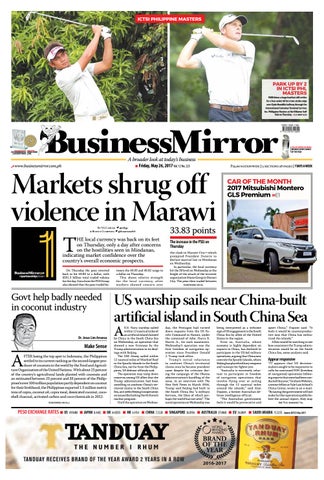
PARK UP BY 2 IN ICTSI PHL MASTERS
PARK blows a huge lead but still settles for a four-under 68 for a two-stroke edge over Clyde Mondilla halfway through the International Container Terminal Services Inc. Philippine Masters at the Villamor Golf Club on Thursday. » C3 NONOY LACZA
media partner of the year
United nations
2015 environmental Media Award leadership award 2008
BusinessMirror A broader look at today’s business
www.businessmirror.com.ph
n
Friday, May 26, 2017 Vol. 12 No. 225
Markets shrug off violence in Marawi T
By VG Cabuag & Bianca Cuaresma
@villygc @BcuaresmaBM
he local currency was back on its feet on Thursday, only a day after concerns on the hostilities seen in Mindanao, indicating market confidence over the country’s overall economic prospects.
On Thursday the peso reverted back to hit 49.83 to a dollar, with $551.5 billion total traded volume for the day. Data from the PDS Group also showed that the peso traded be-
Govt help badly needed in coconut industry Dr. Jesus Lim Arranza
Make Sense
A
fter losing the top spot to Indonesia, the Philippines settled to its current ranking as the second-largest producer of coconuts in the world by the Food and Agriculture Organization of the United Nations. With about 25 percent of the country’s agricultural lands planted with coconuts and an estimated between 25 percent and 33 percent of the Philippines’s over 100 million population partly dependent on coconut for their livelihood, the Philippines exported 1.5 million metric tons of copra, coconut oil, copra meal, dessicated coconut, cocoshell charcoal, activated carbon and coco-chemicals in 2012. Continued on A12
PESO exchange rates n US 49.9680
tween the 49.95 and 49.82 range to a dollar on Thursday. This shows relative strength f o r t he l o c a l c u r re n c y, a f t e r m a rkets showed concer n over
2016 ejap journalism awards
business news source of the year
P25.00 nationwide | 5 sections 28 pages | 7 days a week
CAR OF THE MONTH 2017 Mitsubishi Montero GLS Premium »E1
33.83 points The increase in the PSEi on Thursday
the clash in Marawi City—which prompted President Duterte to declare martial law in Mindanao on Wednesday. In particular, the local currency hit the 50 level on Wednesday at the height of the attack of the terrorist organization Maute Group in Marawi City. The peso then traded between Continued on A2
US warship sails near China-built artificial island in South China Sea
A
U.S. Navy warship sailed within 12 nautical miles of an artificial island claimed by China in the South China Sea on Wednesday, an operation that showed a new firmness by the Trump administration in its dealings with Beijing. The USS Dewey sailed within 12 nautical miles of Mischief Reef in the Spratly Islands in the South China Sea, not far from the Philippines, US defense officials said. The operation may tamp down concerns among US allies that the Trump administration had been unwilling to confront China’s territorial claims in the South China Sea, as it seeks Beijing’s cooperation on issues like halting North Korea’s nuclear program. Until the operation on Wednes-
day, the Pentagon had turned down requests from the US Pacific Command in Hawaii, under the command of Adm. Harry B. Harris Jr., for such maneuvers. Wednesday’s operation was the first freedom of navigation operation since President Donald J. Trump took office. Tr u mp’s i n it i a l reluct a nce to confront China’s territorial claims once he became president came despite his criticism during the campaign of the Obama administration’s handling of the issue. In an interview with The New York Times in March 2016, Trump said Beijing had built in the South China Sea “a military fortress, the likes of which perhaps the world has not seen”. The naval operation on Wednesday was
being interpreted as a welcome sign of US engagement in the South China Sea by allies of the United States in the region. Even so, Austra lia, whose economy is highly dependent on exports to China, has declined to participate in the US-led military operations, arguing that China now controls the Spratly Islands, where Beijing has placed military weapons and runways for fighter jets. “Australia is extremely reluctant to participate in freedom of navigation operations that involve f lying over or sailing through the 12 nautical miles around the islands,” said Alan Dupont, a former Australian defense intelligence official. “The Australian government feels it would be provocative and
upset China,” Dupont said. “It feels it would be counterproductive now that China has militarized the islands.” Allies would be watching to see how consistent the Trump administration would be on the South China Sea, some analysts said.
Appear responsive
“It appears that US decisionmakers sought to be responsive to calls for continued FON [freedom of navigation] operations following reports that none had been conducted this year,” Graham Webster, a senior fellow at Yale Law School’s China Center, wrote in an e-mail. “By saying the government will not make further operations public before the annual report, they may See “U.S. warship,” A2
n japan 0.4482 n UK 64.8335 n HK 6.4154 n CHINA 7.2528 n singapore 36.0936 n australia 37.4860 n EU 56.0691 n SAUDI arabia 13.3255
Source: BSP (25 May 2017 )
A2 Friday, May 26, 2017
BMReports BusinessMirror
www.businessmirror.com.ph
Markets shrug off violence in Marawi Continued from A1
50 to a dollar and 49.93 to a dollar to close the day’s trade at 49.995 to a dollar—just half a centavo away from returning to the P50 territory. The weakness in the peso has been expected by the central bank, with BSP Governor Amando M. Tetangco Jr., saying the volatility is a display of “transitory or temporary cautiousness” in the market due to the developments in Mindanao. A trader on Thursday also confirmed that markets were less concerned over the hostilities in Mindanao, the declaration of martial law in the area and its overall impact on the economy. “Martial law is a cause of concern, of course, but until we see it escalate to the bigger cities, it’ll just be something to worry about,” the trader said. Morever, foreig n-exchange players are now more concerned over global developments, particularly the potential movements in the US’s interest rates. “FOMC [Federal Open Market Committee] minutes from the May meeting showed dovish
undertones, with officials opting to await further evidence that the first quarter slip in US growth was indeed transitory before they hike aggressively,” the trader said. “Although market expectations still point to a hike in June with the minutes also flagging the Fed’s desire to adjust policy ‘soon’, the dovish undertones suggest that the third rate hike may not come as easily,” the trader added, explaining that these new developments are what broadly drove market sentiment during the day. ING Bank Manila economist Joey Cuyegkeng also earlier said that financial markets impact from the clash in Mindanao is likely to be limited and calm likely to return after the initial reaction. The benchmark Philippine Stock Exchange index (PSEi) again ended the day’s trade higher on Thursday. The PSEi rose 33.83 points, or 0.43 percent, from the previous day’s trade to hit 7,871.65 points. Luis Limlingan, managing director of Regina Capital and Development, said the sudden declaration of martial law in Mindanao did not spook investors but
it is mainly buoyed by US stocks closing slightly higher. Limlingan said the market appears to have boxed the domestic risk and set it aside for the moment. The last two days have moved following a similar pattern—weakness at the open posting marginal gains at the noon break before a controlled move to the buy-side to push the measure higher at the closing bell, said Justino Calaycay Jr., senior research head Philstocks Financial Inc. “Bargain-hunting may be the key factor. A couple of index heavyweights, battered over the recent past, have attracted attention, value-wise. “Hav ing said this, we still expect the market to continue a generally sideways pattern but with a hint of upside bias,” he said.
‘Stand with Marawi’
Leaders of various nonprofit organizations and faith-based institutions has called on the public to speak in solidarity with the locals of Marawi City, Lanao del Sur, who witnessed the terror attack of the Maute Group on Tuesday. In a statement, public policy
center Institute for Autonomy and Governance (IAG) condemned the reign of terror in Marawi City. The Cotabato City-based group said violent extremism, which the Maute Group displays, has no place in Mindanao. “The voice of reason and respect for the dignity of every human being as a shared value of the great religions of the world must prevail over few loud voices who threaten to destroy humanity and our way of life,” the statement read. IAG urged the public to stand unified in the face of terrorism and extremism, instead of going against each other over political color divide. It added, “Business and civil-society leaders must voice and act out their condemnation of this global scourge that will condemn people and communities to poverty and despair.” The group also noted violent extremism is not solely a lawenforcement issue, but is a crisis driven by weak and failed governance, referring to regional and local political leaders of the Autonomous Region in Muslim Mindanao. Amid the ongoing siege, the
Mindanao Development Authority (MinDa) asked Mindanaoans to stay the course, that is, to “be vigilant, but continue to be warriors of peace by spreading hope, not fear”. The agency said now is the perfect time to set aside political and religious differences to work toward helping Marawi City and the rest of the island rise from the ashes. “Let us show the world that Mindanaoans can stand as one, even amidst adversities,” MinDa said. “The Mindanaoan spirit is resilient. It is without doubt that we can overcome this atrocity and end up victorious in our fight for justice, equality and peace. Wasalaam [Peace be unto you],” it added. In a message to the locals of Marawi City, Archbishop of Manila Luis Antonio G. Tagle said Catholics in Manila are one with their brothers and sisters in the conflict area. He said the Catholic Church, along with the Filipino people, weeps for the violence locals of Marawi City have to suffer and witness. Archbishop of Cotabato City Orlando B. Quevedo pleaded to the hostage-takers not to harm the innocent as what the Islamic
Manila, Moscow ink joint tourism plan
Russian visitor arrivals from 25,000 in 2015 to 71,000 by 2022, the last year of Duterte’s term of office. More than 28,000 Russians visited the Philippines in 2016, up 11.6 percent from 2015, despite the European Union trade sanctions that have impacted the Russian economy. Before the ruble crashed in 2014, visitor arrivals from Russia in the Philippines were growing by 30 percent annually, which earned it a place in the DOT’s list of “high-growth target markets”. From January to February 2017, visitor arrivals from Russia grew almost 30
percent to 9,152 arrivals, data from the DOT showed. As this developed, the Philippines and Russia on Thursday signed a historic Joint Action Program of Tourism Cooperation, which was one of nine bilateral agreements inked by the two countries. “The Russians are coming, though they are very particular about safety and security in any prospective destination. The agreement signifies Moscow’s confidence in the Philippine government’s capability to resolve peace-and-order issues,” Teo stressed. The bilateral tourism agreement
states that both parties will exchange, on a regular basis, information related to the safety of tourists in the country. Both countries signified to carry out continuous monitoring of any situation connected with the safety of tourists, according to the DOT news statement. The Joint Action Program, a followthrough of the two countries’ first agreement signed 11 years ago also in Moscow, is, likewise, expected to increase the tourist flow between them, as both parties agreed to assist each other in establishing contacts between Philippine and Russian national
tourism organizations. Once implemented, the program is expected to spur tourism exchange in education and training, as well as exchange of information and experts among tourist organizations of both countries. Teo also disclosed that the Russian government is exploring the possibility of organizing a Russian language training program for Filipino tourism industry workers. “We will continue to promote the Philippines as a must-see destination, and I am confident that tourist influx into the country will continue,”the DOT
faith teaches. “I appeal to religious leaders of Islam to influence the hostage-takers to release the hostages unharmed. For God’s will is the safety of innocent people,” Quevedo said. The Maute Group, which laid siege upon Marawi City on Tuesday, took with them priest Chito Suganob and church servants of the Cathedral of Our Lady Help of Christians. Catholic Bishops Conference of the Philippines President Socrates B. Villegas told the government that, while it enforces the law upon the Islamic militants, it must also ensure the safety of the hostages. “At the time of his capture, Suganob was in the performance of his ministry as a priest. He was not a combatant. He was not bearing arms. He was a threat to none. His capture and that of his companions violates every norm of civilized conflict,” Villegas said. Mindanao is presently under martial law, with the privilege of the writ of habeas corpus suspended while soldiers perform their duty in securing the island from Islamic militants. With a report from Elijah Felice E. Rosales
Continued from a12
secretary said. “The interest is there, as evidenced by international events being held in the Philippines, like the Iron Man and the Miss Universe pageant. Promoters are approaching us, asking the Philippines to host these prestigious events again,” she added. DOT officials said Russians are mostly attracted to beach destinations in the Philippines, such as Boracay and Palawan, and usually stay about 10 days in each destination, especially when winter peaks in Russia. Data from the United Nations World Tourism Organization in 2015
ranked Russia as the world’s sixthbiggest outbound market in terms of expenditure, spending $35 billion in travels abroad. “Russians spend more than others and they stay for an average of two weeks with their families in the Philippines,” Teo added. Teo is part of President Duterte’s official entourage in Russia, but the Chief Executive had to cut short his trip after clashes between the military and a local rebel group broke out in Marawi City, Lanao del Sur. Duterte responded by declaring martial law on the entire island-region of Mindanao. The DOT regional offices in Mindanao have been instructed by Teo to make sure tourists were “kept out of harm’s way”.
US warship. . . Continued from A1
seek to avoid the persistent public calls for public FON operations.” The US carries out FON operations by sending navy ships and aircraft near disputed waters to demonstrate the right to fly and sail through what it considers to be international waters and airspace. Such operations need to be within 12 nautical miles of an island or territory to constitute a challenge under international law. China’s claims to more than 80 percent of the South China Sea, an international waterway that hosts more than $5 trillion of trade a year, clash with five others, including Vietnam and the Philippines. An international tribunal last year ruled China’s claims have no legal standing. China says the tribunal has no jurisdiction. President Xi Jinping, as commander in chief of the People’s Liberation Army, inspected the PLA Navy on May 24, where he stressed its “significant role in the national security and development strategy”, according to state-run news agency Xinhua. He urged the sailors to step up efforts to “build a strong, modern naval force.” US Secretary of Defense James Mattis is due to speak to Asian defense ministers next month at a security forum in Singapore. “ We have a comprehensive Freedom of Navigation Operations program that seeks to challenge excessive maritime claims in order to preserve the rights, freedoms, and uses of the sea and airspace guaranteed to all nations under international law,” the Defense Department said in its statement. The New York Times News Service, Bloomberg News
The Nation BusinessMirror
news@businessmirror.com.ph
Editor: Dionisio L. Pelayo • Friday, May 26, 2017 A3
HRW asks Congress, SC: Check martial-law abuses
I
By Marvyn N. Benaning | Correspondent
T is the time for the Supreme Court (SC) and Congress to show they have spine and stand up to the abuses of President Duterte, who has just imposed martial law all over Mindanao.
James Ross, legal and policy director of Human Rights Watch (HRW) who covered the Philippines during the Marcos dictatorship for the Lawyers Committee for Human Rights (LCHR), and documented the abuses during the period, said Duterte “is summoning the ghost of Marcos” and even threatened to be as harsh, if not worse, than his “idol”. A day after declaring martial law all over Mindanao, Duterte issued an ominous message for enforcing it by saying, “Martial law is martial law ha. It will not be any different from what President Marcos did. I’d be harsh.” T he hu m a n - r i g ht s w atc h dog Karapatan said the clashes started when the Armed Forces launched an operation designed to capture Isnilon Hapilon, a leader of the Abu Sayyaf Group (ASG), in Marawi. In response, the Maute Group operating in the areas adjoining Marawi City launched a counterattack, burning schools and a jail, attacking a hospital and ambushing troops, killing two soldiers and a policeman in the process. Defense Secretary Delfin N. Lorenzana said under martial law, the military will have “control of movement, searches and arrest of detained people, suspension of writ of habeas corpus”. Former President Gloria Macapagal-Arroyo also declared martial law in Maguindanao in 2009 to arrest more than 100 suspects in the massacre of 38 journalists and civilians by armed men led and funded by the late Gov. Andal Ampatuan Sr., who was said to be an Arroyo ally. “Given t he l awlessness of Duterte’s ‘war on drugs’, in which the police and their agents have been implicated in the cold-blooded killing of more than 7,000 suspected drug dealers and users, military restraint in Mindanao may be wishful thinking,” Ross also said. “Duterte faces one significant obstacle to becoming the next
Marcos: The 1987 Philippine Constitution, which places restrictions on the imposition and conduct of martial law,” Ross said. “Congress can revoke the martiallaw proclamation by majority vote and the SC can rule on the factual basis for its declaration.” “Martial law can’t be used to suspend the Constitution, the courts or the legislature, and military courts can’t try civilians if the civil courts function. Anyone arrested must be charged by a judge within three days or released,” Ross explained.
Intl jurists ask Duterte: Protect human rights
BANGKOK—The International Commission of Jurists (ICJ) has urged Duterte to ensure that human rights are protected and respected in Mindanao, which he had placed under martial law. ICJ reminded Duterte that “he remains responsible for upholding its international humanrights legal obligations, notwithstanding the imposition of martial law.” The commission also called on the two houses of Congress and the SC, “to exercise their oversight authority to ensure that the declaration is necessary and lawful, and that the activities conducted under martial law respect human rights.” “The suspension of the writ of habeas corpus, which is vital for protecting the right to liberty and preventing torture, ill-treatment and enforced disappearance, must be lifted immediately,” said Frederick Rawski, ICJ regional director for Asia and the Pacific. Rawski added: “The provision of the Philippine Constitution providing for the possibility of suspension of the writ of habeas corpus is in contravention of international law, and denying the right to challenge the lawfulness of a detention is incompatible with recognized principles of the rule of law.” ICJ said, “The right to challenge
the lawfulness of one’s detention through habeas corpus or similar procedures must always be available, even under states of exception like martial law.”
Bayan blasts Marawi attack
THE Bagong A lyansang Makabayan (Bayan) has condemned the attack in Marawi City by the Maute Group and the Abu Sayyaf, but insisted declaring martial law to contain the bandit gangs in one city is an “overkill”. “Let us be clear, the Maute Group-Abu Sayyaf and/or Isis [Islamic State in Iraq and Syria] wannabes operating in Marawi must be stopped. The burning of civilian facilities, such as the UCCP [United Church of Christ in the Philippines] school, must be strongly condemned. Duterte is right to cut short his trip and return to Manila to oversee the resolution of the crisis,” Bayan Secretar y- Genera l Renato M. Reyes Jr. said. “However, we oppose Duterte’s martial-law declaration because it is open to all sorts of abuses by state security forces notorious for human-rights violations. It is a blanket endorsement of so many abuses arising from warrantless arrests, searches and seizures and the filing of trumped-up charges. It threatens to unleash more v iolence against the people,” Reyes said. “The declaration of martial law will create more problems than solutions. Its coverage is the entire Mindanao, where there are various other armed conflicts and struggles not related to Isis or the Maute Group and Abu Sayyaf. Will martial law be used against them, as well? How will that sit with the peace negotiations Duterte is undertaking with the National Democratic Front of the Philippines, Moro Islamic Liberation Front and the Moro National Liberation Front?” Reyes asked. “The various armed conflicts in Mindanao are rooted in decades-old problems of poverty, inequality, discrimination and violations of the right to selfdetermination. These will ultimately require more than just a military solution. Martial law is not the answer,” Reyes added. “We express our solidarity with the people of Marawi who have been witness to and victims of the attacks. We call for peace and justice in Mindanao by addressing the roots of the armed conflict,” Reyes concluded.
OFFICERS of the Union of Local Authorities of the Philippines (Ulap) show their Manifest of Support to President Duterte’s declaration of martial law in Mindanao during their meeting in Manila on Wednesday. Officers of Ulap, the umbrella organization of all leagues of local governments, are led by Isabela Vice Gov. Antonio Albano, president of the League of Vice Governors of the Philippines; Ilocos Sur Gov. Ryan Luis Singson, Ulap chairman and president of the League of Provinces of the Philippines (LPP); Albay Gov. Al Francis Bichara, Ulap president and LPP chairman; Edmund Abesabis, Ulap secretary-general and Liga ng mga Barangay national president; and Angeles City Mayor Edgardo Pamintuan, Ulap executive vice president and president of the League of Cities of the Philippines. PNA
Legislator urges Senate, House leaders to review martial-law edict By Butch Fernandez @butchfBM
T
HE Congress is duty-bound to rev iew the basis for the issuance of President Duterte’s Proclamation 216 placing Mindanao under martial law, Sen. Sherwin T. Gatchalian said on Thursday. In urging Senate and House leaders to act on the matter, Gatchalian invoked a Supreme Court admonition that “the power to declare martial law poses the most severe threat to civil liberties...a strong medicine, which should not be resorted to lightly”. Gatchalian, however, hastened to clarify he is not imputing illmotive behind the martial-law imposition by Duterte. “While I continue to believe that the President is motivated by the best intentions in issuing Proclamation 216, the extraordinary nature of the awesome powers invoked by the President requires Congress to exercise its constitutionally mandated check-and-balance functions as soon as possible.” Gatchalian cited the fact that Proclamation 216 also includes the suspension of the privilege of the writ of habeas corpus, which he describes as “a power even more grave than the declaration of martial law itself, [that] makes the timely exercise of this congressional power of review even more urgent” by immediately convening a joint session of the Senate and the House. “In line with this, I am calling on the Senate President and the Speaker of the House of Representatives to
immediately convene the constituent chambers of Congress in a joint session to exercise the legislative duty under Article VII, Section 18 of the 1987 Constitution to review Proclamation 216,” he suggested. Gatchalian pointed out “martial law is already being implemented in Mindanao as we speak.” “Every day that passes is a lost opportunity for the members of Congress to fulfill our responsibility to safeguard the rights and welfare of our constituents,” the Senator said. “Therefore, both houses of Congress must come together as soon as humanly possible to discuss Proclamation 216 and ensure that the government is using the most proper and effective means to restore peace, order, and security in Marawi City.” Gatchalian added.
Alunan defends martial-law declaration
FORMER Interior Secretary Rafael M. Alunan III has defended Duterte’s declaration of martial law in Mindanao to stop the reign of terror perpetrated by Islamist terror groups in the region. In a press statement, Alunan rallied the Filipino people to support the President’s move “to clampdown on the clear threats to human security” when Maute members in cahoots with the Abu Sayyaf bandit group attacked Marawi City on Tuesday, killing people, including civilians. The bandits also burned a Roman Catholic church, jails and other buildings, sowing terror in the entire city as people were screaming
as they ran for their lives. Alunan hailed the President’s move to stop Islamic militants from their rampage killing. The bandits also kidnapped people, including a Roman Catholic priest. The military and the police engaged the terrorists in heavy fighting since Tuesday. Duterte declared martial in Mindanao for 60 days to clampdown on the clear threats to human security—Islamist terrorism, communist insurgency, syndicated crime and ecological destruction,” Alunan said. “Right now, the immediate focus is on Marawi and environs. Let us rally around the President, our beleaguered local governments and their constituents, and our security and safety forces. Let us rally behind the Flag”, he added. Alunan said the raid on Marawi City was similar to the Ipil, Zamboanga del Sur, incident on April 3, 1995, where some 200 Abu Sayyaf bandits killed 53 people, burned the public market and looted banks before fleeing. He also condemned the bandits for killing civilians, especially those who could not recite certain Islamic verses. Worse, militants use human shields when they are pursued by government forces, he said. “People of Marawi, resist extremism and resist the bandits. Unite and work closely with the authorities. Defeat the threats to your lives, children, homes, businesses, schools, places of worship and, above all, your precious freedom,” Alunan said. With PNA
Economy
A4 Friday, May 26, 2017 • Editors: Vittorio V. Vitug and Max V. de Leon
BusinessMirror
news@businessmirror.com.ph
PHL, Russia ink 10 bilateral pacts By Kris M. Crismundo | Philippines News Agency
M
OSCOW—The Philippines and Russia sealed a total of 10 bilateral agreements after President Duterte’s official visit to Moscow.
President Duterte cut short his trip here after declaring martial law in Mindanao, but Russian President Vladimir Putin has assured that the full package of bilateral documents will be signed by the two countries’ ministers. Foreign Affairs Secretary Alan Peter S. Cayetano, Tourism Secretary Wanda Corazon T. Teo, Agriculture Secretary Emmanuel T. Piñol, Trade Secretary Ramon M. Lopez and Science and Technology Secretary Fortunato T. de la Peña signed the agreements on Wednesday evening here (Thursday morning in Manila). The agreements sealed in Moscow are: Joint Action Program for the period 2017 to 2019, which engages joint promotion of tourism and exchange of best practices; Memorandum of Understanding (MOU) on Agriculture Cooperation, which aims to ensure food security in the Philippines through research in agriculture and fisheries, in livestock breeding, in processing and transportation and storage of agriculture and fishery products and other agricultural products; Defense Cooperation Agreement, which involves exchange views and information on defense affairs, develop relations in the field of military education, including military medicine, military history, sports and culture; Agreement on Cooperation on Transportation, which involves support and technical assistance by exchange of experience and knowledge in the transport area, cooperation in the framework of research projects and educational visits; Protocol on Cooperation between the National Commission for Culture and the Arts, which aims to build closer ties in the area of culture and history; Memorandum of Intent between the Department of Trade and Industry and the Ministry of Economic Development, to foster mutually beneficial trade and investment cooperation; MOU on Cooperation in Industry Development, which aims to strengthen the industries of both countries by subcontracting to certain industries and sharing of technology; Memorandum of Agreement between the Department of Science and Technology and the Rosatom State Atomic Energy Corporation on Cooperation on the Use of Nuclear Energy for Peaceful Purposes; Agreement on Exchange of Intelligence Information, which was signed by National Security Adviser Hermogenes Esperon Jr.; and, Plan of Consultations on foreign affairs between the two countries. These agreements were already signed by Russian ministers before their counterparts from the Philippines inked the deals.
Both groups are dedicated to strengthening our bilateral relations, but both groups are aware that there are challenges. The bilateral relationship, cooperation and collaboration must redound to the benefit of our people—to the Filipino people and the Russian people. That’s also very clear.” —Cayetano
PCCI backs declaration of martial law in Mindanao ORTIZ-LUIS: “I think we should support what the President is doing, because I think he has the best intention for the country.”
T
Power trio Manila Electric Co. linemen perform a maintenance
check on high-tension power cables along Marcos Highway in Marikina City early this week. The power company that serves the power distribution franchise in Metro Manila and outlying provinces performs such maintenance checks to ensure the continuous and efficient supply of electricity for home and industrial consumers. Nonoy Lacza
Legislator pitches for ‘bayanihan’ to close biodiversity-financing gap By Jonathan L. Mayuga @jonlmayuga
A
lawmaker on Wednesday called on participants to the First National Biodiversity Congress to take Congress leaders to the task of increasing financing for biodiversity in the Philippines. In a speech, Occidental Mindoro Rep. Josephine Ramirez Y. Sato said the Philippines has one of the most comprehensive governing laws on the environment and biodiversity, yet, none of these laws provide the much-needed funding support for implementation. “The Philippines practically has laws governing air, water, sea freshwater, forest, agricultural lands, but we have yet to see these policies translated to substantial, actual and institutional resource allocation for real and sustained investments in rehabilitation, con ser v at ion and protection of the country’s natural resources,” she said. A former governor of Oc-
₧24B The financial requirement for the implementation of the Philippine Biodiversity Strategy and Action Plan 2015-2028
cidental Mindoro, Sato underscored the findings of the Biodiversity Financing Initiative (Biofin) that the implementation of the Philippine Biodiversity Strategy and Action Plan 2015-2028 will require financing of at least P24 billion annually until 2028, but the projected expenditures is estimated at a measly P5 billion a year based on the annual budget allocation by Congress. This, she said, leaves behind a financing gap of P19 billion a year. “For varying reasons, including persistent poverty, the lack of environment accountability as well as competing development priorities— appropriate financing allocation for
biodiversity has not been achieved by the Philippines,” she pointed out. According to the lawmaker, an affirmative action for the country’s environment must be supported by real, tangible and sustained resources. National government budget allocation for biodiversity protection and conservation can be augmented by local government units, as well as the private sector through various programs and projects. Sato reiterated her call to employ the concept of bayanihan, which she introduced to participants during her presentation in the Third Biofin Regional Workshop in Almaty, Kazakhstan, recently. “The spirit of Bayanihan is exactly what we want to serve as a frame of mind and action for biodiversity protection, conservation as well as for the other initiatives that were presented in the last three days,” she said. There is an urgent need to come together for the Philippine environment to bring together all heroic efforts and bring to the table scalable models that work, Sato said. “More important, I urge each and every one to be part of a Bayanihan for for Biodiversity Financing,” she said.
he declaration of martial law in Mindanao on Tuesday night has so far registered minute effect on business operations in southern Philippines. Philippine Chamber of Commerce and Industry (PCCI) Chairman Sergio R. Ortiz-Luis Jr. said businessmen support the declaration of martial law if this will put an end to terrorist activities in the country. He discounted any suspension of trade and business activities as a result of the declaration, since the reason for such is to address terroristic activities. “So I don’t think it will affect business in general. It will affect the perception of those outside of Mindanao, but among Mindanaons, I think life will just go as usual,” he told journalists at the sidelines of the Financial Executives Institute of the Philippines meeting in Makati City on Wednesday. Ortiz-Luis considers the martial-law declaration beneficial for the country in the long-run if it is among the primary solutions to end terrorism. “I think we should support what the President is doing, because I think he has the best intention for the country,” he said. The PCCI chief said Mindanaobased businessmen, despite being mum on the situation, have been wanting an end to terror groups’ activities, because these negatively affect them. He said President Duterte's move to address terrorist activities in southern Philippines is a good one, since it shows his resolve to end the problem that is affecting even people from outside Mindanao. “Whether we like it or not, it’s part of the country, and investment is affected, even our trade is affected because of that,” he said. Asked for his suggestion on how the conflicts in Mindanao may end, Ortiz-Luis said improving the economic situation in the region is the key. “Unless you are able to do that, these military actions will only be palliatives,” he added. Bangko Sentral ng Pilipinas Governor Amando M. Tetangco Jr., during the same event, said the central bank has offices in Mindanao, “and the reports are it’s business as usual so far”. He considers the declaration “a very decisive move on the part of the government” targeted “to improve the security and peace and order situation”. “[This] should lead to even greater confidence [for the country in general],” he said. PNA
DENR strengthens ‘security protocol’ under Cimatu
T
he Department of Environment and Natural Resources (DENR) is expected to put in place tighter security protocol for the protection of the agency’s officials and employees. The DENR, through a memorandum, reminded employees to strictly observe existing security protocol prohibiting the publication or giving out of mobile numbers, residence address and residence telephone number/s of DENR officials and personnel. The new DENR chief, former Armed
Forces of the Philippines Chief of Staff Roy A. Cimatu, reportedly wants to make sure that DENR officials and personnel will comply with the order. The memorandum, dated May 15, 2017, signed by DENR Undersecretary for Administration, Finance and Management Demetrio L. Ignacio Jr. said several reports have been received regarding attempts, such as extortion from DENR officials, personnel and external clients, by criminal elements who appear to be taking advantage of the transition period in the agency.
A copy of the order was posted in the official web site of the DENR-Mines and Geosciences Bureau read, “In the interest of the service, pending the issuance of a comprehensive security protocol, all DENR offices are hereby directed to strictly observe of the foregoing provisions on the data covered by the exceptions to the Rule on Transparency on Transactions and Access to Information and are hereby prohibited from publishing or giving out mobile cellular numbers, residence, telephone numbers and residence addresses of DENR officials and personnel.”Jonathan L. Mayuga
Agriculture/Commodities BusinessMirror
news@businessmirror.com.ph
Editor: Jennifer A. Ng • Friday, May 26, 2017
A5
Rice farmers earned ₧32B in Q1–NFA By Jasper Emmanuel Y. Arcalas
T
@jearcalas
he National Food Authority (NFA) on Thursday said Filipino rice farmers earned around P32 billion due to the high farm-gate price of palay in the first quarter of the year.
The NFA said farmers who sold their palay to the agency at P850 to P900 per bag netted at least P39.5 million, while those who sold to traders at an average of P990 per bag earned an estimated P390 per bag or a total of P31.93 billion. The food agency said it made use of Philippine Statistics Authority data, which pegged the production cost of palay at P12 per kilogram, in computing farmers’ earnings. “The NFA must be credited for influencing the buying price of palay traders, which benefited the farmers. We know that the NFA serves as the benchmark for the price of palay,” NFA Administrator Jason Laureano Y. Aquino said in a statement. “Without [the] NFA as a stabilizer, the traders can dictate the price of palay, short-changing the farmers whenever they can,” Aquino added. The NFA was able to purchase 131,720 bags from farmers nationwide at the government support price of P17 per kg plus incentives of P0.70 to P1 per kg for P118.5 million. The remaining harvest for the period was sold by farmers to private traders at
higher prices averaging P19.80 to kg. Aquino noted even with the NFA’s intensified palay buying activities and incentives, farmers took advantage of the high prices offered by private traders ranging at P18 to P22 per kg versus the NFA’s support price of P17 per kg plus incentives. The NFA had targeted to buy 4.6 million bags, or 230,367 metric tons (MT) of palay this year, to augment its rice requirement for distribution and buffer stocking. “We don’t base our performance solely on how much we have procured, because we are limited by the government support price of P17 per kg. What is important is that the farmers are enjoying much higher prices from private traders and that is good,” Aquino said. Even with the current government support price, Aquino said farmers who sell their palay to the NFA could still net at least P285 to P300 per bag. The higher price offered by pr ivate traders was cited by the NFA as the main reason behind its difficulty in procuring more palay from farmers to
File photo
beef up its buffer stock. Earlier, Nationalist People’s Coalition Rep. Arthur Yap of Bohol said the NFA Council (NFAC) should permit the food agency to offer a “summer incentive fee”
ranging from P1 to P2 per kg so the NFA could compete with local rice traders. “If the NFA is not allowed to import, then at least the [NFA] ad m inist rator shou ld get a n
NFAC approval to offer a season-based summer incentive fee of at least P1 per kg so it can buy more local palay,” Yap told the BusinessMirror. “That amount will at least go to
local farmers and allow the NFA to compete with local traders. The increase should be timebound just to make the NFA competitive,” the former chief of the Department of Agriculture added.
DA: P1.12-B grant from Hungary to fund PHL fisheries production up study on cleaning up Manila Bay, rivers 1.16% in January to March
T
he Hungarian government has committed to provide Manila with a €20-million grant (around P1.12 billion) to fund the conduct of a comprehensive study on how to clean up Manila Bay and Laguna Lake, according to the Department of Agriculture (DA). Agriculture Secretar y Emmanuel F. Piñol said the grant was part of the €530-million (around P2.96-billion) credit facility offered by Budapest to Filipino business groups to fund their respective businesses to strengthen economic ties between the Philippines and Hungary. “ The fund was offered by Hungarian Foreign Minister Peter Szijjarto during a call I made on him yesterday in Budapest after I mentioned the cleanup of lakes, rivers, creeks and bays in the Philippines as part of the DA’s fisheries program f o r s u s t a i n a b l e f i s h i n g ,”
Piñol said in a Facebook post on May 25. “Szijjarto said the grant and the credit facility is part of the Eastern Shift policy of Hungary, which includes strengthening relations with the Philippines and other countries in East and Southeast Asia,” he added. Piñol said Szijjarto assured him that the credit facility offered by Hungary, one of the members of the European Union, comes with no strings attached. “The Hungarian foreign minister emphasized that the credit facility and the Laguna Lake and Manila Bay cleanup study fund are offered without any attached conditions, which would be perceived as interference in the internal affairs of the Philippines,” he said. “We respect the sovereignty of your country, and you must be allowed to run your own affairs without interference from
other countries,” Piñol added, quoting Szijjarto. President Duterte recently announced that he will decline aid that comes with conditions from the EU, as the Philippines wants to ensure the independence of its internal affairs. The DA chief said the Hungarian government has also offered 35 scholarships slots to Filipino postgraduate students in the field of agriculture, and five more slots under the Food and Agriculture Organization program. “During the same meeting, I presented to Szijjarto documents, which would allow three Hungarian companies to export meat products to the Philippines,” Piñol said. “ Hu n g a r y i s f a mou s for it s Hu nga r i a n sau sage a nd is one of the biggest exporters of meat among the eastern European countries,” Piñol added. Jasper Emmanuel Y. Arcalas
G
ood weather allowed Filipino fishermen to increase their catch and boost the country’s fisheries output in the first quarter by 1.16 percent yearon-year, according to the latest report of the Philippine Statistics Authority (PSA). In its latest report, the PSA noted there were increments across all fisheries subsectors during the three-month period. Production reached 1.032 million metric tons (MMT), up from 1.021 MMT recorded last year. During the three-month period, the output of commercial fisheries amounted to 220,259.81 MT, 2.5 percent higher compared to the 214,892.38 MT posted a year ago, according to the PSA. Commercial fisheries accounted for 21.34 percent of the sector’s total production in the first quarter. “In Soccsksargen, increase in number of fishing trips due
to abund ance of f ish in the fishing ground, especially bigeyed scad, roundscad, bigeye tuna, skipjack, frigate tuna and yellowfin tuna brought about by the opening of Pocket 1 in the high seas starting [in] March 2017,” the report read. The PSA report showed that municipal fisheries production, which accounted for 26.48 percent of total output, reached 273,286.16 MT, up from 271,660.3 MT posted in 2016. Of the figure, 233,858.50 MT were caught in marine municipal fishing grounds. This was slightly higher than the 233,461.48 MT caught in municipal fishing grounds last year. The volume of fish caught in inland municipal grounds rose by 3.22 percent to 39,427.66 MT, from 38,198.82 MT, a year ago, according to the PSA. “More fish catch and unload-
ings in Davao region, particularly in Davao Sur, was attributed to increased fishing activities due to the additional distribution of 20 boats (motorized and non-motorized) per coastal barangay,” the report read. T he output of aquaculture fa r m s, wh ic h accou nted for more than half of the country’s production during the period, reached 539,295.77 MT, up from 534,470.55 MT, caught a year ago. “In Eastern Visayas, seaweed farms in Leyte were not affected by ice-ice disease thus increased number of operations that managed to harvest twice during the quarter. More har vests from newly opened marine cages in Samar and Southern Leyte,” the PSA said. Last year the country’s fisheries production in the first quarter declined by 6.38 percent, due to El Niño. Jasper Emmanuel Y. Arcalas
Jury rules with school in fight over California strawberries
F
This August 12, 2005, file photo shows organically grown strawberries for sale at a roadside stand in Watsonville, California. AP Photo/Rita Beamish, file
R ESNO, Ca lifor nia—A renowned strawberry researcher in California broke patent law and violated a loyalty pledge to his former university by taking his work with him to profit from it in a private company, a jury in San Francisco decided on Wednesday. Professor Douglas Shaw formed his own research firm with others after retiring from the University of California, Davis (UC Davis), where for years he had overseen the school’s strawberry breeding program, developing a heartier and tastier fruit. Jurors in the federal court decided that he used seeds developed at UC Davis without gaining the university’s permission. The rift struck fear in some farmers in California, the No. 1 strawberry-
growing state, that it would stymie research and cause them to lose their competitive edge. California last year produced 1.6 million tons of strawberries valued at roughly $2 billion, according to the US Department of Agriculture. The university’s strawberry breeding program is now under new leadership, providing farmers and consumers with new generations of the fruit, school officials said. “This federal jury decision is good news for public strawberry breeders at UC Davis and all strawberry farmers throughout California and the world,” said Helene Dillard, dean of the UC Davis College of Agriculture and Environmental Sciences. After reading the verdicts, Judge Vince Chhabria, who oversaw the trial,
scolded both sides, expressing doubt about the sincerity they claimed to have for the strawberry industry. “If you really care about strawberries, and if you really cared about California’s Strawberry Breeding Program, you would figure out a way.... to avoid subjecting them to this custody battle,” he said. Shaw had first sued UC Davis after he retired, saying that the university unfairly destroyed some of his work and keeps some of his other research locked in a freezer, depriving the world of a better strawberry. He had sought $45 million for lost research. The university countersued. Shaw, 63, is a giant in the strawberry world, heading the university’s lucrative breeding program for more than two decades alongside plant biologist Kirk Larson. Most of California’s strawberry
farmers grow plants developed by Shaw and Larson. The two men developed 24 new varieties, allowing growers to double the amount of strawberries produced while retaining the fruit’s succulence. They created strawberries that were more pest- and disease-resistant, more durable during long-distance travel and capable of growing during the shorter days of spring and fall. The partners say their work netted the university $100 million in royalties. How much they themselves made at UC Davis is unclear, but they say they contributed more than $9 million of their own royalties toward the university’s breeding program.They retired from the university in 2014 because, they said, the school was winding down the program. AP
INVESTING IN
EDUCA
A BusinessMirr
A6 Friday, May 26, 2017 | www.businessmirror.com.ph
The big choice
M
By Leony R. Garcia
ARK Anthony (not his real name) has been making P40,000-tops-per-month salary since he was 18. Barely on his second year in college, he’s definitely earning more than the university graduates who work on various offices. Mark has immensely enjoyed his work as a BPO agent. Earning quite good and experiencing its perks, he has decided to put aside his schooling. After some time, he chanced upon opportunities to travel and work abroad. He had all the working experiences in his favor but he lacked the No. 1 requirement—a college diploma. Therefore, the opportunity went to someone who had completed his college education. Proving to be excellent in his work, Mark was invited to take another post in the BPO office—this time as part of the HR department— with bigger salary and saying goodbye to the graveyard’s shift. Once again, he missed this opportunity for promotion and better pay. And
the culprit? His “missing” college diploma, which his employer said he should produce in the next two years before it would be late for him. Meaning, today at 26, all his peers have either graduated as BPO agents and have taken on supervisory or managerial posts or have gone abroad for greener pastures. Others have pursued successful business ventures. Clearly, earning a college degree is all about opening up opportunities in life. It prepares you, both intellectually and socially, for your career and your adult life. The benefits of a college education include career opportunities like better paying and higher skilled jobs, but studies have
shown that it also leads to overall happiness and stability.
The Filipino Dream
Go to college, get a job, save money, enjoy and travel, buy a house, raise a family, etc. It may not be in that order, but we hear that whenever our parents or elders tell us to pursue our studies and dreams. Indeed, earning a college degree is such an important step in life that it has become a central part of the “Filipino Dream”. Many people know that they want to attend college, but don’t know exactly why, or how it will enrich their lives. Below are some of the many benefits of earning a college degree according to EducationCorner.com.
Better career opportunities
EARNING a college degree is the most common pathway to a better career. Entering college, not everyone knows what they want to do when they grow up. But most know they want to have a better job—not only one that will pay more, but one in which they are more satisfied and secure. That combination of benefits is why so many people make the investment of time and money to go to college. Often times it’s not necessarily what you study, but the fact that you studied something at all. Aside
from training you in an expert field, college trains you to think analytically, understand complex subjects and communicate your own critical ideas about them. It also instills crucial skills like organization, selfdiscipline and the ability to complete tasks from start to finish. In other words, college helps mold you into a more professional individual. Because college gives you a broad range of skills, many college graduates
end up in fields that are not what they studied in school. College can open up unexpected opportunities that aren’t always there for those who haven’t engaged in a higher level of education.
Benefits you and your family
OBVIOUSLY, higher income is a primary benefit of earning your college degree. But most jobs that require a bachelor’s, master’s, doctoral or professional degree tend to also pro-
vide more benefits. This can include health care, retirement investment, travel and other perks. These types of benefits are rarely offered for highschool-level jobs. Part of the reason employment benefits are so important is because they offer stability for your family, especially in the case of health care. They are called benefits, but in reality, they are a vital part of anyone’s salary. In some cases, the value of
Globe encourages innovation in schools through IGNITE 2017
IGNITE 2017 participants with Globe President and CEO Ernest L. Cu
O
VER 300 school owners, administrators, academic and information technology heads from all over the Philippines converged at De La Salle University Taft for IGNITE 2017, a three-day education innovation conference presented by Globe Telecom to inspire design thinking, innovation, and transformational change in schools. The conference featured a series of expert talks, workshops, exhibitions, and activities carefully curated and customized to spark exciting fresh ideas that may help
solve the needs and challenges of schools and the new generation of students. Guest speakers included Globe Chief Executive Officer and Presi-
dent Ernest Cu who talked about building a digital nation and Google Philippines Country Head Ken Lingan who expounded on the importance of innovating in the digital age. Globe Chief Technology and Information Officer Gil Genio, SAP’s Rey Paragas; College of Saint Benilde President Br. Dennis Magbanua, FSC; and Mynd Consulting Founder Myrna Padilla also spoke at the conference. “The current challenges that schools are confronted with are varied and complex given the changing needs of students especially the new generation who are widely exposed to technology such as the Internet. This inspired us to come up with IGNITE 2017 to share with school representatives new perspectives, new tools, and new approaches on how to do creative
thinking and problem-solving like the way top companies do it,” said Michelle Tapia, Globe Advisor and Head of Education Strategy and Innovation. The move is in support of the United Nations Sustainable Development Goal 4 to “ensure inclusive and quality education for all and promote lifelong learning” which is necessary in improving people’s lives and ensuring sustainable development. Education is one of the key focus areas of Globe Telecom’s sustainability efforts in line with its vision to usher in a digital nation. Late last year, Adobe Systems, Inc., an American multinational computer software company, released a study, “GenZ in the Classroom: Creating the Future” which underscores the increasing importance of creativity and technology
in shaping future careers. The research showed that of the more than 1,000 US students between ages 11 and 17 and more than 400 Gen Z teachers surveyed, 75 percent would like an increased focus on creativity in the classroom. In relation to this, 60 percent of educators look for more opportunities for hands-on learning in their classrooms while 52 percent wish to evolve the teaching curriculum. At the same time, 93 percent of the students and 73 percent of the teachers view technology as important for career preparedness. Thus, to prepare both teachers and students for 21st century learning, the three-day conference particularly explored design thinking or human-centered design, which uses logic, imagination, and intu-
ition to find meaningful solutions to complex problems. Through the workshops on design thinking, the educators were taught how to empathize with the students and understand their needs, look for patterns and insights, experiment and explore possibilities, refine their ideas, test, and deliver. Conference attendees also enjoyed the technology expo at IGNITE 2017 with exciting giveaways and prizes from IGNITE partners Apple, Power Mac Center, Google, Q Software Research (QSR PD), I am Cardboard, GSA, and Samsung. The tech expo also highlighted education innovations from Epson, Akinto, Felta, Globe Labs, Mynt, Ritmo Learning Lab, and JeepNeed. IGNITE 2017 was also supported by D2L's Brightspace, Marketing Partners, PBEd and COCOPEA.
N
ATION THE BIG CHOICE
ror Special Feature benefits even exceeds an employee’s take-home pay. The benefits of a college education also extend beyond generations. Families of college graduates are generally better off economically and socially. But it is also more likely that the next generation of children will attend college. So you can look at it as an investment in the future of your family.
Earning potential increases dramatically with a college degree
FOR most people, the ability to earn more money is the driving force behind going to college. A post-secondary degree, whether it is a bachelor’s, master’s or PhD, is the most common route to careers that demand higher skills and offer higher pay. Studies show that college graduates earn significantly more money throughout their lifetime than those with only high school education. According to a national report in the US by the State Higher Education Executive Officers Association (sheeo. org), high school graduates earn an average of almost $30,000 per year. Bachelor’s graduates earn an average of just over $50,000 a year. And those with a higher level degree (master’s, doctorate or professional) average nearly $70,000 per year. This translates to a significant earnings gap over the course of one’s life. Earnings potential varies depending on what field you work in. For example, a master’s degree in education or nursing won’t lead to nearly as much wealth as a master's degree in engineering or business. But education and nursing are far and away the most in-demand professions out there. If you enter one of these fields, you’re likely to find a good job somewhere—even if it doesn’t pay as well a job in engineering or business.
Job security and satisfaction
HAVING a post-secondary degree typically leads to better job security. Let’s face it: if you don’t have a degree, you’re probably not as valuable to your employer. When push comes to shove it will be much easier to replace you with someone else who only completed high school. In fact, an educated staff is so important to some companies that they will even pay for employees’ tuition. This is how valuable a college degree can be. It is seen as an investment that will bring substantial rewards, not only to the employee, but to the company as well. Data shows that in an economic recession, college graduates are less vulnerable to layoffs. The people who suffer the most from job cuts are lower level employees who only have high school diplomas. There are no guarantees, but if you have a college degree you will be less likely to suffer long-term unemployment. As a college graduate, it is also more likely that you will enjoy your job. All the factors listed above— higher income, employment benefits and advancement opportunities— lead to better job satisfaction. But a college degree also gives you more freedom to pursue a career that interests you, maybe even inspires you.
An investment in your future
ATTENDING college is a major commitment of time and money, but it is also a down payment on success. Earning your college degree will help you realize your goals in your career as well as life in general. It requires a lot of hard work, but that work prepares you for a challenging and rewarding career and a more fruitful life. With college education and a good degree, you find a decent paying job, work until you retire, or perhaps go into business. However, that may not prove to be a successful life, a secure life, a financially sound life. A lot will depend on your outlook and your goal. That’s why it is important to choose the right college course for you—the one that would strengthen your interest, talents and potentials.
www.businessmirror.com.ph | Friday, May 26, 2017 A7
Passion project
W
By Cedrix S. Hay
HEN Jane’s mom wanted her to pursue Nursing in college, she tried at least
to make them both happy. So Jane, confessing to the heavens, could imagine herself wearing scrubs, and exploring the intricacies of the human body is her element. Connecting the dots, her mom could be more than thankful to her upon realizing her frustration of becoming a licensed nurse. But Jane didn’t want to have her crown but, instead, want something more than just that capital two-letter title beside her name. Summer is over, and Jane has to start her life all over again—but not with her mom. Entering college is an enormous plan everyone has to deal with; Jane doesn’t even know what self-initiative is. In a nutshell, the university life is Jane’s turning point, from losing dreams to finding her new self. One thing for sure, Jane doesn’t want to figure out the science behind our body mechanisms. A brand-new world it is, she could have longed for staying in the ward, not until the moment she was holding her own medical kit and stethoscope. Pins and needles might have her gone curious, but
blood and flesh keeps her fear alive. Agreeing to pursue a four-year dreading course, Jane wants to stop being her mom’s protégé. It has been for two years when she felt lacking. Coping up in a world of seizures and stitches for two years now, it was how the scar affects a person’s brand of image, and not the practice itself, that Jane has ever wanted to seek knowledge. For a while, it fascinates her, but her head bows too low soon after that wake-up call. “Kamusta, iha?” Her mom calmly asks over the phone. “This is not what I want, Ma.” I know how Jane’s mom would react if this has reached her personally. “Masasanay ka rin, I’m telling you. Give this a chance, iha,” her mom patiently says, while her daughter, with a point-blank face, wants to immediately turn off the phone. Today isn’t good news, adding to the failing remarks on her scorecard. Struggling between the truth and the reality, this isn’t what Jane expects for herself. While every per-
DLSU, FNF, and EU Delegation
host ‘yoEUth’ debate
T
O support youth rights, De La Salle University (DLSU), Friedrich Naumann Foundation for Freedom (FNF), and the European Union (EU) Delegation to the Philippines hosted the national YoEUth Debate last May 23 at the University’s Henry Sy Sr., Hall. Representatives from nine schools from all over the Philippines, and three interns from European Union Member States, participated in the event. The debate was conducted in town hall and Asian parliamentary formats. “The future of the world and of the Philippines is with the children and the youth. We want to hear their voices," said Ambassador Franz Jessen, Head of the EU Delegation. The yoEUth debate focused on the issues of human
rights in business and economic freedom. Senator Kiko Pangilinan will gave the keynote speech, while Commission on Human Rights (CHR) Chair Chito Gascon headed the team of adjudicators. The EU community was represented by the Head of the EU Delation to the Philippines Ambassador Franz Jessen, the Netherlands Ambassador Marion Derckx, FNF Country Director Wolfgang Heinze, and European Chamber of Commerce of the Philippines (ECCP) Guenter Taus, who both served as judges.
son in the lab seems gullible watching an infant “swim” his way out to this world, her head “dives” to the deepest concern of how the pain resonates to her femininity. A grim paradise to imagine, she couldn’t handle streams of blood oozing from her patient’s womanliness, same as the pressure of listening to her mom’s advice. In a self-destructive society where having a good-paying and sustainable job is synonymous to following her mom’s choice of education, Jane felt the need of disarming this societal bomb. Wanting to be a “people of the people” and not just a concerned citizen attending to the medical needs of her patients—even to the mess of giving birth—it’s innate in Jane to digest a person’s vulnerability in pieces, thus, seeing the bigger picture of where does he or she comes from. Understanding the human psyche is her greatest motivation to find the goodness in herself. That being interested in Libido Theory and Sigmund Freud, plus Carl Jung and Friedrich Nietzsche, her theoretical engagement to various psychological phenomena was an understatement. It was against her mom’s reality. Her convincing aura lies flat when mom tells the horror of making her proud with that decision. Every now and then, thoughts of choosing between her belief and her mom’s personal touch crumbles to her own sanity—same goes with the only favor she’d given to herself while, all of her life, she has been this sweet, courteous daughter. Owning to her resilience, Jane is about to confront her mom with what’s genuine in her heart before
she crumbles down. Sealed in an envelope is Jane’s confession written a day before her departure to her dormitory. It was the first thing her mom saw in her bedside: “Mom: I tried to fit in the mold, but it’s not worth the effort. Nursing is far from Psychology, and I don’t want you to give any false hope. I never failed your expectations of me but, please, forgive me when I say this isn’t what I want. I can’t stand how unfair it would be granting your desire, when all I ask from you is to just let me do the things that I love. I tried hard to be the nurse you always wanted to be, but I am this weirdo with a heart for the lost people. For the last time, please, let me pursue Psychology. I’m not happy anymore—Jane” A huge relief, even if unsure of its result, Jane is at ease now. Hoping for a favorable response, this ends her struggle of finding that inner peace. Nevertheless, repeating the only mistake she had allowed to happen could either make or break her and her mom. One thing, it wasn’t a bad blood for them settling their conflicts, but she haven’t had her own personal space; it was in college she found liberation, right after that two-year tryout. This time, she won’t hold back to her own vision. School already ended, and the summer breeze once again radiates in Jane’s room, confining her existence in a cubicle of silence, when her mom knocks at the door. Jane, who hasn’t heard her mom say something about the note, didn’t have to argue with her mom. “Go on, be the weirdo
with a heart for the lost people.” The rest is history. Thousands of cash were already spent, but that could be easily gained. And for mom, what’s important is to see Jane blossoming into her best version without impeding her growth—another chapter unfolds to both of them. Jane carries her passion for hearing thoughts, while her mom shuffles those medical books in the cabin. For a while, her opinion verifies Jane’s betterment, but now that Jane could think for herself, detaching her judgment consents both of them to examine what matters most in the grand scheme of life, including her decision of shifting course. Even a dream has just totally ended, another one rises. Now is the time for Jane to make her existence notable for her cause with her chosen vocation. So, Jane, without a word from her lips, is grateful for this chance that she’s been waiting for. For her, it wasn’t how she got to the climb, but was the process that made the climb. May it not give her a million-dollar living, but her receptiveness and affection toward people is a trilliondollar fulfillment not only for her, but also for the lives that has been changed. Ready to accomplish her mission, Jane doesn’t need to prolong the misery memorizing those surgery terms and arguing with her conscience every night. Back to the basics, Jane will have to stay in the university for some more years as a Psychology student, and her mom is in full support—no regrets, just love.
A8
Friday, May 26, 2017
The World BusinessMirror
www.businessmirror.com.ph
Opec set to prolong cuts to clear glut goes slow
O
Protesters demonstrate as Republican members of the House bus to the White House after passing the health care bill at the Capitol in Washington on May 4. The Congressional Budget Office’s assessment of the House’s health bill predicts dysfunctional markets for about one-sixth of the population. Gabriella Demczuk/The New York Times
Republican bill would leave 23M more uninsured in a decade
W
ASHINGTON—A bill to dismantle the Affordable Care Act (ACA) that narrowly passed the House this month would leave 14 million more people uninsured next year than under President Barack Obama’s health law—and 23 million more in 2026, the Congressional Budget Office said on Wednesday. Some of the nation’s sickest would pay much more for health care. Under the House bill, the number of uninsured would be slightly lower, but deficits would be somewhat higher than the budget office estimated before Republican leaders made a series of changes to win enough votes for passage. But beneath the headline-grabbing numbers, those legislative tweaks would bring huge changes to the US health-care system. In many states, insurance costs could soar for consumers who are sick or have preexisting medical conditions, while premiums would fall for the healthy, the new estimate concludes. The forecast by the nonpartisan Congressional Budget Office, Capitol Hill’s official scorekeeper, is another potential blow to Republican efforts to undo Obama’s signature domestic achievement. Republican senators have said they will make substantial changes to the measure passed by the House, but even Sen. Mitch McConnell of Kentucky, the Senate majority leader, sounds uncertain about his chances of finding a majority to repeal and replace the health law. “I don’t know how we get to 50 at the moment,” McConnell told Reuters on Wednesday. “But that’s the goal.” In states that obtain waivers from certain health-insurance mandates, “premiums would vary significantly according to health status and the types of benefits provided, and less healthy people
14M The number of additional people who would be uninsured next year under the proposed health bill compared with President Barack Obama’s health law
would face extremely high premiums,” the budget office said. In addition, it said, “out-ofpocket spending on maternity care and mental-health and substanceabuse services could increase by thousands of dollars”. The new report is sure to influence Republican senators, who are writing their own version of the legislation behind closed doors. The report provided fresh ammunition for Democrats trying to kill the repeal bill, which they have derided as “Trumpcare”. House Republican leaders, who pushed the bill through their chamber before the budget office could complete its final estimate, focused on the deficit reduction still on offer. The House bill would reduce federal budget deficits by $119 billion over a decade—less than the $150 billion in savings projected
in late March for an earlier version of the bill, but still substantial, Republicans said. Republicans in Congress generally focus more on reducing health costs than on expanding coverage. Their proposals will inevitably cover fewer people than the ACA, they say, because they will not compel people to buy insurance. But critics zeroed in on a bifurcated health-care system that the bill could create: Those who are sick, at risk of getting sick or nearing retirement would pay more, while those who are young and healthy would pay less. In states that obtain waivers from rules mandating essential health coverage at uniform rates, the legislation could put insurance economically out of reach for some sick consumers. “Unless you’re a healthy millionaire, Trumpcare is a nightmare,” said Sen. Chuck Schumer, Democrat-New York, the Senate minority leader. “ This report ought to be the final nail in the coffin of the Republican effort to sabotage our health-care system.” Insurance is, by definition, a pooling of risks, but the budget office said the House bill could cause a fragmentation of the market. The budget office report indicates that the House bill would wipe out gains in coverage made in the last three years. “In 2026,” it said, “an estimated 51 million people under age 65 would be uninsured, compared with 28 million who would lack insurance that year under current law.” Republicans have been tr ying to repeal Obama’s health law since the day he signed it in March 2010. But the task is proving more difficult than they expected. Many parts of the law have become embedded in the nation’s health-care system, and consumers have risen up to defend it, now that they fear losing its protection. At the same time, other consumers, upset about the mandate to buy insurance they can barely afford, are demanding changes in the law. The budget office issued two reports on earlier versions of the House bill in March. Both said
the legislation would increase the number of uninsured by 14 million next year and by 24 million within a decade, compared with the current law. But Republican senators appear as determined as ever to replace the ACA. “The status quo under Obamacare is completely unacceptable and totally unsustainable,” McConnell said on Wednesday, a few hours before the budget office issued its report. “Prices are skyrocketing, choice is plummeting, the marketplace is collapsing and countless more Americans will get hurt if we don’t act.” The instability of the health law’s insurance marketplaces was underscored again on Wednesday when Blue Cross and Blue Shield of Kansas City, a nonprofit insurer, announced that it would not offer coverage under the law for 2018. The insurer lost more than $100 million in 2016 selling individual policies under the law, said Danette Wilson, the company’s chief executive. “This is unsustainable,” she said in a statement. “We have a responsibility to our members and the greater community to remain stable and secure, and the uncertain direction of the market is a barrier to our continued participation.” W hile the vast majority of people the company covers get insurance through an employer or a private Medicare plan, Blue Cross of Kansas City covers about 67,000 people in western Missouri under the federal health law. The company’s departure could leave 25 counties without an insurer, said Cynthia Cox, a researcher at the Kaiser Family Foundation. Democrats say much of that instability stems from Republican efforts to repeal and undermine the ACA. The House repeal bill was approved on May 4 by a vote of 217-213, with no support from Democrats. It would eliminate tax penalties for people who go without health insurance and roll back state-by-state expansions of Medicaid, which have provided coverage to millions of low-income people. w
rganization of the Petroleum Exporting Countries (Opec) and its allies were poised to extend their production cuts for another nine months after last year’s agreement failed to clear a global supply glut or deliver a sustainable price recovery. Six months after forming an unprecedented coalition of 24 nations and delivering output reductions that exceeded all expectations, some of the world’s largest oil producers faced the fact that they’d fallen well short of their goal. “The extension shows that Opec is struggling to bring down crude oil inventories,” said Alexandre Andlauer, an analyst at consultant AlphaValue SAS, in an interview in Vienna. While fuel stockpiles around the world are falling, ministers from Saudi Arabia, Algeria, Venezuela and the United Arab Emirates acknowledged that the surplus built up during three years of overproduction won’t be cleared until at least the end of 2017, or possibly even later. So far, Opec has stopped short of committing to further action beyond March 2018, but officials dropped hints that it’s possible. In a committee meeting on Wednesday, si x Opec and nonOpec nations agreed to monitor the market and ta ke “ f ur ther adjustment actions, if deemed necessar y”. The nine-month extension to be discussed on Thursday could include an option for an extra three months, said Russian Energy Minister Alexander Novak. That’s similar to last year’s accord, which included the option for an extra six months. Opec and 11 nonmembers agreed last year to cut output by as much as 1.8 million barrels a day. The historic pact affected everything, from the valuations of US shale producers to the foreign exchange rates of energy-dependent nations, such as Brazil and Nigeria. The supply reductions were
intended to last six months from January, but initial confidence in the deal, which boosted prices by as much as 20 percent, waned as inventories remained stubbornly high and US output surged. With crude futures dipping back below $50 a barrel last month, Russia and Saudi Arabia took the unusual step of publicly backing longer cuts weeks prior to the scheduled ministerial meeting in Vienna. That move did the trick, with US benchmark West Texas Intermediate rising 18 percent to around $52 a barrel since reaching a fivemonth low on May 4. It could also mean there’s little left to gain if ministers ratify the extension at their meeting on Thursday. “A nine-month extension is effectively a done deal, but because Russia and Saudi Arabia announced their support for it earlier in the month, the market may be disappointed,” Amrita Sen, chief oil market analyst at Energy Aspects Ltd., said in an interview. “If Thursday’s meeting ends with ‘ just’ a nine-month extension, prices may sell off.” The sluggish decline in fuel stockpiles isn’t their only concern. US crude production rose to 9.32 million barrels a day last week, an increase of 550,000 this year to the highest since August 2015, according to data from the Energy Information Administration. That wipes out almost a third of the supply reduction from Opec and its allies, and the output surge could double by year-end, consultant IHS Markit Ltd. told the group at a meeting last week. Opec isn’t worried about shale, which may be close to maximum production, but will keep a close eye on developments in the US, Algerian Energy Minister Noureddine Boutarfa said in an interview. “We will assess how shale oil will react,” Boutarfa said. “We know that the American way is to extract the biggest profit in the shortest time possible.” Bloomberg News
UK police rebuke US for leaking terror police info
B
ritish police condemned US officials’ leaking of intelligence relating to the Manchester terror attack, calling it a breach of trust that risks undermining their investigations as the probe into the bombing extended to Libya. The strongly worded rebuke came after the New York Times published photographs of the crime scene and after Home Secretary Amber Rudd openly criticized US officials for sharing details with American media organizations before British security services were ready to do so. The wwz story followed several US news reports disclosing information British police and intelligence officials had chosen to withhold from the press. “We greatly value the impor tant relationships we have with our trusted intelligence, law enforcement and security partners around the world,” the National Counter Terrorism Policing office said in a statement on Wednesday evening. “When that trust is breached, it undermines these relationships undermines our investigations and the confidence of victims, witnesses and their families. This damage is even greater when it involves unauthorized disclosure of potential evidence in the middle of a major counterterrorism investigation.” Manchester police said on Wednesday they’re investigating a network they think orchestrated the bombing, and the suspected perpetrator’s father and brother were arrested in Tripoli. Seven arrests have so far been made in the UK in connection with the attack. The police said on Thursday that a woman arrested in Blackley had been released without charge. Prime Minister Theresa May will cut short her trip to the Group of Seven meeting in Sicily, returning on Friday night to deal with the terror threat. She is expected to raise the issue of intelligence leaks with US President Donald J. Trump, according to the Guardian newspaper, amid speculation that key allies could become reluctant to share vital security information with the world’s superpower.
‘Very troubled’
Manchester’s mayor, Andy Burnham, told the BBC he had raised concerns about the leaks with the US ambassador, while Labour lawmaker Yvette Cooper said she was “very troubled” by those occurring in the middle of an investigation where public safety may be at risk. Before further details were published by the New York Times, Rudd had said she had been “very clear with our friends that that should not happen again”. The victims of the attack were still being identified on Wednesday, and pictures of British troops deployed in the central government district in Westminster, armed with assault rifles, dominated the news. The deployment, designed to free up police officers to pursue the terrorists behind the attack, is the largest on the British mainland in decades. Police now say the suspected bomber, 22-year-old Salman Abedi, who died in the attack, was part of a network. Manchester police arrested a man reported to be Abedi’s brother. Another brother and the suspect’s father were arrested in Libya, witnesses and security forces said. A woman was arrested following an armed raid in Manchester on Wednesday evening.
United front
Britain’s political parties meanwhile agreed to resume campaigning on Friday after a three-day break, as authorities warned that another attack is imminent. With two weeks to go until the June 8 election, it’s likely to be a different style of campaign after the worst terrorist attack on British soil in more than a decade. On Monday morning, May had been on the defensive, denying that she’d reversed one of her flagship policies on care for the elderly. The murder that evening of 22 people—including children— at a pop concert moved her into the role of a leader at a time of national crisis, and politicians on all sides have been careful to show a united front. Bloomberg News
news@businessmirror.com.ph
The Regions BusinessMirror
Marawi mayor identifies terrorists as Dawlah Islamiyah By Cha Monforte | Correspondent
M
ARAWI City Mayor Majul Gandamra said the group laying siege in his city is a composite force calling itself “Dawlah Islamiyah (DI)”. The mayor made the announcement early Thursday morning in a phone interview with GMA News TV 27 anchor Mike Enriquez. “It is composed of Maute, BIFF [Bangsamoro Islamic Freedom Fighters] and Abu Sayaff groups,” Gandamra said. He said the DI terrorists are still present in his city, scattered in different areas and would sometimes shoot up “just to send a message that they are still here”. Since Wednesday evening, he said, he had not heard of any exchange of gunfire. “Mostly houses and establishments have been evacuated by their owners, but there’s somebody who is left to guard each house,” Gandamra said from City Hall, where he has been staying since the start of the siege on Tuesday. He added he is ready to defend City Hall from being taken over by the armed group. The Maute Group is also called DI and is said to be an ISIS-inspired group. The military operation has been going on since Tuesday afternoon and, as of Thursday noon, 1st Infantry Batallion Spokesman Lt. Col. Jo-Arr Herrera said in a media inter-
view there are about 30 Maute terrorists they still need to flush out from three barangays in the city: Basa, Bangan and Gadungon. He said 13 from the enemy side were killed and five government troopers, but there has been “no collateral damage” in more than two days of fighting. He added they are making surgical operations and “are flushing out” the terrorists. He has asked residents to help the soldiers in their drive to end the siege. The terrorists kept on switching positions in buildings and changed clothings to deceive the military, Herrera said. Meanwhile, Maranao author Norodin Alonto Lucman posted again Thursday morning on his Facebook account the military can retake the city anytime, but the problem is water, electricity and food; and the possibility of looting is high in abandoned houses and establishments. “The Army has to move in to prevent widespread looting and summary killings by desperate ISIS fighters, some of them [are] foreigners,” Lucman posted. At around 4 p.m., Lucman said he saw fierce battles between the armed group and government forces nearby from his location in the city. The city seems a ghost towncum-battlefield, with the heavily armed terrorists continuing to hold on elevated positions in various areas in the city.
Displaced Marawi residents also flee to Cagayan de Oro
C
AGAYAN DE ORO CITY— As thousands of civilians fled Marawi City following the firefight between members of local terror groups and state forces starting Tuesday afternoon, some displaced residents found it difficult to seek shelter in neighboring areas, like in this city. While neighboring Lanao del Norte and the cities of Iligan and Cagayan de Oro have set up temporary shelters to welcome the influx of internally displaced persons from Marawi, others like Fatima (not her real name), 36, married, has opted not to go to the evacuation centers. Fatima, from Barangay Bangon in Marawi, is one of the more than 5,000 evacuees who escaped the skirmishes in that city. She and her four children hitched a ride on the vehicle of her husband ’s relative that left that city Wednesday night. They arrived in Cagayan de Oro late Thursday morning because of the traffic congestion that caused a gridlock in Iligan. Fatima said they decided to relocate to this city so she and her kids could have a decent place to stay. Her husband is working in Manila. Before the chaos ensued on Tuesday in Marawi, Fatima said she just stepped out of a money-transfer office at the Mindanao State University’s main campus in Barangay Rapasun to get the cash her husband sent. At Barangay Basak Malutlot, she saw soldiers positioned in the streets, and when she reached the city hall, people were running to different directions as gunshots were heard from afar. Fatima said she and her
children lost no time in going to her neighbor’s house, her husband’s relatives, and decided to hitch a ride with them going out of Marawi. “We haven’t brought anything. My children and I only have the clothes we wear,” she said. “We didn’t care if there were gunshots. We just wanted to get out of Marawi.” She said there were armed men she suspected of being Maute Group members outside her house who told them to move out immediately. “[The armed men] ordered us to hurry up and leave Marawi. They also said they will burn our houses,” she added. When they reached Iligan City, they spent the night at a lodge before proceeding to Cagayan de Oro in the morning. Speaking to the BusinessMirror at a police checkpoint in Sitio Kinasanghan, Barangay Iponan, where a team from the City Public Safety Battalion was flagging down vehicles coming from the western part of Mindanao, Fatima said they were still searching for a place to stay. Most of those who fled Marawi stayed in their relatives’ houses in Cagayan de Oro, but Fatima said her kin’s residences are already full of evacuees. She said she wanted her children to live in Cagayan de Oro and have them study here, but it will be hard for them since their school documents were destroyed after the Maute Group burned the Dansalan College campus in Barangay Moncado Colony. “I don’t know [if they can enroll in Cagayan de Oro]. They have no credentials anymore since [Dansalan College] was burned down,” Fatima said. PNA
Editor: Efleda P. Campos • Friday, May 26, 2017 A9
250 ‘persons of interest’ rounded up in Davao City By Manuel T. Cayon | Mindanao Bureau Chief
D
@awimailbox
AVAO CITY—Police rounded up 250 persons on Thursday in two slum areas here as security measures became tighter against those linked to the terror attack in Marawi City.
City Police Chief Senior Supt. Alexander Tagum said the persons were invited for questioning from their locations in Bucana and Mini-Forest. They were picked up by elements of the police and
the Army’s counterterrorist unit, Task Force Davao. Tagum said the 250 individuals were considered persons-of-interest “since they could not present proofs of identification, and of-
ficials of the two barangays could not verify their identities”. The action came a day after Mayor Sara Duterte-Carpio issued instructions on how residents should observe the declaration of martial law. She said security has been shifted from the order of a lockdown to a “hold and secure” status, all meant to “prevent a spillover of the Marawi incident from reaching the city at the same time, securing the people of Davao from any terrorist acts.” Tagum City, 53 kilometers northeast of here, also put up several highway checkpoints as its mayor, Allan L. Rellon, directed police and the Army “to intensify local checkpoints on all entry points of Tagum City.” He said “this is crucial espe-
cially that big events will be hosted by the city this year, top-billed by the 6th Asean Scout Jamboree in November.” Task Force Tagum, a special unit assigned by the Armed Forces of the Philippines to secure the city, said it has maintained a highalert status. He said authorities would respect the civil rights of citizens as its highest priority despite the declaration of martial law. Randy de Gala, the city’s legal officer, said Tagum residents “should dismiss their fears regarding martial law, because the suspension of the privilege of the writ of habeas corpus shall apply only to persons judicially charged for rebellion or offenses inherent in, or directly connected with, invasion”.
SP approves Metro Quezon industrial zone By John Bello Correspondent
L
UCENA CIT Y, Quezon— Some 1,500 hectares of agricultural land covering Barangays Rosario and San Jose in Mauban, Quezon, are about to be transformed into an economic zone with the approval of its reclassification by the Sangguniang Panglalawigan (SP) committee on land use. On Wednesday the SP committee headed by SP member Claro “Jerry” Talaga Jr. has given the gosignal for the land reclassification from agricultural to industrial and commercial purposes to pave the way for the establishment of the proposed Metropolitan Quezon Integrated Economic Zone. The SP committee hearing was attended by his colleague, board member Erwin Esguerra; Mauban Vice Mayor Leonchito Gapasangra; councilors Misael Pastrana, Romeo Mandrique and Mark Raymund Llamas; Mauban Council Secretary John Encomienda; Lina Biron, who represented the project proponent Achievement Realty Corp.; and Erwin Ellos, representing the Office of the Provincial Planning and Development Coordinator. Talaga said the approval by his committee of Municipal Ordinance 09-2017 of the Mauban Sangguniang Bayan would pave the way for its approval at the SP regular session on June 5.
DOING ‘PUKOT’ IN BALER, AURORA A fisherman does a pukot, a local term for fishing, in Baler, Aurora Province. Baler Bay is one of the surfing capitals of the country. Aside from being a surfing haven, it also gives the local community an array of fish species, their main source of livelihood. NONIE REYES
The ordinance entitled “An Ordinance Enacting the Reclassification of a Parcel of Land Covered by Transfer Certificate of Title T-14101 to 14161 with a Total Area of 15,305,551 Square Meters at Barangay Rosario and Bgy. San Jose from Agricultural to Industrial and Commercial” has passed the scrutiny and evaluation of the Office of the Provincial Attorney and Office of the Provincial Planning and Development Coordinator and noted by Quezon Gov. David “Jayjay” Suarez. W hen asked by Talaga and Esguerra what would be put up in the area by the project proponent, Biron mentioned food-based
processing plants for seafood, poultry and swine products; forest-based products like furniture; cottage industries for businessprocess outsourcing and call centers; and light and medium manufacturing industries, like electronics, automotive parts, garments and others. She said they would also be putting up an airport and a seaport in the area. The affected residents have been offered resettlement areas by Mayor Fernando Llamas, who donated 500 hectares as housing project for the same residents in the 2 barangays. Last January 4 Anabel Hierras-
Garcia, Environmental Impact Assessment (EIA) project manager of Gardenia Environmental Permitting and Auditing Services, has written to Llamas regarding the conduct of public scoping, which is the first step in the EIA process and to introduce the project to the stakeholders. She told Llamas the proposed project will cover the development of 382.8744-hectare lot property of the proponent into subdivision lots, road, drainage, water, power and telecommunication systems to cater to light and medium industries that would be put up in the target areas.
Al Gore’s climate-change body creates Alien Salas Quimpo Leadership Awards By Juan P. Dayang | Special to the BusinessMirror
T
HE Alliance for Climate Protection-Climate Reality Project (ACP-CRP), a global nonprofit organization on climate protection and leadership founded in 2006 by former US Vice President Al Gore, has created a Philippine alliance, the Alien Salas Quimpo Collective Climate Leadership Memorial Awards (ASQCLMA) to encourage civic action against climate change. The ACP-CRP now operates in more than 30 countries and has trained over 7,800 individuals representing 126 countries as volunteer climate-change leaders. Al Gore currently serves as its board chairman, while Ken Berlin is its president. The late-Filipino lawyer and educator Alien Salas Quimpo, after whom the Philippine alliance was named, was a tireless civic and humanitarian leader. He established the now world-famous 250-hectare Bakhawan (mangrove) forest in Kalibo, Aklan, named as the Alien Salas Quimpo Eco-Park. Quimpo underwent training under Al Gore. He served as Aklan’s lone district representative for three consecutive terms and as mayor of Kalibo, Aklan’s capital town. He was president of the Northwestern Visayas Colleges and an active advocate of the Asean Economic Community at the time of his death. He was 70. During his stint in Congress, Quimpo chaired the House Committee on Education. Among the landmark legislations he principally authored were the laws that created the Commission of Higher Education and the establishment of the Aklan State University.
MAJESTIC SCHOOL
On a plateau at the Barangay Site sits a 3-story school building that houses the Senior High School of Eastern Nueva Vizcaya National High School in Didipio, Kasibu, Nueva Vizcaya, designed to house 18 classrooms. The P43-million school building was donated by OceanaGold Philippines Inc. as part of its “We Care” program. LEONARDO PERANTE II
A10 Friday, May 26, 2017 • Editor: Angel R. Calso
Opinion BusinessMirror
editorial
Martial law: The test
T
he proclamation of President Duterte declaring a state of martial law for the whole of Mindanao has created a firestorm of opinion as well it should. The people have the right and the obligation to ask questions on any major decision like this from their government.
On November 19, 1863, at the dedication of Soldier’s National Cemetery, a cemetery for Union soldiers killed at the Battle of Gettysburg during the American Civil War, then-President Abraham Lincoln took a few moments to give his remarks. He began by reiterating the basis for establishing the United States of America. He said—according to the most common accounts—“Our fathers brought forth on this continent, a new nation, conceived in Liberty and dedicated to the proposition that all men are created equal”. He continued, “Now we are engaged in a great civil war, testing whether that nation, or any nation so conceived and so dedicated, can long endure”. The preamble to the 1987 Philippine Constitution reads in part, “Establish a government that shall embody our ideals and aspirations, promote the common good, conserve and develop our patrimony, and secure to ourselves and our posterity, the blessings of independence and democracy under the rule of law”. The 1987 Constitution was written within view and smell of the smoldering ashes of a government that made its own “rule of law” in complete opposition to Lincoln’s “government of the people, by the people, for the people”. However, any “rule of law” is only as strong and valid as the people desire. The rationale and justification of the proclamation is, and will continue to be, subject to great debate by the people. But perhaps a more important issue was expressed by someone on social media who wrote: “This is an opportune moment to show what’s martial law’s purpose, as per the Constitution, and put the horrors of the past to an end”. All of us are going to have our own interpretation of “martial law’s purpose”, specifically in the current situation. Nevertheless, the framers of the 1987 Constitution put in a specific and exact framework in the hope that even under the most extreme circumstances, the rule of law would prevail. While recognizing instances when this extreme measure might be warranted, the authors tried their best to balance the need of the Executive to impose martial law while providing a check and control system to keep the situation from deteriorating to abuse. Sen. Francis N. Pangilinan said this on Wednesday: “While martial law is an option available to the President and we respect this exercise of discretion, we in Congress will exercise our constitutional duty to look into the basis of the declaration and determine whether there is basis for its continued imposition. Central to all this is to ensure that the constitutionally guaranteed rights of our citizens are protected and that the exercise of the martial-law powers of the President are checked”. That is exactly what we want to hear from all the members of the Legislature. Unfortunately—but not unexpectedly—the vile monster of partisan politics has already raised its destructive head. Are our memories so short and so distorted that we cannot recall that the most sinister abuse of martial law is to silence the opposition and gain absolute control of the “ruling party”? This is the time for all sides of the political spectrum in the legislature to work together for one and only one purpose—to preserve and protect the Constitution and the rule of law. Anything less will lead to our destruction. Since 2005
BusinessMirror A broader look at today’s business ✝ Ambassador Antonio L. Cabangon Chua Founder Publisher Editor in Chief Managing Editor Associate Editor News Editor City & Assignments Editor Senior Editors
T. Anthony C. Cabangon Jun B. Vallecera Max V. de Leon Jennifer A. Ng Dionisio L. Pelayo Vittorio V. Vitug
Ruben M. Cruz Jr. Angel R. Calso
Creative Director Chief Photographer
Eduardo A. Davad Nonilon G. Reyes Judge Pedro T. Santiago (Ret.) Benjamin V. Ramos Adebelo D. Gasmin Marvin Nisperos Estigoy Aldwin Maralit Tolosa Dante S. Castro
BusinessMirror is published daily by the Philippine Business Daily Mirror
HOM
James Jimenez
spox
I
n the wake of the declaration of martial law over Mindanao, as a result of the clashes in Marawi, it was interesting to watch social media come alive with the expected protests against the move. How could it not? Social media has long been the stomping ground of people with strong political opinions, and one of those opinions happens to be a pronounced aversion to, and fear of, martial law.
Neither was it surprising to see the rise of pro-martial-law tweets and posts. Again, strong opinions have always been the staple of Philippine social media. What threw me for a loop was that, at the point of collision between these two streams, soon emerged the “if you’re not from there, you shouldn’t care”, argument, coupled with a handful of tweets and posts calling for federalism. This, I found bothersome. Look. To paraphrase Isaac Asimov, there is but one light of freedom. To dim it anywhere is to darken it everywhere. No one in their right mind would argue that martial law does not constitute a diminution of the freedom enjoyed by the people under its yoke. The deprivation of some freedoms
Publishing, Inc., with offices on the 3rd floor of Dominga Building III 2113 Chino Roces Avenue corner De La Rosa Street, Makati City, Philippines. Tel. Nos. (Editorial) 817-9467; 813-0725. Fax line: 813-7025. (Advertising Sales) 893-2019; 817-1351, 817-2807. (Circulation) 893-1662; 814-0134 to 36. E-mail: news@businessmirror.com.ph.
www.businessmirror.com.ph
Printed by brown madonna Press, Inc.–San Valley Drive KM-15, South Superhighway, Parañaque, Metro Manila
—the freedom from warrantless arrests, for instance—is, in fact, the very raison d’etre of proclaiming martial law in the first place. You remove this freedom, to give you more latitude in your campaign to rein in the lawless elements. But in diminishing this freedom —thereby dimming freedom’s light, as it were—you put many innocents at risk, as well. Perhaps not directly from the person who declared martial law, but at the hands of those who are tasked to implement it. This is not to say that the gallant men and women of the soldiery cannot be trusted; by and large they are honorable and do genuinely care for the people. But the possibility of there being bad apples among the good, cannot be
In the end, the declaration of martial law in and of itself does not guarantee the onset of an oppressive night, especially since the Constitution contains the mechanisms that allow martial law to be used properly. When all is said and done, we might yet find that the worst of our fears weren’t justified. But in the meantime, even as we strive to stick to the path laid out by the Charter, let’s also try to respect how the others feel. cavalierly disregarded either. Nor do you even need to confine your apprehension to how soldiers and persons in authority will behave. Our history is rife with examples of neighbors turning against each other, isn’t it? (This exposes the related argument that “the innocent need not fear”, as being disingenuous. There may be no reason to worry about just retribution, but no amount of innocence has ever acted as a shield against malicious intent.) Under such conditions, where anyone’s continued liberty depends not on the protections afforded by law, but on the goodwill of individuals you might not even know, or might have offended at some point, or who may simply don’t like the way you look, it cannot be denied that
‘Sharing the good news in our time’ Rev. Fr. Antonio Cecilio T. Pascual
Lorenzo M. Lomibao Jr., Gerard S. Ramos Lyn B. Resurreccion, Efleda P. Campos
Online Editor Social Media Editor
Chairman of the Board & Ombudsman President VP-Finance VP Advertising Sales Advertising Sales Manager Group Circulation Manager
Fear
SERVANT LEADER
E
veryone can access the latest news everywhere, thanks to advanced technology, especially the social media. However, people are exposed to both true or false and positive or negative news. It is on their own discretion to which kind of news they will pass on.
On Sunday, May 28, 2017, we shall celebrate this years’ World Communications Day with the theme “Fear Not, for I am With You (Isaiah 43:5): Communicating Hope and Trust in our Time”. This theme “is an invitation to tell the history of the world and the stories of men and women in accordance with the logic of ‘good news’ that reminds us that God never cease to be a Father” to everyone at any situation, according to the Vatican Secretariat of Communications.
His Holiness Pope Francis encourages the people to spread the good news in his message for the 51st World Communications Day released on January 24, 2017, the feast day of Saint Francis de Sales, the patron saint of writers and journalists. “I would like to encourage everyone to engage in constructive forms of communication that reject prejudice toward others and foster a culture of encounter, helping all of us to view the world around us
with realism and trust.” “I would like, then, to contribute to the search for an open and creative style of communication that never seeks to glamorize evil but, instead, to concentrate on solutions and to inspire a positive and responsible approach on the part of its recipients. I ask everyone to offer the people of our time storylines that are at heart “good news”. In celebration of this event, the Archdiocese of Manila’s Social Communications Ministry, including the Church’s forefront in media, Radio Veritas, TV Maria and the Archdiocesan Office of Communication, will conduct a seminar with the theme “Communicating Hope and Trust in Our Time: Philippine Media Perspectives”. This aims to put the insights of the Pope’s message for the 51st World Communication on Sunday in the Philippine context. The program will commence with a Eucharistic Celebration to be presided by Fr. Jojo Buenafe. Paterno Esmaquel II of Rappler Philippines will be the keynote speaker.
fear among the general population will be a natural consequence, some locals taking selfies with soldiers notwithstanding. On another level, those not from there, to my mind, are eminently justified in feeling fear—and therefore, expressing that fear through tweets and, yes, rallies. The declaration of martial law in one place brings the possibility of its declaration everywhere else much more likely. Even without the repeated warnings that expanding the coverage of martial law is not being ruled out, it does not take an overactive imagination to see the darkening of the light of freedom here, not just there. In the end, the declaration of martial law in and of itself does not guarantee the onset of an oppressive night, especially since the Constitution contains the mechanisms that allow martial law to be used properly. When all is said and done, we might yet find that the worst of our fears weren’t justified. But in the meantime, even as we strive to stick to the path laid out by the Charter, let’s also try to respect how the others feel. Let’s not make matters worse by stoking the fires of fear; nor trivialize the apprehensions of those who do fear. If a man tells you he is thirsty, don’t tell him he isn’t. Just give him some water.
World Communications Day is the only worldwide celebration called for by the Second Vatican Council (“Inter Mirifica”, 1963). It is celebrated every year on the Sunday before Pentecost. The announcement of the theme is customarily made on September 29, the Feast of the Archangels Michael, Raphael and Gabriel, who have been designated as the patrons of those who work in radio. The Pope’s message for the event is traditionally published in conjunction with the Memorial of Saint Francis de Sales, patron of writers (January 24), to allow bishops’ conferences, diocesan offices and communications organizations sufficient time to prepare for national and local celebrations. To know more about Caritas Manila, visit www. caritasmanila.org.ph. For your donations, call our DonorCare lines 563-9311, 564-0205, 09997943455, 0905-4285001 and 0929-8343857. Make it a habit to listen to Radio Veritas 846 in the AM band, or through live streaming at www.veritas846.ph. For comments, e-mail veritas846pr@ gmail.com.
Opinion BusinessMirror
opinion@businessmirror.com.ph
Food security: A requisite to national security
O
Dateline: Burauen, Leyte
By Rex L. Navarro
ver the past few weeks, public awareness about the urgent imperative of national food security was significantly heightened with the media’s coverage of the issue of rice importation. This burning issue came out amid President Duterte’s pronouncement of domestic procurement by the National Food Authority from Filipino farmers at a time of peak harvest. Rice importation was highlighted by the clamor of food-security experts to firm up the country’s buffer stock of the staple, especially for the coming lean months. In this regard, the President signed Executive Order 23 extending the quota on imported rice at 805,200 metric tons under the minimum access volume for three more years. Over the years, food security and food self-sufficiency, especially in rice, has been a cherished dream of the country. Since the inception of Masagana 99, which made the Philippines self-sufficient in rice for a while in the late 1970s, a succession of rice programs have been launched by the government aimed at attaining self-sufficiency in the staple. The Food and Agriculture Organization states that “food security exists when all people, at all times, have physical, social and economic access to sufficient, safe and nutritious food that meets their dietary needs and food preferences for an active and healthy life.” When this access is denied, food insecurity can spark social unrest, leading to national insecurity. Food insecurity, aside from terrorism and other external challenges, is, therefore, a significant threat to national security. For instance, in 2008 when there was a spike in food prices, there were riots and unrest in various parts of the world. Sustainable food security is, therefore, an indispensable requisite to national security. In 1996 at the World Food Summit in Rome, the Heads of States reaffirmed the right of everyone to have access to safe and nutritious food, consistent with the right to adequate food and the fundamental right of everyone to be free from hunger. They pledged political will and common and national commitment to achieving food security for all and to support an ongoing effort to eradicate hunger in all countries, with an immediate objective of reducing the number of undernourished people to half its level. Poverty is the root cause of hunger and food insecurity, so increasing people’s income is indispensable in improving people’s access to food. Hence, national food security should be undertaken in the context of improving the income and livelihoods of the people, especially those in the rural areas. Sustainable food security should equitably benefit smallholder farmers and consumers. Climate change-related events have damaged farms of major food-producing countries, which decreased global food stocks to all-time lows. Hence, there is less food for export as countries move to secure domestic demand. Moreover, the Asean common market poses a tremendous challenge in making Filipino farmers competitive with their counterparts in the region. Amid the substantial increase in food supply, we consider it intolerable that more than 3 million Filipino families do not have enough food to eat. We import about 37 percent of our cereal requirements, which include rice and corn. We also import 98 percent of our milk and other dairy products. Although we are a net exporter of fish in terms of value, we import more fish by weight. While we earn $3.14 billion from our top agricultural exports, we spend almost double the amount on top agricultural imports. In spite of available technology and top caliber manpower, shortterm domestic food-production programs, rising food prices, reduced global food supply, as well as natural and man-made disasters aggravated by climate change, prevent the country from attaining sustained food security. The country needs to harness
Poverty is the root cause of hunger and food insecurity, so increasing people’s income is indispensable in improving people’s access to food. Hence, national food security should be undertaken in the context of improving the income and livelihoods of the people, especially those in the rural areas. Sustainable food security should equitably benefit smallholder farmers and consumers. Climate changerelated events have damaged farms of major food-producing countries, which decreased global food stocks to all-time lows. Hence, there is less food for export as countries move to secure domestic demand. strong political will to move on and erase our global reputation as one of the world’s largest rice importer amid the presence of reputed agricultural research institutions and a critical mass of highly trained scientific manpower in the country. A rising “perfect storm”, which is a confluence of climate change, rising food prices, energy crisis, land degradation, loss of biodiversity and population explosion, is the biggest threat to food security and global agriculture in this century. The country’s farmers will be the hardest hit due mainly to increasing water scarcity, frequent droughts, rising temperatures, new pests and diseases, shorter growing seasons and degraded natural resources, especially in rainfed and upland areas. Moreover, they spend about 60 percent of their income on food. Due to the foregoing, the challenges of hunger and food insecurity are likely to persist, unless urgent, determined, coordinated and sustained action is taken. There is, therefore, a need to adopt supportive policies and sustained investments supporting food production, postproduction and procurement. To bring this about, agriculture must be modernized, which will synergize linkages of the whole value chain from preproduction, production, processing, marketing and consumption. This will maximize productivity and add value to benefit all the players in the system. The main drivers of agriculture modernization are programs propelled by science-based innovations, policy reforms, sound management and governance systems, a new breed of entrepreneurs, empowered farming communities and market-oriented agro-based industries. Moreover, together with providing food assistance to the poorest Filipino families, effective contingency systems should be established for smallholder farmers and their communities. This will enable them to be prepared at all times and be resilient with the effects of natural calamities and be able to meet transitory food and seed needs. Propelled by a strong political will, we need to modernize agriculture now to fulfill the country’s cherished dream of achieving food security and national security for all times. Dr. Rex L. Navarro is a member of the Coalition for Agriculture Modernization of the Philippines and former director of Strategic Marketing and Communication, International Crops Research Institute for the Semi-Arid Tropics, Andra Pradesh, India.
Tito Genova Valiente
annotations
T
he plane landed at past 5 in the afternoon. Would you be needing a wheelchair, sir? How far is the arrival area? It is near the plane. Indeed, a few more meters and the tip of the plane would have grazed the roof of the airport terminal building.
There was, indeed, no need for a wheelchair. My blue steel—electric blue—walking stick, I believe, glistened in the sunset, revealing flamboyance than helplessness. Oh, well. This was my first travel out of home, a move certified no less by my cardiologist and endocrinologist. I would not miss a trip to Leyte, or Samar. The Film Development Council has invited us three: Emman de la Cruz and Mike Sandejas, both filmmakers of note, and this critic. It was not exactly a common or ideal team. We were there to hold a forum called “Planting Seeds”, a program to focus on film as a tool for education. I was there on a secret mission: to look for Manong Palabyo. He is a character in the song “Lawiswis
Kawayan”, who is lost in the translation from Waray to Tagalog. In the Waray version, he is an itinerant vendor who sells viands especially cooked. Where Manong Palabyo is, there is also the pikoy na waray batasan—the bird with no manners. I woud use the song and its images as metaphors to explain the gap between how Manila, the central world, imagines those in the periphery. But the teachers who participated in the forum that was held in close cooperation with the local government of Burauen were visibly amused with my search. I would soon find out that there are more to be found and to be lost in Burauen and, for that matter, in the other parts of Samar and Leyte.
Friday, May 26, 2017 A11
I was going to a town, visiting this place Burauen after being away from it in terms of histories, economics and cultures. The town is lost amidst the popularity of Palo, where MacArthur landed. It is landlocked, and there is no sea around it to welcome intruders and tourists. The charm of Burauen lies somewhere else. It did not lose the meaning of its name, which is derived from many words to designate spring. Upon arrival at the airport, the vans hailing passengers were all in need of passengers bound for Maasin. The young man beside me was going home to Guian after being away for 15 years. I was going to a town, visiting this place Burauen after being away from it in terms of histories, economics and cultures. The town is lost amid the popularity of Palo, where MacArthur landed. It is landlocked, and there is no sea around it to welcome intruders and tourists. The charm of Burauen lies somewhere else. It did not lose the meaning of its name, which is derived from many words to designate spring. It has a hidden lake, a
dormant volcano and cold, as well as hot, spring. My guides—Ivan, Kai and other active members of the newly constituted Tourism Council—always downplay the beauty of the springs found in their town. They took me to one, where the light blue color of the water was all of its own. My young tour guides were trying to persuade me to climb to a higher ground to see more water holes, ignoring it seems my flashy cane. But I told them, for someone who comes from the big city, where rivers are dying, the sight of rushing, white water almost feels like religion. From the natural pool, one can go near an embankment to look down upon more curling cold waters rushing into dark green paths and be lost in the beginning forest downstream. From above us loomed more green trees. Its geography has kept Burauen away from rugged development. But nature unspoiled is difficult to cover in the world where surroundings are being destroyed. But if I were from Burauen, I would keep my springs and my rivers and my town unknown for some more years. Or I could teach others how to keep the land pristine and pure.
E-mail: titovaliente@yahoo.com.
The grave problem of malnutrition in the country Joselito T. Sescon
EAGLE WATCH
T
he Philippines is a middle-income country but we are as worst compared to poor African countries in terms of nutrition numbers.
Consider these facts: In 1989 children under 5 were 27.3 percent underweight, 44.5 percent stunted and 6.2 percent wasted. By 2005, we only managed to reduce these challenges to 20 percent, 32.9 percent and 5.8 percent, respectively. Ten years later in 2015, the Food and Nutrition Research Institute has reported increases in the prevalence of underweight children under 5 to 21.5 percent, stunting to 33.4 percent and wasting to 7.1 percent. As a result, Filipino males and females were reported to be an inch shorter than the average Asean heights, and are 4 inches shorter than the tallestin-the-region Singaporeans. The impact of stunting alone is something worth contemplating. It often starts in the first two years of life and is mostly irreversible. It results to delayed motor development, impaired mental development and poor school performance. What started as a simple nutritional challenge has become bigger present and future policy problem, as it is now seen having grave repercussions to the country’s present and future labor force. The government agency at the center on nutrition policy is the National Nutrition Council (NNC). The Philippine Plan of Action for
Nutrition, the country’s blueprint of actions for nutrition, has just been launched in May. The NNC formulates policies and coordinates nutrition programs, but direct implementation is delegated to the line agencies, such as the Department of Health (DOH) and the local government units (LGUs). In 2014 I made a study on malnutrition trends in the country. I estimated determinants of malnutrition at the regional (subnational) and national levels. Specifically, the study looked to identify factors that strongly influenced the malnutrition trends that were being observed. Constrained by data availability, I managed to test the effects of some variables, such as food price inflation, income per capita, number of subsistence children, underemployment and unemployment to the prevalence of malnutrition of children. These variables did not include those that provide comparable health and governance indicators disaggregated at the regional level. I found that food price inflation has significant and adverse effects on all three malnutrition indicators at the regional level and consequently at the country level. A 1-percent change in food price inflation means 0.036 percent change in
Considering that we are aware of the negative impact of malnutrition to human capital now and in the future, we need the same or even better zeal as the one being waged on the war on drugs. Because the war on malnutrition will bring us better benefits in the future far more than the current war on drugs.
the prevalence of underweight children under 5 years, 0.878 percent change in prevalence of stunting and 0.169 percent in wasting. Food prices, excluding rice, have stronger effect on stunting on children under 5 as a 1-percent increase in food price inflation (minus rice) means 1.854-percent increase in stunting. The largest effect is reserved for underemployment since a 1-percent change in underemployment means a 3.5-percent increase in stunting of children. Among children age 6 to 10, my estimates resulted to a 1-percent change in food price inflation (including rice) means 0.054-percent change in underweight, 0.17-percent change in wasting of children 6 to 10 years old, and no effect on stunting. While the results of the study are not necessarily conclusive, they are consistent to behavioral expectations on the impact of said variables to malnutrition measures. For instance, no one will dispute that food prices affect prevalence of malnutrition. Going deeper into the data led me to the hidden nature of the malnutrition problem of children. I found that regional data on mean per capita income and children in subsistence families do not affect malnutrition prevalence. The
Macron’s work has barely begun
E
mmanuel Macron is nothing if not persuasive. He’s built a political movement from scratch and won enough votes from France’s established parties to take the keys to the Elysee Palace. He’ll need those skills and more to carry out an essential reform that has eluded all his predecessors— freeing up France’s labor market. Just last year, France debated the latest of many attempts to make its labor laws less rigid. After furious protests, the plan was diluted down to not much —and even then was implemented only by using a special constitutional provision that let the government bypass Parliament. This struggle pretty much sealed the fate of Macron’s predecessor, François Hollande. Macron cannot
be under any illusions about the challenge he faces. The famed 35-hour working week is not the main problem, at least in the private sector. Many workers put in much longer hours (and are paid generously for it). The real issue is that labor laws leave almost no room for individual company-level negotiation. Terms are governed by complex regulations and collective bargaining that is highly centralized. Over 95 percent of employees are covered by such agreements—even though less than 8 percent of workers (even fewer in the private sector) are actually union members. The El-Khomri law, as the 2016 effort was called, did make it a bit easier for companies to dismiss workers for
economic reasons. It liberalized working hours some. But it fell a long way short of what was promised or needed. The permitted criteria for dismissal remain vague and their application can vary from local tribunal to local tribunal. If the French subsidiary of an international firm is in trouble, it can’t fire staff if the parent firm is doing fine—hardly a draw for foreign investors. A system designed to protect workers has become a huge obstacle to growth and employment. And the labor code isn’t the only thing keeping people out of work. France also needs education reform. There are too few opportunities to acquire workplace skills, creating a permanent class of unemployed and underemployed.
regions’ mean per capita incomes must have masked the inequality and very low per capita income of the subsistence poor families relative to middle- and high-income families. However, the indicator on children in subsistence families is quite puzzling. The results show that poverty or subsistence condition does not automatically lead to malnutrition. Children’s malnutrition must have cut across among families in subsistence, poverty, transient poverty and even to nonpoor but vulnerable families above the poverty line. What the data is saying is that the challenge is so prevalent, we cannot pinpoint exactly where the problem is coming from. Hence, the policy and program implication is that we must have blanket interventions to children under 5, starting from their conception, to prevent malnutrition. This is because it is difficult to bring down food price inflation and underemployment immediately and at low levels at that. Thus, the approach then is to consider the challenge of malnutrition as a public good and for government to intervene directly. For instance, a plausible policy is a nationwide feeding program for all public elementary schools. This suggestion comes from my latest study in one public school in National Capital Region where almost 10 percent of normal children are becoming underweight and wasted every year. Considering that we are aware of the negative impact of malnutrition to human capital now and in the future, we need the same or even better zeal as the one being waged on the war on drugs. Because the war on malnutrition will bring us better benefits in the future far more than the current war on drugs.
France’s apprenticeship system is more complex and much less effective than Germany’s. These failings have hit young people especially hard. The stresses have helped to fuel a rise in populism, leaving foreigners and free trade out of favor and even weakening support for the European Union. Macron is aware of the stakes and apparently unafraid to confront the unions, which is encouraging. But winning the presidency wasn’t enough. He now needs to convince voters to give his party a majority in parliament. Even with that, he’ll have his work cut out. Without it, the prospects for the reforms France needs aren’t bright.
Bloomberg View
2nd Front Page BusinessMirror
A12 Friday, May 26, 2017
www.businessmirror.com.ph
BOI sees FDI rising to record-high $11B on better China-PHL relations
T
By Catherine N. Pillas
@c_pillas29
he government expects foreign direct investments (FDI) to jump to as high as $11 billion this year on the back of robust interest of Chinese investors in the Philippines brought about by improving Manila-Beijing ties.
Board of Investments (BOI) Managing Head and Trade Undersecretary Ceferino S. Rodolfo, in a business-matching forum arranged for Filipino and Chinese businesses in Makati Shangri-La on Wednesday, said this will help sustain the expansion of one of the best-performing economies in the Asia, as
FDI have been “driving part of the Philippines’s economic growth”. “In 2010 FDI in the Philippines was just at about $1 billion. In 2016 we’ve already increased to $7.9 billion; and for this year, we’re foreseeing we can even hit between $10 billion to $11 billion due to the strong interest of China
in the Philippines,” Rodolfo told local businesses and Guangxi-based firms during the forum. The first quarter of the year saw a flurry of massive investments from Chinese businesses into the country, notably in infrastructure. In March five Chinese firms submitted letters of intent to the BOI to pour in as much as $10 billion in various projects—from aerospace parts manufacturing, oil storage terminal and refinery to a solid waste-gasification project. During the first meeting of Philippines-China Joint Commission on Economic and Trade Cooperation (JCTEC) under the Duterte administration, the Chinese government identified three infrastructure projects that will be funded by a $9-billion credit facility extended to the Philippine government last year. These projects have a combined cost of at least $1.7 billion.
$7.9B
The foreign direct investments attracted by the Philippines in 2016 The JCTEC, which did not convene during the Aquino administration, serves as the official bilateral mechanism for the discussion of trade, investments and economic cooperation between Manila and Beijing. During that meeting, Trade Secretary Ramon M. Lopez and Chinese Minister for Commerce Zhong Shan signed a six-year development program for economic and trade cooperation. This program will serve as the underlying framework for strengthening economic framework during the
Duterte administration. Rodolfo is pushing for the Chinese to look at the Philippines as a manufacturing hub, especially its export-oriented companies. “The Philippines can serve as an alternative location for your manufacturing facilities, especially if you’re export oriented because of our very good market access to the likes of the United States and the European Union,” the government official added. Rodolfo claims that with the EU not yet revoking the generalized system of preferences plus (EU-GSP+) trade privileges of the Philippines and the US flagging trade-remedy measures to almost all the country’s rival neighbors, the Philippines is in a prime spot to be an export base for goods going to the US and EU markets. “China is being targeted by trade remedy measures due to its strong
exports. A bicycle maker in China that wants to export to Europe can be slapped duties of about 65 percent, while bicycles produced here are charged zero-percent duty if it goes to Europe. We encourage you to locate your production facilities here,” Rodolfo said. The Philippines can also serve as China’s jump-off point for other markets in the region in light of the progress in the negotiations for the Regional Comprehensive Economic Partnership agreement. First quarter Philippine exports to China jumped by 29.6 percent, while those to Hong Kong saw an increase of 41.5 percent. Together, these account for a quarter of the Philippines’s total exports. China’s exports to the Philippines during the same period, on the other hand, increased by 25 percent. China and Hong Kong have a 20-percent share in the country’s total import bill.
MANILA, MOSCOW INK JOINT TOURISM PLAN TOURISM Secretary Wanda Corazon T. Teo signs the Joint Action Program on Tourism Cooperation between the Philippine Department of Tourism and the Federal Agency of Tourism of the Russian Federation. By Ma. Stella F. Arnaldo
@akosistellaBM Special to the BusinessMirror
A ROAD TO MORE CONSUMPTION President Duterte’s P8-trillion infrastructure makeover is expected to create a multiplier effect on consumption, according to Benjie Yap, chairman and CEO Unilever’s Philippine operations. The ongoing Skyway Stage 3 project, which involves building a 14.8-kilometer elevated tollway connecting Skyway or South Luzon Expressway in Buendia and North Luzon Expressway in Balintawak, is just one of the ongoing infrastructure projects of the government. More supermarkets and convenience stores may be set up as the country’s many islands get interlinked through new roads, railways, bridges and airports. NONIE REYES
LEADING travel and tour operator in Russia expressed high praise for the Philippine tourism destinations, and underscored the growing number repeat-customers among Russian tourists. In a news statement, the Department of Tourism (DOT) said, Svetlana Muromskaya, owner of VAND International, has visited the Philippines 11 times and noted how the country has been
attracting a growing number of Russian tourists. “Our clients have very good opinion of the Philippines. The people, especially, are very nice. Fifty percent of Russians who go to the Philippines become repeat clients. They [go] back after a year or two,” Muromsk aya said dur ing a meeting with Tourism Secretary Wanda Corazon T. Teo. Under the DOT’s National Tourism Development Plan for 2016-2022, a copy of which was obtained by the BusinessM irror, the DOT is seeking an increase in Continued on A2
Govt help badly needed in coconut industry But in November 2013, around 44 million coconut trees were damaged by Supertyphoon Yolanda, affecting over 1 million coco farmers. Followed by other ty phoons and the infestation of cocolisap in some coconutproducing areas in the country, the coconut industry faced its biggest challenge, even as it continues to face an even bigger threat today because of the unabated smuggling of palm and canola oil into the country and the illegal export of partially dehusked coconuts.
Palm- and canola-oil smuggling
Palm-oil smuggling is causing hundreds of millions of pesos in revenue losses for the government. When I was president of the CIIF-Oil Mills Group during the period 2009-2012, we were importing palm oil from Indonesia. Our declared value then was based on the world market price of $1.25 per kilo of palm oil at that time, already packed in plastic containers. But a Cebu-
based trader had been importing palm oil also from Indonesia for over three years, with his palm oil importaions’ value declared at only $0.06 per kilo. The gross undervaluation of imported smuggled palm oil from Indonesia did not only result in huge revenue losses for the government, but it also affected the viability of the local coconut industry as it unfairly competed with the locally produced coconut oil in the local market. My pursuit against palm-oil smuggling, however, paid off when the Cebu-based importer was eventually charged for smuggling by the Bureau of Customs, after my complant against the Cebu trader. Moreover, the value of imported palm oil from Indonesia was eventually pegged at a fairly determined reference value. Meanwhile, I would discover the other “modus” to illegally bring canola oil into the country without having to pay its appropriate duties and taxes. I got suspicious over the huge discounts being offered by some Binondo
traders for their imported canola oil. It became a puzzle to me how they could survive with their huge discounts. I would find out later though, that these traders would import palm oil and canola oil at the same time. And they would misdeclare a big part of their canola oil importation as palm oil resulting in huge losses for the government. Traditionally, the price of canola oil in the world market is significantly higher than the price of palm oil.
Illegal export of partially dehusked coconut
An equally serious form of illicit trade in coconut that poses a major threat to the coconut industry is the illegal export of partially dehusked coconuts. Used as a coconut seedling, China is on a buying spree for partially dehusked coconut in view of its massive coconut planting program in Hainan, China. If left unchecked, the impact of the continued illegal export of partially dehusked coconut could be alarming. Philippine Coconut Authorty (PCA) records say the
country’s 338 million coconutbearing trees produce an average 15.344 billion nuts a year. But a large number of these trees are aging and would need replacement. Thus, the illegal export of partially dehusked coconut to China could result in coconut-seedling shortage in the country. Meanwhile, global demand for coconut is expected to grow even faster. And with these unfolding developments in the coconut industry, only time can tell when the Philippines will be taken over by China or other coconut-producing countries from its ranking as the second-biggest producer of coconut in the world. As of this writing, coconut farmers and traders in the Eastern Visayas Region decry the continued illegal exports of dehusked coconuts by a certain consolidator in the area that is allegedly being financed by Chinese speaking individuals in Cebu. Dehusked coconuts from Leyte, Dumaguete, Samar, Bohol and some parts of Cebu are allegedly trucked to the huge Chinese operated warehouse
in Cebu and eventually exported illegally to China.
Government support badly needed
The coconut industry badly needs government support. Coconut farmers affected by the cocolisap infestation need help. They need chemicals to fight off the cocolisaps. Much as they also need government help to replace the millions of coconut trees damaged by typhoons. To preser ve t he cou nt r y ’s inventor y of coconut trees and to hold on to its ranking as the world ’s second-largest producer of coconuts, coconut smuggling and other forms of illicit trade in coconut must also be aggressively addressed. To begin with, smuggling out of the countr y of partially dehusked coconuts can be classified, not only as a form of economic sabotage, but as an act of treason, as well. This would enable the government to apply the full force of the law to coconut smugglers. And most important, this would help keep the countr y’s coconut industr y
Continued from a1
from dying. About 26 million Filipinos depend on coconut trees for their livelihood. For the marginal coconut farmers, they depend mostly, if not entirely, on coconut for their need for food, clothing, shelter and education for their children. But while the prospects in the global market for coconut products are enouraging, the current situation in the local coconut industry is, however, challenging, if not alarming. The timely intervention by the government on the issues now confronting the local coconut industry would be very crucial for its survival. After all, according to American author and futurist Jamais Cascios, “Resilience is all about being able to overcome the unexpected. Sustainability is about survival. And the goal of resilience is to thrive.” A nd, yes, t he gover nment must help the coconut farmers and the local coconut industry to be resilient in light of the challenges now faced by this economic sector.