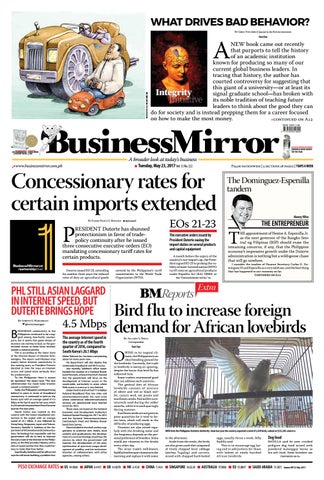
What drives bad behavior? By Greg Navarro | Special to the Businessmirror
Nuvolanevicata | Dreamstime.com
A
media partner of the year
United nations
2015 environmental Media Award leadership award 2008
Part One
new book came out recently that purports to tell the history of an academic institution known for producing so many of our current global business leaders. In tracing that history, the author has courted controversy for suggesting that this giant of a university—or at least its signal graduate school—has broken with its noble tradition of teaching future leaders to think about the good they can do for society and is instead prepping them for a career focused on how to make the most money. »continued on A12
BusinessMirror A broader look at today’s business
www.businessmirror.com.ph
n
Tuesday, May 23, 2017 Vol. 12 No. 222
2016 ejap journalism awards
business news source of the year
P25.00 nationwide | 5 sections 28 pages | 7 days a week
Concessionary rates for certain imports extended EOs 21-23 P T
The Dominguez-Espenilla tandem
By Elijah Felice E. Rosales
@alyasjah
resident Duterte has shunned protectionism in favor of tradepolicy continuity after he issued three consecutive executive orders (EO) mandating concessionary tariff rates for certain products. Duterte issued EO 23, extending for another three years the reduced rates of duty on agricultural goods
PHL STILL ASIAN LAGGARD IN INTERNET SPEED, BUT DUTERTE BRINGS HOPE 4.5 Mbps B By Lorenz S. Marasigan @lorenzmarasigan
roadband connectivity in the Philippines continued to be a laggard among Asia-Pacific counterparts, but it seems that green shoots of recovery are starting to bud, as the government moves to make faster Internet speeds a national priority. This is according to the latest State of the Internet Report of Akamai Technologies. The report said Filipinos may expect better Internet connectivity in the coming years, as President Duterte decided to take the issue on Internet access and speed more seriously than his predecessors. “In the Philippines there is reason for optimism,” the report read. “The new administration has made faster Internet speeds a national priority.” Sadly, the Philippines continued to lag behind its peers in terms of broadband connectivity. It continued to land on the lowest spot with an average speed of 4.5 Mbps in the fourth quarter last year, which is a 44-percent improvement from the same quarter the year prior. South Korea was named as the country with the fastest broadband connection in the region with an average speed of 26.1 Mbps. It was followed by Hong Kong, Singapore, Japan and Taiwan. Secretary Rodolfo A. Salalima of the Department of Information and Communications Technology has repeatedly said the government will do its best to improve the sorry state of the Internet in the Philippines, as the Web provides Filipinos with a slew of opportunities that they could harness to make their lives better. Specifically, Salalima said he will cut red tape for cell-tower building, a problem that
The average Internet speed in the country as of the fourth quarter of 2016, compared to South Korea’s 26.1 Mbps
Globe Telecom Inc. has been complaining about for many years now. His department will also deploy free nationwide broadband and Wi-fi access. Just recently, Salalima’s office spearheaded the creation of a National Broadband Network, whose initial draft showed that the government will focus on the development of Internet access in the countryside, particularly in areas where Web access is scarce or is very limited. Under the first draft of the P77.9-billion National Broadband Plan, key cities and provinces—particularly the rural areas where commercial telecommunications services are absent—will have Internet access by 2022. These areas are based on the National Economic and Development Authority’s National Spatial Strategy for 2017 to 2022 and the National Telecommunications Commission’s Fixed and Wireless Broadband Data Survey. Also included in the draft are key suggestions to promote new media, local content and applications; the development of a rural technology road map; the process by which the government will monitor the development of the plan; optimization of spectrum usage; development of satellite; and the institutionalization of collaborations with other agencies, among others.
PESO exchange rates n US 49.9060
covered by the Philippines’s tariff commitments to the World Trade Organization (WTO).
The executive orders issued by President Duterte easing the import duties on several products and capital equipment
A month before the expiry of the country’s rice-import cap, the President signed EO 23 to prolong the validity of most-favored nation (MFN) tariff rates on agricultural products under Republic Act (RA) 10863, or See “Concessionary rates,” A2
Manny Villar
THE ENTREPRENEUR
he appointment of Nestor A. Espenilla Jr. as the next governor of the Bangko Sentral ng Pilipinas (BSP) should erase the remaining concerns, if any, that the Philippine economy’s impressive growth under the Duterte administration is nothing but a wild-goose chase that will go nowhere.
I consider the tandem of Finance Secretary Carlos G. Dominguez III and Espenilla as a very solid one, and the best thing that has happened to our economy so far. Continued on A10
BMReports
Bird flu to increase foreign demand for African lovebirds By Alladin S. Diega Correspondent
O
Part Two
WING to its tropical climate, the Philippines is an ideal breeding ground for the lovebirds. Currently, the trade in lovebirds is seeing an upswing, despite the havoc that bird flu has subjected Asia. Some traders recommend good diet can address such concerns. The general diet of African lovebirds consists of mixture of white and red or black millet, canary seed, oat groats and sunflower seeds. Red millet is extensively used during the colder months, while it is used sparingly during summer. Sunflower seeds are not given in great quantities for it tend to fatten hens, which will result in the difficulty of producing eggs. Vitamins are also mixed regularly with the drinking water and the frequency depends on the personal preference of breeders. Some would put vitamins in the drinks every other day. The avian trade’s well-known Badilla brothers put vitamins in the morning and replace it with water
Data from the Philippine Statistics Authority show last year the country exported a total of 2,819 birds, valued at $212,303. NONIE REYES
in the afternoon. Aside from the seeds, the birds are also given a soft diet composed of finely chopped local cabbage ( pechay Tagalog ) and carrots, mixed with chopped hard-boiled
eggs, usually thrice a week, Billy Badilla said. This is to encourage egg laying and to add protein for those with babies or newly hatched African lovebirds.
Dog food
BADILLA said he uses crushed pedigree dog food mixed with powdered malunggay leaves as his soft food. Some breeders use Continued on A2
n japan 0.4495 n UK 64.8578 n HK 6.4128 n CHINA 7.2464 n singapore 36.0228 n australia 37.1800 n EU 55.8847 n SAUDI arabia 13.3072
Source: BSP (22 May 2017 )
A2 Tuesday, May 23, 2017
BMReports BusinessMirror
www.businessmirror.com.ph
Bird flu to increase foreign demand for African lovebirds Continued from A1
commercially available egg-food. Other breeders use the commonly available chick booster for pairs with chicks. As a source of calcium, dried cuttlefish bones are put in the cage. Generally, poo trays are cleaned at least once a week. Bird droppings in the wires of the cage are regularly removed to prevent rusting. An ideal aviary should also be secure enough against the entry of rats and cats. It should also be clean enough to discourage ants that could kill newly hatched birds. The birds usually mature and get ready to mate upon reaching eight months. This, however, is also usually the time for molting, or shedding of old feathers. Hence, ,the ideal age is usually between nine and 10 months. Younger birds forced to mate sometimes result in egg-bind in hens, or a hen unable to pass an egg, which is usually fatal in the long run. Chicks are usually ready to be separated from parents at three
We already have foreign offers for the Duns [Fischer], but we’re not releasing anytime soon because we do not want to rig the current price of the ‘pale’ fallow, which will greatly affect new breeders venturing into this expensive mutations.” —Badilla months, then into a bigger cage, or flight cage, for physical development. Maturing birds are usually put in a cage with a pairing box, to encourage natural pairing from the birds. Left alone, lovebirds would naturally look for their mates. But it is common practice also by breeders to force a pairing, especially between sought-after color combinations. Diseases are usually detected by observing runny eyes or noses, and appropriate
medications are usually available in pet shops. Normally, new breeders could ask breeders with longer experience for general advice.
From hobby to business
DATA from the Philippine Statistics Authority (PSA) show that last year ,the country exported a total of 2,819 of birds, which include parrots and related birds such as cockatoos, lorikeets, lories, macaws and parakeets, excluding breeding
fowls. The exports were valued at $212,303 (P10.56 million at current rates). Major buyers were the US, which bought 1,350 birds; Pakistan, with 540; and Taiwan with 146; Japan, Thailand, Indonesia, Tunisia, Germany and the Czech Republic bought fewer. Asked why Thailand, a known breeder of tropical birds, would be buying parrots from the Philippines, breeder Rogelio L. Sicat Jr. said not only Thailand, but even Indonesia, has also purchased lovebirds from the Philippines in previous years because the two countries cannot cope with their own orders from other countries. “Last month an Indonesian trader has approached us inquiring if we can produce enough birds they need, as they are expecting that many more would inquire because of the raging bird flu in Asia,” Sicat said. He added he declined the offer because his group of African lovebirds breeders based in Cainta, Rizal, is just starting and
are more of hobbyists. Sicat, however, cautioned those who want to venture into African lovebirdss breeding to buy their first pairs from reputable breeders to ensure the quality of the birds. Serious breeders ensure that their birds remain “pure” and not hybrids, or birds produced from pairing different species, like Fischer mated with Masked, or eye-ring mated with non eye-ring. The resulting birds from these pairing produce dull-colored birds and, sometimes, incapable of producing offspring.
Therapy
BADILLA said he started breeding African lovebirds in 2002, shortly after learning he had urinary bladder cancer. He was told he had only two years to live. While undergoing chemotherapy, he also ventured into lovebird breeding, buying top-of-the-line mutation at the time as a form of emotional therapy. After five years
of “combined therapy”, he was declared cured of the cancer. Badilla’s hobby has also become a highly profitable business. Now assisted by his brother Bob, Badilla Aviary has a regular contract to export birds to Dubai, Bahrain and the US. According to Bob, they are now breeding “fallows”, currently the most expensive mutation. The “pale fallow”, now commands P90,000 to P110,000 a bird in the market. Aside from Badilla, there are only a handful of other breeders who have enough breeding pairs. The brothers have several pairs of “Dun Fallows”, the more expensive variety that costs between 300,000 and P400,000 per bird. “We already have foreign offers for the Duns [Fischer], but we’re not releasing anytime soon because we do not want to rig the current price of the ‘pale’ fallow, which will greatly affect new breeders venturing into this expensive mutations,” Bob told the BusinessMirror. To be concluded
Concessionary rates for certain imports extended Continued from A1
the Customs Modernization and Tariff Act. The Philippines’s waiver on the special treatment of rice is set to expire on June 30. One of the concessions approved by EO 23 was the lowered tariff on mechanically deboned meat, which would remain at 5 percent until 2020 before reverting to its original rate of 40 percent in 2021. Tariff on butter was kept at 5 percent for another three years. Buttermilk, along with grated
and powdered cheese, is slapped a mere 1-percent duty. Exporters of potato, on the other hand, will enjoy tariff-free privilege in the Philippines before a 10-percent rate of duty is imposed in 2021. The Philippines will also continue to comply with its minimum access volume commitments of 805,200 metric tons on rice per year, with a lower tariff of 35 percent. In 2021 rice imports will be slapped with a higher tariff of 40 percent, as stated by EO 23. The temporary modification of MFN tariff rates is effective un-
til June 30, 2020, or until such time a law amending certain provisions relating to rice in RA 8178, or the Agricultural Tariffication Act, is enacted, whichever comes first. The Philippines in April has informed the WTO it was not able to convert its quantitative restriction (QR) on rice into tariff, citing delay in the amendment of RA 8178. Agriculture Undersecretary for Policy and Planning Segfredo R. Serrano said there are bills already filed in Congress to amend RA 8178, but lawmakers are not poised to pass it into legisla-
tion before the QR on rice lapses on June 30. “As a gesture of goodwill and to avoid disputes, the Philippines would maintain the concessions, while RA 8178 has not yet been amended,” Serrano said. According to Serrano, amending RA 8178 is necessary to allow the conversion of the QR on rice into tariff. He noted that under the law, rice is the only agricultural commodity with an import cap and it did not specify a termination date for it. In 2014 the Philippines was
granted by the WTO a waiver on the special treatment on rice, allowing the country to keep its QR on rice until June 30. EO 23 repeals EO 190, Series of 2015, which listed the concessions the Philippines have to honor for it to continue implementing its riceimport cap. Concessions charted under EO 190 will expire on July 1.
Capital equipment
To support enterprises in their start-up operations and expansion, Duterte has adhered to the recommendation of the Nation-
al Economic and Development Authority to extend the zeropercent duty on principal assets imported by firms registered with the Board of Investments (BOI). Through EO 22, “any import at ion of capit a l equ ipment, spare parts and accessories by BOI-registered enterprises shall be subjected to zero -percent duty”. The President approved the extension of the tariff-free importation to enhance competitiveness within the business industry, in line with one of the goals of the Philippine Development Plan (PDP) 2017-2022. The zero-percent duty is applied to importations made by new and expanding firms under the BOI of principal assets indicated in R A 10863. Upon issuance by the BOI of a certificate of authority, the business enterprise can already import tariff-free capital equipment, spare parts and accessories. This is as long as the items “are not manufactured domestically in sufficient quantity, of comparable quality and at reasonable prices; and are reasonably needed and will be used exclusively by the enterprise in its registered activity”. On the other hand, the BOIregistered enterprise cannot sell, transfer or dispose of the principal assets, without prior approval from the BOI, within five years from the date of its purchase. Should it pursue to do so, the firm will be sanctioned twice the amount of the duty forgone, or P500,000, whichever is higher, without prejudice to other applicable penalties under the law. The BOI is tasked to draft and publicize the implementing rules and regulations of EO 22. “The grant of duty-free importation of capital equipment remains to be an important fiscal incentive in promoting investments into the Philippines considering the global competition for foreign direct investments,” EO 22 read. It added that PDP 2017-2022 clearly stated t he ad m i n ist rat ion’s goa l of reaching an efficient national competition policy.
IT products
The President also issued EO 21 modifying the “nomenclature and the rates of import duty on certain information-technology [IT] products under Section 1611 of the Customs Modernization and Tariff Act, in order to implement the Philippines’s tariff commitments under the WTO”. Malacañang has yet to release the annex on the covered IT products.
news@businessmirror.com.ph
The Nation BusinessMirror
Church leaders worldwide seek release of IFI bishop By Marvyn N. Benaning Correspondent
F
AITH-BASED institutions and human-rights advocates worldwide have called for the immediate release of Iglesia Filipino Independiente (IFI) Bishop Carlo Morales. On May 11 Army soldiers belonging to the 102nd Infantry Battalion manning a checkpoint in Gango, Ozamiz City, took into custody Morales, Rommel Salinas, Morales’s wife Maria Teofilina and IFI driver Isadome Dalid. The four were taken to the Ozamiz City Police Station. They were allegedly held incommunicado. On May 12 Salinas and Morales were charged with illegal possession of firearms and explosives, while the two others were released. In separate letters to President Duterte, the World Council of Churches (WCC), the Christian Conference of Asia (CCA) and the United Church of Canada (UCC) called for the release of Morales. “We consider that the arrest and detention of a religious and spiritual leader, like Bishop Morales, is appalling and a violation of human rights. We urge the authorities in the Philippines to release Bishop Morales immediately,” CCA General Secretary Matthews George Chunakara said. Patti Talbot, team leader of
the Church in Mission Unit of the UCC, said “it is especially offensive that this be accorded to a person who is a religious leader— a Bishop who has an obligation to provide protection or sanctuary to a person who is in distress or politically persecuted”. Upon the initiative of the International Coalition for Human Rights in the Philippines (ICHRP) in the US, numerous religious leaders in the US, known American human-rights advocates, such as former US Attorney General Ramsey Clark, and staunch US activists, like Frank Chapman, Bill Fletcher Jr., Azadeh Shahshahani, Joe Iosbaker, Sara Flounders and John Parker, called for the release of Morales, Salinas and all political prisoners in the Philippines. Salinas, an alleged National Democratic Front (NDF) consultant in the peace talks with the government, was arrested with Morales. “The ICHRP network in the US not only finds that arrest of Bishop Morales and Salinas in violation of international law and agreements signed between the Philippine government and the NDF. The network appeals to you, Mr. President, that you cause the immediate and unconditional release of Bishop Carlo Morales and Rommel Salinas and all political prisoners,” they said in a letter sent to Duterte last week.
No plan to acquire more SSVs for Navy–DND
T
HE acquisition of additional strategic sealift vessels (SSVs) for the Navy will depend on the prevailing security environment in the future. This was stressed by the Department of National Defense (DND) Public Affairs Office chief, Arsenio Andolong, when asked by the Philippines News Agency on whet her t here are plans to acquire additional SSVs for the Navy. “At the moment, there are no plans to acquire a third SSV. Our modernization plan, which is based on the Navy’s doctrine, only provides for two,” he added. “Perhaps, we will consider it in the future when our security environment will require it,” Andolong added. The Navy has two SSVs now— BRP Tarlac (LD-601) and BRP Davao del Sur (LD-602), which is scheduled to be commissioned on May 31. The BRP Davao del Sur arrived at the Manila South Harbor on May 8 from the PT PAL (Persero) shipyard in Surabaya, Indonesia. It took the ship four days to reach Manila. She was named after the province of Davao del Sur, the home of the country’s highest peak, Mount Apo, and other rare species of flora and fauna. “It gives due recognition to the province as a sanctuary of natural wonders and rarities, like the country’s highest peak Mount Apo, the most prized Philippine orchid vanda sanderiana, and the endangered Philippine Eagle,” the Navy Spokesman Capt. Lued Lincuna said. Also, the SSV’s name takes inspiration from a former Navy ship vessel of the same name notable for its accomplishments during during the 1980s. “Naming the vessel after Davao del Sur is consistent with its predecessor, BRP Tarlac [LD-601], which was also named after a province,”
Editor: Dionisio L. Pelayo • Tuesday, May 23, 2017 A3
Trust Duterte to deal with China–Cayetano
F
By Recto L. Mercene
@rectomercene
OREIGN Affairs Secretary Alan Peter S. Cayetano on Monday said the people should trust President Duterte in his dealings with the Chinese, saying running the ship [of state] does not require many captains.
“What I’m saying is that ‘you to trust the captain of the ship, hindi puwedeng maraming kapitan [there shouldn’t be many captains]’,” he said in a news briefing before leaving to accompany the President on his official visit to Russia on Monday. “What we will give you is one, we will not compromise and two, we will not give up our claims. We are working on the framework of the Philippine constitution, international treaties and local laws.” Cayetano’s hurriedly called news conference was meant to defend Duterte from being accused of not standing up to China when the latter told him in a meeting in Beijing that China would go to war if the Philippine side insists on drilling for oil in the disputed areas in the West Philippine Sea. Saying he is not at liberty to divulge the restricted meeting between Dutere and President Xi Jinping, Cayetano, however, revealed “the talk was about how to avoid conflict, how to have to mutual respect.” “ There was no language or even tone that would lead any of the presidents to believe that there were no disrespect for them or their countries.” He added that the tenor of the
talks “was very friendly, very refreshing and, in fact, both sides of the meeting went out satisfied that the dialogue will produce results.” Duterte met Xi when the former attended a signing ceremony following their bilateral meeting held on the sidelines of the Belt and Road Forum for International Cooperation at the Great Hall of the People in Beijing. Cayetano justified that it is natural to mention the word “war” if parties are discussing about peace and conflict. “I’m not denying the President’s speech,” he said, “but said the context of the talk is ‘how we start the dialogue’ and internal and external peace, national security and stability is part of the core belief of the program of President Duterte, [and] this is his campaign promise and the goal of the President.” According to Cayetano, Duterte was forced to respond because he is being barraged by comments on what he should do with regard to the statement about the Asean, where to file the protest and where to send the Navy. “Of course, if every day, for more than a week, he has people criticizing or telling him to do something else, he will have to give some kind of response.”
“What I’m saying is that ‘you to trust the kapitan of the ship, hindi puwedeng maraming caption [there shouldn’t be many captains].’”
He was probably referring to former Foreign Affairs Secretary Albert del Rosario, who said in a televised interview that “China’s threat of war to the Philippines over the South China Sea dispute shows that Beijing does not intend to respect the rule of law unless it benefits from it”. Del Rosarion said, “China’s warning recently issued to President Rodrigo Duterte contradicted the Philippines’s adherence to the arbitral ruling over the disputed waters. “Contrary to our position that right is might, China has strongly declared that it is might that will trump what is right. And finally that China—unless it stands to benefit— does not intend to respect the rule of law.” The July 2016 Permanent Court of Arbitration ruling had invalidated China’s nine-dash line claim over nearly all of the resource-rich waters, favoring the Philippines’s plea to halt Chinese incursions into its exclusive economic zone (EEZ). China has defied the ruling, and has instead stepped up militarization and island-building activities in the area. On the other hand, former Ambassador Jose Apolinario Lozada said: “China acted like a ‘bully’ when it threatened the Philip-
pines with war over the South China Sea dispute.” He said he was discouraged and disturbed with Beijing’s recent warning, saying it should have asked Manila to discuss the issue instead. “I’m disturbed, I’m deeply disturbed with the statement that was told to us by the President when they [Chinese leaders] said they are going to war with us simply because we are going to insist on our claims over the islands, which we have been claiming ever since,” Lozada added. Cayetano, on the other hand, said Duterte “told me many times that he’s committed to protecting our territorial integrity, he will protect every single inch of our territory. But trust him on how he will do it, how he will approach it and the strategy.” Cayetano said in his view, Duterte is consistent with his response repeated several times before: “I don’t not want to go to war not because he’s afraid of anyone, but because many people will suffer in not only in that area but the whole of Luzon, the Visayas and Mindanao, including the whole [Asian] region.” He added that since Duterte is this year’s Asean chairman, “he is already thinking of next generation, that’s why he had the build, build, build and the bilateral consultative meeting”. “We can’t be so naïve but we also can’t be so paranoid,” he added, saying a review of China’s history would reveal they have many boundary disputes because they’re big “but some of these where settled”. He cited as example the maritime disputes between Malaysia and Brunei Darussalam, which they were able to settle amicably “and now profit from the resources there”. He also cited the peaceful settlement of maritime dispute between Singapore and Malaysia.
Pinoys in US remember Bataan, Corregidor
I
Lincuna added. The ship was launched on September 29 last year. She is the sister ship of the BRP Tarlac (LD-601), currently the largest Filipino warship in-service. BRP Tarlac was commissioned in short ceremonies at Pier 13, Manila South Harbor on June 1. BRP Davao del Sur’s delivery completed the two-unit SSV procurement project with an approved budget contract of P4 billion sourced from the Armed Forces Modernization Act Trust Fund. Just like BRP Tarlac, BRP Davao del Sur will serve as a floating command-and-control ship, especially in the conduct of humanitarian assistance and disaster response and will also serve as a military sealift and transport vessel. The ship has an overall length of 120 meters, breadth of 21 meters, draft of 5 meters and can carry a payload of 2,800 tons. She has a cruising speed of 13 knots and maximum speed of 16 knots and a minimum operating range of 7,500 nautical miles. She can carry 500 troops, two rigid-hull inflatable boats, two landing craft units and three helicopters. The ship’s motto is “Nos Inveniam Viam”, or “We shall find a way”. PNA
N commemoration of the 75th anniversary of the surrenders of Bataan and Corregidor in April and May 1942, the US-Philippines Society, in cooperation with the Philippine Embassy in Washington, organized a panel discussion about the challenges faced by Filipino and American soldiers during World War II, and a presentation of the special edition book, Cadet, Soldier, Guerilla Fighter: Remembering Bataan and Corregidor by Antonio Nieva, at the Romulo Hall of the Philippine Embassy late last week. Pepi Nieva, editor of the book and daughter of Antonio Nieva, led the distinguished panel of speakers along with Filipino Veterans Recognition and Education Project (FilVetRep) Regional Director Sonny Busa, and US-Philippines Society Executive Director Hank Hendrickson. FilVetRep Executive Secretary Jon Melegrito also joined the panel. “This evening we remember our heroes, honor their achievements, dedication and courage, and recognize and thank their sacrifices,” said Minister Patrick A. Chuasoto, chargé d’affaires ad interim of the Philippine Embassy in his opening remarks. “These heroes were called to be part of something bigger than themselves. Many of our Filipino soldiers during that time didn’t ask to leave their homes to fight on distant battlefields. Some were ordinary folk who responded in extraordinary ways during that extraordinar y time. They answered the call of a nation that yearned for a path to freedom, liberty, and independence,” Chuasoto added. Cadet, Soldier, Guerilla Fighter: Remembering Bataan and Corregidor follows the exploits of a young Filipino soldier, Antonio Nieva, who joined the United States Armed Forces of the Far East (Usaffe),
FILIPINO Veterans Recognition and Education Project (FilVetRep) Executive Secretary Jon Melegrito speaks while (from left) FilVetRep Regional Director Sonny Busa; the editor of Cadet, Soldier, Guerilla Fighter: Remembering Bataan and Corregidor, Pepi Nieva; and USPhilippines Society Executive Director Hank Hendrickson listen during in the panel discussion and book presentation held to commemorate the 75th anniversary of the surrenders of Bataan and Corregidor at the Philippine Embassy in Washington.
survived the Bataan Death March, and served as an intelligence officer of a Filipino guerrilla unit during the Japanese occupation of the Philippines. “While there have been a lot of accounts of the Death March from survivors, most of them were from US soldiers. This book is from the Filipino perspective, it has a different viewpoint in many cases, but it celebrates the collaboration between the Philippines and the United States,” Pepi Nieva said in presenting the
book to the audience. Together with her sister, Ronie, they read and narrated several excerpts from the book, reliving their father’s experiences as a Filipino soldier during World War II. Guests were also treated to original war drawings and illustrations made by their father Antonio Nieva. “Out of the 66,000 soldiers in the Death March, 56,000 are Filipinos, and out of the 10,000 who perished, 9,000 were Filipinos,” Busa said.
“Through the story of Antonio Nieva, Americans will now understand very clearly how Filipinos persevered on the battlefields and as guerillas in the jungles to stand up for a shared cause,” Hendrickson added. Panelists also fielded questions about the book, and the Filipino Veterans of World War II Congressional Gold Medal Act of 2015 before Melegrito provided the closing remarks and summary of the discussions. Recto Mercene
Economy
A4 Tuesday, May 23, 2017 • Editors: Vittorio V. Vitug and Max V. de Leon
BusinessMirror
news@businessmirror.com.ph
ERC told to keep track of system losses By Butch Fernandez
T
@butchfBM & Lenie Lectura
@llectura
he Senate Committee on Energy is pressing the Energy Regulatory Commission (ERC) to closely track down the systemloss program to encourage powersupply stakeholders to stick to "more efficient processes" that would benefit consumers down the line.
At the same time, Sen. Sherwin T. Gatchalian, committee chairman, prodded ERC officials to prioritize assessment of the program and facilitate early implementation of new system-loss caps to reduce charges private distribution utilities and electric cooperatives pass
on to their consumers. Gatchalian said the ERC should install “a regular mechanism that will study the system loss every so often”, pointing out the wide gap in between the ongoing review of the program and the last ERC regulation of the recoverable system-loss
charges, dating back to 2008. Noting that the last caps were still in the 2008 levels, the senator insisted that the ERC should review the program at shorter inter vals, obser ving that the utilities “are now more efficient in power generation and distribution because they are already equipped and very knowledgeable on how to reduce their system losses”. In t u r n, ERC of f ic i a ls informed members of the Senate Energy Committee that an assessment of the system-loss program is ongoing, also reporting that the ERC is set to hold “public consultations and group discussions on proposed new caps submitted by a third party that reviewed documentary submissions of distribution utilities and electric cooperatives”. The senators were told that new
Apec ministers finalizing RCEP in Hanoi
T
rade m i n i s t e r s f rom the A sia-Pacific reg ion were meeting in Hanoi on Monday to speed up negotiations seeking to finalize a regional trade pact amid fears of growing trade protectionism. Negotiations for the 16-member Regional Comprehensive Economic Partnership (RCEP) led by China started four years ago, and members are seeking to finalize the agreement by the end of the year. “We are at this stage where it has become important to all of us to show political willingness to move our discussions forward, especially in light of the trends in some parts of the world where a return of protectionism is being considered,” Trade Secretary Ramon M. Lopez told fellow trade ministers. “We are here today to help push the negotiations forward by insert-
ing the political will to break the remaining challenges,” he said. “Our presence here today sends a strong message of our commitment and drive toward reaching substantial conclusion of negotiations hopefully by year-end.” Monday’s meeting took place at a time when 11 remaining members of the Trans-Pacific Partnership (TPP) committed to move ahead without the United States. President Donald Trump withdrew the United States from the TPP days after taking office in January, fulfilling one of campaign promises. Trump preferred bilateral free-trade agreements instead of multilateral deals, which he claimed stole American jobs. With the TPP without US participation, RCEP would be the world's largest free regional trade pact, even though it has fewer requirements compared with TPP in
terms of labor rights, intellectual property rights and environmental protection. RCEP, which includes 10 members of Asean and their partners, including Australia, China, India, Japan, South Korea and New Zealand, is seen as an alternative to the TPP. Speaking at the meeting on Monday, Vietnamese Minister of Industry and Trade Tran Tuan Anh said RCEP can show the world that free trade is possible even amid growing trade protectionism. “In the context that protectionism is emerging in a number of major economies in the world, we believe that the conclusion of the RCEP agreement negotiation will convey a clear and consistent message of the opening up and economic integration enhancing policy of the countries in the region,” he said. AP
3 new power projects get DOE’s green light
T
HE Department of Energy (DOE) has cleared three power projects for the conduct of a grid-impact study. The proposed projects could generate a total of 1,880 megawatts (MW) of installed power capacity. A clearance for the conduct of a grid impact study is necessary for a power firm before it can proceed with the construction of its power project.
Based on the agency’s latest list as of April 2017, the power projects that received the green light from the DOE are Ecoglobal Inc.’s 30-MW solar plant in Zamboanga City, the 650-MW pumped storage units of Olympia Violago Water and Power Inc. in Antipolo and Rizal, and the 1,200-MW coal plant of Orion Prime Pacific Energy Inc. in Tagkawayan, Quezon. The power project of Ecoglobal
received the DOE’s green light for the conduct of the study on April 21. Meanwhile, the hydro power projects of Olympia all received the DOE’s go signal on April 24. The conduct of a GIS for Orion Prime’s power project was approved by the DOE on April 26. All proposed projects from January to April this year could generate a total of 4,110.53 MW of installed power capacity. Lenie Lectura
caps, once approved, are set to take effect in 2019, for private distribution utilities; and in 2020, for electric cooperatives. ERC officials, likewise, reported the next scheduled ERC assessment will be held after four years for private utilities and six years for rural cooperatives, but Gatchalian griped this was not acceptable. “I find this too long.” Gatchalian added: “It is only 2017, that’s two more years. There must be a way that the caps can be changed more regularly. Remember that a day saved is a day of advantage to the consumers. Consumers should not continue to be burdened with a high cost of system inefficiency.” To address the problem, he authored Senate Bill 1188 aimed at reducing existing system-loss cap for private distribution utilities to 5 percent (from 8.5 percent), and
There must be a way that the caps can be changed more regularly. Remember that a day saved is a day of advantage to the consumers. Consumers should not continue to be burdened with a high cost of system inefficiency.” —Gatchalian to 10 percent (from 13 percent) for electric cooperatives. The Gatchalian bill also provides exemption of system-loss charges from valueadded tax. Noting that Meralco has maintained a system-loss charge of 6.5 percent, Gatchalian said lowering this to 5 percent can possibly reduce the current cost of electricity
by 12 centavos per kilowatt-hour, or consumer savings of approximately P3.38 billion per year. Also, lowering the system- loss cap for the worst-performing electric cooperatives will lead to reduced costs of 26 centavos per kWh, or annual savings of P2.8 billion for consumers in covered jurisdictions.
ISAAA: Surplus, exports possible with Bt corn By Jasper Emmanuel Y. Arcalas @jearcalas
T
he Philippines has the potential to become the top exporter of corn in Asean, especially if more Filipino farmers would plant Bacillus thuringiensis (Bt) corn to expand their output, according to international experts. The International Service for the Acquisition of Agri Biotech Applications (ISAAA) told the BusinessMirror that planting more Bt corn would allow the Philippines to have a corn surplus, which it could export to neighboring Asian countries. “Many Asian countries are short of corn and the Philippines could supply their requirement,” Dr. Paul S. Teng, ISAAA board of trustees chairman, said on the sidelines of a news briefing on the global status of genetically modified (GM) crops in 2016, held recently in Alabang. “Malaysia imports corn, Indonesia imports corn, so these countries would look for possible sources. Only the Philippines plants Bt corn in this region and it has a good history of
growing corn, so I think it could become an exporter,” Teng added. He also noted that the cost of shipping from the Philippines is much lower. Based on the report of the ISAAA, titled “Global Status of Commercialized Biotech/GM Crops in 2016”, the total hectarage planted with Bt corn in the Philippines reached 812,000 hectares, making the country the 12th-biggest producer of GM crops in the world. The figure was 16 percent higher than the 702,000 hectares recorded in 2015. “The increase is due to favorable weather conditions, and high local demand for livestock and feed stocks,” ISAAA said. ISAAA also reported that the adoption rate of Bt corn by Filipino farmers increased to 65 percent in 2016, from 63 percent in 2014. This means that out of the total 1.248 million hectares planted with corn, 812,000 hectares were of Bt seed varieties. Out of the planted hectarage, 679 hectares were planted with stack traits corn, while the remaining 133,000 hectares were planted with
single trait corn. “In 2003 the area for Bt corn did not even reach 50,000 hectares, and now we are talking about 800,000 hectares. We have yet to receive reports that Bt maize has done harm or caused ailment,” Bureau of Plant Industry OIC Director Dr. Vivencio R. Mamaril said. “The mere fact that planting area grew to 800,000 hectares is proof that it is a successful crop and farmers believed in it,” Mamaril added. The ISAAA report noted that Filipino farmers earned an estimated $642 million from planting GM corn in 2003 to 2015. In 2015 alone, farmers recorded earnings of $82 million. The number of small resourcepoor farmers, growing on average 2 hectares of biotech maize in the Philippines in 2016, was estimated at 406,000, up from 350,000 in 2015. Biotech maize is the only GM crop commercialized in the Philippines. Since the approval of Bt maize in 2003, a total of 6.03 million hectares have been planted with the GM crop, according to the estimates of ISAAA.
Former lawyer faces arrest for falsification of public documents in Uniwide Sales case
T
he Metropolitan Trial Court of Manila Branch 12 has issued a warrant for the arrest of disbarred lawyer Bede Tabalingcos, after the Manila Prosecutor’s Office found probable cause to indict the former lawyer for the crime of falsification of public documents and use of falsified documents. In a recently issued resolution, Assistant City Prosecutor Nestle A. Go declared that, upon thorough evaluation of the complaint filed by Uniwide Sales Warehouse Club Inc. (USWCI) Chairman Jimmy Gow, she found sufficient reason to engender a well-founded belief that probable cause exists for the crime charged of falsification of public documents and use of falsified documents against Tabalingcos. The resolution, which was approved by City Prosecutor Edward M. Togonon, further stressed that the prosecutors’ conclusion was bolstered by the existence of falsified signatures, as supported by certifications confirming the falcity, in the documents
submitted by the complainant on the respondent’s alleged unauthorized filing of a petition for review before the Court of Appeals (CA) in behalf of Woodworth Realty Co Inc., in civil case Woodworth Realty Co. Inc. et al. vs SEC docketed as CA-GR SP 130730. According to the resolution, complainant, being an aggrieved party, also filed a petition for review with the CA questioning the decision of the Securities and Exchange Commission (SEC) in dissolving and liquidating five corporations when what petitioners filed was for suspensions of payments and rehabilitation of their corporate assets in USWCI vs SEC, docketed as CA-GR SP 130736. Also, on April 13, 2016, complainant received a resolution from the CA in CA-GR SP 130736, dismissing its petition on the ground for forumshopping due to the earlier filing by Tabalingcos of a similar petition for review in CA-GR SP 130730, which has already been dismissed. Since the documents allegedly
falsified by the respondent, like the Special Power of Attorney and Secretary’s Certificate, have been duly notarized and the petition for review was submitted before the CA, these documents are classified as public documents. It therefore necessarily follows that their falsification constitutes violation of public trust and the falsifier should be held accountable therefore, the resolution said. Although it was not the signature of the complainant that was falsified by respondent, his interests had been adversely affected by such falsification, since the filing of an unathorized petition (CA GR SP 130730) by respondent before the CA and the subsequent dismissal of complainant’s petition for review (CA GR SP. 130736) on the ground of forum-shopping greatly prejudiced the personal and business interests of complainant, the resolution further said. Respondent was disbarred by the Supreme Court and his name stricken off from the Roll of Attorneys in 2012.
DTI eyes 8 Go Lokal! stores, 100 SME partners this year
T
he Department of Trade and Industry (DTI) is aiming to put up eight “Go Lokal!” stores, which are rent-free spaces for small and medium enterprises (SMEs) to be positioned in major malls this year. With the expansion of the DTI’s SME market-access initiative, the Go Lokal! concept store, the agency is aiming to accredit as much as 100
SMEs by year-end. “I was hoping to have five to eight stores this year, hopefully. CityMall [jointly operated by DoubleDragon Properties and SM Group] committed 30 stores, since they’re aiming to have 100 malls by 2020,” Lopez said at the opening of the second Go Lokal! store in SM Makati. The Go Lokal! store is a program
of the DTI, in partnership with large retail establishments, to help SMEs market their products in rent-free spaces with high foot traffic. It has already partnered with the SM Group for the SM Makati branch, and with Robinsons for another site in Ermita. A Go Lokal! store has also been set up in Enchanted Kingdom.
Catherine N. Pillas
news@businessmirror.com.ph
AseanTuesday BusinessMirror
Editor: Max V. de Leon • Tuesday, May 23, 2017 A5
3 yrs after coup, Thai economy lags behind peers
O
nce prized in Southeast Asia for its economic strength, the new reality for Thailand three years after the military seized power is growth that’s lagging behind peers.
Growth challenge Expansion has picked up since the coup, but trails Southeast Asian neighbors, as well as central bank Governor Veerathai Santiprabhob’s estimate of Thai potential growth of 4 percent to 4.5 percent. A yearlong mourning period for the late King Bhumibol Adulyadej has curbed consumption. Rising trade protectionism poses an ongoing risk to the export-reliant economy.
The economy will expand 3.3 percent a year on average from 2017 to 2019, according to the World Bank, the weakest among eight developing Southeast Asian nations. The outlook is brighter elsewhere in the region as countries vie for investment: the Philippines is growing more than 6 percent a year, and Indonesia at a pace of about 5 percent. Thailand’s generals are trying to
speed up infrastructure projects— such as a $5.2-billion high-speed rail venture with China—while bolstering innovation and advanced industries to spur expansion. Each of these objectives remains a work in progress. The Bank of Thailand has kept monetary policy steady to build confidence in the outlook, and economists predict it will hold its benchmark rate near a record-low 1.5
Private-sector investment One obstacle for the economy is private-sector investment, which has been subdued for a prolonged period. Businesses have been reluctant to invest because of overcapacity and political uncertainty.
External demand After a prolonged slump, overseas shipments are recovering. The export industry makes up about 70 percent of GDP, and the Bank of Thailand expects a revival in the second half of the year to stimulate privatesector investment.
Monetary policy The central bank has left interest rates unchanged despite a bout of deflation. A lack of inflationary pressures signals the benchmark will stay at 1.5 percent through the third quarter of next year, according to a Bloomberg survey.
percent on Wednesday. Thailand has pursued prudent macroeconomic and fiscal policies amid rising global uncertainties, said Ulrich Zachau, the World Bank’s Bangkok-based Southeast Asia country director, in an interview. Delivering large infrastructure projects quickly and improving the quality of education and skills are among the major challenges, he said. The current stretch of military
rule is the longest since the early 1970s in a country that has endured about a dozen coups since putting an end to absolute monarchy in 1932. The promulgation of a new constitution in April set the stage for a return to some form of democracy next year. Here are six charts that help to summarize economic developments since the coup on May 22, 2014. Bloomberg News
Currency High foreign-exchange reserves and a trade surplus have burnished the appeal of baht-denominated financial assets, making the currency one of Asia’s best performers since the coup. The resilience is a risk to export competitiveness, prompting the central bank this year to curb the supply of short-term bonds. Infrastructure The big question for the military government’s infrastructure plan is how fast it can be implemented. The administration has unveiled 56 major infrastructure projects worth about 2.3 trillion baht ($67 billion) for 2016 and 2017, Bank of Ayudhya Pcl. research shows.
A8
The World BusinessMirror
Tuesday, May 23 2017
briefs N. Korea says ready to deploy, mass produce new missile
TOKYO—North Korea says it’s ready to deploy and start massproducing a new medium-range missile capable of reaching Japan and major US military bases there following a test launch it claims confirmed the missile’s combat readiness and is an “answer” to President Donald J. Trump’s policies. The solid-fuel Pukguksong-2 missile flew about 500 kilometers and reached a height of 560 km last Sunday, before plunging into the Pacific Ocean. North Korea’s media said more missiles will be launched in the future. Trump, traveling in Saudi Arabia, had no immediate public comment. AP
Ousted S. Korean president’s graft trial begins Tuesday
SEOUL, South Korea— Handcuffed, her inmate number 503 attached to her clothing, former South Korean President Park Geun-hye begins her corruption trial on Tuesday, in the same courtroom where a brutal dictator was sentenced to death two decades ago. Once the most powerful person in the country, Park will now face judgment over charges of extortion, bribery and abuse of power that could send her to jail for life. The hearing in room No. 417 of the Seoul Central District Court will be Park’s first public appearance since she was jailed in the early hours of March 31. Her arrest came weeks after she was removed from office in a ruling by the Constitutional Court, which upheld the December impeachment by lawmakers after massive street protests over the corruption allegations began last October. AP
China to detail its Antarctic ambitions at treaty meeting
BEIJING—Chinese officials will detail their growing ambitions in Antarctica on Monday, as Beijing hosts a meeting of nations that oversee management of the polar region, amid concerns over its susceptibility to climate change. Scientific research in Antarctica is governed under a 1959 treaty that designates the ice-capped continent as a natural reserve and prohibits commercial resources extraction. China signed on in 1983 and has since established four Antarctic research stations. It plans to start construction of an airfield later this year and a fifth research station as early as 2018. AP
Huge cuts to food stamps part of Trump’s budget proposal
WASHINGTON—President Donald J. Trump’s budget would drive millions of people off of food stamps, part of a new wave of spending cut proposals that already are getting panned by lawmakers in both parties on Capitol Hill. Trump’s blueprint for the 2018 budget year comes out on Tuesday. It includes a wave of cuts to benefit programs such as Medicaid, federal employee pensions, welfare benefits and farm subsidies. All told, according to people familiar with the plan, Trump’s budget includes $1.7 trillion over 10 years in cuts from such so-called mandatory programs. That includes cuts to pensions for federal workers and higher contributions toward those pension benefits, as well as cuts to refundable tax credits paid to the working poor. People familiar with the plan were not authorized to discuss it by name and requested anonymity. AP
www.businessmirror.com.ph
Trump reaches out to Sunni nations, at Iran’s expense
R
IYADH, Saudi Arabia—As voters in Iran danced in the streets, celebrating the landslide reelection of a moderate as president, President Donald J. Trump stood in front of a gathering of leaders from across the Muslim world and called on them to isolate a nation he said had “fueled the fires of sectarian conflict and terror”.
That nation was Iran. In using the headline address of his first foreign trip as president to declare his commitment to Sunni Arab nations, Trump signaled a return to an American policy built on alliances with Arab autocrats, regardless of their human-rights records or policies that sometimes undermine the US interests. At the same time, he rejected the path taken by his predecessor, Barack Obama. Obama engaged with Iran to reach a breakthrough nuclear accord, which Trump’s administration has acknowledged Iran is following. Trump has presented the shift as a reinvestment in historical alliances with friendly nations in order to fight extremism and terrorism. But the juxtaposition of the election in Iran and the gathering in Saudi Arabia seemed to highlight a reality of the Middle East that presidents have long wrestled with: How to choose partners and seek American interests in a region torn by sectarian splits and competing agendas. Iran and its proxies have effectively found themselves on the side of the US in fighting the Islamic State (IS) in Iraq, while in Syria, they have been adversaries in their support for the rule of President
Bashar al-Assad. Saudi Arabia has at times undermined the US efforts to stabilize Afghanistan. “We are picking one side in this geopolitical struggle, and there is ver y litt le room for gray,” said Frederic Wehrey, a senior fellow in the Middle East Program at the Carnegie Endowment for International Peace. “Sectarianism is a byproduct of this geopolitical rivalry, and we are inadvertently picking one side in this sectarian struggle.” The two scenes—dancing in the streets in Tehran and Sunni leaders gathered in an opulent hall in Riyadh—also pointed to a complicating reality in the Middle East: There is often a disconnect between the leaders and their people. In his remarks, Trump signaled his intention to end engagement with Iran, suggesting that it does not encourage change from inside the country. But in Iran, many were pushing for change. Emboldened by the election results, crowds of Iranians in the capital, Tehran, demanded what they hope President Hassan Rouhani’s second term will bring: the release of opposition figures, more freedom of thought and fewer restrictions on daily life.
Rouhani’s supporters also expect his victory, with 57 percent of the vote, to bolster his outreach efforts to the West and the pursuit of more foreign investment to lift Iran’s ailing economy. For those who voted for Rouhani, there was a feeling of tremendous relief that his challenger, the hard-line cleric Ebrahim Raisi, who criticized the nuclear deal with the US and other Western powers, had lost. “Bye-bye, Raisi,” the crowds chanted during the street gatherings. “He faces a difficult task,” Fazel Meybodi, a Shiite Muslim cleric from the city of Qom, said of Rouhani. “Now he must provide more freedoms, break the hardline monopoly on the state-run radio and television, and increase freedom of press.” To achieve all that, Rouhani must persuade the hard-line-dominated judiciary and security forces to change their outlook, Meybodi said. “If he fails to deliver on at least 70 percent of those promises, his future is dark,” he added. For decades, Saudi Arabia and Iran have competed for religious leadership and political inf luence across the Muslim world and beyond. Saudi Arabia, the Sunni monarchy that controls Islam’s holiest sites, sees itself as the natural leader of the Muslim world and has used its lavish oil wealth to spread its austere version of the faith. Iran, meanwhile, is the world’s largest Shiite nation and is led by clerics who seek to export the ideology of political Islam that brought them to power in 1979. Each country accuses the other of sowing instability. Iran accuses Saudi Arabia of spreading an intolerant creed that fuels terrorism and threatens minorities. Saudi Arabia says Iran works through nonstate actors to weaken Arab nations.
In his speech last Sunday, Trump, a guest of the Saudi monarch, spoke of a stronger alliance with mostly Sunni Muslim nations to fight terrorism and extremist ideology and to push back against Iran. “From Lebanon to Iraq to Yemen, Iran funds arms and trains terrorists, militias and other extremist groups that spread destruction and chaos across the region,” Trump told dozens of Muslim heads of state. “It is a government that speaks openly of mass murder, vowing the destruction of Israel, death to America and ruin for many leaders and nations in this very room.” That pointed to a departure from the policies of Obama, who pushed Persian Gulf countries, like Saudi Arabia, to move toward greater self-sufficiency in defense, while pressing for the agreement to limit Iran’s nuclear program. Proponents of that approach hoped that engagement with Iran would lead to greater moderation among its leaders, paving the way for its eventual reintegration into the world system. But the nuclear deal angered Gulf nations, who felt that it rewarded Iran for bad behavior while doing nothing to constrain its destabilizing activities in Arab countries. For them, Trump’s return to America’s traditional allies was a great relief. “ T he most impor t a nt t h ing i s t h at t he re l at ion sh ip be t ween Saud i A rabia and t he US is built on v ision and numbers, not on sloga ns. “ They are building on shared interests,” said Ghassan Charbel, editor in chief of Asharq Al-Awsat, a Saudi-owned newspaper. “It shows that the majority in the Arab and Islamic worlds will be close to the US if it chooses to engage.” New York Times News Service
Israel to help Palestinian economy as Trump arrives
I
srael passed a series of measures aimed at bolstering the Palestinian economy as a confidence-building gesture before US President Donald J. Trump arrives and elaborates on his plans for addressing the Middle East conflict. Prime Minister Benjamin Netanyahu opened the weekly Cabinet meeting on Sunday, with the message that Israel would welcome the American leader “with open arms”, while discussions would focus on strengthening security ties and “how to advance peace”, according to an e-mailed statement. Trump is coming to Israel on Monday after visiting Saudi Arabia, where he signed multibillion-dollar deals in defense, energy and infrastructure, and urged Muslim leaders to combat terrorism. The government’s policy-making security cabinet approved by a 7-2 vote a package of economic steps designed to ease travel for Palestinians on the Allenby Bridge between the West Bank and Jordan, develop two new job-producing industrial zones, and increase the number of building permits issued to Palestinians in the West Bank’s Area C, where most of the Jewish settlements are amid Arab towns and villages. Members of Netanyahu’s coalition government, including Education Minister Naftali Bennett, leader of the Jewish Home party, have expressed their concerns that entering new peace talks would force Israel to give up territory and curtail construction in West Bank settlements. “The Trump administration is focused on materially enhancing the quality of life and the economy for the Palestinians,” Michael Oren, a parliament member who works as an adviser at the prime minister’s office, said in an interview before the security cabinet vote.“They don’t see economic peace as a substitute for real peace, but they see it as setting an agenda that would make conditions conducive toward peace.” Netanyahu, late on Sunday, kicked off a week of events celebrating Israel’s victory in the 1967 war in which it captured the West Bank, Gaza Strip and east Jerusalem. The prime minister lashed out at the unwillingness of most countries, including the US, to recognize the city as Israel’s capital. “Fifty years ago, we returned to the heart of our capital and our land,” he said at ceremony. “We didn’t conquer it, we liberated it,” Netanyahu said. Bloomberg News
Ringling Bros. shuts down after 146 years U
NIONDALE, New York— With laughter, hugs and tears—and the requisite death-defying stunts—the Ringling Bros. and Barnum & Bailey Circus received its final standing ovation on Sunday night as it performed its last show. “We are, forevermore, the greatest show on Earth,” boomed Johnathan Lee Iverson, who has been the ringmaster since 1999. His son, who also performed, stood by his side. The show was held at the Nassau County Coliseum in Uniondale, New York, about 48 kilometers east of New York City. It was an emotional two-and-ahalf hours for those who worked on the circus. Many of Ringling’s employees are second-, third- and even fourth-generation circus performers, while others met their spouses while touring. All spent months on the road, traveling from city to city in Ringling’s train cars and describing themselves as a giant family, albeit one with many clowns. But it also was the fans who felt like family. Elaine Bario, a 57-year-old usher at the Nassau County Coliseum, said she’s seen the circus every time it’s been on Long Island—some years as a child with her father, who also was an usher at the same venue. “ The animals, this is where we fell in love with them,” she said. “We got to see animals here and the Bronx Zoo. We don’t go on safaris.” Bario cried as she watched the final big cat act with its leopards,
Big cat trainer Alexander Lacey hugs one of the tigers during the final show of the Ringling Bros. & Barnum and Bailey Circus, on May 21 in Uniondale, New York. Ringling’s circus began its final show on Sunday evening after 146 years of wowing audiences with its “greatest show on Earth”. AP/Julie Jacobson
tigers and Alexander Lacey, the handsome animal trainer. “I’ve always had a crush on the lion tamers,” she said, laughing through tears. But it was those animal shows that led to the circus’ eventual demise. Over the years, animal-rights activists had targeted Ringling, saying that forcing animals to perform
and transporting them around the country amounted to abuse. In May 2016 the company removed elephants from its shows, but ticket sales continued to decline. People, it seemed, didn’t want to see a circus without elephants. Ringling’s parent company, Feld Entertainment, announced in January it would close
the show, citing declining attendance and high operating costs. A handful of protesters stood outside the venue last Sunday, with signs that said “compassion always wins”, and “the future is animal-free”. Feld Entertainment CEO Kenneth Feld said, “We all have to embrace change.”
Feld’s father and uncle bought the circus in 1967. It was sold to Mattel in 1971, but the Feld family continued to manage the shows. The Felds bought the circus back in 1982. Earlier last Sunday, a group of retired and former circus performers sat across the street at a hotel bar, laughing and hugging and sharing memories of tours past. “There’s a lot of mixed emotions”, said Rev. George “Jerry” Hogan, Ringling’s circus chaplain. “It’s a reunion, but it’s bittersweet. I’m seeing people I haven’t seen in years.” Once a mainstay of entertainment in small towns and big cities across the country, Ringling had two touring circuses this season, one of which ended its run earlier this month in Providence, Rhode Island. That show was the more traditional, three-ring circus, while the one performing this weekend had a narrative storyline. Called “Out of This World”, it was set in futuristic outer space. In the end, though, Feld executives said they knew the circus couldn’t compete with iPhones, the Internet, video games and massively branded and carefully marketed characters. Their other productions—Frozen on Ice, Marvel Live, Supercross, Monster Trucks, Disney on Ice—resonate better with younger generations. But that didn’t stop the circus from giving the performance of their life, one last time, to one last crowd. AP
The Regions BusinessMirror
A9
Editor: Efleda P. Campos • Tuesday, May 23, 2017
South Korea peace group visits Mindanao madaris to address religious extremism By Manuel T. Cayon
D
@awimailbox Mindanao Bureau Chief
AVAO CITY—A South Koreabased religious group heeded a global call to address extremism. Its Philippine chapter has linked up with Islamic religious leaders in Mindanao to embark on an island-wide education in mixed Christian and Moro communities against the likely incursions of terror recruiters into the Arabic-language schools called madaris. Luna Kim, assistant director of the Heavenly Culture, World Peace, Restoration of Light, brought key officers of the organization here to witness its major public event called the “Peace Walk for the Prevention of Violent Extremism”. The walk for peace on Tuesday has already generated support from local government and other organizations, including the National Police, academic institutions with known peace programs and the Moro Muslim and indigenous tribes here. Datu Pamikiren Latip Arumpac Jr., designated deputy vice mayor for the Iranun tribe, said the indigenous people’s tribes hre have committed their support. “We have already agreed among ourselves, even in the past, to support the peace-and-order directive of the mayor. For those of us who already suspect the presence of extremists, we have to report them to
the Task Force Davao,” he said. The task force is an antiterror unit of the government military. Yaudi B. Semilla, coordinator of the group, said there would be more activities, mainly information and education sessions in the communities “to educate more Filipinos on the nature of groups or individuals whose extreme push of their beliefs has already caused violence and pain among other people”. She said more Islamic leaders have been going around their respective madrasah (singular of madaris), or the Arabic-language schools, to teach the correct interpretation of Islam. Samer Along, secretary of the executive director of the city’s Madrasah Comprehensive Development and Promotion Program, said “in the madrasah, we educate children of the true values of Islam. We have to educate them so that they would not be disoriented or misled.”
The city program covers all the 40 madaris, and provides stipend to teachers who teach Arabic during weekends. Moro Muslims in the Philippines have to learn Arabic, from which language was written Islam’s holy book, the Koran. Kim said the organization has also conducted education sessions in the day-care centers, where barangay residents also converge. She said it would not only be the Muslims who would receive the information dissemination, but the non-Muslim residents as well. “We teach love and sharing first before we teach residents immediately on how extremists work,” she said. She said they have not received any threat or warning in organizing the peace walk and to conduct more activities to address extremism. Earlier, Islamic scholars across the country were warned by the erstwhile unknown group Dawla Islamiya, to avoid attending the first three-day summit against terrorism in Cotabato City in the middle of this month. Secretary Noor Hafizullah “Kirby” Abdullah of the Department of the Interior and Local Goverment in the Autonomous Region in Muslim Mindanao appealed last week to local chief executives to protect the more than 300 ulama across the country. Abdullah said the group has been reported to have pledged allegiance to the Islamic State of Iraq and Syria, popularly known as Isis.
Lawyer seeks probe on DENR-7’s ‘blunder’
E
NVIRONMENTALIST lawyer Benjamin Cabredo has urged newly installed Environment Secretary Roy A. Cimatu to investigate the blunder committed by his men in Cebu. Cabredo said the Department of Environment and Natural Resources (DENR)-7 erred in issuing a cease-and-desist order (CDO) against Island Shipping Corp. to stop operating its shipyard in Punta, San Remigio, Cebu. He said it was as if “the unscrupulous DENR officials were influenced by an arrogant politician when it issued [a] CDO to Island Shipping even if the shipyard owner is Elite Fabrication Yard”. Cabredo said Elite, his client, has been operating for the past four
years without trouble until Island Shipping Corp. owner Alex Tan was allegedly harassed by Santa Fe Mayor Jose Egana, a member of the Tañon Strait Protected SeascapeProtected Areas Management Board (TSPS-PAMB) of the DENR. He said he did not resect the illegal CDO, saying the DENR officials violated their own law, because before a CDO is issued, it must issue first a “show cause order” (SCO). The CDO will stop the operation while the SCO will give the owner a chance to explain why the operation is legal. Cabredo said there are three zones in Tañon Strait: First is the strict zone where no human activity is allowed; second is the buffer zone with limited human activity;
and the third is the multiuse zone that can be used by people. “Had the DENR officials conduct a ground survey, they may know the shipyard is part of the Hagnaya Channel, not Tañon Strait. Who among the DENR officials will debate with us at the Plaza Independencia on this matter?” he said. The DENR officials also made it appear in public that the shipyard is operating without legal basis, even if Elite Fabrication Yard has been issued with an Environmental Compliance Certificate by the agency on December 9, 2013. Cabredo said the DENR did not follow the requirements under the National Integrated Protected Areas Act. Charles R. Pepito
NGCP completes restoration of tower hit by fire in Biñan-Muntinlupa By Lenie Lectura
T
@llectura
HE National Grid Corp. of the Philippines (NGCP) has completed the permanent restoration of tower 34 of its Biñan-Muntinlupa 230 kilovolt line last Sunday, 10 days ahead of its May 31 target date. The tower, which collapsed after a fire broke out in an informalsettler colony living underneath the tower on April 19, was lifted and attached to its original location after the reconstruction of its tower base. A permanent fence will also be built to protect
the tower’s right-of-way (ROW) and prevent similar incidents in the future. “NGCP is pleased to announce tower 34’s permanent restoration, without interruption of power supply and with minimal disruption to traffic in the area, while the restoration works were in progress,” NGCP said on Monday. As of May 22, the Alabang northbound exit of the South Luzon Expressway is now open to traffic. With its early completion, NGCP highlighted the crucial role of its linemen and engineers. “Their hard work and dedica-
tion to ensure the safety of the tower and the immediate vicinity while fast-tracking the tower repair enabled us to complete the activity earlier than scheduled. They are truly our heroes in hardhats,” the company said. NGCP assured its customers and stakeholders it is ready to respond to similar situations as it continues its appeal to local government units (LGUs), community leaders and the public to support the company’s transmission line safety advocacy by clearing ROW violations for the safety of life and property, and to keep the integrity of the grid.
A10 Tuesday, May 23, 2017 • Editor: Angel R. Calso
Opinion BusinessMirror
editorial
Relocation is not the real solution
S
ources from the Armed Forces and Philippine National Police (PNP) recently told media that the militant urban poor group Kalipunan ng Damayang Mahihirap (Kadamay) has been attempting to break into other government housing projects intended for low-salaried members of the uniformed services, perhaps trying to replicate their takeover of 5,278 houses in Pandi and San Jose del Monte in Bulacan last March. This time they were reportedly looking at an unoccupied government housing project in Laguna that is intended for members of the bureaus of Fire Protection, Corrections and Jail Management and Penology. This is aside from reported attempts by the Kadamay to occupy other government housing projects in Rizal. The national government spends billions for new public housing every year. Based on the General Appropriations Act for 2017, the government has allocated P15.363 billion to housing. In 2016 the housing budget was P33.481 billion, and in 2015 it was P29.063 billion. Apparently, all these billions are not enough, considering Kadamay’s illegal activities and simply because the squatting problem hasn’t been solved. The government has also relocated thousands of poor families living in slums, particularly those in high-risk zones, such as along waterways in Metro Manila, but they keep coming back or others keep taking their place. The government really does not have enough money to relocate all squatters. It has to spend at least P250,000 for relocating every family of squatters, which obviously runs into tens of billions every year. The Philippine Institute for Development Studies (PIDS) estimated in a 2011 study that there are some four million Filipinos or 580,000 families living in slums, including 105,000 households that reside in disaster-prone areas. In Metro Manila alone, 37 out of every 100 inhabitants live in a slum. Based on casual observation alone, we seriously doubt if the government housing program has been able to significantly cut these figures. Slum dwellers are extremely exposed to filthy living conditions, constant health risks, and the hazards of harsh climate change. So why do they stay or choose to live in slums? Because there are no income opportunities elsewhere but in Metro Manila and other cities. Most industries and investments are concentrated in urban centers like Metro Manila, hence, populations flock to them. Production, as our economists like to say, is creation of utility, and where the factors of production are—land, labor, capital—there the people will go. This is why squatters usually fight tooth and nail, many times literally, to stay where they are. The government is spending billions to relocate them, yet many times it turns out being the bad guy. Even the tough President Duterte was forced to give the housing units in Bulacan to Kadamay members for free after they refused to leave. But is relocation really the solution? We do not believe so. The government would do better to create jobs in the countryside than spend billions on relocation. The administration should focus on rural development to create jobs and services in the countryside and lure people away from Metro Manila and other cities to decongest them. According to another study done by PIDS, by 2035 the share of urban activities to total production and total employment will increase by 92 percent and 88 percent, respectively, and the service sector will likely be the driver of urban growth in the longer term. If we can’t disperse economic activity in the countryside, especially in remote regions, we cannot expect to stem the increase of slum-dwelling populations in cities. Current technologies allow services and manufacturing to be performed anywhere and everywhere. With the right worker education, government incentives and infrastructure, these sectors can thrive outside of cities. And again, dispersing jobs in the countryside is the best way to counteract population congestion in our cities. As for the squatters, they should also do their part by recognizing the rule of law. All citizens have to recognize the rule of law. And the government must also be able to effectively implement property rights for our country to progress and for business investments to pour in.
Since 2005
BusinessMirror A broader look at today’s business ✝ Ambassador Antonio L. Cabangon Chua Founder Publisher Editor in Chief Managing Editor Associate Editor News Editor City & Assignments Editor Senior Editors
T. Anthony C. Cabangon Jun B. Vallecera
Lorenzo M. Lomibao Jr., Gerard S. Ramos Lyn B. Resurreccion, Efleda P. Campos Ruben M. Cruz Jr. Angel R. Calso
Creative Director Chief Photographer
Eduardo A. Davad Nonilon G. Reyes Judge Pedro T. Santiago (Ret.) Benjamin V. Ramos Adebelo D. Gasmin Marvin Nisperos Estigoy Aldwin Maralit Tolosa Dante S. Castro
BusinessMirror is published daily by the Philippine Business Daily Mirror Publishing, Inc., with offices on the 3rd floor of Dominga Building III 2113 Chino Roces Avenue corner De La Rosa Street, Makati City, Philippines. Tel. Nos. (Editorial) 817-9467; 813-0725. Fax line: 813-7025. (Advertising Sales) 893-2019; 817-1351, 817-2807. (Circulation) 893-1662; 814-0134 to 36. E-mail: news@businessmirror.com.ph.
www.businessmirror.com.ph
Printed by brown madonna Press, Inc.–San Valley Drive KM-15, South Superhighway, Parañaque, Metro Manila MEMBER OF
Manny B. Villar
THE Entrepreneur Continued from A1
K
udos are in order to President Duterte, whose strategies in the economic field are now being popularly dubbed “Dutertenomics”.
With Nestor A. Espenilla Jr. on board, the President’s economic team, led by Carlos G. Dominguez III, should continue to push for fastpaced and inclusive growth, while maintaining stability in the business environment. The team also includes Transportation Secretary Arthur P. Tugade, Budget Secretary Benjamin E. Diokno, Public Works Secretary Mark A. Villar and Socioeconomic Planning Secretary Ernesto M. Pernia. Right now, the economy is performing well, and the prospects are very bright. The stock market is booming, with the Philippine Stock Exchange index (PSEi) hitting new highs last week. Some analysts are
already talking about the PSEi, the main barometer of stock prices, hitting 10,000 points in the next two years, from last week’s range hovering at the 7,200-point level. Government policies are steady — not perfect, but steady—while inflation remains within the BSP’s target range of 2 percent to 4 percent. The Bangko Sentral ng Pilipinas is also keeping its policy rates unchanged, which should continue to encourage investments. The economy is expected to hit the government’s target despite the 6.4-percent GDP growth posted in the first quarter of 2017. The government is targeting a GDP growth of 6.5 percent to 7.5 percent for this year.
With Nestor A. Espenilla Jr. on board, the President’s economic team, led by Carlos G. Dominguez III, should continue to push for fastpaced and inclusive growth, while maintaining stability in the business environment. The team also includes Transportation Secretary Arthur P. Tugade, Budget Secretary Benjamin E. Diokno, Public Works Secretary Mark A. Villar and Socioeconomic Planning Secretary Ernesto M. Pernia.
In its April economic update for the Philippines, the World Bank said GDP is expected to grow by 6.9 percent in 2017 and 2018. With sound domestic macroeconomic fundamentals, the World Bank said the Philippines would remain one of East Asia’s top growth performers. According to the global lender, the government’s commitment to continue increasing infrastructure spending will sustain the growth momentum and reinforce business and consumer confidence. In turn, strong and inclusive economic growth is projected to further increase household consumption and accelerate poverty reduction. The government aims to spend P860.7 billion this year,
Trade short term; invest long term
Max V. de Leon Jennifer A. Ng Dionisio L. Pelayo Vittorio V. Vitug
Online Editor Social Media Editor
Chairman of the Board & Ombudsman President VP-Finance VP Advertising Sales Advertising Sales Manager Group Circulation Manager
The Dominguez-Espenilla tandem
John Mangun
OUTSIDE THE BOX
T
here is a popular party game known in the UK as “Chinese Whispers”, and in the US as “Telephone”. A group of people sits in a circle, and a message is whispered to the person at one end of the chain and is relayed from person to person. A simple phrase such as “I gave my brother a ride to work” can be, at the end of the circle, as “I saw my mother ride a stork”. While the idea of short-term “trading” versus long-term “investing” cannot be attributed to a single person, book or even a sentence, the concept probably passed around the Chinese whispers circle once or twice. The current conventional wisdom on the stock market is that if you hold long enough, you will always make a profit. Therefore, there is no need to “trade” the market. Discussing the validity of the different strategies to use to implement this concept is like talking religion. In the biblical book of Mathew, it says, speaking
of Jesus: “Is not this the carpenter’s son? Is not his mother called Mary, and his brethren James, and Joseph, and Simon, and Jude?” For nearly two thousand years, scholars have been debating these passages, arguing whether those brothers and sisters were biological siblings, step-siblings, “half” siblings or cousins. The debate on “averaging down”, “peso-cost-averaging” and “staged investment” is no less a matter of faith. If it works for you, then it is true and perfect. But part of the problem of the “Jesus and his brothers” discussion
is that none of the people debating the question were there. Part of the stock-market discussion problem is also a lack of historical perspective. Historical data for the Philippine stock market can be hard to find prior to 2000, and more difficult before the formation of the Philippine Stock Exchange (PSE) in 1992. However, we do have accurate data for crude oil, which moved from $3.56 in January 1973 to $140 in 2008 and now is trading at about $50. Certainly, you would have made a substantial profit buying and holding from 1973, averaging down, and cost-averaging. But those would not have been the optimum profit strategies. When the PSE Composite Index (PSEi) first reached and held the 4,000 area in 2010, I wrote publically several times that the index would reach 8,000 within a decade. That was actually a “no-brainer”, and my prediction was way off to the extent we hit 8,000 in 2015. The PSEi moved from 420 in January 1987 to 1,300 in July 1987 and back to 500 in 1991. But for 30 years, the local market has been going higher through coup attempts, impeachments, global financial crisis, natural disasters and every
equivalent to 5.4 percent of GDP, on public infrastructure. Meanwhile, net foreign direct investments (FDI) increased 7 percent in February this year to reach $366 million, from $342 million in the same month last year. For the first two months of 2017, net FDI stood at $1.1 billion, up 11 percent from the same period in 2016. The BSP plans to raise the FDI target of $7 billion for this year, because the amount was already breached in 2016, when full-year FDI reached $7.93 billion. The BSP noted the increasing investment inflows reflect investors’ confidence on the Philippine economy on the back of strong macroeconomic fundamentals. Monthly cash remittances from overseas Filipinos, which is a main driver for consumption growth, grew 10.7 percent to reach $2.6 billion in March. This brought the total for the first three months of 2017 to $7 billion, up 7.7 percent from a year ago. With the strong economic team and the President’s focus on increasing job generation, I believe we can expect a continuing improvement in our lives for the next five years of the Duterte administration. For comments, e-mail mbv.secretariat@gmail. com or visit www.mannyvillar.com.ph.
other negative event and person you can think of. Every time we were told “We are now officially in a Bear Market”, it was a buying opportunity. Certainly, selling for profit and then buying back lower makes more profit-sense. Each “correction” and “bear market” was a false move that led to a slingshot higher. The best example is the 2007 fall from 3,800 to the bottom in 2009 at around 1,800, and then to 4,000. In the words of Martin Armstrong, “What is essential is if we are going to really rocket up in a major phase transition, you MUST always have the false move first. These are just minor swings creating the false move, which is always counter to the ultimate trend”. The problem of investing is that it requires nerves of steel or maybe better, locking yourself in a cave on Mount Makiling. Trading and taking advantage of the false moves require another discipline—hard work. E-mail me at mangun@gmail.com. Visit my web site at www.mangunonmarkets.com. Follow me on Twitter @mangunonmarkets. PSE stockmarket information and technical analysis tools provided by the COL Financial Group Inc.
Opinion BusinessMirror
opinion@businessmirror.com.ph
The Fourth Industrial Revolution
Financing agriculture Edgardo J. Angara
Cecilio T. Arillo
database
Part Three
A policy shift in education is needed
O
ne of the most important factors in the Fourth Industrial Revolution (4IR) is inclusivity. Oxford defines it as an intention or policy of including people who might otherwise be excluded or marginalized, such as those who are handicapped or learning-disabled or racial and sexual minorities. In other developing countries like the Philippines, that includes the impoverished. Mahar Mangahas, president of research firm Social Weather Stations (SWS), properly illustrated it recently in his Inquirer column, thus: “in the phrase ‘inclusive growth’, the key word is ‘inclusive’, not ‘growth’. Unless economic growth is inclusive, meaning that it benefits the lower classes, let us not make so much propaganda about it.” “When only the upper classes [definitely] and the middle classes [possibly] are getting better off, it is inconsiderate, if not outright cruel, to be boasting about how fast the Gross National Product grows,” he said. While he is exclusively talking about economics, the same concept may be transferred to technological advances. In today’s fast-changing world, how can slow-progressing societies such as the Philippines keep up? Electroencephalograms (EEGs) are often used in the medical field to diagnose epilepsy, sleep disorders, coma, encephalopathies and brain death, typically through noninvasive methods, such as placing electrodes along the scalp. Progressive countries, such as the US, are already using EEGs to further understand and access the human brain and a leading scholar and lawyer on the field, Nita A. Farahany, is at the forefront of studying the implications of neuroscience and behavioral genetics particularly in US criminal law, among others. While other countries and its individuals are busy studying the bioethics of accessing the human brain and how it affects legal issues, our country, sad to note, can’t even conjure up a sound cybercrime law. Insofar as the Philippines is concerned, a major policy shift should happen in order to start keeping up to the fast-changing world. To channel national hero Dr. Jose P. Rizal’s famous words—“ang kabataan ang pag-asa ng bayan”—it is indeed up to the succeeding generations to help reduce the widening gap of inequality in this 4IR. For instance, the government must encourage educational programs in the fields of information and communications technology (ICT), science, technology, engineering and mathematics (Stem), which enable the younger generation of students to understand the various concepts that shaped the three previous industrial revolutions. “It is misleading to compare ICT with ‘computer studies’,” according to British writer and founder of ictineducation.org, Terry Freedman. In an article he wrote for The Guardian, Freedman said that, in ICT, the technology aspect is the least important because it is an element that changes over time. “But the concepts of handling data and converting data into information are fairly constant and this is reflected in the terminology of the program of study. Terms like ‘e-mail’ and ‘database’ appear only as examples—the main headings are ‘finding things out’, ‘developing ideas and making things happen’, ‘exchanging and sharing information’ and ‘reviewing, modifying and evaluating work as it progresses’,” he explained. In this way, the Philippines will
produce more and more technology-oriented professionals and less dependence on the already massive number of technical-skilled domestic and overseas workers, threatened by the impending of job losses due to further technological advancements in progressive countries. World Economic Forum founder Klaus Schwab mentioned in his 4IR book that an underlying theme in his many conversations with global CEOs and senior business executives is that the acceleration of innovation and the velocity of disruption are hard to comprehend or anticipate and that these drivers constitute a source of constant surprise, even for the best connected and most well informed. “Indeed, across all industries, there is clear evidence that the technologies that underpin the 4IR are having a major impact on businesses,” he said. “Major shifts on the demand side are also occurring, as growing transparency, consumer engagement and new patterns of consumer behavior (increasingly built upon access to mobile networks and data) force companies to adapt the way they design, market and deliver products and services,” Schwab pointed out. He said a key trend is the development of technology-enabled platforms that combine both demand and supply to disrupt existing industry structures, such as those we see within the “sharing” or “on demand” economy. These technology platforms, rendered easy to use by the smartphone, convene people, assets and data—thus, creating entirely new ways of consuming goods and services in the process. “In addition, they lower the barriers for businesses and individuals to create wealth, altering the personal and professional environments of workers. These new platform businesses are rapidly multiplying into many new services, ranging from laundry to shopping, from chores to parking, from massages to travel,” Schwab said. A good example of what he’s saying is the ride-sharing services, such as Uber or Grab, which is essentially a company without its own fleet of cars but eventually became a major player in the transportation industry, so much so that it competed and disrupted the current existing network of taxi franchises and operations worldwide. Another one is the proliferation of online shopping malls, such as Zalora, Lazada and Shopee, that practically have no inventory of their own but became major players in the retail sector. Zalora essentially sealed its legitimate contender status when local conglomerate Ayala Group bought a 43.3-percent stake in the e-commerce web site. The country is brimming with potential to become a major market and player in the 4IR. But without a massive policy shift to empower the upcoming generations with the ability to ride the wave, we will end up endlessly pondering “what could have been”. To be continued To reach the writer, e-mail cecilio.arillo@ gmail.com.
T
he World Bank, in its World Development Report 2008, pointed out: “In the 21st century, agriculture continues to be a fundamental instrument for sustainable development and poverty reduction. Three of every four people in developing countries live in rural areas—2.1 billion living on less than $2 a day and 880 million on less than $1 a day—and most depend on agriculture for their livelihoods.”
Incoming Bangko Sentral ng Pilipinas (BSP) Governor Nestor A. Espenilla cited financial inclusion as his primary goal. Such goal is crucial, as the Philippines remains largely unbanked, with nearly seven out of 10 Filipinos keeping their savings hidden away at home, unsecured and unproductive. Even more noteworthy, Espenilla urged banks and financial institutions to open and ease credit access to agriculture, citing lack of financing the major reason agriculture remains behind industry and services in terms of productivity. Where industry and services accounted for 33.4 percent and 57.1 percent, respectively, of the country’s 2015 GDP, agriculture contributed only 9.5 percent. This is terribly troubling. See the tragic statistics: 10.033 million Filipinos—or over one out of five working Filipinos as of the January 2017 Labor Force Survey—worked in
agriculture. In fact, the Philippines remains largely an agrarian country. According to 2015 World Bank data, up to 56 million Filipinos—roughly 55.6 percent of our 100.7-million 2015 population—lived in rural areas. As of 2015, roughly 32 percent of the country’s land area—or 9.671 million hectares out of a total 30,000,000 hectares—were considered agricultural land. Starving farmers and fisherfolks of credit and other support had rendered Philippine agriculture unproductive and unprofitable—and has effectively impoverished farming and fishing communities throughout the archipelago. On top of the resulting widening wealth and income gap, the food security of the entire country was placed in serious peril. This is the financial equivalent of apartheid. Onpaper,thisshouldn’tbethecase. The Agri-Agra Law of 2009 (Republic Act 10000) mandates all banking
Tuesday, May 23, 2017 A11
institutions, whether government or private, to set aside at least 25 percent of their total loanable funds for agriculture and fisheries (15 percent for agricultural lending and 10 percent for agrarian-reform beneficiaries). The Agriculture and Fisheries Modernization Act of 1997 (RA 8435) clearly outlined the various modes of bringing food and agriculture to modern standards. Performance, however, has been perfunctory at best and totally evasive at worst. As of June 2016, the local banking industry fell short of the 15-percent quota for agricultural lending, devoting only P374.5 billion to agriculture and fisheries, or only 13.18 percent of its total loan portfolio. It was far worse for the 10-percent quota for agrarianreform beneficiaries, as local banking institutions allotted only P29.12 billion, or only 0.97 percent of their total portfolios for this requirement. In fact, compliance differs widely across subsectors of the banking industry. Where universal and commercial banks and thrift banks, respectively, allotted 13.09 percent and 9.92 percent of their loan portfolios to agricultural lending, rural and cooperative banks loaned up to 30.79 percent to farmers and fisherfolk. The pattern is similar when it comes to agrarian-reform credit. Universal and commercial banks and thrift banks, respectively, devoted only 0.67 percent and 1.45 percent for agrarian-reform beneficiaries, while rural and cooperative banks set aside up to 16.73 percent of their loan portfolios.
China’s ‘New Silk Road’ up close Ernesto M. Hilario
ABOUT TOWN
I
n August last year a top Chinese economist, Zhang Yuyan, director of the Institute of World Economy and Politics of the prestigious Chinese Academy of Social Sciences, delivered a lecture at the Asian Institute of Management (AIM) in Makati City, during a forum on “The Role of China in Global Economic Affairs”. In his talk, Professor Yuyan said “huge opportunities” are available for trade, investments and people-to-people exchanges between the Philippines and China with the ambitious 21st Century Silk Road Economic Belt and the Maritime Silk Road projects, which Chinese President Xi Jinping unveiled in 2013 and began to implement the next year, with main focus on infrastructure development. The Silk Road or Silk Route was an ancient network of trade routes that also facilitated cultural interaction through regions of the Asian continent and connected the East and West from China to the Mediterranean Sea. The 21st Century Silk Road Economic Belt now aims to connect China with Central Asia, Russia and the Baltic countries in Europe; with the Persian Gulf and the Mediterranean Sea through Central Asia and West Asia; and with Southeast Asia, South Asia and the Indian Ocean. The 21st Century Maritime Silk Road,
on the other hand, seeks to link China’s coast with Europe via two routes—one through the South China Sea and the Indian Ocean, the other from China’s coast through the South China Sea to the South Pacific. At present, more than 100 countries and international organizations are participating in the project, with 30 of them having signed agreements with China on jointly implementing the strategy. More than 20 countries have worked with China in such areas as railway construction and nuclear-power generation. Bilateral trade between China and countries situated along the Belt and Road reached $995.5 billion in 2015. This figure represents 25 percent of the national total. China has also expanded the scope of 50 overseas economic cooperation areas. Also last year, Chinese companies infused direct investments in 29 countries along the Belt and Road totaling $14.82 billion, or an increase of 18.2 percent
over the previous year and accounting for 12.6 percent of the total. In a bid to explain the Belt and Road project to its neighbors in the Asean, the Chinese government, through the State Council Information Office in coordination with the Asean-China Center (ACC) and staff of China Report, which is part of the China International Publishing Group, conducted a tour of two central China provinces, Hunan and Jiangxi, for 20 journalists from the 10 memberstates of Asean, namely, Brunei Darussalam, Cambodia, Indonesia, Lao PDR, Malaysia, Myanmar, the Philippines, Singapore, Thailand and Vietnam. The 2017 media visit is actually the third of a series that started in 2015. The visits are intended to show to Asean journalists what the various provinces in China can offer as their contributions to the One Belt, One Road project. I was fortunate enough to have been invited to join the visit along with two broadcast journalists. We arrived in Guangzhou via China Southern Airlines toward noon of Monday, April 17. From the airport, our guides from China Report brought us, along with the other Asean journalists, to the train station where we were booked to take a highspeed train to Changsha, capital of Hunan province. The train navigated the nearly 700-kilometer distance in just two-and-a-half hours. The late-afternoon high-speed train ride through the Chinese countryside offered us a first glimpse into the rapid economic development of China since the late 1970s up to the present. The next day, our group started our
Applying for an invention patent Josephine Rima-Santiago
Intellectual Property Matters
Q
: I am a Filipino who made an invention and want to apply for invention patent in the Philippines. How do I go about this?
A: First, do not disclose or publish your invention unless you have filed an application for patent. Second, if you are not skilled to
draft a patent application, consult a patent attorney or a patent agent to do the highly technical requirement. Third, consider two options
for filing: a) by direct route, or b) through the Patent Cooperation Treaty (PCT) route. Nondisclosure: If you happen to disclose your invention in whatever mode (such as in a publication, thesis, blog, contest, lecture, fair, exhibit), you have one year from such disclosure to file your patent application in the Philippines. Few countries, like the Philippines and the US, recognize relative novelty by allowing this grace period, but many other countries apply absolute novelty and do not have a grace period. You will have a situation where your invention would
This suggests that the current “one-size-fits-all” approach to agricultural financing needs to be revisited and revamped. The Agricultural Credit Policy Council recently estimated that the unmet credit demand for priority agricultural commodities amounted to P364 billion in 2014. It can only be worse circa 2017. To be sure, even BSP officials have called for a review of the Agri-Agra Law, as banks and other financial institutions are extremely risk averse and generally consider loans to farmers and fisherfolk to be too risky. There is even anecdotal evidence of financial institutions choosing to pay the penalties for noncompliance, instead of actively seeking and assisting agricultural enterprises. The recent launch of the Credit Information System offers an opportunity for positive change. New financing approaches are definitely needed. Initiating and implementing innovative solutions require both political will and BSP technical leadership. The private sector can and will respond. But government must incentivize the private banks for the higher risk they bear in agricultural lending. For far too long, Philippine agriculture has been treated by Philippine policy-makers as a poor stepchild of development. And yet, as the World Bank pointed out early on: “…[A]griculture and its associated industries are essential to growth and to reducing mass poverty and food insecurity.” E-mail: angara.ed@gmail.com, Facebook and Twitter: @edangara
three-day trip through Hunan province with an early morning visit to the Changsha headquarters of SANY Group, which is engaged in heavy equipment manufacturing. Established in 1989, SANY manufactures various kinds of machinery used in the construction, port, mining and petroleum industries, among others. This was followed by another visit to the Hunan Leopard Automobile Co. Ltd., a subsidiary of the Changfeng Group, a mainstay of Hunan’s vehicle manufacturing industry. It builds the indigenous vehicle brand “Leopaard”—that’s a double “a”—with a range of passenger vehicles from sedans to sports utility vehicles that rival the more established Japanese and Korean brands. In the afternoon, we proceeded to the headquarters of the Sunward Group, another company that manufactures construction machinery. The Sunward Group, founded in 1999, is among the world’s top 50 construction machinery manufacturers and among the top 20 of excavation machinery makers. They have already established a presence in the Philippines. Afterward, we were ushered to the Hunan Broadcasting System (HBS), where we were given a brief tour of the facilities. The HBS produces news and feature stories on developments in both the local and national scenes, as well as television dramas that depict the daily lives of people in China. To be continued
E-mail: ernhil@yahoo.com.
be considered “new”, an important criterion for patentability in the Philippines, but no longer new in countries, where absolute novelty is required. Thus, you may be granted for a patent here, but suffer rejection in said countries. As patent protection is territorial, your prospect for commercialization of your invention in those countries is doomed as no protection is available. To be continued Josephine Rima-Santiago, Ll. M., is currently the director general of the Intellectual Property Office of the Philippines. E-mail: jrsantiago@columnist.com.
2nd Front Page BusinessMirror
A12 Tuesday, May 23, 2017
www.businessmirror.com.ph
Villar: Legalize small-scale mining
S
By Jonathan L. Mayuga
@jonlmayuga
en. Cynthia A. Villar, chairman of the Senate Committee on Environment and Natural Resources, said the Duterte administration should legalize smallscale mining in the Philippines. Interviewed before her keynote speech during the First National Biodiversity Congress at the Crown Plaza Hotel in Ortigas, Pasig City, Villar said smallscale miners are “mere fronts” of big companies engaged in illegal mining activities. “There is no such thing as smallscale mining. Small-scale miners are fronts of illegal miners. What we should do is legalize small-scale mining,” she said. There are an estimated 500,000 small-scale miners in the Philippines, working for small-scale mining companies, or mining cooperative. There are also individuals engaged in gold-panning, which has been a way of life in mineral-rich areas, such as Masbate and Camarines Norte, and some parts of Mindanao endowed with gold deposits. Under the law, small-scale mining should be confined in areas as
500,000 The estimated number of small-scale miners in the Philippines
declared Minahang Bayan. However, there are only five Minahang Bayan in the country, making most smallscale mining operations illegal. There is no accurate account of small-scale mining’s gold output, as small-scale miners sell their gold produce in the black market instead of the Bangko Sentral ng Pilipinas gold buying stations to avoid paying taxes. Villar also rejected the idea of banning open-pit mining method in the Philippines, saying most, if not all, mining operations in the
Philippines are done through openpit mining. She said the Philippines should not shut its door to mining investments as the industry has provided jobs to tens of thousands of Filipinos. “The employees would suffer if mining operations would stop,” she said. Those opposed to mining, Villar said, should “push harder” for the amendment of the Philippine Mining Act of 1995 to stop it or prevent irresponsible mining and enhance environmental protection. “If you’re going to ask me, we should not stop mining. Miners would lose their jobs. What we should do is go after illegal mining operations and illegal loggers,” she said. Villar said big companies are listed companies and they are accountable to their investors. “We should encourage them to practice responsible mining because they are legitimate companies. What we can’t control are small-scale miners.” The First National Biodiversity Congress highlighted the country’s rich biodiversity and the various initiatives for its protection and conservation against various threats. During her speech, she said she sponsored a bill in the Senate seeking to expand the coverage of the National Integrated Protected Areas System (Nipas) Act. Villar underscored the importance of protecting and the
country’s rich biodiversity being “a source of pride and joy” for all Filipinos. “We actively protect and strongly defend the breadth and depth of our territories to ensure that the future generation of Filipinos will still have the opportunity to take pride and find joy in our country’s rich biodiversity,” she said. Villar said Republic Act (RA) 7586, or the Nipas Act, is a strong mechanism for the protection and conservation of biodiversity. Enacted by Congress in June 1992, the law provides the legal framework for the establishment and management of protected areas in the country. “Under the proposed Expanded Nipas Act of 2017, the Nipas shall recognize conservation areas and the management regimes of local government units [LGUs], communities and indigenous peoples (IPs),” Villar said. She said the Expanded Nipas also ensures that the State shall establish “the institutional mechanism for the mobilization of resources and for adequate scientific and technical support for the conservation of biodiversity and integrity of the ecosystem”. “Preservation, maintenance and sustainability are key considerations when it comes to Nipas. Particularly, considering that the Philippines is also known as one
of the 35 world’s biodiversity hot spots or regions containing exceptional concentrations of plant endemism, but experiencing high rates of habitat loss,” Villar said. “Hot spots have lost around 86 percent of their original habitat and are also considered to be significantly threatened by extinctions induced by climate change,” she added. Currently the Nipas is comprised of 240 protected areas—170 of which are terrestrial or landbased and 70 are marine-protected areas (MPAs). Of the 240 protected areas, 113 protected areas as of March 2017 have been established through Presidential Proclamation. These comprise 29 MPAs and 84 terrestrial protected areas. Of the 113 protected areas established through Presidential Proclamation, 13 have been legislated by Congress. The Expanded Nipas bill will facilitate the legislation of 92 more protected areas. Of those 92 protected areas, at least six are internationally recognized. These are Asean Heritage Sites Mount Timpoong-HibokHibok and Mount Iglit-Baco; Malaysia-Philippines Heritage Parks, Turtles Islands Heritage Protected Area; and Ramsar Sites Agusan Marsh, Olango Island and, Las Piňas—Paraňaque Critical Habitat and Ecotourism Area. “The proposed Expanded Nipas
Act will allow for greater involvement of communities and LGUs, as well as IPs and other sectors, especially marginalized ones. It will also revise the prohibited acts and updates penalties for easy evidence gathering and prosecution,” she said. In a news briefing, Undersecretary Analiza Teh of the Department of Environment and Natural Resources (DENR) said the agency will respect the prior rights of mining companies over declared protected areas. Teh said the DENR is finalizing a map that will identify areas covered by the Nipas as well as areas declared as mining no-go zones. Executive Order 79 signed by then President Benigno Simeon S. Aquino III prohibits mining in protected areas but some mining companies have prior rights over certain areas because their Mineral Production Sharing Agreements were granted by the DENR prior to gaining the designation. Also, Teh said the DENR is now in the process of reviewing former Environment Secretary Regina Paz L. Lopez’s controversial orders, such as the ban on prospective open-pit mining and the ban on destructive development projects, particularly within or near watersheds. The definition of watersheds, she said, will also be reviewed by the DENR.
Ubra: Restore 40% tariff RATE on MDM imports
P
CHEAP BOOKS Just a few weeks before the school year 2017-2018 starts, an employee of this store in Recto, Manila, arranges secondhand books so customers could easily find what they need.
oultry growers belonging to the United Broiler Raisers Association (Ubra) said the government must revert back the tariff on mechanically deboned meat (MDM) to 40 percent once the quantitative restriction (QR) on rice expires. Ubra President Elias Jose M. Inciong also criticized the government for supposedly failing to conduct consultations with concerned stakeholders, such as poultry growers, before it decided to retain the existing 5-percent tariff on MDM. “We still maintain that these are concessions which should be abolished upon the expiration of the QR for rice,” Inciong told the BusinessMirror in an interview. Once the waiver on the special treatment for rice allowed by the World Trade Organization (WTO) expires on June 30, he said Manila is no longer under any obligation to extend the grant of concessions. Inciong issued the statement after Malacañang released on Monday Executive Order (EO) 20, which maintained the tariffs on rice and nonrice products covered by EO 190 signed in 2015. EO 190 indicated the concessions provided by the Philippines to extend its waiver on the special treatment for rice. Under EO 190, the 5-percent tariff on MDM will go back to 40 percent upon the expiration of the waiver.
The WTO granted the request of the Philippines to secure a waiver to extend its special treatment for rice in 2015, allowing it to keep its rice QR until June 30 this year. In securing the waiver, Manila had to lower tariffs on offal and MDM, as well as dairy products, oil-seed meals and frozen potatoes. “They maintained the 5-percent tariff without any hearing, consultation or coordination with the Department of Agriculture [DA]. They just assumed that it will benefit consumers,” Inciong said. President Duterte said maintaining the 5-percent tariff on MDM would “ensure that the high economic growth currently being enjoyed by country is sustainable and inclusive, and will benefit future generations of Filipinos.” “It is the policy of the government to create an enabling environment for the growth and international competitiveness of the Philippine industries that will create and preserve employment opportunities and increase incomes,” Durterte said in EO 20. Despite the expiration of the waiver for the extension of its special treatment for rice on June 30, DA officials said the rice QR would remain in place pending the amendment of Republic Act 8187, or the Agricultural Tarrification Act.
Jasper Emmanuel Y. Arcalas
Secondhand books for elementary, high school and college students are sold here at a much lower price. NONIE REYES
What drives bad behavior? Maybe laying the blame for corporate greed squarely at the door of one institution is too much. But focusing on values and attitudes in dissecting why some organizations have failed and have lost the trust of their stakeholders is justified. If you look at the string of corporate scandals from the past few years, many can be traced to corporate cultures that assign value to all the wrong things, thereby enabling, maybe even encouraging, damaging misconduct. Deloitte’s Center for Regulatory Strategy recently took a closer look at the financial services sector to see what drives misconduct in that already highly regulated industry. Exploring the findings of conduct-related enforcement actions, regulatory and industry reviews, government inquiries and firm
remediation programs, Deloitte looked for common themes behind poor conduct in the understanding that knowing the cause can help prevent the damaging effect. Here are four of the eight drivers of misconduct that Deloitte was able to distill from that study, which, while sector specific, generates insights that cut across industries.
1. Customer needs and suitability not guiding product lifecycle practices When the commercial needs of a firm define product design, there is the risk of ignoring customer perspective and, in the financial services sector, of misselling and irresponsible lending. Marketing and sales practices that are driven by maximizing volumes without giving sufficient weight to customer utility can
foster poor conduct. My own son had an unfortunate experience, and not with a financial services company, because of such a situation. He signed up with a well-known gym for a fixed period of one year. But after that had lapsed, he noticed that the gym continued to charge his credit card, which explains why the outfit insisted on direct credit-card billings instead of agreeing to my son’s original request to pay cash on a monthly basis.
2. Failing to have a “balanced scorecard” for human-resource decisions When you screen job candidates for your organization, do you consider their conduct and compliance history? When you design your development programs, do you incorporate training on values and ethics? Hiring
Continued from a1
decisions that are guided primarily by an individual’s ability to create profits can be problematic: You might end up staffing your work force with people who value sales targets above everything else. How you incentivize, evaluate and compensate your employees also plays a significant role in shaping their professional behavior. What kind of message will you send to your team if you celebrate an individual who tops the sales league table but who is also known for cutting corners and engaging in unethical practices?
3. Individuals and leadership are not responsible or held to account for misconduct Recently, a prominent international professional services firm made headlines when it fired six of its employees, five of whom were C-suite level, over an
ethics breach. An independent investigation into the incident revealed that the involved parties became privy to confidential information that was leaked from a regulatory body. The termination, while unfortunate, sends an important message to the rest of the organization: adherence to the firm’s code of conduct knows no exceptions. In studying the drivers of misconduct, Deloitte found that many individuals who were guilty of abuses knew they were in the wrong, but they carried on just the same because they didn’t think they would be held responsible for the negative consequences of their actions. Similarly, employees who witnessed bad behavior did not report such incidents because they didn’t think any action would be taken against the wrongdoer. Organizations that do not have a formalized or hierarchical structure for management accountability risk breeding this kind of mindset.
4. Failing to identify and manage conflicts of interest Earlier this year, massive crowds in Romania took to the streets to protest a government decree decriminalizing some forms of official misconduct. One component of that decree narrowed the definition of “conflict of interest”, making it legal for a public official to favor a business partner when bidding out contracts. I’m not sure what the Romanian government is looking to achieve with this move, but I do understand why citizens are fighting it: conflicts that go unmanaged may lead to opportunities for misconduct. When an individual has two competing objectives and pursuing one will lead to a personal benefit, this individual may set aside his professional or ethical obligations in favor of his selfinterest. To be continued
The author is the chairman of the Integrity Initiaitve Inc.