media partner of the year
United nations
2015 environmental Media Award leadership award 2008
BusinessMirror
www.businessmirror.com.ph
A broader look at today’s business
n
Sunday, May 21, 2017 Vol. 12 No. 220
2016 ejap journalism awards
business news source of the year
P25.00 nationwide | 2 sections 16 pages | 7 days a week
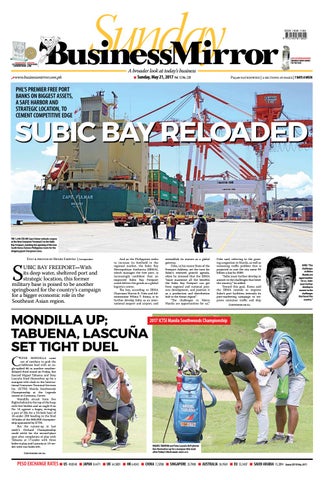
PHL’s premier free port banks on biggest assets, a safe harbor and strategic location, to cement competitive edge
Subic Bay reloaded
The 1,440-TEU MV Cape Fulmar unloads cargoes at the New Container Terminal 2 in the Subic Bay Freeport, marking the opening of the new South Korea-Taiwan-Philippines route for the shipping giant Evergreen Lines.
S
Text & photos by Henry Empeño | Correspondent
UBIC BAY FREEPORT—With its deep water, sheltered port and strategic location, this former military base is poised to be another springboard for the country’s campaign for a bigger economic role in the Southeast Asian region.
And as the Philippines seeks to increase its foothold in the regional market, the Subic Bay Metropolitan Authority (SBMA), which manages the free port, is increasingly confident that an improved Subic Bay Freeport could deliver the goods as a global logistics center. The key, according to SBMA Chairman Martin B. Diño and Administrator Wilma T. Eisma, is to further develop Subic as an international seaport and airport, and
MONDILLA UP; TABUENA, LASCUñA SET TIGHT DUEL C LYDE MONDILLA came out of nowhere to grab the clubhouse lead with an eagle-spiked 66 in another weatherdelayed third round on Friday, but fancied Miguel Tabuena and Tony Lascuña lined themselves up for a marquee title clash in the International Container Terminal Services Inc. (ICTSI) Manila Southwoods Championship at the Legends course in Carmona, Cavite. Mondilla struck from five flights behind to the top of the heap with five birdies and an eagle-3 on No. 14 against a bogey, stringing a pair of 33s for a 54-hole haul of 16-under 200 heading to the final 18 holes of the $60,000 championship sponsored by ICTSI. But the runner-up in last week’s Orchard Championship could settle for the second-place spot after completion of play with Tabuena at 17-under with three holes to play and Lascuña at 15-under with two holes left. Continued on A2
PESO exchange rates n US 49.8340
reestablish its stature as a global gateway. Diño, in his recent State of the Freeport Address, set the tone for Subic’s renewed growth agenda, when he stressed that the SBMA “must maximize all the benefits the Subic Bay Freeport can get from regional and national projects development, and position it as a production and distribution hub in the Asean region”. “The challenges in Metro Manila are opportunities for us,”
Diño said, referring to the growing congestion in Manila, as well as worsening traffic problem that is projected to cost the city some P6 billion a day by 2030. “Subic must further develop in answer to the challenges that beset the country,” he added. Toward this goal, Eisma said the SBMA intends to improve Subic’s port facilities; intensify its port-marketing campaign to improve container traffic and ship
Diño: “The challenges in Metro Manila are opportunities for us. Subic must further develop in answer to the challenges that beset the country.”
Continued on A2
2017 ICTSI Manila Southwoods Championship
MIGUEL TABUENA and Tony Lascuña (left photo) line themselves up for a marquee title clash after Friday’s third round. NONOY LACZA
n japan 0.4471 n UK 64.5001 n HK 6.4043 n CHINA 7.23700 n singapore 35.7900 n australia 36.9569 n EU 55.3407 n SAUDI arabia 13.2894
Source: BSP (19 May 2017 )
NewsSunday BusinessMirror
A2 Sunday, May 21, 2017
www.businessmirror.com.ph
Subic Bay reloaded Continued from A1
calls; establish direct links to other Asean ports; and promote Subic’s capacity for ship-to-ship transfer operations.
Comparative advantage
The push to develop Subic Bay’s seaport was borne by the fact that Subic’s competitive edge has always been its deepwater port. As early as 1868, when the Spanish military forces surveyed its shore, Subic was highly regarded as superior to other ports and an ideal location for a naval base. This led to the construction in 1885 of a Spanish arsenal at the then village of Olongapo, now the site of the free port’s central business district. When the US won the Spanish-American War and built the US naval station here in 1905, Subic’s natural harbor was again an important factor. That edge became clearer during and after World War II, when Subic’s status as a naval base took on a strategic importance: Within steaming distance of various flash points in Southeast Asia, Subic served as both a resupply center and a platform to launch American military might in the Asia-Pacific area. Today Subic is being developed further for basically the same purpose: a logistics and resupply center not for military ships but for cargo vessels; a service provider not for naval forces but for investor companies; and as a launching pad not for military dominance but for economic conquests. Still, Subic’s military past has provided the emerging free
port and economic zone with a foundation like no other. When the US Navy left Subic in 1992, it left behind several wharves and piers, whereby the modern Subic seaport started. These include the Alava Pier, which now services military vessels and passenger ships; the Boton and Riviera wharves that now handle bulk cargoes; and the Bravo and Nabasan piers that have been turned into specialized ports for grains, fertilizer and fuel. Likewise, the US military left immovable assets, like seaport facilities that, although serviceable, could only muster a cargo-handling capacity of only 20,000 twentyfoot equivalent units (TEUs).
Alternative port
To maximize Subic’s potential as a seaport, the SBMA started the construction in 2005 of the New Container Terminal (NCT), which sought to establish Subic as an alternative port to Manila’s South Harbor for loading and discharging both containerized and bulk cargoes. This was made possible by a $125-milion loan from the Japan Bank for International Cooperation. Aside from construction of a new cargo terminal, the project also included the rehabilitation of existing wharves and piers in the Subic Bay Freeport to revive or maximize their use. The NCT-1 project was at Cubi Point, beside the Subic airport, and was built with two berths, each 290 meters long and 500 meters wide. Two goosenecktype gantry cranes were later in-
Within the placid waters of Subic Bay, the 105,335-ton LNG carrier Seri Bakti (right) transfers liquefied natural gas (LNG) to the feeder ship SS Polar Spirit, completing the first ship-to-ship transfer operation for LNG in the country.
stalled at the terminal in 2006, thereby increasing Subic’s cargohandling capacity threefold, or from 100,000 to 300,000 TEUs. At first, the NCT-1 project did not pick up, leading to derisions from critics that it was a white elephant. But two years after, on April 2, 2008, and after the NCT-1 was placed under the management of the Subic Bay International Ter-
minal Corp. (SBITC), a subsidiary of International Container Terminal Services Inc. (ICTSI), the NCT-1 made history when it received the first shipment of containerized cargo from Kaohsiung, Taiwan. The cargo was delivered by MV Eagle Excellence, a 1,200-TEU container ship operated by the American President Lines (APL). The unloading of cargo at NCT-1, the first phase of Subic’s $215-million Port Development Project, marked the acid test for Subic as an international maritime port. As officials at the SBMA Seaport Department recalled, the first unloading operation at the NCT-1 was a sight “we have been waiting to happen for so long”. They recalled that the first ship call made by APL here in Subic involved only a 500-TEU vessel, because it then lacked proper facilities. But now Subic was ready for the big ones.
Record firsts
Since then, the Subic Bay Freeport has made its mark as a transshipment port that is able to service Panamax-type vessels and very large crude carriers. It has also attracted regular ship calls from some major cargo shippers. Just last month, the SBMA announced the start of ship-to-ship transfer operations for liquefied natural gas at Subic Bay by Jovo, China’s biggest green-energy company, which anchored the 105,335ton LNG carrier Seri Bakti. The initial load of gas, which
came from Australia, was transferred to the feeder vessel SS Polar Spirit, a 72,524-ton Bahamasflagged vessel. Also last month Subic welcomed the arrival of MV Cape Fulmar, a 1,440-TEU vessel that unloaded 200-TEU container vans and 70 forty-foot equivalent unit container vans for companies in Subic and Clark, like Yokohama, Lepanto Tiles and Coam Philippines. The arrival of Fulmar, which is operated by Evergreen Line, the world’s fifth-biggest shipping firm, brought to five the number of major shipping lines that operate in this premier free port and connect it to major ports in the Southeast Asian region. Following this delivery, SBITC, the operator of NCT-1 and 2, announced that it will be expecting a “surge” in cargo traffic, as Evergreen launched its Korean-TaiwanPhilippines (KTP) route. “We thank Evergreen for recognizing Subic as a key gateway in the Philippines. Our inclusion in the KTP service is a clear indication that the markets of Central and Northern Luzon are growing, and will benefit from another large global carrier participating in this growth,” SBITC General Manager Roberto Locsin said. In a separate statement, global terminal operator ICTSI cited Subic Bay as a key port, reporting that the Subic Bay Freeport “has achieved productivity levels similar to ICTSI’s flagship Manila International Container Terminal.”
Keeping the edge The Subic seaport, however, is not about to rest on its laurels. According to SBMA officials, the Subic agency intends to further improve Subic’s port facilities; intensify its port-marketing campaign to improve container traffic and ship calls; establish direct links to other Asean ports; and promote Subic’s capacity for shipto-ship transfer operations. In a recent statement to the media, Eisma expressed an optimistic outlook for the Subic Bay Freeport, saying the new administration “seeks to build on past accomplishments to bring the Subic Bay Freeport to greater heights.” “We must look back into the past, so we could build a brighter future,” Eisma added. “Taking into account our performance last year, what we have accomplished can certainly be improved upon.” With this, Eisma said the SBMA plans to bolster Subic’s port capacity with the expansion of bulk cargo port facilities to the tune of $120 million, and the expansion of Subic’s NCT at an estimated cost of $200 million. The terminal-expansion project, she said, will bring about two more berths—NCT 3 and 4—for an additional capacity of 600,000 TEUs. The Subic agency also seeks to construct a new bypass road connecting Subic’s seaport terminals directly to the Subic-Clark-Tarlac Expressway at a cost of $232 million, Eisma added.
MONDILLA UP; TABUENA, LASCUñA SET TIGHT DUEL Continued from A1
Elmer Salvador also remained in the hunt with a 14-under total with two holes to go, while Mhark Fernando totaled 13-under 203 after a 70 in another low-scoring day marred by a 90-minute stoppage due to lightning. American Nicolas Paez and Macedonian Peter Stojanovski also had running 13-under totals with two holes left to play in the event organized by Pilipinas Golf Tournaments Inc. Mondilla, in 12th place after 36 holes despite a pair of 67s, made his charge early with three birdies in the first six holes, added another one on No. 10 but dropped a stroke on the 12th. But the three-leg winner last year bounced back with an eagle on No. 14 and a birdie on the next for that 66.
Tabuena, who has missed the spotlight in the first two rounds due to weather-delayed rounds, birdied five of his last six holes at completion of his second round, including four straight from No. 6, as he finished with a 63 to tie clubhouse leader Nilo Salahog at 14-under 130. But they still stood two strokes behind American Lexus Keoninh, who birdied the last hole to cap a second-round 65 and snatch the lead with a 16-under 128 total. Lascuña, who shared the first-round honors with Stojanovski with a bogey-free 62, birdied two of the last three holes at resumption of his secondround play, but lay four shots off Keoninh with a 132, a shot adrift of the 131s by Paez and Sumcad, who shot identical 65s. But while Tabuena and Las-
cuña kept their charge early in the third round, Keoninh tumbled down the leaderboard with a quadruple bogey on the par-3 No. 3 when he hooked his tee-shot for a lost ball. He teed off again, missed the green and three-putted. He parred the next two for a 12-under aggregate before play was stopped again due to lightning. In contrast, Tabuena, chasing his third win early in the season following victories at The Country Club Invitational and the ICTSI Luisita Championship, birdied two of the first three holes but dropped a stroke on No. 4 for a 15-under total while Lascuña, winner at ICTSI Manila Masters at Eastridge last month, birdied two of the first six holes. Paez also loomed large with a one-under card after six holes as he tied Lascuña at second at 14-under.
Editor: Lyn Resurreccion • www.businessmirror.com.ph
The World
Study: Diesel vehicle pollution worldwide understated by 50%
W
A SH I NGT ON — L a b based tests of harmf u l n it r o g e n o x i d e (NOx) emissions from diesel cars, trucks and buses worldwide significantly underestimate the real-world emissions by as much as 50 percent, a new study said early this week. These excess emissions alone lead to 38,000 premature deaths annually worldwide, according to the study led by the US-based International Council on Clean Transportation (ICCT) and Environmental Health Analytics Llc. “Since 2015, revelations that Volkswagen and other manufacturers used ‘defeat devices’ to hide from regulators the fact that their diesel cars were emitting too much NOx helped to heighten public awareness of the problem,” the ICCT said in a news statement. “But this is not just a defeat device problem. Both light-duty and heavy-duty diesel vehicles emit more NOx in on-road driving conditions than during laboratory certification testing, for reasons that may range from details of the engine calibration to equipment failure, inadequate maintenance, tampering by vehicle owners, the deliberate use of defeat devices, or simply deficient certification test procedures.” For the new study, researchers assessed 30 studies of vehicle emissions under real-world driving conditions in 11 major vehicle markets representing 80 percent of new diesel vehicle sales in 2015. Those markets include Australia, Brazil, Canada, China, European Union, India, Japan, Mexico, Russia, South Korea and the US. They found that in 2015, diesel vehicles emitted 13.1 million tons of NOx, which is 4.6 million tons
more than the 8.6 million tons expected from vehicles’ performance under official laboratory tests. Heav y-dut y vehicles, such as commercial trucks and buses, were by far the largest contributor worldwide, accounting for 76 percent of the total excess NOx emissions. NOx is a key contributor to outdoor air pollution in the forms of ground-level ozone and secondary fine particulate matter (PM2.5). Long-term exposure to these pollutants is linked to a range of adverse health outcomes, including disability and years of life lost due to stroke, ischemic heart disease, chronic obstructive pulmonary disease and lung cancer. “The consequences of excess diesel NOx emissions for public health are striking,” said Susan Anenberg, colead author of the study and cofounder of Environmental Health Analytics Llc. China suffers the greatest health impact with 31,400 deaths annually attributed to diesel NOx pollution, with 10,700 of those deaths linked to excess NOx emissions beyond certification limits, it said. In Europe, where diesel-passenger cars are common, 28,500 deaths annually are attributed to diesel NOx pollution, with 11,500 of those deaths linked to excess emissions. The study also projected that by 2040, 183,600 people will die prematurely each year due to diesel vehicle NOx emissions unless governments act. “Tighter vehicle emission standards coupled with measures to improve real-world compliance could prevent hundreds of thousands of early deaths from air pollution-related diseases each year,” Anenberg said. PNA/Xinhua
Robots taking over US factories imperil emerging-market growth
T
he robot revolution is here, and it’s not all good for emerging-market economies. As the conversion to more automated factories picks up steam in countries like the US, Japan and Germany, there’ll be less factory work outsourced to developing nations with relatively low labor costs, according to a report by Moody’s Investors Service. The impact will be most severe in Hungary, Czech Republic, Slovakia, Vietnam, Malaysia and Thailand. While most robot-related anxiety in popular culture has swirled around unfounded concern of a violent cyborg rebellion and the more likely possibility of blue-collar job losses, Moody’s raises the specter that developing countries that depend on manufactured exports could be in for a painful reckoning. Automated factories require a huge up-front investment in technology, but once that’s in place the operational costs will often be far lower than in fully staffed manufacturing sites in Eastern Europe and Southeast Asia. “As manufacturing has become highly integrated across countries, the adoption of automation in one country now has implications both within and beyond its borders,” Moody’s analysts, including Samar Maziad, wrote in a note on Wednesday. Whether the adoption of robotics is “positive or negative for a particular country will be contingent on how private-sector investment strategies, government policies and labor market dynamics evolve.” The emerging markets most likely to be hurt by factory automation are those with the highest percentage of exports to the leading adapters of the technology, and those that produce relatively high-tech products that are most likely to be eventually be made with robots. The US, China, Germany, Japan and South Korea account for 75 percent of global robottechnology purchases, according to Moody’s. Here’s the regional fallout:
Europe
Between 2013 and 2015, exports of high-tech manufacturing goods accounted on average for over half of GDP in countries like Hungary, Czech Republic, Slovenia and Slovakia, according to Moody’s. Up to 20 percent of high-tech manufacturing exports goes to Germany, an active user of robots.
Asia
Between 2013 and 2015, high-tech manufacturing exports made up on average about 30 percent of Thailand’s GDP, 35 percent of Malaysia’s and 31 percent of Vietnam’s, according to Moody’s. A big chunk of those exports goes to China, which has made robotics a focus of its industrial policy and is one of the world’s biggest buyers of the machines. Local authorities plan to triple robot density to 150 per 10,000 human workers by 2020, data compiled by Bloomberg Intelligence show.
Latin America
The region is probably the area best positioned to withstand the shift, but Mexico and Costa Rica are most vulnerable, according to Moody’s. Bloomberg News
BusinessMirror
Sunday, May 21, 2017
A3
World’s 500 richest people lose $35 billion from Trump turmoil
T
he world’s richest people lost $35 billion on Wednesday when global equity markets were rocked by political turmoil in the US, according to the Bloomberg Billionaires Index.
Bill Gates, the world’s richest person with $86.8 billion, lost $1 billion as shares of Microsoft Corp., his largest holding, tumbled 2.8 percent, the most in almost a year. Amazon.com Inc. Cofounder Jeff Bezos, who came within $4 billion of taking the top spot from
Gates earlier this week, dropped to No. 3 after losing $1.7 billion as shares of the online retailer slid 2.2 percent. Spanish retailing tycoon Amancio Ortega lost $355 million to end the day in the second position, with $83.2 billion. Global stock indexes tumbled
as political turmoil enveloped the White House, with President Donald J. Trump’s ties to Russia and his firing of Federal Bureau of Investigation Director James Comey under scrutiny. US stocks posted their steepest declines
$86.8B The total estimated wealth of Microsoft Corp. owner Bill Gates, making him the richest person in the world
since September, led by the Nasdaq Composite’s 2.6 percent slide. The MSCI All-Country World Index fell 1.2 percent, and bank stocks were the worst performers. Facebook Inc. founder Mark Zuckerberg was hardest hit in the tumult, dropping $2 billion when the social-media giant dropped 3.3 percent. Zuckerberg is the fifthrichest person on the planet with $62.3 billion, according to the index. Trump, the first billionaire to serve as US president, has a net worth of $3 billion and doesn’t have a spot on the Bloomberg index, a daily ranking of the world’s 500 richest people. They have a combined net worth of $4.9 trillion, up $455 billion in 2017. Bloomberg News
In the corridors of power, fears of a presidency out of control
W
ASHINGTON—On Day 118 of the Trump administration, a special counsel was appointed. The word impeachment was uttered on the floor of the House of Representatives. And the president of the US contemplated how to go forward with the next 1,343 days. The notion that President Donald J. Trump will actually be impeached seemed like liberal wishful thinking, but a new prosecutor represented a serious threat and Washington was abuzz on Wednesday with the surround sound of scandal. Lawmakers demanded documents. The Dow Jones average fell by 372 points. Watergate talking heads flooded cable news shows. For a president who in most polls has never commanded the support of a majority of his public, the accumulated toll
of self-inflicted wounds has been a challenge from the start. Now he faces, perhaps, the most daunting moment of his young administration after his decision to fire the Federal Bureau of Investigation (FBI) director, his disclosure of sensitive information to the Russians and a report that he tried to shut down an investigation into a former aide. Like other presidents before him who felt under siege, Trump expressed resentment rather than remorse, insistent that he has done nothing wrong and convinced that he has been persecuted. “No politician in history—and I say this with great surety—has been treated worse or more unfairly,” he complained to Coast Guard graduates on Wednesday hours before the appointment of the special counsel. “You can’t let them get you down.” But he is down, and so are his aides,
many of whom wait for the ax they fear is coming as they hear whispers of shakeups. With his first foreign trip as president starting on Friday, Trump is looking for ways to fend off the attacks and investigations while reinvigorating a presidency that has lost control of its narrative. That became inordinately more difficult at 6 p.m. on Wednesday with the announcement by Rod J. Rosenstein, the deputy attorney general, that he was appointing Robert S. Mueller III, a former FBI director, as special counsel, another term for special prosecutor. It would be hard to imagine a choice less helpful to the White House, given that Mueller was an ally in the past of James B. Comey, his successor as FBI director, who was fired by Trump last week. The last straw for Rosenstein may have been a New York Times article reporting that
Trump tried to persuade Comey to drop an investigation into Michael T. Flynn, the former national security adviser, according to a memo Comey wrote. Julian Epstein, who was the chief counsel for the Democrats on the House Judiciary Committee during the impeachment proceedings against President Bill Clinton, said Trump essentially brought this on himself with his “clumsy and self-defeating” attempts to rid himself of Comey in the midst of an active FBI investigation into any ties between his campaign associates and Russia. “With the appointment of Mueller, they have now totally lost control of this train and have very limited ability to manage the widening crisis around it,” Epstein said. “This will go down as one of the most inept and counterproductive efforts of damage control that we’ve ever seen in public life.” New York Times Service
A4
Sunday, May 21, 2017
The World BusinessMirror
French president May’s Cabinet mixes old and new, left and right S
Editor: Lyn Resurreccion • www.businessmirror.com.ph
Puerto Rico militant leader Lopez emerges from 36 years in custody
P
ARIS—French President Emmanuel Macron named a mix of prominent and unknown figures from the left and the right on Wednesday to make up the government tasked with pushing through his plans to reduce labor protections, tighten European unity and boost military spending.
The most senior Cabinet job— the post of interior minister— went to Gerard Collomb, 69, the longtime Socialist mayor of Lyon who played a key role in Macron’s presidential bid. Collomb said his
French President Emmanuel Macron (right) welcomes European Council President Donald Tusk upon his arrival at the Elysee presidential Palace in Paris, France, on Wednesday. AP
duty will be to protect the French people, to fight terrorism and to prevent youth from falling “in the grip” of the Islamic State group. A few hours after taking office, Collomb made an unexpected
visit to Paris’s grand ChampsElysees avenue, where a police officer was shot to death by an Islamic extremist last month. Jean-Yves Le Drian, 69, who led France’s military operations abroad as former President Francois Hollande’s defense minister, will stay on in Macron’s government as foreign minister and also be in charge of European affairs. Le Drian, another Socialist, brings deep experience that could prove valuable to the untested 39-year-old president. Le Drian vowed to promote the country’s “key role” in the international community, noting continuity between his previous position and his new diplomatic job. The armed forces will now be led by Sylvie Goulard, the most senior woman in the government. Goulard, 52, is a European
Parliament member and strongly pro-European centrist politician who will be expected to champion Macron’s push for joint European military operations. In an important gesture to the right-wing Republicans party ahead of parliamentary elections next month, the crucial Economy Ministry will be run by prominent conservative Bruno Le Maire, 48. The Cabinet includes 18 ministers and four junior ministers, half of them women and half men. Center-right Prime Minister Edouard Philippe, whom Macron tapped named on Monday, is to lead the government at least until the elections. Me m b e r s o f c i v i l s o c i e t y without government work on t heir résumés were appointed to some ministerial posts. Nicolas Hulot, the well-known host of a television show focusing on nature and the environment, was named minister for env i ronment t ra nsit ion. His portfolio includes energ y and transpor tation. Mur iel Penicaud, the new labor minister, previously worked for food corporation Danone and French telecommunications group Orange. Since Januar y 2015, she led Business France, a public agency in charge of promoting French companies abroad and attracting foreign investments. Penicaud will have the daunting task of supervising the reform of labor protections, a part of Macron’s agenda that already has prompted outcries from unions. Cu lture minister Francoise Nyssen is CEO of French publishing house Actes Sud. Macron is know n as a passionate literature lover. The youngest person selected to work in Macron’s government was Mounir Mahjoubi, 33, who was named junior minister for digital economy. As Macron’s campaign digital chief, Mahjoubi was responsible for cybersecurity. The announcement initially planned for Tuesday was pushed back a day while authorities dug more deeply into candidates’ tax records and financial assets for signs of potential conf licts of interest. Macron has pledged to fight corruption after tax evasion and other scandals hit the previous government. The new government may only serve for a few weeks. If Macron’s party doesn’t win a majority in the June 11 and 18 parliamentary elections, he might have to form a coalition and adjust the makeup of the government. He also could end up with a government led by an opposition party. M a c ron ho s t e d Eu ro p e a n Council President Donald Tusk at the Elysee Palace for a private dinner on Wednesday night, a sign of his determination to shore up European unity. Before their meeting, Macron said he wants a Europe that is both more conducive to investment and more protective of workers. Macron wants European militaries to join efforts and for eurozone countries to share a budget and tax rules. He has also promised a tough line on Britain as it negotiates its departure from the EU, to deter others from trying to leave Speaking with Tusk by his side, Macron said he’s advocating “a less bureaucratic and a more political Europe” and relying on Tusk to “go even further in this work of reshaping and setting in motion again a European ambition.” Tusk approved the goals proposed by Macron and said “words such as security, protection, dignity and pride must return to our political dictionary.” AP
AN JUAN, Puerto Rico— Puerto Rico nationalist Oscar Lopez Rivera emerged from house arrest on Wednesday and was celebrated by supporters after decades in custody, freed in a case that made him a martyr for some but angered those who lost loved ones in a string of bombings. Wearing black jeans and a shirt decorated with a Puerto Rican flag pin, the 74-year-old left his daughter’s San Juan home escorted by the mayor of Puerto Rico’s capital and New York City Council Speaker Melissa Mark-Viverito. A celebration for Lopez in a plaza near the University of Puerto Rico drew at least 1,000 people by late afternoon, some embracing and wearing T-shirts reading: “Welcome to your homeland!” Lopez was considered a top leader of the Armed Forces of National Liberation, or FALN, an ultranationalist Puerto Rican group that claimed responsibility for more than 100 bombings at government buildings, department stores, banks and restaurants in New York, Chicago, Washington and Puerto Rico during the 1970s and early 1980s. The Federal Bureau of Investigation classified the Marxist-Leninist group as a terrorist organization. The most famous bombing was the still-unsolved 1975 explosion that killed four people and wounded 60 at Fraunces Tavern, a landmark restaurant in New York’s financial district. Lopez, a Vietnam War veteran who moved from Puerto Rico to Chicago as a child, wasn’t convicted of any role in the bombings that killed six people and injured dozens. But those who lost loved ones hold him responsible. “This guy was convicted of leading the FALN that murdered people,” said Joseph Connor, whose father, Frank, was killed in the Fraunces Tavern attack. In an interview with The Associated Press (AP), Lopez said he had no regrets about his involvement with the FALN. But he stressed that “the issue of violence is discarded completely” by Puerto Rican “independentistas” and he described their struggle as a peaceful one for many years. “Whatever we did, whatever was done, whatever the struggle called for in the 1970s is not there today. We have evolved, the conditions in Puerto Rico have changed,” he told AP. While some Puerto Ricans support Lopez as a sort of patriot and political prisoner, those seeking independence remain a small group. The option garnered less than 6 percent of the vote in four referendums that Puerto Rico has held on its political status. Lopez vowed to soon undertake a pilgrimage across the island mired in a decadelong recession to “share ideas and promote unity”. In a written statement, he also blasted “colonialists”, who he described as local elites who “helped Washington and Wall Street” run the island for over a century. “What quality of life do the colonialists offer the people? All they know how to do is squeeze the last dollar from the pockets of every Boricua who works and sweats for our country,” he said, using the term Puerto Ricans call themselves. Puerto Rico has been under US jurisdiction since 1898, and its people have been US citizens since 1917. The island is home to numerous military
veterans, though Puerto Ricans can’t vote for president and their representative in Congress has no vote. They pay Social Security and Medicare payroll taxes but not federal income tax. A campa ig n to f ree Lopez over the years drew suppor t f r o m Po p e F r a n c i s , f o r m e r President Jimmy Ca r ter a nd Lin-Manuel Miranda, creator of the American musical Hamilton. “He has his champions and his critics, but this much is true: He served a lifetime in prison, including 12 years in solitary confinement. Don Oscar w ill spend his twilight years on the island for which he sought independence, and this feels fitting,” Miranda said in an e-mail, referring to Lopez with the Spanish honorific of “don”. Lopez is expected to be feted in Chicago later this week. Supporters also plan to honor him at the June 11 Puerto Rican Day parade along New York’s Fifth Avenue. Lopez was sentenced to 55 years in prison in 1981 after he was found guilty of seditious conspiracy, armed robbery, a weapons violation and four counts of interstate transportation of stolen vehicles. A federal judge termed him an “unreconstructed revolutionary” and Lopez said Puerto Ricans should fight for their island’s independence “by any means necessary”. He later faced an additional 15 years in jail after he was convicted of conspiring to escape from prison in Leavenworth, Kansas. In 1999 President Bill Clinton offered Lopez clemency but the inmate rejected the offer because it excluded two associates who have since been released. Then in 2011, the US Parole Commission denied his request for an early release. President Barack Obama commuted his sentence in his final days in office, along with clemency for others, including Chelsea Manning, the transgender Army intelligence analyst who leaked more than 700,000 US documents. Lopez was released from prison in Terre Haute, Indiana, and arrived in Puerto R ico in Februar y to ser ve the remainder of his sentence under house arrest. He stayed with his daughter at her apartment in San Juan’s Santurce district. He has said that upon returning to Puerto Rico he wanted to spend time with family and create a think tank to work on issues, including climate change, the economy and the island’s political status. The June parade in New York comes on the same day as the latest referendum on Puerto Rico’s status, which is to include three options: statehood, territoriality or independence. Lopez told AP he believed his compatriots would not opt for statehood and the referendum would be “another exercise in futility”. He also said in a statement: “I want to make it very clear that independentistas do not hate Americans as our people are constantly being told.” The island’s previous referendums resulted in no action from US Congress, which has final say on any changes in the island’s political status. In the last one, in 2012, 54 percent said they wanted a change in status. Sixty-one percent who answered a second question said they favored statehood, but nearly 500,000 left that question blank, leading many to question the results. AP
Whatever we did, whatever was done, whatever the struggle called for in the 1970s is not there today. We have evolved, the conditions in Puerto Rico have changed.”—Lopez
Sports BusinessMirror
Editor: Jun Lomibao | mirror_sports@yahoo.com.ph
Sunday, May 21, 2017
A5
Billion-dollar race to break 2-hour marathon mark is afoot In this May 6 file photo, Olympic marathon champion Eliud Kipchoge crosses the finish line of a marathon race at the Monza Formula One racetrack in Italy. Kipchoge was 26 seconds from making history on May 6. AP
L
ONDON—The two-hour marathon. For distance runners, it’s a mystical goal equivalent to the four-minute mile that Roger Bannister broke in 1954; a test so difficult some have estimated it may be 50 years or more before anyone achieves it. Now the $270-billion market for athletic shoes and apparel is fueling an assault on the mark. Nike and Adidas have announced separate plans to attack the barrier, with both introducing shoe lines linked to the effort. Wireless tech giant Vodafone last month said it was backing a third bid, hoping data gleaned from the quest will translate into wearable technology. The leader so far is Nike, which came within a whisper of the barrier with a time of 2:00:25 in a run with top athletes on May 6. But Yannis Pitsiladis, a professor of sport and exercise science at the University of Brighton, England, may be the tortoise in this race with Nike’s hare. He says running a two-hour marathon will require a coordinated scientific effort and aims to raise $30 million for a project that will increase the understanding of the limits of human performance. Vodafone is backing Pitsiladis. “Nike is doing this because they realized, ‘Wow, I can sell more shoes,’” he said. “For me, this is not marketing. It’s what humans can do when they work together. It’s about human ambition, human legacy. It’s like a journey to Mars.” Nike, which built its brand on the exploits of Michael Jordan and legions of runners wearing Nike’s trademark Swoosh, is already selling shoes developed as part of its
Breaking2 project. The Nike Zoom VaporFly 4-percent model features an aerodynamic heel and carbon-fiber plate, which Nike says will make runners 4-percent more efficient than its previous top-line marathon shoe. The price: $250 a pair. “Breaking2 is a quest to fully measure the extent of what the body is capable of,” the company said by e-mail. “Nike is looking to push the limits of human potential through product innovation, smarter training and an optimized environment— helping our athletes run what has never been run before.” The publicity generated by Nike’s recent attempt, which was streamed live on the Internet from a course festooned with redand-white Swooshes, may have already helped the company reach millions of fitness fanatics and weekend athletes. Running gear accounts for about 45 percent of the sporting goods market, according the market research firm Mintel. “The running market is huge,” said Samantha Dover, a retail analyst at Mintel. Runners “like to have goals, to measure performance, to record it for future motivation. The aspiration element is helping to drive the market.” And it’s not just shoes. It’s fabrics that wick sweat from your skin, fitness-tracking apps and wristbands that monitor your speed. Millennials, in particular, are looking for gadgets that push the boundaries of wearable technology. “Utilizing emerging technologies to enhance elite athlete performance in areas such as nutrition and training will unlock opportunities for these technologies to enter additional compelling markets, whether they be a broad consumer market or even one like the military,” said David Carter, executive director of the Sports Business Institute and professor at the University of Southern California Marshall Business School. Nike says it started the Breaking2 program three years ago. First it selected three top athletes based on their oxygen use, energy consumption and ability to sustain speed over long distance. Initially, the program worked to refine their training by monitoring performance with GPS watches and heart monitors. Then it went a step further, measuring skin temperatures to determine the perfect race conditions and sweat rates to develop personalized hydration mixtures. Finally, Nike took over the Monza racetrack in Italy for what was essentially a 26.2-mile experiment rather than a race. The flat Formula One course with gentle curves provided ideal conditions for the three marathoners, who were supported by 32 other athletes who ran in groups of six to form a wind-breaking wedge and keep them on pace. Moped riders delivered their especially formulated drinks: No scrambling at the drink table at this race. Eliud Kipchoge came agonizingly close to the goal,
finishing in 2:00:25. One second a mile faster and he would have made history. Although Kipchoge beat Dennis Kimetto’s world record of 2:02:57, his time won’t be recognized because the event wasn’t sanctioned by track and field’s governing body. Critics say the Monza run may actually have shown how far humans are from running two hours in a sanctioned race. If some of the world’s best athletes can’t do it under ideal conditions, how long will it be before someone who has to contend with the vagaries of running through city streets in unpredictable weather breaks the barrier? If the sub-two-hour marathon is the Mount Everest of human endurance, Kipchoge “has reached the ledge just beneath its summit,” said Ross Tucker, the head scientist for World Rugby who writes for the Science of Sport blog. Creating perfect conditions just helped him get really close. “It is, to finish the analogy, like getting so close to the summit with the benefit of extra oxygen,” he said. Pitsiladis, an antidoping expert for the International Olympic Committee, is definitely not giving up. His star runner, Kenenisa Bekele, holds the second-best marathon time in history and finished second in this year’s London Marathon. Although Pitsiladis launched his SUB2 project in November 2014 with support from institutions such as Southern Methodist University, funding has been harder to come by because the effort was focused more on science than commerce. Pitsiladis says he has paid for some of the research with his own money, maxing out his credit card and mortgaging his house. Vodafone recently became his first big-name corporate supporter, offering technology to help runners and coaches track performance. “A lot of people thought I was crazy,” Pitsiladis said. “They’re not saying this now.” Santiago Tenorio, Vodafone head of network strategy and architecture, said the company’s interest in SUB2 stems from previous advances it made working with high-end sports. The company once partnered with McLaren’s Formula One team, and applied the technology it developed to serving its customers on highways. It wants to do the same with running. He ticks off the things Vodafone will work on to help athletes, like offering real-time weather data or sensors that measure speed, pace, skin temperature and sweat composition. “If we can help an athlete break the two-hour marathon,” he says, “imagine what we can do with you.”
Denying Sharapova, inviting a debate By Christopher Clarey
I Youth players shine at Junior NBA clinic
Y
OUTH players from the Regional Selection Camp in Metro Manila shined the brightest among 72 boys and girls in the National Training Camp of Junior NBA Philippines 2017 presented by Alaska. Held at the Don Bosco Technical Institute on May 12 and 13 and at the SM Mall of Asia Music Hall on May 14, the Junior NBA Philippines 2017 was attended by Orlando Magic guard Elfrid Payton and former Women’s National Basketball Association AllStar Sue Wicks. Jr. NBA, the league’s global youth basketball participation program for boys and girls, teaches fundamental skills, builds character and promotes active lifestyles for Filipinos nationwide. Payton and Wicks joined Junior NBA Coaches Chris Sumner and Jeffrey Cariaso in training and working with the young campers throughout the National Training Camp.
Junior NBA Asia Advisory Council members, including NBA Legend Dikembe Mutombo, also attended the final day of the National Training Camp. Eight boys and eight girls—comprised of players from Luzon, the Visayas and Mindanao—were selected as Junior NBA All-Stars on the last day of the three-day camp that honed and tested the basketball skills of regional finalists from tryouts staged in Cagayan de Oro, Lucena, Cebu and Manila early this year. Catrina June Biongcog of Xavier UniversityAteneo de Cagayan and Jed Cabellon of Southwestern Univerrsity of Cebu, meanwhile, were selected as the Junior NBA Philippines 2017 Coaches of the Year. The Junior NBA All-Stars, together with the Coaches of the Year, will be rewarded with an overseas NBA experience later this year and will be joined by fellow Junior NBA All-Stars from Southeast Asia.
Boys named as Jr. NBA Philippines 2017 All-Stars:
Girls named as Jr. NBA Philippines 2017 All-Stars:
n Kenji Trey Duremdes, 14 (La Salle Greenhills) n Jan Clement Macalalag, 13 (La Salle Greenhills) n Victorino Torres, 13 (La Salle Greenhills) n Joachim Eddie Laure (University of Santo
Tomas High School)
n Johndel Austria, 13 (Escuela de Sophia-Caloocan) n Ian Dominic Espinosa, 13 (Ateneo de Iloilo) n Reinhard Jumanoy, 13 (University of
San Carlos-North Campus)
n Jeryk Dwight Bait, 14 (Saint Francis
National High School in Lucena)
n n n
Boni Marylene Solis, 12 (Chiang Kai Shek College) Jane Araza, 13 (Chiang Kai Shek College) Jeehan Nikaela Ahmed, 13 (Chiang Kai Shek College) n Jazmine Ann Maniquis, 13 (Saint Paul Pasig) n Lindsey Nacional, 13 (La Salle College Antipolo) n Camille Nolasco, 14 (Miriam College) n Chinnsai Demana, 13 (the University of the Visayas in Cebu)
New York Times News Service
N the wake of the French Tennis Federation’s (FFT)decision on Tuesday not to give Maria Sharapova a wild card into the French Open, a debate arose within the sport about whether denying Sharapova was also further penalizing her. Steve Simon, the chief executive of the Women’s Tennis Association (WTA), maintains that the federation went too far. “They have an opinion, and they expressed it, and I don’t happen to agree with that opinion,” Simon said of the federation and its president, Bernard Giudicelli, in a telephone interview. “I’m sure their position is because of what she was suspended for, they don’t feel she should be getting any special help, and by the way that they’ve expressed it, to me what they’ve done, in essence, is increase her penalty.” Sharapova returned last month from a 15-month suspension for a doping violation that had been reduced from a two-year suspension on appeal. She was suspended in 2016 for taking meldonium, a heart medication that was banned on January 1 of that year. But others rejected Simon’s interpretation of the French Open snub, including Nicole Gibbs, an American player and former star at Stanford who made her views clear first through her Twitter account and then in a follow-up interview on Wednesday. “I don’t believe that withholding a wild card is a ‘penalizing’ action,” she wrote in an e-mail. “A wild card is discretionary and not merit-based in nature, so it’s natural for public opinion and morality to creep into the deliberation process. But by criticizing the French Open, the WTA is making a pitch for preferential treatment for Maria that would not be made for other players.”
Own spin
STILL, Simon said he felt the French federation had gone beyond its brief. “I think where we run into trouble,” he said, “is when we sign up for a program, and we agree to support the program and support the decisions that come from it, and then when the decisions come forward you decide to put your own spin on that and decide whether that’s enough or appropriate or interpret the decision. Then I think you are crossing the line.” Nicolas Mahut, a French men’s player currently ranked 48th in singles and fourth in doubles, also contested the WTA’s position. “Excuse me, Monsieur Simon, but Maria Sharapova is neither penalized nor sanctioned by the FFT,” Mahut wrote in French in a Twitter post. “She is simply not invited.” She is far from Sharapova non grata elsewhere in France, however. Denis Naegelen, the owner and director of the tournament in Strasbourg, which she won in 2010, was still holding a wild card for Sharapova on Wednesday without much hope of her claiming it.
Fiery statement
SHARAPOVA retired from her second-round match in Rome on Tuesday night against Mirjana Lucic-Baroni, citing an injured left thigh. “The wild card is still on the table, but I’ve had no official word from her,” Naegelen said in a telephone interview on Wednesday. “I simply got a message telling me that it was likely she was going to skip the rest of the clay-court season because she did not have the possibility to play at Roland Garros. And that she was going to first of all get treatment and prepare for playing on grass when she will have totally recovered.” Sharapova declined an interview request through her management team on Wednesday, but she did post a fiery statement on her Twitter account. “If this is what it takes to rise up again, then I am in it all the way, every day,” she wrote. “No words, games, or actions will ever stop me from reaching my own dreams. And I have many.” With no possibility of playing in the French Open, the Wimbledon qualifying tournament
beginning on June 26 will be Sharapova’s next opportunity to enter a Grand Slam event— unless Wimbledon gives her a main-draw wild card, which seems unlikely. If healthy, Sharapova will likely play in the British grass-court event in Birmingham that begins on June 19 and reportedly will offer her a wild card.
Wild cards
THOUGH some players have argued that Sharapova should not be receiving wild cards after her suspension, Gibbs said she did not question it. “It’s in their best interest to award her a wild card because she is a huge draw for ticket sales; why would they not?” she said. “However, the fact that she was allowed to appear on a draw before her suspension was complete seemed to push the boundaries of the rule book, to say the least.” Gibbs was referring to Sharapova’s comeback tournament in Stuttgart, Germany. The event began play on Monday, but Sharapova played her opening match there on Wednesday, the day her ban officially ended. For now, there is no rule governing the issuance of wild cards to players coming back from doping-related suspensions. “Our rule book provides for them today,” Simon said. “Maria hasn’t received anything she’s not entitled to. Will that be looked at long term? I’m sure it will. Every rule gets looked at.” Simon said he did not plan on pushing for re-examination of the wild-card rule, but would be open to it. So would Naegelen, who finds himself offering a wild card to Sharapova while the most important French clay-court tournament did not.
Great professional
THERE have been reports that the FTT owns the Strasbourg event, but Naegelen said that a company he owns, Quarterback, purchased it from the federation in 2009. He said the federation does provide an annual subsidy. “The French federation helps the majority of the pro tournaments in France,” he said. “Their contribution represents close to 6 percent or 7 percent of our budget, so it’s a significant part, but it’s not the essential part.” He said that he was free to award wild cards as he saw fit, denying a report that he had received approval from the federation to offer one to Sharapova. “I had no discussion with the federation about this,” he said. He said he made the offer to Sharapova because of her drawing power, his belief that she had already “paid for her mistake”, and because of his appreciation of her comportment when she won the Strasbourg tournament in 2010, Naegelen’s first year of ownership. “The whole week she had the attitude of a great professional,” he said. “Her winning the title changed everything in the way our tournament was perceived. I and the tournament owe a lot to Sharapova.”
Sharapova
Science
BusinessMirror
A6 Sunday, May 21, 2017
Sunday
www.businessmirror.com.ph • Editor: Lyn Resurreccion
A well-balanced life can reverse biological age
By Jasper Emmanuel Y. Arcalas @jearcalas
T
The Junior Astronaut Academy program is teaching schoolchildren about gravity in their space suits. Markus Ballesteros (left) and his classmates learn about these topics in a fun way through the program. They are given badges every time they finish a mission. The five-day workshop by Regulus Spacetech Inc. aims to introduce schoolchildren to astronomy and space science, thus, prepare Filipinos for the establishment of the Philippine Space Agency.
An astronaut program for Filipino children
Taking small step for the big leap Story & photos by Stephanie Tumampos
D
Special to the BusinessMirror
reaming of reaching the stars, Markus Ballesteros, 8, Grade 3 pupil of the Diliman Preparatory School, has started his small step toward a big leap—to become the first Filipino astronaut.
The small steps he took was under a summer program called the Junior Astronaut Academy (JAA), a five-day workshop to teach children about astronomy and the basic knowledge on how to become an astronaut. It was conducted by trained astronomy educators of Regulus Spacetech Inc. According to its program, Dr. Raquel Lopido, director and chief operation officer of Regulus, “It [JAA] is designed for kids to nurture their interest in space, something that the older generation always wanted.” At the age of 5 or 6, “[children’s] interest in space peaks and an avenue for exploration may further this interest,” Lopido told the BusinessMirror in an interview. Ballesteros has set his academic road straight. “I want to study physics,” he told the BusinessMirror in a separate interview.
When asked why, he said, “My mom told me to study physics because that’s what astronauts need to study.” Studying physics and concentrating on astronomy and space science is a course only a few Filipino have taken. So far, there are only three Filipino astrophysicists in the country. One of them, Dr. Rogel Mari Sese, has been pushing for the establishment of the Philippine Space Agency. In line with this, Lopido said the JAA is a support project for the planned agency. “We wanted to inspire children as early as the primary level to pursue STEM [science, technology, engineering and mathematics] courses and, eventually, become the future work force of the agency,” she told the BusinessMirror. “It may seem farfetched but educating the kids and making them learn the benefits of
space takes time to accomplish.” In a developing country that has big, bold ambitions, this program is slowly honing the knowledge of the younger generation to know the benefits of a space agency and industry. According to Lopido, it is best to start this journey in building the foundation of our future space program as early as now. Many Filipinos think that the only thing most astrophysicists and astronomers do is to do research, there is more than meets the eye. Astronomy has developed technologies that have improved the daily lives of many. The use of global positioning system on cellular phones and the telecommunication systems was made possible through the space satellites orbiting Earth. The development of magnetic resonance imaging scanners in the health industry was a product of astronomy and its ambition to scan stars. The digital singlelense reflex camera sensors were developed mainly because scientists wanted to capture light in the darkest parts of the universe, and eventually, produce the most exhilarating photos of galaxies. The intent of JAA’s program is not purely academic as most people would think. “The JAA is also a [space] appreciation course not just for kids but also for the whole family,” Lopido said. “Among our objectives is for
people to understand that space concepts and space technology are not just valuable knowledge [for academic purposes] but are also fun and exciting to learn.” The various activities of the JA A program involve exercise, basics of microgravity, rocket propulsion and launching. Ballesteros said, “We learn about rockets, outer space and we even exercise because an astronaut should be strong, fit and healthy.” Besides space concepts, the children are taught the value of communication and team work, which is very important in space missions, like those in rocket launching, where all astronauts must be in sync to avoid failure. Also, communication and good space relations are key in most missions like the astronauts who are in the International Space Station (ISS). The ISS is a collaboration of 16 countries that includes the US, Russia, Canada, Japan, Brazil and the eleven member-nations of the European Space Agency. Lopido is hoping the JAA program would go nationwide for a wider reach. “We want to reach those talented kids and we want them to want to work for the Philippine Space Agency.” She dreams that someday their graduates will be among the first Filipino astronauts—and that might include Ballesteros, who just earned his last badge and has completed the JAA program.
Pagasa inaugurates COMS satellite system
T
o further strengthen its weather forecasting capabilities, the Philippine Atmospheric, Geophysical and Astronomical Services Administration (Pagasa), in partnership with Korea International Cooperation Agency (Koica), inaugurated the new Communication, Ocean and Meteorological Satellite (COMS) Data Analysis System at the Pagasa Weather and Flood Forecasting Center in Quezon City. The COMS is the first geostationary multipurpose satellite of South Korea, which was launched in 2010. The satellite is stationed at an altitude of 36,000 k ilometers above the Earth ’s equator and at a longitude of 128.2°E. It performs meteorological, ocean observations and communications services. Conceptualized in 2008 through the Korean Gover nment’s Technical Cooperation Program and endorsed by the
Department of Science and Technology (DOST), the COMS Data Analysis System aims to strengthen Pagasa’s capacity to receive and analyze meteorological satellite data and, thereby, enhancing weather monitoring and improving its weather forecast accuracy. The data from the COMS satellite can provide more frequent updates with a 15-minute interval. Dr. Flaviana Hilario, Pagasa deputy administrator for Research and Development, said during the ceremony that the COMS project is another milestone in the field of weather forecasting, as the new tools can “better monitor the weather systems affecting the country”. Pagasa Administrator Dr. Vicente Malano expressed his appreciation for the project, saying that it will further complement the Pagasa modernization program toward its goal to become a worldclass weather service provider.
“ This multimillion project, made possible through the Korean government’s grant aid and technical cooperation program, is guaranteed to help strengthen Pagasa’s capacity to receive and analyze meteorological satellite data and, thereby, enhancing weather monitoring and improving weather forecast accuracy,”Malano said. Koica Country Director Shin Myung Seop is also hopeful about the success of the COMS system, specifically in identifying, assessing and reducing the risks of natural disasters. “The Korean government and the Philippine government agreed to select disaster prevention as a new priority area of the Country Partnership Strategy that would lead our development cooperation for the period of 2017 to 2020,”Shin said. “The Koica Philippines Office is making efforts toward the prioritization of the Disaster Prevention and Prepared-
ness Sector in our cooperation areas from this year,” Shin added. The COMS Satellite has five channels—one visible and four infrared images—that can generate 16 types of analysis data used in weather forecasting and numerical weather prediction, including cloud detection, estimation of radiation level in cloud-free region, land and sea surface temperature, fog detection and rainfall intensity. Combined data from the satellite receivers, like the COMS, and other weather monitoring equipment, such as the different Doppler Radars in the country, means more precise and accurate weather information. The COMS Satellite Receiving System is also installed at the Pagasa Central Office in Quezon City, with four local workstations at Pagasa regional offices in Tuguegarao, Legazpi City, Lapu-Lapu City and El Salvador City. S&T Media Service
ruly one cannot stop the clock from adding more years to one’s age. But with a balanced lifestyle and positive outlook in life, one can actually reverse what is known as “ biological age”. “Many people do not know this, but biological age can be made younger if somebody starts physical training, changes diet, takes medicines and normalizes many factors that were not in normal level before,” said Dr. Reuven Zimlichman, chairman of the Department of Medicine and head of the Department of Hypertension at the E. Wolfson Medical Center. “Change what we eat, change the activity we do, change unhealthy things, like lifestyle. Yes, you will add number to your chronological age, but you will lower your biological age.” Zimlichman was one of the “rock stars of medicine” who visited the country last week to speak at the Experts’ Convergence for Health Outcomes (Echo) Summit 2017. The one-day conference organized by United Laboratories Inc. (Unilab) had the theme “Degenerative Disease: Pearls and Pitfalls”, which attracted more than a thousand doctors. Zimlichman said biological age is dictated by one of the most silent and inevitable health conditions known to man: arterial aging. Categorized as a degenerative disease, arterial aging is an inevitable health condition wherein arteries and blood vessels undergo series of functional and structural changes that occur with age, he said. “Your chronological age is 60, but your arteries are aged 80, or could be 40. This is a result of accumulated factors during many years that affected arteries, like improper way of life and bad genes,” he said. Zimlichman pointed out that if one’s arteries are getting older at an unprecedented rate, it could lead to cardiovascular diseases, like myocardial infarction, stroke and renal failure, among others. The major factors that catalyze arterial aging include bad genetics, life habits, smoking, alcohol drinking, lack of physical activities, mental stress and unhealthy diet, Zimlichman said. So unlike chronological age, which will just keep on adding numbers from birth, Zimlichman said arterial aging could be reversed through proper lifestyle, balanced diet and medications. O b s t e t r i c i a n D r. R o d n e y Baber, a clinical professor of Obstetrics and Gynaecology at Sydney Medical School, shared Zimlichman’s point: prevention is better than cure. For Baber, a glass of milk every day and proper exercise could spare people from one of the most common degenerative diseases known today: osteoporosis. “You must start young to maximize peak bone density,” Baber said. Bone density defines the healthiness of one’s bones, and Baber pointed out that building up one’s bone mass prevents the disease. Baber’s message comes in a time when there are already advanced and readily available medical technologies to address various cases and stages of osteoporosis. “Osteoporosis affects 75 million people worldwide. After the age 50, about one woman in three, and one man in five, will suffer an osteoporotic fracture,” he said. Baber enumerates some of the preventive measures an individual can do to prevent the early onset of osteoporosis: increasing bone density by having adequate dietary calcium (through food or supplements); having adequate vitamins; having a healthy lifestyle with regular weight-bearing
exercise; doing away with cigarette smoking; and avoiding excessive intake of caffeine and alcohol, among others. However, if worse comes to worst, patients diagnosed with osteoporosis should not be worried, Baber said. There are already a wide range of medical interventions addressing osteoporosis, particularly for women, depending on their age and status, available today. Some of these are menopausal hormone therapy, tibolone, the use of selective estrogen receptors modulators, such as tamoxifen and raloxifene, and bisphophonates rankl inhibitors like denosumab. “Fracture prevention is our goal. Osteoporic fractures are often silent, misdiagnosed and under treated,” Baber said. “My message here is that we need to use a variety of treatments to make sure each of our patients can have longer life,” Baber added. Another globally renowned medical expert who spoke at the Echo Summit 2017, Dr. Siegfried Kasper, urged people to break stereotypes on having a mental disorder. “We have to inform our patients that these mental disorders are brain disorders and not disorders of lesions like stroke,” Kasper pointed out. He said about 90 percent of the time, physical symptoms, like recurrence of common headache and body pains, are not properly diagnosed, or doctors could not identify their organic cause. “Patients with depression are often present with numerous physical complaints. As the number of physical complaints increases, so does the likelihood of a mood disorder.” Kasper noted that depression, the leading mental disorder, remains underdiagnosed across the world. And if a person is diagnosed with depression, there is only 34-percent probability that he will seek proper treatment. Filipinos should also be wary of mental health as everyone could suffer from depression, he said. “There is a certain threshold on depression. Some have higher threshold, while some have higher vulnerability.” Kasper emphasized that if one is diagnosed with depression, he or she must seek proper medication and treatment to have a higher rate of recovery. “The longer a patient is ill, the lower his or her chances of recovering,” Kasper said, citing a study on the correlation between the rate of patient’s recovery and the years he or she was suffering from depression. Kasper urged Filipino medical practitioners, particularly the psychologists and psychiatrists, to remain truthful and pragmatic with their patients about the status of their mental state. “We must listen to the patients, to what they feel and undergo. We have to use monitor response and use critical decision points on their case,” he said. “More so, we must give them realistic hope about their mental health. You need to realize depression can cause a lot of disability in your patients.” T he annua l Ec ho Summit, which started in 2015, is part of Unilab’s efforts to support Filipino doctors and provide them a venue for excellent continuing medical education. “Echo, which is now on its third year, is a continuing commitment of Unilab’s specialty cluster to medical education, bringing in opportunities to our highly valued partners for health care,” said Biofemme General Manager Herman T. Eslin, who served as the Echo Summit 2017 Organizing chairman. “Echo Summit is a result of Unilab’s advocacy of ensuring Filipino doctors are kept abreast of the evolving medical practices worldwide. As you know, the practice of medicine is a continuous learning process,” Eslin said.
Tourism&Entertainment BusinessMirror
Editor: Carla Mortel-Baricaua
Capas Freedom March
Sunday, May 21, 2017 A7
Retracing the last 10 kilometers of the Bataan Death March I Story & photo by Marky Ramone Go
t was 4 a.m. when we arrived at the converging place. I instantly felt the cool morning air starting to diminish as the hour inches its way to sunrise. Members of the Philippine Armed Forces, war veterans, their families, sociocivic groups, government employees, Automobile Association of the Philippines (AAP) members and volunteers quickly filled the grounds of People’s Park in Tarlac. While the revving engines of military AUVs and footsteps of army boots sound off, a familiar and respected figure took to the stage and was handed a microphone to address the crowd.
It was then I caught sight of former Philippine and Korean war veteran former President Fidel V. Ramos (FVR)— still brimming with energy, he quickly boosted the crowd from a state of half awakening into a lively mood by leading a morning exercise and reenacting his iconic Edsa People Power jump, to the raucous cheer of the crowd. Sti l l reta ining t hat jov ia l, yet com m a nd i ng , presence, F V R encouraged the crowd, composed of civilians and militar y, to join him in the Capas Freedom March to Capas National Shrine and commemorate the 75th anniversar y of World War II’s infamous Death March. Themed “March for a Veteran”, Ramos reminded the audience of the sacrifices made by WWII veterans. As their numbers continue to dwindle through the years, he pointed out the importance for the younger generation to continue remembering their heroism. “Bravery runs in our blood,” FVR told the crowd.
3rd Capas Freedom March
Now on its third year, the Capas Freedom March retraces the last 10 kilometers of the 106-km ordeal of more than 75,000 Filipino and American soldiers after the surrender of Bataan. Flagellated and forced to walk by the Japanese Imperial Army, the surviving troops witnessed the deaths of numerous brother in arms along the way from Mariveles, Bataan, to San Fernando, Pampanga where they were hauled and packed like sardines into small train coaches and transported to their final destination: Camp O’Donell in Capas, Tarlac. Organized by the Department of National Defense-Philippine Veterans Affairs Office, A AP, Department of Tourism and the Tourism Promotions Board, in partnership with the province of Tarlac and the municipality of Capas, this year’s event further eternalizes the bravery and sacrifices of the Filipino W WII veterans.
A nation of the brave
As the march started and the multitude of participants paced the streets, FVR, even with his advancing age, led the walk for the first few hundred meters before he boarded a military truck. The 10 -km distance seems short on paper, but it proved to be an exhausting one, especially under the scorching sun of an April morning. One can only imagine the torturous trail the WWII veterans endured in that tragic month of April in 1942. Almost a couple of hours later, we, the marchers, finally reached the Capas National Shrine—where a towering 70 -meter obelisk surrounded
by black marble walls etched with the names of the many fallen soldiers of W WII—looms imposingly and pointing to the heavens.
Stronger US ties
In his keynote speech, Ramos reiterated the need for a closer alliance with the US, despite latest news surrounding President Duterte’s criticisms of the meddling of the US in the country’s war on drugs. “He [Duterte] may not know it, but I’m sure he will know it very quickly that the Americans have always been our most sincere, devoted, patriotic and fearless allies in war and peace,” Ramos said, as he acknowledged the role played by our country’s longest ally since WWII. Ramos also explained that in the ensuing peace-time years, the US remained as our biggest economic, security and diplomatic partner. According to Ramos, the real war today is not only exclusive to terrorism. He cited the clear and present threat of global warming, poverty and the menace to human health—as the wars we must wage against with the help of the global community.
A special landmark
A AP Travel Chairman and former Tourism Secretary Dr. Mina Gabor underscored the significance of the Capas National Shrine as a special landmark and expressed her hopes that this annual commemoration of W WII veterans will snowball into bigger events in the future. She explained how this year’s Capas Freedom March successfully integrated with two other Philippine Veterans Affairs Office-sanctioned events—the Bataan Freedom Run and the Padyak Para sa Kagitingan. Gabor also encouraged the audience and organizers to continue to support the annual Capas Freedom March not only to raise awareness about the bravery of our W WII veterans but also to promote domest ic tour ism. Enc i rc l i n g a n area measur ing 54 hectares of lush parkland, the Capas National Shrine ser ves not only as a fitting memor ia l to our countr y’s fa l len heroes, but a lso a reminder of our glor ious and courageous past. Surrounded by 35 has of reforested land—with rows of trees honoring each of the demised World War II veterans, the Capas National Shrine should be visited by every Filipino at least once in their lifetime. “ This memorial is dedicated to the brave men and women who defied the might of the invaders at Bataan, Corregidor and other parts of the Philippines during World War II. Thousands died in battle, during
the Death March, and while in captivity. Thousands more endured inhuman conditions at the prison camp in Capas, Tarlac. They suffered in the night so that their countrymen would wake to the dawn of freedom,” the marker at the foot of the obelisk reads. Reciting these words at a time when our freedom isn’t threatened nor our lives in danger of being taken away by a foreign invader, one can only surmise the unmatched valor displayed by the greatest generation our country has ever seen during WWII. They lived through every bit of the horrors of war—for us—so that the successive generations will have to never experience even a minute of it. A visit to the Capas National Shrine to honor our war veterans who passed on is the least we can do to express our gratitude.
Fidel V. Ramos pointing the name of his uncle, a World War II veteran, MGen Basilio Valdes.
Faith
Sunday
www.businessmirror.com.ph • Editor: Lyn Resurreccion
A8 Sunday, May 21, 2017
A popular religious depiction of Saint Rita during her partial Stigmata. Though historically inaccurate, she is wearing a black Augustinian habit instead of the brown robe and white veil of Monastery of Saint Mary Magdalene from the 13th century. Wikimedia Commons
Saint Rita of Cascia, Saint of the Impossible By Corazon Damo-Santiago Fil-Am Tim Pavino and the BYU Chamber Orchestra at the Meralco Theater on May 16 for the benefit of Caritas Manila
Brigham Young University Chamber Orchestra holds benefit concerts
Music for body and soul Story & photos by Stephanie Tumampos
A
Special to the BusinessMirror
s Kory Katseanes, artistic director and conductor of Brigham Young University (BYU) Chamber Orchestra, stroked the last note of the last music piece they were playing, “An American in Paris” by composer George Gershwin, the audience started to clap on standing ovation. The audience at the Meralco Theater in Pasig City was wowed by the BYU’s repertoire by Leonard Bernstein’s “Overture” to “West Side Story,” to Aaron Copland’s “El Salón Mexico,” and to the voice of Tim Pavino, a young FilipinoAmerican pop balladeer who sang the hits “This is the Moment” by Anthony Warlow and a medley of “I Will Be Here” and “Warrior is a Child” by Gary Valenciano. The Utah, US-based chamber orchestra was set to perform a series of concerts, sponsored by The Church of Jesus Christ of Latter-Day Saints (LDS), or popularly known as Mormons, in Manila, Cebu, Bohol and Palawan this month.
Benefit concert
The BYU Orchestra Chamber concert series will be for the benefit of the host’s choice of foundation. The concert at the Meralco Theater on Tuesday was for the benefit of Caritas Manila’s various social services and development programs for the poor, such as educational scholarships. Its last engagement will be with Tony Award-winner Lea Salonga on May 30 at the Cultural Center of the Philippines (CCP). “It is a program of all her [Salonga’s] Broadway and Disney hits, and some other songs that she sings, as well, [like the one] in ‘Hamilton,’” said Katseanes at a news conference on Tuesday. “It’s all her best stuff.” Part of the proceeds of the concert with Salonga will be for the benefit of her chosen foundation and for the CCP’s student scholars. The concerts in provinces, such as in Bohol, will be for the benefit of the chosen foundation of the
provincial local government. The benefit concerts live by the BY U ’s motto: “ T he glor y of God is intelligence; enter to learn, go forth to serve; the world is our campus.” Haidi Fajardo, area director for public affairs of LDS, told the BusinessMirror the aim of the university is to hone the students educationally, socially and culturally. So that “when they get their education [from BYU], they would work not only for themselves but to be of service to their communities.” BYU, founded by LDS in 1875, Fajardo said, “Follow the teachings and examples of Jesus Christ, which is to serve others.”
Journey back ‘home’
Composed of 49 musicians, the BYU Chamber Orchestra, according to Katseanes, is “probably the most widely toured music university in the world. We’ve been in many countries, and we tour every couple of years.” This year, though, their sole destination is the Philippines, Katseanes said. The orchestra members are proud, as three of them have had their share of Filipino experience. Mar y Griffin, a violinist and a BY U student of music, had heard stories about the Philippines from her mother, who grew up in the countr y. “She [Griffin’s mother] lived close to the American Cemeter y near Dasmariñas [Village]” in Makati City, Griffin said in an interview with the BusinessMirror. With business opportunities in the Philippines, her grandparents started a life in the country, with Griffin’s mother moving to Manila at the age of 10. With all the stories about the country her
Brigham Young University Chamber Orchestra members Brennan Tolman (left), Mary Griffin (center) and Nolan Harris excited in coming “home” to the Philippines for the concert.
Kory Katseanes, artistic director and conductor of the BYU Chamber Orchestra
mother had told her, she said, “It felt a lot like coming home and I didn’t experience culture shock, because, in some way, this has become very familiar to me.” She could put personal memories into the places her mom described to her. Two other BYU Chamber Orchestra members were excited to come back, having lived in the country for two years. Nolan Harris, who plays the tuba, and Brennan Tolman, the percussion, felt like they’re just back home to where they’ve served as missionaries of the LDS in 2010. Tolman, who returned to the US in November 2012 after finishing his mission in the northern Luzon, such as Lingayen and Baguio, thought he’d never be able to come back. “Honestly, I didn’t really know if I would be able to come back. So when I found out the orchestra is coming here, I was just so excited and really wanted to be a part of it,” Tolman told the BusinessMirror. “Really, grateful to be back and it’s fun to be able to practice Tagalog again,” he said chuckling. “It’s awesome to share music
with the Filipino people,” Harris told the BusinessMirror. “It gives me a better look of the talent in the Philippines.” Harris, who has served his mission in Cebu, can still speak Visayan well. Asked what they remember most about the Philippines, Harris said it is the happy disposition of Filipinos. “You’d never meet Filipinos who are sad or down or angry about their situation,” he said. “They’re just happy with what they have and they’re happy to share that with others. Coming back, the whole orchestra have experienced that kind of happiness.” For Tolman, his time in the country has helped shape his person to who he is today. “My time here has affected how I interact with people. One thing I learned and one thing I respect and appreciate is their sense of brotherhood and their friendliness.” He also referred to greeting “good morning” and waving his hand, and the Filipinos would answer back. Besides, the Filipinos made him feel a sense of community and willingness to share with others.
T
he Loti family of Cascia, Italy, “ instead of being alarmed, was mystified” at the sight of a swarm of bees flying around the crib of Rita Loti after her baptism at Laarne Parish. The bees entered and exited in Rita’s mouth without harming or causing injury to the child. Alban Butler, who narrated this story in Lives of the Saints, implied that the child’s life will be one of industry, devotion and virtue.
Not so happy married life
Margherita was born in the village of Roccaporena near Cascia, Italy, in 1381. Her parents Antonio and Amata Loti were so devoted to the Lord’s passion, making them to be known as “Peacemakers of the Lord Jesus”. Rita was born when the couple were of advanced age. Her birth was considered as a great blessing from God. As a child she often visited the Augustinian nuns in the convent. She later desired to be a nun. But her parents arranged her marriage to Paolo Mancini, which at that time was customary for parents to do. Thinking it was God’s will for her, she consented to be married to him when she was 18 years old. Paolo was employed as a watchman for the town. A minor official of the village, he was drawn in the conflict of the Guelphs and Ghibellines political factions. Paolo was an impetuous husband, unfaithful and sometimes had drunken rages. As a good wife, Rita offered prayers, penances and mortifications for her husband. Her only consolation: their twin sons who accompanied her to daily Masses. Returning home from work one day, Paolo was ambushed and killed on a mountain path. She forgave the killers of his husband of 18 years, but his sons vowed to avenge their father’s death. Rita prayed for God to take them rather than sin. Her sons got sick, and she nursed and prayed for them to imbibe the spirit of forgiveness. The twins died after a year. At 30, Rita considered entering the Augustinian religious community, but twice she was rejected. Some members of the religious community were relatives of the warring political factions, and so had reservations about her. Rita prayed to her favorite saints and the hostilities between the Guelphs and Ghibellines were resolved. Still, her application was denied by the religious community.
A share of God’s passion
On a vigil before the Feast of the Assumption, her prayers were interrupted with the arrival of Saints Augustine, John the Baptist and Nicholas of Tolentino. The three saints transported her to the foot of the Blessed Sacrament in the Cascia convent chapel of the Augustinian nuns, according to A.J.M. and J.K. Mausolfe in Saint
Companions for Each Day, New Revised Edition. The nuns found her in front of the altar when they arrived for the matin’s canonical prayers. They believed her story because of the “untouched locks on the convent doors”. She was finally accepted as a religious in the Augustinian Convent of Cascia. At 32, she was an exemplar of obedience, piety and charity in the community. She cared for sick nuns and counseled people who went to the convent for help. She felt a great desire to share Christ’s passion during their Lenten retreat in 1442. While meditating before a crucifix, a ray of light from the crown of thorns pierced her forehead. It left a wound with a putrid smell. So bad was the odor that she was kept in seclusion, according to Fr. Anthony Netikat, CM, in Saints for Everyday. As the pious nun that she was known for by the community, she bore the sore wound with cheerfulness, exemplary patience and acceptance for 15 years.
Saint of the impossible
During the last four years of her life, she was bed-ridden and ate so little that it can be said that it was the Eucharist that sustained her. Despite her condition, she remained an inspiration of joyful disposition. A few months before her death, a relative from her birthplace visited her. When the visitor asked what she can do for her, she requested for a rose from the garden of her parents. It was January and was not the season for roses but Rita specified where her relative could find it. Just as Rita made the instruction, a lone rose was found in the garden. When it was brought to her, she was overjoyed, a sign of God’s love. Thus, her title, “Saint of the Rose”. During her dying moments, she told her sisters: “Remain in the holy love of Jesus. Remain in obedience to the Holy Roman Church. Remain in peace and fraternal charity.” She died on May 22, 1457. Beatified in 1626 by Pope Urban VIII, she was canonized on May 24, 1900, by Pope Leo XIII. Her incorrupt body is in Cascia. Saint Rita shares with Saint Jude Thaddeus the title “Saint of the Impossible”. She is also invoked for unhappy marriages. Rita is also the patron saint of widows, abused victims, people who are sick, sterile and the wounded. Pope John Paul II, during the 100th year of her canonization in 2000, said: “Rita interpreted well the feminine genius by living it intensely in both physical and spiritual motherhood.” n Santiago is a former regional director of the Department of Education National Capital Region. She is currently a faculty member of Mater Redemptoris Collegium in Calauan, Laguna, and Mater Redemptoris College in San Jose City, Nueva Ecija.
Journey
»life on the go
BusinessMirror
A9 Sunday, May 21, 2017
Editor: Tet Andolong
The Cirrus SR
Fly high with FoilaFly A By Tet Andolong
RE you living your life to the fullest? Do you wish you had more freedom? Or do you wish you had more adventure and more time to do them? There are just too many things that we want to do, don’t we? Like exploring our country’s 7,100 islands other than experiencing them from the skies above?
Well, there is a better way to explore these beautiful islands, like Palawan, Boracay, Siargao, Cebu, Bohol, Iloilo and Davao, etc. If you are the type of people who have hectic schedules and are always on the go with your favorite motto that goes “Time is gold” then, every second counts. Here in the Philippines, where the worsening traffic jams are expected to progress to a standstill, people are looking for alternative means of transportation that can take them to their destination in just a matter of minutes. Is it possible? Of course.
Why go through the hassle and stress of traffic when you can fly by jet?
FoilaFly, a division of Foilacar Industries, is set to carve new roads in the local market with its Aero Club. With aircraft facilities in Manila, Bulacan and Clark manned by professional and trained personnel, FoilaFly is a fight training center that provides aircraft rental/ownership for recreational pilots. With its corporate offices situated at the business hub
of Pasig City on Brixton Street, Barrio Ugong, FoilaFly offers services similar to a full-service Fixed-Base Operator Membership, which allows an individual to use the airplanes and facilities for recreational flying and flight training. Currently, the FoilaFly Aero Club fleet consists of four single-engine Cirrus airplanes: two SR20s and two SR22s. “Our aim is to bring flying closer to bigger spectrum of the target market. This is a lifestyle- and businessoriented flying club,” explained Lester Codog, Cirrus brand ambassador and CEO of FoilaFly. Prior to the establishment of the Aero Club, Codog is a trained and licensed pilot and underwent an extensive flight training of the Cirrus airplane in the US. “Every member will have to undergo flight training for three months, or 40 to 50 flying hours, before the member is allowed to fly his own aircraft,” Codog added. The Aero Club also offers services to those members who previously own Cirrus aircraft. Some of these member-services include
Cirrus Brand Ambassador and CEO of FoilaFly Lester Codog
tie-downs, 24-hour fuel availability, and a guarded hangar for safety and security. The Aero Club conforms with Cirrus Standards, and is now undergoing a certification process required by the Civil Aviation Authority of the Philippines for the club to legally operate domestic flights. As a member of the FoilaFly Aero Club, you are given access to great destinations around the country. In a matter of minutes, you will be in scenic and postcardperfect locations—all in the comforts of your own Cirrus aircraft. “Plans are under way for the purchase of two more Cirrus planes, a personalized SR22 with matching leather seats, alcantara dashboard, plus all the bells and whistles,” Codog said. A Cirrus vison jet will be included in the purchase. “The Cirrus G6 is the smartest, safest and most advanced model ever of the best-selling SR22T, SR22 and SR20 piston airplanes,” Codog said. “As soon as you start the engine, every safety feature and engine are checked, which you can see in the cockpit.” The benchmark for high-performance, single engine aircraft has been uniquely raised once again by Cirrus Aircraft to include the just-unveiled, ultra-high-speed Cirrus Perspec-
tive by Garmin flight deck, luxury automotive-inspired Cirrus Spectra wingtip lighting, premium cockpit connectivity solutions and more. The Cirrus SR22 is equipped with a whole-plane emergency-recovery parachute system: the Cirrus Airframe Parachute System (CAPS). This has contributed to its market success, and has given it the name “the plane with the parachute”. This sixth-generation Cirrus is available for order immediately and customer deliveries are under way. “G6 is the result of the most innovative, capable and featurerich set of upgrades we have ever applied to the entire SR product line,” said Todd Simmons, president, customer experience. “The word ‘comprehensive’ best describes the depth and breadth of all the improvements in G6 as the completely redesigned and fully integrated user interface and lightning-quick speed of the brand-new Cirrus Perspective+ flight deck is noticeable from the moment you power up. Perspective+ instantly adds game-changing capabilities to G6—from connectivity to safety to navigation—and gives our owners and operators a completely elevated ground, preflight, cabin and inflight experience.” Simmons con-
Cirrus SR20
The SR cockpit offers synthetic vision, Garmin autopilot with flight director, and satellite weather to onscreen approach plates
tinued, “G6 is also the brightest Cirrus ever, as the new state-ofthe-art Cirrus Spectra wingtips deliver unrivaled visibility and commanding presence both in the air and on the ramp. The reality is the improvements in G6 taken altogether are a window into our design and development values at Cirrus Aircraft. While the new features brought by G6 are both innovative and
compelling, they are equally intentional and customer-centric when it comes to real steps forward in capability, performance, style and safety improvements.” Now, what are you waiting for? Fly your own jet and explore the beautiful islands in the Philippines. The kind of lifestyle that used to be enjoyed only by the rich and the famous can be yours. Visit www.foilacarmanila.com for more information.
Journey
»life on the go
A10 Sunday, May 21, 2017
Pistay Dayat Banca Parada
Editor: Tet Andolong
Celebrating the bounty of the sea
L
Story & photos By Bernard L. Supetran
ONG before street dancing became a fad to mark a festival, the province of Pangasinan has been celebrating the bounty of the sea with the Pistay Dayat, a summertime tradition held at the Lingayen Gulf, one of the country’s biggest and richest bodies of water. Middle-age folks recall that on May 1, a national holiday, residents of beach-side towns would troop the historic gulf to frolic in its vast stretch of grainy beaches, which is as far as your eyes can see. Unlike the frenzied street parades that dominate the countryside fiesta landscape, observances were low-key and spontaneous, but captures the community spirit of the coastal way of life. Literally meaning “feast of the sea”, this decades-old tradition is very much alive in this day and age, when it was given a new twist a couple of years back to make it more
Pangasinan Provincial Capitol
colorful, exciting and engaging. The highlight of the celebration is the Banca Parada fluvial parade at the Agno River, which features gaily decorated boats showcasing the municipalities, government offices and establishments within Pangasinan. The river parade also showcases Agno as one of country’s cleanest river systems after undergoing rehabilitation in the previous provincial administration, which he is pursuing. Pistay Dayat also stresses the need to protect the natural resources, marine, coastal, river and mountain ecosystems for the next generation. A major pro-
ducer of freshwater fish, the river was cleared of fish pens and other obstructions to allow free flow of water. Millions of freshwater fingerlings were released to allow spawning and bring back its onceabundant aquatic life. The 206-kilometer Agno, which originates in the Cordillera mountain ranges, is the country’s largest river in terms of water discharge, draining around 6.6 cubic kilometers of freshwater into the Lingayen Gulf. A certain portion of the river is called Lim Ah Hong Channel, where the fabled 16th Chinese pirate made his escape when pursued by Spanish authorities. Spicing up the Pistay Dayat festivities are fringe events, such as paramotor, paragaliding and sky-diving exhibitions, sandcastle-building, shootfests, musical and entertainment shows, beach volleyball, air soft competitions, tourism and trade expo, art exhibits and various sporting events. Meanwhile, the Limgas na Pangasinan beauty pageant selected the ambassadresses of tourism and goodwill of the province. Rocking the night away were the Kapuso Night, featuring stars from the Kapuso Artist Center, and the San Miguel National Band Concert, which pitted the country’s best up-and-coming rock bands. The monthlong festivity drew to a close with a coastal cleanup
Panag-Arte exhibit
at the Lingayen Gulf, as part of the continuing effort to protect its fragile ecosystem. Organizers fron the provincial government envision that future editions of Pistay Dayat would involve more sporting events and water-related activities that will draw people with active lifestyles. The festival is also an opportunity to showcase the rich cultural heritage of the province, evident in the edifices dotting Lingayen, most foremost of which is the spicand-span Provincial Capitol Complex, one of the country’s cleanest centers of government. The sprawling complex takes pride in its centerpiece, the prewar Capitol, a series of GraecoRoman buildings, and the Veterans Park, which memorializes the historic massive landing of the Allied Forces in the Lingayen Gulf in 1945 to start the liberation of Luzon from Japanese troops. Also within the bustling town are the ancestral homes of its eminent sons—former President Fidel V. Ramos and former Rep. Jose Bengzon, as well as the neoclassical Church of the Epiphany, which houses massive Spanish-era bells. For Pa ngasinenses, Pist ay Dayat will continue to be a festivity they can identify themselves with, in the same manner they can associate with the Lingayen Gulf and everything it embraces.
Paramotor exhibition at the Lingayen Gulf
Watersports at the Lingayen Gulf
Journey
»life on the go
BusinessMirror
Editor: Tet Andolong
Sunday, May 21, 2017 A11
Discovering the charms of South Cotabato
P
By Cesar Cruz Jr.
EOPLE travel for a host of reasons—whether one does it to commune with nature, satisfy one’s spirit of adventure, explore culinary delights, or simply have a better understanding of our culture. South Cotabato, as this writer has experienced, is a treasure trove of wonders ready to delight even the most seasoned of travelers.
The Philippine Tour Operators Association (Philtoa), in partnership with the Department of Tourism and the local government of Regions 11 and Region 12, recently embarked on a Destination Update of (Soccsksargen)+ Davao, billed as “Tuna na, T’boli Pa Myx”. Upon arriving at the southernmost city in the Philippines, our group was met by T’boli native Jellybee Baay, a Tourism Development area manager who served as our happy tour guide. Our first stop was the Durian Garden in Polomolok, South Cotabato, for a heavy breakfast of local cuisine. The 3-hectare durian farm on National Highway boasts of the besttasting durian in the area, with seven varieties of durian trees organically grown. An assortment of large flowers in bloom, a butterfly garden and a minizoo make this place a pit stop not only for your tummy but for your eyes, as well.
A stopover at Lake Sebu
AFTER being recharged by a hearty meal and a relaxing stroll around the farm, we set out for Lake Sebu, the summer capital of Southeastern Mindanao. Making the trek to one of the seven falls, we cannot help but notice how rich the soil of the place is, as shown by the quality of its flora and fauna. It feels like we are in the middle of a rain forest. As we approached the waterfall, the temperature begins to drop, as the playful mists made us keep our distance. This particular waterfall (known as Hikong Alo) is the most accessible of the
many waterfalls. The scent of fresh forest air invigorated our spirit. The magnificent sight and sound of a raging waterfall tells you that you are someplace special. On a side note, T’boli costumes could be rented out in the area, for that picture-perfect photo opportunity. As lunchtime drew to a close, we headed straight for Punta Isla Lake Resort. We were greeted with warm smiles by two T’boli women in their native costumes as we boarded the boat. As we settled in our seats, we felt the cool wind on our faces as we began the lake cruise. We were served a variety of tilapia dishes to the delight of our taste buds. In fact, tilapia here could not be any fresher, as they are caught in the lake beneath us. The specialty of the resort, with its fresh sweet taste, could be prepared in at least 50 ways! A must-try dish is the deep-fried chicharon tilapia served with kropek and vinegar. Entertainment followed suit. A T’boli man skillfully played several native musical instruments one after the other. He struck an emotional chord with our group as he played an almost haunting, melancholic piece that expresses longing for loved ones when one is far away from them. Soon after, a T’boli woman demonstrated for us different tribal dance—the most fun to watch, which elicited giggles from us, is a dance involving flirty eye contacts. Through it all, the sincere expression of their performing arts is well deserving of our admiration. Next stop was the thrilling
T’boli costumes for rent
zipline ride over green hills and waterfalls. The claim to fame of the zipline over Lake Sebu is that it is the highest in Southeast Asia with an elevation of 600 feet. Where else could you be higher than waterfalls and rainbows?
The dreamweavers
A SOUTH Cotabato trip would not be complete without watching how the T’nalak, hailed as the province’s ultimate cultural emblem, are woven by T’boli women, known as “Dreamweavers”. For this we set out to visit Lang Dulay Weaving Center. A banner hanging inside the weaving center reads, “A traditional weaver or the abaca ikat cloth of the T’boli, Lang Dulay produces creations of high quality, displaying rich colors and fine workmanship. She knows a hundred designs, spun in textiles reflecting the wisdom and visions of her people. The Gawad sa Manlilikha ng Bayan was conferred upon Lang Dulay in 1998.” Lang Dulay had made famous the municipality of Lake Sebu. In the past, the T’nalak was used to barter for farm animals and used as dowry, as well. It comes without surprise that the T’nalak
Hikong Alo, one of the seven falls of Lake Sebu
Dinner is served at the homestay
Festival, celebrated every July, has become the grandest and mostawaited celebration in the province of South Cotabato. As a matter of fact, last year was its golden year. Weaving the T’nalak is far from easy. It is a labor of love. It is more than a source of the T’boli’s clothing. It is a source of their identity.
Sinolon T’boli homestay
AS night fell, we headed for the T’boli Knoon Monument. From a distance we heard musical instruments play an engaging upbeat tune. As we moved closer, we saw the happy faces of young and old alike singing and dancing to welcome us. No less than Hon. Dibu Tuan, Municipal Mayor received us to our amazement. He was very unassuming in his casual clothes, without bodyguards by his side. He was armed though—with his friendliness and big smile. Afterwards, we proceeded to the cultural village, which was just a stone’s-throw away. We were greeted with more singing, dancing and friendly faces. We climbed a ladder leading to the second floor of a big bamboo house, the venue of our homestay. At one corner of the house, hanged framed
photos tell the story of how the T’boli municipality came about. When it was time for dinner, food were lined up on the floor—grilled chicken, sticky rice served in a big leaf, chicken cooked inside a bamboo, coconut juice in its own shell, sweet potatoes. The food was not store-bought, but something they grew or raised in their backyard. We sat on the floor and ate with utensils made with bamboo and coconut. Needless to say, everyone had a feast. The highlight of the evening was the storytelling led by a woman named Silin Awed, the village chieftain. She, being a former teacher, narrated the stories of her tribe in fluent Filipino. She had us at the palm of her hands as we listened intently like little children. Rolling mats, pillows and blankets were provided as we comfortably settle along the elevated sides for the bamboo house. The sound cicadas make lulled us to sleep. At 4 a.m., we were awakened by the sound of drumming that soon faded and turned into a beautiful prayer (recited in the vernacular), which reminds one on how to relate with God and neighbor.
Where luxury meets affordability L
By Faye Pablo
UCKY for us, the recent Asean Summit and Labor Day gave us a prolonged weekend getaway where we can enjoy the scorching heat of the sun at our own beloved local tourist spots. But as late as it was declared, searching and saving for a cost-friendly hotel/resort reservation become quite hard. So, while browsing for the best and nearest spot to spend the long weekend, I have seen a promo in Metrodeal, a site that offers discounted vouchers, in which luxury and affordability. Right away, I bought the voucher for only P2,000 per night at Amihan del Sol at the Boracay of the South, in Puerto Galera, Oriental Mindoro. To reach Puerto Galera, you have to spend three hours of land travel via bus going to Batangas Port and another hour in the ocean going to Muelle Pier in Puerto Galera. For less hassle, it’s best to book a roundtrip ticket at the Batangas Port. All you have to spend is only P50 to reach Amihan del Sol via shuttle. Once you have dropped by at Amihan del Sol, you have to take 109 steps up to reach the resort proper, where the staff welcomes you with an ice-cold drink, refreshing and wiping away your tiredness. Since I’m not used to briskwalking or running, it all comes
back at the minute I’ve passed out on my first climb—sounds overreacting, but it is true. Atop, the view is perfectly breathtaking. You will see nothing but its beauty—Puerto Galera at its most serene space—surrounded by trees and diamond-like clear waters of the ocean. It is truly magical and beautiful. Just in time for rest; it reserved for us is ready for occupancy; was just perfect, the room gives you the chance to relax and unwind from the stress in the city. Minimally designed, nude colors—played in white and brown— give you an earthy ambiance, which makes it a natural island escapade. The light-colored curtains and sheets make you even want to stay in bed all day. Let me also mention its fivestar bathroom equipped with a huge bathtub, where you can enjoy a relaxing candlelight bubble bath. Since it only has five rooms in the whole resort, you do not have to worry about the pool getting crowded. You can actually have the whole pool alone, while getting tan-skinned or viewing the sunset, even when you feel like dipping at night. The room was made extra special because of its veranda with the sight of the Puerto Galera White Beach. This is the most majestic place in the room. Perfect time to stay in the veranda? At sunset.
And what’s in it for you? You will definitely not want to miss such a lifetime moment. Since Amihan del Sol is along the highway of Aninuan, Puerto Galera, it is actually 20 minutes away from the famous White Beach. A very accommodating staff will assist you, be it on taking a ride to the White Beach and back to the resort, choosing your meals or searching for another room to extend you stay in Puerto Galera when Amihan is fully booked. Checking in on a world-class hotel in the Metro really costs a lot. Good thing Amihan del Sol exists—it is something that all
Infinity pool
working millennials should experience. It is a place where you can enjoy partying with the crowd at the White Beach, watch poi dancers and drink the famous Mindoro Sling at night, and go back to your home away from home at Amihan del Sol to sleep soundly and wake up with a very beautiful view. Note: Amihan del Sol will be closed from June to August for its renovation. Nevertheless, you can visit www.amihandelsol.com for inquiries and updates. Remember, book your rooms ahead of time, so you’ll see and experience Amihan de Sol for yourself.
Amihan del Sol façade
Veranda
Breakfast was served in the form of sweet potatoes, cassava, boiled bananas and sweet coffee. A number of men and women were playing the musical instruments —kulintang, tambol, heglung and tnonggong. Meanwhile, two T’boli women, who were dancing to the beat, rushed toward this writer and his friend and hanged a malong over their necks, and encouraged them to dance. It was a fun way to tickle the happy hormones early in the day. The homestay, without doubt, is the climax of our T’boli encounter. Their gentleness and sincerity as a people have paved the way for an easy emotion connection. This writer, having seen and experienced the beauty of South Cotabato with his own eyes, will be going back to Manila with the notion that there is more to Mindanao than meets the eye. With regard to the cliché “Do not be a foreigner in your own country”, South Cotabato, with its abundance of attractions for the different kinds of travelers, is a good place to start. The land of the dreamweavers is worthy of Filipino’s curiosity and time.
Journey BusinessMirror
»life on the go
A12 Sunday, May 21, 2017
Editor: Tet Andolong
From VUCA to Virtus: Filipino hospitality and the Iron Ladies of HSMA
C
THE TOURISM ADVOCATE
OOL, calm, collected and impeccably dressed—this is how I can best describe Margarita Munsayac, Rose Hilario-Libongco and Christine Ibaretta, the three lovely women who carry a pillar behind the Philippines’s Hotel Sales and Marketing Association (HSMA). A few weeks ago, at their third General Managers Meeting of 2017, I had the pleasure of speaking to these inspiring ladies and hear such fascinating stories that were made all the more riveting by the passion with which they told them—a passion that I hope to channel here as we learn more about this association that continues to be one of the integral backbones of Philippine tourism.
A time for change
In 1977 HSMA began as an informal group comprised of a few sales and marketing directors from among the country’s five-star hotels. A perfect example of “coopetition”, these would-be rivals instead joined forces to discuss issues and workable solutions that would benefit the whole industry. “At the time, the hotel industry was quite new and competition was very stiff,” shared Munsayac, the current HSMA president and a woman I hold dear to my heart. Many moons ago, I was fortunate enough to consider her my mentor who generously showed me the ropes of hotel marketing. “With the influx of five-star hotels coming in for the IMFF, the Manila-based directors decided to come together to see how to professionalize procedures.” Love them or hate them, it was during the Marcos era that the local tourism industry was truly started. A feat that founding HSMA members largely faced at the time was positioning the country as a world-class destination. “You know, they’d have to go abroad and sell the Philippines. But then they’d have to answer so many questions, for example, about martial law,” she continued.
Despite being caught up in a volatility, uncertainty, complexity, and ambiguity (Vuca) world, these women were able to forge a new path that not only solidified their organization, but even helped it grow into a national level. After being formalized as an association in 1979 the inclusion of provincial stakeholders was swiftly underway, with Cavite becoming the first chapter to join in the early 1980s. Since then, the mission of HSMA has been to provide a platform for its members to bring up concerns collaborate with colleagues and educate others with the goal of professionalizing the sales and marketing ranks. "Until now, we remain organic," said Munsayac. “That means, we only invite fellow sales and marketing peers from the industry that are accredited by the Philippine government.” While they do often work with other tourism associations, like the Philippine Tour Operators Association, the HSMA prioritizes fostering its own. In this way, by inviting only stakeholders from the same industry that hold accreditation, the association is also supporting the government in its quest to bring excellence to every hotel and resort in the Philippines.
Marketing to the techie millennial traveler
It’s no news that technology has been a game changer for every industry, and it goes hand in hand with the generation most attached to it: the millennial-mindsetted. But with pros came cons that a lot of players had to adapt to. One of the founding members and a former charter officer who
The HSMA members during the second annual Virtus Awards, a program aimed at recognizing excellence in sales and marketing hsma.ph.com
really needs no introduction, the witty and well-coiffed Libongco, shared how times have changed in the Internet age. “When before we could answer inquiries within 24-hours [and it would be okay], now, that’s not acceptable. It's as if [the market] expects you to be glued to your computer or your apps all day [just free to reply to their questions].” “Negotiations have also gotten a lot quicker,” she explained. “You cannot afford to tell your client that you will be going back to your office to find out. You need to have the data available right away, because not being able to do so could cost you clients.” It seems that a lot of millennial Filipinos are under the impression that the sales and marketing professions are limited to booking rooms, not fully understanding the intricacies of the hospitality industry, which then leads to expecting results instantly. While new leaps in technology have definitely streamlined many processes, and made public relations more dynamic in many aspects, the old-school training and experience that these pioneering Vuca ladies have is undeniably the core that keeps the sales and marketing industry progressive.
Hello Asia: Eastern tourists as leading visitors
Fresh from her trip to Dubai, Ibaretta, HSMA’s Board of Directors secretary, told me that most tourists nowadays come from Asian countries. Koreans still top the list, followed closely by Chinese visitors. Middle Eastern tourists, meanwhile, are also steadily growing in visiting numbers each year. “Most Middle Eastern tourists
The HSMA board of directors: (seated from left) Rose Libongco, Margie Munsayac and Sunshine Robles; (standing from left) Mayette Delfin, Cecille Kimpo, Cielo Reboredo, Micheal Albana, Carmela Bocanegra, Celeste Romualdo and Christine Ibarreta HSMA’s official Facebook page
are looking for Muslim countries," she said. “In the past, they’d go to Malaysia and Singapore, but now they are looking for new places to travel to.” As Islam is one of our country’s largest religions, I can’t help but feel excited at the prospect of this bringing in muchneeded jobs and tourist traffic to underappreciated spots like Mindanao—a place I consider my second home. “They [East Asian tourists] definitely have the spending power and the new interest,” she excitedly shared.
Virtus and Beyond
In appreciation of the leaps and bounds that HSMA members con-
tinuously achieve, in 2015, then-incumbent President Ms. Munsayac unveiled the Virtus Awards, a program made to honor top-performing hotel sales and marketing members and the best hotel campaigns. These prestigious awards acknowledge members from three levels: line level, managerial and leader. By presenting these hard workers with awards that are nationally recognized, HSMA’s board of directors hope to encourage members to continue striving for greatness and industry excellence. As part of the hospitality industry, the people's positive attitude and passion are also very integral.
“We hope that these awards can eventually motivate more people to join our ranks,” Munsayac said. On the picturesque day I was chatting with these ladies, the third annual Virtus Awards were also being unveiled, and I was honored to be an invited speaker. Today, the Vuca ladies say that despite the massive changes that the hotel sales and marketing industry is facing, the drive that their members have remains steadfast. Indeed, the world of hospitality isn't just made of smiles and reservations—it’s an exciting and fast-paced industry that requires creativity, camaraderie and a whole lot of style.
Book your hotel stay with Citi ThankYou Rewards
W
ITH your Citi Credit Card, you can travel in style and comfort anywhere in the world and pay with your Rewards Points. What’s more, through Citi ThankYou Rewards, you can go ahead and indulge your wanderlust and enjoy 8 percent off hotel bookings all year round. Citi ThankYou Rewards is a global program designed to give loyal cardholders access to the best lifestyle and travel brands worldwide. This convenient and secure digital customer experience has been offering the most generous deals as a way of giving thanks and
showing its appreciation for Citi clients by allowing them to redeem their points or miles for airline flights, hotel stays, electronics, cash credits and more. Available to Citi Prestige, Citi PremierMiles, or Citi Rewards cardholders, it’s easy to enjoy these exclusive perks whether you’re traveling for leisure or business. Furthermore, by booking flights and hotels via the Travel Portal, you get additional options and flexibility—plus no black-out dates, and no waiting for airline miles to be posted to your account. “At Citi, we
are always looking to add value to our cardholders and, at the same time, ensuring they enjoy a remarkable client experience,” shared David Stoughton, Citi Philippines Credit Payment Products director. “Through this offer, we are giving them the opportunity to enjoy their loyalty rewards to fulfill their travel aspirations—and get an exclusive discount as well.” And doing so doesn’t get any simpler. Sign in at www.citibank.com. ph/thankyou, and then search for flights and/or hotels to the destination of your choice. Afterward,
redeem your Rewards Points or Miles to pay for your booking, and use promo code “HOTEL” to avail yourself of the promotion. With over 190,000 unique hotel properties the world over, you are truly spoilt for choice. So, this 2017, let your Citi card be your passport to pleasure with Citi ThankYou Rewards. For more information about this exciting program and other privileges exclusive to Citi cardholders, or to apply for a Citi Prestige, Citi PremierMiles or Citi Rewards credit card, log on to www. citibank.com.ph.