BMReports
PHL steers road-safety goals on badly chipped pavement By Lorenz S. Marasigan @lorenzmarasigan
Conclusion
L
Vossphoto | Dreamstime.com
AWYER Sophia Monica V. San Luis from Imagine Law, a civil-society organization advocating for road safety, believes that infrastructure will also play a key role in ensuring that Philippine roads are safe for both pedestrians and drivers. “As a rule, roads should be designed with the safety of all road users in mind. Vulnerable road users, such as pedestrians, cyclists and motorcycle riders, should be protected from fatal crashes,” San Luis told the BusinessMirror. “One way of doing this is through road design, but this can also be done through other interventions, like lowering of speed limits and strict enforcement of traffic rules protecting pedestrians. Transportation Assistant Secretary Mark Richmund M. de Leon agrees. De Leon explained the transportation and public works departments are working hand in hand to improve the quality of roads in the country. This includes setting up of road signages, which are often devoid in some areas. “The transportation department and public works department Continued on A2
media partner of the year
United nations
2015 environmental Media Award leadership award 2008
BusinessMirror A broader look at today’s business
www.businessmirror.com.ph
n
Wednesday, May 17, 2017 Vol. 12 No. 216
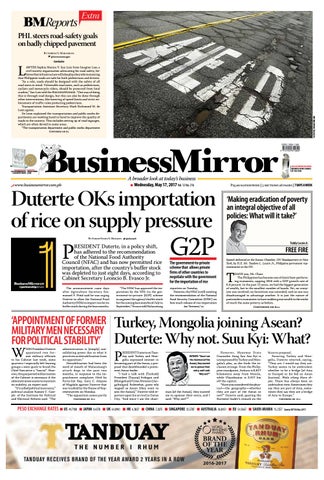
Duterte OKs importation of rice on supply pressure G2P P By Elijah Felice E. Rosales
‘APPOINTMENT OF FORMER MILITARY MEN NECESSARY FOR POLITICAL STABILITY’
W
hen President Duterte appointed t wo for mer military officials to his Cabinet last week, some quarters—especially left-leaning groups—were quick to brand the Chief Executive a “fascist”. However, this purported militarization of the Cabinet is necessary if the administration wants to maintain its stability, an expert said. “It’s called political insurance,” political analyst Ramon C. Casiple of the Institute for Political and Electoral Reform said. “The
administration is [simply] consolidating power due to what it perceives as destabilization from its opposition.” Destabilization had been the word of mouth of Malacañang’s attac k dogs in t he past t wo months, in response to the impeachment complaint filed by Party-list Rep. Gary C. Alejano of Magdalo against Duterte that was trashed by the House of Representatives on Monday. “The opposition comes partly Continued on A12
PESO exchange rates n US 49.7100
business news source of the year
P25.00 nationwide | 5 sections 28 pages | 7 days a week
‘Making eradication of poverty an integral objective of all policies: What will it take?’
@alyasjah
resident Duterte, in a policy shift, has adhered to the recommendation of the National Food Authority Council (NFAC) and has now permitted rice importation, after the country’s buffer stock was depleted to just eight days, according to Cabinet Secretary Leoncio B. Evasco Jr. The announcement came days after Agriculture Secretary Emmanuel F. Piñol said he was urging Duterte to allow the National Food Authority (NFA) to import rice for its buffer stock during the lean months.
2016 ejap journalism awards
“The NFAC has approved the importation by the NFA via the government-to-private [G2P] scheme to augment the agency’s buffer stock for the coming lean months of July to September,” Evasco told Malacañang
The government-to-private scheme that allows private firms of other countries to negotiate with the government for the importation of rice reporters on Tuesday. However, the NFAC is still awaiting the recommendation of the National Food Security Committee (NFSC) on how much volume of rice importation See “Duterte,” A2
Teddy Locsin Jr.
free fire Speech delivered at the Ecosoc Chamber, UN Headquarters in New York, by H.E. Mr. Teodoro L. Locsin Jr., Philippine permanent representative to the UN.
T
hank you, Mr. Chair. The Philippines has become one of Asia’s best-performing economies, capping 2016 with a GDP growth rate of 6.8 percent. In the past 15 years, we had the biggest generation of wealth, but in the smallest number of hands. Yet, no cronyism was involved; no favoritism was extended; and no one was disadvantaged to advantage another. It is just the nature of postmodern economies: to have sudden great wealth in the midst of much the same poverty as before. Continued on A11
Turkey, Mongolia joining Asean? Duterte: Why not. Suu Kyi: What? P
resident Duterte on Tuesday said Turkey and Mongolia expressed interest in becoming part of the Asean, a proposal that dumbfounded a prominent Asean leader. “I had a talk with [Turkish] President [Tayyip] Erdogan and [Mongolian] Prime Minister [Jargaltulgyn] Erdenebat; gusto nila magsali sa Asean [they want to join the Asean],” Duterte told reporters upon his arrival in Davao City. “And since I am the chair-
DUTERTE: “Since I am the chairman [of the Asean], they wanted me to sponsor their entry, and I said: ‘Why not?’”
man [of the Asean], they wanted me to sponsor their entry, and I said: ‘Why not?’”
Ho w e v e r, Myanmar S t at e Counselor Aung San Suu Kyi is unimpressed by Turkey and Mongolia’s plea, as she finds the inclusion strange. From the Philippine standpoint, Ankara is 8,827 kilometers away from Manila, while Ulaanbaatar is 3,917 km off the capital. “Have you considered the physical—the geography—whether they are part of the Asean or not?” Duterte said, quoting the Burmese leader’s remark on the
bizarre proposal. Favoring Turkey and Mongolia, Duterte retorted, saying, “They are. I would say they are. Turkey seems to be ambivalent whether to be a bridge [of Asia to Europe] or [to be] an Asian [nation]. Wala silang klaro diyan. There has always been an ambivalent view. Sometimes they say they are part of Asia, sometimes they say they are a bridge of Asia to Europe.” Continued on A12
n japan 0.4370 n UK 64.0961 n HK 6.3837 n CHINA 7.2075 n singapore 35.5707 n australia 36.8451 n EU 54.5667 n SAUDI arabia 13.2557
Source: BSP (16 May 2017 )
A2 Wednesday, May 17, 2017
BMReports BusinessMirror
www.businessmirror.com.ph
PHL steers road-safety goals on badly chipped pavement Continued from A1
are actively working together to make our road infrastructures more responsive to the needs of our citizens,” he said. The government is pursuing multibillion-peso infrastructure projects to develop different roads in the country, including tourism roads, arterial passages, bypasses and national highways.
Legislative amendments
BE S I DE S h av i n g no v e h ic le safety standards, the Philippines does not adhere to international agreements on vehicle standards, such as the 1958 Agreement of World Forum for Harmonization of Vehicle Regulations. “It also does not have an established new car-assessment program, wherein vehicles are rated in terms of safety, for the information of consumers,” San
Duterte. . .
Continued from A1
should be activated from the NFA’s remaining 250,000 metric tons (MT) standby authority. The NFSC is scheduled to discuss the matter on Thursday. On top of the G2P, Evasco said the NFAC has also green lighted the importation of 805,000 MT of rice under the minimum access volume (MAV). Aside from this, the NFAC has instructed the NFA to amend the MAV guidelines to require participating traders to import 25 percent broken rice from their 25-percent to 30-percent quota.
Luis said. Aside from this, there is a need to update, amend and pass laws to further strengthen the roadsafety initiatives of the government. Some laws, according to San Luis, are outdated, and some lack implementation. “While the Philippines already has various road-safety laws in place, these laws must be revisited to allow for more effective enforcement,” she said. For instance, the Land Transportation and Traffic Code does not provide for enforcement using speed guns, and only treats violations of speed limits as a form of reckless driving. Enforcers are also not adequately equipped with speed guns or assisted with speed enforcement cameras. The Seat Belts Use Act also needs updating. It does not require seat belts for backseat passengers of buses, jeepneys and vans. The
law only requires lap belts for front seat passengers and drivers of jeepneys. The Helmet Act of 2009, on the other hand, has three points that need improving: first, it does not mandate “proper use” of helmets; second, it does not require appropriately sized helmets for children; and third it does not cover electronic bikes. Another law on the laundry list of San Luis is the Anti-Drunk and Dr ug ged Dr iv ing Act of 2013, which requires probable cause for a driver to be apprehended on suspicion of alcohol or drug use. “This prevents enforcers from conducting random breath checkpoints, which has been shown to be effective in modifying drink-driving behavior in other countries,” San Luis said. And while Congress has enacted three laws on road safety—the
Children’s Safety on Motorcycles Act, the Speed Limiter Act and the Anti-Distracted Driving Act—implementation is still a major issue. “These laws have not yet been implemented or enforced, as their implementing rules and regulations have not been issued as of the date of this submission,” San Luis said.
DE Leon noted the problem of unsafe roads requires a multi-sectoral approach. “We will be needing the support of all stakeholders to improve our road-safety situation,” he said. “The department, along with the other government agencies, are actively laying the groundwork for the improvement of transportation systems, infrastructure network and the public utility vehicle [PU V] moder ni zat ion, wh ic h aims to provide safer, better and reliable transport.” Road users
and pedestrians also need to be educated on road safety, de Leon admitted. Ordinary Filipinos also have a part to play in ensuring that Philippine streets are safe. “The department recognizes that the mind-set and disciplined behavior among the road users is one of the keys to minimize road crashes and fatalities,” he said. “Thus, in order to instill safety mind-set to our road users, increased awareness among all stakeholders must be initiated through education and stricter enforcement of pertinent laws and traffic rules and regulations.” The department, through the support of other agencies and private sector, will launch effective communications campaign to increase awareness of road laws and regulations, the official said. San Luis concurred, saying that addressing road-safety issues in the Philippines is easier said than done,
and can only be done through the cooperation of all its stakeholders. “Under the safe system approach to road safety, all roadsafety stakeholders must work together to strengthen all aspects of road-safety intervention, to minimize the effect of a crash,” she said. “But the government must veer away from the traditional view that the driver is at the center of a road crash and must strengthen the five pillars of road safety by: improving roadsafety management; designing safer roads; introducing vehicle standards; setting and enforcing laws that will lessen risky behavior on roads; and increasing accessibility to post-crash care,” San Luis added. For now, Filipinos will have to wait and see how the government will cement reforms in road safety in the next five years.
“This will ensure adequacy of supply and stability of consumer prices at levels within the reach of lowincome families,” he noted. Evasco confirmed the country’s buffer stock is down to eight days, lagging behind the 15 days buffer stock requirement of the Legislative-Executive Development Advisory Council (Ledac). “That’s why the NFAC has directed the NFA to sign the remaining import permits for all this rice to get into our market, all the while wtaiting for imported rice to come through the G2P mode of procurement,” he explained. On the other hand, Evasco admitted the decision to allow rice
importation is a “policy shift” of the administration, as Duterte listened to the recommendation of the NFAC during the Cabinet meeting on Monday. “To some extent, it admits there is really a need for us to import [rice],” Evasco said. Earlier, Duterte and his officials have been saying the Philippines will refrain from importing rice this year. Gearing away from the government-to-government (G2G) scheme is a decision unanimously reached by the NFAC, Evasco said, as it is “prone to corruption” since it is exempt from government procurement. This is in contrast to the so-called G2P, which he labeled to be “more competitive, least corrupt
and transparent”. Piñol has urged Duterte “to do the importation now, because the harvest season has ended”. He claimed the NFA is whining over an insufficient buffer stock. However, his proposal to conduct the importation via G2G did not materialize, as the NFAC has pushed for a G2P. Under the G2P, private suppliers from participating countries are permitted to participate in the bidding, making it covered by the Government Procurement Reform Act. Piñol opted to push for the importation following reports that rice prices have increased by as much as P100 per 50-kilogram bag.
“Let the NFA do the importation now, because the harvest season has ended. The NFA is complaining that they don’t have sufficient buffer stock. If it wants to import, it should be now,” Piñol told reporters in an interview last Thursday. “I told the President that now is the best time for the NFA to import. And it should be via government to government,” he added. Citing data from the International Rice Research Institute (Irri), Piñol said the country’s rice shortfall this year could reach as much as 800,000 MT. “However, this is much lower than the shortfall in previous years. The Irri study showed that the trend
in the rice consumption of Filipinos is declining,” Piñol said. “The Filipino family has become prosperous and, more often than not, when they eat outside, they only consume less rice,” he added. The NFA had earlier asked the interagency NFAC to allow the G2G purchase of 250,000 MT of rice, citing its difficulties to procure palay from farmers to boost its stockpile. The food agency said it would need an additional 490,800 MT to meet the 30-day buffer-stock requirement of the Ledac. The NFA is mandated to maintain a rice buffer stock that will last for 15 days at any given time and 30 days at the onset of the lean months. Rice harvest is significantly lower during the lean months of July to September. Data from the Philippine Statistics Authority (PSA) showed that as of April 1, rice stocks held by NFA depositories reached 327,240 MT, which is sufficient for only 10 days. NFA Administrator Jason Laureano Y. Aquino had been urging the NFAC for months to approve his proposal to import rice. “It’s always better safe than sorry, especially when dealing with our people’s basic staple. If the government does not possess the right volume of stocks when the lean months come, who would provide for the needs of calamity victims?” Aquino said last month. The NFA chief had been urging the council to approve the purchase of the 250,000 MT of imported rice. The volume is part of the 500,000 MT standby authority granted by the council to the agency in 2015. Last month Duterte thumbed down the purchase of imported rice, citing the need to protect local farmers. The NFAC and Piñol had also been lukewarm to the idea of allowing the NFA to import rice. Some members of the NFAC said they prefer the private sector to buy rice from abroad to prevent the food agency from incurring more debts due to G2G importations. To boost its buffer stock and reduce its debts, Piñol asked the NFA to focus on the procurement of palay from local farmers. “In the future, if the NFA intends to increase its buffer stock, then it should buy local produce. Importing rice would only cause the NFA to be saddled with more debts,” he said. Data from the PSA showed that Philippine unmilledrice output declined by nearly 3 percent to 17.62 million metric tons (MMT), from 18.14 MMT recorded in 2015. The DA attributed the decline in output to onslaught of strong typhoons, as well as pest infestation in some rice-growing areas.
Increased awareness
news@businessmirror.com.ph
The Nation BusinessMirror
Red Cross enhances reliability of SOS network with small cell technology
A
T the culmination of the Philippine Red Cross’s (PRC) monthlong 70th anniversary celebration on May 9, the organization announced yet another milestone: the use of “small cellular” technology to power the PRC’s SOS cell network, which will enable people to call, text and connect to the Internet in calamity areas. Made possible by open-source technology, the new communications equipment was unveiled before President Duterte at the sidelines of the commissioning of the MV PRC Amazing Grace, the PRC’s humanitarian ship, at the Philippine Navy Headquarters in Manila.
Networks to be deployed in ground zero
“IT is portable, and once fired up in a disaster-stricken area, is capable of connecting our first responders and people in need of help through their mobile phones within a seven-kilometer radius,” PRC Chairman Sen. Richard J. Gordon. The small form factor of the technology and its low power consumption will allow rescuers to deploy the communications system within minutes after an emergency. “We can rush many of these to the scene, installed in our Red Cross rescue vehicles. Deployment and activation can be as fast as 30 minutes, and requires only solar power to sustain them,” Gordon added. The self-contained cellular network taps into open-source small cell technology. Current advancements in technology allow these types of machines and equipment to be smaller, cheaper and more power efficient.
“This is the first time small cell is being introduced to first responders on humanitarian missions in this part of the world,” Gordon said. “Some 25 natural and man-made calamities occur in the Philippines every year. These calamities have, over time, also tended to intensify, as we have experienced. Every ounce of creativity and resourcefulness is needed if we are to respond, and respond with equal intensity. This is where we turn to technology.” Besides tapping small cellular technology for its SOS network, the PRC has been building its capacity as a humanitarian organization through other initiatives. On April 21 the PRC inaugurated a new logistics and disaster-management training center in Passi City, Iloilo, through a partnership with the Korean National Red Cross. The new facility was part of the PRC’s ongoing Superyphoon Yolanda recovery efforts, which, as of April, has already resulted in 77,471 shelters built, as well as 62,683 families provided with livelihood. On April 19 the PRC raised a total of P37.79 million in pledges and donations by several partners and donors during its annual Fund and Membership Campaign “Kick-Off”. The PRC conducts a year-round fund campaign to sustain its operations. Originally set for May 13 as part of the PRC’s monthlong 70th anniversary celebration, the Million Volunteer Run 4 has been rescheduled to July 23. The annual run aims to raise funds, as well as recruit more volunteers for the PRC’s humanitarian services. Claudeth Mocon-Ciriaco
‘Impeachment complaint vs Duterte dead, cremated’ By Jovee Marie N. dela Cruz @joveemarie
S
PEAKER Pantaleon D. Alvarez on Tuesday said the impeachment complaint against President Duterte is “good as dead”, while the fate of the impeachment complaint against Vice President Maria Leonor G. Robredo remains uncertain. Alvarez said there is no chance for the impeachment complaint against Duterte to be revived. “The dismissal [of the impeachment complaint] talagang patay na. Baka nacremate na nga iyon today,” he said in jest. On Monday the House Committee on Justice has found the first impeachment complaint filed by Party-list Rep. Gary C. Alejano of Magdalo against Duterte sufficient in form but insufficient in substance. PDP-Laban Rep. Reynaldo V. Umali of Oriental Mindoro, the panel chairman, said the committee is now preparing the report to be submitted to the House in plenary session for its approval within 60 days. During the hearing, lawmakers questioned Alejano over his personal knowledge in allegations against the President. Majority Leader Rodolfo C. Fariñas of Ilocos Norte said Alejano “clearly has no personal knowledge” on the material allegations he made, saying “the complaint is [based] purely [on] quadruple hearsay”. He also warned Alejano against an ethics complaint and a perjury case owing to his “hearsay” allegations. Alejano admitted that he had no personal knowledge as a witness but “I have
personal knowledge as a complainant based on the records”. Meanwhile, Alejano maintained that his impeachment complaint was based on the Chief Executive’s alleged culpable violation of the Constitution, bribery, betrayal of public trust, graft and corruption, and other high crimes. The Magdalo lawmaker also said Duterte committed high crimes of bribery, multiple murder and crimes against humanity when he adopted a state policy of inducing policemen, other law-enforcement authorities, and vigilante groups into the extrajudicial killings of more than 8,000 persons who were merely suspected of being drug offenders. Alejano said Duterte’s involvement in multiple murder as mastermind of the Davao Death Squad, saying the President also committed graft and corruption with the hiring of 11,000 ghost employees when he was still a mayor of Davao City; and his unexplained wealth amounting to more than P2 billion in deposits and credits that flowed into his numerous bank account. Alejano also filed a supplemental complaint regarding the President’s failure to assert the country’s sovereign and maritime rights over disputed territories with China, including Benham Rise, Panatag Shoal and the rest of the West Philippine Sea. Meanwhile, Alvarez said lawmakers are still studying the impeachment complaint against Robredo. Currently, there are two impeachment complaints against Robredo. However, they are still not verified since no congressman has endorsed them.
Customs agents foil attempt to smuggle out 2 handguns By Recto Mercene
C
@rectomercene
USTOMS agents foiled on Tuesday an attempt by still unidentified persons to smuggle out of the country two handguns concealed inside two electric water heaters. The agents seized a caliber .45 pistol and a 9mm pistol both manufactured by Armscor Philippines at the Thomas Nationwide Transportation (TNT) warehouse in Pasay City, while the hot items were about to be taken to Hong Kong and Vietnam. Maj. Jaybee Cometa, head of the X-ray Inspection Project (XIP) and Customs District III Collector Ed Macabeo, said a 21-year-old
employee identified as Alfonso Martin V. Sanchez was arrested when he tried to check on the status of the shipment. XIP officials put “X” markings on the two parcels signifying that the parcels must be subjected to a thorough inspection. Macabeo said Sanchez, a resident of Caloocan City, has inquired “about the status of two outbound parcels stored in a Pasay warehouse. When the boxes were opened, agents found a 9mm pistol and a caliber .45 pistol with empty magazine hidden inside two separate electric water heaters”. When Customs authorities demanded for the documents needed to export of the two guns, Sanchez failed to produce any.
Editor: Dionisio L. Pelayo • Wednesday, May 17, 2017 A3
Marcos asks PET to name 3 hearing officers in poll protest
I
N a bid to expedite the much-delayed election-protest proceedings, former Sen. Ferdinand R. Marcos Jr. has asked the Supreme Court, sitting as the Presidential Electoral Tribunal (PET), to designate at least three hearing officers who will assist the tribunal during the preliminary conference.
In a seven-page Urgent Ex-Parte Motion to designate Hearing Commissioners, Marcos, through his counsel George Erwin Garcia, said the designation of at least three hearing commissioners “will better facilitate an orderly, simplified and expeditious disposition of this electoral contest, considering that there are three causes of action raised in this election protest”. The tribunal, in an order dated April 25, had set the preliminary conference on June 21 at 2 p.m. Marcos had raised three main issues in his election protest, namely, the “flawed” automated election system (AES), the failure of elections in several provinces in Mindanao and the unauthorized introduction by Smartmatic’s
Marlon Garcia of a new hash code (or a new script program) into the transparency server on the day of the elections. Garcia said it is most important that a hearing officer be assigned for each cause of action “so as not to muddle the proceedings”, as they intend to present a specific set of witnesses and documentary exhibits per cause of action. He also reiterated the need for Marcos’s election protest to be decided with dispatch and pointed out that the designation of three separate hearing officers would certainly aid the tribunal in resolving the case in a prompt and efficient manner. “Public-interest demands that this electoral controversy be resolved with dispatch to de-
termine once and for all the genuine choice of the electorate for the contested position. The designation of three hearing commissioners, as suggested by protestant Marcos, shall surely aid this Honorable Tribunal in achieving its mandate to ensure a prompt and expeditious resolution of this election protest,” Garcia added. He also said the designation of hearing officers prior to the conduct of the preliminary conference in consistent with the summary nature and preferential status of election protest cases. “In a long line of decided cases, this Honorable Tribunal has consistently ruled that an election case, unlike an ordinary action, is imbued with public interest, since it involves not only the adjudication of the private interests of rival candidates, but also, the paramount need of dispelling the uncertainty, which beclouds the real choice of the electorate with respect to who shall discharge the prerogatives of the office within their gift. “Moreover, it is neither fair, nor just, to keep in office for an uncertain period one whose right to it is under suspicion. It is imperative that his claim be immediately cleared, not only for the benefit of the winner, but [also] for the sake of public interest, which can only be achieved by brushing aside technicalities of procedure, which protract and delay the trial of an ordinary action,” Garcia concluded. Joel R. San Juan
Economy
A4 Wednesday, May 17, 2017 • Editors: Vittorio V. Vitug and Max V. de Leon
BusinessMirror
news@businessmirror.com.ph
Nickel-production outlook steady at 2.4% until 2021
B
MI Research, the research arm of Fitch Group, has kept its outlook on the country’s nickelore production at an average of 2.4 percent from this year to 2021. In its report released on Tuesday, BMI Research said nickel production in the country will continue to grow as the closure and suspension orders made by former Environment Secretary Regina Paz L. Lopez only affected smaller players in the mining industry. “We also maintained our nickel-production forecasts for the Philippines as we believed the Philippine nickel industry would not suffer a significant decrease in overall output in 2017 in relation to 2016, as prices recover and the government’s mine closures largely affect smaller players,” the report read. “True to all our expectations, production from the Philippines in 2017 will be stable. Nickel ore-production growth in the Philippines will register an annual average of 2.4 percent during [the] 2017-2021 [period],” it noted. Last year nickel output was estimated to drop 18 percent. But the BMI Research said the country’s mining space will attract
thin foreign investments, with the “increasing government’s regulation, policy uncertainty and increasing environment regulations”. “Although the new head of the Department of Environment and Natural Resources (DENR), [Secretary] Roy A. Cimatu, is more adaptive and believes mining and protecting the environment can be achieved simultaneously, President
Rodrigo Duterte insists the existing mining law will be upheld,” the report stated. In its Mining Risk/ Reward Index, the Philippines’s mining regulation is the least attractive in Asia. The country scored 45.1 out of 100 in the Mining Risk/ Reward Index, below Asia’s average of 55.6. “Foreign investment into the mining sector in the Philippines will be limited due to policy discontinuity, severe government intervention and strict environmental laws. Besides, protests against mining by environmental activists and local communities, supported by the Catholic Church, are also commonplace in the country,” the BMI Research said. PNA
Foreign investment into the mining sector in the Philippines will be limited due to policy discontinuity, severe government intervention and strict environmental laws. Besides, protests against mining by environmental activists and local communities, supported by the Catholic Church, are also commonplace in the country.”—BMI Research
Power check
A lineman conducts a routine weekend maintenance check on power lines and poles in Makati City. Customers of the Manila Electric Co. will enjoy price cut in their power bills for the month of May, following a decrease in generation charge. ALYSA SALEN
Better rice, corn yields in Q1–PSA By Jasper Emmanuel Y. Arcalas @jearcalas
T
he country’s paddy-rice production in the first half of the year could expand between 11.78 percent and 8.55 million metric tons (MMT), from 7.65 MMT recorded output a year ago, according to the latest report of the Philippine Statistics Authority (PSA). In its report, titled “Rice and Corn Situation Outlook”, the PSA attributed the hike in production to the expansion of harvest area during the January-to-June 2017 period, after farmers have recovered from the damage wrought by El Niño last year. “Harvest area[s] may increase from 1.93 million to 2.10 million hectares, or by 8.7 percent. Yield per hectare may improve by 2.83 percent, from 3.96 MT in 2016 to 4.08 MT in 2017,” the PSA said in its April round-production forecast report published on Tuesday. The PSA projects that local palay production in the second quarter may reach 4.128 MMT, 11.38 percent higher than the 3.714 MMT recorded output in the same period last year. The PSA added that harvest area in the April-to-June period would expand by 11.86 percent to 948,610 hectares, from 848,030 hectares recorded a year ago. “All regions may possibly have increments in production, except Central Luzon. Probable growths in production are expected due to increments in harvest areas resulting from availability of irrigation water/ sufficient rainfall during planting period, and availability of seeds from Department of AgricultureRegional Field Offices [DA-RFOs] and local government units,” the PSA said. “In Cagayan Valley and Mimaropa the possible increments are attributed to movement of harvest to April 2017 due to intermittent rains in late-March 2017,” the PSA added.
8.7%
The projected increase in rice harvest areas, from 1.93 million to 2.10 million hectares in the first half of the year. Corp production, on the other hand, is seen to expand by 30.15 to 3.68 MMT, from 2.83 MMT output in 2016. However, the PSA noted the average yield in the second quarter would contract to 4.35 MT per hectare, from 4.38 MT per hectare level a year ago. The Department of Agriculture also projects that palay production in the April-to-June period would reach the 4 MMT level on the back of better planting conditions, particularly favorable weather patterns. The forecasts of the DA and the PSA were revealed after local rice farmers hiked their palay output in the first quarter by 12.38 percent to 4.42 million, from 3.93 MMT recorded output a year ago. Based on farmers’ planting intentions, the government’s major statistical agency also forecasts that the country’s palay production in the third quarter would reach 3.146 MMT, 5.99 percent higher than the 2.968 MMT recorded production a year ago. The PSA added that harvest area in the July-to-September period would expand by 6.61 percent to 794,400 hectares, from 745,140 hectares a year ago. “Increments in production are foreseen in most of the regions, except the Ilocos region, Bicol, Zamboanga peninsu la, Northern Mindanao and ARMM [Autonomous Region in Muslim
Mindanao],” the PSA said. “Probable increases in harvest areas attributed to farmers’ expectations on the availability of irrigation water/sufficient rainfall during planting period. Likewise, farmers are optimistic with the government interventions in palay production,” the PSA added. However, the PSA noted that yield per hectare in the third quarter could slightly drop to 3.96 MT hectares from 3.98 MT hectares, recorded level during the same period last year. The DA is eyeing a total palay output of 18.57 MMT this year, 5.33 percent higher than last year's output of 17.63 MMT. In the same report, the PSA said corn production in the first half of the year would expand by more than a quarter, or by 30.25 percent to 3.68 MMT, from 2.83 MMT output in 2016. “Harvest area may expand from 0.90 million hectares to 1.10 million hectares, or by 21.77 percent. Yield per hectare may increase from 3.14 MT in 2016 to 3.36 MT in 2017, or by 6.97 percent,” the PSA said. The PSA also forecasts that the corn output in the second quarter would reach 1.137 MMT, which is 44.58 percent higher than the 911,000 MT recorded output a year ago. The PSA added that harvest area would also expand by 47.75 percent to 400,920 hectares, from 271,350 hectares a year ago. “Cagayan Va lley, Norther n Mindanao, Soccsksargen and the ARMM may post significant increments in production and harvest areas. These may be attributed to sufficient rainfall during planting period and availability of HYV seeds from the DA,” it said. Based on corn farmers’ planting intentions for the third quarter, the PSA projects that the corn output during the period would reach 3.146 MMT, while harvest area would expand to 794,400 hectares.
Lawmaker to Palace: Tap local industry sources in modernizing military, police By Butch Fernandez @butchfBM
I
nstead of relying on foreign suppliers to modernize the Armed Forces and the Philippine National Police weaponry, the Duterte administration should first tap local firearm industry sources to supply weapons to soldiers and policemen. Senate President Pro Tempore Ralph G. Recto recommended this option on Tuesday as he asked Malacañang to rethink “reported plans to take on the $500-million loan being offered by the Chinese government to modernize the Philippine military.” The senator suggested that buying weapons from local sources would also give added boost to the local firearms industry. “We must stop relying on foreign suppliers to modernize the military equipment of our armed forces,” said Recto, reacting to a recent statement by Defense Secretary Delfin
N. Lorenzana about government's plans to use the $500-million loan to buy defense equipment from China. “There is no need to borrow from China. We should tap our domestic industries for the equipment needed by our policemen and soldiers.” To drive home his point, the senator cited the vibrant local firearms industry, which, he said, had been exporting its products for many decades now. “Some of them were licensees of world’s leading gun makers,” Recto added. “There are many of them, from boat builders to vehicle manufacturers to firearm/ammunition makers, who can step up to the plate once there are firm orders from the government, Recto said. “We should look inward and develop our own capability. It is cheaper to produce and maintain them locally, than to import them. That way, jobs are created for the Filipinos and the local industries are given the chance to grow.” Recto added: “The only equip-
ment or parts we should import are those which we cannot produce locally.” He insisted that government decision-makers “should not bypass local industries which can provide parts or whole of the defense equipment being sought.” Recto argued against relying heavily on foreign suppliers to provide the needs of soldiers and policemen. “Hindi naman pwede na mula helmet hanggang boots imported. If some of the things can be made locally and the products are of the same price and quality as the ones bought abroad, then let us manufacture them here.” For instance, the senator suggested the country’s booming car manufacturing industry can also supply military and police vehicle requirements. Moreover, Recto pointed to what he described as “a world-class shipbuilding industry in Cebu” that the Duterte administration can harness “as a major source of military and civilian boats”.
The Regions BusinessMirror
news@businessmirror.com.ph
Editor: Efleda P. Campos • Wednesday, May 17, 2017
A5
Mindanao riding high as top-notch performer in PRDP
D
By Manuel T. Cayon
@awimailbox Mindanao Bureau Chief
AVAO CITY—Mindanao’s experience as the pilot of the World Bankfunded rural-development program called Mindanao Rural Development Program (MRDP) has throttled its way to a sterling performance in the successor project, the Philippine Rural Development Program (PRDP).
The program’s community acceptance has led to a new batch of projects, with an aggregate value of P5 billion. These will be proposed for evaluation for additional funding, although the PR DP management team has already approved P7.99 billion worth of projects for the six-year
duration of the program. In last week’s evaluation mission of its performance, the fourth six-month evaluation of the PRDP, Mindanao came out strong anew as a top performer among recipient organizations in all four key components, but especially in infrastructure.
A news conference briefer released by PRDP on Tuesday, and titled “Mindanao Cluster Initial Achievement on Project Development Objectives Indicators,” it shows a sharp 24-percent increase in incomes among beneficiary families to the projects on infrastructure. Increasing rural incomes is the key objective of the PRDP, which set a target of only a 5-percent increase each year for the next six years. This performance would have been equivalent to five years’ worth of sustaining t he projects. Araceli M. Morano, PRDP deputy program director, said the increase in incomes was traced to the increase in economic activities “mostly in areas where our farmroad projects were being built”. “And these are actually projects initiated by new associations that have not applied with the MRDP before. Those that benefited with the MRDP have projects now with the PRDP and have performed well,” she said. “We have noticed how families have maximized the increase in traffic and transport of goods
Construction of ₧330.5-million road projects begins in Quezon
LEADING the groundbreaking of the P330-million road project in Quezon are (from left) Rep. Katrina Enverga (First District); Pagbilao, Quezon Mayor Shierre Ann Palicpic; and Rep. Angelina Tan (Fourth District). JOHN BELLO
P
AGBILAO, Quezon—A much-awaited P330.5-million diversion road project here starts construction with the groundbreaking rites held in Barangay Del Carmen last Friday. Quezon Reps. Angelina Tan of the Fourth District and Katrina Enverga of the First District led the short groundbreaking program that signaled the start of the construction of the 5.75-kilometer-long road project expected to reduce by about 40 percent the vehicular traffic along the Maharlika South Road and especially to the town proper. Celestial Flancia, who heads the Department of Public Works and Highways (DPWH) Fourth District Engineering Office, said the project site is within the First District of the province, but has been under the jurisdiction of the Fourth District. During the program, Tan thanked Public Works Secretary Mark A. Villar for granting her request to release the P112.643million initial fund for the project. She said it was the worsening traffic problem in the town proper that prompted her to cook up the idea of the road project with the help of Flancia and her husband, DPWH- Region 1 Director Ronnel Tan, who once served as district engineer during the term of her predecessor in the district. Citing the significance and many advan-
tages of the project once completed, Tan asked the four barangay captains within the entire project area to cooperate and assist the DPWH. “To our village heads, please help our coworkers in the DPWH while doing the project,” Tan said. Flancia said the project will start in Barangay Talipan and will end in Barangay Ikirin toward Bicol and will provide a new access road in the area and function as a support infrastructure to complement development growth. She said the proposed bypass road has an estimated length of 5.75 km and a 6.7-kmwide carriageway. Being situated within the Calabarzon region growth area, Flancia said it is the only road leading to Bicol, the Visayas and Mindanao. The DPWH official said it will have significance in terms of economic and tourism activities. The project will whittle down travel time and transportation cost for the masses. Also present during the program were Pagbilao, Quezon Mayor Shierre Ann Palicpic, DPWH Assistant Regional Director Yolanda Tanco, Construction Division chief Julieta Deseo, First Engineering District chief Salvador Salvaña, members of the Sangguniang Bayan and Sangguniang Barangays and other guests. John Bello
along these road projects. Some put up their own stores, bought videokes and established other businesses,” she said. In all its infrastructure projects, mainly in farm roads, the PRDP has noted an increase in family incomes, from P194,741 to P247,567. At the farmer’s level, there was also an increase by 64 percent in incomes per hectare, from P55,584 to P90,9958, traced to the increase in transport traffic using the new farm roads. With increased farm incomes, the net income per family rose by 27 percent. “It has to do mainly with the economic activities along and around these roads,” she said. Farm roads connect one barangay,
usually a crop-production area to the nearest town-center market. The recently completed road projects show a sharp influx of transport activities by as much as 91 percent. “An average traffic count with the project was 79, while 151 vehicles were seen using the route after project completion,” it said. The new roads were either dirt roads or trails, or sand- and graveltopped roads. The impact of the roads alone was significant to the direct beneficiaries, the farmers. “Savings in passenger and produce transport increased, brought by the reduction in hauling cost for agriculture products and transport losses.” Average hauling cost per sack was reduced f rom P36.94 to P29.91, the evaluation disclosed. A fish trader, for instance, has converted to income its usual loss amounting to P51,000 due to poor road conditions. Transport of goods was also made faster, reducing an average of 38 minutes without the project, to 14 minutes after the project, covering an average distance of 6.2 kilometers.
Before the roads, farmers used farm animals hauling the products in carts, or the rickety jeepneys traveling once or twice daily. The infrastructure component is the most requested project for funding, indicating the poor infrastructure network in the countryside. Nationwide, it has a fund allocation reaching P18.54 billion. The infrastructure component falls under one of four components of the PRDP, the Intensified Building of Infrastructure and Logistics for Development. The other three components are the Investments in Rural Enterprises and Agricultural Fisheries Productivity, Investments in Agriculture and Fishery Modernization Plan Planning at the Local and National Levels, and implementation support component that includes the monitoring and evaluation, information and finance units. Morano said other rural organizations are requesting to be included in the PRDP program, and hoped their project proposals would merit approval. “These new project proposals are worth P5 billion,” she said.
A6
Wednesday, May 17, 2017
The World BusinessMirror
www.businessmirror.com.ph • Editor: Lyn Resurreccion
‘One Belt, One Road’, one man
Xi looms large at China summit
T
he pageantry permeating Beijing this week showed that China’s expansive vision for a new global economic order had another goal: Boosting President Xi Jinping’s grip on power at home. From faw ning state-med ia campaigns to the words of the man himself, the so-called Belt a nd R oad For u m re peated ly stressed Xi’s centrality to infrastructure-and-trade initiative that brought about 30 world leaders to Beijing, including Russian President Vladimir Putin. The Communist Party chief claimed personal credit for the “project of the century”, unusual in a political system that stresses collective leadership. “This is the initiative I proposed in 2013,” Xi said at a roundt able d i sc u ssion on Mond ay featuring the leaders of the UN, the World Bank and the International Monetary Fund. “This initiative stemmed from my observations and thoughts about the world’s situation.” Greater prestige may help Xi put supportive officials in place during a twice-a-decade leadership reshuffle that will determine his ability to enact a politically fraught economic overhaul. Xi has already become China’s most powerful leader since at least Deng Xiaoping in the 1990s, and the next few years will shape his legacy for decades to come. “In a year of power transition, if you can score a domestic policy or diplomatic victory, it is a political bonus,” said Zhang Jian, an associate political science professor at Peking University. “The Belt and Road Initiative is a large-scale project that links the domestic
economy with diplomacy—it’s his most important and legacydefining policy.” Since Xi first outlined plans in 2013 to recreate ancient Silk Road trading routes between Asia and Europe, the program has repeatedly changed names and been elevated to a top national strategy spanning the globe. On Sunday Xi pledged 540 billion yuan ($78 billion) in financing and encouraged banks to contribute another 300 billion yuan in overseas capital to support his project. Meanwhile, breathless staterun coverage portrayed the Belt and Road Initiative as having near limitless potential to remake the world, with China—and Xi—at its center. State telev ision showed X i and his celebrity wife, Peng Liyuan, receiving Turkish President Recep Tayyip Erdogan and other heads of state, while top diplomats, such as UK Chancellor of the Exchequer Philip Hammond, paraded on stage to praise the president’s program. “Thanks to him, more and more people are interested in today’s China,” a video about the forum by the party’s People’s Daily newspaper said of Xi. “Under his leadership, China’s circle of friends is growing bigger and bigger.” Beijing’s notorious pollution even dissipated as China’s state machinery snapped into action to make Xi look good. The brilliant
Chinese President Xi Jinping speaks at the Belt and Road Forum in Beijing on Monday. Bloomberg News
30 The number of world leaders who attended the Belt and Road Forum in Beijing
blue skies, which authorities often engineer for high-profile events by shuttering factories and taking cars off roads, provided a symbolic backdrop for a leader seeking to show he’s in control. The pomp left little room for serious talk about overcoming the challenges facing such a sweeping initiative. One participant in the
policy discussion sessions who asked not to be identified said the events offered little more than prepared remarks praising Xi, wasting an opportunity for substantial debate on how to collaborate and best spend China’s money. Even before the event got under way, some diplomats in Beijing were complaining the Chinese hadn’t allowed sufficient time for input while preparing the event’s final communiqué, according to people familiar with the process. The draft combined commitments to open international markets with endorsements of C h i na’s d iplom at ic goals, the people said. T he f ina l communiqué released late on Monday emphasized dialogue, consultation and cooperation bet ween par ticipant nations. Signatories to the almost 2,200 -word document pledged “to oppose all forms of protectionism, including in the
framework of the Belt and Road Initiative” while “promoting a universa l, r ules-based, open, nondiscriminatory and equitable multilateral trading system”. The Ministry of Foreign Affairs also released a list of 270 results, including two-way agreements with countries ranging from Switzerland to Afghanistan. “ The BRI [Belt and Road Initiative] is considered Xi ’s most important initiative and it reflects several distinct characteristics of his leadership, including his ambition and confidence,” said Paul Haenle, a former China director on the US National Security Council who now heads the Carnegie-Tsinghua Center in Beijing. Haenle called the forum “one among a series of important opportunities this year for Xi to showcase his leadership credentials in the run up to the all-important Chinese Communist Party leadership transition”. Bloomberg News
Expert who beat cyber attack says he’s no hero
I
LFRACOMBE, England—A young British computer expert credited with cracking the WannaCry cyber attack told The Associated Press he doesn’t consider himself a hero, but fights malware because “it’s the right thing to do”. In his first face-to-face interview, Marcus Hutchins, who works for Los Angeles-based Kryptos Logic, said on Monday that hundreds of computer experts worked throughout the weekend to fight the virus, which paralyzed computers in some 150 countries. “I’m definitely not a hero,” he said. “I’m just someone doing my bit to stop botnets.” The 22-year-old computer whiz from the south coast of England, discovered a so-called kill switch that slowed the unprecedented outbreak on Friday. He then spent the next three days fighting the worm that crippled Britain’s hospital network, as well as computer systems around the world. WannaCry paralyzed computers running mostly older versions of Microsoft Windows by encrypting users’ computer files and displaying a message demanding anywhere from $300 to $600 to release them; failure to pay would leave the data mangled, and likely beyond repair. Hutchins said he stumbled across the solution when he was analyzing a sample of the malicious code and noticed it was linked to an unregistered web address. He promptly registered the domain, something he regularly does to discover ways to track or stop cyber threats, and found that stopped the worm from spreading. Salim Neino, CEO of Kryptos Logic, said Hutchins took over the kill switch on Friday afternoon European time, before it could fully affect the US. “Marcus, with the program he runs at Kryptos Logic, not only saved the US, but also, prevented further damage to the rest of the world,” Neino said. “Within a few moments, we were able to validate that there was indeed a kill switch. It was a very exciting moment. This is something that Marcus
British IT expert Marcus Hutchins who has been branded a hero for slowing down the WannaCry global cyber attack, speaks during an interview in Ilfracombe, England, on May 15. AP/Frank Augstein
validated himself.” He said the company was not able to identify “Patient Zero”, the first system infected, which would give researchers more information about who was behind the attack. Nevertheless, he said the worm was “poorly designed”—patched together and a “sum of different parts” with an unsophisticated payment system. Kryptos Logic is one of hundreds of companies working to combat online threats for companies, government agencies and individuals around the world. Hutchins himself is part of a global community that constantly watches for attacks and works to thwart them, often sharing information on Twitter. It’s not uncommon for members to use aliases, to protect from retaliatory attacks and ensure privacy. Hutchins has long tweeted under the handle MalwareTech, which features a profile photo of a pouty-faced cat wearing enormous sunglasses. But he realizes his newfound fame will mean an end to the anonymity.
After all, now he’s a computer celebrity. He’s been in touch with the Federal Bureau of Investigation, as well as British national cyber security officials. “I don’t think I’m ever going back to the MalwareTech that everyone knew,” said the curly haired young man, shrugging and flashing a winning smile. It is likely to be a big adjustment. Hutchins lives with his family in this seaside town, where he works out of his bedroom on a sophisticated computer setup with three enormous screens. He will soon become a local hero—but if you ask him, his life of celebrity will be short lived. “I felt like I should agree to one interview,” he said. But even that made the fame-averse Hutchins so nervous that he initially misspelled his last name, leaving out the letter “n’’ when doing a sound-level for the cameras. His mother Janet, a nurse, couldn’t be prouder—and was happy to have the veil of anonymity lifted. “I wanted to scream, but I couldn’t,” she said. Many will be following his next moves though. CyberSecurity Ventures, which tracks the industry, estimates global spending on cyber security will jump to $120 billion this year from just $3.5 billion in 2004. It forecasts expenditures will grow between 12 percent and 15 percent annually for the next five years. “While all other technology sectors are driven by reducing inefficiencies and increasing productivity, cyber security spending is driven by cyber crime,” the firm said in a Februar y repor t. “The unprecedented cyber-criminal activity we are witnessing is generating so much cyber spending, it’s become nearly impossible for analysts to keep track.” After more analysis, Hutchins, an avid surfer, plans to take a vacation—traveling to Las Vegas and California on the company dime. One guess on what he’ll be doing: Yes, surfing. On waves this time. AP
Chinese spent $24 billion on US, other ‘golden visas’
B
EIJING—When the sister of President Donald J. Trump’s son-in-law Jared Kushner promoted investment in her family’s new skyscraper from a Beijing hotel ballroom stage earlier this month, she was pitching a controversial American visa program that’s proven irresistible to tens of thousands of Chinese. More than 100,000 Chinese have poured at least $24 billion in the last decade into “golden-visa” programs across the world that offer residence in exchange for investment, an Associated Press analysis has found. Nowhere is Chinese demand greater than in the US, which has taken in at least $7.7 billion and issued more than 40,000 visas to Chinese investors and their families in the past decade, the AP found. The Chinese investors flocking to these programs are people like Jenny Liu, a doctoral student in the eastern city of Nanjing, who sold her apartment two years ago and moved in with her parents. She used the money from the sale to invest $500,000 in a hotel project in the US. If the project creates enough jobs in two years, she’ll get a prized “green card” and a pathway for a less stressful education for her 9-year-old son. “My son has a lot of homework to do every day, but I don’t think he has learned a lot from school,” Liu said. “I hope he can actually pick up some useful knowledge or skills rather than only learn how to pass tests.” The flood of investors reflects how China’s rise has catapulted tens of millions of families into the middle class. But at the same time, it shows how these families are increasingly becoming restless as cities remain choked by smog, home prices multiply and schools impose ever-greater pressure on children. They also feel insecure about being able to protect their property and savings. Their money goes toward government bonds, businesses, mountain ski resorts, new schools and real-estate projects, including a Trump-branded tower in New Jersey built by the Kushner Companies, once run by Jared Kushner, now a White House senior adviser. But the industry is murky, loosely regulated and sometimes fraud-ridden—in the US, federal regulators have linked the EB-5 visa program to fraud cases involving more than $1 billion in investment in the last four years. The EB-5 program and many others like it market heavily in China. China’s golden-visa investors are part of a wave characterized not by poverty, persecution or war, but by people with steady jobs and homes who are pursuing happiness that’s eluded them in their homeland. Key to their spending power is China’s real-estate boom. Real-estate prices in China’s largest cities have more than tripled in the last decade, with prices in Beijing rising by an average of 25 percent a year during that time. Since late 2015 alone Beijing’s home prices have jumped 63 percent, making a 1,300-square foot (120-square-meter) apartment worth more than $1 million. A family that gained ownership of an ordinary apartment more than a decade ago can now sell it for the price of a golden visa. And as their dissatisfaction with China’s problems grows, more families are choosing to do so. The AP obtained data from officials in 13 countries on how many Chinese have used their investor programs since 2007. To estimate money spent, the AP multiplied the numbers of Chinese investors in each countr y by the minimum investment required, making the AP’s figures for each country an undercount. The market leader is the US’s EB-5 program, which gives green cards to anyone who invests $500,000 in a business that creates or saves at least 10 jobs. But Portugal has drawn $1.7 billion over four years from Chinese investors willing to buy property to support its faltering real-estate market. Spain and Greece offer similar programs. Chinese have bought the most visas in all three countries. The EB-5 program has been heavily criticized by government watchdogs and targeted by lawmakers of both parties in Congress, who say it promotes fraud and helps developers building megaprojects more than struggling communities. Defenders of EB-5 say it creates jobs and provides vital funding for projects across the US, from massive developments in New York to hotels, restaurants and small businesses in the Midwest and on the West Coast. AP
Editor: Lyn Resurreccion • www.businessmirror.com.ph
The World BusinessMirror
Wednesday, May 17, 2017
A7
Trump is said to expose ally’s secrets to Russians
W
ASHINGTON—President Donald J. Trump boasted about highly classified intelligence in a meeting with the Russian foreign minister and ambassador last week, providing details that could expose the source of the information and the manner in which it was collected, a current and a former US government official said on Monday.
The intelligence disclosed by Trump in a meeting with Sergey V. Lavrov, the Russian foreign minister, and Sergey I. Kislyak, the Russian ambassador to the US, was about an Islamic State (IS) plot, according to the officials. A Middle Eastern ally that closely guards its own secrets provided the information, which was considered so sensitive that US officials did not share it widely within the US government or pass it on to other allies. Trump’s disclosure does not appear to have been illegal—the president has the power to declassify almost anything. But sharing the information without the express permission of the ally who provided it was a major breach of espionage etiquette, and could jeopardize a crucial intelligence-sharing relationship. In fact, the ally has repeatedly warned US officials that it would cut off access to such sensitive information if it were shared too widely, the former official said. In this case, the fear is that Russia will be able to determine exactly how the information was collected and could disrupt the ally’s espionage efforts. The Washington Post first reported Trump’s disclosure. White House officials denied that Trump shared sources and methods of intelligence gathering but did not address whether he talked about the IS plot itself. Beyond angering a partner and calling into question the ability of the US to keep secrets, the episode threatened to overshadow Trump’s first trip abroad as president. He departs last Friday for Saudi Arabia, Israel, Italy and Belgium. The revelation also opens Trump to criticism of a double standard. The president made Hillary Clinton’s mishandling of classified information through her private e-mail server central to his campaign, leading chants of “ lock her up” at rallies. But there was never any indication that Clinton exposed sensitive information from an ally or gave it to an adversary. It was also likely to intensify scrutiny about Trump’s dealings with Russian officials. He showed throughout his campaign, and at times during his presidency, an unusual willingness to praise President Vladimir Putin
of Russia and has dismissed as “fake news” the conclusion of the US intelligence community that Russia interfered with the presidential election. He has also expressed frustration with the continuing Justice Department investigation into Russia’s meddling and whether any of the president’s associates aided Moscow’s effort. It was not clear whether Trump wittingly disclosed such highly classified information. He—and possibly other Americans in the room—may have not been aware of the sensitivity of what he was sharing. It was only after the meeting, when notes on the discussion were circulated among National Security Council officials, that it was flagged as too sensitive to be shared, even among many US officials, the former official said. The Trump administration pushed back on the revelation, with high-ranking officials issuing carefully worded denials, insisting that the president did not discuss intelligence sources and methods or continuing military operations that were not public. “I was in the room—it didn’t happen,” Lt. Gen. H.R. McMaster, Trump’s national security adviser, said in an appearance outside the West Wing, which was sent into chaos on Monday afternoon by reports that the president had disclosed extremely sensitive information about an IS plot. “At no time—at no time—were intelligence sources or methods discussed, and the president did not disclose any military operations that were not already publicly known,” McMaster said. He said his account and those of others who were present for the meeting should outweigh those of unnamed officials who have said the president jeopardized national security. Secretary of State Rex Tillerson echoed McMaster’s denial that sources or methods were discussed, though he did say Trump talked about “the nature of specific threats” in the meeting. But according to the officials, Trump discussed the contents of the intelligence, not the sources and methods used to collect it. The concern is that knowledge of the information about the IS plot could allow the Russians to figure out those details.
Senate moderates hold bipartisan health-care talks W ASHINGTON—Moderate senators from both parties met on Monday to explore whether they can work on bipartisan legislation overhauling the nation’s health-care system. The evening session came as Republican senators have begun closed-door meetings aimed at crafting a GOP bill scuttling much of President Barack Obama’s health-care law. With the political stakes high over health care, there seems little chance that a band of moderates from both parties would produce a package that will become the Senate’s chief bill, at least until Republicans have exhausted efforts to produce their own legislation. But Monday’s meeting underscored that Democratic and Republican centrists consider it important to show home-state voters that they are seeking middle ground and are not using the issue to score partisan points. There are already divisions between conservatives and GOP moderates over what their party’s bill should look like, with the two factions clashing over issues including Medicaid cuts. Republican leaders are
hoping to produce a consensus GOP bill by this summer. Sens. Susan Collins, Republican-Maine, and Bill Cassidy, Republican-Louisiana, were organizers of Monday’s meeting. Attendees included several other Republicans plus three Democrats: Sens. Heidi Heitkamp of North Dakota, Joe Manchin of West Virginia and Indiana’s Joe Donnelly. Collins told reporters the meeting was aimed at trying to “get away from the partisanship that has made it very difficult to come up with solutions.” In January Collins and Cassidy introduced legislation that would give states the option of retaining Obama’s law. As an alternative, states could enroll people in low-cost, high-deductible plans or let them purchase more expensive policies. Cassidy said the bill he sponsored with Collins would be “a good place to start,” but said senators were open to other ideas. An aide to one Democrat who attended the session said the lawmakers discussed health-care ideas in “broad strokes”. AP
In fact, the current official said Trump shared granular details of the intelligence with the Russians. Among the details the president shared was the city in Syria, where the ally picked up information about the plot, though Trump is not believed to have disclosed that the intelligence came from a Middle Eastern ally or precisely how it was gathered. McMaster did not address that in naming the city, in IS-controlled territory, Trump gave Russia an important clue about the source of the information. Like the US, Russia is also fighting in Syria, where it has stationed troops and aircraft. The two countries share some information, but the cooperation is extremely limited, and each has widely divergent goals in the civil war there. Russia’s primary focus has been propping up the government of the Syrian president, Bashar al-Assad, not directly battling the IS. T he US, in contrast, v iews the IS as the pr imar y threat, and is aiding reb els who are fighting both the IS and the Sy r ian gover nment. Before The Post’s article was published, its impending publication set off a mild panic among White House staff members, with the press secretary, Sean Spicer; the deputy press secretary, Sarah Huckabee Sanders; and the communications director, Mike Dubke, summoned to the Oval Office in the middle of the afternoon.
Jared Kushner, the president’s son-inlaw and one of his advisers, was not in the meeting. But internally, Kushner criticized Spicer, who has been the target of his ire over bad publicity for the president since Trump fired Federal Bureau of Investigation (FDI) Director James Comey last week. Once public, the revelation immediately reverberated around Washington, and McMaster found himself briefly cornered by reporters at the White House. “This is the last place in the world I wanted to be,” he said before walking off without answering any questions. The news coming on the heels of Comey’s firing prompted concern about the W hite House, even from within the Republican Party. “The White House has got to do something soon to bring itself under control and in order,” Sen. Bob Corker, RepublicanTennessee, and the chairman of the Senate Foreign Relations Committee, told reporters at the Capitol, adding, “It’s got to happen.” The Central Intelligence Agency (CIA) declined to comment. But members of Congress, including some Republicans, were quick to criticize the president for the intelligence breach. “To compromise a source is something that you just don’t do, and that’s why we keep the information that we get from intelligence sources so close as to prevent that from happening,” Corker said, adding that he did not know independently if
Trump had revealed sensitive information to the Russians. Sen. Mark Warner, Democrat-Virginia, and the vice chairman of the Senate Intelligence Committee, said on Twitter: “If true, this is a slap in the face to the intel community. Risking sources and methods is inexcusable, particularly with the Russians.” Democrats demanded more information. “The president owes the intelligence community, the American people and Congress a full explanation,” said the Senate Democratic leader, Chuck Schumer of New York. Doug Andres, a spokesman for House Speaker Paul Ryan, said Ryan “hopes for a full explanation of the facts from the administration”. “We have no way to know what was said, but protecting our nation’s secrets is paramount,” Andres said. Sen. Jack Reed of Rhode Island, the ranking Democrat on the Senate Armed Services Committee, was sharply critical of Trump. “President Trump’s recklessness with sensitive information is deeply disturbing and clearly problematic,” Reed said in a statement. “The president of the United States has the power to share classified information with whomever they wish, but the American people expect the president to use that power wisely. I don’t believe the president intentionally meant to reveal highly secretive information to the Russians.” New York Times News Service
ExportUnlimited
A8 Wednesday, May 17, 2017 • Editor: Efleda P. Campos
BusinessMirror
DTI-Citem kicks off G-Mart Program to connect PHL firms to intl retail giants
T
HE Center for International Trade Expositions and Missions (Citem), the export promotion arm of the Department of Trade and Industry (DTI), prepares local companies to get more export deals in the global private label market during IFEX Philippines from May 19 to 21 at the World Trade Center, Metro Manila.
“Under the Grocers Exchange [G-Mart] Program, Philippine companies will be able to take advantage of the major developments and growing preference toward private-label brands in the global retail industry,” Citem Executive Director Clayton Tugonon said. The G-Mart Program is a premium business-matching platform that seeks to connect Philippines manufacturers of privatelabel food products to international retail giants and top grocers to create business development opportunities worldwide. It started in 2013 and continued in the 2015 edition of IFEX Philippines, attracting big names in the retail industry, such as Dollar, El Corte Inglés, E-Mart, Emke, Harrods, Metfood, Sogo, Sysco, Takashimaya, Wal-Mart and Woolworths. For its third edition, the program is going to put more emphasis on the businessmatching and knowledge-upgrading aspect by providing a unique process of exclusively
arranged one-on-one meetings and business activities, as well as a seminar in one-on-one critiquing with a private-label expert. Top companies that have already confirmed their participation are Goldilocks Bakeshop Inc., Sagrex Foods Inc., Marigold Manufacturing Corp. (Mama Sita’s), Ngosiok Marketing, Raw Brown Sugar Milling Co. Inc., Magic Melt Foods Inc. and Fruits of Life Inc. These companies were carefully selected and primed to meet with the leading retail-chain operators from around the globe. They have an excellent reputation and have been in the exporting business for at least two years. More important, they carry certifications for the globalexport market such as BRC, Fair Trade, GMP/cGMP, HACCP, Halal, ISO, Kosher, Organic and US-FDA. “The G-Mart Program is a very promising platform for local companies to gain more knowledge on the current retail trends and
meet prospective business associates that will help them gauge their potential as a company entering into the private label industry,” Tugonon said. In 2016 Euromonitor International said the private-label market has already grown into a $350-billion food industry with 54 percent of its global sales coming from Western European countries, such as Germany, France and Switzerland. Japan and the US are among the non-European countries in the top 10 private-label market in the report. On the food sectors, the Euromonitor said organic and natural health options are also currently dominated by privatelabel products that occupy 83 percent of the market compared to brands (17 percent). In developed markets, private labels have become an essential component of consumers’ shopping baskets. In addition, Euromonitor’s Global Consumer Trends Survey of 2013 indicated 89 percent of shoppers buy private-label products. More than half of all respondents (56 percent) said their level of private-label purchases had remained the same over the previous 12 months. Private-label growth was driven by factors such as the need for shoppers to cut costs during the economic downturn, the expansion of large grocery retailers and the development of more sophisticated private label lines that command higher prices. IFEX Philippines is organized by the Citem with support from the Department of Agriculture.
MARKET DEVELOPMENT UPDATE
Enhancing connectivity in Asean By Alma Argayoso TSO, PTIC Jakarta
Part One
T
HE Philippines and Indonesia are among the member-states in the Asean looking to boost bilateral economic relations from enhanced connectivity in the region. The Asean has long recognized that enhancing intraregional connectivity— through improved physical, institutional and people-to-people linkages—will further facilitate trade, promote economic growth, narrow development gaps and contribute to the overall goal of economic integration. With this in mind, the regional bloc’s Master Plan on Asean Connectivity (MPAC) was adopted on October 28, 2010, through the Hanoi Declaration. Following a comprehensive review of the MPAC implementation, a successor document to the previous strategic document was adopted on September 6, 2016, with the new Master Plan on Asean Connectivity 2025 (MPAC 2025) outlining new strategies that will guide all future endeavors on improving connectivity in the region. MPAC 2025 aims to achieve a seamlessly and comprehensively connected and integrated Asean that will promote competitiveness, inclusiveness and a greater sense of community. It seeks to add value
by complementing and synergizing the Asean Community Blueprints 2025, and other Asean sectoral and integration work plans, as well as other subregional and interregional frameworks. One of the key priorities in the MPAC is physical connectivity aimed at improving the region’s infrastructure to enhance the movement of people, goods and services. Among the key actions outlined in the strategic document called for the establishment of an Asean roll-on, roll-off (Roro) Shipping Network and Short-sea Shipping focused on operationalizing any of the three priority routes (i.e., Dumai-Melaka, Belawan-Penang-Phuket and Davao/General Santos-Bitung or DGB). In a feasibility study conducted by the Japan International Cooperation Agency (Jica); of the three identified projects, the DGB route was seen as the most feasible because of its proximity and cost-efficient means of transporting goods between the two areas. Since 2012 private-sector players have pushed for the operationalization of the route, but policy and institutional barriers impeded the launch. However, the two countries have been earnestly working on their sea connectivity since last year and agreed to march on quickly, creating—for the purpose of operationalizing the route—an interagency task force represented by various agencies involved in transport and trade from both governments. Coordination with the private sector to sustain interest and momentum and jointly work on addressing bottlenecks has also been intensified. To be continued
Philippines-Russia forum The Philippines, through the Department of Trade and Industry (DTI) and its Export Marketing Bureau (EMB),
recently held a Philippine-Russia Business Forum at the Makati Diamond Residences, aimed at involving the private sector from both countries in the program of activities lined up for the PHL-RF Joint Commission on Trade and Economic Cooperation (JCTEC). Present during the bilateral session are (from left) DTI-EMB Assistant Director Agnes Perpetua Legaspi, Board of Investments Director Angelica Cayas, Russian Ambassador Igor Khovaev, DTI Undersecretary Nora K. Terrado, Far East Investment and Export Agency Director Maxim Shakirov and Embassy of Russian Federation First Secretary for Trade and Economic Cooperation Vladislav Mongush.
EMB presents programs, services to Philexport-CAR
T
HE Department of Trade and Industry’s Export Marketing Bureau (DTI-EMB), in partnership with DTI-Cordillera Administrative Region (CAR), presented its programs and services to the participants of the Philippine Exporters Confederation Inc.-CAR (Philexport-CAR) Strategic Planning Workshop on May 4 and 5 at H100 Ecolodge, Church of Resurrection, Baguio City. Over 30 participants, composed of exporters, Philexport and DTI-CAR officers, as well as representatives from micro, small and medium enterprises (MSMEs) in the region attended the two-day activity, which aimed to revisit the organization’s vision, mission and objectives. DTI-Benguet Provincial Director Freda Gawisan welcomed the stakeholders and called on their participation in working toward increasing CAR’s contribution to Philippine exports. Export Development Council Deputy Executive Director Emma
Mijares elaborated on the Philippine Export Development Plan and the role of EDC in the formulation and implementation of policy reforms and promotion strategies for exports. EMB-Market Innovation Division Chief Lala Castro discussed an overview of the Asean Economic Integration and “Doing Business in Free Trade Areas” to familiarize the participants on the benefits of freetrade agreements and the Generalized Scheme of Preferences. Patricia Blacer of EMB-Export Assistance and Business Matching Division tackled EMB’s services and the Philippine export procedures. The participants were also invited to enroll in the Regional Interactive Platform for Philippine Exporters Plus, a program of EMB which extends strategic interventions in enhancing the export capacity of local companies. Trade-Industry Development Specialist Lyka Manaloto explained how this program enables various DTI offices handhold potential and
existing exporters through capacity-building trainings and market exposure opportunities. EMB also presented Tradeline Philippines, an interactive business intelligence platform that provides stakeholders with an integrated export information system on trade statistics, market and product information, as well as supplier and buyer database, among others. Vic Soriano, chief of EMB’s Knowledge Processing Division, made a live demonstration of how to use the web site. To conclude the session, Philexport Vice President for Promotion Leni Abella presented the National Philexport Plan, highlighting the importance of improving partnerships with export-related government institutions and private trade organizations. Abella also emphasized the importance of the activity in realizing the organization’s mission in creating a more robust export community for Cordillera. Patricia Blacer
www.businessmirror.com.ph www.businessmirror.com.ph
BusinessMirror
Wednesday, Wednesday, May May 17, 10, 2017 2017 A9 A5
BM-MAY 10 & 17, 2017
A10 Wednesday, May 17, 2017 • Editor: Angel R. Calso
Opinion BusinessMirror
editorial
China’s ambitious road to somewhere
E
verything about China’s “Belt and Road” project is big—from the scale of its investments to the guest list for this weekend’s gathering to celebrate the initiative. To improve its odds of success, China would be wise to think smaller.
True, the initiative—which envisions building energy and transportation infrastructure from Asia to Europe—addresses real needs. The often-poor countries along the proposed routes need modern roads, rails, ports and power plants. China, meanwhile, has legitimate worries about the security of its energy supplies, as well as money, expertise and excess capacity in its construction industry. The risk, for China no less than participating countries, is that vaulting ambitions could doom the project’s chances of success. What’s held back infrastructure development in Asia isn’t so much a lack of funding, but a dearth of viable projects. Inevitably, as it has within China, politically motivated lending will produce more white elephants, burdening host countries with unsustainable debt burdens. Strategists might rationalize these losses as the price for support and stability along China’s periphery. But the costs may not be so easy to sustain. Fitch Ratings has already warned of the risk to banks’ balance sheets as loans sour. Exporting China’s investment-heavy development model will also ease pressure on inefficient state-owned enterprises to reform and slash overcapacity. And with China blocking capital outflows and holding onto reserves in order to bolster the yuan, there’s simply less money to waste on bad projects. Nor is there any reason to think that building more roads and pipelines will in itself achieve China’s larger stated goals: to promote economic growth and, hence, political stability. Pouring money into development projects could just as easily encourage graft in countries along the route, fuel anti-Chinese fervor and encourage sabotage attacks. China’s historic preference for dealing with authoritarian governments—and raising few questions about their governance—can breed resentment among ordinary citizens, risking future problems. China’s experience with the Asian Infrastructure Investment Bank (AIIB), one of the main Belt-and-Road funders, is instructive. The institution’s flashy launch in 2014 inspired fears that Chinese leaders were seeking to overturn the global financial order. These fears were misplaced. Run by a cadre of international professionals and adhering to high standards, the AIIB is, according to one estimate, unlikely to lend much more than $2 billion annually for its first five years. That will limit its influence, but also its losses. China needs to apply the same rigor to Belt-and-Road projects, which should be scrutinized not only for their headline numbers but their long-term viability. Lenders need to be transparent about financing terms and considerate of borrowers’ ability to repay. Project officers should consult with local farmers, merchants and non-government organizations, not just bureaucrats, or worse, corrupt leaders; environmental concerns should be aired and addressed. And along with infrastructure, China should be promoting greater openness in economies along the route. Most of all, China needs to treat the Belt and Road with care and a clear-eyed appreciation of risk. That will likely result in fewer, less high-profile projects. But they—and China—will be the stronger for it. Bloomberg editorial
Financial Inclusion Steering Committee Atty. Dennis B. Funa
O
INSURANCE FORUM
n June 2, 2016, President Benigno S. Aquino III issued Executive Order (EO) 208, institutionalizing the Financial Inclusion Steering Committee (FISC). The FISC, as a governing body, provides the strategic direction, guidance and oversight in the implementation of the National Strategy for Financial Inclusion (NSFI).
The NSFI was earlier constituted through a consultative process, and serves as a guidepost for public and private-sector stakeholders to accelerate financial inclusion in the Philippines. It was launched in July 2015 during the visit of the United Nations Secretary-General’s Special Advocate for Inclusive Finance and Development, Queen Maxima of the Netherlands. It was also during this
✝ Ambassador Antonio L. Cabangon Chua Founder Publisher Editor in Chief
Managing Editor Associate Editor News Editor City & Assignments Editor Senior Editors
T. Anthony C. Cabangon Jun B. Vallecera Max V. de Leon Jennifer A. Ng Dionisio L. Pelayo Vittorio V. Vitug Lorenzo M. Lomibao Jr., Gerard S. Ramos Lyn B. Resurreccion, Efleda P. Campos
Online Editor Social Media Editor
Ruben M. Cruz Jr. Angel R. Calso
Creative Director Chief Photographer
Eduardo A. Davad Nonilon G. Reyes
Chairman of the Board & Ombudsman President VP-Finance VP Advertising Sales Advertising Sales Manager Group Circulation Manager
Judge Pedro T. Santiago (Ret.) Benjamin V. Ramos Adebelo D. Gasmin Marvin Nisperos Estigoy Aldwin Maralit Tolosa Dante S. Castro
BusinessMirror is published daily by the Philippine Business Daily Mirror Publishing, Inc., with offices on the 3rd floor of Dominga Building III 2113 Chino Roces Avenue corner De La Rosa Street, Makati City, Philippines. Tel. Nos. (Editorial) 817-9467; 813-0725. Fax line: 813-7025. (Advertising Sales) 893-2019; 817-1351, 817-2807. (Circulation) 893-1662; 814-0134 to 36. E-mail: news@businessmirror.com.ph.
www.businessmirror.com.ph
Printed by brown madonna Press, Inc.–San Valley Drive KM-15, South Superhighway, Parañaque, Metro Manila MEMBER OF
Management; National Economic and Development Authority, Commission on Filipinos Overseas, Securities and Exchange Commission, Philippine Statistics Authority, Philippine Deposit Insurance Corp., Cooperative Development Authority and the Insurance Commission. The departments of Agrarian Reform and Science and Technology would join later. Its three primary functions are to provide overall policy and strategic direction in the implementation of the NSFI; to align various financial inclusion-related policies, regulations, programs and initiatives; and,
When the world is led by a child
Since 2005
BusinessMirror A broader look at today’s business
launch when 12 government agencies and the Bangko Sentral ng Pilipinas (BSP) signed a memorandum of understanding to signify their commitment to the NSFI. The EO enumerates the 12 members of the FISC, with the BSP as chairman. The members are: the departments of Finance, Education, Trade and Industry, Social Welfare and Development, and Budget and
On the part of the Insurance Commission, the counterpart advocacy is the promotion of microinsurance. Toward this end, the commission has activated its own Microinsurance Division to promote awareness on inclusive insurance.
David Brooks
new york times
A
T certain times Donald J. Trump has seemed like a budding authoritarian, a corrupt Nixon, a rabble-rousing populist or a big business corporatist.
But as Trump has settled into his White House role, he has given a series of long interviews, and when you study the transcripts, it becomes clear that fundamentally he is none of these things. At base, Trump is an infantalist. There are three tasks that most mature adults have sort of figured out by the time they hit 25. Trump has mastered none of them. Immaturity is becoming the dominant note of his presidency, lack of self-control his leitmotif. First, most adults have learned to sit still. But mentally, Trump is still a 7-year-old boy who is bouncing around the classroom. Trump’s answers in these interviews are not very long—200 words at the high end—but he will typically flit through four or five topics before ending up with how unfair the press is to him. His inability to focus his attention makes it hard for him to learn and master facts. He is ill informed about his own policies and tramples his own talking points. It makes it hard to control his mouth. On an impulse, he will promise a tax reform when his staff has done little
of the actual work. Second, most people of drinking age have achieved some accurate sense of themselves, some internal criteria to measure their own merits and demerits. But Trump seems to need perpetual outside approval to stabilize his sense of self, so he is perpetually desperate for approval, telling heroic fabulist tales about himself. “In a short period of time, I understood everything there was to know about health care,” he told Time. “A lot of the people have said that, some people said it was the single best speech ever made in that chamber,” he told The Associated Press, referring to his joint session speech. By Trump’s own account, he knows more about aircraft carrier technology than the Navy. According to his interview with The Economist, he invented the phrase “priming the pump” (even though it was famous by 1933). Trump is not only trying to deceive others. His falsehoods are attempts to build a world in which he can feel good for an instant and comfortably deceive himself. He is, thus, the all-time record-
By Trump’s own account, he knows more about aircraft carrier technology than the Navy. According to his interview with The Economist, he invented the phrase “priming the pump” (even though it was famous by 1933). Trump is not only trying to deceive others. His falsehoods are attempts to build a world in which he can feel good for an instant and comfortably deceive himself.
holder of the Dunning-Kruger effect, the phenomenon in which the incompetent person is too incompetent to understand his own incompetence. Trump thought he’d be celebrated for firing James Comey. He thought his press coverage would grow wildly positive once he won the nomination. He is perpetually surprised, because reality does not comport with his fantasies. Third, by adulthood most people can perceive how others are thinking. For example, they learn subtle arts such as false modesty so they won’t be perceived as obnoxious. But Trump seems to have not yet developed a theory of mind. Other people are black boxes that supply either affirmation or disapproval. As a result, he is weirdly transparent. He wants people to love him, so he is constantly telling interviewers that he is widely loved. In Trump’s telling, every meeting was scheduled for 15 minutes but his guests stayed two hours because they liked him so much. Which brings us to the reports
third, to ensure effective progress monitoring of financial-inclusion activities that will facilitate evidence-based policy-making. As a backgrounder of the situation in the Philippines, as of 2016 figures, around 68 percent of adults keep their savings at home, 72 percent of those who borrow do so from informal sources, only about 30.5 percent of small and medium enterprises have bank loans or formal lines of credit. Around 12 percent of the 1,634 municipalities all over the country have no access to bank or any type of financial-service providers. On the part of the Insurance Commission, the counterpart advocacy is the promotion of microinsurance. Toward this end, the commission has activated its own Microinsurance Division to promote awareness on inclusive insurance. Atty. Dennis B. Funa is the current insurance commissioner. Atty. Funa was appointed by President Duterte as the new insurance commissioner in December 2016. E-mail: dennisfuna@yahoo.com.
that Trump betrayed an intelligence source and leaked secrets to his Russian visitors. From all we know so far, Trump didn’t do it because he is a Russian agent, or for any malevolent intent. He did it because he is sloppy, because he lacks all impulse control and, above all, because he is a 9-year-old boy desperate for the approval of those he admires. The Russian leak story reveals one other thing, the dangerousness of a hollow man. Our institutions depend on people who have enough engraved character traits to fulfill their assigned duties. But there is perpetually less to Trump than it appears. When we analyze a president’s utterances, we tend to assume that there is some substantive process behind the words, that it’s part of some strategic intent. But Trump’s statements don’t necessarily come from anywhere, lead anywhere or have a permanent reality beyond his wish to be liked at any given instant. We’ve got this perverse situation in which the vast analytic powers of the entire world are being spent trying to understand a guy whose thoughts are often just six fireflies beeping randomly in a jar. “We badly want to understand Trump, to grasp him,” David Roberts writes in Vox. “It might give us some sense of control, or at least an ability to predict what he will do next. But what if there’s nothing to understand? What if there is no there there?” And out of that void comes a carelessness that quite possibly betrayed an intelligence source, and endangered a country.
Opinion BusinessMirror
opinion@businessmirror.com.ph
China will benefit
‘Making eradication of poverty an integral objective of all policies: What will it take?’
Michael Makabenta Alunan
on the contrary
P
Teddy Locsin Jr.
Free fire
resident Duterte’s P8.2-trillion infrastructure program may sink the Philippines into deeper debt, an analyst said in a Forbes article on Sunday.
Anders Corr, founder of Corr Analytics, said in a contributed article to Forbes that the Philippines’s plan to spend P8.2 trillion, or approximately $167 billion, on infrastructure projects during Duterte’s six-year term may put the country into “virtual debt bondage”. “Dutertenomics, fueled by expensive loans from China, will put the Philippines into virtual debt bondage if allowed to proceed,” Corr said. Dutertenomics is the current administration’s economic and development blueprint. Corr said the fund that will be used for the Duterte administration’s infrastructure program will bring the total national government debt of the Philippines to $290 billion (P14.4 trillion). “More likely according to my analysis, at 10-percent interest the new debt could go to $452 billion, bringing Philippines’s debt:GDP ratio to 197 percent, second-to-worst in the world,” he said. He added: “That understates the burden to the Philippines, as existing national government debt would also accrue interest over that time, and such interest was not included in the analysis.” In his article, Corr assumed that a big chunk of funds that will be spent on the Duterte administration’s infrastructure program will come from China.
Worst-case scenario
Budget Secretary Benjamin E. Diokno had said taxes will largely fund the P8.2-trillion infrastructure program, which includes at least 30 bigticket projects in the next five years. Diokno did confirm that China may offer the Philippines an interest rate between 10 percent and 15 percent in the repayment of its debt. “Without much-needed transparency from the Duterte [administration] and China on the rate, conditionality, and repayment terms of $167 billion of new debt for the Philippines, the public should assume, to forestall a worst-case scenario, that the rate would be somewhere between 10 percent and 15 percent,” Corr said. Over 10 years, the Philippines’s debt: GDP ratio will balloon to 296 percent, the highest in the world. Japan currently has the highest debt:GDP ratio at 250.40 percent, according to Trading Economics, while the Philippines’s current debt:GDP ratio is at 42.10 percent. Corr said that, if the country’s debt:GDP ratio balloons to 296 percent, it will not be able to repay China.
“The Philippines will have to give political and economic concessions to China in order to repay annual interest, or renegotiate such a large quantity of debt,” he said. Among the political concessions that the Philippines may give to China is to give up “territory or oil rights in the South China Sea...it could include economic concessions, for example selling China its national companies, or agreeing to belowmarket rates on exports to China.” The Philippines may also be driven to reach out to other countries to be able to repay China. If the government reaches out to Russia, Corr said it may agree to give out a loan to the Philippines “with even stiffer terms”. Corr also alleged that the President and “his influential friends and business associates” would benefit from the administration’s infrastructure program through “finder’s fees”. He said Filipinos should demand transparency in the Duterte administration’s dealings with China. “These interest rates, and all details of the deals, need to be made public and approved by the Philippine Congress, or the loans should not go through,” he said.
Joma’s concerns
National Democratic Front (NDF) Chief Political Consultant Jose Maria Sison was also concerned about the government’s alleged borrowing program. “Can the Philippines really borrow the huge amount of $167 billion from China at so fast a rate?” he said in a Facebook message. “Will not the Philippines become a debt slave of China?” Sison added that the reforms being talked about by the government and communist forces could be derailed by such borrowing plans. “Will not the drive to build, build, build infrastructure [rails, roads and bridges] draw resources away from a program of national industrialization proposed by the NDF in the negotiation of Comprehensive Agreement on Social and Economic Reforms?” he asked. Aside from this, Sison also questioned the credibility of dealing with China, given past controversies. “Does not the Philippines have already bad experience in making deals with China, such as the overpriced NBN-ZTE and NRT scams during the [Gloria Mapagal-] Arroyo regime and the P3 billion wasted on defective trains from China during [Benigno S.] Aquino [III] regime?” he asked.
Continued from A1
O
nce we spoke of a rising tide raising all boats, big and small. But postmodern economies are swelling tides that raise big boats while swamping far smaller and more boats— anchored to the ocean floor. President Duterte’s 10-point socioeconomic agenda and the newest Philippine Development Plan addresses this anomalous development, which will worsen with more growth generating fewer jobs. He is focused on achieving inclusive growth to create a hightrust society, resilient in change and cooperative before challenges: a globally competitive knowledge economy drawing on the educated strengths of as many as possible; so all may advance on a common front
of equitably shared progress—and prosperity we hope. Our target is to reduce poverty incidence from 21.6 percent to 14 percent by 2022. This should lift 6 million people from poverty by creating more and better-paying jobs in city and countryside,
Albert R. Hunt
BLOOMBERG at Moynihan, the great politician-intellectual, warned about the dangers of “defining deviancy down”, in which worse and worse behavior comes to be accepted as the norm.
The late New York senator’s essay, almost a quarter century ago, was about crime and family structure. Today it applies to the Trump presidency: the danger that chronic lying, ignorance of history and policy, petty invective, racial demagoguery and personal greed fall within the realm of the norm. If President Donald J. Trump gives a speech that is reasonably coherent or takes a sensible action, suddenly
even some critics treat it as a momentous occurrence. But wait a moment. That’s actually what presidents are supposed to do. When he commits one of his especially egregious acts, the news media world too often fall into one flawed approach or another. Either they downshift into partisan mode—in which those who constantly attack him continue to do so, and those who
encouraging innovation and enterprise; pulling people together behind their freely elected governments rather than tearing them apart on the streets. Reducing criminality and illegal drugs is a top and never to be compromised priority that firmly excludes; making legal what is criminal, accepting as right what is profoundly wrong, living with the problem rather than solving it by recklessly regarding as mere lifestyle what destroys life. Addressing poverty will entail: Investment in human capital by better education; making people more adaptable as ways of making wealth or just making do change quickly with technologies and the times; investment in infrastructure; for sound urban development for economies of scale—why cities always have the lead; as well as for countryside development now that workplaces have spilled out of factories and offices. And finally, inclusive financing:
that as many might be entrepreneurs as hard work, skill and luck allow, so each may live and work with a sense of personal fulfillment. For all progress must be about people and not governments, communities not states: all on one globe—so that what goes around comes around to everyone else—be it unsustainable progress because of pollution and waste or what we all hope to achieve: one sustainable planet for everyone, every part of it congenial to the present and to coming generations. For people build for tomorrow: their own and posterity’s. Or they would cover themselves with just a blanket of leaves rather than a roof over their heads. Mr. Chair. Poverty eradication is the overarching goal of our own and the 2030 agenda. The Philippines remains committed to this goal, recognizing the centrality of persons as the only purpose of progress, offering the only possibility of sustainable development. Thank you.
Merkel uses law and order to bust the populists Leonid Bershidsky
BLOOMBERG
T
his year’s third and last state election, in Germany’s most populous state, has put Chancellor Angela Merkel and her Christian Democratic Union firmly on the road to victory in September’s general election. And while the party’s two previous wins looked somewhat accidental, this one makes it clear exactly how Merkel intends to prevail. North Rhine-Westphalia, with its 17 million people, is also Germany’s most diverse land. It includes cosmopolitan Cologne, in which every third resident is an immigrant, and tradition-rich Muenster, where the share of people with a migration background is only half that high; Guetersloh, one of Germany’s wealthiest communities, and former coal town Gelsenkirchen, one of the poorest. It’s both industrial and agricultural, depressed and prosperous. It’s like Germany itself in many ways, and to have a chance at beating Merkel this year, it would have been necessary to beat her party there. Historically, North Rhein-Westphalia is a citadel of the Social Democratic Party, which has run it for most of the last 50 years. In the last election, the SPD won comfortably, and Hannelore Kraft, the party’s most powerful woman, served as the state prime minister, heading a coalition government with the Greens. This year, too, the SPD appeared headed for victory, and not because of anything as fickle as the “Schulz effect” —the poll bonus
the party received after selecting former European Parliament President Martin Schulz as its candidate for the chancellorship. Kraft was far more popular than the CDU’s top candidate, Armin Laschet, an uncharismatic politician with a long but spotty record in local government. And yet, the CDU was first at the finish line on Sunday with 33 percent to the SPD’s 31.2 percent. Laschet will be the new state prime minister, regardless of the coalition he ends up building—either with the SPD or with the pro-business, liberal Free Democratic Party, which is on the rise again after failing to get into the federal parliament in 2013. In its two previous defeats this year, in Saarland and SchleswigHolstein, the SPD could blame its local leaders or circumstances. The party’s candidates, indeed, made tactical mistakes. But it’s going to be difficult to lay the blame at Kraft’s feet for Sunday’s debacle. The motherly SPD prime minister didn’t lose, Laschet won under Merkel’s gentle supervision. He did so by presenting himself
The Age of Trump is ‘defining deviancy down’
P
Wednesday, May 17, 2017 A11
critique his critics continue their barrage—or they pursue a misbegotten mission for “balance”. The sudden firing of the FBI director, James Comey, last week gave us a perfect example. The move was shocking because Comey was leading the investigation into whether any Trump operatives colluded with the Kremlin to affect the American presidential election. Virtually, everything the White House said for two days was untrue: that the action had nothing to do with the Russian probe; that the president fired Comey only because of the recommendation of the attorney general, who supposedly was recusing himself from the matter, and the deputy attorney general; that the president was shocked at “atrocities” Comey committed in an earlier investigation of Hillary Clinton; and that morale was terrible at the FBI. It isn’t clear whether White House aides, and Vice President Mike
Pence, lied or whether they were lied to by the president. It gets worse. Roger Stone, a longtime dirty trickster who has been close to Trump starting three decades ago courtesy of the nefarious Roy Cohn, boasted that he advised the president to fire Comey. Stone, who last year predicted it “soon will be [John] Podesta’s time in the barrel” seven weeks before the Russian-spawned leak of the Clinton chairman’s e-mails, is a prime suspect in the investigation. There is one clear truth: Trump fired Comey to stifle the Russia investigation. One reason the bureau considers it a “significant investigation” is a pattern of Trump associates caught in lies about their Russian connections: foreign policy adviser Carter Page, the administration’s initial national security adviser Michael Flynn and the Attorney General Jeff Sessions. Duplicity is the norm for Trump. As a candidate he repeatedly lied. As
Though many voters resent the CDU’s handling of the refugee crisis, and Merkel is unapologetic for it, the CDU leaders are now declaring an intention to rule with a firmer hand. German voters can see no reason to disbelieve them: If nothing else, the CDU has a reputation for working hard to keep its promises.
as the law-and-order candidate—a role that didn’t fit his unimpressive stature, natural friendliness and his past as North Rhine-Westphalia’s integration minister with a reputation for softness on immigrants. During the 2015 refugee crisis, Laschet was firmly with Merkel, who opened Germany’s borders to all comers for a while, and not with her opponents within the party who insisted on quotas. But during the campaign, he was all for deporting immigrants who have committed crimes, and for making it impossible to miss another Anis Amri—the man who drove a truck into a Christmas market in Berlin last year and who was registered as an asylum-seeker in North RhineWestphalia. He hammered the SPD for the state’s high crime rate—as compared to Bavaria, run by the CDU’s sister party—and called the socialist interior minister a “security risk”. In the state where hundreds of women were attacked by North African and Middle Eastern men on Cologne’s central square on the last day of 2015, Laschet’s calls for tougher policing and less mollycoddling of immigrants played well. The CDU is the only party that can credibly claim that it will strengthen law and order. The SPD is unashamedly soft, and the central
theme of its campaign is social justice—not the most relevant of issues in today’s Germany. The anti-immigrant, anti-European Alternative for Germany has been slipping in the national polls lately after a string of leadership disputes; it hasn’t proved yet that it can run itself, much less the complex German government machine. It got into North RhineWestphalia’s parliament with 7 percent of the vote, and it’s likely to be held to a similar result in the national election. Though many voters resent the CDU’s handling of the refugee crisis, and Merkel is unapologetic for it, the CDU leaders are now declaring an intention to rule with a firmer hand. German voters can see no reason to disbelieve them: If nothing else, the CDU has a reputation for working hard to keep its promises. Laschet’s campaign in North Rhine-Westphalia fits the recent trend of center-right parties invading the ground of their nationalist populist challengers. Merkel can do it nationwide, too, without crossing the line into far-right hysteria and scaring off moderate voters. The Social Democrats cannot go that way—and Germans do want better policing and stricter rules for immigrants this year. The general election is coming soon—September—and, theoretically, anything can still happen. But on a practical level, the main question is no longer “Can Merkel win again?” She is proving unsinkable. It’s more interesting now whether she can push out the SPD from government altogether and build a more convenient coalition than the current one. The FDP’s resurgence in the latest state elections presents some intriguing possibilities.
president he has persistently peddled fiction like the crazed charge that the Obama administration wiretapped Trump Tower and baseless claims of widespread illegal voting. But it is not the president alone who is defining deviancy down. It’s also how people react to his actions. When Trump fired missiles at a Syrian airbase, the usually sensible Fareed Zakaria declared, “He became President of the United States” with that action. To be president is to have a coherent policy and to pursue it. Can this administration articulate a policy on Syria or North Korea or Russia? After Trump’s first address to Congress, the liberal commentator Van Jones gushed over his honoring the widow of a Navy Seal, calling it “one of the most extraordinary moments” in American politics. It was a nice touch, but not as memorable Ronald Reagan honoring the doomed Challenger space crew, or George W. Bush with a
bullhorn at Ground Zero after 9/11 or Barack Obama singing “Amazing Grace” at a Charleston church after a white supremacist killed nine AfricanAmericans at a Bible study. (Actually, one of the few memorable lines that evening was Trump’s call that “the time for trivial fights is over”. What a thought. In a tweet a few days ago, the president of the US renewed his bickering with Rosie O’Donnell.) This president has so lowered our expectations that he is given effusive credit if he ever performs a routine function even adequately. James M. Perry, a great Wall Street Journal political reporter, used to worry about any would-be president who didn’t know much about history. Trump keeps demonstrating that he knows almost no history. On ethics, he and his family seems to view 1600 Pennsylvania Avenue as a no-risk hedge fund to enrich themselves. Imagine what Pat Moynihan would say.
2nd Front Page BusinessMirror
A12 Wednesday, May 17, 2017
Congress to proceed with Charter amendments sans Con-com input
C
By Jovee Marie N. dela Cruz
@joveemarie
ongress will definitely convene as a constituent assembly (Con-ass) early next year to work on the Charter amendments, even without the inputs from the Constitutional Commission (Con-com) that Malacañang is supposed to create, Speaker Pantaleon D. Alvarez said on Tuesday.
EO 10
of government to a federal system. All amendments to the 1987 Constitution are expected to be drafted by the Con-com. Last December President Duterte has signed Executive Order 10, creating a committee that will review the Constitution. The committee will be composed of 25 different experts from the country. The constitutional commission will be given six months to start drafting the new Constitution before Congress convenes as Con-ass to debate and finalize the draft of the new Charter made by the commission. Earlier, the lower chamber has
conducted its massive information campaign on the proposal shifting the country’s form of government from presidential to a federal system through Con-ass. House Committee on Constitutional Amendments Chairman and PDP-Laban Rep. Roger G. Mercado of Southern Leyte said the campaign seeks to educate the public on the workings and benefits of federal system. Moreover, Mercado said the measure filed in the lower chamber limits its scope on the mode of Charter change, which is Conass, as it will only cost the normal operation expenses of Congress,
as compared to a constitutional convention, which will cost at least P8 billion. He said the manner of voting, which may be done separately by the House and the Senate, can be introduced as an amendment to the measure during the plenar y proceedings. Since the proposal is in the form of a bill, Mercado said the process is that, after the House passes the measure, it will be submitted to the Senate. Then if it will be approved in the Senate, there will be a bicameral conference. After that, the bill will be submitted to the President for his approval.
The executive order signed by Duterte last December mandating the creation of a committee composed of 25 experts who will review the Charter
In an interview, Alvarez said lawmakers are still awaiting the appointment of members of the Con-com at this time. “The ball is still with the Palace. We already submitted recommendation [of the names of Con-com members],” he said. “Definitely, if there’s no action [from Palace] this year, with or without the commission, Congress will start working on it by next year...we could convene as Con-ass,” Alvarez added. The lower chamber’s plenary discussions on the Charter change were originally scheduled this month. According to Alvarez, members of the Con-com will help Congress, acting as Con-ass, in amending t he present Const it ut ion to change the present unitary form
ROCK STAR This photo shows the sunset at the popular Willy’s Rock in Boracay Island. Boracay has been voted by Conde Nast as one of the top 10 global destinations to watch in 2016. NONOY LACZA
MANILA, BEIJING VOW to strengthen TIES, DISPUTE MANAGEMENT
P
resident Duterte said on Tuesday he and Chinese President Xi Jinping resolved to strengthen their countries’ friendship during their meeting in Beijing, with China pledging to speed up infrastructure projects it is funding in the Philippines. “We renewed our resolve to strengthen our friendship and mutually beneficial partnership on a broad range of areas,” Duterte said in southern Davao City on his return from Beijing. “We resolved to fully use the mechanisms we have established to dialogue openly, monitor progress and ensure implementation of projects.” Duterte, who took office last June, has worked to repair relations with China that have been strained by territorial conflicts in the South China Sea and an international arbitration ruling on a case filed by his predecessor that invalidated Beijing’s claims to the disputed territory. Duterte met separately with Xi and Chinese Premier Li Keqiang after attending last weekend’s “ Belt and Road” trade initiative. Duterte said both he and Xi were looking forward to officials from both countries meeting later this week for inaugural bilateral
talks on the South China Sea. Philippine officials have said the meeting will be held on Friday in southwestern China. Duterte said he didn’t raise the arbitration ruling while in Beijing. “There is a time for me to ask about the arbitral ruling, but it is not now,” Duterte said. The agenda, mechanics and “how to present our case to them” have to be ironed out first ,“because we agreed to talk and to have a dialogue,” he added. Four agreements were signed during the visit, including a Chinese grant of 500 million yuan ($72.5 million) for feasibility studies of infrastructure projects in the Philippines and construction of a drug-rehabilitation center. Also signed were memorandums of understanding on cooperation in human-resource development and personnel exchanges, energy cooperation, and enhancing government capabilities in communication and publishing. Duterte thanked China for its generosity, including providing grants and loans, promising to build two bridges for free in metropolitan Manila and increasing imports of Philippine agricultural products. AP
‘Appointment of former military men necessary for political stability’ Continued from A1
from former military men,” Casiple told the BusinessMirror, referring to Alejano and Sen. Antonio F. Trillanes IV, staunch critics of Duterte and failed mutineers. With this, it is important for Duterte to tap on military men also to secure the support of the Armed Forces. “It’s not militarization or the military making a move to capture power,” Casiple stressed. Last week Duterte appointed military men Roy A. Cimatu to head the Department of Environment and Natural Resources and Eduardo M. Año to take over the Department of the Interior and Local Government. Cimatu replaced rejected Environment Secretary Regina Paz L. Lopez, whi le A ño f i l led in the post left vacant by dismissed DILG
chief Ismael D. Sueno.Cimatu and Año are among the several military men in Duterte’s “ junta”, a description the Chief Executive jokingly labeled his Cabinet last week. Other military men in Duterte’s Cabinet are Defense Secretary Delfin S. Lorenzana, Immigration Commissioner Jaime H. Morente, Philippine Drug Enforcement Agency Chief Isidro S. Lapeña and National Security Adviser Hermogenes C. Esperon Jr. This was condemned by groups, mostly left leaning, saying the appointments of Cimatu and Año are but proof of Duterte’s “fascist” tendencies. In a text message to the BusinessMirror, public-governance expert Maria Fe Villamejor-Mendoza of the University of the Philippines said Duterte’s recent appointments are “opening the portal toward a possible dictatorship”.
“He wants to be ‘armed’ with military men who would form part of his junta,” Villamejor-Mendoza feared. In a statement, the Communist Party of the Philippines criticized Duterte’s joke about forming a junta now that he had at least 10 military men in key positions of the government. “Indeed, the military clique is now among the biggest inside the administration,” the statement read. The rebel group also feared that peace talks between the government and the National Democratic Front will be affected given the automatic bias of military men against communists. “Lorenzana has gone to the extent of openly standing against the Duterte’s regime policy of peace talks. He has issued statements and threats against peace negotiators,” the statement added. Elijah Felice E. Rosales
Turkey, Mongolia joining Asean? Duterte: Why not. Suu Kyi: What? Continued from A1
Geographically, the two countries are nowhere to be found near Southeast Asia. Turkey is located in between east of Europe and west of Asia, while Mongolia is situated above China. Duterte last Sunday had bilateral talks with Erdenebat and a sideline
dialogue with Erdogan during the leaders’ roundtable session of the Belt and Road Forum in Beijing, China. The President was there to enlist the Philippines in China’s most ambitious development plan in history: the revival of the maritime Silk Road. Aside from attending the two-
day session, Duterte held an expanded bilateral meeting with Chinese President Xi Jinping and Premier Li Keqiang, highlighted by the signing of four key agreements on economic and technical cooperation, human-resource development, energy and news publishing. Elijah Felice E. Rosales
www.businessmirror.com.ph
PHL asks Japan to back hike in IDLP By Rea Cu
F
@ReaCuBM
inance Secretary Carlos G. Dominguez III has asked Japan to back an Asean proposal allowing the 10 plus 3nation consor tium to obtain supplementary financing from t he I nte r n at ion a l Monet a r y Fund (IMF) without each having to submit to a formal IMF borrowing program. This so-called delinked p or t ion of t he $24 0 - bi l l ion currency-swap mechanism known as the Chiang Mai Initiative Multilateralization (CMIM) allows member-countries to borrow as much as 40 percent of their maximum borrowing amount without t r ig ger i ng h igh ly rest r ic t ive IMF covenants. The CMIM was established in the wake of region-wide, as well as global financial crises that left balance of payments-challenged countries unable to access foreign-exchange resources to address trade or loan obligations. According to the Department of Finance, the CMIM currencyswap mechanism binds the finance ministries and central banks of the Asean+3 nations as China, Japan and South Korea economies to a swap mechanism for short-term liquidity needs. “On the Asean+3 finance and central bank process, I would also like to seek the support of Japan for the increase in the IMF delinked portion from 30 percent to 40 percent for the CMIM,” Dominguez said in his speech at the Finance Ministers and Central Bank Governors’ Meeting between the Asean and Japan, held in Yokohama, Japan. Under the agreement, each Asean member can swap its local currency with US dollars based on certain conditions. The size of the CMIM doubled from $120 billion to $240 billion, and the IMF-delinked portion (IDLP) was raised from 10 percent to 30 percent, effectively allowing members to draw up to 30 percent of their maximum borrowing amount without requiring IMF lending conditions. The finance ministers and central bank governors of the Asean have been discussing the proposal since 2012 to raise the delinked portion to 40 percent. Doming uez said Japan remains the Philippines’s biggest aid provider and a major source of investments and remittance from overseas Filipino workers. “ T h is w i l l st reng t hen t he region’s financial safety nets, project a positive signal in the global markets and enhance the credibility of the CMIM. T he i nc rea se i n t he I MFdelinked portion will also minimize the downside risks from the normalization of US monetary policy and the Brexit, among other external factors,” he added. In a statement issued after meet ing w it h A sea n f ina nce ministers and central bank governors, Japan proposed to set up a yen-based fund that will prov ide up to $40 bil lion or approximately ¥4 trillion, to Asean economies under a bilateral currency swap arrangement. Doming uez a lso welcomed Japan’s Expanded Partnership for Quality Infrastructure initiative, which aims to provide financing of approximately $200 billion over the next five years t for i n f r a st r uc t u re proje c t s across the globe.