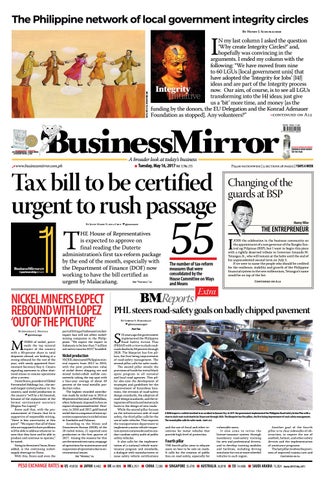
The Philippine network of local government integrity circles By Henry J. Schumacher
Nuvolanevicata | Dreamstime.com
I
media partner of the year
United nations
2015 environmental Media Award leadership award 2008
n my last column I asked the question ‘Why create Integrity Circles?’ and, hopefully was convincing in the arguments. I ended my column with the following: “We have moved from nine to 60 LGUs [local government unis] that have adopted the ‘Integrity for Jobs’ [I4J] ideas and are part of the Integrity process now. Our aim, of course, is to see all LGUs transforming into the I4J ideas; just give us a ‘bit’ more time, and money [as the funding by the donors, the EU Delegation and the Konrad Adenauer »continued on A12 Foundation as stopped]. Any volunteers?”
BusinessMirror A broader look at today’s business
www.businessmirror.com.ph
n
Tuesday, May 16, 2017 Vol. 12 No. 215
Tax bill to be certified urgent to rush passage
T
By Jovee Marie N. dela Cruz
@joveemarie
he House of Representatives is expected to approve on final reading the Duterte administration’s first tax-reform package by the end of the month, especially with the Department of Finance (DOF) now working to have the bill certified as See “Tax bill,” A2 urgent by Malacañang.
NICKEL MINERS EXPECT REBOUND WITH LOPEZ ‘OUT OF THE PICTURE’ By Jonathan L. Mayuga
M
@jonlmayuga
iners of nickel, previously the top mineral export of the country with a 60-percent share in total shipment abroad, are looking at a strong rebound for the rest of the year, with newly appointed Environment Secretary Roy A. Cimatu signaling openness to allow shuttered mines to resume operations after a review. Dante Bravo, president of Global Ferronickel Holdings Inc., the second-largest nickel producer in the country, said nickel production in the country “will be a bit boosted, because of the replacement of the former environment secretary [Regina Paz Lopez].” Bravo said that, with the pronouncement of Cimatu that he is supportive of responsible mining, “there is less uncertainty at this point”. “We expect that all of those who are supposed to have problems will be able to address whatever issues that they have and be able to produce and continue to operate,” he noted. Going to the miners’ favor, Bravo added, is the continuing nickelsupply shortage in China. With this, Bravo said even the
partial lifting of Indonesia’s nickelexport ban will not affect nickelmining companies in the Philippines. “We expect the export in Indonesia to be less than 7 million wet metric tons for 2017,” he added.
Nickel production
Nickel dominated Philippine mineral exports from 2012 to 2015, with the joint production value of nickel direct shipping ore and mixed nickel-cobalt sulfide consistently taking the top spot with a four-year average of about 49 percent of the total metallic production value. The highest recorded contribution made by nickel was in 2014 at 60 percent of the total, or P85 billion, when Indonesia imposed its ban on export of unprocessed nickel. However, in 2016 and 2017, gold bested nickel due to a sequence of mine operation suspensions in nickel mines in Zambales and Palawan. According to the Mines and Geosciences Bureau (MGB), of the 28 nickel mines, 21 reported zero production in the first quarter of 2017. Among the reasons for this are the intermittent rains, stoppage of operations for maintenance and suspension of operations due to environmental issues. See “Miners,” A2
PESO exchange rates n US 49.8130
55 The number of tax-reform measures that were consolidated by the House Committee on Ways and Means
2016 ejap journalism awards
business news source of the year
P25.00 nationwide | 5 sections 28 pages | 7 days a week
Changing of the guards at BSP Manny Villar
THE ENTREPRENEUR
I
join the celebration in the business community on the appointment of a new governor of the Bangko Sentral ng Pilipinas (BSP), but I want to begin this piece with a rightly deserved tribute to Governor Amando M. Tetangco Jr., who will remain at the helm until the end of his unprecedented second term on July 3. If we were to name the people who should be credited for the resilience, stability and growth of the Philippine financial system in the new millennium, Tetangco’s name would be on top of the list. Continued on A10
BMReports
PHL steers road-safety goals on badly chipped pavement By Lorenz S. Marasigan @lorenzmarasigan
S
Part Two
IX years ago the government implemented the Philippine Road Safety Action Plan (PRSAP) with a view to slash roadcrash deaths by 50 percent through 2020. The blueprint has five pillars, the first being improvement of road-safety management. The second pillar calls for safer roads. The second pillar entails the provision of funds for initial black spots program in all national and local road agencies. This pillar also eyes the development of strategies and guidelines for the improvement of hazardous locations, the revision of road-safety design standards, the adoption of road-design standards, and the integration of bicycle and motorcycle lanes in the design of new roads. While the second pillar focuses on the infrastructure side of road safety, the third pillar calls for the use of safer vehicles. This requires the transportation department to implement a motor vehicle-inspection system nationwide and to conduct random safety audit of public utility vehicles. It also calls for the implementation of a national vehicle maintenance program and standards, a dialogue with manufacturers to issue safety vehicle certifications
A man inspects a vehicle involved in an accident in Quezon City. In 2011 the government implemented the Philippine Road Safety Action Plan with a view to slash road-crash deaths by 50 percent through 2020. The blueprint has five pillars, the first being improvement of road-safety management. The second pillar calls for safer roads. NONOY LACZA
and the use of fiscal and other incentives for motor vehicles that provide high level of protection.
Fourth pillar
THE fourth pillar aims to educate users on how to be safe on roads. It calls for the creation of public fora on road safety, especially for
vulnerable users. It a lso aims to rev ise the license-issuance system through mandatory road-safety training for new and professional drivers, and to develop training modules and facilities, including driving simulator for two or more wheeled vehicles in each region.
Another goal of the fourth pillar is to clear sidewalks of obstruction, to require the use of seatbelt, helmet, and other safety devices and the implementation of assistance programs. The last pillar involves the provision of improved trauma care and Continued on A2
n japan 0.4402 n UK 64.1890 n HK 6.3921 n CHINA 7.2200 n singapore 35.4718 n australia 36.8118 n EU 54.4606 n SAUDI arabia 13.2824
Source: BSP (15 May 2017 )
A2 Tuesday, May 16, 2017
BMReports BusinessMirror
PHL steers road-safety goals on badly chipped pavement Continued from A1
rehab. It aims to provide emergency assistance to road-crash victims, and provide training to trauma centers and hospital personnel. But these pillars are slowly tumbling down, and the government is now on the move to patch things up.
Cement updates
TRANSPORTATION Assistant Secretary Mark Richmund M. de Leon told the BusinessMirror the first five pillars were a little bit outdated, given the advancements in tech, policies and trends. “There were identified gaps on the plan,” de Leon said. “It has to be updated and to be responsive to the needs of the time.” The government plans to release a new road-safety action plan in June. The new policies will still have the goal of reducing deaths by 50 percent from now until 2022. “We want the plan to be more strategic to really address specific issues,” de Leon said. “The PRSAP for 2017-2022 is currently being drafted in consultation to [sic] stakeholders.” The gaps, he said, include the updating of policies, and the inclusion of new technology in addressing road-safety issues in the Philippines. “For example, it needs updating on
Miners. . .
Continued from A1
“A nickel-mining operation, being surface mining, is always vulnerable to the weather condition. In Surigao and Dinagat Islands rains come in the months of January, February, March, October, November and December, with January being the wettest month. About 19 nickel mines are located in Surigao and Dinagat Islands,” the MGB review said. Nickel direct shipping ore in the first quarter of the year incurred deficit in both production volume and value, with setbacks of 47 percent and 46 percent, respectively, from 43,612 metric tons (MT) with estimated value
policies, such as the Omnibus Franchising Guidelines [OFG], which was not previously discussed in the old plan,” the government official said. The said guidelines, which spell out the rules for issuing publictransportation franchises, will require public-transport franchises to be in accordance with local publictransport plans instead of the current situation where public-transport franchises are dependent on route proposals of operators.
Franchising guidelines
ACCORDING to de Leon, the Department of Transportation will release the OFG within the month. The set of guidelines, he explained, aims to improve the state of the country’s road-based public-transport systems. “Through the guidelines, routes will be efficiently planned, and the franchising process will be improved,” de Leon said. He added routes along arterial roads, such as highways and expressways and where there is high passenger-demand, will be converted into high-capacity modes, such as buses for efficiency and safety purposes. Tricycles and habal-habal (makeshift motorized three-wheel vehicles) would no longer be allowed along national roads. “It also aims to improve of P3.48 billion in January to March 2016, to 23,004 MT with estimated value of P1.88 billion in the same period this year. The MGB reported that metallic mineral production value grew by 5.1 percent, from P22.79 billion in the first quarter of 2016 to P23.96 billion during the same period this year on account of the robust metal prices. The good performance of gold and mixed nickel-cobalt sulfide (MNCS) resulted in the positive turnout. Production value of gold and MNCS went up by P1.48 billion and P1.01 billion, respectively, the report said. Gold cont i nued to dom i n ate metals output, with 51 percent of the total valued at P12.16 billion during the review period. The Didipio Gold
public-transport vehicle standards and specifications,” de Leon said. Under the draft guidelines, all public-transport vehicles will be converted into Euro 4-emission standard engines. They will also be required to be equipped with speed limiters, GPS, dash cam and closed-circuit television, to ensure safety and security of the commuters. “The door of the jeepney will be transferred to the right or curb side, which is safer than the current design where jeepney doors are at the back making it difficult for the driver to see loading and unloading passengers,” de Leon said.
IT solutions
CONCURRENT with the updating of the road-safety blueprint, the government is also tapping technology in order to improve the management of the roads in the country. The department recently launched a road data platform called “Drivers”, a Web-based crash national reporting database that allows the agency and users to analyze spatial clustering of crashes using different thematic maps. It can also disaggregate data by casualty and vehicle type. “Through this tool, the department aims to provide planners and engiProject of OceanaGold Philippines Inc. in Nueva Vizcaya and the Masbate Gold Project of Filminera Mining Corp. and Philippine Gold Processing and Refining Corp. topped the list of gold producers, with 1,951 kilograms and 1,632 kilograms, respectively. The combined gold output of the two projects accounted for more than 58 percent, or P7.07 billion, of the country’s gold-production value.
Review of Lopez orders
Ronald Recidoro, vice president for Legal and Policy of the Chamber of Mines of the Philippines (COMP), said with Lopez out of the picture, “her decisions are all currently under review”. And Cimatu’s statements lately have been encouraging for mining investors.
neers a decision-making tool, as this can provide evidence based analysis of road crashes, and will help planners to do more strategic road-safety interventions,” de Leon said. “Right now, we are talking with the Philippine National Police Highway Patrol Group and local government units so that they can populate the Drivers system with road-crash data that they collect.” Furthermore, the transportation department is also planning to have modern intelligent transport systems that will improve road safety. “This will entail the installation of intelligent traffic signals, intelligent bus dispatch and monitoring systems, among others, which is focused on making the vehicles using the roads more efficiently managed,” he added. These intelligent bus dispatch and monitoring systems form part of the planned bus rapid transit (BRT) system in major roads in Cebu and Metro Manila. De Leon said the government is in the process of preparing the engineering designs for the two BRTs. “The BRT system will transform the roads into a better, reliable, safer public transport system, as this will provide dedicated right of way for BRT buses that are managed and monitored by intelligent bus dispatching and scheduling systems,” he said. To be concluded
“The thrust for consistent regulation and to fix the image of the mining industry are two things we have been pushing for since Secretary [Ramon] Paje. We remain cautiously optimistic that Secretary Cimatu will keep a balanced perspective about responsible mining, and in reviewing GL’s [Gina Lopez] decisions in the last 10 months,” he said. Recidoro said the COMP will push for a review of Lopez’s policy pronouncements and orders and, if they are not supported by law, will push for their reversal. “We are not asking for a blanket reversal, only for a rational review, and a decision that is impartial and based on scientific, technical evidence that has basis in law,” he said.
www.businessmirror.com.ph
Tax bill. . .
Continued from A1
The government’s worry now, however, is that establishments could use the bill’s imminent passage to jack up their prices this early. The Tax Reform for Acceleration and Inclusion (TRAIN), which seeks to lower personal income-tax (PIT) rates, expand the value-added tax base, adjust excise taxes on petroleum and automobiles and ease the rates of estate and donor’s taxes, is now a step closer to becoming a law, as the House Committee on Ways and Means approved its substitute bill on Monday. In an interview after the approval of the still unnumbered substitute bill at the committee level, PDP-Laban Rep. Dakila Carlo E. Cua of Quirino, chairman of the panel, said his committee was to submit on Monday the panel report on the tax-reform package to the House Committee on Rules for plenary consideration. According to Cua, declaring the tax-reform package as an urgent measure would ensure its immediate approval at the lower chamber. “The DOF is already working on that [certification of the bill as urgent],” he said. But even without the certification of urgency, Cua said the lower chamber could still pass it on third and final reading before Congress goes on sine die adjournment on May 31. Under the bill, workers earning P250,000 will be exempted from paying PIT. The bill also includes a P6 per liter levy on petroleum products and ad valorem tax on brand new automobiles that could cause prices of basic goods to significantly rise. The P6 per liter excise tax increase is divided into three tranches: P3 in the first year, P2 in the second year and P1 in the third year. The package also includes the relaxation of the Bank Secrecy Act, as well as the imposition of taxes on Philippine Charity Sweepstakes numbers’ game and lotto winnings. The panel has also adopted new schedules and brackets for auto excise taxes in the package. The DOF is pushing for the excise tax on vehicles to address traffic in the country. Under the proposal, the revised excise taxes will be implemented in two schedules. For the lower bracket, if the net manufacturer’s price/importer’s selling price is P600,000, the excise tax will be 3 percent by 2018 then increase to 4 percent by 2019. For the higher bracket, If the net manufacturer’s price/ importer’s selling price is over P3.1, the excise tax will be P1,468,000 plus 90 percent of the value in excess of P3.1 million in 2018. For 2019 , if the net manufacturer’s price/importer’s selling price is over P3.1, the excise tax will be P1,824,000 plus 120 percent of the value in excess of P3.1 million. The panel has also included in the TRAIN an excise tax on sugar-sweetened beverages (SSB) and carbonated drinks through P10 per liter of volume capacity, with 4-percent increase every year. Under the bill, 50 percent of the tax collection from the P10 per liter excise tax on SSB shall accrue to the General Fund. As to the remaining 50 percent of the tax collection from the SSB excise tax, the committee adopted the DOF proposal, as manifested by Finance Undersecretary Karl Kendrick T. Chua, that 85 percent of the proceeds will be allocated to priority programs for national government, while the remaining 15 percent will be for the benefit of the sugar farmers. “This is only to specify what are the priority programs to be funded without mentioning the allocated percentages. This will allow the departments involved, the Department of Budget and Management [DBM] and Congress, to expound in the budget what these allocations should be after reconsidering the bigger picture. This would also allow the DBM’s flexibility in prioritizing the funds,” Chua said. “There has been further progress in the first CTRP [Comprehensive Tax Reform Package] bill with its final approval by the Ways and Means Committee. We are hopeful that the House could pass this bill at the plenary level before the Legislature’s sine die adjournment on June 2. We also hope they will reconsider a number of provisions that were removed from the administration proposal,” Chua said. The House Committee on Ways and Means gave its final approval at the start of Monday’s hearing after the bill was returned to it by the House appropriations panel, headed by Rep. Karlo Alexei B. Nograles. The substitute bill consolidated House Bill 4774 with 54 other tax-reform measures filed by other lawmakers. “What we should be concerned about is the profiteering by businesses that will use tax reform as an excuse to unnecessarily increase prices. We are working closely with the Department of Trade and Industry to ensure that this will not happen,” he added. He urged lawmakers to view the CTRP as a package so it can truly realize its ultimate objective of benefiting 99 percent of Filipinos. “Tax reform is really about investing in every Filipino’s future. We need tax reform because we want all Filipinos to rise above poverty and be prosperous by 2040. The businessas-usual scenario of just doing a little is no longer acceptable given our huge investment gaps,” Chua said. Rea Cu
DOT chief. . .
Continued from A12
sector amounting to some P2.2 trillion to construct more accommodations and tourism transport units. “Our numbers will speak for itself. We are hitting new targets with our continuing and sustained efforts. In February of this year alone, tourist arrivals to the country hit a four-year high of 579,178 visitors, an increase of 27.81 percent since 2013,” the tourism chief noted. “With the bureaucratic reforms, strong private sector consensus and a more level playing field in the country’s tourism under the auspices of the newly approved NTDP 2016-2022, your investments are assured to propel the [tourism] industry as a major economic driver for inclusive growth, greater connectivity and infrastructure development.” Foreign visitor arrivals reached 5.9 million in 2016, with China providing 675,663 tourists, up a staggering 37.65 percent from 2015, and representing a market share of 11.32 percent.
Economy
A4 Tuesday, May 16, 2017 • Editors: Vittorio V. Vitug and Max V. de Leon
BusinessMirror
news@businessmirror.com.ph
Farm yield posted 5.28% growth in Q1–PSA data By Jasper Emmanuel Y. Arcalas
T
@jearcalas
he country’s agricultural output in the first quarter of 2017 posted a 5.28-percent growth, rebounding from a dismal performance caused by El Niño in the same period last year, according to the latest report of the Philippine Statistics Authority (PSA). All the agricultural subsectors’ output during the January-toMarch period, the PSA said, posted increment, with the crops subsector remaining to be the main driver for farm growth. “Production in the crops subsector went up by 8.28 percent during the reference quarter. It contributed 53.66 percent to the total agricultural production,” the PSA said in its report titled Performance of Philippine Agriculture, published on May 15. The 5.28-percent growth in farm output in the first quarter of 2017 comes after the sector posted 4.53-percent decline in production during the same time period last year due to prolonged dry spell, coupled with the damage caused by Typhoons Lando and Nona.
8.28%
The production in the crops subsector, contributing 53.66 percent to total agricultural production The decline in agricultural output in the first quarter of 2016 was also brought about by the downturn in the performance of the crops and fisheries subsectors, which was caused by the damage brought about by the prolonged dry spell and the two typhoons that hit the country in late-2015. Palay production in the first
three months of 2017 expanded 12.38 million metric tons to 4.42 MMT, from 3.93 MMT output recorded a year ago. The PSA attributed the hike in output to the increase in areas planted with rice during the quarter and the availability of water for irrigation farms and sufficiency of rainfall in both rain fed and upland farms. “In addition, higher yield level was observed in most regions, and this was brought about by the usage of high yielding varieties. Likewise, proper fertilizer application and favorable weather conditions pushed up production of palay during the first quarter of the year,” the PSA said. “There were also reports of increased plantings as encouraged by the provision of hybrid and certified seeds from the Department of Agriculture-Regional Field Offices (DA-RFOs). Early harvesting or movement of the activity from the scheduled second quarter to the first quarter this year was cited in some farms in ARMM [Autonomous Region in Muslim Mindanao], Ilocos region, CAR [Cordillera Autonomous Region] and Eastern Visayas,” the PSA added. Data from the PSA showed that this was the highest first quarter that palay output registered by the Philippines since 1987, surpassing the previous first quarter-high output of 4.367 MMT production recorded in 2015.
Expanded planting areas driven by favorable planting conditions hiked corn output in the Januaryto-March period by 23.44 percent to 2.37 MMT, from 1.92 MMT recorded same time period in 2016. “The higher production record during the period can be traced to the expansion in area harvested, as a result of increased plantings induced by the following factors: sufficiency of water, higher demand for white corn in Ilocos region and additional provision of quality seeds from the DA-local government units [DA-LGUs],” the PSA said. “There were also reports of movement of harvests from the fourth quarter of 2016 to the first quarter this year because of infestation of corn leafhoppers in Sultan Kudarat. Significantly, yield improved due to favorable weather conditions, usage of good quality seeds provided by the DALGUs and sufficient soil moisture during the growing stage of the crop,” the PSA added. Sufficiency in rainfall during the first quarter drove the production of other crops, such as banana, sugarcane and pineapple, to increase. Pineapple output in the Januaryto-March period grew 3.77 percent, while sugarcane production and banana production rose 3.03 percent and 2.56 percent respectively. However, the country’s coconut production in the first quarter declined 2.31 percent from 3.20
MMT a year ago to 3.12 MMT, due to lesser nuts developed in Davao Del Sur and Sultan Kudarat caused by the effects of dry spell last year. “In Basilan some trees were cut down due to the occurrence of “cocolisap” during the period,” the PSA said. Meanwhile, the production of the livestock subsector, which accounted for 16.85 percent of total agricultural output in the first quarter, expanded by 3.22 percent. “All components of the subsector recorded production increases. Hog, the major contributor to the subsector’s performance registered a 3.50-percent growth in production,” the PSA said. Also, the fisheries and poultry subsectors’ output posted 0.73 percent and 1.88 percent, respectively. The PSA noted that all components of the poultry subsector posted increments during the quarter. The poultry subsector contributed 14.15 percent to the total agricultural output in the first quarter. Increased production in skipjack, yellowfin tuna, tilapia and seaweed boosted the fisheries subsector’s output in the quarter, overturning the 6.07-percent output decline posted a year ago. “Production increases were noted for skipjack at 43.10 percent, yellowfin tuna at 17.32 percent, tilapia at 2.08 percent and seaweed at 1.26 percent,” the PSA said. The fisheries subsector ac-
counted for 14.15 percent of the total agricultural output in the January-to-March period. Agriculture Secretary Emmanuel F. Piñol said the “good climate” and "favorable weather conditions” allowed Filipino farmers to hike their output during the first three months of 2017. “It is also an indication that we are on the right track in agri and fisheries development. But a lot more needs to be done. With the implementation of easy access financing, agri and fisheries productivity could be further boosted,” Piñol said in a statement released to reporters on Monday. Meanwhile, Department of Agriculture Undersecretary for Operations Ariel T. Cayanan said the farm sector’s output in the second quarter could likely grow around 5 percent. “It seems that [it will continue to grow] based on the growth parameters. We hope that the favorable weather conditions would continue and we could achieve our goals,” Cayanan said in an interview with reporters on Monday. “Actually, the second quarter is nearing its end this coming June. We are expecting a [rice] yield of [approximately] 4 million [MT]. So it looks that the growth would also be proportionate [in the second quarter], it could play around the same percent [as first quarter],” Cayanan added.
ERC okays P7-B refund of Meralco over-recoveries from 2014 to 2016 Senate probers pursue inquiry into MRT 3 woes
T
HE Energy Regulatory Commission (ERC) has given the Manila Electric Co. (Meralco) the green light to refund consumers nearly P7 billion worth of over-recoveries incurred from 2014 to 2016. ERC Commissioner Alfredo J. Non said consumers will receive a refund of P0.75 per kilowatt-hour over a three-month period. It is up to Meralco, he said, if the adjustment can be reflected in next month’s billing. The amount is broken down as follows: P4,919,162,892.94 in generation rate over/ under recovery (GOUR); P632,210,115.96 in transmission rate over/under recovery (TOUR); P1,242,760,968.35 in system
loss rate over/under recovery (SLOUR); P130,627,106.04 in lifeline subsidy over/ under recovery (LSOUR); and P2,325,583.09 in senior citizen discounts and subsidy over/ under recovery (SLOUR) for the period January 2014 to December 2016. Meralco Utility Economics Head Lawrence Fernandez said the over recoveries stemmed from “timing issues”. He explained that over-recoveries related to GOUR, for instance, occurred due to lag in the recovery of generation costs from consumers. Basically, the rate used to compute for the generation charge in a current billing month is based on the generation cost incurred during the previous billing month, which is the
supply month. Given the recovery lag and the monthly changing generation costs, over/ under recoveries are expected as the generation cost for the current month is compared to the recoveries of the same month. Meralco asked the ERC to recover from consumers its real property tax (RPT) payments amounting P1,089,707,397.13. “A p pl ic a nt prop ose d t h at G OU R , TOUR, SLOUR and LSOUR be refunded to the customers for a period of 36 months; SrDSOR be refunded to the customers for a period or one month; RPT payments be recovered from customers for a period of 36 months,” Meralco’s 11-page application stated.
Savant develops weather-proof shelter design for farm animals
T
he Philippine Rice Research Institute (PhilRice) said it has developed a typhoonresistant structure that could shelter farm animals during heavy rainfall. PhilRice said Dr. Ricardo Orge, a PhilRice engineer-scientist, developed a shelter innovation called “kwebo,” which is an “easy-to-construct, typhoon-resistant structure” that requires less skilled workers to build. Orge said he thought about the innovation when he visited his hometown in Leyte, six months after the devastation wrought by Supertyphoon Yolanda in November 2013. “There seemed to be a shortage of carpenters repairing damaged structures in the community. Even those capable of hiring dozens of carpenters had to use tarpaulins as temporary substitute for their blown-down roofs. It even took another year before the people could actually repair their farm structures,” Orge said in a news statement released on Monday. Jasper Emmanuel Y. Arcalas
By Butch Fernandez
@butchfBM
S
enate probers are assessing potential liabilities of former and incumbent ranking officials of the Department of Transportation (DOTr) for continued failure to effectively address the recurring inconveniences inflicted on Metro Rail Transit 3 (MRT 3) commuters. This was disclosed on Monday by Sen. Grace Poe after presiding over a Senate hearing by the Public Services Committee on persistent MRT 3 woes daily commuters have to bear to get to their destinations. Poe revealed that the “biggest revelation” at the Senate hearing was the admission of DOTr officials that MRT 3 service contracts to ensure proper maintenance to keep trains running did not go through rigorous review. “’Yun nga siguro ’yung pinakamalaking rebelasyon dito, pinayagan nila ’yung maintenance contract na pumasok para palitan ’yung Sumitomo pero hindi pala nila alam ang detalye nito,” Poe told reporters after the hearing, noting the maintenance contracts were automatically renewed by the new DOTr Secretary Arthur P. Tugade. “Basta pinirmahan na lang niya dahil sabi niya bago lamang siya doon pero ’yung nakaraang secretary at ’yung mga tauhan niya ang nagdesisyon dito.” Poe, however, said the committee is still mulling over options whether to summon former Department of Transportation and Communications Secretary Manuel A. Roxas II, who preceded former Transportation Secretary Joseph Emilio A. Abaya, under whose watch the existing service contracts
were signed during the Aquino administration. “Sa ngayon, hindi pa natin iniisip. Alam mo pinag-iingatan ko na huwag sasabihing pulitika ito pero nakikita talaga na ’yung isang incorporator na hindi dumating ngayon, na pinapa-subpoena ko, si Marlo de la Cruz ay talagang kasama siya sa mga nananalo sa mga bidding na ’yung kanyang kompanya bagong-bago, bagong incorporate, napakaliit ng kapitalisasyon, ang meron lamang siya ay koneksyon doon sa mga nakaraang nakaupo sa DOTC.” In her view, Poe said the problems besetting MRT 3 operations began during the previous Aquino administration. “Sa tingin ko, ito ’yung talagang nag-ugat ng problema dito. Anong kinalaman ng isang tao na nakapasa nga sa bid pero wala naman talagang track record, bigla na lang nananalo. Marami rin nagsasabi na hindi rin sila sinasabihan tungkol sa bidding schedule at saka ’yung Sumitomo, paulit-ulit na nilang binibigyan ng maintenance extension pero pagdating sa bidding, hindi naman nila nabigyan ng sapat na oras para makilahok.” According to the senator, she also learned from sources that Abaya had admitted knowing de la Cruz even before assuming the then transporation and communiucations post. “Ito galing sa iba, inamin na rin ni Secretary Abaya nakilala niya ito bago pa rito sa DOTC dahil kaalyado nila ito. So ’yun ang maaaring isang anggulo. Hindi siya sumipot dito ngayon, bakit? Kung wala naman siyang tinatago, dapat magpakita siya.” Poe lamented that past DOTC officials are invoking technical and legal alibis. “’Yung nakakalungkot talagang nagtatago sa mga teknikal at legal na bagay ang mga dating naupo diyan.”
House committee approves public-service bill
T
he House Committee on Economic Affairs has approved a substitute measure to a bill filed by Albay Rep. Joey S. Salceda seeking to amend the statutory definitions of “public service and public utility, under the 80-year-old Philippine Public Service Act, or Commonwealth Act 146. Salceda’s House Bill 446, titled “An Act Further Amending Commonwealth Act 146, or the Public Service Act”, is deemed as an urgent legislative measure since it will break monopolies and liberalize the entry of telecoms, transport and power industries into the country to a 100-percent foreign capitalization. The measure seeks to solve the country’s debilitating woes over these three vital industries, which have stalled economic growth for so long, said Salceda, senior vice chairman of the House Committee on Economic Affairs. The bill has gained popular support
from both private and government sectors, including the Philippine Competition Commission, which asserts that one way of “promoting a competitive environment is to open fully the market to foreign players”. Salceda added the proposed amendments will clarify the “ambiguities” in the statutory definition of public service and public utility, which have paved the way for oligarchs to monopolize telecoms, transport and power industries, among others, for decades to the detriment of consumers and the country. The Duterte administration has vowed to break, among others, oligarchy in the country. The bill, Salceda added, also seeks to address the “changes in the economic framework brought about by globalization and rapid technological innovations by adjusting the provisions of the law…and enable it to fulfill its purpose of truly serving the public”.
“Consumers often experience high prices and poor quality of basic services in the Philippines, because only a few local players and oligarchs effectively control the market. Competition and foreign investments are inhibited, because limitations that should only apply to the operation of a public utility are usually also applied to all public services,” he said. Salceda added this situation is primarily caused “by the ambiguity in the definition of public utility, which is often used interchangeably with public service, under Commonwealth Act 146, and the key to fixing the problem is to develop a clear statutory definition of a public utility by amending the Public Service Act.” The bill redefines public utility as “public service that regularly supplies the public and directly transmits and distributes… through a network, its commodity or service of public consequence”. PNA
AseanTuesday BusinessMirror
news@businessmirror.com.ph
UK to get Brexit clues as court rules on EU-Singapore trade pact
U
NITED Kingdom Prime Minister Theresa May could get a taste of what’s in store for Britain when the European Union’s (EU) top court spells out how the EU should ratify a free-trade pact with Singapore, the tiger economy some want post-Brexit Britain to emulate. Judges at the EU Court of Justice will say on May 16 whether the Singapore deal must undergo a tortuous process of endorsement by national parliaments and regional assemblies on top of approval from the EU—a step that the UK would be anxious to avoid, as it gears up for its own trade talks with its former EU partners. “May’s objective of a comprehensive trade deal being agreed within two years were never very realistic,” said Steve Peers, a professor of EU law at the University of Essex. “If it has to be ratified by all national parliaments, that’s even less realistic.” Singapore and the EU have been negotiating their free-trade agreement since 2010. An adviser to the EU court signaled last December that individual nations should also ratify it because some aspects, such as dispute settlement, labor and environmental standards and trade in air transport services, fall under national jurisdiction.
Step back
A ruling upholding this would be an obvious step back for Singapore, the largest trading partner of the EU from the Asean, according to Lawrence Loh, director of the Centre for Governance, Institutions and Organizations at the National University of Singapore Business School. “EU-Singapore trade has been growing faster for services than for goods, so any dampener in free trade will affect the services industry more,” Loh said.
But the case “is a big deal” for the UK too, because the decision “will clarify a lot of issues that might arise when negotiating a long-term, postBrexit trade deal between the UK and the EU,” Peers said. “To some extent, it might map out a ‘minefield’ of issues to avoid, if the UK seeks to avoid all member-states having vetoes.” While the formal two-year countdown until Britain leaves the EU was triggered on March 29, European Commission President Jean-Claude Juncker said the real political negotiations on Article 50 will start after the UK has held parliamentary elections on June 8. EU governments are debating a set of directives for the bloc’s negotiator Michel Barnier, outlining the method and objectives of withdrawal talks.
Comprehensive deal
Even if Tuesday’s ruling sets a legal precedent for an accelerated trade deal by allowing just EU institutions to sign off, that “does not necessarily mean that the UK would be able to achieve an agreement of the style it wants with the EU in a matter of two years,” said Aarti Shankar, a policy analyst at London-based think tank Open Europe. The Singapore accord remains quite limited and the UK would likely be looking “for a more comprehensive trade deal than what we have seen so far”, both in trade and services, and potentially even a chapter on migration, Shankar said. Even after Brexit, when the court’s rulings may no longer have binding powers over the UK, they will still bind the EU and as such “determine what constraints the other party to the agreement is under as it negotiates,” Peers said. “That is bound to impact upon the UK indirectly.” Bloomberg News
Malaysia seizes 330 exotic tortoises from Madagascar
M
alaysian authorities said on Monday they have seized 330 exotic tortoises from Madagascar worth 1.2 million ringgit ($276,721), in the latest heist of illegal wildlife and animal parts being smuggled into the country. Deputy Customs Director Abdull Wahid Sulong said 325 Indian Star tortoises and five Ploughshare tortoises were packed into five boxes and labeled as stones. He said the live tortoises, usually kept as pets, arrived via Etihad Airways from Antanaviro Airport in Madagascar last Sunday.
Customs officials found the boxes at the Kuala Lumpur airport cargo warehouse on the same day based on a tip, Abdull Wahid said. The import of exotic tortoises requires a special permit from Malaysia’s Wildlife Department. No arrests were made and the case is still under investigation, Abdull Wahid said. Two weeks ago, airport customs officials seized African pangolin scales worth $2.1 million at the airport cargo warehouse. Last month they confiscated 18 rhino horns worth $3.1 million believed to have been flown in from Mozambique and declared as art objects. AP
Editor: Max V. de Leon • Tuesday, May 16, 2017 A5
Vietnam-aligned hackers attacking foreign companies
C
yber espionage attacks against foreign companies operating in Vietnam have been traced to a group of hackers “aligned with Vietnamese state interests”, according to a report from cyber-security provider FireEye. The attacks by the group—designated by FireEye as APT32— have been conducted since at least 2014, mainly targeting companies operating in the manufacturing, consumer products and hospitality sectors, FireEye said in the report released last Sunday. The group has also targeted foreign governments, dissidents and journalists, it said. “The unauthorized access could
serve as a platform for law enforcement, intellectual property theft, or anticorruption measures that could ultimately erode the competitive advantage of targeted organizations,” the report said. The Vietnam government didn’t immediately respond to an e-mail request for comment. The report didn’t say if FireEye contacted Vietnamese authorities. The report comes as a new wave ransom threats hit more than
200,000 computers in at least 150 countries, affecting companies and government agencies from the US to Europe to Asia. The malware used a technique purportedly stolen from the US National Security Agency. APT32 conducted the attacks by leveraging files that use social-engineering methods to entice victims, FireEye said. The file then downloads malicious payloads from remote servers, with further attacks delivered via “phishing” e-mails, it said.
Dissidents targeted
The group is also targeting security, technology infrastructure and consultancy companies, FireEye said, adding that APT32 continues to threaten political activism and free speech in Southeast Asia and the public sector worldwide. “Governments, journalists and members of the Vietnam diaspora may continue to be targeted,” the report said.
According to the report, examples of the attacks by APT32 include: A European corporation compromised prior to constructing a manufacturing facility in Vietnam (2014); Vietnamese and foreign-owned corporations working in network security, technology infrastructure, banking and media industries (2016); malware detected on the networks of a global hospitality industry developer with plans to expand operations into Vietnam (2016); two subsidiaries of US and Philippine consumer products corporations, located inside Vietnam (2016-2017); and Vietnamese offices of a global consulting firm (2017). “While actors from China, Iran, Russia and North Korea remain the most active cyber espionage threats tracked and responded to by FireEye, APT32 reflects a growing host of new countries that have adopted this dynamic capability,” the report said. Bloomberg News
Singapore home sales in April more than double from year ago
11.6%
The percentage drop in Singapore home prices from their peak in 2013
S
ingapore home sales more than doubled in April from a year earlier, as homebuyer sentiment rallied after the government rolled back some property curbs following a three-year slide in prices. Developers sold 1,555 units in April, compared with 750 units in the same period last year, according to data released on Monday by the Urban Redevelopment Authority. A total of 1,616 units were offered, higher than the 1,527 units in March, when Singapore notched the highest monthly home sales in four years. Developers marketed more apartments last month, buoyed by indications of demand from homebuyers. The largest sales came from Seaside Residences east of the city, which sold 419 units of the 560 put up for sale, and Artra by the Tang Group, which sold all 126 units it placed on the market. The government moved in March to relax a raft of measures to cool
A view of rows of REsidential projects in Singapore BLOOMBERG
home prices—steps it began implementing in 2009, with some of the strictest restrictions being imposed in 2013. Home prices fell 3 percent last year and have dropped for 14
straight quarters, the longest slide since the data were first published in 1975. An index tracking private residential prices fell 0.4 percent in the
three months ended March from the previous quarter, according to data from the authority on April 28. Home values have dropped 11.6 percent from their 2013 peak. Bloomberg News
South China Sea update: Several countries hold military drills in disputed sea
U
NITED State marines joined with forces from Japan, France and Britain for live-firing exercises on the American territory of Guam that are intended to show support for the free passage of vessels in international waters amid concerns China may restrict access to the South China Sea. The drills are being held around Guam and Tinian islands about 1,500 miles (2,400 kilometers) south of Tokyo and east of Manila. The exercises feature two French ships currently on a four-month deployment to the Indian and Pacific oceans. Some 50 Japanese soldiers and 160 Japanese sailors were due to participate, along with UK helicopters and 70 UK troops deployed with one of the French ships. The drills had been halted temporarily on Friday after a French landing craft ran aground. US officials said they stopped the drills so they could assess the situation. They moved ahead as scheduled on Saturday.
Ships from Thailand, Singapore join US Navy in South China Sea drills
Ships from the navies of Thailand and Singapore completed a three-day exercise with the US Navy in the South China Sea last week aimed at boosting their ability to work together on a broad range of maritime tasks.
The exercises, termed Cooperation Afloat Readiness and Training, have been held since 1995 with Thailand and Singapore as original participants. “Our sailors certainly are learning extensively from this tremendous experience,” Cmdr. Doug Meagher, who commands the littoral combat ship USS Coronado, was quoted as saying by the web site navy.mil. Singapore and Thailand sent frigates to take part in the drills, which also included the US Navy’s Arleigh Burke class guidedmissile destroyer USS Sterett. Along with operating together at sea, the exercises included boarding, search and seizure, joint flight operations and communications drills.
China’s construction of seven islands nearby in the Spratly archipelago has dwarfed similar activities by rival claimants, including the Philippines, whose frosty relations with Beijing have improved significantly under President Duterte.
Japan, India affirm plans to strengthen military cooperation
Philippines begins moving troops and supplies to reinforce island holding
The Philippines has started transporting troops and supplies to a disputed island in the South China Sea in preparation for construction work that includes reinforcing and lengthening an airstrip and building a dock. Pag-asa has been home to Filipino soldiers and fishermen for decades, but is also claimed by Beijing. Lt. Gen. Raul del Rosario, head of the Philippine military’s Western Command, said last week that troops and initial
In this May 13 file photo, Japanese soldiers use rubber rafts as part of an amphibious drill during joint military exercises between the US, Japan, France and UK on Naval Base Guam. US marines joined with forces from Japan, France and Britain for live-firing exercises on the American territory of Guam that are intended to show support for the free passage of vessels in international waters amid concerns China may restrict access to the South China Sea. AP
supplies had arrived on the island. About P1.6 billion ($32 million) has been earmarked for the construction that will also include a fishing port, solar-power
generators, a water-desalination plant, the refurbishment of housing for soldiers and the construction of facilities for marine research and tourists.
Japan and India affirmed plans last week to strengthen their military cooperation amid rising tensions in the South China Sea and elsewhere in Asia. Indian Defense Minister Arun Jaitley told his Japanese counterpart, Tomomi Inada, in Tokyo that his country hopes to pursue a strategic partnership with Japan for regional peace and stability. Jaitley welcomed a planned trilateral naval exercise among the US, India and Japan in July as a way of strengthening cooperation in the Asia Pacific. Japan and India have been stepping up defense cooperation amid China’s increased assertiveness in the South China Sea and moves to establish a more permanent presence in the Indian Ocean. China regards Japan as a historical rival for dominance in northeast Asia and is embroiled in long-standing border disputes with India, with which it fought a brief but bloody frontier war in 1962. AP
A6
Tuesday, May 16, 2017 • Editor: Lyn Resurreccion
The World BusinessMirror
news@businessmirror.com.ph
France’s new prexy vows: Fortify EU, revamp pols
P
ARIS—In ceremonies marked by youthful optimism and old-world Napoleonic pomp, Emmanuel Macron swept into office last Sunday as France’s new president, pledging to fortify the European Union (EU), redesign French politics and glue together his divided nation.
Macron’s presidency began with a visit to troops wounded in overseas combat—a reminder of France’s large global military presence and role in fighting extremists from Syria to Africa. He’s expected to name a prime minister imminently, and to show his commitment to reviving European unity. Macron takes his first presidential trip on Monday to Berlin to meet Chancellor Angela Merkel. In a lofty but lucid inaugural speech, Macron vowed to lift France out of its sense of decline and lost purpose, and seize again its place in the world. “The time has come for France to rise up to the occasion. The division and fractures across our society must be overcome...because the world expects us to be strong, solid, clairvoyant.” He promised to take France’s responsibilities to tackle today’s crises—”the migration crisis, the climate challenge, authoritarian abuse, the excesses of capitalism in the world and, of course, terrorism. Nothing now strikes one and spares the other. We are all interdependent. We are all neighbors.” The 39 -year-old Macron is the youngest president in the country’s history and the eighth
president of France’s Fifth Republic, which was created in 1958. A former economy minister with probusiness, pro-European views, Macron is the first French president who doesn’t originate from the country’s two mainstream parties. After Macron was formally declared president at the Elysee Palace, 21 cannon shots were fired from across the Seine River at the Invalides monument, where Napoleon is entombed. Macron later solemnly paid tribute at the Tomb of the Unknown Soldier beneath the Arc de Triomphe, greeting veterans and military officers in formation beneath the imposing arch. Macron takes charge of a nation that, when Britain leaves the EU in 2019, will become the EU’s only member with nuclear weapons and a permanent seat on the UN Security Council. Reviving support for European unity will be among his top priorities. France is a founding member of the 28-nation EU and its thirdlargest economy after Germany and Britain. “We will need a more efficient Europe, a more democratic Europe, a more political Europe, because it’s the instrument of our power and our sovereignty, I will work
New French President Emmanuel Macron (center) waves to the crowd as he is transported up the Champs-Elysees Avenue after his inauguration ceremony in Paris, France, last Sunday. AP/Petr David Josek
300 The number of guests, including officials and family members, gathered in the Elysee reception hall for new France President Emmanuel Macron’s inauguration
on that,” he said on Sunday. Before the ceremony, he met for an hour with his predecessor, Francois Hollande, taking a last few minutes to discuss the most sensitive issues facing France, including
the country’s nuclear codes. In a visibly moving moment for both, Macron accompanied Hollande to his car, shaking hands and applauding him along with the employees of the French presidency who had gathered in the palace’s courtyard. The two men had known each other well. Macron was Hollande’s former adviser, then his economy minister from 2014 to 2016, when Macron quit the Socialist government to launch his own independent presidential bid. About 300 guests, officials and family members gathered in the Elysee reception hall, including Macron’s wife, Brigitte, wearing a lavender blue dress by French designer Nicolas Ghesquiere for Louis Vuitton.
No taboos at Elysee as Mrs. Macron signals change in France
A
s Emmanuel Macron and his wife Brigitte settle in to the Elysee Palace, their unconventional partnership stands as a symbol of the changes the new president is aiming to bring about in France. She’s almost 25 years his senior. They met when she taught him drama at high school. And while they have no children, the 39-year-old head of state is a youthful step-grandfather to her extended family. But far from downplaying his atypical marriage, Macron embraces it as a symbol of his boldness, his ability to challenge the established order, even of his powers of seduction. “That transgression that he fought for as a young man in bourgeois, provincial France led to the sense of transgression that drove his run for president,” said Jean Garrigues, a professor of political history at the University of Orleans. “The question is, will that still work as he takes power?” In one sense, the French election was a choice between two very different kinds of marriage— while it was the nationalist Marine Le Pen that Macron faced in the runoff, his main challenger for the votes of the mainstream majority was the catholic conservative Francois Fillon.
Fake job
Fillon’s wife Penelope was paid a public salary for helping her husband since the early 1980s, but allegedly did very little actual work. Brigitte has been an unpaid adviser to Macron throughout his campaign and now takes on an official role like the First Lady in the US, though she still doesn’t get a salary. “There’s a deep desire for a renewal of the political class and a wish to break free of old social
President John F. Kennedy. Yet, the age gap, and the origins of their relationship, has provoked some nastier chatter. Charlie Hebdo, the satirical weekly known for its biting cartoons, featured a pregnant Brigitte on its cover this week, saying “He’s Going to Work Miracles!” The Financial Times on May 8 described her as an “Essex Girl”—the British equivalent of a “Jersey Girl”—in a piece that also used the French word cagole, pejorative slang for an overdressed and vulgar blonde. Delve little deeper into social media, and there’s much worse.
‘Backlash’
New French President Emmanuel Macron and his wife Brigitte say good-bye to former French President Francois Hollande (not in photo) after the inauguration ceremony at the Elysee palace in Paris, France, on Sunday. AP/Thibault Camus
norms and ancient codes of conduct,” said Mariette Sineau, a political scientist and sociologist at Sciences Po institute in Paris. “French society is much more liberal than people outside the country or even in the media realize.” Brigitte, 64, played a key role as her husband vaulted from junior minister to president in less than a year, advising him on speeches and helping to shape his agenda. In fact, she’s been a central figure since they met as teacher and 15-yearold student at a high school in northern France. His openness about that relationship has become a key part of the new president’s political identity that he uses to reach out to different groups of voters. In an April session of interviews with Snapchat one user said he’d fallen in love with his law professor and asked Macron for advice. “First find out if it’s shared,”
Macron chuckled. “If so, go ahead! No taboo!”
Paparazzi protection
On International Women’s Day in March he said, “There is no less love in our family” just because it’s unusual. In a February interview with the gay monthly magazine Tetu, he said speculation about him and his partner was an “odious” reflection of the fact that politics is was still very “male”. The Macrons’ image as a tightknit couple has been crafted with the help of Michele Marchand, the head of Bestimage, one of France’s most powerful paparazzi agencies. Marchand f looded France’s weekly magazines with iconic images after his election victory. One picture in Paris-Match of Macron writing his victory speech as his wife’s grandchildren play around his desk in this week’s magazine recalled a similar shot of former US
The sniping prompted Elle Magazine, the weekly arbiter of fashion and social trends for French women, to publish a defense of Brigitte before May 7’s final vote: “Brigitte Macron’s Age: How Much Longer Are We Going to ‘Laugh’ About It?” Editor in chief Adele Breau said the comments about the couple were “ultramisogynistic”, and the suggestion that marrying an older woman meant the candidate must secretly be gay was “homophobic”. The article went viral with as many as 700,000 people reading it on Facebook and over 300,000 views on the magazine’s web site, a record. The challenge for the Elysee is to ensure that the Macron marriage doesn’t become a political liability, in a country that has at times been uncomfortable with personality politics. A May 10 poll by YouGov shows 68 percent of French people are opposed to the first lady having a formal status. “US public opinion is much more conservative in terms of values, but it’s more accepting of people’s personal lives,” Sineau said. “In France, it’s the reverse. Macron mustn’t overplay his relationship or there will be a backlash.” AP
Macron himself wore a dark suit from French brand Jonas and Cie, a tailor based in Paris. It cost €450 ($491), according to his team. The new president arrived on the Champs-Elysees Avenue under a heavy rain—recalling Hollande’s inauguration five years ago. But unlike his predecessor, Macron managed to avoid getting wet. The bad weather often associated with the former Socialist president has become a joke for the French. After his time at the tomb, Macron went to shake hands with supporters along the Champs-Elysees, who were taking selfies and waving French tricolor flags, before coming back to the palace for a lunch with his family.
Earlier, he and France’s new first lady briefly posed for photographers at the front porch of the palace after Hollande left. The couple will now live at the Elysee Palace. Macron met with Paris Mayor Anne Hidalgo later on Sunday and visited the Percy military hospital in the Paris suburb of Clamart to meet with two soldiers injured during French operations in Mali last year and one wounded in Afghanistan in 2010. The media wasn’t allowed to cover the visit. Macron has promised to reinvigorate French politics by bringing in new faces, and will form a government in the coming days. His “Republic on the Move” movement—barely a year old—is hoping to elect a majority of lawmakers in next month’s parliamentary elections so he can pass his programs. It has announced an initial list of 428 candidates for the 577 seats up for grabs in France’s lower house of parliament in the vote on June 11 and 18. Many of the candidates are newcomers in politics. Their average age is 46, compared to 60 for the outgoing assembly. Half of them are women. Only 24 are lawmakers running for reelection. Hollande, meanwhile, went on Twitter to describe the “terrible ordeals” that marked his fiveyear term, from deadly attacks to Greece’s debt crisis. He defended his unpopular presidency in a series of tweets minutes after leaving the Elysee Palace. Hollande noted his accomplishments in getting the Paris Agreement on climate change, legalizing gay marriage and doing “everything possible to ensure that Greece stays in Europe”. “We lived through crises but we held together. France remained France,” he tweeted. AP
GOP senators, pulling away from Trump, have ‘a lot less fear of him’
W
ASHINGTON—Senate Republicans, increasingly unnerved by President Donald J. Trump’s volatility and unpopularity, are starting to show signs of breaking away from him as they try to forge a more traditional Republican agenda and protect their political fortunes. Several Republicans have openly questioned Trump’s decision to fire Federal Bureau of Investigation (FBI) Director James Comey, and even lawmakers who supported the move have complained privately that it was poorly timed and disruptive to their work. Many were dismayed when Trump seemed to then threaten Comey not to leak negative information about him. As they pursue their own agenda, Republican senators are drafting a health-care bill with little White House input, seeking to avoid the public-relations pitfalls that befell the House as it passed its own deeply unpopular version. Republicans are also pushing back on the president’s impending budget request—including, notably, a provision that would nearly eliminate funding for the national drug control office amid an opioid epidemic. And many high-ranking Republicans have said they will not support any move by Trump to withdraw from the North American Free Trade Agreement (Nafta). So far, Republicans have refrained from bucking the president en masse, in part to avoid undermining their intense push to put health-care and tax bills on his desk this year. And the Republican leadership, including Sen. Mitch McConnell of Kentucky, the majority leader, and the House speaker, Paul Ryan of Wisconsin, remains
behind Trump. But with the White House lurching from crisis to crisis, the president is hampering Republicans’ efforts to fulfill his promises. “All the work that goes into getting big things done is hard enough even in the most tranquil of environments in Washington,” said Kevin Madden, a Republican operative who worked for John A. Boehner when he was the House speaker. “But distractions like these can become a serious obstacle to aligning the interests of Congress.” When Congress and the White House are controlled by the same party, lawmakers usually try to use the full weight of the presidency to achieve legislative priorities, through a clear and coordinated vision, patience with intransigent lawmakers and message repetition. Trump’s transient use of his bully pulpit for policy messaging has upended that playbook. “It does seem like we have an upheaval, a crisis almost every day in Washington that changes the subject,” Sen. Susan Collins, Republican-Maine, who has been trying to advance health-care legislation, said in a television interview on Thursday night. The latest subject-changing crisis has been the fallout from Trump’s sudden dismissal of Comey, who was leading the FBI’s investigation into contacts between the Trump campaign and Russia. Trump suggested last week that he might have surreptitiously taped his conversations with Comey, and on Sunday two Republican senators, Mike Lee of Utah and Lindsey Graham of South Carolina, said the president should turn over any such tapes, if they exist. New York Times News Service
news@businessmirror.com.ph
The World BusinessMirror
Tuesday, May 16, 2017
A7
Cyber-attack aftershock feared; US warns of complexity
T
he components of the global cyber attack that seized hundreds of thousands of computer systems last week may be more complex than originally believed, a Trump administration official said last Sunday, and experts warned that the effects of the malicious software could linger for some time.
As a new workweek started on Monday in Asia, there were concerns the malicious software could spread further and in different forms, with new types of ransomware afflicting computers around the globe. There were initial reports of new cases found over the weekend in Japan, South Korea and Taiwan. The cyber attack has hit 200,000 computers in more than 150 countries, according to Rob Wainwright, executive director of Europol, Europe’s police agency. Among the organizations hit were FedEx in the US, the Spanish telecom giant Telefónica, the French automaker Renault, universities in China, Germany’s federal railway system and Russia’s Interior Ministry. The most disruptive attacks infected Britain’s public health system, where surgeries had to be rescheduled and some patients were turned away from emergency rooms. President Donald J. Trump has ordered his homeland security adviser, Thomas P. Bossert, who has a background in cyber issues, to coordinate the government’s response to the spread of the malware and help organize the search for who was responsible, an administration official said on Sunday. The attack is more complicated because “the experts tell us that this code was cobbled together from many places and sources,” according to an administration official who insisted on anonymity to discuss the government’s cyber-security plans. The more potential sources of the malicious code, the harder it is for investigators to run down the trail of possible perpetrators.
200,000
The number of computers hit by the cyber attack in more than 150 countries
The source of the attack is a delicate issue for the US because the vulnerability on which the malicious software is based was published by a group called the Shadow Brokers, which last summer began publishing cyber tools developed by the National Security Agency (NSA). Government investigators, while not publicly acknowledging that the computer code was developed by US intelligence agencies as part of the country’s growing arsenal of cyberweapons, say they are still investigating how the code got out. There are many theories, but increasingly it looks as if the initial breach came from an insider, perhaps a government contractor. Copycat variants of the malicious software behind the attacks have begun to proliferate, according to experts, who were on guard for new attacks. “We are in the second wave,” said Matthieu Suiche of Comae Technologies, a cyber-security company based in the United Arab Emirates. “As expected, the attackers have released new variants of the malware. We can surely expect more.” The National Police Agency in Japan found two computers with the malicious software over the weekend, according to reports by NHK, the national broadcaster.
In this May 13 photo, a screenshot of the warning screen from a purported ransomware attack, as captured by a computer user in Taiwan, is seen on a laptop in Beijing. Global cyber chaos is spreading on May 14 as companies boot up computers at work following the weekend’s worldwide “ransomware” cyberattack. The extortion scheme has created chaos in 150 countries and could wreak even greater havoc as more malicious variations appear. The initial attack, known as “WannaCry,” paralyzed computers running Britain’s hospital network, Germany’s national railway and scores of other companies and government agencies around the world. AP/Mark Schiefelbein
One instance was found on a personal computer in a hospital and the other on a private citizen’s home computer. A hospital in Taiwan also reported that one of its computers was compromised, Taiwan’s Central News Agency said on Sunday. Five businesses in South Korea reported ransomware attacks over the weekend, according to the government’s internet security agency, and a Korean theater chain said late-night moviegoers on Sunday alerted them when computer ransom notes appeared on screens instead of programmed advertisements. The spread of the malicious software, or malware, has focused attention on several questions, including why a software patch, issued by Microsoft in March, was not installed by more users. But for many systems, especially older systems, such patches are not installed automatically—a fact the hackers took advantage of. Microsoft has
not said how it became aware of the vulnerability, but it seems likely it was tipped off by the NSA. Brad Smith, president and chief legal officer of Microsoft, said in a blog post on Sunday the attack should be a “wake-up call” for the tech industry, consumers and governments. Smith said Microsoft had the “first responsibility” for addressing vulnerabilities in its software, and that customers must be vigilant. But he said the latest attack showed the dangers of governments’ “stockpiling of vulnerabilities”. “Repeatedly, exploits in the hands of governments have leaked into the public domain and caused widespread damage,” Smith wrote. So far, the main targets of the attack have been outside the US. But neither the federal government nor US corporations assume that this will continue to be the case. Britain’s National Cyber Security Center said last Sunday it had seen “no sustained new attacks,” but
warned that compromised computers might not have been detected yet, and that the malware could further spread within networks. Monday could bring a wave of attacks to the US, warned Caleb Barlow, vice president of threat intelligence for IBM. “How the infections spread across Asia, then Europe overnight will be telling for businesses here in the US,” he said. A 22-year-old British researcher who uses the Twitter name MalwareTech has been credited with inadvertently helping to stanch the spread of the assault by identifying the web domain for the hackers’ “kill switch”—a way of disabling the malware. Suiche of Comae Technologies said he had done the same for one of the new variants of malware to surface since the initial wave. Last Sunday MalwareTech was one of many security experts warning that less-vulnerable version of the malware is likely to be released.
On Twitter, he urged users to immediately install a security patch for older versions of Microsoft’s Windows, including Windows XP. (The attack did not target Windows 10.) Allan Liska, an analyst with Recorded Future, a cyber-security company, said a new version of the ransomware he examined on Sunday did not have the kill switch. “This is probably version 2.1, and it has the potential to be much more effective—assuming security defenders haven’t spent all weekend patching,” he said. The Microsoft patch will help, but installing it across large organizations will take time. Microsoft has complained for years that a large majority of computers running its software are using pirated versions. The spread of hacking attacks has made legal versions of software more popular, as they typically provide automatic updates of security upgrades. Governments around the world were bracing themselves for new attacks. “Please beware and anticipate, and take preventive steps against the WannaCry malware attack,” Indonesia’s communication and information minister, Rudiantara, who like many Indonesians uses only one name, said Sunday at a news conference. He confirmed one hospital had been afflicted, but without major effects on patients. In Britain fallout continued Sunday. Two opposition parties, the Labour Party and the Liberal Democrats, asserted that the governing Conservative Party had not done enough to prevent the attack. With a general election on June 8, officials have been racing to get ahead of the problem. Britain’s defense minister, Michael Fallon, told the BBC on Sunday the government was spending about 50 million pounds, about $64 million, to improve cyber security at the National Health Service (NHS), where many computers still run the outdated Windows XP software, which Microsoft had stopped supporting. A government regulator warned the NHS in July that updating hardware and software was “a matter of urgency”. New York Times News Service
‘One Belt, One Road’: As China builds, US and other Western firms want in
X
UZHOU, China—As China plans to build a raft of roads, rail lines, ports and airports across Asia, Africa and Europe, skeptics say Chinese companies will be the only real winners from the ambitious initiative. General Electric (GE) disagrees. In 2014 Chinese construction and engineering companies ordered just $400 million worth of equipment from GE to install overseas, overwhelmingly in the region that encompasses the effort, known as “One Belt, One Road”. Last year those orders totaled $2.3 billion, and GE plans to bid for an additional $7 billion in orders for natural-gas turbines and other power equipment in roughly the next 18 months. “We have a laser focus on winning these,” said Rachel Duan, chief executive of GE China. China is pulling companies and countries more tightly into its economic and geopolitical sphere with the One Belt, One Road plan. A forum on the effort in Beijing, hosted on Sunday by China’s president, Xi Jinping, drew President Vladimir Putin of Russia and other state leaders, as well as officials from more than three dozen countries, including the US. If enacted as planned, the initiative could lead to a global building spree; China has promised more than $1 trillion of investment over the long term. Western companies are angling aggressively for a piece of the action.
Citibank won a contract from Bank of China to handle a complex $3 billion bond offering last month to raise money for opening branches across Asia, Eastern Europe and East Africa. The technology and manufacturing company Honeywell International is selling equipment to Central Asia for processing natural gas. Some non-Chinese companies are also tweaking their businesses to win more orders related to Beijing’s plan, and GE has rearranged its marketing staff for global power equipment to give them priority. China’s spending does not necessarily mean immediate profit. Most of the money has yet to be earmarked, much less spent. And China—which has too many factories making too much steel and cement—is making sure that its own companies will be the biggest beneficiaries. Companies, like Caterpillar, for example, will have to contend with a fast-growing, government-controlled Chinese maker of construction machinery, the Xuzhou Construction Machinery Group (XCMG). Such businesses, facing a maturing market at home, are eager to find new markets—a core ambition of the plan. At one of XCMG’s cavernous factories here in north-central China, workers are rushing to double the number of excavators that can be made each year, mainly by adding robots to the assembly process. The initiative has the factory humming 16 hours a day, six days a week. “One Belt, One Road, makes our
Workers paint a piece of equipment at the Xuzhou Construction Machinery Group factory, in Xuzhou, China, on May 10. China is pulling companies and countries more tightly into its economic and geopolitical sphere with its ambitious construction initiative, but foreign firms must contend with Chinese rivals. Giulia Marchi/The New York Times
internationalization strategy like a tiger with wings added,” said Wang Min, XCMG’s chairman. For businesses, the plan offers uncertainty, as well as promise. The infrastructure China is building could someday become the avenues for billions of dollars in increased trade—or become debt-ridden sinkholes. Xi is pressuring companies doing business in China to participate no matter what the prospects. The hope of future prosperity is enticing. Li and Fung, a Hong Kong company that for decades has sent Chinese-made goods to US and European department stores, is now marketing to small and medium-size retailers in the developing world. It
is a bet that the Chinese initiative will lift consumer spending across dozens of countries, said Victor Fung, chairman of the Fung Group, its parent company. Others are waiting to see whether China’s ambitious idea translates into actual investment—and whether US and European companies will have a place at the table. They are particularly troubled that the program seems to be mostly about Chinese exports, and not much about imports. “Tell us what we are going to get out of this,” said James Zimmerman, a lawyer in Beijing who is a former chairman of the US Chamber of Commerce in China, referring to the West. “It’s a nonstarter if it’s all about
bringing Chinese goods to Europe, or if it’s all one way.” A top official in the Trump administration, Matthew Pottinger, senior director for Asia at the National Security Council, said at Sunday’s conference that China should provide transparency in the bidding for contracts related to the initiative, to give a better chance to companies that are not state-owned. China’s industrial overcapacity is a big motivator behind the plan. China can make nearly 1.1 billion tons of steel per year, as much as the rest of the world put together, but has domestic demand for only about 800 million tons. The initiative might absorb only about 30 million tons per year, according to a recent study by the European Union Chamber of Commerce. Some US companies are taking steps to improve their chances—but that sometimes means manufacturing more in China, not the US. Duan said GE had focused on ways to produce goods in China to meet the country’s requirements that some of the work be done locally. Honeywell said in a statement that it had also been looking for ways to produce more goods in China for the program. “When the roads are built, when the ports are built, when the power plants are built, I think the other opportunities will come,” Duan said. Others are waiting and watching. Investments have been heavily concentrated in Pakistan, Afghanistan, Kazakhstan, Uzbekistan and other
nearby countries that are geopolitical priorities for China, but that have weak economies. Vincent Lo, a real estate billionaire who is the chairman of the Hong Kong Trade Development Council, led a team of 50 Shanghai and Hong Kong business people to Thailand and Vietnam last week to explore investments based on the Chinese initiative, he said. Trips to the Mideast and Eastern Europe may be next. Central Asia is far down his list. “If Central Asian countries are keen, we will work with them, but of course we’ll have to look at the financial fundamentals,” Lo said. “A lot of these countries will have to do a lot of reforms to be able to receive capital.” Chinese players look to be big winners from the outset. Xi has designated the city of Xuzhou—a dusty rail hub roughly halfway along the five-hour bullet train trip between Beijing and Shanghai—as a key manufacturing base for his policy. At the foot of a hill here topped by a new complex of Buddhist temples, Caterpillar has one of the world’s biggest construction machinery factories, making huge pieces of digging equipment. Nearby, its local rival XCMG is ramping up. Employing 23,000 workers in this city and controlled by the Xuzhou municipal government, XCMG is China’s largest manufacturer of construction machinery, from excavators to cranes to bulldozers. New York Times News Service
A4 Tuesday, May 16, 2017 A8
The World BusinessMirror
North Korea: New long-range missile can carry heavy nuke
IN this April 15 photo, an unidentified missile that analysts believe could be the North Korean Hwasong-12 is paraded across Kim Il Sung Square in Pyongyang. The country’s official Korean Central News Agency said the missile fired last Sundaywas a Hwasong-12 “capable of carrying a largesize heavy nuclear warhead”. AP/Wong Maye-E
S
EOUL, South Korea—North Korea on Monday boasted of a successful weekend launch of a new type of “medium long-range” ballistic rocket that can carry a heavy nuclear warhead. Outsiders also saw a significant technological jump, with the test-fire apparently flying higher and for a longer time period than any other such previous missile.
Amid condemnation in Seoul, Tokyo and Washington, a jubilant North Korean leader Kim Jong Un promised more nuclear and missile tests, and warned that his country’s weapons could strike the US mainland and Pacific holdings. North Korean propaganda must be considered with wariness— Pyongyang has threatened for decades to reduce Seoul to a “sea of fire”, for instance—but Monday’s claim, if confirmed, would mark another big advance toward the North’s goal of fielding a nuclear-tipped missile capable of reaching the US mainland. Some experts, including officials in Tokyo, estimate that Sunday’s launch successfully tested a new type of missile, potentially the longest in Pyongyang’s arsenal. The test is also an immediate challenge to South Korea’s new president, Moon Jae-in, a liberal elected last week who expressed a desire to reach out to North Korea. Pyongyang’s aggressive push to boost its weapons program also makes it one of the Trump administration’s most urgent foreign-policy worries, though Washington has struggled to settle on a policy.
787 km
The distance North Korea’s “medium long-range” ballistic rocket flew, which reached a maximum altitude of 2,111 kilometers North Korea’s official Korean Central News Agency (KCNA) called the missile a “new ground-to-ground medium long-range strategic ballistic rocket”, and said the Hwasong-12 was “capable of carrying a large, heavy nuclear warhead”. Kim witnessed the test and “hugged officials in the field of rocket research, saying that they worked hard to achieve a great thing”, according to KCNA. The rocket, “newly designed in a Korean-style”, flew 787 kilometers and reached a maximum altitude of 2,111 km, the North said, and “verified the homing feature of the warhead under the worst reentry situation and accurate performance of detonation system.”
South Korea’s Defense Ministry said more analysis was needed to verify the North’s claim on the rocket’s technological features. Spokesman Moon Sang-gyun said it’s still unlikely that North Korea has reentry technology, which would return a warhead safely back into the atmosphere. Japanese officials said last Sunday the missile flew for half an hour and reached an unusually high altitude before landing in the Sea of Japan. Several South Korean analysts, including Lee Illwoo, a Seoul-based commentator on military issues, said the missile flew higher and for a longer period than any other the North has ever test-fired. North Korea has also launched satellites into orbit on long-range rockets that share some of the same technology as missiles. North Korea is not thought to be able yet to make a nuclear warhead small enough to mount on a longrange missile, though some outside analysts think it can arm shorterrange missiles with warheads. Each new nuclear and longer-range missile test is part of the North’s attempt to build a nuclear-tipped intercontinental ballistic missile. Kim said North Korea would stage more nuclear and missile tests in order to perfect nuclear bombs needed to deal with US “nuclear blackmail”. State media paraphrased the North’s leader as saying “the most perfect weapon systems in the world will never become the eternal exclusive property of the US”, warning that “the US should not... disregard or misjudge the reality that its mainland and Pacific operation region are in [North Korea’s] sighting range for strike”. The launch complicates the new South Korean president’s plan to talk to the North, and came as US, Japanese and European navies gather for
Merkel’s hand strengthened by German voters
C
hancellor Angela Merkel is picking up a tailwind for Germany’s election in September, strengthening her position at home and on the global stage ahead of a series of summits with fellow leaders, including President Donald J. Trump. Written off last year for her openborder stance on refugees, Merkel is clawing back when it counts. Her party’s election victory in Germany’s most populous state on Sunday highlights her pull among voters as Merkel stands up for free trade, vows to hold the European Union together and fends off Trump’s attacks in a conflict over defense spending.
“Almost everybody in Europe expects that Merkel will stay in power” now, said Famke Krumbmueller, a partner at political-risk consultancy OpenCitiz, by phone. For European peers, such as Emmanuel Macron, that means “he can be pretty sure now that he will have to deal with Angela Merkel in the next four years”. After Macron’s victory in France, the decisive win by Merkel’s Christian Democratic Union (CDU) in the German industrial heartland of North Rhine-Westphalia is another setback for the populists who propelled the UK out of the EU and Trump into the White House.
After 12 years in office, it confirms the German leader’s standing before she heads to the North Atlantic Treaty Organization and Group of Seven summits in Brussels and Sicily next week. Four months before the German election, an economic boom is buoying the national mood, after the refugee crisis dragged down Merkel’s approval ratings last year. Europe’s biggest economy expanded at the fastest pace in a year last quarter. “Germany is so rock-solid economically and politically,” said Erik Nielsen, global chief economist at UniCredit, in an interview. “It’s not
joint-war games in the Pacific. “The president expressed deep regret over the fact that this reckless provocation...occurred just days after a new government was launched in South Korea,” Senior Presidential Secretary Yoon Young-chan said. “The president said we are leaving open the possibility of dialogue with North Korea, but we should sternly deal with a provocation to prevent North Korea from miscalculating.” Moon, South Korea’s first liberal leader in nearly a decade, said as he took his oath of office last week he’d be willing to visit the North if the circumstances were right. The UN Security Council will hold closed consultations about the launch on Tuesday afternoon, according to the UN Mission for Uruguay, which holds the council presidency this month. The US ambassador to the UN, Nikki Haley, said on ABC television the US has been working well with China, Pyongyang’s closest ally, and raised the possibility of new sanctions against North Korea, including on oil imports. The Security Council has adopted six increasingly tougher sanctions resolutions against North Korea. President Donald J. Trump’s administration has called North Korean ballistic and nuclear efforts unacceptable, but it has swung between threats of military action and offers to talk as it formulates a policy. While Trump has said he’d be “honored” to talk with leader Kim under favorable conditions, Haley seemed to rule out the possibility. “Having a missile test is not the way to sit down with the president, because he’s absolutely not going to do it,” she told ABC. The US Pacific Command said the flight of Sunday’s test “is not consistent with an intercontinental ballistic missile”, a technology the North is believed to have tested clandestinely by launching rockets to put satellites in orbit. David Wright, codirector of the Global Security Program at the Union of Concerned Scientists, said the missile could have a range of 4,500 kilometers if flown on a standard, instead of lofted, trajectory—considerably longer than Pyongyang's current missiles. He said Sunday’s launch—the seventh such firing by North Korea this year—may have been of a new mobile, two-stage liquid-fueled missile North Korea displayed in a huge April 15 military parade. Japanese Prime Minister Shinzo Abe told reporters the launch was “absolutely unacceptable” and that Japan would respond resolutely. The White House took note of the missile landing close to Russia’s Pacific coast and said in a statement that North Korea has been “a flagrant menace for far too long”. Italian Premier Paolo Gentiloni said the Group of Seven summit his country is hosting later this month would discuss how to deal with the risk North Korea’s missile launchings pose to global security. AP so surprising that the sitting government is doing well—which is to mean the chancellor, they’re the bigger party—when you have almostrecord low unemployment, a very strong economy and a dangerous world outside.” Social Democratic Party (SPD) candidate Martin Schulz, who’s challenging Merkel on a platform of greater income equality, saw his party suffer its third straight defeat in regional voting in the last test before the national election on September 24. Support for the SPD fell to 31.2 percent, the lowest since World War II in a traditional stronghold, while the CDU took 33 percent, a gain of 6.7 percentage points, according to official results. Bloomberg News
news@businessmirror.com.ph
Evacuations of rebels from last Damascus stronghold begins
B
EIRUT—Hundreds of rebels and their families began leaving a northeastern neighborhood of Damascus and heading toward rebel-held areas in northern Syria last Sunday, in another step that would eventually bring all parts of the capital under the control of President Bashar al-Assad’s forces, state media and opposition activists said. The evacuations from Qaboun came a day after government forces and their allies captured most of the area from insurgents who had maintained a presence in the northeastern neighborhood for four years. The departures from Qaboun come days after hundreds of opposition fighters were evacuated from the nearby neighborhoods of Barzeh and Tishrin. After government forces took control of Barzeh and Tishrin last week and with the expected capture of Qaboun in the coming hours or days, the capital Damascus will be fully clear of rebels for the first time since 2012. The eastern neighborhood of Jobar will be left in rebel hands, but is considered an extension of the eastern suburbs of Damascus, known as eastern Ghouta. Government forces have been on the offensive for months in an attempt to capture the remaining rebel-held Damascus neighborhoods. The troops succeeded after destroying many underground tunnels that linked the northeastern neighborhoods with eastern Ghouta. “It is a big propaganda victory for the regime,” said Anas al-Dimashqi, an opposition activist based in the eastern Damascus suburb of Kfar Batna. He added that, although the government’s offensive began several months ago, it was clear that the neighborhoods would fall because they came under siege several weeks ago and were pounded with air strikes and surface-to-surface missiles. These gains add to recent victories by Assad’s forces that captured last December all rebel-held parts of the northern city of Aleppo, Syria’s largest city and once commercial center. In the central city of Homs thousands of opposition fighters have been evacuated from al-Waer neighborhood, the last rebel-held area in Syria’s largest city that within weeks will be under full control of Assad’s forces.
The government also controls Syria’s fourth-largest city of Hama, in the center of the country, as well as the coastal region. Syrian government forces and their allies have captured wide areas from insurgents since September 2015, when Russia joined the war and provided Assad’s troops with air cover. Syrian state TV said some 2,200 people from the Damascus neighborhoods boarded several buses last Sunday and left toward the northwestern province of Idlib. State news agency Sana said those who decide to stay could benefit from a government amnesty and return to normal life. The Britain-based Syrian Observatory for Human Rights said some 2,300 people, including about 1,100 fighters, have left Qaboun adding more buses are being sent to the area “to empty” the neighborhood from opposition fighters last Sunday. The Observatory and al-Dimashqi said a group of gunmen inside Qaboun opened fire at rebels as they were boarding the buses, killing at least two and wounding several others. No immediate reason was given for the shooting, but the Observatory said the gunmen were followers of a Qaboun-based arms dealer. The evacuations came as the International Committee of the Red Cross (ICRC) warned in a statement last Sunday of the long-term consequences protracted crises might have on health systems. “Hospitals and health-care centers pay a hefty price during conflicts and protracted crises could lead to the total collapse of health systems,” said Fabrizzio Carboni, the head of the ICRC delegation in Lebanon. Hospitals in Syria and Yemen have been forced to shut down due to water and electricity shortages, and a lack of necessary equipment and medical supplies, ICRC said. Doctors and nurses are also fleeing conflict-stricken cities and villages for safer areas, leaving behind hospitals without staff and patients without care, it added. Syria’s conflict that began in March 2011 with anti-Assad protests and later turned into a war has killed some 400,000 people and displaced half the country’s population, sending about 5 millions as refugees mostly to neighboring countries. AP
May pledges shields for UK gig econ workers, pensions
T
heresa May on Monday will pledge to broaden employment rights in Britain as the country pulls out of the European Union, outlining a raft of promises designed to safeguard pensions, gig economy workers with companies, such as Uber Technologies Inc., and wages. The prime minister will say that if her Conservative Party wins the June 8 general election, she’ll follow up on recommendations made in a review into UK working practices she commissioned in 2016 by Matthew Taylor, former policy chief of Labour Prime Minister Tony Blair. She’ll also promise to increase the national living wage in line with median earnings for the next five years, and ensure representation for employees on company boards. The plans “will be the greatest expansion in workers’ rights by any Conservative government in history”, May would say, according to remarks e-mailed by her party. “I said I would use Brexit to extend the protections and rights that workers enjoy, and our manifesto
will deliver exactly that.” May is reaching into policy areas that are traditional strengths of her Labour Party opponents as she seeks to strengthen the Tory grip on Parliament beyond its current slim majority in the House of Commons. Labour Leader Jeremy Corbyn, for his part, will stick to his party’s strongest suit with the electorate on Monday by pledging to inject 37 billion pounds ($48 billion) into the National Health Service over the next five years.
‘Prioritizing the few’
Responding to the proposals, Labour Campaigns and Elections Chairman Andrew Gwynne said May is “taking working people for fools”. “The Tories have spent the last seven years prioritizing the few, opposing Labour’s proposals to give workers more rights, and overseeing wage stagnation, which has left people worse off,” he said. The Tories are leading in the polls by a margin in the mid to high teens, suggesting May’s push to win over Labour voters is succeeding. Bloomberg News
Germany’s Chancellor Angela Merkel makes final campaign stop ahead of North-Rhine Westphalia state elections. Bloomberg
news@businessmirror.com.ph
The Regions BusinessMirror
DAR chief Mariano seeks Duterte’s help to install MARBAI farmers in Davao del Norte towns By Jonathan L. Mayuga @jonlmayuga
A
GRARIAN Reform Secretary Rafael V. Mariano is counting on President Duterte’s help to ensure the smooth and trouble-free installation of members of the Madaum Agrarian Reform Beneficiaries Association Inc. (Marbai) at their Comprehensive Agrarian Reform Program-awarded lands in Tagum City, Mariano sought Duterte’s help through a memorandum, asking the President to direct the Philippine National Police (PNP) and the Armed Forces of the Philippines (AFP) to protect all Marbai members and to provide support and assistance to Department of Agrarian Reform (DAR) personnel when it executes the “writ of installation” addressed to the management of Lapanday Foods Inc. (LFI). Among the help and support needed from the AFP and PNP are 24/7 security detail during and after the installation activities in the next two months. The official wants the PNP and the AFP to clear the area of booby traps, disarm the LFI security guards, remove foxholes and establish mobile checkpoints in the area. He said the conduct of regular police and military patrol is needed for the protection of the Marbai members. If necessary, he said, the AFP and the PNP should establish a temporary detachment in the area. Mariano said another presidential order that would create an intera-
gency task force where all heads of concerned implementing agencies of the Comprehensive Agrarian Reform Program (CARP) are directed to pitch in during the installation activities. The interagency task force would be named “Marbai Task Force”. Besides the DAR, it will be comprised of the departments of Agriculture, Social Welfare and Development, Justice, the Interior and Local Government and of Health; the Commission on Human Rights (CHR); the National Anti-Poverty Commission (NAPC); and the officer of the provincial governor and city mayor. In all activities the task force would undertake, the PNP and the AFP are expected to provide security and other assistance to ensure the smooth and orderly conduct of tasks assigned to each task-force member, Mariano said. Under the memorandum, the interagency task force will map out a plan for the successful installation of Marbai members and ensure their continued stay and engagement in productive agricultural activities in the contested area. The task force shall also put up an Agrarian Reform Inter-Agency Center to serve as a one-stop shop for the beneficiaries. It will stay in the area for 60 days, during which time, it will look after the needs of farmer-beneficiaries before, during and after the installation. Among the immediate needs of farmer-beneficiaries are a capacity-building program, farm inputs, health-related services and medicines, and agrarian justice.
Unlicensed brokers proliferate in nonmajor cities in Mindanao By Manuel T. Cayon | Mindanao Bureau Chief
D
Hardinado V. Patnugot Jr., president of Pareb’s Davao Board of Realtors Foundation Inc., said this city would be Pareb’s additional venture into persuading further the unlicensed real-estate sellers or salespersons to undergo at least the minimum training requirement for government regulation. Pareb earlier signed an agreement with the National Bureau of Investigation (NBI) sin December
CABBAGE HARVEST
Tesda: 830,000 trainees to benefit from BKKK Program Correspondent
G
UIGUINTO, Bulacan—At least 830,000 persons nationwide will be benefited under the Barangay Kasanayan para sa Kabuhayan at Kapayapaan (BKKK) Program of the Technical Education and Skills Development Authority (Tesda), said Secretary Guiling A. Mamondiong, the director general of Tesda, on Friday. Mamondiong, the key note speaker, led the signing of the pledge of commitment by the stakeholders, who attended the Regional Technical and Vocational Education and Training (TVET) Stakeholders Conference, dubbed “Strengthening Partnership: A key in achieving Tesda Reform and Development Agenda”, at the Regional Training Center in this municipality in the province of Bulacan. He was joined by Bulacan Gov. Wilhelmino Sy-Alvarado; Andrew Bido, Tesda director in Central Luzon; Diosdado Padilla, Tesda deputy director general for communities and local government unit services; Gregorio Sison Jr., president of Central Luzon Fed-
eration of Technical Vocational Institutions Inc.; and Francisco Villanueva, the governor of the Philippine Chamber of Commerce and Industry in Central Luzon. He said out of the 42,000 barangays of the Philippines, 54 percent responded to the program. They are still waiting for the remaining 46 percent to enroll. BKKK is Tesda’s flagship program that focuses on skills training for the self-employed, overseas workers, members of cooperatives, entrepreneurs, family enterprise, drug dependents and rebel returnees. BKKK is a barangay-based scholarship program or free barangaybased skills training that seeks to provide a right training program for the employment, livelihood and community development of Filipinos at the barangay level where barangay captains can nominate deserving trainees. Mamondiong believes unemployment and poverty are the main causes of crimes and illegal-drugs problems in the country. He said a P250 cellular phone can cost your life in Metro Manila. He said immediately after the training, the gradu-
@awimailbox
AVAO CITY—The city chapter of the Philippine Association of Real Estate Boards (Pareb) was slated to enter into an agreement with the city’s Register of Deeds on Monday, the first in the country, as government regulators and the association narrowed down the options for unlicensed brokers to continue their freelance works.
Farmer Marlon Raganuit, 44, from Santa Catalina, Ilocos Sur, harvests his cabbage, the Ilocos Star variety, and sells the vegetable at P13 per kilo. The town supplies homegrown cabbage to nearby provinces and Manila. LAILA DE VERA AUSTRIA
By Catherine Joy L. Maglalang
Editor: Efleda P. Campos • Tuesday, May 16, 2017 A9
ates can work or run their business. He added the department has four kinds of scholarship and student assistance programs, such as the Training for Work Scholarship Program; Private Education Student Financial Assistance; Special Training for Employment Program; and Bottom-up Budgeting in coordination with the local government units. Tesda offers free voluntary drug tests for its trainees and personnel through the Department of Health in 122 training centers nationwide. There are at least 4,000 private schools offering skills training. There is at least a P700,000 fund for skills training for drug reformists nationwide. Average is P7,500 per course per trainee. Tesda has at least 18,000 courses and programs to offer. The five major job generators are agrifisheries, construction, health and wellness, tourism and businessprocess outsourcing. He said P24 billion is the proposed budget for 2018 for the 1.5 million people interested to take skills trainings compared to the P2.4-billion budget of Tesda this year.
last year to help the NBI swoop down on the land sellers who have to get a permit to work as sales persons or real-estate brokers. In Davao City these colorums or unlicensed brokers have been identified to frequent a run-down mall north of downtown and operate from there to sell lots on Samal Island. But the colorums have become a national phenomenon, and their number could be 10 times more
than the accredited and licensed real-estate brokers, salespersons and appraisers, said Roy C. Rabor, Pareb vice president for Mindanao. There are 300 licensed realestate brokers and salespersons here, and about 5,000 nationwide, according to government record, although the actual number could be around 40,000. The unlicensed salespersons and brokers could reach as many as 400,000. Patnugot said Pareb would rely on the action of government regulators, although it would still adapt the soft approach, even if they have been doing it for the last three to four years already, since the law, Republic Act 9646, was enacted in 2009. The law regulates the practice of real-estate service in the country, and requires brokers and other real-estate practitioners to take up the four-year college degree on real-estate management and to pass the board examination. Patnugot said a number of freelance practitioners have heeded their call, after assuring them Pareb would assist them in taking up a seminar training on real estate to allow them to practice as salespersons. “But it would not be long— maybe before the end of the year— when there would be some government actions for those who resist
being regulated,” he added. Meanwhile, Rabor said the landbanking activities of corporations have heightened in nonmajor cities in Mindanao, with those in housing and real estate acquiring an average of 50 hectares in areas like Butuan City, cities of Panabo and Tagum in Davao del Norte, and the cities of General Santos and Koronadal in South Cotabato. “Shopping mall owners, who buy lands in towns and provincial capitals, would build not only malls, but usually mixed-use buildings, such as condominiums and office spaces, as well,” Rabor said.
But it would not be long—maybe before the end of the year—when there would be some government actions for those who resist being regulated.”— Patnugot
A10 Tuesday, May 16, 2017 • Editor: Angel R. Calso
Opinion BusinessMirror
editorial
Sharing disaster risks
A
sean members may have missed a wonderful opportunity to show stronger solidarity on South China Sea concerns in their recent summit in Manila, but they have been able to find common ground on other worthwhile endeavors, proving they are not just a motley group of delegates that gets together only for junkets. After recent meetings in Manila, Asean delegates have agreed to establish a regional risk-insurance pool, a very good idea considering there have been quite a number of natural disasters that have hit the Southeast-Asian region over the past few years, causing heavy social and economic losses on its individual members. The Philippine agriculture sector alone incurred as much as $4 billion in losses due to natural disasters, such as typhoons and drought, in the last decade, according to the Food and Agriculture Organization. The Philippines is also home to 21 of the 100 cities most exposed to natural hazards, according to Verisk Maplecroft’s Natural Hazards Risk Atlas. Our extreme exposure to a myriad of natural hazards is reflected by the inclusion of eight of the country’s cities among the 10 most at risk globally, including Tuguegarao (second), Lucena (third), Manila (fourth), San Fernando (fifth) and Cabanatuan (sixth). Port Vila, Vanuatu (first) and Taipei City, Taiwan (eighth) are the only cities not located in the Philippines to feature in the top 10. A disaster risk-insurance pool is one of the precautionary initiatives Asean members have agreed to so they can better deal with disasters and together help make access to reinsurance markets more efficient. The Asean Cross-Sectoral Coordination Committee on Disaster Risk Financing and Insurance, which recently held meetings in the Philippines coinciding with the Asean Summit, agreed to establish the disaster risk pool that Asean member-countries can access for various risks. Such insurance would normally be too expensive for a single country. Having the risk pool will increase Asean’s attractiveness to reinsurance capital and could help make disaster-insurance coverage more affordable for countries in the region. It makes sense to pool funds that Asean members can draw on for assistance when any kind of disaster strikes. This will reduce the losses a country has to cope with, and we have seen from experience that sometimes these losses are so huge they can cripple an economy, or even affect the entire region. No country lives in isolation and disasters are not isolated incidents as well. One supertyphoon, for example, does not affect just one country, but often passes through several countries, causing heavy economic losses on all of them. A disaster that happens in one Asean member can affect the economies of its neighbors. An Asean insurance pool against disasters is also a good antipoverty measure, since poor and middle-income citizens often bear the worst effects of a disaster. Given its necessity, let us urgently focus on the framework and the deliverables of this Asean disaster risk-insurance pool to make sure it would be favorable to our country and our fellow Asean members. From a practical and ethical standpoint, sharing the risks of disasters can only allow Asean countries to better respond to them. This is precisely why we choose to be members of organizations like the Asean. We know we are all in this together. We have to be prepared to meet disasters together. Since 2005
BusinessMirror A broader look at today’s business
Changing of the guards at BSP Manny B. Villar
THE Entrepreneur Continued from A1
F
irst appointed to a six-year term in 2005, the career central banker led the Philippine financial system through the US-led global financial crisis of 2007 to 2008, dubbed the worst since the “Great Depression” in the late-1920s. The Philippines was among the least affected among emerging economies in that crisis, and even in its spill-lover impact on the export markets, which plunged some commodities exporters into recession. Governor Amando M. Tetangco Jr. initiated reforms aimed at making local banks resilient to the challenges in the global markets and, at the same time, making them more responsive to the demands of the growing economy, including a lowinterest environment that encourages investments.
No confidence in confidence data?
✝ Ambassador Antonio L. Cabangon Chua
Paul Donovan
Founder Publisher Editor in Chief Managing Editor Associate Editor News Editor City & Assignments Editor Senior Editors
T. Anthony C. Cabangon Jun B. Vallecera Max V. de Leon Jennifer A. Ng Dionisio L. Pelayo Vittorio V. Vitug Lorenzo M. Lomibao Jr., Gerard S. Ramos Lyn B. Resurreccion, Efleda P. Campos
Online Editor Social Media Editor
Ruben M. Cruz Jr. Angel R. Calso
Creative Director Chief Photographer
Eduardo A. Davad Nonilon G. Reyes
Chairman of the Board & Ombudsman President VP-Finance VP Advertising Sales Advertising Sales Manager Group Circulation Manager
Judge Pedro T. Santiago (Ret.) Benjamin V. Ramos Adebelo D. Gasmin Marvin Nisperos Estigoy Aldwin Maralit Tolosa Dante S. Castro
BusinessMirror is published daily by the Philippine Business Daily Mirror Publishing, Inc., with offices on the 3rd floor of Dominga Building III 2113 Chino Roces Avenue corner De La Rosa Street, Makati City, Philippines. Tel. Nos. (Editorial) 817-9467; 813-0725. Fax line: 813-7025. (Advertising Sales) 893-2019; 817-1351, 817-2807. (Circulation) 893-1662; 814-0134 to 36. E-mail: news@businessmirror.com.ph.
www.businessmirror.com.ph
Printed by brown madonna Press, Inc.–San Valley Drive KM-15, South Superhighway, Parañaque, Metro Manila MEMBER OF
His success in steering the Philippine financial system did not escape notice from the international community. In 2016 while the financial markets were going through volatile times, the New York-based business magazine Global Finance picked Tetangco as one of the world’s top central bankers. It was the eighth time for Tetangco to be on the honor roll, which listed eight other heads of central banks all over the world who earned the prestigious “A” grade on Global
Finance’s Central Banker Report Cards. The Central Banker Report Cards, published annually by Global Finance since 1994, grade the central bank governors of nearly 75 key countries (and the European Union) on an “A” to “F” scale for success in areas such as inflation control, economic growth goals, currency stability and interest-rate management. Moving on, I think the appointment of Deputy Bangko Sentral ng Pilipinas (BSP) Governor Nestor A. Espenilla Jr. as the incoming BSP chief is the latest validation of President Duterte’s vision for and understanding of the economy. Based on my personal observations, I knew he would pick an insider, just like Tetangco, for the post of BSP governor. This is not only because he gives respect to career officials, but perhaps more important, his decision is based on who, or what, would help in growing the economy. The choice narrowed down to Espenilla and Deputy Governor Diwa Guinigundo, but either of the two was acceptable to the business community. Tetangco himself said the appointment of an insider would ensure the continuity of the policies
F
inancial markets treat surveys of business sentiment with considerable reverence. The headline measures are among the most widely forecast economic releases. If investors are prepared to go so far as to pay economists to forecast data, that tells us that the data is considered important in the financial markets. Current sentiment surveys reveal very high levels of confidence, signalling stronger economic activity than is reported in reality. I believe these sentiment indicators are exaggerated, and will narrow the gap with real world data. There are five reasons such surveys may be flawed indicators: 1. Surveys do not pretend to report growth, though they are often presented as if they do. The media frequently reports on them inaccurately by offering statements like “manufacturing expanded in Italy”, when what happened was an opinion poll of manufacturing sentiment among a sample of Italian firms was more optimistic. These two things are not the same. 2. Few people fill in surveys anymore. The declining response rate to official surveys is a worrying trend for statisticians producing government economic data. With electronic surveys littering e-mail inboxes, fatigue seems to have set in. This risks what economists call “selection bias”. Those who can still be
bothered to fill in surveys are unlikely to be typical. People fill in surveys when they have something that they strongly wish to communicate. This is the economic version of Groucho Marx’s quote, “I don’t want to belong to any club that would have me as a member”; even if survey respondents seem normal on the surface, the fact that they are filling in a survey means that they are not normal. 3. People fill in surveys incorrectly. They answer the question they want to answer and not the one being asked. A good example involves export orders in purchasing manager surveys, which explicitly inquire about what is happening to the volume of export orders. But when there is currency volatility (causing the volume and value of exports to diverge), respondents often report
the unrequested value figure, not the requested volume figure. This is why currency weakness will tend to produce a strong export orders confidence figure from a survey, but then the reality of the export data disappoints. 4. Surveys overreact. In recent years, the volatility of many surveys has increased relative to the volatility of the underlying real economic indicators they are supposed to track of (German data is the exception to this trend). Media influence may be responsible for this state of affairs, as the financial media has become demonstrably more sensationalist in recent years. When asked to fill in a survey, people tend to answer what they think they should answer (which is influenced by what the media is telling them about the state of the world). If the media is more sensationalist, then the answers of surveys are likely to be more sensationalist. 5. Respondents may “game” the system. Because those filling in surveys know that the results have a high profile, they may skew answers in the hope of influencing policy outcomes. Political bias can play a role in this as well. When Obamacare, the US health-care program, was going through Congress, US small business sentiment reported dire consequences in the form of rising job losses. Small business owners were generally politically opposed to the measures. In fact, small business employment continued to grow—the
in the BSP and, with Espenilla at the helm, the banking regulator would continue to support the Philippine economy, now considered one of the best-performing in the world. I can personally relate to him, not only because we both graduated from the University of the Philippines, but also, because we were working students at one time—he at the BSP in 1981, and I as a neophyte entrepreneur. Espenilla steadily rose through the ranks until his appointment as deputy governor in 2005. He is well prepared for his new post, having accumulated more than three decades of experience in all aspects of modern central banking, from monetary policy to banking supervision to consumer protection and financial inclusion. I c o n g r at u l at e G o v e r nor Tetangco for a job very well done, and welcome Governor Espenilla to a well-deserved appointment. Moving forward, I will discuss next week the new tandem in Duterte’s economic team.
For comments, e-mail mbv.secretariat@gmail. com or visit www.mannyvillar.com.ph.
reported pessimism just did not reflect reality.
A vote of no confidence in confidence
SO where does this leave investors? The answer is difficult. Opinion polls on business and consumer confidence are popular with markets, and markets will react to them. The fact that surveys may be wrong in what they imply about the real world does not seem to affect the enthusiasm with which the results are met. So a shortterm investor should pay attention to the survey results. For a strategic investor, however, the value of surveys has diminished over the past 10 or 15 years as the five problems outlined here have increased. While surveys may be useful in indicating direction, and the detail of surveys is subject to fewer problems than the headline statistic, a strategic investor needs to be careful in interpreting the numbers. Paul Donovan’s latest book, The Truth About Inflation, was published by Routledge in April 2015. Visit www.ubs.com/pauldonovan for more research. Paul’s commentaries in the UBS series of documentaries on Nobel Laureates in economics is available at www.ubs.com/nobel. Donovan is the managing director and deputy head of global economics of Zurich-headquartered UBS. He is responsible for formulating and presenting the UBS Investment Research global economic view, drawing on the bank’s worldwide resources. Donovan took up philosophy, politics and economics at Oxford University. He holds an MSc in financial economics from the University of London. In the Philippines, his column will appear exclusively once a month in the BusinessMirror.
Opinion BusinessMirror
opinion@businessmirror.com.ph
The Fourth Industrial Revolution
The new BSP governor’s goal Edgardo J. Angara
Cecilio T. Arillo
database
Part One
T
HE forefathers of the industrial revolutions, from hands to machines in 1760 to 1840, continued today in transition with new visionaries remarkably shaping the world with super-computing, smarter artificial intelligence, precision nanotechnology, advances in the biosciences and rapid evolution of communications, transportation and other business processes. In the First Industrial Revolution, the mostly agrarian and rural communities in Europe and America changed to industrial and urban with textile as the most dominant industry, using iron and the development of the steam engine for both manufacturing and transportation. The Second Industrial Revolution, from 1840 to 1914, marked a period of growth, just after World War I, for preexisting industries and the emergence of steel, oil and electricity. It was also a time where electric power was used to create mass production. Telephone and phonograph communications, light bulb energy and internal combustion engine for transportation were some of the major technological advances in that era. The Third Industrial Revolution began in 1937 when British scientist Alec H. Reeves, who was then working for International Telephone and Telegraph Co. in France, invented pulse-code modulation, a technique that converts the amplitude of an analog signal to a binary value and a series of pulses. It was an invention that symbolically advanced technology from mechanical and electronic devices to digital technology available at present. The most notable advancements in the era were the personal computer, the Internet and information and communications technology. Today, an outstanding German mechanical engineer and economist, Dr. Klaus Schwab, founder and executive chairman of the prestigious World Economic Forum (WEF), said, “We are at the start of a revolution that fundamentally changed our way of life, our work and how we relate to one another.” Schwab said the age of ubiquitous, mobile supercomputing; intelligent robots and self-driving cars (artificial intelligence); neurotechnological brain enhancements; and genetic editing are some of the evidence of the dramatic change around us and it is happening at exponential speeds. “In its scale, scope and complexity, what I consider to be the Fourth Industrial Revolution, or 4IR [which he turned into a bestselling book and lately captured the imagination of millions of young people in the Association of Southeast Asian Nations], is unlike anything humankind has experienced before. We do not yet know just how it will unfold, but one thing is clear: the response to it must be integrated and comprehensive, involving all stakeholders of the global polity, from the public and private sectors to academia and civil society,” Schwab said. He observed that there are three reasons today’s transformations represent not merely a prolongation of the Third Industrial Revolution but rather the arrival of a Fourth and distinct one: velocity, scope and systems impact. “The speed of current breakthroughs has no historical precedent. When compared with previous industrial revolutions, the Fourth is evolving at an exponential rather than a linear pace.
Moreover, it is disrupting almost every industry in every country. And the breadth and depth of these changes heralded the transformation of entire systems of production, management and governance,” Schwab adds. To give you a concrete example, the vast availability and convergence of different technologies have changed the ways people communicated with one another. Twenty to 30 years ago, snail mail (or air mail) was a thing that connected a Filipino to a loved one working overseas. True to its moniker, the mail would take at least four to six weeks before the receiver reads the sender’s heartfelt messages. Although telephones had existed in the Philippines at the time, the technological infrastructure to make international calls possible was virtually nonexistent. International direct dialing, or IDD, was introduced around the late-1990s but its high cost still made snail mail a persistent alternative. When the Internet hit a major boom in the mid-1990s, electronic mail, or e-mail, was the prevalent mode of communication. Simultaneously, online chatting during Yahoo!’s heyday and the existence of Internet relay chat, or IRC, enabled loved ones and strangers to connect with each other. However, one had to have a phone line, Internet subscription and personal computer to make it work—all expensive luxuries at the time. Internet cafés popped up as a result where one could rent a computer for P80 to P100 per hour. It cut communication times from months or weeks to hours or minutes. Another development in the mid- to late-1990s was video conferencing that enabled two computer users to see each other live on expensive webcams. Then came the cellular phones that cut expenses and communication time from hours to seconds through SMS (short messaging service) to another cellular-phone user. Fast-forward today, we now have ultra-powerful smart phones— gadgets that used to be the equivalent of at least six devices now packed into one device. Its rapid developments changed the way we paid for our groceries bills, changed our wallets from paper bills to plastic cards that could carry more cash than you could fit in a bank vault and changed the way we acquire new knowledge on the go. Thanks to global positioning system, data gathering and brilliant algorithms that changed the way we explore our world, we now save precious time, thanks to an amalgamation of silicon chips and tiny metals running electrical currents in our pockets 24 hours a day. Despite all these, many questions persist on what the effects of this 4IR would be. What are the challenges and opportunities that it might face? What is its impact on businesses, governments and institutions? How would it impact people? How does it shape the future? To be continued To reach the writer, e-mail cecilio.arillo@ gmail.com.
Tuesday, May 16, 2017 A11
I
ncoming Bangko Sentral ng Pilipinas (BSP) Governor Nestor A. Espenilla Jr. will take the helm of the central bank while our banking sector continues to perform well and enjoy renewed global confidence.
By the end of 2016, consolidated bank loans amounted to P7.4 billion, growing 19 percent from the year before. BSP data shows that by the end of November last year, the banking industry’s total assets increased by 12.4 percent, reaching P13.2 trillion. Deposits also reached an all-time high of P10.1 trillion. Recently, BMI Research—a think tank under the credit rating agency, Fitch Group—kept its positive growth outlook for the Philippine banking sector, estimating that bank lending could increase by 17 percent this year. Up to six foreign banks are looking to set up shop in the Philippines, in addition to the nine the BSP has already approved since the banking sector was opened to foreign participation in 2014. Two major developments in the
financial sector have also taken place last year. In December 2016 the BSP finally launched the Personal Equity Retirement Account, a scheme to mobilize working people’s savings more effectively and voluntarily for their retirement. Last month the Credit Information Corp. formally launched the country’s unified credit information system, which could help lower transaction costs and expand access to credit. We are confident that these twin initiatives of mobilizing people’s savings and easing their access to credit will be pushed successfully under Espenilla. Espenilla, in a recent news conference, vowed he will build on the policies of his predecessor, Amando M. Tetangco Jr. He characterized his plans as “continuity, plus, plus” geared toward making our financial
system (1) more efficient and responsive to the growing needs of the economy, and (2) more inclusive so that “no one gets left behind”. The second program—financial inclusion—is, to me, crucial. The Philippines remains largely unbanked. According to the BSP’s 2015 financial inclusion survey, only 14 percent of Filipino households maintain a deposit account (as compared to 86 percent without one). While a little more than four out of 10 Filipinos (43.2 percent) save for a rainy day, nearly seven out of 10 (68.3 percent) keep their savings hidden away at home in unsecured places—hence, dormant and unproductive. Two out of 10 Filipinos have never even saved a centavo in their life. Small and medium enterprises (SMEs) are similarly unbanked, explaining why this sector accounted for only 35 percent of GDP in 2014, despite representing more than 99 percent of all businesses in the Philippines and employing up to 65 percent of the labor force. A 2012 Philippine Institute of Development Studies summary of various surveys on SME financing conducted from 1992 to 2006 found that, of all the respondent-firms, up to 73 percent relied on their own resources for initial funding. Only 19 percent used bank loans, and up to 28 percent used informal credit. A 2015 Asian Development
‘Fear Factor’ Philippine style John Mangun
OUTSIDE THE BOX
T
he US television series that ran in the early 2000s—Fear Factor—had contestants competing for a $50,000 prize if they could conquer their fears. Jumping from a speeding bus to a moving truck was a simple exercise. People were brought in to hang upside down from a helicopter while trying to find the right key to unlock the shackles that would let them drop into the water below. While wearing a padded safety suit, they had to run a course while being pursued by attack dogs. Of course, one of the most famous of the “food fears” was eating Filipino balut. While there was little actual danger as these were all under professional supervision and safety protocols, it was the person’s own perception of what they thought they needed to be afraid of that moved the show.
While not based on any scientific studies, it seems that Americans are really afraid of mice. Here in the Philippines—if my family is any indication—it is cockroaches that cause the most squealing. Everybody seems to be afraid of snakes probably due to that “Adam and Eve” thing. Actually there are some scientific studies on this whole idea and it turns out the greatest fears are dentists, dogs and the dark. Ours fears are often unrealistic and unnecessary and can be fueled by the newspaper frontpage story and the television news lead story. Recent case
in point is the risk of a major Metro Manila earthquake. We can prepare... sort of. But no amount of personal preparation is going to do much if the quake is large enough. Worrying is a waste of time. Are you really going to move to the bundok because sometime between today and 100 years from now Metro Manila may have a devastating earthquake? China may be another of those Fear Factor stunts. Let’s be honest. Nobody likes China and hasn’t since about 1949. Both Russia and India have fought several borders wars with China. Most Muslim governments—even China’s “allies” like Pakistan—are not happy with the way China treats its Uighur Muslim minority. Europe and the US depend on Chinese manufacturing and tolerate it, but hardly like it. Yet, China’s “One Belt One Road” trade and infrastructure project is going full speed ahead. In January the first train made the journey from China to the UK, arriving in London. On the return trip, the train carried 88 shipping containers loaded with European whiskey baby milk,
Bank report noted that across Asia Pacific banks remain reluctant to fund SMEs. This is tragically true in the Philippines, where SME loans were equivalent to only 3.1 percent of GDP—the second lowest in the Asean region, next only to Myanmar’s 0.1 percent. In fact, a 2015 Deloitte-Visa report found that, while total bank loans to SMEs in Thailand amounted to $171 billion in 2014, it was a mere $9 billion for SMEs in the Philippines. To be sure, the Philippines has been lauded as the first in the world to create a separate unit devoted to promoting financial inclusion—the Inclusive Finance Advocacy Staff in the BSP. In fact, a 2014 Economist Intelligence Unit report ranked us third in the world (out of 54 countries) and first in Asia for having a regulatory environment conducive to “financial inclusion”. The theory is there, but the practice is dismal. Certainly, BSP leadership is necessary. Next time, we’ll try to examine why Philippine banks and financial institutions fail spectacularly the Filipino small entrepreneurs and savers. That antismall bias partly explains the indecent gap between the few who are very rich and the poor who are in the millions. E-mail: angara.ed@gmail.com, Facebook and Twitter: @edangara
pharmaceuticals and machinery. The China-backed Asian Infrastructure Investment Bank expects to have 85 members by the end of this year, including such far-flung nations as Bahrain, Cyprus, Samoa, Bolivia, Chile, Greece and Romania. India refused to participate in the recent “Belt and Road Forum” first citing an “unsustainable debt burden”. But then admitting they are extremely unhappy that the project runs through its disputed Kashmir region also claimed by Pakistan. Between the lines is the demand that China help India resolve its territorial claims. To suggest that the Philippines turn its back on all things Chinese is unrealistic. Certainly, a great amount of common sense and prudence in dealing with the Chinese is critical. But this is not a short-term situation. Many people lost the $50,000 on Fear Factor because they couldn’t eat the balut.
E-mail me at mangun@gmail.com. Visit my web site at www.mangunonmarkets.com. Follow me on Twitter @mangunonmarkets. PSE stockmarket information and technical analysis tools provided by the COL Financial Group Inc.
How a ₧36.5-B tax claim could benefit Filipinos Ernesto M. Hilario
ABOUT TOWN
I
S a compromise deal between the government and tobacco firm Mighty Corp. regarding its tax liability in the offing? That’s possible, if we’re to go by public statements from finance and justice officials.
No less than President Duterte had floated this idea before, as he thinks it’s wise to settle now than pursue a longdrawn tax case. He could be right. We tossed some possibilities on how the total tax due of P36.5 billion (P9.56 billion plus P26.93 billion) could make an impact on the lives of ordinary Filipinos. With P36.5 billion, the government could easily bankroll the construction of more hospitals and schools not only in Mindanao but also in the Visayas and in some parts of Luzon. T he administration can build 36,500 single-story classroom buildings with adequate toilets. Or 1,200 two-story public hospitals with 25-bed capacity. It can construct 58,873 kilometers of paved provincial roads. Alternatively, it can erect 457,600 lineal meters of concrete revetment for flood mitigation.
With the amount, the government can employ an additional 137,200 teachers with a salary of P19,000 per month for 14 months. The money could also pay for the hiring of more teachers, police, soldiers, doctors and nurses. In fact, P21 billion from the total tax due could be used to finally achieve the ideal ratio of one public nurse per barangay for a total of 32,000 nurses. Some P14 billion from it could fund the procurement of medicines and treatment of poor patients. According to the Department of Health, for every P1-billion tax due collected, the government could pay for the treatment of 70,000 patients. The list of key social development and public works projects that could be quickly funded from the P36.5-billion tax due of Mighty Corp. is endless. The government’s tax claim is staggering, as it even eclipses the projected
initial tax take of P31 billion from motor vehicle excise-tax reform. What is important is that the government should make the most out of this deal for the benefit of the Filipino people.
China’s ‘One Belt, One Road’ project
The two-day Belt and Road Forum opened in Beijing last Sunday (May 14) to showcase Chinese President Xi Jinping’s foreign policy project, the Belt and Road Initiative, a multibillion-dollar plan to build ports, railways and other facilities. Also known as “One Belt, One Road” after its two main components: the Silk Road Economic Belt and the 21st Century Maritime Silk Road, the project aims to revive ancient trade routes from Asia to Europe and Africa. It covers some 65 countries representing 60 percent of the global population and around a third of global GDP. China Development Bank alone has earmarked $890 billion for some 900 projects. China touted the forum as the major international event of the year, with no less than 1,200 people in attendance. Among them were 29 heads of state or government, including Russian President Vladimir Putin and Duterte, as well as heads of international organizations, such as UN Secretary-General António Guterres, President of the World Bank Jim Yong Kim and Managing Director of the International Monetary Fund Christine Lagarde.
“Spanning thousands of miles and years, the ancient silk routes embody the spirit of peace and cooperation, openness and inclusiveness, mutual learning and mutual benefit,” Xi said in his opening speech. “We should foster a new type of international relations featuring win-win cooperation; and we should forge partnerships of dialogue with no confrontation and of friendship rather than alliance.” The China-Europe Railway Express, for instance, will connect 27 Chinese and 28 European cities, with freight trains that offer shorter transport time than sea routes. A planned 418km rail line between China and Laos attempts to be the first overseas route that connects with the vast rail system in China. Another 873-km, high-speed railway project between China and Thailand will link the Chinese border to Thailand’s ports. For the 10 members of the Asean, the initiative will help address its infrastructure deficit, and enhance industrial development. While the formation of the Asean Economic Community in 2015 brings Southeast Asian economies together as a single market and production base, the One Belt and Road initiative will facilitate further integration by developing physical infrastructure and encouraging a robust trade regime, since the region is ideally positioned at the center of global value chains.
E-mail: ernhil@yahoo.com.
2nd Front Page BusinessMirror
A12 Tuesday, May 16, 2017
www.businessmirror.com.ph
DOT chief makes a pitch to China for more investments in tourism
T
By Ma. Stella F. Arnaldo
@akosistellaBM Special to the BusinessMirror
HE Department of Tourism (DOT) is angling for more investments from China into the Philippine tourism sector, as it seeks to increase even more visitors to the country. “Now is the time to look at the Philippines from a different light, not just a place to visit and enjoy its destination, but a place to do business, as well,” Tourism Secretary Wanda Corazon T. Teo said at a gathering of Chinese investors in a business forum at the Grand Hyatt Beijing. “I urge you to raise
your stake in our country and be part of the dawning of a new era— the ‘golden age of infrastructure’,” she said. The tourism chief is in Beijing to attend the Belt and Road Forum on International Cooperation, a two-day event that started on May 14, and attended by 29 foreign
heads of state and representatives from more than 130 countries and 70 international organizations. President Duterte led the Philippine delegation, and participated in the event’s activities along with Chinese President Xi Jin Ping and Russian President Vladimir Putin. In trying to woo 17 key Chinese corporations, Teo outlined Duterte’s massive socioeconomic agenda, dubbed “Dutertenomics”, which aims to implement an ambitious P8-trillion nationwide infrastructure development to help sustain the Philippines’s economic growth momentum in the next six years. “With the ‘Build, Build, Build’ thrust of the current administration,” she explained, “tourism infrastructure, ranging from airports, seaports to hotels, are integral to cope with the booming Philippine tourism industry. We are prepared
TEO: “Now is the time to look at the Philippines from a different light, not just a place to visit and enjoy its destination, but a place to do business, as well.”
to offer both fiscal and nonfiscal incentives through our tourism enterprise zone [TEZ] model.” Teo identified possible areas for serious investments or business partnerships, which include the redevelopment of the historic old walled city of Intramuros in Manila, the proposed Philippine Travel Center, as well as the 49 other “high-value assets”. Six of the said assets are operational, while the rest are classified either with a master plan or as raw property
Remittances jumped 10.7% in March, 7.7% in first quarter
which buys close to $18 billion (P900 billion) in Philippine products annually, including electronic products, mineral products and agricultural produce. The DOT said one common concern among Chinese investors present at the business forum was the Philippines’s “capacity” to absorb the influx of international arrivals and foreign direct investments in the tourism industry. But Teo assured them of the DOT’s relentless efforts to increase the country’s capacity, disclosing its P600-million medium-term tourism infrastructure program for 2017 to 2022 to build airports, cruise ports, roads, railways, site infrastructure and TEZs. Under the National Tourism Development Plan (NTDP) for the six-year period, the Philippines is also trying to attract investments from the private See “DOT chief,” A2
DTI EXPECTS PRICES OF PROCESSED MEAT TO REMAIN STABLE T
M
oney sent by Filipino migrant workers grew by double digits in March, posting the highest monthly cash-remittance volume on record for the month, the Bangko Sentral ng Pilipinas (BSP) reported on Monday. Improving economic conditions across the world was seen in the overseas Filipino workers’ (OFW) ability to send record-high remittances in March, reflecting increases from both land-based and sea-based workers during the period. In particular, cash remittances coursed through banks in March hit $2.615 billion, a 10.7-percent rise from the $2.098 billion seen in March 2016. The strong figure at the quarter’s end also put the total remittances the country received in the first three months of the year at $6.953 billion. This is 7.7 percent higher than the $6.457 billion posted in the same three-month period last year. The BSP said the record-high remittance level in March came as a result of growth in both land-based and sea-based workers. Land-based workers were able to grow their remittances by 12.8 percent to hit $2.1 billion, while sea-based OFWs sent $500 million, up 3.4 percent. The development from sea-based workers came after months of posting a contraction in their remittance volume, which the BSP attributed to stiffer competition in the supply of seafarers. The primary contributors to growth in remittances during the month were still the US, contributing 3.9 percentage points to the 10.7-percent aggregate growth; Canada and the United Arab Emirates (UAE), each accounting for 2.1 percentage points; Japan with 1 percentage point, and Hong Kong with 0.8 percentage point. For the entire first quarter, the BSP said almost 80 percent of the cash remittances during the period came from the US, Saudi Arabia, the UAE, Singapore, Japan, the UK, Qatar, Kuwait, Hong Kong and Canada. The BSP earlier announced that it expects remittances to grow by 4 percent this year. Remittances accounted for about 10 percent of the country’s economic output in 2016. Bianca Cuaresma
under the Tourism Infrastructure Economic Zone Authority, an attached agency of the DOT, which develops infrastructure in key tourism areas, and TEZs. She also underscored Manila’s warming relations with Beijing following Duterte and Xi’s meeting in the Chinese capital last October, which drew some $24 billion (P1.2 trillion) in investment pledges from China, including a revitalized tourism-development deal between the Philippines and China. “This meeting ushers in a new chapter in our efforts to further heighten cooperation in tourism development between the Philippines and China,” Teo added, echoing Duterte’s recent pronouncement on the “reawakening of an age-old kinship” between the two nations. China is the second-largest trading partner of the Philippines,
RISING FAITH This May 14 photo shows a 56-foot statue of Jesus Christ sitting on top the Pilgrimage Island at the Hundred Islands National Park in Alaminos City, southern Philippines. The statue is nearly half the height of the fifth-largest statue of Jesus in the world, the Christ the Redeemer in Rio de Janeiro, Brazil, which is 98 feet tall. NONIE REYES
HE De pa r t ment of Trade and Industry’s Consumer Protection arm (DTI-CPG) expects prices of processed-meat products to remain stable due to the executive order extending the 5-percent concessional tariff rate on mechanically deboned meat (MDM). In a text message, Trade Undersecretary for Consumer Protection Teodoro C. Pascua said the extension on MDM, the raw material used in making processed meat, gives considerable leeway for prices on said products to remain at its current market levels. “The extension on MDM tariffs gives some breathing spell for prices on canned products to remain at current levels,” Pascua reiterated. The World Trade Organization (WTO) has allowed the Philippines to implement the rice QR from its approval in 2012 to June 30 of this year. As a concession, Manila had to lower the tariff on MDM to 5 percent, from 40 percent, for the duration of the extension. In an earlier story by the BusinessMirror, Philippine Association of Meat Processors Inc. (Pampi) Executive Director Francisco J. Buencamino was quoted saying prices of their
processed-meat products could spike by at least 12 percent. In the three-year reprieve granted by the extension of the executive order, Pascua advised the implementation of policies that would enable some measure of self-sufficiency in MDM. In 1995 the Philippines, upon its accession to the WTO, was allowed to implement a rice QR for 10 years. Under the QR, rice imports within the minimum access volume (MAV) of 805,200 metric ton were slapped with an in-quota tariff of 35 percent, while all imports in excess of the MAV were assessed with a higher 50-percent tariff. In 2004 Manila applied for a seven-year extension of the QR. The WTO approved the request two years later, subject to tariff concessions on certain agricultural products for member-countries. Among those concessions was a reduction in tariffs for MDM and mechanically separate meat of poultry. After securing another extension of the rice QR in 2012, Manila retained prior concessions. The government also had to grant new concessions, which include a reduction in tariffs for dairy products, oil-seed meals and frozen potatoes. Catherine N. Pillas
The Philippine network of local government integrity circles Continued from A1
Today, I would like to report on the next activity: The creation of the ‘Philippine Network of Local Government Integrity Circles (LoGIC). In each of the more than 60 LGUs, the “integrity and investment promotion mechanisms”, drafted by technical working groups of leading civil servants and finalized by the multisector integrity circles, include a variety of steps, approaches and measures to achieve the aims of transparent, integer and
effective administration to a supportive investment climate under the respective local circumstances. In the implementation of these mechanisms many good and “not so good” experiences are made at the different LGUs. Based on these experiences the following objectives have been laid down: n Create synergies between the local integrity efforts in the LGUs and the national programs of numerous agencies—like the Department of the Interior and Local Government (DILG), Civil Service Commission (CSC), Commission
on Audit (COA), the Department of Trade and Industries (DTI), the Department of Environment and Natural Resources (DENR)— a i m i ng at good gover n a nce, ef fec t ive ser v ice prov isions, improved business climate and investment promotion; n Establish a body partnering with these national agencies in continuous dialogue and cooperation through providing ideas, experiences and examples to establish the most effective ways and actions to achieve the implementation of the respec-
tive programs at the local level; the more the achievements become visible the more additional LGUs will join the I4J movement and try to design and implement similar actions as a key element for attracting investments and creating jobs; n Establish a body for the systematic promotion of integrity mechanisms and integrity circles as tools for the development of a culture of integrity among all provinces, cities and municipalities on one side and the stakeholders on the other—stakeholders,
like representatives of local and foreign business, NGOs, academe, media, churches and religious communities, etc. Important is the structure of the LoGIC network of course: n LoGIC has to be established as a nonstock, nonprofit organization; n An executive board with a chairman and two deputies has to be elected; n A board of trustees with representatives from the six organizations who partnered in the I4J project. Most of these steps have been
accomplished. The activities of the LoGIC network shall be financed by contributions from its members—the Local Government Integrity Circles, its key stakeholders (board of trustees) and from funds/donations from national and international partners. While these exciting activities within the framework of the Integrity Initiative are happening, I request you to join the Integrity Initiative, sign the Integrity Pledge and live up to the commitments of the Pledge. Visit www. integrityinitiative.com.