BMReports
The Labor Movement: Impact of Herrera law after 28 years By Psyche Roxas-Mendoza
@PsycheRoxas
Conclusion
N
INETEEN years of representing workers in various courts have taught Federation of Free Workers (FFW) President Sonny Matula the difficulty of going after labor-only-contracting (LOCs) cases. “There is a gap between the laws that prohibit LOCs and actual practice,” Matula said. “It’s only the rules and jurisprudence that prohibit LOC.” Matula, who is also a lawyer, added the situation on the ground is very different. He noted that, in actual practice, the regularization of workers have been subverted by LOC schemes. A 2014 Philippine Statistics Authority (PSA) survey on companies employing 20 or more workers showed 1.96 million, or 39 percent, of a total 5.06 million workers are nonregulars. Continued on A2
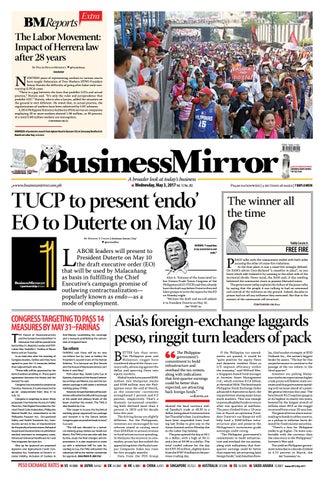
Hundreds of protesters march from Agham Road in Quezon City to Liwasang Bonifacio in Manila on Labor Day. ALYSA SALEN
media partner of the year
United nations
2015 environmental Media Award leadership award 2008
BusinessMirror A broader look at today’s business
www.businessmirror.com.ph
n
Wednesday, May 3, 2017 Vol. 12 No. 202
L
abor leaders will present to President Duterte on May 10 the draft executive order (EO) that will be used by Malacañang as basis in fulfilling the Chief Executive’s campaign promise of outlawing contractualization— popularly known as endo—as a mode of employment.
CONGRESS TARGETING TO PASS 14 MEASURES BY MAY 31–FARIÑAS
T
he House of Representatives and the Senate have identified 14 measures that will be passed into law by May 31, Majority Leader and PDPLaban Rep. Rodolfo C. Fariñas of Ilocos Norte said on Tuesday. In an interview after the meeting of Congress leaders, Fariñas said they have agreed to pass the 14 measures before their adjournment sine die. “These bills will be approved by the both chambers until May 31. This is a joint agreement between the House and the Senate,” he said. Congress has resumed its session on Tuesday. However, it is also expected to go on adjournment from May 31 to July 23. Congress is targeting to enact these proposals: Free Internet Access in Public Place Act, Free Higher Education Act, Revised Penal Code Indexation, Philippine Mental Health Act, amendments to the Philippine Passport Act, Occupational Safety and Health Standards Act, Community service in lieu of imprisonment for the penalty of arresto menor, Refusal of hospital and medical clinics to administer medical treatment in emergency cases, Enhanced Universal Healthcare Act and Free Irrigation Services Act. Also up for approval are proposed Agrarian and Agricultural Credit Condonation Act, Extension of Driver’s License Validity, Inclusion of Casinos in
Anti-Money Laundering Act coverage and a measure prohibiting the conversion of irrigated land.
Tax reform Fariñas said there will be no new tax-reform law by June or before the President’s second State of the Nation Address. “It is because we [the Senate and the House of Representatives] can’t finish it until May.” PDP-Laban Rep. Dakila Carlo Cua of Quirino, chairman of the House Committee on Ways and Means, has said the taxreform package is still under a technical working group (TWG). However, he said members of his committee will tackle the bill until its passage at the panel and plenary levels of the lower chamber this month. The TWG is also headed by Cua. “Our target is to pass the [technical working group-approved] tax package and transmit it to the Senate before Congress goes on another break in June,” Cua said. “The bill was elevated to a technical working group before our break last March. The TWG is the one who will, line by line, study the final changes and improvement. It is also expected to come up with a substitute bill,” he said. According to Cua, the TWG will submit the substitute bill to the mother committee for approval. Jovee Marie N. dela Cruz
PESO exchange rates n US 49.9000
business news source of the year
P25.00 nationwide | 5 sections 28 pages | 7 days a week
TUCP to present ‘endo’ EO to Duterte on May 10 By Manuel T. Cayon | Mindanao Bureau Chief @awimailbox
2016 ejap journalism awards
The winner all the time Teddy Locsin Jr.
DUTERTE: “I stand firm in my conviction to end endo.”
free fire
P Alan A. Tanjusay of the Associated Labor Unions-Trade Union Congress of the Philippines (Alu-TUCP) said they already have the draft way before Duterte directed labor groups to write the inputs for the EO on Monday night. “We have the draft and we will submit it to President Duterte on May 10. See “TUCP,” A2
EACE talks with the communists ended with both sides accusing the other of cease-fire violations. In the first place, it was a cease-fire wrongly defined. On RAM’s advice Cory-declared “a ceasefire in place”, so you knew which side violated it by crossing to the other side of the territorial divide. Never mind, the RAM said, if this wording bolstered the communist claim to possess liberated zones. The government today explains the failure of the peace talks by saying that the people it was talking to had no command and control of the militants on the ground. Indeed, decades in prison had cut off any influence they exercised. But that is the essence of the communist cell structure. Continued on A11
Asia’s foreign-exchange laggards peso, ringgit turn leaders of pack
B
etter late than never. The Philippine peso and Ma laysian r ing g it have clambered aboard the Asian currency rally, advancing against the dollar and spurring flows into equity markets. Global funds have poured $581 million into Malaysian stocks and $198 million into the Philippines since the end of March, a s t he cou nt r ies’ c u r renc ies strengthened 2 percent and 0.5 percent, respectively. That’s a dramatic turnaround considering both declined more than 4 percent in 2016 and hit decade lows this year. The driving forces are slightly different. For the Philippines, investors are encouraged by tax reforms aimed at raising more than $3 billion in annual revenue to fund infrastructure spending. In Malaysia the recovery in commodity prices has burnished the appeal of equities: the Kuala Lumpur Composite Index has risen for five straight months. Data from the PDS Group
The Philippine government’s commitment to build infrastructure and overhaul the tax system, along with indications that first-quarter earnings could be better than expected, are attracting back foreign funds.” —Ravelas
showed the local currency ended Tuesday’s trade at 49.99 to a dollar, losing about 4 centavos from last Thursday’s close. Local markets have been suspended from trading last Friday to give way to the Asean Summit and on Monday due to the Labor Day holiday. The peso opened the day at 50.1 to a dollar, with a high of 50.11 and a low of 49.98 to a dollar. The total traded volume for the day hit $707.55 million, slightly down from the $787.9 million in the previous trading day.
If the Philippine tax amendments are passed, it would be “quite positive for equity flows and domestic resident flows as it’ll improve efficiency within the economy,” said Wilfred Wee, a Singapore-based fund manager at Investec Asset Management Ltd., which oversaw $114 billion at the end of 2016. The benchmark Philippine Stock Exchange Index advanced 4.8 percent in April, the top performer among major Asian stock markets. That was enough to persuade global funds to return after two quarters of outflows. The peso climbed from a 10-year low in March on optimism President Duterte’s tax blueprint will help fund a $160-billion infrastructure plan and preserve the Philippines’s investment-grade sovereign credit rating. “The Philippine government’s commitment to build infrastructure and overhaul the tax system, along with indications that firstquarter earnings could be better than expected, are attracting back foreign funds,” said Jonathan Rave-
las, chief market strategist at BDO Unibank Inc., the nation’s biggest lender by assets. “The key for this outperformance to continue is the passage of the tax reform in the third quarter.” Investors are picking Malaysian stocks on expectations higher crude prices will bolster state revenues and that government spending will increase ahead of a possible general election this year. The benchmark KLCI equities gauge is at its highest in nearly two years, boosted by the longest stretch of inflows since 2013 as the ringgit recovered from a near 20-year low. The general fervor also is not extending to bonds in either country, as a pickup in inflation hurts demand for fixed-income securities. “There’s a bias for Philippine yields to go higher. I’m more comfortable with the currency than the rates story in the Philippines,” Investec’s Wee said. The yield on Philippine government notes due in a decade climbed to 4.72 percent in March, the See “Laggards,” A2
n japan 0.4462 n UK 64.3061 n HK 6.3881 n CHINA 6.4151 n singapore 35.7322 n australia 37.5398 n EU 54.3910 n SAUDI arabia 13.3067
Source: BSP (2 May 2017 )
BMReports BusinessMirror
A2 Wednesday, May 3, 2017
www.businessmirror.com.ph
The Labor Movement: Impact of Herrera law after 28 years Continued from A1
Data from the PSA survey indicated the construction industry had the highest share of nonregular workers, with six nonregulars for every 10 workers. Industries such as agriculture, forestry and fishing, mining and quarrying and food services industry had five nonregulars for every 10 workers. Four presidents: Corazon C. Aquino, Fidel V. Ramos, Joseph Estrada and Gloria MacapagalArroyo have allowed under their respective administration the practice of contractualization, while expressly prohibiting LOC. Come the 2016 presidential elections, all presidential candidates vowed to put an end to LOC, which, in today’s labor parlance, is now referred to as endo, or “end of contract”—the hiring of employees for only five months to bypass the law on regularizing workers after six months. The winning presidential candidate, President Duterte promised to call on the House Speaker, the Senate President and the majority of lawmakers to pass a law to end LOC. Two months into his presidency, Duterte repeated his stern warning to companies practicing endo. In a speech before members of the Parish Pastoral Council for Responsible Voting, Duterte said: “I’m telling this to you. I’m just issuing a warning. You choose: Stop contractualization or I kill you.”
TUCP. . .
Continued from A1
We hope the President will accept the provisions,” Tanjusay told the BusinessM irror. He refused to divulge the contents of the draft, as they were advised by their lawyers to wait for their meeting with Duterte before making public their recommendations. “He told us last night to draft the ground basis of the EO, which will prohibit all forms of labor-only contracting,” said Tanjusay, spokesman of Alu-TUCP. “As we understand it, we will be having a dialogue with him on May 10 to discuss the draft.” This was confirmed by Labor Undersecretary Joel B. Maglunsod. “Duterte ordered labor groups to draft the EO and to submit it to his office on May 10,” Maglunsod told the BusinessMirror. “He wanted the provisions to come from workers themselves so it would truthfully reflect the plight of the labor sector.” He added the administration was most likely inclined to adopt major points of the draft to fulfill Duterte’s
Employers’ response
cost efficient”.
THE Employers Confederation of the Philippines (Ecop) and the People Management Association of the Philippines (PMAP) gave their vocal support for Duterte’s campaign to end contractualization. However, PMAP said endo must be differentiated from contractualization, a project-based labor contract, mostly used in the construction industry. Contractualization, under the present labor setup, occurs when a company outsources labor to service providers who will then hire workers to be supplied to the company. It is the service provider or labor contractor that becomes the employer of the worker, not the company. Acting Ecop President Sergio R. Ortiz-Luis Jr. said contractualization is legitimate, as in the case of a company hiring seasonal workers or workers hired during peak season. Ortiz-Luis added that completely phasing out the practice of contractualization is bad for business. He said the phaseout will seriously affect micro, small and medium enterprises (MSMEs), which account for 99 percent of the registered businesses in the country. The Ecop emphasized that, “in an era where outsourcing is a world-wide trend, employers want more flexibility in the hiring of temporary workers to be labor-
Service providers
campaign promise to end contractualization. Duterte heavily leaned on an anticontractualization crusade to earn the backing of numerous labor groups.
International Labor Day on Monday at the People’s Park here. “Give us time,” he said, explaining the delay in implementing his campaign promise to end contractualization to the administration’s move “to make corrections at ending endo because there are some employers who are seasonal and [who] engage in export”. Labor has been complaining on the widespread abuse of the labor subcontracting through such practices as labor-only contracting and the 5-5-5, or endo, hiring practice to avoid the regularization of workers. “But I said [during the campaign] as I say it now, I stand firm in my conviction to end endo,” he said. He added that the Labor Code has guaranteed the security of tenure of workers. He said this law must be strictly enforced. “To this end, I will issue an executive order directing the strict enforcement of provisions of law against endo and labor-only contracting”. “What I only ask from your representatives, when you make the repor t, tell me the truth, don’t feed me lies,” he said, “because I
Labor Day speech
Duterte’s Labor Day pronouncements followed his tirades in the same speech against the country’s oligarchs, who, he said, exploit their political and economic influence to continuously enrich themselves by using government land and properties at negotiated rental terms unfavorable to the government. Duterte said he would propose the hiring of more labor inspectors to cover more work places from out of the more than 1.2 million establishments in the country. In addition, he said he would ask the DOLE “to deputize labor unions and their staff to conduct inspections in the spirit of tripartism”. “With a few personnel only, the DOLE can not be inspecting only 1,000 businesses a day,” he said. He met labor leaders for more than one hour before he addressed at 7:20 p.m. the crowd of workers commemorating the 115th
LABOR leaders have been most adamant in calling for the removal of labor contractors or service providers in the employer-employee equation. Nagkaisa, a labor coalition consisting of 47 labor federations and workers organizations that includes the Trade Union Congress of the Philippines (TUCP), said the labor department has issued four department orders (DOs) from 1997 to 2001. And while all the DOs stated that labor contractualization will be regulated, the reverse has happened. “Labor contracting and subcontracting has proliferated and has now become the norm,” Nagkaisa said. “Most, if not all, employers have contracted out their labor requirements to labor contractors of the so-called service providers.” The militant Kilusang Mayo Uno (K MU ) sa id t hat, whi le they recognized the efforts of the Department of Labor and Employment (DOLE) to regularize 45,000 contractual workers since the start of the Duterte presidency, “there remains 24.4 million contractual workers that shou ld be reg u lar ized.” “ The majority of these workers are employed under job-contracting schemes,” the KMU added.
Worker vs employer
THE first nine months of the
Duterte presidency saw intense lobbying on the LOC issue from various labor groups. Two DOs issued by Labor Secretary Silvestre H. Bello III were slammed by labor groups from both ends of the political spectrum. Organized labor criticized Bello’s DO 168, of December 28, 2016, and DO 174 on March 15 issued this year. They stressed that the inclusion of labor contractors or service agencies in the hiring of workers, as contained in both DOs, was unacceptable. FFW President Sonny Matula said Duterte shared the position of labor groups on agency hiring. Matula said that, in their February 27 Malacañang dialogue with the President, Duterte told them: “Ayoko itong agency-agency, walang agency-agency hiring. Kawawa ang worker sa ganito [I don’t want agency, no agency agency hiring. It puts workers at a disadvantage].” For his part, Bello reiterated in various media interviews that he had no power to abolish contractual work and that he can only make sure that contractualization schemes are not abused or used to deny workers their rights.
May 1 pronouncements
ON May 1 Duterte held a dialogue with labor leaders at the Davao People’s Park in Davao City, and reiterated that he will not renege on his commitment to end contractualization. may adopt your report and I would be only embarrassed, then there would be something wrong in our relationship.” He said he would also ask the labor organizations to file the list of their nominees for deputized inspectors.
Duterte said, however, that the country’s existing laws posed difficulties and limitations toward achieving what he promised. The President said he will review DO 174 and asked labor leaders to propose a draft for a new order against contractualization which he will consider in his review. Duterte also said he has ordered the Dole to tap workers’ unions to help in inspecting and monitoring compliance with labor laws of the more than 1.2 million business establishments in the country. He stated further that he will look into the national living wage being proposed by trade unions a nd w i l l con sider endorsi ng House Bills (HB) 444 and 556 for legislation by Congress. HB 444, also known as the “Security of Tenure Act of 2016”, was filed by Party-list Rep. Raymond Mendoza of TUCP. It proposes to totally prohibit contractualization and all its forms, including all fixed-term employment. HB 556 is the “Regular Employment” bill sponsored by the Makabayan Bloc in Congress, which, likewise, prohibits the practice of contractualization and promotes regularization. Earlier, the TUCP had proposed an emergency P500 monthly cash subsidy for workers. Bello has said the DOLE will study the matter. Duterte further announced that he is set to sign and endorse to Congress the ratification of
Call to occupation
Duterte also announced that he would ratify the 1978 C151, headlined Labour R elations (Public Service) Convention. It is an international convention “concerning Protection of the Right to Organize and Procedures for Determining Conditions of Employment in the Public Service. The ILO 151 went into force on February 25, 1981, according to the posting of the document on the ILO web site. “I am pleased to announce that I have decided to ratify the ILO 151,” he said. He added that he would also endorse the same document to the Senate for its concurrence. “May this serve the government’s commitment to continuously uphold the aspiration of a corrupt-free civil service,” he said.
Early in his speech, Duterte zeroed in on the country’s oligarchs for much of the economic woes of Filipinos, and warned that he would call on ordinary Filipinos to occupy the properties the oligarchs are occupying now “if you do not return the lands and properties back to government”. “Within the next three months, we would be telling you how much you have defrauded the government amounting to billions of pesos,” he said, “and if you will not return the land to government, I will ask the Filipino people to occupy the lands that are in your hands.” “So those in Makati and Pasay, you can begin looking at nice spots there. Yes, we would be going there, and you can build your homes there because it is yours,” he added. To the oligarchs, he said, “You can not be there for all time”. “I am addressing myself to the oligarchs, you who when you talk to government workers as if we are beggars, and as corrupt as you are,” Duterte said. “ We have been told that we don’t have the money and that we have to sacrifice and wait for
Laggards. . .
UNWTO. . .
highest in more than four years, as consumer prices rose at the quickest pace since 2014. Analysts are predicting the Philippines will be the first Southeast Asian economy to tighten policy in 2017, while annual economic growth is forecast to top 6 percent until 2019, among the fastest in the world. Central Bank Governor Amando M. Tetangco Jr. said in an interview in April that inflation is within target and there’s no strong impetus for the central bank to change stance. Global funds pulled more than $14 billion from Malaysian debt in the five months through March as appetite wilted after inflation hit an eight-year high. A central bank clampdown on trading in offshore nondeliverable forwards also stoked concern about capital controls, though the bank has said nothing is planned along those lines. Malaysian bonds have outperformed Asian peers more recently, and the 10-year yield was Tuesday heading for its lowest close since November. Bloomberg News, Bianca Cuaresma
Despite these travel advisories, Teo told reporters in a separate interview, “our government can assure travelers that the Philippines, as a whole, remains a safe haven for tourists and residents alike.” At the same Global Summit was former Prime Minister of the United Kingdom David Cameron, who said governments should rethink their actions in response to terrorism. “The effect of terrorism, as you know all so well, can be absolutely devastating. This devastation is not a by-product of the terrorist but it is what they want to achieve, to plunge us into a medieval world of fear and oppression, to shut down travel and tourism,” he stressed. The Department of Tourism is targeting an increase of visitor arrivals to 6.5 million in 2017, from the 5.9 million that arrived last year. With the promise of the Beijing government to send 1 million tourists to the Philippines this year, Teo said about 8 million foreign tourists could
ILO 151
Continued from A1
Continued from A12
the International Labor Organization (ILO) Convention 151 (ILO-C151), which ensures the right of government workers to organize. Matula said they view Duterte’s pronouncements with “guarded optimism”. “Labor groups, including the FFW and Nagkaisa, have actually prepared a draft executive order on contractualization within the framework of prohibition of contractualization, as early as Februar y,” he said. “Workers will be ready to inspect establishments as to their compliance to general labor standards a nd occ upat iona l sa fet y a nd health standards,” In Mani la a lmost 100,000 workers marched to Malacañang to demand for an end to LOC. The KMU demanded for a “Social Justice Package”, which contained a P750 national minimum wage, an end to contractualization, free mass housing and free distribution of land. KMU Secretary-General Jerome Adonis urged Duterte to stand by his presidential promise to workers. “Duterte promised that contractualization will stop when he assumes presidency. He did not say some contractualization will stop and some will be legalized,” Adonis said. “ To fulfill his promise of change, the Duterte administration should promote regular jobs by ending all contractualization things to happen,” he said. “But the truth is, while I was reviewing the contracts of government, including those private persons, that there are government properties controlled by only a few families in the Philippines”. He said this was the anomaly kept hidden from the public and, thus,would make government equally accountable for the anomaly. “What happens is that whoever becomes President, they would make them their kumpare [friends]. And so they are enjoying the privileges that were not given to the ordinary Filipinos, which are supposed to be theirs,” he said. He said these oligarchs “own the trade and commerce, the business empires”. But he said they also destroy the environment, “and they don’t care and they keep on abusing the Filipino people”. “So those of you who are occupying those government properties, give them up or I will ask the Filipino people to get them from you,” he said. “You already enriched yourselves and your families for generations at the expense of the Filipino people.”
actually arrive this year. Meanwhile, the UNWTO will be holding its Sixth International Conference on Tourism Statistics at the Marriot Hotel in Manila from June 21 to 24, with the Philippine government as cohost. Conference participants will discuss ways to standardize measures for the collection of relevant information, at either the national or subnational level, on sustainable tourism. According to the conference concept note: “The Manila Conference will be a landmark opportunity to discuss methodological advances, explore emerging issues and learn from pioneering country experiences in this area of measurement. UNWTO recognizes that, apart from being a technical exercise, the development and implementation of a statistical framework for sustainable tourism is very much a strategic endeavor that will require stakeholder engagement, interinstitutional coordination and political leadership. Consequently, the Manila Conference will start with a ministerial roundtable and panels involving leaders from Ministries of Tourism, Environment and National Statistics Offices.”
The Nation BusinessMirror
news@businessmirror.com.ph
Editor: Dionisio L. Pelayo • Wednesday, May 3, 2017 A3
Administration legal beagles circle wagons around Duterte
J
USTICE Secretary Vitaliano N. Aguirre II is set to order an investigation into the people or group believed to be behind the complaint against President Duterte and 11 senior government officials filed by lawyer Jude Jose Sabio before the International Criminal Court (ICC).
Gatchalian warns police could lose war on drugs By Butch Fernandez
@butchfBM
T
HE public approval of the Duterte administration’s raging war on drugs is likely to “continue to nosedive” if the National Police fails to correct reported police abuses in waging the campaign against illegal-drugs syndicates, Sen. Sherwin T. Gatchalian warned on Tuesday. Gatchalian cited the “failure” of National Police chief Director General Ronald M. dela Rosa to “keep his officers in check”, even as he prodded him to promptly launch an inquiry into the charges against erring police officers. He lamented what he described as an “endless string of public scandals concerning the questionable methods employed by police officers in waging the fight against illegal drugs is starting to take its toll on the credibility of the National Police.” Gatchalian voiced concern that “public trust in the [police] institution is fast declining, and the people are losing their faith in police officers.” In a statement, Gatchalian said the March 2017 Social Weather Stations (SWS) survey indicating an 11-percent drop in public satisfaction in the Duterte administration’s war on drugs. He noted that 73 percent of the respondents voiced fears about “being wrongly targeted and becoming victims of extrajudicial killings”, while 44 percent “did not believe police claims that slain suspects fought back during operations”. Gatchalian also cited televised reports last week on a discovery by a team from the Commission on Human Rights (CHR) that found 12 men and women, alleged to be drug offenders, illegally detained inside a “secret lock-up cell” hidden behind a bookshelf at the WPD Police Station 1 in Tondo, Manila.
Joint naval drill with China? No problem–DND official
T
HE Department of National Defense (DND) is fine with President Duterte’s announcement that he is willing to allow the country’s Navy ships to conduct naval maneuvers with their Chinese counterparts. “The DND welcomes every opportunity to forge stronger defense ties with other countries, especially given the fact that we now face threats that necessitate responses on an international scale,” DND Public Affairs Director Arsenio R. Andolong said in a message to the Philippines News Agency on Tuesday. Andolong added it is also customary for various armed forces to train together to become familiar with each other. “Having joint military exercises with other countries will benefit us, since these will expose our troops to new doctrines and new technology. These will also allow us to assess how our own doctrines fare against our foreign counterparts,” Andolong pointed out. Earlier, Duterte said he is amenable to having the Navy conduct drills with its Chinese counterpart, especially in Sulu and Mindanao waters. Duterte made this announcement after visiting the three Chinese People’s Liberation Army Navy ships at the Sasa Wharf in Davao City on Monday. The visiting Chinese ships are the guided-missile destroyer Chang Chun (DDG-150), the guided-missile frigate Jin Zhou (FFG532) and the Type 903 replenishment ship Chao Hu (890). PNA
Bank: Luisita property that farmers want to occupy not CARP-covered
T
HE 300-hectare Hacienda Luisita property that militant farmers are threatening to occupy is not covered by the Comprehensive Agrarian Reform Program, as the Departmentof Agrarian Reform (DAR) itself ordered its conversion in 1996 from agricultural. It was acquired from its previous owner, Luisita Industrial Park Corp., in 2004. The validity of the conversion was upheld by the Supreme Court with finality in 2012. “Clearly, the order issued by Agrarian Reform Secretary Rafael Mariano last February reversing DAR’s conversion order of 1996 and classifying the property as agricultural again directly violates the said Supreme Court decision issued five years ago. The DAR has no authority to revoke the conversion order and overrule the Supreme Court. Secretary Mariano’s order completely lacks legal basis,” the Rizal Commercial Banking Corp. said in a statement.
Aguirre believes there are people behind the actions of Sabio—the lawyer of confessed hitman Edgar Matobato—which he described as an “effort to destabilize the Duterte administration”. “Matobato, Sabio and whoever are behind them are out to destabilize the Duterte administration by discrediting it before the international community. I believe that somebody is behind them, because they will not be so brazen in their actions if there is no one holding the strings, purse strings included, behind the scenes. Ask them who is paying for their expenses in going to the ICC,” Aguirre said in a statement. “Are these funders public officials at present? If yes, are they using public funds of their offices to undermine the government? If yes, they should be investigated and be made accountable. If, on the oth-
er hand, the funding is private, then it is still an act of destabilization. These destabilizers do not want the Filipino people to have a drug-free future. They hate it when the greater majority of our countrymen benefit from the many gains of the Duterte administration. To them and their kind, I say, bring it on!” Aguirre added. For his part, Solicitor General Jose Calida, the government’s top lawyer, said he will initiate the filing of a disbarment charge against Sabio, for filing baseless suits. He recalled that the Supreme Court sanctioned Sabio in 2008 for filing a groundless bribery charge against Judge Alden Cervantes, who was the presiding judge of the Municipal Trial Court in Cabuyao, Laguna, until his retirement in 2005. The Court held that Sabio violated the proscription in the lawyers’ Code of Professional Responsi-
bility against wittingly or willingly promoting or suing any groundless suit, including baseless administrative complaints against judges and other court officers and employees. Sabio also ran for a Senate seat last year and lost. “This perennial loser stubbornly refuses to heed the warning from the Supreme Court that if he commits the same infraction, he will be punished more severely. We will see him in court,” Calida said. On April 24 a communication was filed by Sabio before the ICC in The Hague, the Netherlands, accusing Duterte and 11 other government officials of crimes against humanity. “It appears that this lawyer is in the business of maliciously filing baseless suits based only on hearsay and unfounded suspicions,” Calida said. PNA
Economy
A4 Wednesday, May 3, 2017 • Editors: Vittorio V. Vitug and Max V. de Leon
BusinessMirror
news@businessmirror.com.ph
Manufacturing PMI slightly dipped in April
T
By Bianca Cuaresma
@BcuaresmaBM
he growth of the country’s manufacturing sector slowed down in April this year, but optimism remains for the rest of the year, as domestic demand continues to be robust for the sector. On Tuesday regional business media organization Nikkei and international think tank IHS Markit announced the Philippines’s Purchasing Managers’ Index (PMI) for April, slowing down to 53.3, from 53.8 in March. The PMI is a composite index, calculated as a weighted average of five individual subcomponents. The components include new orders—which weigh the most at 30 percent of the index; output—at 25 percent of the index; employment—at 20 percent; suppliers’ delivery times—15 percent; and stocks of purchases—comprising the other 10 percent. Readings above 50 signal an improvement in business conditions on the previous month, while readings below 50 show deterioration. Despite the slightly lower PMI during the month, the international think tank remains optimistic about the country’s manufacturing sector —with domestic demand as the main driver of growth. “Total order-book growth slowed from March, but the rate of expansion remained robust, reflective of strong client demand. Anecdotal evidence indicated that solid economic growth and increased construction activities contributed to higher new business volumes. Overseas demand for Filipino products grew at the slowest in 14 months, suggesting the domestic market remained the main engine for manufacturing growth,” the report read. However, on the price front, cost increases persisted at an elevated rate despite seen easing of inflationary pressures in the manufacturing sector—a development blamed largely
53.3 The country’s PMI in April, from 53.8 in March
on the weakness of the peso against the US dollar in recent months. “PMI data suggested that a weak exchange rate and higher raw material prices remained key drivers of inflation. Prices for manufactured goods rose in tandem with greater costs as firms sought to protect margins,” the report read. IHS Markit economist Bernard Aw remained optimistic of the Philippine manufacturing’s growth in the nearterm, saying there were further signs growth momentum will be sustained for the rest of the quarter, particularly as forward-looking indicators such as new orders and expectations continued to show robust trends. Aw also said reports of increased construction activ ity, together with greater public-infrastructure spending are expected to support the manufacturing industry in the coming months. “The domestic market continued to be the key driver of manufacturing growth, with foreign demand for Filipino manufactures rising only modestly despite depreciation of the peso. However, the weaker local currency led to costlier imported inputs. Cost inflation remained elevated, which prompted firms to raise charges to protect their margins,” Aw said.
Fashion soot
A worker carries three sacksful of coal on his shoulder for delivery to a retail shop in Barangay Pasong Putik in Quezon City, unmindful of both the soot and the blistering heat of a summer midday sun. Despite the prevalence of liquefied petroleum gas-fueled stoves, charcoal is still widely used by Metro Manila consumers for broiling, roasting and cooking fuel. PNA/Oliver Marquez
House panel summons ad man behind ‘fishy’ ERC infomercial
T
he House Committee on Good Government and Public Accountability will subpoena Luis Morelos, the listed owner of advertising agency FatFree Inc. in connection with the anomalous infomercial project that led to the suicide of lawyer Francisco Villa Jr., former the head of the bids and awards committee of the Energy Regulatory Commission (ERC). In a news statement, PDP-Laban Rep. Johnny Pimentel of Surigao del Sur, Committee Chairman Morelos and ERC Chairman Jose Vicente B.
Salazar are already under preliminary investigation by the Office of the Ombudsman in connection with the infomercial project, based on a complaint earlier filed by the National Bureau of Investigation (NBI). “We’ve had two hearings already on the irregularities at the ERC, and Mr. Morelos failed to show up on both occasions, despite our invitations. We will compel him to attend our next hearing,” Pimentel said. “We support the complaint filed by the NBI before the Ombudsman. The action appears warranted, so we are
all for it,” he added. Villa, who was also ERC Director for Planning and Information Service, committed suicide on November 9, 2016. He left three letters indicating he was under extreme duress from Salazar to endorse the rigged infomercial project contract with Morelos’ FatFree. Villa, 54, shot himself in the head with his .38-caliber revolver inside his house in Parañaque City. He was the son of the late Ombudsman Francisco Villa Sr. According to Pimentel, his panel intends to conduct a third hearing on
the “fishy” infomercial project and two other anomalies in Salazar’s office. “We will have one last hearing, and then we will prepare and submit our committee report for plenary approval,” Pimentel said. “My greatest fear in bids and awards committeetheaudio-visualpresentation by Morelos, which the chairman and CEO, Salazar, chose through a rigged selection system. That will be a criminal act,” Villa wrote in one of his suicide notes that were later made public by his sister, veteran journalist Rosario Sofia Villa. Jovee Marie N. dela Cruz
CAB’s Arcilla: PHL-UAE air talks end in ‘stalemate’ By Recto Mercene
T
@rectomercene
he two-day bilateral air talks between the Philippines and the United Arab Emirates (UAE) in Davao City on April 26 and 27, ended in a deadlock, even as both parties insist they are close to agreeing to some exchanges, according to Civil Aeronautics Board Executive Director Carmelo Arcilla. “Our talks included the commitment of Emirates to operate out of Davao and additional flights to Manila, but the details could not be resolved as of yet,” Arcilla said in an exclusive interview with the BusinessMirror. This follows previous aviation negotiations with the UAE in 2012 and 2015 that have expanded air rights entitlements to the current maximum of 70 flights per week (10 flights per day) between Manila and the prime UAE airports of Dubai and Abu Dhabi. Today Emirates flies 18 weekly flights from Dubai to Manila, while Etihad flies 17 times weekly from Abu Dhabi to Manila, a total of 35 flights weekly. Philippine Airlines (PAL) and Cebu Pacific each fly daily frequencies to Dubai; additionally, PAL serves Abu Dhabi with 3 weekly flights. Both Philippine carriers also operate direct flights to Kuwait, Riyadh and Doha, while PAL, additionally, flies direct to Dammam and Jeddah. Arcilla said the parties would meet again soon to resume the discussions, but Arcilla added the venue would probably be in the UAE. Asked why the talks was held in Davao, Arcilla said: “We want it to be held in Davao because the city is booming, it’s a beehive of activity, we want to promote it, in the same way we are able to promote Cebu.” He said Emirates is already flying out of Cebu and the Philippines side choose Davao “since our president is from there, and also, it’s the commercial center of
southern Philippines,”Arcilla added. In 2015 the Philippines had concluded a round of aviation negotiations with the UAE, during the last year of the Aquino administration, which resulted in more Manila entitlements being granted to Etihad and Emirates. There is concern that giving in to any UAE request for more Manila flights would lessen the incentive for Emirates to continue flying to Clark and Cebu, let alone contemplate a new Davao route. This is borne out by their records such that Emirates abruptly cancelled its Dubai-Clark route in 2014, with less than 7 months of operations, citing economic reasons, after which it pursued applications to secure permanent increases in rights to Manila instead. The UAE-Philippines aviation market is now well served by four airlines: Emirates (based in Dubai), Etihad Airways (based in the federal capital of Abu Dhabi), PAL and Cebu Pacific Air. In addition, Air Arabiya (based in Sharjah), RAK Airlines (based in Ras Al Khaimah), Air Philippines, Philippines AirAsia and other airlines may also avail of the negotiated entitlements. Arcilla said Cebu Pacific and AirAsia Philippines have applied to fly to New Delhi, although India does not fly into Manila. Arcilla denied that the UAE representative walked out of the talks. “You know bilateral talks have their own dynamics; I scratch your back, you scratch my back. There are things they want, but it’s hard for us to give, there are things that we want, but its hard for them to give. Like, we want Davao for them to operate, they want Manila, so we negotiated along those lines, but we can’t iron out the details [for now].” Arcilla admitted, however, that in any negotiations, there are usually tense moments. “Syempre meron tense moments, you know there are bluffs on both side, they are part of the negotiations, there’s a little tense
You know bilateral talks have their own dynamics; I scratch your back, you scratch my back. There are things they want, but it’s hard for us to give, there are things that we want, but its hard for them to give. Like, we want Davao for them to operate, they want Manila, so we negotiated along those lines, but we can’t iron out the details [for now].”—Arcilla
moment, but we ended up amicably, very friendly, there were shaking of hands and we agreed to talk again, we will communicate again, there was no walkout.” Asked what the topic would be during the next round of talks, Arcilla said: “We will pick up from where we left off.” “The goal of every country is to develop an adequate aviation network, because air transportation is a vital tool, not only of the economy, but also of public convenience,” he said, adding thatsinceourcountryisarchipelagic,morethan 99 percent of our tourists travel by air.
news@businessmirror.com.ph
AseanWednesday BusinessMirror
Editor: Max V. de Leon • Wednesday, May 3, 2017 A5
Trump starts courting Asean leaders
P
resident Donald J. Trump is prioritizing strategic interests over human rights by inviting a pair of internationally criticized leaders from Southeast Asia, where the United States is vying with China for influence. The White House said rights concerns in the Philippines and Thailand may be aired in private. President Duterte has championed a deadly war on illegal drugs, stirring a litany of controversies. He has condoned rape, likened himself to Adolf Hitler and faced accusations of personally killing drug suspects as a crime-fighting city mayor. Although less polarizing internationally, Thai Prime Minister Prayuth Chan-ocha took control in a 2014 coup, consolidated military power and repeatedly postponed elections. But both nations are long-standing allies that grew estranged from Washington because of democratic backsliding in those countries. And Trump’s weekend invitations to Duterte and Prayuth to visit the White House may be less about a preference for strongmen, and more about America’s standing in a strategically important part of the world. Trump’s early decision to withdraw the US from a pan-Pacific trade pact dismayed Southeast Asia, a major destination for US overseas investment. And the lion’s share of Trump’s Asia attention has been North Korea’s nuclear weapons development. On Monday White House Spokesman Sean Spicer defended the outreach to Duterte, saying the Philippines can help economically and diplomatically to isolate North Korea. It would be wrong to assume Trump is not raising human rights
“because we don’t put out statements chastising leaders at every call”, Spicer said. Southeast Asia is not the only place where Trump is embracing heads of government with poor democratic records. He has congratulated Turkey’s president for sweeping up more power, hailed Egypt’s strongman as a “fantastic guy” and repeatedly spoken of a burgeoning friendship with China’s communist leader. He has even expressed a grudging respect for North Korea’s Kim Jong Un, and in an interview with Bloomberg News on Monday said he would be “honored” to meet with the young dictator under the right circumstances. In Southeast Asia the Trump administration’s considerations have been broadening. Vice President Mike Pence visited Indonesia in April and said Trump would travel to the region later in the year. Secretary of State Rex Tillerson is hosting the 10-nation Southeast Asian bloc’s foreign ministers this week. In another phone call last weekend, Trump invited Singaporean Prime Minister Lee Hsien Loong to visit Washington. Governments in the region are more concerned about China than North Korea, which has allowed the US to make strategic inroads. Under President Barack Obama,
IN this March 21 file photo, President Duterte (right) and Thailand’s Prime Minister Prayuth Chan-ocha leave a joint news conference in Bangkok, Thailand. AP
the US improved ties with former adversaries Myanmar, Vietnam and Lao PDR, and challenged Beijing’s island-building in the disputed South China Sea. Obama sent warships to operate out of Singapore and paved the way for US forces to use Philippine military bases. But his effort was stymied by human-rights concerns, particularly in Thailand and the Philippines. Both have embraced China. Duterte, in particular, has patched up tensions over territorial disputes and sought closer economic ties, without following through on threats to end the US military alliance. “This is certainly an attempt by
the Trump administration to reelevate these relationships,” Amy Searight at the Center for Strategic and International Studies said. “The US needs to maintain a coalition of countries that continues to support a rules-based order and pushes back against bullying by China.” Allegiances are shifting. This weekend three Chinese naval ships made a rare stop in the Philippines, docking at Duterte’s home city of Davao. At a regional summ it , D uter te’s
Thai prime minister accepts Trump’s invitation
T
hailand’s prime minister has accepted an invitation from President Donald J. Trump to visit the United States, his office said on Monday, as the US leader made an unexpected diplomatic initiative toward several Southeast Asian counterparts. Trump telephoned Thai Prime Minister Prayuth Chan-ocha and Singapore Prime Minister Lee Hsien Loong last Sunday to reaffirm traditional close relations and invite them for meetings. The invitations followed another one in a call late on Saturday to President Duterte. Washington’s diplomacy in Asia has focused recently on China and tensions with North Korea, although Vice President Mike Pence included Indonesia on a recent Asia tour. Prayuth’s office said he had accepted Trump’s invitation, while a Singapore Foreign Ministry statement said the two leaders “looked forward to meeting each other soon.” No dates were mentioned for the visits. Human-rights groups have criticized Prayuth for seizing power in a coup and curbing democratic rights, while Duterte is scorned for his deadly war on illegal drugs. Both bristle at the criticisms. However, Washington has strategic concerns in countering Chinese influence in Southeast Asia. Thailand, Singapore and the Philippines are historically the most pro-Western nations in the region, but China’s influence has been increasing as it flexes its economic muscle and projects its military power into the South China Sea. Prayuth’s government last week announced approval of a plan to purchase a submarine from China. Prayuth’s office said he and Trump reaffirmed the importance of their countries’ long-standing alliance. It also said Prayuth invited Trump to visit Thailand at a convenient time. The White House statement about the call to Lee mentioned that “robust security cooperation and close collaboration on regional and global challenges” mark the two countries’ partnership. AP
administration voiced no criticism of Beijing’s sweeping South China Sea claims that compete with those of the Philippines. Thailand, a traditional US military hub, last week announced plans to buy a Chinese submarine. Bitterness from the Obama era persists. Obama alienated Thailand by stopping Cabinet-level visits and restricting military aid after the
coup. He angered Duterte by criticizing the war-on-drugs killings that Amnesty International says has left up to 9,000 people dead since June. Duterte referred to Obama as a “son of a whore”, derailing a planned meeting. Trump, who plans to visit Manila this fall for a regional summit, has set a new tone. A White House readout of Saturday’s Duterte call credited his administration for “fighting very hard to rid its country of drugs”. But making nice may not prove any more effective than public criticism. On Monday Duterte suggested he may be too “tied up” to visit Washington. “I cannot make any definite promise,” Duterte told reporters, citing scheduled trips to Russia, Israel and elsewhere. Sen. Ben Cardin, the Senate Foreign Relations Committee’s top Democrat, called Duterte’s crackdown “barbaric” and urged Trump to rescind the invitation. Republican Sen. Marco Rubio tweeted that the Philippines’s growing death toll is “alarming and can’t be ignored”. Rep. Ed Royce, the Republican chairman of the House Foreign Affairs Committee, said of the invitation: “This is not a move I would have made.” Human Rights Watch also criticized the Prayuth invitation. Trump “essentially gave the Thai junta a green light to continue on its abusive path: harassing and abusing activists into silence, cracking down on independent media, banning public protests and political meetings, and allowing increased use of torture,” said Brad Adams, who heads the group’s Asia division. AP
The World
Editor: Lyn Resurreccion • www.businessmirror.com.ph BusinessMirror Highlighting his penchant for flouting the norms of diplomacy, establishment A6
Wednesday, May 3, 2017
Trump follows instincts on Kim, Duterte
W
ASHINGTON—President Donald J. Trump continued his outreach to rogue leaders on Monday, declaring he would meet North Korea’s dictator, Kim Jong Un, provided the circumstances were right, even as the Philippine president, Rodrigo Duterte, brushed aside the president’s invitation to visit the White House, saying he might be “too busy”.
Tr ump’s unor t hodox overtures—to a nuclear-armed despot who brutally purged his rivals, and an insurgent politician accused of extrajudicial killings of drug suspects—illustrated the president’s confidence in his ability to make deals and his willingness to talk to virtually anyone. Above all, they highlighted his penchant for f louting the norms of diplomacy, no matter his larger aim. No American president has met with a North Korean leader since Kim’s grandfather Kim Il Sung established a Stalinist state there after the Korean War. However vague and impromptu, Trump’s offer shook up an unsettled situation on the Korean Peninsula, which has been
alarmed by the prospect of a military clash between the US and the North. “Kim Jong Un would be delighted to meet with President Trump on the basis of one nuclear leader to another,” said Christopher R. Hill, a career diplomat who was special envoy on North Korea under former President George W. Bush. “If I were Trump I would pass on that.” D ute r te ’s b ac k h a nde d re sponse to Trump, however, also showed the pitfalls of his personal brand of diplomacy. The president had already gotten fierce criticism from humanrights groups for embracing a man viewed by many as being responsible for the deaths of thousands of people involved in
In this combination of file photos, (from left): President Duterte is pictured on October 26, 2016, in Tokyo; US President Donald J. Trump is pictured on April 29 in Washington. AP/Eugene Hoshiko, Pablo Martinez Monsivais
the drug trade. Now he faces being snubbed by Duterte as well. And he is working to keep open lines of communication with President V ladimir Putin, despite partially blaming the Russian leader last month for the continuing civil war in Syria. Trump and Putin are scheduled to speak by telephone on Tuesday afternoon, the W hite House announced late on Monday. “The most serious risk with this series of uncoordinated and controversial statements is that they undermine the most important currency of US power: the credibility of the president’s words,” said Evan S. Medeiros, who served
as a senior Asia adviser to former President Barack Obama. Trump first broached the idea of sitting down with Kim during the 2016 presidential campaign. He revived it in an interview on Monday with Bloomberg News, saying, “If it would be appropriate for me to meet with him, I would absolutely; I would be honored to do it.” The W hite House clarified that Trump would only consider a meeting if the North Korean leader met a series of conditions, starting with a sharp curtailment of his provocative behavior. North Korea carried out its most recent ballistic missile test, which failed, only last week.
“We want to hold out the possibility that if North Korea were ever serious about completely dismantling its nuclear capability and taking away the threat that they pose both to the region and to us,” the press secretary, Sean Spicer, said, “there is always going to be a possibility of that occurring.” But he added, “That possibility is not there at this time.” For now the Trump administration is pursuing a more traditional strategy of tightening economic pressure on the North—mainly through its neighbor, China—and backing that up with threat of military action. Trump said last week that while he wanted to solve the
Unions in France split over Macron
P In this photo released on May 1 by the Duke and Duchess of Cambridge, showing Princess Charlotte taken in April 2017 by her mother Kate, the Duchess of Cambridge, at Anmer Hall in Norfolk, England. The Duke and Duchess of Cambridge have said they are “delighted” to share this new photograph of Princess Charlotte enjoying the outdoors to mark their only daughter’s second birthday on May 2. The Duchess of Cambridge via AP
Princess Charlotte turns 2
L
ONDON—It’s party time for Britain’s Princess Charlotte, who celebrates her second birthday on Tuesday. Her parents marked the occasion on Monday by distributing a snapshot of Charlotte taken by her mother, the Duchess of Cambridge. Here are five things to know about the family as the landmark nears:
Why haven’t we seen more of Princess Charlotte?
Prince William and his wife Kate want to protect their daughter’s privacy. It’s not surprising that Kate took the official photo to mark Charlotte’s second birthday on the protected grounds of the family’s country estate. The royal couple has tried to keep Charlotte mostly out of the limelight and away from the paparazzi that often follow senior royals at events in London. An important exception was an official trip to Canada in the fall. William and Kate brought Charlotte and her older brother, Prince George, on the trip and Charlotte even attended a children’s party.
What does the photo show? What impact will it have?
Don’t be surprised if there’s a run on fluffy yellow cardigans with cute sheep decorations in British stores catering to kids— that’s what Charlotte is wearing in the official photo.
It’s possible the outfit was chosen by the clothes-conscious K ate, who snapped the photo. Earlier outfits worn by Prince George in public have become extremely popular w ith British consumers charmed by the young royals. Charlotte looks very proper and very British, with her hair styled by a clip and her blue-grey eyes looking directly at the camera at the outdoors photo session in April.
What is the birthday girl’s full name?
She is officially named Charlotte Elizabeth Diana, in tribute to her late grandmother Diana, Princess of Wales, and her greatgrandmother, Queen Elizabeth II. She is also known as Princess Charlotte of Cambridge.
What’s next for Charlotte and her family?
The family is expected to spend more time in London and less in the countryside as William takes up more royal duties, and Prince George, 3, prepares to start school in the fall. Their London base is at Kensington Palace.
Will she ever be queen?
Charlotte is fourth in line for the throne, behind Prince Charles (her grandfather), Prince William and Prince George. AP
ARIS—France’s presidential campaign entered its last week on Monday, coinciding with May Day labor demonstrations around the country that reflected a split among unions over whether to endorse Emmanuel Macron, the centrist candidate, against Marine Le Pen, his farright opponent. More than 140,000 people participated in rallies in Paris, Lille, Marseille and other cities—events organized by French labor unions, some of which have found themselves in a bind before the vote in the second and final round of the presidential election on Sunday. Although they have historically opposed Le Pen’s far-right National Front and have urged members to vote against her, several major labor unions also fought the job market overhauls that Macron defended as economy minister and that he wants to expand if elected. That has left unions split between those who have explicitly endorsed Macron, and those who have only called for votes against Le Pen. At a rally of his supporters in Paris on Monday, Macron reiterated his economic agenda and renewed calls for a “strong Europe”. But he said he would never “ judge” a National Front voter, “ because behind that vote there is always an anger, an outrage, a disappointment.” Though he condemned Le Pen for seeking to exploit voters’ anger, Macron seemed to play to the same deep anxieties on Monday when he told the BBC that if elected, he would have “to listen to our people, and to listen to the fact that they are extremely angry today, impatient, and the dysfunction of the EU is no more sustainable”. Macron said he was “pro-European”, but that if elected, he would “reform in-depth the European Union and our European project”, lest he “betray” the French people. “I don’t want to do so, because the day after, we will have a ‘Frexit’,” he said, referring to a French exit from the EU, “or we will have
140K The estimated number of people who participated in May Day labor rallies in Paris, Lille, Marseille and other cities in France
the Front National again.” Many on the French left, including union advocates who oppose the National Front, say the economic policies defended by Macron—free trade and a desire to loosen labor regulations—have fueled the National Front’s success. Those voters, many of whom supported the hard-left candidate Jean-Luc Mélenchon in the first round, do not want their votes for Macron to be construed as support for his platform. The latest polls have shown an increase in the number of voters who say they plan to abstain in the second round. In Paris on Monday the unions that supported Marcon and opposed Le Pen marched separately, in stark contrast to 2002, when the different labor unions united to oppose Le Pen’s father, Jean-Marie, after he made it into the second round of the presidential elections. Philippe Martinez, head of the General Confederation of Labor, one of France’s biggest unions, told the newspaper Le Parisien on Sunday that while his and other unions agreed on opposing the National Front, “We are not in 2002 anymore.” At the bigger demonstration on Monday in Paris, unions marched for workers’ rights and against Marine Le Pen, without calling for support for Macron. Other demonstrators carried signs that read “No to Macron” and “No to Le Pen”, and some chanted “abolish the Macron law” or “abolish the labor law”. Some hooded protesters
clashed with police on the sidelines of the demonstrations, throwing rocks and firebombs at the officers, who responded with tear gas. Five riot police officers were wounded in the clashes, the Paris police prefecture said. Demonstrators at a smaller rally organized earlier on Monday in Paris by more moderate labor unions, who have endorsed Macron, said voters had to choose. “Although we don’t support the politics of Macron, we advise our followers to vote for him, because we don’t want Le Pen,” said Olivier Belem, 56, a computer technician and union member. “The fact that the other unions don’t give voters clear advice will leave open the possibility of a blank vote and will help Le Pen in her chances of victory.” Analysts predict that abstentions could help Le Pen, especially if left-wing voters reluctant to vote for Macron stay home on Election Day. The latest polls suggest that Macron could beat Le Pen with roughly 60 percent of the vote in the second round. On Monday Macron also paid tribute to Brahim Bouarram, 29, who was killed during a far-right demonstration in Paris on May 1, 1995, by skinheads who pushed him off a bridge and into the Seine. Bouarram’s son, who was 9 at the time of his father’s death, joined Macron as they laid flowers at a memorial plaque. It was the latest attempt by Macron to draw attention to the National Front’s anti-Semitic and racist roots, from which Le Pen has tried to distance herself. Last Friday Macron traveled to Oradour-sur-Glane, a village in central France where an SS division killed 642 people in 1944; and on Sunday he visited the Shoah Memorial in Paris. The National Front’s unsavory past is embodied by Le Pen’s 88-year-old father and founder of the party, who on Monday addressed a couple of hundred supporters in Paris at a rally celebrating Joan of Arc. New York Times News Service
crisis with North Korea through diplomacy, a “major, major conflict” was possible. Some experts said Trump’s openness to diplomacy reflected the influence of China, which has long urged the US to speak directly to North Korea. Since Trump met last month in Florida with President Xi Jinping of China, he has praised Xi for what he insisted was China’s willingness to use its leverage over the North to curb its behavior. “The Chinese have told Trump, ‘You’ve got to talk to these people,’” said Joel S. Wit, an expert on North Korea at Johns Hopkins University, who was involved in diplomacy during the Clinton administration that led to a nuclear agreement with North Korea in 1994. “They’re trying to create the right circumstances for talks,” Wit said, “ramping up the pressure on the Chinese, ramping up the pressure on the North Koreans, and then opening up an escape route.” But the timing of Trump’s overture, analysts and diplomats said, was hopelessly premature. In these types of negotiations, American presidents typically function as closers— taking over the process, after all the spadework has been done, to bridge the last gaps. So far, Kim has displayed no interest in even beginning such a negotiation. New York Times News Service
With Civil War remark, Trump doesn’t go by the (history) book
W
ASHINGTON—If nothing else, President Donald J. Trump has already secured a place in history. It is his grasp of history that seems less secure. In his latest foray into what might be called the alternative past, Trump suggested that Andrew Jackson had been “really angry” about the Civil War, which did not break out until 16 years after his death. And for good measure, Trump questioned “why was there the Civil War” in the first place, suggesting that it should have simply been worked out. The comments, made in an interview broadcast on Monday, may have been attributable to imprecision, but for historians, they underscored what seems to be a tenuous understanding by Trump of the course of events that preceded his ascension to power. At various points, he has seemed to suggest that Frederick Douglass is still alive, appeared surprised that Abraham Lincoln was a Republican and mounted a plaque at a golf course marking a Civil War battle that never happened. “Presidents should have some better sense of the nation’s history as they become part of it,” said Julian E. Zelizer, a presidential historian at Princeton. White House officials said Trump was being misinterpreted and that a few random comments had been twisted into meaning something they did not. The criticism of his remarks, they said, reflects a “gotcha” game by intellectual elitists who fail to understand him. “There’s a certain amount of hunting for ‘what is it that Trump has done that’s dumb?’” said Newt Gingrich, the former speaker of the House, who taught history as a college professor in Georgia and has written multiple historical novels. “Trump’s not a student of history. Trump’s an extraordinarily successful, entrepreneurial personality who learns what he needs to know when he needs to know it. Trump is learning history as he governs.” After Trump’s comments led to criticism, he tried to clarify on Monday night on Twitter. “President Andrew Jackson, who died 16 years before the Civil War started, saw it coming and was angry,” he wrote. “Would never have let it happen!” New York Times News Service
www.businessmirror.com.ph • Editor: Lyn Resurreccion
The World
May: Juncker clash shows Brexit talks ‘won’t be easy’
U
K Prime Minister Theresa May alluded to the leaked details of her disastrous dinner with Jean-Claude Juncker to remind voters that Brexit talks will be tough and she alone is up to the task. G e r m a n y ’s Fra n k f u r te r Allgemeine Sonntagszeitung (FAS) newspaper last Sunday said the European Commission president left the April 26 talks at Downing Street shocked at May’s reluctance to compromise and “10 times more skeptical” of reaching a mutually acceptable deal over Brexit. It said the pair disagreed about the complexity involved in any agreement, about the sequencing of talks, and about budget contributions. Dismissing the report as “Brussels gossip”, May didn’t outright deny its accuracy. If anything, the premier has used the growing antagonism with Brussels to bolster her claim that a personal mandate means she can negotiate Brexit more successfully. May’s ref ra in has been t o c o nt r a s t he r s ho w o f strength and to depict rival Jeremy Corbyn as a “weak, nonsensical” leader. “As we have seen in recent days, it will not be easy,” she wrote in the Western Morning News, a regional daily newspaper, as she heads to campaign in southwest England. “Across the table from us sit 27 European member-states who are united in their determination to do a deal that works for them.” T he repor t is a f ur ther sig n that the initia l par t of the Brexit discussions w il l be spent resolv ing just what to ta lk about, r isk ing a fa l lout even before substantive matters have been debated. T he t wo sides h ave u nt i l March 29, 2019, to find common ground. At that point, Br itain w il l leave the EU regard less of whether it has a dea l or not. After the meeting, Juncker put the chances of a breakdown in the negotiations at over 50 percent, the paper said, citing people briefed by Juncker. All this “brings home just
how vast the gap is between May’s and the EU’s understanding of the Brexit rollout,” according to Henrik Enderlein, a professor of political economy at the Hertie School of Governance. “May wants her cake and to eat it, too. It just won’t work. Does holding a UK election change matters for the talks? Not a jot.” Enderlein added that for EU negotiators “the election is irrelevant”. An EU official said there is a mismatch between the UK’s expectations for the negotiations and the view from Brussels and that the best the British government can hope for is to agree a framework for its future trading relationship before the two-year deadline. T he U K gover n ment i s unrealistic about the pace of separation talks, the official said. At one point, the president pulled out the text of Canada’s free-trade deal with the EU, and Croatia’s accession agreement, and told her the British deal would be, at least, as complex. Juncker was par ticu larly a lar med by May’s v iew that B r i t a i n d o e s n’t o w e t h e other EU states any money, FA S said. T he EU ’s v iew is that the UK w il l have to pay somewhere between €40 billion and €60 billion ($44 billion to $65 bil lion) when it leaves the bloc to cover its outstanding commitments. He also thought her aim of resolving the status of EU and British citizens affected by the split at the next EU summit in June failed to appreciate the complexity of the issues involved, FAS said. Ju nc ker ca l led Ger ma n Chancel lor A ngela Merkel the next morning to brief her and their conversation prompted Merkel ’s comment that some in the UK government have “ illusions” about what lies ahead, FAS said. A commission spokesman declined to comment on the FAS report, and pointed to Juncker’s comments on April 29, when he said the meeting was friendly and constructive. “It was excellent,” Juncker told reporters that day. “I’m not talking about the food.” Bloomberg News
BusinessMirror
Wednesday, May 3, 2017
A7
Trump study of gas tax could run afoul of GOP, rural voters
P
resident Donald J. Trump says he’s open to raising the federal gas tax to fund infrastructure improvements—a position that could pit him against his fellow Republicans in Congress and might hit rural voters who supported him harder than others. Rep. Kevin Brady, the chairman of the tax-writing House Ways and Means Committee, made his opposition to an increase clear on Monday afternoon. Asked if he’d rule out a gas-tax hike, he said: “In my view, yes, but we’re going to have that discussion.” In an interview with Bloomberg News in the Oval Office on Monday, Trump said he “would certainly consider” raising the US gas tax to fund infrastructure. He described the idea as supported by truckers “if we earmarked money toward the highways”. But congressional Republicans have scuttled previous attempts to raise the gas tax. House Speaker Paul Ryan previously has opposed a higher levy, and Sen. John Barrasso, a Wyoming Republican and chairman of the Environment and Public Works Committee, has said he doesn’t see it as a solution for infrastructure funding. The conservative group Club for Growth immediately urged Trump to forget it. “Taking more money from American drivers to send to Washington is not the answer,” Spokesman Doug Sachtleben said in a statement. “Real infrastructure projects are best done at the state and local levels where transparency, efficiency and accountability are at their highest.” Americans for Prosperity, the conservative advocacy group that’s funded by the billionaire brothers Charles and David Koch, opposes gas-tax increases, arguing on the web site of its Louisiana chapter that they “hurt hardworking families, especially those who live in rural areas or drive older cars.’’
Rural effects
Voters in rural areas overwhelmingly chose Trump over Democrat Hillary Clinton in the
$1T
The budget proposed by President Donald J. Trump on roads, bridges, airports, sea ports and other public works
2016 presidential election, and a higher gas tax also may indeed affect those areas disproportionately, said Carl Davis, research director for the Institute on Taxation and Economic Policy, a nonprofit research organization in Washington. The gas tax is regressive, meaning it puts a bigger burden on lower- and middle-income families’ household budgets than it does the wealthy, the group says. The antitax activist Grover Norquist, a longtime opponent of raising the gas tax, said on Monday there are other things Congress can do to improve infrastructure. They include limiting spending from the federal Highway Trust Fund, which passes money to states, to highway projects and streamlining regulations, as well as studies related to permitting. “ There is no need—and no excuse for a tax hike,” Norquist said in a statement. “We can have more roads at lower prices if Congress repeals destructive laws and rules it itself established for sordid reasons.”
Revenue declines
Still, in some corners, pressure is building to increase fuel taxes. The
federal per-gallon taxes of 18.4 cents on gasoline and 24.4 cents on diesel were last raised in 1993. Since then, the revenue they generate has declined as inflation robbed them of their purchasing power and the average fuel economy of a passenger vehicle increased by 12 percent, according to the US Department of Transportation. Business and transportation groups have called for increasing the federal gas tax to help sustain the federal trust fund. Now, with Trump proposing to spend as much as $1 trillion on roads, bridges, airports, sea ports and other public works, the fuel tax is back under examination. Republican lawmakers will be open-minded, but “they’re going to likely start off from a skeptical point of view,” said David Winston, a GOP consultant who has advised congressional leaders. In a February interview, Rep. Bill Shuster of Pennsylvania, the Republican chairman of the House Transportation and Infrastructure Committee, didn’t rule out increasing the gas tax as part of negotiations to get a final infrastructure package approved. “That is certainly a difficult thing to do,” Shuster said at the time. “It’s something we should look at and consider.” Shuster’s office didn’t immediately comment on Trump’s statement on Monday.
Democrats’ response
Rep. Peter DeFazio of Oregon, the transportation panel’s top Democrat, said he thought most Democrats and many Republicans would go along if Trump strongly advocated for an increase. “I don’t think there’s any political jeopardy to this,” said DeFazio, who has introduced a bill to raise fuel levies by no more than 1.5 cents a year to back 30-year Treasury bonds that would generate $500 billion through 2030. The American Trucking Association, which supports a gastax increase as the most efficient method to raise revenue for highway infrastructure, welcomed Trump’s comments. “As an industry that pays half of the tab that funds the Highway Trust Fund, we welcome a discussion around tax reform and how best to generate the additional
revenue we need to improve our roads and bridges,” the group said in a statement. Asked about Trump’s remarks about the gas tax on Monday, Senate Minority Leader Chuck Schumer declined to weigh in. “I’m not going to comment on individual things he’s said,” the New York Democrat told reporters. “Let’s see the proposal.” The timing of the administration’s infrastructure plan is unclear. Trump said in a CBS interview released on Monday, “We’ve got the plan largely completed and we’ll be filing over the next two or three weeks, maybe sooner.”
‘Complicated issues’
But US Transportation Secretary Elaine Chao said last week that the administration hopes to have a package to Congress “probably by summer or this fall”. She said at a Milken Institute Global Conference in California on Monday it could come “fairly shortly”. There had been discussions about combining an infrastructure plan with a proposal to overhaul the US tax code, but the administration probably won’t do that because “they’re both complicated issues”, Treasury Secretary Steven Mnuchin said at the Milken event. Trump’s plan will include $200 billion in direct federal funding to leverage private investment for $1 trillion in spending over 10 years, Chao said. She previously has touted public-private partnerships and repatriation, or taxes on returned profits from overseas, as well as streamlining regulations and permitting to accelerate projects. Democrats and some Republicans have said relying on the private sector won’t work in rural states because public-works investments require a revenue stream, such as tolls or regular tax payments, that aren’t feasible in low-population areas. The president’s infrastructure plan will propose to use federal money to a larger degree in rural areas, Reed Cordish, assistant to the president in the White House Office of American Innovation, said at the Milken event. “It can allow for projects that wouldn’t otherwise happen in the free market to take place,” Cordish said. Bloomberg News
China’s $11-trillion economy, markets in a tug of war C
hina’s run of solid economic indicators proved little consolation for its shaky financial markets in April. The dichotomy stems from a shift in the leadership’s focus toward reducing leverage—one that’s set to determine whether growth joins asset prices in heading down. Economists are practica l ly unanimous in saying that reduced debt loads would be good for China’s longer-term health. The big unknown is whether officials can manage that without a dose of short-term pain. As UBS Group AG analysts put it in a note last week: if authorities’ initiatives are “not managed well, it could lead to a rise in credit events, excessive liquidity tightening, faster-than-intended slowdown of credit growth and greater market volatility”. What started in the fall of 2016 as a tightening in money-market liquidity has intensified to a broader attack by policy-makers on the shadow-banking system, where patchy regulation has allowed investors to make leveraged bets. W hen President Xi Jinping last week warned top officials to
crack down on financial risks, the benchmark equities index, at one point, gave up gains for the year, while bonds suffered their biggest tumble of 2017. While past regulatory shifts— especially pricking a stock bubble and letting the yuan depreciate in 2015—have sometimes spooked international investors, this time around the reaction has been muted. The positive economic backdrop has helped, along with the conviction that Xi and his lieutenants won’t allow turmoil to disrupt a key, once-in-fiveyears Communist Party leadership gathering this autumn. The imperative of heading off disorderly moves in financial markets is a backdrop to the slew of regulatory initiatives over the past two months. Besides broad increases in money-market rates, the list includes: The People’s Bank of China (PBOC) incor porated off-balance-sheet wealth-management products in its macroprudential assessment of banks’ risks, putting lenders on notice that shadow banking is facing deeper scrutiny. The China Banking Regulatory
Track record
Construction workers in Beijing Bloomberg
Commission (CBRC), under new leadership since February, stepped up scrutiny of entrusted investments—funds that banks farm out to external managers. The CBRC issued guidelines to enhance liquidity risks at banks, including all of lenders’ interbank and wealthmanagement product business in their monitoring. Authorities stepped up inquiries about wholesale funding after smaller banks sold a record amount of negotiable certificates of deposit. For now at least, the economy isn’t expected to take a major hit. For one thing, growth accelerated last quarter to 6.9 percent,
according to official figures, and the debt hangover is getting easier to service as factory prices snap years of deflation. Some ind icators sug gest the expansion may be coming off the boil. Caixin Media and Markit Economics’s manufactur ing purchasing managers’ index slipped to 50.3 in April— t he lowest si nce September. But while trends in the property market signal a slowdown ahead, China has plenty of infrastructure needs in central and western parts of the nation, and urbanization remains a long-term engine.
In the most recent tussle between market sentiment and economic fundamentals, it was the latter that won out. The economy weathered the 2015 market turmoil, first stabilizing and then perking up as the housing market took off again and the government stepped in with massive doses of infrastructure investment. The latest push to contain financial risks is focused more on speculative bets than on curtailing credit to the “real” economy. The PBOC has kept benchmark lending rates at a record low and the government continues to spend on pipes, rail and bridges. “China’s current economic recovery is likely to be in its early days, and has more legs to run,” China International Capital Corp. economist Liang Hong said. Better policy coordination and ongoing liquidity injections by the PBOC make a credit crunch seem unlikely, she said. Crucially, the increase in yields on Chinese government bonds (CGBs) has coincided with the emergence of inflation that’s ref lected the economy’s quicker
growth. Nominal GDP rose 11.8 percent in the first quarter from a year before, according to Bloomberg Intelligence economist Tom Orlik. That helps fuel corporate profits, government revenue and household income, along with making debt easier to service. Wringing out leverage may make economic sense, but it may not be pretty for equities and higher-yield bonds. “We could see more forced redemptions from high-yield bonds and a flight to quality back to highgrade bonds, like CGBs,” Nomura Holdings Inc. analysts, including Hong Kong-based Albert Leung, wrote in an April 26 note. Any further sell-off in central government bonds offers “an opportunity for long-term investors”, they wrote. But overshadowing all: the 19th Communist party Congress slated for later this year, when Xi will preside over a reshuffle of leadership positions below him. It’s unlikely that the government will allow the economy to veer off script, said Minyuan Zhao, an associate professor of management at the University of Pennsylvania’s Wharton School. Bloomberg News
The Regions
A8 Wednesday, May 3, 2017 • Editor: Efleda P. Campos
BusinessMirror
news@businessmirror.com.ph
P4-B Midori Hotel and Casino opened Monday in Clark
C
By Ashley Manabat | Correspondent
LARK FREEPORT—The grand opening of Midori Hotel and Casino here finally pushed through on Monday, with Senate President Aquilino L. Pimentel III leading the ribbon cutting. Pimentel, also the guest of honor and speaker during the hotel’s groundbreaking ceremony in 2013, recalled he was a reelectionist senator then, but now in its grand opening he is not only an elected senator but also the president of the Philippine Senate.
“So who got lucky? Midori or me?” Pimentel quipped during his speech. “If you believe I was one of your lucky charms when I broke ground here three years to four years ago and you are now successful, think again because when you invited me for the groundbreaking, I was then
only a candidate for the Senate. Right now, I am not only a senator, but I am the president of the Philippine Senate,” Pimentel said. “That only means our chemistry is good, so let us continue our collaboration. Let there be more Taiwanese investments not only in Clark but also in other areas of the Philippines.” BB International Leisure and Resort Development Corp. (BBI), a corporation dominated by Taiwanese investors, is the developer of Midori Hotel and Casino. BBI top executives, led by its Chairman Jack Yang, Director Ford Chiang and President Dr. Irineo Alvaro Jr., were on hand to cut the ribbon with Department of Tourism Regional Director Ronnie Tiotuico, Clark Development Corp. (CDC) AVP Noelle Meneses, as well as Midori General Manager Vic Chan.
Other guests included Clark International Airport Corp. (CIAC) OIC Alexander Cauguiran and Mabalacat City Mayor Marino Morales, who expressed his felicitations to BBI for raising the bar to another level with its high-end investments. “I feel good and I think we were right all along that there is indeed life after the American bases, but it’s a much better life,” Alvaro said at the sidelines after the ceremony. Midori Hotel and Casino has 111 luxury rooms with the smallest room measuring 42 sq m, while the biggest is 368 square meters embellished with chic décor and high-end amenities. Midori, with a total area of 9,900 square meters, is believed to offer the finest in the hospitality business in Central Luzon. Some of the hotel rooms feature
an outdoor bathtub placed on the balconies, allowing guests to enjoy the tranquil and green surroundings of this free port. The hotel’s main lobby is accented with world-class Dedon furniture arranged by Taiwan’s renowned interior decorator. For guests’ luxurious comfort, Sealy beds, ACCA Kappa and L’occitane essentials are provided. “That is why, if you will notice, this is different from an ordinary hotel,” Alvaro said. “We told CDC we want to join you in raising the benchmark of tourism in this area.” “I gave all my life to Clark. I never left Clark. This is where I started, where I spent the prime of my youth under the US Army and Air Force Exchange Service. When the Americans left, we had some people in the workers union who said we can do
it without the Americans and we proved it,” he said. “What we are doing right now, either in Midori or at Mirej, is a continuation of trying to prove there is life after the Americans,” he said. “This has been our thesis ever since when we were working inside the base because there were some who believed that if the Americans leave, we will die. But we did not believe that in Midori. We proved them wrong and Mirej is a continuation of proving even without foreign support, we can do it with sheer determination,” he said. “Part of our effort is we are bring our own tourists from Taiwan, Japan and other places like right now, we have visitors from Tokyo who came here just to attend the grand opening of Midori,” he said. “With God’s help, we can do it.”
Mirej Resort Hotel breaks ground in Clark
C
LARK FREEPORT—A multimillion-peso 200-room resort-hotel facility broke ground here on Monday in front of the soon-to-open Aqua Planet Theme Park at the northwest perimeter of this free port with Senate President Aquilino L. Pimentel III as guest of honor. Mirej Resort Hotel will mainly cater to tourists of the Aqua Planet Theme Park slated to open in October or November as the biggest watertheme park in the country. Medal Consortium Inc. (MCI), a
wholly Filipino-owned corporation, is the developer of Mirej, which is expected to be finished in 2019. Medal’s company profile said it is “a company engaged in the development and marketing of real estate and envisioned to establish a reputation for building themed residential condominiums and commercial properties that will set a benchmark in urban development in response to the growing demand for lifestyle convenience of having quality and luxury residences in close proximity to office
and leisure facilities.” Medal is a partnership of five Filipinos, including brothers Marquez and Ricarte Mercado, Jeffrey Z. Del Mundo, Dr. Irineo G. Alvaro Jr., and Edwin Lim. Mirej was derived from the initials of the names of the owners—Mark, Irineo, Rick, Edwin and Jeff—which is also the a French/ Latin slang of Mirage, a naturally occurring optical phenomenon which in turn is taken from the Latin word “mirari” meaning “to look at to wonder at and to admire.” Ashley Manabat
HIGHER YIELD
Victor Palocpoc of La Trinidad, Benguet harvested more strawberries this season, thanks to the elevated plot technology practice by farmers who increase their production by planting upwards. MAU VICTA
China to study deep-water port proposal in Davao City
D
AVAO CITY—China’s Ministry of Agriculture has expressed its interest to pursue the proposed deep-water port at the Davao Fish Port Complex (DFPC) here. The proposal is being pushed by the Department of Agriculture through the Philippine Fisheries Development Authority in Region XI. Ricardo Oñate Jr., acting DA-XI regional director, said last Tuesday the proposed deep-water port, about 30 feet deep, will serve large cargo ships. Once established, Oñate said the DFPC can accommodate more local and foreign ships, making it a center for collection, processing, storage and packaging of fishery and marine products. Vicente Lao, chairman of Mindanao Business Council, said the project would accommodate bigger tuna-carrying vessels, particularly from China. Currently, the port can only accommodate smaller vessels, he said. “The need for expansion is essential,” Lao told Chinese delegates. Agriculture Vice Minister Qu Dongyu of the People’s Republic of China lauded the proposed project. PNA
Informal workers get ₧13.76-M grant
G
ENERAL SANTOS CITY —The Department of Labor and Employment (DOLE) in Region 12 released P13.76 million in livelihood grants for informal workers in parts of the region. Sisinio Cano, DOLE Region 12 director, said Tuesday the grants were under the flagship DOLE Integrated Livelihood and Emergency Employment Program and funded through the Bottom-Up Budgeting or BUB scheme. He said they released the funds on Monday to six local government units and one of their attached units chosen as co-implementers of the initiative. The recipients are this city with P8.5 million; Bagumbayan town in Sultan Kudarat with P1 million; Lake Sebu in South Cotabato with P663,400; National Reintegration Center for Overseas Filipino Workers (NRCO)-Region 12 with P250,000; and Antipas with P1.49 million, Banisilan with P500,000, and Kabacan with P1.35 million, all in North Cotabato. PNA
ExportUnlimited BusinessMirror
DTI-EMB pushes promotion of PHL construction services T Conclusion
HE RIPPLES program is anchored in PEDP Strategy 1. The key export sectors of services are IT-BPM sectors (software development, animation and game); technical and trade-related, computer and information services; engineering services outsourcing; and other business services. The RIPPLES is designed to increase exports and investments, and intensify small and medium enterprise (SMEs) development efforts. The objectives are to expand the supply base of internationally competitive Philippine export products and services by extending strategic firm level interventions to participating companies to make them export ready and/or enhance their export capacity and competitiveness and to establish and maintain a database of exporters/manufacturers all over the country through National Exporters Profiling Program (NEPP). The RIPPLES has export performance pathways (EPP) for EMB to provide intervention. In level 1 (handholding of company), companies enrolled should have a production capacity and already establish domestic presence and are committed to support EMB RIPPLES program until such time they reach export readiness (Level 4) or expand their export capability and sales (Level 7). The DTI Regional Operations Group (ROG), EMB, Philippine Trade Training Center (PTTC) and Center for International Trade Exposition and Mission (Citem) work collaboratively to strategize export promotion,
monitor local supply chain and render capacity building and training. The four EMB modes of intervention are 1) training and capacity building; 2) investment marketing and promotion; 3) support for innovation product development and design; and 4) market access facilitation through MRAs and consultation. Participants of the info session were informed that EMB can provide free seminars relative to these modes like seminars on ISO certification, market access, legal requirements of specific markets and other export-related topics. The DTI in coordination with collaborating agencies, is already crafting 2017-2022 PEDP. The main goal is to make 1,000 companies to become millionaire in five years through exports.
Tradeline Philippines
TRADELINE Philippines is a platform for Philippine exporters to develop capability for the global market. Its web site, tradelinephilippines.dti.gov.ph, is a gateway on Philippine trade statistics, market and product information, supplier and buyer databases, online business matching, export marketing programs, export news and other trade-related information. Its objectives are to be the repository of all export-related transactions and to be a one-stop shop for Philippine wouldbe exporters and exporters. It is envisioned to become the most accessed trade reference system in the country and to be an online facility that allows dissemination to both internal and external customers, with interactive
features on trade statistics and business matching. The main component isa business-matching system that provides exporters Web presence to allow business matching with foreign clients and exporters.
Outbound business-matching mission to Dubai THE EMB presented the planned Philippine participation of RIPPLES enrollees in The Big 5 International Building and Construction Show from November 26 to 29, 2017, at the Dubai World Trade Centre. The OBMM is a promotional model in response to the call for focused aggressive promotional strategy for exportable sectors like construction services, or any sector with strong potential for selected international markets with identified business opportunities and the capacity to provide identified services. Dubai was chosen since it won the bid to host the most awaited World Expo 2020, expected to boost its economy and create over 270,000 jobs. The federation is also expected to remain politically stable in 2017-2021 and its GDP growth to strengthen from 2017, prioritizing economic diversification in order to promote non-oil growth. The International Building and Construction Show is the biggest construction event in the Middle East featuring over 3,000 exhibitors from across the globe and access to thousands of buyers looking for construction products and services. Gliceria N. Cademia
Editor: Efleda P. Campos • Wednesday, May 3, 2017
A9
MARKET DEVELOPMENT UPDATE
Northbound policy Conclusion
O
N the part of the Manila Economic and Cultural Office in Taipei and the DTI, our “business as usual” is to promote Philippine exports to Taiwan and invite Taiwanese investors to the Philippines. I would dare say we are doing rather well on these mandates. Statistics would show that investments in the past five years from Taiwan have risen. More nontraditional products from the Philippines have also been entering the Taiwan market. Under the Tsai administration, Taiwan also embarked on their “New Southbound Policy”, which, we are optimistic, will redound to more trade and investments as they seek to expand to Asean and diversify from the Mainland. However, living up to the DTI mantra “Serbisyong higit pa sa inaasahan”, if we are to go the extra mile, and we are, a significant portion of our efforts goes to developing linkages with organizations to help develop our industries. Exchanges and collaborations with the likes of Taiwan Design Center, ITRI, CSD, and others are ongoing. We hope to learn more from Taiwan, especially in the areas of product development, agriculture and aquaculture, packaging, tool and die and precision machin-
By Benedict M. Uy Director of Commercial Affairs, Manila Economic and Cultural Office in Taipei Foreign Trade Service Cops-DTI
ing, among others. With all the research and development and global exposure that the Taiwanese companies have had the past decades and the reputation they have built in various industries, it behooves our Filipino MSMEs to look up to the north. They can seek knowledge, ideas, suppliers and business partners in Taiwan. One would see very good product-packaging designs and technologies even in their regular food shops. A simple pineapple cake (hopia with pineapple jam filling instead of monggo or pork) in Taiwan seems to be in a constant beauty contest—great packaging and excellent price, to boot. I also have never seen so many “award-winning” rice varieties, fruit vinegars and sauces in supermarket shelves. Their XO Sauces, a.k.a. sosyal na bagoong are also sold at a much higher value. To end this article, I encourage the readers to take time to visit Taiwan and attend trade shows
that can help their enterprises scale up. The Philippines will be mounting a country pavilion at the Taipei International Food Show in June so we are now accepting interested exporter-participants (please apply through Citem). That show will also feature foodprocessing equipment and packaging technologies that may help enhance the product offerings of our kababayan. Some other shows that might be of interest are: Taiwan Machine Tool Show (March); Autoparts and Accessories Show, including Electric Vehicle and Auto Electronics (April); Kaohsiung Industrial Automation Exhibition (June); Bio Taiwan Show for biotechnology, advanced agriculture and aquaculture (July); and Taiwan International Plastics, Rubber and Composites Show (September). Let us make Taiwan a technology partner for our country’s development and widen our export offerings. Go north.
A10 Wednesday, May 3, 2017 • Editor: Angel R. Calso
Opinion BusinessMirror
editorial
Fast-track removal of Asean trade barriers
D
uring the recently concluded 30th Asean Summit, leaders from the membernations of the Asean stressed the need to promote transparency of nontariff measures (NTMs) and to resolve technical barriers to trade that have served as obstacles to expanding intra-Asean trade.
In a keynote address in Go Negosyo’s Asean 2017 Prosperity for All Summit, Malaysian Prime Minister Najib Razak urged his fellow leaders in the region to resolve the problem of nontariff barriers (NTBs). While NTBs and NTMs are not unique to the region, Razak said Asean must lead the way in addressing a “stubborn worldwide problem”. Between 2000 and 2015, Razak said NTBs and NTMs in Asean rose from 1,634 measures to 5,975. This happened at a time when the region was moving toward establishing an Asean free-trade area by bringing down tariffs on more than 99 percent of goods produced in the region to a range of zero percent to 5 percent. In a study released recently by the Philippine Institute of Development Studies (PIDS), the government think tank noted that the NTMs being implemented by Asean countries hike costs for exporters. While some of the NTMs are intended for justified reasons, such as sanitation and health, environment, security and consumer protection, the government think tank said there are “legitimate” concerns that many NTMs are effectively working as trade barriers that are protectionist in nature. Member-countries are currently finalizing a work program on the elimination of NTBs and NTMs. This work program would include the process of verification and cross-notification and updating of the working definition of NTMs and NTBs in Asean, as well as the setting up of a database on all NTMs maintained by member-countries. This endeavor would be tedious, given the need to work with each Asean member. In speech, the Malaysian Prime Minister said Asean is projected to be the world’s fourth-largest economy by 2030 with a GDP amounting to $9.2 trillion. Before this could be realized, however, Razak said NTBs and NTMs must be slashed by 50 percent. Apart from eliminating NTMs and NTBs, he said Asean is establishing a National Single Window that will be seamlessly linked to the Asean Single Window and is standardizing customs procedures. These initiatives will take time so it is imperative for member-countries to act with a sense of urgency if they want to unlock the full potential of intra-Asean trade. Razak was on point when he said it is imperative for member-countries to shoot for economic success so property and wealth can be distributed and shared to citizens. And the expansion of trade will certainly help Asean states achieve their goal of boosting their respective economic growth. Since 2005
BusinessMirror A broader look at today’s business ✝ Ambassador Antonio L. Cabangon Chua Founder
Publisher Editor in Chief Managing Editor Associate Editor News Editor City & Assignments Editor Senior Editors
T. Anthony C. Cabangon Jun B. Vallecera Max V. de Leon Jennifer A. Ng Dionisio L. Pelayo Vittorio V. Vitug Lorenzo M. Lomibao Jr., Gerard S. Ramos Lyn B. Resurreccion, Efleda P. Campos
Online Editor Social Media Editor
Ruben M. Cruz Jr. Angel R. Calso
Creative Director Chief Photographer
Eduardo A. Davad Nonilon G. Reyes
Chairman of the Board & Ombudsman President VP-Finance VP Advertising Sales Advertising Sales Manager Group Circulation Manager
Judge Pedro T. Santiago (Ret.) Benjamin V. Ramos Adebelo D. Gasmin Marvin Nisperos Estigoy Aldwin Maralit Tolosa Dante S. Castro
BusinessMirror is published daily by the Philippine Business Daily Mirror
HOM
Publishing, Inc., with offices on the 3rd floor of Dominga Building III 2113 Chino Roces Avenue corner De La Rosa Street, Makati City, Philippines. Tel. Nos. (Editorial) 817-9467; 813-0725. Fax line: 813-7025. (Advertising Sales) 893-2019; 817-1351, 817-2807. (Circulation) 893-1662; 814-0134 to 36. E-mail: news@businessmirror.com.ph.
www.businessmirror.com.ph
Printed by brown madonna Press, Inc.–San Valley Drive KM-15, South Superhighway, Parañaque, Metro Manila MEMBER OF
Life Underwriters Association of the Philippines Atty. Dennis B. Funa
T
INSURANCE FORUM
he Life Underwriters Association of the Philippines (LUAP) was formally established in February 1984. It has been instrumental in improving and professionalizing the image and competence of life-insurance agents. More important, with the growing complexity of insurance products, it plays a vital role in training agents who make insurance products comprehensible.
The pioneers of the association were Avelina G. de Jesus of Insular Life Assurance Co., Orlando G. Javier of BF Lifeman Insurance and Gonzalo B. Cruz of Manila Bankers Life Insurance. At that time, de Jesus was the only Million Dollar Round Table (MDRT) member from the Philippines. After sending out invitations to other distinguished names in the industry based on business conduct, productivity and moral character, they were eventually joined by Gregorio V. Tongko, Antonio G. Ignacio, Lulu M. del Mundo, Cesar R. Reyes, Ricardo C. Aguila, Tedia M. Camarillo and Purificacion Lozare. In December 1984 Fernando Acoymo volunteered to design the
logo of LUAP, pro bono. Thus, the two-headed eagle design, a symbol of strength, success and the ambition to fly high; the two heads looking in opposite directions represent vigilance, a call for members to discern what is right and wrong in the practice of the profession. The eights claws outlined in the logo represent the LUA Code of Ethics. Finally, the 10 laurel leaves represent the 10 founding members. As for the colors, blue symbolizes service and security; gold represents productivity and prosperity; and white represents the members’ purity of intention. LUAP memberships come from the major life-insurance companies. Its membership comes from
renowned life-insurance companies such as Sun Life of Canada, Pru Life UK, Philam Life, Insular Life, Manulife, AXA Life, Coco Life, FWD Life, PNB Life, Pioneer Life and Paramount Life. It has around 6,000 members and has several chapters around the country. MDRT from the Philippines are mandated to become members of the LUAP before they can participate in MDRT activities. Its main advocacy is the continuing professional education and development of life underwriters. In 1994 it acquired a sublicense agreement with the “Life Underwriter Training Council” (LUTC), wherein its graduates are conferred the designation of “Fellow”. Six courses under the LUTC program are offered throughout the country: Exploring Personal Markets, Meeting Client Needs, Business Continuity, Fundamentals of Financial Services, Retirement Planning and Foundations of Estate Planning. In 1999 it successfully hosted the fifth Asia Pacific Life Insurance Congress in the Philippines. It sponsors other learning activities, such as the LUAP Sales Mastery Series, the Fellow Chartered Financial Practitioner Program that was launched in 2015, and the Chartered Wealth Planner. LUAP has adopted the Code of
Start worrying about emerging markets
F
By Satyajit Das | Bloomberg View
or all the hand-wringing over when and how the Federal Reserve (the Fed) would begin tapering its massive bondbuying program, emerging nations appear to be relatively wellprepared for higher US interest rates. Compared with the period before the 1997 financial crisis, many of them have ably shored up their defenses—freeing exchange rates, amassing foreign-exchange reserves and paring back their dollar-denominated debt.
Such structural reforms were much needed. And they should prevent any immediate crisis, especially given how deliberately the Fed is inching up rates. But none of these countries should be feeling complacent: A confluence of factors appears to be raising rather than lowering the risks to emerging markets. Start with debt levels. While many companies have sought to pay back their dollar loans, the level of foreign-currency debt in emerging markets—uncovered by foreign-currency revenue or hedges —remains worryingly high. US dollar credit to overseas nonbank borrowers has risen by more than 50 percent since 2009, to around $10 trillion. As much as three-quarters of this debt is denominated in dollars, and emerging-market borrowers account for a significant portion of it. Chinese companies alone owe more than $1.1 trillion to overseas
creditors. The equivalent figure in Brazil and Mexico is close to $400 billion; in Russia, it’s $700 billion. Rising rates make this debt more difficult to service for borrowers already struggling to meet their commitments. Withdrawal of the Fed’s liquidity support makes the dollars needed to repay the debt scarcer and more expensive. Although the European Central Bank, the Bank of Japan and the People’s Bank of China are still providing liquidity, none of them can offer badly needed dollars. Worse, the rebound in commodity prices that buoyed sentiment at the end of last year seems to have faded. This is doubly dangerous. Exporters of raw materials, such as Indonesia and Brazil, will generate less and less dollar revenue to pay back debt. Lower commodity revenue also shrinks liquidity by reducing global capital flows—most notably in the form of petro-dollar recycling—with
adverse effects for financing, asset prices and interest rates. Positive steps, such as financing in local currencies, may create new problems. Even in countries where most debt is denominated in local currency—such as Malaysia, Mexico, Poland, Turkey and South Africa— investors are oftentimes foreigners. A stronger dollar and deteriorating credit conditions may lead to foreign investors withdrawing, with sales of securities creating a vicious downward spiral in emerging-market debt as well as currencies. Finally, all these countries will suffer greatly should the US economy stumble as a consequence of the Fed’s normalizing its monetary policy. Despite buoyant markets, that possibility is hardly negligible. Financial risk also remains high. American corporations have increased debt by $7.8 trillion since 2010; median debt across companies listed on the S&P 500 Index is near a historic high of more than 1.5 times earnings. Average interest coverage ratios—current earnings divided by interest expenses—have fallen sharply, to less than 6-to-1, the lowest level since the financial crisis. The International Monetary Fund estimates that US companies accounting for 10 percent of
Ethics of the Million Dollar Round Table. The code provides as follows: First, “Always place the best interest of your clients above your own direct or indirect interests.” Second, “Maintain the highest standards of professional competence and give the best possible advice to clients by seeking to maintain and improve professional knowledge, skills and competence.” Third, “Hold in strictest confidence and consider as privileged, all business and personal information pertaining to your client’s affairs.” Fourth, “Make full and adequate disclosure of all facts necessary to enable clients to make informed decisions.” Fifth, “Maintain the highest level of quality production while observing strict ethical standards.” Sixth, “Practice conduct which will reflect favorably on the life insurance industry and the LUA-Philippines.” Seventh, “Determine that any replacement of a life insurance or financial product must be beneficial for the client.” And eighth, “Abide by and conform to all provisions of the laws and regulations in the jurisdiction in which you do business.”
Atty. Dennis B. Funa is the current insurance commissioner. Atty. Funa was appointed by President Duterte as the new Insurance Commissioner in December 2016. E-mail: dennisfuna@yahoo.com.
corporate assets can’t currently meet their interest expenses out of earnings. If interest rates rise, that figure will more than double. Escalating borrowing costs combined with modest earnings growth could put companies with combined assets of almost $4 trillion at greater risk of default. Energy, real estate and utilities are especially vulnerable. A stronger dollar could also reduce export competitiveness, further threatening growth. And as rising rates increase the cost of government borrowing, President Donald J. Trump’s administration will have less room to respond—say, by juicing the economy with billions in infrastructure spending. This is why financial defenses in emerging markets may prove inadequate. Too many of these economies remain narrowly based, dependent on commodities or a few other exports. Corruption remains high and governance weak. Political risks— from Turkey to South Africa, Eastern Europe to Latin America—are rising. Growing opposition to trade and globalization is limiting options for governments. Investors and policy-makers seem to be ignoring these risks. To adapt Robert Louis Stevenson, the world has a grand memory for forgetting.
Opinion BusinessMirror
opinion@businessmirror.com.ph
The strokes of deception? The winner all the time Teddy Locsin Jr.
Michael Makabenta Alunan
Free fire
on the contrary
O
wing to mounting environmentalist pressures, motorcycle owners and tricycle operators have been duped into hastily dumping their two-stroke engines and forced to shift to four-stroke engines, without realizing that four-stroke engines emit equally toxic fumes, although these are odorless and colorless, thus, escaping the scrutiny of gullible environmentalists.
n Why two strokes were scrapped. Two-stroke engines are actually durable and can last for 25 to 30 years, which are good for users, but this is not good business for manufacturers. Unfortunately, manufacturers could not declare their products as defective, so they funded research institutions to find what’s wrong with two-stroke engines, which were visible for their high hydrocarbon emissions. Two decades back, they indirectly influenced the setting of tricycle emission standards that zeroed in solely on hydro-carbons. Suddenly, they came out with four-stroke engines, which brag of low hydrocarbons. Environmentalists and many local government units (LGUs) alike responded aggressively, even passing ordinances forcibly requiring tricycles to shift to four-stroke engines. n Secrets of four-stroke engines. With more strokes, there is more friction among engine parts, resulting in faster wear and tear, thus, achieving what critics call “programmed obsolescence” of creating faster replacement markets. Owing to the heat generated by more friction, the initial models were failures with one tricycle case in uphill Antipolo exploding and amputating the driver’s legs. Many studies have shown that nitrogen oxide increase six to 10 times, while carbon monoxide, a more lethal emission, also increases with fourstroke engines. However, unlike hydrocarbons of two strokes, these are invisible and odorless, but extremely lethal, if we can recall what happened to singer Carol Banawa’s father and brother, while inside a car with engines on, inside a mall’s car park. One of them died, and the other got paralyzed as they inhaled carbon monoxide. Ishmael Sevilla, president of the confederation of the 17 Metro Manila tricycle federations called National Capital Region Toda Coalition, argued, “na-strokan lang kami [We were just duped].” Even if their two-stoke units were still okay, they were forced to junk them in favor of four-stroke engines, which are now selling about 1 million units a year, or sales of P70 billion a year based on the lowest cash sales of P70,000 per unit. In the end, it was all business, and not really environmental concerns, although some four-stroke models are trying to address their emission problems. n Dumping ground of experiments? Still saddled with thousands of hazardous junked two-stroke engines, Sevilla complains of the dumping on them of various emission-reducing technologies, like the Retrofit technology of Colorado and the LPG conversion kits, which all failed technically, leaving them with no after-sales service support. “While we are still reeling from amortizing heavily for our new four-stroke engines, there are moves forcing us to shift to electric tricycles (e-trikes), costing P350,000 to P450,000 each with financing. On three-year loan payments, this means amortizations of P480 a day, which is more than the P200-a-day boundary income of a tricycle operator,” Sevilla said. So this entire cost has to be shouldered by the driver, which is untenable, considering a driver
Even if their two-stoke units were still okay, they were forced to junk them in favor of four-stroke engines, which are now selling about 1 million units a year, or sales of P70 billion a year based on the lowest cash sales of P70,000 per unit. In the end, it was all business, and not really environmental concerns, although some four-stroke models are trying to address their emission problems. spends only 3 liters of gasoline, or P120 a day. He may save on gasoline but will spend more on amortizations, benefiting more the e-trike suppliers and the financiers. Moreover, there are technical issues, like charging time, short shelf life of those four heavy lead acid batteries, disposal of these hazardous batteries, etc. n ‘Try to be clean with Tricyclean.’ As Section 15 of the Clean Air Act on Pollution Research is not implemented or funded, Sevilla says they are conducting their own hands-on research with the pro-bono support of Atin’to Development Services led by Engr. Dave Garcia. “With the limited support of Environmental Management Bureau NCR Director Minda Osorio,” Garcia said, “NCR Toda has been able to hold seminar-meetings, which resulted in a program we call Tricyclean.” Garcia said, “Technology providers, including gadgets, additives, lubricants and electric vehicles, etc., will always claim their sole technology can do everything, but we have discovered no single technology can do the trick if the engine on a blow-by condition. There are also many factors causing emissions from poor fuel quality, poor air-fuel ratio and lubrication, etc. He claimed 80 percent to 90 percent can also be attributed to appropriate maintenance systems. He says NCR Toda aims to reduce emissions by over 99 percent, even a 0.1 emission difference with e-trikes. n Service maintenance centers needed. ”Without any government support, we have been conducting our own researches and techno combinations,” Garcia said, adding that they have been tasked by NCR Toda to design a module of a tricycle service maintenance center, which can be funded even by a fraction of the Road Users’ Tax’s Special Vehicle Pollution Control Fund (SVPCF), now about P9 billion in untapped funds. After all, tricycles, because of their sheer number, also contribute massively to the road users’ tax, of which 80 percent is spent on the repair of national roads, although they ban tricycles from using them, and 7.5 percent on traffic signs and foot bridges in major roads. As tricycles, particularly twostroke engines, are blamed for being the most pollutive in terms of fuel-to-emission conversion ratios, they deserve some form of support from the SVPCF, which shares 7.5 percent of total road users’ tax. After all, tricycles drivers are the most marginalized among transport groups.
E-mail: mikealunan@yahoo.com
Continued from A1
O
nce arrested, you are cut off. If Lenin was in prison, the Bolshevik revolution would not have happened if he talked peace with the czar and made the undertaking to bring along his comrades still at large. He would be able to talk only for himself.
In one of the enlightening talks held weekly by an exclusive club of Museum Volunteers, the lecturer explained that the communist leadership stayed inclined, even after the defeat of Japan, to keep up the United Front with the United States and the Commonwealth
government. The US army’s first order of business after the liberation of our country was the mass killing of communist militants— the only effective resistance to the Japanese. Still, the communist leadership insisted on keeping up the front.
Wednesday, May 3, 2017 A11
The government today explains the failure of the peace talks by saying that the people it was talking to had no command and control of the militants on the ground. Indeed, decades in prison had cut off any influence they exercised. But that is the essence of the communist cell structure. It was the militants on the ground that finally went to war with the US and its Philippine puppet government. But while the bottom defied, the top the surrender—some say defection of the communist leadership—nonetheless, ended the first communist insurgency under President Ramon Magsaysay. By the way, the CIA role there is overrated.
When a movement loses its public face it becomes faceless. Government can dismiss and destroy it as a nuisance, no longer a political force and just a criminal element. The big mistake in the recent talks was the failure to free all political prisoners unconditionally at the start. Otherwise, you are holding peace talks with hostages, and that is shabby from the start. Government knew it would be talking to people whose long detention had lost them command and control on the ground. Cory’s first act was to release all political prisoners. Ramos’s first act: to legalize the Communist Party. No conditions. After that, whatever the results of the talks, the government already achieved moral ascendancy over the other side. The aim of peace talks is peace. But over and above that is to establish which side is in the right. And that is the side that walked the extra mile.
Lessons from 100 days of President Trump Nicholas Kristof
new york times
H
ere are a dozen things we have learned in President Donald J. Trump’s first 100 days. 1. Trump has had the worst beginning of any president since, oh, perhaps William Henry Harrison (who died a month after his inauguration). Trump has had no legislative triumphs, and he has by far the lowest public approval of any new president in polling history. Large majorities say he is not honest, does not keep promises and does not care about ordinary people.
2. Trump distinguishes himself in one area: incompetence. The debacle of the travel ban was followed by the collapse of the Republican health-care bill, and I doubt we’ll ever see passage of a tax-reform package, a health bill or even a major infrastructure spending bill. Trump has made no trips abroad (at this juncture, Barack Obama had visited nine countries), and he has fewer than half as many nominees confirmed for senior positions as Obama did at this point. 3. New presidents typically grow into the job, but Trump remains a bully and a charlatan. In my career, I’ve never known a national politician as mendacious, ill informed, bombastic and dangerous as Trump. His tweets are as immature as ever, and The Washington Post calculates that he has issued 452 false or misleading claims since assuming office, churning them out at a rate of more than one every six hours around the clock (no wonder he seems so busy!). 4. The opposition to Trump has been ineffective in reaching Trump
voters, and he remains deeply popular with his base. Only 2 percent of Trump voters say they regret their choice last November, and an ABC/ Washington Post poll suggested that if 2016 voters filled out their ballots today, Trump would be elected by the popular vote, as well as by the electoral vote. Even more people say the Democratic Party is out of touch with ordinary voters than say the same of the Republican Party. Trump’s popularity among Republicans means that the liberal aim of removing Trump by impeachment or the 25th Amendment is probably fantasy—and all this should prompt some hard reflection among progressives. 5. Trump systematically betrays his supporters. Elected in part on working-class anger at elites, he keeps proposing giant tax cuts for the rich financed by cutting health care for the needy, and his tax “plan” would, in effect, borrow from China to reward billionaires like himself. His “deregulation” includes letting chemical companies peddle an insecticide, chlorpyrifos, linked to brain damage in children.
Trump distinguishes himself in one area: incompetence. The debacle of the travel ban was followed by the collapse of the Republican health-care bill, and I doubt we’ll ever see passage of a tax-reform package, a health bill or even a major infrastructure spending bill. Trump has made no trips abroad (at this juncture, Barack Obama had visited nine countries), and he has fewer than half as many nominees confirmed for senior positions as Obama did at this point.
6. Trump has built a colossal swamp in Washington, hiring lobbyists to craft policies governing the very companies that previously paid them. To cover up abuses, the White House issues secret waivers of its own ethics rules! The denizens of this swamp are also like nothing previously seen in the White House: One counterterrorism aide, Sebastian Gorka, founded an extremist political party in Hungary and allegedly has ties (which he denies) to a Nazi-allied group there. 7. Bless the American people: Scapegoating and bigotry carry a political price. Trump has demonized some of the most vulnerable people—refugees and unauthorized immigrants—but large majorities of Americans disapprove of his policies on immigration (57 percent to 41 percent, according a CNN poll). 8. After initially tussling with allies like Australia and Mexico, and apparently refusing to shake Angela Merkel’s hand for a photo, Trump has partially adapted to reality on foreign policy, abandoning his positions on two Chinas, on China’s currency and
on the Iran nuclear program. He has replaced an awful national security adviser (Michael Flynn) with a good one (H.R. McMaster) and now has a respectable national security team. 9. Perhaps the greatest single risk of a Trump presidency is what he calls a “major, major conflict” erupting on the Korean Peninsula. I don’t think this is likely, but it would be cataclysmic. The problem is that Trump’s existing policy won’t succeed in getting North Korea to give up its nuclear stockpile — and one can’t help worrying when two inexperienced and impulsive leaders face off. 10. Democrats should be careful to avoid Trump Derangement Syndrome. A survey of Dartmouth students found that 45 percent of Democrats would be uncomfortable with a roommate of opposite political views, compared with only 12 percent of Republicans. Meanwhile, the passions to block conservative speakers at Middlebury and the University of California, Berkeley, should also give us pause: Liberalism mustn’t be illiberal. 11. Let’s avoid the temptation to chase the latest shiny thing. Focus on what’s truly important: health, tax and housing policy, the allegations of collusion between the Trump campaign and the Kremlin, the efforts to undermine women’s health programs, and the effort to slash foreign aid just as 20 million people face possible famine. 12. The Republic stands. Checks and balances have constrained Trump, courts have blocked his travel ban, journalists have provided oversight and the public has hounded members of Congress. Alarm that the US might slip into a fascist dictatorship has diminished—but it’s a long three years and nine months still ahead of us.
Globe mum on minimum speeds of its Internet plans MAIL
ON January 6, 2017, I wrote Globe President and CEO Ernest Cu asking the minimum speed for my Plan1299, which advertized maximum speed is 10 megabits per second (Mbps). I was forced to write him because the different Globe sources are in disagreement on the matter. The Globe Telecom official Facebook account said I should have at least 60 percent of the advertised speed. Their official e-mail feedback address talk@globe.com. ph wrote I am supposed to get no lower than 8 Mbps. Globe Telecom
Tuguegarao City employee Jayson Arugay shocked me when on tape he declared that per company policy, the obligation of the Globe Telecom to holders of Plan 1299 in Tabuk City is already considered met with a minimum speed of 200 kilobits per second. My inquiry started around the middle of November 2016, two weeks after installation, because the speed had gone down to 2 Mbps from 9 a.m. to 9 p.m., going to as low as 130 Kbps during peak hours, which is way below the 7 Mbps the installing team told me would be the minimum acceptable speed of my plan. With Cu not answering my letter until March 3 when I was in Manila, I visited their headquarters in Global City. Customer-service representative Carol Rivera tentatively said it’s the e-mail feedback address that is the authority, meaning I should have 8 Mbps but then she could not really state it categorically and ended up connecting me with someone on their hotline she would later identify as Anne. Anne said, among others,
that the minimum speed of Plan 1299 is 8 Mbps and that there must be congestion in Tabuk City if my connection does not reach that speed. Aware that my visit there would be for naught if I could not get an official answer to my query in black and white, I asked Rivera to receive a copy of my e-mail to Cu. She tried to hedge, saying that they do not receive letters when they are not the office to actually act on the communication but would finally agree to receive it. With the reception of the duplicate copy of the letter by someone right in the headquarters of the telco, I thought they would no longer have any choice but to answer me in black and white, but up until this writing (May 2, 2017), no letter yet from Globe. The communication I got from Globe on March 10 was a delayed reply from their official Globe e-mail feedback address that my minimum speed is supposed to be 60 percent to 80 percent of the advertised speed. The problem with that is the same
e-mail address had informed me on January 9, 2017, that the plan has a minimum speed of “at least 80 percent”. How could we get proper service from a company that does not even bother to answer letters officially and which answers to queries differ from one personnel to the other? I strongly suspect that the reason Globe is not giving an official statement on their minimum speed is that there would be hell to pay if clients will demand that the company deliver such speeds to them. Based on my speed tests on Monday (May 1), the average speed of my line from 9 a.m. to midnight was around 3 Mpbs, which is pretty decent when one talks of Internet speed in this country but then if I am entitled to 60 percent of my plan’s advertized 10 Mbps maximum speed, they will have to give me 3 Mbps more. What if all their clients in Tabuk City demand for the delivery of their minimum speeds? Estanislao Albano Jr. Tabuk City
2nd Front Page BusinessMirror
A12 Wednesday, May 3, 2017
DOF hopes S&P assessment will ‘inspire’ lawmakers to pass CTRP
E
By Bianca Cuaresma
@BcuaresmaBM
conomic managers welcomed the recent positive assessment of Standard & Poor’s (S&P) Global Ratings on Philippine economic dynamics, and hoped the favorable reviews on current economic platforms would urge the legislators to hasten the passage of key policies in the Duterte administration.
Following S&P’s decision to affirm the country’s ratings at “BBB” with a “stable” outlook just recently, Finance Secretary Carlos G. Dominguez III said the rating agency’s favorable assessment on the Philippines is one more incentive for the government to “go ahead full throttle” on its “Dutertenomics” agenda to sustain the growth momentum and achieve economic inclusion in the medium term. The finance secretary also expressed hope the debt watcher’s affirmation of its rating on the economy would “ inspire Congress to act soon enough on the first package of the government’s CTRP [Comprehensive Tax Reform Program]”. This, Dominguez added, will help guarantee the financial sustainability of its aggressive expenditure program on infrastructure and human-capital development meant to sharpen the country’s global competitiveness and grow its economy into upper middleincome status by 2022. S&P said the Philippines’s
(BSP) Governor Amando M. Tetangco Jr. also welcomed S&P’s latest decision, saying the action recognized their sound and well-calibrated monetary policy and banking supervision—which helped drive the economy to its “enviable position” of strength amid volatile external conditions. “The BSP over the years has institutionalized a host of reforms that serve crucial roles in maintaining price and financial stability. These reforms also have helped improve
the country’s external profile, which S&P recognized as one of the major strengths of the Philippines,” Tetangco said. “At the same time, the BSP has made it a point to be preemptive, exercising flexibility to introduce more reforms and to adjust policy levers, as deemed necessary, to guard against risks confronting the economy,” he added. The S&P cited the encouraging economic conditions in the Philippines and the Duterte administra-
@jonlmayuga
A
s the powerful Commission on Appointments (CA) resumed public hearing on the interim appointments of three Cabinet secretaries on Tuesday, environmental groups reiterated their support behind Secretary Regina Paz L. Lopez for the top Department of Environment and Natural Resources (DENR) post. However, the Chamber of Mines of the Philippines maintained its opposition to Lopez’s confirmation, citing her “incompetence and controversial decisions and bias against the industry”. But for the environmental groups, Lopez deserves to stay, as she has the passion for the environment and the political will to do what is necessary. Backing Lopez’s confirmation are the Alyansa Tigil Mina, the Green Thumb Coalition, Pambansang Lakas ng Kilusang Mamamalakaya ng Pilipinas and Kalikasan-People’s Network for the Environment (Kalikasan-PNE). On Wednesday Kalikasan-PNE will join civil society organizations in a support protest at the Senate to call for the confirmation of Lopez, along with Agrarian Reform Secretary Rafael V. Mariano and Social Welfare Secretary Judy M. Taguiwalo. Lopez said her decisions to close or suspend 28 large-scale mining operations and cancel seven mineral process sharing agreement aims to
Patron: “There was no mention of the arbitration because there was no consensus to have it reflected in any of the Asean statements.”
By Elijah Felice E. Rosales
I
‘BBB’ The investment-grade rating affirmed by S&P, signifying the Philippines’s good economic housekeeping, as well as ability and willingness to pay debts as they fall due
recalibration of its fiscal program is crucial for the country, as it may raise the ratings if the administration’s newly calibrated fiscal program significantly boosts investment and economic growth prospects. Howe ve r, r at i ng s m ay b e lowered if the reform agenda stalls, or if the recalibrated fiscal program leads to higher-thanexpected deficits sufficient to reverse the progress made under the previous administration. Bangko Sentral ng Pilipinas
ensure social justice, and is part of her prerogative as chief steward of the country’s environment and natural resources. During the CA hearing, Lopez tried to sway the members of the CA that she deserves to be confirmed as head of the DENR. The CA finally decided to terminate the public hearings on Lopez’s appointment after conducting a total of three (3) hearings. The appointments body is set to deliberate and decide on her fate on Wednesday. “I’m taking the opportunity to do the right thing because that opportunity may not come again,” Lopez said. Lopez was grilled by CA members, particularly because of her controversial decisions against mining companies, including an administrative order requiring suspended mining companies to set aside P2 million per hectare of “disturbed land” for farmers before they are allowed to transport their stockpiles. The decision, according to Lopez, is for the common good of mining communities—particularly farmers— which she justified because mining companies are raking huge profit from the exploitation of the natural resources in their host communities. Just recently Lopez imposed a ban on open-pit mining. The ban covers “open-pit method of mining for copper, gold, silver and complex ores.” Lopez assured CA members that whatever she does at the DENR are “within the law and government processes”.
Asean heads ‘deliberately’ ducked China aggression
tion’s push for more development spending as reasons behind its latest rating assessment. “High household consumption, investment and exports (mainly of electronics, commodities, and services) continue to support economic activity. These strengths will likely be underpinned by strong household and company balance sheets, sound growth in jobs and income, inward remittance flows and an adequately performing financial system,” the S&P said.
WITH ENVIRONMENTALISTS BEHIND HER, LOPEZ MAKES FINAL PITCH BEFORE C.A. By Jonathan L. Mayuga
www.businessmirror.com.ph
FAVORITE DESTINATION One of the country’s favorite tourist destinations, El Nido in Palawan was recognized by TripAdvisor, a travel web site for reviewers, as among the top destintations on the rise. It ranked second in Asia and was voted as the world’s sixth destination on the rise in 2016. NONIE REYES
@alyasjah
t might be peculiar to hear, but none of the 10 leaders who attended the Asean Summit raised alarm over the increasing land reclamation and militarization of China in the South China Sea, an official of the Department of Foreign Affairs (DFA) revealed. DFA Executive Director Zaldy B. Patron on Tuesday said there was no motion from leaders of the region to certify as urgent the superpower’s aggression. “[The leaders] want to reflect [on] the discussion as accurately as possible...and there was no one who had strongly pushed or mentioned anything about land reclamation and militarization during the summit and plenary,” Patron said. This might intrigue maritime experts, as the diplomat revealed even other Asean claimants of the South China Sea, including the aggressive Vietnam, did not open the discussion with their neighboring countries. “There was no mention of the arbitration because there was no consensus to have it reflected in any of the Asean statements,” Patron said. However, leaders of the region agreed a framework of the code of conduct in the disputed South China Sea must be completed by the middle of the year to avoid further tensions within the area, the envoy noted. He added a third technical working group meeting will be held this month to finalize the elements of the framework. “We are hoping that in August, we can have some positive development which we can announce publicly,” Patron said. Reacting to popular opinion by maritime experts, the diplomat pointed out it was right for the Philippines not to invoke the arbitration just yet, given the legal strategy President Duterte was trying to formulate with regard to the territorial dispute. Patron explained the arbitration will always be in Manila’s hand, as it was a ruling handed down by international court.
UNWTO chief expresses confidence in PHL By Ma. Stella F. Arnaldo
@akosistellaBM Special to the BusinessMirror
T
HE United Nations World Tourism Organization (UNWTO) expressed confidence in the Philippines and the safety of foreign tourists going to the country. UNWTO Secretary-General Taleb Rifai went to bat for the Philippines at the recent World Tourism and Travel Council (WTTC) Global Summit in Bangkok, Thailand, as Tourism Secretary Wanda Corazon T. Teo appealed to foreign governments to be “fair and reasonable” in issuing their travel advisories, especially on developing nations like the Philippines. “We consider it an important
sign of confidence in the Philippines, which just hosted the Asean Senior Officials Meeting on Trade and Industry in Bohol…. [and] the annual meeting of the Asean heads of state in Manila,” said Rifai. “More importantly, the UNWTO meeting slated in Manila in June will proceed as planned,” he stressed. Meetings of the Asean are being held in various parts of the Philippines, which chairs the regional bloc this year. Bohol and Cebu recorded cancellations from several tour groups after the governments of Canada, Japan and Australia, among others, warned its citizens against traveling to Central Visayas, days before the Holy Week break, considered peak season for tourists in the Philippines. Days later, the Philippine
military clashed with elements of a Muslim insurgent group called the Abu Sayyaf in Inabanga, Bohol. (See, “DOT still confident of meeting 8-million arrivals target despite Bohol cancellations,” in the BusinessMirror, April 22, 2017.) Rifai likewise urged officials of other governments “to keep their travel advisories regularly updated and clearly limited in time and geographic scope, in order to avoid blanket travel advisories that affect the whole of a country.” Teo was one of four panelists during a forum on “Freedom to Travel—can Asean countries lead the way?” at the WTTC Global Summit at the Bangkok Convention Center. The Philippine official ap-
pealed to the foreign governments to always consult destination countries before issuing travel advisories against the latter. “We respect the decision of any country to take precautionary measures to protect their citizens, but it is pivotal that a consultation be made with the destination country. Needless to say, countries like the Philippines tend to suffer the most when advisories are unjustly issued.” The travel advisories recently issued against the Philippines, however, were actually based on intelligence reports shared by the Philippine government with other foreign governments, as part of a global protocol on the sharing of defense and security information. See “UNWTO,” A2