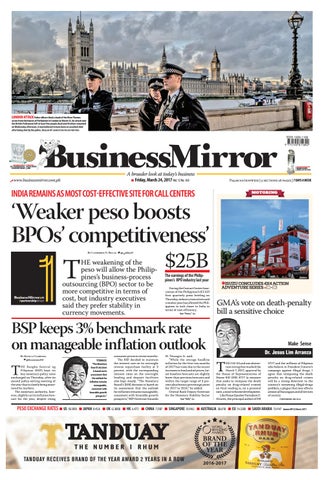
LONDON ATTACK Police officers block a bank of the River Thames
across from the houses of Parliament in London on March 22. An attack near the British Parliament left at least five people dead and 40 others wounded on Wednesday afternoon. A man believed to have been an assailant died after being shot by the police. Story on A7. Andrew Testa/The New York Times
media partner of the year
United nations
2015 environmental Media Award leadership award 2008
BusinessMirror A broader look at today’s business
www.businessmirror.com.ph
n
Friday, March 24, 2017 Vol. 12 No. 163
2016 ejap JOURNALISM awards
business news source of the year
P25.00 nationwide | 5 sections 28 pages | 7 days a week
INDIA REMAINS AS MOST COST-EFFECTIVE SITE FOR CALL CENTERS
motoring
‘Weaker peso boosts BPOs’ competitiveness’
T
By Catherine N. Pillas
@c_pillas29
he weakening of the peso will allow the Philippines’s business-process outsourcing (BPO) sector to be more competitive in terms of cost, but industry executives said they prefer stability in currency movements.
$25B
The earnings of the Philippines’s BPO industry last year During the Contact Center Association of the Philippines’s (CCAP) first quarterly press briefing on Thursday, industry executives said a weaker peso has allowed the Philippines to inch closer to India in terms of cost-efficiency. See “Peso,” A2
BSP keeps 3% benchmark rate on manageable inflation outlook By Bianca Cuaresma
T
@BcuaresmaBM
he Bangko Sentra l ng Pilipinas (BSP) kept its key monetary-policy rates unchanged on Thursday, after its second policy-setting meeting of the year that is closely being monitored by markets. The monetary authority, however, slightly cut its inflation forecast for the year, despite rising
PESO exchange rates n US 50.3010
TETANGCO: “The Monetary Board’s decision is based on its assessment that the outlook for inflation remains manageable, consistent with favorable growth prospects.”
consumer prices in recent months. The BSP decided to maintain the interest rate on its overnight reverse repurchase facility at 3 percent, with the corresponding interest rates on the overnight lending and deposit facilities also kept steady. “The Monetary Board’s [MB] decision is based on its assessment that the outlook for inflation remains manageable, consistent with favorable growth prospects,” BSP Governor Amando
M. Tetangco Jr. said. “While the average headline inflation for the first two months of 2017 has risen due to the recent increases in food and oil prices, latest baseline forecasts are slightly lower than previous forecasts and within the target range of 3 percent plus/minus percentage point for 2017 to 2018,” he added. Central Bank Deputy Governor for the Monetary Stability Sector See “BSP,” A2
Isuzu concludes 4X4 Action Adventure series »E2-E3
GMA’s vote on death-penalty bill a sensitive choice
Make Sense Dr. Jesus Lim Arranza
T
he 216-54 and one abstention voting that marked the March 7, 2017, approval by the House of Representatives of House Bill (HB) 4727 (a measure that seeks to reimpose the death penalty on drug-related crimes) on final reading is, on a personal note, a most welcome development. Like House Speaker Pantaleon D. Alvarez, the principal author of HB
4727 and the millions of Filipinos who believe in President Duterte’s campaign against illegal drugs, I agree that reimposing the death penalty on drug-related crimes will be a strong deterrent to the country’s worsening illegal-drugs problem, a plague that now affects almost all barangays and all sectors of society. Continued on A10
n japan 0.4526 n UK 62.8058 n HK 6.4772 n CHINA 7.3107 n singapore 35.9962 n australia 38.6110 n EU 54.3200 n SAUDI arabia 13.4147
Source: BSP (23 March 2017 )
BMReports BusinessMirror
A2 Friday, March 24, 2017
www.businessmirror.com.ph
Tourism stakeholders urge Montano to resign By Ma. Stella F. Arnaldo
T
legations against Chief Operating Officer Cesar Montano of the Tourism Promotions Board [TPB].” For his part, Cesar R. Cruz, president of the 300-strong Philippine Tour Operators Association Inc. , welcomed Binay’s resolution, and said the Senate Blue Ribbon Committee “is a better venue to air all these complaints against COO Montano, as well as his alleged complaints of financial irregularities against TPB employees. I hope Senator Binay pushes through with the investigation.” Montano, in an interview with an enter tainment columnist, claimed the TPB employees were conniving against him, after he uncovered some anomalies in some transactions of the agency. He failed to mention this, however, in his official statement posted on “SelPhilippines”, a Facebook page reportedly set up by his brother
Rommel, documenting activities of the TPB head. But Cruz insisted, “Even if only half of those allegations in the white paper against Montano were true, he should resign already. He has lost the moral ascendancy to lead the TPB.” He added that more than the alleged financial irregularities, his group was concerned about Montano’s reported “work ethic”, such as leaving meetings abruptly; the alleged inability to understand concepts and ideas raised in presentations; playing the guitar in his room while important documents are awaiting his signature, to name a few. “He really shouldn’t be in that post,” the Philtoa head said. Cruz also took up the cudgels for the TPB, whom he described as having professional and “compliant government employees. We’ve dealt with them and know them well. They’re not the type to make loud complaints against their officials. They’re followers [of policy].” The tourism industry veteran expressed hope the Senate investigation proceeds quickly, so the issue is laid to rest immediately. “This is the 50th year of the Asean, and the Philippines is the chair. We should be attending to this, helping the Philippine destinations get more noticed, instead of being mired in these [issues against Montano]. Three months have already gone by; we are wasting
which spooked investors. The weakening of the peso, however, is a boon for all export-oriented businesses, like BPOs, whose earnings are dollar-denominated. CCAP President Jojo Uligan declined to disclose their windfall from the depreciation of the peso. But he said this has allowed Philippine BPOs to offer better rates. Despite the advantages presented by a weaker peso, Hernandez said call centers, in general, want stability in the movement of the local currency for “predictability.” “For us [a weaker peso has] been a positive thing, but we don’t want it every year behaving differently. For our business planning, an erratic currency is more challenging,” he said. As for US President Donald J. Trump’s protectionist stance, industry executives remain unfazed,
as this has not yet made an impact on their industry. “We have not really seen material impact in the way our clients interact with us. We’re not focused on policy changes, but what’s important for us is to provide valueadded [services] to our clients,” Hernandez said. According to Uligan, the contact center sub-sector of the BPO industry still relies heavily on the US market—70 percent of the demand for outsourced work in that sub-sector is still from North America, and the same can be said for the information technology and the health-care subsectors. The Philippine BPO industry is expected to earn $39 billion by 2020, and employ 1.9 million workers. Last year the sector earned $25 billion, and employed 1.2 million workers.
@akosistellaBM Special to the BusinessMirror
OURISM-Industry stakeholders are calling for the resignation of actor Cesar Montano as COO of the Tourism Promotions Board (TPB), in the wake of allegations of irregularities raised by concerned officers and employees against him.
This developed as the Blue Ribbon Committee chaired by Sen. Richard J. Gordon, is expected to calendar soon the first hearing into said allegations of 24 irregularities and indiscretions committed by Montano. In a text message to the BusinessMirror, Sen. Ma. Lourdes Nancy Binay, chairman of the Upper House’s Committee on Tourism, said, “[Senator Gordon and I] already talked about it. Best effort, we will try to hold a hearing this April. If not possible, it will be in May [when the Senate returns from its recess].” On March 14 Binay filed Senate Resolution 326, “directing the committee on public accountability of public officers and investigations [Blue Ribbon] and other appropriate Senate committees to investigate, in aid of legislation, the truth and accuracy of the al-
Peso. . .
Continued from A1
“The Philippines is more costly than India. A big factor of that is the currency exchange. Five years ago, [India’s] currency weakened to 60 rupees to the dollar level. Then the peso strengthened and hit the 40 to the dollar level,” CCAP Chairman Benedict Hernandez said. “The Philippine peso has hit the 50 level, that’s not big a gap but there’s still a huge difference, so we’re still significantly more e x pensive t han Ind ia,” Hernandez added. Since President Duterte assumed office, the peso has weakened following the decision of the US Fed to hike interest rates and the President’s pronouncements that he will cut ties with the US,
time and opportunity to promote the Philippines,” he stressed. The acts of irregularity versus Montano were contained in a complaint filed on March 1 by TPB management and employees with the Presidential Action Center (PACE), at the Office of the President in Malacañang. These complaints are being investigated by the Cabinet Secretary Leoncio B. Evasco Jr., according to Tourism Secretary Wanda Corazon T. Teo in a recent press briefing. (See, “Teo calls for TPB board meet amid growing dissatisfaction with Montano” in the BusinessMirror, March 21, 2017.) This didn’t sit well with other industry stakeholders, however, who pointed out that Evasco and Montano are friends. The latter also hails from Bohol, where the Malacañang official was a mayor. Former Tourism Secretary Narzalina Z. Lim, in an interview said, “There should be an independent body formed to investigate the allegations against Montano. Evasco is from Bohol and Montano is from Bohol. This might be another case of lutong Macao [whitewashing].” She lauded the move of Binay to have the matter investigated by the Senate Blue Ribbon Committee. “I think, we have better chances in the Senate. Let’s leave the investigation to the Senate, rather than have parallel investigations,” she said. Lim is now president of Asia Pacific Projects Inc., a tourism and
hospitality consulting company. The TPB, a government-owned and -controlled corporation attached to the Department of Tourism, derives its operations budget primarily from contributions from the Philippine Amusement and Gaming Corp., airport and port fees contributed to the national government, Duty-Free Philippines Corp. and a yearly budget allocation under the General Appropriations Act. At any given time, the TPB handles roughly P2 billion in funds, much of it going to marketing and promotion activities. According to Binay’s Senate resolution, employees of the TPB “listed 24 irregularities and indiscretions” allegedly committed by Montano. “It is imperative that we look into the complaints against Mr. Montano. He is leading an agency tasked with domestic and international promotions of the Department of Tourism. As such, he must act with the protection of the image of the TPB and the government in mind at all times,” Binay said in a news statement. “I also urge Tourism Secretary Wanda Teo to look into this matter. We cannot allow our efforts to promote the country as a top tourist destination to be ruined by controversies, especially one involving an official of our tourism agency,” she added. Among the alleged irregularities leveled against Montano, Binay said, were “unprofessional
Impeach. . .
BSP. . .
Quimbo also called on members and allies of the Duterte administration to follow the President’s lead in not supporting the impeachment complaint. “I implore those who support the impeachment complaint against the Vice President and continue to believe in imaginary destabilization plots to focus, instead, on the very real problems of poverty and inequality. They are wasting their energy on no-existent threats. Even the President, supposed subject of said imagined destabilization plots, rejects the impeachment moves against VP Leni. Let’s hope they heed President Duterte’s call,” he said. He also emphasized that an impeachment will have the effect of derailing the government and negatively affecting the economy.
Diwa C. Guinigundo said the BSP revised its inflation outlook to hit 3.4 percent this year, down from a February forecast of 3.5 percent. The inflation forecast for 2018 was also revised from 3.1 percent to 3 percent. The BSP said the balance of risks surrounding the inflation outlook remains tilted toward the upside. Affecting factors include the transitory impact of the proposed taxreform program, as well as possible adjustments in transportation fares and electricity rates. The MB also noted the “beneficial effects” on inflation of the removal of quantitative restrictions on rice importation. Rice accounts for 9 percent of the consumer price basket. Guinigundo said the government’s potential new rules on rice
Continued from A12
Continued from A1
Water firms. . . Continued from A12
by the consumer-price inflation in July the previous year. Aside from this, the basic charge is also modified every quarter, but this time, to reflect foreign currency changes. This is listed in the water bill as foreign currency differential adjustment (FCDA). The WPN believes the CA is “designed to unnecessarily adjust tariffs to ensure the water firms of profits”. It added consumers are slapped twofold at the beginning of each year since they are forced to bear the burden of price increases
PAL. . .
Continued from A12
for 2016 was lower compared to 2015, due to “stiff competition, airport limitations and other market forces.” In 2015 PAL registered a comprehensive net income that was five times bigger than the previous year. Stories from the Heart is a compilation of more than 50 heartwarming tales of employees who displayed five service attributes that are expected of PAL staff when engaging the customers—maalaga (caring and hospitable), magaling
behavior, incompetence and possible corruption. The complainants questioned, in particular, an P11.2-million contract entered into by Montano for an event where he and his nieces were guest performers.” Montano was also criticized for hiring his own team and consultants into the agency, despite the presence of incumbent employees performing the same tasks. The complaint also states that Montano “charged the agency for trips that were not part of his job”. Binay added Montano “was also accused of nepotism, having appointed his relative Priza Cinco, his brother Rommel Montano and a member of his household Peter Domingo”. Under the law, nepotism is punishable by dismissal from government service. “This investigation will enable us to review our laws, and ensure that issues of malfeasance, misfeasance and charges of graft and corruption in the government are immediately addressed,” the senator stressed. “Our country has a huge potential to be known as a top tourist destination, so it’s necessary to immediately resolve this issue that is damaging to our nation’s image. We must discuss it, and find the truth behind this issue at the quickest time possible, so we can focus on more important work: the promotion of the beautiful destinations in the Philippines,” Binay said.
importation will increase government revenue through tariffs, of which new funds will directly be channeled to the agriculture sector. Higher produc t ion i n t he sector, according to Guinigundo, is positive for domestic inflation. The board also said domestic activity is projected to stay firm, supported by buoyant household consumption and private investment, increased government spending and ample credit liquidity.
No RRR cut
Guinigundo said a cut in the country’s reserve requirement ratio (RRR) is “not necessarily useful” at the moment. “In the face of these inflationary pressures building up even from the supply side, it may not be necessarily useful at this point to reduce RRR, and, in the process, infuse more liquidity in the system,” Guinigundo said, adding they need to send a “consistent signal to the market”. in basic commodities and services, as well as water rates due to inflation. The group estimates waterrate hikes by the service firms have amounted to 973 percent for Manila Water and 583 percent for Maynilad since 1997. It also claimed consumers are being double-charged for currency fluctuations through the FCDA and the fixed P1 currency exchange-rate adjustments. The WPN urged the Duterte administration to rescind the CAs with Maynilad and Manila Water. “[The] government should, instead, protect and ensure the public’s right and access to water by reversing water-service privatization,” the group concluded. (efficient and skillful); malambing (warm and friendly); magalang (polite). The book was edited by renowned Palanca awardee Butch Dalisay, which banks on PAL’s brand philosophy “Heart of the Filipino” that was launched last year. During the celebration, the book was presented by Bautista to Tan, who, in turn, thanked the employees for their hard work that enabled the airline to remain profitable since 2014. “I want to personally thank each and every PAL employee. Your hard work has made PAL strong and growing. PAL’s profitability has been sustained,” Tan said.
news@businessmirror.com.ph
The Nation BusinessMirror
Antipiracy group intensifies drive vs unlicensed software By Claudeth Mocon-Ciriaco Correspondent
T
HE Pilipinas Anti-Piracy Team (PAPT) continues to track down more companies using unlicensed computer software in their operations. Agents of the Intellectual Property Office and the National Police’s Criminal Investigation and Detection Group said a lot of companies still do not use licensed software in their business premises. The series of inspections recently conducted jointly by the two agencies showed that many businesses are still not able to provide any proof that the software used in their operations are legitimate. “We highly encourage companies to use licensed software. As the Philippines is turning into an international hub of information-technology services, it is important that companies increase the level of compliance, and respect for intellectual property rights,” IPOPHL Deputy Director General Allan Gepty said. Companies violating the provi-
sions of the Intellectual Property Code, or Republic Act (RA) 8293, and the Optical Media Act, or RA 9239, run the risk of business closure, revocation of travel visas and other criminal charges. Those found guilty of software piracy can face up to nine years of imprisonment, as well as a fine of up to P1.5 million. Computer experts from the PAPT advised that the use of unlicensed software puts any business at risk. In today’s Internet-based and cloudenabled economy, illegal software exposes the company to cybercrime and security issues that could lead to millions of pesos in losses and more millions for technical help to recover from a major breach. In addition, lack of technical support is a typical problem associated with unlicensed software. If the software crashes or becomes problematic, an unlicensed user may not be able to contact the software’s help desk for assistance. Cybersecurity is also an issue. Some unlicensed software cracks may carry trojans or malware, making systems vulnerable to cybercrime.
Editor: Dionisio L. Pelayo • Friday, March 24, 2017 A3
Marines rescue 2 Malaysian seamen from Abu bandits By Priam F. Nepomuceno | Philippines News Agency
M
ARINES attached to the Armed Forces’s Joint Task Force Sulu have rescued two Malaysian seamen from the clutches of the Abu Sayyaf bandits in Pata, Sulu, early Thursday morning. The rescue took place at around 2 a.m. on the waters off Kalinggalang Caluang near Pata Island, in the said province. Capt. Jo-ann Petinglay, spokesman for the Armed Forces’s Western Mindanao Command (Westmincom), identified the rescued Malaysians as Tayudin Anjut, 45, and
Abdurahim Bin Sumas, 62. The two, who were held by the bandits for eight months, were rescued by combined elements of the Marine Ready Force Sulu led by Major Angcap, Marine Special Operations Group and Marine Battalion Landing Teams 1 and 3. Both victims were immediately brought by the troops to the Sulu
military station hospital for medical checkup and interview. “The rescued kidnap victims are weak and in a sickly state when they were rescued by our troops. Military doctors are now attending to them as we speak in our hospital in Sulu,” said Maj. Gen. Carlito G. Galvez Jr., Westmincom chief. Earlier, the Marines received information that ASG sub-leader Alhabsy Misaya, with about 30 fully armed followers and two Malaysian hostages, was hiding at the mangrove area of Barangay Karudong in Kalinggalang Caluang, Sulu. This prompted government troops to focus their efforts at the reported area in order to rescue the victims. “This accomplishment is a product of the combined efforts of our soldiers and the different stakeholders in putting pressure on the kidnappers for the past months,” Galvez said.
“Following the successful operation of the Marine troops in Capual Island on February 7, where eight Abu Sayyaf members under Misaya were killed, our troops on the ground have maximized their intelligence monitoring and have been closely pursuing the group of Misaya to safely rescue the hostages,” he added. “Westmincom troops are continuing pursuit operations against the kidnap-for-ransom groups to rescue the remaining kidnap victims and continue the pressure on the Abu Sayyaf to release their hostages and, possibly, for them to surrender to authorities,” Galvez also said. Anjut and Sumas were among the five Malaysian crewmen of tugboat Serudung 3 who were kidnapped on July 19, 2016, at the waters off Dent Haven, Tambisan, Lahad Datu, Sabah, by the group of Abu Sayyaf sub-leader Sibih Pissih.
Palace, Congress draw up list of priority measures when sessions resume in May
M
ALACAÑANG and Congress officials have firmed up a list of 10 priority bills, including the tax-reform measure, to be fast-tracked for approval when lawmakers resume regular sessions on May 2, after a six-week recess.
Apart from the Comprehensive Tax Reform Program, which provides downward adjustments in personal income- and corporate income-tax rates, the Legislative-Executive priority list includes bills on condonation of land amortization and arrears
on interest payment, revised base pay schedule of military and uniformed personnel, pension reform for uniformed personnel and the security of tenure bill. In addition, Senate and House officials also agreed to speed up
passsage of “common priority bills of Malacañang and Congress: on utilization of the coconut-levy fund, Occupational Safety and Health Hazards Compliance Act, National Mental Health Act, Unified National Identification System
Act and the National Transport Act intended to address the transporttraffic crisis. At least four of the 10 agreed priority bills were reported to be “in the advanced stage of the Legislative process”, which means these are now
ready for plenary consideration when sessions resume on May 2, including the coco-levy fund utilization, the National Transport Act, Occupational Safety and Health Hazards Compliance Act and the National Mental Health Act. Butch Fernandez
Economy
A4 Friday, March 24, 2017 • Editors: Vittorio V. Vitug and Max V. de Leon
BusinessMirror
news@businessmirror.com.ph
Asean SMEs find it hard Cost to build QC light-railway Why to be part of global value chain common station doubles–Neda A
T
By Cai U. Ordinario
@cuo_bm
he long-awaited common station to be built for the three rail transits in Quezon City will now cost more to improve passenger convenience, according to the National Economic and Development Authority (Neda).
Neda officials recently told reporters that the interagency Investment Coordination Committee (ICC) has approved and endorsed for confirmation by the Neda Board the cost increase for the North Extension Project-Common Station, or the Unified Grand Central Station (North Extension Project). The common station for the Light Rail Transit, (LRT) 1, Metro Rail Transit (MRT) 3 and the soonto- be-completed MRT 7 will now cost P2.8 billion, twice the ap-
proved cost of P1.4 billion. “It’s going to be costlier, but in terms of convenience and space, as well as transfer, the logistical transfer for passengers, it will be easier for passengers. It will be more convenient,” Socioeconomic Planning Secretary Ernesto M. Pernia said. The ICC Cabinet Committee (Cabcom) approval of the increase in project cost will also include dual tracks for the LRT 1, MRT 3 and MRT 7, and a total concourse
₧2.8B The new estimated cost for the completion of the common station for the LRT 1, Metro Rail Transit 3 and the soon-to-be-completed MRT 7, twice the approved cost of P1.4 billion
area of 13,700 square meters. Pernia said the groundbreaking for the project will be in the first quarter of 2018. With this, assuming there are no delays, the project may be completed by April 2019. Apart from this, the ICC Cabcom also approved the proposed loan extension and fund reallocation for the new Communications, Navigation and Surveillance/Air Traffic Management Systems Development Project. The proposed project revision
includes a loan extension of two years and six months. It will also reallocate the P570.38-million portion of the project cost of construction and procurement. The amount will also now cover consulting services, administration costs, value-added tax, and duties and taxes from the local counterpart contingency. On the policy side, the ICC Cabcom also approved the increase in the new project cost threshold for ICC review and approval to P2.5 billion from P1 billion. Major capital projects costing at least P2.5 billion shall require ICC approval, except as otherwise provided by law. However, projects costing below P2.5 billion will still need certification that the project is consistent with the Philippine Development Plan/Results Matrices/Public Investment Program, and the implementing agency’s mandate, as well as the performance indicators approved by the Department of Budget and Management, among other requirements.
sean business still struggle with lack of access and red tape that prevent them from becoming part of the global value chain, according to the National Economic and Development Authority (Neda). In a news statement issued on Thursday, the Neda said this is especially true for small and medium enterprises (SMEs) in the region who lack access to financing, technology and information. SMEs also struggle with the absence of a dedicated government agency for business registration, faulty licensing systems and overlapping functions between various government agencies. “There is a demand for a concerted regional level of coordination and cooperation for administrative simplification to enable the GRP [Good Regulatory Practice] agenda. Thus, we must find a way to connect this to our common regional work plan,” Socioeconomic Planning Secretary Ernesto M. Pernia said. These were discussed during the third Asean-Organisation for Economic Co-operation and Development Good Regulatory Practice Network meeting, hosted by the Neda and cochaired by the governments of Malaysia and New Zealand. The meeting gathered around 80 delegates from different Asean memberstates to discuss how to foster connectivity within the Asean region by improving regulatory practices.
Pernia said among the strategies developed in the meeting to address these challenges is for countries to actively engage the private sector, local governments and businesses in streamlining processes and enhancing good regulatory practices. “Good regulatory practice is central in the Asean, [and it] is crucial in fostering connectivity within the region. We firmly believe that there are potential opportunities for Asean SMEs to be part of and benefit from the global value chains if regulatory constraints are correctly addressed,” Pernia said. Apart from these, the meeting also provided a venue for different Asean governments to share regulatory challenges, as well as regulatory best practices. Guillermo Luz, who is private-sector cochairman of the Philippine National Competitiveness Council (NCC), shared the country’s efforts in easing regulatory burden for investors and to promote competitiveness among businesses. One initiative of the NCC is Project REPEAL, a project that allows government agencies, business organizations and individuals to identify regulations and laws that they find burdensome and unnecessary. These are reviewed by a technical working group, and are submitted back to agencies for proper action. Cai U. Ordinario
DENR names ‘water champions’
T
he Department of Environment and Natural Resources (DENR) cited 14 individuals and institutions as “water champions” during simple rites at the Quezon City Sports Club in celebration of the Philippine Water Week and the World Water Day (WWD). Recognized for having gone above and beyond the call of duty to save the country’s water as the most precious natural resource, this year’s water champions are as follows: K ampeon ng Lawa: Gil Abaquin (Ecoindex), Global Underwater Explorers and TWG Knife Fish Infestation; Huwarang Lingkod Tubig: San Jose del Monte Water District and Baliuag Water District in Bulacan province, and Dumaguete Water District in Negros Oriental province; Kampeon ng Katubigan: Manila Water’s Toka-Toka Advocacy Campaign; Water-wise City Award: Makati City government; Water Leadership Award: Engr. Arthur Batomalaque, environmental management specialist, City Environment Management Office of San Carlos City, Negros Occidental; and Engr. Thelma Bautista, city environment and natural resources officer of San Jose del Monte, Bulacan; Huwarang Alagad ng Ilog Pasig: Metropolitan Manila Development Authority’s Flood Control
and Sewerage Management Office; Water Warrior Award: Albert Toldanes, president of Samahang Tubig Maynilad-Riverview; Engr. Reydennis Gilbas, president of Bicol Water District Association; and Mayor Edwin L. Olivarez and the Parañaque city government for their Urban Gardening Campaign. Department of Environment and Natural Resources (DENR) Undersecretary for Staff Bureaus Demetrio Ignacio Jr., together with National Water Resources Board (NWRB) Executive Director Sevillo David Jr. and Maynilad CEO and President Ramoncito S. Fernandez, handed the awards to the honorees. The WWD Awards was cosponsored by the Laguna Lake Development Authority, Local Water Utilities Administration, DENR-National Capital Region, Environmental Management Bureau and the Pasig River Rehabilitation Commission. Ignacio spoke on behalf of Environment Secretary Regina Paz L. Lopez, who is on official leave, during the event where he underscored the dual effect of untreated wastewater. He said untreated, wastewater pollutes the environment and causes health problems. On the other hand, if properly treated and reused, it can boost the country’s water-conservation effort. “Treated wastewater helps clean our environment, and reusing them
conserves our water supply. They also offer economic advantages,” Ignacio said. Citing a recent study of the United Nations Environment Program on the economic valuation of wastewater, Ignacio said approximately 330 cubic kilometers of municipal wastewater is generated globally. “This can irrigate and fertilize millions of hectares of agricultural land that can substantially increase food supply and generate bioenergy for millions of households,” he said. According to Ignacio, the dichotomy of wastewater fits well into the primary objective of the DENR under the new administration, which is to provide social justice to the people. “Social justice means that in everything that we do, the communities should always benefit; and anything that we do should not result to the sufferings of our people.” “We should always strive to recycle our wastewater to benefit our communities, and zwe should not allow untreated wastewater that will harm our people,” he added. For his part, National Water Resources Board Executive Director David said that the water champions were an inspiration that "we can do so much more for the environment especially for our water resources". Jonathan L. Mayuga
Power pump Sen. Cynthia A. Villar tests the hand-powered Villagepump 500 that yields up to 500 liters of fully purified, cool drinking water that meets World Health Organization standards per hour, or over 4 cubic meters per day during the Water Philippines 2017 Expo Conference on Wednesday at the SMX Convention Center, Mall of Asia in Pasay City. Easy to maintain and user-friendly, the pump was conceived and developed to introduce innovative, patented water purification and sanitation products, and continually generate new ideas and produce smart solutions for those who need access to affordable clean water. PNA/Avito C. Dalan
Govts urged to give RE a major push for greater number of consumers
G
overnments should craft and implement policies that will give renewable energy (RE) the much-needed push to make it available to the great majority of people. The statement was made by Ganesh Pangare, regional director for Asia Pacific of the International Water Association (IWA), on the sidelines of the ongoing Water Philippines Expo 2017. The biennial event for the first time features RE as part of the exhibition, apart from 120 different products and services in water supply, sanitation, wastewater treatment and water purification. Pangare pointed out that RE is mostly used by the private sector or individual entrepreneurs. ”I think, there also has to be a policy angle in the terms that governments can’t just keep a blind eye that this is happening. I think, we do need more investment coming
from the state. Some of the poorest of the poor don’t have energy…while the rich are getting subsidized fossil energy. That is the disparity that I am trying to highlight,” Pangare said in an interview with the Philippines News Agency. He noted a large portion of Asia does not enjoy a stable 24/7 supply of power they can use on demand. By using solar technology and distribution generation, people living in rural or isolated areas will be able to enjoy a continuous supply of electricity, he added. “Renewable energy provides a fixed, assured energy source and, therefore, farmers can irrigate when the crop needs irrigation, and then the resource ground water is saved because they will be taking out only what they need and not pumping out and storing it and then just wasting it,” Pangare said. Today, with the advances in
Wind power is harnessed to generate electricity in this windmill farm in Pililia, Rizal. Ganesh Pangare, regional director for Asia Pacific of the International Water Association, urged governments to give renewable energy a big push for the benefit of the global population. Nonie Reyes
technology, solar products have become more affordable that even farmers with a small piece of land
could buy his own solar-power generator to water his farm, he said. The same solar energy has ena-
bled people living in remote areas to use cell phones, Pangare added. “In villages in India, people had no telephone connections and now, everybody has mobile phones, and with renewable energy or solar, people can charge their mobile phones,” he said. On conserving water resources, Pangare emphasized the need to find a solution to the wastage of nonrevenue water. “[Nonrevenue water] is basically water lost by the utility somewhere in the course of distribution and, therefore, does not get charged to the customer. This loss can go as high as 60 percent, sometimes. Therefore, not only did we lose 60 percent of the water, but we also lost 60 percent of the energy needed to transport that water,” he pointed out. Pangare related that two years ago, India established a Ministry of Renewable Energy and has since made RE a viable alternative source,
especially for rural areas. “For a country with a population of 1.2 billion, trying to get targets of 20 percent to 25 percent based on renewable [sources], it has to be done on a mission mode. Everybody has to come together—government, the private sector, entrepreneurs—all of them have to come together, but at least, the thrust has come from the government. It’s a very positive thing,” he said. Water Philippines Expo, held every two years since 2011, features the latest products in water supply and sanitation, sewerage, industrial-wastewater practices, trends and technologies. This year’s exhibition not only showcases products, technology and services in the water and RE industry. Visitors may also attend seminars and lectures on technical subjects, such as climate change, water-supply efficiency, and water quality and sanitation initiatives. PNA
The Regions BusinessMirror
news@businessmirror.com.ph
Turkish travel agents visit Clark, Subic By Ashley Manabat Correspondent
C
LARK FREEPORT—A group of Turkish travel agents visited the Metro Clark area here, as well as the Subic Bay Freeport Zone, on Monday for a familiarization tour hosted by Philippine travel operators and sponsored by Qatar Airways. The Philippine tour operators, led by Joebert Opulencia, president of Orientours Co. Ltd.; Margaret N. Ongshu, president of Travel Experts Inc.; and Gilda Padua, president of Ties That Travel, hosted the Turkish delegates who came via the Clark International Airport (CIA) on Monday. Burcu Inal, sales executive of Qatar Airways, said the airline company sponsored the familiarization tour in order to look for an alternative Asian destination for the Turkish travel agents. “We are happy to organize this rip because Qatar Airways started to fly to Clark,” Inal said. “Clark is also a very interesting place for MICE [meetings, incentives, conferences and exhibitions] since they are also targeting MICE agents to go here,” she said. Inal said they invited nine travel agents who are both very professional and have good business in MICE. “They know about Turkish companies that have incentive groups during the year,” she said, adding, in Turkey, most companies have two or three trip incentives per year, and most of them prefer Asian destinations, like Bangkok, Phuket and Pataya. But now, Inal said, “we would like to present Manila and Clark as an alternative.” “That is the purpose of our trip. So, for four days, we will stay in the Philippines—two days in Clark and two days in Manila,” she said. “It is easy to access the country via the Clark International Airport.”
We are happy to organize this trip because Qatar Airways started to fly to Clark. Clark is also a very interesting place for MICE [meetings, incentives, conferences and exhibitions], since they are also targeting MICE agents to go here.”—Inal Mert Bulat, directing partner for ICF Tour based in Istanbul, said, “The Philippines is still an undiscovered nation for Turkish market. It is just a question of time. I share the opinion the Philippines will be a good alternative for the Thailand program, which we use in Turkey for incentive groups,” he said. However, Bulat said the Philippines is a bit more expensive than Thailand, “but if you can promote the Philippines, eventually, the little extra cost will no longer matter”. “It’s good to know you have direct flights with Qatar Airlines to many destinations,” he said. “We are also looking into resorts and places that can attract incentive groups, as well as honeymooners.”
Editor: Efleda P. Campos • Friday, March 24, 2017 A5
New NGP-MILF panels extend stay of monitoring team, Malaysian facilitator By Manuel T. Cayon | Mindanao Bureau Chief
D
AVAO CITY—The implementing panels of the government and the Moro Islamic Liberation Front (MILF) have extended the stay of the Malaysian-led International Monitoring Team (IMT), even as they welcomed a new facilitator in the implementation of the peace agreement in Moro-populated areas in Mindanao.
The extended stay was contained in a certification from both parties, which also granted the same extended mandate to the Adhoc Joint Action Group (Ahjag). The two parties met anew in Kuala
Lumpur on March 21, a year after a lull in their meetings. Both units have mandates on ensuring the compliance of the ceasefire agreement in 2002, although the Ahjag was specifically
mandated to ensure properly coordinated police and military action against crime groups within the areas covered by the peace agreement. The certification extended the stay of the IMT by another year, up to March 2018. The IMT unit here, the IMT Batch 11, has ended its one-year stint and is expected to be replaced by another batch after this month. The current batch was headed by Malaysian Maj. Gen. Datuk Wira Zamrose bin Mohd Zain. The implementing parties said they “recognized the important roles these mechanisms play in the peace process. Last November Maj. Gen. Zamrose told the BusinessMirror of increased activities of terror groups as he warned the government, including local governments in former conflict areas, to watch out for recruitment activities inside unregistered Arabic-language schools.
He warned of a long lull in the transition of the peace process, from the Aquino administration to the Duterte administration, saying the terrorist recruiters “may find reason to fuel distrust in the government and persuade the discontented into joining their ranks”. He assured, however, of a prevailing general compliance to the ceasefire agreement, reporting only three incidents of violence last year. While the three incidents erupted due to local fights called “rido” and gunbattle with the breakaway units of the MILF, the IMT and other peace advocate groups prevented them from escalating into cease-fire violations. The Kuala Lumpur meeting also signed a new term of reference in implementing the provisions of the Comprehensive Agreement on the Bangsamoro, which was largely made immobile by Congress’s thumbing down of the Bangsam-
oro basic law (BBL). The BBL was supposed to govern and officially clothe legal authority to the new autonomous body that would be replacing the Autonomous Region in Muslim Mindanao. The implementing bodies were so-called because they replaced the negotiating panels which became defunct immediately following the signing of the peace agreement in 2015. Their meeting in Kuala Lumpur also welcomed Dato Kamarudin bin Mustafa, who they said “officially assumed the role of Malaysian third-party facilitator and/or special adviser”. He replaced YM Tengku Dato Ab Ghafar bin Tengku Mohamed. The joint statement of the implementing parties was signed by Irene M. Santiago, the chairman on government side; and Mohagher Iqbal, her counterpart in the MILF. Dato Kamarudin also signed the statement.
Cebu bypass-project feasibility study needs ₧54 million By Charles R. Pepito Correspondent
T
he Department of Public Works and Highways (DPWH)7 has requested its central office to allocate P54 million for the feasibility study of the Mandaue-Consolacion-Liloan Bypass Project. This was reported by the Central Visayas Regional Development Council (RDC) during its full council meeting held recently in Cebu City. DPW H-7 has for warded the RDC-7 resolution to Public Works Secretary Mark A. Villar, including the terms of reference for the consultancy services for preliminary and detailed engineering, economic evaluation and feasibility study of the project and the approved budget for the contract. The Cebu North Coastal Road Project (CNCRP), also known as the Mandaue-Consolacion-Liloan Road Project, was identified in
the 1994 Cebu Integrated Area Development Master Plan Study sponsored by the Japan International Cooperation Agency as one of the basic infrastructure facilities needed in Metro Cebu. In 2005 the National Economic and Development Authority’s (Neda) Board Investment Coordination Committee (ICC) approved the proposed CNCRP for inclusion in the DPWH Arterial Roads Phase 6 and possible funding under the Japan Bank for International Cooperation’s 27th Yen Loan Package, but the funding did not materialize and Alignment C1 of the of the CNCRP was not implemented. On November 14, 2016, the Neda Board approved the New Cebu International Container Port (NCICP) Project to be located in a reclaimed island in Barangay Tayud, Consolacion, Cebu. On September 23, 2016, the RDC7 passed a resolution endorsing the
Educators exhort AFP to stay away from IP schools By Elijah Felice E. Rosales @alyasjah
A
NET WORK of teachers, academics and researchers has warned the military to keep their operations away from indigenous peoples’ (IP) alternative schools, roughly two weeks before the government and the National Democratic Front (NDF) head back to the peace table. In the aftermath of the fourth Mindanao-wide conference of the Save Our Schools (SOS) Network, transformative education group Educators Forum for Development (EfD) demanded on Thursday that the Duterte administration pull out its troops in the countryside. It said the Armed Forces of the Philippines (AFP) continues to conduct operations in IP communities, resulting to numerous cases of human-rights violations, including the right to education. At present, the SOS Network has recorded a total of 15 cases of military encampment in five lumad schools following President Duterte’s declaration in February to cancel the formal peace talks between the government and the NDF. Since then, the AFP has intensified its attacks in rural areas, particularly in IP communities in Compostela Valley, Sarangani and Abra, the EfD said.
T he operations, the g roup said, involved aerial bombings, shelling and strafing. It was also during this period that Ramon and Leonela Pesadilla, a couple who has donated land for the construction of a lumad school, were murdered inside their home in Compostela Valley. The EfD believes the operations put schools and its supporters in the line of fire and sabotages the gains built by the lumad in establishing educational facilities, which the government has allegedly failed to provide. The group said the continuous attacks on IP communities reduces Duterte’s pro-Lumad pronouncements when he was Davao City mayor to mere rhetoric. A report by the SOS Network claimed there have been 168 incidents of military attacks in 47 lumad schools under the Aquino regime’s “Oplan Bayanihan” and the Duterte administration’s “Oplan Kapayapaan”. The report said more than 1,000 families and 5,000 students have been victims of forced evacuation, threat, harassment, intimidation, red-tagging and surveillance. “The administration should end these attacks and execute its duty to uphold the lumad and every other Filipinos’ right to education,” the EfD said. The group vowed to strengthen and widen its advocacy to help and advance IP alternative schools.
proposed access roads for the proposed NCICP in Tayud, Consolacion, namely, Alignment C1 of the CNCRP and the Bagacay North Connector Road, and requesting the DPWH
to update the feasibility study for Alignment C1 of the CNCRP. The R DC-7 Infrastructure Development Comm it tee, du r i ng its Aug ust 31, 2016, meeting ,
organized a technica l work ing group to prepare the terms of reference to update the feasibility study for the access roads of the proposed NCICP.
A6
The World BusinessMirror
Friday, March 24, 2017
www.businessmirror.com.ph
Arabs protest UN withdrawal of report on Israel ‘apartheid’
U
N I T ED NAT IONS —A n Arab delegation met with the UN secretary-general on Wednesday to protest what Palestinian Ambassador Riyad Mansour called the “bullying tactics and intimidation” that led to UN withdrawal of a report that accused Israel of establishing an “apartheid regime”. Mansour said the meeting with UN chief Antonio Guterres “was not a pleasant experience for all of us”, following the secretarygeneral’s order to remove the report from the UN web site and the resignation of senior UN official Rima Khalaf after she refused to withdraw it. The report was swiftly condemned by US and Israeli officials, who reportedly called on the UN to reject it. Guterres’s spokesman Stephane Dujarric said it had been published without any prior consultations and did not reflect his views. Mansour said he and the ambassadors of Oman and Iraq delivered a message to Guterres during what he also called a “very frank but warm discussion about a painful subject to all of us”. “We care about the UN and the secretary-general, and we do not accept methods that are not in the culture of the United Nations,” Mansour said. “You know by that what I mean—some people who are trying to inject bullying tactics and intimidation.” He stressed that “it is our collective responsibility to do everything we can to defend the UN and what it stands for.” Mansour wouldn’t say who was doing the “bullying”, telling reporters: “You know who I mean.” Khalaf, a UN undersecretarygeneral who headed the Beirutbased UN Economic and Social
Iraqi civilians flee through a destroyed train station during fighting between Iraqi security forces and Islamic State (IS) militants on the western side of Mosul, Iraq, on March 19. More than 750 civilians have been killed or wounded in the first month of fighting in the Iraqi offensive to retake western Mosul from the IS. AP/Felipe Dana
Commission for Western Asia, resigned last Friday after refusing Guterres’s request to take the report off its web site. Its authors concluded that “Israel has established an apartheid regime that systematically institutionalizes racial oppression and domination of the Palestinian people as a whole.” The resignation of Khalaf, a Jordanian, and the removal of the report were welcomed by Israel and the United States, Israel’s closest ally. US Ambassador Nikki Haley sa id i n a st atement: “ W hen someone issues a false and defamator y report in the name of the UN, it is appropriate that the person resign. UN agencies must do a better job of eliminating false and biased work, and I applaud the secretary-general ’s decision to distance his good office from it.” But Pa lest inians pra ised t h e r e p o r t ’s f i n d i n g s a n d e x pre s s e d re g re t t h at it w a s t a k e n of f t he w e b s it e. Pa les tinian President Mahmoud Abbas infor med K ha l a f by phone t hat she wou ld receive t he Pa lest ine Med a l of t he Highest Honor in recog nit ion of her “cou rage a nd suppor t ” for t he Palestinian people, the official Pa lest ini a n news agenc y Wa fa sa id l ast Su nd ay. Mansour said even though the report had been taken off the UN web site, “I think it is in the hands of maybe hundreds of thousands of people anyway because of publicity about its withdrawal.” “Many people who were not even interested in the report are now interested and asking for copies, and it is provided to them,” he said. AP
US tells allies: Do more amid new offensive vs IS Japan PM accused of giving
W
ASHINGTON—Declaring the Islamic State (IS) group’s destruction its top Middle East priority, the Trump administration on Wednesday urged coalition partners to contribute more to forces who are retaking Iraq’s second-largest city and readying an assault on the extremists’ self-declared Syrian capital. There was no apparent announcement of a new overall strategy, however.
Addressing top diplomats of the 68-nation coalition, Secretary of State Rex Tillerson called for new ideas to expand the fight against IS in the Iraqi city of Mosul and accelerate the campaign to chase militants from Raqqa, Syria, while preparing for the complex humanitarian and political consequences of both efforts. Yet, Tillerson did not propose, at least in his public remarks, a new approach, beyond noting the increased US military role in each country. As the officials were meeting at the State Department in Washington, the Pentagon announced that it provided an airlift for Syrian fighters taking part in an offensive west of Raqqa, in an escalation of US involvement. At least one country participating in the meeting, France, voiced frustration that Tillerson and other US officials had not offered specifics. “I recognize there are many pressing challenges in the Middle East, but defeating ISIS [Islamic State in Iraq and Syria] is the United States’s No. 1 goal in the region,” Tillerson said. “As we’ve said before, when everything is a priority, nothing is a priority. We must continue to keep our focus on the most urgent matter at hand.”
68 The number of nations in the Middle East coalition whose diplomats met with US Secretary of State Rex Tillerson
Iraqi Prime Minister Haider al-Ababi said victory was finally within reach. “We are at the stage of completely decimating Daesh,” alAbadi said, using the A rabic acronym for IS. Nothing Tillerson outlined departed significantly from the Obama administration’s strateg y, which focused on using local forces to retake territory along with efforts to disrupt IS recruitment and financing, and the blueprint of the multilateral effort seemed unchanged.
French Foreign Minister JeanMarc Ayrault said he was disappointed the US hasn’t outlined a more detailed plan, particularly for Raqqa’s future. He said he understood Trump’s administration was still formulating policy, explaining that he will be more concerned if decisions aren’t made before the end of April. “We are expecting some further clarity from the US,” he told reporters, citing France’s desire for the city to be run by moderate opponents of Syrian President Bashar al-Assad and not the country’s Russian-backed government. He also wants to hear what America seeks from UN-led talks on a broader political settlement to the six-year civil war between A ssad ’s militar y and var ious rebel groups. Tactics for fighting the IS are complicated in Syria, where a partnership with Kurdish militants has prompted difficu lt discussions with Turkey, which sees them as a national security threat. The Pentagon made clear that in Wednesday’s offensive near Raqqa, US forces were still in a support role. Tillerson said the US would play its part and pay its fair share of the overall operation. But he said other nations, particularly those which have faced IS or ISinspired attacks, must contribute more militarily or financially. He said increased intelligence and information-sharing could overcome traditional rivalries between different agencies and governments, and advocated an enhanced online effort to halt the spread of extremist views, especially as the IS group loses ground in Iraq and Syria. Although Tillerson alluded to the intensified campaign, he said the Trump administration was still refining its strategy. As a candidate, Trump spoke broadly about radical changes to the approach adopted by then-President Barack Obama. As a president, Trump has
moved more cautiously. “A more defined course of action in Syria is still coming together,” Tillerson said. “But I can say that the United States will increase our pressure on ISIS and al-Qaeda and will work to establish interim zones of stability, through cease-fires, to allow refugees to return home.” The reference to “zones of stability” appeared to stop short of “safe zones,” which the US military has been extremely reluctant to commit to enforcing in Syria, even as Trump and others have raised the idea at various times. In an interview with The Associated Press, Hungary’s foreign minister said he liked what he heard. “We are enthusiastic about the new US strategy”, Peter Szijjarto said, adding that he saw Trump’s administration determined “not only to fight against ISIS, but totally eliminate ISIS”. He said his country would send 50 more soldiers to Iraq, taking its contribution to 200. As the militants become more encircled, the mission will change. Officials expect in the coming months to see the dissipation of surviving fighters into underground cells that could plan and mount attacks throughout the Middle East, South and Central Asia, Europe, South America and the US. Washington has been trying to get North Atlantic Treaty Organization, coalition and other partners to take actions to adapt to changing threats. “As we stabilize areas encompassing ISIS’s physical caliphate in Iraq and Syria, we also must prevent their seeds of hatred from tak ing root elsewhere,” Tillerson said. “We must ensure ISIS cannot gain or maintain footholds in new regions of the world. We must fight ISIS online as aggressively as we would on the ground. A digital caliphate must not flourish in the place of a physical one.” AP
cash for nationalistic school
T
O K YO —Th e h e a d o f a n u l t r a nationalistic Japanese school operator at the center of a land and political scandal testified in parliament on Thursday that Prime Minister Shinzo Abe donated ¥1 million ($9,000) through his wife for an elementary school where she once was an honorary principal. Ya s u n o r i K a g o i ke , h e a d o f t h e Moritomo Gakuen group, said First Lady Akie Abe handed him the cash in an envelope on behalf of her husband during her September 2015 visit to Kagoike’s kindergarten in Osaka. The outspoken Kagoike, who is affiliated with Japan’s powerful political lobby Nippon Kaigi and known as a big fan and supporter of Abe, said in sworn testimony at parliament that he believed there was “political influence” over his land purchase and a plan to open an elementary school. Kagoike’s school is known for a curriculum that resembles that of preWorld War II militaristic Japan. “I believe there is political influence one way or the other at every occasion and place
[during approval process],” Kagoike said, without elaborating. Abe has denied the donation or any influence in the scandal stemming from a 2016 state property sale to Kagoike at one-seventh of its appraised price. Such a donation is not illegal because Abe’s own electoral constituency is in Yamaguchi, southern Japan, not in Osaka. Abe, who had spoken fondly about Kagoike’s education policies, has distanced himself from the man, criticizing him for being too persistent. Akie also resigned from her honorary post. Still, Abe and his wife’s relationship with the man known for his extreme views on history and derogatory expressions about Chinese and Koreans have raised questions, and Abe’s support ratings have declined over the scandal that has dominated Japanese media over the past month. Kagoike said he is now revealing the truth about Abe, who he thought was on his side and supportive of his school project, before apparently turning his back on him abruptly once the scandal emerged. AP
Australia rejects 500 Syrian refugees on security grounds
C
ANBERR A, Australia—Australia rejected 500 Syrian refugees on security grounds during more than a year of vetting while accepting 12,000 eligible for resettlement from Middle Eastern camps, an official said on Thursday. Immigration and Border Protection Minister Peter Dutton said the deadly rampage near Britain’s Parliament on Wednesday, in which a man used a knife and car as weapons to kill four people, showed Australia was right to be cautious on who it accepted. “The tragic events in London and elsewhere demonstrate the government’s approach was prudent and there are people that we’d excluded on national security grounds and people that we do have concerns about that we have not brought
to our country and we never will,” Dutton told reporters. The government announced in September 2015 that 12,000 refugees from the war in Syria and Iraq would be resettled as quickly as possible. All 12,000 have now been issued visas and more than 10,000 have already been brought to Australia, the government said on Wednesday. Dutton said there would have been “significant consequences in our own country” if the government had followed the opposition’s advice by bringing all the refugees to Australia quickly. Dutton’s office did not immediately respond on Thursday to a request for comment on a newspaper report that as many as 900 of the accepted refugees are members of Syria’s Christian minority. AP
www.businessmirror.com.ph
The World BusinessMirror
Friday, March 24, 2017
A7
Deadly rampage in heart of London
L
ONDON—A knife-wielding assailant driving a sport-utility (SUV) vehicle mowed down panicked pedestrians and stabbed a police officer outside Parliament on Wednesday in a deadly assault, prompting the hasty evacuation of the prime minister and punctuating the threat of terrorism in Europe. At least five people, including the assailant, were killed and at least 40 others wounded in the confusing swirl of violence, which the police said they assumed had been “ inspired by international terrorism”. It appeared to be the most serious such assault in London since the deadly subway bombings more than a decade ago. Throughout a turbulent afternoon, ambulances, emergency vehicles and heavily armed security officers thronged the area outside Parliament, as one of the busiest sections of London was cordoned off and evacuated. Prime Minister Theresa May was rushed into a vehicle and spirited back to her office. She held a meeting of the government’s emergency committee and issued a statement on Wednesday night from her No. 10 Downing Street residence denouncing “the sick and depraved terrorist attack on the streets of our Capital this afternoon”. May also said “the full details of exactly what happened are still emerging”, but she confirmed that the attack had been carried out by a lone male assailant. As of late Wednesday, his identity had not been released, but Scotland Yard officials said they believed they knew who he was. The attack unfolded around 2:40 p.m., Assistant Commissioner Mark Rowley said at a news conference. Driving a large SUV, the assailant slammed into pedestrians on Westminster Bridge near Parliament, killing two people and wounding many others, before crashing into a railing. A third person injured on the bridge later died at a hospital. After the crash, the driver left the vehicle and approached
5 and 40 The number of people killed and wounded, respectively, in the London terror incident Parliament, where he stabbed an armed police officer to death and was fatally shot by the police. The dead officer was identified as Keith Palmer, 48, a member of the Parliamentary and Diplomatic Protection Command with 15 years of experience. “This is the day we have planned for but we hoped would never happen,” Rowley said. “Sadly, it’s now a reality.” The attack came on the anniversary of suicide bombings in Brussels that killed 32 people, along with three bombers. It conf i r med fea rs a mong counterterrorism officials that London, which had largely escaped recent terrorist attacks in Europe, would join cities like Paris, Brussels and Berlin as targets of mass violence. “Terrorism affects us all, and France knows the pain the British people are enduring today,” President François Hollande of France said at a news conference in Villepinte, near Paris. May, who spoke with Hollande and President Donald J. Trump, said in her statement that Parliament would meet as normal on Thursday. She vowed to never permit “the voices of hate and evil to drive us apart”. Cmdr. B.J. Harrington of the Metropolitan Police said at a brief news conference earlier on Wednesday that a “full counterterrorism investigation is under way.” He asked members of the
THE police and ambulances gathered on Westminster Bridge, where a driver mowed down pedestrians, in London on March 22. An attack near the British Parliament left 5 people dead and 40 others injured on Wednesday afternoon. A man believed to have been an assailant died after being shot by the police. Andrew Testa/The New York Times
public to report any suspicious activity and to share any images or video of the violence. Harrington said the acting police commissioner, Craig Mackey, had been at the scene of the attack and was not wounded, but was “being treated as a significant witness”. At least three police officers were among those wounded on the bridge. Also among the wounded were three 10th-grade boys from a group of visiting students from the Brittany region of France, and a woman who fell or plunged into the River Thames. Hollande’s government said it had chartered a plane to London with families of the French victims. Tobias Ellwood, a minister in the Foreign Office, tried to save the life of the fatally stabbed police officer by giving mouthto-mouth resuscitation. The number of wounded apparently included five South Korean tourists who were overwhelmed by a crowd fleeing the scene, South Korea’s Foreign Ministry said on Thursday morning. Three men suffered fractures,
and a woman had surgery for a head injury, the ministry said. For more than two hours, astonished lawmakers inside the House of Commons, some of whom had ducked for cover, were told to stay in place as officers searched the premises, office by office. “At the moment, the very clear advice from the police and the director of security in the house is that we should remain under suspension, and that the chamber should remain in lockdown until we’ve received advice that it is safe to go back to normal procedures,” David Lidington, the leader of the House of Commons, or lower house of Parliament, told lawmakers in remarks broadcast live on the BBC. Olly Grender, a member of the House of Lords, said lawmakers were staying put. “We were in a meeting, I heard shouting through the window,” she said, adding that a colleague then came in to tell them a serious episode had taken place. Jayne Wilkinson, 59, from Birmingham, was near the statue
of Winston Churchill in Parliament Square with her partner, David Turner, 56, when they saw people suddenly running from Parliament. The couple said they had seen a middle-aged man holding a knife. He ignored warnings from the police, running through the gates into the Parliament compound, she said. “They were shouting to warn him,” Wilkinson said. Soon after, she and her partner heard three gunshots and saw the man on the ground. Three construction workers inside the grounds of Westminster Palace said they had heard shots fired in rapid succession before they were escorted off the premises. “It was bang-bangbang,” one said. Reuben Saunders, an American student at Cambridge University who was visiting Parliament, said he had been leaving the building when he saw a police officer accosted by an assailant armed with two knives or similar weapons. “He was at the gate, I heard screaming,” Saunders said. “I saw
the man on the ground being repeatedly stabbed, or pummeled.” Sau nders sa id t wo or t hree ot her pol ice of f icers a r r ived, a nd “t here were t wo or t hree g u nshots”. Corinne Desray, a teacher who was outside Parliament with 39 teenage students on a three-day school trip from northern France, said they had heard three shots. “My colleague saw bodies lying on the floor and someone said a policeman has been knived,” she said. “I told the kids to leave quickly, we’re heading back to the bus.” Kirsten Hurrell, 70, who owns a newsstand opposite Big Ben, said she had seen a car swerve across a bicycle lane and into a fence around Parliament. She saw a body lying on the ground and called emergency services. “At first I thought it was an accident, but then I was told the car had already mowed down quite a number of people on Westminster Bridge,” she said, adding: “Now that it is a terrorist incident, it is a bit more daunting.” New York Times News Service
GOP facing painful choice on health bill
W
A SHINGTON—For the House Republicans who have never served under a Republican president— roughly two-thirds of them—the vote scheduled for Thursday on a measure that would replace President Barack Obama’s signature health-care law with their own party’s version is a legislative fantasia, the culmination of seven years of campaign promises impeded by Obama’s veto pen. But weeks of backroom machinations to bring a disparate group of lawmakers on board have left many Republicans with an excruciating choice: Pass a bill with an extremely limited constituency that could well wreak havoc with their own voters, and with Republicans’ reelection prospects, or vote it down, undermining President Donald J. Trump’s agenda. House Speaker Paul Ryan said on Wednesday that he was confident the House would pass the bill. But as of late Wednesday, roughly 30 Republicans had said they either would vote against the measure or had not made up their minds. That left the bill’s sponsors short of the 216 votes needed, and on Wednesday night
Ryan held a meeting in the Capitol to try to win over skeptics. If House Republicans reject the measure, the working relationship between the White House and Republican leaders in Congress, still in its infancy, will suffer a powerful blow. In Washington failure often begets more failure, as opposition forces strengthen, alliances fragment and the thin foam of bipartisanship evaporates. “How do we have any momentum to do anything else?” asked Rep. Richard Hudson, Republican-North Carolina. “Without this bill, I don’t know how you do tax reform,” he said. If the bill fails, “it’s going to have negative repercussions for all of us.” Trump, a man who rushes to hang his name in gold anywhere he can, has rejected the nickname that some have given the House bill: Trumpcare. But he has begun a last-minute campaign to both sweet talk and vaguely threaten fellow Republicans into supporting the leadership’s hastily written bill, though the measure, which would replace the Affordable Care Act’s health insurance mandate and generous
subsidies with tax credits to buy insurance, has been criticized by the right and the left. Trump met with a group of the most conser vative House members at the White House on Wednesday, and Republican leaders are depending on him to finish the job. Indeed, this week many Republicans have begun to acquiesce to his and the House leadership’s desires, accepting that the bill, however flawed, is the best they are going to get. At least for now, though, too many have not. “ The bill maintains Obamacare’s overa l l str ucture and approach, an approach that cements the federal government’s role in health insurance,” said Rep. Rick Crawford, RepublicanArkansas, an opponent of the bill who represents the concerns of the conservatives. Other more moderate members expressed opposite objections. “Under the current proposal, many South Jersey residents would be left with financial hardship or without the coverage they now receive,” said Rep. Frank A. LoBiondo, Republican-New Jersey. “Our seniors on Medicare
already struggle to make each dollar stretch.” Some Republican leaders and those charged with drumming up votes suspect that some of the more conservative members are simply trying to force Ryan to cancel a vote on the bill so they do not have to go on record against Trump. But moderates may feel the pressure of voters: Large protests against the bill are planned for Thursday. Fu r t her h a mper i ng t hem , House Republicans failed to do the grueling work of building a coalition outside Washington as Democrats did with the Affordable Care Act in 2009. W hile anti-abortion groups have warmly embraced the bill, which could restrict coverage of the procedure, it lacks other advocates. Doctors, nurses and hospitals have come out strongly against the measure, and insurance companies have been largely skeptical. Even if Ryan manages to secure the bare minimum of votes required, the bill that would pass the House would not become law. The Senate expects to make significant changes in the legisla-
Health and Human Services Secretary Tom Price, joined by House Republicans, speaks about the proposed American Health Care Act at a news conference on Capitol Hill, in Washington, on March 17. Republicans could pass a deeply unpopular bill that could wreak havoc with their own voters, or turn it back and wound the president’s agenda. Gabriella Demczuk/The New York Times
tion, dragging out the process deep into the spring, if it can pass any version at all. Senate Republicans, largely those from states that chose to expand their Medicaid programs under the Affordable Care Act, so far have not seemed susceptible to pressure from leaders and Trump, listening instead to governors and constituents concerned about significant reductions in benefits. Part of the bill’s problem is time itself. Much has changed in the years since the Affordable Care Act passed, with millions of Americans, many in red states, now getting health insurance as a result of the law, as well as treat-
ment for the prescription drug addictions that have plagued scores of communities. “My goal for this whole process was to help the people the law harmed and not harm the people it helps,” said Rep. Dan Donovan, Republican-New York. At the same time, a fair number of conservatives would like to see those benefits greatly reduced, the central tension of the Republican debate. As a result, it remains difficult to imagine a bill that could find its way out of the Capitol to Trump’s desk, given the broad disparities in what Republicans now seek. New York Times News Service
A8
Asean BusinessMirror
Friday, March 24, 2017
www.businessmirror.com.ph
In Asia’s infra race, Vietnam is among leaders
I
t may be one of the smallest economies in Asia, but Vietnam is among those leading the infrastructure race.
Vietnam’s public and privatesector inf rastr ucture investment averaged 5.7 percent of GDP in recent years, the highest in Southeast Asia and compares with 6.8 percent in China, according to the Asian Development Bank (A DB). Indonesia and the Philippines spend less than 3 percent, while Malaysia
and Thailand spend even less at under 2 percent. The ADB estimates that emerging economies in t he reg ion will need to invest as much as $26 trillion through 2030 to build transport networks, boost power supply, and upgrade water and sanitation facilities. Vietnam, among the fastest-growing na-
tions in the world, is boosting infrastructure to lure more foreign investors as it positions itself as Asia’s next Tiger Economy. “ The government knows that if t hey want to compete for investment, low wages aren’t enough,” said Eugenia Victorino, an economist at Australia & New Zealand Banking Group in Singapore. “They need infrastructure good enough to entice companies to put up factories. The development has been fairly spread out, with airports and roads being built across the country.” Those efforts are paying off. Foreign direct investment surged to a record $15.8 billion in 2016,
$15.8B Vietnam’s record-high foreign direct investment in 2016
and the economy is forecast by the World Bank to expand more than 6 percent until 2019, among the top performers this decade. Its challenges are formidable. Vietnam needs about $480 billion through 2020 for infrastructure, including 11 power plants
with total capacity of 13,200 megawatts and about 1,380 kilometers of highways, according to the government. Just last week Prime Minister Nguyen Xuan Phuc ordered the transport ministry to speed up plans to attract more private investment for infrastructure, as the state budget can only meet a third of the financial need. The share of private investment in infrastructure spending in Vietnam may be less than 10 percent, said Rana Hasan, ADB director of development economics. In India, the private sector plays a bigger role, accounting for more than 30 percent
of total infrastructure investments in recent years, he said. Others are planning to catch up. President Duterte has embarked on an ambitious goal of infrastr ucture spending at 7 percent of GDP, valued at $160 billion through 2022. While Indonesian President Joko Widodo struggled to get infrastructure off the ground in his early years in office, momentum is now building with the government speeding up projects, including an uninterrupted toll-road connection in the country’s main islands and construction of a 720-km railway from Jakarta to Surabaya. Bloomberg News
Myanmar luxury property reels from confusion over foreign buyers
C
onfusion over a law allowing foreigners to buy condominiums in Myanmar is prolonging a slowdown in its residential property sector, highlighting the challenges of regulatory flux in the frontier market. The legislation adopted in January 2016 leaves unanswered questions, such as whether it applies to existing apartments, hurting efforts to woo investors. The outlook now depends partly on bylaws the government is working on to clarify the legislation, according
to local developer Yoma Strategic Holdings Ltd. “We expect the bylaws early this year,” Yoma Executive Director Cyrus Pun said in an interview. “It’ll be a big change for the sector. There was a very bullish market from 2011 as the economy opened up and investment came in, but residential property has quietened down quite a lot in the past 18 months.” The cooling property sector and a dip in Myanmar’s rapid economic expansion have dented
some of the earlier investor euphoria for the Southeast Asian nation. The 2016 law permits a 40-percent foreign ownership of a development, but lacks details such as the exact process for a project to qualify as a condominium. Resolving such regulatory uncertainty is one of the tasks for State Counselor Aung San Suu Kyi as she tries to open up the economy. Midtier condominium prices dropped about 41 percent from 2014 to 2016, Colliers International Group Inc.
data show, while luxur y unit prices slid 22 percent. The timeline for implementation of the bylaws remains cloudy. While the rules have been drafted, it’s unclear exactly when they will be sent to Cabinet for approval, though officials are working as fast as they can, the Department of Urban and Housing Development said. In time, the rules allowing foreigners to buy property could be thought of as a game changer, but they’ ll have little effect on sales in the short to medium term based on current market conditions, said Joshua de las A las, an analyst in Yangon for Colliers International. “Current condominium selling prices in Yangon are still very much higher than anywhere else in Southeast Asia—making it a risky investment in the short run,” De Las Alas said. Yoma’s Pun said investors can expect residential rental yields of 8 percent to 12 percent, and added there remain untapped opportunities for the longer term. “The interesting thing about the residential market is that the potential, the hidden demand, is a lot bigger than what we have seen so far,” Pun said. “Everybody that has been building is targeting the top end. There’s nothing targeted at the mass market.” Tapping the mass-market op-
portunity depends in part on an expansion of Myanmar’s nascent mortgage industry. Most buyers currently are purchasing upscale apartments in cash.
Chinese buyers?
The clarification of the condominium law should woo buyers from Thailand, Singapore, Hong Kong and China, with the latter likely to be the biggest source of demand, Pun said. “Some C hinese buyers a re already coming in to buy, but through alternative channels,” he said. “ They may have structured deals where they are making an investment rather than buying an actual title. The condominium law would open the market to retail buyers.”
Thai leader uses special powers to order seat-belt use
T
hailand’s military government is cracking down on traffic carnage, invoking special executive powers accorded by an interim constitution to force automobile drivers and all their passengers to wear seat belts. The move by Prime Minister Prayuth Chan-ocha comes ahead of next month’s celebration of the traditional Songkran New Year’s holiday, which sees much of the country’s urban population travel to their rural home villages for revelry, often fueled by alcohol. A total of 442 people died in road accidents during last year’s weeklong holiday, dubbed the “Seven Days of Death”. Thailand is estimated by a United Nations agency to have the second-highest rate of traffic fatalities in the world. Seat belts are already required for drivers and front seat passengers. Prayuth has been criticized for frequent use of the constitution’s Article 44, which is supposed to be used to address situations endangering public order. Use of Article 44 bypasses the interim legislature that was established after the army overthrew an elected government in 2014.
“I understand the intention, that they want to address traffic safety,” said Dr. Gothom Arya, a professor and social activist. “I don’t agree with the use of Article 44. If they want to introduce new laws, they can talk to the National Legislative Assembly, who are always happy to cooperate from what we’ve seen. Is this issue really so urgent and necessary? I don’t see it.” The assembly generally does whatever the ruling junta wants, often with some mild debate but not necessarily quickly. The new seat-belt measure, which took effect on Tuesday, enforces compliance by declaring that car owners who don’t pay fines for failing to have their passengers use seat belts will not be able to register their vehicles for a year. Another decree, also published on Tuesday, tightens up regulations on vehicles used for public transport, such as commuter vans. One new rule allows the authorities to revoke a vehicle’s registration or suspend a professional driver’s license for up to six months if he or she is found guilty of offenses, such as overcharging passengers, carrying too many passengers or drug-related crimes. AP
In the commercial real-estate market, sca led-back ex pectations for economic growth are we ig h i ng on ret u r n s. P r i me Yangon office rents are down a third from their peak two years ago, Pun said. There’s still scope to add office blocks in Yangon gradually, and they can yield 8 percent to 10 percent, he said. That compares with about 4 percent in Singapore and yields ranging from 6 percent to 8 percent in Vietnam, Indonesia and the Philippines, according to estimates from Cushman & Wakefield Inc. Yoma Strategic Holdings, listed in Singapore, has climbed about 10 percent in the past year. The FTSE Strait Times All Share Index is up 8 percent in the same period. Bloomberg News
brief
Indonesia wants control of Free port’s Grasberg
The dispute engulfing the world’s second-biggest copper mine deepened, as Indonesia’s government said it planned to take a majority stake in the local unit of owner Freeport-McMoRan Inc. within two years while workers at the pit threatened to go on strike. The state enterprises ministry has cleared a government-run company to buy a majority stake in PT Freeport Indonesia, the local unit that runs the massive Grasberg mine in Papua province, according to Fajar Harry Sampurno, the deputy minister for mining, media and strategic industries. Freeport-McMoran would have to divest its share to a state-owned entity under a new contract that the Phoenixbased miner is yet to sign. “We’re ready,” Sampurno said at a news conference in Jakarta on Wednesday. A local aluminum producer, PT Indonesia Asahan Aluminium, will be turned into a holding company to purchase the stake, he said. “Once the holding company is formed, they will immediately work on it.” The preparations for state ownership suggest Jakarta is refusing to budge in a dispute that’s curtailed mining at Grasberg and prompted Freeport to lay off thousands of workers. Under new rules announced in January, the government said companies that want to export semi-processed metals, including copper concentrate, must convert their contract of work to a special mining license, build smelters and add local investors. Freeport has refused to do so until it gets guarantees protecting its investment. Bloomberg News
Agriculture/Commodities BusinessMirror
news@businessmirror.com.ph
Editor: Jennifer A. Ng • Friday, March 24, 2017
A9
‘Rice-import delay threatens food security’
T
By Jasper Emmanuel Y. Arcalas
@jearcalas
he National Food Authority (NFA) said on Thursday the government must import rice soon to replenish the food agency’s thinning stockpiles, and ensure there will be enough food during the lean months. NFA Administrator Jason Laureano Y. Aquino said the NFA Council (NFAC) has not yet decided on the food agency’s request to import 250,000 metric tons (MT) of rice to beef up its buffer stock. “Delaying further the approval for the government-to-government importation of the 250,000 MT balance could make it more difficult for the NFA to maintain the minimum levels of food-security rice requirements during normal times, more so during the lean months,” Aquino said in a statement. He said the NFA has sought the NFAC’s approval for the purchase of rice imports under a government-togovernment deal as early as January. The NFA had planned to bring in the imports by April to preposition the stocks in calamity-prone areas. “The NFA Council had not acted
on the request up to this time,” he said. In 2015 the NFAC approved the 500,000-MT standby authority for buffer stocking to fill the gap in local paddy-rice output caused by El Niño. The NFAC is the highest governing body of the NFA. Earlier, Cabinet Secretary Leoncio B. Evasco Jr., exofficio chairman of the NFAC, said the council thumbed down Aquino’s proposal to import 1 million metric tons of rice to prevent the agency from incurring more debts. The NFA is required to maintain a 15-day buffer stock, equivalent to around 400,000 MT, at any given time. During the lean months of July, August and September, when farmers do not usually harvest rice, the NFA is required to have a 30-day buffer stock, equivalent to 800,000 MT. These volumes are based on
the current national daily riceconsumption requirement, pegged at 654,400 50-kilogram bags, or 32,720 MT. The NFA said it has started implementing measures to augment its stockpiles amid the delay in the NFAC’s decision to import 250,000 MT of rice. “As a stop-gap measure, NFA field officials have been instructed to prudently manage inventories and ensure sufficient supplies to satisfy the food-security requirement for each province,” Aquino said. “Milling of the agency’s palay stocks would also be fast-tracked to augment the supply of rice,” he added. The NFA said it temporarily suspended rice sales to farmers’ organizations through the farmers’ cooperative development incentive fee and Farmers’ Incentive Rice Program. Aquino said he ordered the immediate transfer of rice stocks to regions and provinces with critical inventory levels and to undertake emergency procurement of logistics and services, if necessary, to build up buffer stock inventories in their respective regions. He expressed concern that the NFA may not be able to reach its palay procurement target of 4.6 million bags, equivalent to 230,367
BPI urges farmers to be wary of common crop pests in Q2
T
he Bureau of Plant Industry (BPI) on Thursday asked farmers to be on guard against the most common pests that usually attack crops, including rice, during the April-to-June period. In a memorandum order published on Thursday, BPI OIC-Director Vivencio R. Mamaril also ordered the agency’s regional directors to monitor areas where pest infestation could occur in the second quarter. “As per result of analysis from the pest reports that the region submitted to the Crop Pest Management Division [CPMD], you are hereby encouraged to alert your staff and closely monitor the listed areas for possible infestation of these top 5 pests that historically occur every second quarter of the year,” the memo read. The BPI, an attached agency of the Department of Agriculture, noted that rodents, rice stemborer, armyworm, rice black bug and brown planthopper usually affect crops during the Aprilto-June period. The 28 areas that are vulnerable to rodent infestation include provinces in Regions 2, 3, 4B and 6. According to the BPI, rodent infestation is triggered by the absence of effective vertebrate
predation and asynchronous planting. To address rodent infestation, the BPI said the following management options could be applied: trap barrier system, rat hunting, field sanitation and using flame thrower. The BPI also said 34 sites are prone to rice-stemborer infestation, including Region 3—the country’s rice granary. It added that the use of excessive nitrogen fertilizer and asynchronous planting cause the infestation of rice stemborer. The BPI advised farmers to thoroughly prepare the soil before planting to kill larvae and pupae, and plant rice varieties that are resistant to the rice stemborer. The agency noted that the combination of high temperature and humidity could cause the infestation of brown planthopper and armyworm. The BPI said 15 sites are prone to armyworm infestation, while 27 sites are susceptible to the brown planthopper. The BPI also identified 17 sites vulnerable to the rice black bug pest, which is usually caused by asynchronous planting. The five pests that are likely to occur in the second quarter were based on historical data submitted by the BPI’s regional offices from 1993 to 2016. Jasper Emmanuel Y. Arcalas
‘GM crops can help PHL meet nutritional requirements’
G
enetically modified (GM) crops can help the Philippines meet its nutritional requirements, according to Monsanto Director for Global Health and Nutrition Outreach Dr. Milton Stokes. In a recent news briefing at Sulô Hotel in Quezon City, Stokes said crops like Golden Rice with betacarotene biosynthesis genes to combat vitamin A deficiency can help prevent 1 million to 2 million deaths and 500,000 cases of irreversible blindness annually. “Genetically modified organisms [GMOs] are as safe and as nutritious as conventional crops. It has been 30 years since GMO crops have been researched and developed with more than 1,000 studies, which all indicate that these crops are just as safe as those developed through traditional breeding,” he said. Monsanto noted that GM crops are now planted in 70 countries, with more than 3.95 billion acres of land used for GM planting since 1996. In the Philippines debate is ongoing on the safety and impact of GM crops. But Stokes said more than 90 government bodies globally review and approve GMOs.
He added there are countries, such as the Philippines, where multiple agencies are involved in GM regulation. “GM crops are also the most studied crops, which explain its record of safety,” Stokes said. “On the average, a GMO crop takes 13 years and $130 million of research and development before it gets into the market.” Stokes is in Manila to engage with dietitians and other professionals on topics pertaining to food, agriculture and nutrition. Before coming to Monsanto, Stokes had a tenure-track professorship in nutrition and directed a dietetic internship at the University of Saint Joseph in Connecticut. He also owned a private nutrition-counseling practice with multiple offices throughout Connecticut and is a former restaurateur. He has a master’s degree in Public Health from Hunter College and his clinical training was conducted at Yale-New Haven Hospital affiliated with Yale University School of Medicine. His doctoral degree, from the University of Connecticut, is in Communication and Marketing, with a specialization in Health Communication.
In this file photo, workers of the National Food Authority pile up sacks of rice in one of the food agency’s warehouses. NONIE REYES
MT, this year as the farm-gate prices of palay are much higher than the government’s support price. “In many areas harvesting the summer crop, palay prices have been monitored to range within P18 to P20/kilogram, higher than the NFA’s support price of P17/kg, even with incentives reaching P0.70 to P1/kg,” Aquino said. The food agency buys palay at
P17/kg clean and dry with an additional P0.20/kg drying incentive and P0.20 to P0.50/kg delivery incentive. For farmers’ organizations, an additional P0.30/kg is given as cooperative-development incentive fee. The NFA’s buying price ranges from P17.70 to P18/kg. The volume of rice imports is recommended by the National Food Security Committee (NFSC). It is
composed of the secretary of the National Economic and Development Authority as chairman and the deputy national statistician of the Philippine Statistics Authority as vice chairman. Based on the NFSC’s assessment of the local harvest and supply situation, the government imports only the shortfall in local harvest for buffer stocking purposes.
A10 Friday, March 24, 2017 • Editor: Angel R. Calso
Opinion BusinessMirror
editorial
With China, hang together or hang separately
So, I hope, kung pwede, not only to Vice President Leni, but also to the media, to please tone down extrajudicial killings [reports], because I’m always asked wherever I go even in Asia and Europe, ‘Totoo ba ito?”’ - Tourism Secretary Wanda Corazon T. Teo
I
N October 2016 President Duterte visited Beijing and played the “China Card”, altering the Philippines’s foreign-relations stance. The Chinese government saw this as an opportunity to bring the Philippines closer through more “cooperation” and “incentives”. The United States saw this as a risk to its losing influence in the region, and wanted also to be seen as “friendlier”. However, both governments are not blind, and soon realized that Filipino public opinion was not in favor of shifting alliances. The US expresses concern about the $5 trillion in annual trade that passes through the region that China claims as its own. But if a herd of Godzillas suddenly closed down this area, which nations would suffer the most? Nearly 80 percent of China’s trade flows through the South China Sea. It would appear that China—not the US—has more to lose from shipping problems in the region. But isn’t oil the issue? The highest estimate of potential—not proven in any sense—by the US Energy Information Agency (EIA) is 11 billion barrels of oil. The low-end estimates, like those from energy consultancy Wood Mackenzie, guess that there are only 2.5 billion barrels. However, this is all speculation, and is a decade or more away from any reality. Interestingly, the EIA estimate says Malaysia likely holds the most oil—5 billion barrels—beneath its waters. It seems that every possible scenario to deal with Chinese occupation of our territory ends with increased American diplomatic and/or military pressure on China. But is that possibility reasonable? Some suggestions are that the Philippine Navy should force China to either back down or to attack, thereby giving us the chance to invoke the US Mutual Defense Treaty. What if the US finds excuses not to comply? Are we going to threaten not to help them the next time Japan bombs Pearl Harbor? Further, any military action under the treaty is immediately taken to the United Nations Security Council, on which China holds a permanent seat. The most important US military installation in Asia is on the island of Okinawa, which many Japanese would like to see gone. Are we willing to offer the US a return to Subic and Clark in return for kicking the Chinese off our territory? The No. 1 Asian problem for the US is North Korea and its nuclear weapons. Since World War 2, China has used North Korea as its tip-of-the-spear against its most hated neighbor—Japan. Now, North Korea is a Chinese “poisoned pawn” against the US. The recent trip to China by US Secretary of State Rex W. Tillerson should have been to follow through on President Donald J. Trump’s hard line on trade, currency and other regional matters. But almost like magic in the weeks leading up to the meeting, North Korea conducted missile tests, leading Tillerson to practically beg for more Chinese cooperation. Maybe the Philippines could send some rouge police officers to “kidnap” Kim Jong-un, like they recently did with another Korean, to get the US to help against China. Sarcasm aside, trying to find mutually beneficial interests with the US to protect Philippine sovereignty is difficult. Nonetheless, the Philippine government needs to protest in the strongest terms against recent Chinese moves in our waters. Expecting the US to do the “right thing” is naïve. Therefore, instead of looking to the US, the key should lie in Asean. The Philippines has not yet been able to rally strong active support as Asean members have been cutting their own separate deals with China. Now is the time to remind them that relations with a bad neighbor like China may be the best example of “we must, indeed, all hang together, or, most assuredly we shall all hang separately”. Since 2005
BusinessMirror A broader look at today’s business
Misogyny James Jimenez
SPOX
T
HE man I consider my mentor told me a long time ago that there were only two student organizations a law student absolutely needed to join: the law school’s law review and the debating club. The law review, he said, would hone the student’s ability to write comprehensibly and intelligently—both indispensable skills for any lawyer worth his salt; the debating club, he explained, would train the aspiring lawyer to speak well, construct arguments and make sense—again, skills that a good lawyer must have. I dutifully passed on this advice to a dear friend who is a freshman at a law school currently enjoying something of an upward bump in its popularity, due mainly to the benefits of association. My friend, an intelligent, athletic and lively young woman took the advice and is now beginning to rue the unfortunate fact that she also happens to be physically attractive. Upon learning of her acceptance to the school’s law review— or whatever they call the student
publication over there—she soon found herself to be the unwilling object of some of the senior male staffers’ decidedly nonacademic attentions. Worse, despite her sterling academic record, some of the senior female staffers began “inconspicuously” challenging her qualifications, broadly insinuating that she had been brought aboard for reasons other than merit. Now, my friend is seriously considering backing out, if only to spare herself the trouble of unwelcome
Founder
Editor in Chief Managing Editor Associate Editor News Editor City & Assignments Editor Senior Editors
Lorenzo M. Lomibao Jr., Gerard S. Ramos Lyn B. Resurreccion, Efleda P. Campos Ruben M. Cruz Jr. Angel R. Calso
Creative Director Chief Photographer
Eduardo A. Davad Nonilon G. Reyes Judge Pedro T. Santiago (Ret.) Benjamin V. Ramos Adebelo D. Gasmin Marvin Nisperos Estigoy Aldwin Maralit Tolosa Dante S. Castro
BusinessMirror is published daily by the Philippine Business Daily Mirror
HOM
Publishing, Inc., with offices on the 3rd floor of Dominga Building III 2113 Chino Roces Avenue corner De La Rosa Street, Makati City, Philippines. Tel. Nos. (Editorial) 817-9467; 813-0725. Fax line: 813-7025. (Advertising Sales) 893-2019; 817-1351, 817-2807. (Circulation) 893-1662; 814-0134 to 36. E-mail: news@businessmirror.com.ph.
www.businessmirror.com.ph
Printed by brown madonna Press, Inc.–San Valley Drive KM-15, South Superhighway, Parañaque, Metro Manila MEMBER OF
MAKE SENSE
Jun B. Vallecera
Online Editor Social Media Editor
Chairman of the Board & Ombudsman President VP-Finance VP Advertising Sales Advertising Sales Manager Group Circulation Manager
Dr. Jesus Lim Arranza
T. Anthony C. Cabangon
Max V. de Leon Jennifer A. Ng Dionisio L. Pelayo Vittorio V. Vitug
they are “allowed” to aspire for; it teaches them that their value can be measured primarily by how toned their thighs are, or by how willing they are to be complicit in their own degradation and objectification. Misogyny, ladies and gentlemen, is alive and well in the 21st century, even among millennials in an august institution supposedly the cradle of national leaders. But recently, I’ve noticed how some have taken to using the catchphrase “this is not who we are”. Wake up! This is exactly who we are. And that’s precisely what the problem is. To deny the existence of misogyny or to even try to explain it away as some innocuous quirk is to enable it. How can you solve a problem that you are not even willing to acknowledge? More to the point, how many more you ng women w i l l we teach to be less than what they can be, simply because we can’t get over the fact that they are made of girl? James Arthur B. Jimenez is director of the Commission on Elections’s Education and Information Department.
GMA’s vote on death-penalty bill a sensitive choice
✝ Ambassador Antonio L. Cabangon Chua Publisher
flirting and undeserved sniping. Oh, but maybe she shouldn’t make such a fuss. I mean, boys will be boys, and surely, there’s no harm in a little bit of locker room—or, in this case, newsroom?—banter. God forbid, my friend doesn’t get how it’s “all in good fun”, lest she be labeled a manang. As for the female students on the staff, they must certainly be forgiven for defending the deep-rooted aesthetic of the meek Maria Clara, who cannot, for the life of her, show the slightest bit of self-sufficiency. It’s Pinoy culture, after all. And if you agree with anything in this paragraph, then you are medieval, and I can do nothing for you, except to tell you to seek professional help. Even if you are an elected official. My friend’s predicament isn’t unique; neither is her reaction to it extraordinary. Many women victimized in this fashion are reluctant to stand up for themselves out of fear of backlash. This is how misogyny rots society from within. It destroys the confidence women have in themselves; it rewards the willing surrender of ambition in favor of the stature
W
HILE the illegal-drugs trade and drug-abuse remain to be among the country’s long-standing social ills, the discovery of the magnitude of the problem by the Duterte administration and the President’s ironclad antidrugs campaign have further divided the nation. There are those who believe that the country’s antidrug-abuse laws must be given more teeth with the reimposition of the death penalty. While there are those who believe that drug suspects and convicts must be given a chance to live and change, and that execution is immoral. The Church is strongly opposing the restoration of the death penalty, just like the 54 representatives who voted against the passage of House Bill (HB) 4727 at the House of Representatives. And among those who opposed the bill was former President and now Pampanga Rep. and House Deputy Speaker Gloria Macapagal-Arroyo. Arroyo was just being consistent w ith her position on death penalty when she signed the law abolishing it in 2006 as the 14th president of the Re-
public of the Philippines. Like the 53 other representatives who voted against HB 4727, Arroyo has her reason for continuing to oppose the restoration of capital punishment. The Philippines has a long history of imposing and abolishing the death penalty. During the era of the late President Ferdinand E. Marcos, 35 people were executed for savage crimes marked by “senseless depravity” or “extreme criminal perversity”. When President Corazon C. Aquino took power after the People Power
Revolution, the death penalty was abolished, unless for compelling reasons involving heinous crimes, by virtue of the 1987 Constitution. In 1993 the death penalty was reimposed through Republic Act (RA) 7569, or the death-penalty law. Under RA 7569, crimes punishable by death included murder, rape, big-time drug trafficking, kidnapping for ransom, treason, piracy, qualified bribery, parricide, infanticide, plunder, kidnapping and serious illegal detention, robbery with violence or intimidation, qualified vehicle theft and arson. In 1996 the death-penalty law was amended prescribing death by lethal injection for offenders convicted of heinous crimes. During the presidency of Joseph E. Estrada, seven convicts were put to death through lethal injection. And in 2006, then-President Arroyo signed a law abolishing the death penalty. This makes Arroyo’s no vote to HB 4727 a highly sensitive choice. Unlike the other representatives who also voted “no” to HB 4727, the former President’s vote to the bill would have local and internatonal implications. A “yes” vote for her on a law she had abolished during her presidency would have placed the former President in an awkward
and very embarrassing position. Arroyo’s signing of the law that abolished death penalty during her presidency echoed not only in the hallowed halls of the Vatican, but in the enclaves of millions of pro-life communities in the world, as well. As President, she could have vetoed the law. But she did not. She stood by her belief about life, and continues to hang on to that same belief today when she voted no to HB 4727. And for that, I salute the former President for standing by her belief, even at the expense of losing a most coveted position at the House. And for House Speaker Pantaleon D. Alvarez, he must look at the complexity of Arroyo’s vote to HB 4727 and spare her from his plan to remove all those who voted no to HB 4727 from their House committee chairmanships. As the late Russian military engineer Fyodor Mikhaylovich Dostoyevsky said about respect, “Above all, don’t lie to yourself. The man who lies to himself and listens to his own lie comes to a point that he cannot distinguish the truth within him, or around him, and so loses all respect for himself and for others. And having no respect he ceases to love.” Definitely, Arroyo did not lie to herself and to the world when she voted no to HB 4727.
Opinion BusinessMirror
opinion@businessmirror.com.ph
Friday, March 24, 2017 A11
‘A smell of treason in the air’ Earth Hour 2017: ‘Mercy to Earth in Year of the Parish’ Rev. Fr. Antonio Cecilio T. Pascual
Nicholas Kristof
T
NEW YORK TIMES
HE greatest political scandal in United States history was not Aaron Burr’s shooting of Alexander Hamilton, and perhaps, wasn’t even Watergate. Rather, it may have been Richard Nixon’s secret efforts in 1968 to sabotage a US diplomatic effort to end the Vietnam War. Nixon’s initiative, long rumored but confirmed only a few months ago, was meant to improve his election chances that year. After Nixon won, the war dragged on and cost thousands of additional US and Vietnamese lives; it’s hard to see his behavior as anything but treason. Now the Federal Bureau of Investigation confirms that we have had an investigation underway for eight months into whether another presidential campaign colluded with a foreign power so as to win an election. To me, that, too, would amount to treason. I’ve been speaking to intelligence experts, Americans and foreigners alike, and they mostly (but not entirely) believe there was TrumpRussia cooperation of some kind. But this is uncertain; it’s prudent to note that James Clapper, the intelligence director under Barack Obama, said that, as of January, he had seen no evidence of collusion, but that he favors an investigation to get to the bottom of it. I’m also told (not by a Democrat!) that there’s a persuasive piece of intelligence on ties between Russia and a member of the Trump team that isn’t yet public. The most likely scenario for col lu sion seem s f u z z ier a nd less transactiona l than many Democrats anticipate. A bit of conjecture: The Russians for years, had influence over Donald J. Trump because of their investments with him, and he was, by nature, inclined to admire Vladimir Putin as a strongman ruler. Meanwhile, Trump had in his orbit a number of people with Moscow ties, including Paul Manafort, who practically bleeds borscht. The Associated Press (AP) reports that Manafort had secretly worked for a Russian billionaire close to Putin, signing a $10-million-a-year contract in 2006 to promote the interests of the Putin government. The arrangement lasted at least until 2009. As the AP puts it, Manafort offered to “influence politics, business dealings and news coverage inside the United States, Europe and the former Soviet republics to benefit the Putin government.” (Manafort told the AP that his work was being falsely portrayed as nefarious.) This is guesswork, but it might have seemed natural for Trump aides to try to milk Russian contacts for useful information about the Clinton campaign. Likewise, the Russians despised Hillary Clinton and would have been interested in milking US contacts for information about how best to damage her chances. At some point, I suspect, members of the Trump team gained knowledge of a Russian hacking
into Clinton e-mails, which would explain why Trump’s friend Roger Stone tweeted things like “Trust me, it will soon be the Podesta’s time in the barrel”. This kind of soft collusion, evolving over the course of the campaign without a clear quid pro quo, might also explain why there weren’t greater efforts to hide the Trump team’s ties to Russia, or to camouflage its softening of the Republican Party platform position toward Moscow. One crucial unknown: Did Russia try to funnel money into Trump’s campaign coffers? In European elections, Russia has regularly tried to influence results by providing secret funds. I’m sure the FBI is looking into whether there were suspicious financial transfers. The contacts with Russia are by Trump’s aides, and the challenge will be to connect any collusion to the president himself. The White House is already distancing itself from Manafort, claiming that he played only a “very limited role” in the campaign—even though he was Trump’s campaign chairman! Many Democrats are, I think, too focused on Jeff Sessions and have too transactional a view of what may have unfolded. Treason isn’t necessarily spelled out as a quid pro quo, and it wasn’t when Nixon tried to sink the Vietnam peace initiative in 1968. In the past, as when foreign funds made their way into Bill Clinton’s 1996 reelection campaign, Republicans showed intense interest in foreign interference in the political process. So it’s sad to see some Republicans (I mean you, Devin Nunes!) trying to hijack today’s House investigation to make it about leaks. Really? Our country was attacked by Russia, and you’re obsessed with leaks? Do you honestly think that the culprit in Watergate wasn’t Nixon but the famed leaker Deep Throat? Republicans should replace Nunes as head of the House Intelligence Committee; he can’t simultaneously be Trump’s advocate and his investigator. The fundamental question now isn’t about Trump’s lies, or intelligence leaks, or inadvertent collection of Trump communications. Rather, the crucial question is as monumental as it is simple: Was there treason? We don’t know yet what unfolded, and raw intelligence is often wrong. But the issue cries out for a careful, public and bipartisan investigation by an independent commission. “There’s a smell of treason in the air,” Douglas Brinkley, the historian, told The Washington Post. He’s right, and we must dispel that stench.
SERVANT LEADER
R
ADIO Veritas, the leading faith-based AM station, is once again participating in this year’s Earth Hour movement on Saturday, March 25, through a special program, “Ang Banal na Oras para sa Kalikasan”, to air from 8:30 to 9:30 p.m. Everyone is invited to take part in the ecological rosary that will be prayed during the special program. It will be moderated by Lou Arsenio, coordinator of Archdiocese of Manila Ecology Ministry, and Rodne Galicha, country manager of Climate Reality Project Philippines, together with the Eco-Prayer Warriors of the Archdiocese of Manila. With the theme “Mercy to Earth in Year of the Parish”, Earth Hour 2017 aims to bring together millions of individuals to shine a light on climate action, such as the transition to renewables, promoting
sustainable food and agriculture, adopting climate-friendly legislation and business practices, supporting conservation projects and raising awareness on climate issues in schools and among the public. His Eminence Manila Archbishop Luis Antonio Cardinal Tagle expressed his support to Earth Hour and urged the faithful to take part in the movement. “May paanyaya po kami sa inyo, taunang ginaganap ang Earth Day, sa taon pong ito magaganap ito sa March 25, 2017, mula alas otso y medya ng gabi hanggang alas nuebe y medya ng
‘Trump-proofing’ Philippine outsourcing Emmanuel Jose Yujuico
EAGLE WATCH
T
HE worst fears regarding the election of Donald J. Trump as American president were embodied in his January 20 inauguration speech when he mentioned that “[w]e must protect our borders from the ravages of other countries making our products, stealing our companies and destroying our jobs. Protection will lead to great prosperity and strength.” For the Philippines’s fast-growing business-process outsourcing (BPO) industry, such statements are obvious cause for alarm. Although there have always been exceptions in practice, the United States has generally advanced trade as a means for promoting world development in the post-World War Two era.
In rhetoric at least, Trump makes a break from his predecessors. Instead of viewing trade as a positivesum game where all participants gain from voluntary exchange (liberal perspective), he views it as a zero-sum game where an increasingly large trade deficit means one country is losing more growth and jobs (mercantilist perspective). To remedy this situation, the “loser” from this unfair exchange—the US in Trump’s reckoning—should use protectionist measures. To liberals, the US moving production of goods and services overseas makes sense insofar as costs are higher as befitting its status as a highly industrialized nation. To mercantilists, however, the US has been “taken advantage” of by others through unfair practices like artificially depressing production costs, violating intellectual property rights and weakening currencies. However, saying and doing are two different things. To analyze the real risk to Philippine outsourcing
from Trump’s administration, consider the following equation: [Risk] = [Probability] x [Impact] Trump has been outspoken about countries the US runs very large trade deficits with. In decreasing order, the top 4 are China (-$347 billion in 2016), Japan (-$68.9 billion), Germany (-$64.87 billion) and Mexico (-$63.2 billion). Insofar as these deficits are largely due to trade in goods, you would expect Trump’s protectionist policies to target those instead of services, which BPOs engage in. By comparison, America’s trade deficit with the Philippines is a relatively inconsequential -$1.78 billion, making it a far smaller target. Moreover, Trump’s emphasis on goods-manufacturing, instead of services, is mirrored by administration officials. In their “Trump Economic Plan”, National Trade Council Director Peter Navarro and Commerce Secretary Wilbur Ross downplay service sector jobs as lower-paying. During the elections, the Com-
Nice superweapon; too bad you can’t afford to fire it By Tobin Harshaw | Bloomberg View
T
ALK about taking a bazooka to kill a fly: A United States general reported last week that an unnamed ally used a $3.4-million Patriot missile to shoot down a hostile $200 commercial drone. General David Perkins’s point wasn’t that this was a technically remarkable feat—although it certainly was given the tiny target—but to point out yet another asymmetric advantage global terrorists’ hold: it costs the West an unconscionable amount of money to combat even the most basic ad-hoc threats.
For the wars in Afghanistan and Iraq, the Pentagon stocked up on $500,000 ambush-resistant vehicles and $150,000 bombdisposal robots for protection against improvised explosives put together for a few hundred dollars. Unmanned aircraft have proved one of the most effective tools in fighting jihadis, but con-
sider the cost of a single strike: a Reaper drone made by General Atomics has a sticker price of $17 million, costs at least $2,500 an hour to fly, and fires a $100,000 Hellfire Romeo missile made by Lockheed Martin Corp. And it’s not just the jihadis using low tech to their financial advantage. The US and its allies have
gabi. Bukod po sa pagpapatay ng ilaw, tayo po ay inaanyayahan na magdala ng rosaryo kasama po ang Radio Veritas. Kaya po sa loob ng isang oras na yon, makatipid, pagpahingahin ang mundo sa pamamagitan ng pagpatay ng lahat ng kuryente at manalangin. Umasa tayo sa Panginoon. Maraming salamat po sa inyong lahat,” Cardinal Tagle said. Started from a symbolic switchoff event in Sydney, Australia in 2007, the World Wide Fund for Nature’s (WWF) Earth Hour has become the world’s largest grassroots movement for the environment, mobilizing hundreds of millions of people in over 7,000 cities and 172 countries. Since then, WWF and Earth Hour teams worldwide are using the movement to raise support and funds for access to renewable energy, protection of wildlife and their habitats, building sustainable livelihoods and driving climate-friendly legislation and policy. The Philippines was the first country in Asia to join the movement in 2008. Now, the Philippines has been heralded as the “Earth Hour Hero
spent billions protecting ships off the Horn of Africa from Somali pirates in simple skiffs. Iran sows fear among the lumbering tankers and military ships in the Persian Gulf with its swarms of tiny speedboats. Even China, now a first-rate power, has more than 100,000 old-fashioned naval mines, while the US Navy’s next-generation antimine craft, the $450-million littoral combat ship, is barely seaworthy. The Pentagon is not unaware of these economics. This month— Lockheed announced it had successfully tested a truck-born, “directed energy weapon” system— i.e., a laser beam—that achieved a 58-kilowatt blast. It is initially expensive, but its cost per use will be negligible. Not like those missiles that cost $100,000 a pop.
Lockheed will start shipping the weaponry to the Army within months. Two years ago, the company used a laser with half as much power to blast a truck engine a mile away, and says the new weapon will be effective in downing both incoming rockets and drones. The Army’s not alone in learning to love lasers. The Navy, which has been testing energy weapons on the amphibious transport ship, Ponce, in the Persian Gulf, this month decided to forge ahead with its SeaSaber 60-kilowatt system, which it hopes to deploy by 2020. And the Pentagon’s Missile Defense Agency is experimenting with airborne lasers carried by drones. The beautiful part of all this expensive machinery: each blast costs about a dollar.
Country” for topping Earth Hour participation levels from 2009 to 2013, contributing over 1,600 of the world’s 7,000 Earth Hour hubs last year. Radio Veritas first took part in the Earth Hour movement in 2009. The station is also continuously supporting the programs of the Ecology Ministry of the Archdiocese of Manila through its environmental advocacies. Earth Hour 2017 is a partnership of Radio Veritas with the Archdiocese of Manila Ministry on Ecology and WWF Philippines. Radio Veritas 846 is owned and operated by the Archdiocese of Manila. Established in 1969, the Ramon Magsaysay recipient Catholic radio station continues to be the leading social communications ministry for truth and evangelization in the country today.
To know more about Caritas Manila, visit www.caritasmanila.org.ph. For your donations, please call our DonorCare lines 563-9311, 564-0205, 0999-7943455, 0905-4285001 and 0929-8343857. Make it a habit to listen to Radio Veritas 846 in the AM band, or through live streaming at www.veritas846.ph. For comments, e-mail veritas846pr@gmail.com.
munications Workers of America (CWA) actually endorsed Hillary Clinton. It has lobbied for protectionist measures against offshoring call centers, such as having operators identify their country of origin and transfer calls to American operators if demanded by American customers. While the CWA has not approached Trump yet, it may still happen in the future. However, we can be fairly certain that Philippine BPOs pale in significance as a trade target relative to China, Mexico and so forth, lowering the probability for discriminatory action. Yet, it’s probably unwise to discount Trump’s threat to Philippine BPOs on the basis of relatively low probability alone. Stock prices of all sorts of companies—especially manufacturing concerns—have been adversely affected by Trump admonishing them on Twitter for sending jobs abroad. It’s certainly conceivable that this kind of verbal intervention may make American firms warier of outsourcing BPO jobs in the future. Hence, lessening the impact of discriminatory American policies on Philippine BPOs deserves consideration. In a 2010 BPO industry survey, the Bangko Sentral ng Pilipinas noted that 71.8 percent of all foreign investment came from the US, rendering the industry’s fortunes closely tied to the overall US economy. Such a high level of dependence on America increases the impact of adverse policies on the Philippines. Before Trump, the industry’s emphasis has been on upskilling the services offered by BPOs following the path of India: Although one may begin with lower-skilled, lower-paid activities, such as telemarketing and customer support, progression should follow toward higher-skilled, higherpaid ones, such as accountancy and
computer-aided design. While the logic of upskilling remains sound, Trump’s election may underline the more pressing need for geographic diversification. That is, Philippine BPOs should not rely so much on continued American patronage. After all, the first thing you learn in business school is the related notion of portfolio diversification. Already, there is some interest in broadening the customer base of the Philippine BPOs to other, more developed English-speaking nations, especially the likes of Australia, New Zealand and Singapore. Longer-term, however, fluency in English will only take the industry so far. Now is as good a time as any to begin investigating measures to broaden the language skills of BPO workers to make it possible to serve other countries with similarly high labor costs and unfavorable demographics. Consider such countries in our own region. To be sure, learning Nihongo, Hangul, Cantonese and Hokkien to serve the likes of Japan, South Korea, Hong Kong and Taiwan is difficult. However, there is obviously an upper limit to the number of Anglophone customers. Indeed, the Trump administration may curtail market access to the largest of these, the American market. The logic of learning other languages to broaden the capabilities of Philippine BPOs is straightforward and makes economic sense, especially in the age of Trump. How to incorporate language training— during secondary, tertiary or jobspecific training—gains long-term relevance in this regard. Still, the downside of inaction is clear: leaving an important Philippine growth industry quite vulnerable to the whims of an unpredictable American president.
Another attempt to cut back on munitions costs involves the Navy’s stealthy new destroyer, the Zumwalt. The service got a flurry of bad publicity last year when it was disclosed that a single shell for the destroyer’s 155-millimeter gun system can cost upward of $1 million, making it in effect too valuable to actually use. But the Zumwalt is basically a $4-billion floating experiment, and the Navy will use it to test a new electromagnetic railgun, which, in theory, will fire a 23-pound projectile every six seconds at Mach 7 possibly as far as 250 miles. The technology is a ways off—in large part because of the enormous amount of energy the ship would have to produce— but if perfected, it would in theory be able to fire cheap projectiles no more sophisticated than flying an-
vils. (The Navy is also looking at a munition containing tungsten projectiles at a pricey $25,000 per shot.) There is no turning back from the Pentagon’s high-tech vision of the future. The next phase is the so-called third offset initiated by outgoing Deputy Defense Secretary Bob Work, which envisions artificially intelligent machines complementing the battlefield skills of human troops. The road from there to killer robots, although an ethical minefield, seems inevitable. But it seems clear that both the military and the “defense industrial base” that feeds on it understand that while weapons will get endlessly more expensive, it’s time to watch the bottom line on the munitions they fire.
2nd Front Page BusinessMirror
A12 Friday, March 24, 2017
Using ODA for ₧260-B rail project more viable than PPP mode–Neda
T
By Cai U. Ordinario
@cuo_bm
he government will now use official development assistance (ODA) for the construction of the North-South Railway Project (NSRP) South Line, instead of the public-private partnership (PPP) mode, according to the National Economic and Development Authority (Neda). The interagency Investment Coordination Committee (ICC) Cabinet Committee (Cabcom) decided to shift to using ODA for the project, since there are offers from the Chinese and Japanese governments to finance the project. The government of China is keen on financing the long-haul portion of the NSRP, while the government of Japan, through the Japan International Cooperation Agency, is keen on financing the commuter part of the railway. “There are offers, and it’s going to be quicker, especially if it’s China [funding],” Socioeconomic Planning Secretary Ernesto M. Pernia said. Neda Director Jonathan L. Uy also said the decision to use ODA for the NSRP South Line was necessary to cover the subsidy needed to finance the right-of-way acquisition for the project. Uy said the project now costs P260 billion, higher than the initial estimate of P170 billion, because of changes in its design, such as the use of standard gauge.
Tungpalan: From a financing-strategy standpoint, you need long-term finance, which is ODA, to match the gestation period that you expect for long hauls.”
Apart from this, the cost for the project’s Rowa alone is already P54 billion. This cost needs to be subsidized by the government. “From a financing-strateg y standpoint, you need long-term finance, which is ODA, to match the gestation period that you expect for long hauls,” said. Uy added financing will give the government some 30 years of repayment period, instead of only 10 years, if the loan is obtained from commercial sources. With this, the Philippine government clearly has a “sovereign advantage” in securing long-term finance, compared to the private sector. However, ODA will only be used
www.businessmirror.com.ph
Govt should terminate CA with water firms–group By Elijah Felice E. Rosales
A
EXCELLENCE IN AGRICULTURAL AND ENVIRONMENT JOURNALISM The BusinessMirror bags top prizes at the Philippine Agricultural Journalists (PAJ) Binhi Awards held at a hotel in Makati on Wednesday evening. The winners are AgriCommodities reporter Jasper Emmanuel Y. Arcalas (left), second prize, Agri Beat Reporter of the Year; Agri-Commodities Editor Jennifer A. Ng (second from left), Best Agricultural Section of a National Newspaper; and reporter Jonathan L. Mayuga (fourth from left), first prize, Environment Journalist of the Year and Best Agriculture Feature Story. Joining them in the photo are PAJ President Roman Floresca (third from left), former Philippine Star business editor; BusinessMirror Senior Editor Lyn Resurreccion (fifth from left); and PAJ Vice President and Contest Chairman Noel Reyes. Stephanie Tumampos
for construction, and not the operation and maintenance (O&M) of the NSRP’s two parts. The ICC Cabcom decided that the O&M contract for the commuter portion will be bid out to the private sector immediately after construction. But for the long-haul portion, it will first be operated and maintained by the Philippine National Railways. When the line becomes viable, the O&M contract will be offered up as PPP. Apart from the NSRP, the ICC Cabcom has also decided to use ODA to build the Chico River
Pump Irrigation Project from the original government financing and the New Centennial Water Source-Kaliwa Dam Project from the previous PPP funding. These projects, including the NSRP, were listed in the P172.42billion-worth priority projects to be financed by China this year. The bulk of the loan support will be for the P151-billion NSRP, to be implemented by the Department of Transportation. It involves the construction of a 581-kilometer standard-gauge long-haul railway from Manila to
Legazpi City in Albay. The line will also have an extension to Matnog in Sorsogon. The P18.724-billion Kaliwa Dam project involves the construction of a dam and conveyance tunnel to provide 600 million liters of raw water to Metro Manila, and parts of Cavite and Rizal. The P2.696-billion Chico River Pump Irrigation Project aims to irrigate 8,700 hectares and benefit some 4,350 farmers. It will serve 21 barangays in Tuao and Piat in Cagayan, and Pinukpuk in Kalinga.
@alyasjah
n advocacy group on waterrelated struggles has urged the government to repeal the concession agreements (CAs) with water concessionaires Maynilad Water Services Inc. and Manila Water Co., and to take initial steps to reverse the privatization of the country’s water utilities. Water for the People Network (WPN) made the call on Wednesday, as it stressed that the looming water-rate hikes by Maynilad and Manila Water are baseless and unwarranted, claiming consumers have long been overcharged to ensure profits for these two service firms. “Instead of affordable water rates promised by the privatization of the Metropolitan Waterworks and Sewerage System [MWSS], consumers have been forced to pay for continuously rising onerous charges,” the group declared. The regulatory office of the MWSS announced in January it has recommended to raise water rates by P0.70 per cubic meter for Maynilad and P0.37 per cubic meter for Manila Water. The proposed increases, however, are still awaiting approval of the MWSS board, which is yet to be appointed. The MWSS said the water-rate hikes reflect the changes in the basic charge due to three main drivers: inflation rate, periodic rate rebating and extraordinary price adjustment. Under the CA, water concessionaires are allowed to adjust the basic charge every January 1 to account for inflation measured See “Water firms,” A2
Lawyers, professors to file P.A.L. BEEFING UP LONG-HAUL second impeach rap vs VP FLEET WITH TWO NEW B777s By Recto Mercene
L
@rectomercene
egacy carrier Philippine Airlines (PAL) will take delivery of two new Boeing 777–300ERs in December 2017 and January 2018, increasing the airline’s B777 for long-haul flights to 10. Jaime J. Bautista, PAL president and COO, is set to announce the acquisition at today’s (March 24), celebration of the launch of coffee-table book on ordinary employees doing ordinary jobs with a heart at the Bonifacio High Street Central Amphitheater. T he 120 -page book was launched during PAL’s 76th anniversary celebration on March 15, 2015. In the gathering, top PAL officials also revealed the airline’s new brand equity, plans and programs. Bautista took the occasion to announce that PAL aims to become a five-star airline in five years, with service innovations, route-network expansion and fleet modernization as its flagship initiatives, guided by a new brand philosophy—“Heart of the Filipino”. In unveiling its brand promise, PAL asserted its role as the nation’s flag carrier, representing the best of the Philippines to the world. “The country’s national flag carrier aims to continue its legacy of service to the
BAUTISTA: “Our goal is to make PAL the airline of choice in all the markets we serve, one that exceeds passenger expectation. We want PAL to be a source of pride for Filipinos.”
nation and the rest of the world, leveraging on the strengths of the brand. We take pride in the fact that PAL is the only Filipino legacy carrier offering the distinct brand of service marked by heartfelt warmth and hospitality. We take pride in the overall safety and service competence of the team,” Bautista said. He added, “Our goal is to make PAL the airline of choice in all the markets we serve, one that exceeds passenger expectation. We want PAL to be a source of pride for Filipinos.” Meanwhile, Intrepid Aviation has confirmed the PAL acquisition in Twitter, saying it has concluded an agreement with the airline for the long-term lease of two new B777-300ER aircraft, “as a result placing the remaining two B777’s under its 2014 purchase agreement with Boeing.” “Intrepid and Philippine Airlines have enjoyed a strong partnership dating back to 2013,” said Doug Winter, Intrepid president and chief commercial officer.
“The Philippines is currently one of the fastest-growing economies in Asia, and the airline has been enjoying a strong, profitable growth trajectory over the past few years,” Winter added. “We truly value the cooperation and support of Intrepid, as we continue our mission to fulfill the potential of Philippine Airlines. With its proven, superior performance, the B777 will be core to our long-haul fleet for many years to come,” Bautista said. “These new aircraft will help extend our presence into North America, and will be introduced on our London route, as well.” He a lso announced that starting March 26, all PAL flights to the Middle East will be nonstop. These flights are: Manila-Abu Dhabi-Doha will be Manila-Doha; Manila-Dubai-Jeddah will be Manila-Jeddah; and ManilaDubai-Kuwait will be ManilaKuwait. Other Middle East flights that will continue to be nonstop are Manila-Dammam and Manila-Riyadh. On the other hand, Bautista said new domestic routes would also be opened on March 26: Cebu-Puerto Princesa; CebuBusuanga; Cebu-Surigao; and Cebu-General Santos. Meanwhile, Dr. Lucio Tan, PAL chairman and COO, revealed that PAL’s net income See “PAL,” A2
By Jovee Marie N. dela Cruz
V
@joveemarie
ice President Maria Leonor G. Robredo could be facing another impeachment complaint, when the House of Representatives resumes sessions in May. In a news conference, lawyers Bruce R ivera, Tom Berenguer and Trixie Angeles; Prof. Antonio Contreras and Interior Assistant Secretary Epimaco V. Densing III said they are now preparing a case against Robredo for her actions that are “inimical to the public interest and ruinous and prejudicial to the country’s economy”. “Robredo has gone too far. We demand accountability. She needs to answer to us now. It is clear that in her determination to further her political stature, she is willing to bring the Filipino nation to perdition, even at the cost of Filipino integrity and self-determination,” Rivera said. Rivera is one of the lawyers of alleged pork-barrel scam mastermind Janet Lim-Napoles. According to Rivera, his group is now doing a case buildup against Robredo, which could take two to three weeks. He said they may file the case before session resumes on May 2. “But we do not intend to do this alone. We have and are continuing to call for additional lawyers and volunteers in our ongoing case buildup. We need your help, because the fate of the nation lies not just in our shoulders,” he added. “We have decided to file
for her impeachment. She can no onger be allowed to continue in this manner. Not anymore. Not at our expense.” Citing a video message of Robredo to the United Nations Commission on Narcotic Drugs, Rivera said their grounds for impeachment are betrayal of public trust, culpable violation of the Constitution and other high crimes. “We have long watched her, and done our duty by calling her out on social media, despite concerted means to silence us. Yet, it appears that not only has she continued unabated in her actions detrimental to the Filipino people, but she seems to be stepping up her ante using her position as vice president to peddle lies and distortions of reality. And despite public outcry, Robredo remains persistent, unrepentant and diabolical,” he added. Angeles denied they are “agents of the President”, saying they are doing this for the Filipino people. On Monday lawyer Oliver Lozano and Cesar Chavez submitted a draft impeachment complaint against Robredo before the Office of the House Speaker. “We respectfully request that you endorse the attached complaint for impeachment against Robredo. She is the termite of the government. Her unfaithfulness has extended to the betrayal of public trust and culpable violation of the Constitution,” they said. “She betrayed the people by shaming the nation with her dishonest message to the United Nation. [She] is duty-bound to
act within the framework of the Constitution, but her acts of dishonesty and moral bankruptcy breached the bounds of the fundamental law,” they added.
Separation of powers
Meanwhile, Speaker Pantaleon D. Alvarez invoked the separation of powers between the Legislative and Executive in pushing for the impeachment complaint against Robredo. This, after President Rodrigo discouraged politicians to impeach Robredo. “I am respecting the position of President Duterte. However, we cannot abandon our constitutional mandate to hear all impeachment complaints filed before us,” Alvarez said. But Liberal Party Rep. Alfred D. Vargas of Quezon City said impeaching the country’s highest officials “is the last thing we need”. “We have more important things to do. Further polarization among our citizens will get us nowhere. It is my hope that we end this impeachment battle the soonest.” Deputy Speaker and Liberal Party Rep. Romero S. Quimbo urged his colleagues to set aside the complaint against the Vice President. “Aside from the complaint being baseless and practically a sham, we all know that we just had elections. Engaging in political partisanship this early is a disservice to the people who elected us. We need, instead, to focus our time and energy on laws needed by our people,” he said. See “Impeach,” A2