media partner of the year
United nations
2015 environmental Media Award leadership award 2008
BusinessMirror
www.businessmirror.com.ph
A broader look at today’s business n
Saturday, March 17, 2018 Vol. 13 No. 157
2016 ejap journalism awards
business news source of the year
P25.00 nationwide | 2 sections 20 pages | 7 days a week
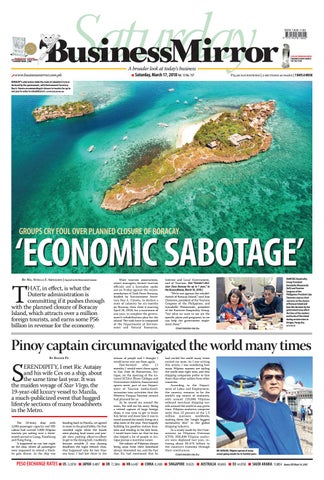
Boracay’s calm waters belie the state of calamity it is in as declared by the government, with Environment Secretary Roy A. Cimatu recommending its closure to tourists for up to one year in order to rehabilitate it. Len4foto | Dreamstime.com
Groups cry foul over planned closure of Boracay
‘ECONOMIC SABOTAGE’ By Ma. Stella F. Arnaldo | Special to the BusinessMirror
T
hat, in effect, is what the Duterte administration is committing if it pushes through with the planned closure of Boracay Island, which attracts over a million foreign tourists, and earns some P56 billion in revenue for the economy.
More tourism associations, resort managers, former tourism officials and a lawmaker spoke out on Friday against the recommendation of Task Force Boracay, headed by Environment Secretary Roy A. Cimatu, to declare a state of calamity for six months on Boracay, then close it starting April 26, 2018, for a maximum of one year, to complete the government’s rehabilitation plan for the island. The task force is composed of the Departments of Environment and Natural Resources,
Raintree Hospitality Group President Annabelle Wiesnewski (left) and Tourism Congress of the Philippines President Jojo Clemente express their concerns on the closure of Boracay Island and how this decision by the government may affect the lives of the workers and locals of the island during an interview in Ortigas, Pasig City.
Interior and Local Government, and of Tourism. (See “Cimatu’s decision: Close Boracay for up to 1 year,” in the BusinessMirror, March 16, 2018.) “We’re not against the rehabilitation of Boracay Island,” said Jojo Clemente, president of the Tourism Congress of the Philippines, and Annabelle Wiesnewski, president of the Raintree Hospitality Group, “but what we want to see are the specific plans and programs, so we can help the government implement these.” Continued on A2
ALYSA SALEN
Pinoy captain circumnavigated the world many times
S
By Roger Pe
erendipity, I met Ric Autajay and his wife Ces on a ship, about the same time last year. It was the maiden voyage of Star Virgo, the 19-year-old luxury vessel to Manila, a much-publicized event that hugged lifestyle sections of many broadsheets in the Metro. The 13-story ship with 2,600-passenger capacity and 935 cabins had carried 2,000 Filipino tourists per sailing over a threemonth period to Laoag, Kaoshiung and Hong Kong. It happened on our last night on the ship, where all passengers were requested to attend a blacktie gala dinner. As the ship was
heading back to Manila, we agreed to meet in the grand lobby. On that crowded night when the bands were playing loud music and people were pushing elbow-to-elbow to get to the dining hall, I suddenly became sociable (I was chasing deadlines the night before). Alas, that happened only for less than one hour. I had lost them in the
PESO exchange rates n US 52.0730
stream of people and I thought I would never ever see them again. Fast-forward after 12 months, I would meet them again in San Jose de Buenavista, Antique, on the opening of the national SCUAA (State Colleges and Universities Athletic Association) sports meet, part of our Department of Tourism media-familiarization tour activities that the Western Visayas Tourism council had planned for us. As he toured me around the town, Ric told me his story. Being a retired captain of large foreign ships, it was time to get to know him better and know how it was to travel around the world, living on a ship most of the year. Now happily building his gasoline station business and tending to his fish farm, I would learn later on that he has also helped a lot of people in Antique pursue a maritime career. The subject of Filipinos always being away from their homeland always interested me, and the fact that Ric had mentioned that he
had circled the world many times excited me more. As I was writing this article, I was wondering how many Filipino seamen are sailing the world seas right now, and why shipping companies prefer to hire them than other sailors from other countries. According to the Department of Labor and Employment, the country remains to be the world’s top source of seafarers, with around 229,000 Filipinos onboard merchant shipping vessels around the world at any given time. Filipino seafarers comprise more than 25 percent of the 1.5 million mariners worldwide, making them the “single biggest nationality bloc” in the global shipping industry. In a study made by the Commission on Filipinos Overseas (CFO), 358,898 Filipino seafarers were deployed last year, infusing about $5.575 billion to the country’s economy through their remittances. Continued on A2
RIC AUTAJAY, Filipino captain of many ocean-going vessels for 42 fruitful years.
n japan 0.4897 n UK 72.5846 n HK 6.6407 n CHINA 8.2400 n singapore 39.6535 n australia 40.6065 n EU 64.0758 n SAUDI arabia 13.8854
Source: BSP (March 16, 2018 )
News
BusinessMirror
A2 Saturday, March 17, 2018
www.businessmirror.com.ph
‘Economic sabotage’ Continued from a1
In an interview with the BusinessMirror, Clemente, who is also president of Rajah Tours Corp., pointed out that it took one year to have Boracay included in the tour programs of foreign travel agencies and tour operators for 2018-2019. On that basis, tourists booked their tours and stay on Boracay about a year in advance. “What will you tell them? Go to Cebu? Davao? What if they don’t like to go to these places because the contract between the guests and the travel agencies is for Boracay? So they go to Phuket instead, and the entire Philippines loses out,” he warned. Wiesnewski, whose hospitality firm manages Coast Boracay on Station 2, added that many establishments on the island have poured in “millions and billions of pesos” of investments into their businesses. But she underscored, “it takes about seven years for re-
sorts to break even, while restaurants, about four years.” Many business owners, she added, also borrowed from the banks to put up their hotels and resorts. “What do I tell my bank? ‘I can’t repay my loan because the government closed Boracay?’ Will the government pay my debt?” she asked with incredulity. She noted that the closure also opens up resort owners, travel agencies and tour operators to lawsuits from their tourist-clients for not fulfilling their booking contracts. For his part, former Tourism Region 6 Director Edwin Trompeta described the recommendations of the interagency task force as “a neat demolition job or economic sabotage by the authorities supposed to ensure the success of the industry.” He added: “What is ironic is that the DOT is part of the conspiracy, not even providing a moderating voice to protect the interests of law-abiding investors, tourists and
service providers, who have made Boracay what it is today, one of the best destinations of the world and the flagship of Philippine tourism.” Sen. Nancy Binay, chairman of the Committee on Tourism, also opposed the one-year total closure of Boracay, saying this “may not be the best solution for the island and its locals. “Although we all agree that a moratorium on building construction be imposed, and we share the same observation that over-commercialization has created a serious environmental disaster, it appears that the DENR, DILG, and DOT only see one aspect of the problem. The likely loss of 17,000 jobs hasn’t quite resonated, that may be caused by the impact of a total closure.” She pointed out that the DENR and DOT didn’t have any “concrete steps” on what to do with the people who will be displaced by the closure. “A phase-by-phase rehabilitation where government can strictly
enforce the law, and at the same time, implement the needed corrective measures, could be the better option for Boracay. We want the island to breathe the same way we want the people of Boracay to live,” Binay stressed. For its part, the Hotel and Sales Marketing Association International (HSMA) expressed hope that the government would “reconsider” the recommendation to close Boracay to tourists, noting that many lives will be affected by this move. The group said it supports closing “those that have violated [laws] until such time that they have made the needed rectification to be compliant. [But] why penalize those who follow the rules?” The group also appealed to government to involve the stakeholders in the decision-making process “and have an honest and sincere discussion [with us].” Clemente warned that it may take a long time again for govern-
ment and private sector stakeholders to get foreigners interested in Boracay and the Philippines again. “Will the government give the DOT additional funds to promote Boracay and the Philippines again in 2019?” he asked, noting that as it is, the country has the smallest marketing budget among Asian nations. Trompeta agreed. “Remember during the coliform scare in 1997, when DENR tried to hit the tourism industry with their incompetence? It was the travel trade sector and the DOT which banded together to save the day for the island, but still it took the island one year to recover the tourist arrival level of the previous year. And there was no closure order then, only bad publicity.” Wiesnewski said the root of the problem in Boracay is incompetence and corruption of the local government. “Why did they allow this to happen? They saw an opportunity to stuff their pockets so they allowed
everyone to come in. They didn’t enforce the laws. What happened to the environmental fees the tourists have been paying every year? Where did that go?” She added that DENR officials were also complicit in allowing many violations on the island. “Why are we, the island stakeholders, paying for the government’s own mistakes?” She also said the tourism industry on Boracay “created a service culture” that is unparalleled in many destinations. “We gave them jobs, trained them, now what? Where will they go? Back to their provinces? The reason they are on Boracay is because they couldn’t find work in their own areas!” said Wiesnewski. On Thursday, DILG officer in charge Eduardo M. Año told a news briefing that the recommendations of the task force will be taken up in a Cabinet cluster meeting on security with President Duterte on March 19.
Pinoy captain circumnavigated the world many times Continued from a1
Filipinos are the most preferred seafarers in the world because they are better trained and proficient in English. Ric emphasized the importance of English communication, especially in life and death situations in the middle of the sea. He related a horror story that caused logistical nightmares to his shipping company when a foreign crew mistook a message and delivered “ice” instead of “rice” to a foreign port during a typhoon. Being a seaman gave Ric a great satisfaction to provide for his family and some form of financial stability. “The fact that I would like to feel being an adventurer, to see many places in the world and still get paid for doing it excited me no end,” he said. Ric, who was expected to be away from his family for at least 10 months every year
prepared for the worst. He and his wife made some adjustments. “What’s the difference between manning a vessel and a cruise chip?” I asked. “Being a seaman and a captain, at the same time, is a big responsibility. You are dealing with millions of dollars of goods to be transported to some specific locations all over the world, and making a safe voyage without any major problem to the vessel, its crew and the company as well,” he emphasized. A cruiseship crew has its own way of dealing with thousands of passengers onboard to make them safe and enjoy their trips,” Ric said. To be a successful seaman, Ric gave important pointers: “First of all, you need a degree in nautical or maritime science to be eligible for an on-board training experience with subsequent testing process until you get to the highest level of being a captain, which takes about five
years to accomplish,” he said. “On top of that, maritime law requires you to have rigid training onboard ocean navigation with specific scenarios. The traits you need to have: You must be calm, level headed and very knowledgeable on all aspects of seagoing oceanography, that includes safety of life and protection of the environment at sea [to maintain the blue color of our oceans],” he added. He also stressed that one must be passionate about being a maritime adventurer, you must have the determination, decisiveness and diligence,” he pointed out. His career as a seaman started in April 1973, until July 2015—a span of 42 years. Among his many memorable trips was being an apprentice onboard a freight vessel from Manila to the vast expanse of the Pacific Ocean, to Hawaii and trans-exiting through the Panama Canal, and then to Philadelphia,
United States—a full circle of an exciting but very challenging internship. He has sailed to Scandinavian seas, Europe, Africa, the Atlantic and Indian oceans and South American sea-lanes. What about his most frightening experience? Ric related that it happened near Alaska, when he and his men encountered bad weather during winter. The temperature was below zero and a hurricane was fast approaching, ready to slam their boat with brute force. It almost rendered him witless, but he and his men were able to manage and pull through the storm. He would also get many awards throughout his career. The highest award he received was from Mitsui OSK Lines (MOL), the Japan presidential award given out during the first Annual General Meeting for safe operation on December 10, 2008, an industry gathering spon-
sored by Japan’s Safety Operation Headquarters. He also received a plaque of appreciation from Toyota Automotive Co. for safe, efficient operation with zero damage in transporting cargoes. During the time, the biggest issue facing the company was maintaining safety, maintaining zero incidents, and making the safety of the vessel, as well as seafarers, the highest priority. The plaque has been onboard the vessel, on display throughout his tenure as captain of the vessel. Born in Hamtic, Antique, Ric attended primary schooling in the same town and finished high school in Antique National School (ANS) in San Jose. At Iloilo Maritime Academy, he finished an Associate in Nautical Science college degree. His parents were Mariano Xavier Autajay and Salvation M. Mosquera. He has six brothers and a sister, all of them grew up in Hamtic and Manila.
He and Ces got married in 1982 and had their first child in 1983. Being a seaman was his choice right after he graduated from high school, mainly for the following reason: To be able to enjoy what the world has to offer. The very first world city he saw was New York City, then on to his most exciting trips as a sailor: Practically every European country, Middle Eastern, Caribbean, South and Central American countries, the West and East Coast of the US, African nations, the Southeast Asia and Australia, including New Zealand. He did not forget to tell me the reason Filipinos are the top priority by maritime companies: “Filipinos are hardworking and they have the ability to communicate intelligently. They are full of energy,” he said. Did he ever encounter discriminatory acts? Ric said, “No, we were given orientations on how to handle derogatory remarks and try to solve them if there were issues.”
Loneliness and homesickness
“Having a family away from your sight for a length of time makes your heart grow fonder,” Ric said. “I was able to separate my job responsibilities and the longing for my family. We have entertainment facilities for our crew. We have movies on weekends and mount crew parties,” he related. Being a captain of a big shipping company gave Ric financial stability for himself and his family. He had no qualms in saying that if he would go through life again, he would still choose being a seaman and a captain. “I loved the adventure and challenges I met,” he proudly said. He added that in the next 10 years, shipping companies would still prefer Filipino seamen even with the advent of modern equipment, computerized technology, with other countries like China, India, Vietnam and Russia training seamen also. “I think it will be a big boost to the hiring process of the shipping companies,” he said. After retirement, what keeps him busy? “I deal with the ‘ins and outs’ of owning a business, but the best fringe benefit of being retiree is seeing my family every day [though, deep inside, I still crave for life on the sea],” Ric said. “I try to maintain a regular routine schedule that benefits my family and our business as well, and tending to my fish farm. I try to be very considerate and understanding of people I work with. Life is really too short to have enemies at our age,” he added. Had he not became a ship captain, Ric wanted to be a criminal lawyer. Today, he just wants to share his knowledge and experience to the younger generation of seafarers. “To be able to tell them how challenging but rewarding this profession is, and be able to help their potential to succeed and have a meaningful life,” he said.
News
BusinessMirror
www.businessmirror.com.ph
Saturday, March 17, 2018
A3
FINLAND-STYLE SUBSIDY SCHEME NOT YET FEASIBLE IN PHL
Options explored to ease poor’s flight
T
By Cai U. Ordinario
he irregular income of her husband, a kristo (bet taker) at a cockpit, forced 53-year-old Maria to become a security guard. This was because when her husband was the only one working, Maria would often end up at her mother’s doorstep to ask for money, food and other basic necessities for her family. Her brothers, who were still single at that time, would comment, “Naku, nandito na naman. Ma-hoholdup na naman tayo [She’s here again. We will be robbed again].” But she did not mind. Her mother, who had a small sari-sari store, would also pack some rice and any food item she can spare to help Maria get by. Suffice it to say, the arrangement was not sustainable. Maria’s dire financial need and the mounting education expenses of her four children made her decide to take it upon herself to become part of the work force. “Nung mag-high school na mga anak ko, talagang nag-decide na ako magtrabaho. Dati kasi nasa bahay lang ako kasi maliliit pa, tapos walang magbabantay. Nung nagtrabaho na ako, hinahabilin ko mga anak ko, lalu ‘yung kambal na bunso, sa kapitbahay. Talagang buong araw, dahil wala ako sa bahay, siyempre iniisip ko mga anak ko [When my children were in high school, I decided to get employed. Before, I was just staying at home because my children were still young and no one would look after them. When I started working, I leave my children with my neighbors. The whole day that I am out, my mind is on my children],” Maria said. Maria earns P800 a day these days, or around P22,400 a month, for working 28 days a month. She works 12 hours a day and gets one day off every 14 days. She spends around P200 a day for her fare going to and from her house in San Pedro, Laguna, and her food. This is on top of her husband’s P150 worth of diabetes medication and the P100 allowance of her children every day.
For some people, working 12 hours a day is too much. But for Maria, she has no choice because working only eight hours a day meant she would get less pay. This is not an option for a breadwinner with children and a sick husband to take care of. Despite her long work hours, her financial state leaves much to be desired. Maria said her family survives through loans, especially during enrollment time. If she cannot obtain a loan from the Social Security System or PagIBIG, she would turn to friends and relatives to help her finance her needs and, sometimes, refinance her existing loans. “Utang ka dito, utang ka dun. Sa utang umiikot yung pang-arawaraw namin [I borrow money here and there. Loans keep us alive on a daily basis],” Maria said. “Ganyan talaga ang buhay ng pangkaraniwang Pilipino [Such is the life of the ordinary Filipino].” Indeed, millions of others are caught in the same situation of surviving from loan to loan because their incomes are not enough to cover their expenses. She said if only the cost of living in the Philippines were lower, she would not need to look for additional sources of income. When asked if a universal basic income (UBI), which is now being extended to citizens of Finland, is implemented in the Philippines will help workers like her, Maria said it would, especially during times when people do not have jobs. It’s been a year since Finland instituted the UBI, which gives its unemployed citizens aged 25 to 58 a monthly stipend of €560. This two-year experiment is envisioned to cut red tape, poverty and unemployment. However, Maria said, if the government really wants to help hardup Filipinos, it would be better if commodity prices were lower. “Mas
maganda kung mag-mura ang mga bilihin para mas maraming makinabang [It would be better if goods were cheaper so that more people will benefit],” she said.
Cash incentives
One of the ways the government helps families cope, especially with rising education and health costs, is the conditional-cash transfer (CCT) program. However, this is not an assurance that individuals or entire families will be lifted from poverty. University of the Philippines School of Statistics Dean Dennis Mapa said the CCT is not enough to keep a family out of poverty, since it only accounts for about 15 percent of the annual household poverty threshold. Based on the 2015 Family Income and Expenditure Survey (FIES), the annual per capita threshold in the Philippines is P21,753. But if you live in Metro Manila or the National Capital Region (NCR), you need P25,007 annually to keep out of poverty. Philippine Statistics Authority (PSA) data showed a family of five needs at least P6,329, on average, every month to meet the family’s basic food needs, and at least P9,064, on average, every month to meet both basic food and nonfood needs. “There are people who say those receiving conditional-cash transfer are lazy; if you rely on conditionalcash transfer, you will actually be hungry. You have to work more so that you will be out of poverty. It is just a supplement,” Mapa said. “The conditionalities is to make sure that you break the cycle of poverty. So if this generation is poor, the next generation will have better opportunities, [with] higher probability of succeeding, which means they should be educated and they should be healthy. [So] part of the conditionalities [is] school attendance, so make sure that you have that,” he said. The government also extended an unconditional-cash transfer (UCT) under the Tax Reform for Acceleration and Inclusion (TRAIN) law. The Department of Social Welfare and Development (DSWD) will implement the UCT scheme for three years as stipulated in the TRAIN. It will release P2,400, or P200
Duterte formalizes withdrawal from International Criminal Court
T
By Recto Mercene
he Philippines on Thursday officially notified the United Nations that it has decided to opt out of the Rome Statute, the country’s initial move to begin the process for its withdrawal from the International Criminal Court (ICC). Foreign Secretary Alan Peter S. Cayetano said the withdrawal was formally conveyed in a note verbale that Philippine Permanent Representative to the UN Teodoro Locsin Jr. handed over to Maria Luiza Ribeiro Viotti, the Chef de Cabinet of UN Secretary-General Antonio Gutteres, at 6:07 p.m. New York time on Thursday, or 6:07 a.m. Manila time on Friday. “Our decision to pull out of the Court is a principled stand against those who politicize and weaponize human rights,” Cayetano said in a statement issued shortly after arriving on Friday in Sydney. The country’s top envoy is in Sydney to attend the Asean-Australia Special Summit as President Duterte’s representative. Through the note, the Philippines gave its assurance to the international community that it continues to be guided by the rule of law embodied in the country’s Constitution and its long-standing tradition of upholding human rights. “ Th e g ove r n m e nt a f f i r m s i t s commitment to fight against impunity
for atrocity crimes, notwithstanding its withdrawal from the Rome Statute, especially since the Philippines has a national legislation punishing atrocity crimes,” the note said. “The government remains resolute in effecting its principal responsibility to ensure the long-term safety of the nation in order to promote inclusive national development and secure a decent and dignified life for all.” Cayetano pointed to the wellorchestrated campaign to mislead the international community and “crucify” Duterte and the Philippines by distorting the human-rights situation in the country. “This campaign against President Duterte and the Philippines is being effectively carried out by elements who seek to undermine our government and who have successfully infiltrated the human-rights community and weaponized human-rights protection mechanisms to advance their goal of overthrowing our democratically installed government,” Cayetano said. “It is doubly lamentable that members of the international community, who include our own partners in the war against terror, have allowed themselves to be used as pawns by these individuals and organizations in undermining our own efforts to restore the rule of law,” Cayetano added. “We are, however, confident that there
is no crime or liability to speak of in the first place, since our campaign against methamphetamines and other narcotics is a legitimate law-enforcement operation designed to protect all Filipinos and uphold the rule of law.” Cayetano said it has always been the position of the Philippines that states have the inherent responsibility to adopt and implement measures, consistent with their respective laws, to effectively address threats to the safety and well-being of their citizens. In the case of the Philippines, Duterte has identified the proliferation of illegal drugs and its link to other forms of criminality as “a serious threat to our people that had to be immediately addressed,” he added. “The campaign we are waging against illegal drugs is consistent with the sovereign duty of any state to protect its people,” he said, adding that in the conduct of this campaign, the Philippines is guided by the rule of law embodied in its Constitution, statutes and its longstanding human-rights obligations. “Contrary to what some parties are trying to make it appear, there is no failure on the part of the Philippine government in dealing with issues, problems and concerns arising from this campaign.” “ These are dealt with by independent and well-functioning organs and agencies of our state,” the top envoy added.
per month, in 2018 and a total of P3,600, or P300 per month, in 2019 and in 2020 to beneficiaryfamilies. An estimated P24 billion has been earmarked for the 2018 UCT implementation in the fiscal year 2018 General Appropriations Act (GAA). In January DSWD Officer in Charge Emmanuel A. Leyco said 10 million households/individuals will receive the UCT. This includes the 4.4 million CCT beneficiaries. He added the DSWD would facilitate the payment to 1.8 million beneficiaries with cash cards by January 31, 2018. The remaining 2.6 million Pantawid Pamilya beneficiaries without cash cards will receive the grants through partner conduits at a later date. Leyco also said that the 10 million UCT beneficiaries include 3 million indigent senior citizens who are also beneficiaries of the DSWD Social Pension Program, which is being implemented with the help of local government units (LGUs) and social development offices (SDOs). He added the remaining 2.6 million households will be selected from the so-called Listahanan, or National Household Targeting System (NHTS-PR), which will go through validation. The validation process is expected to last for three months, so the final list will be released in May, and the distribution of the cash grants will be done by June 2018. “We understand the immediate need of many Filipinos for economic assistance from the government in the wake of the implementation of the TRAIN, which has caused an increase in petroleum prices. We aim to finish the distribution of the UCT to all 10 million beneficiaries before the end of June 2018. We continue to coordinate with the Department of Finance— the lead agency in the crafting of the TRAIN program—the Land Bank of the Philippines wherein the UCT funds are lodged, as well as other possible partners to ensure that the implementation of the UCT will go smoothly,” he said. National Economic and Development Authority (Neda) Undersecretary for Policy and Planning Rosemarie G. Edillon said these kinds of programs are better than implementing a UBI. “We don’t want it to affect labor
decisions, labor-supply decisions, that’s basic. We’re still a developing country, people will still need to work to be able to produce. So I think political acceptability is also not there yet,” Edillon said.
Vouchers
Apart from these cash-incentive programs, there are also schemes, such as the Government Assistance for Students and Teachers in Private Education (GASTPE) and the Senior High School (SHS) Voucher Program, which the government is using as subsidy for the poor. The Department of Education (DepEd) stated that through these programs, the government provides financial assistance for learners who wish to pursue high-school education in private schools. The program, in turn, also assists in decongesting class sizes and strengthens the thrust that education for all is the shared responsibility of all sectors. Apart from this, another possible voucher program is in the works. Edillon said the Development Budget Coordination Committee (DBCC) is now designing a voucher for housing. She added this is the reason the government decided to remove the value-added tax exemptions of landlords who rent out property under the first package of the TRAIN. The voucher system for housing will be crafted by the Neda, along with the Housing and Urban Development Coordinating Council (HUDCC) and the other key shelter agencies. “We said we can do that, but first lets design a housing-voucher system. The idea behind that is its better to just give it to the one renting, the discount to the one renting, than the landlord. That is just right,” Edillon said. Meanwhile, Minimal Government Thinkers Inc. President Bienvenido Oplas Jr. offered other possible voucher systems that will help Filipinos in their health and education needs, but involves a more radical privatization of all public hospitals and schools. Oplas said that instead of cash, the government can resort to vouchers to help Filipinos in their education and medical needs. He added these vouchers will have a specific amount and will be given to all Filipinos.
These will be presented in any educational or medical institution that will then claim the cash equivalent of these vouchers from the government. Should the vouchers not be enough, households will then have out-of-pocket expenses. But, Oplas said, it is important that these vouchers not be transferrable. Otherwise, families can sell the vouchers in exchange for cash that may or may not be used for health and education purposes. “The bottom line here is everyone is a scholar and the government does not abdicate its function. The government is giving money, but not in the form of cash, but in the form of vouchers,” Oplas said.
Welfare woes
T he d issat isfac t ion when it comes to salaries and overall well-being, Social Weather Stations (SWS) Founder Mahar Mangahas said, in a recent forum, has always been there, especially in the Philippines. Mangahas said that, for many years, it was inferred that real wages have not increased despite the growth in the country’s gross national income (GNI) per capita. It was only two weeks ago, Mangahas said, when Finance Undersecretary Karl Kendrick Chua confirmed in another forum that real wages have indeed been stagnant, while labor productivity increased. “The real wage [survey] is very meaningful, and is collected quarterly by the government, but is regularly omitted from publication,” Mangahas said in a presentation. “According to a research led by Dean Dennis Mapa of the UP School of Statistics, the most important determinant of poverty and hunger is inflation in the cost of living; underemployment is secondary; and economic growth is weak,” he added. The statistics and economics behind wages and commodity prices are something that common Filipinos do not understand, but whose impact is most felt. For Maria, any assistance from the government is a welcome reprieve, especially during times when they lose their jobs or experience delays in their salaries. “Kahit konting ayuda lang makukuha, malaking bagay na sa amin [Even a small assistance will mean a lot to us],” Maria said.
A4
Saturday, March 17, 2018
The World BusinessMirror
Editor: Lyn Ressureccion | www.businessmirror.com.ph
What central bankers are saying about Trump’s trade-war threat
C
entral bankers around the world are grappling with the prospect of a global trade war sparked by US President Donald J. Trump’s plan to slap tariffs of 25 percent on steel imports and 10 percent on aluminum.
Here are extracts of some of the recent comments by central bank officials: Australia —Reser ve Ba n k of Australia Governor Philip Lowe, whose economy is the most Chinadependent in the developed world, said on March 7 that Trump’s move was “highly regrettable and bad policy.” “If it’s just confined to the current higher tariffs on steel and aluminum, then I think it’s manageable for the world economy. It’s not a positive, but it’s manageable,” he said. “This could turn very badly though, if it escalates. If we see retaliation and a counter-retaliation, this could turn into a very big shock for the global economy. History’s very clear here: protectionism is
costly. It’s costly to the country that implements the protectionism, it’s costly to everyone else. It’s just not the right thing to do. So the best thing for everyone to do, perhaps even the hardest thing to do, but the best thing to do is just to sit still and do nothing, to not respond and to continue advocating for open trade.” United States—Federal Reserve Bank of Dallas President Robert Kaplan, speaking with reporters on the sidelines of an energy conference in Houston, said it’s too soon to comment on the potential economic impact of the tariffs. “Global trade is good for the US economy, and our trading relationships with Canada and Mexico we believe are very critical to US competitiveness,” he
said. Federal Reserve Governor Lael Brainard, one of the central bank’s most ardent doves, said on March 6 it was too early to say if the possibility of a trade war could disrupt her outlook. “We would take into account developments if they proved to be material to the outlook,” she said. “It’s early to tell what the broader implications could be, so I see it as an uncertainty, but not something that would materially change my outlook, today.” Sweden —Stefan Ingves, governor at the Riksbank, said it’s too early now to say what it would mean for the central bank ’s forecast, while signaling concern about a deepening dispute. “It’s one thing to discuss higher tariffs on steel and aluminum, but if it turns into a general discussion around how different countries try to protect themselves, then it can never be good for the global economy and it would definitely not be good for the Swedish economy,” Ingves told reporters on March 6 after a speech in Stockholm. Thailand—Don Nakornthab, a senior director at the Bank of Thailand, said a trade war is now the biggest risk for the central bank. Exports of goods and services make up
about 70 percent of the Southeast Asian economy. “Trade politics is the most important risk for our economy, as it can evolve into trade war,” Don said in an interview in Bangkok on March 6. “If there’s an external shock in the near future, our economy may face a difficult time.” Thailand’s trade surplus with the US exceeded $20 billion last year. The economy is in the early stages of an upswing and has been lucky to be able to “rely on external demand, while we wait for local demand to gain more strength,” he said. Philippines—Central Bank Governor Nestor A. Espenilla Jr. said a trade war may result in slower global growth, which could hurt inflows from the more than 10 million Filipino workers who live and work abroad. Remittances amount to about 10 percent of GDP and are key source of foreign income in the Southeast Asian nation. “The risk of trade wars is the negative impact on the growth prospects of the global economy itself, affecting everyone, including those who start it,” Espenilla said in a mobilephone message. “The currency angle is but a small piece of the larger picture where there is less economic prosperity for all,” he said. Malaysia—The central bank noted in its monetary-policy statement on March 7 that trade tensions have risen recently, but “at this point, risks to the global growth outlook remain ba lanced, pointing toward continuity in global economic expansion.” Hungary—National Bank of Hungary Governor Gyorgy Matolcsy said the country needs to prepare for a sharp turn in global economic conditions, including the end of the cheap money era. There’s a “bellicose scenario” emerging in trade, exchange rates and the interest-rate environment, he said at a conference in Budapest on March 6. Canada—The Bank of Canada kept borrowing costs on hold on March 7, citing recent developments in trade policy that have become “an important and growing source of uncertainty” for the global
and Canadian economic outlooks. While the central bank has been highlighting risks to the North American Free Trade Agreement for months, the latest language suggests those concerns have evolved. The March 7 statement didn’t even mention Nafta. ECB —Eu ropea n Cent ra l Bank President Mario Draghi on March 8 added his voice to those criticizing the US threat to slap import tariffs on some products and called on governments to work together, rather than end up in a tit-fortat dispute. “If you put tariffs against what are your allies, one wonders who the enemies are,” Draghi told a regularly scheduled news conference in Frankfurt when asked about Trump’s plans. “We are convinced that disputes should be discussed and resolved in a multilateral framework and unilateral decisions are dangerous,” Draghi said. The ECB chief also wondered aloud, “what’s going to be the response of the exchange rate?” Switzerland —W hi le t he Swiss National Bank’s March 15 monetary-policy statement didn’t mention protectionism, SNB President Thomas Jordan told Swiss public broadcaster SRF that there’s a “certain risk” of a trade war that could affect the central bank’s monetary policy. “If international trade doesn’t work anymore, if a spanner gets thrown in the works, then that’s bad for everyone,” Jordan said. A drop in foreign demand would hurt the Swiss economy and weigh on inflation, he said. “Our monetary policy is very much affected by such developments.” Still, titfor-tat reprisals in response to US tariffs on steel and aluminum imports haven’t “materialized yet,” he said. Norway—Being concerned about protectionism is “quite a common view these days,” when looking at Brexit, “major election decisions” and the “new measures” from Trump, as well as signals on countermeasures from other countries, Norges Bank Governor Oystein Olsen said on March 15. “If that development accelerates, it’s a worry.” Bloomberg News
China hackers hit US firms linked to sea dispute–FireEye
C
hinese hackers have launched a wave of attacks on mainly US engineering and defense companies linked to the disputed South China Sea, the cybersecurity firm FireEye Inc. said. Th e s u s p e c te d C h i n e s e c y b e r espionage group, dubbed TEMP.Periscope, appeared to be seeking information that would benefit the Chinese government, said FireEye, a US-based provider of network-protection systems. The hackers have focused on US maritime entities that were either linked to—or have clients operating in—the South China Sea, said Fred Plan, senior analyst at FireEye in Los Angeles. “They are going after data that can be used strategically, so it is line with state espionage,” said Plan, whose firm has tracked the group since 2013. “A private entity probably wouldn’t benefit from the sort of data that is being stolen.” The TEMP.Periscope hackers were seeking information in areas like radar range or how precisely a system in development could detect activity at sea, Plan said. The surge in attacks picked up pace last month and was ongoing.
Increased attacks
While FireEye traced the group’s attacks to China, the firm hasn’t confirmed any link to Chinese government entities or facilities. FireEye declined to name any targets. Although most were based in the US, organizations in Europe and at least one in Hong Kong were also affected, the firm said. The Chinese Ministry of Foreign Affairs in Beijing didn’t immediately respond to a faxed request for comment on Friday. Plan said suspected Chinese cyberattacks on US targets has picked up in recent months, after both sides agreed not to attack civilian entities in 2015. The deal to tamp down economic espionage was hammered out between then-US President Barack Obama and President Xi Jinping. The US indicted five Chinese military officials in 2014 on charges that they stole trade secrets from companies, including Westinghouse Electric Co. and United States Steel Corp., after hacks were detected by Mandiant, a unit of FireEye. China denies the charges and argues the country is a victim, rather than an instigator, of cybersecurity attacks. Bloomberg News
Region’s leaders gather in Sydney for first AseanAustralia summit
S
o u t h e a s t Asian leaders star ted gathering on Friday for their first summit in Australia, as the regional neighbors look for closer economic and security links, and the host prime minister warned against trade protectionism. The leaders of the Asean rarely meet outside their 10 member-nations and the weekend summit in Sydney has caught the attention of protesters angered by humanrights abuses in Southeast Asia. Prime Minister Malcolm Turnbull has been criticized for welcoming some of the leaders to his hometown, including Myanmar leader Aung San Suu Kyi and Cambodian Prime Minister Hun Sen, who have been singled out by protesters. But Turnbull is looking at Asean for its potential to drive free trade in the Indo-Pacific region in a way that the major economies, the United States and China, cannot without creating suspicion and division. The dual themes of the Sydney summit are security and posterity, with the threat to both posed by North Korea high on the agenda. “Open markets, together with democracy, have been two of the most power ful forces in human histor y and they ’ve led to worldwide growth and prosperity,” Turnbull told a business forum in Sydney on Friday. “We must face the world, not turn from it; embrace free trade, not retreat from it,” he added. US President Donald J. Trump sparked fears of a global trade war with his recent move to slap tariffs on imported steel and aluminum. Earlier this month, Turnbull said Trump had agreed to exempt Australian steel and aluminum from the new tariffs. Singapore Prime Minister Lee Hsien Loong, the chairman of Asean this year, said he feared US moves to protect domestic industries put countries “under pressure to retaliate.” “If trust is broken and tit-for-tat trade wars break out, all countries, big or small, will suffer,” Lee told The Straits Times newspaper. Tr u m p h a s f r u s t r a t e d A u s t r a l i a’s free -trade ambitions by withdrawing the United States from the Trans-Pacific Partnership (TPP). Turnbull used a visit to Washington in Februar y to urge the United States to rejoin the trade pact and to speak against a growing sentiment of isolation in America. Four Asean countries—Brunei, Malaysia, Singapore and Vietnam—are among the 11 who have signed up to the TPP. Asean also offers Australia a different route to the goal of an Indo-Pacific free-trade agreement through the proposed Regional Comprehensive Economic Partnership. The partnership would group Asean with six countries with which it already has freetrade deals: Australia, China, India, Japan, South Korea and New Zealand. Lee told reporters he had agreed in talks with Turnbull on Friday that the partnership should be negotiated by this year. Australia’s enhanced engagement with Asean is part of a strategy to look beyond the United States to seek frameworks to bolster security, stability and prosperity in the region, said John Blaxland, director of the Australian National Universit y Southeast Asia Institute. Such moves give “due deference to the United States, but it implicitly recognizes that the United States isn’t as big a player and reliable player as perhaps it once was,” Blaxland said. Stronger ties with Asean come with their own pitfalls, however, including the need to strike a balance between seeking greater economic cooperation and pushing for social reforms in a region rife with authoritarian governments. Human Rights Watch said most Asean governments deny their citizens basic liberties and fundamental freedoms. The New York-based rights group wants human rights on the agenda in Sydney. “Australia’s failure to publicly raise human-rights concerns at the summit would not only provide a propaganda coup to Asean’s most abusive leaders, it would embolden all the region’s leaders contemplating major crackdowns, jailing journalists, or dismantling democratic i n s t i t u t i o n s ,” H u m a n R i g h t s Wa t c h Australian Director Elaine Pearson said in a statement. Yet, criticism is something Southeast Asian leaders bristle at, and Asean itself works on the core principle that membernations won’t interfere in one another’s internal affairs. AP
Sports BusinessMirror
Editor: Jun Lomibao | mirror_sports@yahoo.com.ph
Saturday, March 17, 2018
A5
FILLED WITH OPTIMISM By Doug Ferguson
O
The Associated Press
RLANDO, Florida—The future of Tiger Woods is filled with optimism because of the past. The next stop on his remarkable road to recovery from four years’ worth of back trouble is the Arnold Palmer Invitational, the tournament he has won a record eight times on a course that feels comfortable to him. There also is a short history of Woods winning at Bay Hill during various comebacks. When he was out nearly nine months recovering from reconstructive surgery, his first victory back was at Bay Hill when he made a 15-foot birdie for a one-shot victory over Sean O’Hair. After going more than two years without winning on the Professional Golfers Association (PGA) Tour while trying to patch his personal life back together, Woods finally broke through at Bay Hill with a five-shot victory over Graeme McDowell. Six months after, Woods wasn’t sure if he would be able to compete again at a high level, he is the betting favorite at Bay Hill. That stems from his runner-up finish last week at Innisbrook, where he was never more than three shots behind in the final round and had a long birdie putt at the end to force a playoff. He looks closer than ever to winning. He always seems to win at Bay Hill. Tiger Woods looking to cap another comeback at Bay Hill. AP
Hamilton: I don’t feel pressure within myself
T
URIN, Italy—Lewis Hamilton is “super relaxed” amid ongoing contract negotiations with Mercedes and the four-time world champion hinted it could be his last deal as a Formula One driver. Hamilton is entering the final season of his three-year contract, but talks are underway about a new deal with Mercedes executive director Toto Wolff. The British driver had said last month that he hoped to get it done before the new season gets underway, but he acknowledged Wednesday that it’s now unlikely to happen before the first race in Melbourne on March 25. “We started talking about it over the winter, and I was like, I’ll come back to it, and then we picked it up again, and I was like, I’ll come back to it. It’s not really my priority at the moment,” Hamilton told The Associated Press in an interview. “I’m really, super relaxed, I don’t feel pressure from the team, I don’t feel pressure within myself. I want to continue racing so I’ll have to do a contract at some stage, but I’m definitely not going to do it when people want me to do it. I’ll do it when it’s ready.” If he does sign a new deal with Mercedes, it’s expected to be for another three-year span. But, while he feels he could stay at the top of his game for seven more years, the 33-year-old is not sure he’ll stay that long in the sport. “I don’t want to stop early, I don’t want to stop premature that’s for sure, but I really don’t know what my time is,” Hamilton said. “I could probably stay until I’m 40 if I wanted to, but I don’t think I’m going to do that. “I could stay one or two more years but, in two years’ time, will I still have the
excitement that I have now of going into another season? I really can’t tell you.” Relaxed is exactly how Hamilton appeared as he basked in the sunshine at an event for Mercedes’s sponsors in Turin. A jovial Hamilton laughed and cracked jokes as he responded to questions on the balcony of Petronas’ new $60 million research and technology center. But while he was calm and collected, he was also visibly excited to get back to racing. “I don’t really like practice,” he said. “I’m super competitive, and that’s never ever going to change. Even when I’m 80 years old I’ll be competitive and, hopefully, I’ll have grandchildren or something by then, still going to be wanting to beat them if I’m walking with my blooming zimmer [walking] frame. It’s just how I’m built.” It’s that drive and motivation that could see Hamilton become only the third driver to win more than four world championships— after seven-time winner Michael Schumacher and five-time champion Juan Manuel Fangio. Hamilton said he’s hasn’t even contemplated that happening and doesn’t know how it would feel to be in such illustrious company. “People always asked me what would it mean if you got the third, the fourth. You just have no idea,” he said before, adding with a laugh: “It’s like saying ‘how would it feel if you won the lottery?’ I’m sure you’d feel good, but you don’t really know how you’re going to feel. It would probably feel good for a second, and then you’d be overwhelmed with people trying to steal your money.” AP
Lewis Hamilton is entering the final season of his threeyear contract, but talks are under way about a new deal with Mercedes executive director Toto Wolff. AP
LADY BULLDOGS TRY TO BRING BITE BACK
N
ATIONAL University tries to regains its lofty perch, but the Lady Bulldogs have to contend with an equally hungry Ateneo Lady Eagles at the resumption today of Season 80 University Athletic Association of the Philippines women’s volleyball action at the Filoil Flying V Centre in San Juan City. After suffering a 25-27, 25-27, 16-25 defeat to De La Salle last week, the Lady Bulldogs, who dropped to a 6-2 win-loss record to be at second place, try to regain their winning ways and share of the top spot in a titanic 4 p.m. clash with the Lady Eagles. Back-against-the-wall University of Santo Tomas (UST), meanwhile, fights for dear life against University of the Philippines (UP) at 2 p.m. The Tigresses are on the brink of getting the door after losing seven of their nine matches to fall to the bottom—a skid capped by a heartbreaking setback to third-placer Far Eastern University (FEU), 21-25, 21-25, 23-25, last Wednesday. “As of the moment, we’re aiming for the reality. We have a very slim chance to enter the Final Four, but we will not stop doing everything to get another win,” said UST Head Coach KungFu Reyes, who will test the mettle of the sixth place Lady Maroons (3-6). “We don’t want to end up at the bottom,” he added. “We will do it for school pride and for ourselves.” In men’s play, Ateneo eyes its ninth straight victory against FEU (6-2) at 10 a.m., while UP (3-5) and Adamson University (3-6) clash at 8 a.m. Lance Agcaoili
If it only it were that simple. “Just because I won here eight times doesn’t mean I’m going to win this week automatically,” Woods said. “I’ve still got to do the work. I’ve still got to go through the process of getting myself in position.” At least he knows the course, even if he hasn’t been here in five years. Marc Leishman is the defending champion, getting up-and-down with a 45-yard pitch shot that rolled out to 3 feet for par on the final hole. In some respects, so is Woods. He won in 2013 by two shots over Justin Rose, a victory that returned him to No. 1 in the world. Now he is at No. 149, which sounds good only when considering that he was No. 1,199 five tournaments ago. Las Vegas thinks so highly of Woods, especially after his runner-up finish at the Valspar Championship, that the Westgate Las Vegas Superbook has him favored at 6-1 to win at Bay Hill. It’s the first time Woods has been favored to win a PGA Tour event since Torrey Pines in 2014. “We keep saying it’s surprising, but it’s Tiger Woods, for God’s sake,” said Jason Day, who at 12-1 is the second betting favorite. Bay Hill will be a different test from Innisbrook, mainly because it requires a little more length off the tee and, with unseasonably cool air this week, the ball isn’t likely to travel as far. Day was explaining the difference when he looked over to the right at a TV screen showing—who else?—Woods. Woods is everywhere this week. He has a long list of highlights at Bay Hill, mostly birdie putts on the 18th
hole to beat everyone from Phil Mickelson to Bart Bryant. He won in 2003 by 11 shots while coping with dry heaves from food poisoning. Day and Hideki Matsuyama, out since Phoenix with a wrist injury, will play with Woods over the next few days. Rory McIlroy has said in recent weeks that, with so much commotion, it costs Woods a half shot per round. Day sees it the other way, saying Woods thrives with so much attention. “A lot of people are excited about how Tiger’s starting to show signs in the right direction, and I think it’s going to be a lot of fun over the next two days,” Day said. “They’re all out there for him. There are going to be a lot of cheers for him, and that’s fine, but I need to put my head down and just try to do my job.” Woods finished his pro-am round Wednesday and posed for a few pictures with volunteers, even one of their children. What might be more eerie is walking off the 18th green on Sunday without seeing Palmer. Palmer died in September 2016 as the American team was on its way to Hazeltine for the Ryder Cup. Woods has never been to Bay Hill without being in the King’s presence, starting with his US Junior Amateur title that Woods won when he was 15. “And then I moved here in 1996, and he invited me over here to play in his Monday shootout, and I did and I didn’t like it very much because he took my money,” Woods said. “But I thoroughly enjoyed being around him, being with him, and we had so many great times—none more so than last time I won here. “I’m cleaning out my locker, and he’s over there having his ice tea thing, and so he’s just sitting there and, ‘Hey, grab a seat.’ So we sat down, we just started to BS and have a great time together,” Woods said. “And I’m going to miss those times, for sure.”
A6 Saturday, March 17, 2018 | Editor: Mike Besa
Product review: TaylorMade M4 driver W
hen TaylorMade announced the new M4 driver, I was of two minds. On the one hand, I love my 2017 M2. By my reckoning, it is the best driver I’ve ever owned. That’s big for me—it’s huge because I’ve literally hit them all. The M2 allows me to play my game and swing with abandon knowing that it’s there to save me from myself. Like any other driver, it won’t help the worst of swings but mishits fare much better than with any of my other drivers. On the other hand, my curiosity was piqued. Could they actually improve on the best? The M4 has been out for a while now but has only just hit the Philippines. The product brief for the M4 was to make a driver that would be easier to hit and perhaps a bit longer and straighter than the outgoing M2. That’s insane. Ease of use and performance sit on opposite ends of the spectrum. Making clubs easier to hit has always impacted how playable they were and what kind of distance you could squeeze out of them. Take the old square drivers. Any of them. To a club, they were all shorter off the tee than their traditionally shaped stablemates, but they hit the ball so straight that some golfers didn’t seem to mind. Never mind the fact that they were hideous. That’s changed in recent product cycles and in TaylorMade’s case, it peaked with the M2. This was a club that Rory and Tiger had in their bags. How could you possibly make it any better? All kinds of ways, it seems. Twist Face exists to make all our fairways wider. Most golfers seem to miss toward the high toe or low heel. To mitigate those misses, TaylorMade added loft in the high toe area and took away loft in the low heel to compensate for how the golfers presented the clubface during those misses. If you’re concerned about the look at address, don’t be; it’s barely noticeable. The new face is significantly lighter than the old one and the weight saved there together with a few more grams from the spiffy new aerodynamic carbon crown freed up 86 percent more discretionary weight. That now sits in the 41-gram weight at the back of the clubhead. The improvement in the M4’s moment of inertia (MOI) was so significant it allowed TaylorMade to make the M4 slightly shorter from face to skirt than the M2. It looks more pear-shaped at address and sports a deeper clubface. It might not look it, but the face of the M4 is larger than the one on the M2, thanks in part to Geocoustic Technology. See, it does something besides making the M4 sound good. My feelings are mixed about the switch from white to silver on the new M series. The contrast is less subdued. I’d quite gotten used to the white heads over the years. Finally, to try and squeeze out more performance, Hammerhead reinforces the clubhead and allows
for a more flexible sole slot. We can argue about it, but Hammerhead seems to perform the same function on the clubhead as Jailbreak does for Callaway by stabilizing the clubhead and, in the M4’s case, providing more performance for mishits low on the clubface. The shaft that I’m using is the Graphite Design Tour AD TP-6 in stiff flex. It works very well with the M6. The ball leaves at the height and trajectory to which I’m accustomed. Spin seems to be low based on how much run I was getting after the ball hit the fairway. My first tee shot of my very first round with the M4 immediately put Twist Face to the test. I hit one dead off the low heel. It was a terrible strike, but the ball still found the right side of the fairway. For reference, I hit a second ball and crushed it. It was in the middle of the fairway just 12 yards past the mishit. Impressive. As the round went on I grew in confidence. By the last three holes on our front side, I was just letting it rip. The confidence the M4 gives you is considerable. I had shorter shots into every green than I ever had with my M2. Performance with hits low on the clubface was exemplary. I didn’t feel like I was losing any distance. I hit a horrible shot off the toe on one of the closing holes. I was trying to kill it and missed badly. The ball hooked into the fairway bunker and seemed to roll into the hazard beyond it. Upon arriving in the bunker, I found the ball close to the hazard line but still in play. Twist Face at work again? What else could it be? The aerodynamic improvements on the M4 are noticeable. The M4 goes through the air much easier than the M2 ever did. On the launch monitor during the product launch I was getting incrementally more clubhead speed and more ball speed as a result. Out on the golf course, you can actually feel it. Now, the caveat here is that I only have two rounds and a little range time with the M4 as you read this. It could be a bit of the honeymoon effect that I’m getting such good results, but I can’t deny how impressed I am with the M4. TaylorMade has taken everything I liked about the M2 and made it better. The results are undeniable. More distance, more fairways hit. Even the color is starting to grow on me. If you already have an M2, should you sell it to get the M4? That depends. If you’re as happy as I was with mine, then keep it. It’s still an awesome driver that will give you plenty of performance. But if you’ve got the financial wherewithal or just enjoy new toys, you won’t regret it. We’ll see if the honeymoon lasts. Right now, I wouldn’t bet against it. The M4 driver is very, very good. So good, it’s staying in the bag.
Growing the game
T
n
Dropping procedure: When taking relief (from an abnormal course condition or penalty area, for example), golfers will now drop from knee height. This will ensure consistency and simplicity in the dropping process while also preserving the randomness of the drop. (Key change: the proposed Rules released in 2017 suggested dropping from any height).
n Measuring in taking relief: The golfer’s relief
area will be measured by using the longest club in his/her bag (other than a putter) to measure one club-length or two club-lengths, depending on the situation, providing a consistent process for golfers to establish his/her relief area. (Key change: the proposed Rules released in 2017 suggested a 20-inch or 80-inch standard measurement).
Six looks like it belongs on a postcard.
Mike Besa
Modern Rules of Golf he USGA and R&A announced today the modernized Rules of Golf that will go into effect at the beginning of January 2019, ending a six-year process of discussion (and yearlong period of review). As part of the most sweeping reform to the Rules in decades, the overall number of rules will be reduced from 34 to 24, and simpler language abounds throughout. Indeed, this represents the most comprehensive change to the Rules since the guidelines’ initial publication in 1744. Additionally, “The Official Guide to the Rules of Golf ” replaces the nearly 1,300 examples in the Decisions text. Some of the changes per the USGA:
The Rebirth of Golf and Countr
n Removing the penalty for a double hit:
The penalty stroke for accidentally striking the ball more than once in the course of a stroke has been removed. Golfers will simply count the one stroke they made to strike the ball. (Key change: the proposed Rules released in 2017 retained the existing one-stroke penalty). n Balls lost or out of bounds: Alternative to Stroke
and Distance: A new Local Rule will now be available in January 2019, permitting committees to allow golfers the option to drop the ball in the vicinity of where the ball is lost or out of bounds (including the nearest fairway area), under a two-stroke penalty. It addresses concerns raised at the club level about the negative impact on pace of play when a player is required to go back under stroke and distance. The Local Rule is not intended for higher levels of play, such as professional or elite level competitions. (Key change: this is a new addition to support pace of play) Additional rules—Caddies can no longer line up their players. Penalties for accidentally moving a ball on the green or while searching for a lost ball have been eliminated. The time limit for searching for a lost ball has been reduced from five minutes to three. Players are now permitted to repair shoe prints and spike marks on the putting green; they may also remove loose impediments in a bunker and touch the sand with hand or club, provided they don’t ground the club. The modern rules are available at www.usga. org/rules or at www.RandA.org. Compiled by Mike Besa
B
Story & photos by Mike Besa
uilt in the midst of the great golf-course boom of the early-1990s the Mimosa Golf and Country Club Mimosa is built on what was known as the Clark Air Base Golf Club. The original 18 was split and expanded into what are now two lovely golf courses. Redesigned in 1992 under former Mimosa Leisure Estate Chairman Antonio The Mountain View course’s ultimate green.
Gonzales by Hawaii-based course architects Robin Nelson and Neal Haworth, Mimosa now boasts two delightful golf courses, the Mountain View and Acacia-Lakeview, that exploit the varied terrain of the vast property. It was a smashing success. The Mountain View played host to Tiger Woods in his first international exhibition when he played one-on-one with then Philippine No. 1 Cassius Casas. This was just after Woods had left Stanford University to turn professional and it was a spectacle. It also defined Mimosa’s Mountain View course as one of the top
championship golf courses in the country. Then the dream began to fall apart. The Bases Conversion and Development Authority (BCDA) sued Gonzales over alleged violations in their agreement and after a long, protracted battle, eventually took back custody and ownership of the property. The golf courses suffered as the BCDA stewards failed to care for them properly. But financially, the club was thriving with the seemingly never-ending stream of Korean tourists and the burgeoning Korean community outside the base’s gates.
Blood Red Waterproo
The ideal solut
www.pinoygolfer.com | Saturday, March 17, 2018 A7
the Mimosa try Club
Filinvest Development Corp. eventually purchased the rights to Mimosa from the BCDA some two and a half years ago and things turned around. Rechristened Filinvest Mimosa + Leisure City, it is envisioned as an integrated, balanced, and eco-centric community. Filinvest intends to capitalize on the 201-hectare property’s strengths and develop the key components of the new city—leisure, business, residential and nature. “We envision a leisure metropolis that is very much nature-inspired. We want it to be the top-of-mind destination for tourism and commerce in Clark and in the North,” Filinvest Executive Vice President Catherine
Ilagan said. “Leveraging on the experience of Filinvest, you can expect Mimosa+ to be nothing less than the very best, with features, amenities and infrastructure that’s simply world-class.” The changes since Filinvest took over have been sweeping. Most of the old cottages were demolished to make way for the new facilities. Two new office buildings are currently under construction and might open later in 2018. To further make Filinvest Mimosa+ a premium lifestyle destination, the development of a hub for shopping, dining and events is under way. A lifestyle mall will be home to some of the best retail stores and restaurants in a nature-inspired and al fresco setting. It will also have its own Event Grounds, a sprawling venue for some of the biggest events in the North. The golf courses have benefited in the midst of the development. Recognizing the golf courses were key components of the resort community, they invested in new equipment and plan a comprehensive rehabilitation of both golf courses over the midterm that will replace the aging sprinkler and drainage systems. Expect subtle changes to the golf courses to bring them up to spec and make them even more playable. To remain true to the original design, the firm of Nelson and Haworth will oversee the renovation. Mimosa + has been a very good investment for Filinvest Development Corp. So much so that we understand that they’re shopping around for more golf property investments. This is a positive sign that bodes well for the development of golf in the country. The Mountain View course is, without a doubt, one of the best layouts in the country today. If the course were in better condition, it would be a lock for a top 10 spot in any discussion of the best golf courses in the country. The undulating terrain and sublime vistas provide an ideal setting for golf and the Mountain View provides some of the best. This is the championship golf course that hosted Tiger Woods and is a test for golfers of all skill levels. At a monstrous 7,303 yards from the tips, the Mountain View is one of the longest in the Philippines. It straddles the new and old worlds of Philippine golf courses. On the one hand, it is of modern construction and, on the other, the century-old acacia trees and expansive layout give it the feel of a much older golf course. The quality of the layout, the aethetics and the challenge presented to the golfer are on par with the best golf courses in the country. You’ll need a good long game to score here. Even from the men’s tees (blue) it’s no pushover. It’s a slightly unusual layout with three par-3s on the front and just one on the back nine. The first three holes take you around a hill that hosts the former communications tower of the old American air base. The golf course opens up after the almost claustrophobic opening holes and the golf becomes more enjoyable and more testing simultaneously. The Mountain View really comes into its own on the inward nine. Two of the longest par 4s and three par 5s are on this side, making it a formidable task for the weekend golfer. The 480-yard (from the green tees) 12th and the breathtakingly beautiful 458-yard 15th will prove especially difficult. It’s interesting that the hardest hole on the back is the 578-yard par-5 13th; water is in play after the tee shot and the green is set just up against the lake, which poses most of the problems for the golfer. The par 3s are delightful; six looks like it belongs on a postcard, while 16 offers the ultimate treat: an island green. It’s not too long measuring just 153 yards from the gold tees and the green is generous. The course closes with a magnificent par 5 that requires maneuvering your ball around century-old acacia trees. The hole plays uphill toward the clubhouse and is well bunkered to frustrate all but the best approach shots. In spite of its difficulty, it’s a beautiful golf course and a sheer pleasure to play. There are beautiful views of the Zambales mountain range and Mount Arayat is never out of sight. This is a beautiful place for golf. Factor in the amazing cuisine of the Capampangans and you have the makings of a great golfing getaway that is more accessible than ever. The changes at Mimosa+ and to Pampanga as a whole mark it as the hotbed of development for the near and midterm. Billions of pesos are being invested here to bolster infrastructure and lure businesses to the central plain of Luzon. We see Pampanga as the future center of development in the country today. Blessed with an airport of international standards and one of the best deep-water ports anywhere in the country today, the region is poised to take off. Expect Mimosa+ to be on the forefront of that push into the future of the country.
of Pouches
tion for the year-round golfer A
s golfers, we are often beset by the elements, especially in the Philippines, as we golf well into the wet season. In these times, we are challenged to keep our mobile phones and other digital devices dry and functioning, as we continue our pursuit of the little white ball. So far, solutions have been largely makeshift. These range from Ziplock bags to those disposable mobile-phone bags that are so popular with tourists on our beaches. Both are temporary and prone to failure. Unfortunately, failure in this instance could lead to the ultimate failure of your phone. Enter Blood Red Clothing. Their products are designed with unique features and use materials, finishes, and accessories typical of luxury goods. The brand is the brainchild
of David Harris, a lifelong sailor who drives the team to cook up great ideas for products that are at home on the high seas or the golf course. Blood Red Clothing’s dry pouches for mobile phones are a great product. They are 100-percent waterproof and are available with or without a jack for headphones. They’re made with thermoplastic polt urethane for its clarity and resistance to the elements. They’re perfect for those times that you just have to listen to music in the midst of a rainstorm. Blood Red Clothing’s waterproof pouches retail for P1,300 without the jack and P1,450 with it. They’re available in a variety of colors and can be found at ROX Bonifacio High Street and on their web site www. bloodredclothing.com.
OurTime BusinessMirror
A8 Saturday, March 17, 2018 • Editor: Efleda P. Campos
www.businessmirror.com.ph
Grandma, 108, relishes long life with ‘malunggay,’ ‘camote’ tops
E
CHAGUE, Isabela—Reaching the age of 108—and still counting— centenarian Juanita Cariaga of San Miguel, Echague, Isabela, considers her longevity as a feat for herself. What is her secret? She told the Philippine News Agency she is fond of eating malunggay (horseradish) and camote tops, as well as other backyard vegetables in her village. The vegetables are pesticide-free and naturally raised food, she said. These helped give her long life and a sharp memory since she was born on March 10, 1910, in Nueva Ecija. Her 50-year-old granddaughter Edna Cariaga-Daguro revealed Lola Juanita did not suffer severe illnesses. She only suffered from minor headaches, stomach and body pains, arthritis, flu and fever. “Before, we had no big expenses. We would have long walks and no rides,” Juanita confided, adding she would choose the way of living before than now. When the Japanese soldiers had occupied the country, she and her family members were forced to take refuge at a cave-like formation deep in the forests. Losing her husband 40 years ago, Juanita had singlehandedly worked at the rice farm to feed their eight children, three of them now deceased. “When I was still strong, I would plow and till the farms as the father of my children died early,” she added. Her daughter Feliciana Miguel,
63, is happy over her mother’s good health and long life. She confided that “God is good for providing her the best of health.” Juanita now uses two wooden crutches or baston to support her when she walks around, her other daughter Carmelita noted. Her vision has been affected by a cataract and her left eye has been losing sight, apparently due to her old age, her children said. As a centenarian, Juanita received P100,000 from the social welfare department and P20,000 from the local government, aside from a plaque of recognition, felicitation letter from President Duterte and other benefits. The money—which was mostly deposited—was given in October last year. A portion was set aside for her expenses for food, milk and medicine. Juanita admitted she has been living a good life. She said she would be happy meeting her Creator later. Her children have prepared for Juanita’s fate in the future, even setting aside money for funeral and wake expenses. The cash assistance from the government is an “immeasurable debt of gratitude” for Lola Juanita, her children and grandchildren said. PNA
Family sues Michigan nursing home over abuse caught on video
L
IVONI A, Michigan—The family of an elderly Lebanese man is suing a Michigan nursing home, alleging a hidden camera captured footage of the abuse and some caretakers directed ethnic slurs toward the man. Hussein Younes, 89, was seeking care at Autumnwood of Livonia in 2015 after a bowel-obstruction surgery. His son, Salim Younes, grew concerned after noticing his father had several bruises, cuts and significant weight loss. “They blamed his injuries on his falling 11 times over a five-month period,” said Jonathan Marko, the family’s lawyer. Salim Younes hid a camera in an alarm clock next to his father’s bed. The family gathered more than 100 clips documenting neglectful behavior over two days, Marko said. The family removed Hussein Younes from the facility in December 2015. The lawsuit alleges caretakers physically abused and hurled ethnic slurs at Younes. The complaint also alleges Younes was denied water, had his call button taken from
him and had his legs run into a wall while in a wheelchair. The actions may have been racially motivated, Marko said. “He’s an elderly Lebanese gentleman who was born and grew up in Lebanon,” Marko said. “He’s an ArabAmerican, and because of that, he was targeted at this nursing home and horribly abused.” The company conducted an internal investigation and reported the allegations to several government agencies after learning of the complaints in December 2015, but wasn’t able to substantiate the allegations at the time, said the company’s attorneys. Autumnwood wasn’t made aware of the video until May 2016. “The actions depicted in the video are in no way illustrative of the quality care that is provided by the caring staff at Autumnwood on a daily basis,” the company said in a statement. The employees in the video have been fired and other employees are receiving additional training, according to attorneys for Autumnwood. The civil trial begins in June. AP
Cleansing of social-pension list in ARMM under way
C
A HARVEST OF ITOGON RICE Joyce Candelario, 65, wears a traditional dress as she shows off her harvest of a highland rice variety called “Itogon rice” from her hometown of Itogon, Benguet. Her family has consumed Itogon rice for generations. LAILA AUSTRIA
Austerity-fatigued elderly Spaniards pose challenge to pension system
A
FTER working for 47 years, Alfonso Blas said the paltry pension increase he’s being offered is a scandal. “They tell us the crisis is gone, so why is my pension going up by one euro?” the 65-year-old retired bank branch worker asked. “I worked my entire adult life—this didn’t come for free.” As Spain enters its fifth year of economic recovery, a campaign of nationwide protests by pensioners like Blas—a group traditionally sympathetic to the conservative policies of the ruling People’s Party—is posing an unexpected challenge to Prime Minister Mariano Rajoy. Mindful of its potential cost to his party as his support plunges in opinion polls, Rajoy has called a parliamentary session last Wednesday to discuss the system’s future. Elderly Spaniards are going on the offensive as rising prices erode the spending power of their pensions, which will increase a mere 0.25 percent for a fifth year in a row. Although Rajoy has said the pension debate will be one of the key issues of his second term, other groups whose living standards suffered during the crisis are also clamoring for more. “The government has been flagging that the economic recovery is a tangible reality, so segments of the society including policemen, civil servants, women and, of course, pensioners want to make sure they’re benefiting from it,” said Veronica Fumanal, a political marketing expert, who used to work for the Socialist party and the liberals of Ciudadanos. Rajoy sought to protect older vot-
ers as Spain grappled with an economic crash that forced him to seek a €41-billion ($50.6-billion) bailout to rescue its banking system in 2012. He continued to raise pensions by small amounts even as he increased taxes and cut public wages, education spending and aid for young families. Elderly voters returned the compliment by helping Rajoy secure the extra seats he needed to form a minority government after general elections in 2016. That alliance is now under strain as Spain reaps the benefits of a recovery that has seen the economy expand for 17 straight quarters, setting the country on course to grow more than 2.5 percent this year. Inflation averaged 2 percent last year after three years of falling prices. The Bank of Spain predicts prices will rise 1.5 percent this year, further eroding the value of pensions. The prospect of falling living standards sparked protests across Spain last month. Pensioners broke through police lines to reach the steps of parliament in Madrid carrying banners reading “Misery for Pensioners,” echoing scenes seen during the economic crisis in 2012. The government had inadvertently helped fan the discontent by sending letters to pensioners’ homes spelling out the 0.25-percent increase. The minimum monthly state pension would rise by €1.50 a month to €606.60, barely enough for a coffee in a Madrid bar. “The letter was the trigger,” Fumanal said. “The cost of sending it was more than the actual increase.” Spain isn’t the only country where
pensioners are getting restive. French President Emmanuel Macron, who’s been fighting claims his policies are tailored for rich people since his election in May, last month saw drops in his approval rating reflecting concern about purchasing power. According to a BVA poll published in newspaper La Tribune on February 14, 82 percent of pensioners said they were losing out versus two thirds of the general population. Pensioners in Greece have seen their payments slashed several times as part of the country’s bailout program. In Spain the chances of building any cross-party consensus to tackle the pensions problem looks slim. The opposition Socialists have called for pension increases to be pegged to inflation, something Rajoy said would be unsustainable. He said the best way to protect pensions is to create jobs for workers who would then contribute to social security. Meanwhile, the strains on public finances are starting to show as Spain moves closer to exhausting a pension reserve that stood at €67 billion as recently as 2011. The Treasury will make a €15-billion loan to fund the system, adding to a €10-billion credit line to fund the system in 2017. “We’re starting to realize that we’re losing out and prices are rising and our standard of living won’t improve,” said Saturnino Alvarez, 78, who used to sell computer equipment before he took retirement. “The PP is going to have to do something because Rajoy is alone, and we are his voters.” Bloomberg News
Smart program brings together senior citizens and senior high students
A
T 76 years old, Precy Erguiza’s ultimate wish is to be able to share her beach photos on social media. “My niece knows how to use Facebook—she dances, swims, takes photos while she is at the beach and shares them right away,” said Nanay Precy, who originally hails from Surigao del Sur. “I don’t know how to do that. I’d like to learn.” Nanay Precy and 23 other senior citizens from Barangay 672 in Paco, Manila, are now closer to this dream after attending the first session of the Smart Millenniors program facilitated by Smart Communications in their barangay recently. “Millenniors” is a play on the words “millennials” who are known to be tech savvy, and “seniors.” The goal of
the program is to teach technology to the elderly, specifically about smartphones, mobile data and social media. Assisted by senior high school and Computer Science students from Adamson University, the new batch of Smart Millenniors learned about the basics of smartphones and mobile data. They were also able to set up their Facebook accounts and were assisted by student-volunteers in taking their selfies. One of Nanay Precy’s classmates, Bernardo “Boying” Corpuz, said smartphones will be useful for him because he has children working abroad. “I have a sibling in Guam whose family is based there,” said Tatay Boying, 76, a jeepney driver. “I am happy that I was taught the basics
of smartphones, and that I can now message my relatives abroad.” Among the participants was the chairman of Barangay 672, Domingo Amaro, who was a senior himself. “Like many of my fellow seniors here in the barangay, I also do not know much about smartphones,” the 64-year-old Amaro said. “My grandchildren are the ones who know more about technology, and they teach me. Now that I already know a few things, with my grandkids’ help, I will get better at this, too.” For one of the student-volunteers, Grade 11 student Danica Tumlos, joining the Smart Millenniors session taught her and her classmates about the values of patience and empathy. “This is the first outreach pro-
gram of our student council and we had a great time. It feels good to be able to help out and share our knowledge,” said 17-year-old Tumlos, who is also student council chairman. “I learned that to be able to teach well, one must see from the point of view of the learner, too.” Tumlos and 15 other senior high students helped the participants in the Smart Millenniors session through the different parts of the lecture. “Technology helps improve communication. With many of our seniors having children and grandchildren working abroad, they can use these technologies to easily connect with their loved ones overseas.” “We hope that after we taught them about the basic functions of
smartphones, it will be easier for them to keep up with future millenniors sessions,” she added. “As the Smart Millenniors program reaches more seniors, we are further spreading the word that technology is for both young and old,” Smart Public Affairs head Ramon Isberto said. “With the world going digital, we are working to make smartphones and mobile data accessible to all.” “With the Smart Millenniors program, Smart is reiterating its commitment to bring digital learning to everyone, regardless of age,” said Stephanie Orlino, Smart Community Partnerships senior manager. “We look forward to partnering with more communities for this initiative.”
O T A B AT O C I T Y—T h e cleansing campaign against irregularities in the release of Pantawid Pamilyang Pilipino Program (4Ps) funds in the Autonomous Region in Muslim Mindanao (ARMM) has been gaining headway, the region’s social welfare secretary announced last Saturday. Lawyer Laisa Alamia, ARMM executive secretary and concurrent Department of Social Welfare and Development (DSWD-ARMM) secretary, said more than 100 individuals from across the region have voluntarily surrendered their 4Ps identification cards. “Fake cardholders have voluntarily turned in their cards following our massive campaign to put an end to irregularities in the conditional cash-transfer program for indigent families in ARMM,” Alamia told the Philippine News Agency. She noted that village officials, teachers, civilians and spouses of soldiers and policemen were among those who surrendered their IDs. A l a m i a le d t he c a mp a i g n to cleanse the list of the antipover t y prog ram’s benef iciaries since she assumed office as DSWD regional secretary. She said charges are being readied against those involved in the irregularities who take a “cut” from cash grants intended for indigents in ARMM’s provinces of Maguindanao, Lanao del Sur, Basilan, Sulu and Tawi-Tawi. A cut refers to the amount taken by those who have influence and control over the automated teller machine (ATM) cards of indigents. Meanwhile, Alamia said the reported corruption in the senior citizens’ benefits in ARMM is also being investigated, aside from the irregularities concerning the 4Ps payouts. “The DSWD-ARMM wishes to address the issue concerning the alleged irregularities in the disbursement of senior citizens’ benefits in the region,” she said. She added they are “currently gathering information about this report and it will be handled by our Grievance Redress System, which will allow us to alert concerned social workers in the barangay, municipality, city and provincial levels.” Alamia said the local government unit (LGU) Social Welfare Protection assemblies in the five ARMM provinces aims to ensure that the beneficiaries of the social pension get what is intended for them. She said the “No Fraud” policy is being strictly implemented across all social welfare programs, and for members of the LGU, the security sector, and other partner agencies to show their commitment and support in monitoring fraudulent activities. The DSWD-ARMM chief noted that since Mindanao is still under martial law, all DSWD-ARMM programs are being closely monitored by the military and police as they validate DSWD-ARMM programs’ list of beneficiaries. Policemen and soldiers will be present during senior citizens’ benefits and 4Ps payouts to address anomalies, and to eventually investigate these incidents, which may lead to possible arrests. “We are one with the Duterte ad m i n i st r at ion’s i nte n si f ie d anticorruption campaign,” she said. PNA
Editor: Gerard S. Ramos • lifestylebusinessmirror@gmail.com
BusinessMirror
Saturday, March 17, 2018 A9
SMARTEST 4G LTE STARMOBILE PHONE NOW AT SMART ONLINE STORE
THE Oath, the first HOOQ Originals Series
The wall that puts the spotlight on Scandal’s Olivia Pope.
HOOQ promises to bring more original content PRIMETIME
DINNA CHAN VASQUEZ @dinnachanvasquez luckydinna@gmail.com
H
OOQ Philippines recently hosted a screening for The Oath, the first HOOQ Originals Series at their office in Bonifacio Global City. We were absolutely charmed by the interiors of their office, which has one wall that asks something that we should ponder ourselves during sticky situations: “What would Olivia Pope do?” Olivia Pope is the fictional lead character in the hit political TV drama Scandal. The character, played by Kerry Washington, is a strategist/crisis PR expert/ lobbyist/lawyer. We also got the chance to talk to HOOQ Philippines’s new Country Manager Sheila Paul, who we’ve interviewed several times in the past. “In the past three years, we’ve learned so much about our users. We know what they like to watch, what time they watch, and how many hours they spend online. We’re using this to move forward and build our content. HOOQ Originals Series is something you won’t find in any other service but we think it will resonate with our audiences in the Philippines, Thailand, Indonesia and Singapore,” Paul said. The Oath is the first HOOQ Originals, and Paul added that we can expect more in the future. Set in Los Angeles, the series is a hard-hitting cop drama that delves deep into the world of gangs inside the police force. The series, directed by Jeff T. Thomas
HOOQ Philippines Country Manager Sheila Paul
and Luis Prieto, is produced by Curtis “50 Cent” Jackson (Power) and his G-Unit Film & Television Inc.; Todd Hoffman and Dennis Kim of Storied Media Group; Anne Clements (StartUp) and Joe Halpin. It is distributed by Sony Pictures Television. Paul said they have also started production for On The Job 2, a HOOQ original production with Globe Studios and Reality Entertainment. “We’re really looking forward to bringing you more originals, to being the home of Asian originals,” Paul said. According to Paul, HOOQ viewers are mostly on their mobiles as choice of programs is really something personal as opposed to, say, everyone
watching on a common screen. A growing trend, she added, is screen-casting or mirroring. This means viewing the media content on your phone, tablet or laptop on a bigger screen like a TV. This is done via devices like an Apple TV, Roku or Chromecast. “It’s interesting that we’re seeing a 5-percent to 10-percent growth in the past year in the use of mirroring devices among our users,” Paul said. Viewership of Hollywood and Filipino content among HOOQ users in the Philippines is 50-50 right now, thanks to content like indie films, notably Kita Kita. The film, which stars Alessandra de Rossi and Empoy, debuted on HOOQ last month. “There is a growing consciousness in the consumption of Filipino content and this says something about the quality of Filipino content. We have good quality Filipino films on HOOQ that out viewers are watching,” Paul added. Kita Kita, in fact, exceeded HOOQ’s expectations in terms of viewership. It caught up with HOOQ’s top titles in a short span of time. “In terms of viewing minutes, you would think Kita Kita has been there since last year when, in fact, it’s only been there since February 9,” Paul said. This month lovers of animated films can enjoy Pixar’s Coco and comic-book fans can rejoice as HOOQ brings you the absolute best that the Marvel and DC Cinematic Universe has to offer with Thor: Ragnarok and Justice League. Those looking to make a trip to a galaxy far, far away can eagerly await the arrival of Star Wars Episode VIII: The Last Jedi and, finally, for the nostalgic lovers of 1990s cinema, the highly successful Jumanji: Welcome to the Jungle would be a winning choice. Customers can simply download the HOOQ app from the Apple App Store or Google Play, sign up or log in, to access HOOQ’s extensive library of Hollywood and Asian hits. Globe subscribers can get to try HOOQ for up to 90 days on selected mobile and broadband plans. Find out more and sign up today for a complimentary trial at www.hooq.tv. ■
STARMOBILE FeatureSmart EVO 1 (www.starmobile.ph), the smartest feature phone in the Philippines, is now available at the Smart Online Store, priced at P1,888. Created to make Internet access and services accessible for every Filipino, the feature phone is the most affordable 4G LTE-capable phone in Smart’s roster. The EVO 1 is equipped to handle super fast 4G LTE, and the only feature phone in the market that doubles as a portable Wi-Fi hotspot. Share the telco giant’s fiber-powered connection with up to five other devices, such as your laptop, tablet and even your handheld game console. What’s more, the Starmobile FeatureSmart EVO 1 delivers a smartphone-like experience on a budget. With preinstalled Facebook, Facebook Messenger and Viber apps, users can connect to anyone in the world and share photos, videos and files instantly. The 2.4-inch display phone is also equipped with dual-SIM slots, FM radio, multimedia player and Bluetooth connectivity. Visit goo.gl/gc7Anb to know more about the Starmobile FeatureSmart EVO 1.
APPLE ADDS MORE ‘TEXTURE’ TO ITS SERVICES WITH MAGAZINE DEAL SAN FRANCISCO—Apple has bought digital magazine distributor Texture to extend its subscription services beyond music and online storage. The deal announced on Monday puts Apple in control of a service often described as a Netflix of magazines. Texture allows readers to pore over articles in more than 200 magazines for $10 per month, much like Netflix sells unlimited access to its video programming. But Texture hasn’t proven as popular as Netflix, which boasts 55 million subscribers in the United States alone. Texture hasn’t specified how many subscribers it has, but CEO John Loughlin said in a 2016 interview that the number ranged in the “hundreds of thousands.” Apple didn’t disclose how much it paid for Texture, which had raised at least $90 million since it was founded nearly a decade ago as Next Issue. The magazine distributor had been owned by investors that included Condé Nast, Hearst, Meredith, Rogers Media and KKR. “We are committed to quality journalism from trusted sources and allowing magazines to keep producing beautifully designed and engaging stories for users,” said Eddy Cue, Apple senior vice president of Internet software and services. Unlike most Apple products, Texture will be available on devices powered by Google’s Android software in addition to the iPhone and iPad. Texture will join a stable of Apple subscription options that are anchored by the company’s music-screaming service, which has 36 million subscribers. Apple Inc. also sells additional storage in its iCloud service to customers who exceed the free limit of 5 gigabytes. AP
Behind the Broadcom deal block: Rising telecom tensions BY MAE ANDERSON The Associated Press NEW YORK—Behind the United States move to block Singapore-based Broadcom’s hostile bid for US chip maker Qualcomm lies a new global struggle for influence over next-generation communications technology—and fears that whoever takes the lead could exploit that advantage for economic gain, theft and espionage. In the Broadcom-Qualcomm deal, the focus is on socalled 5G wireless technology, which promises data speeds that rival those of landline broadband now. Its proponents insist that 5G, the next step up from the 4G networks that now serve most smartphones, will become a critical part of the infrastructure powering everything from self-driving cars to the connected home. 5G remains in the early stages of development. Companies, including Qualcomm, based in San Diego, and China’s Huawei, have been investing heavily to stake their claim in the underlying technology. Such beachheads can be enormously valuable; control over basic technologies and their patents can yield huge fortunes in computer chips,
software and related equipment. “These transitions come along almost every decade or so,” said Jon Erensen, research director for semiconductors at research firm Gartner. “The government is being very careful to ensure the US keeps its leadership role developing these standards.” President Donald J. Trump said late Monday that a takeover of Qualcomm would imperil national security, effectively ending Broadcom’s $117-billion buyout bid. Broadcom said that it is studying the order and that it doesn’t believe it poses any national security threat to the US. It’s the second recent US warning shot across the bow of foreign telecom makers. At a Senate Intelligence Committee meeting in February, FBI Director Christopher Wray said any company “beholden to foreign governments that don’t share our values” should not be able to “gain positions of power” inside US telecommunications networks. “That provides the capacity to exert pressure or control over our telecommunications infrastructure, it provides the capacity to maliciously modify or steal information and it provides the capacity to conduct undetected espionage,”
he added. Lawmakers in the US House introduced a bill on January 9 that would prohibit government purchases of telecoms equipment from Huawei Technologies and smaller rival ZTE, citing their ties to the Chinese military and backing from the ruling Communist Party. A few years earlier, a congressional panel recommended phone carriers avoid doing business with Huawei or ZTE. The stakes are even higher in the 5G race. “Qualcomm/ Broadcom is like the Fort Sumter of this technology battle,” GBH Insights analyst Dan Ives said, referring to the battle that kicked off the Civil War. Although its name isn’t widely known outside the technology industry, San Diego-based Qualcomm is one of the world’s leading makers of the processors that power many smartphones and other mobile devices. Qualcomm also owns patents on key pieces of mobile technology that Apple and other manufacturers use in their products. Compared to earlier generations of wireless technology, “we’re seeing China emerge and start to play a bigger role in the standards developing process,” Erensen said. Given a wave of consolidation in the telecom-equipment industry, fewer companies are involved “and the stakes are bigger,”
he added. The Committee on Foreign Investment in the United States (CFIUS), which reviews the national security implications of foreign investments in US companies, cited concerns about Broadcom’s penchant for cutting costs, such as research spending. That could lead to Qualcomm losing its leadership in telecom standards, the committee wrote in a letter earlier in March. Should that happen, Chinese companies such as Huawei, which the CFIUS has previously expressed concerns about, could take a larger, or even a dominant, role in setting 5G technology and standards and practices. That’s where national security concerns come in. “Over time that would mean US government and US technology companies could lose a trusted US supplier that does not present the same national security counterintelligence risk that a Chinese supplier does,” said Brian Fleming, a lawyer at Miller & Chevalier and former counsel at the Justice Department’s national security division. Blocking the deal doesn’t eliminate Chinese influence on 5G development, of course. But it might slow it down, Fleming added: “They honestly believe they are helping to protect national security by doing this.”
BusinessMirror
A10 Saturday, March 17, 2018
/
www.businessmirror.com.ph
POPE Francis
Vatican invites hackers to fix problems, not breach security VATICAN CITY—Computer hackers with a heart are descending on the Vatican to help tackle pressing problems particularly dear to Pope Francis, including how to better provide resources for migrants and encourage solidarity for the poor. The “Vatican Hackathon,” an around-the-clock computerprogramming marathon, started last Thursday in the Vatican, with the full support of the pope, several Vatican offices and student volunteers from Harvard and Massachusetts Institute of Technology. Organizers stressed that no firewalls will be breached or acts of computer piracy committed. Student organizer Jakub Florkiewicz, an MBA student at Harvard, said, “We’re hacking problems, not security.” Teams of programmers, graphic designers and project managers will be asked to provide technological solutions to specific problems in three general areas: solidarity in a digital world, communication in interfaith dialogue and mobilization of resources for migrants. AP
Go all out with Globe’s broadband plans REVOLUTIONIZING home Internet Globe At Home’s GoUNLI (shop.globe.com.ph), a set of unlimited broadband plans that let customers enjoy their digital lifestyle without having to worry about data capping. The best part? There’s no lock-up period. Plans start at P1,699 a month, which comes with unlimited surfing and streaming up to 5 Mbps. Those who would like faster plans can avail of Plan 1899 for speeds of up to 10, 15 or 20 Mbps, Plan 2499 for speeds up to 50 Mbps, and Plan 2899 for speeds up to 100 Mbps. If you’re wondering what you can do with unlimited broadband plans, here are some suggestions that would get you busy. 1. STREAM MOVIES AND TV SHOWS AT HOME. Why spend the night out watching movies when you can watch it in the comfort of your own home? Netflix is a treasure trove of excellent content like its latest original, Altered Carbon, a thriller set in the future where memories are kept in a device that can be inserted in any body. The show is available in Ultra HD 4K, which means customers with Plan 1899 at 20Mbps and up can enjoy the show’s stunning visuals. Full HD viewing requires only 5 Mbps, so all customers can binge watch Designated Survivor, where designated survivor Tom Kirkman (Kiefer Sutherland) becomes president of the United States after the elected leader and members of his Cabinet die in an explosion. 2. LEARN SOMETHING NEW; BETTER YET, TEACH US SOMETHING NEW. YouTube is an endless source of entertainment with movie trailers, music videos, how-tos and original clips from local and foreign content creators. If you’re looking to learn something new, you can easily find a channel or video to up your game. Cooking videos are popular on the platform so, if you’re an aspiring chef, you can learn a new recipe to impress your friends and family. You can also share your own recipe online and become a vlogger by filming yourself or livestreaming your cooking tutorials. 3. GAME ALL YOU WANT. Gamers no longer need to worry about running out of data when downloading huge game patches and updates. They can also buy games and downloadable content from the online storefronts of their favorite console. Are you a pro? Show off your skills by livestreaming your game sessions! With the new Globe At Home GoUNLI plans, you can enjoy fast, reliable and unlimited connections with no data capping. Watch all you want, any time, all the time and make sure you #PlayItRight by watching only from legitimate sources.
WhatsApp links families in amazing, free, frustrating ways
L
BY YONETTE JOSEPH New York Times News Service
ONDON—I remember exactly when the messages began in earnest. In January 2017, on a visit back to Guyana, the former British colony where I was born, I casually revealed to my distant cousins that I was on WhatsApp. I had spent years away, going to college and navigating adulthood in New York. We promised to stay in touch. We were family, bonded. No separations could break that. Soon after I returned home to New York, the first message landed with a “PING!” at full volume, a few hours after I had drifted off, exhausted from a hectic night in the newsroom. It read: “Gm.” At first I was startled. I was in a different time zone and worked weird hours. No one had contacted me from the 592 country code that late before via text. I snatched the glowing phone off a chair beside the bed and tapped out a reply. “Hiya. Everything good?” “Yes” “OK!” I stared at my phone almost cockeyed for a good long while, waiting for the true purpose of the message to reveal itself. But that was it: “Gm.” The messages came at odd times. They landed in someone’s morning, but never in mine. At first, they set off a rush of anxiety. I had been primed to expect nothing good when the phone jangles, rings or pings. After I moved away from my mother’s home in Brooklyn, picking up the phone meant being rocked by news of death, accidents, floods and other calamities. In Guyana, the sun is so hot it bites at your skin, the food is so good it puts you in a carb coma— and people can leave this earth in dramatic fashion. Sometimes while riding without a helmet on a moped or on the back of a donkey cart. Sometimes as a passenger in an SUV facing an oncoming minibus crammed with people and careening madly down the wrong side of the road (the right lane) and trying to switch to the right side (the left) at the last minute. It makes for memorable funerals where men drink XM or El Dorado rum, slamming dominoes and sharing stories about what a bastard the deceased was. Where women wail and toss their bodies into the hole at the cemetery, or faint—with flair—on the coffin. But such losses are devastatingly final. I learned of my mother’s death from a call to Miami
that struck me dumb for five hours—trauma that was strangely similar to the time a sleeping dog bit me over the eye and I went blind for a day. I learned my maternal grandmother would never wake up again when my sister sobbed hysterically at me over the phone—she was alone with the body in Brooklyn. New technology doesn’t dull the shocking thud of bad news; it just speeds it through a slick new medium. But now, I got: “Gm” “Gday” “Good day” Full stop. The only obvious solution to the tyranny of “Gm” was to change the alert sound to a gentler “swoosh.” When I moved to London, I flagged the five-hour time difference to my cousins. Didn’t matter. The messages popped up on Facebook. “Gm” Sometimes—rarely—our schedules aligned, and we communed via a phone call. Tell me something good, I’d say. If not, tell me something almost worthy of the encryption: Whose house burned to the ground. Who failed O level exams. What skulduggery is leaking from City Hall. We’ve always had powerful stories to tell. My grandmother entranced the children with tales of Brer Anansi, the clever spider from African folklore. My grandfather read aloud newspaper stories rife with intrigue and horror. An opposition politician’s head was found in a car trunk. A woman tried to pour hot oil down the ear of her cheating husband while he slept. The Rev. Jim Jones sent more than 900 souls to the Promised Land with poisoned Flavor Aid. But now, the family vine says: “Beautiful woman of God!!” “Enjoy your day!!” By calling, I had raised the stakes. A flood of missed calls began appearing on my muted phone at work. “You called me?” “Yes” “What’s happening?” “Nothing” “Oh. I’m at work.” “Ok” “Everything ok?” “Yes” Late last year, I returned for a visit and reconnected with a cousin who had jousted on WhatsApp. I tried to talk cricket, Messi, Bae. But the smart aleck who had a riposte for every comment online plopped down on a
Xiaomi again takes aim at Filipino consumers BY LORENZ S. MARASIGAN CHINESE mobile phone-maker Xiaomi is optimistic that its return in the Philippines after a three-year hiatus will replicate its success in India, a market where its holds the lion’s share of the country’s smartphone market. (See related story on A12—Ed.) Xiaomi Director for Southeast Asia John Chen said his group’s reentry of the Philippine market— starting with the launch of authorized distribution outlets and two new phones—will be a better experience for the Chinese company, which had to abandon its operations in the Philippines in 2015 in favor of India. “We are now No. 1 in India. We’ve seen that our efforts in India have worked and, now, we are confident that it will work in all other markets, [such as the Philippines]—that is how Xiaomi is going to do it,” he said in an interview. “We are bringing a lot more of ecosystem products to the market. The target is to [win] back the confidence of the people.” The company launched two new phones: Redmi 5A and Redmi 5 Plus. Dubbed as the entry-level smartphone king, the 5-inch Redmi 5A comes with an array of high-quality features never seen before
in this price category, including a 13MP rear camera, a Qualcomm Snapdragon 425 processor and a 3000-mAh battery. The larger Redmi 5 Plus is a 5.99-inch full highdefinition screen, a 4000-mAh battery, a 12MP rear camera and fingerprint reader, among others. “The brand has inspired a growing following in the Philippines that’s been clamoring for the company to bring its latest products to more retail touchpoints in the country,” Chen said. Chen called the Philippines an important market in Southeast Asia. “I think it’s one of the important markets.... I’d say equally important as other major markets in the region,” Chen said. For now, the company’s focus will be on creating brand awareness and strengthen its presence in the Philippines, Chen added. “We’re looking at opening around five Authorized Mi Stores. We’re looking at another one in Manila and, possibly, two more in other cities—probably Cebu and Davao,” he said. Currently, there is one Authorized Mi Store in Metro Manila, which opened recently in TriNoma in Quezon. Another one is set to open on March 17 at SM Megamall in Mandaluyong City.
THE Redmi 5 Plus
sofa and disappeared into her phone. I peered at her sideways, and it dawned on me: We are different species. I’m a former letter writer whose handwriting admittedly now looks as if someone had dipped a beetle into ink and let it loose on the page. She prefers texting someone in the same room. I left discombobulated. But soon after I returned home, the patter resumed and—lo—something approaching a conversation unfolded: “Gm” “Hey” “Adopt me” “What?” “People adopt grown children” “But aren’t you...in university??” “sooo?” “You’re fighting with your mum, right” “Mm-m” At some point, my number made its way to relatives so distant I would not recognize them if they passed me on the street. “Gms” piled up. So did Christmas and New Year’s greetings. Epic GIFs and memes: shiny angels, naked, leering cherubs, dancing Goofys. Destructive thoughts surfaced: I wish someone would just ask me for money. I have to rethink this, I thought. This is family. My WhatsApp threads were a lifeline across the ocean. Selfishness can have no place here. People are searching the World Wide Web to find the perfect e-card. For me. Besides, no one has broken the news of a death here. Not yet. Most important, after years of receiving shattering news by phone, should I not revel in the banal glory of a “Gm”? Then, the chain messages landed. Most had a blessing and a curse: Send it to 20 others—or else. Blessings I’m thankful for. But chain messages are the leeches of social media: They feed off loyalty, friendship and guilt. I lost it. Whole sentences were typed. Exclamation points were hurled. Threats were made. You can’t choose your relatives, but surely you can block ‘em. I saw a tweet from a woman in India who said she was breaking up with her family’s WhatsApp group, citing an “incredible amount of unverified news.” Some described it as “savage.” I call it deliverance. ■
BusinessMirror
www.businessmirror.com.ph
Saturday, March 17, 2018 A11
At 6 seconds per spot, fame really is �leeting Fitbit Ionic makes workout fun BY RIZAL RAOUL REYES FITBIT Ionic quickly created buzz when it entered the local market recently, generating excitement among Filipinos—especially among millennials who are starting to pursue a healthy lifestyle. Basically designed to track a user’s health, it has a sleek nano-molded unibody and eight different sensors in one. Moreover, it has created a great first impression on this writer with its features such as global positioning system (GPS) tracking, water-resistance up to 50 meters, music playback, smart notifications, and a variety of popular apps and clock faces available in the Fitbit App Gallery. The long staying power of the Ionic is one of its best features. The five days of battery life is quite important, especially for people on the go who want their device to be always up for either physical or social activities. With longer battery life, a user is assured that he can use the device for a longer period of time. Add the automatic activity and sleep tracking, and cross-platform compatibility. To test this writer’s endurance and the performance of the device at the same time, we attempted to complete the 10,000-step limit set by the device in one workout session on March 11. We started to do the brisk walking, doing it alternately with light jogging from Santa Ana to the Makati business district passing through South Avenue, Ayala Avenue and other different barangays in Makati City. This writer finished the workout in 90 minutes. The Ionic provided good company for the calorieburning activity and we were able monitor the progress of our workout. In addition to these new features, Ionic has everything you love about Fitbit, like automatically track your steps, calories, floors climbed and sleep stages, see your cardio fitness level (estimated VO2 Max), maintain moments of calm, and more. In terms of guidance, the Ionic can help a user on how to develop the right approach to be fit. There’s a coach for every workout session. One of the loveliest features is its lightness. It’s a comfortable wearable, even when on your wrist in bed or during exercise. The designers made a wise choice in making the sides slightly tapered, enabling the Ionic to have less contact with your wrist. The fact that it angles away means it tends to bash against your wrist bone far less often, too. There are three physical buttons on the Ionic, but this writer thinks one button is enough. The main button on the left side effectively acts as a “back button.” The other two on the right side provide direct access to specific features in the watch which can be accessed via swipes and taps anyways. The 1.42-inch (348x250 resolution) display with Sapphire glass protection assures a user the Ionic can withstand the rigors of daily use. It has 2.5GB storage, and is compatible with Android and iOS systems. The wearable also has a Wi-Fi antenna (802.11 b/g/n), bluetooth 4.0, NFC, 3-axis accelerometer, 3-axis gyroscope, optical heart rate monitor, altimeter, ambient light sensor, and GPS. In a news statement, Fitbit CEO and Cofounder James Park traced the growth of the company since it was established a decade ago that led to the development of innovative products geared for healthy lifestyle. “Ten years ago, Fitbit pioneered the wearables category with the introduction of its first health and fitness tracker. Since then, we have become the leading global wearables brand, setting the pace of innovation in the category and establishing the largest social fitness network that helps millions of people around the world be healthier,” Park said. “With Ionic, we’re delivering what consumers have not yet seen in a smartwatch—a health and fitness first platform that combines the power of personalization and deeper insights with our most advanced technology to date, unlocking opportunities for unprecedented health tracking capabilities in the future.”
L
OS ANGELES—Against the backdrop of a green screen in a studio space, Nico Santos, a star of the sitcom Superstore, was performing an SMH. To translate for those unfamiliar with abbreviations popular on Internet platforms, this means the actor was shaking his head, implying a judgment of “I truly cannot believe how stupid people are.” He did an SMH while looking at the camera, then again with his eyes closed and his lips pursed in a disappointed sideways smirk. People are stupid in many different ways, and so too must be the reaction shot Santos was filming for Giphy, the company that is the best-known purveyor of GIFs, the seconds-long soundless video clips that give people a shorthand to express an emotion or reaction through their phones or computers. Most GIFs are pulled from movies, television shows and other media events. But here at Giphy Studios, the emphasis is on creating original content. “How about a ‘shake my head into a face palm,’” said Wallis Millar-Blanchaer, an associate producer and director at the studio. Santos, who will appear in the coming film Crazy Rich Asians, removed his glasses and delivered the two-tiered SMH reaction. Then he delivered a “Girl, no.” This was followed by a “Yasss, queen,” and then a “EWWW” just threw up in my mouth.” Like emoji, GIFs have become an oft-used replacement for words in texts and messaging apps. This gives these video snippets a lot of currency as young people increasingly favor private messaging over posting publicly on social media. A 2016 study by BI Intelligence reported that the number of global active users on four top messaging services (WhatsApp, Messenger, WeChat and Viber) was exceeding those on the Big Four social networks (Facebook, Instagram, Twitter, LinkedIn). It also is a new marker of that increasingly atomized American achievement: fame. “You know you’ve made it when you’re a GIF,” Santos said. GIFs (pronounced like “gifts” without the T) are now so ubiquitous that even non-techies in their 1940s recognize them when shown on a phone. (“Oh those!” they will say. “Yes, I’ve see them on Facebook.”) Some 300 million Giphy daily users are sharing 2.5 billion GIFs per day through Twitter, Tinder, text messages, Slack, Gmail and, as of recently, in Instagram stories, said Brad Zeff, the CCO of Giphy. Giphy Studios thinks it can help old-school companies like H&R Block break into private messaging with branded GIF campaigns. For a campaign for HP, a spinoff of HewlettPackard, Giphy brought in Matt Cutshall, a star on Instagram, and shot him holding an HP device and acting silly. Absolut Vodka, known since the 1980s for its distinctive photography in advertising, has also succumbed, commissioning GIFs of the fruits that flavor its booze, twisting temptingly. In some cases, Giphy Studios asks such companies to help cover production costs; for other brands, it offers the service for free. GIFs featuring actors, musicians and other “talent” are also made for free, with Giphy staff members assessing pop-cultural relevance in deciding who should get such star treatment. Giphy, which was founded in 2013 and has raised about
/
AMBER Stevens West films a reaction at Giphy Studios, the bestknown purveyor of the brief soundless video clips known as GIFs. EMILY BERL/THE NEW YORK TIMES
$150 million from venture capitalists, is still “pre-revenue,” to use start-up parlance. “We don’t want to turn revenue on in earnest prematurely,” Zeff said. Part of its strategy is to make this Los Angeles studio a hub for actors, musicians and social-media influencers on promotional tours, where they will film reaction shots based on terms that Giphy users often plug into search boxes. The dissemination, it is hoped, will make them “GIF-amous.” “I really want it to be a stop on a press tour,” said Samantha Scharff, Giphy Studios’ chief executive, offering a tour of the space. “You go to ‘Kimmel.’ You go to Giphy.” There is a miniature golf course that winds through the office and most of the conference and meeting tables double as Ping-Pong tables, as is de rigueur at start-ups. Pillows on couches are stitched with “LMAO” and “OMG.” There are a few different filming rooms, including one with a brick wall that the staff thinks of as its “New York stage.” This December day at Giphy Studios was an unusually busy one, with Gwen Stefani stopping by at the last minute to film holiday-theme GIFs, and three other scheduled shoots: with Santos; a band called Portugal. The Man; and the actress Amber Stevens West. Against another green screen, West filmed tarot-card theme GIFs, under the direction of Millar-Blanchaer and Michael Bruno, an associate producer and director at Giphy Studios. Best known for her role in the 2014 film 22 Jump Street, West stood behind a white rectangular cutout that was suspended from a rod. She wore a blue cape and then a white robe over her jeans and t-shirt. This was the first time Giphy had used a costume for a shoot. “How about a ‘You are awesome’?” Millar-Blanchaer said.
Then: “Let’s do a ‘You Got This!’” West posed gamely and emoted as directed. “It’s kind of like an acting exercise,” she said. For nonactors, preening in front of a camera with directors calling out emotions to convey merely with facial expressions and gestures can be cringe-inducing. This was the case with Portugal. The Man, who are originally from Wasilla, Alaska, and who won a 2018 Grammy for best pop duo/group performance for “Feel It Still.” They arrived at Giphy Studios toward the end of the day and sat down with the production staff to get organized. The idea was to make GIFs connecting to “Internet holidays,” which tend to be popular among Giphy users—in this case National Doughnut Day, Pizza Day, Beer Day, Video Game Day/Gaming Day and Earth Day. Bruno asked if anyone would object to these. “We have no reservations or moral compass whatsoever,” one of the bandmates said. “We’ll do anything.” The group laughed. That was before they knew they’d be asked to juggle doughnuts and pose next to slices of pizza. In the studio, each of the four musicians took his turn and was a good sport, hamming it up for the camera as producers shouted hashtags. Zach Carothers, the bassist, went first, and seemed relieved when he was done posing with doughnuts placed over each finger like rings. He sat down in the back of the studio and shrugged. “Our record label is always looking for interesting ways to shovel us into all sorts of crap,” he said. “I don’t know if you’ve heard, but these GIF things are pretty popular on the interwebs.” AP
A different kind of ‘lite’ CONTINUED FROM A12
REDMI 5A, ENTRY-LEVEL SMARTPHONE KING LEADING Xiaomi’s product offerings for the Philippines is the Redmi 5A. Dubbed the entry-level smartphone king, the 5-inch Redmi 5A comes with an array of high-quality features never seen before in this price category, including a 13-MP rear camera, a Qualcomm Snapdragon 425 processor and a 3000 mAh long-lasting battery—at a price of just P4,590. No smartphone in the Philippines comes close to these specs at this price—in fact other smartphones with similar specs start beyond P5,000. The Redmi 5A delivers fast and smooth performance and phone supports simultaneous use of two 4G nano SIM cards and a microSD card up to 128GB. Redmi 5A boasts a 5-inch fully-laminated HD display and houses a 3,000 mAh long-lasting battery, that can last up to eight days standby time. The camera on Redmi 5A is one of the highlights for an entry-level smartphone. Redmi 5A is equipped with a 13-MP rear camera with phase detection autofocus (PDAF) for fast focusing and an f/2.2 aperture that guarantees excellent picture clarity. For selfie lovers, it has a 5-MP front camera with an f/2.0 aperture and comes with Xiaomi’s Beautify mode. The Redmi 5A comes with a metallic matte finish and will be available in three colors: dark grey, gold and rose gold. It comes with 2GB RAM + 16GB storage
/
THE Redmi 5 Plus gives more bang for the buck
and is now available on the official Lazada Mi Store with a retail price of P4590. Another smartphone which is likely to make a strong presence in the midrange segment is the Redmi 5 Plus. This marks the first time that fullscreen display innovations have been introduced in this smartphone category. If you recall, Xiaomi was the first technology company to bring the fullscreen display concept into the mainstream with its groundbreaking Mi Mix in 2016. Redmi 5 Plus now delivers this same concept to a new wave of mobile
users, allowing them to benefit from the increased usable screen area while retaining a compact form factor. Other than the 18:9 FHD+ display, Redmi 5 Plus bring features previously unseen in this category, including Qualcomm’s 14nm eight-core processors, large pixel (1.25µm) sensors for the main camera, front selfie light, as well as a long-lasting 4000mAh battery that can last for up to two days. Redmi 5 Plus (4GB RAM + 64GB storage) has a retail price of P9,990, and will be available starting today, March 17, at Authorized Mi Stores in the Philippines. ■
Editor: Gerard S. Ramos • lifestylebusinessmirror@gmail.com
BusinessMirror
META moment with the Nova 2 Lite and its top-tier relative, the Huawei Mate 10 Pro
Saturday, March 17, 2018 A12
GLEAMING in blue is the Huawei Nova 2 Lite.
A different kind of ‘lite’ THE TECHNIVORE ED UY
whereiseduy@gmail.com
W
HEN Huawei released the Nova 2i late last year, it quickly became a hit among Filipinos, especially those looking for a breakthrough device without breaking the bank. Selling 1,000 units in just an hour on the first day of its availability, it also became the most searched android smartphone in the Philippines, according to Google’s Annual Year in Search. And for good reason. Younger consumers polled around the world agree that camera quality is one of the top considerations in their smartphone purchase. According to statistics, people take 1 million selfies globally, 55 percent of which are taken by millennials. A survey of 1,000 young adults in 2015 indicates that this demographic spends an average of one hour every week just taking pictures of themselves. This is why users came to love the Nova 2i’s selfie-centric features built into its dual front-facing cameras. Nothing ruins a selfie worse than grainy artifacts due to poor lighting—but thanks to the Nova 2i’s toning flash function, images come out looking bright, natural and flattering regardless of lighting conditions. Whether its an #OOTD selfie, mirror selfie, groufie or gym selfie, the Nova 2i’s four-camera setup allows users to capture clear and vibrant snaps of memorable moments in less than a second, while the bokeh-style portrait shots simulate a pro DSLR camera experience. Complementing the awesome camera technology of the Nova 2i is its dazzling FullView Display, a powerful processor that could handle the demands of the millennial user, and a battery that can keep up with one’s daily activities. The Nova 2i definitely set a new standard for midrange devices, earning awards from several media outlets, such as the Best Value Smartphone, Midrange Phone of the Year and Product of the Year. And while other brands seem to quickly forget about their phones soon after its launch, Huawei responded to the support of its users by continuously introducing new features like AR and Face Unlock to the Nova 2i, while offering special discounts, promos, and even price drops to make it more accessible to those who want to own this smartphone superstar. So in a way, while the Nova 2i became a way for users to experience flagship features, it became an instrument for Huawei to relate itself to the younger Filipino market.
That social and trendy DNA of the Nova 2i continues with the brand’s first offering for 2018: the Nova 2 Lite. I’ve been using the Nova 2 Lite for a couple of weeks and even brought it during a recent high-seas cruise and was quite impressed with its features—but what surprised me even more was when Huawei announced its P9,990 price tag, which easily makes it a great buy. True to its name, the first thing you’ll notice after picking up the device is just how light it really is. Weighing in at just 155 grams, the Nova 2 Lite is made primarily of polycarbonate plastic as compared to the all-metal body build of its bigger brother. Despite the difference in material, however, the Nova 2 lite is still a stunner (especially the shiny blue variant), and has a look that stands out even from other pricier models. The only problem with this mirror-like finish is that you may need to put it in a case because it attracts fingerprint smudges quite easily. Looking closer at the device, you’ll see the volume rocker and the power button on the right side while on the left is the SIM tray. Now if you are using two sims, you’ll be glad to know that the Nova 2 Lite has a triple-slot tray, which means you don’t have to choose between extra storage or a second SIM. The top of the device is clean while the bottom of the phone houses the 3.5 headphone jack, microUSB port and a speaker grille. At the back of the device you’ll find the horizontal dual-camera setup, flash and the very responsive fingerprint scanner you’ve come to expect from Huawei. The main camera is 13 megapixels with an aperture of f/2.2, and is equipped with phase detection autofocus. This is complemented with a 2-megapixel secondary camera with an f/2.0 to give you that smooth bokeh effect I’m sure you’ll use quite often. Camera modes include HDR, Panorama, Filter, Watermark, Document Scan and Good Food. Hopefully, a future update could include pro mode, which will allow you to change the settings even more. Up front, the Nova 2 Lite has a 5.99 display with an 18:9 aspect ratio and HD+ resolution (720x1440 pixels). The screen size is great for mobile gaming and watching videos and the panel dishes out pretty good color accuracy with good viewing angles and enough brightness even if you are using it outdoors. Above the display, in its usual position, is the 8-megapixel front camera which has an aperture f/2.0, and a self-toning flash (which is less blinding) and could prove useful when taking those party/dark indoor selfies. There’s also Panorama mode in case you want to take groufies, and a Beauty mode which allows you to tweak different settings and save it for that consistent “perfect selfie” every time. The front camera also supports augmented-reality (AR) functions similar to the Nova 2i, and it can replace backgrounds and add stickers to your photos, plus there’s a new karaoke feature, which, I think, would be fun for those who love to sing using their smartphones.
In addition to the fingerprint scanner, the Nova 2 Lite also features Face Unlock—yup, similar to the iPhoneX but easier to set up. It’s pretty accurate with an adequate amount of light, and it works whether I’m wearing my eyeglasses or not. But I still prefer and recommend the fingerprint scanner for security purposes as Face Unlock is a bit slower and you also need to turn the screen on (by pressing the power button or double tapping on the screen). Still it’s a pretty cool addition. On the hardware side, the Huawei Nova 2 lite has 1.4GHz Qualcomm Snapdragon 430 quad-core processor paired with 3GB of RAM, and 32GB of expandable storage. The Nova 2 Lite comes with Android 8.0 out of the box and is complemented by the latest Huawei EMUI. It feels mostly smooth and responsive when swiping between multiple screens and switching apps, and though it does take a bit longer when initially launching apps compared to higher-end phones, the difference isn’t really that noticeable. The 3,000-mAh battery is also enough for an entire day of moderate use. I also discovered a couple of preinstalled apps worth mentioning, like Game Suite and Ride Mode. Game Suite can ensure an uninterrupted gaming experience by blocking most onscreen notifications except alarms, calls and low-battery alerts when a game is running. You can switch between Gaming Mode (improves game performance but increases power consumption), Smart Mode (balanced) and Powersaving Mode (reduced game performance). Ride Mode, on the other hand, turns Bluetooth and headset off and calls will be automatically answered with voice or SMS messages based on your ride settings. It can also track your ride and provide you with ride analytics. And if you are a new Huawei user simply tap on Tips icon to access the user guide and learn some really cool tips on how to master your phone. With the Nova 2 lite, Huawei again smashes expectations of Dual Cameras being exclusive to pricey flagships, and the inclusion of a FullView Display, AR-enhanced selfie cam, Android Oreo and the newest EMUI 8.0 makes it a very good option for those who want a new phone without having to sacrifice their summer adventure trip. For a more in-depth review of the Nova 2 Lite and tips, check out www.whereiseduy.com.
XIAOMI RETURNS TO PHL WITH A VENGEANCE WHEN it comes to fans, there are but a few who could match the passion of Xiaomi’s loyal followers. As mentioned in a few articles there are actually “Mi fans” who get together to sing songs about the company, while there are also those who have had the brand’s logo shaved into their hair. While I’m aware there are a lot of Pinoys Xiaomi fans, I didn’t believe it until I saw the looooong lines during the opening of the first Mi Store at TriNoma a few weeks ago. Founded in 2010, Xiaomi CEO Lei Jun and other
cofounders started the company based on the vision “innovation for everyone.” Xiaomi products are wellknown for putting a lot of power into the palms and purses of people, while taking very little from their pockets. The company would later be known as one of the most exciting technology companies in the world for making innovative and cutting-edge devices accessible to more people. On Tuesday the fourth-largest smartphone vendor in the world officially made its comeback in the Philippines after a two-year absence and proved just just how serious they are at regaining lost ground by announcing new partnerships and launching two new handsets that seeks to overthrow the current leaders in the entry-level and midrange smartphone categories. Xiaomi also announced its partnership with Grimalkin Corp., which will distribute, market and support the highly innovative products from Xiaomi in the Philippines, as well as partnerships with online shopping giants Lazada and Shopee. Both of them will have official store pages offering the latest Xiaomi products. “Our online store will help Xiaomi products reach the farthest corners of the Philippine archipelago, while brick-and-mortar shops will help us connect with those who want to touch and feel the products before they buy,” said John Chen, Xiaomi Director for Southeast Asia. “All official channels will offer products with official warranties so consumers will have peace of mind with every purchase of Xiaomi products.” Xiaomi then announced that the second authorized Mi Store will be opening today, March 17, at SM Megamall inMandaluyong City. The store will carry a wide range of Xiaomi products, including a series of Mi Ecosystem products such as smart home products, wearables and other accessories.
CONTINUED ON A11
/
RAY ALIMURUNG (from left), chief business officer for brands and retail, Lazada; John Chen, director for Southeast Asia, Xiaomi; and Joyce Borlagdan, brand manager, Grimalkin Corp.