media partner of the year
United nations
2015 environmental Media Award leadership award 2008
BusinessMirror
www.businessmirror.com.ph
A broader look at today’s business
Sunday, March 5, 2017 Vol. 12 No. 144
2016 ejap journalism awards
business news source of the year
‘Epira incomplete without RCOA’
A
n
P25.00 nationwide | 2 sections 16 pages | 7 days a week
By Lenie Lectura
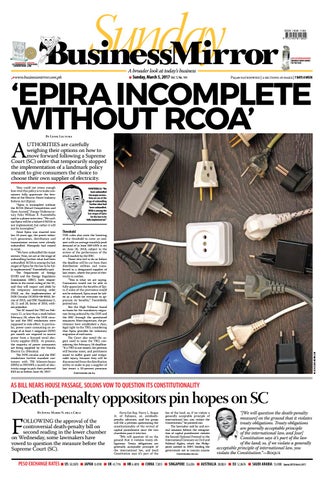
uthorities are carefully weighing their options on how to move forward following a Supreme Court (SC) order that temporarily stopped the implementation of a landmark policy meant to give consumers the choice to choose their own supplier of electricity. Fuentebella: “We have unbundled the major sectors. Now we are at the stage of unbundling further what had been unbundled. RCOA is among the last stages of Epira for the law to be fully implemented.”
Threshold
The rules also state the lowering of the threshold to cover an enduser with an average monthly peak demand of at least 500 kWh is set on June 26, 2018, subject to the review of the performance of the retail market by the ERC. Those who fail to do so before the deadline will be cut from their distribution utilities and transferred to a designated supplier of last resort, where the price of electricity is costlier. “This is what we are saying. Consumers would not be able to fully appreciate the benefits of Epira if some of the provisions would not be enforced. Epira must be taken as a whole for everyone to appreciate its benefits,” Fuentebella pointed out. But the High Tribunal found no basis for the mandatory migration being ordered by the DOE and the ERC through the questioned issuances. More important, the petitioners have established a clear, legal right to the TRO, considering that Epira provides for voluntary migration of end-users. The Court also noted the urgent need to issue the TRO, considering the February 26 deadline. “If a TRO is not issued, the petition will become moot, and petitioners stand to suffer grave and irreparable injury, because they will be disconnected from the distribution utility or make to pay a supplier of last resort a 10-percent premium
Maskarad | Dreamstime.com
They could not stress enough how vital this policy is to make consumers fully appreciate the benefits of the Electric Power Industry Reform Act (Epira). “Epira is incomplete without the RCOA [Retail Competition and Open Access],” Energy Undersecretary Felix William B. Fuentebella said in a phone interview. “We can’t say Epira will be a failure if RCOA is not implemented, but rather it will just be incomplete.” Since Epira was enacted into law 16 years ago, the power industry’s generation, distribution and transmission sectors were already unbundled. Monopoly had ceased to exist. “We have unbundled the major sectors. Now, we are at the stage of unbundling further what had been unbundled. RCOA is among the last stages of Epira for the law to be fully implemented,” Fuentebella said. The Department of Energy (DOE) and the Energy Regulatory Commission (ERC), both respondents in the recent ruling of the SC, said they will respect and abide by the temporary restraining order (TRO) on the implementation of DOE Circular DC2015-06-0010, Series of 2015, and ERC Resolutions 5, 10, 11 and 28, Series of 2016, without prejudice. The SC issued the TRO on February 21, or less than a week before February 26, when the DOE circular and the ERC resolutions were supposed to take effect. In particular, power users consuming an average of at least 1 megawatt (MW) per month are required to source power from a licensed retail electricity supplier (RES). At present, the majority of power consumers are being supplied by the Manila Electric Co. (Meralco). The DOE circular and the ERC resolutions further mandate customers with 750 kilowatt-hours (kWh) to 999 kWh a month of electricity usage to pick their preferred RES on or before June 26, 2017.
Continued on A2
AS BILL NEARS HOUSE PASSAGE, SOLONS VOW TO QUESTION ITS CONSTITUTIONALITY
Death-penalty oppositors pin hopes on SC
F
By Jovee Marie N. dela Cruz
ollowing the approval of the controversial death-penalty bill on second reading in the lower chamber on Wednesday, some lawmakers have vowed to question the measure before the Supreme Court (SC). PESO exchange rates n US 50.3070
Party-list Rep. Harry L. Roque Jr. of Kabayan, an antideathpenalty advocate, said his group will file a petition questioning the constitutionality of the revival of capital punishment once the two chambers pass it into law. “[We will question it] on the ground that it violates treaty obligations. Treaty obligations are generally acceptable principle of the international law, and [our] Constitution says it’s part of the
law of the land; so, if we violate a generally acceptable principle of international law, you violate the Constitution,” he pointed out. The lawmaker said he and several senators believe the reimposition of capital punishment violates the Second Optional Protocol to the International Covenant on Civil and Political Rights, which the Philippines ratified in 2007, binding the government not to execute anyone Continued on A2
“[We will question the death-penalty measure] on the ground that it violates treaty obligations. Treaty obligations are generally acceptable principle of the international law, and [our] Constitution says it’s part of the law of the land; so, if we violate a generally acceptable principle of international law, you violate the Constitution.”—Roque
n japan 0.4398 n UK 61.7116 n HK 6.4810 n CHINA 7.3013 n singapore 35.6206 n australia 38.0824 n EU 52.8676 n SAUDI arabia 13.4188
Source: BSP (3 March 2017 )
NewsSunday BusinessMirror
A2 Sunday, March 5, 2017
www.businessmirror.com.ph
‘Epira incomplete without RCOA’ Continued from A1
between the higher contracts and the Wholesale Electricity Spot Market,” the SC said.
Legal complexities
The TRO was sought by the Philippine Chamber of Commerce and Industry, Ateneo de Manila University (AdMU), San Beda College and Riverbanks Development Corp. “AdMU believes that our government and regulating bodies should ultimately seek to protect our basic, constitutional right to freedom of choice. And this right should extend to all electricity consumers,” AdMU President Fr. Jose Ramon Villarin said. He added: “If we are allowed to choose the best supplier for our needs in a market that is allowed to work freely and for the common good, then such a scenario will be most beneficial to all consumers concerned, especially those smaller-scale contestable customers [CCs], like schools and universities, that may have a difficult time searching for a new contract.” Still, the DOE and ERC vowed to exhaust all available legal remedies to put forward the factual and legal bases on which the promulgation of the assailed rules have been based. “Due to the legal complexities surrounding the TRO, the DOE, ERC and the Philippine Electricity Market Corp. (PEMC) are still in the process of drafting a general advisory for the guidance of the RCOA stakeholders,
without prejudice to future issuances,” the DOE said. The issues being considered by these agencies are whether applicants who have already executed retail supply contracts (RSCs) and were already registered and switched shall continue to honor their respective RSCs, and that ongoing applications for registration filed before the Central Registration Body (CRB) may proceed voluntarily. It is thoroughly being reviewed if applicants who wish to withdraw or defer their registration before the CRB may do so consistent with the Retail Market Rules, provided that the CRB shall not be liable for any legal repercussions that may arise out of the CCs’ contractual obligations; and whether remaining CCs who have not yet secured their RSCs may continue to negotiate and exercise their power to choose.
Relaxing the rules
While the DOE said it is dutybound to implement the RCOA, Energy Secretary Alfonso G. Cusi said he is personally not in favor of the mandatory implementation of the questioned issuances. “But what can I do? It’s there when I came in,” he said. Cusi also said he supports RCOA, as this policy provides consumers the freedom of choice as to which power provider they prefer to deal with, resulting in higher productivity for them. “And the power of choice can only be maximized when there is a level playing field for all suppliers,” he assured. “It is hoped that whatever the
decision by the Supreme Court, it will redound to the ultimate benefit of the consumers, which is really the intent and the spirit of RCOA.” Cusi said. He said before the TRO came out, the DOE and ERC were in the process of easing the rules for the 1-MW consumer by giving them more time to forge a supply contract. “We were thinking of relaxing it, but this [the SC TRO] came,” he said. An option being considered by the DOE after the TRO was issued is to issue a new circular aimed at easing the rules for 750-kW CCs who are mandated to contract their power supply with an RES by June 26 this year. “We may come out with a revised, amended arrangement. We can’t do anything with the February 26 deadline because it has lapsed already. I am preparing for the June deadline,” he said. The proposed revision may include the elimination of some deadlines, particularly the twomonth period before the mandated date within which a supply contract must be sealed with a RES. “Dapat kasi ’yung landscape ay clear at kaya talagang magawa in time,” Cusi said. The DOE would have to consult with the ERC on this though. Meantime, the DOE, in coordination with the ERC and PEMC, as the CRB, will continue to conduct information drive and to educate the CCs on the benefits of RCOA in order to respond to queries affecting the industry players. The DOE assures the public
that extensive consultations and coordination efforts will continue toward full implementation of the provisions of the law favoring the consumers’ power of choice.
Mixed reactions
The ERC, for its part, said the TRO would unduly burden consumers. Lawyer Rexie Digal, ERC spokesman, explained in a text message that RCOA affords the end-users the ability to choose their supplier of electricity, including the ability to negotiate for the rate that would be charged to them. The scheme, she said, starts with large customers, but is expected to reach the household at some point. “Delay in the implementation would deprive the ordinary consumers of enjoying the fruits of competition sooner. The end-users would remain as captive to their DUs [distribution utilities] for a long period of time,” she said. The Philippine Independent Power Producers Association (Pippa) also expressed concern on the SC TRO indefinitely enjoining the
implementation and enforcement of the regulations on RCOA. “The RCOA is mandated by the Electric Power Industry Reform Act of 2001, but implemented only in 2013. It aims to institutionalize competition in the supply of electricity, allowing the electricity end-users to choose their suppliers based on low price and other factors. The recent TRO issued by the Supreme Court has the effect of putting on hold aspects of the RCOA, specifically the timeline for lowering of thresholds,” it said. While Pippa supports the implementation of RCOA, it hopes that the issues before the SC would be resolved with finality at the soonest possible time. “We support the move from the DOE and ERC for a unified policy on RCOA. We hope that this will finally settle the issues and the industry will already move forward to attain the objectives of Epira,” the group of powergeneration companies said. For party-list Bayan Muna, the TRO only benefits big power distributors. “Delaying or stopping open access only works in favor of big distributors,” Bayan Muna
Chairman Neri J. Colmenares said. Consumer group CitizenWatch, meanwhile, said it was “pleased” with the SC decision. “With a deadline of February 26, consumers would have had breakout of existing contracts and scramble to find and enter into new contracts just to meet the deadline imposed by the ERC, or lose power all together. If not for the issuance of the TRO, the ERC’s mandatory policy would have forced consumers into entering contracts with qualified suppliers, even if these contracts were unfavorable or more expensive contracts,” CitizenWatch Secretary-General Paco Pangalangan said. “Furthermore, by limiting the choice of customers to a list of retail suppliers deemed qualified by the ERC and by prohibiting distribution utilities from participating in the contestable market, the DOE circular and the ERC regulations in question do not promote free competition. This will lead to higher prices of electricity, thereby affecting ordinary consumers and will be ultimately detrimental to the economy,” Pangalangan added.
Death-penalty oppositors pin hopes on SC Continued from A1
within its jurisdiction and to take all necessary measures to abolish the death penalty. “Actually, they [senators] have said they have no numbers [to pass the death penalty], but we will see, and the Philippine Constitution is our legal basis,” he added. Unlike most members of the lower chamber, he said senators are more independent in approving a measure.
Punishments
The House of Representatives is expected to approve on third and final reading the measure reviving the death penalty on March 7, and immediately transmit it to the Senate for its own deliberations. The bill is principally authored by Speaker Pantaleon D. Alvarez. Under the House Bill 4727, the seven drug offenses punishable by reclusion perpetua (life imprisonment) to death plus a fine ranging from P500,000 to P10 million are: importation of dangerous drugs and/or controlled precursors and essential chemicals; sale, trading, administration, dispensation, delivery, distribution and transportation of dangerous drugs and/or controlled precursors and essential chemicals; maintenance of a drug den, dive, or resort; manufacture of dangerous drugs and/or controlled precursors and essential chemicals; cultivation or culture of plants classified as dangerous drugs or are sources thereof; unlawful prescription of dangerous drugs; and criminal liability of a public officer or employee for misappropriation, misapplication, or failure to account for the confiscated, seized and/or surrendered dangerous drugs, plant sources of dangerous drugs, controlled precursors and essential chemicals, instruments/paraphernalia and/or laboratory equipment, including the proceeds or properties obtained from the unlawful act committed. Meanwhile, the penalty of reclusion perpetua and a fine ranging from P500,000 to P10 million shall be imposed upon any person, who, unless authorized by law, shall possess any dangerous drug. The capital punishment was last suspended in 2006 by former President Gloria Macapagal-Arroyo. President Duterte, however, has called for the passage of the measure to stop the proliferation of drugs and criminality.
Railroading
Liberal Party Rep. Edcel Lagman of Albay, a member of the legiti-
The House of Representatives is expected to approve on third and final reading the measure reviving the death penalty on March 7. AP/Bullit Marquez
mate minority bloc, said lawmakers must repent and grieve for railroading the death-penalty bill. “The irony of the unconscionable railroading on second reading of the death-penalty bill is that the very congressional leaders who insist that the death penalty is essential for people to stop breaking the law are the very ones who violate with impunity established rules and honored traditions of the House of Representatives,” Lagman said. The termination of the period of individual amendments, the lawmaker said, like the premature closure of the debates, has led to the mutation of the House into a parliament of bullies and puppets. “The arrogance of the House leaders in depriving the oppositors of the death-penalty bill of their freedom of expression and right to debate is unprecedented in the history of the House,” he said. According to Lagman, the lack of will and courage of most members of the “Supermajority” to defy the pressure and threats of the House leadership is reminiscent of the rubberstamp Batasan Pambansa during the martial-law regime. “Members of the Supermajority were hesitant to stand up and be counted on the issue of nominal voting,” he said.
‘Not scientifically rational’
PARTY-LIST Rep. Tom S. Villarin of Akbayan asked the lower chamber to reconsider and refile the death-penalty bill under the House Committee on Dangerous Drugs. Villarin, cited Section 28 (k) of the Rules of the House, which states that the Committee on Dangerous Drugs has the authority over all “matters directly and principally relating to illegal and prohibited drugs, controlled precursors and essential chemicals, the production, manufacture, use and trafficking thereof, as well as the rehabilitation and treatment of
drug dependents.” The lawmaker, also citing the Philippine Federation of Chemistry Societies (PFCS), said the bill does not define and identify what are precursor chemicals and essential chemicals. Villarin said virtually all precursor chemicals and essential chemicals are multiuse chemicals. “Precursor chemicals may also be precursors to other important products, such as pharmaceuticals, fragrances, cosmetics, agro-chemicals and others. Likewise, essential chemicals may also be essential for many other purposes, including household and health uses. The cost to the economy can be staggering. The proposed bill is not scientifically rational,” he said. “Mere possession of a precursor chemical or an essential chemical is not equivalent to possession or manufacture of dangerous drugs. The proposed bill will criminalize legitimate users, and raise the cost of goods and damage the economy. This will also provide many opportunities for corruption,” Villarin added. He said the bill equates pure substances with mixtures, saying it does not distinguish a compound that is relatively pure with its presence in an essential oil or spice at 1-percent composition, adding, “It will criminalize possession of many medicinal plants and cooking ingredients.” “This topic of precursor chemicals and essential chemicals should be discussed extensively together with experts in the field and with industry manufacturers,” Villarin added. “The chemists’ reaction only proves how scientifically void the death-penalty bill is. The least that the House leadership can do is to hear the side of these experts in the proper forum—in a hearing under the House Committee on Dangerous Drugs,” Villarin said.
The World BusinessMirror
www.businessmirror.com.ph
Sunday, March 5, 2017
A3
India pharma firms lobby to win over Trump on generic imports
I
ndia’s largest pharmaceutical firms are looking to convince US President Donald J. Trump that his promise to lower drug costs should take priority over his vow to make sure the medicines are made in America. T he Indian Phar maceutica l A l l i a nc e ( I PA ), a n i ndu s t r y group representing 20 of the nation’s largest drugmakers, is recommending India ma ke the case to US law ma kers, reg u lators and the media that the cost sav ings of cheaper impor ted d r ugs out weigh employ ment gains from producing them at home, accord ing to a repor t obtained by Bloomberg News, which was sent to an Indian gover nment body t his week. One goal for the Indian government could be to win an exemption for gener ic dr ugs under any border-ta x polic y that is enacted, the repor t said. “ T he early sig na ls from the Tr ump administration do not aug ur wel l,” the group said in a repor t sent to the Nationa l Institution for Transfor ming India, a gover nment adv isor y body, on Febr uar y 28. It recommended that the Indian industr y ma ke its case “w ithout ugly confrontation”. Trump’s varied pronouncements on the US health-care system and pharmaceutical industry represent both a threat and an opportunity for India’s $12.54 billion a year in drug exports. As one of the world ’s l a rgest e x por ters of gener ic d r u g s — w h i c h a re ge ne r a l l y about 80 percent cheaper than brand-name equivalents—the Indian industry could gain from a push to lower the cost of medicines in the US. At the same time, Trump has decried imports from low cost countries, the kind of arbitrage which constitutes India’s main competitive advantage, and advocated policies to ensure what’s consumed in the US is made there. The main threat identified in the report is a possible borderadjustment ta x being proposed by Republican law ma kers, which would ta x imports but exempt exports to shift manufacturing jobs back to the US. The report recommends India seek an exemption for generic drug imports should this idea become a reality.
Drug manufacturing
T he Nat ion a l I n st it ut ion for Tra nsfor m i ng I nd i a desc r ibes it se l f a s a t h i n k- t a n k for t he I nd i a n gover n ment , a nd de sig n s long- ter m pol ic ies a nd p r o g r a m s . A r e p r e s e nt at i v e for t he a genc y cou ld n’t i m med i ate ly be reac hed . W it h d r ug m a nu fac t u r i ng costs in India as much as 50 percent lower than in Western industr ia lized countr ies, the I nd i a n i ndu st r y now c l a i m s about 20 percent of global gener ic dr ug e x por ts. One op portunity the report identifies is to “ fill-in-the-void ” left by Trump’s drive to repeal and replace his predecessor’s healthcare law, which was designed to help people who could not afford medical insurance receive care. “We do believe this is one of the industries, which serve global needs and the government will take corrective action based on this communication,” Dilip Shah, secretary-general of the Indian Phar maceutica l A l liance said by phone, referring to potential steps India’s government could take to support the sector. In his inaugural address to Congress this week Trump reiterated his desire to reduce high drug prices and said he wants to speed up drug approval processes at the US Food & Drug Administration. Bloomberg News
Aerial photo shows a supply vessel as it moves near an oil platform. Oil slid for a third day as record-high US crude stockpiles were seen jeopardizing the Organization of the Petroleum Exporting Countries’s efforts to cut global glut. AP
Oil slips as US stockpiles set record despite cuts O il slid for a third day as record-high US crude stockpiles were seen jeopardizing the Organization of the Petroleum Exporting Countries’s (Opec) efforts to drain a global surplus.
Futures declined 0.8 percent in New York. While Saudi Arabia’s February crude shipments fell again, indicating Opec’s top producer is cutting deeper than it pledged, US stockpiles expanded by 1.5 million barrels last week. Still, Citigroup Inc. said the increase in American inventories was “muted” compared with earlier gains and may peak as refineries
restart after maintenance. As the Opec and 11 other nations reduce supply in an effort to end a three-year glut, US producers are ramping up and potentially offsetting the curbs. That has so far subdued price swings, sending the Chicago Board Options Exchange Crude Oil Volatility Index on Wednesday to the lowest since October 2014. While
refinery demand has risen with easing seasonal maintenance, it could be a week or two before processing begins increasing steadily, according to Citigroup.
7.04M
The number of barrels of crude oil a day Saudi Arabia exported in February, a drop of 126,000 barrels a day compared to the previous month
For anyone with a bearish outlook “it is probably hard to resist hitting the sell button,” said Tamas
Varga, an analyst at brokerage PVM Oil Associates Ltd. in London. “Nationwide crude oil stocks are at their highest”. West Texas Intermediate (WTI) for April delivery dropped 41 cents to $53.42 a barrel on the New York Mercantile Exchange at 9:39 a.m. in London. Futures traded between $51.22 and $54.94 in February, the tightest range since August 2003. Prices dropped 18 cents to $53.83 a barrel on Wednesday. Total volume traded was about 9 percent below the 100-day average.
Inventory gains
Brent for May settlement fell 39 cents to $55.97 a barrel on the London-based ICE Futures Europe exchange. Prices declined 15 cents to $56.36 on Wednesday. The global benchmark crude traded at a $2.12 premium to May WTI.
US oil inventories last week rose to 520.2 million, the most in weekly data going back to 1982. They have increased by more than 41 million barrels since the start of the year. Supplies at Cushing, Oklahoma, the delivery point for WTI, gained 495,000 barrels to 63.5 million last week. The nation’s crude production was 31,000 barrels higher at 9.03 million barrels a day, the Energy Information Administration reported on Wednesday. Saudi Arabia, the world’s biggest crude exporter, shipped 7.04 million barrels a day in February, a drop of 126,000 barrels a day from January, vessel-tracking data compiled by Bloomberg show. Measured against the country’s own figures, outflows are down by about 1 million barrels a day since December. Bloomberg News
Euro area inflation hits 2% as ECB debates policy stance
E
uro area inflation accelerated to the fastest pace since January 2013, providing fresh arguments to those calling for an exit from the European Central Bank ’s (ECB) monetary stimulus program. Consumer prices rose 2 percent in February from a year earlier, the European Union’s statistics agency in Luxembourg said on Thursday. That matched the median estimate of 47 analysts surveyed by Bloomberg. The rate was 1.8 percent in January. Rising oil prices have been pushing up inflation across the euro area, including in Germany, its largest economy, Spain and
Italy. Meanwhile the euro area’s core inflation, which strips out volatile elements, such as energy, was unchanged for the third consecutive month in February at 0.9 percent. The divergence between the two inf lation indicators highl ig ht s t he c h a l lenges fac i ng the ECB in choosing the right a mou nt of monet a r y st i mulus. W hile headline inf lation is moving upward in line with the central bank ’s goal of a rate below but close to 2 percent, the persistent weakness of core inf lation is a source of concern for officials, including ECB President Mario Draghi.
The euro area unemployment was unchanged at 9.6 percent in January, the lowest since May 2009, statistics agency Eurostat said in a separate release on Thursday. In the same month, producer prices in the 19-member bloc rose 0.7 percent from December when they had increased 0.8 percent.
Price surge
Back in January, Draghi pointed to a new set of criteria arguing that the return to the ECB’s inflation goal must be durable, self-sustained and representative of the euro area as whole. On that basis, the ECB may well look through the recent surge in prices
because of the energy-cost effect. The ECB’s latest projections foresee a n average inf l at ion rate of 1.3 percent this year, before accelerating to 1.5 percent in 2018. The central bank will update those forecasts on March 9 after a meeting of its Governing Council. Jens Weid ma nn beca me t he f irst pol ic y-ma ker to prov ide c lues on how muc h t he ECB may raise its inf lation forecast next week. “Inf lation this year is l i kely to be wel l in e xcess of t he f ig u re projected to d ate,” the Governing Council member sa id on Wed nesd ay in a speec h i n L j u b l j a n a , S l o v e n i a . T he
project ion for Ger ma ny cou ld be ra ised by ha l f a percent age point “a nd t h is m ight a lso be t he case for t he eu ro a rea as a whole,” he sa id. ECB’s Draghi has repeatedly said the risks to the economic outlook for the 19-nation euro area remain tilted to the downside due to external issues including the agenda of US President Donald J. Trump and the impact of Prime Minister Theresa May’s plan to take the UK out of the EU. Elections this year in euro area core member states of France, Germany and the Netherlands add to the uncertainty. Bloomberg News
A4
Sunday, March 5, 2017
The World BusinessMirror
www.businessmirror.com.ph
North Korean suspects join long tradition of holing up in embassies
In this April 28, 2016, file photo, a visitor browses a booklet at a social-network company booth that enable people to connect global clients during the 2016 Global Mobile Internet Conference (GMIC) in Beijing. Chinese officials on Thursday laid out an argument for China to play a leading role in global internet governance as they solicited international support for a new framework based on regulation and order rather than Western values of unfettered access and openness. AP
China seeks world leadership role in Internet governance
B
EIJING—Chinese officials on Thursday laid out an argument for China to play a leading role in global Internet governance as they solicited international support for a new framework based on regulation and order rather than Western values of unfettered access and openness. Speaking in Beijing, foreign ministry and cyber-space affairs officials unveiled China’s first cyber policy paper while stating that China would beef up its cyber-warfare capacities to defend against foreign threats. “Cyber attacks, cyber espionage, surveillance have become major issues conf ront ing a l l countries,” said the coordinator for the foreign ministry’s cyber affairs division, Long Zhou. China has long defended its right to impose own standards in cyber fields, such as censorship, data privacy and business regulation in the name of national security. The new policy paper effectively codified the Communist Party leadership’s c l a i m t h at cou nt r ies shou ld wield sovereign authority over all cyber-related matters within their territory. Describing the Internet as rife with subversive thought, religious
extremism, por nography, fa ke news and financial scams, Long sa id C h i n a “st a nd s ready to work together w ith par tners”, as wel l as other countr ies on new gover nance measures. BRICS is an organization of large emerging economies grouping Brazil, Russia, India, China and South Africa. China is hosting its annual summit this year as part of efforts to elevate the group’s international status. The new policy paper emerges as the countr y’s leaders have talked up Beijing’s desire to be a world
leader in economic globalization and diplomatic multilateralism, at a time with President Donald J. Trump is questioning trade agreements and pushing his own brand of American economic nationalism. China is seen as sensing an opportunity to bolster its influence and aggrandize its blend of authoritarian politics, strict social controls and limited free market economics. T he sovereig nt y arg ument has underpinned China’s justification for a massive Internet censorship apparatus that critics say hampers free speech and open trade. Chinese officials have evangelized the concept at international forums in recent years, arguing that developing countries should join Beijing in demanding a greater say over g loba l I nte r net go ve r n a nce, which is currently dominated by the United States and liberal Western thinking. Beijing’s sophisticated censorship tool, known as the “Great Firewall”, blocks numerous social-media platforms like Twitter, Facebook and YouTube, and
Every country needs to decide on the balance between freedom and order, and we have to respect how each country reaches that decision.” —Long
the government has broadened police powers to collect personal data for law enforcement. The officials on Thursday extended an invitation to the international community, saying that China, with the world’s largest online population and advanced technology, was willing to share its “wisdom, experience and resources” in governing the Internet with other countries. They said developing nations were especially welcome to study the Chinese model, but that Beijing would not impose its values on countries with different traditions, cultural and national circumstances. “Every country needs to decide on the balance between freedom and order, and we have to respect how each country reaches that decision,” Long said. The officials also warned that China’s military would continue to beef up its cyber-warfare capabilities as “an important part of military modernization”, although they said that China did not believe that an arms race was conducive to world peace. Long urged other countries to maintain mutual respect and dialogue rather than “engaging in confrontation”—in an apparent rebuttal of accusations of statebacked hacking frequently leveled at China. The US government has publicly aired its frustration with Chinese hacking in the past and has indicted five Chinese military hackers for espionage in 2014. AP
Lawyers sue Beijing execs for not getting rid of smog
B
EIJING—Lawyer Cheng Hai has an itemized list of compensation demands from Beijing authorities over the city’s smog: 65 yuan ($9) for having to buy face masks, 100 yuan ($15) for seeing a doctor for a sore throat and 9,999 yuan ($1,500) for emotional distress. Fed up with what they consider halfhearted efforts to fight air pollution, Cheng and like-minded lawyers are putting China’s legal system to the test by suing the governments of the capital and its surrounding regions. “Some people might think that air pollution is inevitable with economic development, but they are wrong,” said Cheng, 64. “We have laws to protect air quality, and major pollution can be avoided if they are fully enforced.” The lawsuits demonstrate the mounting frustration of China’s middle class at the country’s notoriously bad air, a topic that is expected to be discussed at the upcoming annual meeting of the country’s parliament three years after Premier Li Keqiang declared a “war on pollution” at the same event. The dissatisfaction comes even as authorities in the capital are closing factories, getting rid of coal-fired boilers and taking older, heavier-polluting vehicles off the road.
Official data show those measures are having some effect, with Beijing showing year-on-year improvements since 2013. Yet, the city’s average reading of the tiny particulate matter PM2.5—considered a good gauge of air pollution—is still seven times what the World Health Organization considers safe. “We are the victims of smog and we are entitled to ask for an apology and compensation from the government,” said another of the lawyers, Yu Wensheng, 50, from Beijing. The suits, which accuse authorities of failing to deal effectively with the smog, are important to show that the government is not above the law, said Yu. “If the government is not restricted by law, then what else can restrict it?” said Yu, who has spent time in detention accused of supporting Hong Kong pro-democracy protests in 2014 and for speaking up in support of detained rights lawyers. Along with Beijing, the group has attempted to sue the neighboring province of Hebei and the port city of Tianjin. The region generally suffers the worst pollution in China and forms a front line in the central government’s battle against the scourge. The lawyers say their cases are more about
drawing attention to government inaction rather than winning a settlement. China is grappling with serious pollution resulting from three decades of breakneck growth that vastly improved living standards for many, but took a disastrous toll on the environment. As people became more aware of the health issues associated with smog, the declaration of a “war on pollution” at the National People’s Congress in 2014 resulted in measures to reduce pollutants in the air, including capping coal consumption. However, a particularly heavy bout of smog at the beginning of this year still triggered pollution “red alerts” in more than 20 cities. Beijing plans to spend $2.7 billion on fighting air pollution this year, part of which would be used to close or upgrade more than 3,000 polluting factories, replace the use of coal with clean energy on the outskirts of the city and phase out 300,000 high-polluting older vehicles, according to the city’s acting mayor, Cai Qi. Despite efforts to enlist the public in the antipollution struggle, China’s authoritarian Communist government heavily discourages protests and other forms of independent action, and at least one of the initial five lawyers in the case appears to have
withdrawn his lawsuit under pressure from local authorities. The Beijing press office said the government hadn’t received any notices about the lawsuits and was unable to comment. The governments of Hebei and Tianjin didn’t respond to requests for comment. The Ministry of Environmental Protection has been sending out inspection teams to check on how well local governments are implementing smog control measures. On Monday it announced that the lists of companies that have to halt production during periods of heavy pollution drawn up by three lower-level governments under Beijing and Hebei included companies that were already no longer operating. A Beijing court has already twice rejected attempts by the lawyers to file cases, while a court in Hebei province’s capital, Shijiazhuang, has yet to respond to a case filed more than two months ago. Similar attempts to file suits in previous years have also been derailed, and while a change in the law has allowed some environmental NGOs to bring cases against polluters since 2015, they are discouraged to do so by the high costs of investigating and proving environmental damage, and potential threats and harassment from those they’re suing. AP
Ri Tong Il, former North Korean deputy ambassador to the United Nations, speaks to journalist outside the North Korean embassy in Kuala Lumpur, Malaysia, on Thursday. The North Korean envoy said a heart attack likely killed Kim Jong Nam, not VX nerve agent as a Malaysia autopsy showed. Ri told reporters on Thursday that the victim took medication for heart disease, diabetes and high blood pressure. Malaysia is scrapping visa-free entry for North Koreans traveling into the country, the state news agency said on Thursday in the latest fallout from a deadly nerve agent attack on Kim at Kuala Lumpur airport. AP
K
UALA LUMPUR, Malaysia—For years, North Korea has enjoyed the freedom for its citizens to visit, work and live in Malaysia, a rare privilege for a nation considered an outlaw by most of the world. Now that freedom is in danger, with the North Korean Embassy in a suburb of Kuala Lumpur, the Malaysian capital, at the center of a murder investigation that is upending the cozy diplomatic relationship between the two countries. Two North Korean men accused of participating in the February13 assassination of Kim Jong Nam, the half brother of North Korea’s leader, Kim Jong Un, have taken refuge in the embassy and are refusing to cooperate with the police. Their stance is presenting the Malaysian authorities with a daunting challenge as they try to crack a case with major international ramifications. One of the two men, Hyon Kwang Song, is a high-ranking embassy employee who claims diplomatic immunity and, as a result, is untouchable by the police. The other, Kim Uk Il, an employee of the state-owned airline, Air Koryo, is safe from arrest as long as he remains on the embassy grounds. South Korean intelligence officials said on Monday that Hyon worked for North Korea’s Ministry of State Security, the country’s secret police. “The embassy is considered the sovereign territory of the country concerned, so the authorities cannot enter without permission,” said Sivananthan Nithyanantham, a Malaysian lawyer who has served as counsel at the International Criminal Court in The Hague, the Netherlands. “To do so would be akin to entering foreign soil without consent and would be a serious breach of diplomatic protocol.” The Vienna Convention of 1961 gives diplomats and embassies a special protected status intended to safeguard the conduct of international affairs. But over the years there have been several high-profile cases of diplomats and citizens who have sought to use these protections to avoid prosecution for serious, nondiplomatic crimes. During a tense standoff with the United States, Gen. Manuel Antonio Noriega, the former Panamanian dictator, took refuge in the de facto Vatican embassy in Panama City in 1989 to avoid capture by US troops who had come to seize him. He was forced to leave after 10 days when the Vatican declined to give him asylum. And Dominique Strauss-Kahn, the former head of the International Monetary Fund, unsuccessfully sought to invoke diplomatic immunity to avoid a lawsuit alleging that he sexually assaulted a hotel maid in New York City in 2011. But his claim of immunity was rejected by a New York state judge because Strauss-Kahn had already left that post before the suit was filed. One of the best-known diplomatic asylum-seekers is Julian Assange, the WikiLeaks founder who has been holed up at the Ecuadorean Embassy in London for five years to avoid extradition to Sweden on accusations of rape. Although he is not a diplomat, Ecuador has granted him asylum and allowed him to stay at the embassy. Like Assange, Kim Uk Il, the North Korean airline employee, is vulnerable to arrest should he ever leave the embassy grounds—or, in his case, if relations sour to the point that Malaysia and North Korea cut diplomatic ties and the embassy closes. Intelligence services, including the Central Intelligence Agency (CIA), routinely assign agents to work in foreign embassies in the guise of diplomats, largely because of the protections of diplomatic immunity.
Governments sometimes expel these agents when espionage is uncovered. But it is rare for someone working under diplomatic cover to be linked to a murder and for a government to seek an arrest. The police say Kim Jong Nam was assassinated by two women who rubbed VX nerve agent on his face. Siti Aisyah, 25, of Indonesia, and Doan Thi Huong, 28, of Vietnam, were charged on Wednesday with his murder. They have said they thought they were participating in a harmless prank. South Korea has blamed the North Korean government for Kim’s assassination, and the Malaysian police have identified eight North Korean men, including Hyon, an embassy second secretary, and Kim Uk Il as participants in the plot. North Korea said on Wednesday that the conclusion that Kim had been killed by VX nerve agent was “the height of absurdity” because such a poison is so powerful that it would have killed more than just one person. The poisoning in the middle of Kuala Lumpur’s busy international airport has prompted some Malaysians to call for an examination of their country’s role in helping North Korea connect with the outside world—and to question whether the North should be allowed to have an embassy in Malaysia. Dennis Ignatius, a former Malaysian ambassador to several Western Hemisphere countries, called Malaysian officials “naive and gullible” in dealing with North Korea and questioned why the rogue state had ever been allowed to open its embassy in the first place. He urged the government—sometimes known by the same name as its geographic location, Putrajaya—to downgrade relations with North Korea. He suggested expelling Nor th Korea’s ambassador, revoking the visas of Nor th Koreans working in Malaysia and closing Malaysia’s embassy in Pyongyang, the North Korean capital. Malaysia has already recalled its ambassador there for consultations. “The real question is why Putrajaya has allowed North Korea to turn Malaysia into one of its most important bases of operation in the region from which to carry out clandestine activities, circumvent UN sanctions and engage in all sorts of illicit enterprises to earn hard currency for the regime,” he wrote in a blistering blog post this week. U n d e r t h e Vi e n n a Co n v e n t i o n , countries can declare a foreign diplomat “persona non grata”. Malaysia is said to be considering that designation for Hyon and his superior, Ambassador Kang Chol, who issued a strongly worded statement last week accusing Malaysia of colluding with South Korea in the Kim case. Both Malaysia and North Korea have signed to the Vienna agreement, which allows a country to waive immunity for its own diplomats. This happens only rarely. Malaysia waived immunity in the case of its military attaché, Muhammad Rizalman bin Ismail, who was arrested in New Zealand in 2014 on suspicion of sexually assaulting a young woman. He claimed diplomatic immunity and left New Zealand to avoid prosecution. But given the nature of the charges, Malaysia revoked his immunity and returned him to face trial in New Zealand, where he pleaded guilty. In another unusual case, in 1997, President Eduard A. Shevardnadze of Georgia revoked the immunity of Gueorgui Makharadze, a high-ranking diplomat at the embassy in Washington, who was then tried and convicted in the drunken-driving death of a 16-year-old girl in Maryland. New York Times News Service
Faith
Sunday
Editor: Lyn B. Resurreccion
Sunday, March 5, 2017 A5
Saint John of God, Founder of the Brothers Hospitallers By Corazon Damo-Santiago
I
n Granada, John of God heard John of Àvila. Impressed, he decided to express genuine repentance for his sins. He roamed the streets proclaiming his sins with continuous self-flagellation. He’s crazy, was the verdict, so he was sent to an asylum where he gladly submitted his body to daily scourging, the treatment for people with mental disorders.
Mystical encounters
The Catholic Encyclopedia lists mystical experiences in the life of Saint John of God. Saint Raphael, it was noted, often appears when John’s work was too heavy. W hile selling religious literature, he saw a child on the roadside in tattered clothes and barefooted, who requested that John carry him in his wheelbarrow. He lifted the child and placed him on his shoulder. He noticed that his load became so heavy. So tired, he drank on a fountain along the road and proposed to the child that they stop and rest. Coming down from his shoulder, the child was transformed into a bright light and said: “John of God, Granada shall be your cross” and disappeared. Stumbling on a beggar apparently dying, on a deserted street, he carried him on his shoulders to the hospital. While John was cleaning the gaping wounds on his feet, he saw the beggar transfigured, shining and the brightness enveloped John himself. He had difficulty assuring the sick in the room, who thought there was fire, that everything was well. In later years, while praying before a crucifix, he saw Jesus Christ, the Blessed Mother and Saint John. The Blessed Mother stepped forward with a crown of thorns, pressed it hard on his head and said, “It is by the thorns and sufferings that you must win the crown of my Son waiting for you in heaven.” John felt the thorns piercing his brain.
Life of a waif
Saint John of God was born João Duarte Cidade on March 8, 1495, in Montemor-O-Nova in Evora, Portugal. He was raised in a happy and loving family. But at the age of 8, he disappeared, showed up in Castille, a place opposite his birthplace. An outcast roaming the streets of Oropesa, he was employed as a shepherd boy. When he reached manhood, his master offered him his daughter for marriage, F. M. Rudge said in Catholic Encyclopedia. Since marriage was not in his life plan, he left. He joined the foot soldiers of Emperor Charles V against the French in Fontarabia, then in Hungary against the Turks. He became involved in “thefts, revelry and sin.” But however reckless his life was, he had a soft spot in his heart for the poor and needy. On foot, he made a pilgrimage to Saint James of Compostela, atoned for his sins and resolved to spend a life of reparation. With the joy of forgiveness in his mind, he returned to Evora, the place of his youth, and learned that his mother died of loneliness because of him, and his father entered a Franciscan monastery where he died. At 42, he resolved to live a life of atonement. He heard so much talk about the sufferings of Christian slaves among the Moors. In Gibraltar he met a Portuguese who was so destitute, that John went with him to settle in Cueta. He found work and spent his earnings helping others. A priest who worked in the settlement persuaded John to return to Spain, and he did.
A fool for Christ
He attended church rites and was impressed with the sermons of
Saint John of Àvila, a friend of Saint Teresa of Àvila. On the feast of Saint Sebastian, John Àvila sermon on being a fool for Christ inspired him how to atone for his sins. John left before the people poured out to the street. Crying for mercy, he beat himself, rolling in the mud, sitting on the pavement at the feet of people. Children followed him. Some of his neighbors who considered him queer were soon convinced he had fits of insanity. With their laughter, John played well his role as a fool for Christ, beating his chest and confessing his sins publicly. Thinking he was a lunatic, a boy carrying a bucket of dirty water poured it on John. When the crowd burst into laughter, he joined them. On another time, John’s cloak accidentally brushed against a Spanish gentleman and it fell near his feet. He received a staggering blow and another when he picked up the cloak and handed it to the Spaniard. John of Àvila, who sensed his remorse, counseled him. John of God opened a small store that sold religious objects. With the small profit, he rented a house and welcomed the poor. He cared for them, bathed and treated their ailments. Because funds were not enough, he begs, shouting, “Do yourself a good turn, ladies and gentlemen, do yourselves a good turn.” Although people laughed, they dropped coins on his can. Malcolm Day in A Treasury of Saints quoted Saint John of God’s description of his work in the saint’s journal: “So many poor people come here that I very often wonder how to care for them all...More than a hundred and 10 are now living here...Since this house is open to everyone, it receives the sick of every type and condition: the crippled, disabled, lepers, mutes, insane, paralytic, those suffering from scurvy and afflictions of old age, many children and, above all, countless pilgrims and travelers. I work here on borrowed money, a prisoner for the sake of Jesus Christ. And often my debts are so pressing that I dare not go out for the fear of being seized by my creditors. Whenever, I see so many brothers and neighbors of mine suffering beyond their strength and overwhelmed with so many ills I cannot alleviate, then I become exceedingly sorrowful, but I trust in Christ who knows my heart.”
Founder of Hospital Brothers
When people realized his generosity, the spirit of charity swept the townspeople and funds poured to help the patients. Because John exchanges his cloak with that of any beggar he meets, Don Sebastian Ramirez, bishop of Tuy, made a habit for him which was later adapted as the religious garb of the Order of Hospitallers. He named him John of God. Benefactors of the town built a hospital. Patients who were healed joined the hospital, and became the nucleus of the Order of Hospitallers, which was approved by the Holy See in 1572 as the Brothers Hospitallers of Saint John of God. After saving a drowning man, he had a terrible chill, became ill and died on March 8, 1550, his 55th birthday. Saint John of God is the precursor of the mind and spirit first before the body. The patron of hospitals, nurses, booksellers and people who are mentally ill, he was beatified on September 21, 1630, by Pope Urban VIII and canonized on October 16, 1690, by Pope Alexander VIII. n Santiago is a former regional director of the Department of Education National Capital Region. She is currently a faculty member of Mater Redemptoris Collegium in Calauan, Laguna, and Mater Redemptoris College in San Jose City, Nueva Ecija.
Students of San Felipe Neri Parochial School in Mandaluyong City have ashes rubbed on their foreheads as they attend the early Mass on Ash Wednesday. Nonie Reyes
Pope gets Ash Wednesday ashes in Rome to start Lent
R
OME—Pope Francis bowed his forehead to receive a dab of ashes, then smudged ashes in turn on the heads of other faithful during an Ash Wednesday service in an ancient Roman basilica.
Ash Wednesday begins the Catholic Church ’s annual Lenten period of ref lection in preparation for Easter. The day’s rituals include rubbing ashes on the head of faithful in a reminder of mortality. Cloaked in purple vestments, Francis clutched his pastoral staff as he walked in a procession between two churches in the fading afternoon sun on the Aventine Hill. Then Francis strode
into Saint Sabina’s Basilica, a 5th-century church that is considered among the most beautiful in Rome. Lent is a time in which many Catholic faithful strive to go on abstinence, like sweets or liquor, or do more of something, like donate to charity. In his homily, Francis suggested his own approach to Lent, which he described as “the time for saying no”.
Cardinal Jozef Tomko puts ashes on Pope Francis’s forehead, at the Basilica of Saint Sabina in Rome on March 1. Pope Francis is marking Ash Wednesday with prayer and a solemn procession between two churches on one of ancient Rome’s seven hills. L’Osservatore Romano/Pool Photo via AP
He urged the faithful to swear of f ind if ference, “ ha rsh a nd hasty criticism” of others and “simplistic analyses that fail to grasp the complexity of problems, especially the problems
of those who suffer the most.” He a lso adv ised fa it hf u l to “s ay no” to “pr ay e r t h at soothes our conscience” as well as “a l msg iv ing t hat leaves us sel f -sat isf ied ”. AP
Handicapped Center Lourdes marks 24th year A Faith-centered
s it celebrates its 24th year, the Handicapped Center Lourdes has lined up activities to highlight its services to handicapped persons. The center, based in Caritas compound in Pandacan, Manila, will participate in Pedyalympics on March 5 and in Summer Camp from April 20 to 29, both organized by Pedyakamp. The Handicapped Center Lourdes marked its 24th anniversary on February 11 during the Feast of Our Lady of Lourdes.
In an effort to fulfill its mission to love and form Christian handicapped persons, with its core values of all-inclusive love, family -oriented and -centered in God, and to care for persons with disabilities and form them in Catholic faith, the center urges them to have a personal relationship with God and to live in harmony with persons in the society by providing a standard way of living, family and education. It also helps deepen the faith of the center’s volunteers and staff to be able to strengthen them in their task even in times of problems and difficulties.
Four programs
It is with family atmosphere that the center shows its pastoral care to the handicapped, especially to the abandoned children, who are being cared of 24 hours by full-time staff, who act as their “mothers” who give them counsel, care and compassion. The center offers early intervention, treatment for high-risk babies and testing services at various ages. It also recognizes and helps improve the skills and talents of handicapped and people in need. The center offers four programs for handicapped persons and raises awareness in order to work for persons with various disabilities. The programs include providing residence for 13 multiple handicapped persons who are abandoned; day-care service for seven multiple handicapped who live with their parents; a free-of-charge physical rehabilitation for 117 people with disabilities and poor elderly; and advocacy for social awareness and action.
Founded in 1993
FR. Luke Moortgat assists a handicapped child at the Handicapped Center Lourdes.
The center, led by its Exec utive Director Fr. Luke Moortgat, CICM, PhD, is registered with the Department of Social Welfare and Development and the Securities and Exchange Commission. Father Moortgat has been working with the center for almost 24 years. People who suppor t the center’s
advoc ac y are government leaders, business communities, educators, medical professionals, students and religious men and women, and other donors. Suppor t also comes from the Asian Development Bank, Philippines Emergency Fund of Belgium and Philfonds of the Netherlands.
To provide appropriate services for the handicapped, the Handicapped Center Lourdes was founded on February 11, 1993, the feast of Our Lady of Lourdes. His Eminence Jaime Cardinal Sin directed Father Moortgat, the former chaplain for the deaf, to establish a center for multiple handicapped persons. According to Father Moortgat, the same idea came into his mind when the cardinal had conceived the plan for the foundation of the center. However, without sufficient fund, he thought to dismiss the idea. But on February 11, 1993, when he had already planned activities for the deaf, it was decided to name the place Handicapped Center Lourdes, thus, making Cardinal Sin the catalyst of the foundation of the center. Vanessa M. Puno
Science
BusinessMirror
A6 Sunday, March 5, 2017
Sunday
www.businessmirror.com.ph • Editor: Lyn Resurreccion
Govt agencies partner on technology transfer I n a landmark move, two government agencies entered into a partnership to transfer government-funded research projects that amount to P25 million. “This partnership was never done in the government sector before,” said Engr. Edgar I. Garcia, director of Technology Application and Promotion Institute (Tapi), during the inception meeting between Tapi and the Philippine Council for Agriculture, Aquatic and Natural Resources Research and Development (PCAARRD), both agencies of the Department of Science and Technology (DOST). Tapi is the patenting and licensing arm of the DOST, while PCAARRD funds the projects that are due for transfer and geared toward Fairness Opinion issuance. Under Republic Act 10055, also known as the Philippine Technology Transfer Act of 2009, any government-funded research is required to secure a Fairness Opinion from the secretary of the DOST, particularly in licensing agreements and spinoffs, before it is transferred. Two of the projects, technology assessment and intellectual-property (IP) rights protection, aimed to file at least 25 patents and utility model applications and assess 100 technologies in two years. According to Caezar Angelito E. Arceo, supervising science research specialist at Tapi and a registered patent agent, technology assessment shall be done in the areas of technical and industrial feasibility, IP potentials and market readiness of PCAARRD-funded research projects and technologies. Another project on IP and technology valuation, led by Atty. Marion Ivy D. Decena, chief of the Invention Development Division of Tapi, intends to assess the market value of at least 16 technologies in two years. Valuation is relatively new in the country and Tapi is currently building up capacity along this area, while recently outsourcing IP valuation assistance under a different project. Meanwhile, a project to assess the Freedom to Operate (FTO) of PCAARRD’s technologies was successfully proposed by Teresita O. de Vera, supervising science research specialist. The fifth project on Fairness Opinion issuance is being led by Garcia.
FTO is also a relatively unexplored area in commercializing DOST technologies, with some initially being evaluated under a separate Tapi project. Dr. Melvin B. Carlos, director of PCAARRD’s Technology Transfer and Promotion Division, and Noel A. Catibog, manager of the newly created DOST-PCAARRD Innovation and Technology Center in Los Baños, Laguna, along with Garcia, agreed and expressed optimism that after the PCAARRD-funded projects pass the Fairness Opinion Board (FOB) evaluation, proposed transactions will be prepared through these projects in order to have better chances for successful technology transfer and commercialization. This was also expressed by Dr. Reynaldo V. Ebora, PCAARRD executive director, in a previous meeting. Decena explained three of the projects for IP, FTO and valuation are important in preparing technologies for pitching and negotiation. In turn, the documents and information to be generated from these projects are needed to secure Fairness Opinion. “All of the five projects will complement Tapi’s mandated functions as patenting and licensing arm of the DOST and being the Secretariat of the FOB,“ said Decena, who is also assigned as the focal person of the five projects. Carlos and Catibog expressed high hopes that PCAARRD-funded technologies will be efficiently rolled out in the market through the five Tapi programs. The DOST-Tapi is mandated to serve as the FOB Secretariat, with Garcia as chairman, and with Decena, Arceo and Engr. Richelle D. Cahanap as members. Under the law, the FOB must be constituted within 30 days from the formal request, and Fairness Opinion must be issued within 60 days from the constitution of the FOB. A fast-tracked mechanism was recently innovated by Tapi to trim down the required 90 days to at least one to 15 days to obtain Fairness Opinion. As of this writing 20 out of 64 proposed transactions were already issued with Fairness Opinion, three of which are biofertilizers, 12 are food-processing machines and one is an agricultural machine. S&T Media Service
New York’s nuclear plant’s closing raises new worries: How and when
A
LBANY, New York—For years, many Westchester County residents and elected officials clamored for the Indian Point nuclear power plant to be shut down, citing what they said was the untenable risk it posed in an area as populated as greater New York City. But since January, when Gov. Andrew M. Cuomo announced plans for just such a shutdown, attention has turned to the devilish details. At a hearing on Tuesday, Democratic and Republican lawmakers sought reassurances from state energy officials, the plant’s owner and others that the closing would not disrupt the state’s power supply or be financially ruinous to local communities. The hearing touched on issues, such as energy reliability, lost jobs, the affect on the area’s property-tax base and how spent fuel on the site would be stored. In painstaking testimony, top energy officials led lawmakers through descriptions of evolving energy markets and technologies and the complexities of how power is delivered around the state. Mostly, officials tried to placate legislators by citing the planned four-year schedule for closing the plant, while noting that some plants around the country had closed in as little as four months. “The benefit of the agreement is that it gives us a number of years to look at a whole range of issues,” said Richard L. Kauffman, the state’s so-called energy czar. As the hearing began, Cuomo’s office announced the creation of a task force to help the village, town and school district, which rely heavily on Indian Point tax revenue, with the transition. The task force, which includes representatives of 11 state agencies and state and local elected officials, will also be responsible for ensuring that Entergy, which owns the plant, complies with the terms of a shutdown agreement it reached with state. The announcement’s timing could have been meant to blunt the criticisms of lawmakers asking questions at the hearing
and some of the witnesses, including local officials, providing testimony. In a statement, Cuomo, a Democrat, said, “The creation of this new task force will help ensure potential impacts on the local community will be minimized and that an open dialogue is maintained throughout this transition process.” Indian Point, the closest nuclear power plant to New York City, could be shut as early as April 2021 under the shutdown agreement. The agreement calls for one of Indian Point’s two reactors to permanently cease operating by April 2020; the other is to close a year later. The closing has been a chief goal for Cuomo, who had fought Entergy’s efforts for a new federal license. The plant has grappled with 40 safety and operational events and unit shutdowns in the past five years. Indian Point, which is on the Hudson River in Buchanan, New York, supplies a good deal of inexpensive power to the New York area. It can generate more than 2,000 megawatts, about one-fourth of the energy consumed in New York City and Westchester. State officials on Tuesday asserted that almost half the lost energy could be made up through efficiency programs and improved transmission. The other half, the officials said, would come from the private sector, with the state encouraging renewable, nonpolluting energy sources like wind, solar and hydropower. Last year the state unveiled a cleanenergy standard that requires half of New York’s electricity to come from renewableenergy sources by 2030. “New York has had a really good history of power plants being built in response to demand,” said Audrey Zibelman, chairman of the state’s Public Service Commission. “The markets provide the economic signal that allow investors to invest. A number of generators said if there is a scarcity of supply, they’d move in. I’m not concerned about replacement power.” New York Times News Service
Drugs WHO/Jim Holmes/IPS
New antibiotics urgently needed to combat resistant bacteria
R
OME/GENEVA—The United Nations health organization has just published its first-ever list of antibiotic-resistant “priority pathogens”—a catalogue of 12 families of bacteria that pose the greatest threat to human health. The list was drawn up in a bid to guide and promote research and development (R&D) of new antibiotics as part of the World Health Organization (WHO) efforts to address growing global resistance to antimicrobial medicines. The list highlights, in particular, the threat of gram-negative bacteria that are resistant to multiple antibiotics. These bacteria have built-in abilities to find new ways to resist treatment and can pass along genetic material that allows other bacteria to become drug-resistant, as well, the WHO reported on February 27. “This list is a new tool to ensure R&D responds to urgent public-health needs,” said Dr. Marie-Paule Kieny, WHO assistant director general for Health Systems and Innovation. “Antibiotic resistance is growing, and we are fast running out of treatment options. If we leave it to market forces alone, the new antibiotics we most urgently need are not going to be developed in time.” New resistance mechanisms a re emerg i ng a nd spread i ng globally, threatening the ability to treat common infectious diseases, resulting in prolonged il lness, disabilit y and death. Without effective antimicrobials
12 The number of families of bacteria, identified by the World Health Organization, that pose the greatest threat to human health
for prevention and treatment of infections, medical procedures— such as organ transplantation, cancer chemotherapy, diabetes management and major surgery (caesarean sections or hip replacements)—become very high risk.
Three categories according to urgency of need
The WHO list is divided into three categories according to the urgency of need for new antibiotics: critical, high and medium priority. The most critical group of all includes multidrug-resistant
bacteria that pose a particular threat in hospitals, nursing homes and among patients whose care requires devices, such as ventilators and blood catheters. They include Acinetobacter, Pseudomonas and various Enterobacteriaceae (including Klebsiella, E. coli, Serratia and Proteus). They can cause severe and often deadly infections, such as in bloodstream and pneumonia. These bacteria have become resistant to a large number of antibiotics, including carbapenem s a nd t h i rd- generat ion cephalosporins—the best available a nt ibiot ics for t reat i ng multidrug-resistant bacteria. The second and third tiers on the list—the high- and medium-priority categories—contain other increasingly drugresistant bacter ia that cause more common diseases, such as gonorrhoea and food poisoning caused by Salmonella. Tuberculosis—whose resistance to traditional treatment has been growing in recent years—was not included on the list because it is targeted by other, dedicated programs, the WHO said. “Ot her bacter ia t hat were not included, such as streptococcus A and B, and chlamydia, have low levels of resistance to existing treatments and do not currently pose a significant public hea lth threat.” The WHO explained the criteria for selecting pathogens on the list were how deadly the infections they cause are; whether their treatment requires long hospital stays; how frequently they are resistant to existing antibiotics when people in communities catch them; how easily they spread between animals,
from animals to humans, and from person to person; whether they can be prevented (e.g., through good hygiene and vaccination); how many treatment options remain; and whether new antibiotics to treat them are already in the R&D pipeline. “ Ne w a nt ibiot ic s t a r ge t i n g t h i s pr ior it y l i st of pat hogen s w i l l help to reduce deat hs d u e t o r e s i s t a nt i n f e c t i o n s a r o u n d t h e w o r l d ,” w a r n e d P rof. Eve l i n a Taccone l l i , head of t he D i v i s ion of I n fe c t iou s D i s e a s e s at t he Un i v e r s it y of T ü b i n ge n a nd a m aj or con t r i but or t o t he d e v e lo p me nt of t he l i s t . “ Wa it ing a ny longer w i l l cause f u r t her publ ichea lt h problems a nd d ra mat ica l ly impact on pat ient ca re.” The WHO elaborated a global priority list of antibiotic-resistant bacteria to guide research, discovery and development of new antibiotics.
Key facts from WHO
n Antibiotic resistance is one of the biggest threats to global health, food security and development today. n Antibiotic resistance can affect anyone, of any age, in any country. n Antibiotic resistance occurs naturally, but misuse of antibiotics in humans and animals is accelerating the process. n A growing number of infections—such as pneumonia, tuberculosis and gonorrhea—are becoming harder to treat as the antibiotics used to treat them become less effective. n Antibiotic resistance leads to longer hospital stays, higher med ic a l costs a nd i nc rea sed mortality. IPS
‘Fault Finder’ now undersecretary to handle disasters, climate change
B
randin g h i m s e l f a s “Fau lt Fi nder”, bei ng a renow ned geolog ist who studies the different fau lt systems in the countr y, Dr. Renato U. Solidum Jr. was swor n in by Science Secretar y Fortunato T. de la Peña as undersecretar y for Disaster R isk Reduction and C l i m at e C h a n ge A d apt at ion effective Febr uar y 27. S ol idu m w i l l cont i nue t o head the Philippine Institute of Volcanolog y and Seismolog y (Phivolcs) as officer in charge. Solidum brings with him years
of experience in disaster risk reduction and management, particularly in the field of geological hazards, like earthquakes and tsunamis. As Phivolcs director, Solidum initiated several projects that include the following: improved volcano-monitoring system, tsunami warning system, earthquakemonitoring system and the Rapid Earthquake Damage Assessment System, a software that can produce seismic hazard and risk maps before and immediately after an earthquake. S&T Media Service
Dr. Renato U. Solidum Jr. (right) takes his oath before Science Secretary Fortunato T. de la Peña as undersecretary for Disaster Risk Reduction and Climate Change Adaptation. S&T Media Service
Tourism&Entertainment BusinessMirror
Editor: Carla Mortel-Baricaua
Sunday, March 5, 2017 A7
Rental kites filled Clark Field’s horizon during the fest.
Hot-air balloon pilots get ready as the balloons fly one by one.
The opening kicked off with the national anthem and a skydiving exhibition where skydivers carried the Philippine flag.
Up and away: The 21st Hot Air Balloon Fiesta in retrospect O Story & photos by Gretchen Filart Dublin
ne balmy and bleak Thursday dawn, the Omni Aviation complex gates opened to throngs of spectators, all excitedly taking their spots on the grassy field. As early as 4 a.m., people lined outside the gates in anticipation of the opening of this year’s Philippine International Hotair Balloon Fiesta. The only festival of its kind in the country—and the longestrunning too, at 21 years—the hotair balloon fiesta is held annually at Clark Field, Pampanga, gathering thousands of global attendees each year. Some have come from as far as Europe to showcase their colorful balloons, but many travel from the capital and nearby provinces for a glimpse of them flying off to the horizon—which they can experience for as low as P350 (general admission). As it is every year, the opening precedes a massive four-day festival, culminating in “A Weekend of Everything That Flies.” The venue tends to get packed on weekends and the roads leading to Clark Field more trafficked than usual, this being the only opportunity for viewing hot-air balloons up close in the country. (There is a hot-air balloon in Fort Ilocandia, Ilocos Norte, that takes guests 20 feet
above ground for a few minutes, but the balloon is tethered, so the ride is rather stationary). My family and I waited for two hours before the event kicked off with the national anthem at sunrise, followed by a skydiving exhibition by Filipino pilots. Jumping off a helicopter thousands of feet above ground, the skydivers made circles in the morning sky while carrying the Philippine f lag. These adventurers are said to be so precise and skilled that they can land from over 10,000 feet on a P5 coin. The stunt was followed by a choreographed paragliding routine by world-renowned Twinz Acrobatic Paragliders Timothy and Anthony Green, who jumped off from a hotair balloon suspended 3,000 feet in the sky. The highlight of the fiesta, however, was the hot-air balloons themselves. These oldest human-carrying vehicles fly with
Hot-air balloons have an envelope pumped with heated air, thus enabling them to fly.
the help of an envelope pumped with heated air. This heat source possesses lower density than cold air that enables the balloon to fly. This year’s balloons come from 15 countries across the world. Their pilots are trained and licensed, and a few fortunate ones experienced being lifted on them. Priced at $350 per person, hot-air balloon rides afford guests an airborne journey over flatlands and lahar-covered terrain—depending on weather and wind conditions, of course. For those with less to spend, all they have to do is register for a free balloon ride for about a couple of minutes. The balloons often set off in remote locations, with the help of an off-road chase crew. People, us included, waited and watched each balloon get inflated to its full size, from dawn until the sun was scorching hot. I imagined it to be less dramatic than a flight done at sunrise or at sunset, but for a first-timer like me, it was nonetheless stunning. To see colorful balloons soar up in the sky, each of a different form—a house, a car, a soda, even Yoda—until
they become a speck, is amazing. At dusk, the balloons fly a second time in time for sunset.
Other flying activities
Now on its second decade, the Philippine International Hot-air Balloon Fiesta began in 1994, after the catastrophic eruption of Mount Pinatubo. Then-Department of Tourism (DOT) Secretary Mina Gabor spearheaded the launch of the first hot-air balloon fiesta to boost Central Luzon’s economy and revive the livelihood of affected communities. Captain Joy Roa, the first and only licensed Filipino balloon pilot, led 21 balloon pilots into what will be the “longest-running sports aviation event in Asia”. Staying true to the fiesta theme, Roa also pushed for the inclusion of other aviation disciplines. Today, fiesta highlights include diverse aerial exhibitions, such as paragliding, kite flying, ultra-light flying, skydiving, radio-controlled aircraft, gliding, balloon bursting and formation flying. At noon, gliders and micro flight pilots de-
Thousands of attendees flocked to Clark Field on the opening day of the Philippine Hot Air Balloon Fiesta 2017.
scend from the sky one by one in a spectacular display of well-coordinated routines. For a fee, guests can also do tandem paragliding and tandem skydiving alongside expert pilots. During the event, Tourism Undersecretary Kat de Castro said the government’s efforts are geared for attracting more international aviators, to help boost the contry’s tourism for the next two decades.
On-ground fun
Visitors on ground were in for a treat with diverse cultural presentations on stage, from the Angeles’s children’s choir to a local dance from Turkish nationals. After a long festival day, refreshments and grub were in order. We did not have a hard time looking for one, as The Fly Market was dotted a wild assortment of food and beverage stalls that stretched a few meters from the entrance to the end of the complex. With kiosks ranging from vendors selling P50 combo meals to popular doughnut and
DOT eyes tours of Blessed Justo sites
Undersecretary Falconi Millar was joined by Department of Tourism NCR Officer in Charge Catherine Agustin and De La Salle professor Jose Victor Torres during the ribbon-cutting ceremony of the Blessed Takayama Ukon’s photo exhibit.
T
he Department of Tourism (DOT) will launch a new travel initiative to tap into the Japan niche market following the recent beatification of a Japanese martyr who died in exile in 1615 in the Philippines. The life story of Blessed Justo Takayama Ukon has stirred a growing interest, particularly in the places he stayed in before he succumbed to illness in a Jesuit residence in Intramuros, Manila, said Tourism Secretary Wanda Corazon T. Teo. “I can’t help seeing this noble opportunity to deepen and
strengthen friendship between Filipinos and the Japanese with t h is ver y inspir ing develop ment,” said Teo, whose mother is of Japanese descent. Also referred to as “the Japanese Servant of God”, Takayama Ukon was a feudal lord who embraced Christianity, suffered persecution and chose to give up his wealth, After a monthlong sea voyage, he and his family reached Manila in 1614 but died of illness 40 days later under the care of the Jesuits in Manila. Takayama was beatified on February 7 by Cardinal Angelo Amato in behalf of Pope Francis
in Osaka, Takayama’s birthplace. Teo directed DOT Undersecretary Falconi Millar to oversee the familiarization tour program intended for Japanese tourists, who wish to pay homage to Blessed Justo in the Philippines. Millar led the opening ceremonies of the photo exhibit, while De La Salle scholar Dr. Jose Victor Torres conducted a lecture at the Manila Cathedral on the Japanese martyr’s life and historical records, organized and hosted by the DOT National Capital Region and Intramuros Administration. “Holding this photo exhibit and facilitating the familiarization tour of Intramuros and other sites, where Blessed Justo spent his last days, will be our humble way of honoring the memory of Blessed Justo,” Millar said. DOT NCR OIC Catherine Agustin added that a life-size monument of Blessed Justo Takayama Ukon can be found at the Plaza Dilao in Paco, Manila, and another one on the grounds of the University of Santo Tomas Graduate School in España, Manila.
CebGo flies to Masbate
T
ravelers will get to discover the “Rodeo Capital” of the Philippines as Cebgo, Cebu Pacific Air’s wholly owned subsidiary, launched its maiden flight to Masbate on February 15. Flight DG 6177 flies daily from Ninoy Aquino International Airport Terminal 4 at 8:20 a.m., and returns as Flight DG 6178 at
9:50 a.m., using its new ATR-72-600 aircraft. Masbate Vice Gov. Kaye Revil said the new flight is a result of the persistent requests of the Sangguniang Panlalawigan and the city government of Masbate to Cebu Pacific’s top management to provide an air transportation alternative to the province. “The provincial government has been
chicken joints, attendees did not run out of choices, whatever their budget was. T he fiesta was a hit among c h i l d r e n a n d f a m i l i e s , t o o. Families camped in tents across the food trucks, sharing homemade meals (camping is allowed until 10 p.m.). Zoocobia offered animal sightseeing in its booth, while some children played in the Oculus A rcher y or had selfies w ith sca le models of planes and helicopters spread across the field. Shops sel ling var ious souvenirs and merchandise were available on site, as wel l as renta l sta l ls for k ites, which t ra nsfor med C l a rk ’s hor i zon into a v ibrant canvass. For those who had more to spend, there’s a P6,000 VIP pass that includes priority entrance, buffet breakfast and lunch, access to balloon launch patio, airconditioned lounge and toilet, plus tea. If these are all on the roster of activities for the next fiesta, there is no doubt it will be, again, a weekend of everything flies— spirits, included. pushing local tourism, and has passed the Tourism Code to convince the airline to service the underserved route. The new flight will be a big boost to the tourism industry, especially the forthcoming Rodeo Festival, the country’s biggest cowboythemed event, this April,” she enthused. Revil also led the recent social-media campaign #CebuPacGoToMasbate to petition the carrier to fly to Masbate. “We remain firm in bringing people to g e t h e r t h ro u g h s a f e, a f f o rd a b l e, reliable and fun-filled air travel. With these additional routes, travelers will now be able to visit these destinations faster, while enjoying CEB’s trademark low fares. Rest assured, we will continue expanding our network to reach more passengers in and out the Philippines,” Cebgo President and Chief Executive Alexander Lao said. He noted that the social-media campaign greatly helped CebGo management in deciding to enter the Masbate sector. Composed of three major islands, the province is known for its cattle ranches, awesome rock formations, breathtaking viewpoints, pristine white-sand beaches and sandbars, Spanish-era churches and ancestral houses and marine sanctuaries. In photo at the inaugural flight ceremonies are Department of Tourism Regional Director Maria Ravanilla, Masbate City Mayor Rowena Tuazon, Lao and Revil.
A8 Sunday, March 5, 2017
Sports BusinessMirror
Editor: Jun Lomibao | mirror_sports@yahoo.com.ph
‘GOLF VENUE MUST BE NONDISCRIMINATORY’ The issue surfaced in mid-January when Tokyo Gov. Yuriko Koike urged Kasumigaseki to admit women as full members. Following that, the International Olympic Committee inquired about the club’s membership practice.
T
By Jim Armstrong The Associated Press
OKYO—The club that is set to host the 2020 Olympic golf tournament must change its policy of excluding women as full members or the event will go elsewhere, International Olympic Committee (IOC) Vice President John Coates said on Thursday. Coates, in Tokyo for a two-day coordination commission meeting, said some progress has been made on the issue but that the IOC can only wait so long. “At some point there has to be a cut off,” Coates said. “Image wise, our position is clear. We will only go to a club that has nondiscrimination.” Kasumigaseki Country Club board members met last month to discuss the issue but so far have failed to make a decision about changing their policy. The issue surfaced in mid-January when Tokyo Gov. Yuriko Koike urged Kasumigaseki to admit women as full members. Following that, the IOC inquired about the club’s membership practice. “It’s possible to go elsewhere but I think this is going to work,” Coates said. “It’s heading in the right direction for them to have a nondiscriminatory membership procedure. It would appear that we would have this result by the end of June.” Founded in 1929 as a private club funded by about 300 wealthy men, Kasumigaseki is one of the oldest and most prestigious clubs in the country and has hosted more top level tournaments than any other Japanese course. To join Kasumigaseki, an applicant needs to obtain a reference from a current member and pay ¥8 million ($70,800) to become a regular member first, then pay additional ¥4 million ($35,400) to be a full member.
The club does not allow women to become full members or play on Sundays. The bronze medalist in women’s modern pentathlon at the 2008 Beijing Olympics, meanwhile, has been disqualified for doping. The IOC said Viktoriya Tereshchuk of Ukraine tested positive for the anabolic steroid turinabol in retests of a urine sample given at the time. The 35-year-old Tereshchuk, the 2011 world champion, loses her medal and faces being banned by modern pentathlon’s governing body. The fourth-place finisher in Beijing, Anastasiya Samusevich of Belarus, could get the bronze medal. The IOC has found more than 100 positive doping tests in a reanalysis of samples from the 2008 Beijing Olympics and 2012 London Olympics. Tereshchuk is the fourth Ukrainian medalist from Beijing to be disqualified in the retests, and the first modern pentathlon athlete. Budapest’s assembly approved a motion on Wednesday to withdraw the city’s bid for the 2024 Olympics. The decision leaves Los Angeles and Paris as the only remaining candidates. The IOC will choose the host city
in September. Budapest’s decision to withdraw came after a new political group appeared to have successfully gathered enough signatures to force a city-wide referendum on the bid. Prime Minister Viktor Orban’s government said the change of heart by opposition politicians who earlier supported the bid had shattered consensus on the issue. The withdrawal of the bid was decided with
22 votes in favor and six against, with support coming mostly from councilors from Orban’s governing Fidesz party. “Everything that is going on is no longer about sports,” Mayor Istvan Tarlos said during a heated debate at the extraordinary session of the assembly. “The saddest thing...is what kind of image the country is creating itself abroad with this circus surrounding the Olympics.” The opposition said the city government was letting down voters by preventing them from expressing their opinions about the bid. “If over a quarter of a million Budapest citizens have determined that they want to decide in a referendum about the Olympics, it is only right if we give them this opportunity,” said Antal Csardi of the Politics Can Be Different party. The Momentum Movement, a new political association, gathered more than 266,000 signatures in 30 days in favor of holding a vote. Some of the other opposition parties helped collect the signatures, far more than the 138,000 minimum needed.
‘LUCKY’ TO BE DRAWN IN POOL A
T
HE Philippines was drawn in Pool A of the 19th Asian Volleyball Confederation (AVC) Asian Senior Women’s Volleyball Championship, a group Head Coach Francis Vicente described as manageable for the national women’s team. The Philippines was drawn with Kazakhstan and Hong Kong in Pool A of the tournament the country is hosting from August 9 to 17. “We’re lucky to be in Pool A,” said Vicente, who is putting together a 20-member pool, from which he will pick the members of the national team for the tournament. Defending champion China is in Pool B along with Japan and Australia. Runner-up Korea is in Pool C with Vietnam, Sri
Lanka and New Zealand, while Pool D is composed of thirdplacer Thailand, Chinese Taipei, Iran and Maldives. After the Asian Seniors Women’s Volleyball Championship, the national women’s team will fly to Kuala Lumpur to compete in the 29th Southeast Asian Games. Philippine Superliga Grand Prix champion Foton, meanwhile, will represent the country in the AVC Asian Club Women’s Championship set from May 23 to 31 in UstKamenogorsk, Kazakhstan. Foton finished sixth in last year’s tournament the country hosted at the Alonte Sports Arena in Biñan, Laguna. Lance Agcaoili
Volcanoes, Globe seal partnership
T
HE men’s national 7s rugby team, more popularly known as the Volcanoes, recently signed a four-year sponsorship deal with Globe Telecom, a partnership that lasts through to 2020 with a vision of the national team being at their peak for the Tokyo 2020 Olympic Qualifications. “Over the next four years, Philippine rugby has identified key events leading into 2020. Globe has actually had an interest in rugby as far back as 2010, so we are excited to be renewing ties with one of the Philippines’s most iconic brands. The renewal allows our national team to step up the professionalism and boost our chances of performing well in key events each year”, national team Head Jake Letts said. This year the Volcanoes are aiming to repeat their gold medal-winning performance from the Singapore 2015 Southeast Asian (SEA) Games in the Malaysia Games in August, while also setting their sights on a podium finish at the Asian Games in 2018. The Philippines finished a respectable fifth place in the Incheon 2014 Asian Games. “I believe with the right roster and valuable time playing together, we can reach that podium in 2018”, Letts said. For 2019, the national team will have additional
motivation for a gold medal when the SEA Games are hosted by the Philippines. “With the Philippines hosting the SEA Games in 2019, we believe sport, in general, will be huge in the country. We look forward to showing why Rugby is such a rapidly growing sport and of course playing in front of our supporters,” Letts said. “The SEA Games in 2019 will be a spectacle and we want rugby 7s to be leading the way” With the support of Globe Telecom, the investment will focus on professionalizing the national rugby 7s program in the Philippines. This will allow the Volcanoes to be even more competitive with the top level teams in Asia. A four-year strategic plan leading into the 2020 Olympic Qualifications puts Philippine rugby at the forefront. The road to 2020 kicks off this weekend in Doha as the Volcanoes compete in the 2017 Asia Trophy Series. The Volcanoes must finish in first place to qualify for the 2017 Asian Sevens Series. The Asian Sevens Series is a three-leg tournament to be played in Hong Kong, Korea and Sri Lanka across September and October this year. The team will be coached by former New Zealand All Black Frano Botica and David Johnston.
PRACTICE MATCH
Bangladeshi batsman Mominul Haque (left) and Tamim Iqbal run between wickets during their practice match with Sri Lanka Cricket President’s IX in Moratuwa on the outskirts of Colombo recently. AP
BATTLE OF THE WINLESS E
GLOBE CEO Ernest L. Cu (third from left) and President Rick Santos (fourth from left) pose with (from left) Volcanoes Strength and Conditioning Coach Chris Everingham, Treasurer and Board Trustee William Bailey and Head Jake Letts after the signing ceremony recently at the Globe Tower.
XPECT University of the East (UE) and Adamson University to go all out to get the “No. 1” printed across their spots in the standings, as the winless teams take the court today at the close of the first round of eliminations of Season 79 University Athletic Association of the Philippines (UAAP) women’s volleyball action at the SM Mall of Asia Arena in Pasay City. And the atmosphere could match that of a championship showdown when the Lady Warriors and Lady Falcons, both groping for form, clash at 2 p.m. National University (NU) and University of the Philippines (UP), squads that saw their hot starts suddenly turning cold, face each other at 4 p.m. The Lady Bulldogs and Lady Maroons were the erstwhile leaders—with UP notching an unfamiliar 4-0 start—only to lose steam as the season
progressed. UP already lost twice in a row for a 4-2 card and NU was beaten in two consecutive matches to go down to 3-3. UE Lady Warriors, meanwhile, seek to stop the slump before entering the first round and try to repeat what they did last season in beating Adamson, where they pulled off one big win that ended their 58-game losing streak. Despite going winless, Lady Warriors Shaya Adorador, Roselle Baliton, Judith Abil and Kath Arado have been showing vast-improvement and have been putting up gallant stands against the title contenders. And that worries the Lady Falcons. “We both haven’t won a game, but they are still a strong competitor,” Adamson University Head Coach Airess Padda said. “I’ve been watching them, they are tall.
They can slow down a lot of the balls coming from the other teams with great hitters. They are tough competitor just like everyone else.” The American coach couldn’t hide her frustration with her young Lady Falcons, who have not been giving veteran skipper Jema Galanza adequate support. “We really encourage the girls not to take the next match lightly because we’re not experienced enough, we’re not strong enough and our will to win is not strong,” Padda said. It’s a similar situation in the men’s competition for UE and Adamson University, which hope to get that elusive victory No. 1 at 8 a.m. NU (5-1) tries to close the first phase of the eliminations also in the men’s contest with a solid grip of second place when it meets UP (3-3) at 10 a.m.
RegionsSunday BusinessMirror
Editor: Efleda P. Campos
Sunday, March 5, 2017
A9
Pampanga town promotes historical structures By Joey Pavia | Correspondent
M
Photos by Leo Villacarlos
AGALANG, Pampanga—This town’s first woman mayor is investing to promote the city’s old structures, including two military communications towers constructed by Spanish soldiers in the late-19th century.
The San Bartolome Parish Church
Mayor Maria Lourdes Paras Lacson said: “We must find other means of income for our people. One is to promote tourism activities in our town. We have very interesting old structures here.” Lacson said they are planning to “beautify Magalang and promote its centuries-old structures, such as the municipal hall, San Bartolome Parish Church and two heliographic towers.” Last year the National Historical Commission of the Philippines (NHCP) declared all these structures as Important Cultural Properties (ICP). The municipal hall was reportedly constructed in the late-19th century. The parish church was constructed beginning 1866, according to a book written by Louie Aldrin Bartolo. Ryan Miranda, Maglang tourism officer, said they want the torre heliografico (heliographic towers) be declared as National Cultural Treasure (NCT), “especially this one in Barangay Santa Cruz, because it’s still very much intact and preserved.” The other is at the property of Caryana Monastery in Barangay San Isidro. Miranda said there will a “bigger ceremony” when they publicly declare the heliographic towers as ICP to begin their call for the two towers to be named as NCT. Joel Pabustan Mallari of the
Katipunan ding Talasaliksik at Talaturung Kapampangan (Katatagan Inc.) said there were more 10 heliographic towers constructed in Magalang and nearby Mabalacat and Concepcion town in Tarlac. In his study, Mallari said: In a letter to the Comandancia General del Centro de Luzon dated May 8, 1898, Ricardo Monet, who was then serving as the Commandant of War at that time, informs the commandancy about the complete destruction of activities of the detachment of Camansi located at Mount Arayat, transforming it into a blok-haus (blockhouse) constructed at Magalang of this province. Among the details he mentioned are the presence of torre heliografico, strategically located in the 10 towns of Magalang and Concepcion. They were constructed to serve as stations (estaciones) of communication, having an approximate height of 20 meters and made under the charge of the Engineering Corps. “A rc h a e olo g ic a l l y, e x t a nt towers of this type can still be found in Magalang and are made unique to each other—made of fine construction materials, such as fine laryu (red bricks) and huge cut stones of pumiceous rocks and volcanic tuff.” Mallari said a thorough study of these towers is being done by Dr. Lino Dizon of Tarlac State Univer-
The heliographic tower in Barangay Santa Cruz, Magalang, Pampanga
The Magalang Municipal Hall constructed in the late-19th century
Ryan Miranda, Magalang tourism officer, during the interview.
sity. General Monet’s 1898 letter of information came from the Instituto de Historia y Cultura MilitarEspaña (IHCME) through Dizon’s archival initiatives. Basing on the stories of townfolk, Dizon said, “There were around three to four more of these towers dispersed in various parts of the town. People thought they were im-
Magalang Mayor Malu Paras Lacson at the stairs of the municipal hall
burnal (smoke outlets) for cabiaoan, the trapiche or early carabao-driven sugar mills.” Later on, several ethnohistorical and archeological surveys took place together with Mallari. Dizon said a heliograph, which in Greek literally means “sun writer”, is a mirrored communications device for sending messages in Morse code
Inside the church
The heliographic tower at the Caryana Monastery in Barangay San Isidro
by flashing the reflected sun’s rays to a distant station. Mallari said an 1896 description is very apt: “An instrument called the heliograph, or sun telegraph, constructed with sma l l m ir rors made to t u r n upon both a horizontal and vertical axis, mounted upon a tripod, so arranged as to make the
flashes appear and disappear in rapid succession, is to a limited extent in use in the army; and by it, messages may be transmitted much faster than with flags or torches, and it can be used at longer ranges. It is manipulated by a key similar to the electric telegraph instrument. Mirror signaling was first used by the North American Indians.”
RegionsSunday
A10 Sunday, March 5, 2017 • www.businessmirror.com.ph
BusinessMirror
Buckets of love at ‘Munggo Capital of Philippines’
I
Story and photos by Leonardo Perante II
T all started eight years ago during the term of then-San Mateo (Isabela) Mayor Roberto Agcaoili (now vice mayor) with his Adopt a Home Program designed to rehabilitate existing, but dilapidated, houses of indigent residents.
MAYOR Crispina Agcaoili and Vice Mayor Roberto Agcaoili pay a surprise visit to a motorcycle repair-training site being conducted by the Technical Education and Skills Development Authority and the Department Labor and Employment at the Municipal Livelihood Training Center.
VILLAGERS, including children, pose with local officials of San Mateo after they are given their respective housing materials.
A LOCAL mason paves the floor of a house in San Manuel village, San Mateo, Isabela.
A woman villager in Barangay Bella Luz, San Mateo, Isabela, tries a jetmatic pump installed through “Kaposo Mo, Sagot Ko” (a communal potable-water source project).
SAN MATEO, Isabela, Mayor Crispina Agcaoili and husband Vice Mayor Roberto Agcaoili prepare 10,000 buckets of goodies to be given away to their constituents in 33 villages of their town.
“The flooring of their bamboo huts were not paved nor concreted that, when it rains, the dusty soil interior becomes muddy,” recalled Vice Mayor Agcaoili. It is for these appalling reasons the local government of San Mateo tapped the support of the Rotary Club of San Mateo Balatong and six government agencies in providing socialized housing to the impoverished families. At the incumbency of Mayor Crispina Agcaoili, homeowners who are beneficiaries of the “Bahay mo, Ayusin ko” program were identified by the local government. “Likewise, the local government has tied up with other charitable organizations, like the Junior Chamber of Commerce and the Inner Wheel Club, in rendering socioeconomic services to the marginalized sector in our community,” the lady mayor said. At present, the local government has verified and listed more than 1,000 program beneficiaries being among the “poorest of the poor” covering but a single purok in all of the 33 villages. Manpower for the project is carried out in bayanihan way, where masonry and carpentry labor cost is generally paid for by the LGU, while beneficiaries of the program help in the construction to augment the core group of paid workers. “We estimated around P20,000 to P25,000 would cost us to rehabilitate a housing unit’s f looring, walls and roofing. This includes the cost for galvanized sheets, bags of cement, lumber, iron bars and plywood,” Mayor Agcaoili said. With the support of the Department of Health, the program includes the water system, toilet bowls and comfort rooms. “To stay healthy, they need a private and sanitary place to wash,” said the lady mayor who is a medical doctor by profession. This mode of socialized housing does not need to relocate and resettle the dwellers. They are kept in their very own houses where they are near the school, church, health centers and their respective place of work, as well. “ T he house shou ld be c l im ate c h a nge -resi l ient t h at when t y phoons come, t hey a re resist a nt enough to pro tect t he residents a nd in t h is ma nner, we, too, ca n preempt nat u ra l d isasters t hat may h it our tow n,” the v ice mayor said. Another package that goes with the program is food sufficiency. The locals are trained to plant “Bahay Kubo” vegetables right at their backyard with the assistance of the Department of Agriculture.
A FARMER in Barangay Marasat Pequeño, San Mateo, Isabela, proudly displays his cucumber harvest.
A HORTICULTURE technician shows the lowland strawberries experimentally grown in the San Mateo Techno Farm.
“Our poor constituents can have fresh vegetables any time. They do not need to go to the market to have food on their tables. In this way, they do not starve or get hungry,” the mayor said. The locals are trained to plant in-bred vegetables and produce seeds to be propagated since they are already acclimatized under San Mateo condition. To keep environment-friendly farming, farmers are trained by both by the DA and the Department of Environment and Natura l Resources on ver miculture processing to produce organic fertilizer.
The San Mateo Techno Farm at Marasat Pequeño serves as a demonstration farm and training ground for farmers and students where high-value crops are grown. Munggo (mung beans) remains a versatile crop of the town said to be the Munggo Capital of the Philippines. The Technical Education and Skills Development Authority trains residents, whether male or female, on varieties of skills training that suit them. “Like the Motor-repair Training, tricycle drivers undergo mechanical troubleshooting and their harnessed talents could
possibly land them a job here or abroad,” the vice mayor said. For homeless local or national employees, the local government targets the abandoned cadastral roads to set up socialized housing for them. As a symbolic gesture on Valentine’s Day, recipients of the “Bahay Mo, Ayusin Ko” were given a bucket of goodies each. A mass wedding was administered by the town’s chief executive for free. “With all of these social responsibilities extended to our constituents, may we say ‘Buhay Mo, Ayusin Ko!” the mayor and vice mayor said in cheers.
RegionsSunday BusinessMirror
Editor: Efleda P. Campos • Sunday, March 5, 2017 A11
Panagbenga: A festival true to its name By Marilou Guieb | Correspondent
I
Photos by Mau Victa
T’S that time of year again when the mercury dips to its lowest in Baguio City, but the festive fever rises to bursting point with the celebration of the hottest tourism event—the Panagbenga, or flower festival. Panagbenga, in many northern dialects, suggests a blossoming, and, indeed, the weekend highlights of the festival’s street dancing and the Grand Float Parade saw the blossoming of many wondrous flower-inspired creations. It’s the 22nd year the event is brought to life, and while many cynics have questioned the sense of such an activity in between every festival, the sidewalks spill over with spectators year after year, just as dazzled with the wild twirling or the graceful passing of colors from the coolest hues of water to the most vivid tones of fire captured in fantasy floral creations. And so again they came to pass—many with a story to tell, several with their products deciphered with flowers, others in celebration of anniversaries or carrying an advocacy—but all with something to advertise—perhaps a cause or a company. Even when it first appeared on the street, the long trailing f loat of North Luzon Expressway of the Manila North Tollways Corp., it was easy to guess it would emerge as grand winner in the big f loats category. If anything, it best por trayed t his year’s Panagbenga theme, “Inspired by Beauty, Nurtured by Nature. Made of hundreds of thousands of blossoms, the f loat named Beauty of the Wilderness, took its main business of road travel far into the wild—as its promotional ad said, to trek new trails, surrounded by fresh foliage and learn about the cr itters that complete the circle of life. An impressive life-size white stallion adorned the f loat one can be fooled its not made out of white mums, and the centerpiece was a peacock with the full splendor of its fan-shaped tail meticulously formed with petals and blooms in the f lirty colors of the peacock ’s pride. The giraffe with its long neck hovering above
the wild jungle of dainty f lower touches was made of everlasting f lowers and spots of yellow mums. Amusingly, an elephant of green mums had f luffy eyelashes of white petals. Sitel’s coming in second was truly a fancy design of a float that mixed nature with forest elementals and the indicators of a pristine environment, like dragonflies and butterflies. A curious watchtower of brown and maroon blossoms stood at the center of the stage facing an ivory face of white flowers. The story goes that the tower depicts stewards of nature watching over Mother Nature. Gnomes had tufts of dyed tiger grass and were created to pay tribute to the industrious employees, as gnomes are known for being hardworking creatures. Coming in third was the float of the Department of Tourism carrying images of the Cordillera. Unlike other floats made of plucked flowers, this float used 40-percent potted plants and ornamentals. Tourism Regional Director Marie Venus, riding the float, has long advocated the use of potted plants that can afterward be donated to schools to be nurtured instead of the millions of petals that go to waste after the parade. The f loat was to promote tourism’s major thrust, Rev-Bloom, which means the revitializing and reblooming of Bag u io t hrough community participation. The crouching tiger of Maybank Philippines atop a yellow beetle Volkswagen bagged the grand prize among the 10 entries in the small-floats category. So realistically was the figure of the tiger formed it was easy to imagine with its flexed muscles that it would be leaping out from the Volks’ roof anytime in chase of some prey. Its brown stripes were made from palay glued to the chrome yellow papier mâché figure. The Volks was of happy
yellow mums with yellow sidings and bumpers of white flowers. Maybank was one of the companies that joined in celebration of its 20th year in the Philippines. Tiger is its brand logo signifying strength and aggressiveness and as the fourth-largest bank in Southeast Asia, the emerging tiger economy. The Volks spoke of the bank’s 15 years in the auto loans business. In its signature color, Coca-Cola came second, streaming through the streets in flashy red roses shaped into waves with white mums forming the crest—the undulating shape also to stir the bubbly feeling that is the Coke itself when poured into a glass to drink. Asus brought its Zenfone to the caravan in a variety of colored mums and took the third prize.
Filmmaker K id lat Tahimik and the city’s iconic artist once wondered if the celebrity clamor so in character of Pinoy crowds does not actually steal away the appreciation from the floral art that glide before their eyes. And true to his words, all the squeals and cheers and attention begging of the crowd for the stars to look their way certainly leave no room to look at the flowers. Warring stations GMA and ABS-CBN had announced the stars to ride their floats way before the festival, and a thrilled crowd whispered about their excitement even before the parade started. Some came as a surprise to make hearts beat faster for the adulating spectators and in the long stretches of the mainroads, the reverberating cheers warn the
expectant crowd down the line that the next float coming carries a star. One such surprise was the float of the Taloy Norte Farmers of four cooperatives and from afar one sees the name Carrotman boldly lettered in yellow mini chrysanthemums. And it was, indeed, Jeyrick Sigmaton in the flesh that swept the crowd in pleasant surprise— unlike last year’s expectations when Carrotman turned out to be a meme as a joke in a f loat filled with carrots and veggies promoting a farmer’s group. It is the story behind Sigmaton’s fame that has endeared him worldwide, especially to Cordillerans here and those spread around the world. The diaspora of Cordillerans globally seeing in Sigmaton the pride of their ethnicity. If anything says that Sigmaton is
still on the rise it is the echoing sound of cheers, like the fading roar of lions long after his float has passed. Sigmaton was a farm hand and once a tourist took photos of him carrying a basketful of carrots and posted it on the Internet, calling him the most handsome man on earth. They did not know his name and just dubbed him Carrotman. He became an overnight sensation without his knowing. And there’s the rest of the story. T he f loats of t he r iva l ing television networks were not as ornate nor sensational but the stars glittered br ighter than f lowers for the cheering crowd. ABS-CBN stars Bea Alonzo and Enchong Dee alighted from their f loat to mingle with the crowd clamoring for selfies. GMA 7 love-team sensation AlDub not to be beaten had Alden Richards throwing f lowers to his fans whenever their f loat stopped. A favorite float was MLhuiller, where Jericho Rosales stood beside his royal carriage of everlasting flowers pulled by a white horse of mums with a green mane of ferns. He took as many photos of the crowd as fans clambered to the side of the carriage for selfies. When it was over, the Session Road in Bloom opened the next day for a week of gourmet treats and stalls with products from different towns on sale. Atop the road is the quiet art installation of Kidlat Tahimik, a traditional art rendition every year, this time of a giant rooster made of wire mesh and ferns and surrounded by Ifugao woodcarvings, an installation of silent creativity standing like a guardian towering over the vibrant commerce ongoing on the main throughfare. The festival has its own pace and rhythm now, it being the 22nd celebration. L i k e a n o l d f l a m b o u y a nt friend, Panagbenga comes like an ex pected guest in the city even if it is its ver y ow n, stirring a lot of f lurr y and chaos, certainly stirring irritants like t ra f f ic a nd ga rbage a nd t he ripples of what one may call diplomatic internal squabbles. But in the end the city’s people shrug their shoulders on the downsides and say, well, that was fun, too, for there is no arguing the fleeting floats of beauty and the sparkling costumes in the street dance make for a good break from the doldrums of daily struggles of keeping apace life’s hurried ways.
RegionsSunday
A12 Sunday, March 5, 2017 • Editor: Efleda P. Campos
BusinessMirror
www.businessmirror.com.ph
People smile at the sun in Suluan, Eastern Samar
S
Story and photos by Elmer V. Recuerdo | Correspondent
ULUAN ISLAND, Eastern Samar—The weather is unpredictable. The clear blue sky does not guarantee a whole day of sunshine just as the thick clouds in heaven do not tell a long rainfall. But while many frown on the scorching heat of the sun, here in this island, the sun always brings a smile to its hundreds of residents. A sunny day means it is time for the residents to bring out their solar panels and get ready with their mobile phones and other electronic gadgets that need to be charged. “The sun is very important to us because this is where we get the electricity needs of the community,” said Anecito Loyola, a village official and a trained solar scholar. A solar scholar is a community leader who underwent training on the basics of solar technology and how it can be applied, especially in off-grid communities, conducted by the non-governmental Institute on Climate and Sustainable Cities (ICSC). When the government doled out P30,000 emergency shelter assistance for families whose houses were totally destroyed by Supertyphoon Haiyan (local code name Yolanda), Loyola immediately invested this on a solar-home system and bought a solar panel, a battery and a power controller—all for P10,000. His investment can now afford him to watch satellite television and sing on a karaoke while having at least four bulbs running at the same time. “At night, this is very much needed by the
students in their studies,” he said. Loyola also gets the advantage in business, as his sari-sari store remains open at night while other stores have already closed. ICSC, in partnership with the United Kingdombased charity Christian Aid and the local women’s organization Sulong Suluan, recently distributed the 49 Niwa solar-home systems. Each came with three 300-lumen LED lamps, a 9-inch table fan, a solar panel and a battery. The solar-home system is not only capable of lighting three LED lamps for 12 hours but can also be used to run a table fan and charge mobile phones. Charging of mobile phones is advised, though, to be done during the day, when there is ample sunlight, and not at nighttime, when the stored power can be put in better use for lighting. Suluan Island is the country’s easternmost island and the southernmost village of the three provinces that comprise Samar Island. The island is about 30 kilometers from its town center, the municipality of Guiuan, Eastern Samar, which is also the southernmost town of mainland Samar. When the sea is calm during Habagat, the island can be reached after a three-hour ride on a motorized fishing boat. But when the water is rough, which happens more often than not, travel time is
between four to five hours. A boat leaves Guiuan at noon, the only passenger trip in a day, and travels back to the town center early morning of the following day. First-time visitors to the island will not miss the tall electric posts put up last year by the Eastern Samar Electric Cooperative (Esamelco), whose concession extends to off-grid barangays of Eastern Samar, like Suluan. Residents said there was electricity on the island using a diesel-run generator before the whole system was destroyed and posts toppled down by Yolanda. But the new posts are there just waiting for an electric source to distribute to households. The National Power Corp. (Napocor) and Esamelco conducted a consultation in the barangay last year for an electrification project under the Small Power Utilities Group (SPUG) before the electric posts were put up. However, nothing has been heard from them since then. “We were told that it will operate this year but I doubt if it will happen,” Barangay Councilor Lesario Badar Jr. said. He said the neighboring Homonhon Island, which is composed of four barangays and with a much larger population, remains without electricity even when their electric posts were put up much earlier than in Suluan Island. “Definitely, SPUG project in Homonhon will come first before
us.” SPUG is one of the functional groups of Napocor mandated to perform missionary electrification function and responsible for providing power generation and its associated power-delivery systems in areas not connected to the main transmission system, such as Suluan Island. This mandate is based on Republic Act 9136, otherwise known as the Electric Power Industry Reform Act of 2001, or the Epira law. The missionary-electrification function is funded from revenues derived through sales of electricity in missionary areas and from the Universal Charge for Missionary Electrification (UCME) collected from all electricity end-users as determined by the Energy Regulatory Commission (ERC). But Suluan residents are not too ecstatic about the prospects of another diesel generator to serve the energy needs of the households. Previous experience with the generator isn’t enticing with several instances of engine malfunction that left houses without electricity for a number of days. There were also days when all sea travels were not allowed and fuel to run the generators could not be brought in time. Adding reason for their anxiety is the spiraling cost of fuel due to increasing gasoline cost in the world market and the weakening of the peso in recent months.
“Solar is more important than SPUG because you don’t have to pay a monthly fee,” said Badar, referring to solar-home systems that many households are now using. He added it will be more beneficial for the residents of Suluan if SPUG will put up more solar panels to energize the whole island. He said many residents may be reluctant to pay the high cost of energy the power utility may provide, especially that most of the households already have solar panels and are getting their electricity for free. This will impact the viability of SPUG project in maintaining its operation. Despite its relatively small population, Suluan Island has an increasing demand for electricity not only to run domestic appliances but also for the school and cold storage for the abundant fish that locals catch every day. Some great improvements have been made on its integrated school—the once makeshift classrooms are now made of typhoon-resistant school buildings courtesy of international humanitarian groups. All the classrooms are complete with fluorescent lights and electric fun, amenities that have never been used due to absence of electricity in the school. Some parents of the schoolchildren would laughingly narrate how the school is forced to run its generator set just to print a school report.
Considered the biggest suppliers of fish and other seafood in Eastern Visayas, fishermen of Suluan are also in dire need of a cold storage to avoid spoilage of their catch. The women’s organization Sulong Suluan, with the assistance of ICSI, is already planning to put up a store complete with a solar freezer, where they will store products from their meat-processing livelihood program. Arturo Tahup, project coordinator of ICSC’s RECharge Pilipinas, said the potential of the island is huge that it cannot be addressed by family-owned generator sets and even by a SPUG project. Many island barangays in Samar on SPUG have generators running only from 6 p.m. until midnight while many of the energy needs happen during the day like in school, barangay hall and church. Tahup said one viable option is to create a micro-grid, like a mini-solar farm, in the island that will also make use of the electric posts that were recently put up. “It has to be managed by a power utility. If Esamelco will not take the lead, it may choose to waive its franchise for new utilities or investors to come in. Even the local government unit can take this,” he said. “If the electric coop has an interest in renewable energy, they can implement this and we will just support,” he said.