BMReports
PHL sets sail for sea safety By Lorenz S. Marasigan
@lorenzmarasigan
Conclusion
P
HILIPPINE Coast Guard Spokesman Armand A. Balilio said his group has set up several measures to improve sea safety in the Philippines. “We have been implementing sea-safety standards ever since. Sea-safety measures are already in place,” he said. For instance, the Coast Guard has implemented the Environmental, Security and Safety Numbering (ESSN) System, which is a scheme of assigning unique numbers for every vessel, specifically small boats, to facilitate identification to discourage or deter the use of watercraft in the conduct of illegal maritime activities. Boats without this security numbering system become suspects for apprehension. The Coast Guard also regularly practices sea marshaling or escorting. This involves the deployment of teams onboard passenger vessels who will act as security and deterrent force while vessels are under way. “The sea marshall onboard serves as eye and ears for us to know what happens to vessel,” Balilio explained.
THIS undated photo shows Bohol underwater. Philippine Coast Guard Spokesman Armand A. Balilio is calling for passengers to be vigilant when traveling through the seas. Stephanie Tumampos
Continued on A2
media partner of the year
United nations
2015 environmental Media Award leadership award 2008
BusinessMirror
www.businessmirror.com.ph
A broader look at today’s business n
Wednesday, June 28, 2017 Vol. 12 No. 258
Moody’s affirms PHL rating amid growing political risks
I
By Bianca Cuaresma
@BcuaresmaBM
nternational credit watcher Moody’s Investors Service has opted to retain the country’s credit rating, noting that while macroeconomic fundamentals remain sound, the shaky political situation could stifle investment inflows and growth in the future.
The confrontational nature of the administration’s political agenda could…negatively affect investment and growth.”—Moody’s M o o d y ’s o n M o n d a y a n nounced its decision to maintain its investment-grade rating for the Philippines with a stable outlook—which means that the See “PHL rating,” A2
Govt not in a hurry to shift to rice tariffs
T
P25.00 nationwide | 6 sections 32 pages | 7 days a week
Constitutional ban on nuclear weapons Teddy Locsin Jr.
free fire (Remarks by Ambassador Teodoro L. Locsin Jr., Philippine Permanent Representative to the United Nations, at the ‘Examples of national implementation measures’ confab on nuclear weapons, UNHQ)
I
N 1987 the newly restored Philippine democracy adopted a new constitution with a startling provision that read:
China’s message to Asia’s casinos: Promote elsewhere
C
@alyasjah
See “Govt,” A2
business news source of the year
“The Philippines, consistent with the national interest, adopts and pursues a policy of freedom from nuclear weapons in its territory.” Continued on A11
By Elijah Felice E. Rosales
he government appears to be taking its time on the conversion of the riceimport cap into tariffs, with the interagency Committee on Tariff and Related Matters (CTRM) still awaiting the Department of Agriculture’s (DA) recommendation on the duty to be slapped on imported rice. A l so, Trade Sec ret a r y R amon M. Lopez, who chairs the CTR M, said the committee w ill only get to discuss the matter in its next meeting in Aug ust, despite the quantitive restr iction (QR) on rice already due to ex pire at the end of the month. “We are still awaiting the recommendation of the DA chief [ b e c au s e] t h at shou ld come from hitm. For now, it stays at 35 percent,” Lopez told the BusinessMirror. Asked when the CTRM will sit down on the matter, Lopez said it might be in August, since they only meet once a quarter. “I think the meeting [of the CTRM] is scheduled two months from now.” A senior official of the National Economic and Development
2016 ejap journalism awards
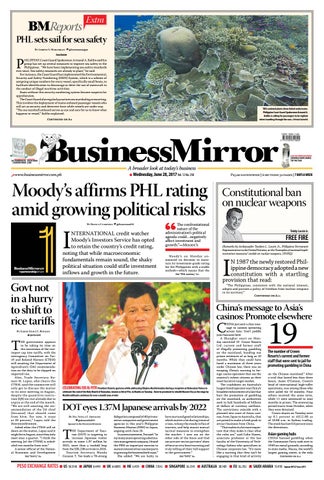
CELEBRATING EID AL-FITR President Duterte gestures while addressing Filipino-Muslim leaders during a reception at Malacañan Palace to celebrate the end of the Holy Month of Ramadan, known as Eid al-Fitr, in Manila on Tuesday. Duterte promised to rebuild Marawi City as the siege by Muslim militants continues for over a month now. AP Photo
DOT eyes 1.37M Japanese arrivals by 2022 By Ma. Stella F. Arnaldo
@akosistellaBM Special to the BusinessMirror
T
HE Department of Tourism (DOT) is targeting to increase Japanese visitor arrivals to some 1.37 million by 2022, more than a twofold leap from the 535,238 arrivals in 2016. Tou r ism Secret a r y Wa nd a Corazon T. Teo leads a 70-strong
PESO exchange rates n US 50.3140
delegation composed of 40 privatesector companies and government agencies in this year’s Philippine Business Mission (PBM) to Japan, ongoing until June 29. In a news statement, Teo said: “In my many years operating a destination management company, I found the PBM an important exercise to sustain interest of our counterparts in growing the business both ways.” She added: “We are lucky to
have nurtured good relationships, which matter a lot during times of crises, to keep the steady influx of tourists, and help mount mutual tactical measures to strengthen the market. I now am on the other side of the fence and find our private-sector partners’ show of force as very heartwarming and truly telling of their full support to the government.” See “DOT,” A2
hina just sent a clear message to casinos sprouting across Asia: Don’t peddle your baccarat here. A Shanghai court on Monday convicted 19 Crown Resorts Ltd. current and former staff of illegally promoting gambling on the mainland, handing out prison sentences of as long as 10 months. While they could have faced a maximum of three years under Chinese law, there was no escaping China’s warning to foreign casino operators that see the country’s richest citizens as their most lucrative target market. The crackdown on Australia’s largest listed operator was China’s broadest enforcement of a law that bars the promotion of gambling on the mainland, as authorities seek to halt hundreds of billions of dollars of currency outflows. The convictions coincide with a planned new wave of Asian casinos, from Japan to Australia, that are poised to make a fresh push to attract business from China. “That makes it a lot more important that they make it clear what the rules are,” said Colin Hawes, associate professor at the law faculty of the University of Technology Sydney who specializes in Chinese corporate law. “It’s more like a warning that they can’t be engaging in that kind of activity
19
The number of Crown Resorts’s current and former staff that were sent to jail for promoting gambling in China on the Chinese mainland.” After a trial that lasted less than three hours, Jason O’Connor, Crown’s head of international high-roller operations, was among those who were jailed for 10 months. Four others received the same term, while 11 were sentenced to nine months in prison. The sentencing period starts from October, when they were detained. Crown shares on Tuesday were up 0.1 percent at A$12.80 as of 10:06 a.m. in Sydney trading. The stock has lost 0.6 percent since the detentions.
Asian gaming hubs
China banned gambling when the Communist Party took over in 1949 on moral grounds, according to state media. Macau, the world’s largest gaming center, is the only Continued on A12
n japan 0.4499 n UK 64.0095 n HK 6.4519 n CHINA 7.3542 n singapore 36.2545 n australia 38.1481 n EU 56.2762 n SAUDI arabia 13.4110
Source: BSP (27 June 2017 )
A2 Wednesday, June 28, 2017
BMReports BusinessMirror
PHL sets sail for sea safety Continued from A1
It has also started regulating mar itime communications to prevent the utilization of communications electronics equipment by unauthorized groups or even terrorists. “We also have Coast Guard personnel in all ports to assure that vessels are not overloaded with passengers or cargoes,” Balilio said. But the Coast Guard also needs to beef up its capacity to ensure
PHL rating. . . Continued from A1
economy is expected to perform steadily over the next 12 to 18 months. Moody’s said the government of the Philippines still has a “Baa2” long-term issuer and senior unsecured debt rating—two notches above the minimum investment-grade rating. The affirmation of the rating, as well as the assignment of a stable outlook, came after the agency’s assessment that risks to the Philippines remain balanced on the positive and negative side. In particular, Moody’s said it expects that the Philippines’s economic performance to remain strong and debt consolidation to continue. “The Philippines’s real GDP growth averaged 6.4 percent per year between 2014 and 2016, more than twice the corresponding med ia n for “Ba a 2 ”-rated countries. We expect growth to be sustained at above 6 percent per year over the next two years, driven largely by the private sector,” Moody’s said. Household consumption will remain the key driver to the country’s economy, according to Moody’s projections,
Premier Li. . . Continued from A12
economy to entrepreneurs. He said Chinese and foreign companies will be treated equally, though he announced no new initiatives and made no mention of foreign complaints that Beijing is reducing access to its markets for computersecurity technology, farm-related biotech and other fields.
the safety and security of vessels traversing the Philippine waters. According to the transportation department, it plans to develop the capability of Philippine ports and the Coast Guard by acquiring a set of equipment, and setting up training programs. One of the plans is to acquire at least 20 fast patrol crafts to provide the Coast Guard with capability of day and night patrol in order to enhance maritime security in the country. Another 24 fast patrol craft and
an 82-meter offshore patrol vessel are being mulled for acquisition, too. These aim to enhance the Coast Guard’s response capability, particularly during search and rescue operation, rescue and salvage work, environmental protection, enforcement of applicable maritime laws, transport of goods and persons in times of calamities and disasters and support in the socioeconomic development of national and local government units. It has also requested for two
helicopters for maritime security monitoring, and disaster response. “But we also ask for the vigilance of the people traveling through the seas,” Balilio added. Maria Rona Legatub, who travels by sea to her home town in Catbalogan, is convinced that she will continue on riding the ferry until she is more capable of going to Samar by plane. “For now, I will ride the ferry. It’s much cheaper. It’s also very safe, at least on my experience,” she said.
as supported by remittances from overseas Filipino workers. The country’s investment climate is also seen to sustain its growth trajectory in the near to medium term, although actual values remain significantly below similarly rated peers. Demographics will also be a key upside risk to the country’s growth, as a young and growing population is seen to impart stability to private consumption growth and reduce the burden of aging-related costs on government finances. However, set against these positive trends, Moody’s said recent events, such as the conflict in Marawi City and the subsequent imposition of martial law in Mindanao, are examples of escalating domestic political risks that could weaken institutional strength and economic growth, should they multiply and escalate. “Downside risks include a worsening of the Islamist insurgency that could lead to an expansion of martial law, undermine domestic business confidence and disrupt economic activity, including in economically significant regions,” Moody’s said. To date, the credit watcher said neither appears an immediate concern. “These events do not appear
to have weighed on economic growth. Nor do they appear to have derailed the government’s economic-reform agenda; indeed, the Comprehensive Tax Reform Package recently passed through the lower house of Congress, in part due to the intervention of the president,” Moody’s said. “However, the confrontational nature of the administration’s political agenda could potentially reduce the effectiveness of governance, or negatively affect investment and growth,” it added. Potential deterrents to growth from global developments, meanwhile, include the possibility of a deeper row in the Middle East that might affect remittances. The passage of US policies that could encourage on-shoring of jobs could also have a negative impact on services exports, particularly of the business-process outsourcing sector. “Moreover, while broad macroeconomic stability has been maintained, so far, a number of metrics indicate material capacity constraints that signal a risk of overheating,” the credit watcher added. Thus, Moody’s said they could consider raising the country’s rating if the predictability and stabil-
ity of the political climate improve, or should the government succeed in defusing signs of prospective overheating in the economy and financial system. Greater revenue mobilization that would lead to a greater convergence of fiscal metrics with higher-rated peers would also be credit positive. On the other hand, the emergence of macroeconomic instability, leading to a deterioration in fiscal and government debt metrics and an erosion of the country’s external payments position, would exert downward pressure on the rating. A rapid escalation of domestic political conf lict that undermined institutiona l strength and the government’s reform agenda would also be deemed as credit negative. Along with the overall rating, Moody’s has also affirmed the government’s local currency and foreign currency senior unsecured ratings at “Baa2”, the government’s foreign currency senior unsecured shelf rating at (P)Baa2 and the senior unsecured ratings for the liabilities of the country’s Central Bank, Ba ngko Sent ra l ng P i l ipi n a s (BSP), at “Baa2”. The outlook on BSP has been removed.
While some indicators “will inevitably fluctuate”, sound economic growth “will not change”, he said. The premier also gave a ringing endorsement of free trade and said governments that face political pressure due to strains from globalization should make sure everyone benefits instead of raising barriers to imports. Despite complaints it is the most-closed major economy, Chi-
na has emerged as a prominent advocate of trade in response to US President J. Donald Trump’s promises to restrict imports. Governments need to provide “equal opportunities for participation” and education to help workers adapt, Li said. “Economic globalization is bringing benefits to all countries,” he said. “It is important to promote growth that benefits all.” The premier also affirmed Beijing’s pledge
to stick to its commitments on climate change, another area where it has split with Washington following Trump’s withdrawal from the Paris climate treaty. Li promised “tremendous efforts” to control climate change. “Countering climate change is the common responsibility of the international community,” he said. “China will honor its commitment and implement the measures to deal with climate change.” AP
www.businessmirror.com.ph
Govt. . .
Continued from A1
Authority (Neda) over the weekend told the BusinessMirror that the agency will convince President Duterte to certify as urgent measures amending Republic Act (R A) 8178, or the Agricultural Tarrification Act. Neda Undersecretary for Planning and Policy Rosemarie G. Edillion said the request will be made by the CTRM. However, she said “there is no definite schedule yet” as to when the CTRM will issue the appeal to Duterte. The Philippines’s waiver on the special treatment for rice is set to expire on Friday. However, Manila in April has informed the World Trade Organization (WTO) it was not able to convert its quarterly
DOT. . .
Continued from A1
The three-day PBM was initiated by the DOT and the Tourism Promotions Board (TPB), and brings participants to Osaka, Nagoya and Tokyo, where they are able to interact with around 400 of the top travel agents in those cities. Japan is considered one of the major tourism markets of the Philippines, constantly ranking either third or fourth place on the list. From January to April 2017, there were 211,123 visitors from Japan, up 15 percent from the same period last year. Under the National Tourism Development Plan, the DOT is targeting 618,436 visitor arrivals from Japan in 2017. The actual number of Japanese tourists in 2016 failed to hit the DOT’s target for that year of 575,390. The PBM is timely as the Japanese were among those who canceled their trips to the Philippines after peace and order issues in Central Visayas and in Mindanao, set off travelsafety concerns. The goal of the PBM is to provide a platform for suppliers of Philippine tourism products to conduct business-to-business meetings with their Japanese counterparts. It also includes a tourism seminar where participants are updated on products and other developments, a Travel Mart where brief one-on-one meetings are set and a cocktail reception for followthrough networking and socialization.
Infra projects. . . Continued from A12
ADB said Asia needs $1.7 trillion a year until 2030, or around $26 trillion between 2016 and 2030, to sustain current growth and respond to climate change. Southeast Asian countries need to invest a total of $3.147 trillion between 2016 to 2030. This translates to an annual investment of $210 billion until 2030. This also means increasing the infrastructure to GDP ratio to over 5 percent. In the Philippines, infrastructure spending has been increasing and reached 5.1 percent in 2016, from 1.8 percent in 2011. The Duterte administration aims to continue the trend and increase infrastructure to GDP ratio to 7.4 percent a year by 2022. This translates to nearly P9 trillion for infrastructure under the current administration.
Debarred
The World Bank and the ADB released a new list of Filipino firms and individuals banned from bidding in their projects. Data obtained from the Washington-based lender showed that it banned or debarred Innogy Solutions Inc. and its president, Lloly Yana de Jesus, in May. The firm and its president were also banned by ADB under the cross-debarment agreement. The World Bank also debarred another individual, Florencia M. Silvestre, who was banned by ADB last year. “Cross-debarment in accordance with the Agreement for Mutual Enforcement of Debarment Decisions dated April 9, 2010, which, as of July 1, 2011, has been made effective by the World Bank, the ADB, European Bank for Reconstruction and Development, Inter-American Development Bank, and African Development Bank,” the World Bank said. Innogy Solutions Inc. will not be able to participate in bidding for World Bank-funded projects from May 2, 2017,
report (QR) on rice into tariff, citing delays in the amendment of RA 8178. Government officials said amending RA 8178 is necessary to allow the conversion of the QR on rice into tariff because under the law, rice is the only agricultural commodity with an import cap and it did not specify a termination date for it. Due to this, Duterte in May was forced to issue Executive Order (EO) 23, extending for another three years the reduced rates on agricultural goods covered by the Philippines’s tariff commitments to the WTO. EO 23 permits the lowered tariff rates on certain imports as a concession to the rice-import cap Manila is enforcing. EO 23 is effective until June 30, 2020, or until such time a law amending certain provisions relating to rice in RA 8178 is enacted, whichever comes first. The delegation also includes representatives from four travel and tour companies, 34 hotel and resort properties and two airlines. The government delegation is composed of Tourism Undersecretary Benito C. Bengzon Jr., Assistant Secretary Ma. Luisa L. Japson, Tourism Attaché Leona Nepomuceno, TPB Department Manager Maricon Ebron and Philippine Retirement Agency General Manager Bienvenido Chy. The Philippine Retirement Authority (PRA) has been promoting the Philippines as a retirement haven for the Japanese. In fact, a TV commercial launched by the DOT featured a blind Japanese tourist—based on a real Japanese retiree’s experience—enjoying destinations in northern Philippines. According to the DOT, about 27,000 foreigners have secured visas to retire in the Philippines. The DOT chief is scheduled to meet executives of Japan Association of Travel Agents, Japan Philippine Tour Council and JTB Corp. Sales, Japan Cruise Line, Asahi Broadcasting Corp. and ABC Libra, Kansai Telecasting Corp. and Nouveau Inc., Mainichi Broadcasting System Inc., Sumitomo Mitsui Banking Corp., JTB World Vacations, Toby Toup Tours Co., International Developers, K.I.S. International Co., H.I.S. Co., KNT Co., Noe Corp., Toyoko Inn and Schoolwith. She and other officers from the DOT, TPB and PRA will likewise meet with top media influencers. until December 1, 2024, while the debartment for its president is effective until May 1, 2028. Silvestre, who was banned by ADB indefinitely in 2016, was also debarred permanently by the World Bank on January 9. Meanwhile, the World Bank has issued a conditional nondebarment for two foreign firms as of February 7. The conditional nondebarment is effective until April 17, 2023. The two foreign firms are Canada Inc. based in Quebec, Canada and US Holdco Inc. based in Delaware, US. “The conditional nondebarment means that so long as the sanctioned entity meets certain conditions, the sanctioned entity will continue to be eligible to participate in bank-financed activities,” the World Bank said. Based on the public sanctions lists of the two multilateral-development banks (MDBs), the World Bank has already debarred a total of 10 firms and individuals, while the ADB has banned 11 firms and individuals as of June 2017. ADB has placed sanctions on a total of 1,317 firms and 813 individuals worldwide and prevented them from participating in ADB-financed activities. In 2010 MDBs, such as World Bank and ADB, signed a cross-debarment agreement in Luxembourg, Germany, as their contribution to the global fight against corruption. Based on the agreement, cross debarments will include only those that have sanctions in excess of one year. Sanctions by MDBs typically include reprimand, conditions on future contracting or debarment—declaring a company or individual ineligible to participate in any future activities it finances, either for a period of time or permanently. Public debarment, which carries with it both financial and reputational risks, is considered a major deterrent to wrongdoing. Entities debarred by one MDB may be sanctioned for the same misconduct by other participating development banks.
A4
Agriculture/Commodities
Wednesday, June 28, 2017 • Editor: Jennifer A. Ng
BusinessMirror
news@businessmirror.com.ph
PHL abaca output declined slightly in Jan-April
T
he country’s abaca production reached 20,8063.06 metric tons (MT) in January to April, 0.7 percent lower than the 21,017.2 MT recorded last year, according to the latest data from the Philippine Fiber Industry Development Authority (PhilFida).
Data from the PhilFida showed that top producers of abaca, including Eastern Visayas, Western Visayas and Northern Mindanao posted cuts in output during the period. The Bicol region remained as the top producer of abaca in the first four months of the year, accounting for nearly 41 percent of national output. Abaca produced in the region rose by 2 percent to 8,522.12 MT, from 8,355.62 MT in January to April 2016. Davao region was the second top abaca producer, accounting
for 15.3 percent of output during the period. The region’s abaca production went up by 7 percent to 3,202 MT, from 2,991.45 MT a year ago. The abaca output of Eastern Visayas, the third-biggest producer of the crop, declined by 5.7 percent to 2,959.5 MT, from 3,139.37 MT recorded in January to April 2016. The region accounted for nearly 15 percent of national abaca output. Among all the abaca-producing regions, Southern Tagalog registered the biggest jump in
output at 70.8 percent. The region’s production reached almost 47 MT in the first four months of the year. Other regions that reported increases in abaca production are Zamboanga Peninsula (12.4 percent), Autonomous Region in Muslim Mindanao (10.1 percent) and Central Luzon. Last year abaca production rose by 5.7 percent to 62,008.64 MT in 2016, from 58,665.81 MT in 2015, as farmers took advantage of the demand for the crop in the country’s major export markets. PhilFida data also showed that earnings from abaca exports fell by 1.5 percent to $10.86 million in January, from $11.03 million a year ago. Shipments of abaca pulp accounted for the bulk of export receipts at $7.46 million. The figure is slightly higher than the $7.42 million posted in January 2016. Earnings from fibercraft exports recorded the biggest drop in January at 82.6 percent to $124,644. Shipments of cordage also declined by 60 percent to $379,432, f rom $94 8,728 posted last year.
File photo
Food establishments urged to serve healthy food C EBU CITY—Officials of the National Nutrition Council (NNC) Region 7 will be visiting food establishments starting July 3 to encourage serving of healthy food. This was announced by NNC Region 7 Program Coordinator Dr. Parolita A. Mission in a news conference on Tuesday about the activities for the 43rd Nutrition Month next month. She said this year’s nutrition month would focus on healthy dieting, as the problems on obesity and noncommunicable diseases continue to grow. With the theme: “Healthy Diet, Gawing Habit—For Life,” Mission said the NNC aimed to promote healthy diets to help reduce the cases of overweight, obesity and noncommunicable diseases in the country, as well as to encourage food establishments to offer healthier food options to the consumers. “Starting July 3 we will visit food establishments, school cafeterias and hospital canteens and encourage the serving of healthy food,” Mission said. “Of course, we can only advocate because we cannot force them to offer
their customers healthy food only.” “Likewise, we cannot prevent the consumers from eating unhealthy food. We can only discourage them,” she added. She said the Nutrition Month celebration will formally begin on July 3, with different activities to be held simultaneously in all cities and provinces in Central Visayas. A Nutri-Fiesta Bazaar will be put up at Park Mall in Mandaue City on opening day where the public can savor all the healthy food and snacks on display. Mission said they would also push for the full implementation of the resolutions passed by both the Regional Nutrition Committee and Regional Development Council enjoining private companies and government entities to serve healthy food and drinks and to provide healthy alternatives for rice. The NNC will likewise present and promote the Philippine Plan of Action for Nutrition during the month-long celebration. The celebration will culminate with the Regional Nutrition Action Officers Congress and the Grand Nutrition Awards for best-performing local government units and frontline nutrition workers. PNA
Visayan fishermen honored in 2nd Ocean Heroes Awards
F
our fisherfolk from the Tañon Strait were recently recognized as Ocean Heroes for championing conservation, coastal law enforcement and sustainable fisheries in the Visayas. Recognition was also given to Tañon Strait Marine Protected Areas (MPAs), which are effectively managed through strong local government and community collaboration. These MPAs are now providing a wide range of environmental, social and economic benefits for coastal communities. “Our Ocean heroes inspire so many, including our enforcement agencies, with their vigor and courage in protecting the Tañon Strait. May their determination and dedication spread, as we work together to protect and conserve our rich, yet fragile, marine resources,” Oceana Philippines Vice President Gloria Estenzo Ramos said. The 2017 Ocean Heroes are Virgilio Aviso, Renato Buenviaje, Jocelyn MoyaHekrdle and Mariano Sarcol. They stood out from dozens of candidates for their commitment to protect the Tañon Strait, a 161-kilometer strip dividing the provinces of Cebu and Negros Island. The Strait is one of the largest and most productive MPAs in the country, hosting 63 percent of the country’s coral species and 14 types of whales and dolphins, while providing food and livelihood for 42 towns, cities
and municipalities in Cebu, Negros Oriental and Negros Occidental. The awards were integrated with the recognition given to the exemplary stakeholders and partners of the province of Negros Occidental, during the culminating activity of the celebration of the 25th year of the establishment of its Provincial Environment Management Office under the leadership of lawyer Wilmon Penalosa. Gov. Alfredo Maranon led the public officials and participants in the momentous occasion. Launched in 2016, the Ocean Heroes Awards is a partnership among Oceana Philippines, the Department of Environment and Natural Resources and the Bureau of Fisheries and Aquatic Resources to honor courageous community leaders to ensure the sustainable management of the marine ecosystems of the Tañon Strait. Its first batch of winners were Norlan Pagal, Oliver Dayupay, Veda Raunillo and Roberto Quigay. This year’s Ocean Heroes Awards expanded with partnerships between the provincial governments of Cebu, Negros Occidental and Negros Oriental, Tañon Strait Protected Area Office and Rare, plus the inclusion of a new category for “Bestmanaged Marine Protected Area” inside the protected seascape, spearheaded by the Provincial Agriculture Office, Rare and the province of Negros Oriental.
news@businessmirror.com.ph
AseanWednesday BusinessMirror
Editor: Max V. de Leon • Wednesday, June 28, 2017 A5
Singapore fund to bare all on GLP sale
T
he litany of complaints about the biggest Asian buyout deal became so bad that Singapore’s sovereign wealth fund decided to act.
$14B
A bidding process for Global Logistic Properties Ltd. (GLP), the $9.6-billion warehouse developer, has been running since the start of the year. In May representatives The value of Global Logistics of GIC Pte., the company’s largest shareholder, Properties shares, making its called the GLP working sale the largest-ever private team managing the sale equity buyout of an Asian into their offices, accompany by enterprise value cording to people familiar with the matter. The Singaporean fund instructed the assembled group to be more responsive to bidders’ questions and share information transparently in the auction, the people said, asking not to be identified because the discussions were confidential. Potential acquirers, including Warburg Pincus, Blackstone Group Lp. and RRJ Capital, had been pressing for months to get increasingly detailed financial information on GLP as they compete with a rival consortium that includes the company’s CEO. At the heart of the issue for the bidders is whether the management-backed group, which also includes Chinese private equity firms Hillhouse Capital Management and Hopu Investment Management, has an advantage over other buyers with privileged access to information. “Everyone has to be on a level playing field,” Justin Tang, a director of global special situations at Religare Capital Markets in Singapore, said by phone on Monday. GIC “can step in as an ombudsman and ensure it’s run according to generally accepted principles”. Some bidders had told GLP that documents they needed were trickling in too slowly and important details were blacked out, the people said. The information they were looking for related to the company’s joint ventures, fund-management performance, employment agreements and appraisals of certain assets, they said.
Warehouse network
The May discussion was held in a closed meeting room to prevent uninvolved parties from observing the conversation, one of the people said. For GIC, calling the meeting followed multiple conversations with the parties running GLP’s strategic review, including the bankers and lawyers advising a special board committee. GLP had already been taking steps to address the concerns raised by bidders, according to one person. GLP ended up extending the deadline for final offers to June 30 to give buyers more time to vet its network of warehouses, which sit at the center of the burgeoning logistics sector in China, Japan, Brazil and the US. Additional documents have gradually been added to the physical data rooms and online document repositories being run by GLP, according to the people. As that date approaches, GIC has become comfortable that information access for all shortlisted bidders has improved, one of the people said. “The strategic review has always been undertaken independently in the interest of all shareholders,” GLP Chairman Seek Ngee Huat said in an e-mailed statement on Monday in response to Bloomberg queries. “The special committee is focused on ensuring that the process is fair and transparent in order to maximize value.” As a shareholder with a large stake, GIC works with all parties in this process, a spokesman for the sovereign fund said on Monday in an e-mailed response to Bloomberg queries, adding that GLP and its board are responsible for the process. As the situation is competitive, it is “not surprising to have noises and excitements around the process,” according to the statement.
Long history
“GIC, GLP and its board need to exercise great care in our respective purviews,” GIC said in the statement. “We will continue to monitor carefully the developments and decide our next course of actions accordingly.” GIC, which owns 37 percent of the company, has a long history with the assets: The company traces its roots back to the sovereign fund’s 2008 purchase of Asian industrial properties from Prologis Inc., a portfolio later rebranded as GLP and listed on the Singapore stock exchange in 2010. It was a request from GIC that prompted the developer to start a strategic review at the end of last year. The strategic review is being handled by a special committee of GLP independent directors, which is receiving advice from JPMorgan Chase & Co. Representatives for Blackstone, JPMorgan, RRJ Capital, Warburg Pincus and the management consortium declined to comment. If an agreement is reached, a takeover of GLP would become the largest-ever private equity buyout of an Asian company by enterprise value, surpassing last year’s takeover of Qihoo 360 Technology Co., data compiled by Bloomberg show. Since Bloomberg News first reported takeover interest in November, the company’s shares have soared about 60 percent, valuing it at $14 billion including debt.
Prologis alumni
Singapore’s takeover code requires that information passed to one potential bidder be promptly furnished to other suitors
requesting it. In management buyouts, rival bidders must be given material information that the executives have, as long as it doesn’t constitute business or trade secrets. Board members who are involved in a bid must also cooperate with independent directors in the gathering of information. The involvement of competitors in this auction makes disclosure a tricky
balance. Warburg Pincus is considering a joint offer with its own logistics business E-Shang Redwood Ltd., which, like GLP, is run by former Prologis executives, people with knowledge of the matter said earlier. Their main competition is GLP CEO Ming Mei, who leads a group of Chinese investors bidding for the business. Ecommerce operator JD.com Inc. and an
arm of Ping An Insurance Group Co. of China are in talks to join the consortium, along with property developer China Vanke Co., one person said. Representatives for JD.com and Ping An declined to comment, while a representative for Vanke said the company has no information to disclose. Blackstone was also among suitors selected to proceed in the bidding, while RRJ
Capital had been considering a joint offer with Temasek Holdings Pte. unit Seatown Holdings Pte., people with knowledge of the matter said earlier. “If there’s no competitive tension, then they’re not going to get the best price for the asset,” Religare’s Tang said. “We never thought it was going to be a slam dunk for management.” Bloomberg News
A6
The World BusinessMirror
Wednesday, June 28, 2017
Syria denies US allegations of coming chemical attack
B
EIRUT—Syria has denied White House allegations that it may be preparing a new chemical attack, insisting again that it has never used such arms.
Ali Haidar, the minister for national reconciliation, told The Associated Press on Tuesday that the White House statement foreshadowed a “diplomatic battle” that would be waged against Syria in the halls of the UN. T he W hite House issued a stern warning to Syrian President Bashar al-Assad on Monday night, saying it had “potential” evidence that Syria was preparing for another chemical weapons attack. In an ominous statement issued with no supporting evidence or further explanation, Press Secretary Sean Spicer said the US had “identified potential preparations for another chemical weapons attack by the Assad regime that would likely result in the mass murder of civilians, including innocent children”. He added the activities were similar to preparations taken before an April 2017 attack that killed dozens of men, women and children, and warned that if “Mr. Assad conducts another mass murder attack using chemical weapons, he and his military will pay a heavy price.”
No advance discussions
SEVER AL State Department officials typically involved in co-
ordinating such announcements said they were caught completely off guard by the warning, which didn’t appear to be discussed in advance with other national security agencies. Typically, the State Department, the Pentagon and US intel ligence agencies would all be consulted before the W hite House issued a declaration sure to ricochet across foreign capitals. The officials weren’t authorized to discuss national security planning publicly and requested anonymity. A non-governmental source w ith close ties to the W hite House said the administration had received intelligence that the Syrians were mixing precursor chemicals for a possible sarin gas attack in either the east of south of the country, where government troops and their proxies have faced recent setbacks. In Moscow on Tuesday, a senior Russian lawmaker dismissed the warning as “provocation”.
Retaliatory missile strike
ASSAD had denied responsibility for the April 4 attack in the rebel-held Idlib province that killed dozens of people, and Russia, Assad’s key backer, sided with
him. Days later, President Donald J. Trump launched a retaliatory cruise missile strike on a Syrian government-controlled air base. Frants Klintsevich, first deputy chairman of the defense and security committee in the upper chamber of the Russian parliament, on Tuesday accused the US of “preparing a new attack on the positions of Syrian forces”. In comments to state-ow ned R I A Novosti, he added: “Preparat ions for a new c y nica l a nd u nprecedented provoc at ion a re u nder way.” The US strike was the first direct American assault on the Syrian government and Trump’s mo s t d r a m at i c m i l it a r y or der since becoming president months before. Trump said at the time that the Khan Sheikhoun attack crossed “many, many lines”, and called on “all civilized nations” to join the US in seeking an end to the carnage in Syria.
A close ally
S Y R I A m a i nt a i ned it h ad n’t u se d c he m ic a l we ap on s a nd blamed opposition fighters for stockpiling the chemicals. Russia’s Defense Ministr y said the toxic agents were released when a Sy r ian air str ike hit a rebel chemica l weapons arsena l and munitions factor y. Russia is a close a l ly of A ssad. The US attack on a Syrian air base came after years of heated debate and deliberation in Washington over intervention in the bloody civil war. Chemical weapons have killed hundreds of people since the start of the conflict.
The US is providing air support and arms to Kurdish-led Syrian forces who are fighting to drive the Islamic State group f rom R aqqa, t he e x t rem ists’ self-styled capital. Defense Secretary Jim Mattis said on Tuesday that Washington would continue to provide weapons after the Raqqa battle is over. His comments were likely to anger Turkey, which views the Kurdish fighters as an extension of the insurgency raging in its southeast.
Back to tweeting
ON Monday Trump had dinner with Mattis, Secretary of State Rex Tillerson, National Security Adviser H.R. McMaster and other top officials, as he hosted Indian Prime Minister Narendra Modi at the White House. Til lerson and Russian Foreig n Minister Sergey L av rov talked earlier on Monday about the need to secure a cease-fire in Syria, fight extremist groups and prevent the use of chemical weapons, the Russian Foreig n Ministr y said. Nikki Haley, the US Ambassador to the United Nations, followed up Spicer’s statement with a Twitter warning: “Any f u r t her at t ac k s done to t he people of Syria will be blamed on Assad, but also on Russia & Iran who support him killing his own people.” Less than an hour after Spicer issued the statement, Trump was back to tweeting about the 2016 campaign, denouncing investigations into potential collusion between Moscow and his campaign aides as a “Witch Hunt”. AP
www.businessmirror.com.ph
Budget office: Senate health bill adds 22 million uninsured
W
ASHINGTON—The S enate Republican health-care bill would leave 22 million more Americans uninsured in 2026 than under President Barack Obama’s health-care law, the Congressional Budget Office estimated on Monday, complicating GOP leaders’ hopes of pushing the plan through the chamber this week. Minutes after the report’s release, three GOP senators threatened to oppose a pivotal vote on the proposal this week, enough to sink it, unless Senate Majority Leader Mitch McConnell, Republican-Kentucky, can win over some of them or other GOP critics. The bill will fail if just three of the 52 Republican senators oppose it, an event that would deal a humiliating blow to President Donald J. Trump and Senate leaders. The 22 million additional people without coverage is just a hair better than the 23 million who’d be left without insurance under the measure the House approved last month, the budget office has estimated. Trump has called the House version approved last month “mean” and told Senate Republicans to approve legislation with more “heart”. In good news for the GOP, the budget office said the Senate bill would cut the deficit by $202 billion more over the coming decade than the House version. Senate leaders could use some of those savings to attract moderate support by making Medicaid and other provisions in their measure more generous, though conservatives would prefer using that money to reduce federal deficits.
Losses
THE White House lambasted the nonpartisan budget office in a statement, saying it has a “history of inaccuracy” projecting coverage. Democrats said the report confirmed their own analysis of the GOP measure. “This bill is every bit as mean as the House bill,” said Senate Minority Leader Chuck Schumer, Democrat-New York. Of the 22 million without coverage by 2026 under the Senate plan, 15 million would be without it next year, the budget office said. That could be a particular concern to moderate Sen. Dean Heller, Republican-Nevada, who faces perhaps
the toughest 2018 reelection race of any Senate Republican and has said he can’t support the measure if huge numbers of people lose coverage. The budget office report said coverage losses would especially affect people between ages 50 and 64, before they qualify for Medicare, and with incomes below 200 percent of poverty level, or around $30,300 for an individual. In one example, the report says that in 2026 under Obama’s law, a 64-year-old earning $26,500 would pay premiums amounting to $1,700 a year, after subsidies. Under the Senate bill, that person would pay $6,500, partly because insurers would be able to charge older adults more.
Debate
MODERATE Sen. Susan Collins, RepublicanMaine, said she would vote against a GOP procedural motion, expected on Wednesday, to begin formally debating the legislation. She tweeted that she favors a bipartisan effort to fix Obama’s 2010 statute but added, “CBO analysis shows Senate bill won’t do it.” In addition, conservative Sen. Rand Paul, Republican-Kentucky, said he would oppose that motion unless the bill was changed. And fellow conservative Ron Johnson, Republican-Wisconsin, said he had “a hard time believing” he’d have enough information to back that motion this week. Those two—plus fellow conservatives Mike Lee of Utah and Ted Cruz of Texas— have said the current measure doesn’t do enough to erase Obama’s law and reduce premiums. All four said last week they’d oppose the bill without changes, as did Heller. Most of the disgruntled senators have left the door open to backing the measure if it’s changed. “It’s going to be very close, but we’re working with each one of them in trying to accommodate their concerns without losing other support,” No. 2 Senate GOP leader John Cornyn of Texas said. Vice President Mike Pence invited four GOP senators to dinner last Tuesday to discuss the bill, his office said: Lee and Sens. James Lankford of Oklahoma, Tom Cotton of Arkansas and Ben Sasse of Nebraska. AP
Scotus travel ban ruling leaves myriad questions unanswered W
ASHINGTON—The decision of the Supreme Court of the United States (Scotus) to partially rei n st ate P reside nt Don a ld J. Trump’s temporary travel ban has left the effort to keep some foreigners out of the US in a murky middle ground, with unanswered questions and possibly more litigation ahead. The justices ruled on Monday in an unsigned opinion they would hold a full hearing on the case in October. In the meantime, the administration can bar travelers from six majority-Muslim countries from the US if they don’t have a “credible claim of a bona fide relationship” with someone or some entity in the country. It’s unclear what will ultimately constitute a “bona fide relationship”, though the ruling suggested that an American job, school enrollment or a close relative could meet that threshold. Equally unclear is how many foreigners will be affected from the six countries: Syria, Sudan, Iran, Yemen, Libya and Somalia. The ruling was seen as, at least, a partial victory for Trump in the biggest court case of his presidency. Trump claims the temporary ban is needed to prevent terrorist attacks. Opponents reject that and argue it’s a backdoor way to bar Muslims from entering the US, as Trump promised in his campaign. The early indications are that the administration will use the decision to take a tough line on travelers from those countries. A senior US official familiar with the situation said the Trump administration has plans in place to relaunch the stalled ban and tourists will be among those kept out. Under
these plans, largely orchestrated by White House adviser Stephen Miller, tourists from those countries and any academics, lecturers or others invited to speak or make presentations in the US will be barred. Those groups are regarded as unable to show a substantial and preexisting tie to a person or institution in the US. The official who described the plans was not authorized to discuss them publicly by name and spoke on condition of anonymity. But some immigration lawyers and advocates said relatively few people would fall under the ban because these travelers tend to have sufficient relationships with people or institutions in the US. Jamal Abdi, policy director for the National Iranian American Council, said most Iranians who visit the US have relatives there or are coming to work or study. He said his group has no idea how the administration plans to judge family relationships and a hard line could mean a significant number of Iranians will be kept out the country for the time being. It could also mean more lawsuits if advocates for immigrants believe the administration is going beyond the Supreme Court’s guidelines in barring visitors to the US. Like the fate of would-be tourists and scholars, the immediate future for refugees is murky. In its opinion, the court partially reinstated Trump’s temporary prohibition on refugees from any country, using criteria similar to that used in the travel ban. The effect on refugees could be greater because they are less likely to have family, school or business relationships in the US. AP
In this May 15 file photo, protesters wave signs and chant during a demonstration against President Donald J. Trump’s revised travel ban, outside a federal courthouse in Seattle. The Supreme Court is letting the Trump administration enforce its 90-day ban on travelers from six mostly Muslim countries, overturning lower court orders that blocked it. The action on Monday, is a victory for Trump in the biggest legal controversy of his young presidency. AP
The World Wednesday, June 28, 2017
A7
Brazil’s crisis deepens as President Temer accused of corruption
R
IO DE JANEIRO—Brazil’s attorney general formally accused President Michel Temer of corruption on Monday, making him the first sitting president in Latin America’s largest nation to face criminal charges. Attorney General Rodrigo Janot’s accusation is the latest salvo in an intensifying showdown between Temer and justice officials who are building a corruption case that reaches to the highest levels. The case now goes to the lower Chamber of Deputies in Congress, which must decide whether it has merit. If two-thirds of the legislature decides that it does, then the president will be suspended for up to 180 days while a trial is conducted. House Speaker Rodrigo Maia, an ally of Temer, would be president in the interim. In his decision, Janot said that Temer at some point, between March and April, of this year took a bribe of around $150,000 offered by Joesly Batista, former chairman of meatpacking giant JBS. Janot opened an investigation last month into Temer for corruption, obstruction of justice and being part of a criminal organization. A recording emerged that apparently captured Temer, in a late-night conversation with Batista earlier this year, endorsing hush money to former House Speaker Eduardo Cunha, a former Temer ally who is serving a 15-year sentence for corruption. Batista reached a plea agreement with federal prosecutors. Temer has denied wrongdoing and said he refuses to resign despite numerous calls for him to do so and plunging popularity. The office of the president said it would not have comment on Monday night.
Total disregard
JANOT’S decision to put forward only the corruption allegation may be a strategy to force the lower Chamber of Deputies to first deal with it before having to consider the other allegations. Allies of Temer have been torn between whether to continue supporting the beleaguered leader or bail on him because of fears that association could be toxic during elections next year. Janot’s 64-page decision was a blistering assessment of Temer and his actions as Brazil’s top leader. Janot said bribes to Temer could have reached about $12 million over nine months, and that, in general, Temer showed a total disregard for the office. “The circumstances of this meeting [with Batista]—at night and without any register in the official schedule of the president of the Republic—reveal the intent of not leaving traces of the criminal actions already taken,” Janot wrote. Earlier on Monday Temer sought to show his government conducting business as usual, defiantly saying he wasn’t going anywhere in his first comments since returning from a trip to Russia and Norway last week that was filled with gaffes and mounting bad news. “Nothing will destroy us. Not me and not our ministers,” he said during the ceremonial signing of a bill in the capital of Brasilia.
Steady stream
DESPITE the optimism, Temer is facing risks to his mandate on several fronts, from tanking popularity to numerous calls, including from heavyweight politicians, for him to step down. His trip last week to Russia and Norway ended up underscoring the president’s problems and Brazil’s diminished stature overseas, thanks to a steady stream of corruption scandals the last three years. Few people showed up at the reception at Brazil’s embassy in Moscow, no top Norwegian officials welcomed Temer at Oslo’s airport and the country’s prime minister, Erna Solberg, gave Temer a public lecture about the colossal “Car Wash” investigation that has upended Brazilian politics and could even jail Temer and several of his Cabinet ministers. Launched in March 2014, the investigation into billions of dollars in inflated construction contracts and kickbacks to politicians has landed dozens of the country’s elite in jail and threatens many more. “We are very concerned about the ‘Car Wash’ probe,” said Solberg, adding that it was important for Brazil to “clean up” corruption. To top it off, during Temer’s visit, Norway announced a 50-percent cut in funds it pays into Brazil’s Amazon rainforest fund because of increased deforestation. The increased deforestation began before Temer took power last year, but environmentalists argue his policies are aggravating the situation. “It was a trip to distract people from the problems in politics,” said Mauricio Santoro, a political scientist at the State University of Rio de Janeiro. “It ended up being a disaster.”
Dubious distinction
TEMER, who took over in May of last year after President Dilma Rousseff was impeached and later removed from office, now also has the dubious distinction of having the lowest approval rating of a president since 1989. The Datafolha polling institute showed over the weekend that just 7 percent of those questioned approved of Temer’s administration, the worst since the country was embroiled in a crisis of hyper-inflation on the watch of President Jose Sarney. Even stalwart allies have begun to bail on Temer. Former President Fernando Henrique Cardoso, who initially supported Temer and is a key leader of the junior coalition party, said in an article published by daily Folha de S. Paulo on Monday that the president could end the crisis by ushering in new elections sooner than the end of his mandate, which goes through 2018. “I plead with the president to meditate over the opportunity of such a gesture of greatness,” Cardoso said. AP
A8
Wednesday, June 28, 2017
The World BusinessMirror
Editor: Lyn Resurreccion • www.businessmirror.com.ph
Charred body found in Mexico identified as missing journalist
M
EXICO CITY—A charred body found in western Mexico has been identified as the owner and director of a local television station abducted in May, the seventh journalist killed so far this year in the country. Salvador Adame was director of local cable Channel 6 TV. Armed men grabbed him on May 18 and forced him into a vehicle in the city of Nueva Italia in violence-plagued Michoacan state. The remains were found in midJune in a rural area, and DNA tests later confirmed they were Adame’s, Michoacan state prosecutor Jose Martin Godoy said. Godoy added a kidnapping suspect had told authorities that Adame was killed on the orders of a local crime boss, allegedly because of “personal problems” between the two. Godoy said Adame had apparently received angry and insulting phone messages from the local gang leader, who he identified by his nickname, “El Chano” Peña. Me x ico’s Nat iona l Hu m a n Rights Commission said it “is calling on authorities to carry out
profound, exhaustive and welldocumented investigations so that whatever the motive is determined to be, it isn’t rushed and doesn’t leave room for doubt”. Mexican prosecutors have been criticized in the past for rushing to attribute the frequent murders of journalists to personal problems or motives unrelated to their work. Roberto Rock, the chairman of news-freedom committee of the Inter American Press Association, condemned the killing and said “Given the total impunity, we journalists have reached a stage in which we do not feel certainty regarding the causes of the murder of a colleague.” The International Airline Passengers Association said Adame “was known for his criticisms of the local mayor” in the city of Mugica, Michoacan. Adame’s abduction came after prominent journalist
Javier Valdez was slain in Culiacan, in Mexico’s Sinaloa state. The New York-based Committee to Protect Journalists said some 40 journalists have been killed in Mexico for reasons confirmed as related to their work since 1992. An additional 50 were slain during the same period under circumstances that have not been clarified. On Monday federal prosecutors in Mexico said they would ask for help from the Federal Bureau of Investigation and other international groups in investigating reports of high-tech spying against journalists and humanrights defenders in Mexico. The University of Toronto’s Citizen Lab, an Internet watchdog group, said in June that spyware called Pegasus produced by Israel’s NSO Group was used to target the cell phones of people who were investigating or critical of Mexico’s government. It added there was no conclusive proof of government involvement, but noted the software was sold only to governments, and the detected targets were all investigating or critical of the government. Assistant Attorney General Ricardo Sanchez said companies that supply such spyware, and state government or federal agencies that might have bought or uses such software, would be asked to testify. AP
In this June 20 photo, injogogibap, a street food invented during the North Korean famine made from leftover fried tofu pressed into hot dog-sized tubes and stuffed with rice, is seen on a plate at Howol-ilga, a restaurant in Incheon, South Korea. Outside Seoul, a tiny restaurant whose Korean name means “People from Different Homelands Come to Gather in One Place” attracts patrons from across the country serving up potato pancakes, blood sausage and memories of North Korea—the outcast homeland those patrons may never see again. AP
Finding comfort, and North Korea, in a tiny restaurant
I
NCHEON, South Korea—The little restaurant isn’t much to look at. It’s across the street from an empty lot in a city where bland high-rise apartment buildings sprawl in every direction. Boxes of dried fish are stacked by the front window. A dirty mop stands in the corner. The walls are painted a vomitous green. But people come from across South Korea to eat here. They come for the potato pancakes, the blood sausage and, very often, for a fried street food that many dreamed of back when nearly everyone they knew was hungry. More than anything, though, they come for memories the food brings back of an outcast homeland they may never see again. “This is the taste of where they came from,” said the restaurant’s owner, a refugee who asks to be identified only by her surname, Choi. “The food here tastes the ways it does in North Korea.”
Barely comprehensible
MORE than 30,000 North Koreans now live in South Korea, having fled poverty, hunger and the relentless pressures of life in an oppressive, authoritarian state. But for most, life in the South is far from ideal. Raised amid dictatorial dysfunction, and normally poorly educated, the exiles stumble into a brutally competitive nation where they are regularly disdained by their neighbors. “Chon-nom” they are often called—“bumpkin”. That derision, combined with their own disillusionment, can churn into a stew of suspicion, resentment and ambivalence. And though they may hate the nation they left behind, many also miss it deeply. Because how can you not miss home? “Our lives here can be so difficult,” said a North Korean now living in the South, and who spoke on condition her name not be used. “But finding that restaurant made me so happy.” Choi has built them a tiny island of North Korean life that starts to feel crowded if it has more than a half-dozen customers. In a burst of optimism she named it Howol-ilga, “People from Different Homelands Come to Gather in One Place”. “My place is a comfort for them,” said Choi, 39, in a Northern accent so thick it can be barely comprehensible at first to Southerners.
“When they come here and find a menu so similar to what they ate back home, they know they can relax.”
Didn’t suffer much
AT first glance, Choi doesn’t seem very relaxing. Gruff and often scowling, restaurant work has left her hands patterned with small knife cuts and her forearms spattered by ugly oil burns. She has only two employees, and keeps the restaurant open seven days a week. Exhaustion is a constant. She cannot remember her last day off. But eventually—when she finally sits down to talk, chugging a can of Georgia Original coffee—a smile crosses her face. Choi grew up in a small town so close to North Korea’s Amnok River border that you could wave to people in China. She learned cooking from her father, a onetime military cook who loved working in kitchens—rare in the North’s deeply conservative culture— and from relatives who smuggled in goods from China. “They had learned Chinese cooking there,” she said. The family was far from rich, but made enough trad ing in clothes, cheap electronics and DVDs of South Korean TV shows to count as middle-class. It was enough to avoid the horrors of North Korea’s mid-1990s famine, which killed at least 500,000 people and, perhaps, well over a million. Years later, most North Korean refugees still refer to the famine by its Pyongyang-mandated euphemism. “Even in the Arduous March we didn’t suffer much,” Choi added, shrugging. “It’s my family’s fate to escape living in poverty.” She left the North in 2012, looking for a better life for her young son, and opened the restaurant two years later.
A cook’s appetite
MODESTY isn’t an issue for Choi. “All of my customers talk about how good I am,” she said. “They tell me, ‘When I eat in other restaurants, it doesn’t taste like what I used to eat in the North. What you cook tastes completely different!’” A South Korean, she insists, could never succeed in her kitchen. “A cook’s appetite is different” when they come from another place, she added, leaning against one of her fake wood tables. “They
taste things in a different way. So how could they cook this kind of food?” Food and history are as tangled at Howol-ilga as they are in North Korea, where three generations of dictators have vowed to end a relentless, centuries-old struggle against hunger. “Socialism is rice!” the country’s founding ruler, Kim Il Sung, proclaimed regularly in the 1960s, promising that everyone would soon be eating meat soup and rice every day. Instead, as South Korea became a global economic power, the North lurched into its nightmare years, culminating in the 1990s famine. While the era of mass starvation is over, malnutrition remains a major problem, particularly among young children and pregnant women. And many Northerners still use food to talk about money and class differences, often saying, for example, that only the rich “eat rice every day”.
Best-loved dish
ONE of Choi’s best-loved dishes is injogogibap, a street food invented during the famine, when it was the closest thing to meat most people could afford. Bits of leftover fried tofu, which in earlier days had been thrown away, were scraped from pots and pressed into hot dog-sized tubes that were then stuffed with rice. It’s delicious and filling (though tastes nothing like meat), with the tofu absorbing random flavors from cooking pots. At the worst of times, when the smell of frying injogogibap would waft from food stalls into streets filled with hungry people, it became an object of fantasy. Even today, some exiles dream about it. That doesn’t surprise Sonia Ryang, an anthropologist at Rice University in Texas who grew up in a pro-North Korea community in Japan, and who has written extensively about the North. To smell injogogibap was to dream of filling your stomach at a time when starvation was wiping out entire neighborhoods. “Far from not wanting to remember, they want to remember,” Ryang said. “Because it was proof that they were alive.” Choi’s explanation is simpler. During the famine, she said, food was something that could always make people happy. She smiles: “Eating is joyful.” AP
Bankrupt company’s air bags still out there
T
AKATA’S lethally defective air bags proved to be the company’s undoing on Monday. But it could take years to get the dangerous devices off the road in the US and around the world. Crushed by lawsuits, fines and recall costs, the Japanese auto-parts supplier filed for bankruptcy in Tokyo and Delaware and will sell most of its assets for $1.6 billion to a rival company. A small part of Takata will continue to manufacture replacements for the faulty air-bag inflators. The problem, though, is that 100 million of the Takata inflators worldwide have been
recalled, 69 million in the US alone in the biggest automotive recall in American history. It will take the industry years to produce that many replacements. In the meantime, millions of car owners are forced to nervously wait for someone to fix a problem blamed for at least 16 grisly deaths worldwide, 11 of them in the US. Many owners have been put on waiting lists by their dealers until the parts arrive. “The big problem is the air bags are still out there. They’re like bombs waiting to explode,” said Billie-Marie Morrison, the lawyer for a young Las Vegas woman grievously injured
by an exploding air bag in March. In fact, the last batch of US repairs is not scheduled to begin until September 2020, according to the National Highway Traffic Safety Administration, which is overseeing the recall. “I don’t think I have any options,” lamented Marv Muller, the owner of a 2009 Subaru Impreza. “It’s really bad.” Muller, a recruiter in New York, received a letter in January saying his car needed to have its passenger air bag repaired. He contacted a Subaru dealer, only to be told it didn’t have the parts. AP
ExportUnlimited BusinessMirror
Editor: Efleda P. Campos • Wednesday, June 28, 2017
A9
DTI promotes franchising sector in Vietnam By Gliceria N. Cademia | Trade and Industry Development Specialist DTI-EMB
T
EN Philippine companies successfully exhibited their products at a recent international exposition in Vietnam, with businessmatching activities generating negotiated sales amounting to $350,000 (P17.6 million) and potential sales of $3 million (P150.9 million).
The 10 companies joined an Outbound Business Matching Mission for the franchising sector and participated in the Vietnam International Retail and Franchise (VIRF) Expo 2017, at Saigon Exhibition Center, Ho Chi Minh City, Vietnam, from May 31 to June 2. The activity was orgnized by the Department of Trade and Industry’s Export Marketing Bureau Services Division and the Philippine Trade and Investment Center (PTIC)
Thailand in partnership with Philippine Franchise Association. The 10 Philippine companies received 60 serious inquiries from Vietnamese retailers, wholesalers, distributors and franchisors. Philippine franchisors VIRF is a major venue for the retail and franchising sector, which allowed Philippine franchise companies to showcase their products and services available for franchising. PTIC Commercial Attaché Enrico
MARKET DEVELOPMENT UPDATE
Coco Loco: Mexico and PHL in global coconut trade Part One
Global context
T
HE Food and Agriculture Organization (FAO) said the global demand for coconut and its derivates is growing at more than 10 percent per year, outpacing production supply that is growing at only 2 percent. According to Hiroyuki Konuma, FAO deputy director general for Asia and the Pacific, “Almost 90 percent of the world’s coconuts and other products derived from coconuts originate in the Asian region, but the sector has problems and needs rehabilitation.” “There is a need for replanting and rehabilitation of coconut trees,” Konuma said in the framework of the High-Level Regional Consultation on Coconut Development in Asia and the Pacific, which brought together delegates from 13 countries in the region. The Asia-Pacific region is the largest producer and exporter of coconut products. The sector is of vital importance for the economies of many countries, especially for small island states. Analysts estimate the Asian coconut crisis could open markets for producers in other regions, such as Central America.
Mexico’s coconut story
IN Mexico the 1940s, 1950s and 1960s saw the demand for copra grew so much that the cultivation of coconut palm reached 200,000 hectares, with the states of Guerrero, Colima, Tabasco, Michoacan and Oaxaca as the main producers. While current official statistics said 80,000 hectares are currently allocated to coconut cultivation, the reality is there are just about 20,000 productive hectares. The rest of this land grows less than 10 coconut trees per hectare, with trees more than 30 years old. The land is mostly used to cultivate more profitable crops, such as sugarcane, papaya, banana and lemon. Why did coconut production collapse in Mexico? During the 1970s and 1980s there was a crisis in the coconut sector, caused by a deterioration in the prices paid to the producers, which was a consequence of the growth of brokers and middlemen. At a time when 40 percent of the plantations were more than 30 years old and had low productivity, increased production costs affected the maintenance of plantations and fertilizer levels. Global market demand was also a factor, as consumption of coconut oil dropped in the
By Vichael Angelo D. Roaring Commercial Counsellor Philippine Trade and Investment Center, Mexico City
US during the 1980s and 1990s. This was primarily caused by the American policies of encouraging consumption of their own oils, such as soy oil. The smear campaign on coconut oil as an unhealthy product because of high levels of fat and lauric acid affected the world’s largest producers of coconut oil, including the Philippines, Indonesia, India, Sri Lanka, Brazil, Papua New Guinea, Malaysia, Vietnam and Mexico. In Mexico most producers, particularly the small ones, stopped planting coconut trees and switched to crops with higher market demand. Other farmers abandoned the farming lands; pests appeared and decimated farmlands on the Atlantic side of the country. More than two decades passed before the industry was able to take off. The newfound popularity of coconut was driven by the health benefits of drinking coconut water, thanks to its high content of potassium, amino acids and vitamins. Coconut water became a new health drink of choice, especially in the US and Europe. The countries that benefited from this new coconut boom were the Philippines, Indonesia, India, Sri Lanka, Thailand, Malaysia and Vietnam. In Mexico the demand started in 2010, with the arrival of some Thai, American and Brazilian brands. Later, some Mexican brands appeared in the market, produced by local companies, like Valle Redondo (Coco Dream), Coco Colima (A de Coco), TerraFertil (Coco!Nut Water), Calahua (AcapulCoco) and Del Valle (Coco Niau). Among them, Coco Colima has been the largest producer; it has more than 2,000 hectares of coconut palm and works with more than 1,500 families dedicated to the production of the crop. This allows the company to reach 10,000 hectares of coconut palm, which is almost half of the productive farm lands planted to coconut in Mexico. Domestic Mexican sales of coconut water increased sixfold in the last three years, from 1.7 million liters in 2013 to almost 11 million liters at the end of 2016. Swedish packaging company Tetra Pak estimates that by the end of 2017, Mexicans will consume 12.4 million liters of coconut water, a 13percent growth. (To be concluded)
Mariano arranged the networking activity with Ambassador Noel Servigon. Philippine franchise companies and the Philippine Business Group Vietnam Association shared insights and prospects of Philippine brands for promotion to Vietnam. Franchisors exhibited their products and services in the Philippine booth in VIRF Expo 2017. Philippine brands showcased their products along with major international and national brands. The exhibition attracted the participation of 265 companies from more than 14 countries to conduct business matching and faceto-face encounter with exhibitors. The business-matching activity was successfully conducted with a third-party organizer, the Vietnam Chamber of Commerce and Industry, and an interpreter during the presentation and businessto- business meetings. Philippine companies that participated included Bench of Suyen Corp., Bibingkinitan of Philippine Food Asia Corp., Canadian Tourism and Hospitality Institute, Coffee Break, K2 Drug, Oryspa, Pure Nectar, Quicklean, UFranchise and Waffle Time.
VIETNAMESE private-business representatives join their Philippine counterparts during a presentation made by the Philippine delegation led by the Department of Trade and Industry-Export Marketing Bureau’s Services Division during the Vietnam International Retail and Franchise (VIRF) Expo 2017, at Saigon Exhibition Center, Ho Chi Minh City, Vietnam, held from May 31 to June 2.
Expert sees tech start-ups flourishing in PHL By Renee Cuisia and Katrina Mina Special to the BusinessMirror
W
ITH established companies in the Philippines buying an increasing number of promising business start-ups, a business expert believes the Philippine start-up ecosystem is an exceedingly promising one. “I’ve seen the rate of acquisitions really accelerating. I think that brings a lot of promise to the Philippines,” business researcher and writer Ezra Ferraz said in a QLITAN forum held on June 20 at the Department of Trade and Industry’s International Building in Makati City.
While the country has already gone through acquisitions since 1999, it experienced a breakthrough last year when SMS-based personalassistance service company HeyKuya was sold just six months after its launch, making it the fastest acquisition in the Philippines. In between those years, many start-ups that were bought were mostly software and tech-based, Ferraz said. Because they are “tailored to the emerging market in the Philippines”, tech start-ups easily become successful. “It encourages more people to invest again in the Philippine businesstech ecosystem,” he said.
Ferraz told the BusinessMirror the importance of learning from local businesses on how to succeed in the Philippine context. “Of course, we could learn things from people who built businesses in other countries, but we should always focus on people who’ve built and scaled business on a local context, different culturally, sociologically,” he said. Having a unicorn, a tech company with over a billion dollars on market, would also benefit the start-up ecosystem. “I think it will result in a lot of sustainable, bring profitable, bring innovative start-ups,” he noted. Despite the increasing trend in
business acquisition, however, startups face difficulties similar to problems encountered by ordinary people in the country, he said. “Traffic, sometimes the Internet can be an issue. Sometimes, people may not be as open to new solutions, but we’re getting more, increasing our rate of adaption,” Ferraz added. Also present in the forum were Machine Ventures CEO and Founder of HeyKuya Shahab Shabibi and Satoshi Citadel Industries CEO John Bailon. The two talked about their experiences in business acquisition to help aspiring start-up CEOs in their way to exiting the business.
IT exec shares ‘secrets of success’ to founders of start-ups By Roderick L. Abad | Contributor
T
HE enterprise world is full of creative business ideas, but only a few actually work. With this in mind, Gurango Software Corp. (GSC) Founder Joey Gurango shared his secrets of success that led him to grow this entity from small to today’s multinational information-technology (IT) solutions company. “There are five main principles that you need to know and to practice to be able to succeed in a way that 4 percent of start-ups see them and 96 percent don’t,” he told entrepreneurs during the “Qlitan Tuesdays” forum at QBO Innovation Hub at the Department of Trade and Industry International Building in Makati City. He emphasized, though, that these rules do not guarantee success unless mastered, like what he did to GSC. First and foremost, the owners of new enterprises “discover and maximize your strengths” as the first dictum to follow, he added. “You should focus on the things that you are good at, focus and maximize on that and use that for advantage,” he said. In any start-up, there has to be three personalities at work that a founder must possess: The hacker, who is technically skilled and a coder, who builds the staff; the designer, as the person in charge of understanding the customers’ wants and being able to tell the hacker what to build; and the hustler, who sells the product, he said. “Well, in a founder, these three personalities must exist. Now, if you cannot [have] all the three, you can find other people to complete them,” Gurango said, adding very few have all these attributes. “These three personalities must always have to exist in any start-up to be successful. And for many start-ups, they do exist in
maybe two or three people. The best start-ups are those that are founded by three cofounders, each having these strengths.” He said an entrepreneur must be visionary to be able to see things others cannot or do not see. A start-up owner should “become educated”, the top executive noted. “Most of what you need to know are not taught in schools, especially in the Philippines. The scientific body of language around growing a startup is only about five or six years old worldwide, and in the Philippines, it’s only recently,” he said. There are a lot of terminologies that newbies should know. Otherwise, they have to learn their meanings through books (i.e., Business Model Generation by Alexander Osterwalder and Yves Pigneur or The Lean Startup by Eric Ries), videos (i.e., “How To Build A Startup” by Steve Blank) or listening to other people’s speech. The third secret unlocked by Gurango is to “develop good habits”. As per the ancient “Rule of 21”, if things are done in 21 days in a row, without even thinking about it, it becomes a habit. “So, a habit is something you kind of do over and over again. It comes naturally to you and, really, when you think about it, excellence is nothing more than a habit. It’s something that comes as a habit; not a specific habit. The idea is to develop good habits,” he said, while citing the book The Seven Habits of Highly Effective People by Stephen R. Covey as a good read for start-up founders. In this best-selling piece, they are divided into three sets. The first being called the “Habits of Independence”— be proactive, begin with the end in mind, and put first things first—allows a person to achieve private victories unknown to anybody. Second, the habits of interdependence, such as think win-win; seek
first to understand, then to be understood; and synergize, help improve a businessman’s relationship with other people. Last, “sharpenly the saw” is a habit for continuous improvement that leads to repair and renewal of things usually done. “The first set of habits have to do with building good character. The second group talks about building good relationship. And the third habit is talking about not burning yourself [out of it]. Your start-up is not your life. You have a life, except that you have a start-up. And you have to learn how to do,” Gurango said, while suggesting that their practice will help entrepreneurs become proactive. “So the things that the 96 percent are not going to do, if you’re willing to do them, you’ll become part of the 4 percent,” he added. “Emulate role models” is the fourth tenet worth doing. The founder of GSC, whose work experience with Microsoft inspired him to put up this company on his own, reminded that they need not only look up to his former affiliated firm and others, like Amazon, Google, Facebook and PayPal, with “success start-up to giant stories”. “Xurpas is our stimulus story—the first start-up in the Philippines,” he said. “You should emulate them.” Started out small scale in November 26, 2001, with only P62,500 as capital, this company has grown into the largest consumer technology firm in the country. Originally founded as a content provider to telecommunications operators, it now offers a complete portfolio of products and services, ranging from mobile casual games, messaging, Web and mobile application development, enterprise solutions and systems architecture to human-resource services technology platforms. On December 2, 2014, Xurpas Inc.
went public in the Philippine Stock Exchange to expand its footprint in Southeast Asia. Today, it is the biggest listed consumer-technology company in the region, with a market capitalization of over P30 billion. “So there’s no excuse for any local start-up to say that it’s not been done in the Philippines. It’s been done, and it’s being done even more. In the coming years, we’re going to see more startups like them. So learn from them,” Gurango added. Above all, the fifth and last secret of success that a founder of a new business has to do with his belief. “Strengthen your faith,”he said, is a no-brainer and must be the guiding principle for an entity to operate on moral grounds. “I do believe that faith is something engraved in yourself in a higher power and something that’s sort of responsible for everything that is happening in our lives is very important. Why is that important? Well, things get really difficult. And when things get really difficult, nobody, no physical human intervention will do. And that’s when prayer comes in,” he said. “And I found prayer to be a very important part of my daily start-up life. Because sometimes, there is no other place to turn. You look at God. He’s the only one we have. And so, prayer is really important, because when all else fails, you can always turn to prayer,” he added. Regardless of religious affiliation, God should be on top of a start-up founder’s priorities, followed by the spouse or parents (for singles), the nuclear family (siblings or immediate family members), occupation (where the business comes in) and the ministry to share with others. “Start-ups are extremely difficult, and founders are basically crazy. So you have to learn how to manage. You have to learn how to handle the difficult and the crazy,” Gurango said.
A10 Wednesday, June 28, 2017 • Editor: Angel R. Calso
Opinion BusinessMirror
editorial
Focusing on commodities not suitable for PHL agri
O
ne of the campaign promises of President Duterte is to improve the income of farmers and fishermen and lift them out of poverty. According to a report of the Philippine Statistics Authority (PSA) released in 2014, fishermen, farmers and children consistently posted the highest poverty incidences at 39.2 percent and 38.3 percent, respectively, among the nine basic sectors in the Philippines. Using 2012 data, the PSA said these figures are higher than the general population’s poverty incidence, estimated at 25.2 percent. The President’s economic team understands that making the Philippine agriculture sector more competitive is crucial to achieving the government’s goal of cutting poverty. Boosting farm production would not only increase farmers’ income, as the availability of more rice, pork and other agricultural products would make food more affordable to the poor. This would then allow them to channel their meager income to other essentials, such as the education of their children. The poor spend about half of their income for food alone. In its economic blueprint, dubbed as the Philippine Development Plan, one of the strategies identified by the Duterte administration to make the Philippine agriculture sector more competitive is to “update Strategic Agriculture and Fisheries Development Zones [SAFDZs] as bases for identifying investment areas”. But according to agribusiness expert Pablito M. Villegas, the set up of these SAFDZs should be at the core of the Duterte administration’s plan to enhance the competitiveness of Philippine agriculture. Republic Act 8435, or the Agricultural Fisheries and Modernization Act, referred to SAFDZs as areas within the so-called Network of Protected Areas for Agricultural and Agro-industrial Development identified for production, agro-processing and marketing activities “to help develop and modernize, with the support of government, the agriculture and fisheries sector in an environmentally and socioculturally sound manner”. Villegas said the government is practically violating the law, which was enacted in 1997, because it has yet to put up these SAFDZs. Instead of pouring billions of pesos into specific commodities, such as rice and corn, Villegas added the Duterte administration should seriously consider funding the identification and setup of these SAFDZs where certain crops could be grown and processed into other products. Factories within the SAFDZs would ensure that farmers would have a ready market for their produce, thereby reducing wastage and cutting costs for transporting their crops. This strategy would also allow the Philippines to diversify its exports. The President has promised the Department of Agriculture (DA) more funds next year. The DA should consider channeling these additional resources into setting up SAFDZs. The government could use a map crafted by the DA, which aims to help farmers with crop planning in identifying these zones. Addressing the root causes of the problems in Philippine agriculture require long-term solutions, not short-term palliatives. Following the law may be a good starting point. Since 2005
BusinessMirror A broader look at today’s business ✝ Ambassador Antonio L. Cabangon Chua Founder Publisher Editor in Chief Managing Editor Associate Editor News Editor City & Assignments Editor Senior Editors
T. Anthony C. Cabangon Jun B. Vallecera Max V. de Leon Jennifer A. Ng Dionisio L. Pelayo Vittorio V. Vitug Lorenzo M. Lomibao Jr., Gerard S. Ramos Lyn B. Resurreccion, Efleda P. Campos
Online Editor Social Media Editor
Ruben M. Cruz Jr. Angel R. Calso
Creative Director Chief Photographer
Eduardo A. Davad Nonilon G. Reyes
Chairman of the Board & Ombudsman President VP-Finance VP Advertising Sales Advertising Sales Manager Group Circulation Manager
Judge Pedro T. Santiago (Ret.) Benjamin V. Ramos Adebelo D. Gasmin Marvin Nisperos Estigoy Aldwin Maralit Tolosa Dante S. Castro
BusinessMirror is published daily by the Philippine Business Daily Mirror Publishing, Inc., with offices on the 3rd floor of Dominga Building III 2113 Chino Roces Avenue corner De La Rosa Street, Makati City, Philippines. Tel. Nos. (Editorial) 817-9467; 813-0725. Fax line: 813-7025. (Advertising Sales) 893-2019; 817-1351, 817-2807. (Circulation) 893-1662; 814-0134 to 36. E-mail: news@businessmirror.com.ph.
www.businessmirror.com.ph
Printed by brown madonna Press, Inc.–San Valley Drive KM-15, South Superhighway, Parañaque, Metro Manila MEMBER OF
Muslim extremism in Asean Edgardo J. Angara
‘T
he threat is no longer over there; it is over here,” said Singapore Prime Minister Lee Hsien Loong in March 2015, at the Asia Security Summit. The Prime Minister described how Singaporean authorities were able to detain disenchanted Singaporean youth and prevent them from joining ISIS in Syria. He said ISIS’s declaration to establish an Asean wilayat or province under its caliphate was a “grandiose, pie-in-the-sky dream”. He nonetheless predicted that it wasn’t far-fetched the terrorist organization would aim to establish a base in the region, “somewhere far from the centers of power of state governments, where the governments’ writ does not run”. His words proved prophetic. The plan materialized in Marawi City. Asean has long been threatened by radical extremism. Many young Southeast Asian Muslims went to Pakistan in the 1980s to help Afghani jihadists defend against Soviet occupation of Afghanistan. They were exposed to the radical groups, such as al-Qaeda. These young Muslims returned home to the Asean region in the 1990s and founded their own extremist groups—like Jema’ah Islamiyah
(JI), which was responsible for the 2002 Bali bombing and the 2000 “Rizal Day” bombings around Metro Manila. Its coming may have been late, but the antiterrorism pact among the Philippines, Malaysia and Indonesia is very much needed. Valuable benefits and lessons will accrue from shared intelligence, joint maritime patrols and heightened security measures. Terrorism undoubtedly cannot be defeated through military action
alone because of its multifaceted origins. Michael Vatikiotis, Asia director for Humanitarian Dialogue, suggested in a recent article that violent extremism is taking root because of a long-standing democratic deficit in the region. He wrote, “Together with the alienation and fragility generated by protracted sub-national conflicts and the chronic impunity with regard to abuses of power and human rights, little wonder that Southeast Asia is susceptible to becoming a haven for violent extremists feeding off social division and disaffection.” Specifically referring to the Philippines, a 2016 Southeast Asia Regional Centre for Counter-Terrorism (SEARCCT) study outlined that several motivational factors are at play in the radicalization of Filipino youths, especially in Mindanao. The first was poverty. Extremist recruiters lured disenfranchised youths with promises of food and funds. New recruits were said to have been offered up to P20,000 just to sign up, while bomb-makers in Mindanao were reportedly receiving as high as P15,000. The money becomes a useful life support of their families, whether or not they subscribe to the radical ideology of the group they signed up with. Another factor was what the report called “perceived differences
A vote of conscience and courage
F
By David Leonhardt | New York Times News Service
orget for a minute about partisan labels and listen to members of the US Senate talk about why they work in politics. Rob Portman talks about a 16-year-old constituent who died of a drug overdose—and about honoring his life by fighting drug use. Lisa Murkowski talks about protecting children from fetal alcohol disorders, and Lamar Alexander speaks about premature babies.
There are many more stories like these, and they’re not only for show. They reflect deeply held beliefs that senators have about themselves. Republican or Democrat, they see themselves as public servants— their preferred term for politicians —trying to make life better for their fellow Americans. Sure, when they’re being honest, they admit that they enjoy the power and perks. But even with all the cynicism Washington engenders, senators still take pride in the high ideals of politics. This week these senators will face a career-defining choice. It is not an easy one for many of them. Republicans have spent years promising to repeal Obamacare. Now the Senate is nearing a decision on whether to do so. Opposing the bill risks marking any Republican as a traitor to the party. By late Monday, enough Republicans were nonetheless expressing skepticism about the bill to put its success in serious doubt. Susan Collins of Maine, Rand Paul of
Kentucky and Dean Heller of Nevada have all distanced themselves from the bill. But we’ve seen a version of this story before. House Republicans also expressed serious doubts—only to wilt after party leaders made superficial changes to the bill. The Senate bill remains alive until it’s dead. In the meantime, I hope that each senator takes some time away from the daily swirl of Capitol Hill to think back to the reasons they entered politics. I hope they understand that this bill is a test of conscience and of courage. A “yes” vote is still the politically easy vote for any Republican. But it is also a vote that will come back to haunt many senators when they reflect on their careers—and when more objective observers pass historical judgment on those careers. There is little precedent for a bill like this one. That’s why Mitch McConnell, the majority leader, kept it secret for as long as possible. Americans have often fought bitterly about
how large our safety net should be and about the precise forms it should take. But once the country commits to a fundamentally more generous, decent safety net, it becomes an accepted part of society. Poverty, disease and misfortune that had been accepted as normal became rejected as cruel. Once we stopped allowing 10-year-olds to work in factories and fields, we didn’t go back on it. Once we outlawed 80-hour workweeks at miserly pay, we didn’t reinstate them. Once we made health insurance and Social Security a universal part of old age, we didn’t repeal them. The Senate health-care bill would be a reversal on that scale. Yes, Obamacare is flawed, and it needs to be improved. But the Senate bill would not fix those flaws. It would instead take away health insurance from millions of Americans—middle class and poor, disabled and sick, young and old—largely to finance tax cuts for the wealthy. Ultimately, the bill would lead many Americans to lose medical care on which they now depend. I hope the senators will listen to some of these people’s stories. The most affecting that I’ve read recently is about Justin Martin, who has overcome cerebral palsy to become a thriving student at Kenyon College. As the HuffPost’s Jonathan Cohn reported, Martin depends on Medic-
between what was required by the state and what was dictated by religion”. This leads to a situation where some Filipinos feel they are penalized for being Muslim—hence, forced to choose between the religion they grew up with and a state that has historically discriminated against them. A third factor was the prevalence of a “gun-culture”, where children at an early age are reared into thinking that “power, control and conflict resolution” can only be influenced and shaped by “violence, guns and intimidation”. Clearly, countermeasures beyond the use of military force and other punitive measures are needed. Hopefully, the tripartite cooperation between the Philippines, Malaysia and Indonesia can evolve into a comprehensive initiative toward countering the “narrative” that pushes and pulls so many disenfranchised Asean youth to join violent extremism. That means closer interfaith and intrafaith dialogue, the propagation of more positive messages and, important, better education, better health, more job opportunities and well-thought-out cooperative program embodying a common vision.
E-mail: angara.ed@gmail.com| Facebook & Twitter: @edangara
aid to pay for a wheelchair that helps him get around and for health-care aides who help him in the bathroom. When history comes to judge today’s senators, do they want to have made life harder on Justin Martin? I hope the senators will also take the time to ask themselves why virtually no health-care expert supports the bill. Conservative health-care experts have blasted it, along with liberal and moderate experts. The Congressional Budget Office says it will do terrible damage. Groups representing doctors, nurses, hospitals and retirees oppose the bill. So do advocates for the treatment of cancer, heart disease, lung disease, multiple sclerosis, cystic fibrosis and, yes, cerebral palsy. I hope the senators will watch a two-minute video created by doctors around the country. In it, each one looks into the camera and explains how the bill would damage medical care. “This bill would dramatically affect my patients,” said Dr. Gregory Lam of Circleville, Ohio, “and my ability to care for them”. I hope the senators grasp the weight of the decision they face, for the country and for themselves. It takes only three Republican senators to prevent millions of their fellow citizens from being harmed. Which of them has the courage to make the right choice over the easy one?
Opinion BusinessMirror
opinion@businessmirror.com.ph
The Duterte dilemma of taxing fairly for development Michael Makabenta Alunan
on the contrary
C
an the Duterte administration succeed with its tax-reform package called Tax Reform for Acceleration and Inclusion (TRAIN) if it cannot move fast enough on its tracks amid mounting dilemmas and opposition to railroad it? Is the TRAIN now on the right track? How fast this TRAIN can figuratively build up steam and momentum will depend on how the government’s financial engineers and supporters in Congress can explain it convincingly with full transparency, modify it to accommodate improvements and get it enacted the soonest. Its early passage is crucial, as it will finance 80 percent of Dutertenomics, which is bandied around as the “Golden Age of Infrastructure”, with the 20-percent balance to be covered by foreign loans, which still have to be paid over the long-term from tax revenues. Dutertenomics pushes for massive infrastructures anchored on TRAIN, which calls for cuts on personal-income tax and higher consumptive taxes (i.e., higher taxes on oil and cars, a tax on sugar-laced products, and a broader value-added tax [VAT] base).
Sleight of hand taxes vs poor?
The government considers its income-tax reforms inclusive and progressive, but critics from both extremes of the ideological divide argue otherwise. University of the Philippines Prof. Eduardo C. Tadem, PhD, president of the Freedom from Debt Coalition, argues the tax exemptions on earners of P250,000 per year and below is welcome, which translates to a tax relief of about P200 billion, but the higher excise taxes on fuel and cars and new taxes on sugar products will generate P500 billion, thus, offsetting the P200-billion relief for the poor by a net revenue gain of P300 billion. Tadem hints of deception, as what is granted in bigger tax exemptions is taken back much more in consumption taxes, which are considered regressive, as the majority, particularly the poor, consume more and, therefore, bear the bulk of higher consumptive taxes. It may therefore be considered as a form of sleight-of-hand taxation system. Moreover, he says that although the bigger tax exemptions for low wage-earners is welcome, it comes with a caveat, as it really does not hold true for many of the unemployed, who do not pay income taxes to begin with. He concludes that tax reforms are prorich and antipoor, and even made a pun why the TRAIN will derail its objectives.
Or too propoor and antirich?
Bienvenido Oplas Jr., head of Minimal Government Thinkers and a free-market apologist, argues on the contrary, saying TRAIN is more propoor and antirich, as it aims to increase the income-tax rate of the rich from 32 percent to 35 percent. An apologist of the rich, Oplas calls the idea of penalizing the rich the “politics of envy”, as society seems envious of the rich for being successful. He says the “philosophy of demonizing and overtaxing the rich and subsidizing the poor forever is wrong, as it creates moral hazards”. Oplas claims there is no incentive to be rich, but there are incentives to be poor, like free taxes, free health, free education, free cash transfer, free housing, etc., thus, many aspire to be poor. He suggests instead to reduce the income tax of the rich to 20 percent, comparable to Singapore’s 22 percent, and reward millionaires for their entrepreneurship and hard work. Oplas’s argument
TRAIN’s early passage is crucial as it will finance 80 percent of Dutertenomics, which is bandied around as the “Golden Age of Infrastructure”, with the 20-percent balance to be covered by foreign loans, which still have to be paid over the long-term from tax revenues. may be flawed, because getting rich by itself is incentive enough, regardless of the costs and taxes. Are lower or higher income taxes better? Economists can put government decision makers in deeper dilemmas, owing to their ambidextrous advice of saying something sensible on one hand but positing equally convincing opposing arguments on the other. The Laffer Curve theory, for instance, named after supply-side economist Arthur Laffer, argues that while lowering tax rates may logically and initially reduce revenues, on the contrary, revenues increase over the long-run, as more tend to pay their taxes at lower rates. But Nordic countries like Sweden, Denmark, Finland and Norway tax their people so much, with tax-toGDP ratios hitting 43 percent to 50 percent, coming both from high income taxes and consumption taxes, and still considered among the richest and happiest people. Denmark alone, despite being taxed the most at 50.8 percent, ranks No. 1 in life satisfaction. Compared to the US, its household per capita income is only 60 percent of the US’s energy use per capita, two-thirds; carbon emissions, less than half, etc. The Philippines’s tax-to-GDP ratio is as low as 14.4 percent, which means a lot of catching up to Nordic levels. However, how come Singapore is even lower at 14.2 percent, and is still among the richest because of higher productivity?
Key is transferring taxes to benefits?
IT appears whether we slap progressive taxes (i.e, higher taxes for higher incomes) or more regressive consumption taxes affecting the poor (i.e., excise tax and VAT), what is important, as Singapore and Nordic countries have shown, is they are spent seriously on “progressive” infrastructures like power, water and transport systems, and on health care and education. Locally, however, we fail dismally due to an inefficient bureaucracy, not to mention corruption. Thus, Prof. Winnie Monsod, who has no objections to higher consumption taxes, worries that without effective “transfer” programs, the whole tax reform will screw the poor people. Indeed, screws need tightening as tax distortions abound, like dirty coal imports are slapped 0.2 percent, while cleaner natural gas is taxed 43 percent, ex-Neda chief Cielito Habito says. Moreover, TRAIN wants to reduce estate or inheritance tax to as low as 6 percent from the current 20-percent maximum for assets P10 million up, way below Japan’s 70 percent, which encourages rich heirs to keep on working creatively and not rely on inheritance that could be wiped out in succeeding generations. How the TRAIN will move depends on our LOCOMOTIVE engineers. I just hope they do not have the MOTIVE to go LOCO. E-mail: mikealunan@yahoo.com
Wednesday, June 28, 2017 A11
Constitutional ban on nuclear weapons Teddy Locsin Jr.
Free fire Continued from A1
T
he world was deep in the Cold War, in which the Philippines played a geopolitical role equal to that of West Germany in the containment of communism.
And this provision was dropped on our laps. The credibility of deterrence arising from our Mutual Defense Treaty with the US, with its implicit threat of mutually assured destruction, suddenly evaporated. Without the threat of nuclear weapons, deterrence must be conventional. But nobody believed that the US would risk a single American life in our mutual defense. But there it was—the first constitutional ban on nuclear weapons. In 1991 the US and the Philip-
pines lost interest in retaining the US bases. The West had won the Cold War. And history had ended, so everyone thought. But not long after, history started again. This time with more nuclear powers in contention. But where had the idea of a nuclear-free region come from? On November 7, 1971, 26 years earlier, the five original members of the newly formed Asean—forged in the fires of the Vietnam War— adopted the Asean Zone of Peace,
Freedom and Neutrality—with a nuclear weapons-free region clearly in mind and firmly resolved. For the Asean-5—Indonesia, Malaysia, the Philippines, Singapore and Thailand—denuclearizing meant banning all nuclear weapons in the region. In 1997 the Bangkok Treaty went into effect committing Asean to just that. The Southeast Asian Nuclear Weapon-Free Zone is considered the most robust convention of its kind, not least because its coverage extends to exclusive economic zones and continental shelves. It bans the dumping or discharge of radioactive material or nuclear waste in the vast area of its coverage. Now one might say—if the rest of the world stays “nuclear weaponed”, what is the value of one nuclear-free part of it? A lot. To deny nuclear powers an entire region from which to fire, or into which to throw nuclear waste, is a giant step toward a nuclear weaponsfree yet, also, a peaceful world. It can work.
And it did. Despite the lack of a nuclear deterrence, Southeast Asia has enjoyed a long peace that mankind has rarely had. It appears that an abhorrence of war—be it nuclear or conventional—can be a deterrent as effective as the fear of a mutually destructive one between nuclearweapon powers. It is Asean’s hope that humanity, however contentious and prone to fighting, shall not become extinct. It may suffer wars, but it must, in sizable numbers, be able to survive them to continue the human story. This is not possible with nuclear weapons. Hence, our commitment to negotiating a legally binding instrument prohibiting nuclear weapons in the hope of finally seeing the last of them disposed of in peace rather than detonated in mankind’s last war. One last note to explain our commitment to a global ban of nuclear weapons. For the Philippines, with its global diaspora of migrant workers, and with Filipino immigrant families enriching their new countries—every land in the world is home, and all peoples are our own.
Why cold, hard cash remains king Leonid Bershidsky
BLOOMBERG
W
e don’t have to like the way technology is changing the world. Given the technological disruption that’s happening everywhere, it’s reasonable to expect a little Luddite pushback. The growing share of cash in advanced economies might fall in that category. Economists rarely admit they don’t understand something related to their area of expertise. But Daniel Gros, director of the Center for European Policy Studies, a Brussels think tank, did so in a fresh paper for the European Parliament. He called the increasing cash-to-economic output ratios a “mystery”. Isn’t cash supposed to be going obsolete with all the modern payment methods, from debit and credit cards to the latest fintech apps? Well, it’s not, except in Sweden and Denmark, where conscious efforts are being made to create cashless societies. Here is Gros’s chart showing the increasing share of cash:
Gros, 2017
There are a couple potential explanations here. Since the use of cash in payments isn’t growing—cashless transactions increased globally to $617 billion last year, from $60 billion in 2010—it might be logical to assume banknotes are used as a savings medium in the era of nearzero interest rates. But, according to Gros, no correlation between rates and the cash-to-GDP ratio has been found. Gros pointed out that in the euro area, 500-euro bills make up a decreasing share of the cash in circulation, and the share of 50-euro bills is rapidly increasing; that’s too small a denomination to keep large
savings in. And, in any case, keeping big amounts of money in cash is unsafe, inconvenient and subject to crippling regulation when one wants to spend it, not to mention abrupt moves such as India’s clumsy demonetization last year. More cash could also be associated with a growing shadow economy. But the informal sector is shrinking everywhere, and the share of cash relative to GDP has increased the most in Japan, where the shadow economy is small, only about 10 percent of GDP. One could also argue that a lot of dollars and euros are used outside their domestic circulation areas. But that wouldn’t explain cash growth in Hungary or the Czech Republic— no one uses the forint or the koruna outside their home countries. I have argued that if governments want to eliminate cash— and, theoretically, they’d all like to, if only to shrink the black market and complicate terrorist funding—they should also promote the spread of cryptocurrencies, such as bitcoin. These are anonymous enough but still somewhat easier to trace than cash, striking a good balance between letting people trade privately, without supervision, and making criminal activity riskier and more difficult. That, however, was the argument of a habitual early adopter of every kind of new
technology. Most people aren’t like that, and I know I’m also changing as I grow older. I miss the more durable, heavier, lower-tech objects of 20 or 30 years ago. The best car I’ve ever owned was a Land Rover Defender, which had barely any electronics in it. Three years ago, my family gave away all the books that filled our apartment and switched to e-books—but now, my younger daughter shows a clear preference for dead-tree books, and I find a guilty pleasure in handling them when I read to her. Clearly, Amazon is on to something with its expanding chain of brick-and-mortar bookstores. They are different from traditional ones in that they stock and display books according to their performance in the company’s online store, but Amazon appears to cherish the physical interaction with customers, who, in turn, miss the tactile aspect of real-world browsing. It’s easier to use a service like Apple Pay or a plastic card than traditional money. But there’s an old, predigital magic to cash. There’s something of a ritual to counting out bills or to folding them to put in a wallet. There’s also a physical reaction: A 2012 study found that people salivate at the sight of cash, because we’re conditioned to feel its attraction. Using cash also
increases one’s emotional investment in a purchase. I remember hesitating in a Kathmandu shop that sold traditional tangka paintings: The price seemed too high. So the seller urged me to pay with a credit card. “Easy money, plastic money,” he said. The tangka over my desk at home reminds me of the episode every time I look at it. In Germany, where I live, a majority of transactions are still conducted in cash. “One shouldn’t forget that trust in a currency begins with cash,” Carl-Ludwig Thiele, a member of the board at Germany’s central bank, said in a speech earlier this year. He meant the predigital, material quality of cash money. The euro banknotes are a highly visible symbol of the united Europe project, one that gives rise to strong emotions. I have no proof that people are hoarding more cash because of an attachment to the retreating physical world, to the kind of ancient convenience that doesn’t require a charged battery or Internet access. But other reasonable explanations have been rejected. It’s intriguing to think that human nature might be rebelling against the technological revolution in this quiet but fundamental way. Perhaps, as technology becomes more invasive and aggressive, it will mount more such counterattacks.
Europe’s banking union fails its latest test
T
he European Commission’s decision to let Italy spend up to €17 billion ($19 billion) to clean up the mess left by two failed banks is bad news—and not just for Italy’s taxpayers. It’s also a setback for the euro zone’s putative banking union, and for the European Union’s efforts to supervise anti-competitive state aid. Over the weekend, the Italian government wound down Banca Popolare di Vicenza and Veneto Banca, two regional lenders struggling under the weight of nonperforming loans. Intesa Sanpaolo, a rival, bought the banks’ good assets for €1, and was promised another €4.8 billion in state aid
to deal with restructuring costs and bolstering its capital ratio. Italy’s taxpayers get to keep the bad loans, which could end up costing them another €12 billion (though the government believes it will be much less). The deal makes a mockery of the EU’s plan for banking union, designed during the sovereign debt crisis to ensure all member-states deal with bank failures the same way. The Single Resolution Board (SRB)—whose purpose is to take the politically difficult decision of whether to close a bank out of the hands of governments—chose not to intervene. Italy’s government then chose not to impose losses on
senior creditors, as the EU’s rules would have required, but to provide a taxpayer bailout instead. Strictly speaking, all this is legal. The SRB can choose to step back if it believes a bank is not significant for financial stability. Italy’s bankruptcy rules don’t require senior creditors to be bailed-in. And the commission was within its rights to rule that the state aid was lawful, on the grounds that it will lessen any damage to the regional economy. Lawful it may be; good policy it certainly is not. The outcome seriously undermines the credibility of the banking union project, leaving great uncertainty about the rules that will prevail next time.
In addition, Italy’s government, the European Central Bank and the SRB all took way too long to deal with the banks in question, compounding the eventual cost to taxpayers. And the commission has allowed Intesa to benefit from a huge public subsidy, which will put the bank in a stronger competitive position. Earlier this month the euro zone handled the resolution of Popular—a failing Spanish bank— quickly, smoothly and without cost to taxpayers. That notable achievement has been substantially undone by this latest maneuver. Europe’s banking union has taken a big step back. Bloomberg View
2nd Front Page BusinessMirror
A12 Wednesday, June 28, 2017
‘Hot’ money slightly up but investors remain jittery from headwinds
S
HORT-term investments made by foreign investors showed a slight recovery in the second week of June, but total investments remain at a negative for most of the first half of the year. Latest data from the Bangko Sentral ng Pilipinas (BSP) showed foreign portfolio investments (FPI) posted a net inflow in the second week of June at $156.37 million—as more investments flowed inside the country than what was pulled out during the period. During the week, about $527.02 million was invested to the country in terms of short-term portfolio instruments, more than offsetting the
$156.37M The total net inflow of foreign portfolio investments in the second week of June, latest data from the BSP showed
$370.65 million that was pulled out of the country during the period. FPI are more popularly known
as “hot” or “speculative” money, because they are easily pulled in and out of the local platforms in slight changes in global and local sentiment. Among economic developments that affected the Philippines during the period include Qatar’s row with neighboring countries. Notable, too, are pronouncements by international credit watchers that lauded the country’s passage of the tax-reform program in the Lower House. Despite the recovery, the total short-term investments to the Philippines remained at the negative territory from January 1 to June 9 this year, at a net outflow of $387.42 million. The negativity of short-term investments is a reversal from the previous year’s level of $236.68 million net inflow. The total inflow during the period was at $6.91 billion and fell short to cover the $7.3 billion total outflow during the period.
Earlier this month, international think tank Capital Economics said investments are also at a risk not only in the near-term but in the medium term as well, due to the President’s rhetoric on politics and controversial policies. “The bigger risks are over the medium term. The Philippines’s own histor y shows how poor leadership and political uncertainty can hold back an economy,” Capital Economics said, citing one of the key achievements of Duterte’s predecessor, Benigno S. Aquino III, was the restoration of political stability. “However, there are signs that this is being put at risk by Duterte,” it added. “The stock market has underperformed, inf lows have dropped, while pledges of foreign direct investment have fallen. If investment starts to slow sharply, medium-term growth prospects will suffer.” Bianca Cuaresma
‘ASIAN COUNTRIES MUST TAP PRIVATE MONEY FOR INFRA PROJECTS’ By Cai U. Ordinario @cuo_bm
G
overnments in Asia cannot finance their infrastructure needs alone and would require the help of the private sector, according to an economist of the Asian Development Bank (ADB). ADB Economic Research and Regional Cooperation Department Advisor Abdul Abiad said in a blog post that Asia’s infrastructure needs could reach $200 to $250 billion annually for the next 15 years. Abiad added there are around $50 trillion worth of global capital from pensions, insurance firms and sovereign wealth funds that can be used to fund the region’s infrastructure needs. “We believe there’s a large potential for increasing private participation,” he said. “The reason for this is that infrastructure is fundamentally an attractive asset. It offers good return, low correlations with other assets and stable and
present during the news briefing are Asean Senior Officials on the Environment Official Philippines Undersecretary Demetrio I. Ignacio Jr. (left) and Dr. Henry A. Adornado, Department of Environment and Natural Resources-Ecosystems Research and Development Bureau director. See story on B4. ALYSA SALEN
$26T
The amount needed by Asian countries to finance infrastructure projects from 2016 to 2030 predic table long-term cash flows,” Abiad added. He said, however, that governments need to craft “better and bankable” projects in the region. This means governments need to improve planning, designing and conducting due diligence to make projects more palatable to the private sector. He also advised governments to ensure that the regulatory environment is stable and to continue efforts to deepen capital markets. “It’s not finance that’s fundamentally the problem here,” he said. “The issue is more the limited supply of bankable projects in the region.” See “Infra projects,” A2
Premier Li: China can control financial risks
B
ASEAN ECOSYSTEM Environment Secretary Roy A. Cimatu (center) leads a news briefing after the opening of a conference on “sustainable urbanization” at a hotel in Pasay City on June 27. Also
www.businessmirror.com.ph
EIJING—China’s top economic official tried to quell fears surging debt might threaten growth, saying on Tuesday that financial risks are “generally under control”, and Beijing can achieve this year’s development targets. Speaking at a meeting of the World Economic Forum in the northeastern city of Dalian, Premier Li Keqiang also gave a ringing endorsement of free trade and said China will stick to its commitments to fight climate change. Li sought to dispel concern about the rapid rise in Chinese debt since the 2008 crisis, which privatesector analysts cite as the biggest potential risk to the world’s second-largest economy. The Moody’s rating on agency cut Beijing’s credit rating on May 25, and the International Monetary Fund (IMF) urged Beijing on June 14 to take faster action to get debt under control. “In the financial sector there are some risks, but we have the ability to uphold the bottom line of no systemic financial risks,” Li said to an audience of Chinese and foreign businesspeople. China has relied on infusions of credit to prop up economic growth since 2008, causing total nongovernment debt to rise from the equivalent of 170 percent of annual economic output in 2007 to an estimated 260 percent last year. That unusually high level for a developing country has prompted
We are taking effective measures to address these risks in a timely manner.”—Li
warnings it could cause a financial crisis or drag on economic growth. Regulators have cited reducing risk in China’s financial system as a priority this year. Banks have been told to look closely at borrowers, especially those trying to make acquisitions abroad, to ensure they can manage their debts. “We have identified the risks in some sectors,” the premier said. “The risks are generally under control. We are taking effective measures to address these risks in a timely manner.” Li added China is “fully capable” of hitting its economic-development targets. The IMF is forecasting the Chinese economy will expand by 6.7 percent this year, down from last year’s 6.9 percent and less than half of 2007’s record 14.2-percent rate. Li promised to “release greater drivers of dynamism” by opening more of the state-dominated See “Premier Li,” A2
China’s message to Asia’s casinos: Promote elsewhere Chinese territory where casinos are allowed to operate. Regulation there is tightening, making it an easier pitch for overseas operators —and the middlemen who lend money—to woo Chinese gamblers to other Asian gaming hubs. More than one third of the revenue at Crown’s Melbourne and Perth resorts last fiscal year came from international visitors, predominantly from mainland China, according to Crown’s latest annual report. In Japan, where lawmakers legalized casinos last December,
Las Vegas Sands Corp. and MGM Resorts International are among those vying for a slice of that potential $25-billion market. A hot tourism destination for Chinese, Japan is following the lead of other Asian governments that are endorsing legal gambling in the region that’s embracing games of chance. Crown, whose largest shareholder is billionaire James Packer, is itself developing a new A$2-billion ($1.5 billion) luxury resort on Sydney’s waterfront that will focus solely on high-stakes gamblers.
Hotels and food
Foreign casino operators are allowed to promote their hotels and restaurants on the Chinese mainland but not their gaming facilities. China’s renewed clampdown on any overseas company that breaks this law makes it harder for gaming companies that have little else to peddle in China but poker or baccarat tables. “Compared with Macau’s casino resorts, other casino properties in the region have less nongaming elements that they can legally market in China,” said Richard Huang,
an analyst at Nomura Holdings Inc. in Hong Kong. “Their marketing campaign in China would be more challenging in both gaining brand reputation and complying with laws.”
Phone betting
Other operators are also now expanding gaming to online and phone betting, with an eye to attracting Chinese players. The Philippines and Vietnam now allow phone betting that’s banned in Macau, and provide favorable tax structures and policies for gam-
ing. Philippine casinos reported as much as 110-percent increases in gaming revenue from high-stakes players, the majority of whom are from China—from $27 billion in bets placed last year. The gambling operations are causing concern in China, where authorities have sought to halt billions of dollars worth of outflows that have pushed down the value of the currency and drained capital reserves—some of which exit the mainland through overseas gaming. Philippine authorities in lateApril arrested 55 Chinese nation-
Continued from a1
als wanted in Beijing for alleged involvement in an online-gambling syndicate north of Manila. It may take time to see whether casino and junket operators heed China’s warning. “Foreign casinos may take this as a caution and stop promotional activities in China for some time,” said Shanghai-based lawyer Si Weijiang, a lawyer at Debund Law Offices. “It’s unlikely that such activity will disappear. When there is money to be made, there will be people trying to make the money.” Bloomberg News