media partner of the year
United nations
2015 environmental Media Award leadership award 2008
BusinessMirror
www.businessmirror.com.ph
A broader look at today’s business n
Sunday, June 26, 2016 Vol. 11 No. 260
P25.00 nationwide | 3 sections 16 pages | 7 days a week
Crisis or speed bump?
What UK vote means for world economy
F
RANKFURT, Germany— Britain’s vote to leave the European Union (EU) adds a heavy dose of uncertainty to a world economy that is still struggling to reach full speed years after the global financial crisis. The most immediate pain will be felt in Britain. But economists say the ripples could be felt much farther afield. Companies will wonder whether to invest or locate in Britain during the years-long negotiations to define new trade conditions with the EU, its biggest business partner. Across Europe, trade and immigration may lose ground to nationalism and protectionism. How the United Kingdom voted
48.1%
Stay Leave
51.9%
• Total ballots 33,577,342 • Votes to leave: 17,410,742 • Votes to stay: 16,141,241
By Cai U. Ordinario @caiordinario
H
IGHER demand for telecommunication equipment and other machines and machinery will likely sustain the growth of the country’s import bill throughout the year, according to the National Economic and Development Authority (Neda). In a statement, Neda Director General and Socioeconomic Planning Secretary Emmanuel F. Esguerra said this demand would be supported by the pronouncements for infrastructure spending of the incoming Duterte administration. On Friday the Philippine Statistics Authority (PSA) said the country’s merchandise imports grew 29.2 percent in April. This was the fastest growth it posted since November 2010, when the import bill posted a growth of 35.6 percent. “The trend is expected to continue for the rest of the year, especially given that the incoming administration has vowed to continue infrastructure spending. Also, a renewed focus on the manufacturing sector could further boost demand for capital goods,” Esguerra said. See “Infra,” A2
Northern Ireland
Peso, stocks bleed following Brexit By Bianca Cuaresma
L
@BcuaresmaBM
OCAL financial markets took a beating on Friday following Britain’s vote favoring the exit of the United Kingdom from the European Union (EU); but the Bangko Sentral ng Pilipinas (BSP) was quick to assure markets of the Philippines’s anchored macroeconomic fundamentals and its readiness to “provide liquidity to the market, as needed.”
Markets across the world watched as citizens from the UK cast their vote on the referendum of Britain’s membership in the EU, with a majority of 51.9 percent voting to leave the bloc. The UK’s historical move as the first country to withdraw its membership from the EU rattled financial markets across the world, not sparing emerging-market economies such as that of the Philippines. On Friday the Philippine Stock Exchange index fell by 1.29 percent, registering declines across all subsectors at the trading day’s close.
The local currency, meanwhile, neared the 47 territory at its close on Friday, losing 41.5 centavos to hit 46.95 to a dollar from 46.535 in the previous day. Central Bank Gov. Amando M. Tetangco Jr. was quick to assure markets that the local currency’s decline was along the line of its regional peers. He, however, warned of more volatility in the near term in the light of the after-effects of Brexit. “As expected, the US dollar and yen benefited as safe-haven See “Peso,” A2
HSBC: PHL most insulated in Asia from UK’s EU withdrawal
T
HE Philippine economy is one of the most insulated economies in Asia against the negative effects of the United Kingdom’s decision to withdraw from the European Union (EU), as the country has one of the lowest export and bank-lending relations with the UK and the rest of Europe, an international bank noted. In its most recent research note on Asian economies, HSBC cohead of Asian Economics Research Frederic Neumann said the Philippines is one of three countries in the region less likely to be affected by the exit of the UK from the EU. The two other countries are India and Indonesia. Neumann gauged the potential havoc of the so-called Brexit
PESO exchange rates n US 46.5110
58%
• Rejected votes: 25,359
BSP ready to provide relief
Infra spending to sustain PHL’s growing import bill
Scotland
• Voter turnout: 72.2%
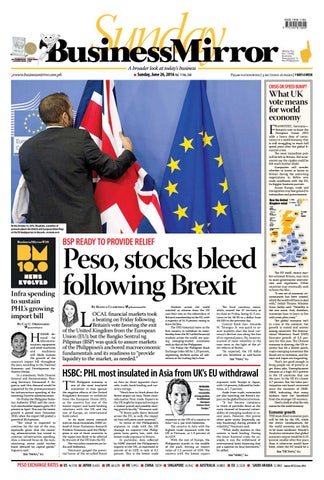
In this October 15, 2015, file photo, a member of protocol adjusts the British and European Union flags at the EU headquarters in Brussels. AP/Virginia Mayo
on Asia on three apparent channels: trade, bank lending and currency swings. “Here’s how to think about the Brexit impact on Asia. Three channels matter. First: trade. Exports to the UK might be impacted owing to a weaker pound and possibly slowing growth locally,” Neumann said. “If Brexit pulls down demand across the EU, as well, the impact on Asia will prove more material.” In terms of the Philippines’s exposure to trade with the UK through its exports—the Philippines fares pretty low, with the lowest trade exposure to Britain. In particular, data collected by HSBC showed the Philippines’s exports to the UK, as expressed in percent of its GDP, is only at 0.2 percent. This is the lowest trade
Neumann: “Asia is in a reasonably strong position to withstand the latest tremors from Europe.”
exposure to the UK of a country in Asia—on a par with Indonesia. The country in Asia with the highest trade exposure with the UK is Vietnam, at 2.4 percent of its GDP. With the rest of Europe, the Philippines stands in the middle of the pack, hitting an export value of 2.5 percent of GDP. The country with the lowest export
exposure with Europe is Japan, with 1.6 percent, followed by Indonesia, at 1.7 percent. Aside from trade, economists are also watching the Brexit’s impact on the global financial stream. “It has become customary to think of portfolio flows as the main channel of financial vulnerability of emerging markets in recent years. However, this proves often quite sticky [especially equity financing] during periods of volatility,” Neumann said. “What really matters in this context is bank lending. During the Asian financial crisis, for example, it was the withdrawal of international bank financing that put a squeeze on local borrowers,” he added.
44.2%
North East
53.7% North West
57.7%
Yorkshire & The Humber
58.8%
East Midlands
59.3% West Midlands
Wales
56.5%
Eastern
52.5%
London South West
52.6%
% vote to leave:
38%
40.1%
South East
Source: electoralcommission.org.uk, BBC Graphic: Staff, Tribune News Service
51.8%
The EU itself, minus market-oriented Britain, may turn to more government intervention and regulation. Other countries may eventually seek to leave the bloc. “A new set of economic circumstances has been created, which the world will have to deal with,” India’s Finance Minister Arun Jaitley said. “Volatility is the new norm. And, therefore, economies have to learn to live with crisis after crisis.” The global economy isn’t in crisis at the moment, but growth is muted and uneven among countries. The International Monetary Fund (IMF) forecasts growth of 3.5 percent for this year. The Chinese economy is slowing; the US recovery has hit a slower patch; major emerging economies like Brazil are in recession; and Europe and Japan are stagnating. That’s not good enough to bring people out of poverty or get them jobs. Unemployment remains at a high 10.2 percent in the 19 countries that use the euro. In the US it’s a lower 4.7 percent. But the labor participation rate hasn’t recovered since the recession of 20082009, indicating that many workers have not benefited from the stronger US recovery. Here’s a look at what the vote means for the world economy:
Economic growth
The most direct economic pain will be felt by the UK, while the direct consequences for the world economy are likely to be more moderate. Moody’s Analytics estimates that global economic output would be 0.25 percent smaller after five years than it otherwise would have been, while the EU would be a See “UK Vote,” A2
See “HSBC,” A2
n japan 0.4455 n UK 68.4270 n HK 5.9952 n CHINA 7.0739 n singapore 34.7642 n australia 34.8833 n EU 52.5528 n SAUDI arabia 12.4063
Source: BSP (23 June 2016 )
NewsSunday BusinessMirror
A2 Sunday, June 26, 2016
HSBC…
Continued from a1
The Philippines’s bank-lending exposure to the UK is also one of the lowest in the region, hitting 2.5 percent of the country’s GDP. The country with the lowest bank-lending exposure is China, at 1.4 percent, followed by Indonesia, at 2 percent of its GDP. In addition, how certain economies will react to the effects of Brexit will also have an impact on the movement of currencies in the region. For example, Neumann said, if Japan’s central bank stands idly by, without intervening directly in foreign-exchange markets, the yen
Infra…
could soar, pulling funds back into Japan, hurting lending and portfolio investment in places like Australia, New Zealand, Indonesia, Malaysia and Korea. In the case of China, meanwhile, the question becomes whether Chinese officials will allow their currency to rally with the greenback, or let it fall behind. “Fears over material renminbi weakness could then quickly reverberate around the region, leading to other currencies to fall, as well, and possibly by more. This, in turn, would tighten financial conditions and hurt
growth. Better hope that China will keep things as steady as possible,” Neumann said. On Friday the local currency neared the 47 territory at its close, losing 41.5 centavos to hit 46.95 to a dollar, from 46.535 in the previous day. “So, what’s the bottom line? Well, you might not be able to tell from current market reaction, but Asia is in a reasonably strong position to withstand the latest tremors from Europe. More insulated, at least in growth terms, should be India, Indonesia and the Philippines,” Neumann said. Bianca Cuaresma
percent to $2.2 billion. This was due to stronger demand for telecommunication equipment and electrical machinery, power-generating machines and landtransport equipment. Also, imports for raw materials and intermediate goods increased by 28.9 percent to $2.5 billion, bouncing back from a modest 5.3-percent growth in the previous month. Imports of consumer goods increased by 21.3 percent to $1.1 billion in April. This was due to higher spending for durable goods, such as passenger cars and motorized cycles, home appliances and miscellaneous manufactures. “The sustained increase in imports of passenger cars reflects an important finding of the AmBisyon Natin 2040 that most Filipinos aspire for car ownership. However, it could also be due to their bad experience with public transportation,” Esguerra said. “Given this, implementation of road infrastructure and mass-transport
projects needs to be accelerated. Problems with respect to licensing and vehicle registration also need to be addressed,” he said. Meanwhile, the PSA said aggregate payments to the top 10 import sources for April amounted to $5.125 billion, or 78.5 percent of the total import bill. The country’s top 3 import sources for April are China, with a 20-percent share of total imports; Japan, with an 11.5-percent share; and the United States, with a share of 8.5 percent. Imports from China amounted to $1.309 billion. This represented an increase of 68.8 percent, from $775.29 million in April 2015. Shipments from Japan reached $748.68 million. This represented a growth of 116.2 percent, from its April 2015 value of $346.34 million. The import bill from the US was valued at $556.93 million. This represented an increase of 25.9 percent, from $442.29 million in April 2015.
Continued from a1
“Consumer spending is also expected to support the growth of merchandise imports in the coming years, especially if the incoming administration pushes through with reforms to make income taxes more progressive.” Esguerra said import growth for the rest of the year will also be supported by imports of petroleum crude, especially toward the end of the year. He said the gradual recovery in oil prices could reduce pressure on the economies of net oil exporting countries, particularly those in the Middle East. “Also, as trade volume picks up, a long-term solution to the congestion in seaports becomes even more imperative. Implementation of the trade facilitation provisions of the recently signed Customs Modernization and Tariff Act will help smoothen the flow of goods through Customs,” he said. The Neda said capital goods registered double-digit growth for the eighth consecutive month, growing by 56.7
Peso…
Continued from a1
currencies. While regional currencies are down, the peso remained in the middle of the pack. We can expect more volatility in domestic markets in the near term,” Tetangco said. “Even as the direct Philippine exposure to the UK is relatively small, we will watch the impact on us via contagion from moves in the US dollar,” he added. The governor further said the BSP will look at developments, particularly how the rest of EU will react to Brexit. “The BSP is ready to provide liquidity to our market as needed. But we don’t see any need to change stance of monetary policy at the moment,” he said. Diwa C. Guinigundo, central bank deputy governor for the mon-
etary stability sector, said the possibility of unwanted consequences of Britain’s exit of the EU is what markets are fearing. “In more ways than one, Brexit is an unfamiliar terrain for the UK. The UK and Europe share many years of important trading and investment linkages. Hence, such an annulment could bring about unwanted consequences on both the real sector and the financial markets on both sides of the English Channel,” Guinigundo said. “This fact is driving the sharp volatilities in both the equities and foreign-exhange [forex] markets. The dynamics of capital flows from emerging markets is also likely to be affected and, hence, we would be feeling the fallout as we did today when the Asian regional cur-
rencies dropped precipitously and equities market profusely bled,” he added. The deputy governor backed Tetangco’s assurance, saying the central bank is “closely monitoring” the situation, particularly in the forex market, and remain “prepared to act” to “ensure orderly transactions and smooth wild volatility.” “We are confident that the flexible exchange-rate regime would be able to absorb the necessary adjustments should they be necessary. After all, the market should be assured of the strength of the Philippine macroeconomy and the banking system, as well as the comfortable level of both our forex reserves and the forex deposits in the banks,” the deputy governor said. ING Bank Manila senior economist Joey Cuyegkeng also remains confident of the local market’s ability to normalize following its slump on Friday, as central banks are expected to moderate the impact of Brexit. What Cuyegkeng is worried about, however, is if the Brexit ultimately leads to a slowdown in Europe’s economy. Moody’s Investors Service has already released its initial assessment of Brexit, saying it ushers in a “prolonged period of policy uncertainty” and is credit negative for the UK. “Heightened uncertainty will likely dent investment flows and confidence, weighing on the UK’s growth prospects, a credit negative for the UK sovereign and other UK debt issuers,” Moody’s said. The credit watcher is also of the view that key credit risks include potential changes to the UK’s commercial relations with the EU, as well as regulatory regimes, access to funding and immigration policy. “But a significant slowdown in EZ [euro zone] as a result of Brexit would have a more significant impact on the Philippines. Europe accounts for 15.5 percent of the total cash remittances of overseas Filipinos in 2015, with exports to Europe accounting for 12.6 percent, while imports from Europe accounts for 11.4 percent of total imports,” Cuyegkeng said.
www.businessmirror.com.ph
Clark shoemaker hires Aytas to boost production for 7 countries in Europe By Joey Pavia Correspondent
C
LARK FREEPORT—A shoe manufacturer based here, which exports its products to seven European countries, is hiring members of indigenous tribes from Pampanga and Tarlac as part of its corporate social responsibility. Asian Sports Apparel Philippines Inc. (AsaPhil), which makes at least 10,000 shoes daily, hosted a recent job fair at San Martin, Bamban, Tarlac, Human Resources Manager Christian Joy S. Dayrit said. She added that San Martin is an Ayta village. Dayrit said the company hired 30 Aytas on the spot during the job fair. “We produce world-class shoes. We decided to hire Aytas because we believe in their capabilities and ability to adopt and learn if given chances,” Dayrit added. She said their shoes are exported to Germany, Ireland, Italy, Denmark, Switzerland, Austria and Hungary. AsaPhil started its operations in this freeport in March 2014 with 300 workers. It initially produced 1,000 pairs of shoes, said Ma. Imee A. Buan, AsaPhil administrative manager. She said as of June 2016, they have 1,100 employees. Sonny Dobles, consultant of AsaPhil, said they are giving the Aytas the minimum salary for regular workers prescribed by law. “AsaPhil wants to help and motivate the Aytas by giving them
UK vote…
a relatively high salary considering they are new and just starting. The company wants to help to the full,” Dobles said. “The company believes in giving back something to the community, especially those who need more help.” Dobles added that the people behind the company want to make Aytas “feel they belong to mainstream society and are not discriminated.” AsaPhil uses China’s technology to make shoes for all ages and gender. Its shoe types are waterproof, and are used for trekking and running. They also make sandals.
Dobles said they now have at least 50 Ayta workers and “more will be hired.” Oscar Dizon, head of the Ayta tribal chieftains in Bamban, lauded AsaPhil for “their noble intention and really beneficial help.” Dizon, speaking in the Ayta dialect, said many of his fellow Aytas used to do farm work and they each earn “P500 weekly or P2,000 monthly.” Now, he said, they each earn P10,000 every month. “I hope the other locators at Clark do the same thing,” Dizon said. There are 82,000 workers and 820 locators at the Clark Freeport.
Continued from a1
full percent smaller and the UK, 4 percent. Then there are indirect effects. Stock-market plunges can make people feel poorer and less likely to spend. Uncertainty can make executives put off investments in new production. “Uncertainty certainly impedes investment decisions, and with few signs of any pickup in the global economy we’re probably going to see a slower rebound in capital spending,” said Sara Johnson, senior research director of global economics with IHS Global Insight.
Central banks
The market plunges after the vote are one reason for the world’s central banks to keep their rock-bottom interest rates in place. “Brexit could be a game changer for central bank thinking,” Megan Greene, chief economist at Manulife Asset Management, wrote in a research note. The Federal Reserve is less likely to raise short-term interest rates this year—and might even have to cut them. Greene predicted that the Bank of England could have to print money to finance government spending, tax cuts or both, and that the Bank of Japan could follow. The European Central Bank might expand its current bond-buying stimulus program.
London lily pad
Many big companies use the UK as a base for their European operations. London’s strength as a banking center is, in part, based on easy access to financial markets in Europe. Regulatory approval to do business in the British capital means an all-access pass to the 27 other EU countries, a process called passporting. Global banks, like JP Morgan Chase, have already said that they would have to move jobs from London to the European mainland if Britain leaves the EU.
Consumers, travelers
AN Ayta worker (right, foreground) is one of 30 Ayta workers recently hired by Asian Sports Apparel Philippines Inc., a shoe manufacturer based at the Clark Freeport in Pampanga. The company exports its shoes to seven countries in Europe. JOEY PAVIA
The pound and euro both dropped on Friday, which should make British and euro-zone exports cheaper overseas. American travelers heading to Britain and the rest of Europe are going to find less-expensive meals, hotels, souvenirs and museum admissions because the US dollar will go further.
Airfare for peak summer months probably won’t dip, but any taxes and fees levied in Europe will be cheaper. For instance, all coach passengers leaving the UK for the US pay £73 for the Air Passenger Duty. That tax is now cheaper. Among retailers, analysts expect luxury sellers—which have already seen weaker demand—to be hurt the most. London luxury shops could suffer if banks move out, taking big-spending employees with them, said Hana Ben-Shabat, a partner at A.T. Kearney. In the US stores like Tiffany and Macy’s, which draw a lot of British tourists to their flagship New York stores, could be hurt. Restaurant companies with a significant presence in the UK and Europe could be hurt, said David Palmer, an RBC Capital Markets analyst. He said the US groups with the most exposure are McDonald’s Corp., and to a lesser degree Yum Brands Inc. (Pizza Hut, KFC), Restaurant Brands International Inc. (Burger King) and Starbucks Corp. Overall, said Steve Barr at PwC, any prolonged declines in the stock market could make shoppers wary about spending.
Trade
The impact on UK-EU trade would depend on how quick and amicable negotiations are on a new set of relations. Britain could wind up like Switzerland, which simply adopts EU requirements without having any say in how they are decided. Britain sends 44 percent of its exports to the EU, less than any other member-country but still significant. The price for continued market access, however, could be allowing free movement of workers. A desire to control immigration was a major force behind the “Leave” campaign, so it’s unclear if such an agreement could ever be reached. “If the UK takes a tougher stance on immigration, for businesses, this will be a disaster, as the EU will retaliate,” said Christian Stadler, professor of strategic management at the Warwick Business School in Coventry, Britain. “Access to the EU will become difficult. For some companies, this means doing business in Europe
won’t be attractive anymore.” “Others will have to deal with complicated bureaucracy,” he said. “In short: a nightmare.”
Markets
Stock markets plunged on Friday, with Germany’s DAX falling almost 7 percent, the Dow Jones industrial average 3.4 percent and Britain’s FTSE 3.2 percent. The pound hit a 31-year low. Outside the UK, however, that turmoil may not last. Analysts at Oxford Economics think the global market reaction and fears of an EU breakup are exaggerated. Today’s drops “are hard to square with the likely long-term impact on the UK—at worst a few percent of GDP in the long run in an economy that is only 3.5 percent of world output.”
Political dominoes
The British vote would have a much broader impact if it becomes a political turning point away from trade and economic integration. In economic terms, free trade is considered a plus for growth. It should mean bigger markets, lower consumer prices and more competition. Yet, those advantages can quickly be forgotten if people feel that the benefits are not fairly distributed, or that their jobs are left unprotected and move to other, lower-cost countries. Many think a British exit could embolden anti-EU, anti-immigration political movements, such as the National Front in France. Its leader, Marine Le Pen, is already considered likely to make the final round of presidential elections next year. Geert Wilders, head of the antiIslam, anti-EU Freedom Party in the Netherlands, called on Friday for a referendum on the EU there, too. And it goes beyond Europe. Donald Trump, the likely Republican nominee for US president, has described the free-trade agreement among Canada, the US and Mexico as “a disaster.” Likely Democratic nominee Hillary Clinton has said the US should “renegotiate deals that are not working for Americans” and, if necessary, reject a proposed trade deal with Asian countries if it doesn’t show clear benefits for raising wages and jobs. AP
www.businessmirror.com.ph
NewsSunday
No immediate oil-price hike due to Brexit—DOE
BusinessMirror
B
RITAIN’S decision to leave the European Union (EU) may yet affect local pump prices, an energy official said on Saturday. “Prices of gasoline and diesel are expect-
ed to increase, ranging from P0.50 to P0.80 per liter, amid speculation of Britain’s exit from the EU,” Oil Industry Management Bureau Director Melita V. Obillo said. Oil firms’ next price adjustment is
Editor: Dionisio L. Pelayo • Sunday, June 26, 2016 A3
on Tuesday. They adjust their prices on a weekly basis to reflect prices of imported oil products that arrive in the country. Obillo said it takes a week for the oil companies to bring their products
to the market from the time they import the products. On June 21 oil companies cut their fuel prices by P0.65 per liter for gasoline and diesel, and P0.45 per liter for kerosene. Lenie Lectura
SundayV
Busine
A4 Sunday, June 26, 2016 • Editor: Angel R. Calso
Who wins from Brexit? China
T
By Michael Schuman | Bloomberg View
HE United Kingdom’s exit from the European Union (EU) is creating a lot of losers: London’s finance industry. British Prime Minister David Cameron. The pound. The grand cause of European integration. But out of all of the market turmoil and uncertainty will emerge at least one big winner: China. In the short term, of course, China’s struggling economy may take a hit from the chaos in the EU, its second-largest trading partner. A smaller, lessstable European market and more cash-strapped consumers aren’t good news for Chinese exporters. Over the longer term, though, Brexit is almost certainly in China’s economic and political interests. Even a fully united Europe—burdened, as it is, by debt woes, high costs, overbearing bureaucracy and, in some cases, dubious competitiveness—has had a tough time competing and contending with China. Now fractured, the EU can’t help but pose less of a counterweight to China’s rise on the world stage. Remember why the EU was formed, in the first place. Proponents like to stress the EU’s mission to promote peace and democracy. More practically, a key goal of unification was to enhance the region’s clout in the global economy. The varied nations of Europe understood that they’d be much stronger if they forged a common market with shared institutions and even a regional currency, the euro, than if they tried to compete as independent units. Europe hoped to evolve from a collection of rich, but contentious, states into a giant economic bloc, on par with the US and, more recently, China. In reality, Europe has struggled to fulfill that ideal and has suffered for it. Persistent nationalism has repeatedly limited its ability to forge a common front on both trade and geopolitical issues. Nowhere has this failure been more obvious than in Europe’s relations with China. As a whole, the EU should, in theory, wield significant power in pressing Beijing to open its markets and play fair on trade. Instead, European nations have routinely squandered that advantage by competing with each other for Chinese investment and favors. Shortly after the UK’s Cameron fawned over visiting Chinese President Xi Jinping last year, German Chancellor Angela Merkel showed up in Beijing, seeking her own business deals. The opportunities for China to divide and conquer—both to strike better bargains and to undercut complaints about its own market-distorting behavior—will only increase now that Europe’s second-largest economy has gone its own way. European businesses would certainly have been better served if the EU could have cobbled together a common policy toward China. While Chinese companies have gone on a major shopping spree in Europe—even buying stakes in beloved football clubs—Merkel, on a recent visit to Beijing, was left griping that foreign firms deserved to “enjoy the same rights and privileges as domestic companies” in China. If she and Cameron and Europe’s other leaders had locked arms and fought for those rights together, they’d have had a much greater chance of success.
Since 2005
BusinessMirror A broader look at today’s business
Paris climate target for 2020: Once impracticable, now a triumph of realism
A
LTHOUGH some people criticized last year’s Paris climate target due to enter into force in 2020 as impracticable, a team of scholars argued that it is, on the contrary, a triumph of realism, the Potsdam Institute for Climate Impact Research (PIK), said on an information relayed to Database.
✝ Ambassador Antonio L. Cabangon Chua Founder
Publisher Editor in Chief Managing Editor Associate Editor News Editor City & Assignments Editor Senior Editors
T. Anthony C. Cabangon Jun B. Vallecera Max V. de Leon Jennifer A. Ng Dionisio L. Pelayo Vittorio V. Vitug Lorenzo M. Lomibao Jr., Gerard S. Ramos Lyn B. Resurreccion, Efleda P. Campos
Online Editor Social Media Editor
Ruben M. Cruz Jr. Angel R. Calso
Creative Director Chief Photographer
Eduardo A. Davad Nonilon G. Reyes
Chairman of the Board & Ombudsman President VP-Finance VP-Corporate Affairs VP Advertising Sales Advertising Sales Manager Group Circulation Manager
Judge Pedro T. Santiago (Ret.) Benjamin V. Ramos Adebelo D. Gasmin Frederick M. Alegre Marvin Nisperos Estigoy Aldwin Maralit Tolosa Dante S. Castro
BusinessMirror is published daily by the Philippine Business Daily Mirror
HOM
Publishing, Inc., with offices on the 3rd floor of Dominga Building III 2113 Chino Roces Avenue corner De La Rosa Street, Makati City, Philippines. Tel. Nos. (Editorial) 817-9467; 813-0725. Fax line: 813-7025. (Advertising Sales) 893-2019; 817-1351, 817-2807. (Circulation) 893-1662; 814-0134 to 36. E-mail: news@businessmirror.com.ph.
www.businessmirror.com.ph
regional offices n DXQR -93dot5 HOME RADIO CAGAYAN DE ORO E-MAIL ADDRESS: homecdo@yahoo.com ADDRESS: Archbishop Hayes corner Velez Street, Cagayan de Oro City CONTACT NOs.: (088) 227-2104/ 857-9350/ 0922-811-3997 n DYQC -106dot7 HOME RADIO CEBU E-MAIL ADDRESS: homecebu@yahoo.com ADDRESS: Ground Floor, Fortune Life Building, Jones Avenue, Cebu City CONTACT NOs.: (032) 253-2973/ 234-4252/ 416-1067/ 0922-811-3994 n DWQT -89dot3 HOME RADIO DAGUPAN E-MAIL ADDRESS: homeradiodagupan@ yahoo.com ADDRESS: 4th Floor, Orchids Hotel Building,
Rizal Street, Dagupan City CONTACT NOs.: (075) 522-8209/ 515-4663/ 0922-811-4001 n DXQM – 98dot7 HOME RADIO DAVAO E-MAIL ADDRESS: home98dot7@gmail.com ADDRESS: 4D 3rd Floor, ATU Plaza, Duterte Street, Davao City CONTACT NOs.: (082) 222-2337/ 221-7537/ 0922-811-3996 n DXQS -98dot3 HOME RADIO GENERAL SANTOS E-MAIL ADDRESS: homegensan@yahoo.com ADDRESS: 2nd Floor, Penamante Clinic Tiongson Street, General Santos City CONTACT NO.: 0922-811-3998 n DYQN -89dot5 HOME RADIO ILOILO E-MAIL ADDRESS: homeiloilo@yahoo.com
ADDRESS: 3rd Floor, Eternal Plans Building, Ortiz Street, Iloilo City CONTACT NOs.: (033) 337-2698/ 508-8102/ 0922-811-3995 n DWQA -92dot3 HOME RADIO LEGAZPI E-MAIL ADDRESS: homeradiolegazpi@ yahoo.com ADDRESS: 4th Floor, Fortune Building, Rizal Street, Brgy. Pigcale, Legazpi City CONTACT NOs.: (052) 480-4858/ 820-6880/ 0922-811-3992 n DWQJ -95dot1 HOME RADIO NAGA E-MAIL ADDRESS: homenaga@yahoo.com ADDRESS: Eternal Garden Compound, Balatas Road, Naga City CONTACT NOs.: (054) 473-3818/ 811-2951/ 0922-811-3993
Printed by brown madonna Press, Inc.–San Valley Drive KM-15, South Superhighway, Parañaque, Metro Manila
Database
By Cecilio T. Arillo
PIK author Ricarda Winkelmann said, “First, and most important, adhering to the Paris target of keeping global warming well-below 2 degrees Celsius is necessary in view of the massive risks that unchecked climate change would pose to society. A crucial type of threats, associated with the crossing of tipping points in the Earth system, is summarized in a landmark map for the first time. “Second, implementing the Paris target is feasible through the controlled implosion of the fossil industry, instigated by a technological explosion related to renewable-energy systems and other innovations. “Third, the target is simple enough to create worldwide political momentum,” PIK scientists said in their comment published in Nature Climate Change. “The Paris target of limiting global temperature increase to well-below 2°C, aspiring to keep the warming even at 1.5°C, offers the chance to avoid some of the greatest climate risks—the tipping of critical Earth system elements. “The ice sheets or the Amazon rainforest, for instance, are projected to succumb to disruptive and likely irreversible change once a certain warming-threshold range is crossed. These are not isolated processes; they affect the whole planet.” Based on the advances made by climate research as a whole over the past two decades, scientists provided a defining diagram of tipping elements in the context of the global temperature evolution. “We illustrate that for the Earth system, half a degree really matters,” Winkelmann said. Warming of only 1.5 degrees above preindustrial levels will have major consequences, such as threatening the survival of coral reefs worldwide. But the difference to 2 degrees is substantial. In a 1.5-degree warmer world, for example, global sea-level rise could be limited to 1.5 meters by the year 2300, whereas at 2°C, 2 to 3 meters rise by
The Paris target of limiting global temperature increase to well-below 2°C, aspiring to keep the warming even at 1.5°C, offers the chance to avoid some of the greatest climate risks—the tipping of critical Earth system elements.” —Ricarda Winkelmann 2300 have been projected, and the Greenland ice sheet may well pass its tipping point. “Beyond 2°C, the course might be set for a long-term complete deglaciation of the Northern Hemisphere,” Winkelmann said, further elaborating that: “This would result in sea-level rise that threatens the survival of many major coastal cities, including New York, Mumbai and Tokyo. Hence, the necessity of the Paris target.” Coauthor Stefan Rahmstorf, head of Earth System Analysis at PIK, explained that: “While the latest Intergovernmental Panel on Climate Change [IPCC] assessment has shattered the infeasibility myth, showing that the 2-degree guardrail can be respected at relatively low cost with the proper political resolve, almost all IPCC scenarios assume so-called negative emissions—taking carbon dioxide (CO2) out of the atmosphere and storing it. That is a very long shot. However, the price decrease and the efficiency increase of wind and solar power have been beyond the most optimistic predictions.” Rahmstorf argued that a technical explosion of renewables would, once the new technologies reach a market penetration of 15 percent to 20 percent, lead to an implosion of the fossil industry. “Currently, India appears to be very serious about implementing its colossal renewables target—an example of self-amplifying developments that have the potential to tip the global market scales.” He said, in addition, a strong climate agreement paves the way toward carbon pricing instruments that will be adopted in more and more countries.
“Last, but not least, issues of morality are going to interfere with economics—one case in point is the divestment campaign, which aims at pulling assets out of fossil businesses,” he said, adding that, “Already today, key financial market players, like the German Allianz insurance, the French company AXA, or the legendary US oil dynasty Rockefeller, are moving in that direction.” “Beyond necessity and feasibility,” said Hans Joachim Schellnhuber, lead author and PIK director, “the 2°C guardrail has a comparative advantage over competing targets that cannot be overrated in the world of ‘realpolitik.’ In fact, the target strikes the optimal balance between concreteness and intelligibility. Now the world of climate action turns around one single number!” In the Paris negotiations last December, the 2-degree concept, originating from a 1995 report by the German government advisory council for environmental issues, proved its worth since every national delegation could take a stance for the temperature limit of its choice. The PIK said this would have been hard to imagine with the more complicated target suggestions made recently, ocean heat content, CO2 equivalent greenhouse-gas atmospheric concentrations, or temperature-change rate. In concluding, Schellnhuber said: “The Paris agreement is a historic achievement and a genuine triumph of reason. Now the pressure is on to implement that consensus in time, in order to avoid the looming humanitarian tragedy for good.” To reach the writer, e-mail cecilio.arillo@ gmail.com
Voices
essMirror
Twitterizing public service
W
HEN his daughter was born, the mayor of Jun (pronounced Hoon) did not go on Twitter to announce, “I have a newborn daughter.” Instead, he opened a Twitter account for her called @martinajun, and wrote, like David Copperfield: “I am born.” The New York Times reports Jun is a small town outside Granada, Spain, where the great and good Inquirer publisher Gani Yambot corrected the skewed view of world media that we kill journalists for the heck of it. He stood up and said, “Well, some of them had affairs with other men’s wives or mistresses.”
Free Fire
By Teddy Locsin Jr. Mayor Jose Antonio Rodriguez Salas (@JoseantonioJun) has more than 400,000 Twitter followers. He spent the last five years turning Jun’s 3,500 residents into the most active Twitter users in the world. That means they don’t just acquire through some gimmick 1 million followers who don’t really follow them; they actually and actively communicate with—but mostly complain to—the local government by Twitter and with each other. Now, Jun has just one cop on the payroll and, Mayor Salas said, 3,500 Twitter users spotting crimes in their neighborhoods. The one remaining cop knows before it happens where a crime is about to be committed, because Twitter followers report suspicious behavior. Even the criminals know beforehand— and cease and desist. Through Twitter, the local
school’s lunch menu is known to parents of schoolchildren so they can make other provisions. So with other social services, like broken street lights or even ravenous power companies, as in #endesameestresa. “You are stressing me out, Endesa.” Endesa is the power company. Salas asked town officials, from his deputy to street sweepers, to open Twitter accounts so they know where they are most needed at any point in time and place. To weed out pranksters, residents are asked to verify their Twitter accounts at the town hall. Justo Ontiveros—“On” not “Hon,” Jun’s lone cop—doesn’t just get complaints; he also gets requests on how to fill out forms to report crimes, like domestic abuse and speeding. You can transact official business, like getting permits, on social media, as well. But there are complaints. Public officials use Twitter to tout their achievements, which sickens residents. But my dad always said if you don’t toot your horn, who will toot it for you? No one else will lick your saliva. But the mayor’s wife has set the example. She is not on Twitter. I suppose it would be unmanageable to Twitterize public service nationwide or even metropoliswide. But surely, by police districts and subdivisions might be useful. Try it.
opinion@businessmirror.com.ph • Sunday, June 26, 2016 A5
Vulnerabilities of LDCs make graduation difficult U
By Ahmed Sareer | Inter Press Service
NITED NATIONS—Last month over 2,000 high-level participants from across the world met in Antalya, Turkey, for the Midterm Review of the Istanbul Program of Action, an action plan used to guide sustainable economic-development efforts for least-developed countries (LDCs) for the 2011-to-2020 period. The main goal was to understand the lessons learnt by the world’s LDCs over the past five years and apply the knowledge moving forward. For my country, the Maldives, the past five years have been a chance to experience first-hand the realities of life after graduation from LDC status. In January 2011 the Maldives was officially removed from the list of LDCs, the culmination of decades of hard work and determined efforts of developing the country. The Fourth UN Conference on LDCs, held in May 2011, was the last for the Maldives as an LDC, but last month in Antalya, we went back because we believed it was important to share the lessons we had learnt since 2011. While our graduation was naturally a moment of pride and cause for celebration for a country only 50 years old, it was accompanied by a sense of uncertainty about the challenges we would face following the withdrawal of the protections and special preferences afforded to LDCs. Ultimately, we were able to forge ahead in spite of these difficulties and adapted to the new realities. We ensured that our economy, driven by a world-class tourism sector, and a robust fisheries industry, would continue to be competitive and dynamic. We focused on fostering a business-friendly climate, while making prudent investments for future growth. However, we remain conscious of the degree to which the gains we have made are vulnerable to exogenous shocks. On December 20, 2004, the United Nations General Assembly (UNGA) decided to graduate the Mal-
dives effective January 1, 2008. But just four days before the UNGA decision, a catastrophic tsunami swept across the Indian Ocean, claiming the lives of over 275,000 people in 14 countries. The 2004 tsunami was especially devastating in the Maldives. With the highest point in our country being just 2.5 meters high, virtually all of it was, for a few harrowing minutes, underwater. Several islands were rendered uninhabitable; nearly one in 10 people were left homeless. Farms were destroyed, the fresh-water lens corrupted, with large-scale loss to infrastructure. The economic cost of the destruction was equivalent to close to 70 percent of GDP, a blow from which it took us over a decade to recover. The Maldives is not alone in facing such vulnerabilities. For many countries, particularly Small Island Developing States, such as our own, an end to LDC status does not necessarily herald the disappearance of structural barriers to growth—such as limited access to markets, geographical isolation, environmental pressures, or difficulty achieving economies of scale. By 1997, the Maldives had already exceeded two of the three thresholds that determine LDC status—gross national income per capita, and the Human Capital Index, measured in terms of undernourishment, child- mortality rates, secondary-school enrollment rates and adult literacy. But we did not exceed the threshold for the third
criterion, the Economic Vulnerability Index (EVI), which measures the structural vulnerability of countries to exogenous economic and environmental shocks—we did not meet this threshold to date. It is not necessary to meet all three thresholds in order to graduate—meaning we were considered ready for graduation. As the tragedy of 2004 taught us, persistent vulnerabilities have the potential to undermine, if not reverse, gains made toward development. Despite meeting the formal requirements, we were not yet ready. The lessons of our own experiences have meant that the Maldives has been consistent in calling for a smoother and more holistic approach to the graduation process. First, the criteria for graduation must account for the structural vulnerabilities of developing countries. The fact that economic vulnerability can be disregarded in determining whether a country is ready to graduate from LDC status represents a critical oversight. Second, the EVI itself must also be redesigned to better account for vulnerability. At present, the index fails to account for key considerations, such as geographic and environmental vulnerability, import dependency and demographic pressures. With greater attention being paid to the effects of climate change on developing countries, most notably in the Sustainable Development Goals (SDGs), evaluating vulnerabilities more comprehensively is a task that has acquired even greater importance. Last, the extension of support and assistance to countries must be determined on the basis of their individual capabilities and challenges, rather than their mere place on a list. We would be remiss to overlook the role that development assistance, including that provided by the UN, has played in helping the Maldives progress—as it has for many oth-
ers—particularly in regards to our work in disaster preparedness and climate-change mitigation. The withdrawal of such assistance—including preferential trade access and concessionary financing—following our graduation from the ranks of the LDCs has meant increased fiscal challenges. This disregards the unique challenges faced by countries, like the Maldives, due to their specific structural constraints—constraints ignored under the present graduation regime. While efforts have been made to smooth the graduation process for LDCs—in 2004, and most recently in 2012—the process remains deeply flawed and in need of comprehensive reform. To this end, the Maldives has called for the World Trade Organization to extend the application of traderelated aspects of intellectual property rights for all LDCs, in addition to the exploration of a “small and vulnerable economy” category at the UN, which would recognize the particular needs of such countries. Similarly, we must move towards devising measures of development that do more than just record national income, and instead provide a more meaningful assessment of national capability and capacity, for which GDP can often be a poor proxy. No country wishes to be called “least developed”, much less remain in that classification indefinitely, but the factors driving underdevelopment must be meaningfully dealt with if we wish to attain genuinely sustainable development. It is for this reason that we believe that the desire by countries to eradicate poverty and achieve economic development must be met with commitment on part of the United Nations and other organizations to chart a realistic and holistic path towards that end.
Ambassador Ahmed Sareer is Permanent Representative of Maldives to the UN and chairman of the Alliance of Small Island States.
US politics scares overseas investors S
By Noah Smith | Bloomberg View
OMETIMES, an economic paper delivers such a disturbing result that you have no choice but to sit up and take notice. That was the case for me, when I saw this new study by Stony Brook University’s Marina Azzimonti. Azzimonti’s disquieting hypothesis is that political partisanship is deterring overseas investment in the US.
When we think of foreign direct investment (FDI), we usually think of rich countries investing in poorer ones—a US multinational buying a factory in China, for example. But the US increasingly depends on other countries’ investment to put its people to work. Nowadays, you hear lots of stories of Chinese companies building copper-tubing factories in Alabama; German companies creating chemical plants in Louisiana; or Japanese automakers building record numbers of cars in the US. But these are not isolated anecdotes—the numbers
tell the same story. Americans don’t often talk about the need to lure FDI. But with the US’s own companies hoarding cash, and its own manufacturing industry failing to add jobs, policy-makers should probably start thinking about how to get overseas corporations to put their factories, offices and research centers in the US. What draws FDI? Intuition suggests that things, like good infrastructure, good education and a predictable regulatory environment, should make a difference, and those are all things that are desirable in
their own right. But when economists have looked into the impact of these factors on FDI, the relationship has proven frustratingly hard to find. We just don’t know as much as we’d like about what concrete steps a government can take to bring in more foreign investment. That’s why Azzimonti’s paper is so interesting. Her hypothesis is that partisan conflict is a major impediment to FDI into the US. Partisan conflict creates doubts about the direction of public policy. Remember the brinksmanship in the 2011 debt-ceiling fight, when it looked as if the US government might be forced into a technical default on its debt, and the country received a credit downgrade from Standard & Poor’s? That kind of thing seems like it might act as a serious negative to overseas companies thinking about building US factories. A technical default would cause financial chaos, spelling disaster for all sorts of domestic assets, so even the slight risk of this happening could chill foreign investment. No matter what the eventual outcome of the political tug-of-war, the very presence of hyperpartisanship creates risks that policy will suddenly change. Some economists claim policy turmoil creates big negative macroeconomic impacts. Since multinational capital is far more mobile than most, we’d expect the effect on FDI to be even larger. Azzimonti tests this using an index of partisan conflict created by the Federal Reserve Bank of Philadelphia. The index uses text-mining of newspaper articles to measure the importance of partisan battles.
Azzimonti finds that, when partisan conflict increases by one standard deviation, FDI tends to fall about 25 percent. That’s a very big impact! Of course, this evidence is only suggestive. The sample period is short—only about three decades. And the US is the only country being studied. Empirical macroeconomic research like this is inherently difficult, because of all the other things that are going on at the same time. Azzimonti naturally controls for many of these—for example, she makes sure to include economic growth itself as a possible confounding factor, since it seems possible that slow growth could incite partisan conflict. But it’s impossible to control for everything. Still, her result is probably more reliable than the usual macroeconomic correlation, simply because the data here is fairly high frequency. Partisan conflict changes rapidly, since issues, like the debt ceiling, come and go within a month’s time. Economic variables, like growth and inflation, change much more slowly—economies rarely suffer a dramatic downturn or spectacular boom within a single month. Hence, Azzimonti’s result should get a little more attention than the typical paper of this type. The upshot here is that partisan conflict is probably hurting the US economy. The rise of the Tea Party and other intransigent partisan warriors in 2010 and afterward—clearly visible on second graph—is an especially disturbing development. America’s politicians should realize that their ideological crusades are bad for business, and bad for American workers.
A6 Sunday, June 26, 2016
NewsSunday BusinessMirror
Retired officer: Poll fraud true T
HE Confederation of Non-Stock Savings and Loan Associations Inc. (Consla), now the Alliance of Non-Stock Savings and Loan Institutions, on Saturday stood firm on its allegation of vote manipulation during the last elections,
saying that its evidence are strong. Retired Air Force Col. Ricardo L. Nolasco Jr., the first nominee of the Consla party-list group, said in a statement that both the Commission on Elections and its sole accredited citizen arm, the Parish Pastoral
www.businessmirror.com.ph Council Reponsible Voting are duty-bound to explain not only to the group’s supporters but also to the Filipino people the discrepancy in their canvassing of votes “for the sake of a transparent and truthful elections.” Joel R. San Juan
Sports BusinessMirror
mirror_sports@yahoo.com.ph | sports@businessmirror.com.ph
Sunday, June 26, 2016 A7
RED LIONS ROAR BACK S By Ramon Rafael Bonilla
AN BEDA COLLEGE avenged its finals loss to defending champion Letran last season, securing a shaky 89-85 victory at the start of the Season 92 National Collegiate Athletic Association on Saturday at the Mall of Asia Arena in Pasay City. The Red Lions hardly missed the services of their deadly trio in Baser Amer, Art de la Cruz and Nigerian reinforcement Ola Adeogun as they displayed their new weapons to clobber the Knights, who parade a new head coach in Jeff Napa. In a battle of tournament heavyweights, San Beda relied on the hot shooting duo of David Potts and Ranbill Tongco, who combined for 16 points in the critical stretch in the fourth quarter to widen their gap to 80-71, with 3:42 remaining in the game. Letran threatened in the closing seconds but the Red Lions hit the timely free throws
to notch their first win. “It just shows that we are a good team for this season,” San Beda Head Coach Jamike Jarin said. “But this is just our first game. We should never be complacent.” The Filipino-American Potts was a revelation for the Red Lions in the game as he played with poise against the physical defense of Letran. “I’m just excited to play my first game. I just want to win the championship,” Potts said. Jayvee Mocon, instrumental to their first half push, finished with 18 points and six rebounds to lead the Red Lions, while Potts and team skipper Dan Sara added 16 and 14 markers, respectively. Donald Tankoua, who was held to two points in the second half, registered 13 points. “They played well in the second half despite the run of Letran. Luckily, they made their shots in the crucial minutes,” Jarin added. Letran’s John Quinto led all scorers with
N
Canadians No. 26. They are expected to make it through to the semifinals and either would be the Filipinos’ opponent should the latter advance from the group stages. Only the tournament winner gets a ticket to the Rio de Janeiro Olympics. Considering the route, it would be veritably like going through the eye of the needle. But the opening, however slight, is there and everybody knows Gilas sure could use the push. That is why all the national and local basketball officials know the more than 100 million Filipinos should come together on this one, like they have done so many times before. “We know you’re the greatest fan base in the world when it comes to international basketball,” Baldwin added. “I can’t reiterate this enough, but please come support your team.”
THE children of the late basketball great Carlos M. Loyza raise their dad’s retired jersey during the opening rites of the National Collegiate Athletic Association Season 92. (Inset) San Beda’s Donald Tankoua loses his balance after colliding with Letran’s Jom Sollano. ROY DOMINGO
LASCUñA’S ROMP CONTINUES T
ONY Lascuña nailed his third victory on the International Container Terminal Services Inc. Philippine Golf Tour (PGT), completing a pressure-free, season-best 11-shot romp over Zanieboy Gialon and Orlan Sumcad on Saturday, with an eagle-spiked 67 and moving two wins away from matching his five-title feat in a banner 2014 campaign. Lascuña turned the final round into a victory walk after virtually sealing the win as early as Friday, when he went unassailably ahead by eight over Sumcad, Michael Bibat, Jay Bayron and Marvin Dumandan at the Forest Hills Golf and Country Club in Antipolo City. Sumcad fell farther back with an early bogey in the final round, but the long-hitting shotmaker fought back with six birdies in a
nine-hole stretch from No. 3, cutting Lascuña’s lead to five-with-seven holes left in a flight ahead of the final group. But he double bogeyed the difficult No. 12 and Lascuña, who gunned down three birdies against two bogeys after 12 holes, went six-up again before capping his romp with an eagle and a birdie in the last three holes to bank another P360,000. The former three-time PGT Order of Merit (OOM) winner totaled a 72-hole 16-under-268 effort, wresting early control with 65 and 64, and practically wrapping up the championship in the third round, despite a one-over-72 card. “It’s nice to win again. I’ve been working hard to further improve my game,” said the 46-year-old Lascuña, whose training includes three 18-hole game each week, a two-hour gym workout and road work, keeping him fit on the rolling Forest Hills layout, despite coming off an Asian Tour campaign in Thailand, where he wound up joint 11th last week.
Lascuña’s 11-shot victory also proved to be the biggest winning margin after eight legs of the circuit, organized by Pilipinas Golf Tournaments Inc., besting Mondilla’s eight-stroke triumph over Jhonnel Ababa at Calatagan last month. It also moved the ace Davaoeño shotmaker, who ruled the Luisita leg by four over Korean Park Jun-hyeok in April and nipped Japanese Ryoma Miki by one at Eagle Ridge early this month, within two victories from equaling his five-title feat two years ago that netted him a third straight OOM title. Three flights ahead, Gialon rammed in four birdies and posed a bogey-free 67 to tie Sumcad, who carded a second 70, at 279 in the event, backed by Custom Clubmakers, adidas, KZG, Summit Mineral Water, Srixon, Pacsports, TaylorMade, Sharp and Champion. Each received P195,000. Bayron ended up with a second 71 for fourth at 280 worth P115,000, while Bibat sputtered
MAMBA’S BACK Los Angeles Lakers legend
Kobe Bryant returns to the country for the Mamba Mentality Tour 2016. Bryant, who retired this season, shares his training regimen to some of the country’s best collegiate and professional players at the Smart Araneta Coliseum. STEPHANIE TUMAMPOS
D
EFENDING champion Petron trounced the pesky and stubborn Generika side in four sets, 25-19, 21-25, 25-22, 27-25, for its second straight win in the 2016 Philippine Superliga (PSL) All-Filipino Conference on Saturday at the Filoil Flying V Centre in San Juan City. The Tri-Activ Spikers were pushed to their limits as the Life Savers battled them toe-to-toe, but their depth and experience proved to be crucial and held on for the victory in the interclub league bankrolled by KLab Cyscorpions, Asics, Grand Sports, Mikasa, Mueller and Senoh, with TV5 as official broadcaster. Aiza Maizo-Pontillas, who had an impressive
T
HE jersey of the man known as the “Big Difference” was retired by the National Collegiate Athletic Association (NCAA) during the opening ceremonies of Season 92 on Saturday at the Mall of Asia Arena in Pasay City. Basketball legend Carlos M. Loyzaga had his No. 14 jersey retired by the NCAA, which welcomed the new season with San Beda College, the school that Loyzaga led to back-toback titles in 1951 and 1952, as this year’s host. The Loyzaga family received the framed jersey in a symbolic ceremony led by Loyzaga’s son, Joaquin C. Loyzaga, who also suited up for the Red Lions. “In behalf of our family, we thank the NCAA community for this honor to our father. He continues to, somehow, motivate and inspire the next generation of athletes,” the younger Loyzaga said. “I hope you remember him as the one who disregarded his own personal ambitions to fulfill his duties for the country,” he added. After his fruitful stint with San Beda, the elder Loyzaga started to make a name in the Philippine basketball team, where he led the country to a bronze-medal finish in the 1954 International Basketball Federation World Cup, still the highest finish by an Asian country up to this date. Loyzaga also helped the squad to rake four gold medals in the Asian Games from 1951 to 1962 and two titles in the Fiba Asia Championships in 1960 Manila and 1963 Taipei editions. He passed away on January 27 after his long battle with stroke. The 85-year-old Loyzaga was feted with numerous awards in his entire career, including a Lifetime Achievement Award from the Philippine Sportswriters Association in 2013. Ramon Rafael Bonilla
23 points, while Rey Nambatac had 18 markers, nine boards and seven assists. The Knights also lost key players in last season’s Finals Most Valuable Player Mark Cruz and forward Kevin Racal due to graduation, as well as their Head Coach Aldin Ayo, who transferred to De La Salle. The Red Lions were leading at the half, 45-36, but the defending champions responded with an 8-2 run in the final minute of the third canto to even the game at 60-all. Then came Potts, who opened the fourth period with a five quick points, while Tongco added nine markers during their decisive run to seize control of the match. Letran won its two meetings with San Beda in last season’s elimination rounds, 93-80 and 77-73, but lost in the playoff for the No. 1 seed, 78-83.
World’s ‘greatest fans’ to give Gilas Pilipinas needed boost OW is the time the world’s greatest basketball fans must come together and support Gilas Pilipinas. Ranged against some of the world’s top-tier squads in the International Basketball Federation (Fiba) Olympic Qualifying Tournament (OQT) Manila, the Philippine National Team sure can use all the help it could get. And here’s where the Most Valuable Fans (MVF) Best Country awardee in the 2014 Fiba World Cup in Spain comes in, as it is expected to provide the indispensable boost in morale and confidence the home team needs through cheers and prayers. “Let’s be a great sixth man,” prodded Samahan ng Basketbol sa Pilipinas (SBP) VicePresident Al Panlilio, CEO of the local organizing committee of the Manila OQT set from July 5 to 10 at the Mall of Asia Arena in Pasay City. “Please, on behalf of our basketball team, keep us in your thoughts, keep us in your prayers and, most important, in your hearts,” was how National Coach Tab Baldwin expressed his own plea for support from this basketball-crazy nation. Baldwin is set to announce his final 12-man roster on Sunday, and his team will have no more than nine days before opening up its Group B campaign against World No. 5 France, which features the San Antonio Spurs’s Tony Parker and Boris Diaw, and EuroBasket Most Valuable Player Nando de Colo. The next day (July 6) it will be New Zealand, ranked 21st by Fiba, testing the Gilas mettle. Based on the final 12-man roster just released by Kiwi Coach Paul Henare, the Tall Blacks are led by eight members of their team that wound up 15th in the 2014 Fiba World Cup. At No. 28 in the Fiba rankings, the Philippines is the fifth lowest-ranked team in the Manila OQT, just up on No. 31 Senegal, which is in Group A, along with Canada and Turkey. The Turks are No. 8 in the world and the
Loyzaga’s jersey retired by NCAA
TRI-ACTIV SPIKERS DENY LIFE SAVERS debut in their win over Foton last week, led Petron anew with a game-high 17 points, highlighted with 16 kills. Bernadeth Pons, the team’s newest acquisition from Far Eastern University, chipped in 16 hits on 12 spikes, three blocks and an ace, while Frances Molina added 14 markers. “Mas mature na ngayon ‘yung mga bago kasi nagkaroon ng experience last conference,” said Petron Head Coach George Pascua, referring to his direct hires Maizo-Pontillas, Bang Pineda, Cherry Nunag and second overall pick Cj Rosario, who all debuted in the preseason Invitational Conference of PSL. “Every game naman satisfied kami, pero depende pa rin sa condition ng bawat
individual,” Pascua added. The win put Petron in a tie with F2 Logistics for the lead with identical 2-0 win-loss cards. Petron prevailed, despite committing 36 errors in the match compared to Generika’s 26 but the Tri Activ Spikers dominated in attacks with 57 won points outplaying the Life Savers, who only had 42 in the game. Generika, which played three straight matches in a week, suffered its second loss, including a sorry loss to Foton on Thursday. The Life Savers dropped to 1-2 record. The duo from University of Santo Tomas, Ria Meneses and Chloe Cortez, led the Life Savers with 14 and 10 points, respectively. Lance Agcaoili
Petron’s Aiza Pontillas (left) scores against Chlodia Cortez of Generika. NONOY LACZA
with a 72 and dropped to joint fifth with Rene Menor, who hobbled with a 72, and 2010 champion Mars Pucay, who shot a 70, at 281. Dumandan limped with a 73 and wound up eighth at 282, while John Rey Pactolerin ended up ninth at 284 after a 69 and Elmer Salvador fired a 69 to tie Danny Zarate, who made a 74, at 285. Mondila, who had an impressive 67 opening, never recovered from a second 73 and finished with a third straight 2-over par card for a 286 for joint 12th with Ferdie Aunzo, who matched par 71. Eight legs remain in the 2016 PGT calendar, with Bacolod hosting the next two legs from July 6 to 9 at Bacolod Golf and Country Club in Binitin and from July 13 to 16 at the Negros Occidental Golf and Country Club, the former Marapara layout.
UP notches crucial win in V-League
U
NIVERSITY of the Philippines (UP) knocked out National University (NU), 25-22, 25-27, 25-13, 25-22, to keep its semifinals bid alive in the Shakey’s V-League Season 13 Open Conference on Saturday at the PhilSports Arena in Pasig City. With their backs against the wall, the Lady Maroons came through when it mattered most, as they forced a tie with Laoag for the fourth spot with identical 3-3 win-loss cards and will play a do-or-die knockout match on the final day of eliminations on Monday. Diana Carlos led UP with a game-high 22 points on 14 spikes, six blocks and two service aces. Isa Molde added16 hits, while Justine Dorog and skipper Kathy Bersola had 14 markers apiece for the Lady Maroons. Playmaker Mae Basarte guided UP with 41 excellent sets. “Kapit lang ng kapit, laro lang ng laro hangga’t may chance sige lang ng sige,” UP Head Coach Jerry Yee said. “We took this game against NU and then if we play good on our game against Laoag, at least some how we’re living up in our top 4 billing last UAAP [University Athletic Association of the Phlippines] season.” UP and NU split the first two sets before the Lady Maroons sizzled in the third set and erected a 22-12 margin en route to a 25-13 advantage. The Lady Maroons were in full control in the fourth, 19-13, before the Lady Bulldogs closed the gap to 20-24, but UP clinched the match point in the next possession. NU fell to 3-4 and was led by Jaja Santiago’s 19 points. Meanwhile, Bounty Fresh notched its first win in Spikers’ Turf with a thrilling 20-25, 25-14, 17-25, 25-22, 19-17 decision over Philippine Navy. The Soaring Griffins ended their four-game losing skid with an amazing come-from-behind win and kept the Sailors winless in their campaign. Philip Michael Bagalay led the charge for Bounty Fresh with 20 hits, highlighted 19 attacks. Romnick Rico delivered 10 spikes and three blocks for 13 points, while playmaker Geuel Asia fed them with 33 excellent sets. “Sabi ko sa kanila last game na namin ‘to kaya ibigay na nila lahat, dapat all out na kami at i-redeem na namin ‘yung sarili namin, since ‘yung mga previous games namin lahat five sets,” Assistant Coach JP de Guzman said. “So, sabi ko sa kanila nangyari na ‘to and we have to learn and sa game na ‘to siguro natuto na kami sa previous errors namin n’ung previous games namin.” Lance Agcaoili
Sports BusinessMirror
PORTUGAL MUST START WINNING
L
ENS, France—With Cristiano Ronaldo finally showing his scoring prowess, Portugal is hoping to achieve something it hasn’t managed yet at the European Championship—win a match. After three consecutive draws, Portugal squeezed its way into Saturday’s round of 16 game against Croatia, which beat defending champion Spain on Tuesday to extend an unbeaten run to 10 matches. “Croatia had an amazing game against Spain. We respect Croatia but we also believe we can beat them,” Portugal Coach Fernando Santos said through an interpreter on Friday. Ronaldo, who netted twice in Wednesday’s thrilling 3-3 draw with Hungary, would clearly be the player Portugal turns to for a victory in Lens. “Portugal is always a team, and Ronaldo is a team player,” Santos said. “Without great teams, there are no great players. A great player might decide a single game, but without great team you can’t win a tournament.” Against Croatia, the history is on Portugal’s side—as it has won all three of their previous encounters without conceding a goal, including a 3-0 victory in the group stage of Euro 1996. More recently, Ronaldo scored the only goal in a friendly win at Geneva three years ago. “This is a totally different match. I warned my players because we will play a final tomorrow,” Santos said. “Croatia has a great team. [Luka] Modric is arguably one of the best players in Europe right now, no one doubts that.”
Santos took over from Paulo Bento in October 2014, after Portugal’s disappointing showing at the 2014 World Cup and poor start into Euro 2016 qualifying with a 1-0 defeat at home against Albania. After leading Greece to the knockout stage of Euro 2012 and the 2014 World Cup based on a tightly organized defense, Santos followed the same philosophy and started rebuilding the Portuguese team. One of the new names was Sporting midfielder Joao Mario, who made his debut as he replaced Ronaldo in Portugal’s first match under Santos, a friendly against France at Saint-Denis. Mario has featured in all three matches Portugal played so far at Euro 2016. “We are aware of what we’ve done so far. We were very good in some aspects, but we need to improve in others,” Mario said through an interpreter. “The group stage is behind us now, everything changes. We want to do much better than before.” Mario said “it was not ideal” that Portugal had just three days to rest following its final group match, compared to Croatia’s four. AP
W
from USA Basketball “the ultimate honor.” The 22-year-old is the latest player to turn down the chance to play for the US in Rio. National Basketball Association Finals Most Valuable Player (MVP) LeBron James, regular-season MVP Stephen Curry, Russell Westbrook, Chris Paul, James Harden
unday, June 26, 2016 mirror_sports@yahoo.com.ph sports@businessmirror.com.ph Editor: Jun Lomibao Asst. Editor: Joel Orellana
DOMINO From indifference to uncertainty, Brexit talk hits Euro 2016
P
Portugal’s Cristiano Ronaldo gets ready to take a free kick during the Euro 2016 Group F match against Hungary. AP
Beal also not going to Rio Olympics ASHINGTON—Washington Wizards guard Bradley Beal has declined an invitation to play for the United States in the Rio Olympics. Beal said on Twitter that he has decided to dedicate his summer to getting into shape for next season. He called the invitation
A8 | S
BEAL
and others have said they won’t go. Beal just finished his fourth professional season. He averages 16 points a game. Wizards teammate John Wall removed himself from consideration when he had knee surgery after the season ended. AP
By Rob Harris
The Associated Press
EFFECT
ARIS—Britain’s momentous decision to leave the European Union (EU) was the talk of soccer’s European Championship on Friday, with one leading Italian player even warning about an undermining “domino effect” across Europe. Wales Coach Chris Coleman spoke of the virtues of free movement of workers in Europe, while England striker Harry Kane conceded to having little interest in the referendum that changed his country’s political destiny. Northern Ireland Coach Michael O’Neill rued his failure to cast a ballot. Discussion wasn’t just isolated to the ranks of the British teams at the tournament in France. Italy defender Giorgio Chiellini broke off from preparations for Monday’s game against Spain to provide a considered analysis of Brexit. “The main concern should be about an eventual domino effect caused by this decision,” Chiellini said. “This vote is the symbol of a general discussion that you can feel in Italy and all across Europe, but I think that discontent shouldn’t lead to a vote for disintegration.” The results of the referendum on British’s future in the 28-country EU have already sent shockwaves around global financial markets and triggered Prime Minister David Cameron to announce his intention to resign. Historic events clearly that don’t seem to be resonating among the England squad. “I don’t know enough about it to be concerned about it,” Kane said at England’s training camp near Paris. “And I don’t think the other players do, as well.”
But players from continental teams were more willing to talk, expressing trepidation about the impact of Britain’s impeding EU departure. “You always had such a feeling of unity [in Europe],” Germany goalkeeper Manuel Neuer said. “It’s a bit of a shame that Britain...doesn’t belong to it anymore.” When it comes to European soccer, Britain has five separate teams: England, Northern Ireland, Scotland, Wales and the overseas territory of Gibraltar. Only England, Northern Ireland and Wales qualified for Euro 2016 and all three are seeking to avoid their own exit from the tournament. Just as Britain decided to split from Europe there will be an influx of Britons to France on Saturday, when Wales and Northern Ireland play at the Parc des Princes in Paris in a round of 16 match. Because of the fall in the pound in the referendum’s aftermath, it’s going to be more expensive. “We’re certainly trying to remain here as long as we can,” Wales captain Ashley Williams quipped, referencing the name of the failed campaign to stay in the EU. His coach, Coleman, spoke glowingly about how working in second-tier European clubs—Real Sociedad in Spain and Larissa in Greece—allowed him to reboot his managerial career after being sacked by then Premier League club Fulham in 2007 and Coventry in 2010. “I wanted the work,” Coleman said. “I wanted the experience, I wanted to get better.” The nature of Britain’s future relationship with the EU will take a while to emerge. It’s unclear whether Britons would be able to seek jobs so easily in Europe. “Even before the result today, it’s disappointing that more coaches from home don’t travel abroad,” Coleman said.