media partner of the year
United nations
2015 environmental Media Award leadership award 2008
BusinessMirror
www.businessmirror.com.ph
A broader look at today’s business n
Sunday, June 25, 2017 Vol. 12 No. 255
2016 ejap journalism awards
business news source of the year
P25.00 nationwide | 12 pages | 7 days a week
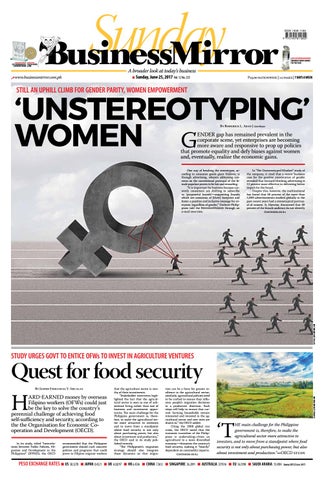
Still an uphill climb for gender parity, women empowerment
‘Unstereotyping’ women G By Roderick L. Abad | Contributor
ENDER gap has remained prevalent in the corporate scene, yet enterprises are becoming more aware and responsive to prop up policies that promote equality and defy biases against women and, eventually, realize the economic gains.
In “The Unstereotyped Mindset” study of the company, it cited that a recent business case for the positive presentation of gender revealed that forward-thinking advertising is 12 percent more effective in delivering better impact for the brand. Despite this, however, the multinational has found that 50 percent of the more than 1,000 advertisements studied globally in the past recent years had a stereotypical portray al of women. It, likewise, discovered that 40 percent of the female audience do not identify Continued on A2
skypixel | Dreamstime.com
One way of breaking the stereotypes, ac cording to consumer goods giant Unilever, is through advertising, wherein addressing con cerns on the conventional portrayal of the fe male populace proves to be fair and rewarding. “It is important for business because cur rently consumers are shifting to subscribe to ‘purposeful brands’—supporting brands which are conscious of [their] footprint and foster a positive and inclusive message for ev eryone, regardless of gender,” Unilever Philip pines told the BusinessMirror through an e-mail interview.
Quest for food security H By Jasper Emmanuel Y. Arcalas
ard-earned money by overseas Filipino workers (OFWs) could just be the key to solve the country’s perennial challenge of achieving food self-sufficiency and security, according to the the Organisation for Economic Cooperation and Development (OECD). In its study, titled “Interrela tions between Public Policies, Mi gration and Development in the Philippines” (IPPMD), the OECD
recommended that the Philippine government should craft concrete policies and programs that could prove to Filipino migrant workers
PESO exchange rates n US 50.3270
that the agriculture sector is wor thy of their investments. “Stakeholder interviews high lighted the fact that the agricul tural sector is seen as one of sub sistence living rather than one of business and investment oppor tunity. The main challenge for the Philippine government is, there fore, to make the agricultural sec tor more attractive to investors and to move from a standpoint where food security is not only about purchasing power, but also about investment and production,” the OECD said in its study pub lished recently. “The Philippines’s migration strategy should also integrate these dynamics so that migra
tion can be a force for greater re silience in the agricultural sector; similarly, agricultural policies need to be crafted to ensure they influ ence people’s migration decisions in a productive direction. Such steps will help to ensure that cur rent farming households remain interested and invested in the ag ricultural sector and new ones are drawn in,” the OECD added. Citing the 2008 global rice crisis, the OECD noted that the economic transition of the Philip pines is undertaking—from an agricultural to a more diversified economy—threatens the country’s food security, making it “heavily” dependent on commodity imports. Continued on A2
Goodolga | Dreamstime.com
Study urges govt to entice OFWs to invest in agriculture ventures
‘T
he main challenge for the Philippine government is, therefore, to make the agricultural sector more attractive to investors, and to move from a standpoint where food security is not only about purchasing power, but also about investment and production.”—OECD study
n japan 0.4521 n UK 63.8297 n HK 6.4536 n CHINA 7.3612 n singapore 36.2091 n australia 37.9516 n EU 56.1398 n SAUDI arabia 13.4184
Source: BSP (23 June 2017 )
NewsSunday BusinessMirror
A2 Sunday, June 25, 2017
www.businessmirror.com.ph
‘Unstereotyping’ women Continued from A1
themselves with the women they see in ads across the industry. This is a reality that shows a slack of representation and di versity in the media, Unilever said, adding that gender stereo types inhibit parity between men and women. Stereotype is a word used to define all people of a certain belief into a mostly negative category that may only reflect a selected few of the racial demographics. It leads to prejudice and dis crimination, as well as “hold peo ple back, damage society and de stroy brands”.
The battle
BY and large, all nationalities have become victims of being stereo typed, even those who also com mitted it to other people. In fact, the World Economic Forum reported in 2016 that there’s still a widening gap on both sexes. At the current level, it said women may not reach economic equality for another 170 years. Per international research firm Athena Insight, however, 58 percent of women-empowerment believers agreed that there would be greater economic prosperity, as 57 percent said that businesses with women leaders are more like ly to be successful. “[So] businesses are recogniz ing the positive feedback in em powering women,” Unilever said. “There is a growing trend world wide for business to address the
gender wage gap and promote gen der equity in the workplace.” In pursuit of gender balance, Unilever commissioned a study to know how stereotypes and cul tural norms impact the workplace worldwide. Of the 4,029 respon dents—3,905 white-collar and 1,158 supply-chain employees across eight countries—60 per cent of women agreed that stereo types impact people’s careers and lives globally, and 49 percent of men subscribed to this. Fifty-nine percent of women versus 51 per cent of their male counterparts be lieved that “Boys Club”, or a term for a group that allows men only to become members, leads to inequal ity, as 65 percent of them against 55 percent of men witnessed this in their place of work. The research also bared that women are fixed until their kind of leadership resembles those of men. It said 61 percent of the re spondents indicated that most firms want women to lead like men, rather than letting women lead like themselves. As regards attitude, women feel pressured to get over the bad behaviors of their male coworkers, as 67 percent of them observed “inappropriateness”. Women are also victims of double standards in the workplace. Fifty-seven percent of women and 51 percent of men thought that a woman should also be nice and look good in leading the firm, while a man is simply expected to lead. Globally, 61 percent agreed
women colleagues are often dis tracted by kids or family concerns. On the other hand, only 29 percent said this about men. These, and other stereotypes, build perceptions on women as be ing risky investments, the research further revealed. “[So the] 55 per cent of respondents in the sur vey who agreed that ‘women are viewed as a risky investment, as they often prioritize families over career,’ leads to a perception that women are liabilities—not as sets—at work,” Unilever stressed.
Equality within organization
BIGOTRY, which has been a peren nial concern globally, continues to lurk around in the international trade arena. For Indian national Leena Nair, the youngest chief humanresource officer of Unilever, this has been a widespread concern not only in her native country, but worldwide. Nair bared that she herself had experienced being stereotyped in the companies she has worked with in the past. With sheer deter mination and grace, however, she conquered it. “A good thick skin, tremen dous focus, be focused on impact, and be very open to feedback be cause you have to constantly adapt your style to fit in different coun tries, in different places,” she said during the recent Unilever Philip pines’s forum on ending stereo types and biases experienced by women in their workplaces, titled “#Unstereotype”.
Sharing the same experience with her is Lynette Ortiz, the first Filipino CEO of the Standard Chartered Bank of the Philippines. Though experienced as a bank er, she revealed that she sometimes had to “downplay” her being a fe male in the banking world domi nated by men. “You know I just wanted to conquer down, to work, be really good at what I was doing and not so much emphasize on the fact that I was the only woman in that dealing room,” Ortiz noted. When asked if they have expe rienced difficulties in leading their men workers, both Nair and Ortiz pointed out that their leadership styles don’t distinguish, whether you are male or female. The panelists also gave advice to women who have experienced, and might have been experiencing, such treatment at work. “Just don’t mind them. Just go on with your life with utmost normalcy. Comply with your ob ligations. Forget that you’re [a] woman, transgender, LGBT [les bian, gay, bisexual and transgen der], just forget about it. And prove them wrong, little by little, day by day,” Rep. Geraldine Roman of the First District of Bataan said.
Good biz sense
RECOGNIZING the unspoken ste reotypes is simply addressing the gender gap. This works for the DutchBritish transnational firm, whose priority is to leverage its clout and lead transformational change in many aspects, including equilib rium on both sexes, as women are pivotal to the organization. Globally, seven of 10 Unilever customers are women, accounting for three-fourths, or 77 percent, of its sales. “As a company with a wide global reach, this is an opportu nity for Unilever to leverage influ ence to drive change in different
areas, which includes the empow erment of women,” the company said, while citing that women are controlling nearly two-thirds, or 65 percent, of consumer spending, and are the fastest growing market in the world today. “Recognizing that the con sumer-goods industry has the power to shape perceptions, Uni lever is taking the lead to use this power in a positive manner for its consumers,” it added. In so doing, Unilever launched #Unstereotype—an international movement aimed at changing soci ety’s perception on gender. The firm has committed to create roles that will widely repre sent the various personalities and appearances that are real and posi tive, giving inspiration to people to become what they want to be. This is evident in the ad campaigns across its brands. Unilever’s male grooming product Axe, for instance, is doing a turnaround from exhibiting con ventional forms of masculinity to celebrating the individuality and different personalities of men. Through its #loveatfirsttaste tack, Knorr highlights that food and cooking are both pleasures that can be enjoyed by everyone. In the Philippines alone, the “Dove Real Beauty” campaign is one of the global campaigns which celebrate body diversity and differ ent types of Filipina beauty. Neil Trinidad, marketing di rector for Dove Masterbrand, said in a previous report of Adobo mag azine: “The world over is experienc ing a real movement toward liber ating the definitions of beauty and we want women everywhere to cel ebrate what makes them unique— their features, their roles and their sense of pride in being who they are, as they are.” “For the last 60 years, we have supported women all over the world to see beauty as a source of
confidence and [an] avenue of true self-expression and never of anxi ety. Through this campaign, we not only wanted the opportunity to work with so many women from diverse backgrounds, but also encourage conversations toward evolving to a wider definition of beauty in the Philippines,” he said. Given the results of the company’s “The Unstereotyped Mindset” study, the global head of marketing of Unilever signed a memorandum with all the top ad agencies in the world, wherein they agreed to change stereotype portrayals of women in advertis ing for the next generation. Business-wise, the company said doing so has earned it a “dou ble-digit” growth for its brands. What’s more, it added that even its competitors have followed suit to present women in their campaigns in a positive light and more relat able to the market. Beyond advertising, the Un stereotype initiative, likewise, aims to remove unconscious bias applied within the Unilever orga nization. Based on the study, when sex ism occurs in the workplace, wom en get fewer opportunities, hurt their performance and, eventually, stifle their careers. With this in mind, the compa ny champions diversity and inclu sion within its work environment. Employing 169,000 employees in more than 100 nations, it develops an inclusive culture that respects gender, age, race, disability or sex ual orientation of its people. As the heart of its business, both internally and externally, women comprised nearly half, or 46 percent, of its executive management internationally. In the Philippines it is also fairly implementing a gender-balanced work environment, given that women hold 48.8 percent of lead ership roles in the organization.
Quest for food security Continued from A1
“In tandem, policy-makers should address rural and agricultural infra structure, such as irrigation and farmto-market roads, to make the sector more attractive for investment and employment,” the OECD said. “At present more productive and higher-paying jobs are to be found elsewhere, and return mi grants may be returning to urban areas instead of their rural house holds,” it added. The OECD made three policy recommendations to encourage OFWs to invest their money in the agriculture sector: adequate labor market institutions; improving in vestment skills; and agricultural aid programs. The OECD noted that “job search centers, training programs and contract enforcement mecha nisms should be put in place in ru ral areas to ensure that agricultural households can easily replace labor lost to emigration, and to facilitate and accelerate the task of hiring la bor in times of peak demand.” “Farming households in areas of high emigration should also be targeted with agricultural techni cal support [e.g., for the use of new resistant crops, fertilizer, irrigation techniques] to help deal with the loss of labor, as well as a possible channel for investing remittances,” it said. The government should also improve basic infrastructure, en hance investment capabilities of OFWs, and create incentive pro grams to “channel remittances and return migration toward invest ment in the agricultural sector, such as improving basic infrastruc ture,” according to OECD. “Policy-makers should help households and return migrants use their remittances to diversify their activities—both within and outside the sector—through incentives and
training,” the OECD added. Government subsidies in ag riculture would also ensure that Filipinos workers will continue “to deter emigration, as well as encour age more investmentin the sector,” according to the OECD. The policy recommendations made by the OECD were derived from the findings of the survey it conducted to 593 agricultural households out of the 1,999 total households inter viewed for the IPPMD report. Bulk of the total agricultural households, around 63 percent, or 372 households, were engaging only with livestock rearing. Meanwhile, 115 households were engaged only in arable farming, while the remaining 106 families do both arable farming and livestock rearing. One of the findings of the OECD study was that returning Filipino migrant workers help their households to diversify and pos sibly transition out of agriculture: Households with return migrants were more likely to run nonagricul tural businesses. The OECD study also found out that agricultural households that have benefited from subsidies, by relieving financial constraints on the house hold, have reduced need to emigrate and find new sources of income. “Moreover, households with land title certificates are more likely to have members planning to emi grate, although actual emigration rarely materializes,” the OECD said. Migration expert Jeremaiah M. Opiniano told the BusinessMir ror that Filipino migrant workers do not invest in agriculture-related businesses as they deem the sector as “risky” and “unprofitable”, unlike other business ventures. “Filipinos abroad and their families will not invest in farming and fishing because the returns are not as gainful and immediate
as earning over a few hours work abroad. Should they invest, anoth er family member will continue to work and earn abroad so that the remittance eases the risks to be faced by agriculture-related busi nesses,” said Opiniano, executive director of the Institute for Migra tion Development and Issues. “Real property is for these Filipi nos a ‘better investment’ because the property acts as a tangible ‘trophy of success’ for the Filipino migrant. Sadly, that view may not be the case for agriculture [not even a farmland, or a fishing ground, is a symbol of tri umph],” Opiniano added. Opiniano said the government should intensify its awareness cam paign to encourage OFWs on possi ble investments in the agriculture sector. “I also think the information on where to invest in the agricul tural sector, or even which agricul tural products can be invested on in Filipinos’ rural birthplaces, is miss ing. A rural locality’s business cli mate conditions can be fixed. As for the agricultural sector, at least a lo cality should put together informa tion available locally on where best to invest in agriculture,” he said. “Government, at the very least, must provide credible information on which agricultural ventures they can invest in. A program can also be done in which DA [Department of Agriculture] tells local government units’ agricultural officers to develop local agricultural investment portfo lios for residents locally and abroad to see,” he added. Opiniano and Ateneo de Ma nila University’s Eagle Watch se nior fellow Alvin P. Ang have im plemented a research tool called “Ricart”, which measures the ex tent of investments made by OFWs in their rural hometowns in rela tion to the area’s development.
The World BusinessMirror
www.businessmirror.com.ph
Sunday, June 25, 2017
A3
Boeing beats Airbus in air-show haul as plane demand rebounds B By Phil Serafino & Richard Weiss | Bloomberg News
oeing Co. beat rival Airbus SE in orders at the Paris Air Show this week as a new, stretched version of the US plane maker’s 737 workhorse sparked a flurry of intense deal-making at the aviation industry’s biggest gathering this year. Boeing won orders and expressions of interest for 600 planes worth as much as $79 billion, according to figures compiled by Bloomberg based on company announcements as of midday on Thursday. While Airbus pulled out a series of late agreements, it fell short with a tally of 326 airliners valued at just under $40 billion, sales chief John Leahy said at a news conference at the show, adding that the two companies were about equal in terms of firm orders, which exclude more tentative agreements to buy. “Are we conceding that Boeing sold a few more airplanes than we did? Yes,” said Leahy, who reaffirmed his plan to retire later this year. “Every dog gets his day.” The deal-making amounted to more than double the $50 billion posted at last year’s show in Farnborough, England, which alternates with the Paris expo as the industry’s marquis event. The unexpected surge marked the highest purchase tally in at least eight years. Asian lessors
$79B
The estimated worth of Boeing orders and expressions of interest for 600 planes
and airlines were particularly active as t hey g irded for an accelerating travel boom. The order binge, driven by demand for single-aisle planes, quieted concerns that demand is fading. “Maybe people came to the show with muted expectations, but the order activity is positive on the backdrop of relatively strong air-traffic growth,” said Kelly Ortberg, CEO officer of aerospace supplier Rockwell Collins Inc. “New narrow-body introductions are exciting. I think we’ll all leave going, ‘The show was a little better than expected’.” Pledges to buy the new single-
aisle Max 10, which Boeing began marketing in Paris to combat Airbus’s hot-selling A321neo, amounted to 351 airliners. Net new commitments for the model amounted to 137 planes, with customers shifting another 214 from earlier agreements for other Max versions, and thereby eating into those backlogs. The biggest disclosed buyer at the Paris expo was General Electric Co.’s GE Capital Aviation Services, which ordered 100 Airbus planes valued at $10.8 billion and converted 20 Boeing production slots from earlier purchases to the Max 10, the biggest variant of the 737. Boeing said on Thursday it signed a sales agreement with an “unidentified major airline” for 125 Max 8s valued at $14 billion. The boost from the Max 10 should help Boeing’s order flow come close to matching deliveries this year, CEO Dennis Muilenburg said. The measure, known as book-to-bill, fell below one during 2015 and 2016 as sales slumped for the Chicago-based manufacturer amid falling oil prices, which sapped demand for new aircraft. Demand for planes jumped earlier in the decade as high fuel prices spurred airlines to stockpile orders of more efficient planes, like Boeing’s upgraded 737 Max lineup and Airbus’s A320neo. That order flurry caused Airbus’s backlog to more than double, surging past 6,800 airliners after its deals in Paris.
Speeding deliveries
A irbus i s now foc u si ng on
US, EU to China: Limit food-import control
B
EIJING—Food exporters, including the United States and European Union (EU), are stepping up pressure on China to scale back plans for intensive inspections of imports that they say would hamper access to its fast-growing market. The group, which also includes Japan and Australia, sent a joint letter to Chinese regulators asking them to suspend a proposed requirement, due to take effect on October 1 for each food shipment to have an inspection certificate from a foreign government. They say that would disrupt trade and ask Beijing to follow global practice by applying the requirement only to higher-risk foods. The dispute, about which governments have said little in public, adds to complaints Beijing is reducing market access for goods ranging from medical technology to farm-related biotech in violation of its free-trade commitments. The letter, dated June 12 and seen by The Associated Press, was sent by an unusually broad group, including the 28-nation EU, the United States, Japan, Australia, Argentina and Israel and four other countries. It is addressed to the director of the General Administration of Quality Supervision, Inspection and Quarantine, known as AQSIQ, and the Chinese commerce minister. A foreign official who asked not to be identified further due to the sensitivity of the issue confirmed the letter was sent to Chinese regulators. The letter says the rules would affect billions of dollars’ worth of meat, fruit, dairy and other products and thousands of suppliers who look to China as a growing export market. Foreign suppliers complain Beijing already uses safety rules in ways that hamper access for beef and other goods in violation of its market-opening commitments. AQSIQ did not reply to a request for comment or questions sent by
fax about how regulations might be changed in response to foreign appeals. The depth of US concern about the impact on American farmers and food processors is reflected in Washington’s decision to take part in the group at a time when President Donald J. Trump has downplayed trade disputes with Beijing to gain Chinese support in dealing with North Korea. The EU role highlights the broad scope of foreign anxiety. Action by the EU requires unanimous agreement by its members, which means nations including Greece and Hungary that want to attract Chinese investment consider the threat serious enough to risk a possible backlash. Eastern European countries with little manufacturing pay for Chinese goods by selling ham, apples and other food to China. Chinese food imports in the first four months of this year rose 17 percent over a year earlier to $39.4 billion. Foreign governments have been lobbying Beijing since last year to scale back the proposed regulations. European officials complained they appeared to be intended to shield Chinese suppliers from competition and allow Beijing to block imports from individual countries if it chose. China submitted its proposed regulations to the World Trade Organization (WTO) as an official notice to other governments, which have 60 days to comment on them. They were posted this week on a WTO web site. In a possible concession to foreign appeals, the regulations on the WTO web site say inspection certificates would be required to say food items were made by a supplier supervised by government regulators and were fit for human consumption. That appeared to be a significant change from an earlier proposal to require inspectors to confirm that food complies with China’s quality standards, a provision to which
foreign governments objected. The latest version still says each “batch of food” would require a certificate, a step foreign officials previously complained would waste resources that should be focused on high-risk products such as dairy. The June 12 letter appeals to Chinese regulators to alter the proposed rules to allow imports from foreign suppliers that are approved by government inspectors without requiring a separate certificate for each shipment. The rules would apply to items from meat and dried fruit to cocoa and spices, according to the document. Foreign officials earlier expressed concern they might extend to such products as coffee, wine, pasta and chocolate, but it was unclear whether the list submitted to the WTO included such processed foods. China contends the inspection requirement is supported by the Codex Alimentarius, the “Food Code” of the UN Food and Agriculture Organization and World Health Organization. The Codex sets quality standards but other nations say it recommends certificates only for risky products. The EU and other governments arranged for the president of the Codex council, Awilo Ochieng Pernet, a Swiss lawyer, to attend an April 6 seminar with Chinese officials in Beijing to explain its standards. The proposed rules follow an avalanche of scandals over Chinese suppliers caught selling tainted milk and other shoddy or counterfeit food products. Western officials say the proposed food rules appear meant to shift responsibility away from AQSIQ, which Chinese consumers often blame for safety failures. Beijing already is at odds with the US and Europe over low-priced exports of steel and aluminum they say are hurting foreign competitors. AP
speeding up deliveries following delays on the A320neo series and wide-body A350, COO Fabrice Bregier told investors at a conference on Wednesday. The Toulouse, France-based manufacturer still plans to hand over about 30 more planes to customers this year than in 2016, which means the company will need to accelerate work in the second half, he said. One of the largest named airline customers at the Paris show was India’s SpiceJet Ltd., which struck a deal with Boeing for 40 of the newest Max model despite being wooed by Airbus, cofounder Ajay Singh said in an interview. The carrier was joined in orders at Boeing by Chinese operator Okay Airways Co. Ltd., Indonesia’s Lion Mentari Airlines Pt., Japan Investment Adviser Co. and BOC Aviation Ltd. The leasing arm of China Development Bank signed agreements to buy airliners from both Airbus and Boeing and is mulling potential wide-body jet orders to serve Asia’s capacity-constrained markets, CEO Peter Chang said in an interview.
Avolon, the world’s third-largest lessor, ordered $8.4 billion of Boeing models. The unit of Beijing-based Bohai Capital Holding Co. decided to lock in deliveries of as many as 125 of the upgraded narrow-body jets starting in 2021 because the slots are “very valuable real estate,” Avolon CEO Domhnal Slattery said. The Max series is oversold through 2020, and capacity is finite for the model favored by budget carriers, Slattery said in an interview. He sees the aerospace market tilting to Asia as the middle class swells by more than 1 billion people over the next decade.
Population jump
“We have never seen a demographic shift like that ever in the world, in terms of the scale but also the purchasing power,” Slattery said. “These people are going to get on planes” and “there’s no going back”. The Max 10 will be 5 1/2 feet (1.68 meters) longer than the $119.2 million Max 9, currently the biggest member of the reengined 737 aircraft family, which was launched in 2011. It will be
the first new model from Boeing since the twin-aisle 777X series, now dubbed the 777-8 and 7779, was unveiled at the Dubai Air Show in 2013. Still, the order flurry—logged during sweltering conditions in Paris—included large numbers of conversions from previous orders and commitments that may not ever materialize. “Lessors also increase the risk that the market will have more supply for a particular aircraft due to speculative buying,” George Ferguson, an analyst with Bloomberg Intelligence, said in a report, adding that Boeing and Airbus were on a par with 144 firm orders each, but Boeing’s value higher due to more widebodies. With numerous conversions among the Max 10 orders, “that wouldn’t qualify as a launch as far as we’re concerned,” said Airbus sales head Leahy, who had earlier quipped that the Boeing plane’s biggest competitor is its sister Max 9. “Let’s talk about the actual incremental orders they’ve got, and I think our numbers are looking pretty good.”
A4
The World BusinessMirror
Sunday, June 25, 2017
Saudi shake-up and Qatar crisis show a Gulf on edge By Adam Schreck & Jon Gambrell | The Associated Press
D
UBAI, United Arab Emirates— There was a time when the mention of the Persian Gulf brought to mind, images of pampered societies ruled by aging monarchs content to preside quietly over their oil money and fantastical skyscrapers, while the US kept the peace.
Not anymore. A sudden royal shake-up in Saudi Arabia early Wednesday is only the latest wild card to be thrown in days of head-spinning developments in the typically staid Gulf. The kingdom-led nations in unexpectedly cutting off nominal ally, Qatar, from the clubby Gulf Cooperation Council, which suddenly looks so incredibly uncooperative that is has raised fears of war among its members. The fact that Qatar hosts one of the biggest and most important foreign US air bases has so far proved to be a good insurance policy for the tiny emirate—but the dispute brings headaches for Washington. The main adversary the Arab nations set up the council to stand against, Iran, meanwhile, launched a volley of ballistic missiles at militants in Syria, its first such strike in more than a decade and a half. That’s not even getting into low global-oil prices squeezing their largely petrodollar-driven economies. Nor does it account for the ongoing threat posed by the Islamic State (IS) group, which struck Tehran for the first time or the stalemated war in Yemen that’s led to extensive civilian suffering. So what’s actually going on? Some analysts have pointed to the fact that much of the turmoil came after US President Donald J. Trump’s trip last month to Saudi Arabia, his first state visit designed to show the Republican had a far different worldview than his Democratic predecessor Barack Obama. In truth, many of the tensions currently on display—with both Iran and Qatar— go back years. But Trump’s strong public endorsement of Riyadh as
his primary regional partner may have emboldened the Saudis and changed some of the geopolitical math. Saudi Arabia and other Gulf nations, like the United Arab Emirates, were deeply suspicious of Obama’s diplomatic detente with Iran, which culminated in the 2015 nuclear deal. “The Obama administration’s apparent attempt to disengage from the region engendered a change in the Gulf ’s strategic culture, making some US partners more confident in their ability to act on their own,” wrote Michael Eisenstadt, the director of the Military and Security Studies Program at The Washington Institute for Near East Policy. However, “arms sales or military surges cannot compensate for policy errors and missteps whose effects are regional in scope and geopolitical in scale,” he added. US Secretary of State Rex Tillerson’s efforts at trying to mediate the Qatar crisis, while Trump’s own tweets appear to back the Saudi-led isolation over allegations the country supports terrorism have only compounded the uncertainty gripping the Gulf. Qatar long has denied backing extremist groups, though Western diplomats say its lax oversight allowed funding of Sunni militants, like Syria’s al-Qaeda branch. The State Department this week demanded the countries boycotting Qatar spell out their complaints, suggesting the Trump administration was losing patience over the spat among its Gulf partners. In Iran, Tillerson’s comments last week before Congress that the US is working toward “sup-
In this April 5 file photo, released by the Saudi Press Agency, SPA, Saudi King Salman (right) and Defense Minister and Deputy Crown Prince Mohammed bin Salman wave as they leave the hall after talks with the British prime minister in Riyadh, Saudi Arabia. Saudi King Salman has put his 31-year-old son, Mohammed bin Salman, next in line to take over the oil-rich kingdom with a royal decree on Wednesday. Saudi Press Agency via AP
port of those elements inside of Iran that would lead to a peaceful transition of that government”, angered officials there already suspicious of Trump. Meanwhile, citizens of Tehran openly accused Saudi Arabia of backing the IS attack on parliament and the shrine of the Islamic Republic’s founder that killed 18 people and wounded over 50. Their evidence? Newly minted Saudi Crown Prince Mohammed bin Salman’s own comments in May that the kingdom would “work so that it becomes a battle for them in Iran and not in Saudi Arabia”. So, when Iran launched its first missile attack in over 15 years on foreign soil this week targeting IS fighters in Syria over the Tehran assault, it openly acknowledged it was a message for Saudi Arabia and America. That crisis between Iran and Saudi Arabia, which cut diplomatic ties in 2016, has extended into a disputed shooting in the Persian Gulf. Saudi Arabia said it captured three members of Iran’s elite Revolutionary Guard aboard an explosives-laden boat that it alleges planned to attack a major offshore oilfield. Iran dismisses the allegation, though it earlier acknowledged the death of one citizen it called a fisherman who was shot by Saudi forces. There’s turmoil striking other Gulf countries, as well, particularly the tiny island of Bahrain, which is linked to Saudi Arabia by
a causeway. A government crackdown on dissent for over a year continues unabated. Militants have responded by stepping up attacks on security forces, including one Sunday that killed a the police officer. In Kuwait and Oman, citizens worry about the health of their current leaders, respectively the 88-year-old Sheikh Sabah Al Ahmad Al Sabah and 76-year-old Sultan, Qaboos bin Said. In Oman, there’s no clear successor to the sultan, while in Kuwait, a leadership struggle is possible. That challenge of continuing dynastic rule in Gulf Arab nations is tied to the task of handling burgeoning youth populations, who expect to live, as well, or better than their parents. In Saudi Arabia, King Salman putting his assertive, 31-year-old son as next in line to the throne could prove popular with the kingdom’s youth—if he can pull off his ambitious plans to wean the country from its oil-soaked economy. That all could be derailed with the dissention among the Arab Gulf states in the region and the ever-heating war of words between Iran and Saudi Arabia. In a way, that trouble has been there for decades, simmering just under the surface. Now it’s boiling to a crisis at a level unseen since the 1990 Iraq invasion of Kuwait. That ended with a war and burning oil fields, something no one wants to see now.
Do American travelers even belong in N. Korea?
T
he US State Department urges Americans to avoid traveling to more than three dozen nations, including such troubled locales, as Libya, Cameroon and Venezuela. Still, obtain a valid passport and permission from the ostracized nation, and you can go there relatively freely. This freedom may soon be curtailed for those wishing to visit the most famous member of the club: North Korea. Following the death of a college student from Ohio who was held prisoner for 17 months in the reclusive nation, the US is considering a full ban. The State Department has already warned Americans to avoid North Korea due to “serious risk of arrest and longterm detention under North Korea’s system of law enforcement”. Secretary of State Rex Tillerson may restrict citizens’ travel in response to Otto Warmbier’s June 19 death, a department spokesman said on Tuesday, as three other Americans remain imprisoned there. Last week Kim Jong Un’s government released Warmbier, 22, who was in a coma when he was flown home, suffering from severe brain injury. US Sen. John McCain of Arizona suggested that Americans who want to visit North Korea should sign a waiver to acknowledge the
risk and the US’s inability to intervene if they require assistance. The US has no diplomatic relations with North Korea, relying on Sweden’s Pyongyang embassy as its “protective power” with the North Korean government. “If people are that stupid that they still want to go to that country then, at least, they assume the responsibility for their welfare,” McCain said on Tuesday. Last month two US congressmen introduced the “North Korea Travel Control Act”, which would require licenses for American tourism to, from or within North Korea, with the intention that the US would issue no such license. The State Department would retain the right to license other travel categories, such as religious or philanthropic trips, under the legislation from Rep. Adam Schiff, a California Democrat, and Rep. Joe Wilson, a North Carolina Republican. The bill specifies financial penalties for travel firms that skirt the tourism ban. It’s unclear how many Americans travel each year to North Korea, as the State Department doesn’t require US citizens to register their travel abroad. Most journey via China and there are no reporting requirements upon return, Schiff noted on Wednesday in a telephone interview. The tour agency that
organized Warmbier’s trip, Young Pioneer Tours, says about 4,500 to 5,000 Westerners visit North Korea each year, with about 1,000 of those from the US. “Sadly, there has been an increase in Westerners seeking the thrill of traveling to the Hermit Kingdom,” Wilson wrote in an opinion piece. “We’ve seen over the past several years an abundance of tour programs that are facilitating what can best be called adventure travel to go to North Korea,” Schiff said. Their appeal? “Go to the most isolated, hermetically sealed authoritarian regime in the world.” The Trump administration is weighing a response to Warmbier’s death, though many analysts consider military action risky and implausible given Kim Jong Un’s ability to launch a major attack on his neighbors. Warmbier’s death is “an outrage even by North Korean standards,” John Delury, an associate professor of Chinese studies at Yonsei University in Seoul, told Bloomberg News. “It does demand something that’s beyond the typical response. But what do you do? How do you punish North Korea? The instinctive response, such as a travel ban, would not punish the people who killed Otto Warmbier.” “They literally think Americans want to
come there because it’s the greatest country on the planet”. Warmbier’s death will likely change the average adventurer’s assessment of how risky such trips are, said Wendy Simmons, a New York writer and photographer who traveled there and later wrote a book, My Holiday in North Korea: The Funniest/Worst Place on Earth. “The only way to foster communication between people is for people to meet,” said Simmons, who said she has visited almost 90 nations. “But in light of what’s gone on...that’s a game changer.” Ironically, if the US curbs travel, North Korean propagandists will struggle with “a difficult story to sell their people about why Americans no longer come there”, Simmons said. “They literally think Americans want to come there because it’s the greatest country on the planet.” Young Pioneer Tours said in an online post this week that it would stop sending US citizens to North Korea. “The way his detention was handled was appalling, and a tragedy like this must never be repeated,” wrote the firm, which is based in Xi’an, China. In an e-mail on Wednesday, the tour company said it didn’t know what percentage of its business was from Americans. Bloomberg News
www.businessmirror.com.ph
From purge to splurge: Erdogan creates own market force for vote
I
n Turkish President Recep Tayyip Erdogan’s hunt for domestic enemies, even the invisible hand of the marketplace is getting cuffed. With elections just over two years away and his approval ratings dipping below 50 percent, Erdogan isn’t leaving his political fate to the vagaries of the free market. Instead, he’s risking his country’s future stability by flooding the economy with credit to engineer short-term growth, analysts say. “Turkish economic policy is all about politics—and politics is all about Erdogan and his AKP party winning decisively in 2019,” Nigel Rendell of Medley Global Advisors in London said. “Nothing else matters.” Since last year’s foiled coup, which triggered emergency rule, Turkey has expanded state guarantees to rush about $50 billion of lira loans to almost 300,000 businesses with little transparency over how the money is spent. The government has also pooled about $200 billion of assets into a wealth fund. That’s so it can borrow against its stakes in companies, like Turkish Airlines and Turk Telekom, to build popular big-ticket infrastructure that will further swell a budget deficit that’s already projected to be the highest since 2010. Officials have even proposed letting banks securitize their total loan book of $515 billion to finance more lira lending, though they’ve already dispersed 50 percent more than all deposits in the national currency, the most of any major economy. While a 22-percent surge in credit since the failed putsch is helping fuel 5-percent headline growth, which Erdogan has trumpeted as a vindication of his policies, it’s also threatening to prolong double-digit inflation. The immediate downside of the credit boom has been an increase in the price of money. To attract savings from a population that’s more reluctant than most to park cash, lenders have raised deposit rates to as high as 15 percent, which means they have to charge even more for lending to be profitable.
Dangerous buildup
Melis Metiner of HSBC Holdings Plc. says Erdogan and his allies are trying to bypass the structural, “supply-side constraints” of the economy, including low savings rates, poor-education results and skill shortages—all while shielding inefficient industries with some of the most protectionist policies in emerging markets. This neglect, together with the debt build up, risks making Turkey even more vulnerable to external shocks after the elections, she said. “The government’s priority appears to be to keep domestic activity as strong as possible for as long as possible by leveraging the public- and banking-sector balance sheets,” the London-based economist said in a research note. Finance Minister Naci Agbal said in an interview in March that most of the government’s recent measures related to taxes and credit are one-time in nature and their impact on the budget will disappear by 2020. “As long as the budget gap is at manageable and controllable levels, a certain amount of increase will not hurt the perception of fiscal discipline,” he said. The Credit Guarantee Fund, which the government created in 1991 but drastically expanded last November, lets commercial banks share some of their lending risks with the treasury, which covers 7 percent of any losses—enough for lenders to approve many clients with borderline creditworthiness. Metiner and other economists have criticized the fund for creating a “debt spiral”, adding another element of fragility to the economy. They argue that while it allows companies to restructure debt and receive fresh loans with maturities of up to 10 years,
it does nothing to improve credit quality and encourages excessive borrowing that can require even more loans to service.
‘Undeniable relief’
Business owners, like Alper Akmaner, who makes and distributes the Cire Aseptine brand of Swiss beauty products, say they would’ve had difficulties surviving, let alone expanding, without the guarantee program. The Anthemis Cosmetics chairman, like legions of other entrepreneurs, imports raw materials for dollars and was thus ravaged by the lira’s 21-percent plunge last year. Turkey is particularly sensitive to the US currency swings because its current account deficit is set to be the biggest relative to output of the 20 largest economies this year and its imports are priced mostly in greenbacks. “When I started my company, banks avoided me,” Akmaner said in an interview in Istanbul, where he employs 14 people. “Now they’re calling me.” A k m a n e r, w ho b o r r o w e d 750,000 liras, roughly equivalent to $213,000, from two different banks under the mechanism, said the “huge cash injection” has provided “undeniable relief” for thousands of firms. It should be extended to achieve sustainable results, “Otherwise, in terms of growth, it’ll be a one-off and then we’ll be back where we started,” he said. Deputy Prime Minister Nurettin Canikli said so far the fund has backed about 180 billion liras of credit out of a maximum of 250 billion liras, after which the program will be wound down. That’s the main reason officials are considering allowing banks to bundle their loans and market them to investors, said Trieu Pham, a credit analyst at MUFG Securities in London. “That could reduce the upward pressure on deposit rates and free up some breathing room for further loan growth,” Pham said.
No braking
For Erdogan, who’s presided over the firing and jailing of civil servants by the tens of thousands since a rogue army faction tried to topple him, prolonging the credit spree is a double-edge sword. He’s seeking a popular mandate for greater powers after pushing through a disputed referendum in April, on moving from a parliamentary system to an executive presidency. Elections for both offices are scheduled for November 2019, but he can call either one early, a decision that may depend on the health of the economy. “The risk is to face an over-leveraged economy right after elections,” said Inan Demir, Nomura International Plc’s London-based economist. “An external financing shock could lead to accelerating inf lation, higher unemployment and stagnant activity right after the transition to the executive presidency.” Even supporters of the debt and restructuring frenzy who’ve benefited from the government’s largesse are worried it may have gone too far. “ This isn’t sustainable,” said Mehmet Erdogan, chairman of Sezon Pirinc, an agriculture producer based in Istanbul that filed for bankruptcy protection two years ago. “We can’t get anywhere by borrowing and restructuring,” said Erdogan, who isn’t related to the president. Maybe not, but don’t expect the Turkish leader to stop trying, according to Atilla Yesilada, an adviser to GlobalSource Partners, a consultancy in Istanbul. “Voters are extremely uncomfortable with the purges and clampdowns,” Yesilada said. “Erdogan can only hold the system together by pumping in enough money to keep growth high, so he’s not going to hit the brakes.” Bloomberg News
Science
www.businessmirror.com.ph • Editor: Lyn Resurreccion
BusinessMirror
Sunday
Sunday, June 25, 2017 A5
Merging science and arts in education enhances learning–Filipino playwright W
Earth’s killer heat worsens
‘M
aking the best banana cue is a skill, but showing it on film and preserving it for our future generations to learn is culture,” was how Dr. Anthony Juan Jr. (Dr. Anton to his colleagues in the arts community) captured the imagination of the scientists-participants to the recent 17th Conference of the Science Council of Asia (SCA), at the Philippine International Convention Centre, which tackled science, technology and innovation. Dr. Juan, who talked about “The Body and the Wound: Some Reflections on the Meaning of Research and the Human Being”, floated the idea of offering the creation and development of subjects that merge sciences with the arts and humanities. There have been studies abroad linking the correlation between arts and effective learning. “It has been proven by the Dana Arts and Cognition Consortium, a philanthropic organization involved in the support of brain research, who in 2008 assembled scientists from seven different universities to study whether the use of the arts across the curricula affect areas of learning other than the arts. The report attributed more interest and more engagement in the learning process on the part of learners of math and reading. “The STEM [science, technology, engineering and math] scores improved. The arts, especially the performance arts, engage the students in immediacy and attention-boosting, because communication is electric as is encodification and decodification, cognition and working memory, critical reading and analysis and expression and embodiment of ideas,” Dr. Juan reported. “I have worked on these syllabi with various departments and ministries of culture and education here and abroad. In one class, imagine the challenge and excitement of the class: Turn a polynomial equation into a dance or a movement piece! The whole class buzzes, as the students start assigning the symbols in repeated, variated, contrasted movements! They have just learned stylistics, movement and polynomial equation!” He also cited views of the 20th-century eminent psychologist from Harvard University, Dr.
Jerome Kagan, who says, that “arts contribute amazingly well to learning because they regularly combine the three major tools that the mind uses to acquire, store and communicate knowledge: motor skills, perceptual representation and language.” Dr. Juan pointed out that there are actually many courses from the humanities and the sciences that can be merged, such as: “ T hree Dimensiona l Animation and the Concept of Isolation in Robotics; Genetic Engineering and Frankenstein; Frankenstein and Imperialism; Darwin and Realism; Impressionism and the Concepts of Time as Duration; Migration and Performance Ethnology as Methods of Research; The Refugee Crisis, Documentary Theatre and Methods in Peace Studies and Humane Development; Yugen and the Essential Physics in Stage Movement—and so many other comparative studies and interdisciplinary gestalts.” His proposit ion h a s ac t ually been done before, when he formulated the Arts Across the Curriculum for the Department of Education that was intended for a group of faculty who took their Masters Degree in Education and the Arts at the Philippine Women’s University. The syllabi was used in some special schools in the country and proved that the use of the method has motivated the students to study. He also used the same syllabi in special target schools in New York City and in the Prison Schools for the Juveniles, where it worked there, as well. What is needed to develop and achieve these learning impacts are the sense of imagination and the sense of being alive. “ Visionaries and fools merge in the infinit y of the mind. But v isiona r ies look for t he pl a n
Dr. Anthony Juan Jr. speaks on the topic “The Body and the Wound: Some Reflections on the Meaning of Research and the Human Being”, at the recent 17th Conference of the Science Council of Asia at the Philippine International Convention Center. Henry de Leon, STII-DOST
for hu ma nit y. A nd fools look for hu m a n d e pre c at ion a nd dest r uct ion,” he sa id. Listening to Dr. Juan, one is reminded of the American author and playwright, James Baldwin. A respected artist whose strong sense of social justice also manifested in his artistic works. Dr. Juan has taught at the University of the Philippines for over 30 years and is now a faculty at the University of
Notre Dame, South Bend, Indiana, US. Multiawarded locally and internationally for his contribution in the arts, Dr. Juan received recognitions from the French government twice: the Chevalier de l ’Ordre des Arts et Lettres in 1992 and the Chevalier de l ’Ordre National de Merit in 2002. He is currently working on “Richard III” and handling workshops for marginalized sectors in
Manila. He is also preparing for a film on refugees in Rome for 2018, in cooperation with various institutes with the mission of social justice. The 17th Conference of the SC A was jointly organized by the Department of Science and Technolog y-National Research Council of the Philippines, the SC A and the Science Council of Japan. Geraldine Bulaon-Ducusin/S&T
News Service
‘Research and science should serve human development’ ‘T he objective of research and science is human development,” said Dr. Anthony Juan Jr., more known in the Filipino arts community as l’enfant terrible, Anton Juan. However, “when human development is pursued for the good and the benefit of the creators of development, instead of the good of the community of human beings, for whom the development research or project is embarked on, then human development can become inhumane development,” he further said. In the recently held 17th Conference of the Science Council of Asia (SCA), at the Philippine International Convention Center, which tackled science, technology and innovation, Dr. Juan talked about “ T h e B o d y a n d t h e Wo u n d : S o m e
Reflections on the Meaning of Research and the Human Being”. Participants to the scientific conference were treated to a lively and enlightening presentation by Dr. Juan, who noted some important anthropological concepts that has a bearing on the realities in research and the “globalized indifference”. Dr. Juan distinguished the linguistic and semiotic meaning of the concepts: tayo-tayo or kami-kami. He cited as an example the housing development. “Housing development, for instance, necessitates a development of a terrain. When the terrain belongs to indigenous peoples and they are driven from their land, making them stateless and spaceless, making their existence and heritage unhistorical and
insignificant, ending in the devastation of the dead and the living, then all the researches into the development of that land was sorely for the purpose of destroying the living environments for a group of people, rendering them marginalized and belonging to the psycho-sociological-economicopolitico-cultural classification of the other. This ‘other’ is beyond two simple pronouns: ‘us’ and ‘them’—dominant culture over the subjugated and powerless marginalized culture,” he said. He fur ther said, “ What becomes terrifying is the recoiling moment when knowledge becomes a tool of indifference. Knowledge by itself is earned. But what matters is how the knowledge is applied and to what end that knowledge and what we have arrived at so far to share
[because, otherwise, it is not knowledge, it is a secret] in the Sciences, in the Fields of Studies in the Humanities and the Social Sciences, affect humanity and our vision of Humanity.” Dr. Juan felt strongly about a poster which was exhibited in the three-day scientific conference. The poster by Yusuf A. Sucol of the University of the Philippines, Los Banos, Laguna, documents the fraudulent use of shoe dye, or jobus, in fish sold in the public market, to give the verisimilitude of freshness. The use of jobus exposes the public to potential environmental health risks. Dr. Juan raised an important point that this study on public-health concern is nothing new. In fact, it has been in the news previously. And this is also not news to the concerned government agencies.
What he perceives as appalling is that how come there is neither public clamor for action, and those who are supposed to take action have been unmoved. The proponent of the study reported that the use of jobus previously gained exposure on television, but unfortunately, it seems nothing was done about it. The problem has persisted. He was right when he mentioned early in his presentation that, “We have arrived at these times when there seems to be a global state of and, ironically, a conscious globalization of indifference.” The 17th Conference of the SCA was jointly organized by the Department of Science and Technology-National Research Council of the Philippines, the SCA and the Science Council of Japan. Geraldine BulaonDucusin, S&T News Service
ASHINGTON—Killer heat is getting worse, a new study shows. Deadly heat waves, like the one now broiling the American West, are bigger killers than previously thought, and they are going to grow more frequent, according to a new comprehensive study of fatal heat conditions. Still, those stretches may be less lethal in the future, as people become accustomed to them. A team of researchers examined 1,949 deadly heat waves from around the world since 1980 to look for trends, define when heat is so severe it kills and forecast the future. They found that nearly one in three people now experience 20 days a year when the heat reaches deadly levels. But the study predicts that up to three in four people worldwide will endure that kind of heat by the end of the century, if global warming continues unabated. “The United States is going to be an oven,” said Camilo Mora of the University of Hawaii, lead author of a study published on Monday in the journal Nature Climate Change. The study comes as much of the US swelters through extended triple-digit heat. Temperatures hit records of 106 degrees Fahrenheit (F) (41.11˚Celsius), 105˚F (40.55˚C) and 103˚F (39.44˚C) in Santa Rosa, Livermore and San Jose in California last Sunday, as a heat wave was forecast to continue through midweek. In late May, temperatures in Turbat, Pakistan, climbed to about 128˚F (53.5˚C); if confirmed, that could be among the five hottest temperatures reliably measured on Earth, said Jeff Masters, meteorology director of Weather Underground. Last year 22 countries or territories set or tied records for their hottest temperatures on record, said Masters, who wasn’t part of the study. So far this year, seven have done so. “This is already bad. We already know it,” Mora said. “The empirical data suggest it’s getting much worse.” Mora and his colleagues created an interactive global map with past heat waves and computer simulations to determine how much more frequent they will become under different carbon dioxide pollution scenarios. The map shows that under the current pollution projections, the entire eastern US will have a significant number of killer heat days. Even higher numbers are predicted for the southeast US, much of Central and south America, central Africa, India, Pakistan, much of Asia and Australia. Mora and outside climate scientists said the study and map underestimate past heat waves in many poorer hot areas where recordkeeping is weak. It’s more accurate when it comes to richer areas, like the US and Europe. If pollution continues as it has, Mora said, by the end of the century the southern US will have entire summers, of what he called, lethal heat conditions. A hotter world doesn’t necessarily mean more deaths in all locales, Mora said. That’s because he found over time the same blistering conditions—heat and humidity—killed fewer people than in the past, mostly because of air conditioning and governments doing a better job keeping people from dying in the heat. So, while heat kills and temperatures are rising, people are adapting, though mostly in countries that can afford it. And those that can’t afford it are likely to get worse heat in the future. “This work confirms the alarming projections of increasing hot days over coming decades—hot enough to threaten lives on a very large scale,” said Dr. Howard Frumkin, a University of Washington environmental health professor, who wasn’t part of the study. AP
Faith A6 Sunday, June 25, 2017
Sunday
www.businessmirror.com.ph • Editor: Lyn Resurreccion
PHLPost releases Saint Stephen’s 100th year commemorative stamps
Metropolitan Emmanuel, vice president of the Conference of European Churches (right) speaks during the Interfaith Rainforest Initiative in Oslo, Norway, last week. On the left is Vicky Tauli-Corpuz, UN special rapporteur on the Rights of Indigenous Peoples, a Filipino. Lise Aserud/NTB Scanpix via AP
Religious, indigenous leaders demand rainforests be saved
H
ELSINKI—Religious and indigenous leaders on Monday called for an end to deforestation in the first international multifaith, multicultural plea to reduce the emissions that fuel climate change.
Participants from 21 countries gathered at a conference in the Norwegian capital of Oslo, hoping that billions of people of faith worldwide will unite to protect the Earth’s rainforests. Those forests are fundamental to human life but are suffering from agricultural and industrial exploitation in South America,
sub-Saharan Africa and Asia. Hosting the one-day meeting, Norwegian Climate and Environment Minister Vidar Helgesen said that halting deforestation requires “a global, tectonic shift in values”. The Interfaith Rainforest Initiative was launched by the Scandinavian country that has made
reducing tropical deforestation one of its top international priorities, with investments of some $3 billion in the past decade. “In that decade, the scientific case, the economic case and the geopolitical case for ending deforestation has only grown. However, more is needed,” Helgesen said. “It is not the realm of policy, commerce or science, but of spirit, faith and moral conviction.” Tropical rainforests contain most of the Earth’s land-borne biodiversity, help regulate rainfall and temperature globally and regionally, and provide food, water and income to 1.6 billion people. The conference said the rapid decreased in tropical rainforests has been fueled by palm oil plantations, cattle, soy and crop production and “rapacious
and often illegal mining and logging operations”. It said the reduction of the rainforests amounted to an area the size of Austria, or nearly 84,000 square kilometers. “Forest communities around the world have put their lives on the line to care for the planet’s tropical forests,” said Vicky Tauli-Corpuz, UN special rapporteur on the Rights of Indigenous Peoples. “We are nothing without our forests. Our culture, our spirituality, our livelihoods, our incomes and our health are tied to them.” Those at the meeting included representatives of Catholic, Protestant, Jewish, Muslim and Hindu faiths and indigenous leaders, including ones from Indonesia and Brazil. AP
Saint John Fisher, bishop and martyr By Corazon Damo-Santiago
A
fter more than a year of incarceration in the Tower of London, Bishop of Rochester John Fisher was beheaded on June 22, 1535. His head was displayed on London Bridge for several days. His body was left on the scaffold then “thrown naked on a rough grave of All Hollows by the Tower”.
He feared not royal anger
A friend of royalty, he preached during the funeral of King Henry VII. When King Henry VIII wanted to divorce Queen Catherine Aragon to marry Ann Boleyn, Fisher appeared on behalf of the queen in the legate’s court, surprised the audience with the directness of his language that divorce is against the teachings of the church. The king, so enraged with his moral stand, never forgave him. “Like Saint John the Baptist, he was ready to die on behalf of the indissolubility of marriage,” wrote Thomas Edward Bridgett, on the Life of Blessed John Fisher. A court of 17, which arraigned him at Westminster Hall on June 17, 1935, for treason as a commoner pronounced him guilty and was ordered to be “hanged, drawn or quartered at Tyburn”. Since the king’s patronal feast day was June 24, the nativity of Saint John the Baptist, in order to avoid public outcry and sympathy, Fisher’s punishment was
Saint John Fisher, a painting by Hans Holbein the Younger. Wikimedia Commons
commuted to beheading to be accomplished before June 23. Fisher’s execution on June 22, 1535, created a parallel effect since it is the feast day of Saint Alban, the first British Christian martyr. A deeply religious man, Fisher opened his New Testament Bible for the last time, and his eyes read the Gospel of Saint John, 17:3-5: “Eternal life is this: to know You, the only true God, and Him whom You have sent, Jesus Christ. I have given You glory on earth by finishing the work You gave me to do. Do you now, Father, give me glory at your side.”
Great soul
John F isher w a s bor n on October 19, 1469, in Beverley, Yorkshire, England. He went to Cambridge University at 14 and received a Master of Arts degree. He was ordained priest
at 22 on December 17, 1491, with papal dispensation, being under canonical age. He distinguished himself academically, finished his doctorate degree in Sacred Theology in 1501 and was assigned Vice Chancellor of Cambridge University. In 1504 he was elected chancellor, a post he held until his death. K ing Henr y V III nominated him bishop of Rochestor in 1504, a post he held with great devotion and strict austerity. To equal the challenges of his pastoral duties, he limited his sleep to finish all tasks. A brilliant, austere and unrelenting preacher, he places a human skull on the altar during Mass and at the table during meals, according to Desmond Steward in The Wars of the Roses. Erasmus, who considered him as the most “learned man in the nation” and the holiest among the bishops, wrote: “He is the one man of this time who is incomparable for uprightness of life, for learning and for greatness of soul.” Prince Henry, the future King Henry VIII, was entrusted to him for tutorship. In 1505 the presidency of Queen’s College was added to his responsibilities.
God above king
Bishop Fisher was commissioned to study the issue of divorce. He ruled that marriage is insoluble according to the rules of the church, which angered King Henry VIII
when he “led the opposition in the House of the Lords on bills passed by the House of Commons”. In 1534 the king appointed himself head of the church of England and had the subservient parliament pass the Succession Act, which acknowledged Henry and Anne Boleyn as legitimate heirs to the throne. All who were called to acknowledge the First Succession Act had to sign. Bishop Fisher refused. In jail, he was questioned repeatedly about succession. Always, his answer was the same: “The king was not, nor could be, by law of God, supreme head of the church.” In May 1535 the newly elected Pope Paul III assigned Fisher as cardinal priest of San Vitale, hoping the king will treat him better. However, King Henry VIII even forbade the delivery of the cardinal’s red hat. After more than a year, he was summarily condemned to die. The Decree of Beatification on December 29, 1886, by Pope Leo XIII, included 54 English martyrs, the greatest of them, John Fisher. He was canonized on May 19, 1935, by Pope Pius XI. n Santiago is a former regional di-
rector of the Department of EducationNational Capital Region. She is currently a faculty member of Mater Redemptoris Collegium in Calauan, Laguna and Mater Redemptoris College in San Jose City, Nueva Ecija.
T
he Philippine Postal Corp. (PHLPost) released postage stamps on June 21 to commemorate Saint Stephen’s H ig h Sc hool ’s (S SHS) 10 0 t h founding Anniversary. SSHS is the first ChristianChinese academic institution in Luzon. In July of 1917 the leaders of the church, headed by Bishop Charles Henry Brent under the American Episcopal Mission, decided to open a school that will admit girls, as most then schools only afforded education to boys. Saint Stephen’s Girls’ School, as it was originally called, started in Reina Regente Street with just 19 enrollees. Its first commencement exercises were held in 1922. Over the years, Saint Stephen’s enrollees grew in numbers and they had to relocate to a lot beside Saint Luke’s Hospital in Magdalena Street, now known as Masangkay. In 1941 a new library, classrooms and a dormitory were completed in the new building. However, their expansion was halted during World War II. The new building was ruined, and most American educators were held prisoners in the University of Santo Tomas. With Saint Stephen’s dedication to spread the Christian faith through education, they reopened in 1946. There were 500 students who returned, along with former teachers and other employees. All of them, through the efforts of Huang Ong Bi Gim, helped in the healing and reconstruction of the school. In 1949 in order to remove the stig ma on boys study ing in a g irls’ school, the school was officially renamed to Saint Stephen’s High School. It was in
1963 when the new five-stor y building w ith 1,100 -seat auditor ium was completed. Today SSHS is known for being awarded the Highest Level Accreditation Status from the Federation of Accrediting Agencies of the Philippines, through the Association of Christian Schools, Colleges and Universities Accrediting Agency Inc. The commemorative stamps have two designs. The first one features the SSHS building, the official logo on the upper left corner, the centennial anniversary logo on the lower right corner, Chinese characters that mean “Saint Stephen’s High School 100 Years Anniversary” on the extreme left and the centennial anniversary celebration theme “100 Years of God’s Faithfulness” at the bottom. The second featuring Saint Stephen’s Elementary School building, the official logo on the upper right corner, the centennial anniversary logo on the lower left corner, Chinese characters that mean “Saint Stephen’s High School 100 Years Anniversary” on the extreme right and the centennial anniversary celebration theme “100 Years of God’s Faithfulness” at the bottom. PHLPost has commissioned Amstar Co. Inc. to print 101,000 copies (50,500 se tenant pairs) of the commemorative stamps, to be sold at P12 each. The stamps were designed by PhlPost layout artist Rodine Teodoro, in coordination with Reynaldo de Jesus of Saint Stephen. The stamps and official first day cover are now available at the Post Shop, Central Post Office, Window 04, Liwasang Bonifacio, Manila and area post offices nationwide.
SM lectors, commentators renew vow
T
hirty-seven SM lectors/ commentators renewed their pledge to actively pa r t ic ipate in spread ing t he gospel and help in the Church’s mission of strengthening the Catholic faith. The lectors and/or commentators serve during Eucharistic celebrations in SM-sponsored
activities or in places of worship located in SM Malls. The renewal activity was facilitated by Rev. Fr. Carmelo Arada, followed by a Eucharistic Celebration by Rev. Fr. Reynaldo Reyes, SSP, at the Sunshine Place in Bel Air, Makati City. This is a project of the Felicidad T. Sy Foundation.
Sports BusinessMirror
Editor: Jun Lomibao | mirror_sports@yahoo.com.ph
Sunday, June 25, 2017
A7
CANOEING honors
GENDER EQUALITY P
By Brian Pinelli
New York Times News Service
RAGUE—The careers of many athletes have been drastically changed as the International Olympic Committee (IOC) moves closer to its goal of gender equality at the Olympics. The IOC recently increased the number of women’s events and participants for the Tokyo Games in 2020 in sports like boxing, canoeing, judo, rowing, sailing and shooting. As a result, some men’s events were dropped, and nowhere were the effects felt more than in canoeing. The International Canoe Federation lost three men’s events from the Olympic program and gained three women’s events. In slalom, men’s canoe doubles (C2), which has been contested at every Olympics since 1992, was replaced by women’s canoe singles (C1). In sprint events, the men’s 200-meter canoe singles and the 200-meter kayak doubles were replaced by the women’s 200-meter canoe singles and 500-meter canoe doubles. There will be 55 fewer men in the canoe and kayak events at the Tokyo Games than at the Rio Games in 2016, but there will be an equal number of men and women. Last weekend in Prague canoeists and kayakers from 36 countries navigated the slalom gates along a 250-meter stretch of man-made rapids at the first World Cup event of the season. It was also the first slalom competition since the Olympic program changes were announced, and it was evident that canoe is a sport divided. Kimberley Woods, the winner of the women’s canoe singles, said she was “overwhelmed” after hearing that her event had gained Olympic status. “It just gives more range and more opportunities for the young girls to reach their Olympic dreams,” said Woods, 21, of Britain. “To have equal opportunity for our sport is important, but it’s also quite sad that they had to get rid of C2 men.” Fifty-three women raced in the new Olympic event here, a staggering number for a discipline that debuted at the 2009 world championships. Jessica Fox, 23, a two-time Olympic medalist from Australia, said the IOC decision “will make a massive difference for girls from some countries because they’ve struggled to get funding, coaching and support because C1 hasn’t been Olympic.” British canoeist David Florence has paddled to silver medals in canoe doubles at the past two Olympics. Achieving a third with his partner, Richard Hounslow, is no longer possible. “It’s a real shame, especially seeing other sports get medals added,” Florence said. “Unfortunately, in the UK, if a sport is not in the Olympics, it doesn’t get heavily supported, so Richard and I decided to call it quits.” The French duo of Gauthier Klauss and Matthieu Péché have been a team for 15 years while also working together at the French national railway company. They have won two overall World Cup titles and a bronze
medal at the Rio Games. They were distraught at their event’s elimination. “It’s a big shame that the politicians decided to take C2 out, because it is an event that is fun for the canoeing family and federation,” Klauss said. “The Olympics are now mired in marketing and politics.” Péché added: “It’s hard to live with this, but they’ve just cut the entire canoe family. We
THREE men’s events are dropped in the Tokyo 2020 Olympics, while three women’s races have been added.
Marikina-Cebu football duel up
‘THE SILENCER’ HAS A MISSION
K
AZAN, Russia—Fans visiting the exotic city of Kazan for next year’s World Cup will get to experience a little bit of everything: rich history, diverse culture, magnificent buildings—and even a beach. The traditionally Muslim city located in central Russia, some 800 kilometers (500 miles) east of Moscow, not far from where Europe meets Asia, lies on the banks of the Volga and Kazanka rivers, where a beautiful water line offers summertime attractions that include the beach and even a water park. Some of the most famous sights of the capital of the Tatarstan region are linked to its rich diversity and extraordinary mix of eastern and western cultures, features that give visitors a chance to see a unique side to Russia. The highlights of the city are the religious buildings inside the ancient white walls of its 16th-century kremlin, or citadel, one of Unesco’s World Heritage Sites. The imposing Qolsharif Mosque, which highlights the Kazan skyline with its bright blue domes, stands only a few meters from the Orthodox Annunciation Cathedral. The Mosque is a 1990s reconstruction—part of postSoviet cultural revival—of one destroyed by Ivan the Terrible in 1552. Also nearby is the leaning Tower of Suyumbike, named in honor of a former Tatar princess following the historic siege by Ivan. Kazan, which means “cauldron”, is one of the oldest cities in Russia, having celebrated its millennium in 2005. With about 1.2 million people, it is considered the country’s third capital after Moscow and Saint Petersburg. It has a majority of Muslim residents and is a symbol of peaceful coexistence among different religious groups and citizens of more than 100 nationalities. There are many Mosques around the city, but headscarves are rare and many Tatars are not rigid followers of the religion. The Tatars, who were conquered by the Mongols, are in many ways culturally and linguistically linked to Turkey. They proudly maintain their rich traditions, and Tatar remains an official language that continues to be taught in schools. “This is what is so nice about Kazan,” said Adel Gataullin, a 37-year-old resident who is Tatar and Muslim. “We all get along with each other very well. And that’s the way it should be. Here we have people from all different places and different religions and that has never been a problem to anybody. We have mixed families everywhere and that is completely normal.” The progressive city is home to 30 of Russia’s largest universities, hosting an estimated 180,000 students. The country’s first Islamic university is said to have been founded in Kazan. The city is also home to Kazan State University, one of the oldest in Russia and where novelist Leo Tolstoy and Vladimir Lenin studied. The kremlin is just a short walk away from the lively Bauman Street, which is filled with tourists and students along its many bars, restaurants, nightclubs and souvenir shops. It’s in Bauman Street where there is the bronze sculpture of a large cat which visitors can pet to attract wealth, according to local legend. Bronze sculptures of the Zilant, the snake-like dragon which is Kazan’s symbol, can also be found across the city. Anywhere across town, visitors can also find the traditional Tatar sweet called chak-chak, a dough pastry deep fried in oil and drenched in hot honey. The 45,000-capacity Kazan Arena, home to local club Rubin Kazan, is nearby. A new park is expected to be built close to the stadium in time for next year’s World Cup, and it is expected to accommodate what local officials say is one off the longest benches in the world with an extension of nearly 2 kilometers (1.2 miles). AP
Filipino fighter Jimmy “The Silencer” Yabo seeks to start his 2017 campaign on a high note as he takes on an outstanding grappling prodigy, Brazilian jiuJitsu ace Bruno Pucci, on the undercard of One: Light of a Nation at the Thuwunna Indoor Stadium in Yangon, Myanmar, on June 30.
J
PV Marikina tries to extend its winning ways when it battles Global Cebu anew in the Philippines Football League today at the Rizal Memorial Stadium. The second-round duel between Marikina and Cebu kicks off at 7 p.m., with Global seeking to repeat its 2-1 victory in the first round on May 7. But this time Cebu faces a more dangerous JPV, which looks to be peaking and has a solid grip of second spot, winning five of its last seven matches for 15 points. Davao Aguilas and Ilocos United take the pitch in a battle of winless teams at 4 p.m. at the Davao del Norte Sports Complex in Tagum City. Davao and Ilocos are facing each other for the second time. They settled for a 1-1 draw in the first round in Vigan City. The Aguilas are coming off a morale-boosting 2-2 draw with Meralco Manila on Wednesday to improve to three points on three draws against three losses. The Ilocanos, on the other hand, absorbed their fifth defeat—a 1-2 squeaker to JPV, 1-2—also on Wednesday night. Lance Agcaoili
are alone, and no one wants to help us.” Changes made by the IOC increase the percentage of women among total athletes at Tokyo 2020 to a record 48.8 percent. At the 2016 Olympics in Rio de Janeiro, 45.6 percent of the participants were women. The move is in line with reforms developed by the IOC president, Thomas Bach, in the Olympic Agenda 2020, which was unanimously passed in December 2014. Recommendation No. 11 of 40 was to achieve 50 percent female participation, while creating more mixed-gender team events. “We’ve really seen the impact of new women’s events and increased quotas in women’s sport really having an impact of women’s participation throughout the world,” said Kit McConnell, the IOC sports director. “That’s why it is so important to us.” Some athletes criticized the canoe federation’s handling of the situation, but its president, José Perurena, said he wanted his sport to be a leader in gender balance. “We understand this is a difficult decision for those athletes who have had their events changed, but as a sport we need to show leadership,” Perurena said. “Gender equality is extremely important in all levels of society, and canoeing is determined to be a leader in this field.” World Cup organizer Jiri Rohan, a two-time Olympic silver medalist in canoe doubles, said part of the sport’s history will be lost in the restructuring. “The C2 category is dynamic, and spectators really enjoyed this event, but now gender equality is very important for the Olympic Committee, and maybe everybody, and we must respect that,” Rohan said.
Where Europe meets Asia, Kazan offers rich diversity
CELEBRATION
Minnesota Twins left fielder Eddie Rosario, center fielder Byron Buxton and right fielder Max Kepler celebrate their team’s 4-2 win victory over the Chicago White Sox in the Major League Baseball on Wednesday in Minneapolis. AP
Tourism&Entertainment BusinessMirror
A8 Sunday, June 25, 2017
The spectacular sunrise as seen from the peak of Mount Sinai
Brett Patrick Hickey
Taking a well-loved Filipino hotel brand to new market segments
S
eda Hotels, a wholly owned and operated brand of Ayala Land Hotels and Resorts, recently announced the appointment of Brett Patrick Hickey as group general manager for the newly opened Seda Vertis North and the upcoming Seda Lio Resort in El Nido, Palawan. With 21 years of experience in the hospitality industry in Canada, China, Vietnam and the Philippines, Hickey was tapped to open the 438-room Seda Vertis North, which is the largest hotel in Quezon City and the first large-format property of the homegrown chain. The sixth property in the Seda chain offers premier amenities a nd accom mo d at ion s. T hu s, Hickey has set for himself the goal of “evolving the brand from primarily being a solid businessman’s hotel to a full-service hotel. It’s a great opportunity for me to make use of my experience working with luxur y international brands and to apply this to the Philippine environment”. Hickey’s last major post in the Philippines was as a hotel general manager at City of Dreams, where he was involved in the construction, preopening up to the actual operations of the Crown Towers. Prior to that, he was resident manager of Shangri-La Hotels and Resorts in Qingdao, Shandong, China. The hotelier’s formative years were spent with the Fairmont Hotels and Resorts, known for its distinctive luxury properties favored by royalty, the wealthy and wellknown statesmen. He began with the group’s property in Toronto, and moved his way up in operations in the brand’s hotels in the US and China. Hickey, a Canadian national who also speaks French and Chinese, observed that being hospitable to visitors comes naturally to most Filipinos. “Since 2012, Seda has always been about allowing hotel colleagues do what is naturally innate to them—to warmly
welcome strangers and turn them into friends.” His role is to further sharpen his colleagues’ eye for details and make them fully aware of the expectations of the international traveler seeking premier accommodations. Later in the year, Hickey will open Seda Lio, the brand’s 150room hotel in the Lio Tourism Estate in El Nido, Palawan. Seda Lio will be the first major facility in the vast community, which has been planned to showcase the biodiversity and attractions of its Bacuit Bay location. Seda has been known for the great values it offers guests in terms of location in a strategic Ayala Land community close to shops, restaurants and other establishments and in terms of its highly rated service. Hickey says that both Seda Vertis North and Seda Lio will continue the brand’s tradition of offering these same benefits to guests. In the meantime, he is fully occupied putting into place the systems and many details that define a deluxe hotel. The hotel’s massive lobby is already a talking point owing to its stylish design and size that is unique to Quezon City. For all-day dining, it has a 250-seat full-scale restaurant called Misto, featuring a show kitchen and buffet that will change with the seasons and guests’ tastes. Moreover, Seda Vertis North’s ballroom that can seat up to 500 guests, will make the hotel a favored wedding reception venue of couples from the northern part of the Metro, or a cocktail venue for social and corporate events with up to 700 attendees. Hickey obser ves that both Seda guests and employees take great pride in the hotel chain’s being a Filipino homegrown brand. He intends to further enhance their sense of pride in the brand as it embraces new formats in new locations.
Editor: Carla Mortel-Baricaua
the author standing at the top of Mount Sinai
Scaling Mount Sinai before sunrise Story & Photos by Marky Ramone Go
the Syriac Sinaiticus, a 358-page 4th-century manuscript comprising the Syriac translation of the four canonical gospels of the New Testament. The Codex Sinaiticus or the Sinai Bible, also referred to as the Great Uncial Codices, a majuscule script that is believed to be the only remaining one to contain the handwritten text of the entire Greek Bible, was also housed here until 1859 before it was transferred to the British Library in London.
U
nder a canopy of dark midnight sky dotted with a few obser vable stars, and a wary moon hiding beneath thick clouds, we started our hike over a narrow trail speckled with loose rocks. As scorching as the wind was when we arrived at Saint Catherine—after a couple of hours wheeling over the long highway of the Israeli and Egyptian border, the wee hour breeze swifts by a little colder for comfort. Guided only by a small flashlight of our Bedouin guide, we trod the shadowy trail, slowly lost in silence of the hush sounds of our huffing and puffing and the breathing of a trio of camels. Soon, we met the other Bedouin guides at the foot of Mount Sinai as they offered their camels for some of us to ride for $20, taking us to the deck just below the peak and back on the slopes again. A few of my hiking companions avail themselves of the camel service almost midway through our hike. I opted to complete our hike on foot. There wasn’t much to see during the pitch-black hours—I just felt the sensation of my feet sliding over loosened rocks and while as the minutes passed by, the silhouettes of the surrounding mountains then slowly became noticeable. We stopped at a small café where dozens of Bedouins are hanging out even though it’s very early to do so. It was almost 4 a.m. and the sun was about to rise in an hour. “We have time to rest and drink,” one of our Bedouin guide told us. I sat and sipped a mug of hot tea while listening to the animated conversations of the Bedouins.
Nomadic Jebeliya Bedouins
The Bedouins of Sinai in Saint Catherine belongs to the Jebeliya Bedouin—a nomadic tribe that originated from Southeastern Europe and settled in the vast Egyptian desert and the Arabian Peninsula in 6th century AD. Initially a Christian group, the Jebeliya
Catching sunrise at Sinai’s peak
Saint Catherine Monastery where the biblical burning bush is located inside.
with our Bedouin guides
Bedouins soon converted to Islam after marrying people from other nomadic communities. The Jebeliya are known to be skillful farmers and gardeners. Evidence of their skills can be seen even in the dry valleys of Saint Catherine, where even in the most extreme land conditions, they are still able to transform the lands and nurture vegetation. In Saint Catherine the Bedouin community remains marginalized by the national government, giving them a hard time to find regular employment in the region’s hotels and resorts, so they end up mostly as tourism guides. The sky started to gleam of daylight as a red line from the far horizon signals the impending rising sun. A Bedouin walking behind me pointed to a barely noticeable structure far below us, and said, “That’s Saint Catherine’s Monastery—where we came from.” It was the same monastery we visited
the previous afternoon, where the biblical burning bush is.
Saint Catherine’s Monastery
The Saint Catherine’s Monastery situated at the foot of Mount Sinai is one of the oldest Christian monasteries in the world, built between 548 and 565 AD. “The Burning Bush” is housed near the Chapel of the Burning Bush inside Saint Catherine’s Monastery. A lmost sec luded f rom t he world and built inconspicuously near the gleaming golden colors of its environs, Saint Catherine’s Monastery is a United Nations Educational, Scientific and Cultural Organization World Heritage Site under the control of the independent Church of Sinai, which forms a part of the bigger Eastern Orthodox Church. This monastery is also where the oldest library can be found with hundreds of unique reading materials and books, including
H aving c l i m b e d c ou nt l e s s mountains in the past—none seem to resonate more exhilaration than my experiences ascending the peak of the biblical Mount Sinai. After a grueling trek under darkness and steep terrain, we finally reached the peak just as the sun was about to rise. Surveying the breathtaking landscape laid out in front of me, I see the glistening golden hues from the distant mountains that are barren of lushness and stretching almost infinitely, appearing to collude scenes from out of this planet. All of a sudden, my elation over whelmed me completely. After I gathered myself and took photographs of the stunning sunrise, the otherworldly landscape took a backseat to the spiritual emotion that’s consuming my being. As I plant my feet at the very spot many believe was where God handed the 10 Commandments to Moses, it finally dawned on me the significance of the moment. Temporarily entertaining the idea of performing a celebratory dance, I resorted to stomping my feet at the round mound of Mount Sinai’s peak hoping the dust specks would remain on my shoe sole forever. Discovering a new found spiritual catalyst to strengthen my own faith, I stretched my hands while I gazed at the mountains around me. Delighted at the idea that this may well be, the very same spot where the foundation of “Christian life, piety and worship” was first laid out, I recited a short prayer thanking the heavens for bringing me there.
Celebrating the bounty of the sea
T
he province of Pangasinan recently celebrated the bounty of the sea with the Pistay Dayat, a traditional festival held in May at the vast stretch of historic Lingayen Gulf, one of the country’s biggest gulfs and longest beaches. The highlight of the celebration is the Banca Parada fluvial parade at the Agno River, which featured gaily decorated boats showcasing municipalities, government offices and establishments within Pangasinan. According to Gov. Amado Espino III, the river parade also showcases Agno as one of country’s cleanest river systems after undergoing rehabilitation in the previous provincial administration, which is sustained by the present provincial government. He added that Pistay Dayat also stresses the need to protect the natural resources, marine, coastal, river and mountain ecosystems for the next generation. A major producer of freshwater fish, the river was cleared of fish pens and other obstructions to allow free flow of water. Millions of fresh water fingerlings were
released to allow spawning and bring back its once abundant aquatic life. The 206-kilometers Agno, which originates in the Cordillera Mountain ranges, is the country’s largest river in terms of water discharge, draining around 6.6 cubic kilometers of fresh water into the Lingayen Gulf. Spicing up the festivities are fringe events, such as paramotor, paragaliding and skydiving exhibitions, sandcastleb u i l d i n g, s h o o t f e s t s, m u s i c a l a n d entertainment shows, beach volleyball, airsoft competitions, tourism and trade expo, art exhibits, various sporting events and the Limgas na Pangasinan beauty pageant, which select the ambassadresses of tourism and goodwill of the province. Rocking the night away were the Kapuso Night featuring stars from the Kapuso Artist Center and the San Miguel National Band Concert, which pitted the country’s best up-and-coming rock bands. The monthlong festivity drew to a close with a coastal cleanup at the Lingayen Gulf, as part of the continuing effort to protect its fragile ecosystem.
Beach football GD Moran Pistay Dayat Banca Parada
Limgas na Pangasinan Pageant BF Sison
Paramotor Exhibition at Lingayen Gulf
Pangasinan Provincial Capitol
Sunday, June 25, 2017 A9
www.businessmirror.com.ph
INDEPENDENCE DAY By Ambrosio N. Flores III
W
illiam found it a great struggle to put on the necktie, not that he didn’t know how. He gazed at himself in the polished mirror, and frowned at what he saw, an Asian face wearing strange clothes. And yet, today, June 11, 2312 was a very special day, for the whole world. Outside his quarters, the hubbub of voices, excited, chanting, could be heard. Some were shouting his name, like he was some celebrity or politician running for office. He couldn’t stand their intrusive auras. He had activated his smart glass window’sopaque feature so they couldn’t look in. They were all excited, he could understand it. What he couldn’t understand was why, somehow, he didn’t share their excitement. Here, in this dingy third world country, in this formerly-squalid neighbourhood, what had happened was like a one-in-ten billion lottery. A lone young adult, 27 years old, male, with no known family members nor connections, with menial work that only ensured his subsistence from day-to-day, had been chosen. He had no wealth to boast of. No pedigree that he was aware of to make him beam with pride. He hadn’t even finished his education…! Yet here he was: out of 10 billion people in the world, the High Master had chosen him. WilliamYu. An Asian. An unknown. A peon, who had to follow the barked orders of others. An agnostic, even, for where was a god who would subject him to this kind of life?He was the “Chosen One”, they said. The world was in an uproar, at least in those areas that expected the Heir to be selected from their stock. What was he to do? He didn’t ask for this. The necktie was finally finished. He looked long and hard into his black eyes. They were piercing angry eyes, not tired, but defiant. In his 27 years, he had gone through so much suffering, he had been inured in it. So much abuse, so much hunger, so much labor, so much… dehumanization. So he couldn’t believe it (and he still couldn’t believe it up to now) when three nights ago, three people came a-knocking on the door of his shanty, and gave him the news. “William? WilliamYu?” the apparent Leader of the trio asked. William was in plain shorts that time and an undershirt with holes. The other two obviously couldn’t hide their disdain at what they say. So what else was new? “Yeah? What do you want?” he had asked curtly when confronted by these people, well-dressed, well-coiffed. His neighbours, all laborers like him, obviously were curious about the presence of these three in this part of the slums, and were starting to mill about his home. The leader coughed. “Erm, may we come in? We have something important to discuss.” William had stared hard at him for some seconds, then at his companions, another man and a woman, who were feeling uncomfortable where they were. He was unable to take in the incongruousness of his visitors to his neighbourhood, and didn’t know what to say. “William?” repeated the other man. His eyes were earnest. “It would really be nice if we could come in. We mean you no harm, really.” The presence of the surrounding stink of his neighbours closing in on them was worrying him. William hesitated for a few seconds more, then nodded weakly as he pried open his door to let his mysterious visitors in. The three hastily walked in, relieved, but the smell of his oneroom shack assaulted their senses, and they all tried to breathe through their mouths. As William closed the door, he saw his neighbours close in quickly
towards his door, and he threw them all a shrug plus a puzzled look that said he had no idea who these people were. When William turned around, his visitors were standing in a line, prim and proper, facing him. He looked at them, gestured absently, and said, “Have a seat. Please.” The three looked around the shanty. There was a small table with a short bench barely big enough for three. The other man and woman sat on the bench, backs straight, their buttocks on the edge, as if they didn’t want to dirty the seat of their pants. The woman was staring at a gas lamp on a shelf, as if she had never seen one like it, but abruptly returned her gaze to William. The Leader just stood where he was, as there was no other place to sit on. William, amused, adjusted the wick to brighten the flame of the lamp, then took the few steps to his wooded bed and sat on it. The smell of the burning kerosene filled the room. He motioned to the leader to sit beside him, tapping the bed, but he just smiled. “OK, so what is it you people want with me?” “William,” began the Leader, “this is a most special day for all humanity, in this century.” “Yeah? And why is that? Who ARE you people?” “We are from the Order of the Discalced Gatekeepers of Neo-Enoch. Have you heard of that?” William nodded, thinking, so THAT’s who you guys are. “Who hasn’t heard of the ‘Eunuchs’?” “Excuse me?” the other man cut in, a frown clouding his forehead. But the leader just gazed at him until he caught his look, and settled down. “Yes,” continued the leader, “the ‘Eunuchs’, but rest assured we are NOT eunuchs. Of course, our Order serves a very specific purpose having been in existence for more than three hundred years. And we operate in the background so as to be unobtrusive as much as possible from mankind’s existence. We have our N-E gliders to help us observe the land.” William thought about the hundreds of green-light blinking circular drones with their gothic letters “N-E” that flew quietly overhead and wondered at their definition of “unobtrusive”.He read somewhere that they started flying around 200 years ago. They were present in every country, hovering day and night, powered by solar energy and guided by magnetic waves. He never really understood what they were for, other than to spy on the people and find ways to oppress them more. “OK, yeah, I never really gave them much thought. Yeah, go on…” The woman spoke: “For the past two hundred years, our Order has been focussed on finding a special individual who will fall under the parameters as set by the High Master…” She pulled up the sleeve on her left arm to reveal a slim-type smart-modem strapped to her wrist. William had seen the earlier models of this smart-modem, but they were clunky unlike this one that was very sleek, and form-hugging, and clearly expensive. She pressed a digital key and stretched out her arm, and from this smart-modem, a 3D holographic tableau filled the centre of the small room.The hologram projected a faceless, sexless humanoid figure that rotated on an axis. It filled the room with a bright light.
The other man spoke, a bit pompously. “Although we are not at liberty to divulge the purpose of the screening parameters, we ARE allowed to share that there are seven markers that would narrow down this search for the ideal candidate. This candidate, and those about him will be rewarded handsomely.” Seven red dots appeared on the humanoid form. William recognized the locations where the dots were. He wasn’t dumb. “Like chakras,” William said. The Leader smiled broadly, eyes beaming. “Yes, William, like chakras” he moved towards William sitting on the bed, cutting through the hologram, and made a motion to sit on the bed beside him. He hesitated at what he had done without thinking, and decided to commit himself to sit on the dirty wooden bed. The woman shut off the hologram, and the lamplight again provided the only illumination of the room. He continued gravely, “But importantly, our N-E gliders are equipped to scan people for their genetic make-up, their DNA, also brain waves. Non-invasive of course, but 100% accurate.” “Chakras and DNA and brain waves. So those are your filters,”William looked at each of his three visitors, who were looking back at him intently, like cannibals who had identified their next meal. It was unnerving. “What has this all got to do with me?” The Leader declared quite excitedly, “You, my most lucky fellow, have been chosen by the High Master to ascend to the Glass Heaven!” Almost immediately, a rousing cheer from a hundred joyful voices came from outside his little wooden shanty, and a rhythmic clapping and singing started. Puzzled, William stood up, walked to his door and opened it. There was a deluge of happy cheers and applause coming from his neighbours, waving their hands at him. Above, there were two stationary N-E gliders hovering in front of his shack that had been projecting the sights and sounds of their supposedly-private conversation to the people around them. He stared in dumfounded amazement at the projection of himself in the air, holding on to the door, looking dumfounded. Then he saw the images of his three visitors approaching him from behind. He turned and saw the leader smiling broadly, and the two others as well, nodding with exaggerated benevolence at the people giving applause. The Leader placed a warm hand on his shoulder, and shook his hand. “It has been a long and challenging search, but we have finally found our diamond in the rough! Congratulations!” William passed his hand over his face to see if there were any traces of whiskers he had failed to shave off. The cuffs of his sleeves felt uncomfortable on his wrists, as he had never worn such finery. His tie looked decently-executed enough, based on what he remembered from the videos he had consulted. And his pants were a welcome change from the day-to-day dungarees he was accustomed to wear to work. His underwear was magnificent, though, fitting but not constricting. The genuine leather shoes and cotton socks completed the ensemble, and for the first time in his whole life, he felt…properly dressed. Thanks to the Leader who had dropped off these accoutrements as well as a selfpropelled van that had bathing facilities for him.He spent a good two hours
within that acoustically-isolated cocoon, not because he enjoyed it, but he was fumbling all the way. If not for the motion-activated PAL (Personal Assistant That Learns), he would not have been able to navigate the myriad digital keys on the walls just to take a hot bath. It didn’t help that this PAL came with the realistic holographic body of a female who followed him and watched his every move. He very much preferred the disembodied voice of SIRI version 8 that just told you what to do, and not hovered over your shoulder like a schoolmarm anticipating you’d be making a mistake at every turn. At least, this schoolmarm was pretty and had a nice smiling face and skimpy outfit that made him blush and cover his swelling manhood. He was also surprised at the speed that his rickety shack had been subjected to a make-over, while he was taking a bath. When he emerged, he thought he had been brought to another place. In fact, in a span of a day, his whole slum area had been subjected to a make-over, with all the shacks replaced by sturdier, more advanced materials, and electric-
ity sourced from discreet wind turbines powering each ex-hovel. Almost instantaneously, the Leader’s minions had installed proper water facilities, and the ground was now paved by recycled biofriendly plastic with LED lights to guide people at night. Built-in projectors at every 100 meters kept his neighbours, heretofore ignorant of world events, now updated on what was happening. All because he had been selected in a centuries-long, world-wide search he didn’t know anything about nor cared for one whit. And what was happening in the news was HIM. WilliamYu. The whole world was now watching him, in real time and in earnest, like some obscene reality show from the 21st century. In the two days that followed, all news channels would be reporting on William, his habits, his place of residence, his humble work, his unknown roots which added all the more to his mystery. He was visited by other minions of the Leader, who gave him a crash course on 22nd century geopolitics and world history going back to the 20th century. Some of these he had learned in college
and his technical courses, but mostly he had no idea that the world was so much more than the world he already knew. From a life of suffering and drudgery, he was afraid of what he was being thrown into. Implants werepainlessly placed on his wrist and below his left and right ears, supposedly to helpthe Order monitor his vital signs, brain waves, and, as they mentioned but couldn’t explain clearly, his “auric emanations” or vibrations or whatever. William was ready now, and walked to the carbon fibre door with palm-print lock that replaced his embarrassing wooden door. As he raised his right hand over the sensor plate on the door, he took one last look at his renovated home. It was clean now, his bed no longer a rickety fabricated wooden slab nor his table and bench uncomfortable nailed-together furniture that creaked all the time. They were now made of silicone-based, memory-foam that was soft on the back and buttocks but stood firm and didn’t wobble. Even his window that used to be just a hole was now covered with intelligent glass Continued on A10
A10
Sunday, June 25, 2017
www.businessmirror.com.ph
INDEPENDENCE DAY Continued from A9
that played nature scenes and doubled as a television monitor as well as a communications screen. William pressed his palm firmly to the sensor plate and the door swung open. He was immediately greeted by all his neighbours, now in clean and trendy clothes, and they all cheered and applauded him. Lively music filled the air. Everyone was in a celebratory mood. The Leader was also there with him, opening his arms in welcome and smiling broadly. His two side-kicks were nowhere in sight. A new silver shuttle that looked like an upright pillow, was hovering at the side of his modernized shack. There were drones floating in stationary positions, their video cameras clearly recording his every move. Without a word but still smiling broadly, the Leader showed the way to the shuttle with his outstretched arm, amid the cheering crowd. William, for the first time, forgot his discomfort, smiled back at the people, and waved his hand, although a bit weakly. He still was uncomfortable with his celebrity status. He still didn’t know, nor was he told what would be his fate, only that the High Master had chosen him. But that in itself was cause for jubilation for the others. Because their way of life improved the moment he was chosen. The door of the shuttle hummed shut and William and the Leader sat down in comfortable chairs.This was an unmanned automatic craft and they were the only ones on board. The interior was dimly-lit and only a few windows provided a view outside. He felt it was only a few minutes but when he peered out, he was shocked to find that they were already miles high in the sky. He had not felt any downward pull of gravity. The Leader sensed his surprise. “Magnetic waves, William. You don’t feel any movement,you just see yourself travelling. That’s travelling in style! We’ll be there in about twenty minutes. It is a long way up, you know” he smiled. “So,” William finally said. “we’re on our way to the Glass Heaven.”The Leader nodded, but kept looking forward. William had heard of the Glass Heaven, but seeing how his daily living was more of struggling on the earth, he had no time to wonder or read about what it was. But his orientation on his destination made him all the more curious. Originally, a company in the 21st century, Renascence, embarked on a bold plan to commandeer an asteroid and bring it into a geo-synchronous orbit around the earth. The intention was to build the first meteor-based skyscraper, Olympus, a wild and thoroughly insane idea that all scientists scoffed at as totally impossible and idiotic. It was not the stuff of wild dreams, claimed the eggheads at Renascence, because it had taken their company years and years of study and secret testing to ensure their plan would succeed. Asteroid A-536 was fast approaching from its usual 25-year elliptical revolution around the sun and Renascence had the capabilityto capture it and divert it towards earth’s orbit. But the world’s scientists argued that, even if Renascence had developed the technology to “lasso” and haul a big chunk of rock towards earth, there was the obvious danger of losing control over its mass and crashing the asteroid unto the planet, causing an end-of-the-world cataclysm and ending all life. None of the heads of state nor the world’s best scientists would endorse such a project. The head of Renascence, who spoke only through his spokesperson, a Mr. Jeremiah Enoch, defied all resistance and declared his resolve. The asteroid that was needed was approaching Earth’s perimeter fast and immediate action was needed in order to “catch” it before it flew way past. They could not wait another 25 years for their “permission”! As all nations debated on how to sanction Renascence and block all resources that it needed, the world saw a
quartet of manned rockets launched one after the other, followed by another quartet, from a large island in the Mediterranean. Renascence had been ready all along to push forward! The whole world was aghast, and all of earth’s pundits predicted failure. Military forces scrambled to surround Renascence’s island, but it was too late to implement any sanctions.Mankind was gripped by fear as total annihilation suddenly became a possibility. All they could do was watch. There were no more announcements from Mr. Jeremiah Enoch, but he courteously gaveall TV networks the live feedsfrom Renascence’s Control Centre, showing their rockets’ progress, to reassure everyone that the project, was indeed, sound and doable. Through unheard-of calculations and mysterious technology, Renascence succeeded in mounting an asteroid with thrusters with guidance capability, and actually “drove” the asteroid towards an orbitexactly at Earth’s gravitational push-and-pull point. The first four rockets drove the asteroid, the remaining four provided the braking power.Once stabilized, with great pride, Renascence “parked” this asteroid right above their Mediterranean island. No country dared to say or do anything. All the countries watched in anticipation what would happen next. The doomsayers predicted that the asteroid would be unstable and fall to earth; the military demanded that the huge rock, 15 kilometers wide and 25 kilometers long and 10 kilometres thick, should be blown away piece by piece if Renascence refused to fly it out again into space. But then, others argued, blowing it up would just bring about the destruction they feared. And Renascence ignored all calls to return the rock whence it came from. With this fait accompli, the world had no choice but be held hostage and allow events to unfold. The head of Renascence and its spokesperson, Mr. Enoch, was suddenly nowhere to be found. The island from where the rockets had been launched had disappeared. As the world held its breath, the asteroid circled the planet for a week. The week turned into month. The month turned into a year. But the asteroid, christened ominously by Renascence as “Purgatory”, stayed on its stable orbit for more than a year, with no orbit degradation. It was a year full of anxiety and world unrest. The people had to rely on pure faith that things would go well. Purgatory became a Sword of Damocles thatinstigated a general spiritual awakening of the world’s people. Because everybody realized how their lives could end at any moment, Purgatory’s presence, visible in the morning sky and gleaming at night like a second moon, brought about a return to religion.Renascence lived up to its name and, through Purgatory, brought about a Rebirth to the whole Earth. But they were still held hostage by the unknown.
I n time, the Mediterranean island inexplicably reappeared to allow Renascence to lift off another quartet of manned rockets, to the chagrin of all world governments. The crewexpertly deployed the building of an asteroid station on its surface facing the ground. From there, Mr. Enoch started transmitting messages to the Earth’s TV networks announcing that Renascence’s third phase would be to clear the Earth’s surrounding space of all of mankind’s floating rocket debris, debris that could damage the construction of Olympus. Numbering more than 50,000 various metal hunks, the asteroid station for five years sent out space barges that, with servo-mechanical arms and pincers, caught and collected all castaway metal. It was an unexpected humanitarian gesture, but for Renascence, with a self-serving agenda. The vast collection of assorted scrap metal they had gathered provided the material they needed to prepare the foundation of their planned skyscraper, at no cost to them. By the 10th year, Renascence, embarked on their Phase 4: Olympus.More rockets were launched with construction materials and workers, and the world could do nothing about it. Olympus was touted to be an architectural marvel that would serve as a milestone in mankind’s history, like Egypt’s pyramids, but greater. The claim was very much ballyhooed but what could the world do? The design of this skyscraper hanging from the sky would be like a shimmering sword of glass jutting down towards Earth, an inverted Empire State Building but longer and with walls and columns made from transparent aluminium and carbon fibre alloy. It took seven years to construct, and when it was finally completed amid much fanfare, as a show of reconciliation,Renascence invited the seats of the world’s governments, including the world’s religions, to hold their capitals there. After an initial reluctance, all of the governments eventually acquiesced and they all marvelled at the achievement attained. Renascence was forgiven, because, who can argue with success?And people rushed to join the tours to experience orbiting around the planet and looking down at the earth. It was a magnificent view and awe-inspiring. They were little ants that felt like gods. The world had finally accepted Renascence’s brazen actionsas Renascence shared its technology with everyone, and mankind was freed from its scientific, political, and religious limitations. Everybody now joined hands to further civilization’s brave foray into exerting control over the universe. Olympus had been the start. Now, terraforming was a concept that could be finally pushed
into reality, not just desert simulations. Man, through Re n a s c e n c e’s leadership, had taken scientific control of its destiny, yet still ensured the retention of its soul and belief in the Almighty. This heralded the onset of the so-called “Golden Thousand Years”. It would be no surprise then that Renascenceand its unknown head, through his designated spokesperson, Mr. Enoch, would be honoured and given the honorary title of World Visionary. The Mediterranean island from where the rockets were launched was named Eden, and also became a tourist attraction as well as a pilgrimage destination. On the 18th year, Mr. Enoch, per direction of their unknown head, announced Phase 5 of Renascence: two more arriving asteroids were to be drawn toward earth, both bigger than the first, and each representing construction sites for Phase 6 and Phase 7 respectively. The world applauded this time, and welcomed the announcement of the two planned projects, Asgard and the Glass Heaven.While Olympus was regarded as uber-high-end real estate, Asgard and the Glass Heaven would serve as platforms to launch further space exploration. People in their old age wished they could live long enough to see it through. The start of these projects triggered a worldwide boost in commerce, education, and well-compensated labor, and technology was thrust into a bullet train of unparalleled advancements. Spirits were buoyant world-wide and prosperity was there for everyone. And so it went. At least, until the day when Asgard and the Glass Heaven were finally finished. The shuttle carrying William finally docked into hangar bay 24. There, a pair of grappling pincers caught hold of the shuttle and shunted it systematically through an airlock, where it was parked on a blue platform with protruding anchorpads. Once the magnetic contacts in the pads were activated and the vehicle secured, the shuttle door slid open quietly. The Leader stepped out first and guided William out. He blinked as he looked around the pressurized shuttle lobby. It was brightly-lit and the slight stinging of ozone in the air hit his nostrils. Surprisingly, there was muzak playing softly on the public address speakers. There were no people around. The Leader started walking towards double doors that slid quietly open and slid back shut once they passed. Opposite this doorway was a wall with five doors. The Leader walked towards the fifth door, pressed a button which immediately caused the door to slide open. He looked back, and saw that William had not followed him. He waved his hand. “Come. This will bring us directly to the High Master’s floors.” William looked at him, then took a moment to look to his left and right. The
corridor was long and dimly lit by lights intermittently spaced on the sides of the floor. He looked back at the Leader who again gestured for him to follow. Both of them entered, and the door slid closed. There was a control panel to the right but only four buttons were present. The Leader pressed the topmost. William didn’t feel they were moving. When the door opened a few seconds later, he saw they were on another floor. “We are below the Pinnacle of the Glass Heaven,” said the Leader, smiling. “On Earth, this would be the 150th floor.”William’s brows raised. “So the High Master is on the 151st floor?” William asked. “No,” said the Leader. “He would be on the 180th floor. Or maybe in the Observatory. That would be the equivalent of the 185th floor.” He smiled. “Nervous?” William was still taking in the information, eyes wide. “Uhmm, yeah, a little bit. Aren’t you?” The Leader chuckled. “Why should I be?” “How come I don’t see any other people here?” “What’s that cliché? ‘Many are called, but few are chosen.’” He held his shoulder with a warm hand, and squeezing it gently, pointed him to a pair of double doors in the distance. “That’s the doorway to the highest height of the Glass Heaven. Just press the top button and the platform will bring you to the level where the High Master is, wherever he may be. He likes walking around, you see,”he tapped his chest, “good for the heart.” “So how does the platform know where he is?” “Oh, let’s just say, the building is attuned to where he is,”the Leader winked. “Now go on. This is where I have to stay. I will immediately know when your talk with him is done.” William looked at him, then at the double doors in the distance. The large hallway leading to the double doors was also dimly-lit. But a thin light outlined the double doors. The muzak was still playing.He looked one more time at the Leader, who shooed him away with his hand and a smile. The double-doors opened just as William stood in front of it. Some sensor somewhere probably, he thought. He got in, saw the two buttons on his left. With his right hand, he pressed the top button. The doors closed. There was also muzak inside this elevator. Out of ten billion, I was chosen, he repeated to himself. In two seconds, the doors opened. The sight that greeted him was…magnificent. He was in a glass globe and looking up, he found himself staring at the earth. He could make out land masses and weather systems, clouds swirling around, lightning flashing. He could see the Pacific Ocean and could make out the currents flowing. If he looked down, he could see the horizon and the onset of night. Beyond it, stars and more stars. He was upside down! He muttered, “Oh my gosh, this must be…” “The Observatory, William,” said a tall bearded man, in a large baritone voice. He walked towards William who was frozen where he stood. The man towered over him, a good 6 feet and probably seven inches or more. A giant. “Welcome to the Observatory!” he was smiling. William stared up at him from his 5 feet and five inches, a height already considered tall for an Asian. He looked at the large hand being extended in front of him and he hesitated. When he shook his hand, all his fingers wrapped around his, like a father holding a toddler’s hand. “Come,” he started to walk towards the glass wall where two chairs and a table were. William hesitated, then hurried after him.The whole floor was empty except for the two chairs and table. The view around him made himfeel that at any moment he could float off into space. The chairs could recline so they
could look at the earth without straining their necks. Foolishly, he looked for seatbelts. He then allowed himself to lie down. The chair was so comfortably warm, William felt he could just lull off to sleep. But the sight before him was so mesmerizing, he felt he could spend days just gazing over the swirling whites and blues. His right hand was still strangely tingling from shaking hands with the High Master and he scratched at it. “Yes, looking at the earth can really be fascinating, I know how you feel.” The High Master chuckled. “When I first got here, that was all I did. I couldn’t move from that very chair.” William was quiet. He heard the High Master but the view was so hypnotic. The High Master allowed him to sit quietly and lose himself in the view. He thought he saw him smiling. Finally, William spoke. “Sir?” He was starting to feel sleepy. “Yes, William?” His baritone voice said, gently. “Why…am I here?” he was embarrassed but he really had to yawn. The chair was so comfy. “William, you may find it hard to believe, but I have lived a long life, and I am tired of all this living, with all its struggles, abuse, and judgemental people who don’t appreciate what I have done for them. All they want to do is take, and enrich themselves, and use the technology I have shared to better entrench their control over the rest of the people. I am tired. So very tired.” William turned to look at him. He felt like he was drunk. The High Master’s eyes seemed to be glassy. He felt his eyes were, too.“I am tired,” the High Master repeated. “I want to wipe out the politicians there in Olympus, who delude themselves that they have the power over people’s lives. They spout their rhetoric thinking they’re improving the world. They don’t know it but I can jettison that asteroid into the sun! And I WILL!” He said angrily, caught himself, paused, then softly asked, “William, do you know how old I am?” William was dumfounded by the question and continued staring at him. He shook his head, and muttered, “uhuh.” His head felt heavy now. “By the end of this planetary rotation, I will be exactly two thousand years old.” William’s eyes widened in disbelief. “You must…be kidding me…Sir.” “Nope. Not joking. When this body starts feeling this way, it means it has to go away. But my visions, I can’t very well abandon my visions, can I? I am the ‘World Visionary’.“He chuckled. Then his voice turned sad again. “I’m really glad that we found you just in time. But I’m also sad. I’m sorry, William. What was it they told you? ‘One in 10 billion’? Correct?” William nodded, his eyes were slits now, and he was fighting to stay awake. “In the last two hundred years, I have felt a weakening in my body. It can’t be helped. Wear and tear, you know. The old model must give way to the new model. I never thought it would be Asian this time. Maybe Aryan, or maybe Indian, but not Asian. Asians are so short and fragile…” “…Sir..?” he mumbled. “I… don’t…understand,” William was feeling scared. And sleepy. “It’s my Independence Day today, William, specifically in ten minutes. Are you feeling…sleepy? Feeling… weak? Don’t worry…it will be painless. And you will be… free of your pain as well. Don’t fight it. Your sacrifice…it’s for the good of all Mankind…for the furtherance of my visions…for our civilization.” The High Master struggled to get up from his reclining chair. William tried to speak but could only whimper. “…Sir…?” His eyes were rolling in its sockets. “Hush… I’m taking over your body, William.” He was looking down at William.“ ‘Many are called’… but you are my next vessel…until the next thousand years…sleep now. High Master.” The End.