media partner of the year
United nations
2015 environmental Media Award leadership award 2008
BusinessMirror A broader look at today’s business
www.businessmirror.com.ph
n
Monday, June 19, 2017 Vol. 12 No. 249
Thousands of tourism firms have no DOT accreditation By Ma. Stella F. Arnaldo
@akosistellaBM Special to the BusinessMirror
T
HE Department of Tourism (DOT) has asked local government executives for assistance in implementing the government agency’s accreditation guidelines for tourism establishments.
In an interview with the BusinessMirror, DOT Director for Tourism Standards and Regulations Ma. Rica C. Bueno said the government agency wrote the League of Municipalities
PHL FOREIGN DEBT SHRANK TO $73.8 BILLION IN JAN-MARCH By Bianca Cuaresma @BcuaresmaBM
E
xternal debt, or borrowings by residents from non-Filipino sources, stood 1.3 percent lower to $73.8 billion as of end-March this year, a decrease by $958 million from $74.8 billion at end-December 2016 level. According to the Central Bank, the decline in outstanding foreign debt resulted from adjustments due to late reporting of principal payments amounting to $673 million. Another $497 million was also chipped off the country’s external debt pile due to the transfer of Philippine debt papers from nonresidents to residents. Actual net principal repayments of $255 million also pushed the country’s external debt lower during the period. The Bangko Sentral ng Pilipinas (BSP) said the decline could have been larger if not for so-called foreignexchange revaluation adjustments of $466 million as the Japanese yen strengthened against the US dollar. See “Foreign debt,” A2
of the Philippines (LMP), League of Cities of the Philippines (LCP) and the Philippine Councilors League (PCL) “to support the DOT accreditation process, and make sure that tour-
ism enterprises secure accreditation from us first, before they are issued business permits”. This request comes on the heels of a recent survey by the DOT, See “Tourism firms,” A2
BMReports
business news source of the year
P25.00 nationwide | 5 sections 32 pages | 7 days a week
What the PACT?!
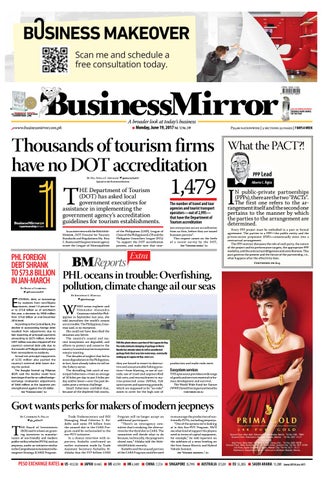
1,479 I The number of travel and tour agencies and tourist transport operators—out of 2,995— that have the Department of Tourism accreditation
2016 ejap journalism awards
PPP Lead Alberto C. Agra
n public-private partnerships (PPPs), there are the two “PACTs”. The first one refers to the arrangement itself and the second one pertains to the manner by which the parties to the arrangement are determined.
Every PPP project must be embodied in a pact or formal agreement. The parties to a PPP—the public entity and the private-sector proponent (PSP)—consensually enter into a contractual arrangement. The PPP contract discusses the role of each party, the nature of the project and its performance targets, the appropriate PPP modality, and the contractual obligations and contributions. This pact governs the present and the future of the partnership, i.e., what happens after the effectivity date. Continued on A15
PHL oceans in trouble: Overfishing, pollution, climate change ail our seas By Jonathan L. Mayuga
W
@jonlmayuga
HEN ocean explorer and f i lmma ker A lexandra Cousteau visited the Philippines in September last year, she told journalists the world’s oceans are in trouble. The Philippines, Cousteau said, is no exception. She could not have described the situation any better. The country’s coastal and marine ecosystems are degraded, and efforts to protect and conserve the country’s coastal marine ecosystems remain wanting. The decades of neglect that led to ocean degradation in the Philippines, in fact, have already taken its toll on the fishery sector. The dwindling fish catch of municipal fishermen—from an average of 10 kilos per day to just 5 kilos per day and/or lower—over the past decades pose a serious challenge. Small fishermen confided that, because of the depleted fish stocks,
This file photo shows a portion of the Laguna de Bay. The indiscriminate dumping of garbage in Metro Manila has already taken its toll as uncollected garbage finds their way into waterways, eventually ending up in Laguna de Bay. Nonoy lacza
they are forced to resort to destructive and unsustainable fishing practices—from blasting, or use of cyanide; use of trawl and unprescribed fish nets; and encroachment in marine-protected areas (MPAs), fish sanctuaries and spawning grounds, which are supposed to be “no-take” zones to cover for the high cost of
production and make ends meet.
Ecosystem services
THE open ocean provides a wide range of goods and services essential to human development and survival. The World Wide Fund for Nature (WWF) listed five important benefits Continued on A2
Govt wants perks for makers of modern jeepneys By Catherine N. Pillas
T
@c_pillas29
he Board of Investments (BOI) said it is keen on granting incentives to manufacturers of eco-friendly and modern public-utility vehicles (PUVs), such as jeepneys, under an initiative similar to the Comprehensive Automotive Resurgence Strategy (CARS) Program.
Trade Undersecretary and BOI Managing Head Ceferino S. Rodolfo said some P9 billion from the unused slot in the CARS Program could be rechanneled to the eco-PUV initiative. In a chance interview with reporters, Rodolfo confirmed an earlier statement made by Trade Assistant Secretary Rafaelita M. Aldaba that the P27-billion CARS
PESO exchange rates n US 49.5250
Program will no longer accept an additional participant. “There’s an interagency committee that’s studying the alternatives for the third slot in CARS. The committee will decide what to do because, technically, the program’s closed now,” Aldaba told the BusinessMirror recently. Rodolfo said the unused portion of the CARS Program could be used
to encourage the production of ecofriendly PUVs, including jeepneys. “One of the options we’re looking at is this Eco-PUV Program. We’ll see what kind of support the players need in terms of capital equipment, for example,” he told reporters on the sidelines of a news briefing on the first Asean Electric and Hybrid Vehicle Summit. See “Modern jeepneys ,” A2
n japan 0.4465 n UK 63.1741 n HK 6.3481 n CHINA 7.2724 n singapore 35.7995 n australia 37.5201 n EU 55.2055 n SAUDI arabia 13.2081
Source: BSP (16 June 2017 )
A2 Monday, June 19, 2017
BMReports BusinessMirror
PHL oceans in trouble: Overfishing, pollution, climate change ail our seas Continued from A1
of maintaining a healthy ocean. These include food, particularly fishery; transportation or shipping; oxygen production; carbon sequestration or sink; and temperature and weather control. Aside from the obvious ecosystem services that oceans provide, such as food and transportation, the phytoplankton in the ocean are estimated to produce over half the oxygen that many needs. The ocean waters also have the capacity to absorb vast amounts of greenhouse gas that help buffer global warming. The surface layer of the ocean absorbs over half the heat reaching the Earth from the sun. “By distributing this heat around the world, ocean currents—which flow for thousands of kilometres, both at the surface and far below— are extremely important in determining the climate of the world’s continents,” the WWF said.
Economic potential
THE Philippines is composed of 7,641 islands and islets, with approximately 266,000 sq km of coastal waters and bay areas, excluding the Philippine Rise, the country’s newest territory 250 km off Aurora Province. The country is at the apex of the Coral Triangle, declared by scientists as “the center of the center of marine biodiversity in the world”. The Coral Triangle, according to a broad scientific consensus, represents a global epicenter of marine life and abundance and diversity. “Spanning only 1.6 percent of the planet’s oceans, the Coral Triangle region is home to the highest coral diversity in the world with 600 corals, or 76 percent, of the world’s known coral species. It contains
Foreign debt. . . Continued from A1
On a year-on-year basis, the debt stock, likewise, dropped by $3.8 billion, from the $77.6-billion level in March 2016 With this development, BSP Governor Amando M. Tetangco Jr. said the country’s external debt remains “at comfortable levels”, as gross international reserves during the period are more enough to cover 5.4 times
the highest reef-fish diversity on the planet with 2,500, or 37 percent, of the world’s reef fish species concentrated in the area,” the Coral Triangle Initiative on Coral Reefs, Fisheries and Food Security web site said. “It is also a spawning and nursery ground for six species of threatened marine turtles, endangered fish and cetaceans, such as tuna and blue whales.” The Philippines, along with Indonesia, Malaysia, Papua New Guinea, Solomon Islands and Timor Leste, known collectively as the CT6 (Coral Triangle 6), agreed to a adopt a 10-year regional plan of action to safeguard the reg ion’s coasta l and mar ine biological resources.
worth P111 billion; coral reef, 62.1 billion; and mangrove, 7.4 billion.
Environmental degradation
The Philippine seas are home to at least five species of marine turtles, 28 marine mammals, 168 cartilaginous fishes, 648 species of mollusks, 1,755 reef-associated fishes, 1,062 seaweeds and 820 species of algae. The Philippine reefs contribute approximately P1.35 billion to the national economy per year. Many areas in the country continue to rake profit from ecotourism, showcasing its coastal and marine biodiversity, its white-sand beaches, lagoons and world-class diving spots, which attract both local and foreign tourists. Having one of the richest coral and reef-fish diversity in the world puts the Philippines in a better economic position than other countries within Southeast Asia. The Philippine Biodiversity Strategy and Action Plan (PBSAP) 2015 to 2028 placed the country’s ecosystem and biodiversity value at P2.3 trillion. The PBSAP added ecosystem services provided through fishery production is estimated to be
MUCH of the country’s coastal and marine resources are already degraded. In Luzon the historic Manila Bay is dying because of pollution. Tons of garbage are washed along the shore. The degradation of coastal and marine areas, such as in Manila Bay, was a result of a number of factors. T he massive land reclamation or dump-and-fill a long Ma n i l a Bay dest royed much of its coastal ecosystem— including mangroves, sea grass and corals—decades ago. The indiscriminate dumping of garbage in Metro Manila has already taken its toll, as uncollected garbage finds their way into waterways, eventually ending up either in Laguna de Bay or Manila Bay. The coast of Manila Bay is known to be notoriously dirty and contaminated with toxic pollutants. Water quality in Manila Bay’s shoreline did not improve much since the Supreme Court issued in 2008 a continuing mandamus ordering concerned government agencies to clean up and restore Manila Bay to its pristine state. The latest laboratory test along the stretch of Manila Bay revealed high levels of coliform and faecal coliform. The fecal coliform is particularly worrisome, as they may carry pathogenic bacteria in fishes and can be harmful to humans when consumed, said Salvador Batellar of the Manila Bay Coordinating Office of the Environmental Management Bureau (EMB). The current coliform level of the water in Manila Bay’s shoreline runs over a million most probable number (MPN) per 100 milliliters. This is way above the acceptable
the country’s short-term external debt under original maturity. The external-debt ratio—a solvency indicator—continued to improve to 20 percent during the period, from 20.4 percent at end-2016. The ratio is computed by getting the outstanding external debt as a percentage of the country’s gross national income. The lower the ratio, the bigger improvement on the economy. The report also showed the country’s still heavily biased against loans with medium to long-term tenors such that medium- to
long-term debts account for 79.6 percent of the total external debt of the country during the period. “This means that foreigner-exchange requirements for debt payments are well spread out and, thus, manageable,” the Central Bank said. Medium- to long-term debts are those with maturities longer than one year. The BSP said the average maturity of medium- to long-horizon tenors is at 17.4 years as of end-March this year. Based on borrower-debt profile, public-sector
Coastal, marine biodiversity
level of 100 MPN of coliform per 100 ml. This level allows authorities to declare fish caught in a particular water body safe for human consumption.
Sorry-state
GLORIA Estenzo-Ramos, vice president of Oceana Philippines, an ocean conservation advocacy group, said she is saddened “to see only small fish underwater and some corals and sea grass smothered by sediments from land”. Humans are getting more and faster from our ocean than it can regenerate, Estenzo-Ramos added. “Overfishing, pollution, coastal developments and climate change are real threats to the health of the ocean and, of course, our survival,” she said. An environmental lawyer, Ramos added the collapse of the country’s marine species and their interconnected habitats, like corals, sea grass and mangroves, is of our own doing. “We should wake up, and take urgent action to restore its vitality and rebuild fisheries—Now!” she said. In a 2013 report, titled “Oceans in the Balance: Philippines in Focus”, Greenpeace noted that the Philippine seas are under threat—corals are dying, mangrove areas are being destroyed, sea-grass beds are being suffocated by erosion and vital populations of fish and other marine species are declining. In fact, the report said the overall picture of the country’s oceans depicted the Philippines as a nation in crisis because of the various threats to its marine and coastal ecosystems. On top of the massive damage to its coastal and marine ecosystem, the Philippine seas is becoming more and more polluted because of indiscriminate dumping of thrash into the ocean. To be continued borrowings average 23.1 years and compare very favorably against private-sector borrowings with a shorter 8.1 years. Meanwhile, shor t-term liabilities accounted for 20.4 percent of total debt stock. This consists of bank liabilities, trade credits and other nonbank liabilities. The bulk of the country’s external debt is still in two major currencies, with US-dollar debt owing to 63.4 percent of total debt, while the Japanese yen accounted for another 12.6 percent of external debt.
Tourism firms. . . which found out that “almost 50 percent” of tourism establishments nationwide are not accredited with the government agency. In a letter on May 31 to PCL President Luis “Chavit” Singson, Tour ism Undersecretar y for Tourism Regulation, Coordination and Resource Generation Alma Rita R. Jimenez said she “respectfully request[s] your assistance to make DOT accreditation a prerequisite to the issuance of business permits. By doing this, the DOT can help local government units in regulating the operations of these enterprises and effectively act on complaints pursuant to the existing rules and regulations governing the accreditation of tourism establishments.” She added: “Our concerted efforts will ensure the safety and convenience of both local and foreign tourists.” The same letter was sent to Mayor Ma. Fe VillarBrondial, LMP National President, and Gov. Edgardo P. Pamintuan, LCP National President. According to the DOT official, despite the agency’s aggressive push for tourism establishments to be accredited, the agency has been “receiving numerous complaints against nonaccredited tourism entities and front-liners. Most of the complaints were undelivered services of travel and tour agencies that are not accredited by the [DOT].” Jimenez added the latest survey of the DOT’s Office of Tourism Standards and Regulation (OTSR) showed that “1,479 out of 2,995 travel and tour agencies (TTAs) and tourist transport operators (TTO) were accredited with the DOT, hence, making up the 49 percent of the whole population of operational TTAs and TTOs in the country. In 2016 alone the OTSR received a total of 59 complaints filed against tourism entities not accredited with the DOT, while nine complaints of the same nature were received by OTSR during the first quarter of 2017.” In accordance with Republic Act 9353, otherwise known as
www.businessmirror.com.ph
Continued from A1
the Tourism Act of 2009, the DOT is mandated to enforce “a comprehensive system of mandator y accred itation for pr imary tourism enterprises and voluntary accreditation for secondar y tour ism enter pr ises”. Under primary tourism enterprises are hotels, resorts, and other accommodation establishments, travel and tour services, tourist transport services, tour guides and tourism front loners, sports and recreational facilities, MIC E (meet i ngs, i ncent ives, conferences and ex hibitions) faci lities and tour ism estate management services. For her part, Bueno said the DOT already had a memorandum of understanding with the PCL, LCP and LMP about the same matter in 2014. But the agency felt the need to write to the local government leaders again and ask for their support, because a number of their members may have already changed due to recent elections. She also stressed that the DOT wrote the leagues of government executives “even before the Resorts World Manila (RWM) incident happened”. The DOT recently said it was mulling over the revision of its accreditation guidelines to cover casino complexes, in the light of the lone gunman attack on RWM on June 2. At present, only hotels in these integrated casino resorts are required to directly get an accreditation with the DOT. Casino complexes fall under secondary tourism establishments and are not required to seek accreditation under the DOT’s current regulations, according to Bueno. (See, “DOT eyes revision of accreditation rules to cover casino complexes,” in the BusinessMirror, June 15, 2017.) This explains why, upon checking by this writer, integrated resort such as RWM, Solaire Resort & Casino and Okada Manila are not registered with the DOT. Only City of Dreams is accredited as a secondary tourism enterprise under the “tourism entertainment complex” category.
Modern jeepneys. . . The Eco-PUV Program is the Department of Trade and Industry’s (DTI) contribution to the Department of Transportation’s (DOTr) PUV modernization program. Rodolfo said the Eco-Puv Program is “CARS-like”, as it aims to spur domestic auto manufacturing and parts-making. The CARS Program is a gove r n m e nt s t i mu l u s p r o g r a m aimed at reviving the country’s declining manufacturing sector by specifically targeting the auto industry, given its strong linkages to other industries and its so-called multiplier effect. The program provides for government support amounting to P27 billion, or a budget of P9 billion for each enrolled vehicle model. The Eco-PUV Program, still under discussion, will initially entail the manufacture of standard parts for a uniform public-utility jeep design, the details of which would be determined by the BOI. It also aims to allow local suppliers to provide the parts. “There’s an important element to the manufacturing process that if the small domestic players can’t supply, let’s say the power train, that’s only when we import and only from selected countries,” Rodolfo said. “We also have a localization component, like the chassis for example, and they have to commit to localize it during a certain period,” he added. The DTI has recommended the sale of old jeepneys to iron and steel makers who may need scrap metals for their blast furnaces.
‘Cleaner’ vehicles
Members of the Electric Vehicle Association of the Philippines
Continued from A1
(Evap) said the DOTr’s modernization program, reforms in the ta xation system and the support of the BOI would expand the use of “cleaner” vehicles in the Philippines. Evap President Rommel T. Juan said his group is targeting to take up 10 percent of the 200,000 jeepneys to be phased out by the DOTr under its PUV modernization program. “The Evap is very active with the PUV modernization program being done by the DOTr, and various other agencies. T here’s a huge number of jeepneys they’re trying to modernize, about 200,000 units in six years,” Juan added at the preevent news briefing on the first Asean Electric and Hybrid Vehicle Summit, which will be held on June 29 and 30. The DOTr is currently in the process of rolling out a modernization program that aims to phase out by 2020 all jeepneys that are more than 15 years old. The government wants lowcarbon and low-emission PUVs plying Philippine roads and to impose a 15-year limit on jeepneys. Aside from the BOI’s incentives program for eco-friendly vehicle makers, the Evap members said they are encouraged by the comprehensive tax-reform bill, which exempts electric and hybrid vehicles from excise tax. The Asean Electric Vehicle and Hybrid Summit will be held at the World Trade Center in Pasay City and will feature 15 local e-vehicle manufacturers, as well as the green models of members of the Chamber of Automotive Manufacturers of the Philippines Inc.
The Nation BusinessMirror
news@businessmirror.com.ph
Editor: Dionisio L. Pelayo • Monday, June 19, 2017 A3
DOJ starts prosecution of Maute bandits
J
By Joel R. San Juan
@jrsanjuan1573
USTICE department prosecutors last Sunday conducted inquest proceedings for the crime of rebellion against Mohammad Naoim Maute, alias Almahid Pangompig Romato. Maute is believed to be the youngest brother of Omarkhayam and Abdullah Maute, leaders of the bandit group. He is among those suspected of rebellion under Arrest Order 1, issued by the Department on National Defense on May 29. He was captured in Barangay Santa Cruz, Macasandig, Cagayan de Oro City, on June 15. An inquest is an informal and summary investigation conducted by the public prosecutor in a criminal case involving persons arrested and detained without the benefit of a warrant of arrest. It intends to determine whether the evidence is sufficient enough to seek court approval to keep the person in detention. The inquest proceeding was conducted inside Camp Brig. Gen. Edilberto Evangelista in Cagayan de Oro City. Police report indicates that he was using a fake identification card of the Mindanao State University bearing the name of Alfaiz Mamintal to get through checkpoints. In Butuan City, meanwhile, President Duterte last Saturday denied the crisis in Marawi City was a result of a failure of intelligence. In his visit to the base of the 401st Infantry Brigade in Butuan, Duterte underscored that the crisis in Marawi City was “not a
Unicef urges business community: Respect, support children’s rights
T
HE United Nations Children’s Fund (Unicef), in partnership with the Makati Business Club (MBC), unveiled last week the Children’s Rights and Business Principles (CRBP). The launching was attended by prominent businessmen led by Chairman Jaime Augusto Zobel de Ayala of the Ayala Group of Cos. T he CR BP is the first comprehensive set of pr inciples to g uide pr ivate-sector companies on the f u l l range of actions they can ta ke in the workplace, market place and communit y to respect and suppor t children’s r ights. W hile the business and human r ights agenda has evolved sig nificant ly in recent years, a child-r ights perspective has not yet been sufficient ly addressed. The CRBP were released in 2012 in London, bringing together leading companies and experts to discuss and showcase ways in which business can respect and support children’s rights in their core operations. This year the principles will be introduced to the Philippine business community with the aim to inspire companies to incorporate a child rights’ lens to their business practices. “ B ec au se c h i ld ren u nder t he a ge of 18 accou nt for a l most a t h i rd of t he world ’s popu l at ion , it i s i ne v it able t h at bu si nesses, whet her sm a l l or l a rge, w i l l h ave a n ef fec t on t he l ives of c h i ld ren , bot h d i rec t ly a nd i nd i rec t ly. C h i ld ren a re a f fec ted b y bu si ness i n a v a r iet y of w ay s — a s con su mers, a s members of employees’ f a m i l ies, a s f ut u re employees t hem se lves a nd a s e vent u a l bu si ness leaders. T he y a l so l ive i n t he com mu n it ies a nd sh a re t he env i ron ment s i n wh ic h bu si nesses operate,” Un icef Ph i l ippi nes R e present at ive L ot t a Sylw a nder s a id . In the Philippines companies are beginning to rethink their business practices not only to respect— doing the minimum required to avoid infringing on children’s rights; but to support—taking voluntary actions that seek to advance the realization of children’s rights. Unicef is convening government agencies and regulators, law enforcement, global organizations, Internet ser vice providers and social networking ser vice companies to stop the creation and circulation of online child sexual abuse content. Online child sexual abuse is the leading form of cybercrime in the Philippines. Unicef Philippines also partnered with SM Supermarkets, one of the largest retail companies in the countr y, to assess the quality of the iodized salt sold in its supermarkets. As a result, all salt vendors of the SM Supermarket Group are now required to submit on a quarterly basis a valid Certificate of Analysis indicating the desired level of iodization, as prescribed by the FDA on all packaged salt supplied to their stores nationwide. Iodine is an essential nutrient for brain development that can increase a child ’s IQ up to 15 points. Claudeth Mocon-Ciriaco
question of failure” on the part of the government. “It was not a failure of intelligence. Kasi kung may makita pa silang may armas, tapos sabihin nila, MI [Moro Islamic Liberation Front], MN [Moro Nationa l Liberation Front], ang standing order naman is…baka sakali mapakiusapan pa natin ang mga kapatid natin. Walang g ulo,” Duter te added. The President explained that the government had a
“very soft policy toward rebels” as the officials did not realize the militants were already storing firearms and ammunition in Marawi City. “All the while, itong Maute, with the connivance of the politicians there, ’yung mga warlords, were stockpiling. Kaya ni hindi maubos ang M-203 na bala at napakarami,” he said. Duterte also reiterated his commitment to buy brand new air assets and “war-grade” weapons for the
military to ensure that government forces would not be at a disadvantage against the terrorists, apparently backed by foreign fighters. Early during his term, Duterte said air assets are “useless since they are only good for ceremonial fly bys”. Duterte also called on the military to resume the use of air assets, saying foreign terrorists are fighting alongside the Maute Group. With PNA
Economy
A4 Monday, June 19, 2017 • Editors: Vittorio V. Vitug and Max V. de Leon
BusinessMirror
news@businessmirror.com.ph
‘Fixing tax system to hike PHL revenues by ₧433B’
T
By Rea Cu
@ReaCuBM
he government can collect some P433 billion in additional revenues, equivalent to 2.7 percent of GDP, by implementing reforms in the Bureau of Internal Revenue’s (BIR) tax policy and administration, according to the Department of Finance (DOF). Finance Undersecretary Karl Kendrick T. Chua said the Duterte administration’s Comprehensive Tax Reform Program (CTRP) would help eliminate the loopholes and inefficiencies in the Philippine taxation system. “We can potentially collect around P433 billion, or 2.7 percent of GDP, based on 2017 prices, if we simplify, address inefficiencies and remove loopholes in BIR’s tax administration and tax policy, as well as improve governance,” Chua said. “The amount is already lower than the 2006 estimate of P726 billion, given stronger tax administration in the last seven years,” he added. Chua said, tax administration efficiency has improved by as much as 40 percent since 2006, when the World Bank started measuring the Philippines’s tax gap. “In fact, the key reasons for weak tax collection are the large number of tax exemptions and incentives that give rise to discretion and negotiations, and thus, tax evasion and even corruption. Removing unnecessary exemptions and incentives will make the tax system fairer and easier to administer, thereby increasing collections,” he added. Among the tax-policy reforms proposed by the Du-
terte administration in Package 1 of the CTRP include broadening the value-added tax (VAT) base while retaining exemptions for seniors and persons with disabilities, updating the excise tax rates for fuel and automobiles, and lowering personal income-tax (PIT) rates. House Bill (HB) 5636, or the Tax Reform for Acceleration and Inclusion Act (TRAIN), was approved by the House of Representatives on May 31 before Congress’s sine die adjournment. TRAIN comprises Package 1 of the CTRP. The DOF said it hopes the Senate would act swiftly on the bill when Congress opens its second regular session in July and retain the original features of TRAIN outlined in HB 4774 being pushed by the agency. “I’m very confident that our legislators are very aware of what is needed in the country, and are very responsive to what the country needs. I’m very confident that we will all sit together, and reason together, and come to a bill that will be good for country,” Finance Secretary Carlos G. Dominguez III said. Earlier, the BIR reported revenue collections totaling P719.952 billion from January to May 2017, which fell short of the P759.287-billion target for the period.
Govt needs to spend P700M for rehab of Sangley airport By Lorenz S. Marasigan
craft include Cebu Pacific, Philippine Airlines and AirSwift, among others. “By moving general aviation and turboprops in Sangley, we will be able to reduce the aircraft operating in Manila, hence, the Naia’s operations will be better,” Tamayo added. He noted, however, that the unsolicited proposals to build an airport that will replace the Naia are still being considered, no matter the government’s planned development for Sangley. “The proposals are still being considered, but they are not immediate. They are more of medium-term solutions. What we need now is a short term one—something that will decongest Manila immediately because that’s our main problem,” Tamayo said. There are two parties also submitted their own unsolicited proposals for the development of a new international gateway. Solar Group-led All-Asia Resources & Reclamation Corp., and partners Belle Corp. and China Communications Construction Co., announced they plan to spend $20 billion to build an airport in an area in Sangley Point, Cavite.
@lorenzmarasigan
F
REEING up more space in Manila in the shortest possible time requires the government to spend as much as P700 million to rehabilitate the existing airport in Sangley. Transportation Undersecretary for Aviation Manuel Antonio L. Tamayo said the government has programmed such amount to address the congestion problem of the Ninoy Aquino International Airport (Naia). “We have the go signal for the development of Sangley. We’ll be spending about P600 million to P700 million. It’s just the military base. There will be no reclamation and no seaport,” Tamayo said. By restoring the existing runway and airport in Sangley, Tamayo said the government will be able to move the general aviation flights and commercial turboprop operations in the area, thereby freeing up space in slotconstrained Naia. There are 25 general aviation operators in the Naia, according to data from the Manila International Airport Authority. Airlines operating turboprop air-
Its plan involves the reclamation of 2,500 hectares of land near a naval and air base at Sangley Point. The project includes a new airport for up to 90 million passengers per year. The existing Naia airport will be replaced by new urban development. According to a study conducted by Danish consulting engineering company Ramboll Group, the new airport, when built, will have two parallel runways to secure future capacity, three terminal spaces, a reserved space for cargo and maintenance facilities. San Miguel Corp.’s $10-billion proposal involves the construction of a 1,600-hectare international gateway somewhere in the south of Metro Manila. The airport, which would have doubled the capacity of the Naia, would have included the construction of a low-cost carrier terminal, a train system and a dedicated tollway. “These have to take a backseat for because we need to improve Manila and Clark first,” Tamayo said. The government is currently in the process of building a new passenger terminal in the Clark International Airport Complex.
Senate summons BPI, BDO officials to explain bank glitches By Butch Fernandez
@butchfBM
R
anking officers of the Bank of Philippine Islands (BPI) and Banco de Oro (BDO) are being summoned to testify on Wednesday before a Senate inquiry into “technical malfunctions” that caused some of their clients to lose money in unauthorized transactions last week. Sen. Francis G. Escudero confirmed over the weekend the Senate’s Committee on Banks, Financial Institutions and Currencies will be looking into the reported unauthorized transactions and withdrawals in BPI and BDO accounts, as well as immediate measures taken to prevent a repeat of the problem and allay concerns this could recur in other banks. Apart from BPI and BDO officials, also expected to testify before the committee are officials of the Bangko Sentral ng Pilipinas (BSP), the Anti-Money Laundering Council (AMLC) and the National Bureau of Investigation’s (NBI) Cybercrime unit, which conducted separate inquiries into the two banks’ system malfunctions. Escudero, committee chairman, however, said he opted not specify and left it up to BPI and BDO managements whom to send as their “responsible” bank officials who will face questioning by senators at the initial hearing he set at 9:30 a.m. on June 21. “It is up to them, as long as they are responsible officers who can answer
all our questions,” the senator told the BusinessMirror. Escudero earlier disclosed that his committee opted to first “await findings” of the parallel probes by the BSP, the AMLC and the NBI Cybercrime before setting a date for the Senate inquiry in aid of crafting remedial legislation, if necessary. Last week Senate President Aquilino L. Pimentel III had backed the move of the banks committee to formally inquire into the BPI and BDO episodes, noting that “the matter of the security and integrity of our banking sector has now become an urgent topic to examine and be transparent about.” Pimentel pointed out it is not just the experiences of BPI and BDO that warrants attention, but that the “news of the recent arrests of foreigners tampering with our ATMs [automated teller machines] should be sufficient impulse and justification for us to hear and investigate this matter.” BDO itself had reckoned with its problems head-on by issuing a public alert that it has “obtained reports of potentially compromised ATMs following reported losses from cardholders”. It advised customers with unauthorized transactions to “reach out to the bank via formal channels so that their cases may be properly investigated and, where confirmed as impacted, may be reimbursed”. BDO reassured the public “that it exerts all efforts to protect its cardholders and their transactions”.
Pinoy spending on junk food increasing–Kantar
F
ILIPINO’S consumption of in-home snack food rose up to 13 percent in the total snack category in the Philippines from March 2015 to March 2017, as revealed by Kantar Worldpanel. From P4,524 in 2015, Filipino households spent P4,904 on snack foods in 2017, which refer to biscuits, snacks, instant noodles, spreads, ice cream, cheese, pasta and rice soup. Kantar Worldpanel tracks the in-home shopping behavior of 3,000 homes in urban and rural areas in the Philippines, summed up that Filipinos 10 percent more on snack food per trip on the average during the three-year period. Biscuits, snacks and instant noodles are the highest shares in peso spend compared to other Filipino’s favourite snack foods category. However, if other snack foods, such as spreads, ice cream, cheese products and pasta were included, purchases have increased by 13 percent
from 2015 to 2017. Homes in the National Capital Region (NCR) and the Visayas purchase snack food more than the average Filipino, with its total contribution to sales at 35 percent. NCR households spend 7 percent more than an average household on snack food, while Visayas homes spend 5 percent more. Meanwhile, Filipino shoppers in class ABC homes have a higher tendency to purchase snack food, accounting for 14 percent of total peso sales. Class ABC homes would spend P65 per trip on snack food versus that of a typical household’s P32. As expected, homes with children aged 3 to 12 make up 41 percent of registered total peso sales of snack food in the country. An average home spends P4,904 on snack food, while homes with children spend P545 more, or a total of P5,449 on snack food. Rizal Raoul Reyes and Kaye Escaño
news@businessmirror.com.ph
The Regions BusinessMirror
Editor: Efleda P. Campos • Monday, June 19, 2017
A5
Govt, NDF on ‘informal’ cease-fire in Mindanao By Manuel T. Cayon @awimailbox | Mindanao Bureau Chief & Elijah Felice E. Rosales @alyasjah
T
HE government last Sunday has instructed its troops to refrain from conducting offensives against the New People’s Army (NPA) in response to a similar directive by the National Democratic Front (NDF) to its armed wing to desist from attacking soldiers and to clear Mindanao of Islamist militants.
In a statement, Government Peace Panel Chairman Silvestre H. Bello III said the government is returning the favor by suspending all offensive against the NPA. “We welcome the recent statement of the NDF, reaffirming its support to the government’s fight against the Maute, Abu Sayyaf
and Ansar al-Khilafah Philippines groups, and other terrorist organizations wreaking havoc in Marawi City, Lanao del Sur, and other parts of the country,” Bello said. “The government hereby correspondingly reciprocates with the same declaration of not undertaking offensive operations against the NPA to pave
the way for the eventual signing of a mutually agreed bilateral cease-fire agreement and agreements on social and economic reforms, political and constitutional reforms and end of hostilities and disposition of forces toward a just and lasting peace.” Bello added the government panel admires the NDF’s recommendation to the Communist Party of the Philippines (CPP) to order all NPA units in Mindanao to halt offensives against the military and police forces flushing out terror groups on the island. “We also appreciate the NDF’s commitment in their declaration to refrain from undertaking offensive operations in Mindanao to enable the Armed Forces of the Philippines and the Philippine National Police to focus their attention on the war against terror groups,” the peace panel chairman said. Bello is positive these voluntary gestures and expressions of solidarity from the NDF could lay the grounds for the resumption of the stalled peace negotiations.
The government panel last month withdrew from the fifth round of peace talks, following the CPP’s directive to the NPA to intensify operations in the face of President Duterte’s martial-law declaration in Mindanao. The NDF last Saturday reiterated its support to the government in its fight against terror groups. “We condemn and are resolved and determined to counteract the Maute, Abu Sayyaf and Ansar alKhilafah Philippines groups, which are wreaking havoc in Marawi City,” the NDF said in a statement. It was signed by Fidel V. Agcaoili, the NDF’s chief negotiator. As a proof of its sincerity, the NDF said it instructed the Moro Resistance and Liberation Organization inside Marawi City to assume home-defense tasks against the terror groups. Aside from this, the NDF also told the CPP to order all NPA units to stop attacking government troops operating against Islamist militants.
PNP watching 11 illegal-gambling operations in NegOr
I
N response to the government’s effort to stamp out illegal-gambling activities and support the operation of the expanded smalltown lottery (STL) implemented by the Philippine Charity Sweepstakes Office nationwide, the Philippine National Police is monitoring 11 illegal-gambling personalities in Negros Oriental.
A report submitted by Negros Oriental Provincial Police Office Director Police Sr. Supt. Henry F. Biñas to Police Regional Office 18 Director Police Chief Supt. Renato Amador Gumban showed that Biñas’s group is monitoring the movement of 11 personalities known to be engaged in illegal-gambling activities in their areas, including Salvador
Garet, Br yan/Ryan Regalado, Bambie Calumpang, Pedro Divinagracia alias “Batchoy”, Raner Divinagracia alias “Roner”, Orlando Fonollera alias “Lando”, Marlou D. Ablay alias “Marlo”, Florendo D. Balubar Jr. alias “Bongbar”, Rizaldee S. Cortez alias “Ady,” Tom Aledro and Michael Vincent Lopera alias “Alo”.
Based on the report, Garet is a close friend of Calumpang, who was engaged in illegal-gambling activities operated through cellular phone and text messages. The latter is willing to go on STL, but could not afford to raise the amount for his bond on Four Aces so he can to be allowed to handle STL in Tanjay City. Claudeth Mocon-Ciriaco
ARMM to construct sanitation facilities in evacuation centers
D
AVAO CITY—Sanitation facilities would be rushed up in at least three evacuation centers in Lanao del Sur to ease up conditions in the centers, the Autonomous Region in Muslim Mindanao (ARMM) said. ARMM Gov. Mujiv Hataman said the unfavorable conditions in evacuation camps “expose individuals staying there, especially the children, to potential health risks”. He said the majority of the almost 46,000 families displaced by the armed conflict in Marawi City have sought shelter in their relatives’ houses, but many families were forced to crowd into evacuation camps. He led a team of ARMM officials to inspect evacuation sites in the town of Saguiaran in Lanao del Sur last Saturday and said the sanitation facilities were needed in at least three evacuation sites in Lanao del Sur—two in the town of Saguiaran and one in Malabang. He said the ARMM’s Department of Public Works and Highways would construct 20 toilets in two evacuation camps in Saguiaran and 10 toilets in Malabang. The facilities would also include washing and
bathing facilities and water tanks. The facilities, which separate the male and the female, would cater to at least 500 families. Hataman said it will help improve conditions in the evacuation camps and reduce the risk of health problems. The ARMM has coordinated relief and disaster responses with national government agencies for Marawi City. It has utilized its Disaster Assistance and Family Access Card system to ensure efficient relief distribution and to evaluate the status and appropriate needs of affected families. In addition to its Crisis Management Committee based in Cotabato City, the ARMM has established operation centers in Iligan City and the town of Malabang to facilitate the coordination of its humanitarian response, which include relief and medical aids and rescue and retrieval operation of trapped civilians. Hataman said the ARMM would transfer its operation center in Iligan City to Marawi City to improve relief efforts and other humanitarian interventions to families who have evacuated to different towns in Lanao del Sur. Manuel T. Cayon
A6
Agriculture/Commodities
Monday, June 19, 2017 • Editor: Jennifer A. Ng
BusinessMirror
news@businessmirror.com.ph
Rice inventory down 13% in May–PSA By Jovee Marie N. Dela Cruz
T
@joveemarie
& Jasper Emmanuel Y. Arcalas
@jearcalas
he country’s rice inventory as of May 1 declined by 13 percent to 3.21 million metric tons (MMT), from 3.69 MMT recorded a year ago, according to the latest report of the Philippine Statistics Authority (PSA).
Despite the year-on-year reduction in stocks, the PSA said in its report, titled “Rice and Corn Stocks Inventory”, the volume is sufficient to meet the rice-consumption requirement of Filipinos for 95 days. “Stocks in the households would be enough for 44 days, those in commercial warehouses for 43 days, and those in National Food Authority [NFA] depositories for eight days,” the report read. Of the rice inventory as of May 1, the PSA said 46.38 percent were with the households,
45.21 percent were in commercial warehouses, while 8.41 percent were in the NFA depositories. Nearly 75 percent of NFA stocks consisted of imported rice. PSA data also showed that NFA stocks during the period reached 270,180 metric tons (MT), while commercial warehouses accounted for 1.453 MMT. Households held a total of 1.49 MMT. “Compared with the previous year, rice stocks in the households and in commercial
warehouses grew by 0.96 percent and 39.39 percent, respectively,” the report read. “Rice stocks in NFA depositories decreased by 17.43 percent,” it added. On a monthly basis, however, data from the PSA showed that total rice inventory as of May 1 was 20.13 percent higher than the 2.68 MMT posted in April. Rice stocks in households and commercial warehouses were higher compared with their April levels. The PSA said stocks in households rose by 3.47 percent while stocks held in commercial warehouses grew 60.15 percent. However, rice stocks in NFA depositories declined by 17.43 percent. The government periodically monitors rice inventory to determine whether it would need to import the staple to beef up the country’s stockpile, especially during the lean months. PSA data also showed that total cornstock inventory tripled to 1.55 MMT, from last year’s record of 517,240 MT.
House inquiry
While welcoming the move of the National Food Authority Council (NFAC) to allow the importation of 250,000 MT of rice, a vice chairman of the House Committee on Appropriations last Sunday said Congress
must pursue its investigation into the true state of the national rice inventory when session resumes in July. Nacionalista Party Rep. Luis Raymund Villafuerte of Camarines Sur said Congress should find out if Filipinos are not facing the specter of a shortage of the staple during the traditional July-to-September lean months. “We are relieved that the NFAC has decided to act swiftly on this urgent matter. But the House should, likewise, swiftly initiate a probe on the country’s rice inventory. This should be done at the soonest possible time so that we can assure the public that they won’t have to either pay more for rice or fall in line to buy the staple in the coming lean months,” Villafuerte said in a statement. The NFAC has approved the recommendation of the National Food Security Committee (NFSC) to allow the importation of up to 250,000 MT of rice via the governmentto-private sector (G2P) mode. “The G2P arrangement is a welcome move as this would be more competitive, open and transparent. This method would have to undergo the process under the Government Procurement Reform Act, so this would reduce the possibility of hanky-panky and encourage more bidders to participate. With more bidders, any monopoly enjoyed by the usual suppliers would be broken,”
USDA report sees slight decline in Philippine coffee imports
T
he country’s coffee imports in marketing year (MY) 20172018 could go down to 390,000 metric tons (MT) due to lower domestic demand, according to the latest report of the United States Department of Agriculture (USDA). In its report, titled “Coffee: World Markets and Trade”, the USDA’s Foreign Agricultural Service (FAS) said the volume is slightly lower than the 396,000 MT the country would purchase until the end of the current marketing year in July. The FAS noted that soluble coffee imports in MY 2017-2018 would reach 360,000 MT, accounting for nearly 93 percent of the country’s expected purchases from abroad. The volume, however, is unchanged from the estimated coffee imports of the Philippines in MY 2016-2017. Filipinos would consume less coffee in the next marketing year, according to the FAS. The USDA said Philippine coffee consumption would decline by 3.13 percent to 417,000 MT in MY 2017-2018, from the estimated 430,500 MT in MY 2016-2017. Philippine coffee production in MY 2017-2018 is also expected to decline by 5.26 percent to 27,000 MT, from 28,500 MT in MY 2016-2017, according to the FAS.
By the end of the next marketing year in 2018, the FAS pegged the ending coffee stock of the Philippines also at 24,000 MT, the projected ending stock in the current marketing year. Data from the Philippine Statistics Authority (PSA) showed the country’s coffee production in 2015 reached 36,171 MT, translating into an SSR of 33.04 percent. The coffee self-sufficiency ratio (SSR) in 2015 was significantly lower than the 71.91 percent registered in 2014 and is the lowest since the 2012 SSR, pegged at 45.21 percent. The PSA defines self-sufficiency ratio as the extent to which a country’s local production of commodities is adequate enough to meet the demand of the whole population. The government is targeting to increase the output of green coffee berries to at least 214,626 MT by 2022 to end the country’s reliance on imports and allow farmers to export coffee. Under the Philippine Coffee Industry Road Map (PCIR) 2017-2022, a copy of which was obtained by the BusinessMirror, the target production would translate into a SSR of 160.16 percent. This means, that in five years, the Philippines would have surplus coffee. Jasper Emmanuel Y. Arcalas
Villafuerte said. However, the lawmaker said this development should not deter the lower chamber from pursuing an inquiry into the country’s rice stocks. Last month Villafuerte filed House Resolution 993 urging the appropriate committee to “conduct an inquiry in aid of legislation on the true state of rice inventory in the Philippines to ensure adequate and affordable rice supply during the traditional lean months.” “An adequate rice supply is necessary for our food security, especially during times of calamities and emergencies,” added Villafuerte, who is also the vice chairman of the House committee on local government. Through a public inquiry, the resolution said the House could “come up with policy proposals for government to ensure ample and affordable supply of this staple, in light of fears that the country’s current buffer stock might not be enough to last us through the traditional lean months after this summer harvest season.” “A congressional inquiry is in order to help Malacañang determine the real supply situation, and then draw up proactive measures, including possible imports, to avert a possible supply shortfall later this year,” Villafuerte said.
Agriculture, food and business
O
nly if we fully understand the relationship between agriculture and food and that “AgriFood” means business, will we be able to find solutions to the agricultural sector and get Agripreneurs Henry J. Schumacher going. As we all know too well, the Philippines has not fully exploited its comparative advantage in agriculture. Beginning with high input costs during production, agribusinesses in the Philippines must also contend with a supply chain that progressively erodes the sector’s competitiveness en route to consumer markets. Along this supply chain, a staggering 20 percent to 50 percent of fresh produce is estimated to be lost in transit from the farm to consumers or food manufacturing companies. By comparison, postharvest losses amount to an estimated 6 percent in Thailand (it’s high time to study this and learn from it; we have to understand why the food costs in Thailand are substantially lower than in the Philippines). By the time agricultural products reach markets, transaction costs have escalated, rendering many agribusinesses susceptible to external shocks, at best, and uncompetitive, at worst. As evidenced by growing markups from farm gate to retail prices for key crops (such as rice, corn, bananas and mangoes), constraints with logistics and supply chain compound already challenging production issues of quality and efficiency. Eventually, consumers pay the price. In comparison to regional peers, the Philippines spends the highest share of total consumption on food. Formidable challenges and constraints along the supply chain continue to hamper the sector’s full potential, including: n The high and variable cost of production inputs; n Lack of mechanization to improve productivity; n Limited access to finance to scale up operations; n Inadequate provision of infrastructure, particularly in irrigation; and n Inefficient logistics and limited connectivity exacerbating postharvest losses. Compounding these issues, natural disasters continue to wreck havoc on this tenuous and vulnerable farm-to-market supply chain; flawed policies reinforce disincentives to invest in the sector; and weak/fragmented institutions limit the effectiveness of local extension services and agricultural support offices. As a result, agriculture exports (with few exceptions) remain broadly uncompetitive in the world market. Issues related to productivity, efficiency, quality and price all compound the agribusiness investment climate. A multitude of complex challenges confront the agribusiness sector in the Philippines, with no easy solutions. The following recommendations, while not exhaustive, point to sensible ideas that merit public policy considerations in the coming decade. Market access—New free-trade agreements (FTAs), including the Asean Economic Community, and other preferential trade privileges provide unprecedented market access, if Filipino agribusinesses can successfully compete in a more liberalized environment. Promising opportunities for agricultural exports are on the horizon, but Philippine food exports remain at modest levels. Their share in Asean has even declined, thus raising the need for clearer government policy/strategy to maximize FTA utilization. Access to finance—The agribusiness sector boasts a small pool of bankable projects, mostly concentrated with the larger commercial farm owners in possession of traditional collateral, secure property rights and financial track records. Hampering investments, access to credit poses a daunting challenge for the sector. Many agribusinesses are small and financially weak, requiring business development support, collateral substitutes and other credit enhancements to improve their risk profile. In this context, a more comprehensive approach to crop insurance, which can help mitigate the numerous environmental risks (e.g., typhoons, droughts) that many smallholder farmers face on a perennial basis, is needed. Crop insurance, microinsurance and microfinance have to work together. Freeing up the land market—In another significant area of market distortions, the property rights regime contains major deficiencies and greatly undermines the investment climate. The business of agricultural production relies heavily on exploiting and developing land for human needs. Indicative of inefficiencies in the land market, a staggering 11 million parcels of untitled properties litter a country of 24 million parcels. Land-use planning, zoning and overall management are weak, undermining property development and associated tax collection vital to public investments. Infrastructure investments—Priorities include farm-to-market roads, postharvest processing facilities, irrigation, sanitary phytosanitary inspection facilities, food terminals, cold storage and food-processing factories. The lack of postharvest facilities cries out for more private-sector investment, as part of efforts to manage overall supply chains. Farm-to-market roads provide much needed linkages. Rationalization of extension services—With low productivity, the business of agricultural production would benefit from adopting new and innovative technologies. Even with advances in research and development, the latest research and information on improved agricultural practices (including intercropping) have not reached farmers sufficiently. In conclusion, bold measures are needed to open up markets, unleash capital, address land reforms, improve infrastructure and rationalize extension services. Given my involvement in coffee farming/intercropping in Camarines Norte, I fully subscribe to the need for bold measures. Comments are welcome; contact me at Schumacher@mca.com.ph
europe Beat
news@businessmirror.com.ph
The World BusinessMirror
Editor: Lyn Resurreccion • Monday, June 19, 2017 A7
Trump restores restrictions on Cuba
M
IAMI—President Donald J. Trump announced last Friday that he was reversing crucial pieces of what he called a “terrible and misguided deal” with Cuba, and will reinstate travel and commercial restrictions eased by the Obama administration in an attempt to obtain additional concessions from the Cuban government.
President Donald J. Trump greets Cary Roque, a Cuban dissident who fought the Castro regime, at the Manuel Artime Theater in Miami on June 16. Trump last Friday signed documents rolling back Obama-era changes that eased US-Cuba relations. Al Drago/The New York Times
During a speech in Little Havana, the epicenter of a Cuban exile community that enthusiastically supported him in last year’s election, Trump said he was keeping a campaign promise to roll back the policy of engagement begun by President Barack Obama in 2014, which he added had empowered the communist government in Cuba and enriched the country’s repressive military. “We will not be silent in the face of communist oppression any longer,” Trump said at the Manuel Artime Theater, named for a former supporter of Fidel Castro who became a leader of Brigade 2506, the land forces that spearheaded the US-led Bay of Pigs invasion in 1961. “Effective immediately, I am canceling the last administration’s completely one-sided deal with Cuba,” Trump added. But Trump’s action fell well short of doing so. After the speech, he signed a six-page directive that ordered new travel and commercial restrictions, while leaving in place some key Obama-era measures that eased sanctions. As part of the new policy, Americans will no longer be able to plan their own private trips to Cuba, and those who go as part of authorized educational tours will be subject to strict new rules and audits to ensure that they are not going just as tourists. US companies and citizens will also be barred from doing business with any firm controlled by the Cuban military or its intelligence or security services, walling off crucial parts of the economy, including much of the tourist sector, from US access. “We do not want US dollars to prop up a military monopoly that exploits and abuses the citizens of Cuba,” Trump said. Despite his grandiose description, the president’s policy represents a middle ground between hard-liners in Congress, including Sen. Marco Rubio and Rep. Mario Díaz-Balart, both Florida Republicans who have called for a complete reversal of Obama’s Cuba policy, and business leaders, human-rights groups and many of Trump’s own advisers who wanted to preserve it. It drew swift condemnation from diverse quarters, from congressional Democrats and a handful of Republicans who support greater engagement with Cuba, to business-minded conservatives like the US Chamber of Commerce, which argued the move would hurt US businesses and jobs. Still, Trump’s action allowed him to claim credit for taking a tough stand while leaving in place many of the changes made by Obama, which polls have shown are broadly supported, including by most Republicans. Under Trump’s directive, embassies in Washington and Havana will stay open, and cruises and direct flights between the US and Cuba will be protected under an exception from the prohibition on transactions with military-controlled entities. Nor does the measure affect the ability of Cuban-Americans to travel freely to the island and send money to relatives there, or a broad array of rules the Obama administration put in place aimed at making it easier for US companies to do business in Cuba. But Trump’s speech was a stinging rejection of Obama’s announcement in 2014 that he and President Raúl Castro of Cuba would begin normalizing relations between the two countries. Trump’s speech evoked, instead, the Cold War thinking that dominated the US government’s stance toward Cuba for a half-century. “To the Cuban government, I say: Put an end to the abuse of dissidents,” Trump said. “Release the political prisoners. Stop jailing innocent people. Open yourselves to political and economic freedoms. Return the fugitives from American justice.” Just over one year ago, Obama took the stage at a theater in
Havana, with Castro in attendance, to reject that thinking and declare that he intended to “bury the last vestige of the Cold War” and “leave behind the ideological battles of the past”. Last Friday Trump sought to revive that struggle, listing the misdeeds of the Castro government over more than five decades.
“We will never, ever be blind to it,” Trump said. “We remember what happened.” His audience of Cuban exiles and their families, including Rubio and Díaz-Balart, roared its approval. “President Trump will treat the Castro regime as the malevolent dictatorship that it is,” Díaz-Balart said. But critics argued that Trump was
returning to a strategy that had been a proven failure. Benjamin Rhodes, a former deputy national security adviser for Obama who led secret negotiations with Cuban officials that led to the rapprochement, said Trump’s moves would undermine his stated objectives, pushing the Cubans into the arms of the Chinese and Rus-
sians, who have no restrictions on their dealings there, and emboldening hardliners in the country who are opposed to moving toward democracy. “If you want Cuba to change and reform, we are doing the opposite of what would be most likely to bring about reforms inside of Cuba,” Rhodes added. New York Times News Service
A10 Monday, June 19, 2017
The World BusinessMirror
www.businessmirror.com.ph
58 people presumed dead from London fire
L
ONDON—London police last Saturday raised to 58 the number of deaths either confirmed or presumed following the horrific inferno that turned the city’s Grenfell Tower public-housing block into a charred hulk.
Public anger is mounting as residents and neighbors demand answers for how the blaze early Wednesday spread so quickly and trapped so many of the tower’s 600-odd residents. British media have reported that contractors installed a cheaper, less flame-resistant type of exterior paneling on the 24-story tower in a renovation that was completed just last year. Police Commander Stuart Cundy said the number of 58 is based on reports from the public and may rise. It includes 30 deaths that already have been confirmed, and reports of people who are missing and presumed to have been killed.
Metropolitan Police Commander Stuart Cundy speaks to the media near Grenfell Tower after a fire engulfed the 24-story building in London on June 17. London police say 58 people, who were in Grenfell Tower, are still missing and assumed to be dead. Cundy said last Saturday that this number, which was based on reports from the public, may rise. He said it will take weeks or longer to recover and identify all the dead in the public-housing block that was devastated by a fire early Wednesday. Victoria Jones/PA via AP
He said it will take weeks or longer to recover and identify all the dead at the building. “Sadly, at this time, there are 58 people who we have been told were in the Grenfell Tower on the night that are missing. And therefore, sadly, I have to assume that they are dead,” he said. He said the police would consider criminal prosecutions if there is evidence of wrongdoing and that the police investigation would include scrutiny of the renovation project at the tower, which experts believe may have left the building more vulnerable to a catastrophic blaze. The police have been struggling to come up with an authoritative list of who was in the building when the fire started, making it difficult to determine how many had died. Cundy said there may have been other people in the tower who the police are not aware of, and that could increase the death toll. He asked anyone who was in the tower and survived to contact the police immediately. The police said the harrowing search for remains had paused last Friday because of safety concerns at the blackened tower but has resumed. Cundy said emergency workers have now reached the top of the building. British Prime Minister Theresa May, facing criticism for the government’s handling of the disaster, met last Saturday with 15 fire survivors invited to her official residence at 10 Downing Street. The group left after a meeting that lasted more than two hours but did not speak to reporters gathered outside. The meeting is unlikely to quell complaints that May has been slow to reach out to fire survivors, despite her announcement of a $6.4-million emergency fund to help the displaced families. May said after the meeting last Saturday there have been “huge frustrations” in the community as people tried to get information. “Frankly, the support on the ground for families who needed help or basic information in the initial hours after this appalling disaster was not good enough,” she said. The identification of the victims is proving very difficult— which experts attribute to the extreme heat of the fire. British health authorities say 19 fire survivors are still being treated at London hospitals, and 10 of them remain in critical condition. The police said they are using the Interpol Disaster Victim Identification Standards to identify the deceased. This relies on dental records, fingerprints and DNA when possible and also features like tattoos or scars. The tragedy cast a pall on the Trooping the Color festivities that mark the official birthday of Queen Elizabeth II. A solemn Elizabeth and her husband Prince Philip held a minute of silence for the fire victims at the start of the procession last Saturday. The 91-year-old monarch said Britain remains “resolute in the face of adversity” after the horrendous fire and recent extremist attacks in London and Manchester. The queen said it was “difficult to escape a very somber mood” on what is normally a day of celebration. There is simmering anger in the multiethnic north Kensington area hit by the blaze, and public fury has been directed at senior government figures, including May, who was jeered last Friday after she visited. Hundreds have been left homeless, putting more pressure on officials in a city plagued by a chronic housing shortage. Scuffles broke out near the Kensington and Chelsea town hall offices last Friday as demonstrators chanting “We want justice!” surged toward the doors. The government has promised a full public inquiry, but that has done little to ease a sense of frustration at the lack of information about how the fire moved so quickly to engulf the building. Engineering experts and fire-safety specialists believe the building’s exterior cladding may have quickly fueled the blaze, overwhelming fire-protection devices. British officials have ordered a review of other buildings that have had similar renovations. The tragedy has provoked a huge response from nearby communities. More than £3 million ($3.8 million) have been raised for the victims. Many of the displaced are living in churches and community centers. There is ample food and water but very little privacy or proper bedding, and with the tower destroyed, no one knows where they will be relocated or for how long. Two nearby underground subway lines were partially shut down last Saturday in the fire area to make sure that debris from the tower did not land on the tracks. Some Grenfell residents had warned months ago that firesafety issues at the tower left it at risk of a “catastrophic” event. They say their complaints were ignored—and fear it was because the tower was full of poor people in a predominantly wealthy borough. AP
The World BusinessMirror
www.businessmirror.com.ph
Monday, June 19, 2017 A11
Trump acknowledges Russia probe includes him
W
ASHINGTON—President Donald J. Trump has acknowledged for the first time that he is under federal investigation as part of the expanding probe into Russia’s election meddling. He lashed out at a top Justice Department official overseeing the inquiry, reflecting his mounting frustration with the unrelenting controversy that has consumed his early presidency. “I am being investigated for firing the FBI [Federal Bureau of Investigation] Director by the man who told me to fire the FBI Director! Witch Hunt,” the president wrote in a Friday tweet. His morning missive apparently referred to Rod Rosenstein, the deputy attorney general whose role leading the federal investigation has become increasingly complicated. The White House has used a memo he wrote to justify Trump’s decision to fire FBI Director James Comey, but that Trump action may now be part of the probe. On Thursday night Rosenstein issued an unusual statement complaining about leaks in the case. Trump advisers and confidants describe the president as increasingly angry over the investigation, yelling at television sets in the White House carrying coverage and insisting he is the target of a conspiracy to discredit—and potentially end—his presidency. Some of his ire is aimed at Rosenstein and investigative special coun-
sel Robert Mueller, both of whom the president believes are biased against him, associates say. Dianne Feinstein, top Democrat on the Senate Judiciary Committee, said she was “increasingly concerned” that Trump will fire both Mueller and Rosenstein. “The message the president is sending through his tweets is that he believes the rule of law doesn’t apply to him and that anyone who thinks otherwise will be fired,” Feinstein said. “That’s undemocratic on its face and a blatant violation of the president’s oath of office.” Aides have counseled the president to stay off Twitter and focus on other aspects of his job. They have tried to highlight the positive reviews he received last Wednesday when he made a statesman-like appearance in the White House to address the nation after Rep. Steve Scalise was shot during a congressional baseball practice. Yet Trump’s angry tweets last Friday underscored the near-impossible challenge his advisers and legal team
Then-Federal Bureau of Investigation Director Robert Mueller testifies on Capitol Hill in Washington in June 2013. President Donald J. Trump’s closest allies are attacking the integrity of those involved in the widening probe of Russian interference in the US election, accusing special counsel Mueller of driving a biased investigation. AP/J. Scott Applewhite
have in trying to get him to avoid weighing in on an active probe. The president has denied that he has any nefarious ties to Russia and has also disputed that he’s attempted to block the investigation into his campaign’s possible role in Russia’s election-related hacking. It was unclear whether his tweet about being under investigation was based on direct knowledge or new media reports that suggest Mueller is examining whether the president obstructed justice by firing Comey. The tweets came shortly after Rosenstein issued his unusual statement that appeared to be warning about the accuracy of such reports. “Americans should be skeptical about anonymous allegations,” Rosenstein said. “The Department
of Justice has a long-established policy to neither confirm nor deny such allegations.” The department would not comment on the record on whether Trump, who has repeatedly complained about leaks on the case, requested the statement. But a department official said no one asked for the statement and Rosenstein acted on his own. The official demanded anonymity because the official was not authorized to be named discussing the deliberations. Trump has told associates he has the legal authority to fire Mueller. What is clear is that he could order the Justice Department to ax Mueller, which may result in Rosenstein’s departure and would certainly intensify the uproar over
Qatar prosecuted 5 men on US terrorism list
Q
atari authorities have prosecuted five people accused by the US and the United Nations (UN) of financing terrorists—and who were also named by Saudi Arabia and its allies as part of the bloc’s justification for isolating the tiny Gulf nation since last week. The five men appear in US Treasury sanctions lists and were tried in 2015 and 2016, according to two Western officials and a Qatari official, who have direct knowledge of the matter and spoke on condition of anonymity because they aren’t authorized to disclose the information publicly. The legal action wasn’t announced to avoid embarrassing the men’s families—some of whom are among the most prominent in the country, the Qatari official said. Saudi Arabia, the United Arab Emirates and other Arab countries severed ties with Qatar on June 5, accusing the gas-rich country of funding Islamic extremists and
cozying up to Iran. The decision came soon after a visit to Riyadh by US President Donald J. Trump, who said last week Qatar was a “funder of terrorism at a very high level”. Qatar has repeatedly denied the accusations and called the Saudi-led action an “illegal siege”. The revelation of these prosecutions now is unlikely to sway the Saudi-led coalition, which last week named 59 individuals and 12 organizations it considers to be involved in terrorism and most, it said, with ties to Qatar. They include Egypt-born cleric Yusuf al-Qaradawi, linked to the Muslim Brotherhood, and Qatar Charity, which implements aid projects with UN agencies. Qatar has dismissed the list as politically motivated. Some of the men were put in jail or under house arrest in Qatar, while others were acquitted but are banned from travel and are under 24-hour surveillance, the officials
said. Qatar is also bringing charges against two more people included on both the US and Saudi alliance lists, they said.
Frozen Assets
The assets of those convicted have been frozen, the officials said. US Secretary of State Rex Tillerson said last week that Qatar’s Emir Sheikh Tamim bin Hamad Al Thani has made progress in halting financial support for and expelling terrorists, “but he must do more and he must do it quickly”. Critics, including conservative think tanks, such as the Washington-based Foundation for Defense of Democracies, say trials should be publicized to serve as a deterrent, and to provide transparency to make sure the punishment fits the crime.
Recidivism
Four of the five men prosecuted in Qatar have allegedly moved cash for al-Qaeda since the early 2000s,
according to US and UN statements. Recidivism has been an issue, with some who were arrested and released by Qatari authorities in the past repeating the crimes. One is accused of providing funds to Iran-based alQaeda operatives from 2009 to 2012. Qatar has maintained that it “does not, and has not, provided funding for terrorists”, government Spokesman Saif Al Thani said last week. But whether by choice or because of the Saudi-led action, there are signs Qatar is becoming more open about the actions it is taking on men suspected of financing terrorism. Asked about one of the men at a news conference in Paris last Monday, Qatari Foreign Minister Mohammed Al Thani confirmed the steps taken. The man “has been prosecuted in the state of Qatar, by the law of the state of Qatar, and he’s on the international list, and he’s sanctioned by the state of Qatar,” Al Thani said. Bloomberg News
Cosby lawyers fighting civil suits by 10 women
N
ORRISTOWN, Pennsylvania—Bill Cosby’s sexual assault case in Pennsylvania has ended in a mistrial, but the comedian’s civil lawyers still are fighting lawsuits against him by 10 women around the country. Currently, seven women have defamation suits pending in Massachusetts, while three more have defamation or sexual battery suits pending in California. Cosby has denied any wrongdoing. The criminal case against Cosby partly stems from the accuser’s related lawsuit. Prosecutors reopened a criminal investigation and filed charges in 2015 after Cosby’s deposition in the woman’s 2005 lawsuit was unsealed, and they realized the 12-
year statute of limitations for felony sexual assault had not yet expired. A recap of the pending civil cases:
California
Cosby is being sued in Los Angeles by Judy Huth, who accuses the comedian of forcing her to perform a sex act on him in a bedroom of the Playboy Mansion around 1974, when she was 15. A trial date may be set later this month for the sexual battery case. Cosby has given a sealed deposition in the case. Huth’s lawyer, Gloria Allred, says the scheduling of a second deposition was on hold because of the criminal trial. Chloe Goins, a former model who claims Cosby drugged and sexually
abused her at the Playboy Mansion in 2008, is also suing the comedian on sexual battery and other claims. Prosecutors rejected filing a case against Cosby based on Goins’s allegations, which they said investigators could not corroborate. A judge recently denied Cosby’s motion to dismiss the case, and a trial has been scheduled for June 2018. The comedian also faces a defamation lawsuit by model Janice Dickinson, who claims Cosby drugged and raped her in Lake Tahoe, California, in 1982. Cosby is appealing a ruling allowing Dickinson’s case to proceed.
Massachusetts
Seven women are suing Cosby for defamation in separate lawsuits
pending in Massachusetts, where Cosby has a home in Shelburne Falls. They say he sexually abused them decades ago and then defamed them after they went public by having his agents deny the claims and brand them liars. An eighth woman withdrew her lawsuit. And a federal judge dismissed a ninth accuser’s case, finding her complaint inadequate. The remaining plaintiffs are Tamara Green, Therese Serignese, Linda Traitz, Louisa Moritz, Barbara Bowman, Joan Tarshis and Angela Leslie. Cosby is seeking to have their cases dismissed. Serignese and Bowman attended the criminal trial near Philadelphia. AP
the investigation. Though some in the White House have preached caution, fearing a repeat of the firestorm over Comey’s firing, many in Trump’s orbit—including his son Donald Trump Jr. and adviser Newt Gingrich—have deemed Mueller biased and worthy of dismissal. Several White House officials and Trump associates insisted on anonymity in order to discuss the president’s views of the unfolding investigation. Rosenstein has been overseeing the Russia probe since shortly after Attorney General Jeff Sessions recused himself. But Rosenstein, too, may ultimately have to hand off oversight given his role in Trump’s decision to fire Comey.
Earlier this month, Rosenstein told The Associated Press that “if anything that I did winds up being relevant to his investigation then, as Director Mueller and I discussed, if there’s a need from me to recuse, I will.” Trump’s tweets came after the top lawyer for his transition team warned the organization’s officials to preserve all records and other materials related to the Russia probe. An official of Trump’s transition confirmed the lawyer’s internal order, which was sent last Thursday. The order from the general counsel for the transition team casts a wide net on documents that could shed light on ties between Trump’s presidential campaign and representatives of Russia’s government. The order also covers separate inquiries into several key Trump associates, including former National Security Adviser Michael Flynn, campaign adviser Paul Manafort, foreign policy aide Carter Page and outside adviser Roger Stone. The White House has directed questions for details to outside legal counsel, which has not responded. Vice President Mike Pence has hired a private lawyer to represent his interests in the expanding probe. Pence headed the Trump transition until Inauguration Day. Trump’s personal lawyer, Michael Cohen, also has retained an attorney to represent him. Cohen has worked for Trump since the mid-2000s and was active in the campaign. He has already been subpoenaed by the House intelligence committee. Meanwhile, another lawyer, Washington veteran John Dowd, has joined the Trump legal team. A former prosecutor, Dowd may be best known to the public for leading investigations on behalf of Major League Baseball, including a probe of allegations of improper gambling by baseball player Pete Rose that preceded Rose’s lifetime ban. AP
Bodies of 7 missing US sailors found Y
OKOSUK A , Japan—T he search for seven US Navy sailors missing after their destroyer collided with a container ship off Japan was called off last Sunday after several bodies were found in the ship’s flooded compartments, including sleeping quarters. Vice Adm. Joseph Aucoin, the commander of the Navy’s 7th Fleet, described the damage and flooding as extensive, including a big puncture under the waterline. The crew had to fight to keep the ship afloat, he said, and the ship’s captain is lucky to have survived. “The damage was significant, this was not a small collision,” he said. Navy divers found “a number of” bodies in the ship last Sunday, a day after it returned to the 7th Fleet’s home base in Yokosuka, Japan, with the help of tug boats. Aucoin, speaking at a news conference at the base, wouldn’t say how many bodies were recovered, pending notification of next of kin. He said much of the crew of about 300 was asleep when the collision happened at 2:20 a.m. last Saturday, and that one machinery room and two berthing areas for 116 crew members were severely damaged. “You can’t see most of the damage, the damage is mostly underneath the waterline, and it’s a large gash near the keel of the ship,” he said. “So the water flow was tremendous, and so there wasn’t a lot of time in those spaces that were open to the sea. And as you can see now the ship is still listing, so they had to fight the ship
to keep it above the surface. It was traumatic.” The Fitzgerald’s captain, Cmdr. Bryce Benson, was airlifted from the ship’s deck after daybreak last Saturday to the US Naval Hospital in Yokosuka with a head injury. Two other crew members suffered cuts and bruises and were also flown out by helicopter. “His cabin was destroyed, he is lucky to be alive,” Aucoin said of Benson. The container ship ACX Crystal weighs 29,060 tons and is 222 meters long, much larger than the 8,315-ton Navy destroyer. The container ship’s left bow was dented and scraped, but it did not appear to have sustained any major structural damage. All of the ACX Crystal’s 20-member Filipino crew were safe, said Japanese shipping company Nippon Yusen KK, which operates the Philippine-flagged ship. The Japanese coast guard questioned crew members of the ACX Crystal, and is treating the incident as a case of possible professional negligence, said Masayuki Obara, a regional coast guard official. Conditions were clear at the time of the collision, though the area is particularly busy with sea traffic. The victims might have been killed by the impact of the crash or drowned in the flooding, said Navy Spokesman Lt. Paul Newell, who led news media on a visit to get a first-hand look at the mangled vessel. Aucoin wouldn’t speculate on the cause of the collision. He said he would order a full and thorough investigation. AP
Green Monday BusinessMirror
A12 Monday, June 19, 2017
www.businessmirror.com.ph • Editor: Lyn Resurreccion
The Burnham Lake Park, a famous tourist attraction in Baguio City Mau Victa
Time to think, talk about green space
A
By Jonathan L. Mayuga
@jonlmayuga
re there enough green space in so-called urban jungles in the Philippines? Apparently none.
As the Philippines embark on building spree, EarthThink, an advocacy and resource center that ventures in scientifically, economically and socially viable changes and solutions for sustainable and resilient communities, is pitching the preservation and improvement of existing, and possibly, development of more green spaces in the Philippines. Mary Antonette Beroya-Eitner, founding president of EarthThink, said last week in an e-mail interview with the Businessmirror that urban communities need not only urban parks, but other forms of green spaces, like green roofs and walls, green corridors, street streets, especially in areas where park development is not possible due to limitation in space. A fellow at the University of the Philippines (UP) Center for Integrative Development Studies and Centre International de Formation des Autorités et Leaders Philippines, Beroya-Eitner noted there is a need to engage various stakeholders in scientific discourse on environment and ecology, climate change, disaster-risk reduction, ecosystem services and sustainability and resilience, to enable and challenge communities to make life-changing decisions and actions that impact the present and future generations. Beroya-Eitner engages in information, education and communication activities, capacity-building, policy-lobbying to promote green space. A geologist with a master’s degree in geology, specializing in landslide evaluation at the UP, she has a PhD in engineering geology, specializing in earthquake/liquefaction hazard assessment at the University of Hong Kong.
What is a green space?
The United States Environmental
400 m
The estimated area that is considered ideal for green space
Protection Agency (EPA) defines green space, or open space, as any open piece of land that is undeveloped, has no buildings or other built structures, and is accessible to the public. It can include land that is partly or completely covered with grass, trees, shrubs or other vegetation. These may be parks, community gardens and cemeteries, schoolyards, playgrounds, public seating areas, public plazas or even vacant lots. According to EPA, “Open space provides recreational areas for residents and helps to enhance the beauty and environmental quality of neighborhoods.” Beroya-Eitner broadly defines green space as areas covered by trees and plants. These can be parks, green roofs and walls, green corridors, or green streets or trees with plants and trees. Around 300 meters to 400 meters is considered an ideal area for green space. “This is why this is the target in many places in Europe. Nantes [France], for example, has 100 percent of its citizens living within a 300-meter perimeter around a green space,” she said.
Urban development improvement
EarthThink is calling to preserve and improve urban parks and other green spaces, and develop new ones, to promote urban biodiversity, offer ecosystem services and contribute to the improvement of urban development.
“ T he y [ g reen spaces] m ay not offer as much ecosystem ser v ices as urban parks, but they can also contribute to the improvement of the urban environment,” she added. “In other countries, like Japan and Germany, this is incorporated in the development plans of housing or subdivision and commercial buildings as required by law. In Darmstadt [Germany], for example, if you build your house now, especially in newly opened residential areas, you are required to have green roof above your car garage or carport,” she said. In the Philippines, there are already some initiatives toward similar direction. “There are already buildings that incorporate green spaces in their design. And there is already the Green Building Code, so it’s a good starting point,” she added.
Putting value to green
There is a need to study or assess the ecosystem services of urban parks and urban green spaces, in general, to highlight its importance, and to make such “values” concrete and tangible to policymakers, communities and business, Beroya-Eitner said. “It is always easier to drive people into action when you have numbers to show. With better information, better long-term decisions can be made toward improving our urban environment,” she added. “A strong policy support, especially at the local level, is eventually needed for the successful promotion of urban parks and other green spaces as green infrastructure,” she added. However, she believes the more immediate need is to increase people’s awareness of the concepts of ecosystem service and green infrastructure, and of the range of benefits urban parks and other green spaces can deliver, as concretized through ecosystem services assessment and valuation which are “relatively less-known in the country”. Beroya-Eitner said where trees and plants are, valuable ecosystem services exist. “The only questions are how
much and in what form, as these depend on the [number of] trees or plants and structures in the park,” she added. She said there’s no known existing studies or assessment of ecosystem services of parks in Metro Manila, or in the whole country. However, urban green spaces, like the Quezon Memorial Circle and Ninoy Aquino Parks and Wildlife Rescue Center, are delivering considerable ecosystem services.
Green space and biodiversity
Beroya-Eitner said biodiversity is fundamental to the generation of ecosystem ser vices bec au se “w it hout a ny biod iversity, there would be no ecosystem ser vices”, citing carbon sequestration and pollination. However, she noted that even the United Nations Environment Program in 2014 disclosed that the ty pe and strength of the relationships between increasing numbers of species, or other aspects of biodiversity, and the delivery of ecosystem services remain less clear. “This is particularly true in urban ecosystem, where the exploration of such relationship has only just begun,” she added. Beroya-Eitner cited a study of K remer et al. (2016), which presented t he resu lts of t he three-year Urban Biodiversity and Ecosystem Services project. One of the seven key insights from the project was that the “relationships between biodiversity and ecosystem services in urban areas are unclear, lack evidence and require new data and empirical research ”. She said such lack of clear understanding is not surprising, considering the nature of urban ecosystems, being situated in a highly modified landscape in a mix of man-made and natural environments. Until now, she said, the dynamics and interaction between these two environments, which presumably have effects on both biodiversity and ecosystem service provisioning, remains largely unknown and, therefore, in their relationship to each other. Nevertheless, she added that
understanding the relationship between urban biodiversity and ecosystem service is a necessary task in an increasingly urbanized world, where 75 percent of the world population is projected to live in cities and their peri-urban surroundings in 2050, as reported in United Nations World Population Prospects 2012, and where the loss of habitats, resources and biodiversity is expected as a consequence. In her recent study, BeroyaEitner noted there were indications that only a couple of species are important in the delivery of crucial urban-ecosystem services, such as avoided urban-run off, carbon storage and sequestration and air-pollution reduction. “For instance, only 11 species representing 15 percent of the total species in the park are needed to deliver 55 percent of the total avoided run-off. On the other hand, only 10 species [14 percent] are needed to deliver almost 70 percent, and 51 percent of carbon storage and carbon sequestration services of the park, respectively. Most of these species overlap, such that their union consist of only 15 species [21 percent], implying that only 15 species can be considered important in the delivery of much of the ES [ecosystem services] under consideration,” she said.
Green space, ecosystem service
Beroya-Eitner said there is a need to integrate plans to develop urban green spaces within an ecosystem service framework. “I have heard of Quezon City’s Pa r k D e v e lo p me nt P ro g r a m [plan] to create green spaces but based on the documents I’ve seen, it is not yet framed within an ecosystem-service framework. In EarthThink, this is what we are advocating in its initial campaign to promote urban green space— that urban infrastructure development should be approached from an ecosystem service perspective,” she said. Citing her recent study, titled “Urban Parks as Green Infrastructure: Assessment of the Flood Regulatory and Other Ecosystem Services in Kinuta Park, Setagaya,
Tokyo, Japan” for the United Nations University-Institute for the Advanced Study of Sustainability, Beroya-Eitner said with the multiple benefits they provide, urban parks play an important role in making cities liveable, sustainable and resilient. “This role will become even more important in the future in the face of climate change,” she added.
Flood, risk mitigation
In that study, focus was given to the assessment of the role of urban parks in flood-risk mitigation, flooding being the main problem in Setagaya where the study area, the Kinuta Park, is located. Results show that urban parks can be a viable nature-based solution to flooding. She noted, however, such floodregulatory service can be technologically replaced, and in ways that may even be more “efficient” in addressing the problem. Because of this there’s a need to assess the other “cobenefits” of parks, which should be factored in. “From a policy perspective, therefore, it is not easy to argue for the integration of urban parks in the general strateg y for f lood-risk reduction, part ic u l a rly where comp et it ion for limited resources is high and continuous pressure from developers is present. For this reason, the other cobenefits of the park were a lso assessed, all of which should be factored in when weighing options for f lood-risk mitigation.” According to Beroya-Eitner, most parks—with “ecosystem services” as the technical term for the benefits people obtain from the environment, including avoided run-off, carbon sequestration, carbon storage, oxygen production and air-pol lutant removal—should be assessed by conducting a tree survey. Hence, Metro Manila, which is considered f lood-prone, should look into the ecosystem service, particularly of f loodmitigation services not only of its urban parks, but other green spaces, too, before deciding in its building spree.
Biodiversity Monday BusinessMirror
Asean Champions of Biodiversity Media Category 2014
Monday, June 19, 2017 A13
Editor: Lyn Resurreccion • www.businessmirror.com.ph
Making a business case for biodiversity By Leslie Castillo & Anna Maria Nisce
S
GREEEN automotive network in the Philippines and Asia Pacific.
Special to the BusinessMirror
Fostering partnerships for the environment
eventeen-year-old Joshua Miguel C. Danac may be young but he understands what many people older than him do not get: Achieving any kind of real change when it comes to biodiversity and the environment needs the active involvement and participation of everybody.
The Hyundai New Thinkers Circuit scholars are up for the challenge with able support from the HFI Board of Trustees represented by (standing, center from left) Chairman Richard L. Lee, president; Ma. Fe Perez-Agudo and Member Edward S. Go.
The Hyundai Logistics Center was awarded the Kamagong, the highest ranking for green buildings, by the Philippine Green Building Initiative (PGBI) represented by President and Executive Director Arch. Amado P. De Jesus Jr. (second from right). Receiving the award were (from left) Hyundai Motor Co. Commercial Vehicles Division President Seong Kwon-han, Hyundai Asia Resources Inc. President and CEO Ma. Fe Perez-Agudo and HariChairman Edward S. Go.
Dr. Berthold Seibert (from left), ACB partner and program director of the GIZ CARE4BioDiv Programme; Vanessa Carriedo, ACB Communication and Public Affairs head; Atty. Roberto V. Oliva, ACB executive director; Ma. Fe Perez-Agudo, HFI president and CEO of Haripresident; and Renato Pizarro, HFI executive director.
“The full and active participation of each and every one toward conservation efforts is crucial to achieving solutions to environmental problems. That being said, little things do count—conserving water and electricity however you can, avoiding the use of plastic straws and other implements, reducing waste and encouraging awareness and participation among peers. “One might think that climate change, biodiversity loss and other grand issues require grand, sweeping solutions—but the collective force born from individual efforts, however small, will certainly be felt, as well,” said the BS Molecular Biology and Biotechnology major from the University of the Philippines Diliman. Danac is one of 10 scholars being supported by Hari Foundation Inc. (HFI) under the Hyundai New Thinkers Circuit (HNTC) project. HFI is the corporate social responsibility arm of Hyundai Asia Resources Inc. (Hari), the official distributor of Hyundai vehicles in the Philippines. Launched in 2013, HNTC is the flagship program conducted by HFI in partnership with the Department of Science and Technology-Science Education Institute. “HNTC is designed to be a premier climate-science literacy program that fosters and nurtures the innovative spirit among outstanding public high-school students to take the lead in helping building a climate change-resilient Philippines,” HFI President Ma. Fe Perez-Agudo said. To date, HNTC has inspired and educated more than 200 highschool students on matters concerning biodiversity, the environment and climate change.
Bret Mic h ae l s de L eon, a 17-year-old Environmental Science major from the Ateneo de Manila University, sees the HNTC as “an innovative means and a perfect avenue in addressing problems related to climate change, environment and biodiversity.” In the case of 18 -year-old C h r i st i ne Joy R e loz a , bei ng part of HNTC taught her “we’re all responsible for the environmental changes that we’re experiencing. This is our only home so we should be held accountable for the good or bad actions that we did to the environment. One thing about climate-change mitigation and biodiversity conser vation is it should always start within myself, within ourselves, because if it is not us, then who?—No one”.
Championing biodiversity in the business sector
“This is a clear example of how business is using its resources and influence to help conserve biodiversity,” Asean Centre for Biod iversit y (ACB) Executive Director Roberto V. Oliva said of the HNTC. He explained, “W hile businesses can have direct or indirect impact on biodiversity, they also have relevant biodiversityrelated resources, knowledge and expertise needed to support the conser vation of biological resources. The business sector is an integral part of the solution to biodiversity loss.” According to Oliva, in the past, biodiversity was a topic alien to the business sector. Over the years, scientific evidence has demonstrated the direct link between biodiversity and the economy. Today, many industry players
Since the turnover of the first of the three Hari EcoVans to Haribon Foundation on Earth Day 2012, the classroom-cum-exhibit on wheels has touched the lives of at least 12,000 students from Luzon to Mindanao.
200
The estimated number of high-school students who the Hyundai New Thinkers Circuit have inspired and educated on biodiversity, the environment and climate change are aware that besides inflation and competition, biodiversity loss could reduce the supply of raw materials, thus, adversely affect businesses, he said. An increasing number of companies are assessing how biodiversity loss may impact their bottom lines. Some companies are study ing how their operations impact biodiversity and the steps necessary to minimize such impacts. In March ACB and HFI sig ned a memora ndu m of co operat ion (MOC) to f ir m up t heir pa r t nersh ip in generating awa reness about t he int r icate l in k a mong biolog ica l resou rces, t he econom ic wel lbei ng of i ndu st r ies a nd t he people who depend on t hese businesses for l ivel i hood. Under the MOC, HFI supports the Asean Biodiversity Heroes, a project designed to recognize outstanding individuals from the Asean member-states who have contributed significantly to biod iversit y conser vat ion and advocacy efforts in their respective countr ies and the region. Partners for the Asean
Biodiversity Heroes also include the Philippines’s Department of Foreign Affairs (DFA), the Association of Southeast Asian Nations and the European Union. The Asean Biodiversity Heroes is one of the commemorative activities for this year’s Golden Anniversary of Asean. As a sustaining activity under the MOC, HFI will support the Adopt-an-Asean Heritage Park Programme, which seeks to protect areas of high conservation importance, which preserve a complete spectrum of representative ecosystems in the 10-countrymember Asean region. It will also provide mobility support during ACB events. “Engaging the business community and the private sector in promoting biodiversity and business initiatives has been one of the emerging key strategies to halt the loss of biodiversity. A number of businesses and privatesector groups are implementing sound corporate social responsibility investment to promote and advocate biodiversity conservation and natural resources management,” Oliva said. He added that innovations from companies like Hyundai are crucial in addressing biodiversity conservation challenges.
Going green
Alongside efforts at boosting climate-science learning through HFI, Hari as a business has been moving toward green building and operations, led by its flagship facility, the Hyundai Logistics Center (HLC), which was inaugurated on April 28, 2015. R i s i ng f rom a 10 - he c t a re property in Calamba City, Laguna province, the state-of-the-
art home base for Hyundai passenger and commercial vehicles boasts of cutting-edge design, construction, use of material and operations, which adhere to the highest standards of sustainable architecture. HLC is envisioned to revolutionize the automotive and propert y development industries with its cutting-edge green technology and operations that promises more efficient deliver y of Hyundai products and services within an eco-friendly work environment that upholds the well-being of employees and the surrounding communities. On June 15, 2016, the Philippine Green Building Initiative (PGBI) awarded HLC with the Kamagong plaque, signifying that the facility has achieved the highest ranking of Geared for Resiliency and Energy Efficiency for the Environment (GREEEN). Perez-Ag udo said, “Har i has been engaged in a w ide var iet y of par tnerships and programs, ra ng ing f rom volu nteer t ree planting to education modu les in environmental stewardship. But we rea lized that we lacked one thing: a concrete and unmista k able statement of our c o m m it me nt , a s a b u s i ne s s and as a responsible cor porate citizen, to responsible innovation—and that is the Hy undai Log istics Center.” The “greening” of Hari’s business operations comes full circle with its fast-growing nationwide fortress of 42 dealerships embracing best green practices, from construction of physical space to day-to-day operations. By 2019, in partnership with PGBI, the entire network is expected to rise as the first and only
Since it was formed in 2006, Hari, through HFI, has engaged stakeholders, employees, customers, dealerships and its many business partners in a number of initiatives geared toward environmental protection. These projects, born out of partnerships with like-minded organizations and individuals, include among many: the donation and planting of 15,000 tree seedlings to Haribon Foundation’s “rainforestation” efforts in three sites, covering 12 hectares in Barangay Cuyambay, Tanay, Rizal province, which was devastated by Typhoon Ondoy in 2009. In 2011 Haribon declared Hari as the highest single donor to the campaign; the donation of three Hari “Ecovans”, fully customized Hyundai H-100 vans that serve as Haribon’s classroom-on-wheels to promote environmental awareness among students from North to South of the country; and the design and construction of the Hyundai Center for Green Innovation (HCGI), located at the GK Enchanted Farm in Barangay Encanto, Angat, Bulacan province. Inaugurated on May 19, 2013, HCGI is now a venue of choice of schools and businesses to train people in the concept and urgency of environmental stewardship as the key to growing a sustainable green economy and community for the Filipino. On March 30 HFI took its green advocacy further by organizing the Hyundai Innovation Congress (iCON). Conceived to spread and embed the culture of innovation in the Philippine context, iCON invited ACB’s Oliva to speak about the urgency for businesses to rethink and innovate in the way they use the country’s wealth of natural resources for the sake of sustainability. “By forming public-private partnerships, HFI aims to advance relevant and sustainable projects that will truly make a change in the area of climatechange ad aptation and mitigation, as well as biodiversity conser vation. But for us to gain ground and sustain our efforts, we need to take a long, hard look at the formation and training of our next-generation leaders a nd i nnovators. T hu s, HFI ’s core advocacy for education in climate change awareness becomes more relevant than ever,” Perez-Agudo said.
The future is green
The young people whose lives have been touched by HFI’s green revolution are giving a thumbs-up to how the automaker is going the extra mile for the environment. “I like the way how HFI incorporates environment-friendly projects as part of their agenda and how they inspire young people to pursue careers related to climate science. It is an honor to be a part of a private institution that cares for the environment and its people. HFI opened an opportunity in my life that I never thought I would have,” Reloza said. For HFI scholar Patrick Angelo Narciso of UP Diliman, the most important lesson “would be t he sha red consciousness that we have to take care of the environment. That anyone who breathes air, appreciates the sun and dances in the rain should take care of the only home they’ve got. And HFI showed us that this shared consciousness could be put into action and. therefore, even if through baby steps, we can all do something.”
A14 Monday, June 19, 2017 • Editor: Angel R. Calso
Opinion BusinessMirror
editorial
Philippine economic reality
T
he Philippines faces many problems. Some are critical, like the Marawi rebellion; others are merely annoying, like the fact that when school starts, so does the rainy season. However, overall, the Philippines does not have economic problems despite Filipinos being told constantly that we do. The academics and other experts sit around a massive table in a wood-paneled boardroom, wearing Western-style suits, which cost could feed a rural Filipino family for a year, and talk, for example, about “inclusive growth”. One problem is that, while they wear their sober faces, they cannot even measure “inclusive growth”, the “equitable opportunities for economic participants during economic growth with benefits incurred by every section of society”. It is a “concept” that’s unlike any sort of a data-defined model. The negative bias is glaring and never ending. The headline about a new World Bank study reads, “Filipinos are working hard but remain poor”. But for us, the most interesting part was this statement: “This new report shows that, contrary to some (actually should be all) perceptions, economic growth in the last 10 years has created enough jobs to absorb the growing labor force. Still, many workers remain underemployed,” World Bank Country Director Mara Warwick said. And, of course, why isn’t the local stock market at its historic high like in the US? But let’s talk about the stock market. As recently pointed out, the net profit growth for all Philippine Stock Exchange-listed issues grew by 17.8 percent in 2016 over the previous year. By contrast, the 30 listed issues of the Dow Jones Industrial Index posted a 0.00-percent growth. An expert questioned how this was possible since total revenue growth was only 6.6 percent higher. This is not a person that you want running your business if you are a for-profit company. Profits that grow faster than revenues show higher efficiency and profit margins. Most business people—unlike the deep thinkers—would consider that a success. Further, a major potential net profit-killer is debt service. So, if a business grew profits faster than revenues, there is a strong likelihood one important reason is that the company spent less on paying offer debts than it did in the previous years probably due to having less debt, another sign of business success. Here is the economic reality. All sectors of the Philippine economy—government, corporate and particularly consumer—are arguably some of lowest in the world. A cash-based economy, particularly on the consumer side, may grow more slowly but that growth will be more sustainable and robust. When you hear negative comments about the Philippine economy, please remember: There is more to the story than the headlines.
The rise of the robots Atty. Jose Ferdinand M. Rojas II
RISING SUN
T
echnology and progress usually go hand in hand and there is nothing wrong when technology leads to economic development. But sometimes, technology hurts certain areas of our economic system and it may be unavoidable. Experts have been talking a lot about the rise of the robots in relation to human resources. Simply put, robots will soon be replacing many of the jobs being done currently by humans. This spells doom for many people if they don’t learn to catch up and adapt, and do it soon. New research shows the alarming rate at which robots are taking the jobs of humans and “forcing down wages”. MIT’s Daron Acemoglu and Boston University’s Pascual Restrepo published a study that said, “Each robot in the US economy reduces employment by 5.6 workers, and each robot added to the work force per 1,000 human
✝ Ambassador Antonio L. Cabangon Chua Founder Publisher Editor in Chief
Managing Editor Associate Editor News Editor City & Assignments Editor Senior Editors
T. Anthony C. Cabangon Jun B. Vallecera Max V. de Leon Jennifer A. Ng Dionisio L. Pelayo Vittorio V. Vitug Lorenzo M. Lomibao Jr., Gerard S. Ramos Lyn B. Resurreccion, Efleda P. Campos
Online Editor Social Media Editor
Ruben M. Cruz Jr. Angel R. Calso
Creative Director Chief Photographer
Eduardo A. Davad Nonilon G. Reyes
Chairman of the Board & Ombudsman President VP-Finance VP Advertising Sales Advertising Sales Manager Group Circulation Manager
Judge Pedro T. Santiago (Ret.) Benjamin V. Ramos Adebelo D. Gasmin Marvin Nisperos Estigoy Aldwin Maralit Tolosa Dante S. Castro
BusinessMirror is published daily by the Philippine Business Daily Mirror
HOM
Publishing, Inc., with offices on the 3rd floor of Dominga Building III 2113 Chino Roces Avenue corner De La Rosa Street, Makati City, Philippines. Tel. Nos. (Editorial) 817-9467; 813-0725. Fax line: 813-7025. (Advertising Sales) 893-2019; 817-1351, 817-2807. (Circulation) 893-1662; 814-0134 to 36. E-mail: news@businessmirror.com.ph.
www.businessmirror.com.ph
Printed by brown madonna Press, Inc.–San Valley Drive KM-15, South Superhighway, Parañaque, Metro Manila MEMBER OF
armed against technological unemployment caused by the advances in artificial intelligence. The local tax systems may have to be reviewed, as well, following Bill Gates’s proposal to tax robots and then use the funds to support the displaced workers and help them transition to other robot-proof jobs. Industries that are less affected need to be strengthened and supported by the government, and those robot companies must also be required to put up programs for the workers they displace. Some people are even talking about the possibility of some countries putting some of their citizens on welfare or implementing a guaranteed basic income for families. We hope it does not reach this point, especially because countries like the Philippines will definitely have a difficult time implementing such economic measures. The best thing to do for now is to recognize the threat, strategize and start putting up safeguards for people’s jobs and income.
Education in situations of conflict, disasters and other emergencies
Since 2005
BusinessMirror A broader look at today’s business
workers causes a 0.25-percent to 0.5-percent drop in wages.” For now, these are the figures for the US labor market, which we know are also relevant for the Asian markets because these countries are also gaining speed in terms of technological advancement. Factor in the export industry and the outsourcing business worldwide and you’ve got a
global economic phenomenon that is likely to hit many countries and the income of its citizens. Experts went on to further say that this trend will likely continue—there is no way to stop automation. The researchers predict negative effects on “virtually every occupation”, probably with the exception of managers and those jobs that are concerned with providing human service based on empathy: physical therapy, social work, care giving, teaching and the like. For sure, the first to be affected are routine manual occupations, blue-collar workers, operators and assembly workers, and machinists and transport workers. In the local context, the Philippine education system has plenty of work to catch up on. First of all, the schools need to encourage more students to take up courses that are robot-proof, offer more of these in the universities and colleges, and provide a stronger career guidance program for the students. The schools need to review their curriculum and offerings so the country’s future workers will be
Atty. Lorna Patajo-Kapunan
legally speaking
E
ducation, arguably the least resilient public service to external shocks, is one of the first to be impacted by conflict and violence. Thirty-seven million primary and lower secondary children are out of school in crisis-affected countries. At the same time, Gordon Brown, the UN special envoy for education, has argued for doubling of education aid from $12 billion per annum to $22 billion per annum to reach the UN Sustainable Development Goals. According to his analysis, failure to do so will mean that more than half the world’s children, nearly 800 million, will leave school without the skills to get a job. Such is the immense value of education that its disruption is also a frequent consequence of displacement, and may often be a cause of it, as well. To add to that, girls’ education is disproportionately affected by conflict, as they are 2.5 times more likely to be out of school than boys in countries affected by conflict. Although most research focuses on conflict-related impacts on education, 175 million children are likely to be affected by disaster annually. Emergencies often result in children being subject to violence, becoming orphaned, separated from their families, recruited into armed groups, forced to marry young, sexually abused, trafficked or, as is often the case, several of these issues at the same time. Moreover, their education is typically disrupted by emergencies. More specifically, in relation to conflict, educational facilities, students and teachers have been de-
liberately targeted by armed actors in 70 countries surveyed between 2005 and 2013, with a significant pattern of attacks observed in 30 of them. Weapon contamination and the presence of unexpected ordinance in school facilities and along access roads is a further consequence of conflict. Education providers and students have been threatened, injured or killed in such instances and damage or destruction caused to school infrastructure can cause students to go without schooling for extended periods of time. In addition, educational facilities—including functioning facilities—have been militarily occupied or otherwise used by State or nonState armed actors in the majority of countries affected by armed conflict over the past decade. Close proximity with weapon bearers also puts students—notably minors—at risks of various abuses, such as forced
recruitment, sexual violence or abduction, and disrupt their learning atmosphere. International humanitarian law (IHL) does not establish a right to education as such. IHL does, however, contain rules that are aimed at guaranteeing that, in situations of armed conflict, education can continue. In particular, the Geneva Conventions (GC) and Additional Protocol (AP) 1 specifically address education with regard to the following situations in international armed conflict: all children under 15 orphaned or separated as a result of war (Articles 13 and 24 GC IV): civilian internees, notably children and young people (Articles 94, 108 and 142 GC IV); occupation (Articles 50 GC IV); circumstances involving evacuation of children (Article 78 AP I); and prisoners of war (Articles 38, 72 and 125 GC III). AP II obliges parties to a noninternational armed conflict, States and non-state armed groups, to provide children with a number of fundamental guarantees. They must provide them with the care and aid that they require. In particular, children must receive an education, including religious and moral education, in keeping with the wishes of their parents, or in the absence of parents, of those responsible for their care (Article 4.3(a) APII). In both international and noninternational armed conflict, children affected by armed conflict are entitled to special respect and protection, which can comprise education (Rule 135 Customary International Humanitarian Law). Students and educational personnel are presumed to be civilians. As
any other civilians, they are protected from direct attack, unless and for such time as they directly participate in hostilities, regardless of whether a school or other educational facility has turned into a military objective. Relatedly, schools and other educational facilities are presumed to be civilian objects and are, thus, protected against attack; like for all other civilian objects protection may cease when educational institutions are turned into military objectives. Even in such case, all feasible precautions would have to be taken when attacking such military objective to avoid, or at least minimize, incidental harm to civilian students and educational personnel and attacks expected to cause excessive incidental harm are prohibited. Parties to an armed conflict have a general obligation to take all feasible precautions to protect the civilian population and civilian objects under their control against the effect of hostilities. These obligations also apply with respect to schools and other educational facilities and with respect to students and teachers. In most international treaties, educational institutions are not listed as forming part of cultural property. However, State practice indicates that educational building in general can be considered as part of cultural property. This implies that special care must be taken in military operations to avoid damage to buildings dedicated to education unless they are military objectives (Rule 38 CIHL, applicable both in international armed conflict and non-international armed conflict) and that seizure of or destruction or See “Kapunan,” A15
opinion@businessmirror.com.ph
Opinion
Training your mind
What the PACT?!
BusinessMirror
By Alberto Agra
Siegfred Bueno Mison, Esq.
PPP Lead
THE PATRIOT
W
hat does it take to finish a marathon? Some coaches say it takes physical stamina; others, continuous practice; still others say you need mental durability. If you notice, talent in sports is of little consequence, unless it is complemented with stamina. As my brother used to tell me, like any other sport, life is less about how you begin and more about how you finish. This requires a kind of mental stamina that comes from training your mind through listening, reading, writing and studying. We may have heard about training our bodies to be healthy through diets and exercise, but how often have we heard about training our minds? Gordon MacDonald, a well-known pastor, says that thinking is best done with a mind that is trained as the body is trained. A strong and healthy mind is one that is independent and self-reliant. The best kind of thinking is done in the context of reverence to God, similar to what Solomon did when he used proverbs and songs to describe things in life that are taken for granted. A recent acquaintance of mine shared his experience of training his mind. Holger Horn is a German national who was very young when he decided he would live his life outside Germany. As a successful businessman, Holger has set up a martial-arts school and international martial-arts headquarters (traditional karate-do and traditional taekwondo beside other styles) and a scuba diving center in Bohol. He involves himself in increasing community awareness in the protection of aquatic resources in Bohol. According to him, his stability is a result of his efforts to train his mind through years of daily meditation. He begins and ends his days with meditation, focusing not on his thoughts, but on his breathing. He trains his martial-arts students to have the mindset of a sponge—letting go of their unnecessary thoughts to focus on the martial-arts movements and their specific accompanying mandatory breathing techniques. His philosophy is that of a great karate master—not only seen in how he teaches, but in how he behaves outside his school. Holger emphasizes the importance of “mind over matter”, and that the mental strength developed and accumulated through martial arts could then be translated into all aspects of life (school, job, business, hobby, family). In his own words, “Having the techniques ‘perfected’ in my mind, it is then my willpower to let my body execute what my mind wants me to do. This visual impression will greatly minimize actual physical training and allows me to go far beyond the performance average.” MacDonald says the first step in training our minds is to listen to other people. Listening to others allows us to become more empathetic and teaches us to ask the right questions. In asking, we not only learn, but we encourage and love. Thus, listening to both critics
Kapunan. . .
continued from A14
willful damage done to institutions dedicated education is prohibited (Rule 40 CIHL, applicable both in IAC and NIAC). In some exceptional cases, educational institutions considered of great cultural importance benefit from a heightened protection (1954 Hague Convention and 1999 Second Protocol: and APII). In the Philippines, Education Secretary Leonor M. Briones, appealed to the Islamic State-linked Maute and Abu Sayyaf groups to spare children in the ongoing clashes between government forces and terrorist groups in Marawi City. “Children should not be part of the conflict,” Briones said, adding that “2,000 displaced students had enrolled in Iligan City, while 1,000 others had transferred to Cagayan de Oro, Cebu City and in Northern and Central Luzon. Around 17,000 of at least 20,000 school children in Marawi City had not yet enrolled since schools opened on June 5”. According to DepEd records, Marawi City has 87 public and 45 private
and mentors helps organize our minds. A key step in training our mind is to read, an act that I have recently learned to appreciate. In all my business travels, I always try to bring a book or buy one at the airport. Admittedly, I was never an avid reader when I was a student. I read my first novel when I was already in college. While in the Army, I would read books by Frederick Forsythe, Robert Ludlum and Tom Clancy. As a lawyer, I began reading novels by John Grisham. In recent years, aside from the biographies of world leaders, I have been reading John Maxwell, Charles Swindoll, Joel Osteen, Joshua Harris and other Christian authors. Writing is another way to train our minds. The apostle Paul was very successful in writing several books while he was in prison. Faith and fate brought him to inspire others by spreading God’s Word. Disciplined studying is the final step in training our mind. Having a spiritual center allows us to take on whatever life has to give. Gary Galvez, Michael Ray Aquino and Avelino Razon have one thing in common: it took prison time for them to read and study the Bible. During their trying moments, they separated the important from the trivial and developed their spiritual dimension. In most cases, it will take a life-changing event to drive us to start our spiritual studying. Once listening, reading, writing and studying are done continuously, then we can establish a routine. Business leaders can easily turn adversities into opportunities for growth if they have trained their minds to be focused. Running a successful business is not measured by the amount of failures one has, but by how leaders respond to them. A trained mind, just like a trained body, will ultimately have bumps along the road called life. Following Holger’s mind training, meditation is the critical ingredient that will allow the mind to absorb what it has heard, read, wrote and studied. In the words of Charles Swindoll, a renewed mind occurs “when Jesus Christ truly takes charge of our minds, bringing our every thought captive to Him”. As a result, we reach spiritual fulfillment, when no bump can take us off course to our path. After all, our lives are not sprints; they are marathons.
For questions and comments, please e-mail me at sbmison@gmail.com.
schools. More than 700 teachers (out of 1,424 public school teachers) remain unaccounted for. Classes have not resumed in Marawi City because all public schools had either been shut down or destroyed after clashes between government forces and terror groups started in the city. As aptly stated by Secretary Briones, “Schools are zones of peace xxx children are innocent. They are Filipinos, and they have the right to be educated.” 1. ODI, education cannot wait. Proposing a fund for education in emergencies. 2. http://bigstory.ap.org/article /9738bdada5994334b11428da02f fe9a3/un-envoy-no-jobs-millionswithout-new-education-funds 3. ODI, education cannot wait. Proposing a fund for education in emergencies. 4. Save the children (2015), More and better: Global action to improve funding, support and collaboration for education in emergencies. 5. Global Coalition to Protect Education from Attack, Education under Attack—2014, p.8. 6. www.Inquirer.net, June 13, 2017
Continued from A1
W
hat the first pact does not cover, but is mentioned in the whereas or preambulatory clauses, is another pact. The second pact refers to the past or the necessary antecedents and prerequisites that led to the execution of the first pact. The legality of the PPP, the first pact, is determined, among others, through the legality of the process by which the PSP is chosen. In order to be valid, the selection of the PSP must comply with four core requirements—the P-A-C-T—where P stands for Public Advantage, A for Accountability, C for Competition and T for Transparency. n Public Advantage. The PSP selection process is anchored on the purpose of PPPs. All PPPs must advance the true north of all develop-
ment initiatives, i.e., the public good. The procedure cannot be dissociated from the substance. The “P” is the tie that binds the “A”, “C” and “T”.
Monday, June 19, 2017 A15
n Accountability. The PPP arrangement must serve a purpose and is, therefore, accountable to this purpose. The PPP must be responsive to the needs of the people, and the people who enter into this pact must be responsible for this. This is performance accountability. Accountability can also be measured through rule-following. The Build-Operate-and-Transfer Law, 2013 Guidelines on Joint Ventures, the Government Procurement Reform Act, local ordinances and other regulations must be observed. Depending on the applicable modality and relevant law, competitive bidding, limited negotiations and competitive challenge through unsolicited proposals may be followed. n Competition. To avoid tailor fitting and monopoly, there must be competition for the market where a level playing field among eligible proponents is promoted. In a pub-
lic bidding, there must be an offer to the public, an opportunity for competition and a basis for an exact comparison of bids. In an unsolicited proposal under current rules, a proposal can be challenged by other proponents, giving the original proponent a right to match the superior offer or improve upon an earlier offer. n Transparency. The selection process must be open to scrutiny. PPP processes should not be exclusive or selective, but must be inclusive where the general public sees the whole process. Transparency is not confined to giving access to documents that report on concluded processes, but should permit stakeholders to have access to information about the process that led up to the decision or action. So, what’s the PACT? The first pact brings us hope for a better future, whereby the second pact infuses integrity in the process.
Let’s talk about the tax reform in the Philippines Filbert Tsai
DEBIT CREDIT Part One
U
nderstanding tax law and regulations is a challenging task for all. Business owners, accountants, business consultants and advisors need to understand the tax implication of their action and advice. A few weeks ago the House of Representatives approved House Bill 5636, or the Tax Reform for Acceleration and Inclusion (Train). While the government’s propaganda to disseminate information about the tax reform is focused on the lowered personal income-tax rate resulting from the bracketing changes, these changes affect more than your personal-income tax. As a business, the effect of personal income-tax rate changes is subtle. There are loads of articles and materials released by the government to propagate the impact of tax changes to personal-income
tax, this article will focus on the business impact of the envisioned changes in tax law and rules. Let me start on the area on taxation of fringe benefits. Most businesses pay fringe benefits (e.g., car allowances, groceries, housing benefits), aside from salaries, to the founders, as well as key management personnel. Under current tax regulations, fringe benefits are subjected to a fringe benefit tax (FBT) at a rate of 32 percent based on the grossed-up monetary value of the fringe benefit paid to the employee (e.g., P32.00 of FBT for a P68.00 worth of fringe benefit).
The proposed tax changes call for a lowering of the FBT rate to 30 percent beginning in 2018, which would mean a lowering of the overall tax burden for the company (i.e., continuing the example above, this would mean an FBT of P29.14 instead of P32.00). While this looks positive for business entities, the proposed change also includes a poison pill for your employee. Under the current tax code, FBT is considered a final tax —meaning, the benefit received by the employee is not subject to personal-income tax. However, Train proposes that effective in 2022, “fringe benefit shall form part of the gross income of its recipient employee subject to the regular income-tax rates”. This would heavily change the dynamics of how employees would welcome receiving benefits in kind in lieu of benefits in cash. Further, current tax regulations allow the business to take, as an expense, the grossed-up monetary value of the fringe benefit as a deduction (i.e., continuing the above example, P100.00 is allowed as deduction from income tax instead of the amount actually paid to the employee—P68.00). The proposed changes now only allow the actual
amount paid to be claimed as a deduction (i.e., P68.00). Subjecting fringe benefits to personal-income tax erases the benefit of receiving salaries. Perhaps, this could be the most crucial aspect of how you can retain top-caliber talents without the noncash benefits that employees previously enjoy. Further, reducing the tax deductible amount to the actual fringe benefit paid eliminates the benefit that the total payment (i.e., P68.00 of fringe benefit and P32.00 of FBT) can be claimed to reduce income tax. In essence, this is a double taxation—subjecting the fringe benefit to both fringe benefit tax and corporate- income tax. I will discuss in my next article the other changes that are proposed in Train that will impact the start up businesses. Filbert Tsai is a Filipino accounting advisor in the UK with global and public sector experience. His key areas of interests are start-ups and MSMEs. His blog and page, Ask the Accounting Advisor, provide relevant insight for start-ups and MSMEs in the Philippines. This column accepts contributions from accountants, especially articles that are of interest to the accountancy profession, in particular, and to the business community, in general. These can be e-mailed to boa.secretariat.@gmail.com.
One Trump tweet can shake up the Justice Dept Noah Feldman
BLOOMBERG
I
S President Donald J. Trump trying to fire Deputy Attorney General Rod Rosenstein without actually firing him? That’s the logical inference from the president’s tweet last Friday morning, asserting that he’s being investigated for firing Federal Bureau of Investigation Director James B. Comey by the person who told him to fire Comey, namely, Rosenstein. The immediate effect of the tweet is to pressure Rosenstein to recuse himself from special counsel Robert Mueller’s investigation. Rosenstein will now have to do so—soon. Whether Trump has thought it through or not, that will leave Rosenstein’s supervisory obligations in the hands of Associate Attorney General Rachel Brand. She’s a horse of a different color from career prosecutors such as Rosenstein, Comey and Mueller. Brand is more like Trump Supreme Court appointee Neil Gorsuch: a highpowered conservative appellate lawyer who clerked for the US Supreme Court, worked in the George W. Bush administration, and is prominent in Federalist Society circles. Her attitude toward the investigation is likely to be a bit different from Rosenstein’s, more informed by the structure of presidential authority and less by unwritten norms of prosecutorial independence. Even before Trump commenced his assault on Rosenstein for conflict of interest, it was becoming conceivable that the deputy attorney general would have to recuse himself from supervising Mueller. If Mueller is focused on the Comey
firing as a potential obstruction of justice, he would want, or maybe need, to know the details of how Trump interacted with Rosenstein around that decision. The facts of whether Trump had already decided to fire Comey before getting Rosenstein to write the memo justifying the firing are unclear and at least partially contested. That would make Rosenstein an important witness for the Mueller investigation—which would, in turn, make it difficult for him to be the figure to whom Mueller is supposed to report. Rosenstein acknowledged something like this in a recent meeting, according to reporting by ABC News. Nonetheless, without Trump’s Twitter barrage, Rosenstein could potentially have refused to recuse himself by saying that Mueller, not he, is doing the investigating. The Department of Justice regulations do after all say that “the Special Counsel shall not be subject to the dayto-day supervision of any official of the Department”.
Rosenstein could have asserted that although the regulations allow the attorney general (here Rosenstein because of Jeff Sessions’s recusal) to ask for explanations of the special counsel’s investigative process, and require periodic reports from the special counsel to the attorney general, he wasn’t going to be supervising Mueller’s investigation. After Trump’s tweet, that course of action isn’t really available to Rosenstein. Trump not only made a concrete argument that Rosenstein has a conflict of interest, but also deepened that conflict by asserting that firing Comey was Rosenstein’s idea. If firing Comey was indeed obstruction of justice, then, according to Trump’s implicit logic, Rosenstein could be guilty of a crime of obstruction. So Rosenstein will have to recuse himself. And that leaves Brand as the next highest Senate-confirmed official in the Department of Justice. Brand might look at the whole affair differently from Rosenstein. She’s wellknown among the nation’s legal elite— but she belongs to a different tribe from the former prosecutors at Justice. She’s the kind of person you’d be more likely to hear was appointed to an appeals court than was supervising an investigation of the president. Brand went to Harvard Law School and clerked for Justice Anthony Kennedy. She worked in the White House counsel’s office under George W. Bush, and then ran the office of legal policy at the Department of Justice, where she helped prepare Chief Justice John Roberts and Justice Samuel Alito for their confirmation hearings. During Barack Obama’s presidency, she was a tough regulatory litigator and was named by Obama to his Privacy and Civil Liberties Oversight Board, a mark of bipartisan
respect for her intelligence and fairness. In short, Brand’s a first-class conservative Washington lawyer, but not a prosecutor. Her first instinct, therefore, is likely to be following the law, not preserving the credibility of prosecutorial institutions and personalities. That would matter if Trump decides to fire Mueller. Like Rosenstein, Brand wouldn’t fire Mueller without cause, because the Department of Justice regulations say so. But she would also have the conservative perspective on executive branch—which gives the president abundant authority. Thus, Brand could be expected to inform the president that he could repeal the regulations that protect the special counsel, and then fire Mueller. With the regulations gone, there would be nothing illegal about firing Mueller, whether the order came from Brand or the president. Not that this is a choice Brand would relish. She’s more than smart enough to know that being the vehicle of such an outrageous presidential act as firing Mueller would have reputational consequences. But she also surely knows that Robert Bork was the Department of Justice official who ultimately fired Watergate investigator Archibald Cox in President Richard Nixon’s Saturday Night Massacre. And that didn’t stop Bork from later becoming a Supreme Court nominee. The upshot is that Trump is probably better off with Brand supervising the special counsel’s investigation than Rosenstein. But that doesn’t need to have been the president’s motive. It’s enough that he’s angry with Rosenstein for appointing Mueller in the first place. The tactic of firing by recusal is a new one. But it’s bound to have consequences.
BusinessMirror
A16 Monday, June 19, 2017
www.businessmirror.com.ph
ARTIST'S Rendering of a Typical View of Green Lane
CERILO AT NUVALI: EVOLVING
LUXURY IN SUBURBAN LIVING
N
UVALI, Ayala Land's sustainable estate, introduces Cerilo a distinctive neighborhood intertwined in greenery and open space. As the country’s economy further develops, the luxury property market’s taste continues to evolve. What remains constant is the need for products and living experience that is built on the highest level of execution, quality and service. In this rarefied class, Ayala Land Premier continues to demonstrate leadership in masterfully planned communities thru its latest offering, Cerilo. The luxury property leader has just unveiled Cerilo, an 85-hectare residential subdivision comprised of generously-sized lots averaging a total area of 680 square meters. This unique master-planned community will have an average density of only seven lots per hectare, providing a heightened feeling of privacy and exclusivity for its future residents. The design of the development will also take advantage of the site’s undulating natural terrain.
SPRAWLING NATURE PARK
WHEN one already has the gleaming high-rise apartment in the busy city, or is looking for the best community to raise a growing family, one looks for a relaxing retreat, a dream home away from urban stresses but complete with all mod-
ern conveniences. Cerilo is the only Ayala Land Premier project where around 80% of lots are right next to green and open space. These sprawling parks and recreational areas make up about 50% of the entire development. Aside from serving as rain gardens and parks, these free, unencumbered spaces also open up breezeways and create opportunities for more dramatic architecture. The original terrain and vegetation will be preserved in such a way that the architecture of the homes can take full advantage of the natural landscape. Residents can have their pick of which spaces best suit their vision: Green Lane lots are adjacent to at least a 10-meter wide green open space; Greenway Lots have at least a 25-meter wide green open space; while Park Premier lots are right next to the main park, boasting at least a 40-meter to 70- meter wide green open space. The main park located at the heart of Cerilo encompasses an area of over six hectares, branching into linear parks and bike trails spread around the development. The focal point of the landscape will be a two-hectare clubhouse
ARTIST'S Rendering of a view from a typical Greenway Lot
area featuring a social hall, multipurpose court, swimming pool and residents lounge. Adjacent to Cerilo will be an upscale retail space envisioned to cater to future residents and the surrounding villages.
LIFE IN A SHOWCASE ECO-COMMUNITY
CERILO is Ayala Land Premier’s eighth residential development in
NUVALI, its celebrated showcase community in Calamba, Laguna, just south of Manila. Across 2,290 hectares of prime land, NUVALI is the largest of Ayala Land’s masterplanned, mixed-use estates. In only around eight years, NUVALI has transformed into a flourishing ecocommunity, with more than half of the estate’s total land area already fully developed. Today, NUVALI
ARTIST'S Rendering of View of the Main Park
Since NUVALI’s launch in 2007, Ayala Land Premier has sold around 3,000 lots across seven developments, with a total value of more than PHP33 billion. In the past four years, Ayala Land Premier has posted annual residential sales of PHP4 billion. Solidifying its leadership in the luxury real estate market. has almost 130,000 square meters of commercial space, comprising both retail and office establishments. These include bustling lifestyle destination Solenad, which houses cinemas, restaurants and shops. Vital institutions such as Qualimed General Hospital and top-tier educational establishments such as Xavier School have also established themselves in the community. In fact, the newlyopened Miriam College will be one of Cerilo’s closest neighbors. “NUVALI offers a peaceful, suburban setting, but with all the conveniences that come with urban living. In recent years, numer-
ous developments have taken place in NUVALI, further highlighting the estate’s fully-integrated and master-planned concept,” said Mike. Jugo, Ayala Land Premier Managing Director. Cerilo’s initial offering will be comprised of 308 lots with a selling price of PHP10.19M to PHP38M. Turnover will commence on the third quarter of 2020. Ayala Land Premier has announced sales of PHP8.09 billion for the first quarter of 2017 alone, marking a 26% increase versus the same quarter last year. The results are the highest leap in quarterly performance in Ayala Land Premier’s history.