media partner of the year
United nations
2015 environmental Media Award leadership award 2008
BusinessMirror A broader look at today’s business
www.businessmirror.com.ph
n
Friday, June 16, 2017 Vol. 12 No. 246
D
@BcuaresmaBM
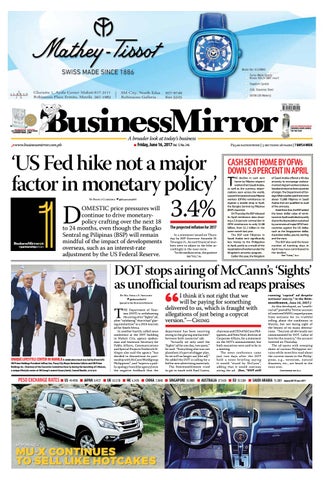
omestic price pressures will continue to drive monetarypolicy crafting over the next 18 to 24 months, even though the Bangko Sentral ng Pilipinas (BSP) will remain mindful of the impact of developments overseas, such as an interest-rate adjustment by the US Federal Reserve.
3.4%
The projected inflation for 2017 In a statement issued on Thursday by BSP Governor Amando M. Tetangco Jr., he said financial markets were to adjust to the hike accordingly in the near-term. “In the medium term, the positive See “U.S.,” A2
business news source of the year
P25.00 nationwide | 5 sections 28 pages | 7 days a week
‘US Fed hike not a major factor in monetary policy’ By Bianca Cuaresma
2016 ejap journalism awards
CASH SENT HOME BY OFWs DOWN 5.9 PERCENT IN APRIL
T
he decline in cash sent home by Filipino migrant workers from Saudi Arabia, as well as the currency depreciations seen across the world, caused the total overseas Filipino workers (OFWs) remittances to register a sizable drop in April, the Bangko Sentral ng Pilipinas (BSP) reported. On Thursday the BSP released its April remittance data showing a 5.9-percent contraction in OFW remittances to only $2.08 billion, from $2.2 billion in the same month last year. The BSP said Filipinos in Saudi Arabia sent significantly less money to the Philippines in April, partly as a result of the repatriation of workers under the Kingdom’s amnesty program. Earlier this year, the Kingdom
of Saudi Arabia offered a 90-day amnesty to encourage undocumented migrant workers to leave Saudi and return to their countries of origin. The Department of Foreign Affairs earlier said there were about 15,000 Filipinos in Saudi Arabia that are qualified to avail of the amnesty. Aside from that, the BSP added the lower dollar value of remittances in April could also be partly due to the depreciation sustained by currencies of major OFW hostcountries against the US dollar, such as the Singaporean dollar, Australian dollar, pound, sterling and the euro. The BSP also said the lesser number of banking days in April may have contributed to the decline. See “Cash,” A12
DOT stops airing of McCann’s ‘Sights’ as unofficial tourism ad reaps praises By Ma. Stella F. Arnaldo
@akosistellaBM Special to the BusinessMirror
T UNIQUE LIFESTYLE CENTER in manila A celebratory toast was led by (from left) SM Prime Holdings President Jeffrey Lim, Pasay City Mayor Antonino Calixto and SM Prime Holdings Inc. Chairman of the Executive Committee Hans Sy during the launching of S Maison, a unique lifestyle center at SM Group’s newest luxury hotel, Conrad Manila. ALYSA SALEN
PESO exchange rates n US 49.4950
HE Department of Tourism (DOT) is withdrawing the airing of its “Sights” ad, after “validating” that it had “glaring similarities” to a 2014 tourism ad for South Africa. In another hastily called news conference at the DOT building in Makati City, agency spokesman and Assistant Secretary for Public Affairs, Communications and Special Projects Frederick M. Alegre also said the agency “has decided to discontinue its partnership with McCann Worldgroup Philippines”, and “expects a public apology from [the agency] over the negative feedback that the
I think it’s not right that we will be paying for something delivered to us, which is fraught with allegations of just being a copycat version.”—Ching department has been receiving owing to the glaring similarities” between both countries’ ads. “Actually we only used the ‘Sights’ ad for one day, two spots,” he said. “Everything else was not placed yet; it’s part of a bigger plan. So we will no longer use [the ad].” He added the DOT is calling for a bid for new advertising materials. The BusinessMirror tried to get in touch with Raul Castro,
chairman and CEO of McCann Philippines, and Niña Terol, director of Corporate Affairs, for a statement on the DOT’s announcement, but both executives were said to be in a meeting. The news conference came just two days after the DOT he ld a news br ief i ng say i ng it would “stand by McCann”, adding that it would continue airing the ad. (See, “DOT still
r unning ‘copied’ ad despite netizens’ outcry,” in the BusinessMirror, June 14, 2017.) As this developed, an “unofficial ad” posted by Twitter account @CreativesOfMNL reaped praises from netizens for its truthful telling about the conditions in Manila, but not losing sight of the beauty of its many destinations. “Tourism ad obviously not commissioned by DOT. Labor of love for the country,” the account tweeted on Thursday. The ad opens with sweeping shots of various Philippine terrains while news bits read about the current issues in the Philippines, e.g., terrorism, natural disasters, etc., are heard in the voice over. Continued on A12
n japan 0.4517 n UK 63.1210 n HK 6.3476 n CHINA 7.2848 n singapore 35.9885 n australia 37.5420 n EU 55.5284 n SAUDI arabia 13.2001
Source: BSP (15 June 2017 )
A2 Friday, June 16, 2017
BMReports BusinessMirror
‘Two-tiered soft-drink tax violates WTO rules’ Continued from A12
imposing an SSB tax would help solve the health emergencies of the country and if this policy is enough to convince Filipinos to live healthier lives.” Dur ing the panel hear ing, senators were assured that the bill provides for a so-called healthpromotion fund to be sourced from SSB tax revenues where an estimated 15 percent shall be alloted to sugar-producing provinces to benefit sugar farmers. The remaining 85 percent is proposed to be allocated to the general fund for other programs, including “operationalization of measures to prevent noncommunicable diseases, provision of sports facilities, access to potable water in public schools and all public places, and nutrition labeling”. As defined in the bill, SSBs to be covered by the higher tax are: sweetened juice drinks, tea and coffee, all carbonated beverages with added sugar, f lavored water, energy drinks and sports dr inks, powdered dr inks not
US. . .
Continued from A1
outlook on US economy should be good for the global economy, including emerging-market economies. In the near-term, we may see some financial-market volatility as markets adjust portfolios for the normalization,” Tetangco said. The US Fed, in their latest meeting this week, hiked its benchmark
clasified as milk, juice, tea and coffee, as well as cereal and grain be verages, a nd non a lcohol ic beverages that contain sugar. The tax package, however, listed exemptions, including plain milk and milk drink without added sugar; all milk products, infant formula and milk alternatives, such as soy milk, almond milk and chocolate milk; 100-percent natural fruit juices and natural vegetable huices; meal replacement and medically indicated beverages; ground coffee; and unsweetened tea. “We would like to know what other fiscal policies should be implemented in tandem with the SSB tax for better health outcomes,” Angara said at the first hearing on the Palace-backed tax measure, adding, “It would be good for us to clarify and establish this point early on so that we can steer the direction of our discussions accordingly.” Angara added the series of hearings also aims to ascertain if the administration tax measure’s current proposed rate at P10 per liter for SSBs with local sugar
and P20 with foreign sugar will be “ just, fair and reasonable”. “Once we’ve clarified if the SSB tax is a health or revenue measure, we can then properly judge if the projected revenue impact is commensurate to the added tax burden and if the proposed earmarkings [15 percent for assistance to sugar farmers; 85 percent for government priority programs] are adequate and justified,” Angara said. At the same time, he said the Ways and Means Committee intends to verify how other countries implemented the SSB tax, like France, the United Kingdom and the United States. For instance, A ngara cited Mexico, which started their SSB rollout in 2014 to deal with widespread obesity, noting that within the first year, consumption of covered beverages was reduced by 6 percent. But he noted that Mexico also implemented an ad valorem tax on so-called nonessential, energy-dense foods, like candies, chocolates, cakes, ice cream and other sweet stuff.
“With the SSB tax, shouldn’t we also be rolling out our own taxes on nonessential foods?” Angara asked. The senator acknowledged concerns the SSB tax, with its projected drops in consumption, will lead to significant jobs and productivity losses, citing estimates that about 140,000 direct jobs and another 740,000 indirect ones will supposedly be affected. “Our loca l sugar industr y, alongside the 5 million or so Filipinos who depend on it, stands to be affected by the SSB tax. We need to project whether or not an SSB tax will imperil their way of life,” he added. He said followup Committee hearings will also address the issue raised that an SSB tax will be “a heavier burden on lower income groups—who may see increases in their expenses without any commensurate increases in their incomes”, citing estimates that the tax proposal may lead to a 1.5-percent increase in unemployment and seriously affect the income of the thousands of sari-sari stories around the country.
interest rate to a range of 1 percent to 1.25 percent as part of their socalled normalization path and signaled markets similar future moves later this year. “The Fed’s action was broadly anticipated by the market and reflects the positive outlook of the Fed on the US economy and labor conditions. It also laid plans for shrinking its balance sheet, which gives the market another glimpse of the normalization process,”
Tetangco said. The outgoing BSP chief also said that, while they will take into consideration the normalization path of the US Fed, their own decision will be guided by the path domestic inflation will take down the line. “The BSP will continue to be guided for its next policy moves primarily by our outlook on inflation. But we will, of course, be mindful of near-term risks that may be addressed by macro prudential tools,”
he said. In their last meeting in May, the BSP kept the rate on overnight borrowing or reverse repurchase facility at 3 percent and the corresponding rates on overnight lending and deposit facilities similarly unchanged. The BSP also kept the forecast inflation at 3.4 percent for this year and at 3 percent for 2018. The BSP will next meet on June 22. It will be Tetangco’s final ratesetting meeting as BSP governor.
INTERTROPICAL CONVERGENCE ZONE AFFECTING MINDANAO (As of 5:00 PM - June 15, 2017)
www.businessmirror.com.ph
Millennials. . . Continued from A12
when they retire, they want to live in farms and be surrounded with green things.” The CGC chief said his company is innovating ways to encourage the millennials to venture into organic urban gardening, one of which is rolling out convenient means of gardening through the use of latest available technologies in the market. “What we do right now is that we continuously innovate to make it a lot easier for people to venture into urban gardening, like for the millennials,” he said. “We have two technologies working on right now: one is aquaponics and the second is barrel gardening.” Sioco explained that through aquaponics, millennials could already have an aquarium and urban garden both at the same time by utilizing only few items. “This one you don’t need anymore any fertilizer nor watering of plants. You just have a pump which siphon freshwater and circulates it to the plants,” he said. “The pump gets the water from aquarium, bringing it to the plants. While the remaining water that the plants willl not use will be drawn back to the freshwater tank, which is already purified. So, the plants and aquarium creates a clean ecosystem.” Meanwhile, barrel gardening utilizes a specialized manufactured vertical container, which allows planters to put 50 pots in just a square meter of space, according to Sioco. “This could be used in condominiums. It could be a little bit of an eyesore but if you care on the practical side of things, this is very appropriate because it is economical and saves space,” Sioco added. Venturing into urban gardening would also contribute in reducing the carbon footprints produced by people, according to Sioco. “All
of us are using technology everywhere and it increases the carbon footprint further. So this [urban gardening] is the least we can do to help our environment,” he said. Aside from producing fresh produce and therapeutic benefits, Sioco said urban gardening can be a way for millennials to develop patience and perseverance. “What we want to tell the people is that there is a way to make it easy for you to venture to urban gardening. Urban gardening could adjust with your lifestyle, no matter what your lifestyle is,” he said. “If your problem is time, space, containers, sunlight or what have you, there are solutons for it. It’s about cultivating the passion. If you want to do it, there’s always a way,” he said. The Department of Agriculture (DA) recently launched its urban agriculture program, aiming to encourage city dwellers to produce their own food. Its program, dubbed as “Urban Agriculture-Pagkain Para sa Masa”, eyes to identify 30 sites in Metro Manila to serve as models for proper urban agriculture, according to the DA. “Urban residents should start growing their own food to ensu re t h at t he y eat sa fe a nd fresh produce aside from saving money,” Undersecretary for Special Concerns Ranibai Dalingalen said. “Urban gardening is easy. It also doesn’t require a big land area to start with,” Dalingalen added. The DA, in partnership with the private sector and the local government unit of Quezon City, chose Bahay Toro communal vegetable garden as the pilot area for the agency’s urbangardening program. Under the Urban Agriculture-Pagkain Para sa Masa program, the DA will provide assistance to partnercom mu n it ies i n engag i ng i n mushroom culture, hydroponics and aquaponics. With Christine B. Francisco and Jessica F. Uyan
news@businessmirror.com.ph
MMDA extends ban on light trucks on Edsa, Shaw Boulevard By Claudeth Mocon-Ciriaco | Correspondent
T
HE Metropolitan Manila Development Authority (MMDA) on Thursday extended indefinitely the ban on light trucks on Epifanio de los Santos Avenue (Edsa) and Shaw Boulevard after it proved to be effective in easing up traffic in those main roads. The light-truck ban was implemented starting March 15 and was supposed to end on June 15. Mandaluyong City Mayor Carmelita A. Abalos said the light-truck ban has improved the traffic flow on Shaw Boulevard. Abalos welcomed the move of the MMDA saying she was about to appeal to the Metro Mayors Council to have it extended. The MMDA’s policy-making body, the Metro Manila Council (MMC), that is composed of the 17 mayors in the metropolis, approved the resolution banning light trucks from plying the two major thoroughfares to improve traffic flow. Under the MMC resolution, trucks which have a gross weight of 4,500 kilograms and below will not be allowed to pass Edsa and Shaw Boulevard from 6 a.m. to 10 a.m., and from 5 p.m. to 10 p.m. The uniform light trucks ban will be enforced from Monday to Saturday. The ban will not be imposed on Sundays and holidays, the resolution said. It added that light trucks carr ying perishable goods are exempted but they still need to apply for exemption. Also exempted from the ban are government and emergency vehicles, such as fire engines and ambulances. Under the resolution, violators will be fined P2,000. MMDA General Manager Tim M. Orbos said there is a necessity to regulate the light trucks on the roads, since these vehicles have contributed significantly to traffic congestion in the metropolis.
The Nation BusinessMirror
Editor: Dionisio L. Pelayo • Friday, June 16, 2017 A3
‘Tired’ Duterte resting indefinitely
M
ALACAÑANG confirmed on Thursday that President Duterte is taking some “private time” to sleep and rest, and will most likely miss official functions for the rest of the week.
In a news briefing, Presidential Spokesman Ernesto C. Abella dismissed rumors that Duterte is sick. Duterte has not attended any public function since Monday and even skipped his first Independence Day celebration in office at the Luneta Park in Manila. “The President is well. The President just needs [to rest]…you have to consider that he has been on the road for at least 23 days fulfilling his martial-law supervision,” Abella said. Asked when Duterte will resume his regular schedule, Abella said he cannot give a definite date yet. In a news report, Duterte was said to have canceled all his scheduled engagements until Sunday to catch up on his sleep, as advised by his medical advisers. On top of this, Abella made clear Duterte is in perfect condition, shrugging off reports that he might have been suffering from sickness the past days. According to Abella, the Chief Executive is resting in Malacañang, but there’s a chance he will travel to Davao City, given his usual routine of going to his residence
in Davao City on weekends. Duterte’s last public appearance was last Sunday night when he went to the wake of the marines who were killed in Marawi City. Questions about his health began to mou nt when on t he ne x t d ays, he fa i led to at tend h is sc hedu led engagements. On Wednesday he begged off from attending an event of the Philippine Drug Enforcement Agency. During the campaign period, Duterte admitted he has four ailments, but they are “not fatal”. Among the ailments of Duterte are migraine and a rare disorder called Buerger’s Disease, which affects the flow of his blood. Duterte, at 72, frequents military camps and attends the wakes fallen government troops wherever these are held. He also went to a number of foreign trips since becoming the Chief Executive, the last of which was to Russia, which he cut short because of the crisis in Marawi City.
Senators not worried
SENATORS played down the continued
absence of Duterte from public functions, amid earlier reports citing Palace officials’ admission he has “not [been] feeling well” and needed to rest during the past few days. Senate President Aquilino L. Pimentel III, however, asserted Malacañang need to disclose if the President is ailing. “If he [Duterte] is sick, the Executive Secretary has the duty to divulge that the President is sick.” “If he is resting, well, let him rest. There is no need to announce ‘the President is resting’ W hat for?” Pimentel added. “Since there was no announcement that he is sick, why do we insist he is sick? He is resting from the public eye, I see no issue at all,” says Pimentel. Senate Majority Leader Vicente C. Sotto III agreed, saying: “I am sure the Palace will inform us if there is a cause for alarm.” Sen. Panfilo M. Lacson, likewise, played down Duterte’s disappearance as “no big deal”, saying Presidents are entitled to occasional day offs. Lacson pointed out that Duterte “ happens to be the President who has to deal with all sorts of problems, like the separatist movement in the south, New Peoples Army insurgency, illegal drugs and crimes, with corruption in government to boot”, adding that the 72-year-old Chief Executive can “not be expected to always stay in shape”. “President Duterte is no exception,” Lacson said, noting that “those who came
The President is well. The President just needs [to rest]… you have to consider that he has been on the road for at least 23 days fulfilling his martial-law supervision.” — Abella
before him, likewise, took some days off occasionally because of health issues. For me, its no big deal.” In an ambush inter v iew at the Senate, Cabinet Secretar y Leoncio B. Evasco Jr., assured that Duterte is not sick. “He [Duterte] is alright; he’s fine,” Evasco told Senate reporters, even as he explained “each one of us needs to relax, including the President”. Asked if the President plans to take the whole week off, the Palace official replied: “No, no, no. I don’t have any idea. I am in my office and he is in his office.” Butch Fernandez and Elijah Felice E. Rosales
Economy
A4 Friday, June 16, 2017 • Editors: Vittorio V. Vitug and Max V. de Leon
BusinessMirror
news@businessmirror.com.ph
CSOs to AIIB: Address energy ‘poverty’, invest in renewables
P
By Jonathan L. Mayuga
@jonlmayuga
hilippine-based civil-society organizations (CSOs) on Thursday called on the China-led Asian Infrastructure Investment Bank (AIIB) help address climate crisis, energy poverty and need for development in its Energy Strategy, expected to be released this week during its annual meeting of its Board of Governors in Jeju, South Korea, from June 16 to 18. In an open letter sent to Southeast Asian members of the AIIB’s Board of Governors, Philippine organizations listed three demands which it wants the AIIB to adhere. These include the demand for
the AIIB to realize its commitment to be a lean, clean and green bank by refusing to fund dirty, deadly and costly energy projects, such as those reliant on fossil fuel and nuclear energy; establish safeguards
to ensure that mega-renewableenergy projects do not endanger ecosystems, and consider their social and cultural impacts, especially to the impacted host communities; and prioritize investment in small, decentralized projects rather than the big renewable-energy projects. Initiated by the Center for Energy, Ecology and Development (CEED), the open letter was signed by different national organizations, including Sanlakas, the Philippine Movement for Climate Justice, the Asian Peoples’ Movement on Debt and Development, Alyansa Tigil Mina, The Climate Reality Project Philippines, Freedom from Debt Coalition, Save Sierra Madre Network, 350.org Pilipinas and the Philippine Rural Reconstruction Movement. “We hope that by this manifestation, the voices of the country’s most vulnerable sectors, especially 16 million energy-poor Filipinos, will be reflected in this week’s meeting,” CEED Convener Gerry
Arances said in a news statement. The AIIB has an opportunity to set itself apart from other international finance institutions, like the World Bank and the Asian Development Bank, in refusing to fund dirty energy projects, like coal and nuclear energy, both directly and indirectly,” he added. The letter also discouraged investments on coal and so-called clean coal, citing the damage it poses to the environment, particularly water and air resources, as well as its greenhouse-gas emissions, which are among the leading causes of man-made climate change. Nuclear energy, on the other hand, is also discouraged, given the risks it poses to the environment given its radioactive waste and its vulnerability to disasters. Arances also highlighted the risks and damages involved in funding large “mega-renewable” energy projects, like large hydroenergy dams. He said the letter highlighted
energy projects, which can be maintained and operated by communities. “This will help democratize the energy sector by decentralizing the generation and distribution of power, helping minimize the cost of electricity. Such projects are also effective in reaching areas which cannot be accessed by large grids, and reducing the power loss inherent in a heavily centralized energy systems,” Arances said.
The AIIB has an opportunity to set itself apart from other international finance institutions, like the World Bank and the Asian Development Bank, in refusing to fund dirty energy projects, like coal and nuclear energy, both directly and indirectly.”—Arances
DTI, Cemap assure supply of cement, other construction materials for Marawi City
Lawmaker says ‘sin’ tax on salty food is anti-poor
A
party-list lawmaker on Thursday urged the leadership of the House of Representatives not to pass a measure imposing excise tax on salty products. Party-list Rep. Carlos Isagani Zarate of Bayan Muna said the lower chamber should not allow this “anti-poor” bill to be passed. “This bill is definitely anti-poor and must be opposed,” Zarate said. “The passage of this measure would greatly affect the purchasing power of lower-income groups and the poor, who buy noodles and canned sardines,” the lawmaker said. If the measure is enacted, Zarate, citing the computation of the Philippine Chamber of Food Manufacturers Inc., said the price of P6.85 noodle pack would jump to P8. Last year Nationalist People’s Coalition Rep. Scott Davies S. Lanete of Masbate filed House Bill 3719. The measure is pending before the House Committee on Ways and Means. He said it is high time for the Philippines to adopt strict measures in ensuring the safety and well-being of Filipinos and imposing a tax on the production, sale and consumption more than the prescribed daily intake but will also generate additional funds for the government. In the measure, Lanete seeks to amend Republic Act 8424 by inserting new provision which states on the manufactured goods that have sodium chloride, or any of its derivatives, as an ingredient and which included, but are not limited, to canned goods, processed food and junk food, a tax of P1 shall be levied on every milligram of sodium in excess of onethird of the allowable daily intake of sodium chloride as prescribed by the Department of Health. “Nowadays, salt has acquired a new image. It is now treated as a silent killer, as its consumption has a correlation with high blood pressure, which consequently leads to increased risks of having a heart attack and stroke,” he added. Jovee Marie N. dela Cruz
the experience of affected communities, particularly indigenous groups, in the construction of dams. “These projects threaten to eradicate the cultural heritage of indigenous peoples and violate their ancestral domains, while solar farms and other large renewableenergy projects compete with our need for food security and land reform,” Arances said. The CSOs also called on the AIIB to invest more on micro-renewable-
T
Fully wired
A power-transmission lineman enjoys a cigarette puff while working on a high-tension power cable connection in Makati City. Power-utility companies have stepped up maintenance work in preparation for the stormy season. Alysa Salen
DOLE lifts OFW deployment ban to Qatar
T
he Department of Labor and Employment (DOLE) on Thursday lifted the deployment ban on overseas Filipino workers (OFWs) to Qatar upon the recommendation of the Philippine Overseas Labor Office (Polo) in the host country. Labor Secretary Silvestre H. Bello III said the decision was also reached upon consultation with the Department of Foreign Affairs (DFA). “This decision was arrived at on the advice of Foreign Secretary Allan Peter S. Cayetano and upon the recommendation of Qatar Polo following their assessment of the situation in the Gulf state,” he said in a news statement. With this, Labor Attaché David Des Dicang and the Philippine Embassy have requested the sending of newly hired workers to the Arab state, particularly to the Philippine School Doha (PSD) and Philippine Interna-
tional School-Qatar (PISQ) since the situation there has normalized. “We respectfully request to allow the deployment so as not to hamper the operations of our Philippine schools and to allay fears of the revocation of their school permits issued by the Qatar government,” he added. A total of 28 new teachers and 20 bus drivers of PSD and 51 new teachers of PISQ have pending applications with the Philippine Overseas Employment Administration (POEA). The Philippine Embassy and Polo has recommended the deployment of an Assessment Team composed of DOLE, POEA, Overseas Workers Welfare Administration (OWWA) the and the Undersecretary for Migrant Workers Affairs of the DFA to Qatar to meet with the government authorities and companies providing employment to Filipinos. Likewise, the Polo is continuously coordinating with the Qatari authori-
ties to discuss possible difficulties regarding the repatriation of distressed OFWs temporarily accommodated at the Migrant Workers and other Overseas Filipinos Resource Center. It is also looking into the possible situation of household service workers of non-Qatari employers, who will be left in the country or will be forced to travel with their employers. On the other hand, the host country has assured the safety of some 240,000 Filipinos there and affirmed that they have the ability to withstand any possible economic shocks out of the diplomatic impasse with its neighboring Arab countries. For their part, OFWs in Qatar have expressed confidence for their safety with the strengthened efforts of the labor department and other concerned government agencies in ensuring their basic welfare and security amid the diplomatic crisis. PNA
he Department of Trade and Industry (DTI) and cement manufacturers have assured enough supply of construction materials, particularly cement, for the rehabilitation of conflict-ravaged Marawi City. Emerging from a National Price Coordinating Council (NPCC) meeting on Thursday, Trade Secretary and NPCC Head Ramon M. Lopez told reporters they’re building up an inventory of construction materials for the rehabilitation of the Lanao del Sur city. “We’re talking to constructionmaterials suppliers to create buffer stocks in the area, and assuring also that these products are compliant. We’re talking to producers of materials, such as cement, steel and roofing materials. That’s what we’re looking now, for preparation in rebuilding and rehabilitation,” Lopez said. Cement Manufacturers Association of the Philippines (Cemap) President Ernesto M. Ordonez said his group is capable of producing 30 million tons of cement, but with the national requirement to picking up in the next few years, and Marawi City needing immediate rehabilitation, they may need to import more. “We’re geared for Marawi and we’ll make sure we have enough supply. We’re welcoming imports,” said Ordonez, whose group is also part of the Federation of Philippine Industries. Actual demand for cement last year was pegged at 26 million tons, and on average has increased by 6 percent yearly. While Cemap declined to give figures on what percentage of this figure is taken up by imports, the
level of imports are seen to grow by 7 percent to 8 percent in the coming years, amid the entry of new players. According to the price monitoring data of the DTI in May, the current cement price per bag is pegged from P220 to P250 in Metro Manila. Cemap has maintained that cement imports will ensure stable market price for the commodity.
Price-freeze extension
Lopez also said the agency is studying the situation in Mindanao if it needs for extension of price freeze once the 60-day martial law ends next month. “With the gravity of the situation, there is a possibility. We are not yet saying yes. We’re studying that to extend the 60day period,” Lopez said. Lopez, noted the possible extension of price-freeze would be the same coverage for the current price freeze implementation, which is the entire Mindanao. “Just for assurance and guarantee that these should be the prevailing prices, no fluctuating variables in terms of prices, then that’s the only reason we will probably recommend an extension,” he said. “It will need approval from the President,” he said in Filipino. The official noted the DTI will be looking at the legality of the extension as the 60-day automatic implementation of price freeze is a provision under the declaration of martial law, state of emergency, or state of calamity. “We will also study the legality. If it merits the need for extension once martial law ended,” Lopez said in Filipino. Catherine N. Pillas with PNA
Expect long MRT 3 commuter queues to be longer–DOTr Q UEUEING up to ride the Metro Rail Transit (MRT) Line 3 may take a bit longer than usual, as the transportation department implemented safety measures that significantly reduced the speed of the train system, as it conducts an audit of what it found to be an irregularity in the system’s hardware. From 40 kilometers per hour (kph), trains fielding the railway line have started to run at a reduced speed of 20 kph due to Tuesday’s
broken wheel-axle incident, which, for Transportation Undersecretary Cesar B. Chavez, should be prudently inspected and corrected before it could do any more harm. “This is part of the process for us to ensure the safety of our passengers,” he said. “It is necessary for us to do it.” The inspection will run for at least four days, he said. MRT 3 Director for Operations Deo Leo N. Manalo clarified that the four-day period is just an estimate, assuring passengers that the mainte-
nance team is focused in completing the safety inspection at the soonest possible time for the rail line to be able to deploy additional trains. “We will do everything to complete it earlier,” Manalo said. Over the last three months, there have been multiple major incidents in the MRT 3, such as the derailment of bogies, and smoke emission from a train car. Chavez added that only 17 out of 20 train sets will be deployed during peak hours. This means that
the current four- to seven-minute headway will be increased, hence, longer waiting time for passengers to board the trains. After the four-day inspection, the train’s speed will then be increased to 30 kph, which was recommended by maintenance contractor Busan Transportation Corp. As a temporary response, the transportation department and Land Transportation Franchising and Regulatory Board are working together to deploy additional city
buses to give MRT 3 passengers an alternative mode of transportation. Mid and long-term solutions, according to Chavez, are also under way. He cited, for instance, the project to upgrade of the ancillary systems of the facility. The deal aims to double the power capacity of the train system, hence, increasing its capability to use more trains. Such a project is expected to be completed by November 11, based on a Busan report. He noted other ongoing projects
may be completed by the second quarter of 2018. This includes the systematic rail replacement and a planned general overhaul for old trains. The train system has been in an almost constant state of decay over the last few years due to government underspending, and legal tussles between the facility’s owner and the state. Such problems had caused many inconveniences to the more than 500,000 daily riders of the train system. Inna Christine Cabel Charlotte Furigay
Agriculture/Commodities BusinessMirror
news@businessmirror.com.ph
Editor: Jennifer A. Ng • Friday, June 16, 2017
A5
‘Self-financed co-ops can hike rice output’
S
By Jasper Emmanuel Y. Arcalas
@jearcalas
elf-reliant cooperatives are a viable alternative to government subsidies to help farmers increase their rice output, according to an expert from the International Rice Research Institute (Irri).
Dr. Peter Jennings, senior scientist emeritus at Irri, said the government alone cannot fund agricultural improvements needed to increase the country’s average palay yield to 6 metric tons (MT)per hectare. These interventions would include better farm-to-market roads, modernized rice mills, earthen dams to capture rainwater where topography permits, credit for tube wells and low-lift pumps, and subsidies to reduce electricity costs to run the pumps. He said more trained extension agents are needed to reduce the multiple deficiencies in crop management that constrain yield. “These extremely expensive requirements are unlikely to be met from government coffers. Capital from the farmers and millers is a better alternative,” Jennings said in a report published on the international magazine, Rice Today. “To generate this, the Philippine agriculture secretary would identify one or two rice areas easiest to impact. His staff would select in each area a highly respected farm leader competent in the management of people and finance,” he added. Jennings, who led the team that bred the IR8 rice variety in the early-1960s, said the selected farmer would be respon-
sible in convincing fellow farmers and millers in his or her area to join a cooperative. The prospective cooperative members should also accept obligatory taxes on each kilogram of grain harvested and milled output. The money collected at the mills would create the capital for investment in irrigation and other farm equipment, Jennings said. The cooperative could also seek funds from international banks, foundations and other sources. “The cooperative would invest in farm needs with the guidance of a board of elected farmers and millers. Success in the pilot areas would be extended to the rest of the country through the creation of additional farmer organizations,” he said. “This proposal will be difficult to implement, opposed by vested interests and subject to financial mismanagement. Yet, self-financed farmer cooperatives are a viable strategy to increase irrigated rice area to attain a national yield average of 6 tons per hectare,” Jennings added. The Irri expert said farmers could also hike their yield if they would shift to a more efficient irrigation system. “Farmers’ appreciation that water control
Region 12 ships mangoes to United Arab Emirates K
ORONADAL CITY—Mangoes from Region 12 have penetrated the United Arab Emirates (UAE), officials said on Thursday. Milagros Casis, Department of Agriculture Region 12 (DA-12) director, said the carabao mangoes that were shipped to Abu Dhabi came from a group of farmers in Tulunan town, North Cotabato. This is the second shipment of mangoes to the UAE produced in Region 12, or the Soccsksargen region, she said. “In 2015 we also exported 2.5 metric tons of mangoes to Dubai, UAE,” Casis said. Region 12 comprises the provinces of South Cotabato, North Cotabato, Sultan Kudarat and Sarangani and the cities of General Santos, Koronadal, Tacurong, Kidapawan and Cotabato. She said the Tulunan Mango and Fruit Growers’ Association shipped carabao mangoes to Abu Dhabi early this month after participating in an international trade fair. “We are hopeful that the other exhibitors in the region that we brought to different trade expositions will also seal similar market opportunities,” Casis said. Rickson Olimpus, president of Tulunan Mango and Fruit Growers’ Association, confirmed they exported 500 kilos, or half a ton, of premium-grade carabao mangoes to Abu Dhabi. “This is our second shipment to Abu
RURAL FARMERS’ TRAINING
Dhabi after our trial shipment on May 22 where we sent 18 kilos,” Olimpus shared. The Agribusiness and Marketing Assistance Division (Amad) and High-Value Crops Development Program (HVCDP) of DA-12 assisted the farmers in shipping the mangoes. Evelyn Jaruda, an Amad-12 worker, said the recent shipment of mangoes was the result of the participation of the region to the International Food Expo (Ifex) on May 19 and 20 held at the World Trade Center in Pasay City. During the expo, Olimpus and Mildred Curato Remo, manager of Fresh Harvest Foodstuff Trading Llc. from Abu Dhabi, agreed on the mango shipment. Together with the 500 kilos of mangoes bound for Abu Dhabi was another half metric ton of mangoes sent to Manila, Jaruda said. Charlotte Tanoja, of B&C Healthy Snack Food Inc. from Muntinlupa City, was the group’s linkage in Metro Manila, she added. Olimpus said he is now in contact with another food processor from Manila, whom he also met at the Ifex, for a possible mango supply deal. “They are requesting around 1 ton of processed grade mangoes by the third quarter of 2017,” he revealed. Besides the domestic market, Olimpus and his group are also expecting more shipments to food processors and importers from India and Middle East countries. PNA
Two hundred farmers from 10 municipalities of Lanao del Norte completed SM Foundation’s Kabalikat sa Kabuhayan Rural Farmers’ Training Program. The training program has imparted to the participants techniques on sustainable vegetable farming, including soil preparation, seed selection, pest control, use of organic fertilizers and irrigation. Aside from the farmers’ training program, a capacity-building program is also given to empower the farmers to be active participants in the socioeconomic development of their locality. The harvest festival and graduation ceremony were attended by Lanao del Norte officials, led by Gov. Imelda Quibranza-Dimaporo and Rep. Abdullah Dimakuta-Dimaporo of the Second District of Lanao del Norte, and representatives from SM Foundation and Harbest Agribusiness Corp. The training program is a testament that Christians and Muslims can work hand in hand for the betterment not only of their families, but of their communities, as well.
is essential for profitable rice farming clearly defines future needs. The shift to water control can be accelerated to reach a goal of 80-percent to 90-percent irrigated farming,” Jennings said.
“That alone would guarantee a national yield of 6 MT per hectare. The strategy proposed to achieve this implies that progress will come more from the farmers’ initiatives than from the researchers,” he added.
Jennings led the Irri team that bred IR8 in the early-1960s. IR8 is considered to be the world’s first high-yielding rice variety and first rice variety released by the Irri with an optimum yield of 9.4 MT per hectare.
A6
The World BusinessMirror
Friday, June 16, 2017
www.businessmirror.com.ph
Shooting critically wounds GOP lawmaker
A
LEXANDRIA, Virginia—A lone gunman, who was said to be distraught over President Donald J. Trump’s election, opened fire on members of the Republican congressional baseball team at a practice field in this Washington suburb on Wednesday, using a rifle to shower the field with bullets that struck four people, including Rep. Steve Scalise, the majority whip of the House of Representatives.
Trump, in a televised statement from the White House, condemned the “very, very brutal assault” and said the gunman had died after a shootout with police. Law enforcement authorities identified him as James T. Hodgkinson, 66, from Belleville, Illinois, a suburb of Saint Louis. Two members of Scalise’s Capitol Police security detail were wounded as they exchanged fire with the gunman, in what lawmakers described as several chaotic, terror-filled minutes that turned the baseball practice into an early-morning nightmare. One was wounded by gunfire and one suffered other minor injuries. The tragedy united Republicans and Democrats in shock and anguish. “For all the noise and all the fury, we are one family,” House Speaker Paul D. Ryan said on Wednesday afternoon. Standing at second base, Scalise was struck once in the left hip, according to witnesses, and collapsed as the shots rang out, one after another, from behind a chain-link fence near the third-base dugout. Wit nesses sa id Sca l ise, of Louisiana, “army crawled ” from the infield to the grass as the shooting continued. His injuries were extensive, and he was in critical condition on Wednesday night, MedStar Wa sh i ng ton Hospit a l Center said in a statement. As the bullet traveled across his body, it broke bones, tore up internal
3
The number of people wounded in the baseball shooting other than Republican Rep. Steve Scalise organs and caused major internal bleeding. Doctors operated immediately, but additional surgery is required, the hospital said. Trump and his wife, Melania, went to the hospital on Wednesday night, arriving with two large bouquets of white flowers. The president sat privately with Scalise and spoke with his doctors and wife, Jennifer, for about 15 minutes. He also briefly chatted with Capitol Police officers there before returning to the White House. “Just left hospital,” Trump tweeted. “Rep. Steve Scalise, one of the truly great people, is in very tough shape—but he is a real fighter. Pray for Steve!” Local officers arrived at the A lexandria ball field minutes after they received desperate
House Majority Whip Steve Scalise (Republican-Los Angeles) in the lobby of Trump Tower on Fifth Avenue in New York, on December 12. Scalise was shot at a baseball field on June 14 in Alexandria, Virginia, when a gunman opened fire near a YMCA, a congressional official said. Sam Hodgson/The New York Times
calls for help, including calls from those still under siege at the field, the authorities said. The Federal Bureau of Investigation (FBI) said it would take the lead in the investigation, treating it as an assault on a federal officer. Tim Slater, special agent in charge of the bureau’s Washington field office, said investigators were “exploring all angles”, but that he could not comment on a motive. Asked whether the shooting was an assassination attempt, he said it was “too early in the investigation to say one way or another”. The FBI said Hodgkinson had a handgun and a rifle, which he bought in March, according to a law enforcement official. Witnesses described a man with white hair and a beard wielding a long gun as he stood behind the dugout. “He was hunting us at that point,” said Rep. Mike Bishop, Republican-Michigan, who was standing at home plate when the shooting began. Bishop said the gunman had seemed to be firing a series of two shots at a time, a firearms technique known as “double-tapping”, sending off bullets that kicked up the gravel on the baseball field as they struck the ground. “There was so much gunfire, you couldn’t get up and run,” he said. “Pop, pop, pop, pop—it’s a sound I’ll never forget.” Sen. Rand Paul of Kentucky, who was among the lawmakers practicing for the annual char-
ity baseball game, which was still scheduled to take place on Thursday, told CNN that “the field was basically a killing field—it’s really sick and very sad.” Rep. Jeff Duncan of South Carolina, who left the practice just before shooting, said later that he had encountered a man in the parking lot—later identified as the gunman—who “asked me if the team practicing was a Democrat or a Republican team”. “I told him they were Republicans,” the lawmaker recalled. “He said, ‘OK, thanks,’ turned around.” The shooting stunned the capital as it began its workday. Out of caution, Capitol police officials said, they quickly put in place a “robust police presence throughout the Capitol complex”, and the Secret Service added security around the White House. Ryan addressed his colleagues in the House chamber shortly after noon. “We do not shed our humanity when we enter this chamber,” Ryan said, his voice seeming to nearly break at times. As the magnitude of the episode became apparent, House leaders canceled the day’s votes, and Trump and Vice President Mike Pence canceled speeches. “We may have our differences, but we do well in times like these to remember that everyone who serves in our nation’s capital is here because, above all, they love our country,” Trump said at the White
President Donald J. Trump and first lady Melania Trump leave after visiting Rep. Steve Scalise (Republican-Los Angeles), who was wounded in the baseball field shooting on Wednesday morning, at MedStar Washington Hospital Center in Washington, on June 14. Doug Mills/The New York Times
House shortly after the shooting. Hodgkinson seemed to be a fervent opponent of Trump. He signed an online petition calling for the president to be impeached, posting it on Facebook with a chilling comment: “It’s time to destroy Trump & co.” His brother, Michael Hodgkinson, said Hodgkinson traveled in recent weeks to Washington to protest. “I know he wasn’t happy with the way things were going, the election results and stuff,” Hodgkinson said in an interview shortly after he received the news on Wednesday. He said he had not been close to his brother, and that he had not been aware of why he remained in Washington. The FBI said it appeared Hodgkinson had arrived in the area in March and had been living out of a white van near the field. Hodgk inson a lso appeared to be have been fer vent fan of Sen. Bernie Sanders, according to a Facebook page with references to the Vermont senator. A LinkedIn page for James Hodgkinson had a profile photo showing Sanders’s famous hair and glasses and the words, “ The Dawn of a New Democracy”. In a statement on Wednesday morning, Sanders said he had been told the suspect had volunteered for his presidential campaign. He offered his “hopes and prayers” for the shooting victims. “I am sickened by this despicable act,” Sanders said. “Let me
be as clear as I can be. Violence of any kind is unacceptable in our society, and I condemn this action in the strongest possible terms. Real change can only come about through nonviolent action.” Others who were wounded included Zachary Barth, a member of Rep. Roger Williams’s staff, who was struck in the leg by a bullet, and Matt Mika, a former congressional staff member and the director of government relations for the Washington office of Tyson Foods, who was shot twice in the chest. He was in serious condition. Barth was treated at a hospital and later released. Two of those who suffered injuries were Capitol Police officers assigned to protect Scalise, the third-ranking member of the House Republican leadership team. Officials identified the two officers as Crystal Griner and David Bailey, both 32. Officials said Griner was shot in the ankle, while Bailey suffered other minor injuries and was treated and released. Wil liams, of Texas, praised the t wo officers as “ heroes”, say ing their split-second decision to confront the g unman saved many lives. “We saw two people risk their lives to save others. We saw courage in the face of death,” Williams said in a news conference on Wednesday evening. “There could have easily been 25 deaths or more today.” New York Times News Service
London residents demand answers in high-rise blaze L
ONDON—With smoke still swirling around the charred remains of Grenfell Tower in west London, residents and community leaders demanded to know on Wednesday how a ferocious fire could have swept through the high-rise apartment block with such speed that it killed at least 12 people. The anger was particularly strong since activists had warned just seven months ago that fire-safety procedures were so lax, that only a catastrophic blaze would bring the scrutiny needed to make the building safe.
What happened?
Fire and police officials have not specified what went wrong, but extensive video footage shows the flames climbing the exterior of the building at a remarkable pace. “I’ve never seen a fire like that in my life,” said Joe Ruane, the former deputy chief fire officer for US Air Force bases in Britain. “I’ve never seen that in a residential block.” The 24-story public-housing complex is owned by the local government council in the borough of Kensington and Chelsea, and was completed in the 1970s. It is managed by the Kensington and Chelsea Tenant Management Organization, which spent £10 million ($12.8 million) refurbishing the building over the last two years. The renovation projec t included installation of insulated exterior cladding, double-glazed windows and a communalheating system. Investigators need to look at what materials were used in the project and who approved their use, Ruane said.
But he said the speed with which the fire spread suggests that more than one fire protection safeguard failed. “It’s not just one thing,” Ruane said. “It’s multiple issues.”
What was the fire procedure at the building?
Some residents suggested that Grenfell Tower’s policies were to blame for the disaster. A newsletter put out by the building’s tenant organization told tenants to follow a “stay put” policy and remain in their apartments during a fire, unless the blaze was inside their apartment or in their hallway, or until they were told to evacuate by officials. This policy is in place “because Grenfell was designed according to rigorous firesafety standards,” according to the 2014 newsletter about the renovation project. New front doors in each apartment could withstand a fire for up to 30 minutes, “which gives plenty of time for the fire brigade to arrive,” the newsletter said. That policy, often followed in high-rise hotels, may be effective in lesser fires. In this case, however, the fire seemed to climb the exterior of the tower so quickly that it overwhelmed protective systems, like fire doors. People who initially remained in place may have been unable to escape later because the hallways and fire escapes were filled with heavy smoke and flames. The London Fire Brigade said crews were on the scene within six minutes of the first reports of the fire, but they were
unable to reach people on higher floors to prevent fatalities.
Who is to blame?
While investigations are underway to determine what went wrong, tenants said repeated complaints were ignored. Survivor Edward Daffarn said the Kensington and Chelsea Tenant Management Organization (KCTMO), which manages the Grenfell Tower, as well as other buildings in the area, is responsible because it ignored numerous warnings. The management organization’s annual accounts for the year ending March 31, 2016, indicate that the company has been cited for fire-safety issues in the past. Following an October 2015 arson fire at one of the buildings it manages, the 14-story Adair Tower, the London Fire Brigade issued an enforcement notice to install self-closing devices on the front doors of all 78 apartments and to improve fire safety in staircases used for escape, the organization said in the report. The Fire Brigade issued a similar notice for another KCTMO-managed building, Hazelwood Tower. The upgrades were scheduled to be completed by 2016, the report said. The Grenfell Tower disaster is uncomfor tably similar to a fastmoving blaze at another London-area public-housing project, Lakanal House, that killed six people, including three children, eight years ago. In that July 2009 fire, smoke and flames quickly engulfed the 14-story building. A coroner’s inquest found that a series of
failures contributed to the loss of life and made a number of recommendations to help prevent future disasters. Investigators probing the Grenfell Tower fire will have to look at which of those recommendations were implemented in the building and which were not, said Jim Fitzpatrick, a former firefighter who now serves in the House of Commons. “These will be matters for the scientists and the engineers ... to find out exactly how the fire started, why it spread so quickly, and what could have been done to prevent it,” Fitzpatrick told Sky News. A local community organization, the Grenfell Action Group, had warned about fire dangers at the building since 2013. In a series of blog posts, the group raised concerns about testing and maintenance of fire-fighting equipment and blocked emergency access to the site. “All our warnings fell on deaf ears, and we predicted that a catastrophe like this was inevitable and just a matter of time,” the group said in a blog post on Wednesday. KCTMO said, it is cooperating with investigators and that it was aware of tenant complaints. “We always take all concerns seriously and these will form part of our forthcoming investigations,” it said in a statement. The Kensington and Chelsea Council promised a full investigation into Wednesday’s tragedy and a public accounting. The UK government also ordered checks at tower blocks that have had or are going through similar renovations as those at Grenfell Tower. AP
Firefighters work at the scene after a deadly blaze at a high-rise apartment block in London on June 14. Fire swept through a high-rise apartment building in west London early Wednesday, killing 12 people with around 50 people being taken to hospital. AP/Alastair Grant
BusinessMirror Special Feature
www.businessmirror.com.ph
Friday, June 16, 2017 A7
CERTIFIABLY THE BEST I
By Steven Edward S. Yu
F you’ve been driving a modern gasoline-powered vehicle for the last ten or so years, you surely will have noticed how fuel companies have competed for dominance in their gasoline rivalry by formulating exotic blends with progressively higher and higher octane numbers, which is great regardless if you’re driving a multimillion-peso supercar, an executive sedan, or an entry-level subcompact. As a matter of fact, the advent of high-octane gasoline makes it possible for modern, computer-controlled vehicles to take advantage of plug-and-play tuning, making their engines even more efficient. From 2010 onwards, Petron has set the bar for the highest-octane gasoline in the industry, Blaze 100. All the other fuel players can do is try and catch up. But a gasoline’s octane rating isn’t the only number that should matter; in a country where air pollution has reached worrisome levels, a gasoline’s emissionscompliance rating may be more relevant than its octane rating because, the truth is, maximum engine power isn’t something a motorist needs every moment; but low emissions will benefit both your vehicle and the environment every second your engine is running, everywhere you go. Once again, Petron, the coun-
try’s largest fuel company, has set the bar for making not only the Philippines’ most powerful gasoline, but now also the cleanest: Blaze 100 Euro 6, which substantially exceeds the government’s current Euro 4 emissions requirement and matches the Euro 6 emission standard used in Europe since 2014. Because Blaze 100 Euro 6 is made at Petron’s Bataan Refinery, they can guarantee its consistency and quality. Euro 6 is currently the strictest fuel technology and highest emissions standard in the world; at least 500%, or five times, cleaner than Euro 4. The current Philippine Euro 4 emission standard, mandated since January 1, 2016, requires a maximum sulphur content of 50 parts per million (PPM); Euro 6 significantly lowers the limit to only 10 PPM. Although there has been no deadline set for the Philippines to adapt Euro
5 or 6 emissions compliance yet, Petron has already taken the lead to meet that compliance now. To meet this Euro 6 standard, a gasoline must exhibit markedly decreased Carbon Monoxide (CO), Hydrocarbons (HC), Nitrogen Oxides (NO), Particulate Matter (PM) and Particle Number (PN) – the unique criterion that distinguishes Euro 5 from Euro 6 – in its emissions. To ensure Filipinos enjoy the benefits of a true 100-octane Euro 6 gasoline, Petron sent samples of Blaze 100 Euro 6 to international laboratories and engine rating experts, such as the SGS, ISP/The
Testing Institute, and the Millbrook Proving Ground for independent testing and certification. Recognized as the world’s leading inspection, testing, verification, and certifying company, the SGS tested Blaze 100 Euro 6 at their laboratories here, in Singapore and in the UK, and found the fuel to meet (EN 228:2012) specifications for Euro-6 compliant vehicles; while in the PN test, they also found Blaze 100 Euro 6 to have three times less sulphur than the Euro 6 requirement, or less than 3 PPM. With the increasing application of Direct Injection in new gasoline
engines, ISP/The Testing Institute, a foremost engine and vehicle testing laboratory for fuel and lubricant development with centers in Normandy and Salzburg, performed a GDI test using Petron Blaze 100 Euro 6 and concluded that Blaze 100 Euro 6 would not contribute to carbon deposits in Gasoline Direct Injection (GDI) engines, which require extremely clean gasoline that will not cause the injectors to foul. Finally, to prove their best fuel’s cleansing properties, Petron sent samples of Blaze 100 Euro 6 to Millbrook Proving Ground in the UK, where various products are vali-
dated for automotive, transport and defense use. Here, Petron Blaze 100 Euro 6 was used in an Intake Valve Deposit test, noting that over 70% of deposits in port-fuel injection engines were cleaned in just 60 hours. Additionally, Millbrook also concurred with the SGS’ findings of less than 3 PPM sulphur, passing even the Euro 6b standard – the absolute strictest emission standard in use. With its (EN 228:2012), non-carbon-causing, engine-cleansing, Euro 6b-passing certifications, there is no doubt that Petron’s Blaze 100 Euro 6 is the best gasoline in the country, at par with the best gasoline blends in the world, offering users as much as six benefits, such as a cleaner engine after one full tank; dramatically reduced harmful emissions; improved combustion with its unique additive formulation; improved fuel efficiency; powerful overall engine response and reduced maintenance costs. But it doesn’t stop there – as the only ethanol-free gasoline in the Philippines, Blaze 100 Euro 6 isn’t just the perfect gasoline for modern vehicles, but is ideal for older vehicles too, potentially reducing their tailpipe emissions to levels acceptable even by today’s strict standards. Moreover, all Petron fuels deliver the TriAction Advantage consisting of: (1) better engine protection for longer engine life; (2) better mileage for longer drives; and (3) better power. Thus in addition to cleaner emissions, motorists can enjoy more savings on maintenance and fuel consumption, while getting the best driving performance from their vehicle. With Petron Blaze 100 Euro 6, you’re putting the very best gasoline into your vehicle, while preserving our environment for future generations. The gasoline rivalry is over.
A8
The World BusinessMirror
Friday, June 16, 2017
Editor: Lyn Resurreccion • www.businessmirror.com.ph
Abe passes bill boosting Japan surveillance powers
J
This photo provided by the Syrian Civil Defense group, known as the White Helmets, shows civil defense workers carrying children after air strikes hit a school housing a number of displaced people, in the western part of the southern Daraa province of Syria, on June 14. Syrian Civil Defense White Helmets via AP
US-led Syria strikes said to take heavy civilian toll
G
ENEVA—Air strikes by the USled coalition against Islamic State (IS) targets have killed hundreds of civilians around Raqqa, the militant group’s last Syrian stronghold, and left 160,000 people displaced, a UN panel said on Wednesday. The findings of the panel, which has been documenting the war in Syria with periodic reports almost since the conflict began more than six years ago, reinforced fears by humanitarian groups over the heavy loss of civilian life that would result from the US-led coalition’s air strikes. Paulo Sérgio Pinheiro, the Brazilian diplomat who leads the panel, said the air strikes had escalated as a US-backed militia, known as the Syrian Democratic Forces (SDF), moved recently to retake Raqqa, which IS fighters seized in 2014 and made their de facto capital. “We note, in particular, that the intensification of air strikes, which have paved the ground for an SDF advance in Raqqa, has resulted not only in staggering loss of civilian life but has also led to 160,000 civilians fleeing their homes,” Pinheiro said in a report, presented to the UN Human Rights Council in Geneva. It was the first time Pinheiro’s panel had focused on US military conduct that has led to heavy civilian casualties and other suffering.
300
The number of civilians who had been killed in the air strikes since March 21
T he p a ne l ’s i nve s t i g ator s found that 300 civilians had been killed in the air strikes since March 21, panel member Karen Abuzayd told reporters in Geneva later. They included 200 civilians killed in a single incident in March, when an air strike hit a school in the town of Mansoura, she said. T he at t ac k on M a n sou ra , shortly after midnight on March 21, hit a school building housing families that had fled the fighting around Palmyra and other towns, investigators said. Initial reports said as many as 40 people had died in the bombing, but rescue
workers and other witnesses interviewed by the panel said as operations to clear the rubble progressed the death toll had climbed to around 200. The US military has said it is aware of the reports of higher casualty figures in Mansoura and is investigating. The Mansoura attack came on a day that the US-led coalition conducted 19 air strikes on targets in the vicinity of Raqqa and a week after 49 people reportedly died when coalition aircraft struck the village of Al Jinah in western Aleppo province. In that strike, residents said, coalition aircraft hit a mosque, but US officials said they had hit a meeting of al-Qaeda operatives and produced satellite images that showed the mosque was still standing. The recapture of R aqqa would be a significant step in the drive to eliminate the IS’s hold on Syrian territor y, and in the wider battle between President Bashar alA ssad ’s gover n ment , bac ked by Russia and Iran, and rebel forces supported by the US and Arab regional powers to decide the future of Syria. Pinheiro’s panel, officia lly known as the Independent International Commission of Inquiry on the Syrian Arab Republic, has been chronicling evidence of war crimes and other atrocities in exhaustive detail. Success in purging Raqqa of the IS would free thousands of civilians from the group’s rule, Pinheiro said, including women from Iraq’s Yazidi minority who
have been held as sex slaves for almost three years. But “the imperative to fight terrorism must not, however, be undertaken at the expense of civilians who unwillingly find themselves living in areas where ISIL [Islamic State in Iraq and the Levant] is present,” Pinheiro said. Its report echoed deepening fears among humanitarian agencies over the toll in civilian lives exacted by US and coalition forces in the campaign to eliminate the IS in both Iraq and Syria. Airwars, a nonprofit group monitoring reports of civilian deaths in Iraq and Syria, has estimated that at least 3,100 civilians were killed in coalition air strikes since the onset of the war against IS in August 2014 up to March 2017, more than eight times the 352 civilian casualties acknowledged by the US military. The number of civilians killed in coalition attacks has raised questions among human rights organizations over whether the greater autonomy the Trump administration has allowed military commanders on the battlefield has diverted attention from protection of civilians. T hose concer n s were f u r t her u nderscored b y re por t s l ast week t hat coa l it ion forces at t ac k i ng IS posit ions a rou nd R aqqa had used munit ions cont a ining white phosphor us, a weapon ba nned in popu l ated areas under inter nat iona l l aw. US of f ic i a l s sa id l a st wee k t he weapon s were not be i ng u sed a ga i n st people. New York Times News Service
Senate approves sanctions bill to punish Russia for meddling
W
ASHINGTON—The Republican-led Senate voted decisively to punish Moscow for interfering in the 2016 election by approving a wide-ranging sanctions package that targets key sectors of Russia’s economy and individuals who carried out cyber attacks. Senators on Wednesday passed the bipartisan sanctions legislation 97-2, underscoring broad suppor t among Republicans and Democrats for rebuking Russia after US intelligence agencies determined Moscow had deliberately interfered in the presidential campaign. Lawmakers who backed the measure also cited Russia’s aggression in Syria and Ukraine. Despite Russia’s bellicosity, there’s been no forceful response from President Donald J. Trump. The president has instead sought to improve relations with Moscow and rejected the implication that Russian hacking of Democratic e-mails tipped the election his way.
Russian President Vladimir Putin’s “brazen attack on our democracy is a flagrant demonstration of his disdain and disrespect for our nation,” Sen. John McCain of Arizona, the Republican chairman of the Armed Services Committee, said ahead of the vote. “But in the last eight months, what price has Russia paid for attacking American democracy?” said McCain, who also faulted Congress for not moving more quickly. Secretary of State Rex Tillerson offered tepid support for the sanctions measure, telling the House Foreign Affairs Committee he agreed “with the sentiment” among lawmakers that Russia must be held accountable for its meddling in the election. But Tillerson urged Congress to make the sanctions legislation doesn’t tie the president’s hands and shut down promising avenues of communication between the two former Cold War foes. He asked lawmakers “to ensure any legislation allows the president
to have the flexibility to adjust sanctions to meet the needs of what is always an evolving diplomatic situation.” If the Trump administration decides to oppose the new sanctions, they could be in a bind. The sanctions measure has been attached to a bill imposing penalties on Iran that the Senate is currently debating and which also has strong bipartisan support. So the White House would have to reject stricter punishments against Iran, which it favors, in order to derail the parts of the legislation it may object to. Sens. Mike Lee, Republican-Utah, and Rand Paul, Republican-Kentucky, voted against the Russia sanctions package. Once the Iran bill passes the Senate, the legislation moves to the House for action. Sen. Sherrod Brown of Ohio, the top Democrat on the Banking Committee, said Trump’s failure to act could embolden Russia and lead to interference in future US elections. Brown also said the veto-proof vote on
the sanctions package should send a strong signal to the White House. “If the president doesn’t sign a bill that passes the Senate with 90 votes, the president will learn yet another lesson about what the public wants,” Brown said. The leaders of the Senate Banking and Foreign Relations committees announced late on Monday that they’d reached an agreement on the sanctions package after intensive negotiations. The discussions gathered steam late last month after Sen. Bob Corker of Tennessee, the Republican chairman of the Foreign Relations Committee, joined the effort to push the legislation forward. Corker said he’d agreed to give Tillerson a “short window of opportunity” to reverse the deteriorating relationship between the United States and Russia. But Corker said his patience ran out after he reviewed classified intelligence that showed “no difference whatsoever” in Russia’s behavior, especially in Syria. AP
apanese Prime Minister Shinzo Abe’s government passed controversial legislation that gives prosecutors the power to monitor and arrest people in the planning stages of crimes. As dawn broke in Tokyo on Thursday, bleary-eyed lawmakers voted to pass the so-called anti-conspiracy bill, which the government says is needed to bolster counter-terrorism precautions ahead of the 2020 Tokyo Olympics. Opposition lawmakers pulled out an array of political tricks to delay the vote until morning. Under the bill, terrorist groups or criminal organizations could be punished for the planning of 277 crimes, which range from arson to copyright violation. Critics say the legislation is vague and could lead to the suppression of civil liberties and excessive state surveillance. The legislative win paves the way for Abe to push ahead with his long-held ambition to revise the pacifist Constitution that has defined Japan’s security policy since World War II. Last month he proposed an amendment to recognize the existence of Japan’s SelfDefense Forces, while maintaining Article 9, which renounces the right to war and prohibits land, sea and air forces. He wants the change to take effect by 2020. “This fits Abe’s agenda in the run-up to a prospective national referendum on constitutional revision, and Japan’s possible involvement in future wars,” said Koichi Nakano, professor of political science at Sophia University in Tokyo. “Both of these would require new means to control unruly citizens who object to government decisions.” Helped by a stable economy, Abe’s support has remained resilient throughout his fourand-a-half years in office. Despite public ambiguity toward his drive to change the Constitution and a probe into his alleged use of influence in helping
a friend’s school project, his approval rating has remained around or above 50 percent for several years in the face of feckless opposition.
UN concern
Abe told reporters in Tokyo on Thursday that the bill was passed to prevent terrorism and would be an appropriate, effective way to protect the lives of Japanese people, according to the Nikkei newspaper. In 2013 he secured passage of a bill that grants the government sweeping powers to declare state secrets, and two years ago he weathered protests in pushing through laws to expand the powers of Japan’s military. Joseph Cannataci, the UN’s special rapporteur on the right to privacy, wrote an open letter to Abe last month expressing concern about increased surveillance under the anti-conspiracy bill. Chief Cabinet Secretar y Yoshihide Suga said the letter was “inappropriate” and denied that the law would lead to excessive surveillance. Thousands of demonstrators gathered outside parliament on Wednesday night to voice opposition to the bill. The general public is split on the need for the law, with about 40 percent in favor and the same proportion against it in a Kyodo News poll conducted last month. More than 77 percent said further explanation was needed. Some senior figures in Abe’s ruling Liberal Democratic Party (LDP) have spoken out against rushing into a constitutional change, the next major item on Abe’s agenda. Others are concerned that he may take his eye off the ball when it comes to reviving the economy or dealing with Japan’s sliding population. “The government shouldn’t use all its energy on constitutional debate,” Shigeru Ishiba, a senior LDP lawmaker who favors constitutional change, told reporters in Tokyo on Wednesday. “The party has to have a debate on what to prioritize, be it social policy, economic policy or the constitution.” Bloomberg News
Mueller seeks to talk to intelligence officials, hinting at inquiry of Trump
W
ASHINGTON—The special counsel examining Russia’s meddling in the 2016 election has requested interviews with three high-ranking current and former intelligence officials in the latest indication that he will investigate whether President Donald J. Trump obstructed justice, a person briefed on the investigation said on Wednesday. The special counsel, Robert S. Mueller III, wants to question Dan Coats, the director of national intelligence; Adm. Michael S. Rogers, the head of the National Security Agency (NSA); and Richard Ledgett, the former NSA deputy director. None of the men were involved with Trump’s campaign. But recent news media reports have raised questions about whether Trump requested their help in trying to get James Comey, then the Federal Bureau of Investigation (FBI) director, to end an investigation into Trump’s former national security adviser. Last week Coats and Rogers declined to answer questions before Congress about the matter. Mueller’s office has also asked the NSA for any documents or notes related to the agency’s interactions with the White House as part of the Russia investigation, according to an intelligence official. The Washington Post first reported on Wednesday that Mueller had requested the interviews with the intelligence officials. It has been clear since Mueller was appointed last month that he was likely to scrutinize the president’s actions. Trump has said he was willing to be interviewed by Mueller’s agents. Comey said he was sure the special counsel would investigate the possibility of obstruction. In recent days Trump is said to have considered firing Mueller but was talked out of it by aides. If the president is under investigation for obstruction, any move to fire Mueller would prove more complicated politically. Even if the FBI gathers information about the possibility of a crime, that does not necessarily mean prosecutors are building a case against the president. In the early stages of investigations, FBI agents typically want to gather all the facts. Agents then present those facts to prosecutors who decide whether they want to take the case.
Mueller’s requests are among his first publicly known acts since he took over the investigation last month, after it was publicly revealed that Comey wrote a memo about how Trump asked him to halt the inquiry into his fired national security adviser, Michael Flynn. In testimony on Capitol Hill last week, Comey said Mueller had a copy of that memo and several others he had written about his interactions with Trump. A spokesman for the White House referred all questions on the matter to Trump’s outside lawyer, Marc Kasowitz. A spokesman for Kasowitz said, “The FBI leak of information regarding the president is outrageous, inexcusable and illegal.” The fact that Trump’s actions are under scrutiny reflects a ripple of unintended consequences that began when the president, frustrated by the cloud of investigations into Russian collusion, fired Comey last month. “When I decided to just do it, I said to myself—I said, ‘You know, this Russia thing with Trump and Russia is a made-up story,’” Trump told NBC. The White House could try to assert executive privilege to keep the intelligence officials from discussing those conversations with Mueller. But that could set up a fight in court, where judges have generally held that criminal investigators can demand to know information that would normally be privileged. In his memos, Comey said Trump encouraged him to end an FBI investigation into Flynn, an effort the then-FBI chief called “very disturbing”. There is a broad federal inquiry underway into Flynn. Among the issues being examined is whether he misled investigators about his ties to Russia, and his failure to disclose that he was working as a foreign agent of Turkey between August and November 2016—the same time he was advising the Trump campaign. The Justice Department appointed M u e l l e r l a s t m o nt h to i nve s t i g ate whether members of the Trump campaign colluded with Russian operatives to influence the outcome of last year’s presidential election. He inherited the criminal investigations into Flynn and Trump’s former campaign chairman, Paul Manafort. Mueller also was given the authority to investigate obstruction. New York Times News Service
The Regions BusinessMirror
news@businessmirror.com.ph
Editor: Efleda P. Campos • Friday, June 16, 2017 A9
ICRC: Number of trapped evacuees dwindles to 500
D
By Manuel T. Cayon | Mindanao Bureau Chief @awimailbox
AVAO CITY—The International Committee of the Red Cross (ICRC) said the number of residents trapped in the fighting in Marawi City has dwindled to 500, even as it raised concern that the onset of the rainy season could exacerbate trouble for the more than 300,000 evacuees in their temporary shelters. The government military said the space was getting narrower for the Maute Group fighters at the lakeside edge of Marawi City, as soldiers pressed on their ground offensive. In Cagayan de Oro City, the police and the Army arrested at dawn
on Thursday a person surnamed Maute believed to be a bombmaking trainer. In its recent bulletin on Thursday, the ICRC said the number of evacuees has numbered more than 200,000 as fighting entered its fourth week, while those trapped
inside the cramped communities may have dwindled to 500 persons. The ICRC said it was getting the update from authorities in the area. But the Autonomous Region in Muslim Mindanao (ARMM) said the number may still be around 1,079, a number 300 less than its last posting on June 11, when the estimate for trapped residents was placed at 1,379. The ICRC warned the onset of the rains was expected to spell trouble for the evacuees, especially for the children and the elderly staying in the evacuation centers. “Protracted stay under such conditions makes them more vulnerable to water-borne and communicable diseases,” it said. The warning came as it reported some evacuation centers were underserved due to the surge in the number of people going to the centers, a trend expected to continue as prolonged fighting increased the negative impact on their safety, property and sources of income. The ICRC has worked with
the Philippine Red Cross in the Marawi crisis, as the ARMM also worked with its disaster response unit, The Humanitarian Emergency Action and Response Team (ARMM-HEART) and its own Department of Social Welfare and Development (DSWD) to serve the needs of the evacuees. The ICRC said the Saguiaran town rural health unit has established a mini hospital with provisions for 10 folding beds and additional medical supplies to last for the next three months. The ARMM said it has spent P35 million in humanitarian aid for the victims of the Marawi City crisis. Gov. Mujiv Hataman said the amount is still half of its initial allocation of P77 million. “During the three-week battle between government troops and local terrorist groups, the committee managed to save more than 5,132 trapped or stranded, civilians in Marawi’s war zone, while 1,079 civilians are still inside the battle zone and need to be rescued immediately,” the ARMM added.
The ARMM’s health department has set up an operation center in Iligan City to provide medical assistance to the evacuees. To ensure equal and timely relief distribution to individuals struggling with the situation in Marawi City, the ARMM uses a system dubbed Disaster Assistance and Family Access Card (DAFAC). The system is applied by the DSWD to validate the status of families affected by the crisis, which would serve as a reference in the provision of appropriate interventions. ARMM Executive Secretary Laisa M. Alamia said the DAFAC would also be used in future rehabilitation and recovery programs for Marawi City. “We are encouraging residents of Marawi City, whether staying in the evacuation centers or not, to register with their social welfare office," Alamia added. The DSWD-ARMM is the lead agency manning the operation center established in the municipality of Malabang in Lanao del Sur.
Meanwhile, on Thursday, Brig. Gen. Gilbert Gapay, spokesman of martial-law implementation in Eastern Mindanao, identified the alleged Maute bomber as Mohammad Noaim Maute, alias Abu Jadid. Maute was arrested at 5:30 a.m. on Thursday in his rented house in Sitio Santa Cruz, Macasandig, Cagayan de Oro City. Gapay said Maute’s presence was tipped by a resident who said he saw a person who resembled Abu Jadid, who is included in a photo gallery posted all over Mindanao. Gapay said Maute was an Arabiclanguage teacher in Marawi City tagged as a suspected bomb expert of the Maute Group. He said Maute concealed his identity under a fake student identification of Mindanao State University with the name Alfaiz P. Mamintal. Gapay said Maute admitted to his real identity during the investigation, and that he was a cousin of the founding Maute brothers. He was detained at the Cagayan de Oro City Police station.
10 PHL cities qualify for One Planet City Challenge 2017-2018
T
EN cities from Metro Manila, Luzon, the Visayas and Mindanao have successfully qualified to join the 2017-2018 edition of the World Wide Fund for Nature’s (WWF) One Planet City Challenge (OPCC) based on the criteria announced earlier this year. The OPCC, formerly known as Earth Hour City Challenge (EHCC), is a biennial global challenge that recognizes cities for developing infrastructure, housing, transport and mobility solutions to power the global transition to a low-carbon, climateresilient future. Any city in the world can join, as long as they meet at least three of the following criteria:
n High level of ambition and ability to deliver on commitments and transformational change; n Ability to integrate actions into coherent and overarching climate action plans; n Determination to align with a transparent, science-based GHG (greenhouse-gas) emission reduction trajectory; n Innovative approaches to addressing urban mobility. In the past four runs of the City Challenge, over 320 cities across five continents have been engaged. When the Philippines took part for the first time in the Challenge’s 2015-2016 edition, seven of its cities were among the 124 participants from around the world. The City of Santa Rosa went on to become one
of the National Capitals, while the City of Paris, France was declared the Global Capital. For this round of the 2017-2018 OPCC, four of the 2015-2016 Philippine participating cities, namely, Makati City, Parañaque City, Naga City and San Carlos City, are continuing their commitment to the global challenge as one of the country’s ten qualifying cities. Completing the list are Pasig City, Batangas City, Catbalogan City, Zamboanga City, Davao City and Tagum City. WWF-Philippines President and CEO Joel Palma, who has stressed the importance of cities in the transition towards a low-carbon and sustainable future when the call for participation was made in April, expressed his delight in the increase of the number of qualifying Philippine cities this year. “This turnout just proves a lot of cities in our country are becoming more committed in global climate efforts. Hopefully, this paves the way for more cities to enable their people and communities to thrive and prosper while respecting the ecological limits of our one and only planet,” he said. The Philippine qualifiers will now be part of the official list of global entries that will be evaluated by an international jury of experts on areas ranging from urban planning and transport to consumer behavior and energy
systems. National winners will be determined and one of those will be hailed as the global winner. All winning cities will be featured in a global digital campaign designed to strengthen public support for city-led climate action. Finalists of the OPCC, which was designed by WWF to mobilize action and support from cities in global climate efforts, including the goals now set forth by the Paris Agreement, will be announced during the second quarter of 2018. WWF is one of the world’s largest and most respected independent conservation organizations, with over 5 million supporters and a global network active in over 100 countries. WWF’s mission is to stop the degradation of the Earth’s natural environment and to build a future in which humans live in harmony with nature, by conserving the world’s biological diversity, ensuring that the use of renewable natural resources is sustainable, and promoting the reduction of pollution and wasteful consumption. W WF-Philippines has been working as a national organization of the WWF network since 1997. As the 26th national organization in the WWF network, WWF-Philippines is successfully implementing various conservation projects to help protect some of the most biologically significant ecosystems in Asia.
TOBACCO FARMERS A farmer unload green tobacco leaves in Narvacan, Ilocos Surm still hoping for support from the national government, particularly the Department of Agriculture. Many towns in the Ilocos Region produce tobacco. LAILA AUSTRIA
BIRDS OF THE SAME FEATHER A band of egrets flocks on a newly plowed rice field in Buenavista, Santiago City. The migratory freshwater birds feed on aquatic organisms, like tiny fish or worms. LEONARDO PERANTE II
Cebu backs DENR land-titling program
I
N an effort to fast track the processing and issuance of land titles over alienable and disposable lands, the Cebu Provincial Government, in partnership with the Department of Environment and Natural Resources (DENR), assisted the public land-titling program in Consolacion town. Consolacion Municipal Assessor Marilou Herrera said the DENR sent their eight-man survey team to assess Barangay Poblacion Occidental in preparation for the titling of the land. The composite land-adjudication team will help the DENR in the titling of alienable and disposable lands in cities and municipalities. The team is expected to function in its municipality of jurisdiction to assist in land adjudication, dispute resolution and other steps to facilitate and fast track the land titling. Engineer Vivencio Jumawid led the DENR survey team with Evaristo Guinita of the Provincial Environment Natural Resources Office (Penro). Herrera said her office submitted 30 workable lots located in the barangay. After the survey, these may result to subdividing 60 parcels to 100 parcels of lots in the area, she added. The program, created under DENR Administrative Order 201106, provides an opportunity to lot owners to apply for residential free patent, at no expense. Through the “Public Land Titling Program”, residents in Consolacion will soon have their lots as the town is among the pioneer in Cebu to avail itself the benefits of this agenda. “Even the newly constructed municipal building, the public market is sitting on an
untitled lot.” Herrera said, adding even the Local government units (LGU) may apply for a special title through this program. By becoming alienable and disposable, lots may host government infrastructure projects, like housing. Herrera said some residents who owned the land for 30 years, including predecessor in interest (original owners) and a parcel of inherited lot will eventually be subdivided into parcels among the heirs. Since the land titling is free of charge, beneficiaries will enjoy huge savings. The prevailing estate rate in Consolacion is P4,000 per parcel of resultant lot, regardless of its size, “so beneficiaries will save P240,000 to P400,000”, Herrera said. Having the lots titled, she said, will eventually resolve boundary conflicts and encourage lot owners to dutifully pay land taxes, encouraging business activity as the titled lot may now be guaranteed as collaterals in business loans. Under DENR AO number 201106, the composite land- adjudication team has the following roles to play in the titling procedure: liaise with, orient and mobilize the community to participate in the LGU titling program; coordinate with barangay officials of the area under the titling program. They are also assigned to process applications by undertaking adjudication activities, such as conduct interviews of land titling applicants, ocular inspection, evaluation of land claims and the pieces of evidence presented and assistance in the amicable resolution of disputes. Charles R. Pepito
Korean peace group lauds global peace walk vs violent extremism
D
AVAO CITY —A Korean-based global peace organization has lauded the wider global participation of people to commemorate the annual observance of the day of peace. The gain is starkly juxtaposed with two daring extremists’ attacks on civilian targets by Islamic Statelinked armed groups in Marawi City in southern Philippines and Iran’s capital in Tehran, which the Islamic State of Iraq and Syria has recently congratulated in an Internet message this week. “During the days in May this year, global youth walked together for the same purpose, the environment of peace and stability in the global community,” the Heavenly Culture, World Peace, Restoration of Light (HWPL) said. The group said it was an international nongovernmental organization under the United Nations Department of Public Information (UN DPI). It said it organized the global peace walk campaign. The HWPL said “citizens in 85 cities around the world have actively engaged in this peace campaign to advocate civic awareness and voluntary participation in sustainable efforts of peacebuilding”. The group said it started the campaign in 2013 to commemorate every May 25 the International Declaration of World Peace. Last month it said 2,300 Thai female students in Satri Wat Absorn Sawan School in Bangkok joined a peace walk, heard speeches in five languages and presented their messages through their prepared cards. They were also joined by teachers of Country’s Council, Wat Thong Witthayaram and members of the World Buddhist Scout Brotherhood. “The spirit of peace delivered by HWPL is truly motivating many hearts of those who desire peace. This type of event can be further developed and organized when we cooperate with each other,” the HWPL quoted Emeritus Yongyuth Vacharadul, founder of World Buddhist Scout Brotherhood, as saying. Manuel T. Cayon
A10 Friday, June 16, 2017 • Editor: Angel R. Calso
Opinion BusinessMirror
editorial
Killing words
T
he March 1892 issue of The Christian Recorder—a publication of the African Methodist Episcopal Church—wrote these words: “Sticks and stones may break my bones, but words will never break me”. This was a thought to encourage people to ignore name-calling and insults and, therefore, to back down from retaliation, especially physical. Yet the biblical book of Proverbs says “the words of the reckless pierce like swords” and this is 2017 when the world has entered a new and dangerous age of words, killing words. Two days ago, a man in the United States specifically targeted members of the US Congress who were of the Republican political party, asking a bystander before he started shooting if these were “Republicans or Democrats?” Five people were shot, including one Republican congressional leader who is in critical condition as of this writing. The shooter had previously posted on Facebook, “Trump is a Traitor. Trump Has Destroyed Our Democracy. It’s Time to Destroy Trump & Co.” In a free society, everyone is entitled to his or her opinion and to voice that publically through whatever platform. There are laws to limit how far an individual may go in calling for or encouraging violence against another person, including a public official. In the past this has worked to help keep those words from turning into “sticks and stones”. However, we are witnessing something far beyond what has been “normal” in the past. The envelope of speech has been pushed to where almost anything goes and is accepted. Singer/songwriter Madonna: “I’ve thought a lot about blowing up the White House”. Actor Robert De Niro: “I’d like to punch him [Trump] in the face”. Rock musician Ted Nugent: “Obama and Clinton should be tried for treason and hung”. If your favorite iconic celebrity can say things such as that, then we can all get on board. Federal Bureau of Investigation agents arrested a Tucson Unified School District employee for making violent threats against Arizona Rep. Martha McSally. Agents said 58-year-old Steve Martan left threatening voicemails for McSally, telling the Republican congresswoman that her days were “numbered”. “To save American democracy, Trump must hang. The sooner and the higher, the better,” California State University at Fresno Prof. Lars Maischak tweeted in February. “If she’s in office, I hope we can start a coup. She should be in prison or shot. That’s how I feel about it,” Dan Bowman, a 50-year-old contractor, said of Hillary Clinton, the Democratic nominee Sen. Tim Kaine—Democrat nominee for vice president in 2016— said Democrats must “fight in Congress, fight in the courts, fight in the streets, fight online, fight at the ballot box”, against the administration of President Donald J. Trump. And then we wonder why a single individual believes that he has the moral authority to move to extreme violence? There are only two possible outcomes from this situation. Either nation will move deeper into chaos and destruction or the iron fist of government will take control. Neither is acceptable. Government can stop this. China is proof of that. It is only a matter of how far government is willing to go and that is usually very far. While human-rights activists and others reject any form of official censorship, this is not about stopping free speech but of individual moderation. Many seem to have lost the boundary line of acceptable and unacceptable speech, which then inevitably leads to losing the line drawn between acceptable and unacceptable actions. Since 2005
BusinessMirror A broader look at today’s business ✝ Ambassador Antonio L. Cabangon Chua Founder Publisher Editor in Chief Managing Editor Associate Editor News Editor City & Assignments Editor Senior Editors
T. Anthony C. Cabangon Jun B. Vallecera Max V. de Leon Jennifer A. Ng Dionisio L. Pelayo Vittorio V. Vitug Lorenzo M. Lomibao Jr., Gerard S. Ramos Lyn B. Resurreccion, Efleda P. Campos
Online Editor Social Media Editor
Ruben M. Cruz Jr. Angel R. Calso
Creative Director Chief Photographer
Eduardo A. Davad Nonilon G. Reyes
Chairman of the Board & Ombudsman President VP-Finance VP Advertising Sales Advertising Sales Manager Group Circulation Manager
Judge Pedro T. Santiago (Ret.) Benjamin V. Ramos Adebelo D. Gasmin Marvin Nisperos Estigoy Aldwin Maralit Tolosa Dante S. Castro
BusinessMirror is published daily by the Philippine Business Daily Mirror
HOM
Publishing, Inc., with offices on the 3rd floor of Dominga Building III 2113 Chino Roces Avenue corner De La Rosa Street, Makati City, Philippines. Tel. Nos. (Editorial) 817-9467; 813-0725. Fax line: 813-7025. (Advertising Sales) 893-2019; 817-1351, 817-2807. (Circulation) 893-1662; 814-0134 to 36. E-mail: news@businessmirror.com.ph.
www.businessmirror.com.ph
Printed by brown madonna Press, Inc.–San Valley Drive KM-15, South Superhighway, Parañaque, Metro Manila
Tempus seducit James Jimenez
spox
A
pproximately mid-July, the Commission on Elections (Comelec) will have to start printing ballot papers for the 2017 Barangay and Sangguniang Kabataan (SK) elections. That means spending money, not just for the printing itself, but for a whole lot of other associated costs. These related expenditures include, among other things, procuring paper, hiring additional manpower and so on. In other words, by mid-July, we will have committed to actually spending for the elections. I’d like to say “irreversibly”, but that wouldn’t be accurate. Quite literally, if on the day before the polls, the law were signed postponing elections, everything would grind to a halt. Of course, if that were to happen, then billions of pesos would be lost. Shame. The thing is, the Comelec can’t let up on its preparations in anticipation of a law that might not come. Nor can the Comelec simply cancel elections because a number of politicians have come out in support of the idea. Nope. As far as the Comelec goes, if the elections are called for in the relevant laws, then they have to be prepared for. As it has been since all this talk of postponement began, the ball is in the legislature’s court.
In the meantime, the Barangay and SK elections aren’t the only elections being prepared for. Groundwork for the 2019 elections must be laid now. And beginning on Tuesday, the 13th of June, the wheels have started to turn. On that date, the new members of the Comelec Advisory Council (CAC)—the body of experts created by the automation law to, well, advise the Comelec on automation—took their oath of office,
Play ball, and then gunfire
W
By Gail Collins | New York Times News Service
hen a gunman opened fire on a congressional baseball practice on Wednesday, everyone in Washington looked for a positive message. There had to be a point to something so awful. The consensus was for Coming Together. “For all the noise and all the fury, we are one family,” Speaker Paul Ryan told the House. “You’re going to hear me say something you never heard me say before,” Minority Leader Nancy Pelosi rejoined. “I identify myself with the remarks of the speaker.” “We are strongest when we are unified and when we work together for the common good,” President Donald J. Trump said. This was regarded as one of Trump’s better presidential moments. He didn’t insult anyone, the way he did after the London terrorist attack. He didn’t suggest that in the future, all baseball players should be armed. And let’s hope it lasts. Since the gunman, James Hodgkinson, was known back home in Illinois as a vehement Trump critic, the president could definitely regress back into making the tragedy all about Donald. But truthfully, American politics has been mean and verbally violent for a lot longer than Trump’s been in the White House. Pelosi—who’s often depicted as the archvillain in Republican campaign ads—has been getting death threats for years.
Back in 2010 a San Francisco man admitted to making more than 30 phone calls to Pelosi and her family, threatening to kill her or blow up her house if she voted for healthcare reform. Ironically, the practice Hodgkinson’s bullets interrupted was for a ballgame that’s a lonely throwback to the good old days of political congeniality, when people from both parties would debate during the day and then go off to drink together after work. The drinking thing is pretty much over. But the representatives and senators do still get together every year to yell good-natured insults at each other and play ball, Democrats against Republicans. Even better, there’s a bipartisan women’s softball team that has its own game every year: lawmakers versus reporters from the D.C. press corps. “It’s really one of the best things we do,” said Sen. Kirsten Gillibrand, one of the veteran players. Gillibrand has a keen memory of the day all the team’s players signed a ball for her good friend Rep. Gabrielle Giffords, who was
The Comelec can’t let up on its preparations in anticipation of a law that might not come. Nor can the Comelec simply cancel elections because a number of politicians have come out in support of the idea. As far as the Comelec goes, if the elections are called for in the relevant laws, then they have to be prepared for. together with the new members of the Technical Evaluation Committee—also created by the automation law, to certify that “the automated election system, including its hardware and software components, is operating properly, securely and accurately.” Working together, these two bodies ensure that the most appropriate technology is used for elections, and that the technology actually used meets the accuracy and security standards mandated by the law. And no, it’s not too early for them to start their work. Consider all the things that need to be done, in the matter of automating the elections alone: the CAC, first of all, needs to come up with a technology recommendation, which
will inform the Comelec on what the CAC thinks is the best suited election tech for 2019. Is the country ready for paperless elections? Can locally developed tech be used? Or do we continue down essentially the same path we took in 2010, 2013 and 2016? These questions and more will be answered by the CAC recommendation. After receiving the CAC’s thoughts on the matter, the Comelec intends to take the question to election stakeholders. Since these consultations will span the entire country, you can expect that it will take some time for the Comelec to gather all the input it needs to come up with the final decision on how the elections of 2019 will be automated. Then, and only then, will the nuts-and-bolts preparations actually kick off. If all goes according to plan, that will put us approximately 20 months away from May 2019. That might seem like a lot of time, but then again, time is deceptive when viewed from a distance. It’s only when you start actually using it up that you come to the often shocking realization that you don’t have quite as much of it as you’d want—whether you’re talking about preparing for the midterm elections or about scuttling the Barangay and SK polls.
shot in the head in 2011 while holding a constituent meet and greet at a shopping center. “I’m not shocked or surprised this happened. I lived through this once before,” Gillibrand said. “We’re in a violent time. We’ve seen Sandy Hook, we’ve seen such horrible gun violence in our communities for a very long time.” The women’s game is next week. “We’ll play,” the senator said. “We’re meant to carry on our lives.” Creating more comity in Washington is a good goal. (So, by the way, is getting more women in Congress.) But if we’re looking to the congressional shooting for lessons, we also have to talk about guns. The baseball story was awful— Rep. Steve Scalise and three other people were hit by gunfire. But every week in America we hear stories that are bloodier. There were 27 incidents of multiple fatal shootings in the week before Hodgkinson took out a rifle and handgun and started firing. A couple of hours after, an aggrieved UPS employee in San Francisco shot and killed three people and wounded two others before turning the gun on himself. We’ll be spending the next few days trying to work through Hodgkinson’s history. How did this happen? Were there any warning signs separating him from the hordes of other people who post angry diatribes about politicians? What kind
of guns did he use? Where did he buy them? “I hope this doesn’t devolve into the usual situation where you expect that any one tragedy is going to change the conversation,” said Dan Gross, president of the Brady Campaign to Prevent Gun Violence. He’s been through too much of that already, and it’s true—if 20 little children can be shot in their Connecticut school without triggering national gun law reform, it’s not likely that the wounding of several adults in Virginia will do the trick. But we’ll keep trying. To start, we need to come together on a consensus that there’s something wrong with a country in which an average of 93 people are killed with guns every day, in which gun homicides are so common that news reports frequently don’t bother to mention how the murderer obtained his weapon, and in which even multiple shootings often don’t make the national news unless there’s some suggestion the crime might be related to terrorism. Write a letter. Call your representative. Hold a meeting. You can demand laws to keep criminals from buying guns, or laws to keep greedy gun sellers from ignoring background checks, or laws to ban rifles that allow one person to take down several dozen victims without reloading. Even if your hopes aren’t high, keep fighting. This is a righteous cause.
Opinion BusinessMirror
opinion@businessmirror.com.ph
Risk awareness and control appreciation
Friday, June 16, 2017 A11
This act of grieving Tito Genova Valiente
annotations
Ser Percival K. Peña-Reyes
EAGLE WATCH
T
he title of my essay comes from a seminar organized by Bank of the Philippine Islands (BPI) some years ago when I was still a junior officer assigned to the BPI Consumer Banking Group. As a matter of fact, all branch officers and staff were required to attend that seminar, so it was quite a big deal back then. It is ironic, because I have always known BPI to be a stickler for operational control, and yet, just last week, it figured prominently in the news because of a system glitch that resulted in misposted transactions and wrong balances in some depositors’ accounts. Indeed, as Murphy’s law posits, anything that can go wrong will go wrong. It appears this adage applies to even our best institutions. Notwithstanding last week’s snafu involving my former employer, there are insights from that seminar I attended years ago that are still worth sharing today. I am doing this to respond to malicious memes and fake news posted and shared extensively via social media. Such misinformation could do more harm than good, so allow me to spell out some basic concepts to help educate everyone. Banking is a business of trust, and there are risks that need to be managed precisely to safeguard that trust. The word “risk” is synonymous with “danger”, “peril” or “hazard”, and in the banking context, it refers to an exposure to any financial loss or damage. To draw an analogy from Egyptian mythology, the god of light Ra is said to be at constant war with the shadow beast Apophis, who threatens to devour the entire world. Just like Ra, bankers are at constant war with risk, which could potentially come from anywhere to wreak havoc on the entire banking system. There is credit risk, which could be either counterparty risk or sovereign risk. There is counterparty risk when counterparties cannot (or will not) meet their obligations to the bank. As for sovereign risk, it arises when the bank deals with counterparties in foreign countries under adverse economic or political conditions. There is also market risk, which could be either price risk or liquidity risk. Price risk refers to the risk of losses due to adverse movements of prices against open positions. Such movements can be seen in interest rates, currency prices and commodity prices. Liquidity risk refers to the risk that the bank will be unable to meet its financial obligations upon demand. There is also regulatory risk, which could be either legal risk or operational risk. Legal risk refers to the risk of incurring penalties or losses from the failure to comply with regulatory requirements while doing business. Operational risk
refers to the risk of losses due to operational factors, such as fraud, human error, system breakdown or failure to comply with internal procedures. Clearly, the beast that BPI had to wrestle last week was operational in nature. The Bangko Sentral ng Pilipinas (BSP) has vowed to investigate the matter when the dust settles. Definitely, the BSP is in the best position to determine what really caused the problem, so it would be wise to await their official findings and stop the spread of baseless speculation, which could only shake our confidence in an otherwise robust banking system. Moreover, banks generally adhere to five basic operational controls to minimize potential losses from fraud or human error. There is joint custody, which means that at least two people should be watching over critical items like cash and accountable forms. There is dual control, which refers to a vouching process where transactions have makers and checkers. There are authority limits that define triggers for escalation to higher management. There is delineation of duties, which refers to having specific job functions put in black and white. There is secrecy of passwords, which is already self-explanatory. These controls ensure that no individual gets to process transactions unilaterally, and accountability can be easily pinpointed. In all likelihood, there could have been a failure to adhere to these operational controls, which eventually gave rise to last week’s problem. Nevertheless, I believe everyone is responsible for safeguarding his financial assets. As the old saying goes, do not put all your eggs in one basket. It would be wise to have money in different banks so that when something bad happens to one bank, one could easily get money elsewhere. It would also be wise to keep track of one’s transactions. Banks print account statements so that clients could monitor account movements and raise concerns if needed. Finally, people should watch out for phishing scams. Unscrupulous folks could take advantage of chaotic situations to get critical information from bank clients. However, as a matter of protocol, banks do not solicit client information via email, so suspicious e-mails should not be entertained at all. Ser Percival K. Peña-Reyes is a faculty member of the Ateneo de Manila University Economics Department.
T
his act of grieving is a physical one. Grieving has nothing to do with emotions, which are the soft expressions of the heart. Grieving is felt by the hands and the arms. There is pain in grieving, and it extends to the body, down to the feet, which carry the burden of a sadness and aloneness beyond measure. In grief, you are one with the horizon. There is no sky, or sun or moon. There is the vast horizon a lesson in emptiness, which is the lesson of grief. You can look up at night and catch the stars. Stare at them, for they can teach you how to weep, which is a product of grieving. Grieving is that quiet pause before a beautiful song is about to end, and there is a sharp stab in your stomach as you try to let the song or the music go on. But you know the sound has to stop. The composer has caused that his song shall end with a particular word or note. You can play the song again but, before you can do that, you know the music has to be terminated. In that terminus, you can locate the power of grieving—that sense of the world, of a particular world that has seen its end. Grieving is of the body unto itself. Solitude comes as a gift when one grieves and, there in that solace, the body is alone. You can hold a kin’s hand, but you stay alone in grief. Grieving does not allow company even if that person is also grieving. Grieving is selfish.
In grief, you can slice sorrow in a space. The love that you cannot offer now is both flesh and wound, both contract and vow. Grief is perfectly real. You can write it with your quivering fingers in the air, and the phrases of caring and unfulfilled promises rise once more. You should touch those words lest they haunt you. Thus, you grieve so they will not become scars in your soul that, by now, have turned ito a mass of finite infinity, a vessel that is limited and, yet, can endure all imaginable condemnations. There is no eternity when one grieves. Everything becomes temporal. The chair has no meaning beyond the fact that we sit on it. You cannot conjure images of the Beloved on that chair or at the dining table. Grief can cause the universe to collapse into the fold of one’s hand. You clench that hand, and grief is a sturdy, thick crown assuring sweet bleeding. There is no deeper grief or a shallow one. Griefs can belong to no one and, yet, when you grieve, you own such grief.
All griefs are about things that are not there anymore, of persons who are gone forever. One does not grieve for things that can appear once more, or persons who can be visible again. Grieving has no opposite. Not joy in the recovery of things or relief at the sight of a loved one. If there is a consolation in grief,
SERVANT LEADER
A
S of 6 p.m. on Tuesday, June 13, through your generosity and kind heart, Caritas Manila raised P3,503,864.50 through Caritas Manila’s Back to School Telethon 2017 held recently in partnership with Radio Veritas 846 and TV Maria. Caritas Manila believes that education is the most effective developmental program for poverty reduction. This is based on the study
made by Ducanes and Tan (2014), which established that poverty incidence in the Philippines drops to 2.4 percent in a household with at
E-mail: titovaliente@yahoo.com.
China rethinks its global role in the age of Trump
I
By David Shambaugh | Bloomberg View
n his short time in office, President Donald J. Trump has done a good job of making China great again. His isolationist rhetoric and unilateral actions—such as pulling out of the Paris climate accord and the Trans-Pacific Partnership—have made it much easier for China to advance its claim to global leadership, as dismayed US allies and partners proclaim that the US can no longer be “completely depended on”, as German Chancellor Angela Merkel put it. In stark contrast to Trump, China has reaffirmed its commitments to free trade, globalization and the battle against climate change. China’s case is made more plausible by its markedly increased involvement in what is known as “global governance”. China is no longer the free-rider on the Western-built global system that it had long been. President Xi Jinping has received numerous expert briefings and has convened Politburo meetings on global governance. As a result, China has substantially increased involvement in areas, such as climate change, global health, international peacekeeping, antipiracy, anticorruption, disaster relief, economic governance, development aid, energy security and multilateralism. In part, this reflects Xi’s own “China Dream” for his nation’s place in the world. Xi expertly staked out China’s leadership potential at the World Economic Forum in Davos in February in a speech that attracted much international attention. China’s new activism is also due to its
sensitivity to foreign criticism for not acting like a true great power (it has a psychological obsession with being seen as one), as well as China’s huge financial wherewithal and the increased professionalism of Chinese bureaucracies. These actions do suggest that China may be ready to fill some of the void in global governance left by an increasingly isolationist America. But there are at least four reasons to question whether China can be an effective global leader. First, while China has been an enormous beneficiary of the Western-dominated global system since the country began its economic reforms in 1978, its leaders have for six decades expressed discontent with the system’s inherent “inequality”. While not seeking to overthrow or replace the existing system, Chinese leaders do want to decrease the outsized role of the West and North, while increasing the representation
and decision-making clout of the East and South. Where existing institutions cannot accommodate such changes, China has spearheaded a set of alternative ones, such as the Asian Infrastructure Investment Bank. China is, thus, a “revisionist” power: It seeks not to defend, but to revise the structures and procedures of global governance to reflect what it sees as the real distribution of power in today’s world, although still upholding the existing system in the main. Second, China is neither willing, nor able, to dispatch military forces to quell threats to global security. China has an extreme aversion to the use of force and to transgressing state sovereignty. Thus, the world should not look to Beijing for help in overturning distasteful regimes or countering transnational aggression, at least not outside the UN system (China is a significant contributor to UN peacekeeping operations and endorses the UN’s “Right to Protect” statute for preventing crimes against humanity). Third, China’s soft power is seriously lacking. It is far from certain that the country possesses the moral leadership, based on universal values, to become a truly global leader. To be sure, China deserves admiration for its economic and social development, as well as for its 3,000year civilization. China’s stunning
Caritas Manila’s YSLEP Telethon for education raises ₧3.5 million Rev. Fr. Antonio Cecilio T. Pascual
it is that when you grieve, you can summon angels, all good angels to be with you. Angels do not know how to grieve. They are the perfect companions as you die over and over and live again, as one dear poet puts it, with all the loves you can recall.
least one college graduate. Getting a college degree, therefore, is vital to nation-building, with a 98-percent poverty-reduction indicator. Funds raised will be used to support almost 5,000 scholars under the Caritas Manila’s Youth Servant Leadership and Education Program (YSLEP). YSLEP is one of the Church’s responses to poverty reduction. YSLEP is the flagship program of Caritas Manila, which extends financial assistance to poor but deserving youth, trains and hones them, not only for academic excellence, but also to become servant-leaders and good members of the community. Caritas Manila also received P577,094.70 worth of donations for
Caritas Manila has produced over 10,000 graduates, and continues to provide educational assistance, values-formation workshops and leadership trainings to almost 5,000 students nationwide, with an average of 300 college and technical/ vocational graduates yearly.
those residents affected by the crisis in Marawi City. To date, Caritas Manila has produced over 10,000 graduates, and continues to provide educational assistance, values-formation workshops and leadership trainings to
almost 5,000 students nationwide, with an average of 300 college and technical/vocational graduates yearly. It only takes P2,100 a month (P25,200 a year) to support a scholar and help him or her finish college. Also, there is a 98-percent chance that a household gets out of poverty when there is a college graduate in the family, according to the Family Income and Expenditure Study in 2009. Caritas Manila is the Archdiocese of Manila’s lead social services and development ministry. Apart from YSLEP, Caritas Manila runs diverse projects that help the poor fulfill their human potential, such as Restorative Justice Ministry, Caritas
economic growth is the envy of the world, and its urban planning, public health and education systems are all commendable. But does Beijing possess the moral standing and messages to inspire and lead a diverse world? Its humanrights record and political system only inspire other autocrats. At its root, China’s problem is that it is sui generis—a unique country whose domestic attributes do not travel well beyond its borders. Until China develops values that appeal universally, it will lack one of the core features of global leadership. It also needs to heed its own admonitions about equality, and treat its neighbors and other states without coercion or intimidation. Finally, for a nation to be a global leader, it must view the world in positive-sum terms. It must truly believe that the well-being of others is in one’s own national interests, and that contributing to “public goods” enhances one’s own strength. This is what Trump blatantly rejects in his Hobbesian “America First” vision. Until very recently, China had also long practiced a “China First” global policy. One senses that China is now in the midst of this conceptual transition. But centuries of isolation, as well as many deeply rooted domestic forces, inhibit its thinking and actions in the world.
Damayan and Segunda Mana. Caritas Manila continues to accept donations for YSLEP and relief for Marawi City. Please call our DonorCare lines 563-9311, 564-0205, 0999-7943455, 0905-4285001 and 0929-8343857. To know more about the YSLEP and other programs of Caritas Manila, visit www.caritasmanila.org.ph. To know more about Caritas Manila, visit www. caritasmanila.org.ph. For your donations, call our DonorCare lines 563-9311, 564-0205, 09997943455, 0905-4285001 and 0929-8343857. Make it a habit to listen to Radio Veritas 846 in the AM band, or through live streaming at www.veritas846.ph. For comments, e-mail veritas846pr@ gmail.com.
2nd Front Page BusinessMirror
A12 Friday, June 16, 2017
www.businessmirror.com.ph
Metro Manila businesses told to prepare for the ‘Big One’
B
‘Two-tiered soft-drink tax violates WTO rules’ The whole tax reform is about doing it efficiently and fairly.”—Chua
By Stephanie Tumampos | Correspondent
usinesses in Metro Manila should prepare and craft a postdisaster recovery plan in the event that a “Big One”, or a 7-2-magnitude earthquake, strikes Luzon, an official of the Department of Science and Technology (DOST) said. to Metro Manila. He said there is a need to establish Metro-wide emergency road networks and establish heavy equipment arrangements for road clearing. Solidum added the government should further decongest the Port of Manila and to identify alternative ports that businesses could use after the Big One strikes. “Airports outside of Metro Manila, for example Clark, should be fully developed and utilized,” he said. Of the bridges in Metro Manila, the Phivolcs chief said only two need to be retrofitted to withstand a strong earthquake. “Briges in Manila have been retrofitted, except for the Guadalupe Bridge that connects Makati and Mandaluyong and Lambingan Bridge along J.P. Rizal in Makati,” Solidum added. T he t wo br idges are v ita l connections for residents and businesspeople who cross Pasig River. Retrofitting Lambingan Bridge, Solidum admitted, will create a “traffic mess”. “If we retrofit it, we need to have alternative smaller bridges across Pasig River,” he said.
Integrity of buildings
Owners of houses and buildings were also urged to ensure that their structures are earthquakeresilient. The West Valley Fault, however destructive, will not
T
Stephanie Tumampos
Dr. Renato U. Solidum Jr., DOST undersecretary and director of the Philippine Institute of Volcanology and Seismology (Phivolcs), noted that the Big One could cause damages amounting to P2.3 trillion in Metro Manila. Solidum cited figures from a 2004 Metro Manila Earthquake Impact Reduction study. “Businesses should be seriously preparing for it [the Big One],” he told the BusinessMirror in an interview. In a plenary session during the 17th Conference of the Science Council of Asia held at the Philippine International Convention Center (PICC) in Pasay City on Thursday, Solidum said Phivolcs has been urging businesses to plan carefully so they can cope with the impact of the earthquake. A 7.2-magnitude earthquake generated by the West Valley Fault could result in the death of 34,000 people sans a disaster-preparedness plan in place. “Most of the damage will be on the lifelines, including water, infrastructure, roads, ports and telecommunication. Ensur ing that these lifelines are up and running following the Big One is of utmost concern,” Solidum added. He said various transport systems must be established to lower risks. In his talk, Solidum made a pitch for the construction of new roads from the North and South
By Butch Fernandez @butchfBM & Rea Cu @ReaCuBM
Solidum
“crack Manila open”, as it is not an open fault. “The buildings on top will be damaged or collapsed, and if you’re there, it is dangerous, but beyond the fault, the major problem is the ground shaking,” Solidum said. “And as the building will fall, or parts of it will collapse, there will be casualties.” The Phivolcs chief added residents in Manila are also aware of the Big One and have been prepared since 2004. “But if you talk about building resiliency, we have around 13 percent of residential buildings that can suffer heavy damage. Around 40 percent could suffer slight damage.” Metro Manila is regarded as one of the densest regions in the world, where around 12 million live in an area of only around 61,000 hectares. Solidum, however, noted that the real problems are not the houses
and buildings that have been built in recent years. “By looking at two studies that we [Phivolcs] have conducted in 2004 and 2013, the construction industry has done better,” he said. “Our real problem is the nonengineered buildings.” Solidum urged engineers to prov ide model designs and a list of materials that the public can use to construct an earthquake-resistant house, “so they can have one without having to consult an engineer”. Phivolcs has also developed many applications and tools to help people realize and imagine the impact of the Big One. “We have the Faultfinder, we have the Geoportal for hazards and the ‘How safe is my house?’ questionnaire.”
Collective effort
Solidum had three reminders
to the public. “The first thing is to ensure that their houses, or building that they occupy, will not collapse.” “Also, ensure that equipment or parts of the building will not fall on them during the earthquake so they must respond by doing the drop, cover and hold,” he added. Last, Solidum urged the public to secure emergency kits or “Go” bags containing food, water and first-aid kits, and to identify contact persons. “Many people have asked what the government is doing, and it’s a good question but, the most important question, here is ‘What are you doing? ’” he said, adding people should be mindful of their own safety. “We have the science, we have the tool to imagine, we have to convert the imagination and awareness into action,” Solidum added.
DOT stops airing of McCann’s ‘Sights’ MILLENNIALS TOLD TO USE as unofficial tourism ad reaps praises ‘FARMVILLE’ EXPERTISE IN OWN URBAN GARDENS By Jasper Emmanuel Y. Arcalas @jearcalas
G
rowing up surrounded by virtual games and electronic gadgets is causing a big disconnect between the millennials and the outside world, particularly the environment, thus, dulling their appetite, even for urban gardening, Cedarhills Gardening Center (CGC) CEO Gerald Sioco said. “Millennials are not interested [in urban gardening] because millennials brought up in the digital age are not used to playing outside and don’t experience gardening,” Sioco told the BusinessMirror after an urban-gardening workshop on Wed nesd ay. “ T h at ’s wh at technology did, as I see it; it is one of the main culprits why millennials don’t have interest in gardening.” Sioco’s statement was based on his company’s experience when conducting gardening workshops. Out of 20 participants in their monthly work-
shops, he said only less than five millennials attended. “They attend maybe because they are curious with gardening,” Sioco said. Sioco, a marketing graduateturned “agripreneur”, added that the closest the millennials experience gardening are smartphone farming applications, like FarmVille. Sioco said the disinterest of the young people toward gardening nowadays could also be attributed to the loss of knowledge transfer on planting and agriculture. “If they don’t get any influence at all, say, from their parents, how will they be able to find that interest in gardening? Some of the young people have farms, backyard gardens and space; all they need is interest,” he added. “Because the new generations are busy right now, it’s very unpopular among them compared to the adult ones. We don’t have an issue with mostly adults—60 years old and above—because See “Millennials,” A2
Continued from A1
As music plays in the background, more cut-to-cut shots of various destinations in the country are played, then, people cheering and running on a sandbar are shown. Toward the end of the ad, these words appear onscreen: “Sometimes it’s hard to fall in love with the Philippines. But most of time, it’s harder not to.” The ad closes with the country slogan: “It’s More Fun In the Philippines”. (https:// vimeo.com/221701540) In a short exchange via direct messaging on Twitter, @CreativesOfMNL told the BusinessMirror that those behind the account “are from the advertising industry…. We work in several agencies. We’re a group of friends running the account just as a diversion from our work and a place to blow off steam”. The group declined to identify its members, requesting they remain anonymous. Informed that the DOT terminated the contract of McCann, @CreativesOfMNL said, “Oh. We feel bad for them.” Netizens called the ad “beautiful” (@dailygasms) and a “reminder that there will always be negative stories but not to let that hide all the beautiful moments that are out there”. (@lost_lifestyle) @toffeeenutbutter for her part said: “I just fell in love with the Philippines
again,” while @glcarino remarked: “People prefer honesty.” @calicodoodle observed: “It’s simple, and it’s powerful enough to show just how beautiful this country is.” At the DOT news conference, lawyer Reynaldo L. Ching, assistant secretary for Administration and Special Concerns, defended the agency’s right to cancel McCann’s contract: “A condition set by the DOT with the bidders [in 2016], is to come up with the campaign that is original, that we didn’t copy…. That’s why we hired a consultant for their expertise to come up with an original concept. I think it’s not right that we will be paying for something delivered to us, which is fraught with allegations of just being a copycat version.” Alegre said McCann “has not been paid” for the “Sights” ad, and stressed there was still enough funds to come up with new ads. The DOT’s total budget for this year’s advertising campaign is P650 million. Prior to the controversial “copycat” ad, McCann also produced the “Anak” TV commercial, showing a foreign tourist being treated as a family member by a local. With the termination of McCann’s contract, the DOT announced that it will “reopen the procurement process for the production of a new advertising material, which will be consistent with the current slogan, ‘It’s More Fun in the
Philippines”.’ Alegre said the rest of the advertising campaign will be broken up into smaller budgets, where one advertising agency will handle only one ad. “Thus, we encourage those with fresh and original ideas that will showcase our diversely rich tourist destinations and the unique Filipino hospitality to join this venture,” he added.
Cash. . .
Continued from A1
In terms of source, remittances from land-based workers hit a 7.6-percent drop, which more than offset the marginal increase of | 0.3 percent in cash transfers from sea-based workers. The top countries that registered declines were Saudi Arabia, Singapore, Australia and the UK. The US, Saudi Arabia, United Arab Emirates, Singapore, Japan, the UK, Qatar, Kuwait, Hong Kong and Canada were the top sources of remittances for the month, comprising about 80 percent of total cash remittances in the first four months of 2017. From January to April, cash remittances hit $9.04 billion, still up 4.2 percent from the same four-month period last year. Bianca Cuaresma
he two-tiered excise-tax system for sugar-sweetened beverages (SSBs), such as soft drinks, will not only result in inefficiencies, but will also violate World Trade Organization (WTO) rules, according to an official of the Department of Finance (DOF). Finance Undersecretary Karl Kendrick T. Chua said the proposal to shift to a two-tiered structure could be regarded as discriminatory by other WTO members. Chua noted that the amendments made to House Bill (HB) 5636 passed by the lower chamber included a twotiered tax structure for SSBs—P10 per liter for those containing local sugar and P20 per liter for those containing imported sugar. “The first problem is, it is a violation of the WTO rules, it’s discriminatory. Number two, it might be very difficult to implement, because we have to determine where a company sourced the sugar for every beverage product,” Chua told reporters on the sidelines of a Senate hearing on the sugar tax on Thursday. He said amendments made to HB 5636, which consolidated HB 4774 containing the first package of the DOF proposal, included the set up of a two-tiered tax structure for SSBs. The DOF had proposed a unitary tax of P10 per liter for SSBs. HB 5636 was passed on third and final reading on May 31 by the House Committee on Ways and Means, and is now up for Senate scrutiny. The measure seeks to cut personal incometax rates and identified provisions to offset losses from this, i nc lud i ng t he e x pa n sion of taxpayer base, limiting value-added tax (VAT) exemptions and increasing excise-tax rates on petroleum and automobiles, among others. “We’ll have to factor in the compliance cost and administration cost. So, for every can or bottle of beverage, we’ll have to investigate where they sourced the sugar. So it’s very difficult. The whole tax reform is about doing it efficiently and fairly,” Chua added. Under the unitary taxation system of P10 per liter for SSBs, revenues are estimated to reach P47 billion for the first year of its implementation. Chua said the DOF is hopeful that its proposed unitary tax on SSBs could be reinstated in the Senate version.
Senate scrutiny
The Senate started scrutiny on Thursday of the Palace-endorsed Ta x Refor m For Acceleration and Inclusion (TR AIN), initially zeroing in HB 5636’s provision imposing higher excise ta xes on SSBs. Once enacted into law, Section 26 of HB 5636 will impose a P10 excise tax per liter on SSBs containing locally produced sugar and P20-per- liter excise tax on other beverages including energy drinks. Sen. Juan Edgardo M. Angara, Ways and Means Committee chairman, clarified at the outset that the Senate panel is keen to “find out if Continued on A2